‘Peace-loving, honest hardworking guy. H the American dream
By GREGG VOSS Contributing Re
For years, Nik Shembitrasi has been cutting Charles Wells’ hair Shop at the Oak Park Arms, along with that of his grandson.
But not recently.
Not since Shembitrasi, 49, who’s given first name is Besnik, was apprehended in May outside of his Elmwood by U.S. Immigration and Customs ment (ICE).
“He’s a very nice guy,” Wells said. “Peaceloving, honest, hardworking gu ing the American dream. Being a barbe he works really hard.”
An ICE representative that Shembitrasi, who immi bania in 2006 and is not a rently in immigration hold in Brazil, Ind. in Clay County, just east of about 150 miles southwest of Indianapoli
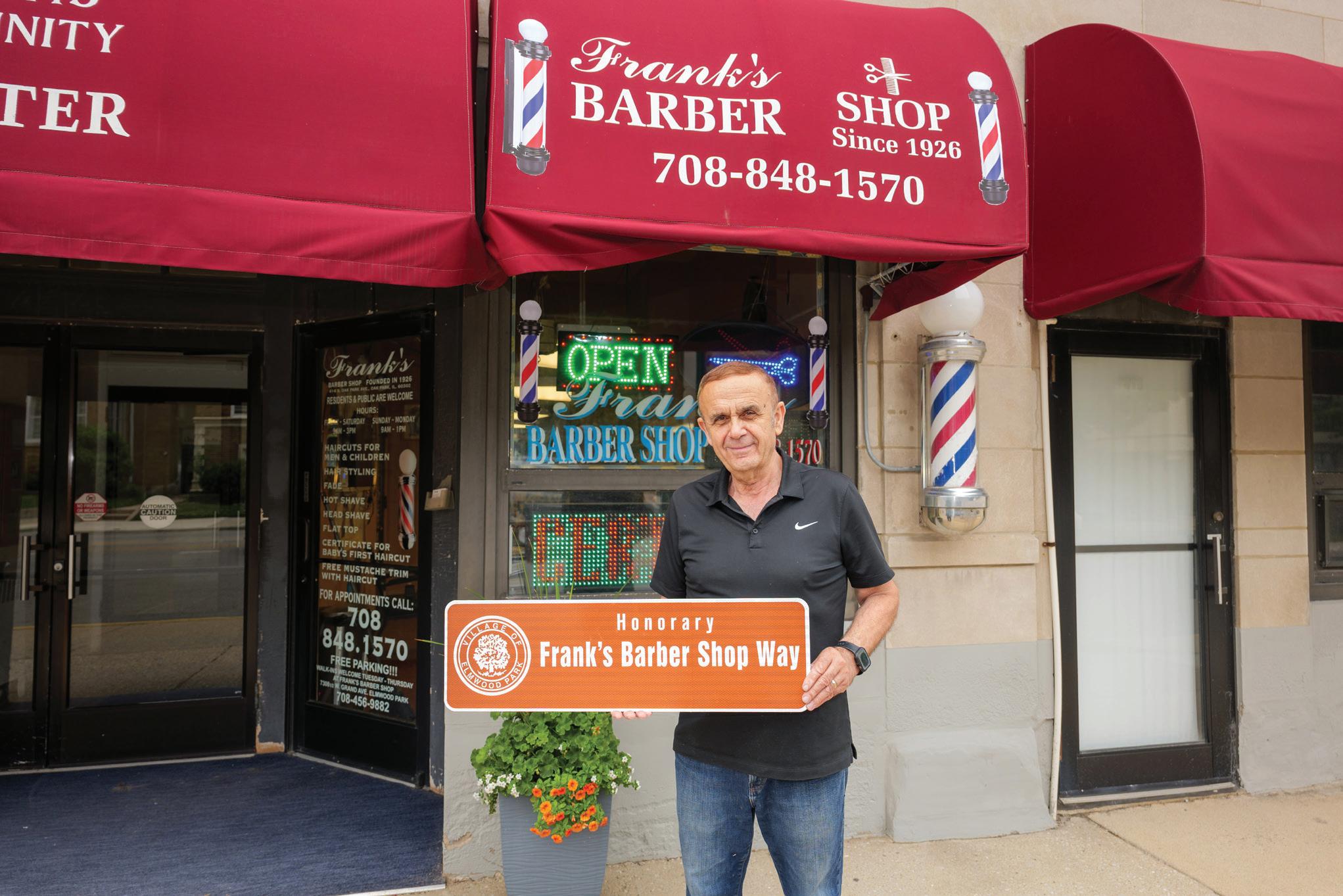
On Sunday morning at Frank’s, 416 S. Oak Park Ave., a gold street sign with the
See BARBER on pa ge 14
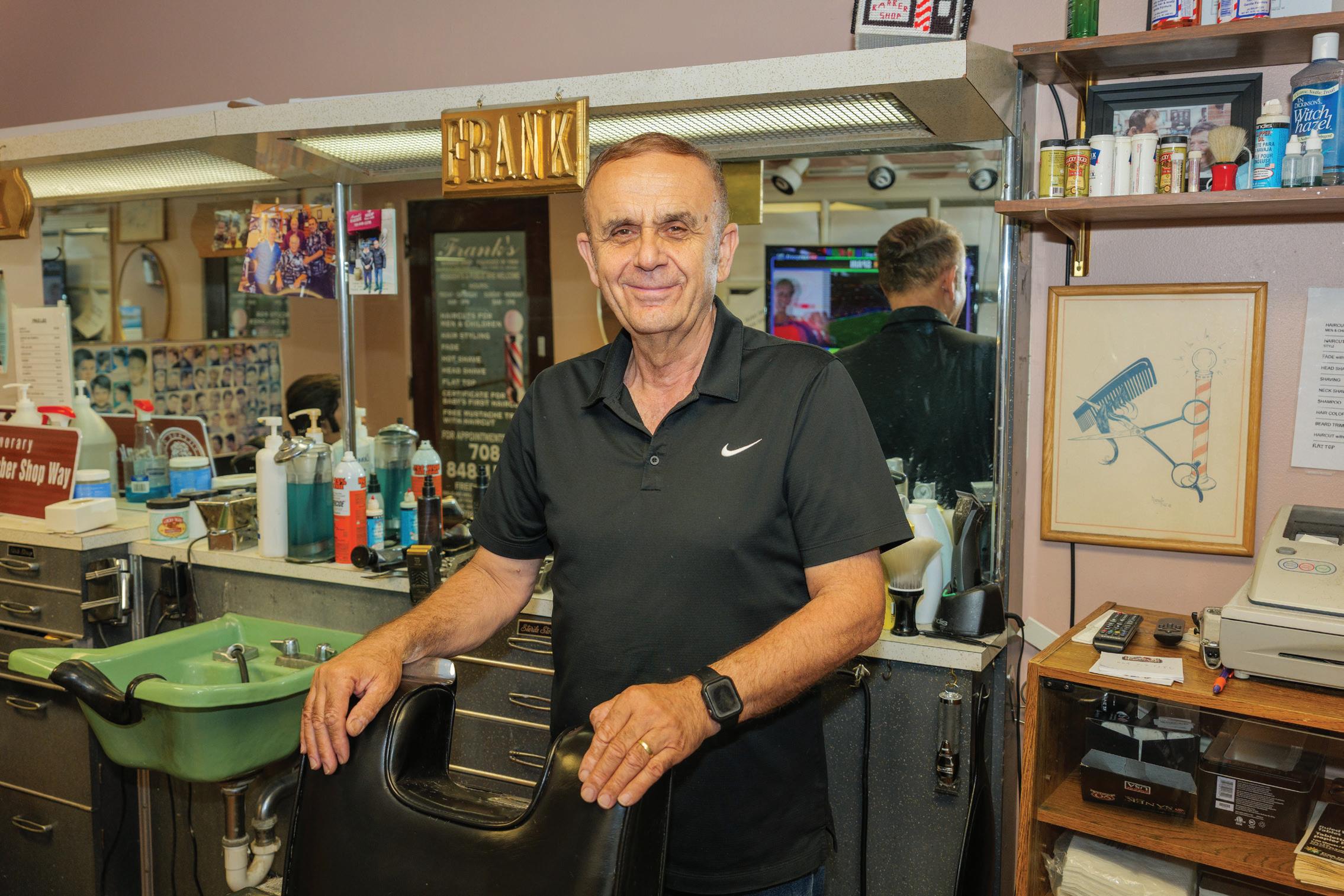
Barber Frank Shemitraku in front of his shop at the Oak Park Arms where Nik Shembitrasi worked until ICE interrupted his life



By BOB SKOLNIK Contributing Reporter
In a little less than six weeks the Oak llage Board will rece ive and vote on hether or not to a ccept proposed changes rk ’s zoning code that are bein g by a c onsulting firm the village ly to eliminate single f amily zoning in Oak Pa rk . But before that happens oard member, Jim Ta glia, wants the oard to allow voters in Oak Pa rk to hether or not they want to eliminate single f amily zoning by having a binding referendum on the q uestion p laced on the November ballot.
See ZONING on pa ge 16

The Historical Society of Oak Park and River Forest presents
Come join us as the Oak Park River Forest Historical Society presents cartoonist Marc Stopeck reflecting on 35 years of his iconic local cartoon, Shrubtown, in the Wednesday Journal. Stopeck will share cartoons spanning his career and discuss the recurring themes in his work, his creative process, and the role of satire in a community newspaper.
June 25, 2026 • 7pm
Oak Park River Forest Museum
129 Lake Street in Oak Park
Audience members are encouraged to bring copies of their favorite cartoons (if they still have them). You will also have the opportunity to ask Stopeck questions, offer up angry criticisms and demand explanations for cartoons that left you confused, baffled and/or offended.





By RISÉ SANDERS-WEIR Eats Reporter
Animal Care League, 1009 Garfield St. in Oak Park, served up hot dogs, tours of the facilities and community awareness at its bark-yard picnic on June 20.
“We’ re more than a shelter, meaning that we want to be part of the community,” said Renee Harlor, the executive director. “Our goal is to show people what we can offer. We also hope to get volunteers and fosters. I just did a tour and I said, ‘The biggest thing you can do is tell people about us because we want people to know we’re here for their companion animals.’”
Stations set up throughout the facility helped the community learn about all the programs and possibilities offered by the nokill facility that serves eight local villages.
For many neighbors, they came for the info and food, but really it was about something else.
“I wanted to see the cute animals,” Giulietta Labriola said.
“I came here to see the puppies,” her brother Luca Labriola said.
One “alumni” of the shelter, a chihuahua named Winnie, came back for a visit with her companion human, David Williams. Winnie was a foster staying at Williams’ home as she recovered her health. Many small dogs have stayed with them before and after, but she stole their hearts, according to Williams
A food tent in the open air play area served beef and veggie hot dogs For adults $10, children $5 the dog came with a drink, chips and dessert. Cupcakes and decorated sugar cookies were provided by Jennifer J. Olenn. Her JJO Bake Co. is a local cottage bakery that specializes in vegan treats.
The expanded facility at ACL opened in 2024. The 19,000 square foot space serves animals and people
“It’s given us the space to offer behavior training,” Harlor said. “It’s done by our behavior team, so it’s positive reinforcement. They have tremendous experience working with the animals. The public can take part in it and alumni animals can get that continued training.”
The staff depends on volunteers to run at its best.
“We can’t do it without them,” Harlor said.

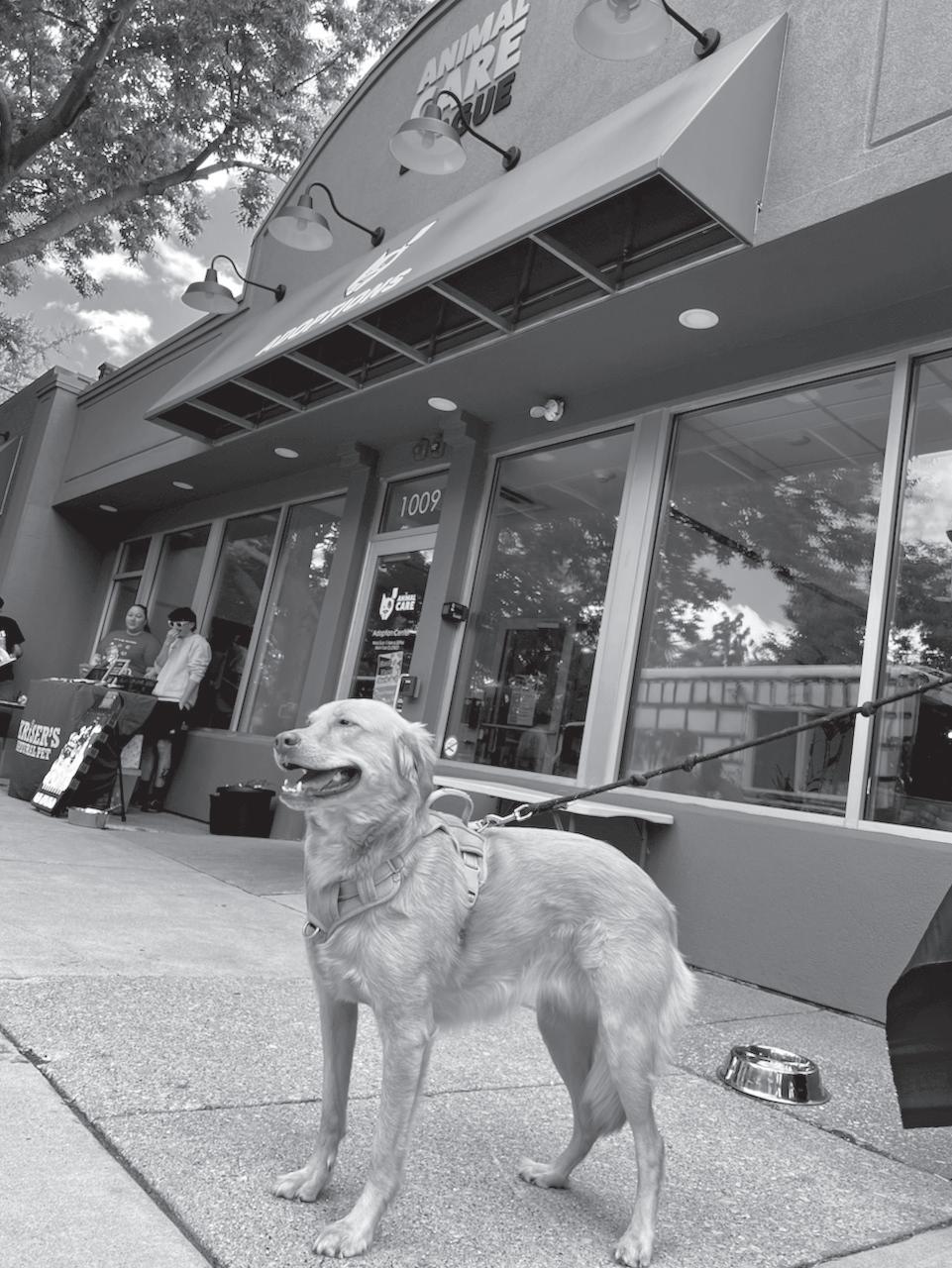
Animal Care League, 1009 Gar eld, Oak Park
“They contribute thousands of hours each month from dog walking, to admin, to setting up events like this.”
A partnership with Kriser’s pet products company helps ACL stock a supply pantry available for anyone who is experiencing financial stress. Supplies from it can also be delivered to homebound seniors.

David Williams and his decked-out dog, Winnie
ACL recently began a junior volunteer program for teens 15-17 years old
“They’re getting experience in customer service,” she said. “They’re doing dishes, washing windows. But then they’re also getting to go into the clinic. All our programs teach responsible partnership and kindness toward all living things.”

Freelain writes book on child-to-parent violence
her. I wanted to speak for Sheila since she can’t speak for herself,” Freelain said.
Oak Park
police officer, devoted much of his casfunctional families and troubled youth. But the case that still haunts him is the brutal esident Sheila von the hands of her daughter Heather and an accomich made international the Bali Weisewas found in a suitcase outside a luxury resort eelain has written a firsthand account, When Lambs Become Wolves, detailing his experience with and the escalating vioextrava-
-cam perworking the three years leading up to Sheila’s murder. I wrote the book because so much media attention was on Heather and I felt like Sheila’s voice was stolen from
Cemetery
Side by side mausoleum crypts available in the Sanctuary of Remembrance. Paid $7000 $2000 each or $3500 for both
(717) 413-0626
Before joining the Oak Park police department in 2002, Freelain, a product of Chicago’s Hyde Park neighborhood, served as an English teacher at Proviso West High School and a teacher at a Park Ridge facility for young people with serious mental health issues, some of whom were quite aggressive
“I feel like life has put me on a path to helping struggling young people. It’s my calling. I’ve always been comfortable with difficult young people that others may have reservations about.” Freelain said.
Freelain’s early years with the Oak Park police were spent as a school resource officer at Percy Julian Middle School and Oak Park and River Forest High School, where he often encountered troubled youth and their families
But nothing prepared him for the turmoil of the Mack family. Freelain, who became a detective in 2007, first met Sheila in November 2010 when he was investigating her alle gation that Heather had stolen her credit card and used it for numerous purchases at Chicago’s
Water Tower Place.
“I immediately sensed a red flag and realized that Heather had a lot of weight in their relationship,” Freelain said. He next met with Sheila in February 2011 when she came to the police station with a cast on her arm. She re ported that Heather had shoved her to the floor, causing a broken arm. The incident confirmed Freelain’s previous misgivings about Heather and led him to believe that Sheila was not safe in the home.
“When I told Sheila that, under Illinois law, Heather had to be ar rested for physical violence, she became very angry and stormed out ofthe station. I thought I would never see her again but she was back the next day, after Heather attacked her again. Heather was ar rested for the first time that day,” Freelain said.
Over the next couple of years, Oak Park police officers responded to do z ens of calls from Sheila re porting Heather’s continued abuse. According to Freelain, the police department was trying to balance ef for ts to respond to Sheila’s dire situation with g etting Heather the resources she needed as an increasingly disturbed child.
In January 2013, in a meeting that
chilled Freelain, Sheila expressed her fear that Heather was going to kill her. A little more than a year later, on Aug. 12, 2014, she was dead.
Freelain learned ofthe murder while he was on vacation. Although he was not surprised, he was shocked to learn that Heather’s accomplice was Tommy Schaefer, an OPRF grad who Freelain knew and of whom he had had a positive impression.
“I knew this was going to happen and still I could n’ t stop it. Heather was one of the most skilled young manipulators I had ever met as a police officer. S heila was an imperfect parent but she was determined to save her daughter at all costs,” Freelain said.
After serving seven years in a prison in Bali, Heather returned to the U.S. and was sentenced in 2024 to 26 years in a U.S. federal prison. Schaefer was released from a Balinese prison earlier this year. He was returned to the U.S. and faces charges in January 2027.
While Freelain was dealing with sorrow and guilt re garding the Mack case, he also was involved in a long, protracted le g al battle with the Village ofOak Park following his re port ofsexual ha-

rassment by a female sergeant and claims of retaliation by the department. The case was resolved in 2021 with a monetary settlement and Freelain’s reinstatement to his post. He was promoted to sergeant before retiring in 2022 with a full pension.
“We all have challenges, and I felt like I faced mine with courage and humility. I’m grateful for the outcome of my situation with the department. I had a great career with the OPPD and I worked with some really good officers and supervisors in Oak Pa rk,” Freelain said.
One ofthe best was Det. Allan Reddins, with whom Freelain worked for several years. Reddins was tragically murdered in the line of duty on Nov. 29, 2024. Freelain was dismayed to learn that the alle ged perpetrator had a history of abusing family members. The connection with the domestic violence leading to Sheila von Weise-Mack’s murder was sobering.
While writing his book, Freelain connected with professionals dealing with child-to-parent violence and abuse (CPVA) and learned that the issue was much more prevalent than he had thought. He asserts that the issue is one ofthe country’s most under re ported crimes, given victims’ feelings ofshame and isolation and
a system unprepared to deal with it
Freelain advises that in 2024, Illinois updated language in the Illinois Domestic Violence Act to reco gnize youth-initiated domestic abuse. In addition, police now have an Adolescent Domestic Battery Typolo gy tool to evaluate youth who batter f amily members and to recommend appropriate responses
Infor med by his years investigating the Mack case as well as his extensive research for his book, Freelain now trains police and social workers on de-escalation techniques and crisis response through the Illinois Crisis Intervention Team (CIT) Training Unit.
He remains committed to seeking justice and chang e, even ifit’s too late for Sheila von Wiess-Mack.
Freelain will discuss and sign his book at The Book Loft Oak Pa rk on June 27 and at Bar nes & Noble on July 5.
Cognitive decline can steal the past, but it doesn’t have to steal the future. Pioneered to curb the effects of cognitive decline, Circle of Friends® is a unique, evidence-based program for building brain fitness. It was developed by Belmont Village in collaboration with the nation’s top universities and healthcare institutions — and it works. Residents enjoy a rich, therapeutic program of physical and mental activities designed to maintain brain function and build self-esteem.
| 708-797-9655

By BILL DWYER Contributing Reporter
Mike’s Place Sports Bar & Grill will remain closed until July 7, under terms of an agreement worked out with the City of Berwyn. The bar, at 6319 W. Roosevelt Rd., which has a long history of noise complaints, rowdiness and violence by patrons, as well as numerous code violations by ownership, has been closed since a June 10 hearing.
Many of those problems have regularly spilled across the street into a residential neighborhood in Oak Park
Under an agreement worked out with Berwyn officials, owner Mike Lapinard stipulated to six counts in the city’s 11-page complaint, agreed to the suspension and to a series of steps he’s required to take upon reopening the bar. He was also charged $500
in court costs
Mayor Robert Lovero, who also serves as liquor commissioner, said Mike’s Place can have no more special events such as live music or DJ parties and other attractions without going through the process of obtaining an entertainment license
“The license fees have exhausted for all special events associated with the standard B-1 tavern license,” Berwyn City Attorney Michael Ochsner, Jr said. “So therefore there’s no more DJ parties, special events, live (music) or anything of that nature, without obtaining an entertainment license that will allow him to do so.”
That is particularly significant, as those special events often created the worst problems at closing, with new people coming from as far away as the far southwest suburbs to attend
Oak Park Chief of Police Shatonya Johnson said her department made a point of monitoring when the bar had such events “We (tried) to find out when they were having special events because it seemed like when they had a special event that they had a larger crowd than their typical night.”
The Village of Oak Park is hosting a public information meeting to present potential Home Avenue Bridge replacements.
The project is studying potential alternatives to the Home Avenue pedestrian bridge over I-290, the CTA Blue Line, and CSX railroad tracks. This is a federally-funded project, and the Public Information Meeting is being held in compliance with NEPA requirements and IDOTs public involvement policy. The public is invited to review bridge replacement alternatives and provide feedback on walking and biking access, accessibility, ramps, lighting, safety, security, bridge appearance, and the user experience. Project personnel will be present to receive input, provide information, and answer questions.
Wednesday, July 8, 2026 | 6:00 pm – 8:00 pm
Oak Park Conservatory | 615 Garfield Street, Oak Park, IL 60304
The meeting will be held in an open house format. All interested persons are invited to attend and participate. Attendees may arrive at any time. For more information or to submit comments, visit: engageoakpark.com/homeavebridge
Comments can also be mailed to: ATTN: Abby Spentzouris, Village of Oak Park, IL 201 South Blvd. Oak Park, IL 60302 Comments received by July 22, 2026 will become part of the official public meeting record.
need a sign language interpreter or other similar accommodations should notify the TTY/TTD number (800) 526-0844 or 711; TTY users (Español) (800) 501-0864 or 711; and for Telebraille dial (877) 526-6670 at least five days prior to the meeting.
The end of special events at the bar was good news for Berwyn resident Mike Maskowski, who lives half a block away. “I think they’ll severely think twice before they hand out another (special events permit) to him, given the past precedents of what he’s done with these events,” Maskowski said.
Other conditions require that for a ter m of 60 days after re-opening Lapinard “shall conclude all liquor sales prior to midnight every day of the week, including the weekends and holidays when the hours are extended.” Ochsner said that after that 60 days, Mike’s Place will be required to “cut off liquor sales 45 minutes prior to closing to discourage binge drinking, and attempt a gradual dispersal.”
Security will “be on the outside of the business at all times and remain until the crowd is dispersed,” and will be “clearly identifiable.”
The bar’s staff will also be required to clean up around the exterior of the bar and “and expand their removal of debris deposited by patrons in the surrounding community.”
Lapinard provided the city a list of manager candidates, with the understanding that the bar “will not operate without a licensed manager or the owner on premises.”
“Sir … do you understand all the terms of the order, and that (it is) what you’re willing to abide by,” Lovero asked Lapinard. “Yes,” he replied.
Maskowski said he’s satisfied, though he has doubts about Lapinard’s commitment, saying, “They’re giving him the rope to hang himself.”
“He’s got his rules now, and what he does with it is in his basket,” Maskowski said “If they violate this (order) they’re probably going to start shutting it down, because with everything that’s happened in the past, there’s a Roberts Rules of Order to doing things, and this is part of the Roberts Rules of Order.”
Maskowski echoed the frustration of Oak

Park residents, saying, “I get tired of being woken up at 2 o’clock in the morning with the police cars coming because of what’s going on in front of his club,” he said. “This has been going on for years, so the rest of the residents are fed up too.”
“I hope he gets the point of what’s going on,” Maskowski said, “because the people in the neighborhood are just getting fed up with being disrespected by his clients. And I don’t think he realizes how badly his clients are disrespecting him, that they’re causing him this much trouble with his business.”
Chief Johnson said she and other Oak Park officials have good relations with Berwyn officials, and she wasn’t inclined to tell them how to address the situation. But she expressed concerns. She said she’s been meeting with south Oak Park residents regularly for the four years since she’s been chief. For a period there was progress. But the last year or so has seen an increase in major incidents.
“I’ll leave it to them to make a decision on how they want to handle it,” she said, adding, “I think that … if that business, if there was no longer a bar, it would provide Oak Park residents a bit of relief.”
Johnson acknowledged the long history of problems at 6317-6319 Roosevelt, saying, “It’s not just Mike and it’s not just that business There were at least four different businesses there, four different bars, and each one has had the same issues. The issues are just -- I shouldn’t say just -- are progressively worse.”
Johnson said several recent disturbances were exceptionally troubling, in particular an April 19 incident in which 75 people were in the middle of Roosevelt Road at 2 a.m., refusing orders to disperse. All on duty police officers from Berwyn and Oak Park were summoned to deal with that disturbance.
“No business should ever require that much police presence,” Johnson said.


By GREGG VOSS Contributing Reporter
Mental health issues have always been a challenge for area youth and their families, but that became much more apparent in wake of the Covid-19 pandemic.
“Coming out of the pandemic, we saw a rise in anxiety and depression,” said Megan Traficano, director of youth and family services for Oak Park township. The township offers its youth engagement program via an intergovernmental agreement with most local taxing bodies, including municipalities, school districts, libraries and park districts. The program supplements what those entities, especially school districts, are able to offer to youth and families in the way of mental health support. Services are free, Traficano said, “because mental health isn’t always covered by insurance. We have a lot of different things we try to provide to youth and families.”
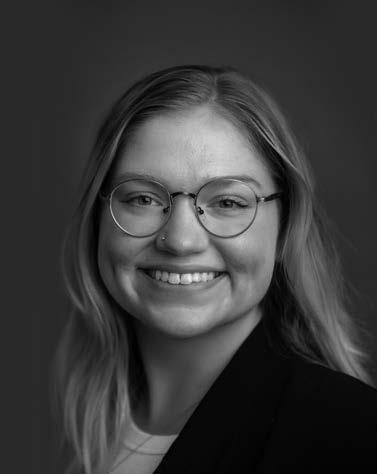
Traficano and Laura Devitt, youth engagement program manager, are both Oak Park natives and licensed clinical social workers. They oversee a team of two master’s degreelevel youth engagement specialists, one of which is also licensed clinical social worker. Together, they work to meet the needs of the 41 youth clients that were in the program at the end of May. The program serves those age 6-18.
Virtually all local taxing bodies are part of the intergovernmental agreement with Oak Park township to participate in the youth engagement program, which is a two-year commitment and is in its renewal cycle in 2026.
Participating bodies include school districts 200, 90 and 97; the villages of Oak Park and River Forest, along with Oak

Park township; Oak Park and River Forest public libraries; and the River Forest Park District. The only non-participant is the Park District of Oak Park; Traficano said that entity “decided the program wasn’t meeting the needs they had.”
But others, like River Forest School District 90, are on board.
“We’ve been pleased at the school level,” said superintendent Dr. Edward Condon at the June 2 board meeting, where the board voted 6-1 to approve its two-year commitment. The only board member who did not vote for the measure was Dr Kristine Mackey, who preferred a one-year commitment.
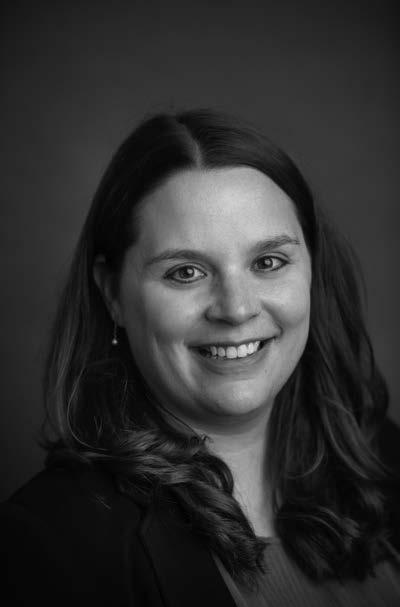
“I’m speaking anecdotally, but the feedback I’ve gotten, especially from the middle school administration (is) students that have been getting supports have benefitted when I look at the dollar value relative to what my understanding is the way it has been delivered here,” he said.
“Not that that’s a fair way necessarily way to look at a partnership, but it’s a pragmatic way, I do think this dollar value is definitely being delivered to the children who are at some of our highest levels for different reasons.”
The Oak Park and River Forest High School District 200 board approved its two-year engagement agreement at its May 28 board meeting. The total cost among all the taxing bodies from July 1, 2026 to June 30, 2027 is $419,770.
That’s an important number for taxpayers, of course, but Traficano said the program value is the assistance she and her team provide to its youth clients. That includes mental health counseling for youth who need assistance in areas like
anxiety and depression, crisis and trauma issues and behavioral and aggression problems
“We work with them on their goals, like their mental health goals,” she said, adding that a youth is typically in the program for up to three months. If therapy is required, that timing jumps to six months to up to a year.
“We have such a great relationship with our school districts, whether it’s the school social workers, the counselors or the deans,” Traficano said. “We really try to wrap around our services with our school partners. A couple of years ago, OPRF approached us; the hours weren’t working because of after-school activities, so we added hours in the evening for everybody
“I think sometimes we’re just that extra supplement,” she said. “Schools are so busy during the day; we can help with referrals. We may not be the right place for each child or family, so we want to make sure the child and the family get to the right place.”
Area families or youth who are experiencing mental health challenges can reach out to Traficano and De vitt at the youth enga gement program via youth@ oakparktownship.org
A story in the June 17 edition of Wednesday Journal headlined “Debate on Israel boycott returns to Oak Park” was updated to clarify a quote from Caren Van Slyke.
The updated quote re garded her view on the impact of a state law on Illinois pension returns.
By BILL DWYER Contributing Reporter
Attorneys for both sides in the ongoing legal battle between West Suburban Medical Center CEO Manoj Prasad and his landlord and West Sub co-owner Rathnaker Patlola Reddy ag reed in court Monday that a settlement is currently in the works.
T hey pointedly disag reed, however, over how soon any settlement might be finalized, and on the appropriate de gree of urgency re garding the matter
In the meantime, Commonwealth Edison is re por tedly preparing to shut of f West Sub’s electricity in July if it doesn’t receive payment.
Attorney Scott Kaplan, re presenting Reddy’s Ramco real estate company, appeared in person in Cook County Circuit Court Judge Patrick Stanton’s courtroom. Martin Tasch, attorney for Prasad’s Resilience Healthcare, appeared via Zoom.
Kaplan said the two sides are making progress towards settling but still had details to work out. He said another meeting is planned for this Tuesd ay
“Hopefully we’ ll iron out most of the issues,” Kaplan said.
Numerous vendors have sought to recoup money owed by Prasad and Resil-
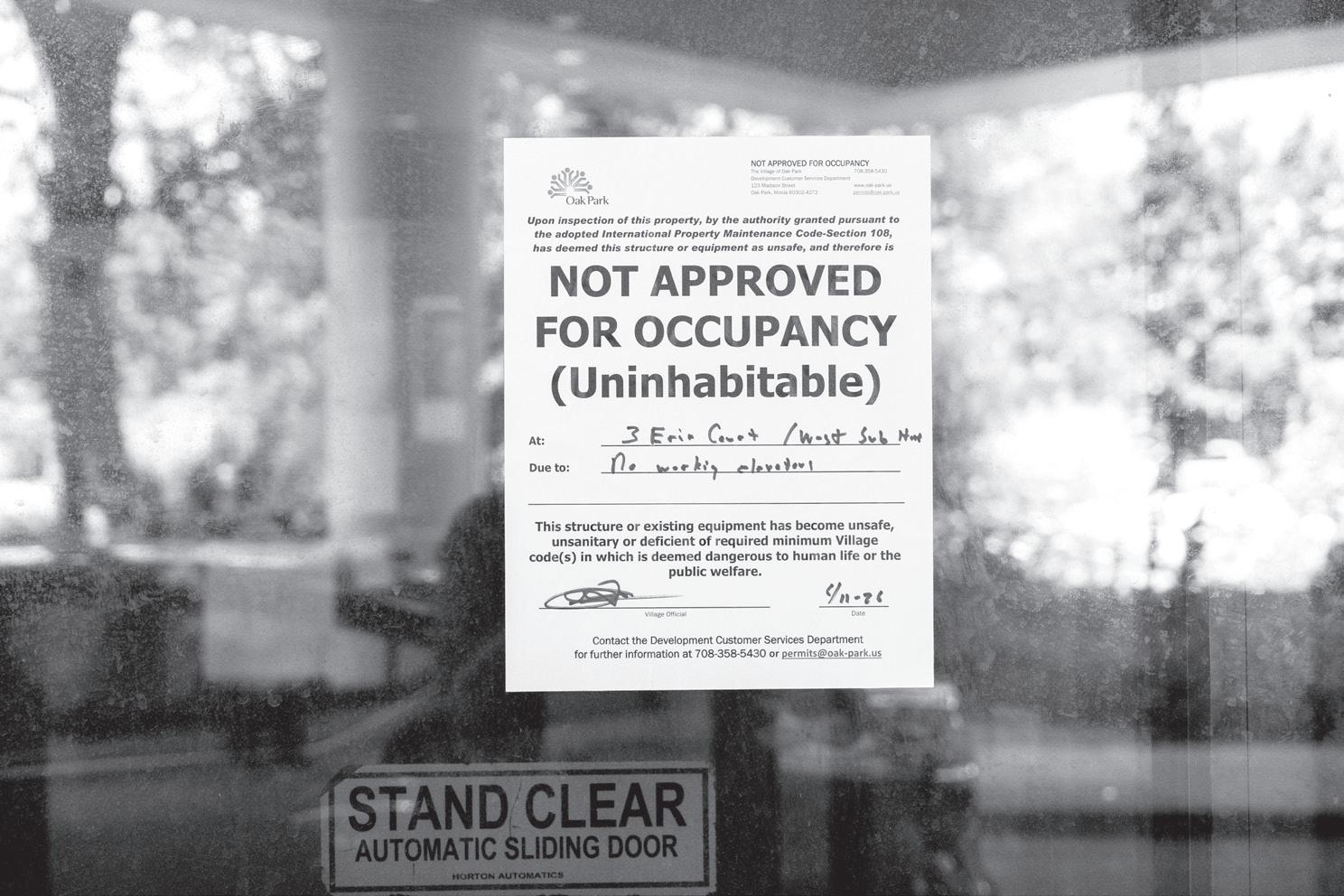
Not Approved for Occupancy sign on door of West Suburban Hospital on June 22.
ience, with several filling lawsuits. Commonwealth Edison may soon join that list. Kaplan told the judge the utility company had posted a sign on the hospital doors, stating that the building’s electrical service would be cut of f as of July 8 due to unpaid electric bills.
The utility’s notice joins a notice from
the Village of Oak Park, notifying the public that the hospital is closed due to having no working elevators.
“There’s a plan in place to try to get that resolved,” Kaplan told the judge re garding the elevator situation. He said the parties were moving quickly toward a resolution and asked the judge for another meeting
later this week, saying “If anything is (still) unresolved, it can be discussed in (the judge’s) chamber.”
“Time is of the essence,” Kaplan added. Tasch, however, did not seem to share that sense of urgency, telling the judge, “It cannot be done quickly.”
Tasch also told Stanton that he didn’t care for Kaplan’s approach to the negotiations, saying “Mr. Kaplan has been sending out ultimatums if we don’t (move as quickly as he’d like).” Tasch suggested another court hearing in 10 days.
Kaplan pushed back, saying “I don’t know if I’d ag ree the discussions weren’ t expeditious.”
Judge Stanton appeared to side with Kaplan, saying, “This needs to be done with all deliberate speed,” and set the next hearing for Thursday, June 25, at 10:30 a.m.
Tasch also expressed unhappiness with what he said was the disclosure of confidential infor mation re garding the case.
“Confidentiality is very important to us, and that seems to have been lost here,” said Tasch. “It’s out there in the community being talked about.”
“We’ re fully aware of confidentiality,” Kaplan said.
“All right,” Stanton said before moving onto the next case. “Everybody gets to take the temperature down.”
By BILL DWYER Contributing Reporter
A Miami-based commercial mortg agebacked securities trust, or CMBS, that holds the bonds tied to a mortg age on two properties owned by the landlord of West Suburban Hospital, has filed a $33.8 million lawsuit that seeks to take back properties in River Forest and in the Uptown neighborhood in Chicago.
The Real Deal Real Estate News reported Monday that Miami-based Rialto Capital
Advisors, which is the special servicer for a $22 million loan to West Sub landlord Rathnaker Patlola, filed the lawsuit after attempts to work out a resolution with Patlola failed after re peated attempts to contact him failed.
According to the Real Deal, the foreclosure lawsuit was filed in Cook County Circuit Court on Friday. It seeks a $6.2 million “yield maintenance premium” and $1.4 million in default interest.
The Real Deal says the lawsuit would effectively bypass the ongoing legal tangle
between Patlola and West Sub CEO Manoj Prasad. It does not target the one square block West Suburban Hospital property on Austin Boulevard, which is owned by Patlola but re gistered under a different corporate name.
A status hearing is scheduled Monday morning downtown in the Daley Center courthouse.
The Real Deal coverage suggests that Patlola is between a financial rock and a hard place. A key challenge facing Patlola, the newspaper found, was that with CMBS
debt, “once a loan reaches special servicing it cannot be refinanced, which means equity cannot be taken out of the property to pay down debt.”
The lawsuit names the corporate entity for a 945-space parking garage in Chicago’s Uptown neighborhood — Clarendon Realty, LLC — and River Forest Realty LLC, the name under which the parcels that comprise the River Forest Campus — 7420 Central Ave., 420 William St. and 7411 W. Lake
Continued on next pa ge
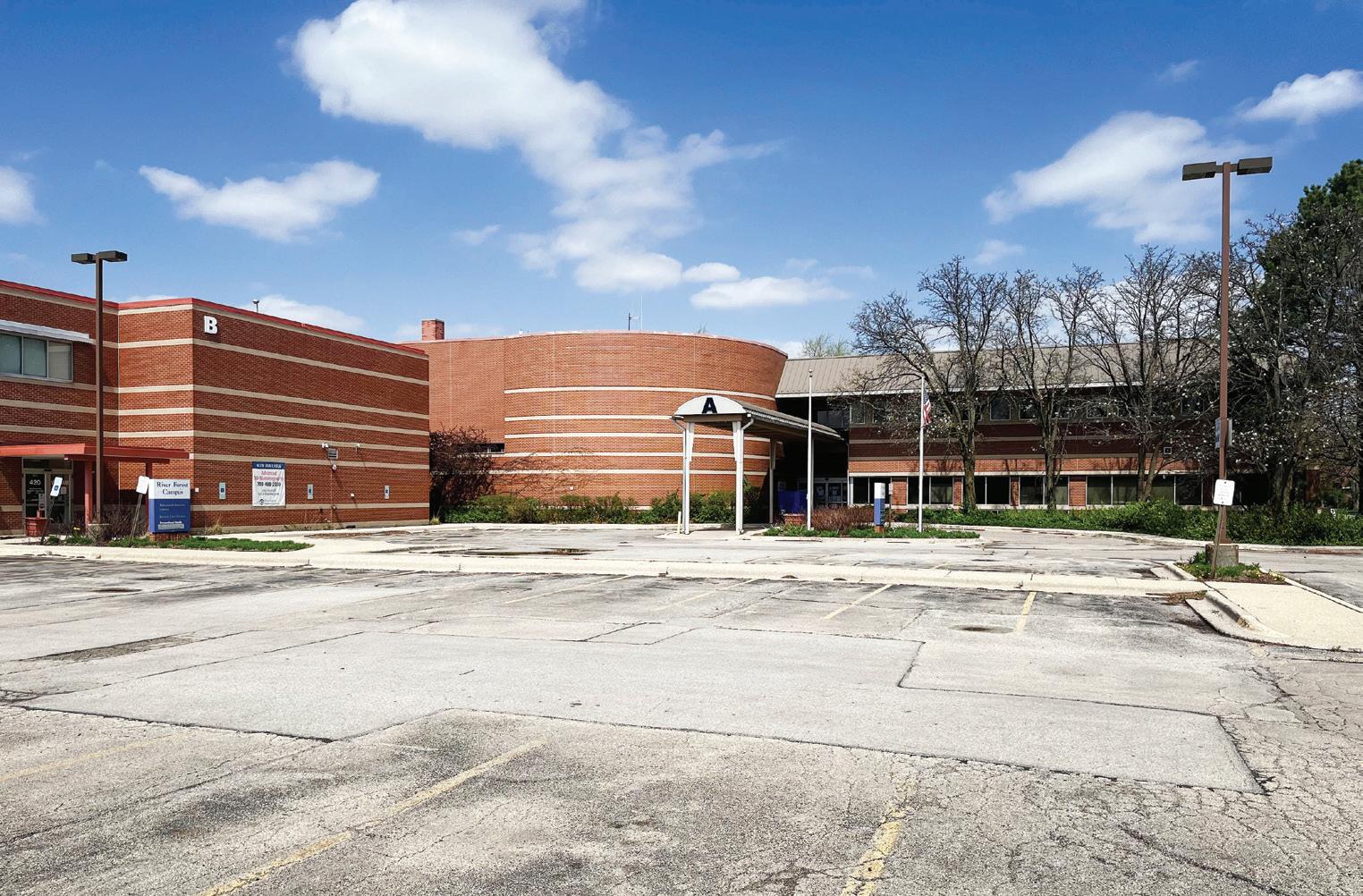
St. — are re gistered. All are controlled by Patlola as “sole member.”
T he Uptown site is part of the shuttered Weiss Memorial Hospital campus which is also owned by Patlola.
According to T he Real Deal, and confirmed through the Cook County Recorder of Deeds, the loan originated in October 2023, for $22 million. According to Cook County Recorder of Deeds record s, Patlola’s River Forest Realty, LLC and Clarendon Realty LLC received a $22 million mortg age from Argentic Real Estate Fin 2 LLC.
In the latest filings with the Illinois Secretary of Stat e, Patlola is listed as the President of Clarendon Realty, with an address in Princeton, New Jersey. River Forest Realty, LLC is managed by River Forest Realty Holdings, LLC, of which Patlola is listed as president.
Argenti c, headquartered in New York City, with offices in Chicago and five other cities, manages commercial real estate lending and investment vehicles focused on providing fixed-rate and floating-rate debt financing solutions to property owners throughout the United States.
T he mortg age note was signed by Patlola as “sole member.” T he debt has since grown to $33.8 million and is accruing interest obligation at a rate of $8,560 per day, due to the Patlola controlled entities alle gedly not paying property taxes on the real estate parcels beginning two years ago in mid-2024.
T he Real Deal re ported that that nonpayment of real estate taxes forced PNC Bank-owned master servicer Midland

Loan Services “to advance $3.4 million to protect the collateral.”
T he Real Deal said Patlola told them he was “informing his attorneys of the foreclosure lawsuit and intends to resolve it amicably,” but declined to comment further.
As re ported by T he Real Deal and other media outlets, for mer West Sub owner Pipeline Health holds a subordinate mortgage note that is tied to Resilience Healthcare’s operations. The publication cites court records indicating that Patlola’s tenants, which “are affiliates of the Resilience Healthcare operator group run by Prasad,” defaulted on the $67 million note in December 2024. Pipeline then attempted to reclaim control of Resilience Healthcare’s books and records. When Resilience refused, that froze the “debt stack.”
A 2023 Real Deal article sheds light on Patlola’s financial situation. T he mere fact that he needed to utilize a commercial mortg age-ba cked securities trust indicates he had limited financing options.
As T he Real Deal says in its December 2023 ar ticl e, and other real estate and leg al websites confirm, CMBS borrowers “have to go through a lengthy process with their special servicers before the debt can be modified,” unlike with a conventional bank mortg ag e. In order for modifications to go through, “bondholders must approve the changes through a trust, a process that the newspaper said, “can take borrowers up to a year or more.”
T he longer a loan sits in special servicing, T he Real Deal article said, “the larger the fees and interest it ha(s) to pay…” The default interest, the paper said, goes to the special servicer, not the bond holders.











Rescheduled

5TO9PM
MARION ST.

MARIONST. JUNE 26 5 TO 9 PM













By BILL DWYER
Contributing Reporter
Last week newly released grand jury transcripts disclosed a grand juror telling Broadview 6 prosecutor Sheri Mecklenburg last October that her case was “a crock of s**t.”
In the past 24 hours that crock has hit the proverbial fan, as lawyers recently acting as defense counsel are now fully on offense against the gover nment, demanding sanctions, an investigation and full accountability for a litany of alleged misconduct.
Lawyers for the now exonerated Broadview 6 defendants, including Oak Park village trustee Brian Straw, filed two motions Tuesday, one seeking the appointment of a special counsel, and the other asking for an evidentiary hearing before Judge April Perry.
The motions were filed by attorneys for all six Broadview 6 defendants, including Christopher Parente and Damon Cheronis, the attor neys for Straw.
Around the same time as those court filings, a senior Congressional Democrat sent a letter to the Illinois Attorney Registration and Disciplinary Commission calling for the commission and U.S. Department of Justice’s Office of Professional Responsibility to “immediately open an investigation into U.S. Attor ney Andrew Boutros.”
An evidentiary hearing in Judge Perry’s courtroom could lead to sanctions imposed by the judge; the special counsel could potentially bring criminal charges if cause is found
The gover nment has already waved a legal white flag of sorts, stating it would “not contest that defendants are entitled to their le gal fees.” The defense suggested that that was more a matter of desperation than principle, saying the offer was made “largely to avoid
having to produce the requested discovery (which appears to have struck a nerve) and a full accounting of its conduct.”
Parente and his legal colleagues are casting a wide net intended to determine just who played a role in the decision last October to indict and prosecute the case, and who was responsible for the alleged cover up of grand jury misconduct by prosecutors.
“There is no doubt the Court can – and should – conduct an evidentiary hearing on sanctions for the prosecutorial misconduct in this case, both the misconduct that is already manifest, and additional misconduct which we anticipate is yet uncovered,” the motion argued
Parente and others also argued that without a deep dive by an outside special counsel, the DOJ could conveniently scapegoat Mecklenburg, who has already acknowledged in transcripts that she engaged in inappropriate conversations with two grand jury members and is shown engaging in other questionable behavior.
They contend there are numerous DOJ officials responsible for the misconduct, including Boutros and his superiors in Washington D.C.
The hearing would seek to “discern the full factual record and inform any potential sanctions for that misconduct,” Parente said. “Indeed, these steps must be taken in large part because of what appears to be a determined effort to blame a single prosecutor when the misconduct now known … runs much deeper and indeed to the highest levels of the Chicago U.S. Attorney’s Office and likely to the Department of Justice in Washington D.C.”
On Tuesday U.S. Rep. Jamie Raskin, (DMaryland), the ranking member on the House Judiciary Committee, continued the theme voiced by both the Broadview Six defense team and the judge, that long-held

“tampering” with the grand jury, saying he and his team “corrupted and contaminated the deliberative process, hollowed out the protection that the Constitution guarantees and violated the would-be defendants’ right to due process.”
“Mr. Boutros personally appeared before a panel and invited any grand juror ‘struggling’ with ‘the immigration cases’ to ‘raise your hand and identify yourself, because we have a different procedure for that’ besides serving on the grand jury,” Raskin wrote “Hours later, on its third try, the gover nment finally secured its indictment.”
“None of this is how justice is supposed to work in America,” Raskin wrote. “Enshrined in our Constitution, grand juries are supposed to stand as a neutral arbiter between the state and the accused, carefully weighing the evidence and rejecting flimsy or unjust charges on behalf of the people.”
In their motion for an evidentiary hearing, the defense team cited Judge Perry’s own
rding her trust in and motives hav, hsaid in the e t parably harmed the defendants’ rights, lives and livelihoods, thoroughly undermined the grand jury function, and significantly damaged the public’s trust in our criminal justice system.”
Brian Straw and his attorney, Chris Parente, will join moderator Charlie Meyerson for a conversation about their Broadview 6 experience in an event hosted by Wednesday Journal. The conversation will be held June 25 at 7 p.m. at the 19th Century Club, 178 N. Forest Ave. There is no charge for admission.
By BOB SKOLNIK Contributing Reporter
director of Thrive told the village board at its June 18 meeting
JunemarksAlzheimer’s&Brain AwarenessMonth—atimetoraise awarenessabouttheimportanceof brainhealthandsupportthose impactedbyAlzheimer’sandother formsofdementia.
June marks Alzheimer’s & Brain Awareness Month a time to raise awareness about the importance of brain health and support those impacted by Alzheimer’s and other forms of dementia
Oak Park continues to move toward an alternate response model for responding to emergency mental health calls and other non-criminal calls to 911.
Maintainingbrainhealthstartsearly. Belowtipsarealllinkedtoreduced riskofcognitivedeclineandcan helpkeepthebrainsharp regularphysicalactivity abalanceddiet socialengagement mentalstimulation simplehabits—likewalkingdaily, reading,orlearninganewskill—
Maintaining brain health starts early. Below tips are all linked to reduced risk of cognitive decline and can help keep the brain sharp regular physical activity a balanced diet social engagement mental stimulation simple habits like walking daily, reading, or learning a new skill
Last week Oak Park’s village board voted unanimously to direct the board’s finance committee to come up with $472,676 in next year’s budget to fund an expanded relationship with the Thrive Counseling Center and more permanently fund the ECHO (Engaging Communities Outcomes) program as Oak Park continues to move towards responding to more non-criminal emergency calls, especially mental health crisis calls, without po lice officers.
Jonathan Burch, an Oak Park assistant village manager, said the ultimate goal, which could possibly be achieved as early as next year, is for the 911 dispatcher to evaluate the situation and, if appropriate, send only a Thrive crisis intervention worker to respond to a call without the police being present at all. That goal was supported by Cheryl Potts, the executive director ofthe Community Mental Health Board ofOak Park Townshi
cludes $175,000 to pay Thrive for the services it already provides so the net amount needed for both programs next year is $472,676.
Burch said that while the village staff are not currently recommending that the ECHO program be expanded next year he did provide the numbers of what an expansion ofthe ECHO program, which primarily responds to social service needs, would look like
The expansion ofECHO outlined in the presentation to the board would consist of adding five new staff members to the curent three person ECHO team. The addiost is projected to be just over $600,000 when other expenses are factored in.
It’salsoimportanttorecognizethe earlysignsofmemoryloss.These mayinclude forgettingrecentlylearned information repeatingquestions difficultymanagingfinances strugglingtofollowconversations misplacingitems experiencingchangesinmood, personality,orjudgment. Whileoccasionalforgetfulnessis normalwithaging,consistent patternsofthesesymptomsmay indicatesomethingmoreserious.
It’s also important to recognize the early signs of memory loss These may include forgetting recently learned repeating questions difficulty managing finances struggling to follow conversations misplacing items experiencing changes in mood, personality, or judgment While occasional forgetfulness is normal with aging, consistent patterns of these symptoms may indicate something more serious.
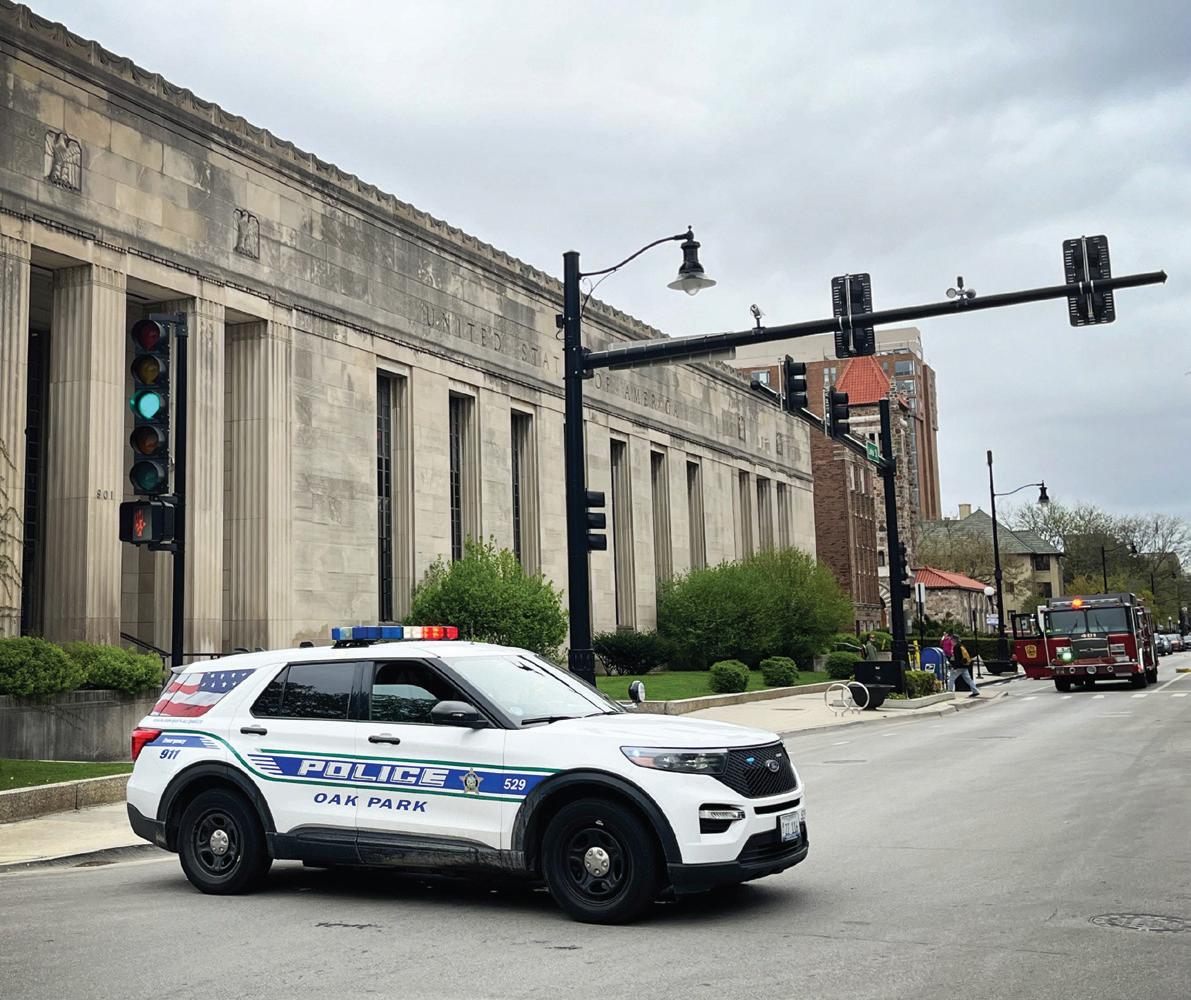
Three members ofthe village board, trustees Brian Straw, Cory Wesley and Village President Vicki Scaman were ready to move forward with expanding ECHO next year while the other our village board members were not there yet.
Village Trustee Derek Eder was nterested but wanted more information.
“I’m curious to explore it,” Eder said. “If it’s a true alternative response I’d be interested.”
Ifyouoralovedoneareexperiencing anyofthesesigns,consulta healthcareprofessional.Early detectioncanleadtobetterplanning andimprovedqualityoflife.
If you or a loved one are experiencing any of these signs, consult a healthcare professional Early detection can lead to better planning and improved quality of life
The idea is that armed police officers are not needed for many mental health calls and some other crisis calls and that the presenc ofarmed officers sometimes escalates a situation. The current practice is for police officers to respond first to a crisis intervention call while Thrive crisis workers are staged close by Once the police determine that the situation is safe the Thrive crisis interventionists move in and take over.
VisitCantata.orgformore seniorlivingadviceorcall (708)387-1030.
Visit Cantata.org for more senior living advice or call (708) 387-1030


Upcoming changes to the WestCom 911 police dispatch system, which serves River Forest and Forest Park as well as Oak Park, that are expected to be completed late this year, would for the first time allow the dispatcher to send a Thrive mental health worker directly to respond to a noncriminal mental health crisis call.
“When these calls come into 911 we would proactively go out with police, and partner with police then to be present on those calls and the goal would be as soon as we identified that the situation seems be safe and there’s no concerns or anything like that we would then move police along and we would follow up with the work that we do on assessing the clinical needs and what we could do from there,” Sarah Weimeyer, the clinical
“Police should not be at a mental health crisis response unless there is an immediate threat,” Potts told the village board.
Currently Thrive and ECHO respond to only 0.15%
Next year Oak Park expects to pay Thrive $303,276 for crisis workers and spend $344,400 on ECHO. This year the village is paying Thrive $166,000 annually. Since the ECHO unit was started a few years ago it has been funded as a pilot program by a onetime $1.1 million set aside. Now that the village wants to make the ECHO program permanent, and perhaps expand it in the future, the village needs to fund ECHO in its annual budget. The current police budget in-
Trustee Jim Taglia said he was concerned about expanding the program given financial pressures the village is expected to face in the future. Taglia said that while the village’s financial situation is currently good, operating deficits are projected in five years.
“I want to make sure that what we’re going to do is sustainable for 10 years, 20 years,” Taglia said. “There’s no point in getting into something and then having it fail. This board wants everything to be successful.”
But Straw noted that an ECHO program could also save the village some money, presumably on police staffing.
“It ultimately has the potential to be a win, win, long ter m, for the community providing both better service and, in the long term as we move to an alternative response model, it creates an opportunity for cost savings,’ Straw said.
By ROBERT J. LIFKA Contributing Reporter
A project to improve pedestrian safety at two Lake Street intersections in River Forest is expected to begin this week following village board action June 22. But similar work on two other intersections will not happen until later this year.
The five trustees present voted unanimously June 22 to approve a contract with Acura Inc. of Bensenville for traffic calming improvements at intersections at William Street and Jackson Avenue. Trustee Erika Bachner did not attend. The cost is $242,112. Adding a 10 percent contingency of $24,111 makes a not-to-exceed total of $266,323.
Jack Bielak, director of public works and engineering, said trustees are expected to consider a contract for similar improvements at intersections at Franklin Avenue and Edgewood Place “toward the end or
summer or early f all.”
He said improvements at Franklin and Edgewood will be partially funded by an Illinois Department of Transportation (IDOT) Safe Routes to School grant of $179,828 and addressing the additional requirements with the grant “will take more time.”
Total cost of the project is estimated at $550,000.
Village officials said the motivation for the upgrades is improving pedestrian safety, citing resident input at community meetings, including the village board and at the Casual Conversations series with village of ficials.
The project includes curb extensions, also called bump outs; a Rectangular Rapid Flashing Beacon (RRFB); and median refuge islands. The project also includes drainage improvements, sidewalks, Americans with Disabilities Act (ADA) ramps, pavement markings and final restoration.

Village Administrator Matt Walsh said the grant funds are specifically for the bump out at Edgewood and the RRFB at Franklin. Refuge islands will be at William and at Jackson.
In a separate 5-0 vote, trustees approved a resolution authorizing execution of a joint funding ag reement with IDOT for the project. The village’s application for the grant was supported by letters from District 90 and St. Luke’s Catholic Parish.
“These upgrades are a great start, but staf f is exploring additional ways to supplement these upgrades to make the crossings even safer for residents,” Walsh said.
The project has been in the works for more than a year.
In a memo to Walsh, Bielak wrote that Lake Street is under IDOT jurisdiction from Harlem Avenue going west through the Village of Bloomingdale where it turns into U.S. 20. Lake Street east of Harlem Avenue is owned by Oak Park and the City of Chicago for their respective segments.
Lake Street has a functional classification of Minor Arterial and in 2023 had an annual average daily traffic figure of 9,700 vehicles. Lake Street has existing curb extensions that were built in 2010 at Keystone, Forest, Park, Franklin and Ashland avenues.
Jackson and William are both situated along the commercial corridor of Lake.
The intersection at Jackson experiences high pedestrian traffic due to the nearby Jewel-Osco grocery store and a Pace bus stop. Several pedestrian-related accidents have been documented at this location over the past five years.
The William intersection serves West Suburban Hospital’s River Forest campus which is currently closed. It is adjacent to a large residential complex and multi-family housing on the north side of Lake and the eastern corner of William. This intersection has also seen a notable number of recorded accidents
“Enjoying life - making connections - maintaining independence”
Our beautiful 6-story building provides quality, a ordable, independent housing for seniors. We o er 75 studio and one-bedroom apartments. Amenities include an award winning interior landscaped atrium, central meeting room, library, laundry facilities, computer learning center, internet access, electronic key entry system, parking, onsite management, and 24/7 emergency maintenance service. e Oaks is funded by the Department of Housing and Urban Development through HUD’s Multifamily Housing Program. Monthly rent is based on the resident’s income, with individuals paying approximately 30% of their monthly income toward rent. For more information, please visit us at www.oakparkha.org or contact us at 708-386-5812.




from page 1
embossed name “Nik” was posted above the head of his uncle and boss, Frank Shemitraku, who seemed to work hard to maintain a positive posture.
“He’s not just my ne phew … he did everything,” Shemitraku said. “Work hard, two jobs, help each other. His wife is (a) U.S. citizen, his daughter was born here. His parents are le g al here. How can they take this guy outside and separate (him) from the family ?
“Who is going to support (them)? His daughter is 8 years old. He’s the only guy to support his people.”
About seven years ago, Shemitraku purchased his Oak Park barber shop, which complements his 100-year-old location in Elmwood Park Shembitrasi started working for him shortly afterward, after acquiring his licensure in cosmetolo gy.
On Sunday, Shemitraku recalled the youthful Shembitrasi in Albania, who was always quick to jump in to help. Just like his adult counter part
“Anything you told him to do, he (would) never say no,” he said. “Same thing working here. Anything I said to him, he was ready. He worked construction. He just bought a house in Elmwood Park a year ago.
“Very nice with customers, he treats the customers nice and a lot of respect for everybody.”
But things went south on a Sunday last month, said Shemitraku, who was working at his Oak Park location at the time. At about 9 a.m. that day, his niece – Shembitrasi’s sister – called to relay the news.
“He came outside to meet his father for
some coffee, Albanian coffee,” he said. “He just (went) to the car.”
At that point, Shemitraku shrugged, indicating that was the moment his nephew was apprehended by ICE agents. From there, Shembitrasi was transported to ICE’s Broadview facility before moving on to Indiana.
“He called his wife, he told her the situation, and now, we hope,” he said.
Shemitraku has not been to Indiana to meet with his nephew but did speak to him
on the phone late last week.
“He cares about his family, especially his daughter, who is very close with him,” he said. “She has friends … ‘Why did they take my father?’”
But more importantly, Shemitraku said, Shembitrasi has been told little by ICE about his situation. He has a Chicagobased attorney, who declined a Wednesday Journal request for comment via Shemitraku. Shembitrasi’s wife also declined com-
ment.
Wednesday Journal attempted to reach Shembitrasi via ICE’s media relations apparatus but was unsuccessful.
Wells said he’s concerned for Shembitrasi, but not only him.
“Why would you take a law-abiding citizen with a job, with no problems at all?” he said. “People don’t realize how serious this is. It’s intimidation, a lot of it
“They can do anything they want.”









CSmack in the middle of a typically dry review of the upcoming year Park and River
200 Community Finance Committee member Michelle Mangan got into a pointed and contentious back and for Supt. Greg Johnson during the June 16 meeting of the OPRF Community Finance Committee (CFC).
Mangan questioned the allocation of $750,000 toward paying design of the Act 3 project to demolish and rebuild the southwest po building to impr tice areas for the perfor that is now estimated to cost $84.6 million.
Back on April 30, Mangan and fellow CFC member Bob Spatz presented a to the OPRF school board on evidencebased funding that ing to the model, OPRF underspends on instructional supports such as tutoring. At the June 16 meeting, Mangan wondered whether that $750,000 would be better spent on academic measures to boost student performance.
When Johnson on the Act 3 schematic design was a function of where the district was facilities planning and that boosting tutoring and implementing a new instructional coaching model was on the administration’s radar Mangan was not satisfied.
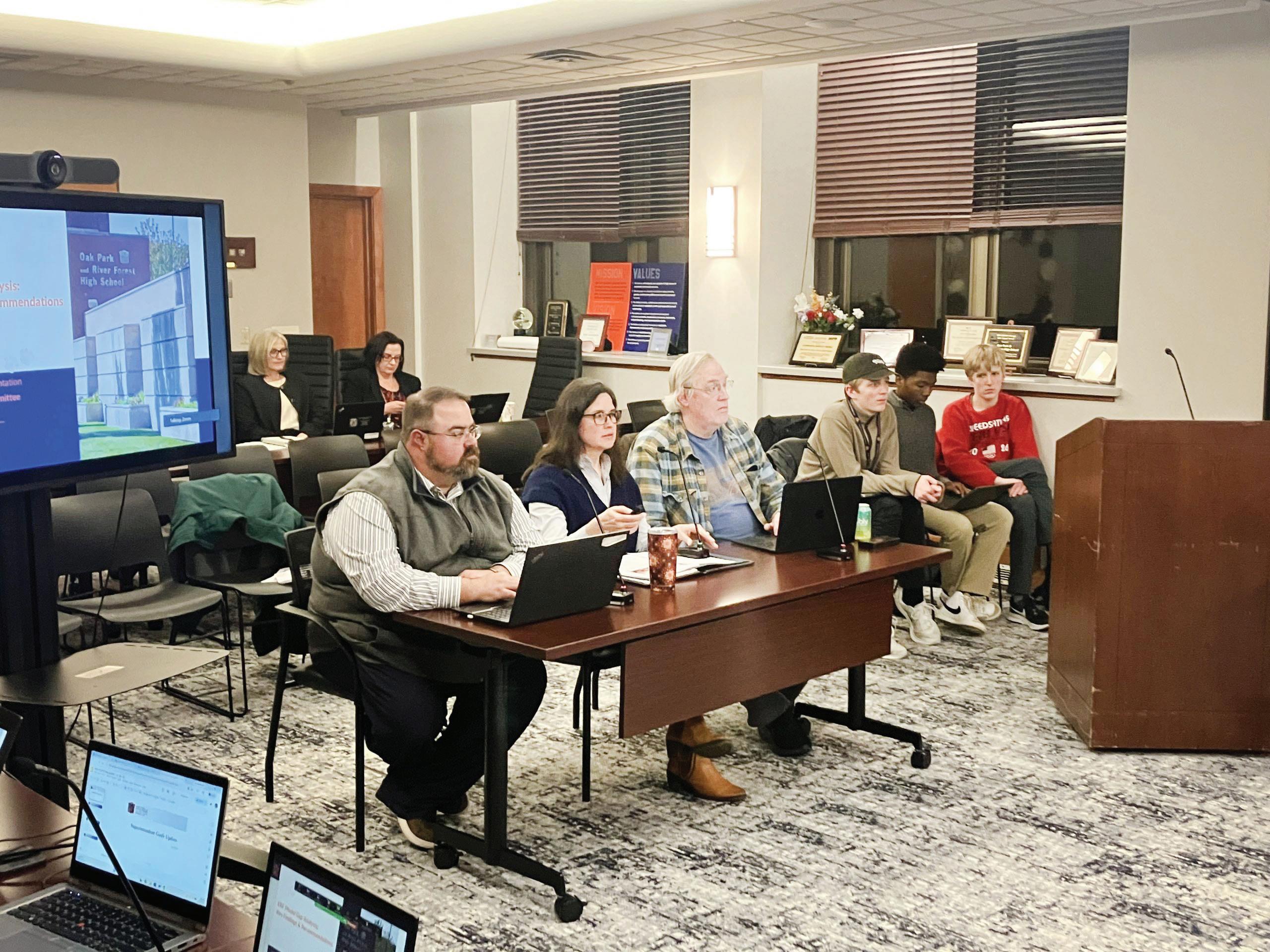
OPRF Assistant Superintendent for Business Services Anthony Arbogast (le ), and Community Finance Committee members Michelle Mangan and Bob Spatz present the CFC’s report on evidence based funding at the April 30 OPRF school board meeting.
Mangan said. “What I’m saying is that een doing has not met are not meeting seeing positive wth in student outcomes isn’ t supat we are seeing in students across the board,” Johnson said. going to take esources,” Manonceded that there is more to ohnson told to be done and if said tonight seemed that work to absolutely work to do. are already ogr ams, curunction as evidencewho helped llinois and elseommunities ears,” Mandon’ t know you know, we have to take a year to do that. That doesn’t really make sense to me.”
“That’s a, you know, unsatisfactory answer,” Mangan bluntly told Johnson. “I’m very disappointed to hear that. I think that, that’s fine that there are some longstanding plans for construction. That’s a priority that you’ re stating that that’s the priority and by not addressing the gap that we have with our students this year I’m very confused. You’ re just doing the same thing that you did last year so I’ll re phrase my question, what are we doing to help students now.”
Johnson seemed to take offense at the suggestion that OPRF is doing nothing new to help students academically.
“There’s all sorts of work that we’re doing on a re gular basis to help our students,” Johnson said seeming to suggest that it was unrealistic to expect major changes next year based on a re port the administra-
tion received a few months ago. A beefed up tutoring program and an instructional coaching system is expected to be in place for the 2027-28 school year.
“To suggest that and somewhat imply that we aren’t doing things for kids to help to kind of improve the outcomes is odd, I don’t understand that in the slightest, frankly,” Johnson said. “We’ re doing all sorts of curriculum work, all sorts of work to help support students and enroll in and find success in honors and the highest level class we possibly can do across the board. We’ve done significant work with our math curriculum over the past few years. We know the work we’ve done with our freshman curriculum and so I appreciate the urgency and I think the urgency is real.”
Mangan was undeter red. She pointed out that the evidence-based funding model
has been around since 2017 and noted that OPRF is ready to spend more money on facilities.
“What I’m seeing is no change in budg et, again what you spend your money on are your values, except I am seeing change in buildings and capital,” Mangan said. “When I see that student outcomes are not changing and some are going down.”
Mangan said she wasn’t saying that the administration doesn’t care about academics but said more needs to be done to address the achievement gap and to boost academic performance overall noting that just 64% of OPRF juniors met the state’s proficiency standard in math according to the latest Illinois School Re port Card
“I’m not suggesting that we don’ t care about kids, that’s not what I’m saying,”
School board member Graham Brisben, who along with Kathleen Odell, is a school board liaison to the CFC, tried to find common ground
“These are valid points from both points of view,” said Brisben noting that not starting enhanced tutoring and an instructional coaching progr am in the upcoming school year is a progr am design issue not a financial issue. “There are actually some things in motion right now and have been since April. If the full board votes to approve that $750K for design development, it’s not as though that’s $750K that would otherwise be spent on teaching and lear ning.”
In other CFC news Greg Kolar is stepping down from the CFC due to the new demands of fatherhood and a re placement will have to be appointed, probably before the CFC next meets in August.
from page 1
“The magnitude of decisions like this belong in the hands of the voters,” Taglia told Wednesday Journal after bringing up his referendum idea at the June 16 village board meeting.
Taglia said the elimination of singlefamily zoning is such a consequential decision that voters, and not the village board, should make the decision.
“The decision has the potential to completely change the village,” Ta glia said. “It affects has so many parts of the village. It can affect the density, obviously, the parking, traffic, schools, and certainly our taxes.”
Taglia said during the board meeting that he doesn’t believe most Oak Park residents have really eng aged on the issue of eliminating single family zoning and a referendum is the best way to get residents to focus on the issue.
“When there are referendums in this village, people talk,” Taglia said.
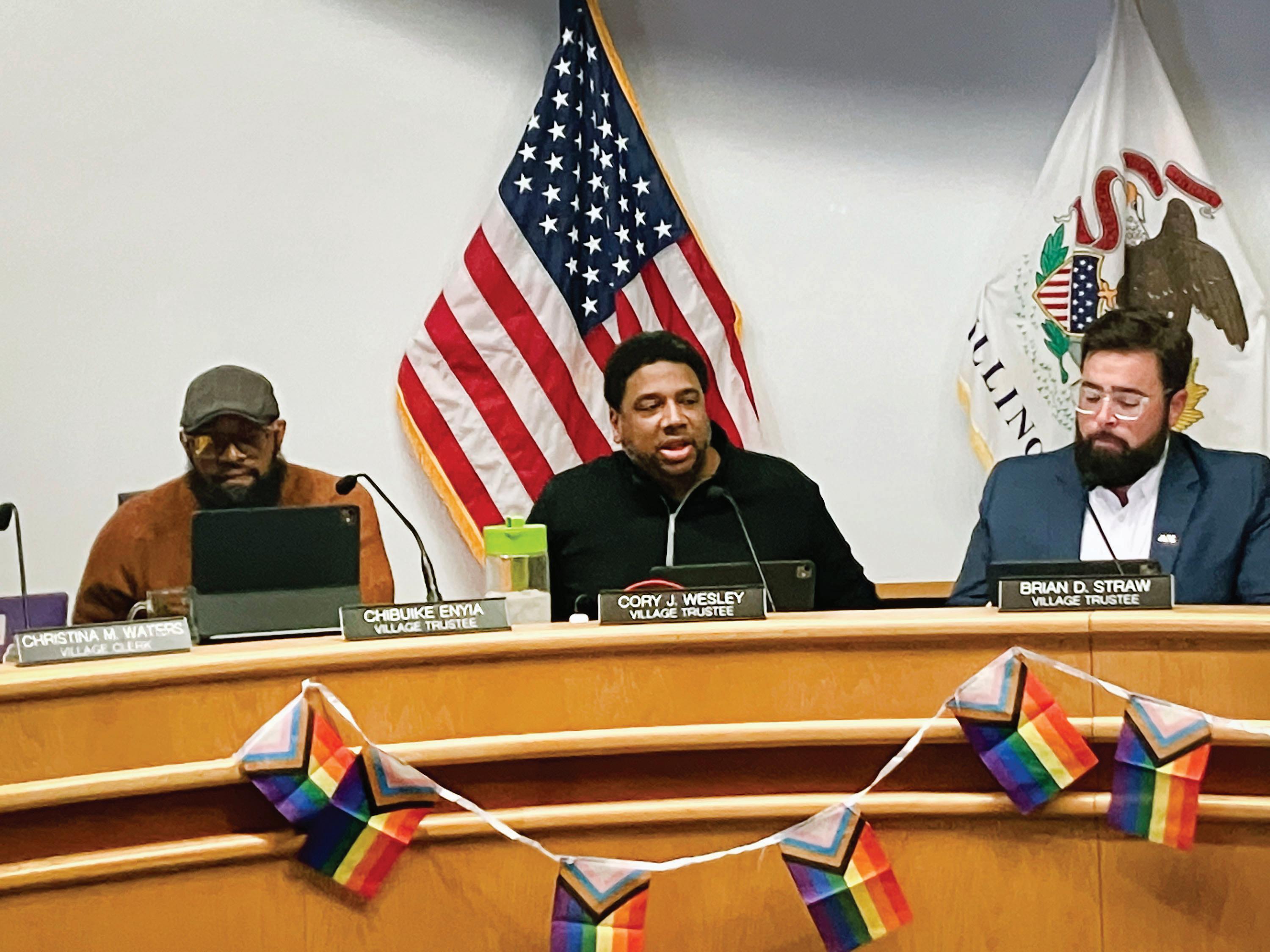
Village board member Cory Wesley, who has been perhaps the most outspoken proponent of eliminating single family zoning districts in Oak Park is willing to second Taglia’s motion to allow the village board to vote whether or not to have a referendum. But Wesley will not be voting to authorize a referendum.
“I believe all ideas should g et a fair hearing but I’m not voting to approve a referendum on this,” Wesley said in a text message
Village President Vicki Scaman said she wants more public input on the issue but doesn’t seem inclined to vote to take the responsibility of making changes to the zoning code away from the village board.
“This board was elected, and is paid, to make decisions,” Scaman said.
On July 28 the village board is expected to vote on the recommendations from the consultant.
But that vote will only star t the process of changing the zoning code. If the village board votes to accept the recommended changes to the zoning code then village staf f would work to make the proposed changes part of the zoning code. T he proposed changes would have to go before the Plan Commission which would have to, by law, hold a public hearing, perhaps more than one, on the proposed changes before the village board finally votes to actually
change the zoning code. That process is expected to take months and could run into 2027.
At the June 16 meeting the village board unanimously approved paying its consulting firm, Opticos Design, an additional $128,000 to do economic feasibility testing, community outreach and develop a zoning comparison tool in relation to proposed changes in the zoning code
If, as seems likely, the village board votes to accept the Opticos recommended zoning changes at the July 28 meeting, Opticos or the village, would send a postcard to all Oak Park addresses to info rm residents about the proposed changes in the zoning code and would ar range six public meetings, three on the north side of town and three on the south side, to g et public input into the proposed zoning changes
“This is a more meet in your neighborhood type of process,” said Oak Park Development Services Director Craig Failor.
Taglia says more public input is needed but he said that input should come before any steps are taken to change the zoning code
“We need to have townhalls where a thousand people come, in the auditorium of the high school, that’s where you need to have it,” Ta glia said.
But Scaman said that residents need a proposal to consider.
“We need the community to have something to react to,” Scaman said.
Wesley says single f amily zoning is racist in origin and limits af fordability and socio-economic diversity.
“The root cause is racism,” Wesley said. “It was implemented to keep Black people out of various different areas, Oak Park being one of them. It is not unique to Oak Park, this is prevalent across the entire country.”
Most other village board members seem to ag ree. Making Oak Park more af fordable and diverse is a high priority for the entire village board.
“We’ re a low af fordability c ommunity,” said b oard member Jenna Leving Jacobson.
Wesley said Oak Park is unaf fordable for too many people and is thus losing its diverse character and what makes it dis-
tinctive
“I’m more concerned about that aspect of a potential future changing Oak Park’s character than I am of a couple two flats or three flats on a block changing Oak Park’s character,” Wesley said.
Taglia said he has not made up his mind about whether exclusive single family zoning districts should be eliminated.
“I really don’t have an opinion yet because I haven’t got the recommendation,” Taglia said “So I’m keeping an open mind but I think whatever the decision it should be the voters making the decision not four trustees. It’s foundational to the Oak Park experience.”
Wesley is impatient and wants to eliminate single family zoning as soon as possible.
“We’ve been working on this since 2022,” Wesley said.
Taglia is more patient.
“There’s no doubt that housing is a crisis but it’s not the kind of crisis where if we wait three months it’s going to matter at the end of the day,” Taglia said. “I want to do it right and I want to be thoughtful.”
By MELVIN TATE
Contributing Reporter
Most Chicago Bulls fans know that broadcaster Stacey King died suddenly on June 7 following a re ported fall in his home. But many may not realize that King was living in River Forest at the time of his death. One of King’s ne phews, Aco graduated from Oak Park and River Fo High School earlier this month and was a member of the Huskies boys basketball team for the past year and a half.
“It’s tragic We were caught off-guard,” said OPRF coach Phil Gary. “I go on how people treat me, and Stacey was one of the nicest people I’ve ever met in my life. I only knew him personally for a year and a half, but in that time he was super-nice to me and the kids in the program.

“He’d invite us to some of the (Bulls) games, stay afterward and talk with some of the players on the court. You don’t meet too many people like Stacey.”
When his players found out about King’s death, they reached out.
“They were very upset. Stacey didn’t have to do the things he did. He did them because he was a very nice person,” Gary said.
Acoya King, who missed the past season with an injury, is still grieving the loss of
“He’d invite us to some of the (Bulls) games, stay afterward and talk with some of the players on the cour t. You don’t meet too many people like Stacey.”
PHIL GARY
OPRF head basketball coach
SUBMITTED TRENT WILLIAMS
OPRF High School boys basketball rising junior Trent Williams
his uncle, which is why Gary talks with him every day to provide support
“Even though I [only] coached him for half a season,” he said, “I told him he could reach out to me at any time.”
OPRF’s players have also been supportive of Acoya, who will play collegiately at Kishwaukee Community Colle ge
“Acoya is a great friend of mine,” said OPRF rising junior Trent Williams. “I never got to meet Stacey King, but I always watch the Bulls games and he was a good, funny commentator. I knew that hurt Acoya when that happened, so I texted him to let him know I was sorry for his loss.”
Stacey King was also a solid basketball player. He was the Bulls’ first-round pick out of Oklahoma in the 1989 NBA Draft and was part of the Bulls’ first “three-peat” championship teams from 1991 to 1993.
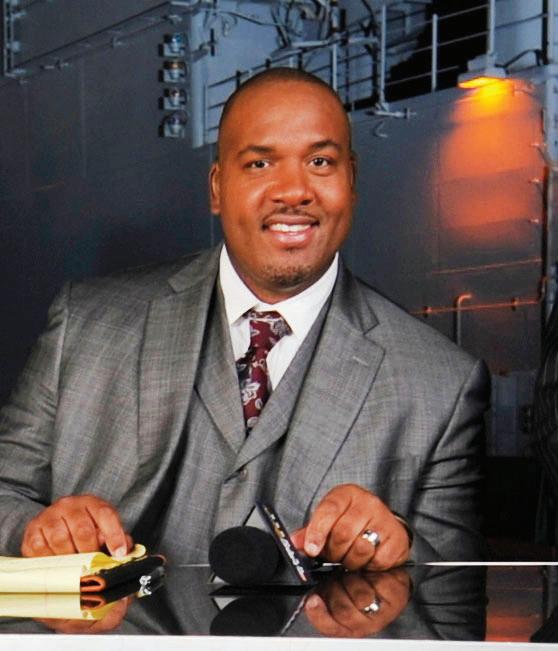
Stacey King onboard the ight deck of the amphibious assault ship USS Bataan (LHD 5) just prior to the Navy Marine Cor ps Classic 2012 game between the Florida Gators and Georgetow n Hoyas.
He would have appreciated OPRF’s strong showing in summer competition this month. T he Huskies are 11-4 overall and sport a 6-2 record at NCAA Live Event g ames, including 2-2 at the Romeoville Pre-Live Summer Shootout last week.
In their first g ame on June 18, the Huskies defeated Marian Central 62-50. Later that day, OPRF fell 49-45 to Plainfield South.
On June 20, the Huskies routed Argo 7435, but dropped their shootout finale to St Ignatius 47-45.
“The way I see it, we could’ve played better,” Williams said of the Romeoville event. “But as a team, from last year to this year, I feel we play with much more chemistry than we did last year. This weekend, we pushed the ball and got after it on both sides of the floor. We played great defense and played really hard; we really want to win.”
In addition to Williams, Gary feels
OPRF has received good consistent play this summer from rising senior D’Angelo Perkins and rising junior Owen Towne
“They ’re doing pretty well,” Gary said. “The returners are setting the tone. Owen has grown a little bit and he’s filling out. D’Angelo’s grown two inches since the end of the season, and Trent is getting stronger and more aggressive, and his game is just developing quicker.”
Williams is optimistic about a turnaround for the Huskies, who have struggled in recent seasons, especially in the West Suburban Conference Silver Division.
“Last year was the first time most of us played together, and I feel now that we have that year of chemistry, even though it was rough,” he said, “it’s carried over and we’ve been doing great this summer.
“I just want to do what I have to do to help us win. A big pa rt of my game is winning and wanting to win. As a team, we’re real hungry.”
By RISÉ SANDERS-WEIR Eats Reporter
A “clawcade” has taken over 1100 Lake St. in Oak Park. This new concept comes from the mind that brought us Poke Burrito and a previous concept called Sweet Dim Sum in the same space that is now Lucky Duck Claw House.
Walk in the door and you are greeted with bright colors, flashing lights when prizes are won, and a menu that includes a variety of appetizers, rice bowls, onigiri rice balls, mochi donuts, smoothies, teas and an array of candies.
are $1 apiece. With three kids in tow, I bought $40 worth of tokens.
For many of those tries the players successfully got the claw to pick up a plush toy and move it towards the prize-winning chute, but none made it all the way there. Plushies fell over and over. One of our younger gamers was audibly, justifiably frustrated.

Owner Jimmy Chen decided to join the taste of Japanese street foods, similar to the menu at Sweet Dim Sum, with an arcade experience.
“The idea is built around the feeling of winning,” Chen said. “Instead of being just a restaurant or just an arcade, we focus on creating memories and interaction between friends, couples and families. At the same time that people can enjoy the food, they can also have fun with the claw machines.”
Once you win the plush toy prizes, you can either keep them or trade them for food. A plushie conversion chart is provided on the menu board.
Chen, who created and owns Umi Sushi by Weight in downtown Chicago and 10 Poke Burrito locations, is a serial entrepreneur. He saw an opportunity in the marketplace.
“People in Oak Park, kids and family, they need a fun spot,” he said. “It took us a little while to put everything together selecting machines, gifts and all other things. Because this is something new that we never done before we’re gonna face some glitch.”
One week after their official ribbon cutting, I took three children from my neighborhood to try their luck. Tokens to play the claw g ames (like what you expect to play at a state fair midway)
We bought another $20 in tokens and the same thing happened. No one won anything.
At this point an employee came over with a pocket full of tokens. With some guidance, Devyn W. played one machine seven times as the cl aw picked up a small plush raccoon holding a rose, but it never made it to the chute. The employee then opened the glass case and positioned

the plushie just so. She said that the weight would be more evenly distributed in an upright position. She was right and the next time, bam, the plushie made it to the chute and into Devyn’s waiting hands.

“I think it’s a very cute place and the workers are super nice here,” Devyn W. said. This was her second trip and the second time a worker had to help her before she won anything. “The stuffed animals are really cute. It’s frustrating when you don’t win. But when you do win, it’s a really good feeling.”
The employee helped the other two girls win prizes as well. We were thankful for the help. But to understand whether this was typical game play, I reached out to the owner.
“I’m glad to hear that all three children ultimately won plushies and that our team member took the time to assist them,” Chen said. “While claw machines are intended to be challenging and some prizes naturally require multiple attempts depending on positioning, we never want guests to feel discouraged or believe they do not have a fair opportunity to win.”
He also said that with a new venture, they are still ironing out all the bugs and procedures. My feedback prompted him to review
the state of play.
“I immediately reached out to our claw machine manufacturer and technical support team to perform a diagnostic review of the machines,” he said. “We want to ensure that every machine is operating properly and delivering the experience we expect for our guests. As a new business, we are continuously evaluating and improving our operations. Our staf f re gularly monitor the arcade floor and often provide tips, assistance, or prize adjustments when younger guests are struggling. We believe great customer service is an important part of the experience, and we want every f amily to leave with positive memories.”
Of the whole experience, Lola C. said, “It was fun. It was challenging and challenging can be fun.”
Once the restaurant/clawcade concept is ironed out, Chen has bigger plans
“If things goes well, then we’re going to launch multiple locations,” he said. “We are excited to start another journey from Oak Park then Chicagoland.”
Sink your claws in:
1100 Lake St., Oak Park
luckyduck-usa.com
Hours: Ever yday 11 a.m. – 8 p.m.
By BILL DWYER Contributing Reporter
An Oak Park teenager, Eliel ArgudoTenorio, has been charged with murder in the fatal shooting of a bicyclist, Malik Jones, in Grant Park the night of June 16.
Argudo-Tenorio was arrested at his home on the 900 block of South Humphrey the following evening. He was arraigned June 19 and ordered held in Cook County Jail. He was scheduled to appear in court again June 23.
Chicago Police investigators say ArgudoTenorio is the person who shot Jones, 27, as he rode a Divvy bike in the 300 block of East Jackson Drive around 12:19 a.m. June 16. Jones, who lived at the Pacific Garden Mission, 1400 S. Canal St., died less than two hours later.
The Cook County Medical Examiner ruled the death a homicide, and cause of death as multiple gunshot wounds.
In court Friday the Cook County State’s Attorney told the court that street camera video captured Argudo-Tenorio exiting a white Mazda, walking over to a second car and reaching in through the front passenger window and retrieving a handgun. He alle gedly “immediately pointed” it at the
victim,” walked towards him and fired at him, hitting him in the right thigh.
Argudo-Tenorio then “handed the firearm back through the passenger window of the second vehicle, ran back to the Mazda and entered the rear seat.”
Police recovered a single .45 caliber shell casing on the ground near where the cars had been parked.
Prosecutors say a license plate reader captured the plate on the white Mazda, and that private surveillance video on the 900 block of South Humphrey showed the same Mazda pulling into the alley behind Argudo-Tenorio’s house at approximately 12:50 a.m. after the shooting.
The State’s Attorneys’ office released Argudo-Tenorio’s criminal history at the hearing. It includes three “findings of delinquency” as a juvenile, including 30 days in juvenile detention for a June 2023 unlawful use of a weapon charge, 24 months of probation for an April 2023 burglary, and a 2024 possession of stolen vehicle charge.
A posting on the Prep Hoops website listed Argudo-Tenorio as being in the Oak Park and River Forest High School Class of 2026, but his name was not among the graduates listed in Wednesday Journal June 10.











hardwood flooring installation & pergo. Sanding, re-finishing, staining. Low prices, insured. Call: 773-671-4996 www.klisflooring.com


































































708.860.8667 joconnor@atproperties.com


708.228.4557 jmadock@atproperties.com
708.207.1214 camilleh@atproperties.com

708.267.2549 afoxmcmahon@atproperties.com
708.790.1319 vwitt@atproperties.com


email: dhaley@newswellchicago.org
By LACEY SIKORA Real Estate Reporter
Donna and Don Jensen have lived on Kenilworth Avenue in Oak Park since July 1979. This fall, they’re making a big move. They will travel two miles south to join their son, daughter-in-law and two grandsons to live in an accessory dwelling unit in the younger Jensens’ back yard.
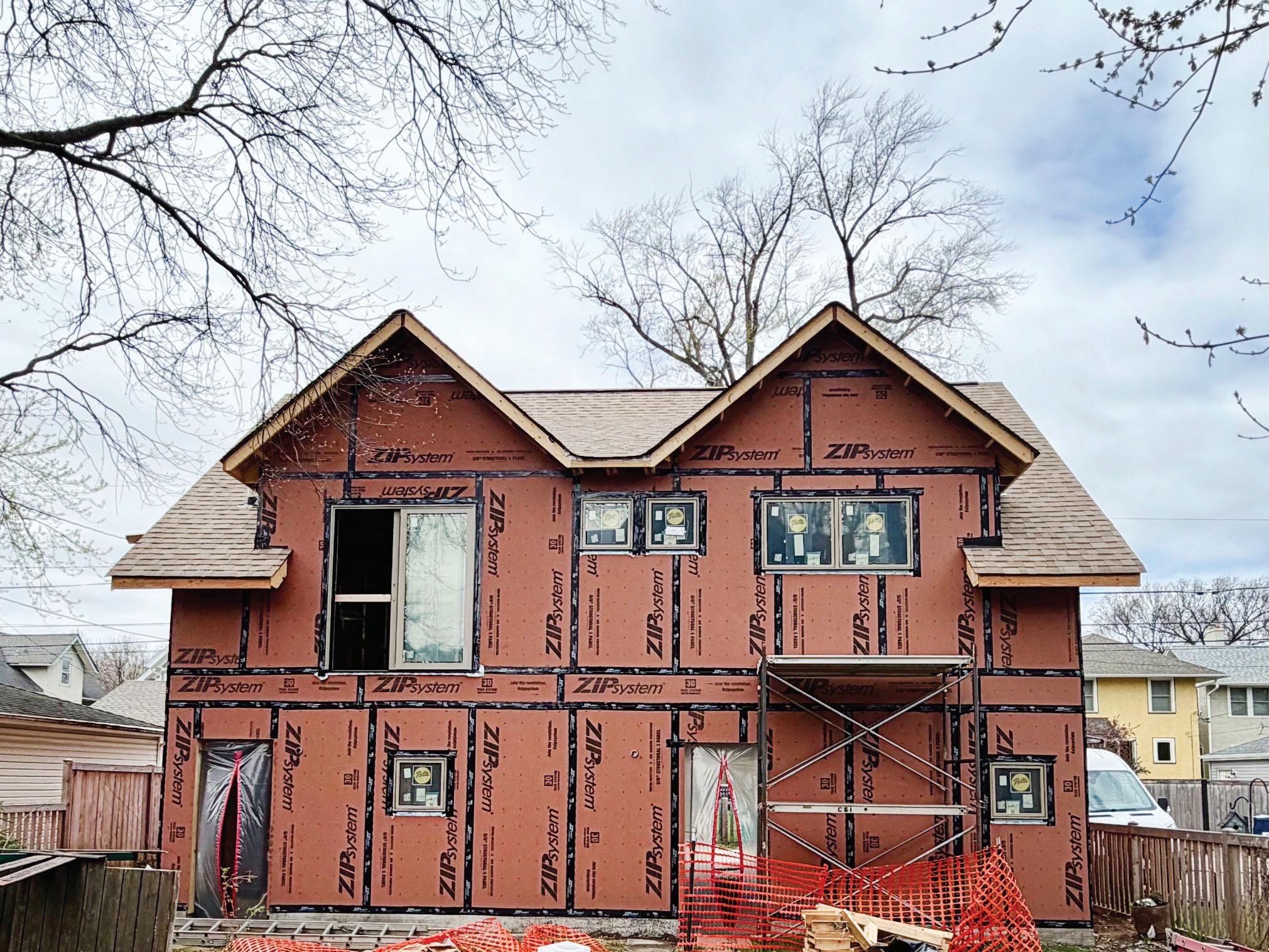
The two couples are collaborating on a new, three-car ga rage with a two-bedroom coach house above it. The space will provide a number of benefits to both generations.
When Claire and her husband Colin found the family’s new house in South Oak Park, they knew the old ga rage was in bad shape
“We had just gotten a note from the village that we had to do re pairs on the garage,” she recalls and notes that the structure was a “falling over, one-car space.”
They began thinking about building a coach house and decided to go for it over a family Easter dinner. Don and Donna thought it was a great answer to their quest for home for the next stage of their lives.
Don Jensen says, “When we sell our north Oak Park house it will pay for the coach house. It’s kind of a trad ” probably

Claire Jensen notes that before her boys were in school full time, Donna and Don were loving caretakers for Arthur and Freddy, so they are used to spending a lot of time together
All parties are big fans of multi-generational living. Donna grew up with a grandmother in her home, and she and Don relish their close relationship with Arthur and Freddy
Working with contractor Kevin Hibbits and architect Bob Bell, who just happens to be the for mer owner of younger Jensens’ home, the two couples came up with a design that suited them all.
Don Jensen knows Bob Bell from his local running group, and when Bell was ready to sell his long-time home, Jensen suggested that his son and daughter-in-law might want to
take a look. Bell sold them the house along with his plans for the garage and coach house
The garage is divided on the first floor. There are two parking spaces for the younger couple. The grandparents have a separate parking space, with its own door, entryway, and a small room that can double as a workout space.
Claire says of her father-in-law, “Bubba is a very active person. There’s room in there for his Peloton.”
“They’ll enjoy this space for many, many years,” Claire says, “but eventually, the apar tment can be used as a rental so we wanted to make this entry and staircase a separate space.”
Upstairs, the kitchen isn’t much smaller than what Don
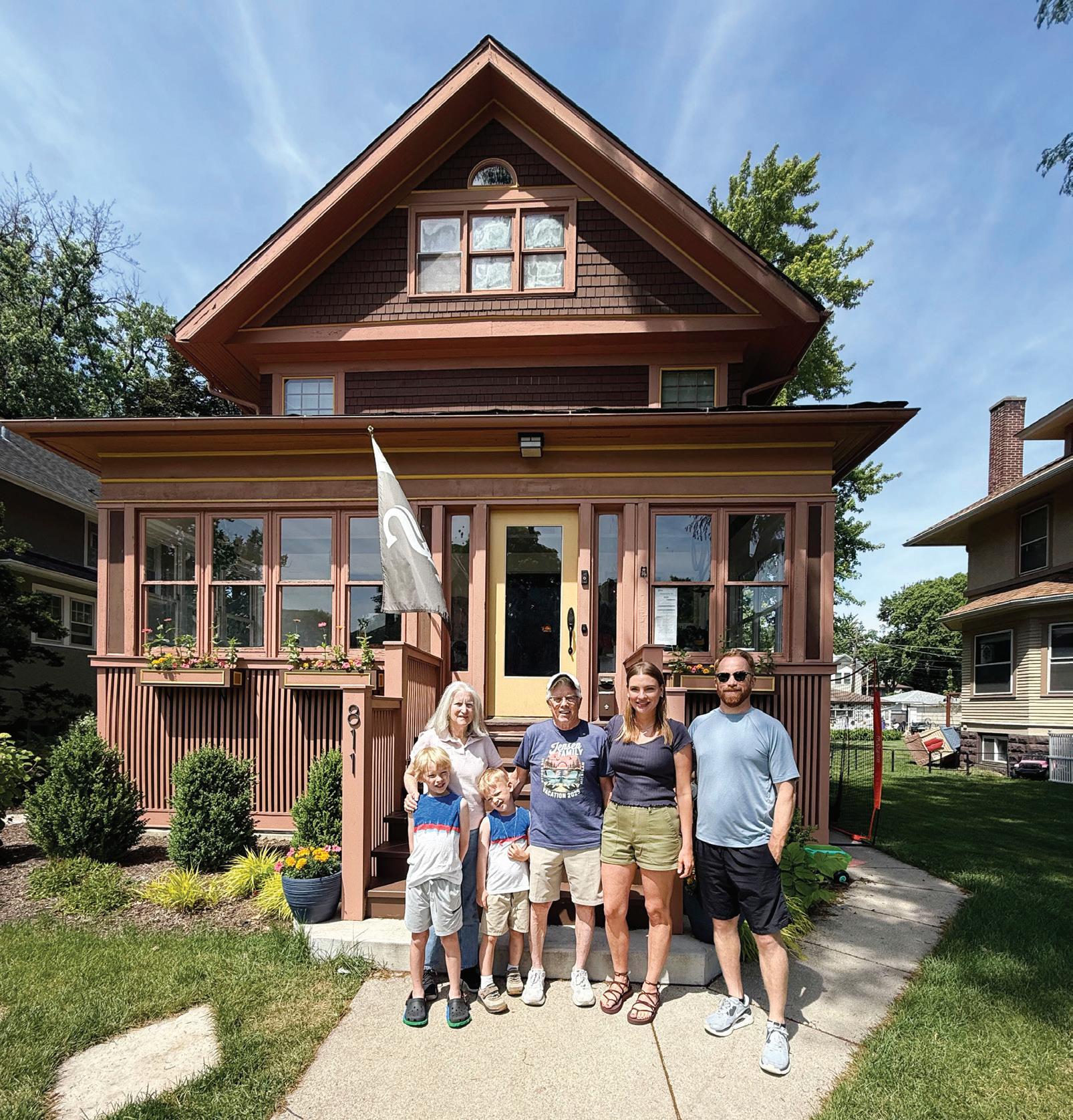
Grandparents Donna and Don Jensen will be moving into a coach house behind the south oak park home of Clai re and Colin Jensen, allowing them to take an active role with their grandsons Freddy and Arthur
and Donna enjoy in their single-family home, meaning the couple don’t have to downsize much in terms of their day-today belongings
They have a sizeable living room, with plenty of room for a Christmas tree to be displayed in front of large windows. A primary bedroom has room for a king-sized bed. The second bedroom can be used as an office by day and will include a Murphy bed for sleepovers with the grandkids
During the construction, everyone focused on ef for ts to make the space accessible for the future. The shower door has a low threshold, and the staircase is made to accommodate a chair lift in the future.
Claire and Colin have plans to later renovate their own home, so one of the biggest decisions they had to make was what colors and finishes to choose for the exterior of the coach house. While the siding and shingles mimic the main house, they are planning to paint with the colors that will eventually be used on
their home after their future renovation.
So far, Claire and Colin say their neighbors have been incredibly rece ptive to the project. Claire says, “I wouldn’t be surprised if others on the block want to do it too. It’s the dream to be able to stay in the house you live in and pass it on to your kids.”
Arthur, a rising third grader at Lincoln Elementary School, and Freddy, a rising first grader, like the idea of eventually living in the main house as adults and seeing their parents live in the coach house. Although both ag ree there are a few details to work out on who gets the bigger bedroom.
Claire, who is a fifth generation Oak Parker, calls their neighborhood the type you never want to leave. She moved across the street from one of her friends from Oak Park and River Forest High School, and now their kids are best friends.
“We landed on the best block in Oak Park. It just felt like everything fell into place.”
The following property transfers were re ported by the Cook County Clerk from February 2026. Where addresses appear incomplete, for instance where a unit number appears missing, that information was not provided by the clerk.
225 Clinton Ave
1108 S Maple Ave
163 N Cuyler Ave
$1,025,000 Ronning-Arnesen Even Pohlman Nicole Michelle
$1,030,000 Pickens Tyrone Karmenzind Audrey
$1,115,000 Lehner Robert Peckinpaugh Lindsey 1104 Fair Oaks Ave
$1,200,000 Kremer Zvi Fish Lauren
436 S Ridgeland Ave $1,300,000 Madison Ridgeland Llc Terra Home Const Llc
900 S Oak Park Ave $1,550,000 900 Opa Ltd Ps Lp 900
Harrison St $50,500 Judicial Sales Corp Construction Mgmt Assoc Llc 253 Ontario St $641,000 Russell Jennifer T Green Duncan G 1134 S Oak Park Ave $655,000 Mazanke Robert Conner Adam 711 N Kenilworth Ave $700,000 Sharon L Harmsworth Trust Dwyer Caitlin
S Taylor Ave
Rodriguez Matthew Barringer Christine
Lembcke Karen R Molina Gregory M
Division St $799,000 Cottingham Steven W Antoniello Shaya
S Ridgeland Ave $850,000 Peiler Valerie J Hall Reed 1221 N East Ave $878,000 Mausolf Trista Lewis Karen 1121 Home Ave $950,000 Rosca George Gronli Leena Ketkar
534 Lathrop Ave $1,223,000 Belke William A Rodriguez Matthew 547 Jackson Ave $1,900,000 Gilpin Randoll Eric Tr Thibodeau Matthew
7206 Oak Ave $115,000 Gomez Anthony Durkce Robert 7210 Oak Ave $135,000 Plebaniax-Lanners Tyler J Depillo Michael Robert 1106 N Harlem Ave $167,000 Moton Gwendolyn Galvez Maria F Parra
8121 Lake St $370,000 Hardin Sheila Porter Jonathan 8213 Lake St $378,500 Bonesteel Kristina Tanzer Bret August
7577 Lake St $400,000 Land Trust Co 7577 Lake St Llc
1535 Forest Ave $405,000 Bowers Susan Weatherly Thomas Gary
7575 Lake St $650,000 Heiss Kathleen A Peterson Liuanne Trust
7575 Lake St $730,000 Peterson Luanne Tr Mezzatesta Louise Trust

Submit events and see full calendar at oakpark.com/events















DEADLINE FOR SUBMISSIONS IS FRIDAY 5 P.M.
Call Viewpoints editor
Ken Trainor at 613-3310
Email: ktrainor@newswellchicago.org
friend of mine recently suggested we need a new algorithm for life
Our current algorithm? If you like _____, you’ll also like ____. It’s always been human nature, but technology has made it our default. Spotify, Netflix, Facebook — the more they learn about us, the smaller the world they show us gets. It may feel comfortable. But does it challenge us and help us grow?
My friend’s idea: If you like ____, try something ferent next time.
he value of trying different things isn’t a new t. But the framing — that we’ve been proammed this way, and we can reprogram ourselves — sits well with me
What could that look like? Some simple starters: ke Taylor Swift, try some ’80s hip-hop. (Can I tune my daughters’ Spotify account to this new algorithm?). If you like dense biographies of historical , try some queer hockey romance novels (we ould all use a little time at the cottage). he benefits of this new algorithm go far beyond culture. What would it look like to bring it into our civic life?
We get into a lot of habits that aren’t productive for the kind of community we want to build — one that lives up to our values of equity, inclusivity and sustainability. I doubt we actually like these habits; we’re just running on autopilot. How could this new algorithm help us break some of those habits, and find new sources of growth? Some ideas:
If your instinct is to immediately comment on a post or article you disagree with, try holding off and just sit with the discomfort of a different viewpoint for a minute. Then consider what the most productive way to get your voice heard might look like
If your instinct is to drive into the city, consider taking public transit instead. And instead of looking at your phone the whole time, look out the window and take in the views of Chicago in all its diversity and complexity. And if your instinct is to complain about those white sticks popping up around town, try reading the Vision Zero plan first. Our public works department is making evidence-based decisions within the constraints of our built environment to make us safer; there’s a why behind the what. Once you are ar med with context, by all means, weigh in OK, I couldn’t resist wading into the Great White Sticks Debate of 2026 (are white sticks the new leaf bags?). But reprogramming ourselves with this new algorithm can help us see that, in any situation, we could all stand to bring a bit more curiosity and a little less reflex.
I know I need this new algorithm as much as anyone. Parenting two young kids, running a business and navigating the chaos we are faced with every day makes it far too easy to fall into unproductive patterns. But I hereby commit to doing my best to try out this new algorithm, and I hope you’ll join me Nicole Chavas writes about community, and what we owe each other as neighbors. In the spirit of trying a new algorithm, she recently took the Austin bus instead of driving, and enjoyed seeing new faces and places along the way.


As an African American pastor in the Black Church tradition, there was no way I was going to miss a chance to meet the first American pope. I volunteered to serve as a member of the Chicago mayor’s dele gation to meet with Pope Leo in Rome. Thirty-six hours later, I found myself standing face to face with the pontif f in a re gal room in the Vatican.
A few minutes earlier he spoke to our group and shared that his mother’s family had migrated north from New Orleans. In our brief one-on-one exchange, I shared that my family had mi grated north to Chicago from Mississippi. It was my way of telling him that I understood our unique mutual connection in the American story.
I thanked him for the clarity of his global moral witness. I was convinced that the timing of this pilg rimage to Rome was divine. It was just days after the Pope had issued an apology for the church’s role in the human catastrophe of the transatlantic enslavement of African people that began in the 17th century, the ef-
fects of which continue to this day. It was also the week of the reveal of his first encyclical, extolling the doctrine that humanity trumps technology as the most magnificent, sacred creation. The Pontiff ’s God-ordained message to the world, “Magnifica Humanitas,” unequivocally declares that technology must serve the needs and interests of the whole of humanity and not the other way around.
There stood the American Pope and the African American pastor, with intense focus, eye to eye, each with unique Southern roots. We each brought to the encounter pride and heaviness, having processed the weight of our histories and the burdens of the present.
It was not lost on me that we were just days from our nation’s Juneteenth 2026 holiday. Our nation’s newest holiday commemorates the June 19, 1865 Galveston, Texas announcement of the abolition of race-based slavery and emancipation from servitude in the United States. It occurs just weeks before the tradi-
Cory Wesley and Jim Taglia are both right when it comes to the proposal to reshape a core element of Oak Park’s longstanding residential zoning. It is a big decision.
A plan coming out of a consultant’s report, steered there by Oak Park’s very progressive village board, would eliminate single-family zoning as the cornerstone of how the village looks at housing in its neighborhoods.
eems radical. And it is. When you listen to Wesley eloquently and assionately explain that single-family zoning is, across America, rooted in efforts to keep commue, to block out affordable pathways to either buying or renting housing on traditionally single-family blocks, when he calls it out as systemic racism, it gets your attention. And it ought to. He is right on all those points. esley is not calling you a racist if you are a te Oak Parker. He is saying, and he makes it lear in his many and thoughtful social media osts and when he sat down a few months ago with our nal colleague, that real estate as a method of racial segregation is baked into our village and our nation. course it is. Now don’t get all defensive. Don’t go into denial. Or all piney nostalgia Trustee Wesley wants this Oak Park Village Board, which has been intentionally working on this issue for years, to bring this to a vote in the weeks ahead. Trustee Taglia last week at a board meeting said this issue was simply too big to be decided by elected officials and it ought to be put to a binding citizen referendum.
Now I admire Taglia and I’m grateful for his voice – more financially conservative, perhaps more skeptical of village hall operations. But my antennae go up each and every time anyone suggests a political issue is so complex, so important that it has to be brought to voters in a binding referendum. Yes to referendums on tax hikes. Essential.
But we elect people to public of fice to make hard decisions. And we need to let them make those decisions. Voters, every two years, get to elect the electeds. And over decades now, Oak Park voters have, with a couple of breaks, elected a very progressive village board and equally progressive school boards.
Close out with a long-term perspective. Oak Park is already way better than most suburban communities when it comes to having diverse housing stock. About half of the housing units in the village are multifamily, mostly rentals. The town was built that way starting in the 1920s. This is the century-old apartment corridors on Austin and Washington, the 1960s mid-rises on north Kenilworth and North Boulevard and the high rises built downtown over the past decade-plus. But it is also the two- and three-flats sprinkled all over the village on blocks that are mainly single-family. It has worked well for decades.
And second, no developer is coming in to buy up a block of single-family homes on Harvey so they can build 200 units. It won’t work that way.
But opening the door to somewhat more density, some more height at certain locations, more “accessory dwelling units” in backyards and other variants on affordable housing would make real Oak Park’s chatter and back-slapping about equity and inclusion.
Time to act.
Suzie and Kitty Carson’s bush bloomed early this y It usually achieves its annual outburst in June. This y perhaps a nod to climate chang it blossomed for Memorial Da It’s not your ordinary rosebush. According to these twin sister been blooming reliably for roughl 200 years.
To be precise, it is a very resilient and active descendent of the bush that emigrated with its owners on the long sea voyage from England to Virginia sometime in the early 1800s For all we know, this might have been its bicentennial blooming Since even Finding Your Roots likely can’t track the lineage of legacy rosebushes, it would be difficult to pin all this down.

and Greek.
om there the story gets more omplicated. Kitty and Suzie’s father, and mother, Anne, moved into a house at 608 S. Kenilworth (bringing along a portion of the bush).

What the Carsons do know is that the rosebush continued blooming until its tenders migrated from Virginia to Hebron, Indiana by ox cart (they still have the wide wooden yoke as a memento). Their forebears brought the rosebush along because they were farmers, and this was a specialized kind of bush, a hedge rose, which spreads to define, and defend, the dividing line between properties. If, as Robert Frost once wrote, good fences make good neighbors, so do hedge roses, which are decorative and pleasing to the eye, yet sufficiently thorny to deter invading critters, and hardy enough to endure long voyages and multiple transplantings.
Checking the Google app, this bush appears to be none other than a White Rose of York, one half of the famous War of the Roses, which are indeed used as hedges and valued for their hardiness. Josephine Carson, paternal grandmother of Suzie and Kitty, was the tale-teller who passed down the details of this rose’s jour ney. Josephine was also, once upon a time, president of the Oak Park-River Forest Garden Club (she specialized in growing irises).
When the family left farming behind, they took up backyard horticulture. Arriving in Oak Park, bush in hand, in 1910, Harvey and Josephine Carson nurtured and preserved their flowery legacy. Harvey, who played professional baseball and graduated from Northwester n, became a corporate lawyer at a fir m with the appropriate name Gardner, Carter & Douglas. Josephine also attended Northwester n and taught Hebrew, Latin
In the 1950s, Bruce moved to Arlington, Virginia and worked for the Securities & Exchange Commission during the Eisenhower Administration. But he soon grew homesick and d back, this time to 811 Fair , and the fair roses came with. hen Bruce and Anne divorced, wever, the bloom was off this rose and the bush was left behind. But 25 years and two owners later, Suzie and Kitty’s brother Robert bought the house back, and the rosebush was still there. Robert died in 1991 and his wife moved to Michigan. When Suzie met the next owner at the fitness center they both attended, she told him the story of the bush and asked if they could transplant a cutting to their home on the 1000 block of Grove. He never got back to her about it — until the day they were moving out.
Suzie called McAdams Landscaping and they transferred the bush to her garden. For the next three years it went dormant. On the day their dad died, Suzie said, the bush burst forth with blossoms
In fact, it rapidly took over the backyard, so they moved a portion to the corner of the garden, surrounded by rocks, and the remainder was transported (not by ox cart) to a niece who lives in Michigan, where it continues to thrive.
As does the rosebush in the Carsons’ backyard
This rosy ending is a testament to the hardiness of both rosebushes and families, not to mention the thread connecting them to England on this 250th anniversary of transplanting a nation to the New World. Stories of surviving and thriving resonate nicely in dark times when celebrating doesn’t come so naturally.
Lineage, though not an exact science, is as much about keeping a story alive as it is about tracing root systems. Suzie and Kitty, whitehaired roses themselves, perhaps originally from York (a long, long way back) have done their fair share to sustain the family lineage and lore. Which includes one very well-traveled rosebush.
Juneteenth is often remembered as the day freedom finally reached the last enslaved people in Texas — June 19, 1865. It is a powerful moment in American history. But it is also something more personal than many of us realize For some families, Juneteenth is not just a date. It is a story car ried forward through generations
In my own family, that story includes my great-great-grandfather, Alfred Berriman — later standardized to Berryman — who served in the U.S. Colored Troops as a member of Company G of the 45th Regiment. His name is inscribed on the African American Civil War Memorial in Washington D.C., on Plaque No. C-58. Historical records show that the 45th U.S. Colored Troops participated in the Appomattox Campaign and was present at the sur render of General Robert E. Lee in April 1865. Following the war’s conclusion, the re giment was ordered to Texas, where it served along the Mexican frontier, incl`uding in Brownsville.

As an educator, researcher, and someone trained in clinical psychology, I have spent years thinking about how people understand their past — especially when that past has been fragmented, erased, or misunderstood. In my current research on early African American families in colonial Maryland, I have encountered records that challenge the idea that freedom began neatly in 1865. There were f amilies navigating complex le gal systems — indenture, racial classification, and shifting definitions of status — long before the Civil War. Freedom, in that sense, has never been a single moment. It has always been a process.
of Oak Park and River Forest
e goal of the Viewpoints section is to foster and facilitate a community conversation and respectful dialogue. Responsible community voices are vital to community journalism and we welcome them. Space is at a premium and readers’ attention is also limited, so we ask that Viewpoints submissions be brief. Our limit for letters to the editor is 350 words. For One View essays, the limit is 500 words. Shorter is better. If and when we have su cient space, we print longer submissions, but when space is limited — as it o en is — we may ask you to submit a shorter version or hold the piece until space allows us to print it.
Members of Girl Scount Troop 45994 and the River Forest Fire Department raise the Juneteenth ag at the Juneteenth Ceremony at River Forest Public Library.
The ar rival of Union troops in Texas — including regiments of U.S. Colored Troops — was essential to enforcing emancipation in regions where it had not yet been realized in practice. While individual actions are not always recorded, soldiers li ke my ancestor were part of the broader military presence that made freedom tangible in the months following its announcement.
Juneteenth is not only about an announcement. It is about the people who carried that announcement — often at great personal risk — and the generations that followed. Years ago, I taught fourth grade at Longfellow Elementary School in Oak Park, where students were introduced to early American history, including the Civil War. I remember teaching those lessons with care, understanding their importance, but not yet realizing how deeply that history lived within my own family. At the time, I did not know that I had multiple direct ancestors and extended relatives who had served in the Civil War, including my great-greatgrandfather in the U.S. Colored Troops.
I saw that process reflected in my ow n life as well. Growing up in Weirton, West Virginia, I was among the early African American students to attend schools that had previously been segregated. Like so many others, I experienced what it meant to enter spaces that had only recently begun to change.
Juneteenth invites us to celebrate, but it also invites us to remember that freedom has always required ef fort, presence, and persistence. It reminds us that behind every historical milestone are individuals whose names are sometimes known, and often forgotten, but whose actions shaped what came next.
For me, seeing my ancestor’s name etched in stone in Washington D.C., is a reminder that history is not distant. It is personal. It is carried in families, in records, and in the work we do to understand it.
As we commemorate Juneteenth, we honor not only the moment freedom was announced but also the people who helped make that announcement meaningful — and the generations who continue to uncover and tell those stories.
That work, in many ways, is still unfolding.
Bonita Berryman Gilliam holds a doctorate in clinical psychology and has worked as an educator and researcher. She is the author of the forthcoming book, “Elizabeth Proctor: Lineage, Law, and Le gacy in Colonial Maryland.”
We reser ve the right to edit submissions. We do not have time to allow the writer to review changes before publication. We also do not have time to do more than super cial fact-checking, and because of our national epidemic of misinformation and conspiracy theories, when writers include statistical evidence to support their opinions, we require them to include the source of that information, such as credible websites, print publications, titles of articles and dates published, etc. Be as speci c as possible so that we and our readers have some way of assessing the credibility of your claims. Links may also be included for the online version. We follow the Society of Professional Journalists’ code of ethics: seek the truth and report it and minimize harm. As a result, we will do our best not to publish pieces that espouse doubtful or debunked theories, demonstrate harmful bias, or cross the line into incivility. While we will do our best not to engage in censorship, we also do not intend to be used as a platform for misinformation. Your sources for fact-checking are a critical step in keeping the discourse honest, decent and respectful.
All submissions must include your rst and last name and the municipality in which you live, plus a phone number (for veri cation only). We do not publish anonymous letters. One View essays should include a sentence at the end about who you are.
If we receive your submission by 5 p.m. on Sunday, you can expect your opinion to be included in that week’s paper (and online), space permitting.
Pieces can be submitted through our online form at oakpark.com or directly to Viewpoints editor Ken Trainor, ktrainor@newswellchicago.org. For the latter, we prefer attached Word les or plain text included in the email.
■ 350-word limit
■ Must include rst and last names, municipality in which you live, phone number (for veri cation only)
‘ONE VIEW’ ESSAY
■ 500-word limit
■ One-sentence footnote about yourself and/or your connection to the topic
■ Signature details as at left
hen it comes to the proposed Five Thirty One Partners development at Madison and Ashland, our River Forest government keeps eng aging in a process cloaked in an aura of impropriety and pretense — unlike anything I’ve seen in 50+ years as a professional city planner.
I and other professional planning colleagues are confused at how the village president and most of the village trustees – the ultimate deciders on the Madison Street proposal – can conduct a public relations campaign in which they show their suppor t for the forthcoming development proposal in the village newsletter and website with FAQs that promote the development, and via letters and One Views in Wednesday Journal’s Viewpoints section. T hey’ve even used our tax dollars to hire a public relations firm to build support for the development. The PR campaign sends a clear signal to the Development Review Board that this proposal is to be approved.
The village president and trustees make the final decision on this proposed development. The village board – and Development Review Board – are supposed to arrive at a decision based on findings of fact derived solely from the evidence submitted in writing and at public hearings and whether the proposal complies with the village’s comprehensive plan. And if our elected officials are to live up to their word, they need to also assess compliance with the village’s af fordable housing plan and age-friendly plan.
But they’ve already tipped their hands by conducting this PR campaign in favor of the development. The motions they’ re going through are pure pretense since our village president and most of the village board have already signaled their support for Five Thirty One Par tners’ development, whatever the ultimate details may be. All the open houses, including the one I attended, and requests for public input appear to have been for show.
I can understand the justification for secrecy if this were privately-owned land. But we the people own the land and were shut out of the selection process from Day One. We the property owners have no idea why the village president singularly rejected a 2024 proposal to build 15-18 unit forever af fordable cottages for seniors to enable them to remain in the village they helped build. We the owners have no inkling of what other proposals were made. We the owners have no clue as to whether the outreach to potential developers sought the inclusion of af fordable housing –something President Adduci promised would be done on a case-by-case basis when she summarily rejected adopting inclusionary zoning six years ago.
The village hasn’t even told us what Five Thirty-One Par tners is paying for the land we own.
I’m not expressing an opinion on the merits of the specific development Five Thirty-One Par tners has proposed so far.
What concer ns me here is how can we possibly get a fair decision from the village president and village trustees when the majority of them are engaged in a public relations campaign to win the hearts and minds of the public to support this development, which was ke pt, in utmost secrecy, from the taxpayers who own the land?
That’s not the transparency all of our elected officials promised when they ran for office.
That’s not the sort of clean, good government the citizens of River Forest expect and deserve.
Instead, it’s a bundle of improprieties that cast doubt on the legitimacy of this entire process.
We deserve better.
A River Forest resident since 1987, Dan Lauber is a past president of the American Planning Association and twice of the American Institute of Certified Planners. His research on zoning procedure has been published by the Advisory Commission on Housing and Urban Growth of the American Bar Association.
On June 10, Wednesday Journal published an article about an anti-Jewish hate crime in Oak Park [Police investigate antisemitic vandalism at Home Ave. development, News]. The crime was not surprising. Anti-Jewish hate crimes and violence are increasing worldwide. These are often preceded by increases in hateful language We experienced it here in Oak Park following the Township referendum meeting in April. Anti-Jewish words lead to anti-Jewish acts
The June 10 article contained a statement from Village President Vicki Scaman condemning the incident and supporting Jewish residents of Oak Park. I thank her for those words said on behalf of village gover nment.
Anti-Jewish speech and acts are not the fault of Jews. The non-Jewish world needs to step up and raise awareness. At the writing of this letter, with the exception of President Scaman and Trustee Wesley, I found no other leaders of our taxing bodies who did so. Nor did I hear the clergy or lay leadership of the 30 or so non-Jewish religious organizations in Oak Park and River Forest speaking out. Not the Community of Cong re gations. Not Concordia or Dominican universities. No offers of
professional help from Oak Park Township, which is surprising as Township Supervisor Thomas promoted his leadership in a Jewish fraternity when he talked in April (Wednesday Journal, April 30) about the racial attacks he was experiencing. We also did not hear anything from the people who denounce criticism of anti-Israel speech by saying it conflates anti-Israel and anti-Jewish themes. Here we have clear anti-Jewish hate. Nothing to argue about and everything to speak up about.
Even Wednesday Journal could not bring itself to publish even one sentence condemning an act of hate in our community.
Ignoring what happened on Home Avenue does not make the hate disappear. It will not protect our community from further problems. What can you do? Talk to your Jewish neighbors and friends about how they are feeling. Show them that they are supported. Do you belong to a local religious community? Ask why they remain silent. Same goes for the Township, Library and Park District. And the next time something like this occurs, don’t wait to make your voice heard.
Alan Peres Oak Park
Immigration and Customs Enforcement (ICE) has taken Nick, one of the barbers at Frank’s Barber Shop at the Oak Park Arms, into custody and sent him to an Indiana facility. He sits in a jail cell while his family scrambles to prevent his deportation.
From Albania for at least 20 years, his name is Besnik Shembitraski. He has been at the Oak Park Ar ms location for more than 12 years and takes care of many of that facility’s older residents and walk-ins from surrounding neighborhoods. He has cut my g randson’s and my hair for the past 12 years. He lives with his wife and 8-year-old daughter in Schiller Park. They recently purchased a new home. This is an outrage!
We have been told repeatedly that ICE
is taking “the worst of the worst” for deportation. Actually, they are taking the “best of the best” immigrants. They are apprehending law-abiding, taxpaying, upright people to increase their deportation numbers. This is to satisfy Stephen Miller, architect of this despicable program who has a direct channel into Donald Trump’s brain. No due process, no bail, just rotting in jail. The more cruelty and meanness used, the better.
What is the result?
A partnership with his uncle Frank disrupted; a family broken up; their home probably lost and destroyed economically. What as a country have we gained? Nothing — Nick is just a number.
Charles Chauncey Wells Oak Park
The tenor of the latest WJ column by Josh VanderBerg is disturbing [The stealth conservatism of Oak Park, Viewpoints, June 10]. He decries Oak Parkers, whom he says “clock left to far left” with purportedly “progressive values,” but are secretly conservative on numerous policy matters. As evidence, along with their occasional gripes over lesser issues, he lumps the enormously monumental and outsized issue of single-family zoning. He chastises the “crushing conservatism” of opposition to all of his progressive ideas, including abolition of that zoning.
I’ve been to large and small cities all over the U.S., Canada, South America, Europe and Asia, and rural communities, too, and universally seen vast tracts of single-family housing. Apparently, large numbers of people worldwide prefer, as I do, the life of such settings. For many it is the quintessential American dream.
But Mr. VanderBerg says (in effect): No. no. no. You can’t want that, and still be progressive. You “clock” yourself as left or far left, but you’ re not — you’ re conservative. To which I say: “Sez who?”
I consider myself even farther left than “far,” and a progressive, too, welcoming real solutions. But I also have a strong libertarian streak, and don’t see anything conservative about simply liking my single-family neighborhood and having, with others, the option to choose it.
There is a clear tone of condescending moral superiority over those who differ with him in what he has elsewhere called his “bold vision for Oak Park” of progressiveness whose benefits he says he has explained until he is “blue in the face.” That’s no way to convince anyone.
The letter to WJ by Blaise Denton, meanwhile, supporting the zoning ban is misleading by what it leaves out [In support of ending single-family zoning, Viewpoints, June 10].
While he cor rectly quotes the abstract of the first cited ar ticle, to the effect that relaxing density limits is the most effective way to increase housing supply and reduce both rents and house prices, he omits the next two sentences: “However, adopting multifamily zoning or relaxing height re gulations alone has little effect” on either supply or rents, and, “Moreover, in each land-use relaxation scenario where rents fall, house prices also fall” — a result more startlingly stated in the paper’s conclusion: “While lowering housing costs ... may help first-time homebuyers and lower-income renters, it comes at the expense of … current owners.” It ends with the caution that even then, “very low-income households may not find housing af fordable.”
I have searched the second cited article in vain to support Denton’s implication that it concludes “single family zoning was mostly implemented to maintain racial se greg ation and continues to perfor m that function,” and have found, instead, assertions inconsistent with that. While the article, a “working paper … for discussion and comment … not peer-reviewed,” certainly studies that question and finds some evidence to support it in the limited cases of Chicago and Seattle, it notes the severe paucity of research beyond those large cities, and “highlight[s] the key gaps in our understanding of the role of urban and suburban zoning in fostering se greg ation within cities and across metropolitan areas.”
Generalities to Oak Park may therefore not hold true: “less well understood, are the motivations underlying the adoption of zoning ordinances by municipalities over the twentieth century.” And research on the post-WWII era “has often failed to establish a clear causal link between zoning and segreg ation.”
Both lengthy papers make clear that the issues are far more complex than Denton lets on.
Frank Stachyra is an old school “lefty” and a 50-year resident in an Oak Park single-family home.
The River Forest village president’s call for residents to attend a cour t hearing on the Lake & Lathrop debacle and “send a message to the cour t” (Village of River Forest Newsletter, emailed to residents June 18) is deeply inappropriate and reflects a troubling misunderstanding of how our legal system works.
A courtroom is not a stadium, and judges are not swayed by cheering sections. Courts decide cases based on facts, evidence, and legal arguments, not by
counting spectators in the gallery. Encouraging residents to travel downtown to influence a judicial proceeding turns a serious legal matter into a political spectacle.
The suggestion that a crowd’s presence should affect the outcome of a case is offensive to the principle of an independent judiciary and has no place in public leadership.
Deborah Borman River Forest
Heritage House is a persisting nightmare, both for the self-image of Oak Park and for the long-suf fering residents of the House. I first became aware of how troubling the situation was there in Wednesday Journal articles in 2023 through the powerful witness brought by House residents before the Aging in Communities Commission of the village board. And I recently became aware of how that situation has in no way improved by attending the June 2026 meeting of House council and residents.
Why has the situation, so aggravated for all parties, remained, at best, unimproved? The residents, our grandparents, parents and siblings, are not being identified with as “family.” Thus their quality of life and dignity is not being defended because “they” are “others.” Or perhaps there is too much silo-ing of the various village agencies and offices, so they end up being feckless in application. Or perhaps there is just a failure to find the courage in and among those who could act to bring achingly needed change, or just a failure of imagination in the face of complex systems of ownership and (mis)management.
Or perhaps this is just another unfolding of how racism works in the 21st century, given that the current residents are vast-majority Black. Where is to be found the “good trouble” in civic action when we need it so desperately?
The recent village manager’s re port of the village board meeting of June 9 (a would-be record of Heritage House code violations and citations) was, to the public at least, inaudible and garbled in presentation. I was simply stunned as to how little those data conveyed the lived experience and history of Heritage House residents. In this village, we pay much too much in real estate taxes for the village government to be found so feckless.
Oak Park must be a “village that works” toward the good quality of life of all its residents.
I love all the Little Free Libraries in Oak Park and I frequent many of them. I am grateful to everyone who hosts one. I know that sometimes a few books overstay their welcome. They sit on the shelf month after month, taking up space that could be used for newly donated books Now is a great time to pull these books and donate them to the Friends of the Oak
Park Public Library sale. You can drop them off on the first floor of the main library through the end of the month. It’s an easy way to put them back into circulation.
Thank you for supporting the readers of Oak Park and surrounding communities! Kris Hansen Oak Park
My neighbor and I had a chuckle after reading Cathy Adduci’s letter [Courts are holding housing progress hosta ge, Viewpoints, June 10] casting the courts as the reason for the failure of the development of the Lake and Lathrop site. This is my neighbor who, when I moved into River Forest 12 years ago, kitty-corner to Lake and Lathrop, said, “It will never be built. ” Tur ns out he was right. How did he know? He knew the history and re putation of the developers. The first, Keystone Ventures, was owned by Tim Hagu e, a River Forest resident.(1) The second was Sedgwick Development, whose owner is Mar ty Paris, also a River Forest resident.(2) Both developers, in tur n, were granted multiple extensions by Cathy’s board until, finally, the bank pulled out.
If my neighbor knew to doubt the reliability of Tim Hague and Mar ty Paris, why didn’t the River Forest Village Board know and act on it? Instead of being good stewards of our village, the board put its (misplaced) trust and our money on developers with an “in” with the powers-that-be (Marty Paris’
father, for mer village president Frank Paris, brought Cathy onto the board).
We’ve heard this from public comments at board and commission meetings: that developers know they may as well not bid on a project if they don’t have some level of “in” with the powers-that-be. That is a problem for us. It limits our choices and could keep more qualified developers from even entering into the running. So in the end we got stuck with Marty Paris who seems to know how to work the court system so that he avoids responsibility and holds us hostage, unable to open the site up to new developers. Working the court system doesn’t mean the cour ts are holding us hostage. It means Marty Paris is, legally, using the cour ts for his benefit. Thanks, Cathy, for leading your board into this mess.
Sources:
1) Lake-Lathrop development gets the green light, Wednesday Journal, 3-29-2016
2) Lake and Lathrop project gets new contract, Wednesday Journal, 9-19-2017.
Phyllis Rubin River Forest
Eliminating single-family zoning in Oak Park is a significant change, with potential wide-reaching implications. While I personally lean toward supporting this change, I and the public at large do not fully understand all the implications and changes that will come from eliminating single-family zoning. That is why I believe the decision should be placed before voters through a referendum, rather than decided solely by the village board.
Proponents of eliminating single-family zoning may see this is an obstacle, but I believe it creates an opportunity to educate residents about what this change means. This is not a trivial change to housing policy, and residents of Oak Park should have an opportunity to buy into this change and
understand its ramifications.
If the decision is made only at the board table, residents will feel excluded from the process, which in turn will lead to misinformation and misunderstanding. The resulting pushback will inevitably lead to delays in implementation, far more than if this issue were put directly to voters.
A referendum, while more work, would compel advocates to engage residents directly, answer questions, and present facts. This would lead to a more infor med public understanding of the issue and, in the long term, ensure a smoother transition and rollout, along with a clear mandate for implementation.
Chris Saam Oak Park
from page 25
tional national July 4th Inde pendence Day. This year would commemorate the 250th anniversary of the nation’s birth in 1776.
But July 4th never really represented freedom for all Americans. Native Americans were victims of ongoing campaigns of ter ror, stolen land, and genocide. Africans were still enslaved. Immigrants from Europe and Asia were still second-class citizens. Women were still disenfranchised and could not vote. It was not until the Civil War ended and the Constitution was amended that all Americans could envision an inclusive, new birth of freedom. It would not be Thomas Jefferson or George Washington, but abolitionist Har riet Tubman and Frederick Douglass who would become the mothers and fathers of the vision of America as a beacon of liberty and freedom for peoples all over the world.
In a real sense, it is Juneteenth, not the Fourth of July, that reflects the real promise of America.
In this season where the very idea and ideal of America is under attack from enemies of democracy within and without, I would propose that Juneteenth is the pre-eminent American holiday. Our current crisis in identity gives us the opportunity to correct the record. The African American spirit of Juneteenth can help all of us recapture an American dream of freedom and justice for all.
The current president would probably never conceive that the present assault on constitutional government presents a unique opportunity to be truthful about our stories of national origin and the ways the Juneteenth commemoration can present new opportunities to reimagine and reclaim the American dream.
The first American pontif f with his New Orleans roots has the capacity to see our nation and the world through the eyes of faith. The truth of America through the narrative of Juneteenth is much more dynamic than fanciful mytholo gies of July 4th. It is the dif ference between hanging onto the fallacies of making America “g reat again” versus energizing eng agement in the ongoing enterprise of perfecting the union and inspiring peoples all over the world. The greatest outcome of America’s slave le gacy is re pairing our faults and embracing the national purpose as global champion of universal human rights.
Pope Leo, the first American and Chicago pontif f, clearly g ets the point. For America to be truly America, we must promote the values of “magnificent humanity” as our national mantra and national purpose. None of us were meant to be masters or slaves of other people. Each of us have been called to live freely to serve the common good. Service to humanity is the highest purpose of humanity.
We stood in the same gracious space, the pope and the pastor, testifying that all religion at its best calls each of us to acknowledge the intrinsic worth of every human being. Indeed, the true kingdom of God always prioritizes the least among us, proclaiming justice by centering the marginalized. That is the profound 21st-century message and meaning of both Juneteenth and Pope Leo’s “Magnifica Humanitas.”
Juneteenth and the pontiff ’s newest encyclical are good news for the whole world. We must fight for the world we want to inhabit. The capacities to be transformed and to shape our world and our history is what makes humanity truly magnificent — the spirit of the ancestors who endured bondage and never gave up the good fight of faith.
Rev. Dr. Marshall E. Hatch is the senior pastor of New Mount Pilgrim Missionary Baptist Church and co-chair of The Leaders Network, a coalition of ministers on the West Side of Chicago. He is the author of two books, “Project America” (2012) and “Cornerstones” (2025).
Although I currently live in the Austin area, I was a resident of Oak Park from 1978 through 1982 and again from 2013 through 2019. As a result, I have many friends who remain and I subscribe to Wednesday Jour nal. In many opinion pieces regarding the proposal to eliminate single-family zoning, the authors claim that single-family zoning is racist — implying there is no legitimate reason for such zoning.
I find that assertion flatly contradicted by a number of facts. First and foremost, the most effective tool for excluding racial, ethnic and religious minority groups from living in certain areas was the restrictive covenant. Once the Supreme Court ruled that unconstitutional, the barriers came down rather quickly. Virtually every neighborhood on the South and West sides of Chicago — including those with single-family zoned areas — resegregated from white to African American from the 1950s through the 1980s. Subsequently, middle class African Americans left those communities for the suburbs — citing crime and other quality-of-life issues as their reason for doing so. I have many close African American friends who once lived in the city and now live either in a suburb or have moved out of the metropolitan area completely for the same reasons.
Virtually every south suburb has resegregated — from Riverdale to Matteson. Olympia Fields, for example, is 75% African American and, to my knowledge, is almost exclusively zoned singlefamily. Flossmoor is 59% African American. Closer
to home, Bellwood, Broadview and Hillside are predominantly African American.
Clearly, single-family zoning did not prevent African Americans from moving to these communities. I will concede that, with respect to Oak Park, the price of a single-family home is not af fordable to the average African American family. But frankly, it is also not affordable to the average white family Is there a disparate impact on African American families? Probably. But that’s a thin reed on which to base the conclusion that single-family zoning has racial discrimination as its primary goal.
Neighborhood density and managing it, is a very legitimate goal — and one with which many African Americans agree, as demonstrated by the choices evidenced in the trends of African Americans moving from more dense city neighborhoods to less dense suburban areas.
Ultimately, even many proponents concede that eliminating single-family zoning in Oak Park is unlikely to result in much of an increase in affordable housing, given that it would require tearing down existing properties to rebuild more dense units. Under the current zoning laws, variances can be granted. This option, to me, makes more sense because managing housing density is a legitimate goal. Oak Park is already an incredibly dense community, so there is a danger in making it too dense. All of this should be considered.
Paul Eichwedel Austin
What would the founders say about the dominance of firearms in our country today? The Preamble to the Constitution includes “provide for the common defence” among its goals. Defending the nation against other nations is what is intended — there and then, particularly a conflict with the British Ar my
Following up, the Second Amendment specifies how that is to be implemented in the absence of a standing ar my to take the field against that large, well-equipped, well-trained warfare machine: “A well-regulated Militia, being necessary to the security of a free State, the right of the people to keep and bear Ar ms, shall not be infringed.” Volunteer militia soldiers, under the command and control of officers authorized by the state, were authorized to bear arms that would match what British (or mercenary) soldiers carried. It was long guns against long guns, primarily — muskets against muskets, in companies arrayed rank against rank.
Facing those British, individuals acting on their own would have caused only chaos, and ultimately a predictable, crushing defeat. And today that is just what is happening on our mean, violent streets. Handguns, easily carried and concealed, are whipped out to be fired by enraged — deranged — fools. The sad cycle of killing begets killing, and the beat goes on. “Breaking News” in the evening knee-jerks with, “If it bleeds, it leads.” And “to form a more perfect Union, establish Justice, [and] insure domestic Tranquility,” the high ideals that precede “common defence” in the Preamble, get little if any attention.
What would those founders say to us? In my opinion, they would be incensed and very blunt: “That is not what we had in mind! Stop perverting and subverting our words for your own selfish, selfcentered purposes!”
Fred Reklau Oak Park
The opening of the Barack Obama Presidential Center on Juneteenth and Father’s Day weekend was full of celebration, nostalgia, and reco gnition of a political figure who remains one of the most talented communicators Democrats have produced in a generation. Best throwback Thursday I’ve seen in a long time. I was even happier that the rain held of f, making an already beautiful day in Hyde Park even better.
Looking at the photos from the event, it felt less like the opening of a presidential library and more like a reunion tour for an era many Democrats desperately want to return to.
The guest list was a who’s who of Obama-world alumni, elected officials, television personalities, and people most recognizable from the fundraising emails asking you to “donate now.” Many have spent the last decade trying to recreate some version of Obama’s appeal. Some have been more successful than others.
What struck me wasn’t who was there but who wasn’t.
The enduring criticism of Obama’s political le gacy has never really been about policy. It has always been about succession. The only Democrat Obama ever truly got elected was Barack Obama.
That may sound unfair until you look around at today’s Democratic Party. Many of the people who attended the opening were supporting characters in the Obama story. Very few feel like direct heirs to it. Which raises a harder question: how does someone who was a child during Obama’s presidency form a meaningful connection to his message today?
The answer cannot come from a building.
The entire point of Donald Trump’s political rise was, in part, to erase Obama’s place in American history. He failed. Obama remains one of the most consequential political figures of the 21st century. But preserving a le gacy and extending a le gacy are not the same thing.
The challenge facing Obama is the same challenge facing the Democratic Party itself. A movement cannot survive forever on memories of its most successful leader. At a certain point, nostalgia turns into hero worship, and hero worship becomes a substitute for honest evaluation. We should be able to celebrate Obama’s accomplishments while also acknowledging the mistakes and blind spots that helped create the political environment we inhabit today.
Eventually, every successful political movement has to produce new leaders capable of inspiring people in their own right.
At the opening ceremony, I saw many people who had once orbited Obama’s political universe. What I did not see were many national figures who could convincingly claim to be products of it.
The Obama Presidential Center will preserve a story.
Whether anyone can continue it remains an open question.
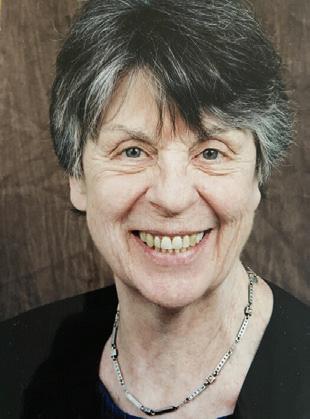
Mary Kathleen Egan Schmuttenmaer, 91, died on May 18, 2026, after a few weeks’ illness. Those who met her during her John Marshall Law School years in the 1970s, her 40-year career at Chicago Title and Trust, or her 10 years of retirement, know her as Mary. Those who met her during her early married years, her years teaching at Nazareth High School, her years at Loyola University Honors College, Trinity High School and Ascension Elementary School know her as Mary Kay.
And a select family group called her “Sixie.” When she was born, she was in bed number 6 in the hospital nursery and her parents, George and Kathleen, had not settled on a name yet. Hearing “Sixie” always brought a smile to her face
She was devoted to lifelong learning and enjoyment of the arts. Book clubs, poetry club, architecture, travel, history, legal updates; and attendance at theater, symphony, opera, movies and museums were some of her cultural pursuits. She relished discussing scientific advancements and continually drew interesting people into her circle
She was an eager and avid conversationalist on almost any topic. While she held many strong opinions, she was usually able to empathize with someone who held opposite views.
Her life had hardships and obstacles. She lost her dad before she was married, her mom before she was 30, and both siblings by her mid-50s. She survived her sons, Charlie, Marty and Mike, and her husband, Hubert. Her third pregnancy in 1964 was complicated by infection with German measles. Marty was born profoundly deaf and with severe developmental delays. She and Hubert found support with other families whose children were similarly impacted. As a result, Marty achieved success far beyond the doctor’s grim assessments at birth. She remained involved in Marty’s care and residential placement throughout his adult life, and brought him home nearly every weekend, even when he lived over an hour away.
She never lost sight of the man she fell in love with and married, even when behavioral health issues made marriage to Hubert impossible. Although they were divorced in the eyes of the state, she continued to make
sure his needs were met, and she cherished the days when his mood allowed for reminiscing about their lives together.
After coping with initial feelings of loss or grief, she accepted her burdens and rose to each occasion, handling them with grace and pragmatism.
She touched the lives of many and will be dearly missed.
Mary is survived by her daughter, Claire (John) Fitz; her grandchildren, Joseph Fitz, Amie (Pablo) Rocha, Laura (David) Kenyon, Joseph (Samantha) Schmuttenmaer; her great-grandchildren, Denzel and Charlotte Rocha, Noah and Miles Kenyon, Sophie, Rylee and Giacomo Schmuttenmaer; and dozens of nieces and nephews, and their families
Please join us at Ascension Church in Oak Park, Wednesday, July 17 at 9:30 for visitation, and 10:30 for Mass
In lieu of flowers, please consider donations to the service agency that supported Marty during the latter years of his life: Garden Center Services, 10444 S. Kedzie Ave., Chicago, IL 60655.
Mary was a fervent supporter of the Constitution. So much so that she had a couple copies on her coffee table for easy reference. Donations to the ACLU would also be appropriate.
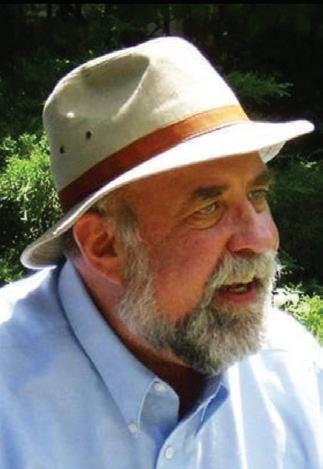
Kevin Donald Peppard, 77, died on April 23, 2026. Born in Oak Park on Feb. 14, 1949, the son of Marvila Aepinus Peppard and Donald Peppard, he excelled academically and graduated from Oak Park and River Forest High School (OPRF) then earned a B.A. from the University of Illinois and an M.B.A. from the University of Michigan.
He retired after working in the automotive industry, holding senior positions at Rockwell, manager for Strategic Planning, and Bendix, director of Automotive Planning. He had an encyclopedic knowledge of history, with special interest in the wars of the 20th century. He also had a big heart. He moved back to Oak Park from Michigan to care for his aging mother as well as his younger brother, Brian, who had a developmental disability.
He also cared about his community and became involved in local politics in the 1990s, beginning with CARE (Citizens Active for
Responsible Electorate) and later CALL (Coalition for Accountable Local Leadership).
In the mid-1990s, he supported an effort to defeat a District 200 referendum that he considered too large, then proposed, and helped pass, a smaller referendum.
With his knowledge of school finance and elections, he played a pivotal role in the OPRF pool saga. In late 2015, he provided valuable insights into the petition process for the grassroots effort that successfully forced the board to place its non-referendum bonds on the ballot to build an excessively large pool. The board responded by pulling the issuance, fearing defeat in the March 2016 election.
Shortly thereafter, he and other members of the grassroots effort for med OPRF Pragmatic Pool Solutions to address the pool issue. The November 2016 pool referendum campaign pitted them against OPRF, with its lobbying group, which outspent them by 3-1. With 35,676 votes cast, the referendum was defeated by 28 votes. It was the first bond referendum defeated in Oak Park in decades.
He remained involved with the pool issue until April 2023.
Kevin was predeceased by his parents and his brother Brian. He is survived by his brothers, Rory Peppard and Sean Peppard of Pennsylvania and their families, and many friends.
A celebration of life was held locally.

George (JoJo) Setrag Kazarian, 74, died on June 19, 2026 after a year-long battle with pancreatic cancer Bor n on June 5, 1952 in Pontiac, Michigan to Sylvia Papazian Kazarian and George Kazarian, he graduated from Waterford Township High School and while attending Oakland University, played back-up bass for BB King at Motown studios. His mother told him he had to get a “real job,” so he graduated from beauty school and got a job at upscale salons in NYC. While there, he met his mentor, Jerry Gordon of J Gordon Designs in Chicago. They traveled throughout Europe doing workshops for Intercoiffure and rode the wave of the blowdry era.
JoJo opened JoJo A Salon on Oak Street in the Gold Coast in 1980. His clientele included a Who’s Who of local celebrities, newscasters and politicians. He served many of these clients for many years. In 1987 he married
the love of his life, Sally Sloane and they raised their 3 boys: Trevor, Seth and Cody in their beloved Oak Park community.
Something of a Renaissance man, JoJo continued playing music including the sitar He also loved cooking, especially Armenian food, and enjoyed yoga, running and painting in various mediums.
He is survived by many who loved him dearly: relatives, friends, clients, neighbors and his immediate family
Services will be private at First United Church of Oak Park. Donations can be made to the American Cancer Society.
James O’Donnell Allen, 76, of Oak Park, died of cardiovascular disease on May 30, 2026. Bor n on Oct. 4, 1949, a fifth generation Chicagoan, he lived in Oak Park most of his life with his mother. He and Catherine shared much in common, including their intelligence – both were Mensa members – and their occupation as court reporters.
Transcribing some of Chicago’s most notorious cases, he developed an interest in crime mysteries and became an avid writer of several, including a novel of historical fiction co-written with Catherine. They also researched and wrote about their genealogy, traveling to Ireland where they transformed vital records into vital friendships that fostered a sense of connection throughout their lives.
In retirement, he served the Oak Park community for 15 years as a volunteer in the nonprofit Economy Shop, benefitting numerous local charities.
Jimmy will be remembered by his cousins, Leslie, Lynn, and Laura, as a compelling storyteller whose knowledge of history and tur n-of-phrase vividly brought the past to life
Jimmy, was the son of Catherine Mary Allen (nee Walsh) and the grandson of Margaret/Marjorie Walsh (nee O’Donnell) and John Timothy Walsh, who predeceased him. As plans are being made to celebrate his life this autumn in Oak Park, please let us know if you are interested in attending by leaving a message with your email address in the online guestbook at http://www conboywestchesterfh.com/obituary/jamesallen. We also hope that you will share your stories of Jimmy there.
Arrangements were handled by ConboyWestchester Funeral Home
By MELVIN TATE Contributing Reporter
The Trinity High School basketball team had a special 2025-26 season, going 26-11 and finishing third in the IHSA Class 3A tournament to gain the program’s second state trophy With several key contributors set to return, the Blazers look to be strong again. At last week’s Windmill City Weekend Shootout, an NCAA Live Event held at Batavia High School, Trinity went 3-1.
“I was really proud of how we played in moments, especially the first day,” said Trinity coach Kim Coleman.
On June 18, Trinity defeated perennial powerhouse Whitney Young 32-29 in its first game, then rolled past St. Laurence 49-30 in the nightcap. The following day, the Blazers fell 49-39 to Bolingbrook, another traditional power, but rebounded to win their final game, 40-36, over Vernon Hills.
“I was happy with how (rising junior) Keyera Gamble led us with her leadership overall and on the court. I liked how she rebounded the ball, how she scored, and how she dele gated and communicated with her teammates,” said Coleman, who also appreciated the steady play of rising senior point guard Destiny Sacluti, who will be entering her fourth varsity season, incoming freshmen Nayana Harper and Gianna McDougall, rising sophomore Destinie Roe, and rising junior Danae Hickman.
“We did pretty good, especially with the work we’ve been putting in,” Sacluti said. “I feel like we’re a really young team with a lot of potential and I’m really excited where this team is going to go. We’ve got some things to clean up, but we’re on the right track.”
As Trinity’s most experienced returnee, Sacluti is ready to hone her leadership skills.
“I’m trying to be that leader, especially with all the younger players we have coming in,” she said. “I want to be a good role model for them.”
As Trinity wraps up its summer session, Coleman has a very good vibe.
“I’m really excited about this team,” she said. “The one thing we’re missing right now is the toughness Zaria (Goins) brought, but everything else, we’re going to fulfill. This group has a chance to do something really special.”
Among the teams who plan on challenging Trinity in 3A is neighboring Fenwick.
T he F riars also competed in the WCW and went perfect in pool play with a 4-0 mark.
“We did pretty good as a team,” said Fenwick rising junior Avani Williams. “Our coach (Lenae Fergerson) wants our defense to be a staple this year and I think this weekend was a good look at that.”
On June 19, Fenwick routed Rockford Lutheran 48-20 and slid past Father McGivney Catholic 39-37. The next day, the Friars trounced Andrew 49-10 and edged out Joliet Central 38-35. Fergerson compared her team’s development to a jigsaw puzzle.
“We have a lot of new pieces,” she said, “so it’s like trying to put it to g ether, and see how it works. It was good to play different competition than ourselves in practice every day, and to see what we need to continue working on and get better at.”
Among those who stood out are a pair of incoming freshmen: Kailyn Hardamon

Fenw ick girls basketball rising junior Avani Williams.
and Kori Thompson.
“I call them my junk yard dogs because they’re very ag gressive on defense,” Fergerson said. “They take our defense to another level once I have to go to my bench.
T hey’re adjusting really well and catching on to stuf f, soaking it up like a spong e.
T hey showed this weekend how much of an inte gral part they will be on our team.”
“They fit in really well,” Williams said.
“It’s really important to build up our chemistry this summer.”
Williams, one of the state’s top prospects in the Class of 2028, adds she’s been watching film and working on strength training
“I like being able to step up,” Williams said, “and becoming a bigger leader is really important. I just want to be able to meet all the expectations.”
PUBLIC NOTICE
IN THE CIRCUIT COURT OF COOK COUNTY, ILLNOIS COUNTY DEPARTMENT, PROBATE DIVISION ESTATE OF Leslie Morris Golden, DECEASED.
NO. 26 P 3596.
Notice is given of the death of the above named decedent. Letters of office were issued to Bruce P. Golden, 943 Forest Ave, Oak Park, IL 60302, as Independent Executor, whose attorney of record is David I Susman (9543), 6968 W. North Ave., CHICAGO, IL 60707
Notice to Heirs and Legatees
Notice is given to Cheryl Balaban, Beth Balaban and Susan Balaban, who are heirs or legatees in the above proceeding to probate a will and whose names or addresses are not stated in the petition to admit the will to probate, that an order was entered by the court on 05/28/2026, admitting the will to probate.
Within 42 days after the effective date of the original order of admission you may file a petition with the court to require proof of the will by testimony of the witnesses to the will in open court or other evidence, as provided in section 5/6-21 of the Probate Act of 1975 (Ill. Compiled Stat. 1992, Ch. 755, par. 5/6-21).
You also have the right under section 5/8-1 of the Probate Act (Ill. Compiled Stat. 1992, Ch. 755, par. 5/8-1) to contest the validity of the will by filing a petition with the court within 6 months after admission of the will to probate. The estate will be administered without court supervision, unless under section 5/28-4 of the Probate Act (Ill. Compiled Stat. 1992, Ch. 755, par. 5/28-4) any interested person terminates independent administration at any time by mailing or delivering a petition to terminate to the clerk.
Claims against the estate may be filed in the office of the clerk in Room 1202, Richard J. Daley Center, 50 W. Washington St., Chicago, IL, or with the representative, or both, on or before December 9, 2026, or, if mailing or delivery of a notice from the representative is required by section 5/18-3 of the Probate Act of 1975, the date stated in that notice. Any claim not filed on or before that date is barred. Copies of a claim filed with the clerk must be mailed or delivered by the claimant to the representative and to the attorney within 10 days after it has been filed.
E-filing is now mandatory for documents in civil cases with limited exemptions. To e-file, you must first create an account with an e-filing service provider. Visit http://efile.illinoiscourts.gov/service-providers.htm to learn more and to select a service provider. If you need additional help or have trouble e-filing, visit http://www. illinoiscourts.gov/FAQ/gethelp.asp.
Published in Wednesday Journal June 10, 17, 24, 2026

Legal Notice Village of River Forest Development Review Board River Forest, Illinois
Public notice is hereby given that a Public Hearing will be held by the Development Review Board of the Village of River Forest, County of Cook, State of Illinois, on Thursday, July 9, 2026 at 7:00 p.m. in the Athletic Facility (Door #8) of Trinity High School, 7574 Division Street, River Forest, Illinois on the following matter:
Application #26-0009: Application for Planned Development to Construct a Mixed-Use Development of a 72-Unit Residential Building with Approx. 3200 Sq. Ft. of Ground-Floor Commercial Space at 76127620 Madison Street, 11 Ashland Avenue, and 10 Lathrop Avenue.
Applicant: Five Thirty One Partners LLC, 1801 N. Bissell St, Suite 1F, Chicago, IL 60614
Legal Description:
7620 Madison StLOT ELEVEN (11), TWELVE (12), THIRTEEN (13), FOURTEEN (14), AND FIFTEEN (15), IN BLOCK SEVEN (7) IN HENRY FIELD’S SUBDIVISION OF THE EAST HALF (1/2) OF THE SOUTHWEST QUARTER OF SECTION TWELVE (12), TOWNSHIP THIRTY-NINE (39) NORTH, RANGE TWELVE (12) EAST OF THE THIRD PRINCIPAL MERIDIAN, IN COOK COUNTY, ILLINOIS.
7618 Madison StLOT 16 AND THE WEST 16 FEET 10 1/2 INCHES OF LOT 17, IN BLOCK 7 IN HENRY FIELD’S SUBDIVISION OF THE EAST HALF OF THE SOUTHWEST QUARTER OF SECTION 12, TOWNSHIP 39 NORTH, RANGE 12 EAST OF THE THIRD PRINCIPAL MERIDIAN, IN COOK COUNTY, ILLINOIS.
7614 Madison StLOT 17 (EXCEPT THE WEST 17.45 FEET THEREOF) AND THE WEST 16.88 FEET OF LOT 18 IN BLOCK 7 IN HENRY FIELD’S SUBDIVISION OF THE EAST HALF OF THE SOUTHWEST QUARTER OF SECTION 12, TOWNSHIP 39 NORTH, RANGE 12 EAST OF THE THIRD PRINCIPAL MERIDIAN, IN COOK COUNTY, ILLINOIS.
7612 Madison StTHE EAST 8.12 FEET OF LOT 18 AND ALL OF LOT 19 IN BLOCK 7 IN HENRY FIELD’S SUBDIVISION OF THE EAST HALF OF THE SOUTHWEST QUARTER OF SECTION 12, TOWNSHIP 39 NORTH, RANGE 12 EAST OF THE THIRD PRINCIPAL MERIDIAN, IN COOK COUNTY, ILLINOIS.
11 Ashland AveLOT 20 IN NEEBES AND PELTON’S RESUBDIVISION OF THE NORTH 450 FEET OF BLOCK 7 IN HENRY FIELD’S SUBDIVISION OF THE EAST HALF OF THE SOUTHWEST QUARTER OF SECTION 12, TOWNSHIP 39 NORTH, RANGE 12 EAST OF THE THIRD PRINCIPAL


PUBLIC NOTICE
Village of Oak Park 2026
Annual Action Plan
MERIDIAN, IN COOK COUNTY, ILLINOIS.
10 Lathrop AveLOT 21 IN NEEBES AND PELTON’S RESUBDIVISION OF THE NORTH 450 FEET OF BLOCK 7 IN HENRY FIELD’S SUBDIVISION OF THE EAST HALF OF THE SOUTHWEST QUARTER OF SECTION 12, TOWNSHIP 39 NORTH, RANGE 12 EAST OF THE THIRD PRINCIPAL MERIDIAN, IN COOK COUNTY, ILLINOIS.
All interested persons will be given the opportunity to be heard at the public hearing, the purpose of which is to take evidence on the Application for the Development Review Board and Village Board to consider. A copy of the application and meeting agenda will be available to the public at the Village Hall, 400 Park Avenue, River Forest, or at www.vrf.us.
Jessica Spencer Assistant Village Administrator
Published in Wednesday Journal June 24, 2026
LEGAL NOTICE
The Village of Oak Park will receive sealed bids from qualified contractors at the Public Works Center, 201 South Blvd., Oak Park, IL 60302 Monday through Thursday 8:30 a.m. to 4:00 p.m. and Friday 8:30 a.m. to noon local time until 4:00 p.m. on Monday, July 20, 2026, for the following:
120 N. Oak Park Avenue – MEP Relocation and Sidewalk Vault Fill
Bid Number: 25-201
Issuance Date: June 25, 2026
There will be two pre-bid meetings, the first will be a mandatory pre-bid meeting at 120 N. Oak Park Avenue, Oak Park, IL on Tuesday, July 7, 2026, at 9 a.m., and the second, a non-mandatory pre-bid meeting at 120 N. Oak Park Avenue on Tuesday, July 14, 2026 at 9 a.m. Bid documents may be obtained from the Village website at http://www.oak-park. us/bid. For questions please call Public Works at (708) 358-5700.
Published in Wednesday Journal June 24, 2026

LEGAL NOTICE
Notice is hereby given that the Village of Oak Park Program Year (PY) 2026 Draft Annual Action Plan is available for public review and comment. The Draft PY 2026 Annual Action Plan may be reviewed during normal business hours Monday through Friday beginning June 25, 2026 through July 27, 2026 at the Village of Oak Park, Neighborhood Services Department, 123 Madison Street, Oak Park, Illinois; on the Village Housing and Grants webpage https://www. oak-park.us/village-services/ housing-programs/communitydevelopment-shelter-grants; and at the Oak Park Public Library Main Branch, 834 Lake Street, Oak Park, Illinois. Reasonable accommodations will be made for persons with disabilities and non-English speaking persons, as needed.
The Draft PY 2026 Annual Action Plan represents the second year of implementation of the Village’s 2025–2029 Consolidated Plan for Housing and Community Development. The Action Plan identifies goals, objectives, and proposed activities to be undertaken with Community Development Block Grant (CDBG) funds for the period October 1, 2026 through September 30, 2027. The Village anticipates receiving $1,576,219 in CDBG entitlement funds from the U.S. Department of Housing and Urban Development (HUD), in addition to any available program income and prior year resources. Proposed activities include public services, housing programs, public infrastructure improvements, and program administration, all intended to principally benefit low- and moderate-income residents.
Written comments regarding the Draft PY 2026 Annual Action Plan may be submitted during the public comment period to the Neighborhood Services Department at grants@oak-park. us or by mail to Village of Oak Park, Neighborhood Services Department, 123 Madison Street, Oak Park, Illinois 60302.
A public hearing regarding the Draft PY 2026 Annual Action Plan will be held on July 13, 2026 from 1:00pm – 2:00pm at Village Hall, Room 102, 123 Madison Street, Oak Park, Illinois 60302. All interested persons are invited to attend and provide comments on the proposed use of CDBG funds.
Published in Wednesday Journal June 24, 2026

The Village of Oak Park --Office of the Village Engineer, 201 South Boulevard, Oak Park, Illinois 60302-- will receive electronic proposals until 10:00 a.m. on Thursday, July 16, 2026 for Project: 26-15, Bike Boulevard Pavement Marking and Signage Improvements. Bids will be received and accepted, and bid results posted via the online electronic bid service listed below. In general, the improvements consist of: the installation of pavement markings including polyurea, Methyl Methacrylate (MMA), and thermoplastic; the fabrication and installation of signs and telescoping steel sign supports and all appurtenant work thereto.
Plans and proposal forms may be obtained via the electronic service starting on Thursday, June 25, 2026, at 10:00 p.m. Plans and proposal forms can be found at https://www.oak-park. us/your-government/budgetpurchasing/requests-proposals or at www.questcdn.com under login using QuestCDN number 10250478 for a non-refundable charge of $64.00. The Village of Oak Park reserves the right to issue plans and specifications only to those contractors deemed qualified. No bid documents will be issued after 4:00 p.m. on the working day preceding the date of bid opening.
The work to be performed pursuant to this Proposal is subject to the Illinois Prevailing Wage Act, 820 ILCS 130/0.01 et seq.
THE VILLAGE OF OAK PARK
Bill McKenna Village Engineer
Published in Wednesday Journal June 24, 2026

Housing Forward (Owner) is issuing an invitation to bid for the project known as 211 N Oak Park Renovation until 3:00pm CST on July 13, 2026 at 1851 S 9th Ave, Maywood, IL 60153. Bids will be publicly opened and read aloud on July 13, 2026 at 4:00 p.m. at 123 Madison St, Oak Park, IL 60302 Room 101
Bidders are invited to submit bids for the renovation scope as described in this Document in accordance with the Instructions to Bidders.
The project includes necessary capital improvements to an existing 1920s building, within the corporate limits of the Village of Oak Park in Cook County, to serve as a homeless shelter to be operated by Housing Forward. This bid for renovation is supplemented by a separate bid for Mechanical, Plumbing and Fire Suppression scopes of work. Selected bidder for this work shall be responsible for scheduling and coordination for the selected bidder for the supplemental scope.
The Contract Documents, including Drawings and Project Manual Specifications may be accessed and download electronically after 10:00am CST on June 24, 2026 by visiting https://iff.org/rfps/ Contact IFF at apanopio@iff.org with questions related to accessing the files.
Bid security, in the form of a certified check payable to the Owner, shall be submitted with each bid in the amount of 5 percent of the bid amount. No bids may be withdrawn for a period of 30 days after opening of bids.
This project is funded in whole or in part with grant funds from the Illinois Housing and Development Authority Non-Congregate Shelter Development Program, Community Development Block Grant (CDBG), HOME, and American Rescue Plan Act programs. Attention is called to the fact that 1) not less than the Federal prevailing wages as set forth in the Contract Documents must be paid on this project; 2) The work to be performed under this contract is subject to the requirements of Section 3, 24 CFR Part 75; and 3) The Contractor must ensure that employees and applicants for employment are not discriminated against because of their race, color, religion, sex, or national origin.
Bidders must be properly licensed under the laws governing their respective trades and be able to obtain insurance and bonds required for the Work. A Performance Bond, separate Labor and Material Payment Bond, and Insurance in a form acceptable to Owner will be required of the successful Bidder. Bidders must not be excluded from participating in any federal assistance program [24 CFR 85, Subpart C 85.35; 2 CFR 200.214].
The Owner reserves the right to reject any or all Bids or to waive any informalities in the bidding. Bids may be held by the Owner for a period not to exceed 30 days from the date of the opening of Bids for the purpose of reviewing the Bids and investigating the qualifications of Bidders, prior to awarding of the Contract.
Published in Wednesday Journal June 24, 2026



ADVERTISEMENT FOR BIDS
Housing Forward (Owner) will issue an invitation to bid for the project known as 211 N Oak Park Renovation Mechanical, Plumbing, Fire Suppression Scope until 3:00pm CST on July 13, 2026 at 1851 S 9th Ave, Maywood, IL 60153. Bids will be publicly opened and read aloud on July 13, 2026 at 4:00 p.m. at 123 Madison St, Oak Park, IL 60302 Room 101
Bidders are invited to submit bids for mechanical, plumbing, and fire suppression scope as described in this Document in accordance with the Instructions to Bidders. The scope is part of a full building renovation.
The project includes plumbing, HVAC, and fire protection system rehabilitations or replacements at 211 Oak Park Avenue, within the corporate limits of the Village of Oak Park in Cook County, to serve as a homeless shelter to be operated by Housing Forward.
The Contract Documents, including Drawings and Project Manual Specifications may be accessed and download electronically after 10:00am CST on June 24, 2026 by visiting https://iff.org/rfps/. Contact IFF at apanopio@iff.org with questions related to accessing the files.
Bid security, in the form of a certified check payable to the Owner, shall be submitted with each bid in the amount of 5 percent of the bid amount. No bids may be withdrawn for a period of 30 days after opening of bids. This project is funded in whole or in part with grant funds from the Community Development Block Coronavirus Grant (CDBG CV) program. Attention is called to the fact that 1) not less than the Federal prevailing wages as set forth in the Contract Documents must be paid on this project; 2) The work to be performed under this contract is subject to the requirements of Section 3, 24 CFR Part 75; and 3) The Contractor must ensure that employees and applicants for employment are not discriminated against because of their race, color, religion, sex, or national origin.
Bidders must be properly licensed under the laws governing their respective trades and be able to obtain insurance and bonds required for the Work. A Performance Bond, separate Labor and Material Payment Bond, and Insurance in a form acceptable to Owner will be required of the successful Bidder. Bidders must not be excluded from participating in any federal assistance program [24 CFR 85, Subpart C 85.35; 2 CFR 200.214].
The Owner reserves the right to reject any or all Bids or to waive any informalities in the bidding. Bids may be held by the Owner for a period not to exceed 30 days from the date of the opening of Bids for the purpose of reviewing the Bids and investigating the qualifications of Bidders, prior to awarding of the Contract.
Published in Wednesday Journal June 24, 2026





IN THE CIRCUIT COURT OF COOK COUNTY, ILLINOIS COUNTY DEPARTMENT - CHANCERY DIVISION
WILMINGTON SAVINGS FUND SOCIETY, FSB NOT IN ITS INDIVIDUAL CAPACITY, BUT SOLELY AS TRUSTEE OF CSMC 2021-RPL4 TRUST
Plaintiff, -v.PATRICIA M. HOOKS F/K/A PATRICIA M. MELGAR, MARK A. HOOKS, WASHINGTON PLACE CONDOMINIUM ASSOCIATION, JPMORGAN CHASE BANK, N.A. Defendants 2025 CH 08998 715 WASHINGTON BLVD, APT. 1D OAK PARK, IL 60302
NOTICE OF SALE PUBLIC NOTICE IS HEREBY GIVEN that pursuant to a Judgment of Foreclosure and Sale entered in the above cause on March 4, 2026, an agent for The Judicial Sales Corporation, will at 10:30 AM on July 7, 2026, at The Judicial Sales Corporation, One South Wacker, 1st Floor Suite 35R, Chicago, IL, 60606, sell at public in-person sale to the highest bidder, as set forth below, the following described real estate: Commonly known as 715 WASHINGTON BLVD, APT. 1D, OAK PARK, IL 60302
Property Index No. 16-07-418-0211004
The real estate is improved with a condominium.
The judgment amount was $162,819.52.
Sale terms: If sold to anyone other than the Plaintiff, 25% down of the highest bid by certified funds at the close of the sale payable to The Judicial Sales Corporation. No third party checks will be accepted. The balance, in certified funds/or wire transfer, is due within twenty-four (24) hours. The subject property is subject to general real estate taxes, special assessments, or special taxes levied against said real estate and is offered for sale without any representation as to quality or quantity of title and without recourse to Plaintiff and in ‘’AS IS’’ condition. The sale is further subject to confirmation by the court.
Upon payment in full of the amount bid, the purchaser will receive a Certificate of Sale that will entitle the purchaser to a deed to the real estate after confirmation of the sale.
The property will NOT be open for inspection and plaintiff makes no representation as to the condition of the property. Prospective bidders are admonished to check the court file to verify all information.
If this property is a condominium unit, the purchaser of the unit at the foreclosure sale, other than a mortgagee, shall pay the assessments and the legal fees required by The Condominium Property Act, 765 ILCS 605/9(g)(1) and (g)(4). If this property is a condominium unit which is part of a common interest community, the purchaser of the unit at the foreclosure sale other than a mortgagee shall pay the assessments required by The Condominium Property Act, 765 ILCS 605/18.5(g-1).
IF YOU ARE THE MORTGAGOR (HOMEOWNER), YOU HAVE THE RIGHT TO REMAIN IN POSSESSION FOR 30 DAYS AFTER ENTRY OF AN ORDER OF POSSESSION, IN ACCORDANCE WITH SECTION 15-1701(C) OF THE ILLINOIS MORTGAGE FORECLOSURE LAW.
You will need a photo identification issued by a government agency (driver’s license, passport, etc.) in order to gain entry into our building and the foreclosure sale room in Cook County and
the same identification for sales held at other county venues where The Judicial Sales Corporation conducts foreclosure sales.
For information, contact Alexander Potestivo, POTESTIVO & ASSOCIATES, P.C. Plaintiff’s Attorneys, 223 WEST JACKSON BLVD, STE 610, Chicago, IL, 60606 (312) 263-0003. Please refer to file number 316583. THE JUDICIAL SALES CORPORATION
One South Wacker Drive, 24th Floor, Chicago, IL 60606-4650 (312) 236SALE
You can also visit The Judicial Sales Corporation at www.tjsc.com for a 7 day status report of pending sales.
POTESTIVO & ASSOCIATES, P.C. 223 WEST JACKSON BLVD, STE 610 Chicago IL, 60606 312-263-0003
E-Mail: ilpleadings@potestivolaw.com
Attorney File No. 316583
Attorney Code. 43932
Case Number: 2025 CH 08998 TJSC#: 46-1250
NOTE: Pursuant to the Fair Debt Collection Practices Act, you are advised that Plaintiff’s attorney is deemed to be a debt collector attempting to collect a debt and any information obtained will be used for that purpose. Case # 2025 CH 08998 I3288451
All real estate advertising in this newspaper is subject to the Fair Housing Act, which makes it illegal to advertise any preference, limitation or discrimination based on age, race, color, religion, sex, handicap, familial status or national origin, or intention to make any such preferences, limitations or discrimination.
The Illinois Human Rights Act prohibits discrimination in the sale, rental or advertising of real estate based on factors in addition to those protected under federal law. This newspaper will not knowingly accept any advertising for real estate which is in violation of the law. All persons are hereby informed that all dwellings advertised are available on an equal opportunity basis.
Restrictions or prohibitions of pets do not apply to service animals.
To complain of discrimination, call HUD toll free at: 1-800-669-9777.







Community Conversation


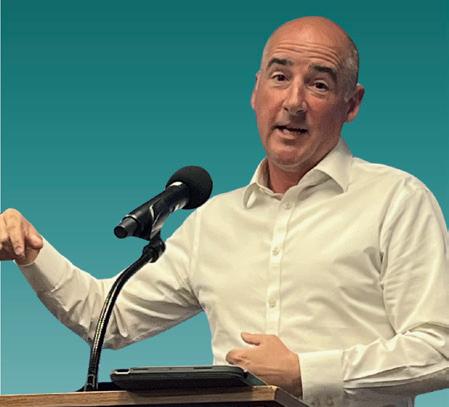


Community Conversation

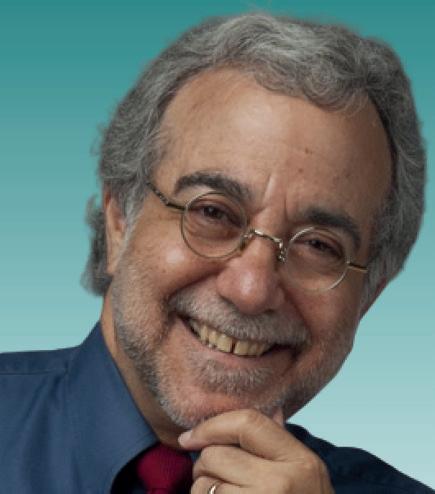
Brian Straw Chris Parente Cha rlie Meyerson Oak Park Trustee Attorney Moderated by veteran journalist

LIFE AFTER THE BROADVIEW 6 A Community Conversation
THURSDAY, JUNE 25 AT 7 PM
19th Century Club (178 N. Forest Ave., Oak Park)
Thursday, June 25 • 7pm 19th Century Club 178 N. Forest Ave, Oak Park
THURSDAY, JUNE 25 AT 7 PM
Join Oak Park Trustee Brian Straw and attorney Chris Parente for a candid conversation about the Broadview 6 case, the dismissal of all remaining charges, and the personal, legal, and civic impact of a prosecution that drew national attention.
19th Century Club (178 N. Forest Ave., Oak Park)
Moderated by veteran journalist Charlie Meyerson, the discussion will explore what happened, what was learned, and what comes next.
Free and open to the public.