AUGUST 19, 2020
AUSTIN FORWARD. TOGETHER. 2020 QUARTER 3
THE AUSTIN COMMUNITY PUBLISHED ITS FIRST QUALITY-OF-LIFE PLAN CALLED AUSTIN FORWARD. TOGETHER (AFT) IN 2019. THIS QUARTERLY PUBLICATION DESCRIBES HOW AUSTIN COMING TOGETHER (ACT) IS SUPPORTING THE COMMUNITY TO IMPLEMENT AFT AND OTHER EFFORTS.
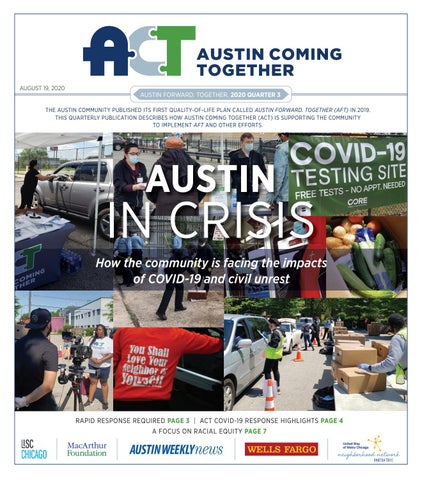
AUSTIN
IN CRISIS How the community is facing the impacts of COVID-19 and civil unrest
RAPID RESPONSE REQUIRED PAGE 3 | ACT COVID-19 RESPONSE HIGHLIGHTS PAGE 4 A FOCUS ON RACIAL EQUITY PAGE 7
2
Austin Weekly News • August 19, 2020
AUSTIN FORWARD. TOGETHER. 2020 QUARTER 3
Since 2010, Austin Coming Together (ACT) has facilitated collaboration to improve education and economic development outcomes in Chicago’s Austin community. Today, we serve a network of 50+ organizations committed to improving the quality of life of all residents. Our strategic plan is called Thrive 2025 and outlines how we will mobilize our resources to achieve four impact goals by the year 2025: Quality Early Learning, Safe Neighborhoods, Living Wage Careers, and Stable Housing Markets. Learn more at AustinComingTogether.org.
ACT BOARD OF DIRECTORS Officers CHAIR
Larry Williams Broker, State Farm Insurance VICE-CHAIR
Ruth Kimble Founder & CEO, Austin Childcare Providers’ Network SECRETARY
Angela Waller Community & Government Relations Director, Advocate Aurora Health
TREASURER
Deborah Williams Community Outreach & Engagement Specialist, Habilitative Systems, Inc.
Directors
Tenisha Jones
Jack Macnamara
Senior Director of Strategy and Operations, West Side United
Visiting Scholar, Center for Urban Research & Learning at Loyola University
Bradly Johnson Director of Core Programs, BUILD Inc.
Founders
Reginald Little
FOUNDING BOARD CHAIR
Director of Graduate Support & Community Outreach, Catalyst Schools
Mortgage Loan Officer for Residential Lending, Old Second National Bank
1955-2019
Reverend Reginald E. Bachus
Senior Marketing Strategist, Zoe Communications Group
Sharon Morgan
Mildred Wiley
Dawn Ferencak
Pastor, Friendship Baptist Church
ACT STAFF Leadership Team
Service Delivery Team
Darnell Shields*
Jerome Sader
Planning & Investment Team
Executive Director
Neighborhood Network Manager
Shavion Scott
Sandra Diaz
Darrel Washington
Director of Strategic Initiatives
Community Hub Coordinator
Alicia Plomin
Jai Jones
Marketing & Development Manager
Community Engagement Coordinator
Andrew Born
Dollie Sherman
Research & Evaluation
Youth Engagement Coordinator
*Ex Officio Member of the ACT Board of Directors
Planning & Investment Manager
Jose Abonce Lead Organizer
Ethan Ramsay Project Coordinator
Esther Ramsay Micro Market Recovery Program Coordinator
Nicole Marcus Micro Market Recovery Program Intern
We’re hiring! Learn more at AustinComingTogether.org
ACT MEMBER ORGANIZATIONS A House in Austin Accion Austin Childcare Providers’ Network Austin Weekly News Be Strong Families Beat the Streets Chicago Because I Care Beyond Hunger (formerly known as Oak Park River Forest Food Pantry) BUILD Inc. By the Hand Club for Kids Cara Catholic Charities Chicago Austin Youth Travel Adventures
Chicago Community Loan Fund City of Refuge Cluster Tutoring Program Erikson Institute Friends of the Children Friendship Community Development Corp. of Austin Greater West Town Community Development Project Housing Forward I.C. Stars IFF Institute for Nonviolence Chicago Jane Addams Resource Corporation Kids First Chicago
KRA Westside American Job Center Legal Aid Chicago (formerly known as LAF) Manufacturing Renaissance Mary Shyrese Daycare Maryville Academy Mercy Housing Lakefront New Moms OAI, Inc. Oak Park Regional Housing Center Open Books PCC Community Wellness Center Project Exploration Sarah’s Inn South Austin Neighborhood
Association St. Joseph Services St. Leonard’s Ministries Stone Community Development Corporation The Catalyst Schools The Loretto Hospital The North Avenue District, Inc. UIC Jane Addams College of Social Work VOCEL Westside Health Authority West Side Forward (evolving from Bethel New Life) Worldvision Youth Guidance
AUSTIN FORWARD. TOGETHER. 2020 QUARTER 3
Austin Weekly News • August 19, 2020
3
Rapid Response Required By Darnell Shields Executive Director, Austin Coming Together
H
istorically, Austin has experienced many inequities that have limited access to the resources and opportunities crucial for its residents to live healthy lives. These economic and social conditions are referred to as social determinants of health. For decades, areas like Austin have struggled as a result of a lack of investment in almost all determinants, such as education, physical environment, healthcare access, and employment. COVID-19 and the civil unrest that has followed have compounded conditions even further. Many of Austin’s social service agencies were unexpectedly paralyzed. From the urgent need to reconfigure programming to fit virtual platforms, to finding creative funding sources to cover unbudgeted expenses, the survival of several organizations continues to be at risk. “Going forward, existing businesses must be comfortable in an environment that is likely changed forever,” said Ed Coleman, President and CEO of West Side Forward, an Austin-based nonprofit evolving from Bethel New Life whose services have provided critical guidance to entrepreneurs and business owners during this time.
When a crisis strikes, a community’s infrastructure is tested. So for Austin, the last few months have been an unprecedented stress test. The COVID-19 pandemic forced us all to confront our weaknesses. It has made clear for all the unstable ground on which we stand. With a situation as new and complex as this, there is no one solution. But there is certainly a desperate need for action.
SOME REAL SOLUTIONS Austin Coming Together (ACT) immediately increased our outreach, surveys, and strategy sessions. Since 2010, ACT’s goal has always been to create sustainable solutions to address Austin’s core needs, and that means adapting to change. Although the challenge was new, we took it on the same way we always have: by listening to the community and leveraging the assets we do have to create the greatest impact. Austin Coming Together (ACT) created a COVID-19 response strategy to decrease the short-term, negative impact of the pandemic on Austin, while also assisting the community to continue upward momentum for the future. The strategy builds on ACT’s existing work and on the community’s strengths to support Austin through: 1
Advocacy
2
Communication
3
Resource Development
4
Resource Deployment
For ACT, our work is relational. Having such strong relationships with key partners, frontline services, and block clubs who were able to identify families with the highest need allowed us to quickly respond. Those partners have become essential in executing our response efforts.
part of Austin’s essential support network and like ACT, had to pivot to the nuances of our shaken landscape.
two-year planning phase involving over 500 community stakeholders. The result was a shared community vision and a roadmap for economic revitalization. Implementation of the five-year strategic plan began in 2019.
The initial support from that Relief Fund allowed us to create the Austin COVID-19 Relief Fund, enabling ACT to provide subgrants to threatened organizations as well as direct deposits to struggling residents.
Austin Forward. Together is empowering residents to carry out 84 actions across seven issue areas: Community Narrative, Economic Development, Housing, Public Safety, Education, Youth Empowerment, Civil Engagement.
But although incredibly helpful, these efforts are all just temporary. We must keep up this dialogue on innovative ways to fix the City’s deep-rooted problems if we are to bring the magnitude of resources truly needed to neighborhoods like Austin.
“We have seen a drastic increase in people seeking our help. Since March, we have expanded our service provisions to include financial payment In order to connect assistance, rental Going forward, existing and homeownership residents to the resources they need resources to more businesses must be and improve the quality than 700 households,” of their lives, ACT’s says Athena Williams, comfortable in an Austin Community Hub Executive Director of team continues to build environment that is likely Oak Park Regional relationships with the Housing Center and community. The Hub Co-Chair and Strategy changed forever. is among others like Lead of Austin Forward. it across Chicago that Together’s Housing ED COLEMAN, PRESIDENT make up United Way Task Force. The OPRHC AND CEO OF WEST SIDE FORWARD of Metro Chicago’s agency has also been Neighborhood Network busy providing rental Initiative. Austin’s Hub team has led ACT’s counseling and property management resource deployment of everything from PPE education to property owners. supplies, food, and laptops, to connections And this ability to persevere by always to direct financial assistance, and COVID-19 listening and flexing to community needs testing. hasn’t gone unnoticed. Longtime partners are razor focused and new ones are realizing HOW TO MOVE FORWARD the time for commitment is now. Although the future may seem uncertain, one “...there is this incredible knowledge and thing I know for sure is that if we are to be power of communities in addressing large successful in saving lives, we must address scale problems, and we want to support the underlying systemic issues that will still that,” said Kimberlee Guenther, Chief Impact plague Austin long after the virus does. Officer at United Way of Metro Chicago. Efforts to improve social determinants for United Way’s Chicago COVID-19 Relief Austinites must be endorsed. One of those Fund made it possible for nonprofits in the is a quality-of-life plan for Austin, created by Neighborhood Network, such as ACT, to and for the community, called Austin Forward. leverage unrestricted donations that could Together. Supported by the Local Initiatives be used where necessary. Support Corporation (LISC), ACT facilitated a
MORE ACTION NEEDED The plan has made significant progress, but there is still much to do. Chicago Police Officers join the ACT team in handing out masks and resource information at a distribution event in March 2020.
The organizations committed to carrying out the work in Austin Forward. Together are
We are seeing an increased interest in neighborhood-led support, but to fully rebound from economic deprivation, Austin needs reinvestment at a level it has not seen before. n
4
Austin Weekly News • August 19, 2020
AUSTIN FORWARD. TOGETHER. 2020 QUARTER 3
ACT COVID-19 Response Highlights In order to ensure that the social services essential to Austin are able to survive, ACT has created a COVID-19 Response Strategy to support the community in four ways: Advocacy, Communication, Resource Development, and Resource Deployment. Here are a selection of updates on the progress we have made.
Up to 100 volunteers are needed to host each of the Pop-Up Food Pantry events in Austin.
ADVOCACY
ACT voices the needs of the key agencies that make up Austin’s support infrastructure, from education resources to social block clubs and nonprofits.
$550,000 was the total amount granted from the Chicago COVID-19 Response
Fund directly to ACT member organizations to best serve Austin residents. Originally only expected to be $25,000, ACT’s advocacy in conversations with United Way of Metro Chicago and the City made the case for increased support for Austin.
COMMUNICATION ACT leverages all communication channels to disperse accurate, helpful information, and to provide updates on our progress in order to uphold ACT’s core value of transparency. Hundreds of residents from in or nearby Chicago’s Austin neighborhood participated in a virtual town hall meeting on April 25, 2020. Experts shared up-to-date information about the impact of COVID-19 in our community, highlighted key resources, and discussed the best ways to protect yourself and your family. The RERRT supported ACT in hosting this event, which streamed live on ACT’s Facebook page.
$50k went to each of these members:
$25k went to each of these members:
ACT transformed their weekly Activities in Austin email to be solely about COVID-19 relief opportunities. The email lists resources for families, businesses, and nonprofits, as well as job openings, and ideas of ways to help.
Subscribe to ACT’s emails at
AUSTINCOMINGTOGETHER.ORG
RESOURCE DEPLOYMENT ACT creatively solves problems through collaboration with our partners to determine the best ways to get essential resources to Austin residents wherever they may be. ACT was able to support families by connecting them to:
50K
Masks Distributed
600K+
Pounds of food distributed
500
Laptops Distributed
5
COVID-19 Testing Sites
$140K
in Direct Financial Assistance to Families
6
Austin Weekly News • August 19, 2020
AUSTIN FORWARD. TOGETHER. 2020 QUARTER 3
Plan Leaders Community Narrative
Economic Development
TASK FORCE COMMITTEE CHAIRS
TASK FORCE COMMITTEE CHAIRS
Briana Shields
Jerrod Williams
Briana Janeé Arts
Kenneth Varner Healthy Schools Campaign
STRATEGY LEADS
Community Resident & SANA Member
Thomas Gary
Community Resident STRATEGY LEADS
Lasondra Kern
Erica Staley
Community Resident
Manufacturing Renaissance
Suzanne McBride
Heather Sattler
Austin Talks
Alicia Plomin
Austin Coming Together
Michael Romain
Austin Weekly News
Cindy Schneider Spaces-n-Places
Community Development Consultant
Education TASK FORCE COMMITTEE CHAIRS
Natasha Smith-Walker Project Exploration
Crystal Bell
Ella Flagg Young Elementary School
Housing
Public Safety
TASK FORCE COMMITTEE CHAIRS
TASK FORCE COMMITTEE CHAIRS
Athena Williams
Bradly Johnson
West Cook Homeownership Center
Allison McGowan
Community Resident STRATEGY LEADS
Shirley Fields Hunters Realty
Rosie Dawson
Charles Anderson
Westside Health Authority
STRATEGY LEADS
West Cook Homeownership Center
Ruth Kimble
Chris Banks
Michele Clark High School
Austin Childcare Providers’ Network
Athena Williams
Community Resident
BUILD Inc.
Marilyn Pitchford Heartland Alliance
Chris Patterson
Institute for Nonviolence Chicago STRATEGY LEADS
Adam Alonso BUILD Inc.
Bradly Johnson BUILD Inc.
Edwina Hamilton
Jane Addams Resource Corporation
Natasha Dunn
Bertha Purnell
Melody Lewis
Cata Truss
Roxanne Charles
Sean Schindl
Kids First Chicago
INTERESTED IN JOINING THE IMPLEMENTATION TASK FORCE?
Carmen Scott-Boria
Deborah Williams
BUILD Inc.
D’elegance Lane Westside Health Authority
Deonna Hart BUILD Inc.
Jeramie McGill
Habilitative Systems Inc. STRATEGY LEADS
Arnold Bearden
South Austin Neighborhood Association (SANA)
Sharif Walker
CEO of Bethel New Life
St. Joseph Services
Frederica Malone Catholic Charities
BUILD Inc.
Catholic Charities
West Side Forward
TASK FORCE COMMITTEE CHAIR
Juan Villalobos Gina Young
Austin Chamber of Commerce Community Resident
TASK FORCE COMMITTEE CHAIRS
BUILD Inc.
Chicago Public Schools VOCEL
Civic Engagement
STRATEGY LEADS
Pam Price
Emily Peters
Youth Empowerment
Institute for Nonviolence Chicago
Jordan Bester Westside Health Authority
Contact ACT’s Lead Organizer, Jose Abonce at 773.417.8615 or jabonce@austincomingtogether.org for more information.
AUSTIN FORWARD. TOGETHER. 2020 QUARTER 3
Austin Weekly News • August 19, 2020
7
A Racial Equity Focus By Alicia Plomin Marketing & Development Manager, Austin Coming Together
A
fter reports in April showed the effects of COVID-19 were heightened in minority communities, Mayor Lightfoot formed a Racial Equity Rapid Response Team (RERRT). This collective effort aimed to address the racial disparities in COVID-19 mortality outcomes, while also looking at the underlying causes behind why these communities are at the greatest risk. At first, the effort focused on three communities where cases were most prevalent: Austin, Auburn Gresham, and South Shore.
The goals of the Racial Equity Rapid Response Team (RERRT): Flatten the COVID-19 mortality curve
in Black and Brown communities in Chicago Build a groundwork for future
work to address long standing and systemic inequities in Black and Brown communities (health, economic, and social) the solutions,” said Ayesha Jaco, Executive Director of West Side United. That is why the RERRT brought on a trusted community organization as an anchor partner in each target area. Austin Coming Together (ACT) was identified as the lead to help develop and implement strategies to meet the need in Austin. With healthcare services already limited, an early priority became creating access to free COVID-19 testing. Through RERRT efforts, five mobile testing sites were established in Austin alone.
Executive Director of Austin Coming Together Darnell Shields speaks with Mayor Lori E. Lightfoot at a community event hosted by the Adams and Austin Block Clubs in July 2020. Photo by Heidi Zeiger
“The key to the success of the Racial Equity Rapid Response Team is that multiple stakeholders, most especially long standing Other RERRT goals include implementing community leaders, are sitting at the same contact tracing, table together, and increasing looking at the distribution of PPE. data, following Through donations, community leaders’ The key...is that multiple as well as by working insights to cowith manufacturers to design solutions, stakeholders, most especially switch to producing and pulling together the RERRT city, philanthropic, long standing community masks, was able to secure and other resources thousands of to take action,” leaders, are sitting at the PPE supplies that said Sybil Madison, same table together...to take continues to be Deputy Mayor of distributed through Education and localized efforts action. Human Rights for led by community the City of Chicago. partners. SYBIL MADISON, DEPUTY MAYOR, West Side United, EDUCATION AND HUMAN RIGHTS, CITY To combat the a coalition of area OF CHICAGO growing food health institutions insecurity, the RERRT whose goal is to launched a series of pop-up food pantries. In address the death gap that exists between partnership with the Greater Chicago Food Chicago’s West Side neighborhoods Depository, the RERRT worked with local and downtown, was brought in as a cocommunity-based organizations like ACT to convenor for the RERRT initiatives. They schedule distribution days where food boxes quickly became an instrumental partner of meat, produce, and dry goods have been due to expertise in gathering data and given to more than 9,000 households so far. understanding the area’s health factors.
behind. “We felt that digital inequities were going to deepen already wide achievement gaps if we didn’t act quickly,” said Daniel Anello, Chief Executive Officer at Kids First Chicago.
The RERRT learned from and adopted several aspects of West Side United’s working model, one of them being the importance of community partnership. “When we see success is when we galvanize, empower, and arm community leaders as contributors to
Since the RERRT began, COVID-19 deaths in the hardest hit areas like Austin are more than 20 times higher. Recently, deaths in the Latinx community have also increased, so the City added Marshall Square, Belmont-Cragin, and Little Village to the neighborhoods targeted by
CONCENTRATING ON CONNECTION As education moved online, inconsistent or unavailable access to the internet caused already vulnerable students to fall even farther
Just months ago, Kids First Chicago released research that found Austin had the City’s largest connectivity gaps. Only one in three households here have internet access. Inspired by early conversations with ACT, Kids First Chicago established a sponsored internet services program for high-need communities and families. This concept led to Chicago Connected, a groundbreaking multi-year public-private partnership to close Chicago’s digital divide and ensure that Chicago Public Schools students have access to the internet and remote learning. It is the latest of its scale and longest in duration in the nation, with 100,000 students getting free internet access in Year One. ACT was selected as the primary lead agency in Austin for Chicago Connected. Additionally, A Better Chicago has also granted ACT funding to facilitate a similar effort that will help to cover families not eligible through CPS.
THE REAL PUBLIC HEALTH CRISIS
the RERRT. We now can see the reasons behind why COVID-19 has ravaged these neighborhoods. Policies rooted in structural racism do not allow Black and Brown communities to thrive. As David Ansell, MD, MPH, Senior Vice President for Community Health Equity at Rush University Medical Center summarized, “concentrated poverty is killing people.” According to an open letter to the Chicago community written by more than three dozen healthcare organizations that was released in June, systemic racism is a public health crisis. Collectively, the group of federally qualified health centers, safety-net hospitals and major academic medical centers care for more than 8 million patients across the Chicago area. As part of the RERRT, the group hopes to see bold steps to fulfill a shared responsibility to serve communities equitably.
BREAKING THE PATTERN Partnerships like the ones we’ve described create a platform for a real connection between government and community to be formed. These connections are creating viable opportunities and a willingness to be proactive. But in order to break the patterns of disenfranchisement and make sure we build on lessons learned, we must translate our responsive solutions into a solid framework. And we must do it in collaboration with the community. n