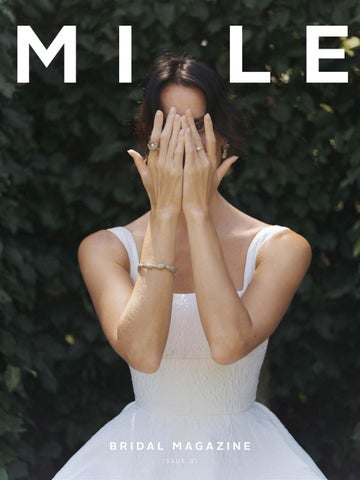
Mile is your guide to weddings and other important celebrations, unique moments in our lives we want to remember and look back fondly on. We tell you what’s hot in the worlds of fashion, design, jewelry, floristry and gastronomy. We look for the best places for ceremonies and honeymoons. Mile is published four times a year.
S I G N AT U R E STY L E Weddings have long ceased to be merely formal social occasions. They have evolved into a distinct space for authenticity, personal aesthetics, and the courage to break away from conventional templates. We are fascinated by how naturally they can be elevated into a complex experience for all senses. From spatial objects and tactile materials to light and the finest finishing touches—none of it is merely a decoration, but rather a deliberate part of a cohesive whole with a character of its own. This new issue is dedicated to weddings with a strong visual voice and to the people who were not afraid to do things uncompromisingly their own way.
Ilona Karásková editor-in-chief
4
2
Editor-in-chief’s message
6
Cover story
28
Interview
41
Real weddings
104
Venues
114
Fashion
120
Flowers
126
Directory
Tuscany just outside Prague. A stone estate blends Czech history with Italian nonchalance. 6
A wedding as an ephemeral world. Magdalena Żywicka bridges architecture, emotion, and the couple’s personal narrative.
Six weddings, six merged worlds, traditions, and families. From weekend celebrations to a morning ceremony at NYC City Hall.
28
41
Three faces of Puglia. Sun-drenched wedding venues hidden among olive groves and the stone walls of ancient estates.
One dress, many forms. Layers transform the silhouette, add drama, and bring an element of surprise.
104
114
Color, rhythm, geometry. A floral composition applies Kandinsky’s aesthetics to the wedding table. 120
D O LC E FA R N I E N T E “There are places where the world falls silent and beauty needs no grand gestures—sunlight, stone, and open space are all it asks for.” Just a short distance from Prague, in the heart of the tranquil Central Bohemian countryside, comes alive an atmosphere reminiscent of a Mauro Bolognini film. A historic stone estate from 1879 carries the noble serenity of Tuscan retreats: a secluded inner courtyard, terraces drenched in warm light, and gardens flowing seamlessly into open grassy paddocks. In the late afternoon haze, horses move leisurely across the fields, accompanied by the gentle rustle of mature trees and an ever-present sense of dolce far niente. It is a harmony of raw nature, subtle countryside grandeur, and effortless elegance — where Italian nonchalance meets genuine Czech history.
Text: Editorial team | Photo: Ondrej Rychnavský – Ryon, ryon.sk | Styling, Concept & Production: Ilona Karásková, Natálie Machová | Article Partner: Horse Park, horse-park.cz | Photo Assistant: Sára Tabačeková | Venue: Horse Park, horse-park.cz | Dress: Momenty, tymomenty.cz | Jewellery: Hanuš Lamr, @hanus_lamr_jewellery | Furniture: Decor Boutique, decorboutique.cz | Flowers & Decor: Avgust flowers, @avgust_flwrs | MUAH: Veronika Karmazínová, @tvorbou | Model: Eva Pavlusová, Stalker Agency
9
D ES I G N I N G T E M PO RA RY WO R L DS Magdalena Żywicka studied Fashion Visual Merchandising in Milan, worked on large-scale interior design projects in Budapest for international hospitality brands such as Hilton Hotels & Resorts and Marriott International, and has lived in over ten countries across four continents. Then came 2019 and a moment when everything suddenly aligned. Today, as the founder of All Things Beautiful (ATB), she creates highly curated destination weddings – immersive celebrations shaped by architecture, emotion, and a deeply intentional approach to design. We spoke about spatial storytelling, the psychology of beauty, why modern weddings are becoming more personal than performative, and why every great celebration needs a Plan B.
Magdalena Żywicka is the founder and creative director of All Things Beautiful, a destination wedding studio working across Europe, the Mediterranean, and beyond. With a background spanning fashion visual merchandising, large-scale commercial interior design projects, and over a decade of living across four continents, she approaches weddings through the lens of architecture, emotion, and spatial storytelling. Her work has been featured in Vogue Netherlands, Vogue France, Vogue UK, Glamour, Financial Times, and other international publications. All Things Beautiful (ATB) is an international boutique destination wedding studio. The studio takes on a limited number of couples each year, treating every celebration as a singular creative and spatial project. ATB’s signature aesthetic – architectural, editorial, and luxe-minimalist – is rooted in the belief that a wedding is not an event to be styled, but an immersive world to be designed. Each project is shaped by the couple’s story, the emotional intention of the day, and the character of the space it inhabits, resulting in celebrations that feel considered, visually refined, and deeply personal. www.atbweddings.com @allthingsbeautifulweddings
Text: Diana Rykrová | Photo: Svenja Petersen, La Dichosa, Bosque Concepts
31
Your path into weddings was anything but conventional. How did those experiences shape the creative perspective you bring to weddings today? My path into weddings was unconventional, but every chapter gave me tools I use constantly today. Fashion journalism trained my eye for storytelling and aesthetics. Interior design taught me how space, composition, and proportion shape emotion. Media sales gave me strategy, negotiation skills, and the ability to work with many different personalities. Living in over ten countries across four continents shaped me the most. It gave me a global perspective and sensitivity to different cultures, customs, and ways people celebrate. That experience allows me to create weddings that feel layered, personal, and emotionally resonant rather than formulaic. Today, I approach weddings less as events and more as immersive experiences shaped by space, emotion, and story.
You’ve described that “lightbulb moment” on the island of Aruba in 2019 when All Things Beautiful came together. What did the first year of building the business actually look like? Was it as beautiful as the vision?
From the beginning, this was never a side project or something I was testing out “for fun” – it was a conscious decision to fully bet on myself. There was no financial or emotional safety net from family or a partner, so I knew it had to be entirely self-driven, with no room for trial runs or “seeing how it goes.” The first year was about learning at speed while building everything from scratch – the structure of the business, the identity of the brand, and the visual world of ATB. It wasn’t a beautiful period. It was intense, uncertain, and often overwhelming. But it laid the foundation of the studio and clarified exactly how I wanted to work: entirely on my own terms.
How did fashion and commercial interior design shape the way you think about weddings today?
Fashion visual merchandising taught me how to create emotion through composition – how people move through a space, what draws the eye, and how atmosphere shapes experience. Commercial interior design added another layer: flow, function, logistics, and guest experience on a larger scale. That combination defines how I approach weddings today. I don’t start with décor or isolated visuals; I start with space and experience. How do guests arrive? What do they feel when they enter? Where does the energy rise and soften throughout the day? Every design decision is connected to how the space is lived in, not just how it looks in a photograph. For me, weddings are temporary spatial worlds. My role is to design them in a way that feels emotionally coherent, visually refined, and deeply intentional, where every detail has both aesthetic and functional purpose.
Many of your couples aren’t looking for a “traditional” wedding. What are they looking for instead?
The couples I work with rarely come to me asking what a wedding should look like. They usually already have a sense of direction – my role is to help refine that and translate it into a coherent creative language.
Instead of focusing on tradition or trends, the conversation naturally shifts inward, towards identity and feeling. A key part of the process is what I call a “self filter” – everything is measured against a simple question: does this feel like us? Once that framework is in place, decisions become much more intuitive and aligned, rather than driven by external expectations. The editorial, architectural language of ATB is not imposed on the couple. It naturally emerges from that process of clarity, restraint, and emotional alignment.
You often speak about architecture as an emotional framework for a celebration. What role does a venue really play in shaping a wedding?
The venue forms a fundamental layer on which the art direction is built, while the couple and their story always remain at the centre of the process. I don’t see the space as the starting point, but rather as a contextual framework – it sets the tone, defines the physical boundaries of the celebration, and influences how the experience unfolds both spatially and emotionally. In that sense, architecture is a very important lens through which the concept is refined and grounded in reality. When I approach a venue, I always look at how it behaves – how people move through it, where the natural focal points are, how light shifts throughout the day, and what kind of atmosphere already exists within the structure. These elements don’t dictate the design, but they inform it in a very honest way. From there, the creative direction becomes a dialogue between three things: the couple’s story, the emotional intention of the celebration, and the architectural character of the space. When those three are aligned, the result feels effortless – as if everything naturally belongs exactly where it is.
Couples today seem far more design-aware than before. Do you feel weddings are becoming more intentional?
Couples are increasingly design-aware, culturally curious, and intentional about how they want their wedding to feel – not just how it should look. What I’ve noticed is less of a shift toward trend and more of a shift toward consciousness. People are questioning conventions and are less interested in reproducing a template. Instead, they want something that feels deeply personal, considered, and aligned with their world. In that sense, editorial or design-led weddings aren’t an aesthetic category for me – they’re a byproduct of a more intentional process. When you strip away expectation and start from identity, emotion, and context, the outcome naturally becomes more refined, spatially aware, and often more architectural in its thinking. I think couples today are really seeking clarity, meaning, and coherence. The visual language simply follows that.
You work across Europe and the Mediterranean. Have there been moments when a couple’s original vision unexpectedly led somewhere completely different?
I encourage couples to go deeper into what they are naturally drawn to, without judgement or assumption. A key part of my process is asking them to share visual references – not only destinations, but also architecture,
landscapes, textures, and atmospheres that resonate with them. This gives a much clearer understanding of what they are actually responding to on an emotional level. Often, those cues already exist within the places they are considering – and sometimes they lead us somewhere unexpected, but still very aligned. For example, we’ve ended up in the middle of a dramatic volcanic landscape in Lanzarote after initially considering Mallorca or Italy, or in a historic villa in Palermo when the conversation was originally centered around the South of France.
What do couples most often underestimate about destination weddings?
The first is the importance of a proper Plan B. And that doesn’t only mean rain – it can just as easily be strong wind, extreme heat, or other environmental factors that significantly affect how a space functions. Having a beautifully considered Plan A is essential, but so is an equally intentional alternative. The second is venue capacity. Not just in terms of how many guests a space can physically accommodate, but how it actually feels across the different moments of the day. Ceremony, dinner, and dancing all require very different spatial dynamics, and this is often overlooked in the early stages. And lastly, timeline restrictions. Every destination comes with its own regulatory and logistical landscape, and this can have a significant impact on the structure of the celebration. For example, venues located near water or in densely populated areas often operate under strict outdoor curfews – sometimes around 10 pm to midnight. So if a couple’s vision includes a long night of dancing until the early hours, certain locations will naturally not be compatible with that format.
You recently designed a very modern wedding in the South of France. What does “modern” actually mean to you in a wedding context?
To me, “modern” doesn’t mean trendy, nor does it mean being anti-trend. It’s not a reaction to anything – it’s more about exploring a creative direction that might not feel immediately intuitive within a traditional wedding context. In that sense, modernity is really about intention and restraint. It’s about questioning default choices and allowing space for contrast, composition, and unexpected combinations – whether that’s in materials, pacing of the day, or how a space is activated. For this particular celebration in the South of France, the starting point was creating a deliberate tension between the venue and the design. We wanted to establish a dialogue between a grand, Art Deco villa by the sea and a modern, highly edited, minimalist design language. Rather than blending into the existing character of the space or competing with it, the idea was to let both identities exist in parallel – and in that contrast, create something more compelling.
How do you translate a couple’s personality into a visual world?
Personal connection is everything. Without trust, the creative process becomes superficial. Alongside the relationship that naturally develops over the time we work together, a large part of my discovery process is visual. I ask couples to share references – from architecture, fashion, interiors,
travel, even seemingly unrelated images – and I look for patterns in what emotionally resonates with them. The goal is never to replicate references literally, but to decode their underlying tone and sensibility and translate that into a visual and emotional world that feels deeply personal and true to who they are.
ATB is intentionally boutique. What does that protect creatively?
For me, “boutique” is a very intentional way of working rather than a scale. It means staying closely involved in every project, working with a limited number of couples each year, and ensuring a high level of depth, attention, and creative integrity throughout the process. In practice, it allows me to remain hands-on from concept to execution, rather than stepping back as the work scales. It protects the quality of thinking behind each wedding, but also the experience for the couple – it stays personal, considered, and truly tailored. Most importantly, it protects the creative clarity of the studio. It allows each celebration to be developed as its own world, without compromise or dilution.
Where exactly is your home right now? And how do you balance being deeply rooted in one place while being completely nomadic in your work?
After well over a decade of living across multiple countries and continents, I more or less by accident found myself back where I am from – Warsaw, Poland. I originally came back for what was meant to be a short stay, but then the pandemic happened and I ended up staying much longer than planned. In hindsight, it was a blessing in disguise, because being based in the heart of Europe has proven incredibly practical for the way I work. From Warsaw, I have relatively easy access to the rest of Europe and beyond, which makes it a very strategic base for a highly mobile, international practice. Travel has always been a fundamental part of both my work and my personal life. I can’t imagine being rooted in one place for too long. So while Warsaw is home for now, I don’t treat it as a fixed concept. It’s simply where I am currently based, while I continue moving between projects, destinations, and countries throughout the year. And in the meantime, I’m very happy collecting as many flight miles as possible.
What inspires you creatively these days?
I have my eye on a few places I feel creatively drawn to at the moment – Mexico and Morocco are both very high on the list. What excites me most, however, is not geography itself, but context. I’m very interested in new venues and emerging spaces, especially those that haven’t yet been overused in a wedding context. I closely follow new openings, and I’m currently working on projects in places where weddings are still very rare – including a private island celebration and an entirely new venue where we will be among the first to ever design a wedding. For me, the most exciting projects are always the ones that feel like stepping into completely unknown creative territory.
REAL WEDDINGS Six weddings, six distinct worlds. Six ways to weave together family, tradition, sense of place, and a personal vision of celebration. Paula and Alberto merged Galician tradition with contemporary design in the gardens of Pazo Pegullal. Brina and Troy used mirrors to let the surrounding landscape take center stage in France’s Rocabella. Valentina and Lorenzo transformed her mother’s home in Brazil into an architecturally composed ritual rich in personal symbolism. Sarah and Sobhan brought French elegance and Iranian traditions together at Château Belá. Amy and Jamie found luxury in nature, music, and community at Wales’ Fforest Farm. Meanwhile, Alina and Brendan shared their first “I do” in Manhattan at 9 AM — celebrated as a perfectly chic date right before heading to work.
43
PAULA & ALBERTO A dialogue between the traditions of Spanish Galicia and contemporary design: nostalgic, cinematic, warm, intimate, and timeless. Architects by trade and by nature, Paula and Alberto wanted their wedding firmly anchored in the history of the landscape and family, while leaving room for the nuanced expression of light, materials, proportions, and atmosphere. They spent roughly ten months planning the wedding, approaching it much like an architectural project — defining a clear concept, refining every detail, and ensuring every choice contributed to the wider visual and emotional narrative. From daylight into twilight, from candlelight onto the dance floor, Paula and Alberto’s wedding followed its own distinct rhythm — like a well-composed score where nothing is accidental, yet everything feels entirely effortless. A shared passion for design, travel, and the quiet beauty of objects brought them together, and their wedding became a natural continuation of that common ground. Alberto proposed in New York, a milestone that felt surprisingly intimate despite the city’s restless energy. The ceremony at the Church of Santiago de Vigo begun the day in Paula’s hometown, before the celebration moved to the gardens of Pazo Pegullal. For their two hundred guests, they crafted an afternoon that shifted in tune with the changing light. Galician bagpipers welcomed everyone into the gardens, followed by a cocktail reception and a multi-course dinner by chef Pepe Solla. The menu drew on local ingredients and seafood, reinterpreting traditional regional flavors through a contemporary lens. The music evolved with each transition of the day — from piano, cello, and vocals during the ceremony to saxophone over cocktails and uninhibited energy on the late-night dance floor. A strong, tthought-through concept made it easy to distinguish what truly mattered. Having designed the creative direction themselves, turning to a wedding coordinator gave them the freedom to simply be present — to become guests at their own feast. And in the end, it was the small imperfections that breathed real life into the celebration.
Text: Diana Rykrová | Photo: Más Que Momentos
Venue: Church of Santiago de Vigo (ceremony), Pazo Pegullal (reception), Pontevedra, Spain| Photo: Más Que Momentos - Marta Fresnillo | Video: Más Que Momentos | Flowers: bride’s own floral concept | Rings: Roberto Joyero | Dress, jacket, veil and hat for her: Helena Mareque | Groom’s suit: Lander Urquijo | Shoes for her: Mint&Rose| MUAH: Moi Freire | Music: Insieme (ceremony and cocktail ), R Música DJs (party) | Catering, cake and sweet bar: Pepe Solla - Restaurante Solla
BRINA & TROY Except for their shared roots, they are living opposites. She is an introverted filmmaker who is happiest at home with a book, a movie, a puzzle, or a set of Legos. He is an extroverted architect who thrives out in the world. Troy lives by structure and healthy routines, while Brina’s relationship with food and sleep is decidedly more free-spirited. Yet across all their contrasts, they are united by a love of travel and an open, curious approach to the world. Troy proposed to Brina in the heart of the Liwa Desert — a setting of endless horizon. When searching for a wedding venue, they looked for that same expansive sense of space. They found it at the iconic Rocabella in Toulon, in the south of France, where just forty-four guests gathered in late July. They wanted an intimate day free of unnecessary décor and florals — partly because Troy is allergic to pollen—so mirrors became their central design motif. Reflecting the surrounding landscape, they invited the natural scenery into the venue, letting the setting itself become the most striking decoration. The bride gave music the role of a second storyteller, subtly weaving references to their favorite films and series throughout the playlist. Their first dance was a bespoke mixtape blending The Way You Look Tonight (a tribute to Monica and Chandler from Friends) with nods to iconic moments from Pulp Fiction and Yorgos Lanthimos’ The Favourite. There was even Good Dog by Tall Guys Short Songs, which accompanied their dog, Wiener, on her honorary mission to deliver the wedding bands. Brina believes that if traditions are to be kept, they should be entirely your own; instead of being given away solely by her father, both parents walked her down the aisle. The couple asked for no gifts, content simply with the quiet presence of their guests. And in place of a traditional honeymoon, they chose a two-week road trip across France with both sets of parents. Despite working in film, Brina didn’t want a scripted day, but rather the next chapter of a story she and Troy write entirely on their own terms.
Text: Diana Rykrová | Photo: Joy Zamora
Venue: Rocabella, Toulon, France | Photo: Joy Zamora | Concept and Coordination: All Things Beautiful | Video: Laguna Santa | Flowers: Bosque Concepts | Rings: Hermes and Harry Winson| Jewelry: Cartier and Lemaire| Dress for her: Wooselect, Alon Livne | Groom’s suit: Bespoke | Shoes for her: United Nude, Saint Laurent| MUAH: MiaVita Makeup| Music: own playlist | Catering: Rocabella
VALENTINA & LORENZO Valentina never longed for a ring. If there were to be an engagement, it had to be through art — that was the private code of this Brazilian couple. On their sixth anniversary, Lorenzo surprised her with breakfast, and in place of one of the dining chairs stood an unconventional chair with crossed legs: an art installation by Luiz Philippe Mendonça that Valentina had always dreamed of owning. The ceremony took place at her mother’s home. A space familiar down to the very last detail became the perfect canvas for her wedding design. As an architect, she wanted something modern and original. She fell in love with a circular layout for the ceremony, an idea mirrored by an opening in the roof structure that brought an ethereal quality to the setting. Every detail was just as deliberate. A square motif repeated across the fabrics, invitations, menus, accessories, and graphics. The color palette remained minimalist and calm: vanilla yellow, contemporary grey, and clean-lined furniture formed a quiet backdrop for bolder, sculptural floral installations in warmer tones. Designed by florists Amorphophallus in collaboration with chef Caique Tizzi, these tall obelisks blended flowers directly with raw ingredients from the menu. Beneath the carefully composed, architecturally driven aesthetic ran a deep current of emotion and memory. Valentina had lost her father less than a year before the wedding, and Lorenzo had lost his mother even earlier. The couple had their names engraved onto rearview mirrors placed near the altar, and their portraits appeared on banners carried by children from both families — weaving past, present, and future into a single moment. Instead of a traditional ring exchange, the couple performed a ritual using a fabric sash sewn from remnants of the wedding gown, into which the witnesses and bridesmaids wove a red thread along its entire length. The spirit of subverting tradition carried through to their first dance, as they joined their guests in dancing samba. By three in the morning, the wedding had transformed into a carnival — all within the framework of thoughtful architecture that offers strong structure while leaving ample room for spontaneity.
Text: Diana Rykrová | Photo: Bruno Aguiar
Venue: Bride’s mother home Brasilia, Brazil| Photo: Bruno Aguiar | Video: Yohana Beerman | Concept: EMBA | Coordination: Simone Couto | Flowers: Amorphophallus | Stationery: EMBA | Rings: Granparents | Jewelry: Clo by Yasmim Passos | Dress for her: Rebeca Nepomuceno | Groom’s suit: Dod Alfaiataria | Shoes for her: Gianvito Rossi, Stella McCartney | Make-up: Biel Alvez | Hair: Leticia Cunha | Music: Samba circle by Ivo Meirelles, DJ Felipe Mar, Kenner e Krell | Catering: Caique Tizzi, Unique Buffet |Cake & Sweet bar: Tatianos Barros, A Banca, Cecília Falcão, Sweet Soft Confeitaria, Jello shots by Luiza Lafer
SARAH & SOBHAN Sarah and Sobhan met during their studies in Vienna. They began as friends before their paths diverged for nearly four years, only to cross again between Vienna and Paris. Their first date on the Champs-Élysées opened a new chapter: a year of living together in Paris, a return to Vienna, an engagement, and, a year later, a wedding. That very French elegance, woven into the beginnings of their story, subtly shaped the atmosphere of the entire wedding weekend. For their multi-day celebration, they chose Château Belá — a place Sarah had been connected to long before the wedding. She used to visit with her father to see a local winemaker who advised him on winemaking, and this family memory naturally carried over into the celebration, with her parents personally curating the wine pairings throughout the weekend. A Friday welcome dinner featuring an Iranian-inspired menu set an easy, relaxed rhythm for the days ahead and gave guests time to connect before the main event. The Saturday wedding on July 4th coincided with American Independence Day, but for Sarah and Sobhan, it marked the beginning of their marriage. Two intimate ceremonies took place during the afternoon. First, a Christian ceremony was held in the chateau’s church, after which guests moved to the orangery for an Iranian ceremony. The sofreh aghd (the traditional Iranian wedding spread) was prepared that morning by Sobhan’s sister, his father led the ceremony, and Sarah’s mother alongside her closest friends held the veil over the newlyweds. Both families were woven directly into the fabric of traditions. The visual aesthetic of the day shared the same effortless grace. Timeless château elegance: a black-tie dress code paired with silver accents, roses, and peonies in soft pink and white hues. Sarah’s gown featured a clean, understated bodice set against a voluminous skirt falling into soft, sculptural folds. The music was curated to build in energy as the day progressed. The weekend unfolded as something between an elegant French summer celebration and a shared getaway — a singular place where Austria, France, Iran, family ties, and friends from across the globe seamlessly came together.
Text: Julie Podlaha Zákostelecká | Photo: Tomáš Lazorík
Venue: Chateau Bela, Belá, Slovakia | Photo: Tomáš Lazorík, Michaela Hynek | Video: Andrej, Redvision Wedding | Flowers: Tóth Annamária | Rings: Mahallati Jewellery, Cartier | Jewelry: Laurence Coste | Dress for her: Millanova, Love Glow | Groom‘s suit: Suit Supply | Shoes for her: Aquazzura | MUAH: Lubica Miklas | Music: Sound Gentlemen, DJ Laci | Catering: Michal Konrád | Cake and sweet bar: Mária Pavlačková Horváthová
AMY & JAMIE Long before Amy met Jamie, she got a moon tattooed on her back while studying at university in America — never imagining that Moon would one day become her surname. Years later, drifting off the coast of Sorrento on a boat beneath the night sky, Jamie proposed, having secretly arranged for that same crescent moon to be engraved inside her ring beside her birthstone. When the two took one of their very first trips together to Fforest Farm in Wales, they fell in love with its raw, wooded simplicity. Right then, they made a pact to save up until they could bring everyone they loved back to that exact spot. Their three-day gathering was conceived as an unpretentious, nature-steeped celebration where food, music, and community led the way. The weekend kicked off on Friday with a “casual cowboy” rodeo welcome party: wood-fired pizzas, a mechanical bull, and acoustic country music by Manchester singer Bec O’Malley. Saturday’s ceremony took place in the dramatic setting of the slate quarry at two in the afternoon. Surrounded by ancient trees and meadows of wildflowers arranged by local florist Mark of Welshborn Flowers, Amy walked down the aisle to the music of Tyler Childers with their young sons by their side. Above the quarry, a solitary red kite circled throughout the vows — a comforting, unspoken presence honouring Amy’s late grandfather, Roger. The reception unfolded naturally among the farm’s raised kitchen garden beds. Long wooden tables hosted a feast of barbecued Welsh hogget and seasonal harvest platters, where fresh carrots, radishes, and Brussels sprouts held the place cards before being composted back into the soil. With the afternoon in full swing, Amy casually slipped off her dress’s voluminous puff sleeves on a friend’s cabin terrace, pulled her hair back into a silk bow, and kicked off her shoes. Instead of a traditional first dance, the night belonged to an eight-piece ska band — a shared childhood love passed down from their fathers, who danced side by side in Mod braces. The weekend wound down on Sunday with a farm brunch, a thirty-person wild swim in the river, and an afternoon on the coast, proving that true luxury lies in simplicity, freedom, and being entirely at home.
Text: Editorial team | Photo: Zoe Ardiff
Venue: Fforest Farm, Cardigan, United Kingdom | Photo: Zoe Ardiff | Video: Matt Jones & Carter Jones | Flowers: Welshborn Flowers | Stationery: Harriet Watson | Rings: Christopher Colin | Jewelry: Blue Meadow (hair bow & earrings) | Dress for her: Halfpenny London, Shaun Oliver Bespoke (Friday welcome dress) |Groom’s suit: Shaun Oliver Bespoke | Shoes for her: Manolo Blahnik | Hair: Grace Lilie Hair | Make-up: Keeley Wilson | Music: Bec O‘Malley & The SKA Kings | Catering: Fforest Farm | Cake: CRWST Cymru
ALINA & BRENDAN Meeting organically at an NYC bar brought stylist Alina and Brendan into the same orbit. Three years later, during a video shoot in Tuscany, Brendan asked for a third take and surprised her with a ring. While a three-day Tuscan celebration awaits, the couple chose to make it official in Manhattan first. Planned in just weeks, their 9 AM City Hall ceremony on July 16th was effortless, chic, and intimate — less like a traditional wedding and more like a quintessential New York date, celebrated over quiet morning vows before heading straight into the workday.
Text: Editorial team | Photo: Ilia Klopov
Venue: City Hall, New York City, USA | Photo: Ilia Klopov | Rings: Cartier | Top: Reformation | Pants: Zara | Bag: YSL | Hat: Magnolia Ave| Shoes: Manolo Blahnik | Groom’s suit: Suit supply
T H E C H A R M O F SO U T H E R N I TA LY Puglia is defined by sun-bleached stone estates, ancient olive groves, sweeping horizons, and celebrations that blend effortlessly into their natural surroundings. Adela Strimbeanu of Holubica Studio curates three distinctive properties, each capturing this spirit through a unique architectural sensibility: Masseria Le Torri honors sensitively restored historic volumes and layered heritage; Masseria San Giovanni is anchored by the quiet poetry of a consecrated chapel and a centuries-old olive tree; and Masseria Moroseta translates rural Puglian vernacular into a crisp, contemporary aesthetic. What unites them is an uncompromising reverence for place, landscape, and the authentic soul of Southern Italy.
AN EYE FOR DETAIL. A FEEL FOR ATMOSPHERE. A DEDICATION TO FLAWLESS EXECUTION. Adela Strimbeanu, Wedding Planner and Creative Director, is the visionary behind Holubica Studio, designing celebrations for an international clientele. Her holistic approach weaves together meticulous logistics, artistic direction, tailor-made spatial design, and floral artistry, ensuring every event is an authentic expression of the couple’s individuality, deeply anchored in its setting. Each wedding is conceived as an immersive narrative — from the initial storyline and overarching aesthetic concept to the architectural staging, floral styling, and effortless guest experience. Holubica approaches every element as an intentional part of a harmonious whole, crafted to feel organic, thoughtful, and profoundly personal. The outcome is never a rehearsed script or a templated production, but an intimate celebration sculpted exclusively for two people: singular in atmosphere, curated down to the finest nuance, and impossible to replicate.
Text: Julie Podlaha Zákostelecká | Photo: Jana Korcek
107
MASSERIA LE TORRI: A CELEBRATION IN TUNE WITH PUGLIAN HERITAGE Set within the serene countryside near Polignano a Mare, Masseria Le Torri pairs the authentic character of an original Puglian estate with an exceptionally sensitive restoration. Over an eight-year revival, historic stone walls, alcoves, original textures, and traditional whitewashed architecture were meticulously preserved and elevated by subtle contemporary accents. In the 17th century, a portion of the masseria served as a convent, and original frescoes from this period remain preserved today. The luminous white volumes of the property stand in poetic dialogue with the surrounding olive groves and rustic scenery, while the patina of aged materials lends the setting a grounded, timeless charm. Its central courtyard, terraces, staircases, and Mediterranean gardens form an organic sequence of spaces, ideal for hosting intimate gatherings of up to 70 guests.
MASSERIA SAN GIOVANNI: A SANCTUARY AMID OLIVE GROVES AND WHITE STONE Situated between the Adriatic coast and the rolling hills of Southern Italy, Masseria San Giovanni is embraced by ancient olive trees and the traditional dry-stone walls characteristic of the Puglian countryside. The estate retains a peaceful layout centered around a courtyard that subtly reveals the property’s layered architectural history. Among its most defining features is an 18th-century chapel, still an integral part of the grounds, alongside a monumental, centuries-old olive tree at the heart of the courtyard, around which daily life naturally unfolds. Together with the intimate scale of the masseria, these historic elements create a private sanctuary for close-knit gatherings. The estate offers 14 guest suites, accommodating up to 38 guests on-site.
MASSERIA MOROSETA: CONTEMPORARY PUGLIA IN CLEAN LINES Masseria Moroseta reimagines the traditional Puglian farmhouse through a modern, minimalist lens. Crisp white walls, clean architectural lines, and meticulously framed vistas create a living scenography that shifts with every perspective. The property’s strict geometric forms are softened by wild olive groves, cacti, and the surrounding rural expanse, with an organic kitchen garden remaining vital to daily life. Evolving from an intimate six-room retreat, it has flourished into a culinary and architectural destination where built form and gastronomy hold equal weight, grounded in locally harvested ingredients and a modern interpretation of Mediterranean cuisine.
W H AT ’S O N TO P Layering is one of the most interesting and playful themes in bridal fashion this year. A flowing cape over the shoulders, a light organza blouse on top that adds volume, or a sequined jacket you slip on before the first dance to light up the floor. The outer layer has stopped being just a “cold-weather fix” and became part of the design — an easy way to change the whole character of the dress.
Text: Veronika Kostková | Photo: brands archive
116
fashion designer Veronika Kostková Veronika Kostková Wedding Atelier
A D D SO M E D RA M A Volume, texture, shine. Dramatic, breathtaking silhouettes that create momentum the second you walk into the room.
Dahlia jacket, Cortana, cortana.es | Cecil jacket, SAX35TH by Alicja Czarniecka,, sax35th.com | Taylor sleeves, Rue de Seine, ruedeseine.com | Sequined crop top, Maticevski, mytheresa.com | Vittoria Bolero, Milla Nova, millanova.com
117
SHEER L AY E RS Organza, chiffon, tulle. The shoulders stay covered, but the beauty of the dress underneath still reads through a layer as light as mist.
Sheer tie-front blouse, H&M, hm.com | Lyra cape, Milla Nova, millanova.com | Hana jacket, Cortana, cortana.es | Ruched sheer cape, Geisha Designs anthropologie.com | Cornelia blouse, Sea New York inc, sea-ny.com
PO P OF L AC E Sleeves in delicate Chantilly lace, a blouse in embroidered tulle. An accessory that’s a piece of jewelry in its own right.
Ivy jacket, Saint Bridal Couture, saintbridalcouture.com | White Sequin Jacket, Ume London, umelondon.com | Lace bomber jacket, Touché Privé,, toucheprive.com | Como silk-trimmed lace cape, Zimmermann, mytheresa.com | Mary Catherine Bolero, Sareh Nouri, sarehnouri.com
CINDERELLA A cape in every shape and length imaginable — one even Cinderella wouldn’t be ashamed to wear.
Prophecy Cape, Saint Bridal Couture, saintbridalcouture.com | Sheer chiffon high neck cape, Because Of Alice,, becauseofalice.com | Chantilly lace bridal cape, Chantilly Cape, graceloveslace.com | Waterfall cape, Donatelle Godart, donatellegodart.co | Raya shawl, Anna Kara, annakara.com
FU R , WO O L , F E AT H E RS Fur, wool, feathers — the cold doesn’t stand a chance.
Kasumi coat, Tatyana Kochnova Atelier, tatyanakochnova.com | Oversized coat, Norma Kamali, mytheresa.com | Greta wool coat, Rue Sophie, anthropologie.com | Tulle and organza jacket, Elisabetta Franchi, farfetch.com | Georges cardigan, Laure De Sagazan, lauredesagazan.fr
L I V I N G B RUS H ST RO K ES The rhythm of pure color translated into a spatial composition. A geometry of emotion that needs no literal to tell a powerful story. Take a closer look at the distinctive floral vision of Adela Strimbeanu, designer and founder of the wedding agency Holubica. In our floral series, inspiration turns to the visionary world of abstraction pioneer Wassily Kandinsky. For Kandinsky, color was never merely a pigment, but a chord vibrating directly with the human soul. This tablescape translates the essence of his compositions into contemporary floral design: a vibrant dialogue of primary tones—the deep cobalt of delphiniums, playful spheres of yellow craspedia, and soft vanilla carnations — punctuated by the sharp verticals of scarlet taper candles and the sleek geometry of chrome elements. Here, flowers act as living brushstrokes and sculptural forms, creating a dynamic concert of balance, tension, and pure visual harmony across the calm canvas of the table.
Text: Editorial Office | Concept & Bouquets: Adela Strimbeanu – Holubica Agency | Photo: Gabriela Jarkovská
123
A P L AC E T H AT M OV ES YO U. M O M E N TS T H AT L AST. www.horse-park.cz
m i l e m a ga z i n e . co
Ondrej Rychnavský – Ryon ryon.sk
Momenty tymomenty.cz
Horse park horse-park.cz
Veronika Karmazínová @tvorbou
Avgust flowers @avgust_flwrs
Veronika Kostková veronikakostkova.com
128
Jana Korcek janakorcek.com
Gabriela Jarkovská gabrielajarkovska.com
Masseria San Giovanni masseriasangiovanni.epocacollection.com
Holubica holubica.sk
Masseria Le Torri masserialetorri.com
Masseria Moroseta masseriamoroseta.it
129
Publisher MILE magazín cz s.r.o. Blatného 1808/10 616 00 Brno ID no.: 079 12 200 Registration no.: Czech Ministry of Culture, E 23371 ISSN: 2571-1784 Published four times a year This issue of Mile was published on September 10, 2026 Cover photo by Ondrej Rychnavský – Ryon Contact milemagazine.co info@milemag.co Staff Ilona Karásková | editor-in-chief Petr Babák | art director Natálie Machová | creative director and graphic design natalie@milemag.cz Diana Rykrová| texts Simona Vlčková | editing and texts Antonín Mika | editing Petra Horenská | advertising and partnership petra@milemag.cz Collaborators Gabriela Jarkovská | photo Jana Korcek | photo Ondrej Rychnavský | photo Julie Podlaha Zákostelecká | text Printed in Czechia H.R.G. spol. s. r. o. International Distribution magazineheavendirect.com Subscription Mile weddings magazine Order online at milemagazine.co