In the Secret Service of James Bond
stefan zürcher
Roland Schaefli
Roland Schäfli
Roland Schäfli
weberverlag.ch
All information in this book was created by the authors to the best of their knowledge and reviewed carefully by them and the publisher. Nevertheless, errors in content cannot be ruled out. All information is therefore provided without guarantee. Neither the authors nor the publisher accept responsibility for any discrepancies.
All rights reserved, including those of excerpts and electronic reproduction.
© 2023, Weber Verlag AG, 3645 Thun/Gwatt
Text: Roland Schäfli
Photos: In cooperation with cinémathèque suisse
Cover design: Dominic Lavery
Translation: Corina Fortmann, Dominique & Darian Schilling
Weber Verlag AG
Coordination/concept: Annette Weber-Hadorn
Illustration cover: Bettina Ogi
Illustration/typesetting: Bettina Ogi, Shana Hirschi, Aline Veugel
Image editing: Adrian Aellig
Editing: David Heinen
Proofreading: Laura Spielmann, Alain Diezig
ISBN 978-3-03818-492-8 www.weberverlag.ch
Weber Verlag is supported by the Swiss Federal Office of Culture with a structural contribution for the years 2021–2024.
Roland Schäfli
Tales of Stars and Stunts from over 50 Years in the Movie Business
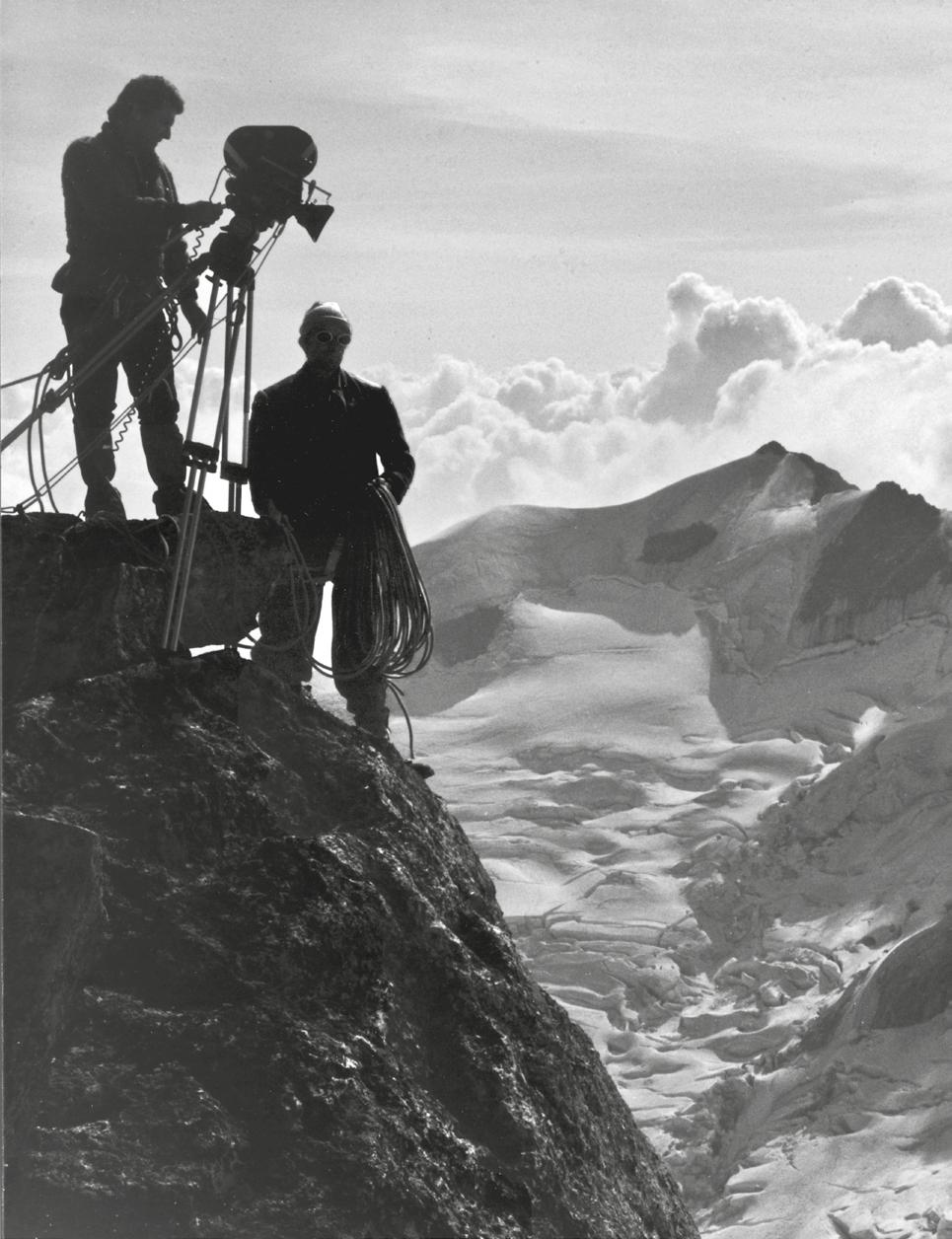
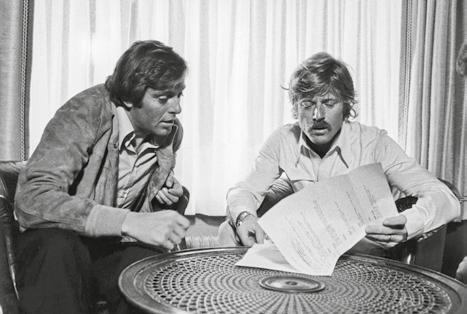
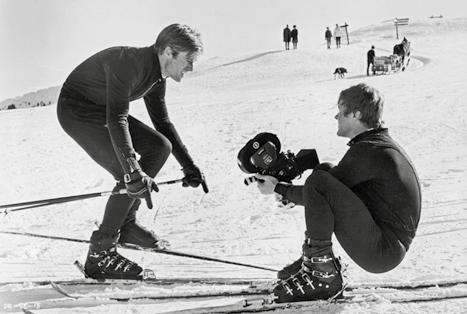
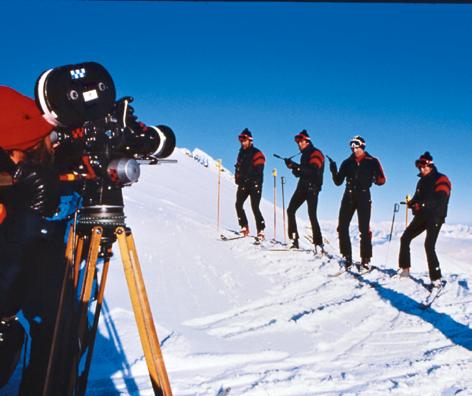
Cinematographers Herbert Raditschnig and Norman Dyhrenfurth are filming “Five Days One Summer.”
Michael and I are very fortunate to have had Stefan work on nine of our James Bond films. Stefan began working with our father, Cubby, as a stunt skier on On Her Majesty’s Secret Service in Muerren, Switzerland. He soon became an asset to the production not only as a stunt skier, but as a translator and coordinator between the English and German-speaking departments. In 1977, Stefan was again hired as a stunt skier on The Spy Who Loved Me and from then on whenever there were films requiring sequences with snow, ice and mountains, we called The Snowman!
It was very amusing to read the story in the book when Stefan recounted an episode on The Living Daylights. I remember the event slightly differently! We were trying to get the ice thick enough for the drivers to get the cars on the lake and we were getting very close. Unfortunately the snow started to fall and this meant that if it settled it would insulate the lake and cause it to melt so we hired some of the locals and their snowploughs to scrape the surface of the lake overnight. I drove down with my wonderful driver Hans to bring the men some hot gluhwein and was alarmed to see the tip of the huge snowplough sticking out of the lake! Stefan was standing at the edge, naked and freezing. He had become impatient with the slow progress and decided to do the job himself with the vehicle that was too heavy for the ice and almost drowned when it crashed through the ice …I had some choice words for him - well as they say there are three versions of a story: His, mine and the truth!!
More recently on Spectre, there was too little snow where we filmed in Austria, so we had to cover 50,000 square metres with three feet of snow using snow machines with high pressure pumps and generators. Stefan sorted this out in his stride as well as orchestrating, along with the rest of the production team, a stunning six minute chase sequence which began in Solden on top of a glacier, through a man made forest aisle before ending in Obertilliach with Bond crashing a plane through a snow covered barn.
Absolutely no mean feat!
There is nobody in the film business who knows more about “Schnee” than our dear friend Stefan.
Barbara Broccoli
What you hold in your hands isn‘t the usual biography that begins with a birthday, and it‘s certainly not a life confession. Still, I thought I might entertain you with some experiences from 50 years of working on unforgettable films - as well as films that are better forgotten.
The name James Bond has a good ring to it and, unlike the name Stefan Zürcher, is familiar to many people, which is why we will talk more about the latter here. Although I was a dreamer who always bagged the window seat in the classroom, I would have never dreamed that the October day in 1968, when I introduced myself as a stunt skier on the Schilthorn, would be the beginning of a long collaboration with the 007 producers. This “Bond family,” as film people worldwide affectionately call it, is a closed circle, so to speak, in which each member has a particular function. My role was to be the snow specialist. Whenever the script called for scenes in ice and snow, Barbara Broccoli would direct her staff: “Call the Snowman. Get Stefan!”
Snow, ice, and mountains played a significant role in the shooting schedules - as they do in my life. How could I have known - when I skipped school in Wengen to ski down the Lauberhorn slope - that I would end up skiing on the same slope as a double for Robert Redford? My sister and I could ski before we learned how to walk. Wengen has remained the center of my life, even though film work has taken me to all corners of the world. Of course, my birthplace has changed a lot over the years, as have I. When I hike in the Lauterbrunnen Valley, memories come flooding back. One of my earliest childhood memories was the death of my mother when I was just five years old. It shaped me for life. Only with the distance of the decades can I see myself as a young person who tried to deal with this loss. I became someone who had trouble committing. The film business was just right for me: friendships and love affairs for a limited period of time. You find each other, then you separate before a goodbye really hurts.
My mother‘s untimely death led to my first experience with the authorities. They wanted to take my sister and me away from our father, a machinist at the transformer station of the Wengernalp Railway, and he had to fight to keep us. Fortunately, he was able to prove that he also lived in the building where he worked. Thus, he spared me the fate of becoming a Verdingkind. I also have vivid memories of my grandfather. As a young man, he had already shaken the Swiss dust off his feet and had headed off to distant lands. After many adventures in different countries and training as a hotel concierge and butler in London, he mastered four languages, both spoken and written languages, before taking over the Hotel Breithorn in Wengen. Again and again, he told me that the world was also mine to explore, and eventually, I took him at his word.
Before that, however, I was formed by the Swiss education system. Through connections, my father got me an apprenticeship as an electromechanic and machinist at the Oerlikon machine factory, but already on my first day of training, when I was working on an iron block with a file, I realized: This was not where I would make my secret dreams come true. Were the four years of apprenticeship wasted time? Not at all. I had learned to do my job with precision to the hundredth of a millimeter. The success of a stunt - and, more importantly, a stuntman‘s life, all too often depended on such attention to detail. I owe my many jobs in international film productions around the world as location manager, production manager, and producer to the Swiss virtues I was taught, such as punctuality, perseverance, honesty, and reliability.
In the mountains, I learned early on to exist in the elements and to respect the forces of nature. As a location manager in charge of a film crew, I always tried to factor in nature‘s unpredictability. When planning complex sequences, you have to be a good listener. Listening… I was good at that. For hours, I sat in my places of energy, in the mountains. Listened inward. Refueled for exhausting film work.
Of course, this was all still ways off when I was a 23-year-old film novice in Mürren and signed on with James Bond. You‘ll read about that if you turn the page now - I hope you enjoy the story!
Stefan Zürcher
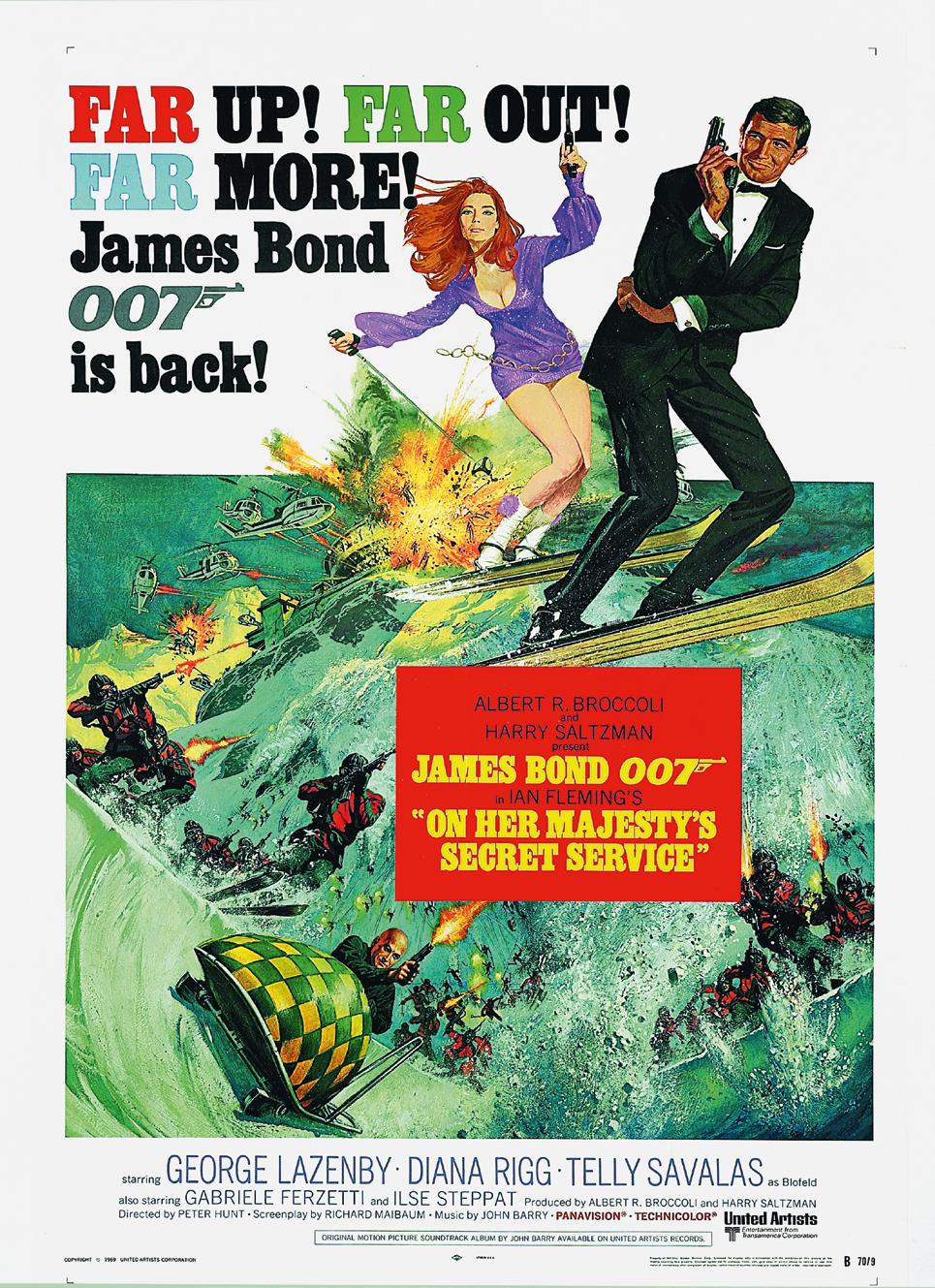
“On Her Majestys’s Secret Service” (1969).
He was aware of the irony. Stefan Zürcher’s home village of Wengen in the Bernese Oberland had become stifling for him. He had moved to a faraway place: the vast expanse of “Movieland USA.” As a ski acrobat, he was waiting for his chance in the film business to do what he loved best: skiing. When this opportunity finally presented itself, it came in the form of a call from home of all places, from Wengen.
“They’re looking for crazy skiers,” his father had said excitedly on the phone. “Something to do with James Bond.” It was in the newspaper. In the neighboring village of Mürren, they were looking for skiers for whom no slope was too steep, no direction too dangerous, to make a spy movie. So, back to Switzerland. Stefan was on the next plane heading home. Something inside him said: This is the opportunity of a lifetime. His inner voice was usually right. He had learned to listen to it on mountain tours. That’s when you can hear it most clearly, out there in the solitude of nature.
When the 23-year-old reported for work on a mild October day in 1968 in Mürrenback in the town where he had graduated as a ski instructor - production manager Hubert Fröhlich took an appraising look at him. The German was the most important man on the Schilthorn project. He always carried a bundle of banknotes in his pocket to solve problems immediately with a “donation.” Fröhlich enjoyed the trust of the 007 producer Albert Broccoli. This made a big impression on Stefan at the time, not his arrogant demeanor, but his great responsibility as production manager.
A test run wasn’t required of the young film hopeful. After all, Stefan had the best references as a stunt skier. In Killington, Vermont, and Vail, Colorado, he had appeared in commercials and had developed into a true acrobatic and extreme skier (see the chapter “The guardian angels also did their job”). He was allowed to join the other “crazy skiers” who had already been cast as gangsters in orange ski suits to guard the Schilthorn for the super-villain Blofeld. The squad of around 15 was made up of several world champions and accomplished record holders. Some, like Willy Bogner, were on the brink of an
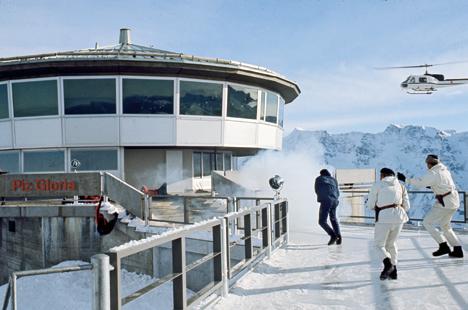
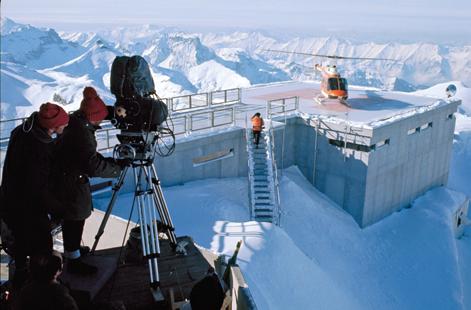
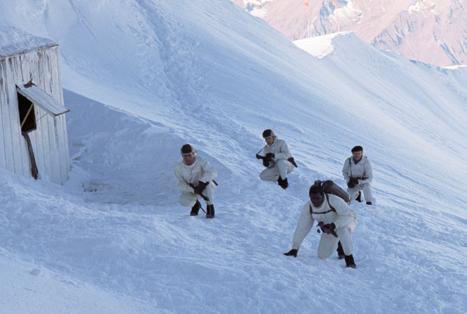
international career. Others had already won their gold medals. They all had one thing in common: They loved this sport and had followed the call of James Bond because this adventure held the promise of something extraordinary for every skier. The name of the film: “On Her Majesty’s Secret Service.”
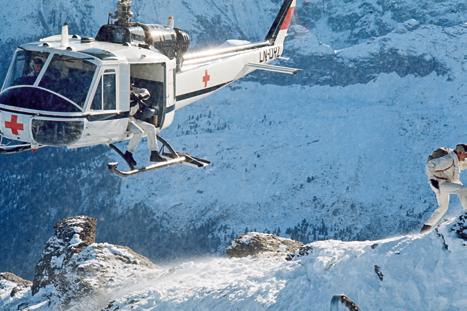
While the actors and technical staff stayed in hotels and chalets in Mürren, the stunt troupe was flown to the Mutthorn hut in a helicopter. Living in a cramped cabin at 2,901 meters is a bonding experience. Zürcher felt reminded of his youth: He had spent much time in the mountains and stayed in SAC (Swiss Alpine Club) huts. “We lived on the edge of the village in the ski area, and I skied to school in every weather. After class, my friends and I would ride down the Lauberhorn.” His love of the mountains and Alpine sports had already become deeply ingrained in him at that time, which meant that the weeks at the Mutthorn hut, where the stunt skiers were eagerly waiting to be called into action, were never too long for him. Soon, a core group of “crazies” emerged. Men who would do anything to stand on those skis that meant the world to them. Something else became clear: The action unit director (also called the 2nd unit director), responsible for shooting the action scenes without actors, had limited knowledge of how
to get a ski sequence into the can. “His drawn storyboards didn’t help him. Willy Bogner and the rest of us suggested where he should put the camera to get us in the picture.” By taking the initiative, Stefan took his first steps in a specialized field unfamiliar to many in the film business, eventually making him an indispensable snow specialist for Bond assignments. “Snow scenes have to succeed on the first take; otherwise, you have to spend a lot of time getting back into position and covering your tracks in the snow - or, even more laborious, transporting the whole crew to an alternative location.” Working in deep snow is exceptionally challenging for a film crew. “The cameras don’t work well at very low temperatures in the high mountains. People tire more quickly. You have to budget for the extra time.” This winter, of all winters, it snowed later than hoped. “For a mountain boy from the Swiss Alps, it was quite a curious sight to see how the Englishmen had to haul snow from other mountain slopes to conceal gaps in the snow cover. Back then, we didn’t have artificial snow.”
When the producers in London viewed the footage and found that three months of shooting had yielded only three minutes of usable film, the action unit director was fired, and John Glen was sent to Mürren. “John Glen had been sitting in the cutting room, working as an editor on the Bond films, waiting for this opportunity, and neither he nor I had any idea at the time that we would be working together on several Bond films.”
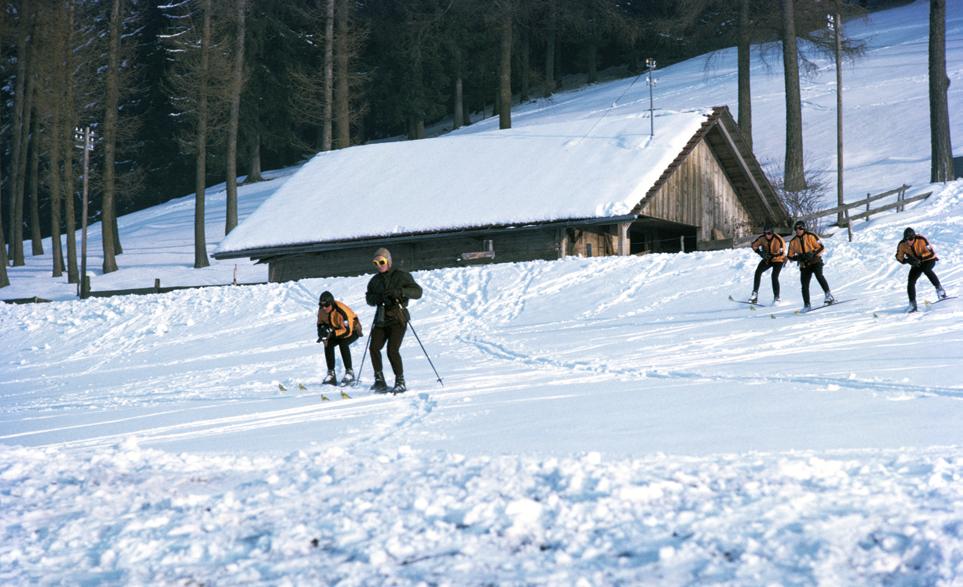
Pursuit at Heiligenschwendi.
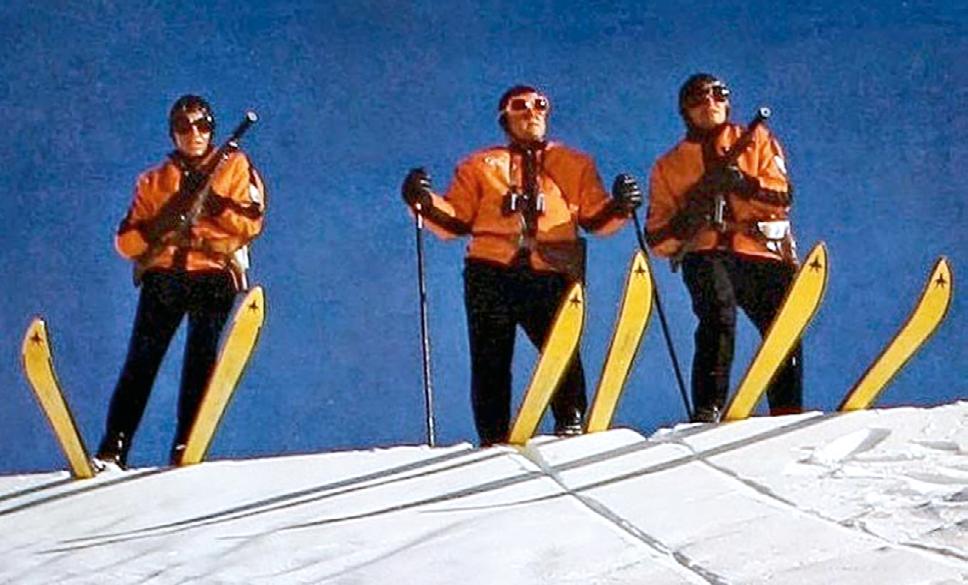
Chasing Bond: Stefan Zürcher, Heinz Brunner, and Bruno Zryd (from left to right).
Glen was also the one who recognized Willy Bogner’s talent, and he knew how to utilize it. “Willy never stuck to storyboards. His backward skiing with the handheld camera was spectacular but difficult to edit. Through his experience as an editor, John Glen understood how to incorporate those moments into the film.”
The dizzying chase through the forest was filmed on Wengernalp and only ended on the cliff above Stechelberg. Although no unnecessary risks were taken, the demands on the skiers were not harmless. “We were all young, and most of us hadn’t won our world titles by being overly cautious.” Ludwig “Luggi” Leitner, the Innsbruck gold medal winner, was James Bond’s double. “We sent him ahead for difficult ski stunts and jumps over crevasses and followed his trail. I remained friends with Luggi for many years.”
“When heavy snow sabotaged the shooting schedule again, we ‘out-of-work’ skiers would pass the time in the Palace Hotel, at that time the best establishment in town, and since the generous Mr. Broccoli also paid for the booze, some of us indulged quite shamelessly. During bad weather, we got into all kinds of mischief. For instance, we organized a contest to find out who could wear their ski boots the longest. The winner managed three days and nights.” When the weather cleared up unexpectedly, the helicopter quickly whisked the group to the glacier to take advantage of the weather window. Ludwig Leitner, however, had spent time at the bar. Undaunted, the Olympic champion instructed his colleagues: “Put me on my skis so I can stand!”
As an immigrant in the USA, Stefan had to learn English. The fact that he was now one of the few on set who spoke English as well as Swiss German worked to his advantage. His determination to succeed in this business made him the ideal interpreter for this multilingual film team. “The Bond movie on the Schilthorn was my real apprenticeship - my film apprenticeship.” What he learned now was the language of film. He acquainted himself with the needs of the various departments, from wardrobe to props. For example, Blofeld’s henchmen carried the original Swiss assault rifle and a rubber version in the stunt sequences. When shots were fired, an electronic release on the trigger provided the muzzle flash. Stefan absorbed everything like a sponge. One of the peculiarities of the film industry is the silo mentality of these departments. “There is strict tribalism because the unions, feared by film producers, wield a lot of power.” Specialists must carry out even small jobs, inevitably increasing production costs. “In the beginning, I got into trouble when I wanted to help move a lamp - that’s something only the specialist employed for that purpose is allowed to do.”
However, Stefan’s efforts did not curry favor with Hubert Fröhlich, who had brokered the deal between Bond and the mountain railways so that the revolving restaurant could be built to their standards: “The longer the shoot lasted, the more our relationship deteriorated. He felt that I was upstaging him.”
And Stefan learned something else while he was making himself useful: confidentiality. “There was a lot of gossip; everyone talked about everyone else. I kept my knowledge to myself.” The rumor mill was especially abuzz over the new 007 actor, George Lazenby. “Few believed he could ever be as good as his predecessor Sean Connery.” Lazenby came across as arrogant, even aloof. Zürcher saw the one-time Bond actor differently: “I think he was just pretending to be arrogant as if he needed a protective wall around him.” Stefan would not see this 007 actor again until 2018, when they were both invited to the Schilthorn to immortalize themselves on the Walk of Fame. “Fifty years later, George was a mature gentleman. That’s the beauty of life: you forget the bad and remember the good.”
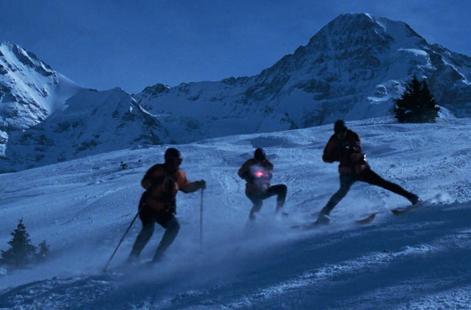
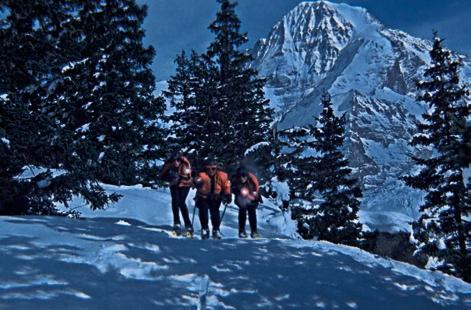
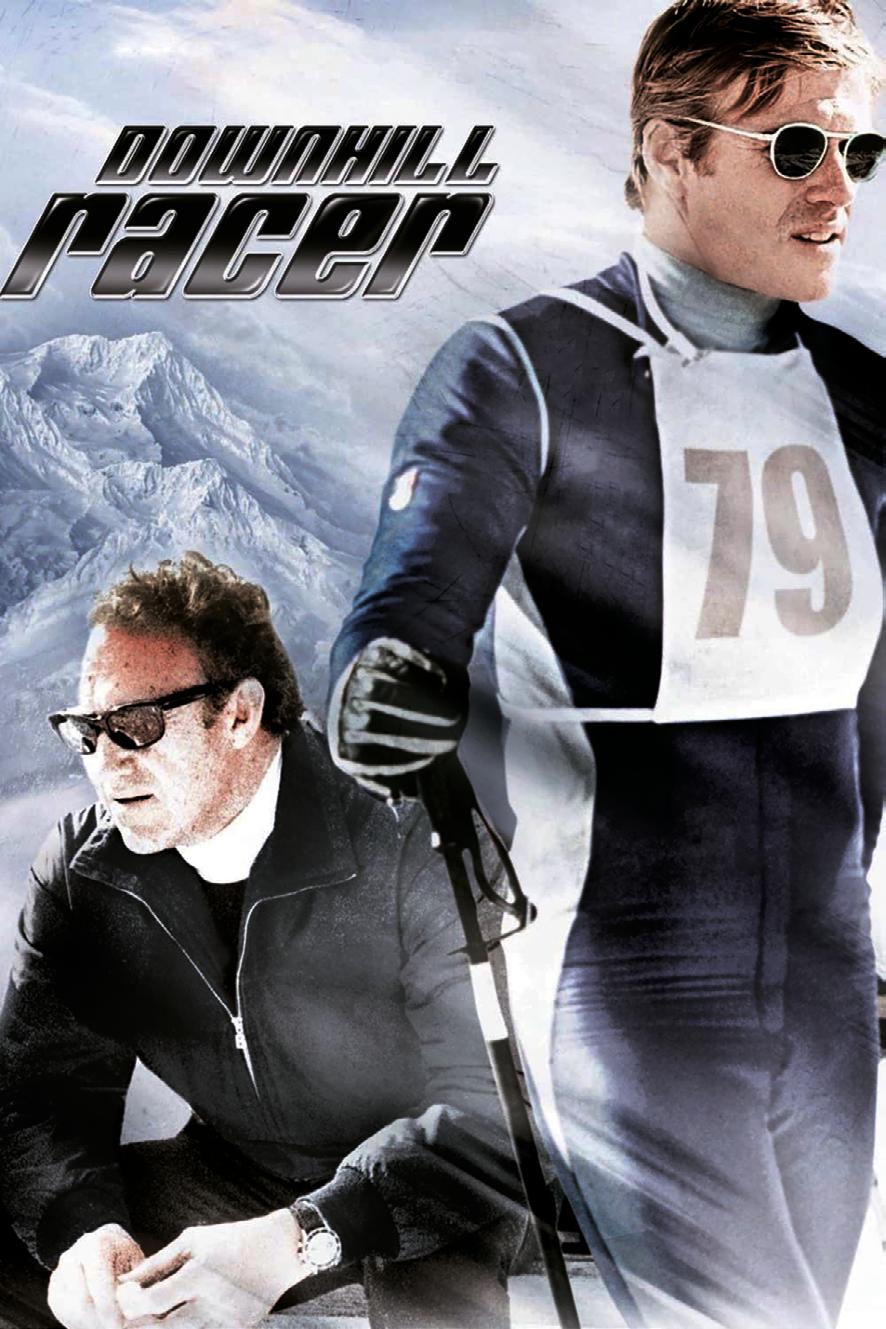
Luck did not let Stefan Zürcher down: He seamlessly moved on from Bond to another film featuring spectacular ski sequences. And in the riskier scenes, doubled none other than Robert Redford.
When “On Her Majesty’s Secret Service” hit the theaters the following year, Stefan promptly missed the premiere - and himself on screen. The reason was that he was already in the thick of other film projects at that time. The fear that the “Schilthorn Bond” would remain a one-off opportunity had not materialized. In fact, after filming in Mürren, Stefan immediately found himself involved in another significant production - ironically, again not in the USA, but in his home village of Wengen. His emerging film career seamlessly transitioned from James Bond to Robert Redford.
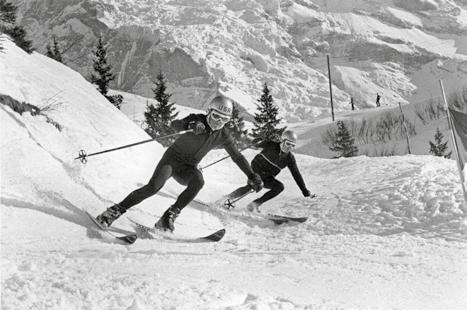
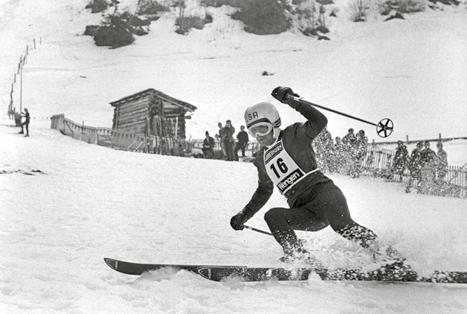
Director Michael Ritchie especially wanted to capture the pace and risk of ski racing. As a result, the two major films released in 1969 showed a significant difference in how they were made. While the Bond stars practically only appeared before rear projections in their ski scenes – which today are recognizable as trick shots - “Downhill Racer” demanded the realism of the TV broadcast of an actual race. In the winter of 1969, the film was shot at various venues for European World Cup races. It would be a ski racing movie unlike anything ever seen before on the big screen. However, filming proved more difficult than expected, leading to a delay in the shooting schedule. That’s why some additional wild downhill sequences on the Lauberhorn were rescheduled for April, ending with crashes.
Robert Redford played the leading role of the ambitious ski racer. The young actor was beginning an unprecedented career. He chose this role because he was happy to stand on skis. However, the famous blonde actor needed a stunt double for the dangerous sequences. A job for Stefan: “All I had to do was mention that I had just demonstrated my ability
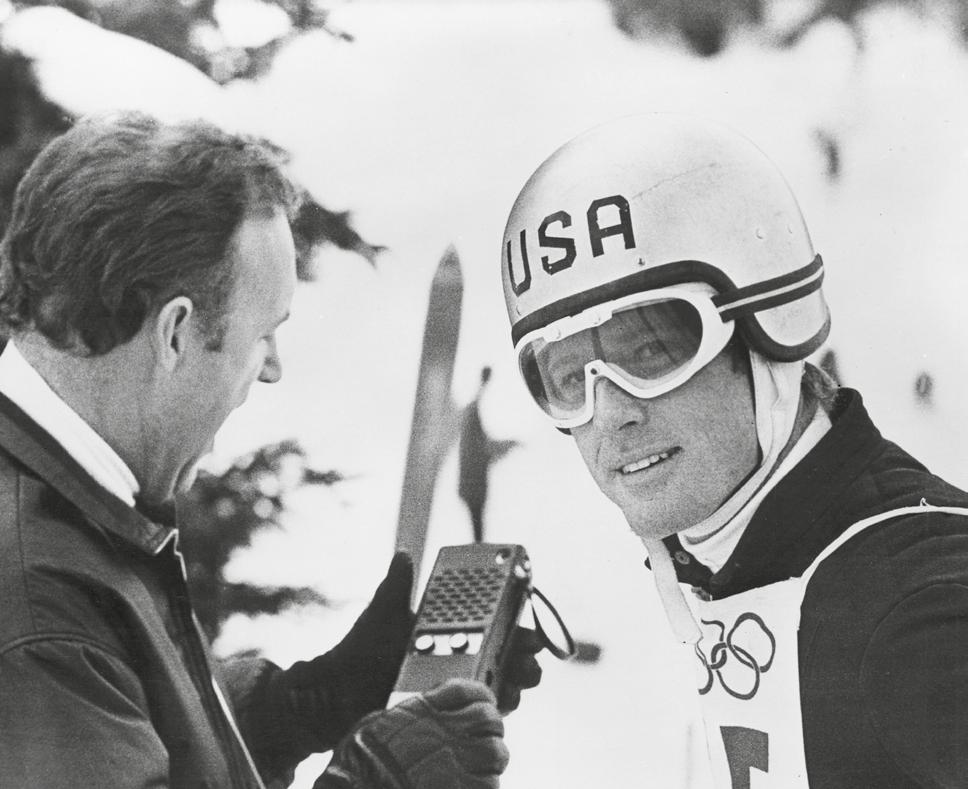
in a Bond film.” In his later years, Stefan gratefully experienced that 007 had been the key to opening many doors for him.
“Robert and I spent a lot of time together. It was important to him that I adopted his downhill ski style so the cut would be seamless.”
When the script called for Redford to fall, Stefan brought in Bond’s know-how, the technique of the “kicker”: “Previously, ski falls in movies were done with the skier flailing his arms and letting himself fall - which always looks staged.” With his team, Stefan prepared the terrain in a way that put the rider in a supine position automatically. This setup significantly enhanced believability when cutting to an actual fall in the editing process. In later film productions, Stefan further perfected the technique of concealing an obstacle on the slope. In the initial shot, this hidden obstacle would trigger the skier’s bindings to release - setting the stage for the impact captured in the second shot. “Bond had taught me a lot. I was eager to apply my new knowledge.”
He stayed in touch for years with Robert Redford, a down-to-earth and modest manqualities that Stefan appreciates. He came to Wengen several times with his family for skiing vacations - and then always stayed at the Hotel Park, where the film scenes had also been shot. “Downhill Racer’s” lack of success did not diminish the joy of this friendship. Unlike the Schilthorn, Wengen has not retained any of its movie fame. Something from the script always remained in Stefan’s memory: Redford proclaimed as an ambitious racer: “I wanna be a ski racer, I wanna be a champion,” but his father discouraged him: “The world is full of ‘em.”
The fact that this champion of cinema came to Wengen, of all places, for his film and once again gave young Stefan a shot at international success was nothing short of outrageous luck after the Bond movie. The fortune that Stefan had first sought in faraway places he found on his local mountain, the Lauberhorn. Another thing he found there was the friendship with Wolfgang Glattes. In the strict hierarchy of a film crew, he proudly held the title of 1st assistant director. Glattes would be the one who opened the doors to the Bavaria film studios in Munich for Stefan.
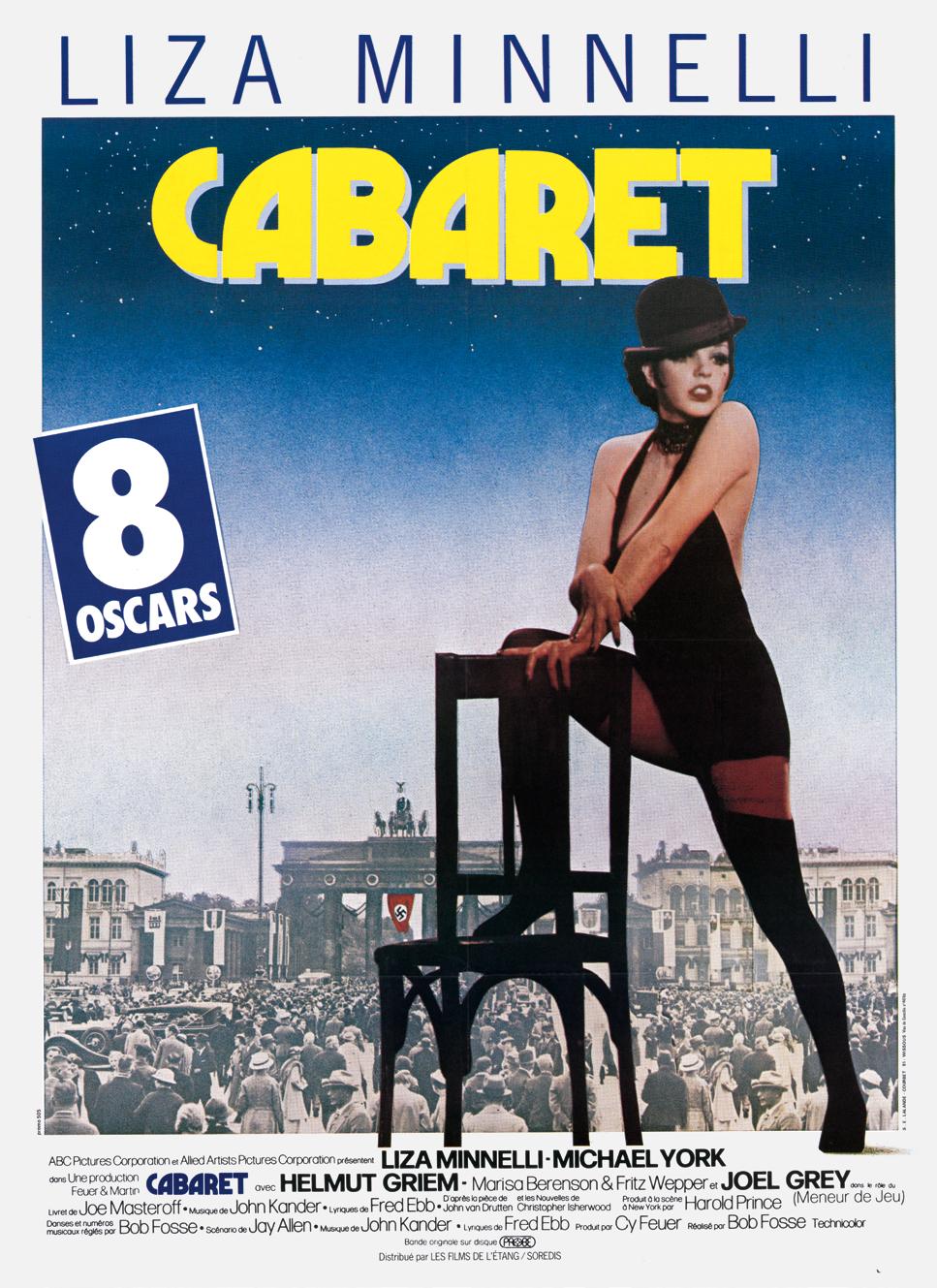
“Cabaret” (1972).
When the young leading lady with her pixie-style haircut first entered the gym where the dance numbers had been rehearsed for six weeks before shooting began, hardly anyone recognized her - not even Stefan Zürcher. Liza Minnelli was to make a splash in “Cabaret.”
In 1972, the then 25-year-old Liza Minnelli had not yet stepped out of the shadow of her famous mother, Judy Garland. “Liza didn’t display any ‘diva-like’ behavior. When she arrived, she introduced herself personally to each crew member.”
This film also taught Stefan a lesson about a chapter of contemporary history that he had previously known little about. The musical is set in Berlin during the rise of Nazism. The paintings of Otto Dix and George Grosz inspired Director Bob Fosse. They provided a template for the set and props. Even the choice of extras and supporting actors was based on these paintings. That’s why Wolfgang Glattes and Stefan had the rather unusual task of finding appropriate extras in Munich’s red-light district.
Fosse, himself a successful dancer, choreographer, and stage director, brought only two dancers from the original cast of the Broadway show. The others he selected personally in lengthy auditions. He entrusted Stefan with a special mission during the rehearsals. “I was supposed to look after the cabaret dancers. They were to go to bed early. For rest, mind you.” Stefan made an exception with one of the girls. It fizzled out by the end of the shoot - a ‘here today, gone tomorrow’ type of relationship that is so common among film people.
While the set was being built in Bavaria Studios, they rehearsed in a bleak hall for six weeks to the point of exhaustion. Stefan also had to know every dance number by heart by the time they finally began filming. Bob Fosse had every dance step rehearsed with a live pianist until the dances were perfect. This approach would pay off during the shoot. Composer John Kander and the arranger Ralph Burns, who would pick up an Oscar for best music, kept a watchful eye during rehearsals.
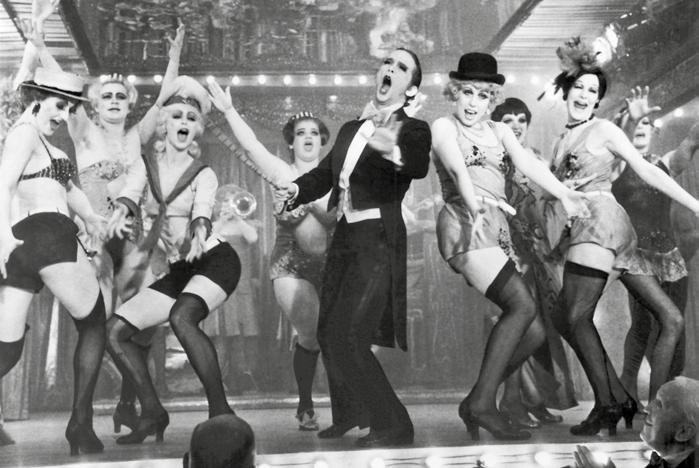
“Cabaret” revolutionized the presentation of film dances. Instead of the usual wide shot of all the chorus girls dancing in sync, Fosse merely showed details of the movements: close-ups of faces, hands, and legs. “He was always coming up with new details and different angles.” Getting a single dance number in the can took them days. Geoffrey Unsworth was the perfect cinematographer and collaborator; he earned an Academy Award for his work. The martial parades of the Nazis stood in stark contrast to the detailed dance shots. Stefan accomplished these menacing mass scenes with the help of several assistants.
Bob Fosse’s idea to shoot at the original locations in Berlin was not possible, except for some scenes in the diplomatic quarter. Much of the city had been destroyed during World War II. Therefore, parts of the street scenes were filmed in Munich or recreated on the grounds of the Bavaria Studios.
Stefan’s responsibilities included location scouting for the beer gardens. “What an exhausting job researching all the Munich beer gardens! Location scouting always feels like a paid vacation. Compared to the tight shooting schedule, I had ample time for this.”
Searching for a train station that matched the period was more challenging. Stefan found what he was looking for in Lubeck, north of Hamburg. “We organized a quick trip to Hamburg for Liza because she couldn’t believe that live sex was being performed on stage at the infamous Reeperbahn. We wanted her to see it with her own eyes, which got a little bigger by the end.” A tall, extremely well-endowed Black man performed the act with a delicate blonde. Seeing live sex on a stage was unimaginable for an American woman in the early 70’s. But Liza reacted differently than we expected; she burst into laughter! “We were sitting in the front row. She couldn’t stop laughing. The performance had to be interrupted, and the club owner threatened to kick us out.”
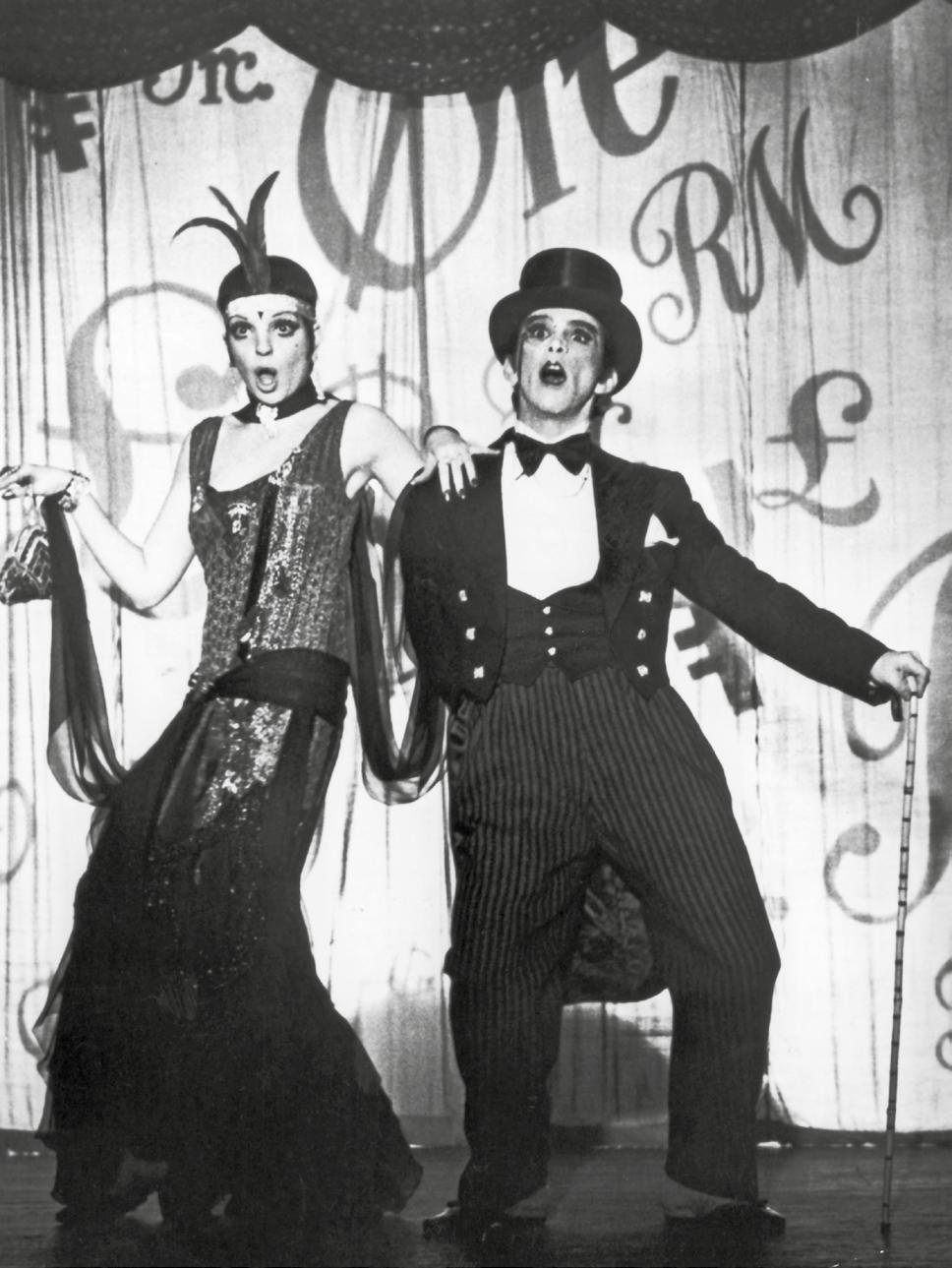
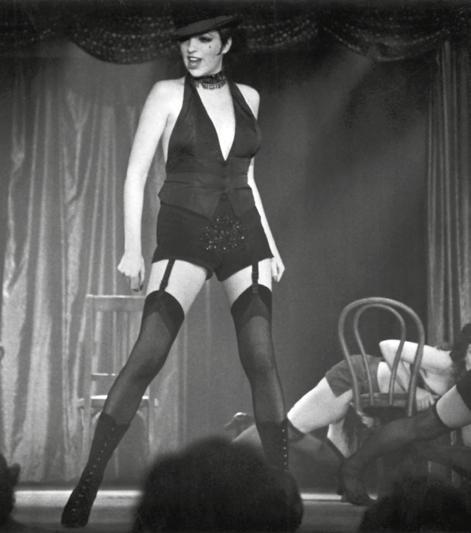
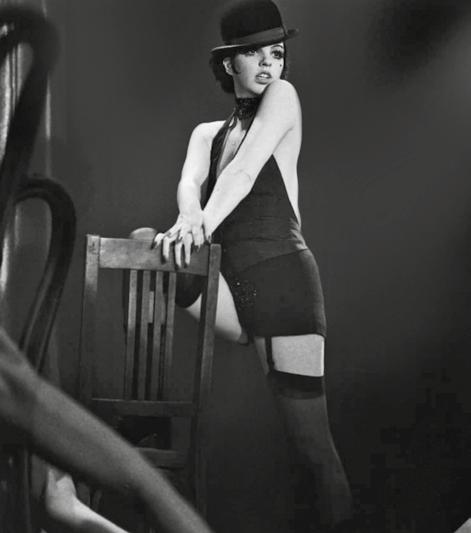
In one scene shot in the historic Eutin Castle in Schleswig-Holstein, a fire was supposed to be burning in a fireplace. As a rule, film professionals know this is a gas fire, and the logs are made of plaster. “Suddenly, a loud bang and a ten-inch gap opened in the historic chimney with smoke and fire pouring out of it. A rookie on the set decoration team had been firing up the huge fireplace all day with real logs.” Nevertheless, Rolf Zehetbauer’s film architects won the Oscar for best production design.
Usually, Stefan didn’t even watch ‘his’ films in the cinema. “Amongst the crew, we always said, ‘Well, we made it, we know what it looks like!’” He made an exception for “Cabaret”. “It’s a cult film that truly deserves that label.” It won eight Oscars, is number 5 on the American Film Institute’s list of best musicals, and 63rd in the ranking of best US films of all time.
While Stefan is grateful for the recognition this cinematic work brought everyone involved, he is even more appreciative of the friendships forged. Having cast and crew from many countries resulted in an exceptional team spirit. It motivated everyone to deliver their top performance: Michael York, the star from England; Helmut Griem and Fritz Wepper from Germany; and Marisa Berenson from the USA. Liza Minnelli was awarded ‘Best Actress,’ and Joel Grey ‘Best Actor in a Supporting Role’. “This film enriched my life and that of many viewers. I’m proud to have been part of it.”
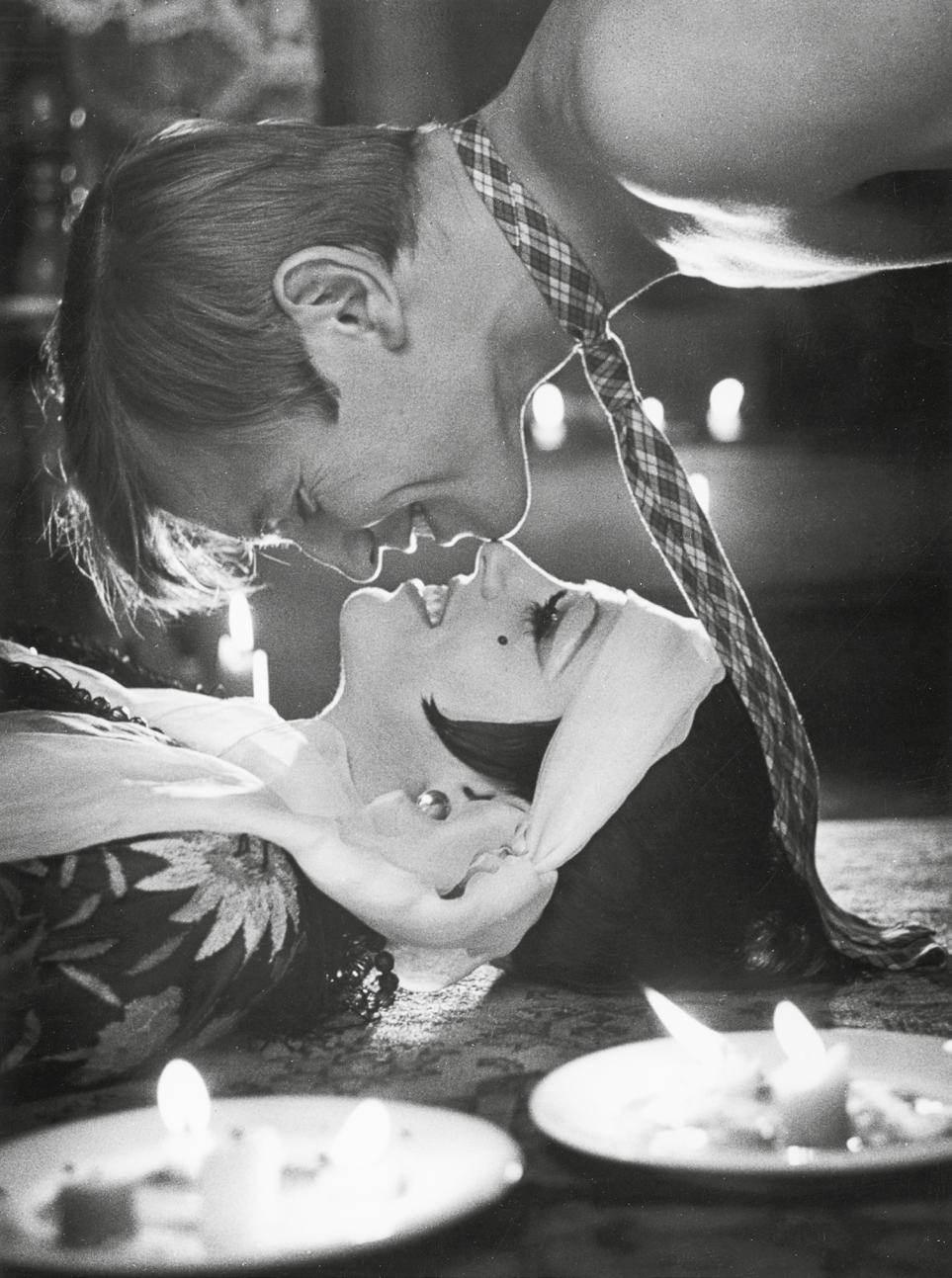
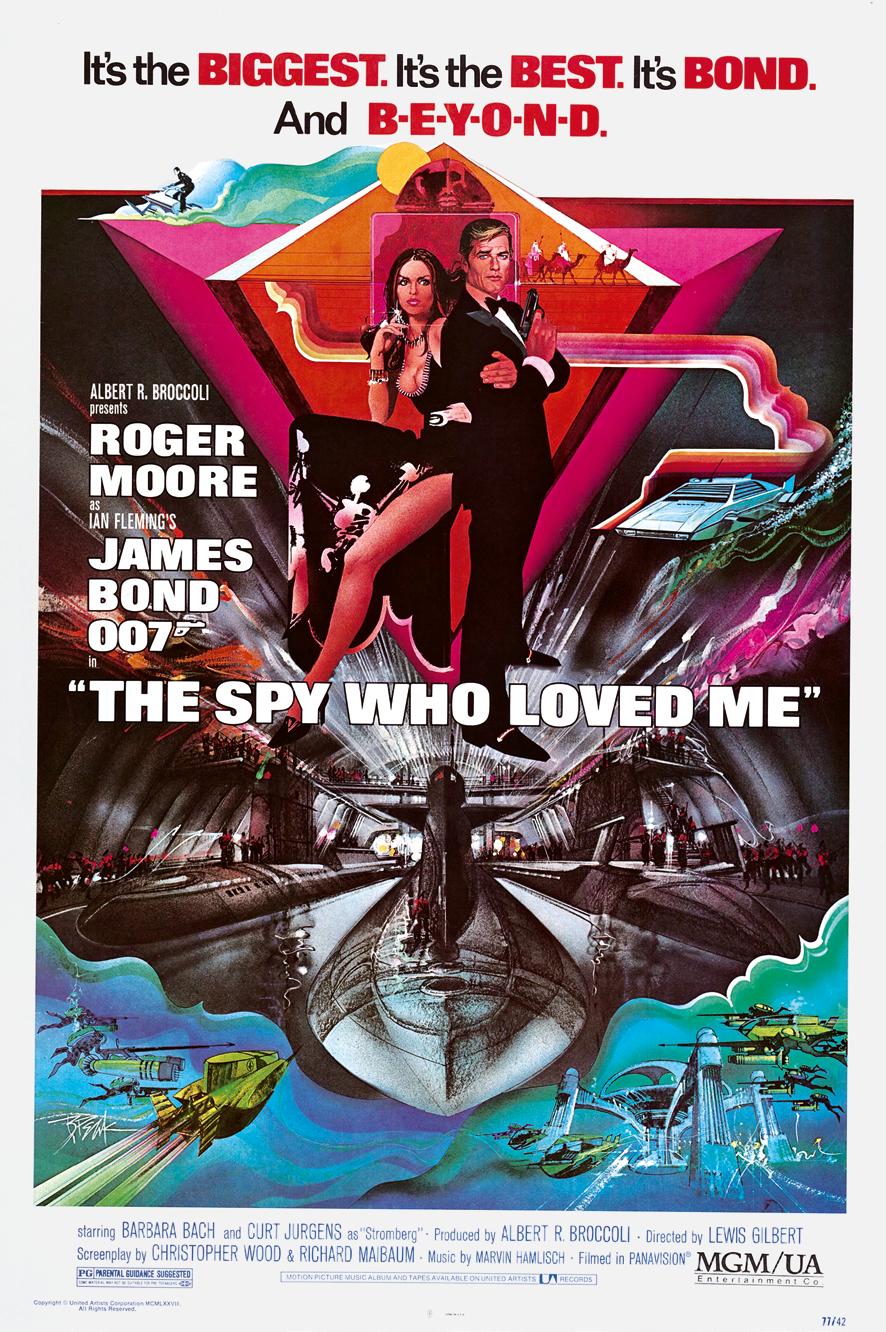
“The Spy Who Loved Me” (1977).
In 1976, a short excerpt from a top-secret screenplay flew onto Stefan Zürcher’s desk: A British secret agent takes refuge on a glacier and takes out a Russian opponent with a shot from his ski pole. The agent was none other than James Bond. The pursuer who took the bullet was Stefan. That was far from the most dangerous thing to happen in “The Spy Who Loved Me.”
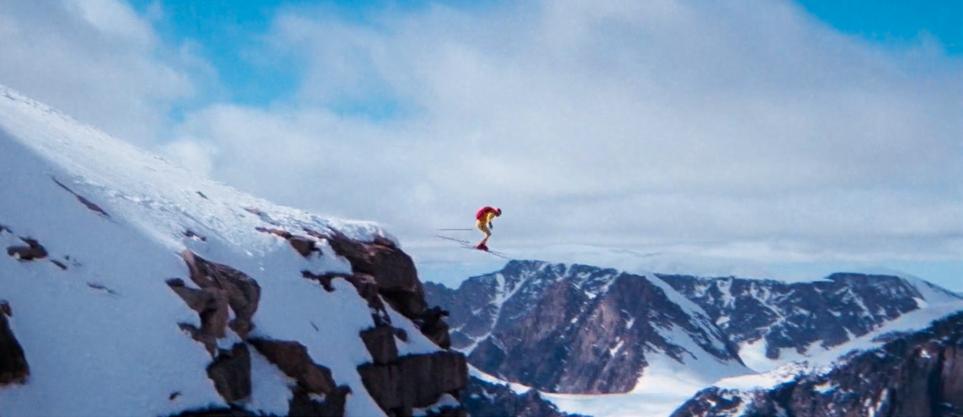
“On Her Majesty’s Secret Service” was still impactful ten years later when James Bond had to conquer a peak once again. The Broccoli family remembered their time-tested collaborators: Willy Bogner as cinematographer, John Glen on the 2nd unit, and Stefan as production manager and stuntman. “Never change a winning team! That was a beautiful reunion. We stayed in St. Moritz and took the train up to Diavolezza in the morning, followed by a helicopter flight to the Italian side of the Piz Scerscen glacier.” Stefan had scouted out these locations with mountain guides and ski instructors from Pontresina. He discovered that in springtime, it was possible to shoot on the Southern glaciers in the morning when the sun was shining, while at night, the cold temperatures caused the snow to freeze and harden again.
Photos from his location search were the basis for the storyboards. Stefan had already left his mark on these slopes from his work with commercial producers. The sequence of the new Bond movie was much more striking, featuring a murderous ski chase through ice tunnels and ice mazes. Willy Bogner was the director and cinematographer for this sequence.
John Glen had ingrained in him the importance of sticking precisely to the storyboard. However, Willy brought in his own spontaneous ideas that weren’t part of the board. Despite the hefty expenses involved in a Bond film, Stefan always kept track of the costs. He was responsible for the production of the elaborate scenes. During the three weeks of shooting, Stefan also created the plates. These plates would serve as background for subsequent close-ups shots in the studio with Roger Moore, who never set foot on the glacier.
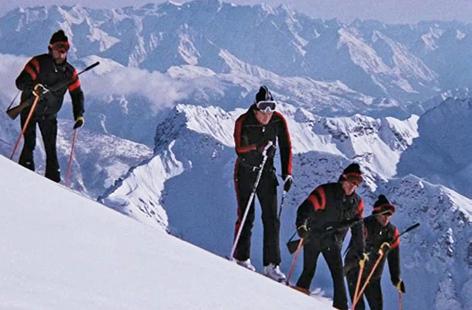
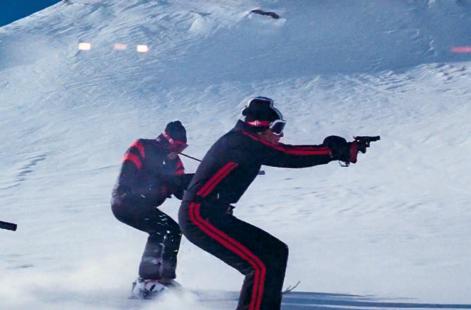
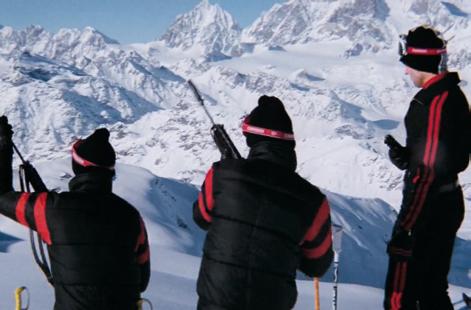
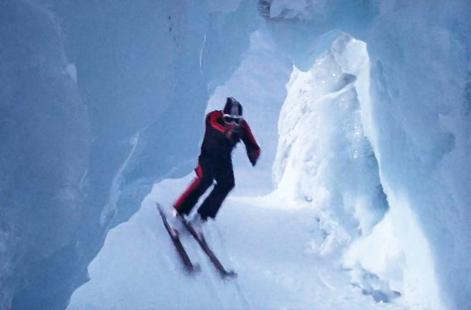
Glen was very pleased with the execution of the first stunt in this 007 adventure. Bond shoots down one of his henchmen with his fire-spitting ski pole. Stefan doubled the Russian spy who took the hit. For the first time, he wore an electronic explosive charge on his chest, protected by leather armor. A wire connected the detonator for the single-shot explosion through his sleeve to a trigger in his hand, which allowed Stefan to set off the blast himself. In true style, the ‘target’ collapsed into the snow.
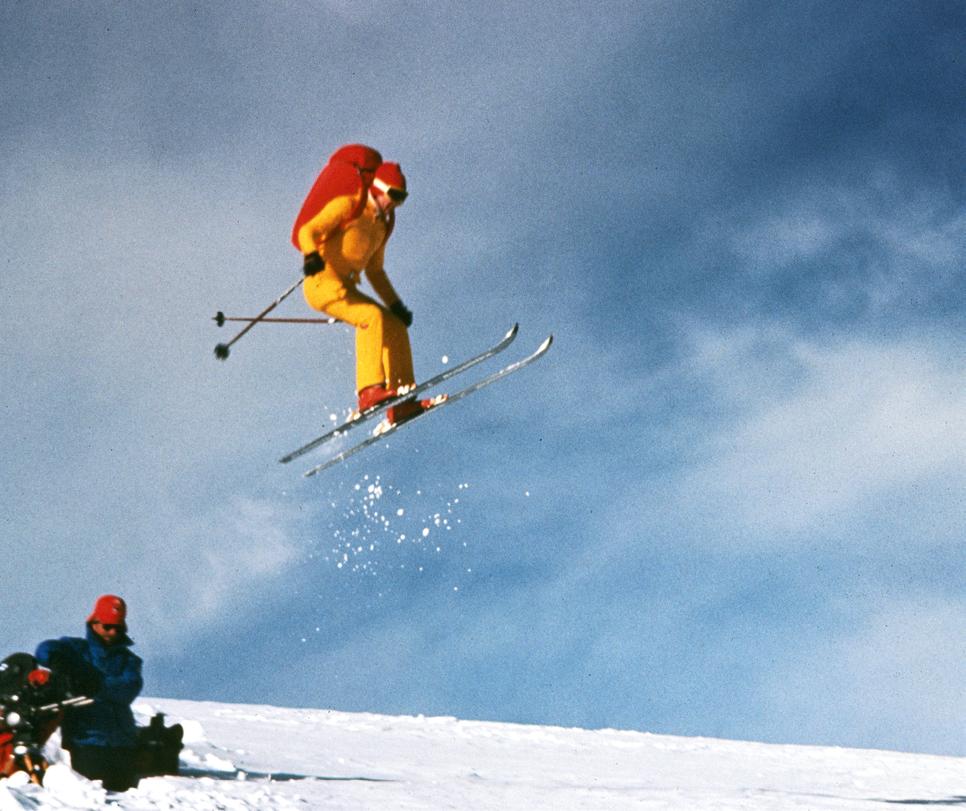
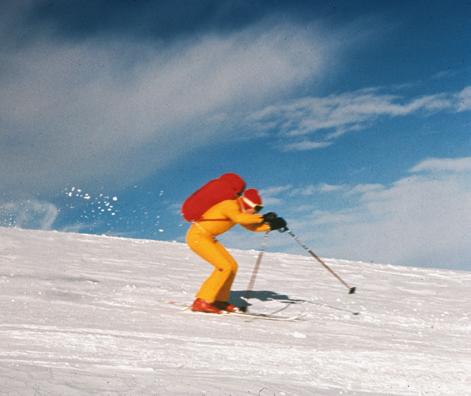
Usually, Andrea Florineth, a St. Moritz resident, doubled 007. On an especially significant day to Stefan, he wore Bond’s flashy yellow ski suit himself. The mountain guides had warned, “Bad weather is coming in with fog!” They urged the team to stop shooting immediately; otherwise, they couldn’t guarantee our safety. Bogner ignored their warning and kept on filming. “The fog quickly ascended towards us until we finally had to clear the set in a state of panic. Helicopters were flying the crew and material to the nearest road in Puschlav on the Bernina Pass, from which vehicles would transport us. The fog continued to thicken. “Instinctively, I grabbed the snow shovels loaded on the helicopter.” Stefan would later find good use for them because the helicopter could not return for the last five people: a stunt rider, three mountain guides, and himself.
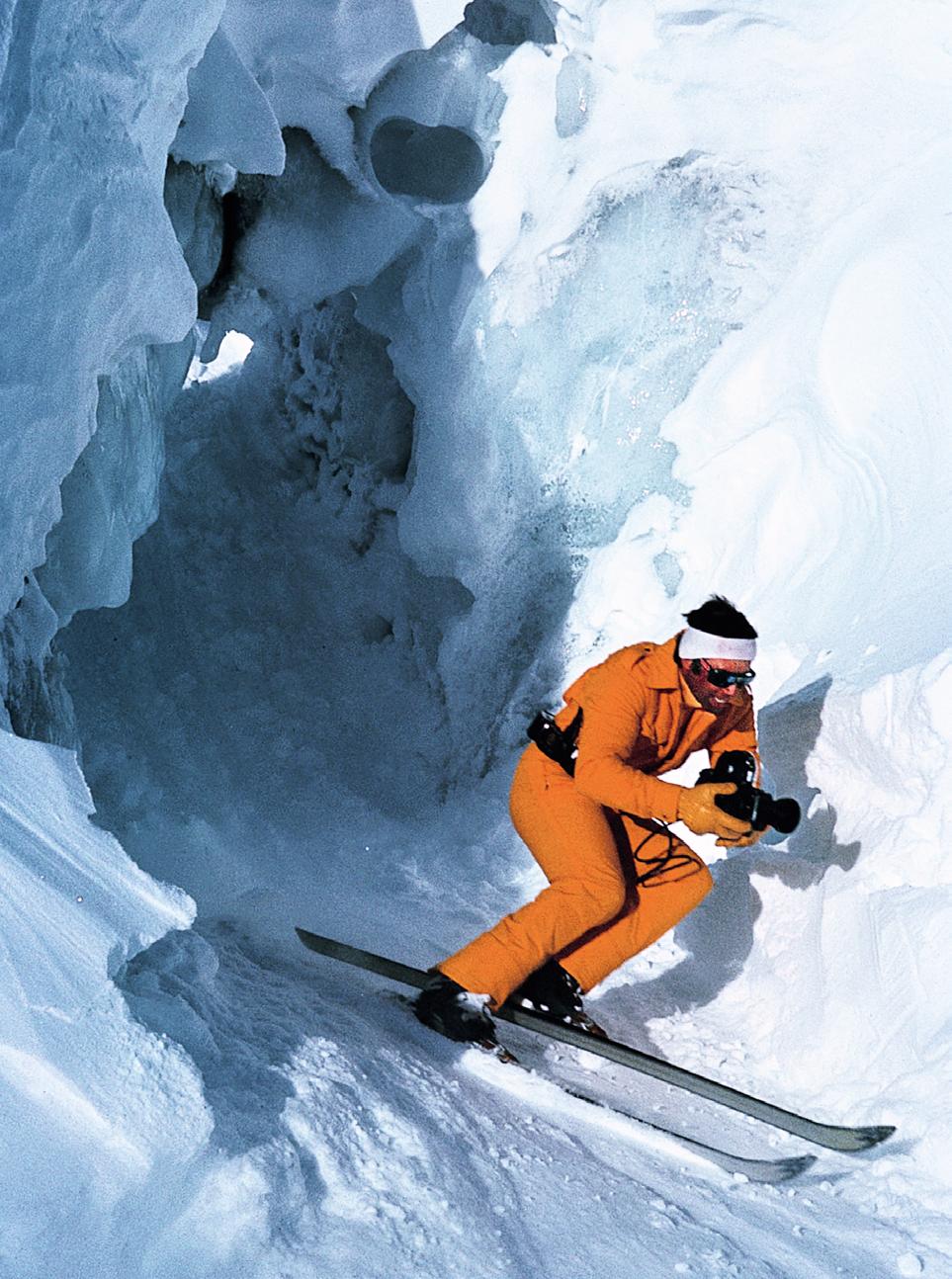
“The fog closed in on us very quickly. The glacier lay at 3500 meters, and the temperature dropped to minus 20 degrees Celsius (minus 4 degrees Fahrenheit) at night. The Tschierva hut remained out of reach because we could not see the crevasses. We had no choice but to dig.” As a sergeant in the mountain infantry, Stefan had learned the art of building igloos. The mountain guides were also adept at this. “We would have been lost without men with mountain experience. Digging the igloos was a strenuous task, so we stripped down to our underwear and ski boots to keep our clothes from getting damp from sweat. We dug for our lives. It was a long night!”
Mountain guides carry candles in their emergency equipment. These serve as an alarm system in the igloo - if they stop burning, it indicates a lack of oxygen. Death from suffocation is imminent. “To prevent that, we used shovel handles to drive holes through the snow roof.” Stefan left the igloo to thaw frozen tea. He used his pocketknife to saw through three old wooden camera tripods to start a fire. He warmed the tea in a metal
35mm film can. “It was scary. I barely found my way back to the igloo’s entrance in the foggy darkness, even though I was only a few steps away. Eventually, I managed to get back inside, where I could surprise my ‘fellow captives’ with a comforting hot tea.
The next morning, Stefan, still wearing James Bond’s thin yellow ski suit, was picked up with the rest of the survivors. “The Broccolis had been very worried. They had alerted the whole village and arranged for our hospitalization.” However, after a day of rest, Stefan was back on the glacier. When he returned to this spot in later years for commercials, he always carried a survival kit: Emergency provision with sleeping bags and flares. However, he didn’t include wooden tripods. “I never received a bill for them.”
“Five Days One Summer” (1982).
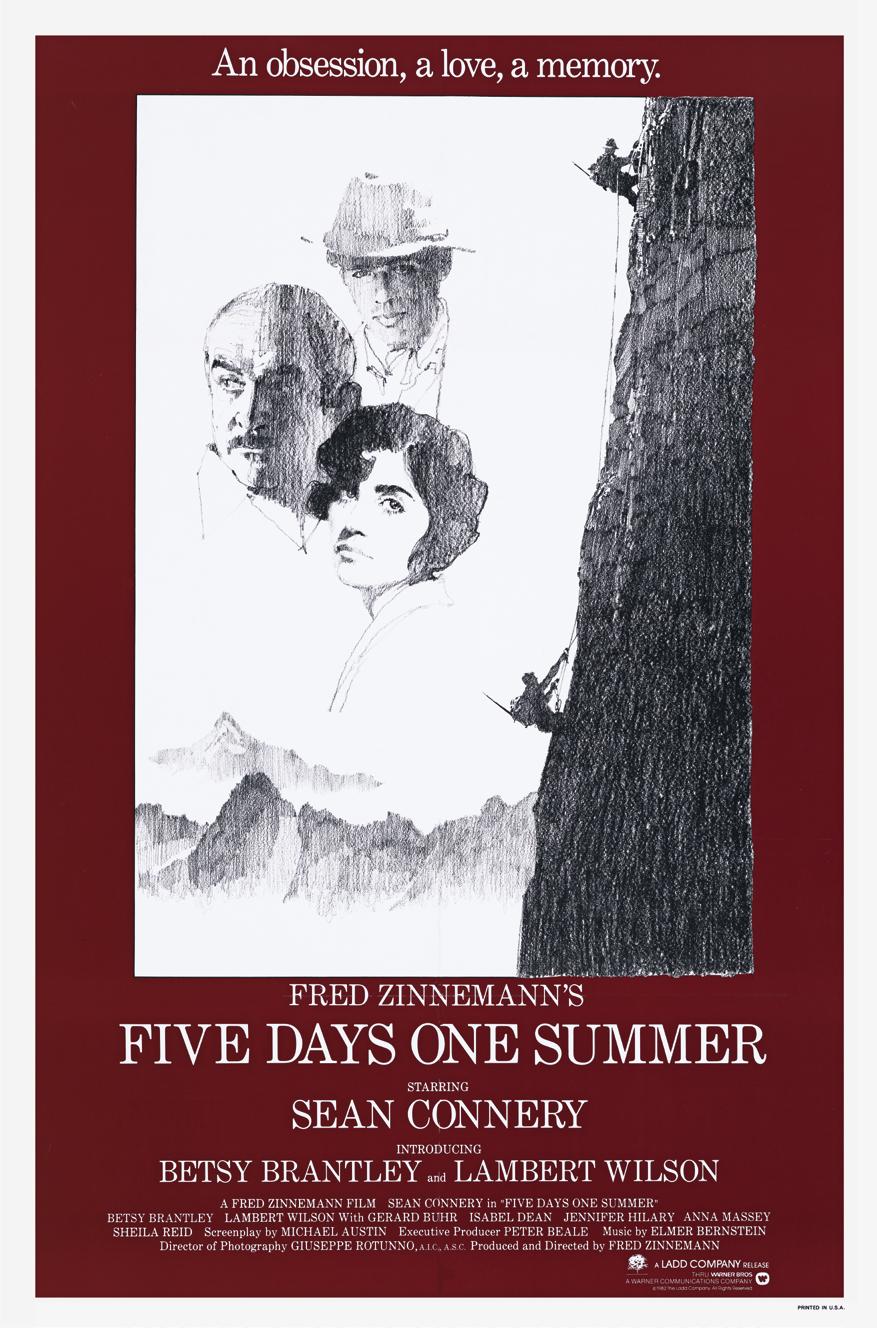
In the mountaineering drama, “Five Days One Summer,” Stefan Zürcher was in his element - on the mountain and the golf course with Sean Connery. A real-life scenario surreally mirrored the film plot: the discovery of an actual corpse on the glacier.
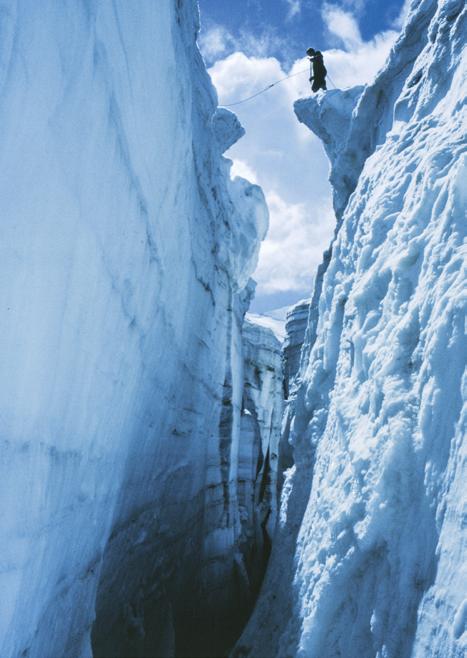
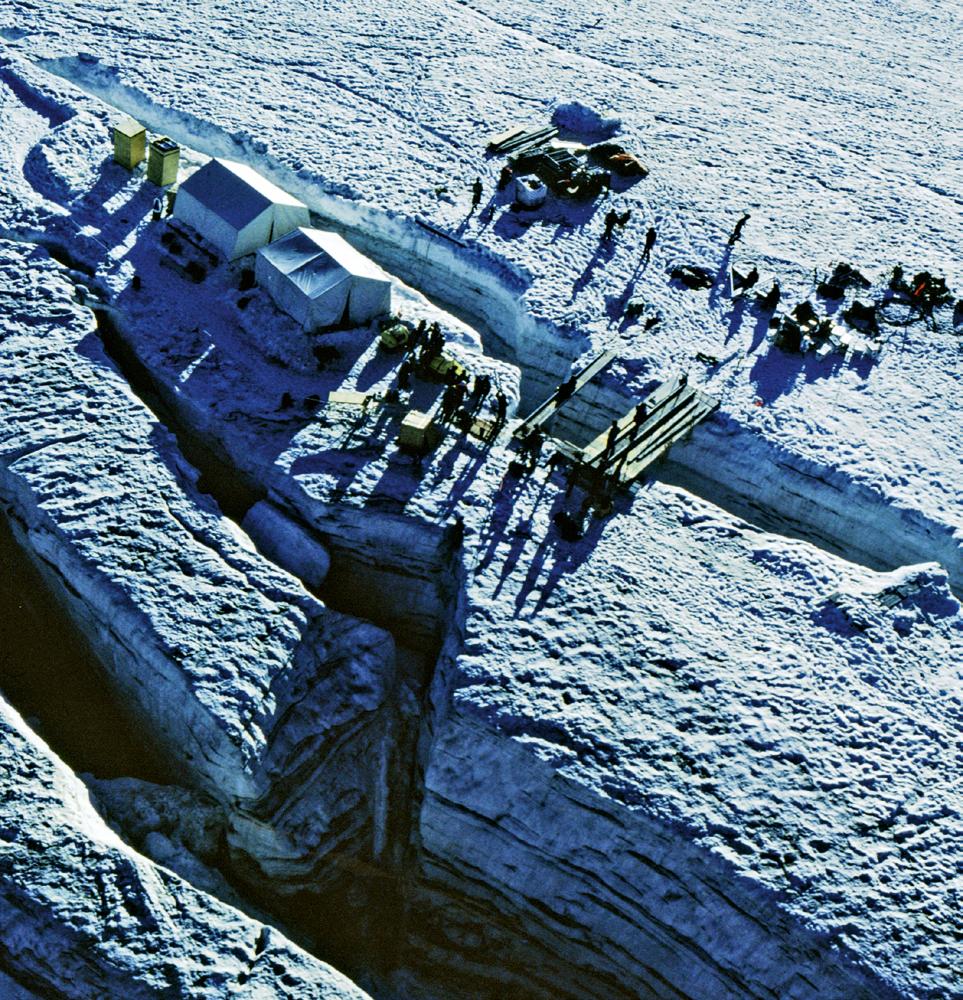
The Austrian Fred Zinnemann had worked in Hollywood classics like “High Noon.” As a vacation guest, he often stayed in Pontresina. Looking at the glaciers, he was struck by the idea that they could be the centerpiece of an excellent film. Mountain legends state that the ice would preserve a corpse in perfect condition. This basic idea gave rise to the movie “Five Days One Summer,” produced in 1982. Leonhard Gmür, the production manager, sent Stefan to find the “perfect crevasse” as the setting for the body’s discovery.
It was a clear case of ‘life imitating art’ that Stefan and some mountain guides experienced what the screenplay envisioned. While searching for a suitable location on the Morteratsch Glacier, they discovered a body on a glacier. “We first saw a pair of shoes, then a backpack, and finally a mummified corpse. We notified the police, and they photographed the gruesome find.” The body turned out to be a missing man from Geneva trapped in the ice since April 9, 1950. When the search was halted due to the man’s apparent fall into a crevasse, the family was informed that the Morteratsch Glacier would likely release him in approximately three decades. It had taken exactly 32 years.
Fred Zinnemann had his way of dealing with this apparent similarity to the film plot. “He was happy because the discovery confirmed his film wasn’t stretched beyond reality.” Another irony is that the elderly woman featured in the film, portraying the widow
of the glacier victim who remained “young at heart,” was originally from Latsch. She had personally known the unfortunate man.
Zinnemann chose Latsch, a film-tested village in the Albula Valley because the houses were still so authentic that hardly anything had to be changed. Only the cemetery where the mountain victims were buried was the work of the talented art director Willy Holt, who based his design on gravestones from a cemetery near Samedan. “The realism of Holt’s set constructions still amazes me to this day.” Val Roseg was selected as the perfect location for the film hotel, and Holt skillfully crafted a facade of plaster and mortar, making it appear as if the Grisons-style Inn had always been part of the landscape. “For shots where the actors are supposedly admiring the view from the window of a hotel room, we arranged a window frame and curtain setup, allowing them to perform in front of this mock-up against the backdrop of the picturesque scenery.”
Gmür and Stefan scouted many sites from a Jet Ranger helicopter in their search for a suitable Swiss Alpine Club hut. What might sound like a routine task turned into a life-threatening situation. “We flew into strong downdrafts and plunged like a boulder toward the abyss. The pilot, nicknamed Capito, pulled the lever with all his strength to
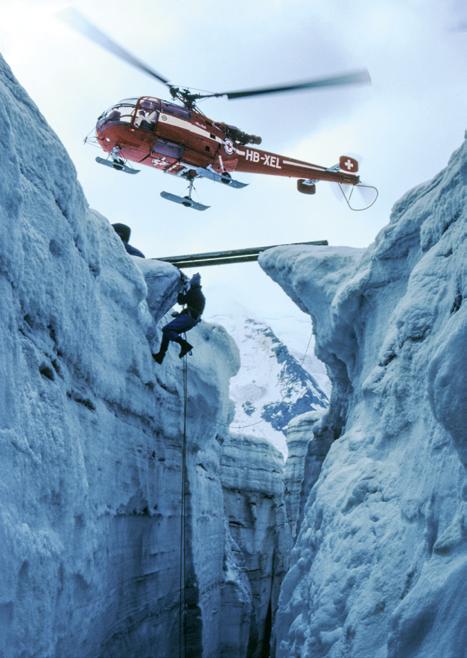
increase the rotor’s lift and accelerated to maximum speed. The turbine howled. The alarm lights in the cockpit flashed like a Christmas tree, yet the helicopter still fell towards the ground at breakneck speed. It all happened incredibly fast. No one spoke. Everyone was pale. No one could know what was going on in our heads.” Shortly before impact, Capito managed to recover control of the aircraft. “Well, that was lucky,” he commented in his distinct Zurich dialect.
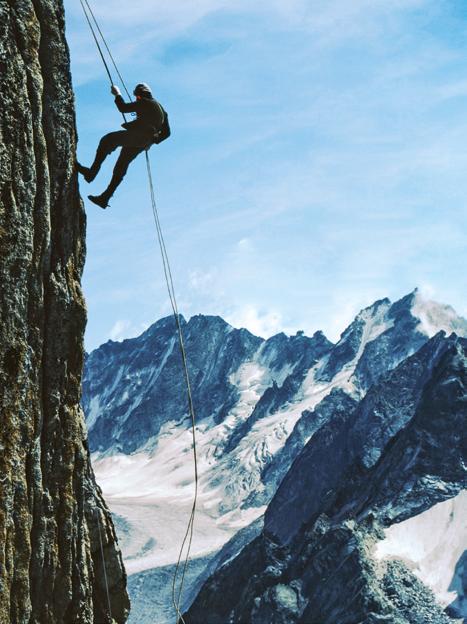
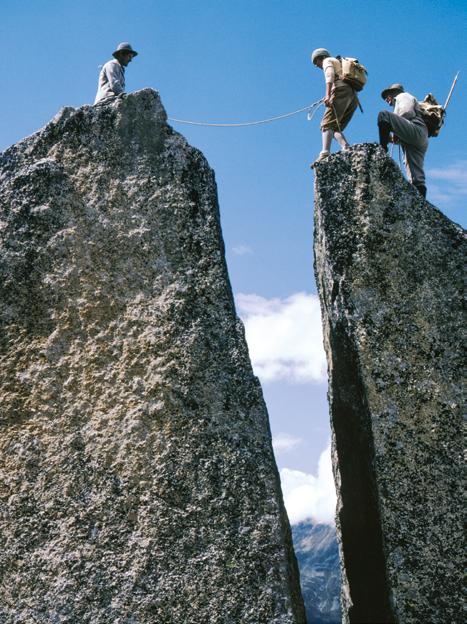
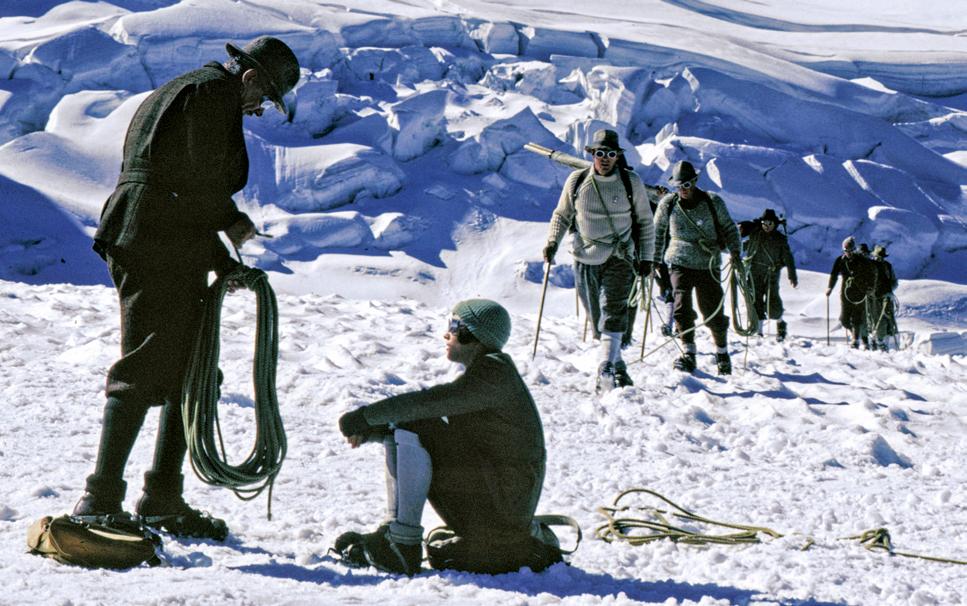
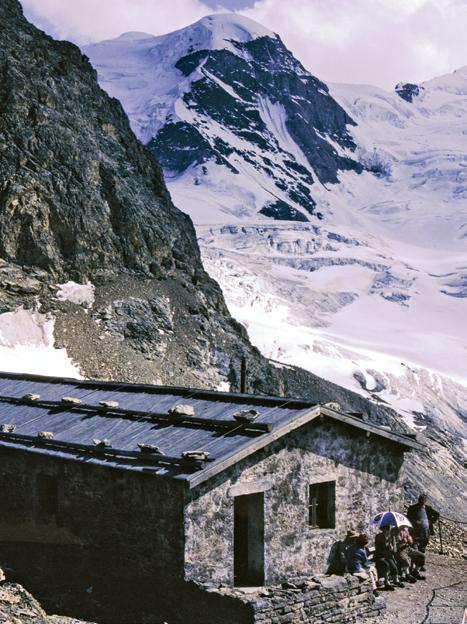
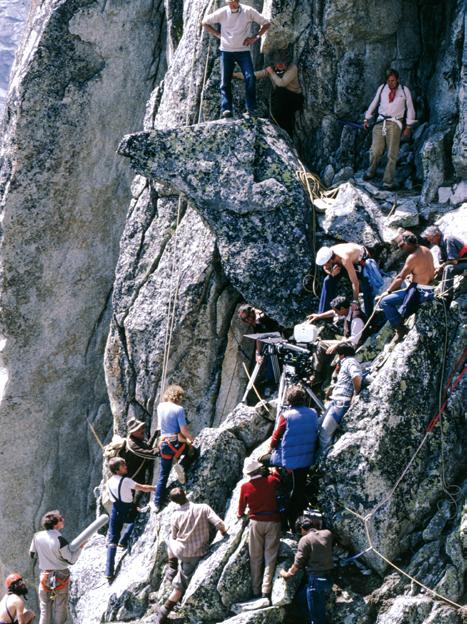
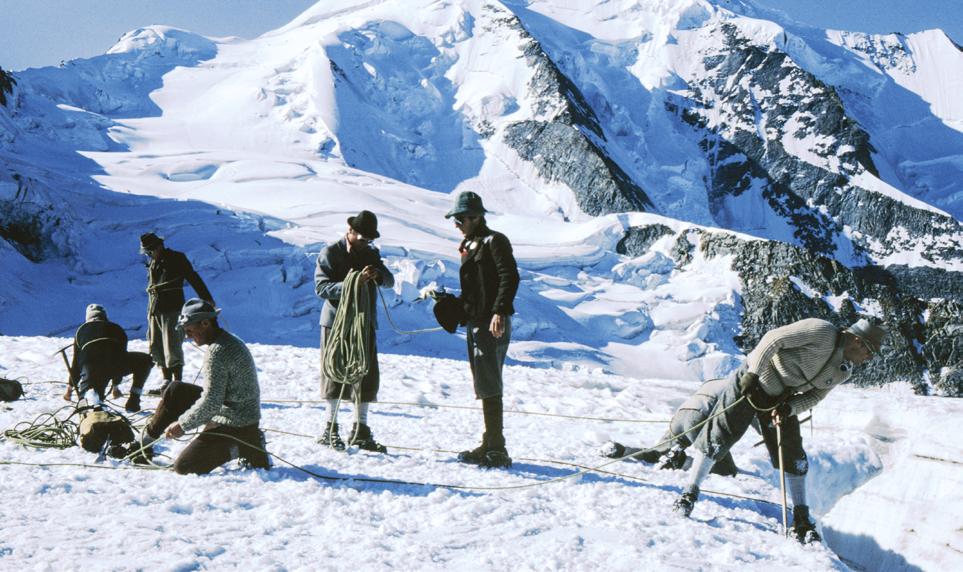
Since we didn’t find the appropriate location, the design team constructed the Swiss Alpine Club hut on the Diavolezza for the interior and exterior scenes. They meticulously crafted it to be astonishingly realistic. The scenery and the vista on Piz Palu were breathtaking. Zinnemann expected absolute attention to detail, but not only in the design. In the mountaineering scenes, they used climbing equipment from 1932, the era in which the story takes place. “We didn’t use any tricks. Zinnemann refrained from doing any tricks using special camera angles, which are often employed to create the illusion of height. Every scene was shot from the actual perspective of the climber.” The owner of Heli Bernina, Ueli Baerfuss, one of the first certified helicopter pilots in Switzerland, used a winch to lower the actors from the helicopter to the precise position. Stefan, along with the camera operators and climbers, was also lowered down. “A new horizon of alpinism opened up for me, even as a man of the mountains. I understood the attitude towards life that mountaineering is based on. That’s why this authentic footage still fascinates me to this day.”
To be prepared for the role of the mountain climber, Sean Connery had to complete a two-week mountaineering course. More important to him, however, was improving his golf handicap. He found a partner, Stefan. “Since we had to leave for the filming locations early in the morning, we were already off work in the afternoon. That left us time for nine
holes on the Samedan golf course, plus a drink at the bar. Sean usually ordered a Scotch, but he kept his wallet in his pocket. I was faced with the classic Scottish stinginess!”
During these games, Connery accidentally revealed that, contrary to previous reports, he was indeed interested in the future of the 007 franchise, but with the distance of an exBond. When he learned that Stefan had also been involved in the ski sequence in “The Spy Who Loved Me” in the Bergell region, he wanted to know everything about it. “He had often been asked about his opinion of his successor and refrained from making judgmental remarks. However, he cared more about the development of the role of 007 than he let on.”
Stefan understood that Connery hoped the mountaineering film would help him leap from the 007 mold into the character realm. The German title, “Am Rande des Abgrunds” (“On The Edge of the Abyss”), reflects the unsuccessful attempt to market this art-house film to audiences as a typical Connery action movie. This strategy proved unsuccessful and ultimately led to the end of Zinnemann’s career.
Another 40 years would pass after the discovery of the corpse in the glacier until this story found its sequel. Francine Lecoultre, the victim’s granddaughter, had moved to Hollywood, where she had made a name for herself as a costume designer in films such as “Star Trek” and “Total Recall.” While researching a documentary about her grandfather, she came across Stefan’s name and asked him to show her where the body was found. That brought him back to the dangerous crevasses of the Morteratsch Glacier.
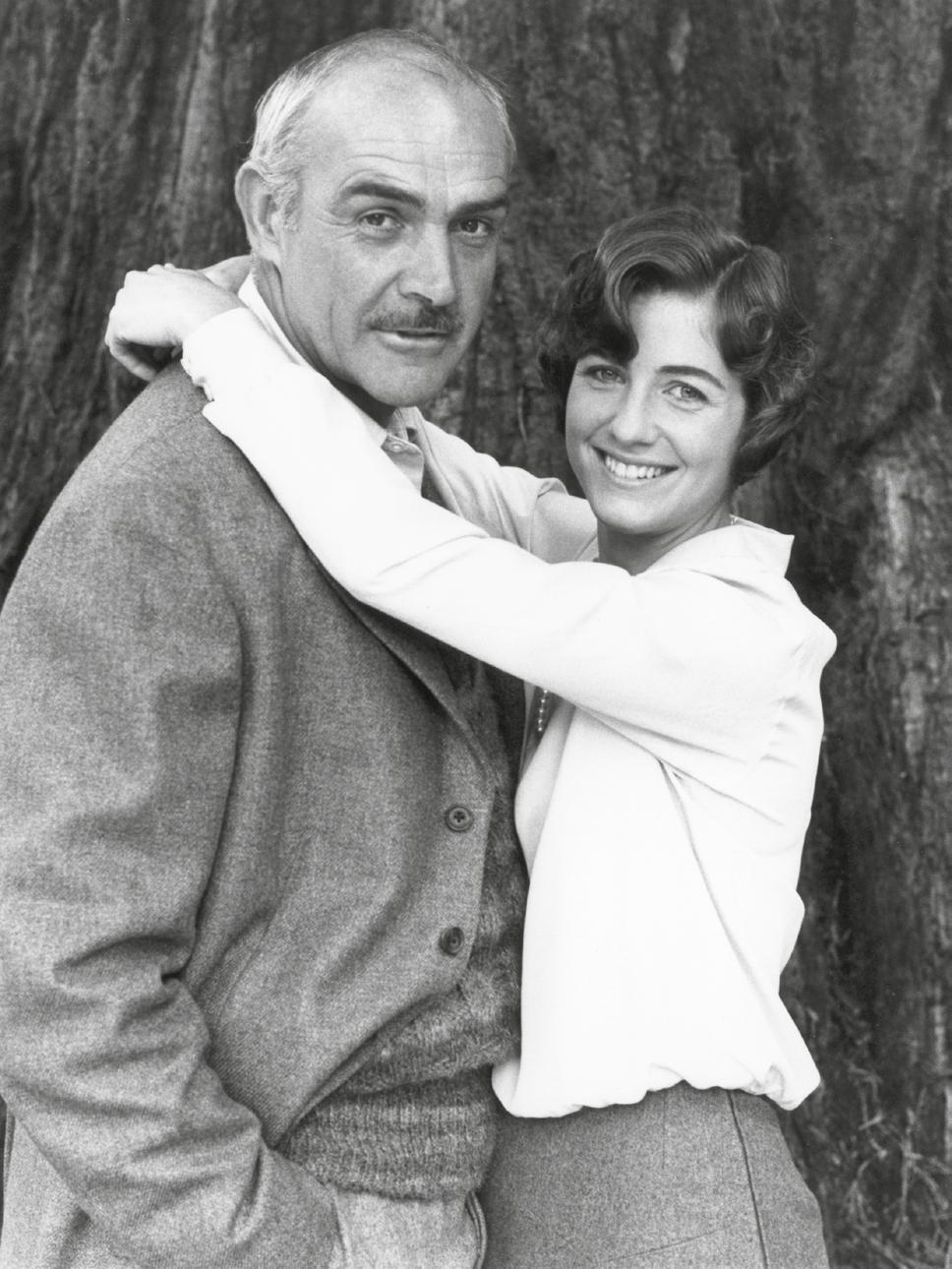
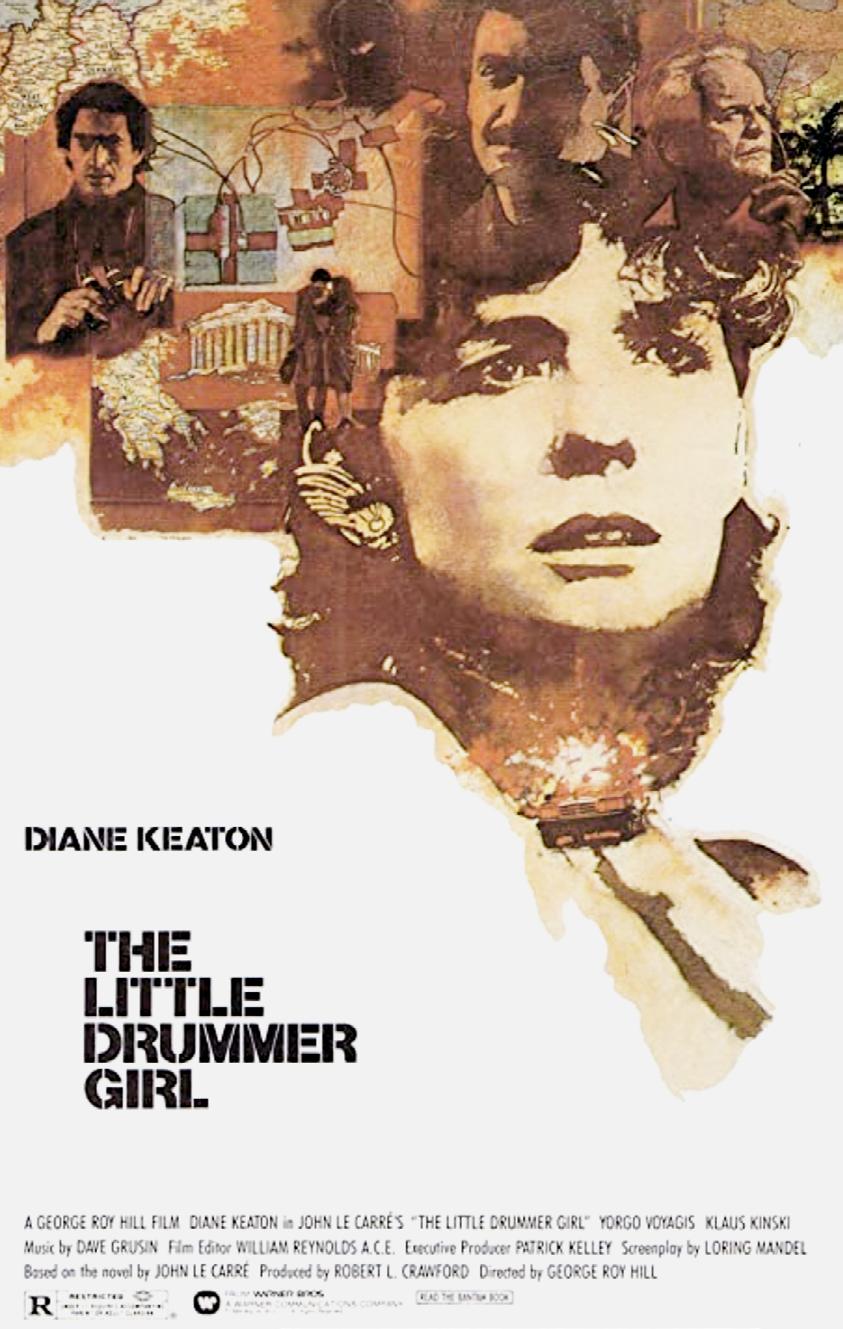
“The Little Drummer Girl” (1984).
Action cinema became a reality for Stefan Zürcher. The film crew of “The Little Drummer Girl” was caught in the crossfire when an actual shooting occurred in Lebanon’s war zone.
Bestselling author John le Carré owned a chalet in Wengen. It was known that the thriller specialist had worked for the British secret services in earlier years, and he included these experiences in his spy novels. Stefan met his neighbor while filming “The Little Drummer Girl.” Afterward, he didn’t get rid of the feeling that John le Carré had never quit active duty.
“John was a smart guy. He had worked as a spy against the Russians. After years of insight into the secret affairs of the state, you can’t just write down those secrets in a book. He indicated that he had to obtain approval from MI6 for the manuscripts.” Stefan suddenly found John le Carré’s residence in his hometown questionable. Wengen is car-free, it is difficult to surveil someone, and the village has always been a British stronghold. Stefan wondered if that was the reason why John chose to live here. Another person in John le Carré’s circle in Wengen, Pierce, sometimes disappeared for weeks. Supposedly, he was working on photography assignments abroad. “One day, he didn’t return. No one knew his whereabouts. We later learned he had died in a mysterious bicycle accident in England.” Despite the strange entanglements, Stefan was pleased to be included in the author’s circle of confidants after filming his novel. “He only talked to me about MI6 within his own four walls. If we met in a restaurant in Wengen, his lips were sealed.”
However, Stefan first had to earn his trust “under fire.” It was 1983, and the Swiss production manager found himself with a ragtag film crew on a plane of Middle East Airlines, the only airline still flying to Beirut at the time. “We were quite surprised when two MiGs suddenly began to escort us after we left Cypriot airspace. Flying over the city’s
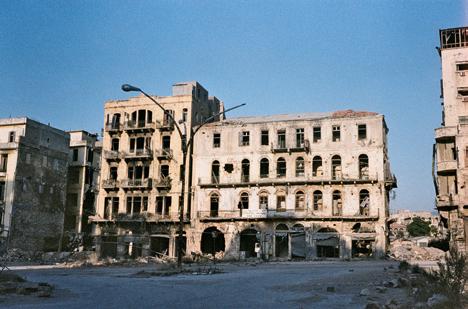
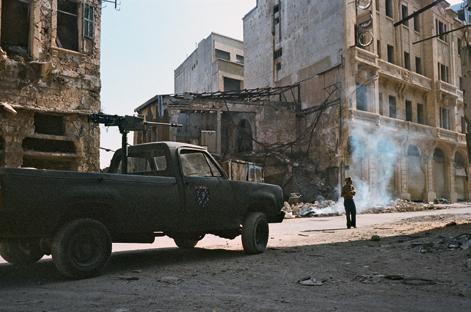
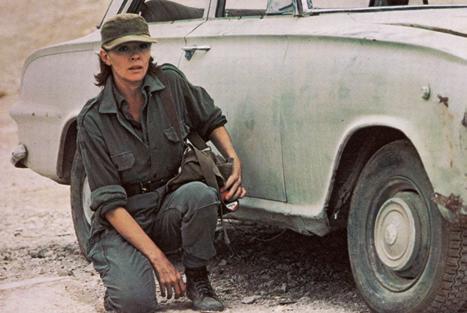
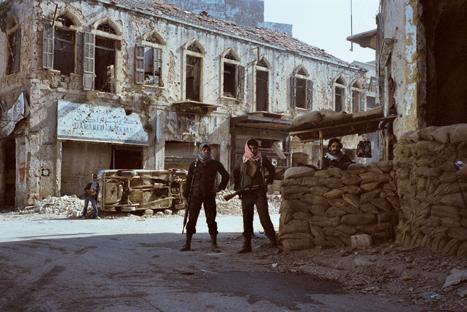
surroundings, I recognized the Chouf Mountains, once a popular ski resort, now a fiercely contested terrain. From a distance, we could make out the muzzle flashes of artillery fire.” The 1982 Lebanon War between the Israeli army and allied militias on one side and the PLO fighters and Syrian troops on the other had divided Beirut a few months earlier. The city, once considered the “Paris of the Middle East,” had been completely bombed and was divided into a Christian and a Palestinian part. Stefan and his team had to film along the demarcation line.
It didn’t take long, and the crew of six heard gunshots. “There was constant shooting.” But this time, the shots were not blanks. “The Little Drummer Girl” was set in Beirut - and was intended to look as close to reality as possible. Zürcher was supposed to film the backgrounds with a small action unit and to take pictures of streets and checkpoints. Part of the team was Alexander Witt, then camera assistant, now action unit director, responsible for the Bond film “Spectre,” and many others. Star director George Roy Hill, who had delivered legendary box office hits with “Butch Cassidy and the Sundance Kid” and “The Sting,” used the footage to build authentic-looking sets in Israel where the leading actress Diane Keaton could perform without being exposed to real danger.
The blue Peugeot in which Keaton travels around town was an important prop. “For the filming, we drove Diane’s double through the bombed Palestinian part of the city, and we had to pass the demarcation line at checkpoints every day. We lived in the Israeli-controlled part. Since the script showed Israel in a positive light, we were on the ideologically correct side, so to speak. However, at every checkpoint, real Kalashnikovs were pointed at us. We never knew if someone might have a nervous trigger finger that day.”
Micky Moore, the 2nd unit director, enjoyed the dicey situation. Stefan worked with him for the first time. Moore had long been a legend among stunt performers. He had worked with the greats like John Wayne and Kirk Douglas and had been responsible for the stunts in “Indiana Jones”. Moore was the “house director” for the action units of Steven Spielberg and George Lucas. “Mickey was truly passionate about action. His pulse was never as high as mine. He staged our shoot as if it was a single stunt, with calculated risk.”
“A captain in the Palestinian militia was in charge of us on the Palestinian side. He was in radio contact with the combat units and constantly updated the foreign film crew about where the fighting was flaring up on the front lines.”
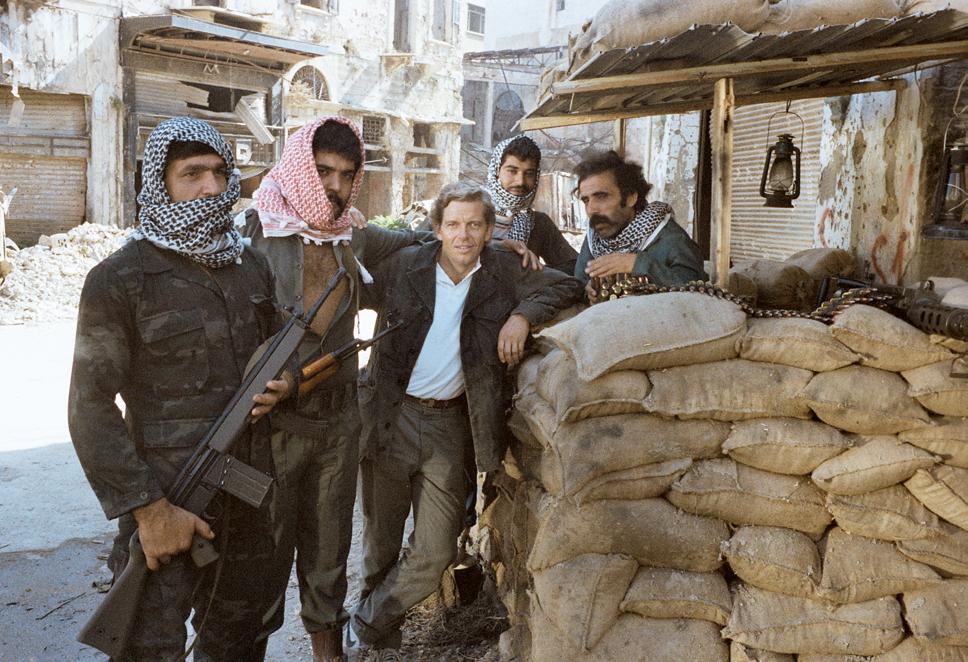
“The production also took pictures in Martyrs’ Square, the central public square riddled with bullet holes. “Our hotel was right on the demarcation line in the Christian part. We heard gunshots close by. If you went out the front door, you first looked around the corner and then ran at breakneck speed across the street to the next cover. This was not for the faint of heart. Of course, I was still at the age when men thought they were bulletproof. In a way, we were even proud to carry out the ‘mission.’”
Stefan’s mission did not end with the shooting of the Beirut footage. As it was impossible to find a second Peugeot in all of Israel, he had the “honor” of bringing the car to the star’s secure location in Wadi Qelt on the West Bank. “No one else wanted to do it.” Stefan’s perilous odyssey first crossed the demarcation line from the eastern to the western part of Beirut, where he embarked the vehicle onto a ferry. “The inspectors took the old rattle trap apart down to the last bolt, looking for explosives.” The fact that the film car had Lebanese plates attracted the guards’ interest more than once. Arriving in Larnaca, Cyprus, he drove the blue film prop to Limassol and shipped it to Haifa, where the car was disassembled upon arrival.
Finally, he traveled to Jerusalem and from there to Wadi Qelt. “In the end, telling the story that we were making a film seemed suspicious even to me. What is a car with Lebanese license plates doing in Israel? I was grateful whenever I could show my Swiss passport.” Stefan finally arrived on location. It took him a week to cover a distance that could be covered in a few hours.
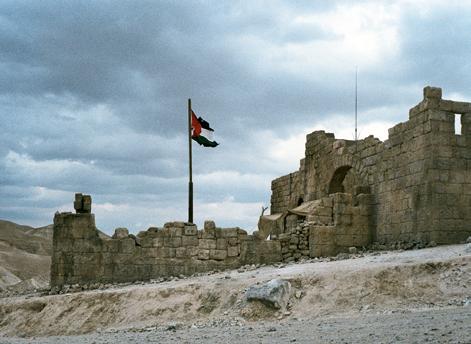
There is a Biblical reference to Wadi Qelt, the desert village in the West Bank where three springs of fresh drinking water are gushing from a rock. Herod had built an aqueduct from there to supply Jericho with water. “For me, it was a magical place of energy. On weekends, I often went to the Dead Sea or the historic summit plateau of Masada on the edge of the Judean Desert to recharge.”
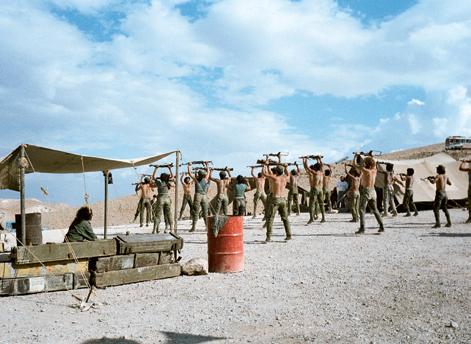
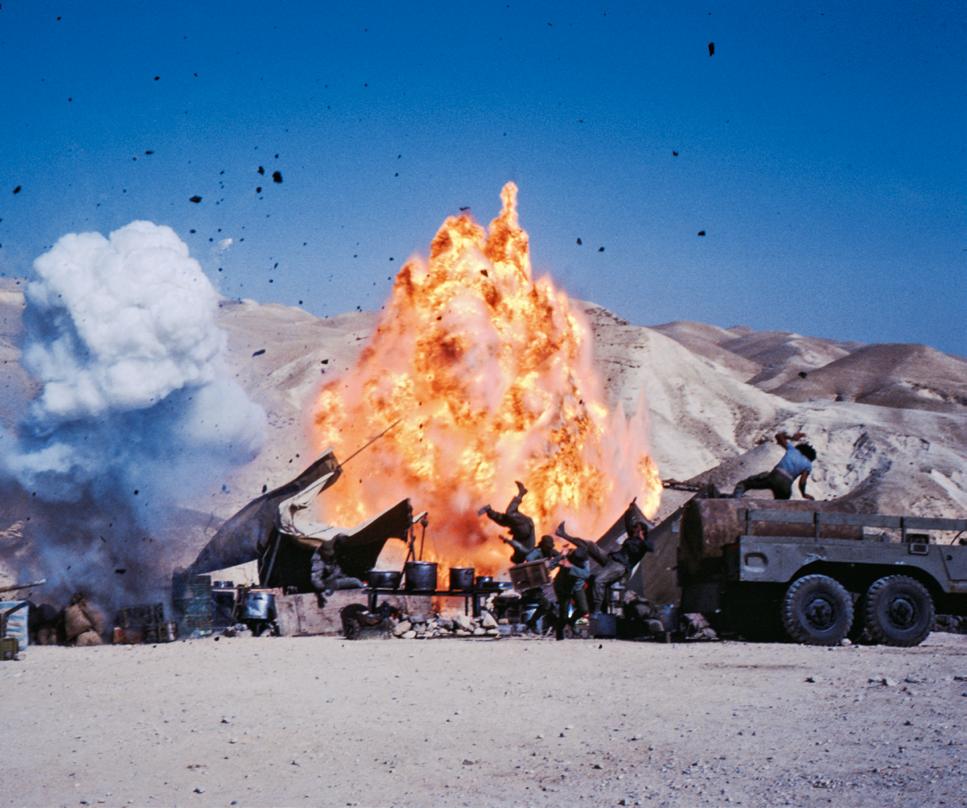
Special effects: explosion scenes.
In this green oasis, Stefan met up with the 1st unit of the film team and leading actress Diane Keaton. She had become known to audiences as a comedienne in Woody Allen films and proved herself in the dramatic field in her role as “Little Drummer Girl.” “Even under these difficult circumstances, she turned out to be a personality with a great sense of humor. “Klaus Kinski was less enjoyable. He played the same role he also had in life, the nasty Klaus Kinski. He did not engage with other people. To his credit, he didn’t hide his true colors from anyone. He was Klaus Kinski.”
In Wadi Qelt, the production designer, Henry ‘Bummy’ Bumstead, faithfully recreated the checkpoints and parts of the streets Stefan and his team filmed in Beirut. He was also no stranger to the film world and had worked with Clint Eastwood for decades. He obtained permission from the Israeli government to construct a control center in the oasis
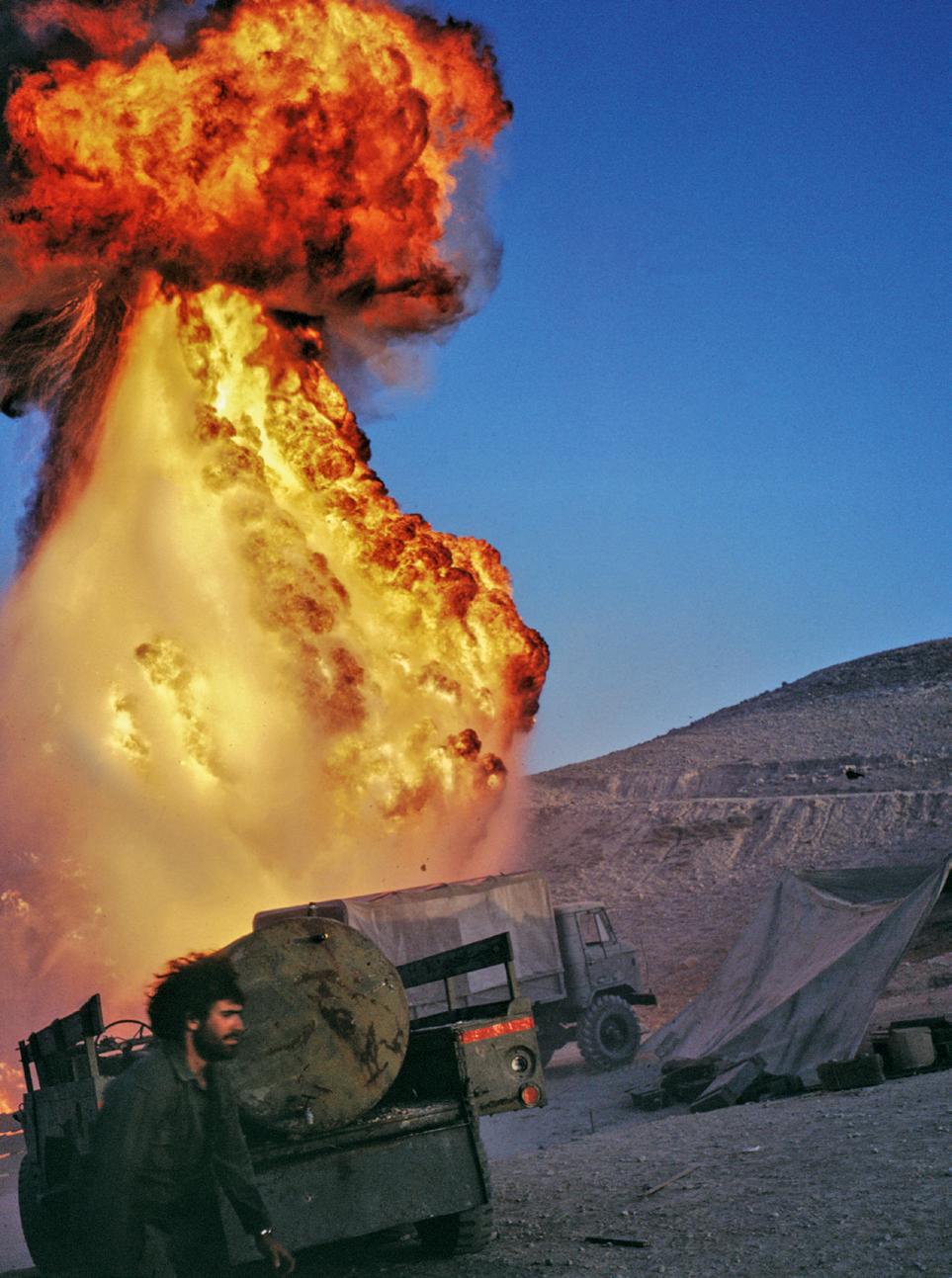
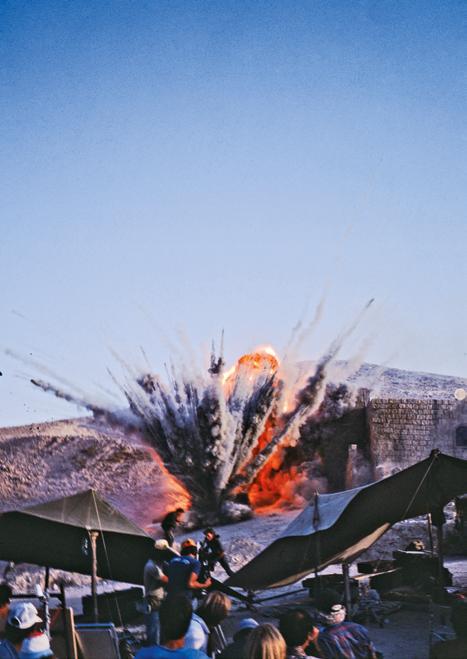
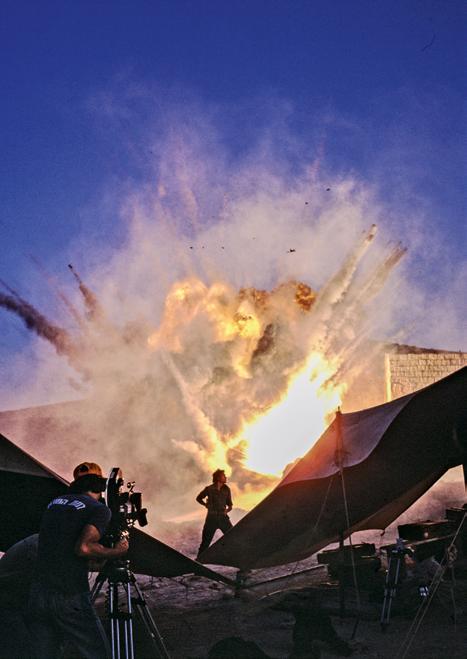
for the movie set. None other than Karl, ‘Charlie Boom-Boom,’ the Bavaria Studio’s explosive specialist, blew it up in the end. “Charlie’s explosions were usually twice as big as the production designer had planned,” Stefan recalled when Charlie was assigned to blow up part of an isolated cabin on a movie set. “When the dust and smoke had settled, there was no trace of the shack. I knew Charlie’s affinity for using large quantities of explosives, so I always took cover at a respectful distance during his blasts.”
Back to the writer of this action-packed story, John le Carré, who also played a small role in the film adaptation. The crossfire of critics was worse than the skirmishes Stefan experienced in Beirut. “John told me that whenever someone asked his opinion on a movie adaptation of his books, and his feelings were less than favorable, he would reply with a cryptic comment: ‘It’s very interesting. It gives me a lot to think about.’” When Stefan asked him directly if he liked “The Little Drummer Girl,” the ex-agent made no secret that he liked the film. Sometime later, when Stefan sat on the advertising board of the Wengen Tourist Association, he was asked to write a brochure. None other than John le Carré wrote the text for it.
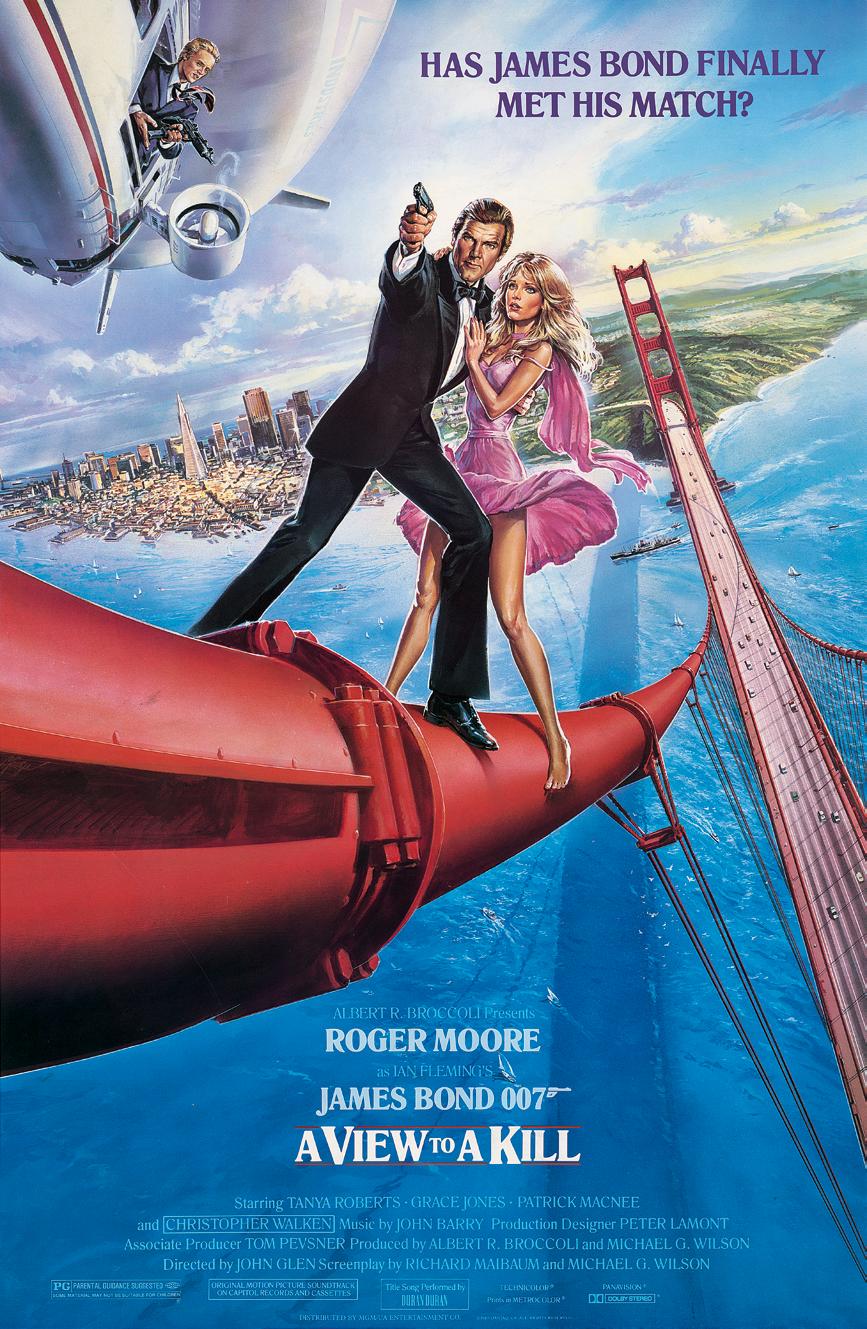
“A View To A Kill” (1985).
The call came from London to secure the services of the Swiss “Snowman,” because in “A View to a Kill,” the secret agent was to head back to the slopes - with one newfangled difference: James Bond learned to snowboard and started a trend.
Before this 14th Bond film, Stefan Zürcher had missed one of the secret agent’s trips to the ski slopes in 1981: “For Your Eyes Only.” “I was still hired for the location search in Cortina d’Ampezzo but then had to cancel for the actual ski sequences due to another film commitment.” Initially, an avalanche escape was part of the script; however, it was never executed. John Glen tried to explain to the Italian location manager where he envisioned the avalanche descending. But instead of “avalanche,” the Italian understood, “Have a lunch,” and he answered: “I can’t get a catering truck up here!”
When London came knocking again in 1983 for the next film, he looked forward to a reunion with John Glen, who had become the Bond films’ house director. Stefan remains in contact with him to this day, and together, they received the honor of leaving their handprints on Schilthorn’s “Walk of Fame” in 2015.
In “A View to a Kill,” James Bond finds himself in Siberia. Willy Bogner shot some glacier footage in Iceland since there was the usual ban on shooting Western productions behind the Iron Curtain. For the ski action, Stefan and production manager Leonhard Gmür chose the area they were familiar with on Piz Palü: the Cambrena gaps and the Pers Glacier above the Morteratsch Glacier.
With a budget of $30 million, this Bond movie was more expensive than the previous films. As always, it had to exceed the high expectations of the global audience, which also applied to the stunts in the snow. “James Bond was always a trendsetter. In ‘GoldenEye,’ we popularized bungee jumping, and in ‘A View to a Kill,’ we helped snowboarding break through unto the world stage.”
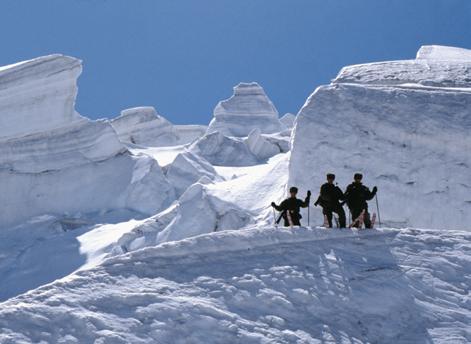
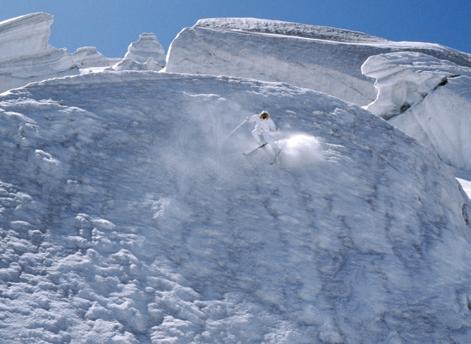
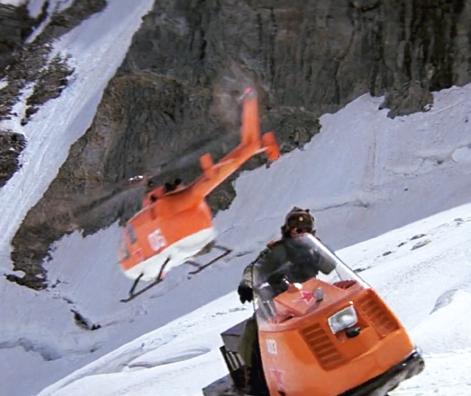
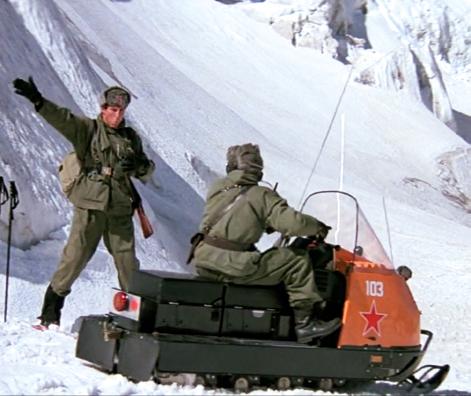
World champion freestyle skier John Eaves doubled Roger Moore as a skier, and worldclass mogul skier Bill Keenan joined him. Stefan felt at home in this hand-picked group of top alpine athletes. “Maybe I felt too much at home because, once again, I let myself be talked into doing a stunt that no one else would do.” Therefore, Stefan became a victim of James Bond once more – as the Russian antagonist. John Eaves, Roger Moore’s double, slyly attaches a hook to Stefan’s harness, which yanks him out of the snowmobile’s saddle. The unfortunate man dangles over a precipice while Bond rides away on the snowmobile.
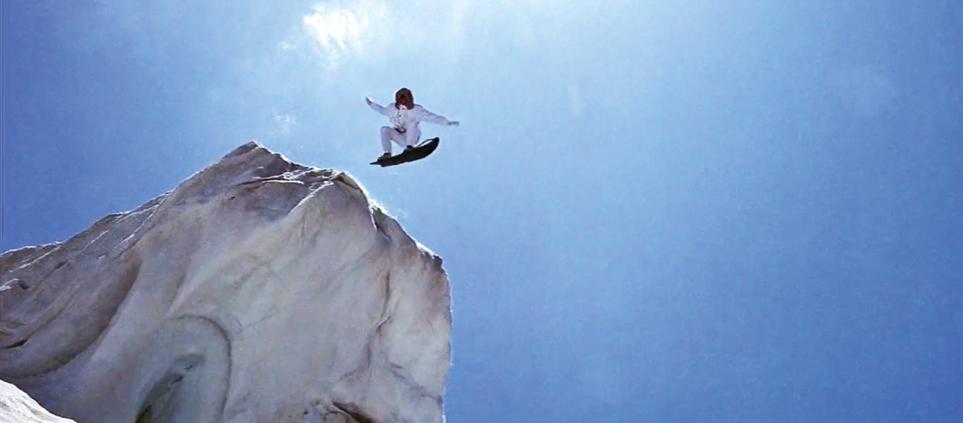
The fleeing Bond is shot at by the onboard gun of a Russian helicopter and saves himself by jumping into a crevasse before the snowmobile explodes. Bond grabs the steel ski from the wreckage of the snowmobile and builds himself a “snowboard”. Snowboard races were still a rarity in those days, and the new type of skiing equipment had not yet made its way into the consciousness of popular sports. Bond’s escape from Soviet pursuers on a snowboard significantly boosted the sport’s popularity.
Some of the founders of this sport were engaged in snowboard stunts: Tom Sims, the first world champion snowboarder, doubled Bond. In the ensuing chase, he jumps off a twelvemeter-high ice tower (Sérac) on his board and saves himself with a wild ride across a glacial lake while his Russian pursuers on skis sink helplessly into it. “You hadn’t seen anything like this before. Finding an ideal glacial lake for this stunt wasn’t easy. Glacial lakes can form within a very short time, but they can also disappear very fast. The scenes were shot in early summer at the Cambrena gaps on the Pers Glacier.” After Bond, Tom Sims began mass-producing his snowboards, which made a mark in the snowboarding scene.
A ride on the snowmobile became dangerous, even if no stunt was planned at all. A steep glacier slope led to the filming location in the Cambrena gaps above the Morteratsch Glacier. The crew and equipment were transported by helicopter. “That day, I was the Bond double and wanted to save the production some time and money. Without further ado, I rode up the 600-meter-long, extremely steep slope to the filming location on
a snowmobile. After several warm-up laps on the flat Morteratsch Glacier, I tackled the slope. Arriving at the top with the engine howling, the whole crew applauded.” Encouraged by this, Stefan wanted to repeat the action the next day. The engine wasn’t warmed up this time, and the power decreased with every meter. “The engine died when I reached the steepest part of the hillslope. I saved myself by quickly jumping off the snowmobile, and I watched as it went over the cliff, dropped down at high speed, and smashed into a thousand pieces at the bottom of the mountain. The biggest remnant was the engine block.” Stefan collected the fragments with two mountain guides and transported them in a helicopter net from the glacier. So once again, true to the motto: “We must save money at all costs.”
The manufacturer had provided the snowmobile; the Bond films are known for their product placement. “Somehow, they must have given up on that item because, as with the wooden tripods, I never received an invoice for the snowmobile. Working on this spectacular introductory sequence was one of my most enjoyable assignments for James Bond.”
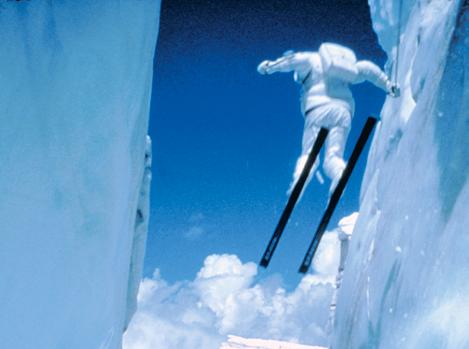
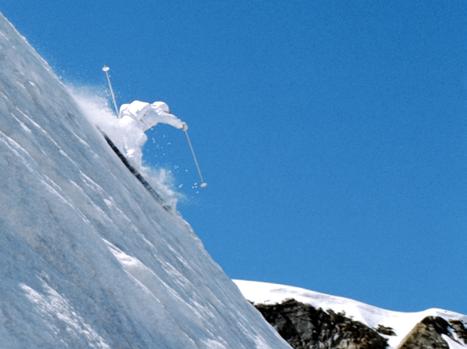
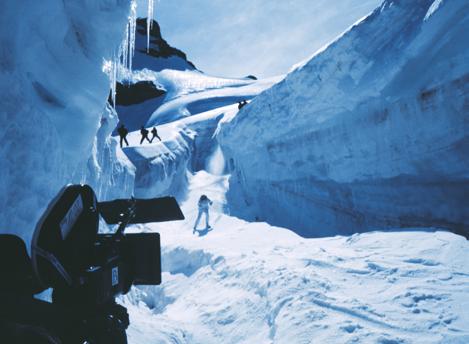
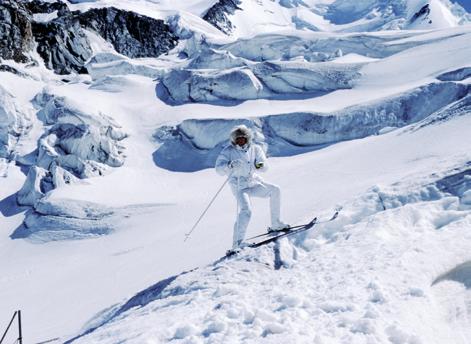
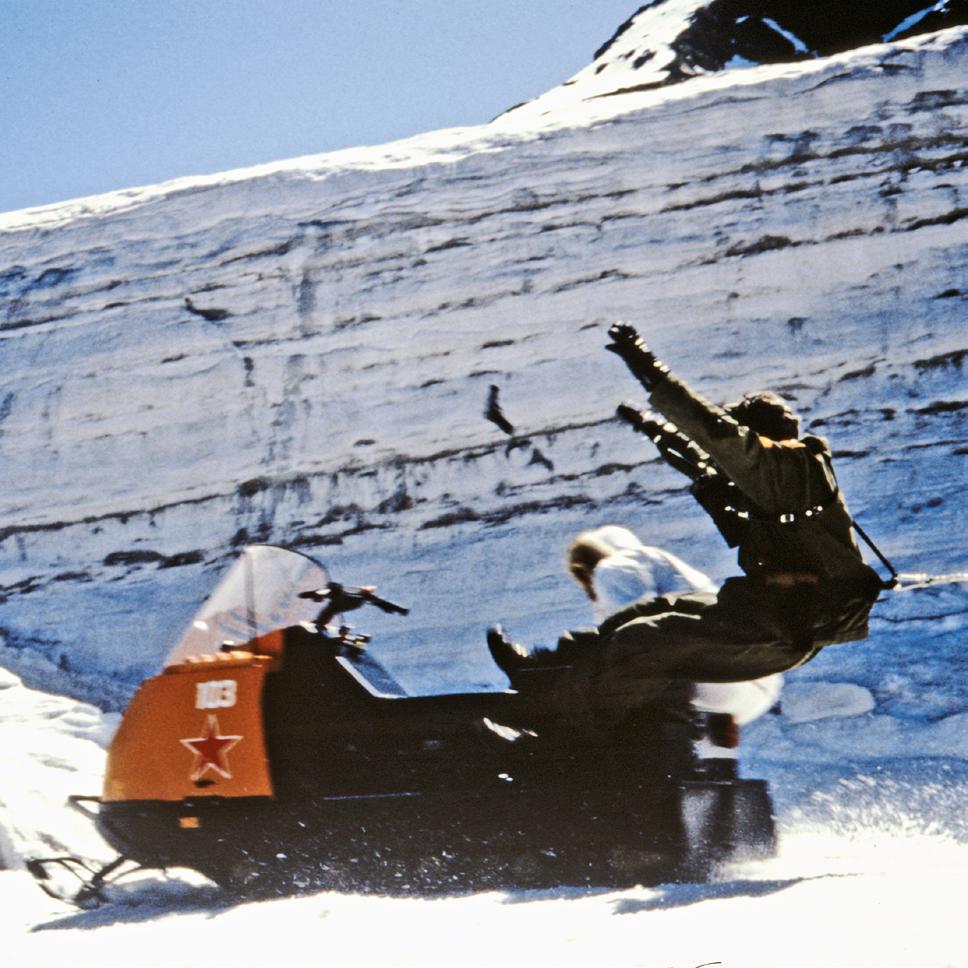
Stefan Zürcher on a snowmobile, Bond’s stunt double John Eaves in the background.
For the first time, the title of the next Bond film was not announced at the end of the credits. Roger Moore ended his run for good after seven appearances. That left everything open for the 007 producers - it wasn’t the first time Stefan wondered if James Bond would ever return to his life. Nevertheless, John Eaves, responsible for dangling Stefan over the precipice, would soon cross paths with him again in a movie surpassing even 007 with its skiing action.
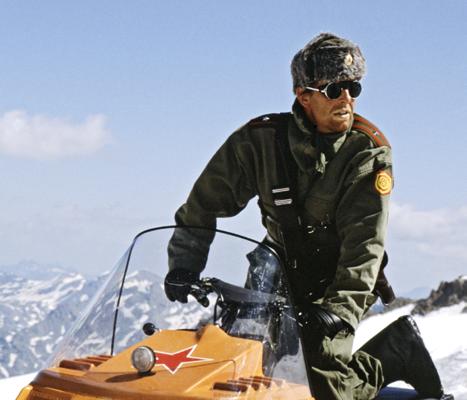
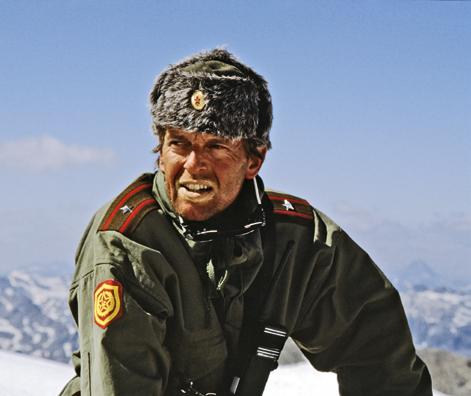
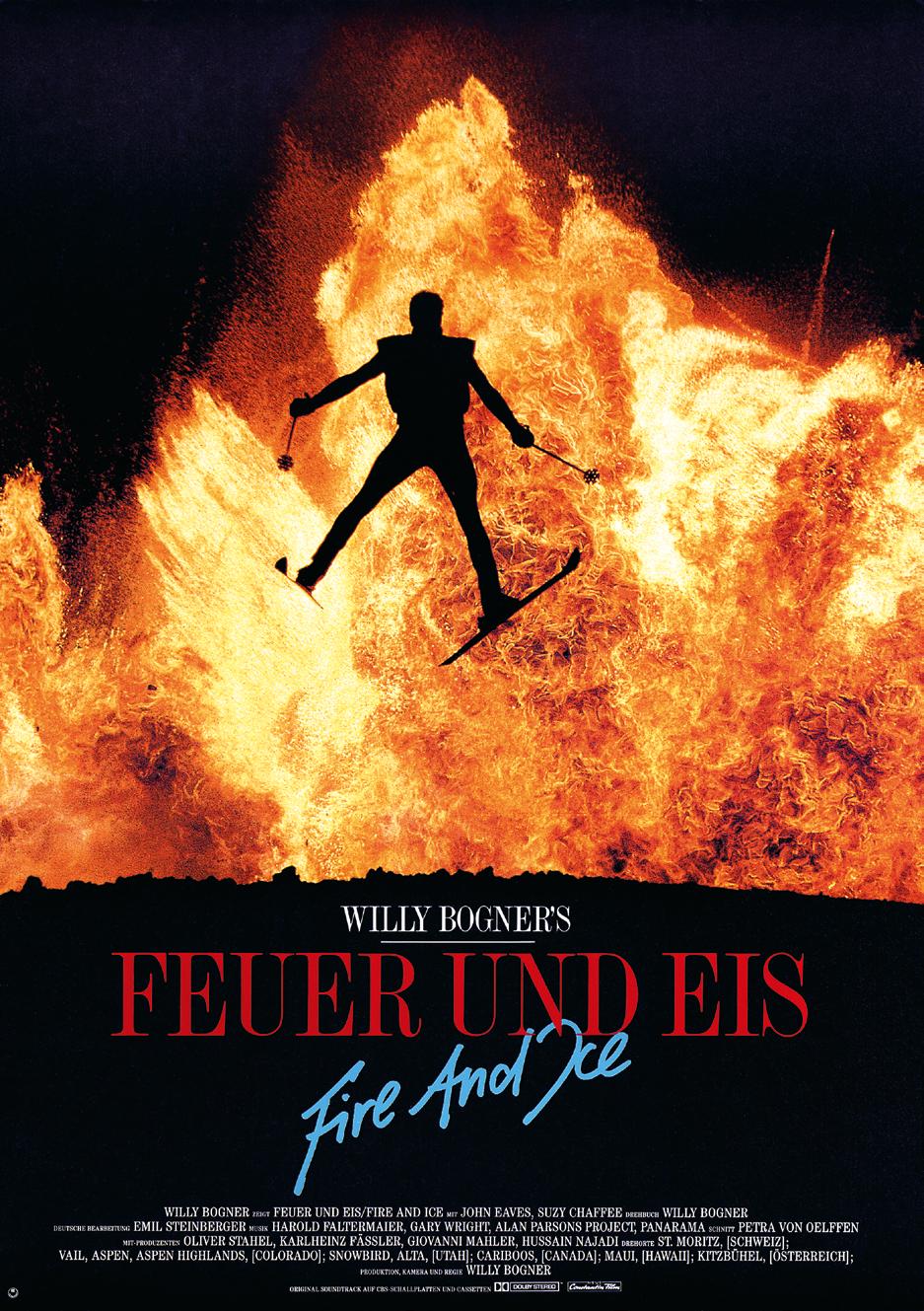
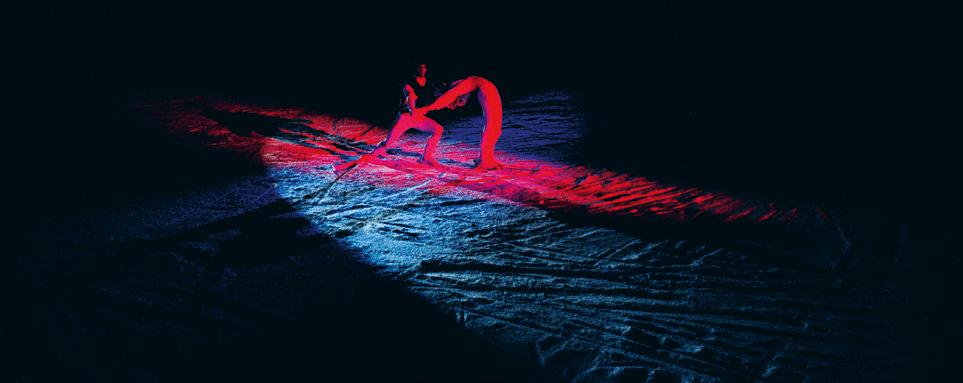
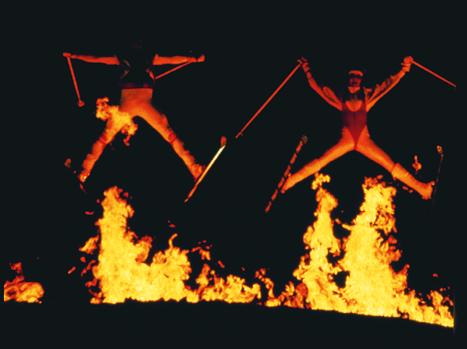
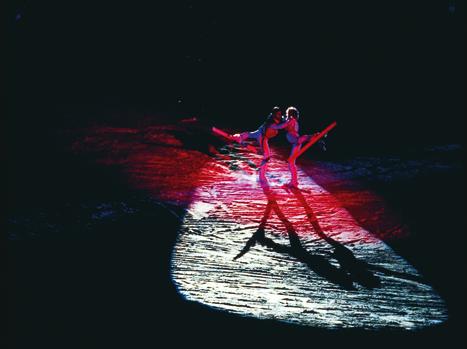
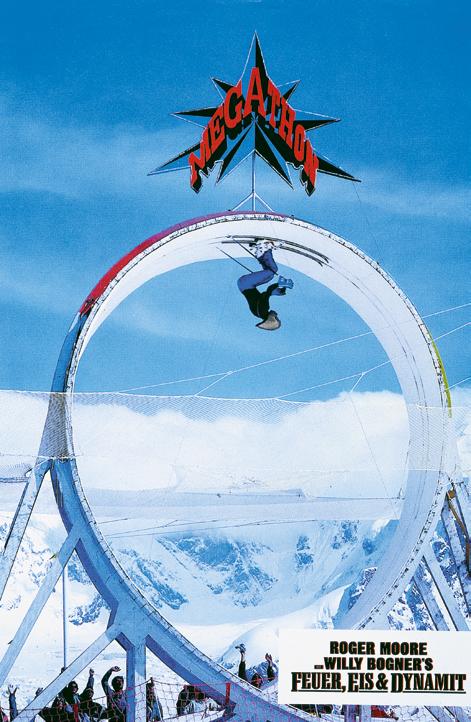
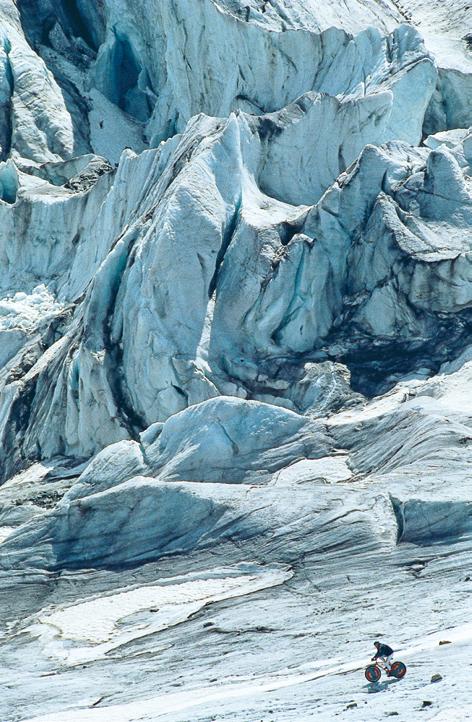
By 1986, Willy Bogner had raised enough money to produce his own film, “Fire and Ice.” He gathered the young talents of the freestyle scene for this. He also wanted Stefan Zürcher.
In “A View to a Kill,” ski racer Willy Bogner, also a big name in the sportswear business, still had to accept instructions from Stefan. He had to remind him multiple times about the assigned position. Bogner was responsible for the images, and Stefan was responsible for sticking to the budget. “Willy always used up a lot of film stock. He was a born showman, eager to prove to everyone that he could ski anywhere with his camera, forward or backward. He could! I learned a lot from him.”
When Willy Bogner created his opus magnum with “Fire and Ice” as a screenwriter, director, producer, cinematographer, and investing his own money, he had to be more cautious with the budget. “He hired me to do the exact opposite of what we argued about while filming Bond.”
The film featured superb ski footage and an 80s pop soundtrack by Harold Faltermeyer. Bogner hired the best extreme skiers, John Eaves, Tom Sims, and the other cracks they had worked with on “A View to a Kill.” In the English version, John Denver provides the voice for Eaves, the protagonist and narrator. In the German version, it was Emil Steinberger. “Emil’s voice and Swiss accent worked well with the film. Willy came up with this idea while editing; it was not part of the original plan.”
On the ski slopes, Bogner required the entire camera crew to keep up with his spontaneous and speedy work pace. As a rule, he wanted to shoot with a long focal length to capture the unexpected. “If he saw a jumping ramp, he immediately wanted to set an
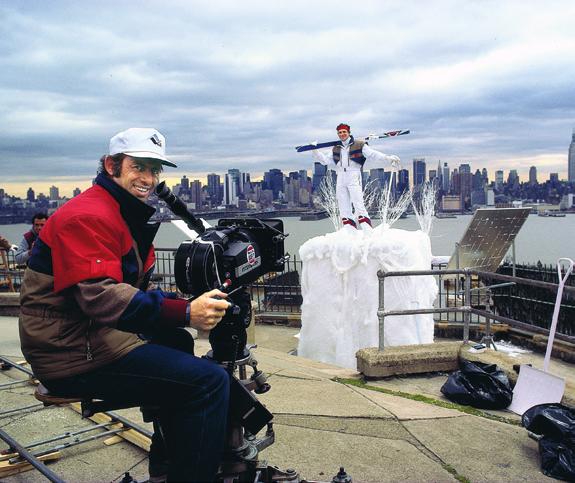
explosion behind it.” A guy named George, from the camera crew, performed as a focus puller. He had to “pull focus” in motion shots! It is impossible to achieve this in improvised settings without a previously defined reference point for the actual focus. “Shit, everything is out of focus!” Bogner complained. He didn’t want to accept that capturing these shots requires time. Finally, George, a thoroughly cool, calm, and collected Bavarian, replied to another tirade, “Any fool can wield a camera.”
Bogner used precious 35 mm film stock in huge quantities until Stefan started to keep track of the unusable footage. “Following each take, we decided whether it should be further developed. I reminded Willy that we discarded 60 meters (197 ft) of film with each missed shot. On a Bond budget, you might be able to afford this, but not here.”
Stefan also paid close attention to costs in other situations. He was supposed to bring 20 boxes of equipment - the latest collection of Bogner skiwear, cameras, and other items - from Munich to the filming location in Vail, Colorado. When checking in at the airport, he was concerned his budget would be in jeopardy due to the excess weight. “I had to come up with something. I found a way to manipulate the luggage scale by placing a piece of wood between the floor and the scale. The excess weight was cut in half. That’s part of my Swiss DNA: Stick to the budget at all costs.”
The closing scene in Vail is one of the most impressive snow sequences ever captured on film. “Willy had a unique vision of night shots with light effects, chase lights, fireworks, and explosions. I could use all my knowledge of snow-related action scenes to put his ideas into practice.”
While filming in Colorado, Willy Bogner took Stefan, John Eaves, and a few other crew members to a cocktail party he was invited to, but he kept the host’s name a secret. The unknown destination in Beaver Creek looked like a prison with barbed wire on high walls and armed guards. “After a thorough check, the gate finally opened, and we were granted entry. It was only when the host appeared that I understood I was standing within the retirement residence of former President Gerald Ford. Willy Bogner stays in my memory as someone always good for a surprise.”
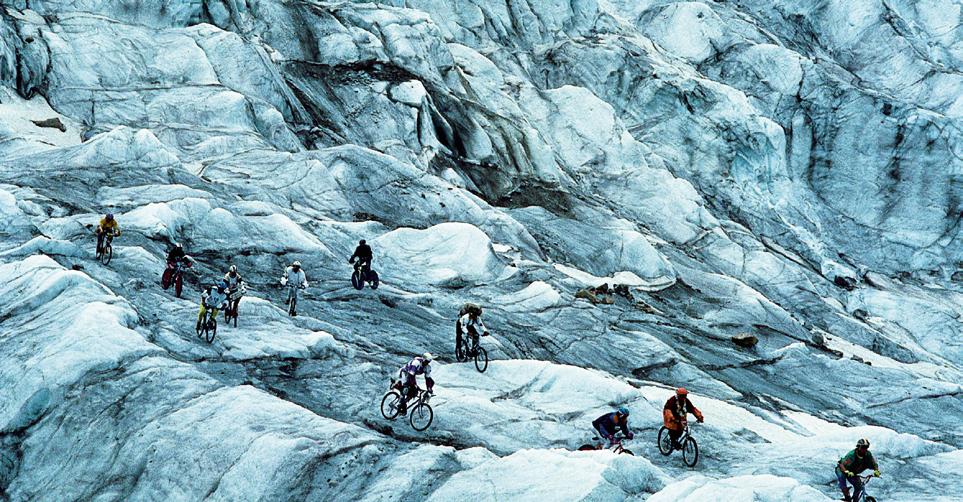
The ski footage had a significant influence on future filmmakers. The audience also appreciated the combination of fashion, slapstick, and ski stunts in front of explosives backdrops. Bogner, therefore, soon came knocking for a second time. “Although we had
good times together, we never became close friends. Willy was aloof. As professionals, however, we worked extremely well together.” That’s why Stefan agreed to do the sequel, “Fire, Ice, and Dynamite.” The movie was supposed to mark the end of their long collaboration.
After the success of the first film, this motion picture was upgraded with prominent actors, including Roger Moore. While the sporting thrills were spectacularly filmed once more, the plot was of minor importance. To increase the budget, Bogner included as many product placements as possible. “I told Willy the night before what sequence we were going to shoot, and he decided right on the spot what items we could promote in the scene.” The cinema owners didn’t like this, of course. They saw their source of income from advertisements threatened by the many product placements and boycotted the film.
“Ishtar” (1987).
“After three days, we knew: This is not going to work.”
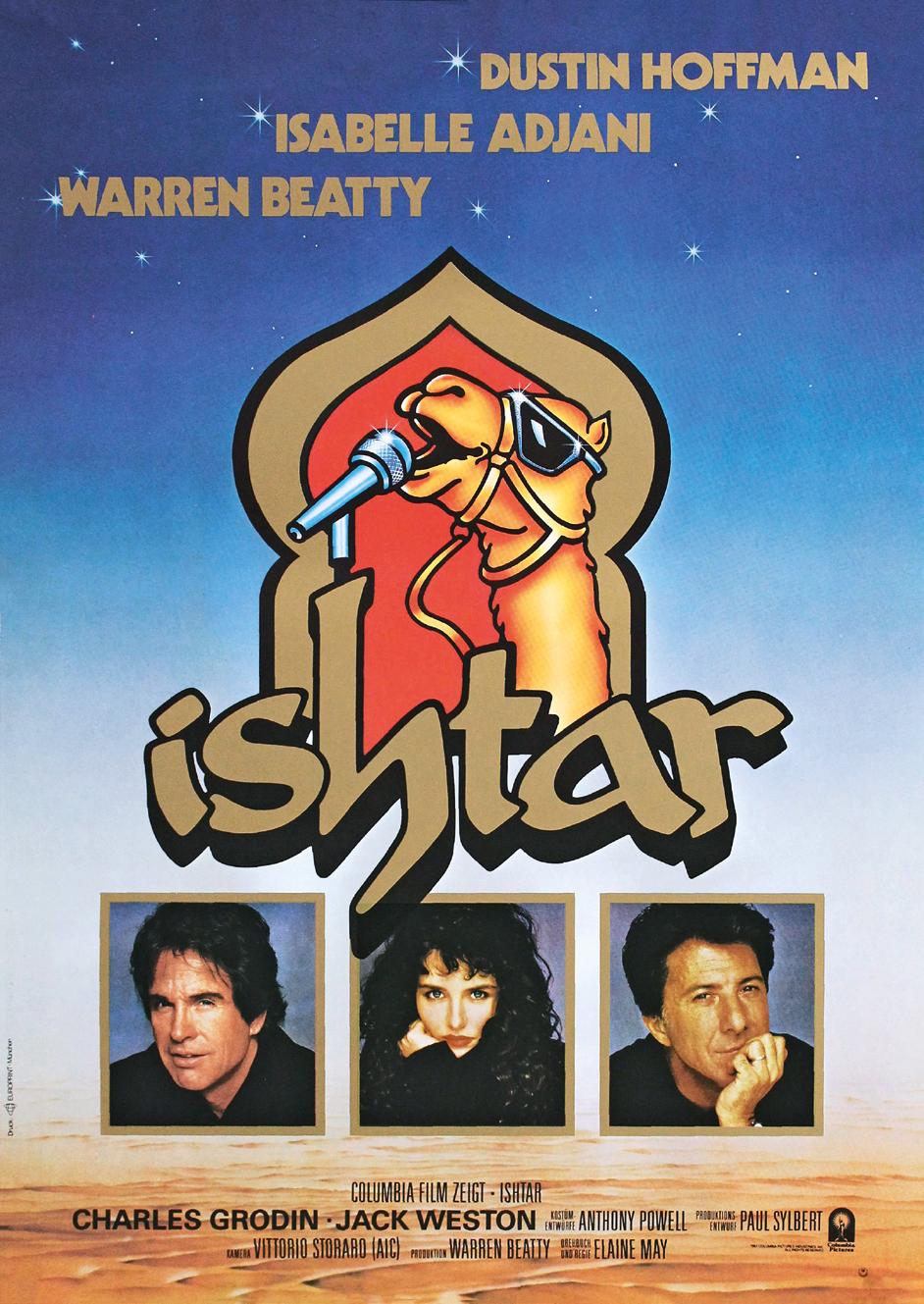
The making of “Ishtar” is how $50 million sank into the sand while everyone watched helplessly. Stefan Zürcher had the most ludicrous job of his career: leveling the Sahara.
Initially, this film project looked like a surefire box office success. Warren Beatty wanted to film Elaine May’s screenplay as producer and lead actor. He brought Dustin Hoffman on board to co-star. “Ishtar” was meant to enrapture audiences with exotic settings in North Africa. Columbia Pictures considered the film worth the $50 million investment. Beatty took the first step toward disaster when he promised Elaine May the director’s chair before signing the studio contract. She would literally tank the film in the sand.
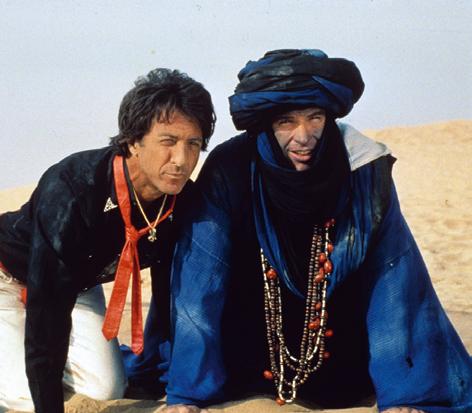
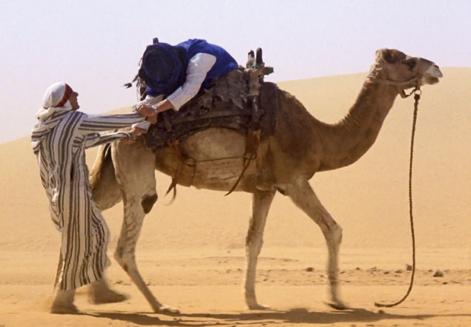
Searching for a location in El Aaiún, Morocco, Micky Moore, the 2nd unit director, and Stefan showed the novice director the nearby sandy desert. She was excited but had one objection that left her traveling companions speechless, “Beautiful, but the dunes are distracting. I want a flat sandy desert.” She wanted the audience to feel its ‘infinity’ when Beatty and Hoffman crawl through the desert, dying of thirst in one sequence. “We tried to explain to her that the winds keep creating dunes.” Elaine May insisted. “Micky and I exchanged a glance. We knew this was going to be a disaster.”
Stefan took up quarters in the royal palace, converted into a luxury five-star hotel in El Aaiún, half an hour from the sea. Over the course of two months, he organized ten giant bulldozers from the Moroccan army to move and level two and a half square kilometers of dunes. “I guess the locals thought the sun had burned our brains. The job was hilarious but well-paid. I felt like I was on a working vacation at a luxurious resort. Every evening, the menu offered fresh fish and lobster.” All this effort had a single goal: enabling the director’s vision of the “infinite desert.”
Soon, Warren Beatty also noticed that “Ishtar” was getting out of control. He increasingly interfered in his protégée’s direction. “The gifted cinematographer, Vittorio Storaro, was the third egocentric personality on set who tried to add his directing vision. Storaro hit the desert with ten trucks full of camera and lighting equipment and a team of 40 lighting technicians. Since the desert sun is known to create harsh shadows, we needed to brighten the faces of the expensive stars. We put white reflective tarps (bouncers) on aluminum frames (6 by 10 meters) and attached them to tripods. This method can also be used for snowshots. However, we weren’t just fighting against the desert sun. There was the Sahara wind that turned the reflectors into sails. We hired 30 locals to hold down the aluminum frames and fill sandbags to weigh down the tripods.”
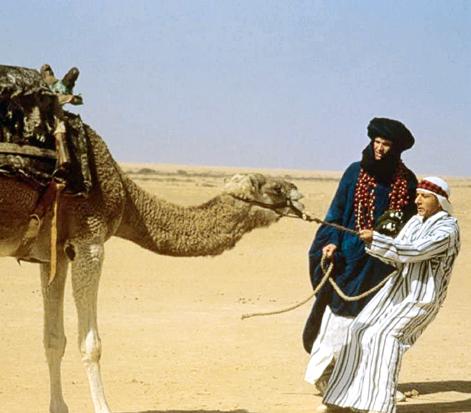
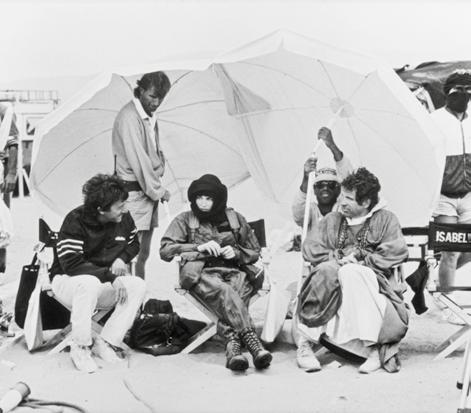
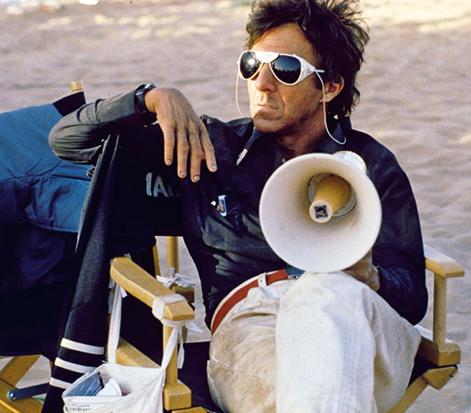
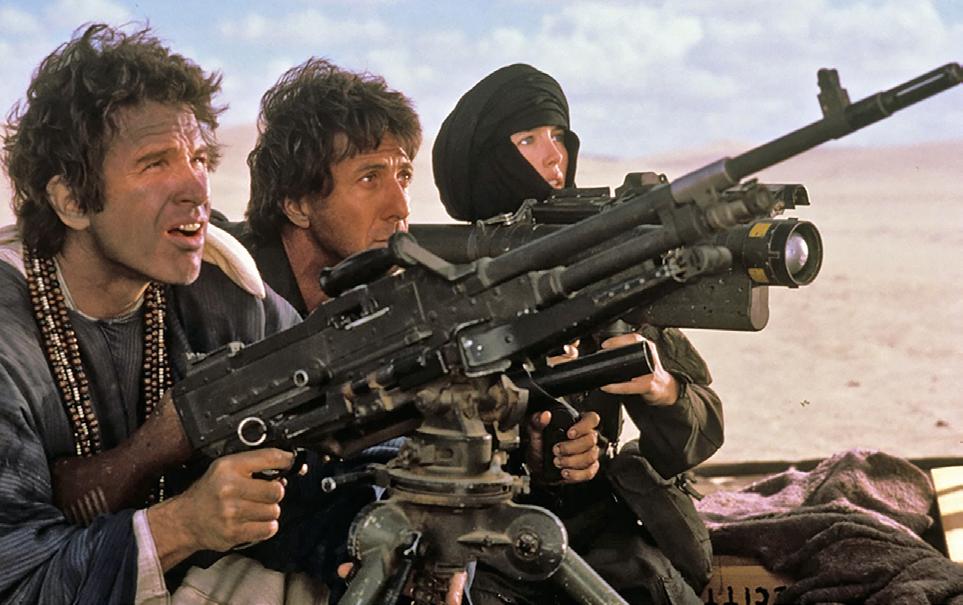
The chaos was complete. The accountants in faraway Hollywood suffered panic attacks when the expense reports from Morocco started piling up faster than Stefan could level the sand. “Our convoy departed daily from El Aaiún into the desert, resembling a lost traveling circus complete with trailers for the stars.” The fact that Beatty spent most of his time in the trailer of French star Isabelle Adjani confirmed his reputation as a playboy. Dustin Hoffman was unpretentious, “A great guy. He showed no interest in logistical problems. Like Beatty, he already had his $5.5 million paycheck in the bag. When we called him out of his trailer, he would come and do his job.”
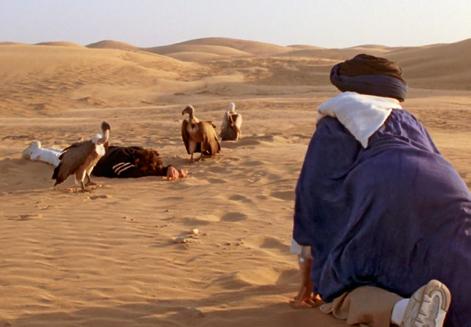
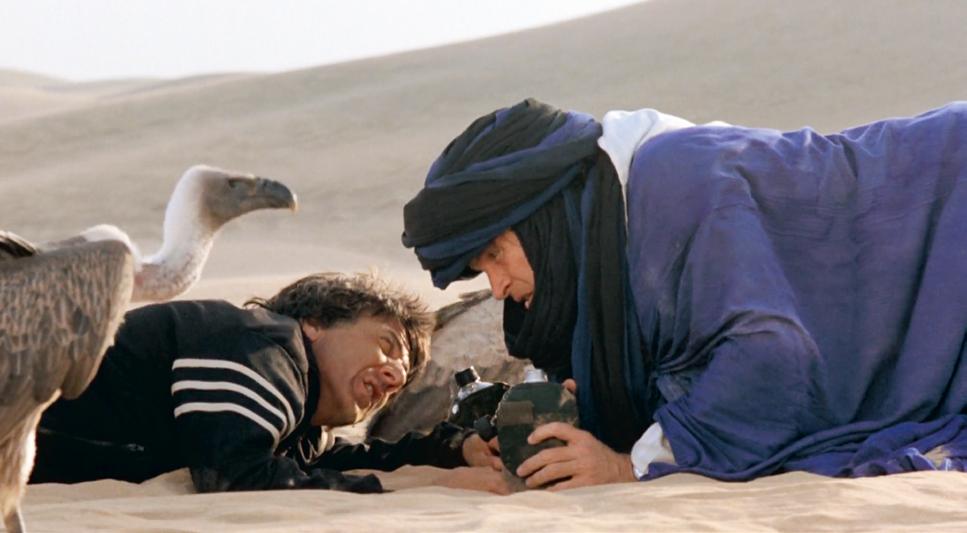
One day, the actor’s job involved crawling through the sand, “dying of thirst”, while vultures circled overhead. An animal trainer flew in from Los Angeles with a vulture in his luggage for this purpose. Stefan picked the duo up at the El Aaiún airport. “I was approached at the gate by a man with a birdcage. He opened the door to the cage and commanded, ‘Higgins, come out.’” Higgins, the expensive vulture, needed some fresh air after his long flight. Side by side, this strange trio marched through passport control and to the parking lot. The scavenger again did as it was told, “Higgins, go in.” The vulture hopped back into his cage. Stefan soon found out the trainer’s secret. Whenever Higgins obeyed, the bird received a “goodie” as a reward, a piece of decomposed meat the trainer carried in a leather pouch attached to his belt. On the long drive to the location, the stench be-
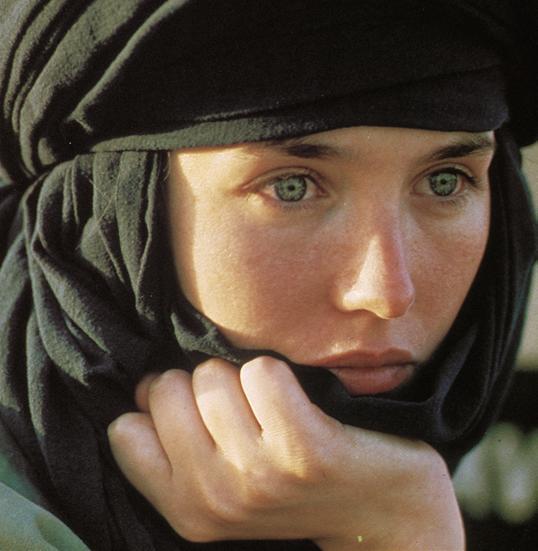
Isabelle Adjani.
came unbearable. Stefan opened the window and asked if Higgins didn’t get sick from the foul-smelling meat. The trainer said unapologetically, “It takes a lot to make a vulture sick.” Stefan transferred this saying to real life. Whenever he had to deal with greedy “vultures” in the film business, people who didn’t shy away from committing shameful deeds, the phrase would come to his mind, “It takes a lot to make a vulture sick.”
They filmed the vulture in the “leveled” Sahara, flying in circles above the main characters and landing with pinpoint accuracy. The animal trainer instructed Beatty and Hoffman to play dead. Otherwise, Higgins would not land next to them. The cinematographer determined the landing point, and the animal trainer marked the spot with a red dot invisible to the camera. “We constructed a 10-foot tower that the animal trainer climbed with Higgins in the cage. He opened the cage at the director’s command, ‘Higgins, fly!’ The vulture shook its feathers, took to the skies, made a few laps over the parched victims, and descended towards the red dot. After landing right next to Dustin Hoffman, it lingered, eyed him, hopped closer, and, probably thinking Hoffman was dead, began pecking away at him. “Luckily, we had forewarned Dustin to shield his eyes with his hands because vultures always peck at the most vulnerable part of the carcass first, the eyes.” The first take was perfect, and the scene was in the can. Higgins received his stinking “goodie” and returned home to Hollywood.
Ultimately, the endless desert wind restored Stefan’s plain to its original state. The following incident, however, was of lasting value to him: “Bedouins from the Berber tribe were to be ready for a scene at 9 a.m. Our windsails were ready. Storaro’s 40 lighting tech-
nicians and the 30 local helpers were ready. The whole team waited for hours under the desert sun. Finally, we spotted the proud men riding their camels along the endless horizon. It took another hour for them to reach us.” The incensed Warren Beatty had the interpreter tell the desert people they were too late. After prolonged talks, the interpreter returned with their answer, “Berbers are never late!” This sentence gave Stefan more food for thought, “I’m sure Berbers have no concept of burnout either.”
Elaine May was never again entrusted with a film of that size. Why did no one put a stop to this madness? “During the making of a film, it’s hard to assess whether it’s all worth it. Many a film has been made in a crazy way and been successful. Not this one.”
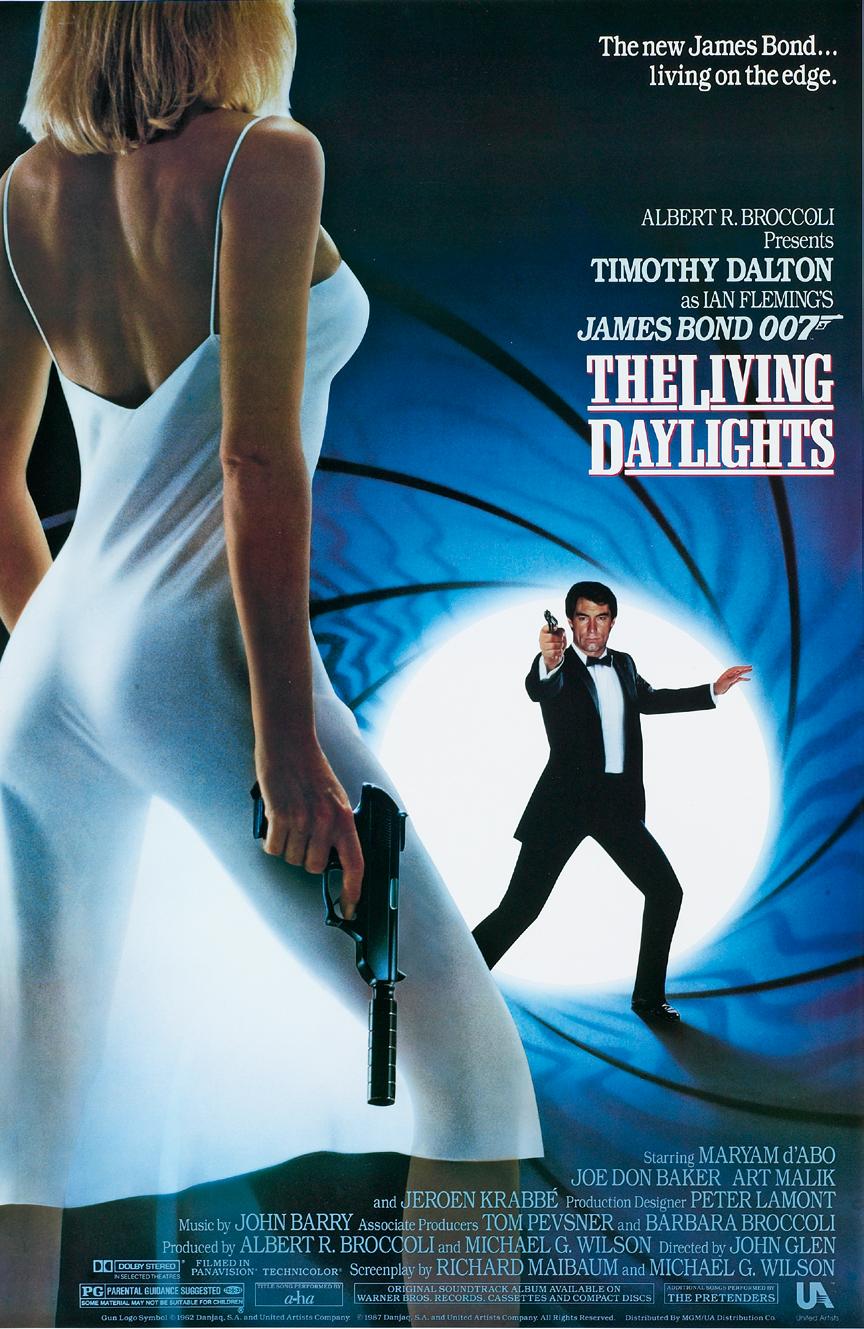
“The Living Daylights” (1987).
After Roger Moore retired as James Bond, Timothy Dalton was given the license to kill in 1987. Of course, the new 007 actor never put himself at risk of death during action scenes. The one who almost gave his last breath for “The Living Daylights” was Stefan Zürcher.
The 15th film in the 007 series not only marked the debut of Timothy Dalton - Stefan appears here for the first time in a small speaking part: “Come on, hurry up!” he commands, as an agent is guided through a pipeline from Eastern to Western Europe. That was more of an inside gag, and no one asked him later if he also wanted to dub himself. But, more importantly, Stefan met Desmond Llewelyn, the famous actor playing the ingenious inventor Q, for the first time during this occasion. “The Q scene that the fans were always waiting for was normally done in the studio, which is why we’d never met before. In this case, Q was needed for the pipeline scene on location in Vienna. Desmond was a permanent fixture in the movie series and was treated like an honored guest by all of us.”
One of the many locations in Vienna where Stefan worked as location manager was the Gasometers, which had been shut down (today, a shopping mall with apartments and event halls). The authorities in the Austrian capital were so helpful that the filmmakers were even allowed to repaint the streetcars to make them look like Eastern European models. Filming was still underway in Vienna when Stefan was already preparing the elaborate action scenes at Lake Weissensee and shooting the so-called “inserts,” detail shots of the secret weapons in the 007 car, with the 2nd unit under the direction of Arthur Wooster. Director John Glen trusted the 2nd unit to complete these shots according to his storyboards and instructions.
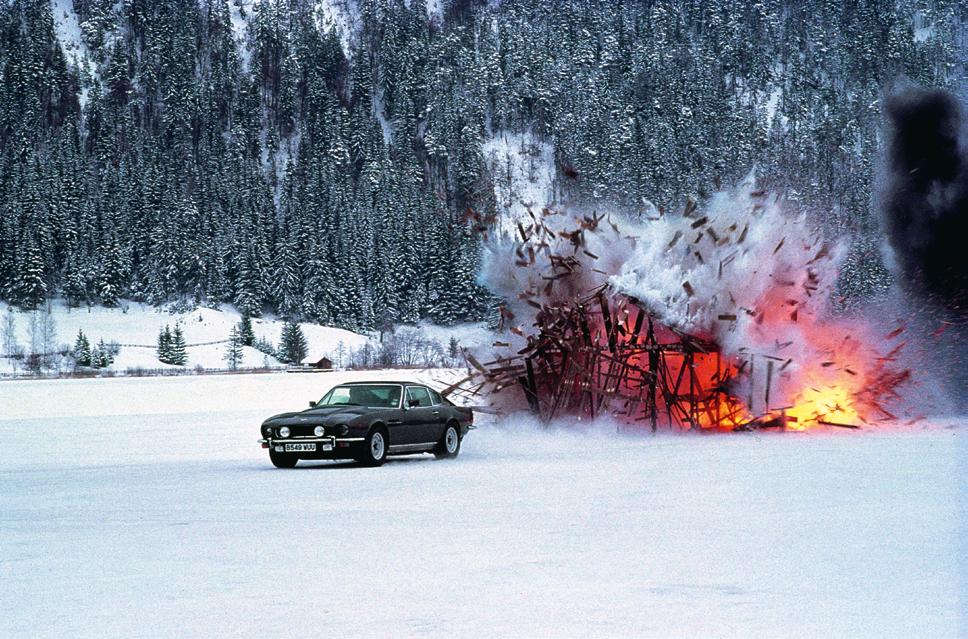
Bond’s Aston Martin on Weissensee, Carinthia, Austria.
“Aston Martin had equipped several cars with different gadgets for us.” One was fitted with rockets, which Bond fired at a truck from the headlights at the push of a button. “What we see in the movies often looks more impressive than it is in reality. In this case, the rockets were actual firework rockets adapted by the special effects crew. The intended impact can be achieved by abruptly cutting to the truck’s explosion.”
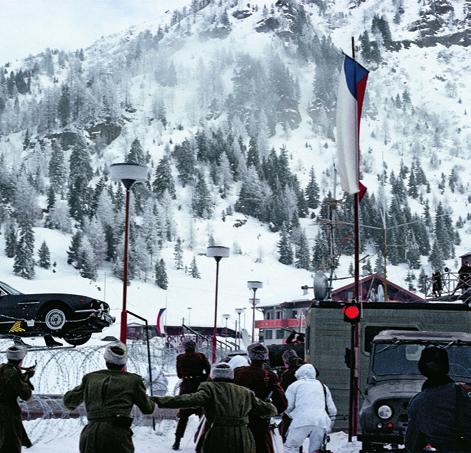
The frozen Lake Weissensee was the ideal location for the chase of the Aston Martin by the Czechoslovak army. The car spins in circles and slices a hole in the ice with sharp prongs attached to the front wheel. A pursuing car sinks into the hole. “With a chainsaw, we cut out the ice floe in a circular shape and drilled holes into the ice. Water shoots up through these holes after the weight of the pursuing car presses on the cut ice floe, and the car disappears into the lake.”
In fact, the Aston Martin itself broke unintentionally through the ice - and the crew had to rescue it from an unwanted dive. For its further ride on the lake, the Aston Martin activates runners and ignites a rocket booster to fly over a border dam. Due to the low temperatures, this stunt didn’t end as planned in the script after a short flight - the air compressors that powered the Aston Martin were too cold. With preheated air compressors, the flight finally succeeded the next day.
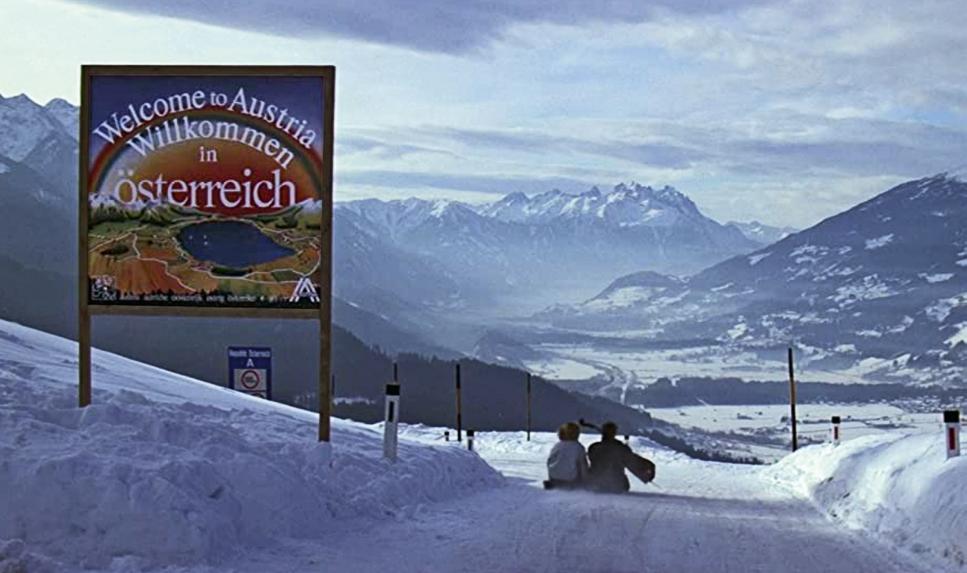
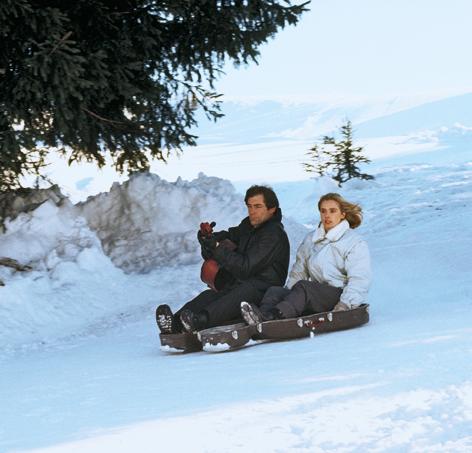
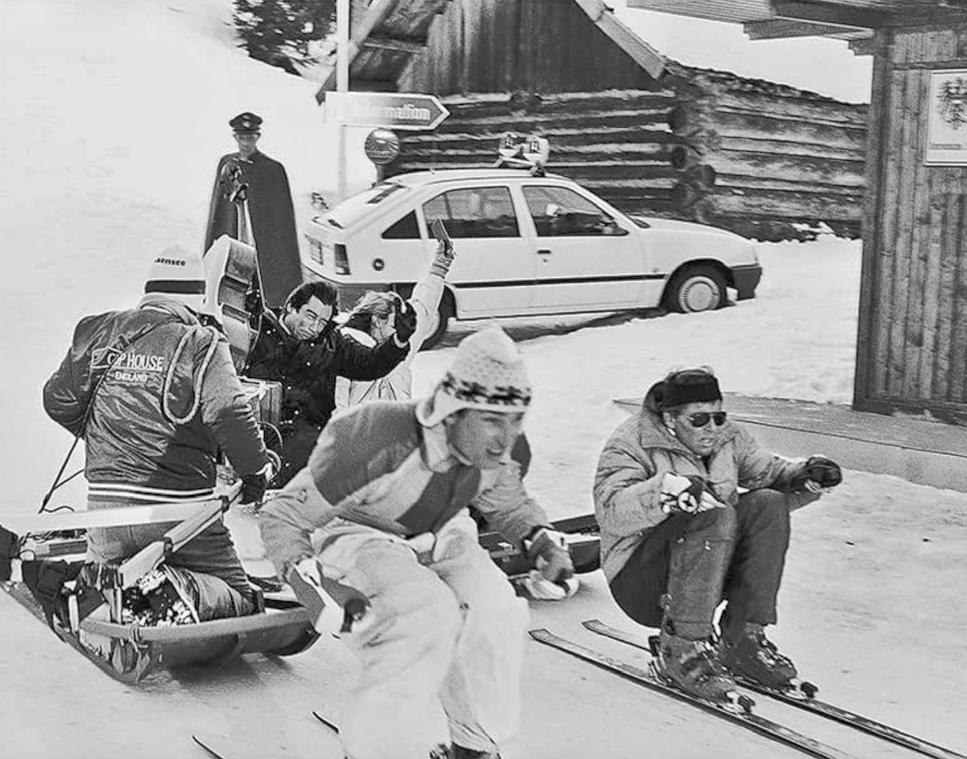
During their escape, Bond and his companion, Maryam d’Abo, used her cello case as a sled and the instrument as a steering wheel. “We had prepared the slope and made it compact with water. I had fitted the cello case with invisible runners and guide rails.” Dalton piloted the strange vehicle while Stefan skied next to the stars, filming them with the camera. “As envisaged in the script, James Bond steered with the cello’s endpin. The cello was real - except, of course, we weren’t using a priceless Stradivarius, but cheap instruments we’d picked up in a second-hand store.” Stefan was also responsible for filming the “inserts” capturing the impact of bullets in the snow around the cello case and on the musical instrument.
Stefan’s film team spent two full months at Lake Weissensee. After the ice had been deemed safe and without objections from the insurance company, they were permitted to film the close-up scenes inside the car with Dalton and his film partner, Maryam d’Abo. “Timothy Dalton seemed tense to me. Considering the risky activity on the frozen lake, it was understandable.” Nevertheless, the 007 novice carried out Stefan’s instructions for the snow scenes with considerable commitment.
Stefan had a lot of experience with frozen lakes from working on many films, but this had given him a false sense of security. He would have been glad to avoid the experience that followed. “After a night of heavy snowfall, we had to clear the fresh snow because its weight put pressure on the ice below. Twenty tractors pushed the snow to shore, but not beyond. Therefore, we had to call a big snow groomer to plow the snow away.”
No team member was willing to pilot the 7-ton snow groomer on the ice, even though it was 40 centimeters thick. Without further ado, Stefan got behind the wheel in the middle of the night to avoid interrupting filming the next day. Suddenly, he heard an ominous cracking sound one hundred fifty meters from the shore. Life imitated art: Stefan suffered the same fate as Bond’s pursuers, whose car sank into the water. The front of the
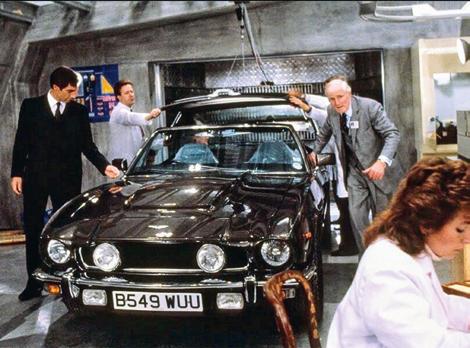
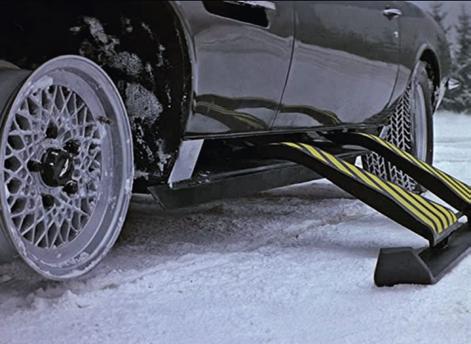
Maryam d’Abo and Timothy Dalton escape to Austria.
snow groomer broke into the ice. He put the car in reverse but pushed the accelerator too hard. Within seconds, the vehicle was sinking. Disastrously, chunks of ice immediately filled the hole above him. “I now understood why the drivers didn’t want to do this. The ice-cold water was up to my neck. I breathed through the bubble of air that had formed at the top of the driver’s cabin. Attempts to break the window were unsuccessful.”
Stefan fought for his life in the submerged vehicle while ice floes drifted above. Norbert Jank, the ice master, bravely jumped into the cold water. “I was fortunate that he was a big, strong man. He managed to get a foothold on the driver’s cab and pried open the door enough for me to escape through the gap.”
Stefan went shivering back to the hotel to warm up. He returned to the ice that same night. It would only be in the following week that he would wake up from recurring nightmares as his subconscious tried to grapple with the delayed fear of death.
The next day, divers recovered the 7-ton truck with a crane. Barbara, daughter of producer Albert Broccoli, watched the scene and calmly remarked, referring to the snowmobile that Stefan had reduced to scrap on “A View to a Kill:” “The equipment you’re losing is getting bigger and bigger, Stefan.” That was her only comment regarding the significant material loss, taking after her dad.
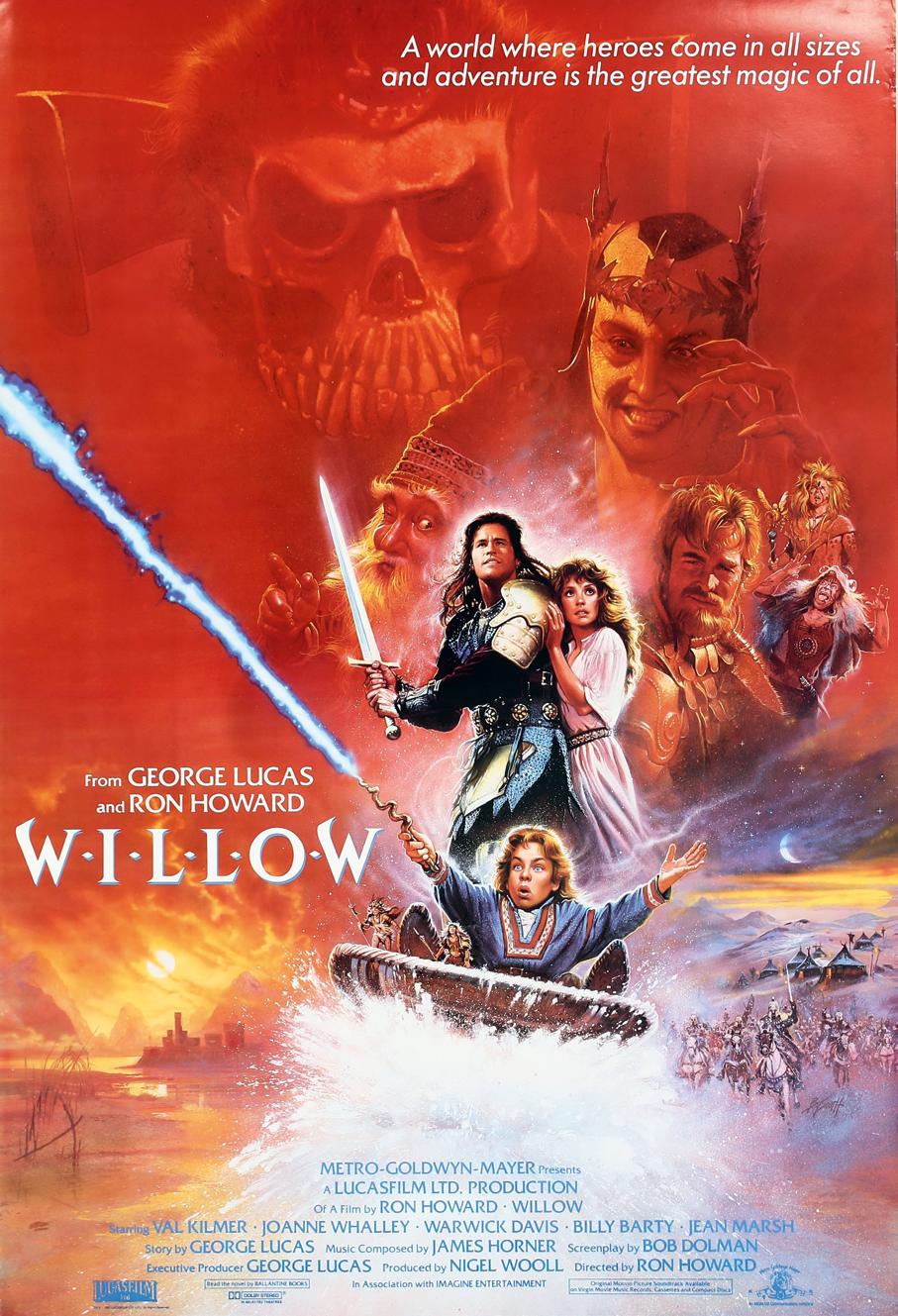
“Willow” (1988).
By this time, Stefan Zürcher had gained extensive experience with the Bond series’ special effects and flying Beetles. “Willow” would lead him into the new generation of visual effects wizards that George Lucas helped to raise.
At preliminary meetings in London, Stefan met director Ron Howard. The latter had already been successful as an actor before switching to directing, where he would also achieve many respectable successes. Howard would later, ever more often, oversee multimillion-dollar productions using special effects. Willow was his first attempt.
For Stefan, the fantasy genre was new territory; however, George Lucas was not a new name for him. His visual effects company, ILM, played an integral role in making “Willow.” “For the first time, I saw the process of such shots where real actors perform with fantasy figures made of various sizes of cardboard, held on sticks, which marked the proportions of creatures that would be inserted during post-production. I learned how to deceive human perception from the industry’s most talented visual effects designers.”
The Swiss snow consultant was responsible for the snow scenes shot in New Zealand. Long before “Lord of the Rings,” “Willow” had already discovered this location, which would become legendary in the world of film fantasy. Stefan skied in search of the perfect place, noting the exact time the sun would shine on each potential site. “When I returned a few days later, to my amazement, the sun was in a very different place than I had expected! It dawned on me that in the Southern Hemisphere, the sun moves in the opposite direction.” At Mount Cook, he and a small team prorated the terrain for the scene where Willow rides through crevasses and ice ruptures.
“Although trained stunt horses were brought in for the riding scenes, you can’t just chase a horse over snowy terrain. A horse can break its legs if it hits an uneven, snow-cov-
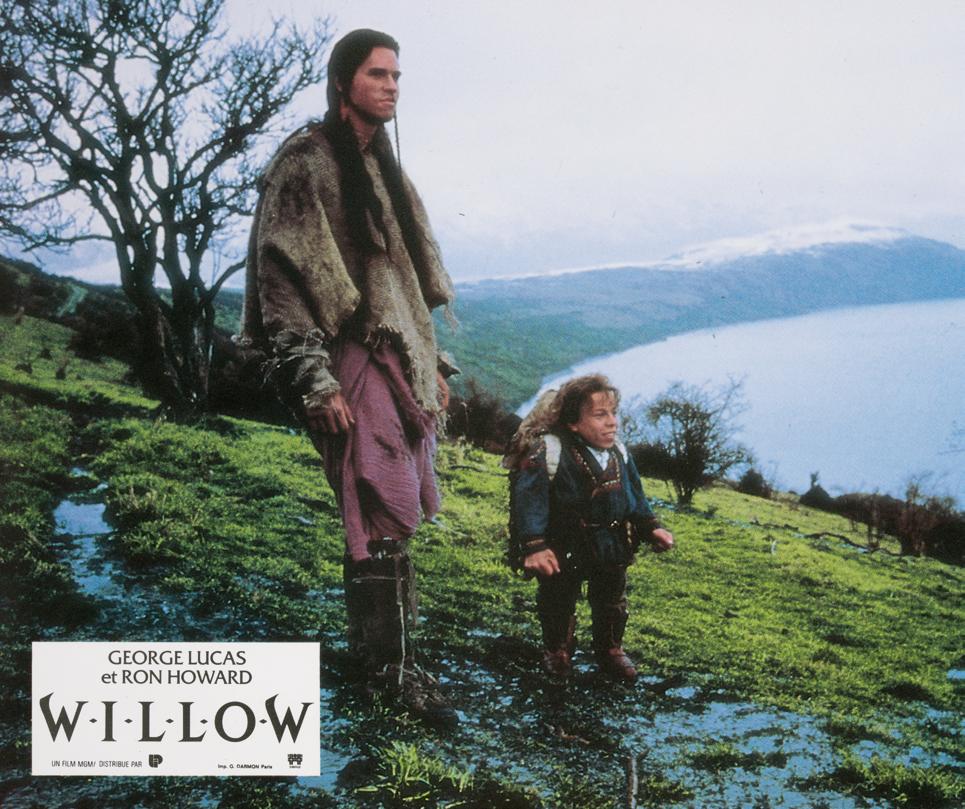
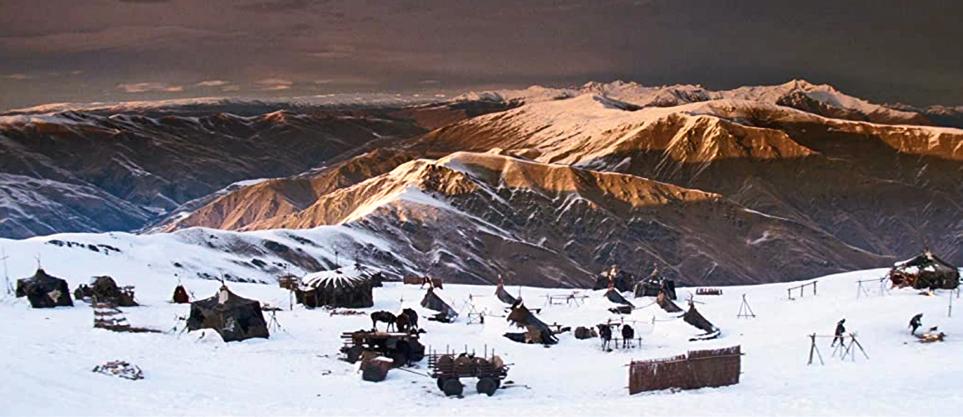
ered patch at a full gallop. Therefore, we groomed hundreds of meters of the slope, trampling the snow with our feet. Then we treated it with water to produce a compact layer of snow on which the horses could gallop safely.”
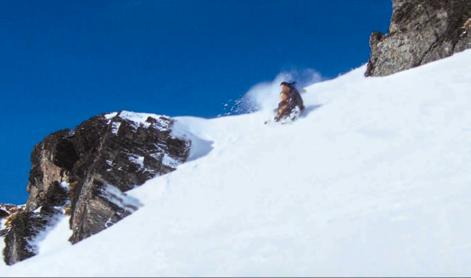
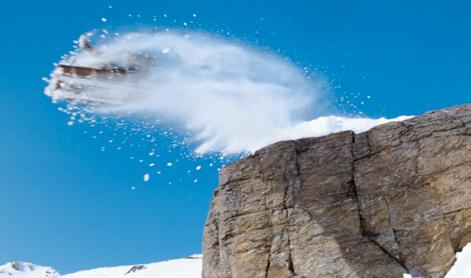
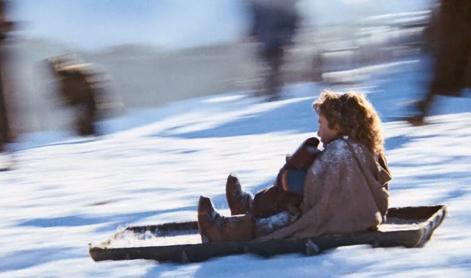
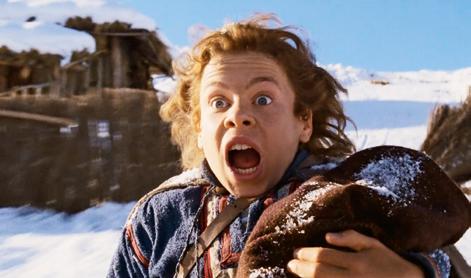
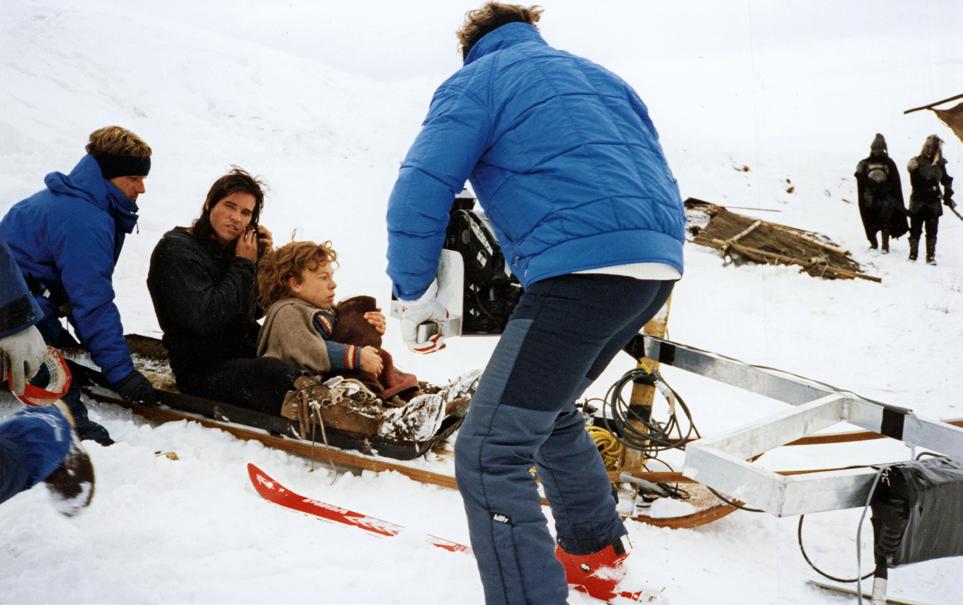
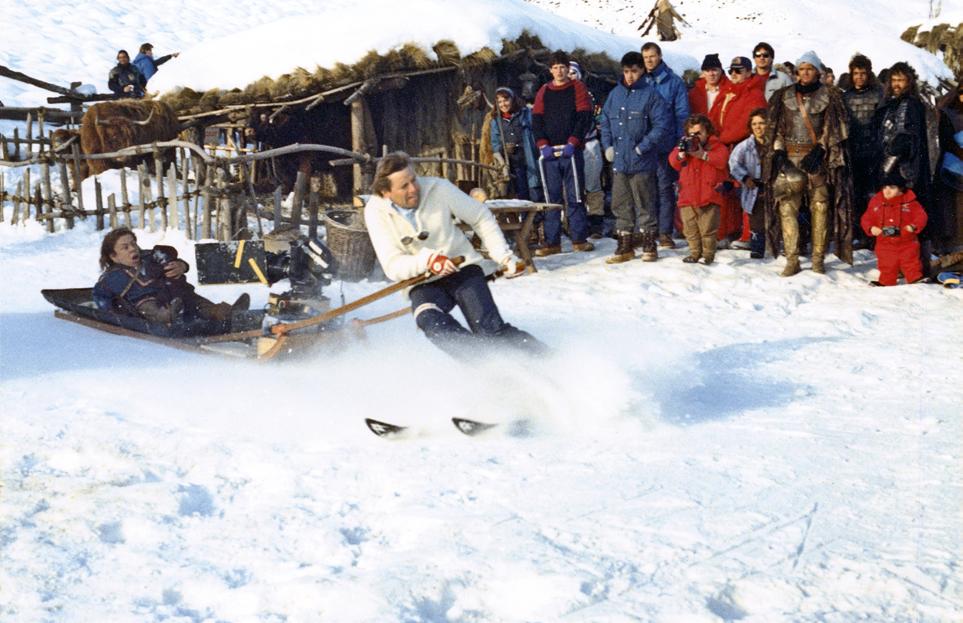
The most elaborate sequence was Willow’s escape over snowy slopes and through ice channels. With Val Kilmer and a baby, Willow makes his wild descent on a shield he uses as a sled. Stefan found it advantageous to film the escape scene as he had previously in “The Living Daylights,” where Bond had utilized a cello case as a sled to escape. He had
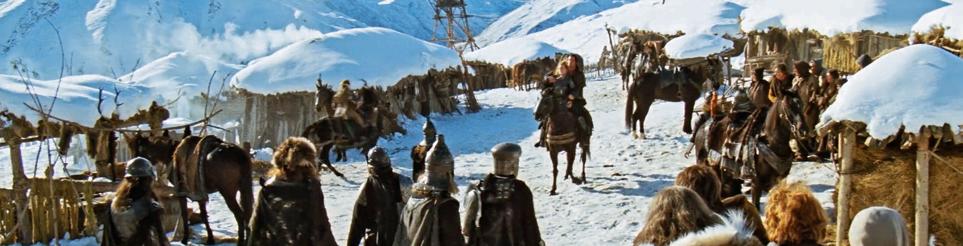
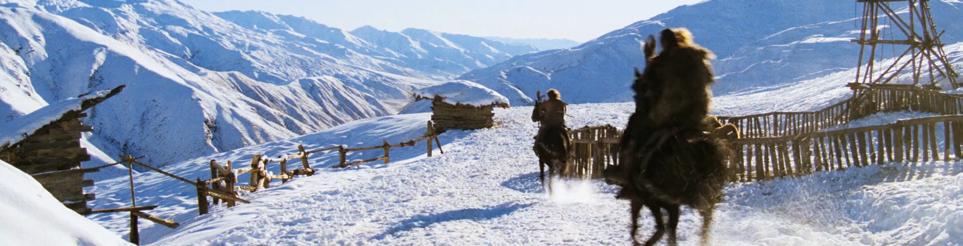
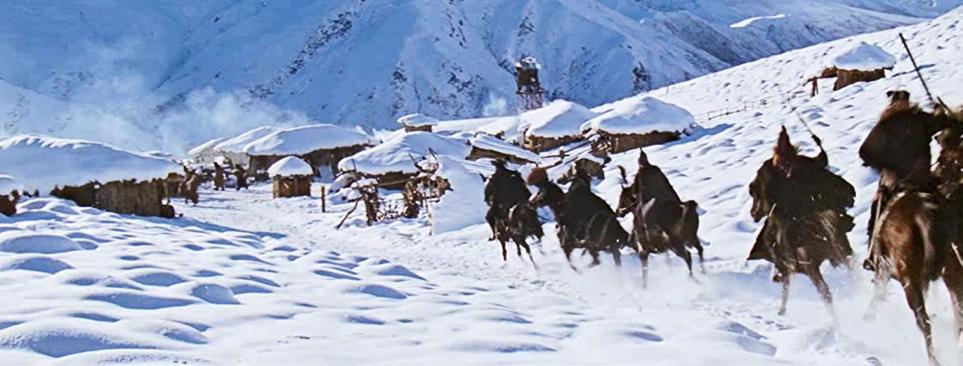
the shield built on invisible runners. Jumping scenes in the film required stunt doubles, and they also used puppets for some of the shots. “The only thing that was never real was the baby – we used a lifelike doll instead! “For close-ups, they put Val Kilmer, the main character, in the sled.” Kilmer already had a reputation for being a difficult actor. During the filming of “Willow”, it became obvious why. “He wasn’t arrogant, but he was an actor who didn’t see his work as simply doing what the director told him to do. Ron Howard proved to be a clever director who understood this and subtly instructed Val so that he thought the directions were his own ideas.”
For one meeting, Stefan traveled to England to a film set, a village that, in the story, is inhabited by little people. “Everything: houses, fountains, and streets had been built to fit their proportions.” The people who were cast as their enemies, the terrifying knights, were particularly tall. They even selected the horses for their size. People of small stature were brought in from all over Europe. “By the end of production, numerous people had found their life partners on the set.”
“The
(1993).
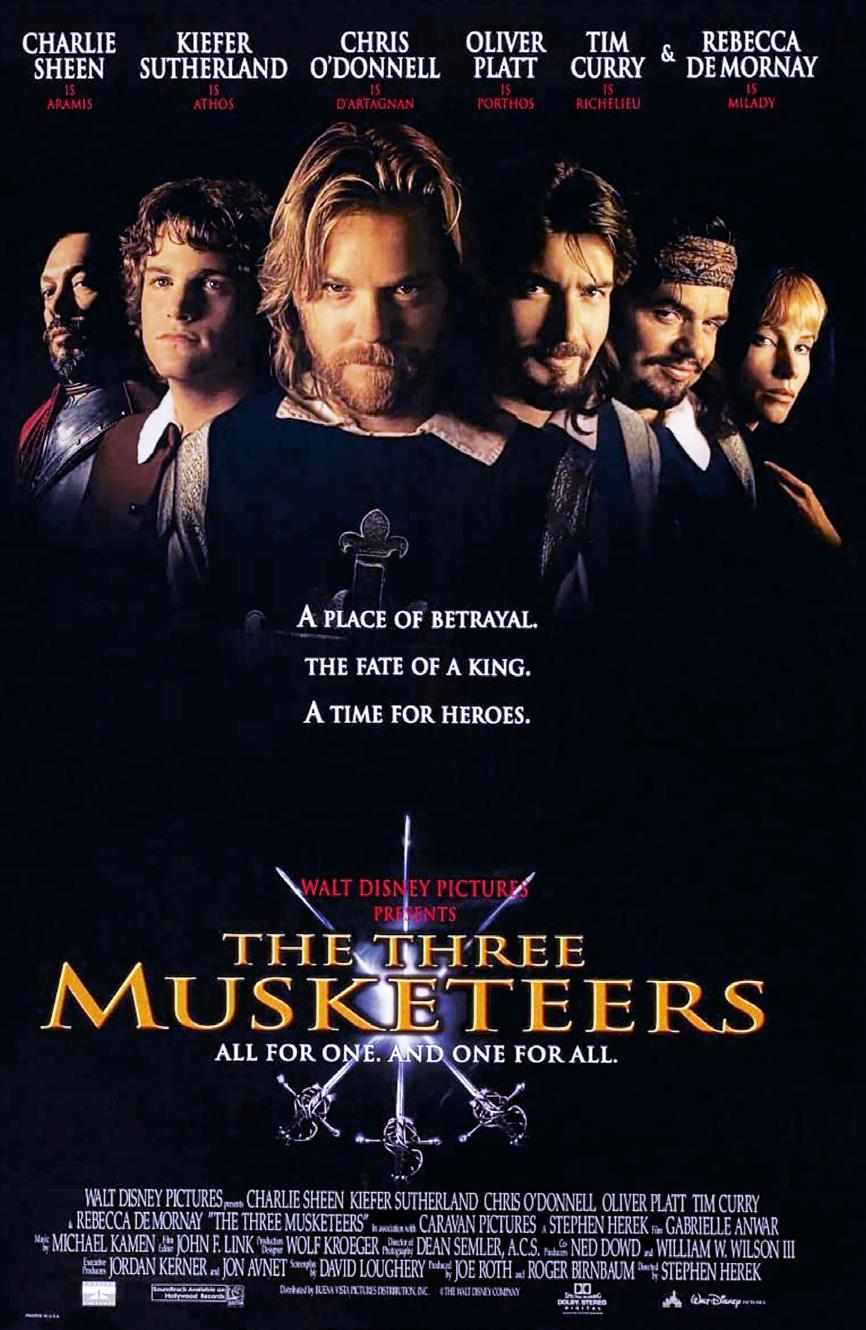
After the second Willy Bogner film, “Fire, Ice and Dynamite”, Stefan Zürcher took a three-year hiatus from filmmaking. He had become a father, felt like a family man, and wanted to take a step back. But the offer to be part of the 1993 remake of “The Three Musketeers” was too tempting. Of course, he had no idea that he would be supervising “the Young and the Reckless” - the rising stars of Hollywood.
Initially, Paris and then Prague had been slated as the film’s locations for “The Three Musketeers” - in the end, Vienna got the nod. The city had made a competitive offer to the filmmakers: two million if the adventure movie was filmed against an Austrian backdrop. “Based on the overall assessment, that’s a favorable calculation. Film Location Austria knew well that a film generates income and creates jobs for film technicians and local craftsmen. In addition, a movie advertises the location as a tourist destination worldwide.”
Stefan had been familiar with Vienna as a filming location since “The Living Daylights.” However, the capital was also a popular party hotspot. It was just the right launching pad for young Charlie Sheen, who was about to jeopardize his promising film career with rampant partying. “Charlie always looked like he’d just come out of a bar - which was usually the case. When he disappeared without a trace, we’d have to scour the likely pubs. Fortunately, his driver usually knew which establishment we could find him in.”
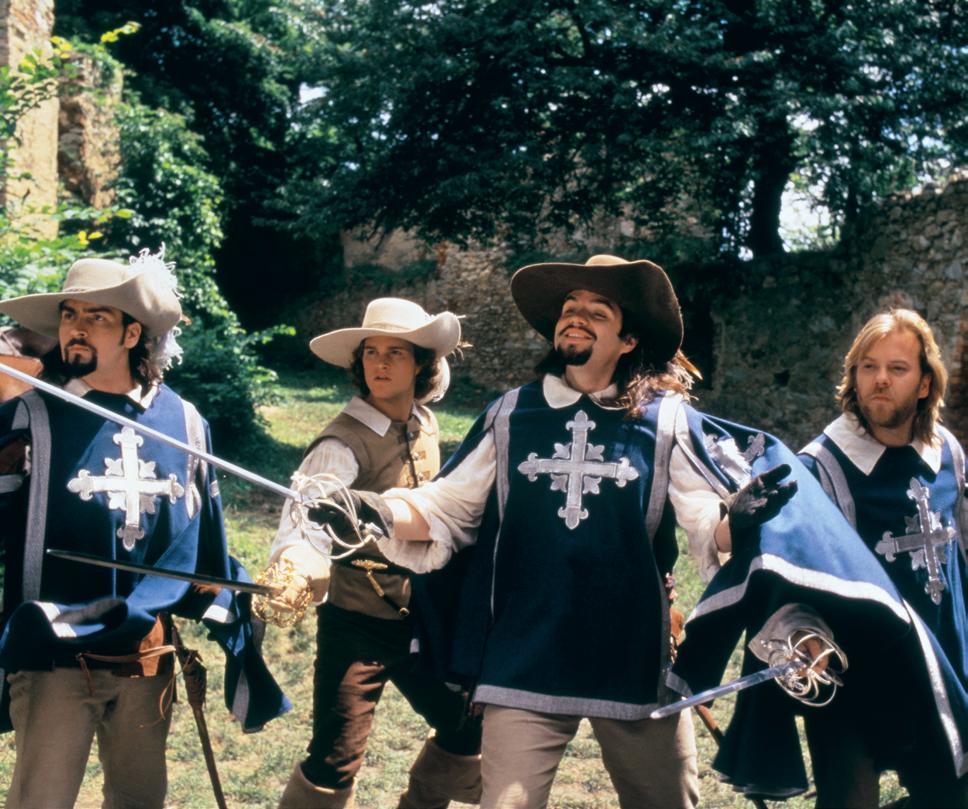
The three musketeers were made up of the crème de la crème of young Hollywood actors, and not infrequently, there was often a competition of egos. “Sometimes, it was hard to tell if the mutual teasing was serious. But those rivalries did the movie well because the characters were competing with each other in the movie, too.” Stefan sometimes felt like a chaperone at a teen summer camp. “Kiefer Sutherland would often play his guitar on set, completely lost in thought. It was nice listening to him. The fact that he has developed his talent further and embarked on a second career as a musician makes me very happy.”
One thing the young actors took seriously was their fencing training. They practiced handling the foils with the stuntmen whenever the shooting schedule allowed. “It was good to see them doing some of the fencing scenes themselves, which was quite rare. They were also excellent horsemen and didn’t need to use a double in most riding scenes.”
Since their experience working together in Beirut, when real bullets had been fired in the region, Micky Moore and Stefan had complete trust in one another. “In this film, his years of experience as an action unit director for scenes with horses and explosives came in handy.” They had their hands full because the shooting of the second unit consisted entirely of daredevil stunts: carriage races, shootouts, fencing scenes on the rooftops of Vienna, and complex crowd scenes with many extras.
“Micky taught me what was necessary for a stunt to succeed: if two elements are brought together in a show - for example, a carriage and an explosion - that can be managed well. But if a third factor is added - for example, a second carriage - the risk of something going wrong increases. With the introduction of a fourth factor, an accident is almost certain to occur.” In “The Three Musketeers,” almost all stunts involve four factors. The art of creating a well-executed stunt scene lies in splitting and filming elements of the scene in such a way that they achieve the desired effect through film editing.
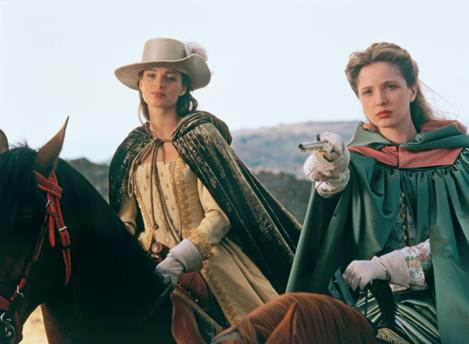
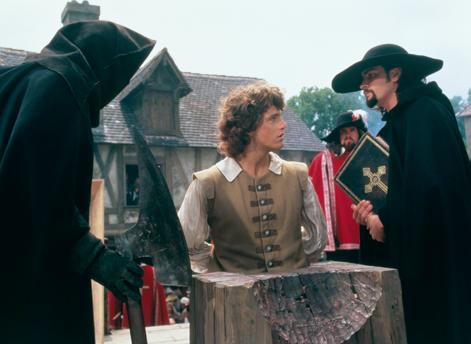
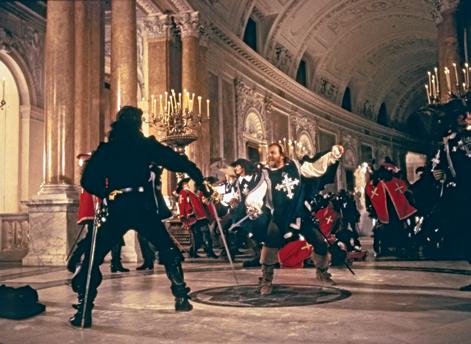
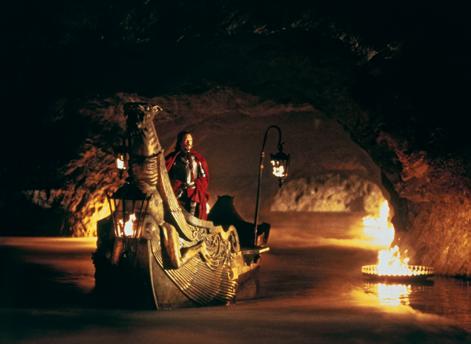
Stefan himself can tell you a thing or two about the injuries you risk with poorly executed stunts. Even today, aches and pains will remind him of such. He once risked his neck in a stunt scene on a ski lift for a German slapstick series. As a result of some unfortunate measures implemented by the people in charge trying to save money in the wrong place, Stefan, hanging upside down from a ski bracket, crashed into the iron girder of the pulley.
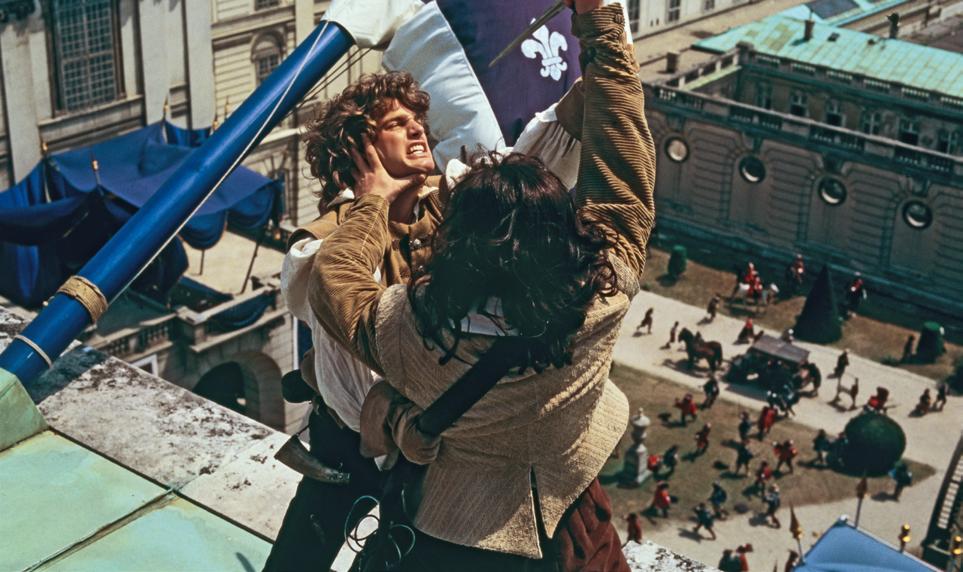
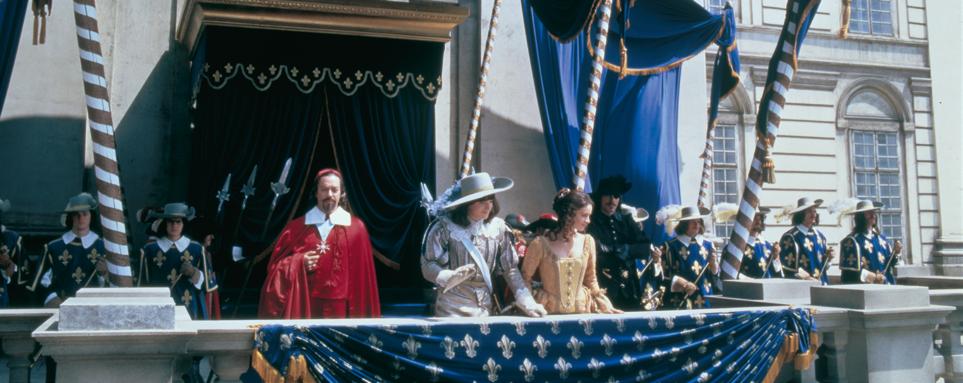
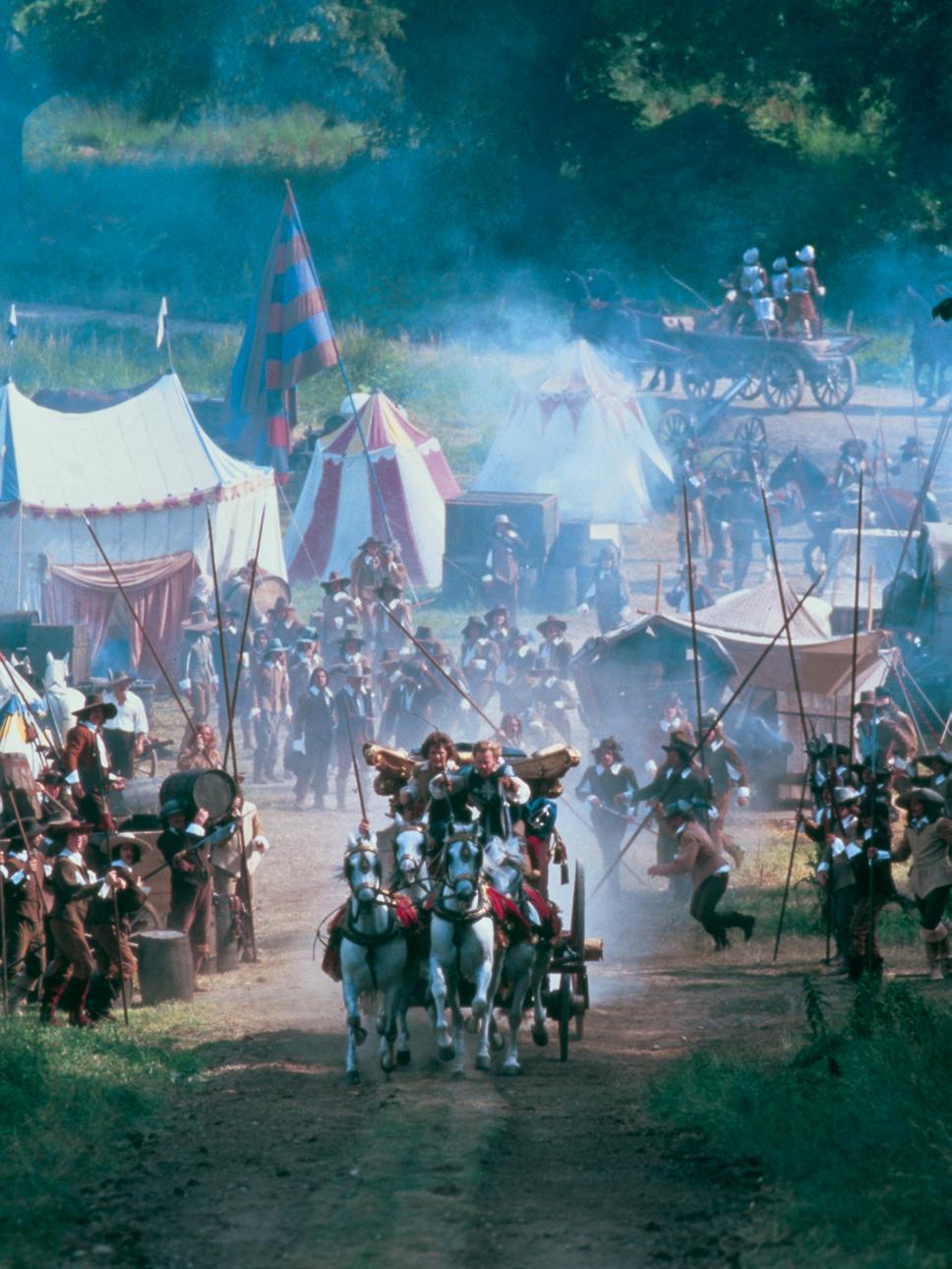
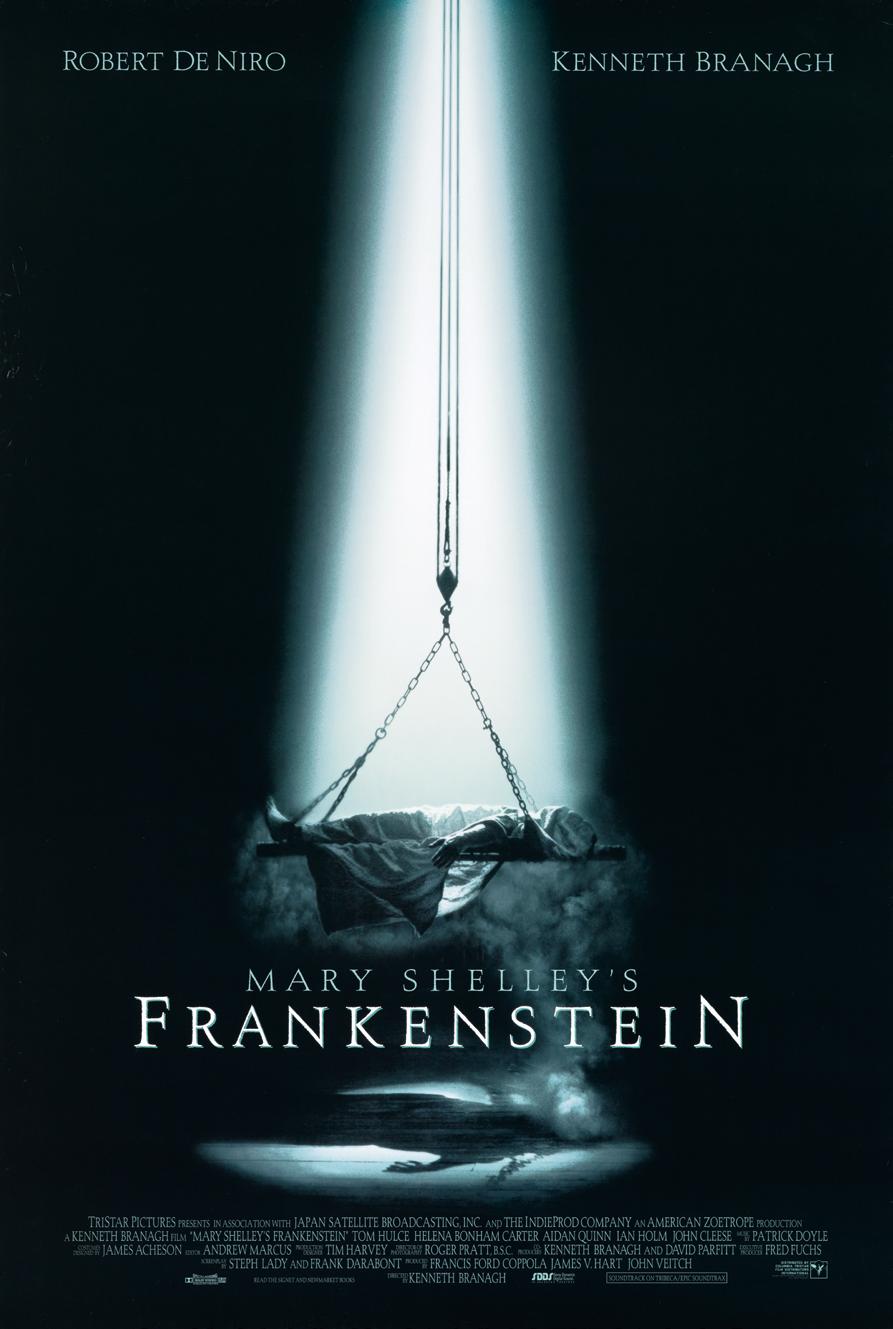
«Mary Shelley’s Frankenstein» (1994).
The film adaptation of Alexandre Dumas’ famous Musketeer novel was followed by another book adaption, “Frankenstein.” But just as the monster was assembled from parts of corpses, Stefan Zürcher had the impression that the lifeless individual pieces of the film just didn’t fit together.
Shakespeare specialist Kenneth Branagh tried his hand at directing a worldwide bestseller for the first time with Mary Shelley’s “Frankenstein.” He would go on to make other more successful book adaptations over the years. His faithful adaptation of Shelley’s novel only received moderate enthusiasm from critics and moviegoers.
Francis Ford Coppola produced the sinister story. As a snow specialist, Stefan advised Kenneth Branagh of the weather conditions and presented him with the motifs he would consider for the scenes. Filming with Helena Bonham Carter and Kenneth Branagh took place at the Sulsseewli mountain lake above the Lobhorn hut in the Lauterbrunnen Valley.
The scenes with Robert De Niro’s double, who played the monster but wasn’t present during this shoot, were filmed on the upper Grindelwald glacier. In fact, a mountain guide was transformed into Frankenstein’s monster with a thick layer of makeup. “None of us envied him sitting still in the makeup chair for several hours every day while latex scars and artificial body parts were glued to him. Even though mountain guides aren’t exactly squeamish, he later told me he wouldn’t endure such an ordeal again.” Although the special effects makeup was nominated for an Oscar, Branagh and the mountain guide walked away without awards.
When Stefan looked at the finished film, he found that Branagh had barely used any footage shot in Grindelwald. “And that’s even though we were dangling in real crevasses.” Branagh recreated the “ice desert” and reshot it in the studio in a less believable set made of Styrofoam. “I strongly suspect he had trouble cutting from our authentic images to his artificial ice blocks. The difference was just too significant. It would have made the studio scenes look less believable.”
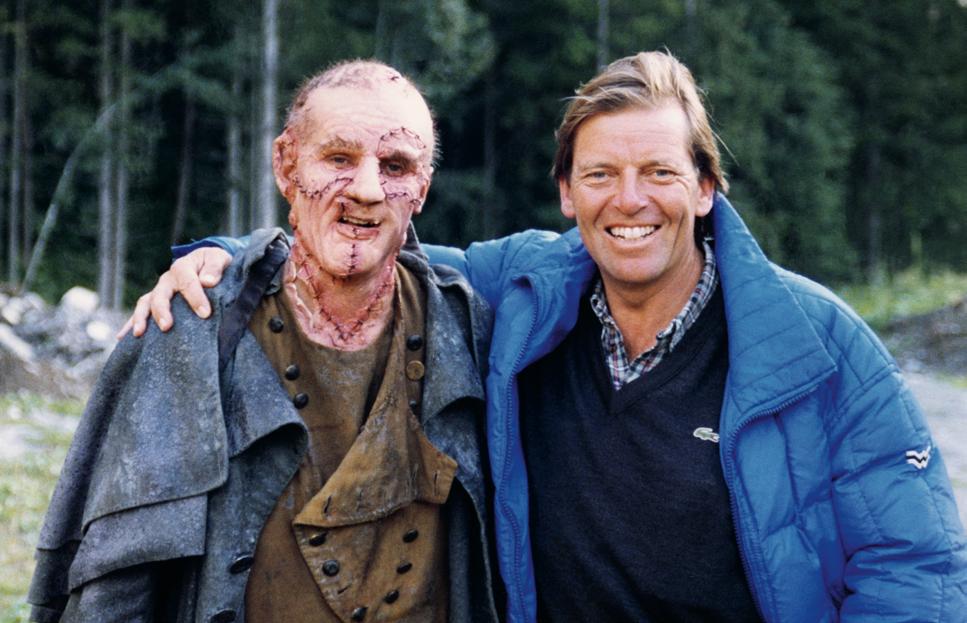
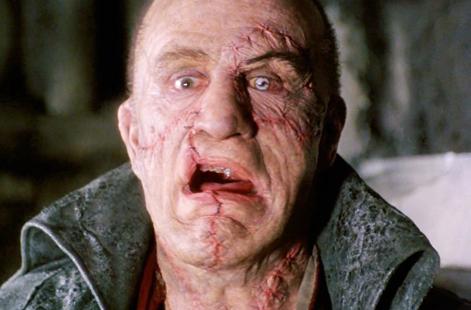
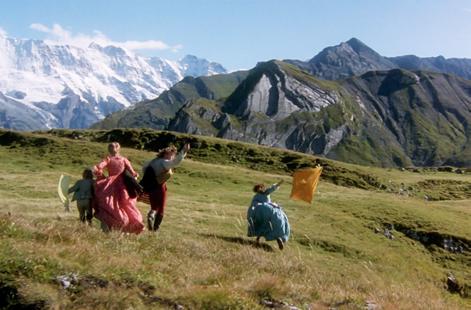
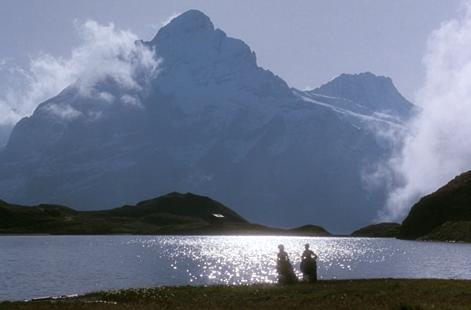
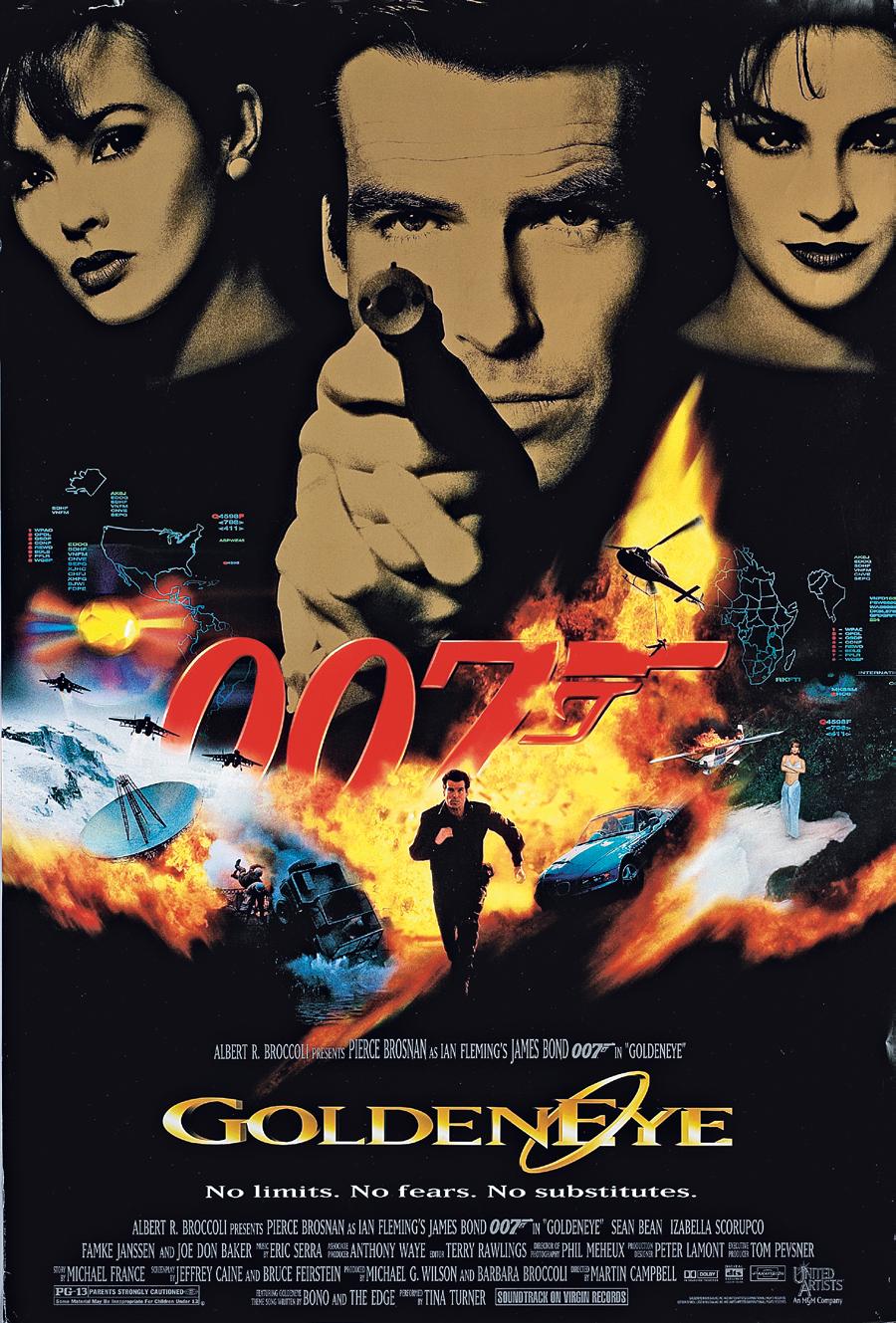
“GoldenEye” (1995).
For six years, Stefan Zürcher hadn’t heard from James Bond. He already feared that his mission for 007 was over. But in London, Stefan had not been forgotten. The upcoming mission was on a larger scale and more dangerous than any before.
The Bond movies were released consistently every two years. The wait for “GoldenEye” became the longest for the franchise’s fans ever. Unlike the impatient audience, Stefan already knew that it would be worth the wait after studying the script. For Bond, number 17 featured the most elaborate pre-title sequence to date, kicking off the secret agent’s comeback with a bang. A lot depended on the demanding opening action sequence. This self-contained scene needed to be the first to be completed to kickstart the film’s promotional campaign.
“The Bond producers take great pride in relying on genuine stunts rather than computer-generated tricks whenever possible.” In this case, a motorcyclist would have to ride off a Swiss mountaintop to catch an out-of-control, pilotless propeller plane. Impossible? After being presented with the idea, Stefan had six months to turn this vision into reality.
Barbara Broccoli and Michael Wilson, Albert Broccoli’s stepson, had been learning the production business from scratch and were officially taking over “Cubby’s” legacy. “And they did it right, true to ‘Cubby’s’ motto: They spent money in the right places and hired the best experts in the world. Not every film producer can or wants to do that.”
Only a few locations were considered for this stunt, which had never been tried before. The Taellistock in the Canton of Bern proved ideal due to the 900-meter overhang below the summit. Both the motorcyclist, who was to save himself by parachute, and the pilot of the small plane, who was to recover the diving plane and fly it away in a loop, needed this altitude for the operation.
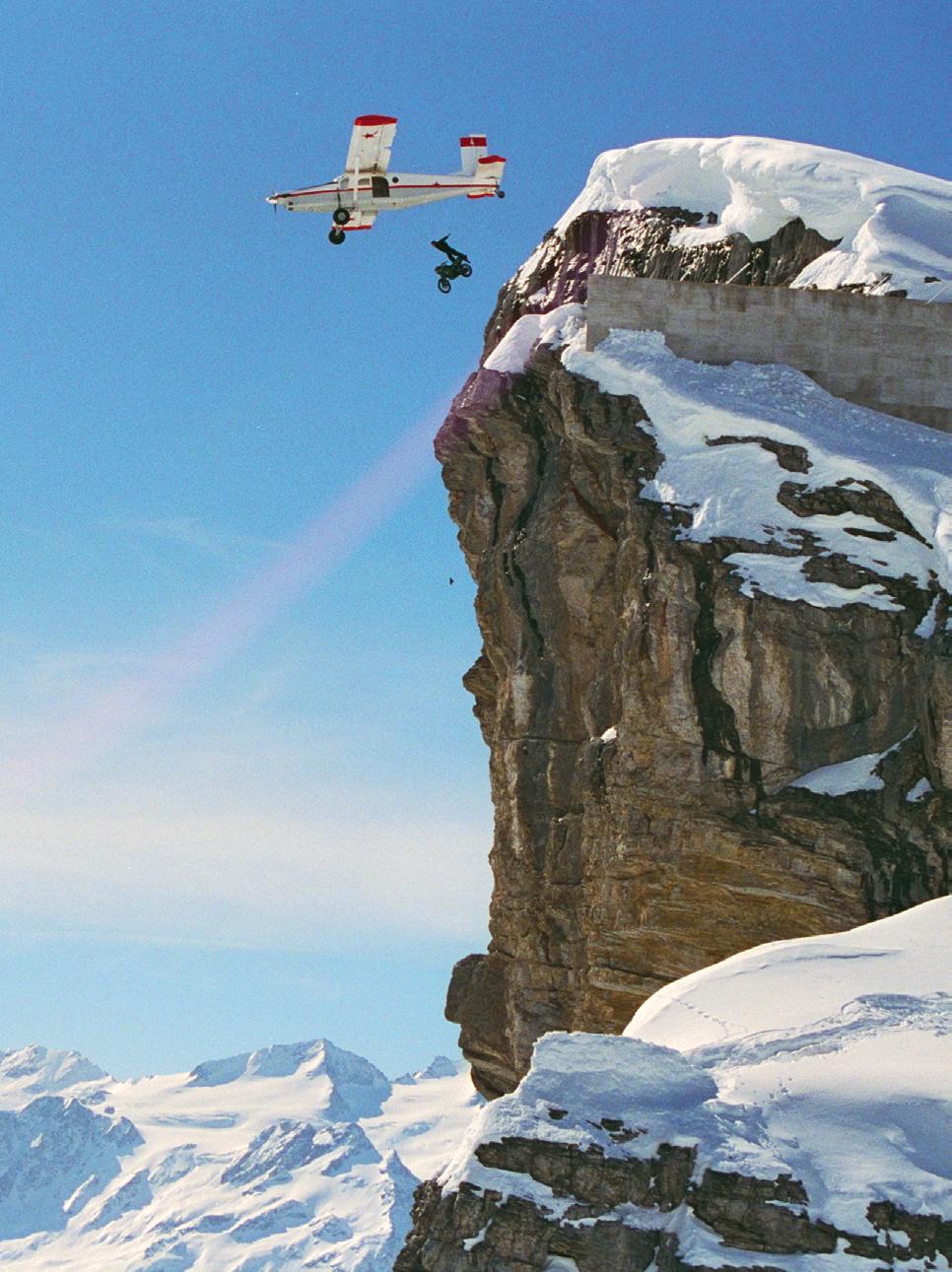
The municipality of Gadmen, located below the Taellistock, granted the permit without further ado. “But then my endless discussions with the authorities in Bern began. Behind ‘our’ mountain was a nature reserve.” Since Stefan could provide all the calculations and had proven experts on board, the FOCA, the Swiss Federal Office of Civil Aviation, granted the low-level flight permit for a dive in the direction of inhabited areas.
The challenging task of constructing two wooden ramps on the slope below the peak of Taellistock, approximately 2200 meters (7218 ft) above sea level, was set to begin. One for the motorcyclist, who had to accelerate to 100 kilometers per hour (62 mi/hr), and one for the airplane, which had to approach and make a touchdown to give the audience the impression that it was taking off from the end of a runway.
“No structural engineer could advise on the ramp’s construction because nothing like this had ever been built. It had to resist the fearful ‘Foehn’ storms of the Haslital with wind gusts of 180 km/hr (60 miles/hr) blowing over the ridge. To protect our construction, we drilled anchors into the rocks, created a structure made of tree trunks, filled it with snow, and placed waterproof plywood on the outside. We had to transport all this material up the mountain by helicopter.”
Snow drifts had created a ten-meter-wide snow cornice on the rim of the plateau they worked on. Two mountain guides examined the rock below with a probe to precisely determine the terrain. Suddenly, a mighty crash! The entire snow cornice broke off right in front of the shoes of one of the guides. He found himself standing at the edge of the abyss. One thousand meters below him, the houses of Gadmen had become visible. But mountain guides aren’t easily rattled. “Well, that was interesting,” he said calmly.
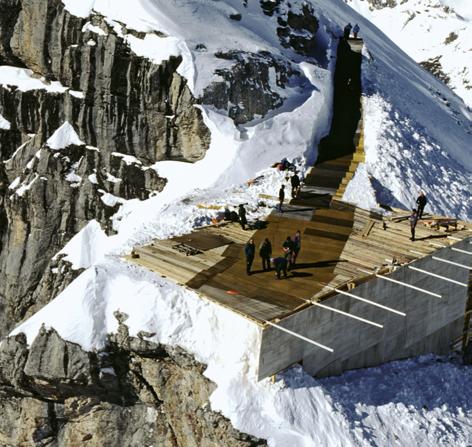
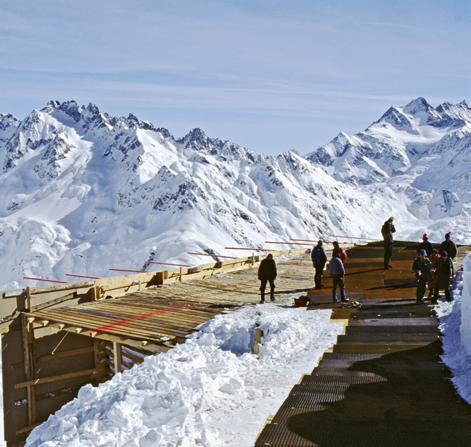
Despite the pressure, there was time for the usual, sometimes crude jokes among film crews. “Of course, it was windy and cold up there. I noticed that a young English staff member was constantly absent. Eventually, I figured out what he was up to. He’d hide in our portable toilet for two to three hours daily.” The next day, Stefan waited for the fellow to shirk off work again. He instructed the helicopter pilot to attach a 30-meter transport cable to the toilet stall and pick it up for removal. The helicopter flew a couple of laps with the toilet over Gadmen. “Swinging through the air, our crew member certainly had an indescribable view of the Swiss mountain panorama. His bathroom breaks became considerably shorter after that.”
The proficient Swiss test pilot who would steer the propeller plane worked for Pilatus Aircraft Works, an aircraft manufacturer in Stans. (This drew a Bond parallel as their factory halls served as the location of the titular villain in “Goldfinger”) “He was the only pilot who could hold a Pilatus PC-6 in vertical freefall.” The test pilot inspected the 40-meter-long ramp on the Taellistock, where he was supposed to touch down before nosediving off the cliff. “Based on the air density, he could guarantee 8.5 seconds of dive. Then he would have to pull up.”
The Frenchman Jacques Malnuit signed on as the motorcyclist. “He was well-known in the base-jumping scene but not in the film industry. Like all base jumpers, the challenge of being the first to do something hair-raising appealed to him.” Malnuit would drive the motorcycle over the mountain ridge, separate from it in flight, and save himself after a free fall of 600 meters (about 2000 feet) using a small, concealed parachute.
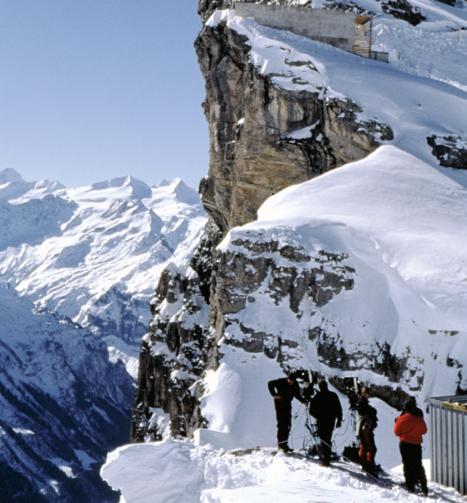
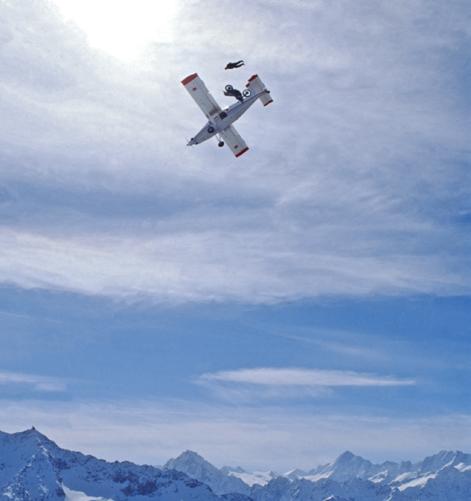
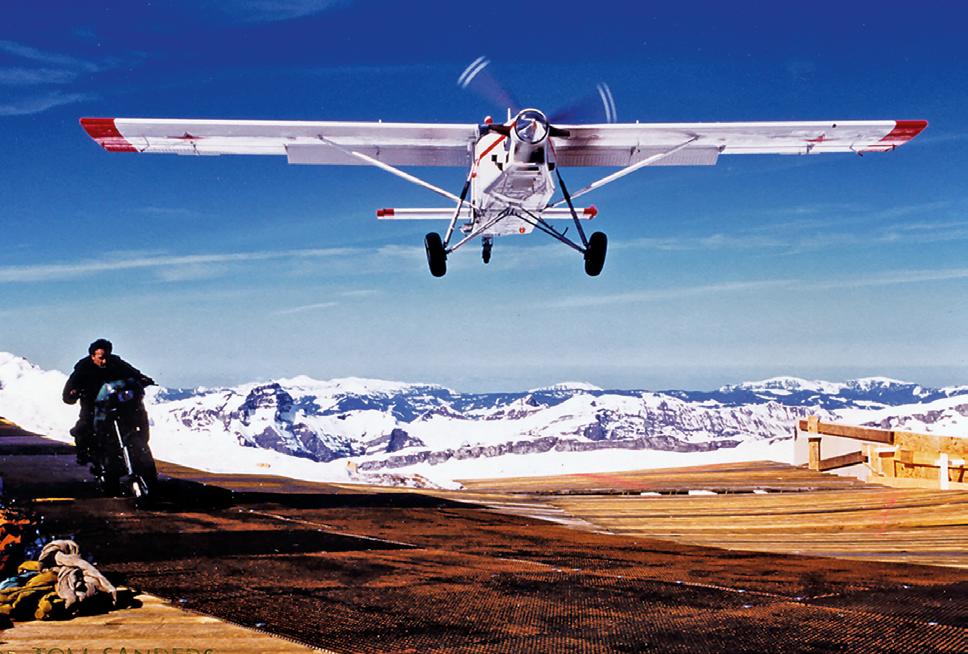
No matter how often they discussed this complex scene, it could not be rehearsed. So far, Stefan had spent 200,000 Swiss francs on construction. Finally, the film team arrived from London. “We stayed in Interlaken, discussing details daily while closely monitoring the weather forecast. Suddenly, two days before the stunt was to take place, a fax arrived at the Hotel Mattenhof. The FOCA had withdrawn the permit.” The civil aviation authority cited an article on “stunt flying with spectators,” which referred to air show audiences. Stefan argued that spectators were not even considered, whereas the FOCA insisted that there would undoubtedly be people watching in Gadmen village.
“I was devastated. Two days before we were supposed to start filming! After spending all that money!” Stefan racked his brain about how he could save the shoot. Finally, after a long, sleepless night, he picked up the phone. He dialed the number of a private friend, Federal Councillor Adolf Ogi. He was the head of the Department of Transportation.
“Dölf, you know I don’t like to abuse a friendship, but I don’t know any other way.”
“What’s wrong?”
Stefan briefly explained his heartache.
“Don’t worry. We’ll call you right back.”
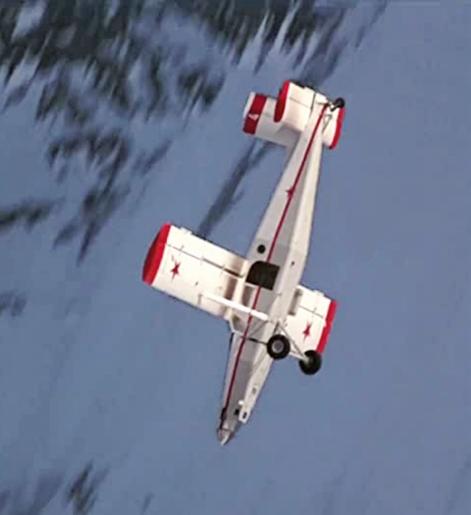
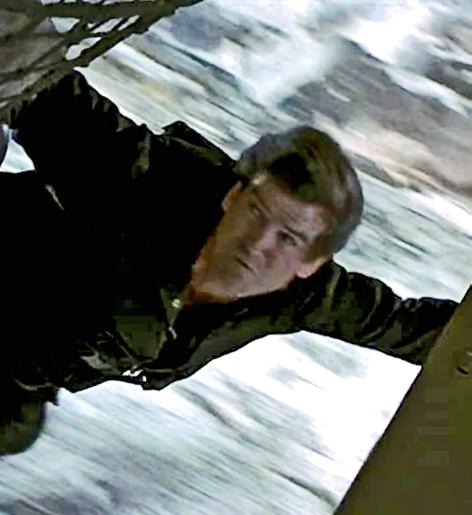
Sure enough, 30 minutes later, the phone rang in his hotel room. A very flustered Head of the FOCA was on the line. He had just received a rebuke from the Federal Councillor. “You didn’t have to call Mr. Ogi personally for that!” The FOCA granted its approval for the second time.
Forty-eight hours later, Stefan and his crew of 30 people with six cameras were waiting for the command “Action!” Jacques Malnuit roared towards the ridge on his Cagiva motorcycle. The propeller plane approached from behind at 100 km per hour (62 miles/ hr), touched down on the ramp, and began its nosedive into the depths of the Taellistock. Fractions of a second later, the motorcyclist followed with a leap into the abyss. The timing was everything.
The French motorcyclist overtook the Swiss plane in the air! That wasn’t part of the screenplay. The pilot radioed in: “This is the first time I’ve been overtaken by a motorcycle at 2000 meters!” They had to sacrifice one motorcycle for each shot; it took eight takes until the spectacular stunt was in the can. The crew recovered every single wreck.
The Broccolis were thrilled, and with good reason.
For the rest of the sequence - Bond flies after the plane to catch up with it in the airStefan moved the filming location to the North Face of the Eiger. A helicopter lifted the base jumper into the air above the Pilatus aircraft. He launched himself into the abyss, following the plane down the North Face. It was a matter of a few seconds in which the jumper and the airplane could be captured in the same shot - and the stunt succeeded!
Much later, after completing all the exterior shots, Stefan saw the missing pieces of his sequence being shot at the studio in London. The aircraft was hanging on a cable in front of a back projection screen. James Bond ‘flew’ on wires behind the plane’s tail, entered the cabin, and ultimately took over the controls. Stefan’s team had shot the plates (footage) for the back projection screen: shots of the Eiger North Face flying by. He used a lightweight, powerful helicopter to film the rock face from bottom to top. Then, the footage was played in reverse to create the illusion of falling—a small but impactful trick. However, it was much more impressive for Stefan to see the new 007 live in action. With this sensational effect, Pierce Bronson was introduced to the world as the new secret agent, and for his services, Stefan got his first mention in the opening credits of the 007 series.
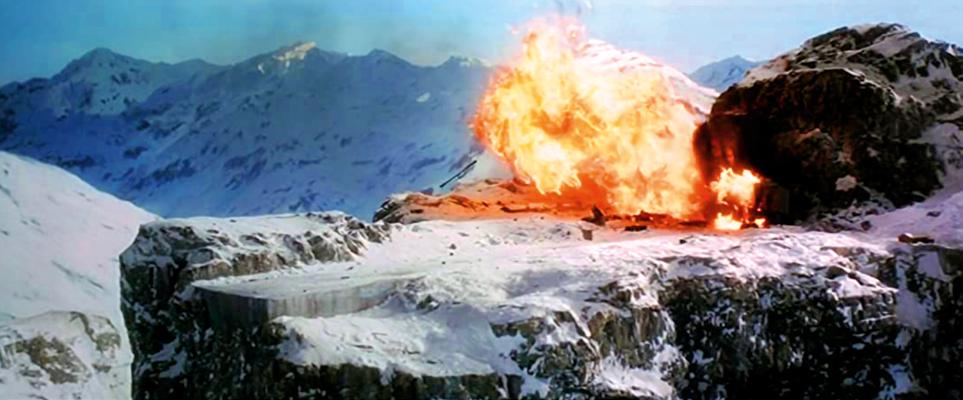
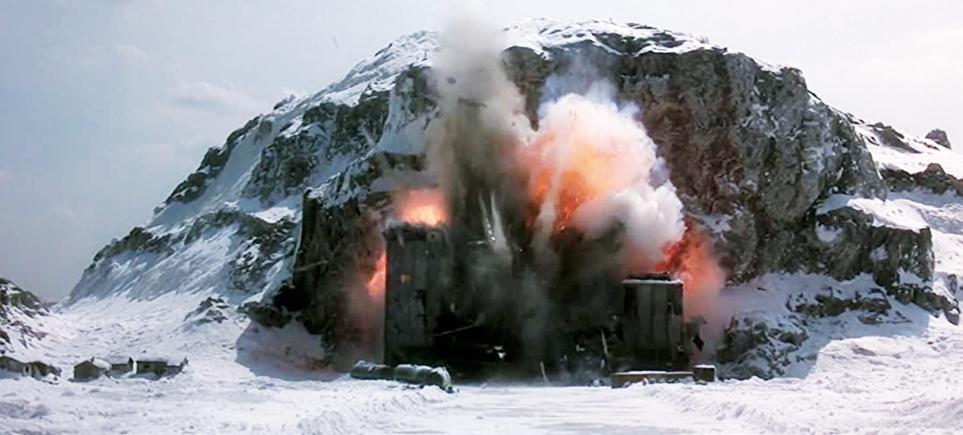
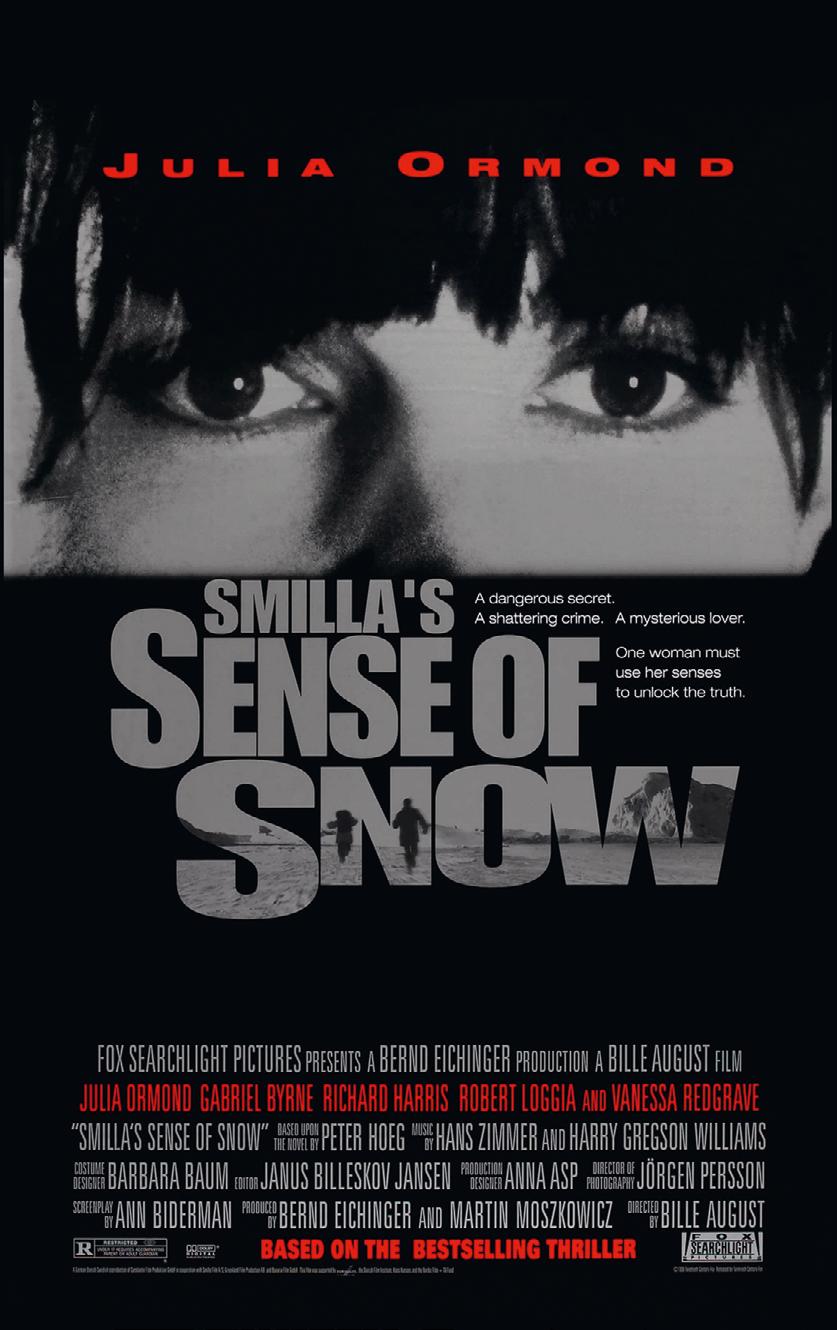
In the movie, Miss Smilla is a Greenlander with exceptional knowledge about all elements of snow. In real life, it was Stefan Zürcher who was the snow expert. Once again, he risked his life for a film.
Stefan hadn’t worked with Bavaria Studios for a long time. The glorious days in Geiselgasteig ended when tax shelters began to disintegrate, and international producers could no longer count on tax incentives. To his surprise, Bernd Eichinger, the successful producer, contacted Stefan. He knew him through his work on “Fire, Ice & Dynamite.” Eichinger had secured the film rights to the bestseller “Smilla’s Sense of Snow” and had raised a budget of $35 million for the production. He had also signed on rising star Julia Ormond as the leading actress. What he still needed were the filming locations on Greenland’s glaciers. Apart from local filmmakers, this was the first time anyone had tried this area.
“We chose the fishing village of Jakobshavn (Ilulissat) on the West coast of Greenland as our production site. The vastness of the glacial landscape was only comparable to the deserts of North Africa.” Ilulissat Icefjord and Disko Bay are known for the continuous movement of enormous icebergs breaking off from the fastest-moving glacier in the world. Allegedly, the iceberg that collided with the Titanic came from Disko Bay. While the temperature during the filming of “Ishtar” was 45 degrees Celsius (113 °F), Stefan now had to get used to 45 degrees below zero (-49 °F). He had ten weeks of preparation before director Bille August was ready to roll the cameras.
The strong gale-force winds had made it difficult for flights to operate. In late October, there were only a few hours of daylight. The local tour guide thought it would be a good idea to go on a location search with sled dogs. As a boy raised in the Bernese moun-
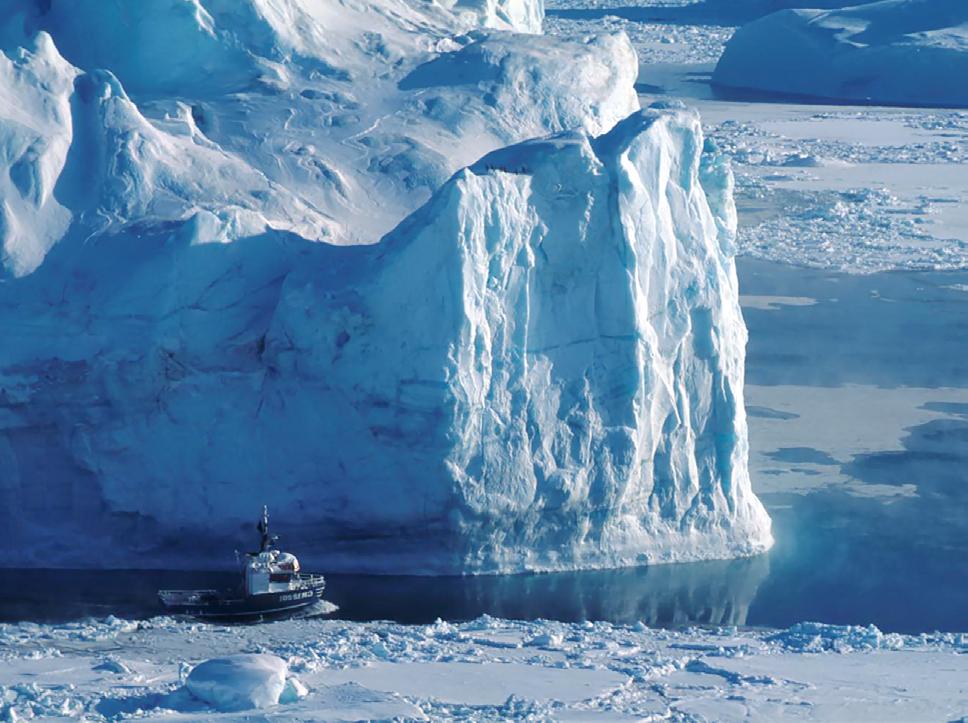
tains, Stefan thought he could cope with any temperature. “At 45 degrees below zero, I almost froze to death! The dog handler commented that it wasn’t too cold today.”
Preparing a film also includes checking the local catering options. Stefan soon revamped the local menu, which consisted mainly of fish, with Wengen mountain cheese he could grate onto his spaghetti. He wanted to find out if the local butcher could deliver some meat and ordered a random sample. When he saw the butcher - his arms were blood-spattered, and his face covered with cysts – he promptly threw the salami he bought into the nearest trash can.
A man with trembling hands sat across from him during breakfast at the only small hotel in town. He poured himself some high-proof liquor to control the tremors. When they began talking, Stefan discovered that the man with the trembling hands was the head surgeon at the local hospital.
Alcohol consumption was a problem among the Natives, the Inuit. “Whenever we made friends with them at a bar, they would order a case of beer right away.” Since it’s essential to understand the mentality of the locals if you want to have them on your side,
Stefan accompanied a fisherman to a frozen fjord. “He cut a hole in the ice and attracted a seal, which he killed with a spear. Then we ate the still-warm liver together. Vitamin-rich food is essential in these climates, but it can take some time to get used to it.”
Director Bille August filmed the first few takes featuring doubles on a Russian icebreaker chartered for the movie. The crew had to eat toast and purple Russian sausages while living on the ship, cruising off the Gulf of Bothnia’s coast for several weeks.
As the days grew longer, the stars arrived. Richard Harris immediately felt comfortable because he also liked to keep himself warm with alcohol. “He was known for occasionally going on drinking tours, slipping away from the director. However, in our small town with limited nightlife options, he couldn’t easily disappear.”
Stefan had ordered ten insulated containers that could be heated to 15 degrees for the production departments, such as makeup and catering. They were dropped off at the filming locations by helicopter. Julia Ormond preferred the company of the crew to her heated trailer, even at 20 degrees below zero. “She was a sweetheart, always content. We instructed the stars on how to handle the temperatures.”
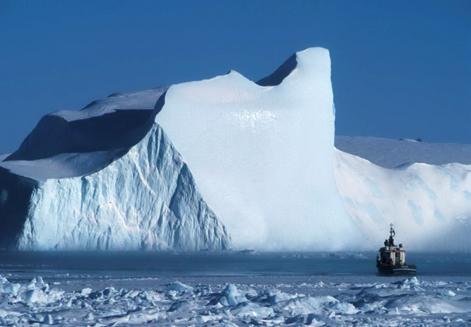
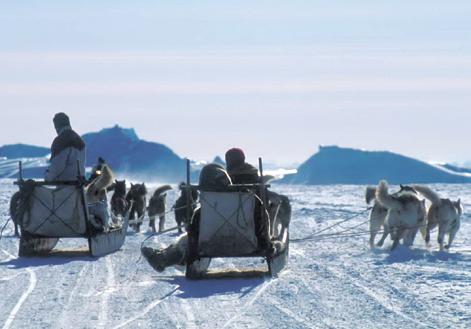
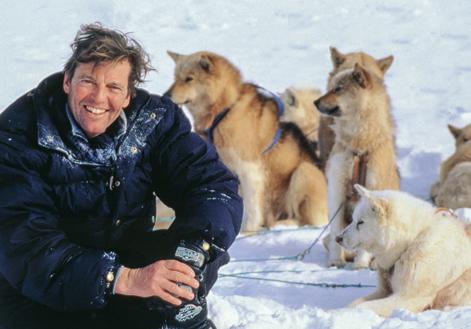
In some scenes, the actors were to perform on drift ice. “We were told that an Inuit would never voluntarily walk on an ice floe. Although we respected the warning, we needed those shots.” Nightmares had haunted Stefan since he broke through the ice in “The Living Daylights.” “Working on ‘Smilla’ helped me process this trauma. I trusted the rescue teams, which were always nearby. We always had divers in the water in case of an emergency. In reality, the water was warmer than the air.”
Concerned Jakobshavn authorities had advised the filmmakers that news of accidents would be detrimental to tourism. Once, however, a small crew risked life and limb for an “establishing shot,” a shot of the landscape that acquainted the audience with the actions’ location. Bille August insisted on a glacier situated in a vast, icy terrain. “We went by helicopter to look for locations in a so-called compression area, where the glaciers are compressed and piled up. The 2nd unit director was eager to explore this area and ignored the pilot’s warning of incoming bad weather.” Stefan had little desire to tempt fate again in a makeshift igloo, as he had done in “The Spy Who Loved Me”. When the pilot ultimately gave the order to return, the wind was already too strong to fly over the mountain. Instead, they had to cross an area marked as “unexplored glacier” on the maps. They finally arrived at the fjord, which led to the landing site, but the warning signal was already beeping inside the helicopter. “We ran out of fuel, and an emergency landing was impossible due to steep fjord walls and strong headwinds. On its last drop, we set down. Nobody talks to the team about adventures like that. You don’t want to scare anyone.”
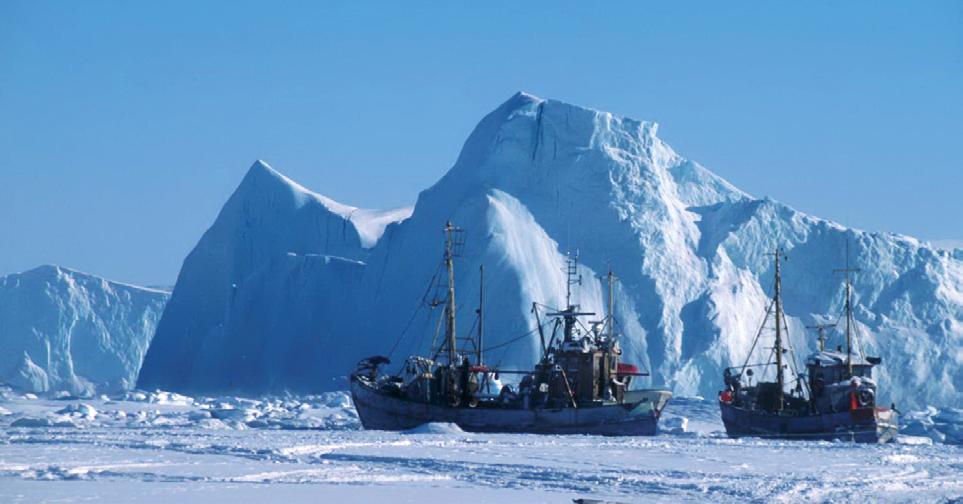
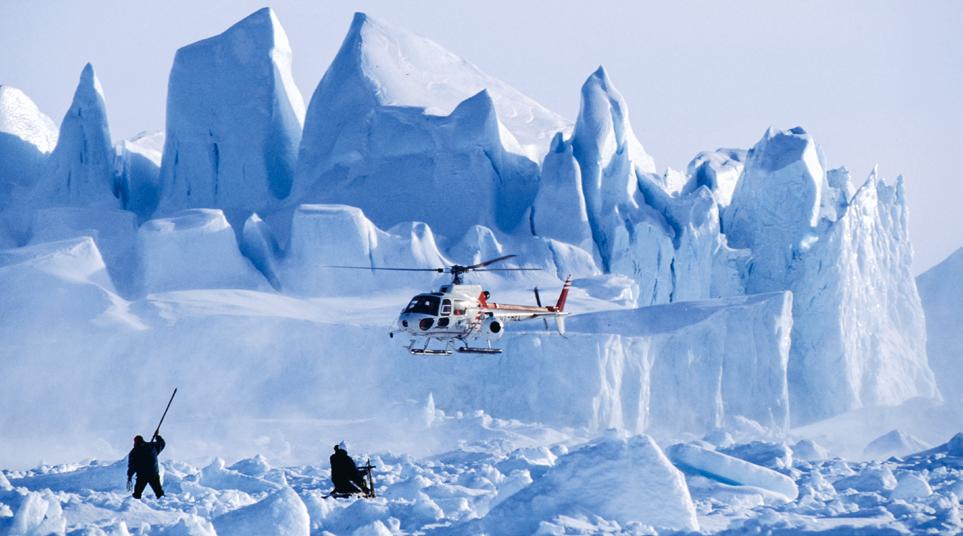
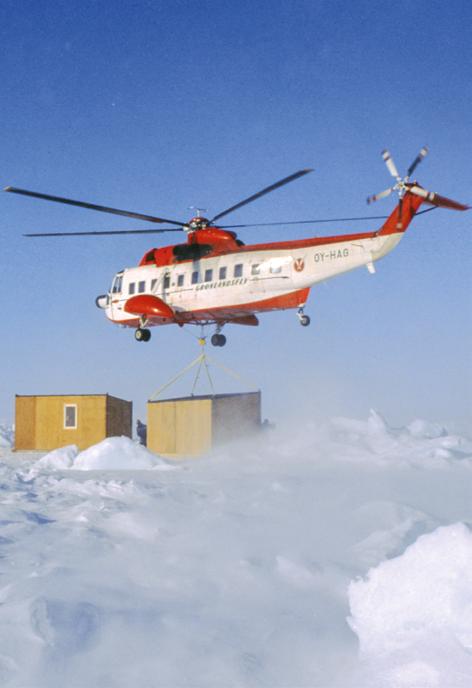
Transport of the containers to the filming location.
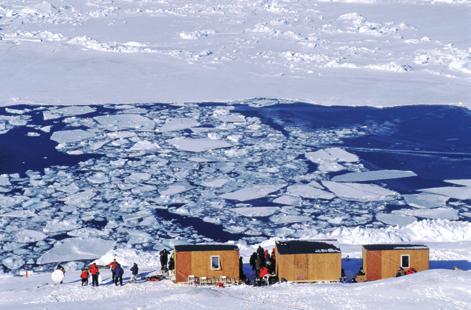
Containers for crew and actors.
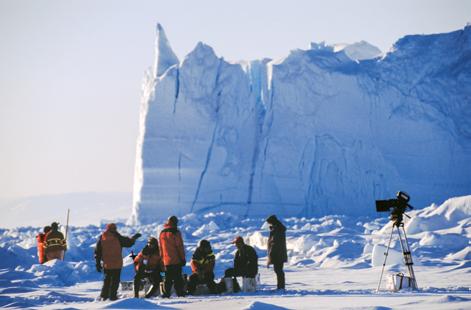
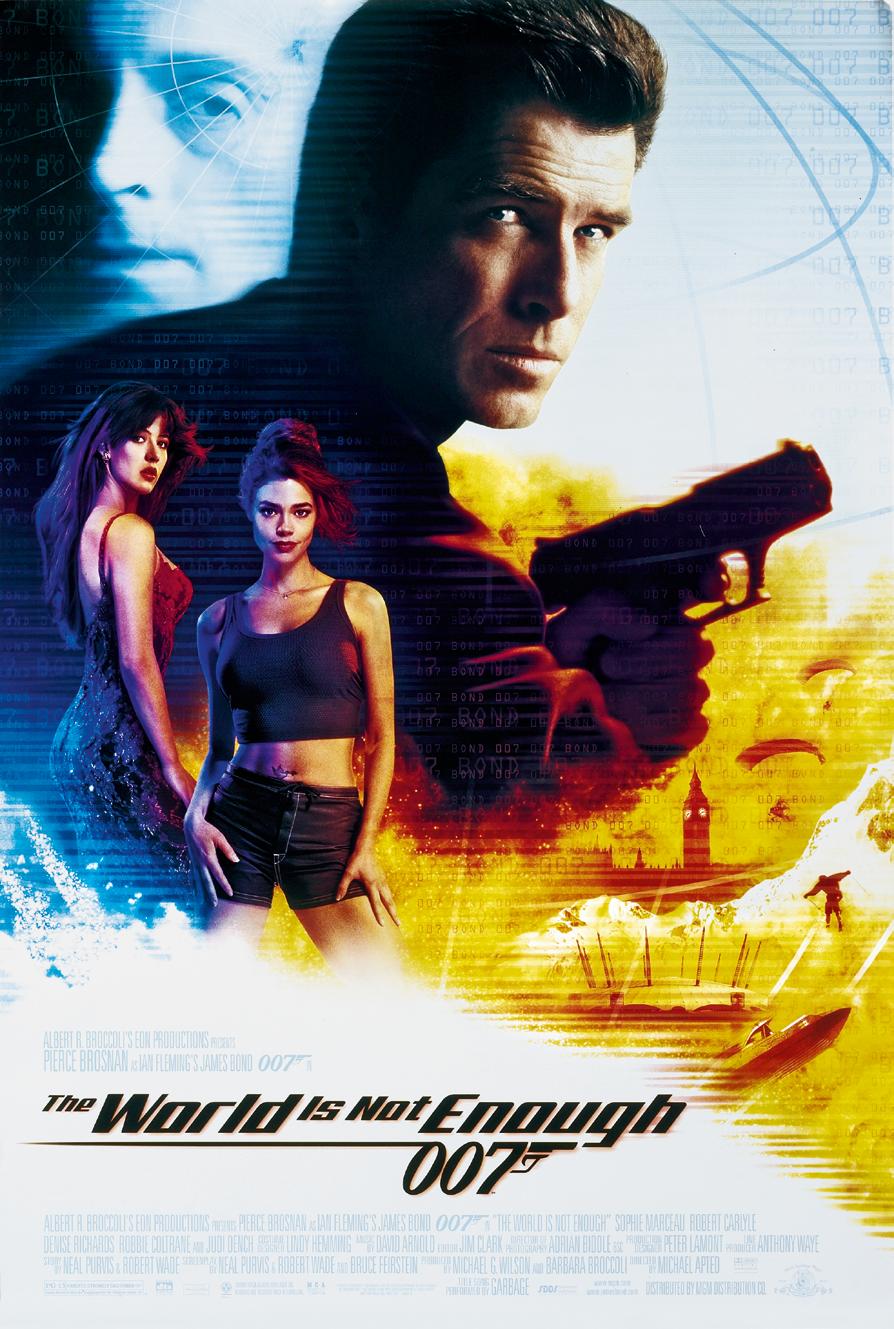
“The World Is Not Enough”
(1999).
After Adolf Ogi had ensured that the 007 mission could be carried out in Switzerland, Federal Councillor Moritz Leuenberger was not fast enough. For “The World Is Not Enough,” the French got the goahead.
The following abridged excerpt from the screenplay of “The World Is Not Enough” shows how the ideas of writers and producers look on paper. Such lines are always the first insight Stefan gets to assess feasibility and logistics.
On the snowy slopes of Azerbaijan, Pierce Brosnan and Sophie Marceau (in the role of Elektra) are attacked from the air by gangsters. The chopper swoops over SNOWY WASTES. It reaches a mountain peak and hovers. The wind is strong, buffeting. Elektra and Bond are both now in ski suits. Elektra leaps out of the chopper without hesitation, landing on her skis. Bond leaps after her. Below him on the mountain, she is already a ways ahead. Her skiing is fearless. Bond reaches her. Suddenly, they hear: THE DISTANT HUM OF A PLANE They see FOUR OBJECTS falling out of the back of the aircraft. Bond and Elektra watch in disbelief: The four objects POP PARACHUTES. Snowmobiles with propellers on paragliders are deadly snow vehicles. The riders start FIRING at Bond and Elektra from the air. While Elektra takes cover, Bond is pursued by the flying snowmobiles. He reaches cover amongst some trees. One of the flying snowmobiles continues to pursue him until THE SKIDS catch on some overhanging branches. The machine is CATAPULTED into a tree and EXPLODES … The second flying snowmobile is dropping bombs, which EXPLODE just behind him in the snow. The other two flying snowmobiles LAND on the snow with their skids and release their chutes. They pursue Bond through the forest. Bond lures the snowmobile to a cliff. He stops at the last moment. The snowmobile, however, races off the edge of the precipice.
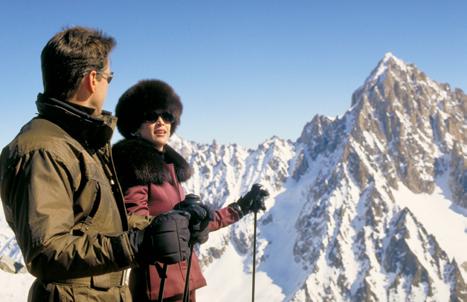
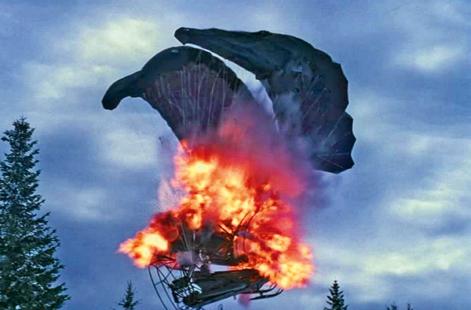
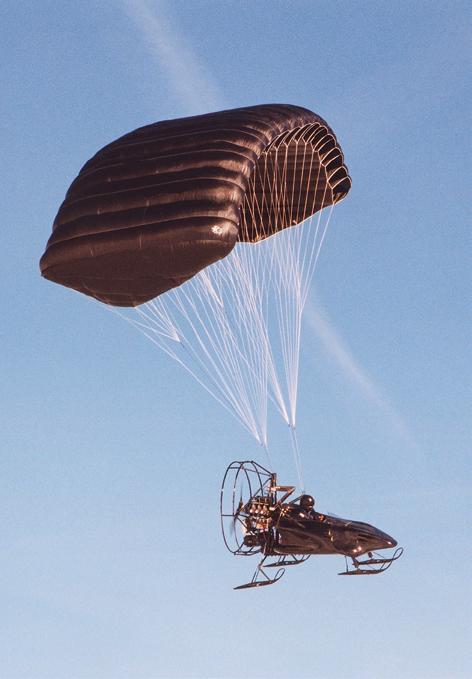
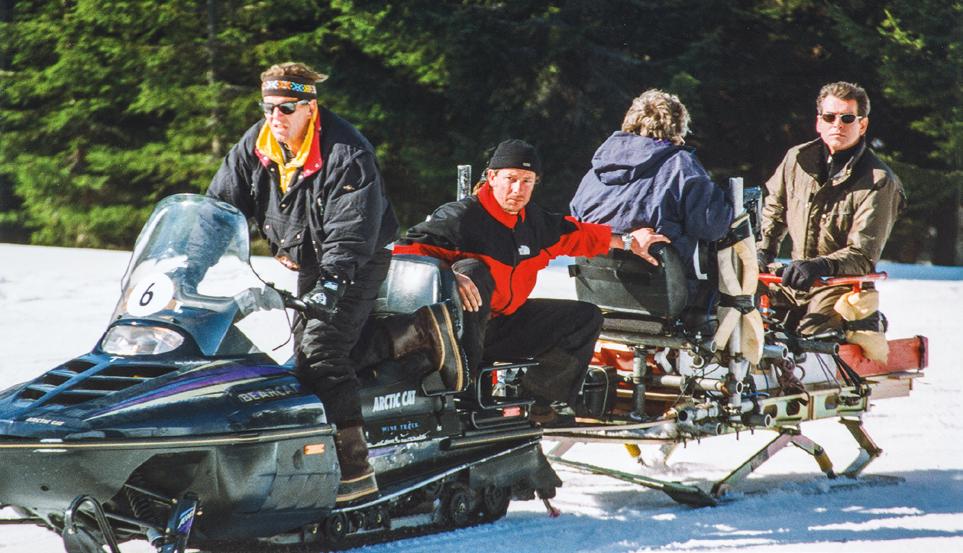
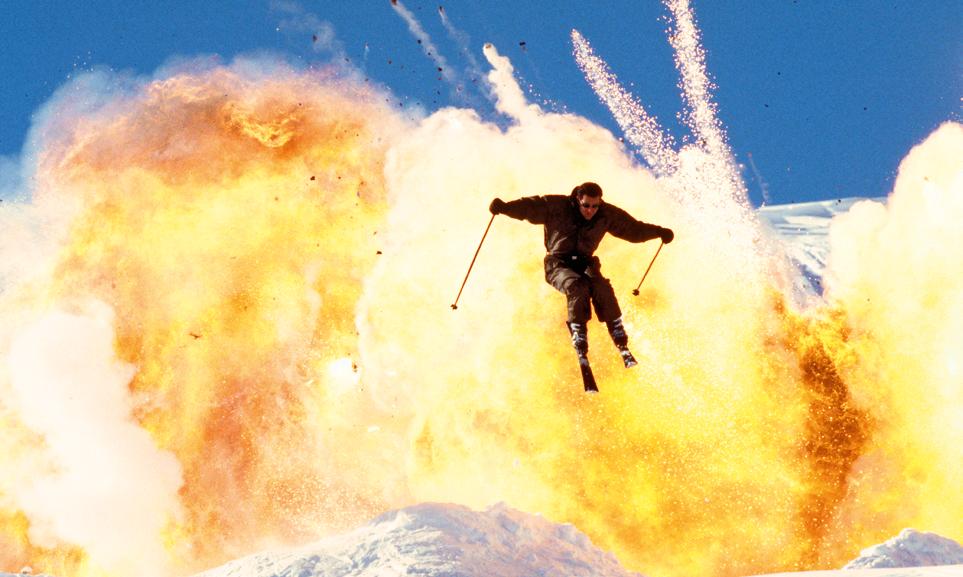
Dan.
When Stefan tried to clear the filming locations in Switzerland, the prop makers had already started fitting snowmobiles with propellers to turn them into flying snowmobiles on paragliders. “In the Engadine, we would have had no problem getting that done. But in London, someone made the mistake of having an inexperienced production assistant call FOCA directly.” After describing the above scene, the civil aviation authority immediately responded with a rejection: “Flying snowmobiles with propellers are subject to the authorization of ultralight aircraft, which are not approved in Switzerland.” “Not for the first time, a major film that could have done much for the Swiss economy and its tourism had failed because of lethargic bureaucracy and complicated procedural structures.”
Instead, the French ski resort of Chamonix was now rubbing its hands in glee. The code name 007 would open all doors. Stefan still tried to save the contract for Switzerland because Federal Councillor Moritz Leuenberger held out the prospect of a special permit for him. However, this came too late, as the French production manager, John Bernard, was already well advanced in the process of preparing the project and could not be dissuaded from Chamonix.
So, Stefan and Bernard recruited French freestylers with film experience from their network. Truly understanding film is as essential to this work as having skiing skills. “Inexperienced freestylers may perform the most beautiful aerial jumps. But you lose important time if someone doesn’t understand how a particular action works in the film.”
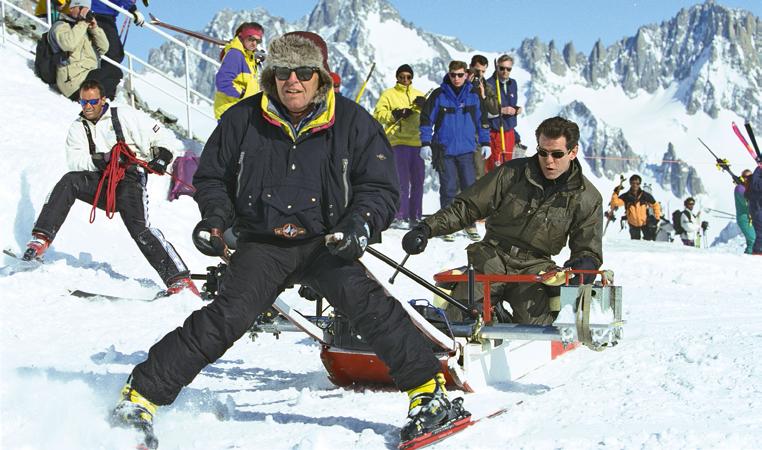
Unlike other Bond snow scenes, in which doubles take on the part of 007, the production filmed the main actors on the Mer de Glace, France’s largest glacier - subject to insurance approval.
Stefan resorted to his tried-and-true method. He skied while pulling the sled with Pierce Brosnan kneeling on it, mimicking skiing movements. This made rear projections in the studio unnecessary and provided authentic inserts of the star during the spectacular stunts. “Mimicking the motion while careening down the slope on a sled at 60 kilometers per hour isn’t as easy as it sounds. Pierce knew a little bit about skiing, and we played him footage so he could make the moves look authentic.” Getting on the sled is a matter of trust. Finally, Sophie Marceau also dared to go sledding with Stefan. “If Pierce can do it, I can do it, too!”
Because Stefan had won Pierce’s trust, the star asked the Swiss to play the pursuer on the snowmobile, who chases Bond through the forest. “At a hell of a pace, I curved around the explosive devices buried in the snow, each set to detonate in brilliant colors behind me. I did several test rides to remember those spots, dragging a net behind me so I wouldn’t leave tracks in the snow.”
Stefan and Pierce got to know each other well during the evenings in the elegant ski resort. “He’s the only Bond I can say that about. The chemistry was also right on a personal level. Pierce is an approachable star without the slightest hint of an enlarged ego and an excellent conversationalist. We weren’t talking about movies; we were talking about life.” Pierce had lost his wife to cancer eight years earlier. He then raised their children on his own. “Just like me, he had learned to live in the here and now.”
Stefan stayed with the ten-member 2nd unit in a guesthouse in the shadow of Mont Blanc. “We lived like kings, but soon we wondered why the landlord offered us a good bottle of wine every day.” Stefan found it puzzling that the patron requested the stunt
performers not to disclose his address to anyone. 1999 was the year of a notorious avalanche winter. The location had to be changed with great effort several times when there was an avalanche risk. “It’s as if a traveling circus had to be transported from one slope to another.” Towards the end of the work in Chamonix, Stefan finally came across the reason for the exuberant hospitality. “The municipality had published a new hazard map showing that we had been in the dark red risk zone all along. The friendly landlord should have closed his guesthouse.”
On the other hand, implementing the above sequence has proved to be entirely safe for man and nature. “Instead of Mont Blanc, it would have been just as feasible on Piz Palü.”
With “The World Is Not Enough,” Bond not only became unfaithful to Switzerland, but a fundamental change in the development of challenging sequences also occurred. “That may have been the last time we did everything using real stunt performers without the help of computers.” For the subsequent Brosnan adventure “Die Another Day,” Stefan went to Iceland on location search. “But by then, the producers already decided to introduce CGI (Computer-generated imagery) and to create a lot of sequences using software - which meant there was less for me to do.” The CGI scenes in “Die Another Day” didn’t resonate with audiences. So, they decided to return to the tried-and-true formula for the following Bond films - the stunt performers got their jobs back.
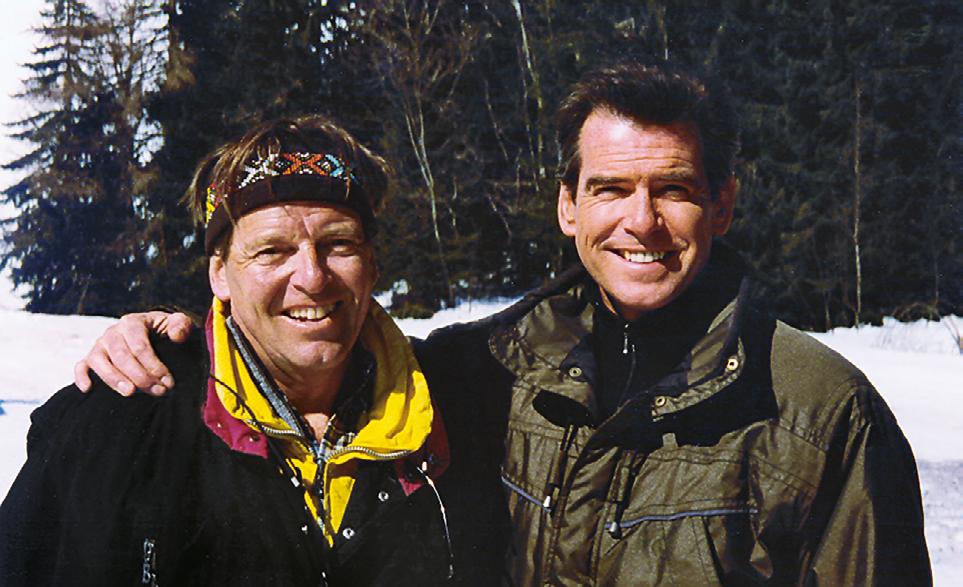
“Band of Brothers”, TV-Series (2001).
For the next job, Stefan Zürcher was able to stay at home. The groundbreaking war series “Band of Brothers” was filmed in his local environment. Even Hitler’s vacation domicile was moved to Switzerland.
Three decades had passed since “George,” Stefan’s first involvement in a TV series. Now, television was preparing to outstrip cinema in creating sophisticated and elaborate entertainment. Stefan was on the front lines when “Band of Brothers” ushered in the new era of expensive limited series.
Steven Spielberg and Tom Hanks had set out to create a story of a company of U.S. soldiers as realistically as possible for HBO. This premise applied to the relentless depiction of wartime atrocities and historically accurate details. As far as locations were concerned, Spielberg was willing to compromise.
The final episode, number 10, was supposed to show the American troops moving into Austria. Spielberg, known to be of Jewish descent, didn’t want to shoot in Austria, which was dominated by Jörg Haider’s politics at the time. “That’s how we got our foot in the door.”
The production chose the already film-tested Hotel Giessbach on Lake Brienz as the location for the headquarters of the U.S. Army. The small town of Unterseen became Zell am See, and above Schwanden, they filmed the scenes with the U.S. troops marching up with German prisoners. We removed the telephone lines and satellite dishes to take the locations back to 1945 and built a U.S. Army camp on the abandoned military airfield near Interlaken. The airplanes were deceptively real dummies. For the sequence in which the U.S. troops take Eagle’s Nest, Hitler’s vacation home atop the summit of the Kehl-
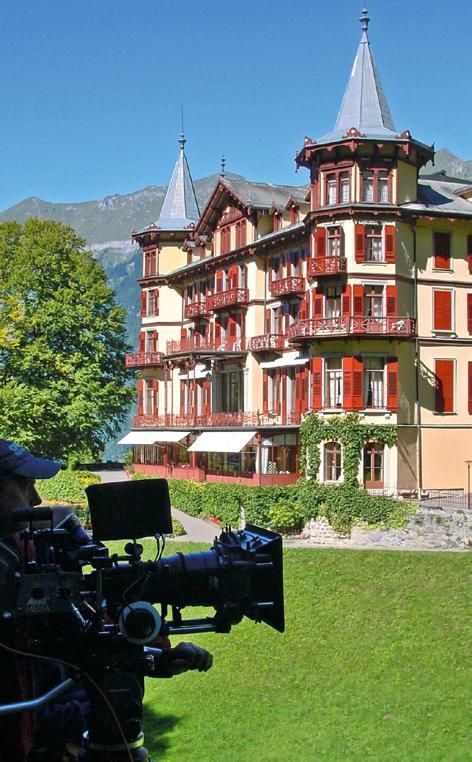
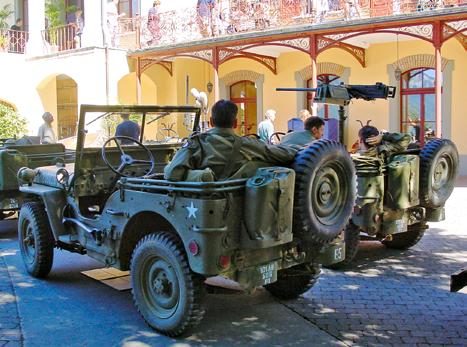
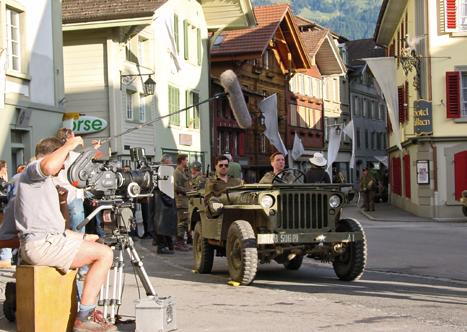
stein, they were allowed to close the old Grimsel Pass road for filming. The landscape resembled the one above Berchtesgaden. The Eagle’s Nest was added to the footage in post-production.
Over the years, Stefan had worked time and again with Leonhard Gmür from Lucerne, who had established a reputation as a production manager in international films (In “GoldenEye,” Gmür was responsible for the shots at the Verzasca dam). At Spielberg’s request, they teamed up as production manager and location manager. “Finally, Steven Spielberg came to Switzerland for a production meeting - incognito, no one knew about it - to sign off on our filming locations. He was the mastermind behind this highly ambitious project, driving the intention of depicting the war as realistically as never before. Still, he was so humble that he was almost overlooked. He never sought the spotlight to have the final say. Back in Los Angeles, he reviewed the footage daily, then judged whether anything should be changed.”
Leonhard Gmür and Stefan had used the recently closed Interlaken spinning mill to
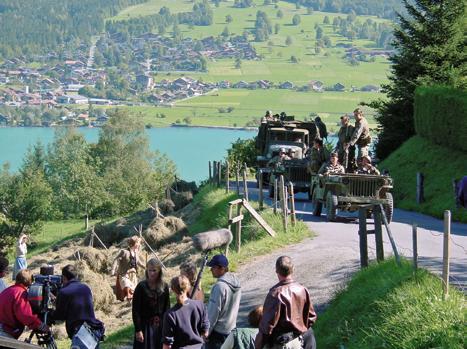
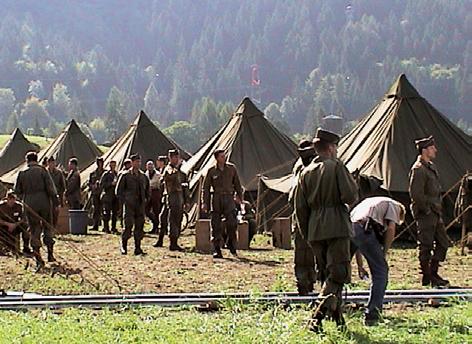
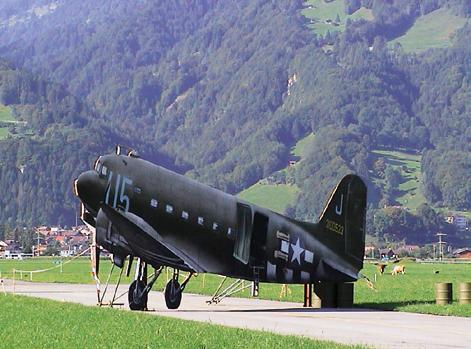
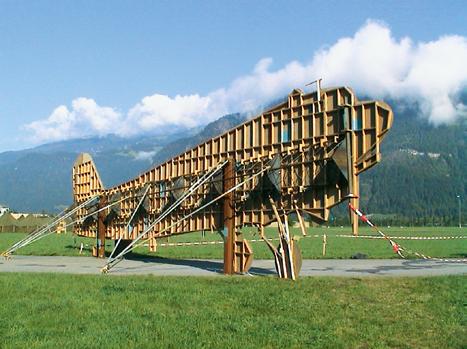
house the production departments. The storage of the material alone took up entire halls: tons of military material, numerous uniforms, and historical costumes, as well as the equipment for the special effects.
They also cast the extras in the old spinning mill: “For the many extras needed to portray German and American soldiers, we recruited Swiss soldiers, preferably grenadiers and mountain fusiliers.” To ensure the Swiss chaps marched like wartime soldiers, Dale Dye drilled them. He was already considered a Hollywood legend as a technical advisor for war films. Dye was quite pleased with our selection. “You can see the quality of Swiss military training school,” he said with appreciation.
Stefan, now in his mid-50s, had always continued learning. The wind in the film world was blowing in the direction of large-scale television series. He had already learned much while working in American television 20 years earlier. The series “All My Children” was popular on the U.S. channel ABC from 1970 to 2011. At one point, the producers filmed an episode in Switzerland. Stefan worked on the project on the Mutthorn glacier. When
the production manager offered to hire him for a few months in New York as an assistant on “All My Children,” Stefan’s curiosity got the best of him. “Since it took us a week to produce 50 minutes of television in Switzerland, I wanted to find out how Americans accomplished that target in one day. It was a paid educational course for me.”
ABC put him up in a New York hotel. “We Swiss are not used to such high-rise buildings, and I seriously wondered how I would escape in the event of a fire. I specifically requested a room that is not higher than the third floor. I bought a 30-meter rope at a sporting goods store, which I attached to the radiator by the window so that I, as an experienced mountain infantryman, would have a way to escape in case of an emergency.”
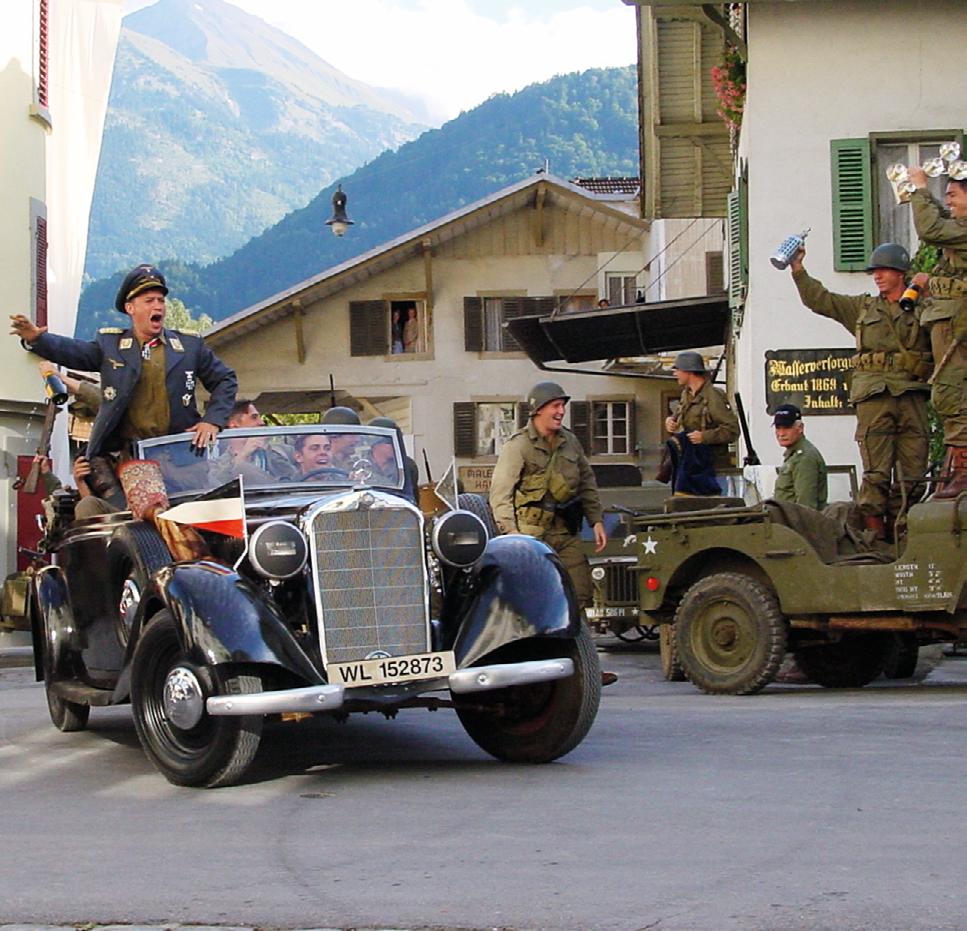
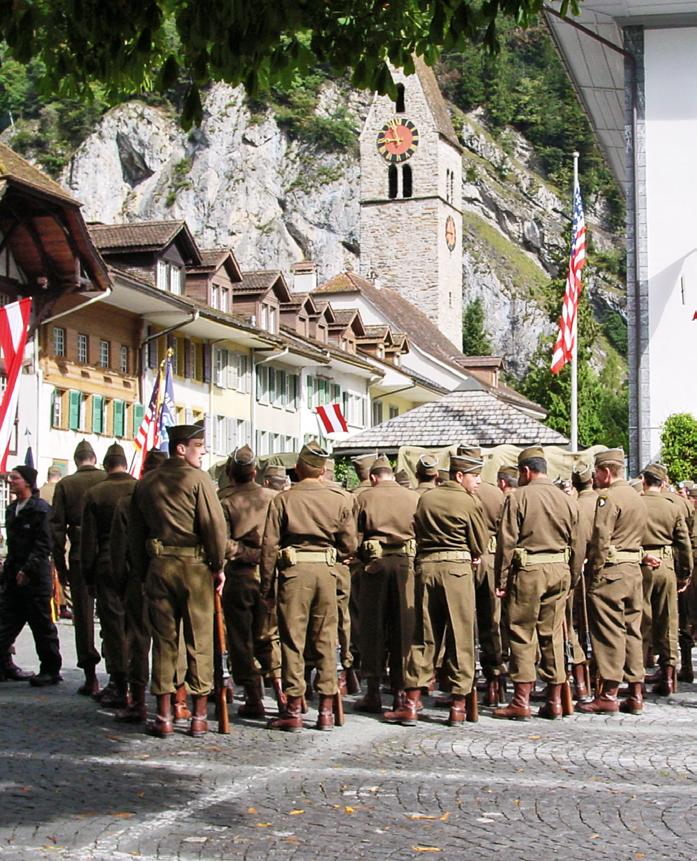
There was one crucial piece of advice from the producer he held onto throughout his life in this business, where rumors quickly make the rounds: “Whenever you have discussions: no names, no figures.” On his first day on the soap opera set, he realized the enormity of the day’s production. It was busier than Grand Central Station. Three hundred employees scurried about. Forty screenwriters delivered their freshly written pages to the film crew. Seven, eight sets, in which the actors shot simultaneously under remote-controlled lamps, were permanently primed for filming. While the main actors were performing on one sound stage, the lights were already set up on the next one, using standins. The directors, always with the schedule breathing down their necks, had already suffered their first or second heart attack. “So, I did learn how to speed up the process, but after two months, I had learned my lesson. I didn’t want to make assembly line filming my job. Sometimes, it’s just important to figure out what you don’t want to do.”
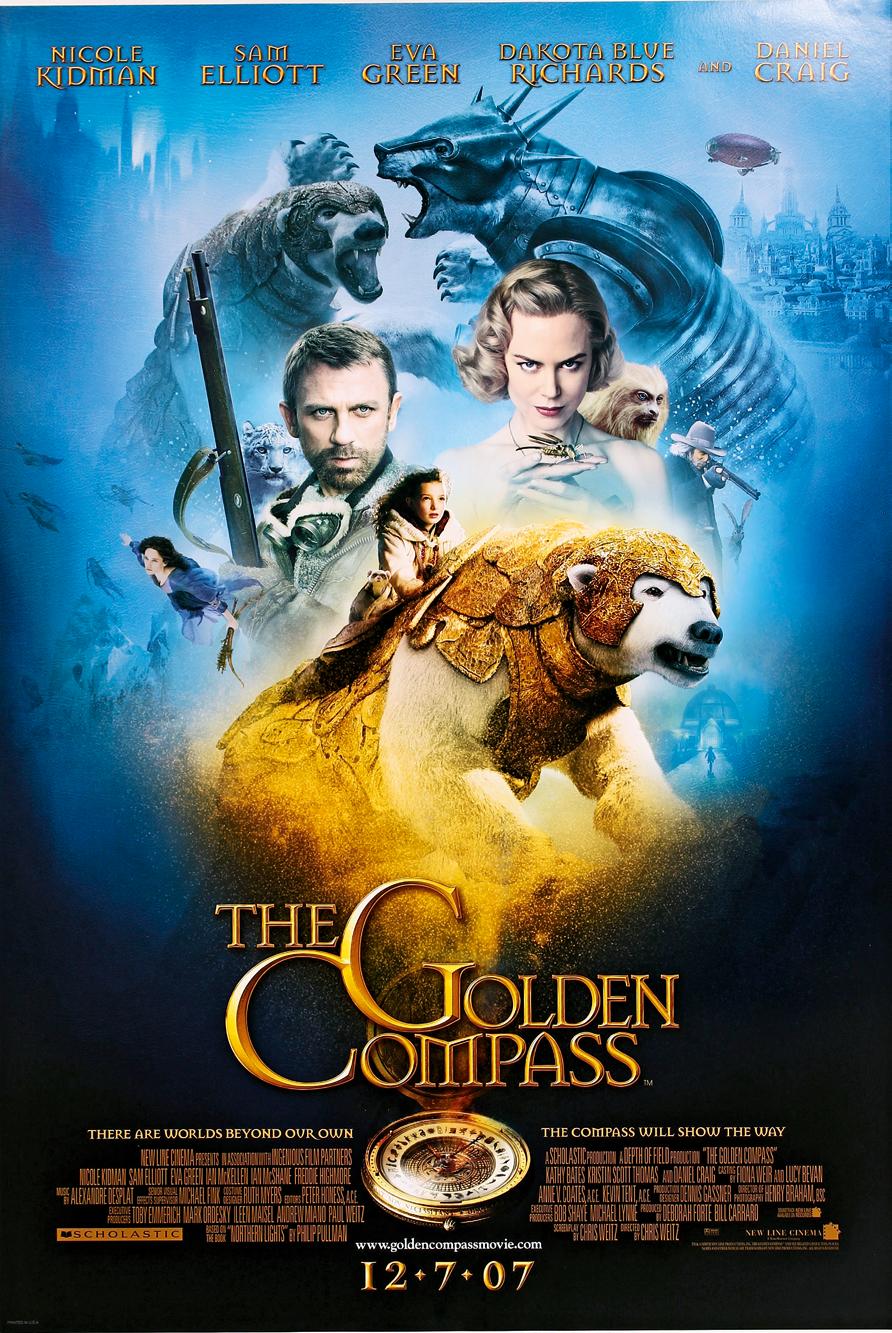
“The Golden Compass” (2007).
The fantasy film “The Golden Compass” had a budget of $180 million, making it the most expensive film to date on which Stefan Zürcher served as a snow consultant. It almost cost $750,000 to bring all the equipment up to the Grindelwald glacier.
After many adventurous commercials, an old acquaintance of the cinema world entered the scene in 2006, Vic Armstrong. Since they had made life difficult for James Bond on the Schilthorn as Blofeld’s henchmen, Vic had worked his way up Hollywood’s pecking order from stuntman to sought-after stunt coordinator. He doubled Harrison Ford in the “Indiana Jones” movies, provided action in the “Rambo” series, and crossed Stefan’s path in more than one Bond adventure.
Vic knew that the proven duo of Leonhard Gmür and Stefan Zürcher could handle the demanding logistics of transporting the “Golden Compass” crew of 120 people a day onto a glacier abyss without them freezing to death. After an extensive location search, the choice fell on Grindelwald. “I knew the glacier like the back of my hand from ‘Frankenstein’ and various commercials.”
The difference is that he only had to bring a core team, including Kenneth Branagh, onto the ice for a few shots in “Frankenstein. “Now, we had to fly a full-blown crew with star Daniel Craig high up into the mountains.” For this, five helicopters had to rotate with a precise flight plan. A single company could not have handled this. “I was proud to bring Bohag (Berner Oberländer Helikopter AG) and Air-Glaciers, usually competitors, to the same table.”
To prevent constant flyovers of Grindelwald village, his production team relocated the helipad to the Grindelwald gorge, a little further away. They installed portable toilets on the glacier and set up five large crew tents. Since the igloo overnight stay of “The Spy Who Loved Me”, Stefan always made sure to have sufficient emergency supplies available.
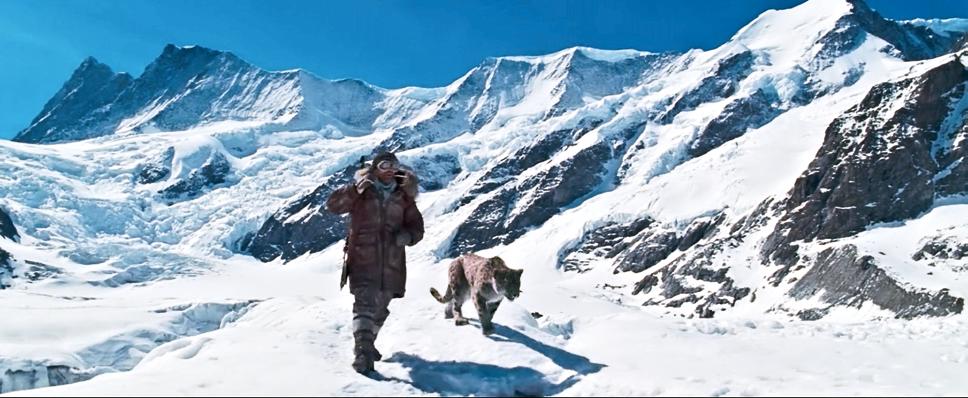
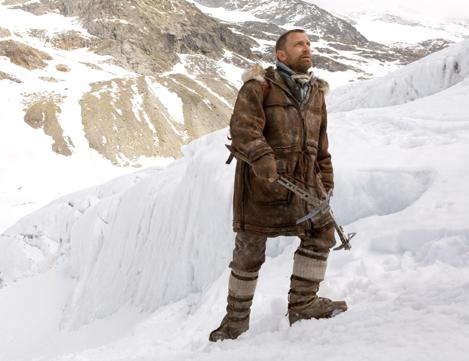
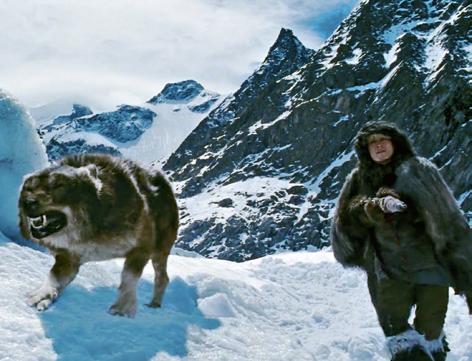
To provide catering on snow and ice, you need to rely on an experienced catering team with winter-proof equipment. “We worked with a tried-and-tested company that also provides catering services for the Lauberhorn ski race.” Local service providers not only earned good money from executing contracts for multi-million-dollar film productions, but they also promised prestige. A chef known beyond the region applied for the job. Stefan had to decline his offer and provided the following explanation: “I had once ordered spaghetti aglio e olio at his Italian restaurant. ‘We don’t have that!’ was his reply. If a chef can’t cook spaghetti aglio e olio for one person in his Italian restaurant, he can’t feed 120 people on a glacier.”
Every morning, his crew shoveled the tents out of the fresh snow. The helicopter landing sites were marked with new paint. All the comforts prescribed by the unions also had to be guaranteed on the ice field at over 2500 m above sea level. When the teams arrived,
the kitchen had to serve hot coffee, followed by an English Breakfast. If the service was delayed, a penalty known as a “meal penalty” was imposed. The union would charge producers a penalty fee. If the breakfast break lasted until 8:30, lunch had to be served at 1 p.m. To keep to the schedule of having dinner at the hotel at 7 p.m., the return flights also had to be well-timed. Otherwise, there was once again the threat of incurring a meal penalty. If the crew worked more than six hours without a meal break - meal penalty again! “I had to make sure that the logistics process ran smoothly and without any delays. Any holdup could lead to substantial expenses. Independent film producers save on union rates by procuring crews that don’t belong to unions.”
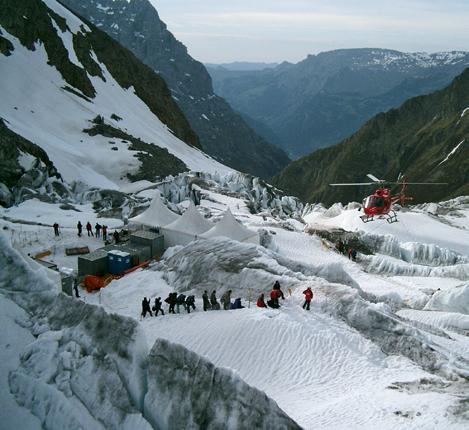
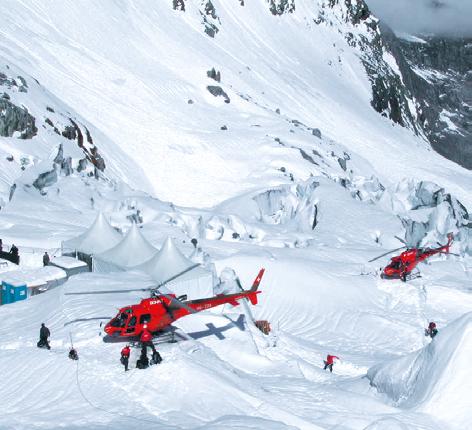
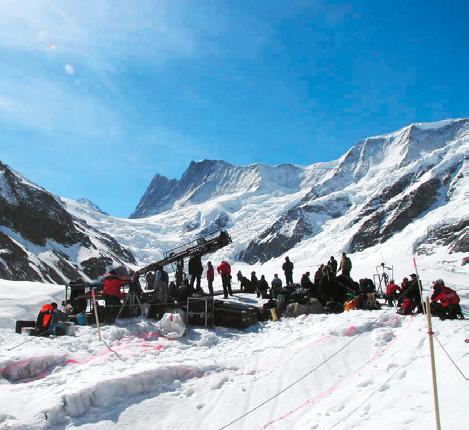
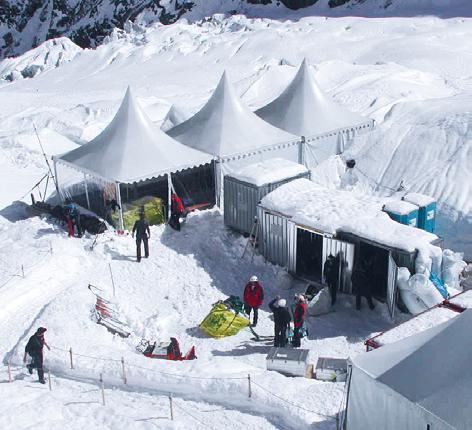
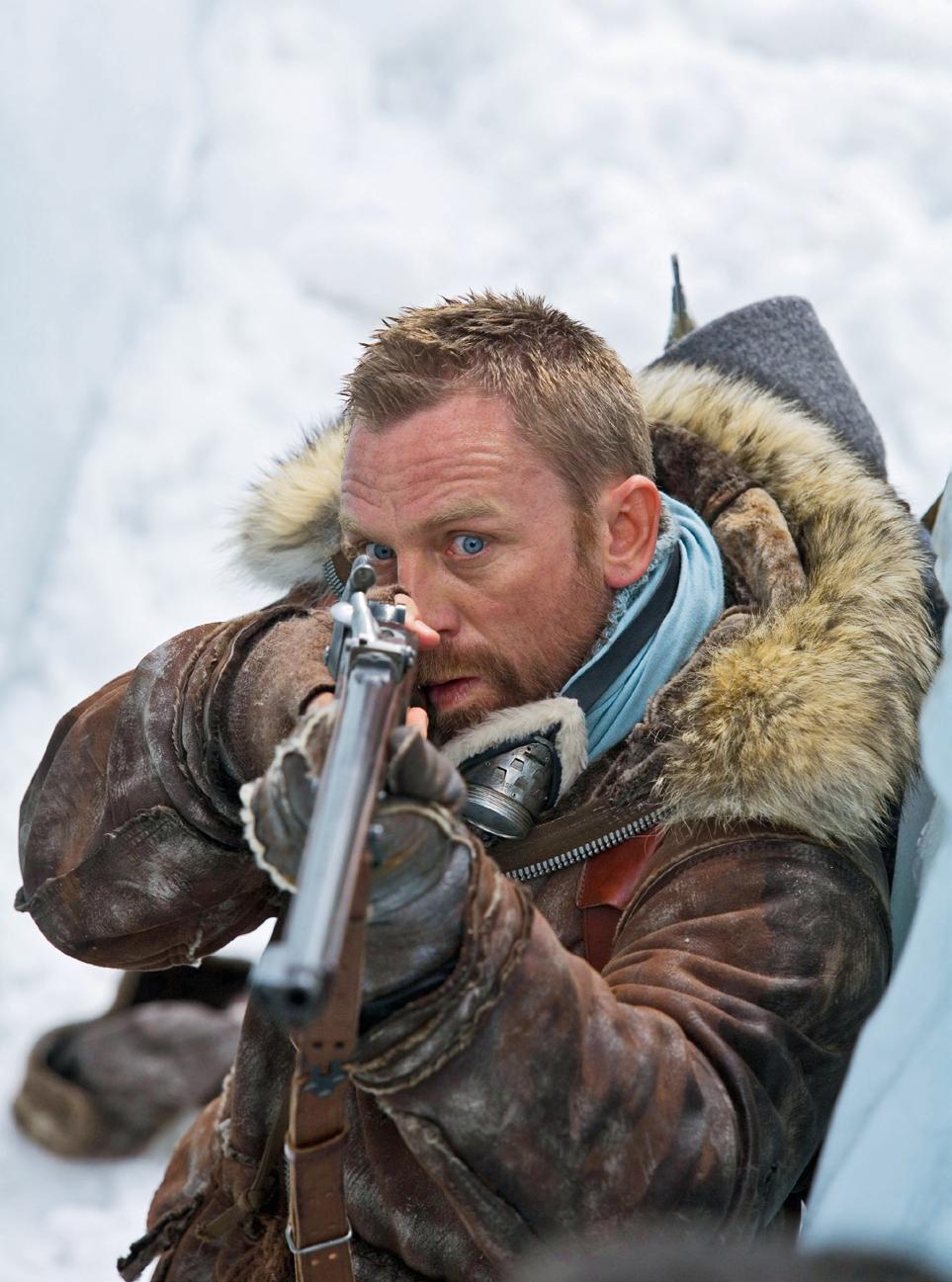
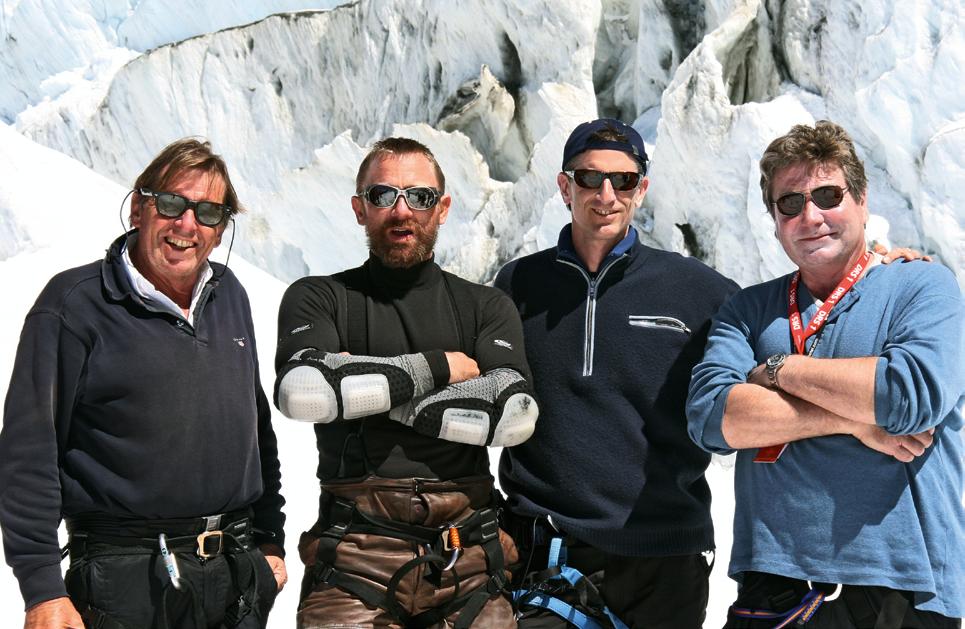
Since it was an English production, each day involved costs of ten thousand Swiss francs. Stefan took the cost-conscious position of his clients. “Over the years, unionized camera crews have tried to deceive me by claiming they had to stop the day’s filming because of insufficient light. That would have resulted in an extra paycheck. Therefore, I always carried my own photometer. As an experienced camera assistant, I could prove that the light was still sufficient.”
The tragic incident in 2021, when actor Alec Baldwin fired a real bullet from a prop gun on a film set, confirmed the importance of strictly following safety regulations. “I always convinced every producer that we needed to hire a licensed firearms expert familiar with Swiss gun laws, licensed to procure explosives and with oversight of all loaded weapons used in the movie.” Stefan would only release the location if an expert was on site for a scene where weapons were used. “Unfortunately, accountants who have no idea of the actual situation on a film set, are always the first to eliminate these necessary expenses in cost-cutting measures.”
For “The Golden Compass,” on the other hand, no expense was spared. Since the fantasy movie didn’t make enough money in the US to cover its production costs, the sequels to the trilogy were canceled. However, Daniel Craig would return to Stefan’s life just one year later, but in the far more successful incarnation as James Bond.
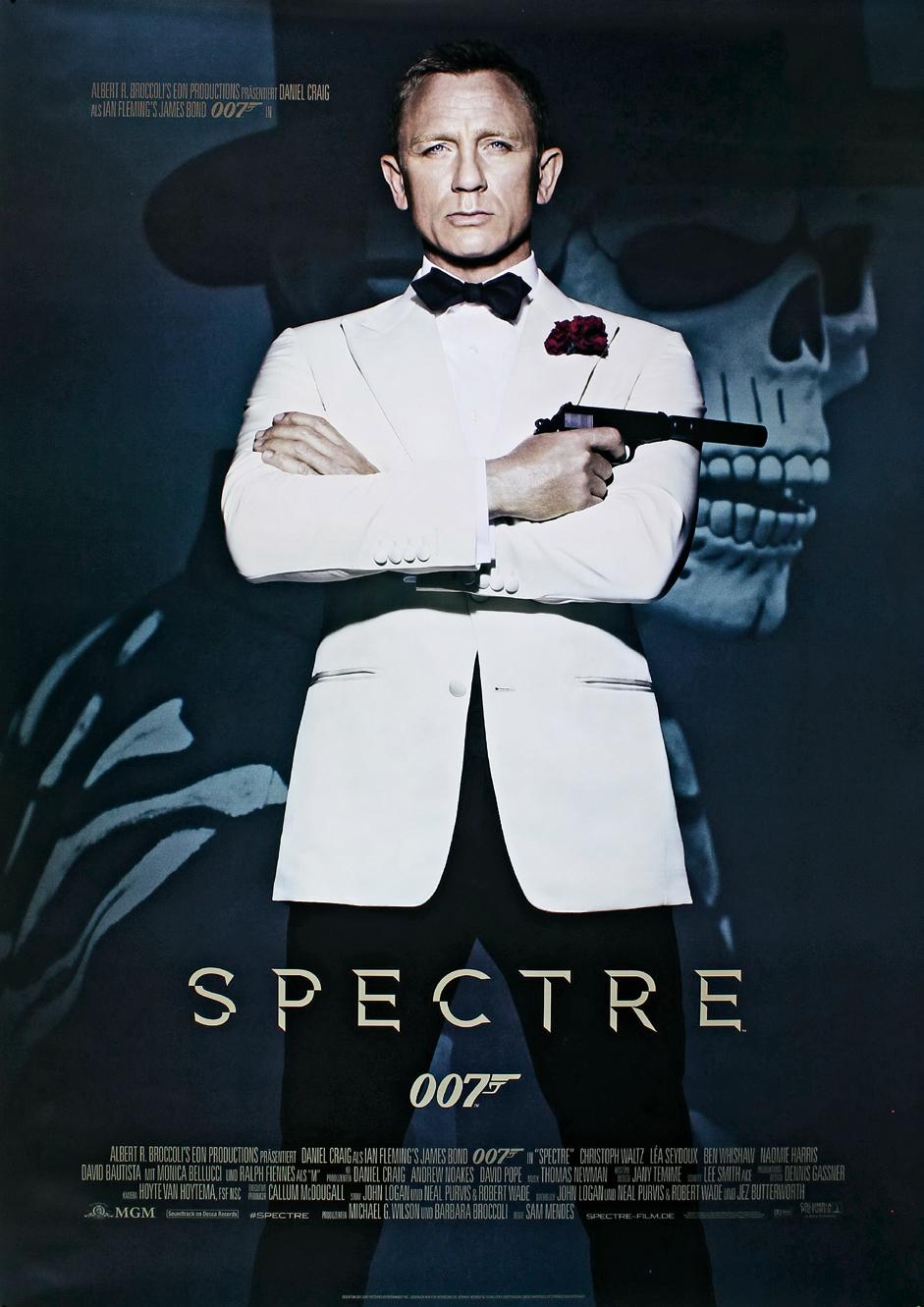
“Spectre” was the highlight of Stefan Zürcher’s James Bond filmmaking venture. The unparalleled action sequence demanded everything he had learned in half a century.
It speaks volumes that the producers of the 007 franchise granted Stefan carte blanche for their assignment. “It was a nice vote of confidence. This job was pretty much the most challenging I’ve ever encountered.”
The starting signal was given one year before the actual filming began. The producers called a meeting in London and presented the storyboard to the director, stunt coordinator, production designer, and the other department heads. The more expensive and daring sequences are always shown with illustrations, ensuring that everybody shares the same visual concept.
The sequence, which would last about five and a half minutes in the film, saw Bond chasing the bad guys through a snowy landscape in a propeller plane. The leading actress is being held captive in one of their Range Rovers. The vehicles race down a forest track, with the plane in hot pursuit, losing wings and landing gear until it hurtles down the snowy slope on the only remaining fuselage, finally crashing through a barn and ramming into the fugitives. Bond frees the prisoner.
“We searched for locations in Switzerland, Austria, Italy, and France. The locations in Austria, suggested by the Austrian production manager Ernst Vogel, made the draw. In Sölden, we chose the mountain road to the Rettenbach glacier, the summit restaurant ‘Ice Q,’ and the mountain village of Obertilliach in East Tyrol. For the scene in which Bond crosses a crystal-clear lake to find an abandoned hunting lodge, we selected Bad Aussee.”
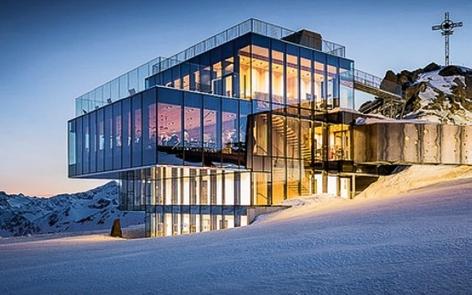
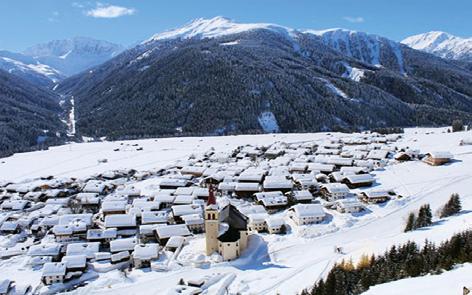
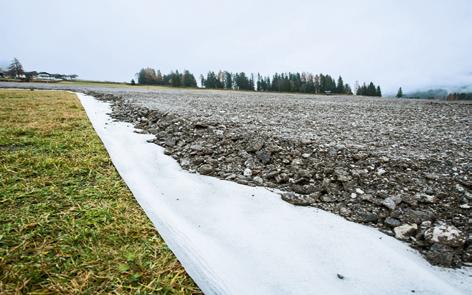
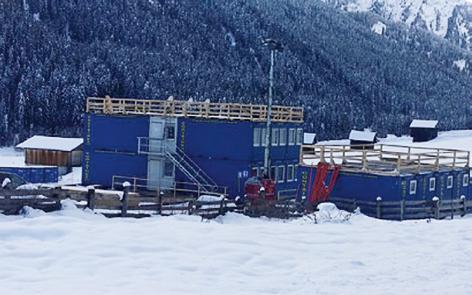
Barbara Broccoli trusted Stefan’s word that he could turn the seemingly impossible film vision into reality. He had to guarantee that the scenes in Obertilliach from January 3 to 6, 2015, could be filmed with the lead actors. “It’s no simple task because when shooting outdoors in the mountains in winter, there can be too much or too little snow. In the best-case scenario, the weather gods are on our side and create a perfect blanket of snow. I had to calculate all these possibilities beforehand and take all measures so that each alternative could have been implemented.”
There are no guidelines in books for the logistics of such a shoot. It was no mean feat. “Imagine 500 film people invading a small mountain village with the same number of inhabitants. For their accommodation, we booked 500 single rooms within a radius of 80 kilometers.” The parking lots, with a total area of 35,000 square meters, were built on the meadows surrounding the mountain village with permeable geotextile sheeting and 25,000 cubic meters of crushed stone to protect the flora. On this stood 20 office trailers for a total of 34 offices, five mobile, heatable high-capacity toilets, ten tents (50 m × 20 m) with passable floors, and a payload of 20 tons, which housed helicopters, airplanes, Range Rovers, special effects, workshop, and a kitchen catering 700 people. Each parking lot had sewer lines, fresh water, and power connections.
“Now, we could construct a road of 1 kilometer in the forest aisle for the car chase.” Once again, Stefan and his team laid down a permeable geotextile sheeting to protect the forest floor. They coated it with 30 centimeters of gravel, soaked it with water, and compacted it to create a frozen solid surface. To simulate the flight down the forest lane, they set up two 120-ton cranes with a height of 30 meters. Two suspension carbon fiber cables hung between them to which the aircraft was attached. A thin towing rope made of carbon fiber, operated by a high-speed winch, accelerated and decelerated the airplane. The angle of inclination of the cranes precisely determined the flight route. A snow team of 30 people was on duty around the clock to ensure perfect snow conditions. After each day of shooting, a snow groomer with special equipment made for this purpose removed the loose gravel ripped off by the Range Rovers’ tires, which were fitted with big studs. For the chase, the Range Rovers were modified and equipped with a high-performance engine to reach a speed of 100 kilometers per hour in a few seconds.
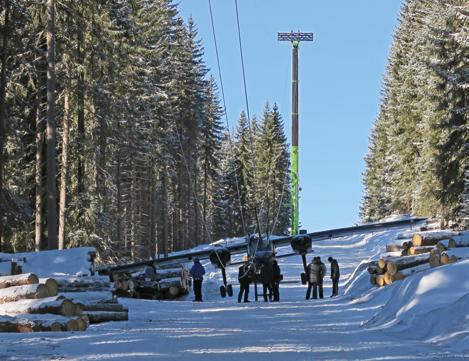
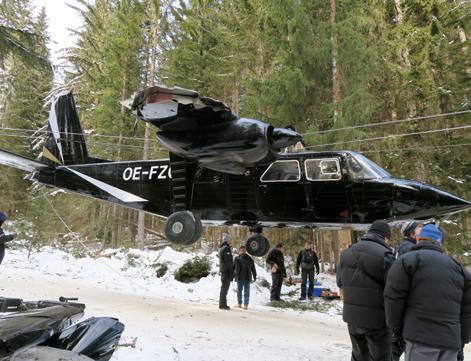
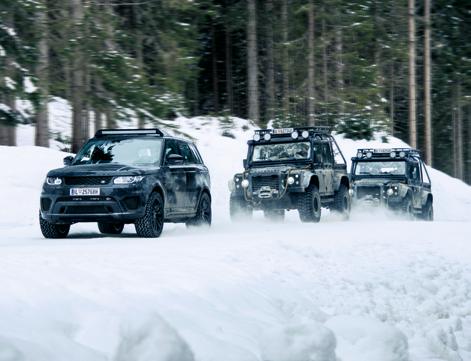
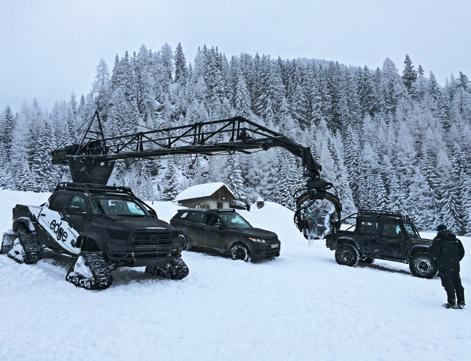
“We laid three kilometers of water and power lines into the forest aisle for icing and artificial snowmaking, used a fire department vehicle to ice the road, and snowed in the area with snow cannons. We placed a steel container in a river basin and had the doors welded watertight to store the 10,000 liters of water that supplied our snow cannons and the fire truck.”
The barn through which Bond crashed his plane was initially situated in a different place. They bought it with 14 other houses and barns and rebuilt it on location. After completing the shoot, they dismantled all the houses and restored the surroundings to their original state.
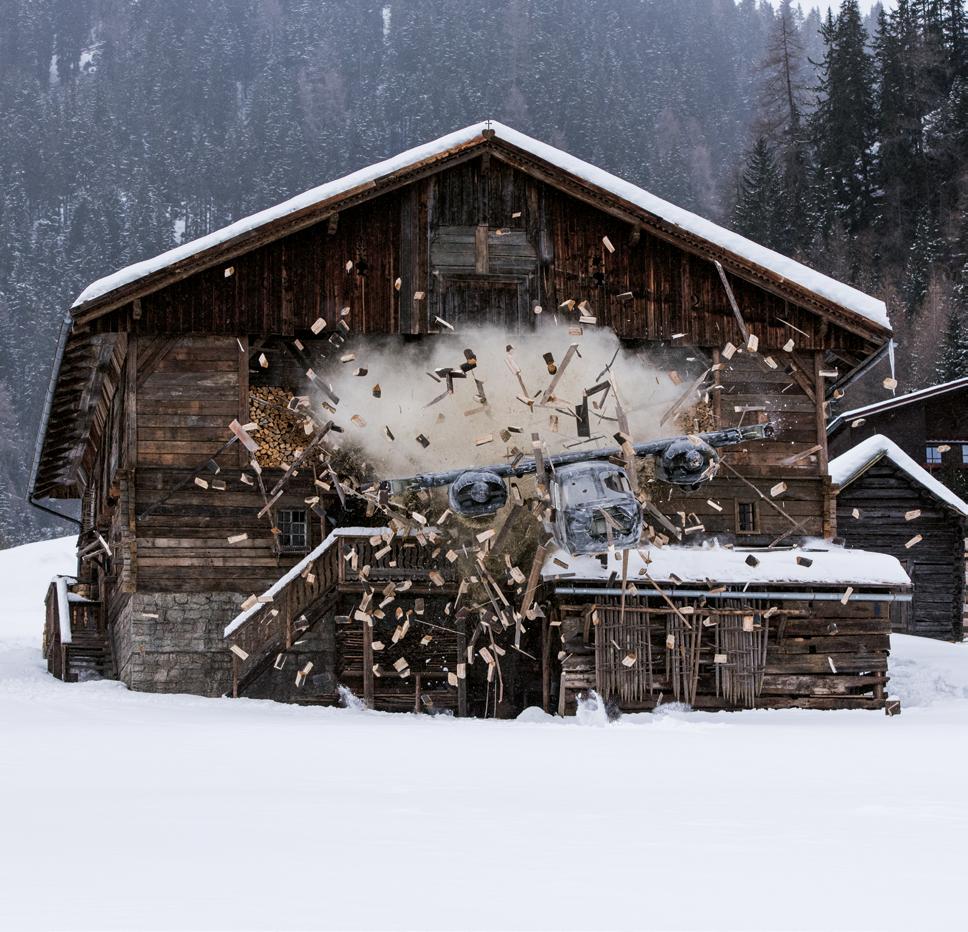
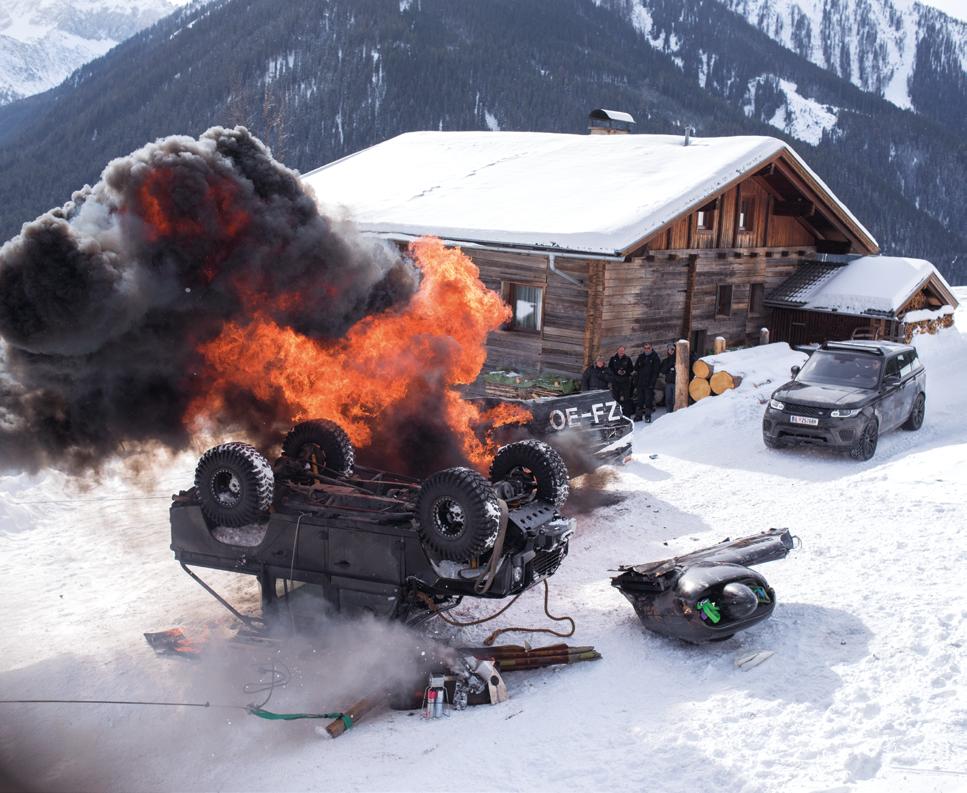
No less than twelve plains in various destruction stages were utilized for the sequence. Stefan set up heated tents to store them and park 25 Range and Land Rovers.
Finally, on January 3, 2015, the 60-man 1st unit arrived with the leading actors. At that point, 700 people and local helpers had already been busy with preparations. Even Barbara Broccoli visited the place where James Bond history was to be written and thanked her long-time snow consultant in person.
Every detail of the showdown between Daniel Craig in the damaged plane and the Range Rover was meticulously rehearsed. Director Sam Mendes used exclusively wide-angle lenses, corresponding to the human eye’s angle of view. The fuselage, powered by the two remaining propellers, pursued the Range Rover. A high-pressure compressed air cannon shot the aircraft through the barn. For the following collision, which culminated in the explosion of the Range Rover, the cameras stood in so-called crash boxes, the valuable lenses protected with crystal glass.
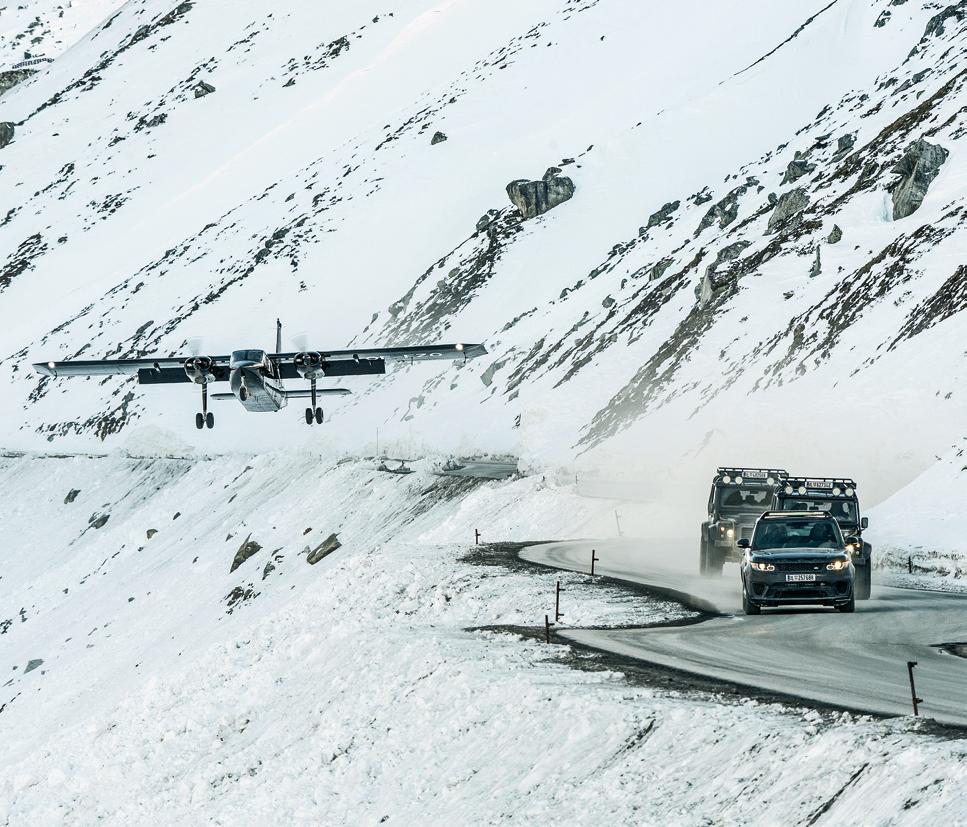
“We had 80 marshals placed virtually from tree to tree along red warning tape so that no one, accidentally or intentionally, could get to us through the forest. At that point, social media intrusion had reached such a level that we had to assign five people to protect Daniel Craig. Two security guards additionally shielded him.” Despite all preventive measures, an exclusive report by ORF (Austrian Radio and Television) flickered across the screens the same evening. A paparazzo had hidden in a tree on the opposite slope under a camouflage net for three days and nights to film the stunt. “He got a nice scoop!”
The glass restaurant “Ice Q” on Gaislachkogl in Sölden was transformed into a high-alpine clinic for the plot. The chase on the winding, snow-covered mountain road near the Rettenbach glacier demanded everything from the stunt drivers. They needed to maintain a 100-kilometer-per-hour speed because the pursuing plane required that velocity for its flight.
In the spring, Zürcher returned to Obertilliach for another six weeks to supervise the renaturation and reforestation. As planned, the geotextile sheeting and gravel successfully protected the meadow and forest soils, and farmers could harvest their hay in June as usual. The forest aisle showed even greater biodiversity because the sun reached the forest ground.
“Spectre” credits him as “Snow Consultant.” “I feel proud to have been a part of such a great movie. Bond films provide the satisfaction of knowing that a worldwide audience will enjoy them for many years, while other movies fade into obscurity.”
He returns to the filming location of “Spectre” in East Tyrol and other places where former film locations have been overgrown with grass to reconnect with friends and acquaintances. “Making a film can only be achieved through collaboration. You get close to the people you work with for a limited time and become part of their community. Then you lose those friends again. You put down roots and have to pull them out again yourself. Anyone who doesn’t work in this crazy business will have a hard time understanding that.”
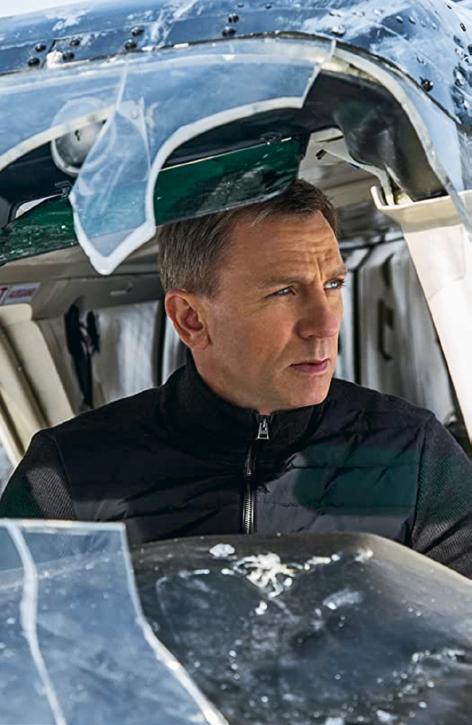
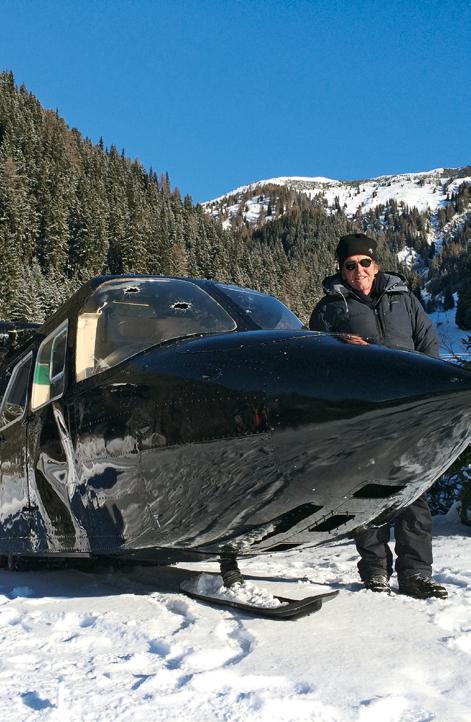
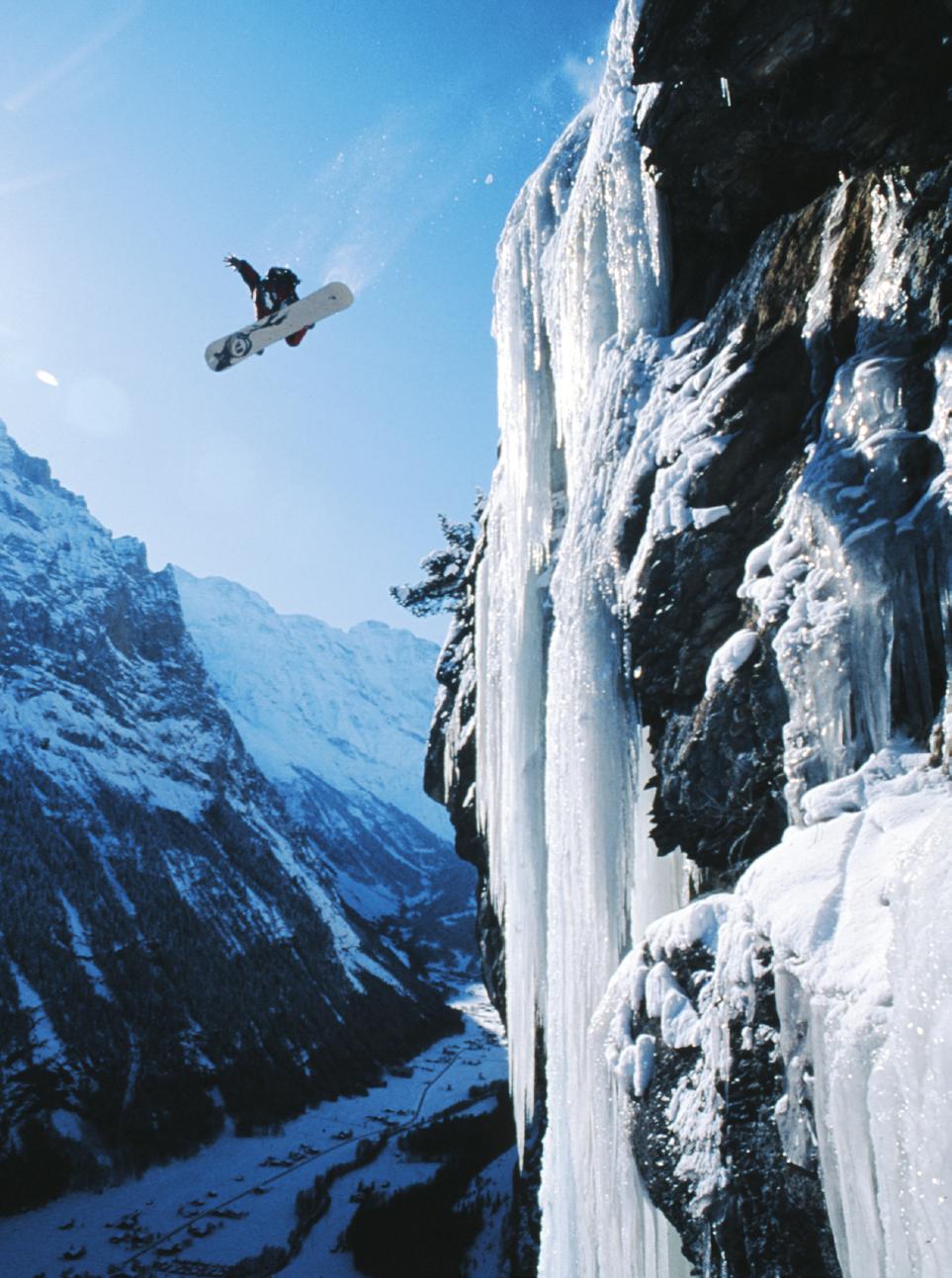
When I meet Stefan Zürcher for the first time, he is wearing a Swiss army fur hat with the ear flaps folded down due to the bitter cold. It is the middle of the night. In the glow of the film spotlights, a couple playfully frolics in the snow. A commercial for “Ferrero Küsschen” chocolate is filmed in the Swiss mountains; I can’t remember where. My mission is to interview Stefan Zürcher about his stint in the 007 movie, which is coming to theaters soon. The year is 1999, and the Bernese Oberland native was recently responsible for Bond being catapulted off a mountaintop on a motorcycle. Nevertheless, I felt like many: I didn’t know his name.
Away from the spotlight, he is ready for action. Whenever the director hoarsely shouts, “Cut! Again!” he fills the lovers’ footsteps with snow. He exhibits the unyielding patience of a mountain man and sets up the scene for the couple to play in fresh snow in the next take. He holds the snow shovel like a conductor holds his baton: carefully, he scoops the white snow onto his shovel, sends the fluffy flakes high up into the air, and lets it trickle down to the ground. There is something that I couldn’t predict at that time: Hardly anyone in the film business knows how to handle snow as well as he does. So well that George Lucas and Albert Broccoli have staked millions on this intuition.
It goes on like this for half the night. Finally, the crew warms up in the heated catering tent with an orange punch (both organized by him as location manager). The German commercial filmmakers are suspiciously looking at my much smaller camera crew. What’s so special about their snow shoveling man? “Stefan, you should have told us!” says the Ferrero director with regret as he realizes he treated the Bond family’s snow consultant like a handyman. This doesn’t matter to Stefan.
Two years after the frosty night, we meet again. This time, he’s wearing a baseball cap instead of his usual fur hat. He doesn’t stand out among the many Americans on the set.
Steven Spielberg hired him to organize the filming locations for the major production “Band of Brothers.” At the Interlaken military airfield, an authentic army camp is built from scratch, wooden dummies look like airworthy bombers from a distance, and a real
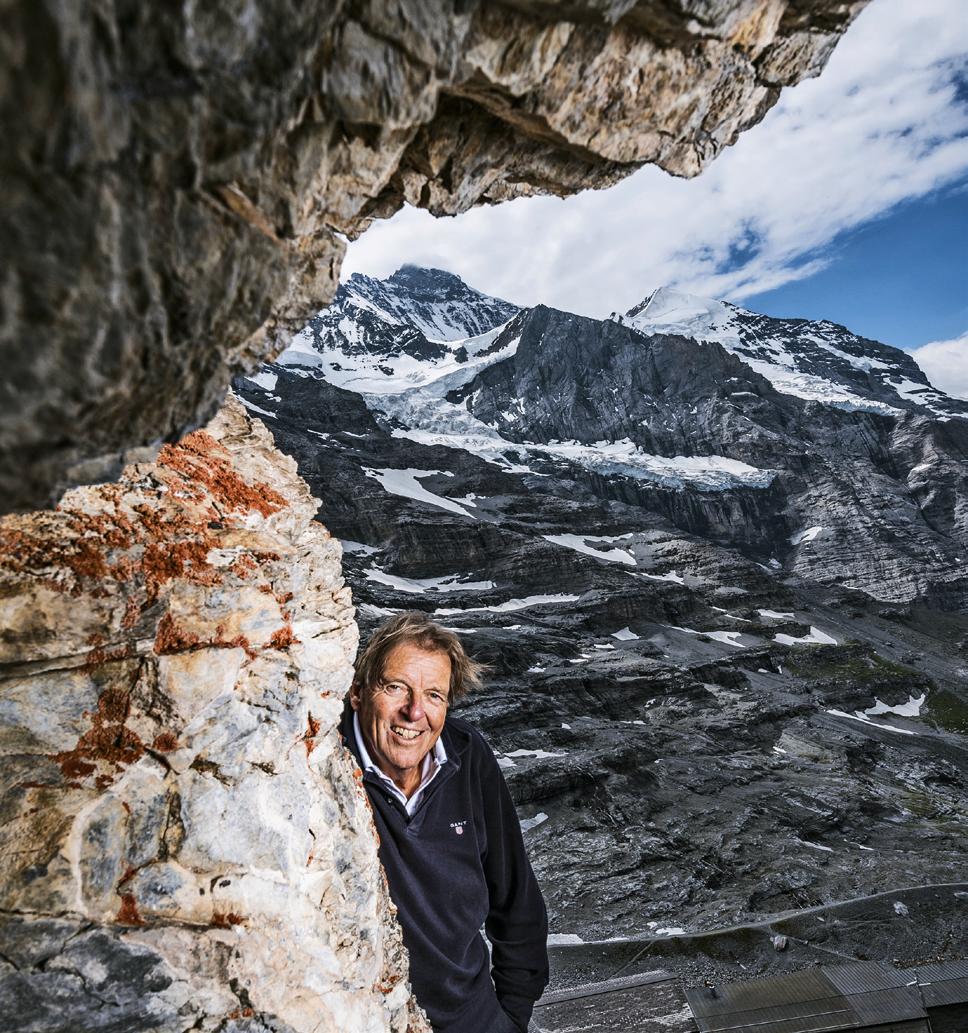
U.S. Marine drills Swiss extras to salute like G.I.s. All make-believe. I am interviewing the “Band of Brothers,” a bunch of young men on the brink of stardom. That’s how you recognize actors: If they see a camera, they’ll even walk on their hands to get attention.
On the sidelines, someone stands with his back to the camera—the only one who keeps his senses in this crazy world of make-believe. By appearance alone, no one would guess that he bears the responsibility of a location manager.
In the years to come, I would learn repeatedly that Stefan Zürcher doesn’t boast about his experiences. You’d never know what he had accomplished in his life unless you specifically asked him. As a result, he remains invisible to the public. After reading the first draft of the manuscript for this book, he raised an objection. He suggested that in most places, I should use “we” or “our team” instead of referring to him in the first person. I pointed out that this is common in film biographies and that it would already be clear to readers that there is a whole crew behind him, but that didn’t fall on fertile ground. I hope he will forgive me for mentioning his humility here.
When I tell him at our next meeting that twelve years had passed since “Band of Brothers,” he rolls his eyes. “Where have all those years gone?” He agrees to an article about his life for a magazine. He suggests the Interlaken golf course for a chat about his films. Because golf is at least as important to him. He turns the wicker chair so that he can see the mountains. There is hardly a summit that he has not filmed. Thanks to him, the Swiss panorama can be seen time and again on cinema screens all over the world. He tells me about the thing with good fortune. That it always found him without him having to search for it. One film engagement followed the other. He never dreamed that someone would pay him good money to do what he loves to do: “Skiing!” At the end of the long conversation, I must admit that his stories go beyond the scope of a magazine report. A book, I say without ulterior intention, would be the more appropriate format. The bright eyes shine even brighter, and the grin on the weather-beaten face widens.
In 2016, we stand together where it all began: on the Schilthorn, 50 years after the Bond movie that became his springboard into this crazy world of cinema. When asked to leave his handprints for posterity along with the film’s cast and crew, I can see it on his face: He is still uncomfortable in the presence of flashing cameras. We drink vodka martinis shaken to James Bond’s no-longer-secret recipe, and as always, he is barely noticed by the many reporters. Yet he has just come from his biggest mission for 007, the airplane sequence in “Spectre.” And it finally dawns on me why he still manages to fly under the radar of Swiss celebrities: He must wear a cap of invisibility!
In one of our conversations about his filmography, I asked if he had a folding chair with his name or position at each location. The kind of chair reserved for the well-known personalities on set. His answer was typical for the man I now know so much better than that night in the mountains: “I didn’t need a chair - I never had time to sit down!” “Hidden Champion” would have been the correct label if this chair existed.
Roland Schäfli, April 2023
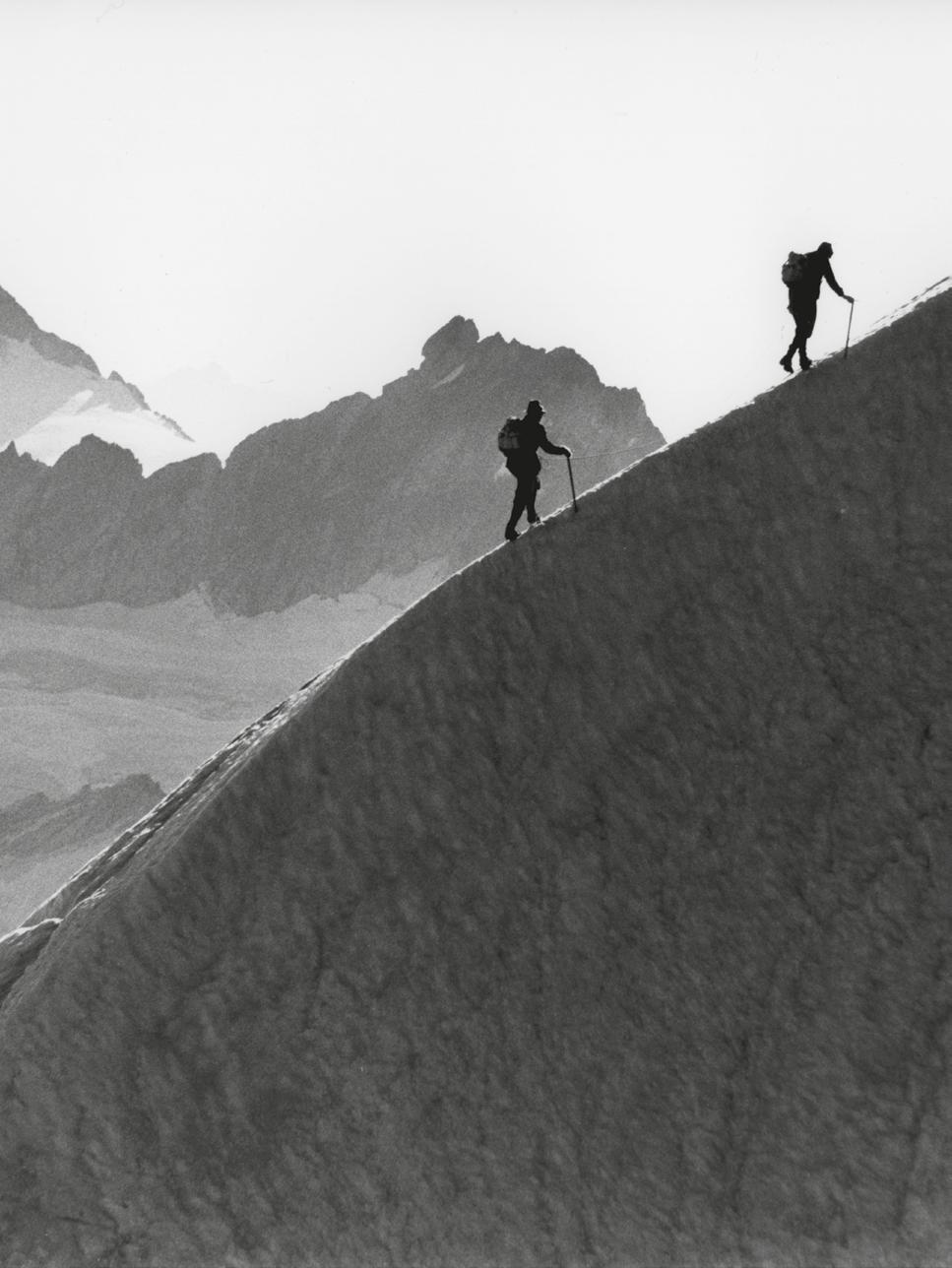
As a child, I spent a lot of my time outdoors in nature and learned early on to read and respect the laws of nature. They taught me structural and contextual thinking. I found the divine in nature and in the universe. I trusted that the right things would happen at the right moments. I sent a wish toward heaven and left it to the universe to sort out the details.
I tried to see the good in every person and to love them. Children are not the only ones with dreams; adults have them too. These must never be destroyed. In my management style, I always included the views and ideas of my team in my decisions. I used visual communication like storyboards, sketches, and drawings because good communication is the key to mutual understanding. To be a good communicator, one must also be a good listener. “I would often listen for a long time and reflect before saying nothing.”
I met people who helped me a great deal. I want to thank them all: Wolfgang Glattes, who introduced me to the secrets of film production at the Bavaria Studios in Munich; Leonard Gmür, with whom I worked so well together as a production team; Micky Moore, who taught me how I could turn my ideas into the ideas of others, under the condition that one first checked their Ego at the door.
I would like to thank Sonja Schneider for the beautiful years we spent together and for our son Flavio. Flavio is my son and my best friend. Every day, I cherish my close relationship with him, his wife Julia, and my grandson Jamie Ray.
In 2020, I suffered a stroke that changed my life. Thanks to my fighting spirit, I didn’t give up and fought my way back into life. I am grateful for the things I can still do, and I do not mourn the things I can no longer do.
Sincere thanks go to the love of my youth and life partner, Corina Fortmann. She stood by me in good times and in bad times and is an immense blessing in my life. This book would not exist without her.
On the TV show “Good Morning, America” (about 60 million viewers daily), I told its host, Matt Lauer, my life story, and he noted: “Stefan, you are a very famous person. It must be terrible walking down Broadway, and nobody knows you.” My answer: “THANK GOD!”
Stefan Zürcher (*1945) started as a stunt skier and became a location manager, executive producer, and movie producer. He is best known for his consulting work for the snow and mountain scenes of the renowned James Bond movies.
Roland Schäfli (* 1968) has been working as a media professional for 35 years in the service of publishing houses, television stations, and movie magazines. He has written several books published in Switzerland, Germany, and the USA.
Roland Schäfli
He went sledding with Pierce Brosnan, played Golf with Sean Connery, hiked with Jon Voight, and doubled Robert Redford on skis. After an exceptional 55-year career in the movie business, Stefan Zürcher tells stories of hair-raising stunts and hilarious situations on film sets that can only happen in the world of cinema; how he bulldozed the dunes of the Sahara for Warren Beatty, went on a pub crawl with Liza Minnelli on Hamburg‘s Reeperbahn, let Daniel Craig crash through an Austrian forest and almost froze to death in an igloo on orders of James Bond: The life story of the Bernese Oberländer is a look behind the scenes of unforgettable films.
ISBN 978-3-03818-492-8
Weber Verlag AG CH-3645 Thun/Gwatt www.weberverlag.ch