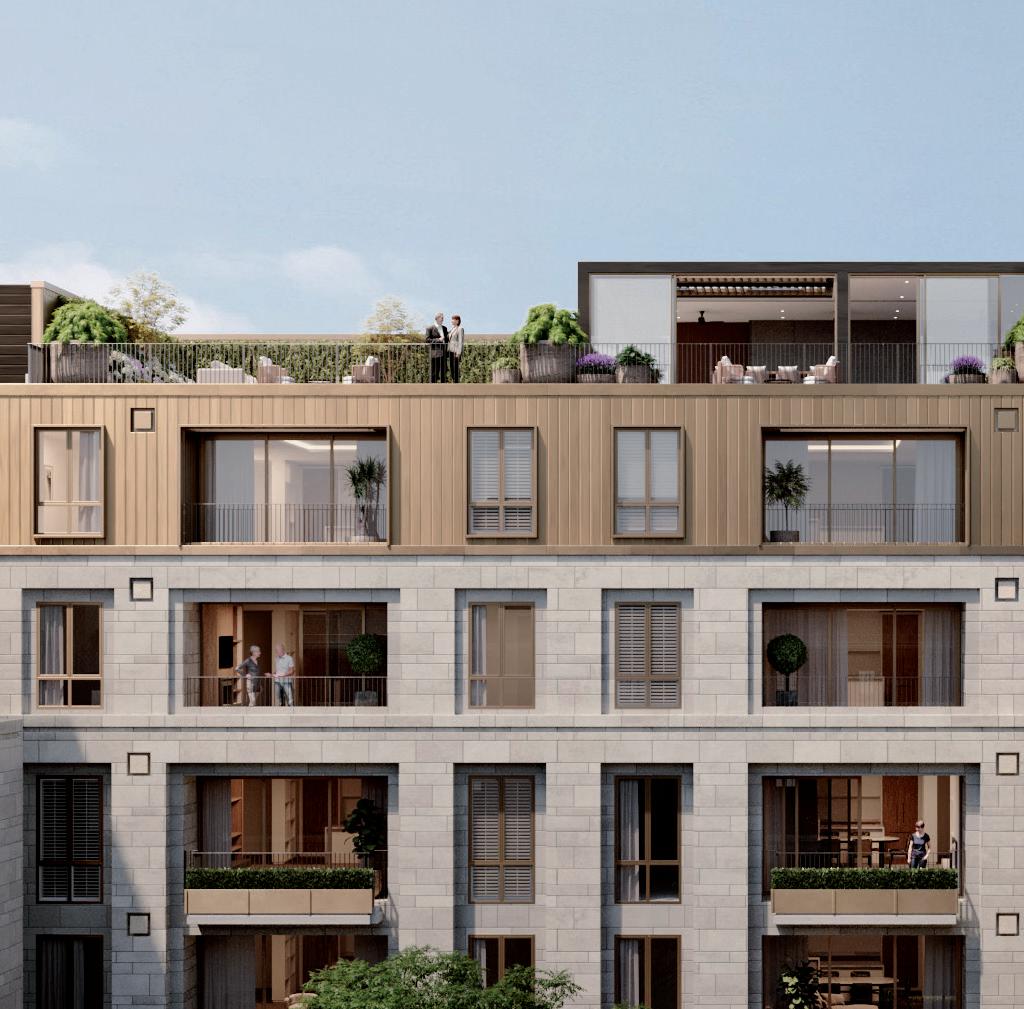
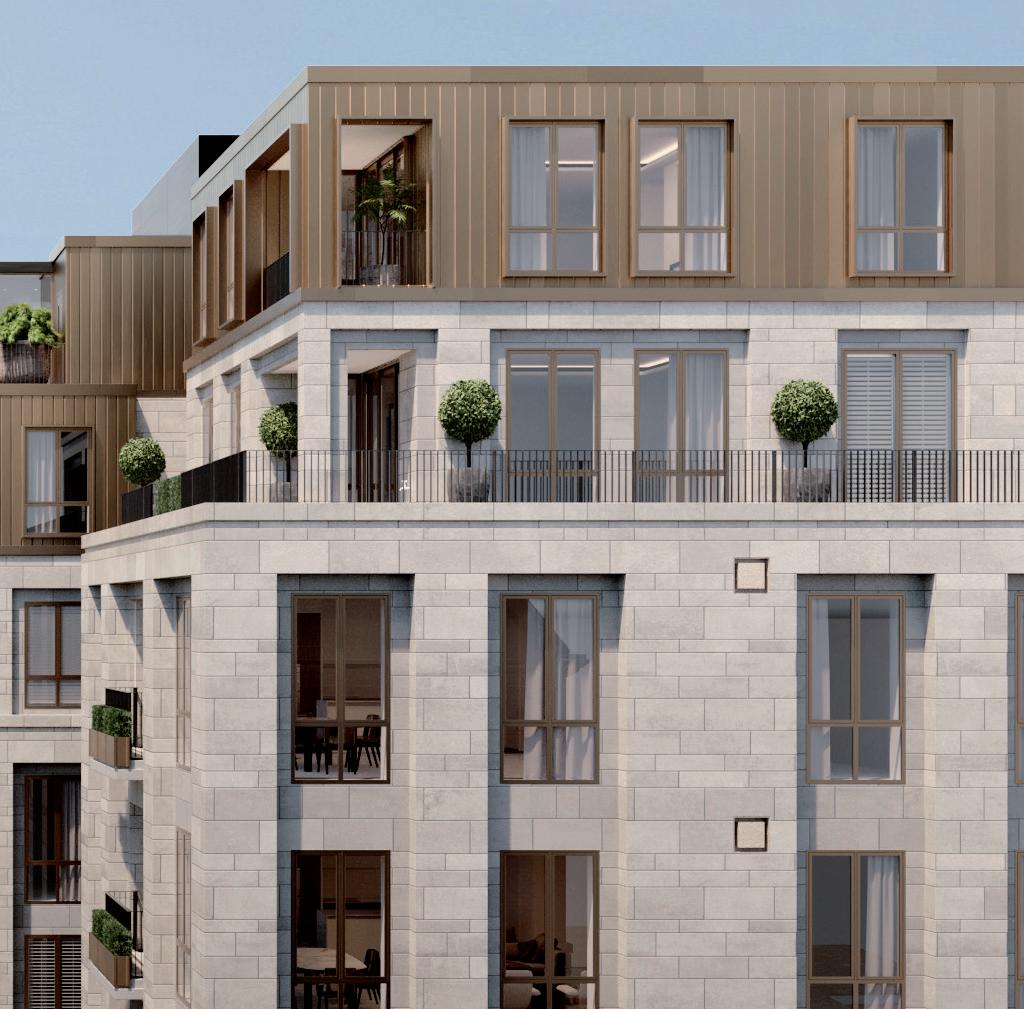
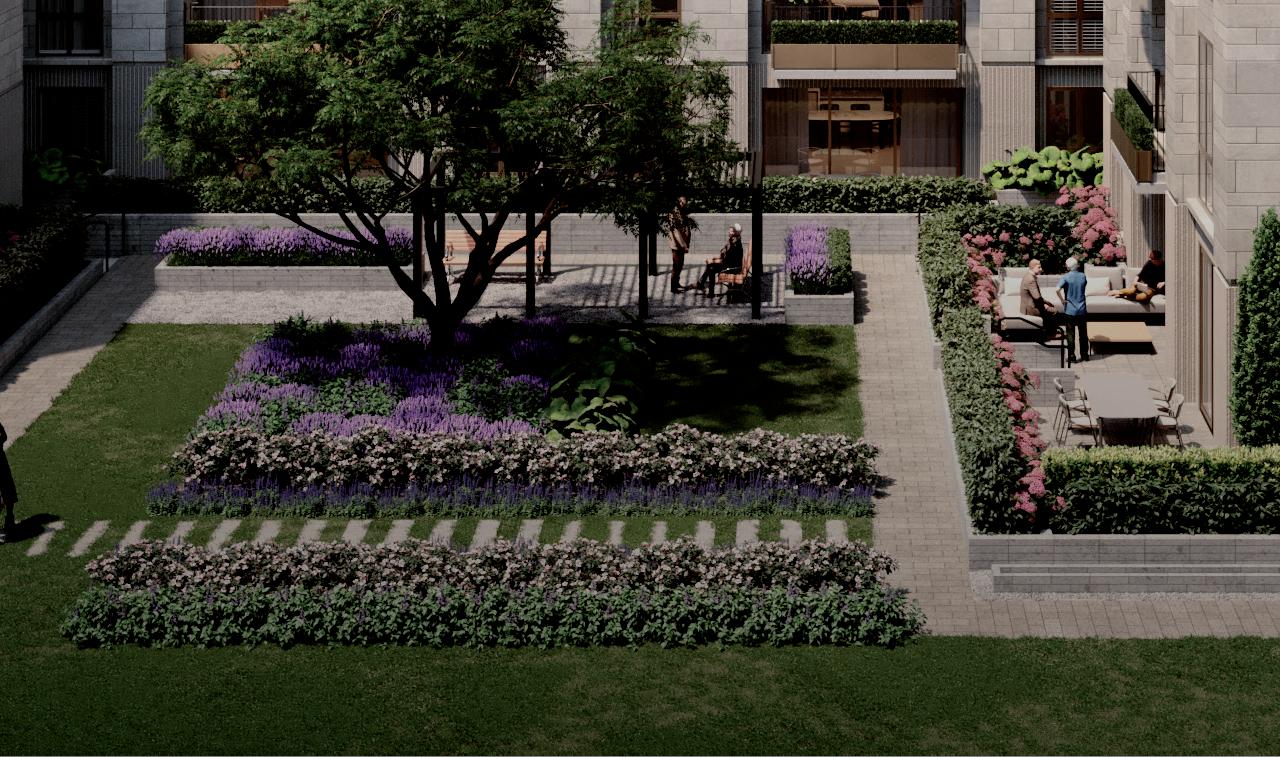
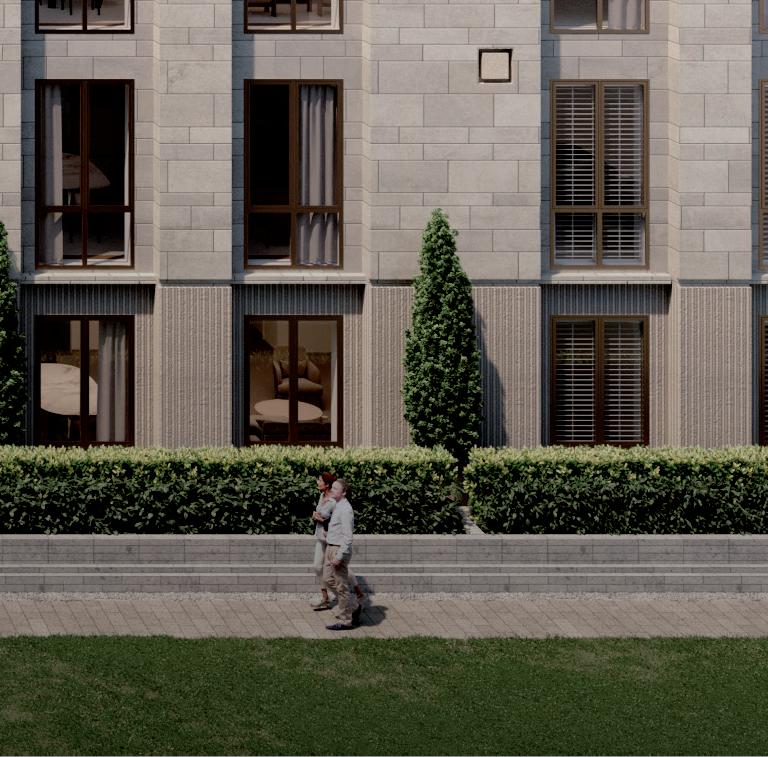
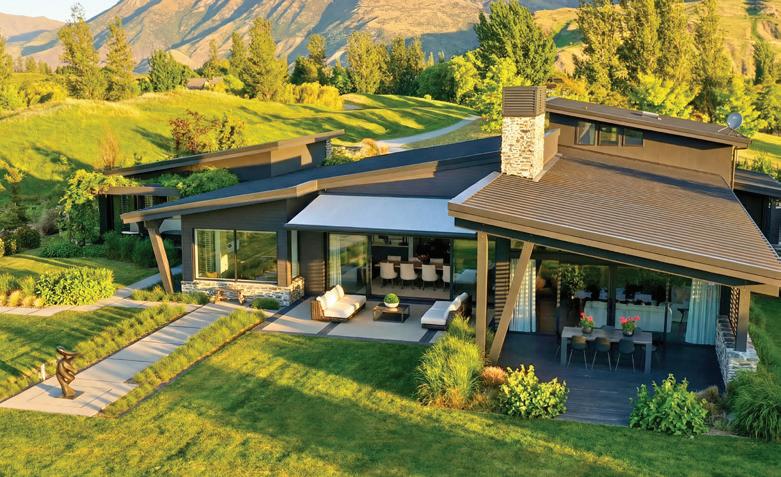
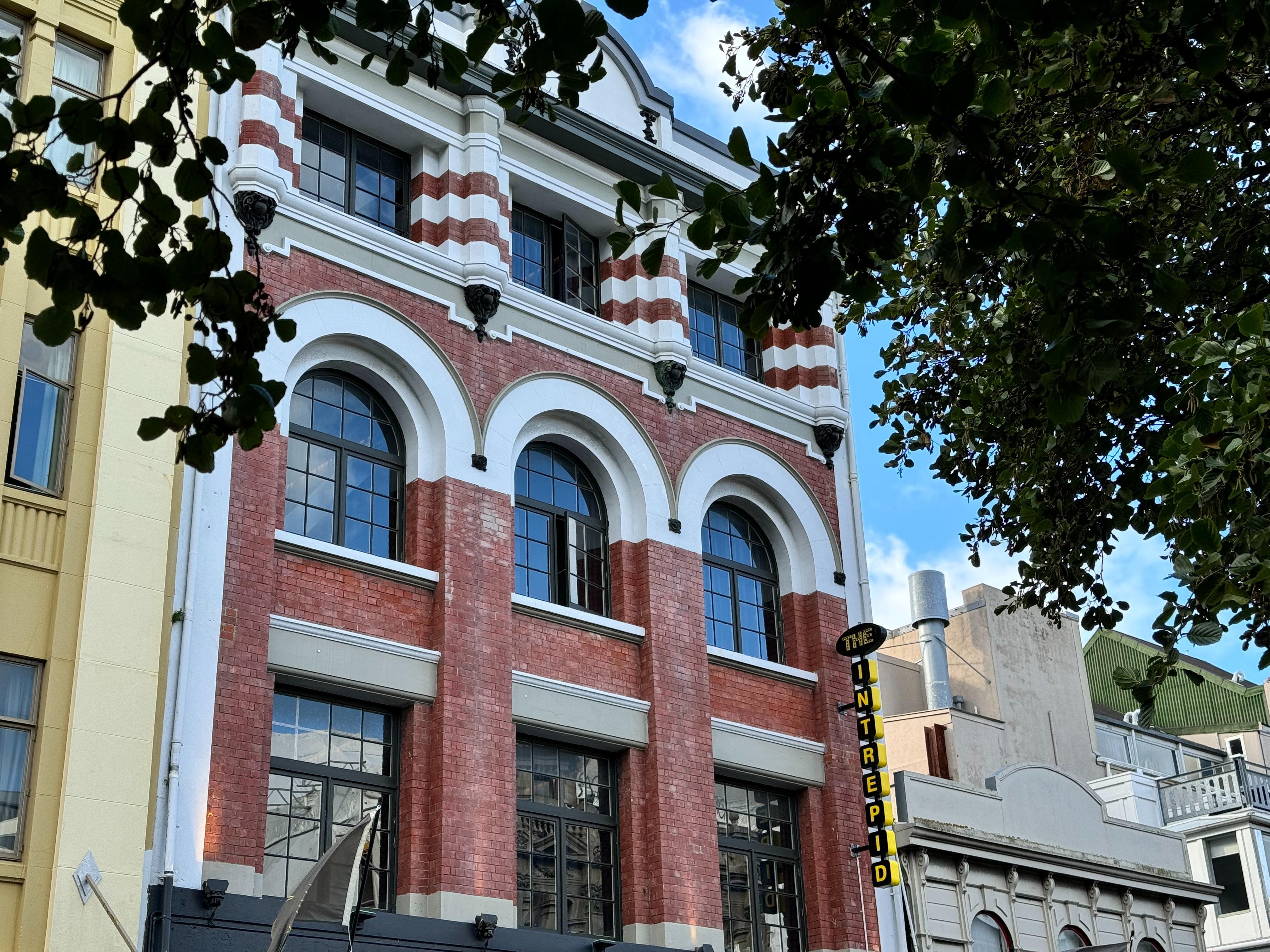
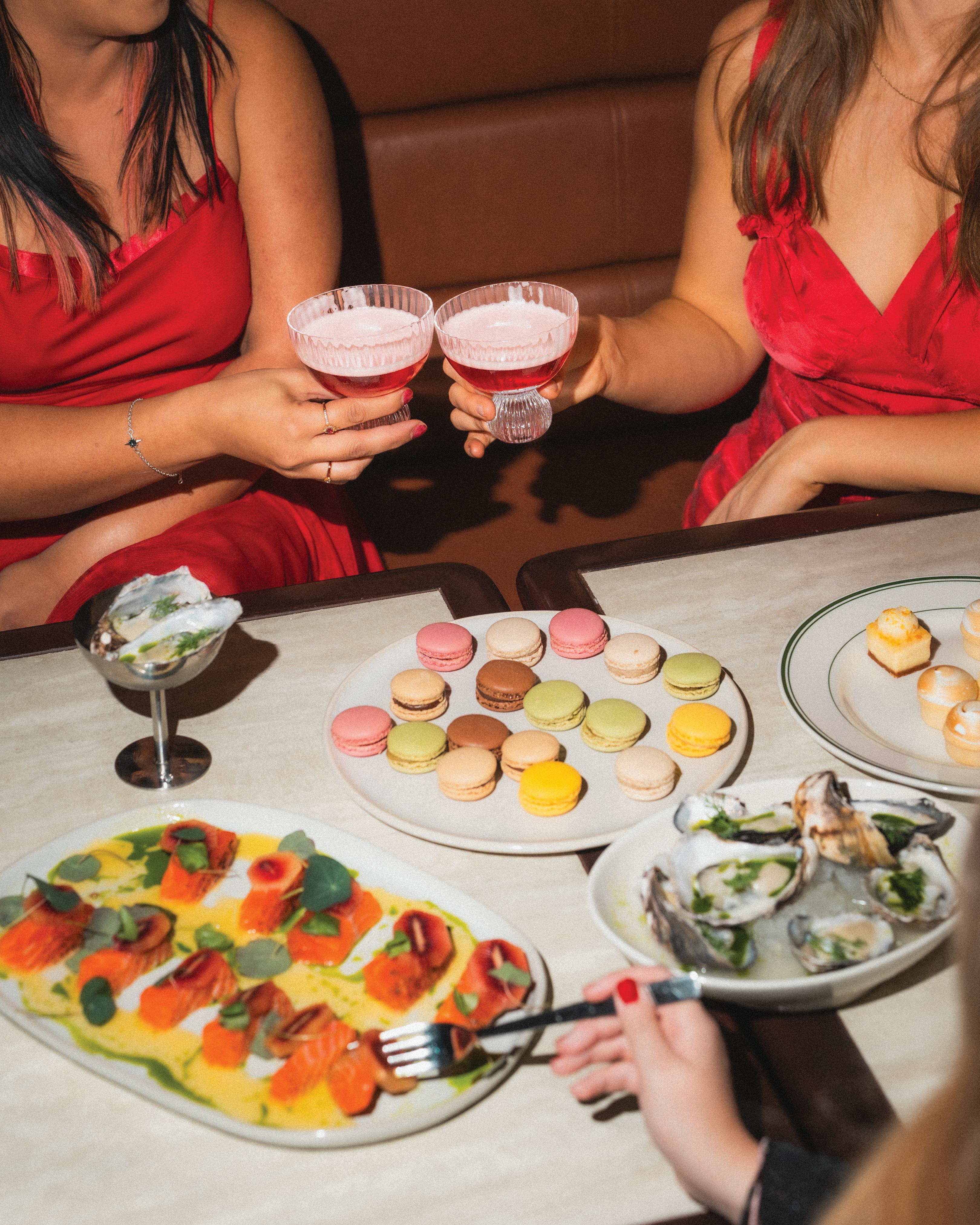
The Foundation is a place for you to enjoy your retirement years with security, vitality and community. Our latest stage of residences is now complete, with a new collection of apartments soon ready to call home.
The Foundation is a place for you to enjoy your retirement years with security, vitality and community. Our latest stage of residences is now complete, with a new collection of apartments soon ready to call home.
Our vision for The Foundation was to create a world class haven of refinement, sophistication and care for seniors - a place to feel energised, at home and rewarded in your later years.
Our vision for The Foundation was to create a world class haven of refinement, sophistication and care for seniors - a place to feel energised, at home and rewarded in your later years.
The Abbott Residences are now open, adding their own distinguished layer to this story. The show apartment is available to view by private appointment, offering a first look at these beautiful residences.
The Abbott Residences are now open, adding their own distinguished layer to this story. The show apartment is available to view by private appointment, offering a first look at these beautiful residences.
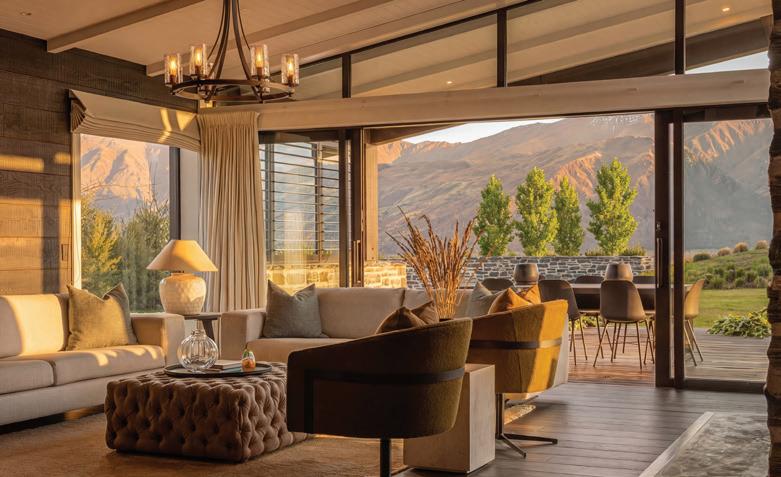
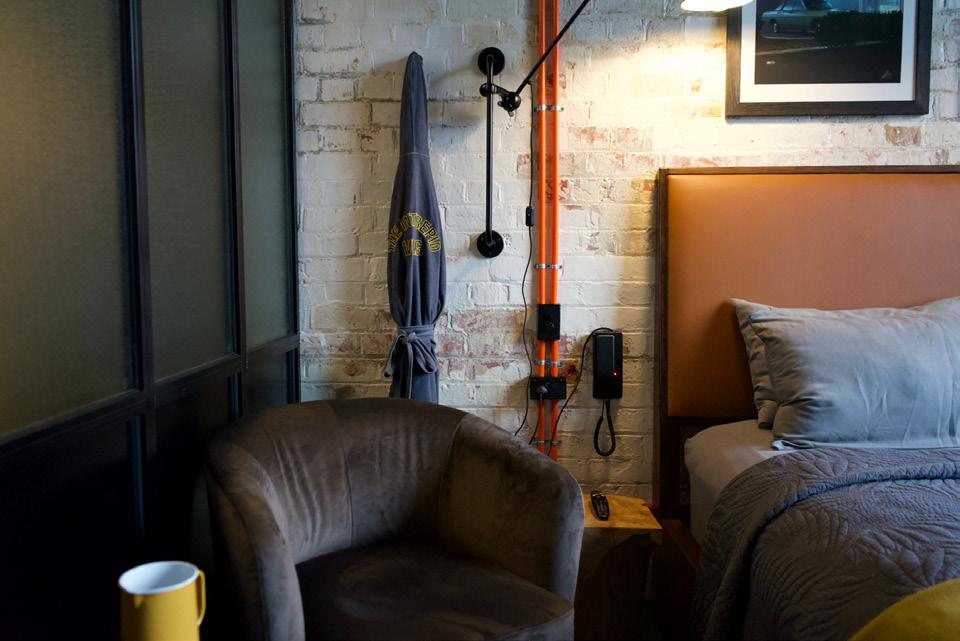
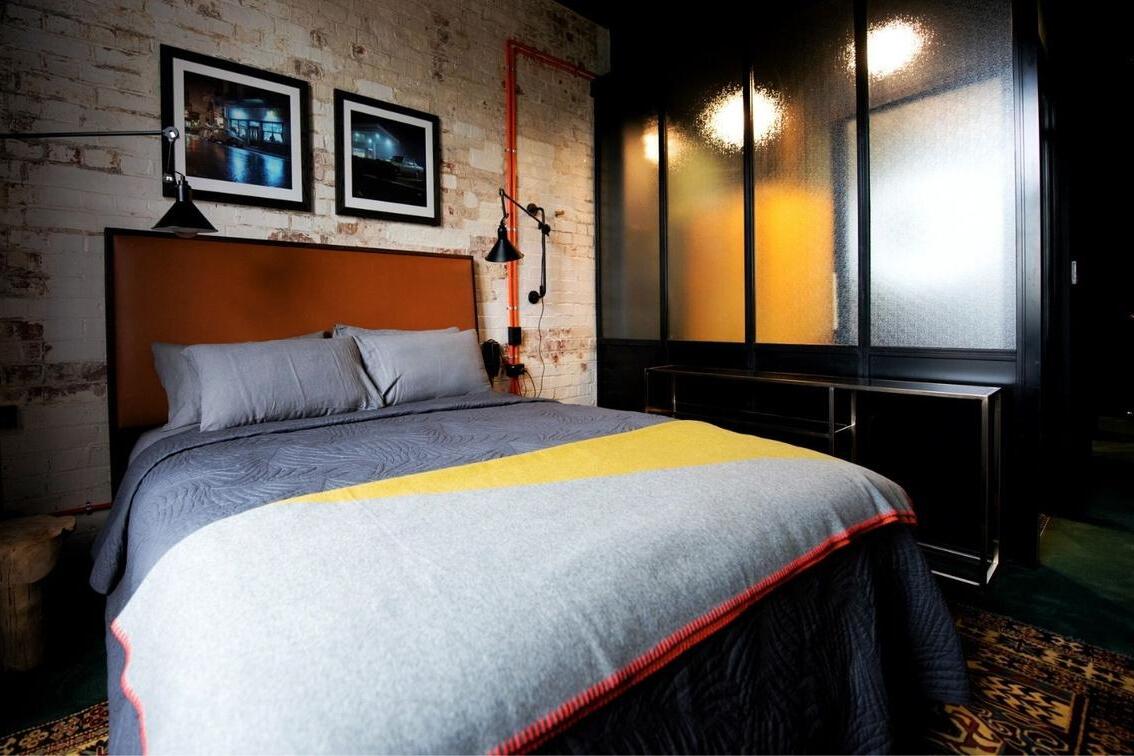
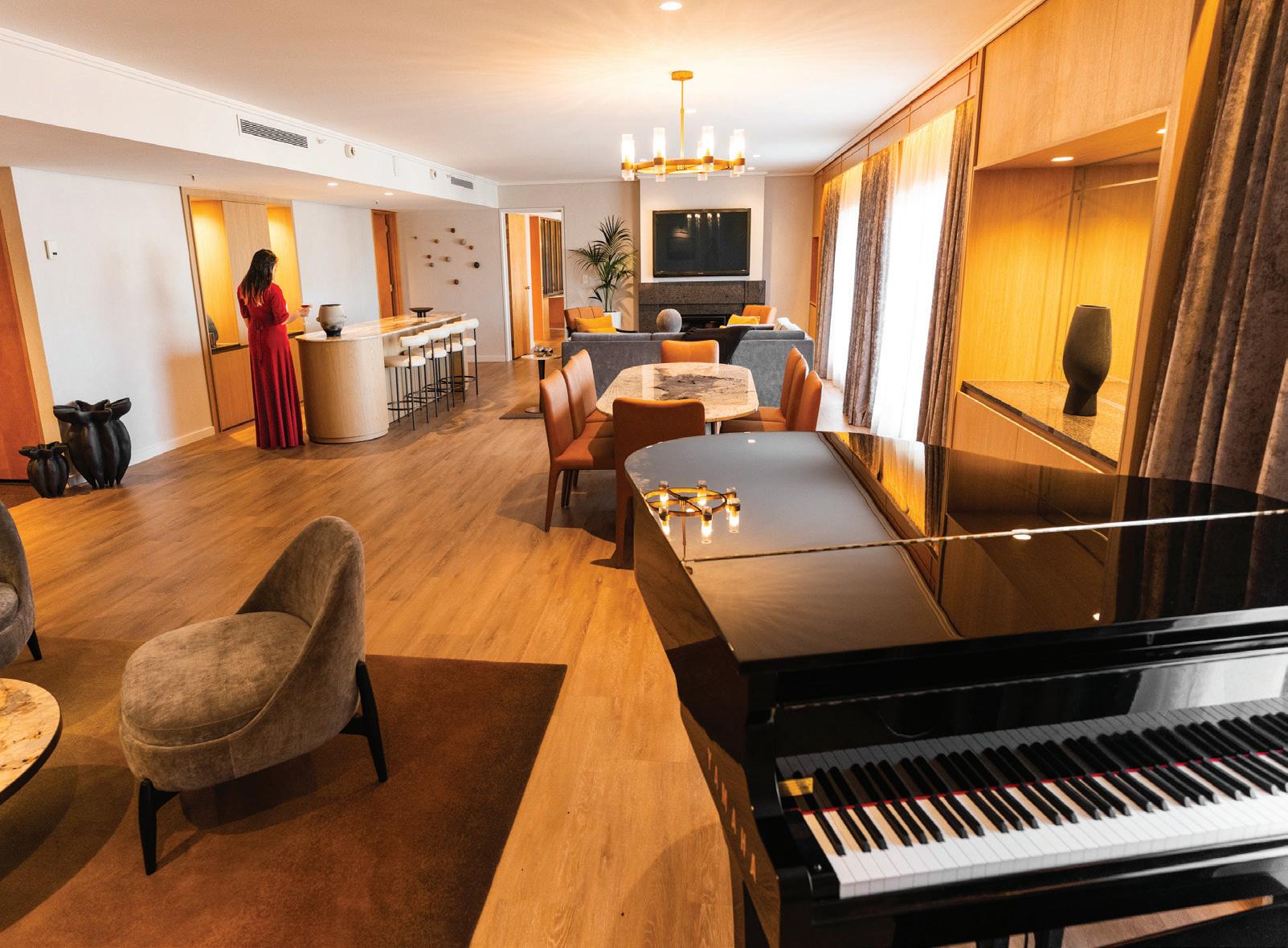
The one-, two-, and three-bedroom apartments combine classic design with contemporary finishes, creating a refined canvas for personal expression. Generously proportioned interiors feature full-height windows, double glazing, and high ceilings, enhancing natural light and a sense of space, while integrated airconditioning ensures comfort throughout the year.
The one-, two-, and three-bedroom apartments combine classic design with contemporary finishes, creating a refined canvas for personal expression. Generously proportioned interiors feature full-height windows, double glazing, and high ceilings, enhancing natural light and a sense of space, while integrated airconditioning ensures comfort throughout the year.
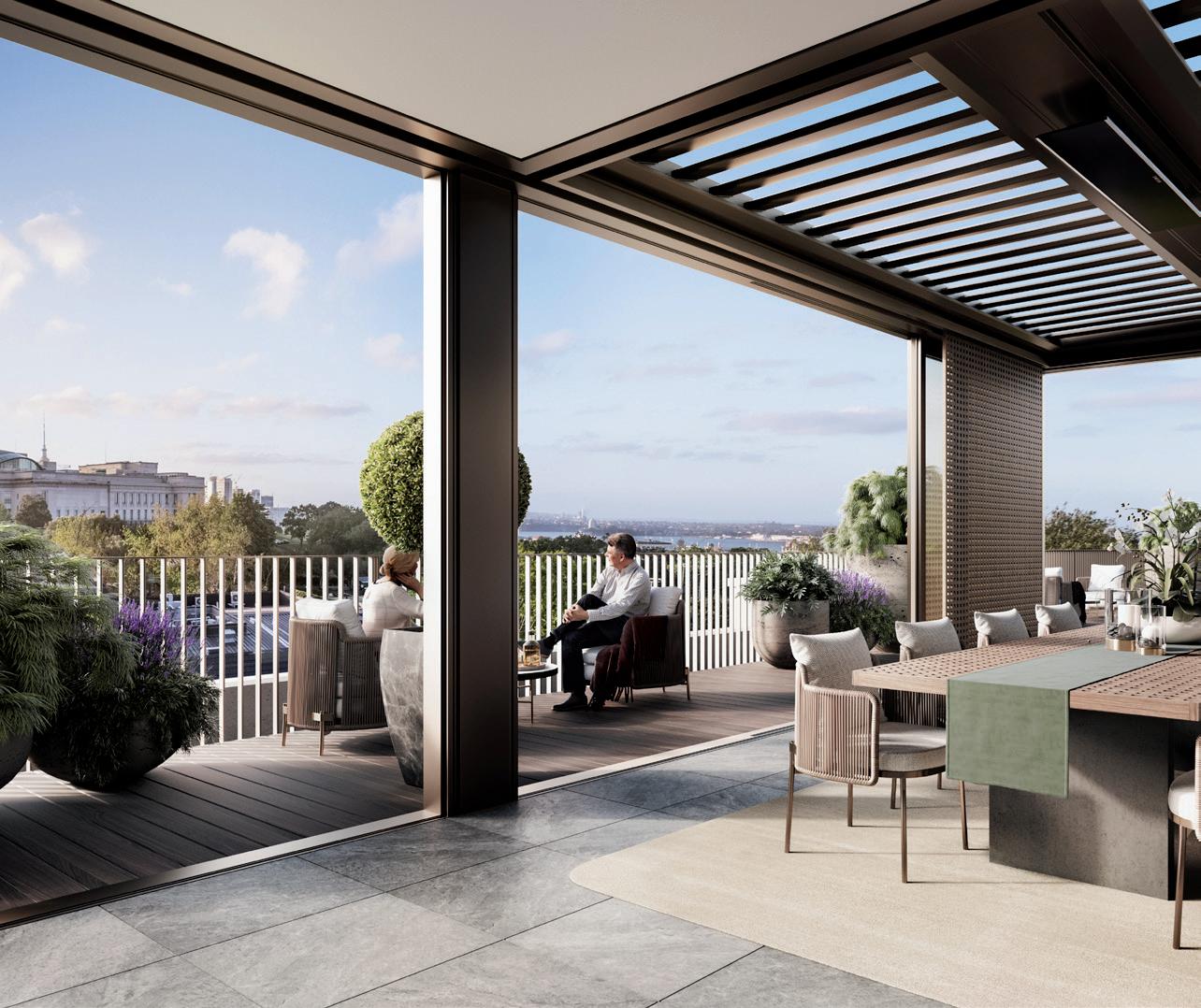
Atop of Abbott Residences, residents can enjoy a rooftop terrace with expansive views of the city and harbour.
Atop of Abbott Residences, residents can enjoy a rooftop terrace with expansive views of the city and harbour.
Chef’s kitchens, sculleries, and full laundry rooms support a practical, clutter-free lifestyle with every detail carefully considered to elevate daily living. Stateof-the-art security has also been a priority in the design with secure underground parking and keyless entry.
Chef’s kitchens, sculleries, and full laundry rooms support a practical, clutter-free lifestyle with every detail carefully considered to elevate daily living. Stateof-the-art security has also been a priority in the design with secure underground parking and keyless entry.
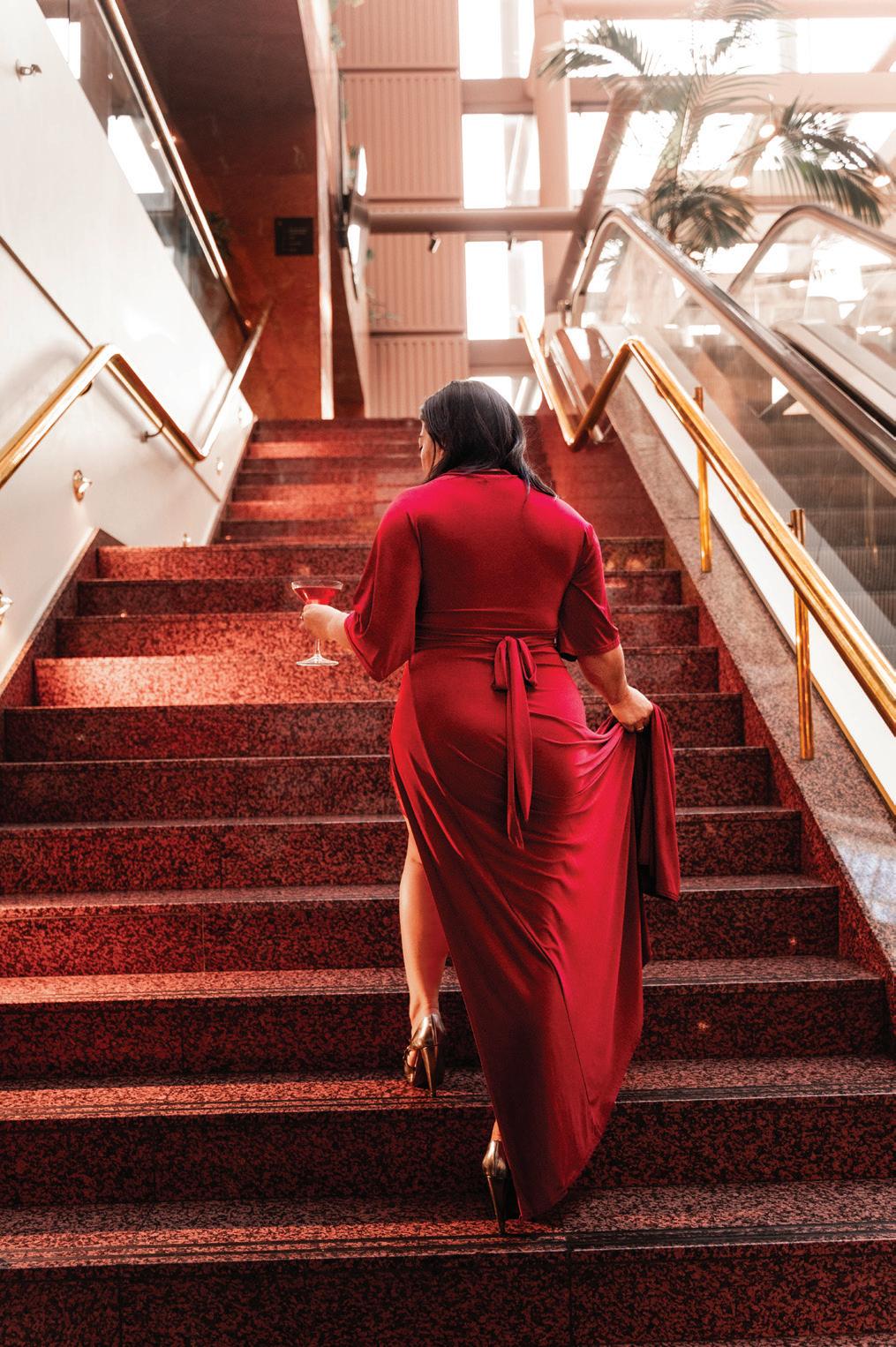
An elevated sanctuary serves as the perfect backdrop for sunset drinks, casual gatherings, or quiet moments of reflection.
An elevated sanctuary serves as the perfect backdrop for sunset drinks, casual gatherings, or quiet moments of reflection.
Generus Living, the group behind The Foundation, has been deliberate in crafting an environment where every detail counts. This meticulous attention is what ensures the precinct isn’t just beautiful, but deeply liveable, too.
Generus Living, the group behind The Foundation, has been deliberate in crafting an environment where every detail counts. This meticulous attention is what ensures the precinct isn’t just beautiful, but deeply liveable, too.
Contact us today to book a private tour of the show apartment and experience The Foundation’s immense potential first-hand.
Contact us today to book a private tour of the show apartment and experience The Foundation’s immense potential first-hand.
Apartments priced from $1,825,000.
Apartments priced from $1,825,000.
541 Parnell Road, Parnell, Auckland
541 Parnell Road, Parnell, Auckland
Tel: 09 869 3947
Tel: 09 869 3947
Web: thefoundationvillage.co.nz
Web: thefoundationvillage.co.nz
Here to help
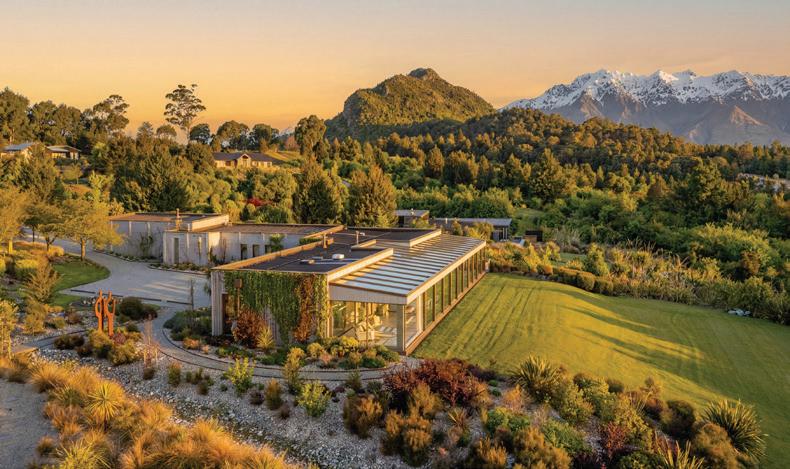
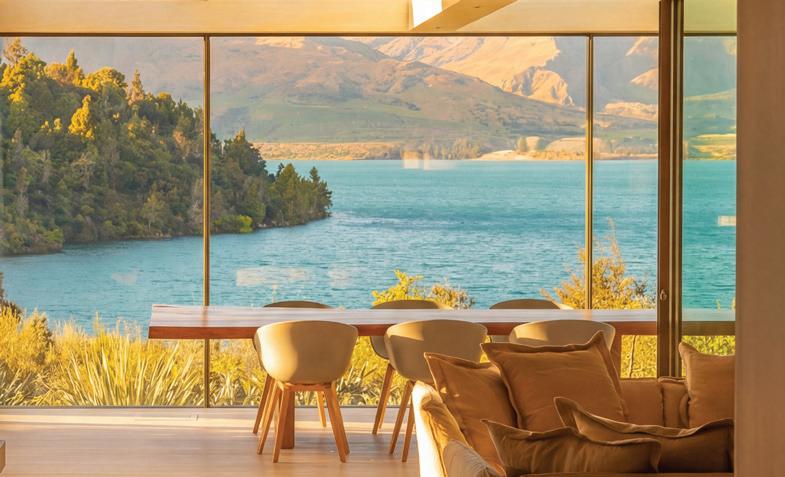
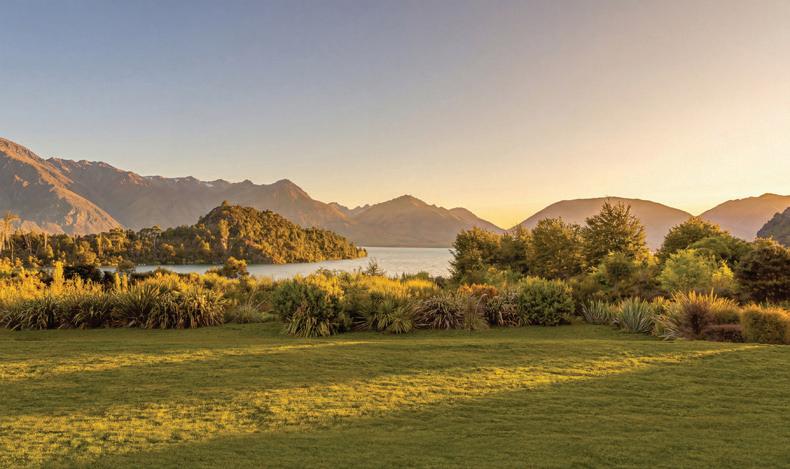
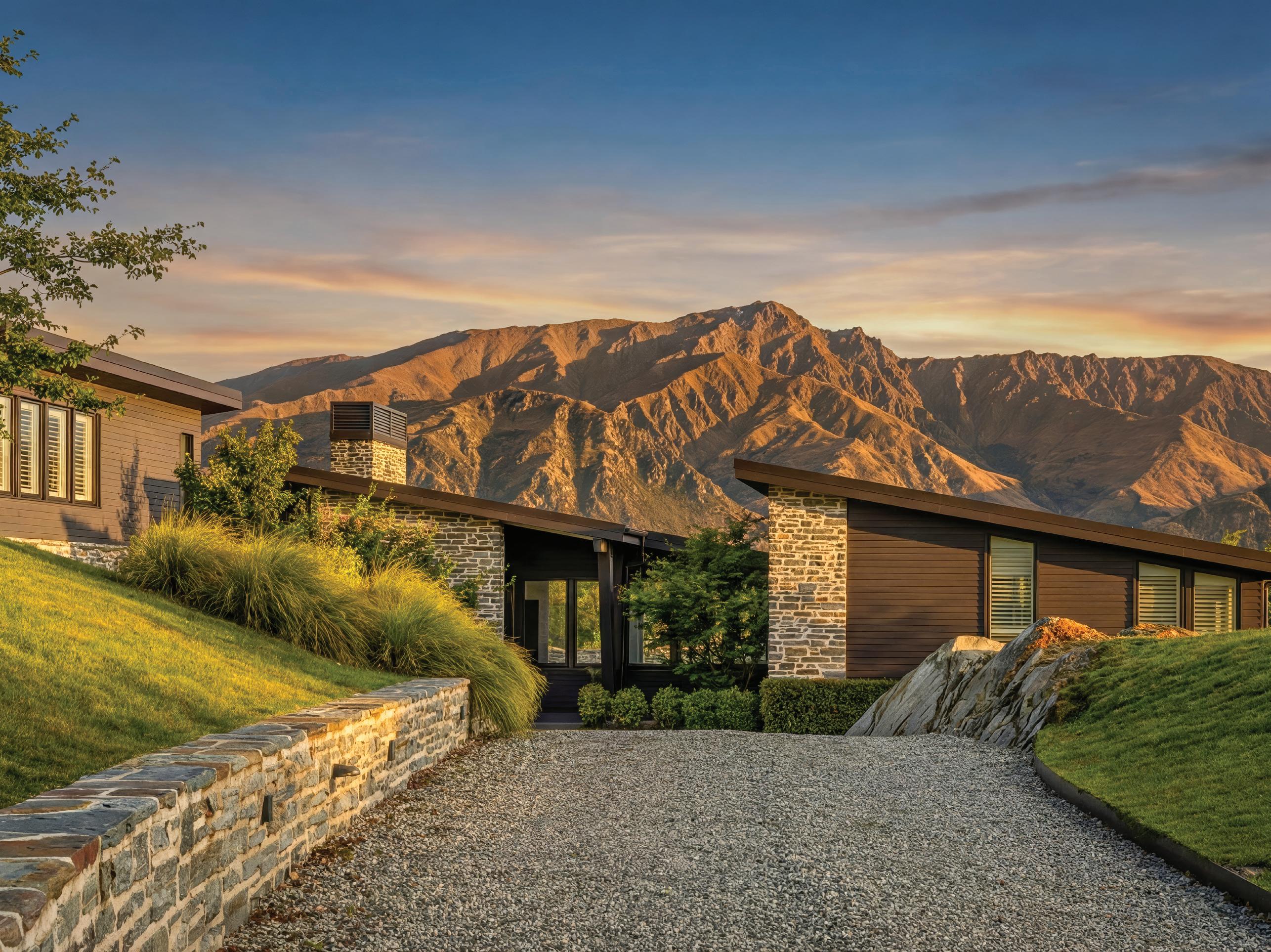
THE LAKE HOUSE
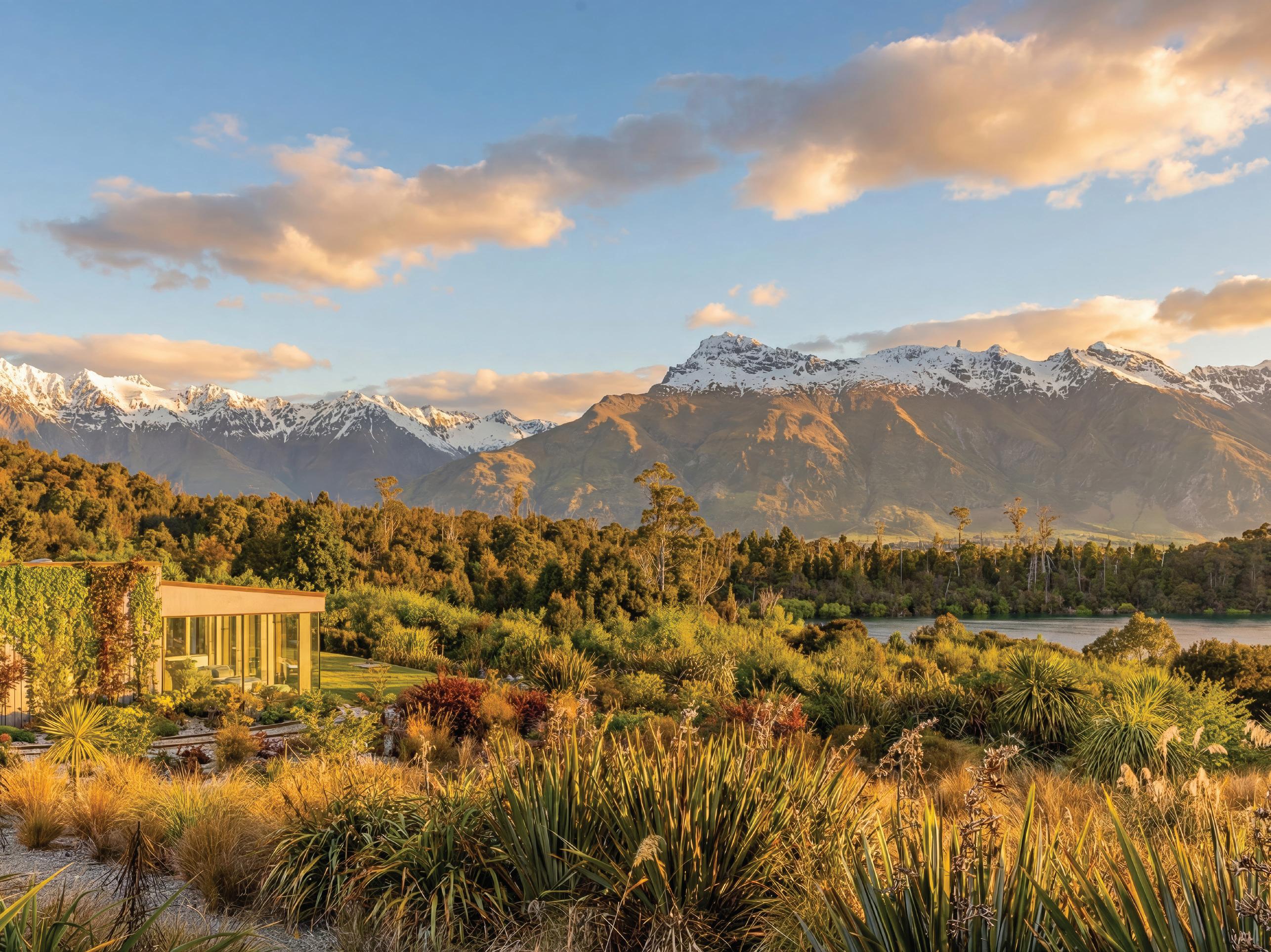
Designed in collaboration with London-based architect Alex Wilcock and built to exacting standards by Triple Star Construction, the home is a careful composition of proportion, material and view. The result is refined, quietly theatrical architecture that never shouts, it simply draws you to the water and lets the light do the talking.
Calming and connecting colours for 2026
GRAND MILLENNIUM SUITE CHARITY BALL
Saturday 1st August, 6.30pm - 9.30pm
SCAN QR CODE FOR BALL TICKETS
A BLACK TIE EVENING OF BATCHED COCKTAILS & CANAPES
Easy entertaining – Sabato style
Come and visit our store before, or after, your next Webb’s viewing. We are conveniently located, virtually next door, and open 7 days.
Publishing Details
printer
Crucial Colour 24 Fairfax Avenue
Penrose Auckland 1061
Publishing Contacts
Edition of 1,700 Offset printed, 152 pages 113gsm Matt Art 100gsm Laser Offset
Freely distributed to subscribers or available at select public art spaces and hospitality venues.
Paul Evans Managing Director paul@webbs.co.nz +64 21 866 000
Lily McCowan Specialist, Art Online lily@webbs.co.nz +64 22 068 4932
Mia Foulds Pre-Sale Coordinator, Art mia@webbs.co.nz +64 9 529 5609
Stephanie Arrowsmith Administrator, Art art@webbs.co.nz +64 9 529 5609
Charles Tongue Valuations Specialist valuations@webbs.co.nz +64 22 406 5514
Mark Hutchins-Pond Senior Specialist, Art mark@webbs.co.nz +64 22 095 5610
Sophie Thorn Specialist, Art sophie@webbs.co.nz +64 9 529 5609
Virginia Woods-Jack Exhibitions Manager virginia@webbs.co.nz +64 22 679 8664
Sean Duxfield Senior Specialist, Art sean@webbs.co.nz +64 21 053 6504
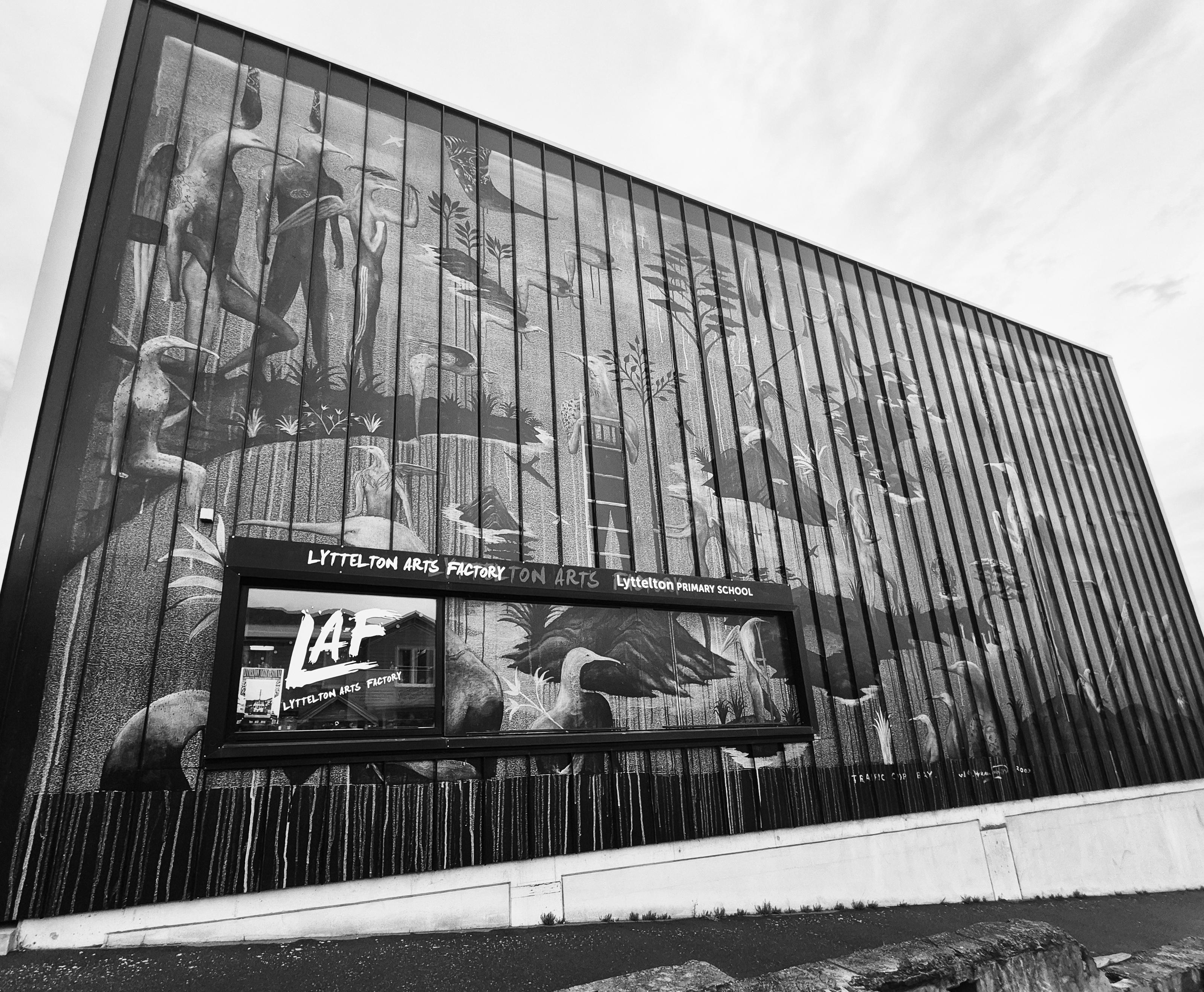
The iconic mural, Traffic Cop Bay (2003), by Bill Hammond spans the Lyttelton Arts Factory (LAF) façade, overlooking the artist's hometown harbour. Initiated during Hammond's lifetime and supported by patron Jane McBride, this ambitious project brings the iconic seascape from the Te Papa Tongarewa Museum of New Zealand collection into public view through a collaborative community effort. The LAF is a venue supporting creatives across all facets of the arts in the Lyttelton community.
laf.co.nz
1 Sumner Road, Lyttelton 8082
List of Essays
Works of Art
—Entries Invited
Webb's is pleased to be inviting consignments into the upcoming Works of Art Live Auction, with early entries already pointing to a catalogue of considerable depth and range.
The catalogue is shaping up as a compelling survey of Aotearoa New Zealand's visual culture, with many multi-disciplinary works.
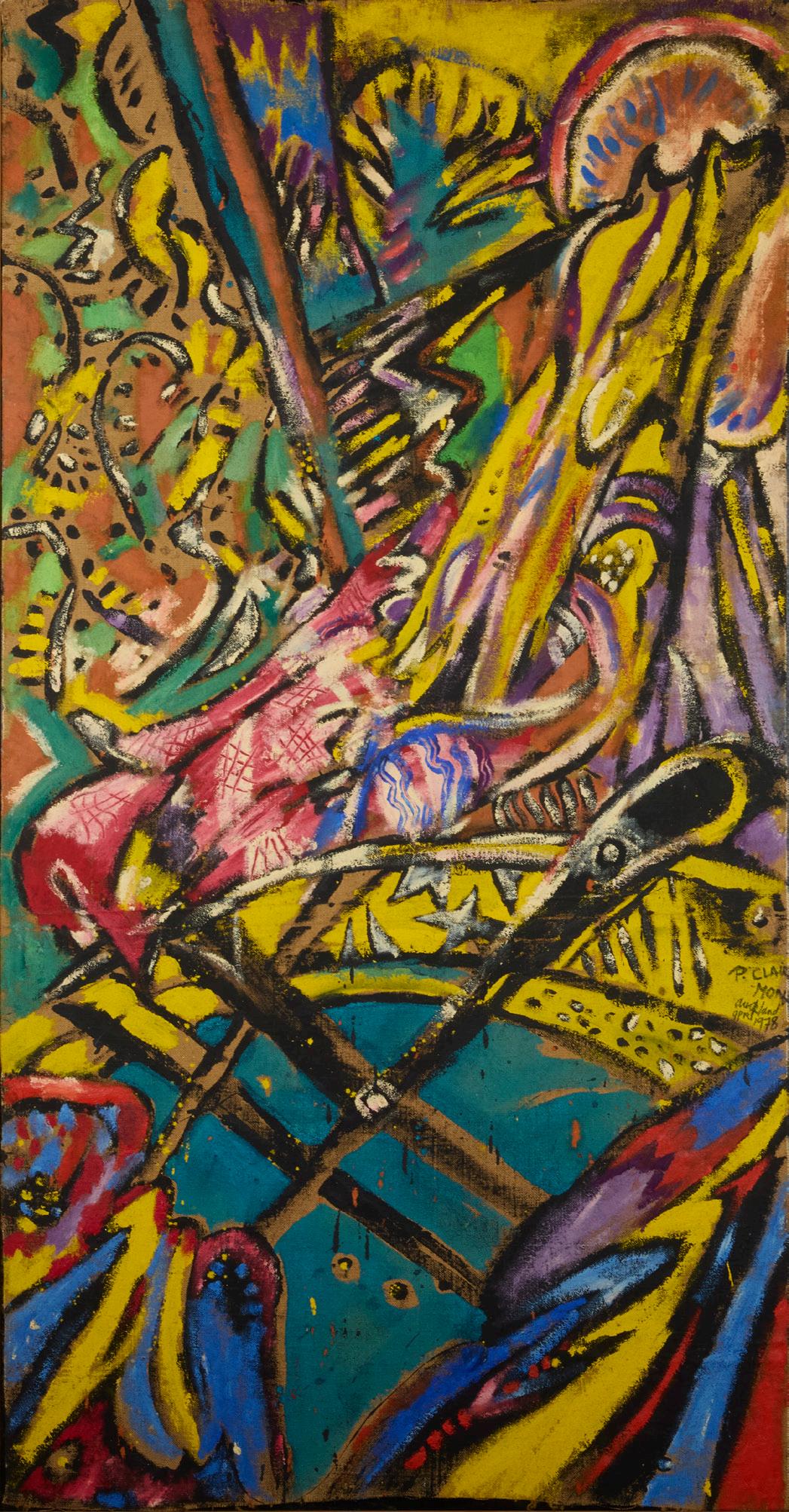
Philip Clairmont's The Folding Chair (1978) is among the most significant works to be offered: a monumental oil on jute canvas, it exemplifies the raw psychological intensity that defines his practice.
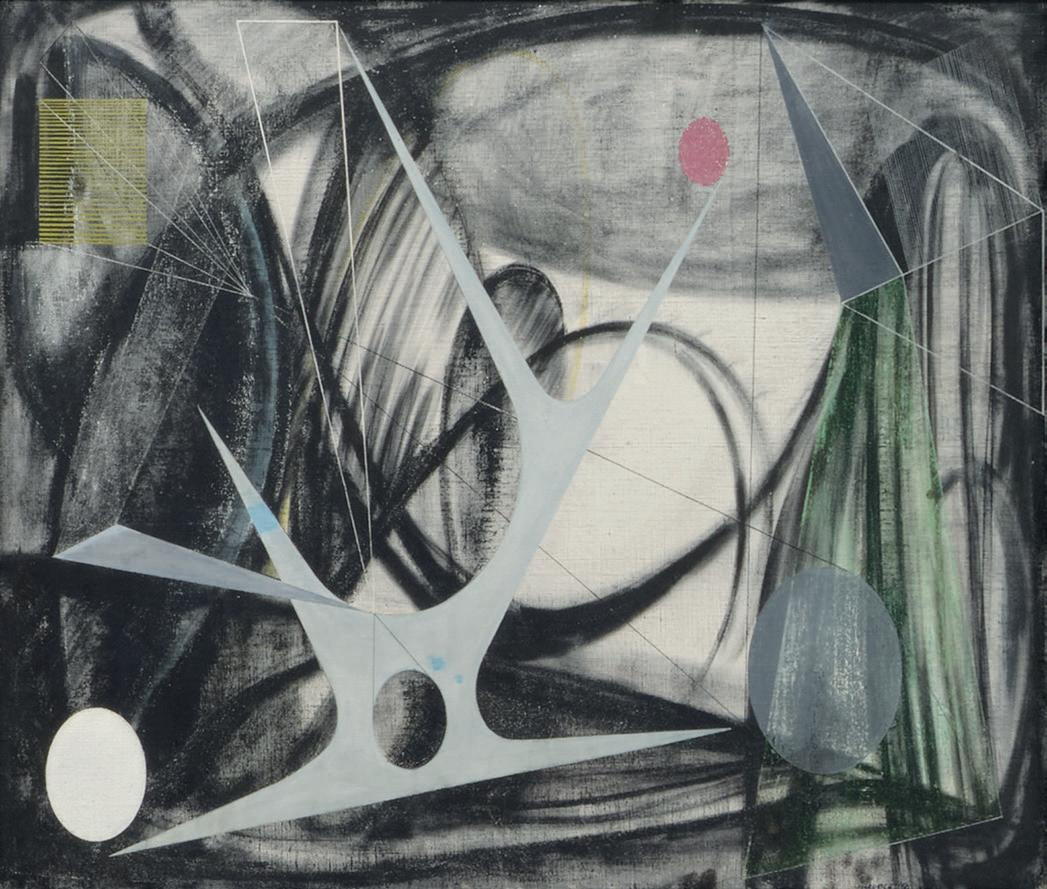
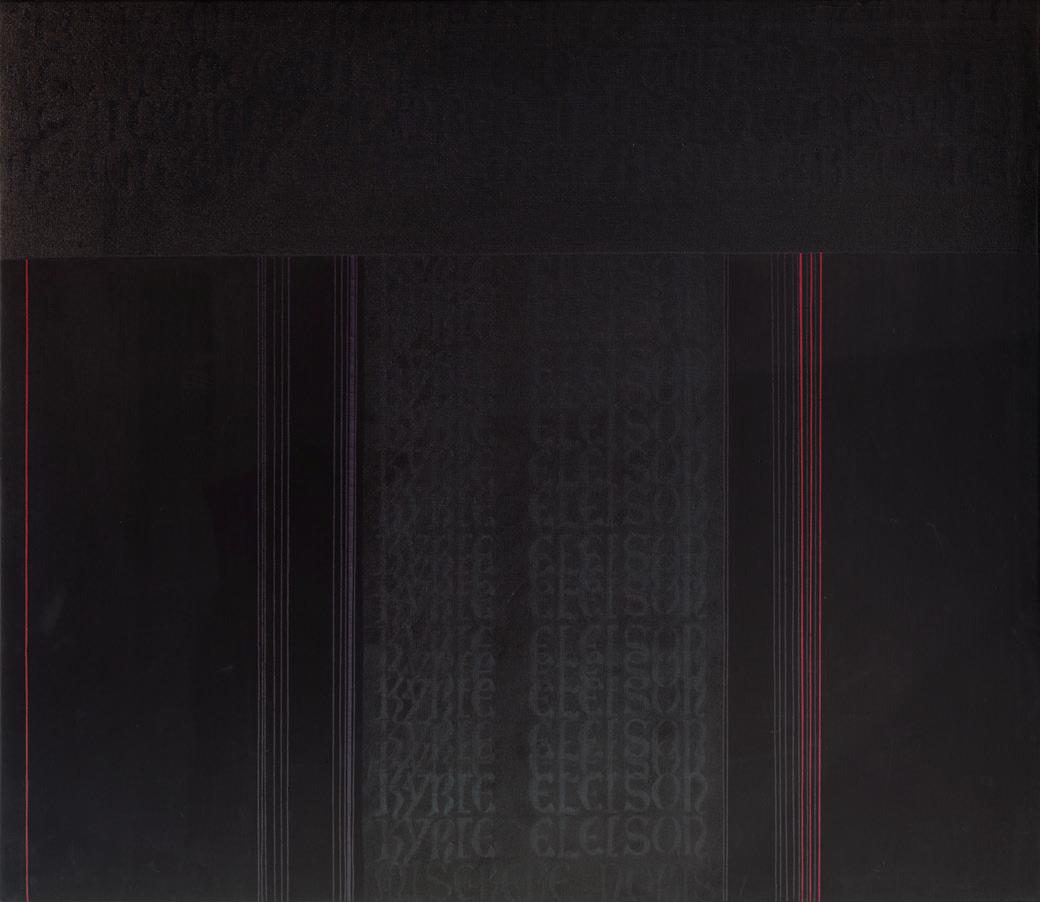
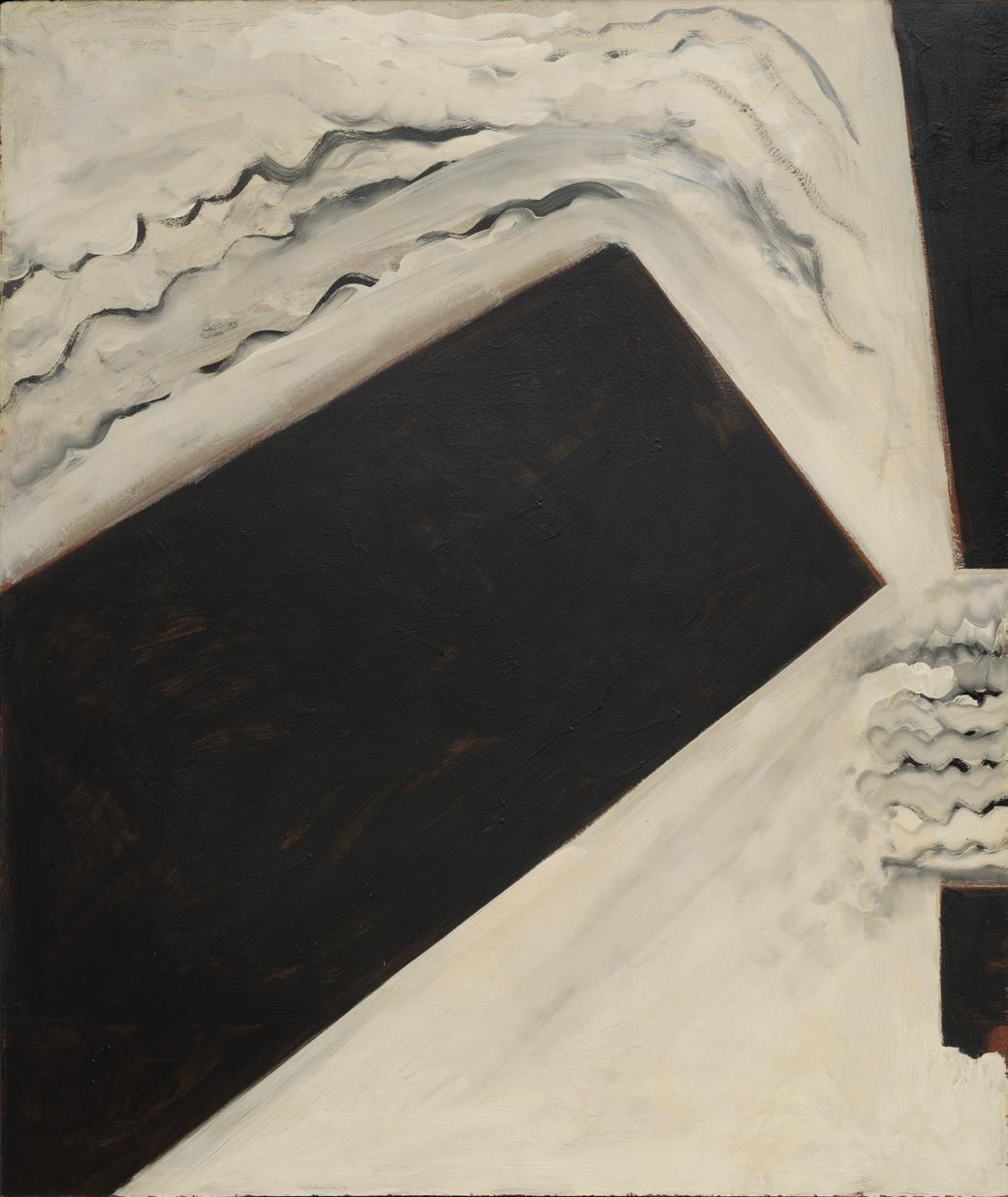
Milan Mrkusich's Painting with Blue Shape, an early example of his disciplined modernist abstraction offers a counterpoint in its restraint and formal rigour.
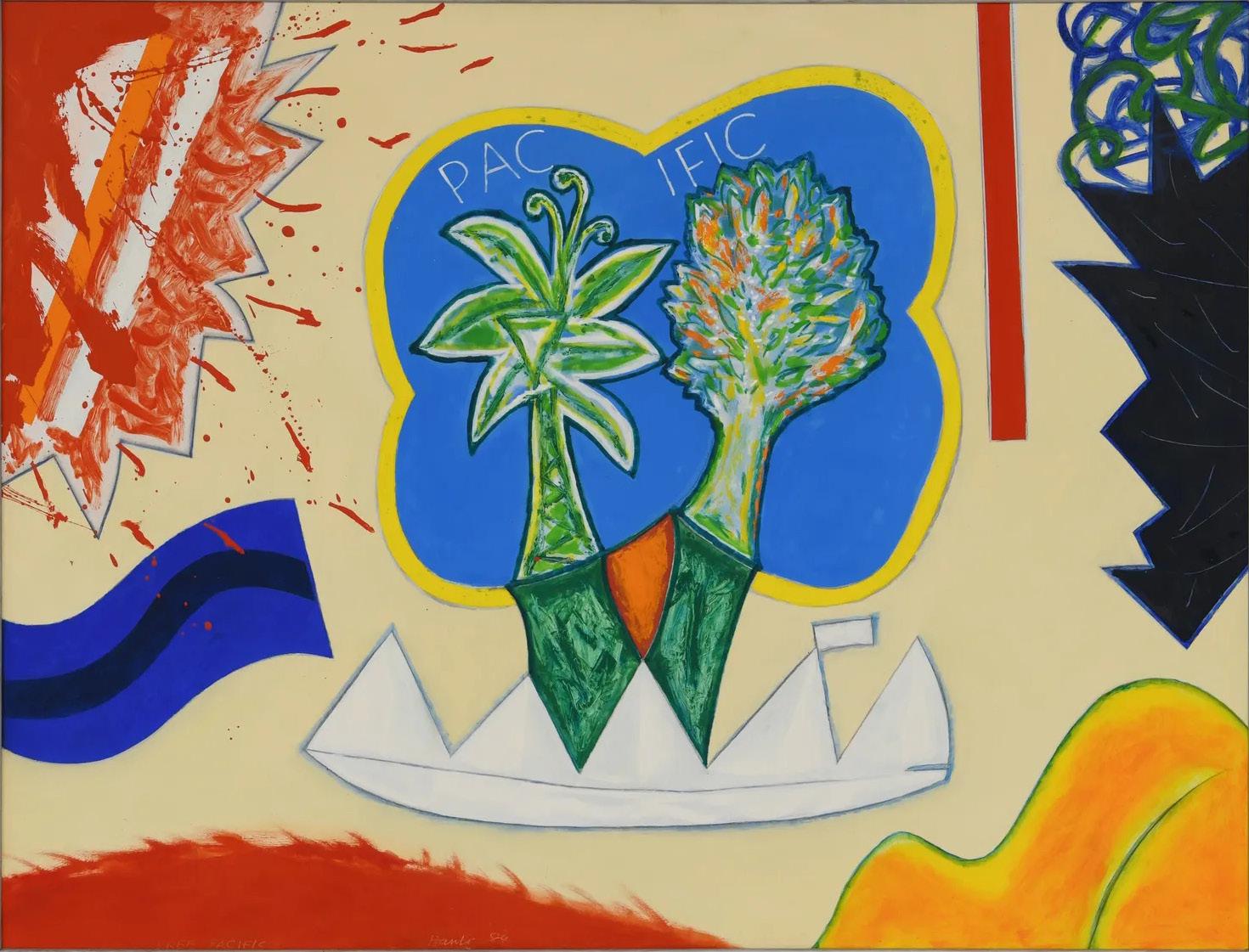
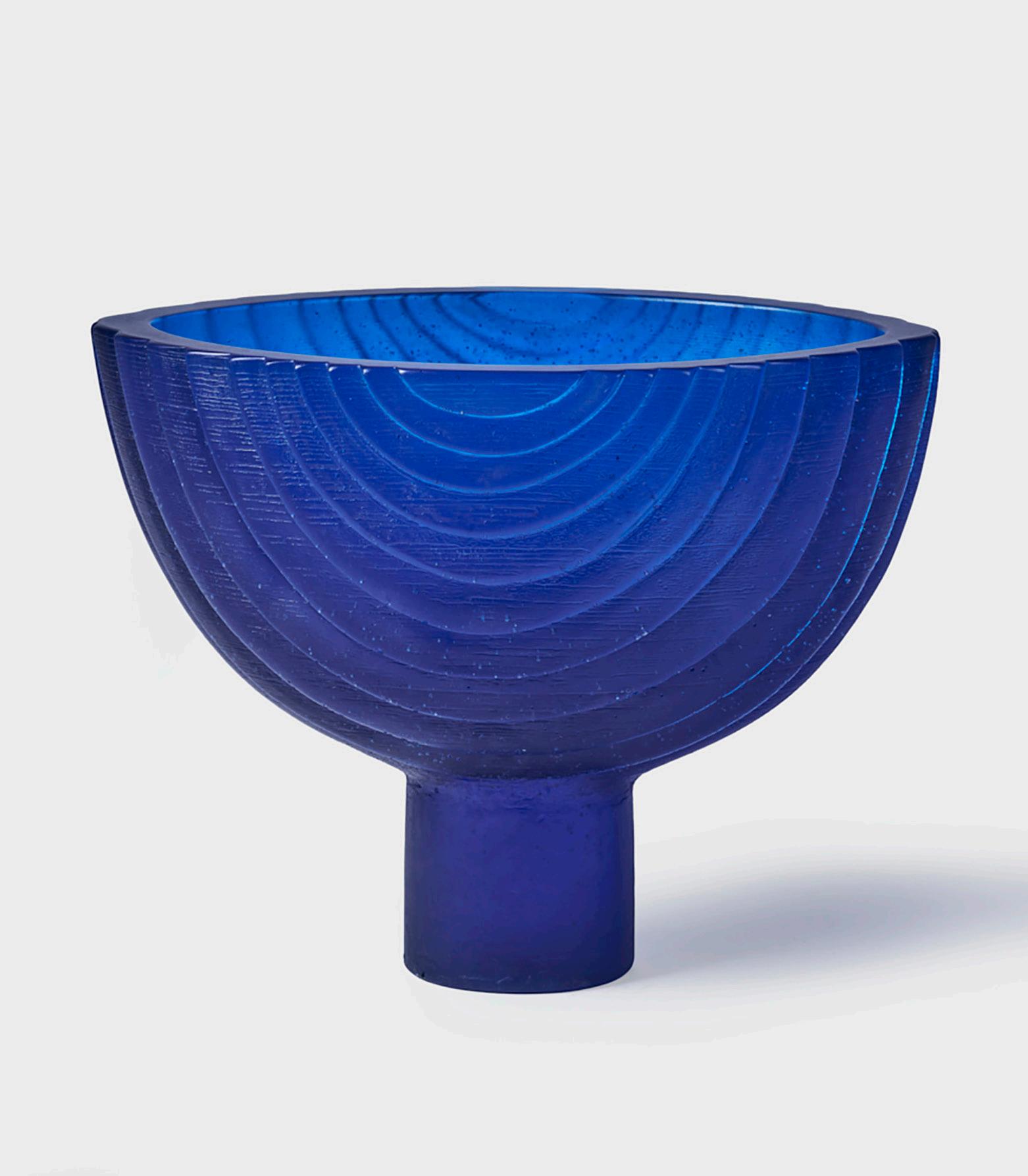
Meanwhile, Ann Robinson's untitled cast glass work represents one of New Zealand's most distinctive studio glass artists. As well as Pat Hanly’s Free Pacific, a vibrant and powerful statement of hope, resistance and national identity, using bold colour and abstract forms to celebrate Aotearoa’s spirit and cultural freedom.
Works of Art is the premier live auction for museum-quality and investment-level art in New Zealand, presented alongside nationwide exhibitions and supported by the full depth of our specialist team.
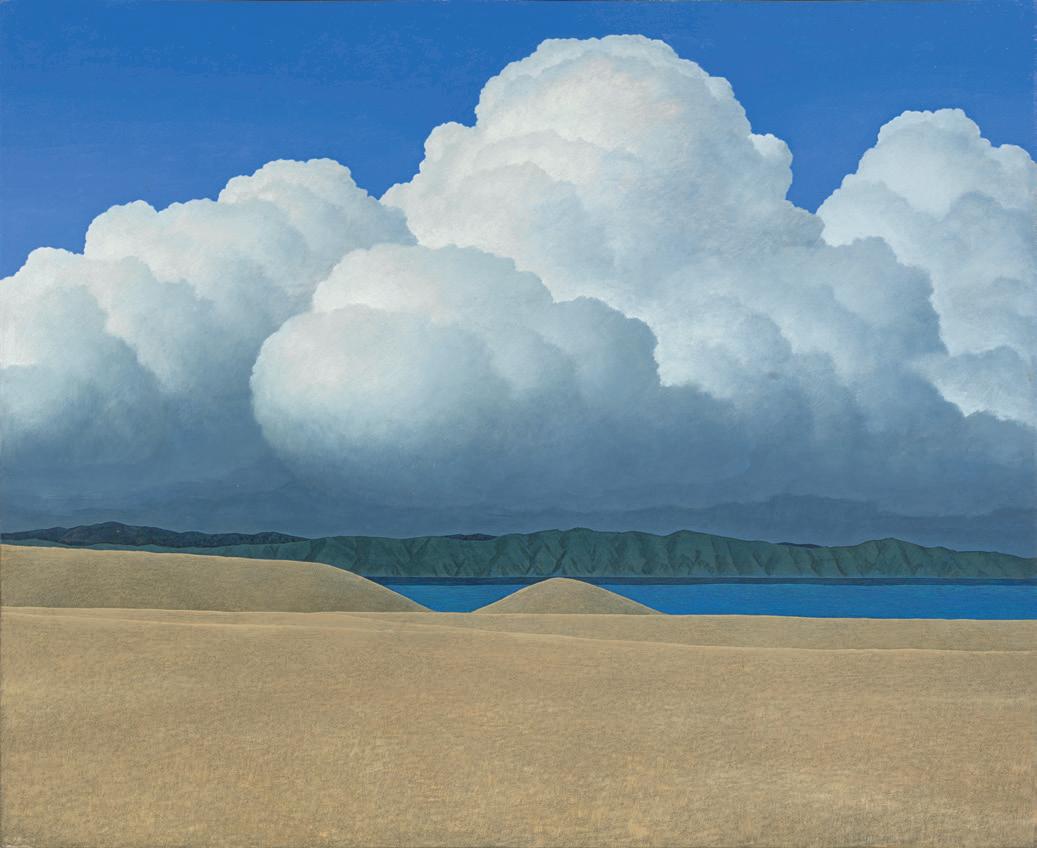
Brent Wong, Coal, 1974, acrylic on board, 560 × 685mm
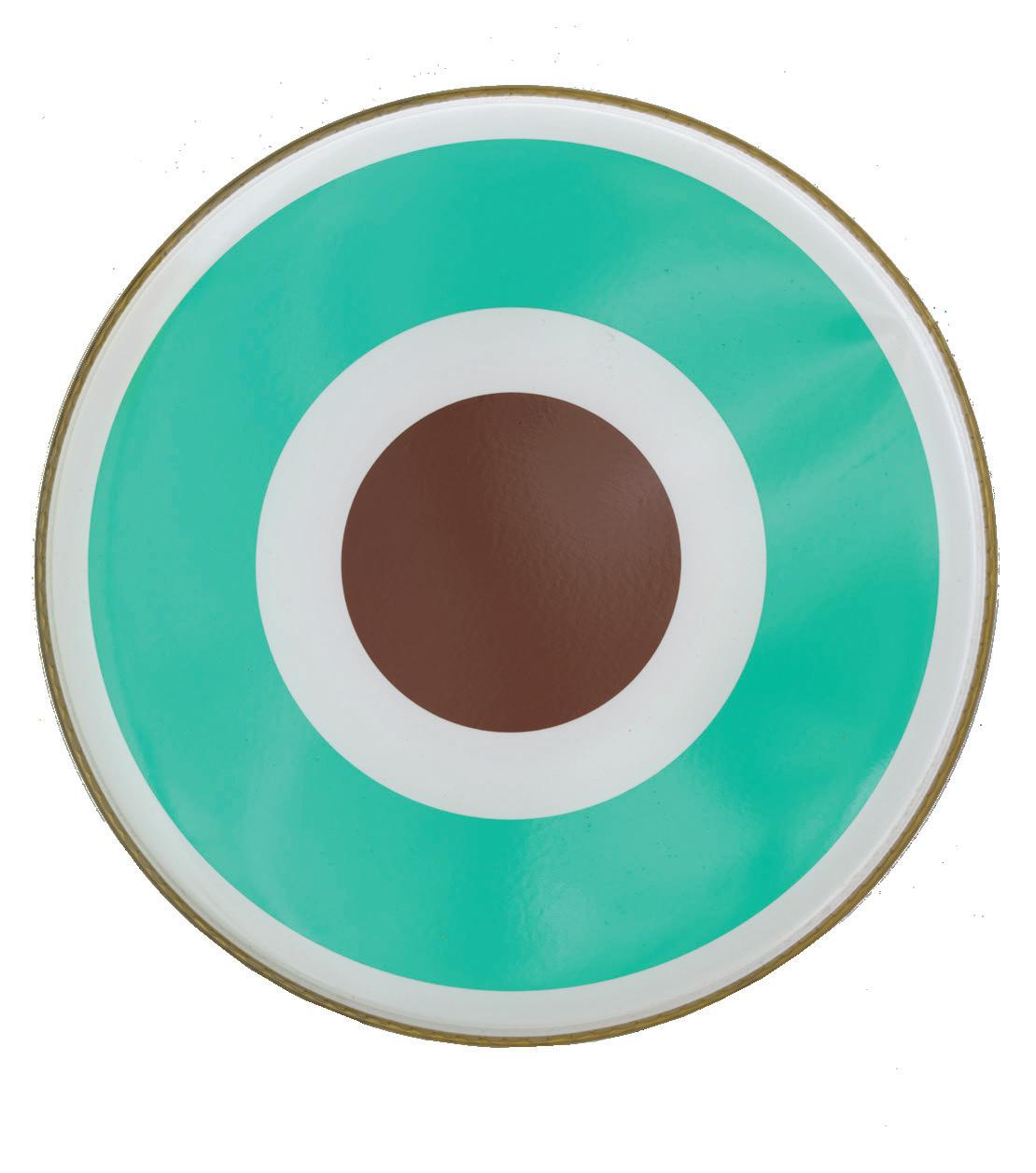
Julian Dashper, Untitled, 1998, vinyl on drumskin, 580mm diameter
Realised incl. BP: $31,667
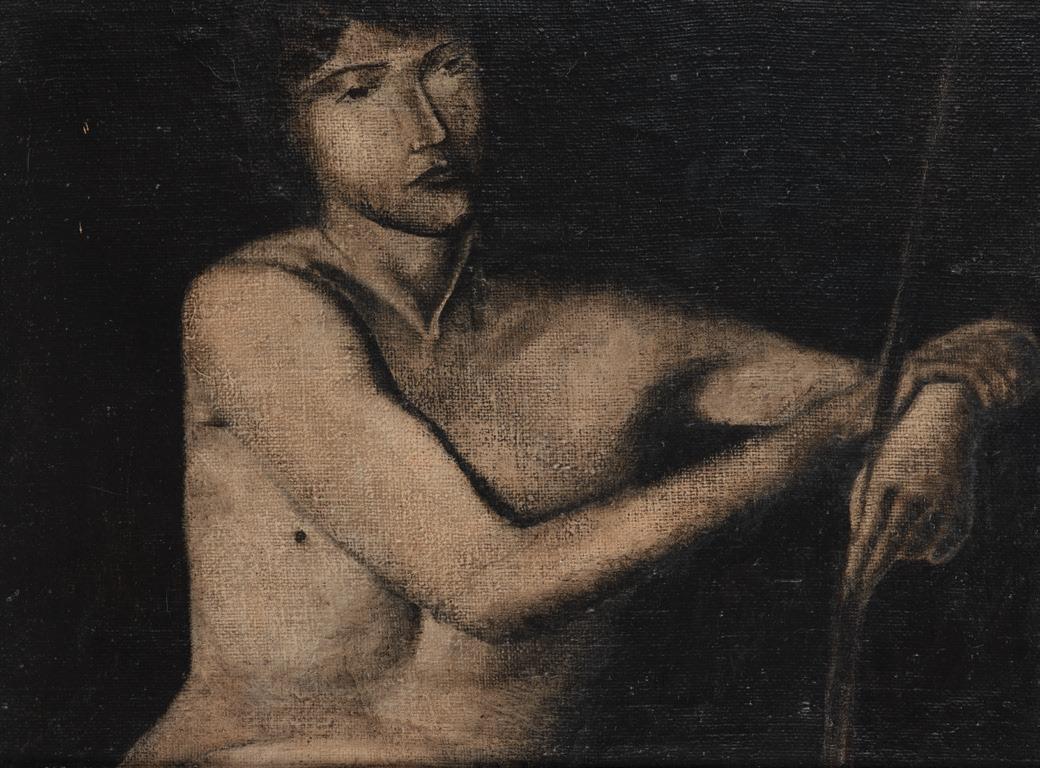
Tony Fomison, John the Baptist, from Caravaggio's St John with Ram, 1966, oil on jute, 435 × 585mm
est $300,000—$500,000
Price Realised incl. BP: $310,700
Colin McCahon, Floodgate I, 1964-65, oil on composition board, 909 × 763mm
est $240,000—$280,000
Price Realised incl. BP: $274,850
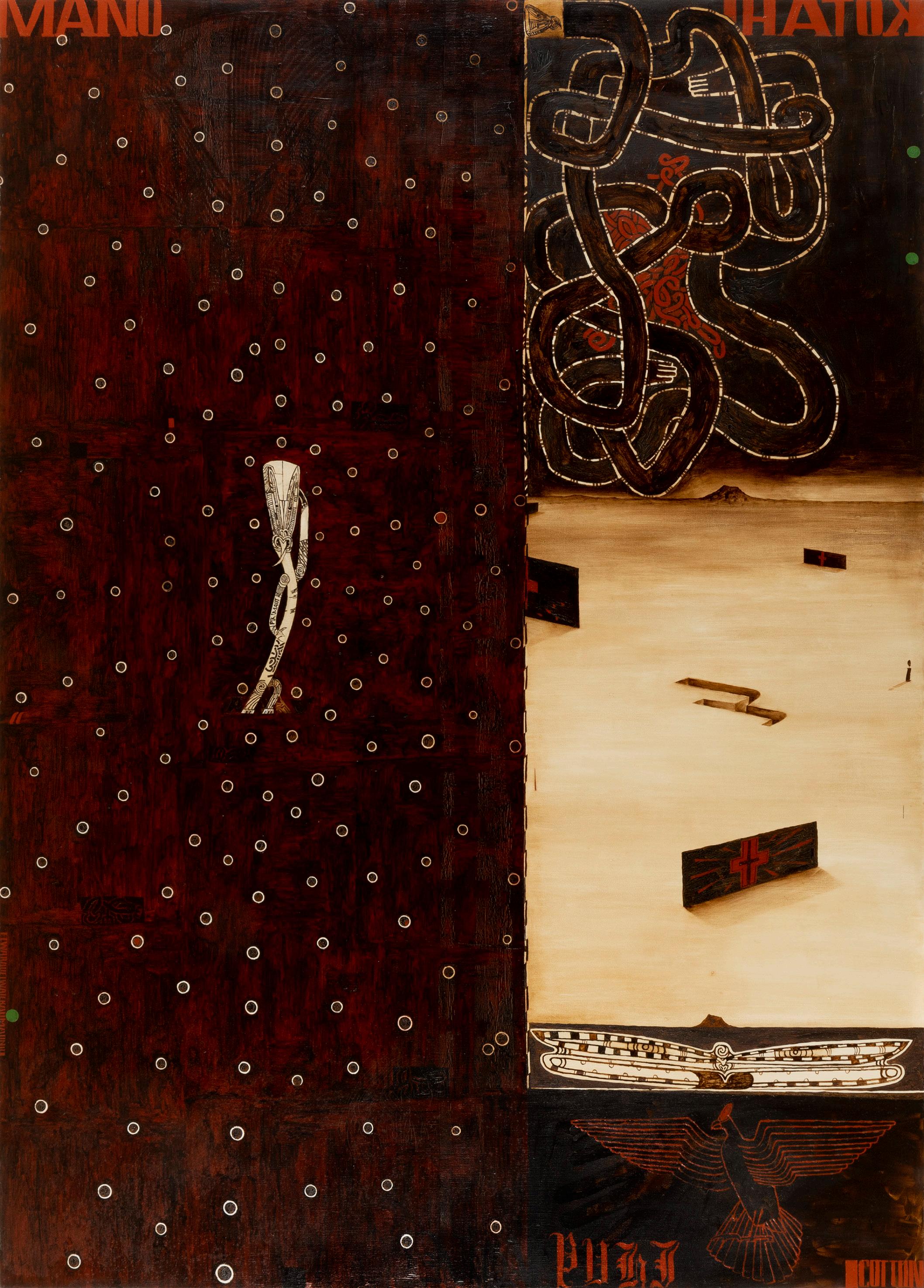
John Walsh, @theHaakari, back in 5 days, 2009, oil on board, 1200 × 890mm
est $20,000—$30,000
Price Realised incl. BP: $37,045
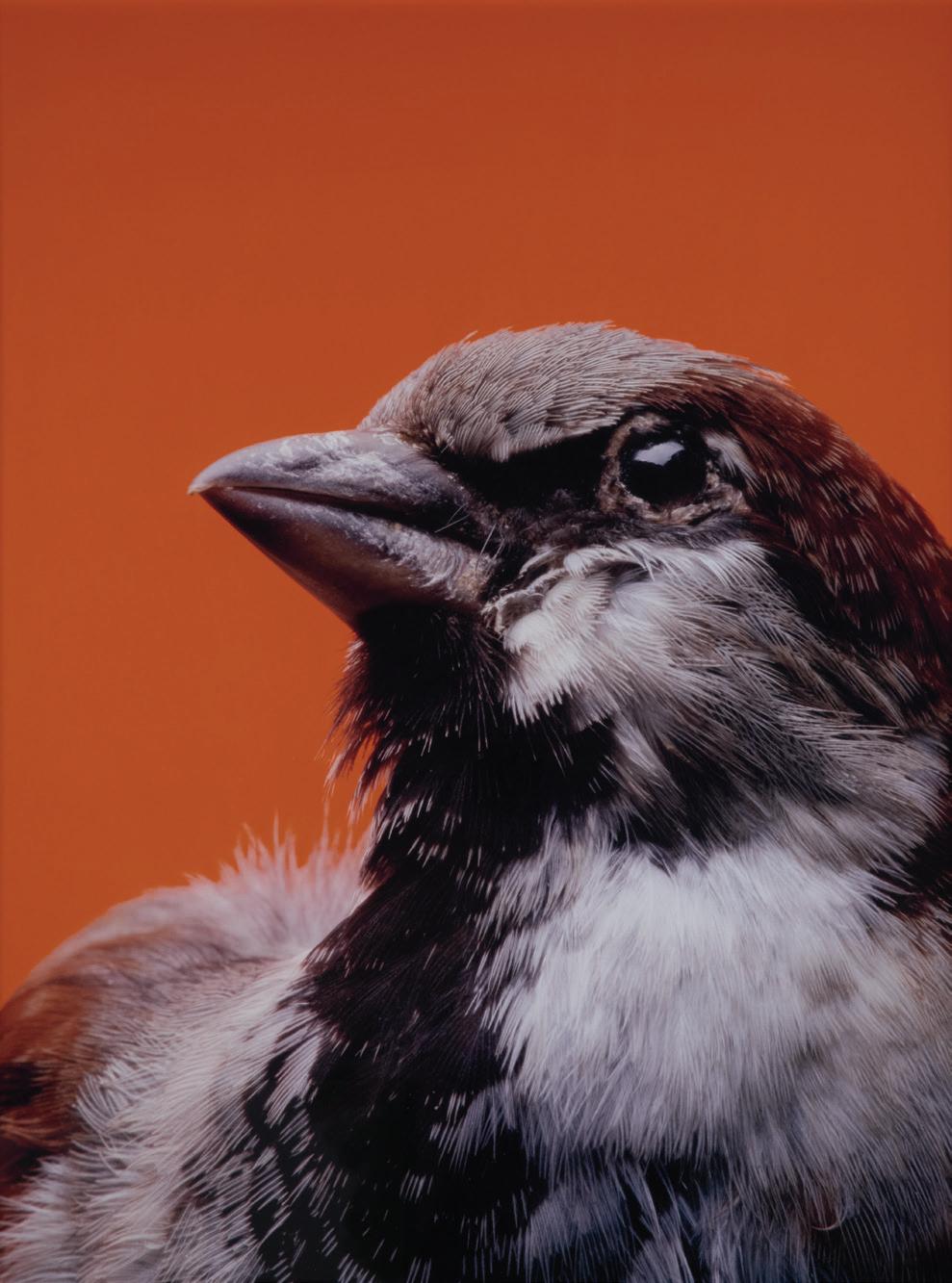
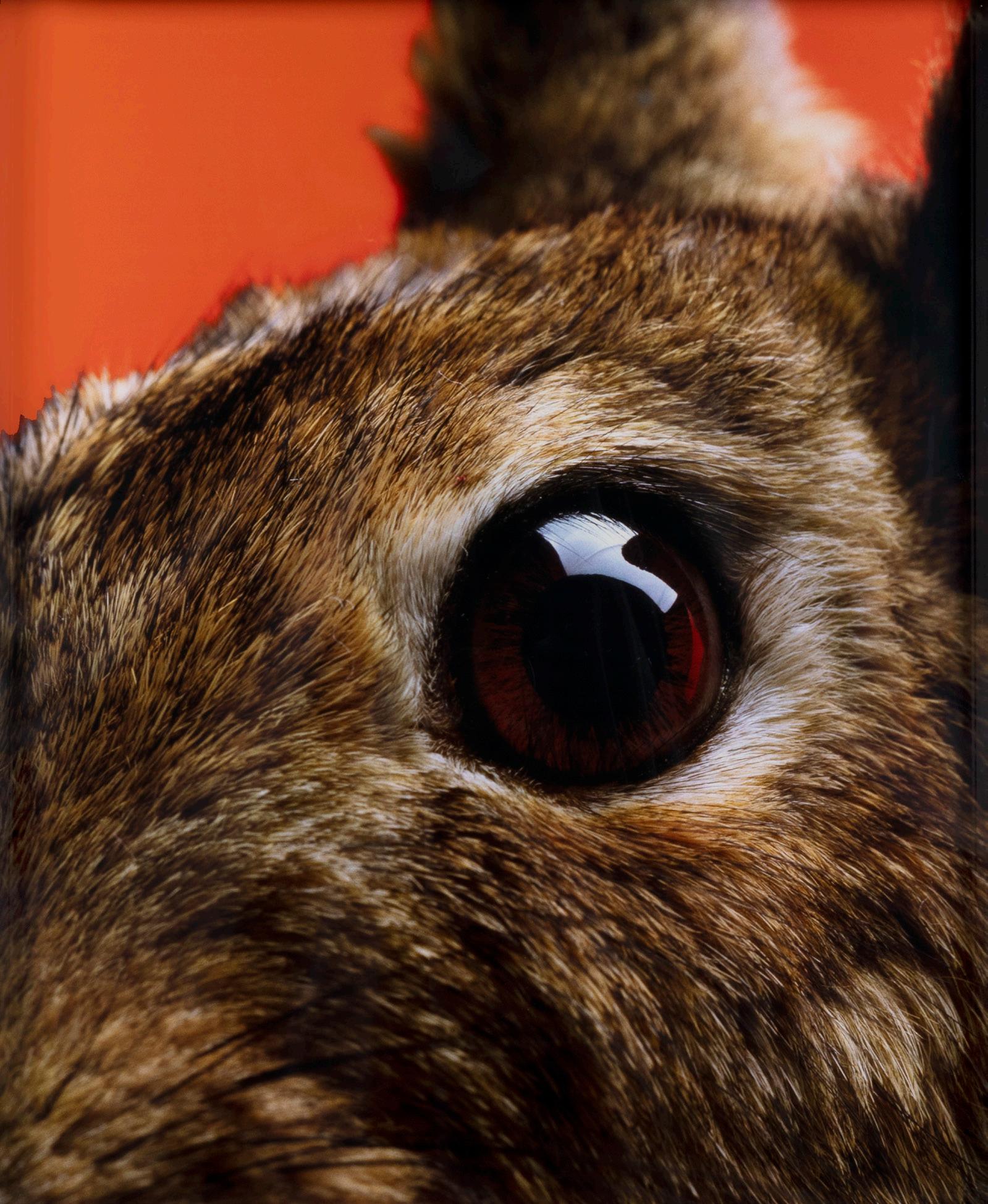
Michael Parekōwhai, Portrait of Ed Brown, 2004, type-c photograph, 1250 × 1010mm
est $18,000—$24,000
Price Realised incl. BP: $29,875
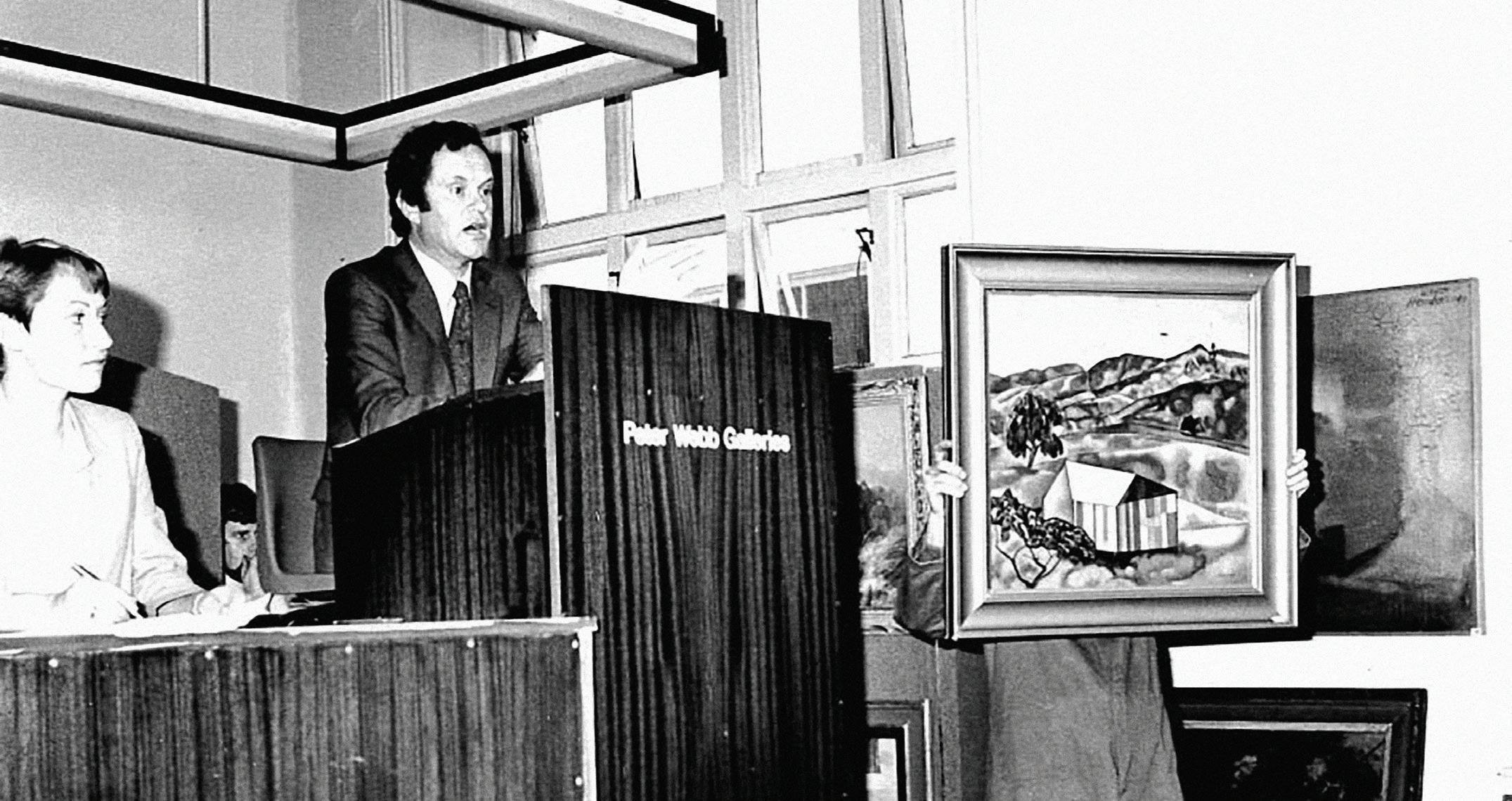
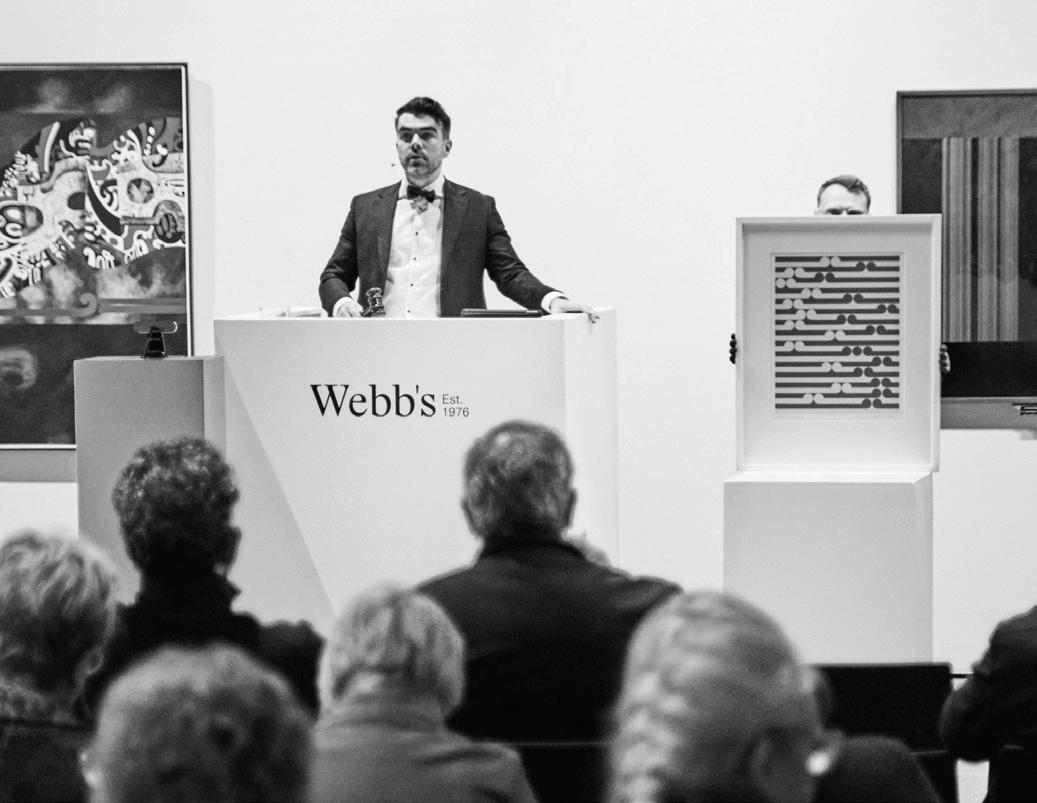
Webb’s Celebrates 50 Years 1976–2026
—New Zealand’s
Leading Auction House
Caolán McAleer
Director of Marketing & Operations
Since its founding in 1976, Webb’s has stood as a meeting place between culture and commerce, connecting collectors with objects that define their era. As Webb’s celebrates its 50th anniversary this year, this landmark moment invites reflection on the artworks, objects, and stories that have shaped its legacy, and on the wider role our auctions play in recording the cultural history of a nation.
As part of our 50th anniversary celebrations, Webb’s is presenting an exhibition that reflects on the many significant moments that have shaped our past. To support this, we are seeking to loan exceptional works purchased through Webb’s, as well as archival material, photographs, and personal anecdotes connected to the auction house and its place within Aotearoa’s cultural landscape.
Together, these contributions will help tell the story of an auction house shaped by its people, its collections, and five decades of extraordinary moments. Should you have an object, image, or story you would like to share for consideration, please contact us.
This year, Webb’s celebrates its 50th anniversary, marking a significant milestone as New Zealand’s premier multi-department auction house. Founded in 1976 by Peter Webb, a pioneering figure in the country’s art world, Webb’s was established with a vision to broaden access to art and collectables and to introduce a new, dynamic auction culture to Aotearoa. From its beginnings, Webb’s has played a defining role in shaping the nation’s secondary market, bringing together expertise, scholarship, and innovation across a wide range of collecting categories.
Over the past five decades, Webb’s has evolved into a trusted institution known for excellence in its respective departments: Art; Decorative Arts; Asian Art; Collectors’ Cars, Motorcycles, & Automobilia; Fine Jewels, Watches, & Luxury Accessories; Fine Wines & Whiskies, The Estate, and Material Culture. Through record-setting auctions, landmark consignments, and an enduring commitment to curatorial rigour, Webb’s has united collectors with objects of outstanding beauty, rarity, and significance, locally and internationally.
Central to this success has been Webb’s dedication to specialist knowledge, meticulous valuation, highly targeted marketing and meaningful engagement with New Zealand’s thriving cultural community.
To mark this significant anniversary, Webb’s is to present a series of special initiatives throughout 2026, including an exhibition, accompanying publication, and educational programmes that reflect on our history and look toward the future.
“Auctions serve as cultural mirrors, reflecting a society’s evolving values, aesthetics, and ambitions. Across its 50-year history, Webb’s has borne witness to profound shifts and pendulum swings in collecting across all categories. Together, these movements trace the changing contours of taste, revealing what each era deems culturally significant, enduring, and investment-worthy. Our history as New Zealand’s leading auction house is indelibly tied to that of our nation’s creative history and cultural evolution.”
—Caolán McAleer, Director of Marketing & Operations
This anniversary is more than a celebration; it is a reaffirmation of Webb’s role at the forefront of New Zealand’s art and wider secondary markets and an investment in the country’s cultural future.
We look forward to celebrating this anniversary together with the people who have helped us reach this exciting milestone.
An Important Collection of Historic New Zealand
Photography
He Kohinga o ngā
Whakaahua ō-Mua o
Aotearoa
The presentation of An Important Collection of Historic New Zealand
Photography, drawn from the collection of Roger Ward (1945–2023), marks a significant moment in the recent history of collecting and custodianship in Aotearoa. Dispersed across two dedicated auctions, the project has foregrounded the enduring relevance of early photographic practice and its capacity to shape contemporary understandings of place, identity and memory.
Comprising more than 1,500 works assembled over several decades, Ward’s collection represents one of the most substantial and coherent groups of historic New Zealand photography to come to market in recent years. Its breadth, encompassing landscapes, townscapes, architectural views, portraiture and ethnographic imagery, offers a layered visual account of Aotearoa in the nineteenth and twentieth centuries.
The public and institutional response to the first instalment demonstrated the depth of connection that these works continue to hold. Photographs were acquired by private collectors alongside iwi, descendants, museums and galleries, underscoring their dual significance as historical documents and living cultural touchstones. Many works represent some of the earliest visual records of specific people from overseas, places and practices, and their return to Aotearoa has been widely recognised as an outcome of lasting value.
2026 marks the 140th anniversary of the 10 June 1886 Mount Tarawera eruption. Among the collection are significant photographs documenting the immediate before and after of this pivotal destructive
29.06.26—12.07.26
An Important Collection of Historic New Zealand Photography Part II —Online Auction
opposite page
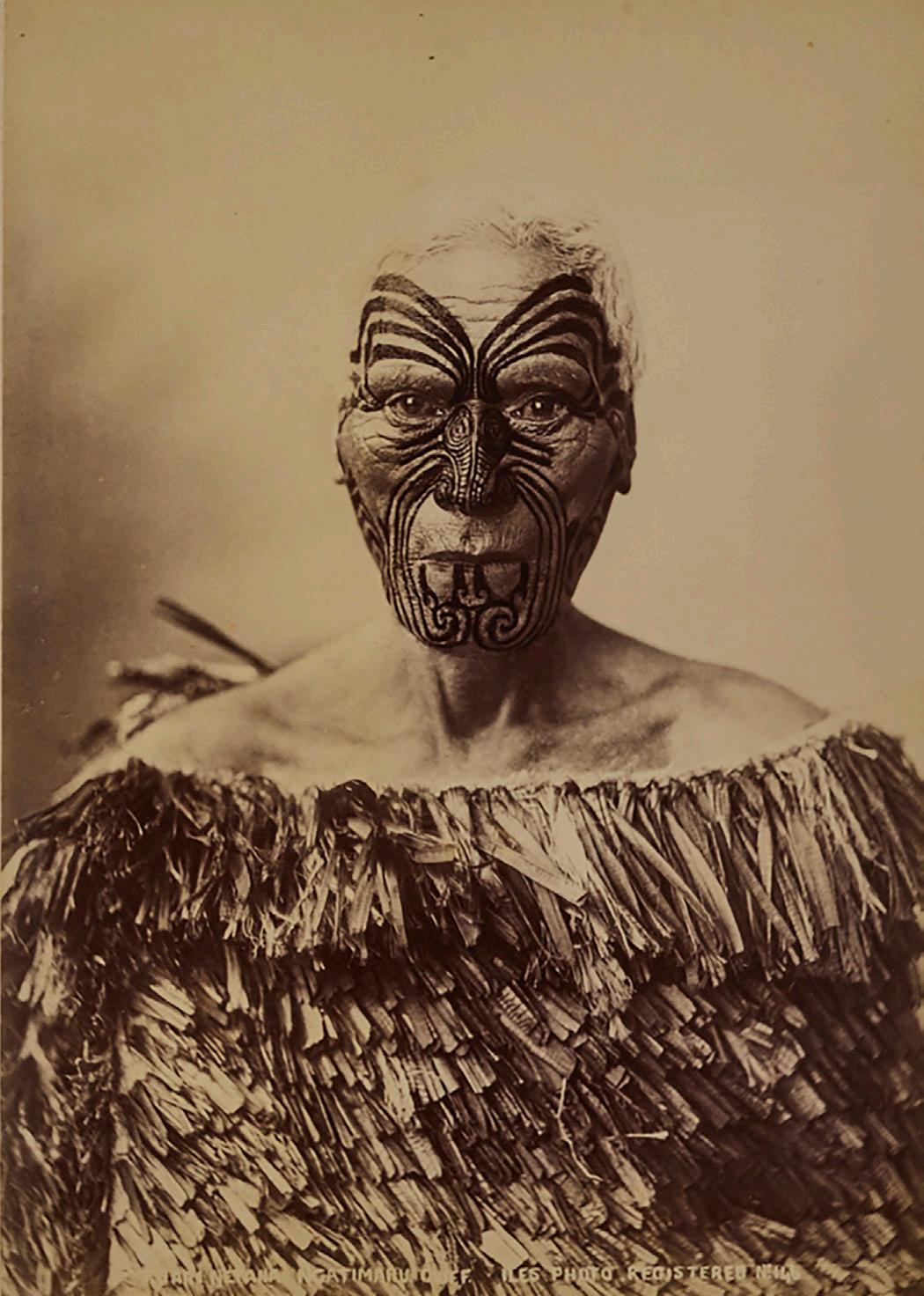
Arthur James Iles, Head and shoulders portrait of Tuari Netana, Ngāti Maru chief with moko, c1899
est. $1,000—$2,000
Price Realised incl. BP: $7,170
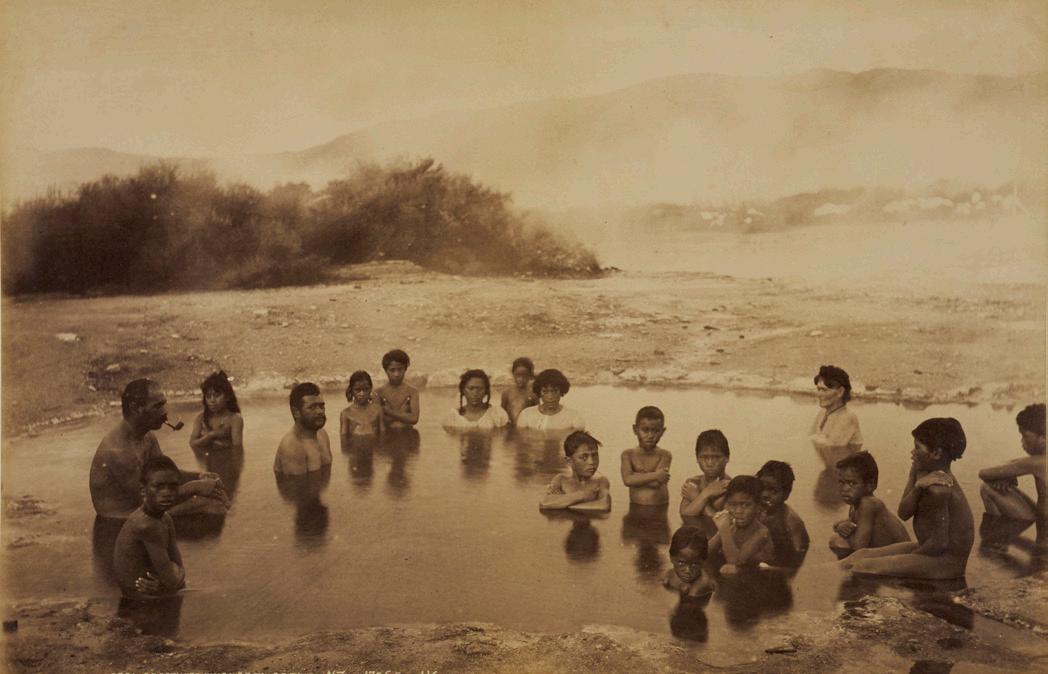
James Valentine, Pool of Bathers, Whakarewarewa, c1880s
est. $300—$500
Price Realised incl. BP: $3,346
this page
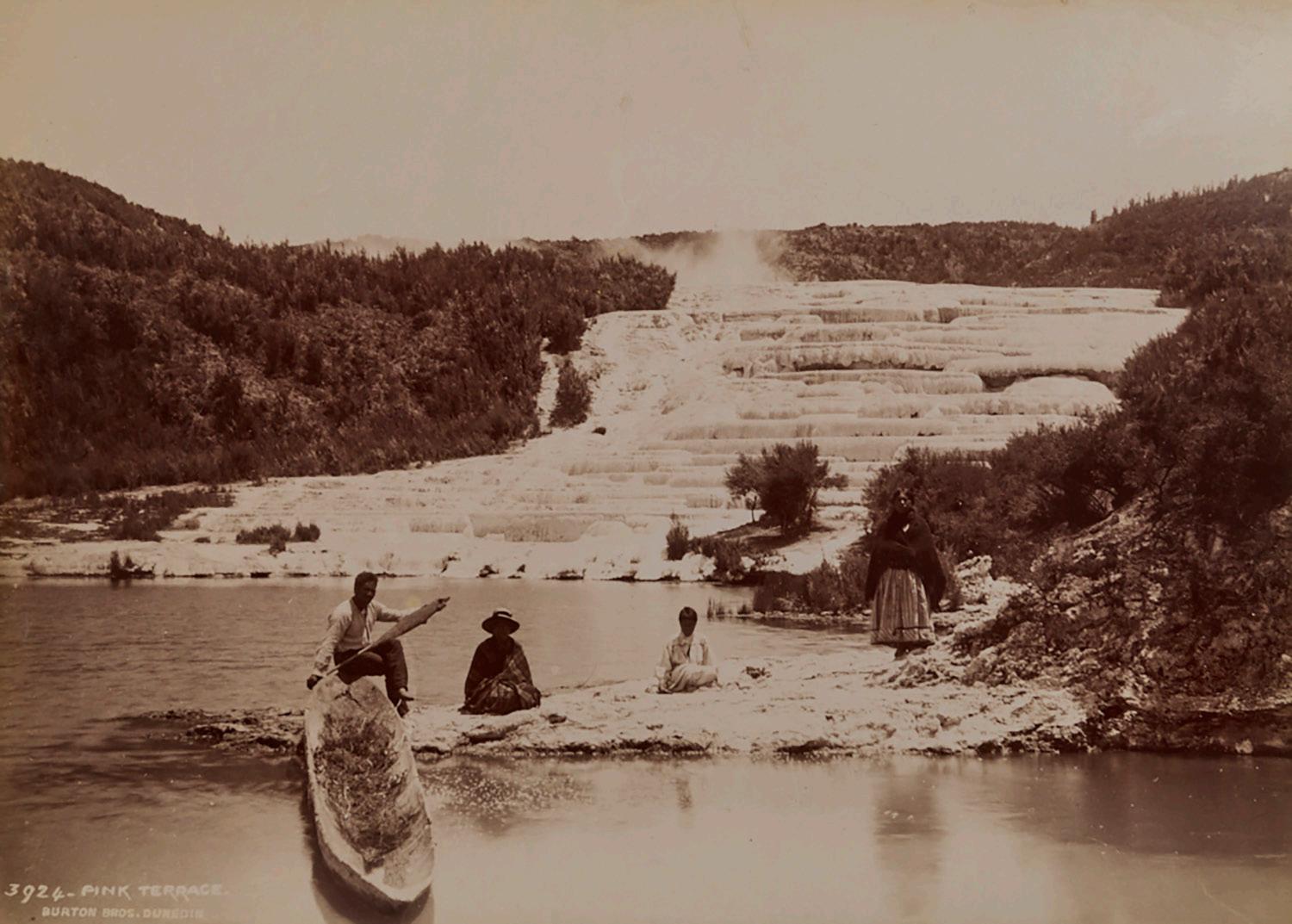
Burton Brothers, Pink Terrace, c1880
est. $400—$800
Price Realised incl. BP: $4,302
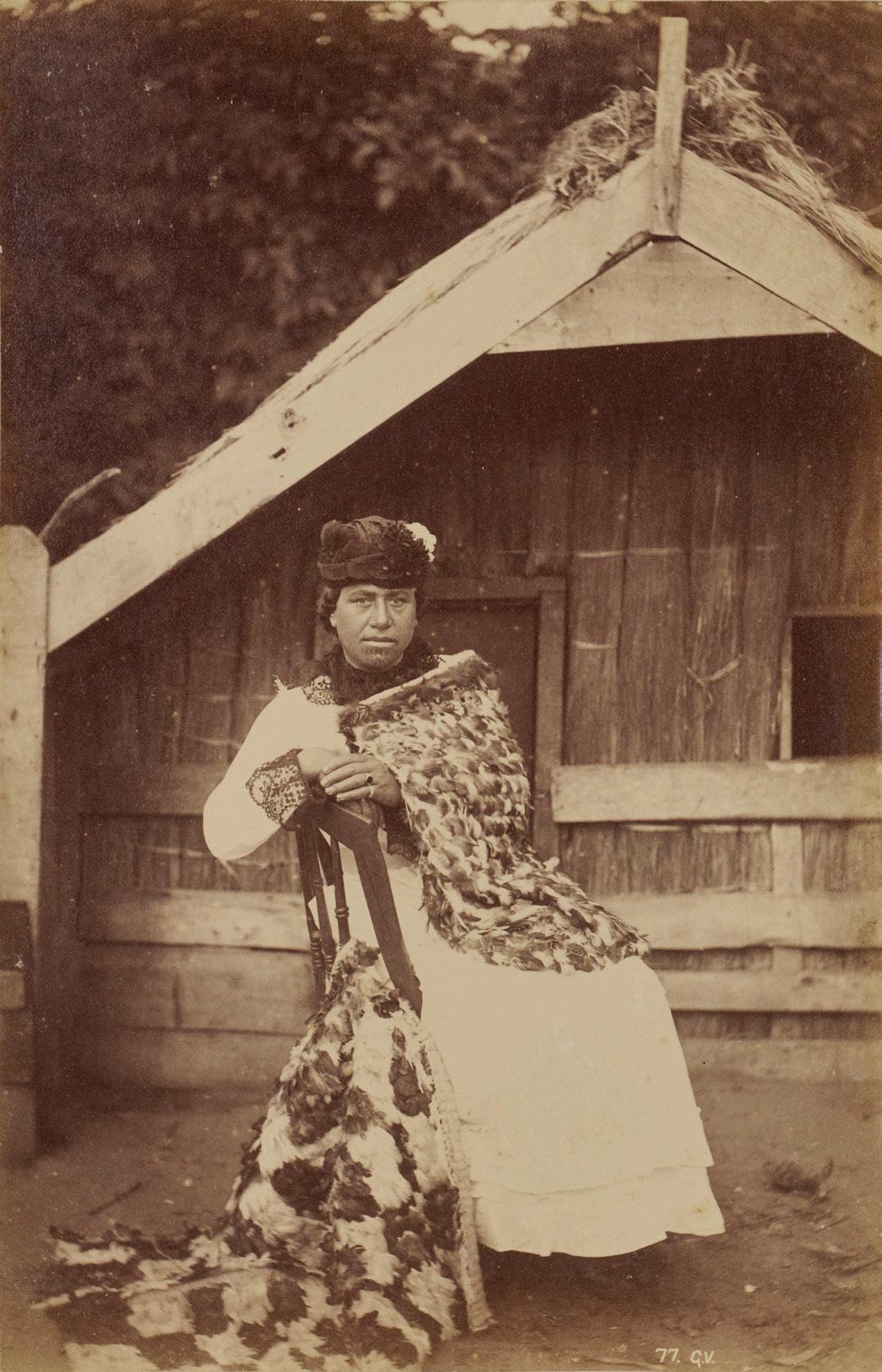
George D. Valentine, Keita Rangitūkia Middlemass - Guide Kate, 1885
est. $300—$500
Price Realised incl. BP: $956
event. These images record the devastation of Te Wairoa and the Rotomahana Lakes region. The eruption fundamentally reshaped local ways of life and brought an end to the Pink and White Terraces— once described as the ‘eighth wonder of the world’—and with them a defining chapter in early tourism in Aotearoa.
This significance was reflected in strong public engagement, including national media coverage and an interview with Megan Shaw and Te Aniwa Hurihanganui for 1 News, which prompted notable audience response.
Guided by a commitment to responsible stewardship, Webb’s worked in consultation with advisors and alongside the Ministry for Culture and Heritage to ensure that culturally and nationally significant material was appropriately considered and remained in Aotearoa.
Together, the two-part auction affirms the importance of Ward’s collection—offering a powerful reflection on how Aotearoa has been seen and remembered, and how these histories and records continue to be cared for today.
Megan Shaw, PhD Manager, Art megan@webbs.co.nz
+64 22 301 8259
Lily McCowan Specialist, Art lily@webbs.co.nz
+64 22 068 4932
The Architecture of a Single Owner Collection
Photography by Jane Ussher MNZM
Single owner collectors in New Zealand have long occupied a privileged position in the art market: as curators with a singular vision, patrons, and independent archivists of cultural undercurrents. The recent sale of Sir Miles Warren's collection at Webb's Auction House made that relationship visible at scale, and demonstrated the particular care required to bring a collection of this depth to market.
Across its 50-year history, Webb's has operated at the intersection of the commercial, private and public collectors’ market, developing specialist expertise in both institutional and single-owner collections: those shaped by a singular vision, and requiring a different approach to presentation, narrative, and buyer engagement. From collaborating on the sale of Ron Sang's Remuera residence and the record-breaking BNZ Collection to finding new custodians for rare pieces from the John Perry Collection, the meticulously collected items from the Auckland Wine Club, among many others in a number of specialist subjects.
Webb's Works of Art sale, held in Auckland in late March and achieving a total nearing $3 million, presented a carefully selected group of works from the private collection of Sir Miles Warren (1929–2022), co-founder of Warren and Mahoney and the defining voice behind Christchurch modernism.
Offered on behalf of the Ōhinetahi Charitable Trust, the sale raised close to half a million dollars in funds for the preservation of Ōhinetahi: the awardwinning house and gardens Warren designed for himself in Governors Bay, and later gifted to the people of Aotearoa.
The auction provides a clear case study in what a single-owner collection, handled well, can achieve both for vendors, collectors, and the continuation of care of important cultural objects.
Sir Miles was not simply a collector; he was an active commissioner, integrating works such as Pat Hanly's monumental Rainbow Pieces mural (1972) into the fabric of the Christchurch Town Hall — one of Warren and Mahoney's most enduring civic projects. He was also a peer, cultivating close relationships with artists across post-war Canterbury at a time when that community was producing work of considerable ambition. Collections formed this way carry a coherence and authority that isolated acquisitions rarely match, and that coherence, when communicated effectively, commands results at auction.
The proceeds of the sale now contribute to the continued public life of Warren's most personal domestic environment. This entire arc, from commission to collection to bequest, reflects a form of custodianship that requires sensitivity on the part of everyone involved in bringing it to market. Webb's role here was not simply to sell works, but to communicate a life's accumulation with the clarity and care it deserved.
That understanding extends across the singleowner collections Webb's has handled over many years.
The most compelling single-owner collections share a common quality: they are not assembled so much as accumulated, each work chosen in relation to undercurrents, passions and sometimes obsessions by informed individuals. Whether formed by architects, artists, or private collectors with a sustained point of view, these assemblages carry an internal logic that isolated acquisitions rarely achieve, and where provenance becomes inseparable from personality. It is precisely this coherence that Webb's works to identify, articulate, and bring to market.
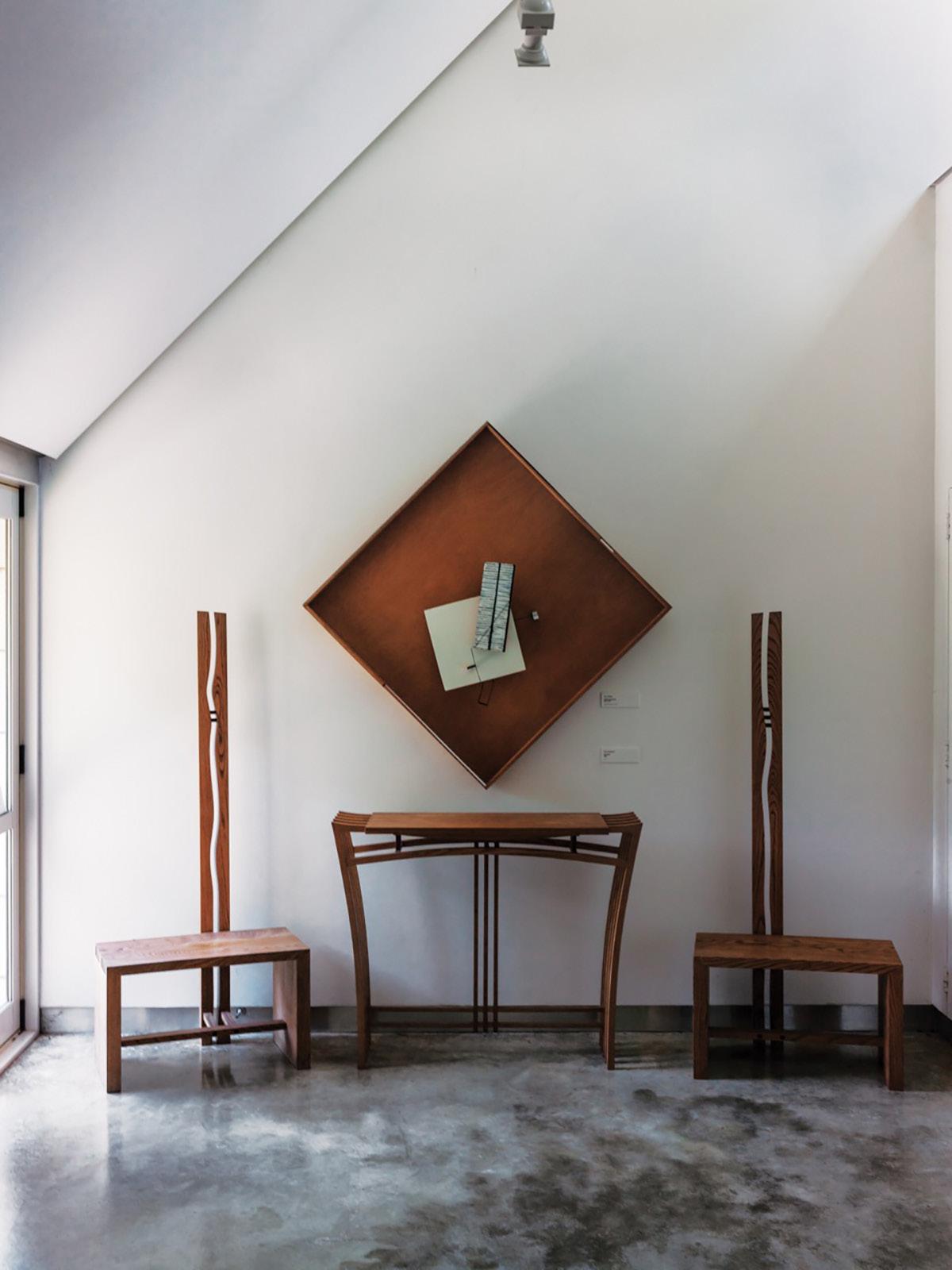
The Ōhinetahi collection sale brought this relationship into sharp focus, making it visible at scale. Highlights included Ralph Hotere's Requiem (1974), which realised $143,450, well above its presale estimate; distinctive works by Paul Dibble and Don Peebles; and several significant works by Pat Hanly, including Protective Helmet (1962), a rare survivor from the Massacre of the Innocents series. A refined group of furniture by Kazu Nakagawa further underscored Warren's sensitivity to craftsmanship and the interplay between form, function, and architectural space.
Taken as a whole, the sale demonstrated the enduring importance of quality and provenance, and of a specialist able to tell the story behind both.
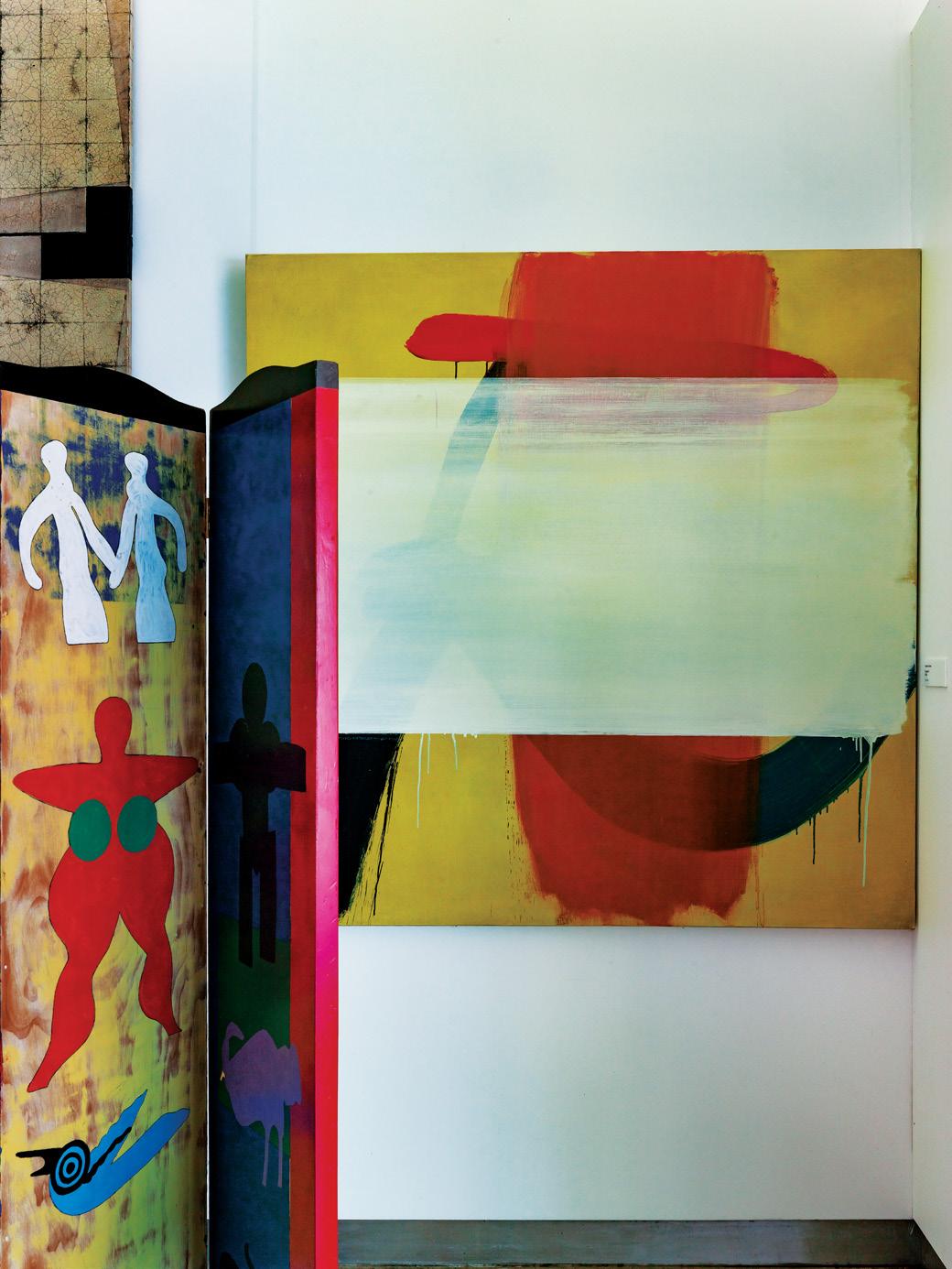
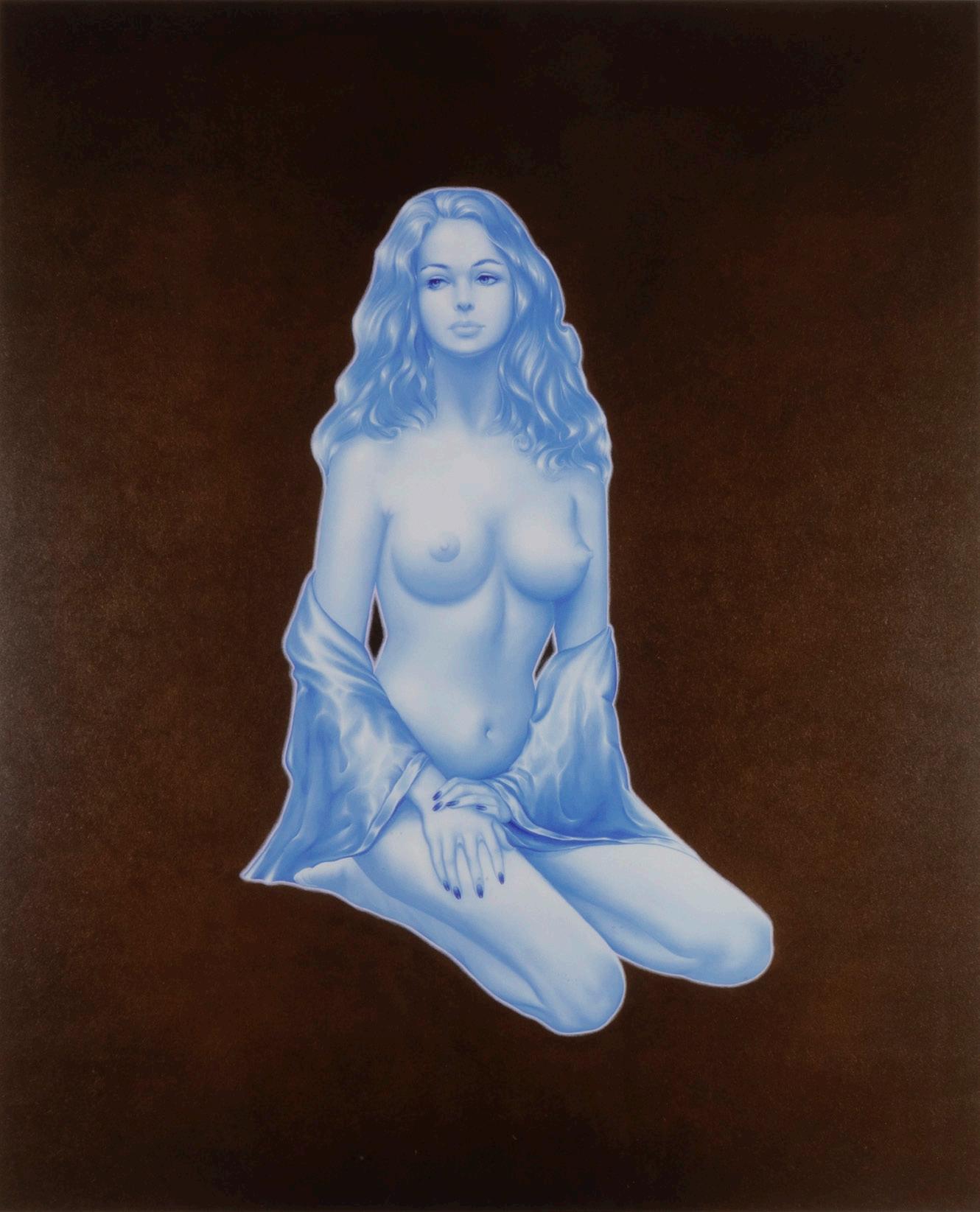
1 Gordon Crook, Screen Goddess Series
Matthew Browne, Sequester III
2 Don Peebles, Relief Construction
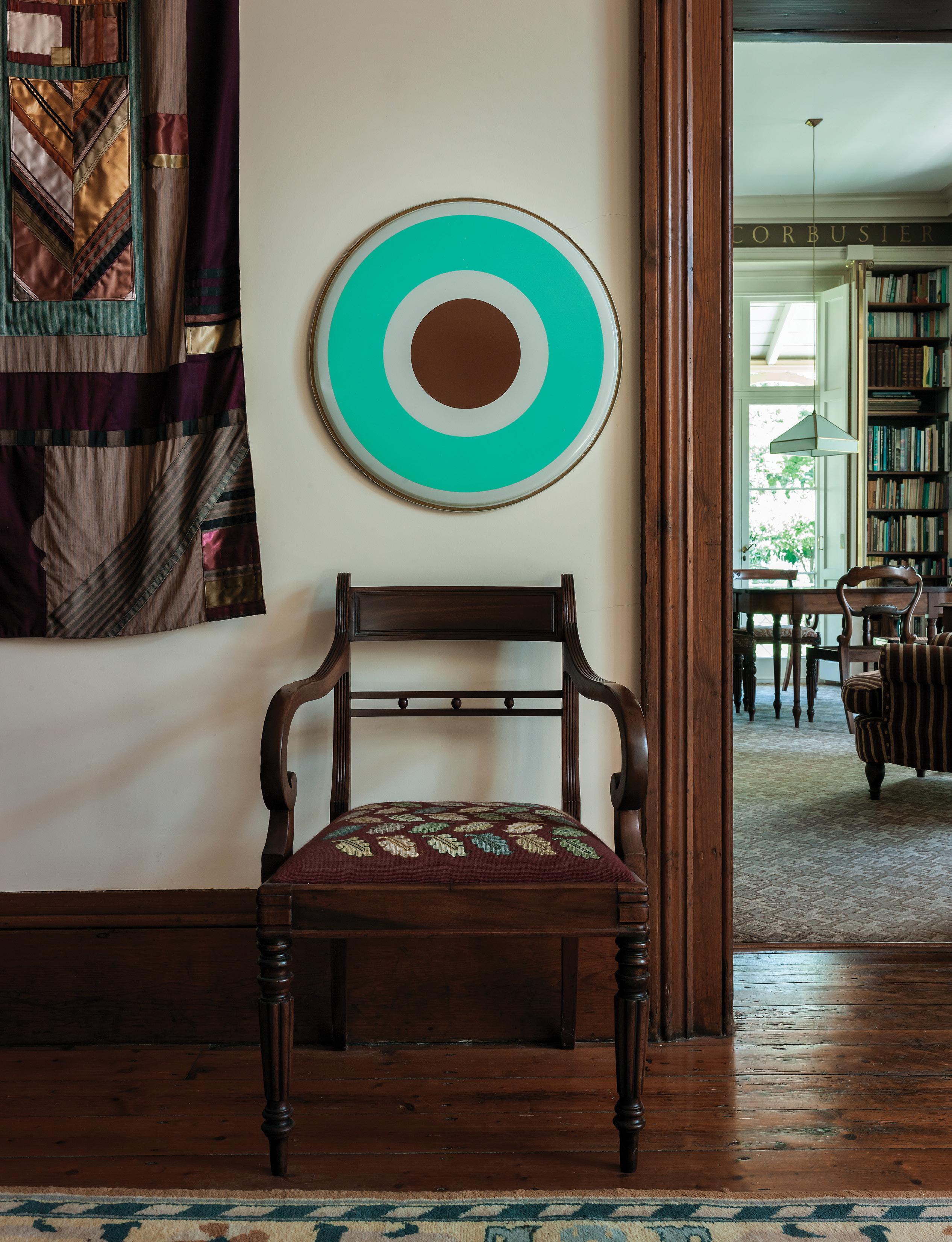
Kazu Nakagawa, Pair of chairs
Kazu Nakagawa, Hall table
3 Julian Dashper, Untitled
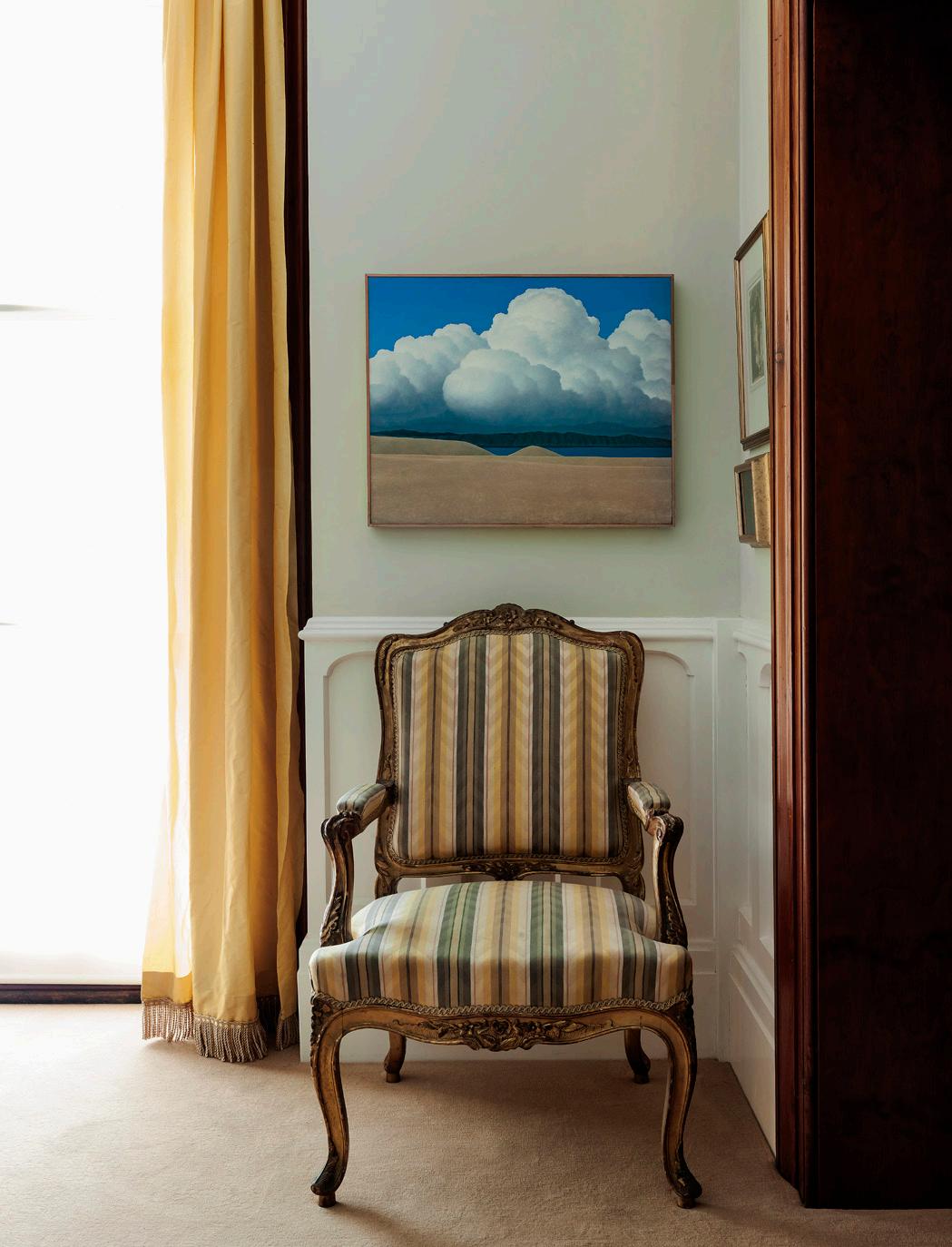
4 Brent Wong, Coal
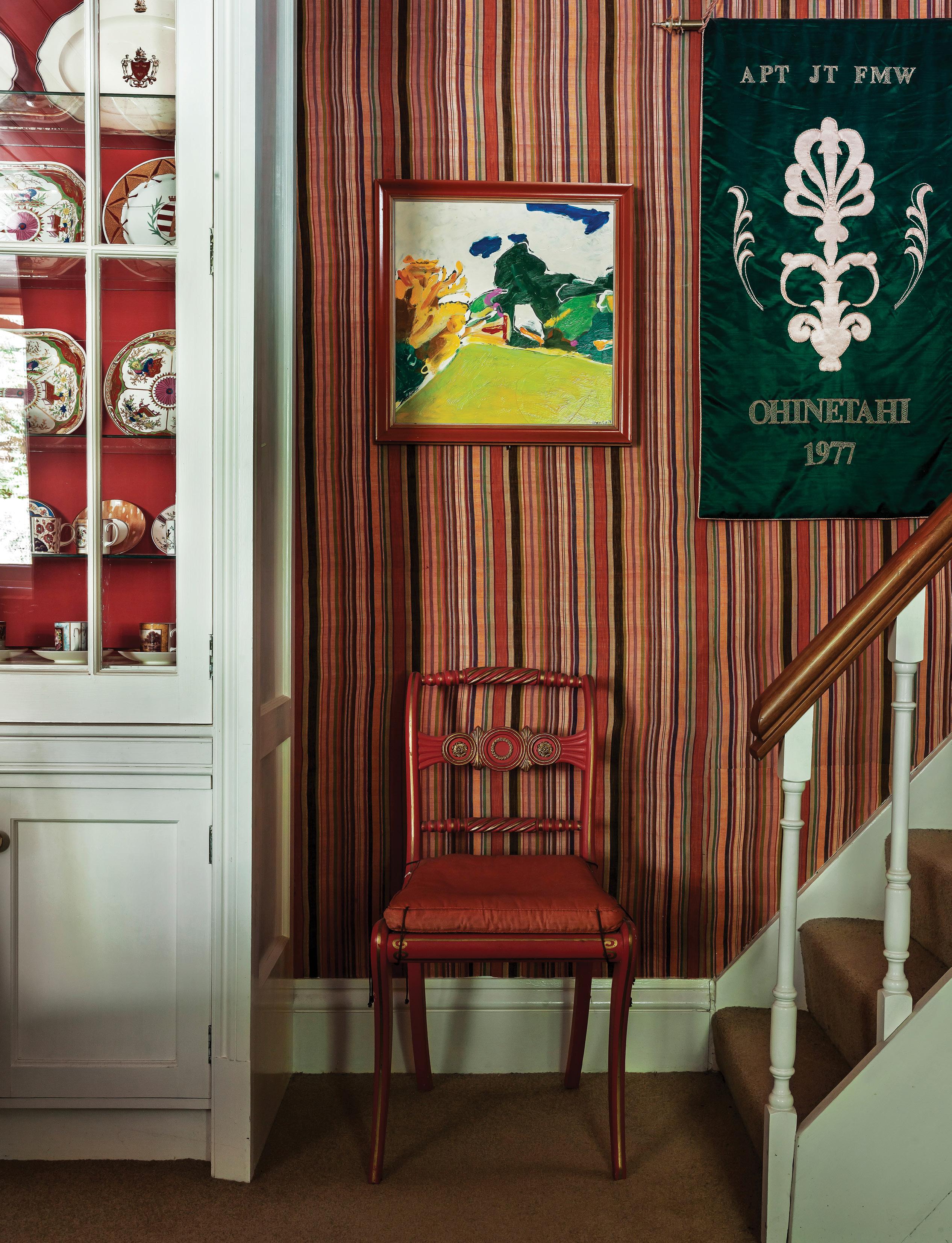
5 Pat Hanly, Summer Land
6 Pat Hanly, Protective Helmet
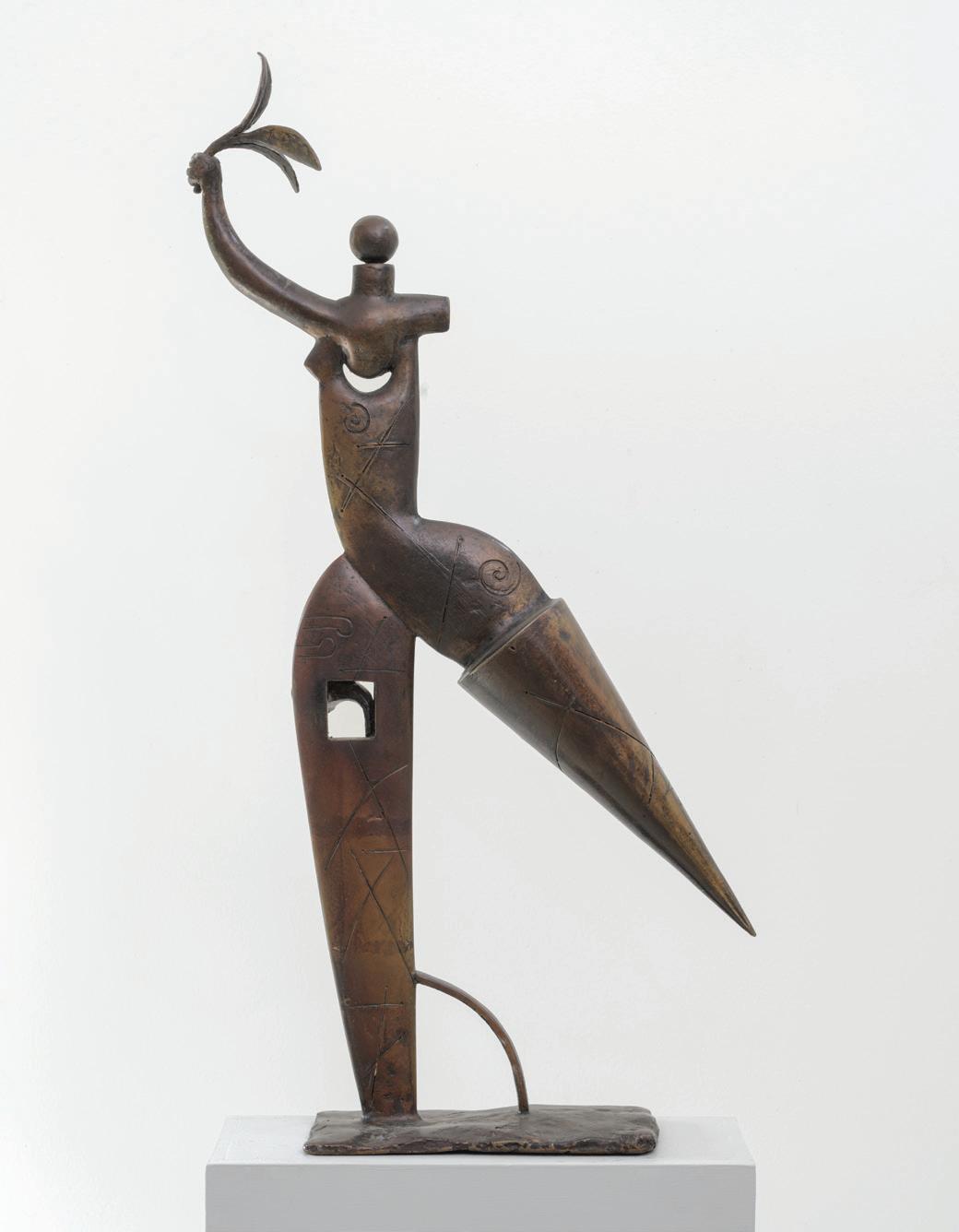
7 Paul Dibble, Standing Figure
Professional Art & Collectables Valuations
Specialist
For nearly five decades, Webb's has been synonymous with authoritative, independent valuations of fine art and luxury collectables across New Zealand. Our services are relied upon by private collectors, institutions, legal professionals, and insurers alike, delivering accuracy, transparency, privacy, and peace of mind in an ever-evolving market.
In a time of volatility, it is crucial to know what you own.
A professional valuation does more than assign a number to an artwork or collectable; it documents your assets, supports accurate insurance coverage, satisfies legal and probate requirements, and gives you clarity when making decisions about a collection.
For institutions, valuations underpin financial reporting compliance and sound collection management. For families navigating bereavement or relationship separation, they provide a fair, documented, and independent basis for equitable division.
Webb's valuations are recognised and trusted by all major New Zealand insurers and are prepared to meet the requirements of legal proceedings, financial institutions, and personal record-keeping.
Because our Valuation Department operates independently from the auction house while drawing on its deep market knowledge and historical sales records, you receive expert, unbiased assessments free from conflicts of interest.
Whether you need a single item assessed or an entire collection documented, our process is straightforward: an initial consultation, examination of the works (in person or via images and documentation), rigorous research, and delivery of a detailed report. Printed and digital copies are available, and all records are stored securely and confidentially.
We offer comprehensive valuation services for insurance, estate planning, legal settlements, institutional reporting, and market transactions. With values shifting rapidly in the contemporary art world, regular expert valuations are essential to ensure appropriate protection and informed decision-making.
Charles Tongue
FLOW Wellington Selling Exhibition
Marian Fountain and Kate van der Drift
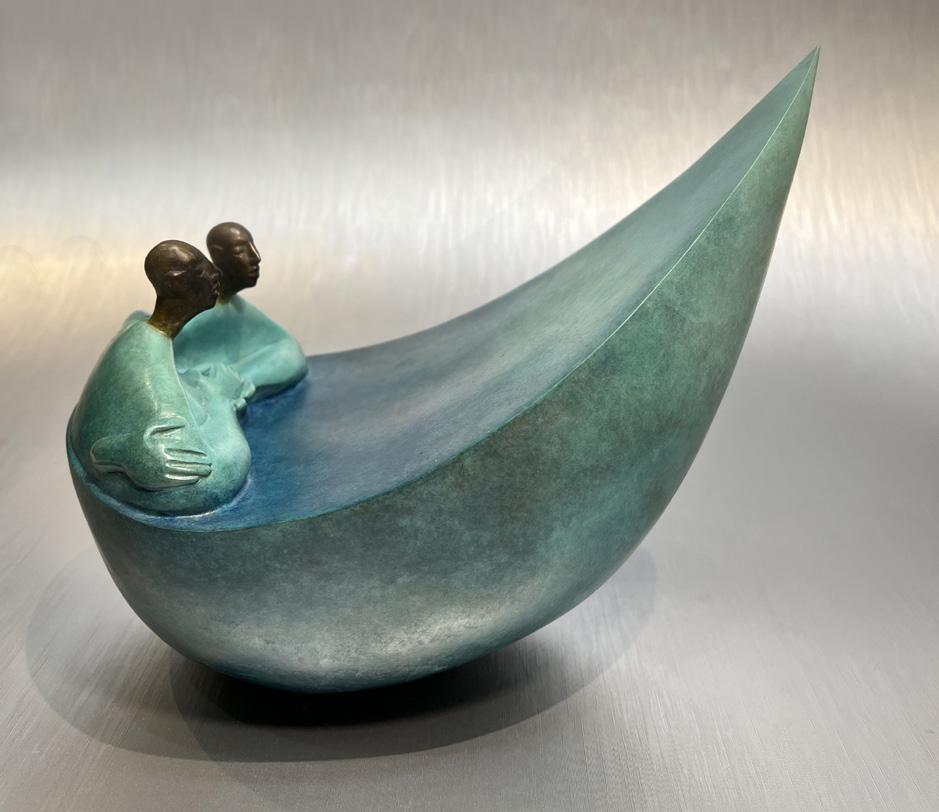
FLOW brings together the practices of Marian Fountain and Kate van der Drift in a shared meditation on continuity, transformation, and care. Across sculpture and photography, the exhibition traces life as an interconnected process, shaped by movement, intervention, and the enduring vitality of the natural world.
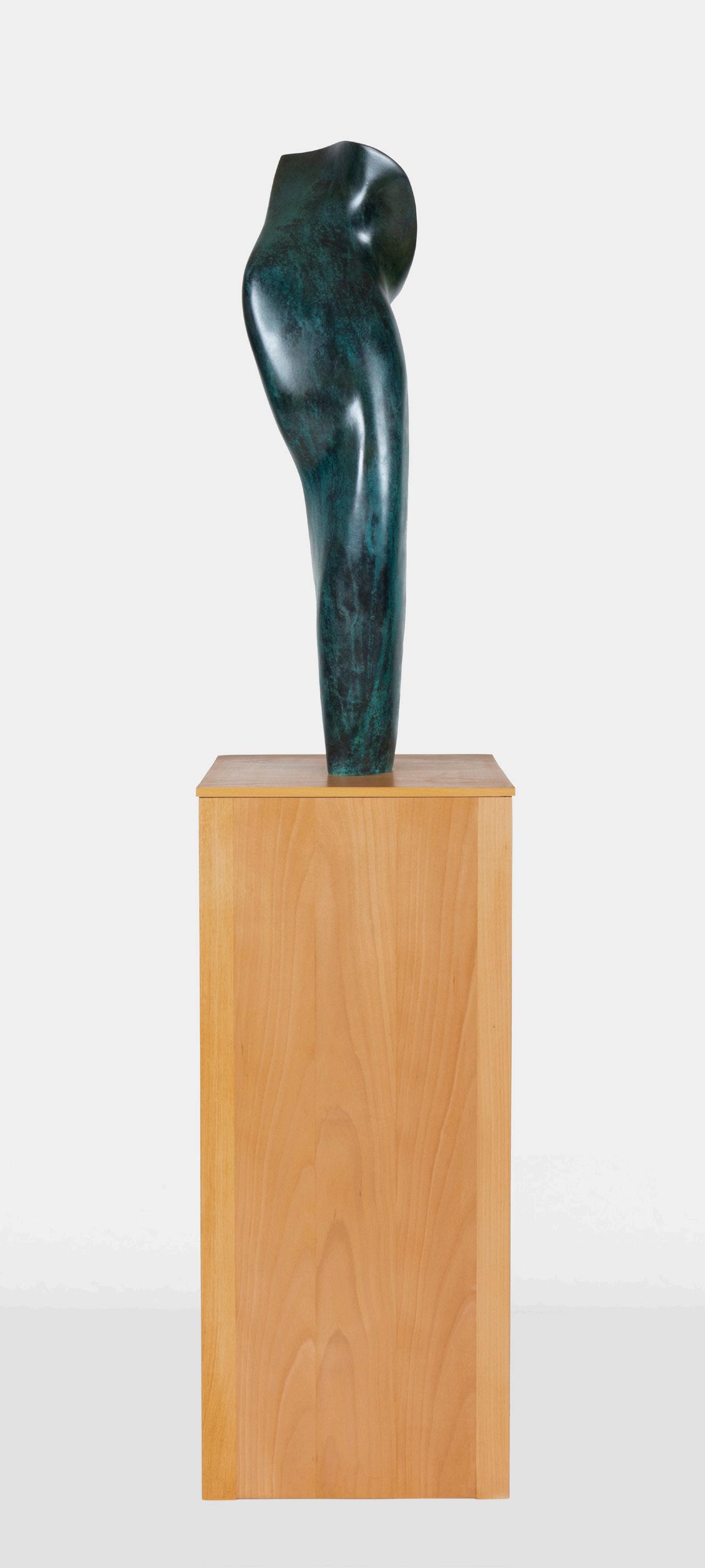
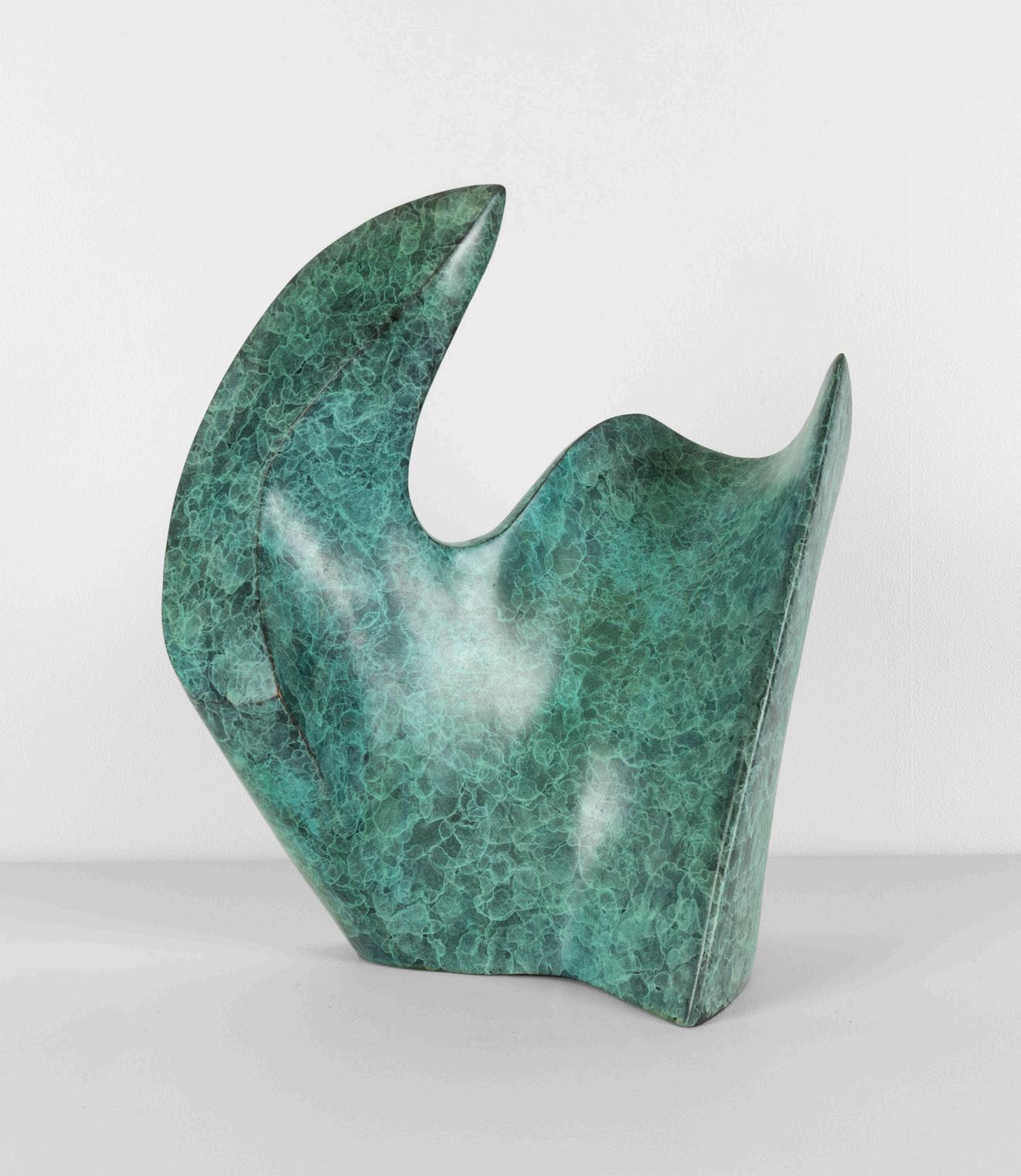
Fountain’s sculptures begin from the premise that life is ongoing, with birth and death marking brief thresholds within a continuous state of being. Working with elemental, recognisable forms, she evokes a sense of sentience and motion embedded within all things. Although cast in bronze, her works carry a lightness and quiet energy, suggesting an animist presence and a deep interdependence between human and non-human life. Her practice reflects on both the fragility and resilience of existence, speaking to the urgent conditions of climate change and the value of life on earth.
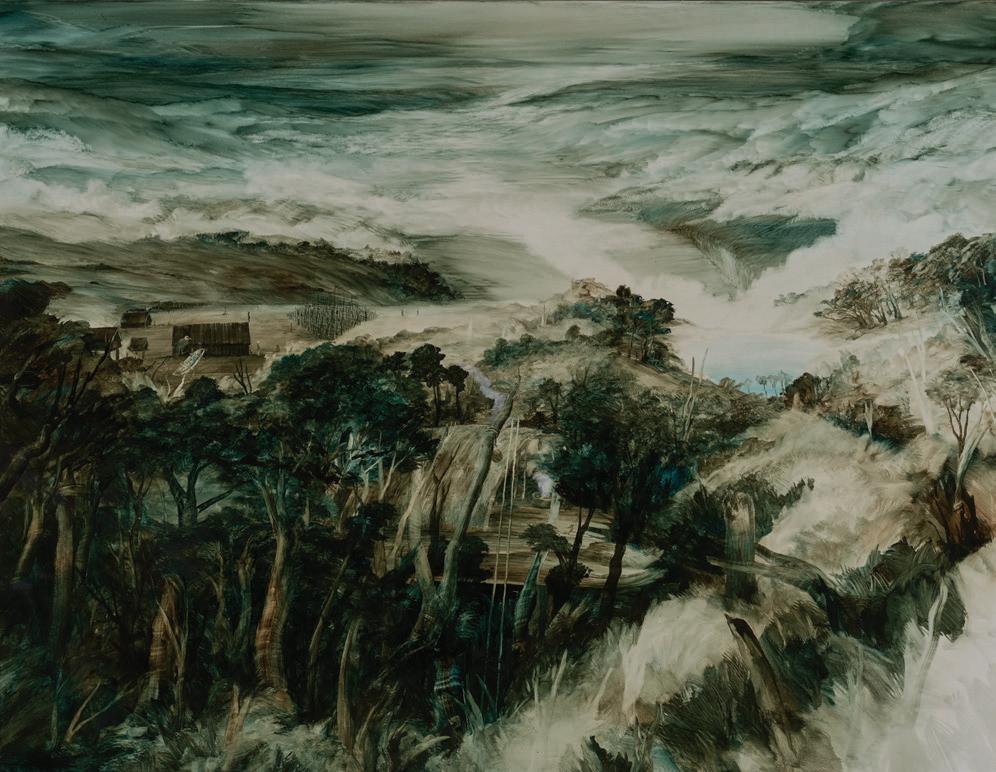
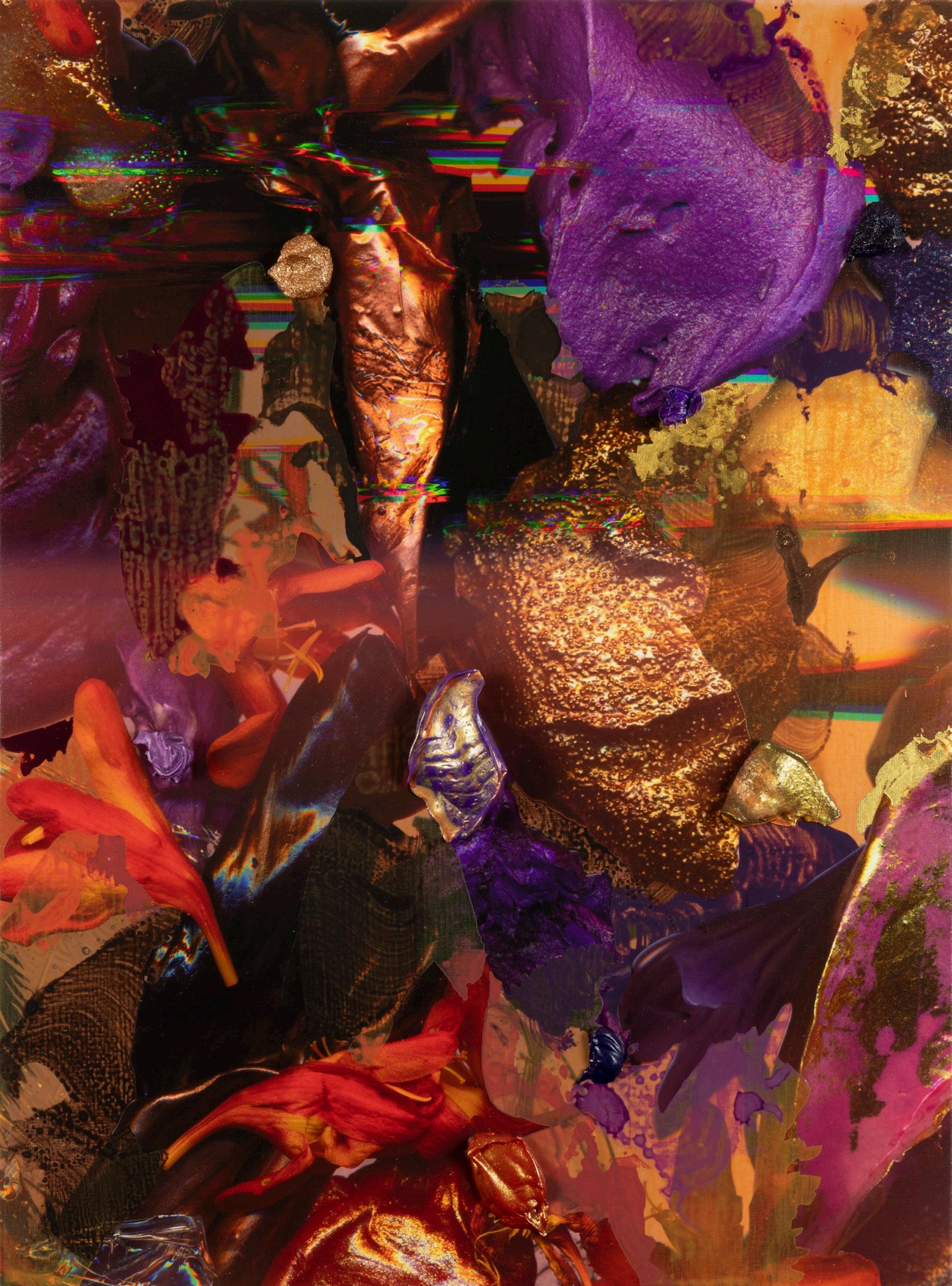
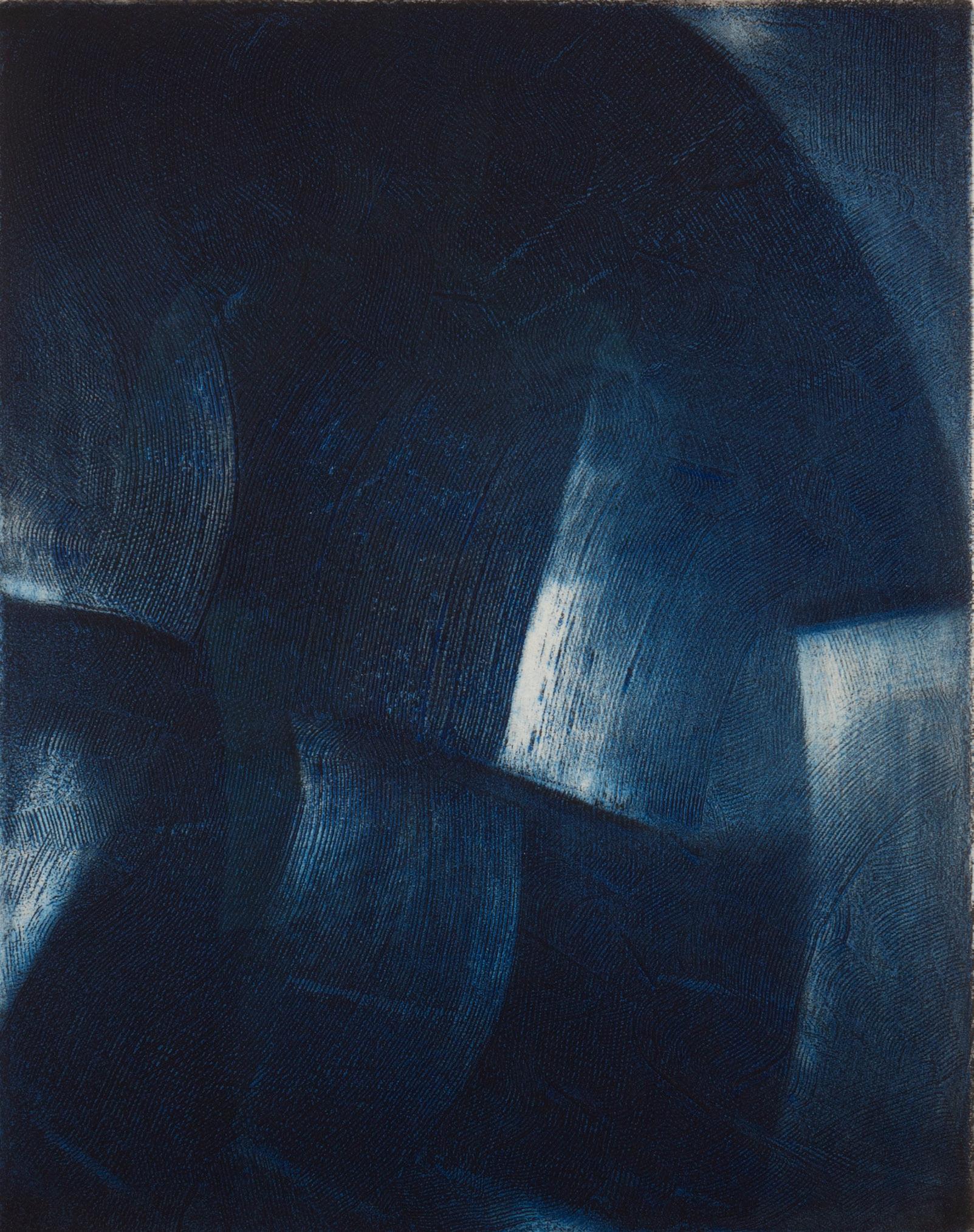
Van der Drift’s camera-less photographs emerge through alchemical processes of light, plant matter, and chemistry, shaped by her residency at Waitawa Regional Park. Engaging with the entangled histories of colonisation, industry, and ecological restoration, her works examine introduced plant species and the marks of human intervention on land and waterscapes. The images map transformation in progress, holding tension between disruption and repair, while offering gestures of resilience and hope.
Webb’s Wellington Selling Exhibitions present curated shows of emerging and established New Zealand and international artists, with artworks available to view and purchase both online and in-person at our Wellington gallery.
Virginia Woods-Jack Exhibitions Manager
above
Kate van der Drift, Solanum Mauritianum (Woolly Nightshade)
right
Marian Fountain, Ecstacy Boat
Private Sales —Beyond the Auction Floor
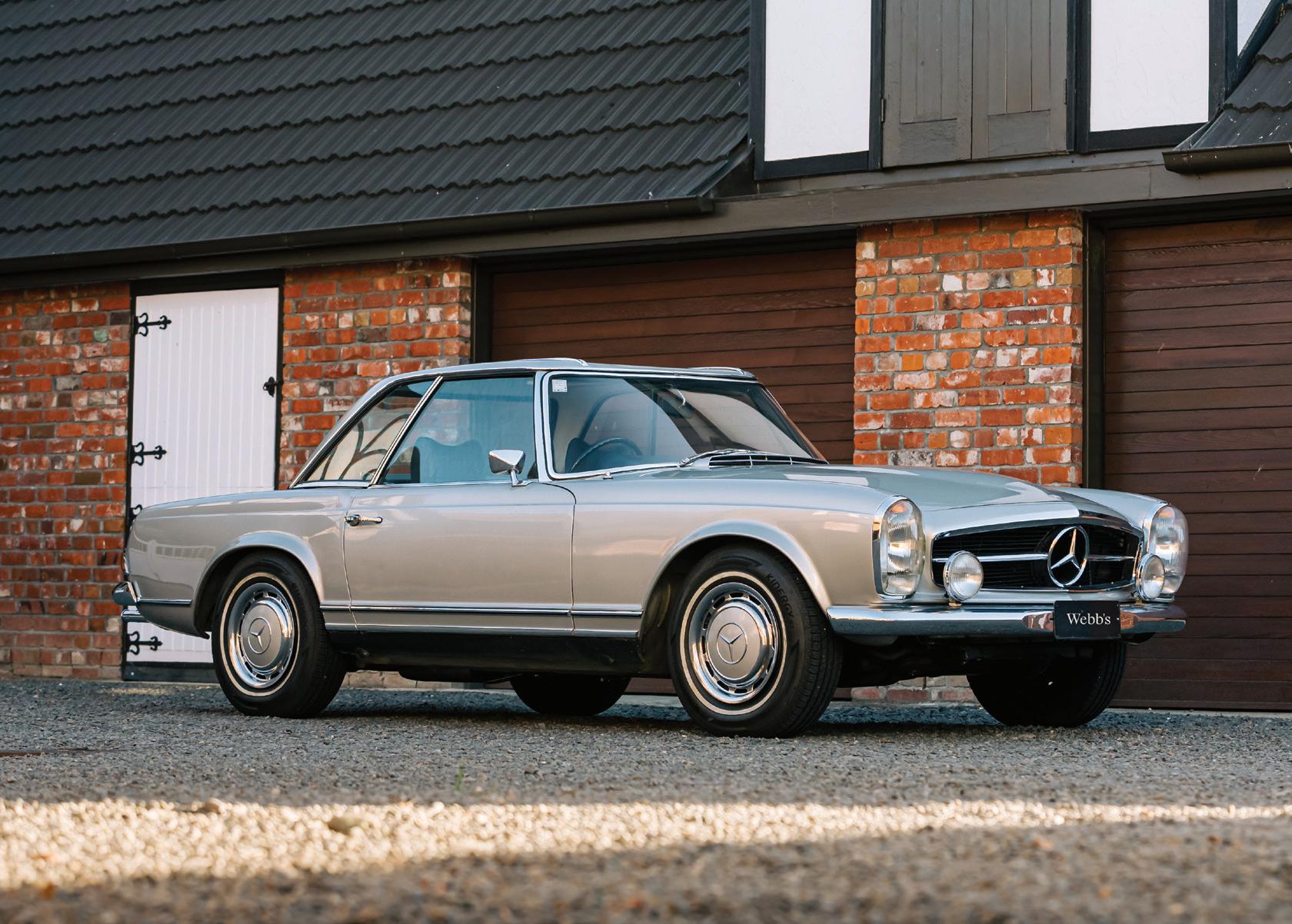
In November 2025, Webb’s successfully handled the discreet private sale of a genuine right - hand drive 1969 Mercedes-Benz 280SL ‘Pagoda’, manual, with just 78,000km from new. Presented in outstanding original condition and accompanied by its handbook, tool kit and spares, transferring quietly from a distinguished South Island collection to a new North Island custodian.
Such transactions underscore Webb’s strength in private sales. For over 50 years, our reputation as New Zealand’s premier auction house has been founded on trusted relationships, discretion and access to an extensive national and international network of serious collectors. We specialise in cars of significance and understand when a sale is best conducted away from the open market.
Whether acquiring or selling privately, clients benefit from Webb’s global reach, depth of expertise and carefully cultivated client base, enabling exceptional results with complete confidentiality.
Chris Wiseman Head of Collectors’ Cars, Motorcycles & Automobilia chris@webbs.co.nz
+64 22 187 7693
1969 Mercedes-Benz Pagoda 280SL Sold Privately November, 2025
Auction — Coming Soon
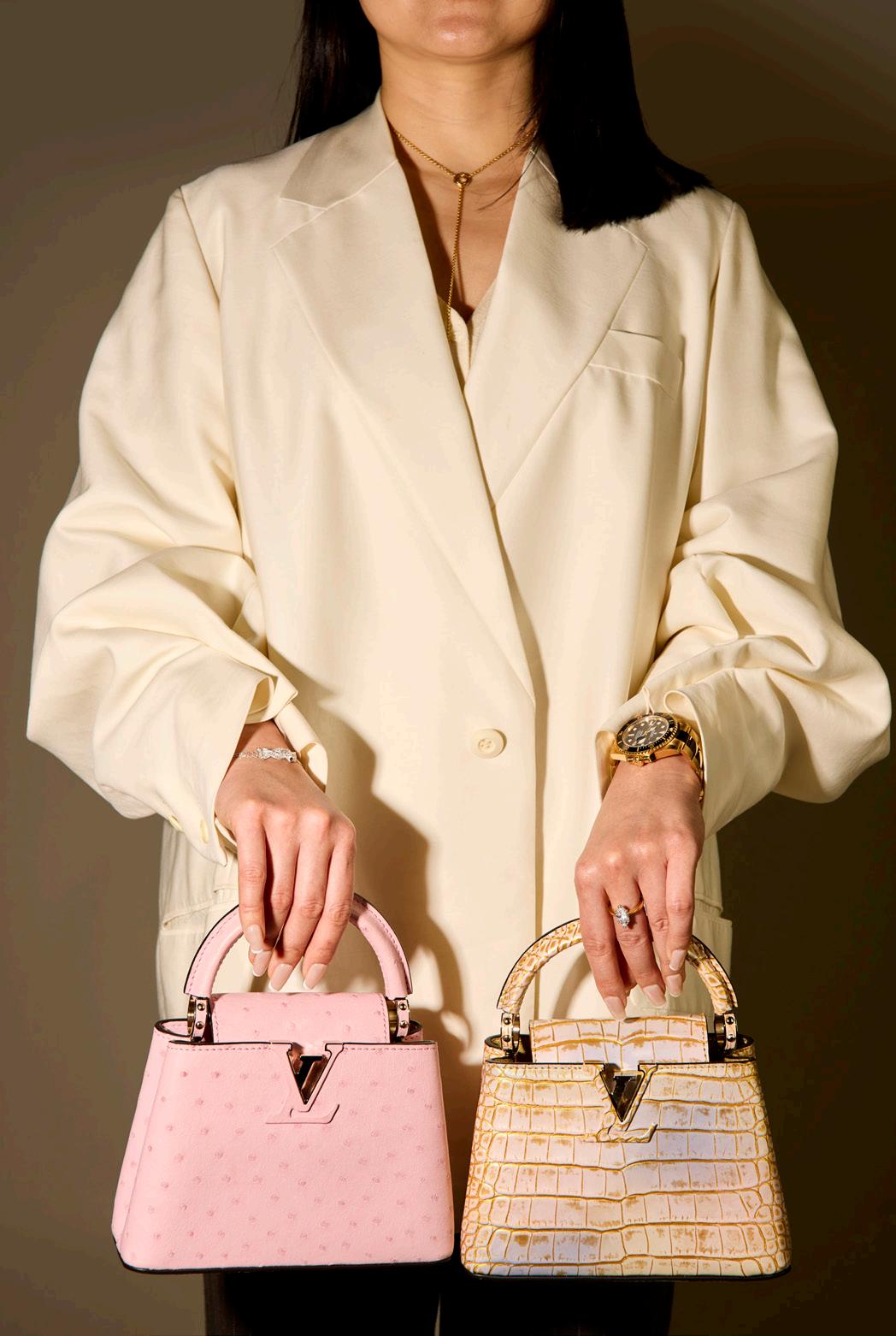
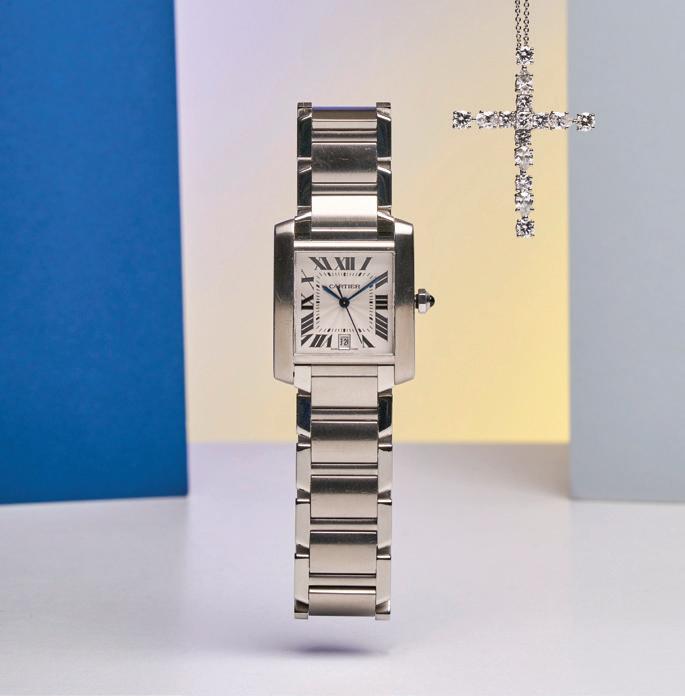
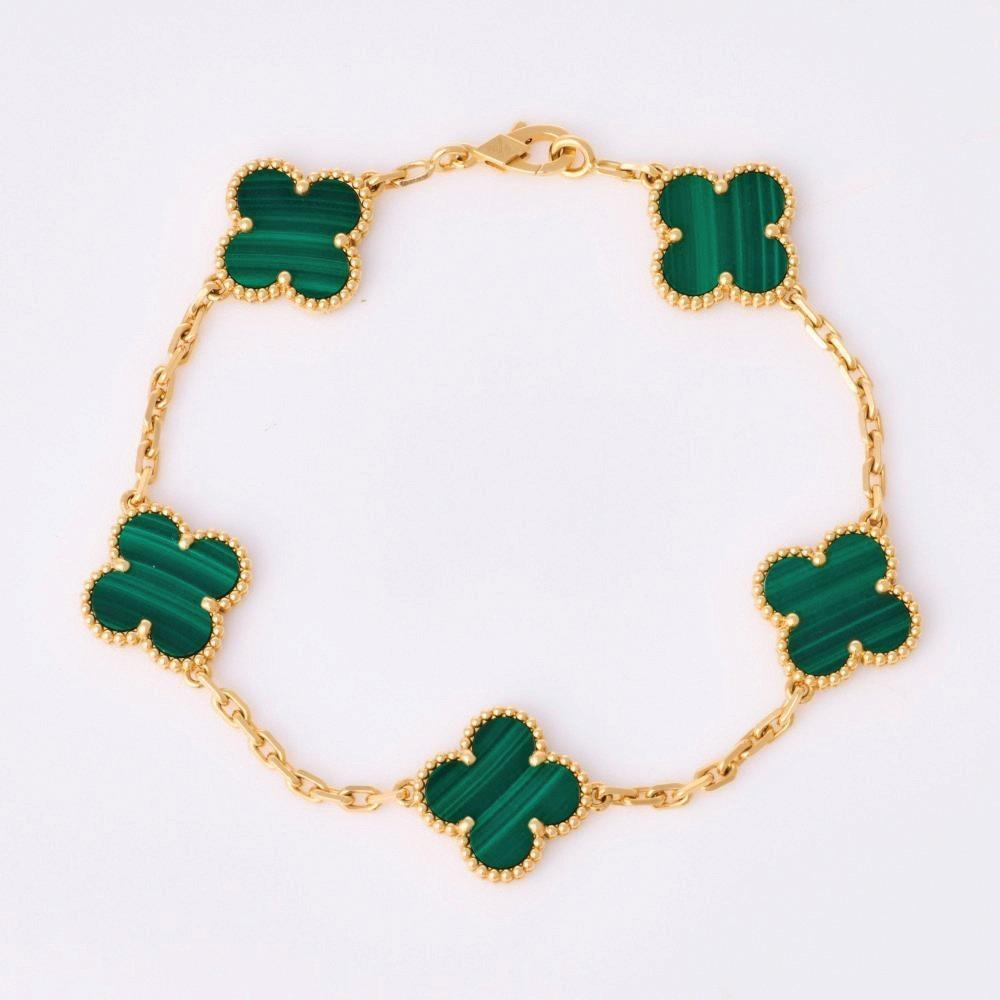
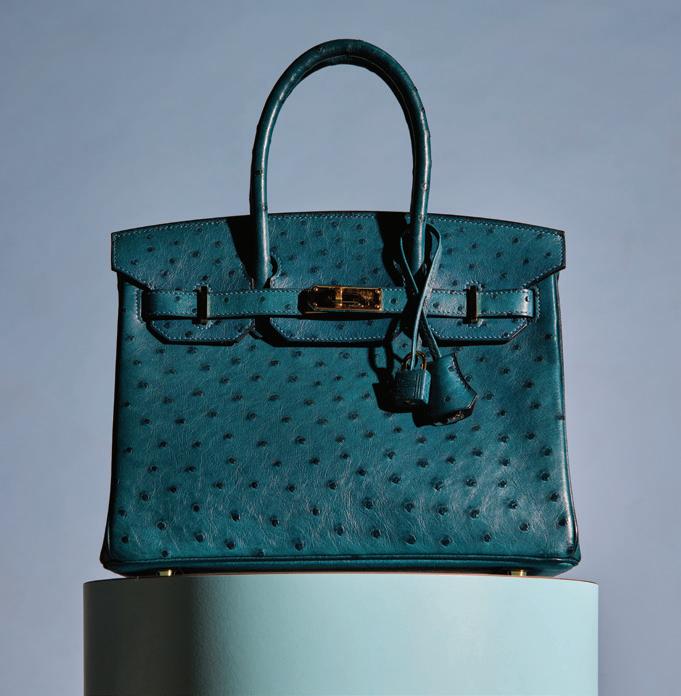
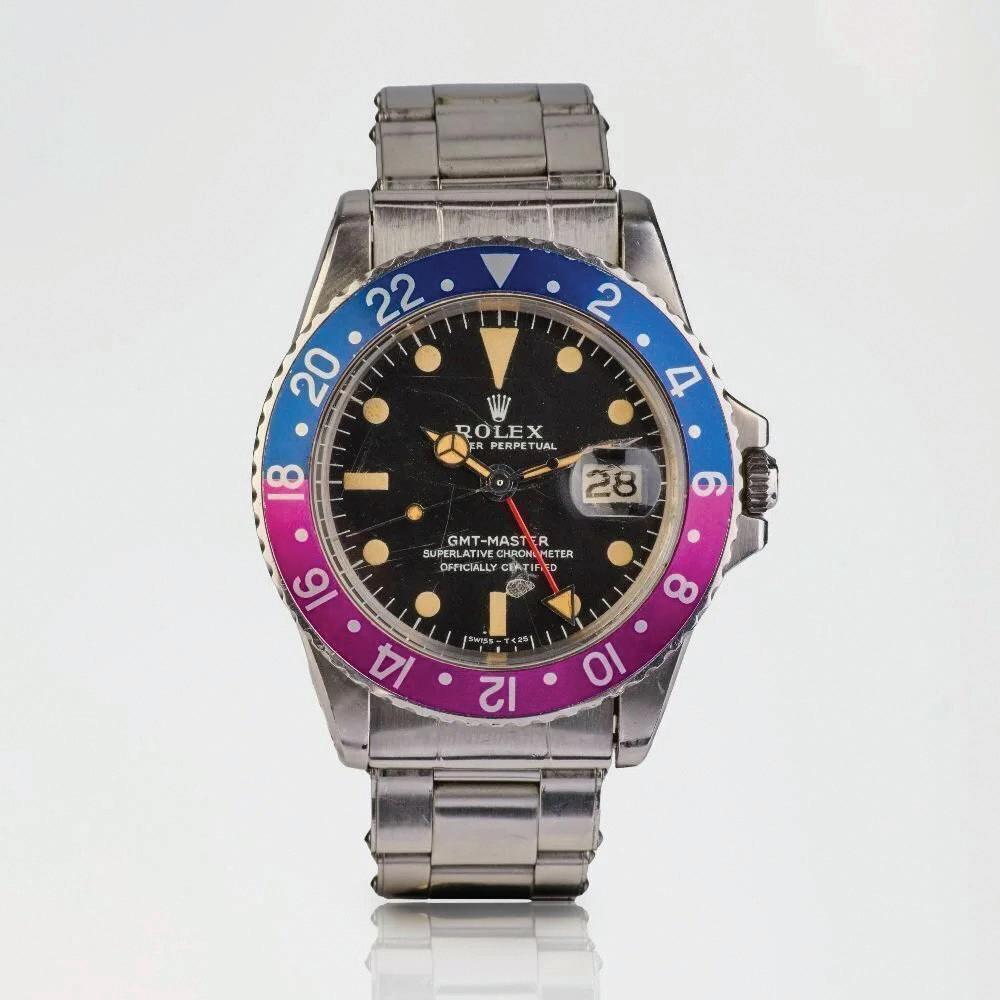
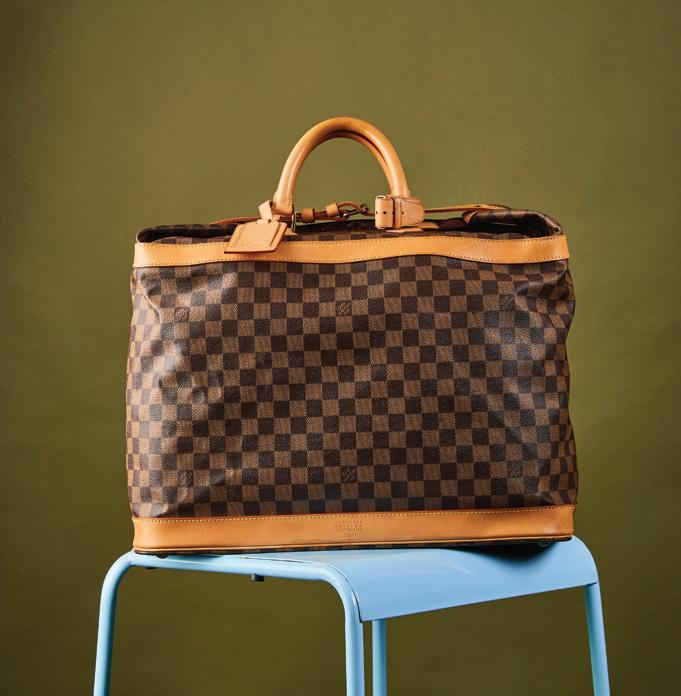
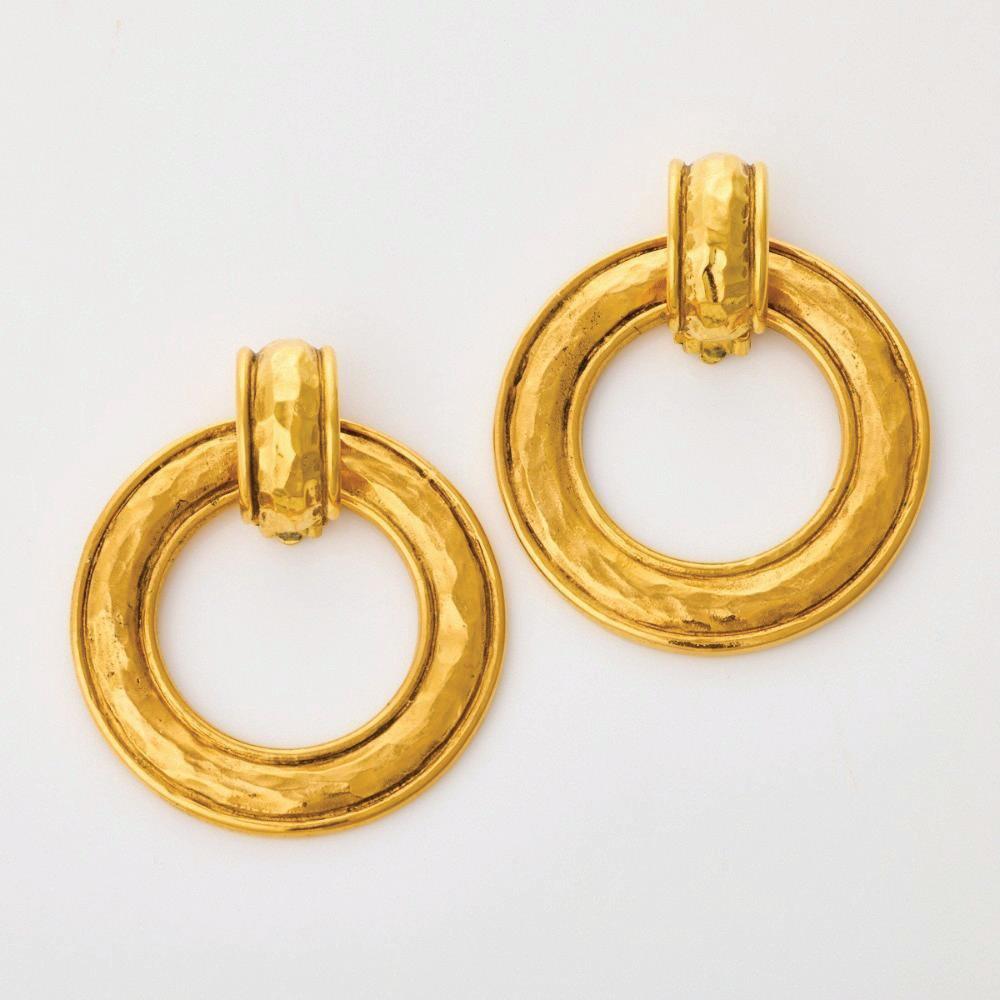
Webb’s Important Jewels, Watches & Luxury Accessories online auction will bring together an exceptional curation of rare and highly coveted pieces, from many of the world’s most revered luxury houses.
Showcasing the most exquisite craftsmanship, this top-tier sale offers a prestigious selection of important jewels, collectable timepieces, and standout luxury accessories chosen for their quality, desirability, and provenance.
Designed for astute collectors and connoisseurs, this auction will offer one-off opportunities to acquire pieces that are seldom available in the secondary market and add value.
Refined, premier, and unapologetically the ‘best of the best,’ this auction invites the discerning purveyors of exceptional treasures. The catalogue will be available for viewing by appointment in our Mount Eden gallery from 4—10 August and you are cordially invited to attend a special event where you can explore these objects of desire and meet like-minded collectors. All bidding takes place online.
Many of the houses represented in this auction are not only synonymous with exceptional craftsmanship, they are also among the world's most committed patrons of the arts. From dedicated cultural foundations to global commissions and philanthropic programmes, these maisons invest deeply in local and international artists and creative dialogues that define our time.
Christine Power Head of Fine Jewels, Watches & Luxury Accessories AJP (GIA)
Cartier
Established in 1984, the Fondation Cartier pour l'art contemporain ranks among France's most prominent private cultural institutions. Recently relocated to a Jean Nouvel-designed building in Paris, it commissions and supports artists across painting, photography, video art, and design. Notably, the Fondation Cartier project Aumoana, conceived and presented by Māori artist Nikau Hindin, was included in their Exposition Générale (October 2025 to August 2026), a collaboration with artists working with traditional bark cloth across New Zealand and the Pacific.
Van Cleef & Arpels
The maison has maintained a long-standing connection to dance, dating to the early 20th century when members of the Arpels family were devoted patrons of the Paris ballet. In 2020, Van Cleef & Arpels launched Dance Reflections, supporting choreographic artists through performances, festivals, and educational programmes. In 2024, the maison supported Te Ao Mārama by Moss Te Ururangi Patterson, performed by the Royal New Zealand Ballet as part of DanceX.
The Fondation d'entreprise Hermès supports contemporary artists through residencies, exhibitions, and its Académie des savoir-faire, which focuses on the transmission of craft. Auckland-born artist Yona Lee has participated in Fondation d'entreprise Hermès initiatives, and Kate Newby, also from Auckland, presented ceramics in the 2024 exhibition Ephemeral Anchoring at Le Forum in Tokyo, works created collectively between her base in Texas and Mashiko-machi, a village in central Japan renowned for its pottery.
Rolex
Rolex has championed the arts through its Mentor and Protégé programme, pairing emerging artists with established masters across literature, music, dance, film, and the visual arts and architecture. Mentors have included David Hockney, Anish Kapoor, Olafur Eliasson, and Peter Zumthor. The company's commitment to the arts dates to the 1970s, when New Zealand soprano Dame Kiri Te Kanawa became the first Rolex Testimonee in music.
The Fondation Louis Vuitton, a Frank Gehrydesigned museum in Paris that opened in 2014, houses significant modern and contemporary collections and presents major temporary exhibitions. The Fondation's collection has a connection to Aotearoa through Katharina Grosse, who lives and works between Berlin and New Zealand. The Fondation holds two of her works: Canyon (2022), a permanent commission, and Splinter (2022), both created in response to Gehry's architecture. LVMH was also a principal corporate donor to the restoration of Notre-Dame Cathedral following the 2019 fire.
Through the Chanel Culture Fund, Chanel provides grants to artists, curators, and performers, partnering with institutions such as the National Portrait Gallery and the Centre Pompidou. The brand also awards the Chanel Next Prize, a biennial international arts award granting ten artists a total of €1 million in prize funding. The prize recognises contemporary practitioners who are redefining their disciplines and shaping the future of culture.
Hermès
Louis Vuitton
Chanel
Auckland Wine Club Cellar Achieves White-Glove Status at Auction
“There’s a lot of love and care that’s gone into this cellar. It’s been well looked after. But the time has come, and we’ve made the decision to work with Webb’s, to find people that will really appreciate the love, concern, and care, that’s gone into each bottle”
—John Bergin,
2026
There is a particular kind of collector for whom wine is not a trophy or a financial instrument but a question of timing. The whole enterprise, for this kind of person, is about patience: acquiring bottles with conviction, storing them correctly, and waiting until they are ready to be opened and shared. What began as a customs complication became one of New Zealand’s most carefully assembled private wine cellars curated over four decades. Some collections arrive at auction with a story already written—this one closed with a new chapter.
John Bergin is that kind of collector, and the cellar he assembled over the past four decades is the evidence.
The Auckland Wine Club did not begin with a mission statement or a formal membership structure. It began, characteristically, charmingly, with an incident at the border. Following extensive overseas travel in the mid-1980s, Bergin returned to New Zealand with a growing quantity of wines sourced directly from producers and merchants abroad. As the volume of imported bottles increased, customs authorities advised that a licence would be required to continue. From that practical necessity, the Auckland Wine Club was born. What had begun as a passion project became a formal collecting enterprise, and over the years it grew into a remarkable cellar of several thousand bottles, many acquired directly from wineries and held in carefully controlled storage conditions for decades. The Club was founded alongside a group of fellow enthusiasts united by a shared ambition: to access and enjoy wines at the point they were intended to be drunk. What began informally between friends evolved into a longstanding community centred around tasting, discussion and a genuine commitment to provenance.
Webb’s Fine Wines & Whiskies department regularly auctions single-owner collections, and such was the case with this recent sale of the Cellar of the Auckland Wine Club, which achieved a whiteglove status: every lot sold. The collection comprised nearly 900 lots spanning New Zealand, Europe, America, and South Africa, and represents one of the most thoughtfully curated private cellars to come to auction in New Zealand.
A white glove auction is a rare and highly successful auction where every single lot offered finds a buyer, also known as a "100% sell-through rate". The story behind the 'white glove' name, is the tradition of presenting the auctioneer a ceremonial pair of white auction gloves at the end of the sale to celebrate such a major achievement.
The success of this sale at Webb's is a result that reflects the exceptional quality of the collection and depth of appetite among New Zealand's wine community for cellars assembled with genuine conviction. Likewise, it is a testament of the tenacity, expertise, and acumen of our Fine Wines & Whiskies team.
“We were delighted to bring this collection to auction, and very proud of the results achieved” —Finn McCabe, Webb's Fine Wines & Whiskies Specialist. "The Cellar of the Auckland Wine Club reflects decades of thoughtful acquisition and careful stewardship. It is a collection built around the pleasures of sharing, discussion and discovery, and we are pleased to see that legacy continue with a new generation of collectors and wine lovers”.
The team at Webb’s expresses thanks to John Bergin and the Auckland Wine Club for entrusting this remarkable collection to us. To the new custodians of these bottles: may they be opened at precisely the right moment.
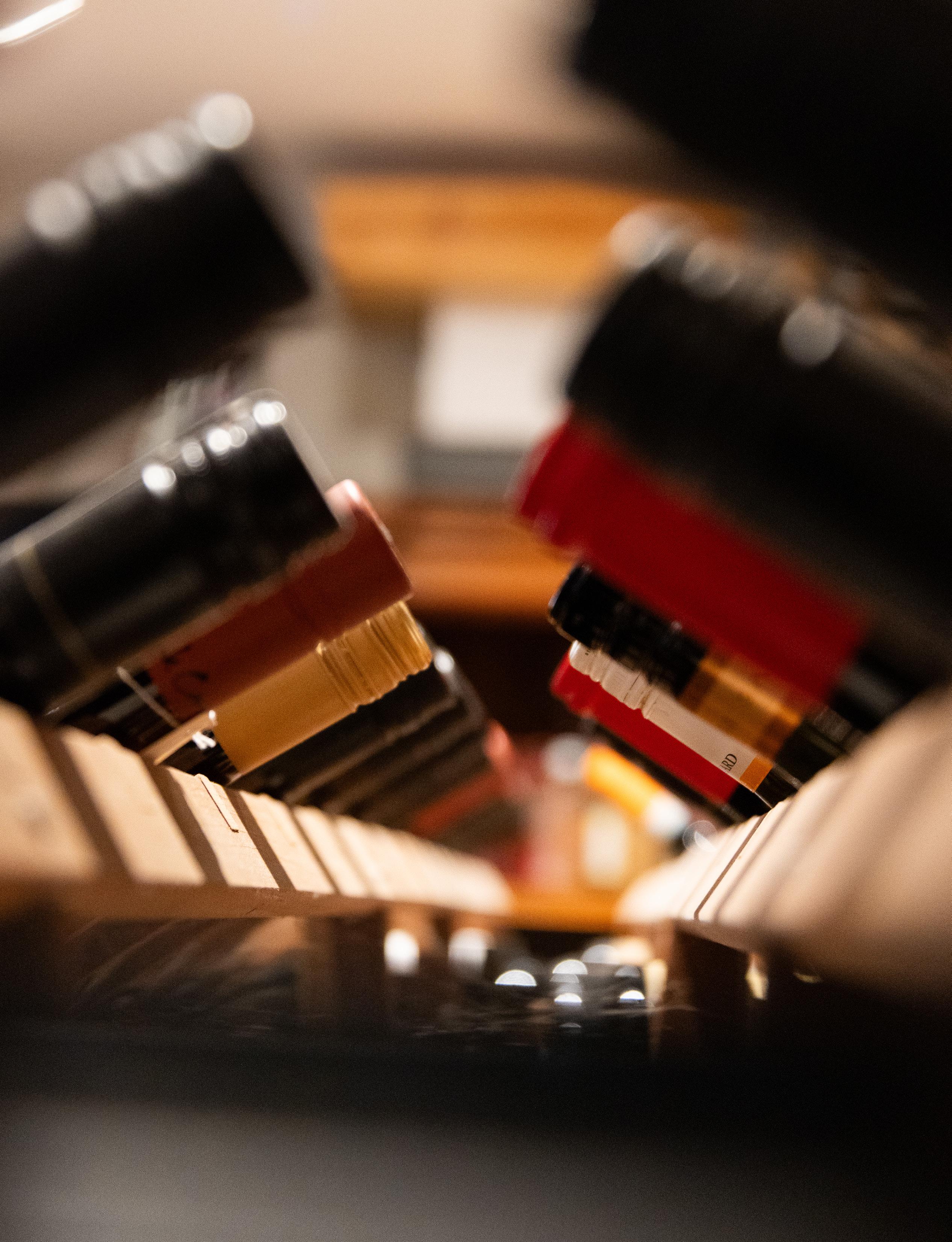
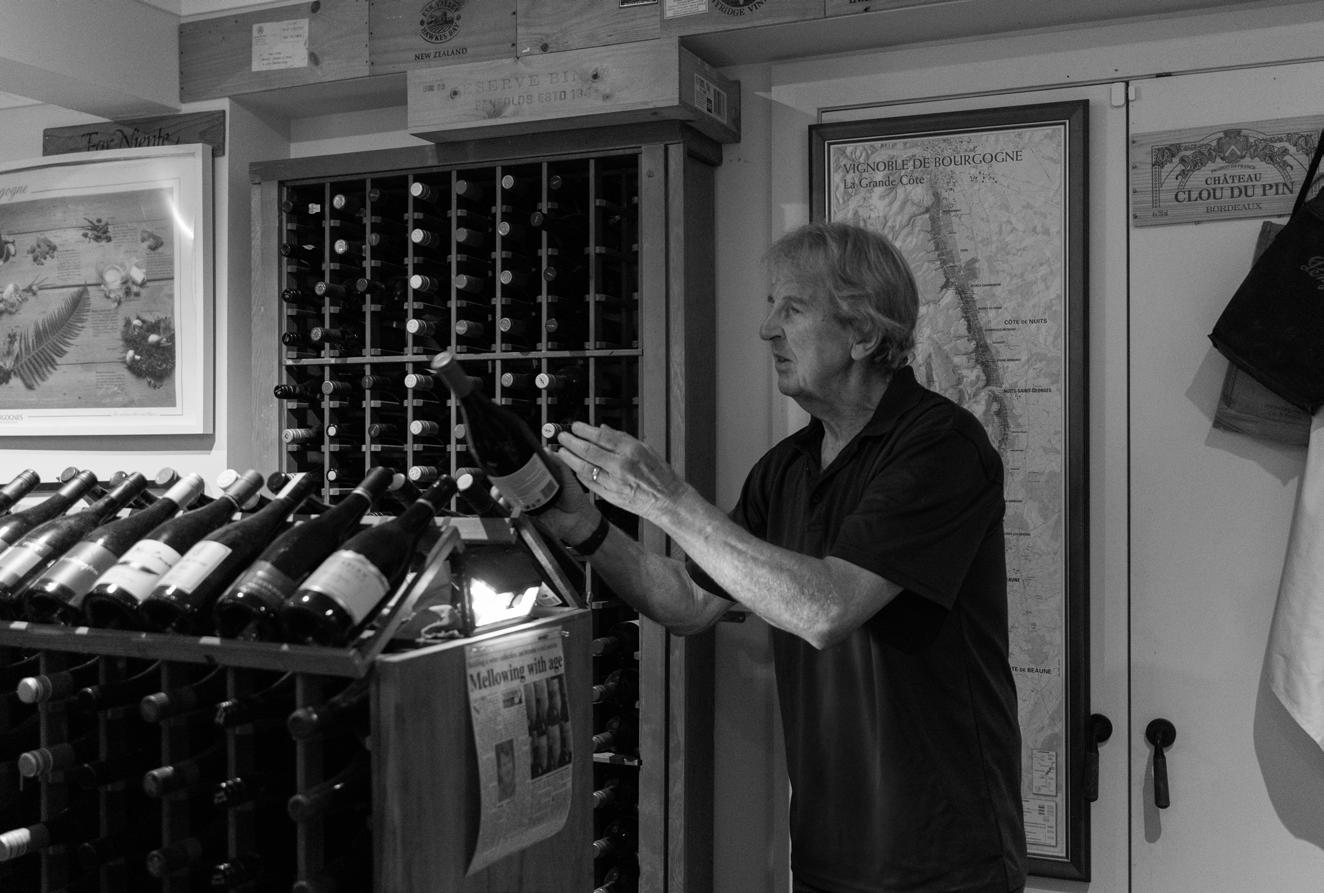
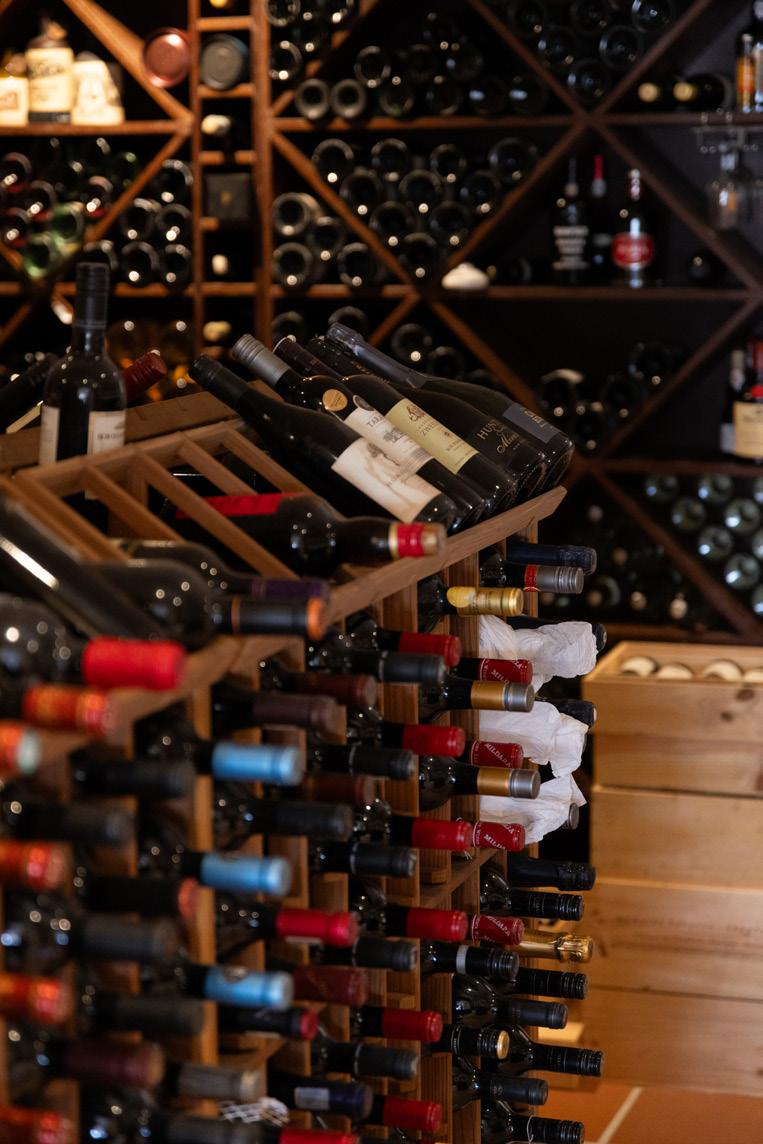
Photos of John Bergin's cellar prior to auction
The Estate | Design Edit
Online Auction
—Bidding Online + Weekday & Saturday Viewing
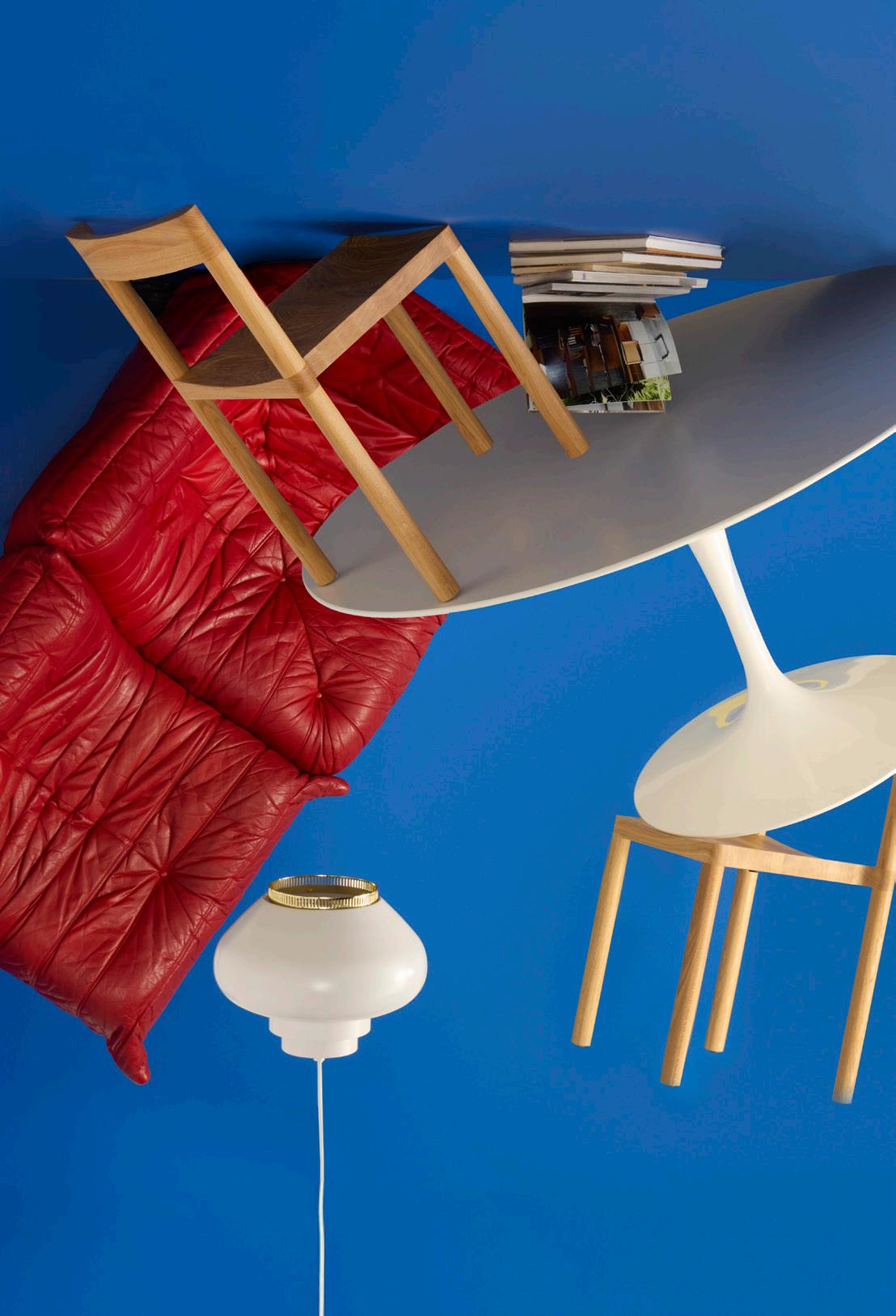
Webb's fortnightly online auction, The Estate, has built its reputation on the pleasure of discovery: rotating catalogues of furniture, antiques, vintage items and collectables chosen for integrity, presence, and enduring appeal. The upcoming July edition takes a sharper focus. The Estate: Design Edit turns its attention to collectable design, bringing together mid-century furniture and lighting, modernist objects, and pieces by recognised local and international designers whose work has been shaped by craft.
Where The Estate typically casts a wide net across vintage and eclectic objects, the Design Edit is curated with a more deliberate intent, unearthing designer treasures that will appeal to connoisseurs of interior design and architecture’s biggest names and most recognisable eras.
Design Edit represents the opportunity to acquire pieces that carry weight, both formally and historically, at accessible price points. Whether sourcing for a client project or a personal collection, the catalogue is likely to surface objects worth attention.
Bidding opens 9 July and closes 14 July, with all lots available for in-person viewing at Webb's Mount Eden showroom throughout the auction period. There is something to be said for seeing design objects in the round, at human scale, before committing. The showroom visit is worth making.
Leah Morris Head of Decorative Arts
Asian Art Live Auction
—Entries Invited
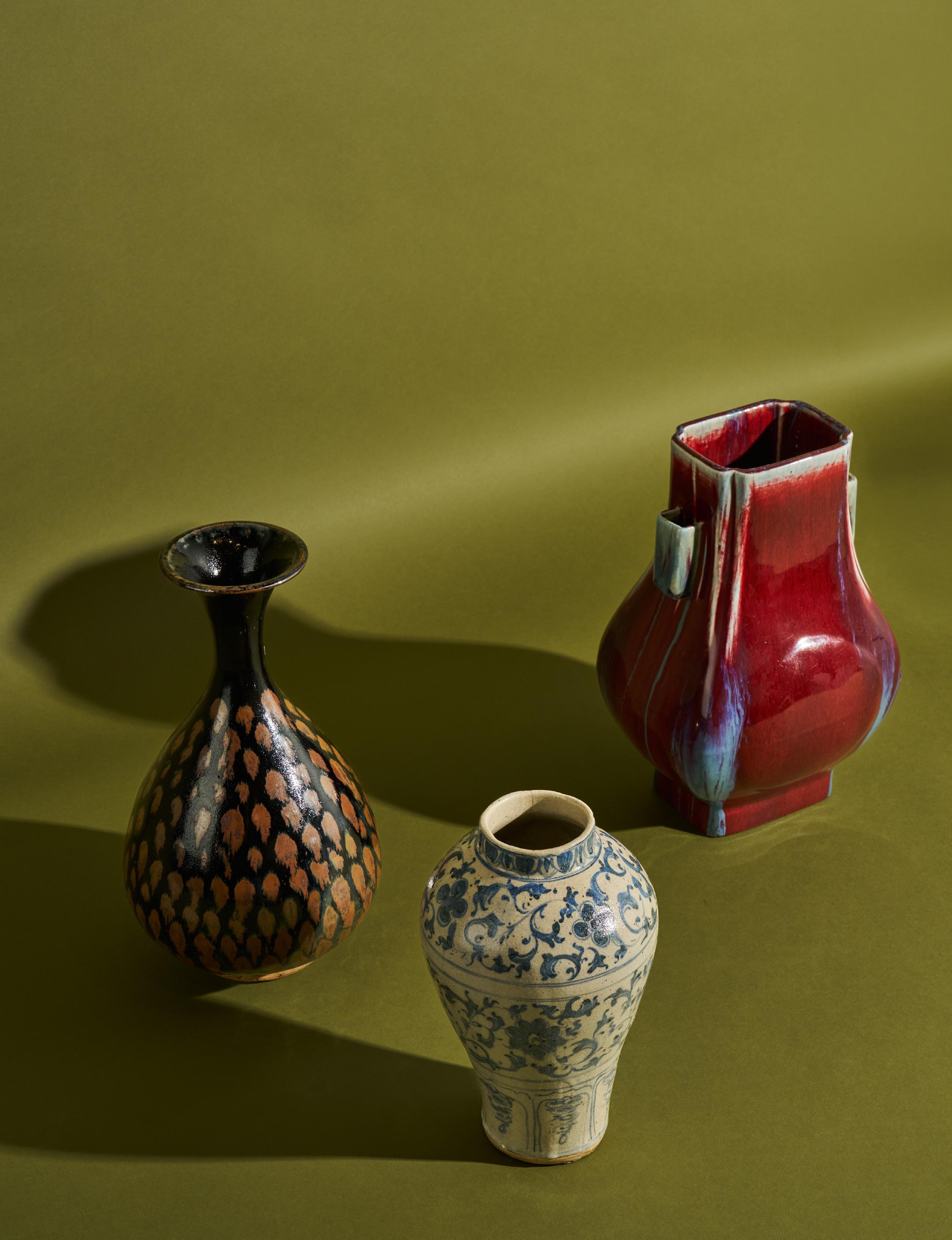
Webb’s Asian Art department specialises in bringing exquisite art and artefacts to market and we are currently seeking entries for our upcoming Online and Live auctions happening throughout 2026.
We are particularly interested in high-quality Asian carvings, ceramics, jade pieces, bronzes, textiles, scrolls, art, lacquerware, furniture, homewares and other items and we have the expertise and resources to market single, important objects as well as entire collections.
Our team has ushered exceptional results for our clients and the New Zealand market continues to see growing interest in this field, making this an auspicious time to consign your valuable pieces.
Contact our team of specialists to discuss your auction needs or to obtain a complimentary appraisal.
Tom Pan Head of Asian Art
Bill Hammond at Webb’s
Sean Duxfield
Senior Specialist, Art sean@webbs.co.nz
+64 21 053 6504
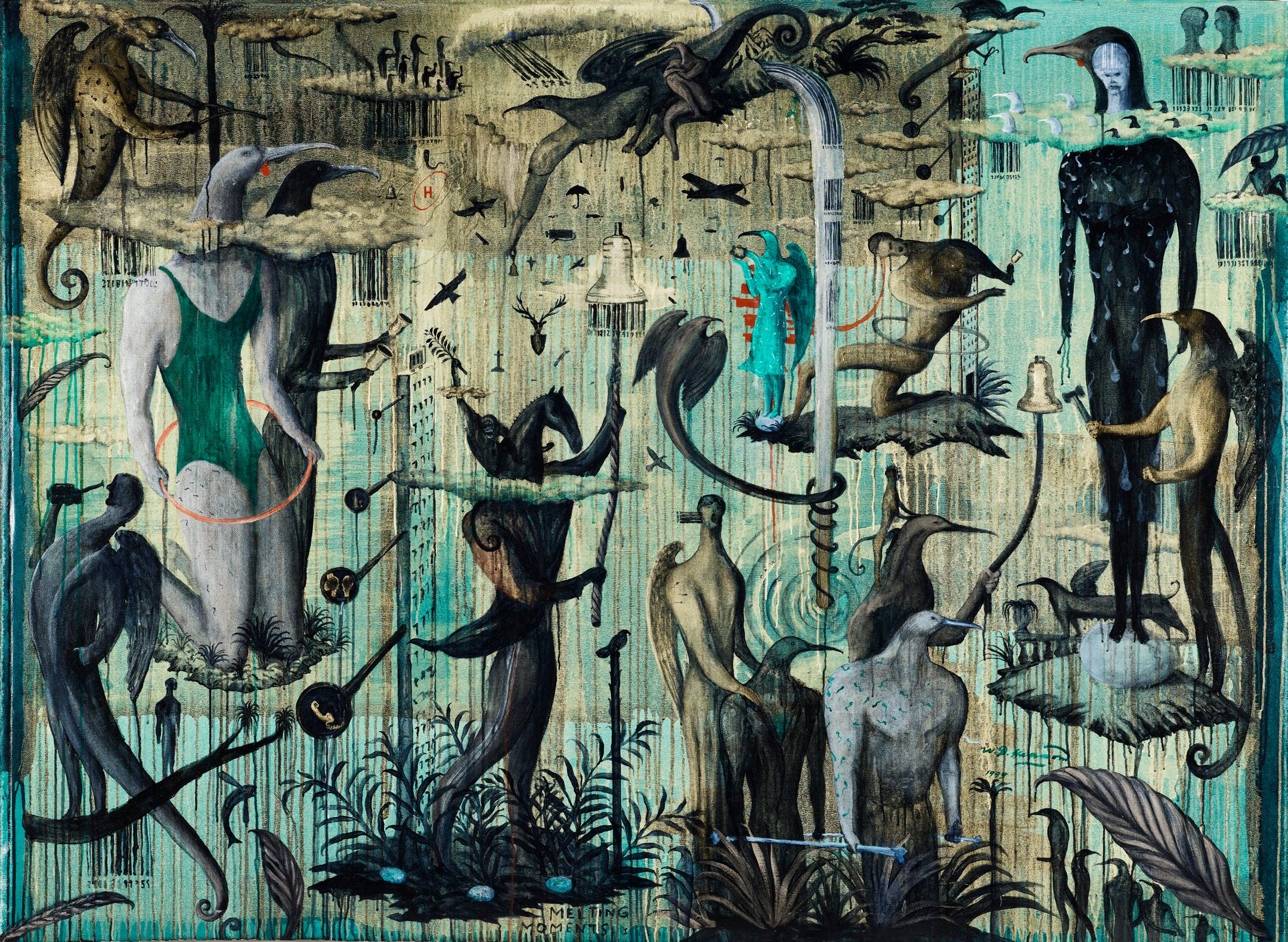
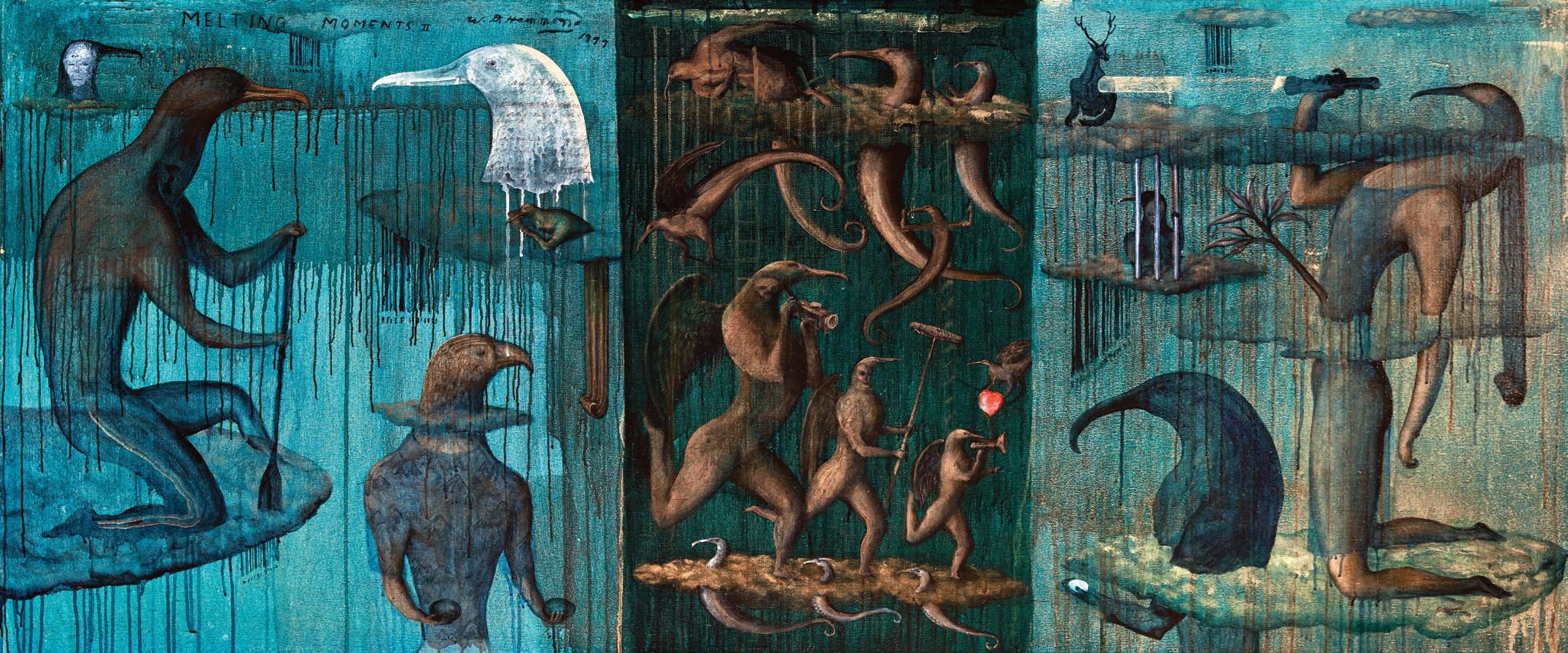
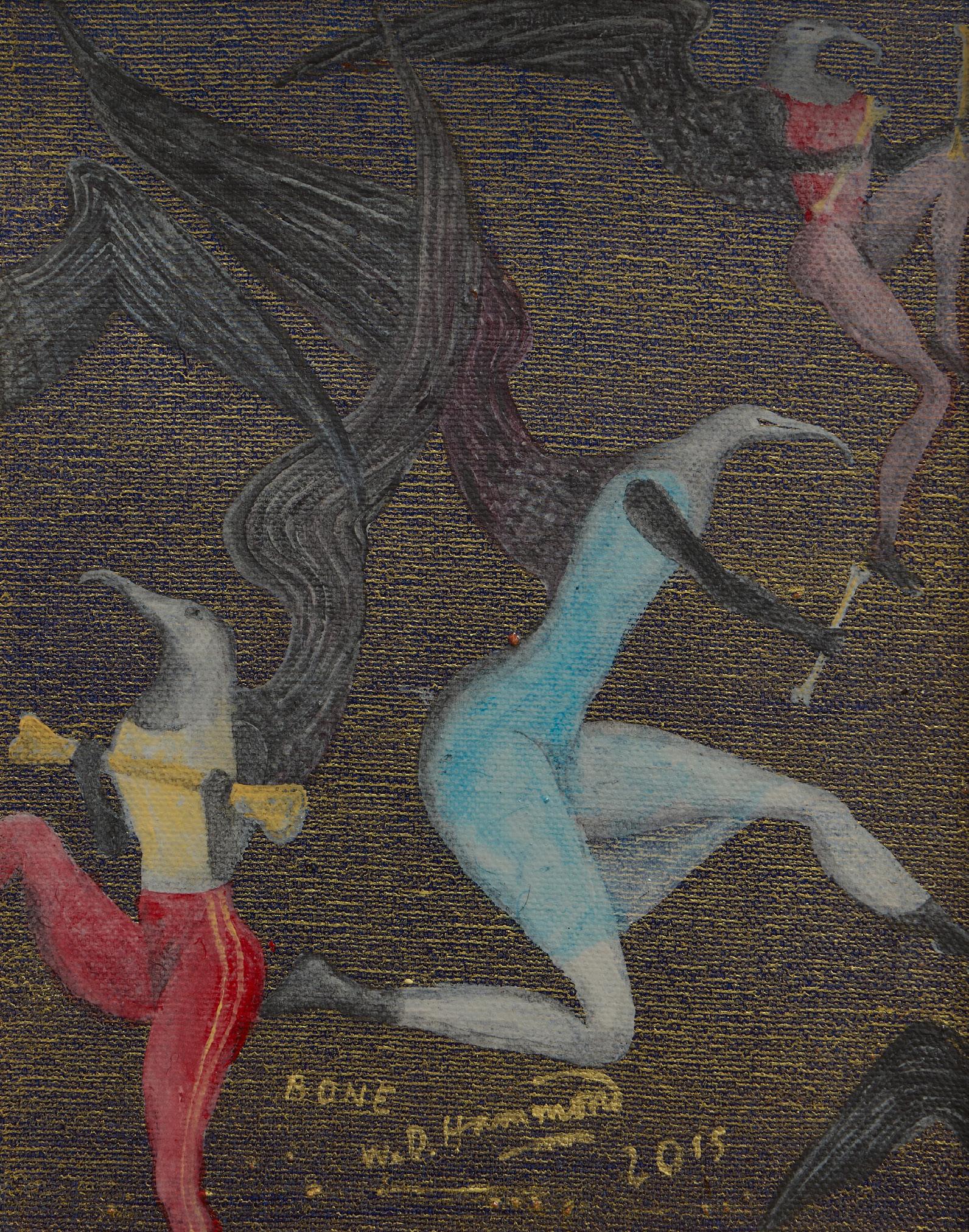
Bill Hammond, Melting Moments I, 1999, acrylic on canvas, 1600 × 2140mm est. $1,500,000—$2,500,000
Price Realised incl. BP: $1,674,024
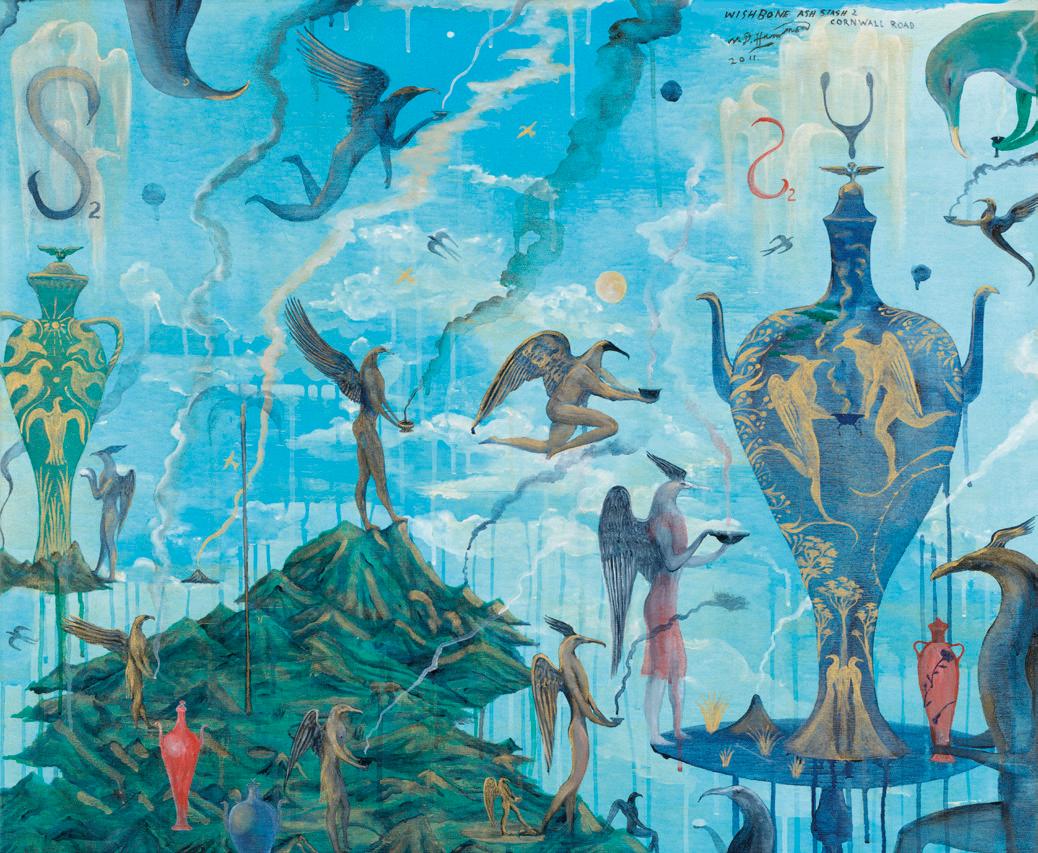
Webb’s auction performance with Bill Hammond is unmatched and has helped define the top end of the secondary market for the artist. In 2023, Melting Moments I achieved $1,674,024 (incl. buyer’s premium), setting a new record for Hammond. More recently, Wishbone Ash Stash 2, Cornwall Road realised $525,800 (incl. buyer’s premium) after substantial interest and a spirited contest between multiple buyers. Webb’s is the place to buy and sell works by Bill Hammond.
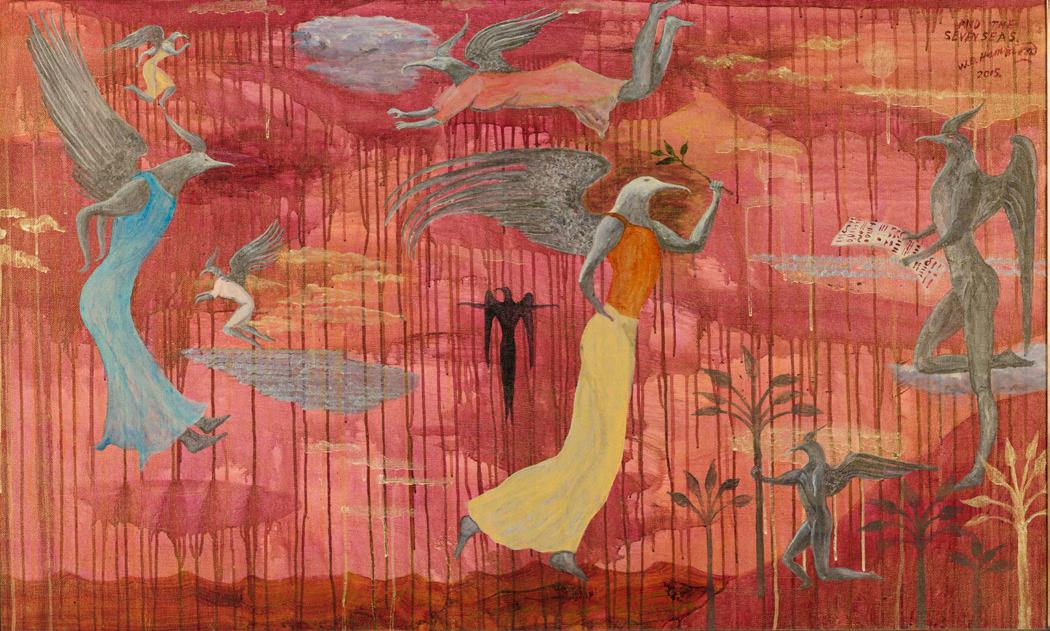
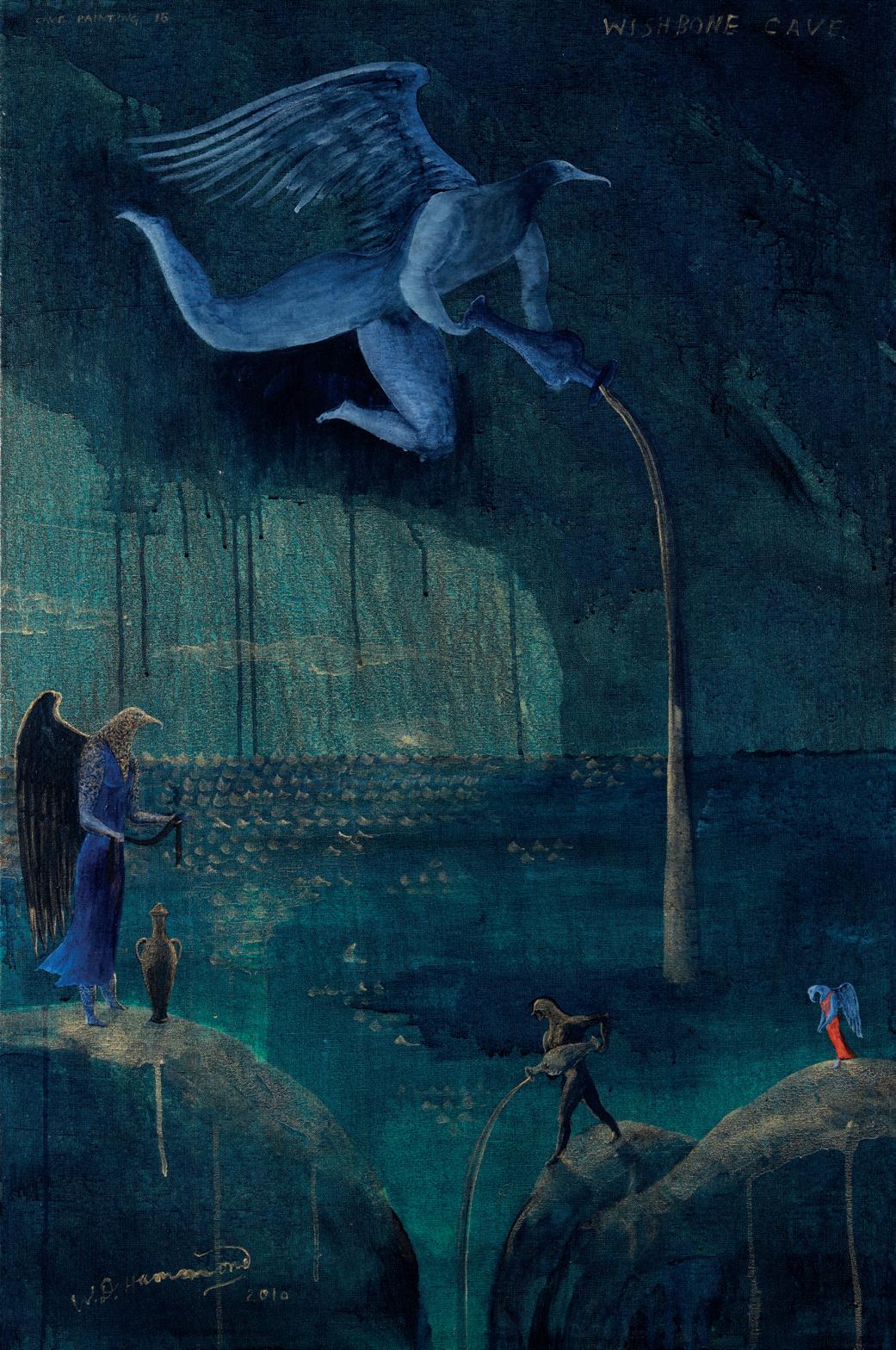
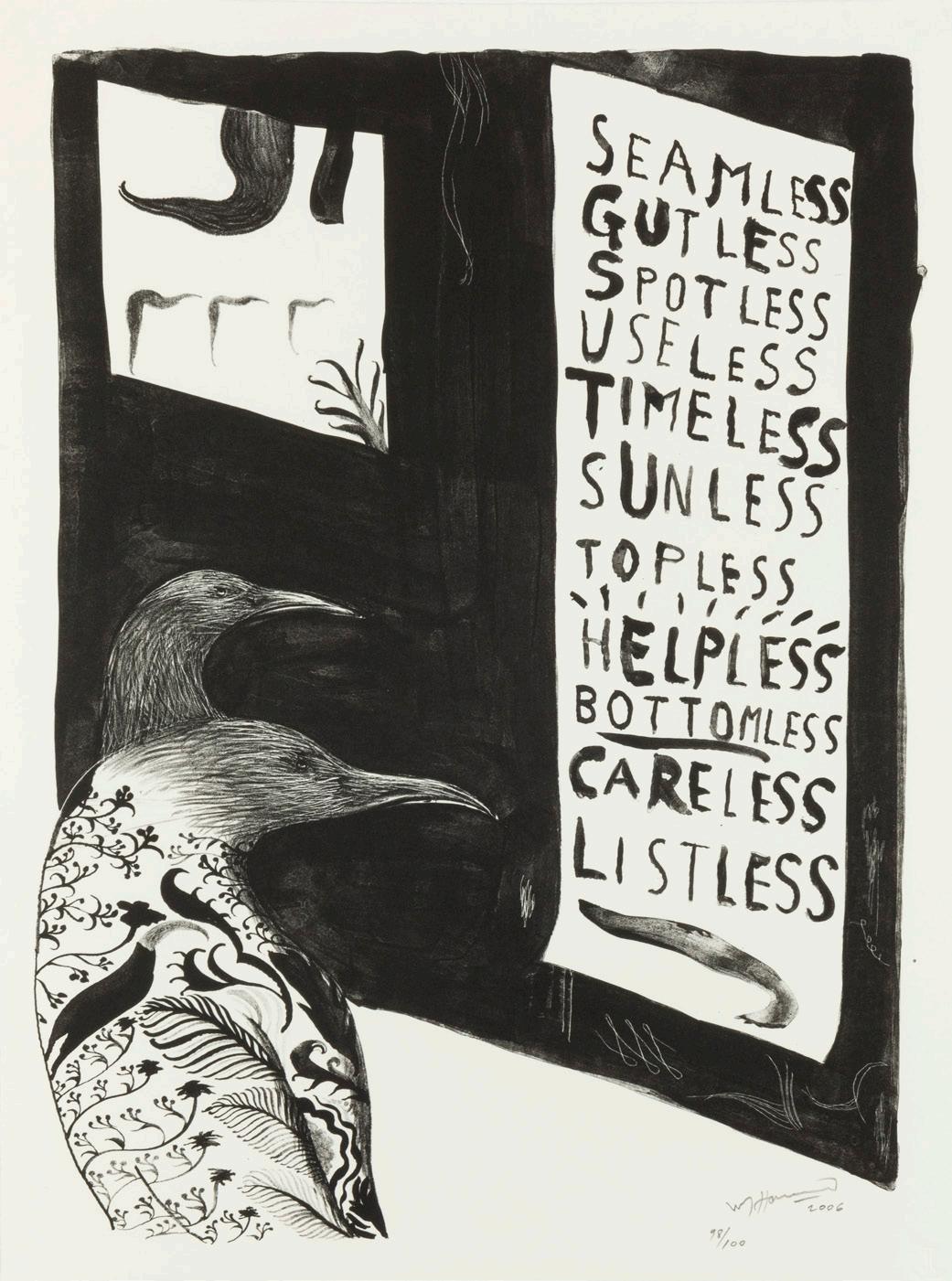
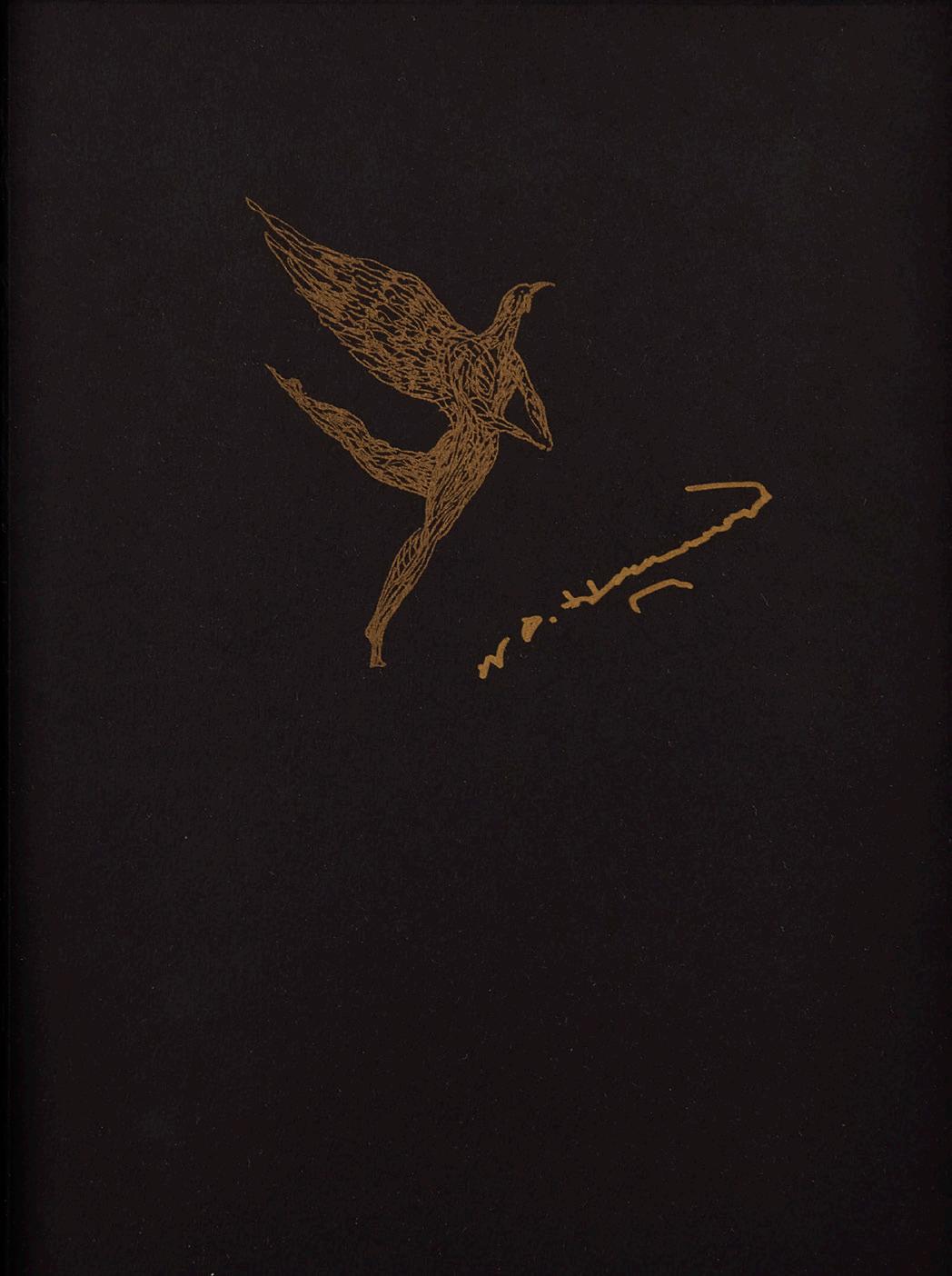
Hammond’s enduring market strength reflects the singularity of his vision. His avian figures are elongated, watchful, and poised between human and bird. They occupy a liminal space as witnesses to memory, ritual, and environmental change.
Following his pivotal journey to the subantarctic Auckland Islands, Hammond’s paintings became worlds suspended in time: places both before and after human presence. Across series such as Melting Moments and Wishbone Ash , he balances visual refinement with themes of transformation, loss, and quiet ceremony, creating works that are at once lyrical and unsettling.
For a confidential appraisal of your Hammond artwork and discuss selling at auction, get in touch with our specialist team.
1 Bill Hammond, Melting Moments II,1999, acrylic on canvas, 850 × 2000mm
$350,000—$550,000
Realised incl. BP: $926,125
2 Bill Hammond, Wishbone Ash Stash 2, Cornwall Road, 2011, acrylic on canvas, 855 × 1040mm
$360,000—$500,000
Realised incl. BP: $525,800
3 Bill Hammond, And the Seven Seas, 2015, acrylic on canvas, 910 × 1510mm
Realised incl. BP: $470,000
4 Bill Hammond, Wishbone Cave, 2010, acrylic on canvas, 1200 × 800mm
$380,000—$560,000
Realised incl. BP: $436,175
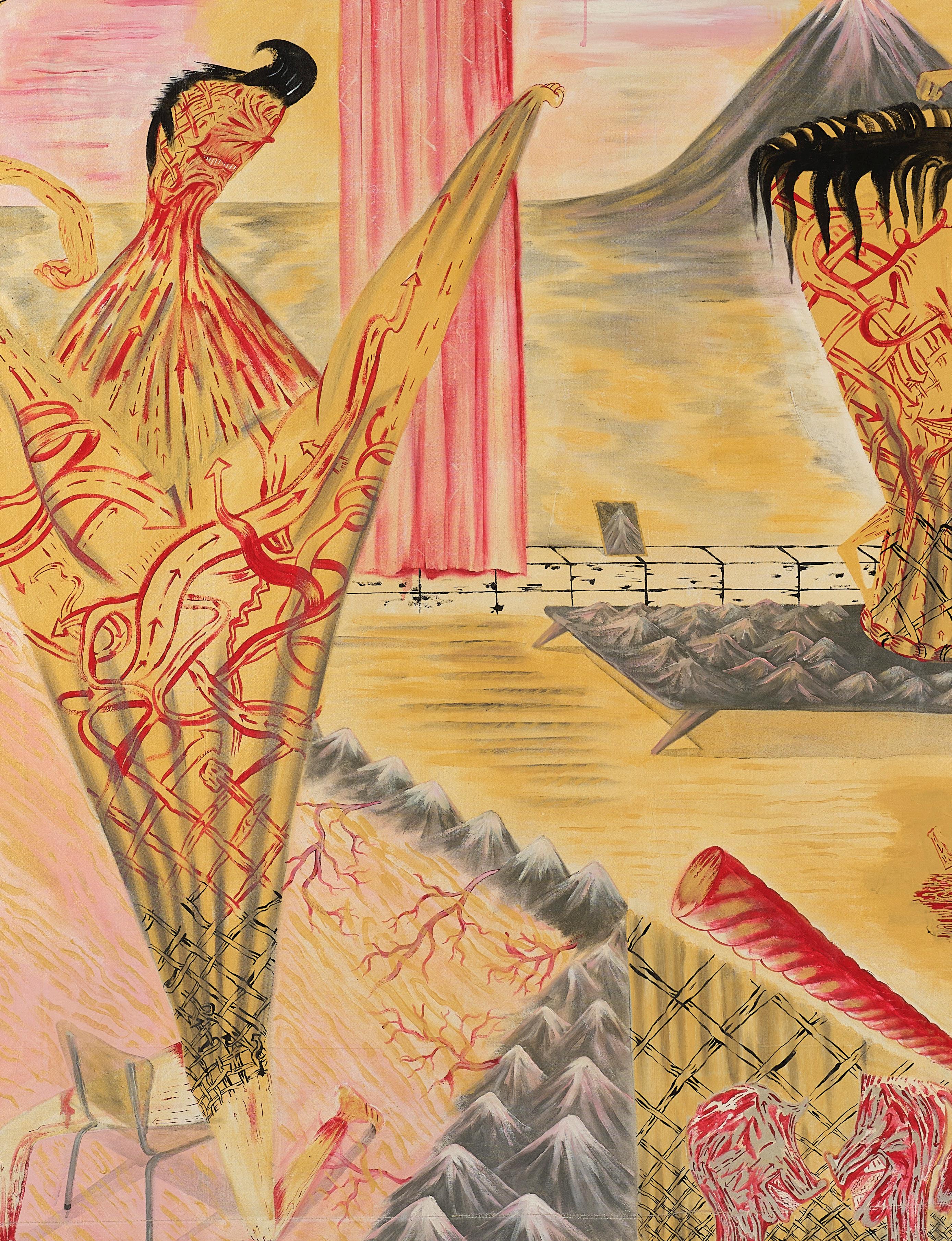
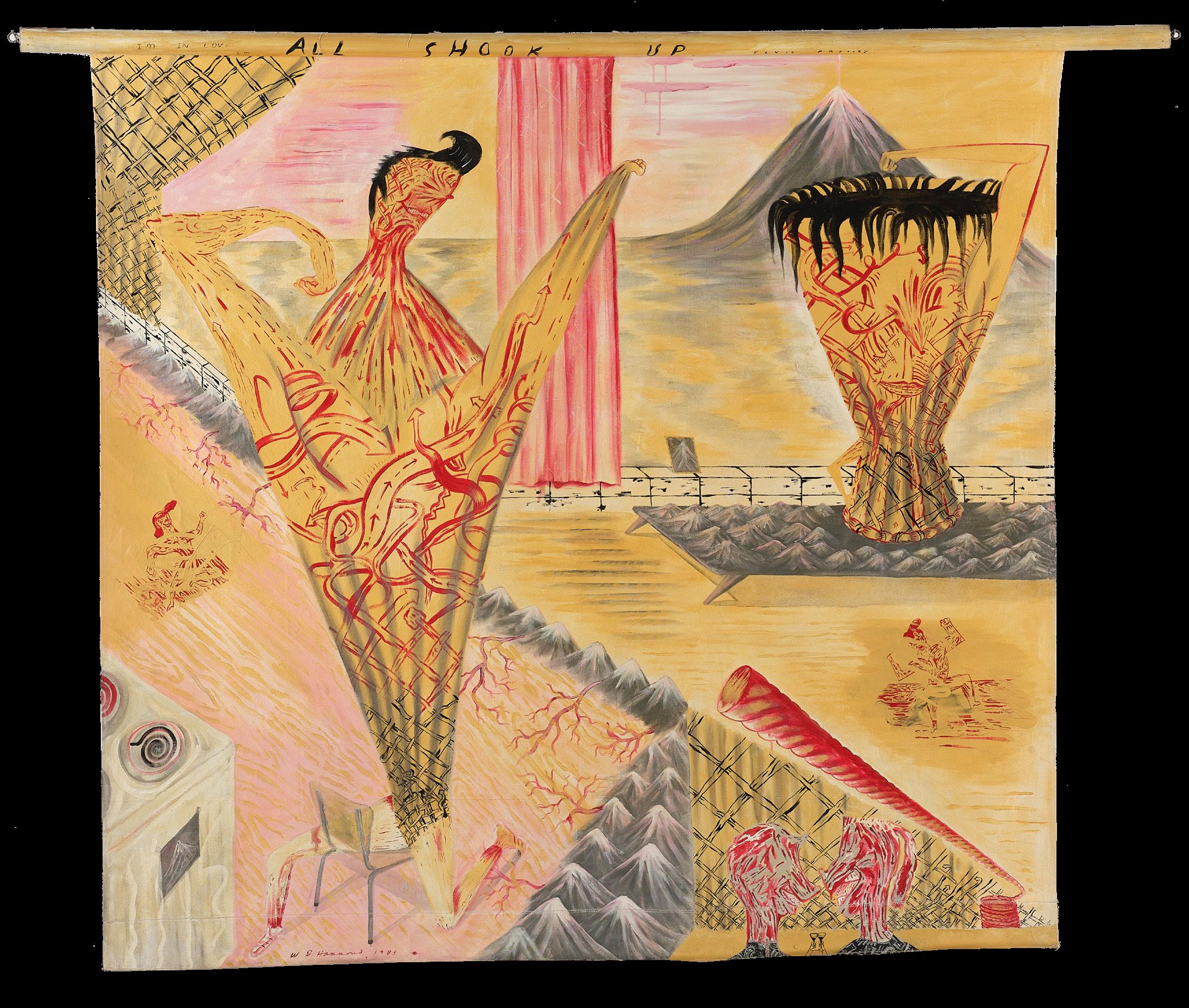
Lot 57. Bill Hammond, All Shook Up (detail)
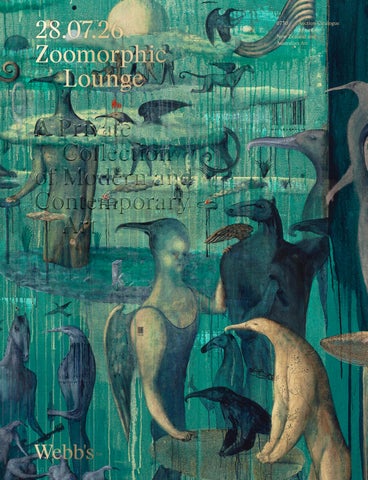
Foreword Zoomorphic Lounge
The term zoomorphic , from the Greek zōon (animal) and morphē (form), describes the attribution of animal characteristics to human figures, objects, or worlds. It signals transformation, a porous boundary between the human and the animal, the familiar and the strange. In art, it often points beyond mere representation, and towards an understanding that identity, environment, and imagination are not easily separated.
On behalf of the Art Department at Webb’s, we are delighted to present Zoomorphic Lounge: A Private Collection of Modern and Contemporary Art . It is a privilege to bring this collection to auction, one shaped not only by discernment and deep engagement, but by a sustained commitment to living with art over time.
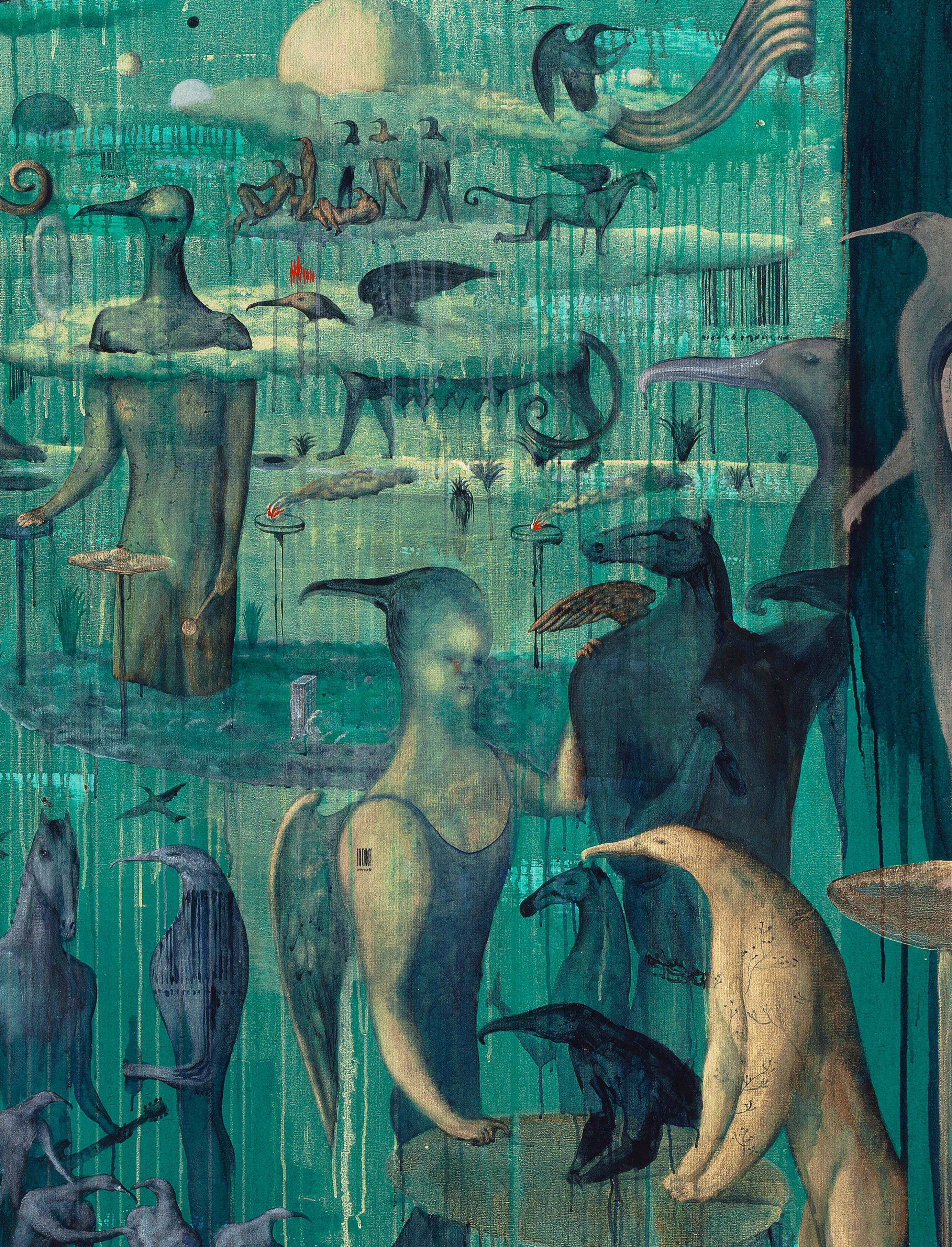
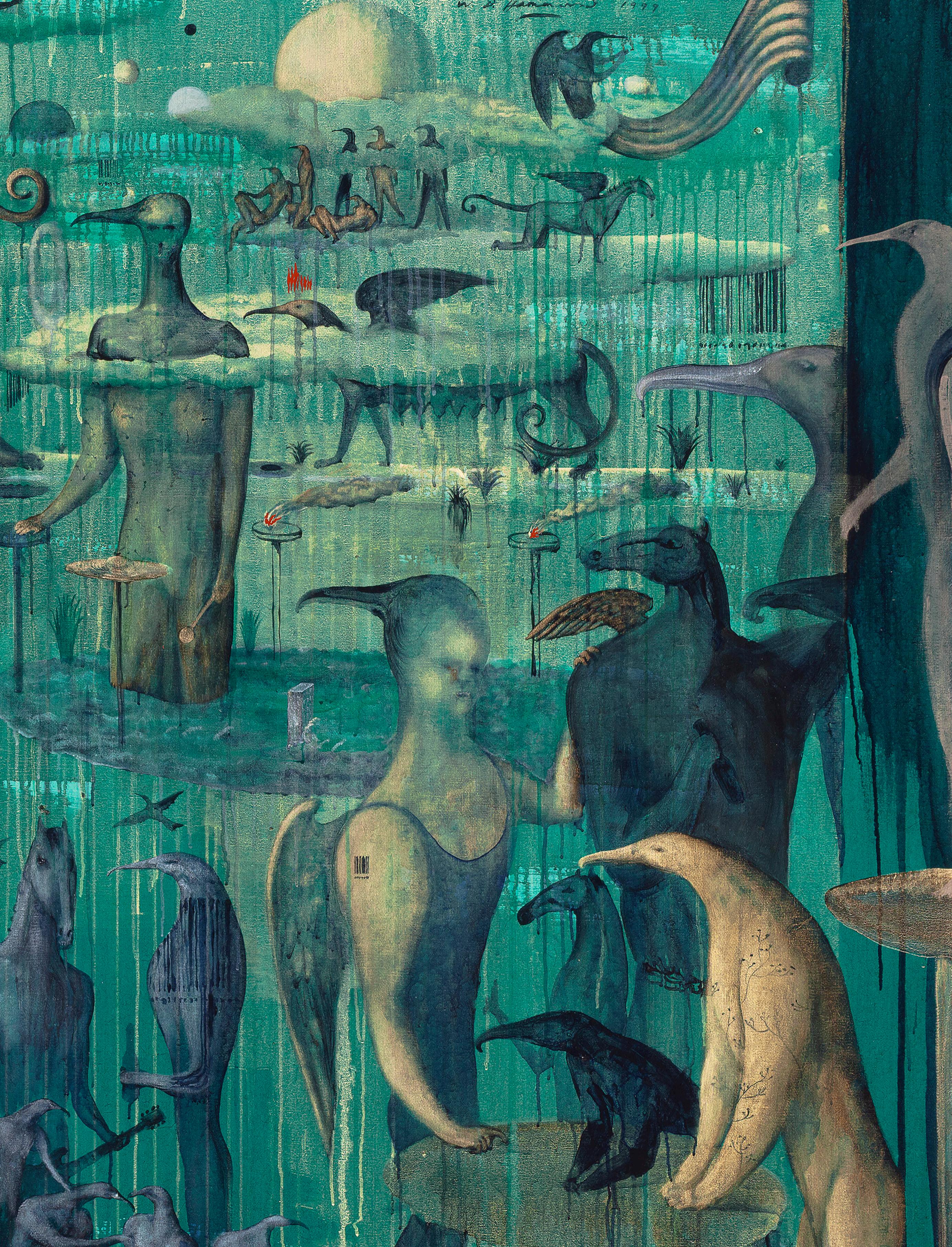
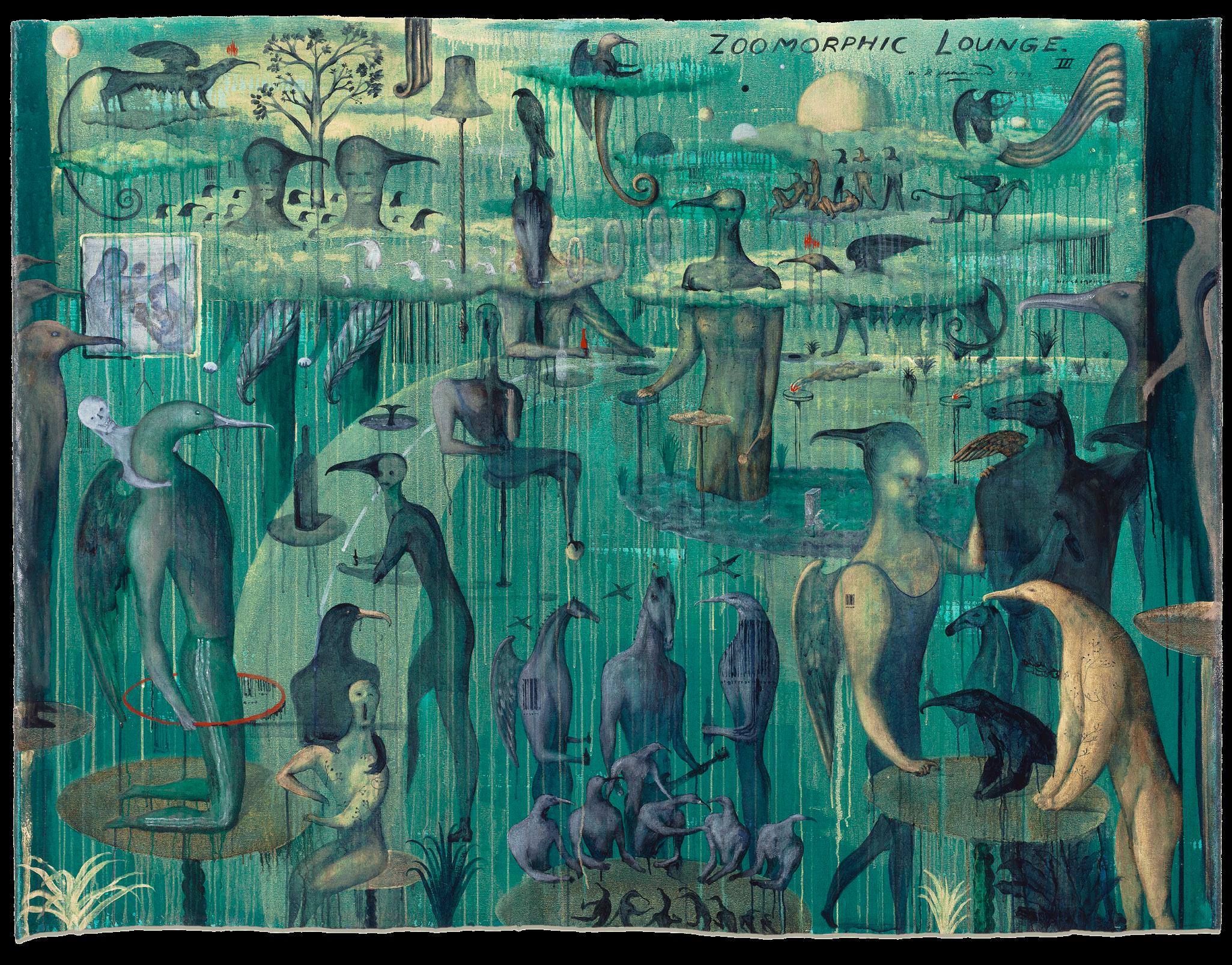
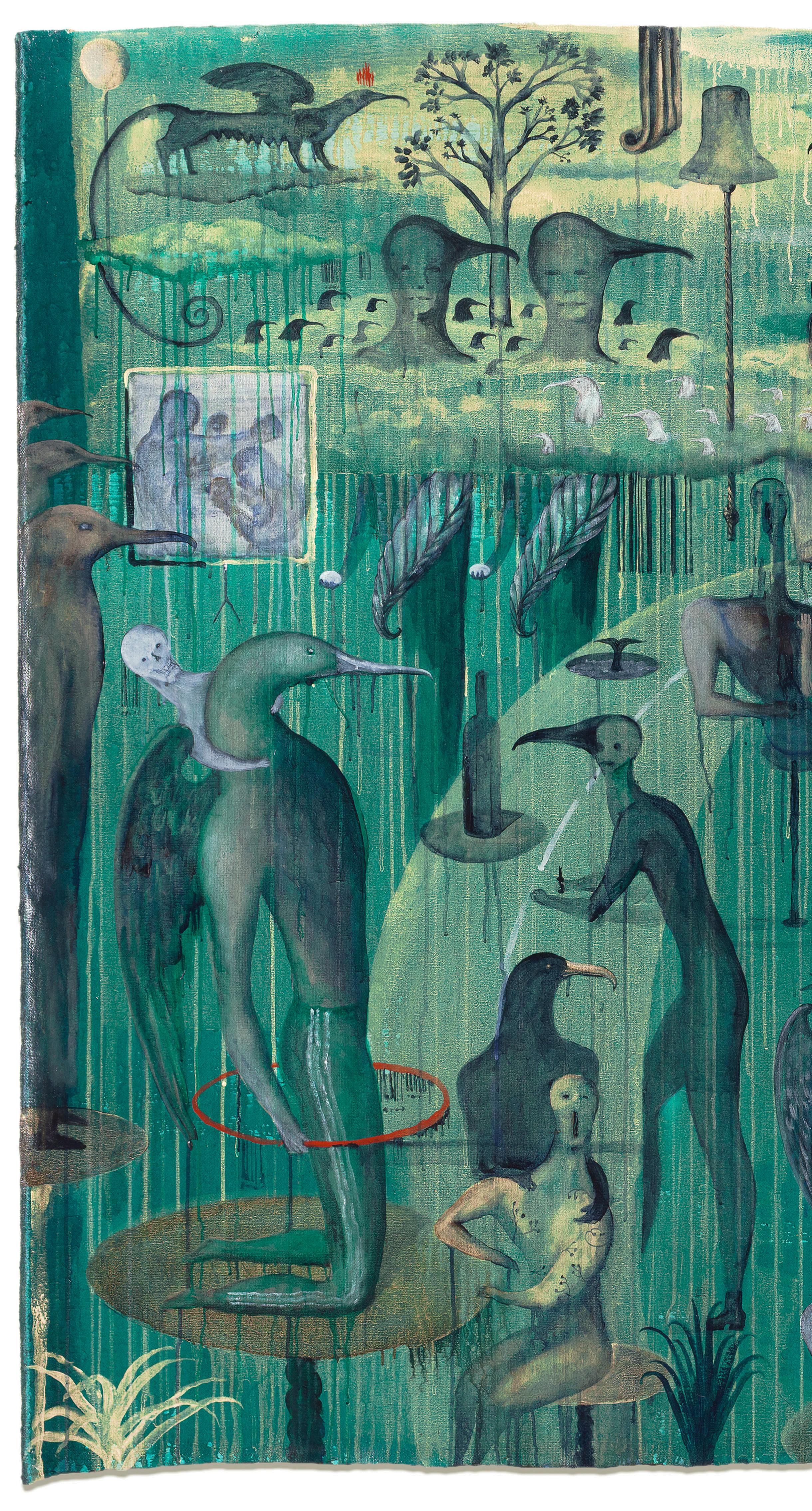
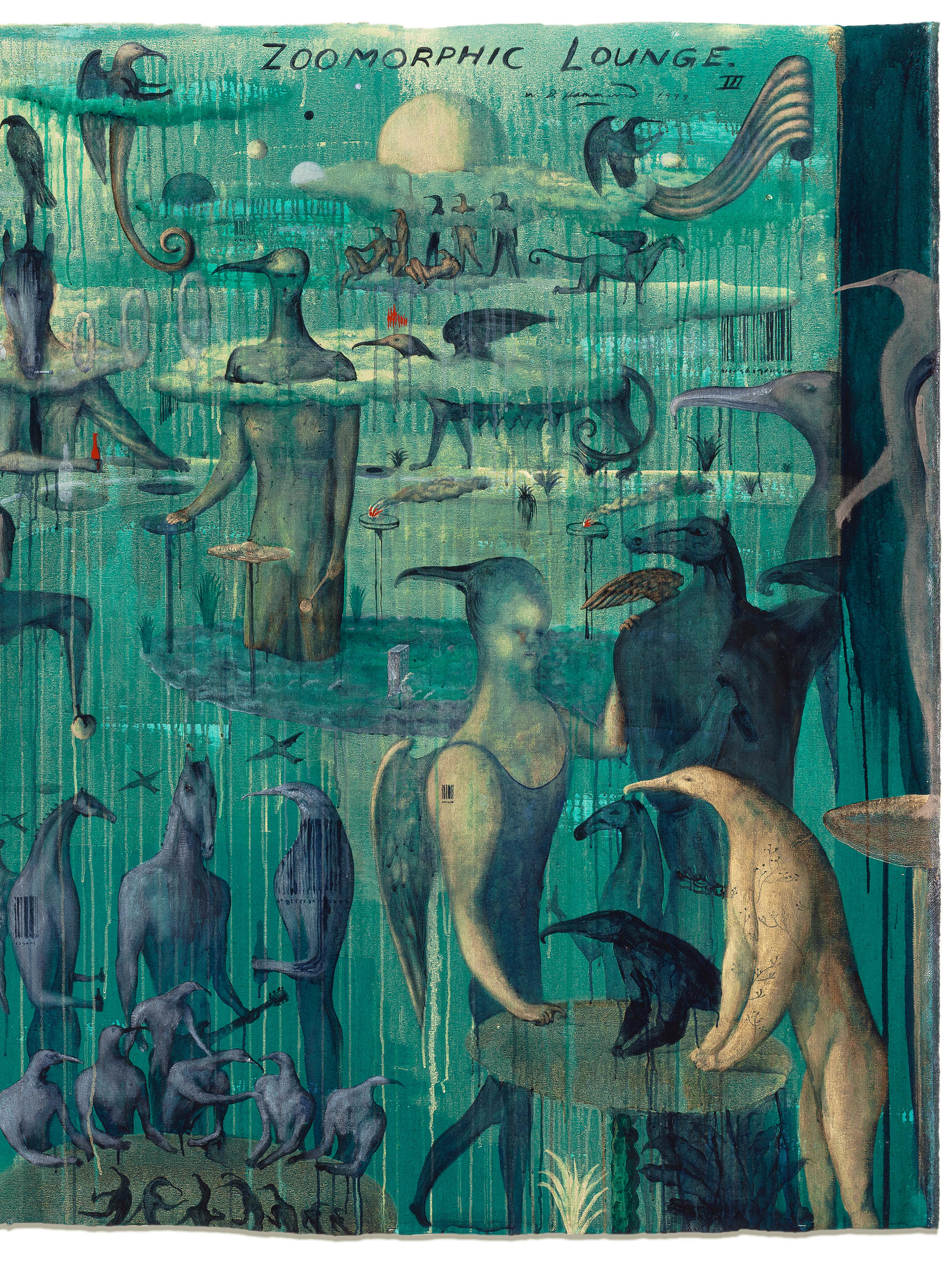
This catalogue takes its title from Bill Hammond’s Zoomorphic Lounge III (1999), a significant work that holds these relationships in fine balance. Hammond’s bird people, central to his practice since the early 1990s, are neither wholly human nor wholly avian. They occupy a liminal space as guardians, mourners, musicians, or witnesses, roles that shift from work to work. Their stillness suggests a condition suspended between life and display as taxidermy specimens while registering a subtle awareness of environmental loss in Aotearoa.
Lou Sanson (former Director of the Department of Conservation), marked a decisive shift in his practice. In an environment shaped by the near absence of human hierarchy, birdlife dominated the landscape. The idea of “birds in charge” arises from this experience, though in his work it is not rendered as inversion. It becomes a condition, a world in which human presence is provisional and other systems of order persist.
The essays gathered in this catalogue extend these mythologies, histories and building of worlds. They move between close observation and lived experience, critical reflection and personal memory. Contributions explore the work of Chris Charteris, Shane Cotton, Ayesha Green, Bill Hammond, Andrew McLeod, Fiona Pardington, Peter Robinson, and Robin White. Two interviews offer the opportunity to look closely and think more deeply. I was pleased to meet with artist Liz Maw to discuss the physical reality of painting, her vast references and the enduring presence of the artist’s hand. Likewise, it was an honour to interview the private collector behind Zoomorphic Lounge, tracing the formation of this collection; shaped over time through meticulous attention and encounter. Taken collectively, these texts offer multiple points of entry into practices that remain deliberately open.
Megan
These figures emerge from a specific encounter with place. Hammond’s 1989 visit to the Auckland Islands with our contributing writer
Zoomorphic Lounge is presented as a single-owner collection, formed over several decades. Such collections reflect a sustained way of seeing, shaped over time through attention and experience. Across Webb’s programme this
year, similar projects have emerged, from the works at Sir Miles Warren’s Ōhinetahi to Roger Ward’s Important Collection of Historic New Zealand Photography, and across departments, including the Auckland Wine Club Cellar. Together, they point to a renewed focus on the collection as both structure and expression.
Within this context, Hammond’s Zoomorphic Lounge III serves as anchor and axis for this collection. Around it, other works gather, extending and shifting its concerns and stories of place; land, memory, spirituality, mythology and a changing environment.
Christchurch, and in particular Lyttelton, remains central to Bill Hammond’s story. It is here that he is most often remembered, not only as an artist, but as a presence, observant, dryly humorous, and closely attuned to the world around him.
This catalogue is the result of a collective effort across Webb’s teams in Auckland, Wellington, and Christchurch. It brings together the work of specialists, writers, and artists, alongside contributions from those who knew Hammond personally. These voices extend the frame of the artworks, situating them within a wider field of experience and memory.
What emerges is not a single narrative but a set of relationships, between human and animal, figure and ground, artist and community. Zoomorphic Lounge III holds these in balance. It resists closure, maintaining a quiet tension, and continues to unfold, inviting us to look, and to remain within that act a little longer.
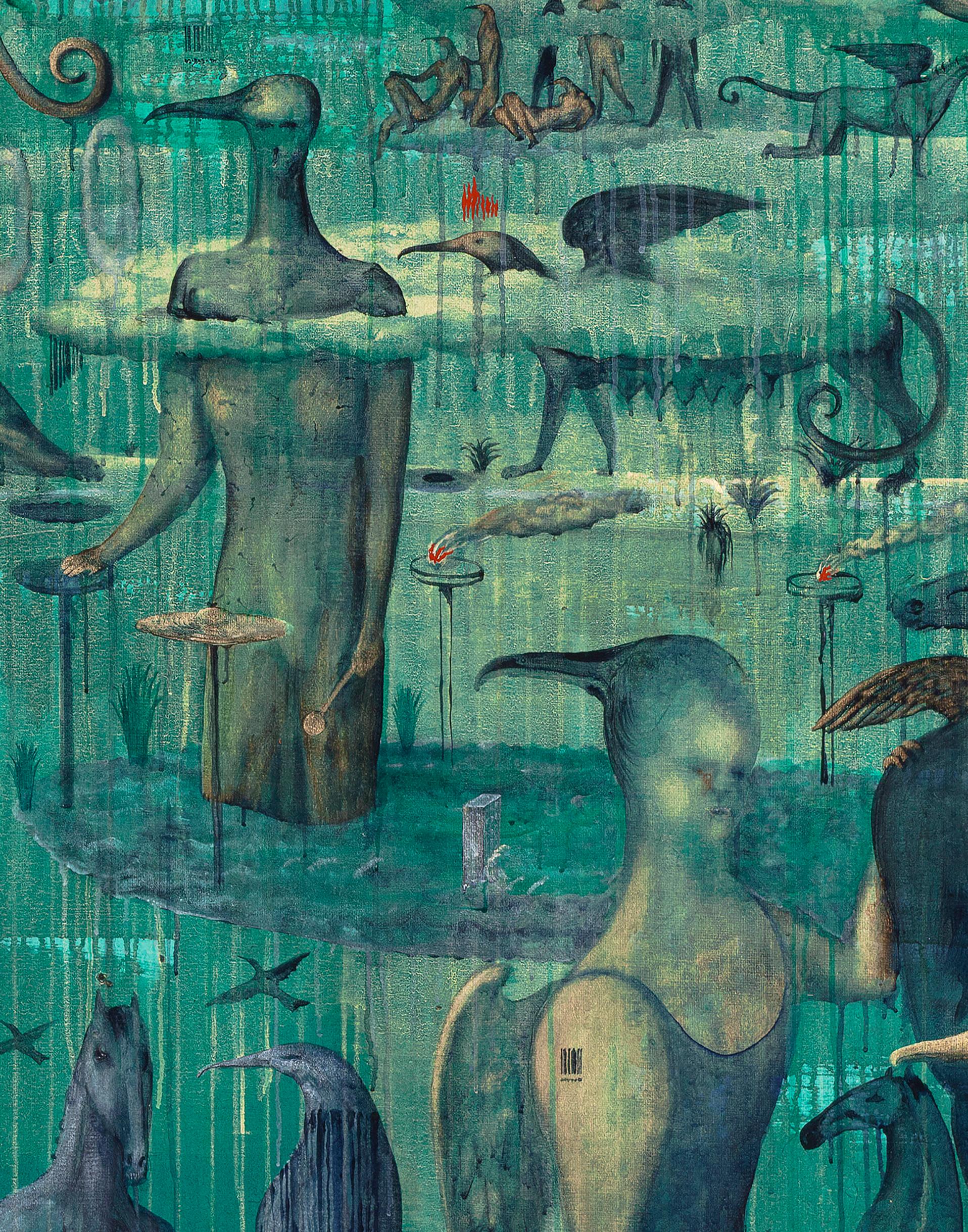
Lot 58. Bill Hammond, Zoomorphic Lounge III (detail)
Interview With the Private Collector behind Zoomorphic Lounge
“buy what you like as you will be living with it”
Peter McLeavey
Our private collector has requested that their anonymity be preserved throughout the sale process. While choosing to remain out of the spotlight, they were generous in sharing the story behind the collection, offering a rare insight into the instincts, passions and philosophies that guided its development over many years.
In conversation with our Art Department Manager, Megan Shaw (MS), the Private Collector (PC) reflects on the evolution of their collecting journey, the ideas and influences that shaped their eye, and the enduring appeal of the artists and works that came to define this exceptional collection. The discussion offers a fascinating glimpse into the mind of a thoughtful and deeply engaged collector whose dedication has resulted in a collection of remarkable depth, character and significance.
MS: How did your relationship with art begin?
PC: Doodling at school. I was never actually very ‘good’ or patient enough, but I enjoyed the creating part. As a young boy I collected matchstick boxes and stamps, so there was always an interest in design, imagery and pictures. My parents collected… Not art but objects, carpets, vases and things from different cultures— which is maybe where the bug started.
Later, working and travelling overseas in the late 1980s/early 90s allowed me to see great art in major institutions. I became interested in how art communicates… the story or message through form, shape, colour and representation, and how that reflects the world. Reading art books also shaped that interest, and how collections speak about the collector.
MS: What first drew you to contemporary New Zealand art?
PC: It comes back to local makers and stories of this place. It was more accessible, and being able to meet artists and see works in person offered a deeper understanding.
I was keen to buy works being made at the time rather than “blue chip”, although I did buy some earlier works to fill gaps. Buying from the primary market also meant encouraging the artist. Books helped, as did meeting dealers like Peter McLeavey and Hamish McKay. Peter’s advice to “buy what you like as you will be living with it” stuck.
MS: How has that interest evolved over time?
PC: Early on it was mainly paintings and works on paper, often figurative. Over time it expanded to include sculpture, photography, and more abstract and conceptual work.
It has largely remained focused on New Zealand artists, often at early or mid-career stages. Relationships with dealers became important, and in those earlier days, weekend gallery visits and conversations were central. Seeing works in person mattered.
MS: What is it like living with the works on a daily basis?
PC: Great fun—it livens up a space. The works carry memories: when and why they were bought. Their meaning unfolds over time, a slow reveal. They become familiar and part of the household, rather than objects in a gallery sense.
MS: At what point did the works around you begin to feel like a ‘collection’?
PC: When I started buying and continuing to buy works by the same artists over time and thinking about how works fit together.
Also, when there were too many works for the available wall space – some on walls, some leaning, some lent out. At that point it felt like a collection rather than individual purchases.
MS: You’ve lent works to public exhibitions. What motivates sharing a private collection in that way?
PC: We prefer loans to be anonymous, so the focus stays on the artist and the work. Public galleries can’t acquire everything, and often move slowly, so many works end up in private hands. Lending allows those works to be seen and appreciated more widely. It’s good for the artist and it helps build a more engaged art community.
MS: How would you define the theme of the collection? This catalogue takes its title from a Bill Hammond work, Zoomorphic Lounge III, and there is a strong presence of animals and natural imagery—what would you like viewers to take from that?
PC: I feel it’s about time and place, dreams, mythology, history and culture sitting in our natural and made-up spaces. In this place (Aotearoa, New Zealand), birds were here in the beginning and have witnessed a much longer history, and have found their way into our hearts and minds.
For me, the animals depicted in the collection are much more than images on a surface. They carry stories about place; the land, memory, spirituality, mythology and a changing environment, and reflect a living relationship between us, animals and the place we call home.
MS: What is your favourite work in this catalogue?
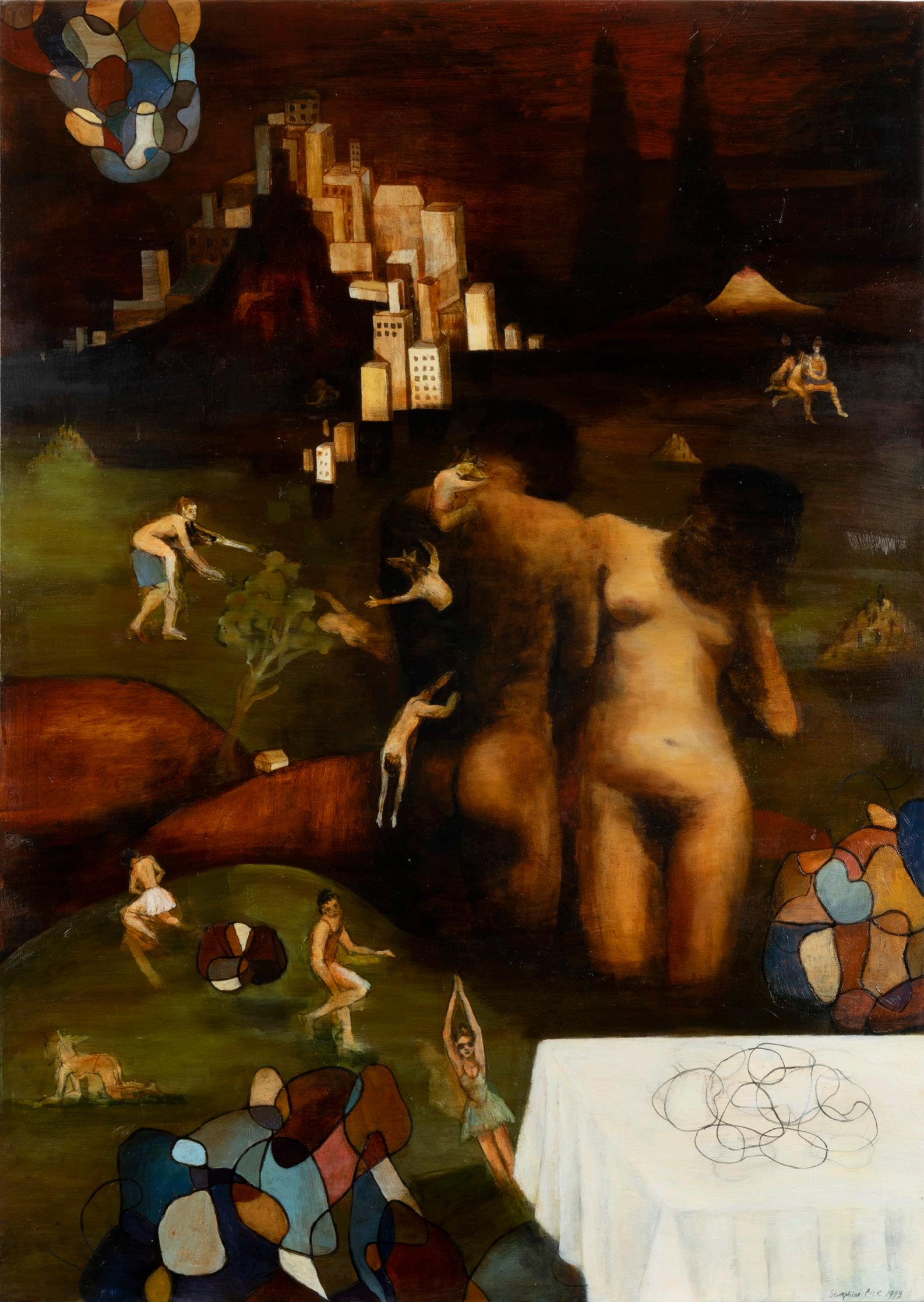
PC: A work can become a favourite for many different reasons. Some of these pieces by Ayesha Green, Shane Cotton, Bill Hammond, Séraphine Pick and Peter Robinson were the very first works I had bought by those artists. They were bold choices then, whether for content or for scale. I love them all and there is a lot of art to see and experience… it has me thinking about what comes next for collecting.
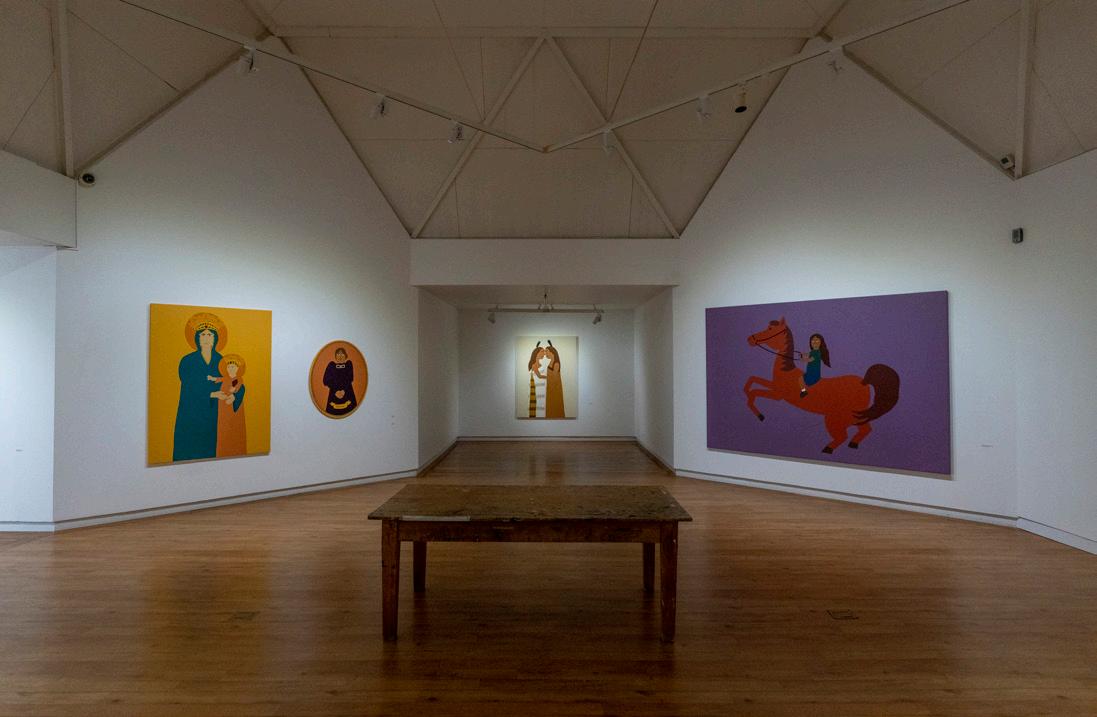
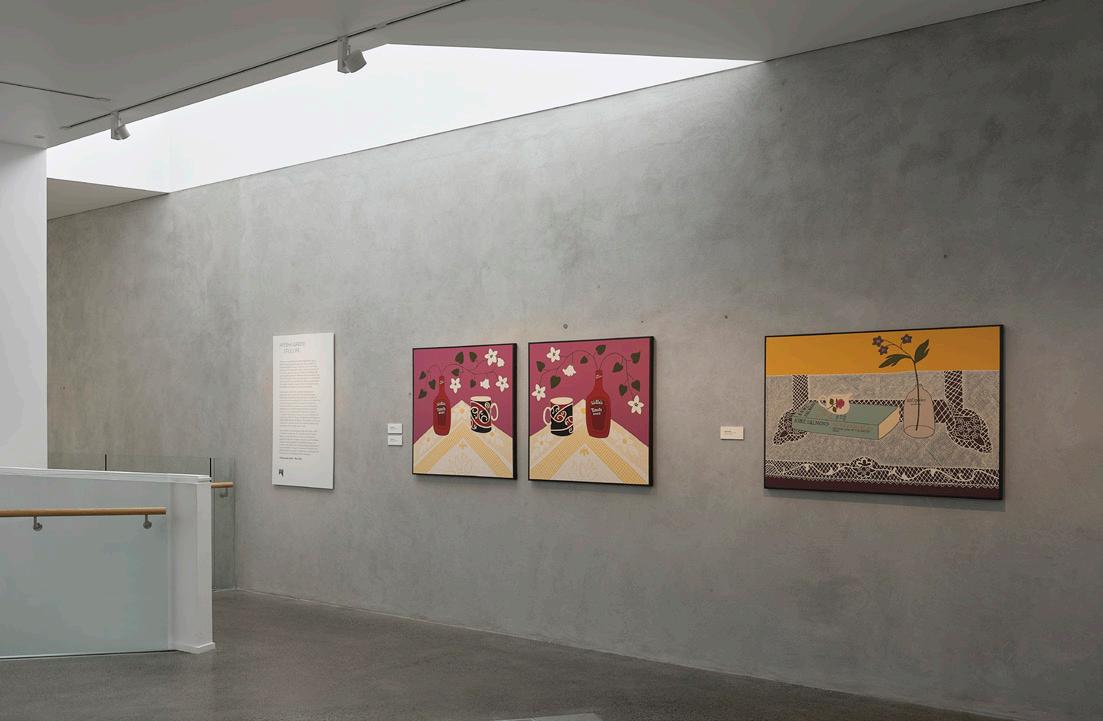
below Installation view of Ayesha Green: To the Best of My Knowledge at Hastings City Art Gallery, 2021. Photo by John Cowpland
Installation view of Ayesha Green: Still Life at Te Uru Contemporary Gallery, 2023. Photo by Sam Harnett
opposite page
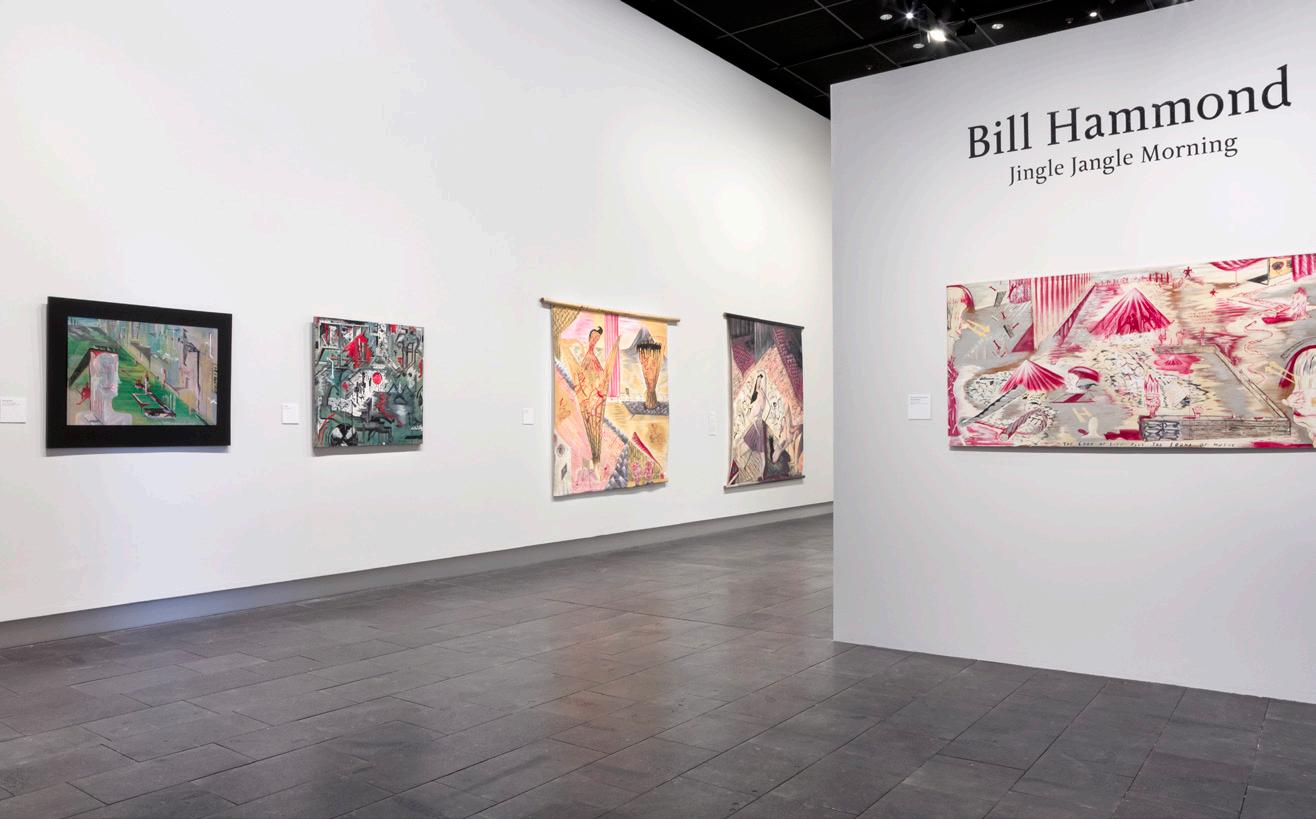
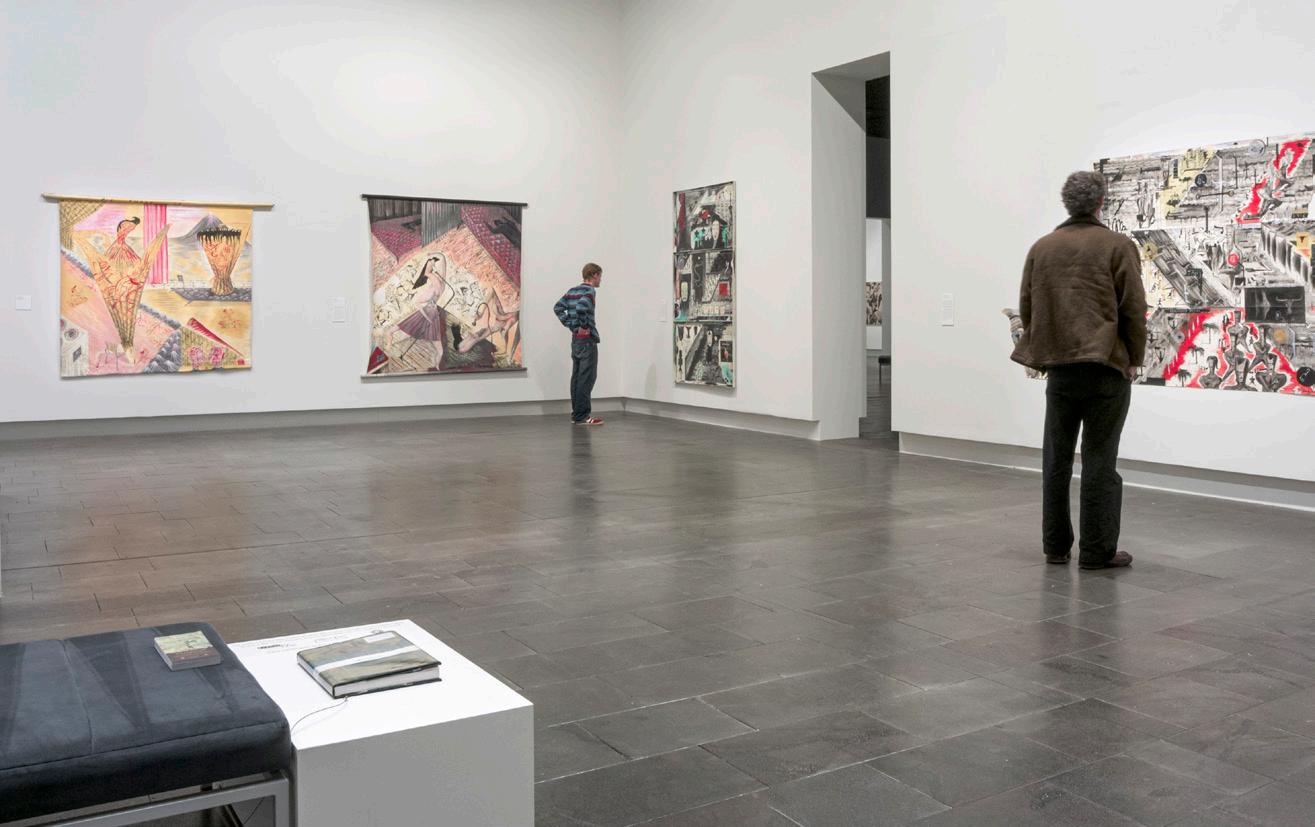
Installation view of Bill Hammond: Jingle Jangle Morning at Christchurch Art Gallery Te Puna o Waiwhetū, 2007
Lot 28. Liz Maw, Palammino (detail)
Plates
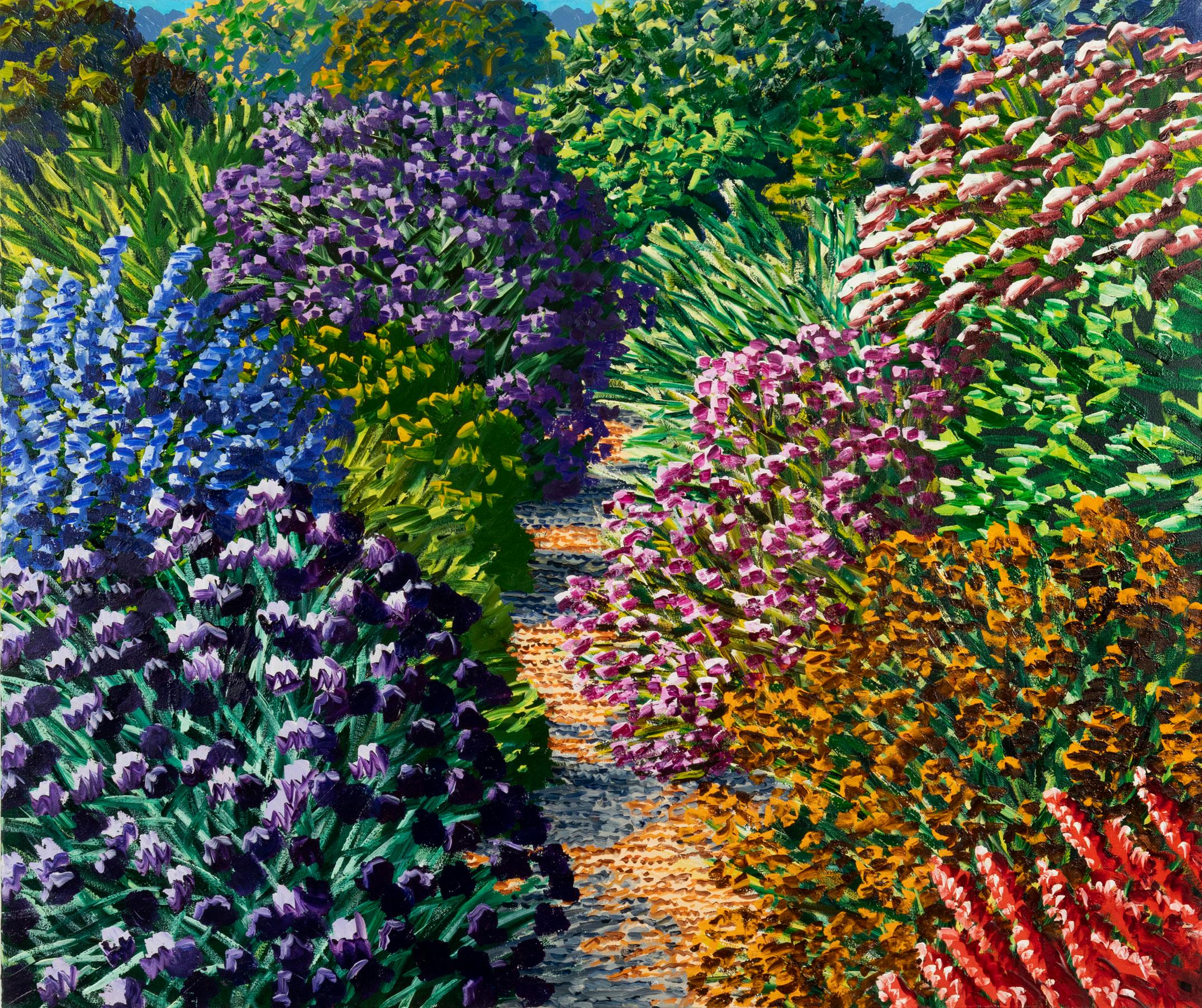
1 Karl Maughan Nannestad Lane 2023 oil on canvas
signed Maughan, dated 2023 and inscribed Nannestad Lane in graphite verso 845 × 1005mm
est $25,000—$30,000 provenance Private Collection, Wellington
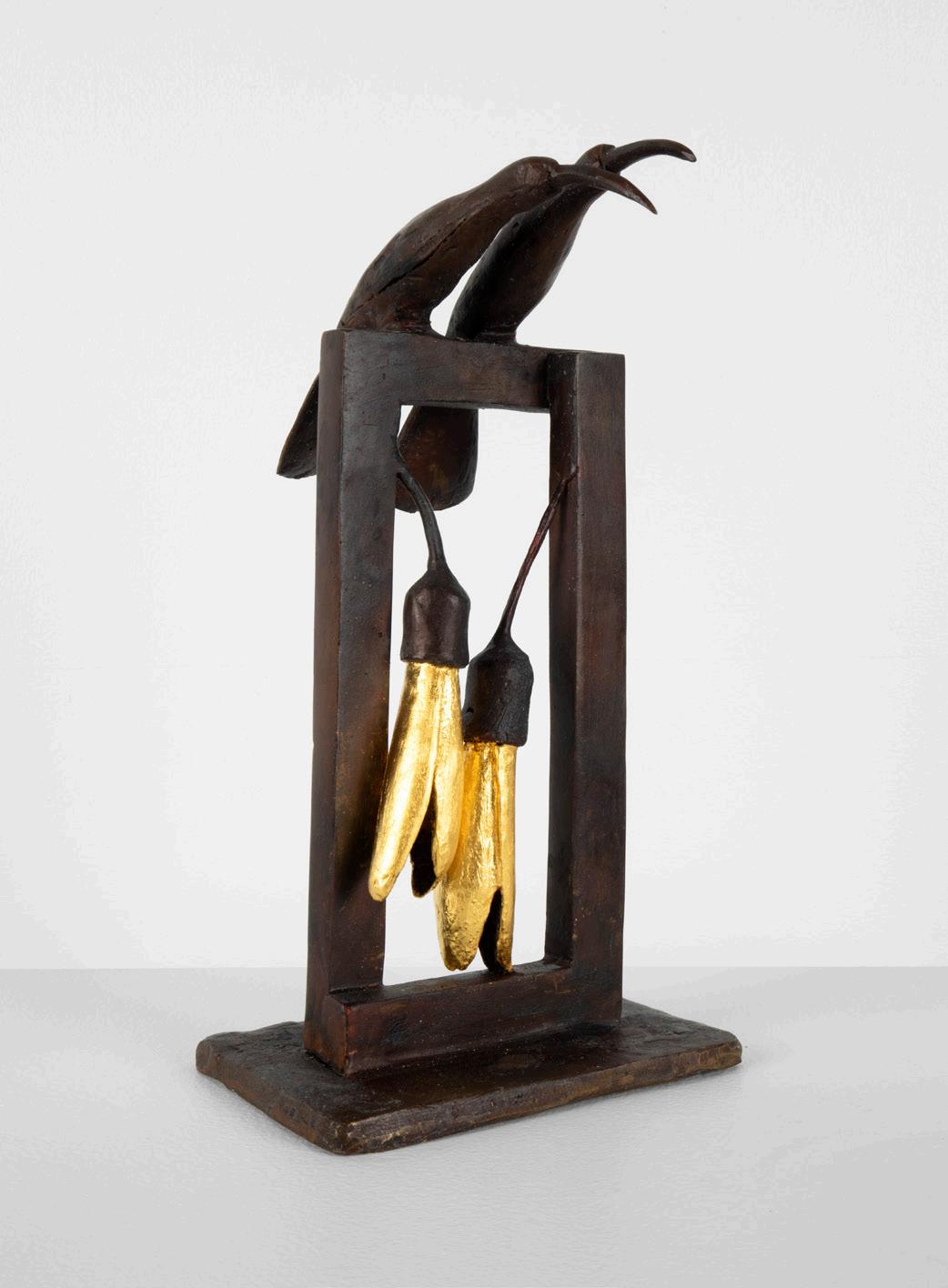
2 Paul Dibble Songs from an ancient world 2021
cast bronze, 24 carat gold gilding signed Paul Dibble with incision on base
320 × 60mm
est $16,000—$20,000
provenance
Private Collection, Wellington
3 Paul Dibble In a Lost Land 2022
cast bronze, 24 carat gold gilding, Edition of 5 + AP (2/5)
signed Paul Dibble with incision on base
395 × 250 × 340mm
est $25,000—$30,000
provenance
Private Collection, Wellington
Essay
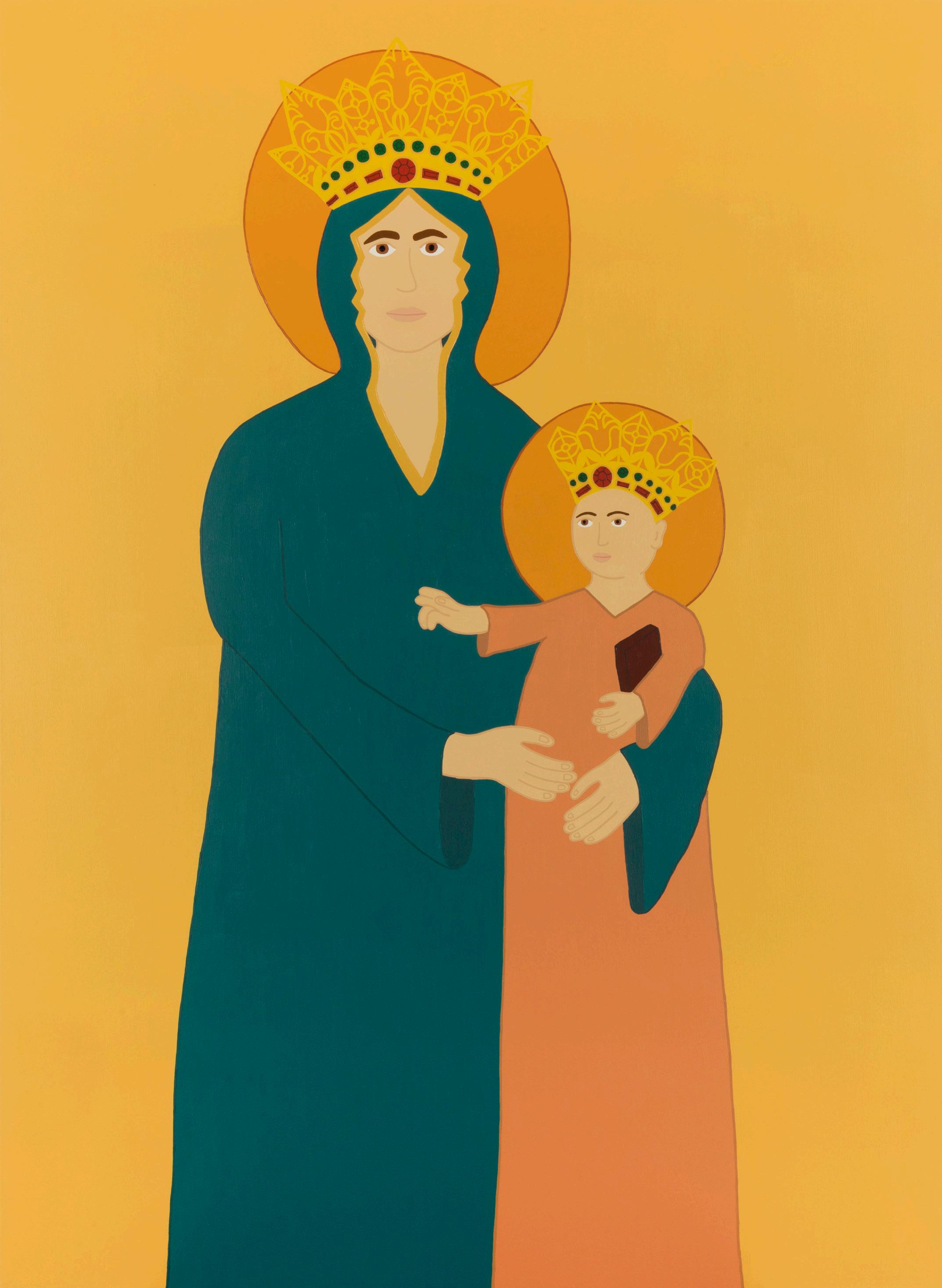
4 Ayesha Green Mother 2021 acrylic on canvas
1700 × 1270mm
est $15,000—$20,000
provenance
Private Collection, Wellington. Acquired from Jhana Millers Gallery, Wellington
exhibitions Hastings City Art Gallery, Ayesha Green: To the Best of My Knowledge, 14 August – 28 November 2021
Icons by Madeleine Harvey
Monarchs and divinities are among the most laden symbols Green employs. Two crowns, each decadently circled by a golden aureole, adorn the figures in Mother . We are all too familiar with the pious duo who dominated Western art for centuries; a blue-cloaked Mary holding an infant, yet worldly, Christ. Green’s mother and child are framed against a marigold background, recalling the gilded gold of dazzling Gothic and Renaissance altarpieces.
However, there is, always, an iceberg effect with Green’s works. Her scenes are appealing in both their approachability and the reward they offer to those who linger, look closely and peel back the complex narrative layers they contain. While luminous halos can be expected in the religious paintings she is referencing, it is not always that Mary and Christ are also adorned with intricate, bejeweled crowns. Mother was created for To the Best of My Knowledge (Te Whare Toi o Heretaunga Hastings Art Gallery, 2021), an exhibition that focused on Hukarere Girls’ College (Hawkes Bay) to interrogate the history of native schooling in Aotearoa.
The inclusion of the crown within this body of work undoubtedly carries the heavy weight of our colonial past. Adopting the Mary and Christ arrangement, Green flags the role of missionaries in perpetuating the assimilation tactics of the colonial government. Conceptions of the monarchy and the church, as intertwined institutions associated with authority and divinity, are reflected for us to ponder.
Leaning on recognition and accessibility,
Few contemporary painters wrangle the art of symbolism quite as potently as Ayesha Green (Ngāti Kahungunu, Kāi Tahu). Her paintings are rendered using a recognisable visual language, whereby illustrative subjects occupy flattened compositional planes and are strategically placed, just so.
Green taps into potent visual references to challenge presumptions about value, power, and identity. This is a mode of painting sharpened by deep knowledge of media, fine art and cultural heritage, developed during extensive tertiary studies across these fields.
Green’s art historical vernacular is especially resonant in her Still Life paintings, made during her Parehuia-McCahon House artist residency (2022). These reimagine the titled genre, commonly associated with the abundant arrangements of fruit, flowers and ephemera that frequent seventeenth-century European painting.
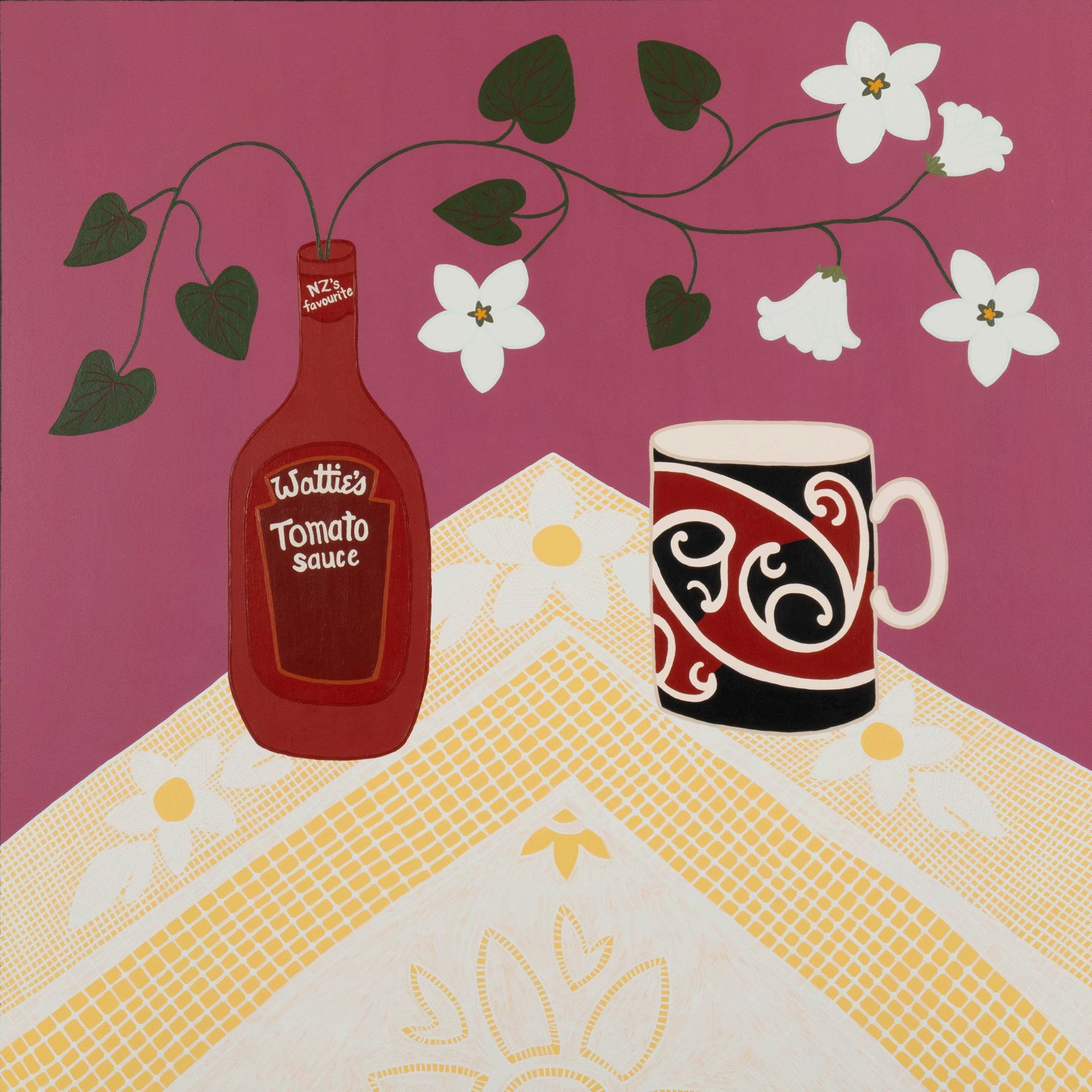
Calystegia Tuguriorum (2) , as one of a mirrored pair, elevates a recognisable bottle of Wattie’s Tomato Sauce alongside a ceramic kōwhaiwhai patterned mug. The former stands in for a vase, holding a clipping of the native (and scientifically titled) Pōuwhiwhi plant. Poised upon a fragment of lace, the staging recalls a domestic tablescape and grounds the objects within an everyday environment.
The effect is deliberately restrained and familiar. In localising the genre so specifically, Green draws our attention to the objects’ nature as markers of national identity and commodification, further complicated when considering the adoption of a traditional Māori motif on a mass-produced good. Including the native Pōuwhiwhi juxtaposes the commercial goods with the environments they come from and are positioned to represent. Such are the emblems that Green cleverly poses and demands we consider, through a meticulous iconography that is distinctly hers.
acrylic on canvas
signed Ayesha Green, dated 2022 and inscribed Calystegia Tuguriorum (2) in graphite verso 900 × 900mm
est $8,000—$10,000
provenance
Private Collection, Wellington. Acquired from Jhana Millers Gallery, Wellington exhibitions
Te Uru Waitākere Contemporary Art Gallery, Ayesha Green: Still life, 10 December – 28 May 2023
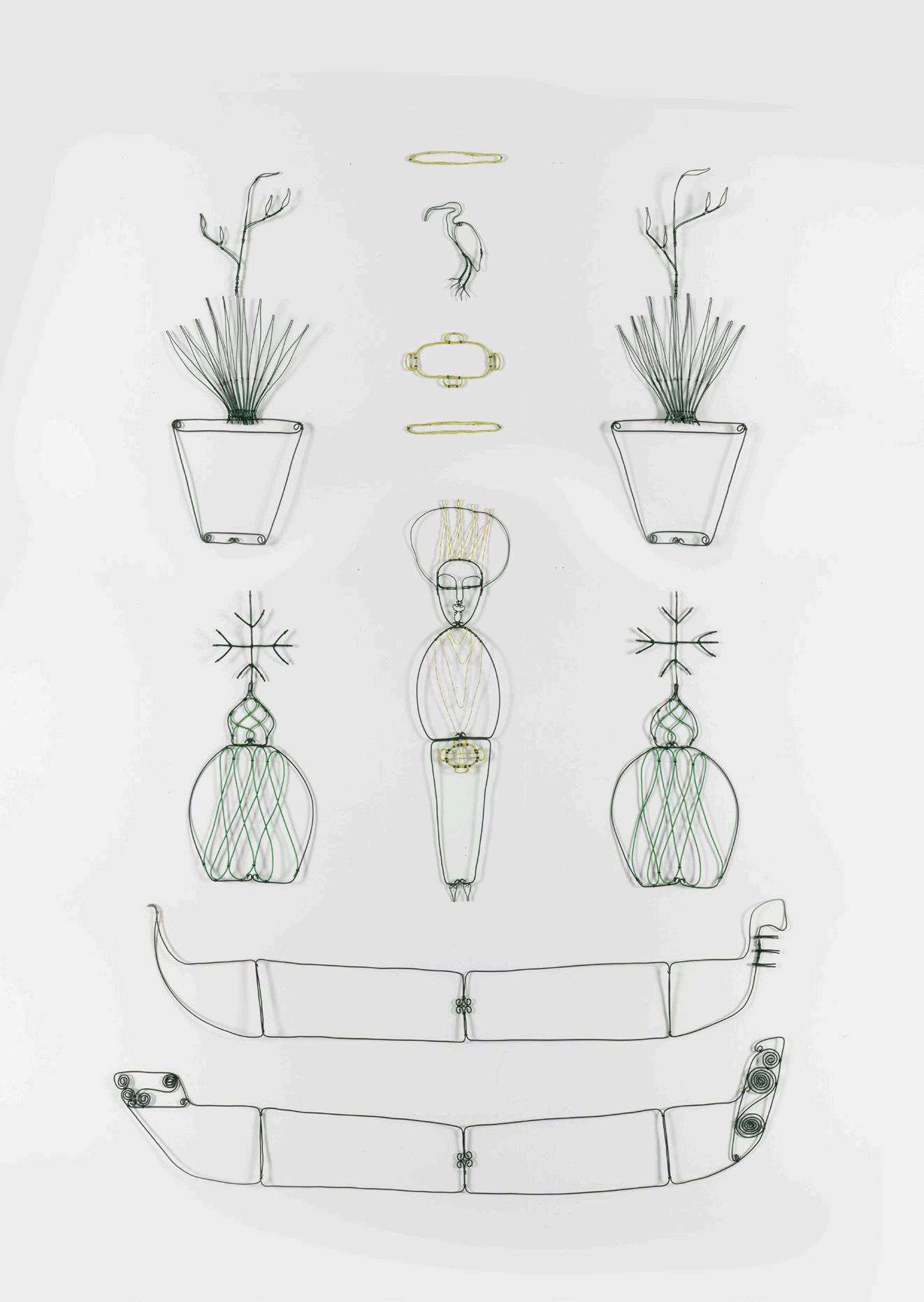
5 Ayesha Green Calystegia Tuguriorum (2) 2022
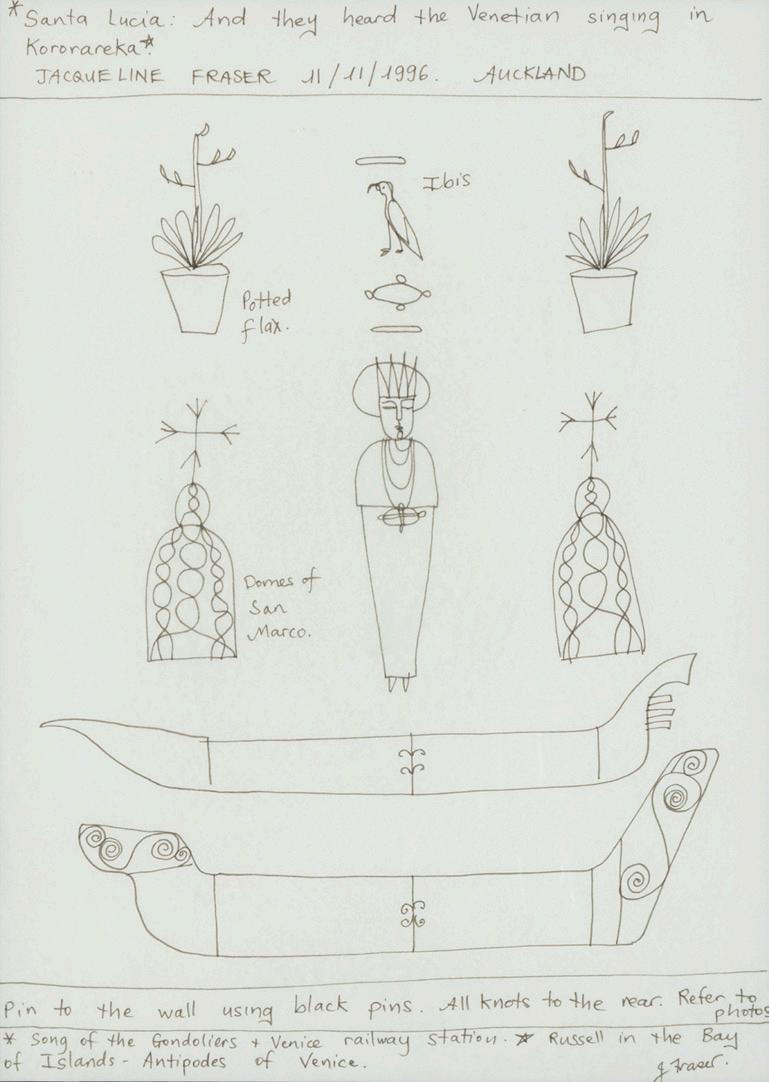
wire / mixed media sculpture with small preparatory drawing, framed signed J Fraser in graphite lower right 3m (variable)
est $22,000—$28,000
provenance
Private Collection, Wellington. Acquired from Peter McLeavey Gallery, Wellington
6 Jacqueline Fraser Korareako, 1996, St Lucia 1996
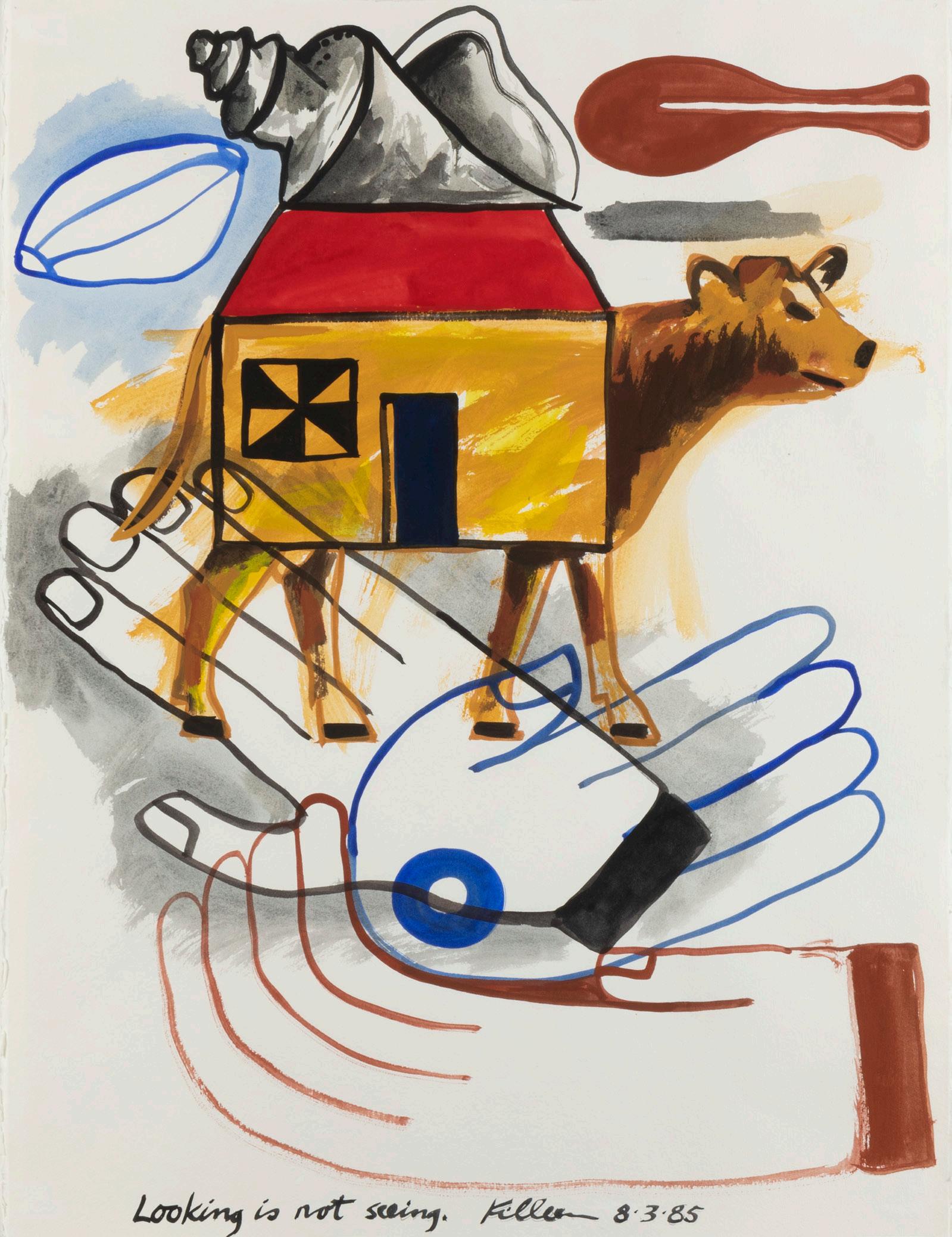
7 Richard Killeen
Looking Is Not Seeing. 1985
ink and acrylic on paper signed Killeen, dated 8.3.85 and inscribed Looking is not seeing. in ink lower edge 760 × 570mm
est $8,000—$12,000
provenance
Private Collection, Wellington. Acquired from Peter McLeavey Gallery, Wellington, 1987
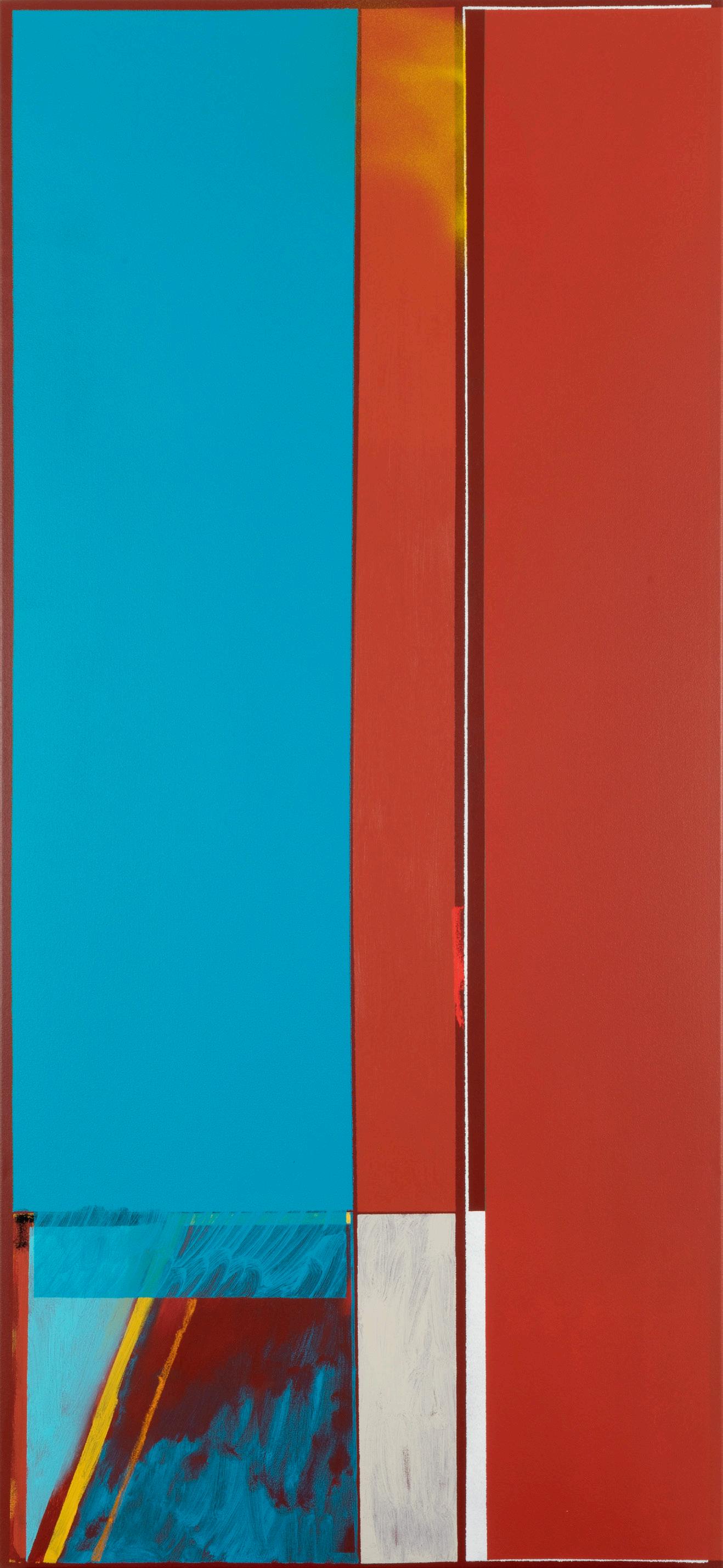
8 Ed Bats
The uneasy nod 2021
acrylic & oil stick on canvas
signed Ed Bats and dated 2021 in graphite verso 1915 × 875mm
est $4,000—$6,000
provenance
Private Collection, Wellington. Acquired from Page Galleries, Wellington
exhibitions
Don't mind if I don't, Page Galleries, Wellington, 11 November – 4 December 2021
literature Connie Brown, Ed Bats' Policy of Violation, The Art Paper (2 December 2021)
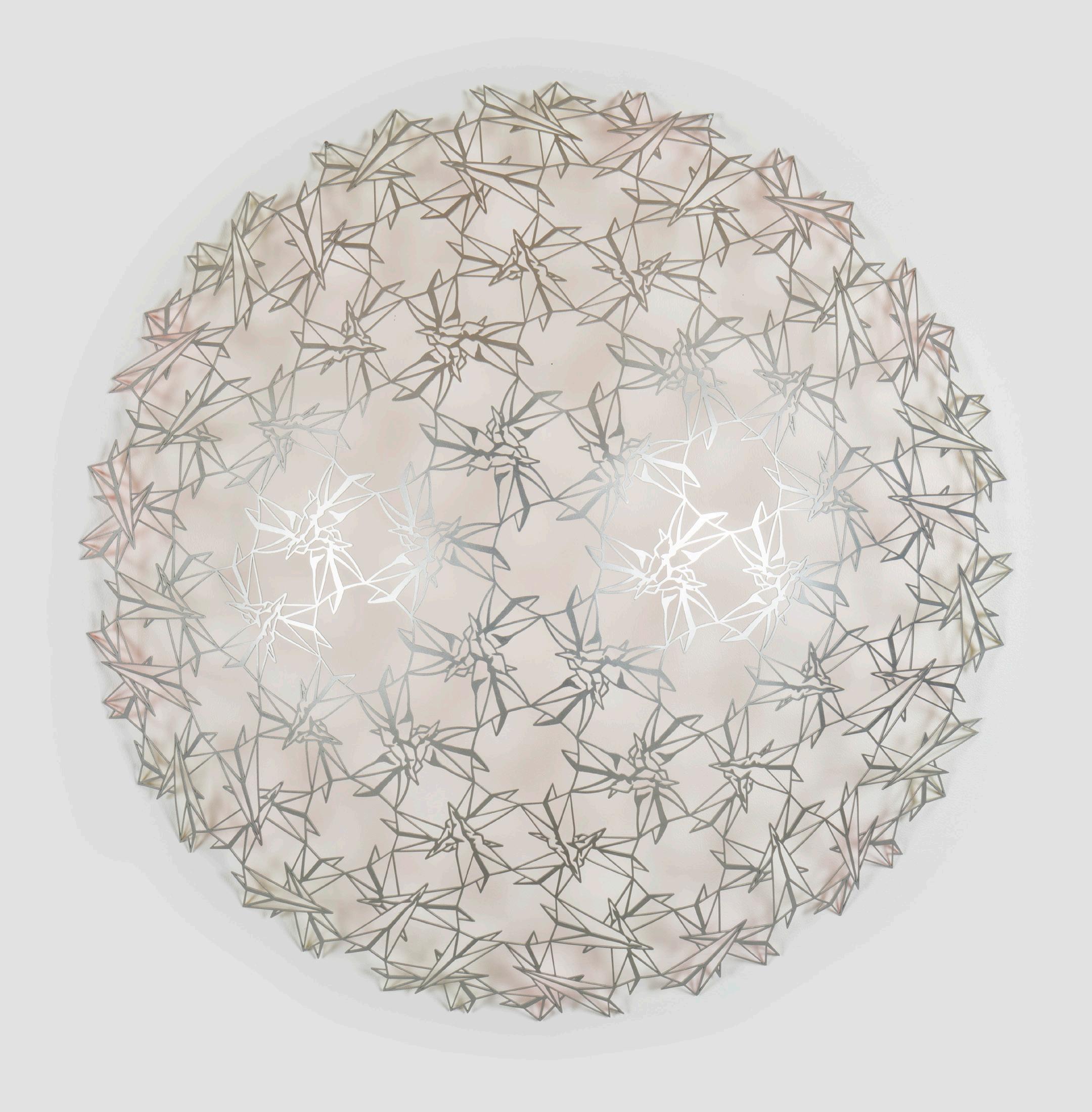
9 Neil Dawson Sphere/blunt arrows 2003
Jive laser cut steel signed NEIL DAWSON, dated 2003 in ink verso 210 × 1100mm
est $12,000—$16,000
Private Collection, Wellington. Acquired from Hamish McKay Gallery, Wellington
est $5,000—$8,000
10 Gordon Walters Tahi (1969), 2021 screenprint on paper, edition of 100 embossed with Walters Estate blind stamp 1090 × 800mm
Private Collection, Wellington. Acquired from STARKWHITE, Auckland
11
Gordon Walters
1984
screenprint on paper, edition 9/75 signed Gordon Walters, dated 84 and inscribed Kapiti in graphite lower edge 540 × 410mm
est $16,000—$18,000
provenance
Private Collection, Wellington. Acquired from STARKWHITE, Auckland
12 Gordon
Walters
Painting No.7 Walters Estate 2017
screenprint on paper, edition 9/75 500 × 375mm
est $7,500—$8,500
provenance
Private Collection, Wellington. Acquired from STARKWHITE, Auckland
est $12,000—$16,000
provenance
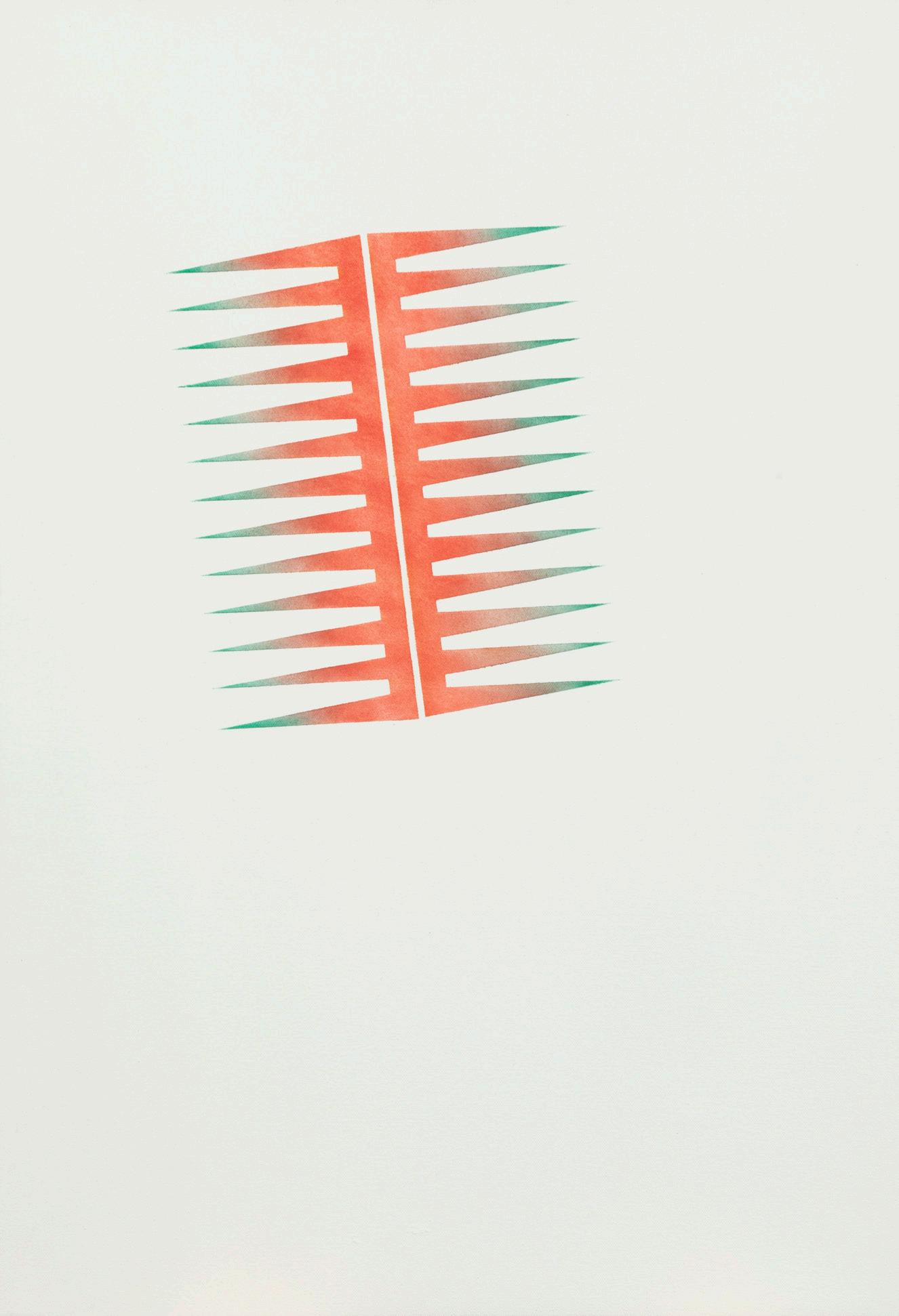
13 Richard Killeen Green Tipped Comb 1974 oil and acrylic on canvas signed Killeen and dated 74 in ink verso 665 × 460mm
Private Collection, Wellington. Acquired from McLeavey Gallery, Wellington
14 Darryn George
Tribute – G Bell
2007 oil on canvas
signed Darryn George, dated 2007 and inscribed Tribute – G Bell in ink verso
650 × 500mm
est $3,500—$5,500
provenance
Private Collection, Wellington
15 Darryn George Appointment #7 2015 automotive paint on melamine board
signed DW George, dated 2015 and inscribed Appointment #7 in ink verso
1000 × 500mm
est $6,000—$9,000
provenance
Private Collection, Wellington
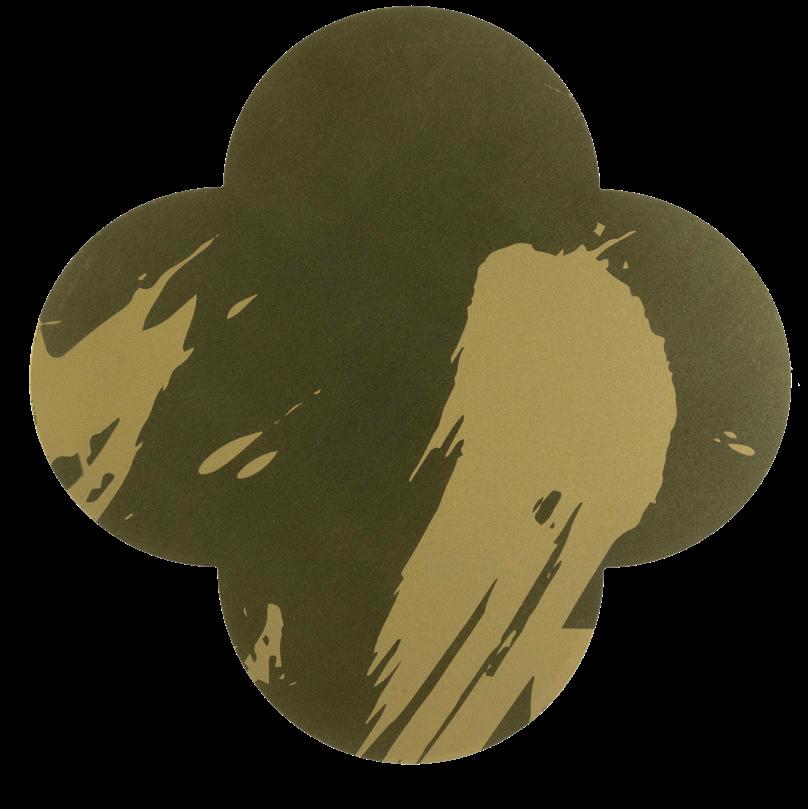
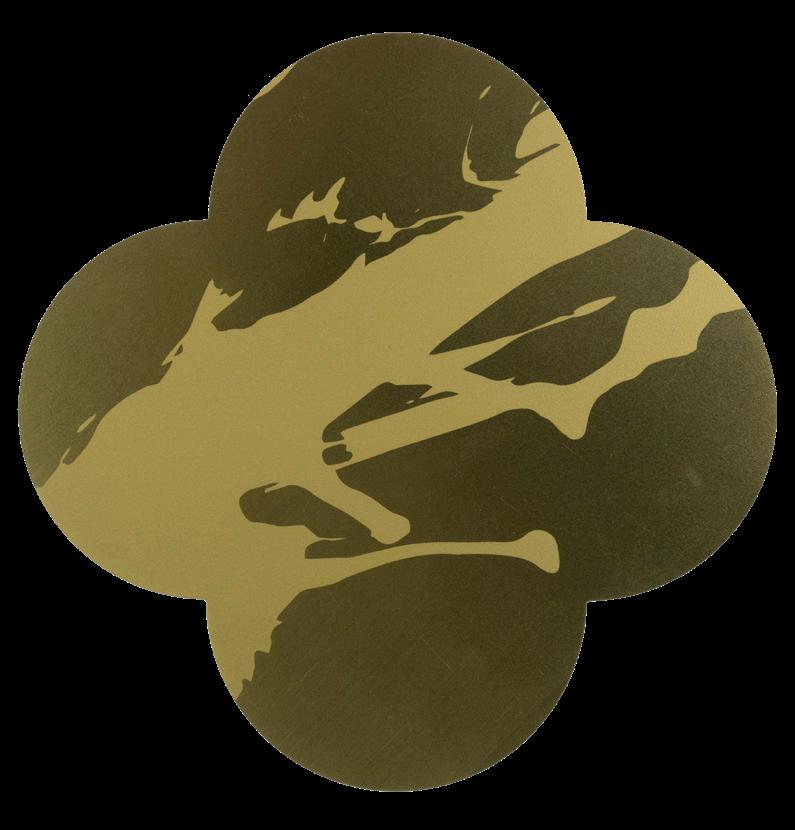
16 Max Gimblett Pōhutukawa 2007
acrylic, aquasize and silver leaf on board signed Max Gimblett, dated 2007 and title inscribed Pōhutukawa in ink verso 1524 × 1524mm
est $60,000—$80,000
provenance
Private Collection, Wellington
The Bending Hours 2016
gouache and graphite on paper
675 × 375mm
est $7,000—$9,000
provenance
Private Collection, Wellington. Acquired from Brett McDowell Gallery, Dunedin, 2016
exhibitions
Kushana Bush: The Burning Hours, Dunedin Public Art Gallery, 3 December 2016 – 2 April 2017
literature
Kushana Bush: The Burning Hours (Dunedin Public Art Gallery, 2016), 114-115
18 Kushana Bush L Motion 2009 gouache and pencil on paper
700 × 500mm est $6,000—$8,000
provenance
Private Collection, Wellington. Acquired from Brett McDowell Gallery, Dunedin
19 Kushana Bush Man Renounces Possession 2014 gouache and pencil on paper
760 × 560mm
est $7,000—$9,000
provenance
Private Collection, Wellington. Acquired from Brett McDowell Gallery, Dunedin
Essay Immersive Systems
by Nadine Rubin Nathan
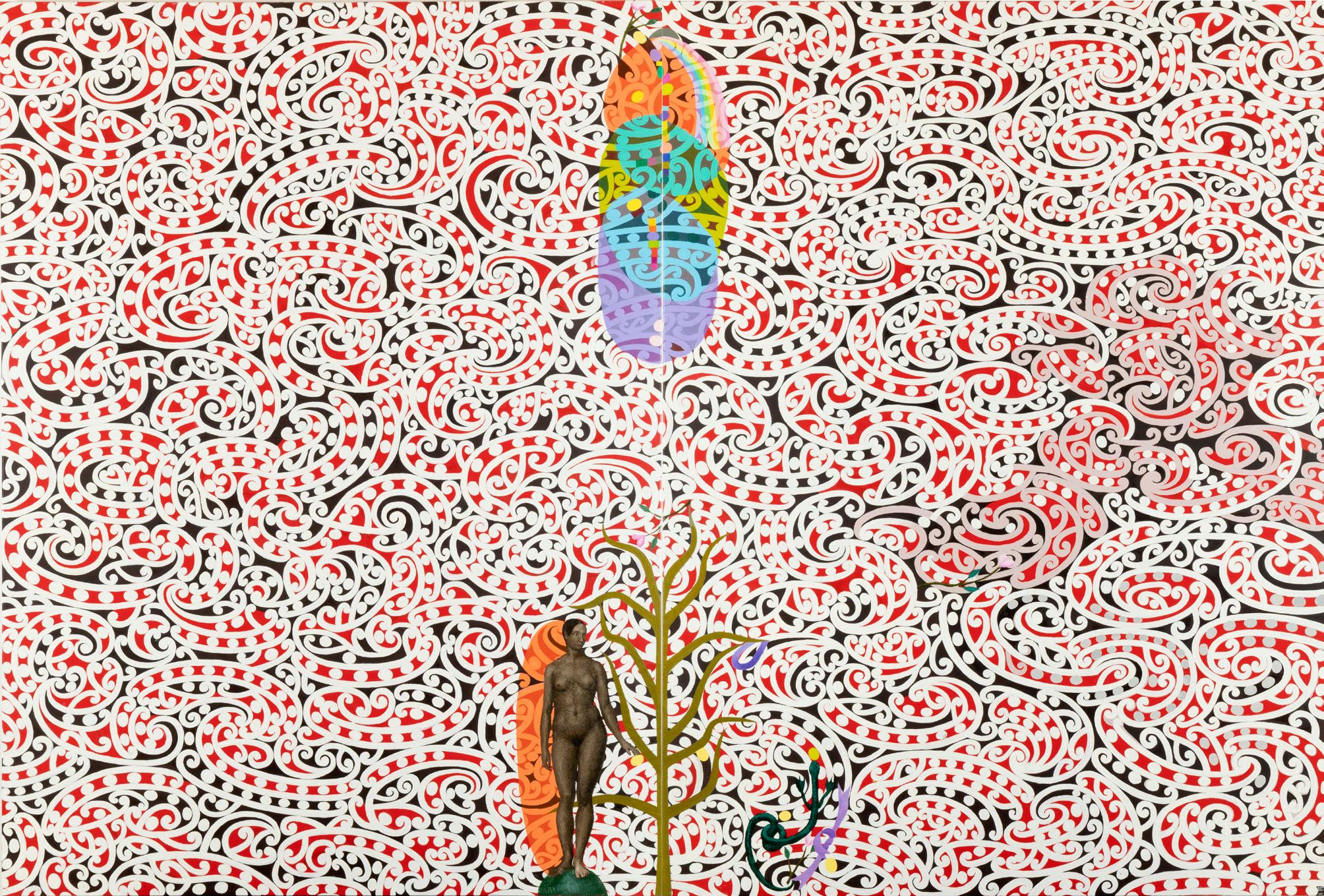
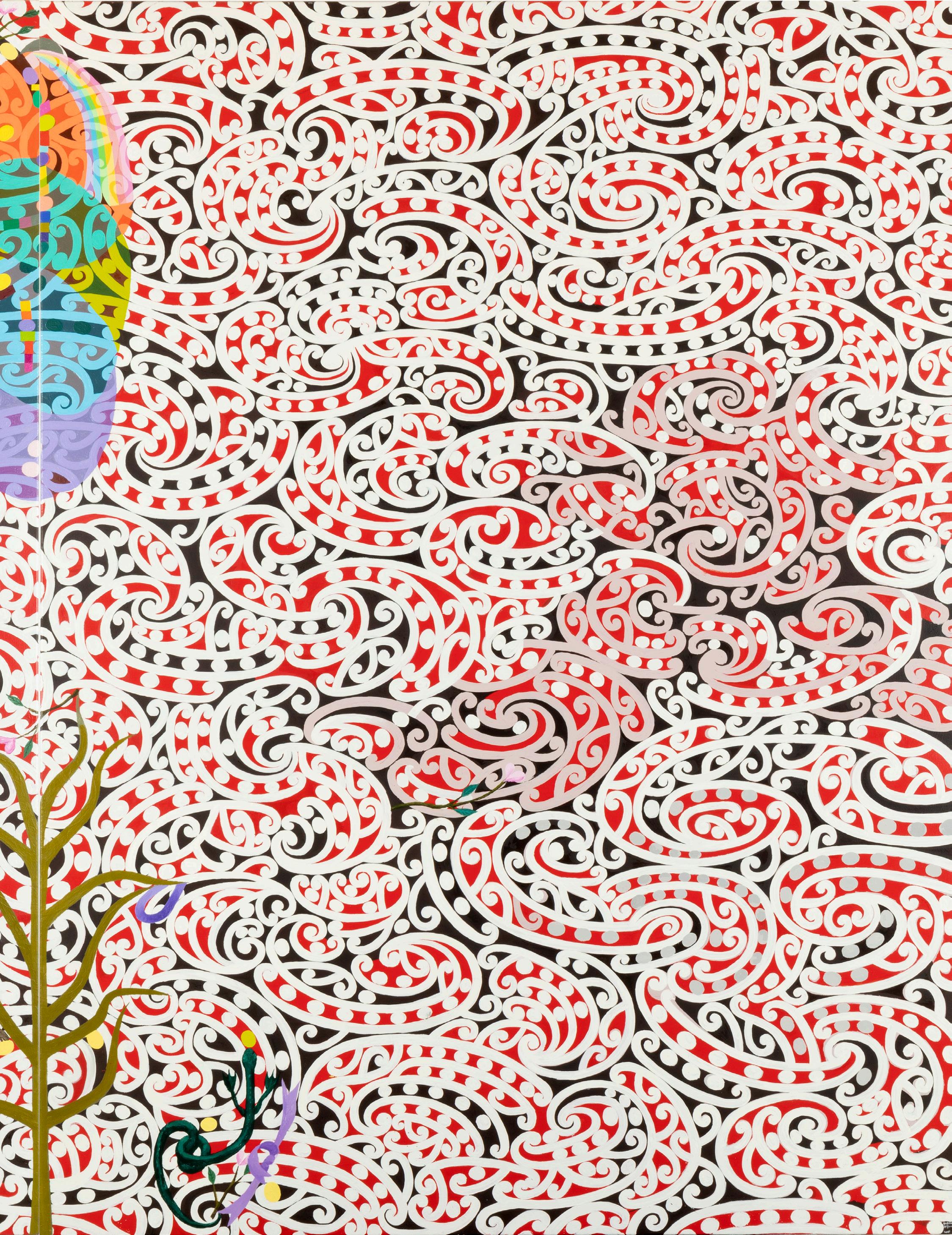
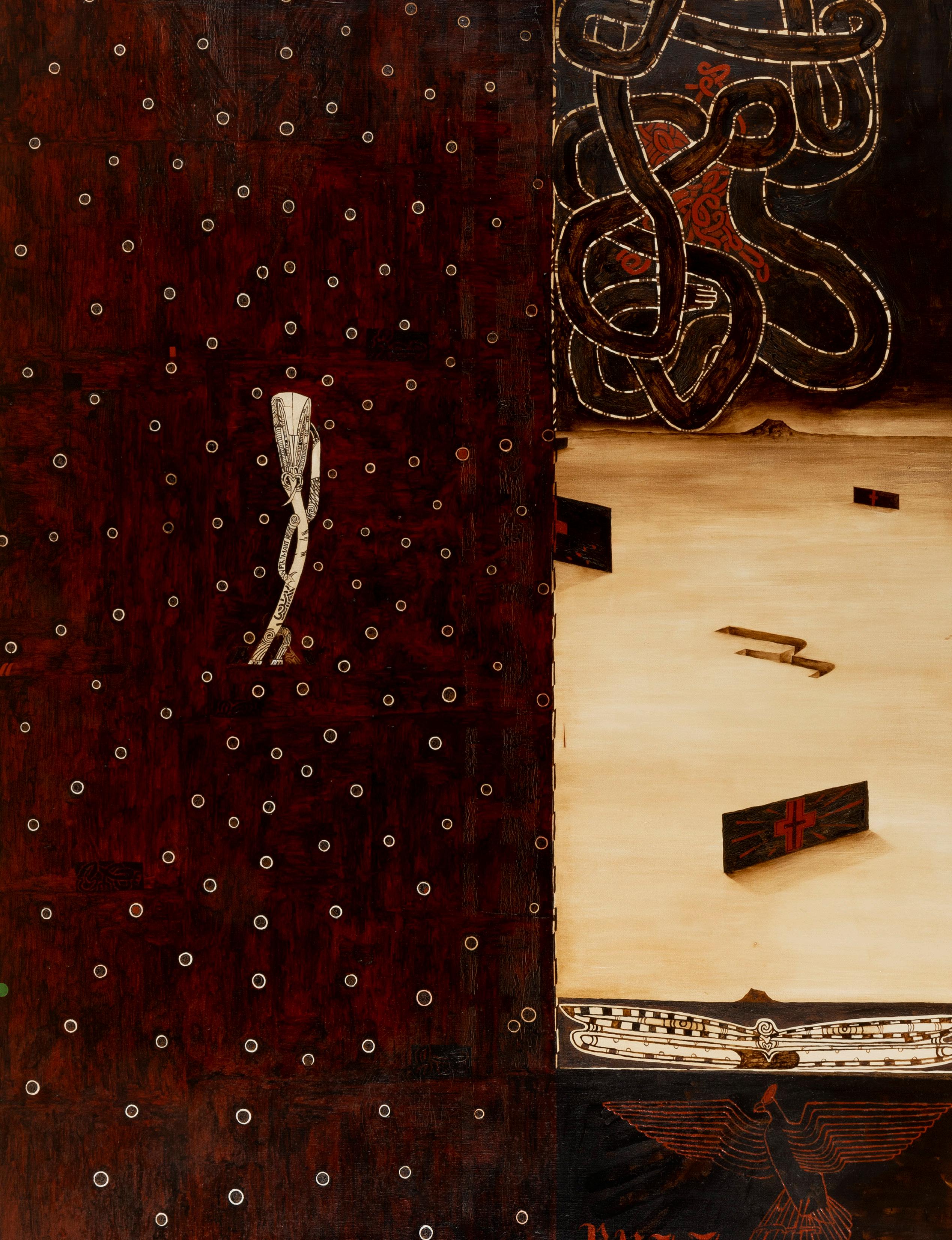
Kōwhaiwhai Diptych [with figure] occupies a pivotal place within McLeod's earlier painting practice, emerging from his studies in the Māori art department at the Elam School of Fine Arts. Contemporary in its sensibility yet deeply engaged with art historical sources, the painting draws together the histories of Māori image-making, New Zealand modernism, Renaissance sculpture and biblical allegory.
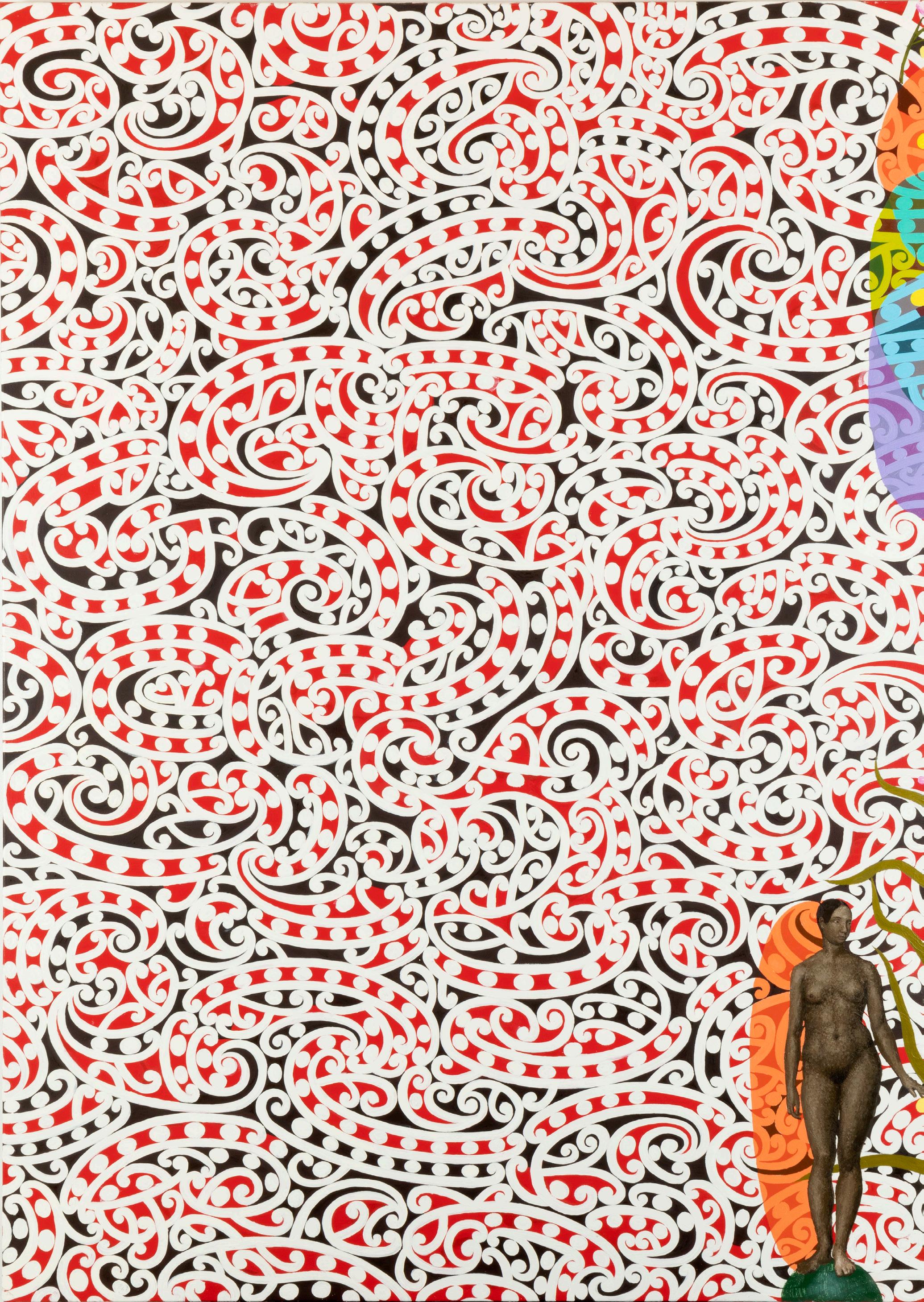
Oscillating between surface decoration and the illusion of depth, there is a restless optical energy in the richly layered field of white curvilinear forms that ripple over a saturated background of red and black. The patterns evoke kōwhaiwhai and koru, the painted scrollwork traditionally found along the rafters and ridgepoles of wharenui. Here they are reimagined as an immersive pictorial environment, recalling the legacy of Theo Schoon, whose fascination with Māori visual culture was a touchstone for McLeod's exploration of the uneasy relationship between New Zealand modernism and Indigenous forms.
At the seam where the two canvases meet, McLeod stages a symbolic encounter. A tree-like form anchors the composition, while to one side stands a nude figure in a frontal contrapposto pose. Rather than concealing herself, she reaches toward a luminous yellow sphere, introducing echoes of Eve and the temptation narrative of the Garden of Eden. Her feet rest on an orb recalling Renaissance allegorical representations of Fortuna, the Roman goddess of chance and fate. In the mid-to-late 2000s McLeod often incorporated his then-partner, the artist Liz Maw, into his paintings; she appears here in the figure’s unexpected contemporary face with its cropped hairstyle. On the opposite side of the tree, a serpent winds through the kōwhaiwhai forms, extending the Edenic metaphor.
Over nearly three decades, Andrew McLeod has established himself as one of Aotearoa New Zealand's most distinctive artists, developing a visual language in which pattern, art history and autobiography converge.
Critics have frequently described McLeod’s compositions as immersive systems of visual signals charged with emotional and perceptual intensity, noting the tension between seduction and instability that animates his paintings. Such observations are particularly compelling here. The diptych structure itself suspends meaning between the two panels, while the kōwhaiwhai motifs become carriers of cultural memory and historical tension.
Read in this light, the allusion to Fortuna resonates beyond its classical origins. Set against the rhythmic structures of kōwhaiwhai, the unstable sphere becomes a metaphor for the contingent nature of cultural exchange itself. McLeod appears less interested in resolving the legacy of figures such as Schoon than in inhabiting its contradictions: the aspirations of New Zealand modernism, the desire to recover and revitalise Indigenous forms, and the unresolved questions of ownership, translation and influence that shape those histories.
Above this scene, a radiant form interrupts the painting's dominant red-and-black palette. Layers of translucent colour spread outward in prismatic bands, evoking a rainbow suspended within the ornamental field. As both optical event and symbolic threshold, it introduces a moment of revelation. Bridging disparate visual worlds, it offers a fleeting image of connection while preserving the ambiguities that animate the painting.
McLeod’s work is held in numerous public and private collections, including Auckland Art Gallery Toi o Tāmaki, the Fletcher Collection, the Chartwell Collection, Te Papa Tongarewa Museum of New Zealand, the Arts House Trust and the National Gallery of Victoria, Melbourne.
20 Andrew McLeod Kōwhaiwhai Diptych [with figure]
2007 oil on canvas
signed Andrew McLeod, dated 2007 in ink lower right 1750 × 1300mm (each panel) est $75,000—$100,000
provenance
Private Collection, Wellington. Acquired from The Lay of the Land, Brooke Gifford Gallery, Christchurch, 2007.
signed Hiria, dated 2023 and inscribed Ki roto Ki waho in graphite verso 1200 × 1000mm
est $16,000—$20,000
provenance
Private Collection, Wellington. Acquired from Tim Melville Gallery, Auckland
exhibitions
A Painter on Turongo Street, Tim Melville Gallery, Auckland, 3 – 28 October 2017
21 Hiria Anderson-Mita Ki roto, ki waho 2023 oil on canvas
22 Hiria Anderson-Mita
A View from the Redshed, Waitomo 2020 oil on canvas
signed Hiria, dated 2020 and inscribed A view from the redshed, Waitomo in graphite verso
790 × 635mm
est $6,000—$8,000
provenance
Private Collection, Wellington. Acquired from Tim Melville Gallery, Auckland
exhibitions
Te Ao Hurihuri: At the end of the beginning, Tim Melville Gallery, Auckland, 2 – 23 December 2020
23 Hiria Anderson-Mita
Wednesday Morning on Tūrongo St 2020 oil on canvas
signed Hiria, dated, 2020 and inscribed Wednesday morning on Tūrongo st in graphite verso 410 × 305mm
est $4,000—$6,000
provenance
Private Collection, Wellington. Acquired from Tim Melville Gallery, Auckland
24 Hiria Anderson-Mita
The Three Ministers 2017 oil on canvas signed Hiria, dated 2017 and inscribed The Three Ministers in graphite verso 305 × 610mm
est $2,500—$5,000
provenance
Private Collection, Wellington. Acquired from Tim Melville Gallery, Auckland, 2017
exhibitions
A Painter on Turongo Street, Tim Melville Gallery, Auckland, 3 – 28 October 2017
1000
est $18,000—$22,000
provenance
Private Collection, Wellington. Acquired from Two Rooms, Auckland
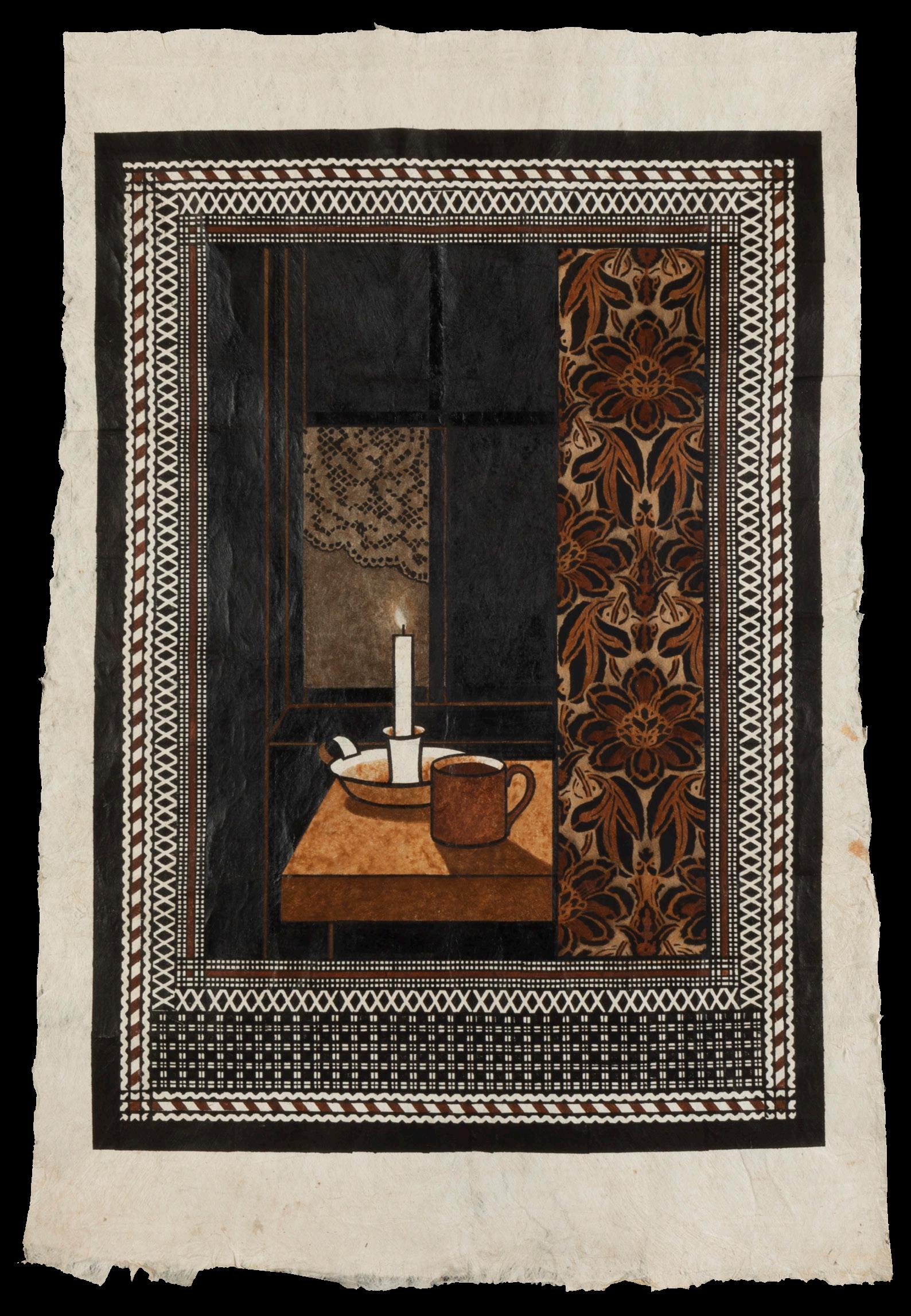
25 Robin White Blackout in Banaras 2019 barkcloth Tapa, earth pigments, natural dye
× 720mm
Essay The Dove by Brooke Pou
1 Robin White: The making of ‘That Vase’, 2019. https://www.tepapa. govt.nz/discover-collections/ read-watch-play/art/watchrobin-white-making-vase.
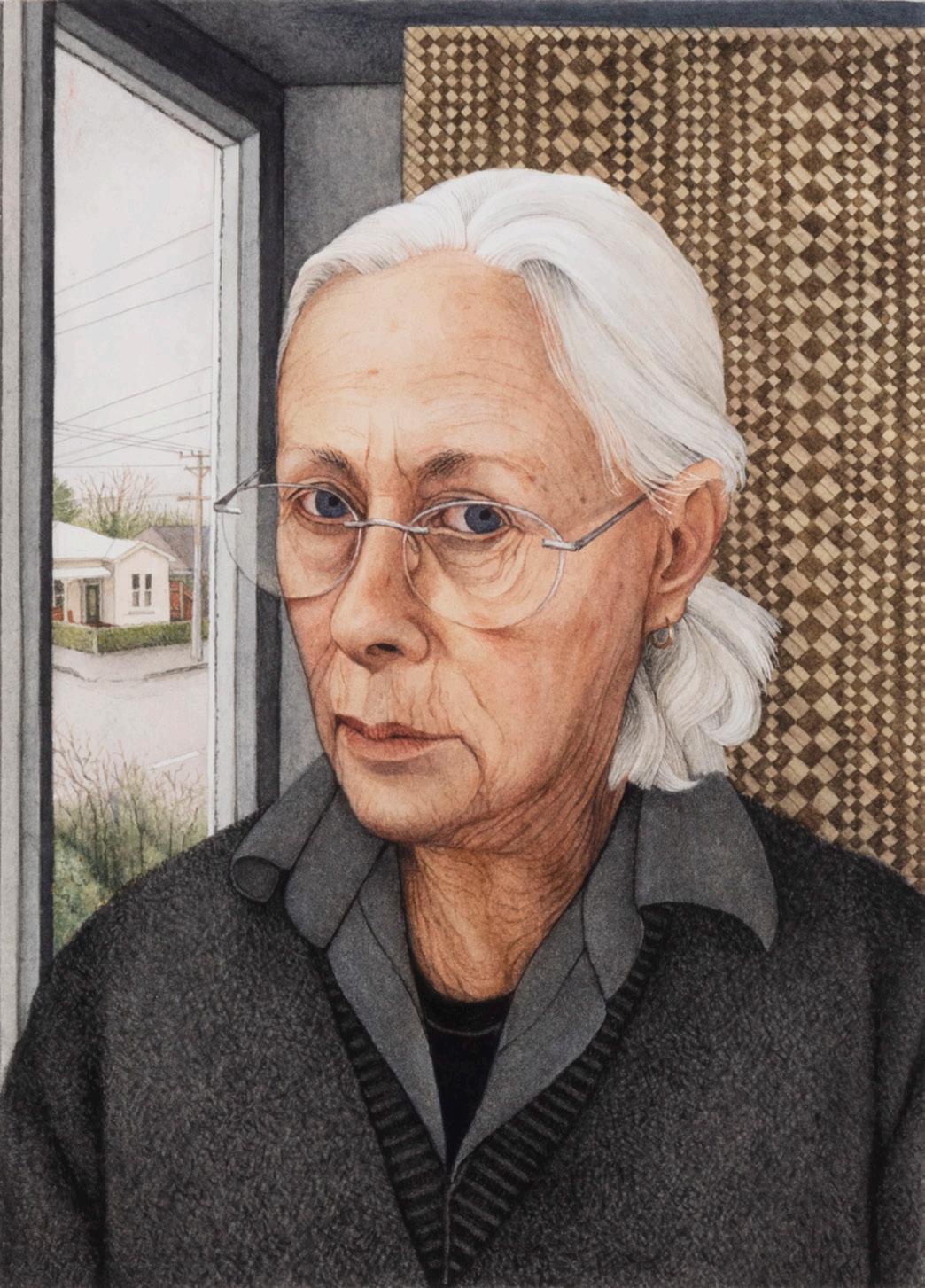
Robin White has explored self-portraiture throughout her career. Having visited and lived in numerous cities, towns, and countries, these works trace the artist’s life. They also offer us a view into the evolution of her practice and the many mediums she has mastered. White’s self-portraits come in many forms: lithographs, drawings, screenprints, woodblocks, and paintings in oil, acrylic, and watercolour.
September 21, 2018 (Self-Portrait) is a tightly cropped self-portrait in which the artist is visible from the chest up. She wears a dark grey sweater over a black top—reminding us that September is spring, but only just. Deciduous trees, glimpsed through the window facing her street, subtly hint at the changing season. The light grey sky outside and dark grey interior walls might make the work seem cold, if not for the large woven mat hanging behind White. A symbol of her travels and the lasting relationships she has built working with women across Te Moana-nui-a-Kiwa, it holds warmth in its brown fibres.
While I have not met the artist myself, I have heard from others that she has been quite unforgiving with her self-representation here. Though White’s body is facing forwards, her head is slightly turned. Is it in concern? Is she wary? Or weary? In most of her self-portraits White adopts a serious expression and September 21 is no exception.
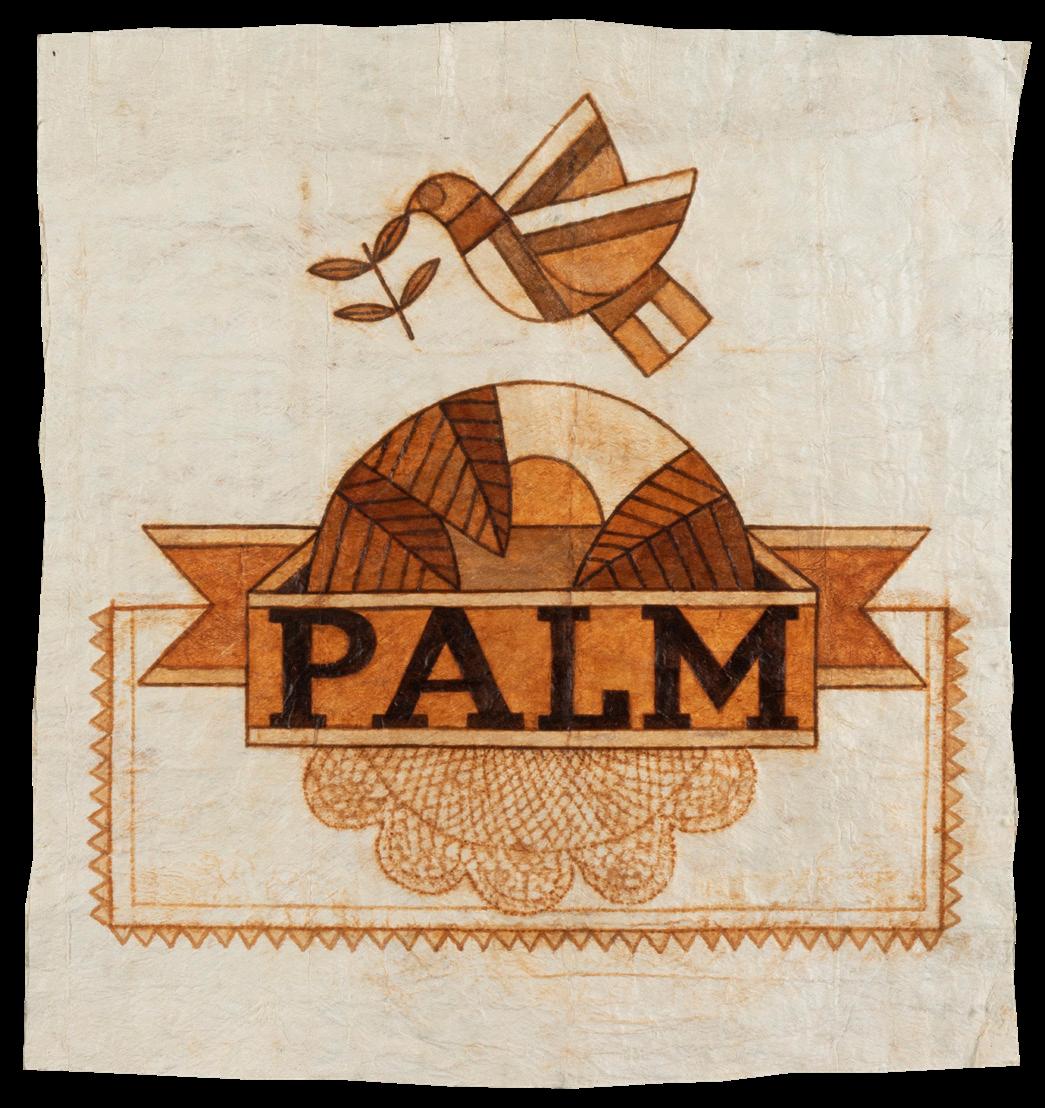
In a survey exhibition organised by Te Papa Tongarewa and Auckland Art Gallery Toi o Tāmaki, a selection of early works and iconic portraits were somewhat overshadowed by the collaborative paintings on barkcloth. The two works on barkcloth here may be smaller in scale than those in the aforementioned survey show, but they both contain the very particular imagery seen throughout that exhibition.
“The dove came to him toward the evening, and behold, in her beak was a freshly picked olive leaf. So Noah knew that the water was abated from the earth”
Genesis 8:11
During interviews, White has often referenced Flemish painters of the fourteenth and fifteenth centuries, particularly their hidden meanings and symbolism. In Palm (2013) she spells out in capital letters the work's title. Above flies a dove with an olive leaf in its beak, representing peace after the great flood subsided: “The dove came to him toward the evening, and behold, in her beak was a freshly picked olive leaf. So Noah knew that the water was abated from the earth” (Genesis 8:11). Followers of the Bahá'í Faith are called to unite in peace, and White takes her faith very seriously. Quoting Abdu'l-Bahá, the son of Baháʼu'lláh (founder of the Bahá'í Faith), White says that “all art is a gift of the Holy Spirit”1. Palm can then be read simultaneously as a call for peace and a gift from God.
Collaboration is another integral aspect of White’s practice. Blackout in Banaras (2019) is one of four paintings on barkcloth, or masi in Fijian, that she made with collaborator Tamari Cabeikanacea during a working visit to Fiji. While other works in this series refer to Fiji, Banaras—also known as Varanasi—is a city on the Ganges river in northern India. Around half of Indo-Fijians trace their ancestry back to the Hindi Belt in northern India, from which their tūpuna were transported to work under indenture during the colonial period. In Fiji they were isolated from their homeland and this history of displacement lingers.
Blackout in Banaras is an exquisite example of White’s use of natural pigment, featuring tonal variations of brown forming geometric and floral patterns. Using stencils within a pared back composition, showing a single candle and mug of coffee on a table, White evokes a sense of loneliness and solitude in the dark.
26 Robin White
September 21, 2018 (Self-Portrait) 2018
watercolour and mixed media on paper
300 × 210mm
est $28,000—$38,000
provenance
Private Collection, Wellington. Acquired from McLeavey Gallery, Wellington
exhibitions
Robin White: Te Whanaketanga, Something Is Happening Here, Te Papa Tongarewa, 4 June – 18 September 2022
27 Robin White
Picnic at North Beach III
2013
natural pigment on tapa barkcloth signed R.WHITE, dated May 2013 and inscribed PICNIC AT NORTH BEACH. III. in ink verso (below backing board)
500 × 520mm
est $5,000—$7,000
provenance
Private Collection, Wellington. Acquired from McLeavey Gallery, Wellington
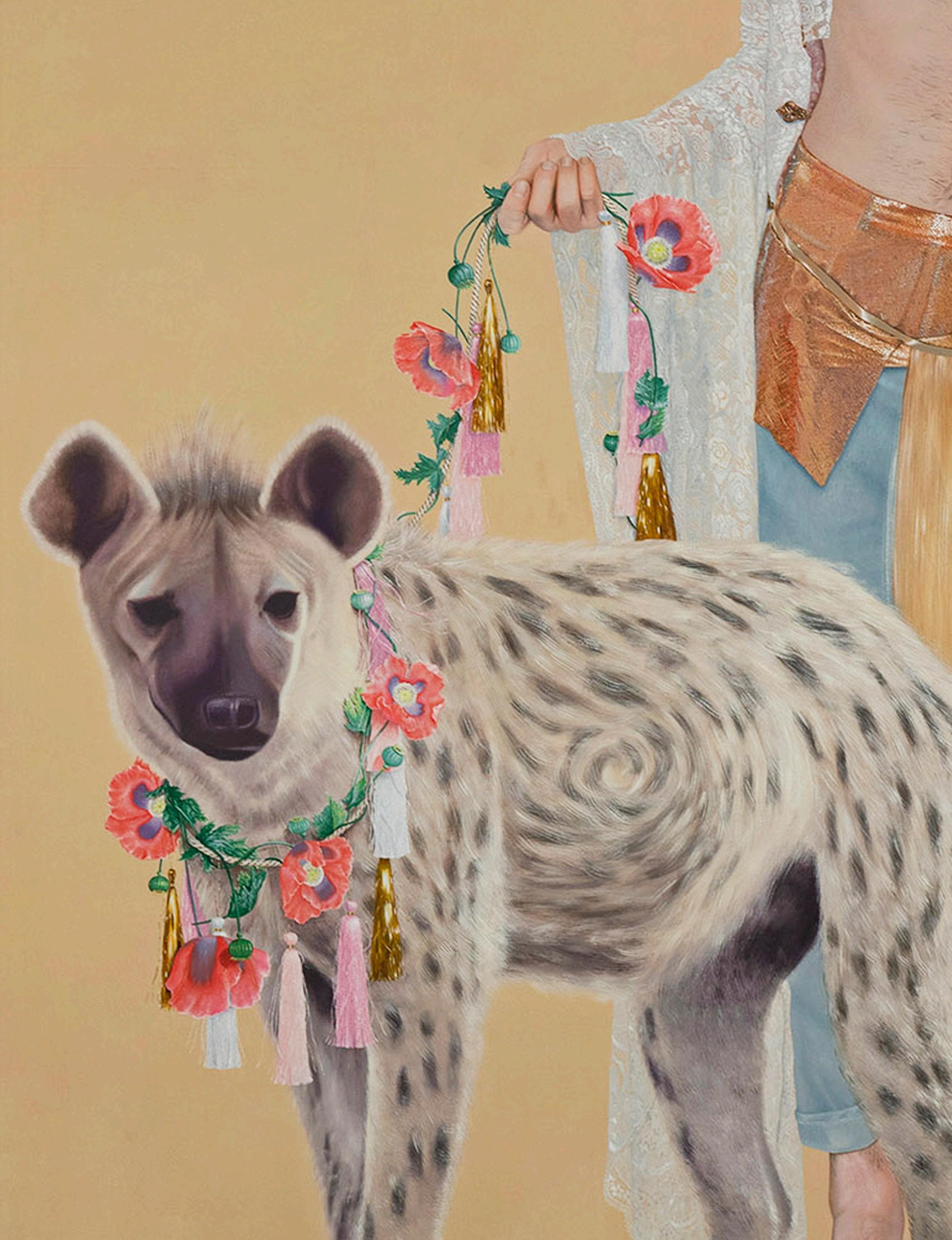
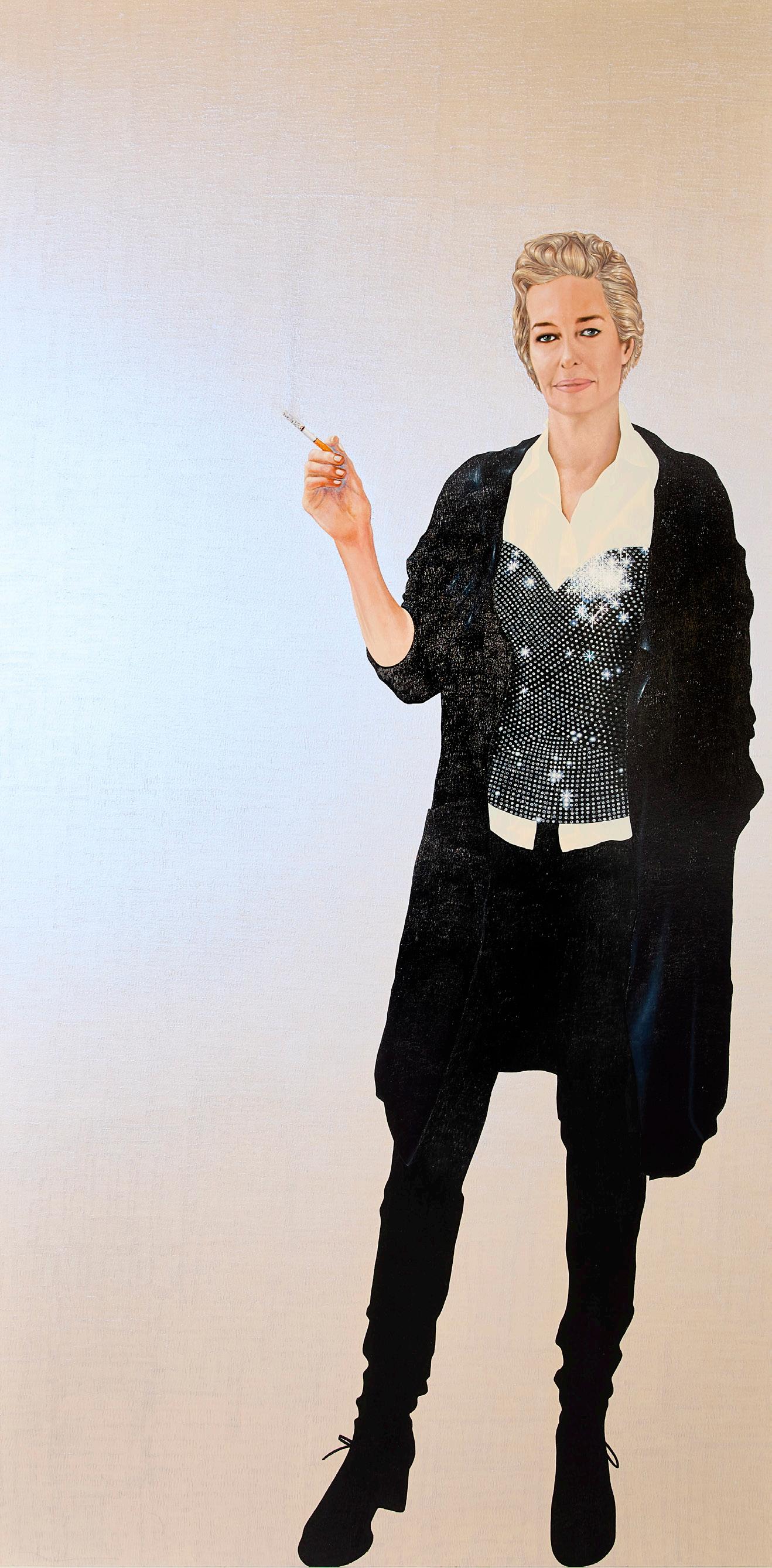
28 Liz Maw Palammino 2020 oil on board 2340 × 1250mm est $75,000—$90,000
provenance Private Collection, Wellington. Acquired from Robert Heald Gallery, Wellington
Interview Megan Shaw in Conversation with Liz Maw
Maw, in a black fur coat, smoking, both of us sharing a drink, spoke with the same directness that marks her work, grounded in the physical reality of painting, her vast references, and the enduring presence of the artist’s hand.
I met Liz Maw at her home and studio in Mount Eden on a drizzly winter afternoon, beginning outside in the garden. She pointed out plants, what was being tended to, cut back and which flowers were going over for the season. She gave me four cuttings wrapped in damp kitchen towel and tinfoil, the gesture of someone who has grown much of what surrounds her this way: taken, rooted and regifted. A statue of David stood on the grass, his pubic hair pointedly added back on. She invited me to return in summer for more cuttings and a drink when the garden looks like a 1990s Pierre et Gilles print - “gay as.”
Inside the studio, we sat with a painting she has been working on for six months, still being negotiated, before returning to the porch overlooking the garden to record the interview. Maw, in a black fur coat, smoking, both of us sharing a drink, spoke with the same directness that marks her work, grounded in the physical reality of painting, her vast references, and the enduring presence of the artist’s hand.
MS: How do you choose or “cast” someone in
your paintings? It feels almost cinematic, where a figure carries something beyond themselves, and doesn’t resolve into one fixed meaning.
LM: I use people in my environment, from the art world, my community. Even though they’re not really portraits… there are a couple here and there like Mary (2013), but mostly they’re models. But the person is still there. People identify with it. These are people from my world. My work is New Zealand work.
It’s like a bolt out of the blue. Sometimes I have an idea and a person together… they trigger some kind of ancient archetype for me.
I’ve always thought that if I didn’t paint, I would make movies. I'd just know how to do it. But for filmmaking you need an army of people to believe in you. I’ve never really had that. If you’re controlling and making something yourself, you’ve only got yourself to blame if you fuck it up.
People are multifaceted. They’ve got good things and bad things about them. A character could be a very bad character, or not. That’s what I’m interested in.
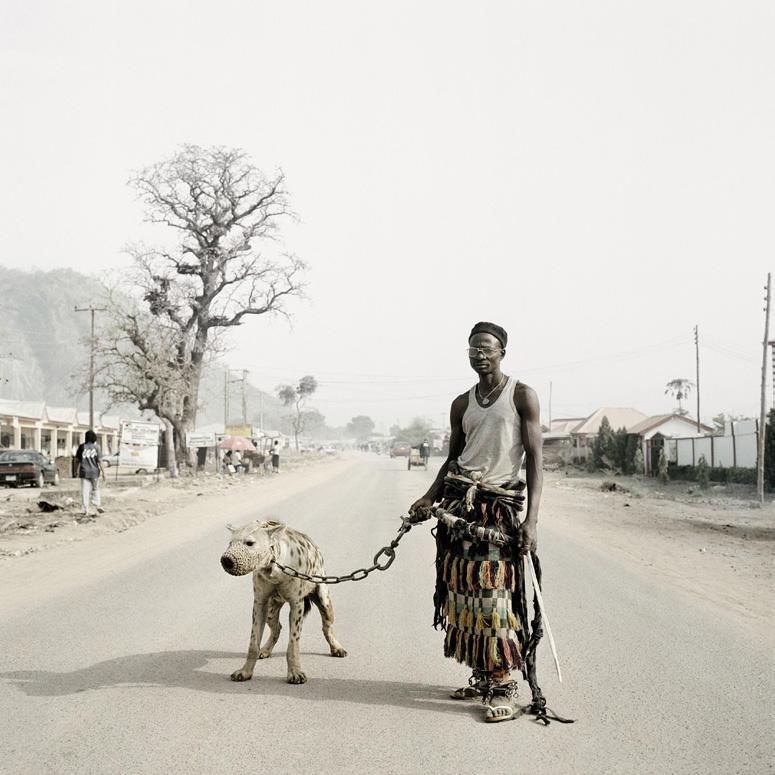
Pieter Hugo, Mallam Galadima Ahmadu with Jamis, Nigeria, 2005
“You are a king. Live alone. Take a free road. And follow where your free mind leads you, Bring to perfection the fruits of well-loved thoughts. Ask no reward for noble deeds accomplished. Rewards are within you. Your supreme judge is yourself. None will ever judge your work more sternly. Discriminating artist, does it please you?”
Alexander Pushkin
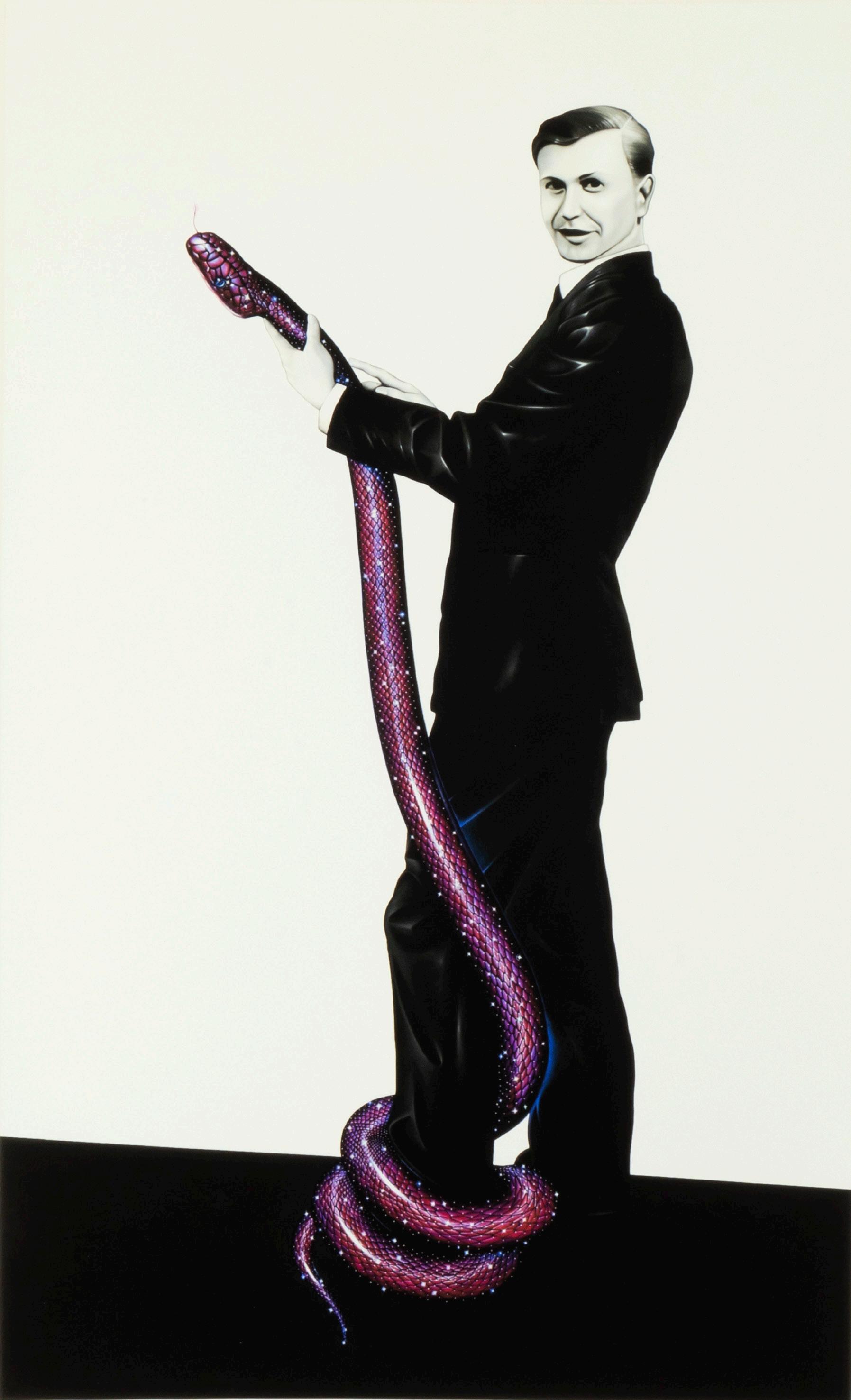
29 Liz Maw Young David Attenborough 2007
giclée print on paper, edition 2/10 signed L Maw, dated 2007 and inscribed Young David Attenborough in graphite lower edge 615 × 418mm est $2,000—$3,000
Private Collection, Wellington. Acquired from Ivan Anthony Gallery, Auckland.
MS: We’re fortunate to be handling two major works of yours in this sale. The first is Palammino (2020), which casts the Walters Prize nominee and artist Owen Connors. You’ve mentioned being inspired by images that carry a very direct, almost confrontational sense of power. Can you talk about how that shifts in this painting?
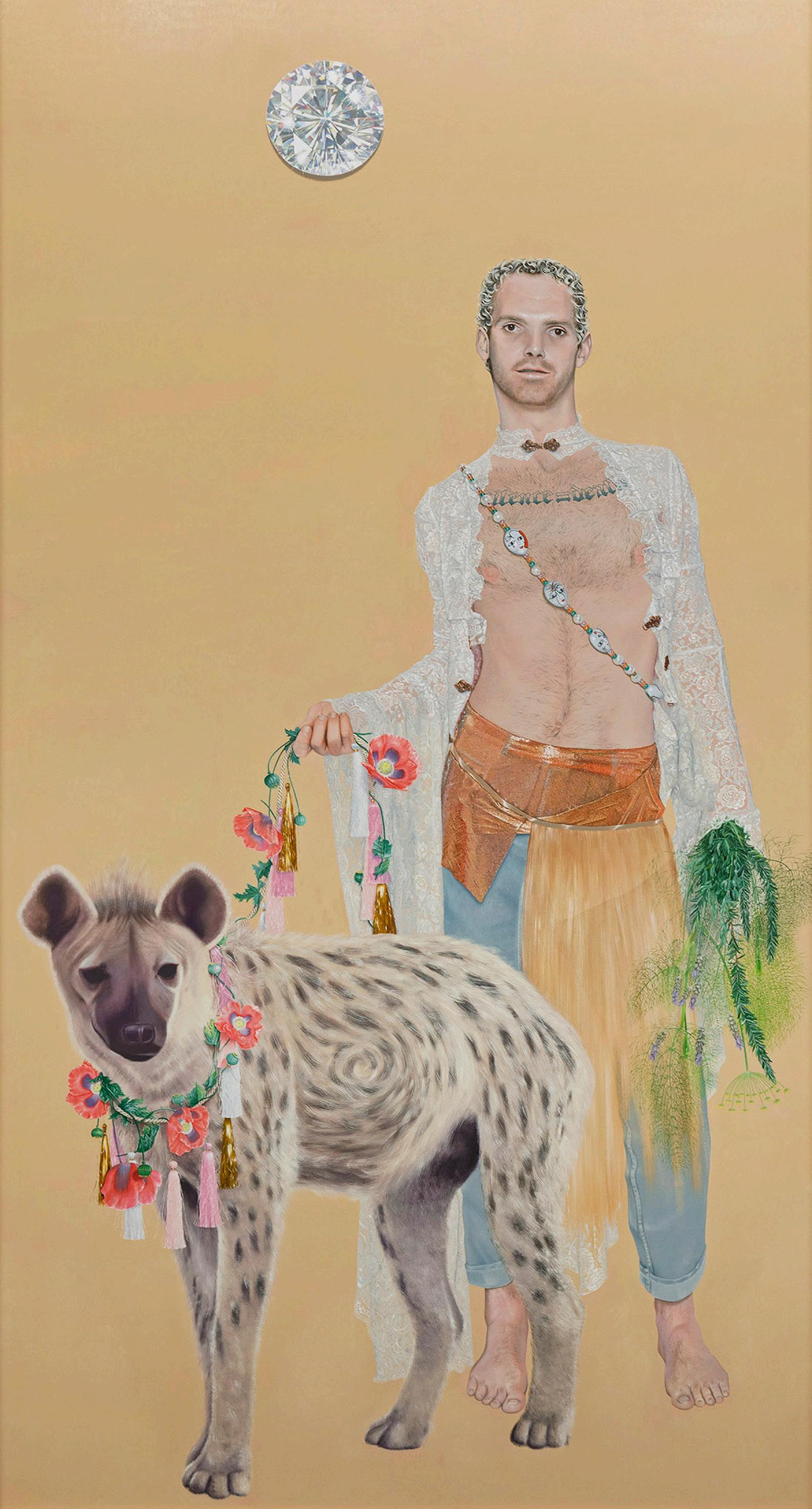
LM: I was inspired by those photographs by Pieter Hugo, his Hyena and Other Men series. I wanted “soft power” instead of power-power. That’s obvious in those images. You’ve got these Nigerian ‘hyena-men’ with aggressive animals on chains. I mean, that’s just one thing, isn’t it? It reads immediately as power. They’re in this space between dominance and submission. I wanted to do something that wasn’t obviously malevolent. Not that kind of direct thing. It’s got such a sweet face. I wanted to make my hyena very soft, very sweet… but still a little tough. So, it could be read as gentle or it could go another way. That’s the tension. But it’s not really about the animal literally, it’s about that feeling.
MS: You’ve described your works as not quite portraits in the traditional sense. Can you talk about how you construct a figure — particularly when different people or references are brought together within a single work?
LM: Yes, it’s not really about portraiture. In The Young David Attenborough (2007) the body was a different person. It’s enough to know the person, they’re part of my world, but they’re also standing in for something else. People want to read things literally, but I’m not interested in that. MS: There are symbolic elements throughout your work like flowers, but you also seem hesitant to fix their meaning. Is there a language there, or is it deliberately left open?
LM: Sometimes. A lot of the plants and flowers in the work are aromatic. I like that element. I’m not going to tell you why. You have to figure it out for yourself. That’s the point.
MS: Your works are eye catching in print or on screen, but they feel so rich in person. The surface of Mary (2013) is remarkable. How important is that physical encounter?
LM: It’s everything. A work like Mary looks so much better in the flesh. It’s the surface of the background, working with interference paints. I did it all with a small brush because I wanted it to feel like a smoke -filled room coming from her one cigarette. There’s a carelessness of how the ash falls.
I don’t want to compare myself to Rembrandt, but when I saw his paintings in Europe for the first time, it was completely different to reproductions, seeing them makes a huge difference. It’s the same thing here. People should come and look.
MS: This painting of Mary Vavasour, the significant
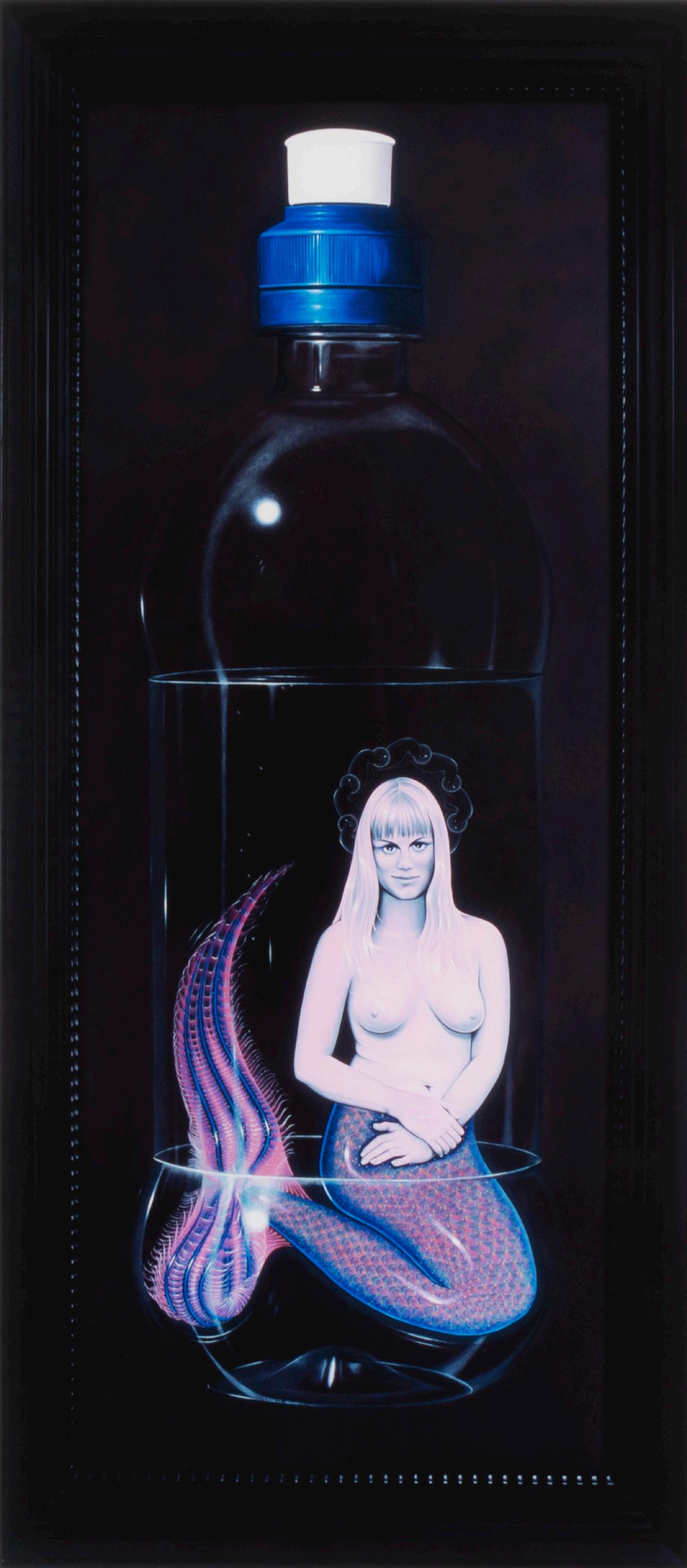
30 Liz Maw Naiad 2015 print on paper 8/10 signed L Maw and inscribed Naiad in graphite lower edge
780 × 350mm
est $3,000—$4,000
provenance
Private Collection, Wellington
literature
Liz Maw, My Beloved Hackneyed: Paintings & Poetry by Liz Maw, 2008
art consultant and gallerist — is she a portrait?
LM: It’s a fantasy portrait. She would never be seen dead in that, that was a full- on diamanté bustier, which I’ve still got. She wore it, but it’s symbolic.
The costume is a signifier for inhabiting a world of opulence and class… and a laissezfaire way of manoeuvring through it. The bustier and the cigarette are creating a certain kind of perception. The long ash is important too, that’s also a symbol of authority and indulgence.
MS: Looking back at the work over time, how do you see your practice now?
LM: I’m a much better painter now. I just am. It’s years and years of working.
But what pleases me is that the works still hold up. Even when I look and think, “Fuck, that hand’s not great,” the painting still works.
Queen of Dreams (2025) was brutal. Two metres by two metres — nothing beats seeing it in the flesh. The last couple I’ve done, the one with the emergency blanket (The Untitled II, 2024) and Queen of Dreams, are probably the best works I’ve done.
MS: You’ve spoken about not wanting to fix meaning in the work. Tell me more about that?
LM: I don’t mind being asked about the content, but I don’t want to over-explain it. I want the same respect as any male painter. I’ve worked just as hard, if not harder, and I think I’m just as good.
Peter McLeavey always said to me, “You know, Liz… sometimes even the artists themselves don’t know what the work is about.”
And often things have been picked up. Like those kneeling nudes I did of Aura (2002) and the Naiad (2015), I hadn’t thought of them that way, but he reckoned they were a copy of a copy, like a pulp painting, stemming from Pania of the Reef in Napier, which I’d always loved. He called me up when it got stolen and asked if I was sitting down, I was devastated. But they found it again.
So there are things in the work that you don’t fully know yourself. Your interpretation is as good as the next person’s.
MS: As these works come to market, how do you want them to be positioned, and how does that sit alongside your own relationship to recognition?
LM: You’ve got to contextualise me. Connect me with other artists — it doesn’t have to be women, just artists.
I’ve never really been in fashion. Being a woman, a painter, figurative, and using colour — it’s almost like a quadruple disadvantage.
When I was younger, I really wanted recognition. Now I don’t give a flying fuck — apart from whether the painting works. That’s all I care about. I am the measure.
There’s that Pushkin quote — “Discriminating artist, does this please you?” That’s it.
Private Collection, Wellington. Acquired from Robert
32 Liz Maw Mary 2013 oil on board 2120 × 1090mm est $55,000—$70,000
Heald Gallery, Wellington
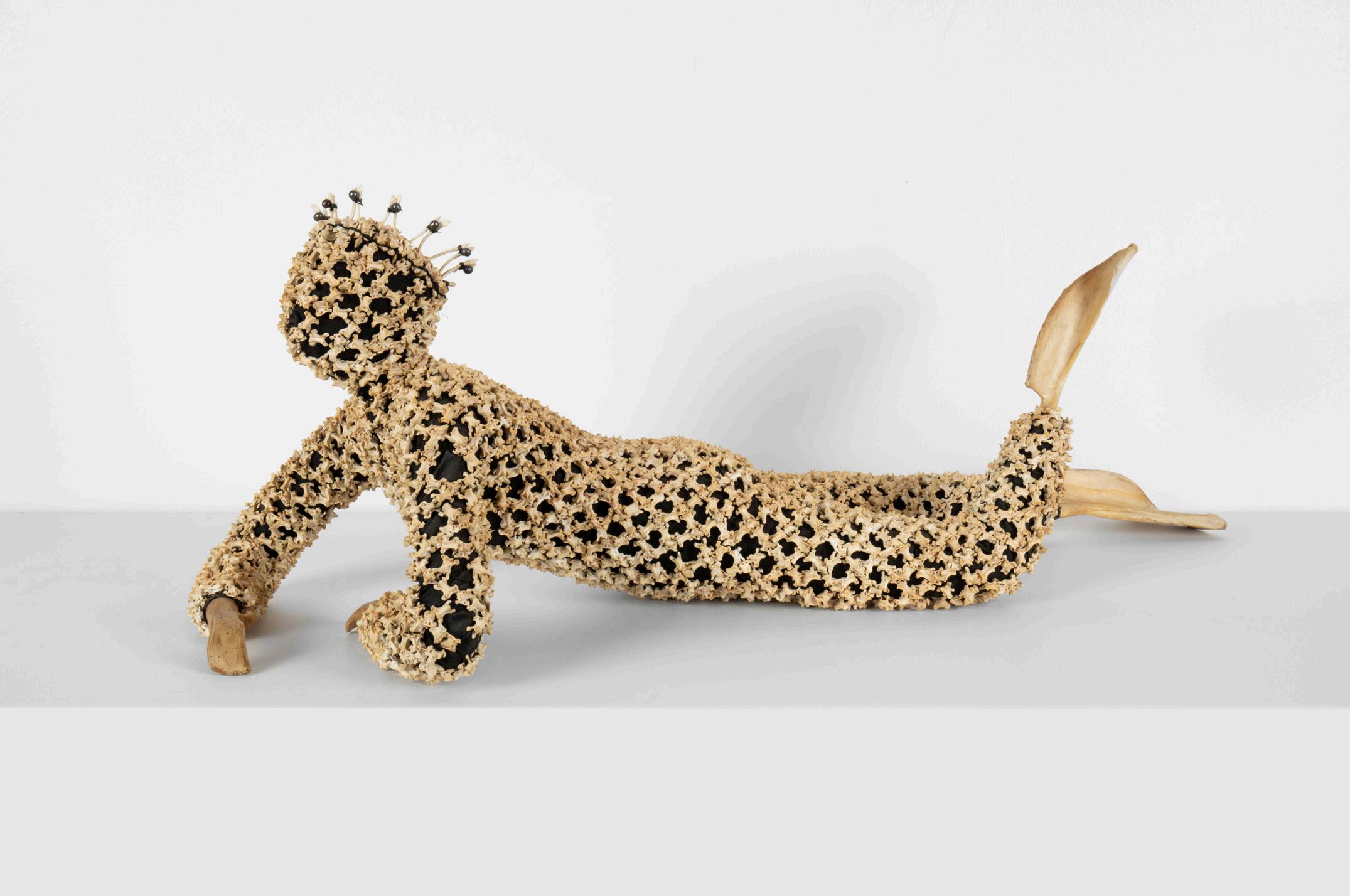
33 Linde Ivimey
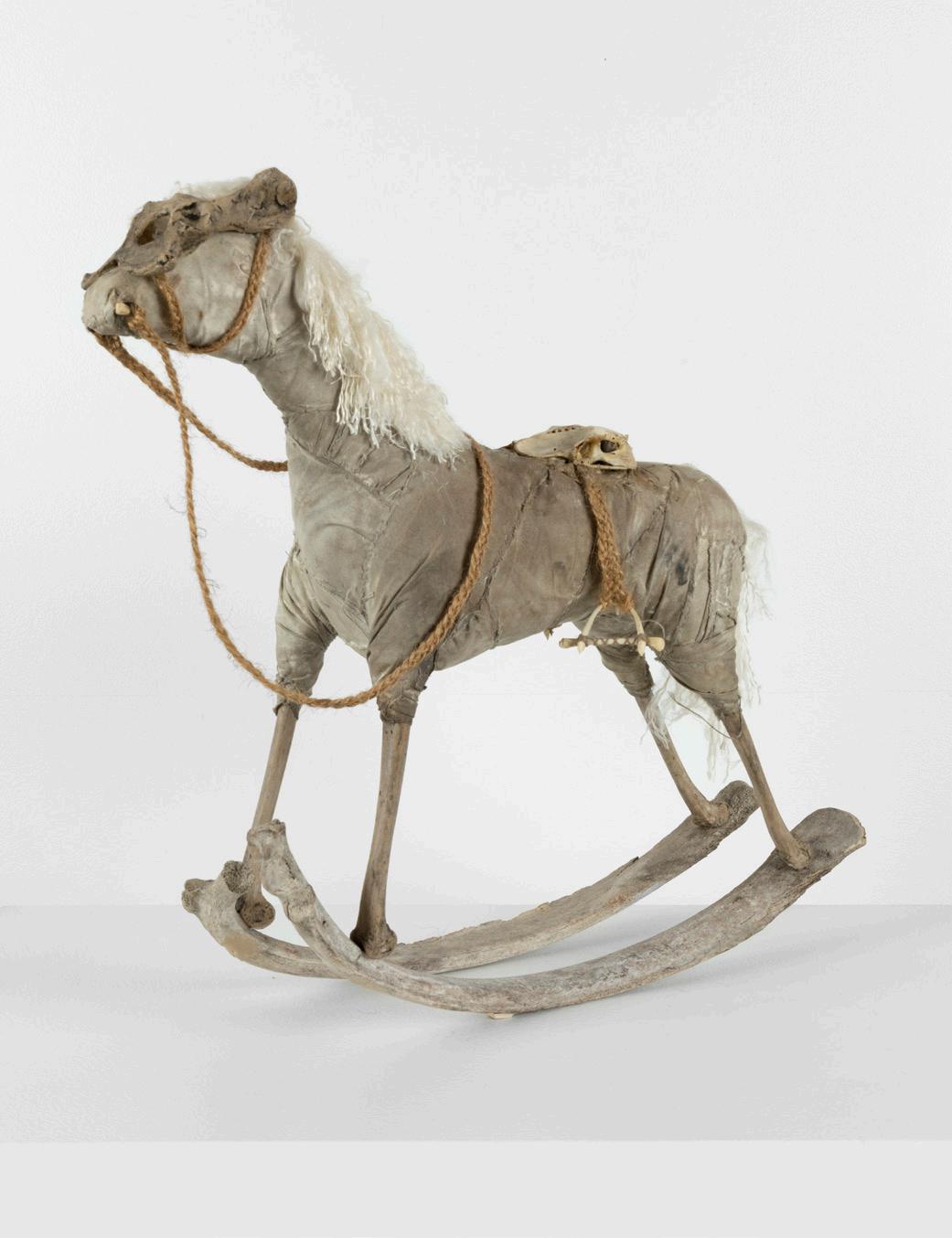
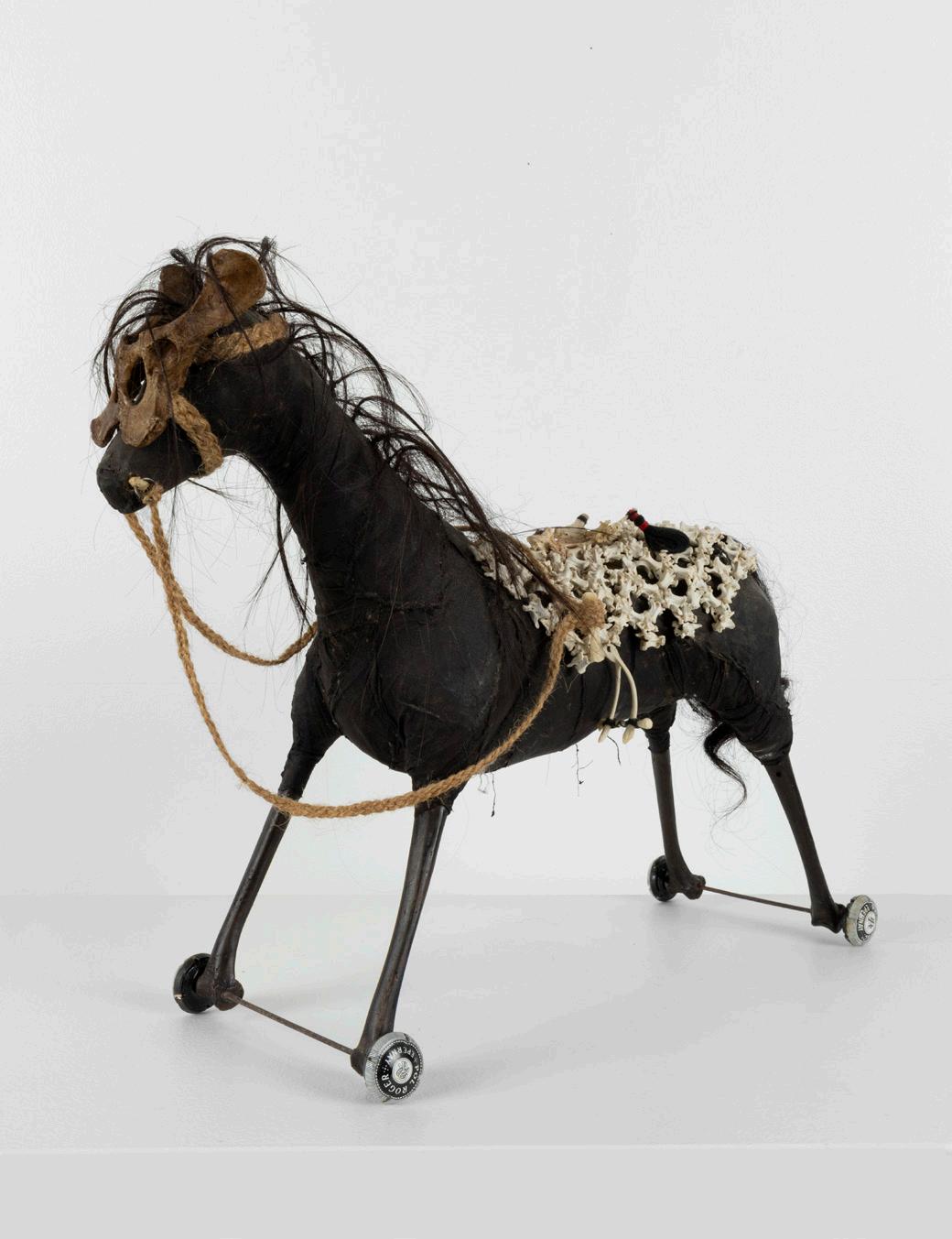
Nixe, sculpture in bones
2007
steel armature, acrylic resin, natural and cast bones, quandong seeds, dyed fabrics, felt, lint, found objects
300 × 280 × 1000mm
est $10,000—$16,000
provenance
Private Collection, Wellington
literature
Louise Martin-Chew, Linde Ivimey (The University of Queensland, 2012), 138-139
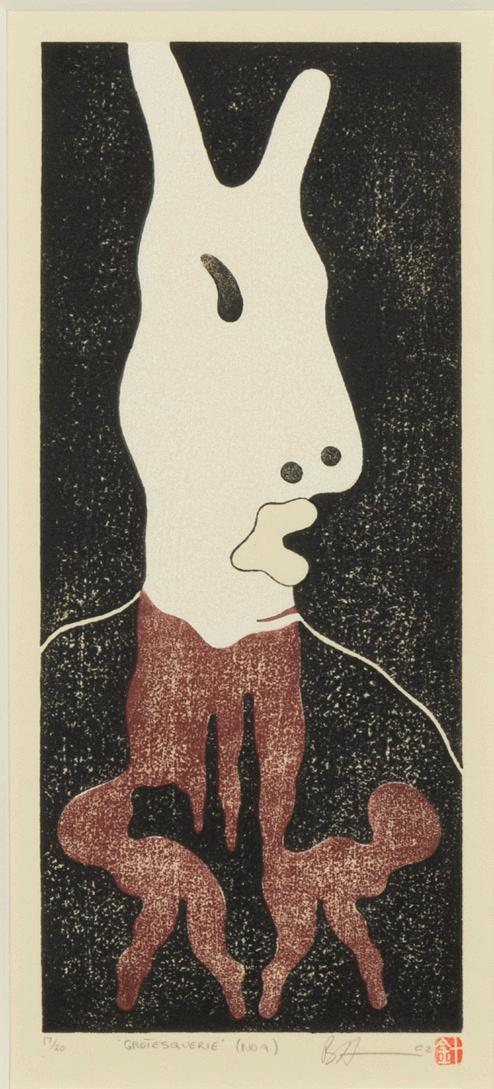
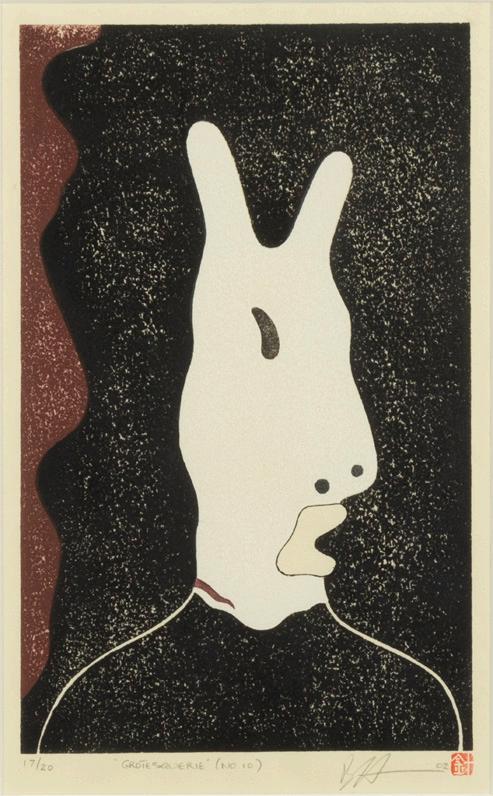
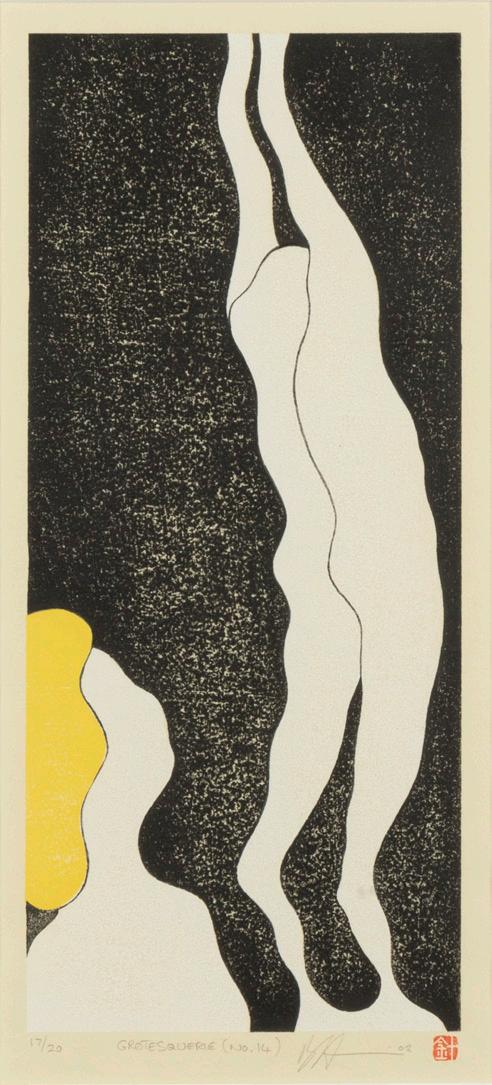
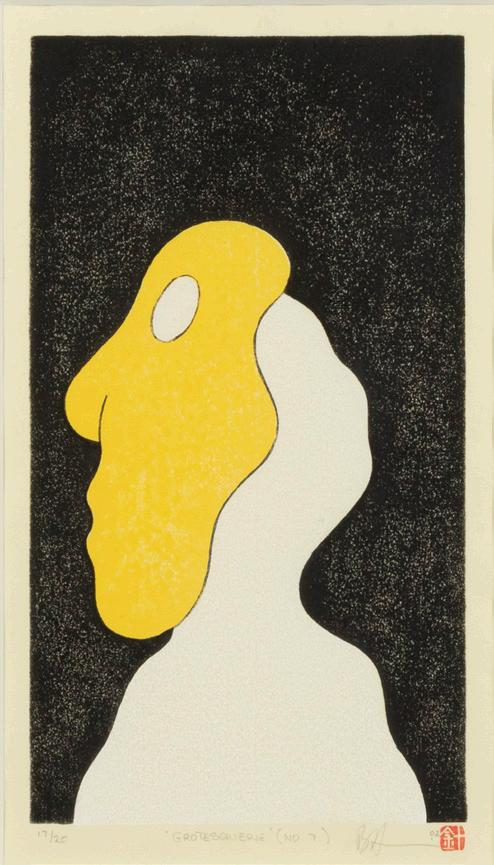
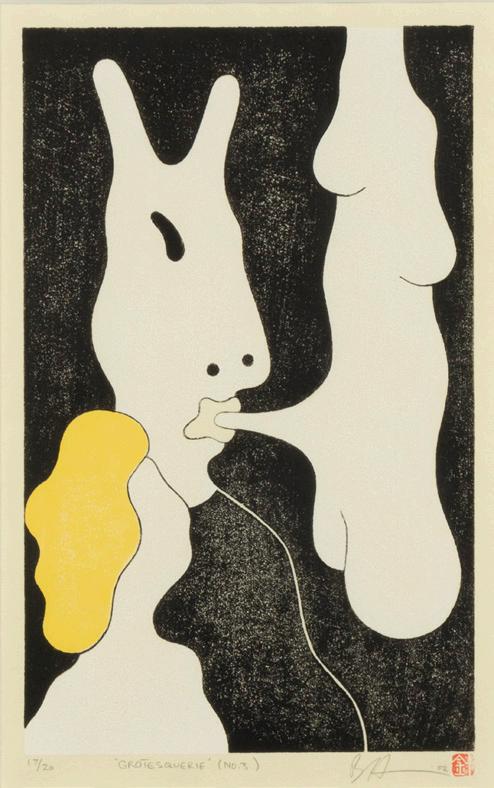
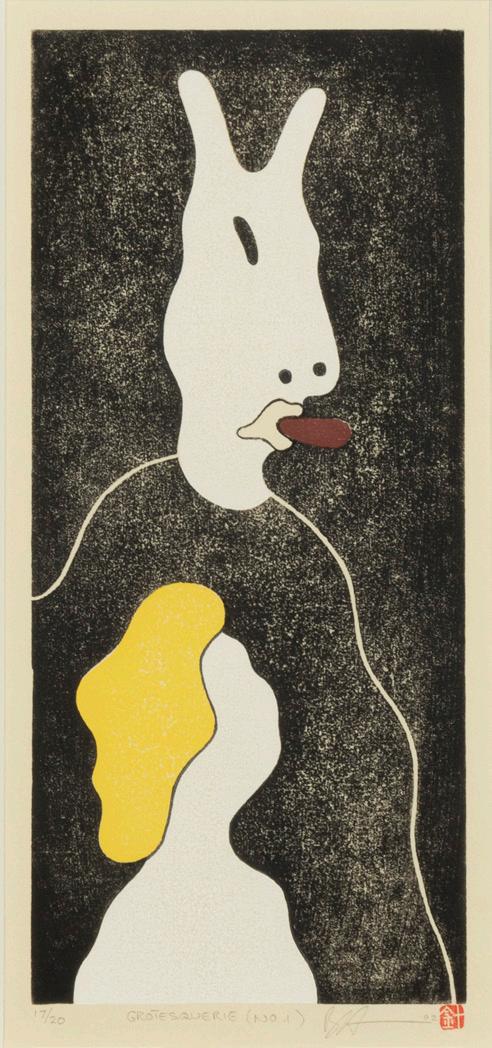
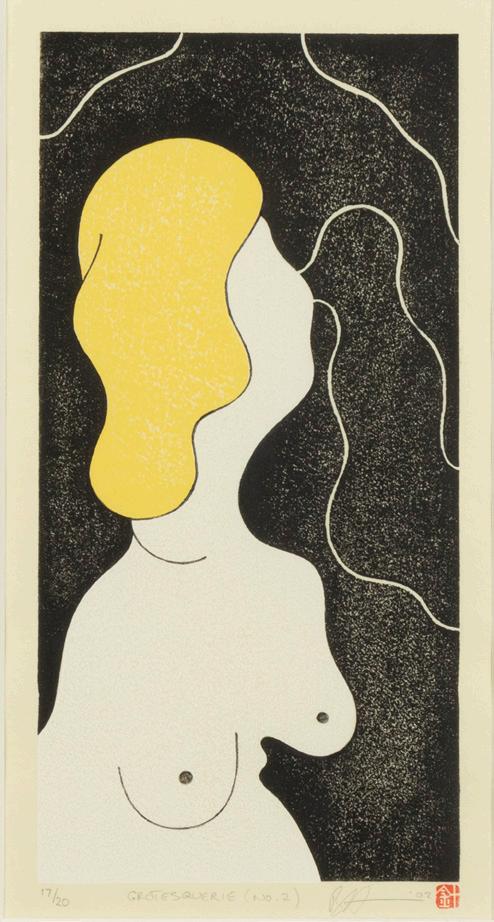
34 Brent Harris Grotesquerie 2002–2009
seven colour woodcut prints on Japanese paper all editioned 17/20 signed B Harris and inscribed Grotesquerie in graphite lower edge (per work)
dimensions variable est $12,000—$16,000
provenance
Private Collection, Wellington. Acquired from Robert Heald Gallery, Wellington
35 Linde Ivimey Lucky 2008
cast acrylic resin, synthetic and natural fibres, dyed silk and cotton, sheep, chicken and poussin bones, hair, amethyst and garnet
430 × 400 × 135mm
est $5,000—$8,000
provenance
Private Collection, Wellington. Acquired from Martin Browne Fine Arts, Melbourne, 2008
exhibitions
Martin Browne Fine Arts, Melbourne Art Fair, 2008
36 Linde Ivimey Star 2008
cast acrylic resin, synthetic and natural fibres, dyed silk and cotton, sheep, chicken and poussin bones, hair, amethyst and garnet
415 × 160 × 420mm
est $5,000—$8,000
provenance
Private Collection, Wellington. Acquired from Martin Browne Fine Arts, Melbourne, 2008
exhibitions
Martin Browne Fine Arts, Melbourne Art Fair, 2008
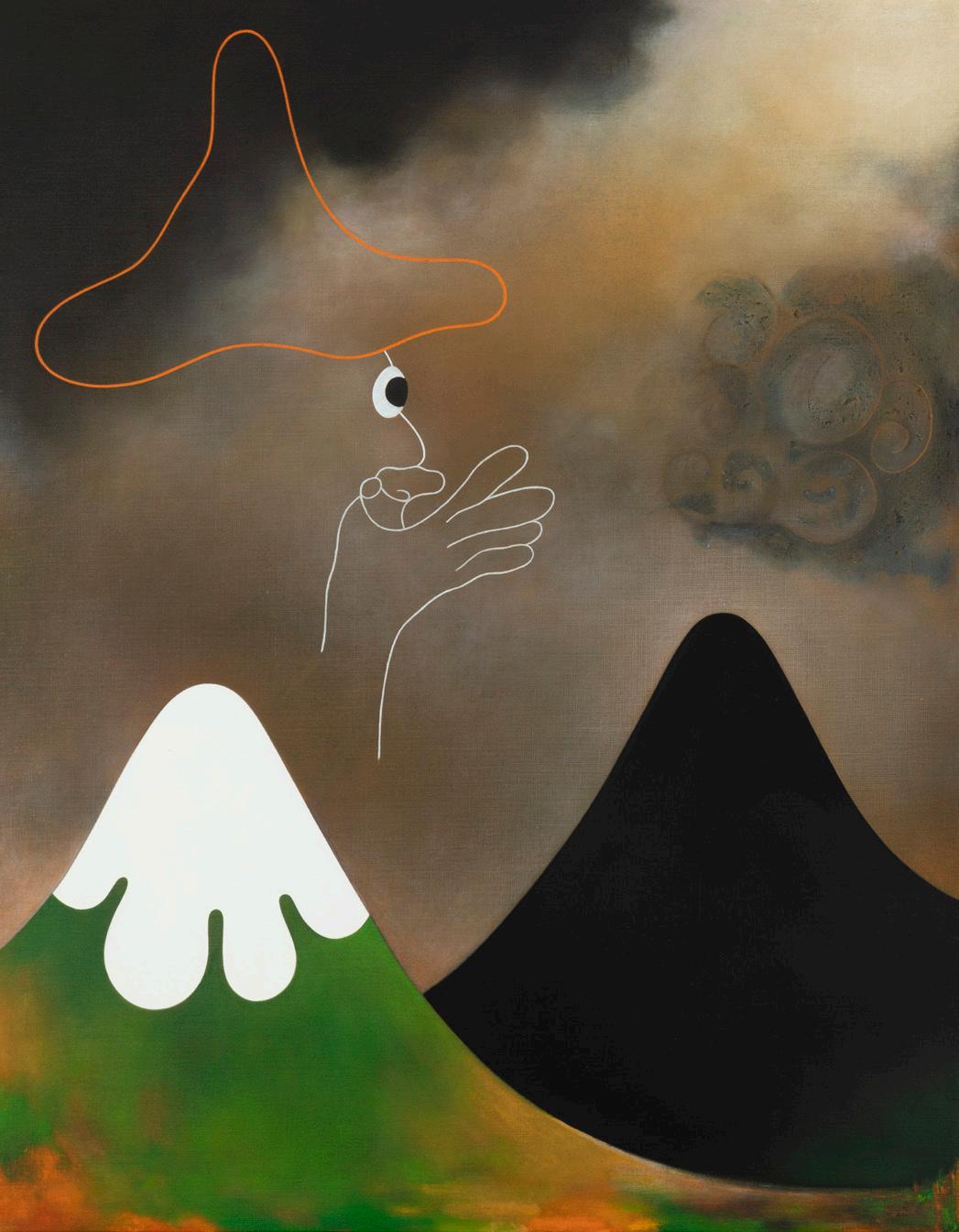
37 Brent Harris Peaks (The Gorge) 2019 oil on canvas
signed B Harris, dated 2019 and inscribed Peaks (The Gorge) in graphite verso 960 × 700mm
est $14,000—$18,000
provenance
Private Collection, Wellington. Acquired from Robert Heald Gallery, Wellington
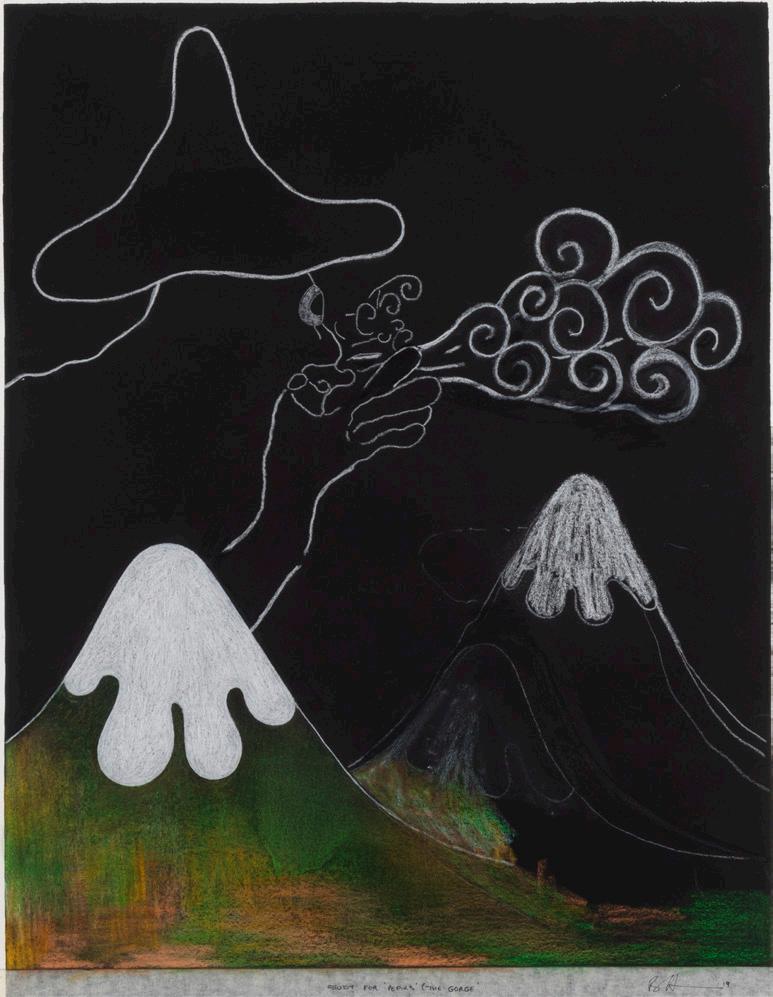
38 Brent Harris Study for Peaks (The Gorge) 2019 oil pastel on paper
signed B Harris, dated 19 and inscribed Study for 'Peaks' (The Gorge) 615 × 470mm
est $3,000—$5,000
provenance
Private Collection, Wellington. Acquired from Robert Heald Gallery, Wellington
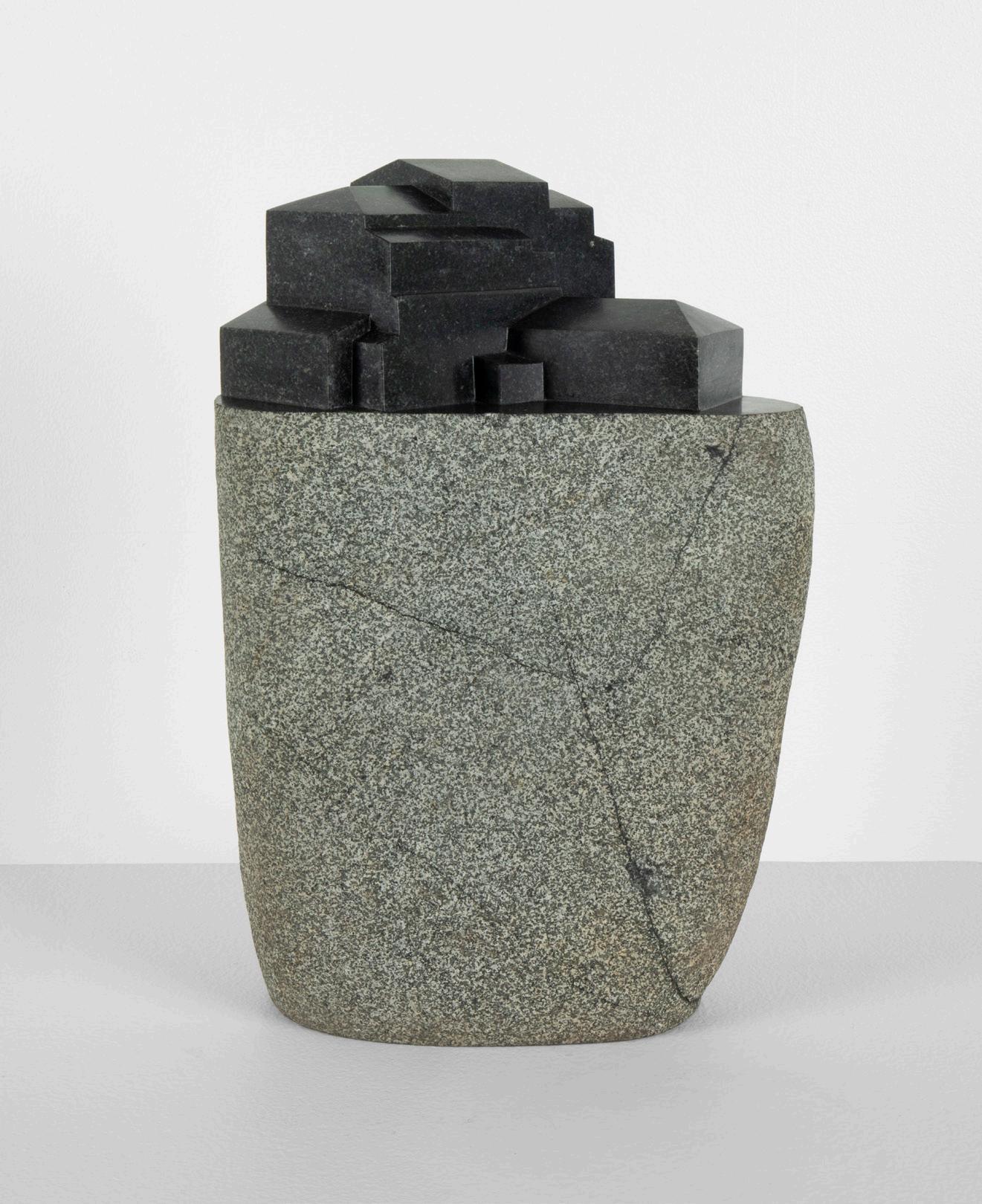
39 Joe Sheehan Harper Road 2019
Diorite (Omaui)
signed JS, dated '19, with incision on base
300 × 200 × 180mm
est $16,000—$20,000
provenance
Private Collection, Wellington. Acquired from Tim Melville Gallery, Auckland
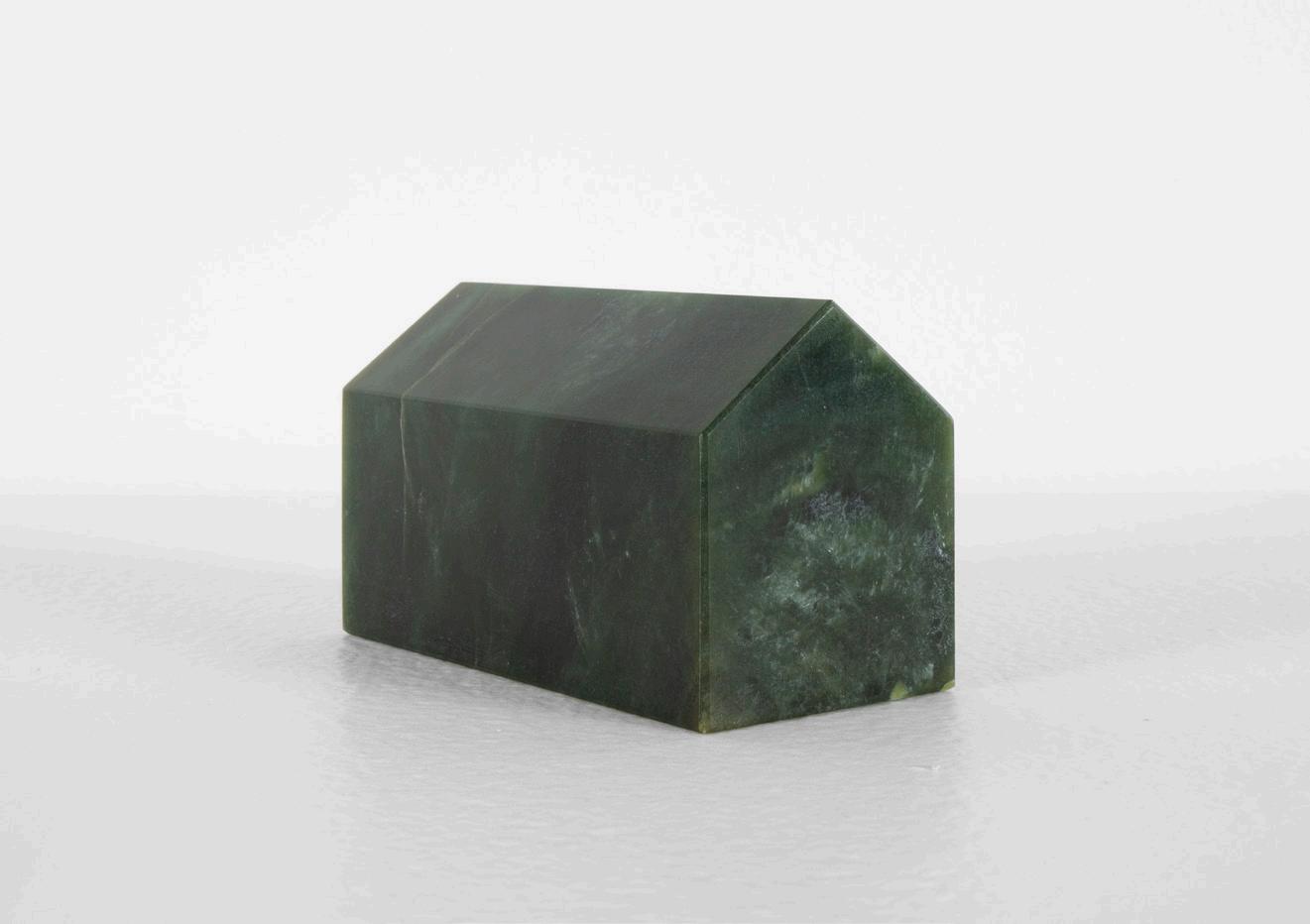
40 Joe Sheehan house (pounamu) 2016
pounamu
signed JS, dated '16, with incision on base
40 × 65 × 34mm
est $1,000—$1,600
provenance
Private Collection, Wellington. Acquired from Tim Melville Gallery, Auckland
41 Joe Sheehan Key (pounamu) 2016
pounamu, sterling silver chain
75 × 8 × 21mm
est $1,200—$1,800
provenance
Private Collection, Wellington. Acquired from Tim Melville Gallery, Auckland
42 Joe Sheehan Huia beak (pounamu) 2016
pounamu, sterling silver chain
65 × 40 × 10mm
est $1,400—$2,000
provenance
Private Collection, Wellington. Acquired from Tim Melville Gallery, Auckland
43 Joe Sheehan Untitled (Battery) 2020
Basalt (Clifden) and cast sterling silver
47 × 25 × 17mm
est $1,400—$2,200
provenance
Private Collection, Wellington. Acquired from Tim Melville Gallery, Auckland
exhibitions
Joe Sheehan, Volumes, Tim Melville Gallery, Auckland, 15 September – 3 October 2020
44 Terry Stringer I Can Not See You Now 2005
bronze, polychrome and patinated folded brass signed TERRY STRINGER, dated 2005 and inscribed I Can Not See You Now, with incision lower edge
800 × 380 × 340mm
400 × 400 × 400mm on base
est $20,000—$24,000
provenance
Private Collection, Wellington. Acquired from Webb's, Auckland, 2006
exhibitions A Life In Sculpture, Webb's, Auckland, 2006
45 Terry Stringer
Love of Land Land of Love
bronze, wood, 82/100 signed Terry Stringer, dated 2001 and inscribed 82/100 with incision lower edge
170 × 110 × 75mm (widest points)
est $1,800—$3,000 provenance
Private Collection, Wellington
2019
cast bronze, 2/2
460 × 150 × 120mm
est $9,000—$14,000
provenance
Private Collection, Wellington. Acquired from Bowen Galleries
inscribed Green Man inscribed with incision lower edge
280 × 100 × 100mm
est $4,000—$7,000
provenance
Private Collection, Wellington
47 Terry Stringer Green Man 2022
bronze, no. 1/10
46 Terry Stringer Head in a Landscape
Michael Parekōwhai
Craig Keller 2022
Type-C photograph, edition 5/10
signed Mike P in ink verso
575 × 475mm
est $15,000—$20,000
Private Collection, Wellington. Acquired from Michael Lett, Auckland
48
49 Michael Parekōwhai
Neil Keller 2022
Type-C photograph, edition 5/10
signed Mike P in ink verso
575 × 475mm
est $15,000—$20,000
provenance
Private Collection, Wellington. Acquired from Michael Lett, Auckland
Essay Ahi by Brook Konia
Ahi marks the maturing of Cotton's painting focus following his graduation from Ilam School of Fine Arts. At the same time, Cotton began his teaching career as a lecturer in Māori Studies at Pūtahi a Toi, Massey University, Palmerston North. Through learning and teaching Māori and colonial history, this became his impetus, most notably the figurative painting on late nineteenthcentury Te Tai Rāwhiti Māori meeting houses. This space and time also prompted a personal calling, leading Cotton on a journey of self-discovery as he broadened his understanding of his Ngā Puhi whakapapa and his tūrangawaewae of Te Tai Tokerau.
Ka kata ngā pūriri o Taiamai - a well-known Ngā Puhi whakataukī that translates as ‘the pūriri trees of Taiamai are laughing’. These kupu recall the departing phrase of evicted Ngāti Pou at the hand of Ngā Puhi. Likened to laughter is the crackling of pūriri wood in the home fires of Ngā Puhi, flickering between Pouerua and Maungatūroto maunga. This connects to the title of this painting, Ahi translates as fire. Ahi kā is the term for home fires of occupation.
Latticed grids reveal different points of focus, reinforced by a patinated colour palette of black, ochre red, and sepia. Key visual motifs anchor the painting’s exploration of cultural identity. An emblematic bird sigils in the lower right. Bird-like figures in Cotton’s paintings are
It was 1996 when Hamish McKay Gallery presented the exhibition New Paintings by Shane Cotton, a noted “Young Gun” of the 1990s New Zealand art scene within the context of the Te Tiriti sesquicentennial decade. From this exhibition, Ahi spotlights this period of Cotton’s art practice and his collapsing of Aotearoa New Zealand's political and cultural histories into a distinctive lexicon of imagery.
inspired by Taiamai, an ancestral manu of Ngā Puhi. Sinuous abstract forms and detailed pitaulike segments sit within the grid alongside the myriad of small white circles, directing the eye toward a stylised tekoteko signifying whakapapa and lineage. Similarly, the kupu ‘PUHI’, ‘MANO’, and mirrored ‘KOTAHI’ annotate a deep expression of unity. The gothic script and large block serif fonts lead the viewer through Anglican postcolonial histories, echoed in the depicted landscape with erected ripeka crosses.
Ahi is a painting that salutes the period of Cotton’s burgeoning art practice and emergence into prominence, which has since developed and evolved powerfully across the decades. Cotton is an internationally renowned artist whose works are held in national and private collections throughout New Zealand and Australia. He was named an Arts Foundation of New Zealand Laureate in 2008 and appointed an Officer of the New Zealand Order of Merit in 2012 for services to the visual arts. Cotton’s recent highlights include presented paintings in the blockbuster Toi Tū Toi Ora: Contemporary Māori Art exhibition at Auckland Art Gallery Toi o Tāmaki (2020–21), the site-specific mural ‘Maunga’ on Britomart Customs East (2020), and feature solo exhibitions Te Puāwai at The Dowse Art Museum, Lower Hutt (2021) and Kei Muri Ngā Mea I Te Rā at Wairau Māori Art Gallery, Whangārei (2022).
51 Reuben Paterson
The Red Coral Cat 2022 glitter on canvas
signed Reuben Paterson, dated 2022 and inscribed The Red Coral Cat in graphite verso
900 × 600mm
est $8,500—$10,000
Private Collection, Wellington. Acquired from Page Galleries, Wellington
52 Reuben Paterson Prayer 2014
screenprint and glitter on 600 gsm deckle edge paper, 25/30
signed Reuben Paterson, dated 2014 and inscribed Prayer in graphite lower edge 970 × 760mm
est $4,000—$5,500
provenance
Private Collection, Wellington. Acquired from Page Galleries, Wellington
53 Reuben Paterson Blessing 2014
screenprint and glitter on 600 gsm deckle edge paper, 13/30
signed Reuben Paterson, dated 2014 and inscribed Blessing in graphite lower edge 970.5 × 760.5mm
est $4,000—$5,500
provenance
Private Collection, Wellington. Acquired from Page Galleries, Wellington
54 Reuben Paterson And I Fall, Back into Your Arms, Again 2022
Glitter on canvas signed Reuben Paterson, dated 2022 and inscribed And I Fall, Back into Your Arms Again in graphite verso 1020 × 1020mm est $15,000—$20,000
Private Collection, Wellington. Acquired from Page Galleries, Wellington
760 × 1620mm
est $45,000—$50,000
55 Lisa Reihana
Banks Transit of Venus, Mourning, Stars, Sex Trade (15375)
2017 pigment print on paper, mounted on aluminium dibond behind acrylic glass, A/P 1/2
Private Collection, Wellington. Acquired from Sally-Dan Cuthbert Gallery, Sydney
Private Collection, Wellington
56 Bill Hammond Staying Alive 1981 etching on paper
inscribed Staying Alive lower right 100 × 260mm est $1,800—$2,400 provenance
Essay
Drummer with a Paintbrush
by Lucinda Bennett
Before Hammond became obsessed with birds and began painting the signature bird-people that would establish him as a market favourite, Bill Hammond was a melomaniac, a drummer with a paintbrush making punky, fleshy, volatile, dystopian, gritty, repulsive, rock’n’roll paintings.
If that seems like a lot of adjectives, it’s because Hammond’s early work is hyperactive, angular, filled with multiple, jarring perspectives, figures morphing into land masses, the alps sprawling across tabletops, snow-capped mountains sprouting veins, theatrical curtains falling from the sky to divide acidic plains, splicing space that could be interior, exterior or both.
As curator Justin Paton points out, Hammond’s interiors came at a time when “the domestic interior had begun to trump landscape as a subject for local painters”; a necessary response to a canon dictated for so long by colonial depictions of the land.1
All Shook Up (1985) doesn’t just unsettle our perspective, it viscerally wrenches us from kitchen stove to mountaintop, careening
around the canvas without pause, interior spaces seemingly fenced by tiny mountains but unable to contain the balloon of a monstrous body, Elvis rising from the kitchen floor, his tiny crotch gyrating against a Formica chair, his yellow torso shaped like an inverted pyramid, a blood-streaked volcano neck sprouting from the base like something from a David Cronenberg film, only recognisable as The King due to that unmistakable quiff of greasy black hair, and perhaps due to the title, shared with one of his most famous songs:
Her lips are like a volcano that’s hot I’m proud to say that she’s my buttercup I’m in love, I’m all shook up
Grotesque, lathering musicians of all kinds have appeared regularly in Hammond’s work over the years, such as the exhibition titled Lines from Songs , one of his first showings at Brooke Gifford Gallery in central Christchurch, which included works such as Heading for the Last Roundup and Radio On , both now held in the collection of Christchurch Art Gallery Te Puna o Waiwhetū.
1 Justin Paton, “Apocalyptic Wallpaper,” 23 Big Pictures (Dunedin Art Gallery, 1999), 8.
57 Bill Hammond
All Shook Up 1985
acrylic on canvas signed W. D. Hammond and dated 1985 in brushpoint lower edge; inscribed ALL SHOOK UP in brushpoint upper edge 1700 × 1700mm
est $85,000—$100,000
provenance
Private Collection, Wellington. Acquired from McLeavey Gallery, Wellington, 1996.
exhibitions
Bill Hammond: Serenading Imagined Worlds, Te Uru Waitakere Contemporary Art Gallery, 7 December 2025 – 22 February 2026; Bill Hammond: Jingle Jangle Morning, Christchurch Art Gallery Te Puna o Waiwhetū, Christchurch, 20 July – 22 October 2007; Bill Hammond: 23 Big Pictures, Dunedin Public Art Gallery, Dunedin, 11 September – 14 November 1999; Loft Gallery, Motueka, September 1987; Hammond/ Webster, Waikato Museum of Art, Hamilton, 1985.
literature
Jennifer Hay, Laurence Aberhart, Chris Knox and Ron Brownson, Bill Hammond: Jingle Jangle Morning, (Christchurch Art Gallery Te Puna o Waiwhetū, 2007), 64-65.
Installation view of Bill Hammond: Jingle Jangle Morning at Christchurch Art Gallery Te Puna o Waiwhetū, 2007
Birds in Charge
by Lou Sanson
What fascinated Hammond was that this was a place where the shags were in charge, no predators, no people, a gorgeous subantarctic island with white sand beaches, gnarled rātā trees, and megaherbs (New Zealand’s largest flowering plants).
In the few days we were there, he came up with the idea of “birds in charge”, the supreme beings in this stunning landscape. Russell Beck, the Southland Museum Director (and father of Rocket Lab’s Peter Beck), had put the idea together for our 1990 celebration: to take a group of emerging New Zealand artists to the subantarctic to create something special in a place only scientists could visit due to its Nature Reserve status. Bill Hammond’s iconic bird series was indeed “that something special”, and it started that day 36 years ago.
The painting Zoomorphic Lounge III is an iconic work that brings together all the elements of our 1989 visit to the Auckland Islands / Motopuhue. In the painting are the basis of the Auckland Island shags that had such a big impact on him. Looking closer, some appear as penguins, Enderby Island is home to the largest population of the world’s rarest penguin, the hoiho (yellow-eyed penguin).
Some appear as tītī (sooty shearwater), and in the distance are the tails of whales. Port Ross, adjacent to Enderby Island, has one of
I was with Bill on the Auckland Islands in 1989 as District Conservator, Invercargill for DOC. I took him on a walk around Enderby Island, where he became mesmerised by a colony of Auckland Island shags at Gargoyle Point.
the greatest concentrations of southern right whales during calving. Others resemble the New Zealand sea lion found on Enderby.
At the heart of the image, though, is what he saw on Enderby Island: a place where birds are in charge and have seen humans come and go, shipwrecked sailors killed in the surf or dying from starvation. A separate colony to New Zealand was established there in 1850, Hardwicke, only to collapse three years later as the elements proved too harsh. The whole time, the birds thrived, and today they still occupy pride of place on Enderby.
In Zoomorphic Lounge III, this moment of encounter is transformed into one of the defining ideas of Hammond’s practice. The birds are no longer simply observed; they assume a quiet authority, occupying a world in which human presence is fleeting and contingent. The painting holds that inversion, of power, scale, and time, and extends it into a broader meditation on survival, memory, and the endurance of the natural world.
Held in the artist’s own collection, the work carries a particular significance. It stands not only as a record of that formative experience, but as a touchstone within Hammond’s oeuvre, where the conceptual and visual language that would define his career first coheres with clarity and conviction.
58 Bill Hammond Zoomorphic Lounge III 1999
acrylic on hessian canvas signed W. D. Hammond, inscribed Zoomorphic Lounge III and dated 1999 in brushpoint upper right corner 1620 × 2145mm est $1,400,000—$1,800,000
provenance
Private Collection, Wellington. Acquired from Peter McLeavey Gallery; Collection of the artist
exhibitions
On Loan to Auckland Art Gallery Toi o Tāmaki, 2008 – 2018. Bill Hammond: Jingle Jangle Morning, City Gallery Wellington Te Whare Toi, 16 November 2007 – 10 February 2008; Bill Hammond: Jingle Jangle Morning, Christchurch Art Gallery Te Puna o Waiwhetū, Christchurch, 20 July – 22 October 2007; Bill Hammond: 23 Big Pictures, Dunedin Public Art Gallery, Dunedin, 11 September – 14 November 1999.
literature
This lot includes signed copies of Bill Hammond: Jingle Jangle Morning (Christchurch Art Gallery Te Puna o Waiwhetū, Christchurch) 2007, signed W. D Hammond, dated 2013 in ink inner title page, 300 × 250mm and Bill Hammond 23 Big Pictures (Dunedin Public Art Gallery, Dunedin), 1999, signed W. D Hammond, dated 2013 in ink inner title page, 290 × 210mm
Installation view of Bill Hammond: Jingle Jangle Morning at Christchurch Art Gallery Te Puna o Waiwhetū, 2007
Essay The Civil and Naval, a Reflection
by Gary McCormick
Bill and I used to meet in the Civil and Naval Bar in Lyttelton.
However, I use the word "meet," relatively loosely as it was never planned and often we would never speak a word to each other.
You see, there is a window table at the Civil and Naval where you can look out onto London Street and if Bill got there first, he would sit there; if I got there first, I would do the same. There was never any argument.
Bill understood the need to think, the need for the "idling brain," and silence was important to him. For me, however, as a poet, broadcaster and raconteur, speaking is important.
I was master of ceremonies at the memorial service at the Christchurch Art Gallery which his partner Jane McBride and family kindly allowed us to have as a public event.
There were three or four hundred people in attendance, including my identical twins Bridie and Florence (aged nine) and wee Evelyn (aged eight). Ten minutes before I went up to the lectern, my girls said they wanted to say something about Bill to the people gathered there.
I was flabbergasted and they insisted on their task.
They too used to meet Bill occasionally at the Civil. They would leave those meetings and go home to try and paint like Bill.
Bill was not an extrovert, but they liked him and his paintings. So, at the ceremony they spoke beautifully about their memories.
There was not a dry eye in the house.
Zoomorphic Lounge III is a grand example of the spooky understanding the artist had for humanity, for nature and for New Zealand.
The painting cuts through to something deep and somewhat disturbing. It left a mark on me… and my children.
Zoomorphic Lounge III is a grand example of the spooky understanding the artist had for humanity, for nature and for New Zealand.
Although I may not know art, I know what I like. The green and the shadows of this grand painting represent New Zealand for me. The birdlike figures too are emblematic of this country, of the creatures lurking in the bush whose personal worlds I hear in the many trees around Lyttelton.
They seem to have their own society, their own world, regardless of me or anyone else’s perspective.
Their world feels distant and isolated, much like the feeling I get from Zoomorphic Lounge III
If I were to look for a single painting to sum up the current, local sense of uncertainty, I would also pick this painting.
We live in the age of anxiety where we don't know who is running what, who is lurking in the shadows. Yet, somehow, I suspect those are our own shadows. Bill understood that. I don't know how he coped with that realisation and slaved away each day thinking and painting it, while retaining his dry sense of humour.
One day, a young man came to Civil and Naval to argue his case for an extension of time on raising finance for a property of Bill's he wanted to buy.
Bill listened, then turned and said to me: "another sob story!" Of course he gave the boy the extra time. There was patience and humour in his wisdom.
Some days he didn't come into the pub. I would see him walking slowly down London Street, lost in thought, and you knew better than to disturb those walks.
The silence.
It was a privilege to be able sit next to him in Lyttelton and know that all those creatures were moving in the shadows.
signed W. D. Hammond, dated 2015 and inscribed in brushpoint front
290 × 240mm
est $30,000—$36,000
Private Collection, Wellington
59 Bill Hammond Bone 2015
acrylic on canvas
60 Bill Hammond Untitled (Gutless) 2006
lithograph on paper 98/100 signed Bill Hammond and dated 2006 in graphite lower right
585 × 430mm
est $5,000—$7,000
provenance
Private Collection, Wellington
61 Bill Hammond untitled 2020 screenprint on paper, edition of 50 signed W. D. Hammond in ink centre 280 × 205mm
est $5,000—$7,000
provenance
Private Collection, Wellington. Acquired from McLeavey Gallery, Wellington literature
Peter Vangioni with Tony de Lautour, Rachel King, Nic Low, Paul Schofield and Ariana Tikao; Bill Hammond: Across the Evening Sky, (Christchurch: Christchurch Art Gallery Te Puna o Waiwhetū, 2021), frontispiece
Essay A Fingerprint, a System, a Category
by Tyson Campbell
62 Peter Robinson Boy Am I Scarred Eh! 1997 oil on canvas 2060 × 1460mm
Private Collection, Wellington. Acquired from Hamish McKay Gallery, Wellington
Peter Robinson’s Boy Am I Scarred Eh! (1997) is a critical examination of identity politics in Aotearoa New Zealand. Produced during a period of heightened debate around biculturalism and Māori sovereignty, the work responds to the social and political forces that determine how identity is constructed, regulated, and understood. Nearly three decades later, the issues it raises remain urgent, particularly in relation to cultural belonging, institutional power, and the ongoing tensions within the nation-state.
Robinson, a Kāi Tahu artist, emerged in the 1990s with works that interrogated ethnicity, authenticity, and the politics of representation. His early practice was shaped by the ways Māori identity was measured, categorised, and debated within New Zealand society, a colonial framework justified through assimilationist thinking that reduced identity to legible, bureaucratic categories of recognition and exclusion. Boy Am I Scarred Eh! belongs to this body of work and reflects his engagement with these contested conditions. The composition is dominated by a large takarangi spiral, a form often associated with whakapapa and the interconnection of past and present. Robinson complicates this reading by also suggesting the spiral resembles a fingerprint, shifting it between collective cultural symbol and marker of individual identity. This ambiguity unsettles any fixed interpretation: identity appears simultaneously personal and culturally embedded, shaped both from within and through external systems of reading and classification. At the centre of the work is the phrase “Boy Am I Scarred Eh!”, which introduces further layers of meaning. It references Colin McCahon’s 1976 painting Scared , while the
colloquial phrasing adds irony and a distinctly Aotearoa register of speech. The word “scarred” also invites an alternate reading as “scared,” reinforcing the idea that identity is not stable or neutral but formed through pressure, expectation, and historical experience. In this sense, identity becomes something inscribed rather than simply expressed, shaped by the social and political environments that define it. The work emerges from a period when Māori rights, Treaty settlements, and bicultural frameworks were central to public discourse. Robinson’s practice critiques the tendency to reduce identity to percentages, categories, and inherited classifications. Earlier works directly addressed the problematic quantification of Māori ancestry through blood quantum systems, exposing how classification functions as a technology of power rather than a neutral description of identity. These concerns remain relevant today. Contemporary debates around indigeneity, cultural appropriation, representation, and sovereignty continue to reveal contested authority over who can define identity and belonging. Public institutions, policy frameworks, and digital platforms frequently become sites where identity is affirmed, questioned, or politicised. Through humour, symbolism, and critique, Robinson draws attention to the instability of identity categories and the systems that produce them. Rather than offering resolution, the work holds these tensions in place, presenting identity as a site of negotiation between lived experience and structural power. Ultimately, Boy Am I Scarred Eh! operates as a sustained critique of categorisation and cultural authority, asserting that debates over identity are also, fundamentally, debates over power.
63 Fiona Pardington
Kārearea, Hunter (Above)
2024
Inkjet print on Hahnemühle paper framed in black box moulding with AR70 nonreflective museum glass, 10/10 signed Fiona Pardington in ink verso 900 × 1200mm (each) est $40,000—$55,000
Private Collection, Wellington. Acquired from STARKWHITE, Auckland
Essay From Above, Messengers and Memory
by Kelly Carmichael
Dr Fiona Pardington (Kāi Tahu, Kāti Māmoe, Ngāti Kahungunu, and Clan Cameron of Erracht) has built a practice exploring museum collections internationally, seeking out objects that tell stories of people and place. After rising to prominence in the 1980s as part of a group of women artists who challenged photography’s social documentary aesthetic, she is now one of this country’s most acclaimed artists, and currently representing Aotearoa New Zealand at the prestigious Venice Biennale.
Pardington is celebrated for her representations of taonga, or treasures, of the natural and cultural world and how her work returns objects and presences previously hidden away, overlooked, or lost forever, to the world. Within a practice that explores the intertwined histories of ecology, colonial collecting, and cultural memory, she crafts beautiful and poignant narratives of memory and loss. Her portraits of native manu (birds) are highly prized, and three exceptional examples are included in this collection.
Pardington has reflected on manu and their significance within te ao Māori throughout her career, seeing them as vital spiritual messengers that bridge the mortal and the divine, operating as intermediaries between earth and the sky realm. Her artistic practice is closely associated with the huia, Pardington spending three-decades photographing this profound taonga of Aotearoa which has now been extinct for over 100 years. The huia was always sacred and a precious signifier which, already rare and highly venerated
Pardington has reflected on manu and their significance within te ao Māori throughout her career, seeing them as vital spiritual messengers that bridge the mortal and the divine, operating as intermediaries between earth and the sky realm.
in pre-European times, quickly faced extinction after colonisation.
The huia’s distinctive, white-tipped tail feathers were signifiers of mana, only worn by Rangatira and those who possessed great power and authority. For Māori, the huia was revered as a symbol of nobility and leadership and now, post-extinction, a single feather is treated as a precious item. Pardington is drawn to the history of loss embodied by the huia and the enduring spiritual intensity, presenting the manu in the style of portraiture and creating compositions evocative of the European still life tradition.
Kārearea Hunter (Above) is the most recent work in an ongoing and sought-after body of work known informally as the ‘Wings Series’. Split across two panels, these heraldic images are some of the largest works produced by the artist and found in prestigious museum collections internationally. A falcon endemic to Aotearoa New Zealand, the Kārearea is a prodigious and agile bird of prey, capable of flying up to 200 km/h. Here the artist’s tight composition is intentional, presenting the bird both as lethal hunter and part fallen angel. With wings extended, the Kārearea’s flight feathers show their strikingly patterned barred markings, almost as if painted. Recalling Māori myths that tell of wing and body markings as physical badges gained from encounters with ancient atua (gods), Pardington reminds us of the role manu perform as mediators between te ao kikokiko (the physical world) and te ao wairua (the spiritual realm).
64 Fiona Pardington
Portrait of a Female Huia, South Canterbury Museum 2024
Inkjet print on Hahnemühle paper, framed in hand lacquered black Goldie moulding with AR70 non-reflective museum glass, 2/10 signed Fiona Pardington in ink verso 1400 × 1760mm
est $26,000—$36,000 provenance
Private Collection, Wellington. Acquired from STARKWHITE, Auckland
65 Fiona Pardington
Lovers, Timaru, South Canterbury Museum 2024
Inkjet print on Hahnemühle paper, framed in hand lacquered black Goldie moulding with AR70 non-reflective museum glass, 2/10 signed Fiona Pardington in ink verso 1450 × 1100mm
est $26,000—$36,000
provenance
Private Collection, Wellington. Acquired from STARKWHITE, Auckland
66 Chris Charteris Coastal Rhythm 2009
Southland granite, stone on steel wire
1500 × 1500mm (widest point)
est $30,000—$40,000
provenance
Private Collection, Wellington
exhibitions
Chris Charteris: Unlocked, Koru Contemporary Art, Hong Kong, 4 September – 30 October 2009.
67 Chris Charteris Unlocked, Coromandel andesite 2009 wood and metal base
signed CC and dated 09 with incision on base
235 × 1200 × 140mm (widest points)
est $6,000—$8,000
provenance
Private Collection, Wellington
1 “Chris Charteris,” Auckland Art Gallery Toi o Tāmaki, accessed 14 June 2024, https:// www.aucklandartgallery. com/explore-artand- ideas/ artist/10145/chris-charteris
2 Philip Clarke, “Chris Charteris: Kotahitanga, 5 April – 4 May 2024,” FHE Galleries, https://www. fhegalleries.com/exhibition-2024chris-charteris-kotahitanga.html
A Good Rock by Lucinda Bennett
There is something intrinsically satisfying about a good rock. Each person has their own metric for what makes a rock good in their eyes, but most will agree on the importance of texture, colour, shape and heft.
As a self-described “beach-comber-cumprofessional-scavenger,” sculptor and jeweller Chris Charteris (i-Kiribati, Fijian, English) has an eye for a good rock.1 Originally trained in Māori design and carving, Charteris moved from carving wood and bone to working with stone in the 1990s, drawn to the endless varieties and colours. Coastal Rhythm (2009) is one of many rock ‘necklaces’ he has made over the years, each one born from a process that involves finding, collecting and grading, before drilling a hole in each carefully chosen rock and stringing them like giant beads, each one perfectly shaped by nature over thousands of years.
In an essay accompanying Kotahitanga, Charteris’ 2024 exhibition at FHE Galleries, Philip Clarke traces the connection between his sculptural works, such as the stone necklaces, and jewellery, describing the way works like Coastal Rhythm can be seen as adorning architecture in much the same way as necklaces, bracelets and brooches adorn our bodies. “I know that the architecture of a wharenui, or meeting house, relates to the human body,” Clarke writes, “… if you apply a body-related concept of architecture to other sorts of buildings it’s quite natural, rather than outlandish, to festoon architectural space in a way that is similar to how we adorn ourselves.” 2
There is something poetic about adorning our built environment with artworks made from natural rock, as though pointing to the evolution of the material, from smooth, beautiful river stones to moulded slabs of concrete, asking, as artists working with stone have done since time immemorial, not which came first, but which will still be here at the end.
68 John Pule
Ulumago 2006
lithograph on paper 12/40 signed John Pule, dated 2006 and inscribed Ulumago in graphite lower edge
750 × 780mm
est $4,000—$6,000
provenance
Private
Collection, Wellington. Acquired from Brooke Gifford Gallery, Christchurch
69 Roger Mortimer Matariki 2020
watercolour, gold dust, acrylic lacquer on canvas signed RJ Mortimer, dated 2021 and inscribed Matariki in ink graphite verso 850 × 900mm
est $8,000—$10,000
provenance Private Collection, Wellington
est $12,000—$15,000
70 Brendon Wilkinson Untitled 2014 watercolour on paper
1300 × 1080mm
Private Collection, Wellington. Acquired from Robert Heald Gallery, Wellington
71 Brendon Wilkinson Apples of Apollo 2009-2010 signed Brendon Wilkinson, dated 2009-10 in graphite lower right 700 × 500mm est $6,000—$8,000
Private Collection, Wellington. Acquired from Ivan
Anthony Gallery, Auckland
72 André Hemer
Skyscape/Flora #3 (February 7, 20:04 NZT, New Zealand) 2022
acrylic, pigment and gold leaf on canvas
signed André Hemer, dated 2022 in graphite verso
670 × 500mm
est $6,000—$8,000 provenance
Private Collection, Wellington. Acquired, London, England
73 André Hemer
Skyscape/Flora #4 (February 7, 20:13 NZT, New Zealand) 2022
acrylic, pigment and gold leaf on canvas
signed André Hemer, dated 2022 in graphite verso
670 × 500mm
est $6,000—$8,000
provenance
Private Collection, Wellington. Acquired, London, England
74 André Hemer
Skyscape/ Tangled (October 2022, 15:06 CEST)
2021
acrylic and pigment on canvas signed André Hemer, dated 2021 in graphite verso 1200 × 850mm est $12,000—$16,000
provenance
Private Collection, Wellington. Acquired from Bartley and Company Art, Wellington
75 Max Gimblett Remembrance 2015
silkscreen on lacquered brass quatrefoil edition no. 3599
signed Max Gimblett, dated 2015 in ink verso
250 × 250mm
est $2,000—$2,800
provenance
Private Collection, Wellington
76 Max Gimblett Remembrance 2015
silkscreen on lacquered brass quatrefoil edition no. 4862
signed Max Gimblett, dated 2015 in ink verso
250 × 250mm
est $2,000—$2,800
provenance
Private Collection, Wellington
77 Séraphine Pick
Submerging Doily
1999 oil on canvas signed Séraphine Pick, dated 1999 in graphite lower right 1070 × 760mm est $12,000—$18,000
provenance
Private Collection, Wellington. Acquired from Brooke Gifford Gallery, Christchurch
est $8,000—$9,500
78 Warren Viscoe
Singing the world into existence
wood, ink and varnish
1040 × 800 × 290mm
Private Collection, Wellington. Acquired from McLeavey Gallery, Wellington
79 Warren Viscoe
Great things are done when men and mountains meet 2023
ancient Kauri
660 × 140 × 450mm
est $5,000—$6,000
provenance
Private Collection, Wellington. Acquired from the artist
80 Warren Viscoe Joyful Bride 2019
Kauri
600 × 250 × 200mm
est $5,000—$5,500
provenance
Private Collection, Wellington. Acquired from the artist
est $5,000—$7,000
81 Christina Pataialii Hard Day's Night 2019
acrylic and house paint on canvas signed Christina Pataialii, dated 2019 and inscribed Hard Day's Night in graphite verso 760 × 760mm
Private Collection, Wellington. Acquired from McLeavey Gallery, Wellington
82 Christina Pataialii
Right down the line 2020 oil on canvas signed Christina Pataialii, dated Nov 2020 and inscribed Right Down The Line in graphite verso 1825 × 1700mm est $12,000—$18,000
provenance
Private Collection, Wellington. Acquired from McLeavey Gallery, Wellington
380 × 300mm
est $10,000—$11,000 provenance
83 Zhu Ohmu Coil Organ Pipe, Mud Dauber #15 2023
glazed earthenware
artist stamp on base
Private Collection, Wellington. Acquired from McLeavey Gallery, Wellington
84 Ans Westra Ratana Church, Raetihi 2005
archival pigment inks on Hahnemühle photo rag Accompanied by signed edition certificate for Westra Museum print. Edition of 5 + 2 APs signed Ans W in ink verso on edition certificate 950 × 950mm est $8,500—$11,000 provenance
Private Collection, Wellington. Acquired from {Suite} Gallery, Wellington
85 Toss Woollaston
Taratama - Hohonu and Turiwhate
(The Road To Kumara)
1963 watercolour on paper signed Woollaston in watercolour lower right 275 × 375mm est $6,000—$7,000
provenance
Private Collection, Wellington. Acquired from Page Galleries, Wellington
86 John Drawbridge French Pacific 1966
etching on paper, edition of 50 signed John Drawbridge in graphite lower right
510 × 400mm est $4,000—$6,500
provenance Private Collection, Wellington
87 Tanya Ashken EROS 2020
patinated bronze, 1/9 signed Tanya Ashken and inscribed with incision
755 × 260 × 220mm est $15,000—$20,000
Private Collection, Wellington. Acquired from Hamish McKay Gallery, Wellington
bronze, AP edition of 3 signed TANYA ASHKEN, and inscribed AP with incision lower edge
300 × 400mm
est $12,000—$16,000
provenance
88 Tanya Ashken
Poseidon 2021
Private Collection, Wellington. Acquired from Hamish McKay Gallery, Wellington
89 Ans Westra Newspaper boys, Royal Oak Tavern, Cuba Street, Wellington 1960 1960
pigment print on paper 21/25
380 × 380mm est $2,500—$4,000
provenance
Private Collection, Wellington. Acquired from {Suite} Gallery, Wellington
90 Ans Westra Mongrel mob Convention (1982), 2023
pigment print on paper 22/25
381 × 380mm est $2,500—$4,000
provenance
Private Collection, Wellington. Acquired from {Suite} Gallery, Wellington
91 Ans Westra (Ruatoria) Kids smoking 1963 pigment print on paper 24/25
380 × 380mm
est $2,500—$4,000
provenance
Private Collection, Wellington. Acquired from {Suite} Gallery, Wellington
92 Ans Westra Ruatoria (Kids Eating Milk Powder) (1963), 2023
pigment print on paper 21/25
380 × 380mm
est $2,500—$4,000
provenance
Private Collection, Wellington. Acquired from {Suite} Gallery, Wellington
93 Richard Killeen
5 cutouts, acrylic on aluminium signed Killeen, dated 2002 and inscribed Jar of old car in ink lower right of one panel 560 × 375mm each est $22,000—$25,000 provenance
Private Collection, Wellington. Acquired from McLeavey Gallery, Wellington
Richard Killeen Three Flyers 2008
powder-coated aluminium, 3 pieces 7/10 signed Killeen, dated 2008 in ink verso 1300 × 490mm (total hung space) est $18,000—$24,000 provenance
Private Collection, Wellington
94
signed Killeen, dated 1977 in ink verso 580 × 580mm
est $10,000—$14,000
provenance
Private Collection, Wellington. Acquired from McLeavey Gallery, Wellington
literature
Francis Pound, Stories we tell ourselves: The Paintings of Richard Killeen (Auckland: Auckland Art Gallery Toi o Tāmaki, 1999), 68.
95 Richard Killeen Untitled 1977
oil stencil enamel on aluminium
Untitled 1977
oil stencil enamel on aluminium
signed Killeen, dated 1977 in ink verso 580 × 580mm
est $10,000—$14,000
provenance
Private Collection, Wellington. Acquired from McLeavey Gallery, Wellington literature
Francis Pound, Stories we tell ourselves: The Paintings of Richard Killeen (Auckland: Auckland Art Gallery Toi o Tāmaki, 1999), 68.
96 Richard Killeen
2011 print on paper 8/10
signed R.White, dated Feb 2011 and inscribed Magpie in graphite lower edge
280 × 190mm
est $4,500—$5,500
provenance
Private Collection, Wellington. Acquired from McLeavey Gallery, Wellington
98
2011 print on paper 8/10
signed R.White, dated Feb 11 and inscribed Kereru in graphite lower edge
280 × 190mm
est $4,500—$5,500
provenance
Private Collection, Wellington. Acquired from McLeavey
97 Robin White Magpie
Robin White Kereru
Gallery, Wellington
99 Robin White Piwakawaka 2011 print on paper 8/10
signed R.White, dated Feb 11 and inscribed Piwakawaka in graphite lower edge
280 × 190mm
est $4,500—$5,500
provenance
Private Collection, Wellington. Acquired from McLeavey Gallery, Wellington
100 Robin White Tui 2011 print on paper 8/10
signed R.White, dated Feb 11 and inscribed Tui in graphite lower edge
281 × 190mm
est $4,500—$5,500
provenance
Private Collection, Wellington. Acquired from McLeavey Gallery, Wellington
Welcome to Webb’s Art Department
Emily Gardener Mat. Leave Director of Art
With over 20 years of experience in leading public and commercial art institutions worldwide, Emily brings exceptional expertise to Webb’s. Holding a Master’s in Contemporary Art from Sotheby’s Institute, she has held senior leadership roles at renowned organisations including the Serpentine Galleries, the Biennale of Sydney, Museum of Contemporary Art Australia, and Objectspace. She was former Trustee of the NZUK Link Foundation, championing crosscultural connections between NZ and the UK.
Megan brings deep experience in contemporary art and philanthropy, shaped by years with the Chartwell Collection Trust. She is an art historian with a PhD from the University of Auckland, has coauthored a book marking Chartwell’s 50th anniversary, served in arts and academia governance roles, and held research fellowships with the Paul Mellon Centre and Oxford University. As Manager of Webb’s Art Department, Megan provides critical stewardship, shaping auction direction and building key relationships across the art market to deliver exceptional outcomes.
Mark is Webb’s Senior Art Specialist, leading the valuation and curatorial teams at the Wellington Gallery. He joined Webb’s in 2022 after a decade as Lead Curator, Contemporary Art, at Pātaka Art + Museum in Porirua. Mark has more than three decades of experience studying, writing, presenting, critiquing, and championing New Zealand contemporary art and served on several arts trusts. Before his museum role, he directed his own dealer gallery for nine years, representing artists who continue to achieve strong secondary-market results.
Sean oversees Webb’s art initiatives across the South Island, bringing decades of experience working closely with both public and private collections. He understands firsthand the care, commitment, and insight required to build and sustain a meaningful collection over time. Sean has held senior roles at leading public galleries in Christchurch, Auckland, Wellington, and New Plymouth. Career highlights include an award-winning association with the Venice Biennale and his current role as co-chair of the Centre of Contemporary Art (CoCA) in Christchurch.
Kelly is Webbs' Senior Art Specialist based in Auckland. She brings a wealth of experience across curatorial practice and arts leadership with a background spanning both the public and independent sectors. Director of Starkwhite Queenstown for five years. She has previously held positions at City Gallery Wellington, Sculpture on the Gulf, and Artspace within Aotearoa New Zealand, alongside positions internationally in Europe and the Middle East. Since 2013 she has been the Oceania representative for the International Award for Public Art based at the University of Shanghai.
Mark Hutchins-Pond Senior Specialist, Art
Megan Shaw Manager, Art
Sean Duxfield Senior Specialist, Art
Kelly Carmichael Senior Specialist, Art
As Specialist for Webb’s Select auctions, Georgina leads the curation of both the catalogue and exhibition design to present a collection of fine artworks for our discerning collectors, while offering vendors an exceptional platform to showcase their works. Georgina brings a wealth of experience from within the arts sector through her work in exhibition production, curation, public programming and business development. Georgina holds a Master of Fine Arts, her art practice centres on sound mediated through mixed-media installations. Her work has been exhibited locally and internationally.
Mia brings valuable experience from her previous roles at Te Uru Waitākere Contemporary Gallery and within the curatorial team for Window Gallery. She holds a Bachelor's Degree in Fine Art from Auckland University of Technology and is a practicing artist and writer. In her role as Pre-sale Coordinator, Mia manages artwork coordination, client liaison and data analysis prior to auction, alongside overseeing framing and restoration, ensuring the smooth operation of Webb’s art team and a seamless experience for consignors and collectors.
Sophie has recently joined Webb’s as our Art Specialist in Te Whanganuia-Tara, Wellington. She is an art writer and curator, most recently serving as Curator of Collections at Te Pātaka Toi Adam Art Gallery, where she cared for Ngā Puhipuhi o Te Herenga Waka, Victoria University of Wellington Art Collection from 2014 to 2026. Sophie holds a Master’s in Art History and Theory from the University of Canterbury, a Postgraduate Diploma in Heritage Materials Science from Victoria University, and a Diploma in Art Law and Collections Management from the Institute of Art Law in London.
Lily brings experience from Dunbar Sloane’s Art Department and McLeavey Gallery in Wellington, alongside a BA with First Class Honours in History and Art History from Victoria University. She was the Wellington Club’s 2024 Parkin Scholar and completed a guest curatorship at Katherine Mansfield House and Garden. As Specialist for Webb’s Art Online platform, Lily curates accessible, high-quality works at a range of price points and collaborates with diverse consignors to ensure their artworks reach engaged collectors.
Stephanie provides essential administrative and operational support, ensuring the smooth coordination of auctions, exhibitions, and events. Stephanie holds a Bachelor of Fine Arts with FirstClass Honours from Massey University, where she developed a strong foundation in visual arts and a distinctive practice exploring materiality and form. Her role at Webb’s combines her artistic background with organisational expertise to support the department’s success.
Charles has over 25 years of experience in the New Zealand art market with particular expertise in contemporary New Zealand paintings, prints and sculpture and historical works on paper. Previous to working at Webb’s he has managed contemporary art galleries, both in New Zealand and internationally, managed public sculpture projects and worked with museum collection management. He has conducted valuations for many of New Zealand's most significant private and institutional collections.
Jo, Tāmaki Makaurau–born and based, is an arts writer and researcher with a dedicated career in producing and facilitating contemporary art. A co -founder of the Meanwhile artist-run initiative, Jo also served for three years on the board of Enjoy Public Art Gallery as secretary and later co - chair. They hold a First- Class Honours Master of Fine Arts by Research from Monash University, and their photographic works are held in the Wellington City Council and Christchurch Art Gallery Te Puna o Waiwhetū collections. At Webb’s, Jo oversees logistics and inventory, ensuring artworks are handled, stored, and prepared to the highest standards.
Virginia oversees the planning and delivery of exhibitions at Webb’s Wellington Gallery, ensuring each presentation reflects the highest standards of curation and client experience. An award-winning practising artist, she brings a unique perspective to her role, reinforcing her understanding of the market from multiple angles. With a strong background in arts management and a passion for connecting audiences with exceptional works, Virginia plays a key role in shaping the gallery’s exhibition programme, working closely with artists, collectors, and the Webb’s team.
Georgina Brett Specialist, Select
Jo Bragg Logistics & Inventory Coordinator
Sophie Thorn Specialist, Art
Lily McCowan Specialist, Art Online
Charles Tongue Valuations Specialist
Mia Foulds Pre-Sale Coordinator, Art
Virginia Woods-Jack Exhibitions Manager, Wellington
Stephanie Arrowsmith Administrator, Art
Lot 50. Shane Cotton, Ahi
Terms and Conditions
The terms and conditions of sale listed here contain the policies of Webb’s (Webb Fine Art). They are the terms on which Webb’s (Webb Fine Art) and the Seller contract with the Buyer. They may be amended by printed Saleroom Notices or oral announcements made before and during the sale. By bidding at auction you agree to be bound by these terms.
1. Background to the Terms used in these Conditions
The conditions that are listed below contain terms that are used regularly and may need explanation. They are as follows:
“the Buyer” means the person with the highest bid accepted by the Auctioneer.
“the Lot” means any item depicted within the sale for auction and in particular the item or items described against any lot number in the catalogue.
“the Hammer price” means the amount of the highest bid accepted by the auctioneer in relation to a lot.
“the Buyer’s Premium” means the charge payable by the Buyer to the auction house as a percentage of the hammer price.
“the Reserve” means the lowest amount at which Webb’s has agreed with the Seller that the lot can be sold.
“Forgery” means an item constituting an imitation originally conceived and executed as a whole, with a fraudulent intention to deceive as to authorship, origin, age, period, culture or source, where the correct description as to such matters is not reflected by the description in the catalogue.
Accordingly, no lot shall be capable of being a forgery by reason of any damage or restoration work of any kind (Including re-painting).
“the insured value” means the amount that Webb’s in its absolute discretion from time to time shall consider the value for which a lot should be covered for insurance (whether or not insurance is arranged by Webb’s).
All values expressed in Webb’s catalogues (in any format) are in New Zealand Dollars (NZD$). All bids, “hammer price”, “reserves”, “Buyers Premium” and other expressions of value are understood by all parties to be in New Zealand Dollars (NZD$) unless otherwise specified.
2. Webb’s Auctions as Agent
Except as otherwise stated, Webb’s acts as agent for the Seller. The contract for the sale of the property is therefore made between the Seller and the Buyer.
3. Before the Sale
3.1. Examination of Property Prospective Buyers are strongly advised to examine in person any property in which they are interested before the Auction takes place. Neither Webb’s nor the Seller provides any guarantee in relation to the nature of the property apart from the Limited warranty in the paragraph below. The property is otherwise sold “AS IS”
3.2. Catalogue and Other Descriptions
All statements by Webb’s in the catalogue entry for the property or in the condition report, or made orally or in writing elsewhere, are statements of opinion and are not to be relied upon as statements of fact. Such statements do not constitute a representation, warranty or assumption of liability by Webb’s of any kind. References in the catalogue entry to the condition
report to damage or restoration are for guidance only and should be evaluated by personal inspection by the bidder or a knowledgeable representative. The absence of such a reference does not imply that an item is free from defects or restoration, nor does a reference to particular defects imply the absence of any others. Estimates of the selling price should not be relied on as a statement that this is the price at which the item will sell or its value for any other purpose. Neither Webb’s nor The Seller is responsible for any errors or omissions in the catalogue or any supplemental material.
Images are measured height by width (sight size). Illustrations are provided only as a guide and should not be relied upon as a true representation of colour or condition. Images are not shown at a standard scale. Mention is rarely made of frames (which may be provided as supplementary images on the website) which do not form part of the lot as described in the printed catalogue.
An item bought “on Extension” must be paid for in full before it will be released to the purchaser or his/ her agreed expertising committee or specialist. Payments received for such items will be held “in trust” for up to 90 days or earlier, if the issue of authenticity has been resolved more quickly. Extensions must be requested before the auction. Foreign buyers should note that all transactions are in New Zealand Dollars so there may be a small exchange rate risk. The costs associated with acquiring a good opinion or certificate will be carried by the purchaser. If the item turns out to be forged or otherwise incorrectly described, all reasonable costs will be borne by the vendor.
3.3. Buyers Responsibility
All property is sold “as is” without representation or warranty of any kind by Webb’s or the Seller. Buyers are responsible for satisfying themselves concerning the condition of the property and the matters referred to in the catalogue by requesting a condition report.
No lot to be rejected if, subsequent to the sale, it has been immersed in liquid or treated by any other process unless the Auctioneer’s permission to subject the lot to such immersion or treatment has first been obtained in writing.
4.
At the Sale
4.1. Refusal of Admission
Webb’s reserves the right at our complete discretion to refuse admission to the auction premises or participation in any auction and to reject any bid.
4.2. Registration Before Bidding
Any prospective new buyer must complete and sign a registration form and provide photo identification before bidding. Webb’s may request bank, trade or other financial references to substantiate this registration.
4.3. Bidding as a Principal
When making a bid, a bidder is accepting personal liability to pay the purchase price including the buyer’s premium and all applicable taxes, plus all other applicable charges, unless it has been explicitly agreed in writing with Webb’s before the commencement of the sale that the bidder is acting as agent on behalf of an identified third party acceptable to Webb’s and that Webb’s will only look to the principal for payment.
4.4. International Registrations
All International clients not known to Webb’s will be required to scan or fax through an accredited form of photo identification and pay a deposit at our discretion in cleared funds into Webb’s account at least 24 hours before the commencement of the auction. Bids will not be accepted without this deposit. Webb’s also reserves the right to request any additional forms of identification prior to registering an overseas bid.
This deposit can be made using a credit card, however the balance of any purchase price in excess of $5,000 cannot be charged to this card without prior arrangement.
This deposit is redeemable against any auction purchase and will be refunded in full if no purchases are made.
4.5. Absentee Bids
Webb’s will use reasonable efforts to execute written bids delivered to us AT LEAST 24 Hours before the sale for the convenience of those clients who are unable to attend the auction in person. If we receive identical written bids on a particular lot, and at the auction these are the highest bids on that lot, then the lot will be sold to the person whose written bid was received and accepted first. Execution of written bids is a free service undertaken subject to other commitments at the time of the sale and we do not accept liability for failing to execute a written bid or for errors or omissions which may arise. It is the bidder’s responsibility to check with Webb’s after the auction if they were successful. Unlimited or “Buy” bids will not be accepted.
4.6. Telephone Bids
Priority will be given to overseas and bidders from other regions. Please refer to the catalogue for the Telephone Bids form. Arrangements for this service must be confirmed AT LEAST 24 HOURS PRIOR to the auction commencing. Webb’s accepts no responsibility whatsoever for any errors or failure to execute bids. In telephone bidding the buyer agrees to be bound by all terms and conditions listed here and accepts that Webb’s cannot be held responsible for any miscommunications in the process. The success of telephone bidding cannot be guaranteed due to circumstances that are unforeseen. Buyers should be aware of the risk and accept the consequences should contact be unsuccessful at the time of Auction. You must advise Webb’s of the lots in question, and you will be assumed to be a buyer at the minimum price of 75% of estimate (i.e. reserve) for all such lots. Webb’s will advise Telephone Bidders who have registered at least 24 hours before the auction of any relevant changes to descriptions, withdrawals, or any other sale room notices.
4.7. Online Bidding
Webb’s offers an online bidding service. When bidding online the buyer agrees to be bound by all terms and conditions listed here by Webb’s. Webb’s accepts no responsibility for any errors, failure to execute bids or any other miscommunications regarding this process. It is the online bidder’s responsibility to ensure the accuracy of the relevant information regarding bids, lot numbers and contact details. Webb’s does not charge for this service.
4.8. Reserves
Unless otherwise indicated, all lots are offered subject to a reserve, which is the confidential minimum price below which the Lot will not be sold. The reserve will not exceed the low estimate printed in the catalogue. The auctioneer may open the bidding on any Lot below the reserve by placing a bid on behalf of the Seller. The auctioneer may continue to bid on behalf of seller up to the amount of the reserve, either by placing consecutive bids or by placing bids in response to other bidders.
4.9. Auctioneers Discretion
The Auctioneer has the right at his/ her absolute and sole discretion to refuse any bid, to advance the bidding in such a manner as he/she may decide, to withdraw or divide any lot, to combine any two or more lots and, in the case or error or dispute and whether during or after the sale, to determine the successful bidder, to continue the bidding, to cancel the sale or to reoffer and resell the item in dispute. If any dispute arises after the sale, then Webb’s sale record is conclusive.
4.10. Successful Bid and Passing of Risk
Subject to the auctioneer’s discretion, the highest bidder accepted by the auctioneer will be the buyer and the striking of his hammer marks the acceptance of the highest bid and the conclusion of a contract for sale between the Seller and the Buyer. Risk and responsibility for the lot (including frames or glass where relevant) passes immediately to the Buyer.
4.11. Indicative Bidding Steps, etc.
Webb’s reserves the right to refuse any bid, withdraw any lot from sale, to place a reserve on any lot and to advance the bidding according to the following indicative steps: Increment Dollar Range Amount
$20
$50
$0–$500
$500–$1,000
$100 $1,000–$2,000
$200 $2,000–$5,000
$500 $5,000–$10,000
$1,000 $10,000–$20,000
$2,000 $20,000–$50,000
$5,000 $50,000 – $100,000
$10,000 $100,000–$200,000
$20,000 $200,000–$500,000
$50,000 $500,000–$1,000,000 Absentee bids must follow these increments and any bids that don’t follow the steps will be rounded up to the nearest acceptable bid.
5. After the Sale
5.1. Buyers Premium
In addition to the hammer price, the buyer agrees to pay to Webb’s the buyer’s premium. The buyer’s premium is 19.5% of the hammer price plus GST (Goods and Services Tax) where applicable.
5.2. Payment and Passing of Title
The buyer must pay the full amount due (comprising the hammer price, buyer’s premium and any applicable taxes and GST) not later than 2 days after the auction date.
The buyer will not acquire title to the lot until Webb’s receives full payment in cleared funds, and no goods under any circumstances will be released without confirmation of cleared funds received. This applies even if the buyer wishes to send items overseas.
Payment can be made by direct transfer, cash (not exceeding NZD$5,000, if wishing to pay more than NZD$5,000 then this must be deposited directly into a Bank of New Zealand branch and bank receipt supplied) and EFTPOS (please check the daily limit). Payments can also be made by credit card in person with a 2.2% merchant fee for Visa and Mastercard and 3.3% for American Express. Invoices that are in excess of $5,000 and where the card holder is not present, cannot be charged to a credit card without prior arrangement. Bank cheques are subject to five days clearance. The buyer is responsible for any bank fees and charges applicable for the transfer of funds into Webb’s account.
5.3. Collection of Purchases & Insurance
Webb’s is entitled to retain items sold until all amounts due to us have been received in full in cleared funds. Subject to this, the Buyer shall collect purchased lots within 2 days from the date of the sale unless otherwise agreed in writing between Webb’s and the Buyer. At the fall of the hammer, insurance is the responsibility of the purchaser.
5.4. Packing, Handling and Shipping
Webb’s will be able to suggest removals companies that the buyer can use but takes no responsibility whatsoever for the actions of any recommended third party. Webb’s can pack and handle goods purchased at the auction by agreement and a charge will be made for this service. All packing, shipping, insurance, postage & associated charges will be borne by the purchaser.
5.5. Permits, Licences and Certificates
Under The Protected Objects Act 1975, buyers may be required to obtain a licence for certain categories of items in a sale from the Ministry of Culture & Heritage, PO Box 5364, Wellington.
5.6. Remedies for Non-Payment If the Buyer fails to make full payment immediately, Webb’s is entitled to exercise one or more of the following rights or remedies (in addition to asserting any other rights or remedies available under the law)
5.6.1. to charge interest at such a rate as we shall reasonably decide.
5.6.2. to hold the defaulting Buyer liable for the total amount due and to commence legal proceedings for its recovery along with interest, legal fees and costs to the fullest extent permitted under applicable law.
5.6.3. to cancel the sale.
5.6.4. to resell the property publicly or privately on such terms as we see fit.
5.6.5. to pay the Seller an amount up to the net proceeds payable in respect of the amount bid by the defaulting Buyer. In these circumstances the defaulting Buyer can have no claim upon Webb’s in the event that the item(s) are sold for an amount greater than the original invoiced amount.
5.6.6. to set off against any amounts which Webb’s may owe the Buyer in any other transactions, the outstanding amount remaining unpaid by the Buyer.
5.6.7. where several amounts are owed by the Buyer to us, in respect of different transactions, to apply any amount paid to discharge any amount owed in respect of any particular transaction, whether or not the Buyer so directs.
5.6.8. to reject at any future auction any bids made by or on behalf of the Buyer or to obtain a deposit from the Buyer prior to accepting any bids.
5.6.9. to exercise all the rights and remedies of a person holding security over any property in our possession owned by the Buyer whether by way of pledge, security interest or in any other way, to the fullest extent permitted by the law of the place where such property is located. The Buyer will be deemed to have been granted such security to us and we may retain such property as collateral security for said Buyer’s obligations to us.
5.6.10. to take such other action as Webb’s deem necessary or appropriate. If we do sell the property under paragraph (4), then the defaulting Buyer shall be liable for payment of any deficiency between the total amount originally due to us and the price obtained upon reselling as well as for all costs, expenses, damages, legal fees and commissions and premiums of whatever kinds associated with both sales or otherwise arising from the default.
If we pay any amount to the Seller under paragraph (5) the Buyer acknowledges that
Webb’s shall have all of the rights of the Seller, however arising, to pursue the Buyer for such amount.
5.7. Failure to Collect Purchases
Where purchases are not collected within 2 days from the sale date, whether or not payment has been made, we shall be permitted to remove the property to a warehouse at the buyer’s expense, and only release the items after payment in full has been made of removal, storage handling, insurance and any other costs incurred, together with payment of all other amounts due to us.
6. Extent of Webb’s Liability
Webb’s agrees to refund the purchase price in the circumstances of the Limited Warranty set out in paragraph 7 below. Apart from that, neither the Seller nor we, nor any of our employees or agents are responsible for the correctness of any statement of whatever kind concerning any lot, whether written or oral, nor for any other errors or omissions in description or for any faults or defects in any lots. Except as stated in paragraph 7 below, neither the Seller, ourselves, our officers, agents or employees give any representation warranty or guarantee or assume any liability of any kind in respect of any lot with regard to merchantability, fitness for a particular purpose, description, size, quality, condition, attribution, authenticity, rarity, importance, medium, provenance, exhibition history, literature or historical relevance. Except as required by local law any warranty of any kind is excluded by this paragraph.
7. Limited Warranty
Subject to the terms and conditions of this paragraph, the Seller warrants for the period of thirty days from the date of the sale that any property described in this catalogue (noting such description may be amended by any saleroom notice or announcement) which is stated without qualification to be the work of a named author or authorship is authentic and not a forgery. The term “Author” or “authorship” refers to the creator of the property or to the period, culture, source, or origin as the case may be, with which the creation of such property is identified in the catalogue.
The warranty is subject to the following: it does not apply where a) the catalogue description or saleroom notice corresponded to the generally accepted opinion of scholars and experts at the date of the sale or fairly indicated that there was a conflict of opinions, or b) correct identification of a lot can be demonstrated only by means of a scientific process not generally accepted for use until after publication of the catalogue or a process which at the date of the publication of the catalogue was unreasonably expensive or impractical or likely to have caused damage to the property. the benefits of the warranty are not assignable and shall apply only to
the original buyer of the lot as shown on the invoice originally issued by Webb’s when the lot was sold at Auction.
the Original Buyer must have remained the owner of the lot without disposing of any interest in it to any third party.
The Buyer’s sole and exclusive remedy against the Seller in place of any other remedy which might be available, is the cancellation of the sale and the refund of the original purchase price paid for the lot less the buyer’s premium which is non-refundable. Neither the Seller nor Webb’s will be liable for any special, incidental nor consequential damages including, without limitation, loss of profits.
The Buyer must give written notice of claim to us within thirty days of the date of the Auction. The Seller shall have the right, to require the Buyer to obtain two written opinions by recognised experts in the field, mutually acceptable to the Buyer and Webb’s to decide whether or not to cancel the sale under warranty.
the Buyer must return the lot to Seller in the same condition that it was purchased.
8. Severability
If any part of these Conditions of Sale is found by any court to be invalid, illegal or unenforceable, that part shall be discounted, and the rest of the Conditions shall continue to be valid to the fullest extent permitted by law.
9. Copyright
The copyright in all images, illustrations and written material produced by Webb’s relating to a lot including the contents of this catalogue, is and shall remain the property at all times of Webb’s and shall not be used by the Buyer, nor by anyone else without our prior written consent. Webb’s and the Seller make no representation or warranty that the Buyer of a property will acquire any copyright or other reproduction rights in it.
10. Law and Jurisdiction
These terms and conditions and any matters concerned with the foregoing fall within the exclusive jurisdiction of the courts of New Zealand, unless otherwise stated.
11. Pre-Sale Estimates
Webb’s publishes with each catalogue our opinion as to the estimated price range for each lot. These estimates are approximate prices only and are not intended to be definitive. They are prepared well in advance of the sale and may be subject to revision. Interested parties should contact Webb’s prior to auction for updated pre-sale estimates and starting prices.
12. Sale Results
Webb’s will provide auction results, which will be available as soon as
possible after the sale. Results will include buyer’s premium. These results will be posted at www.webbs.co.nz.
13. Goods and Service Tax
GST is applicable on the hammer price in the case where the seller is selling property that is owned by an entity registered for GST. GST is also applicable on the hammer price in the case where the seller is not a New Zealand resident. These lots are denoted by a dagger symbol † placed next to the estimate. GST is also applicable on the buyer’s premium.
I
Anderson-Mita, Hiria 70, 71, 72
Ashken, Tanya 136, 137
B
Bats, Ed
57 Bush, Kushana 64, 65
C Charteris, Chris 118, 119 Cotton, Shane 94, 95
D Dawson, Neil 58
Dibble, Paul 51
Drawbridge, John 135
F Fraser, Jacqueline 55
G George, Darryn 62
Gimblett, Max 63, 126 Green, Ayesha 52, 53, 54
H
Hammond, Bill
100–111
Harris, Brent 84, 85, 86 Hemer, André 124, 125
Ivimey, Linde 83, 84, 85
K
Maughan, Karl
50 Maw, Liz 76–82 McLeod, Andrew 66, 67 Mortimer, Roger 121
O
Ohmu, Zhu 132
P
Pardington, Fiona 114, 115, 116, 117 Parekōwhai, Michael 92, 93 Paterson, Reuben 96, 97, 98 Pataialii, Christina 130, 131 Pick, Séraphine 127 Pule, John 120
R
Reihana, Lisa 99 Robinson, Peter 112, 113
S
Sheehan, Joe 87, 88 Stringer, Terry 89, 90, 91
V
Viscoe, Warren 128, 129
W
Killeen, Richard 56, 61, 140, 141, 142, 143 M
Walters, Gordon 59, 60, Westra, Ans 133, 138, 139 White, Robin 73, 74, 75, 144, 145 Wilkinson, Brendon 122, 123 Woollaston, Toss 134