22.09.26—07.11.26 —A Selling Exhibition
Yuki Kihara Victories
Yuki Kihara (b. 1975) is a Japanese-Sāmoan conceptual artist based in Sāmoa. Working across performance, sculpture, textiles, film, photography, and curation, she challenges dominant historical narratives and their socio-political legacies. Rooted in Sāmoan and Pacific communities, her locally co-created projects engage international audiences and institutions. A leading figure in contemporary Pacific art and cultural theory, Kihara represented Aotearoa New Zealand at the 59th Venice Biennale in 2022 with her acclaimed solo exhibition Paradise Camp, curated by Natalie King and presented in the Arsenale to critical acclaim.
Yuki Kihara by Ralph Brown
programme
preview event Saturday 26 September 12.30pm—2.30pm artist talk Saturday 26 September 1pm—2pm music event Saturday 17 October 6.30pm viewing Tuesday 22 Sept — Saturday 7 Nov open hours Monday — Friday 9am — 5.30pm Saturday 10am — 4pm location Webb’s Gallery 23 Marion Street Te Aro Wellington 6011
Sophie Thorn Specialist, Art +64 22 080 8405 sophie@webbs.co.nz
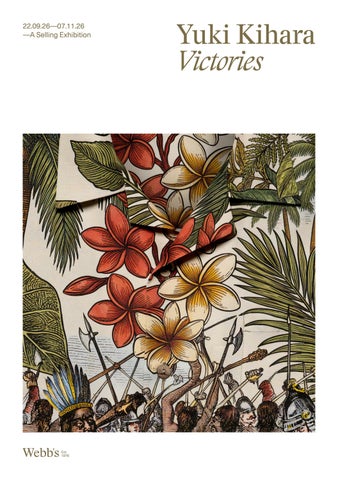
Yuki Kihara Victories Webb’s Gallery Wellington is honoured to present Victories, Yuki Kihara’s first Wellington solo exhibition of new work since representing Aotearoa New Zealand at the 59th Venice Biennale in 2022 with Paradise Camp. The Tiki shirt emerged from mid-20th century America as a romanticised portrayal of Pasifika cultures, reducing them to superficial motifs that catered to Western fantasies of tropical escapism. In Victories (2026), Yuki Kihara reimagines this commercialised garment as a medium for critical engagement with history. Across fifteen works, each shirt is adorned with early lithographs depicting native victories over colonial expeditions: explorers in their final moments, ships capsized, the hubris and failure of colonial ambition laid bare. Presented flat with custom-made hangers that hang against the wall, the shirts read as both art objects and historical artefacts (and not as a wearable souvenir), holding in tension their commercial origins and their critical recontextualisation. By setting the playful aesthetic of the Tiki shirt against these stark images, Kihara invites viewers to reconsider the narratives that have shaped perceptions of Pasifika cultures and the wider legacy of colonialism. Exclusive to Webb's we are excited to share this new series alongside a selection from Kihara’s stunning Aotea‘ula series , courtesy of Milford Galleries. Virginia Woods-Jack
left
‘Victories in Hawai’i and Aotearoa’- detail
above Yuki Kihara ‘Lifting the veil’ (2026).
Yuki Kihara Artist Statement
The mid-20th-century American rise of Moana Pacific-influenced fashion popularized a commodified, exoticized image of Moana Pacific cultures. Tiki shirts reduced rich traditions to superficial motifs that aligned with Western fantasies of tropical escapism, turning non-Western cultures into entertainment and aesthetic products. In the Victories (2026) series, I redirect this trend by reframing the Tiki shirt as a site of critical historical and contemporary engagement. Rather than perpetuating romanticized depictions, the series features images ranging from early lithographs and newspaper clippings to political campaigns and notable figures such as Paul Gauguin and Charles Darwin, presented in a subversive and anachronistic manner. By weaving together archival material with contemporary dialogue, the work foregrounds the contradictions of empire: how symbols can allure audiences while simultaneously indicting power structures, exploitation, and cultural erasure. The juxtaposition invites viewers to examine who gets to tell Moana-Pacific histories, who's voices are amplified or silenced, and how the colonial gaze shapes modern identity. Through careful layering of images and text, the Victories series encourages nuanced readings that resist simplistic tropes and instead illuminate complex histories of exchange, resistance, and adaptation. Thus, the Victories series is a clarion call for equitable, responsible representation that honors diverse Moana Pacific perspectives. Yuki Kihara 2026
1
Yuki Kihara ‘Natives of New Hebrides claim victory against French cutter Petrel' [formally ‘The French cutter Petrel attacked by natives of the New Hebrides’] 2026 digital print on dupion silk with coconut-shell buttons; constructed shirt; custom CNC-cut acrylic hanger. Edition 1/3 + 2AP 1200 x 1490 mm (approx.) price $11,000
also available in: 760 x 910 mm (approx.) price $7,000 980 x 1299 mm (approx.) price $9,000
2
Yuki Kihara ‘Reality check for Paul Gauguin’ 2026 digital print on dupion silk with coconut-shell buttons; constructed shirt; custom CNC-cut acrylic hanger. Edition 1/3 + 2AP 760 × 910 mm (approx.) price $7,000
also available in: 980 x 1299 mm (approx.) price $9,000 1200 x 1490 mm (approx.) price $11,000
3
Yuki Kihara ‘Good government is no substitute for self-government’ 2026 digital print on dupion silk with coconut-shell buttons; constructed shirt; custom CNC-cut acrylic hanger. Edition 1/3 + 2AP 1200 x 1490 mm (approx.) price $11,000
also available in: 760 x 910 mm (approx.) price $7,000 980 x 1299 mm (approx.) price $9,000
4
Yuki Kihara ‘Yuki Kihara as Charles Darwin’ 2026 digital print on dupion silk with coconut-shell buttons; constructed shirt; custom CNC-cut acrylic hanger. Edition 1/3 + 2AP 760 × 910 mm (approx.) price $7,000
also available in: 980 x 1299 mm (approx.) price $9,000 1200 x 1490 mm (approx.) price $11,000
5
Yuki Kihara ‘Victories in Hawai’i and Aotearoa’ 2026 digital print on dupion silk with coconut-shell buttons; constructed shirt; custom CNC-cut acrylic hanger. Edition 1/3 + 2AP 980 × 1299 mm (approx.) price $9,000
also available in: 760 x 910 mm (approx.) price $7,000 1200 x 1490 mm (approx.) price $11,000
also available in: Yuki Kihara ‘1975 New Zealand National Party 760 x 910 mm (approx.) Advertisement’ price $7,000 2026 digital print on dupion silk with coconut-shell 980 x 1299 mm (approx.) buttons; constructed shirt; custom CNC-cut price $9,000 acrylic hanger. Edition 1/3 + 2AP 1200 x 1490 mm (approx.) 760 × 910 mm (approx.) price $11,000 price $7,000 6
7
Yuki Kihara ‘Lifting the veil’ 2026 digital print on dupion silk with coconut-shell buttons; constructed shirt; custom CNC-cut acrylic hanger. Edition 1/3 + 2AP 760 × 910 mm (approx.) price $7,000
also available in: 980 x 1299 mm (approx.) price $9,000 1200 x 1490 mm (approx.) price $11,000
8
Yuki Kihara ‘Darwin Drag Shirt’ 2026 digital print on dupion silk with coconut-shell buttons; constructed shirt; custom CNC-cut acrylic hanger. Edition 1/3 + 2AP 760 × 910 mm (approx.) price $7,000
also available in: 980 x 1299 mm (approx.) price $9,000 1200 x 1490 mm (approx.) price $11,000
Casual Friday Fantasies Essay by Sophie Thorn
In the 1920s in Honolulu a Japanese shirtmaker, Musa-Shiya began selling shirts made from colourful kimono fabric. In 1937 Ellery Chun, the owner of King-Smith Clothiers in Waikiki, trademarked the term ‘Aloha Shirt’. From here the Hawaiian Shirt, and with it an idealised, mass produced ‘casual Friday’ version of the Pacific, spread across the world. In 1995 Yuki Kihara, a young artist of Japanese and Sāmoan descent, enrolled in a fashion degree at Wellington Polytechnic where she would study this history. Victories brings together fifteen new works by Kihara, alongside selected photographs from her series Aotea‘ula. Across both bodies of work, Kihara examines borders, geographic, cultural and historical, and the colonial systems that create and police them. Drawing on more than two decades of archival research, she transforms familiar Pacific forms into sites of historical reckoning: the Hawaiian shirt, or as Kihara more broadly frames it the Tiki Shirt, becomes a carrier of Indigenous resistance, while the ‘ula, a Sāmoan garland of welcome and friendship, assumes the sombre presence of a funerary wreath. Custom designed and printed on high end Dupion silk, Kihara’s shirts incorporate images of colonial expeditions overturned: explorers halted, ships wrecked and imperial ambition exposed in defeat. These historic images are juxtaposed with more recent events and examples of militourism within the Pacific. Kihara has also turned this lens on her own practice, using imagery of the artist dressed as artist Paul Gauguin and biologist Charles Darwin taken from her 2025 Darwin in Paradise Camp exhibition, which in turn built upon her 2022 Venice Biennale presentation Paradise Camp. In each instance Kihara reminds us that the colonial project is anything but historic.
Kihara’s Aotea‘ula photographs add further layers to this story. Depicting garlands made from Aotearoa’s native flora and fauna, these photographs are memorials. Their beauty is tempered by the story of twenty-seven unnamed men from the New Hebrides, now Vanuatu, who were taken to Aotearoa in 1870 and set to work in flax mills in Auckland. The ‘ula are here commemorate these men, reopening a shameful and neglected chapter of ‘blackbirding’ or indentured labour, a form of slavery, in Aotearoa’s colonial history. The complete series numbers twenty-seven works, one for each man. Titled sequentially in Bislama, from Wan to Twanteseven, the photographs acknowledge names that will inevitably remain unknown. Bislama is a creole language using Oceanic language patterns based off colonial vocabularies, used here as another act of reclamation. This attention to detail in the titling of these works is fundamental to Kihara’s practice. Across both series featured in this exhibition, Kihara asks us to rethink our preconceived notions and the inherited knowledge found in our archives. This is contested terrain. Retitled colonial images shift from accounts of catastrophe to declarations of Indigenous agency. Natural specimens recall how the botanical surveys of European voyages opened Pacific lands to extractive agriculture, combining both blackbirding and the displacement of native ecologies by ‘colonising’ plants, animals and people. By identifying and redefining the captions, classifications and silences found in our conventional histories, Kihara suggests we can reveal who created historical authority and who continues to benefit from it today. Presented here on Marion Street, which runs parallel to Wellington’s iconic Cuba Street and is dotted with vintage stores in which Hawaiian shirts circulate as desirable commodities, the exhibition addresses the contemporary presence of this colonial legacy. Neither simply clothing nor conventional pictures, Kihara’s silk shirts occupy a space between art object, artefact and souvenir; while her ‘ula, similarly, slip in meaning between welcome and mourning, beauty and loss. Victories suggests we might to look beneath seductive surfaces and recognise the power relations lurking below. And how, if we continue to question the human, cultural and ecological costs obscured by fantasies of the Pacific, pattern and adornment can be reconfigured to carry histories of resistance, remembrance and survival.
9
Yuki Kihara ‘Empire collapsing’ 2026 digital print on dupion silk with coconut-shell buttons; constructed shirt; custom CNC-cut acrylic hanger. Edition 1/3 + 2AP 760 × 910 mm (approx.) price $7,000
also available in: 980 x 1299 mm (approx.) price $9,000 1200 x 1490 mm (approx.) price $11,000
10
Yuki Kihara ‘Victory against the New Zealand rebels [formally ‘The last stand against the rebels at the battle of Vailele, Saturday, April 1’] 2026 digital print on dupion silk with coconut-shell buttons; constructed shirt; custom CNC-cut acrylic hanger. Edition 1/3 + 2AP 760 × 910 mm (approx.) price $7,000
also available in: 980 x 1299 mm (approx.) price $9,000 1200 x 1490 mm (approx.) price $11,000
11
Yuki Kihara ‘Untitled’
2026 digital print on dupion silk with coconut-shell buttons; constructed shirt; custom CNC-cut acrylic hanger. Edition 1/3 + 2AP 980 × 1299 mm (approx.) price $9,000
also available in: 760 x 910 mm (approx.) price $7,000 1200 x 1490 mm (approx.) price $11,000
12
Yuki Kihara ‘Victory against Laperouse at A'asu’
2026 digital print on dupion silk with coconut-shell buttons; constructed shirt; custom CNC-cut acrylic hanger. Edition 1/3 + 2AP 980 × 1299 mm (approx.) price $9,000
also available in: 760 x 910 mm (approx.) price $7,000 1200 x 1490 mm (approx.) price $11,000
13
Yuki Kihara ‘Failed shipwrecks’
2026 digital print on dupion silk with coconut-shell buttons; constructed shirt; custom CNC-cut acrylic hanger. Edition 1/3 + 2AP 1200 x 1490 mm (approx.) price $11,000
also available in: 760 x 910 mm (approx.) price $7,000 980 x 1299 mm (approx.) price $9,000
14
Yuki Kihara ‘Failed expeditions’ 2026 digital print on dupion silk with coconut-shell buttons; constructed shirt; custom CNC-cut acrylic hanger. Edition 1/3 + 2AP 1200 x 1490 mm (approx.) price $11,000
also available in: 760 x 910 mm (approx.) price $7,000 980 x 1299 mm (approx.) price $9,000
15
Yuki Kihara ‘Victory against Magellan’ [formally ‘Death of Magellan’] 2026 digital print on dupion silk with coconut-shell buttons; constructed shirt; custom CNC-cut acrylic hanger. Edition 1/3 + 2AP 980 × 1299 mm (approx.) price $9,000
also available in: 760 x 910 mm (approx.) price $7,000 1200 x 1490 mm (approx.) price $11,000
Yuki Kihara Aotea'ula
Aotea'ula continues Kihara’s reopening of longneglected episodes of colonial Pacific history. Completed over six years, the photographic series takes its name from Aotearoa, the Māori name for New Zealand, and 'ula, the Sāmoan word for garland. Across the Pacific, 'ula are symbols of welcome, friendship and connection, though in some contexts they have been reduced to tourist souvenirs. In Kihara’s images, forms made from native New Zealand flora, fungi, seaweed, butterflies and moths appear unexpectedly sombre, taking on the qualities of funerary wreaths. The series recalls the colonial histories set in motion by Captain Cook’s Pacific voyages, including the collection of botanical specimens by Joseph Banks and Daniel Solander, which contributed to the opening of the islands for agriculture. This expansion brought environmental destruction and the “blackbirding” trade, through which Pacific Islanders were taken to work in Australia and New Zealand. In 1870, 27 men from the New Hebrides, now Vanuatu, were indentured to work in Auckland flax mills. The full Aotea'ula series comprises 27 works: memorial wreaths that also welcome the spirits of these men home. Numbered in Bislama, their titles acknowledge names that may never be recovered.
Aotea'ula courtesy of Yuki Kihara and Milford Galleries
16
Yuki Kihara ‘Aotea'ula Eit (Psaromenia Berggrenii) 2023 pigment print on Hahnemühle fine art paper, edition 2/7 843 x 843 x 38 mm price $7,500
17
Yuki Kihara ‘Aotea'ula Leven (Crystophora Retroflexa) 2023 pigment print on Hahnemühle fine art paper, edition 1/7 843 x 843 x 38 mm price $7,500
18
Yuki Kihara Aotea'ula Eitin (Kahukōwhai / Vanessa Itea) 2025 pigment print on Hahnemühle fine art paper, edition 1/7 843 x 843 x 38 mm price $7,500
19
Yuki Kihara ‘Aotea'ula Twantetri (Tāwhiri Karo / Pittosporum Cornifolium) 2026 pigment print on Hahnemühle fine art paper, edition 1/7 843 x 843 x 38 mm price $7,500
20
Yuki Kihara Aotea'ula Twantefo (Puawhānanga / Clematis Paniculata) 2026 pigment print on Hahnemühle fine art paper, edition 1/7 843 x 843 x 38 mm price $7,500
23 Marion Street, Te Aro, Wellington 6013
webbs.co.nz