0734
Auction Catalogue November 2026 Contemporary, Modern and Historical Art
23.11.26 Works of Art
Art at Every Turn Abbott Residences | The Foundation
The vision for The Foundation was to create a world-class haven of refinement, sophistication and care for seniors, a place to feel energised, at home and rewarded in your later years. With the Abbott Residences now open, residents are enjoying the art throughout the building, in the lift lobbies, along the corridors and rising through the atrium. The new residences match the exceptional artistry seen across the village, including the recently restored residents’ club, the historic Pearson House. For interior designer Stewart Harris, the aim was for these spaces to offer “a sense of permanency, a sense of belonging and a sense of the individual.” He pictured moving through the building as an uplifting experience, punctuated by bursts of light and colour along the way, with a curated mix of wallcoverings, artworks, lighting and furniture, pairing the traditional with the contemporary. The de Gournay Collection At the heart of Harris’s vision is de Gournay, the renowned maker of handpainted wallpapers. Founded by Cecil Gurney in 1986, when he went looking for artists to recreate historical wallpapers for his own home, the company worked with artists in China to revive chinoiserie designs that rand interiors for centuries.
Harris, who spent 20 years working in Europe, had long admired the brand’s “spectacular colours and intricacy” whenever he came across it in historic houses. For The Foundation, he commissioned pieces through antiques importers Baran de Bordeaux, selecting works that tell stories of the Pacific, the Americas, Asia and Africa. In Abbott, de Gournay panels line the lift lobbies and corridor transition points, turning everyday routes into a journey from level to level. Each was hand-painted by skilled artists and sized specifically for its space, so the proportions stay true to the original drawings. Whispers in the Canopy One of the most talked-about features of Abbott Residences is the whimsical sculptural artwork in its atrium. Made up of two bespoke compositions, one spanning four levels and the other two, it has quickly become the building’s focal point. Conceived by Harris as a New Zealandinspired, three-dimensional take on de Gournay, the piece reinterprets native flora and fauna through the lens of chinoiserie. It echoes the wallpapers throughout the interiors and nods to the chinoiserie-style painted acoustic panels in Maddington Café at Pearson House. The installation brings together several artists and makers. Intricate copper branches by Whangārei sculptor Trish Clarke carry glass birds by internationally recognised glass artist Luke Jacomb. Ceramic kawakawa leaves and native clematis by Northland sculptor Claire Nicholls, and gilded ceramic moths by Monique Wheat and Andrea Ventling, complete the scene. Together, the de Gournay panels and the atrium installation give Abbott Residences a character of its own, rooted in centuries of decorative tradition yet unmistakably New Zealand.
For residents, it means art is part of every day, a quiet source of delight with something new to notice on each walk through the building. Generus Living, the group behind The Foundation, has been deliberate in crafting an environment where every detail counts. This attention to detail ensures the village isn’t just beautiful, but deeply liveable, too. Contact us today to book a private tour of the show apartment and experience The Foundation’s immense potential first-hand. Apartments priced from $1,825,000. 541 Parnell Road, Parnell, Auckland Tel: 09 869 3947 Web: thefoundationvillage.co.nz
2027 SEASON
Experience Aucklands Orchestra
MIS S IN G TRUE P R IVAT E LENDIN G ADV ISORY ?
We built our boutique practice on a simple foundation: real relationships over transactions. From our studio space to every stage of your mortgage journey, we offer award-winning, independent advisory designed around your family’s long-term goals. If you are missing that true private lending advisory, please reach out and experience lending the way it should be.
alexwang.co.nz | Boutique Broker | 021 903 421
SPRING ‘26
QUEENSTOWN LAKES
OLIVER ROAD PRESENTS
The Postcard 15 FOX’S RUSH
M I L L B R O O K R E S O R T,
|
ARROWTOWN
There’s a quiet corner of Millbrook Resort chosen by a small number of like-minded residents who value the location, low-maintenance lifestyle and sense of community within a community. It’s called Fox’s Rush: a quaint collection of freehold terraced homes built by Millbrook around a private lane in the early days of the resort. The weeping willow-adorned pond and practice fairway sit on one side, with a mature, blossoming, tree-lined bund on the other. Recently refurbished from top to bottom by an award-winning interior designer, number 15 is being sold fully furnished and is ready for your full-time or part-time enjoyment.
3
2.5
CAM WINTER
1
|
171 m2
021 800 889
174 m2
OMEA SWANSON
|
0 21 151 5412
|
MILLBROOK COLLECTION
OLIVERROAD.COM
OLIVER ROAD PRESENTS
Safe & Sound 2 9 S E T T L E R S WAY
M I L L B R O O K R E S O R T,
|
ARROWTOWN
There’s a particular calm to Settlers Way, one of Millbrook Resort’s most established lanes, where low stone walls and mature planting give the original village its settled character. Designed by Haden Emslie Architecture and built by Bamford McLeod for Millbrook itself, number 29 is a freehold home with three ensuite bedrooms. Quarry stone, concrete and timber bring warmth and texture, while generous living spaces gather around a sheltered, north-facing courtyard beneath an adjustable louvred roof. Completed in 2024, it combines year-round comfort with the ease of lock-and-leave living and all the pleasures of Millbrook close at hand.
3
3.5
1.5
O L I V E R R O A D E S TAT E A G E N T S |
281 m2
358 m2
LICENSED REAA 2008
RETIRE BETTER
the-point.co.nz 09 905 6488
www.thelindisgroup.com | reservations@thelindisgroup.com
Outstanding art and discerning interiors shot by Jane Ussher in homes throughout Aotearoa New Zealand Rooms Volume Two: More Portraits of Remarkable New Zealand Interiors is in all good bookstores from November 5
World-class recognition for a world-class experience.
The Residence @ The George
The George, Christchurch
A celebration of timeless elegance, impeccable hospitality and an uncompromising attention to detail. 50 Park Terrace, Christchurch info@thegeorge.com | thegeorge.com
AVAILABLE IN SELECTED STORES NATIONWIDE & ONLINE NOW Available in 300ml & 750ml bottles scan to shop online now
thelimery.co.nz | @thelimery_nz
BELGIAN-DESIGNED OUTDOOR FURNITURE EXCLUSIVE TO TRENZSEATER
AUCKLAND - 80 Parnell Rd, 09 303 4151 CHRISTCHURCH - 121 Blenheim Rd, 03 343 0876 QUEENSTOWN - 313 Hawthorne Dr, 03 441 2363 www.trenzseater.com
IS
THE
DEBUT
POETRY
AND
PHOTO-BOOK
BY
TĀMAKI
MAKAURAU-BASED
VISUAL ARTIST AND WRITER JO BRAGG (NGĀTI POROU), PUBLISHED BY ĀPORO PRESS. AVAILABLE NOW (RRP: $25) FROM LAMPLIGHT BOOKS, UNITY BOOKS, TIME OUT BOOKSTORE AND AURELIA BOOKS.
Colophon
Publishing Details printer Bluestar 114 Swanson Road Henderson Auckland 0610
Offset printed 170 pages 113gsm Matt Art 100gsm Laser Offset
Freely distributed to subscribers or available at select public art spaces and hospitality venues.
Publishing Contacts head office Paul Evans Managing Director paul@webbs.co.nz +64 21 866 000
Caolán McAleer Director of Marketing & Operations caolan@webbs.co.nz +64 27 929 5603
advertising
press
design
Angela Gracie Client & Partnerships Manager angela@webbs.co.nz +64 22 495 3943
Harper McLean Marketing Coordinator harper@webbs.co.nz +64 21 206 5730
Alessandra Banal Senior Designer design@webbs.co.nz +64 9 529 5609
Art Department auckland
wellington
christchurch Sean Duxfield Senior Specialist, Art sean@webbs.co.nz +64 21 053 6504
Emily Gardener Mat. Leave Director of Art emily@webbs.co.nz +64 22 595 5610
Kelly Carmichael Senior Specialist, Art kelly@webbs.co.nz +64 22 499 5619
Mia Foulds Pre-Sale Coordinator, Art mia@webbs.co.nz +64 9 529 5609
Mark Hutchins-Pond Senior Specialist, Art mark@webbs.co.nz +64 22 095 5610
Megan Shaw Manager, Art megan@webbs.co.nz +64 22 301 8259
Georgina Brett Specialist, Select georgina@webbs.co.nz +64 27 929 5609
Stephanie Arrowsmith Administrator, Art art@webbs.co.nz +64 9 529 5609
Sophie Thorn Specialist, Art sophie@webbs.co.nz +64 22 080 8405
Jo Bragg Logistics & Inventory Coordinator, Art jo@webbs.co.nz +64 21 113 5001
Lily McCowan Specialist, Art Online lily@webbs.co.nz +64 22 068 4932
Charles Tongue Valuations Specialist valuations@webbs.co.nz +64 22 406 5514
Virginia Woods-Jack Exhibitions Manager virginia@webbs.co.nz +64 22 679 8664
Webb's
2026
17
C OLO UR FORECAST
Dulux Silverstream
2027
Dulux Clutha
The colours shaping homes in 2027 Explore the latest trends in colour and interior design with the Dulux Colour Forecast 2027. This year, our three thoughtfully curated Dulux palettes - Sensory, Play (pictured) and Treasure reflect a shared desire for comfort, meaningful storytelling and finding joy in life’s unexpected moments. View the new palettes and order free A4 Colour Swatches at dulux.co.nz/colourforecast Image: Lisa Cohen. Styling: Bree Banfield. Artwork Credits: ‘A Day Full of Surprises 01’ by Margaret Delahunty Spencer. ‘Colour Crush Bondi Blue #004 by Elizabeth O’Connor. Colours shown are as close as possible to actual paint colours. Due to limitations of the printing process, photographic and printed images may not represent the true colour. Always confirm your colour choice with Dulux Sample Pots. Dulux. Worth doing worth Dulux and The Squares device are registered trade marks of DuluxGroup (Australia) Pty Ltd.
Contents
Journal 22 Programme 44 Foreword
46
Plates 49
Webb's
Terms & Conditions
163
Index of Artists
166
2026
19
HOLIDAY GESTURES 2026
Repeating forms and rich textures come together in a warm expression of Holiday, revealed through meaningful, familiar favourites. Available in store and online at ashleyandco.co Contact us to explore our Corporate Gifting services.
List of Essays
The Darcy Nicholas QSO Collection of Māori Ceramics “Mā te huruhuru ka rere te manu” – With feathers, the bird will fly. by Chantel Matthews Grahame Sydney A Quiet Intensity by Sophie Thorn
56
62
Fiona Pardington From the Dark, They Sing by Susannah Lyon-Whaley
70
Philip Clairmont Incommensurable: Window 1978 by Martin Edmond
76
Raymond McIntyre Who Is the Young Woman in Cloche Hat? by Kelly Carmichael 83 Don Binney Summer Bird by Gregory O’Brien
84
Bill Hammond In The Chapel by Sean Duxfield
98
Julian Dashper Golgotha? by Madeleine Harvey
Webb's
André Hemer New Representations by Victoria Munn
109
Francis Bacon Troppo vero (too real) by Victoria Munn
117
Pat Hanly Protective Helmet by Kelly Carmichael
118
Guy Ngan Art that Takes Part in Life by Sophie Thorn
123
Liz Maw Iconography of Revolution by Megan Shaw
124
Andy Warhol Sticky Fingers: Mick Jagger by Katie Ruscoe
127
Rita Angus A Rare Portrait by Megan Shaw
138
Elizabeth Thomson Forbidden Fruit by Mark Hutchins-Pond
145
106
2026
21
Live Auctions
2026 Winter Highlights
Andrew McLeod, Kōwhaiwhai Diptych [with figure], 2007, oil on canvas est $75,000—$100,000 Price Realised incl. BP: $83,650
John Drawbridge, Aurora, 1970, oil on canvas on board est $40,000—$55,000 Price Realised incl. BP: $60,945
Webb's
Philip Clairmont, Folding Chair, 1978, oil on jute on board est $170,000—$240,000 Price Realised incl. BP: $215,100
November
22
29.03.27 Works of Art entries close Tuesday 23 February nationwide tour 11—29 March
Webb's
Megan Shaw, PhD Manager, Art megan@webbs.co.nz +64 22 301 8259
2026
Live Auction —Entries Invited Paul Dibble, In a Lost Land, 2022, cast bronze, 24 carat gold gilding est $25,000—$30,000 Price Realised incl. BP: $23,900
Bill Hammond, Zoomorphic Lounge III, 1999, acrylic on hessian canvas est $1,400,000—$1,800,000 Price Realised incl. BP: $1,613,250
23
The Hot Hatch: From Everyday Car to Collectable A Peugeot 205 GTi, a Volkswagen Golf R32 and a Honda Civic Type R have each passed through Webb’s auction room this year. Their results say a good deal about who is buying collectors’ cars now, and what their likely future predilections might be.
below 2024 Honda Civic Type R
Before there was the hot hatch, there was the hatchback: a compact, front-wheel-drive family car with a rear door and folding load floor, a formula the Volkswagen Golf brought into focus in 1974. In 1976, a small group of Volkswagen engineers, working largely on their own initiative, gave the humble hatchback a fuel-injected engine, firmer suspension and a red stripe around the grille. Planned as a limited run, the Golf GTI instead defined a category; within a decade every major European maker had an answer to the 'hot hatch'. The premise was simple: an ordinary small car, made quicker and priced within reach of those most likely to enjoy it. Few categories have produced so many cars remembered with such affection, and that affection has turned to nostalgia. Collectors tend to pursue the cars that mattered to them when young, and the generation raised with hatchbacks in the family garage can now purchase based on those memories. Cars from the 1980s, 1990s and 2000s once regarded as ‘used cars’ are now catalogued and bid on as collectables. Read in sequence, the three cars here trace the hot hatch’s evolution, from lightness and agility to today’s highly developed front-wheel-drive performance car. Webb’s Collectors’ Cars department welcomes consignments year-round. To discuss a vehicle, contact Chris Wiseman, Head of Collectors’ Cars, Motorcycles and Automobilia.
1986 Peugeot 205 GTi 1.9
2024 Honda Civic Type R
The Peugeot 205 GTi represents the hot hatch at its most elemental: light, responsive and celebrated for its handling. The 1.9-litre example sold at Webb’s in September had the provenance collectors prize. Purchased new from Earls Court Motors in London, it arrived in Auckland shortly before Christmas 1986 with 250 miles on the clock, then remained with one owner and sole driver for nearly four decades. Its logbook recorded use into 2023.
The 2024 Honda Civic Type R, finished in Championship White, had covered just 4,000km and reportedly retained its factory warranty until February 2029. It realised $62,100, the highest price of the three. Its FL5 generation pairs a turbocharged 2.0-litre engine with front-wheel drive and a six-speed manual gearbox. In 2023, Honda announced that it had set a front-wheel-drive car lap record at the Nürburgring. The Type R is a thoroughly modern car built around familiar principles: driver involvement, three pedals and an internalcombustion engine. Its near-new condition and the price it achieved suggest that some buyers are already treating contemporary performance cars as future collectables, rather than waiting for nostalgia to take hold.
Price Realised incl. BP: $39,100
2004 Volkswagen Golf R32 Mk4 The Golf R32 marks a different approach. Where the 205 relied on lightness and agility, the R32 combined a 3.2-litre VR6 engine with a six-speed manual gearbox and 4MOTION all-wheel drive. The Mk4 was the first model in Volkswagen’s R performance line, and reportedly just 32 were officially imported new into New Zealand. The example sold in June was NZ-new, had one owner from new and had been serviced by Giltrap, with 81,000km recorded. Its history, once incidental to an everyday car, is now part of its appeal to collectors. Price Realised incl. BP: $39,100
Webb's
2026
Price Realised incl. BP: $62,100
Chris Wiseman Head of Collectors’ Cars, Motorcycles & Automobilia chris@webbs.co.nz +64 22 187 7693
above 2004 Volkswagen Golf R32 Mk4
25
Webb’s Celebrates 50 Years 1976–2026
Caolán McAleer Director of Marketing & Operations caolan@webbs.co.nz +64 27 929 5603
Since its founding in 1976, Webb’s has stood as a meeting place between culture and commerce, connecting collectors with objects that define their era. As Webb’s celebrates its 50th anniversary this year, this landmark moment invites reflection on the artworks, objects, and stories that have shaped its legacy, and on the wider role our auctions play in recording the cultural history of a nation. exhibition launch event Tuesday 8 December, 6pm
exhibition on view 8—13 December
Works from the Kim Wright Collection, 1979
Collection of Kobi & Patricia Bosshard, 1986
The Family Collection of the Late Colin McCahon, 1990
The New Zealand Collections of Doctor Neville Hogg, 1993
The Goodman Fielder Estate, 1995
The Partington Collection of Photography, 2001
The Dr Hans and Andrea Haumer Collection, 2004
Works from the Collection of Jonathan Rose, 2006
Webb's
November
26
The Richard & Rhoda Potton Collection, 2008
The Neil & Jean Smith Collection, 2006
The Estate of Giovanni Intra, 2008
The Helene Quilter Collection, 2014
The Collection of Nadene Milne, 2016
The Warwick & Kitty Brown Collection, 2017
The Estate of Miss Crabb, 2019
The Collection of Una Platts, 2019
Melting Moments, 2021
Bank of New Zealand Art Collection, 2022
The Becroft Collection, 2024
Zoomorphic Lounge, 2026
Webb's
2026
27
Formed in Deep Time: Natural Diamonds at Webb's
Natural and lab-grown diamonds share a chemistry but not a depth of history and an established secondary market. We explore the processes and context and why Webb's Fine Jewels, Watches & Luxury Accessories department only deals in diamonds the earth has made.
“Webb's does not deal in labgrown diamonds, because history and uniqueness cannot be manufactured, and those are enduring qualities and matchless beauty that only a natural diamond holds.” —Christine Power
Webb's
November
28
Most natural gem diamonds begin 150 to 200 kilometres beneath the surface, in the earth's upper mantle, where intense heat and pressure lock carbon atoms into a tight crystal lattice. Most gem diamonds are between one and three and a half billion years old, older than complex life on earth. Formation, however, is only half the story. A diamond reaches the surface only if a rare, deep-sourced volcanic eruption carries it upward quickly enough to survive the journey. Those that do, hold a record of their history in microscopic inclusions and growth zones, which gemmologists read somewhat as a forester would read the rings of a tree. No two natural diamonds are alike, because no two have taken the same route from that depth of history and geology and onto a human hand. Lab-grown diamonds, also known as manmade, are chemically and optically the same as natural. Synthetic diamonds were first produced in the 1950s, initially for industrial applications. Advances in technology later made gem-quality laboratory-grown diamonds commercially viable, with the market expanding significantly in the 2000s and beyond. These lab-grown diamonds are made either by recreating mantle heat and pressure inside a press, or by building a crystal layer by layer from a carbon-rich gas, somewhat similarly to how a 3D printer constructs an object. Either method can produce a stone ready for cutting within weeks. Natural and laboratory-grown diamonds share the same fundamental hardness and optical properties; a well-cut stone of either origin can display exceptional brilliance. However, that’s where the similarities stop. “Webb's does not deal in lab-grown diamonds, because history and uniqueness cannot be manufactured, and those are enduring qualities and matchless beauty that only a natural diamond holds,” says Head of Fine Jewels, Watches & Luxury Accessories, Christine Power Part of the reasoning concerns meaning. A diamond is rarely an incidental purchase. It tends to mark an engagement, an anniversary or a birth, and it is chosen to say something special about the relationships it commemorates. “A lab-grown stone can carry a message of economy and convenience rather than one of history, legacy and rarity,” says Christine. A natural diamond was shaped by the earth over an almost unimaginable span of time, finished by skilled hands, and features geological uniqueness that cannot be repeated. A one-of-a-kind stone for a one-of-a-kind individual is, in this case, simply a geological fact. Webb's
2026
There is also the question of value. Natural diamonds are finite, and that scarcity supports a secondary market that has operated for generations. Lab-grown production can be scaled at will, and wholesale prices for lab-grown stones have fallen steeply over the past decade as capacity has grown. A stone that can be produced at increasing scale has little reason to hold its value, and there is not yet a meaningful resale market, meaning future resale values are uncertain. Fine jewellery routinely outlives its first owner. Natural diamonds benefit from a long-established framework of grading, trading and valuation, giving buyers and those who inherit from them a recognised foundation on which to assess a stone. Ultimately, a diamond's value depends on its individual characteristics and the market in which it is sold, but its geological history and place within an established tradition of collecting remain part of its appeal. Webb's regularly brings significant natural diamonds to market, and recent Important Jewels, Watches & Luxury Accessories Online Auctions included two of note. A 3.06ct round brilliant diamond, graded F colour and VS2 clarity with an HRD certificate, sits in a substantial platinum collet on a high-shouldered 18ct yellow gold band. An F grading places it within the colourless range, while VS2 denotes minor inclusions typically seen only under magnification. An oval brilliant-cut diamond of known weight 4.28ct, E colour, VS2 clarity and excellent cut, GIA certified, with no fluorescence, and 23 round brilliantcut diamonds of estimated total weight 0.72ct, G colour and VS2–SI1 clarity, set in a platinum bespoke solitaire-style ring. Webb’s is recognised for selling important diamonds and is a leader in the secondary market. If you are considering bringing a piece to market, we encourage you to seek an appraisal; we can also assist if you are looking for a particular diamond.
Christine Power AJP (GIA) Head of Fine Jewels, Watches & Luxury Accessories christinep@webbs.co.nz +64 27 929 5607
29
The Summer & Festive Pour champagne online auction 4—9 December — Entries Invited
Timed for the festive season: From Krug and Salon to Dom Pérignon’s late-release Plénitude editions, some of Champagne’s most sought-after names come to auction this December.
bidding closes Wednesday 9 December, from 8pm
Marcus Atkinson Head of Fine Wines & Whiskies marcus@webbs.co.nz +64 27 929 5601
Finn McCabe Specialist, Fine Wines & Whiskies finn@webbs.co.nz +64 22 476 2675
Webb's
November
This December, Webb’s Fine Wines & Whiskies department will hold an online auction devoted entirely to France’s most celebrated and celebratory drink: Champagne. Timed for the season when collectors and revellers are paying closest attention, and when many bidders are buying to drink rather than to cellar, the auction is now inviting consignments. The great houses have long been a fixture of our Fine Wines & Whiskies auctions. The names most sought by our bidders have included: •K rug, including Clos du Mesnil and Krug Collection •D om Pérignon, including Rosé and the late-release Plénitude editions •L ouis Roederer Cristal • Salon •B ollinger La Grande Année •T aittinger Comtes de Champagne • J acques Selosse •C édric Bouchard Recent results show the depth of the local market: a 1996 Louis Roederer Cristal Brut Rose Millesime, Champagne which achieved $1,673, and a single bottle of 1985 Dom Pérignon P3 Plénitude that sold for $6,573. Both results reflect an audience that understands vintage, provenance and condition, and is prepared to invest in all three. Unlike most fine wines, Champagne is often a collectable object in its own right. Bidders pay attention to original wooden cases, coffrets and presentation boxes, numbered and limited releases, artist collaborations, and large formats from magnum to jeroboam and beyond. Complete, well-kept packaging can add materially to a result, and we welcome boxed and large-format bottles alongside single bottles of top cuvées, mature vintages and whole cellars, including estates and single-owner collections. Our specialists offer confidential, obligationfree appraisals, in person or from photographs. (all prices include Buyers’ Premium)
30
Fine Wines & Whiskies: A Calendar of Great Taste
Monthly Online Auctions Our monthly online auctions are thoughtfully curated to balance quality, accessibility and confidence. Each sale features a broad mix of wines and spirits selected for both immediate enjoyment and future cellaring. Many lots have been carefully cellared and are ready to open, removing guesswork and rewarding considered buying. Designed for everyone from first-time bidders to established collectors, these auctions offer the pleasure of discovery, trusted provenance and the freedom to take part from anywhere. Consignments come from cellars across New Zealand, and bidders join from here and overseas. Online Auction | 4–9 December Online Auction | 22–27 January —Entries Invited
Premium Auctions Held once a quarter, our premium auctions present the finest wines and spirits we offer: blue-chip producers, rare vintages, and collectable, highly sought-after bottles. Demand at this level reaches well beyond New Zealand. Webb’s has recently completed significant sales to buyers in Sydney and Hong Kong, and we manage the entire process for international bidders, including shipping and logistics. For New Zealand consignors, this opens a wider market for the most important bottles in a cellar. Premium Auction | 20–25 November Premium Auction | 26 February–3 March —Entries Invited
Webb’s Fine Wines & Whiskies department runs a year-round programme of auctions: a sale every month, a premium auction each quarter, and occasional auctions devoted to a single category or a cellar. Each has its own character, and together they offer a place for almost any bottle or cellar, whether you are buying or consigning. Webb's
2026
Consigning Our specialists offer confidential, obligationfree appraisals, in person or from photographs, and can advise which auction best suits a single bottle, a case or a whole cellar.
31
The Italian Hand Webb's
Webb’s The Estate regularly receives consignments of exceptional design, from mid-century furniture and lighting to modernist objects and pieces by recognised local and international designers. Each quarter, the strongest of these come together in Design Edit, a curated online auction and in-person exhibition. In the latest edition, among Swiss modular steel, Dutch daybeds and work by leading New Zealand designers, one undercurrent kept surfacing: Italian design. Few places have produced design so prolifically, or with such consistent flair. Much of the credit belongs to tradition and partnership. On one side are architects and designers with ideas; on the other, family manufacturers (often a short drive from Milan or Venice) with the skill and history to build them. Add government and industry working
November
together to promote design through respected fairs and biennales, and you have a perfect storm. The result is furniture and lighting with a confidence you can spot across any room, and a collector appeal that tends to outlast trends. Here, we follow one Italian piece, from our latest Design Edit catalogue, from each decade since the 1960s.
1960s: Roberto Pamio, Gill Lamp for Leucos (1962) Some companies spend years searching for a signature product; Leucos started with one. Designed by architect Roberto Pamio in 1962, the Gill was the first lamp the company launched. Leucos was founded the same year on the outskirts of Venice with a simple premise: take the centuries-old skills of Murano’s glassblowers and apply them to modern lighting. The Gill’s mouth-blown shade carries a soft white top that diffuses the light rather than directing it to your eyes, producing a warm, flattering glow. Pamio went on to design for Artemide and iGuzzini, but the Gill remains his calling card.
32
1970s: Mario Marenco, Marenco Sofa for Arflex (1970)
2000s: Antonio Citterio, Fly Table for Flexform (2009)
Comedy and architecture are unlikely bedfellows. Trained as an architect in Naples, Mario Marenco co-created the anarchic radio show Alto Gradimento and later became a television favourite as Riccardino, an overgrown schoolboy in a checked smock. Alongside his comedy career, he designed furniture, lighting and architecture across Italy. Think Monty Python meets forwardthinking design. His sofa for Arflex, however, is no joke. Generous cushions sit within a concealed tubular steel frame, giving it the appearance of a casual pile of cushions while remaining expertly engineered. Arflex still makes it today.
If Italian design has a quiet heavyweight, it’s Antonio Citterio. He has shaped Flexform’s collection for more than 40 years, and with his partner Patricia Viel designed the Bulgari hotels. Flexform began as a family upholstery workshop in Meda, in the Brianza furniture district north of Milan, and still makes everything in Italy. Fly is Citterio at his most disciplined: a family of tables and cabinets with a slim metal structure and tops in wood or marble. It’s an exercise in proportion, versatile enough to sit happily beside almost anything, which is precisely the point.
1980s: Gerrit Rietveld, Utrecht Armchair for Cassina (designed 1935, produced from 1988)
2010s: David Lopez Quincoces, Brasilia Dining Table for Living Divani (2015)
Yes, a Dutch designer heads the Italian list, and for good reason. Gerrit Rietveld designed the Utrecht in 1935 for Metz & Co, the Amsterdam department store, naming it after his hometown. It was one of the few upholstered chairs he saw into production, built from four puzzle-like parts that could be assembled on site. In 1988, a century after Rietveld’s birth, Cassina brought the Utrecht back into production. This is the Italian hand at work in another way: taking a modernist classic, rebuilding it with the skill of its own craftspeople, and keeping it alive for new generations. Look for the visible stitching along the edges, a detail that makes a 1930s design look surprisingly current.
Webb's
2026
Oscar Niemeyer had no time for right angles. The Brazilian architect behind the key buildings of Brasília preferred what he called “freeflowing, sensual curves”, and his work is the inspiration for this table. Designed by Madridborn, Milan-based David Lopez Quincoces and presented at the Salone del Mobile in 2015, Brasilia folds its metal like a thin sheet of paper, giving a dining table the presence of a small piece of architecture.
The Estate is currently inviting consignments for its next regular auctions and its more curated Design Edit catalogues. If you have furniture, lighting or objects by recognised designers, from mid-century classics to contemporary pieces, our specialists would be glad to discuss them with you.
Leah Morris Head of Decorative Arts leah@webbs.co.nz +64 22 574 5699
33
Objects of Global Resonance
Leah Morris Head of Decorative Arts leah@webbs.co.nz +64 22 574 5699
Tom Pan Head of Asian Art asianart@webbs.co.nz +64 21 045 0118
Webb's
November
Material Culture & Asian Art — Entries Invited
34
Webb’s Material Culture and Asian Art departments have combined their strengths for a single live auction, and we are now inviting consignments.
Webb's
2026
Bringing Webb’s Asian Art and Material Culture disciplines together for a combined live auction recognises the connections between them: histories of making, exchange and meaning that cross regions and centuries. The sale will present New Zealand’s taonga alongside Asian ceramics, jade, bronzes, carvings, textiles, scrolls, lacquerware, furniture and fine works of art: objects whose value lies as much in their history as in their form. Taonga tūturu are among the most significant objects Webb’s Material Culture Department has the privilege of handling. They are living records of whakapapa, carrying the knowledge and presence of generations. Our team works closely with iwi, museums and the Ministry for Culture and Heritage to ensure every piece is registered and documented accurately, treated with respect, and passed to its next guardian with the care it deserves. Asian art holds a similarly layered place in collections across Aotearoa. Many works have come here through trade, travel and family connection, and they continue to attract considerable interest from collectors in New Zealand and internationally. Our specialists bring close knowledge of period, material and provenance, and present each work so that its quality and context are clearly understood. Whether you are considering the sale of a single important object or an entire collection, we offer confidential advice and complimentary appraisals. We are glad to discuss provenance, condition and the documentation required for taonga tūturu, and to guide you through the consignment process from the first conversation to the sale, with the same care extended to every object. Entries close 16 December. To arrange an appraisal, or to read more about the registration process and standards of care we follow for taonga tūturu, contact our Material Culture and Asian Art specialists.
35
Introducing: Sophie Thorn
Art Specialist, Wellington
We speak to Webb’s new Art Specialist in Wellington about collections, curating and life on the other side of the gallery wall.
university. I went back to study Heritage Materials Science and ended up doing metallurgy at the Chemical Institute of Technology while studying art conservation after working as an art gallery registrar. Though I wouldn’t describe myself as a scientist, I do think a bit of scientific grounding adds another set of questions: what is this made of, how was it put together, and how has it changed over time? A surface, a support or an old repair can tell you something that isn’t immediately apparent from the image alone. I like bringing those observations into conversation with art history. Understanding how something was made doesn’t diminish its mystery; it often makes it more interesting. FM: Your projects have ranged from Colin Sophie Thorn Specialist, Art sophie@webbs.co.nz +64 22 080 8405
Sophie Thorn joins Webb’s Wellington after more than a decade at Te Pātaka Toi Adam Art Gallery, where she cared for Ngā Puhipuhi o Te Herenga Waka—Victoria University of Wellington Art Collection, and spent 16 months as Acting Director. Her career began as a collection technician at Canterbury Museum and later took in heritage materials science. She sat down with writer Federico Monsalve so we could get to know her better. Federico Monsalve (FM): Welcome to Webb’s,
Sophie, and congratulations! What drew you from the public gallery to the auction house, and what excites you about the role? Sophie Thorn (ST): Thank you! What appealed
to me was the opportunity to approach art from a different perspective. In a public gallery, particularly one like the Adam, you’re thinking about how works might be understood and shared through exhibitions, research and the collection. At an auction house, you encounter another part of their lives: the people who have lived with them, the stories they’ve accumulated, and where they might go next. I’m excited by that combination of close looking, research and conversation. There’s the pleasure of discovering something unexpected, but also of helping someone find a work they really connect with. FM: Your path into the art world has been unusual:
opposite page Sophie Thorn at Webb’s Wellington. Photo by Adrian Vercoe. above Senior Specialist, Art Mark Hutchins Pond with Sophie Thorn at Webb's Wellington. Photo by Adrian Vercoe.
Webb's
from making dust covers for blue whale vertebrae at Canterbury Museum to studying metallurgy in Prague. How has that hands-on, scientific grounding shaped the way you look at and assess works of art? ST: Making dust covers for whale vertebrae might
seem a long way from looking at a painting, but both start with paying attention to the object in front of you! That practical experience encourages you to look carefully before making assumptions. Art History was my first love and what I studied at
2026
McCahon’s Gate III to a Charles Spencer cyanotype. Which New Zealand artists, works or periods do you keep returning to, and why? ST: I’m drawn to works that reward returning
to them—where spending more time looking changes what you notice. Gate III offers that on an extraordinary scale, while a cyanotype captures a moment in time and can draw you into something much smaller and more intimate. Both are thrilling in their own way. I wouldn’t necessarily confine my interest to one period or medium. Sometimes it’s the ambitious, familiar work that holds your attention; sometimes it’s a quieter object that opens up an unexpected line of enquiry. FM: Do you collect art yourself, and what advice
would you give someone making their first purchase at auction? ST: I have a little collection forming. My husband
and I like to purchase a piece each year for our wedding anniversary. He has similar tastes to me, luckily! We have a bit of an eclectic mix, our first piece was a photograph by Ngahuia Harrison and our most recent purchase is a painting by Layla Rudneva-MacKay. We also have pieces by Erica van Zon, Sorawit Songsataya and Jamie Jenkins. For a first purchase, I’d encourage people to spend time looking and asking questions. If you can, see the work in person: scale, surface and colour can feel quite different from an image online. Ask about its condition and history, make sure you understand the auction terms and the full cost, and decide on a comfortable limit beforehand. Above all, give yourself time to work out what interests you. You don’t need to have a fully formed collection, or know everything, before you begin. Buy what you like but buy the best version you can afford.
37
Into Summer: Selling Exhibition
Small in scale. Lasting in presence.
Webb’s Wellington closes its 2026 programme with Into Summer, a selling exhibition of small-scale works (perfect for the season of gifting) by established and emerging artists from across Aotearoa New Zealand. Featuring pieces by over twenty-six invited artists as well as favourites from selling exhibitions across the year, highlights include: Connah Podmore, Yae Takahashi, Maija Stephens, Briana Jamieson, Levi Hawken, Billie Culy, Gina Kiel, Trantham Gordon, Christine Massey, Ben Della Barca, and many more. Into Summer, curated with an emphasis on quality and individuality, connects a breadth of practices, each approached on an intimate scale. Bringing together sculpture, painting, prints and photography, the selection includes works created especially for the exhibition. All artworks are modestly priced, with most priced at $2,500 or under, inviting both considered additions to an existing collection and the pleasure of a first acquisition. An artwork given as a gift reflects a personal choice. A sculpture, painting or original print can mark an occasion, begin a collection or offer a new way of seeing, and it remains part of daily life long after the season. Each purchase also directly supports the artist’s practice. Into Summer offers established collectors a closer look at a familiar practice or a first work by an artist new to their collection. For those starting out, its range of media and accessible prices make an easy entry point. These are works to live with, where a detail noticed in passing or a familiar form seen afresh rewards the choice, whether made as a gift or for yourself.
Billie Culy, Peach By The Sea, 2025, photographic print on Giclee fine art cotton paper, edition 4/10, 401 × 379 × 25mm. price: $1,900
Webb's
November
Virginia Woods-Jack Exhibitions Manager virginia@webbs.co.nz +64 22 679 8664
38
Webb’s Celebrates the 2026 Arts Laureates Since 2000 the Arts Foundation Te Tumu Toi has recognised New Zealand’s most accomplished practising artists through its Laureate Awards. As a supporter of the programme, Webb’s congratulates this year’s eight recipients, whose work spans painting, installation, literature, music, theatre, screen and design, and acknowledges the depth of practice that has brought each of them here. On Friday 16 October, some 800 guests, including Webb’s Art Department, gathered at the Kiri Te Kanawa Theatre in Tāmaki Makaurau for the announcement of the 2026 Arts Foundation Te Tumu Toi Laureates. Each recipient receives a $50,000 gift with no conditions attached, a total of $400,000 funded entirely by arts supporters around the country. The Laureates were chosen by an independent panel of
Webb's
2026
above The Webb's Team: Charles Tongue, Caolán McAleer, Megan Shaw, Emily Gardener, Mia Foulds and Lily McCowan
experts in August, and join the 145 artists recognised since the awards began. Visual arts alumni include Michael Parekōwhai, Neil Dawson, Shane Cotton, Peter Robinson, Mata Aho Collective, Saskia Leek, Séraphine Pick, Reuben Paterson and Kate Newby. As a member of the Arts Business Club, a group of New Zealand businesses that back the Foundation’s exemplary work, Webb’s is proud to support an organisation funded wholly by private giving. The Club sits alongside the Foundation’s individual donors and partners in making awards such as these possible. The Webb’s team was delighted to join the evening and congratulate Catherine Chidgey, et al., Emily Karaka, Victoria Kelly, Tyrone Ohia, Anapela Polata’ivao, Madeleine Sami and Sriwhana Spong on this honour.
39
Webb's
November
40
Vale Paul Hartigan (1953—2026)
It is with deep sadness that we acknowledge the passing of New Zealand artist Paul Hartigan (b. 1953, New Plymouth). Hartigan was one of New Zealand’s foremost contemporary artists in a variety of media and became well known for his innovative use of neon and his fusion of pop, abstraction, and light-based media. A graduate of the Elam School of Fine Arts (1973), he emerged in the 1970s as part of the generation bridging experimental photography, printmaking, and conceptual practice. By the 1980s, he had become a pioneer of neon art in Aotearoa, pushing the medium beyond the purely functional into sculptural forms that drew inspiration from calligraphy, surrealism, automatic writing, and more. His Colony (2004), a sprawling 5 × 10 metre orange-red neon installation embedded across the curved, concrete façade of the University of Auckland’s Engineering Building, epitomises his command of scale and rhythm. The work’s squigglelike, pulsating forms echo organic, liquid ripples, in electric hues—an apt, architectural modification that hints at usages and academic subjects that take place within. Equally playful and vibrant installations—such as Nebula Orion (2001, Christchurch) and Whipping the Wind (1988, Wellington)—continue to bring colour and joy to public spaces all across Aotearoa. Hartigan’s early fascination with pop culture and its inroads into Pop Art led him to paint and silkscreen icons from Americana, including his now renowned, drippy painting of the Phantom (1973), a head-and-shoulders portrait of the 1930s comic strip character of the same name by Lee Falk. Hartigan's 70s and 80s adoption of popular themes (advertising, tattooing, Americana) anticipated later developments in New Zealand pop and postmodern art with an uncanny precision and an early knack for navigating its commercial and artistic possibilities. Hartigan once remarked in an interview, “Light and illumination are key elements in all that I do – light is my artistic manifesto, my raison d’être.” (Scoop, 2013). Through this unwavering dedication, he has, in the words of one critic, “elevated neon to its rightful status as art” in New Zealand’s visual culture. Hartigan was a tireless supporter of Webb's—his passing coincides with The Metaphors, an exhibition of his chalice-like sculptures at our Wellington Gallery—and the wider industry. He was a regular at cultural events, and always happy to share advice and conversation with those fortunate enough to be around him. Our condolences go to his family, friends and those whose lives continue to be brightened by his inimitable oeuvre.
opposite page Paul Hartigan, The Phantom
Webb's
2026
41
Select 1—15 February Webb's
Online Art Auction —Entries Invited Georgina Brett Specialist, Select georgina@webbs.co.nz +64 27 929 5609
November
Fiona Pardington, Unicorn Lovers, 2016, inkjet print on Hahnemühle paper, edition of 10 Price Realised incl. BP: $7,170
42
Christchurch Programme
Launch Event
249 Moorhouse Avenue, Sydenham, Christchurch 8011
Thursday 5 November
Our Senior Specialist Sean Duxfield is delighted to invite guests for a special preview of highlights from our November Works of Art catalogue. Including works by Rita Angus, Don Binney, Bill Hammond, Guy Ngan, Fiona Pardington, John Pule, Grahame Sydney; St. Ives artists including Barbara Hepworth, Ben Nicholson and Henry Moore; and major Māori ceramics from the Ngā Kaihanga Uku collective by Baye Riddell and Fred Graham.
Viewing Thursday 5 — Friday 6 November
10am — 6pm
Saturday 7 November
10am — 4pm
Wellington Programme
Launch Event
23 Marion Street, Te Aro, Wellington 6011
Wednesday 11 November
Join specialists Mark Hutchins-Pond and Sophie Thorn for an evening launch exploring highlights from the catalogue including major works from The Darcy Nicholas QSO Collection of Māori Ceramics; works by Roy Cowan, Don Driver, Guy Ngan, Darryn George, Pat Hanly, and international highlights by British and Irish modernists including Barbara Hepworth, Ben Nicholson and Henry Moore.
Webb's
November
5.30pm — 7.30pm
5.30pm — 7.30pm
Viewing Wednesday 11 — Friday 13 November Saturday 14 November
9am — 5.30pm 10am — 4pm 44
Auckland Programme
Launch Event
33a Normanby Road, Mount Eden, Auckland 1024
Tuesday 17 November
6pm — 8pm
Viewing Wednesday 18 — Friday 20 November
9am — 5pm
Saturday 21 — Sunday 22 November
10am — 4pm
Monday 23 November (by request)
9am — 5pm
Live Auction We look forward to welcoming you to our Auckland gallery for the launch of Works of Art, where we will be joined by Sir Grahame Sydney. He will speak about the remarkable collection of early works in this catalogue and his relationship with Peter Webb in the 1970s. Our Manager, Art Megan Shaw will reflect on further highlights from the sale. Featured works include Rita Angus, Paul Dibble, Bill Hammond, Liz Maw, Grahame Sydney, Fiona Pardington, The Darcy Nicholas QSO Collection of Māori ceramics; the St. Ives Collection; works from the SkyCity Collection, and works by Don Binney, Philip Clairmont, Raymond McIntyre and Milan Mrkusich from a Private Wellington Collection. The entire catalogue will be on display ahead of the live auction.
Webb's
2026
Monday 23 November
6.30pm
45
Foreword
Works of Art
Megan Shaw, PhD Manager, Art megan@webbs.co.nz +64 22 301 8259
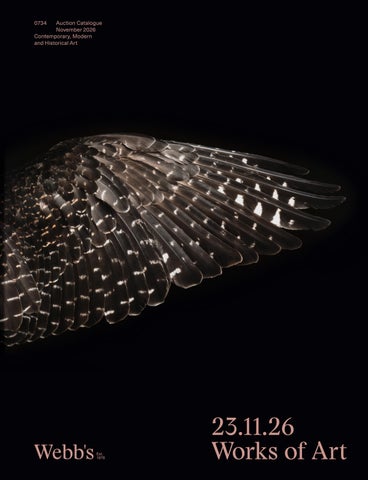
The wings of the Kārearea, Aotearoa New Zealand’s only falcon, envelop this catalogue. Photographed by Fiona Pardington, these are strong feathers “with a beautiful and delicate durability,” evoking the powerful, gliding flight path of a hunter from above. The first essay in this catalogue, by Chantel Matthews, takes its title from the Māori whakataukī (proverb) Mā te huruhuru ka rere te manu – with feathers, the bird will fly. It is a fitting introduction to The Darcy Nicholas QSO Collection of Māori Ceramics, one of four significant collections represented in this sale. The proverb speaks to the transmission of knowledge, support and collective endeavour, qualities embodied by Ngā Kaihanga Uku, the Māori clay-workers collective championed by Darcy Nicholas. The collection brings together works by Baye Riddell ONZM, Manos Nathan and Wi Taepa ONZM, and Fred Graham CNZM, artists whose contributions helped establish powerful contemporary expression of Māori identity and creativity. Collections such as these remind us that great works of art rarely exist in isolation. They are cared for, lived with, shared and exhibited in new ways, and passed between custodians. Great collections, too, are rarely assembled all at once. They are formed over decades through curiosity, friendship, scholarship, and a sustained engagement with artists and their ideas.
Webb's
November
This story is particularly evident in the St. Ives Collection. Formed by a young New Zealander whose time in Cornwall in the 1960s led to a lasting friendship with Dame Barbara Hepworth, the collection offers a rare window into one of the most significant artistic communities of the 20th century. It also reflects a lifelong engagement with British and Irish modernism, preserving the experience of a collector who found himself at the centre of a major cultural and art historical movement and carried that experience home. Our November catalogue also brings together works from a significant private collection in Wellington, assembled with a discerning eye. Works by Milan Mrkusich, Raymond McIntyre and Don Binney sit alongside Philip Clairmont’s Window (1978), first exhibited by Peter Webb Galleries that year. Finally, the SkyCity Collection offers another chapter in New Zealand collecting history, centred on contemporary practice in Auckland including much-loved works by Jenny Dolezel and Dick Frizzell. Throughout the catalogue, individual works are given further depth through the essays and scholarship that accompany them. We revisit Rita Angus through her rare portrait of Hugh Spencer, consider Guy Ngan's enduring exploration of colour and form, and reflect on the landscapes of Sir Grahame Sydney, whose
46
above Sir Grahame Sydney KNZM near his Otago home, 2021. left Lot 23. Fiona Pardington, Hinekōheuheu, Auckland War Memorial Museum
early paintings like Harbour Line (1976) were exhibited by Peter Webb Galleries fifty years ago. We are honoured to welcome Sir Grahame as the guest speaker at our Auckland launch on the 17 November. Across the catalogue, Fiona Pardington, Liz Maw, Elizabeth Thomson, Francis Bacon, André Hemer and Andy Warhol remind us of the breadth of conversations that art can sustain across generations, geographies and traditions. Taken together, these works trace a rich network of relationships: between artists and collectors, objects and histories, makers and audiences. From contemporary Māori ceramics and modernist sculpture to photography, abstraction and international printmaking, this catalogue demonstrates how meaning is carried forward through acts of collecting and custodianship. As Webb's celebrates its fiftieth year, we remain privileged to work with collectors, families and institutions who entrust us with works of such significance. We are delighted to share these collections with audiences in Christchurch, Wellington and Auckland over the coming weeks, and to celebrate the artistic achievements, histories and stories of 57 artists and their collectors - both present and future.
Webb's
2026
47
Plates
Webb's
2026
49
1 Nigel Brown Mother & Child Titirangi No 4 1976 oil on board signed Nigel Brown and dated 1976 in brushpoint lower left, signed Nigel Brown, dated 1976 and inscribed Mother and Child Titirangi No 4 in brushpoint verso 330 × 330mm est $8,000—$10,000 provenance Private collection, Christchurch. Acquired from Brooke Gifford Gallery, Christchurch
Webb's
November
50
2 Milan Mrkusich Chromatic Dark Series No. 4 1996 oil on canvas signed Mrkusich, dated 96 and inscribed Chromatic Dark Series No. 4 in graphite verso 510 × 455mm est $14,000—$18,000
provenance Private collection, Auckland. Acquired from McLeavey Gallery; collection of the artist
provenance Private collection, Auckland
Webb's
3 Richard Killeen untitled No. 949 1978 enamel on .7 aluminium signed Killeen and dated 1978 in ink verso 400 × 400mm est $10,000—$15,000
2026
51
4 Paul Dibble Parallel Worlds 2010 bronze, edition 1 of 3 + 2 AP and 1 FP signed Paul Dibble and dated 2010 with incision in base 940 × 740 × 120mm (widest points) est $30,000—$40,000 provenance Private collection, Auckland. Acquired from Gow Langsford Gallery, 2010 exhibitions Birds' Eye View: Paul Dibble, Gow Langsford Gallery, 5 - 29 October 2010
Webb's
November
52
5 Chris Heaphy Soil 1995 acrylic and oil stick on 16 canvas boards signed C. Heaphy and dated 1995 in brushpoint lower right, signed Chris Heaphy, dated 1995 and inscribed Soil in ink verso 1620 × 1215mm est $20,000—$25,000 provenance Private collection, Auckland
Webb's
2026
53
6 Richard Serra Call Me Ishmael 1987 lithograph on paper, AP edition 3 of 6 signed R. Serra and dated 87 in graphite lower right 1560 × 1330mm est $25,000—$35,000 provenance Private collection, Auckland. Acquired directly from the artist
View of Richard Serra's Seeing the Landscape at Gibbs Farm
Webb's
November
54
7 Gordon Walters Kahu 1977 screenprint on paper, edition 51 of 75 signed Gordon Walters, dated 77 and inscribed Kahu in graphite lower edge 500 × 385mm est $15,000—$20,000 provenance Private collection, Auckland
Webb's
2026
55
The Darcy Nicholas QSO Collection of Ma-ori Ceramics: Nga- Kaihanga Uku and Fred Graham
Essay
“Mā te huruhuru ka rere te manu” – With feathers, the bird will fly. by Chantel Matthews
The Darcy Nicholas QSO Collection of Māori Ceramics represents a landmark in contemporary Māori art, assembled by a respected artist, curator, and cultural advocate. Nicholas, of Te Āti Awa, Ngāi Te Rangi, Ngāti Ruanui, Ngāti Hauā, and Taranaki descent, has shaped indigenous creativity for over fifty years through his own artistic practice and unwavering support for artists. This collection includes important works by Māori ceramic artists Baye Riddell ONZM, Manos Nathan, and Wi Taepa ONZM, who along with Colleen Urlich and Paerau Corneal formed Ngā Kaihanga Uku, the Māori clay workers’ collective that changed how clay was used in Aotearoa from the 1980s. A key work by Fred Graham CNZM, a leading pioneer of modern Māori sculpture, adds both creative advancement and historical depth to the story of contemporary Māori art. Graham’s influence is part of the collection’s story, alongside the uku (clay) artists. Darcy Nicholas’s collecting approach remains both visionary and rooted in kaupapa Māori. His selection highlights defining moments and
Webb's
November
individuals in Māori art—those who transformed their medium and nurtured the next generation. The collection is a taonga, preserving not merely objects but mātauranga, whakapapa, and the stories within. Ngā Kaihanga Uku’s founding members, Riddell, Nathan, and Taepa, used uku to explore whakapapa, ancestral memory, and their spiritual connection to the land. Their practice grew through collaboration, experimentation, and the sharing of mātauranga Māori. The collective’s impact is clear: by showing that uku is a valid contemporary Māori art form, Ngā Kaihanga Uku created a living tradition that has inspired and supported future artists. Each work in the Nicholas Collection is both a vessel and a story, holding personal, cultural, and material histories. The practices of Baye Riddell, Manos Nathan, and Wi Taepa are deeply interconnected, each drawing from personal and ancestral relationships with land, heritage, and form. Riddell’s use of clay from his family’s whenua is both literal and symbolic; his vessels become metaphors and analogies for broader narratives, history, and personal worldview.
56
8 Manos Nathan Ipu Manaia Parirau 2004 wood-fired clay and oxides 250 × 420 × 220mm (widest points) est $6,000—$10,000 provenance Collection of Darcy Nicholas, Wellington. Acquired directly from the artist exhibitions Uku Rere: Ngā Kaihanga Uku & Beyond, Pātaka Art + Museum, Porirua, 2013; toured nationally, Whangārei Art Museum Te Manawa Toi, 2013–14, Waikato Museum Te Whare Taonga o Waikato, 2014, and Objectspace, Auckland, 2015
9 Manos Nathan Ipu Manaia Parirau 2004 wood-fired clay, oxides and terra sigillata 270 × 260 × 260mm (widest points) est $6,000—$10,000 provenance Collection of Darcy Nicholas, Wellington. Acquired directly from the artist exhibitions Uku Rere: Ngā Kaihanga Uku & Beyond, Pātaka Art + Museum, Porirua, 2013; toured nationally, Whangārei Art Museum Te Manawa Toi, 2013–14, Waikato Museum Te Whare Taonga o Waikato, 2014, and Objectspace, Auckland, 2015
Webb's
2026
57
Nathan’s taonga blends Māori and Greek ancestry, bringing together customary motifs and Mediterranean forms with carved manaia, a symbol of kaitiaki – a spiritual guardian and messenger between the physical human world and the spiritual realm. His Ipu Manaia embodies a dialogue between cultures and a refusal to limit meaning, as manaia act as intermediaries between earthly and spiritual worlds. Taepa’s work, rooted in carving and abstraction, uses free-form, meandering etched designs that map unpredictability and fresh perspectives onto the vessel’s surface. Through material and technique, each artist forges a practice where originality and tradition are not at odds but in constant conversation. Their collective connection to the land through clay enables a physical and spiritual relationship with whenua and whakapapa, making each work a living legacy. Fred Graham’s presence in the collection strengthens its connection with the broader story of Māori modernism. Graham’s groundbreaking sculpture links traditional materials of wood and pāua shell with modern practice, taking on bird-
Webb's
November
like forms, to explore people and environmental issues. Like Ngā Kaihanga Uku, Graham’s work is rooted in whakapapa and whenua, while forging new artistic directions. The Darcy Nicholas QSO Collection offers a unique view into the evolving story of contemporary Māori art. The background, artist’s practice, and history behind each piece add depth to every object. Caring for these works keeps their mana and their stories alive. These objects are living taonga that connect people, land, and culture now and for future generations. The proverb “Mā te huruhuru ka rere te manu” – With feathers, the bird will fly – beautifully encapsulates the spirit of this collection and the artists’ practices. For these artists, the proverb becomes a metaphor for the materials, knowledge, and relationships that enable flight—clay drawn from whenua. These motifs bridge cultures, carved lines mapping both tradition and new journeys. Each work contributes to the collective wingspan of Māori art. By nurturing and supporting the artists, Darcy Nicholas creates a foundation from which Māori art can ascend.
58
10 Baye Riddell Untitled 2004 terracotta clay, oxides and slip signed B in brushpoint on base 280 × 260 × 260mm (widest points) est $6,000—$10,000 provenance Collection of Darcy Nicholas, Wellington. Acquired directly from the artist exhibitions Uku Rere: Ngā Kaihanga Uku & Beyond, Pātaka Art + Museum, Porirua, 2013; toured nationally, Whangārei Art Museum Te Manawa Toi, 2013–14, Waikato Museum Te Whare Taonga o Waikato, 2014, and Objectspace, Auckland, 2015
Webb's
2026
11 Frederick John (Fred) Graham Untitled wood and pāua shell inlay 530 × 220 × 200mm (widest points) est $8,000—$12,000 provenance Collection of Darcy Nicholas, Wellington. Acquired directly from the artist exhibitions Uku Rere: Ngā Kaihanga Uku & Beyond, Pātaka Art + Museum, Porirua, 2013; toured nationally, Whangārei Art Museum Te Manawa Toi, 2013–14, Waikato Museum Te Whare Taonga o Waikato, 2014, and Objectspace, Auckland, 2015
59
12 Manos Nathan W hakanuia ki ngā Rākau a Tūtangimamae a 1998 pit-fired clay signed Manos Nathan and inscribed Tunatahi with incision in base 350 × 65mm est $5,000—$8,000 provenance Collection of Darcy Nicholas, Wellington. Acquired directly from the artist exhibitions Uku Rere: Ngā Kaihanga Uku & Beyond, Pātaka Art + Museum, Porirua, 2013; toured nationally, Whangārei Art Museum Te Manawa Toi, 2013–14, Waikato Museum Te Whare Taonga o Waikato, 2014, and Objectspace, Auckland, 2015
Webb's
November
60
13 Baye Riddell Untitled 2004 wood-fired terracotta clay 440 × 680mm est $8,000—$12,000 provenance Collection of Darcy Nicholas, Wellington. Acquired directly from the artist exhibitions Uku Rere: Ngā Kaihanga Uku & Beyond, Pātaka Art + Museum, Porirua, 2013; toured nationally, Whangārei Art Museum Te Manawa Toi, 2013–14, Waikato Museum Te Whare Taonga o Waikato, 2014, and Objectspace, Auckland, 2015
14 Wi Te Tau Piriki Taepa Ipu Pokurukura 1997 pit-fired clay and oxides 160 × 180 × 180mm (widest points) est $4,000—$8,000 provenance Collection of Darcy Nicholas, Wellington. Acquired directly from the artist exhibitions Uku Rere: Ngā Kaihanga Uku & Beyond, Pātaka Art + Museum, Porirua, 2013; toured nationally, Whangārei Art Museum Te Manawa Toi, 2013–14, Waikato Museum Te Whare Taonga o Waikato, 2014, and Objectspace, Auckland, 2015
Webb's
2026
61
Essay
Webb's
A Quiet Intensity by Sophie Thorn
As a medium, egg tempera rewards a patient, exacting approach. Finely ground pigment, bound with egg yolk, is applied to a prepared gesso surface in thin layers. Its quick-drying character calls for controlled brushwork, with small strokes and subtle shifts of tone gradually establishing form.
The resulting surface has a particular clarity and luminosity. It is a very old technique, used from antiquity to the late 15th century, that has had modern and contemporary revivals. Grahame Sydney’s early engagement with egg tempera helped shape his distinctive approach to the landscape of Te Waipounamu, the South Island. Largely self-taught, Sydney developed a practice grounded in close observation and precise draughtsmanship, bringing sustained attention to subjects that might otherwise pass unnoticed. Tempera offered a means of describing both the weathered surfaces of rural buildings and the clear, expansive light of Central Otago. In these paintings, technical precision serves something less tangible: a sense of place held between familiarity and distance. A decisive development in his career came in May 1974, following his return from Britain, when art dealer Peter Webb famously visited Sydney in Ōtepoti Dunedin, buying an unfinished painting on the spot and offering to purchase the subsequent paintings he completed. That commitment provided important support at the outset of Sydney’s professional career. Webb’s is honoured to have this unique history with Sydney’s work and to continue bringing works of such calibre to a wider audience today, with five significant early artworks by Sydney featured in this auction. Harbour Line (1976) and Fallen Soldiers (Hooper’s Inlet, Otago Peninsula) (1974) are examples of the significance of Sydney’s early tempera practice. Here, the method is integral to the image: the accumulation of detail gives
ordinary subjects a quiet intensity. The brooding sky and weathered building paired with the evocative title of Fallen Soldiers (Hooper’s Inlet, Otago Peninsula) show that while there might be an absence of the human figure in Sydney’s work, these empty vistas intensify themes of isolation and belonging through the passing of time, as evidenced in decaying structures and monuments. This auction features both the graphite on paper Study for Fallen Soldiers, and the resulting egg tempera on muslin painting Fallen Soldiers (Hooper’s Inlet, Otago Peninsula). Together, these works give us insight into Sydney’s process and his meticulous attention to detail while planning out his paintings. In both Harbour Line and Puketeraki Trinity (Karitane) (1975), crisp blue skies meet still expanses of water. In all of these works, it is the built environment nestled in the distinctive Aotearoa New Zealand landscape that has captured Sydney’s attention. Across a career encompassing oil, watercolour, printmaking and photography, Sydney has maintained a sustained engagement with landscape painting. He believes in this as a way of finding a sense of place, which is essential to the development of a sense of national character and belonging for this place. Sydney was knighted in 2021 for services to the arts. Egg tempera has remained part of his practice, rather than a medium confined to its formative years. His early paintings nevertheless hold a particular significance. In their measured surfaces and closely observed subjects, they establish an enduring relationship between the discipline of looking and the experience of place.
November
62
15 Grahame Sydney Harbour Line 1976 egg tempera on gesso on board signed Grahame C. Sydney and dated 1976 in brushpoint lower right. Signed Grahame Sydney, and inscribed "HARBOUR LINE" Egg tempera on gesso. Painted Mt Pisa, 30 May-10 June '76. PETER WEBB GALLERIES AUCKLAND, 30 JUNE 1976 in ink verso 370 × 600mm est $65,000—$85,000 provenance Private collection, Wellington. Acquired from Ferner Galleries, Wellington 2002; Acquired from Peter Webb Galleries, Auckland
Webb's
2026
63
16 Grahame Sydney Fallen Soldiers (Hooper’s Inlet, Otago Peninsula) 1974 egg tempera on muslin signed Grahame C Sydney, dated 1974 in brushpoint lower left, signed Graham C Sydney, dated 22 October 1974, Painting completed 12 Nov 74 and title inscribed Fallen Soldiers (Hoopers Inlet, Otago Peninsula) in ink verso 540 × 900mm est $115,000—$150,000 provenance Private collection, Auckland
Webb's
November
64
17 Grahame Sydney Study For Fallen Soldiers 1974 graphite on paper signed Grahame Sydney dated 22 October 1974 and inscribed Study For tempera Hoopers Inlet in graphite lower left 435 × 730mm est $6,000—$10,000
18
Grahame Sydney Puketeraki Trinity (Karitane) 1975 oil on board signed G Sydney and dated 1975 in brushpoint lower right, signed Grahame C Sydney, dated painted December to 19 Feb 1975 and inscribed Puketeraki Trinity (Karitane) in ink verso 240 × 270mm est $50,000—$75,000
provenance Private collection, Auckland
provenance Private collection, Auckland
Webb's
2026
65
19 Grahame Sydney Family doll 1972 oil on board signed Grahame C Sydney dated 1972 in brushpoint lower left 560 × 360mm est $45,000—$55,000 provenance Private collection; Acquired by Gift from the Artist
Webb's
November
66
20 Grahame Sydney Untitled (Bunker) 1976 oil on board signed Grahame C. Sydney and dated Sept 1976 in brushpoint lower left 320 × 400mm est $8,000—$12,000 provenance Private collection, Acquired by Gift from the Artist
Webb's
2026
67
Webb's
November
68
21 Karl Maughan Aorangi I 2007 oil on canvas signed Karl Maughan, dated 7th Oct 2007 and inscribed Aorangi I in pastel verso 915 × 1060mm est $25,000—$35,000 provenance Private collection, Auckland. Acquired from International Art Centre, Collectable Art, 30 June 2020
22 Darryn George Mera Pouaka #5 2005 oil on canvas signed Darryn George, dated 2005, and inscribed Mera Pouaka #5 in ink verso 1500 × 1000mm est $10,000—$14,000 provenance Private collection, Wellington
Webb's
2026
69
Essay
From the Dark, They Sing by Susannah Lyon-Whaley
The birds awaken. Not in the dawn, but to a world filled with darkness. But in this darkness, they are channels of light.
23 Fiona Pardington Hinekōheuheu, Auckland War Memorial Museum 2025 archival inkjet print on Hahnemühle paper, edition 8 of 10 signed Fiona Pardington in ink verso 1450 × 1090mm est $50,000—$70,000
The contemplative studies of birds that define the practice of Dr. Fiona Pardington (Kāi Tahu, Kāti Mamoe, Ngāti Kahungunu, Clan Cameron of Erracht) stretch across more than two decades. These range from photographs of Aotearoa’s endemic birds, to those of deserted nests and eggs seen from above (a bird’s eye view), and to her seventeen larger-than-life bird portraits for the 2026 Venice Biennale. These are set in the spaces between spiritual heaven and physical earth where birds alone can move. Through Pardington’s lens, avian museum specimens collected over the past two centuries are restored to life. In Huia Beak Brooch, Te Manawa Museum (2017) death lurks not beneath feathers but in full view. It shows a female huia’s beak, eternally sealed with gilded bands finely engraved with foliage and curling koru. A delicate gold chain arcs across the blackness where the Victorianstyle brooch was once pinned to fine fabric, nature chained up by a colonial force cutting off life and song. The huia is extinct and will never sing again. While all of Pardington’s subjects are dead, the hunting of huia following the European colonisation of Aotearoa culminated in its last confirmed sighting in 1907. The huia is unlike other birds because the female’s curved beak differs from the shorter beak of the male—rare in the avian world and one reason for its collection—and because it has a sacred place in te ao Māori. The bird’s striking black-and-white tail feathers have long adorned the hair and expressed the mana of the most respected Māori leaders. In looking at dead birds, we can see the collector’s gaze splitting the bird into pieces—a beak, a tail. In Kārearea, Hunter (Above) (2024), a pair of wings stretch across two frames. Without the body of the kārearea (New Zealand falcon) to anchor them, they resemble a pair of pinned butterfly wings. Here we have a natural history specimen that has been tucked away in a museum, where it has been preserved but where its presence is overlaid with colonial and environmental histories. But these are strong feathers with a beautiful and delicate durability. Looking upon the sturdy kārearea wings from above evokes the sensation of gliding from a bird’s eye view, glimpsing the powerful flight path of a hunter. The kārearea is ‘near threatened’, its white-striped feathers an ecological warning to whoever might peer beneath
the glass. And for the extinct huia there will be no new dawn except the ongoing reverberating songs of cultural memory. But like the wings, the spotlighted huia tail in Hinekōheuheu, Auckland War Memorial Museum (2025) arrests us with its present energy. White shafts form ribs through silky black feathers down to white tips, fanning out from the bird’s crossed wings and short, darker feathers. Hinekōheuheu (hine meaning ‘young woman’ and kōheuheu meaning ‘fan’ in te reo Māori) evokes a feminine force with a sense of movement, and the shimmer of only the huia’s feathers allows us to see that there is life in the preserved bird. In Tōminiko's Male Huia in Flight (2025), the huia catches the light in its pale beak, orange wattle, and gleaming eye. Pardington’s lightabsorbing backgrounds in these works—achieved by photographing the birds against black velvet— invert the blank white backgrounds of 18th and 19th-century natural history drawings that isolate birds for scientific study. By contrast, the blackness of the background turns the focus to the rippling textured feathers of the huia, vibrant as if the bird is a ray arising from the primordial night. In taking her avian subjects from museums, Pardington disintegrates the borders between us and the past, asking us to peer through time and to accept the tight binding together of death and life. Reminding us, perhaps, that engaging with the past does impact a future that is shared by manu—the original guardians of the land—and humans. The works discussed here are much larger than the birds they represent, each measuring more than a metre wide. Their size centres the birds’ importance as inhabitants of a natural ecology in which humans coexist. They are not subjects whose world we choose to condemn or restore, but beings who move forward with us in our world, extinct or not. It is not merely that Pardington makes them look alive. That we can feel the spirit of the bird reaching through the portal of the photograph is a sign that death does not silence them, but rather amplifies their power to reach us. From the void and the night comes generative potential, entwining the contradictions of life and death that run through Pardington’s mature work at full voice. We are presented with darkness, but it is a darkness that sings of the future as well as the past.
provenance Private collection, Auckland
Webb's
November
70
Webb's
2026
71
24 Fiona Pardington Huia Beak Brooch, Te Manawa Museum 2017 pigment inks on Hahnemühle paper, edition 8 of 10 signed Fiona Pardington in ink verso 1120 × 1400mm est $15,000—$22,000 provenance Private collection, Queenstown. Acquired from Starkwhite, Queenstown
Webb's
November
72
25 Fiona Pardington Tōminiko's Male Huia in Flight 2025 Pigment inks on Hahnemühle paper, framed in hand lacquered black Goldie moulding with AR70, edition 2 of 10 signed Fiona Pardington in ink verso 1440 × 1080mm est $35,000—$50,000 provenance Private collection, Auckland. Acquired from Starkwhite
Webb's
2026
73
26 Fiona Pardington Kārearea, Hunter (Above) 2024 pigment inks on Hahnemühle Photo Rag, edition 9 of 10 signed Fiona Pardington in ink verso 1080 × 1120mm each est $50,000—$70,000 provenance Private collection, Christchurch
Webb's
November
74
Webb's
2026
75
Works from a Private Collection, Wellington
Essay
Incommensurable: Window 1978 by Martin Edmond
27 Philip Clairmont Window 1978 oil on jute signed Clairmont and dated 78 in brushpoint lower edge 1440 × 910mm est $130,000—$160,000 provenance Private collection, Wellington exhibitions New Auckland Paintings, Peter Webb Galleries, 10–21 July 1978 literature Martin Edmond, ‘Philip Clairmont: New Auckland Paintings’, Art New Zealand (Issue 10, Winter 1978), 16; Martin Edmond, The Resurrection of Philip Clairmont, 1999, Auckland University Press (Auckland), 160
Webb's
November
Some Philip Clairmont paintings are incommensurable. While clearly crafted by his own hand, they do not resemble other works in his oeuvre; nor those from any other artist’s either. Window is one of these. The subject is a view, from inside the house, through French doors, of the garden at 7 Walters Road, Mt Eden, where Clairmont lived with his partner, Rachel Power, over the summer of 1977-78. The house had belonged to Kim Wright, the art collector, who died suddenly early in 1977; and would in 1991 become the home of Pat and Gil Hanly. All going well, it will soon be transformed into an artist’s residency. 76
Webb's
2026
77
above Mark Adams photographed Philip Clairmont painting Staircase, Night Triptych (a work now in the Chartwell Collection, Auckland Art Gallery Toi o Tāmaki). On the wall behind him is Window, 1978. Courtesy of Mark Adams, Orlando Clairmont and Martin Edmond.
Webb's
November
right Review of Philip Clairmont: New Auckland Paintings at Peter Webb Galleries, 1978, Art New Zealand (Issue 10, Winter 1978), 16. Scarred Couch is today in the Te Papa Tongarewa Collection.
78
Webb's
2026
79
The painting was shown at the Peter Webb Gallery in 1978, in an exhibition officially called ‘The Auckland Paintings’ but commonly known as the Chair Show. Window was the only one of the eight paintings therein which did not take a piece of furniture as its subject matter. In all of the works, there was a strong emphasis on the colour yellow; here it is predominant, alongside a sparing use of the other two primaries, red and blue; with several more muted tones appearing as well. There are areas where the raw jute canvas has been left unpainted. Towards the bottom, there’s the lump of a horizontal fold in the support, which the painter preferred to leave as it was. I’ve written about this work before and won’t try to improve upon my previous attempt: ‘The feeling of sunlight and shade is made palpable in the hot yellows and velvety blacks; the garden vibrates with heat, the boundary between inside and outside is ambiguous as ever . . . but something else, something enormous, is going on. It is as if the body of the sun itself has come close, looming, taking up half the sky; and under the arc of the disc some god in profile meditates upon the fate of the shadowy figure, birdheaded, arms outflung, walking the veranda rail as if on a tightrope. This homunculus is no doubt the painter himself.’1 In a Mark Adams photograph of Clairmont painting in his studio in Auckland that year, Window is pinned to the wall behind his crouching figure, with the words ‘Brutalise Not Beautify’ inscribed above it—presumably advice from the artist to himself. It recalls the Surrealist dictum articulated by Andre Breton: ‘Beauty will be convulsive or not at all.’ There is a paradox here. Window is a very beautiful painting and it is also an enigma. It encodes secrets, but it’s impossible to say what those secrets are. If there is any violence present, it is the violence of imminent revelation. No drawing for the work is known. It might have been painted directly onto the canvas and executed at speed. It’s possible, indeed likely, that the painter was astonished by what he achieved and had the foresight not to elaborate, to leave it the way it had arrived, with its beauty, its provocation and its mystery intact.
1
Martin Edmond, The Resurrection of Philip Clairmont, 1999, Auckland University Press (Auckland), 160
Webb's
November
80
28 Milan Mrkusich Segmented Arc on Indigo Blue 1982 acrylic polymer, coloured pencil and crayon on board signed Mrkusich and dated '82 in ink verso 1500 × 1200mm est $40,000—$60,000 provenance Private collection, Wellington
Webb's
2026
81
Webb's
November
82
Essay
Who Is the Young Woman in Cloche Hat? by Kelly Carmichael
When this beautiful painting by Raymond McIntyre arrived at Webb’s from a significant private collection, the art department was excited and charmed. But little did we know the secrets and stories concealed within the elegant portrait.
29 Raymond McIntyre A Young Woman In Cloche Hat 1915 oil on wooden panel 340 × 230mm est $50,000—$80,000
Ian St George, https:// onadmiralroad.co.nz/wpcontent/uploads/2022/08/ Eve-Balfour.pdf, 142
Born in Christchurch in 1879, Raymond McIntyre attended the Canterbury School of Art, then worked and taught in the city until 1909, when he moved to London to experience first-hand the emergence of modernism in British and European painting. McIntyre became part of London’s bohemian scene and rented a studio on Cheyne Walk next to Whistler's studio. Perturbed by the Post-Impressionists, he was instead drawn to the work of British painters William Nicholson and Wilson Steer, and, in his early practice, to the Pre-Raphaelites. McIntyre thrived in London, and between 1911 and 1926 produced the body of work on which his reputation now rests. He was recognised with exhibitions in many of London's top galleries alongside leading British artists of the day. Raymond McIntyre never returned to his country of birth, but his reputation as one of Aotearoa New Zealand’s foremost modernist painters continues to strengthen, as evidenced by significant recent exhibitions at Christchurch Art Gallery Te Puna o Waiwhetū and Gow Langsford Gallery, and the promised gift to Auckland Art Gallery Toi o Tāmaki by the Greg J Moyle Foundation. Known also for landscapes, modern streetscapes, and rare woodcut prints, it is McIntyre’s distinctive portraits of the fashionable young women of London that often catch attention. Painted with pared-back tones yet progressive techniques, his practice echoed the lives of the new modern women who sat for him. One woman in particular appears in several portraits, the notable New Zealand silent film
star Eve Balfour. While the title Young Woman in Cloche Hat may have been handed down with the portrait, new research by Brendan Sowerby suggests this painting may be another portrait of Balfour. A friend and fellow member from McIntyre’s days with the Canterbury Society of Arts, Eve Balfour was gaining her own acclaim in London’s artistic scene as a contemporary of McIntyre. Balfour was a star of the London stage and one of the most popular actresses of the silent film era, her cinematic career reaching its peak between 1915 and 1920 as she specialised in complex, dramatic, and fiercely independent female protagonists. Her beauty won much acclaim also, and the sensuous 1919 bronze of the actress as Venus by Australianborn sculptor Dora Ohlfsen, acquired for the Art Gallery of New South Wales collection, was described as “the most talked about statuary in England” in its time.1 During its time at Webb’s, Raymond McIntyre’s portrait offered one further delight. When conservation work was undertaken and the artwork removed from its frame, conservators alerted us to a previously hidden landscape painted on the back of the wooden panel. Opening up a new body of research, this small, newly discovered painting is sure to be of interest to art historians and curators of the future. Potentially concealed for over 100 years, the landscape can now be seen through a glass backing, allowing this incredibly special artwork’s custodian to view both portrait and landscape.
Webb's
2026
provenance Private collection, Wellington note Following the consignment of this work a second painting of a landscape was discovered on the verso
1
83
Essay
Summer Bird by Gregory O’Brien
“Try that one out on Tomory.” Such was Colin McCahon’s enthusiastic response to seeing Binney’s Pipiwharauroa, Late Summer, during a visit to the young artist’s studio.
30 Don Binney Pipiwharauroa, Late Summer 1962 oil on board signed Don Binney and dated 62 in brushpoint lower left 900 × 590mm est $350,000—$500,000
‘ Picture of the Week’ Pipiwharauroa, Late Summer, 1962. New Zealand Herald, Undated press clipping in artist’s papers. 2 Gregory O’Brien: anonymous quote in Don Binney Flight Path, Auckland University Press,2023, Part 2, Between Bird and headland 1962-1967, II – Summer Bird, 69
He was referring to Peter Tomory, director of the Auckland City Art Gallery who, aided by Hamish Keith, was travelling the country scouting for works to include in a forthcoming survey of contemporary painting. Binney’s work was subsequently included in the 1962 ‘Contemporary New Zealand Painting’ exhibition at the Auckland City Art Gallery. The series of shining cuckoo paintings, of which Pipiwharauroa, Late Summer, was probably the first, marked the beginning of Binney’s mature bird paintings. The critical and public response to the work was overwhelmingly positive, and the painting went on to be selected as a ‘Picture of the Week’ in the New Zealand Herald, with the following accompanying text: Pipiwharauroa is the Maori name for the shining cuckoo, the bird whose migratory cycle symbolises the waxing and waning of the New Zealand summer. In this work… Don Binney gives a personal account of what the cuckoo means to him. He does not use it as a self-conscious symbol of New Zealand, but rather as a particular expression of the greater New Zealand landscape… By using strong contrasts in colour – ‘hot’ yellows and oranges and metallic blues – he has emphasised the characteristics of the bird, its fluid shape and sheen, its clean line of flight and its liquid penetrating voice…i It was a perceptive review, and the first to pick up on Binney’s multi-sensory awareness of birds – attending to the sound and tactility as well as the purely visual display. Binney asserted that his bird subjects were ‘felt’ as much as they were seen, and made the further point that his intention was never to turn the pipiwharauroa /
shining cuckoo into a self-conscious symbol: ‘I was not trying to throw up yet another silver fern or woolly sheep or profiled kiwi. I wasn’t trying to add to the already burgeoning addendum of kiwiana. It was more to do with spiritual, folkloric identity, the mythopoeic, rather than a branding exercise. There was a lot of crass New Zealandism – some of it very exploitative of Maori – which was tossed up in the wake of the 1940 centennial.’[DS] Well versed in the life-cycle and behavioural patterns as well as the plumage of his bird subjects, Binney, through the years of his birdwatching apprenticeship, gained an acute awareness of the seasonal variations in the avian population. He knew how, in late summer, adult pipiwharauroa flew north to the tropical Pacific. Pipiwharauroa, Late Summer captures something of the uncertainty and trepidation of ‘some robust foster-fed youngsters still to leave the perch.’ii …The work marked the beginning of an important phase. It was also the first example of an unlikely format he would return to in the years ahead, in which his two main subjects are arranged vertically rather than alongside each other… As well as being attentive to seasons (and, on occasion, including them in work titles), Binney had a twitcher’s awareness of the time of day or night, and of which birds were most likely to appear at what time (and in what kind of weather). Reproduced with kind permission from Gregory O'Brien from his monumental publication Don Binney, Flight Path, (Auckland University Press), 2023, Part 2, Between Bird and Headland 1962-1967, II – Summer Bird, 69
Webb's
November
provenance Private collection, Wellington. Formerly in the collection of Mr. and Mrs. M. D. Carey exhibitions Auckland City Art Gallery, Contemporary New Zealand Painting and Sculpture, 1962; Auckland City Art Gallery, 10 Years of New Zealand Painting in Auckland, 19581967, 1968; Auckland Institute & Museum, Art of Nature Exhibition, August 1988. Reproduced: Caxton Press poster print c.1965 literature Gregory O'Brien, Don Binney: Flight Path, Auckland University Press, Auckland, 2023, 72; Auckland City Art Gallery, 10 Years of New Zealand Painting in Auckland, 1958-1967, 1968; Auckland City Art Gallery, Contemporary New Zealand Painting and Sculpture, 1962
1
84
Webb's
2026
85
Works from the SkyCity Collection
Webb's
November
Nearly 30 years ago the skyline of Tāmaki Makaurau Auckland was forever changed by the construction of the Sky Tower. Upon its opening, Managing Director Evan Davies and Consultant Hamish Keith built a corporate collection for SkyCity Limited. As part of the ongoing stewardship of its collection, SkyCity periodically reviews its holdings as the collection evolves. Webb’s is proud to showcase a selection of works including two triptychs commissioned of the city and Sky Tower by Jenny Dolezel and Dick Frizzell.
86
31 Michael Hight Piako 2000 oil on canvas inscribed Piako in brushpoint lower left, signed Hight, dated 2000 and inscribed Piako in graphite verso 1000 × 2750mm est $28,000—$36,000 provenance The SkyCity Collection, Auckland
Webb's
2026
87
32 Jenny Dolezel The City Dreaming 2001 oil on canvas signed Jenny Dolezel and dated 2001 in brushpoint lower left, right-hand panel 1205 × 1960mm each est $70,000—$110,000 provenance The SkyCity Collection, Auckland
Webb's
November
88
Webb's
2026
89
Webb's
November
90
33 Emma Camden Folded 2013 cast pale steel blue Gaffer glass 170 × 300 × 210mm (widest points) est $5,000—$10,000 provenance The SkyCity Collection, Auckland
Webb's
2026
91
34 Dick Frizzell Auckland Landscape Triptych 1999 oil and pastel on canvas signed Frizzell and dated 9/3/99 in brushpoint lower right, right-hand panel 1200 × 1990mm each est $40,000—$60,000 provenance The SkyCity Collection, Auckland
Webb's
November
92
Webb's
2026
93
Webb's
November
94
35 Emma Camden Folded 2013 cast clear Gaffer glass signed Emma Camden, dated 2013 with incision into base 280 × 310 × 110mm (widest points) est $5,000—$10,000 provenance The SkyCity Collection, Auckland
Webb's
2026
95
Webb's
November
96
36 Dick Frizzell I REFUTE IT THUS 1999 oil on canvas signed Frizzell dated 17/5/99 and inscribed I REFUTE IT THUS in brushpoint lower left 700 × 800mm est $11,500—$15,000
37 Dick Frizzell Stumps in a river 1987 oil on canvas signed Frizzell, dated 28/7/87 and inscribed Stumps In A River in brushpoint lower left 595 × 2400mm est $44,000—$56,000
provenance Private collection, Auckland. Acquired from Gow Langsford Gallery, Auckland, 2014
provenance Private collection, Queenstown
Webb's
2026
97
Essay
In The Chapel by Sean Duxfield
Bill Hammond’s In the Chapel (2016) bears an uncanny resemblance to a section of Michelangelo’s monumental fresco The Last Judgement, painted on the altar wall of the Sistine Chapel in the Vatican. A masterpiece of Renaissance art, Michelangelo’s fresco depicts the final judgement of humanity, with Christ presiding over saints, angels and resurrected souls as they face their ultimate fate, ascending to heaven or descending into hell. Hammond simplifies this grand religious drama into a scene of just ten characters. Replacing Michelangelo’s human figures with his distinctive bird-like creatures, he transforms them into guardians of the afterlife. While many of Michelangelo’s figures are captured in dramatic movement, Hammond’s birds possess a more static, watchful presence. Their stillness creates a sense of anticipation, as though they are awaiting the moment when each soul’s fate will be decided. Five of the birds hold trumpets, referencing the instruments in Michelangelo’s composition that announce the resurrection of the dead and the Final Judgement. However, Hammond’s figures appear less dramatic, almost like musicians pausing between songs. This interpretation may reflect Hammond’s own enjoyment of playing in a band, introducing a personal dimension to the work. By combining religious symbolism with the familiar imagery of musicians, he creates a more playful and ambiguous interpretation of the solemn announcement of judgement. Unlike Michelangelo’s heavenly figures, who appear suspended among the clouds, Hammond’s birds gather within a semicircle of boulders resting on the ground. This arrangement establishes a ceremonial space, suggesting that the birds preside over the threshold between the earthly world and the afterlife. Ultimately, Hammond transforms Michelangelo’s monumental religious scene into a more restrained and enigmatic composition. Through his distinctive bird-like figures, earthy colour palette and subtle references to music, he reinterprets the themes of The Last Judgement, creating a thought-provoking meditation on mortality, judgement and the guardians of the afterlife. Webb's
November
98
38 Bill Hammond In The Chapel 2016 acrylic on oak panel signed W. D. Hammond, dated 2016 and inscribed In The Chapel in brushpoint centre right 500 × 1150mm est $140,000—$180,000 provenance Private collection
Webb'sWebb's
2026 2026
99
99
Webb's
November
100
Webb's
2026
101
39 Don Driver Duraband Series #19 1988–1990 plastic webbing on plastic signed Don Driver, dated 1988 - 90 and inscribed She in ink verso 1280 × 2040mm est $9,000—$13,000 provenance Private collection exhibitions An edition from this same series in The Chartwell Collection, titled Duraband 10, featured in Ballón Assemblé: Don Driver with Jack Hadley, Objectspace, Auckland, 15 Jun–18 Aug 2024. literature Duraband 10 features in Sue Gardiner and Megan Shaw eds., Being, Seeing, Making, Thinking: 50 Years of The Chartwell Project, The Chartwell Collection Trust and Auckland Art Gallery Toi o Tāmaki, Auckland, 2025, 59
Webb's Webb's
November November
102 102
Courtesy of The Chartwell Charitable Trust and Objectspace, Installation View of Duraband 10 (1988) from the Chartwell Collection in Ballón Assemblé: Don Driver with Jack Hadley, 15 Jun–18 Aug 2024.
Webb's
2026
103
40 Don Driver Wooden relief 1967 wood and found objects signed Don Driver, dated 1967 and inscribed Wooden relief in ink verso 945 × 1245mm est $10,000—$15,000 provenance Private collection, Wellington
Webb's
November
104
41 Don Driver Royal Mail 2004 vinyl, coloured canvas, nylon, acrylic fabric, and hessian signed Don Driver, dated 2004 and inscribed Royal Mail in ink verso 1820 × 1860mm (widest points) est $12,000—$14,000 provenance Private collection
Webb's
2026
105
Essay
Webb's
Golgotha? by Madeleine Harvey
It is difficult to pin down a figure like Julian Dashper (1960–2009). His legacy as one of Aotearoa New Zealand’s most influential contemporary artists is unbound by medium or a distinctive visual language. As aptly noted in the text for the conversational survey exhibition Julian Dashper & Friends (City Gallery Wellington Te Whare Toi, 2015), “Dashper made art about art.”
Dashper’s dialogue with other artists’ works and art histories is the thread that runs throughout his diverse and considered oeuvre. Spanning photography, sculpture, painting, conceptual projects and video, each work feels distinct from the next. Untitled falls early in Dashper’s career, being a striking example of the neo-expressionist paintings that first garnered attention during the mid-1980s. The work was created during or shortly after his years at the Elam School of Fine Arts, where he studied between 1978 and 1981. Dashper’s wide-ranging explorations into everything from abstract painting to post-object art were fostered under his Elam tutors Philip Clairmont (1949–1984) and Billy Apple (1935–2021). He cited both as his pivotal early influences, each representing the tussling sides of his evolving practice. Following his studies, Dashper was attuned to the resurging interest in painting that arose internationally in the late 1970s and early 1980s. He explored this trend, among others, in relation to his place in Aotearoa. Moving into the mid1980s, he would refine his focus on producing rich painterly works that played with both local art traditions and developments in contemporary art arriving from abroad. Situated within this context, Untitled takes shape on an unstretched canvas. The candid, gestural brushwork has echoes of abstract expressionism. There is a palpable tension in the work – between the contrasting chartreuses, blues and charcoals; and between the seemingly
accidental splatters that scatter over dense blocks of paint. The expressive painterly quality is offset against a stark rectangle of exposed canvas, which crowns the laden composition. Dashper’s former lecturer Ron Brownson believed the work invoked the subject of Golgotha. The artist points us to the biblical site of the crucifixion of Christ. Notably a place of significance in Christianity, Golgotha (Aramaic for ‘the skull’) is said to be named for both the site of the crucifixion and the rounded rock formation that it took place upon. Undoubtedly, this contextualises the trio of ghostly crosses pitched along the painting’s bottom edge. This also recalls the religious subjects of Colin McCahon (1919–1987), who notably painted several crucifixion scenes, including his abstract frieze The Fourteen Stations of the Cross (1966). Looming just beyond the crosses in Untitled, another triptych dominates the middle ground of the composition. Three rectangular blocks emerge from the thick painterly marks, in a manner not unlike a podium, with a pair of ambiguous squares in the central block recalling four-pane windows. The triptych format mirrors that of Dashper’s painting Cass Altarpiece (1986), which brought the devotional altarpieces of Gothic and Renaissance religious traditions into conversation with Rita Angus’s iconic regionalist painting Cass (1936). In something of a circular chain of reference, Dashper’s precise titling would nod to other artists, histories and traditions throughout his career.
November
106
42 Julian Dashper untitled c. 1981 acrylic on canvas 1820 × 2655mm est $30,000—$40,000 provenance Dashper Family Collection, Auckland
right Julian Dashper, Cass Altarpiece (1986), Chartwell Collection, Auckland Art Gallery Toi o Tāmaki, acquired 1986. Image Courtesy of the Chartwell Charitable Trust.
Webb's
2026
107
Webb's
November
108
Essay
New Representations by Victoria Munn
43 André Hemer New Representation #11 2016 acrylic and pigment on canvas signed André Hemer, dated 2016 Vienna and inscribed New Representation #11 in graphite verso 1800 × 1350mm est $16,000—$22,000
André Hemer, New Representation III, Gow Langsford Gallery, 2016. Mark Amery, ‘Art Collector’, 2016.
In 2016, André Hemer articulated a shift in our way of seeing. “The characteristics of an image,” he observed, “are no longer principally visual, but embedded with metadata of source, description, and properties. We are caught between versions of things and are relearning to navigate a world in which the physical act of a one-to-one viewing is diminished.”1 Hemer’s artistic practice responds directly to this new phenomenological experience, exploring questions of materiality, tactility and illusion, and offering new representations of the contemporary world. Based between Vienna, New York and New Zealand, Hemer has gained widespread recognition for his sophisticated practice, which is characterised by a continual back-and-forth between physical and digital image-making. It was during his PhD in painting at the University of Sydney that Hemer coined the term ‘new representation’ to refer to his works.2 He was voicing his conscious endeavour to find new ways of representing a world in which the way images and media are made and consumed has fundamentally changed. In the 2010s, for works such as New Representation #11, Hemer would arrange sculptural mounds of thick, dried paint on a flat-bed scanner and take digital scans that turned paint into pixels, essentially dematerialising the forms. With the scanner lid removed, the flatbed exposed, Hemer drew on both natural light and LED light to create his digital forms. Once printed onto canvas, Hemer overworked the image with splatters and smears of paint, locking
Webb's
2026
provenance Private collection, Melbourne. Acquired from Chalkhorse Gallery, Sydney, 2016
1
2
the printed forms into the canvas and activating the surface of the work. In New Representation #11, the result is a riot of colour, texture and light. Meringue-like blobs of paint are overlaid with iridescent cellophane, lipstick pink accents and horizontal streaks of pink and blue. The last are artefacts from the scanning process – Hemer’s way of foregrounding, rather than concealing, his use of digital technologies. On the outskirts of New Representation #11, more faded imagery seems to recede into the distance, where other thick globules of richly coloured paint push towards the viewer. Much like the paintings of Tāmaki Makaurau-based artist Grace Wright or, internationally, the British painter Flora Yukhnovich, Hemer’s abstraction evokes something of the grandeur and dynamism of seventeenth-century Baroque art. Despite the duality of his practice, with scans printed on the flat canvas and thick, textured paint enlivening its surface, Hemer’s works do not necessarily juxtapose the physical and the digital. The result of his working process is rather a complex amalgamation – the artist’s own term – of materialised and dematerialised forms. Hemer leans into the tension; in New Representation #11, his use of light and shadow ensures the scanned forms retain a sense of threedimensionality and texture, meaning the viewer has to work to distinguish physical paint from the printed image. It is as if, with his contemporary form of mark making, Hemer is training our eye to navigate this new reality.
109
St. Ives Modernist Collection
Webb's
November
110
45 John Erskine Milne Delphi 1970 cold cast aluminium relief, edition 7 of 9 signed JEM and dated 1970 in ink verso 310 × 280mm est $1,600—$2,200 provenance Private collection, Christchurch
Webb's
2026
111
46 William Scott Green Pears 1974 lithograph on paper, edition 1 of 75, edition 6 of 10 AP signed W. Scott and dated 74 in graphite upper left 210 × 265mm est $3,500—$6,000 provenance Private collection, Christchurch
47 William Scott Yellow Pears 1974 lithograph on paper, edition 1 of 85, edition 1 of 10 AP signed W. Scott and dated 74 in graphite upper left 210 × 255mm est $3,500—$6,000 provenance Private collection, Christchurch
Webb's
November
112
48 Barbara Hepworth Delos 1971 lithograph on paper, edition 51 of 60 signed Barbara Hepworth in graphite lower right 770 × 540mm est $6,000—$9,000 provenance Private collection, Christchurch note Editions of this work are held in the collections of the Victoria and Albert Museum, London, and Tate, London.
Webb's
2026
113
49 Ben Nicholson Abstract 1935 1973 lithograph on paper, edition 58 of 90 signed Nicholson and inscribed 1935 in graphite verso 665 × 800mm est $4,000—$7,000
50 Henry Moore Silhouette figures with border design 1973 lithograph on paper, edition 49 of 90 signed Moore and dated 73 in graphite lower right 770 × 570mm est $3,000—$5,000
provenance Private collection, Christchurch. From the Penwith Portfolio, Penwith Galleries, St. Ives, Cornwall, 1973
provenance Private collection, Christchurch. From the Penwith Portfolio, Penwith Galleries, St. Ives, Cornwall, 1973
literature From the Penwith Portfolio, Penwith Galleries, St. Ives, Cornwall, 1973
literature From the Penwith Portfolio, Penwith Galleries, St. Ives, Cornwall, 1973
Webb's
November
114
Webb's
2026
115
51 Francis Bacon Study for a Portrait of Pope Innocent X after Velásquez published 1989 lithograph on paper, H.C. 5 signed Francis Bacon in graphite lower right and inscribed H.C. 5 in graphite lower left 1350 × 740mm est $60,000—$75,000 provenance Private collection, Auckland. Acquired from JSC Gallery, Paris, France
left Reproduction collected by Bacon of Velázquez’s Pope Innocent X, 1650, Dublin City Gallery The Hugh Lane, Dublin. Source clipping, The Estate of Francis Bacon.
Webb's
November
116
Essay
Troppo vero (too real) by Victoria Munn
“it’s a very, very extraordinary thing that he has been able to keep it so near to what we call illustration and at the same time so deeply unlock the greatest and deepest things that man can feel.”
David Sylvester, Interviews with Francis Bacon, 3rd ed. (London: Thames and Hudson, 2008), 28. 2 Sylvester, 37, 71, 72.
In the mid-seventeenth century, on his second trip to Rome, the celebrated Spanish Baroque artist Diego Velázquez painted the portrait of Giovanni Battista Pamphilj, Pope Innocent X. Depicting the Catholic leader enthroned and adorned in richly textured papal garb, looking sternly towards the viewer, Velázquez’s portrait was celebrated for its visual evocation of power and its psychological realism. Pope Innocent X himself is said to have judged the portrait to be troppo vero – too real. Three hundred years later, Velázquez’s Portrait of Pope Innocent X captured the attention of British artist Francis Bacon, and held it for decades. Bacon, whose oeuvre is characterised by its distorted, visceral depictions of the human form, was struck by the duality of the portrait, later explaining, “it’s a very, very extraordinary thing that he has been able to keep it so near to what we call illustration and at the same time so deeply unlock the greatest and deepest things that man can feel.”1 For years, collecting book after book, Bacon stockpiled photographic reproductions of the painting and, beginning in the mid-twentieth century, painted over forty studies that reinvent Velázquez’s portrait. Referred to by the artist as “distorted records”, these works generally retain the seated posture of Velázquez’s pope but distort expression, physiognomy, brushwork and colour. Bacon’s popes are variously pictured screaming or disfigured, isolated or encaged. Bacon’s papal portraits were not wholly confined to painting. From the 1960s onwards, he authorised graphic works after selected paintings, including his Study for a Portrait of Pope Innocent X after Velázquez of 1965. Printed in 1989, just a few years before Bacon’s death, the lithograph offered by Webb’s is one of twenty hors commerce proofs. The artist had oversight of the lithographic process and exercised quality control over such elements as colour and saturation, signing the proofs upon approval.
Indeed, the intense colour, varied texture and painterly handling of the 1965 painting are retained in the lithograph. The pope’s commanding expression appears distorted by messy smears of paint; the carefully executed bright highlights of his silky red mozzetta (cape) are rendered instead with thick, mud-brown brushstrokes; the ornate gilded chair is transformed into a schematic skeletal frame. Where Velázquez’s authoritative pope dominates the canvas, Bacon’s pope is substantially diminished and isolated in the centre of the picture plane. If Velázquez’s portrait bestows an air of grandeur, authority and decorum on his sitter, Bacon’s reinvention strips it away. Yet Bacon, a devout atheist, did not frame his papal series in religious terms, insisting that it was the human, psychological quality of Velázquez’s portrait that he was ‘obsessed’ with. Certainly, Bacon’s popes embody the artist’s enduring interest in the human psyche; in Study for a Portrait of Pope Innocent X after Velázquez, the pope’s distorted physiognomy and compositional isolation amount to a visual expression of the anguish of the post-war era. Bacon’s series of papal portraits is, in its own way, troppo vero. In successive interviews in the late 1960s and early 1970s, Bacon expressed dissatisfaction with his ‘distorted records’ of Velázquez’s Portrait of Pope Innocent X. Even as he continued to produce the studies, he labelled them ‘unsuccessful’ and ‘silly’, and regretted their creation, which may explain the late production of the lithograph.2 Bacon was in constant dialogue with Western art history, referencing such artists as Cimabue and Monet in both his remarks and his practice. Yet he did not seem to realise that his distortions would reframe our reading of Velázquez’s pontifical portrait and become one of the most iconic artistic interventions of the twentieth century.
Webb's
2026
1
117
Essay
Protective Helmet by Kelly Carmichael
Protective Helmet is a powerful painting by one of Aotearoa New Zealand’s most celebrated artists. Vibrant and visceral, its scale and strong imagery immediately draw attention.
“ Pat Hanly: Painter of Light,” Art News 158, Spring 2012, https:// artnews.co.nz/pat-hanly-2012/
Part of a series created in Europe between 1961 and 1962, this is a rare example of Pat Hanly’s mature but early work, before his practice took a distinctive turn. The strong environmental and social messages that characterise Hanly’s practice are present in this work, yet the execution is distinct and international in focus. Protective Helmet was painted at a time when Hanly’s reputation was rising in London. He was showing alongside British and American contemporaries including David Hockney, R. B. Kitaj and Peter Blake, and was singled out by critics for his practice. The recipient of a Dutch Government scholarship, Hanly travelled from London to Amsterdam and while there created the Massacre of the Innocents series, of which this work is a part. In one seven-week period he produced 35 paintings and numerous works on paper. As was his habit, he later renounced the series, destroying nearly all of the works. Those that survive are now held in important public and private collections. Taking the biblical story as its theme, the Massacre of the Innocents series is a commentary on the world at that time. In a complex body of work, the tense political environment of the late 1950s was the catalyst for Hanly’s exploration of pain, vulnerability and anxiety. Reflecting on this time, photographer Gil Hanly comments, “It was quite different arriving in England, it was in the middle of the Cold War and everyone was living with this four-minute warning hanging over their heads.”1 Deeply concerned about
nuclear threat and a pessimistic future, Pat and Gil Hanly joined the Campaign for Nuclear Disarmament protest movement. The emotion, suffering and psychological complexity play out clearly across the canvas in this painting. Here, Hanly’s anxiety for the future is rendered palpable through form and colour. Ghostly, half-formed apparitions dominate the middle of the canvas. A strong chalky-white diagonal feels like a scream emitted from something suggestive of a military helmet, a faceless form adorned by a symbol of authority. The ‘Murder of the Innocents’ is a popular theme in traditional European art, often highlighting the emotional agony of mothers. While historical painters may focus on the massacre of a single innocent, Hanly extrapolates the metaphor. Instead, the whole of humanity is in imminent danger, the frightening reality of existence echoed in his use of blood red against black, white and shades of rusty orange. This intensity of emotion is reflected in the urgent brush strokes, where the application of paint is visceral. Af ter completing this series, and overwhelmed by the global politics and tense realities of nuclear threat in Europe, Hanly returned to Aotearoa in 1962. While the work that came after continued to reflect his concerns about humanity’s impact on the world, it is in Protective Helmet, with its influence of international modernism and the impact of the world’s great art centres, that Hanly’s ability to project the full intensity of the human condition is most strongly expressed.
Webb's
November
1
118
52 Pat Hanly Protective Helmet 1962 oil on canvas signed Hanly, dated 62 and inscribed Amsterdam in brushpoint lower right 730 × 945mm est $75,000—$90,000 provenance Ōhinetahi art collection, Christchurch. Acquired by gift from Sir Miles Warren, 2012
Webb's
2026
119
53 Pat Hanly Hope, Vessel + Girls, London 60 1960 monotype print on paper signed P. Hanly, dated 60 and inscribed Hope, Vessel + Girls, London 60 in graphite lower edge 690 × 500mm est $6,000—$10,000 provenance Private collection, Wellington
Webb's
November
120
54 Guy Ngan No.114 from Habitation series 1980 bronze and marble signed Guy Ngan, dated 1980 and inscribed 114 with incision on side 80 × 80 × 100mm est $10,000—$15,000 provenance Private collection, Wellington. Acquired from the artist 1980
Webb's
2026
121
Webb's
November
122
Essay
Art that Takes Part in Life by Sophie Thorn
Guy Ngan’s Explorations in Colour and Form
55 Guy Ngan Animated Colours No. 11 1973 oil on board signed Ngan and dated 73 in brushpoint lower right 1515 × 910mm est $55,000—$70,000
Over the course of his long career, working across architecture, sculpture, painting and design, Guy Ngan 顏國 鍇 (1926-2017), developed a distinctive vocabulary of Pacific-inflected modernism. A second-generation Chinese New Zealander, Ngan studied at Goldsmiths College and the Royal College of Art in London before returning to Aotearoa, where he worked in architecture and, from 1970, became a fulltime artist, serving as director of the New Zealand Academy of Fine Arts between 1976 and 1986. His public commissions across New Zealand reflect his belief that art, and sculpture in particular, should not be isolated but should take part in life. Animated Colours No. 11 (1973) is a vibrant example of Ngan’s painting practice. Large in scale and confidently executed, the work belongs to his Animated Colours series, in which formal abstraction, rhythmic pattern and spatial depth are brought into lively balance. Vertical stripes are set against overlapping blocks of bold colour, creating a layered field in which saturated pigments appear to oscillate. The animation suggested by the title is achieved through the careful placement of contrasting hues, reflecting Ngan’s architectural training and his ability to skilfully translate spatial ideas onto a two-dimensional surface. In Animated Colours No. 11, the vertical rhythms and layered blocks suggest pattern, light and structure without resolving into direct representation. Of both Chinese and New Zealand heritage, Ngan developed a visual language that connects abstraction with ideas of place, migration, built form and cultural exchange. Across the Animated Colours series, his geometric structures invite comparison with carved, woven and architectural forms from both Māori art and the wider Pacific. Later in life Ngan identified as Pacific Chinese, reflecting the theory that Polynesians, including
Māori, originally came from Asia, particularly Taiwan. The year 1973, when Animated Colours No. 11 was painted, was a notable year for Ngan. His public profile was growing through major commissions and architectural collaborations. It was the year he made one of his most iconic sculptures, the Newtown Post Office Mural, originally made for the Post Office on Auckland’s Karangahape Road. This substantial cast aluminium mural is now part of the permanent collection of Auckland Art Gallery Toi o Tāmaki. Ngan’s exploration of structure and space also found sustained expression in his Habitation sculptures, a series of more than 200 unique but related works. No. 114 (1980) is a superb example of one of these sculptures. Carved initially from polystyrene using hot wire and then cast in bronze or aluminium, these intimate, architectural forms bring contrasting angles and curves into dialogue. Their sources encompass Roman ruins, Chinese calligraphy and coastal rocks carved out by the sea, bringing built and natural environments together within a compact sculptural language. Read alongside Animated Colours No. 11, the Habitation series offers a three-dimensional counterpart to the painting’s interplay of geometric elements and spatial depth. While Ngan’s public works brought art into civic and everyday spaces, it is studio paintings like Animated Colours No. 11 and domestic-scale sculptures such as No. 115 which reveal the sustained experimentation that underpinned his wider practice. Both of these pieces, though separately consigned, were acquired directly from the artist and held for decades in private collections. It is exciting to see these items appearing on the market for the very first time, allows others to take part in this defining period in the story of New Zealand’s art history.
provenance Private collection, Auckland
Webb's
2026
123
Essay
Iconography of Revolution by Megan Shaw
“I use people in my environment, from the art world, my community. Even though they’re not really portraits… These are people from my world. My work is New Zealand work… People are multifaceted. They’ve got good things and bad things about them. A character could be a very bad character, or not. That’s what I’m interested in.” —Liz Maw
56 Liz Maw Julien 2003 oil on board signed Liz Maw and dated 03 in brushpoint lower edge 2550 × 1380mm est $70,000—$90,000 provenance Private collection, Auckland
Webb's
Earlier this year, I had the privilege of interviewing Liz Maw at her home in Mount Eden. I asked how she chooses or “casts” someone in her paintings. She explains: “I use people in my environment, from the art world, my community. Even though they’re not really portraits… These are people from my world. My work is New Zealand work… People are multifaceted. They’ve got good things and bad things about them. A character could be a very bad character, or not. That’s what I’m interested in.” Julien casts the New Zealand drummer and producer Julien Dyne. Maw keeps the musician’s profession visible, at least to those who know it: drumsticks become thick, dark streams flowing from his hands, recalling both oil and the stigmata of Christian tradition. From this starting point, she transforms Julien into something larger than a portrait, casting him as a revolutionary or political figure without tying him to any specific individual. The painting depends on our vague recognition that a contemporary musician sits beneath the regalia. What interests Maw is the distance between the individual and the role being performed. Across her practice, sitters are dressed, posed and lit in ways that amplify aspects of their identity until they verge on allegory. Here, Julien becomes less a portrait subject than an actor inhabiting a part. The figure draws on the visual language of Middle Eastern political leadership and revolutionary iconography. The beret, military bearing and composed self-possession evoke images familiar from political posters, murals and state portraiture. Yet Maw resists direct reference. Rather than depicting a specific leader, she borrows the visual language of authority itself, allowing its
November
associations to operate without a fixed narrative. The dark forms emerging from Julien’s hands remain deliberately ambiguous. They suggest oil, one of the modern world’s most powerful and contested commodities, while simultaneously recalling drumsticks and the sacred wounds of Christian painting. The stigmata is the spontaneous appearance of bodily marks or pain that correspond to the five sacred crucifixion wounds of Jesus Christ, here Julien’s hands recalling puncture marks from being nailed to the Cross. Close viewing is always rewarded in Maw’s paintings; the gilt thread in the cargo pants, the cocked gun tucked into the military belt, a halo of blue light, and a small crown balanced atop the military beret. The latter detail is inherently contradictory. The beret signifies rebellion and political struggle, while the crown invokes kingship, inherited authority and royalty. Together, they create a figure who is simultaneously ruler and insurgent, establishment and outsider. Maw uses these opposing symbols to explore how power is constructed, performed and embodied. Even the ornate gold-leaf frame contributes to this transformation. Its deliberately baroque character elevates the painting into the realm of historical state portraiture, reinforcing the sitter’s shift from individual to icon. Maw’s frames are carefully chosen, and they become part of the painting’s theatrical and symbolic framework. In Julien, Maw offers neither a straightforward portrait nor a fixed narrative. We must work hard to unravel and learn the layers of meaning and iconography so deftly incorporated here. These finely worked images are spiritual, political and broadly international, all while located in the “cast” character and familiarity of Aotearoa New Zealand.
124
Webb's
2026
125
57 Andy Warhol Andy Warhol, Mick Jagger, Screenprint (F&S. II. 140) 1975 screenprint on paper, edition 38 of 250 signed Andy Warhol in graphite lower right and signed M Jagger in pastel lower left 1100 × 730mm est $150,000—$200,000
58 Andy Warhol Andy Warhol, Mick Jagger, Screenprint (F&S. II. 141) 1975 screenprint on paper, edition 38 of 250 signed Andy Warhol in graphite lower right and signed M Jagger in pastel lower left 1100 × 730mm est $150,000—$200,000
provenance Private collection, Auckland. Acquired New York, 1977
provenance Private collection, Auckland. Acquired New York, 1977
Webb's
November
126
Essay
Webb's
Sticky Fingers: Mick Jagger by Katie Ruscoe
In the pop art movement there is no figure more notorious, celebrated, quoted or copied than Andy Warhol.
Renowned for his innovative and often provocative approach, Andy Warhol created some of the most instantly recognisable work of the twentieth century. Among his most iconic pieces is a portfolio of ten portraits of Mick Jagger, the charismatic frontman of the Rolling Stones. Created in 1975 – at the height of Jagger’s fame – these portraits are perhaps the pinnacle of both Warhol’s signature artistic vision and his fascination with celebrity culture; the collaboration being not just a meeting of two larger-than-life figures, but also a fusion of art and rock 'n' roll —two cultural forces that defined the 1960s and 1970s. At the time the portraits were created, Warhol and Jagger already had a well-documented friendship, with Warhol spending considerable time with the superstar and his glamorous then wife, Bianca. Warhol was of course also responsible for the envelope-pushing cover of the Stones’ seminal 1971 album Sticky Fingers—featuring a close-up of a man’s denim-enclosed crotch, complete with functional zipper. This established personal and professional relationship meant there was arguably no artist better positioned to capture the enigmatic, godlike rock star in his many personas. Warhol’s portraits of Jagger are a series of ten silkscreen prints that showcase the former’s signature style and offer an early example of his ‘collage’ work. Warhol employed a technique that involved overlaying photographic images with hand-drawn lines and splashes of colour, a method that created a sense of movement
and energy, reflecting Jagger’s electrifying stage presence. The use of bright, contrasting hues and ripped borders also added a sense of drama and intensity to the portraits, making them visually striking. They are signed by both Andy Warhol and Mick Jagger, revealing not only their close collaboration but also the idea and value of a celebrity signature on an already highly coveted Warhol print. One of the most intriguing aspects of these portraits, though, is the way Warhol captured Jagger’s multifaceted personality. In some images Jagger appears contemplative and introspective, while in others he exudes that hallmark confidence and swagger. The two prints on offer in this auction are in the former camp: in Mick Jagger F&S. II. 140 the charismatic singer presents as uncharacteristically vulnerable, one eye awake and the other somewhere close to sleep. In Mick Jagger F&S. II. 141 we find him retreating, though his eyes and matchless pout draw us inward. This ‘behind the curtain’ element is a hallmark of Warhol’s work, as he often sought to reveal the complexities and contradictions of his subjects. This was particularly true during the 1970s, when his artistic output largely focused on commissioned celebrity portraits. By presenting Jagger in different – often humanising – lights, Warhol not only highlighted the rock star’s versatility but also challenged the viewer’s perceptions of celebrity, and in doing so created some of the most iconic and era-defining images in pop art – and music – history.
2026
127
59 John Pule The wind reminds me how palpable and mythical my life was becoming 2003 oil and ink on canvas signed J Pule, dated 2003 and inscribed The wind reminds me how palpable and mythical my life was becoming in brushpoint lower edge 2000 × 2000mm est $55,000—$65,000 provenance Private collection, Christchurch. Acquired from Brooke Gifford Gallery, Christchurch
Webb's
November
128
60 Roy Cowan untitled (Lantern slab built stoneware sculpture) c.1975 glazed stoneware 650 × 600 × 300mm est $10,000—$16,000 provenance Private collection, Wellington. Acquired from the Raydia Farquhar estate
Webb's
2026
129
Webb's
November
130
61 Dale Frank Waiting for the future in Lavender Lane 2017 colour pigment in easycast resin and epoxyglass on perspex signed Dale Frank and dated 2017 in ink verso 2000 × 1500mm est $45,000—$60,000
62 Dale Frank Alex had a really swollen eye 2022 colour pigment in easycast resin and epoxyglass on perspex signed Dale Frank and dated 2022 in ink verso 1500 × 1000mm est $35,000—$50,000
provenance Private collection, Auckland
provenance Private collection, Auckland
Webb's
2026
131
63 Pauline and James Yearbury Haumi-Tiketike wood stain and acrylic on incised wood panel signed with artist mark with incision lower right 600 × 290mm est $6,000—$8,000 provenance Private collection, Auckland
Webb's
November
132
64 John Walsh Marakihau! oil on board signed John Walsh and inscribed Marakihau! in graphite verso 230 × 1200mm est $17,000—$21,000 provenance Private collection, Auckland
Webb's
2026
133
65 Judy Millar Untitled 2003 oil on canvas 1455 × 1160mm est $20,000—$25,000 provenance Private collection, Auckland
Webb's
November
134
66 Jonny Niesche Yes, it moves in foundation (jewellery box variation) 2023 voile, acrylic mirror, and wood signed Jonny Niesche, dated 2023 and inscribed 'Yes, it moves in foundation' (Jewellery box variation) in ink verso 400 × 300mm est $9,500—$14,000 provenance Private collection, Auckland. Acquired from Starkwhite, Auckland note Features mirrored acrylic sides
Webb's
2026
135
67 Charles Blomfield Pink & White Terraces 1919 oil on canvas signed C. Blomfield and dated 1919 in brushpoint lower right 440 × 590mm est $45,000—$50,000 provenance Private collection, Auckland
Webb's
November
136
68 Charles Blomfield W hite Terraces oil on canvas signed C. Blomfield in brushpoint lower right 440 × 590mm est $45,000—$50,000 provenance Private collection, Auckland
Webb's
2026
137
Essay
A Rare Portrait by Megan Shaw
Painted in 1963, Hugh Spencer is a rare late portrait by Rita Angus. It depicts a poised young man, aged twenty-three, capturing a moment of promise at the beginning of what would become an international career.
oday in the Te Papa Tongarewa T Collection. For a discussion of Frank Birkinshaw and his family and Rita Angus see, Jill Trevelyan, Rita Angus: An artist's life, Te Papa Press, Wellington, 2020 edition. 2 Janet Paul, ‘What Makes Rita Angus Different’ Art New Zealand, Issue 26, 29. 3 Rita Angus, draft letter to Dr. Mercer, president, NZAFA, 30 April 1964, ATL MS-Papers-1399-1/2; Rita Angus: Life and Vision, William McAloon and Jill Trevelyan (ed.), Rita Angus: Life and Vision, Te Papa Press, Wellington, 2008.
The portrait was painted when Hugh Spencer was working as an advertising copywriter for the prominent Christchurch agency CarltonCarruthers du Chateau. Family recollections suggest that his work on the Lane Walker Rudkin account may have introduced him to Angus. Other memories suggest they met at an exhibition in Wellington where Hugh saw her portrait of Fay and Jane Birkinshaw (1938).1 The girl's father Frank Birkinshaw had lived near Hugh's parents in London and convinced them to come to New Zealand. Striking up conversation on this mutual connection, Rita asked to paint his portrait. Angus depicts Spencer with characteristic directness and poise. In 1964, ‘Portrait of Hugh Spencer Esq.’ was included in The Group exhibition in Christchurch. It was listed as nfs (not for sale), suggesting that it was never intended for the market and was cherished by its new owner. It was listed ahead of another work in the exhibition titled ‘Portrait’, most likely Angus’s Selfportrait of c.1964, later bequeathed by Charles Brasch to the Hocken Library. Seen together, the portraits of artist and sitter sing. In both, the subject is placed before a landscape that rises behind the shoulders and frames the head. In Hugh Spencer, the upper edge of his dark suit jacket sweeps upward to echo the contours of the Canterbury hills beyond. Perhaps the suit was one size too large. Her own self-portrait presents an uncompromising image, while Hugh’s gaze possesses greater softness and youthful confidence. Janet Paul observed that “because she looked for the essence in a person her portraits hold remarkably the essential character of the sitter, as individual and archetype.”2 Angus presents Spencer as composed and self-assured at the beginning of his professional life, capturing something of the vitality and optimism of a generation looking towards opportunities beyond New Zealand. It also demonstrates Angus’s extraordinary command of blue paint. Subtle variations of blue are woven throughout the composition, appearing not only in the sitter’s suit but in the contours of his eyebrows, hair, under-eyes and facial shadows.
These two portraits appeared alongside a selection of Angus’s recent works: ‘Spring (Leaf Series)’, now known as Leaf and Tug: Spring (leaf series), the second of the pair bequeathed to the Hocken by Brasch; ‘Studio at Twilight’; ‘Still Life’; ‘Thorndon; After Rain, Thorndon’; and ‘Taradale, Hawke’s Bay’. The twilight views of her Thorndon studio may relate to the group of late studio views including Moonlight, Thorndon, which came to market earlier this year. In 1964, her major painting Journey, Wellington (1962, Parkin Collection, Wellington) was rejected from the New Zealand Academy of Fine Arts. Angus resigned from the Academy and declared her right “to paint as I wish in the 20th Century.”3 This deeply personal work brought together aspects of her daily experience, including the steering wheel and interior of the bus she travelled on, camellia and magnolia buds from her Thorndon garden, views glimpsed from the physiotherapist’s couch, and the distinctive houses and harbour of Wellington. It symbolised her routine of travelling to physiotherapy appointments at Wellington Public Hospital for the back condition that affected her work in this period. It is within this context that Hugh Spencer should be understood. It also sits within a sequence of portraits from the 1960s, including Portrait of a Friend, Kate Coolahan (1964, Parkin Collection), Portrait of Judy Jones (1965, Parkin Collection), the Self-Portrait of 1966 (Te Papa Tongarewa), Self Portrait (1968, previously with James Blackie and PAGE, Wellington), and Mother Watching TV (1969, Victoria University of Wellington Art Collection). Shortly after the portrait was completed, Spencer left New Zealand. His career took him first to Sydney and then to Canberra, where he worked on Rupert Murdoch’s launch of The Australian newspaper in 1964, before leading him to positions in Tasmania, Bangkok, New York, Tokyo, Melbourne and Sydney. The portrait remained with Spencer and his family throughout his international career, preserving a connection to New Zealand and to the artist who captured him on the threshold of that journey.
Webb's
November
1
138
69 Rita Angus Hugh Spencer 1963 oil on canvas board signed Rita Angus and dated 63 in brushpoint lower right 408 × 288mm est $70,000—$90,000 provenance Private collection exhibitions Revisiting Modernism, Gow Langsford Gallery, Auckland, 2023. The Group Show, Durham Street Art Gallery, Christchurch, 1964
left Rita Angus, Self portrait, c. 1964, Hocken Collections, Dunedin.
Webb's
2026
139
70 Peter Siddell Stucco House 1997 oil on canvas signed Peter Siddell and dated 1997 in brushpoint lower right 510 × 610mm est $30,000—$40,000 provenance Private collection, Auckland
Webb's
November
140
71 Jude Rae SL 202 2007 oil on linen signed J Rae, dated 2007 and inscribed SL 202 in graphite verso 810 × 965mm est $25,000—$35,000 provenance Private collection, Auckland. Acquired from Webb's Works of Art, 27 November 2023
Webb's
2026
141
72 Damien Hirst Nūr Jahān (H10-2) 2022 HENI EDITIONS, laminated Giclée print on aluminium composite panel with screenprinted glitter, edition 1163 of 3041 signed Damien Hirst in graphite verso 1000 × 1000mm est $3,000—$4,000
73 Damien Hirst Suiko (H10-4) 2022 HENI EDITIONS, laminated Giclée print on aluminium composite panel with screenprinted glitter, edition 1328 of 3310 signed Damien Hirst in graphite verso 1000 × 1000mm est $3,000—$4,000
provenance Private collection, Auckland
provenance Private collection, Auckland
Webb's
November
142
74 Andrew McLeod Duck 2006 oil on linen signed Andrew McLeod in brushpoint lower right 1150 × 1200mm est $35,000—$50,000 provenance Private collection, Auckland
Webb's
2026
143
75 Elizabeth Thomson Forbidden Fruit 2005 fibreglass, acrylic, polymer resin, glass beads and hand-formed glass signed Elizabeth Thomson, dated 2005 and inscribed Forbidden Fruit in graphite verso 1300 × 700mm est $28,000—$36,000 provenance Private collection, Kapiti exhibitions Elizabeth Thomson: My Hi-Fi My Sci-Fi, 18 June 2006–24 September 2006, City Gallery Wellington. Toured to Waikato Museum of Art and History, Hamilton, 12 May–1 July 2007; Te Tuhi, Auckland, 14 July–2 September 2007; Rotorua Museum, 15 September–4 November 2007; Dunedin Public Art Gallery, 1 December–2 March 2008 literature Elizabeth Thomson, My HI-FI SCI-FI, City Gallery Wellington, 2006
Webb's
November
144
Essay
Forbidden Fruit by Mark Hutchins-Pond
“Elizabeth Thomson,” in Two Rooms (Two Rooms, 2022), 150. Gregory O’Brien, “Blue Notes, White Noise,” in Two Rooms, 151.
Elizabeth Thomson is one of this country’s foremost visual artists, working primarily in the mediums of sculpture and installation. Over the past three decades, Thomson has developed a remarkable oeuvre, working across large-scale installations and exquisitely crafted small sculptural works, in which she explores the complex visual interplay between art and science. Specifically referencing biology and physics, Thomson’s work investigates the representation of scientific knowledge in visual form, drawing on languages of pattern and abstraction, harmony and rupture, analogy and rhythm.1 Ours is a universe of moving parts, of flickering, wavering, trembling movement. Things … ebb and flow … glimmer and fade and are replenished. This is also the dynamic in Elizabeth Thomson’s art, which marries a life-long fascination with science and an artistic concept based more upon the processes of nature than its static forms. When looking at Thomson’s work, the viewer is often unsure of what it is they are encountering.2 Mysterious ambiguity of source, combined with mysterious uncertainty about the artist’s intent, instils Elizabeth Thomson’s work with an otherworldly quality that is both seductive and slightly unsettling; Forbidden Fruit (2005) is a perfect example of this. During the summer of 2004–5, Thomson began experimenting with casting fibreglass panels from a piece of retro vinyl furniture she had discovered in a junk shop. She immediately recognised the potential of this abandoned relic of what had once been mid-century glamour, and it became the starting point for an entirely new body of wall-mounted sculptural works. She drew her initial inspiration for these new works from lurid botanical illustrations of carnivorous plants, but her sources soon widened to include poisonous plants in general (both terrestrial and marine), and sea anemones. Thomson created the main structural forms for the new series by seamlessly joining multiple fibreglass castings from her salvaged puckered vinyl seat and coating the assemblage in vivid lime-green acrylic paint. The next stage involved embedding tiny spheres of colourless
Webb's
2026
1
2
glass in optically clear epoxy resin over the entire undulating surface. The epoxy resin was only malleable for a brief period once it was mixed, so the glass spheres had to be applied in small, irregular patches, abutting one another. The curving contours of the fibreglass surface meant that the angle on which each patch of resin was embedded with glass differed by many degrees, resulting in every patch reflecting the light at a different angle. This optical phenomenon makes the whole glass-covered surface appear to shimmer and animate like the flashing of fish scales in sunlight, the glistening skin of a snake, or an iridescent butterfly’s wing viewed under a microscope. Once the glass-embedded surface hardened, Thomson applied final transformative elements – tiny, individually hand-formed spiky glass structures – reminiscent of a ripe dandelion seed-head, ready to be blown and dispersed by the wind. Thomson titled the first works of this new series Venus, in homage to the pheromonal seduction used by the Venus flytrap to attract and ensnare its prey. Although the delicate handformed glass elements protruding from every regular indentation of the shimmering green surface are perfectly dry, the way their spiky fragility refracts and bounces the light makes them appear moist and sticky to the touch – exquisitely refined to look at, yet unpleasant to physically encounter. As her technical proficiency with these highly temperamental materials increased, Thomson began experimenting with variations in the structure of the miniature spiked glass elements she incorporated. Forbidden Fruit was the most successful work to result from these playful extrapolations. In this singular work, Thomson has replaced the central sphere of clear glass that sits on top of the protruding clear rod in the Venus series with a vivid blood-red glass bulb. As with Venus, fine spikes of clear glass were then individually fused onto the glass bulb. In Forbidden Fruit the complementary contrast of the blood-red centre with the glassencrusted lime green surrounding it is visually startling, creating a vacillating optical play that invigorates the senses. As ill-fated Eve discovered when she tasted the forbidden apple, not all that looks and tastes delicious is safe to consume.
145
76 Gretchen Albrecht Pohutukawa III 1999 acrylic on canvas signed Albrecht and dated 99 in brushpoint verso. Inscribed Study no 3 for 'Pohutukawa' 1999 in pastel verso 1200 × 1900mm est $45,000—$65,000 provenance Private collection, Auckland
Webb's
November
146
77 Paul Dibble A Calici Scythe 2001 bronze, edition of 3 + AP signed Paul Dibble and dated 2001 with incision on base 650 × 1100 × 150mm (widest points) est $40,000—$50,000 provenance Private collection, Auckland. Acquired from Bowen Galleries, Wellington exhibitions Calici Smile, Bowen Galleries, Wellington, 2001
Webb's
2026
147
78 Terry Stringer Wooden Wall Cloth 1978 acrylic on wooden construction signed Terry Stringer and dated '78 in brushpoint lower right 600 × 600 × 180mm (widest points) est $6,000—$8,000 provenance Private collection, Wellington. Purchased from Barry Lett Galleries, Auckland, 1978
Webb's
November
148
79 Chris Heaphy The Here and Now 2017 acrylic on linen signed Chris Heaphy, dated 2017 and inscribed The Here and Now in ink verso 1300 × 1000mm est $10,000—$18,000 provenance Private collection, Auckland. Acquired from Gow Langsford Gallery, Auckland
Webb's
2026
149
80 Vera Cummings The Late Rewi Maniapoto oil on canvas signed V. Cummings in brushpoint lower right 395 × 290mm est $12,000—$18,000 provenance Private collection, Auckland
Webb's
November
150
81 Tanya Ashken W hale Form ll (2) bronze signed TA and incised with artist stamp lower edge 700 × 380 × 120mm (widest points) est $20,000—$30,000 provenance Private collection, Auckland
Webb's
2026
151
Webb's
November
152
82 Roy Good Gothic Series 'Tower II' 2018 acrylic and varnish on board signed Roy Good, dated 2018 and inscribed Gothic Series 'Tower II' in ink verso 1340 × 1690mm est $14,000—$18,000 provenance Private collection, Auckland exhibitions Gothic Revival, NorthArt Gallery, Auckland 2020. Parallel Universe: The Art and Design of Roy Good, Te Uru Gallery, Auckland, 2020
Webb's
2026
83 Roy Good Squares Cascade & Rotate II 2021 acrylic and varnish on plywood signed Roy Good, dated 2021 and inscribed Squares Cascade & Rotate II in ink verso 670 × 670mm est $6,000—$8,000 provenance Private collection, Auckland exhibitions Roy Good, Squares Cascade, Scott Lawrie Gallery, Auckland, 2022
153
84 Ralph Hotere Matauri Bay 1988 lithograph on paper, edition 18 of 30 signed Hotere and dated 88 in graphite lower left 550 × 440mm est $8,000—$10,000 provenance Private collection, Dunedin
Webb's
November
154
85 Ralph Hotere PAUL V I LE PAPE EST MORTE 1978 watercolour on paper signed Hotere, dated Aug 8 - 78 and inscribed Avignon in ink lower right 450 × 320mm est $18,000—$26,000 provenance Private collection, Christchurch exhibitions Ralph Hotere Recent paintings and works on paper, Robert McDougall Art Gallery, Christchurch, 1978
Webb's
2026
155
86 Raymond Ching Morning 1997 oil on canvas signed Ray Ching and dated 1997 in brushpoint lower left 700 × 905mm est $10,000—$15,000 provenance Private collection, Auckland
Webb's
November
156
87 Jane Evans Kitchen Interior 1978 acrylic on board signed Jane Evans and dated 78 in brushpoint lower right 740 × 900mm est $8,000—$10,000 provenance Private collection, Peka Peka, Kapiti
Webb's
2026
157
88 Sandy Adsett Pacific Cross Over acrylic on canvas signed Sandy Adsett and inscribed Pacific Cross Over from the Return to Swing Series in ink verso 990 × 790mm est $15,000—$25,000 provenance Private collection, Auckland
Webb's
November
158
89 Nigel Brown An ark for Arama no.5 1979 acrylic on board signed Nigel Brown, dated 1979 and inscribed An Ark For Arama in brushpoint lower left 900 × 1180mm est $8,000—$10,000 provenance Private collection, Christchurch
Webb's
2026
159
Welcome to Webb’s Art Department
Webb's
Emily Gardener (Mat. Leave) Director of Art
Megan Shaw Manager, Art
With over 20 years of experience in leading public and commercial art institutions worldwide, Emily brings exceptional expertise to Webb’s. Holding a Master’s in Contemporary Art from Sotheby’s Institute, she has held senior leadership roles at renowned organisations including the Serpentine Galleries, the Biennale of Sydney, Museum of Contemporary Art Australia, and Objectspace. She was a former Trustee of the NZUK Link Foundation, championing crosscultural connections between NZ and the UK.
Megan brings deep experience in contemporary art and philanthropy, shaped by years with the Chartwell Collection Trust. She is an art historian with a PhD from the University of Auckland, has coauthored a book marking Chartwell’s 50th anniversary, served in arts and academia governance roles, and held research fellowships with the Paul Mellon Centre and Oxford University. As Manager of Webb’s Art Department, Megan provides critical stewardship, shaping auction direction and building key relationships across the art market to deliver exceptional outcomes.
Mark Hutchins-Pond Senior Specialist, Art
Sean Duxfield Senior Specialist, Art
Kelly Carmichael Senior Specialist, Art
Mark is Webb’s Senior Art Specialist, leading the valuation and curatorial teams at the Wellington Gallery. He joined Webb’s in 2022 after a decade as Lead Curator, Contemporary Art, at Pātaka Art + Museum in Porirua. Mark has more than three decades of experience studying, writing, presenting, critiquing, and championing New Zealand contemporary art and served on several arts trusts. Before his museum role, he directed his own dealer gallery for nine years, representing artists who continue to achieve strong secondary-market results.
Sean oversees Webb’s art initiatives across the South Island, bringing decades of experience working closely with both public and private collections. He understands firsthand the care, commitment, and insight required to build and sustain a meaningful collection over time. Sean has held senior roles at leading public galleries in Christchurch, Auckland, Wellington, and New Plymouth. Career highlights include an award-winning association with the Venice Biennale and his current role as co-chair of the Centre of Contemporary Art (CoCA) in Christchurch.
Kelly is Webb's Senior Art Specialist based in Auckland. She brings a wealth of experience across curatorial practice and arts leadership with a background spanning both the public and independent sectors. She was Director of Starkwhite Queenstown for five years. She has previously held positions at City Gallery Wellington, Sculpture on the Gulf, and Artspace within Aotearoa New Zealand, alongside positions internationally in Europe and the Middle East. Since 2013 she has been the Oceania representative for the International Award for Public Art based at the University of Shanghai.
November
160
Georgina Brett Specialist, Select
Sophie Thorn Specialist, Art
Lily McCowan Specialist, Art Online
Jo Bragg Logistics & Inventory Coordinator
As Specialist for Webb’s Select auctions, Georgina leads the curation of both the catalogue and exhibition design to present a collection of fine artworks for our discerning collectors, while offering vendors an exceptional platform to showcase their works. Georgina brings a wealth of experience from within the arts sector through her work in exhibition production, curation, public programming and business development. Georgina holds a Master of Fine Arts. Her art practice centres on sound mediated through mixed-media installations. Her work has been exhibited locally and internationally.
Sophie has recently joined Webb’s as our Art Specialist in Te Whanganuia-Tara, Wellington. She is an art writer and curator, most recently serving as Curator of Collections at Te Pātaka Toi Adam Art Gallery, where she cared for Ngā Puhipuhi o Te Herenga Waka, Victoria University of Wellington Art Collection from 2014 to 2026. Sophie holds a Master’s in Art History and Theory from the University of Canterbury, a Postgraduate Diploma in Heritage Materials Science from Victoria University, and a Diploma in Art Law and Collections Management from the Institute of Art Law in London.
Lily brings experience from Dunbar Sloane’s Art Department and McLeavey Gallery in Wellington, alongside a BA with First Class Honours in History and Art History from Victoria University. She was the Wellington Club’s 2024 Parkin Scholar and completed a guest curatorship at Katherine Mansfield House and Garden. As Specialist for Webb’s Art Online platform, Lily curates accessible, high-quality works at a range of price points and collaborates with diverse consignors to ensure their artworks reach engaged collectors.
Jo, Tāmaki Makaurau–born and based, is an arts writer and researcher with a dedicated career in producing and facilitating contemporary art. A co‑founder of the Meanwhile artist‑run initiative, Jo also served for three years on the board of Enjoy Public Art Gallery as secretary and later co‑chair. They hold a First‑Class Honours Master of Fine Arts by Research from Monash University, and their photographic works are held in the Wellington City Council and Christchurch Art Gallery Te Puna o Waiwhetū collections. At Webb’s, Jo oversees logistics and inventory, ensuring artworks are handled, stored, and prepared to the highest standards.
Mia Foulds Pre-Sale Coordinator, Art
Stephanie Arrowsmith Administrator, Art
Charles Tongue Valuations Specialist
Virginia Woods-Jack Exhibitions Manager, Wellington
Mia brings valuable experience from her previous roles at Te Uru Waitākere Contemporary Gallery and within the curatorial team for Window Gallery. She holds a Bachelor's Degree in Fine Art from Auckland University of Technology and is a practicing artist and writer. In her role as Pre-sale Coordinator, Mia manages artwork coordination, client liaison and data analysis prior to auction, alongside overseeing framing and restoration, ensuring the smooth operation of Webb’s art team and a seamless experience for consignors and collectors.
Stephanie provides essential administrative and operational support, ensuring the smooth coordination of auctions, exhibitions, and events. Stephanie holds a Bachelor of Fine Arts with FirstClass Honours from Massey University, where she developed a strong foundation in visual arts and a distinctive practice exploring materiality and form. Her role at Webb’s combines her artistic background with organisational expertise to support the department’s success.
Charles has over 25 years of experience in the New Zealand art market with particular expertise in contemporary New Zealand paintings, prints and sculpture and historical works on paper. Previous to working at Webb’s he has managed contemporary art galleries, both in New Zealand and internationally, managed public sculpture projects and worked with museum collection management. He has conducted valuations for many of New Zealand's most significant private and institutional collections.
Virginia oversees the planning and delivery of exhibitions at Webb’s Wellington Gallery, ensuring each presentation reflects the highest standards of curation and client experience. An award-winning practising artist, she brings a unique perspective to her role, reinforcing her understanding of the market from multiple angles. With a strong background in arts management and a passion for connecting audiences with exceptional works, Virginia plays a key role in shaping the gallery’s exhibition programme, working closely with artists, collectors, and the Webb’s team.
Webb's
2026
161
ot 12. Manos Nathan, Whakanuia ki ngā L Rākau a Tūtangimamae a (detail)
Terms and Conditions The terms and conditions of sale listed here contain the policies of Webb’s (Webb Fine Art). They are the terms on which Webb’s (Webb Fine Art) and the Seller contract with the Buyer. They may be amended by printed Saleroom Notices or oral announcements made before and during the sale. By bidding at auction you agree to be bound by these terms.
1. Background to the Terms used in these Conditions The conditions that are listed below contain terms that are used regularly and may need explanation. They are as follows: “the Buyer” means the person with the highest bid accepted by the Auctioneer. “the Lot” means any item depicted within the sale for auction and in particular the item or items described against any lot number in the catalogue. “the Hammer price” means the amount of the highest bid accepted by the auctioneer in relation to a lot. “the Buyer’s Premium” means the charge payable by the Buyer to the auction house as a percentage of the hammer price. “the Reserve” means the lowest amount at which Webb’s has agreed with the Seller that the lot can be sold. “Forgery” means an item constituting an imitation originally conceived and executed as a whole, with a fraudulent intention to deceive as to authorship, origin, age, period, culture or source, where the correct description as to such matters is not reflected by the description in the catalogue. Accordingly, no lot shall be capable of being a forgery by reason of any damage or restoration work of any kind (Including re-painting). “the insured value” means the amount that Webb’s in its absolute discretion from time to time shall consider the value for which a lot should be covered for insurance (whether or not insurance is arranged by Webb’s). All values expressed in Webb’s catalogues (in any format) are in New Zealand Dollars (NZD$). All bids, “hammer price”, “reserves”, “Buyers Premium” and other expressions of value are understood by all parties to be in New Zealand Dollars (NZD$) unless otherwise specified. 2.
Webb’s Auctions as Agent
Except as otherwise stated, Webb’s acts as agent for the Seller. The contract for the sale of the property is therefore made between the Seller and the Buyer. 3.
Before the Sale
3.1. Examination of Property Prospective Buyers are strongly advised to examine in person any property in which they are interested before the Auction takes place. Neither Webb’s nor the Seller provides any guarantee in relation to the nature of the property apart from the Limited warranty in the paragraph below. The property is otherwise sold “AS IS” 3.2. Catalogue and Other Descriptions All statements by Webb’s in the catalogue entry for the property or in the condition report, or made orally or in writing elsewhere, are statements of opinion and are not to be relied upon as statements of fact. Such statements do not constitute a representation, warranty or assumption of liability by Webb’s of any kind. References in the catalogue entry to the condition
Webb's
2026
report to damage or restoration are for guidance only and should be evaluated by personal inspection by the bidder or a knowledgeable representative. The absence of such a reference does not imply that an item is free from defects or restoration, nor does a reference to particular defects imply the absence of any others. Estimates of the selling price should not be relied on as a statement that this is the price at which the item will sell or its value for any other purpose. Neither Webb’s nor The Seller is responsible for any errors or omissions in the catalogue or any supplemental material. Images are measured height by width (sight size). Illustrations are provided only as a guide and should not be relied upon as a true representation of colour or condition. Images are not shown at a standard scale. Mention is rarely made of frames (which may be provided as supplementary images on the website) which do not form part of the lot as described in the printed catalogue. An item bought “on Extension” must be paid for in full before it will be released to the purchaser or his/ her agreed expertising committee or specialist. Payments received for such items will be held “in trust” for up to 90 days or earlier, if the issue of authenticity has been resolved more quickly. Extensions must be requested before the auction. Foreign buyers should note that all transactions are in New Zealand Dollars so there may be a small exchange rate risk. The costs associated with acquiring a good opinion or certificate will be carried by the purchaser. If the item turns out to be forged or otherwise incorrectly described, all reasonable costs will be borne by the vendor. 3.3. Buyers Responsibility All property is sold “as is” without representation or warranty of any kind by Webb’s or the Seller. Buyers are responsible for satisfying themselves concerning the condition of the property and the matters referred to in the catalogue by requesting a condition report. No lot to be rejected if, subsequent to the sale, it has been immersed in liquid or treated by any other process unless the Auctioneer’s permission to subject the lot to such immersion or treatment has first been obtained in writing. 4.
At the Sale
4.1. Refusal of Admission Webb’s reserves the right at our complete discretion to refuse admission to the auction premises or participation in any auction and to reject any bid. 4.2. Registration Before Bidding Any prospective new buyer must complete and sign a registration form and provide photo identification before bidding. Webb’s may request bank, trade or other financial references to substantiate this registration.
163
4.3. Bidding as a Principal When making a bid, a bidder is accepting personal liability to pay the purchase price including the buyer’s premium and all applicable taxes, plus all other applicable charges, unless it has been explicitly agreed in writing with Webb’s before the commencement of the sale that the bidder is acting as agent on behalf of an identified third party acceptable to Webb’s and that Webb’s will only look to the principal for payment. 4.4. International Registrations All International clients not known to Webb’s will be required to scan or fax through an accredited form of photo identification and pay a deposit at our discretion in cleared funds into Webb’s account at least 24 hours before the commencement of the auction. Bids will not be accepted without this deposit. Webb’s also reserves the right to request any additional forms of identification prior to registering an overseas bid. This deposit can be made using a credit card, however the balance of any purchase price in excess of $5,000 cannot be charged to this card without prior arrangement. This deposit is redeemable against any auction purchase and will be refunded in full if no purchases are made. 4.5. Absentee Bids Webb’s will use reasonable efforts to execute written bids delivered to us AT LEAST 24 Hours before the sale for the convenience of those clients who are unable to attend the auction in person. If we receive identical written bids on a particular lot, and at the auction these are the highest bids on that lot, then the lot will be sold to the person whose written bid was received and accepted first. Execution of written bids is a free service undertaken subject to other commitments at the time of the sale and we do not accept liability for failing to execute a written bid or for errors or omissions which may arise. It is the bidder’s responsibility to check with Webb’s after the auction if they were successful. Unlimited or “Buy” bids will not be accepted. 4.6. Telephone Bids Priority will be given to overseas and bidders from other regions. Please refer to the catalogue for the Telephone Bids form. Arrangements for this service must be confirmed AT LEAST 24 HOURS PRIOR to the auction commencing. Webb’s accepts no responsibility whatsoever for any errors or failure to execute bids. In telephone bidding the buyer agrees to be bound by all terms and conditions listed here and accepts that Webb’s cannot be held responsible for any miscommunications in the process. The success of telephone bidding cannot be guaranteed due to circumstances that are unforeseen. Buyers should be aware of the risk and accept the consequences should contact be unsuccessful at the time of Auction. You must advise Webb’s of the lots in question, and you will be assumed to be a buyer at the minimum price of 75% of estimate (i.e. reserve) for all such lots. Webb’s will advise Telephone Bidders who have registered at least 24 hours before the auction of any relevant changes to descriptions, withdrawals, or any other sale room notices.
Webb's
4.7. Online Bidding Webb’s offers an online bidding service. When bidding online the buyer agrees to be bound by all terms and conditions listed here by Webb’s. Webb’s accepts no responsibility for any errors, failure to execute bids or any other miscommunications regarding this process. It is the online bidder’s responsibility to ensure the accuracy of the relevant information regarding bids, lot numbers and contact details. Webb’s does not charge for this service. 4.8. Reserves Unless otherwise indicated, all lots are offered subject to a reserve, which is the confidential minimum price below which the Lot will not be sold. The reserve will not exceed the low estimate printed in the catalogue. The auctioneer may open the bidding on any Lot below the reserve by placing a bid on behalf of the Seller. The auctioneer may continue to bid on behalf of seller up to the amount of the reserve, either by placing consecutive bids or by placing bids in response to other bidders. 4.9. Auctioneers Discretion The Auctioneer has the right at his/ her absolute and sole discretion to refuse any bid, to advance the bidding in such a manner as he/she may decide, to withdraw or divide any lot, to combine any two or more lots and, in the case or error or dispute and whether during or after the sale, to determine the successful bidder, to continue the bidding, to cancel the sale or to reoffer and resell the item in dispute. If any dispute arises after the sale, then Webb’s sale record is conclusive. 4.10. Successful Bid and Passing of Risk Subject to the auctioneer’s discretion, the highest bidder accepted by the auctioneer will be the buyer and the striking of his hammer marks the acceptance of the highest bid and the conclusion of a contract for sale between the Seller and the Buyer. Risk and responsibility for the lot (including frames or glass where relevant) passes immediately to the Buyer. 4.11. Indicative Bidding Steps, etc. Webb’s reserves the right to refuse any bid, withdraw any lot from sale, to place a reserve on any lot and to advance the bidding according to the following indicative steps: Increment Dollar Range Amount $20 $0–$500 $50 $500–$1,000 $100 $1,000–$2,000 $200 $2,000–$5,000 $500 $5,000–$10,000 $1,000 $10,000–$20,000 $2,000 $20,000–$50,000 $5,000 $50,000 – $100,000 $10,000 $100,000–$200,000 $20,000 $200,000–$500,000 $50,000 $500,000–$1,000,000 Absentee bids must follow these increments and any bids that don’t follow the steps will be rounded up to the nearest acceptable bid.
November
5.
After the Sale
5.1. Buyers Premium In addition to the hammer price, the buyer agrees to pay to Webb’s the buyer’s premium. The buyer’s premium is 19.5% of the hammer price plus GST (Goods and Services Tax) where applicable. 5.2. Payment and Passing of Title The buyer must pay the full amount due (comprising the hammer price, buyer’s premium and any applicable taxes and GST) not later than 2 days after the auction date. The buyer will not acquire title to the lot until Webb’s receives full payment in cleared funds, and no goods under any circumstances will be released without confirmation of cleared funds received. This applies even if the buyer wishes to send items overseas. Payment can be made by direct transfer, cash (not exceeding NZD$5,000, if wishing to pay more than NZD$5,000 then this must be deposited directly into a Bank of New Zealand branch and bank receipt supplied) and EFTPOS (please check the daily limit). Payments can also be made by credit card in person with a 2.2% merchant fee for Visa and Mastercard and 3.3% for American Express. Invoices that are in excess of $5,000 and where the card holder is not present, cannot be charged to a credit card without prior arrangement. Bank cheques are subject to five days clearance. The buyer is responsible for any bank fees and charges applicable for the transfer of funds into Webb’s account. 5.3. Collection of Purchases & Insurance Webb’s is entitled to retain items sold until all amounts due to us have been received in full in cleared funds. Subject to this, the Buyer shall collect purchased lots within 2 days from the date of the sale unless otherwise agreed in writing between Webb’s and the Buyer. At the fall of the hammer, insurance is the responsibility of the purchaser. 5.4. Packing, Handling and Shipping Webb’s will be able to suggest removals companies that the buyer can use but takes no responsibility whatsoever for the actions of any recommended third party. Webb’s can pack and handle goods purchased at the auction by agreement and a charge will be made for this service. All packing, shipping, insurance, postage & associated charges will be borne by the purchaser. 5.5. Permits, Licences and Certificates Under The Protected Objects Act 1975, buyers may be required to obtain a licence for certain categories of items in a sale from the Ministry of Culture & Heritage, PO Box 5364, Wellington. 5.6. Remedies for Non-Payment If the Buyer fails to make full payment immediately, Webb’s is entitled to exercise one or more of the following rights or remedies (in addition to asserting any other rights or remedies available under the law)
5.6.1. to charge interest at such a rate as we shall reasonably decide. 5.6.2. to hold the defaulting Buyer liable for the total amount due and to commence legal proceedings for its recovery along with interest, legal fees and costs to the fullest extent permitted under applicable law. 5.6.3. to cancel the sale. 5.6.4. to resell the property publicly or privately on such terms as we see fit. 5.6.5. to pay the Seller an amount up to the net proceeds payable in respect of the amount bid by the defaulting Buyer. In these circumstances the defaulting Buyer can have no claim upon Webb’s in the event that the item(s) are sold for an amount greater than the original invoiced amount. 5.6.6. to set off against any amounts which Webb’s may owe the Buyer in any other transactions, the outstanding amount remaining unpaid by the Buyer. 5.6.7. where several amounts are owed by the Buyer to us, in respect of different transactions, to apply any amount paid to discharge any amount owed in respect of any particular transaction, whether or not the Buyer so directs. 5.6.8. to reject at any future auction any bids made by or on behalf of the Buyer or to obtain a deposit from the Buyer prior to accepting any bids. 5.6.9. to exercise all the rights and remedies of a person holding security over any property in our possession owned by the Buyer whether by way of pledge, security interest or in any other way, to the fullest extent permitted by the law of the place where such property is located. The Buyer will be deemed to have been granted such security to us and we may retain such property as collateral security for said Buyer’s obligations to us. 5.6.10. to take such other action as Webb’s deem necessary or appropriate. If we do sell the property under paragraph (4), then the defaulting Buyer shall be liable for payment of any deficiency between the total amount originally due to us and the price obtained upon reselling as well as for all costs, expenses, damages, legal fees and commissions and premiums of whatever kinds associated with both sales or otherwise arising from the default. If we pay any amount to the Seller under paragraph (5) the Buyer acknowledges that
164
Webb’s shall have all of the rights of the Seller, however arising, to pursue the Buyer for such amount. 5.7. Failure to Collect Purchases Where purchases are not collected within 2 days from the sale date, whether or not payment has been made, we shall be permitted to remove the property to a warehouse at the buyer’s expense, and only release the items after payment in full has been made of removal, storage handling, insurance and any other costs incurred, together with payment of all other amounts due to us. 6.
Extent of Webb’s Liability
Webb’s agrees to refund the purchase price in the circumstances of the Limited Warranty set out in paragraph 7 below. Apart from that, neither the Seller nor we, nor any of our employees or agents are responsible for the correctness of any statement of whatever kind concerning any lot, whether written or oral, nor for any other errors or omissions in description or for any faults or defects in any lots. Except as stated in paragraph 7 below, neither the Seller, ourselves, our officers, agents or employees give any representation warranty or guarantee or assume any liability of any kind in respect of any lot with regard to merchantability, fitness for a particular purpose, description, size, quality, condition, attribution, authenticity, rarity, importance, medium, provenance, exhibition history, literature or historical relevance. Except as required by local law any warranty of any kind is excluded by this paragraph. 7.
Limited Warranty
Subject to the terms and conditions of this paragraph, the Seller warrants for the period of thirty days from the date of the sale that any property described in this catalogue (noting such description may be amended by any saleroom notice or announcement) which is stated without qualification to be the work of a named author or authorship is authentic and not a forgery. The term “Author” or “authorship” refers to the creator of the property or to the period, culture, source, or origin as the case may be, with which the creation of such property is identified in the catalogue. The warranty is subject to the following: it does not apply where a) the catalogue description or saleroom notice corresponded to the generally accepted opinion of scholars and experts at the date of the sale or fairly indicated that there was a conflict of opinions, or b) correct identification of a lot can be demonstrated only by means of a scientific process not generally accepted for use until after publication of the catalogue or a process which at the date of the publication of the catalogue was unreasonably expensive or impractical or likely to have caused damage to the property. the benefits of the warranty are not assignable and shall apply only to
Webb's
the original buyer of the lot as shown on the invoice originally issued by Webb’s when the lot was sold at Auction. the Original Buyer must have remained the owner of the lot without disposing of any interest in it to any third party. The Buyer’s sole and exclusive remedy against the Seller in place of any other remedy which might be available, is the cancellation of the sale and the refund of the original purchase price paid for the lot less the buyer’s premium which is non-refundable. Neither the Seller nor Webb’s will be liable for any special, incidental nor consequential damages including, without limitation, loss of profits. The Buyer must give written notice of claim to us within thirty days of the date of the Auction. The Seller shall have the right, to require the Buyer to obtain two written opinions by recognised experts in the field, mutually acceptable to the Buyer and Webb’s to decide whether or not to cancel the sale under warranty. the Buyer must return the lot to Seller in the same condition that it was purchased. 8.
possible after the sale. Results will include buyer’s premium. These results will be posted at www.webbs.co.nz. 13.
Goods and Service Tax
GST is applicable on the hammer price in the case where the seller is selling property that is owned by an entity registered for GST. GST is also applicable on the hammer price in the case where the seller is not a New Zealand resident. These lots are denoted by a dagger symbol † placed next to the estimate. GST is also applicable on the buyer’s premium.
Severability
If any part of these Conditions of Sale is found by any court to be invalid, illegal or unenforceable, that part shall be discounted, and the rest of the Conditions shall continue to be valid to the fullest extent permitted by law. 9.
Copyright
The copyright in all images, illustrations and written material produced by Webb’s relating to a lot including the contents of this catalogue, is and shall remain the property at all times of Webb’s and shall not be used by the Buyer, nor by anyone else without our prior written consent. Webb’s and the Seller make no representation or warranty that the Buyer of a property will acquire any copyright or other reproduction rights in it. 10.
Law and Jurisdiction
These terms and conditions and any matters concerned with the foregoing fall within the exclusive jurisdiction of the courts of New Zealand, unless otherwise stated. 11.
Pre-Sale Estimates
Webb’s publishes with each catalogue our opinion as to the estimated price range for each lot. These estimates are approximate prices only and are not intended to be definitive. They are prepared well in advance of the sale and may be subject to revision. Interested parties should contact Webb’s prior to auction for updated pre-sale estimates and starting prices. 12.
Sale Results
Webb’s will provide auction results, which will be available as soon as
2026
165
Index of Artists
A
Adsett, Sandy Albrecht, Gretchen Angus, Rita Ashken, Tanya
158 146 138–139 151
B
Bacon, Francis Binney, Don Blomfield, Charles Brown, Nigel
116–117 84–85 136–137 50, 159 91, 95 156 76–80 129 150
D
Dashper, Julian Dibble, Paul Dolezel, Jenny Driver, Don
106–107 52, 147 88–90 102–105
E Evans, Jane
157
F
Frank, Dale Frizzell, Dick
130–131 92–94, 96–97
G
George, Darryn Good, Roy Graham, Frederick John (Fred)
69 152–153 56, 59
H
Hammond, Bill Hanly, Pat Heaphy, Chris Hemer, André Hepworth, Barbara Hight, Michael Hirst, Damien Hotere, Ralph
Webb's
M Maughan, Karl Maw, Liz McIntyre, Raymond McLeod, Andrew Millar, Judy Milne, John Erskine Moore, Henry Mrkusich, Milan
51 68 124–125 82–83 145 134 110 115 51, 81
N
C
Camden, Emma Ching, Raymond Clairmont, Philip Cowan, Roy Cummings, Vera
K Killeen, Richard
Nathan, Manos Ngan, Guy Nicholson, Ben Niesche, Jonny
56–60 121–123 114 135
P
Pardington, Fiona Pule, John R Rae, Jude Riddell, Baye
70–75 128 141 56, 58–61
S
Scott, William Serra, Richard Siddell, Peter Stringer, Terry Sydney, Grahame
112 54 140 148 62–67
T
Taepa, Wi Te Tau Piriki Thomson, Elizabeth
56, 61 144–145
W
98–101 118–120 53, 149 108–109 113 86–87 142 154–155
November
Walsh, John Walters, Gordon Warhol, Andy
133 55 126–127
Y
Yearbury, Pauline and James
132
166
Fine Art deserves more than just careful handling.
For over eight years, PACK & SEND Takapuna has partnered with Webb’s, art lovers and collectors across New Zealand to move fine art safely — from bespoke packaging to international delivery. HANDLED WITH CARE. PACKED WITH PRECISION. DELIVERED WITH CERTAINTY.
PACK & SEND TAKAPUNA - BEYOND DELIVERY 09 486 3355 | takapuna@packsend.co.nz Scan to connect with our specialist logistics team.
33a Normanby Road Mount Eden Auckland 1024 23 Marion Street Te Aro Wellington 6011 webbs.co.nz
Fiona Pardington, Kārearea, Hunter (Above)