Luxury Retirement Living The Foundation is about retirement living without compromise. It is a place for you to enjoy your retirement years with security, vitality and engagement. Abbott Residences are now open, introducing a new collection of one-, two-, and three-bedroom apartments in the heart of Parnell. Contact us today to book a private tour of The Foundation.
thefoundationvillage.co.nz
09 869 3947
Our vision for The Foundation was to create a world class haven of refinement, sophistication and care for seniors - a place to feel energised, at home and rewarded in your later years. The Abbott Residences are now open, adding their own distinguished layer to this story. The show apartment is available to view by private appointment, offering a first look at these beautiful residences. The one-, two-, and three-bedroom apartments combine classic design with contemporary finishes, creating a refined canvas for personal expression. Generously proportioned interiors feature full-height windows, double glazing, and high ceilings, enhancing natural light and a sense of space, while integrated airconditioning ensures comfort throughout the year. Chef’s kitchens, sculleries, and full laundry rooms support a practical, clutter-free lifestyle with every detail carefully considered to elevate daily living. Stateof-the-art security has also been a priority in the design with secure underground parking and keyless entry.
Atop of Abbott Residences, residents can enjoy a rooftop terrace with expansive views of the city and harbour. An elevated sanctuary serves as the perfect backdrop for sunset drinks, casual gatherings, or quiet moments of reflection. Generus Living, the group behind The Foundation, has been deliberate in crafting an environment where every detail counts. This meticulous attention is what ensures the precinct isn’t just beautiful, but deeply liveable, too. Contact us today to book a private tour of the show apartment and experience The Foundation’s immense potential first-hand. Apartments priced from $1,825,000. 541 Parnell Road, Parnell, Auckland Tel: 09 869 3947 Web: thefoundationvillage.co.nz
Blooming, opulent, a little bit untamed.
Sootherup Hand & Body Lotion in Bonberry. Plush and creamy all-over hydrator, featuring skin-softening emollients.
ashleyandco.co
From 8 August 2026
Queenstown’s
Finest Homes and Country Estates OLIVERROAD.COM
‘26 W I N T E R
CAM WINTER
|
+64 21 800 889
C O L L E C T I O N
OMEA SWANSON
OLIVER ROAD ESTATE AGENTS LIMITED
|
|
+64 21 151 5412
LICENSED REAA 2008
T ītī Islands
Colour, Art and Place Dulux ® is proud to partner with Webb’s, bringing the richness and character of the Dulux ® Colours of New Zealand® range to life within Webb’s Auckland and Wellington gallery spaces. Inspired by the unique landscapes, places and stories of Aotearoa, the Dulux ® Colours of New Zealand® collection celebrates the colours that shape our surroundings and our sense of place. Throughout the past year, Webb’s has incorporated these colours into a series of gallery installations, pairing artworks with complementary paint shades from the collection to create engaging and inspiring visual experiences.
The partnership has demonstrated the transformative power of colour - enhancing the presentation of artworks while helping collectors and design enthusiasts imagine how colour can shape their own spaces. By connecting artwork with colour, the installations have sparked conversation, encouraged discovery and provided a fresh lens through which to experience both art and interiors. Together, Dulux ® and Webb’s celebrate the enduring connection between colour, art and place. Explore more at dulux.co.nz
® Dulux and Colours of New Zealand are registered trade marks of DuluxGroup (Australia) Pty Ltd. Due to limitations of the printing process, photographic and printed images and swatches may not represent the true colour. Always confirm your colour choice with Dulux Sample Pots.
BESPOKE NEW ZEALAND MADE FURNITURE
AUCKLAND - 80 Parnell Rd, 09 303 4151 CHRISTCHURCH - 121 Blenheim Rd, 03 343 0876 QUEENSTOWN - 313 Hawthorne Dr, 03 441 2363 www.trenzseater.com
Art should be inherited. Not split in half. We advise on prenups, asset protection and succession planning, so your collection can be enjoyed for generations. And if it’s already too late, we act for clients who are separating.
morrislegal.co.nz
+64 9 930 8400
We Frame what Matters to you.
Obligation free quotes for Webb’s clients at exclusive rates. 82 Newton Road, Eden Terrace, Auckland. (Next to the Big Golf Warehouse)
sales@amfm.co.nz - 09 309 2020
Art lives here
Save 15%* when you use the code WEBBVIP. Come and experience a haven of award winning luxury. *Conditions apply
Chicken Cacciatore
Coq au vin
Spanish cottage pie
Meatballs in tomato sauce
French onion soup
Beef Bourguignon
Beef cheek & mushroom braise
Tuscan chicken pie
Chickpea, pumpkin & spinach curry
Courgette & Grana Padano soup
Pork & prawn meatballs
Massaman beef curry
Lamb shank
Chicken & truffle lasagne
Roast chicken meatballs
Ratatouille
Aromatic braised duck
Cheeky beef pie
Chicken Marbella
Veal & porcini lasagne
Made in the Sabato kitchen, under the leadership of Executive Chef, Kate Fay, the ‘From Our Kitchen’ range offers superior convenience food – ready to simply heat and eat at home. Now shipping nationwide (excl. rural delivery). 57 Normanby Road, Mt Eden, Auckland. Telephone: 09-630 8751 www.sabato.co.nz
10% OFF YOUR NEXT GETAWAY!*
THE INTREPID HOTEL
A boutique hotel nestled in the heart of Wellington’s Te Aro neighbourhood on vibrant Ghuznee street
PH: 04 830 0996 *Use code: ESCAPE for a 10% off deal when you book directly through our website!
60 GHUZNEE ST TE ARO | WELLINGTON
20
021
Seven years of your stories. Five years of proven trust.
2022
2023
2024
2025
2026
Seven years ago, we set out with a clear vision: to create a truly boutique lending brokerage – one that’s independent, personal and built entirely around the needs of our clients. As a small team with a big purpose, we’re proud to have been named New Zealand’s Top Brokerage for five consecutive years, proving that heart, experience and integrity go a long way. With over 20 years of specialist expertise in residential and commercial lending, we offer tailored solutions that reflect the uniqueness of every client we serve. Whether you’re buying your first home, expanding your investments or seeking strategic business finance, we take the time to understand your story – and craft a plan that fits it. Our independence is central to who we are. It gives us the freedom to provide transparent, unbiased advice with your best interests at heart. We don’t just offer finance – we offer guidance, clarity and genuine care. Helping clients achieve their goals is more than a mission – it’s our passion. And as we continue to grow, we stay grounded in the values that sparked our journey: to serve with honesty, build lasting relationships and create a brokerage experience that truly puts people first.
Please get in touch to explore how we can partner with you.
alexwang.co.nz | Boutique Broker | 021 903 421
2027
BERLIN BIENNALE BERLIN
DOCUMENTA KASSEL
SKULPTUR PROJEKTE MÜNSTER
Colophon
Publishing Details printer Centurion 11 McDonald Street Morningside Auckland 1025
Offset printed 152 pages 113gsm Matt Art 100gsm Laser Offset
Freely distributed to subscribers or available at select public art spaces and hospitality venues.
Publishing Contacts head office Paul Evans Managing Director paul@webbs.co.nz +64 21 866 000
Caolán McAleer Director of Marketing & Operations caolan@webbs.co.nz +64 27 929 5603
advertising
press
design
Angela Gracie Client & Partnerships Manager angela@webbs.co.nz +64 22 495 3943
Caolán McAleer Director of Marketing & Operations caolan@webbs.co.nz +64 27 929 5603
Alessandra Banal Senior Designer design@webbs.co.nz +64 9 529 5609
Art Department auckland
wellington
christchurch Sean Duxfield Senior Specialist, Art sean@webbs.co.nz +64 21 053 6504
Emily Gardener Mat. Leave Director of Art emily@webbs.co.nz +64 22 595 5610
Kelly Carmichael Senior Specialist, Art kelly@webbs.co.nz +64 22 499 5619
Mia Foulds Pre-Sale Coordinator, Art mia@webbs.co.nz +64 9 529 5609
Mark Hutchins-Pond Senior Specialist, Art mark@webbs.co.nz +64 22 095 5610
Megan Shaw, PhD Manager, Art megan@webbs.co.nz +64 22 301 8259
Georgina Brett Specialist, Select georgina@webbs.co.nz +64 27 929 5609
Stephanie Arrowsmith Administrator, Art art@webbs.co.nz +64 9 529 5609
Sophie Thorn Specialist, Art sophie@webbs.co.nz +64 22 080 8405
Jo Bragg Logistics & Inventory Coordinator, Art jo@webbs.co.nz +64 21 113 5001
Lily McCowan Specialist, Art Online lily@webbs.co.nz +64 22 068 4932
Charles Tongue Valuations Specialist valuations@webbs.co.nz +64 22 406 5514
Virginia Woods-Jack Exhibitions Manager virginia@webbs.co.nz +64 22 679 8664
Webb's
2026
17
ot 6. Sandy Adsett, L Tureia (detail)
Contents
Journal 22 Programme 45 Foreword
46
Plates 49
Webb's
Terms & Conditions
149
Index of Artists
152
2026
19
23.11.26 Works of Art
entries close Tuesday 20 October
Megan Shaw, PhD Manager, Art megan@webbs.co.nz +64 22 301 8259
nationwide tour 5—23 November
Webb's
Live Auction —Entries Invited
August
Bill Hammond, Wishbone Ash Stash 2, Cornwall Road, 2011, acrylic on canvas est $360,000—$500,000 Price Realised including BP: $525,800
20
List of Essays
Sandy Adsett The Visual Language of Kōwhaiwhai: The Legacy of Dr Sandy Adsett by Reuben Friend
55
Bill Hammond Between the Floorboards by Lily McCowan
64
Robyn Kahukiwa The world we are bound to protect by Sophie Thorn
69
Gretchen Albrecht A Revolution in Colour by Kelly Carmichael
81
Philip Clairmont The Domestic Interior as an Abstraction by Sean Duxfield
82
Séraphine Pick Did you hear it? Can you feel it? by Madeleine Harvey
95
Paul Dibble Always finely balanced and always vulnerable by Sophie Thorn
103
Charles Frederick Goldie Portrait of a Victorian Widow by Mark Hutchins-Pond
104
Webb's
2026
Charles Frederick Goldie Te Aho o Te Rangi Wharepu by Mark Hutchins-Pond
111
Ralph Hotere Material Transformations by Mark Hutchins-Pond
114
Ralph Hotere Sedimentary Music by Mark Hutchins-Pond
117
Pat Hanly Joyful Resistance by Rachel Kleinsman
120
Dick Frizzell Pop Heroics by Linda Tyler
123
John Drawbridge Optical Storm by Mark Hutchins-Pond
124
William Dunning Colonial Timetable by Christie Simpson
136
21
Single-Owner Collections and the Value of a Singular Vision
Megan Shaw, PhD Manager, Art megan@webbs.co.nz +64 22 301 8259
Webb's
August
When a private collection is offered as a whole rather than dispersed through a wider catalogue, the collector's judgement becomes an integral part of what is for sale, and buyers respond accordingly. A collection assembled by one individual over time carries a discernible curatorial vision, shaped by years of research, conviction and connoisseurship. That coherence often becomes a source of value in itself, lending a collection a character and significance beyond the sum of its individual works.
22
opposite & above Installation and Live Auction of Zoomorphic Lounge: A Private Collection of Modern and Contemporary Art, July 2026.
Two Webb's auctions this year, one of historic New Zealand photography and one of contemporary art, tested how far this provenance carries at the rostrum, and each returned results that affirmed the enduring appeal of a singular vision. The first case is An Important Collection of Historic New Zealand Photography | He Kohinga o ngā Whakaahua ō-Mua o Aotearoa, drawn from the collection of Roger Ward (1945-2023) and dispersed across two dedicated auctions. Comprising more than 1,500 works assembled over several decades, it represented one of the most substantial groups of historic New Zealand photography to reach the market in recent years. The response to the two-part sale reflected the depth of connection these works retain. At auction, these photographs were acquired by private collectors alongside iwi, descendants, museums
Webb's
2026
and galleries, a pattern that underscored their dual standing as historical documents and living cultural touchstones. The second instalment of that sale, timed against the 140th anniversary of the 1886 Mount Tarawera eruption (as many of the photographs included images from before and after the disaster), produced consistently strong results, at points reaching more than 16 times their low estimates. Among the strongest-performing works across the auction were John Crombie's 1873 portrait of Gottfried Lindauer with the Pukaki carving now in Auckland Museum, a Burton Brothers photograph of Hinemihi Whare taken after the eruption, photographs by Elizabeth Pulman, and an image of rangatahi performing a haka at Whakarewarewa. In each case, the price sat several times above the upper estimate. The second case was Zoomorphic Lounge: A Private Collection of Modern and Contemporary Art, auctioned in Auckland on 28 July. Assembled over several decades by a Wellington-based collector, the collection was described by Webb's Manager, Art, Dr Megan Shaw, as "holding an exacting focus on quality". The 100-lot sale was anchored by Bill Hammond's Zoomorphic Lounge III, a museumquality work that was loaned to Auckland Art Gallery Toi o Tāmaki for a decade and featured in the major 2007 survey exhibition Jingle Jangle Morning. The painting carried an estimate of $1,400,000 to $1,800,000 and realised $1,652,737 (including buyer's premium), the second-highest price ever achieved for a Bill Hammond artwork at auction. The result extends a run of strong Hammond prices since the 2023 sale of Melting Moments I (also by Webb's), which set a new auction record for the artist at $1,674,024. The sale of Zoomorphic Lounge III now ranks among the top ten prices achieved for a New Zealand artwork at auction. Several artist records were also set in this single-owner collection auction, including for Peter Robinson, Jacqueline Fraser and Hiria AndersonMita. Works by Fiona Pardington continued the strong momentum seen in the photographer's market in recent years. Kārearea, Hunter sold for $80,662 against a $40,000 low estimate. Among the younger artists represented in the collection, Ayesha Green's presence reflected her growing visibility on the secondary market. Taken together, the two sales point to a consistent principle: provenance and a singular vision command results at auction. For Webb's, both sales also underlined the importance of specialists equipped to understand a collector's intent, to place each work within its wider art-historical and cultural frame, and to effectively communicate a life's accumulation with the clarity it deserves.
23
Highlights
An Important Collection of Historic New Zealand Photography Part I & II He Kohinga o ngā Whakaahua ō-Mua o Aotearoa Kohinga I & II
James Valentine, Carved Māori Runaca Near Okoroire, N.Z., c1880s, albumen print mounted on card est $400—$800 Price Realised incl. BP: $1,135
Webb's
August
24
Burton Brothers, Hinemihi Meeting House after Tarawera Eruption, Te Wairoa, 1886, albumen print mounted on card est $400—$800 Price Realised incl. BP: $5,975
Charles Spencer, A Haka for Penny [135 C. Spencer], c1900, albumen silver print est $300—$600 Price Realised incl. BP: $1,673
Charles Fredrick Goldie, Portrait of Patara Te Tuhi, Ngāti Mahuta, c1900s, albumen silver print on paper est $800—$1,600 Price Realised incl. BP: $1,135
Josiah Martin, Tekoteko and amo, c1880, albumen silver print est $400—$800 Price Realised incl. BP: $1,793
Webb's
2026
25
Highlights
Zoomorphic Lounge: A Private Collection of Modern and Contemporary Art
Bill Hammond, Zoomorphic Lounge III, 1999, acrylic on hessian canvas est $1,400,000—$1,800,000 Price Realised incl. BP: $1,613,250
Fiona Pardington, Kārearea, Hunter (Above), 2024, Inkjet print on Hahnemühle paper 10/10 est $40,000—$55,000 Price Realised incl. BP: $80,663
Webb's
August
26
Peter Robinson, Boy Am I Scarred Eh! 1997, oil on canvas est $125,000—$160,000 Price Realised incl. BP: $155,350
auction record
Ayesha Green, Mother, 2021, acrylic on canvas est $15,000—$20,000 Price Realised incl. BP: $23,900
Jacqueline Fraser, Korareako, 1996, St Lucia, 1996, wire and thread sculpture with small preparatory drawing, framed est $22,000—$28,000 Price Realised incl. BP: $38,838 auction record
Shane Cotton, Ahi, 1996, oil on canvas est $140,000—$180,000 Price Realised incl. BP: $149,375
Webb's
2026
27
Rarity, Documented: Important Jewels, Watches & Luxury Accessories
Webb's Important Jewels, Watches & Luxury Accessories auction series regularly presents a curated selection of pieces chosen for its quality, craftsmanship, provenance and desirability. Certain themes recur across these catalogues: extraordinary materials, documented histories, with original boxes and papers adding confidence and collectability; and milestones, as heritage maisons mark significant moments while continuing to refine the craftsmanship for which they are renowned. Three pieces from a recent sale illustrate the calibre of what regularly passes through the catalogues.
Percy Marks' Colour of the Kimberleys
Percy Marks, 'Colour of the Kimberleys' , An important 18ct White Gold, Multi-Colour Diamond Choker Necklace est $180,000—$200,000
Webb's
The first captures a pivotal moment in diamond history. Pink diamonds occupy a category all their own: their colour is generally produced not by a trace element but by microscopic distortions within the crystal lattice, created when immense geological forces deformed the stone after its formation. For more than three decades, the Argyle Diamond Mine in Western Australia's remote East Kimberley was the world's principal source of these gems, supplying the overwhelming majority of natural pink diamonds until mining 2026
ceased in November 2020. Percy Marks' Colour of the Kimberleys, a sculptural choker designed by Jennie Lo Russo and handcrafted in 18-carat white, yellow and rose gold, is set with twenty-five natural diamonds documented as originating from Argyle, in shades of pink, brownish-pink, brown and white. With the mine now permanently closed, documented Argyle stones command increasing international attention; the choker, offered with its original presentation case and valuations, stood as both artistic statement and historical record. 29
Stainless Steel, OMEGA Speedmaster Silver Snoopy Award 50th Anniversary Chronograph Wristwatch, circa 2023 est $28,000—$30,000
The Omega Speedmaster Silver Snoopy Award 50th Anniversary
Louis Vuitton, Blue / White / Orange Alligator Mississippiensis Capucines, Size Mini est $30,000—$35,000
Christine Power AJP (GIA) Head of Fine Jewels, Watches & Luxury Accessories christinep@webbs.co.nz +64 27 929 5607
The second is a study in provenance of a different kind. In April 1970, with Apollo 13 crippled by an oxygen tank explosion and its digital timers powered down, command module pilot Jack Swigert timed a critical 14-second engine burn on his NASA-issued Omega Speedmaster while commander James Lovell controlled the craft. The manoeuvre corrected the spacecraft's re-entry angle, and NASA presented Omega with its Silver Snoopy Award, the safety honour selected by astronauts themselves, later that year. The Speedmaster Silver Snoopy Award 50th Anniversary commemorates the feat with a solid silver dial and an animated caseback on which Snoopy orbits the far side of the moon for precisely 14 seconds each time the chronograph is engaged. "Buyers aren't just paying for a cartoon dog," notes Sam Shaw, Manager of Fine Jewels, Watches & Luxury Accessories at Webb's. "They are buying into the only spaceflight story where a watch was the backup plan."
Webb's
August
Louis Vuitton — 130th Anniversary of the Monogram The third turns on an elegant irony. When counterfeiters copied Louis Vuitton's Damier check, Georges Vuitton designed a new pattern in 1896: interlaced LV initials and stylised flowers, conceived as a tribute to his late father and patented as a defence against imitation. The Monogram Canvas has long outlived the problem it was designed to solve, becoming the reference point for luxury branding itself. A Capucines Mini in American alligator, named for the Rue Neuve-des-Capucines where the first Vuitton store opened in 1854 and requiring some 250 separate operations in the making, represented the house's craftsmanship at its least compromising.
Webb's welcomes consignments for the Important Jewels, Watches & Luxury Accessories series throughout the year, from single pieces to entire collections. Our specialists provide complimentary, confidential appraisals, with documented provenance particularly valued. Contact the department to begin a conversation.
30
Webb's
August
32
Webb’s Celebrates 50 Years 1976–2026
This year, Webb’s celebrates its 50th anniversary, marking a significant milestone as New Zealand’s premier multi-department auction house. Founded in 1976 by Peter Webb, a pioneering figure in the country’s art world, Webb’s was established with a vision to broaden access to art and collectables and to introduce a new, dynamic auction culture to Aotearoa. From its beginnings, Webb’s has played a defining role in shaping the nation’s secondary market, bringing together expertise, scholarship, and innovation across a wide range of collecting categories. Over the past five decades, Webb’s has evolved into a trusted institution known for excellence in its respective departments: Art; Decorative Arts; Asian Art; Collectors’ Cars, Motorcycles, & Automobilia; Fine Jewels, Watches, & Luxury Accessories; Fine Wines & Whiskies, The Estate, and Material Culture. Through record-setting auctions, landmark consignments, and an enduring commitment to curatorial rigour, Webb’s has united collectors with objects of outstanding beauty, rarity, and significance, locally and internationally. Central to this success has been Webb’s dedication to specialist knowledge, meticulous valuation, highly targeted marketing and meaningful engagement with New Zealand’s thriving cultural community. To mark this significant anniversary, Webb’s is to present a series of special initiatives throughout 2026, including an exhibition, accompanying publication, and educational programmes that reflect on our history and look toward the future.
Since its founding in 1976, Webb’s has stood as a meeting place between culture and commerce, connecting collectors with objects that define their era. As Webb’s celebrates its 50th anniversary this year, this landmark moment invites reflection on the artworks, objects, and stories that have shaped its legacy, and on the wider role our auctions play in recording the cultural history of a nation.
“Auctions serve as cultural mirrors, reflecting a society’s evolving values, aesthetics, and ambitions. Across its 50year history, Webb’s has borne witness to profound shifts and pendulum swings in collecting across all categories. Together, these movements trace the changing contours of taste, revealing what each era deems culturally significant, enduring, and investment-worthy. Our history as New Zealand’s leading auction house is indelibly tied to that of our nation’s creative history and cultural evolution.” —Caolán McAleer, Director of Marketing & Operations This anniversary is more than a celebration; it is a reaffirmation of Webb’s role at the forefront of New Zealand’s art and wider secondary markets and an investment in the country’s cultural future. We look forward to celebrating this anniversary together with the people who have helped us reach this exciting milestone. As part of our 50th anniversary celebrations, Webb’s is presenting an exhibition that reflects on the many significant moments that have shaped our past. To support this, we are seeking to loan exceptional works purchased through Webb’s, as well as archival material, photographs, and personal anecdotes connected to the auction house and its place within Aotearoa’s cultural landscape. Together, these contributions will help tell the story of an auction house shaped by its people, its collections, and five decades of extraordinary moments. Should you have an object, image, or story you would like to share for consideration, please contact us. Caolán McAleer Director of Marketing & Operations caolan@webbs.co.nz +64 27 929 5603
Webb's
2026
opposite Webb's first auction catalogue
33
For nearly five decades, Webb's has been synonymous with authoritative, independent valuations of fine art and luxury collectables across New Zealand. Our services are relied upon by private collectors, institutions, legal professionals, and insurers alike, delivering accuracy, transparency, privacy, and peace of mind in an ever-evolving market.
Professional Art & Collectables Valuations Charles Tongue Valuations Specialist valuations@webbs.co.nz +64 22 406 5514
Webb's
August
In a time of volatility, it is crucial to know what you own. A professional valuation does more than assign a number to an artwork or collectable; it documents your assets, supports accurate insurance coverage, satisfies legal and probate requirements, and gives you clarity when making decisions about a collection. For institutions, valuations underpin financial reporting compliance and sound collection management. For families navigating bereavement or relationship separation, they provide a fair, documented, and independent basis for equitable division. Webb's valuations are recognised and trusted by all major New Zealand insurers and are prepared to meet the requirements of legal proceedings, financial institutions, and personal record-keeping. Because our Valuation Department operates independently from the auction house while drawing on its deep market knowledge and historical sales records, you receive expert, unbiased assessments free from conflicts of interest. Whether you need a single item assessed or an entire collection documented, our process is straightforward: an initial consultation, examination of the works (in person or via images and documentation), rigorous research, and delivery of a detailed report. Printed and digital copies are available, and all records are stored securely and confidentially. We offer comprehensive valuation services for insurance, estate planning, legal settlements, institutional reporting, and market transactions. With values shifting rapidly in the contemporary art world, regular expert valuations are essential to ensure appropriate protection and informed decision-making.
34
Asian Art Live Auctions —Entries Invited
Webb’s Asian Art department specialises in bringing exquisite art and artefacts to market and we are currently seeking entries for our upcoming Live auctions happening throughout 2026. We are particularly interested in high-quality Asian carvings, ceramics, jade pieces, bronzes, textiles, scrolls, art, lacquerware, furniture, homewares and other items and we have the expertise and resources to market single, important objects as well as entire collections. Our team has ushered exceptional results for our clients and the New Zealand market continues to see growing interest in this field, making this an auspicious time to consign your valuable pieces. Contact our team of specialists to discuss your auction needs or to obtain a complimentary appraisal.
Tom Pan Head of Asian Art asianart@webbs.co.nz +64 21 045 0118
Webb's
2026
35
Collectors' Cars —Sell With Us
Chris Wiseman Head of Collectors’ Cars chris@webbs.co.nz +64 22 187 7693
Webb's
Live Auctions —Three Times a Year
2015 Porsche 911 4S Targa Price Realised incl. BP: $166,750
August
36
Introducing the Fine Wines & Whiskies Premium Online Auction
For years, Webb's Fine Wines & Whiskies auctions have connected collectors with some of the world's most sought-after wines and spirits. Now, with the same meticulous curation, specialist expertise and exceptional calibre of consignments that have defined the department's live sales, Webb's is launching a new format: The Premium Online Auction.
At its heart are the globally renowned wines and spirits you have come to expect at our live auctions, while the online format allows greater scope: more premium lots, and highervalue offerings than ever before, all with the convenience of bidding from anywhere. The August Premium Online Auction is taking the place of our Live Auction for this month, and features one of the most remarkable collections of rare wines and spirits ever offered at auction in New Zealand. Highlights include an exceptional offering of Domaine de la Romanée-Conti, the rare Champagnes of Jacques Selosse, large-format New Zealand icons including Stonyridge Larose, and many other extraordinary bottles. This auction is expected to capture the attention of both aspiring and established collectors, locally and from around the world. Webb's regular monthly Fine Wines & Whiskies online auction is on now and closes on 19 August. The August Premium Online Auction then opens on 21 August, giving collectors two opportunities to bid this month. Webb's is also inviting consignments for future auctions. If you are considering selling fine wine, rare whisky or distinguished spirits, contact our specialists for a confidential appraisal and discover what your collection could achieve at Webb's.
Finn McCabe Specialist, Fine Wines & Whiskies finn@webbs.co.nz +64 22 476 2675
2013 Domaine de la Romanee-Conti Romanee-Conti Grand Cru, Cote de Nuits Price Realised incl. BP: $22,705
Webb's
2026
37
The Estate —Celebrating 100 Auctions
Webb's
August
The Estate is Webb's fortnightly online auction presenting a carefully curated mix of furniture, decorative objects, design, and collectables drawn from across eras. Each sale is edited with intention, favouring quality, craftsmanship, and pieces made to last. From mid-century furniture and vintage finds to modern design and collectable glassware, ceramics, and art, it is a considered way to buy well and buy once. This year, the series reached a milestone: its hundredth sale.
38
In May 2022, Webb's launched the first catalogue of The Estate with 432 lots and a team of three. The sale grew out of Webb's Decorative Arts online auctions, which produced strong results but lacked the frequency the market was beginning to reward. Moving to a dedicated fortnightly format, professionally staffed and installed like an interior transformed what the auction could be. One hundred sales on, it draws a steady community of designers, decorators, seasoned collectors, and first-time bidders, and its success has spawned an annual offshoot, the Design Edit: a curated selection of design-led pieces defined by form, authorship, and aesthetic value. Across those hundred auctions, The Estate has handled exceptional and unexpected material in equal measure. A collection of twenty Apollo-era lots included signatures from Neil Armstrong and Buzz Aldrin, a purported fragment of the Columbia command module,
Webb's
2026
and signed photographs of Yuri Gagarin and Valentina Tereshkova. Two first edition copies of Harry Potter and the Prisoner of Azkaban appeared in separate sales, one realising $5,378 and attracting national media attention. A single-owner collection of almost forty vintage guitars realised $450,000 in one evening, setting benchmarks for musical instruments at auction in New Zealand. A menu signed by all four Beatles during their 1964 tour, preserved for six decades, became one of the most publicised lots in the sale's history. Design remains the auction's backbone. Standout results have included a pair of Hans J. Wegner PP225 Flag Halyard Chairs (price realised $23,900) and an Eames Lounge Chair and Ottoman (price realised $13,145), alongside several pieces from Pierre Jeanneret's teak and cane furniture for Chandigarh, Charlotte Perriand storage systems, USM Haller units, and pieces by Ralph Lauren and Patricia Urquiola. New Zealand design holds equal standing: Garth Chester's laminated plywood Curvesse chairs have reached close to $7,000 when they have come to auction, early Backhouse furniture, and work by David Trubridge and the designers of Resident regularly attract strong bidding. These are objects whose value is reinforced, not diminished, by time. Running beneath every catalogue is a proposition that feels increasingly relevant: well-made objects deserve second and third lives. At a time of disposable furniture and fast consumption, The Estate offers pieces that have already proven their worth. A mid-century chair needs no sustainability disclaimer; it endures because it was made to last. Every lot that finds a new home is one less object entering the waste stream: the circular economy not as aspiration, but as fortnightly practice. Nor has The Estate ever resisted the curious. A fortune-telling machine, a New York taxi door, and a handmade silk chrysalis lamp have all found their place. Space memorabilia sits beside rare books; pop-culture ephemera beside serious design. The sale recognises the magic in variety and strong personalities. Entries are always invited for upcoming editions of The Estate. Our team of specialists ensures a seamless consignment process and the strongest possible results, whether for a single well-loved chair or an entire collection. Contact our team of specialists to arrange a complimentary, no-obligation appraisal. Leah Morris Head of Decorative Arts leah@webbs.co.nz +64 22 574 5699
39
Victories —Yuki Kihara at Webb’s Wellington Gallery
22.09.26—17.10.26 Victories —Yuki Kihara A Selling Exhibition launch event Saturday 26 September, 12.30pm artist talk Saturday 26 September, 1.30pm location 23 Marion Street, Te Aro, Wellington 6011
The Tiki shirt emerged from mid-20th century America as a romanticised portrayal of Pasifika cultures, reducing them to superficial motifs that catered to Western fantasies of tropical escapism. In Victories (2026), Yuki Kihara reimagines this commercialised garment as a medium for critical engagement with history. Across fifteen works, each shirt is adorned with early lithographs depicting native victories over colonial expeditions: explorers in their final moments, ships capsized, the hubris and failure of colonial ambition laid bare. Presented flat with custom-made hangers that hang against the wall, the shirts read as both art objects and historical artefacts (and not as a wearable souvenir), holding in tension their commercial origins and their critical recontextualisation. By setting the playful aesthetic of the Tiki shirt against these stark images, Kihara invites viewers to reconsider the narratives that have shaped perceptions of Pasifika cultures and the wider legacy of colonialism. Virginia Woods-Jack (VWJ): A Guardian article
from 2017 traces the Hawaiian shirt from Elvis to contemporary fashion highlights the ongoing reuse and reinterpretation of cultural motifs— how has this continued circulation of imagery informed or motivated Victories? Yuki Kihara (YK): Australian scholar Patricia
opposite Portrait of Yuki Kihara, Photography by Ralph Brown
Field argues that conflicts in the Middle East contribute to a romanticization of the Pacific as a form of escapism for the Global North, a process framed by Edward Said’s theory of Orientalism. I’ve noticed this sentiment echoed in today’s fashion resurgence of vintage Tiki
Webb's
August
Webb’s Wellington’s Exhibitions Manager Virginia Woods-Jack speaks to Yuki Kihara about her upcoming show Victories.
shirts, which seem to celebrate a carefree lifestyle and evoke the problematic notion of the “noble savage.” VWJ: Victories draws on a range of cultural, and
historical references. Could you speak to the initial impulses behind the work, and how these ideas developed through your research and making process? YK: Victories series grew from a personal
curiosity about archives. As a fashion design student at Wellington Polytech in the late 90s, a costume history course revealed a Westernfocused curriculum, which stirred my interest in Moana regalia, including Sāmoa, and led me to Te Papa's archives for answers. Encountering early 20th‑century Sāmoan photographs taken by Pākehā New Zealand photographers such as the Burton Brothers, Thomas Andrew, and Alfred Tattersall showed me how these images were produced and circulated under a colonial gaze. I began to see how archives shape our sense of cultural and historical narratives, raising questions about representation, power, and the mechanics of archiving itself. Over the past two decades, I have pursued archival research across museums and collections, tracing the global circulation of early 20th‑century Sāmoan photographs and instances of Sāmoan people photographed in Europe and presented as specimens. I have observed and gathered lithographs, photographs, and documentary accounts from explorers, missionaries, merchants, and journalists to map the industry that produced, disseminated, and commodified these images. By tracing networks, provenance, captions, and exhibition histories, I
40
and stereotypes they carry while reconfiguring them to reveal and question their original meanings. I aim to reframe imagery to center the agency and voices of the cultures being referenced, shaping composition, materials, and context to shift the viewer’s gaze from exoticizing allure to critical reflection. My hope is to foster meaningful dialogue between cultures, disrupt single-narrative readings, and invite viewers to reconsider what these motifs signify in our contemporary moment. VWJ: The works draw directly on historical
paintings, placing the series within the global circulation of Pacific visual culture and its questions of appropriation, authorship and cultural exchange. What led you to select these particular images, and what resonances or tensions did you find in them? YK: The selection of archival images draws
aim to uncover not only what was photographed, but why and how these images were crafted and circulated, and what those choices reveal about colonial visual culture. The making process has evolved into a critical examination of archives themselves—how they document, misrepresent, and shape collective memory— while also engaging with the materiality of the photographs, albums, and documentation that carry these histories. VWJ: Your practice often revisits and reworks
recurring cultural motifs. What drew you to these particular visual languages in this series, and how have you approached their reinterpretation in a way that both acknowledges and repositions their meanings? YK: I created this series from a deeply personal
opposite Yuki Kihara, Victory Over Abel Tasman (Detail)
place, drawn to visual languages that carry the weight of colonial and modernist legacies— Pastoral Pacific imagery, Tiki motifs, and Orientalist tropes. I’ve felt the pull of their history in my own practice, where power, fantasy, and desire cross cultural boundaries. Reinterpreting these motifs, I privilege critique over celebration, acknowledging the histories
Webb's
August
above Portrait of Yuki Kihara, Photography by Ralph Brown
inspiration from the sinking of the HMNZS Manawanui—a Royal New Zealand Navy dive and hydrographic vessel—off the southern coast of Upolu, Sāmoa, in October 2024. This event, framed as a gesture of goodwill by the New Zealand government alongside Australia and American navy vessels in preparation for the arrival of King Charles and Queen Consort Camilla for CHOGM, revealed itself as a display of military might and a continuation of colonial power dynamics among nations with a shared colonial history. The environmental disaster caused by the shipwreck, particularly its impact on the village of Safata, whose livelihoods depend on the Moana, exposes stark inequities in how such incidents are addressed—compensating residents with meager payments that fail to account for the long-term devastation. Yet the narrative is often diluted by tourism marketing that masks these inequities and ecological damage, turning a humanitarian crisis into a spectacle-driven opportunity that prioritizes profit over accountability. This reminds me of militourism—a term Teresia Teaiwa uses to describe places where military spectacle runs alongside tourism, turning humanitarian crises into profitable narratives while obscuring inequities and ecological damage. With this in mind, the Tiki shirts serve as a metaphor for the spectacle while the patterns and surface designs in 'Victories' series reveal a deeper story. VWJ: Renaming is central to the series: The
Death of Abel Tasman and his Crew becomes Victory over Abel Tasman and his Crew. How does that shift in title work to redistribute perspective, power and agency within these historical narratives?
42
YK: Renaming shifts the gaze from a historical
YK: I envision Webb’s Gallery as the ideal venue
catastrophe to a narrative of conquest and resilience, reframing the images as deliberate victories rather than losses. This act foregrounds the politics of naming as a creative intervention that challenges the original contexts and powers behind the imagery. By recasting The Death of Abel Tasman and his Crew as Victory over Abel Tasman and his Crew, the series critiques how archival material can be repurposed to sanitize or valorize colonial encounters, while inviting viewers to interrogate who gets to define legitimacy, triumph, and memory. This renaming thus becomes a core conceptual tool for rearticulating power, authorship, and cultural exchange within the series.
for presenting the Victories series because its intimate, unfolds-within-community atmosphere invites conversations that extend beyond the gallery’s white walls. The show could act as a bridge between high-concept art and everyday life, drawing in people who encounter Tiki shirts in Cuba Street, Webb’s Gallery on Marion Street, or in vintage stores elsewhere. I’m not asking the audience to throw away their Tiki shirts; instead, I invite them to pause and ask: who profits from these narratives, and at what cost to the cultures being referenced? The exhibition is an invitation to the audience to scrutinize the politics behind everyday objects and to consider how they might participate more responsibly in the storytelling around them.
VWJ: What kinds of reflections or
reconsiderations do you hope this project might prompt in viewers, particularly in relation to inherited histories and the visual codes embedded in everyday objects and images?
Webb's
2026
Virginia Woods-Jack Exhibitions Manager virginia@webbs.co.nz +64 22 679 8664
43
Online Art Auction —Entries Invited Georgina Brett Specialist, Select georgina@webbs.co.nz +64 27 929 5609
Webb's
August
Judy Millar, untitled, acrylic and oil on paper est $6,000—$10,000 Price Realised including BP: $10,755
44
Programme
Works of Art
Wellington
Launch Event
23 Marion Street, Te Aro, Wellington 6011 +64 4 555 6001
Wednesday 12 August
5.30pm — 7.30pm
Viewing Wednesday 12 August — Friday 14 August 9am — 6pm Saturday 15 August
Auckland
Launch Event
33a Normanby Road, Mount Eden, Auckland 1024 +64 9 529 5609
Tuesday 18 August
10am — 4pm
6pm — 8pm
Viewing Tuesday 18 — Friday 21 August
9am — 5pm
Saturday 22 — Sunday 23 August
10am — 4pm
Monday 24 August (by appointment)
9am — 5pm
Live Auction Monday 24 August Webb's
2026
6.30pm 45
Foreword
Works of Art
Megan Shaw, PhD Manager, Art megan@webbs.co.nz +64 22 301 8259
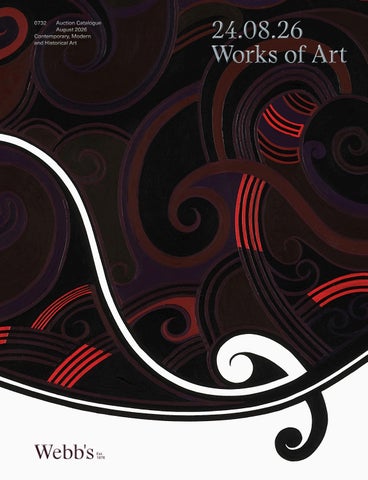
On behalf of the Art Department at Webb's, I am delighted to present our August Works of Art catalogue, which brings together over a century of artistic practice in Aotearoa New Zealand. As winter begins to give way to spring, it offers a timely celebration of colour, form and imagination. These artists reveal connections between place and identity, collectors and objects, and the many ways art continues to shape our understanding of the world around us. Each catalogue is, in its own way, a temporary collection. Works assembled across decades, often held privately and lived with closely, come together briefly before dispersing once more into new custodianship. The auction becomes a point of convergence where individual acts of collecting contribute to the broader story of New Zealand art history. Several works in this sale exemplify the enduring power of art to register both personal and collective experience. Pat Hanly's Free Pacific reflects the artist's commitment to ideas of freedom, peace and environmental responsibility. It is a reminder of painting's capacity to engage with the social and political currents of its time while retaining an essential optimism. Connecting past and present through visual culture, Reuben Friend’s opening essay on cover artist Sandy Adsett explores the language of kōwhaiwhai and Adsett’s enduring influence on Māori art in Aotearoa as both artist and educator.
Webb's
August
A significant group of works by Ralph Hotere speaks to the relationship between art and place. From Baby Iron and Koputai '77 to London, these works demonstrate the breadth of a practice that moved between the local and the international, the personal and the political. Few artists have shown such an ability to transform humble materials into works of profound emotional and visual power, capable of holding memory, protest, landscape and poetry in productive tension. The catalogue also highlights Philip Clairmont's exceptional Folding Chair. Clairmont's transformation of familiar subjects into psychologically charged spaces remains singular, investing the everyday with a sense of intensity that has lost none of its force in the nearly five decades since it was painted. This dialogue between observation and transformation extends into the work of Gretchen Albrecht and Séraphine Pick. Albrecht's exploration of colour remains foundational to contemporary abstraction, while Pick's enigmatic imagery continues to blur the boundaries between memory, imagination and lived experience. Among the catalogue's most remarkable offerings is John Drawbridge's Aurora, a rare largescale mural originally commissioned for Radio New Zealand House in Wellington in 1970. Demonstrating Drawbridge's extraordinary command of colour, atmosphere and scale, the work reflects a period when artists were increasingly engaged in shaping public and architectural spaces.
46
ot 56. Pat Hanly, L Free Pacific
The historical foundations of the catalogue are represented by an important suite of portraiture by Charles F. Goldie and Gottfried Lindauer. Earlier this year, Webb's had the privilege of handling a rare photograph by Goldie of the Ngāti Mahuta tribal leader and warrior Pātara Te Tuhi, offering valuable insight into the artist's process and the relationships that informed many celebrated portraits. Seen alongside the paintings in this catalogue, we are reminded that portraiture is never simply about likeness, but about crafting and transmitting histories. Among the Goldie works featured in this catalogue is the Portrait of Sophia Street. Street’s home once occupied the site of Auckland's beloved Parnell Rose Gardens, grounding these subjects within places many of us continue to know and enjoy today. The catalogue is enriched by the breadth of Māori and Pacific artists, from Sandy Adsett and Para Matchitt to Fiona Pardington and Robyn Kahukiwa, Reuben Paterson and Ralph Hotere, to John Pule, Andy Leleisi'uao and Fatu Feu’u. These works speak to identity, whakapapa, place and cultural memory while reflecting the richness of artistic practice across Aotearoa and
Webb's
2026
the wider Pacific. Across Webb's programme this year, from Sir Miles Warren's collection at Ōhinetahi to Roger Ward's Important Collection of Historic New Zealand Photography, we have witnessed renewed interest in the formation and presentation of entire collections as both structure and expression. Most recently, the live auction Zoomorphic Lounge: A Private Collection of Modern and Contemporary Art achieved significant results. Anchored by Bill Hammond's Zoomorphic Lounge III, the collection demonstrated the enduring appeal of works assembled through long-term engagement and thoughtful stewardship. The painting achieved one of the most significant auction results in New Zealand art history, becoming the second-highest price achieved for a Hammond at auction and reinforcing Webb's longstanding role in bringing important works by the artist to market. There is a palpable sense of optimism and renewal running through this catalogue. It is a privilege to present these works and the histories they carry, and to share a sale that reflects the richness, diversity and enduring vitality of art in Aotearoa New Zealand.
47
ot 58. John Drawbridge, L Aurora (detail)
Plates
Webb's
2026
49
1 Max Gimblett The Glass Grail 2013 silver leaf sealed aqua size signed Max Gimblett, dated 2013 and inscribed The Glass Grail in ink verso 380 × 380mm est $8,000—$12,000
2 Max Gimblett Gold Ray 2013 Gil Size Swiss Gold Red Gold signed Max Gimblett, dated 2013 and inscribed Gold Ray in ink verso 380 × 380mm est $8,000—$12,000
Webb's
August
50
3 Karl Maughan Russ Road 2007 oil on canvas signed Karl Maughan, dated 20/6/2006 and inscribed Russ Road in pastel verso 1300 × 1300mm est $30,000—$40,000
Webb's
2026
51
4 Bill Hammond O.T.2 1991 oil on aluminium signed W. D. Hammond, dated 1991, and inscribed O. T. 2 in brushpoint upper left 460 × 320mm est $18,000—$25,000 provenance Private collection, Auckland
Webb's
August
52
5 Bill Hammond Plus Song 1992 enamel on chipboard signed W.D. Hammond, dated 1992 and inscribed Plus Song in brushpoint lower edge 1070 × 1485mm est $26,000—$38,000 provenance Private collection, Australia
Webb's
2026
53
6 Sandy Adsett Tureia 2026 acrylic on canvas signed Sandy Adsett, dated March 2026 and inscribed Tureia in ink verso 1015 × 1015mm est $20,000—$35,000 provenance Collection of the artist
Webb's
August
54
Essay
The Visual Language of Kōwhaiwhai: The Legacy of Dr Sandy Adsett by Reuben Friend
Dr Raymond Sandy Adsett MNZM is a monumental figure in the mid-to-late twentieth century Māori modernist movement. As a painter, educator, and institutional disruptor, Adsett transformed how Māori art is taught, understood, curated and exhibited. His lifelong dedication to education, curatorial practice and kōwhaiwhai brought the traditional arts of the Māori meeting house into contemporary design, carving out a sovereign space for Indigenous art within the mainstream art canon of Aotearoa New Zealand. Born in 1939 in the Ngāti Kahungunu community of Raupunga, on the East Coast of the North Island, Adsett's creative vision was forged early. His earliest memories include the kōwhaiwhai on the walls of Raupunga Native School. He jokes that colouring books were scarce in those days and the negative shapes in kōwhaiwhai were great fun to colour in. After Te Aute College, Adsett was selected for the Department of Education's Art in Schools scheme led by Gordon Tovey. During this period, Adsett trained in customary Māori arts under master carver Pine Taiapa, renowned for his knowledge of the whare whakairo (carved meeting house). Taiapa’s influence gave rise to a vanguard of young Māori arts educators whose experimental practices set the stage for the contemporary Māori art movement. This cohort included John Bevan Ford, Fred Graham, Ralph Hotere, Paratene Matchitt, Kāterina Mataira, Selwyn Muru, Marilynn Webb, Cliff Whiting, Arnold Wilson and Selwyn Wilson. Some academics refer to this group as the Māori Modernists, however Adsett refutes this label as academic jargon that places primacy on Western Modernism. Instead, he prefers the Pine Taiapa Generation, noting Taiapa as their artistic, cultural and conceptual anchor. European abstractionists such as Wassily Kandinsky influenced Adsett's technique, yet his conceptual foundation remains rooted in whakapapa, creating works that speak to iwi histories and local narratives from his hometown of Raupunga. Rather than allowing modernism to dictate how Māori art is conceptualised, Adsett's hard-edged abstraction seeks to Indigenise contemporary art. The two works in this catalogue, Pangoma
Webb's
2026
Kokowai (1976) and Tureia (2026), represent works made across 50 years of practice. Pangoma Kokowai comes from the Square on Square series from the 1970s and 1980s, where Adsett experimented with negative space between the wooden frame and the internal composition. Painted at the bottom in brilliant white is a mangōpare, a shark pattern, swimming through a subdued background of kōwhaiwhai forms in ceremonial red ochre (kōkōwai), said to be the menstrual blood of Papatūānuku applied as a paint to bring life to important meeting houses. Tureia draws from a later series from the late 1990s and 2000s, deconstructing kōwhaiwhai elements into floating motifs. These series present layered planes of motifs to create Adsett’s signature labyrinthine compositions. In the 1960s and 1970s, Adsett fought to dismantle colonial curatorial practices, insisting national galleries adopt marae protocols for Māori and Indigenous works. Adsett dedicated decades to mentorship in this space, curating numerous exhibitions at the National Gallery in Wellington and around the country. In the 1990s, he cofounded Toihoukura School of Māori Visual Arts in Gisborne, and later served as principal tutor at Toimairangi School of Māori Art in Hawke's Bay, training generations of contemporary Māori artists. He was recognised with an MNZM in 2005 for his services to the arts, and he received an Arts Foundation Icon Award in 2020. Adsett exhibited extensively, most recently including a major commission for the Toi Tū Toi Ora survey exhibition of contemporary Māori art at Auckland Art Gallery (2020) and at the 60th international Venice Biennale exhibition Stranieri Ovunque, Foreigners Everywhere (2024). Despite this prolific output, Adsett has rarely sought individual recognition, preferring group exhibitions to maintain his connections to community. After five decades of practice, Adsett’s first major solo exhibition was the retrospective Toi Koru (2021), developed by Pātaka Art+Museum. The exhibition traced six decades of practice and toured to galleries throughout Aotearoa New Zealand for five years, a testament to Adsett’s legacy and enduring philosophy: that Māori art is not a static relic, but an evolving visual language of the modern world.
55
7 Sandy Adsett Pangoma Kokowai 1976 acrylic on tempered hardboard signed Sandy Adsett, dated 76 and inscribed Pangoma Kokowai in ink verso 950 × 950mm est $21,000—$30,000 provenance Private collection, Hastings
Webb's
August
56
8 Paratene Matchitt Te Whānau a Apanui 1964 oil on board signed Para Matchitt and dated 64 in brushpoint lower edge 445 × 270mm est $15,000—$25,000 provenance Gifted by the artist to Thelma Robinson Mayoress, 1964, Auckland
Webb's
2026
57
9 Fiona Pardington Still Life with Two Pomegranates, Captain Cook Teacup and a Bowl of Ihumoana, Ripiro Beach 2013 pigment inks on Hahnemühle photo rag paper, edition of 10 1450 × 1080mm est $18,000—$24,000 provenance Private collection, Auckland
Webb's
August
58
10 Ann Robinson untitled 1997 cast glass signed A Robinson, dated 1997 and inscribed #7 19 NZ with incision on base 260 × 360 × 245mm (widest points) est $30,000—$40,000 provenance Private collection, Auckland
Webb's
2026
59
11 Gordon Walters untitled 1989 gouache on paper signed Gordon Walters and dated 89 in graphite lower left 400 × 460mm est $25,000—$35,000 provenance Private collection, Auckland
Webb's
August
60
12 Milan Mrkusich Painting with Blue shape 1950 oil on canvas board signed Mrkusich dated '50 in brushpoint lower left 730 × 1130mm est $55,000—$65,000 provenance Private collection, Palmerston North
Webb's
2026
61
13 Karl Maughan Kettle Park 2020 oil on canvas signed Karl Maughan, dated 2020 and inscribed Kettle Park in pastel verso 1000 × 1000mm est $30,000—$40,000
Webb's
August
62
14 Karl Maughan Jellicoe Park 2020 oil on canvas signed Karl Maughan, dated 2020 and inscribed Jellicoe Park in pastel verso 1000 × 1000mm est $25,000—$35,000 provenance Private collection, Auckland
Webb's
2026
63
Essay
Between the Floorboards by Lily McCowan
The late Bill Hammond is one of New Zealand’s all-time greats. His work demonstrates a unique mastery of painting that evolved throughout his career. From the late 1960s through to his final years, the works he produced consistently revealed a strong graphic sensibility and a sophisticated understanding of paint, colour, and image-making. While his widely celebrated bird paintings emerged in the 1990s, his work of the 1980s is highly distinctive in its own right. This pair of works, painted in 1986, exemplifies Hammond’s willingness to work on unconventional surfaces. During this period he frequently painted on eclectic supports, including wood, particle board, and even commonplace wallpaper. The two paintings feature the jarring angles, dark palettes, and biomorphic structures often explored in Hammond’s work of this era. Both set
Webb's
August
gold forms against black, void-like backgrounds. These dark expanses are not entirely dissimilar to the alternative worlds inhabited by the birdhuman figures of his later paintings, while a series of enigmatic objects forms the subject matter. In Hard Work, a dynamic, hard-edged spiral dominates the surface. This mysterious structure generates a sense of visual ambiguity, simultaneously receding into the background and advancing towards the viewer. What appears to be a bright red industrial torrent pours from one end. Another form resembles a tree stump, complete with gangly, barbed, briar-like branches and roots. Although Hammond’s practice had yet to develop into the environmental manifesto for which he would become so well known, subtle signs of that concern can already be detected. In Wake Up, the imagery is somewhat less
64
obscure, suggesting a loosely staged scene. To the right of the composition appears a rodent-faced caricature, perhaps inspired by the cartoons and comics that Hammond and his sons enjoyed. Another creature prances in the background, balancing between two angular, plank-like forms. Pools of indeterminate liquid seep from beneath these structures. The setting almost evokes the underside of an old New Zealand house, an overlooked world inhabited by the small creatures that live beneath our feet. In both paintings, Hammond keeps the imagery minimal and, to a degree, inscrutable. Yet each work clearly demonstrates his distinctive vision, assured command of composition, and the emergence of ideas that would come to define his later practice.
Webb's
2026
15 Bill Hammond Wake Up 1986 enamel on copper signed W.D.Hammond, dated 1986, and inscribed WAKE UP in brushpoint lower edge 250 × 410mm est $20,000—$30,000 provenance Private collection, Auckland
16 Bill Hammond Hard Work 1986 enamel on copper signed W.Hammond, dated 1986 and inscribed HARD WORK incised lower left 300 × 400mm est $20,000—$30,000 provenance Private collection, Auckland
65
Webb's
August
66
17 John Pule W hat I May Need 1999 oil on unstretched canvas signed John Puhiatau Pule, dated 1999 and inscribed What I May Need in ink verso 2330 × 1830mm est $60,000—$80,000
provenance Private collection, Kaitaia exhibitions Tangata Whenua, Warwick Henderson Gallery, Auckland 24 March - 11 April 2015
provenance Private collection, Auckland
Webb's
18 Robyn Kahukiwa Nga Tamariki a Tane 2015 acrylic on canvas signed Robyn Kahukiwa, dated 2015 in brushpoint lower right 1210 × 1210mm est $18,000—$25,000
2026
67
19 Robyn Kahukiwa Pikau 2013 watercolour on paper 590 × 410mm est $12,000—$18,000 provenance Private collection, Auckland
Webb's
August
68
Essay
The world we are bound to protect by Sophie Thorn
lack Door Gallery (2015). B Robyn Kahukiwa Exhibition Archive: Tangata Whenua.
Throughout her acclaimed career, Robyn Kahukiwa (1938-2025, Ngāti Porou, Te Aitanga-a-Hauiti, Ngāti Konohi, Te Whānau-a-Ruataupare) used her work as a tool for resistance, confronting the systematic disenfranchisement, cultural alienation, and economic disparities facing Māori in contemporary Aotearoa New Zealand. Her legacy in paint, as artist, author, and activist, continues to give, to challenge, and champion perceptions of indigeneity both locally and internationally. Pīkau (2013) is a poignant example of Kahukiwa’s social commentary, directly targeting the structural neglect that perpetuates child poverty in this country. In te reo Māori, the word pīkau refers to carrying a load on one's back, a sling, or a backpack. Here the sling is full of children. Kahukiwa uses this work to confront viewers with a stark reality. It is our children, those who should represent the ultimate potential and future of the nation, who will ultimately carry the baggage of both the current failures of state infrastructure and legacy of colonial trauma. The work was created as part of a deliberate strategy by Kahukiwa to address some raw and often uncomfortable socio-political realities. It sits alongside other works from the same period, such as Shame and Child Hunger/Damaged Potential, which pointedly address the widening economic gap and numbers of children in poverty in Aotearoa New Zealand. In Pīkau, we witness the human cost of economic austerity. However, Pīkau is not simply an expression of despair; it is a demand for accountability and a reclamation of mana. For decades, Kahukiwa championed the rights of Māori women and children, using her platform to rewrite New
Webb's
2026
1
Zealand's history through an indigenous lens. The work is a call to our community to protect, uplift, and unburden its children, ensuring they can carry their cultural heritage forward proudly rather than the heavy weight of structural neglect. Ngā Tamariki a Tāne (2015) translates as the ‘children of Tāne’. In Kahukiwa’s own words this painting “…shows the bones of our ancestors, a living wahine and the extinct Huia bird with a living Tīeke (Saddleback), which is a relation of the Huia. All are placed on Papatūānuku the earth mother, with Matariki (Pleiades) shown on Ranginui the sky father. Tāne, the son of Papatūānuku and Ranginui, was responsible for creating birds and people and he placed the stars on the body of his father after he separated them and let in the light, Te Ao Mārama.”1 Kahukiwa’s carefully layered composition positions Māori cosmology as an active ethical framework through which ecological loss and responsibility can be understood. Laden with symbolic meaning, this work might also be understood as a visual depiction of whakapapa or genealogy, a key conceptual basis for a Māori way of understanding the world. Ngā Tamariki a Tāne is a reminder of the responsibilities of kaitiakitanga or guardianship. Placing the extinct Huia alongside the endangered Tīeke is an ecological warning and a challenge that we, as children of Tāne, are charged with protecting the natural world. This is a living framework for present-day ecological obligations. Presenting life, death, humanity, and nature within a unified plane, Kahukiwa issues a challenge to future generations to remember who they are, where they come from, and the world we are bound to protect.
69
20 Max Gimblett Moby Dick - For Colin McCahon, Painter, Poet! 1988 acrylic polymer on linen each signed Max Gimblett, dated 1988 and inscribed 'Moby Dick' - For Colin McCahon Painter, Poet! in ink verso 765 × 765mm each est $20,000—$30,000
21 Judy Millar Untitled 2007 oil and acrylic on canvas signed Millar, dated 2007, and inscribed 007215C in pastel, verso 1480 × 1020mm est $20,000—$25,000 provenance Private collection, Auckland
provenance Private collection, Queenstown
Webb's
August
70
Webb's
2026
71
22 Yvonne Todd Female Study (Gold) 2007 C-type print on paper signed Yvonne Todd, dated 2007 and inscribed female study (gold) in ink verso 1400 × 1170mm (each panel) est $22,000—$26,000 provenance Private collection, Christchurch
Webb's
August
72
Webb's
2026
73
23 Fiona Pardington The Children of Punaweko 2025 pigment inks on Hahnemühle photo rag signed Fiona Pardington in ink verso 405 × 580mm est $8,000—$12,000 provenance Private collection, Auckland
Webb's
August
74
24 Fiona Pardington The Prince of Wales 2023 archival print on Hahnemühle Photo Rag, edition 3 of 10 signed Fiona Pardington in ink verso 1750 × 1400mm est $25,000—$35,000 provenance Private collection, Auckland
Webb's
2026
75
25 Fiona Pardington Pihipihi 2022 pigment inks on Hahnemühle Photo Rag, edition 4 of 10 signed Fiona Pardington in ink verso 1120 × 1080mm each est $40,000—$60,000 provenance Private collection, Wellington
Webb's
August
76
Webb's
2026
77
26 Fiona Pardington Tōminiko's Male Huia in Flight 2025 pigment inks on Hahnemühle paper, framed in hand lacquered black Goldie moulding with AR70, edition 8 of 10 signed Fiona Pardington in ink verso 1440 × 1080mm est $35,000—$50,000 provenance Private collection, Auckland
Webb's
August
78
27 Fiona Pardington Wehi / Fear Kākāpo, New Zealand Ground Parrot 2004 (2021) pigment inks on Hahnemühle Photo Rag, edition 3 of 10 signed Fiona Pardington in ink verso 830 × 1090mm est $18,000—$26,000 provenance Private collection, Arrowtown; Acquired from STARKWHITE, Queenstown exhibitions Exhibited STARKWHITE Auckland and Queenstown
Webb's
2026
79
Webb's
August
80
Essay
A Revolution in Colour by Kelly Carmichael
Gretchen Albrecht stands as a key figure in the trajectory of modern abstraction in Aotearoa New Zealand. Her incredible career spans more than sixty years, but it was her iconic stained canvases of the 1970s that brought an aesthetic shift to how New Zealanders thought about painting.
28 Gretchen Albrecht Anemone 1972 acrylic stained canvas signed Albrecht and dated 72 in brushpoint lower right 1215 × 865mm est $70,000—$90,000
Working with pigment washed or stained into unprimed canvases, Albrecht left behind the figurative for abstract compositions. Anemone (1972) is a beautiful and increasingly rare example of this early milestone moment in her painting when she chose to let pure colour and feeling take over. Created from wide, bold gestures that sweep horizontal bands of colour into shapes reminiscent of sea, land and sky, Anemone lets pure colour and process dictate meaning. After graduating from Elam School of Fine Arts, Albrecht’s early work was full of heavy oil paint and recognisably figurative. But by 1970 she had moved to fluid acrylic paints, further thinning them with water which offered something similar to the transparency and immediacy of watercolour. A major turning point came in 1971 when she saw the work of American Colour Field artist Morris Louis, whose practice which challenged Albrecht to upscale her ambition and aggressively push the boundaries of her wet-staining experiments. Painted just one year later, Anemone captures the exciting first results of this new style. During this time, Albrecht also moved her home and studio to Titirangi, surrounded by native bush, West Coast skies, and dramatic sunsets over the Tasman Sea. Inspired by the nature around her, she began pouring diluted acrylic washes directly onto raw, unprimed canvas. Now the paint could behave as a fluid entity, bleeding, pooling, and sinking into the very weave. These paintings are not representations of nature but an emotional, optical response to nature, deep jewel tones that collide, overlap, and breathe against occasional glimpses of exposed raw canvas.
Much of Gretchen Albrecht’s practice was anchored in a belief that her painting should convey a felt response to the world. Writing about Albrecht in the After Nature catalogue Linda Gill commented: “Good painting in her view is always of the body as well as the mind. Albrecht’s comments on other painters stress the vigorous physical involvement that is evident in her own work.” Of Francis Bacon’s painting, she commented: “Those enormous brave plungings and lungings, the gouges and smears, making such courageous marks on the canvas”.1 Holding traces of the physical gestures that created them, Albrecht’s paintings have a habit of producing one in their audience, stopping the viewer in their tracks and transporting them to a particular place where light, canvas, and liquid pigment effortlessly converge. Anemone is crowned and anchored by bands of dark plum within which orange, yellow, and green swoop across the canvas, the paint carried by the movement of her body and the span of her arm. An artist who focuses intensely on the emotional and visual power of hue, Albrecht is known for her extraordinary orchestrations of colour. Her paintings are carried by pure and atmospheric chromatic relationships, for when only colour exists, it becomes the crucial dynamic of the composition. Treating the canvas as a site of pure sensory experience, Anemone marks the moment Albrecht found her voice as one of New Zealand's greatest colourists, setting the stage for the famous shaped canvases she would paint later in her career.
provenance Private collection, Auckland; Acquired 1980s
1
Ross, James, After Nature Gretchen Albrecht - A Survey - 23 Years (Sarjeant Gallery, 1986), 7.
Webb's
2026
81
Essay
The Domestic Interior as an Abstraction by Sean Duxfield
“Transforms commonplace subjects like fireplaces, chairs and sofas into images of disturbance, unease and fear.” — Michael Dunn
hilip Clairmont Paints a P Triptych, Art New Zealand (Issue 11, 1978), 39. 2 Dunn, Michael, New Zealand Painting: A Concise History, (Auckland University Press: Auckland, 2003), 136.
Philip Clairmont is widely regarded as one of New Zealand's leading expressionist painters, and Webb's is pleased to present the exceptional Folding Chair (1978). At a time when many New Zealand artists were redefining the landscape tradition, Clairmont turned instead to the domestic interior, transforming it into a psychologically charged world. Windows, fireplaces, chairs and sofas became more than familiar objects; they were portals through which he explored memory, perception and the unseen presence of everyday life. In an interview with Art New Zealand in the same year this work was painted, Clairmont stated: "I think an object has a life of its own. It has an essence. And it's that essence that I'm trying to express."1 This desire to reveal the inner life of the ordinary objects we live with lies at the heart of Folding Chair. Painted while Clairmont was living in Mount Eden, Auckland, Folding Chair transforms a humble household object into something strangely animate. The chair is immediately recognisable, yet increasingly elusive, suggesting both presence and absence. Although a still life, the painting is alive with movement. The form of the chair appears to shift, dissolve
Webb's
August
1
and re-form across the picture plane, creating a persistent sense of instability. The closer one looks, the more the chair's edges dissolve. Attempts to define its form give way to a kaleidoscopic arrangement of fractured planes, where saturated yellows, golds, reds, greens and blues collapse the distinction between the object and the space it occupies. Bold, gestural brushwork and richly textured surfaces animate the composition, imbuing the painting with a restless, almost living presence. The viewer is left oscillating between recognition and abstraction as object and space merge into a single, pulsating image. As art historian Michael Dunn observed, Clairmont "transforms commonplace subjects like fireplaces, chairs and sofas into images of disturbance, unease and fear."2 Folding Chair is a compelling example of this, where the ordinary becomes uncanny, and the domestic interior is reimagined as a site of psychological intensity. The chair became one of Clairmont's most enduring motifs, with numerous examples of these works held in New Zealand public collections. In Folding Chair, this everyday object transcends its utilitarian function to become a powerful meditation on perception, presence and the extraordinary expressive potential of the ordinary.
82
29 Philip Clairmont Folding Chair 1978 oil on jute on board signed P.Clairmont and dated Auckland April 1978 in brushpoint right edge 1780 × 922mm est $170,000—$240,000 provenance Private collection, Palmerston North
Webb's
2026
83
30 Reuben Paterson Knock on the door 2012 glitter & synthetic polymer on canvas signed Reuben Paterson and dated 2012 in graphite verso 2002 × 2002mm est $25,000—$35,000 provenance Acquired from Milford Galleries, 2012 exhibitions House of Rainbow, Milford Galleries 31 Mar - 25 Apr 2012
Webb's
August
86
31 Karl Maughan Kopaki 2020 oil on canvas signed Karl Maughan, dated 2020 and inscribed Kopaki in pastel verso 1400 × 2100mm est $55,000—$65,000 provenance Private collection, Auckland
Webb's
2026
87
32 Paul Dibble Pig Hunter 2006 bronze, edition of 3 signed Paul Dibble with incision on base 920 × 480 × 170mm (widest points) est $20,000—$28,000 provenance Private collection, Auckland
Webb's
August
88
33 Andrew McLeod Landscape with Rainbow 2012 oil on canvas signed A.McLeod, dated 12 in brushpoint lower right 1940 × 1200mm est $68,000—$85,000 provenance Private collection, Wellington
Webb's
2026
89
34 Tony Fomison Janis Joplin's Last Song 1988 oil on canvas 450 × 380mm est $38,000—$46,000
Webb's
August
92
35 Andy Leleisi'uao Umbilical Patus of Nalo 2010 oil on canvas signed A. Leleisi'uao in brushpoint lower left 760 × 1530mm est $7,000—$13,000 provenance Private collection, Auckland
Webb's
2026
93
36 Séraphine Pick Guru 2015 oil on linen signed Séraphine Pick and dated 2015 in brushpoint lower right 1600 × 2000mm est $50,000—$80,000 provenance Private collection, Queenstown. Acquired from Nadene Milne Gallery exhibitions Séraphine Pick: White Noise, The Dowse Art Museum, Lower Hutt 27 June 2015 - 17 January 2016 literature Séraphine Pick: White Noise, 2015 (The Dowse Art Museum, Lower Hutt, New Zealand), 62-63
Webb's
August
94
Essay
Did you hear it? Can you feel it? by Madeleine Harvey
A gathering of beings has been summoned from the ether, taking shape in the round and in fragments, at the hand of Séraphine Pick. As one of Aotearoa’s foremost contemporary painters, Pick has been long associated with immersive nineties compositions that feel situated somewhere between the plane of the subconscious and memory.
van Dyck, Sian. “Everything Old Is New Again.” Séraphine Pick: White Noise (2015). Lower Hutt: The Dowse Art Museum.
Did You Hear Something (1999) took shape during a year marked by uncertainty on the cusp of the millennium, as the world looked back and forward all at once. Analogous tension echoes in the patchwork bodies that take up residence near the surface of Pick’s canvas. Each feels unbound by dimension, vying for attention as they flicker against a checkerboard pastel plane among hints of landscape and architecture. It is not a stretch to imagine one of these creatures creeping from a dark garden or creaking around a house in the early hours of the morning. Many teeter on the surreal, with animal heads on human bodies, recalling the bird-people of Bill Hammond. Across the canvas, their outlines appear like unformed thoughts, as though they have been quickly drafted. This echoes in the ghostly drips of paint that melt from one fragment into the next, leaving painterly clues about Pick’s intuitive process. The monochrome majority are situated between sparse opaque forms in full colour; like the pair of conversing finches, or the elevenpoint stag who falls just shy of royal status. Pick deliberately evades a singular narrative here, in favour of a complex murkiness that is alluring and undoubtedly hers. The work’s title is more statement than it is question. She prompts us to tap into our senses; to pause and pay close attention.
Pivoting away from these dream-like scenes, Pick veered toward a grittiness grounded in human experience and real-life imagery in recent decades. Guru (2015) is representative of this shift in her practice, created for her notable solo exhibition, White Noise (The Dowse Gallery, 2015). A tightly packed cluster of feminine bodies reach toward an amorphous void that occupies much of the canvas. There are no illuminated screens clutched in their visible hands, evoking the offline experience of music from decades past. Yet, there is no superstar or guru to be seen. The darkness instead pulls focus to the collective trance of the enthralled audience. Pick grappled with the rapidly evolving online world in the White Noise paintings, musing on ideas spanning collective consciousness, belonging and the sociological impact of being online. She reused digital images of figures already posed in the way she wanted them, coined by Sian van Dyck as second-hand life models,1 and found using internet searches for terms like ‘people with their hands up.’ In reproducing these figures in the slower medium of paint, Pick poses questions around the value of an image and prompts us to look more closely at our relationship with the internet. In both scenes, she offers much to ponder.
Webb's
2026
1
95
37 Séraphine Pick Did You Hear Something 1999 oil on canvas signed Séraphine Pick and dated 1999 in brushpoint lower right 1590 × 1980mm est $55,000—$75,000 provenance Private collection, Wellington
Webb's
August
96
38 Star Gossage Grey 2002 acrylic on board signed Star Gossage, dated 2002, and inscribed Grey in brushpoint verso 630 × 610mm est $15,000—$20,000 provenance Private collection, Auckland
Webb's
2026
97
39 Charles Tole Landscape with Fish 1975 oil on hardboard signed Charles Tole and dated 75 in brushpoint lower left 300 × 400mm est $8,000—$12,000 provenance Private collection, Kapiti
Webb's
August
98
40 Fiona Pardington Still Life with Fish Head in Silver Chalice with Rautawhiri Flowers, Ripiro 2014 pigment inks on Epson Hot Press Natural 310gsm 550 × 410mm est $12,000—$18,000 provenance Private collection, Auckland
Webb's
2026
99
41 Paul Dibble Untitled Standing Figure 2003 bronze, edition 1 of 5 signed Paul Dibble and dated NZ 2003 incised on base 560 × 230mm est $16,000—$24,000 provenance Private collection, Hawkes Bay
Webb's
August
100
42 Paul Dibble Quiet Space Model 2 2015 bronze, Single edition signed Paul Dibble and dated 2015 incised on base 520 × 130 × 130mm est $15,000—$20,000 provenance Private collection, Havelock North
Webb's
2026
101
Webb's
August
102
Essay
Always finely balanced and always vulnerable by Sophie Thorn
43 Paul Dibble Monument to Explorers 1991 bronze, edition of 3 signed Paul Dibble and dated '91 NZ.PN with maker's stamp on base 1100 × 500 × 380mm est $35,000—$40,000
Dibble, Paul (May 1990). From Reason and Myth. Exhibition catalogue. Paul Dibble Estate. https://www.blackdoorgallery. co.nz/robyn-kahukiwa-archive.html
Paul Dibble’s Monument to Explorers (1991) is part of an early milestone in the career of one of Aotearoa’s most prolific contemporary bronze sculptors. First exhibited in his 1991 solo exhibition, From Reason and Myth, the sculpture serves as a conceptual study of Aotearoa New Zealand’s complex place within Moana Nui a Kiwa. Monument to Explorers was a key piece in this exhibition. It was reproduced as the cover image for the exhibition both at Manawatu Art Gallery in Palmerston North and at Gow Langsford Gallery in Auckland. The work exemplifies Dibble’s unique way of blending grand historical narratives with a subverted sense of heroism. Monument to Explorers is a form that feels both weighted and structurally precarious. This tension might be read as a metaphor for the unstable logic underlying the settlement of the Pacific and its impact on this land. The exhibition title From Reason and Myth draws together two conflicting systems of knowledge. “Reason” evokes the European Enlightenment, with its mathematical calculations and colonial logic used to chart the Pacific. “Myth” suggests something more amorphous: the embedded knowledge found in spiritual and storytelling traditions. Dibble’s earliest memories of sculpture were the war memorials found in small-town rural New Zealand. In Monument to Explorers, he reworks the idea of the monument, playing off this notion of civic stoicism to explore what he refers to as an ideal of the ‘heroic Pacific’. To Dibble, as put in the artist’s own words from May 1990, which accompanied the exhibition, this is “a Pacific which is brutalized and loved; that is always finely balanced and always vulnerable.”1 Dibble was at this time deeply preoccupied with themes of early migration, maritime navigation, and the psychological weight of settling an unknown land. Rather than celebrating exploration through a traditional, nationalistic lens, the series to which
Webb's
2026
provenance Private collection, Australia; Acquired from From Reason and Myth, Gow Langsford Gallery, Auckland 1991 exhibitions From Reason and Myth, Gow Langsford Gallery, Auckland November 5 - November 23, 1991
1
Monument to Explorers belongs captures some of Dibble’s thoughts around the vulnerability and profound illusion that accompanied early journeys to Aotearoa. This sculpture combines several recurring symbolic elements from Dibble’s work of this period, particularly the mermaid and the rabbit. Rabbits can signify good luck, fertility, and adaptability, and on boats they have been understood as signs of good fortune. In Aotearoa, however, rabbits have also come to be seen as an invasive and destructive pest introduced by Pākehā. The mermaid is similarly charged: mythologically, she might represent a whimsical icon, a dangerous temptress, a guardian, an eco-warrior, or some combination of these. Here, the mermaid holds a steamboat in the palm of one hand while balancing on a shell into which the rabbit attentively peers. This shell form, or nautilus, is a classic symbol of the Enlightenment, often associated with the golden ratio and mathematical harmony across the universe; in Dibble’s sculpture, it stands in for cosmic balance and a quiet rhythm in the natural world. While his concerns with the environment and our impact on it would continue to preoccupy Dibble over the course of his long career, his work can also be appreciated simply for his ability to shape bronze into lyrical form and ongoing experimentation with figurative work. His work from the late 90s and early 2000s opens from these more specific narrative concerns to an exploration of the free-flowing aesthetics of pure forms. We can see beautiful examples of this in both Quiet Space Model 2 (2015) and Untitled Standing Figure (2003). These simple geometric figurative forms are delicate studies imbued with a sense of humanity. While they draw inspiration from the work of Henri Matisse and Henry Moore and European Modernism, these forms are uniquely Dibble and part of his enduring legacy in bronze for this place.
103
Essay
Portrait of a Victorian Widow by Mark Hutchins-Pond
“ Auckland Society of Arts Exhibition”, New Zealand Graphic, 27 October 1900, 782. 2 “Auckland Society of Arts”, New Zealand Photographer, 7 November 1900 (Scrapbook XI, 64). 3 Clipping identified by Goldie as The New Zealand Herald, 19 October 1900 (Scrapbook XI, 66).
According to Te Art Encyclopedia of New Zealand: “Charles Frederick Goldie’s career began in earnest in 1900, the year in which he first presented a collection of portraits –Pākehā and Māori– at the Auckland Society of Arts.” Goldie’s portraits there received immediate acclaim, the Graphic reporting that: “Nothing better had been seen here, and it is abundantly evident that in this gentleman we have an artist who… may reach almost any height.”1 Another commentator echoed the sentiment, saying that Goldie received “the grand prix in popular estimation for works farand-away superior to anything of the kind seen in Auckland.”2 While yet another, enthusiastic critic claimed: “No one with any knowledge of art could walk through this exhibition and fail to pick out the work of the master which makes that show. The work of C. F. Goldie stands out pre-eminently. This is not only apparent in training and technique, but in the higher fields of expression – those qualities which separate a mere copyist and patient labourer on technical rules from a true master.”3 Such acclaim encouraged the young artist to continue his idiosyncratic pursuit of a meticulously
Webb's
August
1
rendered realism. He began exhibiting regularly and more widely, and his works soon became highly sought after. The portrait of Sophia Street presented here was painted by a young Goldie during that initial flurry of celebrity; shortly after his hugely popular exhibition. Although Goldie eventually became best known for his portraits of Māori sitters; he also painted a number of significant portraits of Pākehā, particularly in these early years of his career. When the young Goldie became the talk of the town following the sensational response to his Auckland Society of Arts’ show, Sophia Street, three years into her widowhood, was living alone in a grand house above Judge’s Bay in Auckland’s inner city fringe. Sophia Street (née Dabinett) was born in Somerset, Southern England, into a family of agricultural labourer’s. She was the fifth of nine children and as soon as she was of age, trained as a glove maker and moved to London where she married Charles Street, a bank clerk. In 1853, Charles and Sophia, together with their young daughter Emily and Charles’ mother, emigrated to Aotearoa New Zealand. After some years developing rural properties, they settled in
104
44 Charles Frederick Goldie Portrait of Sophia Street, circa 1900 c1900 oil on canvas signed C.F Goldie in brushpoint upper left 1100 × 840mm est $85,000—$125,000 provenance Private collection, Wanaka; By descent to the great-grandchildren of Sophia Street
Webb's
2026
105
Birtley, the Street Family Home in Parnell, 1899 by Henry Winkelmann. Images Courtesy of Auckland Libraries
Webb's
August
106
Ōtepoti Dunedin and Charles began working as a land agent. These were Ōtepoti's boom years, when the city served as the commercial centre of the Otago gold fields, a context that enabled Charles to make a significant fortune. In 1866, Emily married Charles’ business partner, Robert Gillies. When Charles retired in the early 1880s, he and Sophia moved to Auckland. Here, they built Birtley, a substantial house on land that later became the Parnell Rose Gardens. Charles died in 1887, leaving Sophia well established in the higher echelons of Auckland’s wealthier residents, and very generously provided for. In 1900, Goldie painted both Sophia and his own mother, Maria Goldie. It is interesting to compare both as a way to discern the social and emotive differences of both sitters. The portrait of Maria Goldie is smaller in scale, but fundamentally they have much in common. Both women are seated in a chair, posed to reveal a three-quarter view of their face, illuminated by a single light source from the upper right, against a dark but warm neutral background that is gently raked by the same light. The proportions of the figures within the picture frames are also very similar, as are their dark clothes, which strongly contrast with the warm pink flesh tones of their faces and hands. However, this is where the similarities end.
Webb's
2026
While the clothing worn by Maria Goldie is smartly tailored and elegant in its simplicity, Sophia Street’s couture is lavish and luxurious. She is dressed in a sumptuous black satin gown, embroidered and appliqued with delicate floral motifs along the internal facing edges of its bodice panels. This is overlaid with a wide, highly extravagant collar of crisp white lace decorated with even more intricate floral patterns. Sophia’s neck is cushioned by a delicate ruff of finely worked lace which also encircles her cuffs. An elaborate Fanchon Cap completes Goldie’s framing of Sophia’s face with radiating white lace, dramatically contrasting with the sitter’s black satin gown and the painting’s dark background. Goldie’s extraordinarily fine rendering of all these details of his sitter’s attire, particularly the lace and other fabrics, evokes the elaborate portraits of Dutch and Flemish Old Masters he would have seen in galleries and museums a few years earlier. As a widow, Sophia Street’s choice of attire may have consciously evoked the visual conventions of widowhood familiar throughout the British Empire, not least those associated with the most famous widow of the era, the then-reigning monarch, Queen Victoria. More than a likeness of a single sitter, the portrait captures the aspirations, conventions, and social identities of colonial New Zealand at the turn of the twentieth century.
107
45 Gottfried Lindauer untitled (Portrait of a Woman) oil on canvas 590 × 490mm est $15,000—$25,000
46 Gottfried Lindauer untitled (Portrait of a Man) oil on canvas 590 × 490mm est $15,000—$25,000
provenance Acquired from Cordy's, 1975. Formerly attributed as Portrait of Mr Westerhouse of Queen Street, Auckland, pendant with a Portrait of Mrs Westerhouse
provenance Acquired from Cordy's, 1975. Formerly attributed as Portrait of Mrs Westerhouse of Queen Street, Auckland, pendant with a Portrait of Mr Westerhouse
Webb's
August
108
47 Charles Blomfield untitled 1885 oil on canvas signed C.Blomfield, dated 1885 in brushpoint lower right 410 × 575mm est $35,000—$45,000 provenance Private collection, Sydney
Webb's
2026
109
48 Charles Frederick Goldie Portrait of Te Aho o Te Rangi Wharepu 1939 oil on canvas signed C. F. Goldie and dated 1939 in brushpoint lower left 290 × 310mm est $300,000—$400,000 provenance Private collection, Waimana; Acquired by gift, 1991; Private collection, Auckland. Acquired from Fine Paintings & Jewellery, Webb's, July 1985, lot 116.
Webb's
August
110
Essay
Te Aho o Te Rangi Wharepu by Mark Hutchins-Pond
Charles Frederick Goldie is likely New Zealand’s bestknown artist. Descendants of Goldie’s models revere the depictions of their tūpuna, while others have denounced the paintings as documents of colonial racism. Yet the story of the artist and his career is embedded in a thick accretion of myth, where dubious anecdotes rub shoulders with strongly opposing opinions.1
Blackley, Roger. Goldie. Auckland, 1997, 1. Anonymous source quoted in Yearbook of New Zealand (1947). 3 Blackley, Roger. “Introduction.” Christchurch Art Gallery website. 4 Ibid. 5 A Study (1905), Te Aho o te Rangi Wharepu, Ngāti Matuta, Auckland Art Gallery, reproduced in Blackley, Roger. Goldie. Auckland, 1997, 104. 6 Te Aho, a Noted Waikato Warrior (1902), reproduced in Blackley, Roger. Goldie. Auckland, 1997, 105. 7 Clarke, Jacquie. “C.F. Goldie: The Old Master Revisited.” New Zealand Geographic, Issue 38, April 1998.
His intensely observed and meticulously rendered form of realism was seen as outdated and backward-looking by contemporary art critics, some pointing out that such obsessive attention to factual detail had been made redundant by the technical advances of hand-coloured photography. One critic considered his work “more suitable for a museum of ethnology and anthropology than the walls of an art gallery.”2 Goldie dismissed such comments as ignorant and irrelevant, firm in his belief that his highly detailed paintings of esteemed Māori elders with traditional tā moko (facial tattoos) would become important historic records in times to come. He felt compelled to record what he saw as the last noble vestiges of preEuropean Māori culture before they disappeared, and in so doing he created artworks that are now widely acknowledged to be of significant historical and cultural importance to Aotearoa New Zealand. Although dismissed as pedantically oldfashioned by art critics of the day, Goldie’s Māori portraits continued to be enormously popular with the general public. In 1908, readers of the Weekly Graphic magazine placed Goldie at the top of their list of New Zealand’s best artists.3 Goldie’s portraits have always been held in high esteem by Māori, and because of their importance as ancestral images, are regarded as taonga, or treasures. Te Heuheu Tūkino, the paramount chief of Ngāti Tūwharetoa and the artist’s friend, described Goldie’s works as “he tohu mo nga Māori i roto i te whakatupuranga”, icons for Māori of future generations.4
Goldie’s portrait of Te Aho o te Rangi Wharepu, dated 1939, is a beautiful example of the artist’s classic, late style. At this stage in his career, Goldie often revisited earlier subjects on a more intimate scale and frequently through a romanticising lens. The subject of this late portrait was a highly regarded and well-respected rangatira from the Waikato region who had sat for Goldie a number of times previously. There are two quite different portraits of this same sitter in the collection of the Auckland Art Gallery Toi o Tāmaki. Both are frontal views; the first is a classic frontal presentation of the chest and head of the sitter positioned fully upright in the centre of the composition,5 while the second work is also a bust portrait, the sitter is posed reclining with his head back, resting on a pillow. The portraits in Auckland Art Gallery are nearly twice the size of the later rendition, featured here, and more conventionally formal, predating the later work by two decades.6 While Goldie was studying at L’Academie Julian in Paris during the late 1890s he took the opportunity to travel extensively through Europe, visiting many of the famous galleries and copying at first hand many of the works of the Old Masters. The young Goldie was especially influenced by Rembrandt, a formative influence that stayed with him, as evidenced by the distribution of deep shadows and soft light on rich complexions that became a hallmark of Goldie’s Māori portraits,7 clearly evident in this fine work we have the pleasure to bring to auction.
Webb's
2026
1
2
111
49 Ralph Hotere Drawing for Pine a Poem by Bill Manhire 1972 ink and graphite on paper signed Hotere, dated 72 and inscribed Drawing for Pine a poem by Bill Manhire in graphite lower edge 560 × 350mm est $16,000—$19,000
50 Ralph Hotere Aramoana 1980 pastel on paper signed Hotere, dated 80 and inscribed Aramoana in graphite lower edge 365 × 250mm est $10,000—$15,000
provenance Private collection, Auckland
provenance Private collection, Cambridge
Webb's
August
112
51 Ralph Hotere London 1963 acrylic on card and upcycled hardboard signed Hotere in stencil, dated 64 and inscribed London in brushpoint verso 1210 × 600mm est $10,000—$20,000 provenance Private collection, Wellington. Acquired from Dunbar Sloane, Wellington c1970s
Webb's
2026
113
Essay
Material Transformations by Mark Hutchins-Pond
’Brien, Gregory. Hotere: Out the O Black Window: Ralph Hotere’s Work with New Zealand Poets. Godwit Publishing, Auckland, 2001. 2 Ibid., 21. 3 Leech, Peter. “Style and Change: Ralph Hotere.” Art New Zealand, no. 29, Summer 1983, 19. 4 Ibid. 5 Ibid.
Across more than four decades of artistic practice, Ralph Hotere repeatedly demonstrated an extraordinary ability to transform humble materials into works of profound emotional and visual resonance. Whether working with discarded cardboard, timber, steel or corrugated iron, he approached materials not simply as supports for images but as active participants in the meaning of his art. The two works presented here, London (1963) and Untitled [Baby Iron] (1984), reveal this concern operating across very different stages of his career. The earlier work belongs to a formative period in Hotere's development following his studies at the Central School of Art and Design in London and his subsequent travels throughout Europe. Although titled London, the work was painted in 1963 while the artist was based in France and travelling extensively on the continent. Its expressive painterly passages recall the Sangro series, painted between 1962 and 1964 as a memorial to Hotere's older brother Jack, who was killed in action in Italy during the Second World War. Yet the work's more complex structure distinguishes it from those paintings and suggests an artist actively experimenting with new compositional possibilities. London also anticipates another important development in Hotere's practice: his embrace of found and repurposed materials. Auckland Art Gallery conservator Sarah Hillary recalled a conversation with Hotere late in his life during which he described using discarded television packaging found in a London dump to construct the supports for his Human Rights works. Their significance was such that he transported them back to New Zealand.¹ Friend and dealer Rodney Kirk Smith similarly remembered Hotere arriving home in 1965 carrying "strangely painted luggage which turned out to be works of art he had nailed together to make them portable."² The re-use of everyday materials held particular appeal for many artists of the 1950s and 1960s as they
Webb's
August
1
sought alternatives to traditional approaches to art making. In Hotere's hands, however, such materials became more than statements about modernity or consumer culture. They became vehicles for memory, protest and formal invention. Two decades later, Hotere returned to this spirit of material transformation in a radically different form. In 1983 he began incorporating corrugated stainless steel into his work. Rigid, industrial and uncompromising in its physicality, the material nevertheless became, through Hotere's interventions, unexpectedly luminous and seductive. Reviewing Hotere's first exhibition of the stainless steel works at Dunedin's Bosshard Gallery, Peter Leech observed that they offered "an occasion for deepening consideration of what his style is and has been".³ For Leech, the works intensified two longstanding concerns within Hotere's art: a formal tension that restrained powerful emotional undercurrents and a fascination with the subtle effects of light.⁴ These qualities are vividly present in Untitled [Baby Iron]. The polished corrugated surface captures and reflects light across the rhythmic ridges of the steel, while crude lead-headed nails and a torn, curled strip of metal introduce gestures of force and resistance. Returning to a material deeply embedded within both the New Zealand landscape and his own artistic history, Hotere transformed an ordinary industrial product into an object of extraordinary visual intensity. Leech went so far as to describe Baby Iron as "an act of pure modernism".⁵ Separated by more than twenty years, London and Untitled [Baby Iron] demonstrate the remarkable consistency underlying Hotere's restless experimentation. Whether working with discarded television packaging or polished stainless steel, he remained committed to uncovering poetry within the ordinary and to transforming commonplace materials into powerful meditations on memory, light and human experience.
114
52 Ralph Hotere Untitled [Baby Iron] 1984 burnished stainless steel, lead head nails on wooden support signed Hotere, dated '84 in brushpoint upper left 700 × 640mm est $60,000—$80,000 provenance Private collection, Auckland
Webb's
2026
115
53 Ralph Hotere Painting '77 – Koputai 1977 acrylic and lacquer on board signed Ralph Hotere, dated '77 and inscribed B. L. G Cat No. 14 verso 2400 × 1200mm est $110,000—$160,000 provenance Private collection, Auckland
Webb's
August
116
Essay
Sedimentary Music by Mark Hutchins-Pond
As early as 1968 Ralph Hotere was the first artist of Māori descent to have been written by Pākehā into a history of New Zealand art.1 Despite his ambivalence about being labelled as any kind of cultural or ethnic artist, he is also often claimed as a founding figure, half a century ago, of today’s burgeoning contemporary Māori art movement.2
Mane-Wheoki, Jonathan. “The Black Light Paradox: The Sumptuous Austerity of Ralph Hotere’s Art.” Art New Zealand 98, Autumn 2001. 2 Reed, A.H. & A.W. Reed. New Zealand Art: Painting 1950–1967. 1968. 3 “The Library of Ralph Hotere.” Reed Gallery website. 4 Heritage New Zealand Pouhere Taonga. Studio of Ralph Hotere (Former). 5 Wedde, Ian. Ralph Hotere: Requiem (B) (For Tony), lot 43, Works of Art 162A, Webb’s, July 2025.
In 1969, Hotere was awarded the Frances Hodgkins Fellowship, a year-long residency granted by the University of Otago to outstanding New Zealand artists, which provided him with Dunedin studio space and a year’s stipend. During that year, Hotere lived at 121 Forth Street, with a rent-free studio in nearby Castle Street, courtesy of the University. In 1973, with Cilla McQueen and her daughter Andrea, Hotere moved further out, to 27 Harbour Terrace, on the hill above Careys Bay. Port Chalmers (Kōpūtai) offered him a relaxed small-town community, a pub where snooker and darts were played, and the opportunity to fish, floating about on the bay.3 The move to Careys Bay also enabled him to be close to the studio at 2 Aurora Terrace, on Observation Point which he’d purchased when the Hodgkins Fellowship ended in 1970. According to Heritage New Zealand Pouhere Taonga: “Situated on the vestigial stump of Oputae / Observation Point in Kōpūtai / Port Chalmers, [Hotere’s first studio] is the last remaining house on Aurora Terrace near the Flagstaff on the slope overlooking the awa Ōtākou / Otago Harbour and Muaupoko / Otago Peninsula. Both iwi history and archaeological evidence show Māori occupation in the Ōtākou / Otago region since the 12th century. Early Kōpūtai was a small settlement recorded as abandoned in the 1840s. Following the settlement, it continued to be a tauraka waka within the awa Ōtākou / Otago Harbour, an ara tawhito and provider of abundant resources. Kōpūtai was the location of the signing of the Otago Deed between representatives of the New Zealand Company and 25 chiefs on 31 July 1844. Today, Kōpūtai
is an acknowledged Wāhi tapu area.”4 Hotere rendered his deep feelings for Kōpūtai many times during his 40 years of association with Port Chalmers, but the works he created during the 14 years he occupied his iconic studio at the end of Aurora Terrace are among the most resonant. The densely layered enamel ground of Painting ‘77 – Koputai, built up by immeasurable layers of dark-toned dots with scatterings of lighter, sand-like specks, appears to speak of the ancient sedimentary physicality of the terrain on which the studio stands. Shadowy phantoms of the generations of residents and travellers who have left their marks on this whenua seem to dart among the painting’s murky depths. Then, on top of this sombre physicality, Hotere trails fragile vertical bands of white lines down each side of the image. Delicate, seemingly trembling at times, these fine white lines elevate the front of the picture plane and, in so doing, throw the dark textured ground back into space. Writer and poet Ian Wedde describes these delicate parallel veils as: “…energetic, almost untidy effects [that] have a strong narrative presence: they are ‘audible’ as they trail down across the by-now-three-dimensional space of the painting… [They create a] sense of depth and orchestration… The combined vitality and orchestrated serenity of these effects are, again, so close to music or speech that a viewer’s ‘entry’ to the work is almost in terms of listening and responding, of speaking or singing ‘along with’ the painting’s score. It’s a moving sense, like being within the engaged space of music that invites us to join, in the darkness."5
Webb's
2026
1
117
54 Len Castle Merapi I indonesian red fire earthenware signed with artist stamp on base 160 × 840 × 190mm (widest points) est $5,500—$7,500 provenance Private collection, Auckland
Webb's
August
118
55 Pat Hanly Silver Bride with Groom 1990 enamel on found board signed Hanly and dated 90 with incision top left 620 × 585mm est $15,000—$20,000 provenance Private collection, Auckland exhibitions Pat Hanly: Bride and Groom Again, Janne Land Gallery, Wellington 1991 literature Gregory O'Brien, Hanly, (Auckland: Ron Sang Publications, 2012), 223
Webb's
2026
119
Essay
Webb's
Joyful Resistance by Rachel Kleinsman
A particular aspect of Pat Hanly’s practice reached a crescendo in the 1980s and it is one to which the term ‘exuberant activism’ may be applied. Pulsating from beneath the surface of Hanly’s paintings of this time, there is a joyful essence to be encountered and Free Pacific is no exception to this. As the painting reveals itself to the viewer, it emblazons a message of hope and resistance onto our souls.
The bold treatment of colour and form in Free Pacific is awe-inspiring, and Hanly’s reputation as New Zealand’s foremost master of colour is asserted through this work. In each abstracted icon of land and geography, we encounter the joy of our national identity: the joy of colour. Hanly has drawn on the creative liberties of collage and applied them in such a way that each form exists in a paradox of harmonious disconnect. Vivacious shades of red, blue, green and yellow coalesce herein, each seeming to hum and thrive in the potency of its own force field. The transcendence and purity of the work also lends a deeply personal quality to the act of viewing. In perceiving the bright and modular shapes existing in choreographed dialogue across the canvas, we instinctively respond to these as emotive symbols and signposts, each relevant to our own personal quest for meaning. Free Pacific was realised at a critical moment in the unfolding of our modern national identity, when the fight to retain New Zealand’s nuclear-free status was coming to the fore.
Considered in this context, the painting’s title is all encompassing; it serves, at once, as a protest banner, an imperative and an epigrammatic urging to retain our moral liberty. For contemporary viewers armed with the power of hindsight, it is impossible not to appreciate the timely prescience of this message – the work was completed just one year before the Rainbow Warrior was bombed in Auckland Harbour. Hanly’s expressions of dissent were not delivered solely via the medium of the paintbrush, by the way. He was well known for protesting from sailboats on Auckland Harbour. The stylised white form of a ship at the centre of Free Pacific may be read as a memorial of this form of water-based freedom in which the artist delighted. Ultimately, the importance of Free Pacific lies in its ability to unite us through the universality of our shared national experience. Looking beyond the immediacy of the protest at hand, there is a timelessness to the work. It serves as an affirmation of our common humanity, weaving Aotearoa’s existence into a thread of joyful and shared triumph.
August
120
56 Pat Hanly Free Pacific 1984 enamel and oil on hardboard signed Hanly, dated 84 and inscribed Free Pacific with incision lower edge 900 × 1200mm est $120,000—$160,000 provenance Acquired from Webb's, Important Paintings & Contemporary Art, Auckland, 7 August 2017, lot 25. Acquired directly from the artist, 1984 literature Russell Haley, Hanly: A New Zealand Artist (Auckland: Hodder and Stoughton, 1989), 200. Gregory O'Brien, Hanly, (Auckland: Ron Sang Publications, 2012), 230, pl.48.
Webb's
2026
121
57 Dick Frizzell The Female Phantom 1999 oil on canvas signed Frizzell, dated 9/5/99 and inscribed The Female Phantom in brushpoint lower left 1500 × 1800mm est $34,000—$46,000 provenance Private collection, Taupo
Webb's
August
122
Essay
Pop Heroics by Linda Tyler
“I painted up a portrait of a cannibal chief from a Phantom comic as if I was Goldie portraying a Māori chief” —Dick Frizzell
Paintings like Whaam! (1963), by American pop artist Roy Lichtenstein (1923–1997), emulated the techniques of comic book illustrators and mechanical reproduction to represent violence and drama in a detached way. Locally, Dick Frizzell took the same approach, painting homages to Buck Rogers, Captain America, Superman with Lois Lane and even Felix the Cat. As well as nostalgically remembering the grip that these cartoon creations had on his childhood imagination, Frizzell worked to overcome the cultural prejudice against comic books as a low form of art. Frizzell’s favourite character is Lee Falk’s 1952 creation, The Phantom, drawn first by Wilson McCoy and then, after his death in 1961, by Sy Barry. Considering Kit Walker and his exploits worthy of heroic treatment, Frizzell remembers “I painted up a portrait of a cannibal chief from a Phantom comic as if I was Goldie portraying a Māori chief”. Frizzell’s large-scale dramatic treatment emphasises the aura of an original work of art in an age of mechanical reproduction.
Webb's
2026
The Phantom is always characterised by a skin-tight costume displaying his epic muscularity, while a cowl and eye mask protect his identity. Here he is joined by his identically dressed wife, Diana, both of them finding it remarkable how the costume of the 18th Phantom’s twin sister, Julie, fits her modern body. Frizzell’s is a close but not exact copy of the original cartoon, which Falk devised to broaden The Phantom’s demographic appeal. As a joke, Frizzell puts his own name on the cover of one of the books on the shelf in the Chronicle Chamber, inscribing himself into the superhero’s backstory. Frizzell’s composition focuses attention on the svelte figure of Diana, who is about to aid The Phantom in flushing out some bank robbers hiding in the Deep Woods. Pointedly, Frizzell has chosen the moment before the action for its momentous and surprising challenge to traditional gender roles. Later, Diana disappointed Lee Falk’s loyal readership by renouncing any claim on Phantom-hood, declaring: “From now on, I’ll just be a female!”
123
Essay
Optical Storm by Mark Hutchins-Pond
Born in Karori in 1930, Drawbridge studied at Wellington Teachers Training College and had his first show at Wellington’s Helen Hitchings Gallery in 1949.
ity Gallery Wellington. John C Drawbridge: Wide Open Interior. O’Brien, Gregory. John Drawbridge: Wide Open Interior. Mallinson Rendel Publishers, 2001, 14. 3 Ibid., 15. 4 Ibid., 18. 5 Ibid., 19. 6 Smith, Allan. Local Colour: Eight Wellington Artists. Exhibition brochure, City Gallery Wellington, 1995, 2. 7 O’Brien, Gregory. John Drawbridge: Wide Open Interior. Mallinson Rendel Publishers, 2001, 19.
According to Gregory O’Brien, “In 1957, he and Bill Culbert were awarded National Art Gallery travelling scholarships to study at the Central School of Arts and Crafts, London. While in Europe, Drawbridge was inspired by [works he saw by] Matisse, Picasso, and Bonnard, who [like himself] were printmakers as well as painters. His subsequent works also made references to Malevich and Morandi, among others.”1 Drawbridge found the teaching philosophy at the Central School very much in keeping with his own ‘holistic’ experience of both thinking about and making art. The course, devised by Johannes Itten at the Bauhaus in 1919, incorporated the ideas of Paul Klee, Wassily Kandinsky and Oscar Schlemmer. Attitudes rather than techniques were the priority – the course set out “to educate not to train.”2 Drawbridge recalled that his printmaking tutor at the Central School, Merlyn Evans, would often talk about visual art in relation to music, an association Drawbridge found particularly relevant. As was the case with the training college in Wellington, the teaching programme at the Central acknowledged the need for both control and freedom…3 In London, Drawbridge’s etchings were exhibited at the Royal Academy, and his paintings shown alongside David Hockney’s in a group show. In 1963, he also presented a solo show at London’s Redfern Gallery. 1963 is also the year Drawbridge’s mural for New Zealand House in London was completed and installed. This highly abstracted and textured view of the New Zealand landscape remained in place until 1991, when the building’s interior was reconfigured. Its ten panels were then returned to New Zealand and subsequently permanently installed in the National Archives building, Wellington.
After finishing the NZ House Mural, Drawbridge returned home, and in 1964 began teaching at Wellington Polytechnic School of Design, where he remained until he resigned in 1990. Throughout the 1960s a gulf was widening between John Drawbridge’s painting and printmaking, with figure-based subjects increasingly confined to printmaking while the paintings became more and more abstract. A large canvas from 1968, Big Red, reflects the artist’s ongoing interest in Abstract Expressionism and colour-field painting. At a time when much of New Zealand art was dominated by a dour black and white palette, this work was a celebration of optical energy and painterly flair. 4 What Gregory O’Brien describes as “staccato paintwork and the Turneresque colour that dominated Big Red,”5 are also strongly evident in the larger scale murals Drawbridge painted in the early 1970s. Aurora, 1970, the IBM Mural, commissioned by AMP, is a miasma of optically vacillating colour. The pulsating, magma-like central horizontal field of boiling orange and yellow is contained and compressed by broken bands of deep sienna and violet top and bottom. Although the title of the IBM mural, Aurora, suggested astronomical observations as its source of inspiration, Allan Smith has observed that the textile-like quality of Drawbridge’s murals of the early 70s with their strident colouration and optical effects, was in accord with the French chemist Chevreul’s conclusion that “the adjacency of contracting colour threads enhanced their chromatic intensity.”6 In the best tradition of the Central School, Drawbridge was keeping a weather eye on theories and technologies well beyond the usual art world pale.’7
Webb's
August
1
2
124
58 John Drawbridge Aurora 1970 oil on canvas on board signed John Drawbridge and dated 1970 in brushpoint lower right 1730 × 2770mm est $40,000—$55,000 provenance Private collection, Wellington; Originally installed at Radio New Zealand House; The IBM Mural commissioned by AMP. literature Gregory O’Brien, John Drawbridge – Wide Open Interior, City Gallery, Wellington, (Mallinson Rendel, 2001), and illustrated in John Drawbridge (Ron Sang Publications, 2008), 98.
Webb's
2026
125
59 Virginia King Tir Na N'og 1995 macrocarpa, beeswax, oil stain and dammar resin 2800 × 700 × 40mm est $12,000—$18,000 provenance Private collection, Auckland; gifted by the artist
Webb's
August
126
60 Richard McWhannell Sunday School Picnic at Sandy Bay 2017-18 oil on canvas board signed R McWhannell, dated 2017/18 and inscribed Sunday School Picnic at Sandy Bay in brushpoint verso 1220 × 1540mm est $25,000—$30,000 provenance Private collection, Queenstown. Acquired from Orexart Gallery, Auckland 2019
Webb's
2026
127
61 Gregor Kregar Reflective Echo 5 2011 stainless steel, edition 1 of 5 signed Gregor Kregar, dated 2011 and inscribed Reflective Echo with incision on plaque verso 1800 × 1450mm est $18,000—$26,000 provenance Private commission exhibitions Specular, Gow Langsford Gallery Auckland, 11 February to 7 March 2026
Webb's
August
128
62 Gregor Kregar Reflective Echo 4 2011 stainless steel, edition 2 of 5 signed Gregor Krgar, dated 2011 and inscribed Reflective Echo with incision on plaque verso 1600 × 1700mm est $18,000—$26,000 provenance Private commission exhibitions Specular, Gow Langsford Gallery Auckland, 11 February to 7 March 2026
Webb's
2026
129
63 Louise Henderson Cloud over harbour oil on board signed Louise Henderson in brushpoint lower left and inscribed Cloud over harbour in brushpoint verso 950 × 1250mm est $50,000—$60,000 provenance Private collection, Dunedin
Webb's
August
130
64 Jeff Thomson untitled (elephants) acrylic on corrugated iron 3000 × 2800 × 580 mm (larger) 2800 × 2300 × 400mm (smaller) est $40,000—$60,000 provenance Private collection, Auckland
Webb's
2026
131
65 Jane Evans Kitchen Interior 1978 acrylic on board signed Jane Evans and dated 78 in brushpoint lower right 740 × 900mm est $10,000—$18,000 provenance Private collection, Peka Peka, Kapiti
Webb's
August
132
66 Philip Trusttum Flowers and Mirror 1972-3 oil on board signed PST in brushpoint lower right 1180 × 1200mm est $18,000—$25,000 provenance Private collection, Auckland; International Art Centre Important and Rare Art, 26 November 2024, Lot 018; Acquired from Petar/James Gallery, Auckland
Webb's
2026
133
67 Peter Stichbury Flaw oil on canvas 1115 × 1115mm est $50,000—$65,000 provenance Private collection, Auckland, Acquired from The Drawings Gallery, Auckland, 1996
Webb's
August
134
68 Michael Hight Slopehill 2015 oil on canvas signed Hight, dated 15 and inscribed Slope Hill in brushpoint lower edge 760 × 1220mm est $18,000—$24,000 provenance Private collection, Auckland
Webb's
2026
135
Essay
Webb's
Colonial Timetable by Christie Simpson
Under William Dunning’s painterly hand, history is made material, ossified into a carvedstone side table, laden with pictures-within-pictures and layered in meaning. Dunning’s practice has long interrogated the complexity of our colonial history in Aotearoa and, in doing so, has never shied away from that sense of discomfort.
Dunning takes clever licence in his titling of the work, Colonial Timetable 1850–1900, a visual pun that has us leaning in closer to inspect this curious piece of furniture. Four male faces appear carved into the facade, their eyes cast outwards to disparate corners beyond our view and positioned not in unity, but fractured – quite literally – by a web of cracks that riddle the table’s surface from every angle. What should be something solid, stoic, of architectural integrity, instead stands splintered and unsteady, threatening to fall apart. Sandwiched between these carved faces is a tableau of richly coloured vignettes lining the table’s frontage. Their curved arches present like portals, offering us glimpses into a colonial past that demands our attention, no matter
how confronting. The painted figures, both Māori and Pākehā, stand frozen in time and though their stillness appears at first serene, closer inspection reveals their unsettledness: a downcast grimace, a furrowed brow, things not quite right. The second half of the nineteenth century, which Dunning refers to, was a period of massive change and upheaval. Following the signing of Te Tiriti in 1840, the discrepancies between the English and te reo Māori translations would come to light, and with them the ripple effects dominoing forward into our present day. As much as Colonial Timetable memorialises the nuanced histories of our past, so too does it provide timely remembrance as we step forth into our future.
August
136
69 William Dunning Colonial Timetable 1850 -1900 2000 oil on canvas signed William Dunning, dated 2000 and inscribed Colonial Timetable 1850 -1900 in brushpoint lower right 800 × 1400mm est $20,000—$30,000 provenance Private collection, Lower Hutt
Webb's
2026
137
70 Peter McIntyre Sampans c1960 oil on canvas signed Peter McIntyre in brushpoint lower right 497 × 600mm est $23,000—$35,000 provenance Private collection, Auckland
Webb's
August
138
71 Terry Stringer Behind the studio screen 1999 Bronze with Patina, oil and wax polychrome signed Terry Stringer and dated 1999 with maker's mark incision lower edge 500 × 220mm est $16,000—$24,000 provenance Private collection, Peka Peka, Kapiti
Webb's
2026
139
72 Toss Woollaston Marpua 1939 oil on board signed Woollaston in brushpoint lower left 420 × 465mm est $30,000—$40,000 provenance Private collection, Christchurch; collection of Rodney Kennedy, Dunedin exhibitions M. T. Woollaston: Works 1933-1973, Manawatu Art Gallery, Palmerston North 1973 literature Manawatu Art Gallery, M. T. Woollaston: Works 1933-1973, Palmerston North: Manawatu Art Gallery, 1973, 31.
Webb's
August
140
73 Gordon Walters Transparency IV 1990 acrylic on canvas signed Gordon Walters, dated '90 and inscribed Transparency IV in ink verso 920 × 730mm est $50,000—$70,000 provenance Private collection, Auckland
Webb's
2026
141
74 Don Binney Lion Rock with King George III 1984 oil on board signed Don Binney and dated 1984 in brushpoint upper right 580 × 640mm est $18,000—$25,000 provenance Private collection, Auckland; Acquired from Webb's, Important Works of Art Auckland, 3 August 2010, lot 52 literature Gregory O'Brien, Don Binney: Flight Path, (Auckland: Auckland University Press, 2023), 263
Webb's
August
142
75 Fatu Feu'u Agaga Pauikura 2002 acrylic and oil stick on canvas signed Feu'u, dated 2002 in ink lower left 1400 × 2500mm est $15,000—$25,000
Webb's
2026
143
76 Ina Haszard untitled oil on canvas board signed Ina Haszard in brushpoint lower right 580 × 890mm est $18,000—$25,000 provenance Private collection, Auckland
Webb's
August
144
77 Amanda Gruenwald Cerulean Pink 2016 oil on canvas signed A Gruenwald, dated 2016 and inscribed Cerulean Pink in graphite verso 2300 × 1710mm est $20,000—$25,000 provenance Private collection, Auckland
Webb's
2026
145
Welcome to Webb’s Art Department
Webb's
Emily Gardener Mat. Leave Director of Art
Megan Shaw, PhD Manager, Art
With over 20 years of experience in leading public and commercial art institutions worldwide, Emily brings exceptional expertise to Webb’s. Holding a Master’s in Contemporary Art from Sotheby’s Institute, she has held senior leadership roles at renowned organisations including the Serpentine Galleries, the Biennale of Sydney, Museum of Contemporary Art Australia, and Objectspace. She was former Trustee of the NZUK Link Foundation, championing crosscultural connections between NZ and the UK.
Megan brings deep experience in contemporary art and philanthropy, shaped by years with the Chartwell Collection Trust. She is an art historian with a PhD from the University of Auckland, has coauthored a book marking Chartwell’s 50th anniversary, served in arts and academia governance roles, and held research fellowships with the Paul Mellon Centre and Oxford University. As Manager of Webb’s Art Department, Megan provides critical stewardship, shaping auction direction and building key relationships across the art market to deliver exceptional outcomes.
Mark Hutchins-Pond Senior Specialist, Art
Sean Duxfield Senior Specialist, Art
Kelly Carmichael Senior Specialist, Art
Mark is Webb’s Senior Art Specialist, leading the valuation and curatorial teams at the Wellington Gallery. He joined Webb’s in 2022 after a decade as Lead Curator, Contemporary Art, at Pātaka Art + Museum in Porirua. Mark has more than three decades of experience studying, writing, presenting, critiquing, and championing New Zealand contemporary art and served on several arts trusts. Before his museum role, he directed his own dealer gallery for nine years, representing artists who continue to achieve strong secondary-market results.
Sean oversees Webb’s art initiatives across the South Island, bringing decades of experience working closely with both public and private collections. He understands firsthand the care, commitment, and insight required to build and sustain a meaningful collection over time. Sean has held senior roles at leading public galleries in Christchurch, Auckland, Wellington, and New Plymouth. Career highlights include an award-winning association with the Venice Biennale and his current role as co-chair of the Centre of Contemporary Art (CoCA) in Christchurch.
Kelly is Webb’s Senior Art Specialist based in Auckland. She brings a wealth of experience across curatorial practice and arts leadership with a background spanning both the public and independent sectors. Director of Starkwhite Queenstown for five years. She has previously held positions at City Gallery Wellington, Sculpture on the Gulf, and Artspace within Aotearoa New Zealand, alongside positions internationally in Europe and the Middle East. Since 2013 she has been the Oceania representative for the International Award for Public Art based at the University of Shanghai.
August
146
Georgina Brett Specialist, Select
Sophie Thorn Specialist, Art
Lily McCowan Specialist, Art Online
Jo Bragg Logistics & Inventory Coordinator
As Specialist for Webb’s Select auctions, Georgina leads the curation of both the catalogue and exhibition design to present a collection of fine artworks for our discerning collectors, while offering vendors an exceptional platform to showcase their works. Georgina brings a wealth of experience from within the arts sector through her work in exhibition production, curation, public programming and business development. Georgina holds a Master of Fine Arts, her art practice centres on sound mediated through mixed-media installations. Her work has been exhibited locally and internationally.
Sophie has recently joined Webb’s as our Art Specialist in Te Whanganuia-Tara, Wellington. She is an art writer and curator, most recently serving as Curator of Collections at Te Pātaka Toi Adam Art Gallery, where she cared for Ngā Puhipuhi o Te Herenga Waka, Victoria University of Wellington Art Collection from 2014 to 2026. Sophie holds a Master’s in Art History and Theory from the University of Canterbury, a Postgraduate Diploma in Heritage Materials Science from Victoria University, and a Diploma in Art Law and Collections Management from the Institute of Art Law in London.
Lily brings experience from Dunbar Sloane’s Art Department and McLeavey Gallery in Wellington, alongside a BA with First Class Honours in History and Art History from Victoria University. She was the Wellington Club’s 2024 Parkin Scholar and completed a guest curatorship at Katherine Mansfield House and Garden. As Specialist for Webb’s Art Online platform, Lily curates accessible, high-quality works at a range of price points and collaborates with diverse consignors to ensure their artworks reach engaged collectors.
Jo, Tāmaki Makaurau–born and based, is an arts writer and researcher with a dedicated career in producing and facilitating contemporary art. A co‑founder of the Meanwhile artist‑run initiative, Jo also served for three years on the board of Enjoy Public Art Gallery as secretary and later co‑chair. They hold a First‑Class Honours Master of Fine Arts by Research from Monash University, and their photographic works are held in the Wellington City Council and Christchurch Art Gallery Te Puna o Waiwhetū collections. At Webb’s, Jo oversees logistics and inventory, ensuring artworks are handled, stored, and prepared to the highest standards.
Mia Foulds Pre-Sale Coordinator, Art
Stephanie Arrowsmith Administrator, Art
Charles Tongue Valuations Specialist
Virginia Woods-Jack Exhibitions Manager, Wellington
Mia brings valuable experience from her previous roles at Te Uru Waitākere Contemporary Gallery and within the curatorial team for Window Gallery. She holds a Bachelor's Degree in Fine Art from Auckland University of Technology and is a practicing artist and writer. In her role as Pre-sale Coordinator, Mia manages artwork coordination, client liaison and data analysis prior to auction, alongside overseeing framing and restoration, ensuring the smooth operation of Webb’s art team and a seamless experience for consignors and collectors.
Stephanie provides essential administrative and operational support, ensuring the smooth coordination of auctions, exhibitions, and events. Stephanie holds a Bachelor of Fine Arts with FirstClass Honours from Massey University, where she developed a strong foundation in visual arts and a distinctive practice exploring materiality and form. Her role at Webb’s combines her artistic background with organisational expertise to support the department’s success.
Charles has over 25 years of experience in the New Zealand art market with particular expertise in contemporary New Zealand paintings, prints and sculpture and historical works on paper. Previous to working at Webb’s he has managed contemporary art galleries, both in New Zealand and internationally, managed public sculpture projects and worked with museum collection management. He has conducted valuations for many of New Zealand's most significant private and institutional collections.
Virginia oversees the planning and delivery of exhibitions at Webb’s Wellington Gallery, ensuring each presentation reflects the highest standards of curation and client experience. An award-winning practising artist, she brings a unique perspective to her role, reinforcing her understanding of the market from multiple angles. With a strong background in arts management and a passion for connecting audiences with exceptional works, Virginia plays a key role in shaping the gallery’s exhibition programme, working closely with artists, collectors, and the Webb’s team.
Webb's
2026
147
ot 44. Charles Frederick L Goldie, Portrait of Sophia Street, circa 1900 (detail)
Terms and Conditions The terms and conditions of sale listed here contain the policies of Webb’s (Webb Fine Art). They are the terms on which Webb’s (Webb Fine Art) and the Seller contract with the Buyer. They may be amended by printed Saleroom Notices or oral announcements made before and during the sale. By bidding at auction you agree to be bound by these terms.
1. Background to the Terms used in these Conditions The conditions that are listed below contain terms that are used regularly and may need explanation. They are as follows: “the Buyer” means the person with the highest bid accepted by the Auctioneer. “the Lot” means any item depicted within the sale for auction and in particular the item or items described against any lot number in the catalogue. “the Hammer price” means the amount of the highest bid accepted by the auctioneer in relation to a lot. “the Buyer’s Premium” means the charge payable by the Buyer to the auction house as a percentage of the hammer price. “the Reserve” means the lowest amount at which Webb’s has agreed with the Seller that the lot can be sold. “Forgery” means an item constituting an imitation originally conceived and executed as a whole, with a fraudulent intention to deceive as to authorship, origin, age, period, culture or source, where the correct description as to such matters is not reflected by the description in the catalogue. Accordingly, no lot shall be capable of being a forgery by reason of any damage or restoration work of any kind (Including re-painting). “the insured value” means the amount that Webb’s in its absolute discretion from time to time shall consider the value for which a lot should be covered for insurance (whether or not insurance is arranged by Webb’s). All values expressed in Webb’s catalogues (in any format) are in New Zealand Dollars (NZD$). All bids, “hammer price”, “reserves”, “Buyers Premium” and other expressions of value are understood by all parties to be in New Zealand Dollars (NZD$) unless otherwise specified. 2.
Webb’s Auctions as Agent
Except as otherwise stated, Webb’s acts as agent for the Seller. The contract for the sale of the property is therefore made between the Seller and the Buyer. 3.
Before the Sale
3.1. Examination of Property Prospective Buyers are strongly advised to examine in person any property in which they are interested before the Auction takes place. Neither Webb’s nor the Seller provides any guarantee in relation to the nature of the property apart from the Limited warranty in the paragraph below. The property is otherwise sold “AS IS” 3.2. Catalogue and Other Descriptions All statements by Webb’s in the catalogue entry for the property or in the condition report, or made orally or in writing elsewhere, are statements of opinion and are not to be relied upon as statements of fact. Such statements do not constitute a representation, warranty or assumption of liability by Webb’s of any kind. References in the catalogue entry to the condition
Webb's
2026
report to damage or restoration are for guidance only and should be evaluated by personal inspection by the bidder or a knowledgeable representative. The absence of such a reference does not imply that an item is free from defects or restoration, nor does a reference to particular defects imply the absence of any others. Estimates of the selling price should not be relied on as a statement that this is the price at which the item will sell or its value for any other purpose. Neither Webb’s nor The Seller is responsible for any errors or omissions in the catalogue or any supplemental material. Images are measured height by width (sight size). Illustrations are provided only as a guide and should not be relied upon as a true representation of colour or condition. Images are not shown at a standard scale. Mention is rarely made of frames (which may be provided as supplementary images on the website) which do not form part of the lot as described in the printed catalogue. An item bought “on Extension” must be paid for in full before it will be released to the purchaser or his/ her agreed expertising committee or specialist. Payments received for such items will be held “in trust” for up to 90 days or earlier, if the issue of authenticity has been resolved more quickly. Extensions must be requested before the auction. Foreign buyers should note that all transactions are in New Zealand Dollars so there may be a small exchange rate risk. The costs associated with acquiring a good opinion or certificate will be carried by the purchaser. If the item turns out to be forged or otherwise incorrectly described, all reasonable costs will be borne by the vendor. 3.3. Buyers Responsibility All property is sold “as is” without representation or warranty of any kind by Webb’s or the Seller. Buyers are responsible for satisfying themselves concerning the condition of the property and the matters referred to in the catalogue by requesting a condition report. No lot to be rejected if, subsequent to the sale, it has been immersed in liquid or treated by any other process unless the Auctioneer’s permission to subject the lot to such immersion or treatment has first been obtained in writing. 4.
At the Sale
4.1. Refusal of Admission Webb’s reserves the right at our complete discretion to refuse admission to the auction premises or participation in any auction and to reject any bid. 4.2. Registration Before Bidding Any prospective new buyer must complete and sign a registration form and provide photo identification before bidding. Webb’s may request bank, trade or other financial references to substantiate this registration.
149
4.3. Bidding as a Principal When making a bid, a bidder is accepting personal liability to pay the purchase price including the buyer’s premium and all applicable taxes, plus all other applicable charges, unless it has been explicitly agreed in writing with Webb’s before the commencement of the sale that the bidder is acting as agent on behalf of an identified third party acceptable to Webb’s and that Webb’s will only look to the principal for payment. 4.4. International Registrations All International clients not known to Webb’s will be required to scan or fax through an accredited form of photo identification and pay a deposit at our discretion in cleared funds into Webb’s account at least 24 hours before the commencement of the auction. Bids will not be accepted without this deposit. Webb’s also reserves the right to request any additional forms of identification prior to registering an overseas bid. This deposit can be made using a credit card, however the balance of any purchase price in excess of $5,000 cannot be charged to this card without prior arrangement. This deposit is redeemable against any auction purchase and will be refunded in full if no purchases are made. 4.5. Absentee Bids Webb’s will use reasonable efforts to execute written bids delivered to us AT LEAST 24 Hours before the sale for the convenience of those clients who are unable to attend the auction in person. If we receive identical written bids on a particular lot, and at the auction these are the highest bids on that lot, then the lot will be sold to the person whose written bid was received and accepted first. Execution of written bids is a free service undertaken subject to other commitments at the time of the sale and we do not accept liability for failing to execute a written bid or for errors or omissions which may arise. It is the bidder’s responsibility to check with Webb’s after the auction if they were successful. Unlimited or “Buy” bids will not be accepted. 4.6. Telephone Bids Priority will be given to overseas and bidders from other regions. Please refer to the catalogue for the Telephone Bids form. Arrangements for this service must be confirmed AT LEAST 24 HOURS PRIOR to the auction commencing. Webb’s accepts no responsibility whatsoever for any errors or failure to execute bids. In telephone bidding the buyer agrees to be bound by all terms and conditions listed here and accepts that Webb’s cannot be held responsible for any miscommunications in the process. The success of telephone bidding cannot be guaranteed due to circumstances that are unforeseen. Buyers should be aware of the risk and accept the consequences should contact be unsuccessful at the time of Auction. You must advise Webb’s of the lots in question, and you will be assumed to be a buyer at the minimum price of 75% of estimate (i.e. reserve) for all such lots. Webb’s will advise Telephone Bidders who have registered at least 24 hours before the auction of any relevant changes to descriptions, withdrawals, or any other sale room notices.
Webb's
4.7. Online Bidding Webb’s offers an online bidding service. When bidding online the buyer agrees to be bound by all terms and conditions listed here by Webb’s. Webb’s accepts no responsibility for any errors, failure to execute bids or any other miscommunications regarding this process. It is the online bidder’s responsibility to ensure the accuracy of the relevant information regarding bids, lot numbers and contact details. Webb’s does not charge for this service. 4.8. Reserves Unless otherwise indicated, all lots are offered subject to a reserve, which is the confidential minimum price below which the Lot will not be sold. The reserve will not exceed the low estimate printed in the catalogue. The auctioneer may open the bidding on any Lot below the reserve by placing a bid on behalf of the Seller. The auctioneer may continue to bid on behalf of seller up to the amount of the reserve, either by placing consecutive bids or by placing bids in response to other bidders. 4.9. Auctioneers Discretion The Auctioneer has the right at his/ her absolute and sole discretion to refuse any bid, to advance the bidding in such a manner as he/she may decide, to withdraw or divide any lot, to combine any two or more lots and, in the case or error or dispute and whether during or after the sale, to determine the successful bidder, to continue the bidding, to cancel the sale or to reoffer and resell the item in dispute. If any dispute arises after the sale, then Webb’s sale record is conclusive. 4.10. Successful Bid and Passing of Risk Subject to the auctioneer’s discretion, the highest bidder accepted by the auctioneer will be the buyer and the striking of his hammer marks the acceptance of the highest bid and the conclusion of a contract for sale between the Seller and the Buyer. Risk and responsibility for the lot (including frames or glass where relevant) passes immediately to the Buyer. 4.11. Indicative Bidding Steps, etc. Webb’s reserves the right to refuse any bid, withdraw any lot from sale, to place a reserve on any lot and to advance the bidding according to the following indicative steps: Increment Dollar Range Amount $20 $0–$500 $50 $500–$1,000 $100 $1,000–$2,000 $200 $2,000–$5,000 $500 $5,000–$10,000 $1,000 $10,000–$20,000 $2,000 $20,000–$50,000 $5,000 $50,000 – $100,000 $10,000 $100,000–$200,000 $20,000 $200,000–$500,000 $50,000 $500,000–$1,000,000 Absentee bids must follow these increments and any bids that don’t follow the steps will be rounded up to the nearest acceptable bid.
August
5.
After the Sale
5.1. Buyers Premium In addition to the hammer price, the buyer agrees to pay to Webb’s the buyer’s premium. The buyer’s premium is 19.5% of the hammer price plus GST (Goods and Services Tax) where applicable. 5.2. Payment and Passing of Title The buyer must pay the full amount due (comprising the hammer price, buyer’s premium and any applicable taxes and GST) not later than 2 days after the auction date. The buyer will not acquire title to the lot until Webb’s receives full payment in cleared funds, and no goods under any circumstances will be released without confirmation of cleared funds received. This applies even if the buyer wishes to send items overseas. Payment can be made by direct transfer, cash (not exceeding NZD$5,000, if wishing to pay more than NZD$5,000 then this must be deposited directly into a Bank of New Zealand branch and bank receipt supplied) and EFTPOS (please check the daily limit). Payments can also be made by credit card in person with a 2.2% merchant fee for Visa and Mastercard and 3.3% for American Express. Invoices that are in excess of $5,000 and where the card holder is not present, cannot be charged to a credit card without prior arrangement. Bank cheques are subject to five days clearance. The buyer is responsible for any bank fees and charges applicable for the transfer of funds into Webb’s account. 5.3. Collection of Purchases & Insurance Webb’s is entitled to retain items sold until all amounts due to us have been received in full in cleared funds. Subject to this, the Buyer shall collect purchased lots within 2 days from the date of the sale unless otherwise agreed in writing between Webb’s and the Buyer. At the fall of the hammer, insurance is the responsibility of the purchaser. 5.4. Packing, Handling and Shipping Webb’s will be able to suggest removals companies that the buyer can use but takes no responsibility whatsoever for the actions of any recommended third party. Webb’s can pack and handle goods purchased at the auction by agreement and a charge will be made for this service. All packing, shipping, insurance, postage & associated charges will be borne by the purchaser. 5.5. Permits, Licences and Certificates Under The Protected Objects Act 1975, buyers may be required to obtain a licence for certain categories of items in a sale from the Ministry of Culture & Heritage, PO Box 5364, Wellington. 5.6. Remedies for Non-Payment If the Buyer fails to make full payment immediately, Webb’s is entitled to exercise one or more of the following rights or remedies (in addition to asserting any other rights or remedies available under the law)
5.6.1. to charge interest at such a rate as we shall reasonably decide. 5.6.2. to hold the defaulting Buyer liable for the total amount due and to commence legal proceedings for its recovery along with interest, legal fees and costs to the fullest extent permitted under applicable law. 5.6.3. to cancel the sale. 5.6.4. to resell the property publicly or privately on such terms as we see fit. 5.6.5. to pay the Seller an amount up to the net proceeds payable in respect of the amount bid by the defaulting Buyer. In these circumstances the defaulting Buyer can have no claim upon Webb’s in the event that the item(s) are sold for an amount greater than the original invoiced amount. 5.6.6. to set off against any amounts which Webb’s may owe the Buyer in any other transactions, the outstanding amount remaining unpaid by the Buyer. 5.6.7. where several amounts are owed by the Buyer to us, in respect of different transactions, to apply any amount paid to discharge any amount owed in respect of any particular transaction, whether or not the Buyer so directs. 5.6.8. to reject at any future auction any bids made by or on behalf of the Buyer or to obtain a deposit from the Buyer prior to accepting any bids. 5.6.9. to exercise all the rights and remedies of a person holding security over any property in our possession owned by the Buyer whether by way of pledge, security interest or in any other way, to the fullest extent permitted by the law of the place where such property is located. The Buyer will be deemed to have been granted such security to us and we may retain such property as collateral security for said Buyer’s obligations to us. 5.6.10. to take such other action as Webb’s deem necessary or appropriate. If we do sell the property under paragraph (4), then the defaulting Buyer shall be liable for payment of any deficiency between the total amount originally due to us and the price obtained upon reselling as well as for all costs, expenses, damages, legal fees and commissions and premiums of whatever kinds associated with both sales or otherwise arising from the default. If we pay any amount to the Seller under paragraph (5) the Buyer acknowledges that
150
Webb’s shall have all of the rights of the Seller, however arising, to pursue the Buyer for such amount. 5.7. Failure to Collect Purchases Where purchases are not collected within 2 days from the sale date, whether or not payment has been made, we shall be permitted to remove the property to a warehouse at the buyer’s expense, and only release the items after payment in full has been made of removal, storage handling, insurance and any other costs incurred, together with payment of all other amounts due to us. 6.
Extent of Webb’s Liability
Webb’s agrees to refund the purchase price in the circumstances of the Limited Warranty set out in paragraph 7 below. Apart from that, neither the Seller nor we, nor any of our employees or agents are responsible for the correctness of any statement of whatever kind concerning any lot, whether written or oral, nor for any other errors or omissions in description or for any faults or defects in any lots. Except as stated in paragraph 7 below, neither the Seller, ourselves, our officers, agents or employees give any representation warranty or guarantee or assume any liability of any kind in respect of any lot with regard to merchantability, fitness for a particular purpose, description, size, quality, condition, attribution, authenticity, rarity, importance, medium, provenance, exhibition history, literature or historical relevance. Except as required by local law any warranty of any kind is excluded by this paragraph. 7.
Limited Warranty
Subject to the terms and conditions of this paragraph, the Seller warrants for the period of thirty days from the date of the sale that any property described in this catalogue (noting such description may be amended by any saleroom notice or announcement) which is stated without qualification to be the work of a named author or authorship is authentic and not a forgery. The term “Author” or “authorship” refers to the creator of the property or to the period, culture, source, or origin as the case may be, with which the creation of such property is identified in the catalogue. The warranty is subject to the following: it does not apply where a) the catalogue description or saleroom notice corresponded to the generally accepted opinion of scholars and experts at the date of the sale or fairly indicated that there was a conflict of opinions, or b) correct identification of a lot can be demonstrated only by means of a scientific process not generally accepted for use until after publication of the catalogue or a process which at the date of the publication of the catalogue was unreasonably expensive or impractical or likely to have caused damage to the property. the benefits of the warranty are not assignable and shall apply only to
Webb's
the original buyer of the lot as shown on the invoice originally issued by Webb’s when the lot was sold at Auction. the Original Buyer must have remained the owner of the lot without disposing of any interest in it to any third party. The Buyer’s sole and exclusive remedy against the Seller in place of any other remedy which might be available, is the cancellation of the sale and the refund of the original purchase price paid for the lot less the buyer’s premium which is non-refundable. Neither the Seller nor Webb’s will be liable for any special, incidental nor consequential damages including, without limitation, loss of profits. The Buyer must give written notice of claim to us within thirty days of the date of the Auction. The Seller shall have the right, to require the Buyer to obtain two written opinions by recognised experts in the field, mutually acceptable to the Buyer and Webb’s to decide whether or not to cancel the sale under warranty. the Buyer must return the lot to Seller in the same condition that it was purchased. 8.
possible after the sale. Results will include buyer’s premium. These results will be posted at www.webbs.co.nz. 13.
Goods and Service Tax
GST is applicable on the hammer price in the case where the seller is selling property that is owned by an entity registered for GST. GST is also applicable on the hammer price in the case where the seller is not a New Zealand resident. These lots are denoted by a dagger symbol † placed next to the estimate. GST is also applicable on the buyer’s premium.
Severability
If any part of these Conditions of Sale is found by any court to be invalid, illegal or unenforceable, that part shall be discounted, and the rest of the Conditions shall continue to be valid to the fullest extent permitted by law. 9.
Copyright
The copyright in all images, illustrations and written material produced by Webb’s relating to a lot including the contents of this catalogue, is and shall remain the property at all times of Webb’s and shall not be used by the Buyer, nor by anyone else without our prior written consent. Webb’s and the Seller make no representation or warranty that the Buyer of a property will acquire any copyright or other reproduction rights in it. 10.
Law and Jurisdiction
These terms and conditions and any matters concerned with the foregoing fall within the exclusive jurisdiction of the courts of New Zealand, unless otherwise stated. 11.
Pre-Sale Estimates
Webb’s publishes with each catalogue our opinion as to the estimated price range for each lot. These estimates are approximate prices only and are not intended to be definitive. They are prepared well in advance of the sale and may be subject to revision. Interested parties should contact Webb’s prior to auction for updated pre-sale estimates and starting prices. 12.
Sale Results
Webb’s will provide auction results, which will be available as soon as
2026
151
Index of Artists
A Adsett, Sandy Albrecht, Gretchen
54, 55, 56 80, 81
B Binney, Don Blomfield, Charles
142 109
C Castle, Len Clairmont, Philip
118 82, 83, 84, 85
D Dibble, Paul Drawbridge, John Dunning, William
88, 100, 101, 102, 103 124, 125 136, 137
E Evans, Jane F Feu'u, Fatu Fomison, Tony Frizzell, Dick G Gimblett, Max Goldie, Charles Frederick Gossage, Star Gruenwald, Amanda
132 143 92 122, 123 50, 70 104–107, 110, 111 97 145
H Hammond, Bill 52, 53, 64, 65 Hanly, Pat 119, 120, 121 Haszard, Ina 144 Henderson, Louise 130 Hight, Michael 135 Hotere, Ralph 112, 113, 114, 115, 116, 117
Webb's
August
K Kahukiwa, Robyn King, Virginia Kregar, Gregor L Leleisi'uao, Andy Lindauer, Gottfried M Matchitt, Paratene Maughan, Karl McIntyre, Peter McLeod, Andrew McWhannell, Richard Millar, Judy Mrkusich, Milan
67, 68, 69 126 128, 129 93 108 57 51, 62, 63, 87 138 89, 90, 91 127 71 61
P Pardington, Fiona 58, 74, 75, 76, 77 , 78, 79, 99 Paterson, Reuben 86 Pick, Séraphine 94, 95, 96 Pule, John 66, 67 R Robinson, Ann
59
S Stichbury, Peter Stringer, Terry
134 139
T Thomson, Jeff Tole, Charles Todd, Yvonne Trusttum, Philip
131 98 72, 73 133
W Walters, Gordon Woollaston, Toss
60, 141 140
152
Fine Art deserves more than just careful handling.
For over eight years, PACK & SEND Takapuna has partnered with Webb’s, art lovers and collectors across New Zealand to move fine art safely — from bespoke packaging to international delivery. HANDLED WITH CARE. PACKED WITH PRECISION. DELIVERED WITH CERTAINTY.
PACK & SEND TAKAPUNA - BEYOND DELIVERY 09 486 3355 | takapuna@packsend.co.nz Scan to connect with our specialist logistics team.