Viewing Times
Saturday 2 May 10am — 4pm
Monday 4 May 9am — 5pm
Tuesday 5 May 9am — 5pm
Wednesday 6 May 9am — 5pm
Thursday 7 May 9am — 5pm
Friday 8 May 9am — 5pm
Saturday 9 May 10am — 4pm
Sunday 10 May 10am — 4pm
Monday 11 May 9am — 5pm
Live Auction
Monday 11 May 6.30pm
Leah Morris
Head of Decorative Arts leah@webbs.co.nz +64 22 574 5699
Please note: Webb’s has taken every care with attempts to accurately describe and catalogue lots offered in this sale, and all information in this catalogue is up to date at the time of printing. If there are lots you are interested in, we recommend you check the online listing thoroughly for any unforeseen changes made after publication. If you have any questions about the cataloguing information, please reach out to our specialist team and we will be happy to answer any queries for you.

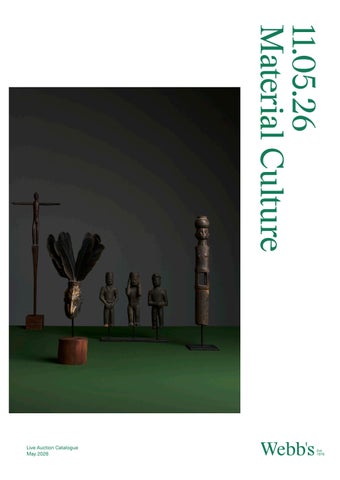
This auction brings together works that exist at the fertile intersection of presence and absence. Some are fragments of cultures irrevocably altered, others are enduring expressions of continuity. Each carries a duality: they are at once grounded in specific places and histories, yet also untethered, having travelled far beyond their points of origin. To engage with them is to navigate these tensions between reverence and curiosity, preservation and change.
Among the highlights is an extraordinary male huia, a taxidermy specimen of one of Aotearoa’s most storied and now extinct birds. The huia embodies both cultural significance and ecological loss. Its presence in this catalogue is arresting, and is a reminder of what has disappeared, and of the layered meanings objects can accumulate over time. Meanwhile, from the Austral Islands, a finely carved paddle suggests a function beyond the utilitarian. Its surface, densely worked with intricate patterning, points to a ceremonial role. This is an object made to be seen, to signify, and to embody status and cultural expression as much as form.
In contrast, a shield from the Central Desert of Australia speaks to protection and assertion; a surface alive with pattern, carrying stories of country, kinship, and survival in one of the world’s most demanding environments.
He taonga nō ngā tūpuna, he koha mō ngā uri whakatipu. (A treasure handed down from the ancestors is a gift for future generations)
Material culture does not sit still. It moves across oceans, through hands, between use and meaning gathering both narratives and interpretations as much as patinas and age.
The objects gathered in this catalogue are not fixed in the past, but rather serve as evidence of motion, exchange, and encounter.
They speak not only to where they come from, but to the journeys they have taken and the shifting contexts that continue to shape them.
These works, though disparate in geography and purpose, share a common thread: they are shaped by relationships between people and land, maker and material, object and meaning. They remind us that material culture is not passive; it is active, performative, and often deeply political, even when its language is quiet.
This offering spans continents and centuries, and reflects not only the diversity of global traditions, but also the complex pathways through which these objects have been collected, preserved, and presented. As always, we acknowledge the responsibility inherent in this role as temporary custodians of works that carry deep cultural weight. We invite you to engage with this catalogue not as a static collection, but as a series of crossings between past and present, origin and destination, object and observer. In doing so, perhaps we come closer to understanding not just the objects themselves, but the worlds they continue to inhabit.
Protected Objects Act 1975
*Please note that a number of taonga in this catalogue have been Y Registered under the Protected Objects Act (1975). Under the terms of this act, to purchase any Y registered item you must be a registered collector. Any taonga tūturu registered under this act may not be sold to non-New Zealand residents nor leave the country without the explicit written consent by Manatū Taonga—Ministry for Culture & Heritage.
To become a registered collector, you must apply to the Ministry for Culture & Heritage. For further information on Y registration and registered items in this catalogue, contact our specialist team.
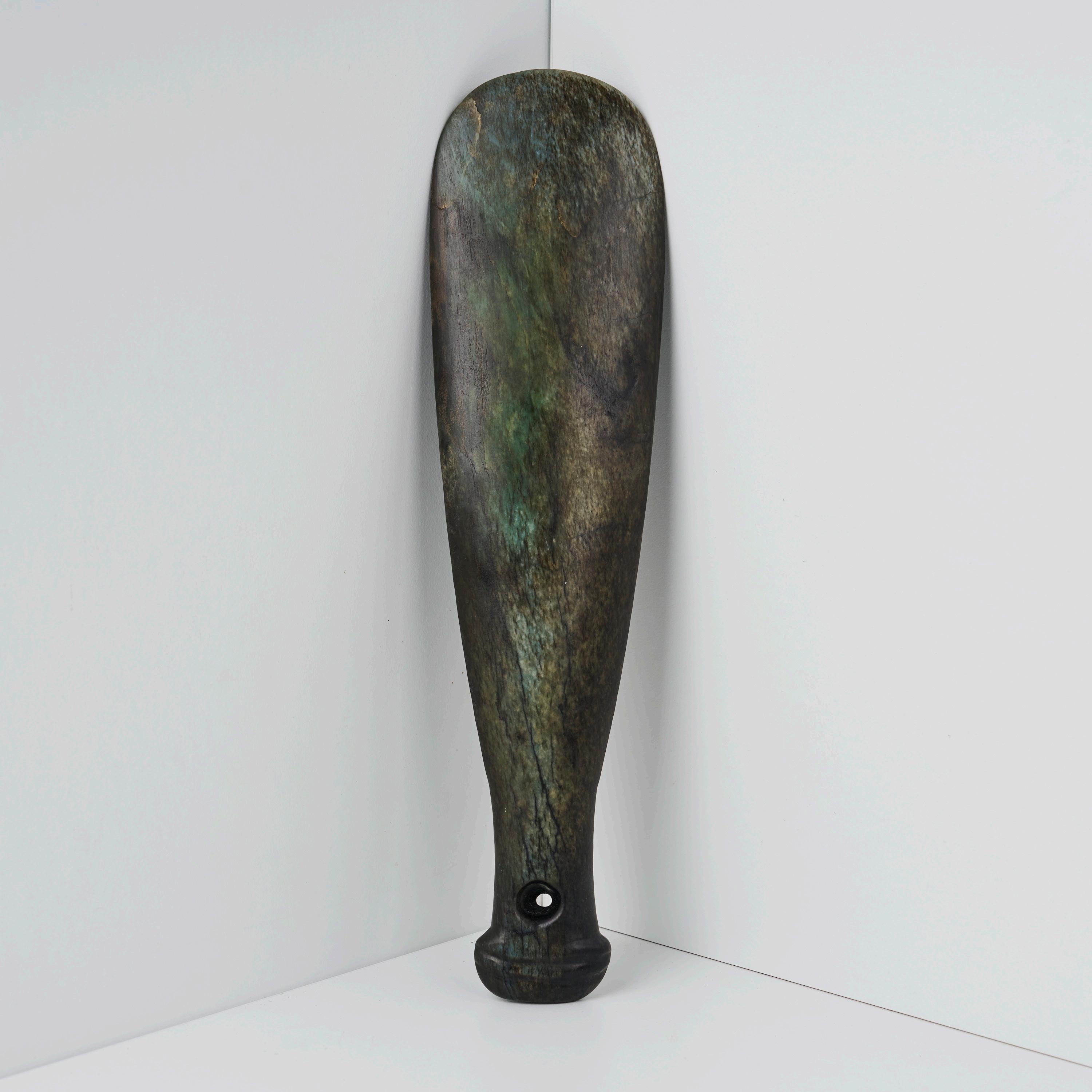
22 An 18th Century Pounamu Mere, Aotearoa
A finely worked example of an 18th-century Māori mere pounamu, fashioned from a vibrant green stone interspersed with distinctive silvery veining, possibly the result of historical firing or exposure to intense heat. The mere is elegantly tapered with a rounded blade, polished to a satin sheen, and terminating in a pierced butt for suspension.
The mere is a short, flat-bladed hand weapon, traditionally used in close combat by warriors. Though modest in size, its effectiveness lay in the skill of its wielder and the strength of the stone. It was used with powerful thrusts and strikes to the temple or ribs, making it a fearsome tool. H315 W80 D20mm Y1738*
est $30,000—$35,000
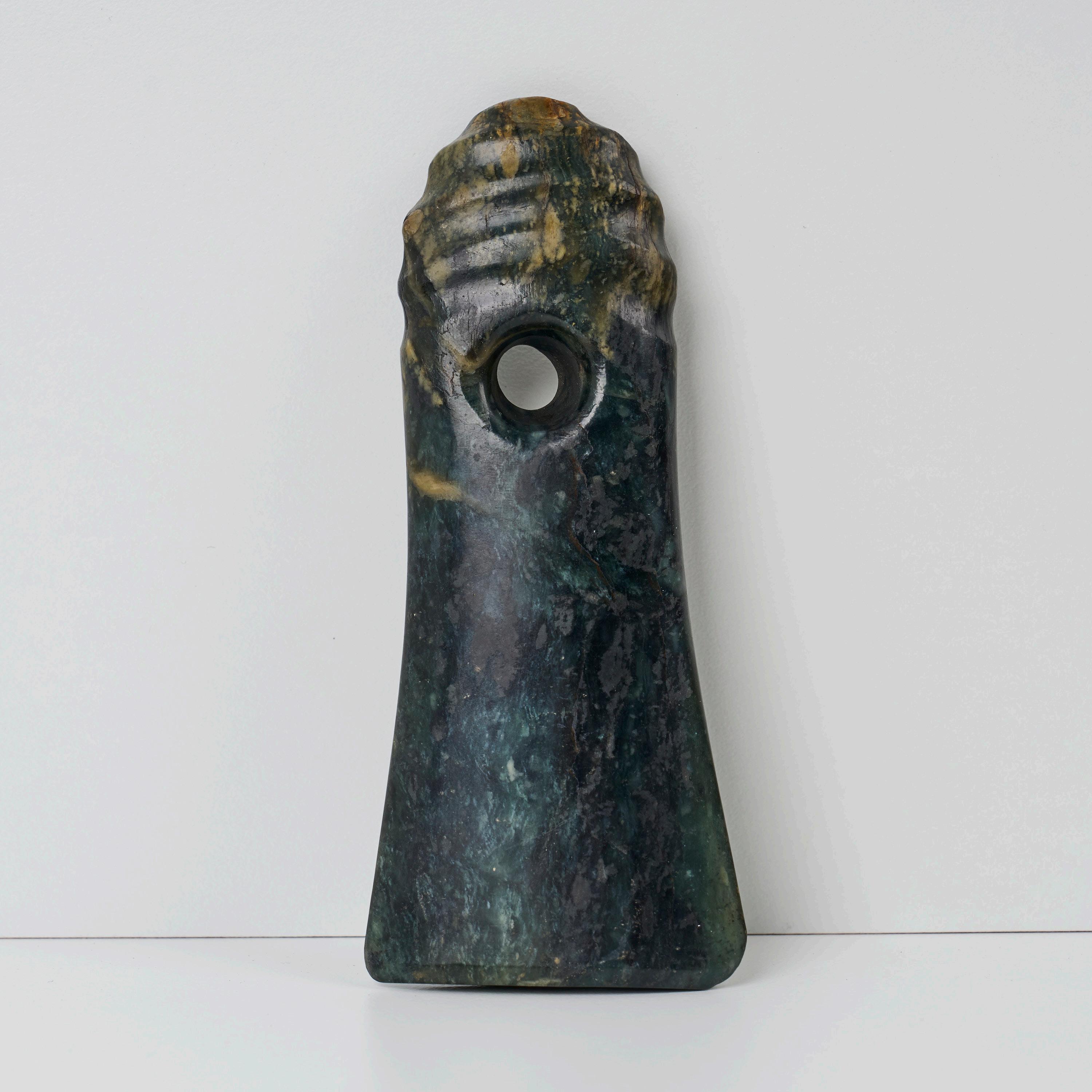
24
This object comprises the surviving handle or grip end of a mere pounamu, with the blade either lost through damage or deliberately removed. The characteristic drilled hole and gently tapering form retain clear evidence of its original function as a hand-held weapon. The truncated end has been carefully flattened and smoothed, suggesting deliberate reworking. Such modifications are understood as culturally significant acts, allowing damaged taonga to remain present and meaningful rather than being discarded. Whether worn on the body, carried, or retained as a treasured fragment, the careful adaptation of the object reflects an intention to preserve the mana and ancestral associations of the original mere. L140 W60 D20mm Y15414*
est $4,000—$8,000
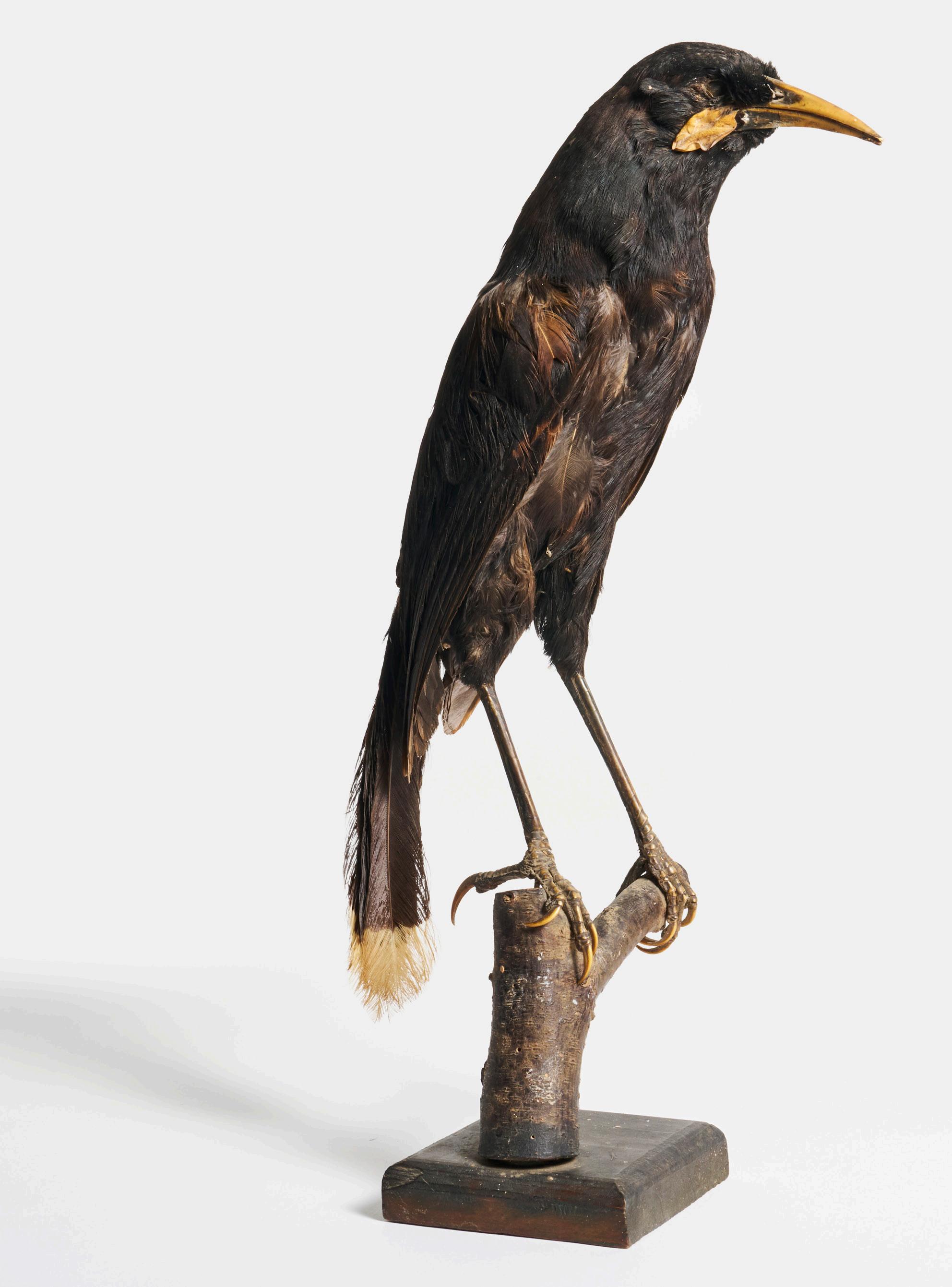

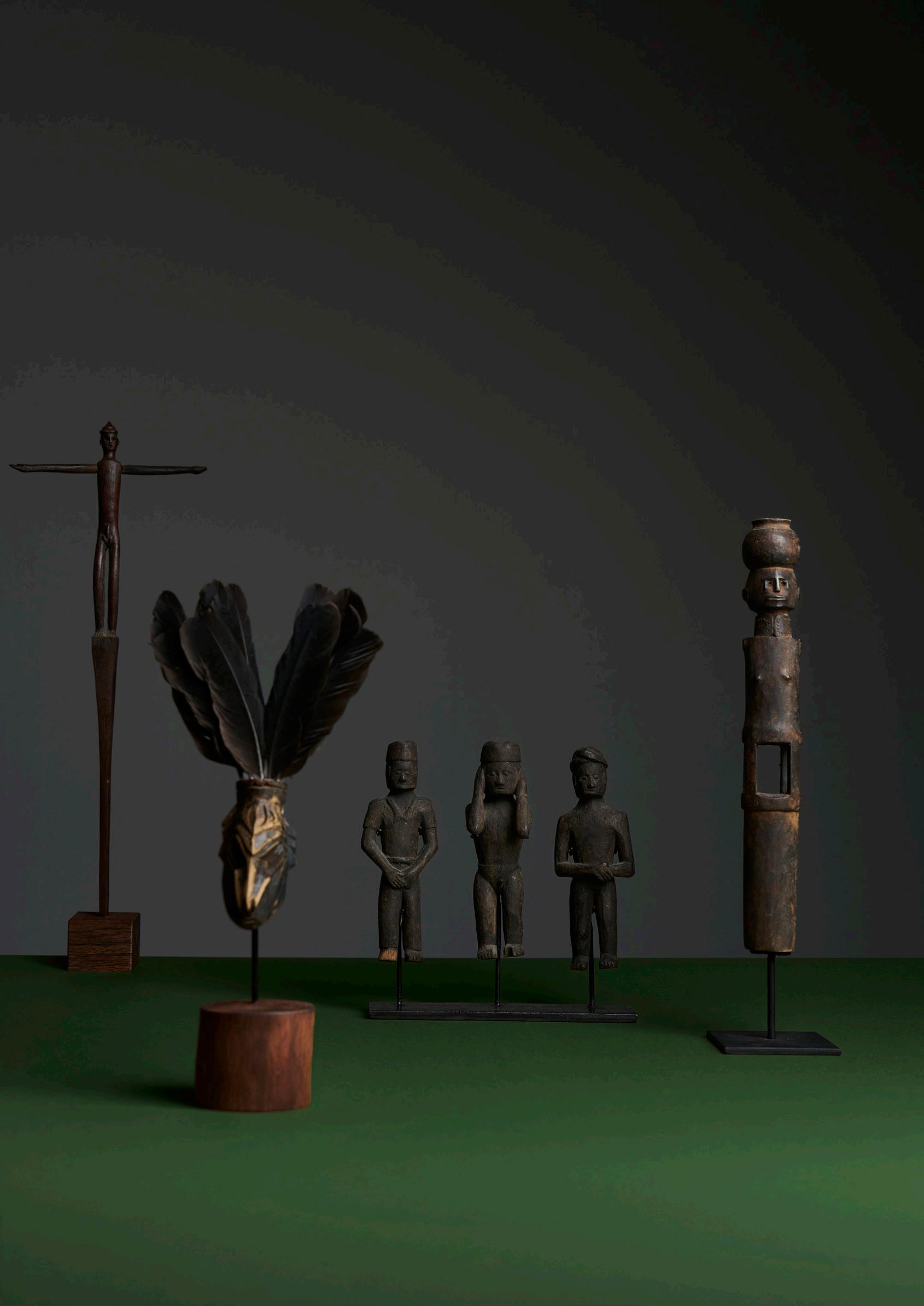
39 A Taxidermy Male Huia, Aotearoa
Today Huia exist only in memory and in a small number of preserved historical specimens such as this one.
The huia was renowned for one of the most striking examples of sexual dimorphism in the avian world. The male, represented here, bears a shorter, stouter bill shaped for chiselling and probing hardwood, complementing the female's longer, curved bill used to extract insects from deep crevices. This ecological partnership of two different bodies evolved for a shared task, has long been understood as emblematic of balance and interdependence in nature. In life, the huia moved through lowland forests in bonded pairs or small family groups, its calls carrying through the canopy like softly struck notes on wood.
For Māori, the huia occupied a place of profound cultural significance. Its tail feathers (rau o te huia) were worn by rangatira as markers of chiefly status, authority, and mana. The bird itself was protected by strict tikanga. Feathers were often gifted rather than taken, and the bird's killing was governed by ritual and seasonal practice. To encounter a huia was not merely an observation of nature, but an event infused with meaning, responsibility, and respect.
European arrival in the nineteenth century altered this equilibrium irrevocably. Habitat loss, introduced predators, and intensified hunting driven in part by Victorian demand for specimens and plumes which rapidly reduced huia numbers. By the early twentieth century, the species had passed into extinction, with only unconfirmed sightings reported thereafter. The huia thus became one of the earliest and most poignant symbols of human-driven loss in New Zealand's ecological narrative.
Taxidermic huia specimens, particularly clearly sexed examples, are now exceedingly rare. Many reside in museum collections where they function as scientific references and memorials. Other examples held in private or historic collections, occupy a more ambiguous position as objects of contemplation and stewardship. This male specimen should be understood not as an ornament, but as a historical document preserving stories of Aotearoa's environment, and human relationships with the natural world.
est $20,000—$40,000
A
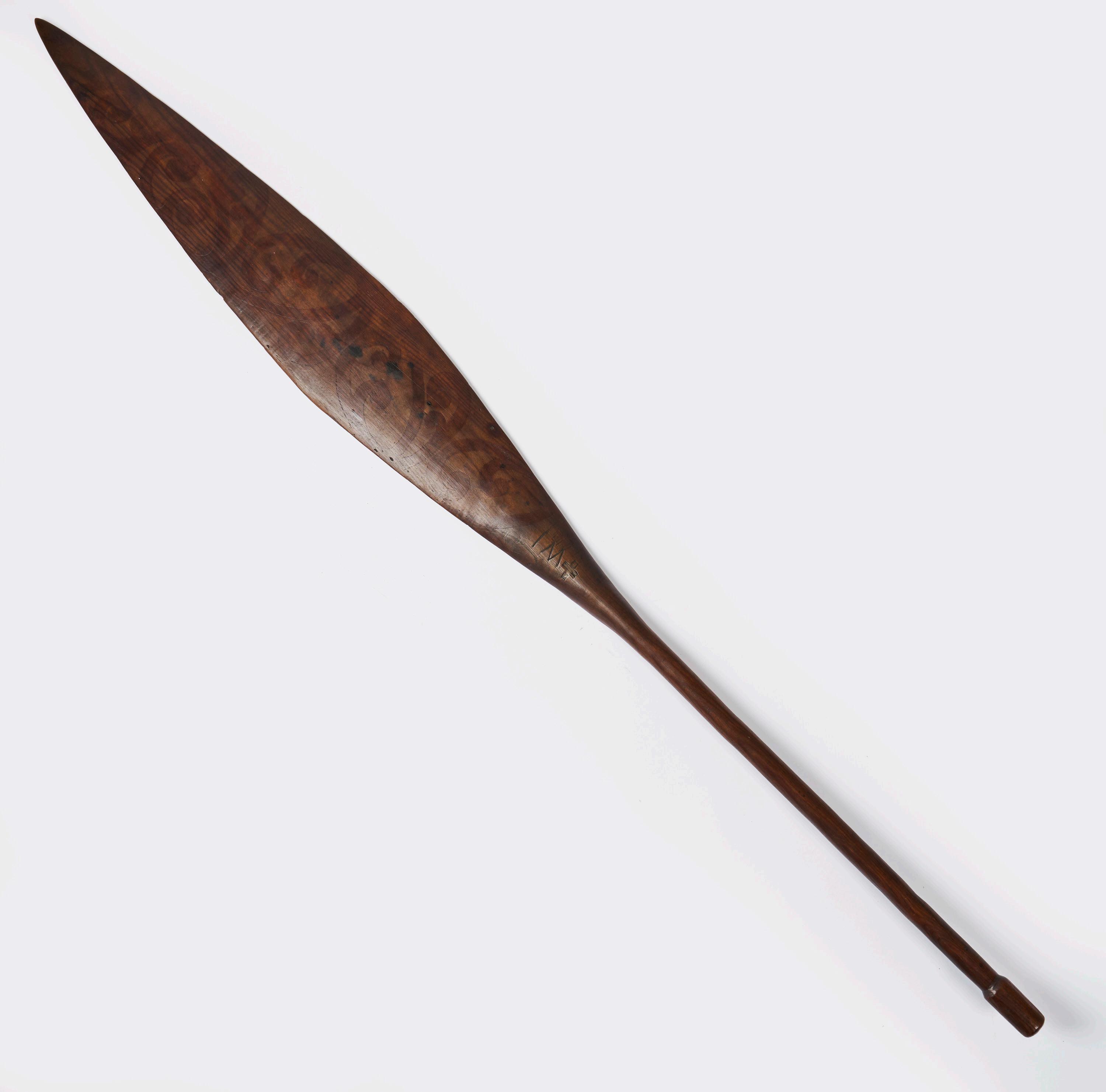
This large waka hoe is finely carved from native timber, its elongated blade and tapering shaft reflecting the elegance and functionality of traditional Māori paddling implements. The surface of the blade is adorned with lightly etched kōwhaiwhai-inspired design. L1675 W170 D38mm Y23254*
est $4,000—$8,000
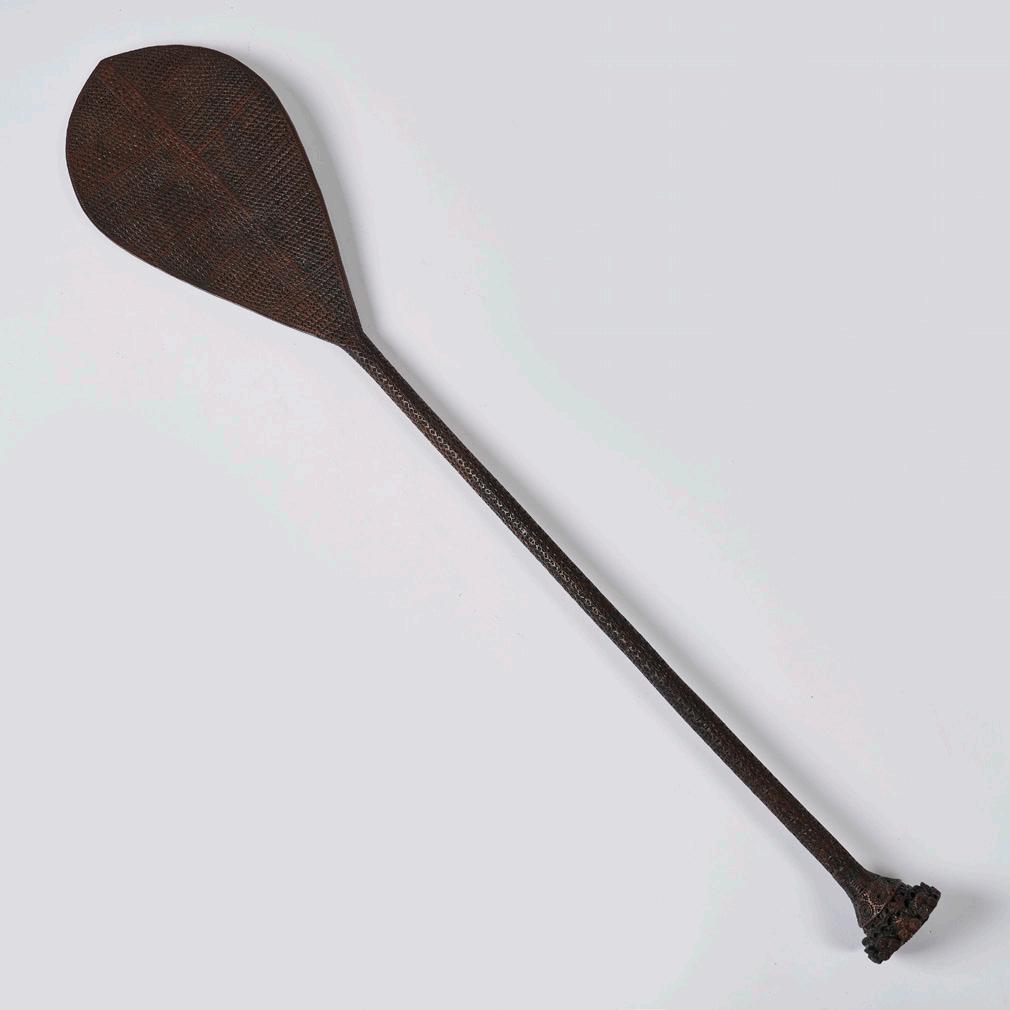
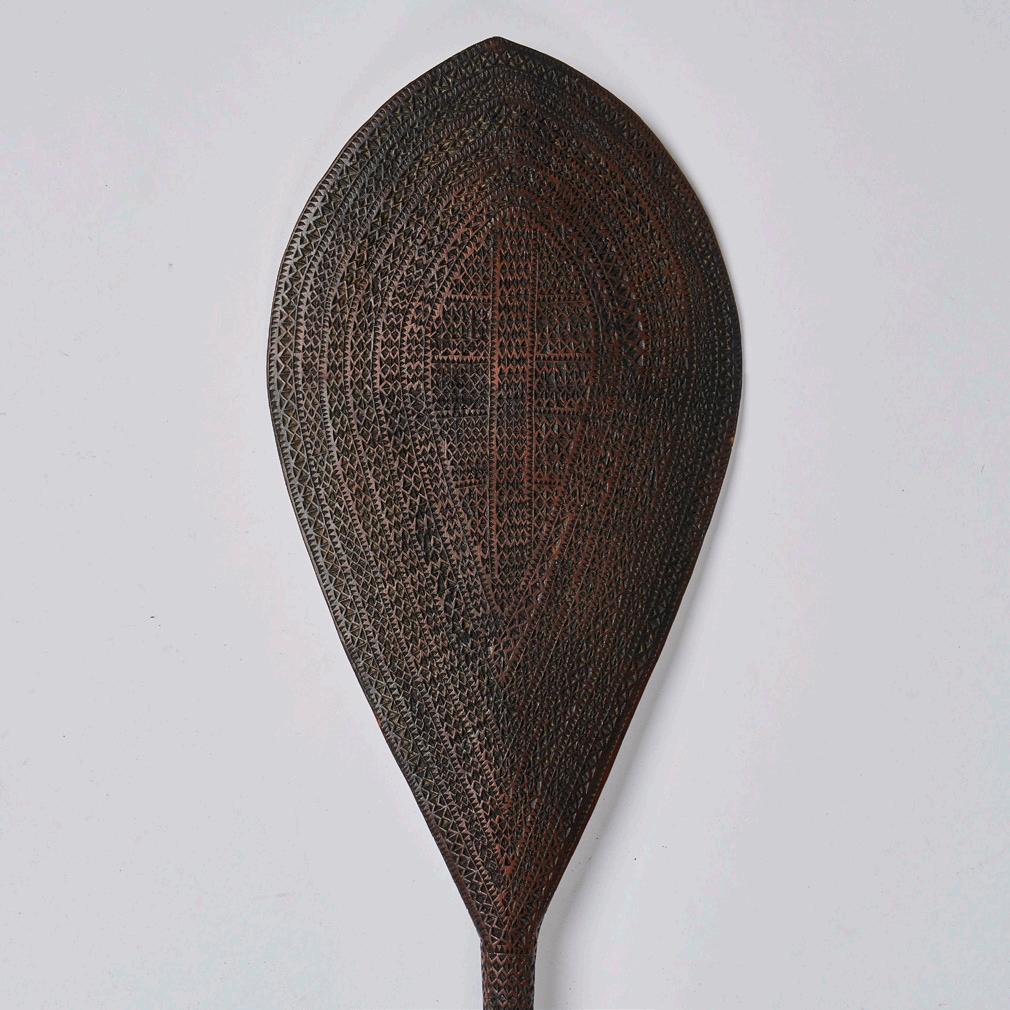
26 A Paddle, Austral Islands
This ceremonial paddle is carved over its entire surface, front and back, with dense lozenge and chevron motifs forming a continuous, unified design. The completeness and precision of the carving reflect an extraordinary investment of time and skill, clearly indicating that the paddle was not intended for practical use, but functioned as a prestige and ceremonial object.
Paddles of this type entered European collections in the late 18th and early 19th centuries and played an important role in shaping early European understandings of Polynesian art. Fully carved examples from the Austral Islands are now regarded as among the most refined sculptural works of Polynesia. L1240 W240 D80mm
Provenance: Private Collection Queensland 1940s. Private Collection Auckland.
est $15,000—$18,000
8 A Central Dessert Shield, Australia
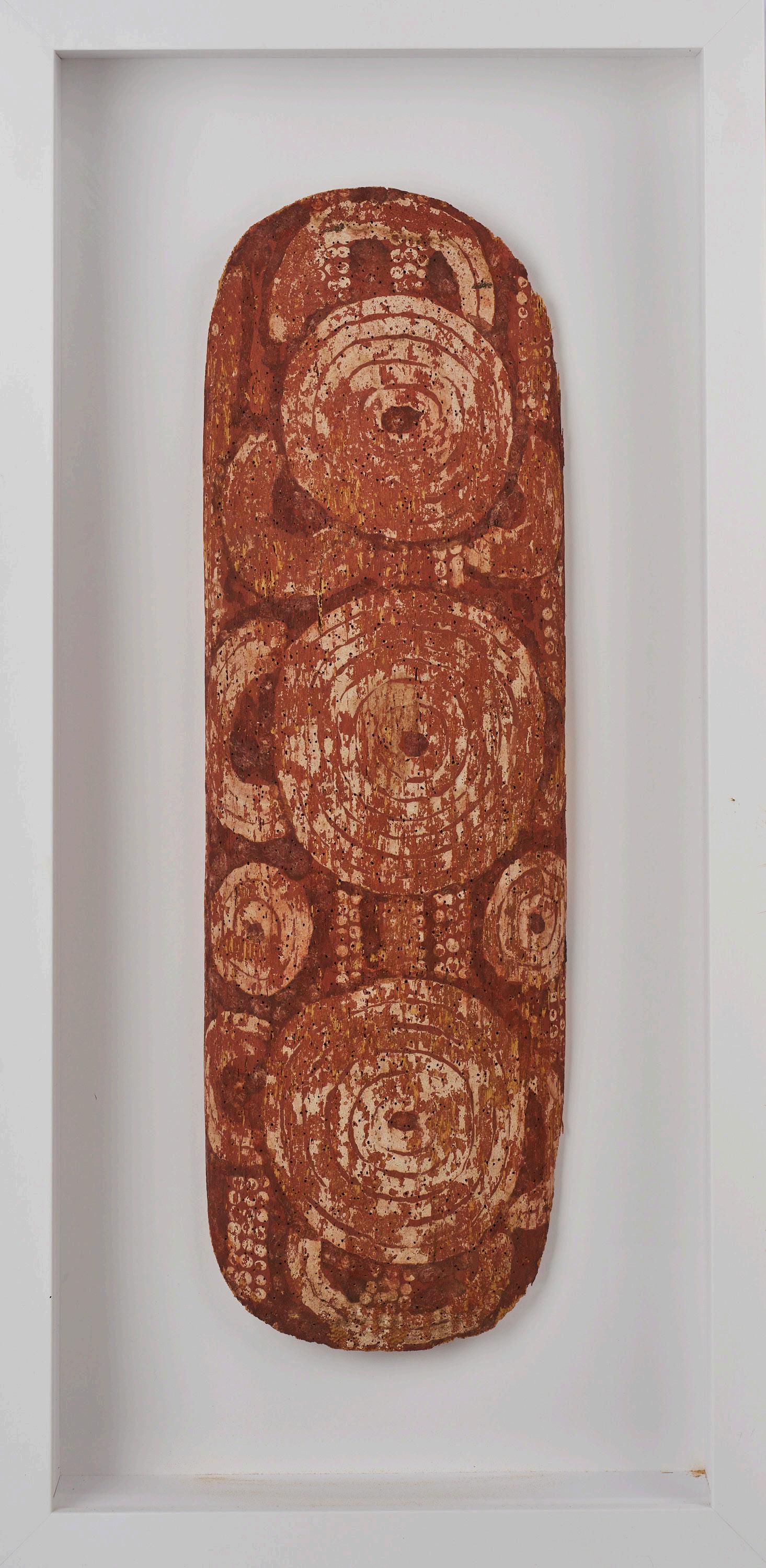
Carved from native hardwood, this shield reflects Central Australian decorative traditions where painted designs carry both visual and cultural significance. In use, shields of this type functioned in close-contact combat and ceremonial display, their weight and form designed for rapid defensive movement as well as visual signalling of identity and affiliation.
The painted surfaces are not purely decorative, they form part of a broader visual language in which pattern, gesture, and material are connected to place and knowledge systems. Each shield can be highly individual, reflecting the hand of the maker and the specific cultural context in which it was produced. Shield L560 W180mm, frame 790 × 390mm
Provenance: Collected by E.K. Young (1896-1980) in the 1930s-40s.
est $6,000—$8,000
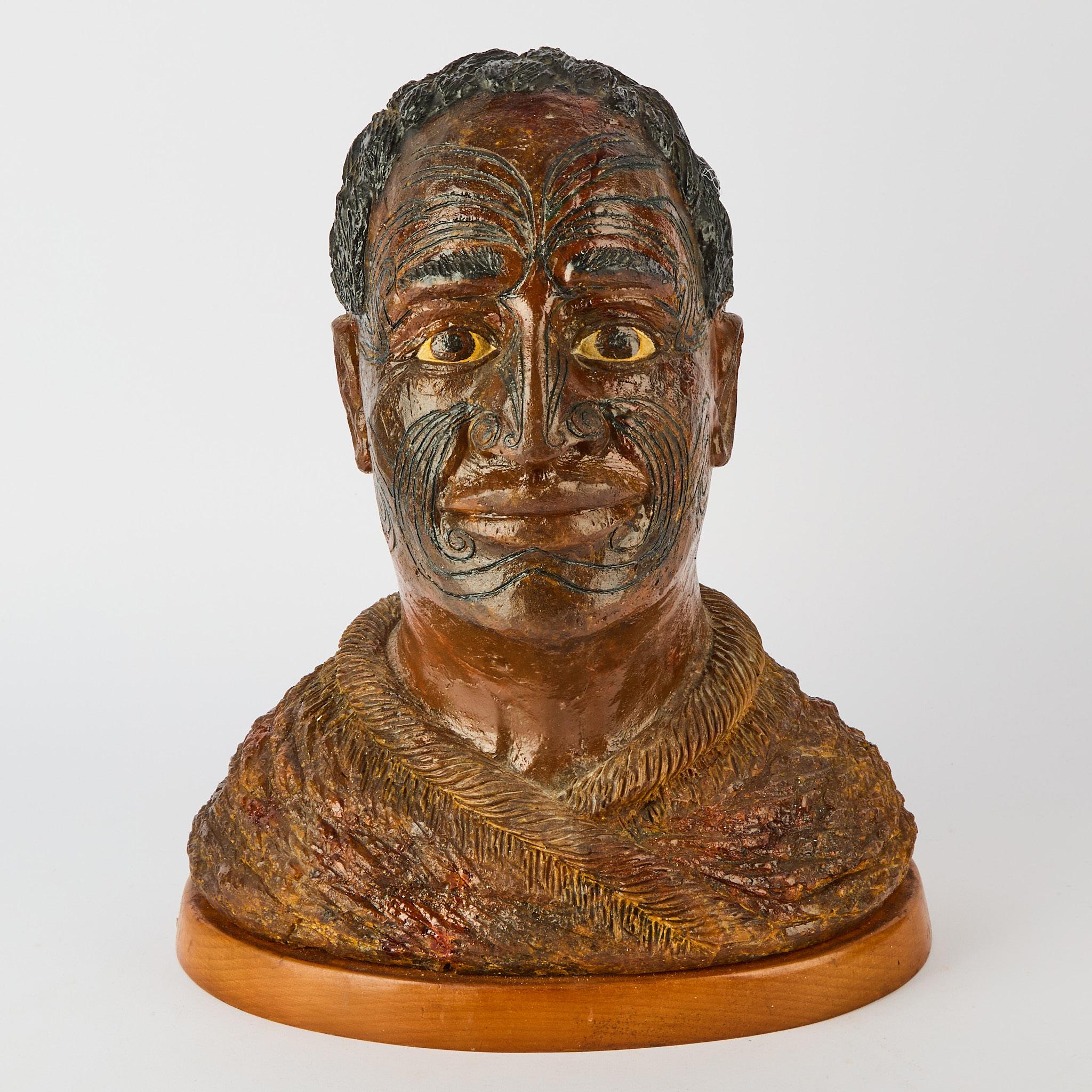
38 A Large Kauri Gum Bust, Aotearoa
Carved from kauri gum, this substantial bust demonstrates the distinctive warmth and translucency characteristic of the material, formed over millennia through the fossilisation of resin from the native kauri tree. Kauri gum carving holds a distinctive place within Aotearoa’s material culture, particularly in the late 19th and early to mid-20th century when the material was widely collected and fashioned into decorative and sculptural works. H370 W310 D200mm
est $10,000—$13,000
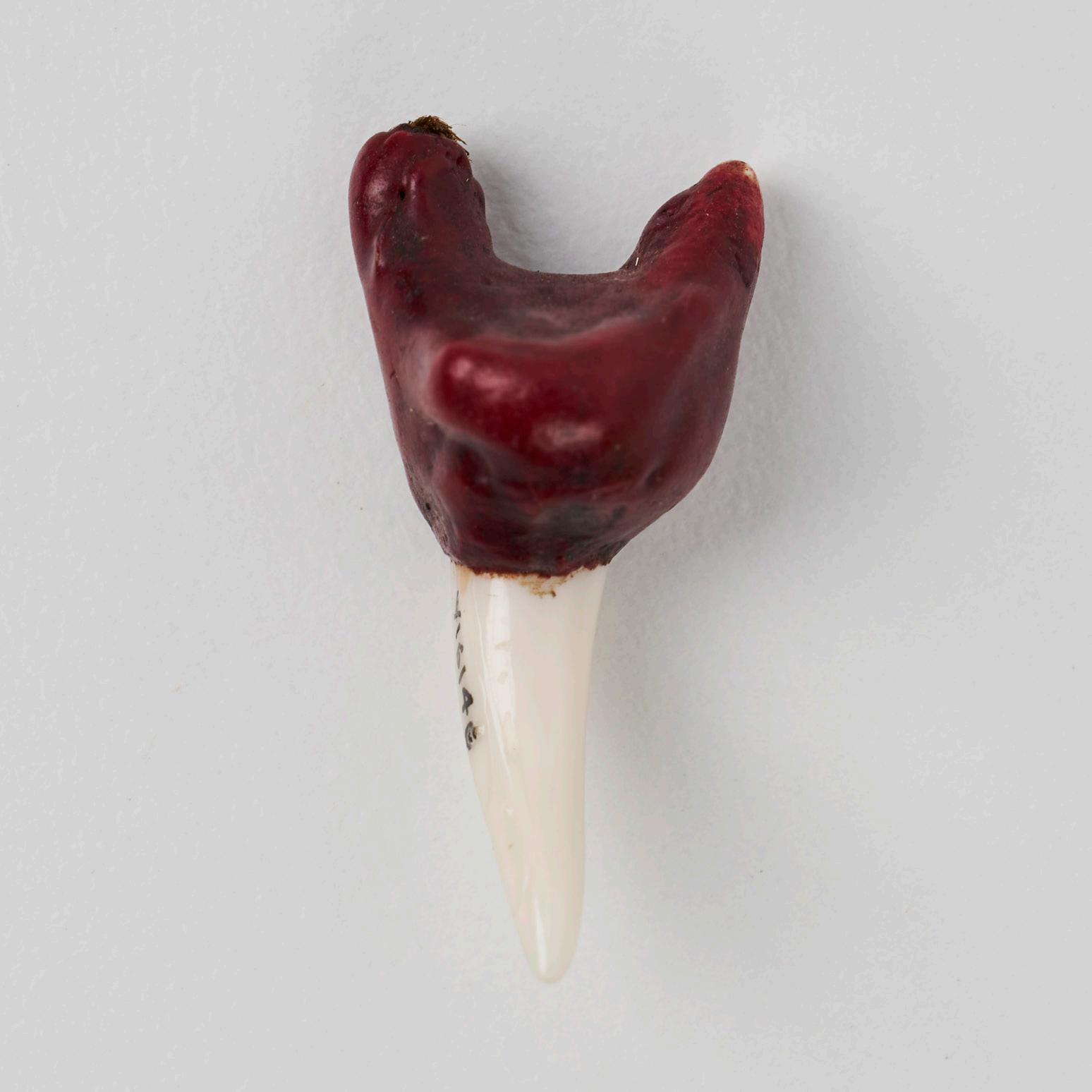
1 A Mako Shark Tooth Pendant, Aotearoa
Shark tooth ear pendant. Early Māori ear pendant in the form of mako shark tooth. Decorated to the upper section with trade sealing wax. The inclusion of sealing wax places the piece within the transitional or early contact period, reflecting the incorporation of introduced materials into established forms of adornment. Rather than displacing customary practice, such materials were adapted to suit existing aesthetic and functional needs. L40 W19 D19mm Y16146*
est $500—$800
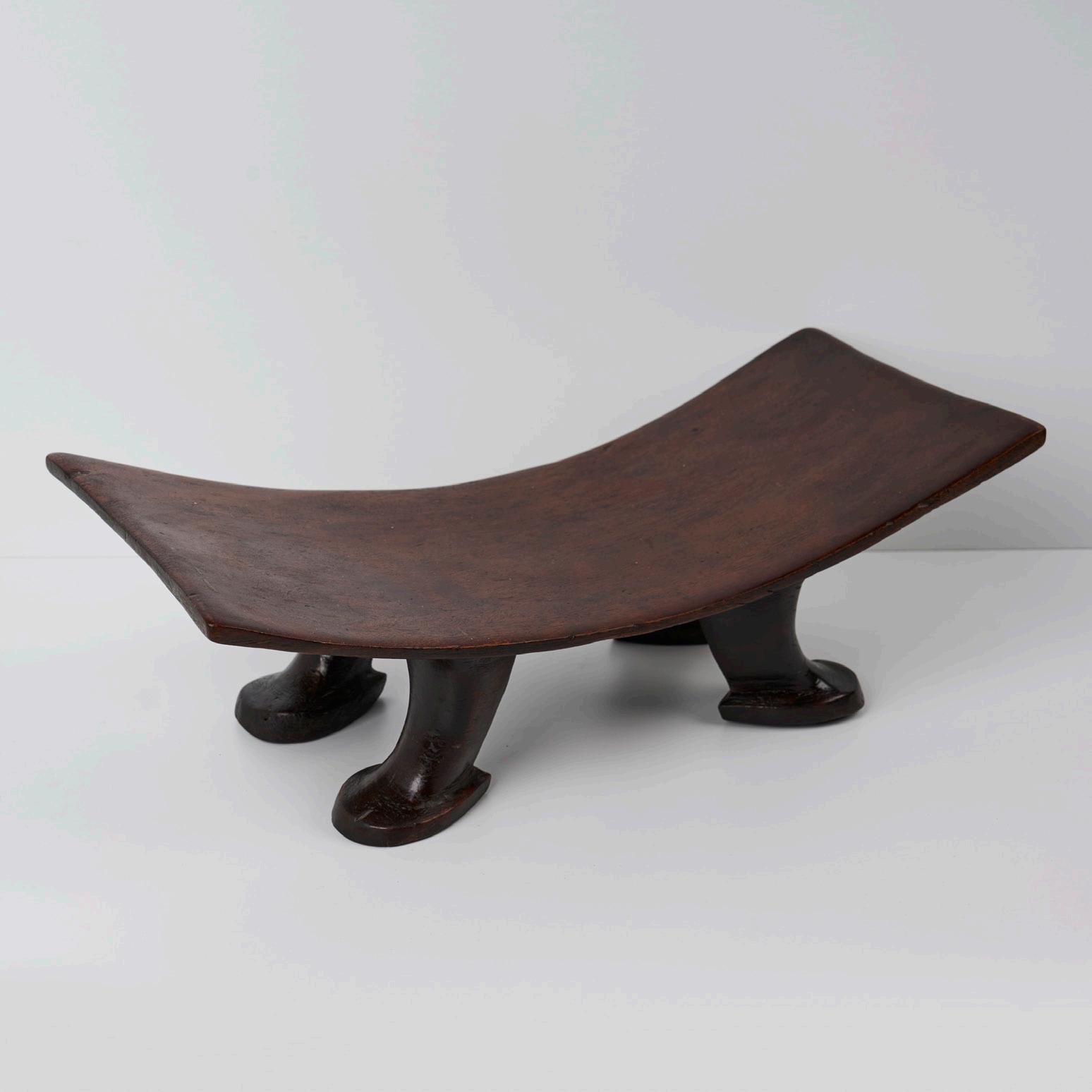
4 A No’oanga Chief Stool, Cook Islands
The No’oanga is a ceremonial stool closely associated with chiefly authority in the Cook Islands. It functioned as a seat of rank rather than domestic furniture, used on significant occasions such as councils, ritual gatherings, and formal encounters where leadership and social order were made visible. To sit upon a No’oanga was to occupy a recognised position of authority. H160 W480 D235mm
est $2,000—$3,000
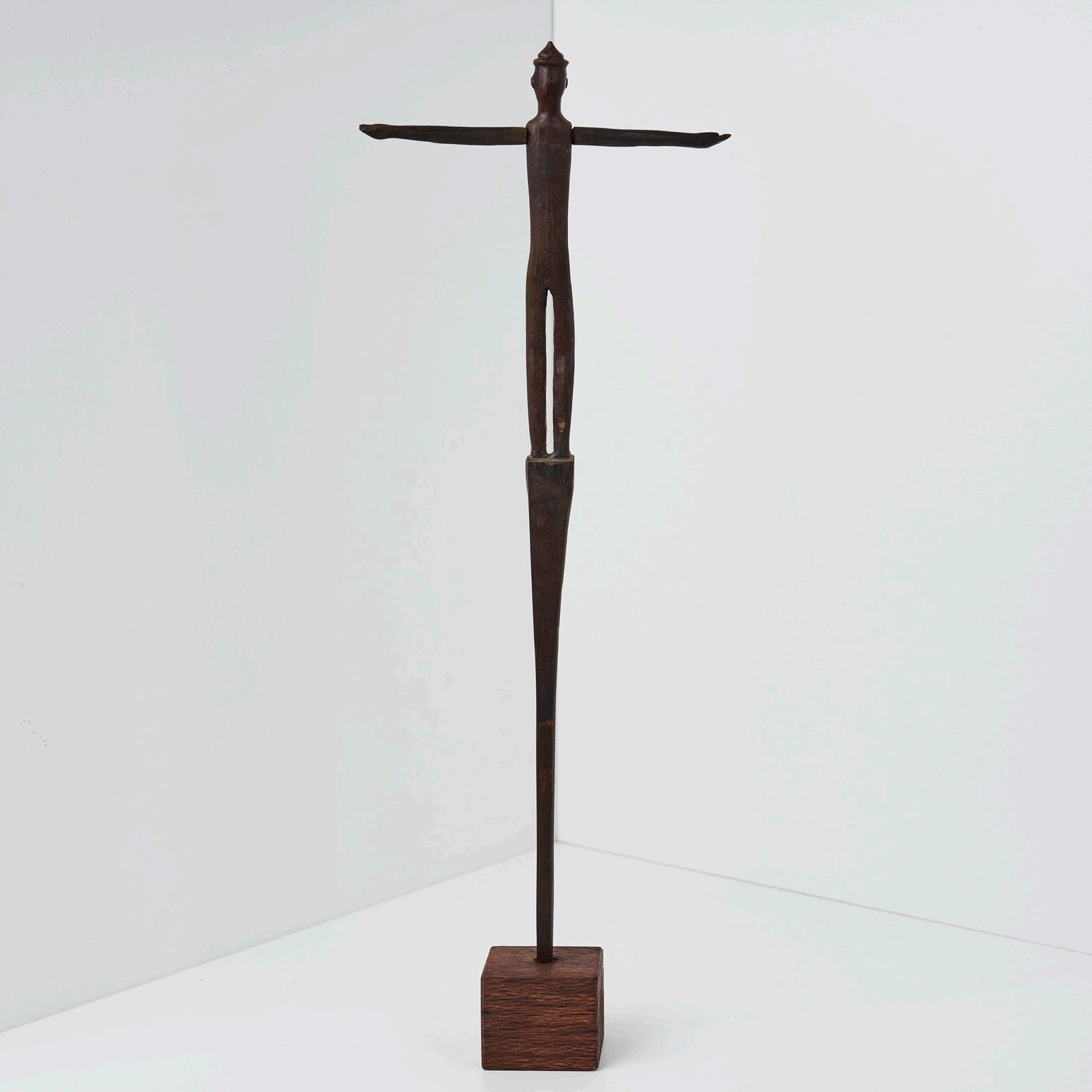
53 A Wood Figure, Borneo
This carved wooden figure is a ritual object from Borneo, commonly described as a fetish, made to serve as a focus for spiritual presence and protective power. The figure is rendered in a strongly elongated form, with outstretched horizontal arms, a simplified torso, and a tapered lower section designed to be planted in the ground or fixed into a structure. Rather than being viewed as static sculpture, this fetish should be understood as an active instrument within systems of belief and practice.Mounted on a wood stand. On stand H430 W155 D20mm est $150—$250
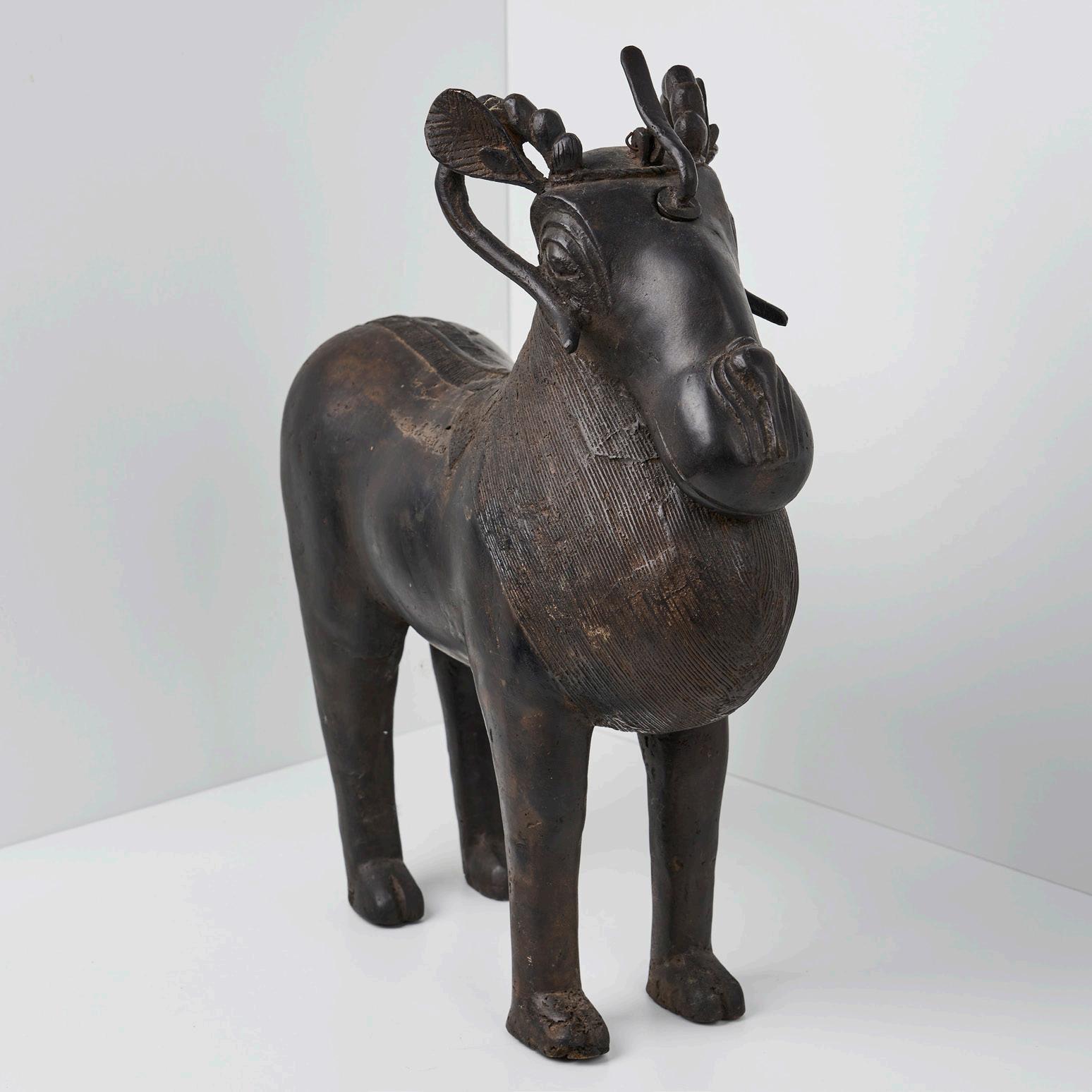
59 A Cast Bronze Alloy Ram, Nigeria
This cast bronze figure of a goat reflects the long-established metalworking traditions of southern Nigeria, where lost-wax casting techniques have been practiced for centuries. The animal is rendered with a balance of naturalism and stylisation, its body simplified into solid, rounded forms while retaining a sense of alertness and presence. H440 W120 D410mm Provenance: Purchased from GALERIE Rheinland in 2011.
est $800—$1,200
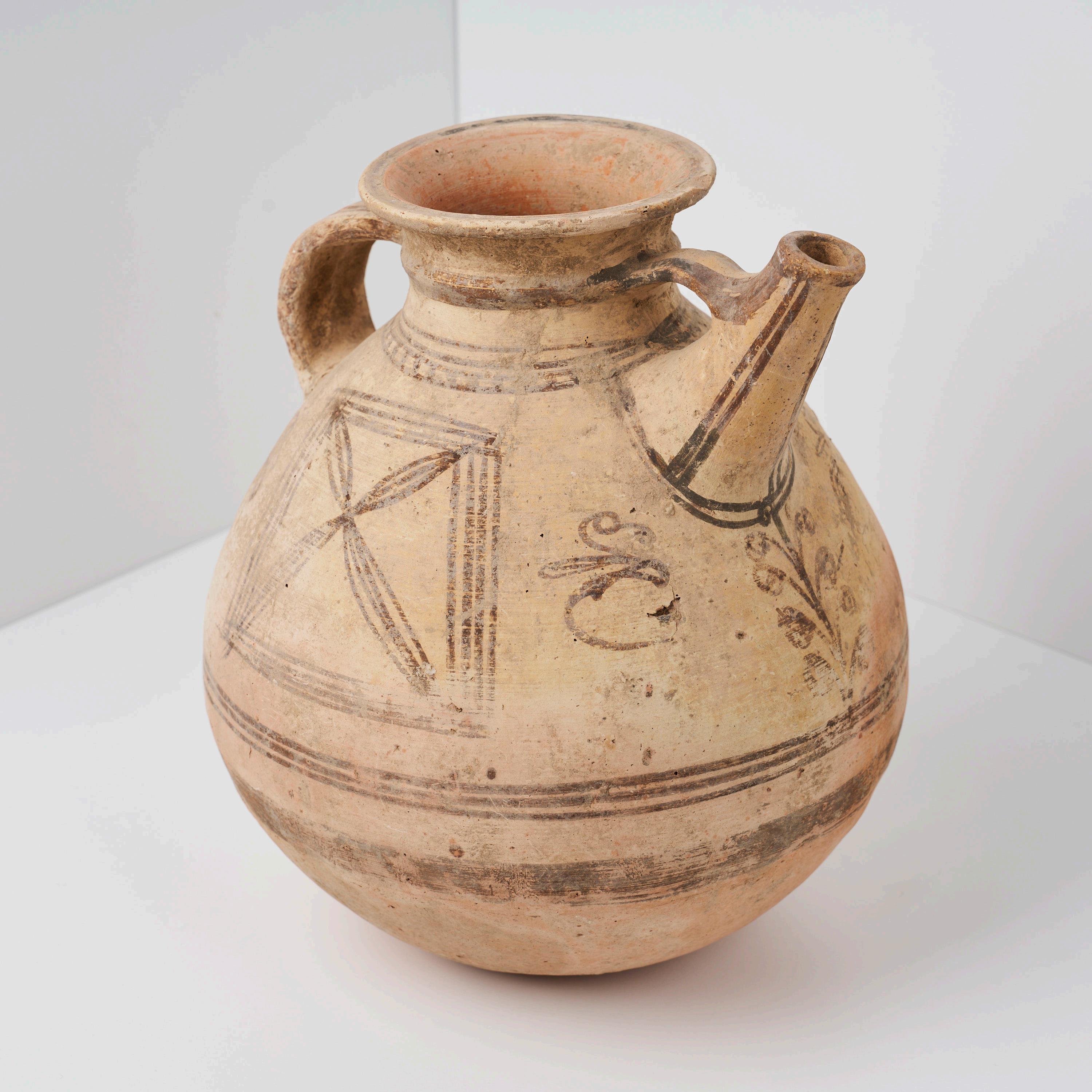
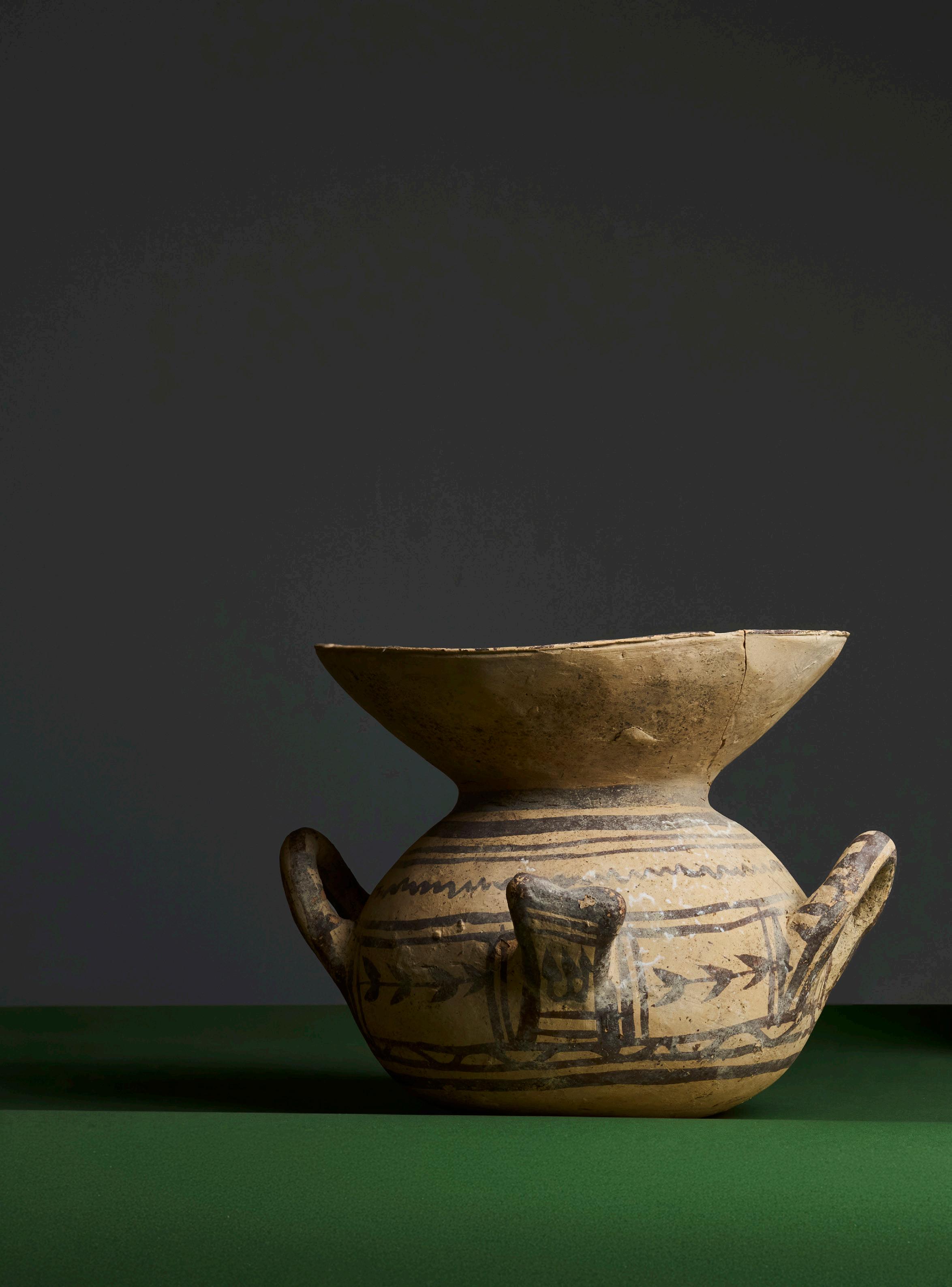
A terracotta vessel with broad bulbous body with rounded underside, trumpet-shaped neck, strap handle, a spout with supporting strap, decorated around with lineal and floral decoration. Such vessels are characteristic of early Persian domestic wares, where simple but functional shapes were produced for everyday household use, often in locally sourced clays and fired in basic kilns. H300 W250mm
est $2,000—$2,400
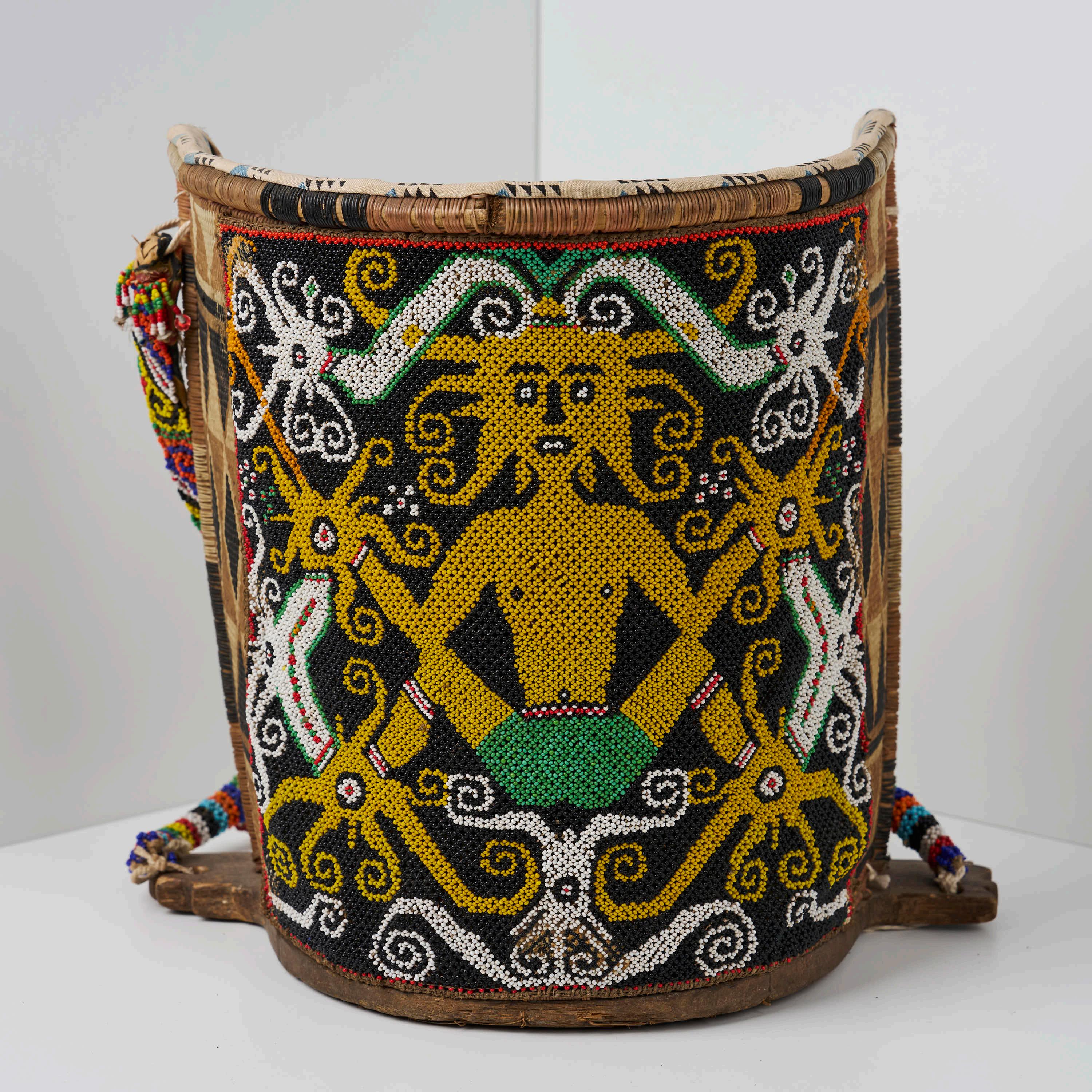
98 A Baby Carrier, East Kalimantan, Borneo
This baby carrier from East Kalimantan is a finely made example of Dayak material culture, combining practical function with rich symbolic decoration. The rigid basket structure is constructed from woven rattan and plant fibres, designed to securely support and protect an infant while being carried on the back. Attached wooden elements at the base provide stability when the carrier is set down.
The large central figure is most commonly interpreted as an aso, a powerful protective spirit being widely represented in Dayak art from East Kalimantan and surrounding regions. The aso is often described as a composite, dragon- or dog-like creature with elongated limbs, curling appendages, and a frontal, symmetrical presentation. In beadwork and carving, it is typically rendered in highly stylised form rather than naturalistic detail, as seen here. H290 W330 D170mm est $599—$800
1 A Mako Shark Tooth Pendant, Aotearoa
Shark tooth ear pendant. Early Māori ear pendant in the form of mako shark tooth. Decorated to the upper section with trade sealing wax. The inclusion of sealing wax places the piece within the transitional or early contact period, reflecting the incorporation of introduced materials into established forms of adornment. Rather than displacing customary practice, such materials were adapted to suit existing aesthetic and functional needs. L40 W19 D19mm Y16146*
est $500—$800
2 A Large Matau Fishing Hook, Aotearoa
This large matau is carved from native wood into a robust “U” shaped form with a single internal shank, its scale suggesting use in the taking of sizeable fish. The hook is fitted with finely braided muka lashing, securing the line attachment and demonstrating skilled fibre-working techniques integral to Māori material culture. Within Māori fishing traditions, such hooks were more than utilitarian tools: they embodied inherited knowledge of the sea, seasonal rhythms, and whakapapa relationships to the natural world. As such, thismataureflects both practical ingenuity and the cultural values embedded in customary food-gathering practices in Aotearoa. L158 W115 D30mm Y22615*
est $2,500—$3,000
3 A Mako Shark Tooth Pendant, Aotearoa
An ear pendant formed from a mako shark tooth, its elegant, tapering shape preserved with minimal alteration. A small perforation has been carefully made at the base of the tooth to allow for suspension, an understated intervention that maintains the integrity of the form while enabling its function as adornment. With collection number ‘47345’ written in black ink. L31 W17 D8mm Y15638*
est $600—$800
4 A No’oanga Chief Stool, Cook Islands
The No’oanga is a ceremonial stool closely associated with chiefly authority in the Cook Islands. It functioned as a seat of rank rather than domestic furniture, used on significant occasions such as councils, ritual gatherings, and formal encounters where leadership and social order were made visible. To sit upon a No’oanga was to occupy a recognised position of authority. H160 W480 D235mm
est $2,000—$3,000
5 A Dari Ni Waiwai Ni Bete Priest’s Dish, Fiji
The dari ni waiwai ni bete is a ritual dish associated with the bete, or priest, in pre-Christian Fijian society. Objects of this type were used in ceremonial contexts connected to religious practice, including the preparation of offerings, presentation of ritual substances, and acts of mediation between the human and spiritual realms. Their form combines functional clarity with symbolic authority, reinforcing the elevated role of the bete as an intermediary between ancestral forces, spirits, and the community. As such, this example stands as a powerful expression of Fijian religious life. H75 W170 D305mm
est $1,000—$2,000
6 A Kali Hahapo Headrest, Tonga
This kali hahapo headrest was used beneath the head or at the back of the neck while sleeping or resting, elevating the head to protect carefully styled hair and to provide comfort in Tonga’s warm climate. It is carved from a single piece of hardwood without joins, demonstrating technical confidence and an assured understanding of the material’s strength and grain. H180 W630 D130mm
est $1,500—$3,000
7 A Wunda Shield, Australia
This Wunda shield is a striking example of Australian Aboriginal defensive weaponry, distinguished by incised line designs on both faces. Wunda shields were used primarily in armed conflict to deflect spears, clubs, and other projectiles. Their narrow profile reflects fighting styles that emphasized agility and precise movement rather than bodily enclosure. L720 W145 D40mm
est $2,000—$2,500
8 A Central Dessert Shield, Australia
Carved from native hardwood, this shield reflects Central Australian decorative traditions where painted designs carry both visual and cultural significance. In use, shields of this type functioned in close-contact combat and ceremonial display, their weight and form designed for rapid defensive movement as well as visual signalling of identity and affiliation. The painted surfaces are not purely decorative, they form part of a broader visual language in which pattern, gesture, and material are connected to place and knowledge systems. Each shield can be highly individual, reflecting the hand of the maker and the specific cultural context in which it was produced. Shield L560 W180mm, frame 790 × 390mm
Provenance: Collected by E.K. Young (1896-1980) in the 1930s-40s.
est $6,000—$8,000
9 A Papunya Kutitji Parrying Shield, Northern Territory, Australia
This Wunda parrying shield from Papunya in the Northern Territory is a finely made example of Central Australian Aboriginal defensive weaponry, designed for agility, precision, and close engagement rather than broad bodily coverage.L820 W180 D100mm
est $1,000—$1,500
10 A Lamp with Warrior Motif, Ancient Rome
3rd Century CE, Roman North Africa
Made from terracotta, this moulded oil lamp features a central decorative motif of a figure holding a sword and shield. The form is typical of Roman provincial lamp production, combining practical function with narrative and symbolic relief decoration. Such lamps were widely used in domestic and civic settings, providing both light and a surface for visual storytelling. The warrior imagery reflects common Roman iconographic themes associated with strength and protection. H60 W138 D80mm
est $200—$300
11 A Trio of Oil Lamps, Ancient Rome
Double Spouted lamp Near East, Circa 5th Century BCE H45 W65 D90mm, H42 W62 D76mm, H43 W65 D79mm
est $200—$300
12 A Lamp with Palm and Lion Motif, Ancient Rome
Circa 500 CE, Roman North Africa, likely Tunisia
Made from terracotta, this moulded oil lamp features a central decorative scene of a palm tree flanked by lions, framed by a spiral design around the upper edge. The composition is strongly structured, with the natural and heraldic imagery set within a clearly defined circular field typical of late Roman provincial lamp production. The palm and lion motif draws on widely used symbolic language in North African Roman art. H55 W80 D125mm
est $400—$500
13 A Ceremonial Adze, Choiseul Provence, Solomon Islands
This large ceremonial adze from Choiseul Province is an imposing and highly sculptural example of Solomon Islands stone carving. Carved from a single block of stone, the adze is notable for its monumental scale and carefully modelled form, which clearly distinguishes it from utilitarian woodworking tools. Such objects could function as emblems of leadership, exchange valuables, or sacred items connected to male initiation and ceremonial display. L340 W210 D60mm
Provenance: Ex Private Collection Honiara. Private Collection Auckland.
est $700—$900
14 A Western Provence Large Mortar and Pestle, Solomon Islands
19th century
This rare and imposing mortar and pestle from the Western Province of the Solomon Islands is a highly unusual example of anthropomorphic stone
carving, combining utilitarian form with strong sculptural and symbolic presence. Executed in dense stone, the ensemble is notable for the incorporation ofcarved facial motifs on the exterior of the mortar, a feature seldom encountered in functional grinding implements from the region. Mortars and pestles in the Solomon Islands were used to process substances of both practical and ritual importance such as foodstuffs, pigments, medicines, and ritual materials. Mortar H240 D180mm pestle L310 D50mm
Provenance: Ex Private Collection Honiara. Private Collection Auckland.
est $1,500—$2,000
15 A Ceremonial Adze, Western Provence, Solomon Islands
19th Century
This ceremonial adze from the Western Province of the Solomon Islands is a powerful and highly symbolic object, distinguished by its Janus-form top. Ceremonial adzes from the Western Province occupy a distinctive place within Solomon Islands material culture, where stone objects functioned as conduits of mana and social legitimacy. L210 W135 D52mm. On Stand H170mm Provenance: Ex Private Collection Honiara. Private Collection Auckland.
est $900—$1,000
16 A 19th Century Waka Hoe with Kowhaiwhai Design, Aotearoa
This large waka hoe is finely carved from native timber, its elongated blade and tapering shaft reflecting the elegance and functionality of traditional Māori paddling implements. The surface of the blade is adorned with lightly etched kōwhaiwhaiinspired design. L1675 W170 D38mm Y23254*
est $4,000—$8,000
17 A Segment of Waka, Aotearoa
This carved wooden fragment is a surviving segment from a waka, likely once forming part of the canoe’s side or structural ornamentation. Hewn from a single piece of timber, the surface is worked in low relief with flowing, interlocking forms. Wakawere central to Māori life, functioning as vessels for transport, trade, warfare, and ceremony. H190 W500 D40mm Y2826*
est $4,000—$8,000
18 A Pre European River Hoe, Aotearoa
Hand-carved from dark native timber, this compact river paddle is of pre-European form, designed for precision work in narrow waterways, shallow channels, and controlled river navigation.
The simplicity of the form is characteristic of early Māori watercraft technology, where efficiency, balance, and responsiveness were central to design. As both a utilitarian and culturally embedded object, the hoe speaks to intimate knowledge of inland waterways and the enduring relationship between people and river environments in Aotearoa. L1035 W103 D70mm Y23255*
est $1,200—$2,000
19 A Finely Carved Marble Head, Asia Minor
Finely carved and life sized head of a male. Provenance: With Mayfair Gallery London. Sold at Bonhams circa 1990.
est $12,000—$14,000
20 A Silver Shekel of Tyre, 126 BCE - CE 66
Phoenicia, Dated AD 50-51, 21mm, 14.19gm, laureate bust of Melkart right; Eagle standing left on prow with palm frond in background, Phoenician B between legs, is VF, has usual striking weakness
Despite being of Phoenician origin, these coins held enormous importance inJudea, where they were accepted for payment of the Temple taxin Jerusalem due to their reliable weight and purity. Many scholars believe that the infamous “thirty pieces of silver paid to Judas” Iscariot were Tyrian shekels
est $2,000—$2,200
21 A Replica Bronze Bust of The Man from Delos, Italy
Circa 1930s/40s
This bronze bust is a 20th-century replica of the celebrated Man from Delos, reflecting the Hellenistic tradition of naturalistic portraiture. Cast in southern Italy, it relates to a group of skilled bronze workshops active in the early to mid-20th century, producing copies of classical works held in major museum collections. Drawing on established regional casting practices, such pieces were valued for their fidelity to ancient models and technical finish.
Positioned between reproduction and classical revival, the bust reflects the enduring influence of antiquity in modern material culture. It speaks to a period in which canonical forms were reproduced for collectors and interiors, extending the presence of Hellenistic aesthetics beyond the museum and into everyday contexts H540 W230 D260mm
est $2,500—$3,000
22 An 18th Century Pounamu Mere, Aotearoa
A finely worked example of an 18th-century Māori mere pounamu, fashioned from a vibrant green stone interspersed with distinctive silvery veining, possibly the result of historical firing or exposure to intense heat. The mere is elegantly tapered with a rounded blade, polished to a satin sheen, and terminating in a pierced butt for suspension.
The mere is a short, flat-bladed hand weapon, traditionally used in close combat by warriors. Though modest in size, its effectiveness lay in the skill of its wielder and the strength of the stone. It was used with powerful thrusts and strikes to the temple or ribs, making it a fearsome tool. H315 W80 D20mm Y1738*
est $30,000—$35,000
23 A Patu Parāoa, Aotearoa
18th Century
This patu Parāoa is carved from whale bone and dates to the 18th century, placing it among the earlier surviving examples of Māori hand weapons. The broad, flattened blade and rounded handle are shaped to deliver controlled, close-quarter strikes, while the weight and density of Parāoa give the weapon
considerable impact. The surface shows wear consistent with age and handling, and the material has developed a warm, honeyed patina over time.Repairs are visible at the junction where the handle meets the body, indicating the point of greatest structural stress.Patu Parāoa were more than functional weapons: they were markers of rank, authority, and personal identity, often associated with chiefs or warriors of status.
Patu L390 W105 D35mm, Mount L460 W141mm Y22936*
est $1,500—$2,000
24 A Handle of a Mere Pounamu, Aotearoa
This object comprises the surviving handle or grip end of a mere pounamu, with the blade either lost through damage or deliberately removed. The characteristic drilled hole and gently tapering form retain clear evidence of its original function as a hand-held weapon. The truncated end has been carefully flattened and smoothed, suggesting deliberate reworking.
Such modifications are understood as culturally significant acts, allowing damaged taonga to remain present and meaningful rather than being discarded. Whether worn on the body, carried, or retained as a treasured fragment, the careful adaptation of the object reflects an intention to preserve the mana and ancestral associations of the original mere. L140 W60 D20mm Y15414*
est $4,000—$8,000
25 A Tokotoko, Aotearoa
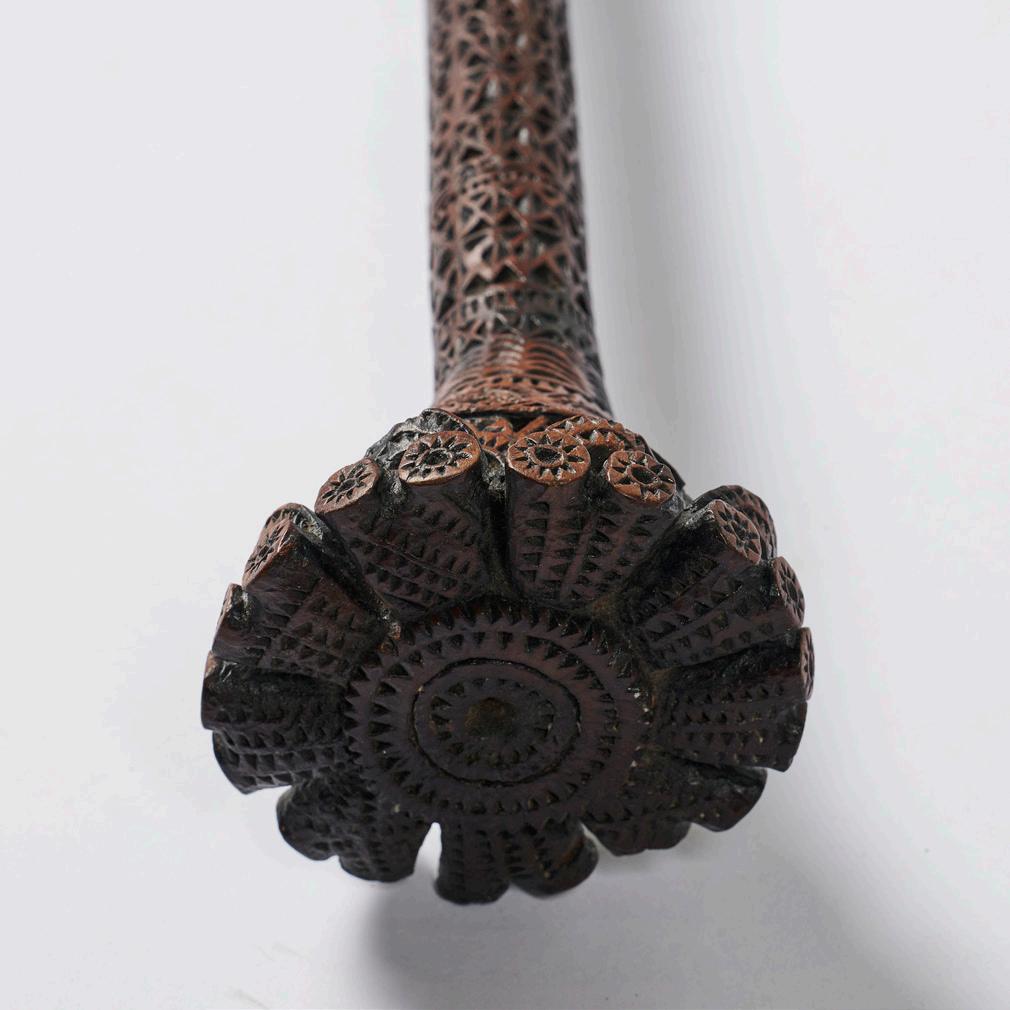
This exceptional tokotoko is an unusually elaborate example of a Māori oratory staff, distinguished by its twisted natural form and dense, full length carving. Carved from a single length of wood that retains its natural spiral growth, the staff displays a dynamic, sinuous profile that enhances its visual presence and authority. The surface is completely worked withdeep relief carving, incorporating multiple stylised human faces.Interspersed between the figures are bands of dog tooth notch patterning. Tokotoko were carried by rangatira (chiefs), tohunga, and skilled orators during whaikārero on the marae. More than a walking staff, a tokotoko functioned as a mnemonic and symbolic tool, used to mark points in speech, invoke ancestors, and assert mana. L880 W39mm Y18108*
est $3,500—$4,000
26 A Paddle, Austral Islands
This ceremonial paddle is carved over its entire surface, front and back, with dense lozenge and chevron motifs forming a continuous, unified design. The completeness and precision of the carving reflect an extraordinary investment of time and skill, clearly indicating that the paddle was not intended for practical use, but functioned as a prestige and ceremonial object. Paddles of this type entered European collections in the late 18th and early 19th centuries and played an important role in shaping early European understandings of Polynesian art. Fully carved examples from the Austral Islands are now regarded as among the most refined sculptural works of Polynesia. L1240 W240 D80mm
Provenance: Private Collection Queensland 1940s. Private Collection Auckland.
est $15,000—$18,000
27 A Carved Tokotoko, Aotearoa
This carved tokotoko is a ceremonial staff traditionally held by an orator during formal speech on the marae. The staff is richly worked along its length with relief carving, incorporating a sequence of stylised figures and interlocking motifs that guide the hand and eye upward to the curved handle. Inlaid pāua shell details punctuate the surface, adding visual emphasis and enhancing the object’s presence.The surface is notably rough and irregular, with visible repairs and losses along the shaft and handle. with old label. Repairs. L950 W30 D140mm
est $1,500—$2,000
28 A Mahe with Carved Motif, Aotearoa
This raremaheis an exceptional example of Māori stone working, distinguished by the presence of incised figurative designs, a feature seldom encountered on objects of this type. One face of the mahe bears anincised human face, subtly rendered with curving lines that emerge gently from the stone surface. Elsewhere, a finely yuna (eel) motif is visible.The eel is a potent symbol within Māori culture, associated with sustenance.This mahe stands apart for the integration ofsymbolic carving within a functional stone form, offering a rare insight into the overlap between everyday tools and personal expression. H55 D47 D47mm Provenance: Found by Philio Ernest Smith at the Auckland Airport Site
est
$10,000—$15,000
29 An Ecclesiastical Table, Aotearoa
This table was produced in Aotearoa New Zealand for use within a Christian ecclesiastical setting, most likely a church or mission interior, where it functioned as a devotional or liturgical furnishing. The carved decoration integrates Māori visual language with introduced religious forms, reflecting a moment of cultural exchange in which Māori carvers adapted traditional motifs to new contexts and purposes. Carved in a Ngati Tarawhai style. The circular tabletop is densely carved with a symmetrical anthropomorphic form framed by spiralling rauponga and koru. The twin standing figures forming the central support echo poupou forms from meeting houses. H610 D460mm
est $3,000—$5,000
30 A Mahe, Aotearoa
This mahe is a stone fishing sinker shaped from dense greywacke, its rounded, weighty form well suited to anchoring a fishing line in moving water. An hourglassshaped suspension hole has been carefully drilled near the top.Stone sinkers such as this were essential components of Māori fishing technology, used in rivers, estuaries, and coastal environments. H120 D85mm
est $1,000—$1,500
31 A Tang Dynasty Court Lady Figure, China
Tang Dynasty, 618-907 CE
This terracotta figure depicts a court lady standing upright, her hair gathered and tied high, and her long robes falling in soft vertical folds to the base.Traces of original pigment remain across parts of the surface, suggesting the figure was once brightly painted. Figures such as this were typically made as tomb attendants, intended
to accompany the deceased into the afterlife and to reflect the sophistication, status, and ideals of elite court life during the Tang period. H355 W98 D92mm
est $1,500—$2,500
32 A Meiji Period Vase, Japan
Meiji Period 1868-1912.
This tall Meiji period vase is characterised by the rich lustrous glaze that shifts subtly in tone from deep blue to purple. The glaze appears to be intentionally fluid, allowing streaking and tonal gradation to emerge naturally during firing, a feature valued in late 19th-century Japanese ceramics.A visible crack line indicates an original Meiji period repair, undertaken to stabilise the vessel rather than conceal damage. Such repairs were commonly accepted and valued in Japan, reflecting an understanding of use, age, and continuity rather than pristine perfection. Vase H305 D130mm Box 360 W160 D160mm est $800—$1,200
33 A Large Tang Dynasty Horse, China 618-907 AD
This finely crafted terracotta horse is a remarkable example of Tang Dynasty art, dating from the 7th to the 9th century AD. Known for their realistic and dynamic representations of animals, Tang artisans imbued their sculptures with a sense of movement and vitality, qualities that are vividly evident in this piece.Terracotta horses were often placed in tombs as part of a larger group of figures intended to accompany and protect the deceased in the afterlife, ensuring their comfort and status in the spirit world. The Tang Dynasty, a period of cultural flourishing in China, saw significant advancements in both the technical and aesthetic qualities of ceramic production, with an emphasis on realism and detail. H570 W170 D530mm est $4,500—$6,500
34 Three Wood Figures, Borneo
This group of three small wooden figures originates from Borneo and represents a type of ancestral or spirit-associated carving commonly made among several indigenous communities, including Dayak groups. Each figure is carved in an upright seated pose, with simplified facial features, compact torsos, and hands resting against the body or head. Subtle variations in headgear, posture, and gesture distinguish each figure while maintaining a shared stylistic language. Mounted on a stand. H190 W180 D48mm est $200—$400
35 A Whalebone Comb, Borneo
19th-early 20th century
This finely carved comb is made from whalebone and originates from Borneo, where elaborately worked personal adornments often carried social, protective, or ceremonial significance. The comb’s long, narrow teeth rise to a sculptural handle carved with paired human figures standing back-to-back, their arms bent and bodies simplified into compact, expressive forms. Below the figures, a band of incised scroll motifs encircles the handle, separating the figurative elements from the functional teeth. On stand H200, comb L160 W43 D18mm est $150—$250
36 A Carved Head, Papua New Guinea
This very small carved wooden ornament from Papua New Guinea features a stylised face surmounted by a fan of dark feathers. Objects of this scale were often worn on the body, attached to ceremonial regalia, or used as personal ritual adornments rather than displayed independently.Such small carvings functioned as expressions of identity, status, or spiritual protection, their power residing in proximity to the wearer or user.
Mounted on a stand. H280 W130 D55mm
est $150—$250
37 A Moa Bone, Aotearoa
Prior to 1400 CE
This large leg bone derives from a moa, one of the giant, flightless birds once endemic to Aotearoa New Zealand. Dense and powerfully formed, the bone reflects the moa’s substantial size and terrestrial adaptation, supporting considerable body weight and enabling sustained movement across varied landscapes.
Moa remains are of profound importance to the natural and cultural history of Aotearoa. They bear witness to a unique prehistoric ecosystem and to the rapid transformations that followed human settlement. As an object, this leg bone stands holding significance in Māori tradition, where moa feature in oral histories and early subsistence practices.L290 W130 D90mm
est $700—$1,000
38 A Large Kauri Gum Bust, Aotearoa
Carved from kauri gum, this substantial bust demonstrates the distinctive warmth and translucency characteristic of the material, formed over millennia through the fossilisation of resin from the native kauri tree. Kauri gum carving holds a distinctive place within Aotearoa’s material culture, particularly in the late 19th and early to mid-20th century when the material was widely collected and fashioned into decorative and sculptural works.
H370 W310 D200mm
est $10,000—$13,000
39 A Taxidermy Male Huia, Aotearoa
Today Huia exist only in memory and in a small number of preserved historical specimens such as this one. The huia was renowned for one of the most striking examples of sexual dimorphism in the avian world. The male, represented here, bears a shorter, stouter bill shaped for chiselling and probing hardwood, complementing the female’s longer, curved bill used to extract insects from deep crevices. This ecological partnership of two different bodies evolved for a shared task, has long been understood as emblematic of balance and interdependence in nature. In life, the huia moved through lowland forests in bonded pairs or small family groups, its calls carrying through the canopy like softly struck notes on wood.
For Māori, the huia occupied a place of profound cultural significance. Its tail feathers (rau o te huia) were worn by rangatira as markers of chiefly status, authority, and mana. The bird itself was protected by strict tikanga. Feathers were often gifted rather than taken, and the bird’s killing was governed by ritual and seasonal practice. To encounter a huia was not merely an observation of nature, but an event infused with meaning, responsibility, and respect.
European arrival in the nineteenth century altered this equilibrium
irrevocably. Habitat loss, introduced predators, and intensified hunting driven in part by Victorian demand for specimens and plumes which rapidly reduced huia numbers. By the early twentieth century, the species had passed into extinction, with only unconfirmed sightings reported thereafter. The huia thus became one of the earliest and most poignant symbols of human-driven loss in New Zealand’s ecological narrative. Taxidermic huia specimens, particularly clearly sexed examples, are now exceedingly rare. Many reside in museum collections where they function as scientific references and memorials. Other examples held in private or historic collections, occupy a more ambiguous position as objects of contemplation and stewardship. This male specimen should be understood not as an ornament, but as a historical document preserving stories of Aotearoa’s environment, and human relationships with the natural world.
est $20,000—$40,000
40 A Model Outrigger Canoe, Kiribati
Finely carved wooden model outrigger canoe, representing the traditional seafaring vessels of Kiribati. Constructed with a slender hull fitted with a single outrigger float secured by crossbeams. Model canoes such as this were commonly made as demonstrative objects, souvenirs, or teaching aids, and serve as important records of indigenous maritime technology and navigation traditions. In Kiribati culture, the canoe (wa) was central to travel, fishing, trade, and community life across vast ocean distances. With swing tag with collection number. H480 W320 D720mm
est $300—$400
41 A Fragment of a Wedding Tapa, Samoa and Fiji 19th Century.
This fragment of wedding tapa cloth originates from the interwoven artistic and ceremonial traditions of Tonga and Samoa, where barkcloth (siapo in Samoa, masi in Fiji) plays a central role in social and ritual life. Such cloths are traditionally exchanged during weddings, births, funerals, and chiefly ceremonies, symbolising respect, alliance, and continuity between families and communities.
This piece reflects the historical and familial connections between Tonga and Samoa, where intermarriage and shared customs continue to shape the making and use of ceremonial cloth
Provenance: Purchased from a third generation Antique dealer, Melbourne
est $600—$1,200
42 A Model Outrigger Canoe, Samoa
This finely crafted model outrigger canoe represents a traditional seafaring vessel widely used across the Pacific for fishing, transport, and inter-island travel. Constructed in miniature form, it preserves the essential structural logic of the full-scale canoe, including the main hull and stabilising outrigger float connected by lateral spars. Outrigger canoes of this type were central to oceanic life, engineered for stability and speed in open water conditions. The model likely served either as a teaching object, a presentation piece, or a record of canoebuilding knowledge, distilling complex maritime engineering into a carefully balanced form. H480 W300 D700mm
est $300—$400
43 An Ink Well, Aotearoa
Early-mid 20th century
This carved ink well combines a European writing implement with carved Māori-inspired ornamentation, reflecting a period in Aotearoa when traditional carving motifs were adapted into domestic and desk objects. The wooden base is densely worked with interlacing spiral and linear patterns, framing four stylised mask-like faces positioned symmetrically around a central glass ink reservoir with a fitted lid. Small pāua shell inlays accent the carvings, providing flashes of colour and visual emphasis against the darkened wood. H65 W200 D140mm
est $300—$600
44 A Native Timber Depiction of Pania, Aotearoa
This carved figure represents Pania of the Reef, a well-known figure in Māori oral tradition associated with the waters off Napier. Rendered in native timber, the figure presents a stylised female form, typically shown seated upon a rock in water.
Carvings of Pania became particularly popular in the mid-20th century, often produced for both local appreciation and the growing tourist market. Despite this, such works retain a strong connection to place and story, translating oral tradition into material form.H400 W200 D180mm
est $1,000—$2,000
45 A Folk Art Box, Aotearoa
This folk art box is carved from wood and richly decorated on all visible surfaces with incised curvilinear patterns inspired by Māori carving motifs.While drawing clearly on Māori visual language, the box is best understood as a piece of folk or vernacular art rather than customary carving.As such, this box offers insight into how Māori forms were interpreted and reimagined within settler and popular craft traditions in Aotearoa, standing at the intersection of adornment, and utility. H120 W310 D210mm
est $400—$800
46 A Hooked Boomerang, Australia
This hooked boomerang is a striking example of Australian Aboriginal woodworking, distinguished by its pronounced angular profile and elongated curved arm terminating in a sharply turned hook. Carved from a single piece of wood, the form emphasizes mass and momentum rather than return flight, indicating use as anon-returning throwing weapon or hunting implement. Hooked boomerangs of this type were designed fordirect impact, capable of delivering significant force at close to medium range. L790 W18 D300mm
est $1,500—$1,800
47 A Large Hunting Boomerang, Rockhampton Queensland, Australia
Prior to 1906
This large Australian hunting boomerang is a powerful example of an early twentieth-century Aboriginal utilitarian weapon, notable for its substantial size and shallow curvature.One terminal retains traces of white pigment, applied over a darker preparatory band. An old handwritten label affixed to the verso attests to early collection history, supporting a circa 1906 date and situating
the object within a period when Indigenous technologies were being actively collected by museums and private individuals. Large hunting boomerangs of this type were primarily used to strike game directly or to flush animals from cover, demonstrating the sophisticated aerodynamic knowledge embedded in Aboriginal toolmaking traditions. L965 W75 D5mm
Provenance: Ex Private Collection Sydney. Private Collection Auckland. est $1,500—$2,500
48 A Lake Nash Boomerang, Central Australia
This Lake Nash boomerang is a finely shaped example of Central Australian Aboriginal woodworking, distinguished by its pronounced asymmetry and clear evidence of traditional manufacturing techniques.One face retains a series of raised chisel marks running the full length of the surface, giving the boomerang a strongly tactile, ridged appearance. The unequal arms and shallow curve produce a fast, low, straight trajectory, maximizing impact rather than lift or spin-back. L720 W20 D250mm
Provenance: Ex Private Collection Queensland. Private Collection Auckland.
est $1,500—$1,800
49 A Taiaha, Aotearoa
This Taiaha is a classic example of the Māori long fighting staff, a weapon and taonga of great cultural significance in Aotearoa. Carved from a single length of hardwood, the taiaha combines martial function with expressive carving and symbolic meaning. One end terminates in thearero(tongue-like blade), a flat, spatulate striking surface used for thrusting and slashing. Incised linear designs accent the blade, emphasizing its edges and reinforcing its visual intensity in combat. The opposing end forms theupoko(head). Taiaha were traditionally wielded by warriors of high standing and required extensive training to master. They were employed not only in battle but also inwero(formal challenges). L1450 W80 D30mm Y22767*
est $3,000—$4,000
50 A Whakairo Figure, Aotearoa
Unknown Date
This standing whakairo figure embodies the sculptural language and ancestral focus central to Māori carving traditions.Whakairo figures such as this serve as physical expressions of ancestry, memory, and continuity. H380 W105 D65mm
est $3,000—$5,000
51 A 19th Century Tewhatewha, Aotearoa
A two-handed weapon used in combat. Carved from a single piece of wood, this tewhatewha comprises a long shaft used as the handle and a striking end shaped like a broad axe head known as a rapa. The tewhatewha was used as a closecombat weapon and as a signalling tool, combining physical combat techniques with visual and auditory cues to intimidate opponents and communicate commands on the battlefield. L1463 W211 D27mm Y21855*
Provenanc: Provenance Ex Robert Hales Collection, London 19th century
est $6,000—$7,000
52 A Batak Lime Container, Sumatra
This object is a Batak lime container, traditionally used to hold lime paste (kapur sirih), an essential ingredient in betel chewing practices across Sumatra. Lime was mixed with betel leaf and areca nut, a practice central to social exchange, hospitality, ritual, and everyday life.
Mounted on a stand H335 W40 D80mm
est $150—$250
53 A Wood Figure, Borneo
This carved wooden figure is a ritual object from Borneo, commonly described as a fetish, made to serve as a focus for spiritual presence and protective power. The figure is rendered in a strongly elongated form, with outstretched horizontal arms, a simplified torso, and a tapered lower section designed to be planted in the ground or fixed into a structure. Rather than being viewed as static sculpture, this fetish should be understood as an active instrument within systems of belief and practice. Mounted on a wood stand. On stand H430 W155 D20mm
est $150—$250
54 A Loom Fragment, Sumba
This object is a fragment from a traditional loom used on the island of Sumba, where weaving occupies a central place in social, economic, and ritual life. The piece is carved from a single length of wood and incorporates a stylised human figure integrated into its structure, indicating that it functioned as more than a purely mechanical component. H330 W40 D38mm
est $200—$300
55 A Sperm Whale Tooth
A well-preserved example of a sperm whale tooth, its dense ivory form tapering to a softened point. Sperm whale teeth occupy a complex position within the history of oceanic exploration and exploitation. As tangible remnants of the global whaling industry, they speak to a period when these animals were central to economies and industry, their oil fuelling lamps and machinery across Europe and America. L127 W48 D40mm
est $700—$1,200
56 A Tabua, Fiji
18th Century
The tabua is a ceremonial presentation object of profound cultural significance in Fiji, actively used in rituals, negotiations, marriages, funerals, and acts of reconciliation. This example is formed from a tovuto (sperm whale tooth).The surface is carefully polished, enhancing the natural curvature of the tooth, and retains traces of red pigment. Tabua were never decorative objects; they functioned as powerful mediators in social and political relationships, embodying respect, obligation, and mana. Their efficacy lay not in ornament but in material rarity, form, and the protocols governing their exchange. As such, this tabua stands as a potent expression of Fijian values, where material culture operates as an active instrument within systems of hierarchy, diplomacy, and communal cohesion.L140 W67 D55mm
est $1,000—$1,500
57 A Sperm Whale Tooth
A well-preserved example of a sperm whale tooth, its dense ivory form tapering to a softened point. Sperm whale teeth occupy a complex position within the history of oceanic exploration and exploitation. As tangible remnants of the global whaling industry, they speak to a period when these animals were central to economies and industry, their oil fuelling lamps and machinery across Europe and America. L127 W48 D40mm
est $700—$1,200
58 A Fang Ngil Mask, Gabon
Mid-20th century
This mask shows signs of ritual use, the wood on the inside has oxidised indicating age and use. This Ngil mask is associated with the Fang peoples of Gabon and neighbouring regions of Equatorial Guinea and Cameroon.Carved from wood and coated with white kaolin, the mask is distinguished by its elongated oval form, high domed forehead, and a long, narrow nose extending vertically down the face.
Ngil masks were worn by members of the Ngil society, a powerful judicial and initiation association responsible for moral enforcement, purification, and the maintenance of social order. When worn with a full costume, the mask transformed the wearer into an embodiment of judicial and ancestral power. On stand H930mm L700 W230 D260mm
est $800—$1,200
59 A Cast Bronze Alloy Ram, Nigeria
This cast bronze figure of a goat reflects the long-established metalworking traditions of southern Nigeria, where lost-wax casting techniques have been practiced for centuries. The animal is rendered with a balance of naturalism and stylisation, its body simplified into solid, rounded forms while retaining a sense of alertness and presence. H440 W120 D410mm
Provenance: Purchased from GALERIE Rheinland in 2011.
est $800—$1,200
60 A Songye Power Figure, Democratic Republic of Congo
This figure is a power object associated with the Songye peoples of the Democratic Republic of Congo, commonly known as a nkisi or mankishi, created to act as a spiritual agent within the community. Such figures were not made as representations in a Western sculptural sense, but as containers and activators of supernatural force. Their primary function was to protect individuals or groups, resolve conflict, enforce oaths, counter misfortune, and address illness or imbalance.
Power figures were commissioned through a ritual specialist, who charged them with spiritual substances and medicines believed to hold agency. These substances were activated through invocation, offerings, and repeated ritual engagement, making the figure an active participant in social and spiritual life. Its effectiveness depended on correct use, adherence to protocol, and the moral authority of those who engaged with it. On stand H515mm, figure D445 W95 D90mm
est $400—$800
61 An Axe with French Trade Head, Solomon Islands
Circa 1830s This long-hafted axe combines a French-made iron trade head with
a locally fashioned wooden handle, reflecting early 19th-century European contact in the Solomon Islands. Trade axes such as this were introduced by European merchants and whalers and were rapidly adopted and adapted within Island societies, prized for both their durability and their social value. Collection number ‘9809’. L980 W20 D150mm
est $600—$1,000
62 A 19th Century Paddle, Solomon Islands
Circa 1890 This finely hand-carved ceremonial paddle, known as aViyoyu, originates from the Solomon Islands and dates to the late nineteenth century. Crafted from a single piece of wood, the paddle exemplifies the refined skill and symbolic language of Melanesian carving traditions.
The blade is adorned withincised depictions of a bonito dish, a motif closely associated with prestige, ritual exchange, and maritime abundance in Solomon Islands culture. The engraved areas retain traces ofrubbed kaolin, a white clay pigment traditionally used to heighten contrast and imbue ceremonial objects with spiritual and visual significance. Mounted on a metal stand. H1580 W230 D40mm Provenance: Purchased from FHE Galleries in 1999
est $1,000—$2,000
63 A Mushroom Head Cudgel, Vanuatu
This elongated hardwood club is distinguished by its slender cylindrical shaft and subtly swollen, mushroomshaped terminals at both ends.Clubs of this type were important objects in Vanuatu, serving not only as weapons but also as symbols of status, ceremonial authority, and masculine identity. L1010 D83mm
est $400—$800
64 A Hei Tiki, Aotearoa
Likely late 19th-early 20th century
This finely carvedhei tikiis fashioned from dark green pounamu, displaying the characteristic asymmetrical head, tilted expression, and compact, crouched body associated with this renowned Māori form. The surface is softly polished, with incised lines defining the arms, hands, and facial features. The eyes are drilled and inlaid with red sealing wax. Hei tikiare among the most significant forms of Māori personal adornment, functioning as taonga imbued withmana and whakapapa. Often passed down through generations, they were associated with fertility, protection, and ancestral presence. L81 W57 D6mm
est $3,000—$5,000
66 An Early Hei Tiki, Aotearoa
Likely late 19th-early 20th century.
This finely carvedhei tikiis fashioned from dark green pounamu, displaying the characteristic asymmetrical head, tilted expression, and compact, crouched body. The surface is softly polished, with incised lines defining the arms, hands, and facial features. The eyes are drilled and inlaid with red sealing wax. Hei tiki are among the most significant forms of Māori personal adornment, functioning as taonga imbued with mana and whakapapa. L80 W54 D10mm
est $3,000—$5,000
67 An Arapa Reoreo, Solomon Islands
This arapa reoreo is a finely made prestige object from the Solomon Islands, combining wood, black tree resin, and mother-of-pearl inlay in a distinctive and visually striking form. The body is carved from wood and coated with a dark resin surface into which repeated geometric motifs have been carefully inlaid using iridescent mother-of-pearl. L260 W75 D8mm
est $550—$650
68 A Daveniyaqona Ritual Dish, Fiji
Thisdaveniyaqonadish was used in the preparation and presentation of yaqona (kava), a central element of Fijian ceremonial and social life. Such dishes played an important role in gatherings that marked hierarchy, hospitality, and communal decision-making. Carved from wood and conceived as both functional and symbolic, the dish is distinguished by itsdecorative treatment, elevating it beyond a purely utilitarian vessel. The form emphasizes balance and containment, while the worked surface reflects the importance of yaqona ceremonies as structured and meaningful events. H68 W230 D395mm
est $800—$1,200
69 An Ifugao Duyu Bowl, Philippines
19th Century.This finely carvedduyubowl originates from the Ifugao people of the northern Cordillera region of Luzon, Philippines. Sculpted from a single block of hardwood, the vessel is distinguished by its broad, deeply scalloped rim Duyubowls were traditionally used in ritual and communal contexts, particularly during feasts and agricultural ceremonies, to hold rice wine (bayah) or sacrificial offerings. H88 D210mm
est $250—$350
70 A Patu Aruhe, Aotearoa
Thispatu aruheis a simple yet robust implement traditionally used in the processing ofaruhe(bracken fern root), a staple food in Māori diet prior to European contact. Carved from a single piece of hardwood, the tool has a broad, smoothly rounded blade tapering to a narrower handle, pierced with a hole at the base for suspension or lashing. While utilitarian in purpose, they also reflect the care and skill invested in everyday objects and the intimate knowledge of materials and subsistence practices.L280 W80 D70mm Y22862*
est $600—$900
71 A Ketu Digging Implement, Aotearoa
This ketu is a traditional Māori digging implement used primarily forloosening soil around kūmara plants, a vital crop within Māori horticulture. Carved from a single piece oflightweight wood, the form prioritises efficiency, ease of handling, and reduced fatigue during prolonged agricultural work. L680 W72 D32mm Y10094*
est $800—$1,200
72 A Tā Tattooing Mallet, Aotearoa
Carved from a lightweight native timber, possibly mānuka, this tattooing mallet follows the natural curvature of the branch from which it was formed.The retention of the wood’s natural form reflects a
pragmatic and material-led approach to tool-making, where the maker worked with the inherent qualities of the timber.
In the practice of Tāmoko, the ta was used to strike chisels (uhi), rhythmically driving pigment into the skin. The balance between lightness and durability was essential: the mallet needed to be responsive in the hand while resilient enough to endure repeated impact. Native woods such as māhoe or mānuka were well suited to these demands L330 W50 D40mm Y18314*
est $1,500—$2,500
73 A Shield, Papua New Guinea
This large oval shield is carved from a single plank of hardwood and richly decorated with natural pigments in yellow, white, and dark brown. The painted surface is organised around a strong vertical axis, with bold V-shaped and chevron forms extending from the top and bottom towards a central meeting point.
Shields of this type functioned both as defensive equipment and as potent carriers of cultural meaning. The striking designs were intended to assert identity, invoke ancestral or spiritual protection, and intimidate opponents in conflict. As an object, this shield exemplifies the close relationship between warfare, artistry, and belief in Papuan societies, demonstrating how functional forms were transformed into commanding expressions of power and presence. L1290 W330mm
est $1,000—$1,500
74 A Shield, Papua New Guinea
Carved from a single plank of lightweight wood, this tall papuan shield is painted with bold geometric designs in red ochre, dark brown, and white. Incised lines and dotted perforations divide the surface into stacked oval and lozenge-shaped fields, animated by chevrons, X-motifs, and triangular forms. The worn pigments and softened edges indicate use rather than purely ceremonial display.
Such shields functioned both as defensive equipment and as spiritually potent objects, their abstract designs associated with ancestral presence, clan identity, and protection. As a result, the shield stands not only as a record of warfare but also as a powerful expression of cultural identity and belief within Melanesian society. L1510 W420mm D70mm
est $1,000—$1,300
75 A Shield, Papua New Guinea
Likely Northern Lowlands, Sepik Region
Carved from a single plank of lightweight wood, this tall papuan shield is painted with bold geometric designs in red ochre, dark brown, and white. Incised lines and dotted perforations divide the surface into stacked oval and lozengeshaped fields, animated by chevrons, X-motifs, and triangular forms. The worn pigments and softened edges indicate use rather than purely ceremonial display.
Such shields functioned both as defensive equipment and as spiritually potent objects, their abstract designs associated with ancestral presence, clan identity, and protection. As a result, the shield stands not only as a record of warfare but also as a powerful expression of cultural identity and belief within Melanesian society.
L1360 D410 D110mm
est $1,000—$1,500
76 A Fighting Pick, Northern Territory, Australia
Boulia, West Queensland
This hafted stone adze is a strong example of Aboriginal composite toolmaking from western Queensland, distinguished by itstransversely mounted stone bladeand heavily worked handle. While primarily a woodworking implement, tools of this type could also beadapted for use in fighting, particularly in closequarter encounters.The substantial stone head, strong hafting, and weighted transverse edge would have allowed the adze to function effectively as a striking weapon. L510 W100 D160mm
est $2,000—$3,000
77 A Pair of Message Sticks, Australia
This closely matched pair of Australian Aboriginalmessage sticksexemplifies a traditional system of long-distance communication used across many regions of Australia.The surfaces are largely plain, with subtle shaping and smoothing from handling. Faintremnants of white painted bandsare visible on both sticks. Larger L410 W65 D28mm
est $1,500—$1,700
78 A Hafted Stone Adze, Australia
Boulia, West Queensland
This hafted stone adze from the Boulia region of western Queensland is a robust and well-preserved example of Aboriginal woodworking technology, combining carefully shaped stone with a strong, functional wooden handle.Hafted stone adzes were central to everyday life across Aboriginal Australia and often circulated through long-distance exchange networks, particularly in regions where suitable stone was scarce. In arid western Queensland, composite tools such as this represent both practical innovation and cultural continuity. L660 W70 D150mm
est $1,000—$2,000
79 TOI TE RITO MAIHI Hieke Pahuka
Ngāpuhi, Ngāti Kahu, Ngāti Rangi, Ngāti Kauwhata (1937-2022)
Toi Te Rito Maihi, also known as Hieke Pāhuka, was one of Aotearoa New Zealand’s most accomplished and respected Māori master weavers. Renowned for her deep technical knowledge, conceptual clarity, and uncompromising standards, she worked across customary and contemporary contexts while remaining firmly grounded in tikanga and whakapapa.
Hieke Pāhukais a striking cloak that demonstrates Toi Te Rito Maihi’s exceptional technical command and conceptual clarity. The work is made using plastic and nylon materials, pushed to their limits through customary weaving knowledge. The base structure employs a twining technique, providing strength and stability from which dense, softly cascading elements emerge.
Despite the industrial nature of the materials, the cloak carries an ethereal lightness, responding subtly to movement and air. Its apparent simplicity masks the extreme precision and sustained labour required to achieve such refined control. An example of Hieke Pāhukais held in the collection of the Museum of New Zealand Te Papa Tongarewa, est $2,000—$3,000
80 UNKNOWN ARTIST Tukutuku Panel
This tukutuku panel is a contemporary example of traditional lattice weaving, constructed with natural and blue-dyed harakeke (flax). The geometric patterning is set within a framed structure decorated with carved kōwhaiwhai-inspired koru designs. The work draws on established tukutuku conventions associated with Māori meeting house interiors, where panels function as visual narratives expressing ancestry, knowledge, and connection. 830 × 500mm
est $500—$800
81 KIRI NATHAN Contemporary Kākahu Set
Ngāpuhi, Waikato Tainui
Kiri Nathan is a Māori fashion designer and founder of theKiri Nathanlabel, known for integrating traditional Māori weaving and cultural narratives into contemporary fashion. Her work centres on identity, whakapapa, and the revitalisation of customary practices through modern design.
A striking contemporary adornment set by Kiri Nathan, comprising a handworked open-weave body piece and matching neck ornament. Executed in black fibre with long cascading fringe, the work is punctuated by clusters of warm-toned feathers, creating movement and contrast across the form. Drawing on customary Māori weaving practices while firmly situated in a contemporary design language, the piece sits between garment and sculptural object, evoking elements of kākahu and ceremonial dress. The cloak stands as an example of how contemporary fashion can operate as a powerful platform for cultural storytelling, ceremony, and self-determination in Aotearoa today.
est $600—$900
82 A Nifo’oti Cane Knife, Niue
This Nifo’oti cane knife is a distinctive edged implement associated with Niue and wider Polynesia, characterised by its broad, inward-curving blade and flared cutting edge. Traditionally fashioned for clearing vegetation and cutting cane, the form is both practical and visually striking, combining efficiency with a bold, recognisable silhouette. L840 W90 D40mm
est $400—$800
83 A Nloi Paddle, Solomon Islands
This paddle, known as an Nloi paddle, is distinguished by its long, narrow blade and carefully incised geometric decoration. Paddles of this type were functional objects used for canoe travel, where efficiency of movement and balance in the water were essential to island navigation across reefs and channels. The incised designs on the blade are arranged in structured, rhythmic patterns, reflecting a wider Melanesian tradition in which utilitarian objects were also surfaces for visual identity and skillful embellishment. Collection number 9221. L1280 W118 D35mm
est $400—$700
84 A Nifo’oti Cane Knife, Niue
This Nifo’oti cane knife is a distinctive edged implement associated with Niue and wider Polynesia, characterised by its broad, inward-curving blade and flared cutting edge. Traditionally fashioned for clearing vegetation and cutting cane, the form is both practical
and visually striking, combining efficiency with a bold, recognisable silhouette. L850 W170 D33mm
est $500—$800
85 A Glass Bottle, Ancient Rome
2nd Century CE
Blown in pale green glass, this small Roman bottle is of elegant and economical form. The translucency and soft green hue are characteristic of Roman glass production, where naturally occurring impurities in the sand and recycling of glass cullet often produced subtle variations in colour and tone. Glassworking was first developed in the Near East before being refined and widely adopted across the Roman Empire. H110 D48mm
est $400—$600
86 A Bronze Age Spear, Western Persia
Circa 1000 BCE
Cast in bronze, this spearhead is of slender, tapering form with a pronounced central ridge, designed for penetration and durability in use.Typical of Bronze Age weaponry from Western Persia, the form reflects established metallurgical traditions of the early 1st millennium BCE. L372 W50 D15mm
Provenance: Ex. Pre Second World War collection of Harris-Morgan est $800—$1,000
87 A Kylix Drinking Cup,
Crafted from terracotta, this piece showcases the advanced ceramic techniques of the time, with a smooth, curved body and a shallow bowl, characteristic of the kylix form, which was used for drinking wine during symposia (drinking parties) and other social gatherings. The cup is adorned with a black overglaze and features an applied central design of apalmette.
The technique used here, involved painting the design in a glossy black slip that would turn matte during firing, reveals the sophisticated pottery practices of the time. The kylix is not only a utilitarian object but also a statement of the owner’s status and cultural participation in the social and ceremonial aspects of Greek life. Repairs across body and to the handles. H48 W230 D160
est $600—$900
88 H. GAMBLE Untitled 1920s
Carbonette
Gamble active during a period of heightened colonial documentation in New Zealand, often portrayed indigenous subjects with a mix of romanticism and cultural curiosity.
330 × 240mm
est $200—$300
89 H. GAMBLE Untitled 1920s
Carbonette
Gamble active during a period of heightened colonial documentation in New Zealand, often portrayed indigenous subjects with a mix of romanticism and cultural curiosity.
330 × 240mm
est $200—$400
1920s
Carbonette
Gamble active during a period of heightened colonial documentation in New Zealand, often portrayed indigenous subjects with a mix of romanticism and cultural curiosity.
330 × 240mm
est $200—$400
91 A Large Terracotta Spouted Vessel, Ancient Persian
Circa 2000 BCE
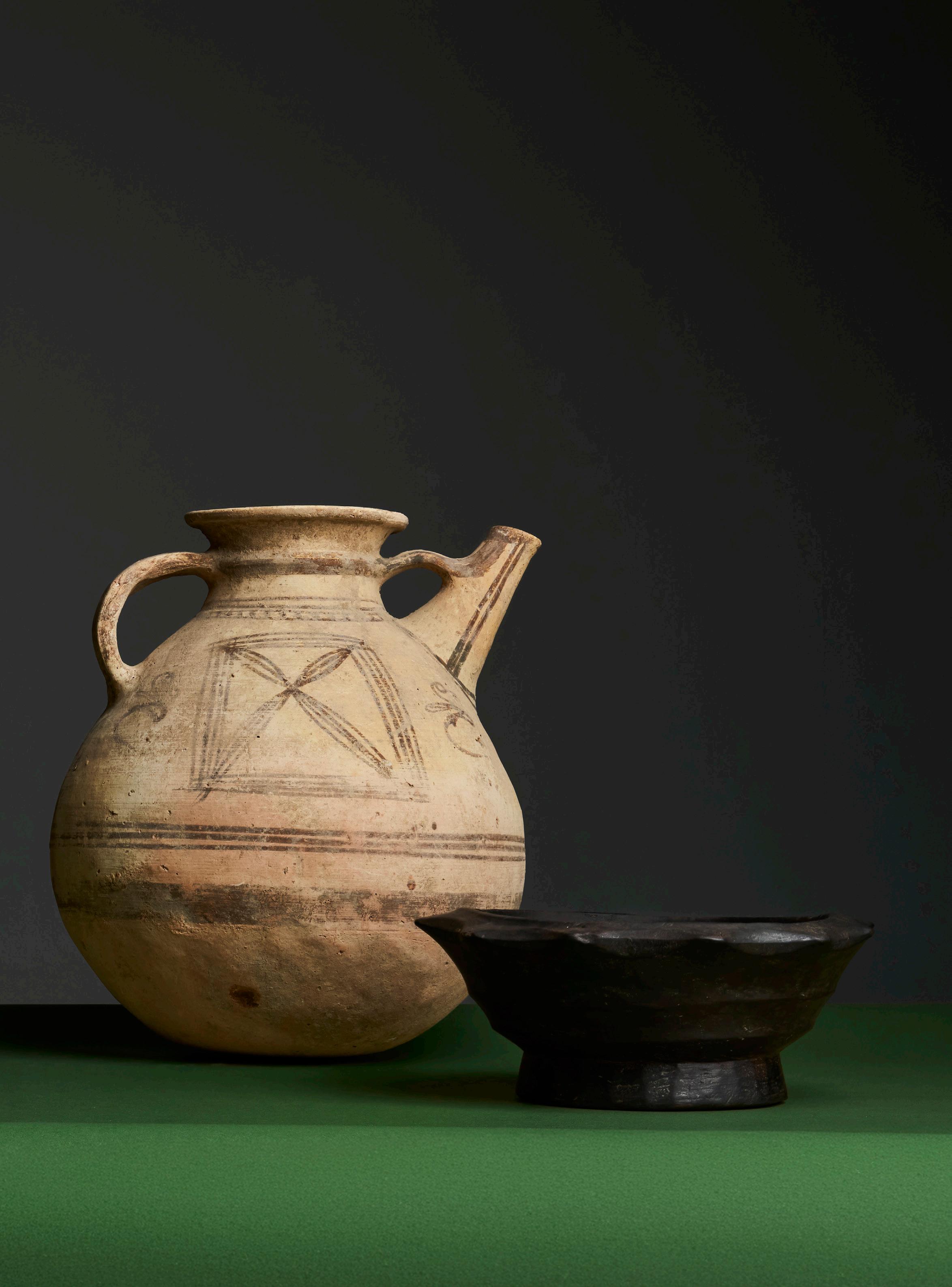
A terracotta vessel with broad bulbous body with rounded underside, trumpet-shaped neck, strap handle, a spout with supporting strap, decorated around with lineal and floral decoration. Such vessels are characteristic of early Persian domestic wares, where simple but functional shapes were produced for everyday household use, often in locally sourced clays and fired in basic kilns. H300 W250mm
est $2,000—$2,400
92 An Early Bronze Age Bowl, Holy Land
Circa 3000 BCE. Petra, Jordan
The simple rounded terracotta form and uneven surface reflect early ceramic technology in the Early Bronze Age, when vessels were shaped by hand before the widespread adoption of wheelthrowing techniques. H105 D240mm
est $700—$900
93 A Duanian Olla, Apulia, Greek South East Italy
Circa 400 - 350 BCE
A large Daunian olla in buff pottery. The vessel features the typical broad, funnel-shaped rim, a squat body, and stands on a flat base.The Daunians were an early Italic people known for their distinctive pottery traditions and strong regional identity prior to Greek and Roman expansion in the region. H210 W250 D230mm
est $1,200—$1,500
94 JASON NATHAN Pounamu Breastplate
Ngāpuhi and Ngāti Whātua Jason Nathan is a Māori carver known for his finely crafted pounamu works. As co-founder of the Kiri Nathan label alongside Kiri Nathan, his practice brings traditional carving into a contemporary design context. This necklace features a crescentshaped stone pendant suspended from a thick, hand-braided fibre cord. The pendant is smoothly worked and highly polished, revealing subtle variations and inclusions within the dark stone.This necklace sits between adornment and sculptural object, emphasising durability, touch, and an enduring relationship between body and material. L215 W165 D10mm
est $1,500—$1,700
95 LEWIS TAMIHANA GARDINER Totoweka Hei Tiki
This totoweka hei tiki is a modern carving in pounamu, recognisable for its vivid green tones and relatively translucent appearance, characteristic of this stone type. The figure follows established hei tiki conventions, with a tilted head, compact body, and
drilled suspension points for wearing. The eyes are highlighted with red detailing, and the pendant is fitted with a braided cord for contemporary use. H50 W101 D15mm
est $2,000—$3,000
96 JASON NATHAN Pounamu Toki
Ngāpuhi and Ngāti Whātua
Jason Nathan is a Māori carver known for his finely crafted pounamu works. As co-founder of the Kiri Nathan label alongside Kiri Nathan, his practice brings traditional carving into a contemporary design context. The pendant is finely polished, revealing deep green-black tones with mottled inclusions that give the stone visual depth and a sense of geological weight.Nathan’s work is characterised by restraint and clarity of intention. This necklace prioritises material presence and balance. L340 W65mm
est $1,500—$2,000
97 A Wunda Parrying Shield, Northern Territory, Australia
Papunya, Northern Territory
This Wunda parrying shield from Papunya in the Northern Territory is a finely made example of Central Australian Aboriginal defensive weaponry, designed for agility, precision, and close engagement rather than broad bodily coverage. L745 W130 D55mm Provenance: Collected by Tom McCourt 60s-70s.
est $1,000—$1,500
98 A Baby Carrier, East Kalimantan, Borneo
This baby carrier from East Kalimantan is a finely made example of Dayak material culture, combining practical function with rich symbolic decoration. The rigid basket structure is constructed from woven rattan and plant fibres, designed to securely support and protect an infant while being carried on the back. Attached wooden elements at the base provide stability when the carrier is set down. The large central figure is most commonly interpreted as an aso, a powerful protective spirit being widely represented in Dayak art from East Kalimantan and surrounding regions. The aso is often described as a composite, dragon- or dog-like creature with elongated limbs, curling appendages, and a frontal, symmetrical presentation. In beadwork and carving, it is typically rendered in highly stylised form rather than naturalistic detail, as seen here. H290 W330 D170mm
est $599—$800
99 A Wunda Shield, Western Australia Nullagine
This Wunda shield from the Nullagine area of Western Australia is a refined example of an Australian Aboriginal hand-held defensive shield, distinguished by its elongated, slightly waisted form and restrained incised decoration.Wunda shields were primarily used in armed conflict, offering protection against spears, clubs, and boomerangs. L710 W105 D60mm
est $1,800—$2,000
100 A Pat Hanly Kite, Aotearoa Circa 1960-1970.
This offset printed work by Pat Hanly features a stylised kite form incorporating a prominent tiki motif,
combining elements of play, symbolism, and graphic design. Kites are a recurring subject in Hanly’s practice, often used as vehicles for movement, colour, and a sense of airborne freedom. Produced in an accessible printed format, the work reflects the wider dissemination of Hanly’s imagery during the late 1960s to early 1970s, a period when printmaking and graphic works increasingly extended the reach of contemporary New Zealand artists beyond the gallery space. The integration of a tiki motif within a Pākehā modernist visual language reflects a broader mid-20th century tendency to reference Māori imagery within contemporary art and print culture in Aotearoa. L760 W740mm
est $1,000—$2,000
101 A Wood Pig, Vanuatu
This large carved pig likely produced as an ornamental object or for informal use, such as a plaything. Rendered in a simplified, robust form, the figure captures the essential shape of the animal with an emphasis on volume and presence rather than fine detail. Pigs hold longstanding cultural importance in Vanuatu as markers of wealth and social status, and even in more recent or non-ceremonial carvings, the subject retains its cultural resonance. H470 W330 D830mm
est $500—$800
102 A Wood Pig, Vanuatu
This large carved pig likely produced as an ornamental object or for informal use, such as a plaything. Rendered in a simplified, robust form, the figure captures the essential shape of the animal with an emphasis on volume and presence rather than fine detail. Pigs hold longstanding cultural importance in Vanuatu as markers of wealth and social status, and even in more recent or non-ceremonial carvings, the subject retains its cultural resonance. H410 W350 D800mm
est $500—$800
103 A Wood Pig, Vanuatu
This large carved pig likely produced as an ornamental object or for informal use, such as a plaything. Rendered in a simplified, robust form, the figure captures the essential shape of the animal with an emphasis on volume and presence rather than fine detail. Pigs hold longstanding cultural importance in Vanuatu as markers of wealth and social status, and even in more recent or non-ceremonial carvings, the subject retains its cultural resonance. H520 W360 D850mm
est $400—$600
104 A Totokia, Fiji
This Totokia club is a formidable example of Fijian weaponry, instantly recognisable by its distinctive hooked head. Totokia clubs were among the most feared and prestigious weapons in Fiji, associated with warriors of high rank. The hooked beak-like form was specifically designed to crush the skull or hook behind the neck, demonstrating a sophisticated understanding of combat mechanics. L840 W120 D130mm
est $2,500—$3,000
105 A Teivakatoga, Tonga
This teivakatoga club is a traditional Tongan weapon, distinguished by its
elongated shaft and expanded, paddle-like blade. Carved from dense hardwood, the form is both robust and finely balanced, designed to deliver controlled yet forceful strikes. Clubs of this type were used in close combat, where their broad striking surface and extended reach provided both versatility and impact. L1150 W110 D32mm
est $300—$600
106 A Kaiakavo, Fiji
This kaiakavo is a long wooden club from Fiji, distinguished by its gently curved shaft and flared, angular striking head.Kaiakavo were close-combat clubs, valued for their speed and precision rather than broad impact. Beyond their martial function, such weapons also carried social significance, associated with status, skill, and male authority. Collection number ‘9401’ written on the body. L910 W60 D190mm
est $400—$700
107 A Wood Pig, Vanuatu
This large carved pig likely produced as an ornamental object or for informal use, such as a plaything. Rendered in a simplified, robust form, the figure captures the essential shape of the animal with an emphasis on volume and presence rather than fine detail. Pigs hold longstanding cultural importance in Vanuatu as markers of wealth and social status, and even in more recent or non-ceremonial carvings, the subject retains its cultural resonance. H500 W400 D930mm
est $400—$600
108 A Wood Pig, Vanuatu
This large carved pig likely produced as an ornamental object or for informal use, such as a plaything. Rendered in a simplified, robust form, the figure captures the essential shape of the animal with an emphasis on volume and presence rather than fine detail. Pigs hold longstanding cultural importance in Vanuatu as markers of wealth and social status, and even in more recent or non-ceremonial carvings, the subject retains its cultural resonance. H500 W250 D1160mm
est $300—$500
109 A Wood Pig, Vanuatu
This large carved pig likely produced as an ornamental object or for informal use, such as a plaything. Rendered in a simplified, robust form, the figure captures the essential shape of the animal with an emphasis on volume and presence rather than fine detail. Pigs hold longstanding cultural importance in Vanuatu as markers of wealth and social status, and even in more recent or non-ceremonial carvings, the subject retains its cultural resonance. H670 W460 D117mm
est $300—$500
110 A 20th Century Miniature Mere Pounamu, Aotearoa
This small-scale mere pounamu is carved in a simplified version of the traditional short hand weapon form, with a rounded blade, tapered handle, and a drilled hole for suspension.Given its miniature proportions and light weight, this example is unlikely to have been intended for use as a functional weapon. Instead, it was most likely produced as a souvenir or keepsake, reflecting 20th-century interest in Māori forms for personal ownership and display. Such objects drew on the recognised
symbolism of traditional taonga while adapting scale and finish for a different market and context. L155 W50 D3mm Y22842*
est $800—$1,000
111 A Pounamu Hei Tiki with Red Wax Eyes, Aotearoa
Likely early-mid 20th century.
This hei tiki is carved from dark green pounamu and features the characteristic asymmetrical form with eyes inlaid with red sealing wax.
The use of red wax for the eyes, combined with the relatively simplified carving and polished finish, suggests this piece was likely made as a souvenir rather than as a taonga intended for long-term ancestral transmission. From the late 19th century onward, hei tiki were frequently produced for sale to visitors and collectors, drawing on well-known traditional forms while adapting materials and scale to new markets. While such examples retain cultural references and visual impact, they reflect a shift in function from deeply embedded lineage objects to items made for personal ownership, memory, or display. L49 W33 D4mm Y22933*
est $500—$800
112 A 20th Century Patu, Aotearoa
This light brown wooden patu is finely carved on both faces, with the broad blade surface articulated by symmetrical incised patterns that frame a series of stylised forms. Inlaid pāua shell elements punctuate the design, their iridescent surfaces providing a strong visual contrast against the warm tone of the wood and serving as focal points within the carving.
Patu are short hand clubs designed for close-quarter combat, valued for speed, control, and precision rather than brute force.This example appears to have been made primarily for decorative purposes rather than active combat, as indicated by its refined carving, pāua shell inlay, and overall finish, which prioritise visual impact over functional wear. L370 W103 D45mm
Provenannce: Purchased from Webbs in 2012
est $400—$600
113 A Batak Astrological
Calendar Bone Carving, North Sumatra
This intricately carved calendar stick, fashioned from buffalo rib bone, originates from the Toba Batak people of North Sumatra. Traditionally known as a porhalaan, such calendar carvings were used by Batak priests or datu to determine auspicious days for various rituals, agricultural activities, travel, and important communal events. The surface of the bone is incised with finely etched geometric patterns and symbolic motifs, alongside a linear sequence of Batak script, which encodes the calendar’s timekeeping system. The inscriptions are typically organized into 30-day lunar cycles, and may include astrological or cosmological references significant to Batak spiritual beliefs. Calendar
est $200—$400
114 Two Combs, Morocco
Combs from the Atlas Mountains aretraditional Amazigh (Berber) utilitarian and symbolic objects, made in rural communities of theHigh, Middle, and Anti-Atlasregions of Morocco.Despite the English wordcomb, these objects arenot primarily for hair grooming,
they are used tobeat, align, and card woolduring textile production. Wood L150 W102 D15mm, bone L116 W59mm
Provenance: Collected Atlas Mountains Marrakes
est $250—$350
115 An Ivory Okimono of Fukurokuju, Japan
A finely executed ivory okimono depicting Fukurokuju, the God of Wisdom and Longevity, from the revered Shichifukujin, one of the Seven Lucky Gods of Japanese folklore. The deity is shown standing in flowing robes, holding a scroll in one hand and a staff in the other, his signature elongated bald cranium rising prominently above his serene, smiling face. Incised cursive text to the back. H500 W26 D15mm
est $400—$700
116 A Kava Bowl with Unusual Legs, Fiji
Kava bowls were central to ceremonial life in Fiji, used in the preparation and sharing of yaqona during rituals, chiefly gatherings, negotiations, and social occasions. The act of mixing and drinking kava reinforced hierarchy, protocol, and communal bonds. While most bowls rest directly on the ground or have minimal supports, the pronounced legs on this example suggest either a local variation or an individual maker’s response to practical or symbolic considerations. H170 D480mm
est $400—$600
117 A Tamat Figure, Vanuatu
Carved fromCyathea lunulata, a species of tree fern, this tamat figure reflects the use of lightweight, fibrous organic material in the sculptural traditions of Vanuatu. The soft, spongy structure of the fern trunk allows for relatively rapid carving, resulting in forms that are expressive rather than highly finished, with a tactile surface that retains traces of the carving process. H750 W120 D130mm, base D200mm
est $600—$1,200
118 A Matty Island Food Dish, Wuvulu
Matty (Matti / Mati) Island, north coast of New Guinea. Carved from a hardwood. An elegant hourglass form. Bowls of this type were employed in domestic contexts and may also have served for communal or ritual purposes, reflecting the fluid boundary between everyday and ceremonial objects in Melanesian island societies. H75 W418 D257mm
Provenance: Ex Private Collection Queensland. Private Collection Auckland.
est $1,500—$2,000
119 An Agate Dzi Bead, Tibet
This agate Dzi bead is a small yet highly significant object within Himalayan material culture, traditionally regarded as both an adornment and a protective talisman. Typically formed from banded agate, Dzi beads are distinguished by their distinctive etched or naturally patterned eye motifs, which are believed to offer spiritual protection, good fortune, and healing qualities. L60 D15mm
est $300—$500
120 An Agate Dzi Bead, Tibet
This agate Dzi bead is a small yet highly significant object within Himalayan
material culture, traditionally regarded as both an adornment and a protective talisman. Typically formed from banded agate, Dzi beads are distinguished by their distinctive etched or naturally patterned eye motifs, which are believed to offer spiritual protection, good fortune, and healing qualities. This example has concentric lines within the stone. L50 D15mm
est $150—$300
121 An Agate Dzi Bead, Tibet
This agate Dzi bead is a small yet highly significant object within Himalayan material culture, traditionally regarded as both an adornment and a protective talisman. Typically formed from banded agate, Dzi beads are distinguished by their distinctive etched or naturally patterned eye motifs, which are believed to offer spiritual protection, good fortune, and healing qualities. L58 D8mm
est $150—$300
122 TANYA BIRD MPETYANE Untitled 51667
Acrylic on canvas.
This untitled work by Tanya Bird Mpetyane is executed in a restrained monochromatic palette of black, white, and grey, creating a dense and rhythmic surface composed of concentric circles, dotted pathways, and organic shapes. The imagery is characteristic of Central Desert painting traditions, where abstracted forms map knowledge of Country, water sources, and ancestral movement rather than depicting literal scenes. Circles often signify important sites or stories, while connecting lines and fields of dots describe routes, relationships, and the presence of life within the land.
600 × 600mm
Provenance: Purchased at the 2013 Telstra National Aboriginal and Torres Strait Islander Awards
est $300—$600
123 LEANNE “WANJIDARI” REID Untitled
1993
Leanne Wanjidari Reid is a contemporary Aboriginal Australian artist whose practice draws on cultural knowledge, personal narrative, and customary visual language.
This work is painted on an antique-age sawfish rostrum, a naturally elongated form distinguished by its pronounced lateral teeth.Painted marine motifs, including turtles, snakes, crabs, and fish, flow along the length of the rostrum, transforming the sawfish’s natural weapon into a vivid narrative surface that evokes ocean life. L1410 W200mm
est $2,000—$3,000
124 KELLY TAYLOR Kelly Country
Reproduction print on canvas
Kelly Country is a richly layered painting that brings together figurative imagery, pattern, and landscape symbolism within a balanced, symmetrical composition. At the centre of the work, two emu face one another, their elongated necks and bodies rendered through contrasting patterns of dots, stripes, and colour fields. The pairing suggests relationship, continuity, and shared Country, anchoring the composition both visually and conceptually.Emu hold strong cultural significance as ancestral beings and as markers of Country, movement, and survival. 420 × 560mm
est $300—$600
125 An Alafolo, Solomon Islands
A carved club with flat rectangular blade enlivened by a raised fin on each side, that extends into a square shaft interspersed with a diamond-shaped knob and terminating with a double-flange pommel. Blackened patina contrasting with lime-filled chevron and abstract frigate designs.This Alafolo exemplifies the Solomon Islands tradition of transforming weapons into works of visual and cultural expression.L1040 W90mm
est $300—$500
126 A Sali, Fiji
Carved from a dense hardwood and finished with a deep blackened patina, this Sali club is a finely worked example of Fijian edged weaponry. The broad, axe-like blade is embellished with dense cross-hatched incised decoration, creating a textured surface that enhances both visual impact and cutting function.L940 W31 D230mm
est $300—$500
127 A Sali, Fiji
This sali club is a traditional Fijian weapon, characterised by its long, slender shaft and gently flared striking head. Typically carved from a single piece of dense hardwood, the form is balanced for both reach and control, allowing for swift, precise blows in close combat. Clubs of this type were integral to warfare in Fiji, where a wide range of specialised forms developed, each suited to particular fighting techniques. L1000 W180 D60mm Kabara
est $800—$1,200
128 A Shield, Papua New Guinea
This Papua New Guinea shield is a robust example of rectangular shield forms developed for hand-to-hand combat and missile defence. Carved from a single slab of dense hardwood, the shield has a tall, slightly tapering rectangular profile with gently rounded corners, providing broad frontal coverage while remaining manageable in movement.L600 W230 D20mm
est $200—$400
129 A Pot Abelam Culture, Papua New Guinea
This distinctive Abelam pot is a richly articulated example of Sepik region ceramic tradition, notable for its combination of sculptural relief, incised detail, and painted ornamentation. Hand-built from clay and fired to a warm earthen tone, the vessel has a globular body with a short, slightly everted neck and is supported on a plaited, wrapped fibre ring base.Abelam pottery was used in both domestic and ceremonial contexts. H240 D225mm Provenance: Ex John Perry Collection. Private Collection Auckland (acquired 1998).
est $400—$500
130 A Shield, Papua New Guinea
This oval shield from Papua New Guinea is carved from a single slab of wood and exemplifies the robust defensive forms developed for close combat and missile protection. The elongated oval profile provides effective coverage of the torso while allowing ease of movement and rapid angling during fighting.Traces of red pigment remain embedded within the carved grooves, indicating the shield was once painted.L640 W240 D30mm
est $200—$400
131 A Chokwe Mask, Angola / Democratic Republic of Congo
The stylised features oval inset eyes, narrow nose, and open mouth fitted with small teeth, are typical of Chokwe mask traditions, where abstraction and contrast are used to convey presence and authority rather than naturalistic likeness.Chokwe masks were created for masquerades connected to initiation, social regulation, and moral instruction, and were worn with full fibre costumes that animated the mask through movement and dance.Rather than functioning as static objects, Chokwe masks operated as active participants in communal life, embodying spiritual forces, ancestral guidance, or social ideals.On stand H40 W230 D230mm
Provenance: Purchased from GALERIE Rheinland in 2011.
est $400—$800
132 A Bronze Alloy Figure, Nigeria
Seated and holding a blade and a staff, this cast bronze alloy figure reflects the sculptural conventions of the Benin court tradition, where metalwork was used to communicate authority, status, and ritual presence. The figure’s regalia and upright posture suggest association with rank or ceremonial role rather than individual portraiture. H555 W170 D230mm
est $800—$1,200
133 An Ambete Figure, Gabon
Standing reliquary figure carved in wood and clad in brass sheet, with a cavity at the back for ritual substances and a beaded necklace. This Ambete figure functioned as aprotective and empowering object, activated through the placement of potent materials within the cavity on its back. Such figures were kept by individuals or families to ensure well-being, success, and defense against misfortune, and could be worn, displayed, or consulted in moments of need. The brass covering and the occasional insertion of nails or metal elements marked the figure’s ritual efficacy, while the contained substances were believed to concentrate spiritual force, transforming the sculpture into an active mediator between the human and spiritual realms. H600 W170 D170mm
Provenance: Purchased from GALERIE Rheinland in 2011.
est $300—$600
134 A Mother of Pearl Inlay Shield, Solomon Islands
This Solomon Islands shield is a visually striking example of Melanesian defensive art, distinguished by its elongated, tapering form and elaborateshellinlaid decoration. L700 W200mm
est $400—$600
135 A Shield, Papua New Guinea
Likely highlands or sepik region. This narrow shield is carved from a single plank of wood and left largely unpainted, but blackened. Decoration is achieved through incised geometric designs rather than pigment: zigzag bands, chevrons, and triangular motifs run horizontally and diagonally across the face, creating a restrained yet forceful visual rhythm. Such shields were functional weapons in warfare, valued for durability and protection, while their abstract motifs carried symbolic meaning linked to ancestry, strength, and social identity. Its austere design underscores a
conception of power grounded in material presence and disciplined form, making the shield a compelling expression of both utility and cultural authority. L1580 W30 D100mm
est $1,000—$1,300
136 A Mother of Pearl Inlay Shield, Solomon Islands
This Solomon Islands shield is a visually striking example of Melanesian defensive art, distinguished by its elongated, tapering form and elaborateshellinlaid decoration. L770 W195mm
est $400—$600
137 An Abelam Yam Mask, Papua New Guinea
Maprik Region.
This Abelam yam mask is associated with ceremonial practices surrounding yam cultivation, growth, and renewal among the Abelam people of Papua New Guinea’s Sepik region. Yams hold deep social and spiritual importance, symbolising sustenance, status, and male prestige, and masks such as this were used during ritual events linked to yam festivals and agricultural cycles. L300 W120 D50mm
est $100—$200
138 A Spirit Board, Papua New Guinea
This elongated spirit board is carved from a single plank of wood and painted with natural pigments in white, red, and earth tones. A stylised human face occupies the central register, framed by bold linear motifs and zigzag patterns that extend along the length of the board. Spirit boards from Papua New Guinea, particularly those associated with Sepik River cultures, were closely connected to ritual life and spiritual belief systems. They commonly functioned as representations or dwellings of ancestral or spirit beings, displayed in ceremonial houses or used during rites to invoke protection, guidance, or social authority. L580 W140 D38mm
est $150—$250
139 A Sepik River Mask, Papua New Guinea
This elongated carved mask originates from the Sepik River region of Papua New Guinea, an area renowned for its highly developed sculptural traditions. Masks of this type were used in ceremonial and ritual contexts rather than as static display objects. They were typically associated with initiation rites, ancestor veneration, or spirit manifestations, and were activated through performance involving costume, movement, and sound. The emphasis on abstraction and pattern reflects Sepik approaches to representing power and presence, where visual intensity was used to signal contact with the spirit world. L760 W255 D160mm
est $200—$400
140 A Large Toki, Aotearoa
This large toki is shaped from polished greywacke, a hard and resilient stone well suited to heavy-duty cutting and woodworking.Toki were among the most important tools in Māori technology, central to tasks such as felling trees, shaping timbers, and constructing waka and buildings.
L280 W80 D60mm
est $1,000—$2,000
141 A Hand Adze, Australia
This hand adze comprises a stone cutting head hafted into a bamboo handle, secured with a built-up application of bitumen.The darkened bitumen binds the elements together and absorbs impact, demonstrating an effective and durable hafting technique using locally available materials. L350 W55 D145mm
est $100—$200
142 A Large Adze, Papua New Guinea
This large stone adze from Papua New Guinea is a finely worked example of traditional stone-tool technology, notable for itshighly polished surfaceand substantial proportions.Stone adzes in Papua New Guinea held great importance, functioning as essential tools and, in many regions, as objects of value that could circulate through exchange networks. L340 W71 D35mm
est $300—$600
143 A Culacula Club Fiji
This Culacula club is a finely carved and visually commanding example of Fijian prestige weaponry.Culacula clubs were primarily percussive weapons, designed to deliver crushing blows. Their broad faces and raised bosses reflect a highly developed understanding of impact dynamics. L940 W120 D55mm
est $200—$400
144 A Kiakavo Club, Fiji
This Kiakavo club is a classic example of Fijian close-combat weaponry, distinguished by its strongly curved profile and bifurcated head. Incised designs at the handle. Kiakavo were not merely weapons but symbols of warrior identity, status, and personal skill.L950 W45 D220mm
est $400—$700
145 A Gogodala Club, Papua New Guinea
This finely proportioned Gogodala club is carved from a single length of dense hardwood, forming a long, tapering shaft that culminates in a smooth, ovoid striking head.This example is characteristic of the Gogodala tradition in its elongated proportions, refined shaping, and absence of applied decoration. L1470 D75mm
est $300—$600
146 UNKNOWN ARTIST Koru Composition
Carved in wood and painted, this sculptural wall panel presents an abstracted composition of interlocking koru forms, arranged within a dynamic diamond-shaped frame.Rendered in a restrained palette, the work emphasises rhythm and movement, with layered elements creating depth and shadow across the surface. H810 W1130mm
est $500—$1,000
147 An Amazigh Berber Flatwoven Textile, Morocco
20th century Atlas Mountains, Morocco
This flatwoven Amazigh textile originates from the Atlas Mountains of Morocco and is characterised by its finely structured composition and dense geometric patterning. Textiles such as this were traditionally made by Amazigh women, with weaving
serving as both a practical skill and a mode of cultural expression. Passing patterns and techniques through generations, these works functioned as repositories of identity, memory, and regional knowledge. 2430 × 1640mm
est $1,500—$2,000
148 JOHN PHILEMON BACKHOUSE Paddle
(1845-1908)
This slender wooden paddle is decorated with a painted landscape scene characteristic of the later work of John Philemon Backhouse, an artist known for romanticised depictions of Māori life and Aotearoa New Zealand’s distinctive environments. Painted on the blade, the scene presents a thatched structure set within a coastal or lakeside landscape, rendered in soft, atmospheric tones that emphasise harmony between human presence and the natural world. Thepainted surface transforms this small paddle into a souvenir or presentation object, reflecting the late nineteenth-century colonial interest in picturesque and spiritualised views of place. L490 W67 D7mm
est $200—$400
149 A Dayak Mandau Sword, Borneo Mandau were historically used for headhunting but are also used as a machete to clear rainforest flora.The blade features decorative notches. Wood sheath with both raised and sunken relief. Deer horn handle . Smaller blade in the sheath. L660 W58mm
est $300—$600
150 A Thai 10th Century ThreeHeaded Elephant Base, StupaForm Buddhist Shrine Figure H240 D140mm
est $6,000—$8,000
151 A Mutu Kākā, Aotearoa
A finely carved mutu kākā, fashioned from a single piece of wood, traditionally used as a perch for a pet kākā.The mutu kākā served both a practical and symbolic role. It was traditionally used to tether a kākā, a prized companion and sometimes trained mimic or decoy used in bird hunting. Parrots were also kept as companions of chiefly individuals, and their vivid plumage was used in clothing and adornment, particularly in kahu huruhuru feather cloaks.
The perch section is gently curved, tapering at one end and terminating in a manaia head, often seen as a guardian or intermediary between the physical and spiritual realms. The shank of the perch features a wheku figure with deeply carved facial features, bent knees, and arms drawn inwards, with fingers resting on the belly. H220 W40 D250mm Y08052*
est $2,000—$3,000
*This taonga requires registration under the Protected Objects Act (1975). To purchase this piece, you will need to be a registered collector of taonga tūturu. Please contact our specialist team for further information. International export permission must be granted by the Chief Executive of the Ministry for Culture and Heritage.
Terms and Conditions
The terms and conditions of sale listed here contain the policies of Webb’s (Webb Fine Art). They are the terms on which Webb’s (Webb Fine Art) and the Seller contract with the Buyer. They may be amended by printed Saleroom Notices or oral announcements made before and during the sale. By bidding at auction you agree to be bound by these terms.
1. Background to the Terms used in these Conditions
The conditions that are listed below contain terms that are used regularly and may need explanation. They are as follows:
“the Buyer” means the person with the highest bid accepted by the Auctioneer.
“the Lot” means any item depicted within the sale for auction and in particular the item or items described against any lot number in the catalogue.
“the Hammer price” means the amount of the highest bid accepted by the auctioneer in relation to a lot.
“the Buyer’s Premium” means the charge payable by the Buyer to the auction house as a percentage of the hammer price.
“the Reserve” means the lowest amount at which Webb’s has agreed with the Seller that the lot can be sold.
“Forgery” means an item constituting an imitation originally conceived and executed as a whole, with a fraudulent intention to deceive as to authorship, origin, age, period, culture or source, where the correct description as to such matters is not reflected by the description in the catalogue. Accordingly, no lot shall be capable of being a forgery by reason of any damage or restoration work of any kind (Including re-painting).
“the insured value” means the amount that Webb’s in its absolute discretion from time to time shall consider the value for which a lot should be covered for insurance (whether or not insurance is arranged by Webb’s).
All values expressed in Webb’s catalogues (in any format) are in New Zealand Dollars (NZD$). All bids, “hammer price”, “reserves”, “Buyers Premium” and other expressions of value are understood by all parties to be in New Zealand Dollars (NZD$) unless otherwise specified.
2. Webb’s Auctions as Agent
Except as otherwise stated, Webb’s acts as agent for the Seller.
The contract for the sale of the property is therefore made between the Seller and the Buyer.
3. Before the Sale
3.1. Examination of Property
Prospective Buyers are strongly advised to examine in person any property in which they are interested before the Auction takes place. Neither Webb’s nor the Seller provides any guarantee in relation to the nature of the property apart from the Limited
warranty in the paragraph below. The property is otherwise sold “AS IS”
2. Catalogue and Other Descriptions
All statements by Webb’s in the catalogue entry for the property or in the condition report, or made orally or in writing elsewhere, are statements of opinion and are not to be relied upon as statements of fact. Such statements do not constitute a representation, warranty or assumption of liability by Webb’s of any kind. References in the catalogue entry to the condition report to damage or restoration are for guidance only and should be evaluated by personal inspection by the bidder or a knowledgeable representative. The absence of such a reference does not imply that an item is free from defects or restoration, nor does a reference to particular defects imply the absence of any others. Estimates of the selling price should not be relied on as a statement that this is the price at which the item will sell or its value for any other purpose. Neither Webb’s nor The Seller is responsible for any errors or omissions in the catalogue or any supplemental material.
Images are measured height by width (sight size). Illustrations are provided only as a guide and should not be relied upon as a true representation of colour or condition. Images are not shown at a standard scale. Mention is rarely made of frames (which may be provided as supplementary images on the website) which do not form part of the lot as described in the printed catalogue.
An item bought “on Extension” must be paid for in full before it will be released to the purchaser or his/ her agreed expertising committee or specialist. Payments received for such items will be held “in trust” for up to 90 days or earlier, if the issue of authenticity has been resolved more quickly. Extensions must be requested before the auction.
Foreign buyers should note that all transactions are in New Zealand Dollars so there may be a small exchange rate risk. The costs associated with acquiring a good opinion or certificate will be carried by the purchaser. If the item turns out to be forged or otherwise incorrectly described, all reasonable costs will be borne by the vendor.
3. Buyers Responsibility
All property is sold “as is” without representation or warranty of any kind by Webb’s or the Seller. Buyers are responsible for satisfying themselves concerning the condition of the property and the matters referred to in the catalogue by
requesting a condition report.
No lot to be rejected if, subsequent to the sale, it has been immersed in liquid or treated by any other process unless the Auctioneer’s permission to subject the lot to such immersion or treatment has first been obtained in writing.
4. At the Sale
4.1. Refusal of Admission
Webb’s reserves the right at our complete discretion to refuse admission to the auction premises or participation in any auction and to reject any bid.
4.2. Registration Before Bidding
Any prospective new buyer must complete and sign a registration form and provide photo identification before bidding. Webb’s may request bank, trade or other financial references to substantiate this registration.
4.3. Bidding as a Principal
When making a bid, a bidder is accepting personal liability to pay the purchase price including the buyer’s premium and all applicable taxes, plus all other applicable charges, unless it has been explicitly agreed in writing with Webb’s before the commencement of the sale that the bidder is acting as agent on behalf of an identified third party acceptable to Webb’s and that Webb’s will only look to the principal for payment.
4.4. International Registrations
All International clients not known to Webb’s will be required to scan or fax through an accredited form of photo identification and pay a deposit at our discretion in cleared funds into Webb’s account at least 24 hours before the commencement of the auction. Bids will not be accepted without this deposit. Webb’s also reserves the right to request any additional forms of identification prior to registering an overseas bid.
This deposit can be made using a credit card, however the balance of any purchase price in excess of $5,000 cannot be charged to this card without prior arrangement.
This deposit is redeemable against any auction purchase and will be refunded in full if no purchases are made.
4.5. Absentee Bids
Webb’s will use reasonable efforts to execute written bids delivered to us AT LEAST 24 Hours before the sale for the convenience of those clients who are unable to attend the auction in person. If we receive identical written bids on a particular lot, and at the auction these are the highest bids on that lot, then the lot will be sold to the person whose written bid was received and accepted first. Execution of written bids is a free service undertaken subject to other commitments at the time of the sale and we do not accept liability for failing to execute a written bid or for errors or omissions which may arise. It is the bidder’s responsibility to check with Webb’s after the auction if they were successful. Unlimited or “Buy” bids will not be accepted.
4.6. Telephone Bids
Priority will be given to overseas and bidders from other regions. Please refer to the catalogue for the Telephone Bids form. Arrangements for this service must be confirmed AT LEAST 24 HOURS PRIOR to the auction commencing. Webb’s accepts no responsibility whatsoever for any errors or failure to execute bids. In telephone bidding the buyer agrees to be
bound by all terms and conditions listed here and accepts that Webb’s cannot be held responsible for any miscommunications in the process. The success of telephone bidding cannot be guaranteed due to circumstances that are unforeseen. Buyers should be aware of the risk and accept the consequences should contact be unsuccessful at the time of Auction. You must advise Webb’s of the lots in question, and you will be assumed to be a buyer at the minimum price of 75% of estimate (i.e. reserve) for all such lots. Webb’s will advise Telephone Bidders who have registered at least 24 hours before the auction of any relevant changes to descriptions, withdrawals, or any other sale room notices.
4.7.
Online Bidding
Webb’s offers an online bidding service. When bidding online the buyer agrees to be bound by all terms and conditions listed here by Webb’s.
Webb’s accepts no responsibility for any errors, failure to execute bids or any other miscommunications regarding this process. It is the online bidder’s responsibility to ensure the accuracy of the relevant information regarding bids, lot numbers and contact details. Webb’s does not charge for this service.
4.8. Reserves
Unless otherwise indicated, all lots are offered subject to a reserve, which is the confidential minimum price below which the Lot will not be sold. The reserve will not exceed the low estimate printed in the catalogue. The auctioneer may open the bidding on any Lot below the reserve by placing a bid on behalf of the Seller. The auctioneer may continue to bid on behalf of seller up to the amount of the reserve, either by placing consecutive bids or by placing bids in response to other bidders.
4.9. Auctioneers Discretion
The Auctioneer has the right at his/ her absolute and sole discretion to refuse any bid, to advance the bidding in such a manner as he/she may decide, to withdraw or divide any lot, to combine any two or more lots and, in the case or error or dispute and whether during or after the sale, to determine the successful bidder, to continue the bidding, to cancel the sale or to reoffer and resell the item in dispute. If any dispute arises after the sale, then Webb’s sale record is conclusive.
4.10. Successful Bid and Passing of Risk
Subject to the auctioneer’s discretion, the highest bidder accepted by the auctioneer will be the buyer and the striking of his hammer marks the acceptance of the highest bid and the conclusion of a contract for sale between the Seller and the Buyer. Risk and responsibility for the lot (including frames or glass where relevant) passes immediately to the Buyer. If you are the highest bidder at the end of the auction, but your bid is below the reserve price, it will be marked as 'subject to vendor approval.' Your bid will then be presented to the vendor for consideration, and if accepted, the lot will be sold to you.
4.11. Indicative Bidding Steps, etc. Webb’s reserves the right to refuse any bid, withdraw any lot from sale, to place a reserve on any lot and to advance the bidding according to the following indicative steps:
Increment Dollar
Range Amount
$20 $0–$500
$50 $500–$1,000
$100 $1,000–$2,000
$200 $2,000–$5,000
$500 $5,000–$10,000
$1,000 $10,000–$20,000
$2,000 $20,000–$50,000
$5,000 $50,000 – $100,000
$10,000 $100,000–$200,000
$20,000 $200,000–$500,000
$50,000 $500,000–$1,000,000
Absentee bids must follow these increments and any bids that don’t follow the steps will be rounded up to the nearest acceptable bid.
5. After the Sale
5.1. Buyers Premium
In addition to the hammer price, the buyer agrees to pay to Webb’s the buyer’s premium. The buyer’s premium is 19.5% of the hammer price plus GST. (Goods and Services Tax) where applicable.
5.2. Payment and Passing of Title
The buyer must pay the full amount due (comprising the hammer price, buyer’s premium and any applicable taxes and GST) not later than 2 days after the auction date.
The buyer will not acquire title to the lot until Webb’s receives full payment in cleared funds, and no goods under any circumstances will be released without confirmation of cleared funds received. This applies even if the buyer wishes to send items overseas.
Payment can be made by direct transfer, cash (not exceeding NZD$5,000, if wishing to pay more than NZD$5,000 then this must be deposited directly into a Bank of New Zealand branch and bank receipt supplied) and EFTPOS (please check the daily limit). Payments can be made by debit card or credit card in person with a 2.2% merchant fee for Visa, Mastercard and Paywave, and 3.3% for American Express. Invoices that are in excess of $5,000 and where the card holder is not present, cannot be charged to a credit card without prior arrangement. Cheques are no longer accepted.
The buyer is responsible for any bank fees and charges applicable for the transfer of funds into Webb’s account.
5.3. Collection of Purchases & Insurance
Webb’s is entitled to retain items sold until all amounts due to us have been received in full in cleared funds. Subject to this, the Buyer shall collect purchased lots within 2 days from the date of the sale unless otherwise agreed in writing between Webb’s and the Buyer.
At the fall of the hammer, insurance is the responsibility of the purchaser.
5.4. Packing, Handling and Shipping
Webb’s will be able to suggest removals companies that the buyer can use but takes no responsibility whatsoever for the actions of any recommended third party. Webb’s can pack and handle goods purchased at the auction by agreement and a charge will be made for this service. All packing, shipping, insurance, postage & associated charges will be borne by the purchaser.
5.5. Permits, Licences and Certificates
Under The Protected Objects Act 1975, buyers may be required to obtain a licence for certain categories of items in a sale from the Ministry of Culture & Heritage, PO Box 5364, Wellington.
5.6. Remedies for Non-Payment
If the Buyer fails to make full payment immediately, Webb’s is entitled to
exercise one or more of the following rights or remedies (in addition to asserting any other rights or remedies available under the law)
5.6.1. to charge interest at such a rate as we shall reasonably decide.
5.6.2. to hold the defaulting Buyer liable for the total amount due and to commence legal proceedings for its recovery along with interest, legal fees and costs to the fullest extent permitted under applicable law.
5.6.3. to cancel the sale.
5.6.4. to resell the property publicly or privately on such terms as we see fit.
5.6.5. to pay the Seller an amount up to the net proceeds payable in respect of the amount bid by the defaulting Buyer. In these circumstances the defaulting Buyer can have no claim upon Webb’s in the event that the item(s) are sold for an amount greater than the original invoiced amount.
5.6.6. to set off against any amounts which Webb’s may owe the Buyer in any other transactions, the outstanding amount remaining unpaid by the Buyer.
5.6.7. where several amounts are owed by the Buyer to us, in respect of different transactions, to apply any amount paid to discharge any amount owed in respect of any particular transaction, whether or not the Buyer so directs.
5.6.8. to reject at any future auction any bids made by or on behalf of the Buyer or to obtain a deposit from the Buyer prior to accepting any bids.
5.6.9. to exercise all the rights and remedies of a person holding security over any property in our possession owned by the Buyer whether by way of pledge, security interest or in any other way, to the fullest extent permitted by the law of the place where such property is located. The Buyer will be deemed to have been granted such security to us and we may retain such property as collateral security for said Buyer’s obligations to us.
5.6.10. to take such other action as Webb’s deem necessary or appropriate.
If we do sell the property under paragraph (4), then the defaulting Buyer shall be liable for payment of any deficiency between the total amount originally due to us and the price obtained upon reselling as well as for all costs, expenses, damages, legal fees and commissions and premiums of whatever kinds associated with both sales or otherwise arising from the default.
If we pay any amount to the Seller under paragraph (5) the Buyer acknowledges that Webb’s shall have all of the rights of the Seller, however arising, to pursue the Buyer for such amount.
5.7. Failure to Collect Purchases Where purchases are not collected
within 2 days from the sale date, whether or not payment has been made, we shall be permitted to remove the property to a warehouse at the buyer’s expense, and only release the items after payment in full has been made of removal, storage handling, insurance and any other costs incurred, together with payment of all other amounts due to us.
6. Extent of Webb’s Liability
Webb’s agrees to refund the purchase price in the circumstances of the Limited Warranty set out in paragraph 7 below. Apart from that, neither the Seller nor we, nor any of our employees or agents are responsible for the correctness of any statement of whatever kind concerning any lot, whether written or oral, nor for any other errors or omissions in description or for any faults or defects in any lots. Except as stated in paragraph 7 below, neither the Seller, ourselves, our officers, agents or employees give any representation warranty or guarantee or assume any liability of any kind in respect of any lot with regard to merchantability, fitness for a particular purpose, description, size, quality, condition, attribution, authenticity, rarity, importance, medium, provenance, exhibition history, literature or historical relevance. Except as required by local law any warranty of any kind is excluded by this paragraph.
7. Limited Warranty
Subject to the terms and conditions of this paragraph, the Seller warrants for the period of thirty days from the date of the sale that any property described in this catalogue (noting such description may be amended by any saleroom notice or announcement) which is stated without qualification to be the work of a named author or authorship is authentic and not a forgery. The term “Author” or “authorship” refers to the creator of the property or to the period, culture, source, or origin as the case may be, with which the creation of such property is identified in the catalogue.
The warranty is subject to the following:
it does not apply where a) the catalogue description or saleroom notice corresponded to the generally accepted opinion of scholars and experts at the date of the sale or fairly indicated that there was a conflict of opinions, or b) correct identification of a lot can be demonstrated only by means of a scientific process not generally accepted for use until after publication of the catalogue or a process which at the date of the publication of the catalogue was unreasonably expensive or impractical or likely to have caused damage to the property.
the benefits of the warranty are not assignable and shall apply only to the original buyer of the lot as shown on the invoice originally issued by Webb’s when the lot was sold at Auction.
the Original Buyer must have remained the owner of the lot without disposing of any interest in it to any third party.
The Buyer’s sole and exclusive remedy against the Seller in place of any other remedy which might be available, is the cancellation of the sale and the refund of the original purchase price paid for the lot less the buyer’s premium which is non-refundable. Neither the Seller
nor Webb’s will be liable for any special, incidental nor consequential damages including, without limitation, loss of profits.
The Buyer must give written notice of claim to us within thirty days of the date of the Auction. The Seller shall have the right, to require the Buyer to obtain two written opinions by recognised experts in the field, mutually acceptable to the Buyer and Webb’s to decide whether or not to cancel the sale under warranty.
the Buyer must return the lot to Seller in the same condition that it was purchased.
8. Severability
If any part of these Conditions of Sale is found by any court to be invalid, illegal or unenforceable, that part shall be discounted, and the rest of the Conditions shall continue to be valid to the fullest extent permitted by law.
9. Copyright
The copyright in all images, illustrations and written material produced by Webb’s relating to a lot including the contents of this catalogue, is and shall remain the property at all times of Webb’s and shall not be used by the Buyer, nor by anyone else without our prior written consent. Webb’s and the Seller make no representation or warranty that the Buyer of a property will acquire any copyright or other reproduction rights in it.
10. Law and Jurisdiction
These terms and conditions and any matters concerned with the foregoing fall within the exclusive jurisdiction of the courts of New Zealand, unless otherwise stated.
11. Pre-Sale Estimates
Webb’s publishes with each catalogue our opinion as to the estimated price range for each lot. These estimates are approximate prices only and are not intended to be definitive. They are prepared well in advance of the sale and may be subject to revision. Interested parties should contact Webb’s prior to auction for updated pre-sale estimates and starting prices.
12. Sale Results
Webb’s will provide auction results, which will be available as soon as possible after the sale. Results will include buyer’s premium. These results will be posted at www.webbs.co.nz.
13. Goods and Service Tax
GST is applicable on the hammer price in the case where the seller is selling property that is owned by an entity registered for GST. GST is also applicable on the hammer price in the case where the seller is not a New Zealand resident. These lots are denoted by a dagger symbol † placed next to the estimate. GST is also applicable on the buyer’s premium.
14. Māori Taonga
Please note that Y-registered Māori taonga can only be purchased by registered collectors of taonga tūturu.