Innovation Studies, Innovation Strategies
Fridays at The Harbor
6 March 2020

Fridays at The Harbor
6 March 2020


• Who are you?
• What do you expect to learn?
• What knowledge and perspectives can you share with us?
• Causes for and consequences of innovation
• Better understand and explain preconditions for innovation.
• Which barriers and facilitators can be identified?
• Which are within reach for change agents?
• Who are these change agents?
• What can innovation policy do?
• No specific interest in technology. Focus on social systems, strategy and policy.
• New creations of economic significance
• New combinations of knowledge
• New challenges to existing structures
• New market logics, new consumer behaviour, and – sometimes –new technology
• The only “sustainable” way to achieve economic growth and social wealth (?)
• The first bird gets the worm…

• …but the second mouse gets the cheese

• “Science, the endless frontier” (Bush, 1945) => investments in science will eventually lead to increased innovation capacity and economic growth => Innovation policy 1.0
• Today largely rejected (but still society acts as if it was valid…).
• Innovation is a non-linear process. Breakthroughs in science will not necessarily generate innovations.
• Most innovations are not science based.
• Most innovations are made by big established companies.
• Performance depends not only on the capabilities of specific organisations, but also on how they interact with each other.
• Innovation Systems: …the elements and relationships which interact in the production, diffusion and use of new, and economically useful, knowledge… (Lundvall, 1992).
• National, regional, local, sectoral, technological etc etc
=> Innovation policy 2.0
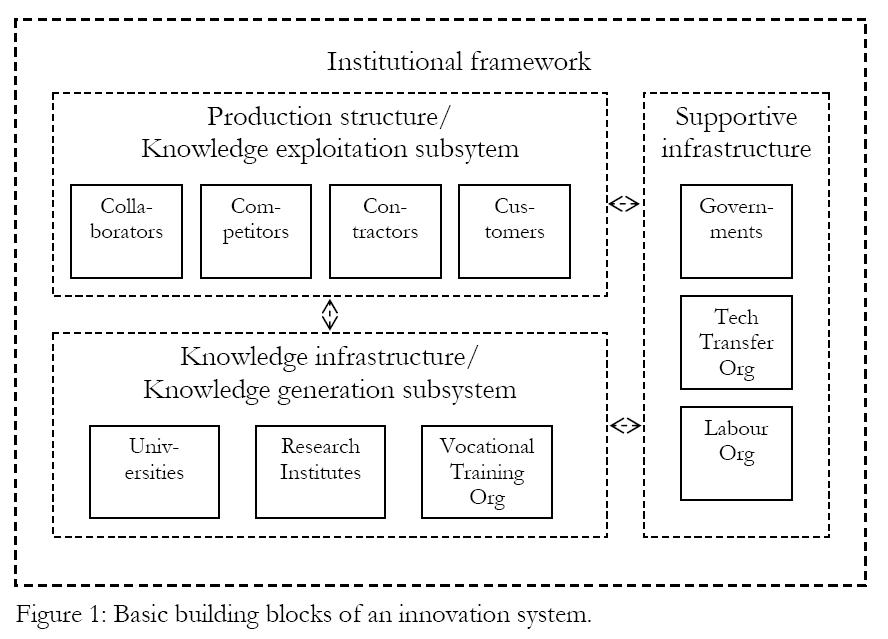
• Fragmentation
• Organizational thinness
• Lock-in
• Mainly ”upstream-focused” (market/adoption hardly considered)
• Little attention to societal needs (except economic growth)
• Little attention to system change/transformation/ disruption
• Need to better understand and address:
• Conflicting interests
• Challenged hierarchies
• Interaction between producers and users
• Shared visions
• Societal acceptance to the innovation/new technology
• Mission-oriented policy
• Fostering wider system change
• Influence directionality
• A horizontal policy approach that mobilizes technology, market mechanisms, regulations and social innovation (OECD, 2015)
• Makes a lot sense, but also adds complexity. Who are “policymakers” nowadays? What is innovation policy? (everything??)
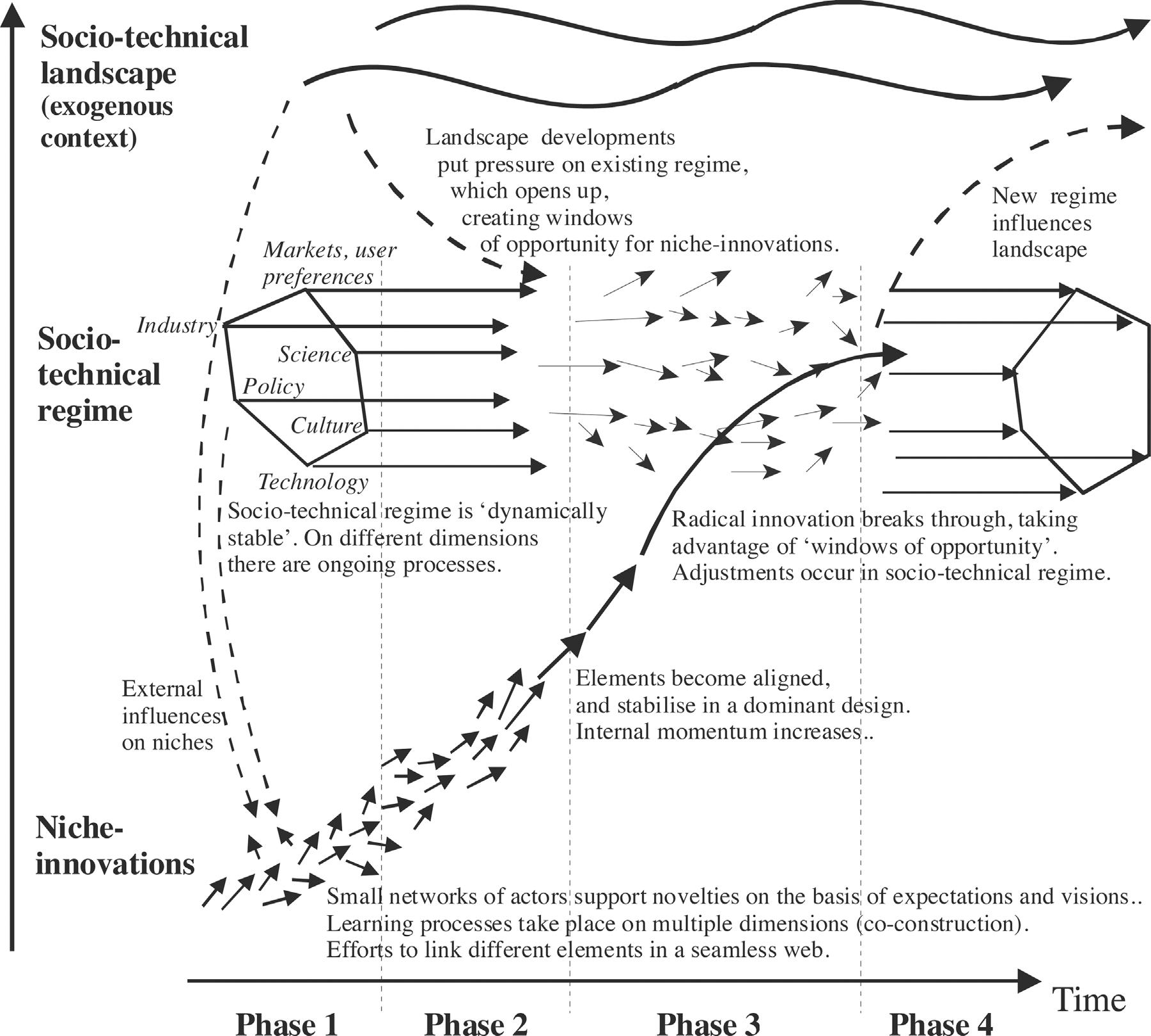
• Coherent complex of knowledge-, technology-, rule-, policy-, routineand norm system contributing to stability (path dependence).
• Facilitates incremental development (path extension) but most often a barrier for change (path renewal, new path creation). Coordinating effects on actors.
• Technological and political paradigms, production factors, sunk investments, vested interests, regulations, user attitudes (consumer habits, trends, scepticism), social acceptance/legitimacy.
• Experiment aiming to challenge (and change?) existing regime through new technology and institutional adaptation.
• Sometimes referred to as ”incubation spaces”, i.e. protected areas in which new technology is temporarily shielded from the structuration forces found in the regime.
• Network formation, collective learning , alignment of expectations, legitimation.
• Overall socio-technical setting , wider political, cultural and economic background. Framework conditions.
• Can be conserving but also contribute to trigger change.
• Social values, political beliefs, world views, prices, costs, trade patterns, incomes.
• Directionality
• Coordination failures
• Vested interests, regulatory capture
• Alignment of expectations
• Capabilities and knowledge bases
• What is my role in the innovation system?
• What are my main challenges? To what extent are those within reach for me? To what extent am I dependent on other actors in the system?
• How do I interact with external partners? Complementary capabilities? Gaps? Conflicting interests?