Poste Italiane spa - Sped. Abb. Post. - D.L. 353/2003 (Convertito in legge 27/02/2004 n. 46), art. 1, comma 1 - LO/MI/ - euro 10,00 - In caso di mancato recapito rinviare all’ufficio CMP Roserio (Mi) per la restituzione al mittente che si impegna a pagare la relativa tariffa - Editrice webandmagazine s.r.l. - Via Valla, 16 - I-20141 Milano - www.webandmagazine.media
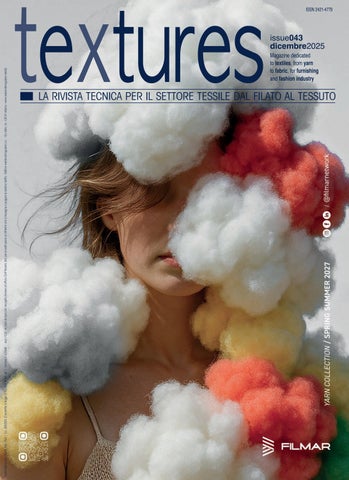
textures ISSN 2421-4779
issue043 dicembre2025 Magazine dedicated to textiles, from yarn to fabric, for furnishing and fashion industry
LA RIVISTA TECNICA PER IL SETTORE TESSILE DAL FILATO AL TESSUTO
issue042
textures
COLOPHON
ISSUE43DICEMBRE2025
editrice WEBANDMAGAZINE s.r.l. VIA VALLA, 16 - 20141 MILANO ITALIA T. +39/02 84173130 T. +39/02 84173121 (MARKETING) @ amministrazione@webandmagazine.com www www.webandmagazine.media
DIRETTORE RESPONSABILE EDITOR IN CHIEF PIETRO FERRARI REDAZIONE@WEBANDMAGAZINE.COM DIRETTORE EDITORIALE EDITORIAL COORDINATOR BEATRICE GUIDI BEATRICEGUIDI_MKT@WEBANDMAGAZINE.MEDIA GIORNALISTI JOURNALISTS SONIA MARITAN COLLABORATORI COLLABORATORS CAMILLA CARRARA, PAOLA GOVONI, STEFANO PANCONESI, MONICA ZANI WEB AND MEDIA ADVERTISING BEATRICE GUIDI DIREZIONE MARKETING BEATRICEGUIDI_MKT@WEBANDMAGAZINE.MEDIA ADVERTISING@WEBANDMAGAZINE.COM MKT@WEBANDMAGAZINE.MEDIA WEB AND SOCIAL MEDIA EDITOR MONICA ZANI MKT@WEBANDMAGAZINE.MEDIA GRAPHIC LAYOUT UFFICIOGRAFICO@WEBANDMAGAZINE.COM UFFICIO LOGISTICA LOGISTIC OFFICE LOGISTICA@WEBANDMAGAZINE.COM AMMINISTRAZIONE ADMINISTRATION LAURA GREGORUTTI AMMINISTRAZIONE@WEBANDMAGAZINE.COM
Stampa Litogì s.r.l. Via Idro, 50 – 20132 Milano
Poste Italiane spa - Sped. Abb. Post. - D.L. 353/2003 (Convertito in legge 27/02/2004 n. 46), art. 1, comma 1 - LO/MI/ - euro 10,00 - In caso di mancato recapito rinviare all’ufficio CMP Roserio (Mi) per la restituzione al mittente che si impegna a pagare la relativa tariffa - Editrice webandmagazine s.r.l. - Via Valla, 16 - I-20141 Milano - www.webandmagazine.media
004
textures
ISSN 2421-4779
issue043 dicembre2025 Magazine dedicated to textiles, from yarn to fabric, for furnishing and fashion industry
COVER
LA RIVISTA TECNICA PER IL SETTORE TESSILE DAL FILATO AL TESSUTO
www.filmar.it
RIVISTA TRIMESTRALE: POSTE ITALIANE SPA SPED. ABB. POST.D.L. 353/2003 (CONVERTITO IN LEGGE 27/02/2004 N.46), ART. 1, COMMA 1 - LO/MI REGISTRO DEGLI OPERATORI DI COMUNICAZIONE - ROC 23567 REGISTRO MONDIALE DELLE PUBBLICAZIONI ISSN 2283-8651 RIVISTA TRIMESTRALE QUARTERLY MAGAZINE UNA COPIA ONE COPY EURO 10,00 ABBONAMENTO ANNUO ITALIA EURO 40,00 A YEAR’S SUBSCRIPTION ABROAD EURO 80,00
MODALITÀ DI PAGAMENTO ABBONAMENTO
TRAMITE BONIFICO BANCARIO CON TUTTI I VOSTRI DATI E CAUSALE UTILIZZANDO IL SEGUENTE IBAN: CRÉDIT AGRICOLE: IT19K0623001619000040434367 – B.I.C. CRPPIT2P166 I NOMI, LE DITTE E I PRODOTTI CITATI REDAZIONALMENTE SONO PUBBLICATI SENZA RESPONSABILITÀ DELL’EDITORE; TESTI E FOTOGRAFIE, ANCHE SE NON PUBBLICATI, NON VENGONO RESTITUITI NAMES, FIRMS AND PRODUCTS WICH ARE QUOTED EDITORIALLY ARE PUBLISHED WITHOUT PUBLISHER’S RESPONSABILITY; TEXTS AND PHOTOS, ALTOUGH UNPUBLISHED, ARE NOT RETURNED INFORMATIVA EX D. LGS.196/03 – WEBANDMAGAZINE S.R.L., TITOLARE DEL TRATTAMENTO TRATTA I DATI PERSONALI LIBERAMENTE CONFERITI PER FORNIRE I SERVIZI INDICATI. PER I DIRITTI DI CUI ALL'ART. 7 DEL D. LGS N. 196/03 E PER L'ELENCO DI TUTTI I RESPONSABILI DEL TRATTAMENTO RIVOLGERSI AL RESPONSABILE DEL TRATTAMENTO, INFO@WEBANDMAGAZINE.COM. I DATI POTRANNO ESSERE TRATTATI DA INCARICATI PREPOSTI AGLI ABBONAMENTI, AL MARKETING, ALL'AMMINISTRAZIONE E POTRANNO ESSERE COMUNICATI A SOCIETÀ ESTERNE PER LA SPEDIZIONE DEL PERIODICO E PER L'INVIO DI MATERIALE PROMOZIONALE. IL RESPONSABILE DEL TRATTAMENTO DEI DATI RACCOLTI IN BANCHE DATI A USO REDAZIONALE È IL DIRETTORE RESPONSABILE A CUI CI SI PUÒ RIVOLGERE, PER I DIRITTI PREVISTI DAL D. LGS. 196/03, PRESSO: EDITRICE WEBANDMAGAZINE S.R.L., VIA VALLA, 16 - MILANO.
21 – 24. 4. 2026 FRANKFURT / MAIN
Dal caso all’idea. Dall’idea al risultato tangibile. Idee innovative sui materiali, promosse da innumerevoli incontri. Inoltre, l’eccellenza dell’ingegneria globale, dimostra che anche le idee più anticonvenzionali possono essere prodotte in serie in modo efficiente.
21 – 24. 4. 2026 FRANKFURT / MAIN
part of
visitatori@italy.messefrankfurt.com Tel. +39 02 880 77 81
09
EDITORIALE
LA MODA COME SISTEMA IN MOVIMENTO FASHION AS A SYSTEM IN MOTION di Beatrice Guidi
10
COVER STORY
FILMAR COTONE DA AGRICOLTURA RIGENERATIVA COTTON FROM REGENERATIVE AGRICULTURE www.filmar.it
14
PERCORSITESSILI
TOLLEGNO 1900 I FRUTTI DELLA RIFLESSIONE SUGLI ARCHIVI, INNOVAZIONE E MEMORIA THE RESULTS OF REFLECTION ON ARCHIVES, INNOVATION, AND MEMORY www.tollegno1900.it
18
PERCORSITESSILI
MONTICOLOR ESPLORARE LA MEMORIA THE THEME OF MEMORY BETWEEN DISCOVERIES AND REDISCOVERIES IN THE COLLECTION www.monticolor.com
PERCORSITESSILI
LINIFICIO E CANAPIFICIO NAZIONALE NATURALE E TRASPARENTE LINIFICIO E CANAPIFICIO NAZIONALE: EUROPEAN EXCELLENCE AND ALLIANCES FOR THE FUTURE OF NATURAL TEXTILE MATERIALS www.linificio.it
24
EVENTI
SFIDE E OPPORTUNITÀ NEL SETTORE TESSILE CHALLENGES AND OPPORTUNITIES IN THE TEXTILE INDUSTRY www.webandmagazine.media/riviste/textures www.decorlab.it
34
EVENTI
PERFORMANCE DAYS IL FONDAMENTO DELLA CIRCOLARITÀ SOTTO I RIFLETTORI IN THE SPOTLIGHT: THE FOUNDATION OF CIRCULARITY www.performancedays.com
36
CULTURA TESSILE
MODA IN LUCE 1925-1955 ALLE ORIGINI DEL MADE IN ITALY FASHION IN LIGHT 1925-1955 THE ORIGINS OF MADE IN ITALY IN THE ARCHIVES OF ISTITUTO LUCE CINECITTÀ di Paola Govoni
issue043 dicembre 2025
22
textures
42
SPAZIOGREEN
SLOW FIBER PER UNA SOSTENIBILITÀ CORRETTA ED EFFICACE FOR A PROPER AND EFFECTIVE SUSTAINABILITY www.slowfiber.it
46
SPAZIOGREEN
ZEROBARRACENTO SPAZIO 3R L'UNIONE FA LA FORZA A STRATEGIC PARTNERSHIP di Camilla Carrara www.spazio3r.org https://zerobarracento.com
50
AREAARREDAMENTO
DINO ZOLI TEXTILE SOSTENIBILITÀ E CLASSE IN THE HEART OF ROME, THE NEW ABITZAI PROJECT SPACE IS THE IDEAL SHOWCASE FOR THE DINO ZOLI TEXTILE SELECTIONS www.dinozoli.it
52
AREADENIM
XLANCE OLTRE LO STRETCH: LA FORZA INVISIBILE DEL COMFORT CHE DURA BEYOND STRETCH: THE INVISIBLE FORCE OF LASTING COMFORT www.xlancefibre.com https://puredenim.it
54
AREATESSUTO TECNICO
PRIMALOFT L'INNOVAZIONE RAGGIUNGE NUOVI LIVELLI THE LATEST INNOVATION REACHES NEW HEIGHTS, CREATING PRIMALOFT'S WARMEST INSULATION YET https://primaloft.com
58
COLOURS
”KEKFESTO”: STAMPA A RISERVA CON TINTURA IN INDACO IN UNGHERIA KEKFESTO: RESERVE PRINTING WITH INDIGO DYE IN HUNGARY di Stefano Panconesi www.pancolori.eu
66
SCENARI
A ECOMONDO 2025, LE NUOVE FRONTIERE DELL’INNOVAZIONE NELLA MODA CIRCOLARE RE&UP DEBUTS AT ECOMONDO 2025 TO SHOWCASE CIRCULAR FASHION INNOVATION https://reandup.com
issue043
EDITORIALE
textures
09
writer Beatrice Guidi
LA MODA COME SISTEMA IN MOVIMENTO La moda è per sua natura un sistema dinamico. La sua forza non risiede nella stabilità, ma nella capacità di trasformarsi continuamente, seguendo un processo ciclico di rinnovamento che coinvolge estetica, tecnologia, produzione e cultura. Questo movimento costante è ciò che rende la moda uno strumento privilegiato di lettura del presente e, allo stesso tempo, un laboratorio di sperimentazione sul futuro. Il riferimento al passato diventa un atto progettuale consapevole, filtrato attraverso le esigenze contemporanee: nuove tecniche costruttive, materiali innovativi, istanze di sostenibilità, cambiamenti nei comportamenti e nelle identità. Il risultato è una stratificazione temporale in cui tradizione e innovazione coesistono, generando nuove possibilità formali e funzionali. MOTION è il tema scelto per le edizioni invernali dei saloni di Pitti Immagine e si fa portavoce di ideali, di culture, di legami, di impegno. Incarna il dinamismo non solo progettuale, ma diventa moto dell’animo. In questo scenario, la ricerca condotta da Milano Unica è nata dalla volontà di considerare il tessuto futuro come una seconda pelle del nostro corpo. Il dialogo tra tessile e cosmetica emerge come uno dei binomi più significativi
della ricerca contemporanea. Due ambiti apparentemente distinti, ma profondamente accomunati dalla relazione diretta con la pelle e dalla capacità di attivare esperienze sensoriali e tattili. Fibre, finissaggi e trattamenti superficiali si avvicinano sempre più ai linguaggi della cosmetica, mentre quest’ultima attinge al know-how manifatturiero del tessile per esplorare nuove forme di applicazione e durata. La ricerca di questa stagione si muove proprio in questa direzione: rafforzare le connessioni tra i due mondi, valorizzando creatività e manifattura responsabile. Materiali performativi, processi a basso impatto e attenzione al benessere della persona diventano elementi centrali del progetto moda, spostando il focus dall’oggetto all’esperienza. Il tessuto non è più solo superficie estetica, ma interfaccia sensibile, capace di dialogare con il corpo in modo attivo. È questa energia, fatta di sperimentazione, contaminazione e visione, a spingere professionisti e operatori della moda a fare ciò che fanno. Comprendere il movimento della moda significa oggi comprendere anche le sue intersezioni: tra discipline, materiali e sensibilità. È in questi spazi di dialogo che il sistema moda trova nuove direzioni, continuando a muoversi, a interrogarsi e a progettare il futuro.
FASHION AS A SYSTEM IN MOTION Fashion is by nature a dynamic system. Its strength lies not in stability, Two seemingly distinct fields, yet profoundly united by their direct rebut in its ability to continually transform itself, following a cyclical lationship with the skin and their ability to activate sensorial and tacprocess of renewal that involves aesthetics, technology, production, tile experiences. Fibers, finishes, and surface treatments are and culture. This constant movement is what makes fashion a privile- increasingly merging with the languages of cosmetics, while the latter ged tool for interpreting the present and, at the same time, a labora- draws on textile manufacturing expertise to explore new forms of application and durability. tory for experimenting with the future. Reference to the past becomes a conscious design act, filtered This season's research moves precisely in this direction: strengthening through contemporary needs: new construction techniques, innova- the connections between the two worlds, enhancing creativity and tive materials, demands for sustainability, shifts in behavior and iden- responsible manufacturing. Performance-enhancing materials, lowtity. The result is a temporal stratification in which tradition and impact processes, and a focus on personal well-being become ceninnovation coexist, generating new formal and functional possibili- tral elements of the fashion project, shifting the focus from the object to the experience. Fabric is no longer just an aesthetic surface, but ties. MOTION is the theme chosen for the winter editions of the Pitti Im- a sensitive interface, capable of actively engaging with the body. magine fairs and embodies ideals, cultures, connections, and com- It is this energy, comprised of experimentation, contamination and mitment. It embodies dynamism not only in design, but also becomes vision, that drives fashion professionals and practitioners to do what they do. Understanding the fashion movement today also means una movement of the soul. In this scenario, the research conducted by Milano Unica was born derstanding its intersections: between disciplines, materials, and senfrom the desire to consider the fabric of the future as a second skin sibilities. It is in these spaces of dialogue that the fashion system finds for our bodies. The dialogue between textiles and COSMETIC emer- new directions, continuing to move, question itself, and plan for the ges as one of the most significant pairings in contemporary research. future.
issue043
10
textures
COVER STORY FILMAR
www.filmar.it
COTONE DA AGRICOLTURA RIGENERATIVA
condizioni locali, lavorando non solo sulla riduzione dell’impatto, ma sulla capacità del suolo e dell’ecosistema di rigenerarsi nel tempo. Questa esperienza si inserisce in un percorso che Filmar porta avanti in Egitto dal 2015, con una presenza continuativa sul territorio e un dialogo costante con gli attori della filiera. Con Cottonforlife, sviluppato insieme ad Alexbank del Gruppo Intesa Sanpaolo, l’azienda ha affiancato piccoli agricoltori nella conversione al cotone di alta qualità, sperimentando un modello basato
Nel mese di ottobre Filmar ha partecipato in Egitto, in qualità di partner di UNIDO Itpo, ad un’iniziativa dedicata al futuro del cotone egiziano e della sua filiera. Insieme a clienti e partner internazionali, l’azienda ha preso parte a un percorso di visita pensato per osservare da vicino l’evoluzione delle pratiche agricole e industriali che oggi interessano il tessile moda. Il programma ha incluso una tappa nella regione di Kafr El Sheikh, cuore della coltivazione del cotone egiziano, dove si trovano le Demo Plots dell’Egyptian Cotton Project,
sviluppato da UNIDO in collaborazione con CottonConnect. In questi campi sperimentali vengono testate pratiche di agricoltura rigenerativa applicate alla varietà più diffusa nel Paese, il Super Giza 94. Riduzione della lavorazione del suolo, uso più mirato di fertilizzanti e pesticidi, incremento della biodiversità e copertura del terreno sono alcuni dei principi osservati dai partecipanti. Le demo plots funzionano come veri laboratori a cielo aperto, in cui agricoltori e ricercatori collaborano per adattare le pratiche agricole alle
TRA LE PIANTAGIONI DI KAFR EL SHEIKH, IL FUTURO DEL COTONE EGIZIANO PRENDE FORMA.
textures
11
La positività dell'approccio di Filmar Nile Textile nella logica della coltura rigenerativa del cotone: volti e paesaggi del domani.
su trasparenza, sostenibilità e responsabilità sociale. Quell’esperienza pilota ha mostrato come il cotone egiziano possa diventare una piattaforma di innovazione responsabile, capace di coniugare qualità della fibra e attenzione all’ambiente. Proprio da questo percorso è nato il dialogo che ha portato UNIDO, con il supporto dell’Agenzia Italiana per la Cooperazione allo Sviluppo (AICS), a sviluppare l’Egyptian Cotton Project, estendendo a livello di sistema principi già sperimentati sul campo. In questo quadro si inserisce la collaborazione con partner come CottonConnect e Better Cotton, che contribuiscono a rafforzare un approccio condiviso lungo l’intera filiera. Il percorso si è concluso con la visita a Filmar Nile Textile, sister company del Gruppo Filmar, dove il lavoro svolto in campo trova continuità nella fase industriale. Qui è stato possibile osservare come una materia prima coltivata secondo nuovi approcci agricoli venga integrata nei processi tessili all’interno di una filiera presidiata e tracciabile, in grado di rispondere alle esigenze dei brand moda in termini di qualità, origine e affidabilità. Il cotone rigenerativo emerge così come una sfida in evoluzione, il cui sviluppo concreto è reso possibile dalla presenza diretta sul territorio e da una filiera strutturata. Un percorso che parte dalla terra e arriva al filo, grazie al lavoro congiunto di agricoltori, partner istituzionali e industria tessile.
issue043
12
textures
COVER STORY FILMAR
www.filmar.it
english text
COTTON FROM REGENERATIVE AGRICULTURE
Alexbank of the Intesa Sanpaolo Group, the company supported small farmers in converting to high-quality cotton, pioneering a model based on transparency, sustainaIn October Filmar participated in Egypt, as a partner of bility, and social responsibility. UNIDO ITPO, in an initiative dedicated to the future of That pilot experience demonstrated how Egyptian cotton Egyptian cotton and its supply chain. Together with inter- can become a platform for responsible innovation, capanational clients and partners, the company participated in ble of combining fiber quality and environmental proteca tour designed to closely observe the evolution of agricul- tion. This process sparked the dialogue that led UNIDO, tural and industrial practices currently affecting the fashion with the support of the Italian Agency for Development Cooperation (AICS), to develop the Egyptian Cotton Protextile industry. The program included a stop in the Kafr El Sheikh region, ject, extending principles already tested in the field to the the heart of Egyptian cotton cultivation, where the Demo system level. This is the context for collaboration with parPlots of the Egyptian Cotton Project, developed by tners such as CottonConnect and Better Cotton, which UNIDO in collaboration with CottonConnect, are located. contribute to strengthening a shared approach throughout These experimental fields test regenerative agriculture prac- the entire supply chain. tices applied to the most widespread variety in the country, The tour concluded with a visit to Filmar Nile Textile, the Filmar Group's sister company, where the work done in Super Giza 94. Reduction of soil tillage, more targeted use of fertilizers the field continues into the industrial phase. Here, visitors and pesticides, increased biodiversity, and soil cover are were able to observe how a raw material grown using new agricultural approaches is integrated into textile prosome of the principles observed by the participants. The demo plots function as true open-air laboratories, cesses within a controlled and traceable supply chain, cawhere farmers and researchers collaborate to adapt agri- pable of meeting the needs of fashion brands in terms of cultural practices to local conditions, working not only to quality, origin, and reliability. reduce environmental impact but also to improve the soil Regenerative cotton thus emerges as an evolving challenge, whose concrete development is made possible by and ecosystem's ability to regenerate over time. This experience is part of a process that Filmar has been direct local presence and a structured supply chain. A jourpursuing in Egypt since 2015, with a continuous presence ney that begins from the land and ends with the yarn, in the area and ongoing dialogue with supply chain sta- thanks to the joint work of farmers, institutional partners, keholders. With Cottonforlife, developed together with and the textile industry.
MILANO UNICA 20, 21, 22 gennaio 2026 Fiera Milano (Rho) Collezioni tessili e accessori per abbigliamento Primavera/Estate 2027 — milanounica.it
issue043
14
textures
PERCORSITESSILI TOLLEGNO 1900
writer Pietro Ferrari
www.tollegno1900.it
I FRUTTI DELLA RIFLESSIONE SUGLI ARCHIVI, INNOVAZIONE E MEMORIA Nei primi giorni di dicembre, in occasione della visita al Lanificio di Tollegno e alla Filatura di Tollegno, la stampa di settore ha avuto la possibilità di avere una panoramica completa delle imponenti e aggiornatissime strutture produttive di quella che è una delle principali realtà nel territorio biellese e di approfittare di uno sguardo approfondito sui preziosi archivi tessili del-
125 ANNI DI TOLLEGNO 1900 A PITTI FILATI.
l’azienda, repertorio e fonte di ispirazione per la creatività moderna. Guida preziosa alla visita sono stati Giovanni Germanetti (AD) e Lincoln Germanetti (Presidente) che l’evoluzione delle vicende societarie vede tuttora al timone dell’azienda: i risultati sono evidenti nella collezione Tollegno 1900 Wool Journey 2026, realizzata per Pitti Filati 2026.
textures
15
125 ANNI DI TOLLEGNO 1900 A PITTI FILATI
Prosegue, infatti, il wool journey di Tollegno 1900 che, dopo le “tappe” centrate sul valorizzare la lana nella sua componente naturale e nella sua innata capacità di regalare benessere a chi la indossa, si proietta ora nel futuro. A Pitti Immagine Filati 98, il brand, che ha celebrato nel 2025 i suoi primi 125 anni, oltre a presentare la sua collezione annuale, coinvolge i propri clienti nella realizzazione della collezione 2027, facendoli sentire parte attiva del progetto creativo aziendale. Attraverso alcune esperienze immersive, buyer, visitatori dello stand, partner fidelizzati e collaboratori avranno infatti la possibilità non solo di toccare con mano e conservare alcuni punti realizzati con filati della stagione in corso (“Cutting days”), ma anche di esprimere la loro preferenza su alcuni dei prototipi degli articoli che caratterizzeranno la prossima collezione (“View and Click!”).
“Cutting days” e “View and Click!”: i clienti diventano protagonisti. Interazione, collaborazione e connessione: sono queste le parole chiave delle iniziative “Cutting Days” e “View and Click!” proposte durante la Kermesse fiorentina da Tollegno 1900 al proprio pubblico, chiamato ad interagire “on site” con l’azienda.
“Cutting days”, già proposto con successo nel corso di alcune presentazioni all’estero, permetterà infatti ai clienti di – letteralmente – “tagliare” piccoli parti di alcuni dei 18 teli della collezione, appesi nello stand come steli, così da poter avere memoria dei loro preferiti anche oltre la Fiera. Con “View and Click!”, invece, chi visiterà lo stand potrà vedere e toccare alcuni dei filati della collezione 2027 – presentati in preview – e, grazie ad un QR Code votare i preferiti e scegliere il “naming” da attribuire loro sulla base di una selezione suggerita dall’azienda. Tra tradizione e digitalizzazione, tra classicità ed innovazione, Tollegno 1900 vuole così coinvolgere attivamente il proprio pubblico rendendolo protagonista dello sviluppo della sua linea del prossimo anno.
Giovanni e Lincoln Germanetti. Una panoramica della Filatura di Tollegno. Il Lanificio di Tollegno. TLAB.
issue043
16
textures
PERCORSITESSILI TOLLEGNO 1900
www.tollegno1900.it
english text
THE RESULTS OF REFLECTION ON ARCHIVES, INNOVATION, AND MEMORY In early December, during a visit to the Lanificio di Tollegno and the Filatura di Tollegno, the trade press had the opportunity to gain a comprehensive overview of the impressive and state-of-the-art production facilities of one of the leading manufacturers in the Biella area. They also enjoyed an in-depth look at the company's precious textile archives, a repertoire and source of inspiration for modern creativity. Giovanni Germanetti (CEO) and Lincoln Germanetti (President) provided valuable guides during the visit, as the company's evolution continues to see them at the helm: the results are evident in the Tollegno 1900 Wool Journey center stage – Interaction, collaboration, and connection: 2026 collection, created for Pitti Filati 2026. these are the key words of the "Cutting Days" and "View 125 YEARS OF TOLLEGNO 1900 AT PITTI FILATI and Click!" initiatives proposed by Tollegno 1900 during Tollegno 1900's wool journey continues. After the "stages" the Florence fair, inviting its audience to interact "on site" focused on enhancing wool's natural component and its with the company. innate ability to provide well-being to those who wear it, it "Cutting Days," already successfully offered during several now projects itself into the future. At Pitti Immagine Filati presentations abroad, will allow customers to literally "cut" 98, the brand, which celebrated its first 125 years in small pieces of some of the 18 fabrics in the collection, 2025, in addition to presenting its annual collection, is in- hung on the booth like stems, so they can remember their volving its customers in the creation of the 2027 collection, favorites even beyond the fair. making them feel an active part of the company's creative With "View and Click!", visitors to the stand will be able project. Through immersive experiences, buyers, booth vi- to see and touch some of the yarns from the 2027 collecsitors , loyal partners, and collaborators will not only have tion – presented in preview – and, using a QR code, vote the opportunity to touch and keep some stitches made with for their favorites and choose their names based on a seyarns from the current season ("Cutting Days"), but also lection suggested by the company. to express their preference for some of the prototypes of Between tradition and digitalization, classicism and innothe items that will characterize the next collection ("View vation, Tollegno 1900 aims to actively engage its audience, making them a key player in the development of and Click!"). "Cutting Days" and "View and Click!": customers take next year's line.
Preview collezione Pitti Filati 2026
issue043
18
textures
PERCORSITESSILI MONTICOLOR
www.monticolor.com
ESPLORARE LA MEMORIA
Monticolor Biosoft.
In un contesto di continua evoluzione, un’estetica del ricordo, un invito a sentire, più che a guardare, a riscoprire la moda come linguaggio intimo, poetico e in continua evoluzione. La nuova collezione filati Primavera/Estate 2027 di Monticolor è un racconto materico e sensoriale che esplora la memoria come spazio creativo, un territorio sospeso dove passato e futuro si incontrano per generare visioni inedite.
Ogni filato è un’eco che riaffiora e si reinventa, diventa un frammento di tempo, un ricordo, un’emozione, un’immagine che si trasforma in ispirazione contemporanea. Non un viaggio geografico, ma un percorso interiore in cui texture, colori e mani interpretano l’eco delle sensazioni che ci accompagnano. Tre i temi: Retrofuture, Playhouse e Marina, ciascuno concepito come una diversa
risonanza del tempo, un differente modo di raccontare la materia. In Retrofuture tecnologia e naturalezza dialogano in un equilibrio pulito e raffinato. Filati essenziali, dalle finezze asciutte, richiamano la precisione dei tessuti high-tech reinterpretati con morbidezza. Le strutture si muovono con leggerezza, illuminate da trasparenze e geometrie che definiscono un’eleganza con-
IL TEMA DEL RICORDO TRA SCOPERTE E RISCOPERTE NELLA COLLEZIONE.
textures temporanea. La palette esplora i nuovi neutri: grigi caldi, beige minerali, accenni di giallo e verde. Da questo immaginario nascono i nuovi Whisper e Feel Flex, Feelfine si rinnova acquisendo nuove nuance colore: filati che uniscono freschezza, comfort e responsabilità. Whisper è il ricordo di una carezza. Un filato che parla a bassa voce, come una luce che sfiora la pelle e resta sospesa nell’aria. Il cotone biologico incontra la seta Mulberry pettinata, in un equilibrio sottile, creando una mano piena e morbida, attraversata da una lucentezza sottile. Leggero ma stabile offre un’eleganza sussurrata, ideale per maglieria fine e senza tempo. Feel Flex è pensato per accompagnare il movimento e respirare con chi lo indossa. Combina cotone biologico ed elasticità riciclata, creando una materia moderna, sottile, vibrante. La sua adattabilità naturale racconta un’idea di libertà: linee fluide, vestibilità confortevoli, capi dinamici e funzionali. Estetica e performance dialogano con responsabilità. Feelfine è il primo cotone biologico pilling-free, compatto, morbido, pensato per chi desidera capi che mantengano nel tempo la loro bellezza. La fibra lunga e certificata OGMfree garantisce qualità, purezza e tracciabilità lungo tutta la filiera. Regolare e uniforme nella mano, permette lavorazioni nette e pulite, perfette per una maglieria essenziale e dal lusso quotidiano. Playhouse, un ritorno allo spirito del gioco, dove la creatività nasce da libertà e sorpresa. I filati danno vita a maglie dalle texture sorpren-
Monticolor Feel Flex.
Monticolor Riccio.
19
issue043
20
textures
PERCORSITESSILI MONTICOLOR
www.monticolor.com gallo. Righe, corde, vele e colori accesi si intrecciano con pattern ispirati agli azulejos, in un linguaggio grafico e solare. Lini naturali, effetti delavé e filati ritorti che ricordano funi riportano alla vita sul mare. Bouclé leggeri richiamano la spuma delle onde, mentre punti e strutture interpretano in chiave attuale costumi anni ’20, maglie da marinaio e reti da pesca. Un tema come un piccolo atlante tattile composto dai filati, Biosoft, Biostrafilo & Biostringa. Biosoft soffice, aperto, voluminoso è il filato che trattiene e restituisce morbidezza. La doppia torsione delicata lo rende fresco e voluminoso, rendendolo ideale per capi estivi che richiedono comfort e naturalezza. Biostrafilo e Biostringa dalle linee più nette e strutture più definite, in equilibrio tra corpo e fluidità. Le torsioni incrociate danno volume alla materia e generano lavorazioni tridimensionali, tra trafori, rilievi e contrasti.
Monticolor Feelfine.
denti, con colori vivaci e pattern che richiamano i wallpapers rétro. Una nostalgia luminosa che invita a sperimentare layering, volumi e combinazioni inedite. Toni accesi si mescolano a sfumature più calme e sofisticate, dando vita a un equilibrio armonico tra spontaneità e design. Riccio con il suo bouclé di piccoli ric-
cioli crea movimento e volume, come onde leggere che non smettono di respirare. Morbido e arioso avvolge la pelle con delicatezza, dona carattere ad ogni punto, perfetto per capi che cercano spontaneità e stile responsabile. Marina, celebra l’immaginario marinaro, evocando atmosfere sospese tra Bretagna e Porto-
Monticolor Whisper.
textures
21
english text
THE THEME OF MEMORY BETWEEN DI- Whisper is the memory of a caress. A yarn that speaks sofSCOVERIES AND REDISCOVERIES IN tly, like a light brushing the skin and remaining suspended THE COLLECTION in the air. Organic cotton meets combed Mulberry silk in
a delicate balance, creating a full and soft hand enriched An aesthetic of memory, an invitation to feel more than to by a subtle sheen. Light yet stable, it offers a whispered look, to rediscover fashion as an intimate, poetic, and ever- elegance, ideal for fine, timeless knitwear. evolving language. Monticolor’s new Spring/Summer Feel Flex is designed to move and breathe with the wea2027 yarn collection is a material and sensory narrative rer. It combines organic cotton with recycled elasticity, that explores memory as a creative space – a suspended creating a modern, fine, vibrant material. Its natural adapterritory where past and future meet to generate unprece- tability expresses an idea of freedom: fluid lines, comfordented visions. Each yarn is an echo that resurfaces and table fits, dynamic and functional garments. A dialogue reinvents itself, becoming a fragment of time, a memory, between aesthetics and performance, approached with rean emotion, an image transformed into contemporary in- sponsibility. spiration. Not a geographical journey, but an inner path Feelfine is the first pilling-free organic cotton: compact, where textures, colors, and hands interpret the echo of the soft, designed for those who want garments that retain their beauty over time. The long, OGM-free certified fiber ensusensations that accompany us. Three themes emerge: Retrofuture, Playhouse, and Ma- res quality, purity, and traceability along the entire supply rina, each conceived as a different resonance of time, a chain. Regular and uniform to the touch, it enables clean, defined workmanship – perfect for essential knitwear with unique way of narrating materiality. Retrofuture Technology and naturalness engage in a clean, everyday luxury. refined balance. Essential yarns with dry fineness evoke Playhouse A return to the spirit of play, where creativity is the precision of high-tech fabrics, reinterpreted with soft- born from freedom and surprise. The yarns bring to life ness. Structures move lightly, illuminated by transparencies knits with surprising textures, vibrant colors, and patterns and geometries that define a contemporary elegance. The reminiscent of retro wallpapers. A luminous nostalgia that palette explores the new neutrals: warm greys, mineral bei- invites experimentation with layering, volumes, and unexges, touches of yellow and green. From this imagery arise pected combinations. the new Whisper and Feel Flex, while Feelfine evolves Bright tones blend with calmer, more sophisticated shades, with new color nuances – yarns that combine freshness, creating a harmonious balance between spontaneity and design. With its bouclé of tiny curls, Riccio creates movecomfort, and responsibility. ment and volume – like light waves that never stop breathing. Soft and airy, it wraps the skin delicately and gives character to every stitch, perfect for garments seeking spontaneity and responsible style. Marina is a celebration of maritime imagery, evoking atmospheres suspended between Brittany and Portugal. Stripes, ropes, sails, and bold colors intertwine with patterns inspired by azulejos, forming a graphic and sunlit language. Natural linens, delavé effects, and twisted yarns recalling ropes evoke life at sea. Light bouclés echo the foam of ocean waves, while stitches and structures reinterpret 1920s swimwear, sailor knits, and fishing nets in a modern key. A theme conceived as a small tactile atlas composed of the yarns Biosoft, Biostrafilo & Biostringa. Soft, open, and voluminous, Biosoft is the yarn that captures and releases softness. Its gently double twist makes it fresh and full-bodied, ideal for summer garments requiring comfort and natural appeal. Biostrafilo & Biostringa defined lines and structured shapes, balancing body and fluidity. Their crossed twists give volume to the material and generate threedimensional workmanship – between openwork, reliefs, and contrasts.
issue043
22
textures
PERCORSI TESSILI LINIFICIO E CANAPIFICIO NAZIONALE
writer Pietro Ferrari
www.linificio.it
NATURALE E TRASPARENTE
Lino e canapa europei stanno ridefinendo lo standard internazionale, unendo performance tecnica, eleganza autentica e trasparenza di filiera. In questo panorama, Linificio e Canapificio Nazionale si posiziona come protagonista capace di anticipare le esigenze di brand, designer e consumatori, indirizzando una trasformazione concreta e sostenibile della produzione tessile. Non solo, Linificio e Canapificio Nazionale riflette e valorizza le priorità condivise al Venice Fashion Sustainability Forum: la centralità di una filiera europea bio-based, la collaborazione sistemica con i player di settore, l’apertura al
confronto internazionale e l’impegno tangibile in progetti che traducono il racconto di sostenibilità in azioni e prodotti misurabili, garantiti e innovativi. In quest’ottica, insieme a Terre de Lin - una delle più grandi e importanti cooperative agricole dedicate alla coltivazione del lino in Normandia, punto di riferimento internazionale per la filiera del lino premium, Linificio ha scelto di mettersi realmente in ascolto dei player del settore per cogliere bisogni e aspettative e alimentare un dialogo europeo che stimola progresso e nuove opportunità per i materiali naturali di domani. Linificio, infatti, partecipa a tre progetti europei strategici che
confermano il suo ruolo di motore di innovazione. Tra questi SSUCHY NEXT, lanciato lo scorso anno e dedicato allo sviluppo di materiali compositi interamente bio-based e circolari, destinati ad applicazioni in edilizia, automotive e pale eoliche. In questo contesto, Linificio contribuisce con tecnologia e competenza alla creazione di preforme tessili tecniche e prototipi industriali sostenibili. La sede di Villa d’Almè è stata anche la cornice per un incontro di lavoro del consorzio, proprio a ridosso del primo anniversario dell’iniziativa. Un altro esempio interessante è il progetto SIZE4Me, che esplora l’innovazione nell’abbigliamento personalizzato, grazie all’analisi di dati biometrici che permettono di adattare filati naturali alle esigenze di ogni cliente, puntando a una moda sempre più sostenibile e su misura. Con UPWEARS, invece, Linificio e Canapificio Nazionale entra nel mondo degli e-textiles e dei capi wearable per lo sport, sviluppando filati e tessuti intelligenti e performanti, realizzati con materiali biobased e funzioni avanzate, come sensoristica integrata e gestione attiva dell’umidità, mettendo la manifattura europea al centro di una nuova visione
LINIFICIO E CANAPIFICIO NAZIONALE: ECCELLENZA E ALLEANZE EUROPEE PER IL FUTURO DEI MATERIALI TESSILI NATURALI.
textures per la tecnologia tessile indossabile. Le azioni di Linificio trovano forza nella sensorialità autentica dei suoi filati, espressione di un equilibrio unico tra tradizione e innovazione. Ogni passaggio produttivo è tracciato e garantito da una filiera corta, trasparente e rigorosamente europea, capace di soddisfare le esigenze di eccellenza e responsabilità ambientale dei brand più attenti. Inoltre, le relazioni strette con università, centri di ricerca
e partner industriali permettono a Linificio di sviluppare prodotti che raccontano la cultura manifatturiera del continente e guardano al futuro. L’impegno nei progetti europei si traduce ogni giorno in una risposta concreta alle sfide digitali, industriali e ambientali, rafforzando la competitività internazionale del settore. Linificio e Canapificio Nazionale si fa così portavoce di un nuovo paradigma, guidando la transizionedel tessile europeo oltre i claim generici sulla
23
sostenibilità e puntando, invece, su autenticità e innovazione applicata, per una filiera sempre più dinamica e responsabile.
english text
LINIFICIO E CANAPIFICIO NAZIONALE: the creation of technical textile preforms and sustainable EUROPEAN EXCELLENCE AND ALLIAN- industrial prototypes. The Villa d’Almè headquarters also CES FOR THE FUTURE OF NATURAL TEX- served as the venue for a consortium working meeting, just TILE MATERIALS before the initiative's first anniversary.
Another interesting example is the SIZE4Me project, European linen and hemp are redefining the international which explores innovation in personalized clothing, thanks standard, combining technical performance, authentic ele- to the analysis of biometric data that allows natural yarns gance, and supply chain transparency. In this landscape, to be adapted to each customer's needs, aiming for increaLinificio e Canapificio Nazionale is positioning itself as singly sustainable and tailored fashion. a key player capable of anticipating the needs of brands, With UPWEARS, Linificio e Canapificio Nazionale enters designers, and consumers, driving a concrete and sustai- the world of e-textiles and wearable sportswear, develonable transformation of textile production. ping intelligent, high-performance yarns and fabrics made Furthermore, Linificio e Canapificio Nazionale reflects and with biobased materials and advanced functions, such as enhances the priorities shared at the Venice Fashion Su- integrated sensors and active moisture management, plastainability Forum: the centrality of a bio-based European cing European manufacturing at the center of a new vision supply chain, systematic collaboration with industry pla- for wearable textile technology. yers, openness to international dialogue, and tangible Linificio's actions are strengthened by the authentic sensocommitment to projects that translate the sustainability nar- riality of its yarns, an expression of a unique balance betrative into measurable, guaranteed, and innovative actions ween tradition and innovation. Each production step is and products. traced and guaranteed by a short, transparent, and strictly With this in mind, together with Terre de Linone of the lar- European supply chain, capable of meeting the demands gest and most important agricultural cooperatives dedica- of excellence and environmental responsibility of the most ted to flax cultivation in Normandy, an international conscious brands. Furthermore, close relationships with benchmark for the premium linen supply chain. universities, research centers, and industrial partners allow Linificio has chosen to truly listen to industry players to un- Linificio to develop products that showcase the continent's derstand their needs and expectations and foster a Euro- manufacturing culture and look to the future. Its commitpean dialogue that stimulates progress and new ment to European projects translates every day into a conopportunities for the natural materials of tomorrow. crete response to digital, industrial, and environmental Linificio, in fact, participates in three strategic European challenges, strengthening the sector's international compeprojects that confirm its role as a driver of innovation. titiveness. Linificio e Canapificio Nazionale thus becomes These include SSUCHY NEXT, launched last year and de- the advocate for a new paradigm, guiding the transition dicated to the development of entirely bio-based and cir- of European textiles beyond generic sustainability claims cular composite materials for applications in the and focusing instead on authenticity and applied innovaconstruction, automotive, and wind turbine sectors. In this tion, for an increasingly dynamic and responsible supply context, Linificio contributes technology and expertise to chain.
issue043
24
textures
EVENTI
writer Pietro Ferrari
www.webandmagazine.media/riviste/textures/ www.decorlab.it
SFIDE E OPPORTUNITÀ NEL SETTORE TESSILE IN UN INCONTRO A MILANO LA NOSTRA RIVISTA TEXTURES RACCOGLIE DATI E OPINIONI SUL DELICATO MOMENTO DEL MONDO TESSILE.
Dopo una serie di convegni patrocinati dal nostro trimestrale Divisione Contract, abbiamo organizzato un primo convegno relativo alle tematiche trattate da Textures sulle dinamiche relative al mondo tessile. Ci è parso opportuno dare il nostro modesto contributo al dibattito relativo ai mercati in questa turbolenta stagione economica che sta mettendo a dura prova la resilienza dell’industria italiana e la sua ben
nota capacità di esplorare e acquisire nuovi mercati. L’incontro si è svolto presso il Design Lab di via Tortona a Milano il giorno 11 novembre e ha avuto una eco inattesa soprattutto nella fitta rete dei social media. I relatori dell’incontro sono stati Omar Safi di CEI Piemonte, Alessandra Tracogna di CSIL, Centro Studi Industria Leggera di Milano e Ornella Bignami di Elementi Moda.
Nel suo intervento di apertura, Omar Safi ha delineato le principali dinamiche evolutive dei comparti tessili e delle filiere correlate. Nel tessile tecnico, la convergenza tra fibre avanzate, sensoristica e biotecnologie sta dando origine a tessuti intelligenti e multifunzionali, con applicazioni crescenti nei settori della salute, della difesa e dell’automotive. Parallelamente, l’introduzione di pratiche di riciclo avanzato in una
textures filiera storicamente caratterizzata da processi energivori rappresenta una discontinuità strategica rilevante. Anche nelle finiture e nei coating, la transizione verso soluzioni biobased e a basso impatto ambientale trasforma i vincoli normativi in vere e proprie leve di innovazione, integrando prestazioni tecniche, sicurezza e sostenibilità. In questo contesto, normative sempre più stringenti in materia di tracciabilità e contenuti chimici si intrecciano con strategie di reshoring e di diversificazione delle fonti produttive, rafforzando al contempo la competitività industriale e la sicurezza delle catene di fornitura. In tale scenario, i Paesi target includono gli Stati Uniti, forti di una leadership consolidata in difesa, aerospazio e mobilità elettrica; il Brasile, sostenuto dalla propria bioeconomia e da una do-
manda in crescita nei settori sanitario, edilizio e agricolo; il Giappone, caratterizzato da una domanda high-tech e medicale trainata dall’invecchiamento demografico e dall’innovazione; la Cambogia, impegnata in una transizione dal low-cost verso tessili tecnici e sostenibili; e il Vietnam, che si configura come hub dinamico di export nei comparti dei nonwoven e degli smart textiles. Nel comparto dell’home textile, riciclo, upcycling e tracciabilità sono ormai elementi strutturali, spinti sia dall’evoluzione normativa sia dalla crescente sensibilità dei consumatori. In una filiera tradizionalmente basata su fibre sintetiche e processi ad alta intensità energetica, l’adozione di tecnologie di riciclo avanzato segna un cambiamento profondo. La casa si afferma come spazio di benessere e identità, con tessili che inte-
25
grano funzionalità, qualità estetica e valore simbolico. Al contempo, tensioni geopolitiche e aumento dei costi di produzione incentivano strategie di reshoring e diversificazione, rafforzando resilienza e prossimità produttiva. I principali mercati di riferimento in questo ambito restano gli Stati Uniti, primo mercato globale per importazioni e consumo di tessili domestici; il Regno Unito, caratterizzato da un’elevata propensione all’import e da una crescente attenzione a durabilità e sostenibilità; i Paesi Bassi, hub europeo della circolarità con forte specializzazione in riciclo e upcycling; la Spagna, che combina una tradizione manifatturiera consolidata con competenze di design apprezzate a livello europeo; la Svezia, sostenuta da una domanda interna sensibile alla qualità ambientale e alla durabilità dei prodotti; e
Momenti del convegno organizzato dalla rivista Textures in collaborazione con Decorlab.
issue043
26
textures
EVENTI
www.webandmagazine.media/riviste/textures
Nella prima foto in alto: Alessandra Tracogna, economista presso CSIL – Centro Studi di Milano. Nella seconda foto in alto, da remoto: il Dr. Omar Safi (Ph.D) responsabile di Market Intelligence e Strategic Markets Development a Ceipiemonte.
la Polonia, competitiva nella fascia media grazie alla prossimità ai mercati dell’UE. In Asia emergono la Corea del Sud, mercato ad alto reddito con forte integrazione tra design e smart home, il Giappone, con una domanda sofisticata che coniuga innovazione tecnologica e identità
www.decorlab.it
culturale, e Singapore, hub di consumo premium con caratteristiche analoghe. Il comparto del meccano-tessile attraversa una fase di trasformazione strutturale in cui sensoristica, intelligenza artificiale e digital twin convertono gli impianti in sistemi intelligenti, capaci di ridurre errori e otti-
mizzare tempi e risorse. Robotica e manutenzione predittiva rendono i processi più stabili, sicuri e flessibili rispetto alle fluttuazioni della domanda. Contestualmente, macchinari a basso consumo energetico, sistemi di riciclo delle acque e processi a ridotto impatto ambientale diventano requisiti competitivi imprescindibili, mentre l’adattamento a fibre bio-based e a materiali tecnici innovativi apre nuovi spazi di crescita, anche in presenza dell’emergere di hub produttivi in Asia e America Latina. In questo segmento, i Paesi target comprendono il Canada, specializzato in tessili tecnici e funzionali con forti sinergie tra industria high-tech e ricerca applicata; il Brasile, che dispone di una grande industria tessile interna e di una domanda costante di macchinari, sostenuta da investimenti in modernizzazione; la Svezia, con competenze avanzate nei tessili tecnici e nell’integrazione con settori tecnologici; la Danimarca, caratterizzata da un’elevata specializzazione in automazione e design digitale, pur in un mercato di dimensioni contenute ma fortemente orientato all’export; la Finlandia, leader nelle fibre biobased e nella circolarità, con un ecosistema ricerca-impresa particolarmente avanzato. In Asia, si distinguono l’Uzbekistan, impegnato in una rapida transizione da esportatore di fibre a hub manifatturiero integrato grazie a consistenti investimenti esteri, e il Giappone, leader mondiale nelle macchine di precisione con un’elevata integrazione di robotica e intelligenza artificiale. Infine, nel settore dei filati, le principali traiettorie di sviluppo riguardano la digitalizza-
textures zione, l’automazione e l’adozione di sistemi connessi, che rendono i processi di filatura più efficienti e tracciabili. Cresce il riciclo del poliestere, insieme alla diffusione di soluzioni textile-to-textile e all’impiego di fibre alternative come canapa e lino. Si affermano inoltre filati con proprietà funzionali avanzate – antibatteriche, ignifughe, idrorepellenti e termoregolatrici – accompagnati da una forte espansione dei microfilamenti e dei non tessuti. Il filato non è più concepito come semplice semilavorato, ma come prodotto ad alta intensità informativa, ambientale e funzionale, nodo chiave di resilienza e competitività per l’intera filiera tessile. In questo contesto, i Paesi di riferimento includono il Portogallo, con un comparto orientato a innovazione, automazione e sostenibilità, competitivo nei filati di qualità medio-alta e nei segmenti premium europei; la Turchia, caratterizzata da una forte integrazione verticale dal cotone alla nobilitazione, da grandi gruppi industriali e da una posizione strategica tra Europa e Asia; il Vietnam, che combina una produzione competitiva e in espansione con sperimentazioni su fibre naturali alternative come ananas e banano; e infine la Malesia, specializzata in filati certificati Halal, nel riciclo del poliestere e nella digitalizzazione dei processi, particolarmente attrattiva per i mercati musulmani ed ESG-oriented. ALESSANDRA TRACOGNA L'EUROPA PROTAGONISTA Il tessile è un settore grande, strategico, molto globalizzato
ma anche molto problematico dal punto di vista ambientale e sociale. La Commissione Europea ha individuato nella sua strategia industriale quattordici ecosistemi con l’obiettivo di monitorare e guidare la transizione verde e digitale dei settori chiave per l’Europa e uno di
questi è l’ecosistema tessile. Gli ecosistemi comprendono tutti gli attori che operano lungo la catena del valore, dalle start-up più piccole alle imprese più grandi, dal mondo accademico ai fornitori di servizi di ricerca e rappresentano un complesso insieme di interconnessioni e
27
Nella prima foto in alto: Ornella Bignami membro di Comitati di Tendenza internazionali e visiting professor presso prestigiosi istituti di moda e Università per la definizione dei trend socioculturali e dell’innovazione. Nella seconda foto in alto: Pietro Ferrari.
issue043
28
textures
EVENTI
www.webandmagazine.media/riviste/textures
www.decorlab.it
interdipendenze tra settori e imprese.
paesi, mercato del venture capital ancora poco sviluppato.
I numeri dell’ecosistema tessile, secondo l’ultimo studio realizzato da CSIL per la Commissione Europea sono i seguenti: 220.000 imprese, 1.8 milioni di addetti, oltre 200 miliardi di fatturato, un valore aggiunto di 60 miliardi, che raddoppia considerando il retail.
LA PIATTAFORMA UE PER L'ECOSISTEMA Uno strumento interessante per individuare soluzioni a queste problematiche è la Piattaforma UE per l'Ecosistema Tessile: https://transition-pathways.europa.eu/textiles-ecosystem Si tratta di un Hub digitale, gratuito, della Commissione Europea dedicato all’intera filiera del tessile, dal filato al prodotto finito, della pelle, calzatura e abbigliamento. Raccoglie informazioni su legislazione, iniziative, progetti, eventi e strumenti per la transizione verde e digitale Si rivolge alle imprese, al mondo della ricerca, università, cluster, associazioni, ONG, ad autorità pubbliche e policy makers. Questa piattaforma è importante perché coordina gli sforzi per un tessile più sostenibile, competitivo e circolare e aumenta visibilità, collaborazione e accesso a progetti e finanziamenti per gli attori del settore. È inoltre possibile entrare nella community dell’ecosistema tessile, pubblicare pledges (impegni concreti per la transizione verso un settore più verde e digitale) e candidare buone pratiche, o condividere informazioni di interesse per la comunità.
PUNTI DI FORZA E DI DEBOLEZZA Siamo in presenza di un ecosistema diversificato, che copre tutti i sottosettori, con una leadership forte nei segmenti ad alto valore aggiunto, e un adeguato posizionamento sui mercati internazionali, una notevole capacità di innovazione e la presenza di PMI specializzate (tecnologie &trend). In questo contesto registriamo però anche un aumento della concorrenza: da produttori affermati (ad es. USA), da nuovi concorrenti emergenti che si diversificano e si spostano verso l’alto nelle catene del valore (Asia, Mediterraneo), da imprese di altri settori (ad es. Amazon). INVESTIMENTI E NUOVE COMPETENZE Inoltre, varie opportunità per rafforzare la leadership e la specializzazione dell’UE in nuovi processi e prodotti, consapevolezza del mercato verso la sostenibilità in (lenta) crescita, ma anche delocalizzazioni che destrutturano le catene del valore, alti costi del lavoro e carenza di competenze, dipendenza dalle importazioni in alcuni comparti, rallentamento dell’attività brevettuale, capacità di innovazione concentrate in pochi
ORNELLA BIGNAMI - VISIONI GLOBALI. RIFLESSIONI SULLE NUOVE DESTINAZIONI DELLA MODA E SULL’ATTUALITÀ DELLE FIERE TESSILI Mercati sempre più complessi e variabili richiedono conoscenze e competenze sempre più aggiornate.
Abbiamo bisogno di informazioni e le fiere tessili si attivano sempre più per creare opportunità di incontro e di condivisione con gli operatori del settore, creativi, stampa, media digitali. In questa rassegna forzatamente breve partiamo da Milano Unica, arrivata, attraverso un percorso complesso a rappresentare, con un livello qualitativo decisamente alto, una eccellente promozione del prodotto italiano, senza trascurare un'apertura a espositori esteri purché di qualità, in primo luogo dal Giappone e dalla Corea. MIlano Unica presenta tessuti in linea con i trend proposti e con la garanzia della sostenibilità, aprendo ad aree molto interessanti dedicate all'innovazione. Su questa linea non manca una giornata dedicata ai giovani e agli studenti in dialogo con le aziende. Parliamo poi di Première Vision, l'appuntamento parigino che per molti anni ha avuto lo scettro tra le manifestazioni tessili e tuttora si segnala per l'altissimo livello qualitativo. Oggi la manifestazione sta cercando nuove strade aprendosi maggiormente a un concetto di lifestyle, con l'inserimento di nuove merceologie e di nuovi approcci. Ha voglia anche di promuovere prodotti “made in France” e di arricchire il suo contenuto informativo attraverso incontri e conferenze e ricchi pannelli esplicativi, con particolare attenzione per l'intelligenza artificiale. Queste due fiere sono sempre più "itineranti" e presenti fisicamente nei mercati di maggior interesse. Questo vale anche per le missioni organizzate dalle associazioni di categoria. Il cambiamento va
textures gestito e non subìto ed essere presenti sui mercati internazionali di interesse è fondamentale, perché il brand, per consolidato che sia, non basta più. Il tessile per la casa è rappresentato da una manifestazione centrale come Heimtextil a Francoforte, a cui partecipano anche numerose aziende italiane con prodotti di grande qualità. Heimtextil gode di un grande supporto da parte delle aziende leader del tessile per la casa e ospita un impegno di ricerca molto intenso che unisce ricerca estetica, progetto e informazione in modo completo. Texworld è organizzato a Parigi da MesseFrankfurt per portare in Europa le produzioni extraeuropee, principalmente oriental, e facilitarne la diffusione. Qui troviamo una presenza cospicua e qualitativa della Turchia. La Cina tiene un trendforum di grande interesse, un momento di riflessione ricco di spunti. Intertextile Shanghai è una manifestazione con un'area di tendenza internazionale di grande completezza e complessità ed è la fiera tessile più grande al mondo, dove è rappresentato tutto il settore. Aree specifiche sono dedicate al tessile tecnico, alla ricerca e a singole merceologie, denim, nuove fibre. L’obiettivo di Messe Frankfurt HK è infatti quello di coprire tutti gli aspetti del settore. Un posto a parte occupa Denim PV che si svolge a Milano, ormai in pianta stabile, e si caratterizza per una dimensione ridotta e per la sua specificità merceologica, accompagnata alla sua internazionalità. La sua specificità e lo spirito creativo che la con-
traddistingue le garantisce la presenza elevatissima di addetti ai lavori. Nel settore dei filati si fanno notare Filo per fibre e filati per tessitura e Pitti Filati che dà conto del mondo dei filati per maglieria di alta qualità e particolarmente creativi. La ricerca di nuove tendenze, l’approfondimento di nuove tecniche produttive, la singolarità espositiva di ogni azienda rendono la manifestazione immancabile. I MERCATI DI INTERESSE Per le produzioni italiane si aprono nuovi mercati di particolare interesse: India, Centroamerica, Emirati, Brasile sono i mercati da monitorare, supportati dalle iniziative di Confindustria Italiana Moda. I Paesi cosiddetti "emergenti" stanno scoprendo sempre più il significato della moda che non è solo consumo ma è valore. Questi Paesi manifestano una crescita nel gusto e il desiderio di percorrere una loro strada verso il fashion. In Brasile, l'attenzione al corpo ma anche ai complementi d'abbigliamento provenienti dall'artigianato locale sono predominanti. In Messico, dove i grandi brand stanno sempre più aprendo i loro showroom, funziona sempre più l'accessorio considerato un bene maggiormente durevole, Il denim è presente ed è molto apprezzato il decoro: applicazioni, ricami, drappeggio per capi che devono garantire indosso confortevole e funzionalità. La Cina si conferma mercato tendente sempre più a consumi nel settore lusso. Ha inoltre deciso di sostenere e portare in Europa i suoi nuovi talenti in una sorta di scambio
con i brand europei. Il concetto base è quello della “Cina per la Cina” in cui si distingue la Shanghai fashion Week con un concetto di qualità e di portabilità che nulla ha a che veder con il fast fashion. È l'abbigliamento urbano il focus per i giovani designer cinesi. Si distingue Dubai che è sinonimo di lusso: i designer locali sono molto attenti alla “scuola italiana”, mentre la Fashion Week di Dubai apre ai brand internazionali senza mai rinunciare al requisito della qualità. L'India non è un mercato facile: mentre la moda maschile tende ad adeguarsi maggiormente a uno stile "internazionale", la moda femminile è decisamente più formale. Qui i creativi indiani tendono però a valorizzare la loro tradizione tessile e sartoriale. I Paesi africani (Etiopia, Somalia e pochi altri) portano i loro stilisti a sfilare a Milano, molti hanno studiato in Italia e pensano a uno stile di abbigliamento che valorizza il corpo, con un'attenzione al gioco o allo sport non agonistico. Richiami alla tradizione artigianale sono reinterpretati in chiave contemporanea. Dalla rapida analisi delle Fashion Week dei nuovi mercati emerge la necessità di approfondirne la conoscenza, di interpretarne le tradizioni, il gusto e lo stile di vita evolutivo. Il brand da solo non basta più per garantire il successo commerciale delle collezioni. Senza dimenticare che anche queste nuove realtà sono ansiose di “dire la loro” nello scenario globale del fashion, come creativi, come produttori e come consumatori.
29
issue043
30
textures
EVENTI
www.webandmagazine.media/riviste/textures
www.decorlab.it
english text
CHALLENGES AND OPPORTUNITIES IN THE TEXTILE INDUSTRY
In the home textiles sector, recycling, upcycling, and traceability are now structural elements, driven both by reguAT A MEETING IN MILAN, OUR MAGAZINE TEXTURES latory changes and growing consumer awareness. In a GATHERED DATA AND OPINIONS ON THE CHALLEN- supply chain traditionally based on synthetic fibers and GING SITUATION FACING THE TEXTILE WORLD. energy-intensive processes, the adoption of advanced recycling technologies marks a profound shift. The home is After a series of conferences sponsored by our quarterly establishing itself as a space of well-being and identity, with magazine Divisione Contract, we organized a first confe- textiles that integrate functionality, aesthetic quality, and rence covered by Textures on the dynamics of the textile symbolic value. At the same time, geopolitical tensions and world. rising production costs are encouraging reshoring and diWe felt it appropriate to make our modest contribution to versification strategies, strengthening resilience and prothe market debate in this turbulent economic period, which duction proximity. is severely testing the resilience of Italian industry and its The main markets in this area remain the United States, the well-known ability to explore and acquire new markets. world's leading importer and consumer of home textiles; The meeting took place at the Design Lab at Via Tortona the United Kingdom, characterized by a high propensity in Milan on November 11th and received unexpected at- for imports and a growing focus on durability and sustaitention, especially on social media. nability; the Netherlands, a European hub for circularity The speakers at the meeting were Omar Safi of CEI Pie- with a strong specialization in recycling and upcycling; monte, Alessandra Tracogna of CSIL, Centro Studi Indu- Spain, which combines a consolidated manufacturing trastria Leggera in Milan, and Ornella Bignami of Elementi dition with design expertise appreciated throughout EuModa. rope; Sweden, supported by domestic demand sensitive to environmental quality and product durability; and Poland, In his opening remarks, Omar Safi outlined the key evolu- competitive in the mid-range thanks to its proximity to EU tionary dynamics of the textile sectors and related supply markets. In Asia, emerging markets include South Korea, chains. a high-income market with a strong integration of design In technical textiles, the convergence of advanced fibers, and smart homes; Japan, with a sophisticated demand that sensors, and biotechnology is giving rise to smart and mul- combines technological innovation and cultural identity; tifunctional fabrics, with growing applications in the heal- and Singapore, a premium consumer hub with similar chathcare, defense, and automotive sectors. At the same time, racteristics. the introduction of advanced recycling practices in a supply The textile machinery sector is undergoing a phase of strucchain historically characterized by energy-intensive proces- tural transformation in which sensors, artificial intelligence, ses represents a significant strategic disruption. Even in fi- and digital twins are converting plants into intelligent synishes and coatings, the transition to bio-based and stems capable of reducing errors and optimizing time and low-impact solutions is transforming regulatory constraints resources. Robotics and predictive maintenance make prointo true levers of innovation, integrating technical perfor- cesses more stable, safe, and flexible in response to flucmance, safety, and sustainability. In this context, increasin- tuations in demand. At the same time, energy-efficient gly stringent regulations regarding traceability and machinery, water recycling systems, and processes with rechemical content are intertwined with strategies for resho- duced environmental impact are becoming essential comring and diversification of production sources, while stren- petitive requirements, while adapting to bio-based fibers gthening industrial competitiveness and supply chain and innovative technical materials opens up new growth security. opportunities, especially given the emergence of production In this scenario, target countries include the United States, hubs in Asia and Latin America. with its consolidated leadership in defense, aerospace, and In this segment, target countries include Canada, specialielectric mobility; Brazil, supported by its bioeconomy and zing in technical and functional textiles with strong synergrowing demand in the healthcare, construction, and agri- gies between high-tech industry and applied research; cultural sectors; Japan, characterized by high-tech and me- Brazil, which has a large domestic textile industry and a dical demand driven by an aging population and steady demand for machinery, supported by investments in innovation; Cambodia, engaged in a transition from low- modernization; Sweden, with advanced expertise in technicost to technical and sustainable textiles; and Vietnam, cal textiles and integration with technology sectors; Denwhich is emerging as a dynamic export hub in the nonwo- mark, characterized by a high level of specialization in vens and smart textiles sectors. automation and digital design, despite a small but highly
textures
31
export-oriented market; Finland, a leader in bio-based fi- as follows: 220,000 companies, 1.8 million employees, bers and circularity, with a particularly advanced research- over 200 billion in turnover, an added value of 60 billion, business ecosystem. In Asia, Uzbekistan stands out, which doubles when considering retail. undergoing a rapid transition from fiber exporter to integrated manufacturing hub thanks to significant foreign in- STRENGTHS AND WEAKNESSES vestment, and Japan, a world leader in precision We have a diversified ecosystem, spanning all subsectors, machinery with a high level of integration of robotics and with strong leadership in high-value-added segments, a artificial intelligence. strong positioning on international markets, significant inFinally, in the yarn sector, the main development paths con- novation capacity, and the presence of specialized SMEs cern digitalization, automation, and the adoption of con- (technologies & trends). nected systems, which make spinning processes more However, we are also seeing increasing competition: from efficient and traceable. Polyester recycling is growing, established producers (e.g., the USA), from new emerging along with the spread of textile-to-textile solutions and the competitors diversifying and moving up the value chains use of alternative fibers such as hemp and linen. Yarns with (Asia, the Mediterranean), and from companies in other advanced functional properties – antibacterial, flame-retar- sectors (e.g., Amazon). dant, water-repellent, and thermoregulating – are also gaining ground, accompanied by a strong expansion of INVESTMENTS AND NEW SKILLS microfilaments and nonwovens. Yarn is no longer concei- Furthermore, there are various opportunities to strengthen ved as a simple semi-finished product, but as a highly in- the EU's leadership and specialization in new processes formation-intensive, environmental, and functional product, and products, a (slowly) growing market awareness of sua key driver of resilience and competitiveness for the entire stainability, but also delocalizations disrupting value textile supply chain. chains, high labor costs and skills shortages, import depenIn this context, key countries include Portugal, with a sector dency in some sectors, a slowdown in patenting, innovation focused on innovation, automation, and sustainability, com- capacity concentrated in a few countries, and a still underpetitive in medium-to-high-quality yarns and in the European developed venture capital market. premium segments; Turkey, characterized by strong vertical integration from cotton to finishing, large industrial groups, THE EU TEXTILE ECOSYSTEM PLATFORM and a strategic position between Europe and Asia; Viet- An interesting tool for identifying solutions to these issues nam, which combines competitive and expanding produc- is the EU Textile Ecosystem Platform: https://transition-pation with experiments with alternative natural fibers such as thways.europa.eu/textiles-ecosystem. pineapple and banana; and finally, Malaysia, specializing It is a free digital hub of the European Commission dedicain Halal-certified yarns, polyester recycling, and process di- ted to the entire textile supply chain, from yarn to finished gitalization, particularly attractive to Muslim and ESG-orien- product, leather, footwear, and clothing. It collects informated markets. tion on legislation, initiatives, projects, events, and tools for the green and digital transition. ALESSANDRA TRACOGNA It is aimed at businesses, researchers, universities, clusters, EUROPE AS A PROTAGONIST associations, NGOs, public authorities, and policymakers. Textiles are a large, strategic, and highly globalized sector, This platform is important because it coordinates efforts for but also highly problematic from an environmental and so- a more sustainable, competitive, and circular textile inducial perspective. stry and increases visibility, collaboration, and access to The European Commission has identified fourteen ecosy- projects and funding for industry stakeholders. You can also stems in its industrial strategy, aimed at monitoring and gui- join the textile ecosystem community, publish pledges (conding the green and digital transition of key sectors for crete commitments for the transition to a greener and more Europe. One of these is the textile ecosystem. These ecosy- digital sector), nominate best practices, or share informastems encompass all the actors operating along the value tion of interest to the community. chain, from the smallest startups to the largest companies, from academia to research service providers, and represent a complex set of interconnections and interdependencies ORNELLA BIGNAMI - GLOBAL VISIONS. REFLECbetween sectors and companies. TIONS ON NEW FASHION DESTINATIONS AND THE CURRENT STATUS OF TEXTILE FAIRS The numbers of the textile ecosystem, according to the latest Increasingly complex and variable markets require ever-upstudy carried out by CSIL for the European Commission are dated knowledge and skills.
issue043
32
textures
EVENTI
www.webandmagazine.media/riviste/textures
www.decorlab.it
We need information, and textile fairs are increasingly ac- In the yarn sector, Filo stands out for its fibers and yarns for tive in creating opportunities for meeting and sharing with weaving, and Pitti Filati showcases the world of high-quality industry professionals, creatives, the press, and digital and particularly creative knitting yarns. The search for new media. trends, the exploration of new production techniques, and In this necessarily brief review, we begin with Milano the uniqueness of each company's exhibition make this Unica, which, through a complex journey, has come to re- event unmissable. present a decidedly high level of quality, an excellent promotion of Italian products, while also welcoming MARKETS OF INTEREST high-quality foreign exhibitors, primarily from Japan and New markets of particular interest are opening up for Italian Korea. production: India, Central America, the Emirates, and BraMilano Unica presents fabrics in line with current trends zil are markets to monitor, supported by the initiatives of and guaranteed sustainability, opening up very interesting Confindustria Italiana Moda. areas dedicated to innovation. Along these lines, there is So-called "emerging" countries are increasingly discovering also a day dedicated to young people and students, who the meaning of fashion, which is not just consumption but can engage with companies. value. These countries are demonstrating a growth in taste Let's talk about Première Vision, the Parisian event that for and the desire to forge their own path towards fashion. many years held the crown among textile events and con- In Brazil, attention to the body and to locally crafted clotinues to stand out for its exceptionally high level of quality. thing accessories are paramount. Today, the event is exploring new avenues, opening up to In Mexico, where major brands are increasingly opening a more lifestyle-focused concept, incorporating new product showrooms, accessories, considered more durable goods, categories and new approaches. It also aims to promote are increasingly popular. Denim is present, and embelli"made in France" products and enrich its information con- shments are highly appreciated: appliqués, embroidery, tent through meetings, conferences, and informative panels, and draping for garments that must ensure comfort and funwith a particular focus on artificial intelligence. ctionality. These two fairs are increasingly "traveling" and physically China continues to be a market increasingly focused on lupresent in the most important markets. This also applies to xury consumption. It has also decided to support and bring missions organized by trade associations. Change must be its new talents to Europe in a sort of exchange with Euromanaged, not endured, and being present in key interna- pean brands. The underlying concept is "China for China," tional markets is crucial, because a brand, no matter how with Shanghai Fashion Week standing out for its focus on established, is no longer enough. quality and wearability that has nothing to do with fast faHome textiles are represented by a key event, Heimtextil shion. Urban clothing is the focus for young Chinese desiin Frankfurt, which also features numerous Italian compa- gners. nies with high-quality products. Heimtextil enjoys strong Dubai stands out, synonymous with luxury: local designers support from leading home textile companies and hosts a are very attentive to the "Italian school," while Dubai Fahighly intensive research effort that comprehensively com- shion Week opens up to international brands without ever bines aesthetics, design, and information. sacrificing quality. Texworld is organized in Paris by MesseFrankfurt to bring India is not an easy market: while men's fashion tends to non-European, primarily Asian, products to Europe and fa- conform more to an "international" style, women's fashion cilitate their distribution. Turkey has a significant and high- is decidedly more formal. Indian designers here, however, quality presence here. China hosts a highly interesting trend tend to emphasize their textile and tailoring traditions. forum, a richly thought-provoking opportunity for reflection. African countries (Ethiopia, Somalia, and a few others) Intertextile Shanghai is an event with a comprehensive bring their designers to Milan to show their collections; and complex international trend section and is the largest many have studied in Italy and create clothing that flatters textile fair in the world, where the entire sector is represen- the body, with a focus on play or non-competitive sports. ted. Specific areas are dedicated to technical textiles, re- References to traditional craftsmanship are reinterpreted in search, individual product categories, denim, and new a contemporary way. fibers. Messe Frankfurt HK's goal is to cover all aspects of A quick analysis of fashion weeks in new markets reveals the sector. the need to deepen our understanding of these markets, to Denim PV, now a permanent fixture in Milan, occupies a interpret their traditions, tastes, and evolving lifestyles. special place. It is characterized by its smaller size and its Brands alone are no longer enough to guarantee the comproduct range, combined with its international reach. Its mercial success of collections. Let's not forget that these new uniqueness and distinctive creative spirit ensure a very high markets are also eager to have their role on the global fashion scene, as creatives, producers, and consumers. attendance of industry professionals.
CSIL MARKET RESEARCH
MATTRESSES & UPHOLSTERED FURNITURE
A trusted source for sector analysis covering the largest world markets and providing a wide range of information to meet diverse research needs.
• Scenario • Country outlooks • Competition • Distribution systems • Market trends • Forecasts
Find out more at worldfurnitureonline.com
issue043
34
textures
EVENTI PERFORMANCE DAYS
www.performancedays.com
IL FONDAMENTO DELLA CIRCOLARITÀ SOTTO I RIFLETTORI
Performane days prosegue il suo percorso verso la circolarità spostando i riflettori ancora
più a monte. Con il titolo "Textile to Textile: The Role of Collectors & Sorters", l'edizione
primaverile del 18-19 marzo 2026 a Monaco di Baviera metterà in luce gli attori, spesso trascurati, che determinano se i rifiuti tessili diventano una risorsa o finiscono per essere scartati. Materie prime pulite, tracciabili e correttamente selezionate sono il fondamento di qualsiasi processo di riciclo. Come osserva Anna Schuster, Responsabile Sostenibilità: «Per crescere come settore, dobbiamo capire cosa succede all'inizio della catena del valore. Molte questioni chiave sorgono molto prima, nella comprensione dei flussi di materiali e nella costruzione di sistemi che consentano l'innovazione».
IL PERCORSO VERSO LA CIRCOLARITÀ DI PERFORMANCE DAYS.
textures SFIDE E OPPORTUNITÀ ALL'INIZIO DEL CICLO
L'Europa si trova ora ad affrontare il compito di aggiornare i sistemi di raccolta e selezione per soddisfare le crescenti esigenze di qualità, trasparenza e volume. Il tema principale esplora opportunità, colli di bottiglia, sviluppi normativi come l'EPR e i passaporti digitali dei prodotti,
e le tecnologie – dall'intelligenza artificiale allo smistamento automatizzato – che daranno forma alla circolarità di domani. La collaborazione rimane essenziale. Come cita Anna Schuster: «La circolarità non si realizza in progetti pilota isolati, richiede una vera cooperazione».
See you at PERFORMANCE DAYS March 17-18, 2026 Messe München, Munich
UN TEMA CHE SI RIFLETTE IN TUTTA LA FIERA
In tutta la fiera, dal Trend Forum ai panel di esperti, Performance Days mostrerà come marchi, raccoglitori, selezionatori, riciclatori e decisori politici insieme costituiscano le fondamenta di un'economia circolare connessa. Promuovendo lo scambio di conoscenze e le partnership, l'evento funge da catalizzatore per soluzioni scalabili. La circolarità non è più una visione, ma un requisito per il futuro del settore.
35
Join us at DAY 0 Conference March 17, 2026 Messe München, Munich
Con trasparenza, tecnologia e collaborazione, Performance Days dimostra come il settore possa preservare le risorse tessili, mantenerle in circolazione e chiudere i cicli a lungo termine. english text
IN THE SPOTLIGHT: THE FOUNDATION OF CIRCULARITY
The Focus Topic explores opportunities, bottlenecks, regulatory developments such as EPR and Digital Product Passports, and the technologies – from AI to automated sorting Performance Days continues its circularity journey by shif- – that will shape tomorrow’s circularity. Collaboration reting the spotlight further upstream. Under the title “Textile mains essential. As Anna Schuster quotes: “Circularity doeto Textile: The Role of Collectors & Sorters,” the Spring sn’t happen in isolated pilot projects – it requires genuine Edition on March 18–19, 2026 in Munich highlights the cooperation.” often-overlooked players who determine whether textile A THEME REFLECTED ACROSS waste becomes a resource or ends up discarded. Clean, traceable and properly sorted feedstock is the foun- THE ENTIRE TRADE SHOW dation of any recycling process. As Anna Schuster, Head Across the entire fair, from the Trend Forum to expert paof Sustainability, notes: “To scale as an industry, we must nels, Performance Days will showcase how brands, collecunderstand what happens at the very beginning of the tors, sorters, recyclers and policymakers together form the value chain. Many key questions arise much earlier – in foundation of a connected circular economy. By fostering understanding material flows and building the systems that knowledge exchange and partnerships, the event acts as a catalyst for scalable solutions. enable innovation.” Circularity is no longer a vision – it is a requirement for the CHALLENGES AND OPPORTUNITIES industry’s future. With transparency, technology and collaboration, PerforAT THE START OF THE CYCLE Europe now faces the task of upgrading collection and sor- mance Days demonstrates how the industry can preserve ting systems to meet rising demands for quality, transpa- textile resources, keep them circulating and close loops for rency and volume. the long term.
issue043
36
textures
CULTURA TESSILE
writer Paola Govoni
MODA IN LUCE 1925-1955 ALLE ORIGINI DEL MADE IN ITALY Quella della moda italiana è una storia straordinaria che ci riporta indietro al tempo delle città delle Signorie fra il Trecento e il Cinquecento quando si affermano il gusto, l’eleganza e lo stile dei manufatti che vestono le corti rinascimentali italiane e si diffondono in tutto il mondo allora conosciuto in una sorta di Made in Italy ante litteram. Firenze è il cuore di questo mondo che esprime le potenti Corporazioni dell’Arte della Lana e della Seta, con le manifatture fiorentine che tracciano la tendenza nei tessuti e negli accessori per l’abbigliamento e per la decorazione dei nobili palazzi di città e delle ville del contado. Dal primo Settecento Venezia diventa il principale centro di innovazione artistica, teatrale, musicale ed editoriale e si guarda alla Serenis-
sima come modello di eleganza e di stile che presto si diffonderà in Europa anche grazie alle narrazioni dei viaggiatori del Grand Tour. Fra il Settecento e l’Ottocento si assiste all’affermazione di altri importanti poli produttivi come le Reali Manifatture di San Leucio a Caserta, l’Antico Setificio Fiorentino a Firenze e i setifici storici di Como, che già esportano la loro produzione. Il tessile diventa un’industria dopo l’Unità d’Italia e si sviluppa con modalità peculiari: “È un’industria diffusa, che nasce e si aggrega spontaneamente, sfruttando le risorse naturali e le competenze che vanno via via affinandosi: il laniero e il tessile serico al nord, la pelletteria e l’oreficeria al centro, le calzature fra il Veneto la Lombardia e le Marche, l’aguglieria e la maglieria in Emilia”. Il lungo viaggio della moda italiana parte da Venezia, dove
IL MUSEO DELLA MODA E DEL COSTUME DI PALAZZO PITTI A FIRENZE HA OSPITATO DAL 18 GIUGNO AL 28 SETTEMBRE 2025 UNA INTERESSANTE MOSTRA CHE HA CONSENTITO DI RIPERCORRERE LE ORIGINI DEL MADE IN ITALY NELLA MODA ATTRAVERSO VIDEO, DOCUMENTI E FOTO D’EPOCA DELL’ISTITUTO LUCE CINECITTÀ CON UNA ESPOSIZIONE DI ABITI E ACCESSORI DI SARTORIE E PELLETTERIE ATTIVE FRA GLI ANNI VENTI E CINQUANTA DEL NOVECENTO.
textures nel 1926 si tiene la prima sfilata collettiva di modelli italiani e francesi, quasi in contemporanea con Milano. Nel mese di aprile del 1933 Torino ospita la prima Mostra Nazionale della Moda e nel 1935 la città della Mole viene scelta come sede dell’Ente Nazionale della Moda, il primo organismo di promozione e affermazione dell’industria italiana del tessile-abbigliamento che riesce a costituirsi dopo una serie di tentativi associativi spontanei falliti. Negli anni dopo la Seconda Guerra Mondiale, Torino, Milano, Roma e Firenze sono in lizza per conquistarsi il primato in un settore già in rapida espansione e che offre evidenti opportunità di immagine e di visibilità sul piano internazionale. Sarà Firenze la città dove nasce un primo “sistema moda” nazionale grazie alle intuizioni di Giovanni Battista Giorgini e alla affermazione del suo progetto che si concretizza con le mitiche sfilate nella Sala Bianca di Palazzo Pitti a partire da quella del luglio1952. Nel decennio successivo il baricentro della moda si sposterà a Milano, destinata a diventare capitale indiscussa del sistema tessile-moda italiano e punto di riferimento internazionale del fashion.
LE IMMAGINI, GLI ABITI E GLI ACCESSORI
La mostra di Firenze ha raccolto una selezione di video, fotografie e documenti provenienti dall’immenso archivio dell’Istituto Luce, che dal 1925 attraverso il “Giornale Luce” e dal 1946 con “La Settimana
37
In apertura, Paola Govoni Le paillettes di Enrico Coveri e Oleg Cassini negli anni Ottanta
Incom” è stato testimone puntuale del cambiamento del Paese e dello sviluppo dei rapporti internazionali fino dagli anni Venti fra l’Italia e i mercati esteri, in particolare con gli Stati Uniti, la Francia, il Regno Unito e il Giappone. Le immagini restituiscono fedelmente le atmosfere, il gusto, le tendenze sociali ed economiche che hanno caratterizzato trent’anni di vita italiana e consentono di ripercorrere l’evoluzione di un modello unico di industria tessile, chimico-tessile e poi di filiera che stava acquistando sempre maggiore peso
e poteva garantire al sistema italiano del tessile-moda grande visibilità nel panorama internazionale. Nelle sale di Palazzo Pitti era esposta una preziosa selezione di abiti e accessori di sartorie e pelletterie attive fra gli anni Venti e Cinquanta del Novecento, alcune tuttora attive e note a livello mondiale come Gucci, Emilio Pucci e Ferragamo e altre entrate nella leggenda come Gambino, Magnani, Ventura, Radice, Montorsi, La Tessitrice dell’Isola, Marucelli, Veneziani. Alla crescita di visibilità e di
issue043
38
textures
CULTURA TESSILE
apprezzamento della moda italiana sui mercati esteri in quegli anni, hanno contribuito le sfilate e le presentazioni private delle nuove creazioni, ma altrettanto importanti sono state le aperture delle prime boutique di Mariano Fortuny y Madrazo e Maria Monaci Gallenga a Parigi e a Londra negli anni Venti e con Simonetta Visconti e le Sorelle Fontana in Giappone negli anni Quaranta. Intanto, si era registrato un primo momento di rappresentazione mondiale alla New York World’s Fair del 1939. La mostra ha inteso rendere omaggio anche a una figura
di donna e politica oggi dimenticata. “Angela Maria Guidi Cingolani, sottosegretario per l’artigianato al Ministero dell’Industria e del Commercio, prima donna ad occupare questa carica nella storia della Repubblica Italiana. È a lei che il settimo governo De Gasperi demanda il sostegno all’industria della moda, del tessile e dell’alto artigianato. Ed è lei a introdurre nel 1952 ai buyer statunitensi la delegazione di modelle e couturier italiani nella celebre presentazione al Grand Central Palace per la New York Fair of Italian Manufacturers, che
segna la definitiva affermazione dell’Italia fra i paesi produttori di stile”.
ARCHIVIO DELL’ISTITUTO LUCE
Dalla scheda dell’Istituto Luce presente in mostra: “Alla voce ‘moda’ l’Archivio dell’Istituto Luce ha raccolto e catalogato oltre 600 immagini fotografiche e 2778 filmati dal 1925 fino alla fine degli anni Ottanta, non solo di sfilate italiane e straniere, principalmente francesi, statunitensi, inglesi, tedesche e giapponesi, ma anche di tecniche di abbigliamento, attività tessili, calzaturiere e di modi-
textures
steria, servizi sulla mondanità che ruota attorno alle presentazioni degli abiti, oltre a documentari diretti da grandi registi, spesso agli inizi della loro carriera, come Michelangelo Antonioni”. “I cinegiornali e i documentari che raccontano il periodo scelto, cioè dal 1925 al 1955, sono 645 e circa 300 le immagini. Il primo filmato conservato, datato 1925, racconta tutte le fasi della manifattura del cappello di feltro presso la Borsalino di Alessandria, anticipando quella che è tuttora la narrativa sul bello e ben fatto dell’Italia”.
Da sinistra a destra: Abito da gran sera in velluto di seta blu notte, 1936. Biki, Milano Tailleur femminile in gabardine di lana e seta, 1947. Sorelle Fontana, Roma Abito garden party in organza di seta stampata, 1935. Sartoria fiorentina Cappello a tesa larga in paglia naturale, 1938 Selezione di abiti di varie manifatture, anni Trenta e Quaranta Architetture e volumi scultorei negli abiti di Roberto Capucci A sinistra: La sfilata di moda del 1952 a Palazzo Pitti in Firenze
39
issue043
40
textures
CULTURA TESSILE
english text
FASHION IN LIGHT 1925-1955 THE ORIGINS OF MADE IN ITALY IN THE ARCHIVES OF ISTITUTO LUCE CINECITTÀ The Museum of Fashion and Costume at Palazzo Pitti in Florence hosted from 18 June to 28 September 2025 an amazing exhibition that allowed to trace the origins of Made in Italy in fashion through videos, documents, and period photographs, with an exhibition of clothing and accessories from tailors and leather goods manufacturers active between the 1920s and 1950s. The history of Italian fashion is an extraordinary one that takes us back to the era of the Signorie cities between the 14th and 16th centuries, when the taste, elegance and style of the products that adorned the Italian Renaissance courts took hold and spread throughout the thenknown world in a sort of Made in Italy ante litteram. Florence is the heart of this world, embodied by the powerful Wool and Silk Guilds, with Florentine manufacturers setting trends in fabrics and accessories for clothing and for decorating the noble city palaces and villas in the countryside. From the early 18th century, Venice was the main center of artistic, theatrical, musical, and publishing innovation, and the Serenissima was looked to as a model of elegance and style, Abito da sera in organza di seta stampato, 1947. Germana Marucelli
textures which soon spread throughout Europe, thanks in part to the narratives of Grand Tour travelers. Between the 18th and 19th centuries, other important production centers emerged, such as the Royal Manufactures of San Leucio in Caserta, the Ancient Silk Factory in Florence and the silk mills of Como, which were already exporting their products. The textile manufacturing became an industry after the unification of Italy and developed in unique ways: "It is a widespread industry, born and spontaneously aggregated, exploiting natural resources and skills that are gradually refined: wool and silk textiles in the north, leather goods and goldsmithing in the center, footwear between Veneto, Lombardy, and the Marche, and hand-knitting and knitwear in Emilia." The long journey of Italian fashion began in Venice, where the first collective fashion show of Italian and French models was held in 1926, almost simultaneously with Milan. Turin hosted the first National Fashion Exhibition in April 1933, and in 1935, the city of the Mole Antonelliana was chosen as the headquarters of the Ente Nazionale della Moda, the first organization for the promotion and affirmation of the Italian textile-clothing industry, which succeeded in establishing itself after a series of failed spontaneous association attempts. In the years following World War II, Turin, Milan, Rome, and Florence competed for leadership in a rapidly expanding sector that offered clear opportunities for image enhancement on a world scale. Florence was the city where the first national "fashion system" was born, thanks to the vision of Giovanni Battista Giorgini and the success of his PROJECT, which culminated in the legendary fashion shows in the Sala Bianca of Palazzo Pitti, starting with the one in July 1952. In the following decade, the center of fashion would shift to Milan, destined to become the undisputed capital of the Italian textile-fashion system and an international fashion hub.
IMAGES, CLOTHING AND ACCESSORIES
The exhibition featured a selection of videos, photographs, and documents from the vast archives of the Istituto Luce, which, starting in 1925 with the "Giornale Luce" and in 1946 with "La Settimana Incom," has punctually witnessed the country's transformation and the development of international relations since the 1920s between Italy and foreign markets, particularly the United States, France, the United Kingdom, and Japan. The images faithfully convey the atmosphere, taste, and social and economic trends that characterized thirty years of Italian life, allowing to outline the evolution of a unique model of textile, chemical-textile, and then supply chain
41
industries that was gaining increasing influence and could guarantee the Italian textile-fashion system great visibility in the international arena. The halls of Palazzo Pitti displayed a precious selection of clothing and accessories from tailors and leather goods manufacturers active between the 1920s and 1950s, some still active and renowned worldwide, such as Gucci, Emilio Pucci, and Ferragamo, as well as others that have become legendary, such as Gambino, Magnani, Ventura, Radice, Montorsi, La Tessitrice dell’Isola, Marucelli, and Veneziani. Fashion shows and private presentations of new creations contributed to the growing visibility and appreciation of Italian fashion in foreign markets in those years, but equally important were the openings of the first boutiques by Mariano Fortuny y Madrazo and Maria Monaci Gallenga in Paris and London in the 1920s as well as by Simonetta Visconti and the Fontana Sisters in Japan in the 1940s. Meanwhile, the first moment of global representation had occurred at the 1939 New York World's Fair. The exhibition also intended to pay homage to a now-forgotten woman and politician. Angela Maria Guidi Cingolani, Undersecretary for Crafts at the Ministry of Industry and Commerce, was the first woman to hold this position in the history of the Italian Republic. The seventh De Gasperi government entrusted her with supporting the fashion, textile, and fine craftsmanship industries. She introduced the delegation of Italian models and couturiers to American buyers at the famous presentation at Grand Central Palace for the New York Fair of Italian Manufacturers in 1952, marking Italy's definitive affirmation as a style-producing country.
ISTITUTO LUCE ARCHIVE
Quoted from the Istituto Luce display featured in the exhibition: "Under the heading 'fashion,' the Istituto Luce Archive has collected and catalogued over 600 photographs and 2,778 films from 1925 to the end of the 1980s, not only of Italian and foreign fashion shows, primarily French, American, English, German, and Japanese, but also of clothing techniques, textile, footwear, and millinery activities, reports on the social life surrounding fashion shows, as well as documentaries directed by great directors, often at the beginning of their careers, such as Michelangelo Antonioni." "The newsreels and documentaries that chronicle the selected period, from 1925 to 1955, number 645 and comprise approximately 300 images. The earliest surviving film, dated 1925, show all the stages of felt hat manufacturing at Borsalino in Alessandria, anticipating what remains the narrative of Italy's beauty and craftsmanship today."
issue043
42
textures
SPAZIOGREEN SLOW FIBER
writer Beatrice Guidi
www.slowfiber.it
PER UNA SOSTENIBILITÀ CORRETTA ED EFFICACE
ESPERTI, IMPRESE E GIOVANI SI CONFRONTANO A TORINO PER COSTRUIRE UN FUTURO DEL TESSILE PIÙ SOSTENIBILE AL PRIMO CONGRESSO SLOW FIBER.
L’apertura dei lavori, affidata a Carlo Petrini, fondatore di Slow Food, ha subito dato il tono all'incontro torinese di Slow Fiber: «Mi auguro che da subito assumiate coscienza che questa idea deve avere una dimensione mondiale. Se è stato importante per il cibo, oggi il mondo ha bisogno di una rigenerazione dell’intero comparto del vestirsi. È un comparto che presenta all’umanità una dimensione di spreco di dimensioni bibliche». Si è svolto, sotto queste premesse a Torino, il 7 novembre 2025, il primo congresso nazionale di Slow Fiber, rete fondata a novembre del 2022 grazie all’incontro tra il movimento Slow Food e inizialmente 16 aziende virtuose della filiera tessile italiana, unite dalla volontà di applicare al tessile i valori fondanti di Slow Food: “buono, sano, pulito e giusto”, arricchiti dal principio di “durabilità”. A tre anni dalla nascita, oggi la rete riunisce 29 imprese italiane della moda e dell’arredamento che impiegano quasi 6800 addetti per un giro d’affari di 1,2 miliardi e rappresentano tutte le varie fasi della filiera: fibra, filatura, tintura, tessitura, finissaggio, disegno, prototipazione, industrializzazione, taglio e confezionamento, stampa e ricamo.
Insieme, custodiscono anche una ricchezza inestimabile di saper fare e mestieri, antichi e moderni, tradizione e tecnologia all’avanguardia. Il network, oggi distribuito tra Piemonte, Lombardia, Emilia Romagna e Toscana, è nato con l’obiettivo principale di diffondere consapevolezza sull’impatto del tessile e sostiene filiere locali che condividono trasparenza, sostenibilità e responsabilità sociale, aperta a collaborare con altre organizzazioni ispi-
textures Momenti del congresso Slow Fiber a Torino.
rate ai medesimi principi e impegnate concretamente a realizzarli. «Negli ultimi anni – spiega l’imprenditore Dario Casalini, ideatore del movimento e Presidente della Rete – la moda ha iniziato a interrogarsi sul proprio impatto ambientale e sociale, ma oggi parlare di “sostenibilità” non è più sufficiente. Il settore tessile è responsabile del 10% delle emissioni globali di CO2, produce ogni anno 92 milioni di tonnellate di rifiuti tessili (l’87% dei quali finisce in discarica o inceneritore) e consuma risorse naturali a un ritmo insostenibile. Al tempo stesso, è un campo di straordinaria innovazione e creatività, capace di guidare un cambiamento culturale che rimetta al centro l’etica, la responsabilità e la bellezza». La sfida non è solo ridurre l’impatto, ma trasformare il sistema moda in un mo-
Dario Casalini, presidente Slow Fiber.
dello rigenerativo, dove il valore non sia determinato dalla quantità prodotta, ma dalla qualità, dalla durabilità e dal rispetto della vita – umana e naturale – che lo rende possibile. Con questo spirito, Slow Fiber ha promosso il suo primo Con-
gresso del Tessile Sostenibile, in occasione del terzo anniversario dalla sua fondazione: un confronto vero, aperto, intergenerazionale. L’appuntamento, ospitato presso L’Auditorium della Fondazione Sandretto Re Rebaudengo a Torino, ha riunito
43
issue043
44
textures
SPAZIOGREEN SLOW FIBER
www.slowfiber.it
esperti, imprenditori e studenti, per riflettere insieme su come applicare al tessile, moda e arredamento, i valori promossi da Slow Fiber: Buono – qualità e radicamento territoriale; Sano – attenzione alle sostanze chimiche e ai processi produttivi; Pulito – impegno a ridurre l’impronta ambientale; Giusto – rispetto del lavoro e della dignità delle persone; Durevole – qualità, uso consapevole e durabilità dei prodotti nel tempo.
Questi principi diventano la chiave per un nuovo modo di produrre e consumare: solo un tessile che duri nel tempo e generi valore reale, per chi lo crea e per chi lo utilizza, può definirsi anche “bello”.
I NUMERI DELL'IMPATTO
In base alle seguenti fonti: ONU, Parlamento Europeo, Ellen MacArthur Foundation, McKinsey, European Environment Agency, libro “Vestire buono, pulito e giusto” di Slow Food Editore, il settore moda è responsabile del 10%
delle emissioni globali di CO2. Consuma il 20% dell’acqua complessivamente utilizzata nel mondo. Si stima che ogni anno vengano prodotti oltre 100 miliardi di capi: il 30% resta invenduto. Produce annualmente oltre 2 miliardi di tonnellate di rifiuti tessili, di cui l'87% finisce in discariche o inceneritori, sottolineando un problema enorme di spreco e inquinamento. Meno dell’1% dei tessuti viene realmente riciclato in nuovi indumenti. Ogni anno, nel mondo, tra 200mila e 500mila tonnellate di microplastiche provenienti dai tessuti entrano nell’ambiente marino. Entro il 2030, la domanda di abbigliamento aumenterà del 63% rispetto ai livelli del 2015 e si passerà dai 62 milioni di tonnellate a oltre 100 milioni di tonnellate di vestiti “consumati” annualmente. Si stima che ogni anno l'industria tessile globale consumi circa 93 miliardi di metri cubi d’acqua. Produce oltre 92 milioni di tonnellate di rifiuti solidi all'anno, tra cui le microplastiche rilasciate a ogni lavaggio dagli indumenti in fibra sintetica . Il tempo medio di utilizzo di un capo è diminuito di circa il 36% negli ultimi 20 anni, con una media di solo 7-8 utilizzi per capo, incidendo negativamente sulla sostenibilità complessiva del settore. I prodotti tessili consumati nell’UE hanno generato emissioni di gas serra pari a circa 121 milioni di tonnellate. Per conoscere Slow Fiber e tutte le aziende associate: www.slowfiber.it.
textures
FOR A PROPER AND EFFECTIVE SUSTAINABILITY
45
In this spirit, Slow Fiber promoted its first Sustainable Textile Congress, on the occasion of the third anniversary of its founding: a true, open, intergenerational discussion. EXPERTS, BUSINESSES, AND YOUNG PEOPLE MEET IN The event, held at the Auditorium of the Sandretto Re ReTURIN TO BUILD A MORE SUSTAINABLE FUTURE FOR TEX- baudengo Foundation in Turin, brought together experts, entrepreneurs, and students to reflect on how to apply the TILES AT THE FIRST SLOW FIBER CONGRESS. values promoted by Slow Fiber to textiles, fashion, and furThe opening remarks, entrusted to Carlo Petrini, founder nishings: of Slow Food, immediately set the tone for the Slow Fiber Good – quality and local roots; meeting in Turin: "I hope you immediately realize that this Healthy – attention to chemicals and production procesidea must have a global dimension. If it was important for ses; food, today the world needs a regeneration of the entire Clean – commitment to reducing the environmental footclothing sector. It is a sector that presents humanity with a print; Fair – respect for work and the dignity of people; waste of biblical proportions." Under these premises, the first national congress of Slow Durable – quality, conscious use, and product durability Fiber was held in Turin on November 7, 2025. The network over time. was founded in November 2022 thanks to the meeting bet- These principles become the key to a new way of produween the Slow Food movement and initially 16 virtuous cing and consuming: only a textile that lasts over time and companies in the Italian textile supply chain, united by the generates real value, for those who create it and those who desire to apply the founding values of Slow Food: "good, use it, can also be called "beautiful." healthy, clean, and fair," enriched by the principle of "duIMPACT NUMBERS rability," to textiles. Three years after its inception, the network now brings to- According to the following sources: UN, European Parliagether 29 Italian fashion and furniture companies, emplo- ment, Ellen MacArthur Foundation, McKinsey, European Enying nearly 6,800 people for a turnover of €1.2 billion. vironment Agency, book "Dressing Good, Clean, and They represent all stages of the supply chain: fiber, spin- Fair" by Slow Food Editore, the fashion industry is responning, dyeing, weaving, finishing, design, prototyping, in- sible for 10% of global CO2 emissions. dustrialization, cutting and packaging, printing, and It consumes 20% of the world's total water use. embroidery. Together, they also preserve an invaluable we- It is estimated that over 100 billion garments are produced alth of know-how and crafts, both ancient and modern, tra- each year: 30% remain unsold. It produces over 2 billion tons of textile waste annually, dition and cutting-edge technology. The network, now spread across Piedmont, Lombardy, Emi- 87% of which ends up in landfills or incinerators, highlilia-Romagna, and Tuscany, was founded with the primary ghting a huge problem of waste and pollution. goal of raising awareness of the impact of textiles and sup- Less than 1% of fabrics are actually recycled into new garporting local supply chains that share transparency, sustai- ments. nability, and social responsibility. It is open to collaborating Every year, between 200,000 and 500,000 tons of microwith other organizations inspired by the same principles plastics from textiles enter the marine environment worldwide. and actively committed to implementing them. "In recent years," explains entrepreneur Dario Casalini, By 2030, demand for clothing will increase by 63% comfounder of the movement and President of the Network, "fa- pared to 2015 levels, rising from 62 million tons to over shion has begun to question its environmental and social 100 million tons of clothing consumed annually. impact, but today, talking about 'sustainability' is no longer It is estimated that the global textile industry consumes apenough. The textile sector is responsible for 10% of global proximately 93 billion cubic meters of water each year. It CO2 emissions, produces 92 million tons of textile waste produces over 92 million tons of solid waste annually, ineach year (87% of which ends up in landfills or incinera- cluding microplastics released from synthetic fiber garments tors), and consumes natural resources at an unsustainable with each wash. rate. At the same time, it is a field of extraordinary innova- The average wear time of a garment has decreased by aption and creativity, capable of driving a cultural shift that proximately 36% over the last 20 years, with an average puts ethics, responsibility, and beauty back at the center." of only 7-8 uses per garment, negatively impacting the oveThe challenge is not just to reduce the impact, but to tran- rall sustainability of the sector. Textile products consumed sform the fashion system into a regenerative model, where in the EU have generated greenhouse gas emissions equivalue is determined not by the quantity produced, but by valent to approximately 121 million tons. the quality, durability, and respect for life—human and na- To learn more about Slow Fiber and all its member compatural—that makes it possible. nies: www.slowfiber.it
issue043
46
textures
SPAZIOGREEN ZEROBARRACENTO E SPAZIO 3R
writer Camilla Carrara
www.spazio3r.org - https://zerobarracento.com
L'UNIONE FA LA FORZA
ZEROBARRACENTO E SPAZIO 3R COLLABORANO PER ARRICCHIRE LA LORO PROPOSTA.
In alto: il team di Spazio 3R. A destra: tessuti in esposizione.
Zerobarracento annuncia una collaborazione strategica con l'Associazione Spazio 3R Riciclo Ricucio Riuso Impresa Sociale, laboratorio milanese specializzato in sartoria sostenibile. Iniziata alcuni mesi fa, questa partnership arricchisce la produzione dei capi del brand italiano con un valore sociale concreto, mantenendo i principi zero-waste che lo caratterizzano. Spazio 3R, nato nel 2016 come progetto di Irene ETS con il sostegno di Fondazione Cariplo, è diventato associazione autonoma nel 2020 e impresa sociale nel 2023. Ha formato oltre 250 donne ita-
textures liane e straniere da più di 35 paesi attraverso corsi, co-working e atelier, utilizzando stoffe di alta qualità donate. I laboratori si sono espansi: dal primo spazio in Viale Lazio al grande laboratorio in Via Ascanio Sforza 75 (Naviglio Pavese), passando per temporary shop e corsi a Macherio. L'associazione si basa su quattro pilastri: laboratorio per inserimenti lavorativi e produzioni con designer; formazione professionalizzante per donne disoccupate; comunità in rete con oltre 21 realtà locali; corsi aperti a tutti per riscoprire il fare manuale. Chiara Ceretti,
presidente, sottolinea: «Spazio 3R è un intreccio di storie, di lingue e di realtà diverse. La sartoria è lo strumento per parlare di persone, di sostenibilità, di circolarità e di rinascite. Questo è possibile solo lavorando in rete e con l’intera comunità per dare risposta concreta ai bisogni». Zerobarracento, brand di outerwear gender-neutral fondato da Camilla Carrara, ha realizzato con Spazio 3R una prima capsule collection, una concept line unisex in cupro Bemberg prodotta con tecnica zero-waste in collaborazione con Clivet per il comfort naturale. Presentata a
47
Parigi in settembre, ha unito moda inclusiva, Made in Italy e valori etici, trasformando i laboratori milanesi di Spazio 3R in un "oceano di blu" per bluse, kimono e pantaloni all-season. Questa sinergia continua con il lancio di due nuovi capi a marchio Zerobarracento: la Cappa midi oversize in lana riciclata borgogna e il Cappotto fitted in lana riciclata borgogna prodotta da Manteco, entrambi 100% Made in Italy, progettati per durare e disponibili ora su zerobarracento.com. Zerobarracento rafforza così la sua missione di moda circolare e responsabile. english text
A STRATEGIC PARTNERSHIP
trained over 250 Italian and foreign women from more than 35 countries via courses, co-working, and ateliers Zerobarracento announces a strategic partnership with using high-quality donated fabrics. Labs have grown from Associazione Spazio 3R Riciclo Ricucio Riuso Impresa Viale Lazio to a major space at Via Ascanio Sforza 75 (NaSociale, a Milan-based lab specializing in sustainable tai- viglio Pavese), including pop-up shops and courses in Maloring. Started months ago, this collaboration adds signifi- cherio. cant social value to the Italian brand's production while The organization rests on four pillars: workshops for job upholding its zero-waste principles. placements and collaborations with young designers; proFounded in 2016 as a project of IRENE ETS with Fonda- fessional training for unemployed women; community netzione Cariplo support, Spazio 3R became an autonomous works with over 21 local entities; open courses association in 2020 and a social enterprise in 2023. It has rediscovering manual crafts.
issue043
48
textures
SPAZIOGREEN ZEROBARRACENTO E SPAZIO 3R
www.spazio3r.org - https://zerobarracento.com
Forme senza tempo.
President Chiara Ceretti states: “Spazio 3R is a mix of sto- vet for natural comfort. Unveiled in Paris in September, it ries, languages, and diverse backgrounds. The tailoring featured all-season blouses, kimonos, and pants, turning the workshop is a tool for speaking about people, sustainabi- Spazio 3R's Milan labs into a "blue ocean" of inclusive, lity, circularity, and new beginnings. This is possible only ethical fashion made in Italy. by working collaboratively and engaging the entire com- This synergy advances with the launch of two new pieces: munity to provide concrete responses to real needs.” the oversized Midi Cape and the fitted Coat in recycled Zerobarracento, a gender-neutral outerwear brand foun- burgundy wool by Manteco, both 100% Made in Italy, deded by Camilla Carrara, produced a first capsule collec- signed to last, now available on zerobarracento.com. Zetion with Spazio 3R: a unisex concept line in Bemberg robarracento strengthens its circular, responsible fashion cupro using zero-waste techniques, in partnership with Cli- mission.
ZERO-WASTE OUTERWEAR OUTSIDE OF GENDER, AGE & TIME
Ph Giulia Napoli
zerobarracento.com
issue043
50
textures
AREA ARREDAMENTO DINO ZOLI TEXTILE
www.dinozoli.it
SOSTENIBILITÀ E CLASSE
Una ricca selezione di tessuti firmati Dino Zoli Textile – azienda che dal 1972 studia, progetta e realizza tessuti d’eccellenza per il rivestimento di imbottiti destinati ai settori Interior Design, Contract, Nautica e Hotellerie – è protagonista del nuovo spazio Abitzai Project, appena inaugurato nel cuore di Roma, dedicato ad architetti e progettisti e che riunisce alcuni dei più importanti brand italiani di design. Tra le creazioni presenti spicca in particolare la collezione REspect, frutto di una lavorazione particolare e attenta, realizzata all’interno del reparto Ricerca e Sviluppo dell’azienda. I tessuti RE-Cycle della collezione nascono infatti da una grande attenzione da parte dell’azienda a temi come la sostenibilità etica e ambientale. I
filati impiegati sono ottenuti da processi di riciclo e rigenerazione di scarti derivanti sia da lavorazioni tessili sia da capi di abbigliamento in disuso e anche da materiali plastici di uso comune, altrimenti destinati a essere smaltiti come rifiuti. La lavorazione prevede procedimenti meccanici accomunati da un bassissimo impatto ambientale che non snaturano le qualità proprie delle fibre tessili e dei semilavorati e che soddisfano i requisiti della certificazione GRS (Global Recycling Standard), in una logica di Economia Circolare e rispetto dell’ambiente.
LA COLLEZIONE RESPECT
«La collezione REspect nasce dalla nostra volontà di dedicare una maggiore attenzione alla tutela dell’ambiente»,
spiega Monica Zoli, Vicepresidente del Dino Zoli Group. «Alla sua base c’è un’eco-progettazione orientata alla produzione di tessuti di qualità che siano sintesi di stile, comfort e sostenibilità, contribuendo in modo incisivo alla crescita di un’economia circolare a cui la nostra azienda è votata in ogni gesto». Un valore, quello del rispetto e del riciclo, richiamato anche dal prefisso “RE-”, che sottolinea il concetto di recupero e una cura profonda per il pianeta. «REspect è la collezione che meglio rappresenta la nostra azienda e trova un giusto spazio all’interno di Abitzai Project – , continua Monica Zoli – Abitzai, nell’antico dialetto sardo, significa vivificare, mantenere vivo, seminare: proprio
NEL CUORE DI ROMA, IL NUOVO SPAZIO ABITZAI PROJECT È LA VETRINA IDEALE PER LE SELEZIONI DINO ZOLI TEXTILE.
textures
51
La collezione REspect di Dino Zoli Textile, colori al passo coi tempi.
come i tessuti di REspect, riciclabili all’infinito e progettati per unire estetica, performance, rispetto e attenzione all’ambiente. Materiali che dimostrano come la sostenibilità possa diventare linguaggio progettuale, senza rinunciare a texture, personalità e resistenza». La collezione si articola in diverse linee, ciascuna con caratteristiche ben definite. Ruffo, utilizzato per l’imbottitura delle sedute presenti nello spazio – tra cui il celebre divano Eclettica di Plinio il Giovane, disegnato da Mario Prandina – è un tessuto materico e morbidissimo, realizzato con una trama bouclé arricchita da lana, che al tatto regala un effetto soffice e vaporoso. La superfice irregolare, tipicamente “arruffata”, crea un gioco di trasparenze che esalta il movimento fiammato del fondo. Il risultato è un tessuto moderno e attuale, molto versatile, ideale per ambienti accoglienti e autentici. Bot reinterpreta in chiave moderna il classico tessuto tweed. Si tratta infatti di un jacquard riciclato dal tratto grafico deciso, che porta carattere, ritmo e profondità diventando un elemento distintivo in qualsiasi progetto. Questa caratteristica si ottiene con l’utilizzo in trama di un filato misto lana al quale sono state aggiunte bottonature di colori diversi, tipo donegal, che fondendosi con il movimento bicolore dell’ordito generano un gradevole equilibrio cromatico e materico. Ray si distingue per una texture luminosa e contemporanea, esempio concreto di come la circolarità possa generare materiali eleganti, versatili e adatti a contesti progettuali diversi. In Ray si fondono in-
fatti una serie di elementi diversi che si equilibrano perfettamente in un florilegio di colori e di sensazioni tattili. Lunar presenta una superficie originale, compatta e ricercata, che coniuga design e morbidezza visiva, ideale per architetture che richiedono un tocco raffinato. Progress, che unisce stile contemporaneo, design moderno e una trama discreta ma identitaria: un materiale estremamente versatile, disponibile in un’ampia palette di colori, perfetto equilibrio tra materia ed etica ambientale. Infine REsuede, la nuova microfibra di Dino Zoli Textile, realizzata con oltre il 90 % di poliestere riciclato post-consumer proveniente dal recupero di bottiglie di plastica disperse negli oceani. Certificata secondo il Global Recycled Standard (GRS), REsuede testimonia l’impegno dell’azienda verso l’economia circolare e una produzione responsabile. Le fibre riciclate impiegate sono selezionate e lavorate con criteri di qualità per garantire elevata resistenza e lunga durabilità, mantenendo le prestazioni tipiche delle migliori microfibre. Diversi sono i punti di forza di questa fibra innovativa: dal tocco piacevole con una mano morbida che valorizza ogni applicazione, all’ampia gamma cromatica, con una palette ricca, attuale e versatile. Le fibre di qualità assicurano performance tecniche affidabili nel tempo e al contempo garantiscono una manutenzione semplice. La fibra è progettata per facilitare il lavaggio e l’uso quotidiano. REsuede REcepisce i vantaggi della microfibra tradizionale – comfort, versatilità, morbidezza – in una versione soste-
nibile e accessibile; REsiste all’usura e all’abrasione, diventando la fibra ideale in contesti contract e nautici. E infine REstituisce rispetto e affidabilità, riducendo gli sprechi lungo la filiera e sostenendo la diffusione di un approccio realmente green. english text
IN THE HEART OF ROME, THE NEW ABITZAI PROJECT SPACE IS THE IDEAL SHOWCASE FOR THE DINO ZOLI TEXTILE SELECTIONS A rich selection of fabrics by Dino Zoli Textile a company that has been researching, designing, and manufacturing premium upholstery fabrics for the Interior Design, Contract, Nautical, and Hotel sectors since 1972 – is featured in the new Abitzai Project space, recently opened in the heart of Rome. This space, dedicated to architects and designers, brings together some of the most important Italian design brands. Among the creations on display, the REspect collection stands out, the result of a unique and meticulous process carried out within the company's Research and Development department. The RE-Cycle fabrics in the collection are the result of the company's strong focus on ethical and environmental sustainability. The yarns used are obtained from recycling and regenerating processes involving scraps from textile manufacturing, disused clothing, and commonly used plastic materials that would otherwise be disposed of as waste. The manufacturing process involves mechanical processes that have a very low environmental impact and do not alter the inherent qualities of the textile fibers and semi-finished products. They meet the requirements of GRS (Global Recycling Standard) certification, in keeping with the principles of the Circular Economy and respect for the environment.
issue043
52
textures
AREA DENIM XLANCE®
www.xlancefibre.com - https://puredenim.it/
OLTRE LO STRETCH: LA FORZA INVISIBILE DEL COMFORT CHE DURA
In un’industria che corre tra tendenze e sperimentazioni, XLANCE® rappresenta una costante affidabile. La sua tecnologia a base di poliolefine reticolate permette ai tessuti di mantenere elasticità, comfort e una mano naturale al tatto anche dopo processi intensivi come lavaggi industriali, laser, ozono e curing termico. Questa resistenza non limita la creatività, ma la amplifica: consente ai designer di spingersi oltre i confini del trattamento tradizionale, senza temere la perdita di performance e mantenendo un natural feel. XLANCE® non è una semplice fibra elastica: è una garanzia di durata, pensata per un denim che deve sopravvivere nel tempo, mantenendo lo stesso aspetto, la stessa mano e la stessa sensazione di comfort, lavaggio dopo lavaggio, anno dopo anno.
EXTENDED DURABILITY: IL DENIM SVILUPPATO CON PUREDENIM
La collaborazione tra ® XLANCE e PureDenim ha dato vita a un denim progettato per garantire prestazioni
textures elastiche costanti nel tempo. Come spiega Luigi Caccia, Owner dell’azienda, i test interni hanno confermato che la fibra XLANCE® mantiene la sua elasticità anche dopo le lavorazioni più spinte. Inoltre, le verifiche sul lungo periodo hanno mostrato una notevole stabilità delle performance: anche dopo un utilizzo prolungato del capo e numerosi lavaggi domestici, il tessuto conserva la stessa elasticità e performance osservate allo stato iniziale. Un risultato che evidenzia la capacità della tecnologia XLANCE® di garantire un denim che non perde identità né funzionalità, nemmeno dopo cicli d’uso reali e intensivi. È importante sottolineare, infine, che i tessuti realizzati con fibra XLANCE® possono essere termofissati a bassa temperatura, contribuendo in modo significativo
alla riduzione delle emissioni di CO2.
UN DENIM CHE EVOLVE E NON TEME LO SCORRERE DEL TEMPO
XLANCE® segna una nuova direzione per il settore: un denim
stretch che conserva nel tempo la propria identità, anche quando sottoposto a stress elevato. È una fibra pensata per un futuro dove etica e durata diventano sinonimi di stile: meno spreco, più performance, più libertà creativa.
53
Stand XLANCE® a Denim PV Milano 26–27 novembre 2025 Superstudio Più, Tortona.
english text
BEYOND STRETCH: THE INVISIBLE FORCE OF LASTING COMFORT
As Luigi Caccia, owner of the company, explains, internal tests have confirmed that XLANCE® fiber maintains its elasticity even after the most demanding In an industry driven by trends and experimentation, processes. XLANCE® represents a reliable constant. Furthermore, long-term tests have shown remarkable Its cross-linked polyolefin technology allows fabrics to performance stability: even after prolonged use and numaintain elasticity, comfort, and a natural feel even after merous home washes, the fabric retains the same elaintensive processes like industrial washing, laser, ozone, sticity and performance observed in its initial state. This and thermal curing. result highlights the ability of XLANCE® technology to This resistance doesn't limit creativity, but amplifies it: it guarantee denim that does not lose its identity or funallows designers to push the boundaries of traditional ctionality, even after real-world, intensive use. Finally, it treatments without fear of loss of performance and main- is important to note that fabrics made with XLANCE® fiber can be heat-set at low temperatures, significantly taining a natural feel. XLANCE® is more than just a stretch fiber: it's a guaran- contributing to the reduction of CO2 emissions. tee of durability, designed for denim that must survive over time, maintaining the same look, feel, and comfort, A DENIM THAT EVOLVES wash after wash, year after year. AND STANDS THE TEST OF TIME XLANCE® marks a new direction for the industry: a EXTENDED DURABILITY: stretch denim that retains its identity over time, even when subjected to high stress. DENIM DEVELOPED WITH PUREDENIM ® The collaboration between XLANCE and PureDenim It is a fiber designed for a future where ethics and duhas resulted in denim designed to guarantee consistent rability become synonymous with style: less waste, more stretch performance over time. performance, more creative freedom.
issue043
54
textures
AREA TESSUTO TECNICO PRIMALOFT
https://primaloft.com
L'INNOVAZIONE RAGGIUNGE NUOVI LIVELLI
PrimaLoft, Inc., leader mondiale nell'isolamento sostenibile ad alte prestazioni, presenta PrimaLoft® UltraPeak™, il meglio assoluto dell’isolamento ad alte prestazioni. UltraPeak™ è il risultato di anni di innovazioni, tradizioni, progressi e prestazioni. Come esperto dell’isolamento già dal 1984 PrimaLoft ha utilizzato i suoi know how
sulle fibre per sviluppare un isolamento rivoluzionario con calore ineguagliabile, maggior volume e una sensazione di morbidezza mai raggiunta. PrimaLoft® UltraPeak™ utilizza fibre ad architettura speciale che creano una struttura unica in grado di intrappolare il calore in modo più efficiente, dando così vita all’isolamento PrimaLoft più caldo mai realiz-
zato. Oltre a un calore senza pari, UltraPeak™ mostra eccezionale morbidezza al tatto e eccellente resistenza. Fedele al suo credo Relentlessly Responsible™, PrimaLoft® UltraPeak è realizzato con materiale riciclato al 100% e con la tecnologia produttiva PrimaLoft P.U.R.E. che riduce del 50% o più le emissioni di carbonio rispetto ai metodi tradizionali.
ULTRAPEAK™: DA PRIMALOFT® IL MEGLIO DELL’ISOLAMENTO AD ALTE PRESTAZIONI.
textures «UltraPeak™, è votato all’instancabilità» ha sottolineato Andrea Paulson, Vicepresidente senior di PrimaLoft per la tecnologia e l’innovazione, l’architettura «Ripensando delle fibre, abbiamo sviluppato un isolamento che risponde appieno a quanto gli amanti più esigenti dell’avventura all’aria aperta si aspettano per raggiungere il massimo delle loro prestazioni». Le fibre ad architettura speciale di PrimaLoft® UltraPeak™, si intrecciano con le microfibre circostanti e creano un effetto impalcatura all'interno della struttura isolante. Questa esclusiva struttura in fibra cattura maggiore quantità d'aria e intrappola più efficacemente il calore corporeo, rendendo l'isolamento PrimaLoft più performante. La struttura crea inoltre un effetto loft resiliente e una morbidezza eccezionale, con aspetto e una sensazione molto simili a quelli della piuma. La capacità di ottenere prestazioni e volume simili a quelli della piuma con una imbottitura su rotolo rappresenta una svolta nel mondo dei materiali sintetici. La facilità d'uso di UltraPeak rispetto agli isolamenti sfusi significa ulteriore efficienza produttiva per i marchi che sviluppano capi ad alte prestazioni per le avventure outdoor. «In PrimaLoft stiamo ridefinendo gli standard dell'isolamento», ribadisce Anne Cavassa, CEO di PrimaLoft. «Lo sviluppo di UltraPeak™, è supportato dalla nostra profonda conoscenza dell’ambiente outdoor e dal nostro impegno nel proteggere gli spazi aperti che tutti amiamo. Questa tecnologia stabilisce un nuovo punto di riferimento per
55
In apertura: un rivoluzionario intreccio di fibre. In alto: linee dinamiche del prodotto. A sinistra: Thermogun.
issue043
56
textures
AREA TESSUTO TECNICO PRIMALOFT
https://primaloft.com
il settore e sottolinea la nostra missione "Relentlessly Responsible" : mettere a punto prodotti realizzati in modo responsabile per promuovere nuove prestazioni». Lo sviluppo di UltraPeak™,
con l’utilizzo della tecnologia P.U.R.E. e’ l’ultimo passo di PrimaLoft per la transizione del suo portfolio verso metodi produttivi più sostenibili su larga scala. Da gennaio PrimaLoft ha convertito Gold Insulation in
PrimaLoft P.U.R.E. in tutti i prodotti di isolamento, mentre i prodotti Legacy saranno convertiti nelle prossime stagioni UltraPeak™ e le prossime tecnologie innovative utilizzeranno P.U.R.E. fin dall'inizio.
english text
develop a revolutionary insulation with unparalleled THE LATEST INNOVATION REACHES NEW HEIGHTS, CREATING PRIMALOFT'S warmth, increased loft, and an unprecedented softness. WARMEST INSULATION YET PrimaLoft® UltraPeak™ utilizes specially engineered fibers
that create a unique structure that traps heat more efficienPrimaLoft, Inc., the world leader in sustainable high-per- tly, resulting in PrimaLoft's warmest insulation yet. formance insulation, introduces PrimaLoft® UltraPeak™, In addition to unparalleled warmth, UltraPeak™ exhibits the absolute pinnacle of high-performance insulation. exceptional softness and excellent durability. True to its ReUltraPeak™ is the culmination of years of innovation, heri- lentlessly Responsible™ ethos, PrimaLoft® UltraPeak is tage, progress, and performance. As insulation experts made from 100% recycled content and PrimaLoft P.U.R.E. since 1984, PrimaLoft has leveraged its fiber expertise to manufacturing technology, which reduces carbon emis-
textures
sions by 50% or more compared to traditional methods. “UltraPeak™ is dedicated to relentlessness,” emphasized Andrea Paulson, PrimaLoft Senior Vice President of Technology and Innovation. “By rethinking fiber architecture, we have developed insulation that fully meets the demands of the most demanding outdoor adventurers to achieve peak performance.” PrimaLoft® UltraPeak™'s specially engineered fibers intertwine with surrounding microfibers to create a scaffolding effect within the insulation structure. This unique fiber structure captures more air and traps body heat more effectively, making PrimaLoft insulation more efficient. The construction also creates resilient loft and exceptional softness, with a look and feel very similar to down. The ability to achieve down-like performance and loft with a roll-fill insulation represents a breakthrough in the world of synthetic materials. UltraPeak's ease of use compared to loose-fill a insulation means additional production efficiency for brands developing high-performance apparel for outdoor adventures. “At PrimaLoft, we are redefining the standards of insulation,” reiterates Anne Cavassa, CEO of PrimaLoft. “The development of UltraPeak™ is supported by our deep understanding of the outdoor environment and our commitment to protecting the outdoors we all love. This technology sets a new benchmark for the industry and underscores our mission of ‘Relentlessly Responsible’: to develop responsibly manufactured products that drive new levels of performance.” The development of UltraPeak™, using P.U.R.E. technology, is PrimaLoft's latest step in transitioning its portfolio toward more sustainable production methods at scale. Since January, PrimaLoft has converted all its insulation products from Gold Insulation to PrimaLoft P.U.R.E., while Legacy products will be converted to UltraPeak™ in the coming seasons, and future innovative technologies will utilize P.U.R.E. from the start.
A sinistra: UltraPeak Timeline. A destra: Primaloft shooting.
57
issue043
58
textures
COLOURS
writer Stefano Panconesi
www.pancolori.eu
”KEKFESTO”: STAMPA A RISERVA CON TINTURA IN INDACO IN UNGHERIA SE C’È UN COLORE CHE HA CARATTERIZZATO LA VITA DELL’UOMO SULLA TERRA, QUESTO È IL BLU. IN UN RECENTE VIAGGIO FATTO IN UNGHERIA CON MIA MOGLIE
ED AMICI, ABBIAMO POTUTO AMMIRARE COME TALE COLORE FOSSE GIÀ APPREZZATO E FONDAMENTALE NELL’ARTIGIANATO TESSILE E ARTISTICO NELLE STAMPE
A RISERVA BIANCHE E BLU, CHIAMATE IN TALI REGIONI …KEKFESTO. La tecnica di stampa a riserva con blocchi, di legno duro intagliati o con dettagli di metallo
textures (chiodi o lamelle) inseriti nel legno, e successiva tintura con piante da indaco in blu, è molto antica. Originaria della Cina e dell’India arriva, attraverso i viaggi, nelle regioni del Mediterraneo e poi in tutta Europa. Particolare diffusione ebbe con la nascita delle compagnie commerciali, le Compagnie delle Indie Orientali, inglese, francese e olandese, nate nel XVII secolo per il commercio tra l’Europa e l’Asia. I tessuti così rifiniti sono molto interessanti anche perché la loro diffusione, con le dovute differenze, avviene sia in ambito ecclesiastico (abiti dei monaci e paliotti d’altare), che nell’arredo delle case borghesi (soprattutto tovaglie) ma anche negli abiti contadini e nei costumi locali. Inseriti nel Patrimonio immateriale dell’umanità dall’UNESCO nel 2018, dall’Ungheria insieme ai paesi confinanti (Au-
stria, Germania, Slovenia, Repubblica Ceca), è un artigianato ancora praticato in molte zone del paese.
d’Austria, furono avviati progetti per la coltivazione in Ungheria che non ebbero però seguito.
Le prime informazioni autentiche sulla stampa tessile risalgono al 1695, nei registri del consiglio comunale della città di Győr, cittadina a nord ovest del paese; ma già nel Medioevo erano nate le corporazioni per regolamentare l’esercizio del mestiere di tintore e stampatore e mantenere privilegi di questi tecnici sofisticati. Per tingere in blu veniva utilizzato il colore estratto dalle foglie di guado (Isatis tinc.) che principalmente veniva coltivata in Turingia e in Francia. Ma, con una diffusione più ampia del prodotto si incominciò ad importare l’indaco (Indigofera tinc.) dall’India e a nulla valsero i tentativi di protezionismo fino a quando nel XVIII secolo, su insistenza di Maria Teresa
Se gli artigiani che praticano ancora questa tecnica come business di famiglia (alcune famiglie continuano da più di 100 anni) sono una dozzina sparsa per il paese, fortunatamente esistono più siti museali che attestano, in modo diverso, l’organizzazione del lavoro ad una scala semi industriale se così si può dire. A Budapest è visitabile la Collezione Goldberger che iniziò l’attività nel 1784 e durò per 200 anni. Nel museo sono ricreate tutte le fasi di lavorazione per ottenere il tessuto blu con decorazioni bianche, i materiali usati, una bella collezione di stampi e successive macchine “perrotine” per la stampa in continuo oltre a innumerevoli cataloghi con tutti i disegni da loro prodotti.
59
Skanzen, Museo Etnografico.
issue043
60
textures
COLOURS
www.pancolori.eu
A nord di Budapest, a Skanzen di Szentendre, c’è un bel museo etnografico all’aperto che riproduce le diverse regioni
dell’Ungheria e le attività artigianali. Una di queste è la ricostruzione di un laboratorio di stampa e tintura in indaco con
tutte le sue attrezzature. In estate, in questo magico luogo situato in un grande parco, vengono invitati maestri per pre-
textures
sentare le diverse fasi del lavoro. A Pàpa, ad ovest di Budapest, si trova il Kekfesto Muzeum
nello stesso edificio dove aveva sede lo stabilimento della famiglia Kluge che ha prodotto questi tessuti meravigliosi per oltre 250 anni. Il museo si è aperto nel 1962 e conserva tutti i diversi spazi produttivi: la stanza per il lavaggio delle stoffe con i calderoni, la “cucina nera” con i diversi tini per la tintura in indaco - effettivamente dipinta di nero per nascondere l’inevitabile sporco della tintura -, la stanza immacolata con i tavoli e la collezione di stampi, i locali con le nuove “perrotine” introdotte nell’Ottocento, la stanza con l’immenso “mangano” azionato con la forza di un cavallo che serviva per stirare e “cinzare” il tessuto di cotone e renderlo lucido dopo essere stato inamidato con un sottile strato di amido di mais o patate, le
caldaie e infine il sottotetto ventilato per asciugare i tessuti che si aggiungeva allo stenditoio in facciata utilizzabile nella bella stagione. La tintoria terminerà la sua produzione nel 1956 ma per fortuna in soli pochi anni è diventato un museo. Anche nei musei di Gyor e Sopron, al confine con l’Austria, sono visibili diversi tessuti antichi tradizionali come anche nel bellissimo Museo etnografico della città di Budapest. Ora, purtroppo, la maggior parte degli artigiani che ancora producono questi tessuti, hanno abbandonato l’uso dell’indaco naturale per la tintura indantren (un colorante prodotto sinteticamente), più resistente e a buon mercato; ma dal 2000 a Nagynyàràd viene organizzato ogni anno un festival promosso dal maestro di arte popolare Jànos Sardi dove si possono ancora trovare quelli del bel blu originale Indaco.
Shop a Szentendre con manufatti tinti in Indanthrene.
61
issue043
62
textures
COLOURS
www.pancolori.eu english text
KEKFESTO: RESERVE PRINTING WITH INDIGO DYE IN HUNGARY
town in the northwest of the country; but guilds had already been established in the Middle Ages to regulate the practice of the dyer's and printer's professions and maintain the If there's one color that has characterized human life on privileges of these sophisticated technicians. To dye blue, the color extracted from the leaves of woad earth, it's blue. On a recent trip to Hungary with my wife and friends, we (Isatis tinc.), which was mainly grown in Thuringia and saw how this color was already appreciated and funda- France, was used. But as the product became more widemental in textile and artistic craftsmanship in the blue and spread, indigo (Indigofera tinc.) began to be imported from white reserve prints, known in those regions as…Kekfesto. India, and attempts at protectionism were unsuccessful until, The technique of reserve printing with blocks of carved har- in the 18th century, at the insistence of Maria Theresa of dwood or with metal details (nails or strips) inserted into Austria, projects for cultivation in Hungary were launched, the wood, and then dyeing with indigo plants blue, is very but these were never implemented. While the artisans who still practice this technique as a faancient. Originally from China and India, it spread, through travel, mily business (some families have continued for over 100 to the Mediterranean regions and then throughout Europe. years) are only a dozen scattered across the country, fortuIt became particularly popular with the establishment of tra- nately there are several museum sites that attest, in different ding companies, the English, French, and Dutch East India ways, to the organization of the work on a semi-industrial Companies, founded in the 17th century for trade between scale, if one may so express it. Europe and Asia.Fabrics finished in this way are also very In Budapest, you can visit the Goldberger Collection, which interesting because, with some differences, they were used began in 1784 and lasted for 200 years. The museum reboth in ecclesiastical settings (monastic robes and altar fron- creates all the production phases for obtaining the blue fatals) and in bourgeois household furnishings (especially ta- bric with white decorations, the materials used, a fine blecloths), as well as in peasant clothing and local collection of molds and subsequent "Perrotine" machines for continuous printing, as well as countless catalogs with costumes. Inscribed on the Intangible Cultural Heritage of Humanity all the designs they producedNorth of Budapest, in Skanby UNESCO in 2018, from Hungary along with neighbo- zen in Szentendre, there is a beautiful open-air ethnograring countries (Austria, Germany, Slovenia, and the Czech phic museum that recreates the different regions of Hungary Republic), it is a craft still practiced in many parts of the and their artisanal activities. One of these is a reconstruccountry. The first authentic records of textile printing date tion of an indigo printing and dyeing workshop with all its back to 1695, in the records of the city council of Győr, a equipment. In the summer, masters are invited to this magi-
textures cal place located in a large park to demonstrate the various Several ancient traditional fabrics are also on display in stages of the process. the museums of Gyor and Sopron, on the border with AuIn Pápa, west of Budapest, the Kekfesto Museum is located stria, as well as in the beautiful Ethnographic Museum of in the same building as the Kluge family's factory, which the City of Budapest. produced these wonderful fabrics for over 250 years. Unfortunately, most of the artisans who still produce these The museum opened in 1962 and preserves all the various fabrics have abandoned the use of natural indigo for inproduction spaces: the fabric washing room with its caul- danthren (a synthetically produced dye), which is more dudrons, the "black kitchen" with the various vats for indigo rable and cheaper. However, since 2000, a festival has dyeing painted black to hide the inevitable stains from the been held every year in Nagynyáràd. dyeing process the immaculate room with the tables and collection of molds, the rooms with the new "perrotine" (pressing machines) introduced in the 19th century, the room with the immense "mangano" powered by horsepower, which was used to iron and "cinzare" the cotton fabric and give it a sheen after being starched with a thin layer of corn or potato starch, the boilers, and finally the ventilated attic for drying the fabrics, which complemented the drying rack on the facade used in the warmer months. The dyeworks ceased production in 1956, but fortunately, in just a few years, it became a museum.
63
ESPERTO IN TINTURE NATURALI PER L’INDUSTRIA
dottor STEFANO PANCONESI Via Italia, 6 - 13843 Pettinengo Biella Italia T. +39/348 3326570 stefano.panconesi@gmail.com www.pancolori.eu
02 – 04.02.2026 PARIS LE BOURGET, FRANCIA
Tessere il Futuro Sourcing | Business | Soluzioni
texworld-paris.com
issue043
66
textures
SCENARI
writer Beatrice Guidi
https://reandup.com
A ECOMONDO 2025, LE NUOVE FRONTIERE DELL’INNOVAZIONE NELLA MODA CIRCOLARE L’AZIENDA CIRCULARTECH RE&UP PORTA LA PROPRIA ESPERIENZA DI RICICLO TEXTILE-TO-TEXTILE AL PRINCIPALE EVENTO EUROPEO DEDICATO ALLA GREEN ECONOMY.
RE&UP ha fatto il suo debutto a Ecomondo – The Green Technology Expo, il più importante appuntamento europeo dedicato alla transizione ecologica e all’economia circolare: specializzata nel riciclo tessiletessile, RE&UP trasforma tessuti a fine vita in fibre Next Gen di cotone riciclato e chips di poliestere, dando nuova vita a materiali destinati allo scarto. In questa edizione, l’azienda ha illustrato come la sua tecnologia circolare supporti già collaborazioni su larga scala con
brand di primo piano – tra cui il progetto pluriennale con il programma RE:FIBRE di Puma e la partnership con il brand ONLY del gruppo Bestseller. I visitatori hanno potuto
scoprire queste collaborazioni e conoscere da vicino il modello di circolarità su scala industriale proposto da RE&UP.
APPUNTAMENTI SIGNIFICATIVI
RE&UP è stato inoltre protagonista di due appuntamenti all’interno del Textile District – Workshop Area, e ha partecipato a una tavola rotonda con esperti del settore per esplorare strategie all’avanguardia nella gestione dei rifiuti tessili non riutilizzabili. Il dibattito ha affrontato il riciclo meccanico e chimico, il recupero energetico e il downcycling, mettendo in luce soluzioni che riducono il conferimento in discarica e massimizzano il valore dei materiali. Il panel Circular Fashion at Scale: supply chains & storytelling ha invece approfondito come la circolarità nella moda passi dal concetto alla realtà. Si è parlato di integrazione di fibre di nuova generazione, modelli di business circolari scalabili, adattamento delle supply chain e dell’importanza di una narrazione efficace per coinvolgere industria e consumatori.
textures
«Ecomondo ha rappresentato per RE&UP il palcoscenico ideale per consolidare ulteriormente le proprie iniziative internazionali, e siamo entusiasti di aver preso parte a questa edizione», ha dichiarato in questa occasione Marco Lucietti, Head of Global Marketing and Communications di RE&UP. «È stata un’opportunità unica per dimostrare come le nostre soluzioni di riciclo textile-to-
textile possano contribuire a ridefinire il futuro della moda – rendendo la circolarità non solo possibile, ma uno standard globale».
CHI È RE&UP?
RE&UP è l’azienda circulartech che sta ridefinendo il paradigma tradizionale del riciclo textile-to textile. Producendo cotone e poliestere Next-Gen con performance equiparabili alle fibre vergini, dà vita a so-
luzioni sostenibili in grado di rispondere alle sfide più urgenti del pianeta. Forte del know how centenario di SANKO nell’innovazione tessile, RE&UP ha creato un ecosistema circolare integrato che trasforma i rifiuti tessili a fine vita in materie prime di alta qualità su scala industriale: un impegno concreto per un futuro del tessile e della moda più responsabile e tecnologicamente evoluto.
67
Marco Lucietti, Head of Marketing and Communications e Andreas Dorner , General Manager RE&UP. Next-Gen Cotton photo credit RE&UP.
english text
RE&UP DEBUTS AT ECOMONDO 2025 TO SHOWCASE CIRCULAR FASHION INNOVATION
new life to materials that would otherwise go to waste. At this year’s edition, the company showcased how its circular technology is already powering large-scale collaborations with leading brands – including multi-year work with RE&UP made its first appearance at Ecomondo, the Green Puma’s Re:Fibre program and a partnership with BestelTechnology Expo, Europe’s leading event for ecological ler’s Only brand. Visitors discovered these collaborations transition and circular economy. Specializing in textile-to- and learned more about RE&UP’s industrial-scale circular textile recycling, RE&UP transforms end-of-life fabrics into model. Next Gen recycled cotton fibers and polyester chips, giving RE&UP also participated in two sessions at the Textile Di-
issue043
68
textures
SCENARI
https://reandup.com
Next-Gen Polyester photo credit RE&UP.
strict – Workshop Area: First sessions was Circular Tex- Global Marketing and Communications at RE&UP. "It was tiles: technological frontiers for recycling, recovery, and va- a unique opportunity to demonstrate how our textile-to-texlorization and joined leading experts to explore tile recycling solutions can help redefine the future of facutting-edge strategies for managing textile waste that can’t shion making circularity not only possible, but a global be reused. The discussion covered mechanical and chemi- standard." cal recycling, energy recovery, and downcycling, highlighting approaches that reduce landfill contributions while ABOUT RE&UP RE&UP is the circulartech company reshaping the traditiomaximizing material value. The panel Circular Fashion at Scale: supply chains & sto- nal textile-to-textile paradigm. By producing Next-Gen Cotrytelling examined how circularity in fashion moves from ton and Next-Gen Polyester that maintain the same performance as virgin fibers, it brings sustainable solutions concept to reality. Topics included integrating next-generation fibers, building to life, addressing the planet's most pressing challenges. scalable circular business models, adapting supply chains, Enriched by SANKO’s centenary knowledge in textile inand turning sustainability into a compelling story for indu- novation, RE&UP creates a seamless circular ecosystem that transforms end-of-life textile waste into high-quality raw mastry and consumers alike. "Ecomondo was the ideal platform for RE&UP to further terials at scale: a commitment to opening up a more responconsolidate its international initiatives, and we are thrilled sible and technologically evolved future for textiles and to be part of this edition," said Marco Lucietti, Head of fashion.
Via Tortona 37 - Milano decorlab.it IL LABORATORIO DELLA DECORAZIONE PERSONALIZZATA ESPOSIZIONE
Vieni a trovarci in Via Tortona 37 a Milano! Scopri le soluzioni di decorazione personalizzata dei nostri partner per dare un carattere unico ai tuoi progetti!
www.decorlab.it
CONSULENZA FORMAZIONE PROFESSIONALE ACCREDITATA MAGAZINE CATALOGUE LIBRARY MULTICANALE PER LE AZIENDE
Arricchisci le tue competenze tecniche su materiali e loro applicazioni attraverso i nostri eventi di formazione accreditati e la consulenza del nostro staff! Consulta il calendario sul nostro sito web e seguici sui nostri canali social!
textures
SERRAMENTO
SISTEMA
LA RIVISTA TECNICA DEL SERRAMENTO E DEI MATERIALI: ACCIAIO, ALLUMINIO, COMPOSITO, LEGNO, OTTONE, PVC E VETRO
Per il contenzioso condominiale arriva lo strumento “smart” dell’arbitrato che impone rapidità nei tempi decisionali Catas: le prove di laboratorio simulano e studiano i fenomeni corrosivi verificando qualità e durabilità dei materiali Modesti: la produzione di finestre in legno fa un salto tecnologico con l’acquisto di un impianto integrato e flessibile Picciocchi: Il lamellare per serramenti in Frassino, Iroko, Okoumè, Pino, Rovere, Sapelli, Castagno e… Red Grandis ANFIT: nella Legge di Bilancio 2025 sono tre i temi principali fra detrazioni, incentivi e premialità sulla prima casa Theatro: l’hub in cui i progettisti possono condividere con le aziende know-how, conoscenze e soluzioni integrate TWT: gli utensili di ultima generazione e il sistema per serramenti in legno che rivoluziona il concetto di assemblaggio Da UNICMI le transizioni decisive per il mercato: dal PNRR fino al décalage progressivo della spinta dei bonus edilizi
Poste Italiane spa - Sped. Abb. Post. - D.L. 353/2003 (Convertito in legge 27/02/2004 n. 46), art. 1, comma 1 - LO/MI/ - euro 10,00 In caso di mancato recapito rinviare all’ufficio CMP Roserio (Milano) per la restituzione al mittente che si impegna a pagare la relativa tariffa Editrice Web and Magazine s.r.l. Via Valla, 16 - I-20141 Milano www.webandmagazine.media
ISSN 0024-0532
388 dicembre 2024 - anno 103 dal 1922 - www.webandmagazine.media - english text
STRUTTURALEGNO ISSN 2283-8651
ISSN 2421-4779
issue039 dicembre2024 Magazine dedicated to textiles, from yarn to fabric, for furnishing and fashion industry
048 marzo 2025 english text
www.webandmagazine.media
La rivista tecnica per il settore tessile dal filato al tessuto Poste Italiane spa - Sped. Abb. Post. - D.L. 353/2003 (Convertito in legge 27/02/2004 n. 46), art. 1, comma 1 - LO/MI/ - euro 10,00 - In caso di mancato recapito rinviare all’ufficio CMP Roserio (Mi) per la restituzione al mittente che si impegna a pagare la relativa tariffa - Editrice webandmagazine s.r.l. - Via Valla, 16 - I-20141 Milano - www.webandmagazine.media
Poste Italiane spa - Sped. Abb. Post. - D.L. 353/2003 (Convertito in legge 27/02/2004 n. 46), art. 1, comma 1 - LO/MI/ - euro 10,00 - In caso di mancato recapito rinviare all’ufficio CMP Roserio (Mi) per la restituzione al mittente che si impegna a pagare la relativa tariffa - Editrice webandmagazine s.r.l. - Via Valla, 16 - I-20141 Milano - www.webandmagazine.media Poste Italiane spa - Sped. Abb. Post. - D.L. 353/2003 (Convertito in legge 27/02/2004 n. 46), art. 1, comma 1 - LO/MI/ - euro 10,00 - In caso di mancato recapito rinviare all’ufficio CMP Roserio (Mi) per la restituzione al mittente che si impegna a pagare la relativa tariffa - Editrice webandmagazine s.r.l. - Via Valla, 16 - I-20141 Milano - www.webandmagazine.media
707 aprile 2025 anno 67 - www.webandmagazine.media english text
ISSN 2283-7213
NUMERO 47 – MARZO 2025
ISSN0019 -753 X
Poste Italiane spa - Sped. Abb. Post. - D.L. 353/2003 (Convertito in legge 27/02/2004 n. 46), art. 1, comma 1 - LO/M/ - euro 10,00 - In caso di mancato recapito rinviare all’ufficio CMP Roserio (Mi) per la restituzione al mittente che si impegna a pagare la relativa tariffa - Editrice webandmagazine s.r.l. - Via Valla, 16 - I-20141 Milano - www.webandmagazine.media
IDM
L’INDUSTRIA DEL MOBILE
Economia, tecnologie e componenti per il settore del mobile
NZEB: un passo concreto verso la sostenibilità che il legno costruisce Il Wood Architecture Prize per contrastare gli impatti del climate change Dalla città al cucchiaio si diffonde il concetto “blu” di casa salubre La IV stagione della serie "Falegnami ad alta quota" su Discovery Dmax La città ideale di Osaka al Padiglione Italia Expo 2025 di Mario Cucinella Dall’inventore della colla bianca nuove linee guida per gli adesivi Gestione planetaria dell’energia solare ed evoluzione delle batterie I prossimi eventi fra l’immobiliare di Rebuild e le tecnologie di Ligna
Il sapere che ti sorprende, ogni mese Accendi la curiosità, sfoglia la conoscenza • Web and Magazine produce informazione di set- Il sito è stato studiato per trasformare l’informazione in
tore sia in rete sia su supporto cartaceo. È una casa un concetto interattivo e immediato che permette editrice che raccoglie un patrimonio di competenza all’utente di interagire con successo con le differenti di decenni e lo traduce in pubblicazioni e canali in- sezioni: dalla ricchissima banca dati, allo sfoglio delle riviste cartacee, al notiziario e alla rubrica di segnaformativi precisi e mirati. La nostra scelta è quella di presidiare i segmenti di lazione di nuovi prodotti, fino ai grandi articoli monomercato con pubblicazioni specifiche “su misura” e grafici di approfondimento. Un quadro di integrazione con approfondimenti e presenze sul campo dei nostri tra l’informazione cartacea e quella su web che ci permette di utilizzare al meglio le specificità dei diprofessionisti esperti. IDM-L’Industria del Mobile, Il Legno, Struttura versi canali utilizzati. I nostri interlocutori possono usuLegno, Sistema Serramento e Textures vanno a fruire infatti di servizi digitali come ad esempio l’invio coprire i segmenti di informazione tecnica più speci- di newsletter o DEM, la pubblicazione di banner, skin, fica, mentre la pubblicazione Divisione Contract si video, notizie oltre a campagne social targettizzate. occupa della vastissima area di mercato che ruota In partnership con collaboratori organizziamo eventi attorno alle tematiche dell’arredamento di alberghi, pensati per architetti, progettisti, designer, esperti e ristoranti, navi da crociera, natanti da diporto e spazi operatori dei diversi settori, in cui proponiamo contepubblici, affrontando le tematiche di questo mondo nuti formativi e pratici, per creare occasioni di crescita e nuove connessioni. con un approccio tecnico.
Web and Magazine s.r.l. www.webandmagazine.media