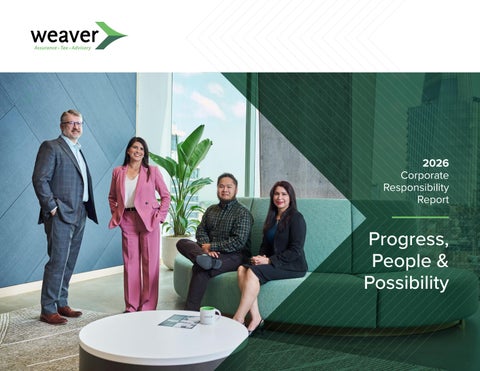
2026 Corporate Responsibility Report
Progress, People & Possibility
Table of Contents About This Report
Culture and Community
Governance
Letter From the CEO
6
Future-Ready Workforce
35
Governance
71
Business Overview
7
Supporting Employee Success
39
Ethics
72
Firm History
13
People by the Numbers
49
Data Privacy and Cybersecurity
72
Weaver at a Glance
15
Community Impact
52
Responsible Use of AI
73
FY26 Highlights
21
Climate and Resilience
Our Approach
Client Impact
Climate Strategy
56
Sustainability Leadership
77
Water Risk Assessment
57
Sustainability and Climate Advisory
78
Climate Risk Assessment
60
Reporting Frameworks
Corporate Sustainability Reporting Directive (CSRD) Process
24
Defining What Matters
25
Impacts, Risks and Opportunities
29
Environmental Performance
64
Performance Data Tables
79
Stakeholder Engagement
33
Industry Leadership & Recognition
69
Global Reporting Initiative (GRI) Index
79
Sustainability Accounting Standards 79 Board (SASB) Index Climate Risk Report
79
About This Report Weaver and Tidwell, L.L.P., (Weaver), a national accounting and consulting firm, began publishing an annual sustainability report in 2024. This year’s Corporate Responsibility Report describes how Weaver integrates corporate responsibility considerations into its business strategy, operations and decision- making processes to support long-term value creation, operational resilience and responsible growth.
In This Section Letter From the CEO Business Overview Firm History Weaver at a Glance FY26 Highlights
ABOUT
|
APPROACH
|
CULTURE & COMMUNITY
|
CLIMATE & RESILIENCE
|
GOVERNANCE
As expectations for corporate transparency continue to expand from clients, employees, suppliers and regulators, Weaver periodically evaluates its practices and reporting to ensure that our disclosures are relevant, useful and reflect the issues most significant to the firm and its stakeholders. Last year, Weaver completed a Double Materiality Assessment (DMA) aligned with the principles of the Corporate Sustainability Reporting Directive (CSRD). The assessment evaluated the firm’s impacts, risks and opportunities and identified the topics most relevant to both business performance and stakeholder interests. During 2026, Weaver continued to evaluate these priorities through the lenses of financial and impact materiality, recognizing
that material topics should be periodically reassessed as business conditions, stakeholder expectations, and emerging risks and opportunities become better understood. Based on this review, the material topics identified through the 2025 DMA continue to provide the foundation for Weaver’s corporate responsibility strategy, reporting priorities and risk management activities.
Financial Materiality
Impact Materiality
The effects of Environmental, Social and Governance (ESG) factors on the firm’s financial performance, risk exposure and long-term business resilience
The firm’s impact on the environment and people, including how its operations contribute to or mitigate broader sustainability challenges
|
CLIENT IMPACT
|
REPORTING FRAMEWORKS
The 2026 report reflects several enhancements to Weaver’s assessment and reporting processes. Building on past climate risk assessments, Weaver expanded its evaluation of environmental risks and opportunities by incorporating nature-related considerations informed by the recommendations of the Taskforce on Nature-related Financial Disclosures (TNFD). The firm also conducted a water risk assessment for all office locations, including those in India, using the World Resources Institute’s (WRI) Aqueduct Water Risk Atlas to better understand potential exposure to drought, flooding and other waterrelated risks. Together, the climate and water assessments provide a broader understanding of how environmental conditions may influence Weaver’s operations, workforce, value chain and long-term resilience while supporting the identification of opportunities to strengthen preparedness and risk management practices.
Weaver’s Houston Office | Image Source: Corgan
WEAVER'S 2026 CORPORATE RESPONSIBILITY REPORT | 4
ABOUT
|
APPROACH
|
CULTURE & COMMUNITY
|
CLIMATE & RESILIENCE
|
GOVERNANCE
|
CLIENT IMPACT
Weaver also revisited its alignment with the globally recognized sustainability reporting frameworks. This report is aligned with the following published guidance: Global Reporting Initiative (GRI)
Sustainable Accounting Standards Board (SASB)
|
REPORTING FRAMEWORKS
Past Reports
International Financial Reporting Standards (IFRS) S1 and S2 (formerly the Task Force on Climate-Related Financial Disclosures (TCFD))
Each standard serves a distinct purpose, and together, they provide a comprehensive structure for disclosing material ESG considerations relevant to the business.
We expanded the number of disclosures, incorporating 50 new GRI disclosures that were not included in prior years. These additions provide greater visibility into the firm’s governance, workforce, environmental performance and operational practices, while strengthening the depth and consistency of reporting across material topics. This report is informed by the GRI Standards, SASB, IFRS S1 and S2, and recommendations of the TNFD. Together, these frameworks and standards support Weaver’s evaluation and disclosure of its most relevant impacts, risks, opportunities and governance practices.
Financial Materiality
Impact Materiality
The effects of Environmental, Social and Governance (ESG) factors on the firm’s financial performance, risk exposure and long-term business resilience
The firm’s impact on the environment and people, including how its operations contribute to or mitigate broader sustainability challenges
Weaver’s Dallas Office | Image Source: Corgan
The 2026 Corporate Responsibility Report is based on the operations of the Weaver consolidated entity, consistent with our financial reporting boundary. Unless otherwise stated, information presented reflects activities occurring during the fiscal year ended May 31, 2026. Greenhouse gas emissions, energy and water quantities are reported on a calendar-year basis (CY2025 with CY2024 comparatives), consistent with utility billing and emission-factor data. Climate and water risk assessments, workforce data and program activity follow the fiscal year ended May 31, 2026. The disclosures contained in this report have not been externally verified. Weaver will continue to evaluate and refine its methodologies, processes and disclosures as its corporate responsibility program and reporting practices mature. Questions regarding this report may be directed to sustainability@weaver.com. Published September 2026 WEAVER'S 2026 CORPORATE RESPONSIBILITY REPORT | 5
ABOUT
|
APPROACH
|
CULTURE & COMMUNITY
|
CLIMATE & RESILIENCE
|
GOVERNANCE
|
CLIENT IMPACT
|
REPORTING FRAMEWORKS
Letter From the CEO The past year reinforced the importance of investing for the long term. As the pace of change accelerated across our profession, we continued strengthening our people, technology and operations while positioning Weaver for future growth.
Growth is most meaningful when it strengthens our people, creates opportunities for our clients and leaves our communities better than we found them.
Artificial intelligence (AI) emerged as one of the most significant developments affecting our clients, our profession and the broader business community. In response, we elevated AI to a strategic priority and continued investing in the capabilities, technologies and talent needed to enhance how we serve clients. We know that AI presents meaningful opportunities to improve efficiency, deepen insights and create greater value, and we are committed to adopting these technologies thoughtfully and responsibly. At the same time, we remained focused on building a stronger, more resilient firm. Throughout the year, we continued integrating Weaver India, refined operational processes
and expanded programs that support employee development, engagement and retention. These investments help ensure we have what’s needed to meet the opportunities ahead. One of the year’s most significant milestones was the acquisition of Mass Ingenuity’s Results™ platform and related intellectual property. For many years, our teams worked alongside Mass Ingenuity to help organizations improve performance and execute strategic initiatives. Bringing these capabilities into Weaver allows us to combine innovative technology with deep advisory experience, expanding our ability to help clients turn strategy into measurable results. Our commitment to responsible business practices remained equally important. Building on the governance and sustainability foundations established in recent years, we continued advancing resilience initiatives while creating a positive impact in the communities we serve. This included achieving a Green Lease Leaders Platinum designation
and supporting a revitalization effort in Altadena, California, following the 2025 wildfires. I am especially proud of how our people embraced change while remaining focused on what has always defined Weaver: exceptional client service, strong relationships and a commitment to doing the right thing. Their dedication continues to strengthen our culture, support our clients and create meaningful impact beyond our business. As we look ahead, we will continue pursuing responsible, diversified growth while investing in innovation and creating long-term value for our clients and communities. I am grateful for the trust placed in us and proud of what we accomplished this year.
John Mackel CEO and Managing Partner Weaver
WEAVER'S 2026 CORPORATE RESPONSIBILITY REPORT | 6
ABOUT
|
APPROACH
|
CULTURE & COMMUNITY
|
CLIMATE & RESILIENCE
|
GOVERNANCE
|
CLIENT IMPACT
|
REPORTING FRAMEWORKS
Business Overview Weaver strives to be the consistent, reliable solutions provider for our clients and a best-in-class workplace for our employees. Guided by unwavering core values, we deliver clarity and stability to support our teams and clients through unpredictable times. While our foundational principles remain steadfast, we embrace adaptability, proactively adjusting our approaches to anticipate and address the unique challenges facing those we serve. Weaver is a national accounting and consulting firm committed to delivering practical solutions that help organizations navigate complexity and achieve their objectives. Our core values remain a north star as we adapt to changing technologies, economic forces and client needs across all our markets. Founded in 1950, Weaver serves clients through a network of 29 strategically located offices and approximately 1,600 professionals. Our multidisciplinary approach combines technical knowledge, industry experience and a commitment to innovation, enabling us to provide solutions that create long-term value. After celebrating our 75th anniversary last year, fiscal year 2026 provided an opportunity to reflect on the achievements, relationships and milestones that have shaped Weaver. More importantly, it reinforced the principles that continue to define our future: commitment to our people, dedication to serving our clients, investment in the communities
where we live and work, and a culture that embraces innovation and continuous improvement. These commitments have guided the firm’s growth for more than seven decades and remain central today. Our team’s agility and responsiveness have consistently proven critical to our clients’ success. We actively leverage innovative technology, continuously evaluating all available tools to maximize impact and deliver customized solutions aligned with each client’s strategic vision. Education remains a priority, ensuring our professionals are always ahead of emerging trends, industry shifts, and new laws and regulations.
Check out this overview video about Weaver’s Transaction Advisory Services practice.
View this video about our New York City office at Penn 1.
Weaver has continued to grow, even in challenging circumstances, because we remember that “value” has many dimensions and that our employees and environment are as important as our clients. This larger perspective is the difference that will enable us all to thrive in the long run.
WEAVER'S 2026 CORPORATE RESPONSIBILITY REPORT | 7
ABOUT
|
APPROACH
|
CULTURE & COMMUNITY
|
CLIMATE & RESILIENCE
|
GOVERNANCE
|
CLIENT IMPACT
|
REPORTING FRAMEWORKS
Core Values Our core values at Weaver go beyond aspirational principles. They infuse our business processes and organizational culture. These values directly influence our employee recognition programs, performance evaluations and our double materiality assessment survey, shaping priorities within our Corporate Responsibility Report. This year, we reviewed our core values against the United Nations Sustainable Development Goals (UNSDGs) and material topics, validating their relevance and confirming that they are consistent with market expectations on both a national and global scales. This alignment ensures our internal objectives resonate broadly, adhering to the highest global standards and emphasizing our unwavering dedication to be responsible corporate citizens.
Take initiative. Lead. Always think about how we can improve.
Do work you’re deeply proud of, as if Weaver were your business.
Act with integrity, no matter what.
Strive to transcend client expectations, always.
Be adaptable and innovative in all that you do.
Help each other succeed at work and in life.
Respect everyone for who they are and what they contribute, no matter what.
Keep perspective: be passionate and diligent, and have fun.
We aim to deliver excellence that catalyzes growth and empowers our clients to exceed their financial and operational goals. Mission
Vision
Values
Working collaboratively with each other and our clients, Weaver solves the most challenging accounting, regulatory and business issues. We bring a human element to the world of numbers and complex regulations, which includes creating a supportive workplace culture where we strive for excellence together.
Weaver strives to be the best accounting and consulting firm in the country for our people and our clients, while celebrating and extending our collaborative, innovative culture.
Our goal is to balance high development with high performance to meet the goals of each individual, team and the firm. Our core values drive everything we do — the way we work, the way we operate and the way we serve our clients.
WEAVER'S 2026 CORPORATE RESPONSIBILITY REPORT | 8
ABOUT
|
APPROACH
|
CULTURE & COMMUNITY
|
CLIMATE & RESILIENCE
|
GOVERNANCE
|
CLIENT IMPACT
|
REPORTING FRAMEWORKS
Take initiative. Lead. Always think about how we can improve.
Do work you’re deeply proud of, as if Weaver were your business.
Act with integrity, no matter what.
Strive to transcend client expectations, always.
Be adaptable and innovative in all that you do.
Help each other succeed at work and in life.
Respect everyone for who they are and what they contribute, no matter what.
Keep perspective: be passionate and diligent, and have fun.
Business Ethics
Business Ethics
Business Ethics
Business Ethics
Business Ethics
Business Ethics
Business Ethics
Business Ethics
Client Satisfaction
Client Satisfaction
Conflicts of Interest
Client Satisfaction
Client Satisfaction
Client Satisfaction
Client Satisfaction
Client Satisfaction
IT Innovation
Data Privacy
Cybersecurity
IT Innovation
Learning & Development
Data Protection
Data Privacy
Learning & Development
Learning & Development
Regulatory Risk Management
Data Protection
Learning & Development
Learning & Development Regulatory Risk Management
Regulatory Risk Management
Regulatory Risk Management
Talent Management
Talent Management
Talent Management
NEW
Artificial Intelligence
Regulatory Risk Management
NEW
Artificial Intelligence
UNSDG Alignment
2026 Material Topics
Core Value
Connecting Our Core Values to Global Priorities and Strategic Objectives: UNSDG Alignment
Reporting Framework Reference: Weaver’s material topics inform the identification and disclosure of sustainability-related risks and opportunities in accordance with IFRS S1. Climate-related matters are disclosed in accordance with IFRS S2, where applicable. WEAVER'S 2026 CORPORATE RESPONSIBILITY REPORT | 9
|
APPROACH
|
CULTURE & COMMUNITY
|
CLIMATE & RESILIENCE
|
GOVERNANCE
|
CLIENT IMPACT
|
REPORTING FRAMEWORKS
v
v
ABOUT
Connection, Communication and Core Values: Weaver’s Annual State of the Firm Event Each year, Weaver employees gather for firmwide news and celebration. The event has a long history. When Weaver had just a handful of offices, all of them in Texas, the leadership team could travel around the state and hold the event separately for each office. As both the firm and videoconferencing options grew, leaders moved to hosting a large in-person event (which still travels around) and holding communal watch parties in the other offices. State of the Firm allows leaders to share accomplishments from the past year, explain upcoming changes and recognize people who have contributed to the firm’s success. Awards are presented for All Stars and Rookies from each service line and office. But the big awards are our Core Values Awards, given to four employees who best exemplify Weaver’s core values every day. One of those four winners is also named the Tidwell Award winner, Weaver’s highest honor. Weaver’s CEO and managing partner, John Mackel, interviews the firm’s Core Values Award winners at the 2025 State of the Firm.
Meet our most recent Core Values Award winners and discover how they exemplify Weaver’s values every day.
WEAVER'S 2026 CORPORATE RESPONSIBILITY REPORT | 10
ABOUT
|
APPROACH
|
CULTURE & COMMUNITY
|
CLIMATE & RESILIENCE
|
GOVERNANCE
|
CLIENT IMPACT
|
REPORTING FRAMEWORKS
Industry Affiliations Our team of professionals maintains active involvement with the American Institute of Certified Public Accountants (AICPA), reinforcing our adherence to the profession’s rules and standards. This ensures we uphold the highest levels of professionalism and integrity in our work, from preventing conflicts of interest to meeting requirements for financial statement audits. Our professionals also hold Certified Public Accountant (CPA) licenses in numerous U.S. states and are members of various state-level CPA societies. These memberships help us remain connected to local networks and stay current with regional developments and regulatory changes. We continue to monitor global regulations and trends through our participation in two international associations — Allinial Global and The International Accounting Group (TIAG®). These associations give us access to global resources and allow us to engage with firms around the world to support cross-border clients.
MEMBER
This year, the Allinial Global Summit was held in Dallas, which is the home of Weaver’s second-largest office, providing a timely opportunity for Weaver to increase its presence at the event. Firm leaders and professionals from multiple practice lines participated, including our CEO. Weaver has cultivated long-standing relationships through active participation, collaboration and knowledge sharing with other Allinial member firms. Next year, National Strategy Leader Alyssa Martin will assume the role of vice chair of the board, further deepening the firm’s reach and giving Weaver a stronger voice in the organization’s priorities and direction.
Weaver partner, Alyssa Martin, is with Tony Sacre, the President and CEO of Allinial Global, at a conference last year.
A Worldwide Alliance of Independent Accounting Firms
WEAVER'S 2026 CORPORATE RESPONSIBILITY REPORT | 11
ABOUT
|
APPROACH
|
CULTURE & COMMUNITY
|
CLIMATE & RESILIENCE
|
GOVERNANCE
|
CLIENT IMPACT
|
REPORTING FRAMEWORKS
⊲
Greater Houston Partnership Greater Oklahoma City Chamber Healthcare Financial Management Association (HFMA) Oklahoma Healthcare Financial Management Association (HFMA) Texas Investment Advisor Association (IAA) Kay Bailey Hutchison Energy Center, Advisory Council Low Carbon Fuels Coalition (LCFS) Midland Chamber of Commerce National Association of Federal Equity Receivers (NAFER) National Council of Real Estate Investment Fiduciaries (NCREIF) National Emergency Management Agency (NEMA) Corporate Membership National Investment Company Service Association (NICSA) North Dallas Chamber of Commerce (NDCC) North Houston Association Membership Opportunity Austin Real Estate Council Greater Fort Worth (RECGFW) Texas Association of School Business Officials (TASBO) Business Membership Texas eHealth Alliance Women’s White Collar Defense Association (WWCDA) Young Professionals of Midland
Industry Affiliations Weaver prides itself in meaningful engagement through membership and participation in hundreds of industry and professional regulatory agencies, associations, chambers of commerce, councils, coalitions and much more. Included on this page are some of Weaver’s affiliations where the firm and/or individual professionals participate on an ongoing basis.
Weaver professionals attend an Allinial Global event.
Association for Corporate Growth (ACG) 101 ACG Austin/San Antonio ACG Houston ACG Louisiana ACG Oklahoma ⊲ Advanced Biofuels Association (ABA) ⊲ American Bar Association Health Policy Circle ⊲ American Biogas Council ⊲ Association of College & University Auditors (ACUA) Strategic Partner ⊲ Association of Water Board Directors ⊲ Commercial Real Estate Development Association (CREDA), formerly NAIOP ⊲ Community College Business Officers (CCBO) ⊲ Dallas Regional Chamber ⊲ The Employee Stock Ownership Plan (ESOP) Association ESOP California/Nevada Chapter ESOP Florida Chapter ESOP Northwest Chapter ESOP Rocky Mountain Chapter ESOP Texas/Oklahoma Chapter ⊲ Financial Executives International (FEI) Dallas FEI Fort Worth FEI Houston FEI San Antonio ⊲ Government Finance Officers Association of Texas (GFOAT) Annual Partnership ⊲ Greater Bethesda Chamber of Commerce ⊲
⊲ ⊲ ⊲ ⊲ ⊲ ⊲ ⊲ ⊲ ⊲ ⊲ ⊲ ⊲ ⊲ ⊲ ⊲ ⊲ ⊲ ⊲ ⊲
WEAVER'S 2026 CORPORATE RESPONSIBILITY REPORT | 12
ABOUT
|
APPROACH
|
CULTURE & COMMUNITY
|
CLIMATE & RESILIENCE
|
GOVERNANCE
|
Firm History Weaver is a national audit and consulting firm with roots going back to 1950 when World War II veterans and friends, Lloyd Weaver and D. Wayne Tidwell, founded the business in Fort Worth, Texas. Originally focused on providing audit and tax services to local businesses and individuals, Weaver’s collaborative culture and reputation for putting clients first contributed to steady growth over the following decades. Today, our client base encompasses both public and private sector clients across a diverse range of industries. We’ve expanded our service offerings to include a variety of accounting, consulting and advisory services to meet our clients’ evolving needs in an increasingly digital world.
CLIENT IMPACT
|
REPORTING FRAMEWORKS
U.S. Office Expansion
From those early days, our growth has been fueled by a deep commitment to our clients, the strength of our culture and our relentless pursuit of excellence. Over the years, we’ve adapted to fundamental changes in the business landscape, from the rise of new industries to transformation within our services. Today, we stand with a reputation for trust, quality and innovation.
A national firm with offices from California to New York, Weaver is ranked #28 in Accounting Today’s Top 100 firms. Throughout our history, we remain dedicated to delivering high-quality services, fostering lasting client relationships and supporting client success.
Left: L-R: Sam Edwards, Lloyd Weaver, J.T. Bartee, Tommy Roddy and D. Wayne Tidwell, the first generation of Weaver partners Right: Weaver’s Fort Worth office
1950
Founded in Fort Worth, Texas
1960
Dallas, Texas Office Established
2007
Houston, Texas Office Established Through Transaction with McDonald, Fox & Lund, PC
2009
San Antonio, Texas Office Established Through Deal with Polansky McNutt Perry & Company, P.C
2010
Midland, Texas Office Established Through Deal with Elms, Faris & Company, LLP
2014
Expanded National Footprint into Los Angeles, California
2016
Conroe, Texas Office Established Through Transaction with HLSK
2018
Expanded National Footprint into New York, New York
2019
HSK Deal expands FLS and VAL practices
2022
New York, New York Office Expansion Through Deal with Levine & Seltzer, LLP
2023
Los Angeles, California Area Expansion through HKG, LLP
2024
Expansion of East Coast Presence to Five Offices
2025
Boston, Denver and Philadelphia Offices Open
2026
San Francisco, California Office Opens
WEAVER'S 2026 CORPORATE RESPONSIBILITY REPORT | 13
ABOUT
|
APPROACH
|
CULTURE & COMMUNITY
|
CLIMATE & RESILIENCE
|
GOVERNANCE
|
CLIENT IMPACT
|
REPORTING FRAMEWORKS
Consistent Values for Changing Times Founding and Early Growth (1950–1986)
Texas Expansion (1986–2009)
Modernization and Rebranding (2009–2015)
National and International Expansion (2015–present)
Lloyd J. Weaver and D. Wayne Tidwell founded the firm in February 1, 1950, in Fort Worth, Texas. As Managing Partner and CEO, Lloyd J. Weaver built a strong foundation, emphasizing client service and technical excellence.
Under W.M. “Mack” Lawhon’s leadership, Weaver expanded from one office to seven offices across Texas, often merging with local firms that shared Weaver and Tidwell’s vision and values.
Tommy D. Lawler took the helm in 2009, continuing the firm’s expansion and modernization in response to changing technology and business needs. During this time, the firm rebranded to “Weaver.”
When John J. Mackel III assumed the role of managing partner and CEO in 2015, Weaver’s headquarters moved to Houston and the firm grew rapidly, expanding service offerings, locations, partners and staff.
1950
1986
2009
2015
2026
2007
2009
2015
Weaver’s founders encoded their community commitment into the firm’s DNA. In 2007, the Weaver and Tidwell Private Foundation was created to serve our communities. Since then, the firm has continued to expand its charitable support through donations and employee volunteering.
In 2009, Jeanne Smith and Alyssa Martin launched Weaver’s first formal women’s initiative, creating opportunities for connection, leadership development and professional growth across the firm. The initiative later evolved into Inspire under Neha Patel’s leadership, which expanded into today’s Impact Teams, including Empower.
Beginning in 2015, under John Mackel’s leadership, Weaver intentionally embedded a people-first culture through a shared set of core values that continue to guide the firm. Inspired by the Everyman archetype, this approach reinforced a workplace centered on authenticity, collaboration and belonging.
2008
2010
2020
2025
In 2008, Weaver formalized its first nonfinancial accounting practice group to address the energy compliance needs of its large energy industry client base. Today, Weaver is a leading provider of consulting, audit and verification services for the transportation fuels industry, with a strong focus on renewable fuels programs.
In 2010, David Rook launched Weaver’s advisory service line, consolidating services into distinct practices for risk advisory, IT consulting, transaction advisory and forensic services. Today, the advisory service line has expanded significantly, with practice areas supporting clients across business transformation and other complex needs.
Weaver implemented robotic process automation before large language models (LLMs) were even available. The first users were administrators for the tax practice, and before long, partners learned how to help clients use these powerful tools. Now AI (always with a human in control) is a vital part of both internal processes and client services.
In May 2026, 33 employees gathered in Altadena, California, for Project Weaver. These volunteers worked to build play areas for Odyssey Charter School South, a school affected by the 2025 Los Angeles fires. Weaver has always worked to improve the communities we serve, with Project Weaver as just one snapshot within the larger initiative.
Creation of the Weaver and Tidwell Private Foundation to Support Our Communities
Launch of Energy Compliance Services
Launch of Women’s Initiative
Expansion of Advisory Practice
Intentional Investment in People-First Culture
Early Adoption of Automation and AI
2024
First International Expansion After testing the waters through partnership with an India-based company, the firm launched Weaver India in 2024, which now has five offices. Built on a culture of collaboration, innovation and shared values, Weaver India helps strengthen the capabilities and reach of teams across Weaver’s global organization.
Commitment to Community
WEAVER'S 2026 CORPORATE RESPONSIBILITY REPORT | 14
ABOUT
|
APPROACH
|
CULTURE & COMMUNITY
|
CLIMATE & RESILIENCE
|
GOVERNANCE
|
CLIENT IMPACT
|
REPORTING FRAMEWORKS
Weaver at a Glance Headquarters
Houston, Texas Year Founded
1950
Total Team Members
1,600
Approximately
Number of Partners
198
Number of Offices
29
24 in U.S., 5 in India
FY26 Revenue
$404.8M
U.S. West
U.S. Central
U.S. East
India
Denver, Colorado Los Angeles, California Manhattan Beach, California Pasadena, California Sacramento, California San Diego, California San Francisco, California Woodland Hills, California Portland, Oregon
Austin, Texas Dallas, Texas Fort Worth, Texas Houston, Texas Lafayette, Louisiana Midland, Texas Oklahoma City, Oklahoma San Antonio, Texas The Woodlands, Texas
Boston, Massachusetts Jericho, New York Little Falls, New Jersey New York City, New York Philadelphia, Pennsylvania Washington, D.C. Metro
Bengaluru Chennai Coimbatore Hyberabad Kochi
WEAVER'S 2026 CORPORATE RESPONSIBILITY REPORT | 15
ABOUT
|
APPROACH
|
CULTURE & COMMUNITY
|
CLIMATE & RESILIENCE
|
GOVERNANCE
|
CLIENT IMPACT
|
REPORTING FRAMEWORKS
Industries
Consumer and Industrial Products Consumer Products Hospitality and Entertainment Food and Beverage Industrial Products
Financial Services Alternative Investments Banking Insurance Private Equity
Health Care Health Care Data Privacy and Cybersecurity Life Sciences Patient Care (Providers)
Infrastructure and Development Construction Real Estate Transportation and Logistics
Labor Union Organizations Labor Unions Multiemployer Plans
Natural Resources, Renewable Energy and Utilities Oil and Gas Renewable Fuels Energy Evolution
Public Sector Government Higher Education Not-for-Profit
Technology and Innovation Blockchain and Digital Assets Technology Artificial Intelligence
WEAVER'S 2026 CORPORATE RESPONSIBILITY REPORT | 16
ABOUT
|
APPROACH
|
CULTURE & COMMUNITY
|
CLIMATE & RESILIENCE
|
GOVERNANCE
|
CLIENT IMPACT
|
REPORTING FRAMEWORKS
Services Advisory Services Accounting Advisory Artificial Intelligence Solutions Asset Management Consulting Bankruptcy and Restructuring Services Business Transformation Digital Transformation and Automation Energy Compliance Energy Solutions Enterprise Performance Management Executive and Leadership Coaching Services Financial Advisory Services Forensics and Litigation Global Capability Centers Government Consulting IT Advisory Real Estate Advisory Services Risk Advisory Sustainability Consulting Services Transaction Advisory Services Valuation Services
Audit and Assurance Services Agreed-Upon Procedures Employee Benefit Plan Audit Financial Audits IFRS Assessment and Conversion Peer Review Public Company Audit Review and Compilation System and Organization Control (SOC) Examinations Tax Services Federal Tax Fixed-Asset Advisory International Tax Services Motor Fuels and Excise Tax Private Client State and Local Tax Tax Credits and Incentives Practice Groups Private Equity Public Company Weaver Capital Advisors Weaver Family Advisors Software Hi-Arc DAVI FuelRules Results
WEAVER'S 2026 CORPORATE RESPONSIBILITY REPORT | 17
ABOUT
|
APPROACH
|
CULTURE & COMMUNITY
|
CLIMATE & RESILIENCE
|
GOVERNANCE
FY26 Firm Revenue
|
CLIENT IMPACT
|
REPORTING FRAMEWORKS
Total Revenue
FY26 By Industry
$404.8M
By Region
Energy
27%
Central
73%
East
11%
Financial Services
25%
West
9%
India
11%
Commercial
17%
Public Sector
10%
Private Client Services
9%
Professional Services
6%
Personal Tax
4%
Hospitality and Entertainment
1%
Agriculture and Ranching
1%
FY25
$383.5M
By Service Line
FY24
$328.3M Tax 36%
Audit 31%
Advisory 33%
WEAVER'S 2026 CORPORATE RESPONSIBILITY REPORT | 18
ABOUT
|
APPROACH
|
CULTURE & COMMUNITY
|
CLIMATE & RESILIENCE
|
GOVERNANCE
|
CLIENT IMPACT
|
REPORTING FRAMEWORKS
Awards and Accolades National Weaver’s industry-focused, client-centric approach has paid off for our clients — and garnered national and local recognition.
RANKED
28
Top 100 Firms INSIDE Public Accounting
RANKED
Largest Accounting Firms in the United States The Business Journals Regional
25
RANKED
28
Top 100 Firms Accounting Today
Regional RANKED
1
Largest Independent CPA Firm in the Southwest Accounting Today
Largest Austin Accounting Firms Austin Business Journal Largest North Texas Accounting Firms Dallas Business Journal Largest Denver Accounting Firms Denver Business Journal Accounting Firms With the Most Local CPAs Houston Business Journal Fastest Growing Middle Market Firm Houston Business Journal Houston’s Largest Private Companies Houston Business Journal Largest L.A. County Accounting Firms Los Angeles Business Journal 2025 Top Accounting and Business Advisory Firms in L.A. County Los Angeles Times
RANKED
3
Largest Tarrant County Accounting Firms Fort Worth Business Press
Largest Accounting Firms in New Jersey New Jersey Business Journal Largest Philadelphia Accounting Firms Philadelphia Business Journal Largest Portland Accounting Firms Portland Business Journal Largest Sacramento Accounting Firms Sacramento Business Journal Accounting Firms With the Most Local CPAs San Antonio Business Journal Largest Accounting Firms in Oklahoma The Journal Record Largest Accounting Firms in Greater Washington Washington Business Journal (Metro DC)
WEAVER'S 2026 CORPORATE RESPONSIBILITY REPORT | 19
|
APPROACH
|
CULTURE & COMMUNITY
|
CLIMATE & RESILIENCE
|
GOVERNANCE
|
CLIENT IMPACT
|
REPORTING FRAMEWORKS
v
v
ABOUT
Weaver Earns 2026 Best of Accounting Award for Client Service Weaver has been named a 2026 Best of Accounting Award® winner by ClearlyRated, a distinction earned by fewer than 1% of accounting firms across the U.S. and Canada. What makes this recognition meaningful is how it’s earned. The Best of Accounting Award is based entirely on independent client feedback through Net Promoter® Score surveys, measuring how clients experience working with Weaver.
84.6%
80
95%
of clients gave us a satisfaction score of 9 or 10 out of 10, compared to an industry average of 48%.
Weaver’s Net Promoter Score more than doubled the accounting industry average.
of surveyed clients said Weaver exceeded or far exceeded their expectations, with no respondents indicating service below expectations.
In our first year participating in Clearly Rated’s survey process, clients rated Weaver well above industry benchmarks:
“Exceptional service — professional, knowledgeable and efficient. They made the entire valuation process smooth and stress-free. They have always met their scheduled deadlines.”
“Working with Weaver has been an outstanding experience. Their team consistently delivers our audits and tax work on time and within budget, which gives us tremendous confidence as we plan and grow.”
− VP of a global data technology company
− Chief financial officer of a K-12 safety software company
This recognition deeply reflects our core value to strive to transcend client expectations, always. It shows up in how we collaborate across teams, how we communicate with clients and how we take ownership of outcomes, especially when client expectations are high. WEAVER'S 2026 CORPORATE RESPONSIBILITY REPORT | 20
ABOUT
|
APPROACH
|
CULTURE & COMMUNITY
|
CLIMATE & RESILIENCE
|
GOVERNANCE
|
CLIENT IMPACT
|
REPORTING FRAMEWORKS
FY26 Highlights Climate and Resilience
80%
of Weaver offices in buildings that hold green building certifications
NY Climate Week: Expanding Weaver’s voice in climate risk, reporting and business readiness
Culture and Community
Governance
96%
52%
26%
Average remuneration ratio of women to men
Female employees
Female partners
Approximately
30
Styrofoam elimination: Advancing year two of our practical waste reduction initiative
Sustainability Impact Team: Launching an employee-led group to support office-level sustainability action and engagement
languages Spoken
NEW
Maintained ISO/IEC 27001 certification for the second consecutive year
93%
90%
$350,000
donated through the Weaver and Tidwell Private Foundation – cumulative through FY26
Agree that Weaver is actively working to ensure that people of all cultures and backgrounds feel welcome
Weaver volunteers and community partners donated
700 hours to Project Weaver in Altadena, California
6%
Learning and Development total training hours
55,605 in FY26 compared to 40,150 hours in FY25
Revenue Growth
Client Impact Client Satisfaction
79%
Felt accepted by coworkers
Training on firm policies
AI Policy
Approximately
TM
Water Risk Assessment: Broadening our reporting through a TNFD-informed view of location-based water risk
100%
of surveyed clients would recommend Weaver (industry average 62%)
Net Promoter Score
71%
industry benchmark 55%
WEAVER'S 2025 2026 CORPORATE RESPONSIBILITY REPORT | 21
Our Approach Assessing and prioritizing the topics most relevant to Weaver and its stakeholders is an ongoing process. While the firm did not conduct a formal DMA in 2026, Weaver continued to evaluate its impacts, risks, opportunities and strategic priorities using the framework established through the 2025 DMA and Impacts, Risks and Opportunities (IRO) assessment.
In This Section Corporate Sustainability Reporting Directive (CSRD) Process Defining What Matters Impacts, Risks and Opportunities Stakeholder Engagement
ABOUT
|
APPROACH
|
CULTURE & COMMUNITY
|
CLIMATE & RESILIENCE
|
GOVERNANCE
|
CLIENT IMPACT
|
REPORTING FRAMEWORKS
This evaluation considered stakeholder feedback, business priorities, industry developments, regulatory activity and emerging topics that may influence the firm’s operations, workforce, clients and value chain. The process reflects the principles of the CSRD, which recognizes that materiality should be periodically evaluated as organizations and their operating environments change.
Double Materiality
Weaver’s Dallas Office | Image Source: Corgan
How Weaver impacts ESG and how ESG impacts Weaver
WEAVER'S 2026 CORPORATE RESPONSIBILITY REPORT | 23
ABOUT
|
APPROACH
|
CULTURE & COMMUNITY
|
CLIMATE & RESILIENCE
CSRD Process Under the CSRD, companies are required to conduct a DMA as the first step in the ESG reporting process, a step Weaver completed in 2025. This approach has become the gold standard because it evaluates sustainability topics across two critical dimensions: Financial Materiality
Impact Materiality
The effects of ESG factors on the firm’s financial performance, risk exposure and long-term business resilience
The firm’s impact on the environment and people, including how its operations contribute to or mitigate broader sustainability challenges
Financial Materiality
Environmental and Social Materiality
To the extent necessary for an understanding of the company’s development, performance and position ...
COMPANY
CLIMATE
... and impact of its activities
COMPANY
CLIMATE
Climate Change Impact on Company
Company Impact on Climate
Primary Audience: Investors
Primary Audience: Consumers, Civil Society, Employees, Investors
Recommendations of the TCFD
|
GOVERNANCE
|
CLIENT IMPACT
|
REPORTING FRAMEWORKS
This two-pronged evaluation strengthens the connection between ESG performance and corporate strategy. In addition, CSRD requires that material topics be validated through an IRO assessment, ensuring that disclosures are backed by strategic relevance and evidence-based insights. This layered approach elevates traditional materiality exercises by embedding rigor, accountability and transparency throughout the process.
1
2
3
4
Analysis of the Business Model, Industry and Value Chain
Stakeholder and Framework Identification
Double Materiality Survey
Analysis of Results
5
6
7
8
Identification of Preliminary Material Topics
Perform IRO Analysis
Stakeholder Engagement
Finalization of Material Topics
Ultimately, the significance of the CSRD and the value of the DMA lie in their ability to transform sustainability reporting from a checkbox exercise into a deeply strategic undertaking. It builds a defensible case for sustainability in an environment where ESG efforts are increasingly scrutinized.
Because Weaver did not experience any material changes to either aspect of the DMA, we chose to continue relying on the determinations made in 2025. WEAVER'S 2026 CORPORATE RESPONSIBILITY REPORT | 24
ABOUT
|
APPROACH
|
CULTURE & COMMUNITY
|
CLIMATE & RESILIENCE
Defining What Matters
Learning and Development
Cybersecurity
Talent Management
Data Protection
GOVERNANCE
Weaver Double Materiality Matrix 2025 DMA Score with 2026 Emerging Priority
IT Innovation
3.75
1 2 3 4 5 6 7 8 9 10
12 11
REPORTING FRAMEWORKS
.s
vg
11
3.50
3.75
) 54
3.
3.25
=
17
re
co
15
20 19 23
3.00
2.50
21 24
25 26
2.75
22
27
2.25
29 30
2.00
2.00
2.25
2.50
2.75
3.00
3.25
Impact Materiality (Environmental and Social Score)
Data Privacy Cybersecurity Data Protection Business Ethics Client Satisfaction Learning and Development Talent Management IT Innovation Conflicts of Interest Regulatory Risk Management
Evaluated Topics (below threshold)
(a
14
d
ol
16
sh
AI
re
Artificial Intelligence Emerging Priority (illustrative not survey scored)
3.50
32 5 4 9 10 8 6 7
th
Financial Materiality (Score)
y
lit
ia
While not identified as a standalone material topic, AI has been elevated within our corporate responsibility program and reporting to reflect its increasing importance to the firm and our stakeholders.
er
at
Client Satisfaction
|
Material Topics (2025 DMA)
4.00
Conflicts of Interest
Regulatory Risk Management
CLIENT IMPACT
Based on this evaluation, the material topics identified through the 2025 DMA remain relevant and continue to reflect the areas where Weaver has the greatest potential to create value and influence outcomes. At the same time, artificial intelligence emerged as a strategic priority due to its growing influence on our business, workforce, clients and service offerings.
M
Business Ethics
|
The Corporate Responsibility Committee determines the cadence of formal materiality assessments. While the committee did not elect to conduct a formal reassessment in 2026, Weaver continued to evaluate these topics against business conditions, strategic priorities, stakeholder feedback and emerging impacts, risks and opportunities. This review incorporated employee feedback, client communications, industry developments and other stakeholder input, as further described in the Stakeholder Engagement section of this report.
The material topics reflected below were identified through Weaver’s 2025 DMA: Data Privacy
|
4.00
Employee Experience, Culture and Engagement 12 Anti-Discrimination 13 Tax Guidelines 14 Transparency and Accountability 15 Pay Equity 16 Anti-Corruption 17 Workplace Wellness 18 Emergency Preparedness 19 Human Rights 20 Occupational Health and Safety 21 Community Engagement 22 Corporate Philanthropy 23 Ethical Marketing and Branding 24 Inclusion and Belonging Initiatives 25 Physical Climate Risk 26 Energy Use 27 Renewable Energy 28 Waste 29 Water Management 30 GHG Emissions
WEAVER'S 2026 CORPORATE RESPONSIBILITY REPORT | 25
ABOUT
|
APPROACH
|
CULTURE & COMMUNITY
|
CLIMATE & RESILIENCE
|
GOVERNANCE
|
CLIENT IMPACT
|
REPORTING FRAMEWORKS
Corporate Responsibility Committee Our Director of Real Estate and Sustainability, Ashly Pleasant, who reports to the National Strategy Leader and is accountable to the Chief Operating Officer, leads both internal sustainability programs and client-facing initiatives. Sustainability is integrated into operational decision-making across the firm. Throughout the year, operational and practice leaders participate in sustainability planning and ESG data collection, creating transparency and shared ownership of the program’s success. Oversight and advancement of the firm’s sustainability strategy is managed through our Corporate Responsibility Committee, a cross-functional team composed of leaders from across departments. The committee plays a central role in evaluating initiatives, shaping policy and identifying opportunities to move the strategy forward. As part of this responsibility, the committee ensures that Weaver’s material topics remain at the center of decision-making. These topics serve as the north star for our sustainability strategy, guiding how we prioritize efforts, develop initiatives and assess impact.
Left: Weaver’s Houston Office | Image Source: Corgan Right: Several leaders present at WeaverLIFT 2025, one of the firm’s largest trainings for newly promoted managers, senior managers and directors. WEAVER'S 2026 CORPORATE RESPONSIBILITY REPORT | 26
ABOUT
|
APPROACH
|
CULTURE & COMMUNITY
|
CLIMATE & RESILIENCE
In the past year, the Corporate Responsibility Committee introduced Weaver’s Human Rights and Environmental Policy, marking a foundational step in formalizing our approach to key ESG topics. Beyond policy, the committee continues to drive impact by identifying tangible, business-aligned initiatives that reflect our values and commitments.
|
GOVERNANCE
Promoting sustainability through reusable drinkware at employee appreciation events
Operationalizing environmental goals by reducing single-use plastic and eliminating Styrofoam cups Exploring food waste reduction strategies for firm-hosted gatherings
This committee challenges itself to move forward with purpose — considering environmental impact, cost savings and employee experience at every step. Many of these changes benefit the bottom line while enhancing employee morale, reinforcing our position as a responsible corporate citizen that delivers on its promises. By evaluating progress from every angle, the corporate responsibility committee ensures we stay relevant in the evolving sustainability landscape and that our employees, clients and communities continue to see Weaver as a firm that leads with intention and integrity.
CLIENT IMPACT
|
REPORTING FRAMEWORKS
Ashly Pleasant, CCIM
Alyssa Martin, CPA
Director of Real Estate and Sustainability
National Strategy Leader
Provides guidance on ESG best practices, benchmarks and industry trends
Represents the voice of clients and ensures ESG initiatives align with client expectations
David Rook, CPA
Laura Roman, CPA
Chief Operating Officer
Partner-in-Charge, National Tax Office; Weaver and Tidwell Private Foundation Chair
Recent focus areas include: Integrating data from our operations in India into firmwide ESG reporting
|
Ensures ESG initiatives align with business objectives
Manages the firm’s community engagement, philanthropic and social impact initiatives
Frank McElroy, J.D.
Demetrice Branch
General Counsel and Chief Risk Officer Advises on legal implications of ESG efforts, including reporting disclosures and assists the ESG steering committee with assessing identified ESG-related risks
Chief People Officer Provides insights on employee-related matters such as equality, belonging and employee engagement
Dana Burris Director of Operations Collaborates with landlords and vendors to gather data from our operations and related sustainability practices within our leased portfolio, encompassing utilities, travel and smart design features
WEAVER'S 2026 CORPORATE RESPONSIBILITY REPORT | 27
ABOUT
|
APPROACH
|
CULTURE & COMMUNITY
|
CLIMATE & RESILIENCE
|
GOVERNANCE
|
CLIENT IMPACT
|
REPORTING FRAMEWORKS
Emerging Priorities AI has emerged as a strategic priority due to its growing influence on how organizations operate, deliver services, manage risk and create value. AI is a broad term encompassing a wide range of technologies, including LLMs, chatbots, intelligent assistants, agents, automation tools and other emerging capabilities. As the technology continues to evolve, so will its applications and implications for businesses and their stakeholders. Weaver focuses not on adopting every new AI capability, but on identifying and advancing the areas most relevant to our services and internal needs. We concentrate on two areas: first, leveraging AI internally to improve operational efficiency, knowledge sharing and the consistency of our work, and second, on applying AI-enabled solutions to help clients address their business
challenges and make the most of emerging technologies. As these capabilities continue to mature, Weaver remains focused on practical applications that enhance business performance and support measurable outcomes. Those efforts are supported by three priorities: AI innovation, AI training and responsible use.
Across each of these priorities, Weaver ensures that humans are in charge. AI augments human capabilities; it cannot replace them. Professional judgment, critical thinking, ethical decision-making and accountability remain central. Our people are always responsible for evaluating outputs, making decisions and ensuring the quality and integrity of the work delivered.
As AI technologies continue to mature, Weaver will periodically evaluate additional opportunities and new risks. This approach allows the firm to respond to rapidly evolving landscapes while staying aligned with its business objectives, stakeholder expectations, core values and commitment to responsible innovation.
AI Innovation
AI Training
Responsible Use
We evaluate opportunities to incorporate AI into our operations and service offerings where it can enhance efficiency, improve insights, strengthen decisionmaking and create value for our clients and teams.
We invest in developing AI literacy and practical skills across our workforce to ensure our professionals understand both the capabilities and limitations of these technologies. Building competency enables our teams to use AI effectively while maintaining the technical insight and professional judgment that our clients expect.
As AI capabilities expand, responsible deployment remains essential. Weaver is committed to using AI in a manner that aligns with our values, professional responsibilities and commitment to quality. Considerations such as data privacy, security, transparency, accuracy and appropriate oversight are important components of our approach.
WEAVER'S 2026 CORPORATE RESPONSIBILITY REPORT | 28
ABOUT
|
APPROACH
|
CULTURE & COMMUNITY
|
CLIMATE & RESILIENCE
|
GOVERNANCE
|
CLIENT IMPACT
|
REPORTING FRAMEWORKS
Impacts, Risks and Opportunities Weaver’s IRO assessment applied qualitative criteria outlined in the European Financial Reporting Advisory Group (EFRAG) guidance to better understand the relevance and significance of the topics identified through stakeholder input.
Impacts refer to the actual or potential effects our business activities have on environmental and social matters. Each identified impact was reviewed based on: Scale
Scope
Remediability
The severity or magnitude of the impact on people or the environment after considering existing mitigation measures
How widespread the impact may be, such as the number of individuals, operations or geographies affected
How difficult or costly it would be to reverse the impact, including the time horizon needed for remediation
Risks and opportunities, in contrast, are assessed solely from a financial perspective. They reflect how sustainabilityrelated topics could affect Weaver’s financial performance, position or access to capital. Each was considered based on:
Likelihood
The probability of the risk or opportunity occurring
Potential Financial Effect
Including cost implications, business disruption or long-term financial benefit
These criteria are not intended to be prescriptive or formulaic. Their application is inherently subjective and must be tailored to each organization’s operating model, strategic priorities and stakeholder expectations. At Weaver, we approached this analysis collaboratively, ensuring the evaluation was grounded in both an understanding of our business and the full context of environmental risks and opportunities.
WEAVER'S 2026 CORPORATE RESPONSIBILITY REPORT | 29
ABOUT
|
APPROACH
|
CULTURE & COMMUNITY
|
CLIMATE & RESILIENCE
|
GOVERNANCE
|
CLIENT IMPACT
|
REPORTING FRAMEWORKS
Double Materiality Assessment Impact
Financial Effect
Time Horizon
Social | S1 Own Workforce Learning and Development (L&D) Learning and Development provides structured programs and initiatives to build employees’ skills, knowledge and competencies in support of strategic objectives and long-term resilience
Talent Management Talent management is the attraction, selection and retention of employees, which involves a combination of HR processes across the employee life cycle. It encompasses workforce planning, employee engagement, L&D, performance management, recruiting, onboarding, succession and retention.
Positive/Negative, Actual/Potential Value Chain/ Own Operations
Own Operations
Positive/Negative, Actual/Potential Value Chain/ Own Operations
Own Operations
Risk
Opportunity
Inadequate L&D programs undermine regulatory compliance, which can stifle innovation, talent turnover, audit errors, regulatory penalties or even loss in client work if skill gaps emerge or certifications lapse.
Boosting productivity, attracting top talent and expanding service offerings in high-growth areas
Risk
Opportunity
Talent shortages, high turnover rates, skill gaps and lack of diversity lead to increased costs for hiring new talent, L&D costs, training employees, decreased productivity or innovation.
Attracting, retaining and developing a skilled workforce to drive business success and retain successful employees
Risk
Opportunity
Lower revenues, reduced market share if satisfaction dips
Upsell and cross-sell opportunities as high client satisfaction drives deeper engagement and new referrals
Short-Medium Term
Medium Term
Social | S4 Consumers and End Users Client Satisfaction An indicator of reputation and value creation, client satisfaction is measured via formal feedback channels, complaint-handling processes and satisfaction surveys that gauge how products and services meet end-user needs and expectations.
Positive Actual
Positive Potential
Positive/Negative, Actual/Potential Value Chain/ Own Operations
Negative Actual
Downstream Value Chain
Short-Medium Term
Negative Potential
WEAVER'S 2026 CORPORATE RESPONSIBILITY REPORT | 30
ABOUT
|
APPROACH
|
CULTURE & COMMUNITY
|
CLIMATE & RESILIENCE
Impact
|
GOVERNANCE
|
CLIENT IMPACT
|
REPORTING FRAMEWORKS
Financial Effect
Time Horizon
Governance | G1 Business Conduct Data Protection Policies, processes and technical controls to ensure the confidentiality, integrity and availability of client and firm data (audit work papers, financial models) in compliance with General Data Protection Regulation (GDPR) professional standards and industry frameworks
Data Privacy Policies, processes and technical controls that protect individuals’ and organizations’ private personal and financial data, including mechanisms that protect data in transit and at rest.
IT Innovation Build resilient infrastructure, promote sustainable industrialization and foster innovation; innovation is defined as developing and deploying new technologies, processes and services that drive productivity, inclusivity and environmental performance
Conflicts of Interest Situations where personal, family or financial interests of individuals (or their close associates) are or may be perceived to be, in conflict with their duty to act impartially and potentially undermining professional objectivity and enterprise value
Positive/Negative, Actual/Potential Value Chain/ Own Operations
Own Operations
Positive/Negative, Actual/Potential Value Chain/ Own Operations
Own Operations
Positive/Negative, Actual/Potential Value Chain/ Own Operations
Own Operations
Positive/Negative, Actual/Potential Value Chain/ Own Operations
Own Operations
Risk
Opportunity
Regulatory fines, professional liability claims, remediation costs and reputational damage from unauthorized access or data leakage
Adoption of ISO 27001/SOC 2 controls and privacy-enhancing technologies to differentiate our services, reduce cyber-insurance premiums and win new clients seeking secure accounting partners
Risk
Opportunity
Mishandled personal data can lead to identity theft, discrimination, regulatory scrutiny and loss of confidence in our client relationships. This extends to lawsuits, client attrition and increased compliance costs stemming from privacy violations or inadequate consent management
Embedding privacy-by-design in client engagements builds our reputation for integrity, unlocks new advisory services and strengthens long-term client loyalty
Risk
Opportunity
Underinvestment could lead to inefficiencies, higher costs, inability to meet evolving client expectations
Differentiation through cuttingedge solutions, new revenue from AI-enabled advisory and consulting-assurance products and automation to complete client deliverables more efficiently
Risk
Opportunity
Legal fines, reputational damage, loss of independence if conflict of interest not managed
Strengthened governance and transparency bolsters credibility, enabling access to regulated clients and premium engagements
Long Term
Long Term
Medium-Long Term
Short-Medium Term
WEAVER'S 2026 CORPORATE RESPONSIBILITY REPORT | 31
ABOUT
|
APPROACH
|
CULTURE & COMMUNITY
|
CLIMATE & RESILIENCE
Impact
|
GOVERNANCE
|
CLIENT IMPACT
|
REPORTING FRAMEWORKS
Financial Effect
Time Horizon
Governance | G1 Business Conduct Business Ethics Appropriate business policies and practices regarding arguably controversial, such as corporate governance, insider training, bribery, discrimination, social responsibility and fiduciary responsibilities. The law usually sets the tone for business ethics, providing a basic guideline that businesses can choose to follow to gain public approval
Cybersecurity Protecting systems, networks and programs from digital attacks. These cyberattacks are usually aimed at accessing, changing or destroying sensitive information; extorting money from users via ransomware; or interrupting normal business processes
Regulatory Risk Potential for adverse financial, operational or reputational impacts arising from changes to or noncompliance with applicable laws, regulations, voluntary commitments or professional standards identified through the undertaking’s risk-management processes and requiring mitigation to avoid fines, sanctions, operational restrictions or loss of stakeholder confidence
Positive/Negative, Actual/Potential Value Chain/ Own Operations
Own Operations
Positive/Negative, Actual/Potential Value Chain/ Own Operations
Own Operations
Positive/Negative, Actual/Potential Value Chain/ Own Operations
Own Operations
Risk
Opportunity
Increased risk of legal liability and reduced capital pool resulting from lack of policies and business ethic standards
Establishing a strong ethical culture, code of conduct and ethics training programs to foster integrity and responsible business practices to strengthen and expand business engagements with government agencies
Risk
Opportunity
Financial loss due to cyber attacks, data breaches: risk of operational disruptions and downtime due to a cybersecurity disruption
Investing in cybersecurity measures, implementing data protection protocols and conducting regular security assessments to mitigate cyber risks and safeguard business operations
Risk
Opportunity
Fines, remediation costs, increased compliance expenses, license actions and reputational harm
Strengthening compliance governance and advisory capabilities differentiates Weaver, creates new regulatoryconsulting service lines and reinforces credibility with clients and regulators
Short-Medium Term
Long-Term
Medium-Long Term
WEAVER'S 2026 CORPORATE RESPONSIBILITY REPORT | 32
ABOUT
|
APPROACH
|
CULTURE & COMMUNITY
Stakeholder Engagement We treat engagement as part of the way we operate. It is woven into every decision and relationship. Weaver’s approach has been intentional from the start, shaped by the belief that real connection creates stronger outcomes. Collaboration isn’t limited to internal teams or client work. It extends to every relationship we maintain. We stay active in our communities and remain open to dialogue across every touchpoint. That includes finding new channels to engage, creating space for feedback and staying present in the moments that matter. This level of engagement has become a defining part of our identity. It has contributed to the credibility we’ve earned and the longevity of the relationships we’ve built. As the landscape changes, we continue to challenge ourselves to show up authentically — listening closely, responding thoughtfully and staying rooted in the values that guide our work.
Stakeholder
|
CLIMATE & RESILIENCE
|
GOVERNANCE
Engagement Organization
|
CLIENT IMPACT
|
REPORTING FRAMEWORKS
Purpose of Engagement
Client Satisfaction Surveys Continuing Professional Education Events Participation in Industry Associations Thought Leadership Website Social Media Monthly Newsletter Corporate Responsibility Report
⊲ ⊲ ⊲ ⊲ ⊲ ⊲ ⊲ ⊲ ⊲
Assess service quality and identify improvements Offer technical insights and deepen credibility Build rapport and share industry leading practices Strengthen network and stay current on trends Demonstrate deep understanding and insight Inform clients of full service capabilities Provide updates on firm activities Provide timely updates on regulatory and market changes Promote transparency and communicate the firm’s impact
Employees
Annual State of the Firm Meetings Firmwide Town Hall Meetings Service Line Town Hall Meetings Coaching Learning and Development Trainings Volunteering Recurring Practice and Industry Meetings Impact Teams Inspire Employee Growth Inclusion Programs Psychological Safety Meetings Recruiting Events
⊲ ⊲ ⊲ ⊲ ⊲ ⊲ ⊲ ⊲ ⊲ ⊲ ⊲ ⊲
Share business updates and strategic priorities Share business updates and strategic priorities Share business updates and strategic priorities Foster professional, personal and leadership growth Build skills and support career advancement Encourage community involvement and reinforce shared values Provide regular touchpoints to share updates and coordinate Cultivate an inclusive work environment Promote learning and development opportunities for employees Foster a culture of inclusion and belonging Build awareness to promote a culture of safety and respect Maintain a strong talent pipeline and showcase firm culture
Partners
Partner Meetings Annual Partner Retreats Practice Group Briefings Departmental Retreats, Summits and Meetings
⊲ ⊲ ⊲ ⊲
Share firm updates and align on strategic direction Strengthen relationships and set long-term vision Review performance and coordinate priorities Engage for collaboration, planning and leadership development
Peers
Conferences Industry Associations Peer Reviews
⊲ ⊲ ⊲
Exchange ideas and stay current on industry trends Elevate Weaver’s brand and exchange insights External validation of quality work
Expand the Reach Association of Latino Professionals for America (ALPFA) National Association of Black Accountants (NABA) Weaver and Tidwell Private Foundation
⊲ ⊲ ⊲ ⊲
Expand recruiting pipeline for otherwise underrepresented groups Expand recruiting pipeline for otherwise underrepresented groups Expand recruiting pipeline for otherwise underrepresented groups Support communities through philanthropy and partnerships
Clients
Communities
WEAVER'S 2026 CORPORATE RESPONSIBILITY REPORT | 33
Culture and Community Weaver’s culture is shaped by the strength of its people, the relationships employees build across the firm and the roles they play in their communities. As the firm grows, Weaver continues to invest in professional development, employee-led programming, benefits and well-being resources, philanthropy, volunteerism and service.
In This Section Future-Ready Workforce Supporting Employee Success People by the Numbers Community Impact
ABOUT
|
APPROACH
|
CULTURE & COMMUNITY
|
CLIMATE & RESILIENCE
|
GOVERNANCE
|
CLIENT IMPACT
|
REPORTING FRAMEWORKS
Employees across Weaver contribute to a culture of connection and shared responsibility. They develop new skills, mentor students, support colleagues, participate in Impact Teams, volunteer locally and invest in strengthening their communities. Their efforts strengthen collegial bonds and commitment while extending Weaver’s impact beyond the workplace.
Future-Ready Workforce Weaver invests in employees by creating opportunities to build technical knowledge, strengthen professional judgment, develop leadership skills and expand experience. As client needs and professional services continue to evolve, our employees are building skills that support quality, collaboration and client service across disciplines and locations. Emerging technologies such as AI and other digital tools are changing how work everywhere is performed. Weaver’s approach keeps people at the center of that evolution. Employees remain responsible for applying technical insight, evaluating information, exercising professional judgment and maintaining the quality clients expect.
Left: Chief Talent Officer Linc Ashby delivers a training session at WeaverLIFT. Right: Newly promoted managers and directors participate in a session at WeaverLIFT. WEAVER'S 2026 CORPORATE RESPONSIBILITY REPORT | 35
ABOUT
|
APPROACH
|
CULTURE & COMMUNITY
|
CLIMATE & RESILIENCE
|
GOVERNANCE
|
CLIENT IMPACT
|
REPORTING FRAMEWORKS
Our learning and development team supports employees at different points in their careers, from onboarding and early career development to technical training, leadership development and coaching.
In FY26, employees completed 55,605 total learning and development training hours, compared to 40,150 hours in FY25. This increase reflects Weaver’s continued investment in employee growth as the firm prepares its workforce for evolving client needs, new technologies and broader leadership expectations.
Together, WeaverLAUNCH, WeaverLIFT and WeaverLEAD reflect Weaver’s belief that professional development is not a one-time event, but a long-term investment in people, leadership and the future of the firm.
Attendees collaborate and learn at WeaverLIFT.
From Launch to Leadership Weaver’s development approach begins early in an employee’s career and continues through leadership progression. WeaverLAUNCH supports interns and associates who are new to the profession by providing onboarding, technical training and relationship-building opportunities. Held three times a year, WeaverLAUNCH brings new hires from across offices together for training, activities and connection as they begin their careers with the firm. As employees advance, WeaverLIFT supports newly promoted leaders as they take on greater responsibility and begin leading others. WeaverLEAD builds on that foundation through internal leadership coaching for employees who are already guiding teams and preparing for broader leadership roles. In FY26, WeaverLEAD provided 1,000 coaching hours and supported 240 students through a network of more than 50 coaches and one full-time coach. This continued investment builds on FY25, when the program provided 980 coaching hours, supported 302 students and included 41 coaches plus one full-time coach.
WEAVER'S 2026 CORPORATE RESPONSIBILITY REPORT | 36
ABOUT
|
APPROACH
|
CULTURE & COMMUNITY
Employees also have access to learning resources that support continued growth beyond formal development programs. Through LCvista, Weaver’s learning management system, employees can access internal courses, technical resources, external vendor content and firm-specific training. Weaver also added LumiQ, a thirdparty platform offering videos and podcasts eligible for CPE credit. These tools give employees more flexibility to
|
CLIMATE & RESILIENCE
continue learning in ways that fit their roles, schedules and professional goals. Weaver’s global learning efforts give employees opportunities to build relationships, share knowledge and gain broader perspective across markets. As the firm expands its footprint, secondment and exchange opportunities help employees deepen technical experience, strengthen collaboration and better understand how teams operate across locations and countries.
|
GOVERNANCE
|
CLIENT IMPACT
Employees in Weaver India offices are participating in U.S. secondment opportunities, with four secondees currently placed in Manhattan Beach, New York and a Houston/Dallas split. Additional Dallas and Houston placements are planned before December 2026. These experiences create practical opportunities for employees to build cross-office relationships, gain exposure to different teams and client needs and bring broader perspectives back
|
REPORTING FRAMEWORKS
to their home offices. Weaver also continues to support international exchange opportunities with Pitcher Partners, Blick Rothenberg and Gestion Global. Current activity includes inbound placements to Dallas, outbound opportunities for Weaver employees and additional cross-border experiences that strengthen professional development, collaboration and knowledge sharing across the firm.
Sharing Weaver’s Leadership Development Resources Weaver’s investment in leadership development has also created opportunities beyond the firm. What began with WeaverLEAD, the firm’s internal leadership coaching program, has grown to be Executive and Leadership Coaching Services, or XLCS. This service leverages our people and experience to offer clients customized programs that help emerging leaders to grow, supporting organizations during periods of growth, transition and change. Leadership development has become more important as organizations navigate market volatility, merger activity, leadership changes and new technology. Such times require more than technical skills. They require leaders who can communicate clearly, manage uncertainty, support their teams and guide organizations through change with focus and resilience. Led by Roshmi Dalal, an experienced executive coach and former CPA, and developed with Chief Talent Officer Linc Ashby, XLCS brings Weaver’s leadership development experience to external organizations. The service supports executive and team development, succession planning, change management, well-being and emotional intelligence. It also reflects the connection between Weaver’s internal investment in people and the value we bring to clients facing similar leadership and workforce challenges.
In this video, leaders on Weaver’s XLCS team discuss our services and the benefits they can provide to our clients.
Check out this video in which our XLCS leaders address how to keep and grow top talent in your organization as a part of succession planning.
WEAVER'S 2026 CORPORATE RESPONSIBILITY REPORT | 37
ABOUT
|
APPROACH
|
CULTURE & COMMUNITY
|
CLIMATE & RESILIENCE
|
GOVERNANCE
|
CLIENT IMPACT
|
REPORTING FRAMEWORKS
Connecting Weaver India Through Culture and Community As Weaver’s India teams continue to grow, our People Operations efforts have focused on building a connected employee experience across offices while respecting the distinct cultures, communities and professional environments in each city. These initiatives are designed to help team members in India feel fully integrated into Weaver’s culture, values and employee community, with the same intentionality we bring to engagement across all firm locations.
Through these forums, our teams engaged directly with local talent communities, supported professional development and gained deeper insight into the needs and priorities of local employees. We continue to use these insights to shape how we build connections, foster inclusion and support our teams across Weaver’s growing footprint.
In 2026, Weaver supported this effort through active participation in local career, mentorship and leadership programs, including:
The Career and Mentorship Conference at MACC 2025 in Bangalore
A panel discussion on “Careers in GCC” at DG Vaishnav College
The HerKey Conclave and Avtar’s Segue Sessions in Hyderabad on “Women at the Helm of GCC Transformation”
Top left: Weaver India welcome students from Avtar Human Capital Trust’s education and empowerment program to its Chennai office. Students were encouraged to complete their education, explore professional career opportunities and envision what’s possible for their futures. Top right: Weaver professionals in Chennai celebrate Ethnic Day during a visit from Weaver partners, with team members wearing traditional attire representing their cultures. Bottom right: Weaver partners with a local not-for-profits in Bengaluru on a sustainability initiative, hand-painting approximately 300 reusable cloth bags for community distribution as alternatives to single-use plastic bags. Bottom left: Attendees at Weaver’s annual State of the Firm event in India.
This video provides an overview of Weaver India.
WEAVER'S 2026 CORPORATE RESPONSIBILITY REPORT | 38
ABOUT
|
APPROACH
|
CULTURE & COMMUNITY
|
CLIMATE & RESILIENCE
|
GOVERNANCE
|
CLIENT IMPACT
|
REPORTING FRAMEWORKS
Supporting Employee Success Weaver supports employee success through both formal programs and employee-led experiences that help people build relationships, grow professionally and stay connected across the firm. As Weaver expands its offices, capabilities and geographic reach, these programs provide structure for connection, leadership, learning and support for all service lines and employees.
“Our culture is strengthened when employees have opportunities to connect, contribute, develop and engage in meaningful ways. INSPIRE reflects the interests, passions and experiences of our people, creating opportunities for employees to engage in ways that support both their personal and professional growth while contributing to the broader success of the firm. By listening to employees and evolving alongside their interests, we create meaningful connections that strengthen both our culture and our business.”
Inclusion and Belonging Weaver’s inclusion and belonging efforts are grounded in the belief that employees are more engaged when they have opportunities to build relationships, contribute beyond their day-to-day roles and participate in programs that reflect their interests, experiences and communities. These efforts are supported through INSPIRE, Weaver’s employee-led platform for culture connection and engagement. Each team reflects a different area of employee interest, including cultural awareness, leadership development, student outreach, caregiving, veteran and military-connected communities, Pride programming and sustainability.
The Impact Teams create space for employees to develop relationships outside their day-to-day work. They also give employees opportunities to support community organizations, share personal experiences and contribute to programs that strengthen the employee experience. As Weaver continues to grow, INSPIRE provides a flexible structure for employee participation. Leadership panels, mentoring, educational programming, volunteer activities and office-based events create multiple entry points for employees to get involved across the firm.
− Meha Khanna Culture Programming Manager
Weaver team members attend the Ascend National Convention & Career Exposition, which brings together Pan-Asian professionals and business leaders for professional development and networking focused on advancing talent in the workplace. WEAVER'S 2026 CORPORATE RESPONSIBILITY REPORT | 39
ABOUT
|
APPROACH
|
CULTURE & COMMUNITY
|
CLIMATE & RESILIENCE
|
GOVERNANCE
|
CLIENT IMPACT
|
REPORTING FRAMEWORKS
INSPIRE and Impact Teams The INSPIRE Impact Teams reflect the range of employee interests and experiences across Weaver. Each team has a distinct focus, creating practical ways for employees to lead programs, build relationships and contribute to the firm’s culture. Firmwide, 424 Weaver employees are part of INSPIRE Impact Teams. Through INSPIRE, employees participate in seven Impact Teams: Celebrating Cultural Diversity
Empower
Family Forward
Expand the Reach
VANguard
Pride
Celebrating Cultural Diversity Impact Team The Culture Diversity Impact Team creates opportunities for employees to learn about, celebrate and share cultural traditions, experiences and perspectives. Through heritage month programming, cultural storytelling, employee spotlights and community engagement, the team supports cultural awareness and shared learning across the firm. This year included observances such as Lunar New Year, Black History Month, Hispanic Heritage Month, Asian Pacific American Heritage Month, Juneteenth, Mid-Autumn Festival and Diwali. The team’s work also connects cultural awareness with community service. Through Heart of Dinner, employees decorated meal bags and shared messages of care for Asian American elders. The team also hosted a Hispanic Heritage Month virtual tamale-making class and supported Martin Luther King, Jr. Day book drives. Those book drives helped stock Odyssey Charter School South and local lending libraries, creating a direct connection between employee-led cultural engagement and broader community impact.
These photos feature Diwali and Weaver’s volunteer work with Heart of Dinner, a nonprofit that supports older adults in the AAPI community. More broadly, they reflect the Celebrating Cultural Diversity Impact Team’s ongoing commitment to celebrating the cultures represented across Weaver.
Sustainability
WEAVER'S 2026 CORPORATE RESPONSIBILITY REPORT | 40
ABOUT
|
APPROACH
|
CULTURE & COMMUNITY
|
CLIMATE & RESILIENCE
|
GOVERNANCE
|
CLIENT IMPACT
|
REPORTING FRAMEWORKS
Empower Impact Team
Family Forward Impact Team
This group supports leadership growth, professional development, mentorship and connection. An event called “Power Shift: Redefining Strength, Success and Courage” brought employees together for a firmwide keynote focused on leadership, authenticity and confidence. The team also hosted a Path to Partnership panel and highlighted employees through International Women’s Day spotlights.
This team supports working parents and caregivers through connection, resource sharing and conversations about balancing career and family responsibilities. Family Forward Conversations began with a discussion focused on the early years of parenthood, giving employees a chance to share experiences and practical advice. The team also developed resources to support employees before, during and after parental leave. The Moms of Weaver channel provides another way for employees to stay connected around shared experiences.
Empower’s work extends to student engagement through the Young Women’s Preparatory Network STEM Challenge. INSPIRE leaders served as judges, creating another connection between employee leadership, mentorship and future talent development.
Weaver professionals attend the Women in Leadership Conference at Rice University.
Through the Empower Impact Team, Weaver maintains an ongoing partnership with the Young Women’s Preparatory Network, which helps young women develop the academic and leadership skills needed to succeed in college and beyond. Weaver sponsors YWPN’s annual STEM Challenge, where students present innovative projects and compete alongside students from across the organization’s network of schools.
In this powerful video, Kerri Franz, a Weaver partner, tells her story about raising her family and building her career at Weaver.
Weaver partner Brandon Tanous holds his newborn baby.
WEAVER'S 2026 CORPORATE RESPONSIBILITY REPORT | 41
ABOUT
|
APPROACH
|
CULTURE & COMMUNITY
|
CLIMATE & RESILIENCE
|
GOVERNANCE
|
CLIENT IMPACT
|
REPORTING FRAMEWORKS
Expand the Reach Impact Team The Expand the Reach Impact Team, with 114 members, connects students with career exploration, professional development, mentorship, scholarships and industry connections. The team maintains relationships with Association of Latino Professionals for America (ALPFA), National Association of Black Accountants (NABA) and Ascend. Employees participate in conferences, chapter activities, student presentations, networking events and volunteer leadership roles. Expand the Reach also supports career panels, resume workshops, LinkedIn training, case studies and mentorship. In FY26, the team hosted events in Fort Worth, Dallas, Houston and Pasadena. The team also expanded its reach through HBCU and nontraditional student engagement with Grambling State University and Prairie View A&M University.
Top: Weaver team members attend the NABA National Convention & Expo. Left: Weaver’s team attends the Ascend Engage Conference. Right: Participants from Weaver attend the national convention of ALPFA
WEAVER'S 2026 CORPORATE RESPONSIBILITY REPORT | 42
ABOUT
|
APPROACH
|
CULTURE & COMMUNITY
|
CLIMATE & RESILIENCE
|
GOVERNANCE
|
CLIENT IMPACT
|
REPORTING FRAMEWORKS
Cultivating Greatness Cultivating Greatness is one of Expand the Reach’s strongest initiatives. What began as a scholarship and student outreach effort has developed into an ongoing support network for students throughout their college journeys. Through scholarships, mentorship, regular communication and continued engagement from the scholarship subcommittee, students remain connected to Weaver and better prepared for a career in accounting.
Tax partner Kurtis Dixon presents at Weaver’s Cultivating Greatness Dallas event. In this video, Weaver’s leaders and participants share about the firm’s Cultivating Greatness program, which provides mentorship, education and scholarships to high school students.
Weaver team members present at the Cultivating Greatness program in Weaver’s Dallas office.
Since its launch, Cultivating Greatness has presented 39 scholarships, including nine scholarships in the current cycle. The initiative has expanded from a spring-only format to both spring and fall activities and launched in New York City. Two former participants have gone on to pursue opportunities with Weaver, including one internship and one administrative role. WEAVER'S 2026 CORPORATE RESPONSIBILITY REPORT | 43
ABOUT
|
APPROACH
|
CULTURE & COMMUNITY
|
CLIMATE & RESILIENCE
|
GOVERNANCE
|
CLIENT IMPACT
|
REPORTING FRAMEWORKS
VANguard Impact Team This team supports veterans, service members, militaryconnected employees and their families through community engagement, volunteerism, recognition and partnerships with organizations serving the military community. VANguard is a relatively new team and currently includes 27 members. Its FY26 efforts included Operation Gratitude letter-writing campaigns, Wreaths Across America, Cigars for Warriors support around Flag Day, Student Veterans of America engagement and Junior Reserve Officers’ Training Corps (JROTC) student outreach. The Veterans Day Virtual 5K benefiting Wounded Warrior Project is one of VANguard’s signature initiatives. The virtual format allowed employees across offices to honor military service and support wounded veterans and their families.
Top and bottom center: The VANguard Impact Team launches a virtual 5K benefiting Wounded Warrior Project. Fifty individuals across the firm participated from communities across the country Bottom left: Through its ongoing support of Operation: Cigars for Warriors, the VANguard Impact Team helps provide comfort and connection to deployed U.S. service members. Bottom middle left: Weaver professionals attend the national conference of Student Veterans of America, which supports veterans as they pursue their education, build professional networks and transition into civilian careers. Bottom right: Weaver professionals participate in Wreaths Across America, honoring veterans by placing remembrance wreaths at the graves of those who served. WEAVER'S 2026 CORPORATE RESPONSIBILITY REPORT | 44
ABOUT
|
APPROACH
|
CULTURE & COMMUNITY
|
CLIMATE & RESILIENCE
|
GOVERNANCE
|
CLIENT IMPACT
|
REPORTING FRAMEWORKS
Pride Impact Team
Sustainability Impact Team
The Pride Impact Team is a created space for LGBTQ+ employees and allies to connect, learn and support one another. Pride Month provides a background for the team’s hallmark annual events, although activities continue throughout the year. In FY26, those activities included virtual escape rooms and painting classes, a cookie decorating party and a gingerbread house party at Christmas. The team also hosts book clubs, discussion groups and the biennial Pride Summit, which gives employees a forum to share feedback, discuss priorities and identify opportunities for future activities. Pride’s community engagement includes relationships with Montrose Grace Place and Elevate North Texas, as well as participation in LGBTQ+ Chamber of Commerce activities. These efforts extend the team’s work beyond internal connection by supporting local organizations and professional networks.
Our newest team, Sustainability gives employees a formal pathway to participate in environmental stewardship, sustainability education, community impact and leadership. The formation of this group reflects the continued evolution of employee-led engagement at Weaver. The team kicked off its work through an Earth Day celebration, providing offices with resources to volunteer in their communities through local cleanups and other sustainabilityfocused service efforts. Through education, service and local action, the team creates practical ways for employees to support Weaver’s sustainability culture across the firm.
Left: Weaver’s Pride Impact Team maintains an ongoing partnership with Montrose Grace Place, a Houston nonprofit supporting young people experiencing homelessness. Weaver professionals regularly volunteer for various activities that help create a welcoming and supportive environment for youth in Houston’s Montrose community Right: Members of our Pride Impact Team attend a holiday celebration at the Greater Houston LGBTQ+ Chamber of Commerce.
Left: As part of Weaver’s firmwide For the Earth initiative, the Oklahoma City Community Engagement team hosted a “Let’s Plant” event where employees potted plants to bring home or add greenery to their workspaces. Right: Weaver team members volunteer at the Dallas Arboretum and Botanical Gardens.
WEAVER'S 2026 CORPORATE RESPONSIBILITY REPORT | 45
ABOUT
|
APPROACH
|
CULTURE & COMMUNITY
|
CLIMATE & RESILIENCE
|
GOVERNANCE
|
CLIENT IMPACT
Culture is also built through the smaller, recurring moments employees experience within their local offices. While INSPIRE and the Impact Teams provide firmwide opportunities for employees to lead, serve and engage with shared interests, culture is also shaped through everyday experiences. Fun Committees in all our offices help create those moments by planning activities that bring employees together outside of client work, deadlines and formal meetings. Fun Committees support local gatherings such as holiday celebrations, cornhole tournaments, Weaver Expo activities and State of the Firm watch parties. Such events give employees opportunities to build relationships across teams, welcome new colleagues and celebrate firm milestones in an informal setting. While each office tailors its activities to its employees, the purpose is consistent: creating space for connection, recognition and shared experiences.
|
REPORTING FRAMEWORKS
Team members attend Weaver’s annual State of the Firm event.
These office-level efforts complement Weaver’s firmwide programs and Impact Team initiatives by keeping culture visible in employees’ day-to-day experience. They help reinforce a workplace environment where employees can connect locally while remaining part of a broader firmwide culture.
Check out this video where Weaver marketing interns Isabella Montano and Lillian Hayes share about their internship experience.
Weaver team members participate in the annual Weaver Expo event in Dallas, where attendees learn about teams across the firm and what they do.
WEAVER'S 2026 CORPORATE RESPONSIBILITY REPORT | 46
CULTURE & COMMUNITY
Benefits and Employee Well-Being
|
GOVERNANCE
|
CLIENT IMPACT
|
REPORTING FRAMEWORKS
Physical Well-Being
Resources include Well onTarget through Blue Cross Blue Shield (BCBS) and PerkSpot discounts for local gyms. Weaver also offers CPR/AED training for offices that meet the minimum participation threshold, hosts an annual walking challenge and plans to expand wellness offerings with virtual yoga sessions.
ing
Mental Well-Being
Resources include the Employee Assistance Program, which provides five free counseling sessions per year and behavioral health support through BCBS Blue Access for Members. Employees can access traditional counseling, psychiatric therapy and digital mental health resources. Weaver’s Mindful Moments encourage employees to pause during the workday and prioritize well-being through short mental health walks.
ing
-Be
Benefit Update
ell lW
Financial Well-Being
Resources include monthly retirement workshops hosted by Fidelity to help employees better understand investment options and long-term financial planning. Weaver also added Roth in-plan conversion and after-tax contribution features. Gallagher hosted a retirement workshop focused on the new after-tax contribution option and provided education on how after-tax and Roth contributions compare. The move to a semi-monthly 401(k) deferral schedule gives employees additional flexibility in managing retirement contributions.
nta
Me
Through Benefit Updates, Weaver introduced a PPO medical plan with a copay structure, expanding choice within the firm’s medical plan portfolio. The firm also continues to provide a broad benefits package that includes medical, personal leave and well-being resources. Additional mental health support is being evaluated as part of continued benefits planning.
CLIMATE & RESILIENCE
ca
Weaver supports employees through benefits and well-being resources that address physical, mental and financial needs. These programs provide practical support, expanded choice and resources that can be used across different life and career stages.
|
-Be
|
lW ell
APPROACH
ysi
|
Ph
ABOUT
Financial Well-Being
Weaver’s approach to workplace health, safety and accessibility continues under the Emergency Response and Disaster Recovery Plan formalized in FY2025. The plan maintains coordinated procedures for a range of emergencies, including weather-related events, medical situations, workplace violence and active shooter incidents, supported by designated safety officers, multi-channel emergency notifications and periodic reviews of emergency equipment and physical accessibility across our offices. These practices reflect how Weaver plans ahead, adapts to evolving risks and maintains a safe, responsive workplace.
WEAVER'S 2026 CORPORATE RESPONSIBILITY REPORT | 47
ABOUT
|
APPROACH
|
CULTURE & COMMUNITY
|
CLIMATE & RESILIENCE
|
GOVERNANCE
|
CLIENT IMPACT
|
REPORTING FRAMEWORKS
Pay Equity
Starting Salary to Minimum Wage Ratio
Weaver’s commitment to fairness, consistency and opportunity guides its compensation review process across the firm. The firm evaluates pay-related data to better understand compensation outcomes by role and level as well as to provide transparency in its reporting approach. Pay equity reporting is reviewed with the Compensation team and appropriate firm leadership to confirm the data, methodology and interpretation before publication.
(Average Salary/Remuneration)
Weaver also evaluates starting compensation in relation to the U.S. minimum wage to provide additional context for its pay practices. Because Weaver is a professional services firm, most roles require higher education, technical training or focused skills. Starting salaries therefore exceed the federal minimum wage and reflect the qualifications, responsibilities and client-service expectations associated with professional services work.
In 2025, Weaver’s remuneration ratio of women to men remained close to 100% across all reported levels, reflecting generally consistent compensation outcomes from Associate through Director/Managing Director roles. This review provides an important check on how compensation practices are applied across the organization and reinforces the firm’s commitment to equitable pay practices. Weaver continues to evaluate compensation practices as part of its commitment to fairness, consistency and opportunity across the firm. Pay equity reporting was reviewed with the Compensation team and appropriate stakeholders to confirm the data, methodology and interpretation before publication.
Associate
Senior Associate
Remuneration Ratio of Women to Men (Average Salary/Remuneration)
Manager
101%
98%
92%
99%
92%
Associate
Senior Associate
Manager
Senior Manager
Director/ Managing Director
Senior Manager
Director/ Managing Director Male
Female
WEAVER'S 2026 CORPORATE RESPONSIBILITY REPORT | 48
ABOUT
|
APPROACH
|
CULTURE & COMMUNITY
|
CLIMATE & RESILIENCE
|
GOVERNANCE
|
CLIENT IMPACT
|
REPORTING FRAMEWORKS
People by the Numbers “People by the Numbers” provides a data-driven view of Weaver’s workforce and employee experience. This section includes workforce demographics, representation, pay equity metrics, employee engagement, languages spoken, Impact Team participation and learning and development metrics. Employee feedback also provides insight into the firm’s culture, including whether employees feel accepted by coworkers and whether they believe Weaver is actively working to make people of all cultures and backgrounds feel welcome.
FY 2026
FY 2025
FY 2024
Workforce Overview Total Workforce (full-time employee (FTE)) Partner Leadership
1,577 198
Total Workforce (FTE) Partner Leadership
1,602 190
Total Workforce (FTE) Partner Leadership
1,608 175
Employee Workforce Composition Male 48% Black or African American Asian Hispanic Caucasian Other Not Specified
Female 52% 5% 15% 17% 56% 3% 6%
Promotions
Total 341
Male 40%
Female 60%
Black or African American Asian Hispanic Caucasian Other Not Specified
4% 17% 21% 54% 3% 0%
Male 49%
Female 51%
Black or African American Asian Hispanic Caucasian Other Not Specified
3% 12% 12% 47% 4% 22%
Male 50% Black or African American Asian Hispanic Caucasian Other Not Specified
Total 315 Male 42%
Female 58%
Black or African American Asian Hispanic Caucasian Other Not Specified
4% 18% 20% 55% 3% 0%
Female 50% 5% 15% 14% 46% 3% 17% Total 92
Male 61%
Female 39%
Black or African American Asian Hispanic Caucasian Other Not Specified
WEAVER'S 2026 CORPORATE RESPONSIBILITY REPORT | 49
3% 14% 14% 63% 6% 0%
ABOUT
|
APPROACH
|
CULTURE & COMMUNITY
|
CLIMATE & RESILIENCE
FY 2026
Total 436
Male 53%
Female 47%
Terminations Male 49% Black or African American Asian Hispanic Caucasian Other Not Specified
GOVERNANCE
|
CLIENT IMPACT
FY 2025
New Hires
Black or African American Asian Hispanic Caucasian Other Not Specified
|
5% 15% 19% 39% 3% 20%
7% 16% 21% 48% 5% 4%
REPORTING FRAMEWORKS
FY 2024
Total 552 Male 46%
Female 54%
Black or African American Asian Hispanic Caucasian Other Not Specified
Total 331 Female 51%
|
3% 18% 17% 26% 32% 4%
Total 417 Male 51% Black or African American Asian Hispanic Caucasian Other Not Specified
Total 389 Male 55%
Female 45%
Black or African American Asian Hispanic Caucasian Other Not Specified
6% 22% 28% 39% 2% 3%
Female 49% 8% 26% 19% 43% 3% 1% Total 281
Male 51%
Female 49%
Black or African American Asian Hispanic Caucasian Other Not Specified
WEAVER'S 2026 CORPORATE RESPONSIBILITY REPORT | 50
5% 27% 21% 41% 5% 1%
ABOUT
|
APPROACH
|
CULTURE & COMMUNITY
|
CLIMATE & RESILIENCE
FY 2026
Voluntary Turnover Male 46% Black or African American Asian Hispanic Caucasian Other Not Specified Involuntary Turnover Male 51% Black or African American Asian Hispanic Caucasian Other Not Specified
|
GOVERNANCE
|
CLIENT IMPACT
FY 2025
5% 12% 15% 58% 6% 4%
Total 211 Male 54%
Female 46%
Black or African American Asian Hispanic Caucasian Other Not Specified
Total 177 Female 49% 8% 19% 25% 40% 3% 4%
REPORTING FRAMEWORKS
FY 2024
Total 154 Female 54%
|
5% 23% 31% 37% 1% 3%
Total 102 Male 52% Black or African American Asian Hispanic Caucasian Other Not Specified
Total 178 Male 56%
Female 44%
Black or African American Asian Hispanic Caucasian Other Not Specified
6% 20% 25% 41% 4% 4%
Female 48% 2% 29% 20% 45% 2% 2% Total 161
Male 51%
Female 49%
Black or African American Asian Hispanic Caucasian Other Not Specified
WEAVER'S 2026 CORPORATE RESPONSIBILITY REPORT | 51
8% 29% 22% 32% 8% 1%
ABOUT
|
APPROACH
|
CULTURE & COMMUNITY
|
CLIMATE & RESILIENCE
|
GOVERNANCE
|
CLIENT IMPACT
|
REPORTING FRAMEWORKS
Community Impact Weaver works to improve our communities through financial investment, employee service and local relationships. The Weaver and Tidwell Private, employee giving, charitable contribution requests, scholarships, volunteerism and firmwide initiatives support education, economic opportunity, health, environmental stewardship and community needs. Employees from all our locations contribute time, resources and leadership through local office activities, Impact Team initiatives and firmwide service programs. The firm coordinates opportunities and provides tools such as a matching gift platform to make it easy for employees to volunteer and contribute. Our intentional, consistent efforts are led by employees and supported by Weaver administration to maximize our impact in our communities.
Our team members volunteer at a California Feeds the Hungry event.
Investing in Communities
$346,470
Donated and supported more than 300 organizations
through Weaver and Tidwell Private Foundation donations.
$33,516
Through employee donations and matched by the Weaver and Tidwell Private Foundation, by 350 employees towards more than 300 organizations. The matching program extends Weaver’s community investment by supporting the causes employees personally care about.
$120,000
Awarded to support 45 organizations
through 55 employee requestors, sponsors or referring employees.
$75,000 To NAMI
(National Alliance on Mental Illness) in lieu of client gifts. NAMI provides mental health education, advocacy, support groups, public awareness programs and resources for individuals living with mental illness and their families. The contribution reflects Weaver’s commitment to supporting organizations that address community needs while reinforcing the firm’s broader focus on mental health and well-being.
WEAVER'S 2026 CORPORATE RESPONSIBILITY REPORT | 52
ABOUT
|
APPROACH
|
CULTURE & COMMUNITY
|
CLIMATE & RESILIENCE
|
GOVERNANCE
|
CLIENT IMPACT
|
REPORTING FRAMEWORKS
Employee-Led Impact Weaver’s volunteer program is supported by a firmwide network of community engagement champions. All 23 U.S. offices participated in community engagement activities, supported by 186 champions. Champions helped organize school supply drives, clothing drives, snack-packing events, lunch-and-learn programs, beautification projects and quarterly initiatives. Participation is tracked through Benevity. Weaver recorded 1,165 volunteer hours, with 240 employees volunteering across 45 causes. Operation Backpack, Weaver Feeds the Hungry and Project Weaver were among the most active initiatives. Weaver’s quarterly initiatives have helped build a community engagement program that is active throughout the year and rooted in local office participation. As that work has grown, the firm has continued to look for ways to deepen its role in the community, create more hands-on service opportunities and bring employees together around needs that require a coordinated response.
Quarterly Firmwide Initiatives Operation Backpack
Weaver Feeds the Hungry
For the Earth
Weaver Walks for the Cure
VANguard Impact Team
helps students begin the school year prepared with new backpacks filled with the supplies they need. All Weaver offices participated by contributing either backpacks or financial donations. The initiative supported 29 local schools and organizations, and more than 545 students received backpacks and school supplies. The Weaver and Tidwell Private Foundation contributed $35,000 to support the initiative.
supports local food banks, meal programs and community organizations to relieve food insecurity. Weaver offices volunteered or made donations to local not-for-profits serving individuals and families experiencing hardship. The Weaver and Tidwell Private Foundation contributed $17,000 to support the initiative. Employees participated through food drives, volunteer events, meal preparation and local partnerships.
advances employee-led environmental stewardship through sustainability awareness, environmental education, conservation, restoration, community beautification, urban agriculture and local service. Employees supported natural spaces, community gardens, local schools and environmental organizations. The Weaver and Tidwell Private Foundation contributed $5,000 to support the initiative.
supports health-related causes through community walks, races, fundraising, awareness campaigns and volunteer participation. Offices selected causes meaningful to their local communities, including organizations focused on cancer, Alzheimer’s disease, ALS, heart disease, childhood illness and veteran-related health needs. The Weaver and Tidwell Private Foundation contributed $19,000 to support the initiative.
members from across the firm participated in a virtual 5K benefiting the Wounded Warrior Project. Weaver professionals across the US ran and walked with friends and loved ones to honor and remember our military veterans, service members and their families.
WEAVER'S 2026 CORPORATE RESPONSIBILITY REPORT | 53
ABOUT
|
APPROACH
|
CULTURE & COMMUNITY
|
CLIMATE & RESILIENCE
|
GOVERNANCE
|
CLIENT IMPACT
|
REPORTING FRAMEWORKS
Project Weaver Goes to Altadena In May 2026, Weaver employees gathered in Altadena, California for the first firmwide service project. Employees came from many different offices to support Odyssey Charter School South after its former campus was destroyed by the 2025 Eaton wildfire. Project Weaver marked the first time Weaver expanded its local service projects into a firmwide opportunity. Participation was viewed as both a privilege and a responsibility. Employees were selected through a review process that considered eligibility, availability, office and department representation, and the ability to participate fully in the service experience. That process helped create a cross-functional volunteer group prepared to represent Weaver while effectively supporting a school community. In partnership with All Hands & Hearts and with support from the Weaver and Tidwell Private Foundation, 33 employees helped create spaces that support learning, play and community connection. Volunteers built lending libraries, constructed raised garden beds, painted basketball courts, planted flowers, painted exterior doors, refreshed reading nooks and game rooms, assembled scooters and bikes and painted murals throughout the campus.
This video summarizes Project Weaver, a firmwide service project in Altadena, California. Leaders and team members share about the work we did, why they participated and what it means to the school and community we supported.
The project included employees from Bethesda, Dallas, Denver, Fort Worth, Houston, Little Falls, New York City, Oklahoma City, Pasadena, San Antonio, The Woodlands, Woodland Hills and our virtual office, representing departments across the firm. The volunteers gave more than 700 combined service hours, $105,000 through the Weaver and Tidwell Private Foundation and 194 books. Their work supported 185 students and 37 staff members. The campus unveiling brought together more than 350 attendees, and students were able to select books, receive goodie bags and participate in a community celebration. Weaver team members work hard and have fun at Project Weaver in Altadena, California.
WEAVER'S 2026 CORPORATE RESPONSIBILITY REPORT | 54
Climate and Resilience Over the past several years, Weaver has built a foundation for understanding its environmental impacts, risks and opportunities. The firm has inventoried its greenhouse gas emissions, assessed climate risks and enhanced reporting to produce visibility into the environmental factors that may influence its operations, workforce, clients and value chain.
In This Section Climate Strategy Water Risk Assessment Climate Risk Assessment Environmental Performance Industry Leadership & Recognition
ABOUT
|
APPROACH
|
CULTURE & COMMUNITY
|
CLIMATE & RESILIENCE
|
GOVERNANCE
|
CLIENT IMPACT
|
REPORTING FRAMEWORKS
Climate Strategy As its understanding of environmental factors has matured, Weaver has expanded its focus to encompass how the firm can meaningfully reduce negative impacts. We asked how environmental considerations can support business resilience, operational effectiveness and long-term value creation. We assessed climate and nature-related risks and opportunities, identified areas for improvement and prioritized initiatives that align with both environmental objectives and our strategic priorities. Weaver recognizes that environmental stewardship and business performance are not mutually exclusive. The most durable initiatives are those that support both. By grounding environmental efforts in practical business considerations, we are better positioned to strengthen resilience, manage risk, improve operational performance and create lasting value for our people, clients and communities.
Weaver’s climate strategy is centered on understanding the firm’s environmental footprint, periodically assessing climate and nature-related risks and opportunities and using those insights to inform business planning, risk management and operational decision-making. As a professional services firm with locations across the U.S. and India, Weaver evaluates how environmental conditions may affect its workforce, workplace operations, suppliers and ability to deliver uninterrupted services to clients. To support this approach, Weaver conducts periodic climate and nature-related assessments using recognized frameworks and methodologies. Consistent with the recommendations of TCFD and IFRS S1 and S2, the firm performs an annual climate risk assessment to identify physical and transition risks across its office portfolio and operating locations. Conducting the assessment annually allows Weaver to incorporate new office locations, evaluate changing risk conditions and confirm that previously identified risks remain relevant and appropriately addressed. In 2026, Weaver expanded its approach to incorporate nature-related considerations informed by the recommendations of the TNFD. While climate assessments provide insight into physical and transition risks, TNFD broadens the evaluation to consider how nature-related dependencies, impacts, risks and opportunities may influence business operations. As part of this process, Weaver conducted a water risk assessment across all office locations, including India, using the Aqueduct Water Risk Atlas from the World Resources Institute (WRI). The assessment provides additional insight into potential water-related risks that may affect workplace operations and long-term resilience. Assessment findings are evaluated against Weaver’s operating model and existing mitigation measures to identify potential gaps, opportunities for improvement and areas requiring additional attention. This review includes consideration of business continuity plans, emergency preparedness procedures, workplace standards and other operational controls designed to support workforce well-being and organizational resilience. Weaver’s Corporate Responsibility Committee reviews these findings and evaluates them to determine whether additional initiatives, policy enhancements or operational improvements are warranted. This process helps ensure that environmental priorities are assessed through a practical business lens and that resources are directed toward initiatives that support both resilience and long-term business performance.
WEAVER'S 2026 CORPORATE RESPONSIBILITY REPORT | 56
ABOUT
|
APPROACH
|
CULTURE & COMMUNITY
|
CLIMATE & RESILIENCE
|
GOVERNANCE
|
CLIENT IMPACT
|
REPORTING FRAMEWORKS
Water Risk Assessment Water is fundamental to all our communities, infrastructure and economies. When water resources become constrained, the impacts extend far beyond direct consumption, influencing energy generation, transportation systems, public infrastructure, workforce stability, economic development and business continuity. In recent years, events such as prolonged drought conditions and devastating wildfires across California, as well as severe flooding and landslides in parts of India, have highlighted how closely environmental conditions are connected to operational resilience and businesses’ ability to adapt. As part of Weaver’s efforts to incorporate nature-related considerations informed by the recommendations of the TNFD, we assessed water risks using the WRI Aqueduct Water Risk Atlas. Consistent with TNFD’s Locate, Evaluate, Assess and Prepare (LEAP) approach, the assessment evaluated office locations, identified potential exposure to water-related risks and considered how those conditions could influence operations, workforce resilience, business continuity and long-term planning.
Weaver’s Houston Office | Image Source: Corgan
Weaver’s Water Risk Assessment Applying the structure of the TNFD LEAP approach
L
Locate
E
Evaluate
A
Assess
P
Prepare
Where the business meets the issue
Data and indicators applied
What the findings mean for operations
How the firm responds
U.S. office locations
WRI Aqueduct Water Risk Atlas
Exposure by location
Consider findings within resilience planning
India office locations
Potential impacts on operations, workforce and business continuity
Baseline water stress Water-related physical and regulatory indicators
Review business continuity and emergency preparedness measures
WEAVER'S 2026 CORPORATE RESPONSIBILITY REPORT | 57
ABOUT
|
APPROACH
|
CULTURE & COMMUNITY
The overall Water Risk metric combines indicators associated with water quantity, water quality and regulatory and reputational considerations. One component of the methodology — baseline water stress — compares water demand with renewable supply and provides insight into where competition for water may become more pronounced. The assessment is designed for screening and prioritization; it should be supplemented with local considerations and business-specific analyses.
|
CLIMATE & RESILIENCE
Weaver’s assessment found that waterrelated risks vary significantly between locations. While many locations exhibited relatively low levels of water stress (drought, flooding or both), several offices in California, Texas and India have elevated exposures. Most notably, four of Weaver’s five India offices and the firm’s San Diego office were assessed as extremely high risk, while additional California, Texas and Colorado locations have high risk. These findings provide important context regarding the environmental conditions
|
GOVERNANCE
|
CLIENT IMPACT
surrounding Weaver’s offices, employees and operations. While the firm is not a water-intensive business, it depends on resilient communities, reliable infrastructure, functioning utilities and workplaces that support the delivery of client services. Understanding where we may face future water-related challenges lets us plan more effective operational resilience and business continuity for both the short and the long term.
|
REPORTING FRAMEWORKS
28 Office Locations assessed (23 in the United States and five in India)
12 Offices
in High or Extremely High risk (roughly 43% of the footprint)
5 out of 5
India offices in elevated-risk areas (four of five assessed Extremely High) Understanding the WRI Aqueduct Overall Water Risk metric
United States | 23 Offices Low
Low-Medium
Medium-High
High
Extremely High
Bethesda
Austin
Fort Worth
Denver
San Diego
Lafayette
Boston
Jericho
Los Angeles
Little Falls
Dallas
San Antonio
Manhattan Beach
New York City
Houston
Midland
Portland
Oklahoma City
Pasadena
Philadelphia
Woodland Hills
WRI’s Aqueduct Overall Water Risk metric is a composite screening tool that incorporates indicators associated with water quantity, water quality and regulatory and reputational considerations.
Sacramento The Woodlands
WEAVER'S 2026 CORPORATE RESPONSIBILITY REPORT | 58
ABOUT
|
APPROACH
|
CULTURE & COMMUNITY
|
CLIMATE & RESILIENCE
|
GOVERNANCE
|
CLIENT IMPACT
The water assessment also reinforces the importance of evaluating local risks for all of Weaver’s locations. Environmental conditions in California or India are very different from the risks facing New York or Colorado. By understanding these differences, Weaver can incorporate location-specific considerations into resilience planning and maintain greater awareness of environmental conditions that should influence future business decisions.
India Water-risk Profile All five India offices fall in High or Extremely High water-risk areas, four of them Extremely High — the most concentrated exposure in the footprint. Five Offices
100% Elevated
High
Extremely High
Coimbatore
Bengaluru
Kochi
Risk Distribution within Region 3
6
1
India
Low Team members in various Weaver India offices.
Medium-High
For an office-based firm this is a planning signal, flagging where local water conditions, infrastructure reliability and community context warrant closer monitoring.
Total Water Use
1,952 gallons Water Use per FTE
4 Low-Medium
High and Extremely High exposure concentrates in California (Los Angeles, Manhattan Beach, Pasadena, Woodland Hills and San Diego) and across all five India offices. Denver and Midland are the only other U.S. offices in High-risk areas.
2,795,791 gallons
United States
1
What This Tells Us
In addition to evaluating locationbased water risk, Weaver tracked water consumption across its U.S. office portfolio in CY2025.
Chennai
8
REPORTING FRAMEWORKS
Water Use
Hyderabad
5
|
High
Extremely High
Location-based water-risk exposure screened across 28 office locations to inform resilience planning and prioritization. Source: office water-risk assessment using the WRI Aqueduct Water Risk Atlas. Overall Water Risk is a composite screening metric and baseline water stress compares water use with naturally available supply; results reflect location-based exposure around office locations rather than direct water consumption and are intended for screening and prioritization supplemented with local analysis. WEAVER'S 2026 CORPORATE RESPONSIBILITY REPORT | 59
ABOUT
|
APPROACH
|
CULTURE & COMMUNITY
|
CLIMATE & RESILIENCE
|
GOVERNANCE
|
CLIENT IMPACT
Climate Risk Assessment Weaver’s climate risk assessment shows that the firm’s office portfolio is not defined by one dominant climate exposure. The results point to several regional risk profiles that should be understood together: widespread heat exposure across the portfolio; multi-hazard exposures across Texas; wildfire and seismic exposure across California; winter weather and coastal exposure in parts of the Northeast; and cyclone, heat, water scarcity and wildfire exposure across India. In the U.S., heat is the most consistent physical risk, with 18 of the 23 assessed U.S. office locations scoring 95 or higher. Texas offices showed the most concentrated multihazard profile. Houston had the highest average risk score in the U.S. portfolio, with elevated scores for riverine flooding, tornado, hurricane, lightning, heat, cold wave, strong wind and hail. Dallas, Fort Worth, Austin and San Antonio also showed elevated scores across multiple hazards, including heat, tornado, hail, riverine flooding, lightning and wind. This indicates that the Central region carries a broad range of concurrent physical risks rather than a single hazard. Other regions showed different risk patterns. California locations including Los Angeles, Pasadena, Woodland
Hills and Manhattan Beach reflected elevated exposure to earthquake, wildfire, heat, landslide and related hazards, while San Diego showed very high overall risk driven by wildfire, heat and coastal considerations. In the Northeast, offices such as Jericho, Little Falls, New York City and Boston reflected a different profile, with elevated exposure to winter weather, ice storm, riverine flooding, strong wind, lightning and in some locations, coastal flooding. The India assessment also identified layered physical risk exposure. Wildfire was assessed as high risk across all five India locations, while cyclonerelated risk was high in four of the five. Heat wave risk was high in Kochi, Chennai and Coimbatore; water scarcity was high in Chennai, Bengaluru and Hyderabad. Kochi showed the broadest
physical risk profile, with high ratings for heat wave, riverine flooding, urban flooding, cyclone and wildfire. For Weaver’s planning purposes, these results are useful because they distinguish between portfoliowide risks and location-specific considerations. Heat exposure appears broadly relevant across the firm’s footprint, while other hazards require more localized responses. The findings provide a basis for evaluating whether existing emergency preparedness procedures, business continuity plans, workplace practices and location-level controls remain appropriate for the risks in each region.
|
REPORTING FRAMEWORKS
Physical Climate Risk Assessment
29 Office Locations
assessed 23 in the United States and 5 in India
15 Natural Perils screened per U.S. office
heat, flooding, severe storms, seismic and more
~43%
of U.S. headcount in two highestexposure hubs Houston and Dallas
How exposure was screened Physical climate risk was screened across the office footprint using FEMA’s National Risk Index for U.S. locations and the World Bank Group’s Think Hazard tool for India locations. Each office was evaluated for its relative exposure to natural perils; U.S. results are expressed as percentile risk scores and India results as qualitative hazard ratings. Consistent with the tool’s intended use, the assessment supports screening and prioritization and is intended to be supplemented by site-specific analysis.
WEAVER'S 2026 CORPORATE RESPONSIBILITY REPORT | 60
ABOUT
|
APPROACH
|
CULTURE & COMMUNITY
|
CLIMATE & RESILIENCE
|
GOVERNANCE
|
CLIENT IMPACT
|
REPORTING FRAMEWORKS
Physical Climate Risk Assessment (continued)
Dallas
Employees
200
Fort Worth Priority: high risk + workforce
Austin
100
New York (Penn) The Woodlands Midland San Diego 0
50
60
Pasadena
San Antonio Oklahoma City Denver Boston 70
Philadelphia 80
90
Average climate-risk score (FEMA NRI) Medium-High
High
Extremely High
Tornado
96%
Kochi
Lightning
91%
Chennai
Earthquake
87%
Coimbatore
Cold wave
86%
Bengaluru
Hurricane
81%
Hyderabad
Landslide
78%
Strong wind
78%
Ice storm
71%
Wildlife
70%
Drought
64%
Winter weather
61%
Hail
56%
Coastal flooding
24%
No Data
Very Low
Medium
High
Landslide
96%
Coastal
Riverine flooding
Urban
100%
Riverine
Heatwave
Quake
Houston
Think Hazard ratings, perils ordered by severity
Drought
Each bubble is an office. Top-right quadrant represents people in higher-risk locations
India physical-risk snapshot
Heat
Share of U.S. offices rated High or Very High for each peril
Cyclone
Most widespread perils
Wildfire
Climate risk vs. workforce exposure – U.S. offices
Low
Wildfire is High at every India office and cyclone exposure is High at four of five; Chennai, Bengaluru and Hyderabad also face High water scarcity.
Source: 2026 physical climate risk assessment. U.S. perils screened with the FEMA National Risk Index (hazards.fema.gov/nri); India perils screened with World Bank Group ThinkHazard (thinkhazard.org). Scores reflect relative, location-based hazard exposure rather than realized losses and are intended for screening and prioritization supplemented with site-specific analysis. Portland, Oregon additionally scores 91 for volcanic activity.
WEAVER'S 2026 CORPORATE RESPONSIBILITY REPORT | 61
ABOUT
|
APPROACH
|
CULTURE & COMMUNITY
|
CLIMATE & RESILIENCE
|
GOVERNANCE
|
CLIENT IMPACT
|
REPORTING FRAMEWORKS
Climate Risks and Opportunities
Low-Emissions Scenario (SSP1-2.6, below 2.0°C)
Climate change presents both risks and opportunity for Weaver. The same regulatory, market, technology and stakeholder shifts that create exposure for organizations also influence how businesses operate, allocate resources, manage risk and create long-term value. As a professional services firm, Weaver evaluates these dynamics for both their environmental impacts and for their potential influence on workforce resilience, operations, client service, technology and business strategy.
Under a Low-Carbon Economy scenario, Weaver’s primary exposure would shift toward transition risk. Accelerated climate regulation, enhanced disclosure requirements, stricter emissions standards, green building requirements and growing stakeholder expectations would increase the importance of sustainability-related knowledge and capabilities. At the same time, these conditions would create opportunities for firms with established experience in sustainability, governance, reporting and risk management. Demand for climate disclosures, emissions reporting, double materiality assessments,
To better understand how climate-related risks and opportunities may evolve over time, Weaver evaluated multiple climate futures representing a Low-Carbon Economy and a Business-as-Usual future. These scenarios provided a range of plausible outcomes and helped illustrate how risks and opportunities may shift depending on the pace of climate action, technological advancement, regulatory change and market response.
Weaver’s Advisory Practice continues to reflect the market’s growing appetite for services that help companies respond to increasingly complex operational, compliance, regulatory and technology-driven challenges. The establishment of Energy Compliance Services (ECS) as a separate national practice reflects the continued expansion of advisory capabilities across the energy sector. This growth is supported by client demand for services such as carbon emissions reporting, regulatory compliance support, lifecycle analysis, technology-enabled reporting and broader energy advisory solutions.
decarbonization strategies and regulatory compliance support would be expected to increase as organizations navigated a more complex reporting and regulatory environment. For Weaver, this scenario would underline the importance of continuing to invest in sustainability proficiencies, technologyenabled solutions and thought leadership to help clients navigate evolving requirements. If sustainability considerations a more integrated into business strategy and decision-making, the firm’s experience would position it to capitalize on growing market demand.
Wade Watson, CPA, CFE National Practice Leader for Energy Compliance Services
WEAVER'S 2026 CORPORATE RESPONSIBILITY REPORT | 62
ABOUT
|
APPROACH
|
CULTURE & COMMUNITY
|
CLIMATE & RESILIENCE
High-Emissions Scenario (SSP5-8.5, approximately 4.4°C by 2100) Under a Business-as-Usual scenario, physical risks become more pronounced. More frequent severe weather events, prolonged heat conditions, flooding, wildfire activity and water stress would affect employees, workplaces, infrastructure, utilities, transportation systems and the communities in which Weaver operates. For a professional services firm, the most significant impacts are most likely to occur through disruptions that affect workforce availability, workplace accessibility, technology systems and the firm’s ability to provide uninterrupted service to clients. At the same time, fragmented
regulatory approaches and varying market responses would create additional complexity as organizations adapted to evolving conditions. This scenario highlights the importance of operational resilience, emergency preparedness, business continuity planning and workforce support. It also reinforces the need for adaptable service offerings as clients would need to respond to increasing physical climate impacts, changing stakeholder expectations and evolving market conditions.
|
GOVERNANCE
|
CLIENT IMPACT
|
REPORTING FRAMEWORKS
Comparative Analysis Although the specific risks differ across scenarios, the necessary response is surprisingly consistent. Regardless of the pace of climate transition, organizations must operate under increasing complexity, evolving stakeholder expectations, heightened regulatory scrutiny and greater need for resilience. Success will depend on an organization’s ability to adapt, manage risk, leverage technology and respond effectively to change. For Weaver, these findings reinforce that many of the firm’s existing investments support resilience, whatever scenario materializes. Investments in sustainability proficiencies, technology-enabled solutions, workforce development, data management capabilities, risk management practices and operational preparedness strengthen the firm’s ability to respond to change while continuing to create value for clients. Weaver’s greatest climate-related exposure is not tied to owned facilities or physical assets, but rather to the people, systems and relationships that enable the firm to operate. Our ability to attract and retain talented professionals, maintain resilient technology infrastructure, support employee well-being and deliver consistent client service remain critical regardless of which future unfolds. Ultimately, climate-related risks and opportunities are intertwined with broader business strategy. They influence how organizations attract talent, deploy technology, respond to regulation, manage operations and create long-term value. For Weaver, understanding these dynamics is about building an organization capable of adapting and succeeding across many possible futures while continuing to support clients, employees and communities. These same considerations also influence how Weaver engages with the marketplace, contributes to industry conversations and continues to develop the capabilities needed to address emerging sustainability and resilience challenges. WEAVER'S 2026 CORPORATE RESPONSIBILITY REPORT | 63
ABOUT
|
APPROACH
|
CULTURE & COMMUNITY
|
CLIMATE & RESILIENCE
|
GOVERNANCE
|
CLIENT IMPACT
|
REPORTING FRAMEWORKS
Environmental Performance Assessment alone does not create value. The real benefit comes from how information is used to guide decisions and drive action. Environmental performance reflects how Weaver translates environmental insights into practical initiatives that support operational effectiveness, responsible resource management and long-term business objectives.
Greenhouse Gas Emissions
U.S. Portfolio
Greenhouse gas emissions data provide more than an understanding of environmental impacts. It helps identify how resources are consumed and reveals opportunities to improve efficiency, reduce costs and strengthen performance. Emissions data acts as an important management tool for Weaver, providing insight, providing insight into the activities that contribute most to our environmental footprint and helping to inform decision-making. As our program continues to mature, we continue to expand and refine our greenhouse gas inventory to develop a more complete understanding of firmwide emissions. While Scope 1 and Scope 2 emissions provide visibility into direct fuel consumption and purchased electricity, Scope 3 emissions offer a broader perspective and often represent the largest portion of a professional services firm’s overall footprint.
GHG Emissions by Scope mtCO2e (by Scope (mtCO2e)
India Portfolio (Excluded)
23 Offices
Five Offices
Scope 1
20 mtCO2e*
Scope 2
1,977 mtCO2e
Scope 3
1,018 mtCO2e
Total Emissions
3,015 mtCO2e
Emissions Intensity
Scope 2
Direct
Indirect (location based)
20 mtCO e 2
0.66% of measured
1,977 mtCO e 2
65.57% of measured
Scope 3
3,015 mtCO e Intensity
1,018 mtCO e
mtCO2e/FTE
33.77% of measured
Intensity is calculated using 1,432 average fulltime equivalent employees (FTEs) for CY2025, distinct from the 1,577 firmwide headcount as of May 31, 2026 (end of FY2026).
Total Measured
Category 6: Business Travel 2
Weaver has begun collecting India utility data and established a framework to include these offices, beginning with the CY2026 inventory, to be reported in 2027.
* Metric tons of carbon dioxide equivalent
Emissions Composition (measured)
2
(Scope 1+2+3)
Scope 1
2.1 mtCO2e/FTE
Excluded from the calendar year (CY) 2025 GHG inventory because office-level utility activity data was not yet available.
66.23%
2.1 mtCO e
33.77%
Scope 3 Business Travel Mix
2
Year Over Year
486 mtCO e
80%
18% 2%
Air Travel
Personal Rental Vehicle Car
2
19.2% year-over-year increase vs. baseline
WEAVER'S 2026 CORPORATE RESPONSIBILITY REPORT | 64
ABOUT
|
APPROACH
|
CULTURE & COMMUNITY
|
CLIMATE & RESILIENCE
|
GOVERNANCE
|
CLIENT IMPACT
|
REPORTING FRAMEWORKS
Scope 3 Highlight In CY2025, Weaver’s measured Scope 3 business travel emissions totaled 1,018 mtCO2e, an increase from 696 metric tons in CY2024 that reflects a more complete view of our travel footprint. Weaver improved its process for tracking business travel emissions by automating data collection directly from expense and travel-system documentation of air travel, rental car activity and personal vehicle mileage. This shift reduces reliance on manual compilation and estimation, minimizing assumptions and producing a more accurate, consistent view of business travel emissions. This methodology allowed us to capture directly booked air travel and personal vehicle mileage that our prior process sometimes omitted. The higher total is therefore driven by improved measurement and may not indicate a significant increase in travel activity. Air travel produced the largest share of Weaver’s Scope 3 emissions, accounting for approximately 80% of measured business travel emissions. Personal vehicle mileage accounted for approximately 18% and rental car activity for approximately 2%. This breakdown helps us understand how business activity translates into environmental impact.
Business Travel Emissions Bridge
Business Travel by Mode
FY2024 to FY2025 (mtCO2e)
+182
1,018
1000
1,018
+428
mtCO2e
800
696
mtCO2e
CY2025 Business Travel
600
400
-288
80%
Personal Vehicle Mileage 182.2 mtCO2e
18%
Rental Cars 24.5 mtCO2e
2%
Source: Maconomy mileage (EPA passenger-car factor)
Source: Avis-supplied factors
200
0
Air Travel 811.7 mtCO2e
Source: Concur travel booking app and Maconomy expense reports (EPA basis)
FY2024 (prior process)
Change in travel under prior measurement basis
Directly booked air, newly captured
Personal vehicle mileage, newly measured
FY2025 (expanded capture)
Figure: FY2024 to FY2025 business travel bridge. Newly captured activity (directly booked air and personal vehicle mileage) accounts for the full increase; the balancing item reflects the net change in travel measured under the prior process.
WEAVER'S 2026 CORPORATE RESPONSIBILITY REPORT | 65
ABOUT
|
APPROACH
|
CULTURE & COMMUNITY
|
CLIMATE & RESILIENCE
|
GOVERNANCE
|
CLIENT IMPACT
|
REPORTING FRAMEWORKS
Air Emissions
Personal Vehicle Emissions
Rental Car Emissions by Vehicle Class
The concentration of emissions in air travel reflects the nature of our business, which serves clients and markets across the country. Even though most of our work is currently performed using virtual tools, physical travel is sometimes necessary.
Personal vehicle mileage, which we measured for the first time this year, reflects more than 600,000 miles of reimbursed business driving. Its inclusion recognizes that a meaningful portion of our travel footprint occurs on the road, serving clients in the communities where we operate and establishes a consistent baseline for measuring this activity in future years. The U.S. Environmental Protection Agency (EPA) average passengervehicle emissions factors were applied to reimbursed business miles because vehicle type was not captured. Employee commuting was excluded because it is not reimbursable Commuting emissions will be evaluated separately as Scope 3, Category 7, in a future reporting period.
Rental activity is a small share of the footprint, and within it, larger vehicles dominate. Sport utility vehicles (SUV) across all classes account for roughly onethird of rental emissions, while electric and hybrid rentals remain negligible, an obvious efficiency opportunity.
Flight activity was concentrated among high-frequency routes linking our Texas offices to major markets. In addition, a limited number of long-haul international trips accounted for a disproportionate share of air emissions. Roughly 4% of flight segments booked through our corporate travel platform were international, yet those segments contributed approximately 16% of our air emissions measured from that platform. Understanding the difference between how often and how far we fly gives Weaver leaders a more meaningful view of our footprint and will help inform how we evaluate travel practices over time.
Vehicle Class
mtCO2e
Share of Rental
Intermediate SUV
4.92
20%
Sport
3.75
15%
Intermediate
3.49
14%
Minivan
3.40
14%
Full-Size
2.37
10%
Luxury
1.72
7%
Standard SUV
1.45
6%
Specialty
1.29
5%
Full-Size SUV
1.13
5%
Premium SUV
0.57
2%
Compact
0.20
1%
EV + Hybrid
0.12
<1%
Total
24.5
100%
WEAVER'S 2026 CORPORATE RESPONSIBILITY REPORT | 66
ABOUT
|
APPROACH
|
CULTURE & COMMUNITY
|
CLIMATE & RESILIENCE
|
GOVERNANCE
|
CLIENT IMPACT
|
REPORTING FRAMEWORKS
Scope 3 Category Coverage Consistent with the Greenhouse Gas Protocol, we screened all 15 Scope 3 categories for relevance to our business. Business travel was fully measured this year, and priority categories have been sequenced for inclusion in future inventories. The following table summarizes this analysis:
For Weaver, this process is about more than reporting. Because Scope 3 emissions are often linked to the activities that enable a professional services firm to operate every day, understanding these impacts provides valuable insight into how resources are used across the organization and where opportunities may exist to improve efficiency, support responsible growth and create long-term value.
#
Category
Relevance
Status
1
Purchased goods and services
High
Planned
2
Capital goods
Medium
Planned
3
Fuel and energy-related activities
Medium
Planned
4
Upstream transportation Low Screened out and distribution
Sustainable Operations
5
Waste generated in operations
As a professional services firm, our environmental footprint is primarily influenced by office operations, purchased energy, business travel, employee commuting and the spaces in which our people work. While these impacts differ from those of asset-intensive industries, they still present opportunities to operate more efficiently, reduce environmental impacts and support employee well-being.
Medium
Planned
6 Business travel High
Measured (1,018 mtCO2e)
7 Employee commuting High
Planned (next priority)
8 Upstream leased assets Covered
Reflected in Scopes 1 and 2
9-14 Downstream categories Not applicable
No physical products or downstream operations
15 Investments Not applicable
Not applicable to firm operations
As our understanding of these patterns deepens, we will continue to evaluate opportunities to travel more efficiently, from how trips are planned and booked to the vehicles our people choose on the road, in ways that preserve the client service that defines our work.
Weaver continues to prioritize high-quality office environments that support operational effectiveness, employee experience and responsible resource management. Across our portfolio, this includes consideration of green building certifications, efficient building operations, recycling programs, waste reduction initiatives and workplace practices that encourage responsible use of energy and resources. These efforts support both environmental objectives and the creation of workplaces that help our people perform at their best.
*Records from the travel-management and expense systems were confirmed to capture distinct trip populations with no duplication, combined on a consistent EPA emission-factor basis. Weaver transitioned its enterprise resource planning (ERP) system from Maconomy to Microsoft Dynamics in August 2026; data collection processes referencing Maconomy will be updated beginning with the CY2026 inventory.
WEAVER'S 2026 CORPORATE RESPONSIBILITY REPORT | 67
ABOUT
|
APPROACH
|
CULTURE & COMMUNITY
Building Performance Gets Local High-performing buildings are an important part of Weaver’s Corporate Responsibility program because office space directly affects energy use, utility demand, resource consumption and operating costs. As we evaluate our leased office portfolio, we consider both third-party certifications and the building systems and features that support daily efficiency. The priorities are consistent across our footprint, but specific building features reflect local conditions. In the U.S., 400 Capitol Mall in Sacramento, California, highlights the value of verified building performance, efficient controls and ongoing energy upgrades. In contrast, Godrej Square in India reflects a more infrastructure-focused approach, with green power access, on-site solar generation and high-efficiency cooling systems.
|
CLIMATE & RESILIENCE
|
GOVERNANCE
|
CLIENT IMPACT
|
REPORTING FRAMEWORKS
400 Capitol Mall, Sacramento
Godrej Square, Bengaluru
Also known as Wells Fargo Center, this is an 11-story office tower in downtown Sacramento. It has the most extensive sustainability and energy-performance profile in Weaver’s leased office portfolio. The building combines third-party recognition with practical energy and resource-saving features, including monitored HVAC (heating, ventilation and air conditioning) controls, lighting upgrades, heatmanagement improvements and suite-level recycling infrastructure.
Godrej Square brings a different type of building performance into focus. The Bengaluru office is located in an IGBC Platinum-rated building with open-access green power, rooftop solar generation and high-efficiency mechanical systems. These features are particularly relevant in India, where cooling efficiency, renewable electricity access and energy reliability are important considerations for both environmental performance and operational continuity.
Key Sustainability Features Certification Profile: LEED Gold, Energy Star, BOMA 360, WELL Health-Safety, SmartScore Silver and Fitwel Viral Response Energy Performance: Energy Star recognition reflects measured energy performance compared with similar buildings: Building Controls: Direct digital controls (DDC) and pneumatic HVAC controls are continuously monitored and tuned for comfort and efficiency. Controls Modernization: Pneumatic controls are being upgraded to DDC controls, supporting more precise system management. LED Lighting: A building-wide LED conversion is underway to reduce electricity use and improve lighting performance: Heat Management: Heat-reflective interior window coverings are being upgraded to reduce solar heat gain and cooling demand.
Key Sustainability Features Certification Profile: IGBC Platinum rating, reflecting recognized green building performance in India: Green Power: Open-access green power has supported the building’s electricity supply since February 2025. On-Site Solar: A 260 kWh rooftop solar plant provides renewable electricity generation at the property. High-Efficiency Cooling: Water-cooled variable frequency drive chillers with a coefficient of performance (COP) of 6.4 supply efficient cooling. Heat Recovery: A heat-recovery wheel captures and reuses energy from building ventilation. Efficient Motors: IE3 motors support lower energy use across mechanical systems:
Waste Diversion: A 40-yard recycling compactor serves every suite, supporting consistent recycling across the property.
Energy Resilience: The combination of green power, rooftop solar and efficient cooling supports a more resilient energy profile.
Occupant Health: WELL Health-Safety and Fitwel Viral Response certifications reflect building practices focused on health, safety and tenant experience.
Regional Relevance: The building reflects sustainability priorities that are especially important in India, including renewable power access, cooling efficiency and resource conservation.
WEAVER'S 2026 CORPORATE RESPONSIBILITY REPORT | 68
ABOUT
|
APPROACH
|
CULTURE & COMMUNITY
|
CLIMATE & RESILIENCE
|
GOVERNANCE
|
CLIENT IMPACT
|
REPORTING FRAMEWORKS
Industry Leadership & Recognition External recognition validates the progress Weaver has made in its Corporate Responsibility program and sustainability efforts. This year, Weaver received several notable recognitions reflecting our commitment to responsible business practices, sustainability leadership and continuous improvement. Together, these recognitions reflect the firm’s continued investment in operational excellence, professional development, transparency and sustainability leadership. Weaver attendees accept the Avetta Award for ESG Innovator.
Avetta 2025 ESG Innovator
The award recognizes efforts to advance responsible business practices
The Avetta 2025 ESG Innovator recognition honors organizations demonstrating strong performance across environmental, social and governance criteria. Weaver received the recognition based on information reported through Avetta’s ESG assessment, reflecting the firm’s sustainability practices, risk management and commitment to transparency.
Green Lease Leaders Platinum
GRI Certified Sustainability Professional
Administered by the Institute for Market Transformation and the U.S. Department of Energy’s Better Buildings Alliance, Green Lease Leaders recognizes organizations that use lease provisions and collaborative landlord-tenant practices to support building performance, operational efficiency and sustainability objectives. The Platinum designation recognizes Weaver’s leadership and highlights how thoughtful workplace strategies can support both business performance and responsible environmental stewardship.
During the year, Ashly Pleasant, Weaver’s Director of Real Estate and Sustainability, earned the GRI Certified Sustainability Professional credential. As one of the most widely recognized sustainability reporting frameworks in the world, GRI plays an important role in advancing transparency, consistency and accountability in corporate reporting. This investment reflects Weaver’s commitment to maintaining the technical knowledge necessary to support both internal reporting initiatives and client engagements.
This designation recognizes leading practices within the firm’s leased office portfolio
The firm also continued to strengthen its technical capabilities through professional development and industry engagement.
WEAVER'S 2026 CORPORATE RESPONSIBILITY REPORT | 69
Governance Responsible governance is deeply rooted in Weaver’s mission, vision and core values. These principles establish the foundation for how decisions are made, risks are managed and accountability is maintained across the organization.
In This Section Governance Ethics Data Privacy and Cybersecurity Responsible Use of AI
ABOUT
|
APPROACH
|
CULTURE & COMMUNITY
|
CLIMATE & RESILIENCE
|
GOVERNANCE
|
CLIENT IMPACT
|
REPORTING FRAMEWORKS
Governance Our mission is to solve the most challenging accounting, regulatory and business issues while bringing a human element to the world of numbers and complex regulations. Our vision is to be the best accounting and consulting firm in the country for our people and our clients, while continuing to celebrate and extend our collaborative, innovative culture. Supporting this vision is a commitment to balancing high development with high performance, creating an environment where individuals, teams and the firm can succeed together. These principles shape how we approach ethics, information security, innovation, risk management and corporate responsibility. As the business environment continues to evolve, sound governance provides the framework that helps ensure accountability, transparency and responsible decisionmaking across the organization.
Corporate Responsibility Governance Weaver’s Corporate Responsibility program is driven by strong leadership, cross-functional collaboration and an emphasis on accountability and practical impact. Sustainability considerations are integrated into operational decision-making across the firm, helping ensure that environmental, social and governance priorities remain connected to broader business objectives. The firm is led by a Chief Executive Officer and an Executive Committee consisting of five elected partners serving three-year terms. Together with the Chief Operating Officer and Chief Risk Officer, this group establishes strategic priorities, oversees major investments, supports risk management activities and guides firmwide policy development. Three National Practice Leaders further support execution by strengthening collaboration across service lines, promoting innovation and advancing the firm’s market leadership strategy. Leadership of Weaver’s Corporate Responsibility program is provided by the Director of Real Estate and Sustainability, who reports to the National Strategy Leader and is accountable to the Chief Operating Officer. Sustainability initiatives are supported by leaders across operations and practice groups, creating shared ownership and accountability throughout the organization.
Oversight and advancement of the firm’s Corporate Responsibility strategy is provided through the Corporate Responsibility Committee, a cross-functional group composed of leaders from operations, risk management, legal, human resources, strategy and client service functions. The committee evaluates initiatives, reviews performance, helps establish priorities and identifies opportunities to strengthen the firm’s approach to corporate responsibility. A key responsibility of the committee is ensuring that Weaver’s material topics remain central to decision-making. These topics serve as the foundation of the firm’s Corporate Responsibility strategy and help guide investments, initiatives, reporting priorities and performance evaluation. During FY2026, the committee continued to advance the maturity of Weaver’s Corporate Responsibility program. Key accomplishments included supporting the firm’s successful Green Lease Leaders Platinum application and expanding Corporate Responsibility reporting to provide greater transparency regarding climate risk, water risk, artificial intelligence, governance and sustainability performance. Through leadership oversight, clearly defined responsibilities and cross-functional collaboration, the Corporate Responsibility Committee helps ensure sustainability considerations remain integrated into decision-making and aligned with the firm’s mission, values and long-term strategic priorities.
WEAVER'S 2026 CORPORATE RESPONSIBILITY REPORT | 71
ABOUT
|
APPROACH
|
CULTURE & COMMUNITY
|
CLIMATE & RESILIENCE
|
GOVERNANCE
Ethics
Data Privacy and Cybersecurity
Trust is fundamental to the accounting and consulting profession. Clients rely on Weaver to provide objective advice, safeguard confidential information and uphold the highest standards of professional conduct.
Protecting client and firm information is a core business responsibility. As technology continues to evolve and cyber threats become increasingly sophisticated, Weaver remains committed to maintaining strong information security practices designed to protect sensitive data, support regulatory compliance and preserve client trust.
Our commitment to integrity is reflected in the policies, procedures and professional standards that govern our work and support ethical decisionmaking across the organization. Weaver maintains a Code of Conduct that establishes expectations for ethical behavior and compliance with applicable laws, regulations and professional standards. These expectations are reinforced through employee training, leadership accountability and a culture that encourages employees to raise questions and concerns when issues arise. Together, these measures help foster an environment where ethical conduct is not only expected but embedded into how we operate and serve our clients.
|
CLIENT IMPACT
|
REPORTING FRAMEWORKS
Our information security program includes policies, procedures, employee training, monitoring activities and governance structures that support the protection of firm and client information. Security controls are evaluated through ongoing monitoring, quarterly technology integrity assessments, annual internal audits and oversight provided by the Technology Steering Committee. During the reporting period, Weaver experienced no reportable cybersecurity incidents. While cyber risks continue to evolve, we remain focused on strengthening our security posture, protecting sensitive information and maintaining operational resilience in an increasingly digital business environment.
As evidence that our cybersecurity programs are robust and effective, Weaver maintained ISO/ IEC 27001 certification for the second consecutive year.
Left: Weaver professionals attend the TABA Spring Conference as part of the firm’s sponsorship. Right: Weaver professionals attend SnowFROC event as part of Weaver’s sponsorship.
WEAVER'S 2026 CORPORATE RESPONSIBILITY REPORT | 72
ABOUT
|
APPROACH
|
CULTURE & COMMUNITY
|
CLIMATE & RESILIENCE
|
GOVERNANCE
|
CLIENT IMPACT
|
REPORTING FRAMEWORKS
Responsible Use of AI The firm’s approach to AI is grounded in the belief that technology should augment professional insight and judgment rather than replace it. As AI capabilities continue to evolve, the opportunity to improve efficiency, enhance decision-making and support innovation must be balanced with appropriate governance, transparency and human oversight. Maintaining that balance is essential to preserving the quality, trust and accountability our clients expect. To support the secure, ethical and effective use of AI technologies, Weaver adopted a formal Artificial Intelligence Policy during the year.
The policy aligns with Weaver’s professional obligations and the National Institute of Standards and Technology (NIST) AI Risk Management Framework. It is guided by three core principles:
Enablement
Empowerment
Transparency
Using AI to enhance client service and firm operations, improve accuracy and increase efficiency while maintaining professional judgment, security and compliance
Encouraging experimentation and providing employees with training and resources to effectively leverage AI-enabled tools (with a human always firmly in the lead) in support of client delivery and business operations
Promoting appropriate disclosure and documentation when AI is used in client-facing activities and maintaining sufficient records to support accountability and auditability when required
Weaver’s policy establishes that AI-generated outputs must be reviewed and validated by qualified professionals before being incorporated into client deliverables or operational decisions. AI is intended to supplement professional insight, not replace it. The policy also establishes requirements related to confidentiality, approved technology platforms, documentation, employee training and data protection.
WEAVER'S 2026 CORPORATE RESPONSIBILITY REPORT | 73
ABOUT
|
APPROACH
|
CULTURE & COMMUNITY
|
CLIMATE & RESILIENCE
|
GOVERNANCE
|
CLIENT IMPACT
|
REPORTING FRAMEWORKS
v
Technology Success Story Responsible AI begins with thoughtful implementation. Weaver helped a leading independent power producer modernize its credit operations by identifying practical opportunities to apply artificial intelligence in ways that enhanced credit monitoring, streamlined workflows and supported better decision-making. Through AI technology recommendations, a proof of concept and a phased implementation roadmap, the organization gained a structured approach to adopting AI that aligned with its business objectives while maintaining appropriate governance and oversight. Governance extends beyond the use of AI tools. New AI-enabled technologies undergo security and risk assessments before implementation, including reviews of cybersecurity risks, data protection considerations, bias and fairness evaluations, and potential impacts on quality and compliance. AI solutions used in client service environments are subject to additional oversight to help ensure they meet professional, regulatory and client-specific requirements.
“The future of accounting is technology amplifying human judgment and strengthening collaboration. Software extends a commitment to client service by simplifying financial management, enhancing reporting insight and deepening advisory relationships.” − Tadeh Papelian and Kolette LeBlanc Weaver
The policy also requires the use of Weaver-approved platforms when working with sensitive information and prohibits the use of confidential, proprietary or client-identifiable data within unapproved AI tools. Employees using approved AI technologies are required to maintain appropriate documentation, complete required training and adhere to established security and compliance protocols. Adoption of AI-enabled solutions used in client service delivery is coordinated through firm leadership to support quality, consistency and compliance with client-specific requirements. As AI capabilities continue to evolve, Weaver’s governance framework will be refined to fit emerging risks, opportunities, professional standards and regulatory expectations. This approach helps balance innovation with accountability while maintaining the trust placed in us by clients and employees.
>2,300 hours of AI-related training WEAVER'S 2026 CORPORATE RESPONSIBILITY REPORT | 74
ABOUT
|
APPROACH
|
CULTURE & COMMUNITY
|
CLIMATE & RESILIENCE
|
GOVERNANCE
|
CLIENT IMPACT
|
REPORTING FRAMEWORKS
TechWell — Launching Effective, Human-Led AI at Weaver Weaver has always been an early adopter of advanced technology, such as advanced data analytics and process automation. Our advisory group has built customized client tools and dashboards for many years, and since the roll-out of tools like Copilot and Claude, the team has helped clients plan how to use AI effectively. In 2025, the firm began laying groundwork to bring these capabilities to our own teams as well as developing a formal AI policy. The partner retreat featured keynote and breakout sessions about how to use AI responsibly. We also offered a session at the annual State of the Firm meeting, virtually attended by all employees, to introduce the TechWell initiative and build excitement about the possibilities offered by this technology. By November 2025, those efforts had helped establish a firmwide AI policy and governance while also aligning leadership around a common vision and developing internal champions who could scale AI literacy across the firm. Weaver then embedded AI more deeply into daily operations through firmwide licensing, governance and steering committee oversight, “AI Prompting 101” training and a cross-functional AI practice group that developed use cases into real workflows. On the client side, Weaver’s approach has focused on practical outcomes, helping organizations adopt AI through governance, training, intelligent automation and agentic solutions. Internal leaders noted that Weaver’s AI approach was successful enough internally that they took it to clients with positive reception and clear client value.
WEAVER'S 2026 CORPORATE RESPONSIBILITY REPORT | 75
Client Impact The issues explored throughout this report extend beyond Weaver’s own operations. Organizations across industries continue to navigate evolving regulatory requirements, climaterelated risks, stakeholder expectations, emerging technologies and increasing demands for transparency.
In This Section Sustainability Leadership Sustainability and Climate Advisory
ABOUT
|
APPROACH
|
CULTURE & COMMUNITY
|
CLIMATE & RESILIENCE
|
GOVERNANCE
|
CLIENT IMPACT
|
REPORTING FRAMEWORKS
Through sustainability advisory, climate risk assessment, reporting and strategic consulting services, Weaver helps clients understand these challenges, identify opportunities and make informed business decisions. Our approach is grounded in the same philosophy that guides our Corporate Responsibility program: assessment is only the starting point. The greatest value is created when insights lead to action, helping organizations strengthen resilience, improve performance and support long-term business objectives.
Sustainability Leadership As sustainability continues to become more integrated into business strategy, risk management and corporate governance, Weaver actively contributes to conversations shaping the future of responsible business. This year, Weaver professionals participated in New York Climate Week, one of the world’s leading forums focused on climate action, sustainable finance and corporate leadership. The firm also hosted the AI Shockwave Forum during the South by Southwest (SXSW) event in Texas, bringing together business leaders, technology innovators, sustainability professionals, investors and infrastructure experts to discuss the intersection of artificial intelligence, energy demand, data center growth and long-term resilience. Weaver leaders also participated in conference presentations, publications, webinars, client roundtables and industry discussions focused on sustainability reporting, climate resilience, energy infrastructure, artificial intelligence and emerging business risks. These activities helped foster dialogue around complex issues while sharing practical, real-world insights. By participating in these conversations and sharing our experience, Weaver contributes to a broader understanding of the opportunities and challenges organizations face in a rapidly evolving business environment.
Weaver professionals attended and spoke at various New York Climate Week events.
WEAVER'S 2026 CORPORATE RESPONSIBILITY REPORT | 77
ABOUT
|
APPROACH
|
CULTURE & COMMUNITY
|
CLIMATE & RESILIENCE
|
GOVERNANCE
|
CLIENT IMPACT
|
REPORTING FRAMEWORKS
Client Impact
Sustainability & Climate Advisory
Thought leadership is most valuable when it translates into measurable outcomes. Weaver works with organizations across industries to address sustainability challenges in ways that support business strategy, operational objectives, risk management and stakeholder expectations.
As climate-related reporting requirements continue to evolve, organizations are looking for practical ways to strengthen governance, assess risk and prepare defensible disclosures. For example, Weaver worked with the U.S. trading subsidiary of a global energy company to develop its first climate-related financial risk report under California’s SB 261.
Services span climate risk assessments, sustainability reporting, greenhouse gas inventories, double materiality assessments, regulatory readiness programs, sustainability strategy development and resilience planning. While each engagement is unique, the objective remains consistent: helping clients make informed decisions that create value and support long-term success. Whether we are supporting organizations with sustainability reporting, evaluating climate-related risks, helping them prepare for emerging regulations or identifying opportunities for operational improvement, Weaver remains focused on delivering practical solutions that help clients navigate complexity and achieve their objectives.
The engagement established a clear entity-level reporting approach, assessed physical and transition climate risks and aligned disclosures with leading reporting frameworks. The resulting report created a scalable foundation for future climate reporting while helping the organization respond to increasing regulatory and stakeholder expectations.
Weaver director Ashly Pleasant speaks on a New York Climate Week panel.
Weaver professionals recap the NCREIF Fall Conference in an episode of Weaver Beyond the Numbers: Location Cubed. WEAVER'S 2026 CORPORATE RESPONSIBILITY REPORT | 78
Reporting Frameworks Performance Data Tables By consolidating Weaver’s environmental, workforce, community and governance results together with prior-year comparisons, calculation notes and reporting boundaries, these tables provide a consistent basis for evaluating performance over time.
Global Reporting Initiative (GRI) Index The GRI Index maps Weaver’s governance, workforce, community and environmental disclosures to the applicable GRI Standards, providing a traceable record of what has been reported, where each disclosure appears and any current reporting limitations.
Sustainability Accounting Standards Board (SASB) Index The SASB Index applies the Professional & Commercial Services Standard to financially relevant topics for Weaver, including data security, workforce management and professional integrity, connecting corporate responsibility performance with business risk and long-term value.
Climate Risk Report The Climate Risk Report presents Weaver’s climate governance, physical and transition risk analysis, scenario assessment and risk-management approach using the IFRS S2 and TCFD structure, combined with TNFD-informed water-risk analysis. The report connects location-based exposure across Weaver’s U.S. and India offices with workforce resilience, business continuity and client demand.
Performance Data Tables
Environmental (E) Greenhouse Gas Emissions (U.S. Portfolio)
Scope 3 Category Screening (New Detail)
Metric
CY20251
CY2024
Note
Category #
Category
Relevance
Status
Scope 1 (direct — purchased gas)
20 mtCO2e
21 mtCO2e
U.S. 23-office portfolio; essentially flat year over year
1
Purchased goods and services
High
Planned
Scope 2 (indirect — electricity/steam)
1,977 mtCO2e
1,812 mtCO2e
Increase year over year
2
Capital goods
Medium
Planned
Scope 3 Cat. 6 — Business travel
Fuel and energy related activities
Medium
Planned
696 mtCO2e
Increase reflects more complete, automated data collection, not necessarily more travel
3
1,018 mtCO2e
4
Upstream transportation and distribution
Low
Screened out
2,529 mtCO2e
U.S. portfolio only; India’s five offices excluded pending utility data
5
Waste generated in operations
Medium
Planned
6
Business travel
High
Measured (1,018 mtCO2e)
7
Employee commuting
High
Planned (next priority)
8
Upstream leased assets
Covered
Reflected in Scope 1 and 2
9-14
Downstream categories
Not applicable
No physical products or downstream operations
15
Investments
Not applicable
Not applicable to firm operations
3,015 mtCO2e
Total measured emissions
2.1 mtCO2e / FTE
Emissions intensity
1.79 mtCO2e/FTE
Measured in mtCO2e equivalent per full-time employee Intensity is calculated using 1,432 average calendar-year 2025 full-time equivalent employees, because emissions are reported on a calendar-year basis.
Business Travel Emissions by Mode (New Detail) Travel Mode
mtCO2e
Share
Source
Air travel
811.7
80%
Concur and Maconomy (EPA basis)
Personal vehicle mileage
182.2
18%
Measured for the first time this year; >600,000 reimbursed miles
Rental car
24.5
2%
Avis-supplied factors
Total
1,018.4
100%
1: CY = calendar year; FY = fiscal year ending May 31
Water, Certifications and Recognition Metric
Result
Note
Total Water Use (U.S. Portfolio, 2025)
2,795,791 gallons (CY2025)
CY2024 comparative 2,486,678 gallons
Water Use Per FTE
1,952 gallons (CY2025)
New disclosure for FY2026
Overall Water Risk — Extremely High
4 of 5 India offices; San Diego office (FY2026)
New TNFD-informed WRI Aqueduct assessment
Overall Water Risk — High
Additional CA, TX and CO locations (FY2026)
New disclosure for FY2026
Certified Workplaces
80% of offices in green-certified buildings (FY2026)
Flat vs. FY2025
Total Offices
28 (23 U.S. + 5 India), (FY2026)
FY2025 reported 25 U.S. offices; FY2026 consolidates U.S. + India
Green Lease Leaders Designation
Platinum (highest tier), (FY2026)
New recognition for FY2026
REPORTING FRAMEWORKS PERFORMANCE DATA TABLES | 81
Social (S) Weaver at a Glance/FY2026 Highlights
Starting Salary to U.S. Minimum Wage Ratio
Metric
FY2026
FY2025
Change
Level
FY2026 Male
FY2026 Female
FY2025 (M/F approx.)
Total Team Members
1,577
~1,600
Slight decrease
Associate
5.09
5.15
5/5
Number of Partners
198
190
Increase
Senior Associate
6.09
5.97
6/6
Manager
9.01
8.28
8/9
Number of Offices
28 (23 U.S. + 5 India)
25 (U.S. only)
India offices now consolidated
Senior Manager
11.20
11.11
10/11
Average Remuneration Ratio, Women to Men (Firmwide)
96%
98%
See level-by-level table below
Director/Managing Director
14.27
13.08
14/13
Female Employees
52%
51%
Slight increase
Learning & Development
Female Partners
26%
26%
Flat
Languages Spoken (Other Than English)
33
30
Firm HRIS count: 33 languages across 105 employees (prior years approximate)
Employees Who Feel Accepted by Coworkers
93%
91%
Increase
Employees Who Agree Weaver Welcomes All Backgrounds
90%
88%
Increase
L&D Training Hours
55,605
40,150
~38% increase
Metric
FY2026
FY2025
Total L&D Training Hours
55,605
40,150
Weaverlead Coaching Hours
1,000
980
Weaverlead Coachees/Students
240
302
Weaverlead Coaches (+ FT Coach)
50 + 1
41 + 1
New: Executive and Leadership Coaching Services (XLCS)
Client-facing offering launched, built on WeaverLEAD
Not present in FY2025
Pay Equity: Remuneration Ratio of Women to Men, by Level Level
FY2026
FY2025
Change
Associate
101%
101%
Flat
Senior Associate
98%
102%
Decrease
Manager
92%
87%
Increase
Senior Manager
99%
106%
Decrease
Director/Managing Director
92%
94%
Decrease REPORTING FRAMEWORKS PERFORMANCE DATA TABLES | 82
Impact Team Membership (FY2026)
Community Engagement and Giving
Impact Team
FY2026 Members
Program
FY2026
FY2025
Note
Empower
100 members
$346,470.10 to 300+ orgs
~$260,000
Expand the Reach
114 members
Weaver and Tidwell Private Foundation Donations
FY2026 breaks giving into channels below
Family Forward
42 members
Employee Donations Matched by Foundation
$33,516 matched; 350 employees; 300+ orgs
Not separately reported
New detail
Pride
41 members
Employee-sponsored Charitable Contribution Program
$120,000; 45 orgs; 55 requestors
Not separately reported
New program
VANguard
27 members
Holiday Giving — NAMI
$75,000
$75,000
Flat
Sustainability Impact Team (New, Launched April 1, 2026)
33 members
Volunteer Hours (Via Benevity)
1,165 hrs; 240 employees; 45 causes
1,395 hrs; 341 employees; 55 orgs
Decrease; system changed
Community Engagement Champions
186 across 23 offices
148 across 19 offices
Increase
Operation Backpack
29 schools/orgs; 545+ students; $35,000
750 children; $23,000
Expanded scope
Weaver Feeds the Hungry
$17,000
$19,000
Slight decrease
For the Earth
$5,000
$19,000
Decrease
Weaver Walks for the Cure
$19,000
$19,000
Flat
Project Weaver: Altadena, CA (New for FY2026) Metric
FY2026 Result
Employee Volunteers
33
Service Hours
700 (includes community partners)
Weaver and Tidwell Private Foundation Investment
$105,000
Books Donated
194
Students Supported
185
Staff Members Supported
37
Attendees at Campus Unveiling Celebration
350+
Offices Represented
Bethesda, Dallas, Denver, Fort Worth, Houston, Little Falls, NYC, OKC, Pasadena, San Antonio, The Woodlands, Woodland Hills, Virtual
Not Disclosed at This Level of Detail The following breakdowns are referenced by GRI and SASB disclosures elsewhere in this report but are not published at a granular level in the 2026 report: Employees by employment type (full-time, part-time, temporary, contract) Voluntary and involuntary turnover, by gender and race/ethnicity Governance body/partner diversity, by race/ethnicity Workforce diversity by level, by race/ethnicity Employee category by gender and race/ethnicity
REPORTING FRAMEWORKS PERFORMANCE DATA TABLES | 83
Governance (G) Policy, Certification and Process Updates Item
FY2026
FY2025 Comparison / Note
Artificial Intelligence Policy
Adopted during FY2026; aligned to NIST AI Risk Management Framework (Enablement, Empowerment, Transparency)
Not present in FY2025 — new policy
Reportable Cybersecurity Incidents
None reported for the FY2026 period
0 (FY2025) — consistent
Green Lease Leaders Platinum Designation
Achieved FY2026 (highest tier)
FY2025: application pending
Avetta ESG Award
Received during FY2026
Not present in FY2025
Supplier Code of Conduct
Committee formally decided NOT to implement for 2026
N/A in FY2025
Report Publication Date/Process
Accelerated to September 2026; tactical development transitioned to marketing
FY2025 published October 31, 2025
Double Materiality Assessment (DMA)
No new formal DMA for 2026; 2025 DMA/IRO framework re-evaluated
FY2025: full DMA conducted
REPORTING FRAMEWORKS PERFORMANCE DATA TABLES | 84
© COPYRIGHT 2026, WEAVER AND TIDWELL, L.L.P. | FOR MORE INFORMATION VISIT WEAVER.COM.