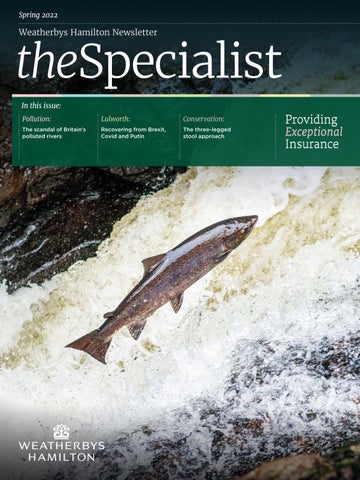
Spring 2022
Weatherbys Hamilton Newsletter
theSpecialist In this issue: Pollution:
Lulworth:
Conservation:
The scandal of Britain’s polluted rivers
Recovering from Brexit, Covid and Putin
The three-legged stool approach
the Specialist Spring 2022
Welcome to our Spring 22 edition of the Specialist. Richard Chugg and I are thrilled to have taken over at the helm of Weatherbys Hamilton as Joint Chief Executives and see exciting times ahead. We find ourselves increasingly unique in a broker market that continues to experience huge consolidation. Whereas many of our competitors now find themselves at the will of outside shareholders, we maintain our autonomy and can ensure that our customers’ interests remain paramount. Weatherbys Hamilton’s major selling point is the quality and knowledge of the partners and staff that we employ and over the coming years we intend not only to continue to strive to be the go-to broker in our core areas of expertise, but also the employer of choice in our sectors. As ever we remain committed to helping our clients find the best insurance solutions. Please don’t hesitate to get in touch if we can help in any way.
Alec Moore Joint Chief Executive
the Specialist Spring 2022
Racehorse trainers – the cost of Employers’ Liability insurance
The business of training racehorses has never been for the fainthearted but is about to get a whole lot more difficult. When you are supplying a product that is entirely discretionary, economics are key and the leisure pound is of course one of the easiest to cut when times are tight. Everyone understands that owning a racehorse is costly and that the chances of getting anywhere near covering your costs are between slim and impossible, but racing is a habit that is easy to catch and difficult to kick. So up and down the country racehorses continue to be bred, reared and trained in numbers that probably defy logic. Together with all the time and trouble they require to be lavished on them, to perform at the top of their game racehorses need to be fed the best rations available and often need to be transported many miles across the country to race. With so many of the ingredients used in feed coming from afar and fuel costs ever rising, it is no wonder that most trainers are now having to consider a significant increase in their fees. This of course is something of a tightrope for them because there could be a tipping point when the luxury of racehorse ownership becomes one too many. Many racehorses nowadays are owned in partnerships, syndicates or clubs in order to spread the cost, but none are immune to the rising cost of living. On top of this and to a large extent unheralded, there is unfortunately another increase beginning to make its presence felt: the cost of Employers’ Liability insurance. Every employer in the land is obliged by law to have an insurance policy in force in case they are sued for damages by an employee as a result of an injury sustained through their employment, with a minimum indemnity of £10 million. Naturally, a good employer, which most racehorse trainers are, will do their utmost to avoid doing anything that may adversely affect the safety of their employees. But where racing is different is that most employers are not requiring their employees on a daily basis to interact with half a ton of fit and feisty flight animal that hasn’t read the Health & Safety manual. Add to this the terms of the 1971 Animals Act whereby liability is strict
i.e. no negligence needs to be proved for a claim to be successful, then if a horse causes damage or a member of staff has a nasty accident, there is little defence a trainer can successfully put up. Fair enough you will say, that is what this insurance is for, and is of course as it should be where there is a serious and possibly life-changing injury, the incidence of which is thankfully rare. The problem lies with a trend, that is threatening to get out of control, of claims being made for lesser injuries that can be regarded as part and parcel of working with horses but which due to the way the legislation is drafted will still have a chance of success. The racing industry is obviously not alone in being subject to ‘ambulance chasing’ lawyers and when any claim is made, spurious or otherwise, it still needs to be properly and expensively investigated by the insurer. Where there is no water-tight defence, the Animals Act again, a level of damages has to be settled, often on the steps of the Court, and this is where losses for Employers’ Liability insurers are spiralling. Most insurers in the general liability market run for the hills when they are asked to consider providing insurance for anything equine, and so the pool of those prepared to participate is tiny – in fact, there are just two at the present time. We are seeing an exponential rise in the incidence of stable staff making claims against their employer, often following redundancy and just squeezing inside the time limit of two years within which a claim has to be made. The actuaries who increasingly dictate the strategies of their underwriters predict dire loss ratios in the coming years, so those still remaining brave enough to stay in the game have been forced to make some fairly drastic premium increases in order to stand a chance of survival. Not a good time for racehorse trainers, or their owners of course, but the alternative is to be left without any insurers prepared to underwrite racehorse liability. The doomsday scenario of no insurance would mean no racing industry. TO FIND OUT MORE WHY NOT GET IN TOUCH: mhaxby@weatherbyshamilton.co.uk 07764 153234
the Specialist Spring 2022
Lulworth Estate – recovering from Brexit, Covid and Putin Although some businesses flourished during the Covid-19 pandemic, particularly tech and home delivery services, others have been devastated and I can only imagine being a young entrepreneur borrowing money to invest in a dream enterprise during 2019, only to find the rug pulled from under me with no control over events and little prospect for recovery in the immediate future.
Whilst a number of our enterprises were shut down during Covid, all weddings having to be postponed for two years, others involving visits to the open air only suffered brief closure at the very beginning, reopening bringing its own challenges which were well documented in the press. Contrary to reports, with Council-imposed limits in place we did not see record numbers, but different visitors, hopefully uncovering the wonders of our rural landscape to many more who might otherwise not have ventured further than the ring road.
Some would argue that our woes began with the exit from the European Union on 31st January 2020 after the Brexit vote in 2016, with the exodus from the UK of much needed labour for some sectors exacerbated and accelerated by Covid-19 from March in that year. Although an expected result of the latter, possibly fuelled by the former, was relatively rampant inflation, this has been further fuelled by Putin’s incredible invasion of Russia’s neighbour, seemingly driven by a desire to return to the days of the USSR or perhaps simply a weird sense of establishing his place in history.
Many farmers and landowners have taken the opportunities that this has created, establishing camping sites of all types and sizes to cater for the growing demand from urban dwellers who have suddenly discovered a whole new world in our countryside. Possibly a boost to many farms at a time when agricultural income seemed destined to drop like a stone. The increase in commodity prices, driven by recent events, will undoubtedly create more competing priorities for our farms, potentially giving more choices to many.
Each of these factors on their own would have a huge impact on business and our standard of living, but together the consequences for some are unavoidable and possibly life changing. Lulworth’s long practiced diversification, primarily driven by fortune with the estate’s location, has been our saviour through difficult times, none more so than now. Although traditionally a rural estate, Lulworth has deep roots in tourism, first opening Lulworth Castle in the 1790s on Wednesday afternoons and more lately, at the beginning of the 20th Century with the growth of trains, charabangs and cars, we have welcomed an increasing number of visitors to our shores.
In recent decades Lulworth has striven to create a balanced estate, encouraging the best in farming, helped considerably by the fortune of having some very good farmers, whilst protecting and enhancing the diversity of habitats for our flora and fauna. We embarked on a self-financed programme to improve our habitats nearly 30 years ago and more recently we let the best of our in-hand farms to those who could farm better and more efficiently, retaining the less-productive but better environmental areas to follow a whole estate approach to the production of food and the better management of our natural heritage. Perhaps by accident, we created an estate management policy that now places us in a strong position to respond to the changes taking place in agriculture and the countryside.
the Specialist Spring 2022
James Weld Owner The Lulworth Estate
Although we never responded to the demand for solar farms or in the early days, wind farms, largely because we were more interested in first ensuring a secure future for the farming and conservation at Lulworth, we have not forgotten that we must respond to the dangers of global warming. Again, this is being approached on an estate-wide basis, reducing our dependency on fossil fuels, assessing and calculating our own emissions and trying to balance this with an increase in woodland from 8% to over 20% with the intention of achieving a net zero position. All our endeavours to improve both our natural and built heritage depend on capital and being able to continue to generate the surpluses needed to invest. For this we look to our tourism enterprises and their continued growth, not necessarily in numbers of visitors but through the services we are able to provide, which are essential if we are going to be able to achieve our objectives.
The biggest challenge we face, the primary factor which will prevent or delay investment, is undoubtedly available labour. We have never been large European employers, preferring to seek local labour to cover our needs and to do this we pay well and provide a generous pension scheme.
However, the knock-on effect of the shrinking labour pool as a result of Brexit, the pandemic and changing personal priorities driven by Covid, may curtail our ambitions to invest in some areas, particularly those enterprises that have a larger staffing requirement. We can no longer be certain of finding the staff we need and, being in a rural area, other factors such as the cost and lack of housing have an impact on this availability. That factor, rural housing, opens a whole new debate with the consequences of increasing interest in the countryside by those who may not need or want to work in rural areas, or by those who can afford to retire to the shires with a good pension, increasing the cost of homes with a stagnant supply unable to keep up with demand. For the moment and in spite of Brexit, Covid and Putin, although hard times are upon us all for the immediate future, the prospects for recovery, certainly in our countryside, may be quite good in agriculture, rural tourism and our natural environment.
the Specialist Spring 2022
The scandal of Britain’s polluted rivers
On January 5th the House of Commons Environmental Audit Committee published its long-awaited report on Water Quality in Rivers. Over the previous twelve months this cross-party group of MPs had been taking evidence from a wide range of scientific, agricultural, corporate and environmental organisations, including my own campaigning group River Action. The report’s findings were shocking. Its 137 pages chronicle a devastating account of how in recent years our rivers have been allowed to sink into a scandalous state of environmental degradation. To quote from its executive summary: “A ‘chemical cocktail’ of sewage, agricultural waste, and plastic is polluting the waters of many of the country’s rivers. Water companies appear to be dumping untreated or partially treated sewage in rivers on a regular basis… Farm slurry and fertiliser run off is choking rivers with damaging algal blooms… Not a single river in England has received a clean bill of health”
Charles Watson Founder and Chairman River Action
the Specialist Spring 2022
How could this have happened? I remember when much younger our watercourses were making a major ecological comeback. Great British rivers such as the Thames, Clyde and Tyne were showing huge progress in recovering from over a century of industrial abuse. For example, some might remember the momentous occasion in the 1980s when salmon were recorded finally returning to the Thames after an absence of 150 years. However, in the last decade things have taken a horrendous turn for the worse. One of the direct consequences of the financial crisis of 2008 was the subsequent decade of austerity. The huge government debt incurred in saving our banking system was largely paid off by severe cuts to public services. Whether Health, Education or Defence, few government departments escaped the axe and one of the most significant casualties was Environmental Protection. Since 2011, the budget of England’s Environment Agency (EA) was cut by 75%, with similar cuts taking place in its equivalent statutory agencies in the devolved nations. As a direct consequence, environmental protection began to collapse. Essential services such as water quality monitoring were seriously scaled back. Meanwhile, the EA was also instructed by Government to re-direct much of its funding to the growing issue of flood defence. The biggest casualty of these cuts was enforcement. Prosecutions of polluters during this period collapsed by 95%, with the Agency simply not having the resources to take on major offenders in the courts.
So, polluters, be they under-invested water companies or cash-constrained farmers, had been able to save significant costs themselves by bypassing environmental regulations and discharging waste into rivers or onto the land, secure in the knowledge that they could do so with impunity. The resulting statistics make dire reading. Data released on the 31st March this year showed that raw sewage was discharged into rivers and coastal areas for more than 2.7 million hours on more than 370,000 occasions throughout 2021, with many other discharges not being monitored. And only 14% of England’s rivers are officially considered now to be in “good” ecological health. Nowhere has the collapse of environmental protection been more harrowing than the story of the iconic River Wye. Britain’s fourth biggest watercourse is probably one of the most “protected” rivers in Europe. From its source in the Welsh mountains to its mouth in the Severn Estuary it flows through National Parks, Special Areas of Conservation, Areas of Outstanding Natural Beauty and Sites of Special Scientific Interest. But tragically over the last five years this magnificent river has spiralled downwards into an advanced state of ecological collapse. Over the last three summers, the unthinkable happened. The Wye’s clear flowing water turned a noxious green following repeated and unprecedent algal blooms. Its pristine gravel beds, the spawning ground for England’s premier salmon river, became caked in thick algal slime. Meanwhile, the famous abundant ranunculus weed beds, which are so important to the river’s ecosystem, all but disappeared having been smothered from sunlight by this putrid opaque water. The prime cause of this catastrophe can be found in the huge industrial sheds which have appeared across the river’s catchment over the last few years and which now house over 20 million intensively reared chickens. Let’s not kid ourselves. This form of intensive agriculture is not farming. It is industrial manufacturing. Most of the chicken meat sold in fast food restaurants or from supermarket shelves is the output of a highly industrialised process which starts with the pumping of phosphate-rich animal feed into huge sheds containing up to 300,000 birds. Never seeing the light of day, they are fattened up for 3-4 months before slaughter, after which the manure they have produced is largely dumped onto surrounding agricultural land.
the Specialist Spring 2022
Chicken excrement contains four times the nutrient levels of that of humans, cows or pigs – and recent research by the University of Lancaster has concluded that the soils of the Wye Valley now contain three times average national phosphate levels. So, with the land unable to absorb this huge surplus of nutrients, they have nowhere to go when it rains other than down into the river, wreaking untold damage as they fuel the deadly algal blooms. The fightback against the pollution crisis facing our rivers is however starting to build real momentum up and down the country. Volunteer citizen science groups have stepped in to fill the void left by our failing statutory agencies to conduct the essential evidence of monitoring of pollution levels. Meanwhile campaigners in every shape and form have mobilised. From local “friends” groups who have formed to protect a given river, to the repurposing of existing environmental organisations such as the Wildlife Trust Movement. Angling, rowing and kayaking clubs have become environmental campaigning bodies. As has the country’s booming wild swimming movement. Into this dynamic community River Action was launched last February shortly after I had just stepped out of a 25-year career in the worlds of public relations, digital communications and advertising. Having just seen for myself the appalling state of the River Wye – unrecognisable from that pristine river I had fished in my 20s – I was resolved to repurpose skills originally learnt at the sharp end of the corporate sector into the world of environmental campaigning.
In our first year we have directly taken on the major agribusinesses whose toxic supply chains are a prime source of the problem. In February we published our “Plan to Save the Wye”. Strongly endorsed by dozens of other environmental NGOs, we are calling for urgent mitigations to be implemented, such as the export of the hundreds of thousands of tonnes of the Wye Valley’s chicken manure to those parts of the country, such as East Anglia, that actually import huge quantities of synthetically manufactured phosphate-based fertilisers. With fertiliser prices having rocketed due to the Ukrainian situation, this is the ultimate no-brainer. In the months ahead we plan to take on the fundamental task of persuading our lawmakers to re-fund and re-empower environmental protection. If you care about the fate of our rivers, get involved! Join a local environmental group or become a volunteer citizen scientist – or make a donation to a campaigning body like River Action to help us escalate the reach and depth of our campaigning to save our precious rivers. It would be an unforgivable tragedy if an iconic British river such as the Wye has to be sacrificed before the government finally sits up and does something about the greatest environmental scandal of our time. If you are as moved as we are by this article please do consider making a donation to River Action to help them in their efforts to save Britain’s rivers before it is too late. You can find out more by going to their website: www.riveractionuk.com – or you can support their latest fundraising appeal to save Britain’s rivers via https://www.crowdfunder.co.uk/p/ campaign-to-save-britains-rivers
the Specialist Spring 2022
A growing dilemma - to farm or not to farm
Even before Russia invaded Ukraine, supply chains have been disrupted due to the pandemic and to a certain extent, the new Brexit arrangements. However, we are now experiencing the after-effects of all three of these scenarios, with Putin’s invasion of Ukraine in particular causing an increase in energy and foodstuff costs which means farmers and growers are having to juggle extreme increases in the cost of farm inputs with the prices they expect to be able to receive for their end product. The prices paid by farmers and estate owners for seeds, fertilisers, feed and red diesel will naturally have a knock-on effect on all of us with increased farmgate prices. With this precarious background it seems somewhat perverse that farmers are being encouraged to take land out of food production in favour of subscribing to one of the plethora of agri-environmental schemes, albeit for laudable reasons. However, changing farming practice and strategy is not an overnight decision and needs to be part of a medium to long term planning process on the part of the farming community rather than a knee jerk reaction. The impetus towards environmental stewardship schemes is now gathering pace following the unleashing of the Agriculture Bill. Will the rapidly evolving geo-political instability in the world cause the government to look again at our own precarious food security situation and review the UK’s strategy on this in the same way that it is looking at energy? Probably unlikely, particularly in the short term, but there are going to be some invidious decisions to make.
But as brokers it is the immediate situation that we need to deal with on behalf of our clients and no one needs reminding that the unwelcome return of inflation puts a focus more than ever on ensuring that sums insured within insurance policies reflect adequate replacement cost if there is a claim. Insurance cover for farm property such as derv, fertiliser, sprays, feed, supplements, building materials, hay & straw etc becomes more relevant week by week.
Likewise you should also consider the value of produce such as combinable crops, whether as a standing crop prior to harvest or those crops retained in store. It is worth having a chat with your broker to run through the figures as this is not expensive insurance and it is obviously very desirable to be compensated for the right sum if there is a need for urgent replacements. TO FIND OUT MORE WHY NOT GET IN TOUCH: mwright@weatherbyshamilton.co.uk 07747 763045
the Specialist Spring 2022
Three legged stool - a tried and tested approach to conservation
James Swyer Head of Membership & Marketing Game & Wildlife Conservation Trust
With environmental subsidies in a state of flux and landowners feeling the pressure to produce more food, it would be easy to lose hope that the United Kingdom can reach the biodiversity targets agreed at national level. At the Game & Wildlife Conservation Trust we don’t think that’s the case.
In times of change and uncertainty, it’s often best to look back at guiding principles to make sure that you continue to steer in the right direction. At the GWCT, the principle of good, productive, and environmentally resilient farming comes down to one key approach if the natural world is to prosper in tandem: the three-legged stool. The vital components of this are:
• Suitable habitat • Adequate food supply • Manageable levels of predation
Dubbed the three-legged stool because if any of the three elements is missing the stool is unstable, the gamebirds and much of the other wildlife on your land will not thrive if farming isn’t sympathetic to it. Habitat, the first of the three legs, is vital and something that good shoot management offers when efficient modern farming can often fall short. It’s about making the best use of unproductive land – field corners, hedgerows, margins – to deliver for wildlife the shelter it needs to sustain life and propagate.
Food – for wildlife in this instance – can come in many forms. One prime example is the use of cover crops, but it’s important to note that not all such crops are alike. At the GWCT we have spent a great deal of time researching and designing cover crops to provide the best possible support for farmland birds. One study looking at game crops in Scotland recorded up to 100 times as many songbirds per hectare of game cover when compared to other uses such as set-aside or conventional crops. This included much-loved species such as the linnet, bullfinch and reed bunting. The impact of these game crops cannot be overstated. The PACEC survey of the shooting community suggests that there are 93,000 hectares of these crops in the UK, which works out as providing roughly 180,000 tonnes of seed per year. We also know that many chicks require insects as a food source from birth. That’s why we created beetle banks - raised strips running across the middle of arable fields, sown with a mix of tussocky grasses and disconnected from the field edges. These banks, as the name suggests, play host to insects that provide chick food and also help to control crop pests. The presence of aphid-munching beetles, ladybirds, hoverflies and spiders potentially reduces the need for pesticide use and we have also found that they are home to small mammals such as harvest mice.
the Specialist Spring 2022
Finally, there is the often-thorny issue of predation management. We know, however, that good management of predatory species can have a positive impact on many of the others. Our Salisbury Plain Experiment, the first large-scale field trial of its type, showed the importance of predation management in improving the breeding success and population growth of wild grey partridges. Comparing two sites, one with and one without management (and the trial repeated in reverse after three years), the study showed 75% greater production of young partridges. We have seen a similar story in the uplands with curlew chicks. The three-legged approach is increasingly accepted as being core to delivering biodiversity gain. In fact, this February Lord Benyon raised the issue in the House of Lords, commenting. “There are three legs to the stool of nature conservation: providing habitat, providing good feed sources and legal predator control. When those three are put in place, extraordinary things happen. It will help us to hit our 2030 target of no net loss of biodiversity.”
Lord Benyon is right. The reason the approach has become widely accepted is that when the three factors work together, it can bring about excellent results. As we hit the 30th anniversary of our Allerton Project farm, songbird numbers are 191% above the 1992 baseline. This has been made possible alongside profitable farming thanks to adherence to these guiding principles. On the Sussex Downs, the Peppering Project has built a sustainable population of 300 breeding pairs of wild grey partridge from just six wild birds, despite the species declining by 93 percent across the UK since 1970. At the same time, a wide range of red-listed farmland species have made a spectacular recovery because of the management system put in place, including skylark up 57%, linnet up 94%, yellowhammer up 20%, and lapwing up 71%. If you read reports of species decline or climate change, it’s easy to be overcome with pessimism about conservation. My advice, however, is not to give up. We know there are methods that can bring about improvements because we’ve seen it first hand in many different landscapes and on several different land uses. Every initiative that is put in place has the potential to bring about local change and each of these can add up to progress on a national scale. With new environmental schemes set to reward those delivering conservation results, hopefully we can enter a new era in which landowners can become the true working conservators of the countryside.
A beetle bank
the Specialist Spring 2022
Badminton – it’s great to be back! One of the worst things about the last two years has been either the abandonment or lack of spectators at many of the iconic events that give such a strong narrative to our year. The deprivation of familiar landmarks has been strangely disorientating and for many of us the months have just merged in to one unmemorable mass. With so many horrors going on in the world top class sport does have that fantastic ability to distract and lift spirits. When it also involves a day out in a wonderful setting it is easy to see why Badminton Horse Trials is such a popular event and why we are so glad it is back. Cheltenham and Badminton are both harbingers of Spring and their place in the calendar marks the start of longer days and the countryside’s return to life. Cheltenham took place in front of empty stands in 2021 but it did at least take place. Badminton has had to endure blank years in both 2020 and 2021 and so its return is doubly welcomed.
Between our partners Weatherbys and ourselves we have sponsored races at every one of the 60 racecourses in the UK over the years but Badminton is the only three day event in our programme. We have sponsored the Members’ Enclosure since 2017 and the four days are an absolute highlight for us, seeing so many of our clients and their families in between walking the course or shopping in the tented village. The informality of Badminton is one of its great attractions and it is a fantastic place to sponsor and entertain.
Swindon – Martin Wright mwright@weatherbyshamilton.co.uk
07747 763045 01793 847333
(Mobile) (Office)
Penrith – William Johnson 07966 030832 wjohnson@weatherbyshamilton.co.uk 01768 877355
(Mobile) (Office)
Newmarket – Alec Moore amoore@weatherbyshamilton.co.uk
07503 671649 01638 563444
(Mobile) (Office)
Wellingborough – Matthew Haxby mhaxby@weatherbyshamilton.co.uk
07764 153234 01933 440077
(Mobile) (Office)
London – Hamish Hardy hhardy@weatherbyshamilton.co.uk
07858 149007 (Mobile) 0207 292 9029 (Office)
Edinburgh – James Innes jinnes@weatherbyshamilton.co.uk
07526 252857 (Mobile) 0131 285 5064 (Office)
Horsham – Guy Baxter gbaxter@weatherbyshamilton.co.uk
07855 626086 01403 915599
(Mobile) (Office)
www.weatherbyshamilton.co.uk
Weatherbys Hamilton LLP is authorised and regulated by the Financial Conduct Authority. Financial Services Register number 582708 Registered office: Sanders Road, Wellingborough, Northamptonshire NN8 4BX Registered Number OC373141