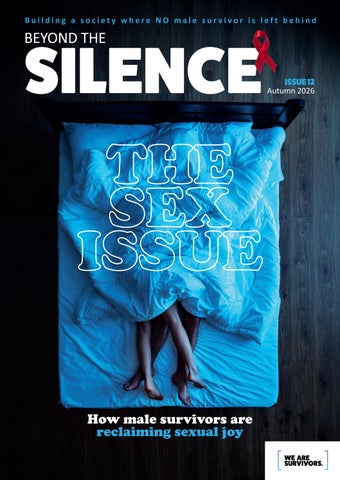
Building a society where NO male survivor is left behind
ISSUE 12 Autumn 2026
THE SEX ISSUE How male survivors are reclaiming sexual joy
SCAN HERE to watch our ‘Let’s Talk About Sex’ video
ISSUE 12 Autumn 2026
INSIDE FROM THE CEO From The CEO News Meet The Team Fundraising We Are Allies ON IT Influencing Change Sexual Health Your Are NOT Broken No Filter So It’s Not Rape? Adult Content We Stand United Gallery The Last Word
02 03 04 05 06 07 08 09 10 12 14 15 16 18 19
WE ARE SURVIVORS is a male-survivor focused voluntary sector organisation that aims to create and facilitate safe spaces for male (including trans and non-binary individuals) survivors of sexual harms, rape and sexual exploitation across Greater Manchester, providing access to quality assured support. wearesurvivors.org.uk “Let’s tell it like it is, and how it could be. How it was, and of course, how it should be” — SALT ‘N’ PEPA
2
“Lets talk about sex baby, lets talk about you and me, lets talk about...”
...NO SERIOUSLY, LET’S TALK ABOUT IT BECAUSE WE NEVER DO! We talk about the psychological impact of sexual assault and abuse on us. We talk about the physical trauma we experience when the physical acts we associate with sex are used in a way that is harmful. We talk about consent and how vital that conversation is in navigating sex… all of which are hugely important, especially in our world of supporting victims/survivors of course. But we don’t talk about sex after abuse. We rarely talk about anything that is remotely sex-positive. We don’t talk about reclaiming sex and taking it back from abuse. We don’t talk about how to navigate conversations to be able to have good sex, or how to have a fantastic sex life. We don’t talk about men exploring their relationship with sex and sexuality as survivors, including making actively positive choices about not having sex. And the not talking really bothers me. Many years ago I worked in substance misuse services and it was so normal for us to talk with people who had been
in state of addiction about creating new relationships with drugs and alcohol, which wasn’t necessarily about abstinence. But yet in the past 20 years of being in the sexual harms world, I could probably count on one hand the number of times people have proactively engaged in discussions about survivors creating new relationships with sex. This is a really personal subject for me as a survivor. I have had such unhealthy relationships with my body, with sex and intimacy, and it has taken really brave and sometimes embarrassing conversations to feel normal and invite a healthy relationship with sex and intimacy back into my life. I hope that this edition of Beyond The Silence helps you start those conversations with us, loved ones, friends, professionals, lovers, hook ups… and most importantly, YOURSELF. I refuse to allow the impact of sexual abuse to ‘stain’ my relationship with sex and I hope you find a way to say that too. Until next time… DUNCAN CRAIG OBE Chief Executive Officer
NEWS
DATA SHOWS DECLINE IN SYPHILIS & GONORRHOEA AMONG GBMSM
UKHSA HAS PUBLISHED PROVISIONAL SURVEILLANCE DATA which indicates continued declines in syphilis and gonorrhoea diagnoses among gay, bisexual and other men who have sex with men (GBMSM). Samantha Niblett MP
TALK ABOUT SEX
YES SEX PLEASE, WE'RE BRITISH MP’s campaign for better sex education. SAMANTHA NIBLETT MP WANTS MORE OPEN, INCLUSIVE AND LIFELONG SEX EDUCATION AND AN END TO THE STEREOTYPE “NO SEX PLEASE, WE’RE BRITISH” Her campaign aims to tackle social stigma and encourage more honest discussions regarding sexual pleasure and communication. Niblett, who also serves as the chair of the All-Party Parliamentary Group on Sex and Reproductive Health, has received support for her work from figures such as actress Dame Emma Thompson and specialists for pushing to improve sex education. She told the
BBC: “I think if some of my colleagues - who should be some of the most progressive MPs that there are - are finding it amusing, then I look forward to seeing the goodness that will come off the back of the campaign.” She added that people are expected to speak in court about “horrifying things that have happened to them, when we don’t openly talk about good sex”. She said: “How can we talk about bad sex if we can’t talk about good sex?” Ms Niblett pointed to how a lack of openness is feeding sexual abuse and crime, rather than healthy open discussion.
However, the downward trend is not being seen equally across groups experts warn that strategic action and investment is needed to address sexual health needs and inequalities in England.
A MALE CONTRACEPTIVE PILL COULD BE AVAILABLE IN FIVE YEARS
A MALE CONTRACEPTIVE PILL could be available in just five years, says the World Health Organization (WHO). The announcement, was made by the global public health agency on 23 September as part of an unveiling of new contraceptives guidelines.
3
ABOUT US
> MEET THE TEAM DANIEL
Community Development Services Manager “WE ALWAYS TALK ABOUT SEX! DRUGS! HIV! AND CONSENT! Along with Grahame, we are the Co-Sexual Health and HIV Leads for We Are Survivors, leading the ON IT campaign in partnership with George House Trust. Since joining We Are Survivors in 2019, I’ve championed sexual health as being just as important as physical and mental health. Together, Grahame and I created the Greater Manchester Sexual Health Services Map, helping people find their nearest sexual health service. We’ve also hosted in-house sexual health screenings with The Northern, giving male survivors access to testing in a familiar environment, and keeping the charity’s free condoms and lube scheme stocked. Because consent is sexy! I also co-Chair the Greater Manchester ChemSex Partnership, helping ensure people can access the right support if sex or drug use goes wrong. Through harm reduction, advocacy and a sex-positive approach, I’m always ON IT when it comes to promoting safer, healthier sexual wellbeing.”
Find out more about our work at: www.wearesurvivors.org.uk
> OUR STATS
THE DIFFERENCE WE MAKE. AT A GLANCE.
WE’VE JUST LAUNCHED OUR BRAND NEW IMPACT REPORT FOR 2025-26. It’s a fascinating insight into the work and the impact we’ve had on the lives of male survivors. In keeping with the sex theme of this issue, below is a snapshot of some of the stats from our report showing the gender and sexuality balance of the people we support. Get the full story by scanning the QR code below.
Scan the QR code below to read the animated version of our brand new Impact Report. 4
SUPPORT US
ARE YOU READY?
ARE YOU UP FOR A CHALLENGE?
Help us break the stigma around men’s mental health... with the added bonus of getting fitter! REP 102 IS A CAMPAIGN DESIGNED TO BREAK THE STIGMA SURROUNDING MEN’S MENTAL HEALTH. In partnership with Mandem Meetup, we will be raising funds and making noise about men’s mental health this November. This campaign encourages people to complete 102 repetitions of an exercise of choice throughout the month. This number represents the 102 men who die by suicide each week across the UK. Suicide is one of the leading causes of death for men, and male survivors are even more likely to experience difficulties surrounding their mental health. We want to encourage men to push through the barriers that often prevent them
from reaching out for support. We’re encouraging survivors and supporters to get involved with the campaign so that we can spread the message and raise more money to support men to open up and break the silence about their mental health struggles. You can donate to the campaign by heading to www.bit.ly/Rep102 or scanning the QR code. Join in with the challenge and encourage your friends, family and colleagues to join in and/or donate to support your efforts. Choose whether it’s 102 push ups a day, 102 kick ups a week, or even 102 kilometres a month! The main thing is to get involved, tag us in your social media posts and share the fundraising page!
"REP 102 represents the 102 men who die by suicide each week across the UK."
SCAN THE QR CODE or visit www.justgiving.com/charity/ wearesurvivors to donate in support of all the men and boys we are there for. 5
BE AN ALLY
MANDEM MEETUP
SEXUAL HEALTH
THE DOCTOR ALLIES! WILL SEE YOU... TOGETHER WE’RE
Male survivors deserve sensitivity at a sexual health clinic.
We’re proud to work with our brothers at Mandem Meetup. Mandem Meetup is a grassroots charity promoting, and improving the conversation around men’s mental health and wellbeing. They provide an open, inclusive community for all those who identify as a man, offering psycho-social interventions and recreational activities, to practical advice and guidance, as well as talking therapy and more. Find out more at mandemmeetup.org 6
FOR MANY PEOPLE, A VISIT TO A SEXUAL HEALTH CLINIC IS ROUTINE. For male survivors of sexual harms, however, it can be an experience filled with anxiety, vulnerability and uncertainty. The We Are Allies campaign highlights the importance of creating trauma-aware spaces where male survivors, including trans and non-binary people, feel safe, respected and supported when accessing services involving close or intimate physical contact. The campaign provides free training to help professionals better understand the impact sexual harm can have on an individual’s experience of care. Sexual health practitioners are often among the professionals most likely to encounter survivors, whether those experiences have been disclosed or not. A patient may never share their
history, making it vital to approach every interaction with sensitivity and awareness. Simple steps can make a significant difference. Explaining procedures clearly, seeking consent throughout an appointment, using inclusive language and offering patients as much choice and control as possible can help reduce distress and build trust. Creating a safer service is not about making assumptions. It is about recognising that trauma is often invisible. By adopting a traumainformed approach, sexual health professionals can help ensure that male survivors feel more comfortable accessing essential healthcare, improving both patient experience and long-term health outcomes. The message from We Are Allies is clear: small changes in practice can have a lasting impact. www.onit.org.uk
ON IT
WORLD AIDS DAY
THE RIGHT THING TO DO
This World AIDS Day, our friends and ON IT partners, George House Trust, have some important messages...
IF YOU ARE SEXUALLY ACTIVE, TESTING REGULARLY FOR HIV IS THE RIGHT THING TO DO. HIV testing has never been easier. There are more places to test for HIV than ever before, and you can even test at home. Knowing your HIV status puts you in control of your health and means you can access the medical treatment and support you need to stay well. With early diagnosis, treatment and healthcare, people living with HIV can expect a normal life expectancy. You can only know your HIV status by taking a HIV test. Anyone who is sexually active should test regularly for HIV. HIV testing is free and confidential when you use a sexual
ON IT GETS POLITICAL
health clinic, your GP or get a test through a community organisation, such as LGBT Foundation or BHA for Equality.
SEPTEMBER AND OCTOBER IS TRADITIONALLY SEEN AS ‘PARTY CONFERENCE SEASON’, AND THIS YEAR SAW ON IT TAKE ITS MESSAGE ON THE ROAD.
If you do receive a positive result, George House Trust is there to provide you with the support you may need. We will be able to talk with you about your diagnosis and will be able to help you understand what living with HIV might mean for you. You can take a test at your local sexual health clinic. Testing may also be available from voluntary organisations in your area.
‘Facts Keep You Safe’. That was the message ON IT took to delegates at specially organised breakfast briefings by LGBT Foundation at the Labour, LibDem and Green Party conferences. It was our opportunity to promote our work around sex, drugs, HIV and consent, and it was a valuable opportunity to engage with conference-goers and political representatives.
Find out more about George House Trust including how to get tested at www.ght.org.uk
Find out more about the ON IT campaign at www.onit.org.uk
7
INFLUENCING
Rory, We Are Survivors rory.b@wearesurvivors.org.uk
DATA, MYTHS & MALE SURVIVORS
BREAKING SILENCE, BUSTING MYTHS A sneak peak into our We Are Survivors and Movember See#Me(Too) survey data
FOR THOSE OF YOU THAT KEEP A REGULAR EYE ON WE ARE SURVIVORS’ JOURNAL ON OUR WEBSITE, SOCIAL MEDIA, AND PREVIOUS EDITIONS OF BEYOND THE SILENCE, YOU WILL SURELY HAVE SEEN AND HOPEFULLY TAKEN PART IN OUR SEE#ME(TOO) SURVEY WITH MOVEMBER. At this point, we are in possession of data from people who saw and replied to our or Movember’s posts and distribution. We are waiting to analyse more results from one of our marketing distribution partners; these being respondents who have not engaged with We Are Survivors or Movember’s distribution. As such, these figures are subject to change as we conduct further data analysis. We cited that 1 in 10 victims of rape are 8
male, and asked people what percentage of these men they believed to be gay. Of course, this question concerns the myth that the vast majority of rape victims/ survivors are gay men, playing into other stereotypes around gay men engaging in risky sexual activity.
disagreed, and 43.99% strongly disagreed. “If you don’t say “no”, it wasn’t rape.” This was more focused on disagreement, with 23.5% disagreeing, and 73.6% strongly disagreeing.
So far, on average, respondents believe that 35% of male rape victims/survivors are gay. We also asked respondents for their understanding of rape from the standpoint of what consent looks and sound like. We acknowledged a number of rape myths, asking whether they agree with statements like;
While the latter is reassuring, with respondents understanding that consent extends far beyond verbal confirmation, the former speaks to where more work may need to be done to raise awareness. Sexual abuse is often a situation in which the victim lacks the power or ability to physically resist their perpetrator, due to factors like power dynamics, age, or intoxication.
“Rape is always violent, or involved physical force.” Results have been spread, with 9.5% strongly agreeing, 9.5% agreed, 37.1%
We look forward to publishing our findings in full, with all the data in hand, and an eye for how it can be used to further our charitable mission to achieve our vision.
LOOKING AFTER YOUR SEXUAL HEALTH IS A REALLY IMPORTANT PART OF LOOKING AFTER YOUR OVERALL HEALTH AND WELLBEING... TIME FOR AN MOT?
SEXUAL HEALTH
Dr. Andrew Tompkins
We Are Survivors trustee Dr. Andrew Tomkins tells us why a sexual health MOT is so important. For survivors, sexual health is often a difficult topic to discuss but it’s just as important as physical and mental health, and we always advocate for self-care and regular check-ups. Having sexual health screening can give you information, peace of mind and access to simple and effective treatment if it’s needed.
“You don’t need to have symptoms to get checked - testing can be useful at the start of new sexual relationships, or if you change your sexual partners regularly, or simply when you feel ready to test.” Sexual health screening is completely free, there’ll be no judgement and it’s confidential. Most importantly, you are in control. You can ask questions, take things at your own pace and you’ll never be asked to do anything you aren’t comfortable with.
If you have no symptoms, testing is done by a blood test, urine (pee) test and sometimes swab tests that you can take yourself. If you would prefer not to visit a sexual health clinic, you can also request a home testing kit online for free. Sexual health clinics offer lots more than testing, including advice and support, vaccinations to protect you against sexually transmitted infections, HIV prevention (PrEP and PEP) and treatment, pills to reduce the chance of coming into contact with certain infections (doxyPEP) and treatment. The health care professional will advise what’s available and may be beneficial to you based on your own needs. We Are Survivors has a really helpful map on the website to help you locate your closest sexual health clinic to arrange a check up. Scan the QR code to take a look.
wearesurvivors.org.uk 9
FEATURE
YOU ARE NOT BROKEN Reclaiming Pleasure After Sexual Trauma
Silva Neves
silvaneves.co.uk
Kate Moyle
katemoyle.co.uk
We spoke to two leading psychotherapists - Kate Moyle and Silva Neves - on reclaiming sexuality, intimacy and pleasure after sexual harm.
S
exual harm can affect every aspect of how we experience our bodies, relationships and sexuality. For male survivors, the impact can show up in many different ways, from avoiding intimacy altogether to feeling disconnected during sex, struggling with desire, or questioning whether parts of their sexuality are truly theirs. Psychosexual therapist KATE MOYLE says the effects often reach far beyond the original experience. “Sexual harms are rooted in a violation of the body, trust, and our sense of personal control - and once we have experienced it we can’t un-know that it’s possible.” The consequences can look very different from person to person. “Any behaviours can be exhibited,” explains Kate, 10
“but they may not be a true reflection of how exactly someone is feeling, but more ways of coping with sexuality which at one point felt unsafe.” Many survivors experience difficulties with desire, arousal or pleasure, while others report feeling disconnected from their bodies and emotions. Distinguishing between trauma responses and authentic sexual desires can feel impossible. “It’s such a complicated and almost impossible distinction to make precisely because the two can become so tangled.” Rather than searching for definitive answers, Kate focuses on safety, choice and autonomy. “Ultimately it’s about the sense of safety and autonomy someone feels and has over the experience that they are having, and that they can say no or change it at any time.” Rebuilding that relationship with yourself often starts away from sex altogether. “Pleasure begins with noticing what feels
good in your own body, and this is a process that you need to begin on your own before bringing in anyone else.” Kate encourages survivors to reconnect with their bodies gradually, establishing “a sense of safety with choice and control and no agenda or expectations.” For those in relationships, communication matters. Kate suggests conversations about intimacy when sex is not on the agenda and asks partners to focus on understanding rather than fixing. “What someone wants may not always be consistent - sometimes it may be space or a break from touch, other times it may be to maintain contact but to slow things down or stop.” Most importantly, she wants survivors to let go of the belief that they are somehow damaged beyond repair, “You are not defined by what happened to you and what you have been through. Working through what happened and how it has impacted your life is a process, it can take time and it can be incredibly hard but it’s possible.”
PLEASURE
For psychotherapist SILVA NEVES, sexual trauma frequently affects the nervous system itself. “A lot of people can develop post-traumatic stress symptoms, and the common ones can be disassociation, which means that the body becomes numb to a lot of sensory effects. It becomes numb to emotions and can even become numb to touch.” Survivors may also become hyper-vigilant, experience flashbacks or avoid anything connected with intimacy. These responses can make it difficult to understand what is trauma and what feels genuinely authentic. Silva believes this can become even more complicated because survivors are often left questioning whether their sexual thoughts, fantasies or behaviours stem from who they are, or from what happened to them. Rather than searching for certainty, he encourages people to approach themselves with curiosity and compassion. Rather than rushing towards sex, he suggests beginning with a different question: “Why do you want to have sex? Do you want to have sex? Does not having sex cause a lot of distress in your life? Or are you wanting this because society or your peers tell you that you should?” For those who do want to reconnect with sexuality, he recommends paying attention to pleasure in all its forms, not just sexual pleasure. “When we work on one area of pleasure, then another area of pleasure can get better.” That might involve rediscovering hobbies, creativity, movement, food, music or other experiences that help reconnect people with their bodies and emotions. The goal is not to force sexual enjoyment, but to rebuild a broader capacity for pleasure and connection. He also believes recovery
should include something many survivors lose along the way. “Something that I often see in my clinic that is missing, is a sense of fun.” Above all, Silva encourages survivors to approach the process with curiosity rather than judgement. “If it doesn’t work, if you don’t like it, no problem. It’s information. It’s learning. And that’s valuable.” Neither therapist promises a quick route to recovery. But both share the same message: healing is possible, pleasure can return, and what happened to you does not define who you are. Recovery is not about becoming the person you were before. It is about building a relationship with yourself based on choice, safety, self-compassion and hope. Most importantly, as Kate reminds survivors, “You are not broken.”
Keep the conversation going...
SCAN THE QR CODE above to hear We Are Survivors CEO Duncan Craig OBE on Kate’s regular podcast. Duncan and Kate chat about the silence around male survivors, and what we’re not talking about. You can also check out Kate’s book ‘The Science of Sex’, which answers all your questions about sex and intimacy. Available online and in book shops now. SCAN THE QR CODE above to hear Silva Neves on the ‘A Bunch of Therapists’ podcast
SCAN THE QR CODE to read our full, fascinating chats with Kate and Silva.
11
FEATURE
NO FILTER GETTING IT ONLINE (safely!)
O For many male survivors, reclaiming sexual joy often means going online. It’s quick and easy, but it also comes with its own risks as well as rewards...
Here our guide to keeping safe online, and what to do when sharing intimate images goes too far...
12
NLINE DATING AND HOOKUP APPS have made it easier than ever to connect with new people, whether you’re looking for sex, friendship, companionship or a relationship. For male survivors especially, building trust and maintaining personal boundaries can be an important part of feeling safe and confident when going online to find a connection. Good sexual health starts long before intimacy. Having an open conversation about testing, contraception and expectations can help create a culture of honesty and mutual respect from the very beginning. While these discussions may feel uncomfortable at first, they are often a sign of emotional maturity and respect for both partners.
FEATURE Before meeting someone in person, it is also worth taking simple steps to verify who you are talking to. Scammers and fake profiles remain common across many platforms, making it important to trust your instincts and avoid sharing too much personal information too quickly. Protection is another important consideration. Bringing your own condoms, lubricant or other barrier methods allows you to take responsibility for your sexual health rather than relying on someone else. For men who have multiple partners - regardless of sexuality - prevention options such as PrEP can provide an additional layer of protection against HIV. Speak to your GP about this. Most importantly, remember that consent must be enthusiastic, informed and ongoing. Alcohol and drugs can affect judgement, making it harder to communicate boundaries and recognise warning signs. Healthy relationships are built on mutual respect, and as we always say, consent can be withdrawn at any time.
WHEN TRUST IS BROKEN Sharing intimate images has become a normal part of many modern relationships. For some people, it is a consensual expression of trust and intimacy. Problems arise when that trust is exploited, when someone feels pressured into sharing content, or when images are distributed without permission. For male survivors, image-based abuse remains an issue that is often under-discussed. Yet anyone can become a victim of non-consensual image sharing, online harassment, exploitation or blackmail, regardless of age, sexuality or background.
IF IT HAPPENS TO YO
U...
1
Do not blame yourse lf. Imagebased abuse is never the victim’s fault.
2
If you are being black mailed, do not pay money or send further images.
Save screenshots an 3 ev d idence be offender.
fore blocking the
Report sextortion an d image4 ba sed abuse to th e police.
Talk to someone you trust, 5 wh ether that is a friend, family member or su pport professional.
U MEET O Y E R O BEF N... IN PERSO
1 2
l health ut sexua Talk abo person. eeting in before m partner otential p a n e h Is and be Ask w ed for ST tatus. t s e t t s was la r own s bout you honest a s on versation Keep con pp until trust ga the datin . s p lo deve fore eo call be rson id v a r e id e pe Cons onfirm th c o t g in t mee file. their pro matches me g your ho in r a h s id r other Avo rkplace o o early. o w , s s e r add ion to informat personal a public, dates in t s r fi t e Me cation. well-lit lo t to transpor n w o r u o y Arrange e. the venu m o r f d an d know ted frien s o u r t a t Le g and wh u are goin o y e r e h w eeting. you are m
3
4
5
6
7
8
One of the fastest-growing forms of image-based abuse is sextortion. Criminals may use fake profiles to establish an online relationship before persuading someone to share intimate content. Once they obtain images or videos, they threaten to share them unless money or further content is provided. Importantly, if intimate content is shared without consent, responsibility lies with the person who broke that trust, not the victim. The emotional consequences can be significant, leaving survivors feeling anxious, ashamed, isolated or fearful about their future relationships and reputation. It’s also worth remembering that ‘private’ messages are not always private. Screenshots, secondary devices and third-party apps can preserve content even when messages are designed to disappear after viewing. While recovering from image-based abuse can be challenging, there is support available. Taking action quickly, reporting content and seeking emotional support can help restore a sense of control. Many survivors find that over time, positive relationships, healthy coping strategies and a supportive network outweigh the impact of what happened.
The message remains the same: you are NOT to blame, help is available, and recovery is possible.
13
FEATURE
“DATA RELATING TO THIS FORM OF SEXUAL VICTIMISATION HAS NOT BEEN WELL CAPTURED.”
A year after the ONS updated its approach to recording male sexual victimisation, we look at why better data matters. THIS MONTH MARKS A YEAR SINCE THE OFFICE FOR NATIONAL STATISTICS (ONS) MADE SOME SIGNIFICANT CHANGES TO THE DATA THEY CAPTURE ON MALE SEXUAL VICTIMISATION AS PART OF THE CRIME SURVEY FOR ENGLAND AND WALES (CSEW). The most significant of these changes related to how they captured data on forced-to-penetrate cases which are cases that involve a man being forcedto-penetrate a woman’s vagina, anus, or mouth, without his consent; which in law does not meet the definition of rape. In UK law, rape is defined as an act of nonconsensual penetration with a penis by a man, or in other words because of how the law is written, only men can commit the act of rape. 14
“IT’S HOPED THAT THIS CHANGE...
WILL BETTER CAPTURE MEN’S EXPERIENCES.”
But in cases which we refer to as ‘forcedto-penetrate’ the woman is the perpetrator and the man the victim. Data relating to the prevalence of this form of sexual victimisation had not been well captured, either in national police data or by CSEW. However, it is hoped that this will change with improved questions that have been incorporated into the survey, with the aim of better capturing men’s experiences. The ONS worked with Duncan, our CEO, and Dr Siobhan Weare from Lancaster University, to develop the new ‘forcedto-penetrate’ questions by drawing upon Duncan and Siobhan’s experiences of supporting and engaging with male
survivors and on the collaborative research project that explored the experiences of male forced-to-penetrate survivors. Through this work it is hoped that men’s experiences of sexual victimisation are better captured in national statistics on sexual victimisation, something which is imperative as part of an evidence-based approach to improving national, regional, and local responses to male survivor. Read the original report here: https://bit.ly/BAFTP Read ‘No One Believes You If Your A Bloke’: https://bit.ly/BlokeBarriers
FEATURE
ADULT
CONTENT THANKS FOR TALKING TO ME TODAY ALEX, like you I hope that our discussion will in some way break down the barriers that male sex workers so often feel a challenge in accessing support for their experiences of abuse from the past, or even when boundaries are crossed during their work. Sex workers should never feel silenced and their work should always be consensual.
Alex (40) has been involved in sex work for over 15 years. He engaged with We Are Survivors to support his own healing from sexual abuse and spoke with his friend and CEO of the charity, Duncan, about how his survivorship shows up in sex, whether that’s personally or professionally.
HOW DID THE IMPACT OF SEXUAL ABUSE SHOW UP IN YOUR SEX LIFE PERSONALLY? I was incredibly promiscuous, hiding everything about what happened sexually to me as a child and how it was manifesting itself my adult life. I was constantly seeking new experiences with new people as that was my answer to feeling alone: taking bigger risks in the places I’d go, with women I didn’t know, ignoring everything I knew about ‘safe sex’ – it was like a reverse whirlpool, a loop of destruction. AND THAT REVERSE WHIRLPOOL WAS THE PATH INTO SEX WORK? Yeah, it was me crossing over from exploring risk in chaos to actively putting myself into sex work and there was a sort of advantage to that as it meant there was ‘structure’ to my acting out, it lent itself to me legitimising my dark secrets, my dirty hobby even, my need to get ‘love’ from others as I had such a lack of love for myself.
new relationship with sex work, deciding if I wanted to do it, setting boundaries to what I will do or what I won’t. It’s like learning the lessons from the past to make healthy decisions in the present.
DID YOUR HEALING JOURNEY AS A SURVIVOR CHANGE THAT? Yeah. In both therapy and the Safe Room, I got more understanding of myself about when I was being abused, the dynamic was everything being done TO me, but when I was sex working it was me choosing to do things and that’s a shift in power isn’t it. I’m in control of my body not someone else! Coming to terms with me as the survivor gave me an opportunity to make better decisions for me as a performer. I started a
WHAT WOULD YOU SAY TO OTHER MALE SURVIVORS WHO WORK IN THE ADULT SEX INDUSTRY? Firstly... there are a heck of a lot of us you know! Mate, don’t feel so isolated about who we are or what we do for a living. But then ironically there is still so much stigma surrounding sex work and surrounding male survivors. Please don’t feel alone lads, we’re just not I promise you mate! Build community, connections, support for each other. Help each other create healthy and
meaningful opportunities to self regulate Your experiences of abuse doesn’t get to decide what you do now. Keep a reference point... if you wouldn’t do that thing in real life then don’t do it in your work. Don’t feel you are shackled to live through trauma. Reach out to We Are Survivors because what I want us to do now is pass on healing to others and if me doing this will help another adult performer, sex worker, content creator feel more connected then that’s brilliant.
15
COMMUNITY
SEX WORKERS
Tom, We Are Survivors tom.m@wearesurvivors.org.uk
WE STAND
UNITED! We Are Survivors is refreshing its support to male sex workers and content creators to ensure they have access to inclusive, survivor-focused services. WHILST WE ARE SURVIVORS HAVE ALWAYS SUPPORTED MALE SEX WORKERS FROM COFOUNDING THE BLUE ROOM PROJECT FOR STREET BASED MALE SEX WORKERS TO WORKING WITH MALE ADULT CONTENT CREATORS TO CREATE BANANA MILKSHAKE, IT’S ABOUT TIME WE MADE OUR OFFER CRYSTAL CLEAR. The project builds on the success of the ON IT campaign, which we have co-delivered with George House Trust for the past three years, with support from Manchester City Council. Male sex workers remain an underrepresented community within the survivor space. We want to change that by creating opportunities for sex workers to access support and services that reflect their experiences and needs. The landscape of sex work has changed over recent years, with online platforms and content creation 16
becoming a hugely important part now. We want to ensure that the support keeps up with these changes, including helping sex workers navigate online/platform-based work safely.Through a programme of outreach and in-reach, we will speak directly with sex workers to understand what they need from our services and identify any barriers that may prevent them from accessing support. We will also host engagement events for male sex workers and content creators in Manchester which will create opportunities for people to connect, share experiences and help shape a more inclusive support service. Alongside this, we will develop a harm prevention campaign focusing on consent, sexual health and safety which will give sex workers access to information and support around the potential violence and sexual harms they could experience. Most importantly, we want every male survivor who is a sex worker to know that support is available at We Are Survivors.
COMMUNITY GROUPS All FREE to access! At We Are Survivors, we offer a variety of activities across the week, and all of them are free. Have a look below at our offers: DROP IN A space for clients to come along and have an informal brew and a chat. A great opportunity to connect with other survivors. Various activities are ongoing including art, board games and computer games. THE SAFE ROOM A fortnightly confidential peer to peer support group. Can be accessed either face to face or online. Great friendships have been forged within The Safe Room and many attendees have gone on to successfully complete therapy. TAKE NOTICE FACILITATED BY PATHFINDER. The session will explore – What is Mindfulness and guided meditation sessions. Feel free to come, just check below on our calendar when we are running the session. THE COFFEE SHOP A chance to ‘go grab a coffee’ and socialise at pre-determined safe venues across the city.
SEX WORKERS
WHAT IS THE SIGNIFICANCE OF THE RED UMBRELLA? IN THE CAMPAIGN AD - WHICH YOU CAN SEE ABOVE, AND ON THIS SPREAD - WE’VE USED THE IMAGE OF A RED UMBRELLA. SO, WHAT’S THE SIGNIFICANCE OF THIS IMAGE? The red umbrella is the international symbol for sex workers’ rights, representing protection from abuse, solidarity, and resistance to discrimination. The umbrella serves as a visual metaphor for shelter and defense against violence, stigma, and harsh weather conditions faced on the streets. The canopy of the umbrella represents a unified coalition where all sex workers gather together under one shared movement. The red signifies strength, life, and resistance against intolerance. The umbrella symbol was first used during the 49th Venice Biennale in Italy in 2001. During the event, sex workers marched through the streets of Venice carrying red umbrellas to draw attention to poor working conditions, violence, criminalisation, and human rights abuses.
THE HANGOUT A brand new and evolving space for clients aged 16 – 25, to meet fellow survivors, connect and engage in a variety of activities. THE CREATIVE ROOM A space designed for you to be creative, from drawing to drama, music to origami making! THE GARDEN AT RHS BRIDGEWATER Get out of the city for a gardening session in beautiful surroundings at RHS, planting, and harvesting in our community plots. Clients are picked up by taxi at our Unit 17 office space and dropped back off at 3.30pm.
If you want to know more about these activities, book a Step Into Support appointment, and/or join our newsletter mailing list, then contact our Community Development Team on 0161 236 2182 or email community@wearesurvivors.org.uk 17
SURVIVORS
GALLERY
THIS IS YOUR PAGE.
Share your art, poetry and creativity with us.
Every issue we want to celebrate the creativity of male survivors. Expressing yourself through art, poetry and writing can be an important part of healing. If you’d like to share your work, send them to the e-mail on page 19.
“I wrote this for the first person who made me feel truly safe during sex. They taught me I didn’t have to feel like a piece of meat. That sex is soft and pleasurable.” Signed BB
‘I WISH YOU KNEW’, OUR CREATIVE WRITING AND STORYTELLING PROJECT FOR SURVIVORS IS NOW WELL UNDERWAY, AND WE WANT TO MAKE SURE NO ONE MISSES THE CHANCE TO BE PART OF IT. ‘I Wish You Knew’ is a project designed to give survivors the space to explore their own journey with survivorship through storytelling. The title comes from a phrase many participants have found to be a powerful starting point – yet the direction you take is entirely your own. Your piece ‘or pieces’ can take any form or style that feels right to you. With participants’ consent, we are now hoping to bring these pieces together in a published collection. We are also keen to record submissions being spoken aloud, 18
e g n a r o n a m Ia by BB
old fruit bowl uch first out of the to u yo ge an or e th I beg to be ng or soft skin I have no fresh netti t please take me I do not look ripe bu ck my layers my skin and peel ba to in ils na ur yo nk Si I want this give e want you have to I wont hide from th I’m an easy peel cult I’ll try to not be diffi y on the inside I’m vibrant and juic your teeth So rip me apart with Please have me tween your fingers Grasp my pieces be lips Hold me up to your Smell me gers with my scent Let me stain your fin on your lips The citrus imbedded ed on you And my lips imbedd ther And us in bed toge fruit I am not a delicate as such But please treat me ugh handled needs it ro The skin i beg to be like it soft But my inner lines meat I am not a piece of I am an orange you treat me as such And i’m so happy
creating an ‘I Wish You Knew’ library of recordings and performances. Whether you’d like support in crafting something new or you already have a piece you’d love to submit, we would be delighted to hear from you. Tying into the sex theme of this issue, we’re grateful that BB has submitted the
wonderful poem ‘I am an orange’. BB told us, “I wrote this for the first person who made me feel truly safe during sex.” To get involved, please get in touch. Drop and e-mail to christopher.e@ wearesurvivors.org.uk or kaelin.f@ wearesurvivors.org.uk; or call 0161 236 2182 and let us know you’re enquiring about the ‘I Wish You Knew’ project.
THE
LAST
WORD
NO male survivor left behind GRAHAME ROBERTSON Senior Design and Communications Officer
SILENCE = FEAR
MAIN OFFICE Unit 9 Brewery Yard, Deva City Office Park, Trinity Way, Salford M3 7BB T: 0161 236 2182 E: support@wearesurvivors.org.uk W: www.wearesurvivors.org.uk
@thisissurvivors We Are Survivors is a Company Ltd by Guarantee (06811096). Registered Charity in England & Wales (1144941)
USEFUL CONTACTS 24/7 Support Line 0808 500 2222 247sexualabusesupport.org.uk
“IN 1996, I LOST MY BEST FRIEND, HAZELL, TO HIV/AIDS. THAT’S HIM UP THERE IN THE PHOTOGRAPH. I WAS YOUNG, ANGRY AND HEARTBROKEN. But alongside the grief was a growing determination that something had to change. I wanted to be part of a community that didn’t simply survive HIV and AIDS, but celebrated who we were, how we lived and who we loved. That was the beginning of a journey that has shaped almost everything I have done since. I started volunteering with Gay Men’s Health in Edinburgh, where I discovered that HIV prevention didn’t have to be about fear. It could be creative, funny, honest, provocative and, above all, sex-positive. I became involved in developing campaigns and creating safer-sex zines that talked openly about sex, pleasure, desire and looking after ourselves. Because shame has always been one of the things I have wanted to challenge. Shame tells us not to talk about sex. Not to talk about HIV. Not to talk about pleasure. Not to talk about abuse. Not to admit what we want or who we are. And when we are silent, fear and misinformation have
space to grow. Eventually, that journey brought me to Manchester and Healthy Gay Manchester, where I was able to take those ideas further. Through outreach, groundbreaking safer-sex messaging and creative campaigning, I learned that celebrating our sexuality could be just as powerful as warning about its risks. Prevention could be empowering rather than frightening. Nearly thirty years after Hazell’s death, that principle still guides me. Today, through my work with We Are Survivors and George House Trust, I’m proud to be involved in developing the ON IT campaign. It’s another opportunity to talk openly and positively about sex, relationships, HIV, sexual health and consent — without judgement or shame. The world has changed enormously since 1996. HIV is no longer the same story it was then. But stigma, shame and silence are still prevalent, and still have consequences. As we mark World AIDS Day this year, I think about Hazell. I think about everyone we lost. And I think about everything our communities have achieved. My response to loss has always been to celebrate life. To be louder, not quieter. To talk honestly about sex. To challenge shame. To embrace pleasure. And, above all, to celebrate who we are.”
Shout 85258 This is as 24/7 text service that supports people if they are feeling overwhelmed or anxious. Free and confidential. Samaritans 116 123 (available 24 hours a day) jo@Samaritans.org.uk Mankind 018823 334 244 (Domestic Abuse Support) Mon-Fri, 10am-4pm www.mankind.org.uk Dad Matters 0161 344 0669 dadmatters.org.uk
Supporting Men’s Mental Wellbeing Through Community, Activity & Purpose.
info@mandemmeetup.org www.mandemmeetup.org BEYOND THE SILENCE is published quarterly by We Are Survivors, and is edited, designed and produced by our Grahame. We’d love your feedback. What would you like to see in future editions? Let us know. E: media@wearesurvivors.org.uk W: www.wearesurvivors.org.uk