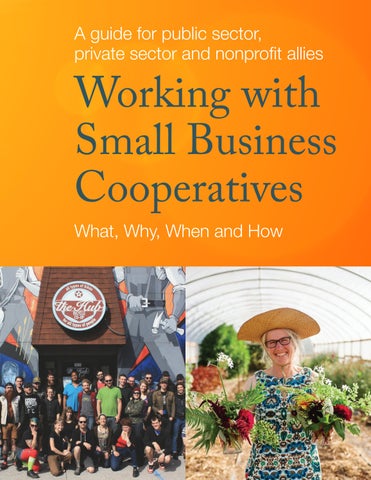
A guide for public sector, private sector and nonprofit allies
Working with Small Business Cooperatives What, Why, When and How
“
A co-operative is an autonomous association of persons united voluntarily to meet their common economic, social, and cultural needs and aspirations through a jointly owned and democratically controlled enterprise. International Cooperative Alliance
What?
What are cooperatives? Why and How might they help meet common objectives for economic opportunity, shared prosperity and business success? At it’s most basic, a cooperative is simply an enterprise that is democratically-owned and controlled by the people who benefit from it. Cooperatives prosper in all industries, can be found in every corner of the world, and vary in size from a handful of members to Fortune 500 companies. Co-ops play a significant role in agriculture, finance, and rural utilities in the US. While in the small business sector it is common to find consumer-owned cooperatives, housing co-ops, worker-owned businesses and shared services cooperatives owned by groups of individual entrepreneurs. For those interested in the following objectives, a cooperative might be the right vehicle to deliver the results:
Resilience and 1 Longevity
Data from around the world show that cooperatively-owned enterprises stay in business longer and are more resilient in economic downturns than other kinds of businesses.
Provide for Business 3 Continuity and Preservation of Tax Base
Over the next two decades, 70% of small businesses will change hands as baby boomers retire – many will close or move out of the area. Do you know such a business at risk in your community? Cooperatives are a proven method for enterprises transitioning to a new generation of owners while keeping the business rooted in the local community.
2
Offer Equitable 2 Opportunities for Entrepreneurship
Cooperatives are a shared ownership structure, which means they can help individuals with limited assets, including young people, to become successful business owners by pooling their capital together. Employees of worker and consumer-owned cooperatives in the U.S. also earn, on average, better pay and benefits than employees in comparable firms. In worker co-ops, the average ratio between the highest and lowest pay is 2:1 compared with 300:1 in large corporations.
Preserve and Anchor 4 Vital Good and Services
Essential community resources like cafes, hardware stores, pharmacies, theaters, and general stores that are challenging to run as independently-owned enterprises can survive and thrive as community-owned cooperatives.
“
I’m encouraged to see that there are cooperative businesses around with revenues in the tens of millions of dollars... co-ops can have a significant impact and compete with anybody. David Hincapie, Economic Development Specialist, U.S. Small Business Administration
A Flexible Model For Delivering on Multiple Objectives
There are thousands of cooperatives in the U.S. operating in many different industries, serving a wide variety of purposes. Consumerowned cooperatives like REI or your local food co-op serve individual members. Co-ops can also COOPERATIVES IN THE U.S. be formed by business entities working together for • 65,000 enterprises common objectives. Farm • 2 million jobs supply cooperatives are a familiar example of this kind • $650 billion in revenue of co-op. Other examples include artists who market • 1 in 3 Americans is a together, or professionals member of a cooperative such as interpreters, web designers, cleaners or child care providers who form co-ops to share the cost of sales, promotion, scheduling and administration. Some cooperatives, called multi-stakeholder cooperatives, have different classes of members in the same cooperative.
Consumer and farmers, for example, might work together on a local food hub project. Co-ops can be small or large, complex or relatively simple. The common factor is the relationship to members. Co-ops are structured to meet a mutual purpose, and operate for the benefit of members. As in a political democracy, each co-op member has an equal vote in selecting the board of directors that leads the co-op, and each member benefits financially in accordance with their use of the co-op (called “patronage”).
In a co-op, the people who OWN, CONTROL and BENEFIT from the enterprise are all the same people – the members!
Some Familiar Cooperative Names
3
Cooperative Type
Example
Number of Members
Benefit to Members
Economic Development Impact
Purchasing/ Marketing
ACE Hardware
5,200 independent ACE hardware stores.
Member stores are more competitive, enjoying lower inventory costs and high name recognition.
Smaller communities and city neighborhoods are able to retain core services like independent hardware stores.
Worker
Equal Exchange
130+ workerowners
Worker-owners receive a portion of profits and influence over the direction of the company.
Worker-owned businesses offer better pay and benefits and are more resilient, with fewer layoffs.
Consumer
Your local community food cooperative
The 150 largest food cooperatives have over 1.3 million members
Consumers have access to more products of their choice, such as organic, fair trade and local goods.
U.S. food cooperatives pay higher wages, source more locally, and contribute more to local causes than other grocery stores.
Producer
Organic Valley
Over 2,000 family farmers.
Farmers are paid a premium for their milk, a price set to cover the actual costs of production.
Communities benefit from more viable small family farms as well as fewer environmental problems.
Cooperatives Serve Needs, Create Opportunities Engineers Use Worker Cooperative Structure to Succeed
Consumer Grocery Cooperative Fills a Need in Downtown
Isthmus Engineering & Manufacturing, Madison, WI Type of Co-op: Worker
Co-op Market Grocery & Deli, Fairbanks, AK Type of Co-op: Consumer
Worker-owned cooperative Isthmus Engineering has thrived in the very competitive industry of customized automated manufacturing machinery. Manufacturing as a sector has faced significant challenges in recent years, and as a share of GDP is now at its lowest point since the 1940s. In contrast to
For 13 years, downtown Fairbanks, AK was without a grocery store. Everyone living downtown had to travel 4-5 miles to reach a food store of any size. When they did, quality produce was hard to come by, and locally-sourced product even more so. The consumer-owned Co-op Market changed all that in 2013, when it became the first cooperative grocery store in Alaska. The co-op now boasts 3,900 member-owners. Their specialty is local, organic, and fair-trade foods, supporting a local supply chain and enhancing food security for members – just a few hours drive from the Arctic Circle.
Isthmus Engineering & Manufacturing
4
this dour picture, business at Isthmus is booming, as teams of worker-owners help customers envision and craft successful solutions to complex automation challenges. Membership standards are rigorous, but any employee is eligible to become a member regardless of position in the company. Being at a worker-owned business allows Isthmus employees to be more self-directed than in conventional companies. This process cuts out layers of administrative management and red tape, and allows designers, fabricators, office staff and sales people to come together collaboratively as partners, creating unique products and a unique workplace.
Native Artists Pursue Markets Together and Much More ARTZ Cooperative, Zuni, NM Type of Co-op: Producer/marketing The Ancestral Rich Treasures of Zuni Cooperative, also known as the ARTZ Cooperative, is the only co-op of artists from the Zuni Pueblo in New Mexico. ARTZ is organized with member artists as owneroperators who pay an annual membership fee for retail space in the former post office and trading post building on Zuni’s main thoroughfare. Members include carvers, jewelers, metalsmiths, painters, potters, weavers and woodworkers. The co-op offers shared marketing and helps educate customers about authentic artworks of the Zuni people.
What Is the Same, What Is Different?
Cooperatives are very similar to other small businesses in many ways: They have owners and employees, revenue and expenses, markets and competitors. What is different is their objective of service and benefit rather than strict financial gain from investment (although many cooperatives enable their member businesses to be more profitable
through lower costs or better marketing opportunities). They are not charitable organizations, but rather vehicles of selfhelp. Many do have missions that would be recognized as socially beneficial, because that is the kind of enterprise and outcome that members choose to pursue. Some key differences between cooperative and more familiar types of organizations are outlined below:
Co-ops and Other Businesses Compared
5
Cooperative
Corporation (C or S)
Indv Prop(r)/ Partnership
Nonprofit
Who are the Owners?
Members who are also patrons (users)
One or more shareholders; # is limited in an S corp
Individual(s)
No ownership
What is the business purpose?
To meet members’ needs for good, or services
To earn a financial return on owners’ investment
To provide income for the owner(s) and a return on owner(s) investment
Provide charitable or educational services for the public
Who governs it?
Board of Directors elected by memberowners
Board of Directors selected by shareholders
Individual or partners
Board of Directors selected by member/ donors or existing board members
Who manages it?
Hired General Manager or CEO or other (e.g. team) structure selected by the board
CEO
Individual owner(s) or hired management
Executive Director selected by the Board
How is the business financed?
Member shares; retained earnings; sometimes preferred shares; debt
Sale of stock; retained earnings; debt
Owner(s) investment; retained earnings; debt
Grants; individual contributions; fee for services
Who receives profits?
Members in proportion to use (patronage); preferred shareholders in proportion to investment, up to 8% return
Shareholders in proportion to investment, no limit on return
Owner(s) in proportion to investment or agreement in the case of a partnership
Not applicable. All net income is retained.
Who pays taxes on profit?
Members when they receive patronage rebate; co-op on retained earnings
C corporation on earnings before dividends; shareholders on dividends and gain on sale
Owner(s) at individual rate
Not applicable
What is the owner’s legal liability?
Limited to members’ investment
Limited to shareholders’ investment
Unlimited, except in some cases of LLPs
Limited to assets of the organization
Source: Adapted from University of Wisconsin Center for Cooperatives; California Center for Cooperative Development
“
We see cooperatives as real problem-solvers in our community... A co-op of child care providers for example addresses two really pressing needs at once: the need for better paying jobs in a typically low wage sector, and also the need for additional reliable child care slots... Ruth Rohlich, Economic Development Specialist, City of Madison, WI
Why?
With their focus on impact and benefit and their collaborative nature, co-ops are an excellent way to deliver a range of community impacts in a market-based way. Cooperative are job generators—but just as important, they are long term job retainers. Data show that cooperatives are more hardy than comparable small businesses, surviving longer and exhibiting greater resilience in hard times. Cooperatives are always formed for a reason, a reason that is shared by all of the members: co-ops are problem solvers. Because co-ops do not have to make the most money (they just have to make enough money) they can survive in situations where it may be challenging for an individual entrepreneur. Main Street staples like cafes, grocery and hardware stores can thrive as cooperatives when similar businesses have disappeared. Co-ops present the ideal combination of economic and social impact: market-based enterprises that also consider the needs of individuals affected and the broader community. For would-be entrepreneurs with limited resources, co-ops can also be engines of opportunity and shared prosperity. In a situation where a single person may not have sufficient capital or experience alone to run a business, a group of such individuals might. Worker-owned and consumer cooperatives in the U.S. also pay higher wages than comparable firms.
6
Cultivating the Next Generation of Business Owners Rock City Roasters, Rockland, ME Type of Co-op: Worker/Conversion As baby boomers retire, the fate of their businesses can have huge impact on the economic vitality and stability of a local community. The Rock City Roasters found a way not only to create an exit strategy for a long time owner, but also create opportunities for a new wave of entrepreneurs. Rock City’s conversion to a worker cooperative brought a younger generation – workers in the 20s and 30s into business ownership, a move that will certainly benefit their small community in rural Maine. While several of the long-time employees had passion for their work, they were not likely to have ventured the buyout on their own. The co-op model allowed the collective pool of workers to share the financial risk and support each other as new business owners.
When? Cooperatives can contribute in many different settings and be a useful tool for a wide variety of populations. Three common situations where the cooperatives provide a significant advantage:
Retiring Small Business Owners
Cooperatives help retiring owners smoothly and successfully transfer businesses to a new generation: •
Baby Boomers at or near retirement age currently own nearly half the nation’s businesses, many of which their children don’t want to take over.
•
In fact, the largest avoidable source of job loss in America today is from businesses closing due to an owner’s retirement.
•
•
7
Many business owners may think they can sell their business, but in reality only about 20% of listed businesses ever sell. For employees and for communities, an owner selling the business to a worker or community-owned cooperative keeps jobs in place, preserves local tax base, and maintains vital goods and services in the community. Employees may not know everything they need to before taking over a business; fortunately, help for these situations is available. A coalition of nonprofits called Worker to Owners can help any business conversion project in the country with specialized training resources. (See Resources page.)
Co-op Conversion Keeps Ownership Local in Rural Communities Railroad Avenue Supply, Stamford, NY Type of Co-op: Worker/Conversion Two generations of the Biesler family owned and operated Railroad Avenue Supply, a local ACE Hardware store, in the small community of Stamford, NY. In an era when big box retail is gobbling up small business, depleting the community of better paying jobs and community owned assets, Railroad Avenue Supply found a way to maintain ownership in the local community. After three decades of private ownership, the business converted to worker ownership in early 2019. This will keep consistency – in jobs and service – in the community. When asked what the customers will notice that is different, one of the new worker owners replied, “Nothing, that’s the point.” The pride and passion each worker brought to their jobs are now rewarding them with a seat at the table to own and make decisions for their business.
When? C O N T I N U E D
Small Businesses Sharing a Common Market or Industry Cooperatives help independent entrepreneurs more effectively run their businesses:
8
•
Producer-owned supply and marketing cooperatives have worked for decades to help farmers lower costs, achieve economies of scale and gain greater market share; the same model can work for other entrepreneurs.
•
ACE Hardware is another familiar example of this kind of cooperative; owned by 5,200 independent hardware store owners, ACE helps members to save money on purchases and participate in a nationally-recognized brand.
•
Cooperatives made up of small business owners in similar markets or industries can save money through group purchasing, and increase revenue by collaborating on marketing materials or sales outlets. Depending on the industry, co-ops can also help business owners create efficiencies by sharing administrative tasks and investing in collaborative training or other resources.
•
Artists have a strong history of successfully marketing together through cooperatives; other examples of cooperatives working for independent entrepreneurs include co-ops of translators and interpreters, web designers, bookkeepers, home cleaners and childcare providers.
Marketing Co-ops Enable Family Farms to Scale Seattle Wholesale Growers Market Co-op, Seattle, WA Type of Co-op: Marketing To grow high-end flowers for wholesale distribution takes time — it might take most of your time. So where does the time and knowledge come to cultivate the business side of flower farming? For growers in the Pacific Northwest, it comes from the Seattle Wholesale Growers Market Co-op. Seventeen flower farmers formed a co-op to offer a wide variety of product under one business entity. They employ a professional staff to focus on the business side – running the operations, marketing and managing the enterprise on behalf of members. Together, the growers can offer the variety and quantity of product to be attractive to the wholesale market, something they could not achieve individually. By working together, they can enhance their own farm income as well as create several new jobs.
When? C O N T I N U E D
Emerging Entrepreneurs
Cooperatives make the world of enterprise ownership a lot bigger – a small scale solution with a big impact: •
Surveys show over half of Americans do not have $500 in the bank to cover emergency expenses; the rate is even higher for Millennials in their 20’s and 30’s. Many entrepreneurial and committed people have the potential to be successful business owners, but do not have the capital.
•
In a cooperative, each member can make a small contribution to capital that, when added up, can make enough to launch a business.
•
•
•
9
Co-ops provide a means to limit risk for emerging business owners, while also providing the means to share knowledge and work collaboratively. Together, members bear the responsibilities of ownership. Worker-owned cooperatives in particular have a history of extending the opportunity for business ownership to a wide range of talented individuals who might otherwise be shut out. Co-ops offer an additional tool for growing locally-owned businesses, rooted in the community.
Co-ops Create Wage Stabilization in Care Industries Child care, elder care – workers in these industries have historically been underpaid. Co-ops are changing that. Beyond Care, Brooklyn, NY Type of Cooperative: Shared Services Circle of Life Caregiver Cooperative, Bellingham, WA Type of Cooperative: Worker/Start-up With their shared services co-op, the members of Beyond Care help each other to strengthen business operations and negotiate fair contracts. While each member remains a solo child care provider, the coop helps members be more successful. At the other end of the country and the age spectrum, Circle of Life is a workerowned co-op of caregivers serving mainly the elderly. Members get a say in important issues such as budgets, scheduling and sharing profits. The co-op plays a dual role, an asset both for worker/owners and the community.
“
We have found that cooperatives can be a very efficient way to work with multiple business owners… Collaborating with co-op allies in our state has also opened up new funding opportunities for us, and enabled us to offer a much wider array of services. Jon Bittner, Executive Director, Alaska Small Business Development Center State Office
How?
How can we help cooperatives work for our communities? Working with cooperatives is much like working with any other business – they have employees, revenues, expenses, competitors, suppliers, customers and markets, all of which must be attended to in the same way as with any other small business. There are key differences to note regarding cooperative financial statements.
Underwriting Cooperatives
The flexibility of the cooperative model makes it valuable for addressing any number of challenges or pursuing any number of opportunities. However, the diversity of practice also presents a challenge for lenders and other analysts who don’t often work directly with the sector. What “should” a coop look like? How can one tell a good co-op from a mediocre one?
10
The simple answer is that all cooperatives are businesses and from a financial perspective, a “good” co-op will look much like other “good” privately-held companies of the same size in the same industry. The characteristic elements of a co-op are to be found in its broad ownership base, democratic governance structure, and its strategic commitment to maximizing member benefit rather than investor profit. Understanding how each of these elements support the financial health of the enterprise is the first step in evaluating its strength as a business as well as a cooperative:
Co-op Conversion Maintains Educational Options for Students Living with Disabilities New School of Montpelier, Montpelier, VT Type of Co-op: Worker/Conversion When the founder of a small private school wanted to retire, the question was raised not only of who might take over the business, but whether this important community resource remain at all. A school focused on the severely disabled, the New School of Montpelier offers education services where the public infrastructure is not able to meet needs. Working with a population living with severe handicaps is difficult work, with a high level of burnout. The conversion of the privately owned school to a worker co-op not only saved the school, but also contributed to greater retention of experienced staff. Recognizing the value of continuing the enterprise, the state’s Vermont Economic Development Authority was among the organizations providing financing for the buyout.
The 5 C’s of Credit for Cooperatives CHARACTER A co-op won’t have a
formal credit score the way an individual entrepreneur will, but most cooperatives will have a history of payment to vendors that can be evaluated for timeliness and consistency. Co-ops also should be able to provide complete organizational documents articulating their purpose and mission, criteria for admitting new members, and history of achieving member objectives. A co-op with a sound history of communicating clearly and transparently to members and delivering on South Mountain coop workers
its commitments to them indicates a co-op of sound “character.”
CAPACITY Debt-to-income ratios are
calculated the same way for cooperatives as for other businesses. Other important considerations for cooperatives from a capacity standpoint include how much business the co-op does with members and how this impacts revenue.
CAPITAL In cooperatives, owner equity
11
typically comes in the form of many smaller holdings rather than one or two large ones. One advantage of having many owners is that the co-op has many more “friends and family” to call upon if more capital is needed. Co-ops also sometimes make use of loans
from members which serve as additional subordinate capital.
COLLATERAL The business assets of a
cooperative enterprise are no different from those of a similar business, offering the same degree of security for a loan. Where co-ops do differ on the question of collateral is in the area of personal guarantees. Since no single member owns a controlling interest in the business (and there can be thousands of members), it is difficult to ask any one individual to guarantee a loan. For this reason, Community Development Financial Institutions (CDFIs) that specialize in lending to cooperatives seldom require personal guarantees. They rely on the cooperative corporation to pay the debt. It is worth noting that the repayment history of CDFI loans to cooperatives has been excellent, and principal losses on these loans equal to or lower than comparable businesses.
CONDITIONS External conditions such
as the state of the economy, industry trends, supply channels or local circumstances impact cooperatives like other small businesses, although the way they respond to conditions may differ: for example sharing work rather than layoffs. One key factor that may positively affect cooperatives is the breadth and strength of their membership base – member allegiance and loyalty may enable a cooperative to create for itself a superior set of market conditions to that experienced by their conventional competitors. Another unique consideration for cooperative borrowers is the network of peer support organizations that exist to help cooperative enterprises survive and thrive, even in challenging circumstances.
How Cooperative Financial Statements Differ INCOME STATEMENT •
Cooperatives may enjoy more customer loyalty from members in the case of consumer cooperatives, as well as benefit from an insider market perspective
•
Cooperatives may benefit from volunteer hours from members
•
Cooperatives do not have to generate market “profits” for investors, but instead will focus more on maximizing service and benefit to members
•
Cooperatives can strategically shift the tax burden between members and the cooperative through how they declare and distribute any surplus gains
•
The direct financial benefit to member/ owners is tied to lower costs or shared surplus rather than growth in stock value. In the case of a shared service or marketing cooperative, the benefit comes from the cooperative’s contribution to the profitability of the member’s own business
BALANCE SHEET •
•
12
•
Cooperatives will likely raise equity in many small portions rather than one or more large investments Many co-ops benefit from member loans to the cooperative, a form of “quasiequity” that spreads risk and provides additional patient capital
Cooperatives have the option to pay annual surplus to members in the form of patronage dividends in cash* or stock, or keep surpluses as retained earnings for the cooperative *If a patronage dividend is declared, at least 20% must be paid in cash
CASH FLOW •
Cooperatives can be structured to have the advantage of regular inflow of member equity capital
•
Cooperatives should plan for the regular redemption of member equity as new members join and old members leave
•
Co-ops have the flexibility to allocate patronage dividends (that is, members’ share of surplus or profit) in either cash, or a combination of cash and stock.
•
Cooperatives can plan to issue member return in the form of patronage at the end of the year, effectively waiting until profit is earned before distributing discounts to members
Remember - You can get help with special technical aspects of cooperatives from a number of organizations and publications listed in the Resources section at the end.
Cooperatives Make Use of Diverse Financing Making Business Ownership Accessible The Hub Bicycle Co-op, Minneapolis, MN Type of Co-op: Worker A nine-word statement guides The Hub Bicycle Co-op: “All types of bikes for all types of people.” They’ve ridden that mission to success: After a dozen years, the co-op bought its building in a $1.2 million deal, with financing from the National Cooperative Bank and a local CDFI specializing in cooperatives. At this Minneapolis worker cooperative, the employees are the owners, making decisions by consensus process and majority votes. It’s an egalitarian workplace
The Hub Bicycle Co-op
where each worker-owner has a vote and equal access to information. In an industry in which turnover is typically high and employee benefits scarce, the Hub has created a stable and growing enterprise where business ownership isn’t limited by wealth, but is open to all workers willing to make the required commitment. Community Rallies Around Historic Building Art’s Café Springville, Springville, NY Type of Co-op: Multi-stakeholder
13
With worker-owners and community investors, Art’s Café is at the heart of a significant revitalization effort in downtown Springville, NY. Spearheaded by the
Springville Center for the Arts, the project to rehab the 19th century building on Main Street as a mixed-use community resource took nearly nine years, and involved local government, major state
grants, crowdfunding and historic tax credits. Financing included co-op-like ownership shares selling for a minimum $250 investment to community owners who have voting rights and receive profit distributions. Six worker-owners run the café, and a ninemember board (with representatives of the arts center, workers and community-owners) guides the business. Co-op Benefits From City and University Partnerships Democracy Brewing, Boston, MA Type of Co-op: Worker/Start-up Setting out to recreate the Public House – a public space for citizens to congregate, discuss community needs, and enjoy food and drink were the vision of Democracy Brewing’s co-founders. The structure of a worker co-op was appealing as an opportunity to bring many people with different talents and knowledge together into the ownership structure, and to build an organization that would build off the skill set of all worker owners instead of depending on the leadership and capabilities of just one. Democracy Brewing was incorporated with the help of Transactional Law Clinic at Harvard University. TLC helped set up a direct public offering to raise the initial capital needed to start the business. The offering not only raised needed seed money, but also created a following and early customer base that supports the brewery today. Another key funder of the start-up was a $150,000 loan from the City of Boston.
FAQs
Frequently Asked Questions about Cooperatives:
Who is in charge in a cooperative?
Chart by University of Wisconsin Center for Cooperatives
As the graphic below illustrates, the members of a cooperative are ultimately in charge. Members elect a board of directors which makes policy and appoints management. Management carries out the board’s policy and selects and supervises any employees. The type of co-op determines who the members are.
How are co-ops incorporated? Are they a legal business structure?
Co-ops can take many different business forms. Most states have a separate cooperative statute under which a new co-op can incorporate. A few states still define cooperatives as nonprofits (not charitable, but operating for use not for financial gain), but most recognize them for the unique business structure that they are. Many co-ops, for various reasons, are also incorporated as LLCs or other legal forms. To be counted as a cooperative enterprise for tax purposes, a business must meet certain criteria established by the IRS, commonly referred to as “Sub-chapter T tax treatment”. These criteria include democratic member control, limited return on capital, and surplus allocation based on use.
How are co-ops financed?
Cooperatives are legal entities and can borrow money like any other corporation. Co-ops also rely on member equity for capital, and may also be permitted to issue preferred shares to non-members in order to raise capital. Such shares can receive a financial return, but carry no voting rights.
Aren’t co-ops really like nonprofits?
14
Not really. Cooperatives are a different kind of corporation, operating for the broad benefit of their membership rather than solely for the benefit of investors. While many cooperatives also
embrace a social mission (because that is what their members want) they differ from a nonprofit organization in that a co-op’s mission is not to provide a charitable or educational service to the public, but rather a service valued by their membership.
Do co-ops pay taxes?
Yes. Cooperatives meeting the IRS tax designation of “operating on a cooperative basis” are able to avoid paying corporate tax on distributions made to members; instead, members pay the tax, similar to an LLC. Any surplus kept by the cooperative as retained earnings is taxed at the same rate as other corporations.
How do boards of directors make decisions?
Many organizations, including nonprofits and large corporations, are governed by boards of directors. Co-op boards are elected by their members and are bound by the same legal and ethical considerations as directors of any other kind of corporation. Each board decides how decisions are made (majority rule, consensus, some combination etc.) and records of proceedings and decisions must be kept in the form of written minutes. In a small cooperative, it is not uncommon for all of the members to also serve on the board.
How are day-to-day decisions make in a co-op? Is there a manager? Again, a co-op board can decide how they are going to allocate day-to-day decision-making. Most cooperatives hire managers for this task, but some co-ops operate in a less hierarchical manner with designated work groups or team-based management. In any case, the board articulates the policies and strategic goals that management staff pursue.
How do members put money in and get money out?
A cooperative’s organizing documents will outline the requirements for membership, including the initial share that must be purchased. Members may put in additional equity, either voluntarily, or through allocation of their annual patronage share of surplus in the form of stock. Cooperative documents also govern the procedure for members requesting to take their equity out. Like all small, privately-held corporations, member equity shares in a cooperative are not liquid, and generally can only be sold back to the corporation (housing co-ops may be an exception). Most co-ops will have a system for buying back the stock of departing members on a regular basis and include this element in their financial planning and forecasting. A key obligation of cooperative board members is to balance the desires of individual shareholders with the interests of the cooperative (that is, all shareholders) as a whole.
Are there organizations to partner with that special in cooperatives?
Yes! The Resource page at the end of this publication lists a variety of nonprofit organizations that can provide technical assistance on all aspects of cooperative practice. They are happy to partner with state and local government, workforce development boards, lenders, SBA and local SBDCs to put together a plan of assistance that works for everyone.
15
Resources
Interested in learning more? Need to find an expert to assist with a project?
To find a qualified expert in converting existing businesses to worker ownership: •
Workers to Owners https://institute.coop/workers-owners-conversions
For information about cooperative finance, governance and other issues: •
The Democracy At Work Institute - https://institute.coop/resources
•
ICA Group - https://icagroup.org/resources/
•
Cooperative Development Foundation - https://www.cdf.coop/
•
University of Wisconsin Center for Cooperatives - https://uwcc.wisc.edu/
For links to a qualified expert in cooperative business: •
Cooperation Works - https://cooperationworks.coop/
To find a community development lender with expertise in cooperatives: •
Cooperative Fund of New England - https://www.cooperativefund.org/
•
Local Enterprise Assistance Fund - https://leaffund.org/
•
Shared Capital Cooperative - https://sharedcapital.coop/
•
The Working World - https://www.theworkingworld.org/us/
For general information about cooperatives:
16
•
National Cooperative Business Association - https://ncbaclusa.coop/
•
Association of Cooperative Educators - https://ace.coop/ Produced with generous funding from the United States Department of Agriculture Rural Cooperative Development Grant program.