Christian Appalachian Project Volume XXIV
No. 4
Winter Issue
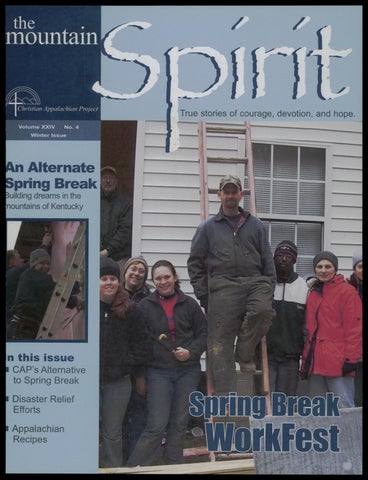
\n Alternate Spring Break uilding dreams in the îountains of Kentucky
n this issue i CAP’s Alternative to Spring Break Disaster Relief Efforts Appalachian Recipes
True stories o f courage, devotion, and hope
Contents
Reader Services TO CONTACT US by phone: (859) 792-3051 toll-free: (866) 270-4227
Features
Mountain Spirit Staff
Editor/Design Linda G. East
Design/Circulation Lorie A. Baugh
by email: capinfo@chrisapp.org
Contributing Writers
Christian Appalachian Project P.O. Box 511 Lancaster, KY 40444-0511
Carla Davis Jennifer Lavender Linda East Margaret Gabriel Shawnna Carney Kathleen Leavell
SUBSCRIPTIONS The Mountain Spirit is published four times a year. The annual subscription price is $20.00. Subscriptions and other correspondence should be sent to:
Photos
CAP’S Annual WorkFest
The Mountain Spirit Christian Appalachian Project P.O. Box 511 Lancaster, KY 40444-0511 Copyright, 2005, the Christian Appalachian Project, Inc. All rights reserved. The Christian Appalachian Project is a non-profit Christian service organization operating throughout Appalachia. The Christian Appalachian Project is recognized by the Internal Revenue Service as a 501(c)(3) charitable organization and is qualified to receive tax deductible contributions.
Steps to Nowhere
Delivering Hope to Those in Need CAP Helps the Victims of Hurricane Katrina
GUIDING PRINCIPLES I.
2
A summary of the registration and financial documents filed by this organization can be obtained by contact ing: in Maryland, for the cost of copies and postage, the Secretary of State, State House, Annapolis, MD 21401; in Virginia, State Division of Consumer Affairs, P.O. Box 1163, Richmond, VA 23209; in Washington, residents can call the Secretary of State toll-free within the state at 800-332-4483; in Mississippi, by calling the Secretary of State’s office at 888-236-6167; IN NEW YORK, OFFICE OF THE ATTORNEY GENERAL, CHARITIES BUREAU, 120 BROADWAY, NEW YORK, NY 10271; IN NEW JERSEY, THE ATTORNEY GENERAL BY CALLING 973-504-6215; IN PENNSYLVANIA, DEPARTMENT OF STATE BY CALLING TOLL-FREE WITHIN THE STATE, 800-732-0999; IN WEST VIRGINIA, SECRETARY OF STATE, STATE CAPITOL, CHARLESTON, WV 25305; IN FLORIDA, THE DIVISION OF CONSUMER SERVICES BY CALL TOLLFREE WITHIN THE STATE AT 800-435-7352; IN NORTH CAROLINA, FINANCIAL INFORMATION AND A COPY OF THE LICENSE ARE AVAILABLE FROM THE STATE SOLICITATION LICENSING BRANCH WITHIN THE STATE AT 1-888-830-4989 OR OUTSIDE THE STATE AT 919-807-2214; or by writing to Christian Appalachian Project, P.O. Box 511, Lancaster, KY 40444-0511. Our license number in Michigan is MICS 9933. Registration with any of the above government agencies does not imply
Around the Project
OUR MISSION STATEMENT The Christian Appalachian Project is an interdenominational, non-profit Christian organization committed to serving people in need in Appalachia by providing physical, spiritual and emotional support through a wide variety o f programs and services.
To promote the dignity and self-worth o f individuals by promoting self-help. II. To practice and encourage good stewardship o f and accountability fo r all o f the resources entrusted to us. III. Tofoster individual growth among staff, volunteers, donors and program participants. IV . To live out and promote the Gospel through all o f our actions. V . To foster open, honest and effective communication both inside and outside the organization, V I . To involve the Appalachian people at all social and economic levels in developing solutions to poverty.
Carla Davis Jennifer Lavender Linda East Shawnna Carney
Serving the Poorest of the Poor
_
,
20
endorsement by the state.
On The Cover A group of WorkFest volunteers join together for a group photo.
Editor’s Note...............................3 , Around The Project.................. 13
Departments Book Review........................... 18
Appalachian Recipes................ 26 Back Porch Poetry.................... 28
EDITOR’S NOTE The staff of The Mountain Spirit would like to thank you for your continued support and prayers over the past year. We hope that you are having a blessed Holiday Season and would like to wish you a joyful New Year. Throughout this past year, CAP has tried i Left to right: Lorie Baugh, Linda East, and Shawnna Carney to provide you with a ' glimpse of life in Appalachia through The Mountain Spirit. This year we have shown you how life can be for a child attending one of CAP’s Child and Family Development centers and how CAP is working to decrease the isolation that our Elderly Program partici pants face each day. The Spring issue took you into the flooded areas of Eastern Kentucky with CAP’s Operation Relief efforts, delivering hope and relief through our “ ...CAP has tried to provide you w ith a glim pse o f life in A ppalachia through The M ountain Spirit
Decreasing
Isolation
Operation Sharing Program. This issue of The Mountain Spirit, Winter 2005, will show you how some college students and volunteers from across the country will spend their spring break helping those in need in Appalachia. We will also be giving a first hand look at CAP’s relief efforts in the Gulf Coast areas following hurricane Katrina. As always, we welcome your letters to the Editor. Please let us know how we are doing. Your comments, suggestions, poetry and recipes have been a blessing to all of our readers. We would like to ask that you continue your prayerful support of CAP, without you our mission to those we serve would not be pos sible. Please know that you will also be in our daily prayers. God bless, Linda East Editor
Lorie Baugh Graphic Designer
What's Online At www.chrisapp.opg Become a Christmas Basket Sponsor - TOBAY! Bead the Katrina Belief Blog updated by a CAP Employee Shop CAP'S Online Auction at Ebay Learn how you can donate to CAP online! Join CAP'S Friend Z Friend and Help Spread Our Mission Bequest information about becoming a CAP Volunteer
Shawnna Carney Staff Writer 3
P o o r e st
of the P oor by Margaret Gabriel
A lthough the term “spring break” still tends to ^ conjure images of beaches, tanning lotion and hours of fun in the sun, the term “alternate spring break” is becoming more and more a part of the lexicon of 21st century college students. And since 1992, the term has also become synonymous with the Christian Appalachian Project’s Spring Break Appalachian WorkFest. College students from throughout the United States travel to eastern Kentucky during the first three weeks of March to work on home repair and occasionally con struct a new home. Planning for WorkFest begins many months before, according to Robyn Renner, manager of CAP outreach and housing, who takes the applications for home repair and helps determine the families whose homes will be repaired by WorkFest volunteers. “In 2006, we’re going to focus on Owsley and Jackson counties and the groups will stay at Camp Andrew Jackson [in Jackson County],” Robyn says. “We’ll probably do six houses and three back-ups. And we have one new home in progress, too.” Eight houses and four back-ups will be scheduled for WorkFest in Lawrence and Johnson counties in the Big Sandy region at the same time. Those volunteers will be housed at Camp Caleb. The CAP outreach program, Robyn says, begins by
starting a relationship with a fam
refurbishing and repairing homes
repaired is able to climb the roof to
ily and out of that relationship,
rather than constructing new
help patch the leaks, Robyn says,
meeting the needs for home repair
homes with assistance from groups
but all are able to make an effort to
follows. The relationship between
that furnish low-cost mortgages for
participant in the project by clean
the family and the CAP caseworker
families who qualify. Robyn and
ing up materials, making coffee for
broadens to include the WorkFest
others who work in CAP housing
workers, even stuffing envelopes
volunteers who come to perform
have learned that low-interest loans
for another CAP project.
the repairs on the family’s home,
are also available for major repairs
“If they’re really not able to do
Robyn says. “The students really
and additions to houses as well, she says.
anything, we can write a waiver for
bond with participants; we see a lot of tears when they leave.” WorkFest provides new experiences for both the students and the residents. First-time WorkFest vol unteers are often visiting Kentucky for the first time and many of the homeowners are meet ing people from outside the state — or even their county! — for the first time. CAP specializes in repairs In the 14 years that CAP has hosted WorkFest,
WorkFest volunteers repair and build homes in Eastern Kentucky.
thousands of volunteers from dozens of colleges throughout the United States have participated and built or repaired homes in eastern Kentucky. In 2006, CAP will focus on Owsley and Jackson counties because of the great need in those locations, Robyn says. CAP is one of several non-prof
“We want to serve the poorest of the poor, and even with low
honestly, in all the years I’ve been
income loans, a lot of the people
working, we’ve only had to do
sweat equity,” Robyn says. “But
we really want to serve can’t afford one or two. In fact, we send out to make those payments. We pro little reminders for people to send vide the labor at no cost, and the in their payments, and I’ve had participant pays back a third of people call to tell me they hadn’t the cost of the materials. And we received it.” also ask for ‘sweat equity,”’ Robyn For larger repair jobs and home
its that work to provide decent
says, referring to the requirement
additions, jobs that cost more than
housing for low-income families, but is the only one that focuses on
that the family assist with the
$5,000, CAP workers are able to
repair project in some way.
introduce families to the United
Not everyone whose home is
States Department of Agriculture, 5
CAP WorkFest volunteers and employees work together to repair a participant’s roof.
from which they are able to borrow
families obtain the loans they need
as a “WorkFest junkie,” and will
money at a low interest rate.
for repair and construction. She
return for her fourth WorkFest in
plans to work with 14 families who will be considered “primary” jobs
2006. In 2002 and again in 2003,
Delinda Huff works in the CAP housing office in the Big Sandy region, and helps partici
and eight more who will be back
Cumberland Valley regions to
ups in Jackson, Owsley, Lawrence and Johnson counties, where the
apply for the needed loans from
volunteers will work.
the USDA.
“WorkFest junkie”
pants in both the Big Sandy and
In the last several years, CAP
Many WorkFest volunteers come
has begun to focus more on repair
to Kentucky with a desire to
and refurbish jobs than new con struction, Delinda says. “Home
change the world, or at the very least, to help a family, but former
repair is what we do best, and it
volunteer Liz Fritz wrote about a
enables us to help the folks that
former WorkFest experience, say
might fall through the cracks for
ing, “It’s about realizing that the
organizations that do mostly new
only person who will be changed is you.” Reflections from other stu dents consistently mention getting
construction. We can help extreme ly low income people that no else might be able to help.” For WorkFest, Delinda will help 6
back more than they give. Stacie West describes herself
A group of Workfest volunteers take time out to smile for the camera.
from UNC, she joined CAP as a
things I’d never done before. They
long-term volunteer and worked
were my hands, but I really felt
in outreach in Clay County and
like it was someone else doing the work.”
coordinated WorkFest 2005. In 2006, Stacie, serving now as a
Four years after her first
campus minister at the University
WorkFest experience Stacie still
of North Carolina at Wilmington,
holds fond memories of the family
will participate in the program
with whom her group worked.
from yet another perspective when
“They lived in Inez [Martin
she brings students from UNC-
County],” Stacie says. “Steve
Wilmington for their first experi
and Michelle and their daughter
ence with an alternate spring break.
Heaven Lee, who was two. That
“I tell people ‘you live at the
baby would pull up a little plastic
“IT'S ABOUT REALIZING THAT THE ONLY PERSON WHO WILL BE CHANGED IS YOU...” Stacie came to Kentucky as a
beach [UNC-Wilmington is located
student with the group from the
on North Carolina’s Atlantic coast.]
chair and watch us all day!” Stacie recalls.
University of North Carolina at
Where else are you going to go for
Steve, Heaven’s daddy, had been
Chapel Hill. After graduating
spring break?’” Stacie says. “So far I have 10 people that are really excited about coming, and we’ll
injured while he was working and had also lost most of his vision.
Michelle was a home health nurse, ask people from other campus min and was having a difficult time istries, too.” providing for the family with her When she attended her first low-wage job. Repairs for the fam WorkFest as a student, Stacie was invited by others who had made
they learned of the opportunity to
the trip the previous year. “I was in
participate in WorkFest and access
a rough emotional spot during my
a low-interest loan to pay for the repairs needed on their home.
junior year and my friends told me, ‘helping someone else might help you.’”
ily home were out of reach until
Stacie says that during that week at WorkFest, she felt the Holy
“The house had been a garage, and Steve would have liked to fix it himself,” Stacie said, “but he couldn’t because of his eyesight.
Spirit come into her life for the
I was so impressed with them and
first time. “Here I was, up on the
their dreams for Heaven. They
roof, ripping the shingles, doing
had already started to save pennies 7
“While I was there, I learned how connected people are to home,” says Stacie who grew up in a military family that traveled extensively and has now settled in the state of Washington. “I met one woman who had lived in several other places, but then moved back home, and lots of people were sur prised that I would choose to live so far away from my family.” Stacie says that she will keep many of her observations to her self, though, so that her students will have the opportunity to make A group of volunteers help get this home ready for cold weather.
to send her to a Christian school when she was old enough to start school, and they asked the volun
“T he first im ages I h a d o f K e n t u cky w ill ALWAYS BE WITH M E - ”
teers to talk to her about going to
and teach them to ask questions
discoveries on their own.
college.” In the months before the March
about why people live in sub-standard conditions.
“The first images I had of Kentucky will always be with me.
2006 trip, Stacie will help her stu dents with smaller service projects in Wilmington and with raising the $1200 that it will cost for 10 students to travel to Kentucky and participate in the project. “Before Christmas we’ll try to spark people’s interest in the project, then after Christmas we’ll have to have information sessions. I’ll show them my pictures from Kentucky and we’ll look at the issues of poverty.” Stacie says that the information sessions will educate students to the underlying causes of poverty 8
Sarah McNamara, Stacie West and Carrie Buppert prepare lunch for other Workfest students.
Volunteers work together to build a new porch.
I loved the people and I claim McKee as ‘home,’” says Stacie, whose cell phone plays “My Old Kentucky Home.”
come to dinner with the volunteers. The groups get to really sit and talk
talk about what they have gained from those they met—both the
with the families, and the families are given an opportunity to speak,
other students and the families on whoses they worked.
if they want to. Most of them have
Eric Anderson, a student at
There is more to WorkFest than long days of home repair,
never had an experience like this and it’s a great opportunity for the families to come together.”
Marquette University, Milwaukee, said, “At CAP you can leave your ‘safety zone’ and emerge into the
Robyn says. CAP’s long-term
“We start with a presentation
volunteers plan evenings for the
on safety—that’s one of the most
crews that include entertainment
important things,” Robyn says.
reality of injustice-a journey that is utterly exhausting and yet uniquely fulfilling. In my brief stay, I’ve
and information about Appalachian culture and history.
“And then we tell them to work
grown and matured in ways that
hard, play hard and sleep good!”
could not have been predicted.”+
Volunteers and families come together
“And on Thursday night, we’ll have a ‘Family Appreciation
At the end of each WorkFest, volunteers are asked to share their
Dinner,’ and invite all the families
experiences and reflect on the
whose homes are being repaired to
things that they learned. Many
'oss a coin in a fountain and make a wish. your estate? W hat charities will benefit from your estate? If you’re thinking about your future and what would happen should you die, you might say: “I 'will, properly prepared, lets your family wish that my brother, Tom, would handle my es rest better at night. It makes your family rest bet tate.” Or perhaps, “I wish Aunt Etta would take ter, too. care of my daughter.” Or maybe, “I wish that any estate taxes would be kept to a m inim um.” ishing wells may be fun for some things, You might also say, “I wish to give a portion but not when it comes to estate planning. When of my estate to CAP and other charities I care you’re dealing with your estate assets and vari about.” ous responsibilities it’s far better to “toss a coin” toward a qualified attorney who can help you ^ % s h e s , wishes, wishes — th at’s all they do things right. Granted it will take more than a are. And tossing coins into a wishing well won’t penny or two, but the certainty and satisfaction help. The only way you can be sure of these things — to change them from wishes to certain you receive will far outweigh any cost.
<9k
ties — is to prepare a will or other appropriate estate-planning document. 'will is a way to make your wishes come true. In it, you list what you want to happen: Who will represent you through the process of probate? Who will care for any minor children? Who will look after any trusts? Who will receive
^ ^ e can provide for you complimentary brochures with helpful information about making a will. Complete this reply form and we will mail information to you promptly. Or request informa tion by calling us toll free at 1-866-270-4227.
r
□ W e* / Please send me the following information: Please send me your complimentary will information brochures. Please contact me about a personal visit. The best time to call me is:_______________ I have provided for Christian Appalachian Project in my will or other estate-planning.
Name:___________________________ Address :_________________________ City:____________________________ State:_____Zip:____________ Phone:
L
10
tA U tilf l< y: Christian Appalachian Project Planned Giving Dept. P. O. Box 511 Lancaster, KY 40444-0511 J
words o f wisdom The love of a family is life’s greatest blessing.
Tvery
father
shoufdremember that one fa y his son wifffoffow his exam hie insteadofhis advice.
Every tomorrow has two handles. We can take hold of it by the handle of anxiety, or by the handle of faith. W h en th in g s a re b a d , we
] have o f t en re g re tte d mu s p e e c h, n e v e r my s ile n c e .
Those who (ove deepfu never arow ofd
ta k e c o m fo r t in th e th o u g h t t h a t th e y c o u ld a lw a y s b e w o rs e . A n d w h e n th e y a re ,
Winter must be cold for those with no warm memories.
w e fin d h o p e in th e th o u g h t t h a t th in g s a re s o b a d th e y have t o g e t b e tte r .
Tear can keep us up a ff niaht fona, hut faith mahes one fne pdfow. 11
C h r is t ia n A p pa l a c h ia n P roject , I n c . Charitable Gjift Annuifa 'Proqram w
.OULD YOU CONSIDER
MAKING A GIFT TO THE
Uniform Gift Annuity Rates Single Life Age Rate
C h r is t ia n A ppa l a c h ia n
55
P r o je c t , a n d r e c e iv in g
56 57
LIFE INCOME?
58 59
This is possible when you fu n d a CAP charitable gift annuity. A chari table gift annuity is an agreement between you and CAP. In exchange fo r cash or other assets (stocks, bonds, mutual funds, etc.) o f $2,500 or more, CAP guarantees to make fix e d paym ents fo r the rest o f your life. Follow ing your life, the assets remaining are used to fu n d the work o f CAP.
60 61 62 63 64 65
DVANTAGES OF A CHARITABLE GIFT ANNUITY WITH CAP
66
A
67
Fixed payments for life. A charitable income tax deduction the year the charitable gift annuity is funded. A portion of each lifetime payment considered a tax-free return of principal. An opportunity to make a significant commitment to the Christian Appala chian Project and enable us to help those less fortunate throughout Appala chia for years to come.
68 69 70 71 72
5.5% 5.6 5.6 5.7 5.7 5.7 5.8 5.9 5.9 6.0 6.0 6.1 6.2 6.3 6.4 6.5 6.6 6.7
Age
Rate
73
6.8 6.9 7.1 8.2 7.4 7.6 7.8 8.0 8.3 8.5 8.8 9.2 9.5 9.9 10.2 10.6 11.0 11.3
74 75 76 77 78 79 80 81 82 83 84 85 86 87 88 89 90 and over
Please use the following information to calculate my charitable gift annuity Name (Mr., Mrs., Ms, Miss)
_______________________________________________
Address
Telephone (
Zip
State
City A
Birthdate Month
Amount of Gift Considered $ ________________ ________ Frequency of Payment Desired: □ Annual Q2 times/year ($2,500 min)
Day
Year
Q 4 times/year □Monthly ($5,000 min) ($10,000 min)
a y e s , I am interested in a Two-life Charitable Gift Annuity illustration.
Name of Second Beneficiary____________________________________ Birthdate___________________________ PLEASE COMPLETE & RETURN TO:
Christian Appalachian Project Planned Giving Department P.O. Box 511 Lancaster, KY 40444-0511
(All information provided is confidential )
Steps to ¡Nowhere In August o f this year Hurricane Katrina hit several Gulf Coast states, destroying everything in its path. Soon after the hurricane hit, CAP decided to give its employ ees, volunteers and others the opportunity to travel to Mississippi and help with the relief efforts. As o f today, CAP is still sending volunteers to the Gulf coast and they plan to keep volunteers in the Ocean Springs area until mid-December with groups rotating each week.
Reflections from Rebecca Welch, CAP volunteer, Martin County CFDC and Hurricane Katrina Relief Worker
0)
o ¡M
After two weeks in Ocean Springs, Miss., one image from the devastation stands out starkly in my mind - steps to nowhere. It was the first thing I noticed when I visited the devastated coastal neighborhoods of Ocean Springs and St. Martin. Steps that once led to the front door of somebody’s home, now lead to a concrete slab. The house is gone, washed away by an unimaginable surge of water. This morning, the local paper car ried a photojoumalistic piece on this very image. I was not the only person struck by these stairways. Some belong to apartment buildings, some to multi million dollar homes, others to modest homes or even trailers. The hurricane did not judge the economic status of people. All were treated as equals. I know, however, that when I leave Mississippi on Wednesday morning, the steps to nowhere will not be what I remember most. What I will remember most is the faces of the people who once walked those steps everyday, the people whom I have been blessed to meet. I will remember the little boy who told me, “I love you,” when I handed him a
stuffed animal. I will remember the man at the shelter who told me every day that I was an angel for com ing to help. I will remember the blind man I delivered meals to and who remembered every tiny detail I ever told him about myself. I will remember the many women who embraced me in gratitude for the goods we were able to load into their cars. I will remember the people who could still laugh after all they had been through, as well as those who could only cry. The people who will have the most lasting impact on me — not the images of destruction. The people tell us time and time again what a blessing we are to them, but I think that every CAP relief worker would agree that they are equally a blessing to us. And I think that’s exactly the way that God would want it.
13
around the proj ect
Antivide Child and Family Development Center Earns 3 STARS Annville Child and Family De
staff to child ratio, program curriculum, staff edu
velopment Center is participat
cation and training. Children who receive care in
ing in Stars For Kids Now, Ken
a safe, stable, and nuturing environment tend to
tucky’s voluntary child care rating
develop effective social skills and are more likely
system. The center has been awarded a three-star rating, out of a possible
to be well prepared to enter school. The Annville center offers care to children 15
four, indicating that the program seeks
months to 5 years of age, and before and after
quality standards beyond the require
school through 12 years of age. Chil
ments for facility licensure.
dren are separated by ages in differ
According to Bonnie Hellard, pro-
ent rooms that are coloful and invit-
Children who receive in a safe, stable, and nuturing environment tend to develop effective social skills and are more likely to be well prepared to enter school. Annville Child and Family Development Center Staff Front row: Tabatha Tincher and Bonnie Hellard; Back row: Brenda Walker, Patsy Smith, Delois Fox, Mackenzie Thomas and Carrier Tillery. Absent from photo: Abbie Keyton and Rhonda Brewer
gram manager, the three-
ing. The curriculum, includes art, creative play,
star rating is based on
computers, math, music and movement, science
factors associated with good outcomes for young children such as
and language,
Visiting New York Friends and Donors This fall, CAP workers visited with many New York area friends and donors at a reception in New York City. “We were absolutely overwhelmed with their generous welcome and concern for the people we serve in Appalachia,” said Kathleen Leavell, Planned Giving Field Staff. Jon Carloftis, a Rockcastle County native who now works as a garden designer in the New York area, spoke of his great pride in his Kentucky roots and Appalachian heritage which he pictures in his new book, Once a Garden. Lorraine Corsale, a former CAP volunteer, shared information about her book Appalachian Images, a photo essay of the people she served as a volunteer. She told the audience of the imprint they left on her life.
During the reception, CAP showed a slideshow presentation about its work to friends and donors.
The group honored Mr. and Mrs. Gideon DeMargitay, who have supported CAP for over 30 years. Events such as these help CAP recognize donors and meet new friends who extend their generous sup port to the people we serve. “To all our friends in New York, New Jersey and Connecticut—our heartfelt thanks to you all!” says Kathleen.
Make a D ifference The C h ristian A p p a la c h ia n P roject is looking for peo p le w h o desire to help th e po o r o f A ppalachia! C ontact us to inquire a b o u t vo lu n te e r opportunities! Application Process Required Christian Appalachian Project Route 6, Box 43 Mt. Vernon, KY 40456 www.chrisapp.org
volunteer@chrisapp.org
1-800-755-5322
VOLUNTEERAND CHANGE LIVES!
A Grateful Heart and This year’s school readiness distribution was held in July and was a huge succe plies and clothing for the new school year. A school teacher helped by making it a diffferent age groups. The class put each packet together for distribution. Each far We ask that they send those back to CAP’S Outreach program. Below are a few c
a Note of Thanks serving over 300 families. Each child received a special bag with school supss project to collect several of the items that go in the school packets for the was given a card to write down how thankful they were for their new items, is the program received this year.
■reus " “ “ " e s s
Xentucky Cfir istmas An Appalachian Book Review by Jim Trammel eventy Kentucky-connected contributors portray hopes and humanity, in a sampler assembled by award-winning Lexington author George Ella Lyon into an ideal gift for anyone on your Christmas list who might enjoy Kentucky’s literary prowess. Many Kentucky literary giants are included, along with rising stars. Some writers so far unsung demonstrate that future reputations await. Lyon’s admirable editing job (rightly includ ing a brief but sparkling gem of her own) gives the anthology the overall flow of a novel. This is a rich sampler, a literary ten-pound box of chocolates to which our fingers keep pleasantly wan dering. Some pieces surprise; we bite expecting one flavor and a different tang pleasures or startles. But this box also features some dark choco lates; there’s more here than warmth and family love around the impressively bountiful holiday table. Our assembled would-be revelers want to celebrate, but first often must deal with drugs, alcohol, family discord, child abandonment, dis appointment in romance, impossible relatives, auto accidents, falls in the snow, missed travel connections, and even the occasional death. In this respect, watch out especially for “Bread,” by Kim Edwards, now of Lexington by way of New York and Texas. One of her sentences can start out friendly and conversa tional, then suddenly turn sinister and cost us a supporting character. Some other highlights: Linda Scott Derosier’s first-person excerpt has the most heart, out of her memoir Creekers. She writes that true Kentuckians properly celebrate Christmas only at home - by “keeping the creek in Christmas”- a
18
truth illustrated by her own life, Pike County to Harvard. She shares her Christmas letter of 1994 in which we learn that life’s struggles have recently ended for both her suffering parents, and nevertheless she finds comfort - they will forever live for her at the holidays. 1Harry Caudill spins a lawyerin’ story in the relaxed, confident tone he would have used with courthouse disciples over coffee at the downtown diner. A master ful storytelling voice. Silas House draws two striking character portraits, and more than earns his spot next to Wendell Berry, James Still, and Jesse Stuart among the powerful, effective writers brought on late in the book. Successful novelist Bobbie Ann Mason of Mayfield demonstrates her sharp eye for ironic key details, here describing the prospect of new blood at a hectic family Christmas already swirling with emotional undertow. In the passage, adult daughter Carolyn plans to present her new love to skeptical par ents and siblings, but the cad, traveling separately, doesn’t show. The present she thoughtfully prepared in order to including him in the gift-giving goes untouched as she broods: “Carolyn refused to tell them what was in the lone package left under the tree. It was the most extravagantly wrapped of all the presents, with an immense ribbon, not a stick-on bow. An icicle had dropped on it, and it reminded Carolyn of an abandoned float, like something from a parade.” Loretta Lynn, country music’s first lady, confesses her girlish wedding night naïveté in “Hey, You Ain’t Supposed To Wear Clothes Under Your Nightgown,” from her best-selling biography Coal Miner’s Daughter. The tale’s only mention of Christmas is that Dooley, her Butcher Holler suitor, gives tooyoung Loretta a doll one Christmas and a family by the next. The excerpt provides marquee value, and some mind candy after reading Trappist monk Thomas Merton. Chris Holbrook of Alice Lloyd College writes of a father dragging his family on a dangerous and frus trating winter auto trip toward a Knott County holi-
day gathering. It’s the chilliest description of icy mountain driving I’ve read since the beginning of Silas House’s Clay’s Quilt. It touches a clammy memory of my own drive on curvy hillside-hugging Jackson County roads about to freeze over. I tried not to look down over the cliffside road shoulder at treetops far below, wondering whether they would break my plunge, my disquieting view unobstructed by the completely absent guardrails. The tension in Holbrook’s prose gave me the familiar knot in my stomach all over again. • Jane Olmsted of Western Kentucky University chronicles a family split by drugs and secret tragedy in “Letters from the Karst.” The narrator’s drug-laced abuse of those nearest to her opens a Mammoth Cavesize chasm between them. (“Karst” is an ecologically fragile series of limestone caverns, as those in the Cave country know.) One can’t like every chocolate in a ten-pound box equally, so a section of food writing complete with recipes clunks as literature for me, except for a piece about snow cream I admit I salivated over. Also, the poetry selected is not as remarkable as the prose, and I think that’s because the verse holds to relatively conventional holiday themes. One effective exception: “Winteriese,” by Bellarmine College’s Frederick Smock, in which unexpected personal intimacy asserts itself during a Manhattan panhandle. Familiar memories will likely key your responses as they did mine; I was moved by each piece to the precise degree it nudged a personal Christmas memory. Outsiders frequently are surprised at Kentucky’s richness in literary art, so give this to anyone you can. JIM TRAMMEL will wear clothes under his nightgown tonight because Kentucky win ter evenings get chilly. Merry Christmas.
‘This is a rich sam pler,a ten-pouncC Box o f chocoCates...
i'A ,
1/ 1
DELIVERING
HOPE TO THOSE IN N e e d ...
• r ■"Nfc.* nmm
Everything in the hurricane’s path was destroyed
In late August of this year, Hurricane Katrina hit several Gulf Coast states, impacting the lives of hundreds of thousands of people residing in its path. Concerned citizens from across the United States ral lied to send support in many forms, including money, medical supplies, food, and clean drinking water. Many people, however, felt strongly called to do more than just send supplies. They chose to send them selves, offering to travel to some of the hardest-hit areas to do whatever they could to help. Very soon after the hurricane hit, CAP began the process of sending much-needed supplies to the area. CAP’S leadership also decided to give its employees, volunteers and others the opportunity to take an active role by going to Mississippi and helping with relief efforts. These groups went down in shifts, each one leaving Mississippi only when the next bus from Kentucky arrived. While there, they slept on the ground in tents, on cots in church sanctuaries, or anywhere they could find a place to rest at the end of a long, hard day. But
despite the less than luxurious accommodations, from all accounts they woke up each morning energized and ready for another day of work that was at times hot, tedious and dirty. Although hot and tired, the groups continued with their work, always with a smile, according to Sherry Buresh, one of CAP’S assistant directors of Human Service Missions. “There’s a whole lot more winds than second winds,” she says, recalling one night when everyone was preparing to go home after a long day. Instead, they were met with a tractor-trailer full of new supplies. The group didn’t complain; they simply went to work unloading the truck, finishing at a time when they should have already been sound asleep. Keeping a healthy perspective on the situation seemed to help the group. “We get to come home,” Sherry says, compared to the hurricane victims who have no choice but to stay. “The residents will be going through this for years,” she adds. “Every group we’ve had we think can’t get any better,” Sherry says of the people who have gone to
'$
^ «,
..
the area to work in any way they are needed. As one of the main CAP contacts in the gulf area, Sherry has been in communication with countless officials, and she proudly states that CAP’s groups have consistently been praised for their positive attitude and willing ness to work seemingly endless hours. She says what makes the groups stand out is the diversity of skills they bring with them, including the ability to drive a forklift, operate a chainsaw, cook, repair a home, and provide medical care from a registered nurse. Any need that came up was met, she remembers. She says the groups not only bring energy and skills, but they also bring a reminder of God’s presence through their actions, words and daily devotions. Charlie McAnly, whose wife Teresa is a CAP employee, was one of those who experienced firsthand the hard work that followed the hurricane. He spent most of his time working with housing crews, gut ting houses, tearing down walls and removing debris. According to Charlie, it was hard work, but well worth the effort. “We didn’t have time to think about being Two CAP volunteers help strip the inside o f a flooded home.
21
AND CRUSHED EVERYTHING IN ITS PATH.” tired, hot, sweaty or thirsty,” he remembers. Charlie says the best part of his experience in Mississippi was meeting and working with the many volunteers and residents. He was particularly impressed with the younger volunteers and their strong work ethic. “They worked,” he said. “They weren’t down there to play around.” The groups served in several different capacities. Some worked at their base camp, a local church, operating a drive-through center where residents could pick up basic necessities such as water, cloth ing and food. Others helped to remove furniture from homes, tore down drywall to prepare for remodeling, and performed much-needed general cleanup. Others performed outreach services, traveling to those who couldn’t make it to the drive-through center to give them supplies. Charlie also worked at the distribution center dur ing his stay, helping prepare donations to be given out to the hundreds of residents who came daily for help. He remembers well over 150 cars coming through in one day, each filled with families in need of basic necessities. He remembers the irony of seeing
newly homeless families driving large SUVs that had become their homes and only source of shelter. While in Mississippi to help with relief efforts from Katrina, CAP’S groups found themselves in a situation similar to that of local residents. A second hurricane, Rita, was fast approaching the area, forcing a tempo rary evacuation into Alabama. They soon returned, however, as determined as ever to assist however they were needed. Sherry says with pride that when they returned to their original post in Mississippi, they were met with a standing ovation, which served to boost their spirits and rallied them for more hard work. Those working in housing and outreach had the opportunity to get out into the neighborhoods and witness the damage that had been done to homes. “It looked like a war zone,” Charlie recalls, adding, “It looked like a giant came through and crushed every thing in its path.” While the work was hard and the residents’ despair was palpable, volunteers found that there was joy and inspiration in the air as well. Rhonda Hinkle, a CAP employee who also worked with housing crews in
AESmf
Charlie McAnly helped in the distribution center preparing donations to be given out.
22
Two walls and the steeple were all that was left of this
«■L. *«’~l t <*"*-■
■3>:
CAP transported pallets of much needed supplies to distribute to the victims.
Mississippi, was particularly inspired by the residents’ faith. She remembers one man whose home had been devastated by nine feet of water. Although he had suf fered through quite an ordeal, his faith was as strong as ever, and he told the group, “I’ve lost so much, but God has given me so much more.” Rhonda says that so many residents had a similar attitude. Even though it was a devastating event, she says, “they all had faith and felt like they were going to get through.”
thurch after the hurricane.
CAP was well received by residents and by volun teers working with other relief organizations. Many commented on the wonderful feeling of community, and everyone working together toward a common cause, regardless of differences in hometown, age, employer or religion. Rhonda and Charlie recall that groups of people who began as strangers quickly became friends. There was no time for disagreements or arguments, only for hard work.
Rhonda Hinkle helped the housing crew cleanup the destroyed homes.
Upon returning home from Mississippi, both Charlie and Rhonda felt parts of them were still with the residents and volunteers continuing the work. Rhonda says she didn’t want to leave and feels guilty about being home. Charlie is considering returning for a second time. Charlie and Rhonda’s reactions are typical of those who have served, Sherry says. “No matter how much you give, you get more in return,” she says, adding that the experience has been a life-changing event. “It has been amazmg.“ _ , , „ _ , , A street in Mississippi depicts the absolute destruction of Katrina. As of the end of October, CAP had provided approximately $2 million dollars stomachs, but they also needed shoulders to cry on. in supplies from Operation Sharing program, as well They needed to know that they would receive supplies
“IT’S SO OVERWHELMING, YOU (UST c a n ’t h a v e e n o u g h HELP.” as nearly 200 people to assist in the relief efforts, pro viding approximately 18,000 hours of service. “We need more volunteers,” Sherry says. “It’s so over whelming, you just can’t have enough help.” The people of the Gulf Coast needed food for their
Several groups stayed in tents while helping with the relief efforts.
24
for housing repairs, but they also needed to know that they were not going to have to face those repairs alone. CAP recently announced an extension of its commitment of volunteers and supplies, so that aid will continue to pour into the area and bring hope to those who need it most. If you are interested in becoming a CAP volunteer or would like more information contact the volunteer program at 1-800-755-5322, email us at volunteer@chrisapp.org or write Christian Appalachian Project, Route 6, Box 43, Mt. Vernon, KY 40456. All inter ested individuals are subject to an application process.t
'. %
Don’t Forget Us W e are happy to say that when we asked you to send us items to sell on our online “Attic” store, you did a wonderful job of supporting our efforts. However we still need your help! When you do your spring, summer, fall and winter cleanouts please send us any unwanted jewelry, glassware, kitchen/housewares, knickknacks and especially antique items to CAP’s new online attic store. Our attic is operating through the nonprofit division of eBay, which is called MissionFish. This effort has not only brought in monies, but has also introduced CAP to thousands of people who were not aware of our work in Appalachia. The monies collected from sales help fund our pro grams including our outreach efforts to families that need the basic neces sities of food and shelter, our housing department that provides valuable rehab work for families and elderly, and most of all necessities for our children. If you like to shop or would like to list the items yourself, please visit www.missionfish.org. Look for the Christian Appalachian Project and you will find us. We thank you for all you do.
We Need Your H elp!
A PPALACHIAN
D E LIC IO U S RECIPES YOU W ILL ENJOY S H A R IN G
Sweet Rolls 12 cups Bisquick 1/2 cup sugar 1 glass of milk 3 eggs, beaten 2 tablespoons vanilla 2 tablespoons cinnamon In a large mixing bowl blend flour, sugar and cinna mon. Mix in milk, vanilla and eggs. Blend well. Bake in a square pan with butter and cinnamon on top. Bake at 350 degrees for 30-40 minutes or until golden brown.
Mrs. Anita M. Alexander Harvey La.
Homemade Chicken Pot Pie 2-3 lbs. cut up boneless, skinless chicken breast 2 tablespoons olive oil 1/2 cup chicken broth 1 can cream of chicken soup 1 can cream of celery soup 1 can mixed vegetables 2 (9 inch) pie crusts
Brown chicken in oil. Add remaining ingredients and heat until smooth. Pour into pie crust ana top with second pie crust. Bake at 350 for 40 minutes or until crust is light brown. Let cool for 5 minutes before serving.
Dilly Cucumber Salad 8 cups cucumbers, sliced and pared 11/2 cups sour cream 1 small garlic clove, crushed 2 tablespoons salad oil 2 teaspoons sugar 1 teaspoon salt 1/2 teaspoon dillweed Place cucumbers in a large mixing bowl. Mix remain ing ingredients except the dillweed. Pour over cucumbers and mix gently. Sprinkle salad with dillweed and cover. Refrigerate at least 1 hour. Mix lightly before serving. If desired, garnish with snipped parsley. Makes 8-10 serv ings.
Ms Wanda L. Woods Batavia, III.
From the South Corn Casserole 1 box com muffin mix 1 14 oz. can whole kernel com, drained 1 14 oz. can cream com 1 8 oz. container sour cream 1 stick butter, melted Preheat over to 350 degrees. Mix all ingredients in a mix ing bowl. Pour into an 8x8 baking dish. Bake at 350 for one hour.
Down Home Chili 3 lb. hamburger 1 cup chopped onion 1/2 cup chopped green pepper 1/2 cup chili powder
DO YOU HAVE A FAVORITE RECIPE YOU WOULD LIKE TO SHARE? 26
1/4 cup sugar 1/2 cup garlic salt 8 oz. can diced tomato with chilies 1 large can tomato juice 3 cans child hot beans 3 cups water 1/2 handful spaghetti shredded cheese Brown hamburger, onions and green peppers. Once cooked drain and add cnili powder, sugar and garlic salt and stir well. Add tomatoes and tomato juice. Heat to boil and let simmer for 30 minutes. Add chili beans and let simmer for 30 more minutes. Add water and spaghetti, cook until done. Garnish each bowl with shredded cheese.
Green Bean Suprise 2 16 oz. cans green beans 1/2 cup chopped onion 1/2 cup sour cream 1 can cream of chicken soup 1/2 cup shredded cheddar cheese salt and pepper to taste 1/2 cup butter, melted 1 package crushed Ritz crackers 1/2 cup silvered almonds Preheat oven for 350 degrees. Mix green beans, onion, sour cream, soup, cheese, salt and pepper. Pour into a 6x9 baking dish and top with butter, crushed crackers and almonds. Bake for 45 minutes or until golden brown.
Pecan Pie Muffin 1 cup chopped pecans 1 cup firmly packed brown sugar 1/2 cup all-purpose flour 2 large eggs 1/2 cup butter or margarine, melted foil muffin cups non-stick cooking spray
Preheat oven at 350 degrees. Combine pecans, brown sugar and flour in a large mixing bowl. Make a well in the center of the mixture. In a separate bowl beat eggs until foamy then stir in melted butter. Add to the pecan, brown sugar and flour mixture. Stir together just until moistened. Place foil baking cups in muffin pan and coat with cooking spray. Spoon batter into cups, filling 2/3 full. Bake for 2025 minutes or until done. Cool on wire racks.
Peanut Butter Fudge 11/3 cups creamy peanut butter 2 cups sugar 1/2 cup milk 1 7 oz. jar marshmallow cream Bring sugar and milk to a boil and let boil for 3 minutes. Remove from heat and quickly add the peanut butter and marshmallow cream stirring quickly until well blended. Pour into a shallow buttered pan or cookie sheet lined with buttered foil. Once fudge hardens, cut into small squares. Store in an airtight container.
If so, send us a recipe card in the envelope provided or write to us at: Christian Appalachian Project, Publications Department, PO. Box 511, Lancaster, KY 40444-0511
(join' The old man sat on the edge of the flat car his legs hanging over the side. He’s slipped on to the train in the darkness of night and still had a long way to ride. His bare brown ankles showed between his faded overalls and his worn out shoes. In an old burlap bag his guitar rested beside him. He was a man who sang the blues.
The siren call of the train whistle was hard to resist to a restless youth. So when the whistle blowed at the overhead bridge, he turned up the road to Shaney Ridge, Where a mule waited and a field to be plowed. Goin’ home. Betty Stewart Lebanon, Ohio
He had been up to Harlem when times were good. The clubs were all shuttered now, as the depression got worse. For a blues man who played with the best, It was the devil’s curse! The old man had slept under the stars, lulled by the rhythm of the rails. When the sun came up, he crossed the Ohio and was now deep in the hills. From the pocket of his bib-overalls he took out his harpoon and played a tune, just happy to be alive. A young man with honey red hair stood near the tracks as the flat car passed by. The old man waved and called out “Goin’ home boy, Goin’ home.” They waved to each other until the train was out of sight. The boy envied the man for his freedom, not knowing the price he’d paid.
'f a i t h
I have a dog named Faith. She licks me all over my face. When it’s a sunny day, She loves to run and play. Her tail is like a whip. It smacks me on my hip. Her bark is like an alarm. It protects us from any harm. She always defends, Because she is my best friend. Alecia Koliski Mastic, N.Y.
Oops! We made a mistake...in the 2005 Fall issue we published Candice Herrling’s poem, The Angel and we printed her address incorrectly. It should have read Candice Herrling, East Moriches, NY. We apologize for the mistake!
HJe woufdfove to hear from mu! 1?tease sendusyour poetry, with permission to print in an upcoming issue of The "Mountain Spirit 28
G¡odShake 'MomentofSilence Today I did not speak a word - 1 only listened, and I heard The many voices of God. He spoke to me on many themes, His Voice came forth from varied things I felt Him move in the breezes’s sigh, I heard Him sing as a lark flew by; I saw Him smile in the sun’s warm ray - yes, God speaks oft’ And I like to hear what He has to say! Betty Piatt North Vernon, Ind.
Cjod's W ork How can we doubt the love of God When we see the beauty He’s wrought? The gifts of each season He freely gives More precious than anything bought. Spring starts out with its lovely colors And perfume from all blooming things. The purples, pinks, creams of the earth The sweet soft air it brings. Summer blazes in with warmth. Woods and water spring to life Brilliant greens burst on the scene. Placid waters with fish so rife Autumn waltzes in all dressed up. In tones of russet, gold and brown A peaceful, beautiful time of the year As all of nature winds down The winter calm encourages rest A diamond world of glittering snow A time to count all blessings given Cherishing warmth and comfort that we know. Wanda Allen Holladay, Tenn.
I opened heaven for you today Cause I like your faith And the way you pray I have always had my eye on you And always wondered what you might do. I opened heaven for you today My Son, Jesus, heard what you said about Him And related His joy to the throne And He liked your faith And the way you pray. God spoke to me today Early at home He liked my faith And the way I pray. Joe Hendrickson Punta Gorda, Fla.
Never Wifi Hoof flown Amin How I wish I could meet her; at least I believe it to be a her. Could I even, possibly, have known her? But even that is part of a greater mystery. It is not a mystery I want to solve. Just curious is all. I want to meet and thank that angel I am sure exists, watching me and always, always protecting me. I feel her presence all the time, no matter what. I know I am absolutely never alone and never have to be. There is an irresistible comfort there, making sure I know that I am truly blessed. Katie Davis-Steward San Diego, Calif. 29
Across the Mountains... This list of words come from the pages of this Mountain Spirit issue... can you find them in the word search? H
U
M
A
N
1
T
Y
M
E
L
G
J
E
E
E
E
E
K
Y
S
P
D
U
N
Y
N
M
C
D
R
T
N
Q
M
V
1
U
L
T
Z
1
0
A
U
H
D
E
A
U
s
P
T
U
E
w
N
G
C
C
T
U
E
R
A
1
F
D
C
R
s
1
N
C
A
T
R
R
S
C
1
T
H
1
T
E
A
1
1
T
D
R
T
R
L
N
0
Y
R
A
F
R
R
D
1
S
E
0
K
1
U
0
U
R
1
A
T
P
E
0
R
R
R
F
S
C
C
C
U
N
M
V
S
N
N
F
0
A
1
M
T
A
Z
C
M
1
E
P
T
R
F
0
N
E
1
0
H
N
R
E
L
1
E
F
E
H
G
U
0
T
F
C
Y
E
N
Y
M
T
W
P
D
Y
N
R
C
H
R
1
S
T
M
A
S
G
A
Q
S
R
H
N
0
1
S
S
E
R
P
E
D
1
L
S
R
H
C
A
E
R
T
U
0
S
E
R
R
accident comfort depression education family humanity relief steps
30
Christmas concrete disaster entertainment forklift hurricane repair tears
curriculum construction dreams equity housing outreach spring training
From Our Past... Excerpts from the November - December 1991 Mountain Spirit The November - December 1991 Theme
The Mountain Spirit The Magazine of the Christian Appalachian Protect
When people join together as a community to accomplish a worthwhile goal, a certain spiritual ity pervades the event. CAP encourages “team work.” The Home Repair Day article recognizes the work of one day crews that join homeown ers in McCreary County to boost pride as well as implement home improvements. While in Knott County communities joined forces where their spirituality added strength to their work.
Home Repair Day Persistence. It’s one of those Appalachian traits that is common in McCreary County. Lauri Eiselt, a vol unteer at the Eagle Child Development Center, dis covered that when talking with county residence about Home Repair Day. Lauri, and the other workers at the child develop ment center, spent hours driving the winding roads talking with people who needed repairs on their homes. While driving one day, Lauri noticed she was being followed. She stopped to talk with the driver, Bea. Bea explained that her old house needed some siding to keep it warm in the winter. Her husband did what work he could but because of a back ailment his abilities were limited. When Home Repair Day arrived Bea’s home was surrounded by 12 people - CAP employees, volunteers and family members. They were able to put up under pinning, siding, windows and a door. Bea’s family was one of 13 families that worked with CAP that day to repair their homes. This was the
Original story and photos by Beth Dotson
third year for this event that gives CAP employees, vol unteers and their families a chance to meet some of the people CAP serves. It also gives homeowners a chance to broaden their horizons by meeting people from other places while they make needed improvements.