Christian Appalachian Project V o lu m e X X IV
N o. 3
decreasing solation teaching out to serve the Jdeiiy in Appalachia
n this issue I C A P ’S E lderly S e r v ic e s V o lu n tee r A lum ni R eu n io n B o o k R e v ie w
True sto ries of co u ra g e, devotion, and h op e
Contents
Reader Services TO CONTACT US by phone: (85S) 792-3051 toll-free: (866) 270-4227
Features
Mountain Spirit Staff Edifor/Design
Linda G. East Design/Circulation
Lorie A. Baugh
by email: capinfo@chrisapp.org
Contributing Writers
Christian Appalachian Project P.O. Box 511 Lancaster, KY 40444-0511
Carla Davis Jennifer Lavender Linda East Margaret Gabriel Shawnna Carney Sue Sword
SUBSCRIPTIONS The Mountain Spirit is published four times a year. The annual subscription price is $20.00. Subscriptions and other correspondence should be sent to:
The Mountain Spirit Christian Appalachian Project P.O. Box 511 Lancaster, KY 40444-0511 Copyright, 2005, the Christian Appalachian Project, Inc All rights reserved. The Christian Appalachian Project is a non-profit Christian service organization operating throughout Appalachia. The Christian Appalachian Project is recognized by the Internal Revenue Service as a 501(c)(3) charitable organization and is qualified to receive tax deductible contributions.
OUR MISSION STATEMENT The Christian Appalachian Project is an interdenominational, non-profit Christian organization committed to serving people in need in Appalachia by providing physical, spiritual and emotional support through a wide variety o f programs and services. GUIDING PRINCIPLES To promote the dignity and self-worth o f individuals by promoting self-help. II. To practice and encourage good stewardship o f and accountability fo r all o f the resources entrusted to us. III. To foster individual growth among staff, volunteers, donors and program participants. IV . To live out and promote the Gospel through all o f our actions. V . To foster open, honest and effective communication both inside and outside the organization. V I . To involve the Appalachian people at all social and economic levels in developing solutions to poverty. I.
2
Photos Carla Davis Jennifer Lavender Linda East Shawnna Carney
Bom and Raised in Appalachia CAP’S Elderly Services Program 4
Around the Project
Alumni Reunion CAP Hosts a Volunteer Alumni Reunion
A summary of the registration and financial documents filed by this organization can be obtained by contact ing: in Maryland, for the cost: of copies and postage, the Secretary of State, State House, Annapolis, MD 21401; in Virginia, State Division of Consumer Affairs, P.O. Box 1163, Richmond, VA 23209; in Washington, residents can call the Secretary of State toll-free within the state at 800-332-4483; in Mississippi, by calling the Secretary of State's office at 888-236-5167; IN NEW YORK, OFFICE OF THE ATTORNEY GENERAL, CHARITIES BUREAU, 120 BROADWAY, NEW YORK, NY 10271; IN NEW JERSEY, THE ATTORNEY GENERAL BY CALLING 973-504-6215; IN PENNSYLVANIA, DEPARTMENT OF STATE BY CALLING TOLL-FREE WITHIN THE STATE, 800-732-0999; IN WEST VIRGINIA, SECRETARY OF STATE, STATE CAPITOL, CHARLESTON, WV 25305; IN FLORIDA, THE DIVISION OF CONSUMER SERVICES BY CALL TOLLFREE WITHIN THE STATE AT 800-435-7352; IN NORTH CAROLINA, FINANCIAL INFORMATION AND A COPY OF THE LICENSE ARE AVAILABLE FROM THE STATE SOLICITATION LICENS NO BRANCH WITHIN THE STATE AT 1-883-830-4989 OR OUTSIDE THE STATE AT 919-807-2214; or by writing to Christian Appalachian Project, P.O. Box 511, Lancaster, KY 40444-0511. Our license number In Michigan is MICS 9933. Registration with any of the above government agencies does not imply endorsement by the state.
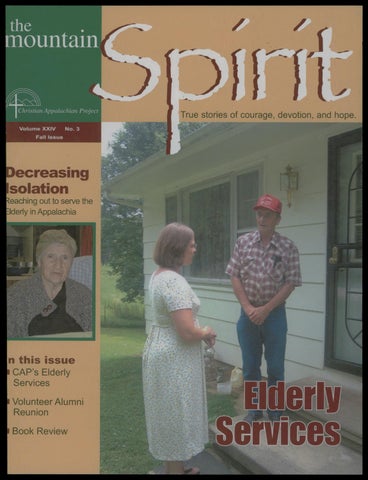
On The Cover Wendy Mathews, a CAP volunteer, talks with participant, Dellas Hobbs. (Photo taken by Peggy Gabriel)
Random Thoughts..................... 3 Around The Project.................. 13
Departments Book Review........................18 Appalachian Recipes................ 26 Back Porch Poetry.................... 28
RANDOM THOUGHTS "CAP has truly been a blessing for many of the elderly in the small hollows and towns../'
I attended a small Eastern Kentucky high school tucked away in the south of Floyd County, Kentucky. It was in a small coal-mining town called Wheelwright. Everyone knew everyone and if you didn t know someone, you knew someone who did. We all knew that when we finished school that there were three options: you could go to work in the mines if you were male, or get married if you were a female; you could go to college if you were fortunate enough to get a loan or scholarship; or you could leave for the northern states of Michigan and Ohio to find a job in a factory. Almost everyone had relatives who had gone to these states and were working in the factories. So, almost everyone went north and never came home, except for an occasional holi day visit or vacation. During the fifties and sixties there was a large out-migration of the population of the entire Appalachian region. Almost all of the young adults left the area. As their parents aged and retired, there was no one to take care of them, thus many thousands were left alone to try to care for themselves in an area that lacked socialization services for seniors. I don t think I ever realized how
fragile and vulnerable our elderly are until I witnessed the passing of my father and now I witness daily my mother growing weaker and more dependent on her family. CAP has truly been a blessing for many of the elderly in the small hollows and towns whose children left and never came back except for those occasional visits. CAP is there for them daily. We do whatever we can to bring joy and happiness into their lives. We are there for them when they are sick and need to go to doctors, we are there for them when they need food and we are there for them when they just need a friend. We have become surrogate families to many. Our elderly have become a dis tinct subgroup of our population that have needs that span across lines of race and social class. Loneliness, isolation, poor health, improper nutrition and lack of meaningful work relegate many older people to “high risk” status in our communities. With the trend toward an increas ingly greater proportion of our population being elderly, as the life expectancy for Americans increases, health disparities and other needs will become greater. We must continue our mission to always be sensitive to the rights, needs and resources of our elderly. We must value their wisdom and knowledge, respect who they are and where they have been. We must be there for Sue Sword Vice President
Whit's Online At
wnvw.chPisani.opg Become an Angel of Appalachia CAPPartnering with Group Workcamp Foundation to Repair 54 Homes Shop CAP'SOnline Auction at Ebay CAPDonates to "Believe" in West Virginia Learn howyou can make an honor or memorial donation Request information about becoming a CAPVolunteer
Born and raised in A ppalachia by Margaret Gabriel
he major goal of the
many miles from the nearest town
workers to see folks regularly.
Christian Appalachian
and that suits them fine, thanks.
“When we make our first visit, we
Project elderly servic
But as they age, that sense of inde
take an intake form for the pro
es program sounds simple enough
pendence becomes more and more
gram that tells us about their needs.
and, in some ways its implementa
isolating and for some, even dan
Sometimes it takes two or three
tion should be uncomplicated and
gerous.
visits before we decided if we re
straightforward.
“We provide transportation,
suited to each other. Most people
But look a second time and
run errands, help people pay bills
contact us because they need trans
realize that the goal to “decrease
and take them to visit each other,”
portation. Either they don t have
isolation and increase socializa
says Zayda Flannery, manager
family in the area, or they have
tion” often means battling life-long
of the program in Jackson, Clay,
family who can t get away during
habits and the standard of
the day. A lot of our people
living for generations of
are widows or widowers,
THEIR SENSE OF INDEPENDENCE
and it s good that we can
BECOMES MORE AND MORE
help people get together
ISOLATING AND FOR SOME, EVEN
socially,” Zayda says.
Appalachian people. Many people in eleven coun ties served by the CAP Elderly Services were born and raised in Appalachia,
Programs in two locations
DANGEROUS...
In some of the counties
often in the same county
where CAP works, elderly
where they still live. Others grew
McCreary, Owsley and Rockcastle
participants knew each other years
up in the mountains, moved away
counties. Zayda supervises two
ago— sometimes before a volunteer
to a region to make a living and
employees and five volunteers who
was born— but because they live in
returned “home” after retirement.
visit an average of 40 participants
different parts of the county have
in each county.
lost touch. Other times, they re
It is common to find that these retired individuals have children
Zayda receives referrals from
making new friends and come to
and grandchildren living many
physicians, social workers, hos
genuinely care about one another,
miles away, unable to attend to
pitals and other participants. She
says Jennifer Eitel, a program case
the needs of their elderly family
likes to keep the number of par
worker.
members. Elderly folks might live
ticipants to one that enables her
A second elderly service pro-
5
“W E H O L D O U R D IN N E R AS CLOSE to
T h a n k s g iv in g
AS POSSIBLE, S O O U R PEOPLE HAVE A HOT M EAL..”
Wendy Mathews, CAP volunteer visits with participant Dellas Hobbs
gram operates out of CAP s
workers hope to use the facility as
says, emphasizing the importance
Hagerhill offices, where Teresa
a community center.
of the socialization portion of the
Gullett manages workers who
The workers at the Hagerhill
program. Jennifer started her work with
serve participants in Johnson,
office plan picnics and
Floyd, Martin, Knott, Magoffin and
Thanksgiving gatherings. “We
elderly services as the program s
Lawrence counties.
hold our dinner as close to
administrative assistant, but recent
Zayda and the staff that works
Thanksgiving as possible, so our
ly took a position as caseworker.
out of the Jackson County office
people have a hot meal,” Teresa
She describes her work with CAP
plan two or three all-county gather
says. For the first time in 2005,
as a “dream job.”
ings each year: one each for Easter
they also planned a “Seed Sowers”
When she worked for the
and Thanksgiving and for the first
luncheon, which gathered people
Jackson County Empowerment
time in 2005, they are planning a
who garden.
Zone, a federal program designed to give rural communities an
picnic for the end of summer. “We
“Some of our people have
usually have these gatherings at
gardened all their lives and now
opportunity for growth and revital
Camp Andrew Jackson, but we re
they re not able. So we make sure
ization, Jennifer became acquaint
hoping to be able to use the new
that we get seeds to their families
ed with several CAP programs,
building in McCreary County,”
or someone who can tend a garden
saw the good the organization does
Zayda says, referring to the reno
for them so they can still see that
for the county and wanted to be a
vation of Eagle Elementary School,
life growing around them,” Teresa
part of it. Her familiarity with the
which is adjacent to the Eagle
work of elderly services made her
Child and Family Development
says. “We found out that the only
Center in McCreary County. When
time one of our ladies got out was
as caseworker for Rockcastle and
the renovations are complete, CAP
to come to our luncheons,” Teresa
Jackson counties, working with the
6
a good candidate to take the jobs
Even keeping travel time to a
although on days when she drives
“I look at CAP as doing good
minimum, though, providing trans
a participant to the University of
things and I love to be a part of
portation to appointments can take
Kentucky Medical Center that isn t
it,” Jennifer says. Not long after
the better part of a day. Jennifer
possible. On the other days, when
she had her daughter, CAP helped
has found that time in the car or
she distributes government com
make some repairs on her trailer,
sitting in a waiting room gives her
modities, she might see as many as
and she enjoys being able to give
the best opportunity for getting to
ten people. “But that s not quality
back through her service to the
know her folks.
time that s just in and out!” she
volunteers in those counties.
elderly in Jackson County.
“We talk about everything,” she
says.
Although she liked working as
says. “History, health, we share
“It seems that the people who
the administrative assistant for the
recipes. Sometimes 1 11 take more
are the neediest are the ones who
program, Jennifer says she eagerly
than one person on a trip and
get more attention, but if people
looks forward to day-to-day con
people have the opportunity to get
have family in the area, they 11 call
tact with program participants. In
to know each other.” Although
them for support,” Wendy says.
just six weeks as a caseworker,
Jennifer and Zayda agree that
“When I m going to visit someone,
Jennifer has already identified
transportation is the most impor
1 11 call ahead and see if they need
transportation as one of the most
tant— and time consuming— ser
anything from the store, and then I
important services she provides,
vice they provide, socialization
go out to visit and help with any
“Especially to doctors appoint
comes in a close second.
thing else they might need. Lately,
ments.” The counties served by CAP
Wendy Mathews has provided services in Jackson County for
I ve been dusting a lot of ceiling fans!”
have little public transportation,
the ten months that she has been a
While she s visiting, Wendy
and what they have is very expen
CAP volunteer. Her goal, she says,
listens carefully for tasks or items
sive. The counties are also tradi
is to visit three people every day,
her elderly friends might mention
tionally underserved by the medi cal community; physicians who practice in the region concentrate on primary care. The specialists that elderly people in and around Jackson County often need to see are in Richmond, Somerset or Lexington, and can be as much as 75 miles away from the remote areas where many people live. From the Hagerhill region, people travel to Pikeville or Huntington, W.Va. “We try to keep our trips to an hour away,” Teresa says. “If some one needs to go farther, we help them access community transport.”
needing. “They won t always ask
founder, on construction projects
Dale tells funny stories about
directly, so the next time I come,
in CAP s earliest days, days when
Father Beiting s experiences driv
1 11 just do it,” she says.
employment in Jackson County
ing a bulldozer and says, “I never
was scarce. “I heard there was a
saw him eat. We d work until
far western Kentucky, but lived
fella hiring workers and when I
eleven o clock at night and he d be
for many years in Tallahassee,
went to see about it, he said, can
right back there in the morning.”
Fla., where her two adult children
you drive a tractor? I never did,
While working on the construc
still live. She learned about CAP
but I reckoned I could learn,” Dale
tion of St. Paul Church in McKee,
through a direct response mailing
says.
the third church that Father Beiting
Wendy grew up in Paducah, in
and became a donor (“I still am
With his newly acquired skills,
constructed for his first four-county
a donor, when I run out of petty
Dale helped to clear timber on the
parish, Dale had the opportunity
cash!”). A nurse by profession,
land for Camp Andrew Jackson;
to meet Father Beiting s parents,
Wendy came to CAP interested in
worked at the greenhouse that was
Ralph and Martha, and two of his
ministry to youth, but changed her
established by Melvin Marks, one
seven brothers who laid brick for
direction when she learned of the
of CAP s first volunteers; and at
the church.
service she could provide to the
the dairy farm at Gray Hawk, Ky.,
“I d been working for two or
elderly. “I ve loved every minute
an economic development project
three dollars a day, and he paid me
of it!”
that was started with volunteer
a dollar an hour,” Dale recalls. For
And if Dellas and Sinnie Hobbs
George Purcell, six Holstein cows
a man trying to raise a family dur
are any indication, it s obvious that
donated by the Trappist monks at
ing tough times, that pay increase
her folks love Wendy, too.
Gethsemane (near Bardstown, Ky.)
was quite remarkable. He recalls
and the assistance of people like
painting the church, varnishing the
Dale.
beams in the ceiling and was hon
Dellas (known as Dale) and Sinnie have been married for 42 years, beginning their life together
“I ve never had anybody treat
ored when Father Beiting invited
about the time that Dale worked
me no better than Father Beiting
him to the dedication of St. Paul s
with Father Ralph Beiting, CAP
treated me,” Dale says.
in the spring of 1962. Wendy says she loves to hear Dale s story of CAP s early days and especially those about Father Beiting. She promises to re-intro duce the two when the priest visits Jackson County, although Dale says he saw Father Beiting at a Jackson County funeral about elev en years ago, “and he knew me. He was a fine fella.” Dale has had recurring health problems, including cancer, for
IP
two years, and has turned to CAP for transportation to his doctor s appointments, including 50 radia
Dellas Hobbs and wife, Sinnie Hobbs
8
tion treatments for his thyroid.
“Wendy s an angel that was sent to
ery. CAP workers access as much
tion to providing goods and trips
help us,” Dale says. “She s helped
as $200,000 worth of medications
for seniors, Second Wind Dreams
us with our heating bills, too!”
each month through the program.
works to improve the perception of
Zayda estimates that one-third of
aging and of elderly people. The
ments of visiting and providing
the people who participate in the
group s mission fits well with that
transportation, the umbrella of the
elderly program also receive medi
of CAP s elderly services, Zayda
elderly services program also cov
cations through prescription assis
says. “We hope to fulfill many
ers prescription assistance in 12 to
tance.
more dreams in the coming year.”
In addition to the essential ele
15 counties. Many elderly people
In the fall of 2004, CAP began
are able to take advantage of this
collaborating with Second Wind
American population increases,
program and it is available to any
Dreams, a national organization
the demand for services to elderly
one who meets the income eligibil-
whose mission is to enhance the
people will be on the increase, and
As the average age of the
“W E HOPE TO FU LFILL M A N Y M ORE DREAM S IN TH E COM ING YEAR ”
ity requirements, regardless of age.
Elderly volunteer, Christina Laurence looks at photos with a participant from CAP s Elderly Services program
The cost of medications is out of reach for many people; the feder
quality of life for elderly people.
the demographics in the counties
ally-mandated prescription assis
Twenty-eight people in CAP
that CAP serves indicates a higher-
tance project makes available from
Elderly Services program have par
than-average age for the popula
the manufacturer “maintenance”
ticipated in the portion of Second
tion. Those demographics indicate
medications, such as those taken
Wind Dreams that helps people
an increasing need for CAP ser
to treat high blood pressure and
discover and fulfill wishes or
vices in the future and the elderly
diabetes. For most medications,
dreams. For example, Wendy took
services program is well positioned
though, manufacture s require a
three seniors to Florida, where they
to provide those services.
tangle of paper work for a supply
saw Disney World and the ocean
“I think we re flying high
that must be re-ordered every three
for the first time. Dreams that have
with new staff, and we re add
or four months. CAP workers help
been fulfilled include purchas
ing Second Dreams for people,”
participants determine whether the
ing such items as rocking chairs
Zayda says. “We re all busy and
medication they need is covered
or sewing machines. People have
happy.”+
in the program, obtain the needed
taken trips to see family and an
documentation and physicians
Owsley County lady dreamed of
signatures and follow up on deliv-
a new door for her house. In addi9
LETTERS TO THE EDITOR
I have just finished reading the lastest edition of The Mountain Spirit, and I just wanted to write you to say how much I learned from it and how much I enjoyed reading it. It was so well done, the pictures were great and the articles were thought-provoking and very well-written. Thanks for a great magazine. I look forward to receiving my next copy!
I am so glad to receive and read The Mountain Spirit. The entire magazine serves as a reminder of my Kentucky heritage. My parents grew up in Jackson and Rockcastle counties and I lived there until I was nine years old. My education began in a one room school, Cruise Ridge, in Rockcastle County in 1942.1 have always been grateful for my love of learning which began there. Your 40 years issue was a gem. As a new subscrib er, I did not know a lot about CAP and its impressive history - and present. I especially enjoyed Jim Trammel s book reviews. What a coincidence! I had recently read the Big Stone Gap books and also Creeker. I loved them! I have not heard of Clay s Quilt but I plan to seek it out and read it. I mention the book reviews because I love to read and books are my passion. The other articles are good and informative and tell your story well! Looking forward to future is sues.
Janette Amos Etowah, Tenn.
Catherine Fischer Wicklijfe, Ohio
I received The Mountain Spirit and I thank you. When I look through it I can almost see my old mom and dad sitting on the porch of our old home place. I grew up in the West Virginia mountains, so I know about the people there and I love them, too. I get a little touch of home as I read through it. The people are hard working, full of heart and soul and especially spirit. May God bless them all and CAP. Martha Christian Palermo Virginia Beach, Va.
Happy Summer to you. I just want you to know what I do with the magazines and stationery you send me. The magazines I send to my sisters so they can enjoy them at Christmas and I will take the ones I gathered up to Solano Mission. I am very active in the food distribution programs in town. The stationery I share with my daughter and write to friends of faith when we have stamps. So things are appreciated. Trudy Prescott Fairfieild, Cal
LET US KNOW HOW WE ARE DOING' Send your Letters to the Editor to: Editor, The Mountain Spirit, P. O. Box 511, Lancaster, KY 40444-0511. We may publish your your letter in an upcoming issue of the magazine.
words of wisdom ft smiCe is your personaCwe[come mat. A smile is a light in the window of your face to show your heart is at home.
Our lives will always be full if our hearts are always giving.
‘You mahe a hiving by what you get, 6ut you a Cife by what you give.
A teacher’s job is to take a room full of live wires and make sure they are well grounded.
The tragedy of life is not that it ends so soon, but that we wait so long to begin it. Coming together is a beginning. Keeping together is a progress. Working together is a Don’t squat with your success. spurs on. Never test the depth o f the Experience is the sinking water with bothfeet. feeling you have made this mistake before. Without faith, we are as stained-glass windows in the dark.
Cfiaritalofe Qift Annuity Proyram OULD YOU CONSIDER
Uniform Gift Annuity Rates Single Life
MAKING A GIFT TO
A?e Rate A p 55 5 .5 % 73 C h r i s t i a n A p p a l a c h ia n 74 56 5.6 PROJECT, AND RECEIVING 57 5.6 75 LIFE INCOME? 76 58 5.7 77 59 5.7 78 60 5.7 This is possible when you fund a CAP charitable gift annuity. A chari 79 61 5.8 table gift annuity is an agreement between you and CAP. In exchange for 80 cash or other assets (stocks, bonds, mutual funds, etc.) o f $2,500 or more, 62 5.9 CAP guarantees to make fixed payments fo r the rest o f your life. Follow 81 63 5.9 ing your life, the assets remaining are used to fund the work o f CAP 82 64 6.0 83 65 6.0 84 66 6.1 DVANTAGES OF A 85 67 6.2 CHARITABLE GIFT ANNUITY W ITH CAP 86 68 6.3 Fixed payments for life. 87 69 6.4 A charitable income tax deduction the year the charitable gift annuity is funded. 88 70 6.5 A portion of each lifetime payment considered a tax-free return of principal. 89 71 6.6 An opportunity to make a significant commitment to the Christian Appala chian Project and enable us to help those less fortunate throughout Appala 90 72 6.7
A
Rate 6.8 6.9 7.1 8.2 7.4 7.6 7.8 8.0 8.3 8.5 8.8 9.2 9.5 9.9 10.2 10.6 11.0 11.3
and over
chia for years to come.
I Please use the following information to calculate my charitable gift annuity Name (Mr., Mrs., Ms, Miss)____________ ___________________________________________ Address_____________________________________________________________________ ____ I City. I I Telephone ( 1 I Amount of Gift Considered $. I Frequency of Payment Desired:
_Zip_
State _Day.
Birthdate Month
Q Annual
CÜ2 times/year ($2,500 min)
Year
d 4 times/year [^M onthly ($10,000 min) ($5,000 min)
I U fi/e s, I am interested in a Two-life Charitable Gift Annuity illustration. I Name of Second I Beneficiary ________________________________ Birthdate______
P l e a se C o m p l e t e & RETURN TO: 12
Christian Appalachian Project Planned Giving Department P.O. Box 511 Lancaster, KY 40444-0511
(All information provided is confidential )
around the project
CAP partners with the Summer Pood Service Program in Magoffin County The end of the school year, for many, is a happy time - a time to throw off the cares of the past year and enjoy summertime. Unfortunately, for some, the end of the school year also means the end of nutri tious meals. Some students must forego the breakfasts and lunches the schools serve throughout the year. According to information provided by the USDA Food and Nutrition Service homepage, “good nutrition is essential for effective learning every day, all year long.” In the same way that learning continues even after the school doors close for the summer, so does the need for good nutri tion. Children who are not deprived of nutritious meals “act better, feel better” and generally fare better than children who are hungry. The Summer Food Service Program (SFSP) helps children access the nutrition they require to grow, play and learn throughout the summer months. The program was created to ensure that children in economically depressed areas can continue to receive well-balanced meals during summer vacation, when they do not have access to school lunch or breakfast. Although millions of children depend on nutritious free and reduced-price meals and snacks at school for nine months out of the year, according to information from the homepage, just a fraction of them receive the free meals provided by the SFSP dur ing the summer months. This summer the Christian Appalachian Project partnered with the SFSP in Magoffin County. Meals were served to
all children under the age of 18 daily through out the summer at the Ramey Memorial Park in Salyersville. CAP volunteer Bob Flick, who helped spearhead CAP s involvement with the program, says helping
Mikayla Lykins of Magoffin County was one of the first children to take part in the summer food program this year. Mikayla is attending the 4-H Day camp provided by the County Extension Office.
to feed Magoffin s hungry children was definitely a goal worth pursuing. “In this county we have a lot of children who don t get balanced meals, especially during the summer,” says Flick. “The parents just don t have the money to put together three meals a day that are balanced and healthy for children. The Christian Appalachian Project and the Summer Food Service Program are working together to feed Magoffin County s children with balanced, nutritious meals.” e> 13
around the project
Christian JLppafachian (Project Hosted a Home (Repair (Bfitz Christmas in July came for 54 Johnson County families. In just one week, the families got much needed and longawaited minor repairs to their homes thanks to over 480 people who came to Johnson County to do the work. The repair blitz was a community effort spearheaded by the Christian Appalachian Project (CAP) in partnership with Group Workcamp Foundation, a non-profit that provides short-term mission trips for youth and teens. Four hundred teens from all across America, and their chaperones, congregated at Johnson County High School, their home base for the week. The teens were grades nine through twelve in high school and were members of youth groups at their churches. Throughout their stay, they dispersed during the day to work on all fifty four homes, then met together at the school for dinner and an evening program. The Christian Appalachian Project partnered with the Workcamp Foundation to provide a mean ingful experience for the teens. CAP s Housing Program also provided half of the materials and oversaw the work sites during the week. Repair projects included painting, repairing roofs, building and repairing porches, building wheelchair ramps, building and repairing steps and other small jobs. CAP s Housing Program Manager, Mike Wiley, was pleased with such a large group coming to Johnson County. “This is a win-win,” he said. “Fifty-four repairs will get finished for families who really need them, and the experience will provide the youth with opportunities to learn new skills, make new friends and grow in their relationship with Jesus Christ.” Mike added, “This was also good for the community, and we re thankful for individuals and businesses in the community who have helped us with this effort.” e>
WELCOME TO THE CAP FAMILY NEW VOLUNTEERS Pictured fron left to right, front row, are Michael Lynch, Becky Welch and Sarah Kingery; Back row, John Schmitt, Kathy Stephens and Mike Stephens.
14
Painting a Colorful Summer The families of McCreary County enjoyed a colorful summer at Eagle Child and Family Development. For the second year, Eagle teamed up with the Kentucky Arts Council and the McCreary County Community Early Childhood Council to bring Arts Start Program to Parkers Lake. Arts Start is a grant program designed to bring professional artists into Kentucky early childcare/preschool facilities to demonstrate their art forms and share their creativity with the children, directors and staff.
winning visual artist from Hyden, Kentucky spent a total of four weeks at Eagle CFDC teaching young children and their parents how to create their own landscape paintings. “It’s amazing,” said Michael Loiacono, Eagle’s manager, “how children who we label as ‘shy’ or ‘slow’ suddenly blossom when given an opportunity like this.”
Crystal Watson of Parkers Lake brought her two daughters to the program for the past two years and praises the program: The goal of Arts Start Program “These painting classes have is to enable early childhood given my girls the confidence education facilities to collaborate Artist Lonnie Hendrix assists Holly Ridnerwith her to try new things,” said Crystal. with practicing, professional painting Now they love to paint.” artists on individualized short-term Arts Start is funded through a residencies. The artist involves the children, directors grant from the Kentucky Arts Council. Eagle CFDC staff directly in the creative process received a mini-grant from the McCreary County during the residency, and teaches Community Early Childhood Council and Kids Now to them how to integrate the arts support the endeavor. e> into daily programming. Lonnie Hendrix, an award
h an k $fou ^Summer VSam p ^Volunteers CAP would like to thank everyone who gave their summer to serve as volunteer counselors, lifeguards, and medical personnel at Camp Andrew Jackson and Camp Shawnee. Each one of you played a vital role in creating many wonderful memories for every child that attend ed camp this summer. You truly made a differ ence in the lives of these children.
S h a n k s fo r a ll o f yo u r h a rd work!! 15
JvfcCreanj Comfy Collaborates on The four adult education programs in McCreary County held their annual GED (General Equivalency Diploma) gradua tions together at the Whitley City Branch of Somerset Community College on June 27. The programs collaborated to provide a special graduation for the 42 graduates who earned their GEDs this year. CAP Adult Education Teacher Brinda Campbell with graduates Caro The event began with an introduction by lyn Abbott and Ginger Ridenour Christian Appalachian Project adult educa tion manager, Bobbie Playforth. “McCreary out of school as long as 30 years before pursu County is unique,” she said, “because our ing the completion of their high school equivalence programs work together to offer a wide array degree. Before the end of the ceremony, the gradu of adult eduction services to our community. ates were given an opportunity to speak about their We are not in competition with one another.” experience and then received their degree. Many Bobbie congratulated the graduates for thanked the programs and teachers for their assistance their hard work and perseverance. “It s in helping them reach one of their dreams. “I didn t tougher than high school,” she said. “You really think it would make a difference in how I feel, have less time to learn all five subjects and but it does,” graduate David Sparks told the audience. then take a test on all of them at the same The participating programs included: Somerset time, all the while juggling jobs and fami Community College McCreary County Adult lies, which are obstacles most students do Education and Family Literacy Program, McCreary not have to deal with in high school.” LYNC, Christian Appalachian Project s Adult Beverly Murphy, director of the Somerset Learning Center/School on Wheels and CAP s Eagle Community College McCreary County Adult Child and Families Growing Together Program.e> Education and Family Literacy Program, gave the keynote address. “You are a role model for many people,” she told the graduates. “Your chil dren will value education because you value educa tion. Continue your thirst for knowledge,” she encouraged them. “You can do whatever you set out to do.” Murphy shared the story of Morris Strunk, who as a young man earned a GED while serv ing in the military, and later played an instrumental role in founding the McCreary County Educational Center. 2005 McCreary County GED Graduates left to right front row: David Parks, Danny Pierce, Darla Phil Some graduates had been lips, Fayrene Goodin and Carolyn Abbott. Back row: Faith Dixon, Ginger Ridenour, Michael Smallward, Richard Garland Ashley Sziber and Wanda Jones
16
Kentucky Wildcats Spread the Good News of Jesus Christ Three former University of Kentucky students talked to campers at CAP Camp Andrew Jackson and Camp Shawnee during the camping season. Cameron Mills, Jeff Shepherd and Gavin Duerson delivered messages of triumph in Christ. The three are members of the Fellowship of Christian Athletes, a ministry that uses the platform of sports to spread the good news of Jesus Christ. If you think sports is all about winning a game, think again. That was the message Cameron Mills gave close to 80 female campers. As a young boy, Cameron recalled win ning his first trophy in swimming. Throughout his childhood and teenage years, Cameron says he remained on a quest to build up his trophy collection from a variety of sports, even academics. In 1996, Cameron won what he thought was the ultimate trophy: his Univeristy of Kentucky team won the NCAA tournament that year. But the tro phy he had worked so hard for fell short in fulfilling Cameron. “I was angry. I was upset,” he said to the crowd. Like a true basketball player, he kept the crowd alive by constant movement, turning this way and that in order to reach the entire audience. “I was angry because this piece of metal I had sought all my life was leaving me feeling so empty inside. It was then that I turned to Philippians 3:8, which says that all things, compared to knowing Christ,
are worthless.” Jeff, a teammate of Cameron’s, challenged a group of 44 male teen campers to dream, to “show up and try” and to keep Jesus in the midst of it all. “When Jesus is the leader of our lives, we always win,” said Jeff. Gavin, who spent games cheering on the crowd as the school mascot, had a similar message to campers.Gavin spoke to a group of 8 to 12 year-olds at the start of camps’ sessions and focused on leadership and cultivating a daily walk with Jesus. He com pared his prac tice sessions as a mascot to the everyday prac tice of reading the Bible and praying. But, he said, just as he practiced and performed as a mascot, so too we must prac tice and perform as a Christian. After the talks, the three players answered questions and signed autographs for campers. The three members of FCA remain active in their Christian walk and participate in speaking engage ments throughout the country.
17
Aerarían
A grarian
Kentuch
A Coo^Sacf^show An Aj^judax^wwi B
L
hope everybody makes a point to find and read one (or one more) of the three dozen books edited by our departed Kentucky Historian Laureate Dr. Thomas D. Clark, in tribute to a life spent trying to explain Kentucky to its native sons and daughters. When you do, I m sure Dr. Clark would smile to see that one more person has read and learned from his carefully explained lessons of history. Agrarian Kentucky could have been subtitled “When, Why and Where Kentucky First Fell Short.” The treatise is short but the deep concepts make it a slow, rich read. You can t speed through these truths, you must stop to ponder. The verities are tighly condensed; in only 135 pages Dr. Clark completely explains how a noble reverence for the land enriched but also twisted the Kentucky experience, from the state s beginning until the present day. The book focuses mostly on the 19th century, during which Kentucky stayed too busy tilling its fields and going about day-to-day living to set aside any resources for the long-range needs that would have helped it keep pace with other developing states. One untimely problem after another held back progress for Kentuckians. Road and water transport of crops, and development of banks to serve as storehouses of value, took decades to establish even to mini mum standards. Though farming was central, the type of farming varied: the Bluegrass area raised crops to sell, while the earlier settlements of central and eastern Kentucky farmed for subsistence. The tides of wider history in the 19th century also ran crosswise against Kentucky s progress. Henry Clay, consummate politician and farmer and a one-man force for Kentucky s social development, at one point acquired English cattle that represented the topmost breeds in Europe. A Kentucky shorthorn was bred that quickly became the envy of the nation. But leadership in cattle was soon to be seized from Kentucky by the developing prairie states to the West. Dr. Clark finds it curious that a state of Kentucky s farm orientation would mismanage and plunder its abundant forests as it did. The War of 1812 and the Civil War each held Kentucky back from attaining a timely awareness of national trends that were benefiting neighbor states. (By contrast, World War I would impel Kentucky in beneficial social directions.) In the decades leading up to the Civil War, the volatile slavery issue held back the progress of education because several prominent abolitionists were also fervent believers in public education, and agrarian reac tion against one cause penalized the other. The political leaders of the time occasionally paid lip service to education but never adequately funded it or required Kentucky citizens to attend the badly funded, ill-equipped schools taught by poorly trained teachers lacking proper equipment or textbooks. Those who seek to solve Kentucky s social problems quickly discover they occur in interlocking knots. Kentucky citizens mistrust of government led to the establishment of too many small counties, Clark maintains, and the needless extra costs sapped revenues of the “pauper counties” which could not educate 18
K e n tu c k y where we ’re going... keview byJim Trammel its citizens adequately. The constitutional convention of 1849, writing Kentucky s third constitution, was the death of hope for government-supported education. The influential Ben “Kitchen Knife” Hardin of Bardstown, by all accounts one of the most intelligent and promising delegates, gave a key speech against public schools, which, coupled with a familiar Kentucky hostility to
Æ t the Ume 40,000 Kentucky aAuLts were ¡¿Literate omA 200,000 duldrevi
Clark wrote
were eAxAsattionaily depHveA. taxation kept the convention from mandating public schools in the new constitution. At the time 40,000 Kentucky adults were illiterate and 200,000 children were educationally deprived. These delegates avoidance of an obvious problem echoes more current legislatures that debate trivial issues that seem designed to position them personally to win approval of small-minded voters. The inad equate pols of the 1800s must smile down approv ingly at their descendants bickering over symbols and status issues as they jockey for re-election while more vital issues up to and including entire state budgets go unaddressed. But Dr. Clark shows us it has been that way in Kentucky for more than a century, and the negligence has taken its price. Though he loves us, he certainly can lecture, and in Agrarian Kentucky he ties up responsibility for Kentucky s deficiencies in a pack age addressed to government. Agrarian Kentucky should be required reading for all who are, have been, or aspire to be Kentucky poli ticians, so they can see the consequences of turning their heads away from ongoing problems.
Author and University of Kentucky profes sor Dr. Thomas D. Clark, called “Kentucky s greatest treasure” by former Kentucky Gov. Brereton Jones, died June 28, 2005, at age 101. His death took place just a few weeks before his 102nd birthday and the renaming of the Kentucky History Center in Frankfort to honor his prolific lifetime of teaching, writing and scholarship. He chaired the University of Kentucky History Department from 1942 to 1965, and was a Distinguished Professor of History at Indiana University for five years. Dr. Clark estimated that he taught more than 25,000 UK students over the years. He wrote more than three dozen books, mostly about Kentucky, and also wrote many of the entries in The Kentucky Encyclopedia. He wrote Exploring Kentucky, a 1939 public school textbook used for over half a century. The Kentucky General Assembly declared Dr. Clark Kentucky s Historian Laureate in 1990. His memoirs of over 400 pages, which he was editing even from his sickbed, are tenta tively scheduled for publication next spring.
19
CAP Hosts Volunteer Alumni Reunion ostalgia reigned in Renfro Valley over the week end of June 24-26 at the Christian Appalachian Project Volunteer Alumni Reunion. Over 330 people flocked to the
“I t’s not ju st
grounds of CAP s Community Center to reminisce about good times and rekindle old friendships. Those in atten dance were both current and former volunteers and their families. The event drew former volunteers from as far
an alumni reunion
reunion...
away as Hawaii. Many planned their vacations around the reunion and brought their families for the weekend s festivi ties.
An alumni reunion of this size had not been held in nearly 15 years, so the event was much-anticipated and had been in the planning stages for nearly a year. It turned out to be one of the biggest events CAP has organized. The three day reunion began Friday night with snacks and a slide show of volunteer pictures. Former volunteers trickled in throughout the evening and were met with big hugs and shrills of delight. Everyone enjoyed looking at old scrapbooks and post ers full of pictures of days gone by. Saturday started with a catered picnic followed by games and a concert by Zoe Speaks, an Appalachian contemporary folk band. The group heard from President Bill Mills and attendees continued to
Vice President Casey Sterr,
mingle, meeting new and
who both expressed CAP s
old friends. Many spent time
gratitude to volunteers and
getting reacquainted and
gave an overview of CAP s
finding out what happened
current work. Mills also recognized some volunteers
to each other. They remi
S- 1*1
nisced about good times and
including over fifteen mar |
ried couples who found
listened to a message from CAP founder and volun
their mates while volunteer
teer supporter Father Ralph
ing at CAP. Throughout
Beiting. mmm
One former volunteer,
Janet Fiedler, was finally able to meet in person the volunteers who were featured in a CAP video; their comments impressed the future volunteer enough to commit her service to CAP. Meeting them years later was a treat for her because of the impact they had on the course of her life. Cecilia Williams friend drove her from Ohio to attend the reunion. “I wanted to come one more time,” said Cecilia, who volunteered in 1978. “When I was here, Father Beiting worked us hard, but we had so much fun. I have many fond memories.” One CAP participant came to the reunion specifi cally in hopes of seeing Cecilia and other CAP vol unteers who influenced her life. “One of the most wonderful times in my life was with the van driver,” 21
“Whenever I come back and touch my CAP family, I’m touching something I can’t touch anywhere else...” said, “I have no regrets about moving on with my life and doing what I m doing now. I m happy, but whenever I come back and touch my CAP family, I m touching something I can t touch anywhere else.” That sentiment was echoed by former volunteer Valerie Balling who said, “I ve been gone for seven years, and you know how people always say, you can t go back home again? Well, after 10 minutes at CAP, I feel like I m back home again.” Over and over, volunteer alumni expressed their enjoyment of the event. While the activities and food were much appreciated, the highlight for most everyone in attendance was simply reconnecting with old friends and seeing how everyone s fami lies had grown over the years. Former volunteer Ann Sandhoff noted that the highlight for her was “renewing the spirit of volunteer life and renewing friendships.” she said, speaking
Alumni also appreciated the attendance of cur
of Cecilia driving her back and forth from CAP s
rent and former CAP employees. “It was wonderful
Bible school in Garrard County. Though not assigned
to have some employees there to see,” noted Barb
to the program, Cecilia helped out with driving in the
Delmonico. “We really felt thanked by CAP for
evening. “It just goes to show that you never know
our service!” added Anna
who you are impacting as a volunteer,” said Kathleen
Brannen.
Leavell, former volunteer and current CAP employee
After a fabulous day
of CAP. “Cecilia was an incredible volunteer. She
enjoying each other s
was a beacon of hope in this participant s life.”
company, some volunteers
Barb Delmonico, who volunteered in the 80s and
retired, while others lingered
later was employed with CAP, commented on the
to talk until late in the eve
energy that many volunteers felt at the reunion. She
ning. A prayer service and
“It just goes to show that you never know who you are impacting as a volunteer...”
brunch was held on Sunday morning before tearful good byes, hugs and promises to stay in touch. The volunteers left with their special memories
22
and the treasure of having created new ones at the reunion. Kathy Kluesener, a long-time volunteer and CAP current employee at CAP, felt that everyone in attendance felt blessed by the event, emphasizing the “gratitude of being able to come back and reconnect.”
“It was great to be back in Kentucky for a real family reunion.” According to former volunteer Mary McNamara, “It was great to be back in Kentucky for a real fam ily reunion.” She spoke of how “rejuvenating and spiritually uplifting” the event was for her and so many oth ers. Christian Appalachian Project estimates between 40,000 and 60,000 volun teers have served at CAP since Father Beiting first started recruiting volun teer help in the 1950s. CAP continues to main tain a robust volunteer program. Today, CAP has full-time volunteers as well as
of thousands of dollars. The volunteer experience at CAP consists of three important pillars; community, spirituality and service. Volunteers are challenged to develop their gifts in these three areas by living in volunteer houses, participating in spiritual events and devotions and working in CAP programs This year s reunion was so popular that volunteer program has already scheduled a future reunion for June 30, 2007. If you are interested in
Volunteers donate over 25,000 hours of labor each year to CAP which saves hundreds of thousands of dollars. becoming a CAP volunteer or would like more information contact the volunteer program at 1-800-755-5322, email us at volunteer@chrisapp. org. or write Christian Appalachian Project, Route 6, Box 43, Mt. Vernon, KY 40456. All interested indi viduals are subject to an application process.t
short-term volunteers and mission groups. CAP provides long-term vol unteers with housing and many other benefits. Volunteers work in many of CAP s human service programs includ ing camps, elderly programs, GED pro grams, child and family development, housing repair and disabilities programs. Volunteers donate over 25,000 hours of labor each year to CAP which saves hundreds 24
Don’t Forget U s... e are happy to say that we asked you to send us item s to sell on our online “A ttic” store and you have done a w onderful jo b o f supporting our efforts. H ow ever w e still need your help! W hen you do your spring, sum m er, fall and w inter cleanouts please send us any unw anted jew elry, glassw are, kitchen/housew ares, knickknacks and especially antique item s to C A P s new online attic store. O ur attic is operating through the nonprofit division o f eBay, w hich is called M issionFish. This effort has not only brought in m onies, but has also introduced C A P to thousands o f people w ho w ere not aw are o f our w ork in A ppalachia. The m onies collected from sales help fund our p ro gram s including our outreach efforts to fam ilies that need the basic neces sities o f food and shelter, our housing departm ent that provides valuable rehab w ork for fam ilies and elderly, and m ost o f all necessities for our children. If you like to shop or w ould like to list the item s yourself, please visit w w w .m issionfish.org. L ook for the C hristian A ppalachian Project and you w ill find us. We thank you for all you do.
We Need Your Help!
A PPALACHIAN
D E LIC IO U S RECIPES YOU W ILL ENJOY S H A R IN G
Roasted Chicken 1 roasting chicken 1 bottle of balsamic vinaigrette dressing, divided 1 lb. carrots, peeled, cut into chucks 4 stalks celery, cut into chucks Preheat oven to 350 degrees. Wash and pat chicken dry with paper towels. Using a wooden spoon pull skin from chicken on both sides, being careful not to break skin. Brush bottom of chicken with 1/4 cup of balsamic vinaigrette dressing. Tuck the wings under the chicken and place breast side up on rack in roast ing pan. Brush 1/2 cup of the dressing under the skin and on the outside of the chicken. Mix carrots and celery with remaining 1/4 cup dressing and stuff into chicken cavity. Bake the chicken for 1 1/2-2 1/2 hours or until juices run clear. Make sure your ther mometer which should be inserted into the thickest part of the thigh reads 180 degrees. Let the chicken
stand for 10 minutes. Remove the vegetables from the chicken cavity before serving.
Pumpkin Cheese Bread 1/2 cup or 1 stick of butter 1 package cream cheese, softened 2 1/2 cups sugar 4 eggs 1 can pumpkin (16 oz.) 3 1/2 cups flour 2 teaspoons baking soda 1 teaspoon salt 1 teaspoon ground cinnamon 1/2 teaspoon baking powder 1/4 teaspoon ground cloves 1 cup pecan pieces (optional) Preheat oven to 350 degrees. Beat butter, cream cheese and sugar in a large bowl with mixer until well blended. Add eggs, 1 at a time, mixing well after each addition. Blend in pumpkin. Add combined dry ingredients, mixing just until moistened. Stir in pecans. Pour evenly into 2 greased and floured 9x5 inch loaf pans. Bake for 1 hour or until a toothpick inserted in centers comes out clean. Cool for 5 minutes and remove from pans.
Buttery Mashed Potatoes 4 cups cooked and diced potatoes, mashed 1/2 cup milk 2 tablspoons butter 1 tablespoon chives chopped finely 6 oz. American cheese cut up and divided 2 tablespoons grated parmesan cheese Beat potatoes, milk and butter until fluffy. Stir in chives and half of the cheese. Spoon into a 1-quart casserole dish. Sprinkling the top with parmesan cheese. Bake at
DO YOU HAVE A FAVORITE RECIPE YOU WOULD LIKE TO SHARE?
350 degrees for 20 to 25 minutes or until heated through. Top with remaining cheese and bake an additional 5 minutes or until cheese melts.
Cinnamon Pull-Apart Bread 3/4 cup granulated sugar 1 tablespoon ground cinnamon 3 cans refrigerated buttermilk biscuits 1/2 cup or 1 stick butter, melted 4 oz. cream cheese, softened 1/2 cup powdered sugar 1 to 2 tablespoons milk Preheat oven to 350 degrees. Mix sugar and cin namon in medium bowl. Cut each biscuit into quarters and roll in cinnamon-sugar mixture. Place half of the biscuits pieces in a greased 12 cup flut ed tube pan and drizzle with half of the melted butter. Top with remaining biscuit pieces and drizzle with remaining butter. Sprinkle with remaining cinnamon-sugar mixture. Bake 40 to 45 minutes or until golden brown. Let cool in pan for 5 minutes then invert onto serving plate. Beat cream cheese and powdered sugar in a small bowl with mixer until well blended. Add 1 tablespoon of the milk and beat until well blended. Beat in enough of the remaining milk until glaze is of desired consistency. Drizzle over warm bread. Serve warm.
Mixed Vegetable Casserole 1/2 cup crushed round crackers 1 tablespoon butter, melted 1 bag frozen mixed vegetables, thawed and drained 1/2 cup salad dressing 1/2 cup shredded mild cheddar cheese 1/3 cup chopped onion Mix crushed crackers and butter in small bowl. Mix
remaining ingredients in a 1-quart casserole dish, Sprinkle with cracker mixture and bake at 350 degrees ^or ^ minutes or until heated through.
1/2 cup flour l package cinnamon brown sugar instant hot cereal \ tablespoon baking powder 1 cup milk 1 egg 2 tablespoons butter, melted 1 cup blueberries (optional)
Mix flour, cereal and baking powder in medium bowl. Blend milk, egg and butter in a small bowl. Stir into dry ingredients just until blended. Let stand for 5 min utes. Stir in blueberries. Pour approximately 1/4 cup batter onto a hot griddle or skillet sprayed with cook ing spray. Cook until bubbly then flip. Remove when golden. Serve immediately.
If so, send us a recipe card in the envelope provided or write to us at: Christian Appalachian Project, Publications Department, P.O. Box 511, Lancaster, KY 40444-0511 27
Thanh, you, Cjod, Tor Poetry... The ftnqef
For bright words ringing true. Thank you for the way I feel when I m alone to read
The Angel sits on my bed,
it - for it always brings me close to you.
Placing her hand on my back. She tells me its going to be ok,
A lovely poem requires me to think beyond what s Here - in poems I can dream - and maybe even shed a
But I m not sure of that.
tear.
I feel so completely alone, I don t hear a thing.
Sometimes I read for many a golden hour and then I
Little do I know,
Feel a kinship sweet with all the birds and every
The softness I felt, Was the touch,
flower.
O f an angels wing. The words come leaping forth from the page like
The room suddenly seems brighter,
Some shining thing. Sometimes they make me feel
Almost a peaceful glow.
Just a bit sad, other times they make my heart
God never lets anyone be alone,
sing.
He always sends an Angel to go. Everything is going to be ok,
Thank you, God, for poetry...for bright words
If not now,
Ringing true. On special days I like to write it
Eventually. I know this because,
and to read it too.
I had an Angel promise me. But more than that I hope and pray that in my life 1 11 be a living poem filled with Your love for all the world to see.
Candice Herrling Culloden, W.Va.
Thank you, God, for poetry...
Patti Merrill Glendale, Ariz
TVe wouldlove to hear 'Please sendus y o u r poetry, with permission to print in an upeominy issue o f The ^Mountain -Spirit 28
or
f_ -/o ss a coin in a fo u n ta in a n d m ake a w ish. If y o u ’re th in k in g ab o u t y o u r fu tu re an d w h at w ould h a p p e n sh o u ld you die, you m ight say: “I w ish th a t m y b ro th e r, Tom , w ould h a n d le m y es ta te .” O r p erh ap s, “I w ish A unt E tta w ould tak e care of m y d a u g h te r.” O r m aybe, “I w ish th a t any e sta te taxes w ould be k ep t to a m in im u m .” You m ig h t also say, “I w ish to give a p o rtio n
&
y o u r estate? W h at ch arities will ben efit from yo u r estate? 'w ill, p ro p erly p re p a red , lets you sleep b e tte r a t night. It m akes y o u r fam ily re st b etter, too. ishing w ells m ay be fun for som e things,
of m y estate to CAP an d o th e r charities I care a b o u t.”
b u t n o t w hen it com es to esta te p lan n in g . W hen y o u ’re dealing w ith y o u r estate assets a n d v a ri ous resp o n sib ilities it’s far b e tte r to “to ss a coin”
ishes, w ishes, w ishes — th a t’s all they are. A nd to ssing coins in to a w ishing well w o n ’t help. The only w ay you can be su re of th ese
to w ard a qualified a tto rn e y w ho can help you do th in g s right. G ran ted it will tak e m o re th a n a p en n y o r tw o, b u t th e certain ty a n d satisfaction you receive will far outw eigh any cost.
th in gs — to change th e m from w ishes to c e rta in ties — is to p re p a re a will or o th e r a p p ro p ria te esta te -p la n n in g docum ent. 'w ill is a w ay to m ake yo u r w ishes com e tru e . In it, you list w h at you w an t to h ap p en : W ho will re p re se n t you th ro u g h th e process of p ro b ate? W ho will care for any m in o r children? W ho will look after any tru sts? W ho will receive
'M , can provide for you co m p lim en tary b ro c h u re s w ith helpful in fo rm atio n ab o u t m aking a will. C om plete th is reply form an d we will m ail in fo rm atio n to you prom ptly. O r re q u e st in fo rm a tio n by calling us toll free a t 1-866-270-4227.
r
Please send me the following information: Please send me your complimentary will information brochures. Please contact me about a personal visit. The best time to call me is:_________________ I have provided for Christian Appalachian Project in my will or other estate-planning.
Name:___________________________ Address:_________________________ City:____________________________ State:____ Zip:____________ Phone:
L
Christian Appalachian Project Planned Giving Dept. P. O. Box 511 Lancaster, KY 40444-0511 -j 29
3cross the L^AAountdms
¿
N R D F
M J
E
F
G T
M B Y
E
G M L E
E
H W 0
L
1
N F
E
E
G A
T
R 1
A
H C
L
K
0
T
S
D R S
A
A
S
C
N Y
N N V
T
s
M D
P
1
J
E
M U G P
K
U E
R 0
H E
N J
M E
D D M Q T
C
E
1
R L
D M T
A
N R A
A
T
Y
Y
1
B
M E T
N 1
S
R L
F
R P X
A
J
P A
N
1
A
T
E
E
0
D L
Y
E
C
1
T
F
0
G U L
1
P
L
D D C
L
K
E
N N Y
T
S
R N L
R D A
0
A
P
L
M T
G E A
U A P T
P
P
E
R L
A
R 0
N L
T
A
G 1
1
Y
G 1
T
U T
T
G
S
J
A
Y
A
A
N B
E
L
U W
E
L
0
0
0
V
M
R W 1
0
S
T
N
R 1
T
1
0
N
N Y
0
L
N E
N 0
1
N U E
W X
T
R K
E
E
E
H N U T
B
0
Y
S
T
G T
X
P
E
H K
1
0
N S
H 1
P
C C J
R s
0
N U R
C
W A
1
R N 1 O A
X
E
E
C
J
H T
c
H A
M P
Y
C
N
1
L
N
F
R A
L
U M N 1
P
1
N J
S
A
M T
S
1
R H C
P
M L
N
1
1
0
V
U N w
T
0
C S
A
M B V
L
R E
0
L
P Y
E
R L
S
T
R E
N G T
H R V
R F
T
V
C
U
Q Y
Q A
A
G W B W C G L
L
M E
B
L
D A
This list of words come from the pages of this Mountain Spirit issue can you find them in the word search? alumni angel apple basketball breakfast championship Christmas cinnamon community education elderly farmer
30
U F
generation graduate grant independence isolation lunch mascot nutrition obstacle poem pumpkin reunion
service spirituality strength teammate tragedy transportation trophy volunteer wheelchair wildcat window j
A
0
L C 0
.<J C ' <ArG
January-February 1990
ro m ast Excerpts from the Ja n u a ry - F eb ru a ry 1990 M o u n ta in Spirit The January - February Theme
The Mountain Spirit The Magazine of the Christian Appalachian Project
M uch of the strength of A ppalachia is rooted in her elderly people - the people who have lived through tougher times and remind us that living through the tough times makes us better, stron ger people. CAP has several programs whose goals are to make lives a little easier for the elderly people in our counties. On page four, Joe Foley says the elderly visitation program represents “CAP in its most pure form .”
A Day with the Elderly Elderly visitation volunteers have always seemed to me to be some of the most charged in our organiza tion. At the same time, they seem to represent CAP at its most pure. There is very little distribution of goods or materials. There are no special program facilities. A simple Christian presence is the core of the program. Ed Jahnke, a volunteer, and myself visited the home of Edna. She lives on the outskirts of Salyersville. Edna welcomes us with a “come on in.” The smell of cinnamon floods through the door as we follow Edna to her kitchen. Edna bends over large pots of boiling water. She is making apple butter from the trees in her yard. “He checks on me; I m so glad,” Edna says of Ed. “Feels like he s one of my boys.” Edna tells us how her garden did and shows us all her canned vegetables. Tomatoes, beans and kraut. “How in the world?” I said. “You re 85 years old and...” Edna cuts me short. “I m not 85 til next March.”
V v
Original story and photos by Joe Foley
“It s the faith in God that gives us the strength to do it,” Ed says. “I thank the Lord, he s been so good to me. I look at the things that I do and I turn around and say Lord, I thank you for giving me the mind and strength to do it, ” Edna says. 31