WINTER
3
mm
2002
VOLUME
21,
NUMBER
ONE
The Magazine of the C H R IS T IA N A P P A L A C H IA N P R O JE C T
Human Service Programs • No Place Like H om e..........................4 • Family Life Counseling.......................... 18
^ NoPiace
i Like Home
* It Takes A Village.................................. 22 • Bathed In Grace................................. 28 Million Dollar Savings.......................... 3 1
18 counseling
Development Section • Charitable Givlng-Your W ill.................10 • Operation New H ope......................... 16
Directions of the Project
I'J'J \hTMes \ a vuiage
* Volunteer Enlists Her Family............. 12 * Female Inmates & GED....................14 • Operation Sharing..............................16
O n th e coven
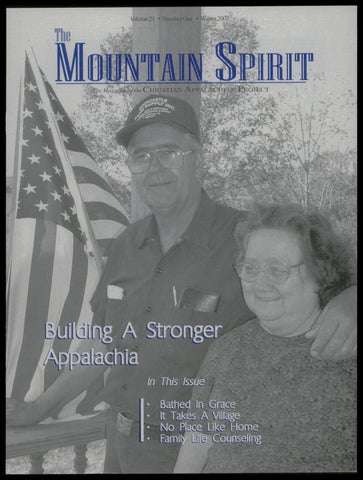
Keith and Doris Sowders, residents o f Rockcastle County and participants o f CAP’S Housing Program, celebrate the dedication o f their new home in a multi-lateral partnership o f agencies, organiza tions, along with many helping hammers, hands and hearts. Published by the Christian Appalachian Project
Managing Editor K a re n
F ra n c e s S p iv e y
Contributing Reporter C a r la
D a v is
Circulation D e b b ie
M o r r is
Advisory Board:
28
Chaplain's C orner Y o u r Letters
Bathed In Grace
The Christian p Appalachian Project has been on the fro n t lines o f battling poverty fo r over forty years. The problems in Appalachia are still present and need our attention, however, the recent events o f September I I have shaken our nation and those w ho call America home to the very core. W e are re thinking our security, our future and our position within this global village we reside. On September I Oth, 2001 CAP had a number o f families that needed housing, hundreds o f adults working on their G.E.D.’s, children attending our educational preschools, elderly that required prescription assistance. Those needs did not disappear after September I Ith, but our country’s attitude toward those in need changed. Focus has been sharply
2
directed to families effected immedi ately by our national tradegy as well it should be. Their loss is shared by a country deeply wounded by horrific actions enacted because o f a difference in beliefs. CAP joins the nation in mourning, and in adopting a greater need fo r understanding. Understanding differ ences, developing a peaceful approach to others we may not necessarily agree o r share commonalities. W e are a patchwork quilt o f multi cultures, many languages, races and religions, even here in what appears to be homogenious Appalachia. O ur mission will continue, the needs are still ever present and your support is essential fo r this w o rk to remain constant. W e were founded in faith and faith is what will see us through this current crisis. May God Bless You!
Mike Sanders - CAP President
M ich ae l S an ders, B e n P re w itt, Joan H a m m o n s , Linville R o se The Mountain Spirit is published four times a year. The annual subscription price is $8.00. Subscriptions and other correspondence should be sent to The Mountain Spirit, Christian Appalachian Project, 322 Crab Orchard Street, Lancaster, KY 40446. Copyright, 2001, The Christian Appalachian Project, Inc. All rights reserved. Member, Catholic Press Association. The Christian Appalachian Project is a non-profit Christian service organization operating throdgFiout Appalachia. The project operates on the philosophy that helping people help themselves Is the best approach to Appalachian poverty. The Christian Appalachian Project Is recognized by the Internal Revenue Service as a 501(c)(3) charitable organization and is qualified to receive tax deductible contributions.
A summary o f the registration and financial documents filed by this organization can be obtained by contacting: in Maryland, fo r the cost o f copies and postage, the Secretary o f State, State House, Annapolis, MD 21401; in Virginia, State Division of Consum er Affairs, P.O. B ox 1163, Richmond, VA 23209; in Washington, residents can call the Secretary o f State toll-free within the state at 800-332-4483; In Mississippi, by calling the Secretary o f State’s office at 888-236-6167; IN N E W YORK, OFFICE O F THE ATTO RNEY GENERAL, CHARITIES BUREAU, 120 B RO AD W AY, N E W YORK, N Y 10271; IN N E W JERSEY, THE ATTO RNEY GENERAL BY CALLING 973504-6215; IN PENNSYLVANIA, DEPARTMENT OF STATE BY CALLING TOLL-FREE WITHIN THE STATE, 800-732-0999; IN W EST VIRGINIA, SECRETARY O F STATE, STATE CAPITOL, CHARLESTON, W V 25305; IN FLORIDA, THE DIVISION O F C O N SU M ER SERVICES BY CA LL TOLL-FREE WITHIN THE STATE A T 800-435-7352; IN N O RTH CAROLINA, FINANCIAL INFORMATION A N D A C O P Y O F THE LICENSE ARE AVAILABLE FROM THE STATE SOLICITATION LICENSING BRAN CH WITHIN THE STATE A T 1-888-830-4989 O R OUTSIDE THE STATE AT 919-807-2214; o r by writing to Christian Appalachian Project, 322 Crab Orchard Street, Lancaster, KY 40446. O u r license number in Michigan is MICS 9933. Registration with any o f the above government agencies does not Imply endorsement by the state.
T he M o untain Spirit
GOD SUPPLYS OUR NEEDS! A little girl came home from a neighbor’s house where her little friend had died. “Why did you go?” Questioned the father. “To comfort her mother,” said the child. “What could you do to comfort her?” “I climbed into her lap and cried with her.” Too often Christians, especially during this season of the year, seem to forget the blessings we can share with those in need. Too often we focus on what we don’t have rather than on the valuable assets we do have.
Richard Ginn
There is a passage of Scripture in Acts, chapter three, concerning Peter, John, a beggar and the crowds. As the two Apostles were entering the city of Jerusalem they confront a beggar asking an alms. Peter turns to the beggar and says, “Silver and gold have I none; but what I do have I will give to you.”
Peter admits that he has no money. It is not necessary to have money to be a Christian. If we do have money, the use we make of it may determine our spirituality. That whom God has given the most, the most is ex pected. Well, in the scripture that was cited we see that Peter, even though he had no money, proposes to make a gift. What was it that Peter had? (1) His experiences with Jesus. He could recall the times he had seen Jesus help the needy. He had seen the times Jesus had feed the hungry give comfort to those in need.
W inter 2 0 0 2
He could remember the times that Jesus had healed the blind, the deaf, the crippled, etc. (2) Peter had eyes to see this man. Here was opportunity. This we believe is the work for which the Christian Appalachian Project has been designed: to see the needs of the people of Appalachia and use our resources to meet those needs. It was left up to Peter to select the way he would help this man, but it was not up to Peter whether or not he would help. In Matthew 25, we are taught that we will be held accountable for whether or not we take care of those less fortunate than we. (3) Peter had faith. Any work we undertake can only be accomplished with the help of the Lord. (4) Peter had a vocation. This was not something he could do in his spare time. This was a full-time commitment. (5) He had the fellowship of John. Tasks are made easier when we help each other. It is only through the fellow ship and support of our donors that we are able to accomplish anything in helping the needy in Appala chia. I believe that all of us, in some measure, possess these same gifts. We at CAP want to express our sincere “THANKS” to all those who have made this year, a time when we, because of your prayers, financial support and concern have been able to make life a little less burdensome for many who are less fortunate. It is our prayer that working together, one day we will hear the words of our Lord saying to each of us “Well done, good and faithful servant.”
3
—
.—
st ory aruTyfiotos S y r^^aren ? \ (S y iv e y __________
V f* (P la ce (L ik e Jp c
one can
ouse
jft -Vf*k
An eloquent quote, spoken by Geoff Barrett, CAP manager of Housing, during a recent home dedication at the residence of Doris and Keith Sowder, which was constructed by the Christian Appalachian Project. 4
T he M ountain Spirit
The former home o f Doris and Keith Sowder, fo r over 26 years, located in Rockcastle County, sits in the shadow o f their new residence.
home is more than just bricks and mortar, baseboard and lumber, it is constructed with elements of faith and hopeful foundation. Each hand that took part in the construction of the Sowder home brought a different rendition of their own faith, their belief in the people they joined in labor and a trust in the “Master Builder”, to see the construction through its entire process. With a wide variety of helping hands, assisting in its completion, from the footer to the framing, Christian Appalachian Project, the general contractor for the job, had a diverse crew that embodied numerous counties, cultures and collaborators.
¥£u m fife J ^ e j i n n i n j s The Sowders, a soft spoken couple, began housekeeping nearly forty-eight years ago. Their former home stands cautiously close to the new residence. The simple structure was in danger of collapsing due to
W inter 2 0 0 2
the fact that it did not have a proper foundation. The floors were too close to the ground and in spite of being replaced, continued to rot. Add to this a faulty roof, constantly crumbling porch and deteriorating siding that more than likely, won’t tolerate another Kentucky winter and you can see Trinity Baptist Church, built on acreage donated by Keith and Doris Sowders. why they needed a new home. Former owners of the house had and small garden. The end of the milked their cattle within a portion of picturesque hollow has a white the interior, only adding to the flavor of the humble abode. Their homestead is located on plot seated alongside a winding fence-lined lane, that meanders along fourteen acres of mountainside pur chased by the Sowders nearly three decades ago, with a green road sign bearing the name of Keith Sowders. Only a small portion of the land was suitable and During the project’s infancy, a volunteer group from Times Square Church in New York City, lifted primary sizeable enough to walls, earlier this summer. accomodate a home
clapboard church, that sets upon the only other available plot, donated by the Sowders and current home of the Trinity Baptist Church, a prime example of the Sowders generous spirit and kind benevo lence. The Sowders’ are hard-working, honest and determined, which is typical of their generation, but due to a work related accident years ago, they were unable to save for their retirement years. Doris suffers from asthma, rheumatoid arthritis and other health concerns, which consume a good portion of their meager income. Making the move to more suitable, energy efficient, healthy surround ings are a welcome and somewhat urgent need for Doris’ health. The old house was heated with coal and consequently made the asthma considerably worse.
c7iie § !r o untfK\foor The entire process began when the Sowder’s daughter connected to a CAP Outreach worker in order to establish some assistance for her aging parents. It was deter mined through an intake and assessment of the dwelling the Sowders occupied, that repair was not an option. New construction was the best choice. The outreach/housing team at CAP began to research alterna tives and partnerships to locate the most suitable fit for the family. The group from Times Square Church A number of issues are considered labors in the summer heat to attach a final wall. when looking at new home construction within CAP’s housing program. tion is done in preparation for There are several steps in this determining the appropriate process. First a family budget is financing package. Third, a Family reviewed. Second, a credit evaluaSelection Committee (FSC) comes
Ruth Martin of Daniel Boone Development Council and Donna Thrush of CAP’S Housing Program converse on final pieces of paperwork for the Sowder home. The Sowder’s previous residence in the background is a valid reminder of this major accomplishment.
T he M ountain Spirit
Keith Sowders, Lloyd Rice-CAP Housing Crew Leader, Doris Sowders, Geoff BarrettCAP Housing Manager, Janet Glovak-CAP Outreach, CAP Volunteer Denny Brehm.
together to review personal and financial stability to determine whether the family has the skills and abilities to be successful long term homeowners. Third, upon approval of the FSC, plans are chosen and financing is arranged. Fourth, construction begins with the family participating to the extent which they are able. Keith was on site
everyday with the crew helping in every way he could.
'f i in d i n j I f u n d i n j
A highly organized, collaboration of groups, agencies, partnerships and individuals converged to begin construction on the Sowder home. Through a long trail of paperwork and diligent digging, it was determined that Daniel Boone Development Council, Inc., the local community action agency was most appropriate for meeting the Sowders monetary needs, budget and targeted outcome. CAP would be the general contractor. The connection was made with Ruth Martin, housing director with Daniel Boone, whose tireless efforts place many families in Doris and a generation o f Sowders, her granddaughters, suitable housing Kathy and Tonya and their children Jacob and Jordan.
W inter 2 0 0 2
with affordable financing. Ruth serves the counties of Clay, Rockcastle, Jackson and Laurel. As the local community action agency, Daniel Boone Development provides various services besides housing, which include job development training, emergency assistance and home weatherization. Currently, the agency works with approximately 9,600 families. A combination of monies were leveraged to create the financing package. They include ARC, Kentucky Housing Corporation Affordable Housing Trust Fund, and HOME Rehabilitation Monies, Community Development Organiza tion Block Grant, (CHDO). Through the ARC funding, a sidewalk and driveway were poured and a septic system installed. Ruth Martin was able to leverage enough forgiveable grants, so that the Sowders will pay less than a fourth of the monetary investment incurred in building supplies and skilled labor, as long as they live there for twenty years or more. CAP donates all the general building labor to the family.
A multi-cultural, interfaith group from Times Square Church in New York City, raised the walls during the infant stages of construction. The first set of work boots on the
final heating efficiency and finds the structure to be in excellent standing with state regulations.
7
and the comfort their updated surroundings provide, Doris Sowder has had a remarkable change in health. Her nebulizer, an apparatus necessary for breathing, has not been required as often. She has experienced a noticeable reduction in swelling from the arthritic pain in her legs, she remarked, “I can see my ankle bones.” She also requires lower dosages of her asthma medication and is very encouraged about facing another winter. After all is complete, the Sowders will have a mortgage they can live with and a home they’ll live in throughout the remainder of their life. Whether the contribution was Lloyd Rice, CAP Housing Crew Leader presents the family with a maintenance book a single two by four or research during the dedication ceremony. Keith and Lloyd became very good friends during the ing the complicated bank note, construction, and Lloyd said he could use a good man like Keith any day o f the week. each person instrumental in the Neighbors, relatives, agencies home can take pride in allowing this premises consisted of this eager and CAP employees and volunteers deserving couple to reach the band of volunteer recruits from came to the Sowders to celebrate American dream. Manhattan, some wielding hammers during a dedication for the very first time. The construc ceremony, complete tion continued for another four months. Men and women in varying with cake and well roles came in and out of the building wishes from all involved. The site to get things finished before Sowders received a arrival of inclement weather. family Bible, a Mike Howard works with Daniel beautifully crafted Boone and the Cabinet for Families blanket, a and Children and his role is to homeownership inspect homes throughout eastern training certificate Kentucky, to insure they meet and collage of work standards set by CABO, a National site photos. Brenda Residential Building Code. Mike Thornton, CAP completed a blower door test that Housing Administra detects any major or minor air leak. tion Assistant sang an After his equipment was installed, it registered that the Sowder’s exceeds inspiratonal hymn. Geoff Barrett, CAP industry standard and does not Housing Manager suffer any lose of energy due to and minister spoke to leaks or faulty construction. the nearly forty “This house is about as tight as people about the any I test,” Mike stated. importance of The energy saved will help the dedicating both the Sowders’ stay within their budget. work and the home to God. X jefe/jra tio n e f In a portion o f the home that sees the most activity, In addition to the Donna Thrush-CAP Housing, Doris Sowder and Janet happy occasion of o f f a d o r a tio n Glovak-CAP Outreach, congregate in the brightly lit, entering a new home, brand new kitchen.
T he M ountain Spirit
In a world that seems, at times, to be filled with anger, strife, hatred and trouble, it is good to read of so much good being done by CAP. I am glad I have been able to contribute to this work, although not as much as I would like. Everette D. Settle Bramwell, WV
I enjoy reading my “Mountain Spirit”. It helps me touch base with those lives working and serving in Kentucky, as well as with the lives being served and changed. I live in a rural part of Northeastern Ohio and in many ways can identify with all those people. My great grandma was from West Virginia. I have a feeling of kinship with the mountain folks. Lori Bryan Kensington, OH
I really enjoy reading about the good that is being done for the people in Appalachia. I would really like to visit and learn more about this. I especially like the approach you use in “helping people help themselves”. Keep up the good work. Marie Sellers Jesup, GA
Mrs. Cates and I have been missionaries to Jamaica for over 40 years. Due to our age 79 and 80 and glaucoma that has blinded my right eye and the left eye with only 10% sight, we had to retire. We enjoy reading about the work of Fr. Ralph and we pray God’s blessing on him and his mission work. Rev. & Mrs. Jack Cates Randleman, NC
I really like the friendly, family type image you project. I’ve never met or seen any of you folks, but I feel like I belong to a family. Keep up the good work! Valerie Lull PortlandOR The Mountain Spirit keeps us in touch with the people we grew to love when we were working in E. Ky. in the 80’s. May God continue to bless CAP’s work. Steve & Judy Heckel Abbotsford, WI
I enjoy reading The Mountain Spirit, the stories about Father Beiting and all the work he and his “crew” do in Kentucky. God bless you all. Mrs. Dorothy Armstrong Englewood, FL
It is heartwarming to see that some do care for the well-being of their fellow man. It is indeed evident in the endeavors of those working so diligently in the Appalachian area. Patricia W. Morris Douglasville, GA
W inter 2 0 0 2
Too few people in this country are aware of the work of Father Ralph Beiting and his wonderful volunteers. Charity begins “at home” and I can’t think of a better place than the hard working people that live in the appalachian mountains and surrounding areas! God Bless Fr. Beiting! Audrey B. Ezzo New Orleans,LA
I love your magazine Father Beiting. It’s very interesting and I pray for you and all the people who help those poor people and children. God bless you, Mrs. Jane Price Rockford, IL
Letters to the editor are welcome. They should not exceed 150 words in length, and we reserve the right to edit them for space. Address letters to: The Mountain Spirit Christian Appalachian Project 322 Crab Orchard Street Lancaster, KY 40446 or e-mail: capinfo@chrisapp.org
How old is your will? Have you reviewed It in the last three years? If not, chances are it could use some attention. A number of personal factors can affect your will — things like changes in income, employment, family size or marital status. External factors such as new federal or state laws can also require the revision of your will. Have any of the following things occurred in the last few years? __Move to another state __New business venture __Children less dependent __Death in family __Serious illness in family __Marriage or divorce __Birth of child __Executor can’t serve __Trustee can’t serve
__Desire to change guardian __More grandchildren __Change in giving interests __Job promotion __Purchase of life insurance __New out-of-state property __Purchase of home __More property in joint names __Major change in finances
We at the Christian Appalachian Project want you and your loved ones to be protected with a good, up-to-date estate plan. We also want to remind you that an estate gift to the Christian Appalachian Project can make a positive statement to your family and friends regarding your priorities...as well as make a tremendous differ ence in our future work. Perhaps you didn’t know all the options when you signed your will. Later, you discovered other ways to make your bequests. You may feel dissatisfied with your will. It may work as a legal document, but fail to work well as the expression of your true desires. Is it time to redo your will? If so, we urge you to make an appointment with your attorney as soon as possible. You should be satisfied and confident about your estate plan.
It’s Legally Invalid.
Your will can contain all the information you think you want, and not be worth the paper it’s written on. This is more likely to be true if your will is old, or if you tried to cut corners by using generic forms from a stationery store. A will can be invalid if it is unsigned or wit nessed improperly. There’s just no substitute for having a competent attorney involved. In the short run, it may cost you a bit more, but it will certainly provide greater peace of mind and possibly deliver your survivors from a nightmare. It Conflicts With Other Plans.
Your will should be coordinated with your other estate transfer documents. For example, insurance proceeds and brokerage accounts pass outside the will to the named beneficiaries. Pension funds are also distributed outside the will. A will that truly works well will take all of these other assets into consider ation. It Fails to Fulfill Your Desires.
Your will should accomplish exactly what you want. Do you want your children to receive their inheritance all at once, or at various intervals? Do you want your charitable gifts to be used for unrestricted purposes, or do you want to earmark the funds to meet specific needs? Do you want to continue to support the work of the Christian Appalachian Project and give a percent age of your estate, or a set amount?
Christian Appalachian Project’s planned giving staff offers complimentary informational brochures that include helpful information about making a will. It also contains material on basic estate planning and ways you can use planned giving techniques to benefit your charitable interests, as well as yourself. Please complete the coupon below and send to:
Christian Appalachian Project Planned Giving Department 322 Crab Orchard St. Lancaster, K Y 40446-0001 Or call us for information at 1-800-955-3470 (Please complete and return this reply form.) Dear Friends at Christian Appalachian Project: ___Please send me free literature about making a will. ___Please contact me about a personal visit or other planned giving opportunities. ___I have already provided a bequest for CAP in my will. ___Please send me information about CAP’S Charitable Gift Annuity Name:_________________________________________ Address:_______________________________________ City:___________________________________ State:___ Zip:_________________ Phone:_____________________
B ooks O n T ape By Father Ralph Beiting Available on cassette, the voice of
Father Ralph Beiting, who brings to life the stories and experiences of his work in the mountains of Appalachia. As f o u n d e r
of the
Christian Appalachian Project, Fr. Beiting has earned a reputation in Appalachia as a true visionary and advocate for change. His self-help r ^ e p v O fiV C
philosophy has materialized in the human seivice programs of the Christian Appalachian Project. The books on tape are available to you at no cost. Each book contains two cassettes, packaged in a full color vinyl case.
A donation to help offset the cost o f the book, shipping and handling is appreciated. Your donation will also help make possible the w ork of the Christian Appalachian Project. To order please fill out the following card: □
Please send me one of the following books on tape at no cost:
□ □ □
The Prom ise Of Hope The Prom ise Of Faith. . . With Christ We Can Do All Things The Promise Of Charity
I have enclosed a donation of: □ $10.00 □$15.00 □$20.00 □Other $_________(credit card use800#) To help cover the cost of the book(s) and help further the mission of the Christian Appalachian Project One book per order, Please - limited quantities available Any questions? You may contact us at 1-800-955-3470 Please make checks payable and mail to: Chnstian Appalachian Project 322 Crab Orchard Street • Lancaster, KY 40446 Visit our web site at uww.chrisapp.org email: sfnorris@chrisapp.org
W inter 2 0 0 2
win-02
CAP Compass • Directions O f The Project
From Far and Wide; CAP Volunteer Enlists Time and Talent Of Her Family
1.
_
'
CAP Volunteer-Kiara Klister looks on, as her father Dave sizes up the framing foe a housing project in Owsley County, Kentucky, Kiara’s Aunt Barb assists in the background.
K
iara Klister, CAP Outreach Volunteer who originates from Kaukauna, Wisconsin, ordinarily works in Jackson County, however, she took a few days away from outreach to strap on a tool belt and get the familiar smell of sawdust on her blue jeans, as she enlisted the help of her family to accompany her on a housing project in nearby Owsley county. They came from three states and one even crossed the entire continental U.S., in a family effort to join Kiara in a construction project for a deserving elderly lady. “(When you volunteer) I think CAP becomes your world and it’s great my family has an interest in coming. I guess
lenged them to come here, and wanted to see how far they could get in a week,” Kiara remarked about her extended invitation. “I sent them the house plans in the mail ahead of time, so they’d know what to expect,” Kiara continued. Dave Klister, Kiara’s dad is a veteran of construction, and owner of Klister Karpentry (yes with a K) in Kaukauna, Wisconsin, for over twenty years. “Kiara mentioned there’s a need, and we all wanted to learn more about CAP, the area, their way of life. It changes our lives too, because we learn from them, it’s not a one way street,” Dave Klister declared about the reasons for coming to Appalachia to join his daughter. “We gain a lot from being here, it’s great working with the local people,” Dave continued. “All these folks that came here are community minded, and want to help others, four of us are going into Honduras, Nicargua later this year with Fox Valley Mission,” added Dave. . r. . . , . , ., r We won ‘ flmsh the h° use; but hopefully we can
touch a life by being here, said Dave. Kiara’s grandparents, Cyril and Martha, also from Kaukauna, kept up the pace, coming from a very strong ■
Volunteer Charles West Great Aunt Lucina Schmidt, Kiara Klister, Grandmother Martha Klister, back row: Great Uncle it Sa pride thing too, I mean, I live With Norbert Schmidt, Cal Martin, Uncle John Klister, Dad Dave Klister, Aunt Barb people who do home repair, my dad has Ludke, CAP Volunteer Cameron Hunter, Grandfather Cyril Klister and Bob always been in this business. I chalVandenHeuvel.
.,
.
T he M ountain Spirit
CAP Compass • Directions O f The Project work ethic of dairy farming for over forty one years. Kiara’s uncle John Klister receives the award for traveling the farthest distance, as he flew from Monroe, Washington to spend the week with his brother, sister, parents, aunt, uncle and niece. John also heralds from a construction background. Kiara’s Aunt Barb Ludke had the closest drive, coming in from nearby
A good team effort is exerted, as everyone joins in to hoist the framing trusses, during a crucial moment o f the building blitz.
roof frame, sheeting, felt and partial metal roofing were installed, interior walls erected and the siding started. Corene Allen, a recent widow, is the individual benefitting from all this donated labor and time, as the finished product will be her brand new home. She has been involved with outreach and
CAP’s prescription assistance program, that has provided Corene with a $100/month savings on her much needed medications. Excited about owning her own home, Corene is most thankful she will finally have indoor plumbling. Kiara is excited she had a hand in making all this happen and as a bonus, got a family reunion in the process. : ,; : ..I
::
Still maintaining a strong work ethic, dairy farmers, Cyril and Martha Klister, labor alongside grand-daughter Kiara.
Cincinnati, Ohio, where she works as a community relations develop ment director for a health education organization for elementary students in Cincinnati. “Being with my family and the whole spirit of doing something good like this together is very fulfilling.” stated Barb Ludke. Tremendous progress was made in the one week the Klister crew was on the job. The house received a
W inter 2 0 0 2
A brief, but well deserved break underneath the new porch and welcome shade.
13
CAP Compass • Directions O f The Project
Education Provides Source Of Hope And Purpose To Female InMates stereotypes one would expect soon dissolve, the hardened criminal, trash talking, seasoned and soured. The women Janet teaches could easily be mistaken for a group from a church bible study, or a tight knit bunch of friends swapping stories about their children over soup and salad. They are polite, soft spoken, kind to one another and their teacher. More definitive of the group is that they were easy going, somewhat shy, demure and delightful to speak with. Each one, eager to pursue their education and make it count toward their future. Aspirations of the class, vary from nursing to architecture to elderly care. Their studies encom pass reading, science, mathematics, Janet Heinz, CAP Adult Education Teacher, stands with her a few o f her G.E.D. literature, history and social students, Tammy Posey, Vanessa Grubbs and Wendy Scott. studies. Each will advance at their weight room, a church, an mong them, they are mothers, own pace, some AA meeting room and a wives, homemakers, students and will finish while for the coming months, they are also place for contact visits, it incarcerated, while prisoners. Incarcerated for various is sparsely furnished with a few may felonies, the women are state a metal table and a row of complete their inmates and currently housed at a barbells. testing on the local county jail in the CAP service Prison is not necessar “outside”. It’s area, a facility that accommodates ily conducive to educa difficult to study, those convicted on state charges, in tion, however, it is a place as everyone is on addition to individuals brought up of self-reflection, intro a different on local offenses. spection and the opportu schedule. Some of Once a week, Janet Heinz, a CAP nity to take inventory of the women employee, who teaches adult what one might improve provide some education, passes through heavily upon. With that in mind, functional duty, or secure, reinforced metal doors and CAP and volunteers like rather, hold a job Tammy and Vanessa proceeds to a small Janet Heinz offer within the jail, windowless room a presence and a purpose to whether it is working in janitorial where she is well-meaning individuals maintenance or preparing the meals equipped with a twowho are trying to better that will be consumed by the in way radio that themselves and need a mates and staff. Some work well communicates with place to start. into the evening, while others keep the guards out front. “She takes time for each a more conventional eight to four The women arrive one of us and doesn’t look regiment. Regardless, with ten to to her “classroom”, down on us just because eleven women in one common one by one. The we are in here,” remarked living space and each in-mate “classroom” space Wendy, one of the inmates. maintaining a somewhat different also serves as a All those Hollywood schedule, finding quiet concentraWendy
A
14
T he M o u n t a in S pirit
CAP Compass • Directions O f The Project tion time is very difficult. This impediment does not deter the women from continuing to pursue their studies, as they come to class prepared and eager to learn. “For them to have a fresh start, the education piece is so important,” stated Janet. “During a typical day we will review reading assignments, do some games, some individual study, some work on math, some are testing, it goes very fast,” said Janet. “There’s a guard that works third shift, who has been very helpful to them with homework, although everyone on staff is supportive of the program, they genuinely want them to succeed,” Janet continued.
Janet originally came to CAP as a volunteer from Longmont,Colorado, with a background in medical technology, education and corporate training.
“We try to talk a lot about options, there’s a bright future waiting for career choices, things available, I them and this is providing a very want them to be encouraged that good start.” Janet concluded.
Still looking For A Few Good Volunteers
CAP is in need ofm en and w om en o f faith to serve in m any o f our diverse program s. Join us as w e provide abetter tom orrow for children, the elderly and fam ilies in eastern Kentucky. Be part o f the call. To find out more about volunteering, contact Christian Appalachian Project
(800) 755-5322 Christian A
Project
Application process required
email: vohmteer@chrisapp.org
W inter 2 0 0 2
15
CAP Compass • Directions O f The Project
CAP to launch
Operation New Hope 2002
M E M B E R OF
f
< Ameriaf t ')
Charities
Campaign “It is more blessed to give than receive” Acts 20:35 Last year, several thousand CAP friends generously participated in this annual campaign and helped our Workfest crews repair, refurbish and build new homes for the poor of Appalachia. The work done was truly life changing! The repairs that were made on these homes were beyond the means of these struggling families who can hardly put food on the table, let alone pay for a new roof, or rebuild a sagging porch. It was more than a new home, it was new HOPE. This year plans for Operation New Hope are even more ambitious: we hope to build 24 new homes, 14 additions, and repair more than 200 others. Our college crews will provide the labor during our annual Workfest — but the money for the shingles, and lumber, and plumbing supplies, and paint and nails — must come from friends like you. CAP operates on faith, and we have faith that this can be done. After all, Jesus himself was a carpenter. With his bare hands, some friends, and faith that everything is possible, He changed the world. With your help we too can change the world. Even if it’s just a few needy counties in the heart of Appalachia it won’t go unnoticed by our Lord. By mid January we will be sending out packets that outline this special project. Donations can be made in January by mail, through our website (www.chrisapp.org), or over the phone (toll free 1-866-270-4CAP). If you have any question about this or any CAP project please give us a call (toll free 1-866-270-4227).
CAP is a member of America’s Charities If your employer supports a workplace payroll deduction program, you can now choose to contribute to CAP through America’s Charities. CAP has become a member of America’s Charities, a nationwide federation that provides critically needed human services, reaching millions of Americans in thousands of communities. Through America’s Charities workplace giving campaigns, employees can choose to support their favorite charitable causes from over 100 nationally known non-profit organizations. If you are a military or civilian federal employee, you can choose to contribute to CAP through American’s Charities. C A P ’S member number is #0428. For more information, please contact: Teresa McAnly Christian Appalachian Project
322 Crab Orchard Street Lancaster, KY 40446 (859) 792-3051 www. chrisapp. org
T he M o u n t a in S pirit
CAP Compass • Directions O f The Project
CAP Answers Need In Flood Disaster Relief
W inte r 2 0 0 2
. Thompson
Bad things come in three’s, just ask the residents of southeastern West Virginia. Over the past summer the area was pounded with torrential flooding that left over one thousand homes destroyed, nearly four hundred families in unsuitable housing and $70.3 million dollars of estimated damage. The three devastating floods prompted the development of a long-term recovery team, equivalent and in compliance with FEMA and the Red Cross. Community Resource Development DirectorGlenn Runyon chairs the Long Term Recovery Committee that is com prised of grass roots leadership. This group of local citizens developed a collaborative effort in amassing donations, necessary supplies and assistance for the countless that found themselves in an emergency situation.
The Christian Appalachian Project answered the call to assist in efforts to aid those left homeless, needing to rebuild and reassess their lives in the devastating tragedy. “When any natural disaster of this calibur strikes in our service area, it is CAP’s intention to respond quickly to lessen the magnitude of the devasta tion,” stated Johnny Thompson, Assistant Director of Operation Sharing. Operation Sharing, an in-kind donation program of CAP, that serves thirteen Appalachian states, rolled into the area with an tractor trailer that contained shingles, insulation, commodes, sinks, paint, stain, Clorox cleaning supplies and garbage bags. The donation will help hundreds that are still in the process of cleaning up and re-building months after the disaster. A warehouse maintained by the Long Term Recovery Committee holds the CAP donation, along with other supplies received from dozens of agencies and relief organizations. Each flood family is processed by completing FEMA paperwork and receives everything from building supplies to tetanus shots.
17
“"Where there is no counsel the people fa ll: 6ut in the m ultitude o f counselors there is safety. (p ro v e rb s 1 1 :1 4
These are the victims and, Abuse Center (FLAC) fearing for “Where there is no counsel, the ultimately, the results of a form of her life. Family members wanted to people fall: but in the multitude of poverty not often mentioned in sign paperwork to have her perma counselors there is safety.” studies that talk about unemploy nently committed to a mental Proverbs 11:14 ment and low-wage statistics. institution. A private psychiatrist’s This Biblical quote is featured However, poverty of the spirit is diagnosis indicated that she has prominently on the front cover of frequently much more devastating severe mental and emotional CAP’SFamily Life Counseling than that involving purely economic disorders (Schizoaffective, Bi-polar, Service brochure that it places in and Post-Traumatic Stress Disorder) ramifications. churches, courtrooms, juvenile Without help these victims often and she was under heavy medication centers, social service agencies and wind up in prison, or mental but the quality of her life was other places where emotionally institutions, or they try to wend rapidly getting worse instead of hurting people may show up. themselves through life carrying better. She knew she had to have For nearly three decades CAP has open mental wounds and function help but her instincts told her that an recognized that professional institution would be counseling services can the end of the line. frequently be the means Barbara, who is in whereby folks, literally at her mid thirties, the end of despair, can trusted absolutely learn to turn their lives no one on earth. She around and become fled to FLAC healthy, productive because she needed members of society. a safe place to turn, Suicide, on the one and there was no extreme, or life-time other place to go. commitment to mental Within two days institutions or even long after her arrival at the prison terms often result center Rob Insley of when ordinary people CAP’s Family Life suddenly become saddled Counseling Service with horrible circum met with Barbara and stances over which they there began a have no control. Families relationship that has break up when Dad has no turned her life job, nor any prospects for completely around. one, and he often takes “Barbara was his anger and frustration extremely trauma out on Mom and the kids. tized, delusional, Families also break up, angry, scared, quite frequently, because depressed and one or another of the uncooperative when household begins abusing I first met her.” Rob alcohol and drugs as a Rob Insley and Barbara Witt gain enormous ground through sessions said in a recent way to escape reality and o f open dialouge and a willingness to survive. Through other CAP interview. “She was often the victims of all this programs, Barbara was able to develop additional skills and further nourish her self assurance. unable to trust are the most innocent. people, no matter how much they They are the sexually abused and ing at a fraction of their real might want to help her because she emotionally devastated children or capacity. If they are youngsters, had been hurt in every previous the bruised and battered and raped they fail in school and the cycle situation where she had placed her spouses, all of whom have suffered repeats itself. The ultimate alterna trust in people.” physically and emotionally and lived tive is that they take their own lives Rob Insley, who manages one of through terror and horror that most with a firearm or some other form of the two Counseling Service pro people can’t even imagine. They violence and frequently they take grams stated that one of the reasons may even be the father or husband those they love along with them. he is at CAP is because he strives to crying his eyes out, wallowing in a In June, 2001, Barbara Witt was know and do the will of God, and he gutter of remorse and feeling as admitted to CAP’s Family Life felt led to be here. He grew up in helpless as it is humanly possible.
W inte r 2 0 0 2
Poquoson, Virginia and completed undergraduate school at Mississippi State University with a degree in Psychology in the late eighties. He completed a Master’s program in professional counseling at Liberty University and holds a counselor’s certificate from the University of Louisville. Prior to joining CAP over two years ago, he had spent more than eight years on the staff of the Bluegrass Regional Mental Health/ Mental Retardation Board, Compre hensive Care Center in Richmond, Kentucky where he worked with children, adolescents, and adults with a broad range of mental trauma. His background also includes a stint as head counselor with Mid-Atlantic Teen Challenge in Newport News, Virginia, a program that helps troubled youth, including gang members who have substance abuse concerns. There he helped them turn their lives around by focusing on spirituality as a source of solutions to their problems. He has also been heavily involved with outreach and counseling programs provided through his church in Richmond. “Outside agencies provide a lot of help to people in the community, but the missing element is God because there are constraints to integrating spirituality into most counseling programs. Looking back, I believe I have been where God wanted me to be, even though I did not always like it. I felt He was preparing me for a higher calling and right now this is it,” says Rob Insley. “If I hadn’t found and learned to trust God, and certainly Rob helped me to that, I don’t know where I would be right now,” said Barbara Witt. “Right now Rob is the mainstay of my support system and there was a time when he was my only lifeline but God is doing that for me now or at least making sure that I do it for myself.” Rob smiles modestly at the compliment. “How many counselors does it take to change a light bulb,” he asks and the interviewer does not
20
have a clue. “None,” he says. “It has to want to change itself.” He has already told the inter viewer that, “In this program there are no victims, only survivors. The first thing we do after establishing a connection with the participant is get beyond the victim stage in a timely and sensitive manner. Barbara is a survivor.” But, indeed, a high focus on
“Looking hack^ I 6edeve I have 6een where Cjod wanted me to 6e, even though I did not aCways [ike it. Ifekt JLe was preparing me fo r a higher catting and right now this is it, ” says cl%o6 I nskey. spirituality is the pervasive culture of the Counseling Service no matter with whom one speaks in its employ and this is no small operation. Ten professional counselors and three administrative personnel staff the service and it maintains offices in 13 counties. For practical purposes it operates as two programs, one on eastern edge of CAP’s service area in Hagerhill, Kentucky and one on the Western edge in Mount Vernon. Members of the staff belong to numerous professional organiza tions and disciplines within their individual education and experiential backgrounds. Several also have church ministry backgrounds, have taught in public schools and universities and had private practices. Collectively they have upwards of 150 years of relevant experience. Counselors carry a work load of anywhere from 30 to as many as 60 participants each depending on the level of involvement they may need to have in any particular individual’s life. In addition they
frequently run group sessions for families, churches and other organizations. They also present seminars on such subjects as anger management, marital enrichment, domestic violence awareness/ prevention and other behavioral issues. “Quality, not quantity is the ultimate focus here,” says Rob Insley. The emphasis is not on generating numbers but on provid ing people with the tools and the processes to bring balance and wellness to their lives.” Rob has even begun doing internet sessions for program participants who are too distant or too time-constrained to make it practical for regular visits to the counseling Service office. “The staff is committed to the value of the individual, the impor tance of families, and the wisdom of spiritual values. We do not focus on mental illness but serve people who need help with life’s difficulties,” it says in the brochure. Translated, that means counse lors dealing with abuse, parenting, anxiety, grief, family dysfunction, substance abuse, depression, divorce, guilt, stress management, neglect, anger, violence, and a host of other individual and family issues. “All tough issues too” says Abby Boyd, Rob Insley’s counter part who manages the eastern office in Hagerhill, and echoes his notion that what makes the program so different than most other counseling services is God. “And they are compounded by poverty. Almost none of the participants in our program could afford to pay for conventional, private practice therapy and practically none of them have insurance. In fact, we don’t even do third-party billing (to an insurance company, for example) because we have more work than we can handle just serving folks that have no other alternative.” Actually the Counseling Service doesn’t do any billing at all.
T he M o u n t a in S pirit
Program participants (Bedeve me, you don’t start the day out in State in all three of those programs as well. (you will never hear a Shortly after coming to (government with an office gathering to gray CAP Counselor refer FLAC, Barbara Witt to someone using the 6ut that’ s the way we start it now. ” enrolled in CAP’s Job service as a “client”) Start Program which help are asked to look over fl66y (Boyd- ramify Life Coursefing Services folks, most of whom have a sliding income scale never had a full time job, and pay a suggested systematically develop basic work “That interview was life fee that starts out a one dollar per skills, self confidence, problem changing for me, “ said Abby. session for folks who have an solving skills, nutritional and rest “ I left knowing without any income of more than $500 a month habits, and other routines necessary doubt that God was calling me. It and runs to $50.00 a session for to hold down a full time job. In meant that I was leaving tenure, folks with monthly incomes exceed good pay, great benefits and a job I addition to counseling her in formal ing $3750. Most participants aren’t therapy sessions twice a week for the loved but I never gave it a second even at the one dollar level. first couple of months of her involve thought. I know for sure that I am Abby Boyd, incidentally, took a right where I’m supposed to be and ment in CAP. Rob ran interference more direct route to CAP than did with her participation the other doing what I’m supposed to be Rob. Abby is a native of Lawrence programs. He also ensured she kept doing. Believe me, you don’t start County where her office is head appointments with the psychiatrist. quartered. With a Master’s in Social the day out in State Government CAP even arranged transportation to with an office gathering to pray but Work from the University of get her to and from medical appoint that’s the way we start it now.” Kentucky, she had spent 14 years as ments. CAP staff (Liz Phelps, FLAC a counselor, mostly with abused and continued Abby. manager) helped her find a safe What most impresses both Rob neglected children and their families, temporary apartment and later Insley and Abby Boyd about their and was quite content with her job Barbara helped herself at Kentucky’s State find a more permanent Bureau of Social Services. residence. “I honestly thought Just a few short that’s where I would retire months ago Barbara and I was very happy with Witt believed her the work I was doing,” she world was coming to said. “Then one day an end. Charlie (Abby’s husband “My life, if you who is manager of CAP’S could call it that, was Hagerhill Vehicle Mainte in shambles to say the nance Division) brought least. Now I’m home a job posting from enrolled in college work for a Program and I’m doing well. I Manager at Family Life haven’t taken the Counseling and urged me psychiatric medica to take a look at it. He tions in months and kept asking if I was my doctor says I no considering it over the course of a few weeks and Abby, Rob and other staff counselors will carry a caseload o f 30 to 60 longer exhibit clients each, depending on the amount o f involvement. symptoms of the I began praying about it schizoaffective disorder. I’m active in current jobs is the true holistic too because I really wasn’t sure I Church and I feel genuinely cared for. approach they can take to working should be as disinterested as I was I’m learning to give some of that care with their participants. While at first glance.” back. I’ve got a long way to go but spirituality is a big part of Counsel Eventually, Abby applied for the I’m on the right track and I’ve never ing Services approach to therapy, it job and then one day Bill Belcher, been this happy in my life. I don’t is just as important in other CAP previous Program Manager of the even think I knew what happiness programs like the Abuse Centers, Counseling Service, called up and was until the Counseling Service Job Start Programs, and Youth invited her to interview for the job came into my life.” centers where they spend a lot of with he and Rose Price who was Human Services Director for CAP’S time following the progress of participants who may be involved eastern area at the time.
W inte r
2002
2
On the road with CAP’S Parents Are Teachers, a program that models skills stimulating growth and development in children with physical challenges.
Susanne Potter, u Developmental Interventionist o f CAP’s Parents-AieTeachers. works with fifteen-month -old Mukalla on tactile skills and stimulating language with a song.
tory and Pfeofos fey Karen
Spivey
he departs her home at a crisp 6:15am, her sleigh (alias GEO Metro) loaded with toys, puzzles, paints, games and gadgets galore, much like Santa Claus, headed to homes of countless girls and boys. Before her work day ends, she will have logged close to two hun dred miles and traversed through four counties of Eastern Kentucky. Suzann Fenton, an Educational Develop mental Interventionist, (DI) provides a valuable resource to families of children with physical challenges. Her role is to enter the home environment, establish a relationship with both child and parent. In essence, she is a liaison that provides stimulus to promote growth and development. Her presence in the home will enable the parent a better understanding of their child’s disability and Suzann Fenton and three-year-old Chance Truitt produce a painted how to approach teaching the child to masterpiece, as the autistic youngster stays on task and participates in physically prosper. cognitive learning. Suzann, along with two other D.I.’s of Parents Are Teachers are assigned and serve children in colors have on the paper. A glue stick, construction paper turkey and paper plate get some of the same eight counties. Each D.I. (Developmental Intervention ist) has a running caseload of fifteen to thirty children of results in another activity. “The parent can interpret immediately how the whom they will interact at least once every week. teaching and behaviors are enacted. It is so essential to Suzann’s first stop of the morning leads up a narrow have their involvement, and Vicki is so in tune with hollow, from paved road to gravel, there we encounter Chance, she is an excellent model,” states Suzann. Chance. Still in his footed pajamas at this early hour, While lying on the floor, Suzann did some deep Chance is a handsome boy of three and half. Chance has pressure movement to help Chance be more aware of his a form of autism know as Pervasive Developmental body, provide him with sensory input, also it is very Disorder. Suzann allows Chance a moment to get calming to him. A special brush is used on his chest, acquainted with the new face, mine, and soon she slips back, legs and feet to help him focus and give physical to the floor, cross-legged, hands working rapidly to stimulation. employ each activity so the youngster doesn’t lose “He really gives ‘tight hugs’,” commented Vicki, “the interest. brush helps a lot and I use it daily.” Chance’s mother Vicki is involved every step of the His gross motor skills are perhaps the strongest of all, way, although she is a silent observer, allowing Chance as he jumps very deliberately on a small trampoline in to warm up to the “teacher”. The parent applies “inci the middle of the room, that Suzann brought months dental teaching”, as Suzann terms it, by modeling any of ago and left in the home. Chance jumps straight and the activities only using other household items during focused for nearly five minutes without stopping. an average day. “I chart in a notebook that is shared by the other The two begin a painting session that lasts less than therapist and Chance’s teacher at pre-school, this will two minutes, an important developmental skill called tie home and school together. I'll note what we accom “cause and effect” is learned. By using a brush and plished today and then I also review what happened paint, Chance can see the “effect” that textures and
W inter 2 0 0 2
23
with Chance and the other service brothers. This part of the program is Clinic in Jackson County, Penny providers.” concluded Suzann. essential for Penny and her older Marcum, a thirteen-year health care This helps everyone involved daughter, who is allowed to benefit professional had been giving her with Chance to “be on the same from Suzann’s visits, then mimics “good housekeeping seal of page” both literally and figuratively. some of the activities she learns approval” on CAP’s services for a “He has tolerated sensory after the session is over and Suzann number of years, in recommenda activities very well today, with play has gone home. tions and referrals. Penny found dough, pressing, molding, and with “I’ve noticed such improvement herself in need of “heeding her own the glue and paint. Also the deep advice”, as she adopted a child with in Molly,” remarked Penny. pressure was successful.” Suzann “She had speech and cognitive special needs. assessed. delays, but one of “I am here today the most touching “I am here today with Chance because of CAP moments came with Chance because of CAP donors. No when Molly said donors. No one is billed for this, we do not get “Momma” for the one is billed for this, we do not get first time. I just reimbursed for my started crying, reimbursed for my time through any time through any and I know it was state funding or due to Suzann’s state funding or grants. Donations and donations grants. Donations work with her,” and donations Penny concluded. ALONE make it possible.” ALONE make it On another day, possible.” states with another Suzann Fenton Suzann. Susanne, this time “I am able to Susanne Potter, continue to make sure another of CAP’s PAT Developmental Interventionist Vicki is aware of Developmental services and links out Interventionist’s, there, such as getting D.C.P. who also travels great distances to “We’d (White House Clinic) (Disabled Children’s Program) attend to the needs of her young given Suzann and CAP all our assistance, through which Vicki charges. Makalla entered the world referrals and I knew what she was received a swing set, vibrating toys weighing only one pound and nine capable of accomplishing,” stated Penny. ounces at 26 weeks. Her mother, Phyllis, lapsed into a coma and after Her youngest daughter, Molly, came to their home at three days old, three days, the attending obstetri cian delivered Makalla. Phyllis had through foster care and eventually suffered during the pregnancy from adoption; she had developmental delays as her birth mother had some pre-clampsia, a form of toxemia that caused the early, difficult premature substance abuse. delivery. Phyllis, also a health care Molly appeared to be suffering professional and practicing nurse in from delays that were ever so subtle, Louisville, was forced to stay home but her mother, attune to stages of after Makalla’s arrival and soon development through her work at begin to notice that things weren’t the clinic, detected the problems and normal with tiny Makalla, despite knew whom to contact. her premature birth. In setting up sessions with “The first thing was nutrition. I Suzann, it became very valuable to knew that was key in her growth, Penny, as Suzann would accommo and she was not gaining any weight, date Penny’s work schedule, unable to digest the prescribed arriving later in the afternoon. In formula. I really had a time with her addition, Suzann incorporates her Chance and his mother Vicki interact in the beginning, researching the activities to include any siblings in with play dough and teaching toy. right dietary needs. She finally the home. Oftentimes she tailors her settled on Infamil with added rice and special brushes that will help play to appeal to older children as and that was the only thing she’d Chance progress.” well, with the theory that children On a visit to the White House learn volumes from older sisters and take,” Phyllis said.
24
T he M o u n t a in S pirit
Susanne Potter engages baby Makayla and her mother Phyllis in play that promotes sensory perception and gives both mother and child a new way o f making the most o f their day.
Phyllis quickly begin to notice certain milestones that weren’t being reached and the University of Kentucky Hospital and N.I.C.U. (Neonatal Intensive Care Unit) recommended her to First Steps, where she received a list of names of care providers. She chose CAP and Susanne Potter. She had relocated back to her hometown of London, Kentucky, to be closer to family and thus began the journey they are now on with Makalla and Susanne’s weekly visits. Makalla is exhibiting some tendencies of Cerebral Palsy, although that has yet to be the official diagnosis. Her hands are fisted and she has a very hard time with self-regulation, (difficulty getting back to a calm state after crying or being upset). Her sensory perception is elevated, she is very keen on hearing, touching, has great sensitivity in these areas. In addition, Makalla has little to no upper body movement, which
W inter 2 0 0 2
prompted Susanne to bring in a special divider chair that prevents Makalla’s legs from scissoring. She uses activities that employ constant practice with Makalla’s hands to grasp and open. In one recent session, Makalla stayed focused, emptied and re-filled an entire Noah’s Ark toy with over a dozen animals, a huge break-through in getting her to use her hands functionally. “The biggest advantage that Susanne has been to me, is that she first taught Makalla to hold a toy. She gives me a break, because I am with Makalla ’round the clock, she never leaves my sight, and Susanne’s interaction has given activity ideas to occupy our time,” Phyllis remarked. What is a continuing theme throughout a number of CAP’s programs are partnerships. CAP staff meet with a number of other service providers throughout the community and share progress
reports, assessments and recom mendations with resource providers such as occupational therapists, pediatricians, physical therapists and primary service coordinators. A good example of this was a meeting Susanne attended with other members of the IFSP Team or Individualized Family Service Plan, the official acronym. The particular team was comprised of the Physical Therapist, Primary Service Coordina tor, the D.I.-Susanne and the child’s parents. The young parents who are only just beginning to come to grips with the fact that their four-month old child may have considerable difficulties in life, is in itself an overwhelming experience. Together, these committed individuals will work in concert with each other in developing and implementing a plan that will address the needs of the child and supply him with a much needed head start. Although the parents have the support of this
25
team, this will be a continuous process for them and many other parents of children with disabilities. There will always be new obstacles to overcome and new skills to learn.
to manage in the classroom, but in the pool he was calm. The constant pressure from the water and sensation of floating relaxed him. Children with sensory problems respond so well in an aquatic Where was GOD in all environment,” Susanne commented. of this, how could all As the day drew on, we this hardship be upon paid a visit to the home of this young mother, who three children, two who are to receive services from P.A.T., was pregnant with yet although all will benefit and another? How can participate. The oldest child, Christopher, has non-specific things so tragic happen diagnosis delays. Christopher in such sequence? engages in play that stimulates advanced speech by Susanne’s use of pretend play. Two year old Christopher participates in Susanne is a unique asset to “The pretend play and language play Susanne iniatiates. CAP, equipped with a background in songs help to bring out Special Education and a Master’s in language in a child that is reluctant stacking of cans, pots and pans Early Childhood. She also has been to speak. We are also working on found in the kitchen,” said Susanne. certified in adaptive aquatics. This readiness skills for preschool,” said “I can see a big improvement since very individualized therapy is Susanne. Susanne’s been coming,” remarked helpful in that it combines her love “We’ve been working on spatial Missy, mother of two year old for water, and her knowledge of relationships, a purposeful under Christopher and one year old twins, working with special needs children. standing of how things “fit”. This is Austin and Destiny. “For instance, I worked with a carried over when I leave, as mom Several months ago, D.I. Cheryl child that was autistic and difficult will allow Christopher to do some Lynn Osborne allowed an accompa nied visit to four of her participants. She serves the counties of Whitley and McCreary. We traveled from appointment to appointment, entered into each home, engaged in play, activity and conversation, then motored on to our next. Cheryl, an easy going, knowledge able woman, is a nine-year veteran of CAP and prefaced each visit by giving a brief explanation of every child. While I was moved by the varying disabilities and challenges facing each child and mother, I must admit, nothing prepared me for the last home we encountered. This one, was perhaps her most “medically fragile”; bom with a rare genetic disorder called ‘Golden Har Syndrome’, the child was a living miracle. With severe handicaps, the child had a cleft palate, wore a trachea tube, a colostomy bag and had recent surgery to correct a perforated anus One o f Cheryl Lynn Osborne’s smallest participants manipulates a teaching toy. (underdeveloped rectum).
T he M o u n t a in S pirit
Cheryl Lynn Osborne, PAT Developmental Interventionist, generates exercise and mobility with a tiny youngster she serves in a remote corner o f Whitley county.
As if these physical disabilities weren’t enough, the family had just suffered a devastating fire and were living in a small building shed on a relative’s farm. They’d lost every thing except their lives. It was rather cool that day and the primitive housing they’d been subjected to inhabit whistled with a fierce wind. Trash bags with a few articles of donated clothing were scattered about and the young, pregnant mother, greeted us with a warm, genuine smile, holding this unusu ally tiny baby. One glance at this child, and his disability becomes extremely apparent. His size is the first recognizable characteristic that something is askew, at eight months of age, he tipped the scales at just
W inter 2 0 0 2
over twelve pounds. Other charac teristics of “Golden Har Syndrome” are apparent, such as a misshapen head and underdeveloped ears. He did not make any audible kind of sound. He was unable to cry or verbally communicate, as he is hearing impaired and the trachea tube prevents some of his oral development. I wanted to run, run far and run fast, I felt my face grow hot and was glad to place a camera in front of my eyes as they had filled with tears that I didn’t want either Cheryl or the mother to witness. Where was GOD in all of this, how could all this hardship be upon this young mother, who was pregnant with yet another? How can things so tragic happen in such sequence?
I did not run but more impor tantly, neither did this young mother. She was firmly planted at the side of Cheryl to learn all she could in how to prepare for her child’s maladies and misfortunes. She faced this day, like she’d faced all those before, with a determination to get through it the best she could. And as for GOD, God was there in Cheryl’s hands, in the tenderness of her touch, in the kindness extended to a mother in isolation and tragic situation. God is in hundreds like Cheryl, Suzann Fenton and Susanne Potter who come to CAP to serve those less fortunate. Who come to make a difference in a sometimes indifferent world.
27
28
T he M o u n t a in Spirit
o many days-it’s like I open up a treasure chest, a secret garden in working with the elderly and working with this culture, ‘It’s like I’m bathed in grace’,” spoken with poetic flair by CAP Volunteer-Janet Fiedler, left, visits with Ella Barnett, seated with her constant Janet Fiedler, a companion Speedy CONzolez, and Zayda Hurd-CAP Manager, Elderly program. A Vital Link volunteer in CAP’s Zayda Hurd, CAP Manager of the Elderly program is intent on educating the public about her group of Elderly Program. Janet Fiedler originates from the foothills of the Sierra Nevada, and nearby Sacramento area of California, a world and a century away from Jackson County, Kentucky. While a far cry from the west coast, being in Appalachia is a welcome change to Janet, as she finds her time in Kentucky very positive. “For me, one of the best parts of my job is sharing the faith with others, although I never offer MY interpreta tion. I mean, I am from a totally different generation, a totally different culture, but the common ground is there. How lucky I am that my faith can be incorporated in what I do,” Janet proclaimed. Basic Goals The basic goal of CAP’s elderly program is to improve the quality of life for those within their service area. This is achieved through focusing on self-help and independence, linking them to appropriate re sources within the community and helping them identify their talents, strengths and contributions. In essence to help them ‘be all they can be’. Regular home visits, scheduled activities, transporta tion to appointments, connections to key agencies, help achieve objectives of the program. The end result is gratifying work for staff and volunteers, an involvement in the community and educating the older population about services available in their communities.
W inter 2 0 0 2
seniors and the important position they play in their communities and in the scheme of CAP. “We don’t just have parties and picnics, we are dealing with emotional, physical, and even spiritual problems that come from isolation and aging,” stated Zayda Hurd in describing her program. “Our staff tackle tough issues and provide a vital service to a sometimes ‘forgotten population’,” continued Zayda. Each workday is never quite the same as the one before. As people’s lives demand different needs, there have been situations where staff of the elderly program had to drop everything to assist an ailing participant or answer an immediate crisis that could not wait. Calls of desperation are received on a weekly basis; everything from needing transportation to a loved one’s death bed, assistance in getting Medicare benefits properly instituted, or finding the right resource for paying an expensive utility bill. When a call from an elderly male participant came in for rubber gloves and adult diapers, the answer arrived through Operation Sharing (another CAP program). The gentleman cares for an invalid mentally handicapped brother and that immediate need was addressed when no-one else was there to help. Sometimes a volunteer will simply stumble onto the need. Recently, upon entering the home of one elderly participant, eight buckets were cluttering her living room, catching rainwater from heavy spring storms. Emergency funds were located, the volunteer recruited
29
did not get results and gave up. Janet then remembered a story of how Jewell met her late husband, delivering mail on the back of a mule. If Jewell’s husband had been a U.S. Postal Carrier, then surely he would be in the system, The home with eight buckets o f rain water in the somewhere. With a little living room, gets a new roof. digging, some paperwork and others to donate labor in a roof phone calls, Janet was able to secure repair and much needed assistance the Medicare benefits and complete was provided to the eighty-one-year a process that connected Jewell to a old, too proud to ask for help. valuable resource.
ing comfortable spinning a yarn, weaving brilliant stories about her new found friends that are similar to the colorful afghans crafted by one of her participants, Mrs. Ella Barnett. With a visit to the home of Ella, one is awarded a pair of her famous crocheted slippers. The eighty-fouryear old keeps her hands busy, in constant motion, crocheting afghans, slipper socks and colorful doilies. Despite her blindness, the creative engine that drives her continues to purr. Her constant companion, Speedy CONzolez, an aging, overweight chihuahua gives the word ‘lap dog’ a whole new meaning. The widow of a Baptist minister,
Emotional Support Colorful Contributions Zayda recalled one participant There is a common thread who was very emotional. She was throughout the elderly community, crying her eyes out because her the need to remain needed. husband had just been placed in a “I had made the statement to nursing facility. Zayda proposed that an older gentleman I work with, husband and wife could live that I didn’t want to leave together in the facility. This had Kentucky without having tried never even been suggested to her. squirrel, and ask if he’d ever Her eyes lit up and it changed her hunted them,” Janet remarked as whole day. It made for a wonderful sort of a casual question. feeling that the staff gave her the “The following week, he ask me opportunity to feel lighter in spirit by to come to his freezer, and there a mere suggestion. before me, he presented three “In our day, I used to take care of frozen squirrels. He had to be able the older generation. My grand to tell that I was totally thrilled,” daughter works and I understand continued Janet. that, but it used to be different,” “I can’t think of a nicer gift. commented an elderly participant Here is this arthritic man, com about her current situation. pletely isolated and he’d placed Janet and Ella complete some CAP business in between a social call. “I think they feel left out, not an order to have someone hunt necessarily betrayed, more like ‘I did some squirrel just for me,” Janet Ella was active for years in church, my part, what about me’,” Janet concluded. through music, missions and assessed. This same older fellow gave Janet ministry. She continues to want to Some elderly participants have a complete lesson in how to make contribute and serve, but rheumatoid commented that CAP staff and moonshine and pointers on growing arthritis and limited sight prevents volunteers are their only connection tobacco. In true mountain fashion most outside activities. She is to the outside world, the only she responded to him regarding the insistent on donating her crochet, visitors they will see from week to making of moonshine. remaining a life force that is still week. Loneliness is a prevalent “I’d be leaving CAP faster than a pulling her weight. theme among the elderly. scalded dog if I got caught makin’ When the time had come to it!” she exclaimed to her ‘instructor’ conclude a visit with Ella, she asked about the possibility of cookin’ up it end in prayer. Standing in the Community Connections small, dimly lit bedroom she called Janet has a participant, Jewell, an the brew. “I am still moved by the simplicity upon a friend, a friend she spoke elderly woman she transports of life and values. People are so very with daily and often and the visit monthly to doctor’s appointments. generous, speaking openly about took on a whole different light. The In one trip, a health provider ask their faith, their priorities. It’s all very sweet prayer, intimately, humbly why Jewell did not have Medicare. refreshing,” continued Janet. uttered, reassured all present of When Janet pursued the question, Janet has enjoyed soaking up the Ella’s importance and emphasized Jewell replied that on several Appalachian culture and is becomhow each of us, needed her. occasions she tried to qualify, but
30
T he M o u n t a in S pirit
M
il l io n D o l l a r $ a v in g $ C A P ’S P r e s c r i p t i o n A s s i s t a n c e
tallied between the diligent work prescriptions. of Peggy and Richie. This savings While only in existence less translates into better health for than two years, the program has saved millions of dollars to the community and an easier approach to the winter months hundreds of people of eastern fast approaching the mountains Kentucky. of Kentucky. From a small office in Referrals made for an elderly McKee, Kentucky, Richie woman in Owsley county proved Kincaid and Peggy Harrison to be ‘just what the doctor assist over four hundred ordered’. Prescription savings people, which breaks down to permitted her the ability to reach a thirty people per day receiving household budget that met with information, phone calls, vital CAP’s housing program stan answers to lifesaving ques dards. Beforehand, the woman’s tions, from the two employees prescriptions were consuming that comprise the program for Richie Kincaid, with CAP’s Prescription Assistance fourteen counties. over half of her monthly income. program spends much o f his day amid paperwork With the intervention of prescrip “It’s a good feeling when and prescription forms as he saves Appalachian tion assistance, she now is on her they call up and say ‘thanks’. residents millions in prescription costs. way to home ownership. I know we’re providing a In CAP’s eastern region office service they really need,” Peggy Rx savings for Sept-Oct. 2001 Harrison commented about her work reached a whopping $226,565.89 with the program. with a total of $ 1.36 million for a Someone’s age is not a qualifying factor. It is contingent on income, lack yearly tally. This essential and crucial of coverage and if their physician is service provided by CAP has agreeable. proven to be a lifesaving link to Most of the leg work is done by hundreds of Appalachians in phone and fax. A lot of research is sustaining good health, while required with pharmaceutical compa saving million$. nies and manufacturers. The advo cates go through approximately 350 pieces of mail a month. A number of community based services make Oftentimes this becomes the rule referrals to connect and not the exception, especially individuals with the when one is on a fixed income. In Jackson County some cases there will be a number of office, doctor’s mouths to feed, and someone will go offices, clinics, without essential prescriptions in Social Security, order to keep a roof over their heads Cabinet for Families or shoes on their children. Medicine and Children. has risen to a billion dollar business, During the month but one CAP program is in the of October a process of linking people to re Peggy Harrison, advocate fo r Prescription Assistance is savings of a lifesaving link to those in need o f medicine. sources that permit affordable $106,358.64 was
“When it comes down to either groceries or medicine, people will choose to eat a realistic comment of Richie Kincaid, an advocate of CAP’s prescription assistance program.
W inter 2 0 0 2
31
Housing In 22 of Kentucky’s 49 Appalachian counties, over 10% of occupied housing is in substandard condition. This translates to 46% of Kentucky’s Appalachian counties having serious problems with substandard housing.
CAP Volunteer-Kiara Klister and her father, Dave, a master carpenter from Wisconsin, teamed up, along with six other family members to do construction on a housing project in Owsley County, Kentucky. (story on page 12)
While the U.S. rate for substandard housing was 5.3 percent of all occu pied homes in 1990, over half (57 percent) of Central Appalachian counties had a higher percentage of substandard homes. Information obtained from The Housing Assistance Council
Shaded area indicates the boundaries of the Appalachia region