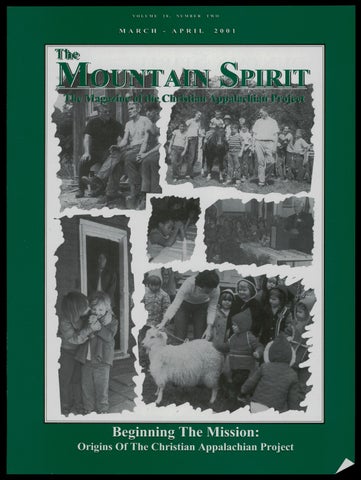
Beginning The Mission: Origins Of The Christian Appalachian Project
P resid en t’s NOTE
M o u n t a in S p ir it The Magazine o f the C H R IS T IA N A P P A L A C H IA N P R O JE C T M A R C H
-
A P R I L
2001
V O L U M E
20,
N U M B E R
TWO
Beginning the Mission by Margaret Gabriel
Owsley County, Ky. by The CAP News Service
18 ATheBoyMountains From by T.F. Shaughnessy
O O Elderly Services in ^ ^ Owsley County
Owsley County, page 16
by Margaret Gabriel
24 Street Preaching by Margaret Gabriel
On the cover: Archived photos of the Christian Appalachian Project and the beginning of the mission. (story on page four) Street Preaching, page 24
D
e p a r t m e n t s
3 9 10 29
R a n d o m T h o u g h ts Letters A round the Project CAP Close-Up
Published by the Christian Appalachian Project E d it o r M a r g a r e t G a b r ie l G r a p h ic D e s ig n K a r e n F r a n c e s S p iv e y C ir c u la tio n D e b b ie M o rr is A d v is o r y B o a r d : F a th e r R a lp h W . B e itin g , M ik e San d ers, Ben P rew itt, B eck y K an a
The Mountain Spirit is published six times a year. The annual subscription price is $8.00. Subscriptions and other correspondence should be sent to The Mountain Spirit, Christian Appalachian Project, 322 Crab Orchard Street, Lancaster, KY 40446. Copyright, 2001, The Christian Appalachian Project, Inc. All rights reserved. Member, Catholic Press Association. The Christian Appalachian Project is a non-profit Christian service organization operating throughout Appalachia. The project operates on the philosophy that helping people help themselves is the best approach to Appalachian poverty. The Christian Appalachian Project is recognized by the Internal Revenue Service as a 501(c)(3) charitable organization and is qualified to receive tax deductible contributions.
When the world began celebrating the last year of the second millen nium, we at the Christian Appalachian Project began to Mike Sanders, celebrate the CAP President first of “our next fifty years,” we like to say. Celebration 2000 was just that — a celebration of the work that Father Beiting started in 1950 and a look ahead at what we will be doing in our next 50. Primarily, CAP has decided to re-focus attention to areas of greatest distress. When Father Beiting founded CAP in 1964, he began by serving the fourcounty area of his first parish. The ensuing 35 years saw tremendous growth in two of those counties: Garrard and Madison. Over the last few years, CAP has gradually decreased its programming in those counties, moving to areas of greater need. This year, we decided to complete those moves, working with local groups to make sure that needed services will still be provided. We believe that this move is in the best interest of the people of Appalachia and that it is in keeping with our guiding principle of practicing and encouraging good stewardship of our resources. It was not an easy decision to make — such decisions never are — but the move will enable CAP to serve areas in great need of assistance. We are honored to be able to make this move, and ask for your prayers as we continue to break new grounds of service to the Appalachian area. This issue of The Mountain Spirit examines CAP’Shistory as we enter a new era, and shares with our readers the highlights of Father Beiting’s street preaching tour to sites of historic significance throughout the country. Enjoy! —, Mike Sanders, CAP President________
A summary o f the registration and financial documents filed by this organization can be obtained by contacting: in Maryland, for the cost o f copies and postage, the Secretary o f State, State House, Annapolis, MD 21401; in Virginia, State Division o f Consumer Affairs, P.O. Box 1163, Richmond, VA 23209; in Washington, residents can call the Secretary o f State toll-free within the state at 800-332-4483; in Mississippi, by calling the Secretary o f State’s office at 888-236-6167; IN NEW YORK, OFFICE OF THE ATTORNEY GENERAL, CHARITIES BUREAU, 120 BROADWAY, NEW YORK, NY 10271; IN NEW JERSEY, THE ATTORNEY GENERAL BY CALLING 973-504-6215; IN PENNSYLVANIA, DEPARTMENT OF STATE BY CALLING TOLL-FREE WITHIN THE STATE, 800-732-0999; IN WEST VIRGINIA, SECRETARY OF STATE, STATE CAPITOL, CHARLESTON, WV 25305; IN FLORIDA, THE DIVISION OF CONSUMER SERVICES BY CALL TOLL-FREE W ITHIN THE STATE AT 800435-7352; IN NORTH CAROLINA, FINANCIAL INFORMATION AND A COPY OF THE LICENSE ARE AVAILABLE FROM THE STATE SOLICITATION LICENSING BRANCH W ITHIN THE STATE AT 1-888-830-4989 OR OUTSIDE THE STATE AT 919-807-2214; or by writing to Christian Appalachian Project, 322 Crab Orchard Street, Lancaster, KY 40446. Our license number in Michigan is MICS 9933. Registration with any o f the above government agencies does not imply endorsement by the state.
T
h e
M
o u n t a i n
S
p i r i t
R A N D O M T H O U G H T S B y W . B e n P r e w it t he year 2000 was momen tous for the Christian Appalachian I Project in a number of ways. Over the course of the year we observed the 50th anniversary of Father Beiting’s ordination, his 50 years of service to the people in need in the Appalachia mountains, the “Y2K” scare, and of course the Christian Appalachian Project kick off to Celebration 2000. CAP’s Celebration 2000 was not intended to be just one event for one day or one year, but was designed to create an atmosphere for CAP to celebrate its next 50 years of service. Father Beiting made it perfectly clear that he did not want a big fuss over his multiple 50 year anniversaries; rather he wanted to visit people and thank them for the love, prayers and support that have assisted so many. This was accomplished, in part, by a multi-city tour. During this tour Father Beiting and CAP wanted to visit with the people that have so generously supported this ministry and to thank them, to share the success stories and the continuing needs. Cities we visited included: Washington, D.C.; Memphis, Tenn.; Greensburg, Pittsburgh and Phila delphia, Pa.; Columbus, Dayton, Portsmouth and Cincinnati, Ohio; Louisville, Newport, Covington and Owensboro, Ky.; Richmond and Williamsburg, Va.; St. Louis, Mo.; Fort Lauderdale and Miami, Fla.; Dallas and Fort Worth, Texas; Aurora, Madison, Jeffersonville, Evansville and Indianapolis, Ind.; Palm Desert, Calif.; Emmitsburg, Md.; Huntington, W.Va.; West Palm Beach and Deerfield Beach, Fla. At all of these stops Father
M arch
A pril
2001
During several stops on Father Beiting’s multi-city tour, he signed books fo r people interested in reading his story.
Beiting and CAP conducted informational sessions about the work of the project, met with CAP donors — both longtime friends and new ones. Father Beiting, Mike Sanders, CAP staff members and I spoke at church services and many public programs to share in the celebrations of the ministry that CAP provides because of our donors’ most generous support. At six of the city stops, we chose a historical backdrop that supported a street preaching topic and docu mented that event on videotape to share with anyone who is interested. At most of these locations, Father Beiting also signed many of his series of eleven books for people interested in reading his story. In Philadelphia, we were privileged to sign books at the public library, the first in the United States. Other events and projects that have taken place during this initial celebration year include recording Father Beiting’s books on tape; creation of a series of informational videos concerning CAP programs; and a new web site. Donors around the country hosted special events for the benefit of CAP. Most
important, we started new and innovative human service programs for the people we serve. Each of these projects were accompanied by long-range planning and prayers for solutions to the many challenges in Appalachia. CAP continues to celebrate in many ways. We celebrate our donor family for the wonderful support it gives; we celebrate the people of Appalachia for their strength and resilience; we celebrate a Christian ministry with strong guiding principles; we celebrate our thousands of volunteers who have given of their time and talent; we celebrate good stewardship for those items and funds entrusted to us; we celebrate strong leadership in our president, Mike Sanders; we celebrate an outstanding staff; and we celebrate the Christ who is commemorated in our name, whose work we see at hand every day. Thank you for continuing to celebrate with us and pray for those we serve. May God bless you.
Ben Prewitt is a CAP vice-president of development.
3
T h e m o u n ta in s k y w as g ray o n th e a u tu m n d a y t h a t E a th e r R a lp h B e itin g tra v e le d fro m N o rth e rn K e n tu c k y t o B e re a t o b e g in his m in is try as p a s to r o f a f o u r - c o u n t y re g io n o f E a s te rn K e n tu c k y . O rd a in e d o n e y e a r, E a th e r B e itin g was leaving his hom e o f 2d y e a rs — th e o n ly hom e h e 'd e v e rk n o w n — t o serve an are a w hich p re s e n te d a g r e a t challenge. H is dream o f w o rk in g w ith p e o p le in A p p a la c h ia be g a n in
A s a semi
narian, B ill B e itin g as be was kno w n th e n , a cco m p a n ie d several p rie s ts as th e y w e n t o u t t o p re a c h in th e m o u n ta in s o f E a s te rn K e n tu c k y , m e o ld e s t o f eleven ch ild re n w h o g re w u p d u rin g th e G re a t D e p re s s io n , th e sem inarian was n o s tra n g e r t o n e e d ^ o u tth e s o u l-s h a tte rin g p o v e rty he o b s e rv e d d u rin g th a t sum m er p la n te d th e s e e d s o f a v is io n .
After his ordination in 1949, Father Beiting was assigned to work as an assistant pastor in a Northern Kentucky parish and as a math teacher at Newport Catholic High School. He tells a story of a meeting with Bishop William Mulloy one year after he began his work. “I had been working happily as an assistant pastor when the bishop asked to speak to me. Puzzled about the unusual circumstances of a lowly assistant pastor being asked to meet with the bishop, I was trying to make myself comfortable in his presence when he said, ‘Father Beiting, I have been going over your record.’ “How much of the record did he know, I asked myself? If he was all knowing I could be in real trouble! He went on. ‘I have been giving considerable thought to opening a new mission territory in our Appalachian area. I need to select a priest to act as a pastor for four counties in the area, and I think you would be a good selection.’ “I couldn’t believe what I was hearing. Surely this was some ecclesiastical test to determine the degree of a person’s humility. Or maybe what they taught us in the seminary was true, and the inspira tion of the Holy Spirit was the motivating force behind this decision. Fortified by this thought, I asked the bishop the location of the church. He said, ‘There is no church.’ “I told myself I couldn’t have everything in Appalachia and went on to serious matters. ‘Where is the rectory?’ “‘There’s no rectory either,’ the bishop told me. Right then and there I had a serious reservation about the Holy Spirit being involved in this affair at all.” On that overcast day, October 7, 1950, Father Beiting began his work as pastor of a non-existent church in a parish the size of the state of Rhode Island, with a small Catholic
M arch
A pril
2001
Father Betting’s parish in 1950 included the counties o f Garrard, Rockcastle, Jackson and southern Madison, the first Catholic parish in the area.
population. The two-story house at the end of a driveway full of potholes sagged uninvitingly. Young Father Beiting gingerly crossed the porch full of rotting planks and entered an equally dangerous “living room.” Bishop Mulloy’s assignment for him was to transform the sad house into a chapel — and quite an assignment that was, Father Beiting recalls. He had $100 in his pocket and could look forward to a salary of $41 a month, which was ex pected to cover both his personal needs and a car. He couldn’t really turn to the parishioners in Berea, either. The congregation was made up of nine people — and three of them were children. Moving into the living quarters in the house, Father Beiting opened his suitcase and took out a crucifix he had won as a religion award in high school. For the first time, he recalls, he looked at the man hanging on the cross instead of first looking at the words of congratulations that were engraved upon it. Upon realizing that it was Jesus to whom he needed to look for strength, Father Beiting went to his tool box, got a screw
driver, and removed the plaque, so that he might only focus on his best friend, one who had told him, “Through me you can do all things.” Father Beiting knew he had another place to turn for assistance — to his family. With the help of his parents Ralph and Martha Beiting, his brothers, sisters and in laws, the house was transformed into a chapel with living quarters and space for parish activities. As a seminarian Father Beiting learned that all people — not just Catholic people — were part of his ministry and in Appalachia he quickly found that for many of his people the greatest need was not spiritual, but physical. Discovering far more need than he could alleviate by himself, Father Beiting called once again on his family and friends in Northern Kentucky for help. For several years he made frequent trips to pick up food, clothing and household goods that would ease the burden of lowincome people in Eastern Kentucky. After a while he realized that these trips could go on indefinitely. One evening, after Father Beiting
5
today, providing some economic stability to Jackson County, which has started to improve the distressed conditions that it has experienced for many years after being named an Empowerment Zone by the federal government. The most success ful enterprise that began at that time was a Christmas wreath factory, which CAP Summer activities in many CAP counties include Bible school, like this one at Our Lady o f Mount continued to Vernon in 1979. operate until 1998. Today, the wreath operation had been living in the mountains for Christian atmosphere to boys from continues under the auspices of the five or six years, he was nearing his poor families in the counties where Mountain Economic Development home in Berea, Ky., at the end of Father Beiting ministered. Fund. Wreath sales provide MEDF the latest of seemingly endless By the early 1960s, it was with the funding it needs to work in forays north. As he drove U.S. 27 obvious that employment was an the arena of economic development. South, Father Beiting was struck important key to independence for Since its inception, CAP has with a sinking feeling that thus far the Appalachian people. At the time worked to invest in long-term his effort to help the poor had been of CAP’s incorporation in 1964, economic growth, but in the early essentially insignificant. He asked Father Beiting, and the people he 1970s workers realized several steps himself, “Do I want to be a truck had recruited to work with him, had were needed before healthy driver the rest of my life?” added several business ventures to economic growth — or even selfHis sobering answer — an the camp, used clothing stores, sufficiency — would be possible. emphatic “No!” — caused him to Bible schools and emergency think beyond short term needs. assistance programs that What kind of help would be they had started. necessary to help people care for These enterprises themselves? How could they included a dairy farm, a woodworking shop, and a become more personally indepen dent and interdependent with others greenhouse. Although in their community? they were not designed to Children were the starting point create a significant for Father Beiting. In 1957, he and number of jobs, each his associate pastor, Father Herman made a small but dynamic Kamlage, pooled their small impact on the local economy. For example, stipends and bought land on Herrington Lake in Garrard County, the dairy farm (begun with Ky., to start a summer camp for six Holsteins donated by boys. Named CliffView Lodge, it the Abbey of Gethsemani, was integrated (during the days near Bardstown, Ky.) was when segregation was an accepted, operated by George indeed expected, part of life in the Purcell, a native Garrard South), and incorporated indepen Countian who was one of dently from the Catholic Diocese of Father Beiting’s first Cliffview Lodge was an integrated camp before the Covington. Cliffview Lodge offered volunteers. The dairy days o f the civil rights movement. recreation and fellowship in a continues to operate
6
T
h e
M
o u n t a i n
S
p i r i t
established in Louisa, the During these years, county seat, with expansion emphasis shifted to into adjoining Martin development of human County and talk of expan potential. Much of CAP’s sion across the state line emphasis continues on into West Virginia. human development, In 2000, CAP officers addressing both long- and short-term needs. Long and directors decided to term human service make a dramatic shift in the counties served by the programs include child organization. The changing and family development economic picture and centers; counseling services; tutoring for demographics of some of CAP volunteers pick up and deliver kids for camps, Bible teenagers and adults CAP’s original counties, Schools, child development centers and other programs. working on high school specifically Garrard and Madison, led to the decision to equivalency certification; adult parish: Garrard, Rockcastle, literacy instruction; teen and youth withdraw programs from counties Jackson and Southern Madison. As centers; life skills training and with less need to allow concentra CAP expanded in the 1970s, it did tion on counties with greater need. supported employment opportuni so in counties that adjoined those ties for people with disabilities, job In the most recent U.S. census, original four: Lincoln and Jessa training for people entering or re three of the counties that CAP mine. Counties with great need entering the workforce and serves are among the poorest in benefited during the 1980s, as CAP affordable housing. Kentucky. Other CAP counties, expanded into Pulaski, Owsley, Programs designed to address those that are immediately adjacent Casey, McCreary and Estill short-term needs include visitation to the more prosperous Bluegrass counties. of elderly people; emergency area, show the good effects of In the meantime, in 1981, Father financial assistance; spouse abuse intensive help over the years. State Beiting was assigned to parishes in shelters; a gardening program; and county officials say that those Floyd and Magoffin counties, 150 food and gift baskets at Christmas; counties are in better positions to miles east of CAP’s original fourrespite for families with members lend the help needed by residents, county base. Needs in the Big who have disabilities; instruction and welcome the opportunity to Sandy area — the heart of for parents in teaching pre allow CAP to transfer its resources Kentucky’s coal mining area — schoolers with disabilities; and a to areas of great need. prompted the inception of CAP family recreation complex. These In the 1970s, CAP began programs there. A similar pattern programs have grown slowly and granting funds to grass-roots occurred when Father Beiting was steadily over the last twenty years organizations doing work similar to assigned to Lawrence County in or so, meeting needs as they have 1991. By 1993, programs were well its own. Through the human manifested them o development grant selves. Many workers >program, CAP’s in CAP human | resources are used services programs are efficiently to benefit recognized by other many more people professionals as than could be reached experts in their fields. through site-based The locations of programs. CAP programs can be In 1986 CAP traced to the assign received a large ments that Father donation of books Beiting has received which launched a from the Roman program known as Catholic bishops of “Operation Sharing.” Covington, and later, Goods, including Lexington. Beginning books, food, garden in 1950, activities Cliffview Lodge, the first property purchased by Father Beiting, is located seed and home repair were located in the on Herrington Lake. Today it is a retreat center fo r the Catholic Diocese supplies, which CAP o f Lexington. four counties of his receives from a
M arch
A pril
2001
7
that Father Beiting number of sources, arrived in Berea, he are distributed to recalls inviting a grass roots organiza group of volunteers tions in all of the from Newport Appalachian Catholic, the school counties of Ken where he taught math tucky as well as just the year before Appalachian areas in (“I gave some of twelve other states. those guys passing Since its inception, grades — I figured thousands of they owed me!”). churches, schools They traveled to and community Berea to construct a action agencies have nativity scene on the received goods from lawn of the house Operation Sharing. where Father Beiting In 2000, Operation One o f CAP’s first child development centers was in Berea, in Southern said Mass for the Sharing estimates Madison County. Former volunteer Ellen Burke was an early manager. small group of that over 1.5 million Catholics in the area. people were served by those groups. Because of the expense of direct Now, as then, much of CAP’s For the most part, CAP’s programs mail fund raising, the 1980s saw work is the result of volunteer have been primarily funded by CAP exploring additional methods assistance. The volunteer program of fund raising. Today those efforts money solicited directly from has blossomed to include nearly include planned giving, solicitation individuals throughout the United 100 men and women whose ages States. Beginning in the late 1960s, of funding from foundations and range from 21 to well past retire corporations and from church a highly successful direct mail ment age, working mainly in congregations. CAP does not solicit program has been developed which outreach and education programs. solely monetary support, however. in 2000 raised over $16 million CAP also employs over 300 people dollars. An active donor file of over Solicitations include requests for in full-time and part-time positions. volunteers, as well as prayer and one million people grew from In addition to human services Father Beiting’s initial list of donors help with the dissemination of programs, these workers are which he assembled by gleaning information telling of the problems involved with the development and Irish and Italian names (which he still facing the Appalachian area. administrative functions needed to hoped belonged to generous Volunteers have been a part of support CAP’s work in Appalachia. CAP’s work since long before the Catholics) from the New York, This work force makes a significant organization was incorporated in Boston and Philadelphia telephone impact on the economy of the area. 1964. In December of the same year books. From a young priest’s determination that he would contribute more to an area than just the services of a truck driver has grown the largest private service organization in Eastern Kentucky. As the twenty-first century dawns and the problems in Appalachia continue to change, CAP pledges to adapt to meet those changes as it continues its mission of affording the Appalachian people the same opportunities as those available to the rest of the American public. CAP began a dairy farm in Jackson County with six Holsteins donated by the Abbey of Gethsemani in Bardstown, Ky.
T
h e
M
o u n t a i n
S
p i r i t
L etters to the E d itor E3E3E3ElE3E3E3E3ElE3El£3
Keep up the good work! You are making a difference — a big difference! Phil Hahn Willmar, Minn.
The work that Father Beiting and his many helpers do is wonderful. Father Beiting and his entire staff are to be complimented again and again for helping the people of Appala chia. Thank each of you for your diligence and unselfish assistance. I enjoy reading The Mountain Spirit. It’s rewarding to see that poverty is being conquered. Alyce Lambert N. Ridgeville, Ohio
You are doing wonderful work in your efforts to combat poverty in the area. I read The Mountain Spirit from cover to cover as soon as I receive it. I wish I could help more. S. Ward Tiernan Baltimore, Md.
I saw Father Beiting speak a couple of times at St. Therese Church in Wayland, Michigan. He is a most effective speaker. If every one could see him, they would be more swayed to his cause - I think his work is wonderful. Irene G. DuBridge Hendersonville, N. C.
I have enjoyed every issue of your wonderful magazine and pass them on when I’m finished. God bless you all for your wonderful work. Verness MacNeil New Milford, Conn.
M arch
A pril
2001
I enjoy reading The Mountain Spirit and have shared it with co workers. This area of Ohio has many people originally from the Appalachian area. Their life stories are always interesting. Keep up the great work! Scott Rumsey New London, Ohio
Though I wasn’t the “perfect” permanent volunteer, I still miss working with CAP and Fr. Beiting everyday. Tom Dalfonso Portland, Maine
The Lord knows we can’t be everywhere to help those in need, so we try to send something as often as we are able, to be used in any way it’s needed. For all God’s children need help along life’s pathway at one time or another, no matter what age they are. Bless you, Father Beiting for being there and doing the work. May your rewards be great in heaven. Robert & Linda Plues Payson, Ariz.
I look forward to The Mountain Spirit and especially admire Father Beiting’s great work for the Lord and his people. May the Lord bless and keep you everyday. Phyllis Blackmer Oak Island, N.C.
Enjoy reading The Mountain Spirit. My, what great people you work with! Ms. Mary Murphy Malden, Mass.
I hope to visit your project sometime within the next two years, but never seem to have any time. I am 68 years of age and still work full time. When I was very young, I lived in conditions much like those in your area. Keep up the good work. Franks. Kelly' Dayton, Texas
I’m sorry I can’t send more at this time, as it is my heart’s desire to help the poor of Appalachia. I know at one time in my life my family and I were so poor, that the Salvation Army gave us a basket of food for Christmas. Thank God for organizations such as the Salvation Army, CAP and many others that help the poor when they have nothing. Thank you for the recent book “The Promise of Charity” you sent to me. I was deeply moved by Father Beiting’s life in the moun tains of Appalachia. In Christian love, Ruth Schneider Kent, Ohio
I enjoy The Mountain Spirit very much. I left Eastern Kentucky close to forty years ago. I am proud of all the work you are doing for my people there. May God richly bless you and your co-workers. Love and Christian Faith, The Ralph Cassell family Bellville, Ohio Letters to the editor are welcome. They should not exceed 150 words in length, and we reserve the right to edit them for space. Address letters to: The Mountain Spirit Christian Appalachian Project 322 Crab Orchard Street Lancaster, KY 40446 or e-mail capinfo@chrisapp. org
9
A
r
T he
o
u
n
d
P r o je c t
Friend O f CAP, Brother Edward Nadalsky, Dies in Dayton A long-time friend of the Christian Appalachian Project, Brother Edward Nadalsky, died on December 7, 2000 in Dayton, Ohio. He was 84 years old. A member of the Marianists (a Catholic religious order of brothers also known as the Society of Mary) for 64 years, he began his ministry on the campus of Mount Saint John, in Dayton, then served for six years in New York. After returning to Dayton he worked in various jobs for education and mission institutions. Brother Ed first became acquainted with CAP in 1965 when he heard founder Father Ralph Beiting speak in Dayton, Ohio, about working in Appalachia. After the talk, Brother Ed encountered a University of Dayton student, Tony Pappano, who had been as impressed with the speech as Brother Ed. The two began recruiting others to serve God by helping the people of Appalachia. They formed the Appalachia Club, which sent food, clothing and volunteers to assist those in need in Kentucky. One of Brother Ed’s most memorable contributions to the region was in 1973. He enlisted the help of the United States Army in delivering supplies to Appalachia with a 19-truck convoy. The Army repeated its assistance again the next year. Countless CAP volun teers and employees encountered Brother Ed through his years of weekend service and constant prayer from his home in Dayton. One way to remember him is through the words of these people
10
who celebrated his service in the November 1987 issue of Ave!, a newsletter for CAP’S volunteer alumni, a publication now known as The CAP Connection. That issue was dedicated to Brother Ed on the occasion of his Golden Jubilee in the
Society of Mary. Here is some of what people said about him at that time: Father Ralph Beiting: “In ways too numerous to count, he improved the quality of human life for the good people of Appalachia.” Sister Terry Gonyea (volunteer and later employee at CAP Child Development in Berea): “Brother Ed has been an inspiration for me. I witnessed his busy days of ‘backstage’ working to get material for others to help the needy. This was done with love and cheer in his heart — but [it was quite common] to see him in a quiet place, finding his strength in prayer.” Stan Cebrzynski (volunteer): “He really knows how to take the bull by the horns and get things done. If more people would follow his
T
h e
M
example, this world would be a much better place to live.” Sister Kathleen Weigand (volun teer and later director of St. Vincent Mission, David, Ky.): “It was always a delight in July to have Brother Ed come for a visit because we knew we would always go blackberry picking! . . . Brother Ed, thank you for being a beautiful example of what it is to be a servant of God and of His people.” When Brother Ed’s health declined and he was no longer able to make trips to Kentucky, he continued to keep CAP and the people of Appalachia in his prayers. Brother Ed is survived by his brother Albert Nadalsky of Fort Myers, Fla., his sister Mary Catherine Ries and a niece, Maryann Tegeler, both of Troy, Ohio, and many friends in Dayton and Kentucky.
Is there a CAP program that you don’t see in this issue of The Mountain Spirit? CAP’S web site includes information about all of CAP’S human service programs, planned giving and major gifts and the volunteer program. Please visit the site at www.chrisapp.org and be sure to sign our guest book!
o u n t a i n
S
p i r i t
A
r
T he
o
u
n
d
P r o je c t
Father Beiting Receives Award From the Catholic N etw ork o f Volunteer Services Christian Appalachian Project founder Father Ralph Beiting received the twelfth annual Father George Mader Award from the Catholic Network of Volunteer Service in November, 2000. The award honors the founder of CNVS and is presented annually during the fall meeting of the National Conference of Catholic Bishops in Washington, D.C. According to Jim Lindsay, CNVS executive director, “the criterion for receiving the award is that the individual or group recipient will have fostered the role of lay men and women in the Church in an exemplary fashion. As the founder and longtime chair of the board of the Christian Appalachian Project, a CNVS member begun in 1964 which assists people in the Appala
chian region of Ken tucky to become more self-sufficient, Father Beiting certainly has met this requirement. In the last thirty-six years, nearly 60,000 lay volunteers have served with CAP. “I think it is particu larly significant that CNVS is honoring someone who has done Father Ralph Beiting and Bishop J. Kendrick Williams o f the Catholic Diocese o f Lexington. so much to promote home mission activity. well as its member programs and In many ways, Father Beiting has partners I am sure, extend a been a pioneer in engaging in ecumenical (and interfaith) dialogue heartfelt congratulations to Father Beiting, along with an expression of in an area where the Catholic gratitude for fifty-plus years of Church has often been unknown dedicate service to laity and to the and misunderstood. “The board and staff of CNVS, as poor.”
Elderly Advocacy Group Meets Monthly In Berea On the first Monday of each month, a group of 25 or more elderly people gather at the Senior Citizens’ Center in Berea to share ideas and gain information about issues that are important to people who are aging. A recent speaker was the county-judge executive of Madison County who told his audience of the issues being addressed in the county, including the plans for the nearby Bluegrass Army Depot, and how it might be used to benefit seniors, according to Christian Appalachian Project elderly services manager Zayda Hurd. Five to ten of the people who participate in CAP’s elderly services program are regular attendees of the meeting and have enjoyed learning new things. Those
M arch
A pril
2001
who are able to drive often offer transportation to friends and neighbors, Zayda said. “A representative from the AARP [American Association of Retired Persons] came to speak to us about the help they can give with taxes and to answer questions about insurance. And she told us how to start a local AARP chapter,” Zayda said. Peggy Harrison, who works in the prescription assistance compo nent of elderly services, spoke to the group one month, giving vital information about accessing un insured prescription medications. In the course of only one year, CAP workers helped people — not all of them elderly — to access over $ 1 million in prescription medications
through programs established by pharmeceutical companies. Madison County will lose CAP’s elderly services program when the organization moves its resources to more distressed counties. Zayda feels confident that the advocacy group will give people a resource for accessing services they need. The February meeting was planned as a roundtable discussion which would encourage participants to suggest topics for the coming months. “We’re interested to hear what they want,” Zayda said. “We’ll be able to line up speakers they’d like to hear, people they have questions for.” Elderly services programs also operate in eleven counties in Eastern Kentucky.
11
A
r
T he
o
u
n
d
P r oje ct
Camp Shawnee Improves Water System When Owen Wright, manager of the Christian Appalachian Project’s camp in Floyd County, looks out the door to his office he frequently sees a deer walking to the woods. Owen feels fortunate to be able to share the beauty of Camp Shawnee with young people, both during the camping season and during the school year as well. “It all ties in to Appalachian history,” said Owen, a history enthusiast. “It shows the importance of our region and who we are. It’s a way of taking pride in our home. If we make the kids aware and take pride maybe they’ll treat each other and their environment better.” Owen has been unable to host as many groups in the last few months as he has in previous years, but for a very good reason, he said: “We’re getting public water and a septic system.” Camp Shawnee hosts about two thousand people each summer.
Until recently, water was pumped from nearby Coppeas Creek, then treated by the camp’s own treatment plant. “We had two pumps,” Owen said. “One was submerged and the other was above ground. We had Water activities at Camp Shawnee will be enhanced by the trouble with them new system. almost every year, we had to monitor the treatment, water, Owen said. keep up with the paper work and “I’ve been in contact with them keep someone trained in the whole since I started here in 1994. They operation.” Owen commended told me then that it was a long term maintenance worker Jerry Oaks for goal to run water to this side of Cow his diligence with the septic system. Mountain, but they hadn’t planned The required paperwork and the on coming all the way up here.” records of the amount of water The new water source will make Camp Shawnee used every summer the summer of 2001 more enjoyable for campers, staff and visitors alike, demonstrated to the Prestonsburg City Utilities the need for public Owen said.
Long Term Im pact The CAP volunteer program needs summer camp counselors, nurses and lifeguards to staff four camps in eastern Kentucky. We are seeking highenergy men and women, age 18 or older, for the months of June, July and early August. We would like a commitment of at least two months, but a 3-7 week stay can be arranged. Room and board is provided, also orientation and ongoing training, daily prayer and a potential AmeriCorps Educational Award.
12
For more information call
(800) 755-5322
e-mail: volunteer@chrisapp.org
Visit us: www.chrisapp.org
T
h e
M
Christian Appalachian Project Volunteer Project o u n t a i n
S
p i r i t
A
r
T he
o
u
n
d
P r o je c t
Operation Sharing Gives Relief To Alabama Tornado Victims at this time of year,” Johnny said. Toys were a popular commodity during the month of December, Johnny said, and Operation Sharing procurement specialist Jeff Burchett played Santa Claus for the Rockcas tle Teen Center, helping the teens in Mount Vernon and the surrounding area get into the spirit of giving. With spring just around the comer, Operation Sharing is helping CAP’s housing and volunteer programs to prepare for the tenth annual Spring Break Appalachian WorkFest. Through the efforts of Johnny and Jeff, Operation Sharing has procured insulation, vinyl siding and other home repair materials, as well as safety supplies such as helmets, gloves and tool belts. And to make sure that the work force of some 400 college students is well fed, they also work to obtain juice, bottled water, food and snacks. Johnny reports that during fiscal year 2000 CAP programs used nearly $4 million worth of materials Operation Sharing workers know that in times o f natural disaster there is a great need for obtained by Operation bottled water. Sharing, while distributing a total of $51 million to grass roots donation distribution program. The First Baptist Church of organizations, churches and schools When a tornado ravaged parts of Tuscaloosa regularly receives in all of Kentucky’s Appalachian northern Alabama the week before materials from Operation Sharing, counties, as well as areas in the Christmas, Operation Sharing and received the truckload of other twelve Appalachian states. assistant director Johnny Thompson supplies that also included toys. Although the in-kind distribution swung into action. “When I got on the Internet and program has grown steadily over the “The tornado hit on Saturday was reading the Alabama papers, I years, friendships with both donors night, I heard about it on the news learned that people had lost their and participants have remained on Sunday morning, and started Christmas presents, so we made constant, Johnny said. getting supplies together when I got sure to put in some toys. We knew “As the economy shifts, it’ll be to work on Monday.” Because of that would be a little bit of relief. It interesting to see how it affects our his experience with disasters in the was just amazing that there would past, Johnny knew that immediate be tornadoes anywhere in the South program,” he said. People in any part of the 13-state Appalachian region have come to realize that during times of natural disaster they have friends that can and will assist areas to come back to their feet. People faced with such disasters as floods, hurricanes — even the recent coal waste spill in Martin County, Ky. — have come to know they can turn for assistance to Operation Sharing, the Christian Appalachian Project in-kind
M arch
A pril
2001
needs would include personal hygiene items, cleaning supplies and bottled water “Then I got a call from Alon Marom at Americares. We’ve been working together on disaster relief, and he told me that he wanted to send a truck. When I told him that our truck would be gone by time he could get one down here [from New Canaan, Conn.] they sent materials directly to Tuscaloosa,” Johnny said.
13
A
R O U N D
T he
P r oje ct
‘Parents Are Teachers’ Collaborates With Other Providers White House Clinic in McKee, Ky., is serious business, but the mood lightened considerably at the Christmas party that the groups collaborated on hosting. “The clinic didn’t think there would be that many people to come; Suzann [Fenton, a PAT develop mental interventionist] thought there would be about a hundred,” said Gloria. “We stopped counting at 350. There were people lined up all the way around the building.” PAT receives many referrals from Dr. Julia Richardson, a White House Clinic pediatrician. “Doctors are usually concerned with normal growth and development and pick up on kids that need early intervention,” Gloria said. “We get a lot of referrals from Dr. Richardson because she’s such a good doctor — she picks up on a lot of things.” Santa Claus makes an appearance at a party The Christmas party sponsored by Parents Are Teachers and White was Suzann’s brainchild. House Clinic. She also involved the collaborative efforts the participants Jackson County volunteers and obtained gifts for each child through in her program receive optimal Operation Sharing, CAP’s in-kind services. Those participants are infants and donation distribution program. She even invited a local young man to children with disabilities up to age play Santa Claus. three and their families. The CAP “Dr. Richardson supplied the film early intervention program not only we needed to give every kid a trains parents in the best way to picture with Santa. We gave out teach their children, but prepares information about Parents Are them to be advocates when those children begin public school. At the Teachers and some tips for activities that parents could do with their kids third annual Americans With during the holidays,” Gloria said. Disabilities conference in October, Penny Williamson is filling a new CAP was recognized with the ADA PAT position, Gloria said, that of Spirit Award, given in honor of the primary service coordinator. She work that CAP and other organiza coordinates all of the services a child tions have done in working with and his or her family have that have people with disabilities. to do with education. She conducts Most of PAT’s activity with
Many, if not most, of the Chris tian Appalachian Project’s human service programs collaborate with other service providers. They make and receive referrals from state and private agencies, communicate with medical providers and confer with teachers and educators about the progress of program participants. Parents Are Teachers manager Gloria Jordan stresses that through
14
T
h e
M
W ORKPLACE PAYROLL DEDUCTION If your employer offers donor designation as a write-in for payroll deduction campaign, please remember the Christian Appalachian Project. CAP is a 501(c)(3) tax exempt agency, and payroll deduction is the easiest way to help the families of Appalachia. To ensure that we receive your payroll deduction gifts, please give your payroll officer CAP’s full address and send to the attention of: Teresa McAnly-Campaign Coordinator
Christian Appalachian Project 322 Crab Orchard Street Lancaster, KY 40446
transition meetings and prepares the family for the transition to public school, sometimes a difficult process for a family, she said. “Penny also teaches parents how to advocate for their children, and teaches them about their rights and the rights of children with special needs.” Although Parents Are Teachers receives many referrals from other service providers, they also receive inquiries directly from families. In such a case, Gloria or an interven tionist pays the family a visit and explains the best way to access services, both from PAT and from others who provide care to children with disabilities. Most of the families in Parents Are Teachers are low income families, Gloria said, but service is not limited to that group. “A disability doesn’t know if you’re rich or poor,” she said. “They all need services.”
o u n t a i n
S
p i r i t
B ooks O n T ape By Father Ralph Beiting Now available on cassette, the voice of Father Ralph Beiting brings to life the stories and experiences of his work in the mountains of Appalachia. As founder of the Christian Appalachian Project, Fr. Beiting has earned a reputation in Appalachia as a true visionary and advocate for change. His self-help philosophy has materialized in the human service programs of the Christian Appalachian Project. The books on tape are available to you at no cost. Each book contains two cassettes, packaged in a full color vinyl case. A donation to help cover the cost of the book, shipping and handling is appreciated. Your donation will also help make possible the work of the Christian Appalachian Project. To order please fill out the following card:
□ I would like to receive the following book(s) on tape at no cost (Check Below). Number of copies
_________ _________ __________
God Can Move M ountains The Prom ise o f F aith. . . W ith Christ We Can Do All Things A Time o f C r isis__ A Time for Christ
I have enclosed a donation of: □ $10.00 □ $15.00 □ $20.00 □ Other $__________ To help cover the cost of the book(s) and help further the mission of the Christian Appalachian Project Please make checkspayable and mail to: Christian Appalachian Project 322 Crab Orchard Street • Lancaster, KY 40446 You may call us at: (606) 792-3051 Visit our web site at: www.chrisapp.org email: capinfo@chrisapp.org
- by M argaret Gabriel -
Traveling to Owsley County, Ky., isn’t easy, but if you’re looking for unspoiled natural beauty, it’s worth the effort. Located west of Kentucky’s eastern coal region, Owsley County is a small but vigorous county, one whose citizens have been actively searching for ways to lift their home out of poverty. The county currently has an area of 198 square miles. Its county seat, Booneville, is located on the south fork of the Kentucky River. Owsley County was formed in 1843 from parts of Clay, Breathitt and Estill counties. The boundaries today are different from those that were formed at that time. In subsequent years, it lost territory to Jackson County (1858), Wolfe County (1860) and Lee County (1870). Pioneer Daniel Boone camped in the area at one time, leading the area now known as Booneville to be called Boone’s Station. It was also called Moore’s Station at one time, in honor of a family of late 18th century settlers. The land for the county was donated by Elias Moore. When Owsley County was established, Kentucky was in the midst of a “county-creating binge,” accord ing to a recent story in the (Lexington) Herald-Leader. From the three original Kentucky counties (Jefferson, Fayette and Lincoln) that were originally part of Virginia, the legislature created 97 more, all of them small enough to allow residents from throughout the
area to reach the county seat in only a day’s ride by horse. By the end of the 19th century, however, legislators were creating counties to honor politicians and Indian fighters. “Politicians sought new counties to boost their power bases; landowners wanted to make their property more valuable by having it become the seat of new counties,” said the story by Herald-Leader staff writer Bill Estep, referencing Little Kingdoms: The Counties o f Kentucky, 1850-1891, by University of Kentucky history professor Richard M. Ireland. Analysis of the 1990 census figures reveals that Owsley County was among the poorest in the nation, with nearly 64 percent of its children living below the poverty level. Although the figures have not been finalized for the 2000 census, there are indications that significant improvements have been made in the number of children and families living in poverty. Stella Marshall, director of Workers of Rural Kentucky and a lifelong resident of Owsley County, is quite modest about the contributions that she and her group have made toward improvements in the county. She suggests that some of the improvement stems from the drop in the number of people receiving welfare, but also points out that many of those people have joined the ranks of the working poor. “But you have to realize,” Stella said, “I always see the people that have more needs.”
16
T
h e
M
o u n t a i n
S
p i r i t
Stella identifies a need ¡work for what they want, for employment, activi and for the community,” she ties for youth and decent said. Nearly 200 young housing in the county people participate in and the latest statistical WORK’S youth program, information seems to which offers help with bear that out. The official academics, technical and unemployment in 1997 computer training and listed Owsley County classes in the creative arts. with an unemployment The program works with first rate of 5.3 percent. The through twelfth graders in Owsley County Action both after-school and Team, a community summer programs. action agency established Ows/ev is a small, rural county, liven the county seat has fewer People occasionally in 1992, estimates that than 1000 people. wonder what it is about the actual unemployment in the The need for youth programs has Owsley County that keeps its county is closer to 47 percent. created a collaboration between residents from moving to an area (Official unemployment rates take WORK and Pathways to Prosperity, that might offer more opportunity. into account only those individuals Stella said. “We like having our own space,” who are receiving unemployment Pathways to Prosperity enables Stella said. “And it’s important to benefits. The actual rate, while people who live 200 percent below live close to your relatives. Every difficult to document, takes into the federal guidelines for poverty to time I heard about how bad things consideration people who do not deposit $ 15 of earned income each are around here, I think about the receive unemployment, or whose month into an Individual Develop fact that I’ve never been afraid to benefits have expired). ment Account. The money must be leave my purse in my locked car.” Coal production has never had a earned income rather than money She tells of a trip to Richmond, Ky., major impact on the economy of from an entitlement program. The a nearby, more metropolitan area, Owsley County, although there was funds are then matched at a rate of when a thief broke the window of a small amount of strip mining six to one by grants from the her car to steal her purse. during the coal boom of the 1970s. Kellogg Foundation and the “We don’t have to worry about Today, Owsley is host to one Corporation for Enterprise Develop safety.” manufacturing plant, Image Entry. ment in Washington, D.C. After 24 CAP has operated programs in The data entry company employs months, the participant has an Owsley County since 1986. Today, about 40 people in Owsley County account of $2520 which is available those programs include elderly and has plants in other counties for one of three purposes: to start or services (see “Elderly Services in throughout Eastern Kentucky. State expand a business; to buy, build or Owsley County,” page 22), out and local government are listed as repair a home; or for continuing reach, housing, counseling, adult the largest employers in the county. education. education and Job Start, a program The unemployment rates, both Young people who are involved which trains participants to enter or official and actual, and the fact that in WORK’S youth program serve in re-enter the workforce. Owsley over 57 percent of personal income the organization’s used clothing County youth attend Camp Andrew for county residents is derived from outlet or help with other community Jackson during the summer months. transfer payments, indicates that service activities, Stella said, to although Owsley County has made earn the needed money for the significant progress in the last ten Individual Development years, more is needed. Stella agrees Account. with this assessment. Stella belongs to several Workers of Rural Kentucky local and regional boards, but (WORK), along with the Owsley recently cancelled a meeting County Action Team and Pathways when she heard a call for help to Prosperity, and the Central from the Owsley County Food Appalachian People’s Federated Bank and decided that her time Credit Union are listed on an was better spent gathering the information web site as organiza teens together to lend the tions helping the county to make needed assistance. “It’s The population in Owsley County is aging, as needed progress. important to teach our kids to is the case with many Appalachian counties.
M arch
A pril
2001
17
Christian Appalachian Project president Mike Sanders has lived in a lot of places and done a lot of jobs, but “never quite found my niche,” he says, until Father Ralph Beiting recruited him as a volunteer in the summer of 1983. Looking back, says Mike, “God was getting me ready for this kind of work.” His varied experiences have taught him always to try to see life from the other person’s perspec tive. “It makes me a better servant,” he says.
Wanderlust Michael Sanders, 50, grew up in the coalfield town of Majestic, Kentucky, in Pike County, the son of coalminer J.B. Sanders and homemaker Patsy. He attended
18
elementary school in Majestic and high school in Phelps, but he “wanted to get out and try the world.” After high school graduation, Mike moved to Ohio, where he worked in a couple of factories and then the Chesapeake and Ohio Railroad, but nothing seemed to be able to capture his imagination. Toward the end of 1968, he volunteered for the U.S. Army. He did basic training at Fort Knox, Kentucky, and engineer equipment training, his specialty, at Fort Belvoir, Virginia. Then he volun teered for duty in Vietnam. In Vietnam, Mike ran heavy equipment and drove a supply delivery truck, “so I got to see the whole country.” A year later, he
T
h e
M
filled out his “dream sheet” for his next assignment. He picked postings in Hawaii and Florida. The Army, however, sent him to Texas, but “God had a hand” in that, because he met his wife, the former Jacqueline Taylor, while he was stationed at Fort Sam Houston in San Antonio. They were married in 1970. In what he suspects was an enticement to re-enlist, Mike’s next duty was a stint in Germany, but he considered it his honeymoon. Stateside ten months later, Mike and Jackie settled in Columbus, Ohio. It turned out to be just a stop, as the two commenced “making our rounds,” of Ohio, Kentucky, and Texas. “I loved all of the jobs,” Mike says, “but I never found my niche.”
o u n t a i n
S
p i r i t
Volunteered By 1981, they decided to stop close to Mike’s home and he opened an automobile service center in Prestonsburg, Kentucky, in 1981. Jackie, a lifelong Catholic, became acquainted with Father Ralph Beiting, who was newly assigned to the local parish and working to establish CAP programs in the Big Sandy region. Both the parish and CAP had vehicles, and before he knew it Mike had volunteered to service them. Mike converted to Catholicism in 1982. By 1983, Mike Sanders had tired of running the service center and sold the business. He and his wife were going to take a year off: they owned a boat and lived not too far from a lake. But Father Beiting talked Mike into volunteer ing for the whole summer. “That’s when I fell in love with the whole CAP organization,” Mike said. The volunteer experi ence was “different for me,” he said. “I was always interested in Number One, me, my family.” Although he grew up in a coalfield town, Mike said, you “look over the poverty;” it is literally part of the scenery. His initial experience with CAP opened his eyes and, though he is a native son, he realized that he “hadn’t commit ted to the region.” Later that year, Father Beiting hired Mike as the first CAP em ployee in the newly expanded area in the far eastern part of the state. Mike’s job was to manage the volunteers. He hired social worker Rose Price to help begin programs and together they began with emergency needs, outreach services, elderly visitation and home repair
M arch
A pril
2001
work. In five to six years, those programs had expanded to include a spouse abuse program, health education and more home repairs. Each program seemed to reveal new needs and spawn another program, Mike said. “I knew for a fact that God had a hand in it. There’s no way we could
have done it,” he said. Although Rose, too, was an Eastern Kentucky native, they first time the two met was when she interviewed for her job. Even then, Rose said, Mike had the qualities that make him an effective president today. “He might not have had the administrative skills, but he had strong leadership qualities, charisma and he’s very persuasive.” During his early days with CAP,
Mike had a hand in all the work there was to be done, Rose said, not just the policy or decision-making jobs. “We wanted the office to look nice, so he sent me to the dollar store to get wallpaper, and then we stayed late one night to put it up. One time, Mike McLaughlin [Mike’s predecessor as president] said he liked a rocking chair 5 in our warehouse. We | refmished and upholstered i it ourselves and gave it to him for his birthday.” That rocking chair still sits in McLaughlin’s office at Operation Sharing in Corbin. “During Christmas basket distribution time, we’d all work together. These are good memories — he made things fun.” Rose also appreciates the connection Mike made for her with the management team in Lancaster, some 150 miles away. “He represented them in a very positive way,” she said. “He introduced you to the best side of CAP and made you respect the people who were in leadership roles. Then, when he became president, he did an excellent job of building a team. “The strength of his personality pulls people together,” Rose said. “He requires cooperation and compromise.” Before coming to CAP, Mike had owned a business and was used to being a sole decision maker, Rose said. Since becoming CAP’s president, Mike has learned the skill of diplomacy and negotiation. “But he’s also learned when a leader has to step in and make a decision, but in doing that, he’s learned to truly consider the opinions of others before making a decision.” While the decision-making and executive responsibilities are a large
19
speaking, “taken the money and run” but came back, gave back, helped, and shared her story with other women. “She gave everybody a breath of hope,” he said.
Family
as a father of three grown children: Kelli Ann, a freshman at the Univer sity of Kentucky; Michael, who is married and stationed in England with the U.S. Air Force; and Melissa Sanders Fannon of Lexington, new mother of three-month-old Jacob William — Mike and Jackie’s first grandchild. “She (Melissa) was going to be a career lady,” Mike said. “I bet her she wouldn’t go back to work” after Jacob was bom. “I’m very proud of her for staying with the baby.”
Of all of the things in the world, family matters most to Mike. It is “the most important gift we have,” he says, and he hopes his legacy as president of CAP is that the organization will continue to move in the Honorifics direction of emphasizing CAP Board Chairman Jerome family, of helping families O’Daniel has nothing but good “grow and stay together.” things to say about Mike Sanders. In That commitment to family and stability runs in the Sanders fact, his comments come out almost Mike is always ready and willing to pitch in wherever h e’s needed, according to human like a stream of honorifics: “high clan. Mike’s father, J.B., now services director Rose Price. retired from the coal mines, and energy level;” “intelligent;” “thor part of Mike’s job, he is always on ough;” “knowledgeable of the mother, Patsy, live in the same hand to help with anything that organization;” “people-sensitive;” house where Mike and his sister needs to be done, Rose said. “He “spiritual;” “courageous;” “respon grew up. J.B. Sanders, Mike said, always sets a fine example. It’s very has always been committed to his sible.” And the list goes on. endearing about him.” His involve “Mike sets a tone of spirituality job, his family, and his region. In ment has given Mike a constantly about 30 years of working the deep throughout our organization,” Jerry true perspective of CAP and its said, noting that Mike begins every mines, J.B. Sanders missed mission. “maybe” one day of work. Digging meeting, from the most mundane a livelihood out of the mines always committee function up the line, with “Breath of hope” a prayer. made for tough times and material Rose comments on the spiritual One story typifies Mike’s things were sometimes lacking, experience of CAP’s service to Mike said, but “I feel like, growing growth that she has seen in Mike since his early days people in the region: A shy young up, we were with the organiza lady came to CAP for help in the luckiest tion. “When he first completing her General Equiva people in started he would lency Degree because her family the world,” leads prayers every had gone through some tough times. because his so often, and you With CAP’s help, she completed parents could tell that he her GED and ultimately became one were always was just learning of Avon’s top cosmetic salesperson present and how to pray. Now, in Kentucky. Years later she available for he prays beauti contacted CAP and volunteered to him and his fully,” Rose said. help with the annual women’s sister. “Everything is leadership conference at Camp “If I’m straight from his Shawnee. There she showed the half the heart — I love that parent to my participants how to apply make-up about him.” kids that my in an appropriate and professional Long time manner. Sanders said it was parents employee Kathleen gratifying to see that the shy young were to me, Leavell recalls a lady had “come out of her shell” to they’ll be particular day in the successful become a calm, outspoken, selfchapel, not too long assured, and enthusiastic business in life,” Jackie and Mike Sanders, during his 50th Mike said of birthday celebration with CAP employees. ago. After everyone woman. He said it was also inspir was assembled, his efforts ing that she had not, figuratively
20
T
h e
M
o u n t a i n
S
p i r i t
“Thirty minutes after
because he is responsible to the organization and chapel, while the entire “feels responsible to our donors,” Jerry said. “It office was stunned as makes a chill run up my spine,” he said. “It’s the news was passed, we something I really admire. Mike loves the finally found Mike busy mountains and he loves in his office making the mountain people,” Jerry said. “He respects phone calls and the people we serve.” Mike, though, shuns conducting business as credit for CAP’S success, focusing attention instead usual. From the very on the “team.” CAP’s beginning, he was at directors, he said, are “outstanding people.” As total peace” for his job, he said, any 1 one of them could take Mike announced that he had been his place and probably do a diagnosed with cancer and asked for better job, he said. “I don’t everyone’s prayers as he began to think there is a challenge that undergo treatment. we can’t tackle as a team,” “Those of us who were in chapel Mike said, adding that the Mike often addresses employees with a folksy that day were the first people he quality and tells stones from his days growing up tougher the challenge, the told, outside of Jackie and his higher his enthusiasm seems in the mountains. family. He hadn’t called the board to run. or the officers, but immediately Roads, the newspaper o f the Catholic came to us and asked us to join him T.F. Shaughnessy is the editor o f Cross Diocese o f Lexington, Ky. in prayer. Thirty minutes after chapel, while the entire office was stunned as the news was passed, we finally found Mike busy in his office making phone calls and conducting business as usual. From the very beginning, he was at total peace. I’ll never forget that and I don’t think anybody else will cither,” Kathleen said. Mike is “coura geous,” Jerry said, because he does not shy away from the hard jobs, and Mike talks with Operation Sharing director Mike McLaughlin at an employee clean-up day at the he is “responsible,” Corbin warehouse.
üwticv 'County For several years, Myrtle cared for a woman in Owsley County, providing meal preparation and light cleaning as well as companionship. Upon the woman’s passing, Myrtle learned that she was to inherit the house trailer her employer had allowed her to occupy. Although Myrtle is happy to have the trailer, after six months, the pipes have burst, so she must catch rain water for laundry and carry water in milk jugs for drinking and cooking. Plastic over Myrtle’s windows traps the warmth from the wall heater in the small trailer. “I worry about her,” said Naomi McIntosh, the Christian Appalachian Project elderly services case worker in Owsley County. Although Myrtle could take an apartment in a housing project in the county seat of Booneville, she would have to give up her pet dog in order to make the move. “She says the dog is her only relative and helps to keep her blood pressure down.” So she continues to live in the cold, damp trailer. For Christmas, Naomi took Myrtle two cases of bottled water, new sheets for her twin-sized bed and “a good warm sweatsuit to see her through this cold weather we’ve been having. She was tickled,” Naomi said.
Naomi visits Myrtle and 37 other elderly people in Owsley County. Some, like Myrtle, live in substandard housing, others have more comfortable surroundings. A few live in nursing homes, although they joined the program before they moved away from their homes. “I like to visit everyone at least once a month, but really it depends on what they need. I need to see some every week; some don’t need me that often,” Naomi said. She visited on Myrtle’s birthday and found her depressed because of her isolation. “I told her ‘Let’s get out of here and get something to eat and have a good time. After we got back she told me that she felt better,” Naomi said simply. “That’s my job. Sometimes I have to turn my back, because the tears are flowing so. I really feel their pain and loneliness.” Visiting is Naomi’s favorite activity but she also she provides transportation to many of her participants because of the lack of public transportation in Owsley County. Access to transportation, she said, is the reason for the long waiting list she has for potential partici pants. “If they have Medicaid, I refer them to Daniel Boone [the community action agency]. They’ll take them to
the doctor, but not to the grocery store. A lot of people just don’t like to take the transport bus, because they don’t give the same TLC that Naomi gives. They think of me more like family.” For nearly 75 percent of those she looks after, Naomi is family. Their children have moved away to a location where jobs are move plentiful. Adult children who do live in the area must take time off from work to transport elderly parents. “And that affects their income,” Naomi said. In order to maximize services, Naomi provides transportation to Jackson, Richmond, Winchester and Manchester. She is not able to take participants to specialists in Lexington because such a trip takes an entire day, time she is not able to spare in caring for all of her participants. In order to provide as much transportation as possible, Naomi asks doctors to synchronize appointments so she can take several people in one trip. “They work with me if they can, especially at the Kentucky Eye Institute in Jackson.” As great as the need is for medical transportation and other errands, though, Naomi doesn’t want the program to provide just transit. She enjoys encouraging people to find hobbies, and then helps them to locate the needed materials. A talented quilter herself, Naomi has helped participants to select quilt patterns and to cut and piece them. She tells of a woman, recently widowed, who felt she had nothing to live for until she discovered a love for reading. “I take her books occasionally, but her niece takes her to the library. She was going to be gone for a few days around Christmas, and took her a big stack of books and said, ‘This ought to hold you, Aunt Ethel.’ I really like helping people to find something they like.” Naomi helps her participants set personal goals that will enable them
M arch
A
p r i l
2001
to maintain their own homes. “People want to dress themselves, handle their personal care and cook for themselves.” Some of her participants like to participate in group outings and others have set goals to participate, but didn’t really enjoy them. “Some people are just party animals,” Naomi said. Naomi likes to visit with her 37 participants at “They love cake walks and least once a month. She sees some every week. bingo. One of my ladies goes to the Senior Citizens’ Center Jackson and to the park in Berea.” for lunch every day and others Naomi adds people to her would go more if they didn’t live so program infrequently, only when far from town. someone moves out of the county “Some people just like to talk or passes away. Several people one-on-one. Or I’ll help them shop have participated since the and go to the grocery, then come program’s inception in 1992. In home and put things away. Folks addition to the services that Naomi don’t realize all we do — I’ll sweep provides, she is also able to refer the porch or help defrost the fridge. participants to other CAP pro If someone needs something grams, such as housing, counseling cooked, I’ll fix soup or a sandwich. and Christmas baskets. “We’ve People invite me to eat with them. had some in housing, and we could A lot of time, they just want the refer several more,” Naomi said. company.” Georgie Lou, a longtime Naomi is a native of Owsley participant who is dying of County, like many of the folks in congestive heart failure, will leave her program, and she has learned a vacancy not just in the program, that they enjoy „ but in Naomi’s heart visiting together. I when she passes. “We “The other day I talked about her was visiting and poetry the last time I told one lady I visited her. Her niece was taking a is there, seeing to her, Christmas basket and her friends and to someone else. neighbors come in, She said, ‘If you too. She’s fighting to can wait a few reach her 93rd minutes, I’d love birthday, trying to to go with you.’ reach it for her They’d known children,” Naomi each other all said, obviously proud their lives, but of Georgie Lou, who Georgie Lou was a teacher in a neither of them taught in a one-room could get out to one-room school house in Owsley school house in the County. visit the other. county. Sometimes I’ll pick up one and take Naomi speaks proudly of all of her to visit somebody she hasn’t her participants. She relishes their seen for some time. We like to get strength and is honored to help everybody in the county together a each of them make the most of least a few times a year, and they their golden years. enjoy going to Camp Andrew
23
In the last 18 months or so, the Christian Appala chian Project has marked several important milestones. In 1999, Father Ralph Beiting, CAP’s founder and chair emeritus of the board of directors, celebrated both his 75th birthday and the 50th anniversary of his ordination to the priesthood. In 2000, Father Beiting marked the 50th anniversary of his service to the Appalachian region. To commemorate all of these anniversaries, CAP hosted Celebration 2000, giving Father Beiting the opportunity to celebrate with family and friends —- old and new — as well as supporters of the Christian Appalachian Project. One of the highlights of Celebration 2000 was a trip Father Beiting made on the Ohm River from Huntington, W.Va., to Cairo, 111. The 16-day cruise included 14 stops where Father Beiting preached from atop the Daniel Boone, a Sumerset houseboat. In 1946, as a seminarian, Father Beiting had his first
experience with street preaching —- indeed, with preaching of any kind— in front of the Catholic Church in Van Lear, the first Catholic Church in Eastern Kentucky. He was so taken with the adventure that after his ordination in 1949 and assignment to Eastern Kentucky one year later, street preaching became a part of his summer activity annually thereafter. In the 50-plus years that Father Beiting has preached in the deep hollows of the mountains, before court houses and at small town intersections, he estimates that thousands of people have heard his message of the love of God. Frequently, the stories he tells include his experiences of street preaching in the mountains. For Celebration 2000, though, the itinerant street preacher widened his audience and took his message to over 30 sites throughout the United States. The tour gave supporters in those cities the opportunity to meet Father Beiting and personally experience his message. CAP recorded the preaching missions to give the message an
even wider audience today, and to preserve it for the future. In discus sion with Mike Sanders, CAP’s president, and Ben Prewitt, vicepresident of development who manages the detail of Celebration 2000, Father Beiting settled on a series of topics for the series: Strength of the Family, Honesty and Integrity, Human and Civil Rights, Freedom and Independence, Education and the Gateway to the Future. A great student of history, Father Beiting visited as many landmark locations as he could and used their historical qualities as a cornerstone the messages he selected. The first location had a personal rather than national historical significance. As Father Beiting preached to a crowd at the Serpentine Wall in Cincinnati, his backdrop was Northern Ken tucky, his boyhood home. Quite fittingly, his topic that evening focused on a crucial subject.
Strength of the Family Father Beiting is the oldest of eleven children raised by Ralph and Martha Beiting. “I’m convinced, as the years go on, that whatever good
M arch
A pril
2001
I’ve accomplished was made possible because of my family,” he tells his congregation in Cincinnati. From not only his parents, brothers and sister, but also from his grandparents, cousins, aunts and uncles, Father Beiting says he was able to form a system of values that emphasized service to God and to humanity. “My family was always willing to love, sacrifice and be of service so that God could be glorified.” Father Beiting also tells of the influence of a priest who was a teacher at his high school. “What do
you want to do with your life?” the priest asked his young student. “I told him I thought I might like to be an architect. All of my family is in construction and I think building great buildings would be a wonderful thing,” Father Beiting recalls answering. The teacher said that such a dream was a waste of time and asked the young man to consider the priesthood. “You pray about it every day, and come and talk to me every six weeks. “By the end of my junior year, I had decided to help people build their lives,” Father Beiting says against the backdrop of his home town. When Bishop William Mulloy, several years later, told the young seminarian that he was to spend the summer in Appalachia, a vast but underserved part of the Diocese of Covington, young Bill Beiting (as he was known then) objected, telling his superior that because his father had incurred an injury, he felt a responsibility to help care for his family that summer. “ ‘Where do you go to seminary?’ Bishop Mulloy asked me. ‘When your bishop gives you an assignment, you’re supposed to say ‘Amen, Bishop.’
25
“I said, ‘Amen, Bishop.’” Despite his devotion to his family in Northern Kentucky, the six weeks in Eastern Kentucky was life changing, and charted the path that enabled Father Beiting to become involved with the lives of thousands of families in the mountains of Kentucky.
Honesty and Integrity In Washington, D.C., Father Beiting preached in front of the Lincoln Memorial for two reasons, he said. First, he said, he wanted to honor Abraham Lincoln, a fellow Kentuckian. And secondly, he wants CAP to follow the example of Lincoln and be honest and fair. “I remember the first time I came here and put my hand on the foot of this great man. I felt at home. Like Abraham Lincoln, I am a Kentuck ian by birth,” Father Beiting tells his audience gathered outside the memorial. When he was studying at the Catholic University in Washing ton, Father Beiting recalls fre quently visiting the site and found a great challenge, particularly after his assignment to a four-county parish in Eastern Kentucky in 1950. After beginning his work in Appalachia, Father Beiting says, it was not long before he learned that,
26
like those Lincoln championed, his people were not free, but impris oned by poverty and isolation. “We needed to give them vitality,” Father Beiting says. “I wanted to bring them clothing and fuel, but then I asked myself, ‘Are you being honest and fair?’ If you just give them things, you haven’t changed them. You’ve made a proud people dependent. You’re just salving your own conscience, not addressing needs.” As a Catholic priest, Father Beiting assumed, at first, that he would address problems as the church has done for centuries, but then asked himself, “Are you being honest? Where will you get the resources? The Catholic people were scarce and I was the first Catholic priest to live in that area of Appalachia. I was different and people wanted nothing to do with me. How could I make a difference as a Catholic?” Father Beiting decided that he needed to be inventive and to depend on the Kentucky state motto, “United we stand, divided we fall.” “I dreamed of bringing together people of all faiths and found people who were willing to join me. With them, I founded an organiza
T
h e
M
tion that was separate from the church. It was a group of people who were going to get their hands dirty and their feet wet. But I had to make sure that we would be honest and find solutions to problems by going to the root of poverty.”
Human and Civil Rights The next tape in the series has a different look from the others. Except for the wreath mounted on the railing of a balcony, the back ground could be any motel in any town. But quickly, Father Beiting lets the audience know that it’s not just any balcony or any motel, but the Civil Rights Museum in Memphis, Tenn., the site of the assassination of Rev. Dr. Martin Luther King, Jr. “Martin Luther King shared the word of Christ and brought change in people’s lives. As we planned this tour, we wanted to go places where wonderful things happened, and even though what happened here was tragic, we know that out of death comes life, ” Father Beiting says. Over the course of his earliest days in Appalachia, Father Beiting
o u n t a i n
S
p i r i t
recalls praying for guidance, asking for God’s commission as to his assignment. Over time, he says, he came to a realization similar to that which God sent to St. Paul on the road to Damascus. “He told me we were the family of God, made in his image and likeness. Christ bound us together and, in truth, we could call God ‘Father.’ We were to love one another to the extent that he loves us. That was my calling to be a lover. “And if I was to be a lover, out of love would come service and fidelity and the mission to unite one and all. Not male or female, Jew or Gentile, black or white. Through the body of Christ, we are brother and sister to each other.” Appalachia is a very segregated land, Father Beiting says. Black men were recruited from the Deep South to work in the coal mines, but were assigned to live in a segre gated community. In the four county region that Father Beiting first served there were few black people and in one county, there were none. In the county that was the home of the first camp that Father Beiting started, though, there was a small
M arch
A pril
2001
group of black families, and in 1957, before the days of integrated schools or even integrated drinking fountains, Cliffview Lodge wel comed children of all colors. “Some of the white parents said they wouldn’t send their children, but I said they would be the losers. We have to do things according to the mind of God. We are family.”
Dignity Through Freedom The Guiding Principles of the Christian Appalachian Project calls the organization to preserve the dignity of all individuals. That is done by assuring freedom to each individual, a statement that is reinforced by Father Beiting’s appearance at Independence Hall in Philadelphia. Poverty strips indi viduals of their independence; it is the mission of the Christian Appalachian Project to restore that independence. “When James Harrod left Philadelphia in 1775, he wanted to take that dream of independence beyond the 13 colonies,” Father Beiting says. He traveled to the Ohio River, to the Kentucky River
and down a creek to a settlement that is today known as Harrodsburg. “It took men of dreams to see land beyond uncertainties, men who wanted to do something coura geous. Harrodsburg became an anchor of independence for others who came into the area, people who weren’t afraid to take a chance.” After Harrod, Daniel Boone established the second settlement in Kentucky, but instead of traveling with just men, as Harrod did, Boone traveled with entire families. These families, he said, were not afraid to overcome obstacles. “These were the men that I came to know when I came to Appalachia in 1950,” Father Beiting says. “Those were not prosperous times in Appalachia. During [World War II] coal established Appalachia as an industrial might, but now there was no need for coal. There was a great out-migration. Barriers began to grow between Appalachia and the rest of the country. Then came a fighting from within, a fight for survival. A once-great land became full of despair, uncertainty.” It was then that he came to see Boone, Clark and Harrod as the saints of America, people who put
27
Jesus into practice. “If they can do it, then so could I,” Father Beiting says. “But I was not just to bring jobs, education and things of this world, but I was to instill a desire in people to be free, independent, people of their own.” In each of the series of videos, Father Beiting asks for prayer, pledging that through prayer, all things will be possible and a new Appalachia will be found.
“The Truth Will Set You Free” On the front lawn of the College of William and Mary in Williamsburg, Va., Father Beiting tells his audience of the importance of education, which brings people to truth and freedom. “If there is hope for Appalachia, a desire to make it better, it has to be through educa tion.” He recalls his early days in Appalachia and realizing how desperately the children needed education. “How could I imbue them with knowledge? When I first came here in 1950, the need for education was not as great. People worked in the mines, or cut down trees, but those ways of making a living were passing away.” To make inroads into families, Father Beiting began a school and then a camp. “But they weren’t there just for swimming, but we wanted to change minds and hearts. In the evening I would build a fire, and we’d talk about dreams. When education happens, I would tell them, you will take a step toward freedom. I was amazed to see kids take those words to heart.” Through that early success, Father Beiting and the people he had brought together to help with his mission could see that education was the key. They began classes for pre-schoolers and that early childhood education also began to affect and influence parents. “They began to ask questions they had
28
‘7 was to instill a desire in people to be free, independent, people of their own. ”
never asked, so we started classes in literacy and gave them the opportu nity to achieve high school equiva lency. They said, ‘Aren’t we too old?’ But we told them you’re never too old to learn.” Adult education, Father Beiting says, does not just influence one generation. He tells a story of a grandmother who, after receiving a diploma, tells him that it will be her mission to make sure that all of her grandchildren finish high school. “We tell people that education is not just for a job or to make more money. Education, we say, will enrich them spiritually and intellec tually. It will be the answer to problems in Appalachia.”
A New Frontier At the foot of the arch in St. Louis, Mo., Father Beiting ex pounds on a subject he loves dearly — the courage of those who left the comfort and security of their homes in the newly established United States of America and traveled west to open a new frontier. “Daniel Boone came here in 1799 with a group of families. He had been asked to build communities and explore the West. He was a man of dreams and determination and vision.” Along with the explorers, Father Beiting says, he is inspired by the missionaries who came into the area. “They built cultures based on respect and love of God and one another.” The arch represents expansion, says CAP president Mike Sanders, an expansion that CAP embraces as
T
h e
M
it works to address problems that have plagued Appalachia for several generations. At the close of World War II, Father Beiting visited the western United States to recall the travels of his pioneer heroes and to immerse himself in their accom plishments. “When I returned, I was determined to be a pioneer, to bring dreams and goodness about.” It wasn’t long after that that Father Beiting found himself in Appalachia faced with challenges similar to those of Daniel Boone and Lewis and Clark. “I found that same isolation. People considered Appalachia the ‘other America,’ and that had to change. But how could I bring people of all faiths together?” By using the love of Christ as a common denominator, Father Beiting says, people were able to work together to solve the prob lems. A great part of CAP’s mission, Father Beiting says, is gathering people together to join in the process of ending isolation. “Isn’t that what the pioneers did? They brought people together. I hope that at the beginning of this new millennium, we say that we’re going to make a difference and bring about things that are great. “Like Daniel Boone, we want to bring families together to build and rebuild. We want to end abuse and discord as we work together.” As he concludes his remarks in St. Louis, Father Beiting claims more enthusiasm than ever for his mission “because of the spirit of America, a land of love and caring. Together we will build and never give up. We will be brother and sister, one to another.” To receive copies o f Father Beiting’s series o f Celebration 2000 preaching appearances, please contact Paula Fields, CAP, 322 Crab Orchard St., Lancaster, KY 40446.
o u n t a i
n
S
p i r i t
Russ Taylor couldn’t afford to pay a full-time pastor, so I knew I needed to find a job,” Russ said. After conducting his first service, he recalls, Judy was waiting to talk to him. She asked Russ about his background and education (he has a bachelor’s degree in pastoral ministry from Pikeville Col lege), the told him about an opening for a CAP outreach caseworker. “I applied the next day and was hired two weeks later,” Russ said. He had been looking for a job, but found a Forty-odd years ago, a fellow churchgoer told Russ Taylor, “With that smile of yours, God’s going to use it some kind of way.” Russ’s warm smile and sparkling blue eyes are inviting, and his carriage and stature speak of his years in the Air Force. Russ and his wife, Gloria, moved to Floyd County from Manchester, Ky., to serve as the pastor of First Baptist Church, the congregation of Judy Crum, a former manager of Christian Appalachian Project outreach program. “It’s a small church, and they
ministry. After working for one year in outreach, Russ learned that CAP was planning to begin a program that would provide respite care for families of individuals with handi caps, or were otherwise confined to their homes. “The elderly services volunteers saw a need,” Russ said. “Father Beiting talked about a need for respite in the area five years before the program started.” Again, Russ applied for and received the position of program manager and worked with human services director Rose Price to
begin Rejoice Respite from the ground up. The program started with two participants and one staff in 1992; seven years later, four staff members and two volunteers provide respite care to 93 partici pants in the Big Sandy region. The dedication of the staff and their concern for the people has made the program successful, Russ said. “When we started, Rose and I agreed that we wanted to grow by word of mouth,” Russ said. “To me, that’s the best way.” In early 2000, outreach manager Judy Crum was injured in an automobile accident. With his knowledge of the operation of the outreach program, Russ agreed to act as interim manager, while still managing Rejoice Respite. After several months of wearing two hats — and having his attention divided between the programs — Russ decided to give up the respite program and manage outreach. It wasn’t an easy decision, he said, but one that he has embraced with his usual gusto. For the first time in quite a while, Russ said, the program is fully staffed with four employees and three volunteers. Their work is divided into several components, including CAP Partners, Families in Crisis, emergency assistance, housing, emergency housing and seasonal programs. Each fits a particular niche, and as a whole, CAP provides a full range of services to people who are in need of either short-term or long-term assistance. Russ looks at outreach casework ers as people who are interested in
Story and photos by Margaret Gabriel M arch
A pril
2001
29
people. “That’s what makes a caseworker a success. The way they extend to others,” Russ said. Some of the short term work is seen by some as putting a bandage on a sore, he said, but people who come to the outreach program in crisis are often not ready to take the steps necessary to arrive at long term solutions to problems. “They might not be ready,” Russ said, “but we always want to offer the opportu nity to excel.” Outreach is the greatest job in the world, Russ said, but then admitted that it can be tough sometimes. Russ frequently spends part o f his day talking and working with community volunteers “You learn quickly that you who help with the outreach program. can’t fix every problem. We months, then accepted the position don’t have the funds, but for a victims of house fires and natural of pastor. “I just felt that’s where someone that’s trying to better disasters. themselves, outreach is an excellent the Lord had me to be.” After giving the needed assis CAP plays an important role in program.” For example, he said, tance, outreach workers ask his ministry as a preacher, Russ only in cases of extreme emergency participants about possible goals will CAP outreach pay 100 percent said, because the income from his and the challenges they might work enables him to minister to the of a utility bill. Usually, in order to encounter in meeting those goals. small churches to which he is have an entire gas, electric or water “If we work with a person for a called. His experience as an Air bill paid, people must be willing to while, we can begin to show them, Force administrator has given him use a number of different resources in six months or a year, how much including CAP. Those who borrow they’ve accomplished. If we can get the experience he needs to be a good program manager. “It’s just money for utility bills from CAP a person to sense that, and have making it work,” he said. “God does outreach are given the opportunity hope that something can be accom that for all of us. He prepares us to work at a variety of tasks to repay plished, then we’ve achieved our the assistance, an opportunity goal. If we can move someone from way back there and is always directing us.” appreciated by participants, Russ earning $4 an hour to $10 an hour, Russ has made evangelization an said. so they can support their family, integral part of CAP outreach, “I’ve seen people develop good that’s what we’re all about. We work skills,” Russ said. “Some have a willingness to help those that especially the Christmas basket program. In 2000 each basket come back and volunteer to work in want to help themselves.” the warehouse after they learn who Russ’s work in CAP outreach fits contained Scripture verses, which the families were invited to share as we are and what we do.” perfectly with his ministry as a part of their Christmas celebration. The cold winter of ’00-’01 has preacher, to which he was called in “We want them to know that we’re brought many people to CAP’s 1989. Bom and raised in Louisiana, here not just to give them gifts, but door. The first group came in Russ moved about with the Air December and January for assis to extend the love of Christ so they Force, then came to Kentucky to might know that love.” tance with propane, which must be study at the Clear Creek Baptist Community prayer is part of paid for upon delivery. Later in the Bible College in Pineville. After every morning at the outreach office winter, people needed assistance serving at Pleasant Point Baptist in the CAP warehouse in West with high electric bills, and frigid Church in Manchester and First Prestonsburg, Ky., and when temperatures frequently lead to an Baptist Church in Martin, Russ is participants are working, they increased number of house fires. now pastor of Caney Bible Church, invited to join in, of course. Through Operation Sharing, CAP’s an interdenominational congrega “Ours is to tell the Good News,” in-kind donation distribution tion of about 35 in Floyd County, Russ said. “That’s all we’re asked to program, Russ and the outreach near Martin. He was a member of do. God does the rest.” workers are able to help people who the congregation for about six
30
T
h e
M
o u n t a i n
S
p i r i t
Iva — A Compassionate Caseworker Not many people would say, “Thank God I broke those dentures,” but that’s just what you might hear from Iva Davis, of Martin County, Ky. After breaking those dentures, she asked Gail, a Christian Appalachian Project outreach worker, for help. “She helped me and I became a CAP Partner,” Iva said. As a CAP Part ner, Iva also received help with repairs on the family home, but most important was the assistance she received enrolling at Prestonsburg Community College. “I was so depressed. I had never fooled with the system; everywhere I turned I hit a blank wall.” CAP not only helped Iva to enroll at PCC, but introduced her to people who could help with financial aid. Iva is the mother of three — ages 27, 24 and 18 — and the wife of a disabled coal miner. The experience of going from a coal miner’s income to the $262 each month she was able to collect from the Kentucky Temporary Assistance Program gives her a great deal of compassion for the people with whom she deals as a CAP outreach worker. “After my husband was disabled, we spent all our money and then had to sign up for KTAP. It was the most degrading experience I’ve ever been through, and that’s what made me determined to go to college and get my degree so that I could get a job that paid more than minimum wage.” On December 17, 1999, Iva received an associate’s degree in business office systems, a business degree with a focus on office management. Then on January 17, 2000, Iva was hired as a caseworker for the very outreach program that enabled her to reach her goal of getting a degree and a job. Iva was hired by former outreach manager Judy Crum. Because her initial position re quired that she work with women’s crafts groups, Iva’s experience making crafts (indeed, in the past she has paid the electric bill with proceeds for her handi work), combined with her experience working in PCC’s service learning depart ment made Iva a good candidate for the job. Her days as a KTAP recipient give Iva a compassion for the people in CAP’s outreach program. Today, Iva is the housing outreach worker. She interviews potential homeowners, makes home visits and keeps up with the mountains of paperwork required to help low-income and very low-income people become first time home owners. Iva is grateful for the opportunities CAP has given her, and particularly men tions the help she received from Kathy Rhodus with CAP Family Life Counsel ing. “While I was in school, I lost my dad, a grandchild, my grandmother, and my mother was diagnosed with Alzheimers. And I still graduated with honors. I’m proud of that.” “CAP has really helped me a lot,” Iva said. Your donation of $40, $, $75 — more, if you’re able — will allow CAP to help others like Iva, who is now help ing others to help themselves.
WelfaretoWork • Almost two-thirds of the Kentuckians who left the welfare roles in 1999 are working at jobs that pay less than $8 an hour. • Thirteen percent of those Kentuckians work on the night shift. • Twenty-three percent work varied shifts, which makes child care arrangements a significant challenge. • The child poverty rate in Kentucky in 1997 was 23 percent, an improvement from the 1989 figure of 25 percent.
Shaded area indicates the boundaries of the Appalachia region