S E P T E M B E R
O C T O B E R
2 0 0 0
Education — Preschool to College
C O
N
T
E
N
T
President’s
S
NOTE
T he
M o u n t a in S p ir it The Magazine o f the C H R IS T IA N A P P A L A C H IA N P R O JE C T S E P T E M B E R
-
O C T O B E R
200 0
V O L U M E
18,
N U M B E R
FIVE
Eastern Kentucky’s Treasure: Private Colleges You Don’t Have To Be Cool
Eastern Kentucky s Treasure, page 4
by Beth Dotson
Creeker: A Book Review by Jim Trammel
24 A Natural Process
A Natural Process, page 24
by Margaret Gabriel
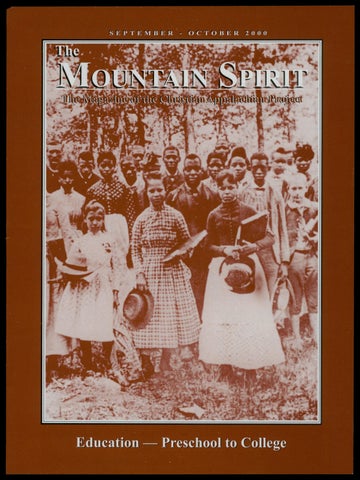
Cover: From its beginning in 1855, Berea College was committed to interracial education. This photo, taken in 1887, shows a portion o f the student body, which was served without discrimination. With the passage o f the Day Law in 1904, racial segregation was forced upon Berea and black students were not able to enroll again at the college until 1950.
D
e p a r t m e n t s
3
R a n d o m T h o u g h ts
10
A round the P roject
21
Letters
29
CAP Close-Up
You D on’t Have To Be Cool, page 16 Published by the Christian Appalachian Project E d it o r M a rg a r e t G a b r ie l G r a p h ic D e s ig n K a r e n F r a n c e s S p iv e y C ir c u la t io n L in d a G r i d e r E a s t A d v is o r y B o a r d : F a th e r R a lp h W . B e itin g , M ik e S anders. B e n P re w itt, B e c k y K an a
The Mountain Spirit is published six times a year. The annual subscription price is $8.00. Subscriptions and other correspondence should be sent to The Mountain Spirit, Christian Appalachian Project, 322 Crab Orchard Street, Lancaster, KY 40446. Copyright, 2000, The Christian Appalachian Project, Inc. All rights reserved. Member, Catholic Press Association. The Christian Appalachian Project is a non-profit Christian service organization operating throughout Appalachia. The project operates on the philosophy that helping people help themselves is the best approach to Appalachian poverty. The Christian Appalachian Project is recognized by the Internal Revenue Service as a 501(c)(3) charitable organization and is qualified to receive tax deductible contributions.
It is difficult to say which level of education is the most important. Surely, without early childhood Mike Sanders, development CAP President the love for learning which comes with good pre-school programs, there is a shaky foundation for elementary education. The need for challenging programs for youth and teens is not questioned. Programs during these crucial years of development give young people an opportunity to learn their own thought patterns and the chance to discover individual areas of excellence. And it is through the availabil ity of excellent higher education that people in Appalachia will compete on an equal footing with people in the rest of the country. This issue of The Mountain Spirit examines each of these areas of education, as well as areas in which the Christian Appalachian Project is making contributions. It is obvious that all phases of education fit together — one level builds on the last and any degree of excellence demands success on all levels. CAP realizes that a solid education is one of the most important opportunities that can be offered to the people of Appalachia. We’re proud of the contributions we’ve made in education and hope to be able to continue those contributions in the years to come. Enjoy! Mike Sanders
A summary of the registration and financial documents filed by this organization can be obtained by contacting: in Maryland, for the cost o f copies and postage, the Secretary o f State, State House, Annapolis, MD 21401; in Virginia, State Division o f Consumer Affairs, RO. Box 1163, Richmond, VA 23209; in Washington, residents can call the Secretary o f State toll-free within the state at 800-332-4483; in Mississippi, by calling the Secretary o f State’s office at 888-236-6167; IN NEW YORK, OFFICE OF THE ATTORNEY GENERAL, CHARITIES BUREAU, 120 BROADWAY, NEW YORK, NY 10271; IN NEW JERSEY, THE ATTORNEY GENERAL BY CALLING 973-504-6215; IN PENNSYLVANIA, DEPARTMENT OF STATE BY CALLING TOLL-FREE W ITHIN THE STATE, 800-732-0999; IN WEST VIRGINIA, SECRETARY OF STATE, STATE CAPITOL, CHARLESTON, WV 25305; IN FLORIDA, THE DIVISION OF CONSUMER SERVICES BY CALL TOLL-FREE W ITHIN THE STATE AT 800435-7352; IN NORTH CAROLINA, FINANCIAL INFORMATION AND A COPY OF THE LICENSE ARE AVAILABLE FROM THE STATE SOLICITATION LICENSING BRANCH W ITHIN THE STATE AT 1-888-830-4989 OR OUTSIDE THE STATE AT 919-807-2214; or by writing to Christian Appalachian Project, 322 Crab Orchard Street, Lancaster, KY 40446. Our license number in Michigan is MICS 9933. Registration with any o f the above government agencies does not imply endorsement by the state.
2
T
h e
M
o u n t a i n
S
p i r i t
R
A
N
D
O
M
T H O U G II T S B y M a r g a r e t G a b r ie l I ppalachia is a country filled with dichotomy. Land that is among the richest in the world in natural resources hosts some of the most distressed areas I___________ I in the United States. I remember standing on a mountain top in Leslie County. Facing one direction, I saw the beauty of the mountains, covered with trees, birds soaring majestically. I turned around and faced a strip mine that looked for all the world like a moonscape. Trucks rumbled past, intent on scraping away another layer of beauty to haul away the riches below the surface. Frequently, the beneficiaries of this wealth live far away from the mountains and care little about the devastation. Family is treasured in Eastern Kentucky, but too often, dysfunctional families are at the root of societal ills. When I think about education in Eastern Kentucky, I see a similar dichotomy. Some of the wisest people I’ve ever met show up in the statistics that say that adults in Kentucky are among the least educated people in the United States. As we’ve been working on this issue of The Mountain Spirit, I’ve seen the importance of all phases of education and how difficult it is to point to any one stage and anoint it as “the most important.” For many years, the Christian Appalachian Project has operated child development centers that have received national certification, a process that few centers even attempt. Women who have been involved with shaping CAP child development centers have moved on to work for groups that make suggestions and set policy on a state level. CAP firmly believes that influencing children at these earliest stages of development, even when they are infants and toddlers, reaps benefits for many years. We know also that it is equally important to continue to nurture young people as they begin and progress past elementary education. CAP youth and teen centers began as places for kids to congregate, enjoy each other’s company and maybe even work on a little homework. They were good places, as far as they went, but after a few years CAP began to recognize that youth and teen centers could be places of great influence and education.
E P T E M B E R
O c t o b e r
2 0 0 0
In the last few years teen centers, as well as Camp Andrew Jackson, have focused on teen leadership and become places where teens are given the guidance they need to shape their own values. Those values will shape the values of the region in the years to come. Today, the youth and teen programs are helping students to discover the importance of blending all phases of life — social, academic and spiritual — to become adults who will make a contribution to society. It is interesting to see how the lessons taught in CAP child development centers carry on to become the issues that are examined in the teen centers, as well. In their pre-school years, children are taught to be fair and caring and kind. Those simple lessons follow young people through the years and are often the focus of issues that are discussed in settings that deal with leadership. Who among us would want our leaders to be anything less than fair and caring and kind? In a desire to complete the education loop, CAP makes contributions to institutions of higher education in the mountains. In some cases, CAP has shared money. Others have been given expertise in matters of fund development. While CAP has had enormous success in helping adults to achieve literacy goals and then earn high school certification or even diplomas, without access to college and vocational school, people in Appalachia can never hope to have the same opportuni ties that are available in other parts of the country. In many of CAP’s programs, education plays a vital role in the work that is done and the goals that are accomplished. In some programs, such as child and family development, education is more traditional. In others, like youth and teen centers and camps, education is more incidental. Kids learn through their relationships to each other and from the experience of the staff and volunteers. For many people in Appalachia, education has not played an important role in life. In the past, it was possible to provide for a family with jobs that did not require skills beyond basic literacy. Those days are past in Appalachia, as they are everywhere, and the passing of those days will also see the passing of Appalachia’s dichotomy in education. Margaret Gabriel is the editor o f The Mountain Spirit.
3
•
Eastern Kentucky's Treasure
•
Private Colleges by Ike Adams
Berea College, 1887. From its beginning in 1855, Berea College emphasized its commitment to interracial education. This photo, taken in 1887, shows a portion o f the student body, which was served without dis crimination. With the passage o f the Day Law in 1904, racial segregation was forced upon Berea and black students were not able to enroll again at the college until 1950 (photo courtesy o f Berea Public Relations). a will to live based on nothing more than sheer determi nation. Their common mission is based on passionate belief that if the region were ever to grow and prosper the initiatives would have to originate within the hills. The history of the century has proved the soundness of that theory. Today if you visit almost any public school, hospital, professional service, business, factory or seat of government in Eastern Kentucky, southeastern Ohio, western Virginia or southeastern West Virginia you are likely to encounter the products of these little colleges. You will meet principals, teachers, doctors, nurses, social workers, accountants, entrepreneurs, attorneys, engineers, civic leaders and elected officials who began, and in most cases completed, their education at one of these five schools. Many will tell you that they would not have been able to attend college at all if not
The economic hardships measured in terms of income levels, joblessness and lack of opportunity are obvious in central Appalachia as are the hardships of impoverishment indicated by substandard housing, inadequate health care, poor nutrition and dismal levels of formal education. Things could be far worse, though, and no doubt would be, if not for a handful of small private colleges that have provided advanced educa tional opportunities to the region’s youth for more than a century. As a result, thousands of mountain youth have been become both leaders and effective servants to the land and people they love. This story introduces five little colleges that have struggled and persevered on the hillsides of small Eastern Kentucky communities since before or shortly after the turn of the 20th century. Their existence often mirrors the harshness of mountain life characterized by
4
T
h e
M
o u n t a i n
S
p i r i t
for opportunity given by his or her alma mater. All five schools began as philanthropic “missions ” — started by individuals or religious congre gations determined to do something about the chronic lack of educa tional opportunity for mountain young people. In the early days, travel into and out of the mountains meant walking or riding a horse. Transportation problems were compounded by a cultural value of wanting to stay close to home. Even if those issues had not existed, hardly any families had the finan cial wherewithal to pay for a college education. The colleges’ founders realized that if advanced education was to succeed for mountain folks it had to be community-based and affordable. Success would depend on sacrifice and hard work. The fact that these little colleges continue to serve and prosper are vivid testa ment to just that. As we enter the 21 st century, modem highways traverse the region and communication is easily accessible. Trips that required more than a day of travel as recently as the 1960s can now be made in two or three hours. State universities have established branch campuses in dozens of small towns throughout the region. Young people are more prone to leave home and seek both education and livelihood in other parts of the world. Yet the argument that small, private mountain colleges are more vital than ever is
Pikeville College
S e p t e m b e r
O c t o b e r
easy to make for one reason: Big universities prepare students to make their way in the world outside and are all too often a conduit for encouraging the best and brightest to do just that — leave. Eastern Kentucky’s small private colleges offer quality preparation for young people to stay at home, making home a better place in the process. The role is nothing short of vital.
PIKEVILLE COLLEGE Pikeville, Kentucky Berea College has five craft areas that
Pikeville College, the eastern employ anywhere from 100-200 most of the five colleges, is the first students, all o f whom will work 10-15 school we will visit largely because hours per week as participants in Berea s student labor program. it is the alma mater of this story’s author, and because Father Ralph churches in Louisville to raise Beiting, founder of the Christian money to construct a ten-room Appalachian Project, serves on its dormitory for female teachers and Board of Tmstees. Father Beiting students. A tradition of support received an Honorary Doctorate of from Presbyterian women from Divinity from the college at the across the country continues to this May 2000 commencement for his day. commitment to meeting the educa Hundreds of teachers in the Big tional, physical and spiritual needs Sandy Valley have been trained at of the people of Appalachia. Pikeville College but the school is Established in 1889 as the Pikeville Collegiate Institute by leaders of the Presbyterian Church, the school began with a two fold ambition: to bring both educational and spiritual development to a rugged and isolated area where Virginia, West Virginia and Ken tucky come together. There were neither schools nor churches in the area. Lucy Dodds moved to the region from Louisville and devoted herself to educating mountain youth. In the mid1890s, Miss Dobbs convinced groups of women at two Presbyterian Alice Lloyd
2 0 0 0
5
much more than a teachers’ college. In the early ’70s it instituted the region’s first and only school of mining technology, enabling hundreds of local students to train for sophisticated jobs, previously filled by people recruited from outside the region. Pikeville also provides respected pre-professional education for the medical, dental, veterinary science, divinity and legal professions. In 1997 it converted a neighbor ing hospital into an educational facility and opened the doors of the Pikeville College School of Osteopathic Medicine with a goal of annually graduating 60 physicians in order to improve the doctor-topatient ratio in the region. Currently there is only one doctor for every 1,400 people in the Eastern Ken tucky compared to a national average of one to 240. (CAP made an initial grant of $50,000 to help build a financial base for the medical school.) In exchange for the opportunity to study medicine close to home, students agree to devote a substantial portion of their professional practice to the moun tains. Enrollment in the undergraduate school averages 800 students per year while the medical school enrolls another 240. Pikeville College prides itself on providing a campus atmosphere best described as a “home away from home.” It encourages students and faculty to socialize and work together as a family. Most students and faculty are acquainted on a first name basis and class sizes are kept small to encourage personal interaction. In fact, the teacher/student ratio is an amazing one to fifteen. While the college focuses primarily on its surrounding geographic region, it currently enrolls students from more than 20 states. Many have received scholar ships from Presbyterian churches or have been influenced by parents or other alumni who value Pikeville College so greatly that they insist
6
there is no better post secondary college in the country. Many of these students come to get an education and wind up staying after gradua tion because they fell in love with the mountains or with a fellow student with an address of Virgie, Haysi, Grundy, Clintwood, Lenore, Johns Creek or Elkhom City. Pikeville College enters the new century with far brighter Students from Union College. hopes, ambitions and pros pects than it had in 1900. It is easy to wonder if Miss Dobbs envi According to archives at the sioned, when she managed to erect college, Miss Lloyd raised more that first ten-room building, an than $2.5 million by typing over institution that would one day cover 60,000 fundraising letters to folks most of a mountain and sit, like a who could afford to make a little crown, overlooking the region’s financial contribution to the college. most vibrant city. “Eastern Kentucky’s problems can
ALICE LLOYD COLLEGE
Pippa Passes, Kentucky
be solved if we teach them how to do it,” those letters said. She recruited teachers who worked for little or no pay and insisted that students perform the labor necessary to keep the college maintained and running. Living proof that almost anything can be accomplished if one works hard enough, Alice Lloyd instilled that value in her students.
In 1915 Alice Spencer Geddes Lloyd arrived in Knott County, Ky., disillusioned with life in Boston and determined to live where she could do the most good. She chose Knott County because only one person in 50 could read and write and only one person in the county had any college education. Within a few years Miss Lloyd was joined by June Buchanan who had learned of her work in the hills through a letter appealing for financial assis tance to carry out a school building program in Eastern Students from Alice Lloyd College. Kentucky. It is often said that the purest In her waning years she became form of philanthropy is to give not nearly obsessed with building a what you have but who you are, capital base that would keep the mind, body and soul. These women college going after her death. She did just that. Working with no would most likely have been utterly salary and traveling on the backs of dismayed to learn that the college mules, they started 100 elementary today bears her name, a change that schools within ten years and, in was made in 1980, seventeen years 1923, established Caney Creek after her death. Junior College, a facility to train Alice Lloyd is now a fullyteachers. accredited, four-year liberal arts
"he
M
o u n t a i n
S
p i r
i t
1500, Berea College is regarded by such presti gious publications as U.S News and World Report as the best liberal arts college in the south while others call it the best buy on education in America. It is a good buy because tuition is free of charge. Room, board and other Cumberland College expenses amount to over $4,000 per year but every student on quality are manufactured and sold by students to support the college. campus is required to work at least Boone Tavern is essentially run by 10 hours each week so most earn students and has a national reputa enough to pay most or all of those tion for excellence. There are more expenses. It’s also a good buy than 140 labor departments at the because members of the teaching college and if you call you will staff have impeccable academic almost certainly speak to a student credentials, often to the envy of before you speak to anyone else on much larger and more exclusive campus. institutions of higher education. Appalachia is the essence of Berea requires at least 80 percent Berea College although a walk of its students be from Kentucky or across campus reminds visitors of Southern Appalachia. All Berea miniature versions of Ivy League students come from low-income campuses on the East Coast. Strike families according to guidelines up a conversation with a group of established by the college; interna students, however, and the southern tional students and students from mountain connection is readily other states are enrolled to create apparent. Ask them what they diversity. intend to do with their lives and Hand-crafted items such as most will say they intend to finish brooms, pottery, wrought iron, grad school and then go home. wood furnishings and woven goods with a national reputation for MIKE BAGNOLI
college with an enrollment exceed ing 500 full-time students. The ivycovered campus almost looks as if the mountains were built around it instead of the other way around. Point to any building and a student is proud to tell stories about it. The ivy, for example, miles and miles of it, sprouted from a handful of shoots given to a group of students by President Herbert Hoover’s wife when they visited the White House in exchange for some forsythia that she planted there. Today every student at Alice Lloyd College is required to work at least ten hours each week as part of the curriculum; there is no tuition. As much as anything else, students learn the value of hard work. “The only time we give anything away around here is Christmas,” Miss Lloyd used to say. “The rest of the time you work for what you get.” In exchange for that work, students have less than $600 a year in out-of-pocket expenses at Alice Lloyd and most students are debtfree upon graduation. More than 40 percent of the school’s $9 million operating budget underwrites tuition. More than 70 percent of the students who finish college at Alice Lloyd stay in the region. “The leaders for Eastern Kentucky are here,” Miss Lloyd wrote in her letters. Indeed, they are.
BEREA COLLEGE Berea, Kentucky Located on the edge of the mountains where they meet the bluegrass, Berea College had a racially integrated student body well before the War Between the States and in fact, was founded by Rev. John Fee for the express purpose of providing educational opportunities to African-American students. Berea College continues its for ward-thinking mission. With a current enrollment of
S e p t e m b e r
O c t o b e r
Berea College s emphasis on teaching is considered a major contribution toward excellence in the College’s academic program. Dr. Pat Shugars, professor o f horticulture, is one o f approximately 20 Berea faculty members who has received the Seabury Award fo r Excellence in Teaching, the College s top faculty honor.
2 0 0 0
7
Union College
CUMBERLAND COLLEGE
Williamsburg, Kentucky Located near the Tennessee border in southeastern Kentucky, Cumberland College owes its foundation to a group of Baptist men who had little money but a lot of faith and courage. The college was chartered as Williamsburg Institute by the Kentucky legisla ture in 1888 and became Cumberland College in 1913. No one is quite sure how it happened, but as Cumberland College began bringing students from the most remote hills and hollows along the state line into the classroom, their zeal and aptitude for learning became readily apparent. The institution caught the attention of John D. Rockefeller and Andrew Carnegie and, in short order, its list of supporters began reading like Who s Who in America. Duncan Hines, William Jennings Bryan, Bing Crosby and Henry Clay Frick are among the famous people who have had significant relationships with the college over the years. Like most small colleges that have achieved success in the mountains, Cumberland empha sizes developing and nurturing a strong work ethic. The college does not require that students work campus jobs, but tuition, room and board are frequently earned or supplemented by students. The
sprawling campus grounds and buildings are kept immaculate by student labor. Cumberland’s mission is simple: to provide outstanding academic opportunities under financial conditions affordable to mountain families and to help students maximize their leadership potential. In fact, it requires completion of several courses focused on personal leadership development. The effort has paid off. Cumberland College alumni include two governors, five military generals, a member of Congress, local elected officials too numerous to count, ministers, missionaries, state legislators, judges, a host of physicians and attorneys, and several thousand teachers. In addition to liberal arts majors in 27 subject areas, Cumberland offers pre-professional training in law, medicine, pharmacy, dentistry, nursing and engineering.
UNION COLLEGE Barbourville, Kentucky Union College was founded by the community of Barbourville in 1879 with financial and development assistance from the United Methodist Church at a time when simple survival, not higher education, was the top priority of most of the country. It selected its name because every single adult in the community declared him or herself united in the effort to establish a local college. Today the campus covers 100 gently rolling acres covered with huge elms, mountain laurel and Georgian architecture. It enrolls 600 full-time undergraduates and almost 300 graduate students from 23 states and several foreign countries. The college has no specific geographic focus but focuses on providing a demanding and wellregarded academic program for students all across the country. It is a member, with the states’ larger universities, of the Kentucky Institute for International Studies
T
h e
M
Berea College Public Relations CPO 2316 Berea, KY 40404 http://www.berea.edu Alice Lloyd College Public Relations 100 Purpose Road Pippa Passses, KY 41844 http://www.alc.edu Pikeville College Public Relations 214 Sycamore Street Pikeville, KY 41501 www.pc.edu Cumberland College Public Relations 7791 College Station Drive Williamsburg, KY 40769 http://cumber.edu Union College Public Relations 310 College Street Barbourville, KY 40906 www.union.edu through which students study in France, Spain, Mexico, Germany, Austria, Italy and Ecuador. Tuition isn’t cheap compared to other schools. Total expenses at Union amount to about $ 16,000 per academic year. However more than 89 percent of the student body receives some financial assistance and a significant number of students qualify for full scholarships. Students come to Union from all over the world for the single purpose of getting a superior college educa tion. The college offers Bachelor of Arts, Bachelor of Science and Bachelor of Music degrees in a broad range of disciplines. Ike Adams graduated from Pikeville College in 1971 with a BA in English, though he says no one would be aware o f that if they engage him in casual conversation for any length o f time.
o u n t a i n
S
p i r i t
A
r
T he
o
u
n
d
P r o je c t
CAP To Become An EDP Provider Manager Bill Tussey expects that 35 people will receive a General Equivalency Diploma when the Christian Appala chian Project hosts a graduation ceremony on September 28 at the Irene Cole Memo rial Baptist Church in Prestonsburg. Pictured is a graduating class o f adult learners at Eagle in McCreary County. CAP annually hosts Bill has invited Dr. graduation ceremonies fo r students in the Lincoln/Garrard, Rockcastle, Floyd and McCreary Karen Kimsey to county adult education programs. give the graduation address. student where the trouble areas are teacher in Magoffin County, is Dr. Kimsey, a and help determine strategies that taking referrals for students from physician practicing at the June might help.” A personal learning City Hall, the fire department and Buchanan Clinic in Hindman, Ky., the Mayo Vocational School. Young plan helps the student determine was at one time an actor who which strategies to use, Bill said. people enrolled in Mayo who run played small roles on daytime soap The program is also offering help afoul of the law are often assigned operas, Bill said. “She realized that to students interested in obtaining a to complete a GED with Sylvia, career wasn’t getting her anywhere, high school diploma, rather than a Bill said. Firefighters that have and decided to go to medical GED, Bill said. “The External attained a GED have received school,” he said. “We’ve asked her Diploma Program is based on to talk to the students about the promotions and pay raises; the competencies that people must county then receives more funding motivation to make a career acquire and is often more suitable for the department because of a change.” for people who are better at applied successful continuing education The adult education program performance than something that’s based in Salyersville is branching program. reading-based.” “We’re really making an impact out in a number of directions, Bill The EDP still requires the basic in Magoffin County,” Bill said. said, and will be adding a teacher knowledge of reading and math, but The Historical Center in in Knott County in the coming year. requires students to complete 65 CAP began working in Knott Wayland, in nearby Floyd County competencies such as registering to has asked the CAP adult education County several years ago in vote, finding a job and obtaining a program to conduct classes in its response to a high number of library card. When all the compe Kentucky Temporary Assistance center, which also has access to a tencies are acquired with 100 computer lab. Program recipients, people who are percent accuracy, the student is One of their most valuable tools, in need of welfare-to-work training awarded diploma from a local high Bill said, has been the implementa programs. “We had a request to go school, Bill said. to Kingdom Come,” said assistant tion of Power Path, a test which “I’d like to see CAP become an director Sandi Knight. “But the enables teachers to discover EDP provider,” Bill said. “When it’s students’ learning difficulties. community was really too remote.” in place, it will give options to When a student has a hard time CAP human services workers are students. They can choose what’s raising his or her scores, the test is considering locations that are more best for them and we’ll be able to administered to determine visual, populated, in order to serve more meet the needs of more people than auditory or perceptual problems. people, Sandi said. ever before.” “We take the information, tell the Sylvia Robinette, the CAP
S e p t e m b e r
O c t o b e r
2 0 0 0
9
A
r
T he
o
u
n
d
P r o jec t
CAP to Collaborate on CDC in Annville The Christian Appalachian Project human services department is participating in the planning process for a child and family development center which will be a collaborative effort between, several groups in Jackson County, according to assistant director Jean Barnes. The program will operate at the Industrial Development Park near Annville in Jackson County to serve the day care needs of its workers. “This won’t be CAP’s program,” Collaborators in the Annville Child and Family Development Center accept said Jean. “CAP will manage the a grant from the USDA. L-R, Jerry Rickett,Kentucky Highlands; Mitchell Ball, JCR Industries; Gene Hensley, JC Industrial Authority; Mary Perky, facility for a period of time and then, JC EZ Community; Ken Arteburn, USDA;Louise Parman, Vision 2000; Maria hopefully, the program will be turned Matthews, USDA; Jennifer Eitel, JC EZ Community; Tom Fern, USDA; over to the community.” Tommy Slone Jackson County C ounty Judge/Executive, Jean Barnes, CAP As the program has been develop Assistant Director, Clyde Phillips,Phillips Diversified Manufacturing. ing, CAP has collaborated with area businesses as well as Head Start and Agriculture. Operating costs will be of curriculum that will serve as pre the East Kentucky Child Care shared by CAP, Head Start and the school for three-, four- and five-year Coalition. A child care sub-commit industries located at the Industrial old children. Maximum enrollment, tee of the Jackson County Vision Park. Because the cost of quality child Jean said, will be 20 three- to five2000 Committee conducted a local care is often unmanageable for year-olds, ten toddlers and ten infants. survey and needs assessment which families, CAP will participate in the “But we’ll have to work up to that.” indicated a need for dependable child state child care subsidy that was With the increasing demand for care for working parents of children recently made available through mothers of young children to join the from birth to age five. Many parents welfare reform initiatives. Co-payments workforce, CAP is returning to the day currently depend on grandparents, from parents will make up another care programming it operated several aunts and uncles, Jean said. “While share of operating costs, Jean said. years ago. The need for both day care everyone wants to be able to turn to Recognizing the need for child and child development is the reason family, they’re not always depend development activities as well as day CAP is making a change to meet that able. What if Mom gets sick? That’s care, the center will have three hours need. when you see people missing work,” Jean said. Local family resource centers (which are part of the county The Attic, CAP’s used clothing learned that families threw clothing school system), the Lexington Child store in Berea, offered a 50 percent away and came back for more rather Care Council and Head Start added to discount to school readiness than washing it, she began to charge the assessment so that the sub participants, according to store a nickel or a dime for each item, committee had a complete picture of manager J.C. Adams. Some of the according to what the family could all the child care services in Jackson families used the discount to afford. Doris’ system also gave County. purchase additional school clothes families the pride of providing for The Annville Child and Family for students; others purchased themselves, rather than accepting Development Center will also work clothing for adults and toddlers. charity. the shifts needed by people who work Most of the items in the Berea Then, as now, though, families in at Mid-South Electronics, Phillips Attic are sold at nominal prices, a crisis, such as those who have lost Diversified Manufacturing and the tradition that has held fast since the their home to fire, are offered Jackson County Rehabilitation store had its start in the late 1950s. materials at no cost. During the Industries. At first, items were given to current year, the Attic has distributed The center has applied for and needy families in Berea and the nearly $21,000 in vouchers to CAP received a “brick and mortar” grant surrounding areas. But when Doris programs and over $6,000 to nonfrom the United States Department of Anglin, the store’s first manager, CAP programs, J.C. said.
CAP Attic Offers Discount
T
h e
M
o u n t a i n
S
p i r i t
A
R O U N D
T he
P r o je c t
CAP Students Recognized for Writing Excellence Hills’ to receive First Prize in the non-fiction prose division. Con gratulations on achieving this formal recognition of your craft as a writer.” The summer issue of Appalachian Heritage announced the winners of the awards, and published Tony’s collection of essays. “School Days” is a poignant recollection of growing up in Rockcastle County. “I know we all talk about the good old days but to tell the truth they are not all good old days . . . I can remember people coming to our school to put on shows. The kids that did not have the quarter or fifty cents admission would have to stay behind in the room while the others went to see the play . . . I remember feeling ashamed that I could not go . . . If we did not have tennis shoes to put Tony Smith, left, with CAP adult education on when we got [to the teacher Keith Gilbertson. gymnasium] the coach would make us take our shoes off fiction essays that describe his life and do exercises in our sock feet. growing up in the mountains of When the exercises were done we Rockcastle County. Realizing the could not kick the ball very hard clarity and power of Tony’s because it would hurt our toes. writing, Keith began to pass the Because we couldn’t kick the ball essays to his reading students, hard, nobody wanted us on their knowing that they would relate team . . . I can remember at recess much more readily to Tony’s work they would sell popcorn and Coke. than to traditional beginners’ The popcorn was dime a bag and reading texts. the Coke was a dime, too. But to me In June of this year, Tony it might as well have been a received a letter from James Gage, the editor of Appalachian Heritage, hundred dollars because I didn’t have them two dimes.” a literary magazine published by Motivated by Tony’s writing, G.P. Berea College. In part, the letter Pearson has been participating in read: “The judges for the 1999 workplace instructional opportuni Denny C. Plattner Appalachian ties at his workplace, NAACO Heritage Awards for excellence in Materials Handling Group, which writing have selected ‘These Old
The September-October 1999 issue of The Mountain Spirit featured a story about Tony Smith, one of Keith Gilbertson’s adult education students. The story told of Tony’s efforts as a writer of non
S e p t e m b e r
O c t o b e r
2 0 0 0
manufactures forklifts. The employee newsletter recently published an essay by G.P entitled “Common Sense in Education.” G.P, whose essay, “Memory Lane,” was featured in the Septem ber-October issue of The Mountain Spirit wrote, “I have been here 24 years and they have never asked me to do anything on the line I couldn’t do with a little common sense. When it came to filling out paper I just had to sit there. I’ve learned right smart since I have started class. I’ve picked up how to read a lot of the work instructions on the line . . . ” His employer went on to con gratulate G.P. for taking advantage of the opportunity to advance his education. “G.P. is living proof that with the right ‘tools’ and a little cultivation it is never too late, nor are we ever too old, to reap a bountiful harvest when it comes to developing our mind!” The CAP Adult Education program congratulates both Tony and G.P. for their recognition and encourages them to continue reading, writing and learning.
Is there a CAP program that you don’t see in this issue of The Mountain Spirit? CAP’S web site includes information about all of CAP’S human service programs, planned giving and major gifts and the volunteer program. Please visit the site at www.chrisapp.org and be sure to sign our guest book!
11
A
R O U N D
T he
P r o je c t
ADA Torch Relay In May 2000, the Christian Appalachian Project resources for Independence in Community and Employment (CAPRICE) became a local affiliate of the Americans with Disabilities Act Action Network of Kentucky. CAPRICE is one of 12 local affiliates, which includes representatives of state and local agencies, organizations, and councils such as the Murray chapter of the National Federation of the Blind of Kentucky; the Bardstown chapter of the National Organization on Disability, the Northern Ken tucky Disabilities Coalition Center for Independent Living and the Pathfinders Center for Independent Living in Harlan County. These groups, as well as others, are keenly interested in keeping the ADA alive in Kentucky. “Being recognized as an affiliate is an honor,” said program manager Gloria Jordan. “ It gives us more opportunity to be advocates and to teach others to be advocates of the Americans with Disabilities Act.”
As a part of the ADA Action Network, CAPRICE and all the local affiliates work under the guidance of the state ADA coordi nator Pamela Wallace to encourage organizations and businesses to voluntarily comply with and implement accessibility for people with disabilities. This is accom Brian, Monica and Cameron Anderson carry plished through the dissemination the ADA torch in the Corbin event. They of accurate materials, training, participate in Parents Are Teachers, CAP s public awareness and hosting early intervention program fo r pre-schoolers special events. with disabilities. CAPRICE is hosting two events in its role as a local affiliate. The people with disabilities. first was the passing of the ADA CAPRICE’S second event is its Independence Torch on July 18 in eighth annual parents retreat, where Corbin and Whitley City. The ADA parents and care providers will Torch Relay began June 11, with receive training on issues involving ADA and IDEA (Individuals with Section 504 of IDEA, which ad Disabilities Education Act) groups dresses the rights of children with in various cities celebrating the disabilities to education. The tenth anniversary of the ADA, intended outcome of the retreat, which was signed into law by Gloria said, is to help families President George Bush on July 26, become more informed, better 1990. The relay is intended to advocates and to be active team heighten awareness and educate members in planning their children’s others about the issues affecting education and future.
CAP Donor Supplies Home Repair Materials Pat Montgomergy, a Christian Appalachian Project supporter in Louisville, Ky., calls herself a “pack rat.” Several months ago she was remodeling her kitchen cabinets and noticed that they still had good wear left in them. “I couldn’t stand the thought of throwing them away,” Pat said. “It was against my nature.” So Pat called CAP, said she had a load of gently used home remodel ing materials to donate, and asked if they could be used. Indeed they could, and she was asked to bring materials to the Operation Sharing warehouse in Corbin. A week later Pat received a call asking if more materials would be available. Johnny Thompson, manager of Operation Sharing, says that used, although still servicable, home repair materials are valuable both to
12
CAP and other organizations that use Operation Sharing materials. “Cabinets are always great, because they give such a good finish. It’s good to think in terms of usefulness, and [cabinets] can be very expen sive. Lighting fixtures, too, are things we like to receive.” The remodeler who had worked for Pat, the president of the Louis ville Remodelers Association, has put her in touch with other remodelers who have material to share. A second truckload has been delivered to Corbin, and a third is almost ready to be sent. “We’re fulfilling four things,” Pat said. “First, we’re recycling. Second, we saving things from going to the dump. Third, we’re providing usable products, and fourth, we’re saving remodelers
T
h e
M
money because they have to pay to have things hauled away. I can really see this growing into some thing like Kentucky Harvest,” she said, referring to a food salvage program that began in Louisville, and has taken on national dimen sions. “This is an easy way to help, and it’s fun.” Pat and her family learned about CAP in the 1960s when she read a story about street preaching in the local newspaper, and then Father Beiting spoke at her parish, St. Agnes. “We really like the work that was going on. He and CAP just go to show you what one person can do.” For more information about beginning a remodeling salvage program, Pat has invited people to call her at (502) 451-6470.
o u n t
a i n
S
p i r i t
A
r
T he
o
u
n
d
P r o je c t
WORKPLACE PAYROLL DEDUCTION
Volunteer Garrett Feliciano, right, enjoys water activities with adult Rainbow Respite participants at a recent camping trip.
Rainbow Respite To Increase Services Since its founding in the late 1980s, the Rainbow Respite Care Center has concentrated services on caring for both adults and children with disabilities at the Christian Appalachian Project’s Family Life Center in Renfro Valley. Currently, however, the center is concentrating on expanding the services it offers to families with members with disabilities in their homes, accord ing to manager Carolyn Lindsey. In-home service had formerly focused on providing six hours of care for a participant. “Usually, we take people out,” Carolyn said. “Barb [Rector] can take people from three families at one time.” Adults, she said, enjoy shopping trips and eating out while children favor visiting a park, a bowling alley or a skating rink, the Finley Fun Center in London, Ky. At Finley, Carolyn said, it’s not at all unusual to see a Rainbow Respite kid on the skating floor in a wheel chair, participating in the games. There is always a staffer in atten dance (some wearing skates, some not, Carolyn said). “It’s really good for the kids,” she said. “Usually, it’s something their parents didn’t think they could do.”
S e p t e m b e r
O c t o b e r
The in-center respite program provides care for a week at a time, alternating weeks for adult men, adult women and children. Expansion of services will see participants at the center for briefer periods — days or weekends, Carolyn said. “We’d also like to offer field trips, with the center as a starting point, and we’d like to take the whole family.” Field trips will include such activities as movies and bowling. Some of the respite families lack the resources needed for such outings. Others have the money but don’t believe that their disabled member is capable of participating. “We’ll also use the trips as a way to connect families and let them socialize together,” Carolyn said. Carolyn hopes that the short-term trips to the center will encourage families to take advantage of the week-long program and that the center staff will become better acquainted with the folks who participate in the in-home program. “Barb is videotaping some of the people she cares for in their homes. We look at the videos in staff meeting, so staff gets to know some of her people before they come to the center.”
2 0 0 0
If your employer offers donor designation as a write-in for payroll deduction campaign, please remember the Christian Appalachian Project. C A P is a 501(c)(3) tax exempt agency, and payroll deduction is the easiest way to help the families of Appalachia. To ensure that we receive your payroll deduction gifts, please give your payroll officer C A P ’S full address and send to the attention of: Teresa McAnly-Campaign Coordinator
Christian Appalachian Project 322 Crab Orchard Street Lancaster, KY 40446
Currently, Barb has 15 families who receive in-home respite services, with ten on a waiting list. About a half dozen of them also use the in-center services of the pro gram, Carolyn said. While families often begin their participation with Rainbow Respite programs as a short-term answer to the stress of dealing with a family member with a disability, workers help families to look at the long term issues involved. “We encourage personal futures planning,” Carolyn said, referring to plans that, among other things, help families to determine the situation when parents pass away, or are no longer able to provide care. “It’s hard for people to get to a point that they’re able to plan — sometimes it’s hard for people to accept the inevitable.” Willard and Debra McQueen were misidentified in the July-August issue of The Mountain Spirit. They appeared in a photo with Kathryn Oberg who was explaining CAPs repayment require ment of a third of the cost of materials.
13
CAP'S Schoo adiness Program Gives Children Encouragement And Back-To-School Basics On June 8,1989, Kentucky’s public school system was declared deficient and unconstitutional. By spring of the following year, the state was required to completely re-create the institution of public education. Over the last ten years, Kentucky schools have seen the implementation of writing portfolios, ungraded primaries, achievement tests and family resource centers. All of these teaching and learning methods are considered to be ways in which children learn successfully and prepare themselves for the next level of education and, eventually, for adulthood. Even before the implementation of the Kentucky Education Reform Act, public education began to move toward becoming more egalitarian. No longer does one hear of incidents like those that Tony Smith remembers (see page 11) about poor students being excluded from activities because of a lack of money. As one might imagine, though, children who come from low income families still keenly feel the sting of starting school in old clothes and lacking the supplies needed to begin the new school year. In 1997, Christian Appala
14
chian Project outreach initiated a program that provided students materials to start the school year. That first year, 821 students were provided school supplies, shoes, clothing, grooming items, haircuts, “anything that would eliminate a barrier and make starting school a positive experience,” according to Peggy Hancock, manager of CAP outreach at that time. The success of the initial year of the school readiness program prompted CAP to repeat the program in following years. In 2000, nearly 2200 students in thirteen counties are participating,
T
h e
M
according to human services assistant director Garry Vickers. In several counties, the students are not only children, but adults who are participating in CAP’s “Partners Program” and are attending college or vocational school. Everyone — children and adults alike — will begin school with the supplies they need, as well as new clothing. Outreach workers assume, and hear from parents, that the materials make the playing level more even, giving needy children a boost, a hand up to success in the classroom. As CAP goes into its fourth year
o u n t a i n
S
p i r i t
family, based on the of sponsorship of the program, an outcome model has been developed, sizes and styles re quested. Now, transpor one that should estimate the actual tation has been supplied value of the program. Since the first with CAP vehicles to pairs of shoes were distributed, families who are unable caseworkers report that both children to travel to Berea. The and their parents thank them time current method has and again for the notebooks, new been received with clothes and backpacks that make approval from both needy students feel that they fit in just a little better. CAP hopes that the caseworkers and Brenda Watts, coordinator o f CAP s Christmas Basket outcome model will give a means of families. Robyn said that many program, helps a young man select a new pair o f jeans. more accurate measurement. Outcome models, Garry explained, of the children they in the program for the first time in serve don’t have the opportunity to require a close examination of a 2000. The initial survey will ask shop because their parents lack the program, and a determination of about a student’s attendance and needed money. Because of the way where the program is and where it grades from the last school year. At workers have arranged the school wants to be. After some discussion the end of the year, CAP will ask readiness goods, many think they’re between Garry and outreach case those families to report on the coming into a regular store. “When workers, the school readiness changes in both attendance and you see the faces of the kids who outcome model has just two points. grades and determine what, if any, are picking out new shoes, you just First is an initial outcome. Through impact was made by the school know they’re feeling good about distribution of new school clothes readiness program. going to school,” she said. and supplies, CAP would like “We’re not confident to say that Sharyl Trail is the caseworker for students to indicate a positive as a result of being in the school CAP outreach in Owsley County. attitude about attending school and readiness program they’re [improv “In our western culture, we’re very for parents to report a reduction in ing their school performance], but materialistic, and part of that culture financial stress on the family budget. we want to be able to measure those is the importance of new clothes for Outreach manager Robyn Renner results,” Garry said. the first day of school. I can realizes that one new outfit and some Garry, CAP outreach workers and remember when I was a kid, laying school supplies is not going to others in human services would also all of the school clothes out on the necessarily translate into better like to measure interest in training bed and trying things on 15 times grades, but new things that first day programs, which would educate until it was just right. For the rest of is a boost. “At least they don’t have parents in ways that they can the year, kids in our program will to worry that first day about some become more successful partners in probably be wearing things that body making fun of them because of their children’s learning. come from yard sales or The Attic, their clothes.” “Making tutors available to Families from McCreary, Garrard, but for that first day of school, children might also be a possibility they’re cutting the tags off clothes, Rockcastle, Jackson, Owsley, Clay to improve school success,” he said. knowing that nobody else has worn and southern Madison counties have “I’m not ready to give up on the these things before. If nothing else, been invited to come to a large room notion that enabling a child to feel it’s going to improve their self adjacent to CAP’s used clothing like they fit in via new cloths or esteem.” store in Berea. There, families can other opportunities has little or no Because fewer families are select their outfits from materials that impact on performance. The idea outreach workers have purchased at involved, those in Johnson, that people who feel good about area K-Marts, which give CAP a ten Lawrence, Floyd, Knott, Magoffin themselves produce good results is percent discount on the clothing and and Martin counties are invited to a popular motivation philosophy in shop at a local department store supplies purchased for the school the world of management, and I with a voucher, according to readiness program. The selection think it has some validity.” But program manager Russ Taylor. process assures that the clothes fit, and gives children the opportunity to “People are pretty conservative with Garry also believes that CAP has a responsibility to measure the those vouchers,” Russ said. “They select something they really like. attitude that “Making them feel buy as much as they possibly can “And it’s fun,” Robyn said. “The good about being AT school will kids really get a kick out of coming.” with them.” also make it possible for them to do Garry plans to survey 20 percent In the past, school readiness well IN school.” of the families who are participating materials were packaged for each
S
e
p
t
e
m
b
e
r
O
c
t
o
b
e
r
2 0 0 0
15
It’s Thursday at Camp Andrew Jackson. While it rains outside, teens with wet hair are sprawled across the floor of the building called “Old Hickory” eating peanut and butter and jelly sandwiches. After three days of hiking, swimming and sharing their stories, they don’t seem to mind staying inside to play cards, watch a video or try some games. Maybe they are so relaxed because they have learned part of what the counselors are trying to teach them. By joking around and acting silly, the counselors let the campers know
- $fe>ry 16
this is a place where they can just be who they are and be accepted. Matt Douglas, one of the Teen Leadership Camp organizers, says of the week-long experience, “It’s about Thursday before they figure out they don’t have to be cool at AJ.” That philosophy is part of the spirit that makes CAP’s youth programming unique. Walk into summer camp or a teen center to chat with participants, volunteers or staff members and you get the same
jdi&f&g^
and T
h e
whether you’re in Louisa, Mount Vernon or elsewhere. This is a place where kids can be kids, with the flaws, problems, giftedness and joys they bring. Want to talk? We’ll listen. Want to joke around? We’ll laugh with you. Want to learn something? There’s plenty here for all of us to learn. Just bring yourself and we’ll go from there. CAP’s programming for teens
M
o u n t a i n
6n S
p i r i t
Building “lake-worthy” rafts is a teamwork exercise at Camp Andrew Jackson.
and youths includes overnight camps at AJ, Camp Shawnee and Boone’s Landing, and day camps in Rockcastle and Lawrence counties. There are also the teen centers that provide activities all year, as well as educational programs that are based in the camps but typically take place in local schools. In each of these programs, there are plenty of moments for lessons and laughter, but there are also opportunities to listen. That is one of the main goals of CAP’s work with young people — give them someone who will hear what they say, someone who will model love and trust as young people are shown how to make good decisions and build a life that brings them closer to God.
times forget to do. Owen remem bers one child who had been placed in foster care before arriving at camp. The camper was unhappy about the new home. He really wanted to live with his grand mother, but because no one had asked the child where he wanted to live, they hadn’t considered his grandmother’s home. When CAP intervened to pass on the child’s desire, his placement was changed and he was able to live where he wanted. Perhaps camp counselors are in an especially good position to listen
to young people because most of them are in their late teens or early 20s themselves, not so far from childhood that they have forgotten some of its anxieties. Katie Leischer, a college student from Medford, Wisconsin, was a first-year Camp AJ volunteer this summer. She noticed early on that a lot of the campers at the Teen Leadership Camp (which AJ hosts for two weeks) wondered why counselors wanted to volunteer at AJ rather than get a paying job somewhere else. When they asked, Katie told them, “We leam more from you than you could ever imagine, and we love you.” It’s that love that Katie hopes the campers will remember when they return home. She has heard some of their stories of heartaches caused by broken families. “If they see that we love them,” she said, “maybe they can carry that love back and form more loving relationships.”
Learning to listen “We, as adults, sometimes dismiss kids’ troubles,” said Owen Wright, the Camp Shawnee program manager who has also worked with a CAP teen program and has three children of his own. He believes that regardless of the kind of home a child comes from, he or she can benefit from having people around who realize their problems are just as real as adult issues. That realization leads to listening, something adults some
S
e
p
t
e
m
b
e
r
O c t o b e r
Joe Brnnnen and Lauri Eiselt combine fo r seventeen years o f service at Camp Andrew Jackson.
2 0 0 0
17
overcome evil They listened to me and helped me with good,” through it,” Carolyn said. As a Jeff said. So result, things were better during the that’s what he school year. “I didn’t have as much tried to do. hate towards him so when I go to Becky his house on weekends I can get Deichman, an along better with him and I don’t eighth-grader hold grudges against him, so I can from Madison be more open to him.” County, said Some of these lessons are the she has same things that the camps are learned things trying to teach during the school Owen Wright, left, manager o f Camp Shawnee, has a special at camp that year with their educational outreach love fo r Kentucky history. He plans an annual history camp at help her see the facility in Floyd County. program. Camp AJ’s success with the world in a Matt, who has also worked with this education program has inspired different way. “I learned a lot about young people in schools through Owen Wright at Camp Shawnee to how not to follow the patterns of Camp AJ’s school-year educational model a similar effort. He said it this world,” Becky said. For program, is counting on the puts the camp staff in touch with example, some people like to get campers also learning a kind of self young people during a time of the into fights just to show off. She tries year when they weren’t seeing any love. “I hope they’ll have more to avoid that. pride in themselves, more selfyouths. “Follow what you believe and worth. Then, all other things will The lessons the Camp Shawnee don’t be like everyone else,” Becky fall into place, like self-control. If staff takes into the schools are: said. And if she needs to avoid a you have pride in yourself then Reach out and respect; We can work fight, her you’re not going to let someone strategy is to take advantage of you, so you’ll “Think of what have more self-control, or you God wants me won’t go out and do something to do and what stupid.” my parents Indeed, campers who have want me to do returned to AJ year after year have about this and learned some of what the counselors the conse hoped for. Although Teen Leader quences that ship Camp tries to help young might come people recognize their leadership and teamwork skills and encourages from this.” them to use these skills in their own Carolyn Spugnardi, a communities, the camp experience tenth-grader also has helped some of them come from Madison to terms with personal and family County, is issues. another Jeff King is a ninth-grader from Jackson County who participated in leadership participant with leadership camp, after having previous attended traditional camp at AJ experience at when he was younger. “I think it camp. She said (camp) helps you grow spiritually that during her and it helps you grow as a person, last year at to become more mature,” Jeff said. camp, she During the school year, Jeff said, learned how to he might have made some different forgive her decisions if he had not learned lessons at camp. For example, when father. “The he was in a situation where he really counselors Trish Joseph guides a camper through a leadership activity wanted to take revenge on someone, were really at Camp Shawnee. good to me. he didn’t do it. “The Bible says to
18
T
h e
M
o u n t a i n
S
p i r i t
it out; The best is yet to be. Each program begins with one class, then is followed with two or three more lessons on the same topic. The staff uses hands-on activities and games to involve the students. Many of these same lessons are evident in different ways throughout the weeks of summer camp. In addition to traditional camp, Camp Shawnee also hosts camps that focus on computer training, history, sports, health, environment and leadership. During these special camps, children spend an hour and a half a day working on their specific focus for the week like working on the computer. History camp participants also took trips to local historical sites and participated in living history events. Regardless of the particular activities that are going on, Owen said about Camp Shawnee, “It’s where a camper can be a kid.” Owen said that some of the children come from families where there is not much trust and love. “There are several of them who we have seen who say this is the best week of the year.” Besides listening to the young campers, the volunteer counselors work hard to make the week carefree. Joe Oubre, a retiree from Louisiana who spent his second summer volunteering at Camp Shawnee, said he thinks what is important about camp is “Letting them know there are things in this world where they can just have fun.” So he’s big on giving out chewing gum and getting the kids wet on boat rides. Brian Valyko volunteered at Camp Shawnee last summer but only had a few days off work in North Carolina to give this summer. Even if just for a couple of days, he had to volunteer because it is such a rejuvenating experience for him. “I almost can’t believe we don’t have to pay to do this,” he said. But it isn’t always 100 percent fun for the counselors. Katie Leischer recalls that during camp
S e p t e m b e r
O c t o b e r
Although some leaderships camp participants are new to Camps Andrew Jackson and Shawnee, others have attended camp since they were seven or eight years old, and some serve as junior counselors to younger children.
orientation, the counselors had to build a raft in two hours with tarp, bailing twine and whatever they could find around the camp site. It’s the same activity in which they would be guiding the leadership camp participants. “We were all fighting it. We didn’t want to do it,” Katie recalled. “But they did it and afterwards we couldn’t get them out of the water,” Matt said, grinning. That’s the kind of experience that can help the counselors relate to the campers. “We’re telling them that it takes hard work. We’re encouraging them to keep going, to work together, to keep trying and we need to learn that, too,” Katie said. As the counselors learn, the campers are watching them closely. Becky Deichman said her role models are not people she has seen on television, but rather, they are counselors she has met at camp. She believes a role model is someone who is respecting, kind, trustworthy, follows God and helps people out.
Leading youth to Christ As the counselors encourage the campers, play practical jokes and listen to their stories, the impression they leave transcends what some of
2 0 0 0
these young people might have heard about people of other reli gions. Jeff said he has learned that it doesn’t matter what your religion is because it’s not about how people worship, but that everyone believes in God.” Glenna Martin, manager of the Rockcastle County Teen Center and day camp, addresses the topic of religion when she is orienting new volunteers and staff to day camp. She’s aware that some of the campers come from homes where their parents tell them they shouldn’t listen to what anyone has to say about religion unless they are from their own denomination. Glenna’s response is, “We’re not teaching you our faith. We’re teaching you the faith of Christ.” She has also told staffers and campers, “There are all kinds of beliefs in the world, but we’re all God’s children.” Day campers participate in three Bible lessons a day, an increase from the past year that they seem to enjoy. They have been focusing on what God has given us and what we give to God in return. Glenna said a group might go on a nature walk and when they return, they put things into a bucket that God has given them, like flowers, sticks and
19
program a teen Bible of their own. Although Glenna isn’t sure where this “spiritual walk” will lead, she says she is putting it in God’s hands. It seems you can’t avoid God in these youth programs. Former volunteer Lauri Eiselt first volunteered at Camp AJ when she was 22 years old. Now, 10 years later, she’s managing the summer camp with Computer camps are some o f the most popular specialty camps. Equipment fo r the Camp another former volunteer, Shawnee computer camp was furnished by Prestonsburg Community College; at Camp Joe Brannen. She said she Andrew Jackson, by the Center fo r Rural Development in Somerset. has returned so many times because, “There is just a spirit values or your preacher’s values, rocks. There’s also another bucket that’s here . . . God lives here.” Joe in which they can put something for but your values. Twenty-six teens said they were up for the challenge. agrees. “Once you get it once, you God. She has seen crafts and Thus the emphasis on spirituality want it back again and you want to pictures in the bucket, but has also give it back.” Being with the heard some campers say they didn’t began. The group made trips to campers, Joe said, “It’s a Godly have anything to give. “Why can’t Springfield, Ky., to help build a exchange, almost, of gifts, of oppor chapel at Our Lady of Valley Hill. you just smile into the bucket?” tunity.” That exchange is possible Glenna gave the teens journals to Glenna suggested. throughout CAP’s youth programs start writing about what makes Helping young people make because of the spirit of love and them angry, happy, and everything intangible concepts of faith and in between. She hopes the walk will acceptance that the staffs create. spirituality something real in their Glenna’s belief about the teen center lives seems to be a new direction help them find themselves, and she in Rockcastle County holds true for hopes it will direct them toward for some of CAP’S work with other programs. “I think we give Christ. If it’s financially possible, youths, like Glenna’s work at the them (the teens) a place to come and she wants to give the teens who Teen Center in Rockcastle County. we don’t judge them.” participate consistently in the During the past year, Glenna felt God calling her to do something spiritual at the teen center and she has turned that calling into what she calls a spiritual walk. The journey began when Glenna was talking with the group at the teen center about values, morals, spirituality, beliefs and prayer. The topics raised several questions from the group, like “What is salvation?” and “What’s belief?” The discus sion confused many of the teens, so Glenna approached it in another way. She told them, “God’s telling me I need to grow spiritually and I need friends to walk with me.” She invited them to join her on a spiritual walk. “Like a ghost walk?” someone asked. No, Glenna said, we’ll learn how to put your values Campers and counselors form close, lasting relationships. in your life. Not your parents’
T
h e
M
o u n t a
i n
S
p i r i t
L etters to the E d itor I love my Mountain Spirit magazine. Being an ex-volunteer, I’m naturally interested in all aspects of CAP. I love reading about friends I met while at CAP. I often think about people I know that are still at CAP and it’s enjoyable reading about others who’ve moved on to other experiences. Beverly J A looser Camp Hill, Pa.
Congratulations to Father Beiting for his 50 years of dedicated service. May he have 50 more years. J.A. Medley Henderson, Nev.
The Mountain Spirit magazine is most inspirational. I always feel better after reading it. Please renew my subscription as I do not want to miss a single copy. May God bless you. I enjoy your magazine and thank Edgar Crawford the good Lord for your great work. I Macclenny, Fla. will pray for all of you and the people you serve. Please remember me in yours. I am 69 and physically limited. I Frank Parish will do more to help you when I am Muncie, Ind. able. Right now I am helping my
On March 20 my husband, Robert Worsley, passed away after 79 eventful years. He was a devoted supporter of CAP for many years. During the the 1980s he collected clothing and toys from friends and church members in our home state of Massachusetts and personally delivered them to the Attic in Berea. At that time, the Attic stores were being managed by Doris Anglin. During his many trips, he became friends with Doris and her husband, Bill, and we still have them as some very dear friends. Since Bob was so devoted to CAP, I listed CAP as his choice for friends to offer gifts in his name. Many memorials were sent in his name and I know he would have been pleased that the wonderful work of the Christian Appalachian Project will be helped through these contributions in his memory. I am grateful to CAP for giving Bob so much pleasure in serving in his small way. Catherine Worsley, Katonah, N. Y.
S
e
p
t
e
m
b
e
r
O
c
t
o
b
e
r
I love The Mountain Spirit. I wish I was able to volunteer but I’m in the same age bracket as Father Beiting, I’ll be 75 in August. He’s far stronger than I am. Frances Gondek Brooklyn, N. Y.
A very touching and heartwarming magazine. The love for mankind really shows in the many kindnesses. Wish that more people would try to show this kind of love. Genevieve Monson Belmond, Iowa
I really enjoy reading The Mountain Spirit. I learned a lot about the Appalachian region; didn’t realize it was such a large territory. Wish we where younger so we could go help, as my husband’s occupation is a carpenter - very good one, too. He will be 80 Aug. 25th but still works and keeps busy. He had a heart attack five years ago. Mr & Mrs John Howlett Hrookston, Minn.
son, who is 28 and having a struggle to “keep body and soul together.” Even though he has a B.F.A. in photography from the Savannah College of Art & Design here in West Virginia, it is not easy to produce income, and so now he is just completing (graduation ceremony tomorrow) training to be a certified nursing assistant. I am not a Roman Catholic but I gladly give my little bit when I can Keep up the good work. I enjoy because I believe you are doing reading The Mountain Spirit from God’s work, with love for those cover to cover. A great magazine. who need and deserve it. God Bless Mark & Mary Walsh you! Pigeon Forge, Tenn. H. Larrimore Monongah, W.Va. I enjoy getting your Mountain Spirit magazine and seeing all of your fine accomplishments. It is so good to see CAP repairing homes for the elderly and single parents with little children. God bless all of you. Lana Kouri Pembroke Pines, Fla.
2 0 0 0
Be nice to someone today. Thomas Smolen Bowling Green, Ky. Letters to the editor are welcome. They should not exceed 150 words in length, and we reserve the right to edit them for space. Address letters to: The Mountain Spirit Christian Appalachian Project 322 Crab Orchard Street Lancaster, KY 40446 or e-mail capinfo@phrisapp. org
21
“I come from a rural community in deep Eastern Kentucky, and I am one o f those who went away and stayed, but... ... I never got away, not really. ” Creeker: A Woman’s Journey, by Linda Scott DeRosier. University Press of Kentucky. 228 pages. $27.00. Who among us could write the story of his or her life and hazard even a guess as to what it signifies? Linda Scott DeRosier has lived six decades that happen to illustrate quite nicely a sociological chapter about which too little has been
22
written. So we get two books in one as Creekers takes a good look around rural Appalachia before we leave on a cross-country journey that will eventually take us to Harvard. Young Linda was a passive, unquestioning receptacle for the traditional mountain “wisdom” about a woman’s place, but she eventually becomes independent mistress of her own finances, life decisions and fate. She does this without rejecting her Eastern Kentucky upbringing even as she placed physical distance between herself and it. Rather, she celebrates her upbringing as the key to her character and all she knows of
T
h e
M
relationships. A “creeker” is looked down on by Appalachian people of incorpo rated towns [see sidebar]. The attitude is summarized in the cruel high school ballgame cheer she quotes: “Two bits, four bits, six bits, a dollar / Send those creekers back up the holler!” We see Linda Sue “Lee” Preston Scott DeRosier’s life story go through phases in which she acquires and disposes of several combinations of the above name. Gawky child Linda Sue becomes college-mature Lee, who later resumes the name Linda once she acquires intellectual respect for her roots. Linda Sue was bom in 1941 on Two-Mile Creek, near the towns of Paintsville, Prestonsburg and Inez, Kentucky. Her family got electric lights when she was in the second grade and indoor plumbing much later. At the same time, in Butcher Holler, only about seven miles away, young Loretta Lynn was just beginning to produce babies for her husband, Dolittle, well before the beginning of her singing career. That story is well known, and there are similarities. Dolittle spmng Loretta from a traditional mountain momma’s role and the insular comforts of family. Otherwise, Loretta would have never sung for anyone except her children, never thinking she would become an international superstar because her culture never allowed women such dreams. Women in the hills of Loretta’s and Linda’s time were there to serve the menfolk. Women waited to eat the food they had cooked, sitting down to the second table only after the men had finished. Only women washed dishes. Their options were so few that you can’t even call them “choices.” Along with the privations of Appalachian poverty, Linda Sue endured an independent, misfit childhood, too curious and irre-
o u n t a i n
S
p i r i t
T
R w ia t
As if Appalachians didn’t face enough condescension from most of the rest of America, Linda Scott DeRosier begins her sociological description of her Two-Mile Creek home by pointing out that “town” Appalachians often look down their noses at “rural” Appalachians. This more insulated, socially independent but commu nity-obliged group of “Creekers” is Linda’s extended family, but she says they represent, a lower rung on the social ladder than people in Appalachian towns. “While pressible to fit a woman’s pre conceived place. She was tossed into college not because she wanted to go, but because she couldn’t interest any male around Two-Mile in marriage. By blind luck, she correctly chose Pikeville College out of many that offered scholarships; it was pre cisely the environment she needed, granting her social independence in perfectly timed steps. She writes that any larger college or university would have chewed her up and spit her back up the holler, and I nodded when I read that, because I know hill people to whom that happened. The gawky, date-less Linda Sue of Two-Mile suddenly became the popular, confident, sought-after “Lee” on campus. Her social development caught up to (and briefly surpassed) her intellectual development, and by the end of her sophomore year, she had married Brett Dorse Scott. But she was still functioning under the old rules. After she married, she assumed she would quit school. “Now that I was married,” she writes, “I saw no point in continuing [at Pikeville College], After all, we two had become one and he was the one, so it was his education we needed to attend to.” But Brett proved more interested in finding time for golf than for his wife and child, so Lee was all but officially cut adrift to start a working life. Her first work-related trip away from home took her to Asheville, N.C., where Thomas Wolfe had once written “You can’t go home again.” Lee would prove, however, that you can take home with you,
S
e
p
t
e
m
b
e
r
O
c
t
o
b
e
r
the difference is pervasive, it goes largely unrecog nized,” she writes. Appalachian townspeople, she continues, would find similarity with small town residents from any of a thousand small town residents from any of a thousand small towns all over America more quickly than they would bond with Linda or her “creekers.” The prototype hillbilly stereotype exagger ates “creeker” traits and doesn’t describe “town” Appalachians nearly as closely.
sojourning through Louisville, Frankfort and Corbin, Kentucky; east Tennessee (where second husband, then-East Tennessee State University President Charles DeRosier, enters the story); and finally Montana, Idaho and Harvard. “I come from a rural community in deep Eastern Ken tucky,” she declares, “and I am one of those who went away and stayed — but I never got away, not really.” In the later chapters, Appalachian-and-proud-of-it “Linda” matures into a college professor who turns her new perspective on her roots into promotion for Appalachian studies during her higher education career. What could have been a basic “I worked here, moved there, met this person, thought this, did that” memoir acquires its unique savor from Linda’s Appalachian observa tions. She recounts the good and notso-good even-handedly. Her kin are good-hearted, earnest Christians who love their families — indeed, are all part of an extended family, acting together to help one another survive an ungenerous land. (I hope she’ll write more about her mother and her sister, who in the space of only a few pages emerge as two supremely interesting characters.) Their family closeness, though, also insulates. Linda recalls a childhood front porch conversation in which the elders said Baltimore is the capital of Maryland. Young Linda Sue, in her independentminded way, produced a book that correctly named the capital (An napolis) and showed it to the group. The elder wasn’t impressed; he
2 0 0 0
pronounced that the book was wrong, the capital is Baltimore. Not a lot of respect for book leamin’, Linda Sue concluded. The attitude persists, within Linda as well as without. Much later, as an adult who could be expected to no longer be ashamed of sophistication, she is nevertheless embarrassed to admit to fellow creekers that she has traveled to China, England, Japan, and Ger many. (All humanity, not just rural Appalachians, have cause to be ashamed of such displays of crabbucket mentality.) Linda veers into Jeff Foxworthy territory with a brief glossary of hill-speak, but this isn’t joke book stuff, it’s the language and cadences with which she grew up. (Don’t read them all out loud to your kids before you scan them over quietly to yourself. As she warns, her native idiom is sometimes pungent.) The personal biography is a conventional memoir of colorful people, loving parents, college days, several workplaces, two husbands, a son, family life, and demanding careers, told with above-average wit and a more discerning eye than many autobiographers can summon. Many of our own personal narra tives are similar in the broad strokes. It’s fortunate, though, that Linda’s life story throws a spotlight on her upbringing, because she’s close enough to the hills to illumi nate those shady hollers mightily with her blazing intellect and warmly glowing compassion. Reviewed by Jim Trammel, freelance writer and journalist from Lexington, Ky.
23
A N a t u r a l Pr o c ess B y M argaret G abriel "A n d so w e discovered t h a t education is no t something WHICH THE TEACHER DOES, BUT THAT IT IS A NATURAL PROCESS WHICH DEVELOPS SPONTANEOUSLY IN THE HUMAN BEING." M aria M ontessori
Photos courtesy o f Mountain Montessori archives.
Anne Leslie Hissom kneels on the floor and silently demonstrates an activity for an observing child. With no extraneous motions, she fits many pieces into the shape of a cube, matching both color and pattern. Before Anne Leslie is even half-way finished assembling the intricate puzzle, the child has caught on through both visual and tactile observation and completes the activity on her own. She smiles at Anne Leslie, proud of her
24
accomplishment. Anne Leslie gives her a hug. “Good job!” As she returns the activity to its assigned place and carefully rolls up the rug on which she and her student have worked, Anne Leslie illustrates that the Montessori method of education enables children to make their own discoveries. For ten years she has guided those discoveries for children at the Mountain Montessori School in Letcher County. The Montessori method was
T
h e
M
founded in 1907 by Maria Montessori, an Italian teacher and physician who developed a new method of teaching when she was working with children with mental retardation. The method she developed permitted children to work by themselves, learning things which interested them in a limited discipline. The children thrived in an environment of meaningful activities, mental stimulation and increased self-
o u n t a i n
S
p i r i t
esteem. Convinced that her methods would be equally beneficial to children of typical intelligence, Montessori opened a school in Rome. The children enrolled in the Children’s House did, indeed, flourish. Before the age of five, many had learned to read and write. From around the world, people visited the school and observed Dr. Montessori’s revolutionary meth ods, which adapt the program to fit the child rather than fitting the child to the program. The Montessori method has proved successful with children at all socio-economic levels, as well as with children with special needs. Although Maria Montessori first visited the United States in 1912, the movement took root in the American education system with the establishment of the American Montessori Society in 1960. The society is committed to furthering the Montessori philosophy and to promoting better education for all children. According to June Widman, assistant director of the East Kentucky Child Care Coalition, the Montessori method became popular
The Mountain Montessori School was founded in 1990 by parents in Letcher County and continues to operate with involve ment from both parents and the community. “There was a group of parents who were concerned about education,” Anne Leslie said. “They had a taste of Montessori from the Buckhom School, but they wanted to start their own.” During that first year, “a wonderful year,” Anne Leslie said, they had five students. Sharmin Chapman-Crane was one of the parents who founded Mountain Montessori when her son, Evan, was a pre-schooler. Evan has attended Letcher County public school, was home-schooled for two in the U.S. in the 1960s, a time years and currently attends the June when the county saw an increasing Buchanan School in Pippa Passes, interest in pre-schools and nursery Ky. But the time he spent at schools. With the increase in the Mountain Montessori, Sharmin number of children in group care said, has bonded him to students situations, came the adoption of with whom he shared the experi methods that promoted learning and ence. Although many have moved independence. “Those methods are away, Evan still counts Sam and different from the ones that take Matthew and Cloe and Ada as his elementary education and scale it best friends. “These kids have down,” June said. The focus on scattered, but they look forward to independence and individual seeing each other and getting learning was determined an ideal together, still,” Sharmin said. “They method for younger children. formed an amazingly strong bond.” Marie Montessori believed that the years between three and six are the prime devel opmental times for laying the academic foundation for children; those years are also prime for teaching children the ground rules of human behavior. The At Mountain Montessori, like all Montessori schools, children are encouraged to work on activities in which relationships they are most interested.
S e p t e m b e r
O c t o b e r
“If help and salvation are to come, they can only come from the children, for the children are the makers of man.”
2 0 0 0
25
Mountain Montessori, received her Montessori training at the University of Kentucky. Because she has worked as the director of the school for more than five years, she is now qualified to train others to work in the school. Those who are trained in the Montessori method are not called teachers, but directors, Anne Leslie said. “The philosophy is to follow the child, whatever they are in. You’re there to feed them all that they need. The teacher is not the center of the class room, but an observer. Anne Leslie Hissom and husband, Bear, demonstrate an We’re constantly activity. making notes and observing and intro that continue to thrive between the ducing lessons. Making sure that first five students in Mountain they get what they naturally desire. Montessori, even years after They come here wanting to learn; that’s their job in life, and they love attending the school, seem to confirm that belief. it. We need to keep that positive.” For the most part, Anne Leslie Today, Mountain Montessori has said, her former students have done 19 students and three teachers, quite well in their transition to the including Anne Leslie’s husband, Bear. “That was my first attraction public schools, although some have taken a little longer to adjust to a to him; I was watching him hanging out with a little boy whose mother school culture which requires them wasn’t paying attention. I notice to stay in a seat and work on that he was always silent, but he assignments. At Mountain Montessori, as in all schools that was always where he was needed. use the Montessori method, students He’s very gifted with children.” move about the classroom, working The children love Bear, Anne Leslie said. “I used to be Miss on whatever activity interests them. “I go with them and try to give Popularity, but now they want to them a little orientation, to whatever know ‘Where’s Bear?”’ Before school they’re going to attend. They working at Mountain Montessori, all seem to excel. The local newspa Bear was a core driller and worked other odd jobs. Although both his per, a year ago, had a picture of parents were educators, Bear never children and all their achievements, dreamed of being a teacher. But and only one was not a Montessori when Anne Leslie needed a student. It was really impressive. substitute teacher at Mountain We have a lot of children of public Montessori, his path was set. school teachers, because they’re “I never knew kids could learn seeing the results.” like that,” Bear said. “I’ve got a Anne Leslie, the first director at
26
T
h e
M
good rapport with kids, and I told her I’d help out until she found somebody.” But Bear found a niche and now plays as integral a role at Mountain Montessori as Anne Leslie. A native of Whitesburg, Ky., Anne Leslie learned about the Montessori method when she was working as a baby sitter for a family whose children traveled for an hour and half to attend a Montessori school in Knott County. She attended Lincoln Memorial Univer sity in Harrogate, Tenn., for two years, then moved to Lexington, Ky., where she lived and worked at a series of “survival jobs,” she called them. “I lived next door to the Commu-
“Establishing lasting peace is the work of education; all politics can do is keep us out of war.” nity Montessori School in Lexing ton, and like anyone else, I wasn’t sure what that was, but I had seen the children and I knew that they were on top of it.” Looking to go back to school, Anne Leslie learned that the University of Kentucky Family Studies department was offering a two-year degree in Montessori training. “So I took the course and thought it was a wonderful philoso phy. I had graduated from [Letcher County schools] but I wasn’t very educated. Montessori’s philosophy is to set someone up for success. That worked so well for me. I got to go back and learn geography, for example. I don’t think I would have ever been able to do what I’ve done
o u n t a i n
S
p i r i t
if it hadn’t been for Montessori. I got to learn all the basics that I missed — it was a real life saver for me.” Anne Leslie wishes when she was in school she had taken science a little more seriously, she said. She recalls turning in empty notebooks that were supposed to be filled with assignments, but being passed along rather than being held accountable for incomplete work. Now, she says, science lessons are her favorite. The Montessori method takes a non-traditional rather than the traditional approach found in many Kentucky schools. Anne Leslie’s classroom — Marie Montessori called it a “prepared environment” — is designed for children age twoand-a-half through six. Colors are bright and inviting, pictures are three feet from the floor — eye level for a four-year-old. The room has a lot of open space, with activities stored neatly along the walls on shelves and book cases. When Mountain Montessori first opened, many of the materials were hand made by parents. (Those that are ordered from a catalog are often very expensive, although they are sturdy and take many years of hard use.) Children are given the opportunity to work on any activity they choose, with a few limitations. “Every activity is taught with a three-period lesson, and children have to be shown the lessons before
S
e
p
t
e
m
b
e
r
O
c
t
o
b
e
r
they can choose them,” Anne Leslie said. “They can only choose them if they’ve chosen them the right way, with no abuse of the materials or anything like that. A lot of people ask if it’s chaotic to let them move around the classroom, but it’s not, it’s very organized and self-directed.” Bear commented that he has come into the front door of the school and entered the classroom with all 19 students working, making hardly a sound. The Mountain Montessori day starts at 8:00 and goes to 1:00 for the half-day students and 5:30 for the full-day students. The extended hours allow families to send children to Mountain Montessori for day care as well as child development. “Montessori works on a threehour work cycle, so from 8:00 until 11:00, children can choose their activities. Then we have lunch and play time and pick-up for the half day students. Then a nap time,” Anne Leslie said. “After nap we’re a little more lax.” When five families started Mountain Montessori, they pledged that they would always have at least one scholarship available, Anne Leslie said, preferably to be given to a child in the area of Cowan, where the school is located. In 1999-2000 they were able to give two partial scholarships with the
2 0 0 0
help of the East Kentucky Child Care Coalition. Anne Leslie regrets that there are people in Letcher County who believe Mountain Montessori is only for people of means. “That’s a big problem. We want to be able to reach everyone. I don’t want to be known as place just for the elite, but a lot of people have that impression. And we have to beat a stereotype. We say ‘Montessori,’ and people want to know what religion that is. Or they think it’s a private school that they couldn’t possibly afford. It’s sad, because I have people call and even if they get help through EKCCC, it’s still more than they can afford.” Tuition at Mountain Montessori is $225 a month, considerably less than day care in most places, although the price compares favorably to other day cares in Letcher County. A child who received a scholar ship several years ago lived close to the school in the Cowan Community Center. The family was astonished, Anne Leslie said, at the types of learning the child experienced. Several members of the family were non-readers, and labeled the child a genius when he came home know ing the names of the continents. Unfortunately, Anne Leslie said, the child is performing poorly in public school. “Once he was in school, it changed the whole family,” Anne Leslie said. “They stay in touch and come by. We made that child feel special, so I feel he’s at least got that, no matter what struggles he’s going through now. His family still thinks he’s special because of the love and caring he got from us.” The involvement of families is a key to the success of Mountain
27
Children form a bond at Mountain Montessori which many keep as they continue through school.
Montessori, Anne Leslie said, and parents who enroll their children realize their expectations. Parents are involved with various fund raising activities, including an annual benefit dinner and yard sales that are held throughout the year. The success of the fund raising efforts will culminate with a move in August from the Cowan Commu nity Center about 12 miles from Whitesburg, the county seat of Letcher County, to a building that the school has purchased near the center of town. The increase in space will allow Anne Leslie to increase her enrollment from her current level of 19 students to 40, although for the first year, she will increase only to 28 students. Anne Leslie loves many features of the new building, but one of her favorites is the large window that faces the street. Not only will it provide lots of natural light, she explains, but people will also be able to observe the activities in the classroom, which she says will make the program more accessible. “It’s hard to get over the stigma that this is some sort of weirdness,” Anne Leslie said. “I learned that first year that I was here I started at
28
the wrong end — I should have started with parent education, and I would love to educate about what we are, how our day goes, and the Montessori philosophy. It would be so much easier. I feel lucky that I don’t feel stressed in my job. The running of the school can be stressful, but teaching is wonder ful.” Like many human service programs in Eastern Kentucky, Mountain Montessori has received funding and support from the
Christian Appalachian Project Community Development Grant program. Annually CAP grants over $400,000 to organizations which operate programs in a wide variety of areas in Eastern Kentucky. Believing as it does in the impor tance of early childhood education, the CAP human development program is happy to have an opportunity to support a program in a different part of the state. Although only schools which employ teachers who have training in the Montessori method are considered “Montessori” schools, many early childhood and pre school programs have adopted principles based on Dr. Montessori’s research, said assistant director Jean Barnes, who supervises CAP child and family development centers. “Use of table work and giving each child his or her own space are all methods that we learned from Dr. Montessori,” Jean said. “Things are broken down into steps so children can feel successful, and that builds confidence for them.” Anne Leslie would like to see a school culture based on success and confidence spread throughout Letcher County. With the students leading the way, it is clear that Mountain Montessori can lead such a culture and help it to grow.
Parents, students and supporters o f Mountain Montessori participate in a parade in Whitesburg, Ky.
T
h e
M
o u n t a i n
S
p i r i t
Mike McLaughlin CAP
T h e
w
C l o s e u p
“Nothing’s going to make me as comfortable as pressing a hand shake,” Mike said. “I would be very unhappy if a lot of my job wasn’t face-toface contact.”
Mike McLaughlin’s comfortable office in the Christian Appalachian Project’s office in Corbin, Ky., shows no sign of 21st century technology. Bookshelves, comfort able furniture and a patchwork quilt make a visitor aware that Mike is a “people” kind of guy. “Nothing’s going to make me as comfortable as pressing a hand shake,” Mike said. “I would be very unhappy if a lot of my job wasn’t face-to-face contact.” Human contact has always been an important part of Mike’s work. In 1986, he was asked to replace CAP’S founder, Father Ralph
S
e
p
t
e
m
b
e
r
O
c
t
o
b
e
r
Beiting, as the organization’s president. He had joined CAP twelve years earlier as personnel director, later becoming vicepresident and executive vicepresident. By 1995, though, Mike felt that he was no longer giving CAP the best of what he had to offer. “I planned to be president of CAP until I retired. I’ve always been a patient, tolerant person, but in the last six months to a year [of my presidency] things began to bother me more than they should have. I really felt that I didn’t have any choice but to step down, but I
2 0 0 0
hadn’t been thinking of a career change.” Still wanting to serve CAP in whatever way Father Beiting and the board of directors felt he could be of value, Mike accepted the position of director of Operation Sharing, CAP’S in-kind donation distribution program. Mike was CAP’S president in Operation Sharing’s infancy; he receives credit from Bill Begley, CAP’S recently retired vicepresident of development, for the insight of structuring a program that benefits hundreds of schools, churches and grass-roots organiza-
29
lines and treated people like animals. We’ve become more human in the workplace, and it’s become a far healthier place to work. But sitting at computer screens is not basically healthy — we’re always going to have a social need. I think that means that our local communities will become more important. The globalization that computers are allowing us is really going to be a good thing to help us realize we have brothers and sisters in Germany and Asia and Africa. CAP president Mike Sanders, left, participate in a Even though it’s not prayer led by Mike McLaughlin, kicking o ff an pressing the flesh, we’re employee work day at the Operation Sharing going to feel instanta warehouse in Corbin. neous communication tions that serve thousands of people. with people from other lands. But In fiscal year 1999, Operation we’re still going to need face-toSharing received $38.6 million of face communication.” materials, which were used by CAP When he looks back at some of programs and distributed to 1,281 the contributions he made to CAP groups in every Appalachian county as its president, Mike says that his in Kentucky, as well as the other 12 emphasis on education was the most Appalachian states. valuable. As executive director, Mike enjoys being part of a Mike saw to it that employees were program that is so appreciated encouraged and given the opportu throughout the Appalachian region. nity to complete college course “Everybody that works here at work at either an undergraduate or Operation Sharing knows that that’s graduate level. “I always believed a nice little benefit that we have. that an educational component was We’re lucky to be in this position.” really important,” Mike said. “We Everyone at Operation Sharing, should never worry about how like Mike, seems to enjoy the much we spent on education for “people” aspect of the job and the employees. I thought that was the contact they make with people, both way to treat people and encourage in acquisition and distribution. them to expand their horizons. Whether materials are coming or Good things you do like that will going, workers have the opportunity come back either to CAP through to meet, talk and interact. The that person or in other ways.” business world looks different now Family is an important aspect of than it did when Mike entered the Mike’s life. He and his wife, Allis, work force; his experience in both have two children: Kelly, a graduate human resources and psychology student at the University of Iowa lead him to say that despite those and Pat, a recent graduate of Duke changes, human nature hasn’t University who has started an changed. engineering job in Atlanta. Mike “I don’t think we were really and Allis both glow with pride when human when we had big assembly they talk about their children.
30
T
h e
M
He hasn’t made a final decision about an exact date, but Mike expects to retire in the next few years. Rarely one to think about a problem in a small context, Mike says he has been thinking about the sociological impact of retirement. “I remember when I was young, thinking that it would be neat if we could retire at age 55 and be retired from 55 to 65, and then go back to work.” Mike admits that the plan has no chance of being imple mented, but believes that at retire ment age, people should be given a chance to continue working, but with fewer hours each week until age 75. “It would help people ease into retirement. So many people are lost in retirement. Even though they’re financially prepared, some of them seem to die earlier. Work often fills an important role; I think we’d live a longer and more enjoyable life.” Mike said that he would like to see CAP become a leader in a new model of retirement years, for both volunteers and employees. “There are ways that I believe I can be of service to CAP when I’m 75, but the typical work mode has me long gone by that time. Some of my best wisdom and insight would be lost.” Mike doesn’t intend to let that wisdom and insight go to waste, but plans to write fiction in his retire ment years. He has completed 60 pages or so of five different novels, and dreams of seeing at least one of them to completion. Mike is a long time journal writer, and has note books filled with of journal entries he has written over the course of many years. Spy novels provide Mike with an occasional escape from reality, he said, and he would enjoy trying his hand at such a writing style. “It would have a human interest angle; a story about people who just happen to be spies. I’m an incurable romantic at heart, so it would probably have a love story, too.”
o u n t a i n
S
p i r i t
B ooks O n T ape By Father Ralph Beiting Now available on cassette, the voice of Father Ralph Beiting brings to life
the stories and experiences of his work in the mountains of Appalachia. As founder of the Christian Appalachian Project, Fr. Beiting has earned a reputation in
Appalachia as a true visionary and advocate for change. His self-help philosophy has materialized in the human service programs of the Christian Appalachian Project. The books on tape are available to you at no cost. Each book contains two cassettes, packaged in a full color vinyl case. A donation to help cover the cost of the book, shipping and handling is appreciated. Your donation will also help make possible
the work of the Christian Appalachian Project. To order please fill out the following card:
□
Please send me one o f the following books on tape at no cost. □ God Can Move Mountains □ The Promise of Faith . . . W ith Christ We Can Do All Things □ A Time of Crisis . . . A Time for Christ
I have enclosed a donation of: □ $10.00 □ $15.00 □ $20.00 □ Other $___________ To help cover the cost of the book and further the mission of the Christian Appalachian Project One book per order, Please - limited quantities available. Any questions?You may contact us at (800) 955-3470
MS-SO
Please make checks payable and m ail to: Christian Appalachian Project
Visit our web site at:
S e p t e m b e r
O c t o b e r
322 Crab Orchard Street www.chrisapp.org
2 0 0 0
•
Lancaster, KY 40446 email: capinfo@chrisapp.org
31
• In 1995 the largest group of adult learners were those between the ages of 24 and 44. • Over one half of the non-working adults in the state of Kentucky are high school drop outs. • Rates of poverty are highest among people who have low levels of education. • In 1989 Kentucky teachers’ salaries were 19 percent lower that the national average. By 1991 they had improved to 13 percent below the national average, and were the highest in the region. • Future jobs will require that workers continuously learn new skills and adapt to new technology.
Shaded area indicates the boundaries of the A ppalachia region