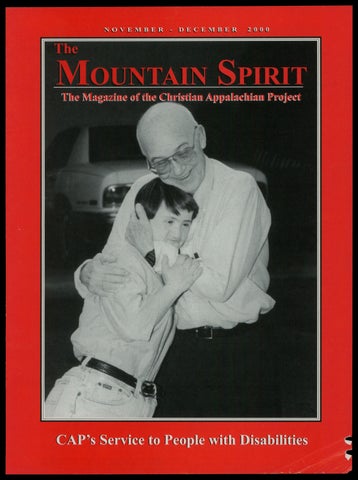
CAP’S Service to People with Disabilities
P r e s id e n t ’s NOTE
T he
M o u n t a in S p ir it The Magazine o f the C H R IS T IA N A P P A L A C H IA N P R O JE C T S E P T E M B E R
-
O C T O B E R
2 0 0 0
V O L U M E
18,
N U M B E R
FI VE
A Father’s Love by Ike Adams
Christmas Baskets
A Father’s Love, page 4
CAPJs Unique Approach by The CAP News Service
16
Respite A Good Thing by Margaret Gabriel Rainbow Respite, page 16
CAPRICE:
24
An Attitude o f Advocacy by Beth Dotson
On the cover: Buddy and Leann Westbrook, father and daughter (photo by Ike Adams).
D
e p a r t m
e n t s
3
R a n d o m T h o u g h ts
10
A ro u n d the P ro je c t
21
L etters
29
C A P C lose-U p
Published by the Christian Appalachian Project E d it o r M a rg a r e t G a b r ie l G r a p h ic D e s ig n K a r e n F r a n c e s S p iv e y C ir c u la t io n L in d a G r i d e r E a s t A d v is o r y B o a r d : F a th e r R a lp h W . B e itin g , M ike S anders, B en P rew itt, B e c k y K an a
The Mountain Spirit is published six times a year. The annual subscription price is $8.00. Subscriptions and other correspondence should be sent to The Mountain Spirit, Christian Appalachian Project, 322 Crab Orchard Street, Lancaster, KY 40446. Copyright, 2000, The Christian Appalachian Project, Inc. All rights reserved. Member, Catholic Press Association. The Christian Appalachian Project is a non-profit Christian service organization operating throughout Appalachia. The project operates on the philosophy that helping people help themselves is the best approach to Appalachian poverty. The Christian Appalachian Project is recognized by the Internal Revenue Service as a 501(c)(3) charitable organization and is qualified to receive tax deductible contributions.
For people with disabilities, some of the challenges of life in Appala chia can become even more severe. I can just Mike Sanders, imagine how CAP President isolation and poverty could only make a bad situation virtually intolerable. That’s why I look at folks in CAP’s pro grams that work with people with disabilities with a great deal of admiration. As much as I value our daily chapel services in our offices in Lancaster, the days that Ray Giudice brings the participants from Rainbow Respite are even more special. Especially when they sing for us, or lead us in prayer, I am reminded that we are all special in the eyes of God. I’m also proud of the people who participate in CAPRICE, the Christian Appalachian Project Resources for Independence in Community Employ ment. They have taken the initiative to concentrate on learning the skills they need to enter the job market and make a contribution to society. Their families, too, often go the extra mile to assure independence. Families who participate in Parents Are Teachers begin working toward securing that independence for their children as they learn the best, most effective ways to teach and motivate their children. This issue of The Mountain Spirit introduces readers to these programs that make such an important impact on people with disabilities and their families. Many times, people in these programs work together to see that people with disabilities in Eastern Kentucky have the best opportunities available for a productive, meaningful life. Enjoy! Mike Sanders
A summary of the registration and financial documents filed by this organization can be obtained by contacting: in Maryland, for the cost o f copies and postage, the Secretary o f State, State House, Annapolis, MD 21401; in Virginia, State Division o f Consumer Affairs, RO. Box 1163, Richmond, VA 23209; in Washington, residents can call the Secretary o f State toll-free within the state at 800-332-4483; in Mississippi, by calling the Secretary o f State’s office at 888-236-6167; IN NEW YORK, OFFICE OF THE ATTORNEY GENERAL, CHARITIES BUREAU, 120 BROADWAY, NEW YORK, NY 10271; IN NEW JERSEY, THE ATTORNEY GENERAL BY CALLING 973-504-6215; IN PENNSYLVANIA, DEPARTMENT OF STATE BY CALLING TOLL-FREE WITHIN THE STATE, 800-732-0999; IN WEST VIRGINIA, SECRETARY OF STATE, STATE CAPITOL, CHARLESTON, WV 25305; IN FLORIDA, THE DIVISION OF CONSUMER SERVICES BY CALL TOLL-FREE WITHIN THE STATE AT 800435-7352; IN NORTH CAROLINA, FINANCIAL INFORMATION AND A COPY OF THE LICENSE ARE AVAILABLE FROM THE STATE SOLICITATION LICENSING BRANCH WITHIN THE STATE AT 1-888-830-4989 OR OUTSIDE THE STATE AT 919-807-2214; or by writing to Christian Appalachian Project, 322 Crab Orchard Street, Lancaster, KY 40446. Our license number in Michigan is MICS 9933: Registration with any o f the above government agencies does not imply endorsement by the state.
T
he
M
q u n t a i n
S p i r i t
A N D O M T II O I J G II T S
R
B y B obbie W esley capped people. That’s okay, isn’t it?” I n August 16, 2000,1 celebrated 13 I never made it to the classroom. I volunteered for years of employment with the Christian Appalachian Project. Ten of those years CAPRICE that summer, helping out with activities and assisting with community outings. The following year I were spent at CAPRICE, a CAP became a CAP employee, working in CAPRICE. I told program that serves individuals with myself it was only short-term; I wasn’t fulfilling the disabilities and their families. The past prophecy of my friends and family. Nor was I aligning three years I’ve been working in the training depart myself with “those” people — they were far more ment, providing orientation and other types of training handicapped than I, and I did not to new employees and volun plan to be lumped into the same teers. The two don’t seem category as “them.” But oh my, how connected in any obvious way, my perceptions and attitudes but in my mind, the connection changed over the next few years. is very real. I realize now that the Lord knew I I never intended to work could not go through life with that with people with disabilities. I “me vs. them” attitude, or else I’d was bom with a handicap and never be able to impact the “us vs. was accustomed to people you” attitude of others around me. immediately assuming that I What I came to realize, through the would want to spend my life help of all the wonderful partici helping others “suffering” a pants at CAPRICE, is that there is similar “plight.” The more no “them and us.” There’s only “us” determined others were that and that “us” is big enough to allow this was my calling, the more for many, many differences, because determined I became that it the human spirit is a commonality was not. When I applied for that keeps the circle connected. college and told my friends Once I truly grasped that concept, I and family I planned to be a realized that the folks at CAPRICE teacher, without fail, they Bobbie Wesley had helped me in a far greater way responded, “Oh, you’re going than I was likely to ever help them. They taught me a to teach handicapped children. How nice!” I would grimace and retort, “I most definitely am NOT!” Funny lesson they’d known all along — that we’re much happier people when we like what makes us different as how the Lord allows us to think we’re in charge of our life’s plan, knowing that seeing our destiny prematurely much as we like those things that make us the same. I spent years telling our participants “You can do might frighten the daylights out of us! anything you set your mind to do. It won’t be given to College was a breeze, and teaching loomed immi you — it shouldn’t be given to you, or you’ll be just nently closer. But every year I dreaded summer break, another charity case. But when you’ve worked hard for knowing that once again I would have to look for it, and you’ve earned it, there’s nothing in the world employment. Year after year I watched my friends get like that feeling of accomplishment.” It would sadden jobs shortly after returning home, while I spent the me to work for an organization that employed me to entire summer going for interviews and being given a give that kind of advice, but didn’t live it out well. litany of excuses of why I was not a suitable candidate. Every time I teach a class or stand in front of a group, Some of the reasons were so ludicrous that, had it not I’m reminded that I’m representing what is surely a been MY life, it might have been funny. But it wasn’t small miracle. I know of no other organization that has funny. It was painful and deeply humiliating. My as its training manager an individual with a signifi normally positive disposition took a beating that was cantly visible handicap, and I know that it matters not hard to recover from. one iota to CAP — I happen to be the person who could Finally, during my junior year of college, my sister perform the job that needed to be done. The fact that wrote me a letter and said, “Forget job hunting this I’m “handicapped” only matters to those who haven’t year. Come volunteer where 1 work. The Christian yet learned the lesson of “us.” And thanks to CAP, Appalachian Project uses volunteers, and we could spend the summer together that way. It’ll be lots of fun! that’s a lesson I’m quietly helping teach every day. P.S. Oh, by the way, you’ll be working with handi
N
o v e m b e r
D
e c e m b e r
2 0 0 0
3
m m m
W BBBÊBÊÊSBÊÊÊÊÊÊBBÊÊÊÊÊÊÊÊÊÊÊM
by Ike Adams
Her ther’s Love For more than ten minutes Leann Westbrook tries to get her father, some friends and the visiting photographer to grasp the single word that she has decided will enable them to understand the concept she is trying to get across. Dozens of times she has tried to enunciate the word and her observers have guessed as many, but all they have figured out is that it has something to do with an ambitious undertaking the camera has inspired. She has pointed at it and struck various poses. The fact that she wants to be a model has already been established but that is not enough. “This is something new,” her father, Glen “Buddy” Westbrook muses more to himself than to anyone in particular. His eyes twinkle with affection as he grasps his chin between thumb and forefinger, signaling he is stumped. Leann runs a few steps down the driveway,
4
twirls gracefully and then with long, obviously practiced steps she glides toward the audience on concrete that has suddenly become a runway. Her head is cocked at just the right angle, shoulders square, arms swinging with her stride, the epitome of aloofness. She is petite, maybe a size three and at just over four feet tall, perhaps a bit short for a model but the act could not be more convincing. However, this is not a game of charades and Leann’s patience is running thin. This is not rocket science, her expressions seem to say, and it is clear that this is her last trip down the makebelieve runway.
T
he
M
o u n t a i n
S p i r i t
“She could be in Paris,” a friend word. It describes so well the close thick folder of memorabilia he has remarks. and loving relationship within our collected over the years that Bingo! family and the special role that chronicles Leann’s life. On top of Leann’s right thumb points Leann has played in it. She is the stack is a clipping from an early skyward and her forefinger singles certainly an angel among us.” 1980s issue of a Catholic periodical out her friend. Her left hand balls The analysis of Down Syndrome written by columnist Mary Carson. into a fist and snaps cockily to her is complex but it boils down to The column is entitled “Angels hip. “Yessssssssss!” It doesn’t come Have 47 Chromosomes.” Ms. people with Down’s being bom out quite that articulately but the with an extra chromosome — 47 Carson is the mother of eight meaning is clear. The expression of children; the youngest is a daughter instead of the nomial 46. As a result satisfaction on her face is thorough. with Down Syndrome. they have a combination of features “There may be some intelligent life distintive to people with Down “Leann’s mother could have in this crowd after all,” it seems to Syndrome, in addition to features written that article almost word for say. Someone has finally figured out that she wants to be a model in Paris. But Leann was bom with Down Syndrome and she cannot vocalize “Paris” with a sound that anyone around her can understand. Paris is a word that she would have spent a lot of time with before she could spell or write it out it on paper, but Leann knows a lot about Paris even though she can’t talk about it much. Leann Marie Westbrook lives in London, Ky., with her father. Now 33 years old, she is the youngest of eight children bom to a family for whom community service has always been a way of life. Buddy Westbrook retired from the Cumberland Valley Area Development District in 1993 to spend his time working without pay for a variety of civic organizations and industrial development boards. He has served on CAP’S Board of Directors and played a key role helping CAP establish the Mountain Economic Development Fund in the mid-’90s. Now 70, a battle with cancer that requires regular chemo therapy has slowed him down a bit. But, if he didn’t tell as much, one would never guess that he is 70 nor that he has any health problems. He insists that the cancer is under control, treatments nothing more than a necessary aggravation. Leann’s mother died in 1983 and since the late ’80s she has been the only child at home. Leann (second row, center) enjoys “hamming it up ’’for the camera at a recent “Leann grieved as much, prob outing to Camp Andrew Jackson with friends from the Rainbow Respite Care ably more, as any of the rest of the Center. family,” says Buddy, digging out a
N
o v e m b e r
D
e c e m b e r
2 0 0 0
5
inherited from family. These common characteristics in humans were recognized by British Doctor John Langdon Down in 1866, although the actual chromo somal nature of Down’s was not documented until 1959. In the United States, Down Syndrome occurs in about one of every 1000 births. Medical science does not know what causes Down Syndrome. It does not seem to be genetic and there are no consistent traits among parents who give birth to children with Down’s. The most accurate description is that it occurs at random and that no parents are any more or less susceptible to its occurrence.
muscle tone, and decreased skeletal size, traits that are accompanied by severe mental, emotional and speech development disorders. As a result, people with Down Syndrome are rarely able to live completely unassisted, independent lives. “I’m sure that Leann had to be one of the first participants in CAP’s Rainbow Respite Care Center when it opened back in the ’80s,” says Buddy. “That program has meant more than I know how to put into words, both for Leann and me, too. “Both of us look forward to the visits she makes to the center two or three times a year. Over the last two or three, because of my illness, they have been even more frequent.
L-R, Sherry Allen, Leann, and Susan Nierman. Leann met Sherry and Susan at Camp AJ, when Rainbow Respite was sharing the facility during volunteer orientation.
Some of the physical features of Down’s, common but not always present, are extra folds of skin over the eyes, palatial development disorders, slanted eyes, decreased
6
“There is no place that Leann would rather be and certainly no other place, outside the family, where I don’t have a single worry about her well-being. The respite center is as
T
he
much of a blessing to me as it is to Leann,” he says. “That’s what it’s supposed to be,” says Carolyn Lindsey, manager of the Rainbow Respite Care Center. “It’s difficult for people to under stand that family members who serve as primary caregivers to people with severe disabilities need a break, too. The quality of that care at home increases or at least has no decline in quality when folks like Mr. Westbrook have the emotional assurance that their loved one is safe and happy even though they are not at home.” Carolyn grins when Leann’s name is brought into conversation. “She has an impact on everyone here and she forms intense personal relationships with the staff. Some times weeks go by and I’ll find a message on my voice mail from Leann who has just called to say hello or wish me a happy day. Sometimes I’m not able to under stand a single word she has to say but the tone of her voice is almost always cheerful. “Leann also likes to be in charge,” Carolyn says. “She takes remarkable initiative and she’s exceptionally outgoing for a person with Down’s. She constantly writes notes and shares secrets that have to be kept just between us. Building and maintaining new, close relation ships is obviously very important to her and, again, that is a rarity for someone with Down’s.” Carolyn pulls out photographs taken at Camp Andrew Jackson. Rainbow Respite Care had just spent a week at camp on a retreat with its women participants and shared the facilities with a group of 30 or so new CAP volunteers who were going through an orientation program before beginning their year of work with CAP. She selects a photo of Leann sitting between CAP volunteer manager Sherry Allen and newlyarrived volunteer Susan Nierman. Leann’s arms are thrown around the others’ necks and the picture
IM o u n t a i n
S
p i r i t
Leann s petite stature requires alterations for the clothes she purchases with the money she earns by working at a fast food restaurant.
suggests a relationship of long standing. “Not so,” says Carolyn. “I don’t think Leann knew either of them, though she might have seen Sherry around. Here are two people who had nothing to do with our program, but happened to be on the premises at the same time and Leann some how found opportunities to connect with them.” “She comes by some of it naturally,” says her father. “Her mother was a people person and so am 1.1 take Leann to gatherings where she has met none of the people but she works the crowd like a politician because she doesn’t want anyone going away a stranger. It’s easy for her because she’s so full of love; I believe the reason she connects to so many different people so easily is because they sense that love.” Her trouble with communication frustrates Leann, Carolyn says. “More than anything, I wish that
N
o v e m b e r
D e c e m b e r
she could talk like you and me because I want so much to hear and understand the things that she wants to tell me. She prays frequently and it’s obvious that she has deep faith in God but only he and she know the content of those prayers. Perhaps she prays because she knows he understands her. I’m not sure how much she understands it, but she spends hours reading the Bible.” In 1985, when she was 17 years old, Leann went through extensive testing at the University of Ken tucky and was evaluated as having the cognitive and communication skills of a three-year-old child. She has clearly come a long way, although much of her behavior is still child-like. A few strands of gray in her dark brown hair betray the notion that she is not a sweet little girl; otherwise, she looks and acts the part. “She’s a ham,” is among the first sentences that anyone acquainted
2 0 0 0
with Leann uses to describe her, but it is clear she has dreams. She grabs the photographer by the arm and nearly drags him to her father’s car. She would like to learn to drive. It’s probably not going to happen but her father confesses she may have had a little experience in a safe field somewhere nearby. Leann has already figured out that the photographer can’t under stand a word she says. He didn’t have a clue when she was on the models’ runway in Paris but she has discovered that she can use hands and facial expressions to get across some basic information. Her palm goes up and her face says “Stop and wait right there.” She opens the car door and gets behind the wheel. The photographer jerks the camera to his eye but Leann waves him off and her expression says “Hang on, I’m not ready yet.” Her arms curve around the steering wheel. Her left leg pokes out the door. She shakes her hair
7
until it’s tossed just the way she yard. She sits on the bench, stretches she hurries to her bedroom to wants it and her chin juts out. She’s out, crosses her legs and props on an change. She has two new pairs of jeans and the aforementioned plaid ready and the photographer does his elbow. She doesn’t say a word but shirt. She is back to her father’s thing. The flash pops twice and the photographer has learned to study in a flash. The jeans fit that’s enough. Let’s get on to bigger sense when she is ready. perfectly around the waist but the He pops the shutter and the flash and better things and the photogra legs seem long enough to fit a goes off. “Travis Tritt,” he says pher is left wondering whether he college basketball player. Buddy smugly, thinking to himself that he has just photographed James Dean grins and shakes his in a ’57 Chevy or head. Richard Petty getting “Stick your leg up ready for a NASCAR here,” he says, his race. He takes eyes twinkling the satisfaction knowing way they do almost when Leann sees the any time he and photo she’ll know daughter are together. exactly who it was. He begins folding the “She knows the extra material up to words and tunes to measure where the countless country jeans will need to be and western songs cut off and it reaches and she is always past her knee. singing,” says her “We could probably father. “She tapes make two pairs of songs and music pants out of the stuff programs off the that’s going to be left television and when we get through replays them over with this one,” he and over. At least says, trying to make it once a week she sound like gmmbling. watches The Sound But daughter knows o f Music and idolizes better. While his head Julie Andrews. I is down, concentrating never know from one on the task, she bends week ’til the next over and places a who her favorite Swimming is one o f Leann s favorite activities when she visits Camp loud, smacking kiss singer is going to be, Andrew Jackson. perfectly in the middle but she loves country of Dad’s bald pate. music.” He finishes the folding as though and Leann are beginning to under Another highlight of Leann’s life that kiss happens several times a stand each other, but she shakes her is a church camp in Beattyville she day. head. visits occasionally where they let “Stand back a bit,” he says and “Alan Jackson,” she replies and her lead the singing. It doesn’t studies his handiwork long enough nails the pronounciation. matter that no one understands her “Dam, I knew that,” the photogra to decide the fitting job is right. “Go because she knows the tune and get the other pair,” he commands. pher thinks to himself. they know the words. “It’s safe to Instead, Leann grabs Buddy At 3:30 each day, the bus from say God understands every word Westbrook around the neck with Cumberland Valley Comprehensive she is singing though,” Buddy says both arms in a long, enduring hug. and smiles. In the final analysis, that Care Center drops Leann off at the “I love you Dad,” she says and doorstep of her home. Its supported is enough. the photographer, lump in throat, employment program enables her to Leann grabs a red bandana and thinks to himself there’s no doubt work ten hours a week; she has fastens it to a head band. She is about that nor about the fact that it earned enough money to pay for a wearing new blue jeans and a new works both ways. cam-corder she is learning to plaid shirt with a tee shirt under • operate. neath. She grabs the photographer Ike Adams lives in Paint Lick, Ky., and But now, she wants to show off by the arm again and it’s off to a works for MACED. picnic table in the Westbrooks’ back the new clothes she has earned, and
T
he
M
o u n t
a i n
S
p i r i t
C hristmas B askets C A \P ''s ¡Unique AVpproach The Christian Appalachian Project is one of many organizations, not only in Eastern Kentucky but throughout the world, that distribute gifts and food to people in need during the Christmas season. The CAP program, however, adds a personalization to its baskets that sets them apart from those of other groups in a couple of different ways. Approximately 70 percent of the nearly 1200 baskets distributed by outreach are given to families and individuals who participate in CAP programs throughout the year, said outreach manager Robyn Renner. Workers in housing, adult education and child development programs accept applications from families, as a way of celebrating Christmas with friends. Robyn sends letters to former basket recipients, telling them that CAP is accepting applica tions; other applicants hear about the program through word of mouth. If sponsors and resources are available, new families are accepted, but those who CAP serves throughout the year are first priority. CAP secures sponsors for indi vidual families, assuring that each family receives personal attention concerning its requests. Operating in such a way since the late 1970s, CAP asks donors to take the responsibility for providing toys and gifts for one family. Donors are asked to indicate the size family they would like to sponsor. They receive information from program coordinator Brenda Watts in the late summer or early fall. They are asked to return gifts, wrapped and tagged with the name of each person in the family around Thanksgiving. Some sponsors are interested in younger children, others like families that mirror the ages and
N
o v e m b e r
D e c e m b e r
genders in their own families. Some sponsors say that preparing a basket is one of their favorite activities of the year and kicks off their celebra tion of the birth of Christ. CAP distributes baskets in ten counties. In each county, CAP hosts a religious service featuring preaching and hymns that are designed to help people focus on the meaning of Christmas. Parthena Martin, the outreach caseworker in Magoffin County, is responsible for finding a host church in that county and making the arrangements needed for the service. “We pick a different church each year,” Parthena said. “And we invite the pastor of the church to give the message at the service.” Parthena believes that the service “plants a seed in their souls.” In a similar manner, other caseworkers call around to find a host church, preferably one that also
2 0 0 0
has enough space to distribute baskets. “Some churches would like to host the service, but don’t want to be responsible for the security needed to keep all those gifts safe,” Robyn said. “In that case, or if they don’t have enough room, we’ll move distribution to the Senior Citizens’ Center.” Diann Brand, the housing caseworker in McCreary County, served as the outreach caseworker during her days as a CAP volunteer. “I didn’t want to alienate anyone who didn’t feel comfortable coming to a church they didn’t belong to, so we had our services at the old middle school,” Diann said. “We invited pastors to speak and CAP volunteers to sing hymns. It was a time for families to step back and reflect on the reason for the season.” The services are not only an ecumenical way to express belief, but give program participants an opportunity to share those beliefs with caseworkers they might see through adult education or other programs. “The service isn’t meant to replace the services that people might attend at their own churches, but many of our people don’t belong to churches, so this might be the only chance they have to attend a service at Christmas,” Diann said. Services are not meant to convert anybody, but Diann agrees with Parthena when she says that they frequently plant seeds. “We want them to know we’re Christian,” Diann said. “We welcome you and we accept you as you are and we have a wonderful message to give you.” SPIVEY
9
A
r
T he
o
u
n
d
P r o je c t
.. It Is In Dying That We Are Born To Eternal Life.” bachelor’s degree in social welfare. Christian Appalachian Project attended Missouri State University Later he obtained a master’s in employees were saddened by the and earned a master’s degree in social work from the University of loss of three friends and colleagues psychology and counseling. Kentucky. An ordained minister of the during the spring and summer Bill is survived by a daughter, a Church of the Nazarene, Larry lived months of 2000. son, his mother, seven brothers and Martin May, 58, died of respira in London, Ky., with his wife, four sisters. tory complications of Sarah. The couple has “Bill brought a level of profes heart disease on May two sons, Edward and sionalism to the counseling service Robert, and a daughter, 13. He joined CAP in that made us all proud,” said Garry November, 1999, Kimberly. Co-workers in Vickers, director of direct response Family Counseling recall serving as the director fund raising, who began his work hearing Larry remark, “1 of human resources. with CAP as a counselor. “He was used to be a minister that Martin and his wife, one of the best supervisors I’ve ever Felicia had six children counseled, now I’m a worked with. He held us all counselor that ministers.” and three grandchildren accountable, but had the same and lived in Lexington, Martin May Larry’s biggest compassion he had when he worked contribution to CAP was his Ky. with participants.” A native of Floyd County, Martin example of dealing with death and A good friend of Bill’s, Garry was a graduate of the University of the reality of letting go, said CAP recalls the last time they had an vice-president of human services Kentucky, and held a bachelor’s opportunity to talk. “It Moe Mercier. “He helped degree in political science and a was shortly before he master’s degree in adult education. a lot of people address the died. I was in Mount Martin was an active member of his issue openly and honestly. Vernon and stopped in to He never got discouraged parish, the Cathedral of Christ the say hi. I found myself and when he died, his King. telling him how much I funeral was more about “Even though Martin had only appreciated him and the resurrection than death. been a CAP employee for a short things that he’d brought time, we greatly miss his good He was really a fine to CAP and to the example of showing all of sense of humor, kind and gentle counseling service. I spirit, and Christian love for all,” us how to prepare for Bill Belcher don’t know why I did it, eternal life.” said Hazel Evans, CAP vicebut I’m glad I did. president of administration. Moe believes that Larry’s “He’s missed every day.” preparation for death had a great Larry Emerson began working CAP president Mike Sanders, influence on Bill Belcher, manager for CAP in 1994 as a counselor in himself successfully treated recently the Family Life Counseling Service. of CAP’s Family Life Counseling for colon cancer, said he has given a Service, who passed away August 1 Although he was diagnosed with great deal of thought to Martin, from heart disease. Bill, too, began cancer in 1995 he continued his Larry and Bill during his own work as a counselor, rarely missing his work with CAP as a counselor treatment. in 1994, and was promoted to as much as a day, according to “They led by example,” Mike human resources worker Barbara manager in 1996. said. “It’s hard to lose people like Bill lived in Mount Hale. He lost his battle that and not ask ‘why?’ But our loss Vernon, Ky., not far with cancer on May 28. is God’s gain. They’ve done what from his boyhood home Larry, 60, went to high they were supposed to do, and now of Crab Orchard. He school in Ohio, attended they’ve been rewarded. It’s good attended Sue Bennett Lincoln University in that we had three men that had College in London, Ky., Missouri Mid-American respect from everyone they worked and graduated from Nazarene College in with, from those in their programs Scarritt College for Kansas where he earned through to CAP management. They Christian Workers in a bachelor’s degree in Larry Emerson were good, Christian role models.” Tennessee with a psychology. He later
10
T
he
M
o u n t a i n
S p i r i t
A
r
T he
o
u
n
d
P r o je c t
CAP Hosts Fourth Annual Golf Tournament Cunningham, Greensburg, PA, and Jim Schaffer, Cincinnati, Ohio, for their work to ensure the success of the tournament. “This event is successful because it is, and has been from the begin ning, donor driven,” Ben said. “It has been sponsored and financed by both donors and corporate sponsors. People make special events, or more accurately, people make events special.” Fund raising through special events is a relatively new field for CAP, but results thus far have been worth the effort, Ben said. “Compe tition for the donated dollar has become more competitive; special events is one way of being creative in our funding efforts. Events
combine interaction among donors who seem to get even more excited about CAP when they share experi ences they’ve had with the organiza tion over the years.” Special events also give donors the opportunity to meet with CAP staff members who can give donors a more personal view of CAP’s mission.
Education Program Teaches Anger Management
and experience in the subject matter. She administers another test after her series of presentations to discover what her students learned and how to more effectively gear the presentation for another class. All of Trish’s presentations are in line with the goals of the Kentucky Education Reform Act, Owen said. “We knew that the schools would be more receptive to the presenta tions if we were all working from the same page.” In addition to making presenta tions in public schools, Trish visits private schools and helps with leadership training for young people in CAP youth and teen centers in Lawrence County and in Kermit, W. Va. “If we start with them in the second grade, we hope that by the time they graduate, we’ve helped them to set value-oriented goals,” Owen said. He hopes the presenta tions Trish makes in the schools will also tie in to the lessons and activities that young people experience at camp during the summer months.
CAP hosted its fourth annual benefit golf tournament at Latrobe Country Club in Latrobe, PA, August 11, 2000. The tournament yielded record revenue, according to CAP vice-president Ben Prewitt. Ninety-six golfers played a scramble format in foursomes. Both players and sponsors traveled from throughout the country, including PNC Advisors and Hilliard Lyons Trust Company from Louisville, Ky. Tom and Jan Nowalk, Latrobe, Pa., served as gold sponsors and have been key to the success of the tournament, Ben said. He also thanked CAP donors Charlie
Many young people in Floyd, Magoffin, Knott and other counties in Kentucky’s Big Sandy region say that some of the their best memories of summer are those that start at the Christian Appalachian Project’s Camp Shawnee in Floyd County. Manager Owen Wright and camp staff know that the camp activities are designed for learning as well as play, and in order to extend those lessons through the school year, the program is being offered through the schools in the area. The program is designed to encourage and enhance self-esteem, teamwork, problem solving and cognitive development, Owen said. For the current school year, teacher Trish Joseph is making presentations that center on the theme “We Can Work It Out,” which addresses anger management. “We had a lot of requests for this from teachers,” Trish said. “They have a lot of kids who throw temper tantrums in the classroom and need
N o v e m b e r
D
e c e m b e r
exercises to help them handle themselves when they’re angry.” “We Can Work It Out” has a series of six lessons, Trish said. “First, we talk about feelings. I tell them it’s okay to have feelings and be angry, but sometimes what you do with feelings is not okay.” Trish gives her students time to express things that made them angry, sad or happy and they talk about how to handle uncomfortable situations. The different lessons cover control, confrontation and conflict resolution through role-playing and games and hands-on exercises. Trish will work in three or four schools for six weeks at a time in grades two through twelve. During the next six week period, she will move on to a different series of schools in Magoffin, Floyd, Knott and southern Johnson counties. When Trish first enters a class room she begins with a short test to determine children’s knowledge of
2 0 0 0
11
A
r
o
T he
u
n
d
P r o je c t
Grants Share Resources With Other Organizations For many years, officers and directors of the Christian Appala chian Project have felt a responsi bility to share its resources — both talent and treasure — with other groups and organizations that serve the people of Eastern Kentucky. For that reason, CAP customarily grants funds to small, grassroots organizations in Kentucky, West Virginia and east Tennessee. In the coming year, human development grant manager Sheila Helton plans to conduct meetings in the spring and fall at which a committee made up of CAP human services workers and administrators will review grant applications from non-profit groups that are involved in work similar to CAP’S but located in areas where CAP does not have daily activities. In the past year, CAP has awarded nearly $250,000 to 96 groups that provide education and other services to children, elderly people and those with disabilities.
One of CAP’S guiding principles requires that the organization “practice and encourage good stewardship of an accountability for all of the resources entrusted to us.” CAP believes that making grants to organizations that provide services in places outside its immediate service area demonstrates good stewardship by reaching groups that are firmly established in direct service programs. Because of the volume of grant requests Sheila receives, the human development grant committee has decided to limit the number of requests from an organization. “Groups can apply to be considered at one of our two yearly meetings for two consecutive years, then they must wait a year before they can apply again,” Sheila said. “This gives us an opportunity to make grants to more groups.” Since the inception of the program in the mid-1980s, Sheila said, CAP has made grants to over
500 organizations. “We’ve gotten letters giving CAP credit for seed money, and then the community picks up the funding of a group,” Sheila said. “They say that if it wasn’t for CAP, they wouldn’t exist.” Sheila said she is continually amazed at the work that groups do with the relatively small amounts that CAP grants, usually $5,000 or less. In addition to the funding that it grants, CAP also hosts “Community Partnership” seminars, which give groups information concerning fund raising, grant writing and networking. Sheila produces a newsletter, “Appalachians Working Together,” which keeps CAP grant recipients updo-date on activities of the human development grant program and shares information about workshops in Kentucky that may be of interest. For more information about C A P ’s human development grants, please contact Sheila Helton, (859) 7923051, ext. 240.
The Christian Appalachian Project is seeking "movers and shakers" to serve in our oneyear volunteer program. Volunteers "help people help themselves" through a variety of human service programs. “Serving at Rainbow Respite has been a wonderful experience. I ’ve learned more about myself and
Christian Appalachian Project 322 Crab Orchard Street • Lancaster, Kentucky 40446
( 800) 755-5322
others than I would’ve dreamed possible. CAP offers a great gift to anyone considering being a volunteer. To give so little and receive so much Is the greatest gift o f all.
www. chris app. org
12
David Mineah, CAP Volunteer-Rainbow Respite
T
he
M
o u n t a i n
S p i r i t
A
R
T he
O
U
N
I>
P r o je c t
Volunteers Recruited Nationwide Former volunteer Elizabeth Fritz joins the Christian Appalachian Project employee ranks as the volunteer recruiter. Since taking over the position, Elizabeth has been answering letters and E-mails and preparing for her first recruit ing trip, a visit to Bellarmine College in Louisville, Ky. Before the end of the year Elizabeth travels to the Midwest, where she will attend events and meet students at such universities as Marquette and Notre Dame. The trip will also take her to Chicago for the Catholic Network of Volunteer Service. On the suggestion of fonner volunteer recruiters, including Mary McNamara, who recently returned to her home in Cleveland,
Elizabeth contacts people in campus ministry and Newman Center offices when she is planning trips to colleges. Often, she was told, the faith-based groups are more likely to participate in volunteer work. Groups of volunteers from all over the country participate in CAP’s annual Spring Break Appalachian WorkFest. In the nine years that CAP has hosted WorkFest there has been at least one person who has decided to volunteer for a year after the As a volunteer, Elizabeth Fritz, left, experience of working in home repair for one week in the spring. It worked as a volunteer in home repair. is often through recruiting trips that outs. I’m going to call Mary for some school groups leam of WorkFest. pre-recmiting trip advice.” Of her new job, Elizabeth says, Jim Morris, assistant director of “It’s fun, but hectic. It will take me human resources, said that Elizabeth a few trips to really leam the ins and has a good mix of the qualities he was looking for in a volunteer recruiter: someone who is familiar with the area, with CAP, and with what it’s reason, workers can only carry an like to be a CAP volunteer. average of 150 people, a fraction of “We also needed someone who can the people who are eligible to appreciate other religions while being receive dmgs under the guidelines secure in her own,” Jim said. set up by the phannaceutical Enthusiasm and energy are both companies. important elements to the job, Jim CAP workers have trained the said. “Particularly on days when you families of some people to take over don’t feel like being enthusiastic. And the form management, and people flexibility is important. We don’t from other agencies have also asked work 9-5; we work practically 24/7. for training, said elderly services If a volunteer in California has a manager Zayda Hurd. question at 9:00, you have to be ready The Jackson County office has to answer it, even if that’s 9:00 had help from people who receive Pacific Time. Sometimes nights are assistance through the Kentucky the only times you can catch a Temporary Assistance Program, prospective volunteer from Alaska.” who must work 30 hours each week Elizabeth brings different qualities to receive benefits. “They help us to the position than those which her file charts and keep the office predecessors offered, Jim said. clean,” Zayda said. “Everybody brings their own gifts to Because of the demand, and the job. They modify them and use CAP’s willingness to assign them differently.” workers to the prescription assis As for Elizabeth, she says she feels tance program, Zayda believes that right at home. “I really feel like I’m the amount of dmgs accessed will where I need to be right now. There’s continue to increase. a higher calling.”
Prescription Assistance In Fiscal Year 1999, the Christian Appalachian Project helped people obtain about $170,000 worth of dmgs through its prescription assistance program. In 2000, that amount jumped to over $1 million, due to the efforts of workers in the Jackson County and Hagerhill elderly services offices. With a call for prescription assistance, a CAP worker inter views the person making the request to leam which dmgs he or she needs. The worker looks up each dmg in catalogs from the pharmaceutical companies to see if the dmg is available at no cost, and how to access it. Generally, after filling out the proper forms and obtaining the proper signatures, the participant can receive a threemonth supply of the dmg. Because the program requires different forms for every drug, the amount of paperwork for the CAP worker can be staggering. For that
N
o v e m b e r
D
e c e m b e r
2 0 0 0
13
A
r
T
h e
o
u
n
d
P r o je c t
JobStart Moves in New Directions In 1997, in response to welfare reform, CAP initiated a program that provides job training for people who are entering or re entering the work force. With a sizable grant from the state of Kentucky, CAP was able to purchase the materials needed to begin the program. During that three-year period, over 500 people have enrolled in “JobStart,” as the program is called, and many of them have successfully entered the job market. The initial grant has expired, and CAP has the opportu nity to build on the strong start and take the program in new directions, according to program coordinator Judy Dillingham. The program has a twelve-week curriculum. Most weeks do not build on materials from the previous week, which enables a student to begin JobStart at any time. New students are tested for reading level, and to determine the type of job they might enjoy. For many people, just answering questions allows them to dream and set goals they never imagined. Although JobStart does not require that a participant have a GED (high school equivalency diploma), the certification is required for most jobs, said Judy. “We can work one-on-one with people on the GED,” Judy said, something that she and the teachers were unable to do until recently because the program grant required that they work only on job skills. “We can also help with the ACT (a college entrance exam),” another new direction. “We try to work with the individual, whatever her needs are,” Judy said. Despite the fact that many of the JobStart graduates have entered the job market, Judy said, many still live below the poverty level because so many of the jobs in the
14
because so many of the jobs in the region are in the lower-paying service sector. Even so, she said, many of the former KTAP recipients (Kentucky Temporary Assistance Program) have started the climb to self-sufficiency. Many of the students in the JobStart program are single mothers, Judy said, so they have more responsibility and less support at home. The support and encourage ment they receive from JobStart teachers is a crucial part of making people feel successful in their efforts. “It never ceases to amaze me, the difference in attitude and the way people’s self-esteem increases with challenges. We have people who started only because they had to to get their KTAP benefits, but eventually, even they come to enjoy learning and enjoy being here,” Judy said. JobStart currently operates from classrooms in Rockcastle and Owsley counties, although several students in each class travel from surrounding counties. Judy and other teachers are actively recruiting
WORKPLACE PAYROLL DEDUCTION If your employer offers donor designation as a write-in for payroll deduction campaign, please remember the Christian Appalachian Project. CAP is a 501(c)(3) tax exempt agency, and payroll deduction is the easiest way to help the families of Appalachia. To ensure that we receive your payroll deduction gifts, please give your payroll officer CAP’S full address and send to the attention of: T eresa M cAnly-Cam paign
Coordinator
Ot
Christian Appalachian Project 322 Crab Orchard Street Lancaster, KY 40446
students through other CAP programs and other services providers in the counties. Most of the their new students, however, have heard about JobStart from a friend, and are curious about the benefits of the program.
When people begin JobStart, often their greatest apprehension involves computer work. CAP staff help to put those apprehensions to rest.
T
he
M
o u n t a i n
S p i r i t
A
R
T he
O
U
N
D
P r o je c t
Sunshine Center Celebrates 25th Anniversary Experts agree that early child hood development is a crucial first step in education. For many years, CAP has known that, and as such, in August celebrated the 25th anniversary of the Sunshine Family and Child Development Center, the center located in Garrard County, Ky. Former students, families, volunteers and staff gathered at the center on South Campbell Street in Lancaster. Former volunteer Eileen Garrity traveled from West Virginia to join 124 former teachers, volunteers, students and family who gathered to share stories and memories of children’s first experience with education. Another twenty people mailed in stories for a memory book, said program manager Becky Kana. Memories came from Chuck Thompson, a former volunteer who reports that a book that he has written will be published soon. “He didn’t say too much about it, but that it mentions Father Beiting and Kathleen Leavell,” Becky said. Kathleen currently works in CAP’S planned giving department, but served as manager of the Sunshine Center in the early 1980s. Chuck worked in auto maintenance in Lancaster, and later as a child development teacher at CAP’s center in Somerset. Many of the former staff and volunteers continued their involve ment with children and education, Becky said, including Diane White Lunt. She and her husband, Greg, both former volunteers, are the parents of four children whom she home schools. Former students and parents were also asked to make entries in the memory book. Most recalled the friendly atmosphere of the center where they were accepted as they were and made to feel at home.
N
o v e m b e r
D e c e m b e r
Hundreds o f children in Lancaster and Garrard County have attended the Sunshine Child and Family Development Center in its 25 years o f operation.
While children’s memories of the Sunshine Center might be only as a place of peace and security, several parents said the things they learned at the center gave them the confi dence they needed to continue to be involved in their children’s educa tion when they moved to public schools. “[The Sunshine Center] helped me to prepare them for the real world,” said Edie Anderson. “In summing up, it was a real blessing,” she said. For nearly ten years, Anna Lois Davis was a favorite of the children and their families at the Sunshine Family and Child Development Center. After she retired, she devoted her time to her husband and family, but enjoys keeping up with her friends at CAP as well as the center. Few people were looking forward to the center’s 25th reunion more than Anna Lois, but as she was preparing to attend, the former van driver had a fender bender. When an ambulance arrived to take Anna Lois to the hospital she told the driver “Baby, I can’t go now, I have to take a bath and get to the Sunshine Center!” Anna Lois was not hurt, but had
2 0 0 0
agreed to report to the emergency room to be checked. Later in the afternoon, as she was enjoying pictures, a memory book and refreshments with former students and their families, the emergency room called the Sunshine Center to tell Anna Lois to get over there. Some things, she told Becky, were just more important than the emergency room!
there a CAP program that you don’t see in this issue of The Mountain Spirit? CAP’s web site includes information about all of CAP’s human service programs, planned giving and major gifts and the volunteer program. Please visit the site at www.chrisapp.org and be sure to sign our guest book!
15
Good Thing CAP provides respite care fo r adults and children with disabilities through programs that serve much o f Eastern Kentucky -
16
S t o r y a n d p h o to s b Y M a r g a r e t G a b r ie l -
T
he
M
o u n t a i n
S
p i r i t
The Lancaster office of the Christian Appalachian Project looks and sounds much like any other office. Computer terminals hum, phones ring, and although it’s a “people” business lots of talk centers on policies and procedures. Visitors are always welcome, but some visitors aren’t just visitors, but folks who are really part of the family. Two or three times a month, participants from the Rainbow Respite Care Center in Renfro Valley (about 45 minutes away) travel with program staff to the Lancaster office to join in daily chapel services, honor friends who have recently celebrated birthdays, and maybe even join in a potluck lunch. When the word is passed up and down the hallways that “Re spite will be here,” a chapel-goer can be sure that there will be standing room only that day. “We have gotten such a great response from the Lancaster employees,” said Rainbow Respite program manager Carolyn Lindsey. “Our going over there lets [CAP workers] know that their job is worthwhile, that what they’re doing for eight hours in the lettershop or data entry makes a difference. They see what it’s doing.” CAP began Rainbow Respite as a pilot program in 1986 and it remains the only program in Kentucky that is licensed to provide respite care for children and adults with disabilities. Because it was impractical for the state to create a license for just one facility, the center is licensed as a group home for people with mental retardation and developmental delays. Licens ing is needed for the facility, Carolyn said, to protect against liability. “We’re not a group home — nobody lives here. This is where people come to give their families a short term break. I wish they had created a license. That might have sparked an interest in other people to start this type of center,” Carolyn
N
o v e m b e r
D e c e m b e r
Ray Giudice, left, began his work as a CAP volunteer, became an employee at Rainbow Respite and now says, “I wouldn’t work anywhere else. ”
said. Places for people to obtain overnight respite are scarce, she said. Most respite is available only at hospitals or nursing facilities. When the Rainbow Respite Care Center opened, its first manager, Sue Ricalton, asked for written evaluation of the services provided in order that CAP might specifically meet families’ needs. The mother of a child with cerebral palsy wrote, “I missed him very much, but how nice to live like normal people for just a little while.” Respite is important for families with disabilities because it often keeps families intact, said Carolyn, who began working at the center as its coordinator when it opened in 1988. Those years of experience have give her an unparalleled insight into the dynamics of the families that use CAP’S respite services “Some of the participants that we serve have a lot of care needs, and it’s a 24-hour a day job. If families aren’t getting the breaks that they need, they’ll start looking for outof-home placement a lot sooner than it needs to happen. They’ll get into a crisis situation and anything can happen when a family is in crisis,” Carolyn said.
2 0 0 0
Because there are so few places that provide overnight respite, CAP’s program serves families from all over the state, even one family in western Kentucky, which drives five hours, one way, for a week’s respite. Peace Place in Williamsburg is a home operated by Sisters Syra Whitman and Carol Stiefvater for children who need temporary care during times of crisis or special need. Currently, Carolyn said, Peace Place is taking fewer foster children and providing more respite. “It has given us one place that we know of that we are confident that participants are going to be well taken care of, so we can make referrals.” The pilot program began during the summer months as place for children. At other times of the year, of course, children are in school. The center opened as a full time program because CAP had learned that the need for respite is great for families who have adult members with disabilities. Today, the center alternates weeks for men and women, although the house is big enough to allow the needed privacy for mixed gender weeks, as well. Carolyn explained: “We know which participants we can put
17
such in-center activities as spiritual exercises, crafts and games like bingo, a perennial favorite. “The time we spend in the center gives us more time for one-onone attention, and people also have the opportunity to help with cooking and baking, setting the table and cleaning up after meals,” Ray said. Ray and the other staff members are sensitive to the likes and dislikes of participants, Carolyn said. When a partici pants. Here, Carolyn Davidson helps Valerie center the ball pant voices a on the ramp. dislike, the staff together and which ones we can’t. If works to learn why. “If it’s just something that they don’t like to we have a guy come in who’s do, fine. But if it’s because they woman-hungry, we’ll get through don’t feel like they can do some the week knowing that he needs one-on-one supervision at all times, thing, then let’s teach them how. but the next time, he’s scheduled for Let’s make it fun,” Carolyn said. The staff wants to make sure a week with all men. And the same that when a participant voices an thing with the women.” opposition to an activity it’s not Rainbow Respite participants because of a bad experience or come to the house at CAP’s Family because it’s an activity that some Life Center in Rockcastle County one else told them they weren’t able on Sunday evening and stay through lunch time on Friday. When to do. Bowling at Levi Lanes in they file an application to attend London, Ky., is a favorite activity Rainbow Respite, participants are for many reasons, Ray said. asked about the activities they Usually, the group bowls five enjoy; from those responses, the frames, takes a short refreshment week’s activities are planned by break and returns to finish the Ray Giudice. game. “We love that,” he said. The activities he plans for the “[The people at Levi Lanes] love week are eagerly anticipated by to see us coming,” Carolyn said, participants, Ray said. He tries to but it wasn’t always so. schedule eight outside activities “When we first started going, the each week; trips to Lancaster to lady who works behind the counter attend chapel services, or even lead stayed behind the counter. The guy prayer, are always a big hit. A that rents shoes never came out. week’s activities might also include
18
T
he
M
Now they come out and greet us at the door, they get excited with us. Our participants can wander around and we don’t worry, because they’ve made friends.” There is learning on two levels, Carolyn said. The Rainbow Respite participants, most of whom have a degree of mental retardation in addition to other disabilities, are learning important socialization skills. The patrons as well as the workers at the bowling alley are being educated about persons with disabilities. “They’re not to be feared. You can sit down and talk to them,” Carolyn said. Ray came to CAP as a volunteer in the mid-1990s, working first in the Berea Attic. When a volunteer who worked at Rainbow Respite had to leave suddenly, Ray was asked to fill that position. Although he had worked, at one time, at a job in which he transported people with disabilities to a workshop, Ray had never worked in a setting like Rainbow Respite. “I wasn’t sure about it, but it was sink or swim, and I’m still swimming,” Ray said. Swimming, indeed. After working in the center for four years, Ray has taken a new direction as part of the center’s in-home staff. In his new position, Ray provides short-term respite care for men and boys, many of whom have few male role models. The new position wasn’t something he immediately jumped at, Ray said, but during the summer of 2000, he had the opportunity to take two young boys on outings, which led him to think more seriously about the need for short-term respite. “I prayed about it, and the pieces fell nicely into place. I’m very excited about it,” he said. Not all families are in need of long-term respite, Carolyn said, but because CAP’s in-home respite program offers evening and week end hours which are rarely regularly scheduled by other providers, it has been difficult to keep the three inhome respite staff positions filled.
o u n t a i n
S
p i r i t
“But we also want to reach out to more families and into more counties, and we felt like we could do that with three staff if we used this building on Friday evenings and weekends. That way we can provide respite to eight families at one time and people can work on socialization skills, making friends and connecting families to fami lies.” The short term, multi-family visits will enable staff to meet and serve more families in various ways. Carolyn hopes to be able to use the facilities at Camp Andrew Jackson for year-round weekend activities. “We’d like to have inhome respite participants one Saturday a month and then partici pants with their families once a month. Our goal is to have some of these families provide respite for each other.” Carolyn hopes that one of the three staff positions can be devoted to families that need only evening respite, so that in the hiring process, the applicant will know the job involves working odd hours. Eventually, Carolyn would like to be able to have respite providers in counties that surround Rockcastle. “We’d like to work up to five providers because it’s so needed and so worthwhile.” Lori Furguson began to work as coordinator of the Rainbow Respite program after serving in the inhome program for several years. The in-home program works to be more than a baby-sitting service for people with disabilities as it encourages and enables people to expand their experiences and their capabilities. After the family trains the respite provider in the particu lars about the participant’s care, those that are able to go out might make regular visits to movies, skating rinks and parks with their respite provider. Such outings form a bond, not only with the partici pant, but the family, as well. “It’s so much more than just providing respite,” Lori said.
N
o v e m b e r
D e c e m b e r
from referrals from other agencies, “You’re going out with your said manager Russ Taylor. Rejoice buddies and their life changes for Respite has no center, but provides that amount of time that you’re out. only in-home services. It’s so much more than just the In addition to providing services break you’re giving that family.” for adults and children with mental Lori became acquainted with the and physical disabilities, Rejoice Rainbow Respite Care Center when Respite serves families who care for her sister, Valerie, began to partici elderly members, often who have pate in the program. She knows Alzheimer’s disease. “The only well the hesitancy that families thing we require is that they need might feel in using respite services; 24-hour care,” Russ said. she felt a similar hesitancy herself The eight providers who work in when she learned that her mother Rejoice Respite, including perma had applied for respite for Valerie. nent and community volunteers, When Lori married and left home, she recalls that Valerie depended on her mother for much of her personal care, but at Rainbow Respite she has learned to perform that care herself, including shampooing her own hair, although she has the use of only one arm. “I thought if I didn’t do things for her, I wasn’t being a good sister,” Lori said. Rainbow The activity center at Camp Andrew Jackson enables dances and Respite has lots o f other high energy activities. Here, folks practice the macarena. provided a receive training through such learning environment for the whole Eastern Kentucky University family, she said. workshops as cardio-pulmonary CAP operates a second respite resuscitation and depression in the program which serves seven caregiver. “Anything to help the counties in the Big Sandy region of respite provider care for the Kentucky. Founded in 1992 as an participant,” Russ said. outgrowth of the elderly services Like Rainbow Respite, Rejoice program and upon the observation Respite would like to expand of need by CAP founder Father services by providing additional Ralph Beiting, Rejoice Respite care on weekends and holidays and today serves 92 families who have in the evenings. learned of the program through “And we’d like to reach out to word of mouth, and occasionally
2 0 0 0
19
The Rainbow Respite Care Center hosts people several times a year at the facility in Renfro Valley, and offers several yearly outings to Camp Andrew Jackson, as well.
more children with disabilities,” Russ said. “It’s always been a struggle to get families to agree to take a break. We get lots of re quests, but after the first visit, they’ll back out.” Russ hopes that by continuing relationships with families of children with disabili ties, the respite providers will achieve the trust level that families need to leave children in their care. “We want to offer families a sense of security,” Russ said. Judy Yates recently began serving families as a respite provider, after working for many years as the receptionist in CAP’S Hagerhill office. She has about 15 families on her case load; she likes to visit each family once every three weeks for five or six hours. On Judy’s first visit with a new participant, the family instructs her in the manner in which he or she is accustomed to receiving care. Judy provides meals, personal care and sometimes reads or sings to those in her care. “Sometimes I’ll take people in a wheelchair out to the porch — they love to be outside. I’m there to do whatever their regular caregiver would do.”
20
The people in Judy’s care range in age from 11 to 96, and include a paraplegic and a patient with Alzheimer’s disease. The caregiver has the option of leaving the house, but some prefer to stay home and do housework, secure in the knowl edge that Judy is providing good care. Her eleven-year-old participant suffers from seizures and has difficulty communicating with new people, Judy said. During her first visit, the boy’s mother stayed home and did her laundry, while observ ing Judy’s response to the boy’s seizures. The mother also helped Judy learned the boy’s communica tion methods and style. “When I left, I told the mother I didn’t feel like I’d done much, but she felt good that I was learning how to take care of him,” Judy said. Like Ray, Carolyn began her work with CAP as a volunteer and was assigned to work in the home for special children. The four-yearold hearing impaired daughter of program manager Judy Harrison was Carolyn’s first sign language teacher. “She would sign to me and I’d sign back, and that’s how I first
T
he
M
started to learn. It’s been really helpful. I can’t interpret or anything, but I know enough to communicate. “There’s so much you get back from working here,” Carolyn said. “You get to see the results every day when you interact with the partici pants, and you walk out of here knowing that. You may not feel like you’ve done anything for them and they don’t even know that they’re giving to you. But it’s always two fold.” From the relationships that are formed between participants and Lancaster office workers to those that develop between in-home providers and families, friendship is the bond that makes the Rainbow Respite Care Center special in so many lives. It’s a place where people — staff and participants alike — feel at home. “As they’re leaving, they want to know when they can come back,” Carolyn said. “When they’re here, it’s their place. They get to do what they want to do.”
Margaret Gabriel is the editor o f The Mountain Spirit.
o u n t a i n
S
p i r i t
L etters to th e E d ito r IS] [SI
Received my September-October issue of The Mountain Spirit Monday and it is wonderful reading! I look forward to each copy! I enjoyed the sections telling about the various colleges. My dear uncle had a brother, some years ago, who was a newspaper pub lisher of the Berea paper, Albert Schumaeker. I love Kentucky and have been to Renfro Valley half a dozen times — love it there! I really enjoy bluegrass and quartet singing. Keep up your good work. Selma Diller B lu ff ton, Ohio
The work that Father Beiting and his many helpers do is wonderful. Father Beiting and his entire staff are to be complimented again and again for helping the people of Appalachia. Thank each of you for your diligence and unselfish assistance. I enjoy reading The Mountain Spirit. It’s rewarding to see that poverty is being conquered. Alyce Lambert N. Ridgeville, Ohio
Keep up the good work! You are making a difference — a big difference!
1/^1
The Mountain Spirit always renews me with a burst of joy and strength, knowing that God’s work is being done. The gladness of the volunteers, and the recipients of CAP’s services is invigorating. Thank you, Carolyn Santangelo Brooklyn, N. Y.
I think you have a fine magazine, informative and written in an interesting manner. Keep up the good work. William Payden Santa Monica, Calif.
I love The Mountain Spirit. The stories are real and down to earth. Heartbreaking but true. You are doing great things in Appalachia. Mrs. Marjorie Bailey Attleboro, Mass.
It makes us so happy, Father Beiting, that you and your staff are doing such a beautiful job for so many people there. It also gives us such joy being able to help in our small way. God bless you and yours! Love and prayers, Lewis and Kay McIntosh East Liverpool, Ohio
Phil Hahn Willmar, Minn.
the wonderful work you do helping the people of Appalachia. I know that without your hard work and compassion you have for those in poverty there would be many more hardships among the people. May God bless you for all you do.
While it is heart breaking to read about the terrible poverty and suffering in Appalachia, it is also heart warming to read about the love and dedication of Father Beiting and of all the many workers and volunteers involved. I enjoy reading about the “success stories.” God be with all of you. My love and prayers,
Doris Stenger Centerville, Ind.
Anna T. Lavallee Haverhill, Mass.
I enjoy reading The Mountain Spirit. It is interesting to read about
N
\^\ D^KI
o v e m b e r
D e c e m b e r
2 0 0 0
D^KI\^\
I enjoy reading your magazine. At age 80 and using a telesonic machine to read, I feel like I know these people. My dreams are that I will be able to make a trip to your mission this summer. Jeanette Nathe Saint Cloud, Minn.
We love The Mountain Spirit, great stuff. We also know that God is guiding Father Beiting as he guides all of us. We know that Father Beiting is a saint even though it hasn’t been proclaimed by the Holy See. Pass our kind words on to those most deserving. God bless! Mr. and Mrs. Lindbergh Derington Bradenton, Fla.
I enjoy your magazine very much. We pray that God will bless your work and that he will bless our nation. We were bom and raised in West Virginia and we know that a lot of people stmggle each day to survive. I believe that if all of God’s people will help a little, things will be better for all of us. Thank you. W. W. McCallister Williston, Fla.
I enjoy your publication very much. Maybe someday I can volunteer. I am a retired R.N. and I’m sure there is much I could help you with. Keep up the good work. Congratulations on Father Beiting’s 50 years of service. Margaret Martin LaGrange, Ind. Letters to the editor are welcome. They should not exceed 150 words in length, and we reserve the right to edit them for space. Address letters to: The Mountain Spirit Christian Appalachian Project 322 Crab Orchard Street Lancaster, KY 40446 or e-mail capinfo@chrisapp. org
21
S tory and P hotos representative to the Kentucky Americans with Disabilities Act (ADA) Action Network of Kentucky, knows At a meeting o f Southeast Kentucky People Who Care, Donna the chapter and verse of the ADA. Coffey receives a plaque recognizing her work in advocacy for people with disabilities. His well-chosen words to the grocery store manager No, this isn’t a joke. were from the federal law which Two guys, let’s call them Joe and prohibits discrimination against Elvis, walk into a video store, individuals based on physical, browse through the aisles, and make mental, or developmental disability. their selection. They take their President George H.W. Bush selection up to the check-out. The signed the Americans with Disabili clerk refuses to rent them the video. ties Act into law July 26, 1990. The Neither man has a driver’s ADA filled a hole in the Civil license, so they can’t watch the Rights Act of 1964, which did not movie. cover persons with disabilities. Here’s another one, and it isn’t a The ADA is civil rights law, joke, either. though advocates are quick to point John wears his sunglasses into the out that it is not a form of affirma supermarket. He makes his selec tive action legislation. The ADA tions and wheels his cart of grocer ies to check-out, and the clerk scans does not mandate the creation of new positions, policies, or services them through. John writes a check. for the disabled. It does require The clerk can’t accept the check, “reasonable accommodation.” because John does not have a driver’s license, either. John asks for the manager and gives him a good talking-to. The manager accepts the check, apologizes, and John gets his groceries. These two stories have two things in common and one very major difference. Joe Trammel of McCreary County, Elvis Smallwood of Knott County, and John Glisson of Murray each have a disability. None of the three has a driver’s license, that state-embossed totem of personhood. But John Glisson, a member of John Glisson can quote the Americans With Disabilities Act “chapter and the National Federation of the Blind verse. ” of Kentucky, Murray Chapter, and
22
T
he
M
Lack of a driver’s license for purposes of identification is a “typical” problem faced by persons with disabilities, according to Donna Coffey, coordinator of Southeast Kentucky People Who Care, a Corbin-based advocacy group composed of and for persons with disabilities. The aim of the group is “self-advocacy.” Elvis and Joe are members of SKPWC, which meets every month. As a matter of fact, Elvis is the sitting chairperson, and Joe is the spokesperson. One of the group’s major projects at the moment is the development and approval of a “universal ID card.” Designed by Donna Coffey, the universal identification card would look similar to a driver’s license, with identification information and photo on the front. On the back, the card would have valuable medical and disability information on the reverse side. The Legislative Research Commission presently is examin ing the issue of the universal identification card. If approved by the Kentucky General Assembly, the ID card would be valid by law and carry the authority of the state with it. The private and public sector (including law enforcement) would have to accept it. If the card had come earlier, an evening of disappointment might have become Joe and Elvis’ excellent adventure. Donna Coffey heads Southeast Kentucky People Who Care. An Americans with Disabilities Act parent advocate, she is an ADA representative with the Christian Appalachian Project (see page 24). “I was the original parent
o u n t a i n
S p i r i t
advocate,” she says. “I taught parents to advocate for education.” Donna, who lives in Pine Knot, attended the hard knocks seminar on ADA. When her son, Brandon, was in the third grade, his school called. Since birth, Brandon has been sightimpaired and grapho-motor impaired, a condition which limits his ability to write and perform other tasks with his hands. “All I knew at the time was to stand on the Constitutional Many people who participate in CAP programs also belong to Southeast Kentucky People right to an education,” Donna Who Care. $100 bill; ship to Cumberland College, said. She believed her Brandon had Williamsburg, Ky., where he is now • A report from John Glisson on the the right to be “educated differ August ADA celebration, which a sophomore. ently.” included a torch relay and van By some estimates, one in five A teacher at the school gave her caravan from Paducah to Frankfort, Americans has some type of the telephone number of the Office via Bardstown, Covington, Harlan, disability. In Appalachia this of Protection and Advocacy, and Whitley City, Corbin, and Lexing number may go as high as one in Donna has been an advocate ever ton. Pam Wallace encouraged all four. In Appalachia, the situation of since. participants to write and submit people with disabilities is aggra In the arena of education, two their comments on the “Freedom vated by poverty and few, if any, additional civil rights laws come Ride” to her office, noting that services. into play: the Individuals with Kentucky is the only state with an “Elvis is in the house,” says Rose Disabilities Education Act (IDEA), ADA Independence Day as a stand Cooper to signal the other 12 which became law in 1997, and the alone celebration. members of SKPWC that Elvis Rehabilitation Act of 1973. In her “We were a part of ADA history,” Smallwood is about to convene the role as advocate, Donna wields the Donna Coffey tells the group. September meeting at DuPont law like a rapier or a club, as “Yesterday is (ADA) history.” Lodge in Cumberland Falls State needed. The evening is capped by a Park. Special guests at the meeting “I shut down a school system,” presentation. Elvis Smallwood and are Pamela H. Wallace, state ADA she says, with a mixture of pride Joe Trammel present Donna Coffey and sadness. The school system had coordinator, and John Glisson, with a plaque, engraved to her, Murray chapter representative of a waiting list for fourteen children the National Federation of the Blind “People’s Advocate and Old with disabilities — something Hippie.” of Kentucky. blatantly illegal under IDEA. Mistina Perry, of Pine Knot, is In addition to a progress report “Basically you could call it a parent and child nightmare,” Donna on the universal ID card, the agenda the treasurer of Southeast Kentucky People Who Care and the group’s includes: said. • Discussion of a draft letter to state latest success story of self-advo At a recent Southeast People cacy. On August 1, she earned her legislators urging them not to Who Care meeting, Donna won learner’s permit for driving, with support any efforts to weaken the dered aloud over supper how, one “reasonable accommodation” ADA; morally, schools could fail to — Donna Coffey read the exam to • A planned trip for members to provide or deny educational her. visit Frankfort to observe and meet services to a disabled child. Their Now, she says, beaming, she with legislators. A prerequisite for mission is, after all, education. going on the trip is for each member enjoys driving her mother to the As long as Donna Coffey can store. to submit a story demonstrating an remember, her son’s favorite place instance of “self-advocacy;” to go has been the library. Not T.F. Shaughnessy is the editor o f Cross incidentally, Brandon was graduated • Dues and fundraising, during Roads, the newspaper o f the Catholic which portion of the meeting John from high school with honors and Diocese o f Lexington. received the Bert T. Combs Scholar Glisson contributes a crisp new
N
o v e m b e r
D
e c e m b e r
2 0 0 0
23
CAPRICE
An Attitude Of Advocacy
Bobby Bailey, a CAP job coach, learns a stocking job to teach to a ( APR1CE supported employment participant
by Beth Dotson Donna Coffey sits behind her desk in McCreary County and pulls out one piece of information after another about the rights of people who have disabilities. She hands over a guide for parents of children with disabilities. She offers a pamphlet about an upcoming family conference, a written proposal for a calendar commemorating the passage of the Americans with Disabilities Act (ADA), and a folder of information about laws and civil rights. Then there’s the booklet, “How to negotiate in ARC meetings,” which will help parents get the proper educational assistance for their children.
She shares a photo of a nicelooking young man who wore a tuxedo for his senior picture — her son Brandon, the reason that Donna works today for the Christian Appalachian Project Resources for Independence in Community Employment (CAPRICE). When Brandon was in the third grade, “The school more or less notified me that I should take him home because he couldn’t be educated.” Donna did not believe them. “I knew he could learn, just in a different way. Actually, he had a thirst for knowledge.” Brandon needed non-traditional help to graduate from school. He and all children with disabilities have a legal right to an education that is appropriate to them. So Donna began learning about the ADA, IDEA: Section 4, Title 9 and all sorts of legal terminology that can make your head spin if you’re not familiar with the acronyms and laws related to disability rights.
Today, Donna puts that knowl edge and experience to work as a CAPRICE caseworker in McCreary County. CAPRICE works with adults who have disabilities and would like to increase their inde pendent living and job skills. The program offers training, volunteer experiences and supported employ ment opportunities. The program has been active since the late 1970s, and today is expanding its work to include more public awareness raising and advocacy activities, with Donna Coffey as one of its most experienced advocates. That seems to be a natural extension for a program that has long promoted the attitude that people who have disabilities are capable of contribut ing to their families and communi ties. “The biggest challenge has been to help families to see a son or daughter as capable,” said Gloria Jordan, CAPRICE program manager, who has been working
with people with disabilities for 22 years. “We have to remember that years ago, a lot of these families were told take them home or put them in an institution. They were told, ‘They’ll never learn, they can’t.’ So after years and years of this, this is the mindset that you have to deal with, and things don’t happen overnight. It takes time.”
Becoming an ADA affiliate It also takes visible results and education. This year, CAPRICE headquarters in Corbin became a local affiliate for the Americans with Disabilities Act Action Network of Kentucky. As a local affiliate, Gloria said, CAPRICE will help to dissemi nate accurate information about the ADA by sponsoring workshops and community events. This will spread the education to service providers, families and community members. One of these community events happened in July during a statewide torch relay that celebrated the ten
CAPRICE will retrain a supported employment participant whenever there are new skills to be learned.
N
o
v
e
m
b
e
r
D
e c e m b e r
2 0 0 0
25
year anniversary of the passage of the ADA. CAPRICE hosted events in Corbin and Whitley City that were related to the relay. The staff discovered that not everyone thought the anniversary was something to memorialize. Gloria recalls one elderly woman who called the office and said she didn’t think there was anything to cel ebrate when the door at the senior citizen center was too heavy for her to open. “The ADA itself is not just for someone that we typically think was bom with a disability or might be in a wheelchair or somebody who was in an auto accident and sustained a traumatic brain injury. It affects all of us because we are all going to get older,” Gloria said. “So it affects the elderly as well. Sometimes we don’t think about how easy it would be for us to become disabled in a moment in a car accident, or we don’t think about if we fall and break our leg and we have to be on cmtches or we’re in a wheelchair. And we don’t experience any of the inaccessibility until something happens to us to make us open our eyes and really stop to take a look. Sometimes we take a lot of things for granted.” Gloria was reminded of that
when CAPRICE was planning the community torch relay events. In searching for a location, they faced a number of problems. If the place was accessible for people in wheelchairs, could the wheelchairs also fit into the bathrooms? That planning experience showed Gloria that organizing community events will make CAP more aware of issues surrounding physical accessibility. CAP’s increasing work with the ADA Action Network is partially due to Donna Coffey. Ten years ago when she struggled with the school to educate her son, a teacher gave Donna the telephone number of the state Office of Protection and Advocacy. That’s where she began learning about the laws that protect her son and made provisions for his education. But Donna didn’t stop at getting her own son the help he needed in school. She became a volunteer parent advocate for exceptional children in 1991. After she learned the process, she helped other parents walk through it also. “If parents leam these laws, they will never have to argue with the school. They will not have to even raise their voices,” Donna said. With this background, the job opening with CAPRICE looked to Donna like it was meant specifi cally for her. As a caseworker teaching life skills, she primarily comes into contact with adults who did not get the education her son did. “It’s like trying to play catch up. People who could have received some education . . . they didn’t receive that and I’ve seen the results,” Donna said.
The attitude of advocacy While Donna’s personal experi ence raised her awareness about disability issues, every staff member brings a different perspec tive to the work. Gloria, for Sandra Cundiff displays the “Spirit example, was trained as a nurse and Award” which recognizes the worked with foster children. Bobby contributions she has made to people with Bailey, a job coach, came to disabilities in her community.
26
T
he
M
CAPRICE after being trained as a teacher and working at a CAP teen center. Many others have brought a variety of experiences to the program over the years. CAP’s awareness about disability issues has been continually growing throughout its history. Gloria remembers her early days at the Rainbow Respite Care Center (see page 16), a program that provides respite for families and other people who care for people with disabili ties. There was a lot of staff education going on. “We got more involved with learning about conscious and unconscious wounding we some times do to one another,” she recalled. The staff asked themselves questions such as, “Do we see them (people with disabilities) just as someone who constantly needs help, or do we view them as being capable? As being able to contrib ute?” CAP has seen people who have disabilities as being capable for many years. In fact, CAPRICE’S founder and first manager, Jack Heyne, used a wheelchair after being injured in an automobile accident. Since that time, CAP has advocated, demonstrating in very personal ways to communities, employers and families that people with disabilities have skills and abilities that they can use. “There’s a concept that it’s all that they can do — sweep and mop and clean toilets. And that’s not true,” Gloria said. Before someone even gets to the possible employment opportunities, the CAPRICE staff first works with the family, asking them about their hopes and dreams. They generally begin by teaching the participant functional skills, like responding to an emergency by calling 911 or washing the dishes — activities that help them contribute to the family. Learning life skills is the first of a three-phase approach that CA PRICE uses. It includes such tasks as learning to cook and taking care
o u n t a i n
S p i r i t
the things that we of personal forget is that there are hygiene. The many steps that you second phase is have to take in order volunteer to get to that dream or placement, that goal that you through which want. We don’t know participants can if he will ever become get some life and that. But what we do job skills by know is that he can volunteering at a take guitar lessons,” food pantry, she said. senior citizen center or other Success in the location. The workplace third is job skills Plenty of partici and supported employment pants set goals, through which a achieve them, then CAPRICE job excel beyond. Bobby coach helps a coached one young participant find a man who wanted to job, then trains work at WalMart. He Gloria Jordan, CAPRICE program manager, has twenty-two years o f experi him or her for was in his thirties and ence working with people with disabilities. that particular rather quiet, but he work. dreams, said he wanted to be either learned the job with no problem. Gloria says although it would be an airline pilot or railroad conduc His mother said the job brought him ideal for people to move steadily tor. Although Bobby assumed those out of his shell. Today, he not only through those phases and be jobs were out of this man’s realm of stocks shelves, but works in counted a success, it doesn’t always possibilities, he did not immediately receiving and delivers to five work in order and it rarely works discourage him. Instead, he gath departments. quickly. Part of the reason for that is ered information about the kind of Jeff Bryant found success in his that CAPRICE tailors its services to education and training pilots and job at Kroger’s, a grocery store. the individual needs of each person. conductors need. He presented it to More than a year ago, Bobby began the participant, who decided on his That’s one of the things that working with Jeff, who shopped Donna Coffey likes about the own to pursue something else. monthly at the grocery store in program’s philosophy. She says: Gloria has also encountered McCreary County where he lived. “CAPRICE, to me, . . . is probably people who have goals that she When Jeff decided he wanted to the only organization or agency that sometimes doubts, like a young man work there, Bobby talked with the to my knowledge does peoplewho wants to be a professional manager, Sandra Cundiff, about the centered planning. This is what I’ve musician. But she combines possibility. She had hired many always believed in. Because people encouragement with reality. “One of people with disabilities in the past with disabilities for most of their and was very happy that lives, I would say 90 percent of CAPRICE provided someone to them with developmental help Jeff learn the job. disabilities, have been told what First, Bobby had to go to they can and cannot do. At work in the store to learn the CAPRICE, we ask, them ‘What exact job Jeff would do — do you want to do?’ That’s where stocking shelves in the health we start.” and beauty aids section. When At times, that is an over Bobby had learned the job, he whelming place to begin for brought Jeff in for training. Bobby Bailey, the job coach in Bobby’s presence was also a Whitley, Knox, Clay, McCreary help to Sandra because, like and Laurel counties. He remem many people who are new to the bers one participant who, in work world, Jeff was quiet and response to the question about his shy. She could see that Jeff
“A t CAPRICE we ask, them ‘What do you want to do?’ That’s where we start.
N
o v e m b e r
D
e c e m b e r
2 0 0 0
,
27
trusted Bobby, and therefore could learn the job from him. And he learned it well. Sandra was worried about him in August when they had to do inventory. It’s a big job and she didn’t want to overwhelm him, so she showed him what to do ahead of time and emphasized how important it was. Still, she wasn’t sure if he would be able to carry out the tasks. On the inventory day, Sandra was so busy that she forgot to check on Jeff until he had been at work for hours. She discovered he wasn’t having any problems at all. In fact, Sandra said, “It’s the best job anyone has done on anything.” It didn’t seem to be a big deal to Jeff. He said, “Inventory was easier than the regular job.” He also says he’s never had a job that he has enjoyed as much as this. Now that he has been at work nearly a year, Jeff hopes to learn more about other jobs in the store. “Jeff’s a good worker,” Bobby said. Jeff readily agrees, having left some of his shyness behind. “I’ve always been a good worker.” Sandra Cundiff has realized for a number of years that it’s not the ability or disabil ity that makes the best worker. “When someone comes in to me for a job, I look for attitude,” she said. If they have the enthusiasm to accomplish what Brandon Coffey. they want, and can also help her reach her goals with the store, then it can be an all around beneficial relationship. The state ADA network recognized Sandra’s contributions to her community this year with the “Spirit Award” that Donna Coffey helped to institute. “It is the spirit of caring and being in compliance and just
28
automatically doing things right without being forced to do something. It’s in the spirit of the law,” Donna ex plained. “She’s one of a kind.” Each person who works with CAPRICE seems to be unique in the attitude they share about Donna Coffey has ten years experience as a parent advocate. people with disabilities. Bobby remembers that when he getting no education. Once Donna began his work with CAPRICE, he helped them identify the miscomdoubted that people with disabilities munication problem, they started on could learn enough to hold down a a partnership that should help the job. But he remained open, then boy. saw it happen. When he places Because of its designation as a people in jobs today, he sees that local affiliate, the entire CAPRICE “The managers love them . . . they staff will be more involved in some go above and beyond the call of kinds of advocacy that are new to duty.” them. For example, in McCreary Donna Coffey County four businesses have asked also continues to CAP to evaluate their accessibility go above and and give suggestions for improving beyond the call of it. That type of consultation is just duty in her work. one way the staff can expand its She had given the experience, and help more people state ADA office a understand the ADA. prototype of a “DI” Gloria emphasizes that the ADA card, a Disabled is not there for special treatment. Individual card that “The ADA is there to assure would identify to inclusion for all people. It opens up police or medical doors to accessibility and equal workers what their rights in the sense that if this person disabilities are in has the desire to work and they have case of emergency. the skill or can learn the skills, why As part of an shouldn’t they have that chance to ADA affiliate be a productive citizen for the organization, she community.” continues to work with families Thanks to his mom, Brandon who have children in school. She Coffey got that chance. He received recently assisted a mother who took the Bert T. Combs Scholarship and her son out of school because he is now in his second year at Cumber had been diagnosed as schizo land College. Donna says he is con phrenic with violent tendencies. sidering a career in civil rights law. • Because of a communication Beth Dotson, a former CAP volunteer, is problem between the mother and a free lance writer and editor. the school, the 12-year-old was
T
he
M
o u n t a i n
S
p i r i t
Suzann Fenton
“... we’re able to give them that extra love and nurturing... ”
Suzann Fenton
As a new teacher fresh out of college, Suzann Fenton stepped into a difficult job. Her assignment was to work with the students who struggled in school, students who challenged their teachers as they tried to work around problems of learning disabilities, problems that stood in the way of academic success. It wasn’t an easy job, but Suzann embraced it. “These were children that really struggled in school and I was able to help them overcome
some of these barriers to make school a successful experience for them,” she remembers today. In the early days of her career, Suzann, a native of Portland, Indiana, didn’t know her teaching skills would continually put her in touch with students and families who required extra help, people who needed to be guided along a non-traditional path to success. Today she is still putting her talents to work for those families as a developmental interventionist in
Parents are Teachers, a CAP early intervention program. Suzann first went to work with CAP in 1987 after she and her husband, George, had moved to Rockcastle County from Indiana. CAP was looking for a part-time worker to act as a liaison between its child development center in Renfro Valley and the county Head Start program. Suzann accepted the job. Two years later when CAP wanted a staff member for Parents
Story and photos by Beth Dotson N o v e m b e r
D e c e m b e r
2 0 0 0
29
are Teachers, Suzann moved into that position. It’s the philosophy of that program that Suzanne relates to. “The parent is the most impor tant teacher of the child,” Suzann said. “And I really believe that. And so my job is to enable the parent to help the child reach his or her fullest potential, and to help the parent to reach his or her fullest potential to be the very best parent.” Through Parents Are Teachers, CAP sends teachers to the homes of families who have children, up to the age of three, with disabilities. These could be developmental or physical disabilities, or both. The teachers work with the parents on an early intervention program that helps parents learn to teach their children. They play educational games, read books and discuss ways to help this child succeed in life. Suzann began working with families through Parents Are Teachers in Estill County. Since then she has worked in Lincoln, Garrard, Rockcastle, McCreary, Jackson and Clay counties. Regard less of where she has been, her goal has been to help the people she works with reach their potential. Her own school experience taught Suzann that when school is discouraging, parents can help their children along. She remembers that her own parents were determined that she would succeed in school. “School was very difficult for me. I hated school and I did very poorly,” she said. She has since realized that some of her own problems were caused by an undiagnosed learning disability related to grammar and language. Today, she occasionally consults a Language Master to help her with words that still stump her. But imply that Suzann might not be able to do something and her strong will takes over. Despite her difficulties in school, she went on to graduate from college. Her own struggles help her to understand what faces some of the families she works with today. Most, Suzann said, have a low
30
income and they have not been able to fully realize their dreams and develop their talents. Many do not have good social skills and when they find themselves with a child who needs extra help, they Suzann confers with program manager Gloria Jordan. are intimidated about advocating for what that child office might be able to help. Whatever their need, Suzann tries to needs. Suzann meets with these put them in touch with a resource. families in their homes, helping Gloria Jordan, program manager them to learn what they can do to give their child the most opportuni for Parents Are Teachers, says Suzann has also been very good ties possible. Lor one family, it about helping CAP establish ties might be learning sign language. with community resources. “Any For another, it could mean asking time we start or re-establish services for particular services when their in an area, one of her strengths is child reaches school age. Whatever that she can go into a county and the situation calls for, Suzann delivers the assistance with compas really work it and really make the contacts there. It’s been hard work sion. Sometimes, that extra support is exactly what the family needed to and she has really stayed with it,” Gloria said. gain the confidence to do what is One of the reasons Suzann has right for their child. stayed with the work is that she “A lot of times we’re there when loves “to watch these families they are in a crisis and we’re able to blossom out and flower, just really give them that extra love and bloom, to have the opportunity to nurturing that they need to help reach their fullest potential.” make it through,” Suzann said. Why do that kind of work for so With some support from outside of many years with CAP? “I have the the family, the parents lose their opportunity to do a ministry that I feelings of desperation and begin to wouldn’t be able to do in any other see what they are able to do to type of position,” Suzann said. improve their circumstances. This fall, Suzann has had the “We’re not just meeting the needs opportunity to share her ministry of the child, but we’re meeting the and talents with a student teacher, needs of the family,” Suzann said. giving those who observe them the She believes one of the greatest hope that she will help to form advantages of serving families another mentor with the capacity to through CAP is that the organiza guide even more children and their tion can link them to a number of families to meet their fullest resources. If parents need to study potential. for the General Equivalency Diploma in order to obtain high As a CAP volunteer, Beth Dotson school equivalency, for example, worked with infants and toddlers in Suzann can refer them to a CAP McCreary County, referring them to class or tutor. If their home needs Parents Are Teachers for additional intervention. some repairs, the CAP housing
T
he
M
o u n t a i n
S
p i r i t
W ith CAP’S H elp Jo an n e W ill Live On H er Own Carolyn had a problem. Several times a year, Joanne would come to spend a week at the Rainbow Respite Care Center. As the manager of the center, Carolyn has seen lots of growth and a great increase in maturity in Joanne, a young woman with physical and mental disabilities. She was tak ing more responsibility for her own care and grooming, she had obtained a job and was working every day at a local fast food restaurant. Carolyn knew that the biggest boost for Joanne would be an apartment of her own, but she still needed support from an aide and a roommate to help with expenses. After months of working on a “Futures Plan” with Joanne and her family, a living assistance grant was approved and Joanne began living on her own in the fall of 2000. Part of that success is due to Carolyn’s work helping the family to plan for the future. A futures plan is generally devised by a group that includes family and service providers, but Carolyn sees her position as one that advocates for the participant. “When other people said, ‘She can’t do that,’ it was my job to say, ‘Yes she can.’ I think that was what we were all supposed to be doing, but it gets lost sometimes. Joanne’s mom didn’t think she could make her bed or cook or even wash her hair without assistance.” But Joanne can do, or be taught to do all those things, Carolyn said. “While she’s at Rainbow Respite, if she says she can’t do something, we’ll show her how, and if she says she can’t the next day, we’ll remind her. By the third day, she doesn’t say she can’t. She knows it has to be done, and she does it.” Futures planning is one of many services that CAP provides for people with disabilities and their families, through the generosity of its donors. A donation of $50, $75, $100 — more, if you are able — will enable CAP to continue to place its resources in program that are needed most.
iFttsoi^De\wiuhinisaiiiifiires • Christian Appalachian Project Resources for Independence in Community Employment, CAP’S training program for people with disabilities, uses the “mentor” approach, which is favored on a national level. • In several CAP service areas, over 23 percent of the population have disabilities. • CAP operates the only facility in the state of Kentucky that is licensed to provide respite care for people with disabilities. • In 1999 CAP served over 500 families with members with disabilities through CAPRICE or Parents are Teachers.
Shaded area indicates the boundaries of the Appalachia region