M A R C H - A P R I L
2000
CAP Volunteers: Prayer, community, Wee
P r e s id e n t ’s NOTE
T he
M ountain S pirit The Magazine o f the C H R IS T IA N A P P A L A C H IA N P R O JE C T M A R C H
-
A P R I L
200 0
V O L U M E
18,
N U M B E R
TWO
Volunteer Spirituality by Beth Dotson
8 Book Review by Jim Trammel
16 My Year in Service by Christine M. Penne
22
A Rockin’ Good Time
Life On A Three-Legged Stool, page 24
by Beth Dotson
24
Life on a Three-Legged Stool by Margaret Gabriel
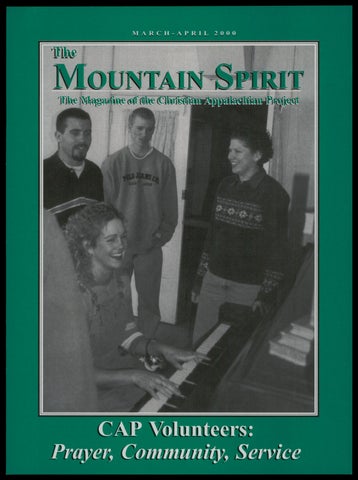
On the cover, Todd Norton and members o f the youth group at the United Methodist Church o f Louisa. At the piano is Gretchen Jackson. Photo by Beth Dotson.
Volunteer Spirituality, page 4 Published by the Christian Appalachian Project
D
e p a r t m
e n t s
E d ito r M a rg a r e t G a b rie l
3
R a n d o m T h o u g h ts
G r a p h ic D e s ig n K a r e n F r a n c e s S p iv e y
10
A round the Project
C ir c u la tio n L in d a G r id e r E a s t
21
Letters
29
CAP Close-Up
A d v is o r y B o a rd : F a th e r R a lp h W. B e itin g , M ik e San d ers, B ill Begley, B en P rew itt, B e c k y K an a
The Mountain Spirit is published six times a year. The annual subscription price is $8.00. Subscriptions and other correspondence should be sent to The Mountain Spirit, Christian Appalachian Project, 322 Crab Orchard Street, Lancaster, KY 40446. Copyright, 2000, The Christian Appalachian Project, Inc. All rights reserved. Member, Catholic Press Association. The Christian Appalachian Project is a non-profit Christian service organization operating throughout Appalachia. The project operates on the philosophy that helping people help themselves is the best approach to Appalachian poverty. The Christian Appalachian Project is recognized by the Internal Revenue Service as a 501(c)(3) charitable organization and is qualified to receive tax deductible contributions.
One of the most intriguing aspects of the work of the Christian Appala chian Project is the presence of the volunteers who come from all over the country to share Mike Sanders, part of themselves CAP President with the people of Appalachia. I can honestly say it is the spirit of those volunteers that I first met in 1983 that led me to accept Father Beiting’s offer to work for CAR I was caught up in the spirit of service and with the notion of working not for personal gain, but to empower and strengthen the area where I was born and raised. This issue of The Mountain Spirit introduces the reader to the three components of CAP’s volunteer program: prayer, service and commu nity. No one of these three areas is more important than another. All work in harmony to make an experience in CAP’s volunteer program. People who have volunteered with us (and there have been close to 35,000, we esti mate) say that their time has affected them as few other experiences have. I’m always particularly proud to point to the diversity in our volunteer force. There’s no “typical” age for a volunteer. We have some who have just finished college; others who are grandmas and grandpas. Our volun teers represent 30 states — we’ve even had some from foreign countries. The diversity of CAP’s programs call for diversity in our workforce, and in our volunteer ranks as well. I believe our volunteers will tell you that the diversity among them is one of the things that makes the volunteer experience with CAP, well, an experi ence. It’s not easy, they say, but something few of them would have missed. If you find the idea of volunteering for CAP of interest to you or someone you know, please contact us. You can be sure we’ll be in touch 1 Enjoy!
A summary o f the registration and financial documents filed by this organization can be obtained by contacting: in Maryland, for the cost o f copies and postage, the Secretary o f State, State House, Annapolis, MD 21401; in Virginia, State Division o f Consumer Affairs, P.O. Box 1163, Richmond, VA 23209; in Washington, residents can call the Secretary o f State toll-free within the state at 800-3324483; IN NEW YORK, OFFICE OF THE ATTORNEY GENERAL, CHARITIES BUREAU, 120 BROADWAY, NEW YORK, NY 10271; IN NEW JERSEY, THE ATTORNEY GENERAL BY CALLING 201-504-6215; IN PENNSYLVANIA, DEPARTMENT OF STATE BY CALLING TOLL-FREE WITHIN THE STATE, 800-732-0999; IN WEST VIRGINIA, SECRETARY OF STATE, STATE CAPITOL, CHARLESTON, WV 25305; IN FLORIDA, THE DIVISION OF CONSUMER SERVICES BY CALLING TOLL-FREE WITHIN THE STATE AT 800-435-7352; IN NORTH CAROLINA, FINANCIAL INFORMATION AND A COPY OF THE LICENSE ARE AVAILABLE FROM THE STATE SOLICITATION LICENSING BRANCH AT 919-733-4510; or by writing to Christian Appalachian Project, 322 Crab Orchard Street, Lancaster, KY 40446. Our license number in Michigan is MICS 9933. Registration with any o f the above government agencies does not imply endorsement by the state.
T
h e
M
o u n t a i n
S
p i r i t
R A N D O M T H O U G H T S B y S ue H enry n the mid-19th century Alec De Tocqueville described the typical American as one who “habitually engaged in a contemplation of a very puny object; namely himself.” A century later a Catholic priest founded an organization in Eastern Kentucky which gave people freedom from the trap of being caught up in themselves. His call was to take care of a group of people in Eastern Kentucky who were very needy; the deep poverty exacerbated by illiteracy. Father Beiting knew that, with God, CAP could make a significant difference. I’m confident that he was aware that by caring for people with very limited means by using volunteers he would also care for an opportunitied people with the inclination that all of us have to be caught up in ourselves. One can’t help wondering if the fall-out of CAP’S service to the poor has been almost as significant as the actual service. I am confident that all over the United States there are people who are far better disciples of Christ than they might have been had they not had the CAP experience. Most CAP volunteers are in Kentucky because they felt a call to service. They are drawn specifically to CAP by an opportunity to serve in a setting that pro vides a chance to live and serve in a Christian commu nity. I suspect the vast majority of volunteers get far, far more than anticipated. (Yes, more work probably as well as more wonderful benefits.) The nature of volunteer houses provides a volunteer the opportunity to grow while helping to help others grow as well. The first obvious part of the growth results from a diverse group of people living together with all of the give and take that involves. It is not always easy, but always a rich, wonderful growth experience. Volunteers are expected to live as Christian sisters and brothers: caring for each other, protecting each other, yes, loving each other. In spite of all our natural instincts, it happens. Dinner and prayer are the center of community living. Most of us know that something happens as people eat together. Dinner conversation is a good time for talking about the day’s experiences; on one hand serious and responsive, on the other, hilarious and just fun. Over good dinner conversation, volunteers really begin to know each other. After the meal and shared clean-up is finished, community members move into the living room to thank God for all his blessings and to appeal for guidance,
M arch
A pril
2 0 0 0
CAP founder Father Ralph Beiting with columnist Sue Henry.
strength, and support for all of the CAP communities, for each other, for the families we represent, and individual concerns. During this time openness often develops. Community members find themselves willing to be vulnerable, because they know they are safe with each other. What a gift! One of the amazing things that has happened to me personally, I suspect, has happened to a good many others. As a Protestant, 1 have grown in my respect and appreciation for Catholicism and what it is about. I certainly pray that through the CAP experience — a professedly ecumenical one — Catholics have likewise grown in an awareness of Protestant faiths. As each volunteer moves into a work situation daily, he or she is reminded of the privilege of service. Most of us grow up learning Jesus’ command to love others as we do ourselves. To our amazement we realize that with Him, we can indeed love our participants as we do our friends, our housemates, our family. Intellectually we know the power of love; but it is exciting to see it exhibited day after day. We adapt our expectations; becoming realistic about what should be accepted without being indulgent, we learn to forgive, be forgiven and move on. Yes, when CAP was begun as God’s operation to serve the people in real material need in Eastern Kentucky, a wonderful fall-out happened over these 50 years. Many opportunitied people have responded to God’s call to serve with CAP and these people have been given fulfillment and deep peace as they have grown closer to Him — walking side by side with other of His servants. Sue Henry hails from Alabama and originally came to CAP in the summer o f 1996. She has returned every summer since to volunteer at Family Life Services.
3
When Todd Norton left Iowa for Kentucky in August, 1999, he set several goals for himself. Some were fun things to strive for — like learning to rollerblade and play the guitar. Those easily fit in with the image some of his friends have of him as a “goofball” who likes to have fun. But Todd had more objectives. “I made a lot of goals in
my spiritual life also. One thing I want to do before I leave is to have an impact on the kids I come in contact with,” he said. “My stay here is worth it if I can just get one kid to come to the Lord.” In his first five months as a CAP volunteer, Todd has worked tirelessly toward that end. He tutors at the high school in Louisa, where
T
h e
M
he lives. He works in a CAP teen program that has put him in contact with young people in Louisa and Salyersville, Ky, and Kermit, W.Va. In addition, he has taken on the responsibility of being the youth director at the Methodist church in Louisa. It seems that if there are teens who need a little guidance, Todd is bound to meet them. “In our
o u n t a i n
S
p i r i t
society, I think that many teenagers aren’t being raised by their parents, they’re being raised by the televi sion,” Todd said. “They sit in front of the TV all day long and most of the time they watch by themselves, so we’re letting the media become the parent in these kids’ lives. I think it’s a good thing to get kids away from that environment and into a loving Christian environment where they can learn and grow and really get a lot of guidance in their life that they can’t get at home.” It wasn’t so long ago that Todd was a teen himself, discovering his own spirituality. He grew up in Iowa with both of his parents and four older siblings, all of whom still live in his hometown. His parents raised him in the Methodist church. Todd remembers when what they had been teaching him became a tangible reality in his life. It was during middle school when he attended a church camp. One evening, a counselor asked the group, “If you were to die tonight, would you to go heaven or hell?” At first, Todd wasn’t worried. He was a good kid, so of course he would go to heaven. “Do you know for sure?” the counselor asked. The more he thought about it, the more doubtful Todd became. That was when Todd realized he could acknowledge he was a sinner, ask for forgiveness, offer repentance and really invite Christ into his life. So that was what he did. He recalls that, like many young Christians, he made his share of mistakes when he was in high school. But Todd’s spiritual life swelled while he was attending Simpson College in Indianola, Iowa. “In college, God put different people in my life to help strengthen my walk and to help nurture my walk and my Christianity and they helped me grow spiritually,” he said. He especially recalls his friend Ryan, who kept him accountable to doing the right thing, and Rachel, who challenged him to be a better
M arch
A pril
2 0 0 0
Volunteer Todd Norton works with teens in Louisa and Salyersville Ky., and Kermit, W. Va.
Christian by spending more time in prayer, quiet and studying the scriptures. During his last semester in college Todd truly opened himself to God’s will. Although he had majored in journalism and worked in radio, newspaper and television, he didn’t feel that was what God wanted him to do. “I realized I needed to forget what I wanted and start concentrating on what God wanted in my life,” Todd said. “I think before it was a case of I was trying to decide what I wanted to do with my life and not giving God a chance to tell me where he could use me or where he wanted me.”
Working with teens
So Todd considered his talents and passions and realized he loved working with kids. Although he and a group of friends had volunteered with CAP in May of his senior year and worked in home repair, he didn’t realize at that time that CAP also served young people. In the summer when Todd checked out the CAP Web site on the Internet, he found information about CAP’S teen centers and decided that was where he needed to be. “A lot of my friends think I’m crazy for not working, especially the non-Christians,” Todd said. There is the matter off paying of his school
5
loans. And besides that, he’s not only volunteering, he’s volunteering far from the path that most of classmates have chosen back in the Midwest. But even when they share their belief that one person can’t really make a difference, Todd is not dissuaded. “I know that through Christ all things are possible and that if I have God on my side, I can accomplish anything. 1 knew when I came down here that God was going to give me the words, that God was going to give me the thoughts, the guidance, whatever it took, to help others. He was going to give me the energy and everything I needed.” So Todd signed up for one year of service with CAP and began working with Calvin Crumm and Matt Westerlund in the teen pro grams in Louisa and Salyersville, Ky., and Kermit, W. Va. The teen centers offer after school activities to young people. They try to attract low-income students who need positive role models and experiences that can introduce them to opportunities outside their regular realm of reality. “I don’t think they (teens) get a lot of adult interaction and we’re able to provide that for them,” program manager Calvin Crumm said about the teen centers. The centers
provide a place for socializing, Bible study, community service and field trips. For example, the staff has taken participants to Marshall University in nearby Huntington, W. Va., to see the campus. “Through that we hope to plant a seed that they can escape whatever life they live in and be a success. So many times these kids come in with no hope and they live in a society that a lot of times doesn’t have much hope,” Todd said. “That’s one thing we’re trying to provide to these kids . . . to give them a sense of hope and to show them that the possibili ties are there.” The teen center workers have seen dire situations during the past year, such as a 14-year-old girl who was having social and academic problems at school and had been suspended. She found out she was pregnant then tried to use so many drugs and so much alcohol that the baby would die. “She doesn’t believe there’s any way out and she doesn’t have any motivation to change her behavior. And that’s just typical of many of the kids,” Todd said. Many of the teens come to the center from broken homes and abusive situations. Some of them even live on their own, maybe in a trailer down the road from their
In addition to his work at CAP’s Pathfinders Youth and Teen Center, Todd sponsors a youth group at the United Methodist Church o f Louisa.
6
T
h e
M
parents. Todd sees youth being stolen from these teenagers. At the teen centers, the staff members try to give positive guidance and role models to the young people. Matt, another CAP volunteer, said the teens sometimes come to them with questions. “At that point we can use our own Christian insight and backgrounds to help influence their decisions and to show them this is what I think and this is what the Bible says,” Matt said. But the teen centers are not all serious Bible studies and discus sions. Matt said one of Todd’s gifts to the center is that he brings a lot of smiles and is a joker when it’s appropriate. “He shows the kids there’s nothing wrong with being fun. You don’t have to be boring and straight-faced all the time, but there are times when you need to get serious,” Matt said. Calvin appreci ates the positive leadership Todd has brought to the program. “Todd’s a very outgoing person and he has the ability to draw the kids in with his personality,” Calvin said. A community volunteer
Those traits also serve Todd well at the church where he meets with high school students every Sunday evening and calls each of them during the week to see how they are doing. Todd said that although the teens he meets at church come from good families and generally more positive situations than the young people he meets through CAP’s program, they’re still teenagers who are struggling with choices. They need to talk about issues like dating, drugs, violence and what they are going to do with their lives. He believes these issues are even tougher today than they were five years ago when he was in high school. If Todd can help these young people develop a personal relationship with Christ,
o u n t a i n
S
p i r i t
Todd, right, brainstorms with other youth and teen workers (L-R) Ruth Horn, Calvin Crumm and Matt Westerlund.
he believes they’ll be on the road to making good decisions. On Sunday evenings, the group plays games, studies the Bible and talks about what it means to be a Christian. “They’re always on the fence and you have to give them the guidance and give them the convictions and pray that they’ll get convicted in their own life to do what is right, to do what God wants in their life,” Todd said. Ashley Butler and Becky Schaffer enjoy participating in the youth program and agree that Todd brings patience and energy to the job. “I guess some people have that gift and he has it,” Becky said. She also notes the scripture passage that has been on her mind because of the frequency with which Todd brings it up: John 3:30, which says “God must increase and I must decrease.” As the youth ponder the meaning of that passage in their life, they are examples to the rest of the congre gation. Ashley Butler said about the youth program, “It’s helped the morale of the church to see the youth active.” They had been advertising for a youth pastor for a year before Todd arrived. Although making the commitment to the church makes Todd’s sched ule even busier, he draws strength for fulfdling all of his commitments from his volunteer community and his prayer life. There are 18 volun teers in Todd’s house, all of whom
M arch
A pril
2 0 0 0
offer support to one another as they try to follow the will of God during their time of service in Appalachia. “I live in a house with very spiritual people and I have been challenged and encouraged by each one of them to be stronger in my faith, to really spend more time in regard to my spiritual life,” Todd said. “And I think my spiritual life has gotten greater and I’ve spent more time in prayer since being down here.” CAP volunteer communities pray together each day, but Todd’s evening work at the teen center often causes him to miss the group prayer. Like some of the other young people in the house, however, Todd is still awake enough at 10 p.m. to debate spiritual questions. He said that often, three or four of the volunteers gather late at night for a devotion. They pick a topic, read scripture, debate it and talk about how it affects them. Sometimes one of the volunteers will have a question they are struggling with and share it with the group. Someone recently asked, “How do you know when you’re supposed to pray with someone?” The group discussed prayer and its meaning for an hour as they searched for an answer. “You’re just growing constantly as you listen to these other people,” Todd said. The situation he is in now draws Todd into prayer and conversation with God more often than he has
experienced before. “Seeing all the problems that are here, I spend more time just asking God for guidance, knowing what to do to help the people in Appalachia,” he said. That prayer will continue throughout Todd’s time of service, and it’s one of the things he will carry with him when he finishes his volunteer time. Todd says that working with people who haven’t had things handed to them in life has changed him, and that’s something he’ll carry away also. “My whole outlook on life and my whole outlook on being successful and my outlook on a lot of things the world tells us is important have been shaped and have been changed, transformed,” Todd said. “That kind of experience is some thing you’ll carry with you for the rest of your life.” Todd believes that his spirituality has been shaped by the people who have guided him in his life, which is why he wants to be a guide for the teenagers he meets. Even if he helps only one person build a relationship with Christ, he believes he will have done his job, because the ripple effect can begin there. That ripple might begin with a laugh. “Most people consider me a goofball. I guess it’s true I’m a goofball, but I’m a goofball with an intense love for the Lord,” Todd said. Whether it’s a laugh, a game, a Bible study or a phone call that reaches someone, Todd is ready to use it. He feels that God has already opened so many doors for him in Kentucky, and he has no reason to believe that will stop. Although he signed up for one year of service with CAP, Todd doesn’t really know when he’ll leave. “I’ll stay in Kentucky until God tells me I can leave. He brought me here, and He’ll lead me where He can use me next.” Beth Dotson, a regular contributor to The Mountain Spirit, is a former CAP volunteer.
7
Appalachian Reflections by CAP Volunteers, CAP President Mike Sanders, and Fr. Ralph Beiting, CAP Founder.
Reviewed by Jim Trammel Christ’s subtle soldiers, low-key miracle workers, notes in the melody of God’s creation — the Christian Appalachian Project’s volunteer corps. They collapse exhausted from most sessions of striving toward the light, and feel God’s grace flow strongly into the center from which their day’s energy ebbed. Seven hundred strong during 1999, they will probably more than double that number before the end of 2000. If you’ve ever won dered about their motivations, or sought to know the blessings they find in the volunteer lifestyle, sit down with Appala chian Reflections and let these pilgrims speak to your heart. Early spring is a peak season for volunteer activity, as hundreds of college students from all over the nation sacrifice spring breaks for an invaluable lesson in life. CAP brings them all to Appalachian Kentucky where they converge for
T
h e
M
o u n t
a i n
S
p i r i t
its annual WorkFest, doing what ever they can (across a wide range of talent) to repair homes. Some will return later for another volunteer assignment and will stay for weeks, months or years. As with almost every volunteer experience, the rookies may have a mission in mind, but their expecta tions don’t always mesh with Appalachian reality. Victories and setbacks are absorbed, and only with distance and time for serious thought can most realize what the volunteer experience wrought in their own lives. “Although I often think of CAP . . . it’s been a while since I truly reflected,” Jerry Buffington-Dunn says as she describes service to the elderly program. CAP President Mike Sanders introduces us to each volunteer, whose stories illustrate CAP program activities, thereby also imparting a neat overview of CAP’s multi-faceted efforts. Mike’s own story, which he tells in his first essay, recalls how Father Beiting’s efforts inspired Mike’s own commitment. With that ex ample, it isn’t too much of a stretch to think that Father Beiting’s effort multiplied through all these earnest volunteers might one day gather strength enough for a complete social safety net, even one as strong as Appalachian Kentucky needs. Whether the reminiscences concern wielding hammers for home repair in the manner of volunteer Jackie Burke Rodriguez, or teaching literacy as Bert Uschold did, readers share a little slice of the excitement and fulfillment of doing God’s work that is the volunteers’ chief compen sation. Uschold’s particularly bittersweet essay recounts a literacy break through — he taught a dad to read a book to his son. But the real world denies a storybook ending: Circum stances prevented Uschold from ever seeing the dad/student again. Even so, as Uschold muses, the act may ultimately have done some
M arch
A pril
2 0 0 0
Christ’s subtle soldiers, low-key miracle workers, notes in the melody of God’s creation — the Christian Appalachian Project’s volunteer corps. good somewhere, at some time, perhaps ultimately providing a golden thread to God’s tapestry. Julie Sbraccia-Manos, a 1980s volunteer, provides a glimpse of the joy in a CAP volunteer community, whether during daily life in volun teer houses or in reconnecting after several years. Sally Simmons and Jeanne Campbell share reminiscences about CAP’s summer camp programs, Sally exploring the lessons learned unawares by a camper and Jeanne evoking gentle laughs out of chaos. Jeanne must have had some second thoughts about her call to become “The Oldest Kid in Camp,” gamely offering her volunteer service despite being a half-century beyond her colleagues in their 20s. She persevered through some humorous initial misconnections to witness “unheralded acts of charity” and a “great sense of spirituality” at the camp. Other essays demonstrate how the volunteer experience echoes down the corridors of life. Pam Prout Ptasnik tells how she came from Chicago to find an unofficial but truly real family that lives in her thoughts today. Mountain Spirit editor Peggy Gabriel recounts life lessons that have lasted far beyond her time as an outreach program
volunteer. “I don’t know where it is that you meet God,” reflects volunteer Shannon Hodge in perhaps the book’s most poignant passage. She knew God’s presence through a rambunctious four-year-old that unexpectedly mellowed and let her get close to him. “One day in May, God came to me, and sat on my lap, and allowed me to rest in the love and power of His holy caring arms.” Hodge borrows an apt Father Beiting phrase when she continues, “A tired volunteer is a happy volunteer, because [the volunteer] ... can know what it means to be loved and held by grace.” Photos of the volunteers are a welcome addition to this brand of CAP publication. Their warm smiles let you know just by looking that these volunteers are spreading happiness both outwardly and inwardly. Each first-person story is intro duced and amplified by President Mike’s summaries of the relevant CAP program and his frequently expressed appreciation of the vital roles of volunteers. And at every turn, the common thread: By helping CAP on its journey, the volunteers advance along their spiritual paths. In the words of Sister Marguerite Blackburn, a volunteer through her religious community: “Each time you give that love away, in whatever form . . . your store is not depleted, but rather increased.” These selected stories from among 35,000 volunteers who came to do good and found much goodness to take home make Appalachian Reflections a heart warming read.
More information about volunteering is available at the CAP web site www.chrisapp.org, or see the volunteer information and application form in the back o f Appalachian Reflections. To obtain a copy please contact Phyllis Caudill, CAP, 322 Crab Orchard St., Lancaster, K Y 40446
9
A
r
o
T he
u
n
d
P roject
Middlesboro Ministerial Association Honored for Stand Against Racism The Christian Appalachian Project honored the Middlesboro Ministerial Association with the 2000 Peace Award for the courage the association displayed by mounting community events in the face of a rally organized by the Ku Klux Klan. The Klan action followed a racial incident involving a black man and a white boy. “To remain silent,” said Rev. Derek Penwell, minister of the First Christian Church, “would be a tacit endorsement of the Klan’s pres ence.” Penwell and the Middlesboro Ministerial Association wanted no part of what they agreed would be an endorsement, but felt that to stage an alternative rally would “play into their hand. We have lots of weapons, not the least of which is prayer,” Rev. Penwell said. “We decided to hold an alternative service to proclaim who we are.” The Service for Peace, Unity and Justice, held at the Central Arts Auditorium, hosted 200 to 300 people who prayed and talked about prayer and the importance of prayer in a situation “when there’s hatred all around,” Rev. Penwell said. The association received greetings of prayer and support from governing bodies of local denominations, including Episcopal, Roman Catholic, Methodist. The service was preceded by a vigil at the Covenant United Methodist Church organized by the ministerial association. People came to pray continuously for twenty-four hours before the service and the rally, which occurred simulta neously. On the request of the association, Saturday, December 18, 1999, was proclaimed a day of peace, unity and justice and the Middlesboro City
10
Council appro priated funds for a visual symbol of unity — black and white ribbons which were displayed prominently throughout the small, southeast ern Kentucky town. “Had we not said or done anything,” Rev. Penwell said, “the only image people in Kentucky and Tennessee would have of the peo ple of Middles boro would have been of whitehooded people walking through our downtown.” The associa tion recognized Peace Committee co-chairperson Kathleen Leavell addresses the need for ra an assembly at the 1998 Peace Award ceremony. cial healing and reconciliation after the burning of CAP’s Operation Sharing and a African-American churches in 1996, member of the Peace Committee. Rev. Penwell said. “There have been “They made a statement that a lot of racial problems here, not unlike other us think about making. They had an places,” but the group sees the need opportunity to speak out against an to confront the issues and devise injustice, they stepped up to the solutions. They held a service for plate and hit a home run.” healing and reconciliation on Sunday, The 1999 recipient, John Ed January 16, to coincide with the Pennington of Manchester, Ky., was national recognition of the birthday of recognized for his lifelong efforts to Rev. Martin Luther King, Jr. eliminate racism in Clay County. The Middlesboro Ministerial Other recipients include Jerry Gore, Association is the ninth recipient of director of minority affairs at the CAP Peace Award, which is Morehead State University, and the given annually in January in honor Racism and Diversity Committee of of the work of Rev. King. “They’re the Berea Community School. trying to make a difference,” said The award will be made at a public Mike McLaughlin, director of ceremony in Middlesboro in April.
T
h e
M
o u n t a i n
S
p i r i t
A
r
T he
o
u
n
d
P roject
CAP Opens Child and Family Center in Lawrence County Genesis Child and Family Development Center will expand the Christian Appalachian Project’s work in family literacy and child development when it opens in the Lawrence County community of Louisa, Ky. “We did a county evaluation and learned that there was no child care in town,” said human services director Rose Price. “Louisa is a county seat and people come to work here, so there was a need demonstrated.” Like CAP’s centers in Garrard, Madison, McCreary and Rockcastle counties, the newest center will be designed to meet the needs of its community, according to program manager Brenda Wireman. “We’ll probably have more enrollment in family literacy than in day care, and we’ll serve children from birth to age five,” she said. Like a typical family structure, children of all ages will come together for meals and outside play, but will group by age for cognitive activities. “Each group will have time that will be set aside just for them,” Brenda said. CAP child development centers have been in operation since the
mid-1970s. The programs have always reflected the philosophy that parents are the first and best teachers of their children. In the late 1990s, centers began to implement family literacy programs and in 1999, the names of the centers were changed to “child and family development centers” to more accurately describe their goals and mission. “When a child is enrolled, we ask the family to be involved in the center,” Brenda said. Families who participate in the Kentucky Tempo rary Assistance Program can work in the center for 30 hours a week, the hours that are required to collect benefits. “We’re working with Community Based Services to help as many people as we can,” Brenda said. Regardless of a family’s employ ment standing, an adult is encour aged to participate in the program. “One of our moms works during the day and the dad works at night, so he comes to the center. In another, the grandmother comes.” Genesis Child and Family Devel opment Center is licensed for 49 children.
What You Don't Know About Wills Can Hurt Your H e irs ..
Find Out Why. Request Your Free Copy.
Much of what you know about wills may be misinformation that has been floating around for years. If you think, for example, that wills are primarily for rich people, or elderly people, you may be the victim of a common misconception. The helpful booklet offered here will explain how your will can save your heirs from costly delays and confu sion. Send for your copy today. Clip and Mail
Christian Appalachian Project 322 Crab Orchard Street Lancaster, Kentucky 40446 Please send without obliga tion your booklet, “37 Things People ‘Know’ About Wills That Aren’t Really So.” Name____________________ Address__________________ C ity______________________ At the Genesis Open House, managers o f CAP's four child and family development centers gave gifts to Brenda Wireman (center), manager o f the newest center.
M
a r c h
A pril
2onn
State,ZIP__________________
A
R
O
T he
U
N
D
*
P roject
Scholarship Fund Helps Woman Overcome Barriers Each year the Christian Appala chian Project awards scholarships to people who have attained a General Equivalency Diploma and wish to continue their education through post-secondary or voca tional training. Like most CAP programs, the scholarship fund has the flexibility it needs to serve people in the best, most effective ways. When adult education teacher Keith Gilbertson met Lisa Leach, who was referred to CAP by the Kentucky Department for the Blind, she had been trying to pass the test for her GED for six years. Her sight impairment made progress difficult, but her desire to obtain her GED kept her from giving up. “If you’ll be patient with me, we’ll do this together,” Lisa told Keith. In addition to his tutorial work
with Lisa, Keith also helped her to access information about special accommoda tions available because of her disability. He helped Lisa apply to CAP for funds for a computer that would enable her to run software that runs enlarged type and a program that reads books aloud. “She passed her GED this week,” said program manager Linville Rose. “Her husband, who is also legally blind, makes saddles. Their children are so Lisa Leach, pictured here in a recent interview about her proud.” academic accomplishments.
Short Term Experience . . .
Long Term Impact The CAP volunteer program needs summer camp counselors, nurses and lifeguards to staff four camps in eastern Kentucky. We are seeking highenergy men and women, age 18 or older, for the months of June, July and early August. We would like a commitment of at least two months, but a 3-7 week stay can be arranged. Room and board is provided, also orientation and ongoing training, daily prayer and a potential AmeriCorps Educational Award.
For more information call
(800) 755-5322
e-mail: volunteer@chrisapp.org
12
Visit us: www.chrisapp.org
T
h e
M
Christian Appalachian Project Volunteer Project
o u n t a i n
S
p i r i t
A
R
T he
O
U
N
D
P roject
CAP Expands Education Programs at Camps Chauncy and Matthew Douglas are currently conducting twice-weekly classes at Jackson County Alterna tive School, which students attend when they are on suspension. Currently, the volunteers are addressing the concept of “Circle of influence,” with their students, Daniel said. “When you surround yourself with positive or negative influence it affects what you do,” he said. “They’re the ones who can change.” Daniel said that as they move toward talking about dreams and realizing those dreams, the students learn that their circle of influence can affect their long term planning. One of their students, for example, dreamed of joining the Army. “But if he keeps hanging around with students who get in trouble, he could get in trouble, and his dream would be gone,” Daniel said he has pointed out. Brenda Thomas recently started working as a CAP representative The education program at Camp Andrew Jackson in the Jackson County includes a hands-on science exhibit. school system, present ing a curriculum called “Celebrating With Peggy, volunteers and Diversity” which explains a variety employees of CAP’s camp education of cultures. programs devised a mission: “To “I’ll start with the Appalachian foster growth in second to twelfth region, and talk about the pride of graders through moral, ethical, our own culture,” Brenda said. spiritual and character-building “Then I’ll go on to another culture, values.” At Camp Andrew Jackson probably Cajun.” Brenda’s lesson three staff members and program plans will include many aspects of manager Mike Arvin make presenta culture, including song and food. tions on a variety of topics, includ The last lesson the unit is “Creating ing diversity, tolerance and respect. a Culture of Inclusion,” Brenda said. A unit entitled “We Can Work It “We’re different, but all part of the Out” which addresses the issues of same family.” self-control and conflict resolution Brenda, a native of the small is very popular, Peggy said. “The Jackson County community of Best is Yet to Be, the Future is Me” Morrill, graduated from Berea introduces older students to skills College and received her teaching and life choices. Volunteers Daniel The Christian Appalachian Project operates camps in three Eastern Kentucky counties: Jackson, Floyd and Lawrence. In addition to summer camping experiences for young people, each camp provides unique programming to young people in its home county, and in surrounding counties. During the current academic year, Camps Andrew Jackson (Jackson County), Shawnee (Floyd County) and Boone’s Landing (Lawrence County) are providing programs to enhance the curriculum of local second through twelfth grades, said human services assistant director Peggy Hancock.
M arch
A pril
2 0 0 0
certificate from Eastern Kentucky University. “I know this program will do a lot of good for the kids,” she said. Trish Joseph is coordinating the education program for Camp Shawnee in Floyd County. Four days each week Trish makes a presentation called “Celebrating Differences” in classrooms in Floyd, Johnson, Knott and Magoffin counties. “The first thing I do is write the word ‘diversity’ on the board, and ask the kids if they know what that means,” Trish said. Discussion is followed by assigning each student to a group with a different color dot. She tells the class that she is going to treat one group differently, and asks them to be alert to which group that it is. It never takes long for a class to identify which group is being treated differently, even unfairly, she said. The goal of Trish’s class to impress upon children that differ ences are to be embraced and celebrated, and to learn that everyone is different, but in the ways that are most important, we are all the same, Trish said.
Is there a CAP program that you don’t see in this issue of The Mountain Spirit? CAP’s web site includes information about all of CAP’s human service programs, planned giving and major gifts and the volunteer program. Please visit the site at www.chrisapp.org and be sure to sign our guest book!
13
A
R
T he
O
U
N
D
P roject
Kentucky Employees Charitable Campaign Several CAP staff and volun The Kentucky Employees Chari teers took the opportunity to talk table Campaign (KECC) knew it was with state employees about CAP. off to a great start when Secretary PAYROLL DEDUCTION Margret Short, a network John Morse, Cabinet for Health If your employer offers donor analyst with the Transportation Services, volunteered to lead the fall designation as a write-in for Department in Elizabethtown, Ky., 1999 campaign, according to Teresa payroll deduction campaign, has group meetings at every McAnly, who coordinates the state please remember the Christian transportation location in her area. campaign for the Christian Appala Appalachian Project. CAP is a Margret has coordinated her area chian Project, one of the three 501(c)(3) tax exempt agency, campaign for the past nine years participating charities. “When he and payroll deduction is the and claims that “education is the announced his resignation from state easiest way to help the families key to having a successful government, no one could have filled of Appalachia. To ensure that we receive your payroll deduction campaign. Once people are better his shoes any better than Secretary gifts, please give your payroll educated concerning the pro Viola P. Miller, Cabinet for Families officer CAP’S full address and and Children,” Teresa said. “Secretary grams funded by these organiza send to the attention of: tions and the way funds are Miller’s true spirit towards bettering Teresa McAnly-Campaign allocated, they seem more willing the lives of the people of Kentucky Coordinator to donate.” would energize an entire room.” Email: KECC has support from all Along with CAP, KECC provides tmcanly @chrisapp. org areas of state government, Teresa resources for Community Health said, and many people consider Charities and United Ways of Ken Christian Appalachian Project 322 Crab Orchard Street tucky. CAP has been a recipient in the the campaign an important part of Lancaster, KY 40446 their job in state government. KECC campaign since 1993. All reason that someone got a new “Serving as a KECC coordinator Kentucky state employees are for two years has opened my eyes home or a cure for cancer is found,” encouraged to give contributions said Kathy Campbell, special through payroll or cash to one, two, or to the challenges some of assistant to Treasurer Johnathan Kentucky’s citizens face. It feels all three organizations. Many state great to know that you may be the Miller. offices also sponsor events such as chili cook-offs, ice cream socials, used book sales, “dress down” days and talent shows. All three recipient organizations split the profits from fundraisers. The goal for KECC in 1999 was quite aggressive, Teresa said, “A whopping $1 million. Through the amazing generosity of 12,000 Kentucky’s State employees, the total reached $1,040,405. CAP’S share of designated pledges from 2,580 state employees was an Kentucky First Lady Judy Patton (left) served as the Honorary Co-Chairperson fo r the 1996 KECC all-time high of with her husband, Gov. Paul Patton. Pictured with Mrs. Patton is CAP participant Devona Hensley, vice president o f development Ben Prewitt and CAP campaign coordinator Teresa McAnly. $173,148.”
WORKPLACE
14
T
h e
M
o u n t a i
n
S
p i r i t
B ooks O n T ape By Father Ralph Beiting Now available on cassette, the voice of Father Ralph Beiting brings to life
the stories and experiences of his work in the mountains of Appalachia. As founder of the Christian Appalachian Project, Fr. Beiting has earned a reputation in
Appalachia as a true visionary and advocate for change. His self-help philosophy has materialized in the human service programs of the Christian Appalachian Project. The books on tape are available to you at no cost. Each book contains two cassettes, packaged in a full color vinyl case. A donation to help cover the cost o f the book, shipping and handling is appreciated. Your donation will also help make possible
the work of the Christian Appalachian Project. To order please fill out the following card:
□
Please send me one o f the following books on tape at no cost. □ God Can Move Mountains □ The Promise o f Faith . . . With Christ We Can Do All Things □ A Time of Crisis . . . A Time for Christ
I have enclosed a donation of: □ $10.00 □ $15.00 □ $20.00 □ Other $___________ To help cover the cost of the book and further the mission of the Christian Appalachian Project One book per order, Please - limited quantities available. Any questions? You may contact us at ( 8 0 0 ) 9 5 5 - 3 4 7 0 __________________________________________ MS-300 Please make checks payable and m ail to: Christian Appalachian Project
_____________ Visit our web site at:
322 Crab Orchard Street • Lancaster, KY 40446 www.chrisapp.org_______________ email: capinfo@chrisapp.org______
When I came to Jackson County in June, 1999, to volunteer in the Christian Appalachian Project elderly services program, I never expected to gain fifty Appalachian grandparents overnight. Nor did I expect that at age 21 I could come to identify so easily with a group of people whose mirrors reflect the wrinkles, age spots, and gray hairs time inflicts on us all. But I have, thanks to the invaluable lessons I have learned through previous service experience and the last few months with CAP. —
Pi* photos by Margaret Gabriel
—
My servicemindedness first kicked in several years ago when 1 was in junior high school — I was too young to apply for a paying job, but old enough to know I wanted to contribute something to my community. For several months I volunteered at a local veterinary hospital cleaning cages, mopping floors, and restocking supplies. The puppies and kittens were cute and all, but it wasn’t what I would call reward-
Christine enjoys China’s dried apple stack cake. Later in the visit. China served homemade fudge and
ing. peanut brittle. The following year, 1 discovered a new source of inspiration. The married couple who taught my religious education class constantly encouraged us to serve people directly with people — to put a face and a name with the experience rather than making an anonymous effort to meet some anonymous need. They promised it would enhance learning and understanding and help us in the development of compassion. And they were right. During the next couple of years I volunteered at soup kitchens and in the surgical ward of a local hospital. Finishing high school and making a solid start on my communication degree became priorities until my junior year of college when I jumped at the opportunity to travel to Ghana, West Africa, as part of a missionary group led by a priest from my home parish in Waterloo, Iowa. We traveled this extremely impoverished country for two weeks delivering medical, dental, and school supplies, clothing, and toys while witnessing the daily headaches, backaches, and heartaches suffered by parents as they labored to provide for their numerous young ones. The supplies we carried to Ghana
M arch
A
p r i l
2 0 0 0
when she was injured in a horrible definitely eased some of the car accident. I was devastated. families’ immediate physical needs. On Thanksgiving Day that year, But more important than the two days after I met Ruth, I exchange of the tangible gifts we returned to her house with a meal brought was the lesson of love, a local church had prepared for hope, and faith we taught one her. She was at the door of her another. These fill everyone’s spiritual needs, and we realized that trailer waiting for me before I could even get out of the car. no matter what we think we already Immediately, she invited me in to know about love, hope, and faith, have lunch with her. I was running there is always more to learn. a little late as it was, but I stayed My junior year of college was just to spend more time with an also the year I learned about the admirable woman whose strength Christian Appalachian Project. I and courage I found incredible. I first visited Jackson County, Ky., during Thanksgiving break while on had no idea if I would ever see her again. When it was time to say a service trip sponsored by my goodbye it was difficult, and Ruth college. That was the year I met made leaving no easier when she Ruth, a very gentle woman in her thanked me for having lunch with mid-fifties whose quiet smile her, saying it was the first time in concealed the fact that she was struggling quite fiercely with cancer. years she had spent a holiday with company. She lived in a trailer next to the Before returning to college after crumbling house where her mother such an extraordinary service had died a few years earlier. I experience, I spoke with a CAP wondered why Ruth’s shelves held volunteer who briefly explained stuffed animals, why her walls were what services each program bare of family photographs, and provided. The second she de why such a wonderful lady’s only scribed the in-home visitation and companion was her pet Schnauzer. personal nature of elderly services, Later, I learned she had lost her husband, three young daughters, and 1was interested in the chance to spend a year in an area of the her memory of everyone she loved
17
country I had fallen in love with getting to know more people like Ruth. I was fascinated by people whose histories tell of incredible stories, whose present lives are often filled by loneliness, and whose futures have yet to be authored by their own hope. I knew what I wanted to do, but would I still be interested in another year after I graduated? And what about getting a job, making some money, and paying off college loans? Could I really do this? My afternoon with Ruth had quizzed me on the subjects of love and hope, but that chapter on faith was to be the focus of a major exam. I had begun my own journey to learn what serving others truly means. The decision to devote a year to helping others was extremely appealing, yet seemed very risky, considering I would have to give up making a fresh start for myself as a college graduate and pursuing a career in journalism. To ponder the decision, I returned to Jackson County with the service group from my college again the following year. At that point, I was about six months from graduation and the decision seemed clear and simple. I would come to Kentucky after graduation and not think about it as giving up my start in the real world, just as postponing it a little. So here I am. Well over half of my year with CAP is completed and I love the elderly people of Jackson County. At a month and a half into my year of service, I found myself telling my mother that I had spent the afternoon of my 22nd birthday with two friends who happen to both be in their upper 80s. They cooked lunch and we had a grand time over fried country ham, fresh green beans, buttermilk biscuits, and baked apples. It was just like being a child at your grandma’s house, except I quickly realized that over 50 people had adopted me as their granddaugh ter and I had adopted them as grandparents as well. There are a lot of good times that
18
stand out in my mind. I lead monthly craft hours at the local senior center, and had an especially good time when we decorated pumpkins for Halloween. I deco rated my pumpkin to look like my favorite Muppet, Miss Piggy. When it came time to award the prizes for
and buying her groceries. The second time I visited her, Maxie slapped me heartily on the shoulder, pulled me to her, and hugging me tightly said, “Ah lu-uv you!” with a wide smile and a childish giggle as punctuation. I could go on about the good
China looks forward to and appreciates visits from Christine.
the decorating contest, I found myselfjudging about ten other pigs! But each was different in some way and they all received prizes because each was really something special. Then there is my 90-year-old sweetheart, Maxie, who immedi ately trusted me enough to let me take on the jobs of paying her bills each month, picking up her mail,
T
h e
M
things forever, but the truth of the matter is that when you serve others, you have to take the good and the bad together. I’ll never forget the phone calls bearing the bad news that so-and-so was taken to the hospital or the worried voice of one man’s daughter who told me her father was in a coma after undergo ing his fourth open-heart surgery in
o u n t a i n
S
p i r i t
Christine visits with Wendell. Although Wendell is recuperating from heart surgery, he still loves to play jokes and tell funny stories.
less than a year. When Wendell woke up and was in a stable enough condition to have visitors, I went to see him at the hospital. He was very scared and knew he had a long recovery ahead of him. He broke down crying, as did I, so we prayed together. There have also been occasions when I’ve gone into people’s homes to find no food in their cupboards, pest and rodent problems that are almost out of control, and unfortu nately, people who are either unwilling to help themselves, unwilling to accept help from others, or unappreciative of the help they have been given. But I roll with the punches and try to serve in the best way I know how. During my time with CAP I have learned that it is possible to serve others without even knowing it. Taking a special interest in a person, spending time with them, and talking over a cup of coffee is a good start. A lady I see often reminded me of this not so long ago. Her name is Bessie. For a few months we’ve been making weekly trips to the health department to keep an eye on her blood pressure. Bessie is shy and quiet, so I was surprised when she spoke up, saying she was tired of all this running
M arch
A
p r i l
2 0 0 0
around and one day she wanted to just sit in her kitchen and talk like we used to. The conversation we had in her kitchen a couple days later was one of the most enjoyable I’ve had. Keeping up with 50 senior citizens is not as easy as I thought it would be! A lot of my time is spent driving people to see their doctors in neighboring counties, running to the grocery store to pick up a few items, arranging social events, and delivering medications. On days when I’m busy running errands I feel that I’ve accomplished a great deal, but Bessie helped me realize I can probably accomplish more by swatting horse flies on Owen’s front porch while he cracks jokes from his rocking chair, by sharing Arnold’s enthusiasm over his collection of silly toys, or by enjoying a piece of China’s dried apple stack cake. More than anything, I’ve learned that service is the personal nature of building relationships, not counting how many errands you do for a person. In building those relation ships, there are several important elements we must demonstrate, no matter how personally challenging they may be, elements like selfless ness, empathy, respect, vision, insight and community. CAP has
given me an inside view of how often these ideals work themselves into everyday life in Appalachia. Starting with selflessness, we have to remember to devote ourselves to others’ welfare and not just our own. Being flexible, adjusting our schedules, and putting our own, often less-important agendas aside for the sake of someone else is not a new concept in itself, but it may be a novel idea when applied to our own lives. Just before several of us volunteers were leaving for the holidays, we received some donated turkeys which were to go to our participants for Christmas. With a full schedule, the only free time I could find to distribute the turkeys was on a Sunday afternoon when 1 would have rather been packing my car to go home. Tugging at my selfish conscience was my soft heart, reminding me what I was here to do. If my family at home was in the same financial situation as many Appalachian families, getting a turkey for Christmas would be a precious gift. So off I went into the hollers to deliver five birds. At the last stop, Linda took the turkey and said, “Aw, you didn’t have to do this for us,” and I found myself replying honestly, “But I wanted to.” Empathy does a lot to humble a person. I was once in a drugstore with 78-year-old George, a freespirited man who takes awesome delight in animals, plants, nature, and as he once put it, “anything beautiful.” He spotted the greeting cards and made a mad dash down the aisle. When I caught up with him, he was picking cards off the shelf based on their illustrations and asked me to read them to him. It was only then that I realized he couldn’t read. At first it bothered me to think of the limits that put on him. Then I saw how his shining, joyous eyes were studying every line and every color and how beautiful the pictures were to him and I knew that he understood everything he needed to know about those cards, even without knowing what the words said. By seeing
19
Christine shares a crossword puzzle book with Lola, who often initiates the phone tree with Christine’s participants.
through his eyes, I realized that at his age his needs probably don’t include learning how to read, but they do include stimulation and someone with whom to share his appreciation of absolutely every thing. When we meet people who are financially poor, physically or mentally ill or disabled, or who have an insufficient education, we’re often challenged concerning the level of respect we choose to show them. I believe the more time we spend with people in these situations, the more likely it is that we see their humanity. They share the same needs and dreams as every other human being in the world, and deserve the same respect and sense of dignity. This is where community and insight enter the grand scheme of things. The cities and communities we live in, whether large or small, are made up of all sorts of people. Some are better off than others, some simply need direction, and
20
some just need a good kick in the pants. If we can realize that these people are our grandparents, parents, brothers, sisters, and even our peers, then maybe we’ll see that part of our responsibility includes providing insight to aid them with their challenges. It’s great to have goals and a vision of how we’d like to help others and how we’d like things to eventually turn out, but as another volunteer once put it, we have to remember to “meet people where they’re at.” A few of the elderly people I visit are somewhat anti social but they also say they are lonely. To this very day, I have been unable to stir them from the comforts of home and persuade them to take part in a social activity. However, some have agreed to invite guests to their own homes and others have found new hobbies. One woman even decided to take up watercolor painting. Disheartening situations don’t improve overnight, so it’s best to accept people and their capabili
T
h e
M
ties for who and what they are and work slowly from there. A friend once told me not to expect to change the world as a volunteer, and I told her I believed the world could be saved, but only one minute step at a time. Finally and most important, we must remember to serve others by example. I have learned valuable lessons during the past several years, but the most priceless lessons learned are those taught by the example of Christ. Volunteering with CAP has proven to me that service has an enormous spiritual compo nent. Unconditional love, peace, and faith are wonderful gifts we can attain through Jesus. By doing so we can also see that every smile that greets us, every tear we wipe dry, and yes, every wrinkle we try to smooth and every gray hair we pluck are the very ones we will see in the face of God. Christine Penne is a first year CAP volunteer.
o u n t a i n
S
p i r i t
L etters to the E d itor D^d
l^dE m][M] E m] DM 1EMI
I enjoy reading everything you send to me. If I were younger, I would certainly be there to help. You certainly do wonderful work for all the people there. God bless. Leona Ferraro
I am deeply proud and glad to participate in God’s holy will and divine plan to help bring to man kind his eternal love and devotion in this country. CAP is truly the divine plan in action, to rejuvenize and to truly re-dedicate this glorious nation, under God, for the equal opportunities for all peoples right to life, liberty and the pursuit of happiness of which this great nation was built on! Keep up the good work. Donald Wahl Carmichael Ohio
Your stories are so beautiful as you show the people living in their sad conditions, day after day. Mrs. Gladys M. Patter Fontana, Calif.
We really enjoy reading The Mountain Spirit. Wish we could help more. Your magazine has an excellent set-up and is well written. Mr. & Mrs. Edward L. Fargo Akron, Ohio
1 enjoy The Mountain Spirit and read it all the moment it arrives. You are all good people doing good things too good people. Keep on keeping on! Ronald C. Wetterholt Evanston, III.
M arch
A pril
2 0 0 0
You and your fellow workers are ever in my thoughts and prayers. My husband and I both come from “dirt poor” backgrounds. We daily count our blessings and are thankful to have learned the joy of knowing how to work hard to better our own circumstances and to provide our children and grandchildren a more promising future. It is true that nothing we do for a child is wasted effort. Mrs. Patricia Berry Darrington, Wash.
I enjoy The Mountain Spirit so much and look forward to every issue. I wish I could help those dear people more. Keep up the good work and perhaps the next genera tion will have better lives. Mrs. M. Rowenhorst Santa Ana, Calif.
I think it’s wonderful! What you’re doing. I used to live in Eastern Kentucky. I know the area and I know how people struggle. Keep spreading the love of Jesus to these people! Deana Ramsey New Albany, Ind.
1read The Mountain Spirit from cover to cover each time. I am glad to learn that Gov. Patton is really working to improve the lives of the people in Kentucky. We also have people here with needs. This is a called life. I only regret I cannot help more. I do continue to pray for CAP and the people of Appalachia. Also I pray and help where I can here at home. God bless all of you. Verne & Jeanne Luebbe Elwood, Neb.
PMEM
Though so far away from the lovely “Hills of Home” The Mountain Spirit is a dear reminder of my beloved Christian parents, and the heritage of His truth and love, a “rock” to which I cling. I praise God for them, and for Him. Elizabeth Sohngen Petoskey, Mich.
My grandmother was raised in the Appalachian mountains of Kentucky. My grandfather was a coal miner. My mother was also raised there and they were poor but very hard workers. I remember going to my grandmother’s house and there was not an inside toilet. My grandmother died two years ago and I know she is smiling in heaven every time I send money to help the poor people there. Toni Cabrera Rhoades Tampa, Fla.
I really like your magazine and am happy to be able to help in a very limited manner with your mission in the Appalachians. God bless you and all your endeavors for our Lord. Jean Hooper Zanesville, Ohio
Thank you, Father Beiting, for allowing me to take part in your wonderful work. Mrs. Dorothy Rizos Malone, N.Y. Letters to the editor are welcome. They should not exceed 150 words in length, and we reserve the right to edit them for space. Address letters to: The Mountain Spirit Christian Appalachian Project 322 Crab Orchard Street Lancaster, KY 40446 or e-mail capinfo@chrisapp. org
21
A Rocking Good Time
GAP Summer C a m p / by Beth Dotson Find laughter and joy every day. Sing camp songs, even three months after all of the campers have gone home. Discover your talents and put them to work in a team. And witness for Christ. Those are the things volunteers who have worked at CAP’s summer camps say they have discovered during their long days and nights spent with kids from ages six to 16. Each summer, CAP hosts weeklong camps at Camp Andrew Jackson in Jackson County, Camp Shawnee in Floyd County, Boone’s Landing in Lawrence County and a day camp in Rockcastle County. The camps provide myriad opportunities for the youth in the region. For many, it is their first
opportunity to be away from home, which sometimes leads to more homesickness for the parents than for the children. Activities at camp help participants discover some of their hidden talents, whether in areas of physical prowess (like swimming, hiking or fishing), in arts and crafts, or even the performing arts (There can never be too much singing or too many skits at camp!). Some of the camps are special ized and offer opportunities to explore specific areas such as leadership or Kentucky history. Working with their fellow campers, these young people build confidence by completing activities they wouldn’t have done on their own, like an obstacle course or a
T
11 I
\1
scavenger hunt. They also build an increased appreciation for the natural beauty around them as they spend days outdoors and away from the television. While the camps offer fun challenges to campers, they offer just as much fun, or even more, to the counselors who staff them. “You just sort of have clean fun and you get to be a kid, too,” said Kathy Murray, a three-time camp counselor. Murray will spend her fourth summer at camp this year, this time as coordinator. It’s work that she’s enthusiastic about even when discussing it during the winter. Her enthusiasm comes from knowing that her presence has touched the lives of children and
C) l i
IN I
A
1 IN
S P I K
T
At Camp Shawnee, counselor Diana Duff, right befriends a young camper that is deaf and as God would have it, Diana knew sign language.
feeling how they have changed her. Justin Spencer came to Kentucky from Gardener, Mass., in the summer of 1999 to volunteer. He also learned from the campers. He watched their relationships with one another grow during their week and saw the beauty in that. He said they taught him, “To have openness and acceptance for each other.” Those are good traits for counse lors to exercise since they are working with a group of counselors who, at the beginning of the summer, are usually unfamiliar to them. Openness helps them form a family that can serve the campers. Many of the campers are especially moved when they realize these counselors have come from all over the country to put on a camp for them. Murray remembers one camper who she describes as “ 14 going on 27.” Although she started out as a tough girl, after the camp she wrote Murray a letter telling her about how much it meant to her to meet people
who really care for her. Murray said one thing her camp experience taught her is that many of the youth in the region come from very difficult family circumstances where they don’t feel the same love and family security that most of the counselors have experienced. For some of these children, their week at camp might be the best week of their year. “You really get a taste for where these kids are coming from,” Murray said. That taste, along with meeting some of CAP’S permanent volunteers and learning about CAP’s other work, prompted Murray to return for an entire year of service. She has been working at Family Life Services, a residential shelter program. “I knew that there was more I needed to do at CAP . . I got the bug in me,” she said. That’s not an unusual bug for a summer volunteer to catch. Anna Harken and Joe Brannon are also three-time summer volunteers who stayed on after the summer to
volunteer with CAP. When they returned to camp, they returned to some of the same faces in their summer family of counselors — people who got so much from their camp experience and the friends they made that they returned for more. As camp counselors learn about a region where there are many opportunities for service, they also learn about living with a community of Christians that wants to make a difference. For someone who feels committed to serving Christ, volunteering with a Christian organization that offers opportunities for spiritual growth tends to be different than working at a summer camp where God and faith are not mentioned. The Christian atmo sphere allows counselors to grow personally. And, as Murray said, “It really is a chance for you to be a witness for these kids of our Chris tian life.” When asked about his most vivid memory of serving at summer camp, counselor Anthony Aduaka wrote: “Apart from the consummate fun I had with the campers and the tranquil and serene atmosphere that reigned in the camp, my most vivid memory of the summer camp is the Christian spirit that underlined our day to day activities. I am pretty sure that 1 will be going home with more values than I came with.” As Justin Spencer said, “We come from so many places and we work together as a whole in the body of Christ.” Murray said, “It really brings out the best in people.” I f you, or someone you know, are interested in volunteering as a CAP summer camp volunteer counselor, please contact Mary McNamara, 800-755-5322 or volunteer@chrisapp. org
Christian Appalachian Project Volunteer Community
by Margaret Gabriel The Christian Appalachian Project volunteer program can be compared to a three-legged stool. Service, spiri tuality and community living are the legs of the imagi nary stool and without any one, the stool collapses. CAP estimates that over 35,000 people have worked as volunteers since Father Ralph Beiting hosted his first group of high school students that constructed an outdoor nativity scene in the winter of 1950. Currently over 100 volun
teers, the largest group in the history of the organization, have committed to one year of service. They come from 30 states, and range in age from 21 to past retirement age. “The hardest thing for every volunteer, regardless of
age, is how to deal with living in community,” said Ann Sizemore, who with Sherry Allen, manages CAP volunteer houses. “[In inter views] we tell prospective vol unteers that they need to realize that not only are we a Christian-
based service organization, but community living is an important part of it, too.” Ann manages houses in Magoffin, Lawrence, Martin and Floyd counties; Sherry has three houses in Rockcastle County and one each in McCreary, Jackson and Garrard counties. Volunteers live in the house that is closest to their work assignment. “I was thinking that it would be more rugged than it is,” said Steve Klos, who lives with his wife, Linda, in one of the Rockcastle County houses. “I was expecting ten people shoved in one room.” Two of the volunteer houses are converted motels. In those houses, each volunteer, or married couple, has a private room and bath. The other houses are more conventional with more than one person to a bedroom and shared bathrooms and common areas. The volunteers say that the “motel” houses allow some distance between housemates, so the challenges are a little more relaxed. All agree, though that the challenge of community living is an important part of the CAP volunteer experience. The “three-legged stool” idea is stressed in the interview process and in volunteer orientation. “Community is an important part,” said Sherry, “but until they live it, they don’t really know what it’s like.” Steve Laudenslager thought he knew what to expect from commu nity life, “after all, I was in the Army for four years,” he said with a small laugh and said he thinks of the group as a family. Anna Grace Katon from Califor nia, describes community as “unanything you’ll think.” She works in CAP’S outreach program in Knott County, and says the job suits her perfectly because of the variety. The living arrangments, too, suits her need for variety. “Living with people that are so incredibly different is amazing.
M arch
A pril
2 0 0 0
Dinner is always an adventure; you never know who’s going to say what. That’s exciting for me because I’m not rich enough to travel the world like I’d want, but living in community and meeting people from all over makes up for that,” Anna Grace said. John Buege and his wife, Jeanette, from Green Bay, Wis., are one of three married couples living in the Louisa volunteer community. Married for nearly 30 years, they have five grown children. John knew, he said, that living in a community with young people would differ from living with his family. “After being head of a household, I knew I was going to be one voice in 15.”
Through the give and take of community living, John said, and it is important that everyone agree to a “minimum standard” involving other’s personal mannerisms, quirks or even idiosyncrasies. “You have to take everyone where they are, but if someone leaves a mess in the sink and someone else comes in to fix dinner, why should they have to clean it up? That would probably trigger a comment about minimum standards.” The small things like letting dishes drain rather than drying them with a towel or deciding a “reason able” time to observe quiet hours in a house provoke lengthy meetings to discuss and establish house rules.
Linda and Steve Klos during their camp days. Currently, Linda works at Family Life Child and Family Development; Steve, in CAP s housing program.
25
“The irritations are small if you let them be,” John observed. “We took a survey fairly recently asking what people thought was good about the volunteer community. We had twelve positive responses about friendliness, atmosphere and companionship. I thought it was nice that most everybody said, ‘hey, we’ve got good people here.’ There might be a few dishes around, but life’s not going to end.” In CAP’s outreach program, Anna Grace is frequently called on to help families in crisis. Dealing with a father who is trying to feed his family or a mother with a sick child put the irritations of community living in better perspective. Steve and Linda, the young nearly-newlyweds, dated for a year at their home in Virginia, announced their engagement and then spent a year as CAP volunteers. They went home to marry and returned CAP for another year. “Steve and I don’t have much defined couplehood outside of community,” Linda said. “We had our year of engagement in commu
nity, and our first year and a couple months in community. We’ve never lived just the two of us, so it’s hard to try to define yourself as a couple when you’ve got twelve of your closest friends surrounding you.” While Steve works in CAP’s housing program, Linda spends her days working in the Family Life Child and Family Development Center. The program, which provides early childhood education and family literacy, seems a perfect match for friendly, outgoing Linda. She says that even after a day’s work, she seeks out the companion ship of others in their community, limiting the time she and Steve spend alone. John and Jeanette, on the other hand, find most of their community bonding is with each other. They share a private room and often find themselves drifting back to spend time together, sharing the day’s adventures working in adult education and elderly services. Recently they discussed the need to spend more time in common areas with the other volunteers in their
community. “It’s just the opposite with Steve and me,” Linda said. “I’m most often found in common areas. Even when Steve is in our room, he’s not much of a talker and I am. I’ll be in the kitchen or the TV room, pretending to read the paper, waiting for somebody to come by. It’s not boring with Steve!” Linda said, to the laughter of the others. “When we came, our purpose was not to spend time by ourselves. If we wanted that, we would have stayed home.” Steve and Linda said they’ll have a lifetime to spend together, and the time they’re spending in volunteer community will strengthen their marriage over the years. “You can get a negative attitude sometimes,” said Linda, “but when I do, I start driving myself crazy. I love living in the [volunteer] house. I really like the people, and I have a good time. You have to challenge yourself not to focus on the things that people do that annoy you. Surely, I’m doing things that really bug people, so I’d rather focus on the good things. You’re going to
Weddings are always a time fo r volunteers to get together.
26
T
h e
M
o u n t a i
n
S
p i r i t
have a really long year if you’re focused on ‘The dish drainer isn’t empty!”’ One of the challenging but gratifying aspects of community living is the inter denominational make-up of the group, the volunteers said. Linda expected to find a “Christian utopia, a spiritual walk in the park. But it’s not easy. You have to work at it, and like everything, you Volunteers live in community; most think o f their housemates as family. get out of it what you put into it,” she said. and spirituality is a comfortable way Explaining the practices of one’s Steve Laudenslager appreciates faith goes a long way toward the opportunity to talk with people of meeting people who are taking a strengthening that faith. of other denominations. “One of the similar faith journey. Angie said that challenging Angela Carter, a soft-spoken people who helped me is a former discussions about religion have volunteer who’s now in seminary. If young woman from North Carolina, given her the opportunity to more I hadn’t come to CAP I probably was finishing her master’s degree in wouldn’t have developed a relation fully examine her beliefs and engineering when she felt a calling ship like that. Before, I knew what I become more solidly grounded. that she found difficult to discuss “Hearing differences has made me believed, but had never examined with either friends or family. more comfortable in my faith. what anybody else believed. Now “I had begun to be more spiritual,” I’ve had a chance to understand, and Angie said. “I felt that I was being Hearing other people’s opinions has I can see where they’re coming made me ask myself what I really called, but couldn’t explain it from.” because nobody I knew talked about believe. I found I wasn’t upset when Many people find that a lifestyle someone disagreed or told me I was those things. Here, though, people, that includes commitment to prayer wrong. I don’t think I would have didn’t think I was crazy. Before, everyone thought felt that way a year ago.” Community living leads to that I was nuts after all that hard work type of maturity, Linda said, “and a greater sense of who you are. [in engineering Otherwise you’ll just blow about school].” Volunteers say because you don’t know who you are. Sometimes it can be a little that a single scary. You can start to question Protestant in a ‘What if that’s right and I’m group of Catho wrong?”’ lics, or vice “It forces you to question what versa, might feel left out; but when you grew up with, where you’re people are open used to coming from, things you don’t think about,” Anna Grace said. to other tradi “Living in community, having tions, the devotions and discussion and community is Age, gender and backgrounds converge in communin' life enriched. conversation in general can bring up o f CAP volunteer houses.
M arch
A pril
2 0 0 0
27
questions that you never thought you’d have.” Although the question “Have you changed by living in a volunteer commu nity?” might receive a unanimous “yes” from a group of volunteers, asking “How?” will give as many answers as there are volunteers. Steve Klos said while he still enjoys reading and keeping to himself, his time in community has made him more social. “By nature, I like to stay in my own room and Evening meals are a time o f sharing and fellowship after an exhaustive day o f service. keep to myself, but community has made benefits of their work as volunteer learned who I am and what I add.” me come out more and feel more John has looked at the individuals house managers, said Sherry and comfortable doing things like Ann. leading prayer or talking to people I in his house and learned to accept Before working with volunteer each as a child of God, he said. “If I don’t know. “I’m still who I am,” Steve quickly can’t love the people I’m living with houses, Sherry worked at Family Life Services, a CAP residential here, these wonderful Christians, pointed out. “I still like to be by program that helps families in then I’m really going to have a myself sometimes, but I also more transition to make a new start in life. problem on the outside. I can enjoy being around other people.” Like the volunteer houses, FLS was honestly say that I think every Angie said she appreciates the a community of which Sherry was a person in our house is a child of differences between those people part. “There’s feeding and being fed, God and I truly love them. Con around her. “A lot of things I might have seen sciously doing that when someone is and at FLS, I was constantly giving. With the volunteers, although part of a little bit different has led me to as weaknesses I see now as differ my job is to give, I’m also being step back and say, ‘What’s the big ences and it helps me to accept fed.” myself more. Accepting other deal here? They’re individuals just Ann called the volunteers she people’s differences has helped me like you are.’” knew while working at a CAP child “I found I need to be more in to accept my own differences and development center some of the focus with God,” Anna Grace said, not feel bad about them.” most spiritually oriented people she “because one of my goals was to Angie works at Family Life had ever met. “I really hoped to become a Proverbs 31 woman, Abuse Center and has learned that draw upon that, and I have found ‘more valued than pearls,’ so that I people of different temperaments that since I’ve worked with the can be a good friend, daughter, wife complement each other; women in volunteers, I hold myself more and mother. crisis need a variety of people to responsible for my own spirituality. “I’ve been forced to rely on God whom they can relate. “It’s okay if And I really got that from the because as much as I wanted some I’m quiet, because it’s going to help volunteers.” people in my house to meet a need this person, whereas someone else that I had, they didn’t do it.” For might need someone who’s more Margaret Gabriel is a former CAP that reason, Anna Grace said, she outgoing.” volunteer. increased her reliance on God, for Like Angie, Linda said she has which she is most grateful. worked to find her place in commu The spiritual component of nity, “and then further into the volunteer life is one of the great workplace and into the world. I’ve
28
T
h e
IVt o u n t a i n
S
p i r i t
Mary McNamara
“There’s validity in living in community for two years, having that experience and now helping others to think of it. I ’m sort of like a farmer^ planting seed. Just one of Mary McNamara and CAP founder Father Ralph Belting.
Mary McNamara has a little note affixed to her computer monitor where she can see it every morning. The simple reminder asks the Christian Appalachian Project’s coordinator of volunteer recruit ment, “How do you make God laugh? Tell Him your plans for the next five years.” “I look at that every day and just laugh,” Mary said, reflecting that when she came to CAP as a volun teer in 1994, she planned to stay for one year, then return to her home in Cleveland to pursue social work, the career she chose as a student at Ohio State. Mary seems to view her time with CAP as a delicious surprise, one she continues to unwrap and explore. Mary first came to CAP for three weeks as a short term volunteer when she was eighteen years old.
M arch
A
p r i i .
2 0 0 0
She calls the experience “life changing” not just for the work she did, but for the people that she met, both those she served and the volunteers with whom she lived. For the first two weeks of her stay Mary worked at CAP Child Development in Berea; during her final week she helped Barb Delmonico, who at the time was the caseworker for elderly services in Madison County. “I had a profound moment when she dropped me off at an elderly woman’s house and told me that the woman liked to have her feet rubbed with lotion. I told her I wasn’t sure I could do that, but Barb said, ‘Sure you can.’ “[The woman] just sat in her rocker and I rubbed her feet. Her last words to me, she said, ‘I won’t see you again on this earth, but I’ll see you in Heaven.’ I was young,
many people who have planted those seeds. ” Mary McNamara Volunteer Recruitment but I remember that so clearly.” Through her years at Ohio State, Mary talked about her experiences, and continued to receive “The CAP Connection,” CAP’s volunteer newsletter, through which she was able to keep abreast of activities and people she met during her threeweek period of service. Mary spent her first two years at Ohio State majoring in education, a direct result, she feels sure, of her experi ence in CAP Child Development. She discovered a love for social work after taking a class that “I
29
couldn’t wait to get to,” Mary said, and changed her major to social work and criminology. “Senior year came around, and I don’t even remember thinking about getting a real job,” Mary said. “I knew what I wanted to do.” While she had her sights set on volunteer service, she didn’t initially consider volunteering for CAP, “because I had already done CAP.” Her memory of Barb, who by this time was a CAP employee, dropping her at the elderly woman’s house, prompted Mary to apply to CAP as well as Jesuit Volunteer Corp, and several other faith-based volunteer programs. “I came down to interview [with CAP] right before I graduated,” Mary said. “I was at the Lancaster volunteer house and everyone was in bed at about 10 o’clock. Well, I was on college time and was used to going to bed about one. I went into my little room and there was one of Father Beiting’s books on the bedside table. I read the entire book, and at the end of it, I knew what I wanted to do. When I went to the interview the next morning, I was really at peace. Up until that point, I wasn’t sure about CAP, but reading the book and seeing the CAP spirit,” Mary said, clinched her decision. “When I talk to short-term volunteers, 18, 19, 20 years old and hear about their experiences, it reminds me of how life-changing it was for me to come short term,” Mary said. As a volunteer, Mary served as a caseworker at Family Life Services, CAP’s residential program for families in transition. “I hadn’t even thought about FLS. I really thought I wanted elderly services,” Mary said. “Family Life Services was where they said the greatest need was, and it couldn’t have been more of a perfect fit. I was immersed in an intense social setting with folks of all different ages.” Her education in criminology, Mary said, gave her a comfort level for legal difficulties that some
residents had. Mary relished her work helping families to achieve long term change, but after two years, felt the call to return to her home in Cleveland, Ohio. One of a large Irish family, she had three nieces and nephews, four siblings, parents Mary and Father Beiting with volunteer house coordinators Ann Sizemore and Sherry Allen. and a grand giving back. She said, ‘You lived it, mother she longed to see more than you loved it, help others to do that.’ infrequent trips home allowed. “I’m the CAP on-the-road person “The bags were packed, I had an for volunteering,” Mary said. interview set up for a job in Cleve “There’s validity in living in land. I remember wallpapering with community for two years, having Father John [Curtis, pastor of Our that experience and now helping Lady of Mount Vernon, Mary’s church], I didn’t know if I was going others to think of it. I’m sort of like to get to see him again, and he asked a farmer, planting seed. Just one of many people who have planted me what I was going back to. He those seeds.” said, ‘Mary, you like who you are As CAP hosts 100-plus long term here; you seem really happy. I think volunteers for the first time in its it’s good to look at every door that history, Mary sees her role as that of God opens. You may not want to go a team player, one in a long line of through it, you may have it already figured out, but you at least owe it to people who have promoted the volunteer program to people God to look at the door.’ ” It was throughout the country. “I feel like a not the advice Mary wanted to hear, link in chain. People hear about she recalls. CAP six or seven times before they However, the door opened on a commit. They might look at our job as a domestic violence advocate Web page. Their grandmother might at a CAP spouse abuse shelter, a send donations, or their grandchild position that Mary held for nearly might have worked at WorkFest (an two years before taking the job as annual event that CAP hosts for coordinator of volunteer recruit ment, again an unexpected door that college students on spring break), then they’ve read one of Father God opened and patiently invited Beiting’s books. And we estimate her to walk through. “Through the that we’ve had over 35,000 volun support of some mentors, particu larly Sue Henry, who I met when we teers over the years.” Those people, Mary says, are worked at Family Life Services, I CAP’s best volunteer recruiters. saw God’s hand. Sue told me “I’m the contact person at 322 [Crab through this role [as a volunteer Orchard St.] , but we’re so depen recruiter] I could help bring other dent on former volunteers and people to that door. It’s not going to donors. It’s a great job to be a part be the same feeling you had when of and I really feel like I’m part of a you were working at the shelter, she bigger thing that’s happening. My told me, with the same people little piece is just to harvest more contact, but it’s a different way of volunteers.” helping, more of a macro way of
T
h e
M
o u n t a i n
S
p i r i t
c
fc
u
it f r
Georgia Lou Burch, age 91, says she learned to milk cows at the age of four and learned to churn butter at age five, under her grandmother Holcomb’s supervision. Georgia Lou, a retired school teacher remembers feeding and milking her cows before going to work. In the winter, before daylight, she carried a coal oil lantern to the barn for light. Georgia Lou shares this recipes for making butter, as she did with Grandmother Holcomb.
Fresh Churned Butter Skim cream off a few gallons of strained milk that the cream has raised to the top of the milk. Pour cream skimmings into a stone churn. Cover with a clean cloth and lid until clabbered. After 16 to 24 hours, remove cloth and lid. Place churn dash in churn. Move dash up and down until flecks of butter appear on dasher. Remove dasher lid and rotate dasher around and around, gathering the butter on top of the milk. Remove butter from the churn with a large spoon into a large mixing bowl. Pour cold water into butter. Stir and drain off water to wash milk from butter. Repeat until all milk is washed from butter. Salt butter to taste. Place in covered butter bowls. Refrigerate to chill. “We hung our butter in the well in a bucket before electricity came to Appalachia,” Georgia Lou says. Zayda Hurd and the workers who provide services to elderly people in the Appalachian region have compiled recipes — and memories — like these and are anxious to share them. Look for more recipes in upcoming issues of The Mountain Spirit and direct mail packages. If you enjoyed the recipe, and reading about Georgia, drop Zayda a line at Senior Citizens’ Center, 214 Jefferson St., Berea, KY 40403.
IN' $ MMteer • Sixty-two volunteer camp counselors served as counselors, lifeguards and nurses at CAP camps during 1999. • Since 1964 more than 40,000 volunteers have shared their time and talents with CAP programs in Eastern Kentucky. • In 1999, 54 one-year CAP volunteers and 25 CAP summer volunteers enrolled in the Americorps Educational Award Only Program. • Americorps is part of the national service movement that engages Americans of all ages and backgrounds in service to address our na tions most critical programs. In return they receive a college voucher to further their education.
Shaded area indicates the boundaries of the Appalachia region