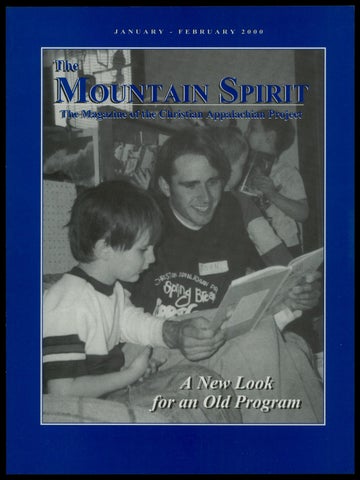
J A N U A R Y
FEBRUARY
2000
c
E
P r e sid e n t’s
S
N
NOTE
T he
M ountain S pirit The Magazine o f the C H R IS T IA N A P P A L A C H IA N P R O JE C T J A N U A R Y
-
F E B R U A R Y
2 0 00
V O U U M E
18,
N U M B E R
ONE
A Peaceful Change by Fr. Ralph Belting A Conversation With Governor Paul Patton A Peaceful Change, page 4 by Jim Trammel Chloe by Carolyn Bertram
Home & School:
2 4 'by Margaret Gabriel
Home and School, page 24
Published by the Christian Appalachian Project
Governor Patton, page 16
D
e p a r t m e n t s
3 10
R andom T houghts A round the Project
21
Letters
E d ito r M a rg a r e t G a b rie l G r a p h ic D e s ig n K a r e n F r a n c e s S p iv e y C ir c u la tio n L in d a G r id e r E a s t A d v is o r y B o a r d : F a th e r R a lp h W. B e itin g , M ike S anders, B ill B egley, B e n P rew itt, B e c k y K an a
The Mountain Spirit is published six times a year. The annual subscription price is $8.00. Subscriptions and other correspondence should be sent to The Mountain Spirit, Christian Appalachian Project, 322 Crab Orchard Street, Lancaster, ICY 40446. Copyright, 2000, The Christian Appalachian Project, Inc. All rights reserved. Member, Catholic Press Association. The Christian Appalachian Project is a non-profit Christian service organization operating throughout Appalachia. The project operates on the philosophy that helping people help themselves is the best approach to Appalachian poverty. The Christian Appalachian Project is recognized by the Internal Revenue Service as a 501(c)(3) charitable organization and is qualified to receive tax deductible contributions.
We’ve had a busy couple of months here, and as we begin the new year, we’ve got a new look here at CAP as well. As you’ve probably heard, our founder, mentor and Mike Sanders, friend, Father CAP President Beiting, decided several months ago to take a step back from his day-to-day duties as CAP’S chairman of the board. Although Father Beiting continues to serve as Chairman Emeritus, the transition has meant change and adjustment for all of us. I’m pleased to report that the first stages of transition are going very smoothly. Jerry O’Daniel, who has been a board member since 1996, has accepted the position of chairman of the board, and he and Father Beiting talk frequently about the goals and direction of the organization. We feel quite honored that Governor Paul Patton was able to meet with us to give an idea of the directions he sees for Eastern Kentucky during the second term of his administration. Gov. Patton is the first Kentucky governor from Eastern Kentucky since the 1960s and has made sure that making opportunities available to the Appalachian region of the state is part of his agenda. Between his plans and those of Father Beiting, we can see that the new millennium will mean exciting times for the mountains! I hope you enjoy the story about the CAP child development program. Services to children is among some of the oldest work of CAP, but over the years we have adjusted programs to suit the needs as they change and develop. For example, several months ago we changed the name to Child and Family Develop ment Centers to reflect the emphasis that parents are first and most important teachers of their children. Like all of CAP’S programs, the centers will change as needed to provide the best services possible to the people of Appalachia. May God’s richest blessings be yours in the new millennium. Enjoy!
A summary of the registration and financial documents filed by this organization can be obtained by contacting: in Maryland, for the cost of copies and postage, the Secretary of State, State House, Annapolis, MD 21401; in Virginia, State Division of Consumer Affairs, P.O. Box 1163, Richmond, VA 23209; in Washington, residents can call the Secretary of State toll-free within the state at 800332-4483- IN NEW YORK OFFICE OF THE ATTORNEY GENERAL, CHARITIES BUREAU, 120 BROADWAY, NEW YORK, NY 10271; IN NEW JERSEY, THE ATTORNEY GENERAL BY CALLING 201-504-6215; IN PENNSYLVANIA, DEPARTMENT OF STATE BY CALLING TOLL-FREE WITHIN THE STATE, 800-732-0999; IN WEST VIRGINIA, SECRETARY OF STATE, STATE CAPITOL CHARLESTON, WV 25305; IN FLORIDA, THE DIVISION OF. CONSUMER SERVICES BY CALLING TOLL-FREE WITHIN THE STATE AT 800-435-7352; IN NORTH CAROLINA, FINANCIAL INFORMATION AND A COPY OF THE LICENSE ARE AVAILABLE FROM THE STATE SOLICITATION LICENSING BRANCH AT 919-733-4510; or by writing to Christian Appalachian Project, 322 Crab Orchard Street, Lancaster, KY 40446. Our license number in Michigan is MICS 9933. Registration with any of the above government agencies does not imply endorsement by the state.
T
h e
M
o u n t a i n
S p i r i t
R
A
N
T II O l
D
O
M
G H T S
B y M a r g a r e t G a b r ie l
more than just food and clothing. He needed to help appy New Millennium! We hope your new year them find ways to provide for themselves so that they would no longer have to ask for help. is off to a good start. From this understanding came the Christian Appala CAP, for its part, began early, and we’re already chian Project and its mission to serve people in Appala in the midst of Celebra chia by providing physical, spiritual and emotional support through a wide variety of programs and services. tion 2000, which is marking several milestones for both the organization Although Celebration 2000 recognizes the beginning of Father Beiting’s work in the mountains, I think Father and our founder, Father Ralph Beiting Beiting’s trip home to Berea that night marks the real You’ll recall that in January, 1999, CAP cel beginning the Christian Appalachian Project. ebrated Father Beiting’s 75th birthday. His golden jubilee as a priest came in June of the same year. Rather than celebrating with a dinner and party, Father Beiting chose instead to combine two of his favorite pastimes: preaching and boating, and spent two weeks in the summer sailing the Ohio River in the Daniel Boone, a houseboat. With a crew of CAP employees and volunteers, Father Beiting stopped at 13 ports in West Virginia, Ohio, Indiana and Kentucky to preach the Gospel and the love of God to crowds gathered on the riverbanks. Father Beiting’s third milestone is his 50th anniversary of service to the mountains. As a seminarian in 1946, Father Ralph Beiting with some o f his favorite people CAP Father Beiting spent his first summer in volunteers. the mountains — he calls it the summer That night Father Beiting realized that there is a he fell in love — and was called back only one year great deal of satisfaction in giving things away, but after he was ordained. Father Beiting is a great almost no challenge. Giveaway programs actually storyteller, and some of his best stories tell of his require very little emotional or intellectual investment. first days in Berea, Ky., when he was assigned to They don’t call for the establishment of a real relation establish churches in Eastern Kentucky. ship between people. One person feels good for One of my favorites is the story he tells about a having given, but frequently that good feeling is at the late night drive he was making back from the home expense of another, who could easily feel humbled or of his family in northern Kentucky. Shortly after he even degraded because of being in need. Preserving announced the presence of a Catholic church in the area, people began to come to Father Beiting for help pride is one of the most important aspects of CAP with basic needs — food, clothing and shelter. For a programs. People also must have the opportunity to set their own goals and devise what to do to achieve number of years he did the best he could to meet them. those needs by asking his family and friends to help Since the planning for Celebration 2000 started, Ben him provide assistance. He tells of a night that he Prewitt, CAP’s vice president of planned giving and was driving old Highway 25 to Berea from northern major gifts, has emphasized that the celebration isn’t Kentucky when in a blinding flash he realized that for January 1, or even for the year 2000, but for “the for all the work he was doing he wasn’t really next hundred years.” helping the people. Celebration 2000 will applaud all aspects of CAP — “Do you want to be a truck driver all your life?” programs, donors, and volunteers. As we progress Father Beiting recalls that he asked himself. As he through the year, we will begin to map the goals for the drove through the darkness toward the mountains it next hundred years of the work of the Christian became more and more apparent that to help people Appalachian Project. — to really help them — he needed to give much —
J anuary
F e b r u a r y
2 0 0 0
3
Change is a funny thing. Some people view it as the enemy, something to be avoided at all costs. Others embrace change and the attitude that any change is better than no change at all. In August 1999, the Christian Appalachian Project learned that its founder, Father Ralph Beiting, views change pragmatically when he decided to step down as the Chairman of the Board. Here Father Beiting, who will continue to serve as Chairman Emeritus, gives his thoughts about the change and tells that he’s not about to slow down!
T
h e
M
o
u n t a i n
S p i r i t
J anuary
F e b r u a r y
isn’t a retirement schedule by any stretch of the imagination. I travel in a car 60,000 miles a year, and that doesn’t count airplanes and all the rest. I’m giving more talks and I’m involved in more things, and I’ll stay involved with most of it, as well as the speaking and fund raising that I’ll keep doing for CAP. I’m not really sure this was the right time to make this move, but you have to make a decision. It seemed that with increasing age, I should do it now. I can still make a positive impact, which will make a good transition period. CAP Founder Father Ralph Belting. Below, Fr. Whatever time I still Belting tours Jackson County Rehabilitation Services. have left as an active I’ve been invited to attend all of and energetic person, I can offer CAP’s board meetings, and I’ll new ideas, and recall them to our remind CAP that they’re a spiritual spirituality, our sense of service. entity, not a social charity or a humanitarian group. Our Christian heritage means we are called to be leaders, always explorers. Always innovators, never content with the status quo. I’m going to push the question of what we’re going to do about families, the core of anything. If you have a solid, good family, you’re going to overcome anything. I was the oldest of eleven in the midst of the greatest depression this century has seen and every one of my brothers and sisters has married, they’re still married; they have batches of kids and they’re all prospering. They’re all people of faith. We’re still people who are proud and give good example. Why? Because we had a strong family: a father and mother who made sacrifices, and grandparents and aunts and uncles. What an exciting thing for CAP to be one of the leaders in Appalachia on family,
2 0 0 0
5
GABRIEL
To decide to step down as Chairman of the Board wasn’t easy, but it was a decision that I made out of the realization of what I am: a servant being called to do some thing for the poor of Appalachia. It’s like parents as they see their children begin to grow up. They’re not wanting to keep their kids at home. They want them to get married or go off into some kind of vocation that’s going to be mean ingful. If they truly love the kids, that’s what the ambition has to be. The decision wasn’t based on how much work I have to do or what kind of health I’m in, but that I want to see the organization not only endure, but grow and prosper and develop. From that standpoint it wasn’t a hard decision. In the back of my mind I always knew that if I really loved the thing, I was going to have to give up being Chairman of the Board. I’m going to die someday, therefore resigna tion is going to come sooner or later. I’m in good health, but people have heart attacks and my schedule
| It amazes me how m these young people sit there and listen. Here I am, four times their age — an old fogey in a Roman collar, at a college that has, maybe, ten Catholics in the whole establishment. But they listened and they asked questions. Just the week before I was in Georgetown, Ky., at the youth rally, “Keep the Flame Alive,” and gave talks to about 400 people. I got standing ovations when they were over with and you wouldn’t get that if you didn’t motivate them in some way. We talk about the age gap and how big that is, and I’m sure it’s there, but on the other hand you can Mitchell Ball, plant manager, shows Father Beiting an electronic part that is made at the plant in Jackson County. say to them, “I went through the same When I first came here at age 26, things you did.” If you can relate to to instill a religious spirit that’s them, they begin to think maybe I could do a lot more, physically, going to say that people are going you’re not an old fogey out on a than I can do now, at 76. I could lift to stay in Appalachia. more, run faster, get here and there limb. You’re a person who has I argue with the [state] Task without any difficulty. Now I walked the way they walked, where Force on Education because it says appreciate it when somebody gives they walked. “education pays.” If you keep that me a hand and I can get up the steps Being old gives you an opportu going, I tell them, you’re going to a little easier. But there is a grace in nity to motivate young people more lose everybody you train because age that comes because you can than if you were young yourself. I they’ll go to Louisville or Cincin offer God your sufferings. When think growing old is a wonderful nati or Columbus and get a better you’re young, you think you’re gift of God. Prayer becomes more job than they can here. You have important, you have a history invincible; when you’re old you to make them understand that know dam well you’re not. I try to behind you that you’ve seen how “pays” means more than money. It offer God all the aches and pains I God’s providence works and how means creativity, changing your have as a gift of love. I believe that God’s love is manifested. homeland to things that are My parents were both in their 80s has more effect on helping the poor compatible with society today. than all of the work I do. God’s when they passed away, and from I think that some of what I’ll be grace is what’s bringing about the them I learned to offer sufferings to able to give to CAP now is victory, not my efforts or somebody God. When we rolled Dad to happening because God has given Mother’s bedside just about an hour else’s. me the gift of old age. I’ve tried to before she died, she held his hand I was at Alice Lloyd College live my life, imperfectly as I’ve and said, “Daddy, I’ve always loved yesterday, speaking to students done it, with the idea that I am the during “Religious Emphasis Week.” you. Today I love you more than servant of God.
6
T
h e
M
o u n t a i n
S p i r i t
ever.” There was a time that you could see the love of family. Maybe they weren’t as involved romanti cally as when they were first married, in the sense of sexual things, but intimacy was much greater. The prayers they said every day, their great desire to get to Mass as long as they were able was a very positive influence. Outside of my Catholic faith, family has been my greatest blessing. And the Catholic faith was nourished because of the family. From your own family you learn that family is people that you’ve come to know over the years and have worked with. As a priest, I don’t have a physical family, but many people who are, perhaps, even closer. This love of family led to my love for the church, and in turn for the missions. When Bishop William Malloy came [to the Diocese of Covington], he said the role of the church is not to just have Mass and protect the Catholics. The role of the church is to extend the love of God to everybody. Let’s get into
Christ-like, that’s our job, too. But county seats. Let’s get into hospi we can’t do the job ourselves, so tals. Let’s start schools. Let’s get just from a strictly sensible stand involved in getting people to reach point we have to have all other beyond the sanctuary. That’s how I people of good will get together to got to the mountains. He wanted to do the job. That’s the mind of get seminarians excited — in a Christ. He said if they’re not against very real sense, he was the most you, they’re for you. Now people effective leader we’ve had. People like myself who grew up under him view the Catholic Church as a profited by his energy, his enthusi caring group of people who can be counted on. Catholics are willing to asm and his vision. I tried to keep do anything they can, no matter that up in Berea when we got a place right on U.S. 25, not on some what your religion or lack of it. We talk about God in a way that isn’t back street. We said, “We’re the Catholic presence here.” Of course, either hellfire or brimstone or just pious, “Let’s just love God and people would come and say “Can everything’s OK.” We come in with you help us with food,” with this some specific things. and that. But that’s what we were Part of my agenda has always after. Then we got groups from all been to see how many people you over to help reach out in mission work. We were making some pretty could bring into the Catholic faith. But not as a competitor, someone extensive inroads — it was to do who’s taking members away from what the Catholic Church was other churches. On Friday night I’m about. It was about being the messenger giving a talk to the Methodist women’s society on the role of of God for everybody, the heralds women in Christianity as the new of the good news. It’s what our job millennium comes. They can ask was. Christ fed the poor, cured the sick, instructed the ignorant. He did me to come and talk about spiritual all those things. If we are to be truly things, but they know very well that GABRIEL
Father Betting addresses students in CAP's Jackson County JobStart program.
J
a
n
u
a
r
y
F e b r u a r y
2 0 0 0
7
GABRIEL
I’m interested in bringing people who have no church into a closer relationship with God. I love to give someone who is still looking for an answer in their search with God the beauty that we have in the Catholic Church, but for those who are convinced in their own religion, I’m not trying to dissuade them. We’re saying join your strength with ours and let’s see what we can do for the poor, for the uneducated, for the homeless, for women who are abused. There’s a joy that we can work together instead of fighting each other. But it took a long time and it took a lot of suffering. If I had to say what value I’ve been to the area, I think promoting ecumenism would be on top of my list. Human Services director Tom Conner, left, tours the plant with Father Beiting and Mitchell Ball. More than all the physical things and the money on all our official publications, and that could do more if they got some we’ve spent, we have changed, in help from us. If we can be that that’s the day it was official, but many ways, the attitude of the enabler, that energizer. The first 35 we had a lawyer in Lexington who religious people. We’ve motivated a years we had to prove our worth. was doing [all the incorporation lot of people of other faiths, as well We had child development pro work] in his free time and it took as people of our own faith, and this him a year and a half to get it done. grams before Head Start and we motivation has grown into the were innovators. We had to be From those days, it was so easy to Christian Appalachian Project. keep going in that spirit, but as you innovators because nobody wanted CAP has come from a tiny little anything to do with us. But now keep growing and you’re involved thing in ’57, when it was Cliffview we’ve gotten recognition that we’re in so many areas, it gets to be Lodge. In ’62 I first used the name a nice group of people and that we more difficult. “Christian Appalachian Project,” have noble motives and all the rest. In addition to starting new even though CAP wouldn’t have programs, I want to support groups These motives will be carried out by legal status for a year. They put ’64 Jerry O’Daniel — and I’m pleased out there that are good programs
T
h e
M
o l j n t a i n
S p i r i t
that the board selected him to be the chairman. We’ve always had good boards, but this one is the best. They have a lot of good talent, but when they selected Jerry as chair, I was very pleased. In his time with CAP he has been a very hard-working committee person. He has traveled, met people, taken the time. He’s been anxious to learn, to be in volved. His background with IBM let him work with a lot of people. Religion is important to him; God is important, fundamental. That is so essential to a leader in the Christian Appalachian Project. He’s willing to listen and to learn. He’s demon strated those things in board meetings, and all of that made me feel very, very positive. And I have the opportunity to help him play a more vital role, something I wouldn’t be able to do if this change had come out of a quick situation,
where I wasn’t there and wasn’t able to be of help. I think in this time of transition, there are a lot of unanswered questions. I have a lot of unan swered questions. But it’s a time of growth, and that’s always a time of anxiety. So I think we need to have
. . . from that hope comes peace. deeper faith. We have to remember we really are the answer that God has given to this time and place, to heal the hurts and bind up the wounds. We have to have the humility to know that we don’t have
all the answers, and we don’t know how the story will finally be told. That’s God’s work. I say to myself “God please help me put my head on straight, so I know which way I should be facing.” With that sense of humility, you’re going to have faith. If you have faith, deep down, you have hope, and that means you have peace. You know that in God’s wondrous plan, things will work out. It doesn’t make any difference if the road is crooked or straight — it’s going to work out. I hope that everybody in the process will have the humility to say “I don’t know everything that is happening, I don’t know where the future is going to be,” but we know that if we are faithful to God, to say, “you have the power to do it well,” out of that deep faith that God loves us and will care for us, we have hope. And from that hope comes peace. GABRIEL
A classroom adjacent to the Jackson County Rehabilitation Industries hosts CAP ’s JobStart classes in Jackson County. Father Beding meets with the studen ts and shares memories o f his days in Jackson County.
J anuary
F e b r u a r y
2 0 0 0
9
1
A
r
o
T he
u
n
d
"
P roject
Fr. Beiting Makes Annual Visit to Programs In the fall of 1999 Father Beiting made his annual visit to see the people and programs of the Christian Appala chian Project, programs that include child and family development centers, adult education, job training, crisis Father Beiting talks with Operation Sharing manager intervention, counseling, housing Johnny Thompson, as housing assistant director Ken Stuber looks on. and community Hagerhill region traveling over five development. hundred miles. He visited places for In McCreary County, Father which he still dreams of a better Beiting met tomorrow and ways to accomplish theology those dreams. students from “As CAP gets larger and larger the University of and more geographically dispersed, Notre Dame, visits from Father Beiting bring up who were spending a week an important sense of community,” Garry said. “[Visits] give him the working on a opportunity to connect with CAP housing participants and also give volun projects, teers the opportunity to meet him. I according to had the opportunity to go with him human services to a couple of participants’ homes, assistant director and when he sat down with people Garry Vickers. he was really doing what he does “I watched Father Beiting visits JobStart in Mt. Vernon best: give people hope.” him standing Over fifty years ago, Father Ralph Beiting returned to the area where he had worked as a seminar ian during a summer assignment. Bishop William Malloy, who Father Beiting says loved the mission area of the Diocese of Covington, assigned the young priest to a large geographic area with many prob lems and few Catholics. Father Beiting began to devise solutions that would help people in need. Father Beiting’s vision for a brighter tomorrow started with children. In 1957, a camp on Herrington Lake in Garrard County was established because Father
10
beside a pile of shingles, talking those volunteers, and he inspired me,” Garry said. “He told those students that since the beginning of time, they had been chosen to come here and do this work. Those words really brought CAP’s work home to me.” Father Beiting spent three days in the Lancaster region Father Beiting chats with a student at the Family Life Child and Family Development Center. and three in the
T
h e
M
o u n t a i n
S p i r i t
S P IV E Y
Beiting believes that with children “you can plant important seeds.” From the summer camp grew other human service programs and by 1964 Father Beiting had organized and incorporated the Christian Appalachian Project (CAP), which has grown into the largest non-profit service organiza tion in Eastern Kentucky with a mission of providing physical, spiritual and emotional support through education, crisis interven tion and community development. With more than seventy programs and services, CAP’s efforts reach people in the thirteen states that make up the Appalachian region.
A
r
o
T he
u
n
d
P r o je c t
CAP Initiates Elderly Advocacy Group In response to a growing population of senior citizens and the need for networking to this population, a meeting was conducted recently to address the necessity of an Aging Advocacy group. Christian Appalachian Project Elderly Services and the Berea Senior Citizens’ Center hosted the organizational meeting to establish the group that will work on issues of concern for older adults in Madison County and the surrounding areas. The “Aging Services Advocacy” group will offer an information network, educate people to services available, and connect appropriate agencies that assist in a number of those services. Elder abuse, for instance, affects over a million persons annually. Not only physical abuse is considered, but emotional and financial abuses, as well. Nearly 80 percent of these cases go unreported. A Social Services block grant that funds programs for elder abuse prevention was cut by $300 million last year. The Aging Services Advocacy Group was formed and the governing body was elected as a
Zayda Hurd, manager o f CAP elderly services, addresses a meeting concerning elder advocacy.
result of the meeting. It was confirmed that the group would confer monthly. Subcommittees were established to explore three areas of senior awareness: medical costs, medical assistance and transportation. The committee hopes that the advocacy group will provide a valuable link to senior adults and the agencies that serve their needs. “Through the disbursement of information, the elderly program, in cooperation with the Senior Citizens Center, will successfully meet the needs of a growing and diverse segment of our population — those over 60,” said Zayda Hurd, manager of CAP’s elderly services.
Donors Honored on National Philanthropy Day
Jim and Sylvia Schaefer
Jim and Sylvia Schaefer were honored for their dedication as CAP donors on National Philanthropy Day, sponsored by the National
J anuary
F e b r u a r y
What You Don't Know About Wills Can Hurt Your H eirs.. .
^ Society of Fund Raising Execu tives. They give not only of their financial resources, but of their time. “They consider themselves part of the CAP family,” said Vice-president Ben Prewitt. “They’re also great ambassadors for letting people know about CAP and recruiting others to help with our mission.”
2 0 0 0
Much of what you know about wills may be misinformation that has been floating around for years. If you think, for example, that wills are primarily for rich people, or elderly people, you may be the victim of a common m isconception. The helpful booklet offered here will explain how your will can save your heirs from costly delays and confu sion. Send for your copy today. C lip a nd Mail
Christian Appalachian Project 322 Crab Orchard Street Lancaster, Kentucky 40446 Please send without obliga tion your booklet, “37 Things People ‘Know’ About Wills That Aren’t Really So.” Name Address _ C ity ____ State,ZIP
11
A
r
o
T he
u
n
d
P r o je c t
Not long ago, the Christian Appalachian Project received an email from a supporter who asked about the availability of CAP volunteer opportunities for a family. We replied that because of housing limitations, different opportunities are open for families than are available for single people. While CAP is able to accept a limited number of married couples, we are not able to accommodate families with children. There are, however, other ways for families to volunteer. For instance, they might volunteer to distribute literature about CAP to school and church groups. We are happy to make additional copies of those publica tions available to volunteers for In its Child and Family Development Centers, CAP promotes family literacy. distribution. For more information about the supporters of all descriptions, can Street, Lancaster, KY 40446. various ways of contributing to CAP Our most powerful form of have a mighty influence by praying through volunteer assistance in at least one minute a day for poor assistance, however, is prayer. No various forms, please contact The people in Appalachia and through matter where they are or what Mountain Spirit, 322 Crab Orchard out the world. they’re doing, volunteers and
S P IV E Y
How Can I Help CAP?
Long Term Impact The CAP volunteer program needs summer camp counselors, nurses and lifeguards to staff four camps in eastern Kentucky. We are seeking highenergy men and women, age 18 or older, for the months of June, July and early August. We would like a commitment of at least two months, but a 3-7 week stay can be arranged. Room and board is provided, also orientation and ongoing training, daily prayer and a potential AmeriCorps Educational Award.
12
For more information call
(800) 755-5322
e-mail: volunteer@chrisapp.org
Visit us: www.chrisapp.org
T
h e
M
Christian Appalachian Project Volunteer Project
o u n t a i n
S p i r i t
A
r
T he
o
u
n
d
P r o je c t
Students Observe Legislative Process S P IV E Y
Forty-six Lawrence County middle school students recently had the opportunity to meet Kentucky Governor Paul Patton and become acquainted with the legislative process in Frankfort. Through the Christian Appalachian Project, a curriculum was introduced to sixth, seventh and eighth grade students designed to familiarize them with government and the importance of their input to getting things accomplished. The curriculum is part of the educational program at Kentucky Governor Paul Patton and Albert Bloomfield, a former CAP community Boone’s Landing, a education instructor. CAP camp that holds The newest camp is designed to learning the outcome, they’ll educational sessions throughout the offer programs for family retreats, document the experience in their school year for local students. CAP and programs that will enable writing portfolios. “It isn’t impor provides an instructor, curriculum wounded families to renew them tant whether they are for or against development, technical support and selves. the bill. They key thing we hope to chaperones for field trips. CAP also achieve is their awareness of the offers facilities at Boone’s Landing process and responsibility of their for environmental study and Is there officials,” said Albert Bloomfield, a exploration. former CAP community education Students traveled to Frankfort to a CAP instructor at Boone’s Landing. observe the discussion surrounding program Rocky Adkins (D-Lawrence Co.) a bill that has been pre-filed for arranged the trip for the students, Kentucky’s General Assembly in that you which Albert describes as one of the January 2000. The bill proposes a don’t see best experiences Boone’s Landing franchise tax that would levy a fee has sponsored. of a quarter of a cent on each in this issue of The Mountain The educational sessions con container/wrapper used by fast-food Spirit? CAP’s web site includes operations. For instance, an average ducted by Boone’s Landing incorporate environmental issues, fast food meal of a soft drink, information about all of CAP’s community awareness, coupled with sandwich and fries would cost an human development programs, an emphasis on learning. additional cent if the tax is passed. Boone’s Landing is the third and The revenue collected will create a planned giving and major gifts newest camp sponsored by the permanent and stable cash flow to and the volunteer program. Christian Appalachian Project. Like fund clean-up and waste removal. Camps Andrew Jackson and Much litter in smaller Kentucky Please visit the site at Shawnee, Boone’s Landing offers towns is generated from fast-food www.chrisapp.org and be sure summer programs and environmen wrappers, bill supporters say. tal education. The students will receive the to sign our guest book! minutes of the session. After
J anuary
F e b r u a r y
2 0 0 0
13
A
R
T he
O
U
N
D
P r o je c t
Fr. Beiting Named Alumnus of the Year As part of the 1999 Theological College Alumni Days at Catholic University of America in Washington, D.C., Christian Appalachian Project founder Father Ralph Beiting re ceived the 1999 Alumnus Lifetime Service Award. An article in a recent alumni magazine told of the reason for Father Beiting’s recognition: As a seminarian at Theological College, Ralph Beiting, a native o f Newport, Ky., learned that all people — not just Catholic people — were part o f his ministry. In 1950, when he was appointed, “as pastor o f non-existent church in a parish the size o f Rhode Island, ” in Appalachia, he also learned that, for many people, the greatest need was not spiritual but
physical. “I thought to myself, ‘This has got to be some mistake. ’ I f is was, it was the happiest mistake o f my life. ” Based on the the belief that “we will be a group that will roll up our sleeves and get the job done, ” Father Beiting founded the Christian Appalachian Project. . . Our pro grams try to get to the roots o f poverty, to habits and attitudes, to causes rather than symptoms, he says. A priest o f the Diocese o f Lexington, Monsignor Beiting is also pastor o f St. Jude Catholic Church in Louisa, St. John Neumann in Hode and St. Stephen in Inez. During his 50-year ministry, he has built nine churches.
W ORKPLACE PAYROLL DEDUCTION If your employer offers donor designation as a write-in for payroll deduction campaign, please remember the Christian Appalachian Project. CAP is a 501(c)(3) tax exempt agency, and payroll deduction is the easiest way to help the families of Appalachia. To ensure that we receive your payroll deduction gifts, please give your payroll officer CAP’S full address and send to the attention of: Teresa McAnly-Campaign Coordinator
Christian Appalachian Project 322 Crab Orchard Street Lancaster, KY 40446
CAP Collaborates with Lawrence County Students Lawrence County High School students gained class credit by participating in a group project that will benefit others. The student body conducted a food drive to collect canned goods, vegetables, soups, pasta, pudding and other nonperishable foods. The students provided Thanksgiving dinner to families in their community with the collaboration of health science
Participants in the Thanksgiving basket program.
14
instructor Judy Herron and HOSA (Health Occupational Students of America) and the Christian Appalachian Project. CAP provided a voucher for a Students from Lawrence County High School. Thanksgiving turkey or ham while the HOSA and James Ellis, Family Advocate of students came together to sort and Youth Service. box the donations. Each bag “The students get an idea of how contained the voucher, canned their time and energy can contribute vegetables, side items and to relieving others’ despair and desserts. More than 243 families certainly this class credit is one who participate in CAP’s outreach they’ll enjoy,” said Ruth Branham, program shared in the students’ CAP outreach caseworker in generosity. Lawrence County. “CAP’s mission Others involved in the project is to serve families and I am include Renaye Sparks, Commu especially grateful when local nity Education Coordinator; Kay agencies offer their services to us,” Isaac, Youth Service Coordinator; Ruth said.
T
h e
M
o u n t a i n
S p i r i t
A
r
T he
o
u
n
d
P r o je c t
Thank You, Christmas Basket Sponsors! in 1999. Over 1500 families who participate in CAP programs received gifts and food vouchers in the amount of $10.00 for each person in the family. Brenda singled out several groups for special thanks, including many readers of The Mountain Spirit, whom she called, “some of our best spon sors. We really depend on them for sponsoring families as well as cash donations for food,” Brenda said.
Brenda Watts reports that with the help of its sponsors, the Chris tian Appalachian Project’s Christ mas basket program was successful
1999 marked the ninth year of participation in the program for Christmas basket volunteers Pierce and Gladys Gay and Jay and Ed Barrett. For many CAP folks the bustle in the Berea warehouse is as sure a sign of Christmas as the Star in the East. Finally, Brenda gave a huge thank you to Rosie Farmer and the congregation of St. Margaret of York Church in Maineville, Ohio. “I got a call one day from asking if they could help; they sponsored 47 families this year, and maybe even more next year,” Brenda said.
CAP Hosts Annual Family Retreat Buddy and Mary are like any other parents you might meet — they love and care for their children. Buddy and Mary have seven children: two biological daughters, and five foster children. What makes their family special is not only that they are foster parents — it’s that all their foster children have disabilities. Buddy and Mary and four of their children attended the seventh annual Family Retreat sponsored by the Christian Appalachian Project’s programs for people with disabili ties: CAPRICE, Parents Are Teachers, Rainbow Respite and Rejoice Respite. The focus this year was on developing and implement ing a plan that will allow a son or daughter with a disability to be cared for even if a parent is unable to provide care. Buddy and Mary have been to several CAP family retreats over the years. “We really enjoy the time we can spend with other parents who have children with disabilities,” Mary said. “It is a social support group that helps us all to realize other parents are dealing with similar challenges in raising these children. The information we got this year
J anuary
F e b r u a r y
was very valuable in making plans for the future. It gave us ideas on whom we can contact for different services and other help.” The morning session of the retreat focused on “how to” steps in planning for the future of a son or daughter with disabilities. It addressed reasons why parents don’t make plans. The “Scarlet Syn drome,” parents learned, Buddy and Mary have attended several CAP features people who think, sponsored Family Retreats in the last several years. “I’ll think about it tomor with disabilities, including the row.” Kentucky Housing Corporation, The “Pie-in-the-Sky Syndrome” Supported Community Fiving, is illustrated by parents who think Bluegrass Technology Center and the “I’m in no hurry . . . when the time ARC (a national volunteer organiza is right the services will be avail tion devoted to improving the lives able.” “The Fear Syndrome” is based on of children and adults with mental the fear of one’s own mortality, and retardation.). Buddy summed up the retreat the “Denial of Reality Syndrome” saying, “I feel we were given a takes for granted another caregiver (for example, a family member) will challenge. Hopefully, this retreat will encourage more people to plan ahead emerge to take the place of the for their sons or daughters with parent. The afternoon session focused on disabilities, that they might have a future with continued care and the services that are currently available for families with members success.”
2 0 0 0
15
GABRIEL
16
T
h e
M
o u n t a i n
S p i r i t
Kentucky Appalachia’s Friend in Frankfort Pike County native and newly re-elected Kentucky Governor Paul E. Patton tells The Mountain Spirit what Appalachia can expect from Frankfort during his second term. Eastern Kentucky has a valuable friend in Governor Paul E. Patton, who hails from Kentucky’s eastern most county (Pike County, the same as CAP President Mike Sanders). Patton, a successful coal business man, turned to public service when the coal boom ended for Appalachia in the late 1970s. In the 1980s, during three terms as Pike County Judge-Executive, he established Kentucky’s first county wide garbage collection program, a priority he now champions for the entire state (only 20 of Kentucky’s 120 counties currently have man dated county-wide garbage pickup). First elected governor in a close race in 1995, a prior constitutional change allowed Gov. Patton the possibility of re-election to an immediate second term. During his first term, Gov. Patton’s administra tion spent more than $2 billion on
J anuary
F e b r u a r y
maintaining and improving Eastern Kentucky’s roads, water systems and industrial parks. No major opponent came forward to contest his re-election last November, and many interpreted the landslide numbers as a sign of public ap proval of his first term. The Governor spoke with Jim Trammel of The Mountain Spirit in the Governor’s State Capitol office in Frankfort, as bleachers were being built on the Capitol steps to seat the crowds expected for his second inauguration. The Mountain Spirit: What can Appalachians expect out of a second Patton term? What are your goals and aspirations for the area? Gov. Paul E. Patton: The big picture is going to be to continue to push for improved education at the elementary, secondary and post secondary areas.
2 0 0 0
In the more direct sense as far as economic development, the completion of the regional indus trial park program is going to happen, and we’re going to have six as a minimum and probably seven to eight before the end of this four years that are going to be open, fully developed and ready for business. The one at Morehead is open and we’ve already got a major distribution warehouse there . . . . The one in Hazard is already open, we’ve got Sykes Enterprises located on that facility, about 600 acres . . . (He recounted the status o f other parks nearly ready in the Kentucky cities o f Grayson, Corbin, Hazard, and Inez. Others are being pre pared in Campion and Jenkins, and in Pike and Harlan counties.) This will cover Eastern Kentucky; within 30 to 40 miles of virtually every part of Eastern Kentucky there will
17
be a place to attract and locate industry. MS: What kind of economic development is best for us? Gov. Patton: When I say industrial park, I don’t mean only manufac turing industries. Sykes Enter prises, for example, is a knowl edge-based industry. We have people who can do all the high-skilled jobs that we can locate in Eastern Kentucky, but it is very difficult to get the higher-tech companies that generally want a more metropolitan area where you have a lot of educational and cultural facilities available. We’re going to have to look for other medium-skilled jobs, because we have other people with medium skills that couldn’t get a high tech job even if we could recruit them. At the same time, we need to concentrate on upgrading the skills of the existing work force, and certainly developing the new work force with the high skills we want to be developing. MS: Does our need to emphasize middle-level skills limit our participation in the information technology world? Gov. Patton: My understanding is that one of the data processing facilities, the one in Owsley County, is having problems getting enough people that can do the work, and that’s certainly a medium-skill operation. [U.S. Representative] Hal Rogers got a data processing company in Owsley County, and whatever the problem, my understanding is that they’re having a problem getting enough people to do the work. I think there’s one in Whitesburg that also is likewise. So those are certainly medium skill jobs and we’re having problems getting people that can do it. So if we can’t get enough people to do medium skills, we have to be careful how far we can go with high skills. Now the Sykes operation in Pikeville and Perry County are going to be a little bit higher level.
It’s not just data entry. They’re doing program ming analysis, they have to solve problems, so it’s going to require a higher level of skill than just strict data entry. And they’re paying a little bit more money. Obviously, one of the factors is if you don’t pay enough money you can’t get the skills, and that may be the problem in Owsley County. For whatever reason, the pay’s too low, the child care, or just nobody there with the skill to do it, I don’t know. MS: What are some of the chal lenges we face in upgrading the labor force, and how are we going to go about meeting those chal lenges? Gov. Patton: You have to upgrade their skills, but you also have to develop the opportunity to use skill that exists. So theoretically you put somebody in a medium skilled or even low skilled job, and while they’re working, you motivate them to upgrade their skill a little bit. Then, theoretically, they move to an upgraded job, you motivate them to continue to upgrade their skill, and they move to even better jobs. There’s a more practical way: You get the parents into the work force, and hopefully they motivate their children when they say, “If you get a better education, you’ll have a better job than I’ve got.” That’s the more practical way to do it, but we need to get people in the work force somewhere. We’ve just got too many people that have given up on work. And with the demise of welfare as we know it, that kind of mentality has got to be
T
h e
M
eradicated in Eastern Kentucky, the mentality of “I’ll never have anything better than what I can get off welfare, so therefore I’m not willing to try to get off welfare.” MS: Some practical concerns have to be addressed, too, such as the transportation and child care issues of getting former welfare recipients back to work. Gov. Patton: Yes, our Early Childhood Task Force emphasizes availability of affordable, highquality child care, a vital element. Three vital elements [to help retumto-work plans succeed] are health care, child care and opportunity. In many parts of Eastern Kentucky, the opportunity is not there. But we’ve also got to provide the child care, the health care, the educational opportunity and the employment opportunity. MS: Quite a matrix of problems there. Who’s working with you on this? Gov. Patton: Our umbrella organization is the Kentucky Appalachian Commission, Ewell Baltrip’s organization headquar tered in Hazard. He’s on the state payroll. That’s an extension of the
o u n t a i n
S p i r i t
governor’s office in Eastern Kentucky. In Frankfort, Jerry Johnson is my person here at the Office of Appala chian Development to make sure that we in Frankfort are focusing on Appalachia. He’s got a dual job, he’s also the head of the office of the coal severance tax out of the Cabinet for Economic Develop ment. So his job is to keep our office and all the rest of state government focused on Appalachia, particularly the Economic Develop ment Cabinet. What we’ve done that no other administration has done is to establish these two positions that focus specifically on Eastern Kentucky. No administration has ever done that, and there’s no other part of the state that has that kind of concentration. MS: How can a citizen or an organization that has some re sources to contribute or who wants to be part of the solution find a good initial contact point? Gov. Patton: Either one of those. They’re fully funded positions with a tremendous ability to focus the
J anuary
F
e b r u a r y
state’s resources on Eastern Kentucky. And we can do that without neglecting the rest of the state. We’re not putting any less emphasis on the rest of the state, we’re putting more emphasis on the problems of Eastern Kentucky. MS: And whom would you most want to hear from? Gov. Patton: What we need is people to invest in Eastern Ken tucky that have ideas, that have money, that have the ability. In the end we’re going to solve Eastern Kentucky’s problems with private investment and re-invigorating the free enterprise system. We became so dependent on coal, so dependent on natural resources that today require absolutely huge investments to get into. We don’t have any other industries that you can get started in on a smaller scale. So, people investing in the region and living in the region would be the biggest single thing we could have. MS: And of course organizations such as the Christian Appalachian Project have a vital role to play there. CAP’s founder, Father Ralph
2 0 0 0
Beiting, is on the Commission. Gov. Patton: CAP is a very important organization that ad dresses a lot of the social issues, but also fully understands the need for economic opportunity. And certainly I think CAP has a very balanced approach between social human needs and economic opportunity. They’ve invested in a lot of economic ventures such as Red River Hardwoods, and I think that’s been spun off into a totally private venture now. MS: What about state programs to stimulate individual entrepreneurship, or any other way to develop home-grown business start-ups? Gov. Patton: Of course that’s a problem all over Kentucky. We recognize that what we’ve done hasn’t really worked as well as it should have, so we’ve got a group again working on another entrepre neurship high-tech approach for the General Assembly that is currently in session. So we’ll have another initiative, to try to see what we can do to promote entrepreneurship that would be statewide. MS: Farming is not as big in
19
Eastern Kentucky as it is in the central and western parts of the state, but farmers there are as concerned as anywhere. “Tobacco under siege” is the big story for tobacco farmers everywhere. From your vantage point, what do you see coming in your second term and how are we going to deal with it? Gov. Patton: We’ll have a major program to invest in trying to help small farmers transition into some additional high-value crops. Specific programs could include investing in farmers markets, a fund for developing farmers’ co-ops, or cost-sharing in investing in new activities like shrimp farming or catfish farming or produce farming. We will have an aggressive pro gram to promote this small-farm economy as a result of the Phase I tobacco money. [Kentucky’s annual share of revenue from the multi state settlement of the states’ lawsuits against the tobacco companies is approximately $138 million per year for the next 25 years.] We’ll be putting at least 25 percent of that money directly into the rural areas to promote what I call high density, high value per acre farming, as opposed to mass farming like com and soybeans in the west, that’s going to have to take care of itself. But in the east, where you have the small creek bottoms, you can’t mass farm them, you can’t come in there with a tractor ten feet wide and plow and harvest like you can in the plains of the west. So you have to have high density farming, whether it’s produce or whatever, cabbage, bell peppers, apple orchards, highdensity type crops. MS: Where will 1-66 be at the end of your term? Gov. Patton: Well hopefully we will have made some physical advancement down around the Lebanon-Somerset area. I would hope that if we could get the environmental issues resolved, we ought to have a section of that under constmction. In the eastern part of
20
it, up in Pike County, I would like to have a section under constmc tion, but that would be a Herculean task. But at least my goal is to have one section under construction in the London-Somerset section, and one segment under constmction in the Hazard -West Virginia section which would be in the vicinity of Pikeville. MS: During your last campaign, there was an ad that ran in Eastern Kentucky that said, “During the next four years we’ll build even more roads and bring even more jobs to the mountains.” Journalists tied that to your gas tax proposal [In the weeks preceding the everyother-year convening o f the Kentucky State Legislature, Gover nor Patton had made statements supporting a seven-cent increase in Kentucky’s gasoline tax, which is currently below the average of surrounding states.]. Is there any real tie between the gas tax increase proposal and your road improve ments plan? Gov. Patton: Well, you’ve got that whole problem of the road fund being overcommitted, but that’s tme all over Kentucky. Our program that is on the books spends more money in Eastern Kentucky in the next four years than was spent in the last four years. Now yes, it does have to be funded. But the Appalachian program has received a lot more funding from the federal government, in a specific program that can be spent only in Pike and Letcher County because they’re the two last roads to be finished. All of the primary system in Eastern Kentucky is finished. We have to finish the primary system before we can start spending that money on others. MS: Is there any follow-up planned to the interest in Appalachia sparked by President Clinton’s visit to Hazard earlier this year? Gov. Patton: I intend to hit the road personally after the legislative session (which typically ends in March) with a promotional program
T
h e
M
for Appalachian Kentucky, follow ing up on the White House’s offer to help us get in touch with and work with the major CEOs in the nation to talk about bringing specific facilities into these regional industrial parks. MS: CEOs are going to want to know how we can train our popula tions in the particular skills their industries need. Gov. Patton: The coal severance tax will promote an industry specific training program that can be marketed, and that program is in the final stages of development. We haven’t really used any of the coal severance tax money for training, like we’re authorized, because we haven’t had a specific program. But now we’ll have a program that can tell the company exactly what they can expect in extraordinary training funds per job created. And we’ll start marketing that in our total marketing program. MS: Infrastructure has to be up to par to support these industrial parks, and in some areas of Eastern Kentucky the current state of water and sewer development might not impress an out-of-state industry. Gov. Patton: As we increase the coal severance tax toward 50 percent, then there’s going to be a lot more than what’s required for industrial parks or for training, and you’re going to see that moved into community development, and the biggest part of that, I think, will be into water and then perhaps sewer development. So you’re going to see a tremendous increase in coal severance tax used for water and sewer in this next legislature. MS: Thank you for your time this morning, Governor. Gov. Patton: Good. Let’s go to work. Jim Trammel, a regular contributor to The Mountain Spirit, works for the Kentucky Department o f Agriculture.
o u n t a i n
S p i r i t
L etters to the E d itor [/j^
D ^l 1/^3 1X1 EX1 1X1 1X1 [X ] 1X1
It is my pleasure to be a small part of an organization like CAP. Having a fishing camp on Cumberland Lake, I am aware of local conditions and CAP answers those. Thank God for Father Beiting! Elton Herbig Palmdale, Calif.
It is great to contribute to a program that gives “a hand up” and not “a hand out.” The people of Appalachia are so hard-working and take pride in their accomplishments. Helen Burke
The Mountain Spirit articles are very informative and always interesting and often inspiring. I look forward to each issue. Ms. Mary Cook Baltimore, Md.
We are so proud to be a part of the CAP family. We send our love and prayers to Father Beiting and all of the other CAP family. Steve & Gwen Kirk Tuskegee, Ala.
I enjoy reading The Mountain Spirit magazine, as it keeps me in touch with what is happening in that area and makes me feel good that my money is being used to help those people in the mountains. Elsie Glenn North Aurora, III.
J anuary
F e b r u a r y
I was bom in Amonate, Va., and grew up in English, W.V., with 14 wonderful brothers and sisters. We were blessed with parents who were concerned about our futures and assisted us in our efforts toward a secure life outside of Appalachia. We have many relatives who have remained there and some we assisted in their efforts to make lives outside the coal fields and mountains. My heart will always remain, along with my memories, in the deep mountains of Appalachia. I am most grateful to you for the wonderful work you do in helping those who need outside assistance. God bless you. Rubye Jackson Kosko Woodstock, Md.
I read The Mountain Spirit from cover to cover every month and share it with my family and friends. The stories about the staff as well as the people of Appalachia are so enlightening about what is happen ing right here in our own country for missions. Keep up the good work. Mrs. Wallace Johnson Ashtabula, Ohio
What a joy to be able to share in all the good work all of you are doing there in Kentucky. It is so wonderful to see pictures of the students sharing in the load of helping to restore houses that are so badly in need of repair. Keep on keeping on and thanks for being there for those who need you so badly. God bless you all. Mrs. Lana Kouri Pembroke, Fla.
2 0 0 0
I love to read The Mountain Spirit. I enjoy keeping in touch with all the activities of CAP. God bless Father Ralph Beiting. He tmly is a man of God. After I read The Mountain Spirit and the books I’ve received, I leave them at church for others to read. I’ll continue to help as often as I can. Philip H. Woods Natick, Mass.
Congratulations, Father Beiting, on all the great work you and your people do in Appalachia. We support you as much as we can. Thank you and we enjoy The Mountain Spirit. Mr. & Mrs. Richard G. Renckly Glendale, Ariz.
I find your magazine very informative as to conditions in Kentucky. Mrs. Loretta Alexa Matteson, III.
Excellent work and a very worthwhile magazine. The world is a better place for people like you. Keep up the good work. Mrs. Ernest Kennedy Des hier, Ohio
Letters to the editor are welcome. They should not exceed 150 words in length, and we reserve the right to edit them for space. Address letters to: The Mountain Spirit Christian Appalachian Project 322 Crab Orchard Street Lancaster, KY 40446 or e-mail capinfo@chrisapp. org
21
Available Soon: Street Preaching Videos
Father Ralph Beiting, delivering his message of hope and peace, in front of the balcony that was the scene of the assasination of the Reverend Doctor Martin Luther King, Jr. in Memphis, Tennessee. T
h e
M
o u n t
a
i n
S p i r i t
CAP is currently producing a series of videotapes that will feature founder Father Ralph Beiting in one of his most impressive venues — that of a preacher. One of Father Beiting’s earliest activities in Appalachia was street preaching as a seminarian. He has preached every summer since 1946, spreading the Gospel from nearly every hill and hollow in Eastern Kentucky. Because Father Beiting’s “pulpit” is often remote locations, inhabited by only a few people, many more people have only heard him talk about street preaching. Often we hear how much they would like to experience this unique ministry. To satisfy this need, and in honor of Father Beiting’s fifty years in the mountains, CAP is producing a series of street preaching videos. To be of value, each will be titled with a specific message, in which he will be featured in a historic location that will be directly tied to that message. For example, “The Strength of the Family,” was filmed when Father Beiting was preaching on the Ohio River, with his hometown of Newport, Ky., in the background. On the steps of the Lincoln Memorial, Father Beiting’s message was “Honesty and Integrity.” At the
J anuary
F e b r u a r y
;;
Civil Rights museum in Memphis, Tn., Father Beiting spoke in front of the balcony where Dr. Martin Luther King was assassinated. His
2 0 0 0
message was civil rights, human rights and equality for all. The series will be available in March 2000.
23
Home and School TAc VttifnAtC 'PtttHCi C A P A R C H IV E S
John Fenger, a CAP volunteer, reads during a recent “Family Fun Day ’’ at the Family Life Child and Family Development Center.
Some of the newest advice concerning child development indicates we’ve come full-circle. “Follow your instincts,” parents hear are hearing again. The importance of family, especially daddies, is being emphasized or, more specifi cally, re-emphasized. “Play is a child’s work” lets parents know that through exploration and fun, their children are receiving the best preparation possible for more structured educational environments. 24
T
h e
M
o u n t a i n
S p i r i t
J anuary
F e b r u a r y
2 0 0 0
S P IV E Y
Mothers and grandmothers have known this for years, but the advice isn’t news to Christian Appalachian Project workers, though. While “innovations” like parenting classes and home visiting are new to some programs, they have been estab lished elements of CAP’s programs for many years. One of many funny little ironies concerning children is that children don’t change but child development rarely stays the same. Lots of moms who enroll their children in pro grams as early as age two hear from grandmas “Let kids be kids! Why start them in school when they’re barely out of diapers?” CAP program managers and child care workers have a ready answer, one that displays their concern for children and their desire to let kids be kids. “We tell them about the newest research on how the brain develops and how much they learn from the time they’re bom,” said Becky Kana, manager of the center in Garrard County. The centers are designed to supplement and Sarah Dixon began her work with CAP at the center in Somerset. complement the home environment, began to take advantage of the state Development in McCreary County and that, as partners, CAP child and served as its manager for nearly money that was available for at-risk development and the family can children, CAP was able to leave day ten years. “The courts had man most effectively prepare children care to the community and concen dated that these children had to be for a life-long love of learning. trate on child development. “Our out of the home eight hours a day, CAP has been involved with strength was child development,” or longer.” child development programming Jean said. “Day care was a need, but A court mandate to remove since the mid-1970s, when pro children from the home for several there wasn’t that intense educational grams included both child develop hours a day points out differences in component from seven to nine in ment (formal teaching of young ways that handling family problems the morning or after nap from three children through play) and day care have changed in the years that CAP to five. It was decided that we could (less stmctured activities that serve serve more children with an intense has worked with young children. more as baby sitting while parents child development program if we “Instead of working with the work). Broad changes for CAP family, they just took that child out went to two sessions a day.” programs began when they moved Since that time, CAP centers of the home,” said Sarah Dixon, away from day care, and enrolled have had both morning and after who manages the center at Renfro morning and afternoon sessions in Valley. “It was mostly children who noon session four days each week. child development. (Friday are set aside for home had been abused, and they took “In the beginning, day care was visiting.) They are able to serve as them out of the home and put them provided for children who were in many as 60 children — and their protective custody,” recalled human in our day care during the day, but families, which they serve through they went back to the home in the services assistant director Jean parenting classes and other activi evening. They were providing Bames. Jean began her work with respite for parents, and the state ties. CAP as head teacher at the child paid us to care for those children.” In the past year, CAP made development center in Somerset; another significant change in When commercial day cares she later opened Eagle Child
25
“He came to our open house the other day and told me ‘I learned more in this center,’ and now he’s sharing with his grandchild, who will be parented differently than he was, and differently from how he parented his own children.” The goal, Jean said, is to teach children to behave not out of a sense of fear, but because they want to do the right thing, even when no one is around. Each of the centers Creative arts teach many skills in CAP child and family development centers. Students here are use “I Care Rules,” from Eagle. [see “Diversity,” The Mountain Spirit, MayJune, 1999] another means in which teach non-violent discipline to renaming the programs “Child and children learn behavior that will set parents. Family Development Centers.” In patterns for life. “We’ve been using Jean tells of parents of children doing so, the centers more accu the ‘I Care Rules’ to help children rately reflect the holistic philosophy she taught in McCreary County who learn to control their anger or said of spanking “ ‘Look at me — I of working with the entire family, control their behavior,” Sarah said. turned out okay.’ Now we have more “We hear kids using it each other on not just one or two members. children that are off the beaten Child development programs are the bus — I heard it with my own track, so the old ways must have designed to give children the tools ears, it wasn’t that someone came worked. But that’s fear, and we don’t and told me. I heard a kid say, they need to develop a love for behave out of fear. We won’t learning that will lead to success in ‘You’re not using your I Care school and beyond. Discipline is the [misbehave] for a short period of Rules, you’re using your hurting time, but that behavior will come most important of these tools; CAP hands, not your helping hands.’ We back [when the parent] isn’t around. teachers believe that the best had the parents come in and went We want for a child to behave discipline is that which leads rather over the rules with them during a himself, all the time, not just when than forces children to desired parenting class — I had nineteen mom or dad is there, scaring him to behavior. One of the most contro dads come. I have to brag about versial questions is that of discipline death.” that!” Jean points to a father whose through spanking, one of the more CAP is renewing emphasis on the perspective moved to a different prevalent forms of discipline in importance of fathers in the lives of way of thinking about child disci Eastern Kentucky. “You parent as their children. “We always said pline after his years of involvement ‘family’ but we thought, ‘mother,’” you were parented,” Jean said, and with CAP. “He came from the old Jean admitted. “But we know now many parents believe that physical school that taught that if a kid that it’s that father who really punishment is the most effective misbehaved, you jerked him up and influences the house. And it’s not means to good behavior. paddled his bottom. We fought just in Appalachia — it’s every “That’s a mindset, especially in many a battle; I asked him about a this day and time, when there are where. big person hitting a little person. “It might change more slowly shootings in school. People think What are you saying here? What here, where often they don’t have a that shootings happen because we power big people have, instead of profession to go to and need to be don’t spank in school,” Jean said, teaching a child what he can’t do more dominant at home — and we but the policy of CAP child devel instead of what he can do to replace all have to have a certain amount of opment is to not only use non that behavior. control and power. We’ve got to let violent discipline in centers, but to
26
T
h e
M
o u n t a i n
S p i r i t
both children and parents present a those men know that they can have different face during a home visit. control and power and not ever “First of all, the expectations are strike a child. You can still have the different. When they come to the child hug you and sit on your lap center they have to behave our and all those wonderful things. way,” Jean said. “This is your You’re still a man if you do that. Because CAP is placing emphasis home — if you don’t want me there, you can ask me to leave. We on the total family, men are feeling more comfortable in school settings, respect that family, and the way and it is important to the children to they live. If we do nothing else in our home visits, we teach that’s know that their fathers are as your home and we’re to respect involved as their mothers in the their parenting skills. We might interaction between school and challenge them and maybe give home. The combination of encour agement from school and the change in family dynamics when both parents work outside the home have combined to make child development families look different now than they did several years ago. Sarah reflected that there has been an effort on the part of people like Colin Powell to encourage men to become more involved with their children, “and there’s an emphasis on family — the ‘it takes a village’ philosophy, and family resource centers in public schools. Parents didn’t used to go into school unless their child was having problems.” Jean, Sarah and Becky point out that public schools have Sunshine Center students love outdoor play. recently begun visiting them some new information, but students’ homes, a practice that we respect their wishes. If they CAP child and family development don’t want us there, then we’ll centers have used for a number of reschedule.” years. “What better way to under “When you go into a home and stand a child than to go into a home the couch is broken,” Sarah said, and see where that child comes “they might say something, but from?” said Sarah. you tell them it’s okay for me to When CAP centers began two sit here. They see that you accept sessions a day, they also began four-day weeks, which would allow them for who they are, not what they have.” teachers to visit families and learn A visit to a student’s home often more about the environments of makes clear to a teacher the reason their students. The teachers say that
J anuary
F e b r u a r y
2 0 0 0
for a student’s behavior. If the teacher visits the home before the child comes to the center, she might even be able to predict a type of behavior. “If a child comes from a home without a whole lot of materials, when he comes to our center, he might just be rambling for a while,” Jean said. “He’s never had books and toys and scissors and paint. It’s like going to a dress shop and saying ‘try it all on! ’ And we know that in the beginning, and we plan for it. But, primarily, we m respect that family enough h to go into the home.” Sarah told of a student whose family lives in a very small space, with every window covered, making the house very dark. “The child comes to school pretty much out of control,” Sarah said. “He runs from the house to the bus, but all the teachers have to do is go to the house one time, and they can understand why he’s so excitable when he gets out of the house. But we can give him time to run and explore and then he learns that there has to be time for other things, too.” Jean says that parents are sometimes afraid of inviting “outsiders” into their home. Often they’ve heard stories about children being removed, “and we’re not there to check up on them so we can call social services; we have to get that out of the way. We tell them that, by law, we are required to report unsafe conditions. They know that; we don’t hide it or go in with any secret agenda. I don’t want anybody coming to my house with a secret agenda, nobody does.” With a few exceptions, workers in CAP’s child development programs are mothers and grandmothers and recognize the need that parents have to exult in the success of their
27
children. The mothers of a law student (Sarah), an engineer (Jean) and a physical therapist (Becky) all delight in sharing the accomplish ments of their children; they know that the parents of their students take no less delight in sharing the accomplishments of their children. When a CAP worker begins working with a family, they are first asked for the goals they would like to set for their children. “Most people say they want him to read and write his name. We’ll lead them up to that point, especially if the child is only a year and a half old, but that’s important to them,” Jean said. “They want their children to be smart. Maybe [parents] weren’t successful in school and it wasn’t fun, but we all love to brag on our kids, and why should we expect our families to be any different? I think that’s what makes our home visits special.” With the experience and educa tion of CAP child development workers, parents could easily view them as not moms and grandmas,
28
but as intimidating “experts.” “But we’re parents,” Becky said, “And what parent doesn’t feel inadequate at some point in time?” “We all share those stories of when we messed up, or thought we messed up,” Jean said. “I tell a story about my husband trying to beat the school bus to school because we were afraid Brian was going to get into a fight and he did get into a fight. We tell those personal stories because it doesn’t matter how we look; we all deal with our heart when it comes to our children and not necessarily with our brain.” Becky recalled leading a parent group that coincided with the time when her daughter, Tracy, was preparing to leave home. “We were going over the word ‘discipline — D is for distracting the child, 1 is for whatever.’ We got all the way to X is for letting go,’ and I started talking about wanting our children to be independent. I got to thinking about Tracy, and started to get choked up. There was a parent there whose daughter was turning 13 and
T
h e
M
starting to go through all that teen stuff, and she started talking about her daughter’s wanting to be more with friends than family and how she needed to start letting go. She started crying, and I started crying and before you know it, there were about ten parents in that room, all crying. “Yes, you’re a professional,” Becky said, “but you’re a parent, and you know where they’re coming from.” People who work in CAP child and family development programs must have great degrees of faith and trust because only very occasionally do they get to see the harvest of the seeds they sow. Sometimes though, years after the garden is planted they get to see the fruits of their labors. “I’m thinking about a girl who’s a senior this year,” Becky said. “She had a single mother, her other brothers and sisters had lots of behavior problems and difficulties. We didn’t have any of her brothers and sisters in our center, but we had this child. 1 don’t want to take credit where no credit is due, but we had her for two years. She’s gone through kindergarten, elementary, middle school and high school as a straight-A student. I saw in the summer, after not seeing her for several years, when she was working in the bank as summer help.” Becky said that Jennifer is attending Eastern Kentucky University in the fall on scholarship, and “I said, ‘Yes! She’s one!”’ She recalled that Jennifer’s mother was involved in several parenting events during her years at the Sunshine Center, and feels confident that the partnership between the home and the school had at least, “gotten the stream going in the right direction. “At least I like to think so.” Margaret Gabriel is the editor o f The Mountain Spirit.
o u n t a i n
S p i r i t
Today is Chloe Jenkins’ seventy-ninth birthday. Thirty more than she ever expected to see. Carefully, she opens a pink flowered package from her son, Elroy, his wife, Nan, and their daughter, Stacy, who have come from Texas to Kentucky for this annual family celebration. “Hurry up and see what’s inside, Grandma,” says Stacy. Chloe’s oldest child, Jean, and three of her five kids, Katrina, Brian and Regina, are here from Nash ville. Red-haired Katrina is sitting beside Chloe on the green vinyl couch. She has trouble telling Regina and Katrina apart since they are similar in size and dress alike. Almost everybody thinks they’re twins. Junior, her oldest son, is there, too. He is forty-eight, still single and very independent. He lives about a mile away and takes care of his farm and Chloe’s. He’s been doing double duty since Cyrus, Chloe’s husband, died. When she finally opens the box and sees the elegant black dress trimmed with lace, she exclaims, “It’s the finest dress I’ve ever seen!” “Try it on and see if it fits,” Regina urges, her pigtails bobbing up and down as she jumps. “I declare, it’s too good to wear,” Chloe insists. After their continual pleas, she goes into her bedroom with the dress. She sees a small,
J anuary
F e b r u a r y
hump-backed woman in the dusty wardrobe mirror. Her gray hair still has a few strands of dark brown that are pulled back in a bun which sits relaxed on the top of her head. Her wrinkled neck sags loosely and she smiles when she remem bers Brian once telling her she looked like the old tom turkey. She expects he’s right. When she pulls off her patched apron and faded squash-print house dress, she accidentally knocks her black rimmed glasses off her sweaty nose. She has a hard time picking them up off the floor. “My back just ain’t what it used to be,” Chloe mutters. “Too many buckets of water and armloads of wood, I reckon.” When she comes back to the living room wearing the dress, twelve-year-old Stacy says, “It looks like it was made ’specially for you, Grandma.” Jean says, “Mama, you can wear that when you come visit, and we’ll go to the Grand Ole Opry. You know you’ve always liked to hear Bill Monroe. We’ll go see him in person.” “You know I’m too old to go sashaying off around the country like you young folks, spendin’ money like it grows on trees,’’Chloe says. Junior adjusts the bill on his “Red Man” cap and says, “You’re only as old as you feel.” “Then I guess I’m a hundred and three,” Chloe says, heading back to the bedroom. But she admits to herself that with kids and grandkids there she feels more like a spring chicken. They always put fancy ideas in her head. Like going to the Grand Ole Opry. What would people say down at church? Brother
2 0 0 0
Jasper always preached any music besides gospel was the devil’s music. Back before she got converted, Chloe had been Square Dance Queen two years in a row, and her feel still got happy when she heard the old fiddle tunes. She even found herself patting her foot in church to the song, “Give Me That Old Time Religion.” She knew it was a sinful thought, but she always felt it would have been a good square dance tune. She can see herself, sixty years younger, promenading with Cyrus like they had done so many times. She reckons bluegrass music is her only big sin. Otherwise, she has lived a moral life. She often tells her kids. “I don’t drink, smoke or chew and don’t ’sociate with them that do.” Of course, she knows Junior smokes and chews, but he abstains in her presence. He tells her he’s just supporting his livelihood by keeping the prices up on his own tobacco crops. It just doesn’t seem possible her kids are all grown. Even Jean’s oldest boys, Michael and Tony, are teenagers. This is the first year they haven’t come home for her birth day. They have summer jobs and can’t take off. It seems only last year they were crawling through the house and hiding in her kitchen cabinets. She misses them, but is more lonely for Cyrus on days like this. See, already, they have her all flustered, reliving the past. They are always jumping on her about that. Jean has often told her to live today and not to dwell in the past. Chloe often dreams about the mansion she has waiting in Heaven where she’ll see Cyrus again. That’s why she doesn’t care about the niceties of this earth. If she could only make her kids understand. She puts the dress carefully back in its box and rejoins her family in the living room as Junior says, “Remember what a fit she had when we wanted to put in the bathroom.”
29
“You can make fun of me all you want.” Chloe says. “But I still think it’s unnatural going out-a-doors in the house.” They all laugh. She is used to their jokes. She accepted a lot of the modem ways after Cyrus’ death. When she took a bad spell about a year ago, the kids persuaded her to let them fix up the house. Jean, Claude, Elroy and Nan paid for the materials and Junior did most of the work. If Cyrus was alive, she thinks, he would say I was plumb spoilt. She now has electricity and indoor plumbing, but she still has her outdoor toilet. She doesn’t tell the kids, but she uses it more than the indoor one. Sometimes when she is alone she lights up the kerosene lamps. Junior came by one night when she was using them. He said she was just being stingy. He doesn’t understand. Many nights she knits and pretends she’s sitting by the fire talking to Cyrus while the lamps bum on the mantel. Junior closed up the old fireplace and she has electric heat now. She hasn’t been as warm since. “What did you do with the dress, Mama?” Jean asks. “I put it away,” Chloe says. “I’m going to save it for my burying. I’ve got that black hat with the veil you young’uns got me last Christmas. It’s never been out of the box. I think I’d look right respectable laid out in that hat.” “Now Mama, don’t start that foolish talk,” Elroy says. “You’ve been getting your burying clothes ready ever since I was just a towhead. You done throwed away your first burying dress after the moths ate big holes in it.” Jean laughs. “No, she didn’t even throw it away then. She cut it up in little strips and made that old rag rug that’s on the back porch.” “We bought it for you to wear now,” Nan says gently. “You deserve to dress up now and then. You looked ten years younger in it.”
30
“The Good Book warns against pride and vanity,” Chloe says firmly. “The Lord provides me with enough clothes to get by. I’d be shaming Him if I got all puffed up with pride wearing these fancy outfits like folks wears nowadays. It just ain’t proper!” Chloe notices that everybody looks at each other. They change the subject quickly to crops and the dry weather.
“No, I put them in a drawer. I’m saving them, though. It hardly ever gets cold enough to wear them in Texas.” Chloe doesn’t know what to say for a minute. She realizes she doesn’t know her grandkids. She has never once thought about the way they live. Besides, she’s never been to Texas. “You must think I’m a foolish old woman.” “Oh, no Grandma. I didn’t think you made the mittens to , wear anyway. You always save the presents I give you. I thought I you wanted me to keep the presents you give me.” Chloe hugs her and pats her blonde curls. I have been a foolish old , woman, Chloe thinks. The rest of the night, she ponders all the conversations they’ve had today. , When she goes to sleep, she dreams she sees Cyrus and reaches out to him. He moves back away from her, then disappears in a foggy cloud. She looks behind her and sees her Nan and Jean go into the kitchen to fix supper. They always refuse to family in a jumbled maze of cars and let Chloe lift a finger since she is the giant robots. She is floating. guest of honor. She is content to sit Desperately, she reaches toward and talk with the grandkids since she the cloud, while her family is doesn’t see them often. They live in beckoning her to come back to them. a different world. They seem to be shouting, but she can’t hear their words. Brian has all kinds of robot toys that turn into cars or planes. Katrina, She hears a metallic ringing sound. Is it an angel’s harp? Regina and Stacy play with a pocket-sized piano which makes Half-awake, she sits up, her arms stretching upward. For a moment she music all by itself. feels suspended in mid-air. She has a hard time thinking of something to say to them. Now, fully awake, she looks around, weak from disappointment. Finally, she asks if they like their Christmas presents. She knitted them She is still alive. The girls are entertaining them all a pair of mittens after making a selves in the living room with the toy drawing of their hands on her last piano. birthday. Chloe wipes away her tears with “Yeah,” Katrina and Regina say. the tail of her nightgown and Brian nods. Stacy doesn’t say reluctantly puts on her new robe and anything. slippers. Resolutely, she shuffles on “Did you like your mittens, her feet toward the living room and Stacy?” joins her smiling granddaughters. “Sure, Grandma.” “Did you wear them?”
if Cyrus was alive; she thinks he
would say was plumb spoilt, she now has electricity and indoor
plumbing but she still has her
outdoor toilet, she doesn't tell the bids but she uses it more than the indoor one.
T
h e
M
o u n t a i n
S p i r i t
B ooks O n T ape By Father Ralph Beiting
T in v
Now available on cassette, the voice of Father R alph B eitin g brings to life the stories and experiences of
Crisis
his work in the mountains of Appalachia. As founder of the C hristian A p p alach ia n Project, Fr. Beiting has
earned a reputation in Appalachia as a true visionary and advocate for change. His self-help philosophy has materialized in the human service programs of the Christian Appalachian Project. The books on tape are available to y o u at n o cost. Each book contains two cassettes, packaged in a full color vinyl case. A d o n a tio n to h e lp o ffse t th e c o st o f th e b o o k , s h ip p in g an d h a n d lin g is ap p reciated . Your donation will also help
make possible the work of the Christian Appalachian Project. To order please fill out the following card: □ I would like to receive the following book(s) on tape at no cost (Check Below). Number o f copies
__________ __________
G od Can M ove M ountains T he P ro m ise o f F a i t h . . . W ith C hrist We Can D o A ll T hin gs A T im e o f C risis . . . A T im e fo r C hrist
I have enclosed a donation of: □ $10.00 □ $15.00 □ Other $__________ To help cover the cost of the book(s) and help further the mission of the Christian Appalachian Project Please make checkspayable and mail to: Christian Appalachian Project 322 Crab Orchard Street • Lancaster, KY 40446 You may call us at: (606) 792-3051 Visit our web site at: www.chrisapp.org email: capinfo@chrisapp.org
Approximately 30 percent of Kentuckians who are employed full time live below the poverty level. One of the counties CAP serves with daily programming ranks seventh in the nation in lowest personal income ($7,663 annually, compared to the U.S. average of $18,696). During the last census, it was determined that 31 percent of the citizens in Appalachian Kentucky live below the poverty level. Kentucky has four counties in which over 50 percent of the infants and children live below the poverty level.
Shaded area indicates the boundaries of the Appalachia region