S li V T il 1\1 11 1’ U
- O C T O Il r, li 1
n Project
Art and Education
Appalachian Artists
T he
M o u n t a in S p ir it The Magazine o f the C H R IS T IA N A P P A L A C H IA N P R O JE C T S E P T E M B E R - O C T O B E R
1999
VOL.
XVIII,
NO.
5
Ruby Laney . . . Painting By Heart by Margaret Gabriel
16
Becoming Readers, Writers and Artists by Jim Trammel
Wolfe County Artisans
page eight
22 24 Living Your Art by Margaret Gabriel
page sixteen
page twenty-four
D e p a r t m e n t s 3
R an d o m T h o u g h ts
10
A round the Project
21
Letters to the Editor
29
T he C A P C lo se u p
Published by the Christian Appalachian Project E d it o r M a r g a r e t G a b r ie l G r a p h ic D e s ig n K a r e n F r a n c e s S p iv e y C i r c u la t i o n L in d a G rid e r E a st A d v is o r y B o a r d :
F ath e r R alp h W. B eitin g , Mike Sanders, Bill Begley, Becky Kana
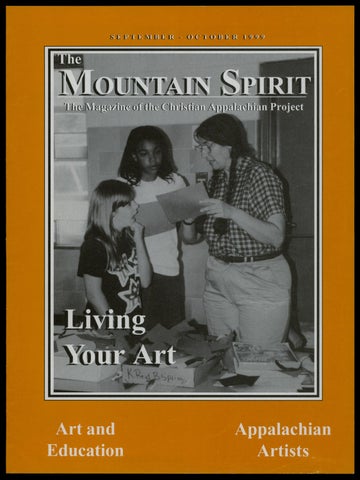
On the cover, Kentucky artist in residence Judy Sizemore (photo by Beth Dotson). The Mountain Spirit is published six times a year. The annual subscription price is $8.00. Subscriptions and other correspondence should be sent to The Mountain Spirit, Christian Appalachian Project, 322 Crab Orchard Street, Lancaster, KY 40446. Copyright, 1999, The Christian Appalachian Project, Inc. All rights reserved. Member, Catholic Press Association. The Christian Appalachian Project is a non-profit Christian service organization operating throughout Appalachia. The project operates on the philosophy that helping people help themselves is the best approach to Appalachian poverty. The Christian Appalachian Project is recognized by the Internal Revenue Service as a 501(c)(3) charitable organization and is qualified to receive tax deductible contributions.
The best of our memories often center around the arts. I remember music ringing off the mountains, carving and weaving produced by the hands whose owners told stories about “the old days,” and quilts stitched from bits of fabric that map the special events of the family. But mountain folks don’t think of these things as art; they’re much more pragmatic Sanders, than that. Music Mike CAP President was something you did to pass the time and keep the little ones entertained. You wove a basket so you could carry the potatoes in from the garden, and a quilt wasn’t an artistic expression — it kept you warm on a cold winter’s night! As the culture of the mountains becomes more precious because of the creeping influence of more mainstream culture we’ve come to realize that our culture is captured better —- more realistically — through our music, our dance, through storytelling of all kinds. In fact, as you’ll read in this issue of The Mountain Spirit, cultural expression of every kind is being used more and more frequently as an integral part of the curriculum for mountain students. Creative people of all descriptions are coming together to enrich their lives and the lives of others. They’re using cultural expression to teach people about life in the mountains. When my parents were young, people used the arts to enrich life and communicate with each other. Today, we in the mountains are using the arts not only for each other but for those around us, as well. Enjoy! Mike Sanders
A summary of the registration and financial documents filed by this organization can be obtained by contacting: in Maryland, for the cost of copies and postage, the Secretary of State, State House, Annapolis, MD 21401; in Virginia, State Division of Consumer Affairs, P.O. Box 1163, Richmond, VA 23209; in Washington, residents can call the Secretary of State toll-free within the state at 800332-4483- IN NEW YORK OFFICE OF THE ATTORNEY GENERAL, CHARITIES BUREAU, 120 BROADWAY, NEW YORK, NY 10271; IN NEW JERSEY, THE ATTORNEY GENERAL BY CALLING 201-504-6215; IN PENNSYLVANIA, DEPARTMENT OF STATE BY CALLING TOLL-FREE WITHIN THE STATE, 800-732-0999; IN WEST VIRGINIA, SECRETARY OF STATE, STATE CAPITOL, CHARLESTON, WV 25305; IN FLORIDA, THE DIVISION OF CONSUMER SERVICES BY CALLING TOLL-FREE WITHIN THE STATE AT 800-435-7352; IN NORTH CAROLINA, FINANCIAL INFORMATION AND A COPY OF THE LICENSE ARE AVAILABLE FROM THE STATE SOLICITATION LICENSING BRANCH AT 919-733-4510; or by writing to Christian Appalachian Project, 322 Crab Orchard Street, Lancaster, KY 40446. Our license number in Michigan is MICS 9933. Registration with any of the above government agencies does not imply endorsement by the state.
2
T
h e
M
o u n t a i n
S
p i r i t
R
A
N
D
O
M
T H O U G H T S B y G a r r y B arker he arts are not just important to East Ken tucky. They are absolutely essential. Culturally, educationally, and economically, the arts play a major role in the history of the region and are a key element in planning for the future. Mountain storytellers, musicians, and craftspeople have preserved a living heritage, keeping the history of a people alive in their words, music, and skilled hands, an oral and visual documentation that only during this century has begun to be written and studied. The relative physical isolation and the family focus of East Kentucky helped preserve and maintain the traditional arts, and now the region’s educators and economic developers are making good use of native talents. Today the hills of Kentucky are alive with musicians, writers, artists, film makers, craftspeople, and story tellers, both those who hold to the traditions and those who build on heritage to develop new and exciting expressions. The Country Music Highway, US 23 from Ashland to Jenkins, honors the many East Kentuckians whose mountain music roots propelled them to the national spotlight. The new Mountain Arts Center in Prestonsburg was built to showcase emerging native talent. Mountain crafts are marketed across the world, and new initiatives in regional development include the “Gateway” Artisans Center being built near Berea and the ambitious effort in tiny Hindman, Ky., to rebuild an entire community focused on the heritage of arts and cultural activity. The building of a new two-year technical college of arts and crafts, an Artisans Support and Marketing Center, and a major renovation of the town itself are already underway. In nearby
T
S eptember
O ctober
Whitesburg, Appalshop’s film making, public radio, and culture-based programs are a model for the nation. East Kentucky’s folk artists build on native skills to create expressive contemporary art, and Morehead State University’s new Kentucky Folk Art Center grew from regional and national interest in the region’s large population of self-taught artists. The local literature of East Ken tucky long ago transcended regional ism, led by such legendary authors as Jesse Stuart, Harriette Arnow, and James Still, a movement reinforced today by the likes of Chris Offutt, Gurney Norman, George Ella Lyon, Chris Holbrook, Lana Witt, Sidney Saylor Farr, James Goode, and many, many others who mine the rich culture of the Kentucky mountains. The annual Appalachian Writers Workshop at the Hindman Settlement School is the heartbeat of the region’s writing programs, and Kentucky Arts Council “Circuit Rider” Judy Sizemore has developed teaching guides that incorporate mountain authors into a teaching experience which helps East Kentucky students learn more by learning more about themselves. Major efforts to build “cultural tourism” as an industry in East Kentucky focus on the native arts, the colorful mountain culture, and the beauty of the land which time did not forget. Contrary to the “third world” image often portrayed, Appalachian Kentucky has been all too often “discovered” by outside forces. Since the 19th century, industrial developers and missionaries have worked diligently to change the people of East Kentucky into more mainstream Americans. Well-meaning efforts have often resulted in an “Appalachian” culture seemingly invented and manipulated by those who then marketed it to the nation. One result of such “cultural politics” is that many East Kentuck ians do not recognize or value their own culture as being valid and
1999
important, instead seeing “culture” as something that is either brought in from the outside or visited elsewhere. The importance of bringing the East Kentucky arts into the schools becomes even more obvious under those circumstances, and the native arts become a way to help rebuild self esteem in a region where a century of negative reinforcement has created a lingering sense of cultural inferiority. East Kentucky does not ignore the more conventional cultural activities, as evidenced by the many school and community arts programs which bring classical music, dance, drama, and art into the mountains, efforts strongly supported by state arts and education agencies and the region’s colleges and universities. Increasingly, though, artists-in-theschools are regional artists, giving equal credibility to art forms and directions native to the mountains. The new sense of cooperation sweeping across East Kentucky, the recognition of the necessity for networks, regional planning, and leadership development, includes the arts at every level. Having a current governor, tourism secretary, and arts council director with strong East Kentucky roots surely aids the current creative movement in the mountains, and there’s an air of excitement that inspires both the arts community and the larger community. Few geographic or cultural regions have managed to hold onto their arts heritage in the way East Kentucky has done, clinging to the traditions despite the many pressures, and finally the stage is set for making full use of a treasure most of the world didn’t even know we had.
Garry Barker, director o f the Kentucky Folk Art Center in MoreheadKy., grew up in Elliott and Fleming counties, and has worked in the arts since graduating from Berea College in 1965.
3
R uby Laney s Th is ket'f'ev te* y \ i ^ t j-v [vôni mcvnôry , y& xw
r¿>v
tl-jve* y o u r
ív»fvl/í<2;ev»ce .
o n » ij ^ c*ur
Ruby Laney paints her memories. The waterfalls and mountain scenery in vivid colors and dynamic shapes she paints today are the successors of the notebooks she once filled with sketches of flowers. All of her life has not been peaceful and beautiful, but her paintings blend the natural beauty she observes around her with painful
life experiences. “What doesn’t kill you makes you strong,” Ruby says of that pain. Bom in Floyd County and raised in Ohio and Indiana, Ruby returned home to Eastern Kentucky when her mother left her alcoholic father, whom Ruby describes as cmel and abusive. She dropped out of school in the
w
v\ *í l í
be
, (P .aiJ ^ ouirutv) *5 eighth grade, had her first child at the age of 14, married at age 25, bore four more children, buried one (“my little girl got killed by a car”), and helped to raise her 13 nieces and nephews, her sisterin-law’s children. After 27 years of marriage, Ruby’s husband, Howard, deserted her. For fifteen years Ruby was paralyzed
.
Story and photos by Margaret Gabriel
was against my family, because of my more to learn,’” Cathie says. “A lot of from her waist down, following a eyesight,” Ruby says. “They thought stroke in 1973. Ruby’s family cared for people say that and it sounds trite, I would damage my eyes. I was bom but it was true for her.” her until she was healed at a prayer legally blind, but I’ve always been Cathie recalls that Ruby enjoyed meeting. able to see color.” literature, social science and science, Ruby recalls the spinal headache Ruby uncovers several paintings but was less motivated when she she had that night in 1988, and that that represent her body of work for studied math. “She called geometry her daughter encouraged her to go to the spring semester at Morehead. The ‘that stupid geronimo; I don’t think I Wednesday night services, saying large canvases are painted with bold, can take it. ’ Some of the math prob “There’s no better place to go than brightly colored images, which she lems were so unreal to her. They church.” In the small Magoffin has no trouble seeing, in spite of her weren’t the kind of thing that some County church, the pastor asked poor eyesight, but “when it gets real one living in a trailer in a holler would Ruby if she wanted the congregation delicate, sometimes I end up to pray for her. with paint on my nose,” she “I said yes, and the says, indicating a pointillism pastor’s wife was assignment that features more sitting next to me. They detail. took me in and set me Ruby eyes her work on a couch, and after critically. “I’m going to do they got done praying some more work on that one, for me, it was like but I just don’t like it,” she somebody had patted said of an assignment to “put me on the back. I yourself into a painting that looked at Mildred and Monet might do.” she was like this, She declared that she praying,” Ruby says, didn’t like the painting with her hands folded because she didn’t feel that it and head bowed. was her own work. “I don’t “They were praying for like to even try to copy Brenda and Mitchell somebody else. I don’t Combs and the hand believe in copying — if it’s did it again. And the not yours, leave it alone!” next thing I knew, it An assignment to work in was like somebody was black and white led Ruby to behind me, pushing me explore working outside her up. And I’ve been signature vibrant colors. The walking ever since.” black and white exercise is Howard was in the obviously Ruby’s work congregation that though because of the large, night. He and Ruby bold objects it features. An had been divorced five years, and he had just During the school year, Ruby lives in student housing on the Morehead observer of her work can see Ruby’s regard for Van Gogh separated from his State University campus. and Gauguin, whom she second wife. Within the categorizes as “the wild painters.” deal with.” year, Howard and Ruby remarried. As a girl, Ruby looked for ways to After Howard passed away, Ruby Howard was in poor health; Ruby color her sketches. She learned ways commemorated his birthday, October cared for him until his death in 1992. to create paint, of a fashion, from 22, by receiving her General Equiva Howard encouraged Ruby to study things that she found growing on the lency Diploma. Because it was “there for and take the test for high school mountainside. After drawing with to do,” Ruby says, she decided to go equivalency, saying “You’re just as pencil, she would mix the milk from a to college, and enrolled at smart as the rest of these dummies,” milkweed pod with blackberry juice. Prestonsburg Community College as she recalls. “He said what he “There’s some over on Long Creek in an art major. She obtained an thought.” Floyd County, and you can find blue associate’s degree and continued Cathie Kinley taught Ruby’s GED clay and red clay. You make it thick studying art at Morehead State classes when she began studying. with water, and when it dries, you’ve University, where she is currently a “[Ruby] used to tell me, ‘You know, got paint.” For bmshes, Ruby used senior. the more I learn, the dumber I feel, broom straw, toothbrushes, “and my “I always drawed, even though it because I can see that there’s so much
S eptember
O ctober
1999
5
aunt’s makeup brushes! You just used “She told me, ‘If I wait until I don’t resulted in acquisition of her work by whatever was handy.” need the money, I’d never pay you local collectors. BillTussey, manager Although she has been a prolific back.’ And she paid me right then. of CAP adult education, displays two artist all her life, Ruby was completely She’s just a rarity.” of Ruby’s paintings in his office in unschooled until her first art class at The most important element in Salyersville. Prestonsburg Community College. teaching Ruby, Whitaker said, was to “The first time she ever showed There weren’t many art classes at give her support and the opportunity was at a Women’s Leadership PCC, Ruby says, “but you can learn a to interact with other people and other Conference I was helping with,” Bill lot there, if you listen.” artists. said. “I bought [the paintings] As a student Ruby has explored “He said I’ve come a long way, the because I knew it would help her, but I differences in textures and methods. last time he was down here [in had heard that Tom Whitaker was “When you teach yourself, you’ve Morehead], but he said, you pretty going wild over her art, and I knew got a poor teacher,” she says. “When well knew what you wanted to do they’d be worth something someday.” I went to PCC, it was the first art class before you started,” Ruby said. Mostly, he says, he bought the I ever had in my life.” Tom Whitaker, who has been called America’s greatest Appala chian artist by poet A1 Stewart, was Ruby’s first instructor. He, too, is a native of Eastern Kentucky whose art reflects life in the mountains. In his classes, Whitaker stresses the importance of being true to oneself rather than relying on public opinion. He says that regardless of what she learns studying art, CAP program manager Brenda Wireman (left) and Ruby have worked together during Women s Leadership Ruby will remain Conferences and when Ruby was working on her GED in Magoffin County. true to herself. Whitaker called Ruby, “the hardest worker I’ve Of Ruby’s practice of painting from paintings because he likes them. One memory, Whitaker said every painter ever seen, and completely genuine. painting is a home sitting in a field; Unlike people who want to do pretty the other is a church cemetery. “I paints from memory, to a certain degree. He explained that while paintings, she paints what is real. The could step into either and be at home whole world seems like it’s filled with teachers often say, “paint what you there. They each speak to me in a personal way,” Bill said. see,” all artists see things in different computers and Star Wars — we’re After Ruby completed her GED with ways. bombarded with hype, but Ruby is so the help of CAP’S adult education “What Ruby sees is removed from wise. Spirit just radiates from that program, she was eligible for a CAP the artificialness of society,” said woman, and she’ll always give you a college scholarship. Whitaker, who has displayed Ruby’s wise answer. I loaned her money one “We have $3,000 at our disposal to work in his gallery. time. It wasn’t very much, and when distribute as we see fit,” Bill said. The Ruby’s exhibitions in Whitaker’s she came to pay me back, I told her, scholarship program helps people gallery, and in the Prestonsburg ‘you don’t have to pay me back right who have participated in CAP Community College gallery, has now, if you need that money.’
6
T
h e
M
o u n t a i n
S
p i r i t
mountain homes.” Ruby is proud of the success that she has had selling her paintings, but, like most artists, her sales are spo radic. “It rains a lot, sometimes, then there’s a dry spell.” There is a purity in Ruby’s motiva tion, as well as her goals. She decided to study for her GED because the opportunity made itself available. She went to college not because she hoped for a better job or a reward that you could measure, but because she wanted to further her education. “I was scared to death the first day of class [at Prestonsburg Community College], I said ‘What in the devil am I doing here?’ It’s scary, and I thought I would never make it. I went, but I would have guaranteed you that it would be my first and last semester! That’s how much confidence I had, but I passed.” Because she passed, Ruby decided to continue her education and hopes to graduate in the spring o f2000. She sees busy times ahead until she gets her degree, “But most of it’s going to be fun, the painting and the photography,” two of her required classes. “This fall, I’ll be taking Painting II, and then I’ll have one more class of drawing. I’ll miss it when I’m finished.” Ruby dreams of graduating in a tuxedo. “I want a light blue, or complete white. Some body said that’s for men, but I told them they have tuxedos for women — they’re beautiful.” Those dreams go far beyond the graduation day and a lightblue tuxedo. As she Ruby displays two pieces o f her body o f workfrom the spring completes her semester at Morehead State University.
programs, such as adult education, outreach and JobStart, to continue their education. Usually, a recipient is awarded $500 to use for direct education expenses like tuition or books. Recipients may also use the scholarship for expenses that are essential for a successful return to school, like child care or a car pay ment, or other supplemental needs that are not often needed by more traditional students, Bill says. Ruby has received scholarship assistance in the past, and has applied for assistance with the fall semester. “I’d like to help her any way we can. I think what she’s doing is really wonderful,” Bill says. Through her art, Ruby helps people around her to focus on individuality and the beauty of life in the moun tains. “You can take materials out of the hills, like pawpaw whistles or grapevine wreaths, and show our culture,” she says. “If people like us don’t preserve it, children won’t know anything about it. They won’t know where they come from or how they got here. I think it’s very important — it’s part of us, it’s our history. Some of the things that we do now, our ancestors done then. Things like quilting and ceramics. Even paintings, it reflects on the time back then, like the old
S eptember
O ctober
1999
Ruby hopes to start a gallery to display the work o f mountain artists.
own goal, her next is for others, people who have a goal similar to hers. Ruby sympathizes with the difficulty that unknown or even newly discovered artists have in securing studio and gallery space, and aspires to make those things available to artists in Magoffin, Floyd and Johnson counties. “Students struggle,” Ruby says. “They’re like me. If you don’t get grants and things, they couldn’t do what they want to do. [My gallery] would be for students to hang their paintings without costing them an arm and a leg. If they sell, they could pay a little piece, but if they don’t sell, there’s no cost. It’s hard for a student, if they don’t sell something, to pay anything. I’ve been in that situation. If I had had to pay to hang my paintings, I couldn’t have done it.” A goal of helping other artists to achieve their goals exemplifies Tom Whitaker’s description of Ruby as “genuine.” He says that Ruby is a good illustration of Picasso’s assertion that: “Art is not truth. Art is a lie that makes us realize truth, at least the truth that is given us to understand.”
7
“M ’n On The River” Father Beiting’s 1999 RiverboatTour
by Jim Trammel
Father Ralph Beiting, founder of the Christian Appalachian Project, wanted something besides the traditional testimonial dinner to celebrate his 50 years as a priest. So, returning to his earlier days as a traveling preacher in Eastern Ken tucky, he took to the water on a houseboat for a 14-day river tour, preaching at 13 shoreside stops from Huntington, W. Va. to Evansville, Ind., down “America’s Main Street,” the Ohio River. Fr. Beiting and a crew of eight CAP employees, friends and volunteers piloted the river between stops. An advance shore crew of other CAP employees and volunteers went ahead in a recreational vehicle making arrangements for logistics and media coverage. “I wanted to really and truly thank God publicly for my Catholic faith, my
8
50 years in the priesthood and the wonder He has brought into my life,” Fr. Beiting said, as well as thanking people he has met for their support. The evening-long riverboat stops featured sermons and reminiscences by Fr. Beiting, delivered around spoken and sung performances by CAP employees and friends. This is Fr. Beiting’s fourth riverboat tour; earlier ones took place in 1979, 1985 and 1992. His love for houseboats developed over many years and he has used houseboats as a setting for CAP volunteer training and to entertain children at camps. Fitting CAP’s ecumenical nature, the floating pulpit was shared by Richard Ginn, CAP’s assistant director in Louisa and Church of Christ minister, and many other T
h e
employees of the various faiths that make up the CAP family. Fr. Beiting recognized three Applachian Christian colleges he said are teaching values and providing the education that is the region’s best hope for the future: the inter-denomi national Alice Lloyd College in Pippa Passes, Presbyterian Pikeville College, and the Baptist institution Cumberland College in Williamsburg. He exhorted his crowds to take personal action to restore Christian values to American society. “Material ism and secularism have dried up our society,” Fr. Beiting said. “The challenge is for people to stand up for God in their daily lives.” Fr. Beiting heard inspirational stories from the crowds who came out to the houseboat every night along the river. In Madison, Ind., Fr. Beiting heard from a woman who set up a ministry in that city because it was where she was abandoned by an
Ben Prewitt, vice president ofplanned giving and major gifts, gives insight on CAP’s Mission Statement to the crowd in Carrollton.
M
o u n t a i n
S
p i r i t
Above, CAP human services assistant director Richard Ginn greets the crowd in Carrollton, Ky. Below, the “Voices o f CAP,” a choir made up o f CAP employees, performs in Cincinnati.
Dave Harl performed as a “Mountain Troubador ” and controlled the sound system during the tour.
abusive spouse after a 30-year marriage. The woman said she had prayed for someone to use a boat like Jesus did, rather than just for gambling or recreation. She said she asked God to send a boat to talk about His son, and Fr. Beiting’s boat appeared. Beyond the person-to-person contact on the riverbank, the media attention generated by the boat tour has brought CAP’S message to an ever-wider audience. CAP president Mike Sanders, who traveled with the advance party between on-deck appearances to discuss CAP programs, said, “It’s a funny thing, but CAP is much more widely recog nized in New York and Florida than here in our service area.” That must have ^ ove> sextet from St. John s Catholic Church in , , Carrollton sings “River o f Glory.” Right, Father Betting c ange some enjoys meeting long-time CAP supporters. what, with the tour of the flower-bedecked houseboat decorated Papal flag and the colors of CAP, buoyed not only by the with a cross on the bow and flying Ohio’s steady current but by the seven flags — the states involved in the tour (Indiana, Kentucky, Ohio and equally steadfast enthusiasm and West Virginia), the American flag, the personal drive of its skipper.
S e pte mb er
-
O ctober
1999
9
A
r
T he
o
u
n
d
P roject
President Clinton Reaches Out to People in Jackson County Reprinted with permission o f The Jackson County Sun Jackson Countians, including local citizens and elected officials, remained impressed with President Bill Clinton following his historic visit to the county on Monday, July 5. Clinton landed at Tyner Elementary surrounded by walled-in school buses and high security details, but ven tured away from the envelope of security to reach out and meet local people in ways that he will be long remembered for by those he met. Only staying in the county about three hours, Clinton visited the Ray Pennington family before making two unscheduled stops in Annville, where local people had been lined up all morning to see the presidential motorcade go by before going on to Mid-South Electronics [which is also the site of JobStart, the Christian Appalachian Project training program in Jackson County], At Mid-South the President talked with local leaders and toured the assembly line where electrical compo nents are manufactured and visited with workers while shaking hands along with founder Jerry Weaver. Jackson County Judge-Executive Tommy Slone was the first Jackson Countian to greet President Clinton as he stepped off Marine One after touching down in Tyner. “Elad I been able to spend more time with the president, I would have asked for any assistance he might give us in cutting the red tape and possibly speeding up our process of obtaining a lake which we desperately need in order to expand our industry and create more jobs for our people,” Slone said. “The lake is important for
10
the industry but also to the 40 percent of our population who do not have potable drinking water.” Slone emphasized the county is not looking for handouts, but rather in getting assistance with the lake and upgrading local roads. “We have the ability and the fortitude to carry out the rest,” Slone said. “We appreciate President Clinton taking an interest in our county — it sure was an honor for us to host a sitting president, it will be a day long remembered by all of us.” Jackson County was put on the presidential agenda after stringing together many successes as an empowerment zone. As part of the EZ, the county joined Wayne and Clinton counties to comprise the zone, which receives federal aid and grant priori ties and funds to help economic development. Many of the efforts have been aimed at developing jobs, both
through the efforts of the local EZ office and Kentucky Highlands Investment Corporation, and by the use of such tools as tax credits and the help of the local industrial authority. There have been several indications that the local EZ, including Wayne and Clinton counties, has been one of the most, if not the most, successful zone in the nation. Jackson County had many prob lems historically with high unemploy ment, poverty and lack of infrastruc ture that the empowerment zone status seeks to solve. In the late 1980s, Jackson County had high unemployment often exceeding 20 percent, but that rate has declined somewhat, has continued to decline, and is now below the national average in a large part due to the empowerment zone status and the job creation it has focused on.
President Clinton greets well-wishers at Annville, Ky. The photograph is courtesy o f CAP adult education teacher Keith Gilbertson, who introduced the president to his three sons.
T
h e
M
o u n t a i n
S
p i r i t
R O U N D
A
T he
P roject
CAP Sponsors Interfaith Conference The Christian Appalachian Project was the co-sponsor of the 1999 Conference of Many Faces of the Spirit, an interfaith group whose members are empowered to pursue their unique spiritual paths. The conference, “Welcoming the Stranger: Embracing Our Diversities,” was held at the Newman Center in Lexington, Ky. The keynote address by Dr. Michael Kinnamon, dean at the Lexington Theological Seminary, explored four basic points about welcoming the stranger: that it is a primary foundation for all faiths; that it is not just an altruistic act, but is essential for the spiritual self; that it means welcoming those who don’t welcome strangers; and that there are strangers in our midst. Workshops were conducted by representatives from many religious disciplines including Hinduism, Quaker, Islam, Mormon, Baha’i, Christian, Taoism and Christian Science. Other workshops focused on the work of spiritual leaders like Dr. Martin Luther King, Jr., Thomas Merton, and the Dalai Lama, or addressed topics of experiencing God’s love through prayer and sacred
chanting, caring for the earth as part of a spiritual journey and current efforts by community service agen cies. CAP workers maintained a display table and distributed information on the various programs of the organiza tion. Kathy Kluesener and Donna Lamb of the volunteer department explained opportunities for volunteer ing with CAP, and Garry Vickers, assistant director of human services, attended the workshop sessions and represented CAP on a panel of community service organizations that work with strangers in need. “This conference provided opportu nities to learn about religious disci plines other than our own,” Garry said. “CAP is one organization that does just that. We work with people who are strangers to economic prosperity, to healthy environments and relation ships, to educational opportunities, and to positive self-esteem. In working with those in need, we incorporate other strangers, those who come to volunteer with CAP, to offer partici pants opportunities to grow and develop and to belong in the commu nity. As they do that, they are no longer strangers.”
How Can I Help CAP? Not long ago, the Christian Appalachian Project received an email from a supporter who asked about the availability of CAP volunteer opportunities for a family. We replied that because of housing limitations, different opportunities are open for families than are available for single people. While CAP is able to accept a limited number of married couples, we are not able to accommodate families with children. There are, however, other ways for families to volunteer. For instance, they might volunteer to distribute literature about CAP to school and church groups. We are happy to make
S eptember
O ctober
additional copies of those publica tions available to volunteers for distribution. For more information about the various ways of contributing to CAP through volunteer assistance in various forms, please contact The Mountain Spirit, 322 Crab Orchard Street, Lancaster, KY 40446. Our most powerful form of assistance, however, is prayer. No matter where they are or what they’re doing, volunteers, and supporters of all descriptions, can have a mighty influence by praying at least one minute a day for poor people in Appalachia and through out the world.
1999
What You Don't Know About Wills Can Hurt Your H e i r s .. , Find Out Why. Request j . Your Free Copy.
Much of what you know about wills may be misinformation that has been floating around for years. If you think, for example, that wills are primarily for rich people, or elderly people, you may be the victim of a common m isconception. The helpful booklet offered here will explain how your will can save your heirs from costly delays and confu sion. Send for your copy today. Clip and Mail
Christian Appalachian Project 322 Crab Orchard Street Lancaster, Kentucky 40446 Please send without obliga tion your booklet, “37 Things People ‘Know’ About Wills That Aren’t Really So.” Nam e______________________ Address _ C ity____ State,ZIP
11
A
r
T he
o
u
n
d
P roject
Twenty-Three Receive GED in McCreary County Submitted by Paula Woodman manager, CAP Adult Learning Center CAP celebrated the McCreary County Adult Education graduation in Whitley City on June 8. These cap and gown ceremonies are very special occasions to honor the adult education participants who have earned the GED (high school equivalency diploma) in the past year. It is also a time to recognize special contributions made by other students in the program. The graduates came from CAP adult education, Schoolon-Wheels and Families Growing Together, a family literacy program at
the Eagle Child Development Center. About 75 friends, family members, teachers and CAP staff attended to celebrate this joyous occasion. Ken tucky Representative Charles L. Siler of Williamsburg was the graduation speaker. Rep. Siler has long been a proponent of adult education and serves on the Governor’s Task Force for Adult Education. Also speaking that evening was Shirley Tooley, from Families Growing Together. Shirley is a recent GED graduate who plans to attend Kentucky Technical College in Somerset. Shirley thanked her family and her teachers and others for supporting her while she worked to get her GED. Shirley
spoke for many students who have overcome the barrier of not having a high school diploma. A recent survey of McCreary County shows that 44.1 percent of the population lives in poverty. Fiftythree percent of the adults ages 18 and over have no high school credential. Of that number, 32 percent have less than a ninth grade educa tion. CAP adult education programs provide a much-needed service to this area. Lack of a high school diploma is a major barrier to getting a good job or going into higher education or training. The correlation between poverty status and lack of education has been well documented. CAP adult education program have helped approximately 1,300 adults in earning the GED. The program has been recognized as one of the most outstanding programs for adult education by the Kentucky Associa tion for Adult and Continuing Education.
Is there a CAP program that you d on ’t see in this
The latest graduating class o f the more than 1,300 people who have been helped by CAP in attaining a GED. This group graduated in McCreary County.
issue o f The Mountain Spirit? C A P ’s web site includes inform ation about all o f C A P ’s human d evelopm ent program s,
Mountain Spirit Wins Award The Mountain Spirit was recog nized with an award from the Catholic Press Association in its 1999 journalism award competition. Margaret Gabriel’s series on welfare reform was recognized in a new award category, “Best Body of Work by a Writer or Editor.” The
12
judges commented, “While [Gabriel] revealed the socioeconomic problems of this region, she also let the reader see how faith, hope, love and charity will prevail to up lift the community. Her thoughtful treatment made her stand out among the competitors and placed her first in the category.” T
h e
planned giving and m ajor gifts and the volunteer program . Please visit the site at www.chrisapp.org and be sure to sign our guest book!
M
o u n t a i n
S p i ri
t
A
r
T he
o
u
n
d
P roject
CAP To Help New Workers with Job Retention Skills The success of JobStart, a Christian Appalachian Project program that helps participants acquire the skills they need to enter the workforce, led the commonwealth of Kentucky to invite CAP to begin a job retention program. CAP accepted the challenge and has hired “job retention special ists” in five counties. Each specialist will mentor 50 KTAP (Kentucky Temporary Assistance Program) recipients, lending them whatever support they need to achieve success in their jobs. “That support could be anything and everything,” said program manager Janet Ryan. “It might entail getting someone the right clothing for a job, a haircut, dentures, whatever it takes for folks to be successful.” The state has increased the funding for supplementary needs, those that can mean the difference between success or failure. The specialists will also assume the role of mediator between an employer and a worker who is new to the job force. “It’s a two-fold mission, really,” Janet said. “To the employer we can say, ‘How can we be a positive impact on your retention rate?’ On the flip side, we’ll talk to the participants and say ‘What’s stressing you out?’ We want to nip those things in the bud before people quit or are laid off.” Job retention is the next logical step past JobStart, which empowers people with basic skills. “Now we’re looking at barriers that might develop upon employment,” Janet said. In addition to mediators, the state is also supplying cash incentives for people who complete a GED, or six months on a job, although these incentives have met with mixed success, according to JobStart teacher Sandy Spalding.
S eptember
O ctober
She recalls telling a group of women in Owsley County [a county with one of the highest unemployment rates in the state] that they could all go to work tomorrow, and found that it wasn’t a lack of transportation or child care that was keeping them out of the workforce. “We can fix all that. I found that what’s holding them back is the fear of making a mistake and being scolded or shamed for doing something wrong. The fear of supervisors is the biggest reason that our people quit jobs.” The job retention program will equip people with the skills they need to shake off those fears, and give them the ability to learn from mistakes, Sandy said. Career advancement will play a part as well, so that people will have the skills they need to go beyond the entry-level wages which are fre quently barely above poverty for a family of three.
1999
“Most of our people will go in at entry level,” Janet said,” but we tell them ‘Let’s get a plan.’ Take more classes, ask your supervisor how you can move up. Employers like to see that kind of initiative.” Some of the counties in which CAP will be working lack jobs, especially higher paying jobs, but there are jobs available in counties that are easily within commuting distance, Janet said. “People who want to change where they are will use the resources that are available, and there are enough programs in place to assist people in making it happen.” Respecting the wishes o f deceased loved ones, or in honor o f them, families often request that memorials be sent to us. Memorial gifts live on to benefit others. Many also specify memorial gifts in their wills. Any size gift is welcome. Contact us for more information.
13
A
r
T
h e
o
u
n
d
P r o je c t
Training Program Expands in McCreary County Eagle Child Development, the Christian Appalachian Project child and family development center in McCreary County, is adding a newer, larger trailer that can accommodate expanded activities for its family literacy program, according to program manager Mike Loiacono. Family literacy promotes literacy as a household project. Parents and children teach each other to read, and reinforce each other as well in literacybased family skills. All of CAP’s child development centers promote family literacy; the Eagle center was the first to begin such a curriculum, which includes child development, parenting instruction, parent support groups and time in which parents and children
Eagle Child and Family Development Center in McCreary County is helping adults to develop the skills they need to join the workforce. The building they are adding is making more training possible.
W ORKPLACE PAYROLL DEDUCTION If your employer offers donor designation as a write-in for pay roll deduction campaign, please remember the Christian Appa lachian Project. CAP is a 501 (c)(3) tax exempt agency, and payroll deduction is the easiest way to help the families of Ap palachia. To ensure that we re ceive your payroll deduction gifts, please give your payroll officer C A P’S full address and send to the attention of:
Teresa McAnly Campaign Coordinator
Christian Appalachian Project 322 Crab Orchard Street Lancaster, KY 40446
14
work on activities together. Studies by the National Center on Family Literacy in Louisville, Ky., indicate that “family literacy is the way to go to break the cycle of ignorance and poverty,” Mike said. “Instilling a love of learning with both generations at once is doubly effective. Everything is learned behavior, and if kids see their parents learning, they’ll be inclined to learn, too. Child development is wonderful, but they went home, and the parents weren’t really sharing the experience.” A training component was added to the family literacy program so that the program would qualify as a training program for families that will be joining the work force as a result of welfare reform. When the double-wide trailer is in place next to the trailer that houses the child development center, the program will have more space to devote to such training as industrial sewing and computer-related activi T
h e
ties. Several people involved with the training have moved into jobs in the various sewing factories in McCreary County, Mike said, and some, after working on computer skills, have enrolled at Kentucky Technical College’s office technician training program. Other program participants are concentrating on acquiring the skills needed for food preparation jobs or to provide home-based child care for other working families. “Community-Based Services [formerly the state Department for Social Insurance] is impressed with our services,” Mike said. “They say they wish there were more.” All of these services grew from the need that was observed in the area, said Jean Barnes, assistant director of CAP human services. “We knew that if parents and children learned together, they would learn better and they’d learn longer.”
M
o u n t a i n
S
p i r i t
A
r
T he
o
u
n
d
P roject
Second Generation Volunteer Serves at Camp Shawnee Tony Licata has a few memories of his childhood in Kentucky, but with his parents, he decided that after his sophomore year at Rice University he should return as a Christian Appala chian Project summer volunteer. “My dad came as a volunteer, and he enjoyed the people and loved the area,” Tony said of his father, also named Tony. The older Licata was the waterfront director at Camp Andrew Jackson in the mid-1960s, and started Kentucky Woodcraft, one of CAP’s early economic development projects. “When I came, I guess I had an idea of what I was getting myself into — in spirit, being a counselor now is like it was then. I was lucky to have motiva tion and support, and I’ve always wanted to come back and see Ken tucky for myself.
“I didn’t come with any expecta tions, but it’s been a wonderful summer,” Tony said.
Tony, a math major who would like to teach or do research upon graduation, said that he had never given any thought to long-term volunteer work before his summer experience, but now, the possibility “depends on how the next couple of years go.”
Tony Licata, left, and campers from Camp Shawnee.
Come Move Mountains... each an adult how to read a food label in a grocery store for the first time. Repair a home for a family that’s truly in need. Show a child the marvel of nature. Come and share the experience of service and prayer for a year with many other volunteers. To request an application, call or write:
Christian Appalachian ProjectVolunteer Program 322 Crab Orchard Street • Lancaster, KY 40446 • (606) 792-2219 • (800) 755-5322 FAX: (606) 792-6625 Visit our website at www.chrisapp.org or email: volunteer@chrisapp.org
Keith Gilbertson thought he was just teaching one more person to read when Tony Smith started studying with him. But quiet, guitar-strum ming Tony, who lives on the edge of the Daniel Boone National Forest in Rockcastle County, Kentucky, turned out brimming with clear-eyed observations, intense memories and profound love for his Eastern Kentucky hills. It’s all coming out in his writings, which enhance Keith’s program and inspire other authors. Keith has been with the Christian Appalachian Keith Gilbertson and Tony’s mother, Marie, another member o f his “writing circle.” Project for over 16 years more words right than usual,” Keith as an employee and two prior years as that direction.) a volunteer. Eight years ago he started recalls. Tony’s simple but profound Keith typed “These Old Hills” from teaching GED classes and adult declaration of love for his hills had Tony’s handwritten pages, using a literacy at the CAP Adult Learning struck a chord within G.P, intensifying laptop computer word processor he Center in Renfro Valley in Rockcastle his interest in reading as conventional brought with him on a home visit to County. Tony. Keith hooked up the printer and texts never could. Keith has 20 to 30 students at any Tony’s writings are ideal for printed out a copy of the essay with one time, and over 100 come and go in Tony’s name at the top, right there on students learning to read, because the a typical year. An average threevocabulary is not very difficult Tony’s kitchen table. It’s crucial that quarters of his students are seeking (software programs that analyze Keith had the printer right there and their GED (General Equivalency complexity of written material put could immediately show Tony a copy Diploma, or high school certification), Tony’s work at about fourth- to fifthof the work with his name in type. If but there are always four or five adults he hadn’t been able to do that until grade comprehension level). Plus, in the program who simply want to writing that concerns the hills of the next visit, the delay would learn to read. dissipate the sense of accomplishment Eastern Kentucky is such familiar, Tony was referred to Keith’s unthreatening territory to his reading that kept Tony interested in the program in 1997, at a time when Keith students that Keith can obtain a much process, Keith says. needed reading material in which his higher enthusiasm level than he could students could sustain an interest. Readers shed tears with traditional reading texts. Now Tony’s writing provides reading Tony said as much. He responded texts to which Keith’s students strongly to Keith’s literacy-training Keith later passed his copy of respond strongly, from the heart. efforts “because he didn’t try to get “These Old Hills” to another reading It began when Tony gave Keith an me to study some old book I didn’t student, G.R Pearson, in another essay he had written two years prior care nothing about.” town. “I wasn’t real sure G.P. was to Keith’s visits. The essay declared Standard beginning reader texts going to be able to read it and Tony’s lifelong love for “These Old “weren’t real” to Tony. “What do I understand it because we had been Hills.” (Academics would class Tony’s working in the standard textbooks for care about Einstein’s theory?” Tony work as “essays” since they mostly beginning readers with limited said. Well, we know Einstein’s theory recount history, paint portraits of is down one-to-nothing to “These Old success,” Keith remembers. people and places, and record the “As G.P. was reading I was setting Hills” if we’re keeping score by how narrator’s nostalgic feelings. Stories up the laptop computer for our lesson. many times G.P. was moved to tears. generally have more plot, conflict and And G.P.’s enthusiasm helps keep When I glanced up, G.P. was wiping a characterization than Tony has yet Tony writing and producing. “You can tear from the corner of his eye.” G.P. mastered, but he’s making steps in read the story to Keith, “getting many make a sure bet I told Tony how much S eptember
O ctober
1999
17
G.P. liked his story,” Keith said, and others have joined in the enthusiasm. Tony’s latest story had to be dupli cated eight times to reach everyone interested in seeing it. Right now Tony’s reading circle is mostly friends and relatives, but that may change. “I’d like to get pub lished,” Tony said. “There are people in the hills in Tennessee, Kentucky and Virginia who would like it. They’d identify with it,” Keith says of Tony’s writing.
when he gets stuck, but he already has a vision of the story he wants to write. Tony writes one or two essays a month in a wirebound notebook. On Fridays Keith visits Tony’s home, types what Tony has written into a laptop computer, and prints a copy for Tony and a copy for Keith’s classes on his portable printer. At this stage Keith furnishes the necessary editing and spelling help Tony needs. Spelling and grammar are such cruel masters that Tony would be helpless without Keith’s corrections. How Tony writes Keith changes Tony’s written “squorl” to “squirrel,” and confers with Keith Tony writes at his mother’s kitchen until they realize Tony’s first-draft title table in Rockcastle County, on a road “The Sicking Sun” was meant to be that borders the Daniel Boone “The Sinking Sun,” which finally National Forest. His mom, Marie, lives became “The Setting Sun” when a mile down the road from Tony, and printed. he goes to write once a week, But neither Marie or Keith are notebook in hand and story in mind. furnishing phrasing. Tony sticks to his Marie, who went to enough school to vision. (Indeed, his handwritten “get by,” helps him with spelling stories have remarkably few correc tions.) Marie once tried to make a few suggestions about some words, but he would tell her, “No, I don’t want it thataway.” Tony will likewise resist some changes that Keith suggests. Once he stopped Keith from changing the phrase “half of a dollar” to “a half dollar.” Having the technol ogy on hand for his home visits has In addition to writing, Tony also expresses himself with music. jump-started
18
T
h e
the results of the School-on-Wheels program, Keith said. “The ability to bring along modem computer technol ogy has made my teaching job more enjoyable, and I can measure the progress made by students in the quality of the words they are writing and reading,” Keith reported. Tony as author
Tony’s essays call to mind the creative odyssey of Garry Barker, today a forefront Appalachian fiction writer and essayist who recalled his rural roots in print as a sort of therapy (Garry and Tony have both been published in The Mountain Spirit). Tony hasn’t yet developed quite to the point where Garry began. Of course, Garry ultimately benefited from a Berea College education, while Tony is just learning the written language. Tony can’t yet craft a story, or play around with narrative techniques, nor can he develop a fictional character or create many plots that haven’t really happened to him. “Everything I’ve written so far is true, except one that’s a dream,” Tony said. But for a person of his limited training, his results are promising and remarkable, and if he can maintain his special heartline connection with his material while he develops his literacy, intellect, and story skills, his voice could become powerful indeed. He has a keen eye for the “telling detail,” the carefully chosen item of description that springs an entire scene to life in the readers’ minds, even down the dim corridors of memory. His recall is prodigiously detailed, down to his father’s brogans. Keith recalls a well-meaning writer from the West Coast who recognized the promise of “These Old Hills,” but stumbled in a letter by suggesting that Tony experiment with different voices and points of view. Keith politely let the West Coast writer know by return mail that Tony is working full-time to develop and articulate his own voice and point of view, as a much more authentic voice than the distant writer supposed. M
q u i n t
a i n
S
p i r i t
Inspiring others to write
Tony’s mother, Marie, started writing material of her own when she saw Tony’s writing move people. “I enjoyed seeing how his stories could bring tears to people’s eyes,” she said. Recording her personal history for the family also appeals to Marie: “I thought about what a great thing it would be to write stories about my life for my kids,” she said. She has written an intense personal reminis cence of “The Night Jesus Healed Me,” and other memory pieces about her girlhood and a quilt made by her grandmother. G.R, who cried over “These Old Hills,” wrote a piece titled “Memory Lane” about his youth, attempting his first story ever at age 53. Another student of Keith’s, named Bobby, at first liked to write about his Christian faith. Lately he has discovered that writing is a great way to express serious sentiments — and he’s penned poems beautifully expressing love for his wife, respect for his mother, and advice to his daughter when she married. None of these writers have met each other The technology o f a laptop computer has been a key to the success o f Tony's writing efforts, Keith says. (besides Tony and Marie, of course), but they always look forward to Keith bringing one interested in the process, he says, but another’s work. G.R always asks Keith filled with love when they write about until Keith visited him to start reading their mountain childhoods. It’s first thing if Tony has written any lessons Tony couldn’t unlock the common knowledge that creativity thing new he can read. G.R says of writer within. All it took was a laptop can help take away the pain all too Tony: “It sounds like Tony knows computer and a portable printer, common in day-to-day living. These what he’s writing about, and I know coupled with the interest and develop writers are taking their love of writing what he’s talking about ‘cause I’ve ment shown by Keith. He thought he and reading to new heights because been there.” was teaching a reader; how surprising of Keith’s assistance and the to learn he was developing an artist. technology he makes available to Unlocking the writer within them. Jim Trammel, a free lance writer, special No one else ever knew Tony had it Two reliable sources of art are great izes in issues vital to eastern Kentucky, in him to be a writer. He was always especially those that pertain to men. love and great pain. These writers are
S e ptember
O ctober
199 9
19
From Some Student Essays . . • I can see green beans strung up on long sewing thread and hanging down from the 2 by 4 rafters. I can smell the sweet smells of mustard greens cooking on her old wood cook stove....I can see the com in the long narrow bottoms. It’s turned brown from the frost....I see my dad walking from the garden with his bib overalls and his brown Brogan shoes. He is carrying a bucket of taters in his hand and he looks so young and healthy. I can smell the smoke from the old cooking stove. It smells like chestnut oak smoke. Just now I get a chill and I wake and I see the sun is beginning to go away....I stop and look back in to the hollow where I was raised. This time it is different. The house is gone and so is the bam. The long narrow bottoms where we grew com have grown up in pine trees, briars and old brown weeds. The branch that once had water, now is dried up. The mule does not kick here any more. The cowbells do not ring up this hollow any more. Going Home by Tony Smith November 1998
I can remember mom stringing beans on sewing thread and peeling apples to dry. She put the apples up on the roof or car hood, any place to catch the sun and where the chickens could not get to them. When they were dry she put them in a pillowslip and hung them up out of the way. When we wanted a big apple pie she brought out the apples and cooked them up. Memory Lane by G. P. Pearson November 1998 My brothers were going to the store. My big brother had a nickel. Little brother had a dime. My big brother told his little brother to trade him the dime for Marie s son, Tony, inspired her to write essays, as well. the nickel. He said the Keith finds that students are more motivated when they nickel would be worth read work that addresses subjects with which they are familiar. more because it was the biggest....When they were on their way home little brother noticed his big brother had more than to wake mom up. I told her what I had he did....The big brother said, “I fooled seen and she woke up daddy to tell you again, didn’t I? When are you him. He didn’t believe me. He said that going to get smart?” Then my little I had seen a picture somewhere and brother said he wasn’t going to listen that I imagined that I saw Jesus and to him no more. My big brother said, the disciples. But I knew that I did see “Now you are getting smart, son.” them. .. Mom was Baptist at the time Living Down on the Creek but became Holiness after that... I did by Marie Smith get well. I was not sick anymore... November 1998 Daddy began to wonder about it. He
Some days me and my brother Ernie and my cousin Clyde decided to play hooky from school. We hid in the woods and when we seen the bus go by it made me feel like someone got out of jail a week early. We would go to the cliff and build a fire and bake taters to eat for dinner. When we saw the bus go back through we would go back to the house and pretend like we had been at school. This worked until we got a telephone....When we would play I was sick and I went outside and it hooky the principal would call and was at night. . . Right before my eyes that evening when we got home from I saw Jesus and the disciples standing the cliff we got a whupping from mom. in the air. Jesus stretched out his arm The next day at school we got another and I could see his finger pointed at one from the principal. That made us me. I was not scared at all. I reached hate school even more but we did up to get his finger and he said, “I finally quit playing hooky. have come to heal you. Your mom and School Days dad do not know the word of prayer.” by Tony Smith Then they disappeared and I January 1999 jumped up and ran back in the house
20
T
h e
noticed that I was not sick no more and I had been sick all my life until then. It was not long until Daddy became a Christian. . . Sol believe God has ways of getting people to pray. . . I can yet see them as plain as I did that night and I can see the colors of their robes yet just as it was that night. The Night Jesus Healed Me by Marie Smith December 1998 M
o u n t a i n
S
p i r i t
L etters to th e E d ito r E3E l E l E l E l E l E l E l E3E l (S E l
Keep up the wonderful work you are doing. Many years ago a relative, Fr. Ed Dunn, spent time helping and working. Yours has always been a special pleasure to keep in any small way we can. We are retired on fixed income and have had many, many hospital, doctor and medical prescrip tion bills. We will always help you as long as we’re able. God bless all of you! Mr. and Mrs. Charles D. Corkery Union, Mich. Congratulations on your 75th birthday, Father Beiting. Good health to you for many days to come. “These Old Hills” by Tony Smith moved me very much and prompted this renewal. Thanks for publishing it in The Mountain Spirit. God bless you. Dorothy Byrne San Diego, Calif.
Our whole family enjoys the photos and stories in The Mountain Spirit. The children often use the pictures and/or stories in their schoolwork at Christ the King School. Thank for your the wonderful reading experi ence. Colleen Kurz Toledo, Ohio The Mountain Spirit is excellent. To see the pictures and read the contents is almost T.V, as if you were there in person. Keep up the excellent work. Bill F. Williams Huntington, W.Va.
I thank God for your work and pray his blessings into your lives.
I really appreciate the stories of the folks in Appalachia. I was bom in Eastern Kentucky, but at the base of the Appalachians, near the town of Salyersville. In fact, Salyer is my maiden name. So I really do under stand a certain amount of the hard ships the people endure. My dad and brother worked in the coal mines and my mom was very determined to get her family of six boys and two girls away from the mines. So we left when I was quite young. Bette Salyer Matter Sylmar, Calif. I am a junior English Writing major at Marshall University in West Virginia. I am writing because an MU grad student and myself are compiling an anthology of Appalachian litera ture that will focus on ethnicity and gender in Appalachia. We are starting this anthology, titled, Appalachia Uncovered: Voices o f Difference and Descent to give voice to those who are commonly unheard: Appalachians descended from African-Americans, Mexican, Native Americans and so on. We want to give voice to all Appalachians. We plan to donate all of the proceeds from this project to a program at MU dealing with the study of Appalachia. For more information about our project, please visit the official webpage of Appalachia Uncovered at: http: www.geocities.com/Wellesley/6315/ project.htm Andrea Fekete via e-mail
Your magazine is very informative about conditions in Appalachia. It brings it into a personal and friendly light.
Robert Plues Payson, Ariz.
S e ptember
O ctober
1999
John H. Nylon Gaithersburg, Md.
May God continue to bless Father Beiting and all the volunteers that come to Appalachia. Em moved at the progress being made there. I read The Mountain Spirit each month and can see the changes taking place. My prayers are offered daily for Father Beiting and the people of Appalachia. Sister May Fabiola Pittsburgh, Pa.
Father Beiting’s little prayer book is such a blessing to me. My hubby is very ill — diabetes, Parkinson’s, etc. I silently sing the songs and say the prayers on sleepless nights. Thank you for being there. Gertrude Clark Appleton, Wis. I f you would like a copy o f Father Beiting s My Week in Prayer, please write to The Mountain Spirit. Wed be happy to send one along! —Ed.
I think it’s wonderful, the job you are doing. It is never ending, but don’t ever lose hope. Eternal Life is never-ending and I’m sure all of you dedicated people will be enjoying the biggest mansions in Heaven. PS. My husband will be 81 years old and I will be 74 this month. We raised ten children. Our oldest is a nun. Just bragging. Jane Diostilio Collingdale, Pa. Letters to the editor are welcome. They should not exceed 150 words in length, and we reserve the right to edit them for space. Address letters to: The Mountain Spirit Christian Appalachian Project 322 Crab Orchard Street Lancaster, KY 40446
21
E xplo ring t h e A r t s in Wo l f e C o u n t y by Margaret Gabriel For almost as long as association sponsors “tons of there have been people different things,” Janine said. in Appalachia, they “Every year we bring in the have been creators, Lexington Children’s Theatre collectors and audience. because we love them dearly. Janine Musser, director We’ve brought a lot of things of the Wolfe County to the schools, so kids can Arts Association, works see how the arts work. We’ve to assure those who had the Louisville create that in addition to Shakespeare Festival, a mime, anything else they different music, tap dancing, might be, they are also African dance. artists. “The Louisville Ballet does “People have played a show called ‘The Artist and music all their lives, the Athlete,’ which is just danced all their lives, perfect for our little athletic told stories, quilted, community,” Janine said. “All made baskets, but they these macho boys saw guys never thought of it as getting to lift beautiful art. That’s been one of women up, and they thought my biggest jobs, trying ‘Wow! This isn’t such a girly to convince people that thing! ’ It was really a very the thing they’ve been good program.” A group o f Russian fo lk dancers entertain and teach members doing, and what their The association sponsors o f the Wolfe County Arts Association ancestors have done, is workshops that explore arts truly an art and we need to save it and of all kinds: oil painting and watercolWolfe County], We put a little notice celebrate it and honor it. People did it ors, stained glass, ballroom dancing, in the paper asking if anyone was all their life, and never thought of it as song writing, and poetry, to name but interested in arts in our community art. They thought of art as being a a few. Since 1993 the association has and we had twenty people come to the museum in New York that had nothing supported a professional development first meeting.” to do with them.” program called, “Where Art Meets With interest in the community For ten years, Janine has been Ed,” a four-day conference that shows evident, David and Janine applied for telling people that not only is art a and received a part of life, it’s a big part of life in $5,000 grant Wolfe County. from the In 1989 Janine and her husband, Kentucky Arts David, were serving as school Council. With volunteers. David makes children’s those funds, instruments, and they were running a matching funds program that enables “little kids to from the play real music on real instruments,” community and Janine says. Through their work they grants from learned of the Kentucky Arts Council such groups as and an arts association in adjoining the Southern Morgan County. Arts Federa “I realized all of the great things tion, Forward in [Morgan County was] bringing into the Fifth and the community, and thought about the Appala The association regularly holds workshops in painting, scultpting starting their sister organization [in chian Commu and otherfine arts. nity Fund, the
22
T
h e
M
o u n t a i n
S
p i r i t
teachers how to use arts across their curriculum. At an early teachers’ conference Janine met Kentucky writer Gurney Norman, author of Kinfolks, a collection of short stories set in Eastern Kentucky. “During that week we talked a lot, and he said he would love to help us make things happen, so we decided to do the workshops. Gurney has a special gift at helping other people write. He’s setting little sparks of writers all over Appalachia. He’s got this ability to find out what’s on Students from Wolfe and surrounding counties attend WCAA events in the auditorium at people’s minds and have them write Hazel Green Academy. about it.” The best word to describe the Wolfe refurbished dormitories. She tells the Shortly after Janine, Marie and County Arts Association might be Pharian started making plans to open story of the granddaughter of a Hazel “inclusive.” Everyone in the county is Green Academy alumna who drove the chapel, a prospective volunteer counted in their membership rolls, group called to say they wanted to from Texas to attend a recent writers’ regardless of their level of involvement retreat. donate an organ. “See? We just say in the association. As a relative we want the Lord to help us, and all of “They came just because it meant newcomer to the county, Janine a sudden, with the next phone call, so much to her grandmother, who had wanted to establish a group that could her diploma from 1903.1knew that we’ve got an organ!” Janine said. include everyone no matter what The long-range plan for Hazel we’d be able to tap into the alumnae, political, family or any other type of Green calls for establishing the but I didn’t think it would be 1903 association they might be involved campus as a “life-long learning alumnae! People really have a heart with, she said. center,” which, Janine says could for this place.” “I didn’t want people to say, ‘If soencompass many things, in addition With Hazel Green caretakers Marie and-so is a member than I can’t be.’ to the arts. and Pharian Winfree, Janine would There are different categories of “It could be almost anything like to see the chapel on campus re membership, and it’s been a long hard anybody could think of, to keep the open. “Actually, I’d like to go in and row to hoe, getting people to come to community learning. I think it will help pray by myself— I know that Lord events, but sometimes we’ll have 200 the community understand what we’re will come, even if nobody else in the people and sometimes we’ll have two. trying to do.” community does!” It’s so unpredictable.” The association has a permanent residence at Hazel Green Academy, now that the Christian Appalachian Project has become involved in the academy’s renovation. Janine hopes that CAP, Hazel Green and the arts association can build a partnership that will be fruitful for everyone. “We had over 700 people come to events at the academy this year, which is incredible, since there have been buckets of paint, and things in a state of construction.” [see The Mountain Spirit, January-February, 1999.] Janine believes that Hazel Green Academy will attract people to the arts association and that the association will attract people to the academy, particularly when they have the In a show o f Appalachian hospitality, the association hosted a pot luck dinner fo r the fo lk dancers (photos courtesy o f the Wolfe County Arts Association). opportunity to spend the night in the S e ptember
O ctober
1999
23
Vour Art Story ood photos by Beth Dotson
It’s summer time and in the cafeteria of Manchester Elementary School nearly 40 children are as busy as if school had never ended. One boy plays a hand-held video game. Another drifts along, singing. A group of girls huddle around an unfinished art project. They are all dressed in the clothes of summer — T-shirts, shorts and hats. They could be children anywhere in the United States. But what’s happen ing in this cafeteria today is designed especially for them — an activity created to help them appreciate their unique mountain heritage. The teacher is Judy Sizemore, a Kentucky artist-in-residence. She has worked on several programs with the Clay County schools, including this summer arts program that is sponsored by the Manchester and Hacker Family Resource Center. Family Resource Centers help families
24
squares, the students have sewn and painted scenes on large blocks that have been stitched together. This is what the Manchester group will also accomplish. But before they get to create their art, they need to have a direction, a foundation from which to work. So the lesson connect with community resources they might need, such as food pantries or counseling services. They occasionally sponsor programs that supplement the regular school curriculum, like presentations about health, nutrition or the arts. They are concerned with the well-being of the whole child. On this day, Judy is gearing up for a two-day project that begins with a look at quilts. She has brought three from other schools. Rather than creating the traditional quilt blocks in the patterns of bow ties, tulips or four
T
h e
starts with a story. Judy reads When I was Young in the Mountains, by Cynthia Rylant, the story of a young girl’s recollection of the good times of her youth with her grandparents in the Appalachian mountains. “What are the similarities between this story and life here today?” Judy asks the students, who range from preschoolers to teenagers. Eating combread. Swimming. Drinking hot cocoa. Finding snakes. Being baptized in the creek. It was all in the book —- activities they had
M
o u n t a i n
S
p i r i t
That’s one of the reasons that during her 10 years of working as an artist-in-residence, Judy has concen trated on cultural heritage activities. And it’s one of the reasons she has written Appalachian Literature, Appalachian Culture: LiteratureBased, Cross-Curricular Activities for the Primary and Intermediate Classrooms. The book offers teachers activities that they can use in con junction with books written by the region’s writers. Forward in the Fifth, a local education fund, published the book, which is a resource teachers have been requesting, according to executive director Ginny Eager, who edited Appalachian Literature, Appalachian Culture. The topic it addresses has also been a popular Forward in the Fifth professional development training for teachers. Sometimes Judy presents that training. Cultural fragility
Jessica Kemp works on a block fo r the quilt.
experienced. Then Judy asks about traditions in their homes. Does someone in their families pass down a wisdom or talent of some kind? Learning to play the dulcimer. Snapping beans. Playing basketball. Making sweets. Learning to drive a tractor. Their teachers are fathers, grandmothers, cousins, sisters. Those are the activities, Judy tells her students, that they can create pictures of for the quilt. When the quilt is complete, it will illustrate something about their heritage, about things passed down through their families. It will illustrate, in a positive way, how these students are a little bit different than young people in other parts of the United States. “I think what has been so good about Judy’s projects is the fact that our community can be proud now,” said Betty Eagle, director of the
S eptember
O ctober
Hacker and Manchester Family Resource Center. A native of Clay County, Betty has seen her home portrayed with negative stereotypes in the media. She believes that many of the area’s students feel their home is not something to be proud of. When they work with Judy on projects like this, or the community heritage story book that they created earlier in the year, they begin to see that although what they have isn’t always like what they see on television, it is special and worth keeping. “I think every child needs to have that sense that their heritage is worthwhile. And there’s so much negative stereotyping in the media and in day-to-day life that kids are constantly confronted by that, especially kids that go from here to someplace else .. . and take that accent with them,” Judy said.
1999
Perhaps one of the reasons Judy so highly values Appalachian culture is that she moved to Kentucky from a place that lost much of its own culture. She was raised in rural New Hampshire, which she feels had many similarities to rural Kentucky. For example, people from where she grew up were considered “country bump kins” compared to the city folks in Boston. When her home was devel oped into a vacation spot, Judy said, its character changed. When Judy and her husband moved to Jackson County, Kentucky, it was like being home again. “I felt like I had found something I had lost,” she said. She values her connection to the land and nature and shares that with many Appalachians. It bothers Judy to see that people are sometimes ashamed of their culture rather than proud of it. And it troubles her to see that the culture could, like the one she grew up with, disappear. “I see Appalachian heritage in a state of being very fragile, of being over whelmed by pop culture,” Judy said.
25
While technology has improved the ability of people to communicate and travel, television has contributed to a homogenization of the culture. Satellite dishes dot the mountains, giving young people access to television programs that are more likely to put down rural or mountain people than uphold their value. Television, intentionally or not, presents images of California teens and city life, making it seem like that is what all people should be like. “I work with so many kids who live in the country but they spend all of their time inside in front of the television,” Judy said. That takes them away from the outdoors and other local activities that could give them roots. Many parents don’t question their children’s dedication to the main stream and lack of local heritage because they were raised in a similar atmosphere. Judy said that after World War II, “That whole generation was raised, really, to be ashamed of their culture and to try as much as possible not to preserve the old ways. It didn’t just happen here, but it had, maybe, a more significant impact here.” Therefore, if young people are to learn about their culture, they might need to seek out their grandparents. Or, when other teachers follow Judy’s lead, they might learn about it in school.
The introduction to Appalachian culture
Literature, Appalachian Culture states: “We want to present Appala chian culture to our students as the viable, dynamic, evolving culture that it is and not as a culture that belonged to their grandparents.” The book gives teachers a resource they haven’t been able to find elsewhere. It lists authors from the Appala chian region, gives biographi cal information about them, and provides handsExploring art helps children to take pride in their culture as well as on activities they their accomplishments. can do with their reasons. The reform provisions also students after reading the book, ‘The topic lends itself well to using said that schools should include more education in the arts and humanities. literature across the curriculum and that’s a popular teaching method now. In addition, it recognized the theory of multiple intelligences — that children It allows teachers in our region to learn in different ways. relate learning to the real world that’s “It wasn’t always academic. There around kids,” are other ways of learning, of express Ginny said. ing, of succeeding in life,” Judy said. Using the Those changes opened the door for real world teachers to be more creative. But around being creative in a new way some students in times takes more time than teachers instruction was have, which is why the book is a one result of useful tool. It outlines specific steps Kentucky’s for implementing creative projects education using Appalachian literature. reform law that For example, teachers can use the passed in 1990. book Homeplace by Anne Shelby. In Judy believes it, Anne looks at her “home” and the the law opened different people who have lived there schools to through the years. Appalachian teaching about Literature, Appalachian Culture local culture provides eight activities classes could for a variety of Della helps Dwayne to fashion a “God’s eye. work on after reading the book. One is
26
T
h e
M
o u n t a i n
S p i ri
t
drawing floor plans, which can help students develop problem-solving skills, practice measuring and under standing scale, and introduce con cepts of architecture. In this activity, students draw floor plans of the cabin in Homeplace. Encouraging understanding
It isn’t just for building pride in their own heritage that Judy feels these projects are important. “We so often learn about other places without learning about our own place and if we start with learning about our own place and develop a sense of pride in our own heritage, then we have a context for understanding what culture means and what heritage means. We have enough of a sense of self-esteem that we can accord other cultures respect and appreciation,” Judy said. In her work with schools, Judy often tries to teach about local heritage in the fall, then move on to another culture in the spring. When she does that, she is very aware that it is easy to trivialize cultures and promote stereotypes; she tries to avoid that. “On a daily basis I ask myself if I present it in this way, am I being respectful? Am I promoting an awareness that generates respect?” Many times when the Appalachian culture is taught, it is characterized as a crafts-based culture. “I want an awareness to be built that along with that artistic ability there are the cognitive skills and there’s the literature and there are other dimen sions to Appalachian culture,” Judy said. Judy will be working with the faculty and students at Pineville Independent Schools in Bell County in the fall on a semester-long Appala chian culture unit. Pineville library media specialist Diana Anderson said that her school is serious about doing a good job on the unit. Besides the extensive planning they are putting into the activities, Diana also has a large Appalachian literature and history section in the library. “It’s important to gather all the resources S eptember
O ctober
Judy Sizemore has been an artist in residence in Kentucky fo r ten years.
you can so kids have access to them,” Diana said. Some of the resources are people. Teachers at Pineville have already attended a special training to learn to use child-size dulcimers in the classroom. They met and talked with Jeff Chapman-Crane, illustrator of Ragsale, a picture book by Artie Ann Bates. Chapman-Crane lives in nearby Letcher County and Diana thinks his example can be a good motivator for students. “It will be good for the kids to see there are people here making a living using the things we have in this region,” she said.
1999
Having developed a middle school instructional unit on Appalachian culture, Diana is also familiar with how teachers can address all subject areas using culture as an umbrella. For example, she recalls that math teachers used the canning of foods for a lesson and science teachers studied regional herbal remedies with their students. Diana is pleased to see the increase of Appalachian culture lessons in schools. “I felt like there was a huge void,” she said. She doesn’t recall studying the local culture as a student but she does recall the ridicule she felt as a college freshman when she left home to go to
27
As the students created the school at the University of Kentucky. “And there is plenty of hills,” patterns for their quilt blocks, they “I felt that the first year I was there, I Carrie said. were designing unique portraits of developed a thick skin,” she said. They agree with Cynthia Rylant, their lives. Carrie Craft, 10, and Jessica who ended When I was Young in the In an English class with Kentucky Kemp, 12, said they enjoyed the arts poet James Baker Hall, Diana learned Mountains by saying, “When I was program. They also like Cynthia she could write about her home and young in the mountains, I never Rylant’s book, which told them about traditions, the things she knew best, wanted to go to the ocean, and I never the way life used to be. And they like rather than the same things everyone wanted to go to the desert. I never some things that are still the same else was writing about. She credits wanted to go anywhere else in the today, like the region’s peacefulness Hall with helping her appreciate some world, for I was in the mountains. And and beauty. “Where I live, it’s not of her own heritage. that was always enough.” really loud, except for one truck,” “I want our kids to be proud of Jessica said. what they have,” Diana said. She and the other teachers at Pineville will be working on that during their first semester. Judy Sizemore hopes that people outside of the region will also be interested in using the book. She feels it would be a good tool for teachers anywhere who want to explore Appalachian culture. She also believes it would be useful in places like western Ohio where students have moved from the Appalachian region. And Judy isn’t stopping with one book. Presently, she is working with Forward in the Fifth on another that will be geared toward middle and high school teachers. She is using different authors for that book and exploring issues in a more sophisticated and in-depth way. Parents and students seem to appreciate what Judy is doing. Della Smith has been helping with the summer program at Manchester Elementary for three years because her son enjoys it so much. She’s glad that Judy has used literature from the region with the children, “because they know more about what the people around here have been through.” Della also appreciates the artistic experience the children get. She points out the importance of the arts by saying, “You couldn’t build a house if you didn’t know how " . . for I was in the mountains. And that was always enough.” — When I Was Young to draw.” in the Mountains by Cynthia Rylant
28
T
h e
M
o u n t a i n
S
p i r i t
George Webb
“ Physicalsupport services involves so much that some times it’s hard to focus, but buildings and mechanical things are interest ing to me, George said. “When I ’m not here at CAP, I ’m doing the same things at home. ”
George Webb considers himself a fortunate man. During the course of his life, he has twice been able to make a living doing something he loves. Concerning the second, the Christian Appalachian Project’s director of physical support services says “I enjoy either thinking about or doing the physical part of anything to do with building or mechanical activity.” And although he no longer makes his living with it, George’s love of the saxophone is evident when he’s entertaining a group with rock and roll and stories about his days on the
S e ptember
O ctober
road. George smiles and identifies the bridge between music and physical support services. “Age,” he admits. “When I was a young man, I was into rock and roll. As I grew older, I left that and took up more worthwhile pursuits.” Today, those pursuits involve construction, both planning and execution, something that has intrigued George for many years. “[Physical support services] involves so much, that sometimes it’s hard to focus, but buildings and
199 9
mechanical things are interesting to me,” George said. “When I’m not here at CAP, I’m doing the same things at home.” George is married to Judy, a native of Johnson County, Ky., and they have moved in and out of state several times since his days as a University of Kentucky student in the late 1950s. George and Judy knew that their final move would be to Eastern Kentucky. They were living in Florida after Judy’s mother passed away in 1994, and “we needed to move back east,” George said.
29
Natives of Eastern Kentucky often subscribe to their hometown weekly newspaper, and Judy Webb is no exception. When George saw an ad in the Paintsville Herald for a Christian Appalachian Project maintenance technician, the way seemed clear. “It was really strange,” George said. “The whole time we subscribed to that paper, there were never any ads for anything I did. I was surprised that we were able to get together. I guess [CAP] realized my sincerity because I had roots in Paintsville.” Before their move to Florida, George and his family were members of Paintsville’s St. Michael Church when Father Beiting was pastor. “Father Beiting would talk about CAP sometimes, but I didn’t really know what it was, or its impact,” George recalled. Today, as the person responsible for the upkeep of CAP’s vehicles and buildings in over a dozen Eastern Kentucky counties, George knows its impact well, and how his work fits into CAP’s mission. “We provide the place of operation for programs, whether it’s a vehicle or a house or a building. We provide the support: it’s as simple as that.” George has enough contact with human service programs to know that the work of his department is essen tial. “We’re kind of at a disadvantage because we don’t have that satisfac tion of actually seeing a family that we help,” but contact with program managers and other human service workers keeps George focused. As a “younger man,” he says, George spent five years playing music, professionally, the other way in which he made a living doing some thing he loves. He learned to play clarinet, and later saxophone, when he was in high school in Lithonia, Georgia. “When I got to [the University of Kentucky], some of the kids there had a band, and I joined. After a couple years of that, I had the opportunity to join a professional group. In other words, they didn’t go to school. It was a big decision, what I should do — it took about three seconds!” George admits that his parents
30
George Webb, the director o f CAP s physical support services, entertains delegates to the Women s Leadership Conference at Camp Shawnee.
weren’t thrilled with his decision, “but I only wanted to do this until I became famous, then I’d return to college. As it was, I went back to college after I got out of the Army. I played music until I was drafted, and that ended that.” He says, “that ended that,” but George continued playing music in the Army. “The kids say, ‘Daddy, what did you do in the Army? Joey’s daddy was a paratrooper.’” George said. “I told them I was a saxophone player, and they didn’t like that very much. But I got to study music in the Army, really. It sounds funny, but part of that was study, too.” George had a degree of success in his five years as a musician. His group, the Upsetters (“We pro nounced it the UP-setters, and didn’t like it when up North they called us the up-SETTERS.”), had a regional hit on Sun Records and spent a year traveling with Jerry Lee Lewis. He recalls performing with Patsy Cline shortly before she died in a plane crash. “We were playing a show in Birmingham with Charlie Rich and Jerry Lee Lewis. Tex Ritter added some variety with his cowboy songs, but T
h e
Jerry Lee and Patsy Cline were the headliners. The show was packed, and we did a second show later that night that wasn’t scheduled. Patsy Cline had become very mellow during the evening, but in the last show, she got into a sadness thing. She didn’t do the song she was planning to do, instead she started singing Life is Like a Mountain Railroad, at a rock and roll show. When she was killed in a plane crash six days later, everybody wondered if it had been some kind of premonition.” Today, George keeps his musical ability sharp by practicing weekly and playing occasionally for select groups, recently at a dinner CAP hosted for Volunteer Appreciation Week. His band, which plays for weddings once or twice a year, is make up of a cross section of business people in Paintsville, including the mayor. George’s favorite audience is his three-year-old granddaughter, Morgan, who likes to dance as he’s practicing. When he stops, Morgan tells George, “Don’t talk, Papa, just play the whistle.” And George goes back to the danceable sounds of “Unforgettable,” and might even throw in some vocals with “Yakety Yak — Don’t Talk Back!” M
o u n t a i n
S
p i r i t
A Family United — The Evanoffs CAP outreach workers observe that home and family mean everything to the Evanoffs of Owsley County. For 31 years Amos worked as a maintenance supervisor in a county school system. When heart problems surfaced, he worked as long as he could before moving the family to Ohio where he could see a doctor in Cincinnati. But Ohio wasn’t home, so Amos moved his family back to Owsley County, where they had a land contract on a log house with an old trailer attached to it. In need of a boost to make the house liveable for the Amos, Sheila and their six children, the family contacted the Christian Appalachian Project. CAP has no home repair program in Owsley County, but has supplied materials, which the family matched in goods, but more important, in labor. “Mr. Evanoff has the skill level to get the work done,” said human services assistant director Peggy Hancock. “The mother is the uniter, organizer. She doles out jobs, helps everybody stay on the right track.” Amos has directed his five sons in making a foundation for the house out of rock they carried from a nearby creek and have converted space in both the log house and the trailer to make it more liveable. “What I like the most about this family is that they’re working as a united group to accomplish something. They’ve taken whatever talents they have and used them to the nth degree,” Peggy said. “They’re proud of their house, and no matter what they’ve invested, they’re proud of what they’ve done.” The Evanoff family is a great picture of a partnership between CAP and an Appalachian family who needs not a hand out, but a hand up. Everyone who meets the family comments on their willingness to not only work, but to work together. Your gift of $25, $40, $75 — more if you are able — to use where it is needed most will enable and encourage families like this with the hand up they need.
• Kentucky’s poverty rate dropped to 17.9 percent in 1995, improving its national ranking from 46th to 43th. • Children, however, were more likely to live in pov erty conditions that adults. In 1995, 30.4 percent of children under five lived in poor households. • In 1989, the median household income in Kentucky was 75 percent of the national median income. By 1995, that percentage had increased to 84.9 percent. • The median income in Kentucky’s poorest county was less than half of the state median, $28,929. The median income for the U.S. was $34,076.
Shaded area indicates the boundaries of the Appalachia region