J U L Y
Appalachian Demographics
A U G U S T
1 9 9 9
A Latin Influence
P r e s i d e n t ’s
c
N
T he
M ountain S pirit The Magazine of the C H R IS T IA N A P P A L A C H IA N P R O J E C T JULY
4
- AUGUST
1999
YOU.
XVIII,
NO.
4
Somebody To Talk by Margaret Gabriel
Required for the Future: 2020 Vision by Jim Trammel
Book Review by Father John Rausch
^
- Garrard County Gets A New Accent by Beth Dotson
A Latin influence, page 24.
D
e p a r t m e n t s
3
R a n d o m T h o u g h ts
CAP serves the aging population o f Appalachian Kentucky, page 4. Published by the Christian Appalachian Project E d ito r M a r g a r e t G a b r ie l
G r a p h ic D esig n K a r e n F r a n c e s S p iv e y
10
A ro u n d th e P ro je c t
21
L etters to the E ditor
29
T h e C A P C lo s e u p
C ir c u la tio n L in d a G r i d e r E a s t
A d v iso r y B oard : F a th e r R alp h W. B eitin g , Mike Sanders, Bill Begley, Becky Kana
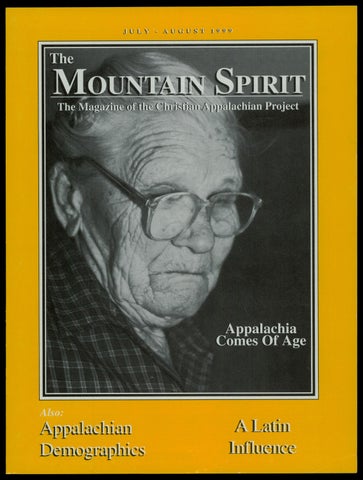
On the cover, Owsley County elderly services participant Cliffie Strong (photo by Margaret Gabriel). The Mountain Spirit is published six times a year. The annual subscription price is $8.00. Subscriptions and other correspondence should be sent to The Mountain Spirit, Christian Appalachian Project, 322 Crab Orchard Street, Lancaster, KY 40446. Copyright, 1999, The Christian Appalachian Project, Inc. All rights reserved. Member, Catholic Press Association. The Christian Appalachian Project is a non-profit Christian service organization operating throughout Appalachia. The project operates on the philosophy that helping people help themselves is the best approach to Appalachian poverty. The Christian Appalachian Project is recognized by the Internal Revenue Service as a 501(c)(3) charitable organization and is qualified to receive tax deductible contributions.
O
T
E
Appalachia: A Changing Land The Appalachia that I serve today looks different from the Appalachia that I loved as a boy. I have sensed that for a number of years, but the demographic pattern tells us that the elderly population of the area is growing as the birth rate declines. This pattern is common in other areas of the country, as well, and we know that the shift will place Mike Sanders, a greater demand CAP President on resources that are already stretched. Ron Crouch, director of the Kentucky State Data Center, examines these demographic changes — and their effects and consequences — on page 16. An obvious change will be the increase in the number of elderly people in eastern Kentucky. This trend will place new demands on CAP’s elderly services program, which benefits eleven counties in the region with transportation, help with chores and simple friendship. We also realize that the face of agriculture is changing in Appala chian Kentucky with a greater number of Spanish-speaking people migrating to the area to work in the tobacco crops that have long been a mainstay of Kentucky’s economy. On page 24, Beth Dotson introduces you to several Hispanic people who are finding Appalachia a hospitable place for themselves and their families. The changes that we’re seeing are changing the face of Appalachia, to be sure. But there is certainly no chang ing its heart. For all of these changes, we still see a deep love of family and home and a reverence for the land that nurtures us all. Enjoy!
Michael Sanders
A summary of the registration and financial documents filed by this organization can be obtained by contacting: in Maryland, for the cost of copies and postage, the Secretary of State, State House, Annapolis, MD 21401; in Virginia, State Division of Consumer Affairs, P.O. Box 1163, Richmond, VA 23209; in Washington, residents can call the Secretary of State toll-free within the state at 800332-4483; IN NEW YORK, OFFICE OF THE ATTORNEY GENERAL, CHARITIES BUREAU, 120 BROADWAY, NEW YORK, NY 10271; IN NEW JERSEY, THE ATTORNEY GENERAL BY CALLING 201-504-6215; IN PENNSYLVANIA, DEPARTMENT OF STATE BY CALLING TOLL-FREE WITHIN THE STATE, 800-732-0999; IN WEST VIRGINIA, SECRETARY OF STATE, STATE CAPITOL, CHARLESTON, WV 25305; IN FLORIDA, THE DIVISION OF CONSUMER SERVICES BY CALLING TOLL-FREE WITHIN THE STATE AT 800-435-7352; IN NORTH CAROLINA, FINANCIAL INFORMATION AND A COPY OF THE LICENSE ARE AVAILABLE FROM THE STATE SOLICITATION LICENSING BRANCH AT 919-733-4510; or by writing to Christian Appalachian Project, 322 Crab Orchard Street, Lancaster, KY 40446. Our license number in Michigan is MICS 9933. Registration with any of the above government agencies does not imply endorsement by the state.
2
T
h e
M
o u n t a i n
S
p i r i t
R
A
N
D
O
M
T H O U G H T S B y “ G ranny” And what bad’s out there, anyway? The grass is love this world— I’ve green and the sky is blue and the storm over on the loved it ever since I can right is gonna feed the plants when it comes in. remember. And if you Those kids that done that shootin’, I wonder how want to know the truth, many times those kids had an innocent laugh. If they there’s nothing more were hurt so bad that they felt like they had no place, beautiful than the people that they had to kill themselves to be known, when did that’s in it. But, you know, they have a really genuine, healthy laugh? That didn’t there’s nothing more hurtful than the people that’s in it, involve nobody bein’ hurt or anything vulgar? I either. That’s the first thought that came into my head wonder what their last thought was. I hope it was when 1 heard about that awful shootin’ in that school in “God, please forgive me, I see what I’ve done was Colorado. Who gave those kids hugs when they didn’t wrong.” have hugs at school, I asked myself? I hear everybody sayin’ “What can we do? What There’s been a lot of blamin’ and finger pointin’ can any of us do?” Well, I know what Granny’s gonna goin’ on, but I don’t think we’re really tryin’ to blame do, and it’s what I always try to so much as we’re tryin’ to figure do. I’m just gonna have to do it out how to make sure nothin’ like a little more. And that’s to try that ever happens again — ever and make life easier for could happen again. young’uns. Not easier by doin’ Public officials and school their work for ‘em or makin’ teachers have a part to play, but it things easier to get done, you has to start at home. We have to see, but by givin’ ‘em more love our children. I make it my job love, more Granny kisses, and to reach out and talk to kids — it’s by sayin’ “Honey, no matter just been put on my heart to do when you’re down, and no that. And in a time of need, you matter if you think nobody’s have to put your arms around a kid around, God’s there, so when and when you do, he’ll say you feel like nobody loves you, “Somebody cares for me.” remember God always loves That’s the important thing — you because he made a promise that these kids always know that and He don’t break it.” somebody cares for ‘em, even if You remember that tonight they do somethin’ wrong. It puts when you go home and you lay me in mind of the bootlegger down your head down on your pillow. the road when I was a young’un. If you think “Nobody loves me, He broke the law, but that doesn’t nobody cares for me,” you’re mean we stop lovin’ him. God lyin’ to yourself because God don’t stop lovin’ us when we break loves you and Granny’s tellin’ a rule, and we’re nothin’ like God! you this because Granny loves But He’s our role model when we you. If you need Granny, Granny trust and we believe and we put will be there, and if Granny can’t our faith there. I’ve fallen down a Granny, aka Glenna Martin, at a CAP be there, she’s got a good friend lot of times, but who picked me Christmas celebration. named Glenna Jean who’ll be up? God give me the courage to there in a heartbeat. fall and get back up many a time. We just gotta remember to get back up one more time than we fall. We gotta help these kids choose which way to go, Granny’s friend Glenna Jean is Glenna Martin, and tell ‘em to look up, not down and keep goin’. We coordinator of CAP’s Rockcastle Teen and Youth gotta tell ‘em that if you can’t take the bad times, don’t Center. She is featured in “The CAP Closeup” on page expect the good because you’re not going to know 29. what good is until you get the bad.
JULY
A U G U S T
1999
3
and fastest growing segment of the community. The Kentucky State Data Center estimates that Kentucky’s entire population growth for the years 2010 through 2020 will be in the 65 and over category (See “Required for tie Future: ‘2020’ Vision,” page 16).
Somebody To Talk S ton y &photos by M anganet Gabniel T
h e
M
o u n t a i n
S
p i r i t
A
sk Naomi McIntosh about those numbers, though, and she’d probably say she hasn’t had time to think about it. She’s too busy caring for 40 seniors in Owsley County who rely on her for things that range from transportation to help with chores to simple friendship. Naomi is one of sixteen people who provide CAP services to elderly people in eleven counties, including Owsley. Zayda Hurd manages the programs in McCreary, Rockcastle, Jackson, Owsley and Madison counties. Working from CAP’S offices in Hagerhill, Melissa Vance manages the elderly services programs in Floyd, Magoffin, Knott, Lawrence, Martin and Johnson counties. Zayda and Melissa like to keep the number of participants each worker serves to 40-50, and the services provided to each person are tailored to meet their needs. It’s just this side of impossible to get a description of a typical day because both Melissa and Zayda say there is no such thing as a “typical” day. “It all changes every day,” Zayda said. “People have to be able to know when they wake up in the morning their whole day could change.” Often, workers schedule their days around the need elderly folks have for transportation, although they like to focus on activities that keep the program from being more than just a transportation service. “Most of the time, when we get a referral from a doctor or a home health agency, it’s for transporta tion, and if they need transporta tion, that clues me in to something else,” Melissa said. “It’s telling me that they probably don’t have any family support,” so the other services that the program offers might also be welcome. In most of the counties there are other agencies that provide a range of services that many elderly people use. Agencies might help with cleaning and yard chores, shopping
JULY
- A U G U ST
1999
or personal services, “but these people are starved to death for somebody to sit down and talk, and that’s what we do. We’ve got the time to just sit and talk,” Naomi said. “When you get up to leave, after you’ve been there two hours, they’ll follow you out to the porch, and keep talking. They start talking a mile a minute, just wanting you to stay that few more Cliffie Strong is a senior artisan with extraordinary skills in whittling. Pictured here with CAP caseworker, Naomi Macintosh, minutes.” Cliffie holds a miniature wooden chair she carved. Top inset: The Shows the close-up o f the chair carving. services that CAP workers down there for breakfast and he’d provide to elderly people in their have a cup of coffee. Then he’d go counties often include advocacy for lunch and he’d have french fries, and helping people to obtain and in the evening, he’d maybe benefits that will help them to have a hamburger,” Zayda said. stretch the scant resources they “Kathleen decided to try to find have retained from years of working. out how she could help him. He Zayda tells the story of a man who didn’t have any idea how to sign up moved to Rockcastle County, where for any benefits at all. He was not he met Kathleen, a CAP volunteer receiving a monthly check, like who worked in elderly services. j people do after they Although the Jr retire. So Kathleen gentleman had a ^ helped him sign up, and small nest egg, he „ helped was reserving it for x and clothes his burial and living and off his proceeds from really selling cans that he The man had moved gathered on the side ■JW W B H s i.y s: from Ohio, Zayda said, in of the road. é a camper truck with “There was a everything he owned McDonald’s down piled in the back. An the road a little piece More o f Cliffie’s handiwork: elderly program partieifrom where he lived, a woodenchain. pant befriended him and and he would go
5
invited him to spend some time at her house, which led to his relationship with Kathleen, who helped him attain a healthier lifestyle. Geneva also moved to eastern Kentucky later in life, when her son moved to the region with a job. When she became involved in the program in Lawrence County, “I was dying of loneliness,” she said. Today, Melissa said, Geneva is one of a group of ladies in the county who have created a support network. “We have four or five people who have become great friends. Melissa Vance, elderly services manager in Hagerhill, speaks with Geneva Danek, who dabbles in We try to have a little oils and acrylic painting. outing occasionally, to go out for and provided for us so much to-one, and encouraging people to lunch or on a little shopping spree. information. The youth that we’ve visit each other, elderly services They call each other, and it’s really a workers schedule group activities been involved with are very good system. respectful, and that will continue to periodically. In the Hagerhill area, “A couple of times, volunteers grow and they’ll see what the Melissa likes to bring groups would invite someone to go with elderly have to offer.” together at Thanksgiving and hosts them on a home visit, particularly Zayda is masterminding a a summer outing for Memorial Day. when they knew that two people cookbook with her staff and the The Memorial Day outing this had a lot in common,” Melissa said. elderly people they visit, as a way of year was a cookout on May 25 at “They would exchange phone documenting and preserving some Paintsville Lake, Melissa said. The numbers and it kind of snowballed.” of the “old-timey” ways. volunteers prepared potato and In addition to visiting people one- macaroni salad, baked beans and watermelon and grilled hamburgers and hot dogs for about 70 guests. Thirty teens from the Louisa Youth Services Center attended to help serve and then eat lunch with their elderly friends. Melissa believes that inter-generational relationships are of great value to old people and young people alike. “Kids can see the value of aging,” Melissa said. “They’ll learn how important it is to hold on to your roots and know where you’re coming from and know where you’ve been. It’s important to be respectful to our elders. As [the Geneva Danek is active in Melissa ’s Geneva makes many crafts. Some are teens] become adults, they’ll know “phone tree. ” fo r sale, some fo r her own enjoyment. that our elders have worked hard
6
T
h e
M
o u n t a i n
S
p i r i t
relationships than a younger person use what they had might. available.” “Grace is very wise and she She read a story knows many of their needs, and from Ella Fay what they would like,” Melissa said. Gibson, an elderly Recently, Grace received a referral services participant to an eighty-year-old woman who in Owsley County, recently began using a wheelchair about the impor and her son, a man in his fifties, who tance of molasses has AIDS. in cooking when “I don’t know how I’ll be called to she was a girl in the serve in that situation, but I’ve early part of the interviewed them, and I know that 20th century. The he appreciated talking to me. He told story included me he had a brother that wouldn’t, instructions on you know . . . ” Grace’s voice trailed how to make egg off. butter from “I know that he put me to the test inexpensive when I first came in,” she said, ingredients. “Because I had two bottles of water, “Every family and he said, ‘Do you mind if I have raised a cane crop a bottle of that water?’ I gave him a and made molasses bottle, and I know he was trying to to use for a test me, to see if I was going to be sweetener instead scared to touch anything that he of sugar,” Naomi touched, and he realized that I CAP volunteer Grace Turner says the Lord called her to read. “Ella Fay still wasn’t. That’s going to mean a lot work with elderly people after she had served fo r a year in remembers winning to him.” Grace has added both the CAP’s Rainbow Respite Center. a blue ribbon at the mother and her son to the list of county fair for her homemade potato Naomi was copying pages, people she visits. rolls. Her husband liked to brag reciting a litany of the recipes she In 1996, elderly services workers about eating blue ribbon bread has gathered and passing them over learned that a number of pharmaceu every day. So she gave me a recipe the desk for inspection when Zayda tical companies make drugs avail for egg butter. You take a cup of said, “Butter rolls! That looks like able to low-income people. What molasses, two well-beaten eggs, a the [recipe] I’ve been looking for began as an experiment in Floyd fourth-teaspoon of nutmeg. You ever since my grandma died.” pour the molasses in a pan, add “You start with a buttermilk the eggs and bring them to a boil biscuit,” Naomi said, “then you roll for two minutes, add the nutmeg, them out in little circles, and spread stir it up and remove it from the them with softened butter, sprinkled heat and eat it over hot hoecakes sugar, and I believe, a little nutmeg or cinnamon. Then flop them over to or hot biscuits or pancakes. It was dessert for them.” a half-moon and seal ‘em with your Grace Turner, an elderly fingertips and lay them in a pan of services volunteer in Lawrence melted butter. You make up some County, says that she has many of sugar water and cover them with the the same memories as the people sugar water and bake ‘em.” she visits, because she grew up in Zayda said that her mother had North Carolina. “I’m a farm girl,” never been able to make butter rolls Grace said. “I was raised very like grandma. She admitted that she much like these people. I’m might not be able either, but Southern — I eat like they do.” intended to try. Grace has more than just eating Naomi explained “old people habits in common with the people didn’t have much to go from. They in her program; Melissa said that had to take simple ingredients and Georgia Lou Burch looks forward to she brings different gifts to her try to make desserts. They had to Naomi’s visits.
JULY
- A U G U S T
1999
7
pants thousands of dollars a year. Some people are able to take drugs that they would not be able to take properly, or would not be able to afford at all. Because doctors must request medications from the companies, it is imperative that Sally and Diana develop good relationships with doctors in the area; more and more doctors are referring patients to the program in the Jackson County area, Diana said. In addition to her work with prescrip tion assistance, Diana helps with transportation, as needed, and participates in the gatherings of elderly people. The knowledge that she’s needed and appreciated motivates Diana to “get up and go to work every day,” she said. “We talk a lot around the Georgia Lou participates in the program in Owsley County. She is an accomplished musician who dinner table about accompanies her church congregation. the really neat people we get to meet. It’s connecting with humans. County has flourished into a vital grams. When receiving referrals, It doesn’t really matter if they’re a part of the elderly services program Diana and Sally make a complete list participant or not.” in both areas. Low income people of of all the drugs the requesting In the last year elderly services any age are welcome to participate patient uses, and painstakingly workers have begun to help their par in CAP’S prescription assistance research the companies that make ticipants define and attain goals. program. each one. After finding the manu “When we add someone to the pro Diana Bond, a volunteer in facturer, another list is consulted, gram, we ask them where they see Jackson County, and Sally Owsley, one that tells whether the drug, themselves in a year,” Melissa said. an employee in Johnson County, usually a three-month supply, can For some people it is the first time work to access prescriptions for be supplied at no cost. Melissa and they’ve ever set a goal, and the pro people in the eleven counties that Zayda estimate that the prescription cess helps workers to identify things have CAP elderly services pro assistance program saves partici
bunch of with which a new partici computers that pant might need help. the kids work M elissa identified on,” Naomi said. some goals. “Do they “Wouldn’t that want to be living alone?” be neat if we had she said. “Do they want a little group to be independent? Or outing to have do they need assistance the kids show with housing? If you these older name and think about a people what goal, that gives you they’re doing on something to look for the computer and ward to.” let them try it. I Some goals are more don’t know a pleasant than others, thing about it Naomi learned one day myself, so it when she went to visit would be Rillia, a woman who has educational for been in the program me as well as nearly five years. some of my It seems that Rillia elderly who had finally gotten fed up would be with sharing her house interested. I think with m ice, and with Georgia Lou and N aom i’s help, she is Cliffie would love reaching her goal of rid it.” ding her house of pesky Few of CAP’s little rodents. programs demand “I went there one • * . more flexibility day, and she was ready Georgia Lou, a retired school teacher, when asked what grade she than elderly to throw in the towel,” taught, said, “Well, all o f ‘em, honey!” services. Workers Naomi said. “She met me at the door, and said, ‘Naomi, I are always willing to add “just one butter in it, tie it with thread and tie more person — she really needs our don’t know what I’m going to do.’ I it on the bait pedal of the trap. We services,” or to explore a trip or a looked and she had everything piled fixed six that way. She’s caught out of the closet, and there was the training that they think might close to 40 mice now. If she hears awfullest smell in the house that broaden the already wide scope of one a-gnawin’ she’ll go freshen up you ever smelled in your life. We’d experience their folks have. her traps. Now her house doesn’t put out poison and killed a bunch, Workers say that the time they have that odor and, and it’s built her but they were stinkin’. spend with elderly people in self-esteem and really improved her “So I came to Booneville and got Appalachia will result in memories lifestyle,” Naomi said. some disinfectant and spray for the While Zayda, Naomi, Melissa and of an older way, a slower way, and closet and we swept all the mess — for many — a better way. It has the others who work in CAP’s out. We raised up the couch they been said that old people today elderly services are careful to were dennin’ in and got in there and remember The Waltons, but live like respect the old ways, the way folks cut out nests. I was ‘til about 7:00 The Jetsons. It’s tough to say that have always lived in the mountains, gettin’ home that night, but I knew milking a cow by hand is a better they have also started to develop we’d made a difference. From there way to spend time than surfing the training programs to introduce we started a lot of other home ‘Net, but CAP elderly services participants to newer ways, too. improvement, and her outlook on workers might well say that people Discussion of the convenience of elife’s better. who have experienced both have mail prompted Zayda and Naomi to “I got her some mousetraps that the best of both worlds. begin formulating a plan to intro • day, and I taught her how to make duce participants in Booneville to Margaret Gabriel is the editor o f The bait from little bags cut out of nylon the Internet. Mountain Spirit stockings. You take a little square of “Stella Marshall, up at WORK nylon stocking and put peanut [Workers of Rural Kentucky], has a JULY
A U G U S T
1999
9
A
r
T he
o
u
n
d
P r o je c t
Nina Isaacs Cooks With Love When children arrive at Camp Andrew Jackson this summer, they’ll see a familiar face in the kitchen. Nina Isaacs will return for her 13th season as the cook at the Christian Appalachian Project’s
Nina Isaacs.
Jackson County camp. Camp manager Lauri Eiselt says that Nina’s greatest asset is “this isn’t just a job for her — she cares so much.” Nina seems almost as excited about camp as the kids she feeds. “It’s a wonderful place! When Father Beiting decided to build that camp, he sure knew what he was doing. It’s the best place in the world.” Nina looks forward to renew ing friendships with many of the same counselors every year, she says, and has “watched some of the kids grow up. I only get to see them for one week every year, but I look forward to seeing them,” she says. Like children
CAP Founder Recognized by Lexington Diocese Christian Appalachian Project founder Father Ralph Beiting received the Bishop’s Award at the eighth annual Recognition Banquet of the Catholic Diocese of Lexing ton, Ky. Bishop J. Kendrick Williams recognized Father Beiting’s service to the diocese, mentioning espe cially street preaching, the sixteen churches that Father Beiting has built or helped to build, and the
10
founding of the Christian Appala chian Project. “CAP’s success today in providing long term self-help to our Kentucky neighbors is a visible tribute to this dedicated man and priest,” Bishop Williams said. Father Beiting received a statue of Our Lady, Queen of Heaven, Patroness of the Diocese of Lexington. T
h e
M
just about anywhere, Nina says, the favorite meal at camp is pizza, although chicken patties with mashed potatoes, green beans and banana pudding for dessert runs a close second. Lauri recalls that banana pudding’s place on the menu is the result of a request from a camper a number of years ago. “Whatever the kids ask her for, she tries to give,” Lauri says. Serving three meals a day to close to a hundred people takes more than a willing attitude and the ability to make lots of banana pudding, though. Lauri points out that Nina’s organizational skills keep the kitchen in tip-top shape. Nina orders food a week in advance, keeps up with the inventory, and does all the cooking, with the help of an assistant. “Some days, we work ten hours,” Nina says. “We pack lunches for hikes, and get ready for the cookouts on Tuesday. They eat hot dogs and watermelon.” Nina says that often she can tell that the nutritious, well-balanced meals she prepares are treats for some of the campers. “They really take care of the kids that don’t have a lot. I’ve seen them come with nothing but a little pair of shoes in a plastic bag, and [the staff] will go out and get them the things they need. You’ve never seen the likes of strangers being kind to kids they don’t even know,” Nina says. Nina gets cards, letters and pictures from counselors who keep in touch with her throughout the year, but every summer she looks forward to her time at Camp Andrew Jackson. “You just have to be there to see the love. God has got Camp Andrew Jackson in the palm of his hand!”
o u n t a i n
S
p i r i t
A
R O U N D
T he
P r o je c t
A Community Baby Shower daughter had a baby recently, the The Christian Appalachian hospital staff taught her quite a bit Project, in cooperation with the about care, but there was so much Family Resource Center, Social information given in such a short Services and the local migrant period of time, “How much sinks in?” program, recently hosted a “Com she asked. munity Baby Shower” in Garrard Outreach manager Peggy Hancock County. Outreach, Job Start, and says she would like to conduct a child development workers invited different training every month for expectant mothers and mothers of outreach participants. “We call it infants and toddlers to share community outreach, helping people information about infant and child care. Operation Sharing, CAP’s in-kind donation distribution program, provided such items as baby bottles, cups and wipes. Individual donors provided items used for door prizes, such as strollers, carrier/car seats, and a beautiful bassinet. “We’ve been planning and saving these items for months,” said outreach caseworker Marie Bonner. Eva Stone, a nurse from the Garrard County Health Depart ment and Loretta Adams and Adella Stephens from the University of Kentucky County Extension Office, addressed such Crystal Warren cuddles Tamia Ison. Crystal and topics as nutrition and Tamia’s mom, Torn, participate in Families Growing health care. CAP Together at CAP’s Sunshine Center. outreach caseworker get the skills they need to help Linda Procter taught cardio themselves. They get to know other pulmonary resuscitation; Job Start teacher Sandy Spalding showed the people, and they begin to feel like they’re part of a community.” moms the benefits of infant mas The training opportunities give sage. participants the opportunity to learn “A lot of these young mothers a new skill, Peggy said. “I firmly have never been around babies,” believe that education is the only Marie said, “so we hope to give way out of poverty, and these them some knowledge about health trainings are working toward exactly and safety issues.” that.” Marie recalled that when her JULY
A U G U S T
1999
What You D ont Know About W ills Can Hurt Your Heirs, Find Out Why. Request Your Free Copy.
Much of what you know about wills may be misinformation that has been floating around for years. If you think, for example, that wills are primarily for rich people, or elderly people, you may be the victim of a common m isconception. The helpful booklet offered here will explain how your will can save your heirs from costly delays and confu sion. Send for your copy today. Clip and Mail
Christian Appalachian Project 322 Crab Orchard Street Lancaster, Kentucky 40446 Please send without obliga tion your booklet, “37 Things People ‘Know’ About Wills That Aren't Really So.” Name Address C ity___ State, ZIP
11
A
r
T he
o
u
n
d
P r o je c t
CAP Hosts Leadership Conference The eighth annual Women’s Leadership Conference at Camp Shawnee featured some new twists, as well as some old favorites, according to Trish Joseph, one of the event’s organizers. “I enjoy meeting new people and making new friends,” said Rita Wellman, a first-time attendee from Lawrence County. About 50 women from Floyd, Knott, Magoffin, Lawrence and Martin counties heard speakers address such topics as self-defense, mountain medicine, nutrition and budgeting. Tom J. Whitaker, one of the week’s featured speakers, has been called “America’s Greatest Appala chian Artist” by Kentucky poet A1 Stewart. Whitaker saluted the women in attendance, commending them for the important work they do as mothers. Whitaker displayed a variety of his art, which he said people appreciate not because it is pretty but because it has a sensitivity and realness. “We [natives of Appalachia] have been accused of being friendly people,” Whitaker told his audi ence, “but that’s a lie. We’re a genuine people.” Whitaker said that some of his favorite work portrays that genuine ness. Watercolor portayals of wringer washing machines and clothes hanging to dry on the front porch have been labeled “negative” by some, but brought back happy memories to many of the women in Respecting the wishes of deceased loved ones, or in honor of them, families often request that memorials be sent to us. Memorial gifts live on to benefit others. Many also specify memorial gifts in their wills. Any size gift is welcome. Contact us for more information.
his audience. “Did anyone ever hang the old, ratty clothes on the front porch?” he asked. Everyone laughed and chorused “No!” agreeing that it was only the newer, prettier clothes that received such prominent display. Judy Crum, outreach program manager, and Sheila Patton, out reach caseworker, said that the week
at the Leadership Conference is, for some women, their only opportunity to relax away from the stress of raising a family and managing a home. “Some of them find a part of themselves that they haven’t seen for awhile,” Sheila said. “They find people to talk to and associate with and slowly come out of themselves.”
Monroe, a comedian from the Kentucky Opry at the Mountain Arts Center in Prestonsburg, was a featured speaker at the Women’s Leadership Conference.
Factory Relocates to Tyner, Ky. On March 8, 1999, a gathering of Jackson County residents, elected officials, and representatives from various economic development organizations celebrated the opening of a new Kentucky furniture manufacturing plant. Flat Rock Furniture, an Indiana-based producer of high value rustic home furniture, commenced operations at a property owned by the Christian Appalachian Project. Flat Rock Furniture has experi enced tremendous sales growth during the past three years. The twelve-year-old company makes rustic pole furniture, including chairs, beds, tables, and other bedroom, dining and living room pieces from hickory poles gathered T
h e
M
in eastern Kentucky. “This segment of the furniture business is soaring. Our challenge has been to secure sufficient raw material to keep up with the product demand,” said Vance McQueen, president of Flat Rock Furniture. “By expanding to Jackson County we are able to locate in the midst of the best source of hickory and a productive labor market area,” he added. CAP partnered with the East Kentucky Corporation, Kentucky Highlands and MACED (Mountain Association for Community and Economic Development) in financ ing the expansion. Flat Rock will employ 30 people at their Jackson County plant, which is the former location of CAP’s wreath factory. o u n t a i n
S
p i r i t
A
r
o
T he
u
n
d
P r o je c t
Managers Treat Lettershop Pizza, homemade salads and desserts were the order of the day when human services managers
hosted a lunch for workers from the lettershop at CAP’s Crab Orchard Street offices in Lancaster. The
(Left to right), Michelle Hendrickson, Kim Edwards and Charlotte Raider o f the Lettershop share pizza with outreach manager Peggy Hancock.
___
teams of Jean Barnes and Garry Vickers developed annual goals to show appreciation to people in other CAP departments. “We had a luncheon for the Department for Social Services,” said Family Life Services manager Liz Phelps, “and we decided we wanted to appreciate our own people.” Eighteen managers hosted 43 people from the lettershop. “It was a really nice gesture, to make us feel a part,” said lettershop manager Mike Stanfill.” Machine operator Michelle Hendrickson pronounced both the company and the atmosphere “fantastic,” and said that she enjoyed meeting the people who work in CAP programs. “It makes me feel good to work in a place that makes a difference in people’s lives,” Michelle said.
Please detach and mail to the address below:
B rin g a smile to an
Appalachian family with a CAP Christmas Basket During this time of year workers in CAP’S outreach program begin the work necessary to provide Christmas baskets of toys, gifts and food to the folks we serve. If you would like to participate: i
Let us know the size family you would like to sponsor (gifts for each person in the family should cost between $15 and $25). We’ll send you information about your family, including first names, ages, sizes and a few gift suggestions; • We’ll also include family code stickers and a guideline letter with the correct address to send your gift box; ► Wrap and label your gifts with the name of each person; » Mail your boxes to CAP by or before November 21, 1999. Please adhere to our deadlines, so we can make sure gifts are given to your family; ► If you have any questions, please call Brenda Watts at (606) 985-7091. That’s all there is to it! Your Appalachian family will have a Christmas they’ll never forget and you’ll know that you’ve contributed to the real meaning of the birth of Christ. We look forward to hearing from you!
I would like to sponsor: □Small family (1-2 children) □Large family (5-6 children)
□ / am not able to shop for a needy family, but
I have included a contribution that will enable
□Medium family (3-4 children) □Extra large family(8 or more children
you to provide gifts for a family. ($75.00 pro
& parents or 2 medium size families.)
vides gifts for a family of three. $30.00 will pro
Total number of families sponsored Name_ Address
vide a Christmas food voucher for a family of three. Any amount you choose will help us share the joy of Christ’s birth in Appalachia. Make checks payable to CAP and return to:
City, State, Zip_ Phone (please include area code)
CAP Christmas Basket Program 322 Crab Orchard St., Lancaster, KY 40446
A
R O U N D
T he
P r o je c t
Elderly Participants Observe National Day o f Prayer The Christian Appalachian Project elderly services program hosted its participants for an observance of the National Day of Prayer at the Rockcastle Teen Center in May. With singing, group prayer and Scripture reading, the elderly participants joined other people across the country in praying for the health and well being of the United States and its leaders. Program manager Zayda Hurd said that the group was also happy to have three former volunteers at the service: Vi Ellis, who now makes her home in Rockcastle County;
Judy Costello, who now lives in Berea; and Sue Funderburk, who now lives in South Carolina but was in Kentucky visiting friends from her days with CAP. After the prayer service, the group shared coffee and dessert, and had time to visit with each other, Zayda said. “A lot of our people aren’t able to get to church,” she said. “They don’t drive, and it’s hard for them to get there. That’s why we think that it’s important to have days of prayer. One lady just sits and cries during music because she enjoys it so much.”
There are many more CAP programs than you see in this issue of The Mountain Spirit. CAP’S web site includes information about all of CAP’s human development programs, planned giving and major gifts and the volunteer program. Please visit the site at www.chrisapp.org and be sure to sign our guest book!
John Pennington Honored With 1999 Peace Award
WORKPLACE
The Christian Appalachian Project honored John Ed Pennington with its 1999 Peace Award, given in honor of the work of Dr. Martin Luther King, Jr. Pennington, a foreman for the Kentucky Transportation Department, has worked for many years to eliminate racial barriers and racial tensions in his hometown of Manchester in Clay County, Kentucky.
PAYROLL DEDUCTION If your employer offers donor designation as a write-in for payroll deduction, please re member the Christian Appa lachian Project. CAP is a 501 (c)(3) tax exempt agency, and payroll deduction is the easiest way to help the fami lies of Appalachia. To ensure that we receive your payroll deduction gifts, please give your payroll officer CAP’S full address and send to the at tention of; Teresa McAnly Campaign Coordinator
Christian Appalachian Project 322 Crab Orchard Street Lancaster, KY 40446
14
Keynote Speaker for the 1999 CAP Peace Award Ceremony was Anthony Ridgeway. Ridgeway, a reporterfor WVLK-AM in Lexington, hosts Central Kentucky’s only race relations talk show.
T h e
M
o u n t a i n
S p i r i t
A
r
T he
o
u
n
d
P r o je c t
CAP Honors Volunteers During National Observance During National Volunteer Appre ciation Week, the Christian Appala chian Project hosted dinners in Hagerhill and Mount Vernon to honor the men and women who give time and talent to people who are working to improve the quality of their lives and those of their children. In CAP’s administrative office in Hagerhill (Johnson County), nearly 70 people gathered to share a potluck dinner prepared by program manag ers to thank the 39 volunteers who serve Floyd, Johnson, Martin, Lawrence and Magoffin counties. Also, over 100 people attended a dinner in Mount Vernon (Rockcastle County) to pay tribute to 33 people who serve programs in Garrard, Rockcastle, Madison, McCreary, Owsley and Jackson counties. CAP president Mike Sanders spoke at both dinners, thanking the volunteers for giving of themselves and relating how volunteers changed his life. “I had moved in and out of state so much, I about wore Highway
23 out,” Mike said. “Then, I met [CAP founder] Father [Ralph] Beiting and the volunteers, and they changed my life.” Mike told of the summer that he spent working with CAP’s volunteers, and after observing their selflessness, “I found the challenge I had been looking for in my life.” A native of Pike County, Mike told the group of the impact that they and previous volunteers have had on the people of Human services program managers performed Appalachia. a skit during the entertainment portion o f the The Christian Appalachian dinner in Mount Vernon. (Left to right) Mike Project has hosted volun Liacono, Janet Ryan, Jean Barnes and Lauri teers since its earliest days, Eiselt. when Father Beiting was assigned to pastor a church in helped him construct an outdoor Berea, Ky., in October of 1950. nativity scene. During that first Christmas season, When people in need began to ask Father Beiting says, members of his Father Beiting for assistance, he family and teens he had taught at responded to those requests with the Newport Catholic High School help of volunteers who shared his 1 dream of serving the region. Since p that time, CAP estimates that it has received the services of more than 50,000 people who have worked in education, crisis intervention and community development programs throughout the eastern part of Kentucky. Today, CAP’s volunteers represent 32 states and two foreign counties and contribute hundreds of thou sands of hours of service to the region. Despite that volume of service, Sheila Patton, an outreach case worker in Johnson County, puts that work in perspective, saying, “God puts you where He needs you. If you Richard Ginn, director o f operations fo r CAR’s Louisa programs, thanks and come here and help one person, congratulates Ron and Karen Srajer, who work at Boone’s Landing in Lawrence County. you’re where He wants you.”
JULY
A U G U S T
1999
15
V ision by
J im T ram m el
“The difference between reality and perception is that reality changes, says Ron Crouch, director of the Kentucky State Data Center. Appalachia, like the rest of the nation, is heading into the same uncharted waters as everyone else as the new millennium dawns. If some small changes are made right away, Appalachia will be in a much better position to prosper during the early 21st century. The first step, in fact, doesn’t even cost anything: All of us, in the moun tains and outside them, must first lose some outdated perceptions of who Appalachians are. T
h e
M
o u n t a i n
S
p i
r i t
L et’s begin by taking note of the good dem o graphic news Crouch cites for Appalachia, because there is some. Basically it can be summarized as, “Al though there is still much catching up to do, things aren’t quite as bad as they were a couple of years ago.” The most recent edition of Crouch’s Kentucky State Data Center News says that the state’s poverty rate is 17.9 percent for 1995, im proved from the 19.7 per cent rate of 1993. Also, in 1995 the number of Ken tuckians living in poverty improved by 59,000 over two years previous (down to 689,138 from 748,007). In 1995, K entucky im proved to 43rd on the list of the percentage of its people living in poverty. It’s a small improvement, but it’s a start. Also, some of the poorest Ken tucky counties have recently posted the largest relative improvement in household income. Median house hold income rose fastest from 1989 to 1995 in the counties of Owsley (62 per cent), Knott (55.8), Magoffin (55.1 percent), McCreary (55 percent) and Leslie (53.9 percent). When you put the change in average household in come on a map, the result is positively heartwarming. The greatest increases in household income, of 40 percent and more, are concentrated in south eastern Kentucky. It is also interest ing to note that Owsley, Knott, Magoffin and McCreary counties are all locations in which CAP has hu man service programs. But regarding the large gap that still exists between Appalachia and the middle ground: Median annual house hold income in Owsley County was still less than half of the state median of $28,929. Owsley County regularly distinguishes itself even among the other impoverished Kentucky Appa lachia counties, regularly earning a JULY
- A U G U ST
1999
listing among the ten most impover ished counties in all the nation. Owsley County led the state in 1995 with 46 percent of its people living below Federal poverty levels, al though the percentage is down from 52.9 percent in 1986. Some say that the solution begins by recruiting new industry to eastern Kentucky, but immediately a gap in our resources becomes apparent when recruiters come calling. Short in education Kentucky is a plodding horse in the race for new industry and its jobs. Quality employers want an educated work force, and they see that Ken tucky has relatively little to offer. 1990 Census figures placed Ken tucky an appalling 49th in high school completion. (Mississippi replaced Kentucky at 50th in 1990; Kentucky had been dead last in 1980.) Statewide, 27 percent of Kentucky’s over-25 population has not finished high school, the Census found. The figures for Kentucky improved
10 percent in 10 years, a small gain on the rest of the nation which im proved more than nine percent over the same period. Southeastern Kentucky’s figures hover in a range of 45 to 50 percent high school completion [i.e., percentage of young people who finish high school], de pending on the particular statistical region under study. Four or more years of college? Fouteen percent of Kentuckians had a college degree in 1990, up three points from 1980. The only other state bor dering Kentucky that had it worse was West Virginia, a completely Appala chian state, at 12 percent. The solution starts partly with the Kentucky Education Reform Act, en acted in the 1990s, which should have at least some measurable beneficial im pact when the 2000 census survey is taken. But to reach workers beyond high school age, adult education and retraining components must be part of addressing the education deficit. Appalachian women are doing their part to narrow the education deficit. Women make up 75 percent of the stu-
17
dents in community colleges and fouryear institutions, improving their op tions in a knowledge-based economy, Crouch said. Women are getting bet ter educated on the average, as the years go on — although, surprisingly, they are also growing increasingly likely to be living in poverty. Job Start, the Christian Appalachian Project’s education and training pro gram, is designed to help people make the progress needed to join the work force and break the cycle of poverty. Don’t look to computers Could the information superhigh way pass through Appalachia? It would seem at least possible, in a geographically inhospitable place that depends on very scarce flat land for business de velopment. A non-manufactur ing industry that requires only a minimum of physical presence might be the salvation of such a region, according to this line of thinking. Crouch no longer thinks so. “I had sort of bought [the contention that A ppalachia could excel in the computer in dustry], until I went to a tele-ser vices conference in West Vir ginia last year,” Crouch said. At that conference, he realized that West V irginia’s rem arkable growth in the tele-services in dustry had all taken place in lo cations along interstate high ways. “It tells me that even in the computer industry, people need to get equipment and people in, and managers need to get in and out easily,” Crouch decided. For that to happen, there must be in terstate highways, another weak spot in eastern Kentucky’s com mercial features. For an effective economic im pact, Crouch said, interstate highways must connect Ken tucky to the nation as well as provide connections inside the state. Eastern Kentucky’s best
possibility for interstate highway de velopment is the proposed Interstate 66, a $5 billion southern beltway across the state that would run from Pikeville through Hazard, down the existing D aniel Boone and Cumberland parkways, then on to B ow ling G reen, H opkinsville, Paducah and west, out of the state. Another problem with hoping for com puters to save A ppalachia, Crouch said, is that computer literacy is a poor substitute for the power of thinking. “The computer must be a tool, not the master,” Crouch said. It’s relatively easy to acquire com puter and keyboard skills, but much harder to understand what the data
About one-third o f K en tu ck y’s
adults in 1990 (35.4 p ercen t)
didn
’t have high
school diplomas. T h at’s an im
provement over 1980, when the
figure was ju st under half (46.9 percent).
18
means when a computer produces it. That latter skill is rare in an educa tion-deficient society — a character istic of Appalachia and Kentucky that is assuredly not mythical. Crouch says he often sees workers who know how to follow software operating procedures, but can’t tell you which are the significant numbers in a data table once the program gen erates it. That human talent will never be replaced by computers, because it’s delivered through education rather than training. About one-third of Kentucky’s adults in 1990 (35.4 percent) didn’t have high school diplomas. That’s an improvement over 1980, when the fig ure was just under half (46.9 per cent). But it’s still only 49th in the nation, and in some eastern Kentucky counties, even today, up to 50 percent of adults be tween 25 and 34 haven’t com pleted high school. The Kentucky Education Re form Act (KERA) attempts to address this correctable cause of former high school students opt ing for a lower-possibility future, but these children’s parents have an education problem , too. KERA won’t reach the 90 per cent of Kentucky’s workers in the year 2000 who are already past high school age, but find they need to refresh their train ing, renew their skills and re-in vent themselves. These workers are largely male. He is a working white male, 25 to 34 years old, who worked in the mines or manufacturing and is now trying to make a liv ing in a service job, or in retail. His income is down, so to sup port his family, his wife has had to go to work. He doesn’t like that much, and the financial and personal stress is beginning to show. If he leaves his family, he may hamstring his former part ner who now finds herself hav ing to make new child care and transportation arrangements to keep the job she recently took.
T
h e
M
o u n t a i n
S
p i r i t
The solution lies in somehow put ting across to him that re-education and re-training are here to stay for ev eryone. Crouch quotes management guru Tom Peters of the “Excellence” book series who says that 90 percent of the infcrmation workers will need in the year 2020 isn’t even known yet. The “epidemic” that wasn’t If you believe that Appalachia is a barefoot-and-pregnant society riddled with teen moms, you’ve bought a popular stereotype the figures don’t bear out. Births to teen mothers are individual tragedies and perhaps a steady prob lem, Crouch said, but hardly an “epidem ic.” In Kentucky as a whole, the birth rate among teen agers is down by one-third since 1975, when the state started keep ing records. There were 13,319 total births to Kentucky moms under 19 in 1975, compared to a declining 8,979 in 1995. Women in Kentucky over the past 20 years have become better educated, and on average, older when they give birth, but are more likely to live in poverty. They’re having more babies, too; over the same 20 years, the proportion of births to women 30 and over nearly doubled, to 25 percent. Nationally, Appalachia is one of the least likely places in the na tion to have children. Kentucky ranks 46th among states in fertil ity rate for women ages 15 to 44, and Appalachia’s regional rate is lower than the overall state. (Na tionally lowest fertility rate: West Virginia.) This has statistical implications if our leaders listen to the barefoot-and-pregnant stereotype and commit precious resources fight ing an “epidemic” that isn’t there. The solution starts with dispel ling the stereotype of the epidemic of pregnancies among “undeserv ing” teens, and mobilizing exist ing assistance programs to be of best use to families. JULY
- A U G U ST
1999
Kentucky’s aging population People are not steadily leaving Ap palachia. The population also isn’t growing — it’s just growing older. An outflow of population from Ken tucky to surrounding states happened during the 1980s, but the trend has re versed in the 1990s. In the 1980s, the state’s population was constant, with births equaling deaths plus out-migra tions of 171,000. The population stag nation cost Kentucky a seat in the House of Representatives, but Crouch says the losses stop there. In the 1990s, the state’s population has grown by over 200,000, including 91,000 move-
I f you believe that Appalachia is a barefootand-pregnant society riddled with teen moms, you *ve bought a popular stereo type the figures don’t bear out.
ins. This migration adds to the matu rity level of Kentucky’s worker base. Kentuckians, Americans, and all the citizens of the entire developed world are living longer. This is good news individually, but it has worrisome im plications for Kentucky’s population that have to be faced now because we have a few years before the bad news begins. The target year for concern is 2010. Right now in Kentucky and the nation, the largest population group is ages 40 through 44. But as Kentuckians live longer, and the birth rate continues to fall, the average age of Kentucky’s population, and the sheer numbers of people in the older age categories, will both rise. Resident live births are declin ing as the aging population lives longer. The results move the aver age age higher. By the year 2020, the largest population in both the state and the nation will be age 50 to 54, and Kentucky’s entire popu lation growth for the years 2010 through 2020 will be in the 65 and over category. The number of Kentucky’s under-34 workers will be in decline, putting further stress on the solvency of Social Secu rity, which aging boomers will be counting on to give them money in retirement. Crouch already characterizes our health care system as more correctly a “sick-care system,” and warns we should be paying attention to preventive health care measures to hold down costs. It’s an interlocking matrix of un healthy economic signs. Our thenretirees, today’s baby boomers, will be expecting their checks in record numbers. A depleted work force of likely resentful young workers will be working deficient jobs to try to support them. And health care costs for these longerlived retirees will keep going up. Former Commissioner of Social Security Dorcas Hardy, who co wrote the ominously named book Social Insecurity in 1991. predicts a crunch at the national level be-
19
ginning in 2010. Hardy in early 1986 quit promising that Social Security would provide for all retirees. Some tentative steps have been taken on a national level toward Social Security solvency since Hardy’s prediction, but our representative leaders are bickering rather than follow ing through with the fixes Social Security needs. The solution must be provided by our leaders as they take preventive action in the few years we have left, before the baby boomers start hitting retirement age in about year 2010. Pre cious months and years are being lost to partisan squabbles over the par ticulars of Social Security, Medicare and Medicaid reform, however, and there is a real question about whether we can summon the national resolve to find a consensus solution for re tiree financial woes in time.
money the family support payments popularly known as “welfare” totaled only $684,000. But the levels went up, and reforms were enacted. In 1996, family assis tance programs were up to $3.7 mil lion — but the other categories had exploded even more, from the $ 14 mil lion of 1970 up to an incredible $160 million. (Federal retirement and disabil ity payments were the leading cat egory, making dramatic gains, espe cially during the 1990s.) Crouch warns the high levels of government entitlements, and the many older Kentuckians receiving them, puts Kentucky at risk of dra matic losses if someday health care and retirement entitlement programs undergo a welfare reform-style over haul. Kentucky’s counties will be very vulnerable to cost-cutting in Medi care, Medicaid or federal retirement
The “water bill problem” The national outcry for wel fare reform focused on a very small slice of governmental money in Kentucky. Crouch says it was as if a family con fronted all its $1000 in regular m onthly expenses and fo cused on cutting the $20 wa ter bill as its highest expense reduction priority. M edicare and M edicaid health care expenses, along with retirement entitlements, make up the vast majority of government payments to east ern Kentucky counties. Crouch cites Perry County (county seat, Hazard) as a typi cal case of a K entucky county’s level of government support. Back in 1970, Perry County received a total of $14 million dollars from Medicare, Medicaid, Social Security, dis ability, Federal civil service, veterans benefits, unemploy ment insurance, payments to nonprofit institutions, and in come m aintenance benefit (welfare) programs. Of that
20
Crouch said family-focused efforts such as CAP’S will be key to the social response to Appalachia’s changing demographics. T
h e
entitlement programs when such mea sures become necessary, because those monies dwarf welfare reform dollars in the economy of most coun ties. Crouch calls it an unhealthy situ ation to have so much of a county’s econom y dependent on benefit checks. The solution starts by making gov ernment fiscal policy that causes a transition from emphasizing “sickcare” programs that deal with end re sults of illness, to a “health care” economy that invests more heavily in prevention. Matrix of challenges Appalachia, throughout its history, has been squeezed between harsh re alities, each of which aggravates an other. The future threatens more of the same: Social Security will come under fire just when Kentucky’s population pyramid becomes top-heavy with aging baby boomers. Coal mining, tobacco, and other past economic main stays have likely seen their hey day, and re-education and re training are slow to get rolling. More women have to enter the work force, triggering social and psychological problems for men already shaken by the chang ing job climate. But however harsh the reali ties, knowledge of where we are and at what rate we’re progress ing is the first tool we need to fashion our response to the fu ture. Crouch said family-focused efforts such as CAP’S will be key to the social response to Appalachia’s changing demo graphics. As the region faces a varied matrix of challenges, it’s virtually certain CAP will be able to make an impact for the good of Appalachia in several vital areas. • Jim Trammel is a free-lance writer based in Lexington, Ky. He special izes in issues vital to eastern Ken tucky.
M
o u n t a i n
S
p i r i t
L etters to the E d itor Reading your excellent magazine raises my “spirits” also. I live in senior citizens’ apartments, 118 in all, so when I finish reading, I put it down in our library to inform others of the wonderful work you are doing all these years. God bless you all. Norma Coushaine Port Hurron, Mich.
Have purchased The Mountain Spirit for years, and like to see the improvements being done. I often feel like I would like to visit the area, but I am not able. I am 84 years of age. Best of everything, Ethel Landers Coeur D ’Alene, Idaho
I read The Mountain Spirit from cover to cover. The stories of the people are full of courage and spirit. CAP is doing wonderful work for the people of Appalachia. I try to send a little each month to help. My prayers are with you every day. Ms. Evelyn Campbell Merritt Island, Fla.
I have enjoyed reading the articles about the people in Appalachia, how so many families have been helped by college students who come there on summer vacations and give their extra time throughout the year. Enjoyed “A Volunteer’s Journey” in the January-February issue. Also acclamation of Father Beiting’s 75th birthday in the March-April issue. Sarah K. Early New York, N.Y.
JULY
- A U G U S T
1999
I truly enjoy The Mountain Spirit. The Christian Appalachian Project is doing a wonderful job helping people. Marilyn F. Keller
It is inspiring to witness families with children as well as single men and women, transform lives of hopelessness, poverty and depen dence into ones of self-respect as productive citizens by seizing the opportunities for education and dedicated hard work, inspired and provided by the Christian Appala chian Project. Miss Pauline M. Colahan Bakersfield, Calif.
Your magazine is a wonderful antidote for a downcast day of one feeling sorry for oneself. It makes you think of all that we have and to be thankful for. Peace and Love, Mr. & Mrs. Ephrem Pehowski Redgranite, Wis.
I enjoy reading the magazine. I am impressed with the many ways your organization helps the underprivi leged get a start for a better life. Gladys Kleppe North St. Paul, Minn.
I love the magazine. I can’t be there myself to help in your work, but I feel close when I read articles in the magazine. God bless you all. Mrs. Dorothy R. King Hampton Bays, N. Y.
I enjoy The Mountain Spirit very much. I always pass it along to friends. You are doing wonder ful work. I only wish I could be there to do some volunteering, but I am recovering from a stroke, and at age 75 it takes a lot of energy to get back on my feet. Lucille B. Macon Ft. Myers, Fla.
Really enjoy reading each issue of The Mountain Spirit. I feel very close to the people as a result. Hope to visit sometime soon. Alice H. Hallinan Winter Haven, Fla.
I enjoy your magazine and think it gives a very real picture of things in Appalachia. I notice there are rarely pictures of young men involved in your activities or in sports. Is there any CYO or similar activity with basketball, baseball, etc. Sport is a very important part of the growing up process, no matter how poor the area. I played stickball on the streets of Newark, N.J. but it was still a semi-organized sport, even if we were poor. Chris Martinsen Norwood, Mass. CAP program managers are interested in improving and increas ing programs fo r boys and men. —Ed. Letters to the editor are welcome. They should not exceed 150 words in length, and we reserve the right to edit them for space. Address letters to: The Mountain Spirit Christian Appalachian Project 322 Crab Orchard Street Lancaster, KY 40446
21
Christianity in Appalachia: Profiles in Regional Pluralism Edited by
Bill J. Leonard
A Book Review by Fr. John S. Rausch More than “Christianity,” “Appala chia” jumps from the title of Christian ity in Appalachia, a new anthology on regional belief and practice, edited by Dr. Bill Leonard of the Divinity School at Wake Forest University. More than five years from promise to publica tion, the twenty essays span aspects of rural Appalachia’s religious and cultural scene to codify specific elements of mountain religion and chart the history and activity of mainline denominations. Historians, sociologists, academicians, parish ministers, church administrators and community development specialists all contributed, and by so doing enhanced their disci plines and practice. “Appalachia” evokes a myth in the minds of outsiders. Images from popular magazines suggest poverty, backwardness and hardship. What appears unfamil iar, elicits judgment. In reality, a closer look melts icy stares and captures a curiosity for a place outsiders might want to explore. The worth of the volume rests with its ways of respecting faith traditions and suggesting religious insights disregarded in a post-modern society. First, a religious primer to grasp some contrasts. Mainline churches (Episcopal, Roman Catholic, United Methodist, Presbyterian, Lutheran, American Baptist USA, United Church of Christ and Disciples of Christ) nurture denominational ties, respect liturgical practice, accept only seminary-trained ministers and stress social
22
T
h e
M
o u n t a i n
S
p i r i t
action in response to situations of injustice. With variations, these church communities tended to view Appalachia as a mission field. Evangelical churches (various types of Baptist, Nazarenes, Church of Christ, Bible churches and other independent groups) hold less formal worship, reflecting the revivalistic tradition of gospel hymns, Bible preaching and altar call. Their ministers may or may not have graduated from seminary, and many, as bi-vocational pastors, support themselves primarily through secular employment. Salvation depends on a “personal experience” with Christ, while social concerns focus on personal morality. Pentecostal churches (Church of God, Assemblies of God, Holiness and Pentecostal groups) emphasize strongly the baptism of the Holy Spirit evidenced by speaking in tongues and healing. Their clergy may include both men and women ministers who preach piety of otherworldliness. While all of these churches weave a rich tapestry in Appalachia, mountain churches, which some list with evangelical or Pentecostal churches, actually constitute a distinctive expression of religion unique to the region. A variety of Baptists (United, Old Regular, Primitive and Free Will) plus numerous Holiness congregations stand independent of any national denominational system, yet find themselves rooted in the mountain culture through kinship ties and a pervasive piety. They practice certain traditional and camp-meeting rituals, such as outdoor baptisms, foot washing, Spirit-led preaching and speaking in tongues. Most devoted church-goers from national denominations can trace a history of their church from Sunday School or adult education classes. Christianity in Appalachia offers chapters with a regional slant on the Southern Baptists, the Presbyteri ans, the Disciples of Christ, the JULY
A U G U S T
1999
Church of God and the Catholics. More intriguing with at least five chapters, the anthology spots the pattern of mountain religion that usually flies undetected through religious radar. Charles Lippy cites two features of Appalachian mountain religion that help people interpret the human experience: a sense of power and perspective on heaven. Mountain religion understands the world as a realm of supernatural power, where “principali ties and powers” engage the struggle of good and evil. The Holy Spirit Father John. S. Rausch brings power. Glossolalia (speaking in tongues) and faith healing show that the Holy Spirit takes control. Even the infrequent practice of serpent handling demonstrates the realm of supernatural power as the believer holds life and death in his hands. Additionally, a perspective on a heavenly future gives meaning to the present. Believers avoid the behaviors of this world (alcohol, wearing makeup, frequenting certain types of entertainment), because one already belongs to another far superior domain. Homecomings at the original family church feature worship, feasting on the grounds and cleaning the church cemetery. The reunions reinforce the mingling between the living and dead, the joining of earth to heaven. Deborah McCauley (see review of Appalachian Mountain Religion: A History, July-August 1996) empha sizes the autonomy and free church polity of mountain religion. The term “Holiness” captures this movement of independent, non-denominational
churches that focuses on grace and religious experience mediated by the Holy Spirit. Holiness churches avoid organizational categories. Though not formal, churches “fellowship” by constantly travel ing around to worship at each others’ churches where the Bible gets preached with strong emotion. Mountain religion maintains a plainfolk camp-meeting religion that asks a total dedication in the power of the Holy Spirit. Christianity in Appalachia draws back the curtain on mountain religion for conventional believers to see, and then examine themselves. As Gary Farley and Bill Leonard suggest, “Some of us need to confess that we approached ministry in Appalachia more as missionaries of modernity than as missionaries of the gospel.” The spirituality of bi-vocational pastors, the reliance on the Holy Spirit and the conscious presence of heaven challenges the sophisticated secularism that claims to know all answers. In a system where the economy forces families to relocate to distant cities, the rootedness of reunions and family cemeteries lessens the separation. When children shoot children at their schools, the reasons from psychol ogy and sociology pale before the realization that the spirit of evil exerts power. Christianity in Appalachia reminds its readers — whether mainline, Evangelical, Pentecostal, or mountain religions — there are many ways to make sense of the human experience. Father John. S. Rausch is a Glenmary priest who works on special projects fo r Appalachian Ministries Educational Resource Center, in Berea, Ky.
23
£<wy 24
ah 4
<y &etA
ffa tM T
h e
M
o u n t a i n
S
p i r i t
The face of central Kentucky has been changing during the past five years. Drive through Somerset, London, Berea, Richmond and Danville and you’ll find new Mexican restaurants that are operated by dark haired waiters, cooks and proprietors with heavy accents. Gas stations hang Spanish-language signs in the windows advertising international calling cards. Grocery store shelves display more than the small bags of 10 flour tortillas they § ‘f used to sell; now they also carry the 50-count corn Sandy, a VISTA volunteer, speaks with Miguel about special tutoring. variety. In Garrard County, the location of the Christian Appala ment rate. seasonally; others have begun to chian Project’s headquarters, the Mike said there has also been a stay year-round, adding a new names of the men working the consolidation of production. He flavor to many communities. While tobacco fields have also changed. explained that as lawsuits against these workers supply needed labor, Although there are still men called cigarette manufacturers have they are also presenting new Montgomery, Carter and Edgington threatened the tobacco industry in challenges to the people who planting and cutting tobacco, there the past few years, some small provide them with services. are also those named Ramirez, farmers have decided to sell their Santiago and Garcia who are tobacco allotments to other produc Changes in a farming community working for local farmers. They are ers, who then need extra help for part of the Spanish-speaking their larger crop. The increase in The need for migrant workers population that is slowly changing migrant labor is also related to the from outside of the state arose from the face of Garrard County. economic situation of Mexico and a shift in farming in Garrard County. “When they’re here, they want to the other countries from which Burley tobacco brings approxi work six days a week, 10 to 12 hours migrant workers are coming. In mately $16 million into the agricul a day,” said Mike Carter, UK Mexico, for example, the value of the ture economy of the county every Extension Agent for Agriculture peso is so low that even people who year, with approximately 500 farmers and Natural Resources for Garrard work full-time have a difficult time relying on tobacco for their primary County. He estimates that five years providing for their families. income, according to Mike. The ago there might have been 200 For example, Rocio and Jose, a work is very labor intensive. Mike Spanish-speaking migrant farm couple from Mexico City who live in estimates that it requires 200 - 250 workers in the county. Most of Lancaster, have been working in a hours of work per acre, from start to them come from Mexico, although factory in Boyle County. They earn finish, to grow a crop of tobacco. some are from Central and South a minimum wage salary, which, they Most farms in Garrard County are American countries. During the said, they would also be earning in a between 25 and 50 acres. past fall, Mike believes there were similar job in Mexico. But because While family members, neighbors, at least 700 Hispanic people, maybe the dollar is worth more than the local labor and teams of contract even 1,000, working in tobacco. peso, their buying power is much workers from Jackson, McCreary As workers from south of the and Whitley counties have done the greater. They estimate that a day’s border have become acquainted work in the past, those people aren’t salary in Mexico would feed their with central Kentucky through family for one day. One day’s salary always available today. In some tobacco jobs, as well as work on earned in Kentucky can feed their instances, they have found yearhorse farms, the population has family for 10 days, and that’s eating round employment elsewhere, due grown. Some work in Kentucky to an improvement in the unemploy well. If they ate well on their JULY
A U G U S T
1999
25
Mexican salary, they said they would have to sacrifice other necessities, like shoes. Migrant workers regularly send money home to their families for daily living expenses and special needs. News of their success tells friends and acquaintances back home that there is opportunity in the United States, some of it in central Kentucky. Although much of the work is on farms, immigrants have also found jobs in factories and started their own small businesses, such as cooking for migrant workers. People who have hired these migrant laborers praise their work ethic, which includes reliability and dedication to the job. “Many of them are very polite and handle themselves very well and they are a joy to work with,” Mike said. Mike said that farmers use the migrant labor in the spring when they are planting the crop, then again beginning in August when it’s time for topping, cutting, then housing the tobacco. There is little or no work in June and July, so some workers travel to North Carolina or another state where
there is a crop to harvest. Mike said when farmers find good help they want to keep it, so “Many are looking at crops that would keep their labor working.” The precarious tobacco situation has also encouraged some farmers to explore adding crops, such as green peppers. Challenging service providers “They will try hard to please the farmers,” said Janice Fain, a recruiter with the county’s migrant education program. “I don’t know CAP volunteer Karen Lorenz is the Garrard County School on Wheels teacher. what the farmers would do without them.” Fain is one of many school to school. They also can service providers who have come in enroll students to the age of 22 in a contact with Spanish-speaking GED program, which might begin migrants in the past few years. Her with English classes. Fain said her program assists families in enrolling office, for example, has worked with their children in school and provid the Friends of Paint Lick to provide ing special tutoring to overcome the the adult instruction. language barrier and problems Language and cultural differences created when children move from are challenging Garrard Countians to expand their horizons. Sometimes that means learning some Spanish, being open to another way of doing things or simply welcoming oppor tunities to learn something new. Fain said that in working with migrant families, “I have learned that their culture is very much different from ours. They live for today. We live for tomorrow.” At the Garrard County Health Department, employees have also been called upon to learn about language and culture as they serve an increasing number of Hispanic patients. Nurse Lucy Atkerson works with many of these patients and explains that the language barrier means their appointments take more time. Lucy often finds herself meeting a new patient who was referred to her by someone with whom she has already worked with. And some-
Olga takes a test measuring progress.
26
T
h e
M
o u n t a i n
S
p i r i t
Jose’s primer: Charlotte’s Web.
times she does more than deal directly with health care. She might be on the telephone to the school system trying to enroll a newly arrived student, or locating other assistance. As she has gotten to know many Hispanic people in the community, Atkerson said, “I’ve really learned to appreciate what a difficult life many of them have.” Yet, they don’t complain about substandard living conditions or other things that would make other people unhappy. As long as they are earning money to send home to their families, they are happy, Lucy said. Although most Hispanic people who arrive in the county speak very little or no English, they have been able to build an informal network of people who can help them. During the past few years, various local organizations have offered both Spanish and English classes.
Victor has been teaching English as a Second Lan guage (ESL) for the Lincoln/ Garrard Regional Adult Education Program for a year. When he began working with that program as a community liaison, teaching an ESL class was not in his job descrip tion. It became obvious very soon his bilingual abilities could help the community. Besides working on English, the class has also given students an opportu nity to meet other immi grants. Two members of the group are Rocio and Jose, who arrived in Kentucky in May, 1998. Through a neighbor in Mexico City, they had learned of an opportu nity for work. They left their two children, ages 15 and 12, in the care of Jose’s sister and moved in with acquaintances in Casey County. After a few months in a difficult living situation, Rocio and Jose found an apartment in Garrard County. Every Sunday, they call home to talk with their children. “Life is very different here than in Mexico City,” said Jose. There is no life in the streets of Lancaster — kids playing soccer, people walking
to the store or to work — as in their home city. “People here go everywhere in a car,” Rocio pointed out. “But life is good here because it is peaceful,” Jose said. To live in a small town in a rural area of Mexico, he said, would be difficult for their family because it would mean starting again in a new place where there probably would be no work. Yet, staying in the city means a life of insecurity with a high crime rate, dense population and heavy air pollution. “In Mexico, you have to take care of your own shadow so no one steals it,” Jose said. Rocio and Jose met Victor soon after they arrived in Garrard County. He has been more than their teacher. He is also their roommate and their connection with the Englishspeaking community. “He taught us about how to live here,” Rocio said. From time to time, they call on him to help with errands for people he hasn’t met. For example, when someone they know needed to send an express mail package to Mexico, Victor went on a search for a company that could do that, although he had never met the senders. Being a part of this support network gives Victor a feeling that
Victor (right), a VISTA volunteer, teaches a class in English as a second language.
JULY
- A U G U S T
1999
27
he is doing something useful and exercising his duties as a Christian. He has also gained some practical experience through his work in the classroom. “I’ve learned how to be a better teacher and use the skills it takes to engage someone in learning,” he said. CAP volunteer pitches in In October 1998, Victor intro duced CAP volunteer Karen Lorenz to R ocío , who wanted an English tutor. Although Karen had never taught ESL and knew no Spanish, Author Beth Dotson (second from left) provides occasional translation services in she accepted the challenge. Garrard County fo r her Hispanic friends. Interviewing fo r this story was conducted in Spanish. “It’s forcing me to grow,” Karen said of the experience. She tutored R ocío for several months, using Service learning literacy materials from CAP’s School services. That’s what we hope the on Wheels. Then Rocio asked if her directory will be,” Victor said. Coordinator Karen Anderson and husband could join their lessons. teacher Diane Gibson have joined Victor invites local residents to Karen said she hopes she has been efforts with Kathy Helmen, the high get to know their new neighbors. “I able to help them see that they have school Spanish teacher, to teach one would encourage people to get to the ability to learn English. know Hispanics and they’ll see that class of eighth-graders some As she listens to them talk about they are quiet, humble people.” Spanish while serving the commu living in a new country, Karen has Karen Lorenz has been inspired nity. They are going to create three developed great respect for Rocio by her work as an English tutor. She bilingual picture books for a and Jose. “I think about how kindergarten class. has signed on for another volunteer challenging it must be for them to be year with CAP and says that when “These kids will be able to take in a whole new culture and when I she has the opportunity, she will Spanish next year and this will give think of it, I would be frightened . .. learn more about teaching ESL. them a taste of how Spanish sounds Rocio and I have talked about their and how it is used,” said Gibson. She also notes that working with children and how much she misses the Spanish-speaking population is If they become fluent in the them and I am just amazed at their “probably going to be one of the language, these students might strength and character and how growing areas of need here in eventually be able to provide hardworking they are.” translation services, something that Garrard County for CAP.” CAP’s The presence of Hispanics also outreach program and Sunshine is greatly needed in Garrard County. affects Garrard County’s young Center have both worked with Victor and a handful of other people. There have been Spanish Hispanic families this year. community members have provided speaking students enrolled at all of Lucy Atkerson continues to translation assistance on a variety Garrard County’s schools at various of occasions. Victor has also learn Spanish words and serve times throughout the year, although Hispanic patients weekly at the organized a Spanish class for most of them move at some point. health department. She encourages employees at the health depart Having classmates who speak people to be open to learning about ments. In addition, the Lincoln/ Spanish and, in some cases, hearing Garrard Regional Adult Education the culture that these newcomers their parents speak the language bring with them. They have Program has applied for a grant to with farm workers, has raised demonstrated that “We don’t just create a directory of community student interest in learning the live in Lancaster, we live in the resources in Spanish. Victor says language. world.” the county’s newest arrivals need Although Spanish classes aren’t the same kinds of services as offered in the middle school, Beth Dotson, a former CAP volunteer, everyone else, but it is difficult to students have expressed an interest traveled in Central and South procure them because of the America when she worked fo r Catholic in studying the language. language barrier. “They need a Relief Services. bridge between themselves and the
28
T h e
M
o u n t a i n
S p i r i t
Glenna Martin
“I ’ve been on the welfare line, I ’ve been without food, I ’ve been abused and in the h o s p i t a l . . . . I know why I went through my hardships. . . ” Glenna Martin Rockcastle Teen Center
Glenna Martin
At a Christian Appalachian Project employee gathering several years ago, an old woman in a long dress and a bonnet approached founder Father Ralph Beiting, who was seated on stage. With a twinkle in her eye, the woman tousled Father Beiting’s white hair, and said, “I’ve wanted to do that ever since I’ve known you!” The playful gesture was some thing that Glenna Martin, Granny’s alter ego, admits that she never would have had the nerve to do. Today, Glenna is the coordinator of the Rockcastle Youth and Teen
Center, but her relationship with CAP goes back nearly twenty years. Then, she lived across the street from CAP Child Development in Berea, where her children attended and she served as a parent volun teer. “But I knew about CAP long before I moved there,” Glenna recalls. “It’s the same story that you read in a lot of Father Beiting’s books. They would come out and want to help, but my grandpa would say ‘No, I’ll shoot you if you come in my house. We don’t need no Catholic help.’ He didn’t take handouts from anybody.”
Her grandfather didn’t dislike Father Beiting or CAP or anyone else who wanted to be of assis tance, Glenna said, but his attitude was “he would supply what his family needed, or they didn’t need it.” Glenna credits her parents, particularly her mother, Viola Richards, and her grandparents for her the morals, beliefs and family values. She teaches those values now to her children and grandchil dren, as well as the young people who come to the youth and teen center, where she has worked for
• by Margaret Gabriel • JULY
A U G U S T
1999
29
ten years. “I take the old ways, and bring them into our teen center in a new way. I tell them that no matter how many times you fall down, you pick yourself up, and this is how you do it. I’m going to hold your hand, if I have to. I’m going to be there, if there’s nobody else, but let’s go to your mom and dad first.” Glenna sees parents become discouraged as they try to teach their children right from wrong. Many teens come from single parent families, or those where both parents work and teens frequently feel undirected. In the parenting classes that Glenna holds she urges them to share with their children the strong values they learned as children. “Basically, parents love their children, but they don’t know how to handle situations because they’re different situations than they had when they were growing up, and they get afraid.” Glenna recites a litany of difficult situations she has experienced in her own life, and recalls that her grandfather would say, “Glenna Jean, pick yourself up. You’re my survivor. “I never understood what that meant until he died eighteen years ago, but he always knew that I’d try
Glenna stands before a mural she painted at the center. The sillouette is that o f a teen who attends the program.
30
to do things he couldn’t do,” Glenna said. She knows now that her experiences combined with the wisdom of her grandparents have uniquely equipped her to work at the Rockcastle Youth and Teen Center. “There’s not anything I haven’t been through,” she says. “I’ve been on the welfare line, I’ve been without food, I’ve been abused and in the hospital, I’ve been a raped woman. I’ve reached for a pill bottle wanting to end it, not knowing what to do the Glenna examines a project that was completed in a school art next day. I’ve been the class. woman with the knife under her pillow, and would have grandmothers, but most of Granny’s killed him if he’d come back into the stories come from “Mom and Pop,” house that day. I’ve been down that her dad’s people. road, and I never could figure out “They were always afraid that why.” there’d be another Depression,” When Glenna found her answer Glenna recalls. “Everything was through God, she told Him, “I know dried, everything was stored or put why I went through my hardships, up. With my other grandparents, if now put me where you want me. you went out with them, they’d buy And it’s here. It’s with these kids.” you a Coke, but with Mom and Pop, There is nothing in her tough life when we were growing up, we got that she’d change, Glenna says, one piece of Wrigley’s gum, broke “Except the abusive relationship, three ways. All three of us girls got but even that has helped me help a ‘bite’ of gum, is what we called it. these girls.” When you got married, you got a Glenna gives her own children the half a piece of gum, but when you credit for much of the advice that had your baby you got a whole she passes on to other parents. piece of gum. I tell that as Granny James, Teresa, Jeannie, Dwayne, and people say ‘Nah,’ but every Rodney and Charlotte would ask to thing I tell as Granny is the truth.” talk, and call her down for trying to Glenna doesn’t worry much about talk and do dishes at the same time. the historical accuracy of Granny’s “I had to open my ears to my stories. The character is more of a kids. Listen to your own kids, I tell memory than a documentary, but parents. Because if you’re not going through Granny, Glenna communi to listen to your kids, somebody cates “laughter and love and else will and it might be somebody compassion and comfort when you don’t want them to listen to.” there’s tears, and that’s what “Granny” is a big part of Glenna’s Granny does,” Glenna says. life [see page three], although When you’re with Granny, you Granny doesn’t appear in might only get a third of a piece of Rockcastle County as frequently as gum, but you’ll get a full measure of she used to. The wise old woman is wisdom. And that wisdom comes a composite of Glenna’s two when you’re talking to Glenna, too. T
h e
M
o u n t a i n
S
p i r i t
you g if t yn
rt
O
f() U C9 n fg_> i w til 0TT7 Christian Appalachian Project congratulates its founder, Father Ralph Beiting, as he celebrates the fiftieth anniversary of his ordination to the priesthood. Father Beiting remembers that as a child, he told an uncle he wanted to be the Pope; later, he set his sights on big league baseball. By high school, though, he had decided to become an architect. In his autobiography, “Called the Moun tains,” Father Beiting recalls: One day I was discussing my future plans with one o f my mentors in high school, and he said, “Being an archi tect would he fine. You would do well, and you would probably make a lot o f money in time. But you know, you can’t keep wealth and education to yourself. God gives you gifts so you can give them back. “As an architect, you could change a building and that’s honorable work. But why not change people’s lives? Why not be a priest?” After hearing those words, Father Beiting’s mind opened to the possibili ties of becoming closer to God through service to His people. He entered the seminary, and excelled in both academic and theological studies. It was during his time as a seminarian that Father Beiting was first introduced to Appala chia and “fell in love,” as he says. It is safe to say that Father Beiting
rr
/ /
would have been a success at any profession. But we at the Christian Appalachian Project, and indeed all of the people of Appalachia, are blessed that Father Beiting chose not a profes sion, but a calling, a ministry, in the manner of the prophet Samuel, who said, “Speak, Lord, fo r your servant heareth. ” In his fifty years of ministry, Father Beiting has not only served, but has encouraged, influenced and inspired those around him to serve as well. Because we know that service is the greatest joy of Father Beiting’s life, our prayer for him is that he will continue to be given the opportunity to serve, and in doing so, will continue also to en courage, influence and inspire us all.
L is iJ ttflS L L P
• The rate of births to teen-aged mothers has declined by a third since 1975. Today, fewer than one baby in five is born to a teen-ager. • Kentucky’s population is becoming an inverted pyramid, with a small base of younger people. • The largest age group of Kentuckians is between 20 and 29. By 2020, the largest is expected to be between 50 and 59 and will outnumber younger children. • Kentucky’s population is projected to peak at just under 4 million people around 2005, then start declining. Shaded area indicates the boundaries of the Appalachia region
LU
c
co
If e g
!E o
22
Q. Q. < C co
(O z>
_C0 CO
O
hO 111 -3 0 I—
□C LU O. LU
Z £E 1 ^ CD I— o Q < DC < I
n U is DC z ° LU Z h- 3 W < O 5 O ^ Z LU < X
is ¡5
O co
■D CD
cr 0
DC
> 0
CO 0
0)
c CO sz
O