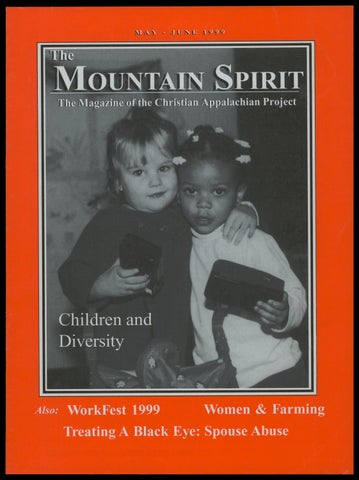
M A Y - J U ___________________
I
The Magazine of the Christian Appalachian Project
Children and Diversity
Also:
WorkFest 1999
Women & Farming
Treating A Black Eye: Spouse Abuse
P r e s i d e n t ’ s N
M o u n t a in S p i r i t The Magazine o f the C H R IS T IA N A P P A L A C H IA N P R O JE C T MAY
- JUNE
1999
VOL.
XVIII,
NO.
3
Children & Diversity
Home Grown and Heartfelt Gardens, page 16.
by Margaret Gabriel
Home Grown & Heartfelt Gardens by Beth Dotson
2 2 Work Fest 1999 by Karen Spivey
Treating A 24 Black Eye by Jim Trammel
WorkFest ’99, employee Janet Ryan brings her know-how to the repair o f a home in Jackson County, page 22.
Children & Diversity, page 4.
D 3
e p a r t m
e n t s
Published by the Christian Appalachian Project E d it o r
M argaret Gabriel
R a n d o m T h o u g h ts
G r a p h ic D e s ig n
Karen Frances Spivey
10
A round the P roject
21
Letters to the Editor
Linda G rider East
29
T he C A P C lo se u p
Father R alph W. B eiting, Mike Sanders, Bill Begley, Becky Kana
C i r c u la t i o n
A d v is o r y B o a r d :
On the cover, two little ones who want to photograph the photographer (photo by Margaret Gabriel). The Mountain Spirit is published six times a year. The annual subscription price is $8.00. Subscriptions and other correspondence should be sent to The Mountain Spirit, Christian Appalachian Project, 322 Crab Orchard Street, Lancaster, KY 40446. Copyright, 1999, The Christian Appalachian Project, Inc. All rights reserved. Member, Catholic Press Association. The Christian Appalachian Project is a non-profit Christian service organization operating throughout Appalachia. The project operates on the philosophy that helping people help themselves is the best approach to Appalachian poverty. The Christian Appalachian Project is recognized by the Internal Revenue Service as a 501(c)(3) charitable organization and is qualified to receive tax deductible contributions.
O
T
E
“Planting the Seeds of Change” Change can be an emotional topic. Some people think that any change is better than no change at all. Other people, when faced with change, dig in their heels, close their eyes and turn a deaf ear to the thought of making any change, no matter how small. I’m not sure that either approach is really what’s needed. An “any kind of change” attitude could easily result in throwing the baby out with the bath water, yet we certainly don’t want „ M i k e Sanders, to resist change that CAP President is needed. In this issue of The Mountain Spirit we’re introducing readers to ways a couple of our programs present change to participants. Our child development centers, particularly CAP Child Development in Berea, are focusing on educating children on the need to embrace people of all races and cultures. Our teachers are learning that diversity education for young children leads them also to a greater self-appreciation. If other people are okay, they must be okay, too. For children who will grow up to face a world that might think that all Appalachian people are barefoot and ignorant, a strong sense of who they really are will go a long way toward paving a road to success. You’ll read a story of a brave woman who broke the cycle of abuse, finished her education and is already helping other victims to follow a similar path. Her surprising story is on page twentyfour. In these stories you’ll see how CAP is helping to preserve the qualities of Appalachian life that need to be preserved and to make change where change is needed. Enjoy!
Mike Sanders
A summary of the registration and financial documents filed by this organization can be obtained by contacting: in Maryland, for the cost of copies and postage, the Secretary of State, State House, Annapolis, MD 21401; in Virginia, State Division of Consumer Affairs, P.O. Box 1163, Richmond, VA 23209; in Washington, residents can call the Secretary of State toll-free within the state at 800332-4483; IN NEW YORK, OFFICE OF THE ATTORNEY GENERAL, CHARITIES BUREAU, 120 BROADWAY, NEW YORK, NY 10271; IN NEW JERSEY, THE ATTORNEY GENERAL BY CALLING 201-504-6215; IN PENNSYLVANIA, DEPARTMENT OF STATE BY CALLING TOLL-FREE WITHIN THE STATE, 800-732-0999; IN WEST VIRGINIA, SECRETARY OF STATE, STATE CAPITOL, CHARLESTON, WV 25305; IN FLORIDA, THE DIVISION OF CONSUMER SERVICES BY CALLING TOLL-FREE WITHIN THE STATE AT 800-435-7352; IN NORTH CAROLINA, FINANCIAL INFORMATION AND A COPY OF THE LICENSE ARE AVAILABLE FROM THE STATE SOLICITATION LICENSING BRANCH AT 919-733-4510; or by writing to Christian Appalachian Project, 322 Crab Orchard Street, Lancaster, KY 40446. Our license number in Michigan is MICS 9933. Registration with any of the above government agencies does not imply endorsement by the state.
2
The
M
o u n t a i n
S
p i r i t
R
A
N
D
O
M
T H O U G H T S B y M a r g a r e t G a b r ie l hen I was interviewing Kim separate rooms until they went away to college. My husband, Jim, wryly suggested that their behavior DelRe and Jean Barnes for the story about CAP’s child would change when they got tired of the lectures. After they were dressed for church on Sunday development curriculum I morning, a row began concerning a computer game. A wrote for this issue, they night’s sleep had revived me, so I tackled “I Care” told me about the “I Care behavior again. We sat around the dining room table, Rules,” (see page 8). I and I asked Gabe to think about how he and Ellen could sensed that I had stumbled across something I needed both play. to share at home. “Take turns,” he said. You see, I like to think of myself as a good mom. “Good!” I said. “Now how can you decide who can Don’t we all? But I must admit that our home usually go first?” I said, knowing that would be the next more resembles Grand Central Station than Sunnybrook obstacle. With an uncommon burst of maturity, Ellen Farm. Maybe, I thought, rules like #5 (We are respon said, “I went first sible for what we yesterday, so say and do.) and Gabe can go first #4 (We care about today.” each other’s I could have run feelings.) would into the street introduce my kids, screaming “ft seven-year-old works! ft works!” Ellen, and Gabe, but I restrained five, to conflict myself and said, resolution skills “Good! How long that will serve should your turns them well as they be?” get older. At the Gabe decided very least, they twenty minutes, could lead to a and when I little more peace pointed out that and quiet. we had to leave Last weekend, for church in the time seemed Margaret Gabriel’s fam ily has hung the “I Care Rules ” in Refrigerator twenty minutes, right. We began Gallery in their kitchen. Ellen said that by talking about they could each have a ten-minute turn. the “I Care Rules,” about taking responsibility and ft certainly wasn’t the first time that they had taken respecting the feelings of others. I’d love to say that my turns, but it was the first time that Mommy hadn’t children were an attentive audience and hung on my stepped in and laid down the law. ft was something that every word, but that would be a big, fat lie. The rules, they had talked about and negotiated and what do you even #1 (We listen to each other.), went in two ears and know? My dining room was beginning to take on the air out two others. But Kim and Jean said the most impor of peace talks in the Middle East. The whole scene tant things about the “I Care Rules” is that you have to made Kim DelRe seem like one smart cookie. say them over and over and over. So I tried. Really. And so it goes. We have relapses every day, and I “Gabe, why did you pull Ellen’s hair? I know she do, indeed, have to tell them over and over to care made you mad, but how can you let her know she made about the feelings of other people and hands are for you mad without making her cry?” helping, not hurting. But that little success around the “Ellen, don’t just grab the puppet out of Gabe’s hand. dining room table on Sunday lets me know that we’re Why don’t you ask him when you can have a turn to on the right track, and I’ll bet if more children (not to play with it?” At one point on Saturday, I was close to deciding that mention adults) lived by the “I Care Rules,” the world would be in pretty good shape. life would be a whole lot simpler if I just kept them in
MAY
JUNE
1999
3
A former Christian Appalachian Project volunteer tells a story about one of her earliest days with the organization. She was substituting at a child development center for a teacher who was sick, facing about twenty chil dren she didn’t know and didn’t know her.
In Lancaster, toddlers play at the Sunshine Center while their moms participate in Job Start.
Luckily, the kids didn’t descend all at once; the van delivered them in groups of four or five, so she was able to learn their names a few at a time as she settled them down to breakfast.
by Margaret Gabriel 4
T
h e
M
o u n t a i n
S
p i r i t
sensitivity they need to help Things were going swimmingly children and their families accept, until Creative Time, when the lesson appreciate and celebrate cultural called for finger painting, so diversity. everyone donned big white shirts. “We all are individuals and we all Suddenly, the names the volunteer have our own culture and our own had so conscientiously learned were identity. We need to focus on a dim memory as she was sur helping rounded by children children learn in white shirts whose to accept distinguishing themselves characteristics all and others for seemed to be fair hair who they are and blue eyes. regardless of Someone from skin color, or outside Appalachia anything else,; — and even some Kim said. natives — might not Because realize the diversity Mary Mundy, head teacher at CAP Child some children Development in Berea. of the region because in Appalachia of the traditionally have few dominant presence of viewed “The Color of Fear,” a opportunities white, Anglo-Saxon documentary which observes a to meet people Protestants. Kim group of eight men with a wide of color, the DelRe, manager of need increases variety of racial and ethnic groups CAP Child Develop who spent a weekend together for greater ment in Berea, tells of discussing and exploring their attention to a an activity during a attitudes concerning race relations. more formal recent parenting Kim and Mary came away from the ized training meeting at the center. gathering determined to introduce program, said There were signs their students to a way of thinking Jean. “They posted on the wall that could free them from bias and don’t have a that said such things intolerance. They began to research real life as BLACK, CATHO Jean Barnes books and curricula that might give experience to LIC, WOMEN. “Our Assistant Director see that people them additional tools and found task was to take Human Services Peacemaking for Little People, of color are characteristics and just like we are. which Kim says is just what they put them into [one of were looking for. Their culture is different, but their the] groups,” Kim said. For many years, Mary said, CAP heart is the same. When they see Kim was surprised when she saw Child Development has worked to such characteristics as Barefoot and people [of color] portrayed on equip children with the skills they television, it’s usually in a negative Can’t Read included under the need to treat people fairly and with role, so we have to combat all of group APPALACHIAN. “Some of dignity. Peacemaking for Little that, often with the parents, too, our parents had put those labels up People, she said, gives a more inespecially when they haven’t dealt there, and didn’t associate that with depth look at methods teachers can with people of color. But we have to themselves. 1 said, ‘You guys are use to incorporate such concepts start with our children. If we educate from here. Is that you?’” into lesson plans and activities. them, when they go home, they’re When they said the characteris “I’ve seen how the kids do here. going to educate their parents and tics were faulty, Kim said, “That’s If we teach them to say, ‘I don’t like say the things they’ve heard from what other people think you are, so it when you hit me,’ or ‘It hurts my Mary.” how does that relate to your ideas feelings,’ they learn that they have a “Mary” is Mary Mundy, an about other groups of people?” It choice in their behavior,” Mary said. African-American woman who has was an interesting eye opener. “They can choose to hit or they can worked at CAP Child Development Kim, assistant director Jean choose to use their words and walk for 22 years, and for 20 has been Barnes and other CAP program away. This is a way of equipping head teacher. With other CAP managers have been on a journey them with the skills to communieducation workers, Mary and Kim that they hope will give them the
“They don’t have a real life
experience to see that people of
color are just like we are. Their culture is
different but their heart is the same.”
M A V
JUNE
1999
5
cate.” Every day, the children at CAP Child Develop ment recite the “I Care Rules” during Circle Time. Throughout the school year, the teachers’ lesson plans outline activités that let the children see how the rules relate to their experiences. In one simple activity, all the children sit on the floor. The teacher explains that we “Appreciation Education ” is part o f every day and every activity at CAP Child Development. are all individuals, with similarities and differerences, then asks the I can just imagine. children questions about them When we incorporate selves. Who has black hair? Who these rules in children, has green eyes? Who has shoes they’ll know that on? Who likes pizza? If the ques they’re following tion applies, the child stands, and Jesus.” the teacher points out that the Jean, Kim and Mary others are like the one standing up. agree that children are Since, of course, different children color-blind, saying that stand for different questions, the color or other differ children begin to appreciate that ences in appearances although they are different about are not as important to some things, and alike about others, them as whether they everyone is special. are kind or play fairly. The behavior that results from “Elizabeth Goggins, following the “I Care Rules” is a lady of color, was a “what we’re called to be as Chris teacher at Children’s tians,” Mary went on. “It’s how Discovery Center [in Jesus was when he was on earth Somerset],” Jean said. with us. He always listened to the “We were talking about needs of people, especially when differences and she they were expressing pain.” The and I stood up and rules that govern touch and said, ‘What is different language, too, are behaviors that about us?’ Jesus used. “They said I had on “One of the rules talks about blue jeans and she had using a gentle touch; everyone on green pants; I had Jesus touched with his hands was red hair, and she had healed.” Mary said. “Jesus used T black hair. Never one Care’ language when he taught that Jean Barnes time did they say that we needed to care for our neighbor. she had dark skin and I Assistant Director He must have had marvelous had light skin. Where Human Services conversations with little children —
“Some of our kids.
when they see a person in a coat and tie, they’ve had bad
experiences. It’s been
social services, come to get mama or daddy. It wasn’t his color, but his dress.”
6
The
M
o u n t a i n
S
p i r i t
do they start seeing color?” Jean asked. “If we start at an early age with them and help the parents see through the child’s guidance, maybe we can make some changes.” Children see the differences in people’s color at different ages, Mary said, depending on their developmental levels. “I’ve had children as young as three look at me and say, ‘You’re brown.’ It depends on what they’ve been exposed to. When they do, I comment, ‘You and I are not the same color.’” Regardless of their age or development level, she said, color rarely is an issue of concern to small children. “She’s just their Miss Mary,” Kim MAY
JUNE
1999
said, “and they love her.” Jean pointed out that children aren’t always immune to biases, telling of a gentleman who visited Eagle Child Development and termed the children stand-offish, assuming it was because he was black. “We asked the kids, ‘What was different about him?’ Well, he had a suit and tie on! Some of our kids, when they see a person in a coat and tie, they’ve had bad experiences. It’s been social services, come to get mama or daddy. It wasn’t his color, but his dress.” The goal of “Appreciation Education,” as Mary calls it, is to encourage children to embrace,
| appreciate and celebrate not only people who are different, but to affirm that they themselves are lovable regardless of how they might be different. “We have this homog enous view,” Kim said. “Everybody has to be the same, and we end up not being able to accept people for their individual differences. And if the goal of society is for everybody to be the same, we aren’t going to accept somebody who can’t be, and how do we treat that person?” When children accept the idea that diversity is something to be treasured, they begin to break the cycle of fear and mistrust they might have of people who look different than they or have different traditions. The “I Care Rules” are quickly becoming an accepted part of the culture at CAP Child Development, Kim said. Every day the children recite the rules during Circle Time, and she hears them reminding each other, or even saying, “Miss Mary! He’s not using his I Care Rules!” It’s most important, Kim said, that children see adults modeling the rules. She recently told her parent group, “If you guys can’t learn these and know them and model them, how do you expect your kids to? How do you expect your kids not to hurt each other? You have to do them every bit as much as the kids!” And they knew it was true. “The same thing happens with the teachers. We really have to get along and work through our issues, too. Because they’re there — staff stuff. If we can’t work it out and model for the kids, they aren’t going to leam it,” Kim said. She believes that Rule #5, “I am
7
During Circle Time children recite the “I Care Rules,” and talk about appreciating their friends.
responsible for the things that I say and do,” is a key to children becoming capable, successful adults. Some of the children in her center have been faced with a disturbing amount of turmoil for young lives. Peacemaking for Little People suggests ways to help children identify feelings and choose appropriate reactions. “We all have feelings, and typically what kids, and even adults, do is just act on those feelings and say some thing nasty. But we talk about feelings and have somebody say ‘You know, sometimes things that parents do make us feel real sad. You’re mad because Mommy left yesterday, and it hurts. Being mad is okay, but hurting someone else because you’re mad isn’t okay. Let’s think about what else you can do.’ “That carries so much importance for the future,” Kim said. “And we’re not just looking at the short term here.”
Kim and Mary are working on a presentation first for teachers in other CAP programs, and later for teachers in other pre-schools and resource centers. They have talked with colleagues and received an encouraging response to the question: “What would you think if we came to your center with a presentation on ‘Appreciation Education?”’ “When the time comes to actually do it, I think there will be a positive reception,” Kim said. “All centers, all people who deal with young children deal with conflict all day, every day. We can help you deal with those conflicts and can help your children learn about dealing with conflict, so you don’t have to all the time.” There are very specific ways to handle conflict resolution with little ones, Kim said, starting with the “I Care Rules.” It is also effective, she T
h e
M
and Mary have found, to give children specific things to say in specific situations. They repeatedly suggest that children talk rather hit, and engage children to think about ways that they can resolve dis agreements so that everyone is satisfied. “It’s hard work, though. Once you commit to it, it’s not easy, because you don’t say it just one time. You say it with every situation that comes up. But if they can start doing it when they’re itty bitty people it’s not so hard,” Kim said. “And then they feel better,” Jean added, “just like we do. That’s a burden that’s lifted off of them, and they can be children, which they need to be. They’ve learned that when they’re mad, they need to take a time-out or bang a pillow, but not hurt people. It’s okay for me to have these feelings, but what I do with it is my responsibility.” Jean and Kim agree that teaching o u n t a i n
S
p i r i t
Children frequently accompany adults in CAP’S residential programs, including spouse abuse shelters. For many of them, the conflict resolution they have observed in their lives has been only violent. A method of resolution that ad dresses feelings, and the appropri ate response to those
feelings, could well be the way to break a cycle of violence that grips some families. Kim and Mary believe that in breaking that cycle, new values can be introduced to the area, but have questioned themselves about a conviction that of itself threatens to contest the concept of acceptance: “If we’re really accepting of people, why can’t we accept those limita tions to thinking?” Jean said. Kim explained, “I may not be able to change people’s lives, but if I don’t share what I believe is right and true about ways to treat people, then I’m as guilty as that guy in Jasper, Texas, who [killed a black man by dragging him behind a pick up truck and] actively acted out his hatred. I may not change attitudes, but I think I have a personal responsibility to at least share some different ways of looking at life and how to treat people. Accept it if you want to, throw it in the trash if you don’t, but I’m going to share it.”
CAP Child Development prepares three- and four-year-olds fo r success in school.
children to appreciate diversity and resolve conflict in a creative manner is best done in the early pre-school years for a couple of reasons. First, as with anything, it is easiest to teach a child before there are attitudes to be “un taught.” Secondly, CAP is frequently involved with a family whose children are enrolled in a child development center for a number of years, beginning even when children are infants. “Then, they might become involved with camps or teen centers, where they’ll be re minded,” Jean said. “And one of the things we hope Kim and Mary will do is workshops for schools, for teachers, so they can share and celebrate, because it makes a difference.” CAP has the opportunity to influence children in several programs other than those which concentrate mainly on education. MAY
JUNE
1999
9
A
r
T he
o
u
n
d
P ro ject
CAP Programs Collaborate On Family Fun Day Two Christian Appalachian Project child development centers and an outreach program collabo rated on a day of family fun and learning called “FUNdamentals You Need for Life.” One dad and 23 moms gathered in Berea for workshops, informational and inspirational talks, while their 24 children were hosted at a carnival in nearby Mount Vernon. In addition to the involvement by outreach and child development staff, workshops were conducted by people who work in other CAP programs. Lauri Eiselt, manager of Camp Andrew Jackson, told parents how to “Celebrate Diversity”; outreach administrative assistant Wanda Penman took folks “Shop ping with Wanda,” and showed how to stretch a budget. This workshop dovetailed with the “Budgeting Your Dollars” presentation by outreach caseworker Marie Bonner. Human services assistant director Garry Vickers gave the keynote address during lunch, a presenta tion called “Happy Attitudes (HA).” Other topics included nutrition, social and emotional development of children, and “realizing your dreams.” Outreach was able to award each parent with a door prize, including a new fishing pole for the dad in attendance, said Kim DelRe, manager of CAP Child Development in Berea. “That was a little bit rigged,” she admitted. “We didn’t want him to get a makeup mirror!” As the day was ending, Sarah Dixon, manager of Family Child Development, told the dad, now the owner of a new fishing pole, how much she admired him for attending.
John Fenger and other volunteers entertained children while their parents attended “FUNdamentals You Need fo r Life.”
He told her that he had attended the “Realizing Your Dreams” workshop, and said, “Now I realize that I can do anything I want. If I work hard enough for it, I can do it!”
CAP operates child development programs in five counties. Outreach offices in Berea and Hagerhill assisted nearly 14,000 people in 1998.
How Can I Help CAP? Not long ago, the Christian Appalachian Project received an email from a supporter who asked about the availability of CAP volunteer opportunities for a family. We replied that because of housing limitations, different opportunities are open for families than are available for single people. While CAP is able to accept a limited number of married couples, we are not able to accommodate families with children. There are, however, other ways for families to volunteer. For instance, they might volunteer to distribute literature about CAP to school and church groups. We are happy to make T
h e
M
additional copies of those publica tions available to volunteers for distribution. For more information about the various ways of contributing to CAP through volunteer assistance in various forms, please contact The Mountain Spirit, 322 Crab Orchard Street, Lancaster, KY 40446. Our most powerful form of assistance, however, is prayer. No matter where they are or what they’re doing, volunteers, and supporters of all descriptions, can have a mighty influence by praying at least one minute a day for poor people in Appalachia and through out the world. o u n t a i n
S
p i r i t
A
R O U N D
T he
P r oje ct
“We’re Just Beginning” dogs daily, in an effort to go to Christian Appalachian Project public school. Peace Committee member Lois West Lois hopes to share much of what spent time during a recent vacation she learned with CAP and with at a conference of the Southeast others in her community, she said. African-American Preservation “As a race and as Christians, we’ve Alliance. People from Alabama, become much too complacent Kentucky, South Carolina, Louisiana [concerning the struggle for civil and Maryland discussed the rights]. The conference made me documentation of events and realize that the fight is not over, and preservation of sites important to in some ways, we’re just begin African-Americans, Lois said. ning.” The conference was held at the One of the projects of the alliance, 16th Street Baptist Church in Lois said, is identifying and restoring Birmingham, Alabama. Lois said that sites of the Underground Railroad, as she entered the church, she had the network of people and places that the feeling that there was a signifi helped slaves to escape in the 18th cance to the location that she was and 19th centuries. The contact missing, but couldn’t identify. person for sites in Kentucky is Jerry When she passed an enclosed area Gore, recipient of the 1996 CAP marked “Memorial Room,” Lois said, Peace Award. Part of the grant which “It hit me. This is the church that accompanied his award was directed was bombed in 1963, killing four to the effort, “so CAP has had a hand little girls in a Sunday School class.” in the preservation,” Lois said. Lois said the realization was so strong that a companion said, “It just hit you, didn’t it?” Across the street from the church is the Civil Rights Institute, which traces the movement through American culture, including music and television. Lois was touched by a number of displays, she said, particularly the burned Greyhound bus that provided transportation for “Freedom Riders” from the North and the door of the jail cell from which Dr. Martin Luther King, Jr., wrote “Letters from a Birmingham Jail.” Statues in an adjoining park depict events and people crucial to the civil rights movement, includ Lois West (back to camera) attended the Southeast ing children who linked African-American Preservation Alliance. Janet arms and faced attack Sikes (right) was the keynote speaker. M A V
JUNE
1999
What You Don t Know About Wills Can Hurt Your H e irs .. ^
Find Out Why. " Request j . Your Free Copy, v ’
Much of what you know about wills may be misinformation that has been floating around for years. If you think, for example, that wills are primarily for rich people, or elderly people, you may be the victim of a common m isconception. The helpful booklet offered here will explain how your will can save your heirs from costly delays and confu sion. Send for your copy today. Clip and Mail
Christian Appalachian Project 322 Crab Orchard Street Lancaster, Kentucky 40446 Please send without obliga tion your booklet, “37 Things People ‘Know’ About Wills That Aren’t Really So.” Nam e______________________ Address _ C ity____ State,ZIP
11
A
r
T he
o
u
n
d
P r oje ct
CAP Outreach Helps Johnson County Man with Surgery Christian Appalachian Project outreach workers sometimes receive unusual requests for assistance that few other agencies are able to give. Such was the case with David Jaynes, who needed assistance with travel to Summit Medical Center in Oakland, Calif., for surgery to correct a condition called Essential Tremor Disorder. David has had the condition for many years, but it is degenerative; he had lost the ability to write, had difficulty eating, and was in danger of losing his job. He saw a story on CBS’s “48 Hours” that showed a procedure which involved implant ing a brain stimulator which would control his tremors. David’s doctor agreed that the treatment was suitable and his medical insurance would cover the procedure and hospitalization, but the cost of traveling to California was making the possibility of the trip doubtful. Outreach caseworker Sheila Patton called David “tough.” She said, “He told me has going through with the surgery, if he had to walk [all the way to California], And he would have done it.” CAP saved David the walk when it provided the airline ticket to travel to Oakland, the only hospital where the needed surgery is performed. Jim Kammerer, a CAP volunteer, referred David and his nephew, who accompanied David and served as his support during his trip, to a group of Franciscan sisters that provided accommodations for the trip. Respecting the wishes o f deceased loved ones, or in honor o f them, families often request that memorials be sent to us. Memorial gifts live on to benefit others. Many also specify memorial gifts in their wills. Any size gift is welcome. Contact us for more information.
12
Less than a week after leaving his home in Johnson County, David was sitting in Sheila’s office in CAP’s Hagerhill location. “He was bandaged, and his face was black from the intrusion, but he came in to show me what he could do,” Sheila said. “He signed his name. The difference between the signature on his driver’s license and his signature
now is so dramatic, it’s hard to believe.” The outreach staff circulated a letter among CAP workers that asked for prayers for David’s surgery. “Also,” they said, “please give a prayer of thanksgiving for the support of our donors and the privilege of being a part of such a life-changing path.”
Father Beiting preaches on the bank o f the Kentucky River in Maysville, Ky., during his 1987 river tour.
Father Beiting to Preach on River Banks Christian Appalachian Project founder Father Ralph Beiting will be combining two of his favorite activities during the summer of 1999, as he cruises the Kentucky and Ohio rivers, stopping to preach along the banks of the rivers. Father Beiting first experienced “street preaching” in 1946 when he was still a seminarian. He first met Appalachia and her people that summer, “the summer I fell in love,” he says. Outdoor preaching for him has been a part of practically every summer since then. Father Beiting has scheduled the following preaching stops for the The
M
summer of 1999. July 5 Huntington, W.Va. July 6 Ashland, Ky. July 7 Portsmouth, Ohio July 8 Maysville, Ky. July 9 Cincinnati, Ky. July 10 Covington, Ky. July 11 Aurora, Ind. July 12 Carrollton, Ky. July 13 Madison, Ind. July 14 Louisville, Ky. July 15 New Albany, Ind. July 16 Owensboro, Ky. July 17 Evansville, Ind. Please see local newspapers for times and locations.
o u n t a i n
S
p i r i t
A
r o u n d
T he
P r o je c t
Volunteer to Bike Cross-Country Christian Appalachian Project Liz Fritz recently held a car wash to raise the money for a cross-country bicycle trip she will make to benefit the American Lung Association. “Since I’ve been here, I’ve seen so many people with lung and respira tory ailments, I really felt called to do this,” Liz said. The car wash, held in the parking lot of a local discount store, netted Liz over $700, which was matched by the store for a total of $ 1400. Two CAP employees and 24 volunteers washed cars steadily from 9:00 in the morning until 3:00 in the afternoon, taking donations rather than charging a set price for their work. “A lot of people just wanted to get their car washed, but when I told
j
people what the donations were for, they really got into it,” Liz said. Liz, who works in home repair, had to take a break from her training routine during Work Fest ’99 (see page 22), but since then has worked at road biking or mountain biking three or four times a week, as well as running, hiking and playing soccer on Sundays. Raising the needed funds to participate in the 3200-mile trek has been “a very humbling Volunteer Liz Fritz is training fo r a cross experience,” Liz said. “I’ve country bike trip. learned to receive graciously.” before traveling to Seattle to begin She completes her commitment with biking on June 14. The trip will CAP on June 3 and will spend some finish on July 31. time with her family in New York
TiwigTerm Im pact The CAP volunteer program needs summer camp counselors, nurses and life guards to staff three camps in Eastern Kentucky. We are seeking high-energy men and women, age 18 or older for the months of June, July and August. We would like a commitment of at least two months, but a 3-7 week stay can be arranged. Room and board is provided. A Personal Response
fOLUNTEE^
For more information about volunteering for summer, or for a year or more, contact:
Christian Appalachian Project Volunteer Program 322 Crab Orchard Street, Lancaster KY 40446
Call 800-755-5312
Email: volunteer@chrisapp.org
Visit our website: www.chrisapp.org
A
R O U N D
T he
P r oje ct
Healander Chairs National Committee Former Christian Appalachian Project volunteer Jeff Healander was featured recently in a copy of Email, a newsletter for the Eastern Ken tucky University community. As a volunteer, Jeff worked at Rainbow Respite, a program that gives relief to families who care for members with disabilities. Jeff’s work with people with disabilities led him to change his direction in life, and after his volunteer service he began to work on a degree in occupational therapy. The “In the News” section of Email highlights Jeff’s position as chair of the American Student Committee of the Occupational Therapy Association, which
represents 14,000 students in occupational therapy programs nationwide. Jeff will serve in the position until April 2000. He told Email, “The (parent) national association has made some cuts in what students receive, and I have a problem with that. It will be my job to gather information from all the schools and take the concerns of the students to the Executive Board. I’ve always been interested in the political process.” In addition to his volunteer work at Rainbow Respite, Jeff also volunteered many hours to estab lishing and supporting a CAP website.
Is th ere a CAP p rogram th a t you d o n ’t see in this issu e o f The Mountain
Spirit? C A P ’s w eb site in clu d es in form ation ab ou t all o f C A P ’s hum an d e v e lo p m e n t p r o g ra m s, p lan n ed g ivin g and m ajor gifts and the v o lu n teer p rogram . P lease v isit th e site at
www.chrisapp.org and be su re to sign ou r gu est book!
WORKPLACE
Congressman Rogers (R-Ky.) Visits Dump in Jackson Co.
PA Y R O LL D E D U C TIO N If your em ployer offers donor designation as a w rite-in for payroll deduction cam paign, please rem em ber the C hris tia n A p p a la c h ia n P ro je c t. CAP is a 501 (c)(3) tax ex em pt agency, and payroll de duction is the easiest w ay to help the fam ilies o f A ppala chia. To ensure that w e re ceive your payroll deduction gifts, please give your payroll officer C AP’S full address and send to the attention of: Teresa M cA n ly C am paign C o o rd in a to r
Christian Appalachian Project 322 Crab Orchard Street Lancaster, KY 40446
CAP volunteers Heidi Metrakoudes(left) and Amy Vescovo(right) pictured here with Kentucky Secretary ofNatural Resources James Bickford were part o f a group o f Jackson Countians who greeted the entourage o f Rep. Hal Rogers (R-Ky.) when he was traveling his district recently. Rogers visited an illegal dump which is being cleaned through PRIDE (Personal Responsibility In a Desirable Environment), an initiative created two years ago by Rogers and Bickford.
The
M
o u n t a i n
S
p i r i t
A
R O U N D
T he
P r oje ct
Father Beiting Speaks to Asbury Students of good Christian people, “but felt went up to the stage to talk to him called to speak about the fact that and shake his hand after he was we’re not living in Godly times.” finished.” He pointed to what he called a “graying” church, and challenged the students to get involved as young people. He challenged them to adopt heroes that were not sports figures, pointing to John Wesley, the saints and Mother Teresa. When Father Beiting was finished, students were given the opportu nity to visit an informa tion booth Mary set up in a room adjoining the chapel where Father Beiting spoke. “Folks told me that they really appreciated his mes sage,” Mary said. “About fifteen people Father Ralph Beiting at Asbury College.
McNa m a r a ___________________________________
Christian Appalachian Project founder Father Ralph Beiting recently addressed 1400 students at Asbury College, Christian liberal arts college in Jessamine County. James Fogle, a member of CAP’S field staff and a graduate of Asbury College, arranged the appearance. Father Beiting was introduced to the student body by Jim Johnson, a professor of social work, who has brought groups of Asbury students to CAP Work Fests for four years. Johnson was inspired by the talks Father Beiting has given during Work Fest, according to Mary McNamara, CAP’s volunteer recruiter. “During his introduction, he quoted from, A Time o f Crisis... A Timefor Christ [one of Father Beiting’s books],” Mary said. Father Beiting delivered a passionate oration, telling the students he could go one of two ways: to talk about the Christian Appalachian Project and the work
Teens Learn About Their Purposes in Life
MAY
JUNE
1999
volunteers. Employee Karen Spivey to trust God,” Karen said. Sean Leavell, a 13-year-old from gave a talk which drew parallels Garrard County, enjoyed the between gardening and life. “I weekend because “I learned that compared implements we use to everybody has a purpose and you garden, to things that help us to can learn from your mistakes.” grow in life,” she said. “Rain is like tears that we shed in order to grow. We use garden gloves and hats to protect ourselves in the garden, the same way we have to protect ourselves in life by making good choices and smart decisions. These choices are like the choices we make Sean Leavell, center, participates in the Teen Retreat. to trust parents, and
spivey
“Everybody’s got a seed to sow” was the theme of a recent retreat sponsored by the Christian Appala chian Project’s Rockcastle Youth and Teen Center. About 70 teens reported to Camp Andrew Jackson in Jackson County for two days of activities, discus sions and free time when they could make new friends, play basketball or just think and toss rocks in the lake. Friday evening’s activities were emceed by camp manager Lauri Eiselt, who was assisted by volun teer Matt Douglas and accompanied on electric keyboard by employee Mike Liocano. Beth Chauncey organized the entire weekend and had assistance from numerous
15
Heme Grown and H eartfelt Gardens y *y* * ' ifiihi ‘ #
Women Join Farming Group To Find Self-Sufficiency And Health Tell the women of East Kentucky Home Grown that there’s going to be a work
Sister Judy Yunker, prioress o f Mount Tabor Monastery, inspects a raised garden bed. The sisters have fashioned the beds, giving them garden space on their mountainous land.
shop about raising mushrooms or marketing herbs and they’re likely to check their calendars to see if they are free to go. This five-member group in Floyd County, Kentucky, is always looking for ways to be more self-reliant and to set an example to those around them. In the process, they are learning the true meaning of cooperation and creating a healthy food source.
by Beth Dclscn 16
T
h e
M
o u n t a i n
S p i r i t
Sister Judy Yunker, prioress of the Benedictine community of sisters who live at Mount Tabor Monastery in Martin, Kentucky, was one of the group’s founders. The Benedictine sisters feel a strong connection with and responsibility for the earth. They chose the land for their monastery to be on a mountainside that faces the sun and their home has windows that let in an abundance of natural light. Although the ascent to the property is up a steep mountainside and the land never quite flattens, they have found ways to use it to help feed themselves With the help o f H eifer Projeet Internation , m em bers o f E ast K entucky H om e Grown and the volunteers who are raising chickens. visit. Sister Judy hopes chickens from many large growers, someone who joins the program the that in doing so they are showing so they are an all-natural product. following year. They also share the people around them about how “It’s hard to describe,” said Sister what they have learned with the they, too, can take a small amount Carolyn Lambert, who lives at new member. HPI is a nonprofit of land and put it to good and Mount Tabor, “but they have a organization that provides livestock, responsible use. The stated different taste from store-bought training and technical support so purpose of East Kentucky Home chicken. It just tastes better, and that rural families with limited Grown is to offer opportunities for you’re eating a healthier chicken resources and communities can help low-income families with emphasis because there are no additives.” themselves by producing food and on raising and selling agricultural These chickens are ideal for income. Most of HPI’s funding produce and livestock. “We wanted people with small plots of land comes from churches and individu to have a group to encourage because a minimum number of acres als. people,” Sister Judy said. is required. The pen, also called a In addition to individual help, the As part of this group, Sister Judy mobile grazing shelter, is 10 feet by group has used their grants for can share her experiences with 12 feet and must be constructed training and equipment. They others who are also interested in from relatively lightweight material purchased the tools needed to raising their own food. At their so that it can be easily moved by process the chickens (a scalder, meetings and trainings (the one person. Yet, its weight must be stainless steel tables, a plucker) and members are now taking a master they join their efforts when process substantial enough that the wind gardener class), the women teach cannot blow it away. ing time comes. one another and explore ideas for “I basically raised my chickens in The women raise Cornish-cross improving their production and the back yard,” said Kathy Friend, chickens from the time they are less marketing the produce, which another original member of the than a day old. They brood them for includes chickens. All of the group. Kathy is a Floyd County two weeks, then transfer them to members are raising pasture-fed businesswoman. She wanted to be portable pens that are moved at chickens with the help of a $6,000 part of the project because she least once a day to give them fresh grant from Heifer Project Interna agrees with the idea of helping grass to eat. tional (HPI). People who meet the people become independent and of The chickens are fed a special federal poverty guidelines are providing a clean food source. She grain mixture that includes oyster eligible for a grant that covers the has discovered an experience that shells and a mineral supplement that purchase of 100 chicks, a pen and she calls gratifying and rewarding. provide good nutrition, but they are waterer and feed. In return, that “A woman can do it by herself. It not fed growth enhancers as are participant must buy 100 chicks for MAY
- JUNE
1999
17
■
,
t
Members oj East Kentucky Home Grown spend time together, sharing stories about success and ideas fo r new marketing and agricultural concepts.
gives you a real sense of accom plishment,” she said. The process has also given the women a greater appreciation for the entire cycle of life. They have experienced the effort it takes to raise animals for food and they have seen the amount of food the animals require. Kathy remembers that her friends, who know that she is an animal lover, thought she wouldn’t be able to slaughter her chickens. When the group gathered for their first processing day, she did almost leave before they even started. But the prayers the group offered for the chickens helped her to see how they play a part in the cycle of life. The group’s members share these sorts of experiences and discuss their accomplishments and prob lems at their meetings. They draw from their previous experience to share with the other members so they won’t make the same mistakes. They also join their power as a group to do things like buy in bulk.
18
In the future, they hope to sell in bulk at a farmers’ market or to local businesses. At a late winter meeting, the group discussed plans for the upcoming growing season. Members Trish Harris and Teena Conley raise pasture-fed hens so they can sell eggs. Drawing on her business sense, Kathy Friend suggested the group might be able to make labels for their egg cartoons that tout the quality of the eggs. Member Suzanne Stumbo, an agriculture teacher at Prestonsburg High School, discussed the involve ment of her students in the program. Last year, a few students partici pated and the members were impressed with their ingenuity. One student was able to sell some of the chickens live, which eliminated the group’s need to process them. This year, Suzanne has even more students who want to participate and she must discern who qualifies and who can be relied upon to raise 100 chicks to maturity so that the T
h e
M
other members are not stuck with finishing a job someone else started. The group also worked on plans to host a Heifer Project Interna tional poultry-raising workshop on one of their farms. HPI has invited new farmers from other states to attend the workshop to receive their initial training for raising chickens and to learn from the expertise the women in Floyd County are developing. Besides raising chickens at Mount Tabor, Sister Judy also works on the Benedictine community’s raised bed gardens. The raised beds work well on the uneven land because with a wooden frame filled with soil, they are able to create a level growing area. Creating the beds entails digging down several feet and mounding up the soil approximately two feet above the ground. They then cover the ground with black plastic, poking holes in it so that water can trickle into the soil. The plastic keeps weeds at bay and vegetables grow close together. o u n t a i n
S
p i r i t
The nuns also garden at an elderly neighbor’s home, which demonstrates the Neighbor to Neighbor project of East Kentucky Home Grown. The concept is to match families who don’t have land that is appropriate for gardening with some who have the land, but don’t garden, perhaps elderly people who are no longer able. The gardening family promises to plant and care for the garden and they share the produce with the land owner. East Kentucky Home Grown assists by providing a rototiller to prepare the land for planting and helps to get seeds. The nuns raise crops that need a lot of space, like potatoes and squash, at their elderly neighbor’s home because there is more flat land that allows for the area they need. This is one more way they are setting an example that they hope others will pick up on. After just one year with the
group, Trish Harris has set a powerful example for her young nieces and nephews. Harris, who is the group’s president this year, originally got involved through her friend, Teena Conley. Teena joined the group to meet other people interested in growing healthy food. The idea of raising their own meat, eggs and vegetables was appealing to both Teena and Trish. Trish had been having some health problems and when she thought back to when she was the healthiest, she realized it was when her grandmother was alive and she fed the family from her own garden. So Trish and Teena joined forces to raise the Cornish-cross chickens and hens, hoping that more natural foods would improve their health. Trish also built two raised bed gardens. She didn’t want to use treated lumber, so she made one with limestone rocks and the other from trees that had fallen on her
property. She raised an herb garden and tomatoes. She moved the chickens around on her old garden space, hoping to improve the soil with the chicken droppings so she could grow a prosperous garden this year. As Trish worked on these projects, her eight nieces and nephews, who live nearby, took notice. They began to bring her garbage for use in her compost pile. They helped with the chickens and the garden. They observed Trish’s healthy eating habits and decided they wanted to do the same. They also saw that Trish is a member of a farming group and decided they wanted to form their own group, just for kids. The young people, who range in age from 4 to 12, invited some of their friends from church to help out, then drafted Trish to help them form their club. “I think it’s good experience and it will get them to eat healthier,”
Floyd County kids have started an agriculture club fo r themselves, modeled on East Kentucky Home Grown.
MAY
JUNE
1999
19
Sister Judy Yunker (left) has lived in eastern Kentucky since the mid-1970s. She has been involved in many aspects o f life in Floyd County, providing friendship and advocacy to those around her.
Trish said. “They are into recycling and they want to give back to the earth.” The experience of joining the group has also been beneficial for Trish. “I get a fulfillment knowing that I grow it with my own two hands and that I am putting something healthy into my body,” Trish said. “It’s just so rewarding . . . . I feel like a whole person.” Teena has also been pleased with the experience. “I love it and I want to learn more,” she said. She enjoys knowing a group of women who share some of her interests in food and health and she treasures the experience of being outside in the fresh air and sunshine as she works on her garden. A new family is joining the group, a husband-wife team with three children. Trish and Teena plan to help them out as much as possible as they go through their first year of raising Cornish chickens.
20
The women readily recognize their two strongest supporters in their venture — HPI’s Field Representative Steve Muntz and Floyd County Extension Agent Pat Spicer. Steve provides the group with all of HPI’s vast resources. “He was always there for us when Teena and I had questions,” Trish remem bers about her first year in the program. Kathy Friend says Pat has all of the scientific and technical informa tion about agriculture and is able to use that to give practical advice to the small farmers. She is also able to connect the women with resources and research from the University of Kentucky’s agriculture department. Members recently attended a workshop about mushroom grow ing. They have also considered raising ginseng and goldenseal for profit. The women know that some of their friends and neighbors don’t The
M
understand why they are trying these new methods of farming. People in eastern Kentucky are sometimes slow to embrace change. But the good flavor of their chick ens and the self-satisfaction of the members of East Kentucky Home Grown has already won over some family members. They won’t stop there. “I think we’re going to continue to explore how we can get clean food into our bodies and maybe along the way we’ll figure out how to get a little money,” Kathy said. As a community that concerns itself with serving the low-income families in the area, Sister Judy and the Benedictine Sisters at Mount Tabor also hope that they are planting seeds that will one day sprout into prosperity for families throughout Floyd County. Beth Dotson, a former CAP volunteer, is a free lance writer who lives in Lancaster. o u n t a i n
S
p i r i t
L etters to th e E d ito r Keep up the good work! May our Lord bless your efforts. May He touch the hearts of us all so that we can all appreciate the good works that you do and open our hearts so that we can support your efforts with our prayers and support. Richard A. Man North Borough, Mass.
I find this publication very informative and enjoyable reading. Needless to say, I immediately read it from cover to cover. I’m sure all of the projects geared to education and job readiness will make a big difference in the future. Keep up the good work. Walter M. Hansen Cornell, Mich.
A wonderful publication. It is heartwarming to see the good CAP does for so many people. I hope I can continue to contribute in some way. God bless all of you! Mary A. Schneider Ely, Nev.
May God richly bless you, Rev. Beiting, and all who work with you to reach out to the less fortunate of Appalachia. You are living your faith, not just talking about it — thank you! I would like to join you someday by being a CAP volunteer. In the meantime, I feel God wants me here with my aging parents. I enjoy The Mountain Spirit, Robert Duthler Grand Rapids, Mich. only wish it could be monthly. Keep on working for Jesus.
To Father Beiting, and all volun teers: Your love for Christ truly helps lift the burden of poverty and loneliness. As I read Matthew 12:2830,1think of you and pray that God will bless you and bring more supporters your way. We are all blessed when we share. God bless you and CAP.
God bless Father Beiting and all the volunteers and employees of CAP for your love and unselfish devotion to the people of Appala chia. Barbara M. Rice Hanover Park, III.
We again look forward to receiving The Mountain Spirit with its most inspiring stories of service to those in need, all in the name of our Savior, Jesus Christ. Mr. & Mrs. Charles Goulding Flat Rock, Mich.
I think your magazine is very informative and helps us to understand about the Appalachia area. Sally M. Williamson Louisville, Ky.
We enjoy your magazine very much. We feel that our donations are going directly and promptly to sources that benefit the most needy.
I really look forward to your magazine each month. I read it from cover to cover. God bless you all in the work you do.
Joseph M. Shreve South San Francisco, Calif.
Mary Ann Dunigan Royal Oak, Mich.
MAY
JUNE
1999
Mr. Jerry Shuck Indianapolis, Ind.
I believe that The Mountain Spirit tells the entire story of all that is taking place in the Christian Appalachian Project. I enjoy reading it and am behind this loving and sincere ministry in every way. God bless all your efforts to help the poor and needy and oppressed. Dan McBrayer Fort Worth, Texas We enjoy the many interesting articles in The Mountain Spirit. Please continue our subscription and your good work. It would be of interest to have a column relating tales of families from days past, or even a garden column telling how they raise such good produce. Don & Ann Allen Ohio Letters to the editor are welcome. They should not exceed 150 words in length, and we reserve the right to edit them for space. Address letters to: The Mountain Spirit Christian Appalachian Project 322 Crab Orchard Street Lancaster, KY 40446
21
The Sawdust and Snow Replaces the Sun, Sand & Surf 1
by
K aren S pivey
or a lot of employees at CAP, we do our jobs, complete our given tasks during the day, narrowly focused on the given squares we work within. Only rarely do we move “outside the box” and think on a more global scale. Recently, I was provided an interest ing glimpse into that very sentence as I took in the wonders of Work Fest and the multiple facets that go along with the event. After just going to bed at 2:00 a.m., Mary McNamara and co-host Trish Stoffel arose daily with four hours of sleep, to awaken crews from Marquette, Notre Dame, University of Wisconsin, Loyola, and the list goes on and on. The task masters begin their day of answering questions from “Can we get the heat fixed?” to “Do you have any Ben Gay or a heating pad?” or “Are the vegetarian lunches prepared?” Mary and Trish fielded all questions with the ease of a White House media advisor, despite their lack of sleep. Students choke down a nutritious breakfast, shove a stray banana or orange into their coveralls and they’re off to brave the elements and attempt new learned skills
22
of home repair. Certainly not the leisurely morning around a hotel pool most spring breakers are enjoying this time of year. Bobbie Wesley, one CAP employee, spent the day on a rooftop with crew chief Jim Lynn in Jackson County. Ordinarily, Bobbie enjoys creature comforts on a day such as this and isn’t lifting trusses with 25-mile-anhour winds in her face and temperatures dipping into the 20s. The recipient of the renovation worked right alongside the crew, jumping up to volunteer his hands and heart for the hardest tasks of the day. He also was eager to show the plans for finishing work he had designed for later, long after the students return home. Bobbie said this made their efforts that much more important, as the work would continue and this family had a great deal of involvement and pride in the construction. Work Fest generally is a toss-up when it comes to the weather: rain, snow, sleet, hail and damaging winds may prevail but you can count on nothing being predictable. On the day I chose to trek to the sites, weather of T
h e
M
o u n t a i n
S p i r i t
Esther Farmer and her handiwork.
Church that sits nestled just down the lane, and Esther’s quiltmaking sales helped to pay for part of the construction. The church was built close to their home because of Gentry’s developing prostate cancer; he needed a close commute to where he ministered. Gentry has since passed away, and Esther said his constant prayer throughout his illness was not that he get better, but that God give her the strength to carry on after he was gone. Her quiltmaking is a constant mainstay. The skill was handed down from her mother, whose incredible workmanship is on display in Esther’s bedroom in the form of a tightly woven popcorn stitch cotton blanket she cherishes. Esther’s long, beautifully weathered hands know the twist of a chain stitch as she caresses her colorful creations, with patterns such as a
course, did not cooperate; thank God my car and heater did. My first stop was with a woman named Esther Farmer, who happily invited my muddy feet to enter her immaculate abode. She has a contagious laugh that spoke of hospitality and warmth on an otherwise icy-cold day. Esther could be related to anyone at CAP, she could be your neighbor, your aunt or even your grandmother. She lives on the edge of Jackson County, literally. Her mailbox is on the Jackson County side and 10 yards away, her home sits in Owsley. Esther is a slight woman in stature, slender yet strong for her 70 years. No stranger to hard work, she and her husband, Gentry, spent a lifetime carving out a home in eastern Kentucky. Gentry served his country in WWII and returned home to marry his sweetheart, 17A Magoffin County Work Fest crew. year-old Esther. The newlyweds chum dash or the shade and built the house where she still lives, sunshine with its brilliant purples out of whatever they could and yellows. Quilts that hang from “scrounge up,” as evident from the her iron bed are adorned with 50-year-old lumber removed from scraps of old aprons worn by a her porch. generation of women related to her. She and Gentry raised three Currently, the Fireside Gallery in healthy sons, her husband taught Berea exhibits and sell Esther’s school and volunteered for the cloth canvases. March of Dimes. In fact, he walked During Work Fest, the sounds of his 100th mile for the charity at age hammers, banging and clanging 65. Gentry built Old Orchard Baptist MAY
JUNE
1999
rhythmically pounded throughout her home as Esther smiled at renovations she’s received. She joined the crew each morning in prayer and they came inside during their lunch break. “That Liz is something else,” Esther says of Liz Fritz, CAP volunteer and crew leader. “We’ve prayed together and laughed a lot.” Esther will benefit from the toil and labor of many Work Fest volunteers and students, who unselfishly contribute their time and talents to others. The point is, we all contribute to Esther, in one way or another: program managers approved work days for their staff; Peggy Hancock’s outreach program selected possible recipients; Ken Stuber put together task lists and assigned responsibilities for Work Fest; Betty Saylor forwarded calls from universities, donors, inquiries; Linda East faxed hundreds of press releases to college newspapers reporting on the event; Brenda Thornton logged Work Fest workday employees and volunteers; Robyn Renner assigned students and coordinated food and lodging; Judy Crum and Brian Reavey orchestrated efforts in the Hagerhill region; Michelle Hendrickson of the mail room prayed for success during chapel; the mechanical know-how of Arthur Adams kept the rooms warm and the lights lit at Camp A.J. Each and every one of us, in one way or another, somehow, some way contributed, just so an elderly Appalachian woman could have a leaky roof mended and sit in a rocker upon a new porch. God bless you, Mrs. Esther Farmer, for giving us the opportu nity to serve Christ and see “out side the box.” Karen Spivey is the graphic designer for The Mountain Spirit and occasionally swings a hammer.
23
^ /zeaiim / C /7
L in d a , F lo y d C o u n ty a n d
by Jim Trammel
Even in an Appalachian county with far more than its share of abused spouses, Linda Mullins’ nightmare stands out. Her father was so relentlessly abusive that she called his death a “dream come true.” After the vows, each of two husbands made her life a grim welter of pregnancies lost, swollen and blackened facial features, threats on her children, psychological warfare, and other soul-destroying disasters. But the Christian Appalachian Project helped her turn her life around, and now Linda repays the Big Sandy Lamily Abuse Center by helping others like her. Meanwhile, an outreach office for the center fights the larger battle of awareness among public officials and law enforcement officers, posting successful results in Floyd County and likely soon in others as well. Also, if you’re watching, Linda’s story contains what may be the seed of a solu tion to the entire spouse abuse cycle. 24
The
M
o u n t a i n
S
p i r i t
Linda Mullins listens compas sionately to women who have fled to the Big Sandy Family Abuse Center for refuge from their personal domestic hells. They soon learn the source of that compassion. Linda was once one of them, trapped in a life of prolonged, intense abuse by her father and two husbands. She’s an inspiration today because she not only survived, but managed to bring about a happy ending. Linda suffers at home
Linda was the fifth of twelve children, the oldest girl still at home. She remembers her mother as always pregnant, often wandering in a near-trance from frequent beatings, unable to give the love her children needed.
“They do things they feel guilty about, and then hit you and call you bad names to cover up their guilt over being with the kind of woman they’re calling you.” At age nine her duties included housework, cooking, baby bathing and gardening. At that age, she recalls, her father attempted to abuse her sexually, as she says he did the other eight girls and one of the four boys. Linda feared her father would some day visit the same horrors on MAY
JUNE
1999
her own three children. Those fears didn’t subside until he died of cirrhosis in 1988. Linda didn’t grieve. She said news of his death was “a major relief. One of my dreams had finally come true.” Husbands show abusive sides
Linda didn’t delay in leaving home. At 16 she married a 19-yearold, and within a Linda Mullins and Kelvin Carl, the new addition to the family. month it began: abuse, drugs, other women. She explains, “They do things they feel occasionally sent him away, but guilty about, and then hit you and their three children would beg for call you bad names to cover up their Daddy, and Linda would relent. guilt over being with the kind of She stayed with him for seven woman they’re calling you.” years of beatings laced around her She met the man who would three successful pregnancies and become her second husband during two more children lost. When a separation from the first. Linda Linda finally resolved to pursue a again was deceived: “He didn’t divorce, “He beat me in the head show his abusive side until a month until I was knocked down, and then after my divorce came through and he kicked me in the face so bad that we were married,” Linda recalls. it left tread marks on my face.” This husband would follow up Police she called did nothing but violence by demanding sex. Linda tell her he really loved her and she vowed to leave after a beating on should give him another chance. Although spouse abuse occurs all June 15, 1986, when her husband, for the first time, had threatened to over America at every economic beat the children too. stratum, unique cultural factors She fled the next day with only modify the problem in Appalachia. her children and the clothes she The culture permits men to drink wore. An officer defeated her with their buddies and misbehave, husband’s attempt to intercept her, then beat their wives at home to and took Linda to the CAP’S Big displace the guilt. Linda acidly
25
Sandy Abuse Center. “I was scared, but just wanted a safe place to go for my children and myself,” Linda remembers.
88 Bfij
Linda benefits from the Center
is■ : She found a good deal more. The center jl ■' provided lodging and I ■& meals for her and her children, along with police security, help from a support group help, and a place her children could play as she repaired her life. Staff photographed her injuries to help make the case for an Donna Turner, manager o f Big Sandy Abuse Shelter calls Linda a great success story. Emergency Protective Order. “I had two black eyes, busted vessels in my Sherry said. Shelter officials got Kentucky’s largest city, Louisville.) eyes, and a concussion. I couldn’t Linda the medical attention she Floyd County may have this balance myself, focus my eyes or needed, signed her up for a housing status only because Helen has think straight. I felt so ashamed for program and overall “made me feel brought many cases to task. The how I looked and for what I had like I was worth the effort and nightmare possibility exists that the been putting up with,” Linda trouble. The shelter changed my situation is just as bad in other recalled. life,” Linda said, “because it gave counties, but the record may not The women of the center “made me the strength to make the show it yet. me feel at ease and told me that I changes I would not otherwise have We may find out soon: Helen is was not the only one going through had the courage to do.” turning over her Floyd County this.” duties to others so she can estab The center can hold 20 victims CAP funds officer in Floyd County lish new offices in neighboring and children, said manager Donna Martin, Magoffin and eventually Turner, and has resources for off Helen Bowen, whose salary is Johnson counties. A family court site placement if the shelter fills. paid by CAP, is the head of the has begun operations in Pike (Three or four male spouse abuse Floyd County Domestic Violence County, but a clogged docket has victims per year are also placed off Unit, an office set up four years ago made for a rocky start. site.) Residents help with meals and by a concerned Floyd County In her new locations Helen chores. judge-executive and sheriff. The expects to spend much time doing Kentucky Domestic Violence county meets all other office what she did in Floyd County for Association executive director expenses. the past four years: “Just trying to Sherry Currens said that shelter Helen is primarily responsible for get respect from the court system.” organizations are beginning to keeping the Floyd County court Sherry Currens of the KDVA has realize they must do more than make system aware of the scope of the high praise for Helen’s work. “She’s spouse abuse victims leave their spouse abuse problem in the one of the strongest advocates I’ve homes. Shelters must also provide county. In 1997, this county of less ever worked with,” Sherry said. medical and social services to help than 50,000 population issued 312 Helen’s strength derives from her put women’s lives back together, EPOs and processed 380 cases of connections to the community and and arrange for EPOs to protect domestic violence through its court the government and her courageous them. The Big Sandy Family Abuse system. (The rate is second only to advocacy for spouse abuse victims Center offers superior services, that of Jefferson County, location of in the local legal system.
26
The
M
o u n t a i n
S
p i r i t
The EPO — a vital shield
Helen conducts seminars to update Floyd County authorities on the powers granted by an EPO. Before Helen, the majority of EPOs weren’t served by peace officers at all. If served, they could be revoked completely if a woman relented. Not surpris ingly, then, they didn’t rate high priority with officers. Helen persuaded county officials to adopt a “no drop” policy to end revocation. Now, if a woman cancels an EPO, it reverts to a Domestic Violence Order, which allows the couple to reunite but still penalizes reported spouse abuse for three more years. In Kentucky, an EPO protects the victim from contact or communication with an abuser. It can also temporarily provide for custody of children, grant temporary child support, and set hearing dates and counseling sessions. One feature of EPOs drawing widespread attention in Floyd County is a requirement that an abuser turn in his firearms if an EPO is sworn out against him. (After two months, this requirement caused Floyd County officials to complain about lack of storage space for the tumed-in guns. Helen reports that the argument “If you abuse your wife, you can’t hunt” reaches abusers in language and conse quences they understand.) Linda reforms her abuser
When Linda left the center, she went back to her abuser. She had divorced him after leaving the shelter and they had stayed apart for six months before she went back to him. Helen sees this predictable and frequent turn of events often from her Floyd County Domestic Violence Unit office. An abuse MAY
JUNE
1999
ence of his drinking buddies. She moved to neighboring Pike County and told him to follow her to show his seriousness about re-starting their marriage. He followed her, and managed to quit drinking in 1987. The physical abuse tapered over the next five years and finally stopped. The emotional abuse ended soon afterward, Linda reports. Put simply, Linda had developed a decency inside her husband that his upbring ing had buried. “I knew (he would change) if I could get him to see that it wasn’t normal, it wasn’t his right to beat me whenever he wanted,” she said. To demonstrate that, she Helen Bowen used the messages in popular Floyd County culture — specifically, TV shows and movies about Domestic Violence Unit spouse abuse. They watched them together, and he saw the dramatic illustrations of what abuse off the relationship, especially if does to women. He had never seen there are children involved; she just this before, and it touched him. He wants the abuse to stop. began to respect women, develop As is frequently the case with an ing the attitude that battles the urge abuser, Linda’s former husband had to abuse. successfully isolated Linda’s “I’d watch his reaction when he support in their small community. He saw something on TY” Linda said. intruded on, and frightened, friends “I could see it bothered him — he’d who helped her. He staged embar almost cry. After the shows were rassing public scenes, begging her over he’d say, ‘Honey, you know I to return; some who saw only those don’t mean it.’ For the first time, he scenes interpreted them as proof saw how bad he was hurting me,” that he was the wronged party. Linda related. Linda says the most important Linda’s abuser realized for the reason she gave her former husband first time patterns that had been set another chance was that Linda in his childhood. “He knows now didn’t doubt their love. “I knew that if it wasn’t him for me, it wouldn’t be that his dad was abusive,” Linda anyone,” she said. “My love for him said. “Once he thought his dad was perfect.” As a child he had watched made me keep coming back.” These his father get psychotically drunk, feelings were never there for her beat his wife and children and first husband. destroy property. The pattern had imprinted itself, destined to incubate and repeat in the next generation. The seed of an overall solution? When Linda was sure her former She knew a necessary first step in husband had changed permanently, they remarried in 1993. The future his rehabilitation would be to get now certainly seems brighter for all, him away from the negative influ
victim’s cycle will repeat “until she’s had enough.” Why do women forgive their abusers? Helen said the number one reason is simply, “Love.” She doesn’t want to break
The argument “If you abuse your wife, you can’t hunt” reaches
abusers in language and consequences they understand.
27
including little Kelvin Carl, his first child and their first together, born early in 1999. Should the alcohol or the abuse return, Linda says she is strong enough now that she would leave immediately. But her new strength and his re-education make that possibility much less likely than before. “Because he really loves me, and because he saw I wasn’t going to put up with it, I think we’ll make it now,” she said. Linda helps the shelter
After she was mostly out of danger from abuse, Linda spent the 1990s earning her high school equivalency, then enrolled in Prestonsburg (Ky.) Community College. The abuse hadn’t quite ended, and she overcame opposi tion from her former husband, who reacted badly to Linda’s depen dence slipping away. “It was a constant fight to keep going back with all of the trouble he was giving me, but I was determined to get through school,” Linda said. Linda earned Dean’s List status in 1993 and 1994, and received her Associate of Arts degree in 1995. She graduated last May with a bachelor’s degree in University Studies from Morehead State
University. or North Carolina. As practical experience toward a social work minor, Linda made a A new century, a new chapter triumphant return to the Big Sandy Family Abuse Shelter. The former Linda is ready to begin the new client came back to do practical field century by starting a new chapter in work as a student, counseling abuse her life built around her reinforced victims from her heart. Linda marriage and Kelvin Carl. discovered the similar stories of “This was like a dream come others, and vowed to use her true,” Linda said of her chance to education to help victims. repay the shelter for its help. “The Linda excels at caring for children shelter was where I got the strength caught in the tragedy of spouse to get my education and the abuse, said shelter manager Donna courage to fight for what I wanted. Turner. It has been a very long and hard Linda’s stories comfort clients road, but I am about to reach the and lend her unique authority. “As a end.” volunteer, I can tell the women CAP has helped reclaim a life from things staff members can’t. I can the brink of destruction and set the say ‘Get rid of him! You don’t need person on the road to a productive him, you’re a beautiful woman. ’ A and happy life. Multiply Linda’s staff member couldn’t go there.” extreme suffering by the case The staff, Donna confirms, histories of the women served by doesn’t try to shape clients’ the shelter and by the positive responses. If victims choose to efforts of the Floyd County Domes return to their abusers, the staff tic Violence Unit, and we can only does not interfere. (But, Donna said, begin to appreciate the sheer they will never deliver a woman volume of the human suffering CAP directly back to her abuser.) is helping prevent. “The staff at the shelter has made me feel welcome,” Linda said. “I have learned a lot during my work Jim Trammel was once pictured on here and have enjoyed every minute a brochure for a CAP spouse abuse of it.’’ She hopes someday to join shelter. He is, however, really a nice the staff of an abuse shelter, either guy who occasionally writes on Big Sandy or another in Tennessee issues involving Appalachian men.
What j(js Domesitic Vi olencel9 Domestic violence occurs when one or more family members are abused by another member of the household. Abuse takes many forms including: • hitting, punching, kicking or biting; • choking, burning or stabbing; •threatening with weapons such as guns, knives or furniture; • throwing objects towards the person
* f° rced sexual relations; * hair-pulling, slapping and shoving; -non-support of the family; * threats or name calling. The
M
o u n t a i n
S
p i r i t
Sarah Dixon
“
_____
Itruly
believe that being involved with children has made me a wonderful grandmotherl ” Sarah Dixon Sarah often dresses as Mother Goose to entertain children.
Like most people, Sarah Dixon plays multiple roles in her life. She is wife to Jerry, mom to Mandy and Carrie, grandma to Olivia and Manny. “And I have adopted grandchildren all over,” Sarah explains. Many of the children she claims are those she has served through the Christian Appalachian Project child development centers in Somerset and Mount Vernon. When her younger daughter, Carrie, was nine, Sarah made the
choice to begin working outside her home. For nineteen years prior, she had provided care in her home to children whose mothers trusted her to provide care — and love — second only to that which they would receive from family. “When I started working in an actual child care center, I realized that I was doing the right thing with children, and didn’t know it.” In 1985 Sarah began working as a child care provider at CAP’S
Manager, Family Life Child D evelopm ent Children’s Discovery Center. When she was named head teacher and then manager of the program in Somerset, and later in Mount Vernon, Sarah learned that her natural tendencies to cherish children, and respect them “as little human beings” are the very things that allow children to become productive adults and contributing members of society. Welfare reform, which requires that mothers of pre-schoolers who
• by Margaret Gabriel MAY
JUNE
1999
29
need cash assistance enter the work force or participate in training programs, is effecting changes for many of the families of her students, Sarah says. “Through the years I’ve been involved with child develop ment, and I truly, truly believe now that it’s not the amount of time you spend with your child, but how you spend that time that you have. “But, because of the way things are happening with welfare reform and with single parents, our children will be left with whoever can keep them in a day, while the mother goes to work. And that’s troubling to me.” Sarah believes that Family Life Child Development in Rockcastle County provides programs and activities that will help children prepare for kindergarten and first grade. “If a parent is going to be at home, but is going to let the television be the babysitter, which happens more often than we want to think about, the child is going to be better off in a day care, where they’re getting some stimulation.” Sarah, who calls herself a “people-person,” enjoys working with families, as well as their children. Family Life CDC, and CAP’s other four child development centers, makes parenting classes available and encourages parents to work in the centers as often as possible. “We all want to think we’re good parents,” Sarah says but admits there is always something to be learned. “Because I’m the kind of peopleperson that I am, I’ve never had anyone get upset with me by bringing them in and tactfully saying ‘I see you’re having a hard time.’ I’ll talk to them and give them literature, and help them find other ways [to discipline]. There’s no way to know the impact you’ve had, except when you read an evaluation, and they say ‘I never knew this would work. I’m so glad to know it, and I’m going to try it.’ Or they might see you handling a situation
30
in a certain way, and decide to try it. “I’m not real sure how these things are taken sometimes, but you present it and have it available, and you hope that it sinks in and it does some good.” When Sarah first started working in child development, she says, most of the involvement from home came from mothers. In the last several years, though, she has seen more and more participation by fathers. “When we go to the homes to do the initial visit and enroll children, the fathers are more involved now. It used to be just the moms, Children have always been a cornerstone o f Sarah but now the dads ask Dixon .’s' life. questions and want to know more about the program. In a lot of homes, now, the She cherishes a compliment from mom will work one shift and the dad Carrie, now a law student. “We were will work the other, so dads are on the phone and she said she had getting to spend more time with to get off and straighten up her their kids.” apartment because everybody was Sarah carried a tradition that coming over. She laughed and said, started in the Children’s Discovery ‘I guess my home is going to be like Center with her to Family Life Child it was with you and Dad. Everybody Development: a night designed drops in, nobody has to call. And specifically for kids and dads. “[In the spring] we’re going to have kite you know, I guess I really like that my home feels so comfortable.’ flying on a Friday night. We’ll build “It made me feel good, that that’s the kites and hope for a windy day. how she looks back at our home,” That will be for men and their Sarah says. children.” She believes that all of her Sarah loves to talk about her experience with children — her own, children: Mandy and Carrie, Olivia as well as other people’s — has and Manny, as well as the children come together to make her a — many who are now young adults wonderful grandmother. “I was — who have made it a habit to stop ready for [Olivia and Manny], I was at the Dixon home as a matter of as prepared as a person can be for course. They might be students grandmotherhood, and I truly husband Jerry taught in his biology and art classes, or friends of Sarah’s believe that being involved with children has made me a wonderful girls, or even young people Sarah grandmother!” cared for as little ones. T
h e
M
o u n t a i n
S
p i r i t
Be It Ever So Humble
o
o
donation. CAP participated by supply Ruth Williams and her daughter, Amy, live in Knott County, Ky., on land ing the propane set-up and 400 gallons of gas. A government program, the that has belonged to Ruth’s family for PRIDE (Personal Responsibility In a many years. They were proud of their Desirable Environment) Initiative, house and Ruth kept it as well as she made a low-interest loan, enabling the could, but the foundation was crum bling and the kitchen was so cold, water family to install the septic system required by the health department. would freeze in the sink. Ruth called the Christian Appalachian Project The family has cleaned, scrubbed, outreach office, “in a panic over a $100 papered and painted their new home. Saving two or three dollars at a time, electric bill,” according to caseworker Ruth purchased the curtain rods and Sheila Patton. material to have curtains for the new When Sheila visited Ruth and Amy, windows she had installed. she could tell practically by looking CAP is installing a wheelchair ramp that the family’s home was past the to make the trailer more accessible for scope of a regular CAP home repair Amy, who recently began to use an job. Nevertheless, Ruth called Sheila a “ray of hope,” knowing that she needed electric wheelchair which had been a safer, warmer home for Amy, who has donated to CAP. “It tickles her to death,” Judy said. “That thing really cerebral palsy. Back at the outreach office, Sheila goes!” and manager Judy Crum put their heads The first time Ruth saw the trailer, it together, and almost at the same time, still needed windows and a good cleaning. But even so, her tears just “We collided thoughts,” Judy says. They decided to call Barker Mobile poured, Judy said. “She said, ‘This is a Homes to see if the company would be castle for me.’” in a position to donate a decent used Judy calls Ruth’s trailer one of trailer for Ruth and Amy. William CAP’s best partnerships. The family, Barker had a trailer that fit Judy and the community, the government and Sheila’s request, and Ruth and Amy CAP have pitched in to provide a safe, were on their way to the home they warm home to a mother and her child with a disability. CAP donors can take needed. CAP outreach is dedicated to part pride that in the part they played in providing that home. Your gift of $25, nerships, and Ruth and Amy’s trailer demonstrates one of CAP’S finest part $40, $75 — or more, if you are able — nerships. Barker Mobile Homes started will make these types of partnerships the ball rolling with their generous possible in the future.
o
In 1983 Kentucky was ranked 45th nationwide in per capita income. By 1991, that ranking was 39th. Between 1980 and 1991 Kentucky’s per capita income grew annually by 6.2 percent, although the median income per household lagged 25 percent behind the national average. In 1991, 43 Kentucky counties, most of them in eastern Kentucky, had a family poverty rate twice the national average. This was a major improvement over 1960 when the poverty rate was twice the national average in over 100 counties. In 1989, Kentucky teacher salaries were 19 percent lower than the U.S. average. By 1991, they had improved to about 13 percent below the national average and were the highest in the region.
Shaded area indicates the boundaries of the Appalachia region