M ill T ■ lllt f l The Magazine of the Christian Appalachian Project
41:'
,M Iffsl
In This Issue
Respite Care
Awesome Vacation
À
n
Jfi
Family Life Center
T he
M o u n t a in S p ir it
Helping Families Grow Together
The Magazine o f the C H R IS T IA N A P P A L A C H IA N P R O JE C T J AN UA RY - F EBRU ARY
19 9 8
VOL.
XVI,
NO.
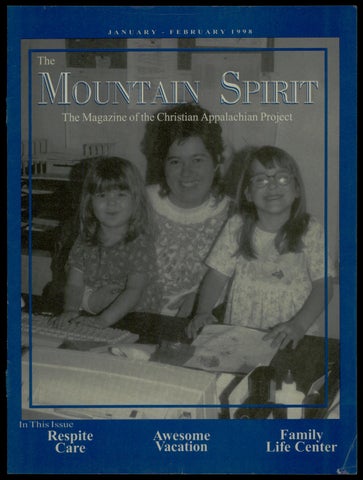
Nearly twenty years ago, the Christian Appalachian Project bought about 100 acres of beautiful countryside in Rockcastle County, Ky. Father Beiting named the area the Family Life Center, and we set about to begin programs that would help families in distress to come together, find common ground and ultimately heal. Not all of the programs at the Family Life Center today were the programs that started in 1978, but the goals are the same: to help families heal and strengthen. On page twenty-four, read about how several programs of the Family Life Center — and several other CAP programs, as well — united to help a woman reunite with her children and begin a path of independence. On page four, you can share in the trip of a lifetime. In the fall of 1997 nineteen CAPRICE and Rainbow Respite participants travelled to Washington, D.C. and “took it all in,” they said. Judging from the pictures that they’ve shared with us, we believe they took Washington by storm! On page twenty-one, Beth Dotson tells how CAP’S respite programs help to keep families strong despite the pressure of caring for a loved one with a disability. On the cover, Brenda Richardson with her daughters, Clara and Carrie (photo by Gabriel).
1
The Trip o f A Lifetime by Margaret Gabriel
Welfare: Families in Transition by the CAP News Service
Refreshing The Spirit And The Mind by Beth Dotson
Healing the Whole by Margaret Gabriel Refreshing The Spirit,
Page 4 Healing The Whole, page 16
D e PARTM ENTS 3_____R an d o m T houghts 10
A ro u n d the Proj ect
23
Letters to the Editor
29
The C A P C loseup
Published by the Christian Appalachian Project Editor M a r g a r e t G a b r ie l Graphic Design K a r e n F r a n c e s S p iv e y Circulation L in d a G r id e r E a s t Advisory Board: F a th e r R a lp h W. B e i tin g , Mike Sanders, Bill Begley, Ike Adams
The Mountain Spirit is published six times a year. The annual subscription price is $8.00. Subscriptions and other correspondence should be sent to The Mountain Spirit, Christian Appalachian Project, 322 Crab Orchard Road, Lancaster, KY 40446. Copyright, 1997, The Christian Appalachian Project, Inc. All rights reserved. Member, Catholic Press Association. The Christian Appalachian Project is a non-profit Christian service organization operating throughout Appalachia. The project operates on the philosophy that helping people help themselves is the best approach to Appalachian poverty.
A summary of the registration and financial documents filed by this organization can be obtained by contacting: in New York, Secretary of State, Office of Charities Registration, 162 Washington Ave., Albany, NY 12231; in Maryland, for the cost of copies and postage, the Secretary of State, State House, Annapolis, MD 21401; in NEW JERSEY, THE ATTORNEY GENERAL, 202-626-4380; in NORTH CAROLINA, A COPY OF THE LICENSE TO SOLICIT CHARITABLE CONTRIBUTIONS AS A CHARITABLE ORGANIZATION OR SPONSOR AND FINANCIAL INFORMATION MAY BE OBTAINED FROM THE DEPARTMENT OF HUMAN RESOURCES, SOLICITATION LICENSING BRANCH, BY CALLING (919) 733-4510; in Pennsylvania, residents may call the Pennsylvania Department of State at 1-800-732-0999; for West Virginia residents, the Secretary of State, State Capitol, Charleston, WV 25305; in Virginia, the State Division of Consumer Affairs, PO Box 1163, Richmond, VA 23209; Washington State residents may obtain a copy of the last report filed with the Washington Secretary of State by calling toll free within Washington, 1-800-332-4483; IN FLORIDA, RESIDENTS MAY CALL THE DIVISION OF CONSUMER SERVICES AT 1-800-HELP FLA or by writing to Christian Appalachian Project, 322 Crab Orchard Road, Lancaster, KY 40446. Our license number in Michigan is MICS 9933. Registration with any of the above government agencies does not imply endorsement by the state.
2
T
h e
M
o
u
n
t
a
i
n
S
p i r i t
R
A
N
D
O
M
T H O U G II T S B y
I ke
A dam s
it used to be. In all likelihood, when he is gone, our hen Father Beiting, CAP’S family reunion will be a thing of the past, at least on founder, is asked about the the scale that it has been operating. most important role that CAP Father Beiting is correct. Our sense of and can fill in the mountains he appreciation for family is critical to solving the doesn’t hesitate to insist that social and economic problems faced by modem our primary focus needs to Appalachia. be on preserving families and The last half of the twentieth century has seen reinforcing traditional family values. our society faced with problems that were simply Ironically, a fierce devotion to family has unacceptable to our grandparents. historically been regarded as one of the more positive Teen pregnancy out of wedlock, even in my aspects of Appalachian culture. We have a reputation youth, was nearly non-existent and today it is for protecting and taking care of our kinfolks with arguably the single greatest contributor to the high more determination than the rest of America. school drop-out rate. Many children will never even On any given weekend between Memorial Day and know who their fathers are. Labor Day it’s difficult to find a picnic pavilion at any Husbands didn’t get away with beating their wives park in eastern Kentucky that hasn’t been reserved for a family reunion, many of which have been annual happenings for decades. Some are so large that an entire state park couldn’t accommodate them. For example, my second cousin, Den Adams, who lives in Paulding, Ohio, takes the lead in getting the Letcher County Adams/Blair/ Thompson clan together every August. It’s a week-long affair because a brother-in-law or father-in-law, or both, and we congregate by the hundreds on a mountain top had to be dealt with when it did happen. Today in owned by Den’s deceased parents and leveled by strip Appalachia, spouse abuse centers are fully mining in the late sixties. Dozens of cousins have chipped in a little cash and lots of hard labor so that the occupied, and too often women are even killed by husbands. Justice is far too slow and too lenient on site now contains shelters, rest rooms, electricity, the perpetrators. Family too often turns cold running water and recreational amenities. It’s not unusual for five generations from a dozen or shoulders to the victims. I’m not sure where we, as a society, went wrong more states to show up and renew old acquaintances, or what we’ve done to lose sight of the very values or for that matter, to meet cousins we’ve never even that have sustained our culture over two centuries, seen before. but we simply have to right that wrong, to Unfortunately, with each passing generation, the rediscover and reinforce the importance of family urge to return home every summer for a family cooperation if we expect to rise to the challenge reunion diminishes. Den is getting up in years now and his health isn’t what before us. J A N U A R Y - F E B R U A R Y
1998
3
Christian Rppalachian Project Washington, D.C. Trip September 1997 With Gertier Tours
■xl ainbow Respite Care Center and CAPRICE travelers recently met at the Dinner Bell Restaurant in Berea, Kentucky, to share pictures of their “Awesome Vacation” to Washington, D.C., during mid-September.
T
4
h e
M
o
u
n
t
a
i
n
S
p i r i t
Madness” at the Kennedy Center and Arlington National Cemetery, including the T omb o f the Unknowns. Gloria Jordan, manager of Christian Appalachian Project Resources for Independence and Community Employment (CAPRICE) asked the group, “How many people slept for two days after you came back home?” The hand o f every traveler shot up. Along with their pictures, the Rainbow Respite and CAPRICE participants shared memories o f the trip with each other and their r n a span o f L only five days, the group saw the Lincoln Memorial, the Washington Monument, the Smithsonian, the Vietnam Veterans’ Memorial, the White House, the play “Shear
J A N U A R Y - F E B R U A R Y
1998
families. As they viewed a slide show, they reminisced about the monuments in Washington and their adventures as they travelled
“It’s hard to describe how moving that moment was,” said CAPRICE staffer Bobby Bailey.
A picture o f four group members at the Tomb of the Unknowns prompted a quiet moment, as they recalled that they had laid a wreath marked “Christian Appalachian Project” at the tomb, in thanks to the people who have given their lives in service to the United States.
I
6
11 E
M
o
u
n
t
a
i
n
S
p i r i t
“Maybe the year after next, we can plan another trip,” Jordan said. “To plan it that far in advance will give us time to . . . “ “Rest!” came a voice from the back o f the room.
Gloria memorialized one o f the travelers who passed away only weeks after returning from Washington. “The trip made her last few weeks enjoyable,” she said. Gloria and the other staff members thanked the families o f the travelers for their support, and for allowing their family members to make the trip. In thanks for the support the group received from CAP, they presented a group photograph taken in front of the White House for display in the Lancaster office. Each o f the six staffers who made the trip received a CAP sweatshirt with “I Survived the Awesome Vacation” printed on the back.
J A N U A R Y - F E B R U A R Y
1998
7
by Margaret Gabriel
WELFARE 'iS I N
|? A l i i « 1
A welfare recipient, Betty, knows that she has less than two years to obtain the education and training that she needs to enter the job market. She also knows that CAP workers are willing and anxious to help her. CAP’S symposium on welfare reform in May of 1997, part of the day focused on the effect of the changes on family roles and Kentucky dynamics. Gary Hansen, a family sociologist with the University of Kentucky Cooperative Extension Service has begun to study “the vast social experiment whose consequences are unknown, but will affect the lives of 763,000 Kentuckians whose incomes are not enough to bring them above the poverty level,” according to “Welfare Reform and Its Implications for Kentucky’s Families on the Economic Edge” by Hansen, Lori Garkovich and Patricia Dyk. The key, Hansen said in a later interview, is to focus on what will happen to families as they go through the transition of living on welfare to joining the work force. “There are studies that indicate some of the things that
“We’re talking
about major life
transitions for some people who aren’t used to getting up
and going to work every day.
T
8
be a lengthy process, and “there’s no magic bullet,” Hansen said. “It’s going to be an overall effort working with parents, working with schools, with social service agencies that work with families to support them over time.” Hansen suggests maintaining what he calls a “hierarchy of responsibility” that begins with the self, then progresses to family, community, and government at local, state and federal levels. “Ultimately, the goal is individual selfsufficiency, but the family has the responsibility for those who can’t make it, children, for example. If families aren’t able to provide, then the community has the responsibility.” Local, state and federal governments follow, but for
help make families resilient, who have the ability to bounce back when things go wrong, are community-based and comprehensive.” Hansen said a lot of the programs that he sees developing are strictly job-based and focused on getting people into the job market, but are not focused on helping people to keep a job. “We’re talking about major life transitions for some people who aren’t used to getting up and going to work every day. These are other, broader life skill aspects that we’ve been forgetting about. Programs have to focus on causes rather than just symptoms,” he said. By concentrating on symptoms, families will be able to break the cycle of poverty, but to do so will h e
M
o
u
n
t
a
i
n
S
p i r i t
the hierarchy to be productive, from each other than Hansen said, we all have to be from the people that are involved with the next level. coming in to speak. It’s For many people, Hansen said, subtle, but that’s a good the changes in the welfare example of things that program will be the next in a line can happen with a of stressful events that have a comprehensive cumulative effect. “All the studies program.” show that it’s the accumulation of The role of fathers in stress. It’s not just being poor, but families that are making changing or having to start a new transitions due to job or living in a single parent welfare reform is household. The more of crucial, said Hansen who those things that accumulate at one has conducted a study in time, the more likely children which he asked middle are to have major problems. So, school and high school with welfare reform it’s not just students in rural do they get a job, but as they go Kentucky whether their through the transition, how many fathers care about them, of these stressful conditions are are involved with their there, and what’s the cumulative lives. “Across the board, effect?” most of the things that In order to help families with put kids at risk — taking this stress, it is imperative drugs, using alcohol, that CAP and other service engaging in sex at an providers think beyond just early age — the kids that Gary Hansen, a fam ily sociologist at the University equipping people with the job skills said that their fathers o f Kentucky. needed to leave the welfare rolls, didn’t care about them Hansen said. comes to gender expectations. were two, three, four times as Support networks are valuable likely to engage in risky behaviors. What’s the dynamics of that when structures for people who are men have little hope of finding Getting fathers involved in their making big transitions during [mining and manufacturing] jobs children’s lives is obviously stressful times. “When a family and the jobs that are there are important. Most of what we hear experiences stress, it’s often a traditionally held by females? What about fathers when it comes to time when they withdraw from does that do to the family welfare reform is to get them to community and church, but support pay child support.” dynamics?” networks are the kinds of Hansen stressed that it is Hansen suggests that a degree of things that happen with important to remember that welfare flexibility will enable families to comprehensive programs. I’m reform is designed only to reduce deal effectively with the changes thinking specifically of a series the number of people on welfare. that will occur as a result of that God’s Pantry Food Bank does welfare reform, and with the “We need to think broader than that. called Super Pantry [a six-week We need to think about what’s changes that have been occurring program of hands-on cooking going on in these people’s lives as the economic structure of the demonstrations and other lifethey’re going through the mountain communities. skills discussion. See The transition.” “So many of the jobs that have Mountain Spirit, January-February been lost in eastern Kentucky are Throughout the year The Mountain 1997]. I’ve gone and talked about the traditionally male jobs, and the Spirit will explore the effects o f welfare stress management, and it seems reform on the people served by CAP jobs that are there are relatively that the people who have been low-paying service jobs that women and discuss in greater depth the topics attending for four and five and six are doing. You’re talking about a that were presented at its symposium in weeks are probably getting more May. very traditional culture when it J A N U A R Y - F E B R U A R Y
1998
9
A
r
T he
o
u
n
d
P roject
Child Development Center in Berea Holds Trike-A-Thon To the cheering of classmates, teachers, parents, brothers and sisters, 15 Christian Appalachian Project Child Development Center students in Berea completed 330 laps for their 1997 Trike-A-Thon to benefit St. Jude Children’s Research Hospital. This is the third year that the center has participated in the event. Kim DelRe, manager of the center, encourages the children to participate because of the research aspects of St. Jude Hospital. “This is a good way for children to learn the value of helping other people,” Kim said. “Also there have been some of our CAP kids that have benefitted from St. Jude. They’ve needed services and St. Jude has been able to help them.” The Trike-A-Thon packet from St. Jude includes information about bike safety, which teachers incorporate into a week-long unit that helped the children prepare for the Trike-A-Thon. The packet also included pictures of children who have been helped
Pre-schoolers at the CAP Child Development Center in Berea ride 330 laps around the trike-track to benefit St. Jude Children’s Research Hospital.
Parents of the trike-riders gathered pledges from family and friends. Kim said that parents are happy that their children are learning the rules of bike safety, as they help others as well. “It’s an activity that parents really like to be involved in,” Kim said. “It’s a way for them to be involved in their children’s school activity.”
by the hospital. “Mary [Mundy, head teacher] showed the calendar with the pictures of patients and told them that when they rode their trikes, they’d be helping kids get better when they got sick.” The children always respond well to the idea of helping other children, Kim said.
Pantry to Open in Jackson County The Christian Appalachian Project elderly services program is planning to open and operate a food pantry in Jackson County, one of the most distressed counties in the state. The pantry will operate out the office in McKee, the county seat, and will enable elderly services workers to make sure that the fifty or so folks who
participate in the program are able to maintain healthy levels of nutrition, according to program manager Zayda Hurd. “So many of our elderly receive food stamps, and sometimes they just don’t make it to the end of the month,” Zayda said. “When elderly people are malnourished other health problems get worse, as well.” T
10
h e
M
o
CFC Contributions Christian Appalachian Project is a participating agency in the Combined Federal Campaign. Federal and military employees can contribute to CAP by designating #0898 on the CFC pledge card.
u
n
t
a
i
n
S
p i r i t
R O U N D
A
T he
P roject
CAP Thanks Donors, Volunteers for Successful Basket Distributions The Christian Appalachian Project outreach program would like to thank all of the CAP supporters that made the Christmas basket program so successful in 1997. Nearly one thousand CAP donors supplied toys and gifts for families through the CAP program. Gifts and food were also provided to over 700 elderly couples and individuals. Instead of a food box, families this year received a food voucher,
which enabled them to select family favorites from local grocery stores. Once again, volunteers Ed and Jay Barrett from Vermont, Pierce and Gladys Gay from Iowa, Laura Atkinson from Kansas and Bev Alcoser from Pennsylvania prepared the Christmas baskets for distribution in nine locations throughout the CAP service area the week before Christmas.
Human Development Hosts Luncheon for Colleagues The Christian Appalachian Project recently hosted an appreciation lunch for the Rockcastle County Department for Social Services. The luncheon had a two-fold purpose: to strengthen the partnership between DSS and CAP and to present DSS with toys for their family visitation room. Many of CAP’S programs work with DSS to serve Rockcastle County families and individuals. The luncheon gave CAP the opportunity to express appreciation for the working relationship that has been developed over the years. “We work with them so much in most of our residential programs,” said CAP assistant director Garry Vickers. “We understand that they get overloaded, and wanted to let them know that we appreciate their efforts.” The visitation room, which is used by families that are working
to rebuild lives and relationships, is now supplied with toys and games that were donated by CAP. “We’re looking into doing this in other areas, too,” said Vickers, who also noted that several DSS workers are former CAP volunteers.
Moving? Please notify us of any change of address to make sure you receive every issue of The
Mountain Spirit. Please print
O ld A d d r e s s
N ew A ddress
Mail to: The Mountain Spirit 322 Crab Orchard Road Lancaster, Kentucky 40446
In appreciation fo r a good working relationship, CAP human development workers share lunch with Kentucky Department fo r Social Insurance workers.
J A N U A R Y - F E B R U A R Y
1998
A
r
T he
o
u
n
d
P roject
Rockcastle Elderly Share Thanksgiving The Rockcastle County participants of the Christian Appalachian Project elderly services program were treated to a Thanksgiving celebration by the staff and volunteers. The luncheon was served in the Rockcastle Teen Center by the members of Garry Vickers’ management team. “We wanted to get together to meet some of the people in Zayda (Hurd’s) program (elderly services manager). This seemed like a good way to thank and honor these folks,” Garry said. Vi Ellis, a former CAP volunteer who has remained in Mount Vernon, and active with her elderly friends, fixed her delicious turkey, stuffing and gravy, and other volunteers made sure that none of the twenty diners went home hungry. Zayda plans similar gettogethers every four to six weeks, she said, but never has to put together much of a program. “The folks just like to get together to talk and visit,” she said.
Memorial and Honor Gifts Respecting the wishes of deceased loved ones, or in honor or them, families often request that memorials be sent to us. Memorial gifts live on to benefit others. Many also specify memorial gifts in their wills. Any size gift is welcome. Contact us for more information.
Manager o f CAP human development programs serve lunch to the participants o f the elderly services program in Rockcastle County.
What Can I Do to Help the Christian Appalachian Project? hours, donating time to helping the people of Appalachia help themselves and their families out of poverty. If you would like to volunteer a year or a summer to working in Appalachia, please contact: The Mountain Spirit, 322 Crab Orchard Road, Lancaster, KY 40446. We will see that you receive information about CAP’S volunteer program. Finally, our most powerful form of assistance is prayer. We believe that if our supporters spend at least one minute a day praying for poor people every where, mountains can be moved, the course of rivers can be changed. The CAP family forms a powerful prayer network reaching into Appalachia and across the nation.
Christian Appalachian Project supporters often ask what more they can do to help eliminate suffering in Appalachia. First, we tell them, you can tell others of the problems in Appalachia which you learn about in The Mountain Spirit and other CAP publications. You might want to share this magazine with a friend, for example. If you’d like, drop us a line and we’ll send you a replacement copy. Ask us about the problems in Appalachia and we’ll be happy to share any knowledge we have or to refer you to another organiza tion that can help you. Secondly, you can give us a most valuable commodity — time. Since 1950, thousands of people have worked millions of
TH E
M
o
u
n
t
a
i
n
S
p i r i t
A
r
T he
o
u
n
d
P roject
Father Beiting Represents Eastern Ky. at Seminar Father Ralph Beiting, founder of the Christian Appalachian Project and pastor of the Catholic churches in Lawrence and Martin counties, was a special guest of Peter Lowe, founder of Success, an organization that promotes positive thinking as an essential ingredient to success in any field, at a motivational seminar in Louisville, Ky. Speakers for the seminar included Lowe, actor/director Christopher Reeve and General Colin Powell. Father Beiting, representing eastern Kentuckians as well as clergy, was one of ten Kentuckians invited by Lowe to have dinner with Colin Powell.
The two renewed the acquaintance they had made in Philadelphia when they attended the President’s Summit for America’s Future in April. As each dinner guest shared information, Father Beiting told of his 47 years in Appalachia, and the work of the church and of CAP. Fie reports that his dinner companions were most interested by his descriptions, and asked several questions. “The evening ended and each left a little better than when dinner began,” Father Beiting said. “There was a pride in being part of America and a determination to make the best of the time remaining in this century.”
Successful Family Retreat
What You Don't Know About Wills Can Hurt Your Heirs. . Find Out Why. "** Request j *
Much of what you know about wills may be misinformation that has been floating around for years. If you think, for example, that wills are primarily for rich people, or elderly people, you may be the victim of a common misconception. The helpful book let offered here will explain how your will can save your heirs from costly delays and confu sion. Send for your copy today. Clip and Mail
Christian Appalachian Project 322 Crab Orchard Street Lancaster, Kentucky 40446 Please send without obligation your booklet, “37 Things People ‘Know’ About Wills That Aren't Really So.” N a m e _______________________ Address_
For the third year, CAP conducted a retreat fo r families involved in CAPRICE, Rainbow Respite and Parents Are Teachers. The retreat gives families the opportunity to share the sorrows and joys o f having a family member with a disability. While the mothers and fathers meet together, and talk with counselors and other professionals, the adults and children with disabilities participate in activities and outings.
J A N U A R Y - F E B R U A R Y
1998
C ity ____ State,ZIP
13
A
R O
T he
U
D
N
P roject
Job Start Students Apply Themselves The Christian Appalachian project was among eighteen programs that received funding from the state of Kentucky to assist with adult education. Job Start is a program designed to equip students, mostly mothers who receive welfare, with the skills they need to successfully enter the work force. Although most of the participants in Job Start are women, a man enrolled recently and has been making great progress toward selfsufficiency. A single father of three children, Rodney was attending the classroom portion of Job Start several hours a day, and working with Ken Stuber in CAP’S home repair program, as well. When he began working the
volunteer, reports that Rodney frequently talks about the role God has played and is playing in his life. “We look at what a hard life he’s had, but instead of talking about what he doesn’t have, he talks about what he does have,” Pete said.
numbers involved in carpentry and home repair, his skills and comprehension skyrocketed, according to adult education manager, Paula Woodman. Pete Fochtman, home repair
Job Start participants list barriers on a “ladder to success, ” and one by one learn to overcome them.
Have an Adventure in Beautiful Appalachia! Volunteer for a year or a
Christian motivation to
summer with the Christian
serve people. One-year
Appalachian Project. We
volunteers receive room
are in need of energetic,
and board, a monthly
open-minded people to
stipend, health insurance
outreach, spouse shelters,
staff our many human
and loan deferment infor
youth and teen centers
service programs here in
mation.
and more.
eastern Kentucky. Volun
We need one-year
Join others from around
teers live together, sharing
volunteers (age 21 or
the country by putting your
meals, prayer and the
older) to serve in child
faith into action to fulfill a
challenge of fighting pov
development, adult educa
dream for Appalachia. For
erty as they support each
tion, home repair, elderly
more information, call
other through their strong
programs, respite care,
800-755-5322.
T
14
h e
M
o
u
n
t
a
i
n
S
p i r i t
A
R O U N D
T he
P roject
Camp AJ Gives Museum Experience to Children Elementary school students from Jackson and the surrounding counties were hosted to “Kids’ Time,” a children’s museum that is directed by the staff of Camp Andrew Jackson. “We’re set up in the dining hall and two dorms,” said camp manager Lauri Eiselt. “There’s a lot of hands-on exhibits — weights and measures, mirrors, bubbles. There’s a physics demonstration area that shows reactions with levers and pulleys.” Lauri is excited about a new display that has been added to the museum, which is operating for the fourth year. An “archeological dig” features both antique and contemporary items which the students dig and identify. An interactive environmental section displays animal tracks painted on a board, with the picture of the matching animal concealed. Students guess the animal which made the tracks and can immediately verify whether the guess is correct. An erosion machine shows students the effect of water on its surroundings, and one entire room is devoted to various sensory experiences. As new volunteers join the Camp AJ staff each year, they add their ideas to the museum displays, Lauri said. “That’s really good, because we have a lot of the same kids every year, so they get to see something new and different.” The hands-on and interactive activities “really reinforce KERA
[the Kentucky Education Reform Act],” Lauri said. “After they get back to the classroom, they can write about what they did, or have reading or math activities that relate to the museum. Every teacher leaves with a book of extension activities that they can use.” As many as 80 students a day visit Camp Andrew Jackson to see the exhibits, which Laurie says rival the children’s museum in Lexington, over fifty miles away and a difficult and expensive trip for most classes. “It’s great to have something so close that they need and want.”
J A N U A R Y - F E B R U A R V
DOUBLE Your Dollars! If you are a CAP donor, or are considering becoming one, you may be eligible to double your gift through your em ployer’s matching gift pro gram. Many companies today match monetary support to non-profit community service organizations that are supported by their employees. Many of these companies match the gifts that are made by their retirees as well. Please write for your brochure “Double Your Dollars,” which lists participating companies and instructions. Send correspondence to:
Teresa McAnly, CAP 322 Crab Orchard Road Lancaster, KY 40446
Teachers in Jackson County say that the hands-on science display at Camp Andrew Jackson rivals museums in nearby cities, according to camp manager Lauri Eiselt.
Visit CAP’S Web Site! Are you looking for information about a CAP program that you don’t see in this issue of The Mountain Spirit! CAP’S web site includes information about all of CAP’S 1998
human development programs, planned giving and major gifts and the volunteer program. Please visit the site at www.chrisapp.org. And be sure to sign our guest book!
Refreshing The And The
CAP respite programs serve families who
B y Beth Dotson k # 3 rolyn Butt understands why disabilities frighten some people. Seizures petrified her until her own sister was diagnosed with epilepsy She also dreaded caring for people with feeding tubes, worrying that the tube would come out while she fed them.
developmental activities to her charge. Barb knows the fear of being on her own with no one else to turn to when she must suction a tracheotomy or give medicine. But she also knows that her work comforts the family and enhances the life of the participant. “If s a big comfort for those families knowing that you’re going to come into the home rather ____________ than them taking their child somewhere. They know that they’re in their own surroundings,” said Carolyn Butt, now the program manager of Rainbow Respite, of which the in-home program is a component. Even if the respite worker takes the child or adult on an outing, the family still knows where they will be. They don’t have to fully let go of them as they would if they took them to Rainbow Respite for a week. “We have so many parents that just can’t get out if they don’t have somebody there,” said Barb. “And a lot of people are afraid to stay with somebody like Matthew because he’s so fragile.” In-home respite caseworker Barb Rector provides friendship and developmental activities fo r Bobby and eighteen other people with disabilities, both adults and Matthew Brock is a 15-
lie working with people with disabilities in a cChristian Appalachian Project program, one little boy pulled out his own feeding tube. Carolyn immediately called the doctor to get instructions for reinserting it, which she completed successfully. “After that, I thought I was a pro,” she says now with a laugh. Carolyn is one of the rare people who has overcome her fears about being around people with disabilities in order to provide respite care for the families who live with these loved ones every day. She was a volunteer in 1985 when CAP began providing weekend services to families who had children with disabilities, conditions ranging from spina bifida and cerebral palsy to mental retardation and blindness. Many of these people struggle with multiple disabilities. To give the family a rest from the all-consuming care responsibilities, CAP first offered families a place to bring
W
-
their children for the weekend. Since then, CAP has expanded to offer week-long programs at the Rainbow Respite Care Center and in-home care to families within 50 miles of the center in Mount Vernon. Through Rejoice Respite, headquartered at the Hagerhill office, CAP provides in-home care for families in ten counties in the southeastern comer of the state. Rainbow Respite employee Barb Rector has 19 families on her inhome caseload. She goes to their homes for four to six hours periods to relieve the family and to provide
“It’s a big
comfort for those
families
knowing that you’re going
to come into the home
rather than
them taking their child
somewhere.”
children.
J A N U A R Y - F E B R U A R Y
1998
17
Janice feeds him again at noon and later takes him from his bed into the living room where he might be able to sit up for an hour. Sometimes, Janice is up during the night three or four times with Matthew. He easily contracts any illnesses his sisters bring home from school. During the winter months, Janice said she takes him to the doctor every two weeks or so because he stays sick. But even going to the doctor doesn’t always give her any easy answer for helping him get well. Because she uses a state-issued medical card for his care, she has to maneuver a maze to get prescriptions and medicines approved for him. Some prescribed medicines must be preauthorized by the state, which has at times taken more than a week. Making trips to the
year-old who spends one-week centermost of his day in based programs, bed and a good but Barb visits him portion of it napping. twice a month. He was bom healthy, Janice is the the youngest in a person who cares family of four. for Matthew every When he was ten day, along with her months old, he two teenage contracted Reyes daughters. Her day Syndrome. begins early when Matthew’s mother she gets the two Janice first learned girls off to school, about CAP ten years then she feeds ago. Matthew and his Matthew. He sister, Jessica, who usually naps after has Down Syndrome, breakfast, giving Carolyn Butt were among the first Manager her time to tend to children to Rainbow Respite her housework and participate in the other things she weekend respite needs to do. Two program. Now, Matthew is not mornings a week, a teacher arrives able to attend Rainbow Respite’s at 11:00 to work with Matthew.
“W e are not babysitters. W e do not go in and just
sit . .
Matthew Brock’s mother, Janice, shares pictures with Barb and Rainbow Respite manager Carolyn Butt. When Matthew was a pre-schooler, and newly enrolled in Parents-Are-Teacher, a homebound CAP early intervention program, he appeared on the cover o f The Mountain Spirit with his teacher.
T
18
h e
M
o
u
n
t
a
i
n
S
p i r i t
doctor or pharmacy are not easy for Janice and Matthew. The nearest pharmacy is 35 minutes away. “You learn as you go and talk to other doctors and parents and kind of see what they do. You ask lots of questions of people who come in and work with him,” Janice said about how she cares for Matthew. She recalls one time when she took Matthew to the health center for a shot and they Like the program in Mount Vernon, Rejoice Respite, in Floyd County, enables fam ily to take the told her they break they need to continue caring fo r loved ones. couldn’t administer it Teachers, through which she because he has seizures, although wash the dishes that had been found some information and they had given medicine to him piling up and begin preparing the support. Recently, a parent who previously regardless of the house for winter by putting has used Rainbow Respite seizures. So Janice got the plastic over the windows. services organized a support medicine and took it and Matthew Carolyn said that for families group for families in Mount to the doctor’s office where he like the Brocks, it is difficult Vernon. There is also a nursing administered the shot. Sometimes service that offers in-home care because “They are alone out it’s a complicated process, but there.” Sometimes neighbors and twice a week. Janice works hard to get Matthew family members are afraid to visit When the nurses or Barb come what he needs. because the person being cared into the home, Janice might go to Through the years, Janice and her a neighbor’s place or just catch up for might get sick while they are children have participated in a there. on her work around the house. On variety of CAP programs including a November day when Barb Janice said it takes time for her child development and Parents are arrived, she said she planned to to develop trust in someone who J A N U A R Y - F E B R U A R Y
1998
Russ Taylor, manager o f CAP’s Rejoice Respite.
offers to stay with Matthew. “You don’t hardly trust yourself,” she said. She watches how Matthew interacts with people and his actions tell her if it’s a good match. After working with Matthew for a few months, Barb is still trying to find games he will enjoy. Some are too simple for him and others don’t keep his interest. She recently discovered a musical story game that makes him happy. “We are not babysitters. We do not go in and just sit,” Carolyn said. The in-home care is designed to provide developmental stimulation and growth experiences. Janice appreciates this because so much of her time is consumed by meeting Matthew’s basic needs that she doesn’t often have time to do things like read to him.
Bobby is another person with whom Barb works. Bobby is 43years-old, legally blind and has some mental retardation. He lives with his sister and works at a restaurant. Other than his work, he doesn’t have much opportunity for social activities and spends much of his time alone. So when Barb visits him, they always go on outings. Although Bobby would be happy to go bowling every time they venture out, Barb also introduces him to museums, parks and other activities she thinks he will enjoy. Barb’s relationship with Bobby goes back to when she was working with Christian Appalachian Project Resources for Independence and Community Employment (CAPRICE), CAP’S training program for adults with disabilities. Barb was with Bobby T
20
h
e
M
o
when he was fired from a job at another restaurant, a heartbreaking experience for them both. Although she doesn’t work at Rainbow Respite’s in-center program, she was there to welcome him for the first time for a week in November. “One thing that the in-home providers can do, and they do it well, is they can build that trust with those families and then they can start talking to those families about the center-based program and the benefits of using the center-based program where they are able to have an extended break. They can go on vacation or they can just have a week with their other kids or a week by themselves or whatever,” Carolyn said. Besides giving the family a break, it also helps the participant begin to develop some u
n
t
a
i
n
S
p i r i t
independence and contacts outside the family. That is important because their family might not always be around for them. To encourage respite participants to plan for the future, Carolyn has been participating in personal futures planning workshops. This is a way of helping a family and child work together to plan what will happen when the caregiver is no longer able to provide care. At that time, they generally go to a family care home, group home or institution. Carolyn said funding cuts have diminished the number of people who received assisted living grants that would enable them to hire a staff person to live with them. Decreased government funding has also increased the caseload for CAP’S Rejoice Respite program. With fewer home health workers available,
“One thing that the in-home providers can do, and they do it well, is they can build that trust ...” Carolyn Butt
Manager, Rainbow Respite
CAP strives to fill the void. Program manager Russ Taylor said the initiative in the Big Sandy region of the state began in 1993
to provide relief to families who have a loved one who requires 24-hour care. They serve 76 people of varying ages — from birth to their oldest participant, who is 108. These folks are living with a wide range of physical disabilities as well as problems associated with old age, such as dementia or Alzheimer’s disease. When one of the program’s two employees or three volunteers goes into a home for five to seven hours, Russ said, “The caregiver is refreshed. It’s a renewal of their spirit, mind and attitude.” They are able to go out shopping or do other things that usually are not possible because they don’t have anyone with whom to share the responsibility of care. “Some of them are pleased just to go to bed and rest,” Russ said. He also emphasizes that the
Janice Brock has been involved with CAP programs since her fifteen-year-old son, Matthew, was enrolled in C A P ’s early intervention program. Currently, the fam ily receives services from Barb Rector, a CAP Rainbow Respite worker. J A N U A R Y - F E B R U A R Y
1998
21
comes from a sense of being Christian and sharing their love for the Lord,” Russ said. It’s a job that they do for more than the salary. “People can sense that when we go into the home.” Through experience and prayer, respite providers overcome their fears and develop skills that make their services invaluable. Although Janice Brock appreciates the respite assistance she receives, she looks elsewhere for her true strength, perhaps to the same source the respite providers call on. Janice said, “God is the Matthew Brock receives visits about twice a month from Barb, and works with a homebound public school only thing that teacher teacher every day. keeps you going or you wouldn’t be able to work is a real ministry. Besides Sometimes they connect the do it.” helping the caregiver, the respite family with other available provider also offers a new ear for services and help make contacts the participant. If they have an with agencies or doctors. For the illness that they need to talk caregiver, it is uplifting to know Former CAP volunteer Beth Dotson, about, or complain about, the a freelance writer, lives in that there is someone else who Lancaster, Kentucky and is a respite provider is there to hear wants the best for the loved one. regular contributor to The Mountain what they have to say. “We give “Our staff has a deep concern Spirit. them refreshment and a new hope for those they minister to that because we listen,” Russ said. T
22
h u
M
o
u
n
t
a
i
n
S
p i r i t
L etters to the E d itor I enjoy reading every issue and am very pleased to read of the progress that is being made to help these unfortunate, brave people. God bless them all, especially the wonderful people who make up CAP and Father Beiting, the founder. Congratulations for being recognized for outstanding work by the Catholic Press Association. You deserve it. Mrs. L. Kenneth Walter Milford, N.J.
The Mountain Spirit is so real and well written! There is a “spirit” that provides one of support of one another. Those ministering to others have such a sincere expression on their countence. When the magazine arrives, I truly look forward to reading it. By doing so, I feel as if I’m sharing in each article. Sister Mary Happ Langhorne, Pa.
I find your magazine very interesting. I passed on the last one to a man at my church who heads up our Habitat for Humanity work group. I’m sure he found it very interesting — your “Hammering in the Hills” story, etc. Betty Langevin St. Paul, Minn.
I love to get your magazine, I know the stories and articles are true. I subscribed for one to be sent to my daughter. She likes it also. If possible I read it all as soon as I get it. Thank you! Margaret Holloway Louisville, Ky.
The Mountain Spirit is momentary trip back in time and places when people remembered that we serve God best in serving each other. Jim Farris Culpeper, Va.
I never cease to be amazed by the huge variety of programs and services that CAP has available to the people of the Kentucky Appalachia region. I love to read about these programs and services in The Mountain Spirit. People helping people to help themselves is what it’s all about. I found out just a couple of years ago that my ancestors came from Whitley County, Ky., and that makes me feel like I have an inherited tie to the people of Appalachia. I love it! Mrs. Pollyann Patterson Mision Viejo, Calif.
J A N U A R Y - F E B R U A R Y
Every time I receive The Mountain Spirit I take time out to read it from cover to cover. It is a joy to know that the people are being helped to become self-sufficient, and to see that they in turn are helping others. May God bless you and all the workers involved in this wonderful project. Margaret M. Coon Toledo, Ohio
We thoroughly enjoy reading The Mountain Spirit and the wonderful things you’re accomplishing in providing housing for the needy in Appalachia. Truly they are the rewards we feel in helping others! We’ve supported Millard Fuller, the founder of Habitat for Humanity, and Jimmy and Rosalyn Carter, in their works for some time, and will continue to do so. We greatly admire all of them. Enclosed is our subscription renewal to The Mountain Spirit for one year. Mrs. Tal A. Lloyd Los Gatos, Calif. Letters to the editor are welcome. They should not exceed 150 words in length, and we reserve the right to edit them for space. Address letters to: The Mountain Spirit Christian Appalachian Project 322 Crab Orchard Street Lancaster, KY 40446
1998
23
o
:
)u(y 11, 1997, bRcndA soARred doom a ROAd rhAr cuouCd chAnge heR (ipe And sec An unpRecedenred numdeR op ChRisdAn AppAtAchiAn pRojecr pRogRAins luorH rogerheR ro he(p heR Achieve heR goA(s. I
24
h
e
M
o
u
n
t
a
i
n
S
p i r i t
roblems for low-income people rarely come one at a time. It is far more common to see problems plague people and families in twos, threes or even packs. Christian Appalachian Project programs, in order to help people achieve self-sufficiency, must work together so people can solve problems and settle issues one at a time, or by working simultaneously on more than one problem at a time. Such was the case with Brenda, a young mother of two little girls who came to CAP with a multitude of problems. Brenda had been separated from her daughters, five-year-old Carrie and three-year-old Clara, for sixteen months. She told Family Life Services workers Sherry Allen and Liz Phelps that she would do anything to get her girls back. Lacking confidence and healthy self-esteem, Brenda spoke nervously during the interview which is required for admission to FLS. She told Sherry and Liz that she had been living with Clara’s father, and that their troubled relationship had resulted in the children being placed in foster care. Like most people who participate in Family Life Services, Brenda was largely without resources — physical, emotional or spiritual. “We’re set up for people who are in transition or in crisis situations,” Sherry said. Most of the people who come to them looking for
assistance are victims of some type of abuse, unwed mothers over the age of 18, single parents, or people who are homeless due to some other circumstance. In the course of their interview, Liz and Sherry determined that in order to reach her goals Brenda would need to participate in several CAP programs, and make efforts in a variety of areas.
Family Life Services is one of several programs at the Family Life Center which was established in 1978 to help families overcome crisis, heal and discover ways to recover and maintain healthy relationships. The Family Life Abuse Center is a spouse abuse shelter which
J A N U A R Y - F E B R U A R Y
provides a safe shelter for families that have been victims of domestic violence. The Rainbow Respite Care Center is a residence that provides care for adults and children with disabilities who are usually cared for in their own homes. Through the Family Life Counseling Service, families that participate in Family Life Center programs, as well as people in over a dozen surrounding counties, have access to professional psychological counseling, both individual and group sessions. CAP’s Adult Learning and Family Life Child Development centers round out the services, providing adults with GED and literacy training and children with early intervention and pre-school activities. Before Brenda had finished with her journey, Family Life Services had connected her with the Family Life Counseling Service, the Adult Learning Center, a CAP job training program, the Attic (CAP’s used clothing stores), CAP Child Development and the Appalachian Development Corporation (a CAP for-profit subsidiary). Supporting roles for assistance came from CAP’s accounting and maintenance departments. Anyone who chooses to begin the program at Family Life Services enters into a contractual
1998
25
out. Depression and stress sometimes cause circuits to get overloaded, but the answers are still within,” Bill said. “They just need to go fishing to find them.” Years of successful counseling and the word of mouth of “satisfied customers,” Bill said, has led people to have the faith in the service and courage to make calls to see CAP counselors. “We’re unique because we have the liberty to do creative things in counseling,” he said. Family Life Counseling, both individual and group sessions, helped Brenda to look inside herself and realize that with hard work and perseverance, she could reach her goal of reclaiming custody of her children. “I knew I could do it if I put my head to it, “ Brenda said. “I’m the kind that doesn’t give up.” Brenda’s contractual agreement with Family Life Services required that she begin working on her high school equivalency diploma (GED), which was available at CAP’SAdult Learning Center and easily accessible on the grounds of the Family Life Center. After beginning her GED
Five-year-old Carrie proudly shows one o f her favorite dolls, a resident o f her new bedroom.
agreement that requires shared chores, adherence to house rules, parenting and/or life skills management classes and group and individual counseling. Rent is paid on a sliding scale, according to means. After any monthly bills are paid, half of the remainder must be deposited to a personal savings account and the rest is subject to a budgeting process which is part of the life skills management process. Alcoholics Anonymous or other twelve-step programs are required for people who have a history with substance abuse. “Brenda was told [by social workers] to come to FLS,” said program manager Liz Phelps, “but the choice was still hers. She had been here before but only stayed a few days. When she came this time, she was ready to make some changes.” Residents come to FLS with a variety of motivation for change, and for Brenda, it was the desire to reunite with her children, Liz said. “I think she found herself here, too. She found that she was
worth standing up for. She just needed a few stepping stones, and she found that she wouldn’t need them forever.” For Brenda, counseling was one of those stepping stones. Although counseling isn’t always necessary for everyone, according to Family Life Counseling Service manager Bill Belcher, the process enables many people to acquire more of the tools needed to make the necessary changes in their lives. Bill said that counseling often simply reminds people to use the tools that have always been there, and that “by using God-given creativity, Family Life Services coordinator Sherry Allen coos to the infant they come o f a resident. T
26
h e
M
o
u
n
t
a
i
n
S
p i
r
i t
study, Brenda was invited to enroll in CAP’s newlyestablished Job Start, a tenweek job training program that helps participants acquire the skills needed to enter the job market. In addition to learning about interviewing, resumes and bookkeeping, Job Start also helps people identify their strengths, shore up their weaknesses and reach the emotional state needed to successfully balance work and home. The program is CAP’S response to welfare reform, and is designed to enable people with little, if any, job experience to begin to acquire
“PcopCc
stcXRr ro
TYioRC
conpidenr
Family Life Counseling Services manager Bill Belcher and participants o f CAP’s elderly services program in Rockcastle County.
pee( c\nd
rhc\r even spReads rheiR
ro
chKrken.
T h e y ’Re
hopepui
rhc\r
posirive
changes
can
6e made, and rh a r rheyRe
Ready
conrRoC
oveR
in
cuhar
h ap p e n s.” Paula Woodman Manager, CAP Adult Education
J A N U A R Y - F E B R U A R Y
the skills needed to enter the work force. Recently the recipient of a $385,000 grant from the state of Kentucky, people who participate in Job Start can use the program as the 20 hours that they must spend each week in a training program in order to continue to receive cash assistance from the state. Paula Woodman, manager of CAP’S adult education programs, identifies education as a crucial component of Job Start. When people have success working on high school equivalency or literacy, it paves the way for learning job skills, Paula said, and gives people a degree of success that they might not have experienced in the past. “People start to feel more confident and that even spreads to their children. They’re hopeful that positive changes can be made, and that they’re really in control over what happens.” 1998
With the beginning of Job Start, Brenda was making tremendous progress toward her goal of re establishing her family. Although she was attending parenting classes as part of her contractual agreement with Family Life Services, Brenda thought that by taking one extra step, she would be able to conclusively show the Department for Social Services how serious was her desire to make changes in her life. After contacting CAP’s Family Life Child Development Center, Brenda was accepted as a community volunteer and was able to put the good techniques that she learned in her parenting classes to use with the children in the center. Brenda quickly became a favorite with the children and the teachers in the center, and was one step closer to bringing her little girls home with her. At the end of the ten-week Job Start summer session, Brenda applied for several jobs and was hired in a local restaurant. Soon she had saved enough money to buy a car and purchase the needed insurance.
27
When the Appalachian Development Corporation, CAP’S for-profit subsidiary, asked for a candidate from the summer Job Start class that might be available to manage its rental houses in Berea, volunteer teacher Sandy Spalding identified Brenda as one who would be interested in the position and capable of handling the responsibility. Once, when asked by a Family Life Services staff member what her life would look like if she had a magic wand and could make her life look like anything she wanted, Brenda said, “First of all, my daughters would be with me. We would have a nice little house together, and I would have a job, so I could buy them things they needed.” With the possibility of the ADC job, the work that Brenda had put in on education, life management, parenting skills and counseling came together, and it appeared the her goal of reuniting with her daughters and living together in a nice little house was within grasp. In order to present the best face possible, Brenda rehearsed for her job interview with
counselor Bill Belcher, selected a business-like outfit from CAP’S used clothing storage and hit a home run. Brenda got the job as the rental property manager. The job includes a nice little three bedroom house on the property, and the same week she got the job, Carrie and Clara were home again with their mother. From the beginning of this story until the end, one finds people and programs in partnership. The programs at the Sherry provides encouragement to a resident. Family Life Center, and throughout CAP, work says that networks are formed and together to provide families and strengthened in therapy groups, individuals with the stepping and that groups almost always stones they need to live full, form an informal network after healthy lives. the therapy days are completed. Liz Phelps, with Family Life “We find clusters of former Services, said that one of the most residents [that have been in group important lessons that they have therapy together] coming up with to teach their residents is the solutions to their own problems. importance of interdependence. They gain their own momentum in “They can’t do it by themselves,” helping one another.” Liz said. “I’ve seen so much of The friendship and bonding that, especially in this past year. involved in Job Start is one of the Everyone elements that makes the program is working successful. Instead of feeling that together — they are alone and isolated, with families, problems no one else has or friends and understands, participates learn agencies.” from one another that “They’re all Garry in this together.” Vickers, Paula Woodman plans to ask assistant Brenda to form a network of director of people who live in her rental human houses to begin a GED group that development, can meet in the afternoons. With and a her message “Hang in there — former don’t ever give up,” Brenda can counselor serve as a role model and in the Big cheerleader for people who can Sandy look to her for support and region, encouragement. T
28
h e
M
o
u
n
t
a
i
n
S
p i r i t
Hazel Evans
li
V,
T
C A P
h e
C
l o s e u p
“Our employees and their families are vital to hands-on service, so human resources is crucial to CAP’s success. ” Hazel Evans
On one hand you have a worker who helps families rebound from crisis; on the other, someone who occupies herself with benefits administration. Then you have someone who works the “graveyard” shift in a spouse abuse shelter where she listens to chilling stories about violence in places that are supposed to be havens. Juxtapose her with a co worker concerned about the more monotonous issues associated with pay scales and disciplinary procedures.
♦
Hazel Evans, director of the Christian Appalachian Project department of human resources, sees people in these two types of positions walking hand-in-hand to accomplish the mission of helping people to help themselves. “Our employees and their families are vital to hands-on service, so human resources is crucial to CAP’S success,” Hazel says. Because of the need to recruit people suited to CAP’s mission, and assure that the organization has fair pay and good
benefits, human resources becomes essential in providing a high degree of effectiveness in services. “Once you develop human resources, we’re able to have a vital workforce that is able to go out and accomplish our mission,” Hazel says. “We’re sort of in the background, behind the scene, doing the employment and benefit stuff, so that employees in the programs can do what needs to be done.” When she came to the Christian Appalachian Project in 1988, there
by Margaret Gabriel ♦
J A N U A R Y - F E B R U A R Y
19 9 8
29
wasn’t much about personnel that Hazel Evans didn’t know. She brought experience in the fields of health care, manufacturing (both union and non-union), government and education human resources environments. But she says that working for CAP has given her an Hazel meets with Human Resources staff, Janet Sparks and Kimberly Tillett. opportunity to grow in ways she Christian walk. Are you where you organization’s decisions and didn’t expect. need to be? Do you need to close activities. “Prior to CAP I really didn’t some doors and get rid of some “Probably the thing that I like know much about eastern garbage? How do you need to best about CAP is being able to Kentucky,” Hazel said. “I had redirect your future so you can do let my spiritual life be part of my some friends that were from the what the Lord has directed you to everyday work. It’s not Hindman area, and I had gone to do? It has made a difference in my uncommon to have an employee visit them. I knew it was quite life. Now I think my priorities and here who is crying and upset, and different from home in Cynthiana my religious commitment are to have prayer before we leave. [Kentucky] but, I really didn’t much improved. We meet That’s really unusual and one of know much about the people or regularly on Tuesday night and talk the things I really like about CAP. culture and what their needs might To be able to have a Bible on your about our accomplishments for the be.” week and where we were able help desk and be able to talk about Learning about the richness of to, and where we failed and could Christ and talk about where you the Appalachian culture has have done better. It really changed are on your walk with him and for helped Hazel to be “less my attitude about work and my that to be okay — it’s really neat! structured and bureaucratic,” she priorities and what it’s all about. “Human resources is not a lot says. “We all have needs, and It’s helped me to communicate different [from other places I’ve learning that has helped me with the Lord more regularly and worked] but to be able to witness mellow and to have a better to do His will, rather than my and talk about the Lord and what balance in life. Cultural diversity will.” he means, and how we’re here to has really hit me hard at CAP. I Hazel says that she would like to help others, that’s really neat.” had read about it, and I was remain a part of the CAP team for Hazel went on an “Emmaus trained, and I thought I knew all many years to come. “I’m proud to Walk,” about three years ago, and that stuff, but when I came here, I be a part of CAP. We’ve got a calls the experience life put it in practice. That’s kind of good, professional group of changing. exciting.” people who are sincere, honest and “It was a three-day weekend Hazel says that when she dedicated. They’re doing a good where you went without watches, started working for CAP, she was job of planning their decisions and you didn’t see family, talk to pleasantly surprised by its supporting CAP’S mission. It’s a anybody, all the media is away. emphasis on stewardship and You go into a reflection time with nice package, but we all fit spirituality and how it effects the together and make it beautiful.” regard to where you are in your T
30
h e
M
o
u
n
t
a
i
n
S
p i r i t
Winter Burnouts
January is the time of year when Christian Appalachian Project workers receive m ore of the calls they dread m ost — those from fam ilies that have lost everything to fire. This outreach w orker has made the long trip to help a fam ily salvage m em ories and rebuild a life. “ It w as a gray, alm ost cloudless day up the gravel drive to the skeleton brick foundation w hich once shouldered wood, w indow s and life. It w as only four w eeks since the devastating event w hich took everything they fam ily ow ned. R osem ary said the fire burned at 3000 degrees Fahrenheit; nothing w as left except a deform ed iron bed fram e and a few pieces of pottery, w hich endured the heat. “ R osem ary is the m other of eleven, grand m oth er of fourteen w ho has ju st lost her hom e. The fire engulfed the house w ithin fifteen m inutes. They w ere not even able to save her cedar chest, w hich housed precious m em ories. She told me that the pictures w ere the hardest things to lose; all the ch ild re n ’s baby pictures, the start of her fam ily and her c h ild re n ’s fam ilies. She spoke positively about the fact that the kids said for C hristm as they w ould gather the ir old pictures and m ake her a photo album. “W e stood am ongst the ruins, both with more than one tear in our eyes, looked at the structure and the w hite flow ers standing in a vase am ongst the charred w ood and om inous clouds. R osem ary explained with a sorrow ful sm ile that her daughter put those there because she feels so... “ I nodded in sym pathy and understanding. W e w alked back to the truck and finished filling out an application to build a new house together, on her existing foundation. I noted that it m ust be a beautiful sunrise up th e re .” W ith the support of CAP donors, outreach w orkers are able to give hope to fam ilies like these. Your gift of $25, $25, even $100, if you are able, for a program w ith the greatest need will see hope continue throughout the w inte r months.
Poverty m
Appalachia • Approximately 30 percent of Kentuckians who are employed full time live below the poverty level.
• One of the counties CAP serves with daily programming ranks seventh in the nation in lowest personal income ($7,663 annually, compared to the U.S. average of $18,696).
• During the last census period, it was determined that 31 percent of the citizens in Appalachian Kentucky live below the poverty level.
• Kentucky has four counties in which over 50 percent of the infants and children live below the poverty level. Shaded area indicates the boundaries of the Appalachian region
Data references available upon request.
CHRISTIAN APPALACHIAN PROJECT 322 CRAB ORCHARD ROAD LANCASTER, KY 40446 THE MOUNTAIN SPIRIT
NON-PROFIT ORGANIZATION U.S. POSTAGE PAID Christian Appalachian Project
Address Correction-Requested
CAROLYN SUE MARKS 119 HILLTOPPER DRIVE STANFORD KY 40484