Stewardship
Service Spirit
In this issue: CAP Partners I ¡gj| SÉA
A Family Comes Together
\
i .»V
T he
M
May - June 1997 Vol. XVI, No. 3
O U N T A 1N P IR IT
The Magazine of the Christian Appalachian Project
4 Partners Project by Jim Trammel
1 6 The Endowment Tree 1 8 The Hopeful Option o f Adoption by Beth Dotson Partners Project, page four
2 4 Voices for the Voiceless by Beth Meyers
Departments 3 Random Thoughts 10 Around the Project 23 Letters to the Editor 29 The CAP Closeup Vicki and Ryan, page eighteen
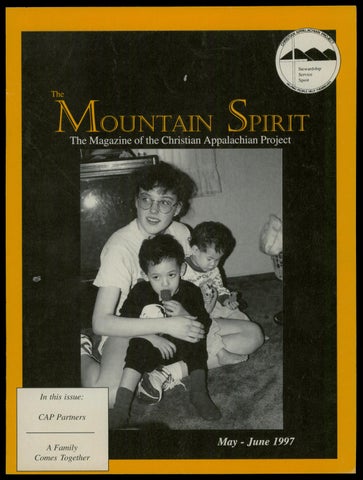
CAP Programs Working Together More than ever before it is becoming apparent that helping people achieve their goals of self-sufficiency will involve partnership on many levels. CAP is well positioned to help people with those goals in the face of welfare reform through its crisis intervention and education programs. On page four, you’ll read about a new approach in CAP’S outreach program. Called the “Partners Project,” there are several different partners involved. CAP’s programs partner with each other, then join with a participant who has agreed to take steps necessary toward independence. On page eighteen you’ll meet a young mother of three children, all of whom have disabilities. Beth Dotson tells of the love this young mom has for the children, and the assistance that workers in several CAP programs have given in bringing this family together. Finally, Beth Meyers, who works in a CAP spouse abuse shelter tells of the work of victims’ advocates in CAP shelters. CAP advocates are part of a large network in Kentucky that provide counsel to victims that might otherwise have nowhere to turn. On the cover, Vicki Oakes’ children: Brandy, Ryan and Patrick (photo by Beth Dotson).
Published by the Christian Appalachian Project. Editor: Margaret Gabriel. Graphic Design: Karen Frances Spivey. Circulation: Linda Grider East. Advisory Board: Father Ralph W. Belting, Mike McLaughlin, Bill Begley, Carla Durand, Teresa McAnly. The Mountain Spirit is published six times a year. The annual subscription price is $8.00. Subscriptions and other correspondence should be sent to The Mountain Spirit, Christian Appalachian Project, 322 Crab Orchard Road, Lancaster, KY 40446. Copyright, 1996. The Christian Appalachian Project, Inc. All rights reserved. Member, Catholic Press Association. The Christian Appalachian Project is a non-profit Christian service organization operating throughout Appalachia. The project operates on the philosophy that helping people help themselves is the best approach to Appalachian poverty. A summary of the registration and financial documents filed by this organization can be obtained by contacting: in Maryland, for the cost of copies and postage, the Secretary of State, State House. Annapolis, MD 21401; In Virginia, State Division of Consumer Affairs, P.O. Box 1163, Richmond, VA 23209; in Washington, residents can call the Secretary of State toll-free within the state at 800-332-4483; IN NEW YORK, OFFICE OF THE ATTORNEY GENERAL, CHARITIES BUREAU, 120 BROADWAY NEW YORK NY 10271 • IN NEW JERSEY, THE ATTORNEY GENERAL BY CALLING 201-504-6215; IN PENNSYLVANIA, DEPARTMENT OF STATE BY CALLING TOLL-FREE WITHIN THE STATE. 800-732-0999; IN WEST VIRGINIA, SECRETARYOF STATE, STATE CAPITOL, CHARLESTON, W V 25305; IN FLORIDA, THE DIVISION OFCONSUMER SERVICES BY CALL TOLL-FREE WITHIN THE STATE AT 800-435-7352; IN NORTH CAROLINA, FINANCIAL INFORMATION AND A COPY OF THE LICENSE ARE AVAILABLE FROM THE STATE SOLICITATION LICENSING BRANCH A i 919-733-4510; or by writing to Christian Appalachian Project, 322 Crab Orchard Street, Lancaster, KY 40446. Our license number in Michigan is MICS 9933. Registration with any of the above government agencies does not imply endorsement by the state.
2
The Mountain Spirit
Margaret Gabriel GABRIEL
hen we decided, six months ago, to focus this issue of The Mountain Spirit on the multiple ways that CAP programs serve families, we didn’t realize that in doing so we would also be focusing on the beginnings of the effects of welfare reform in Appalachia. As we interviewed folks involved in the programs we are profiling, time and again talk turned to the ways people are trying to prepare for the changes that will be the result of welfare reform. It seems that every worker in every program we talked to in preparation for this issue is responding to or trying to prepare for the days when there is a two-year cap on Temporary Aid to Needy Families (the program that used to be known as Aid to Families with Dependent Children). Considering that the average amount of time that a family must depend on welfare is under two years, it seems that this is a reasonable cap. But that is a national average; in Appalachia it is difficult to find a job where few jobs exist. CAP’s response to welfare reform, so far, has been to keep doing what we’ve been doing, but knowing that people are going to have to get results a whole lot faster. In some cases this means helping people who dropped out of the ninth grade ten years ago to complete a GED, job training and find a job in a fiercely competitive job market in — now — less than two years. Our programs that work with children are helping families to look at the issues of child care that have been addressed but not really tackled. If a single mother earns a GED, finds adequate job training and then a job that pays $8 an hour, where will she find affordable child care? And when you’re grossing $320 a week and raising two or three children, just what is affordable child care? We were pleased to learn from Anita Seals, our CAP Closeup (see page 29), that victims of domestic violence have been exempted from the five-year lifetime welfare cap. Abuse victims and May - June 1997
CAP Partners are working to break the cycle o f poverty fo r their children.
their children do not have to live in dangerous situations only because they believe they don’t have any choice. The Partners Project in Hagerhill, a concept that will soon be implemented in other CAP outreach programs, is a crystal clear example of how CAP programs — education, crisis intervention and community development, alike — work together, equipping participants with the things they need to break the welfare cycle. CAP has always had a holistic approach to the assistance people need to help themselves out of poverty. Since the earliest days of his work in Appalachia, CAP’s founder, Father Ralph Beiting, could see that it was a combination of helping people meet day-to-day needs, followed by assistance with education and employment that would help to make permanent changes. It is becoming more and more apparent to CAP workers that that is the approach that will give people the safety net they need in the days following the Welfare Reform Act of 1996.
Margaret Gabriel, the editor o f The Mountain Spirit, this year celebrates her 20th anniversary with CAP. 3
Step by Step, Case by Case, Year by Year, Partners
An eastern Kentuckian (usually a woman) gets out of the welfare state of mind one uphill step at a time. As the
Project
day draws nearer when welfare reform
Is a Way
changes all the rules, CAP’s Partners
Off Welfare
Project works to turn public assistance recipients into productive workers, one by one. The Mountain Spirit
4
“We asked ourselves what would help people get off welfare,” Judy said. The answers were predictably complex, but common problems surfaced: lack of job skills, incomplete high school education, money and transportation problems. “Just paying electric bills will not get them what they need,” said Albert. To help with the needed long term solutions, workers have devised the Partners Project.
GABRIEL
The chief focus of the Christian Appalachian Project’s outreach programs used to be helping folks pay overdue gas, water, electricity and rent bills in an area where the social and economic problems are interlocked, thorny and unforgiving. In order to help with deeper problems, the outreach programs in Hagerhill and Louisa, under the direction of Judy Crum and Albert Bloomfield, recently began to shift their focus to address more basic challenges.
% 8 *
V 76 s„ 4
Elizabeth Miller, a caseworker in the outreach program in Hagerhill, works with seventeen families that are involved in the Partners Project.
Helping toward definite goals Partners Project participants have to be committed to a specific goal, often a General Equivalency Diploma or completion of job training. Participants follow a specific goal-attainment plan that covers one year. This doesn’t mean that participants are helped for a year and that’s all, Judy clarified, but the annual review process helps keep goals manageable and efforts on track. Participants must make frequent measurable steps toward their goals; if they lose heart and quit trying to achieve the agreed-upon goals, a caseworker will guide them back May - June 1997
to the path if possible, or as a last step, withdraw assistance. That hasn’t happened often, because in helping their people toward education and training goals, Partners Project workers often help participants with the at-home needs that could derail grander plans. They know it’s hard to concentrate on your GED studies until your children’s needs are met. So Partners caseworkers call participants frequently and visit every few weeks to see how things are going and offer the small helpful gestures that mean so much when the money and resources are short.
He was “dead meat” Caseworker Elizabeth Miller learns about prospective participants through referrals and then conducts initial visits in their homes. “That tells you a lot about a person — people are more at ease at home.” Liz tells prospects what the Partners Project can do and what is expected. Among the ground rules: • In two-parent families, both husband and wife must be willing to pursue the goals of education, employment, counseling, or whatever is needed.
5
• The Partners caseworker and the participant sign a mutual agreement: Partners Project will help however they can as the participant strives for the agreedupon goal.
Not used to a warning like that, he woke up and apparently drew some inspiration from Liz’s lecture. He has since received the technical certification and is grateful for Liz’s concern. “I want to help you if you help yourself,” Liz said.
• The caseworker will visit every two to three weeks and call between visits to check on progress.
Her success rate is respectable. Two participants have earned their GEDs. One widowed mother of five in her 30s is being helped by Liz to pursue the GED. Another man is taking his second shot at trucking school because of her concern.
Progress doesn’t have to be absolutely even-paced, but it’s risky to go too long without something good to report. One young man had quit pursuing his goals on two occasions, so the normally very forgiving Liz decided he needed a wake-up call. She told her reluctant participant that if he didn’t shape up and pursue his goal of technical job training, he was “dead meat.” :
One participant whose success is particularly prized by Liz has graduated at the top of his class, with certification as a welder, which he will use to open up new job opportunities. As an ironic reward for his > determination in I | facing school days and night work, the government is acknowledging his efforts by cutting his food stamps.
Patty Hall is a child care worker in Johnson County. With the help o f the Partners Project, Patty studied fo r and received her GED, which enabled her to keep her job.
6
Another successful participant of Liz’s will attend nursing school at a nearby technical institute, and has gotten such good control over her life that she’s attending church again. Liz is justifiably proud of these achievers, but she realizes things
don’t always turn out right: “When I have success 1 have good success, but when I have a flop it’s a killer-diller.” Liz’s case load at press time was 17 active participants, two prospects about to join the program and ten of indeterminate status that Liz suspects may have fallen by the wayside. It’s been hard for some welfare recipients to realize that the old ways are over. Even after seeing newspaper articles and being told by Judy, Liz, Albert and the rest of the workers, some welfare recipients can’t let the old ways go. “One recipient told us she wouldn’t take job training because she’d lose her welfare money. We told her that’s coming anyway,” Judy said. Welfare reform speeds process “I hate to say it,” said outreach worker Ken Slone, based in the Martin, Ky., office, “but welfare reform has inspired some people to get moving on their GED.” Twenty-four students are enrolled in GED studies in the six-county area served by CAP’s Hagerhill office, either through the Partners Project or a countybased GED program. Ken has been with CAP for six years, always in outreach. He started in Floyd County and is now here again, after also working in Magoffin and Knott counties. The coming transition from welfare to work will be “a shock to everybody involved,” Ken predicts. Lifetime maximums on The Mountain Spirit
programs mean “people will really be hurting,” he predicts. “I would have done things more gradually. For one thing, there aren’t jobs available,” he said, identifying one of the toughest problems welfare reform poses for eastern Kentucky. It’s one thing to mandate that everyone work in two years, but at what jobs? (When we know, only then can we address the likewise crucial issues of child care and transportation.)
Richard only had time to make nine visits during Kelly’s GED study. She was in classes for only three months, earning her GED by September of 1996. Along the way, Ken called with encouragement, the occasional commodity turkey dinner, and laundry detergent. (Cleaning supplies are among the most gratefully received
kids. I want to get off this welfare,” she said with determination in her voice. “Now I’ve got more self-esteem and courage to do what [others] said I couldn’t do.” Her next goal is to enroll in the fall of 1997 at Prestonsburg (Ky.) Community College. “When I was in school I wanted to go to college so bad, but after
Ken also worries that Partners Project participants who don’t start their GED training soon may run out of time as the twoyear deadline for welfare’s end approaches. GEDs don’t always happen as quickly as they did for Kelly Martin. Kelly rapidly earns GED Kelly was one of the first Floyd Countians to join the new Partners Project last summer. She has three sons ages 7, 3 and 1. In 1989, Kelly dropped out of high school in her sophomore year to get married. Kelly discovered the project through a neighbor who was receiving help from a spouse abuse program. Kelly’s goal was to earn the GED to begin steps toward a better life. The project arranged for Kelly to get new eyeglasses, a necessary first step to reading and studying, and signed her up with GED instructor Richard Price. Richard brought Kelly the placement test and said he’d be back in a week to pick it up. “I had it done the next night,” Kelly proudly recalls.
May - June 1997
Magoffin County outreach worker Sheila Barrett and participant Loretta Prater. Sheila helps and supports Loretta in her effort to finish a medical office assistant's program.
commodities furnished by the Partners Project, because they can’t be purchased with food stamps.) Nearly as vital is the encouragement Ken and the other caseworkers provide, especially in the face of skepticism and discouragement. How did Kelly raise three children and earn her GED in only three months? “I’m motivated. I want to do something to support me and the
I got married I lost out,” Kelly said with some regret in her voice. With three children, that road won’t be easy, and some issues are not yet resolved. She’s trying to arrange financial aid to cover the $680 per semester tuition, and how she’ll get to and from classes remains to be answered. Good child care became another possible roadblock when her husband left her and the children right after the third child was bom. Her first effort at GED
7
classes had ended when the children’s father wouldn’t watch the children while she was in class. But no one would bet against Kelly if they could have seen the light in her eyes when she first
Patty dodges a problem Partners Project particularly shines when it comes to reclaiming good workers who face a knotty problem that might land them on public assistance. Often they can provide just the little bit of help that turns a welfare recipient into a solid worker again.
Such was the case with Patty' Hall, who found herself laid off from her job last summer. She had left school in the ninth grade. She had a supportive husband but they had four children to Ken Slone and Partners participant Kelly Martin. raise without payments from learned that the Partners Project unemployment insurance. could help her make life better for her children. “When I first She knew someone willing to learned I could do it I was real hire her, but they couldn’t excited. I knew that I could, and without her GED. Enter Partners to find out I would get the chance Project, who found Patty through was really exciting.” a mutual friend. She predicted with determination, “If I can get into college, I will get a job,” emphasizing “will.” She hopes to study computer science and get a computer-related job. Kelly strongly wants a better life for her children: “If it means going to school, working and raising my kids all at the same time, I’m going to do it.”
8
“I couldn’t go to classes, so [Liz] got me the books,” Patty recalled. “I studied on lunch breaks and after I got the kids put to bed.” It was her eighth attempt at the GED exam, but this time she was successful; she received her GED last October and accepted the job offer that made her a productive worker again. The Partners Project helped Patty’s family with washing
powders, clothes and snacks for the children, and even a Christmas basket. Caseworker Liz called Patty every few weeks at work after having secured the GED texts for her. Patty wants to set a good example for her children: “I don’t want them dropping out.” Loretta overcomes adversity Loretta Prater is likewise motivated by her children. The Partners Project is helping her pursue a 15-month certification as a medical office assistant at a Paintsville, Ky., technical institute. She has overcome a hard time to provide for her two sons, age 11 and 10. When she found CAP last August, she intended to just sign up for a Christmas basket. Loretta was divorced, in continual pain from two auto accidents, and in need of therapy for her children when she learned about the Partners Project last August. “Sheila [Barrett, Magoffin County outreach worker] told me there was a program that could help,” Loretta remembered. “I thought the Lord had sent that to me. I just thank the Lord for it,” Loretta said. Loretta made the good results happen, though. “I’ve been in two car wrecks and it hurt so bad to walk that I could hardly stand it, but I didn’t want to let the program down,” she said. She hasn’t. Last quarter she earned a 3.7 grade average. Now in the second quarter of the program, she’ll graduate late this year or in early 1998. “I cheated The Mountain Spirit
my way through high school but I’m learning my way through now,” she said. During Loretta’s studies, the Partners Project helped the family out with food, papers, supplies, clothes, and detergent. Such assistance qualifies as help toward the Partners Project goal, Sheila says, because “when you’re just drawing AFDC you can’t afford any money going out.” Loretta hopes to get a good job in a hospital or office, and is pleased that she can help improve the quality of her family’s life. “The way we were going, we weren’t going to have much of anything,” she said. “I’ve come a long way through divorce, two car wrecks and trying to take care of kids. I want my kids to see that my effort is an influence on them.” What would Loretta say to people considering improving their lives through the Partners Project? Emphatically she replies, “If you have problems, go. You’re crazy if you don’t.” Practiced assistance providers When CAP workers told other area service providers about the Partners Project and the new emphasis they planned for the outreach program, some were skeptical. For a while, the Partners Project succeeded best where such preconceptions didn’t exist, such as in Johnson County. The Project always furnishes commodity food and basic support items to the community’s needy. Also the May - June 1997
Project provides medical assistance through their connections to area doctors who offer pharmaceutical samples, limited reduced-rate office visits, and other assistance. “People should be healthy and eating well” so they’ll be in a position to attain the longer-range goals, Judy said. God’s Pantry Food Bank and CAP’S Operation Sharing are frequent sources of the material help the Project provides. A commercial supporter of the Partners Project sends paper, pencils, typewriter correction fluid, blank tapes and other office supplies from a retail office supply business. You can imagine how grateful cashstrapped students are to receive these study materials. They’re quite an investment in the students’ future.
arly divorce put Kelly, Patty and Loretta into the teeth of some sinister problems just as it deprived them of the support we all need to keep life’s problems at bay. Although women equally share responsibility for marrying inappropriately, men who then fail to live up to their family responsibilities play a major role in such hard cases. Liz Miller thinks being on welfare wounds a man’s image of himself as a provider. “Men used to have a family support role they were proud of and stayed with,” she said. When the economy suffers and jobs suddenly aren’t available, a man’s image as a self-reliant provider suffers. Rising unemployment likely raises the rates of spouse abuse and substance abuse as men react badly to their frustrations. “We need a program designed specifically for men, helping men focus on their family roles,” Liz said. Perhaps a mentoring program, she speculated, that would help men recognize and accept their responsibilities to the family. Any such program would break new ground, probably with difficulty. The men who most need this kind of help don’t like to seek it. Some way would also have to be found to compel attendance. Interesting problem. Any solutions? Send your suggestions or reactions to Jim Trammel, Men’s Correspondent, The Mountain Spirit, 322 Crab Orchard Road, Lancaster, KY 40446.
A local sawmill gives discarded wood to help answer calls for winter fuel. Of such small steps, over a year’s time, is the journey made that leads upward from the psychological depths of the
welfare life to the higher ground of productivity. It’s a trip that Partners Project hopes to help many more make. •
Jim Trammel is a free lance writer who explores a variety>o f topics relevant to eastern Kentucky.
9
Around the Project Ottawa University Recognizes Father Beiting GABRIEL
Faculty and staff of Ottawa University in Ottawa, Kansas, recently announced that Father Ralph Beiting, founder of the Christian Appalachian Project and pastor of St. Jude Church in Louisa and St. John Neumann Church in Hode, and was chosen to receive the University’s Meeker Award. The award honors Jothan and Eleanor Meeker, Baptist missionaries, whose work with the Ottawa tribe of Native Americans led to the founding of Ottawa, Kansas, the First Baptist Church, and Ottawa University. The award is granted annually to individuals whose dedication to Christianity and education mirrors the characteristics of Mr. and Mrs. Meeker. Father Beiting was nominated for the Meeker Award by Jerod
Father Ralph Beiting meets with CAP employees in Somerset.
Huguenot, an Ottawa University graduate, who served as a counselor at CAP’S day camp in Rockcastle County. “Jerod was really moved by the work Father Beiting had done to start the organization and the faith that it has taken to sustain it. He called and told us about the
award, and that he wanted to submit Father Beiting’s name,” said Kathy Kluesener, director of CAP’S volunteer program. Kathy noted that Ottawa University, a Baptist institution, was honoring a Catholic priest. “You see a real spirit of ecumenism coming through.”
Operation Sharing Provides Flood Relief Among the counties declared disaster areas after recent flooding in Kentucky was Lawrence County, the location of CAP’S newest administrative office. “All in all, we were pretty lucky, though,” said assistant director Richard Ginn. “The only property we lost was a camper at Camp Yatesville. The only reason it didn’t float away was because it was tied to a pole with an electrical cord. Twenty-five families involved in the outreach program in Lawrence County called on CAP for clothing, furniture and cleaning supplies. Workers in outreach offices counties not so severely affected
Operation Sharing procurement coordinator Johnny Thompson delivers a load o f cleaning supplies to flood victims in Cynthiana, Kentucky.
were still called on by families who were caught by the flash flooding of low-lying creeks. Operation Sharing, CAP’s inkind donation distribution program, was able to distribute cleaning supplies to north central Kentucky counties devastated by
high water. “We’ve had calls from church groups that are helping with flood relief,” said Operation Sharing procurement coordinator Johnny Thompson. “A lot of groups that dodged the bullet this time are reaching out to people that weren’t so lucky.” The Mountain Spirit
around the project. . . continued
Parenting Classes Held in Louisa Class in Correctional Institute Continues When more and more of the parents she counseled asked for guidance with their children, Kathy Rhodus decided to offer a parenting class in Louisa. Her first ten-week class will be followed by a second, and because of the demand, Kathy has decided to offer the parenting classes on an ongoing basis. Kathy uses the Systematic Guide for Effective Parenting (STEP, see The Mountain Spirit, March-April, 1997), along with videos and plenty of class discussion time. “This past week we talked about I-messages,” Kathy said, referring to the technique of telling a child how behavior makes a parent feel. “One of our parents had been very discouraged, but after using Imessages, she was
communicating more deeply with her children.” The class involves parents of widely varying ages, Kathy said, from a couple expecting their first child, to grandmothers who are raising their grandchildren. The class also includes a couple of fathers. A mother of two teenagers, Kathy has been able to share techniques that worked as she raised her children. She looks forward to conducting a class geared to parents of teenagers. “Eve had individuals tell me in counseling that they’re having trouble with a teen, and I’ve counseled several teens, and can see where their parents would need help,” Kathy said. Chris Griffith, the newest member of the Family Life Counseling team, is teaching a parenting class at the Otter
College Students Help CAP During Spring Break Appalachian Workfest
Creek Correctional Facility in Wheelwright, Ky. This course teaches participating inmates effective parenting skills and gives them the means to re establish contact with their families. Now in its second year, this CAP-sponsored program has proven to be very effective in reaching a population that tends to be ignored. Recently the warden at Otter Creek complimented the results of this class, saying he could tell the students from the parenting class had made changes in their lives by seeing their change in attitude and behavior.
M o vin g ?
Please notify us of any change of address to make sure you receive every issue of The Mountain Spirit. Please print
O ld A ddress
N ew A ddress
During the month o f March 221 students from 29 colleges across the country participated in CAP’s Spring Break Appalachian Workfest. Students repaired and constructed homes in Jackson and Martin counties.
May - June 1997
Mail to: The Mountain Spirit 322 Crab Orchard Road Lancaster, Kentucky 40446
11
around the project. . . continued
Youth Workers, Peace Committee Attend Workshop GABRIEL
Diversity issues encompass a great many areas, said Rayla Smoot, Executive Director of the Bluegrass Chapter of the National Conference (formerly known as the National Chapter of Christians and Jews), although we are tempted to consider only areas of racial diversity. In the course of the day, discussion touched on many areas including ethnic, religious, gender and sexual diversity. Rayla recently conducted a workshop for Christian Appalachian Project employees which explored diversity issues as they relate to communication. Attending were folks who work in CAP’s youth programs, along with several members of the CAP Peace Committee. The workshop was conducted at the Jackson County volunteer house. The most important things to remember in dealing with people of diverse backgrounds, is to keep the lines of communication open, something easier said than done, Rayla said. “The hardest thing in the world is to listen to someone talking about something you think is hogwash.” After a period of discussion, Rayla posed several questions and asked the group to consider
Workers in young people’s programs and members o f the CAP peace committee participate in a diversity workshop.
different answers, then move to a section of the room, according to which answer best described their feeling. Frank discussion followed each question, with respectful give and take on many sides. The purpose of the questions, Rayla said, was to “stretch our consciousness,” as different opinions and values are considered.
During the afternoon portion of the workshop, participants discussed exercises and activities that would be valuable for young people involved in CAP programs. At the end of the day Rayla termed the participants a “phenomenal group,” with open minds willing to express themselves. “You disagreed well,” she said.
Volunteers and maintenance workers gathered on a Saturday morning recently to give a good cleaning and facelift to the Attic, CAP’s used clothing store in Berea.
The Mountain Spirit 12
around the project. . . continued
Elderly Services Workers Host Easter Celebration The staff of the Christian Appalachian Project elderly services program hosted folks from all of their counties at an Easter celebration at the Acton Folk Center in Berea. The program started with piano selections by volunteer Dan Egan, who was later joined on the French horn by fellow volunteer Michelle Mau. Cindy Fogle shared the Last Supper Discourses from the gospel of St. John. In his message, Rev. David Grandgeorge, pastor of the First Christian Church in Berea, gave insight into Easter traditions, explaining that many intertwine the Jewish celebration of the Passover, and the recognition of spring and new life. During this season, he said, “Christ chose to pass over our sins and bring us to new life.” Rev. Grandgeorge told the
group that he believes that the greatest evidence of the life of Jesus is the effect that it had on the apostles. “After the Resurrection, they were bold. They witnessed and they healed,” he said. “To me, that is the evidence that something miraculous happened on Easter.” After the program, the volunteers served lunch of sandwiches, chips, fruit salad and homemade desserts, featuring a large Easter Bunny cake, the contribution of Owsley County caseworker Naomi McIntosh. “I’ve made one for Mark [Naomi’s son] every year for 30 years now. But for a crowd this big, I had to use three cakes!” Manager Zayda Hurd complimented the program workers for their efforts, and thanked everyone for their participation.
What You Don't Know About Wills Can Hurt Your Heirs. Find Out Why. Request j . Your Free Copy. W J k
Much of what you know about wills may be misinformation that has been floating around for years. If you think, for example, that wills are primarily for rich people, or elderly people, you may be the victim of a common misconcep tion. The helpful booklet offered here will explain how yourw illcan save your heirs from costly de lays and confusion. Send for your copy today. Clip and Mail
Christian Appalachian Project 322 Crab Orchard Road Lancaster, Kentucky 40446 Please send without obligation your booklet, “37 Things People ‘Know’ About Wills That Aren't R eallySo.” Name_______________________ Address.
Rev. David Grandgeorge delivers the message at the Easter celebration that was hosted by CAP elderly services workers.
State,ZIP.
May - June 1997 13
around the project. . . continued
Vocational Rehabilitation Workers Present Report to Kentucky Governor Bobbie Wesley, manager of Christian Appalachian Project Resources for Independence and Community Employment (CAPRICE), was a member of a delegation that recently presented Kentucky Governor Paul Patton the 1995-96 annual report of the Statewide Advisory Council for the Department of Vocational Rehabilitation. Because of CAPRICE’S involvement with supported employment, a program for adults with disabilities, Bobbie chairs the employers’ relations committee for the council. The report outlined for the governor the efforts that are being made in the state to place people with disabilities in jobs, and the assistance that is available both to people with disabilities and employers. Sam Serraglio, Commissioner of the Department of Vocational Rehabilitation, told Governor Patton that nationally, nearly 69 percent of people with disabilities are unemployed. “Our job is to break down those barriers,” Serraglio said, and pointed to a page in the annual report which charted the amount of income tax dollars paid by Kentucky workforce members with disabilities. The council reports that 4,471 people with disabilities joined the Kentucky workforce in 1995-96, and paid over $16 million in Social Security, state and federal income taxes. Patton asked what attempts are made to employ people with disabilities in government, saying that the state should take a
CAPRICE manager Bobbie Wesley (right) ana Merlene rlujj, members of the Statewide Advisoiy Council fo r the Department o f Vocational Rehabilitation, meet with Kentucky Governor Paul Patton.
leadership role in the effort. Marlene Huff, of the Department for Veterans’ Affairs, told Governor Patton there are many people with disabilities who have professional-level educations, but accept jobs at lower pay because they are the only jobs available to them. “People with
disabilities need role models,” said Huff, who uses a motorized wheel chair. “When I was growing up, it was never expected that I would work.” The advisory council works to point out the competencies of people with disabilities and their contributions to society.
CAP to Host Symposium Christian Appalachian Project founder Father Ralph Beiting has asked the organization to host a symposium that will examine the future of Appalachia in the light of welfare reform and the changing economic picture. Father Beiting has invited a large cross-section of people who work in the areas of education, housing, politics and religion, saying that he is “determined to work with all my strength to bring about a new and more exciting future.” Assistant director of human development Richard Ginn is coordinating the event. “We want
to know how things like education and housing will fit together in the light of welfare reform, and how we can better serve the people,” Richard said. Richard expects attendance by about 125 people representing churches, area development districts and social service agencies. Christian Appalachian Project is a participating agency in the Combined Federal Campaign. Federal and military employees can contribute to CAP by designating #0898 on the CFC pledge card.
The Mountain Spirit 14
around the project. . . continued
Volunteers Needed for Summer Camp Adventure! The CAP volunteer program needs summer camp counselors to staff gen eral, special needs and specialty camps. We are seeking high-energy men and women, age 18 and older, for the months of June, July and early August. We would like a commitment of at least two months, but a 3-7 week stay can be arranged. Room and board is provided. For more information about volunteer ing for summer, or for a year or more, contact the Christian Appalachian Project Volunteer Office, 235 Lexington St., Lancaster, KY 40444, 1-800-755-5322.
Volunteers must be at least 1S years old. What Can I Do to Help the Christian Appalachian Project? Christian Appalachian Project supporters often ask what more they can do to help eliminate suffering in Appalachia. First, we tell them, you can tell others of the problems in Appalachia which you learn about in The Mountain Spirit and other CAP publications. You might want to share this magazine with a friend, for example. If you’d like, drop us a line and we’ll send you a replacement copy. Ask us about any of the problems in Appalachia and we’ll be happy to share any knowledge we have or to refer you to another organization that can help you. Secondly, you can give us a most valuable commodity — time. Since 1950, thousands of people have worked millions of
hours, donating time to helping the people of Appalachia help themselves and their families out of poverty. If you would like to volunteer a year or a summer to working in Appalachia, please contact The Mountain Spirit, 322 Crab Orchard Road, Lancaster, Ky., 40446. We will see that you receive information about CAP’s volunteer program. Finally, our most powerful form of assistance is prayer. We believe that if our supporters spend at least one minute a day praying for poor people every where, mountains can be moved, the course of rivers can be changed. The CAP family forms a powerful prayer network reaching into Appalachia and across the nation.
DOUBLE Your _ Dollars If you are a CAP donor, or are considering becoming one, you may be eligible to double your gift through your em ployer’s matching gift program. Many companies today match monetary support to non-profit community service organizations that are sup ported by their employees. Many of these companies match the gifts that are made by their retirees as well. Please write for your brochure “Double Your Dollars,” which lists participat ing companies and instruc tions. Send correspondence to:
Teresa McAnly, CAP 322 Crab Orchard Road Lancaster, KY 40446
May - June 1997 15
The Christian Appalachian Project has been at the center of my life for many years, as have most of you, our family of donors. It makes me proud to think of what you and I have done together. But you and I will not be here forever. I dream of leaving as a legacy the work I have started and you have supported. I pray that our hard work and sacrifice will continue long after we are gone from this life. I, as well as you, I’m sure, want the people of Appalachia to keep striving for and reaching for solutions to the problems of poverty. And they must have the resources to achieve these goals. I want to tell you about a newly-formed general endowment fund, which will ensure that CAP’S work continues for future generations. A contribution to the endowment
CAP founder Father Ralph Belting preaches on the courthouse lawn in Nicholasville, Kentucky.
fund requires a rare level of generosity above and beyond what you normally give. But this extra gift will ensure that CAP’S work will go on. That’s why our general endowment fund is so important to me. This spring we unveiled an Endowment Tree in the foyer of our office on Crab Orchard Road in Lancaster, Kentucky. Each leaf of the tree will be engraved with the name of a Christian Appalachian Project donor who has contributed a major gift to the endowment fund. When your name is inscribed on a leaf on CAP’S
Endowment Tree, you will be honored for your generosity, generosity that will endure forever. We will send you an exact replica of the engraved leaf for display in your home. As Memorial Day approaches, you might want to consider giving a gift in the name of a loved one. You could choose to memorialize someone who gave his or her life in service to our country, or perhaps someone that has added special meaning to your life. All of us involved in the work here know the kinds of problems that the people of Appalachia face every day. Families live in inadequate housing. Mothers and fathers frequently have a hard time finding jobs, and so often, they haven’t been employed for years. Regular gifts from CAP donors are vital to combat these The Mountain Spirit
16
CAP president Mike Sanders (left) talks with Operation Sharing director Mike McLaughlin.
problems and we depend on them for our day-to-day work. In no way do we want to jeopardize this very important funding with the endowment. By means of the endowment, we are asking friends to make an extra gift, one that will to guarantee that the work of CAP will continue when you are no
longer able to give. The words “to endow” mean to set aside dollars in such a way as to guarantee the Christian Appalachian Project will continue its very important work for years to come.
Now that the six-foot tree has been erected, it is ray hope and in my prayers that you will help “leaf out” this Endowment Tree. I have dedicated my life to the work here in Appalachia; you have supported this work with your past and ongoing generosity, as well as your prayers. Now I need your special gifts to preserve CAP’s programs for future generations. Help me now to make sure the endowment fund contains the resources necessary to carry on the work we have started. On behalf of those we haven’t reached and those yet to come, I ask that you consider a gift to the future with a generous gift today to the Endowment Fund Tree. May God bless you,
Father Ralph Beiting
V/ a u , ... I L
til If
1\ yw /JP™""!\ M v /£»■ l
A > C* '
i* , ;
.Lastin mition The Least You Deserve! Yes! I want to make a special gift to the Christian Appalachian Project’s Endowment Fund. Please add my name to a leaf on the Endowment Tree.
□ $2,000 Please accept my gift to CAP’s Endowment Fund: □ $____________ What would you like us to inscribe? You have three lines:
May - June 1997
For more information about including your name, or that of a loved one, on CAP’SEndowmentTree, please contact: Ben Prewitt or Teresa McAnly 322 Crab Orchard Road Lancaster, KY 40446 (606)792-3051
I
The H opeful O ption of A d o p tio n by Beth Dotson
Ryan arrived at Vicki Oakes’ home with four diapers and one small bottle of milk. He was a little more than a year old and his mother, an ex girlfriend of Vicki’s husband, wanted to leave him there for two hours. So Vicki held out her arms and took the child. The Mountain Spirit 18
When his mother first dropped him off, Ryan “would lie on the pallet for hours and he wouldn’t fuss and he would grin at you,” Vicki remembered. “He didn’t fuss. And when you tried to hold him and cuddle him, he didn’t like it. It was like it scared him to death or something. And when he was five months, I think, he was already holding his own bottle where I guess he had to do it.” Ryan’s mother was an alcoholic and Ryan was suffering from symptoms related to fetal alcohol effects, which was later diagnosed. Through its various programs, the Christian Appalachian Project encounters parents like Vicki who face unique problems. In its effort to strengthen the families of Appalachia, CAP has a variety of ways to reach out to them. Vicki’s introduction to CAP came through Parents Are Teachers, an early intervention program that supports families with children who have special needs. Ryan’s pediatrician recommended that Vicki take advantage of the help they could offer. When CAP first encountered Vicki, she was the married mother of one. She had adopted Brandy, her husband’s daughter. Brandy’s biological mother is the same as Ryan’s. When Brandy was two, her mother left her with Vicki and her husband. Remembering the decision to May - June 1997
DOTSON
Hours, then days passed, and his mother did not come back to get him, so Vicki began to love him like her own. Now Vicki is trying to adopt him so that legally, he will be her son.
adopt Brandy, Vicki said, “I loved her and I wanted to keep her.” Brandy’s mother did not object. “It was real natural, the way it happened.” Brandy’s mother again sought Vicki’s help last year when she asked if Vicki could babysit her infant, Patrick. Again, she did not return to claim the baby. Vicki is now raising three children. Ryan reads a picture book during a visit with Parents Are
“If s an odd Teachers worker Leigh Weaver. family, but it works,” Vicki each with a disability that said with a laugh. requires special attention. During a visit from Leigh Ryans story Weaver, program manager of Parents Are Teachers, Vicki sits When Vicki took Ryan to the in the small, furniture-crowded doctor as an infant, she living room with Ryan and discovered that his inactivity Patrick. Leigh settles herself on might suggest fetal alcohol the floor with her bag of toys. effects and developmental She gives her attention first to delays. He needed help one boy then the other, as she improving his fine motor skills pulls out playthings. Before long, and speech. Leigh began visiting the room is a jumble of puzzles, weekly. She used games and play books, cars and out-of-season to help develop his skills. With wrapping paper on which the Leigh’s guidance, Ryan has boys have been coloring. The learned about shapes and colors boys show off their skills with to get ready for preschool. He excited squeals and smiles. also improved his speech. At three years old, he is now Vicki smiles, too, although working at his age level and will there are times when it is be prepared for school. difficult. She is now a single mother caring for three children,
19
She has also shared her knowledge of child development with Vicki and supported her during difficult times. Vicki remembers the days when she had to take Ryan to therapy. “When I first started out with Ryan there were days I almost
Although her visits and games helped, Leigh also showed Vicki how she could work with Ryan through their routine activities. For example, when an occupational therapist was helping Ryan learn to brush his teeth, Leigh saw an opportunity
funds to pay for the application, filing and lawyer’s fees. “It just seemed like something that fit in with CAP’s mission,” Leigh said. The adoption would give Ryan a stable home and family.
Brandy's story Vicki has given Brandy a stable home for ten years. When she gets home from school, Brandy greets her brothers with hugs and kisses. There’s a photo of her on the living room wall — her hair is fixed and she’s wearing a touch of makeup that the makeover artist at the photo studio applied. She looks pretty. Her mother says she’s a tomboy. When Brandy remembers the experience, she says it was awful. The way they put all of the stuff on her made her feel like a cupcake, she said.
Patrick, like his older brother, exhibits symptoms o f fetal alcohol syndrome.
cried because they would make him do things and he didn’t want to, or he really couldn’t at the time, but they knew that with work he would and he would cry and want me to get him and I couldn’t because I knew he had to do it. And there were times when the boys [Ryan and Patrick] have been poked and prodded when they really didn’t want to be,” Vicki said. “It does get better with work, but it does take a lot of work and time. You have to hang in there. It will take work at home and things like that. You’ve got to have a lot of patience,” Vicki said.
for him to also work on using his wrist, another area he needed to strengthen. She pointed out to Vicki that she could watch him when he was brushing his teeth to be sure he used his wrist rather than his entire arm. She could do the same thing when he ate a meal. As Leigh worked with Vicki and Ryan, she saw the love between them grow. When Vicki said she wanted to adopt Ryan, Leigh felt that would be a positive step. “If there was anybody who helped someone else, it was Vicki,” Leigh said. She knew the legal fees for the adoption were too much for Vicki, so she asked CAP for
With the boys, she isn’t a glamour queen or a cupcake, she’s like a little mother. She has helped Ryan learn his colors and shapes. She also shares her father with her brothers, who call him Daddy. Brandy deals with difficulties of her own. When she was nine, she was diagnosed with attention deficit hyperactivity disorder (ADHD) and Tourette’s Syndrome. Tourette’s Syndrome is a neurologic disorder characterized by motor and vocal tics. It can take a variety of forms. In Brandy, it shows itself when she grinds her teeth, taps her jaw, twirls her hair and talks a lot. Although they haven’t been diagnosed as such, some of Brandy’s behavioral problems could be a result of her mother’s drinking while pregnant. The Mountain Spirit
Vicki works nights at a brake factory and sometimes has difficulty keeping a babysitter for the kids because of Brandy’s behavior. “They (babysitters) think that Brandy doesn’t have respect and she doesn’t get discipline. They don’t realize that she gets disciplined, but the problem is that a hyper kid doesn’t think about the consequences. The way they explained it me (doctors) they just go head on. They’re impulsive.” Although Vicki has spent a lot of time and energy learning to deal with Brandy’s behavioral problems, she doesn’t complain about what she has to do for her children. “I guess it’s my purpose,” Vicki said.
P a tric k s
story
Patrick is a hugger. While Leigh is on her weekly home visit, he doesn’t want to go for more than three minutes without a hug from her. He looks much smaller than his 16 months and he has a lazy eye. Leigh went with Vicki to the geneticist who diagnosed fetal alcohol syndrome. She’s now working with Patrick, too. Infants with fetal alcohol syndrome have been adversely May - June 1997
affected by their mother’s drinking while in the womb. According to a recently completed survey by the National Institute on Drug Abuse, alcohol exposure occurs in 20 percent of pregnancies in the United States. Fetal alcohol syndrome is the leading cause of In a recent edition o f a Parents Are Teachers newsletter, mental Brandy wrote a story about the things she teaches Ryan retardation in and Patrick. the country. Besides mental retardation, between good progress and children exposed might also difficult behavior. She proudly experience central nervous reports that now he is walking. system problems, small size and Three therapists work with low birth weight and facial or Patrick to assess and encourage cranial abnormalities. Patrick his growth. was four pounds at birth. Now he weighs 15 pounds. Besides working with the children, another part of Leigh’s Children with fetal alcohol job is to support Vicki and other syndrome and fetal alcohol parents who are raising children effects, which describes Patrick with disabilities. It is especially and Ryan, are often described as difficult for parents with more hyperactive, distractible or than one child with a special impulsive. They might have short need. For example, if they need a attention spans similar to break and want to go out, it might attention deficit disorder, but not be hard to find a neighbor with lower IQs. It is also who will watch one child with a common for them to have disability, but more than one problems with judgment, might become impossible. “Very comprehension and abstract often that’s what becomes more thinking. Vicki leams about these overwhelming,” Leigh said. issues when they appear in her life. Leigh feels it is important to encourage parents to take time During her time of working away. “We can affirm that it is with Patrick, Leigh has seen his okay to want that,” Leigh said. development move in cycles She can also refer parents to
DOTSON
As many as 50 percent of patients with Tourette’s Syndrome also have ADHD. It’s the hyperactivity that Vicki finds most difficult to handle. “I feel for anybody who has hyper children because it is rough and it doesn’t really get any easier. It’s a full time job as I found out with Brandy,” Vicki said.
21
DOTSON
CAP’S Rainbow Respite program that serves that purpose. Leigh is also on hand to help make appointments with specialists and to accompany the family, when needed. Vicki has learned how to deal with some of the children’s health concerns. Ryan has asthma. She recalls that the first time he had an attack, she didn’t know what was
"He was my little angel. He saved me and I
Vicki Oakes and her son, Ryan.
saved him /7 happening to him. In a panic, she ran out of the house with him in her stocking feet to get him to the doctor. That was the first time he had a breathing treatment. Now she administers them at home. Ryan climbs onto his mother’s lap and asks if he can go to his friend’s house. She gives a typical mother response — “In a few minutes, when we’re
finished here.” But Vicki and Ryan’s relationship is not typical. Not just because of the circumstances of his birth, but also because of the time he came along, when Vicki was struggling with a personal depression. “He was my little angel. He saved me and I saved him,” Vicki said. Vicki doesn’t know if anyone can save Ryan’s mother from losing the love of her sons. She has already lost Brandy. She visits infrequently and when she does, it’s usually because she wants something, Vicki said. She
also doesn’t approach the boys with the love she needs to build a relationship with them. “She doesn’t have a very good vocabulary with him when she’s drinking,” Vicki described. Vicki has already filed papers for legal custody of Ryan. Now she must undergo an investigation to determine if she provides a good home for Ryan before the adoption can be approved. Leigh and CAP want to help her with the process. When it’s all final, Leigh will help her celebrate the newest addition to her family. The Mountain Spirit
22
L etters to the E d itor <
It is always a delightful time to have a hot cup of tea and read my new issue of The Mountain Spirit, and find out the latest accomplishments of CAP. The successes and the triumphs! May God bless you all for the good works you do, and may He bless your every undertaking. Thank you.
0
I am handicapped with arthritis and enjoy The Mountain Spirit. It makes me realize how much I have to be thankful for with just arthritis as a problem — I enjoy a beautiful home, family, and just enough income to keep me comfortable. Miss Gertrude F. Stanley Summerfield, III.
Sharon C. T. Johnston San Francisco, Calif.
As a former CAP volunteer, I look forward to The Mountain Spirit, to follow up on my experience and to read the names of those volunteers and staff that I served with. The Spirit lets me know even more than I learned as a volunteer! William Grun
Receiving The Mountain Spirit helps a person to be close to your people. Although contributions are small, CAP makes you feel like a millionaire. The people of The Mountain Spirit are beautiful and worth every donation to help — however they seem to be busy maintaining their end. God’s blessings. Gladys A. Browne Seattle, Wash.
I enjoy seeing and reading about friends I made when I was at Camp Andrew Jackson, and at the Jackson volunteer house. Mrs. Mary B. Kinney Hurley, Wise.
I very much enjoy reading The Mountain Spirit. I’m from that area, so I’m sure there is much need for the help you are giving. Keep up the good work and God bless you. Mayme Relliford Lebanon, Ohio
No problem with price increase — The Mountain Spirit is well worth it! Look forward to each issue — just wish it was a monthly publication. All the best to you in 1997! Mark J. Seibert Berkley, Mich.
0 ? <
0
I admire the work you have accomplished over the years in your work. You are helping people to help themselves. The Mountain Spirit gives one a picture of the work you are doing. I am sure that much more is accomplished than you are able to put into a magazine. I only wish I could give more, but, as I am retired on a fixed income I cannot do as much as I would like to do. Evelyn Tripp Lawrenceburg, Tenn.
I have been a friend to CAP for many years. I first got involved with learning about Appalachia when I did a high school senior project, for which I got an A+. Ever since then I have watched progress and growth of the area and people through The Mountain Spirit. I share this with family and friends. It’s been over 25 years, and the connection continues to strenghten — thanks to your publication, articles and faces of the people! Terri Burke-Arbachauskas Southburg, Conn. Letters to the editor are welcome. They should not exceed 150 words in length, and we reserve the right to edit them fo r space. Address letters to: The Mountain Spirit Christian Appalachian Project 322 Crab Orchard Street Lancaster, K Y 40446
May - June 1997 23
otees .. .for the ‘Poiceíess 6y (Beth Myers One night at the Family Life Abuse Center (FLAC), a Christian Appalachian Project spouse abuse shelter, a call came in from a woman we will call Betty. She was desperate. A few nights earlier her husband had pushed her head into a wall, kicked her out, acquired temporary custody of their child, and taken out a restraining order against her. He was a police officer, and had physically abused her for most of their marriage. The Mountain Spirit
etty had taken out a restraining order against him a few weeks earlier, but he had threatened her into dropping it. Due to her fear, she had lied to the judge and stated that the information in her restraining order was false. The judge told her then that she was committing perjury, but Betty was too paralyzed to tell the truth. Now she had lost everything and didn’t know where to turn. She wanted to take out another restraining order since she now wanted to leave him, but she was afraid of the judge because she had lied before. “She’ll never believe me after I’ve lied,” Betty cried. “I don’t know what to do.” For her, the justice system was one more place where she would be criticized, one more place where she could be accused and one more place where her husband would once again have the power. In short, one more place where she would suffer abuse.
doubtful Betty would have ever been able to step back into that courtroom. “Since 1994, there has been a big push for victims’ advocates in Kentucky,” said Carol Jordan,
‘“Peoplehave fin a lly come to the realization th a t the legal system can be a p retty frightening
Luckily, FLAC was able to help, not just with safety, but with the advocacy Betty so needed. FLAC victims’ advocate Mary McNamara was contacted, and the woman received the assistance she needed.
the executive director of the Governor’s Office of Child Abuse and Domestic Violence Services. “People have finally come to the realization that the legal system can be a pretty frightening place.”
Mary contacted the judge, then Mary walked Betty through the process and explained her rights to her. Without this support, it is
This “dehumanization” of the legal system, which often victimizes the victim, has led to the funding for 100 victims’
May - June 1997
advocate positions around the state of Kentucky. Mary’s position through CAP is a grant position, funded from several different state and federal sources. Anita Seals, program manager of FLAC, wrote the grant over a year ago to establish an advocate for Jackson, Clay, Knox and Whitley counties. Mary’s routine sounds simple, but the actual communication with the victim and the court system is anything but. She attends district court in these counties for restraining order hearings and simple assault cases. Her responsibilities include making contact with all the women on the docket that day who are attending court due to some sort of domestic violence. “I introduce myself to them, tell them what I do and let them know how the process is going to go and explain what is going to happen,” Mary said. “I’ll give them options, maybe do a role-play with them on what the judge will say and I always do some domestic violence education with them.” Mary also works closely with the judges in relation to these women’s cases and often advocates for them. Mary initially met Betty when she was in court to obtain the first restraining order, the one that she dropped. The judge requested that Mary speak to the woman, since it seemed obvious that she was terrified and dropped the restraining order out of fear.
25
“I could tell something was wrong,” Mary said, shaking her head. “She wouldn’t look me in the eyes, so I just talked to her and gave her some information.” This was one case which Mary had the opportunity to assist with later. Mary is also setting up monthly support groups in her counties for the victims she meets in court. She hopes to use these groups as a way to get even more information to the victims, and also help them with housing, financial needs, jobs, and emotional support
one advocate and some counties in Kentucky have none. Michelle McKinney is an advocate that works through a commonwealth attorney’s office, serving Whitley and McCreary counties. Recently she wrote a grant for a domestic violence advocate in Whitley County, and
explain the charges to them and explain how it will be handled in the criminal court. My main role is explaining, answering questions and informing them of any changes in their case.” Michelle mostly handles children who have been victims of sexual abuse or any violent crimes. Often the | child will have to m K testify, and Michelle’s role is preparing them for court and the questions they will have to answer. For children especially, the court system can be a cold, unfriendly place that seems to put them on trial instead of the person who abused or attacked them.
Mary is only one type of victims’ advocate in Kentucky: the “The most type which deals difficult thing specifically with domestic violence about my position cases. Other is witnessing a child going advocates work in through the commonwealth’s criminal justice attorneys’ offices, county attorneys’ system, and then Mary McNamara work as the victims ’ advocate fo r the Family Life Abuse Center. offices, and other watch a jury not local offices such convict,” as law enforcement agencies, Michelle said. hired Angie Lewis when the courts, or like Mary, in spouse money came through. abuse shelters. She paused for a moment, and “I pretty much serve as a said shakily, “It will put you on When a victims’ advocate your knees.” liaison between the victim and works out of a commonwealth prosecutor. After someone has attorney’s or county attorney’s Gina Bennett, a victims’ been indicted, I’ll try to contact office, he or she works with the victim and ask them to come advocate for Knox County in and see me,” Michelle said. victims of violent crimes, through the commonwealth including domestic violence. attorney’s office, has also found “I’m here as a support. I’ll Some counties have more than frustrations through her position, prepare the victims for court,
The Mountain Spirit
despite its necessity. Gina works through district court with domestic violence cases, and handles victims of violent crimes through circuit court. “I take them all the way through the case. I’ll contact them when their court case comes up, and talk to them about it. I more or less focus on the children, but I handle the domestic violence cases that come through,” Gina said. Gina also refers the victims to any resources that might help them, such as the Department of Social Services, a domestic violence shelter, or legal representation. If the children are in danger where they live, she arranges a safe place for them and transportation to and from court. “The most difficult part of my job is trying to explain to the victim that they don’t have as many rights as the perpetrator,” Gina said bluntly. “You try so hard to be a shining light in the justice system but there’s only so much you can do.” The attention to criminals’ rights is partly responsible for the establishment of victims’ advocates, according to the attorney general’s office. So much emphasis has been put on protecting the criminals that victims often are forgotten and neglected. “Victims’ advocates are essential to the process,” said Jennifer Shaw, media director of the Kentucky Attorney General’s office. “They humanize the legal process, help victims to cope with it. One of [Attorney General May - June 1997
Ben] Chandler’s pet peeves is how much people talk about criminals and their rights, and ignore victims. It’s important to advocate for these victims. What we’re trying to do is restore balance to the justice system — balance and faith.” Before 1994, when the Kentucky General Assembly passed a law allowing prosecutors to hire victims’ advocates and providing funding for those positions, there were only a handful of victims’ advocates in Kentucky. Both of the CAP shelters, FLAC and the Big Sandy Abuse Center, however, already had caseworkers in place who advocated for the women who resided in their shelters. FLAC takes women from eight counties - Rockcastle, Jackson, Laurel, Whitley, Clay, Bell, Knox, and Harlan; and Big Sandy takes women from Pike, Floyd, Magoffin, Johnson and Martin counties. Helen Bowen has worked as a caseworker for the Big Sandy shelter for five years along with Linda Hutchinson. Donna Boggs has worked at FLAC for nearly three years as an advocate. Both women replaced other caseworkers who provided the same services. Linda and Donna advocate for the residents in the shelter, — helping them fill out restraining orders, taking them to court, supporting them when they decide to take out warrants. When Helen was contacted for information about this article, she was busy on the phone speaking to the state police.
“I’m sorry about this,” she said breathlessly when she got on the phone. “I’ve been talking to the police about warrants and having some men picked up. This has been a crazy two weeks.” After catching her breath, Helen explained that the shelter has worked with the police to set up a 12-hour service, in which the perpetrator is served with a restraining order or warrant twelve hours after it is signed. This type of agreement is part of what a shelter advocate can provide for victims: a voice to the police and courts who aren’t always willing to listen to the victim themselves. Helen, unlike Donna and Linda, also works with women from the community in Floyd County. The shelter set up a satellite office in the courthouse two years ago, where Bowen works when she isn’t needed in the shelter. There she can work with abused women who have not gone to the shelter, but still need an advocate in the court system. “I have a very good relationship with the judge. He really doesn’t want to see anyone get hurt,” Helen stated. To set up their satellite office, the shelter first talked to the county judge-executive and then formed a roundtable meeting with different community services such as law enforcement, social services, and representatives from the court. After discussing how the office could help the community, they were given space at the court house and the fiscal court supplies the office. Helen does most of the things
27
that an advocate who works through a prosecutor’s office does. She explains the court system, refers them to agencies that can help them, goes to court with them, and supports them emotionally as they work through their own scars from abuse. Donna, however, sees the emotional strengths women can gain simply from going through the legal system, regardless of the decision of the judge or actions of the prosecutors. “It helps them to be stronger by seeing that they can do it, and an advocate helps them to have more faith in themselves. They see that they can be strong even though there’s a lot of fear,” Donna said. “They can use that strength in a more positive way, instead of fear.” In some ways, the shelter advocates have an advantage over advocates who work for a prosecutor. They can bring attention to injustice in the legal system, and put pressure on the prosecutors and judges to help victims more than they do. Since they are somewhat outside the system, it gives them more room to criticize. If an advocate works through a commonwealth or county attorney’s office, they must obey orders since the prosecutor is the boss. “I would love for there to be more than one kind of advocate in each county,” Carol Jordan of the governor’s office said enthusiastically. “One thing you quickly realize is the difference between prosecutor’s advocates and domestic violence advocates.
Sometimes you need to speak up for the victim and go against the court system. That can’t happen if you work for a prosecutor, because you work for them.” The Attorney General’s office, which funds 34 advocates, has a goal to put an advocate in every county in Kentucky, while Carol Jordan would like to see even more. When the General Assembly passed the law allowing prosecutors to hire victims’ advocates, Rep. Paul Mason (D91st District) helped to put into the state’s budget $800,000 to fund these positions. Money also comes from federal funding, through the Victims of Crime Act (VOCA) and Violence Against Women Act (VAWA), which the Justice Department handles. Other funding sources include the Department of Social Service, mental health agencies, spouse abuse shelters, and other organizations. There are other goals as well for the victims’ advocate program in addition to increasing their numbers. Recently it was put into statutory language that victims’ advocates could come into the courtroom with the victims, due to some judges who would not allow them access. “That pretty much defeats the whole purpose of having a victims’ advocate,” Jordan said dryly.
“Turning Grief Into Action.” Fred Goldman, the father of murder victim Ron Goldman, was the guest speaker. Since the murder of his son, Goldman has dedicated his time and money to the care of victims. Attorney General Chandler testified before the Judiciary Committee on Victims’ Rights Day as well, to recommend that violent offenders serve 80 percent of their sentence instead of the current 50 percent. Victims’ advocates across Kentucky attended Victims’ Rights Day, which was also an effort to unify the different advocates, who can support each other in their stressful role of fighting for personal rights in an impersonal system. “The most satisfying thing about my job is when you know the perpetrator is behind bars and the child is safe,” Gina Bennett stated. Michelle McKinney agreed. “I feel really blessed to be here for these kids.” “I like it that my role brings services that we do in [CAP’s] spouse abuse shelter to women in the community. Most won’t go to the shelter, but this way they still receive shelter services,” Mary McNamara stated. “It provides the education that women need to get out of their isolation, and they find out they’re not as alone as they think.” •
The Attorney General’s office sponsors Victims’ Rights Day on April 15, an event held every year. In 1996 the theme was
Beth Myers is a form er CAP volunteer and. works at the Family Life Abuse Center as a resident assistant.
The Mountain Spirit
iin ; c a i
Anita Seals SPIVEY
“
I
coac
counsel, bribe, borrow — we « lot o f work to develop a good team. ” In 1981 Anita Seals, a pharmacist’s assistant, read a “Help Wanted” ad that asked for a worker in a spouse shelter. “After the interview I told them that if employment didn’t work out, I was interested in working as a volunteer,” Anita said. Anita was hired for the position, and today serves as the manager of the Family Life Abuse Center, one of two shelters operated by the Christian Appalachian Project. “I didn’t really know what abuse was. That’s what drew me to the interview in the first place,” she said.”
TwzYa Sea/s After nearly sixteen years, Anita has held every job at the center, including work in child services, outreach and public education. Case work, however, is Anita’s favorite responsibility. “I enjoy direct service,” Anita said, which involves helping women with legal action and advocacy. “We help them with housing, education, and to locate the people they need to help them get the job done. As manager, I don’t get to do that as much as I’d like.” She is, however, involved in every aspect of the shelter, she says, as she directs her staff. “I
coach, counsel, bribe, borrow — we do a lot of work to develop a good team. A team is very important in this type of program. We all have to know what the other is doing. We have to have a plan, and we have to execute that plan.” “The plan” is simple to describe, but more complex to carry out. It involves providing safety to victims of domestic violence, and equipping them with the means to improve their lives and those of their children. “We measure success by the number of people who complete
♦ by Margaret Gabriel ♦ May - June 1997
29
presence in our society, Anita said. “It’s enlightened people that domestic violence can happen in any person’s home, any place, any time. It doesn’t have to be a welfare recipient. It can be a doctor, a lawyer, a star football player. It doesn’t matter who it is, it can happen.”
Frequently, Anita says, she gets calls from evety direction.
our program while they’re here, even if they return to their abuser — which is strictly their choice. They make their own decisions and we support whatever that may be.” Anita expressed frustration over some of those decisions, and said that an abused woman leaves a perpetrator an average of seven times before making a permanent change. It’s not easy to keep her opinions to herself, she said, “especially when children are involved. But we have to constantly remind ourselves that it’s her life, and she has to make her own choices. We feed them information while they’re here, even about what abuse is.” Sometimes, Anita said, women who have grown up in a culture of violence aren’t aware that they’ve been abused, saying, “He just pushed me a couple of times, or he didn’t hit me very
hard, or he just killed the pet cat.” Often they come to the shelter only because they are in danger of losing custody of their children. “They ‘just’ fear for their lives, which they don’t consider to be abuse — he’s just in a bad mood. But anything we can teach them is a step in the right direction for them,” Anita said. “We give them a safety plan, things they can think about doing the next time this happens. And do it before they’re in danger.” Anita said that several women who have had to return used the safety plan they made during their first stay at the shelter. “We get a good feeling from teaching them something while they’re here, something that possibly saved a life,” Anita said. Recent media attention to domestic violence has made the public more aware of its
The Kentucky Domestic Violence Association, of which Anita is a member, has been instrumental in shaping Kentucky’s domestic violence laws, which are some of the most progressive in the nation. As a result of aggressive KDVA lobbying and its contact with legislators, a law was recently passed that allows a police officer to determine that an incident of domestic violence has occurred. No longer does a victim have to press charges. Another law established a computer network which links the state’s circuit court clerks’ offices, enabling clerks to access an emergency protective order that has been issued in another county. Anita credits KDVA, composed of the directors of the seventeen spouse abuse shelters in Kentucky, for good leadership and teamwork in its effort to shape public policy concerning domestic violence laws. As she reflects on the years since she started working in CAP spouse abuse programs, Anita says, “The best I can remember, I’ve slept since I started,” and admits that there are times when she would like to take a short respite from the high stress of working with victims of domestic violence. “But it would be hard to leave — this is my passion.” The Mountain Spirit
30
CAP Partners Are Making a Difference She tried to make him happy, but after nearly eight years and three children she could no longer live with the physical and emotional abuse. She somehow found the resources — both financial and emotional— to continue raising her boys by herself. But the first thing she learned was that her less-than-tenth-grade education wasn’t going to take her very far in the job market. From a neighbor she learned that the Christian Appalachian Project would help her with her goals, but only if she was willing to commit time and energy to becoming self-sufficient. More than anything else, she wanted to provide a better life for her children. In CAP she found a partner for her goals. Despite the message, “You’ll never be able do it,” from her children’s father, she scored well on her GED, completing it in record time. Now she plans to go on to college, but first she must find the money for tuition, transportation to get to class, and care for her children. But she is determined, and CAP is determined, to help her work as she goes to school. “I don’t know what I’d do without my kids,” she says. More than anything else, she wants to be a wonderful example to them of the things that are important in life. She is only one of CAP’S partners, someone who is investing time and energy to improve her life and the lives of her children with the help of a variety of CAP programs. But the third partner is the CAP donor, one who provides the prayer and the resources necessary to change a life. A gift of $10, $25, $50 — whatever you are able— for use where it is needed most will make our partnerships strong and fruitful.
E ducation and E mployment N e e d s
Go H and in H and CORSALE
In one area we serve, only 29.3 percent of high school graduates go on to college. Nationally, 60 percent of high school graduates go to college. In one area we serve, only 36 percent of the people age 25 and over have a high school diploma. Nationally, that percentage is 77. In one area we serve, the unemployment rate is twice the national average. Some people believe that the low educational attainment rate is one of the reasons for the high umemployment rate. Shaded area indicates the boundaries o f the Appalachian region
CHRISTIAN APPALACHIAN PROJECT 322 CRAB ORCHARD ROAD LANCASTER, KY 40446 THE MOUNTAIN SPIRiT
NON-PROFIT ORGANIZATION U.S. POSTAGE PAID Christian Appalachian Project
Address Correction Requested
CAROLYN SUE MARKS 4430
KY,
HWY 6 4 3
WAYNESBURG KY 4 0 4 8 9