November-December 1997
e
November-December 1997 Vol. XV, No. 6
ountain The Magazine of the Christian Appalachian Project
4 Outreach by Margaret Gabriel
8 Appalachian Christmas Stories by Jim Trammel
16 Discoveries by Beth Dotson Jackson County outreach, page four.
24 Mountain Sojourn by Kathy Peterson
Departments 3 Random Thoughts 10 Around the Project 23 Letters to the Editor 29 The CAP Closeup Volunteers, page sixteen.
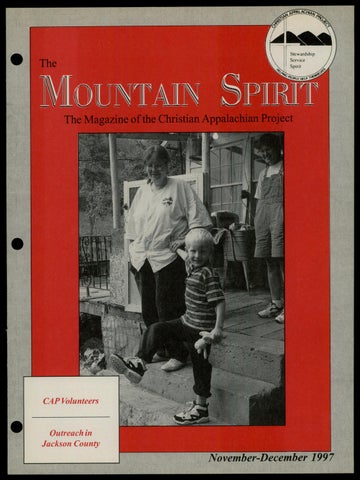
Volunteers Leaving an imprint, on the region Someone once asked CAP’s founder, Father Ralph Beiting, what his greatest gift was to Appalachia. “That would have to be volunteers,’’Father Beiting said, after considering the question for a moment. He said that the work of volunteers has benefitted the Christian Appalachian Project and the region, because of the people who came originally for a short period and stayed much longer. This issue of The Mountain Spirit introduces you to volunteers and former volunteers who have extended their commitments to CAP and to Appalachia. On page sixteen, a story by Beth Dotson examines the motivation of volunteers who determine that their work is not yet finished at the end of one year. On page twenty-four, Kathy Peterson tells of the hardships and joy she andi her husband, Steve, experienced ^ when they began living and working in the small Harlan County town of Evarts. Kathy and Steve have learned that through community can be found the strength needed to stay on the path. May we be the first to wish you a “Merry Christmas” with Jim Trammel’s review of “Christmas Appalachian Stories,” on page eight. On the cover, Jesse Mays proudly shows off the shoes that were a back-to-school gift from volunteer Clare Kaiser and CAP’s School Readiness program (photo by Margaret Gabriel).
Published by the Christian Appalachian Project. Editor: Margaret Gabriel. Graphic Design: Karen Frances Spivey. Circulation: Linda Grider East. Advisory Board Father Ralph W Beiting, Mike Sanders, Bill Begley, Ike Adams. The Mountain Spirit is published six times a year. The annual subscription price is $8.00. Subscriptions and other correspondence should be sent to The Mountain Spirit, Christian Appalachian Project, 322 Crab Orchard Road, Lancaster, KY 40446. Copyright, 1997, The Christian Appalachian Project, Inc. All rights reserved. Member, Catholic Press Association. The Christian Appalachian Project is a non-profit Christian service organization operating throughout Appalachia. The project operates on the philosophy that helping people help themselves is the best approach to Appalachian poverty. A summary of the registration and financial documents filed by this organization can be obtained by contacting: in New York, Secretary of State, Office of Charities Registration 162 Washington Ave., Albany, NY 12231; In Maryland, for the cost of copies and postage, the Secretary of State, State House, Annapolis, MD 2140T in NEW JERSEY THE ATTORNEY GENERAL, 202-626-4380; in NORTH CAROLINA. A COPY OF THE LICENSE TO SOLICIT CHARITABLE CONTRIBUTIONS AS A CHARITABLE ORGANIZATION OR SPONSOR AND FINANCIAL INFORMATION MAYBE OBTAINED FROM THE DEPARTMENT OF HUMAN RESOURCES, SOLICITATION LICENSING BRANCH, BY CALLING (919) 733-4510: In Pennsylvania, residents may call the Pennsylvania Department of State at 1-800-732-0999; for West Virginia residents, the Secretary of State, State Capitol. Charleston. WV 25305: in Virginia, the State Division of Consumer Affairs, PO Box 1163, Richmond, VA 23209; Washington State residents may obtain a copy of the last report filed with the Washington Secretary of State by calling toll free within Washington. 1-800-332-4483; IN FLORIDA. RESIDENTS MAY CALL THE DIVISION OF CONSUMER SERVICES AT 1-800-HELP FLA or by writing to Christian Appalachian Project, 322 Crab Orchard Road, Lancaster, KY 40446. Our license number in Michigan is MICS 9933. Registration with any of the above government aqencies does not imply endorsement by the state.
The Mountain Spirit
Random Thoughts Casey Sterr spent 1986 and 1987 as a volunteer in the Christian Appalachian Project home repair program, then spent the next eight and a half years in various paid staff positions. These nine and half years have been the most fruitful and transforming years of my life. I will also share one other important note. In June of this year I made the decision to leave my staff position, to move on to new ventures. I was able to make that decision because CAP has been an integral part of my growth as a Christian. From my first day as a volunteer to the present, I have been richly blessed by the enthusiasm, dedication, and perseverance of a truly special ministry that longs to make a difference in the world. What makes CAP so special? Answered simply, all involved are messengers of God’s love and hope for those in need. This is special because we are fulfilling part of Christ’s greatest command: “You shall love your neighbor as yourself’ (Matthew 22: 39). “All involved” refers to everyone who makes this ministry possible: those who offer up prayers, those who send financial contributions, paid staff, volunteers, and program participants. The volunteer, however, plays a unique role: that of servant. I am most impressed with individuals who are “doers.” Some talk about the need to serve and others research the causes of problems that need to be addressed. Each of these plays a role. But it is the front-line servants — the “doers” — who hold a special place. CAP volunteers are doers. They blend an active faith in God with service to others. St. Francis of Assisi once wrote: “Preach the Gospel at all times. Use words if you have to.” This wry command tells us that we are to be people of action and service, not just words. Considering my earlier note that I will be leaving CAP soon, some may wonder, “Why do you no November-December 1997
Casey Sterr.
longer want to be a part of all the good that CAP manifests?” A big part of the answer is: I don’t know. My decision is based on a faith that God is gently leading me on a new part of the journey. Another part of the answer is that I have received deep blessings in all of my work at CAP, blessings that serve as a preparation for the next step. In a way, I feel like one of the seventy-two disciples whom Jesus sent out with the words, “The harvest is abundant but the laborers are few . . . Go on your way . . . ” (Luke 10:2-3). The challenge I have received is to take these many blessings and share them with others. I have had such a special experience at CAP that I sometimes wonder whether it can ever be duplicated. When volunteers leave they may also wonder the same thing. I truly believe that as long as we continue to be messengers of God’s love and hope to our world, that the volunteer experience will never end. Casey Sterr recently left his position as CAP's director o f direct response fund raising.
3
Folks visit the Christian Appalachian Project outreach office in Jackson County for many reasons. They might need help with an overdue utility bill, or with food, clothes or shelter. O r maybe they just need a friend to talk to. Volunteer Clare K aiser is that friend and her occasionally-used desk probably goes a long way toward making folks feel a little more comfortable asking for help with a problem. The uncluttered surface gives the impression that the next problem will receive undivided attention. The tiny farmer sitting on a toy tractor on the comer of the desk reminds Clare of Nebraska, her home state, and lets people know that she is close to the land, close to her roots. She says people like that.
Clare began her work with CAP at Camp Andrew Jackson, as an environmental education teacher. She enjoyed working with the children, and going into the schools in Jackson County, but as the beginning of her second year of service approached, Clare was looking for a different experience. “At AJ, we worked in the schools or at camp, and I wanted to get into the families more,” Clare says. “Kids are
V < ,lU " > C e r
where a lot of the hope is in Appalachia, and I figured I really needed to understand their situation. I love outreach. I just love it. I still get to work with the kids, but I get to work with the whole family now.” CAP outreach programs include a wide variety of services which Clare is able to offer to The Mountain Spirit
4
families that are working to become self-sufficient. It is easy to sense that Clare loves outreach not because of what she does for people, but because she is able to encourage people to do for themselves. Forming and promoting support groups of teens and women — groups that encourage and enable selfsufficiency — are among the activities she terms as “success.”
that experiences outside of the county, blended with service to the community, will result in well-rounded adults who will be equipped to make contri butions of leadership.
Clare works with the teen group in affiliation with St. Paul Catholic Church in McKee, Jackson’s county seat with a population of about 1000. She is proud of the service aspect that the group has adopted. “The group named itself Helping Hands, and I’ve seen them growing and feeling good about themselves. This weekend they’re going help the food bank with a road block [to collect food and support], and they helped out on trash clean-up day. They got first prize for picking up the most trash.”
By its very nature, the outreach program involves the worker and the participant in a relationship that touches on personal issues. Deep friendships often grow very Clare Kaiser s visits provide encouragement, Jriendshtp — and quickly. Clare’s on this particular occasion, dessert. friendships with Books in the living room of program participants Betty Mays Betty’s house tell the story of her and Kelly Blevins are GED efforts. “I do okay with unmistakable when she talks of English and social studies, but them, and even more so when she math is my big problem,” she visits with them. admits. “I was labeled a slow learner, and dropped out of the “Betty needs someone who will eighth grade when I was sixteen.” listen to her and support her,”
While Clare and the other adult sponsors of Helping Hands have encouraged the teens to reach out to their community, they have also let them “be kids” by taking them to adjoining counties for movies and bowling. Jackson County is an hour away from the nearest movie theatre or bowling alley. Lack of transportation and little or no pocket money combine to make activities that most young people take for granted very special to the kids in Clare’s teen group. “They’re learning there are other things besides the things they know in their small community. It’s good that they get a taste of things outside of Jackson County.” Clare believes November-December 1997
Clare says. “She’s working on her GED (a high school equivalency diploma), and I think Job Start [a CAP job training program] would be tremendous for her right now. She doesn’t think she’s ready for it, but I think it would be ideal.” Indeed, Clare says that she will consider her entire year of service in Jackson County a success if she can convince Betty Mays to begin Job Start and join a women’s group. “She’s very shy, and doesn’t feel comfortable around a lot of people.”
Betty says that she started to study to take the series of GED tests when Jesse, her younger child, started pre-school and that “even though it’s hard, I enjoy it.” Vivien Abner, a CAP adult education teacher, is encouraging Betty to take the science and social studies portions of the test in the coming month. A welfare recipient, Betty knows that she has less than two years to obtain the education and training that she needs to enter the job market. She also knows that Clare and other
5
CAP workers are willing and anxious to help her. They have been friends since her nine-yearold was a baby, and a CAP outreach worker transported them to the health department when baby Katrina had a bad cough. Clare and her predecessors in the Jackson County outreach office helped Betty and her family access CAP home repair to make their home safer, and in the fall helped stretch the family budget by providing the supplies and shoes that Katrina and Jesse needed to start school. Jesse proudly showed off the tennis shoes Clare had supplied. “He wants to sleep in 'em,” Betty says, “And I don’t know how she knew what kind of shoes my daughter wanted, but she brought those old clunky shoes that Katrina loves.” Betty doesn’t drive, and is particularly grateful when Clare takes her to visit her parents, who live in Garrard County, about 40 miles away. “She goes above and beyond — anything we’ve needed, she’s been right here.” Before Clare left the Mays’ home on a bright day in late August, she and Betty swapped a pumpkin pie and a pair of sneakers. Operation Sharing [CAP’s in-kind donation distribution program] had received a shipment of pies which Clare was distributing while they were still fresh, and Betty had cleaned up the tennis shoes that Jesse had outgrown. “I want to donate them to CAP,” she says. While the Mays family is one that Clare has known since her earliest days in Jackson County, Kelly Blevins and her children are new to Clare’s caseload.
the top honor at summer camp. She really works on discipline with them,” Clare says. Kelly frankly admits that she “screwed up” by dropping out of school in the tenth grade and holds herself up as an example for her children. “You’re going to school and get your education,” she tells the children. “You will make something out of your life. You won’t be out on the street.”
“I met Clare after I moved here with a business I was working for,” says Kelly. The business, which had moved to Jackson County from Columbus, Ohio, folded and left Kelly without any means of support for her children. A neighbor drove her to the social services office in McKee to sign up for welfare and food stamps. She also introduced Kelly to Clare, who was able to provide beds for her three boys. Since that time, Kelly has taken in her boyfriend’s three children, and a fifteen-year-old pregnant niece. Clare checks in with Kelly every week, or so. “Right now, we’re building a friendship,” Clare says. “She’s really trying to make life better for her kids. They’re doing all right in school, and not getting into trouble.” Shortly after meeting the family, Clare was able to enroll three of the boys at Camp Andrew Jackson, where they all won awards. “One of the boys that was getting into trouble in Columbus won the Christian Spirit award —
Although her primary concern is for her children, Kelly still dreams for herself now and then. “I want to finish my education. I see now how much that firm backing means. I want to go into computers or accounting. I’m good at that, and it’s something I can do at home. I’d would like to buy a house someday, so I can have something to leave to my kids.” Kelly calls Clare “my sanity, at times” and insisted that the CAP volunteer check in with her the following week. Clare promised to come back when she could stay a while. Clare’s love of people is at the root of her success as an outreach worker. According to Peggy Hancock, manager of CAP outreach, Clare’s genuine warmth and concern for her friends make her an asset in Jackson County. “When Clare worked at camp, she was very shy. I’ve seen her really blossom with these people,” Peggy says. “Her real strength is her soft, gentle way of caring for people of all ages. She carries books in the back of her truck to encourage kids to read, and she can sit and listen to an elder tell the same story The Mountain Spirit
seventeen times, and it’s new every time.” That same love led Clare to join CAP’S volunteer community. “I’ve always had a desire to volunteer, even when I was working full time in other places,” she says. As she was growing up, Clare’s parents modeled comunity service to their five children. “My dad was real involved with Knights of Columbus and my mom was in Christian Mothers and Catholic Daughters back home. And I went to a small, private school, and you learned to be involved.” Clare assumed that full-time volunteer work meant working overseas, and had applied for a position with the Peace Corps when she had an opportunity to travel with a friend in Thailand. “I know about six people from Thailand, and I wanted to see how they live. Ying is one of my best friends, and I wanted to see her background so I could understand her better. I traveled all through Thailand, and while I was there I realized that I needed to stay in the United States, that there’s plenty to do here.” Clare was introduced to CAP and its work in Appalachia by Father Beiting’s autobiography Called to the Mountains. “It gave me a really strong feeling that this would be something I ’d enjoy doing,” Clare says. “I decided on CAP because of the volunteer communities. I know myself enough to know that I need a positive community to come back to for support. And the rural area attracted me, too,” Clare says. “The community has really been a great support, and really, a November-December 1997
Clare and Kelly share thoughts on a porch in Jackson County.
lot of fun. We’ve had some wonderful people. I feel so fortunate — I’ve been in a super house. I know I’ll keep in touch with my housemates forever. These will be lifelong friends.” Volunteers in the Jackson house, as in all nine volunteer houses, work with many of the same families in different programs. Those families often become a part of the “extended” volunteer family, far more than just people they work with. “Everybody here knows Betty Mays,” Clare says. “I took Betty swimming last week, with her kids, then she came up to the house. We invite people for dinner all the time.” Clare feels certain that she will be returning to Nebraska after her second year of volunteer service is complete. In fact, she says, her entire family has been scouting around for jobs that she might find suitable when she goes home. Although she is not certain what turn her life will take, and tries
not to think about it too much (“It’s going to be tough, leaving.”), Clare plans to continue working with people, and believes that her work in Jackson County has made a positive impact on the people she has touched. “I hope they have a positive image of themselves. They’re good people, and I hope they know that, too. I don’t talk too much about Christianity, but I hope that they know that God loves them, that they’re truly loved.” Reflecting on the things that she’ll take with her when she leaves, Clare smiles, laughs and says, “Oh my, there’s so much. I probably won’t even realize how much until I’m gone.” Whatever Clare takes with her, she’ll certainly be leaving with Betty, Kelly and her other friends, a measure of the quiet care and friendship that has made her so welcome in so many homes in Jackson County. 7
Appalachian Christmas Stories Appalachian Christmas Stories. Compiled and edited by James M. Gifford, Owen B. Nance and Patricia A. Hall. $9.95, The Jesse Stuart Foundation, P. O. Box 391, Ashland, KY 41114. I l l pages.
ne slender, ten-dollar book will edify you about mountain Christmas customs, catch you up on favorite Appalachian authors you might never have gotten to know, and add a whiff of mountain evergreen and oranges to your Christmas family readings around the Yule log. That remarkable book is Appalachian Christmas Stories, published by the Jesse Stuart Foundation of Ashland. Three Christmas short stories, one each from the legendary Jesse Stuart and renowned educators James B. Goode and Loyal Jones, have more to offer than the standard portrait of mountain people fighting back the hard times long enough to have a family Christmas. Each throws in lots of rich detail on the way toward telling a clever story. The
Stuart piece is a flawless little gem, but the Goode story veered into usually uncharted territory and earns my vote as the best of the three. (“Christmas on the River,” by Catlettsburg native Billy C. Clark who now edits Virginia Writing,
reads as dramatically as any of these three stories but is identified by the editors as a memoir. The same for Harry Caudill’s contribution, an entertaining The Mountain Spirit
. . . A Book Review by Jim Trammel When they had passed the last house in Looney Ridge, it occurred to him that he didn’t know the girl’s name. “I bet such a pretty girl has a pretty name,” he inquired. “My name is Faith Simpkins,” she hung her head between the collar on her coat and blushed. “That’s a beautiful name,” Doc replied. “I don’t particularly like mine,” he said. “Mother named me after my grandfathers on both sides. Hector Lum Dupree just doesn’t fit.” He toyed with the name emphasizing the LUM in the middle of it. “Hector LUM Dupree — then HECTOR Lum Dupree — then Hector Lum DUPREE.” None of them seemed to work for him. The little girl fell silent. She had quit sobbing and the tears were dried in dirty streaks on her face. By the time they reached the halfway point at Wise Gap, she slept with her head leaned against the door jam. Doc concentrated on the snowy dirt road — peering through the smear left by the stubborn vacuum windshield wipers of the Model-A.
remember getting a holiday apple or orange, it was news to me that the fruit was rarely ever eaten all at once, and that the peels were saved to use all the next year as flavoring for cakes, custards and puddings. And if you don’t readily know what role mackerel, oysters, and coconuts played in hill country Christmases of long ago, then you might be as entranced with Clarke’s essay as I was.
From “Appalachian Christmas Angel” by James B. Goode
A ppalachian C hristm as S to n e s
lawyerin’ yarn which one could imagine Caudill spinning while finishing touches are being put on Christmas-aftemoon dinner not far away in the kitchen.) Historian Thomas Clarke is a bit more clear-eyed about Appalachian Christmases of old in a nonfiction essay, “A Little November-December 1997
Bit of Santa Claus,” in which he reconstructs real-life Appalachian Christmases based on generalstore records. Why and how did oranges, so presumably scarce in the hills, get to be such a big part of a country Christmas?
Thoughtful poems from Stuart, Goode and the late Jim Wayne Miller are an appropriate finish to this collection. Two hillbilly “Night Before Christmas” parodies at the end by Marlin Blaine don’t damage the overall high tone of this work too much, only because they’re included, I suspect, as harmless chuckles, mainly toward the end. It’s hard to listen to Clement Clark Moore’s cadences married to stereotypical “cracker barrel” doggerel, like “And me in my long johns and Maw in her flannel,” without wondering if they take a shot at the dignity of the hill people.
can easily become the book you bring out every holiday season for a group reading that reminds everyone why Christmas in the hills and hollers was always special and always will be. Give it a try. Jim Tramm el works f o r G o d ’s P antry F ood Bank, which brings its share o f holiday j o y to the p o o r
Although the longestmemoried among us might
and hungry every y e a r about this tim e and y e a r ’round, in fa ct.
9
Around the Project CAP Expresses Sympathy to the Missionaries of Charity Mother Teresa answered the question, “Why Jenkins?” with fa r more simplicity. “My concern is that wherever God wants us to be, we will be. I f you count the number, maybe in Calcutta, we deal with thousands. Maybe here we will deal with two people. I t ’s not how much, but how much love! ” “Hunger of the Heart” The Mountain Spirit September-October, 1982 In 1982, Mother Teresa of Calcutta visited sisters in Jenkins, Kentucky, the first rural mission established in the United States by the Missionaries of Charity. The location was selected after Christian Appalachian Project founder Father Ralph Beiting escorted several of the sisters to some of the most distressed areas of eastern Kentucky. “First, it was the Appalachian people who attracted them [to the area] with their strong family ties, and their attachment to the land,” Father Beiting recalled. “Sister Priscilla was very surprised at the topographical similarities between eastern Kentucky and her home in the hills of India. We spent our first night in Whitesburg, the county seat, and the next day drove around the county to some of the other small towns. “We stopped at a gas station in Jenkins to ask direction and a young man of, maybe, twenty struck up a conversation with Sister Priscilla. He introduced himself and asked what had brought us to his town. The friendliness and pride which he
Father Betting greets Mother Teresa o f Calcutta at services and a reception in Jenkins, Kentucky, when the Missionaries o f Charity established their first rural mission in the United States.
took in his town seemed to be a great factor in the decision. I think it’s a tribute to their wisdom that they chose Appalachia to begin their rural work in the United States,” Father Beiting said. Since that time the Missionaries of Charity have continued their work in Jenkins, becoming a presence of the love of Christ in that small mountain town. The Christian Appalachian Project expresses its deepest condolences to the Missionaries of Charity on the loss of their
founder, Mother Teresa. When she spoke to the people of Jenkins in 1982, Mother Teresa said “Let us come to know the poor of this area. Let us make this place something beautiful for God by spreading the joy of loving.” Mother Teresa’s sisters and the people of Jenkins have truly shared that joy of loving. Christian Appalachian Project is a participating agency in the Combined Federal Campaign. Federal and military employees can contribute to CAP by designating #0898 on the CFC pledge card.
The Mountain Spirit
around the project. . . continued Future Entrepreneurs Attend Leadership Training at Camp AJ
The Christian Appalachian Project is participating in the Kentucky Employees’ Charitable Campaign fo r 1997. At the KECC Kick-Off Celebration, CAP program participant Barbara Marks met Kentucky Governor Paul Patton and told o f the help she received from CAP in rebuilding life after enduring years o f domestic violence.
A group of 24 ninth, tenth and eleventh grade members of the Jackson County High School Entrepreneurs’ Club gathered at the Christian Appalachian Proejct’s Camp Andrew Jackson for leadership training, according to camp manager Laurie Eiselt. Part of the day was devoted to the team building exercises at Camp AJ known as “The Ropes.” One group of twelve teens tried to scale an eight-foot wall safely, while the other was involved in “The AJ Triangle,” Laurie said. The triangle exercise involves tying a rope between three trees and putting the group in the triangle. The group is told that the rope and everything below it is electrified, given a seven-foot plank, and instructed to get the group out of the triangle. At the wall, the group is instructed to get everyone over the wall, safely. “While they’re trying to figure how to do it, you can see lots of leadership styles coming out,” Laurie said.
During de-briefing, students related the team building exercises to business experiences they envision as future entrepreneurs, and determined how they might help them as students and in life. “The kids talked about how they felt when their ideas weren’t listened to, or when everyone cheered for them.” Laurie hopes that some of the young people in the Entrepreneurs’ Club will be interested in the teen leadership programs at Camp AJ. “I’d like to involve them in facilitating the after school and service programs that we have for the younger kids,” Laurie said.
Moving?
Please notify us of any change of address to make sure you receive every issue of The Mountain Spirit. Please print
O ld A ddress
New Camp Holds Open House An open house October 26, 1997, introduced the community and workers from all over the area to the Christian Appalachian Project’s latest camping facility, Camp Boone’s Landing in Lawence County. Five small houses will provide lodging for campers and a larger building will be used as a dining hall and for group activities, according to assistant director Richard Ginn. “We also cleared land for tennis courts and poured the basketball court,” said Richard. November-December 1997
In addition to traditional camping programs, Richard said, Camp Boone’s Landing will also be available for family vacations or counseling. CAP is leasing the 500-acre camp from the Army Corps of Engineers. “I’m really looking forward to it,” Richard said. “I think it will be the best camping program that we’ve ever been involved in. If we can do it the way we envision it, this camp will be a blessing to CAP and to the community.”
N ew A ddress
Mail to: The Mountain Spirit 322 Crab Orchard Road Lancaster, Kentucky 40446
11
around the project. . . continued
CAPRICE, Respite Vacation is Truly “Awesome” As their bus drew closer and closer to Washington, D.C., CAPRICE worker Bobby Bailey asked one of the travellers what he most wanted to see. “Oh, I just want to take it all in,” he said. The travellers included nineteen adults with disabilities and six staffers from the Rainbow Respite Care Center and CAPRICE (Christian Appalachian Project Resources for Independence and Community Employment). They were off on their “Awesome Vacation,” a trip they had all been planning and working toward for months. And take it all in they did. In a span of only five days, the group saw the Lincoln Memorial, the Washington Monument, the
Vietnam Memorial, the White House, a play at the Kennedy Center and Arlington Cemetery, including the Tomb of the Unknowns. Different people had different favorites. Bobby was moved when he laid a wreath on the tomb to honor people in military service. Rainbow Respite staffer Stacy Bray enjoyed the Kennedy Center, she said. Days started with breakfast at 7:00 and continued until after 8:00 in the evening. “There was so much to do, we had to have long hours,” Bobby said. At the Smithsonian, the large group divided in smaller groups, so that people could see things that interested them the most. While the travellers were
■H
anticipating the museums and points of historical interest, most were caught off guard by the urban setting. “For some, it was their first time out of their county. They thought the city was huge, and were taken with the homeless people they saw,” Bobby said. Stacy told of a homeless man who approached their group, took off his hat and sang “Amazing Grace.” “They gave him money for a meal and a bus ticket. He made them really thankful for the things they had.” The group is ready the make the effort to take another trip, Stacy and Bobby said. Although several had been told that they wouldn’t be able to raise enough money to make the trip, or travel without their parents, they proved all the doubters wrong, and have gained a great measure of confidence for day-to-day living.
Respecting the wishes o f deceased loved ones, or in honor o f them, families often request that memorials be sent to us. Memorial gifts live on to benefit others. Many also specify memorial gifts in their wills. Any size gift is welcome. Contact us for
Nineteen CAPRICE and Rainbow Respite participants travelled to Washington, D.C., fo r an “Awesome Vacation. ” Here, the travellers visit the outdoor sculpture, “The Awakening. ”
12
The Mountain Spirit
around the project. . . continued CAP Hosts Benefit Golf Tournament A t What You Don't Know About Wills Can Hurt Your H e irs .. Find Out Why. ^ Request j . (• Your * •.- j Free Copy. .
Ben Prewitt, Director o f Planned Giving and Major Gifts, caught up g o lf great Arnold Palmer, president and owner o f Latrobe Country Club, Latrobe, Pennsylvania, at a benefit g o lf tournament hosted by CAP.
The Kentucky Summit As a follow-up to the President’s Summit for America’s Future held recently in Philadelphia [see The Mountain Spirit, July-August 1997], the Christian Appalachian Project participated in the Governor’s Summit for Kentucky’s Kids in September. CAP founder Father Ralph Beiting, a governor’s delegate at the Philadelphia summit, led the CAP group: Moe Mercier, vicepresident of human development; Tom Conner, director of human development; Kathy Kluesener, assistant director of CAP’S volunteer program; and Laurie Eiselt, manager of Camp Andrew Jackson. Kentucky’s goal is to recruit 30,000 volunteers by 2000. “The focus is on kids,” Kathy said, “and there is a large focus on mentoring. They want to involve people of all ages, from high school age and younger, on up to seniors citizens.” Workshops addressed a variety of topics, including collaboration, partnership and November-December 1997
recruiting diverse volunteers. During his invocation, Father Beiting commended the work of Kentucky PTA President Karen Jones, who was instrumental in planning and coordinating the summit, the author of an acclaimed story in a past issue of The Mountain Spirit, “A Look in the Mirror of an Appalachian Woman.” The story is an account of her struggles to return to high school and college. Through her work in the PTA, Karen encourages young people to complete their educations. Father Beiting spent time in CAP’S exhibitor’s booth with many old friends, and was commended frequently for the work of CAP and his longevity in the region. “I believe that people see the possibility of making long-term commitments to the region because of Father Beiting’s work and dedication,” Kathy said. Moe, Tom, Kathy and Laurie plan to create a strategy for attracting community volunteers to work in CAP programs.
Much of what you know about wills may be misinformation that has been floating around for years. If you think, for example, that wills are primarily for rich people, or elderly people, you may be the victim of a common misconception. The helpful book let offered here will explain how your will can save your heirs from costly delays and confu sion. Send for your copy today. Clip and Mail
Christian Appalachian Project 322 Crab Orchard Road Lancaster, Kentucky 40446 Please send without obligation your booklet, “37 Things People ‘Know’ About Wills That Aren't Really So.” Name Address_ C ity____ State,ZIP.
13
around the project. . . continued Outreach Program Helps Students With Clothes and School Supplies To continue its mission of helping people eliminate barriers to their goals, the Christian Appalachian Project outreach program initiated a “School Readiness” program in the fall of 1997 “There are lots of barriers just going to school,” said outreach manager Peggy Hancock. “Some families don’t place value in education, or just plain don’t have the money it takes to get kids ready to go to school.” Through eight CAP programs, including adult education, child development, teen centers and outreach, CAP took applications for the program from families with whom programs work. They were provided school supplies, shoes, clothing, grooming items,
haircuts, “anything that would eliminate a barrier and make starting school a positive experience,” Peggy said. The program provided for 821 children in nine counties, although every county was handled differently, according to the involvement of schools and family resource centers. In Jackson County, for example, the family resource center is able to provide clothing, so CAP provided only school supplies. In the future, Peggy hopes to coordinate with other providers, enabling everyone to work together. She also anticipates working closely with Operation Sharing. Peggy commended the local Kmart for its community
involvement. “They came through in a big way,” Peggy said, and matched low prices on everything she could find advertised, or gave discounts on things she couldn’t. “They opened up two or three check out lines for us every time we came in, and the shoe department sent us a thank-you note for shopping there.” Peggy and the outreach workers didn’t have to shop for everyone. Liz Phelps, the manager of Family Life Services, CAP’S residence for families in transition, shopped specifically for the children in her program. Peggy hopes to be able to let the teen center participants shop for themselves in the future. Calling the readiness program “very successful,” Peggy said, “It was a lot of work, but it was a lot of fun, too. Everyone worked hard.”
Give the Spirit o f Christmas! H o w many times have you read a story in The Mountain Spirit and thought “Oh, I wish I could share that with . . . !” We hear from readers almost every week who tell us that they pass their Mountain Spirit to their mother, brother, pastor or friend. Give a little bit of us this Christmas by giving a gift of The Mountain Spirit to someone you’d like to tell at the work of the Christian Appalachian Project. We’ll be happy to announce your gift with a specially designed card. If you’ve told yourself that you’d like to do more for CAP in the coming year, this might be the very way to do it. By sharing The Mountain Spirit you can tell more people about the joys and challenges of the mountains and the work that the Appalachian people are doing to help themselves out of poverty.
around the project. . . continued What Can I Do to Help the Christian Appalachian Project? Christian Appalachian Project supporters often ask what more they can do to help eliminate suffering in Appalachia. First, we tell them, you can tell others of the problems in Appalachia which you learn about in The Mountain Spirit and other CAP publications. You might want to share this magazine with a friend, for example. If you’d like, drop us a line and we’ll send you a replacement copy. Ask us about the problems in Appalachia and we’ll be happy to share any knowledge we have or to refer you to another organiza tion that can help you. Secondly, you can give us a most valuable commodity — time. Since 1950, thousands of people have worked millions of
hours, donating time to helping the people of Appalachia help themselves and their families out of poverty. If you would like to volunteer a year or a summer to working in Appalachia, please contact: The Mountain Spirit, 322 Crab Orchard Road, Lancaster, KY, 40446. We will see that you receive information about CAP’S volunteer program. Finally, our most powerful form of assistance is prayer. We believe that if our supporters spend at least one minute a day praying for poor people every where, mountains can be moved, the course of rivers can be changed. The CAP family forms a powerful prayer network reaching into Appalachia and across the nation.
Elderly Program Involves Neighbors When Elmon, who has participated in CAP’s elderly services program for many years, was referred to an ophthalmologist for consultation about his cataracts, it was decided that surgery would greatly improve his vision, and therefore, his quality of life. Eric Smith, a CAP volunteer who worked in elderly services
in the county, could provide the needed transportation for pre surgery bloodwork, the surgery and the follow-up visits, said elderly services manager Sandi Knight. “But the real problem,” Sandi said, “was that Elmon didn’t have anyone to put drops in his eyes three times a day. He doesn’t
D O U B LE Your D ollars !==Jli If you are a CAP donor, or are considering becoming one, you may be eligible to double your gift through your employer’s matching gift program. Many companies today match monetary support to non-profit community service organizations that are sup ported by their employees. Many of these companies match the gifts that are made by their retirees as well. Please write for your brochure “Double Your Dollars,” which lists participat ing companies and instruc tions. Send correspondence to: Teresa McAnly, CAP 322 Crab Orchard Road Lancaster, KY 40446
have any family, he’s never married. Eric went out in the area where Elmon lives and knocked on every door, one at a time, until he found someone who could help.” So, Elmon was able to have the surgery he needed, and Eric felt good about one of the last services he was able to provide before leaving CAP after serving for three years.
CAP Website The newly-mounted Christian Appalachian Project website has had many hits (visitors) since it was created in late summer by former volunteer Jeff Healander. CAP’s web site includes information about CAP’s human development programs, planned giving and major gifts and the volunteer program. Please visit the site at www. chrisapp. org. November-December 1997
CAP held its annual Day o f Prayer in the fall. In Mount Vernon, the children from the Family Life Child Development Center participated in the day.
15
:
Kevin Feliciano begins his third year as volunteer, working in adult education.
The Mountain Spirit 16
or many who decide to spend a year volunteering with the Christian Appalachian Project, it’s a P bit like tumbling down the rabbit hole with Alice into another world. “For me, it just became a new way of life,” recalled Laura Schnizler. She volunteered after beginning her career in the business world. “Giving of myself freely, being able to pray at work, being able to start the day with prayer or end the day in prayer. That is something that you can’t get in the corporate world.” It is something volunteers get when they join CAP, though. Laura is among hundreds who have volunteered and discovered the experience not only allows them to serve, but to grow personally and to deepen their spirituality. For some, the experience is so positive that they volunteer for more than a year, or even move into the region permanently. Laura completed a year and a half of volunteer work then moved on to become a CAP employee. After working at the Family Life Abuse Center, she now works in the volunteer department as coordinator of volunteer houses. When volunteers tell her they are considering a second year with CAP, Laura suggests that if they are even thinking about staying, that is a sign that they have enjoyed their personal progress and work and they probably aren’t finished growing yet. Judy Costello is a retired teacher and a second year volunteer from Massachusetts. Sitting in the living room of the
November-December 1997
Mount Vernon house with two other volunteers, she talks about how she’s trying to be more accepting of others. She’s still learning, still trying to give of herself to become more simple and less materialistic. It’s a long road, she says, but she’s on it and she’ll keep at it. The retired teacher smiles at the other two volunteers then laughs. “Now if I were talking like this at home, eyes would be rolling.”
“Giving of mvself freeh; being able to pray at work, being able to start the dav with praver or end the dav in prayer. That is something that vou can’t get in the corporate world.” *j
«/
i
*)
Sister Emily Yuhas joins in the laughter, then reassures Judy. “That’s all right. . . the journey of a thousand miles begins with a single step, so every effort we make is one step further along the path.” For Judy, Sister Emily and Pete Fochtman, the first year of their volunteer experience led them into a second along the volunteer path. Pete, a Michigan native who signed on with CAP after
N/
Laura Schnizler,
former CAP volunteer currently Coordinator of Volunteer Houses
Laura Schnizler and Barb Delmonico began their work with CAP as volunteers, and today work in the volunteer department.
Mary McNamara found a good fit with Christian Appalachian Project. A form er volunteer, Mary has worked in several programs, and currently serves as Coordinator o f Volunteer Recruitment and Alumni fo r CAP.
graduating from college and student teaching, recalled talking with another volunteer at the end of her term. She was jittery about leaving and Pete advised her not to worry about tomorrow because there are enough worries to deal with today. As he spoke, he realized that it would soon be time for him to decide if he was ready to leave. He knew the experience had been catalytic to his spiritual growth. One day as he talked with Judy about struggling with the decision, he recalled her telling him “with how much I was praying and desiring to do what God wanted, whatever I did end up deciding would be His will and up to that point I hadn’t really thought of it that way.”
Serving and Growing Conversations with volunteers and former volunteers about their CAP experiences reveal that though they came to serve, they have discovered an atmosphere in
which they can also grow. Whether from an incident they won’t remember next week or a story they’ll be telling for the rest of their lives, these people who come from a variety of socio economic backgrounds and ages have put themselves into situations where their
put themselves into situations where their minds and hearts are tested, altered and strengthened.
minds and hearts are tested, altered and strengthened through their work and community living with other volunteers. Mary McNamara arrived in Kentucky in 1994 as a recent college graduate with a degree in social work and criminology. She volunteered with Family Life Services which provides shelter for families in transition. “I think it took the first six months just to learn the job,” Mary recalled. Even then, she still found herself dealing primarily with the immediate needs of the women in the program rather than searching for the roots of their problems. She put on bandages that helped in the short term but didn’t necessarily provide lasting solutions. When Mary committed to a second year of volunteering in the program, she used her new knowledge and confidence to look at deeper issues with the residents. She took on more work, followed up with women who had left the shelter and started a parenting class. “I didn’t have the courage to do that the first year, not being a parent myself,” Mary recalled. “Knowing that I was going to be here longer, I was more willing to make stronger connections with residents,” Mary said. She believes that volunteers who stay for more than a year provide an important stability to the programs in which they work. Barb Delmonico, another volunteer turned employee who now works in the volunteer office, also sees how two-year volunteers can influence CAP program The Mountain Spirit
18
When volunteers realize they can’t save the entire world in one year, or even two, they can derive pleasure from individual successes. Sister Emily, a retired teacher from Ohio, worked first in the School on Wheels program in When he began, Pete wasn’t Garrard County, then sure he wanted to stay in his in adult literacy in position for more than a few Rockcastle County. months. Since he had a degree in She had many happy education, he wanted to work in a moments when her CAP child development center. “About a month into working at the students received their General center I felt real frustrated with Equivalency where these kids were coming Second-year volunteer Judy Castello works in the Diplomas. “I felt Rainbow Respite Care Center. from and the fact that I only had that was one key to a them in my care for three hours a better life for them day,” Pete said. The frustration — education and a job and even distracted him from his work and self-esteem. So that part I felt dealing in these programs shows he thought about changing jobs. really great about.” me different ways God is reflected and the ways that God “After talking with one of the While she saw life improving works in life, so I think I’m trying teachers up there I realized that my for her students, Sister Emily also to understand God through this job was not to try to change the realized she was learning. “I felt program and living here and world but to love those kids while that being exposed to so many working here,” she said. “I would they were there for three hours people that come from different like to know more about people and hope for the best and pray for backgrounds and that come from and how they see life and how the best for the rest of their days. other denominations, that really they attack problems, how they That gave me a lot of strength in kind of broadened my view of cope, what they’re striving for and terms of staying in that program.” religion, God, to know people genuinely and to spirituality and I felt respond to them. Not to just know that was very them but also, hopefully, I’m worthwhile.” giving to them my friendship, my attention, my time, my know-how It was also just a to teach.” starting point for Sister Emily, who has great ambitions for her second year as a CAP volunteer. One reason that Sister Emily “I think I hope for can focus on this learning has understanding. I something to do with the think I would like to uniqueness of the Appalachian know God lots region. Repeatedly, people who more. Dealing here choose to stay for more than a Pete Fochtman is working in home repair during his with the people and year talk about the simple participants. When someone stays, she said, “I think the message it sends to them (participants) is that there’s a real commitment, that they’re not just here for a year to do their service, then they’ll leave . . . It says I really love it here, I love the people here and I love what’s going on so I want to stay and help.”
second year as a CAP volunteer.
November-December 1997
Kathleen Leavell and Kathy Kluesener began their time with CAP as teachers in the Sunshine Center. Today, Kathleen is CAP’s foundation grant writer; Kathy is the assistant director o f the volunteer program.
It was also a place where she learned from the elderly people she visited as a volunteer. They didn’t have much materially. Some lacked indoor plumbing, a warm home and family members to watch after them. Yet, they thanked God every day for what they had.
her bed. Yet, every day she thanked the Lord for her blessings. Barb said, “I think there was a transformation that took place inside of me that made me an incredibly grateful person.” One of Pete’s reasons for volunteering was to try to pay back some of the blessings he had been given in his family. While doing that, he has gained tremendously. “To anyone who was the slightest bit interested in CAP for the reason that it is a Christian organization, I would say that I would guarantee that they would know God more profoundly, in ways that they might never have. It definitely broadens your relationship with God. I don’t really know anyone who came and the day they walked away they weren’t closer to God,” Pete said.
lifestyle the region allows them. “There’s such a simplicity here that you can really focus on life and what you should do in life and what you expect from life,” Sister Emily said.
One visit in particular left a profound impression on Barb. She asked a woman what she would like to have if she could have anything in the world. She answered, new sheets for my bed.
Strengthening CAP
Barb Delmonico has also been drawn to the simplicity of the region. “I think I’m more true to myself living simply,” she said.
“I cried on the way home,” Barb remembered. The woman had never before had new sheets for
Besides growing themselves, volunteers who stick around are also a boost to CAP’s volunteer
Barb arrived in 1989 after working in the mental health field in Colorado. She volunteered in the elderly visitation program for a year and two months. Though she was set to leave Kentucky, a job opened in CAP’S volunteer department and she took it. Why did she stay? “I believe it’s the Holy Spirit first and foremost,” she said. “I could not cognitively say why I wanted to stay, but there was such a pull to stay here . . . I think for me it was a place that I could totally be myself and share my faith.”
Ken and Ann Marie Stuber met as CAP volunteers, married, and started their family in Kentucky. Today, Ken works in CAP's home repair program.
The Mountain Spirit 20
department. From the recruiting standpoint, Barb said, that’s one less volunteer she has to find, so it makes her job easier. She has also heard from people in communities where volunteers live say they are happy to see volunteers stay around who might be involved in a local church or some other area service. As the coordinator for volunteer recruitment and alumni, Mary’s example of volunteering with CAP for two years then working for CAP “speaks that I have a real love for CAP and I think when you’re recruiting that’s important for people to see.” Her experiences with other volunteers have also helped her better understand CAP’s mission and how the organization works as a whole. Pete said he would like to think that, as CAP’s mission statement calls for, volunteers will pioneer when necessary. “A volunteer who has been there for two years is definitely November-December 1997
GiveMe Wings “Give me wings,” I’d beg You. “Make me a bird,” I’d plead. You knew I was being foolish . . . You’re smart like that. I wanted to fly far from here; leave behind the sunken eyes and broken spirits. I wanted to fly far above so I could see only the majestic patchwork of rooftops scattered across the hills. I was scared . . . You must understand. It killed me to know who slumbered beneath these leaky roofs, and gathered around these empty dinner tables. It killed me to see shoeless children, to hear anger and defeat, to smell this poverty of pocket and soul. I wanted to fly . . . I wanted to flee. I asked for wings and You gave me roots. I asked to be a bird; You made me a tree. Firmly You planted me in this ground. You gave me strength that my roots might run far and wide; that they might offer stability to this rocky surface, strength to this tired soul. I am growing steadily now. In the safety of my branches children now scamper, up . . . in . . . over . . . down. They whisper, they sing, they cry, they dream in the comfort of my outstretched arms. My leaves echo their laughter and loneliness. As I grow taller, my limbs cast longer shadows, offering relief to those enduring the relentless heat of living. I and they bear fruit of my work; the fruit of my growth. Now I can only hope my seeds fall upon fertile ground. I can only pray they are nurtured with love, challenged by circumstance, as I have been; new seeds offering hope for tomorrow, and the next day, and the next. Hope is a wonderful thing . . . I asked to be a bird You made me a tree. For this I thank You. Michele Pond, former volunteer.
-------------- ♦ ----------------
.. I all the sudden had this feeling or this thought that God must love me an awful lot to have me down here.. --------------- ♦ -----------------
Judy Costello, CAP volunteer
not a stagnant person. I think most people who stay for two years are staying largely because they’ve grown so much in the first year that they couldn’t justify leaving. I think with all that change that they have some perspectives on things, whether that is programs or just how things operate, perspectives that I guess are insightful because as CAP has evolved in the past two years that they were here they have evolved with that.”
Judy recognizes she is still evolving and the volunteer community is a safe and supportive place to do that. “Someone explained to me that as a stone is being polished it has to be buffed and buffed and buffed and buffed. I’m being buffed,” she said. As she’s being buffed, Judy said she has experienced God’s love more than she ever has before. She remembered one day when she drove a volunteer to the airport in Lexington. “On my way back, just by myself, and I don’t know what it was, I all the sudden had this feeling or this thought that God must love me an awful lot to have me down here. And I think that was the first time for me that I ever experienced God’s love,” Judy said. She explained that in her head, she had known God loved her, but she had never felt it like she has now. Like other volunteers, Judy had also felt God’s hand guiding her to where she needed to be. During her first year as a volunteer, she worked in elderly services. She had to change jobs in her second year and is now working in Rainbow Respite with children and adults with special needs. Judy spent her career as a special
Ursula Newton volunteered one year with Christian Appalachian Project and recently accepted a position as court advocate fo r domestic violence with Family Life Abuse Center, a shelter serving families in crisis.
education teacher and initially did not want to work in the program. But that is where she is, dealing with feeding tubes and other physical needs of the participants that she didn’t attend to as an educator. She has found that the experience speaks to her. “To me, that certainly is Jesus lying there,” she said. And so Judy is giving in a way she didn’t anticipate during her first year of volunteer work. Pete has also discovered something new in his giving. “I felt like I wanted to give back from what I’ve been given. Little did I know that’s a lifelong process, not something you make up for in one year.”
Beth Dotson, a former CAP volunteer, is a regular contributor to The Mountain Spirit and resides in Lancaster, Kentucky.
The Mountain Spirit
L etters to the E ditor I am encouraged by God’s continued faithfulness to His people in Appalachia and your vision to help them physically with jobs, but most important to bring Christ into their lives. I pray for your work and look forward to The Mountain Spirit in sharing those who are Christ’s ambassadors and the lives which are being served through them. I’m privileged to participate in a small way. God bless and keep each of you. Aldeen Wilfrod Gahanna, Ohio
I look forward to reading The Mountain Spirit in order to keep abreast of the wonderful work Father Beiting and all the staff are doing in Appalachia. My roots are deep in Appalachia and I thank God every day for all the dedicated people who are working so hard to make it a better day for the people I love. God bless all of CAP. Sharon Rose Portola, Calif.
This magazine is a fresh breath of air for me, as I was bom and raised in Covington, Kentucky. We were also poor in material wealth, but oh so rich and blessed in a family of seven children. Love abounded! I feel that love once again through your words. Lois Eha Fresno, Calif.
November-December 1997
I enjoy The Mountain Spirit so very much. It’s about honest people and a way to help them help themselves. Helen Savage Covina, Calif.
I am pleased with your excellent publication, The Mountain Spirit, so am again renewing my subscription with an additional contribution to help keep CAP funded. It deserves and requires our support and I am glad to help this ecumenical endeavor. May God reward all of you who are so active in it. John Blauwiekel Pewamo, Mich.
It’s a fine magazine. Keep informing us of your works and your Spirit. Mary Ann Vallieres Port Sanilac, Mich.
I look forward to each issue. I would like to see articles on people who are part time vol unteers, if the people volunteer for a summer or one year. I would like to know more about how and what we could do for a summer. This is a dream of ours when we retire. We hope we could contribute something to CAP. Harry Nell Naples, Fla.
I was so excited when my July-August 1997 Mountain Spirit came and on the cover were familiar faces, and a wonderful story by Katie Newsome about the 1997 Women’s Leadership Conference. My sister, Marge McKeisthan, Jacksonville, Florida, and I were volunteers there for that conference. What a flood of memories — the fashion show, the make-overs — many good speakers and other women’s health matters. My sister and I were among a select few that witnessed Ruth Shepherd accept Jesus Christ as her Lord and Savior, and we are very proud of her achievements. I was there for the 1995 conference. I hope to go back soon. I love CAP. Thank you for that article. Jean C. White Wilmington, N.C.
We need more people in this world like Father Beiting, who extends a helping hand to those in need. I know it must be a labor of love that gives him the will to press always forward, never looking back. Elbert Byrd ___________Portland, Ore. Letters to the editor are welcome. They should not exceed 150 words in length, and we reserve the right to edit them fo r space. Address letters to: The Mountain Spirit
Christian Appalachian Project 322 Crab Orchard Street Lancaster, KY 40446
Mo
tain
Sojourn
2 arly last spring, my husband, Steve, and I decided to hike to the top of the mountain ridge along the back of our holler. We started out thinking that we would be back in two or three hours, but on the way back down we got lost. We ended up sliding down the steep mountainside towards the sound of the creek we knew wandered past our trailer somewhere below. S ix hours later, scraped, muddy, tired, yet laughing, we arrived back home. The journey to Evarts, Kentucky, andbeing here since, has gone something like that.
The Mountain Spirit
teve and I both came to the Christian Appalachian Project as volunteers in the fall of 1991. Each fresh from college in a major city, we were drawn by memories of inspiring spring breaks spent with work groups in the Appalachian mountains. We both came for what Steve calls a mixture of selfless and selfish reasons. He wanted to be able to give to those who had not had as many opportunities as he, and to have a new experience in a different part of the country before beginning a career as a high school band director somewhere close to home. I looked at volunteering as time to learn more about my gifts, about living in Christian community and about God, while helping others. I anticipated beginning a career in secondary education. We both came with the idea that our time in Kentucky would be powerful but brief— a stepping stone to other things. Looking back, we can simply say that God called us each to Appalachia, for reasons we are still discovering.
S
Steve worked in CAP’S outreach program, providing emergency assistance, distributing garden seeds and Christmas baskets, and making many home visits. I worked in the adult learning program, tutoring literacy and GED students in their homes. As we visited families without running water, parents who couldn’t read, tobacco farmers, storytellers, fathers disabled and unemployed, master gardeners, and young single mothers trying to pass the GED and get a job, our world view expanded. Each day was an adventure, and we returned to our volunteer communities each evening full of stories of the people we’d met and places we’d seen.
November-December 1997
Kathy and Steve Peterson, top left and right, with the Stanford Volunteer House in 1993.
Through community life, prayer and service, God became more interwoven in my moment-tomoment life than ever before. My sense of God’s call to make a difference in the lives of others and my desire to make my life a radical response to that call deepened, as it did for Steve. We found that we didn’t want Christian service to be part-time or temporary, but a way of life. As volunteers, we were often asked when we were going to return to the real world, yet we felt we had found a world more real than any other. After three years with CAP, Steve and I decided to marry, and then decided to move to Evarts, Kentucky. Somehow we felt that
the adventure of ministry in Appalachia was not over for us: we were just beginning to understand the culture and our work. Steve decided that instead of returning to a large suburban school to teach instrumental music, he’d like to try to build a program in a small school in Appalachia. I decided to continue working with adults working towards their GED and literacy. With excitement and trepidation, Steve accepted a job in Harlan County and off we went. Harlan County, in the southeastern comer of Kentucky and mostly mountains, is ninetyone percent woodland. About 36,000 people live here, but the population has been steadily
25
dropping over the last several years. Coal mining is still the major source of income, although the industry loses hundreds of jobs a year to layoffs and mine closings. Under 50 percent of the adults have high school diplomas; only about 6 percent have a bachelor’s degree. About a third of Harlan Countians live in poverty, according to government standards. Millions of dollars in public assistance pours into the county each month. Evarts. the town we live near, is on the Clover Fork branch of the Cumberland River, has about 900 residents and is about a 30-minute drive from the county seat. Steve is entering his fourth year as the lone instrumental music teacher in this branch of the county. He teaches sixth graders at two elementary schools, and directs the beginning band, junior high band, and advanced marching concert band at the junior senior high school. Working with students with a variety of economic backgrounds, he has
experienced the ups and downs and stresses of any new teacher, plus some special challenges and frustrations at schools with limited resources and aging facilities (including a sometimes partially-flooded band room and not enough instruments to go around). He spends a lot of after school time on rehearsals and performances, and feels proud that the number of sixth to twelfth graders in band has nearly quadrupled since he came. Many kids feel comfortable hanging out in the band room, experimenting with music outside of school hours. After teaching literacy and GED students in the county adult education program for three years, I now work as the secretary at the Catholic elementary school in Harlan, and as the supervisor of an afterschool mentoring tutoring program in Evarts. In my job as an adult education teacher. I worked mainly with low income adults, many of whom were on public assistance. Last school year I worked with mostly teen parents
§ who were s required to take my class in order to keep their welfare benefits. I’ve also worked with many other adult students on an individual basis. It’s been good to see students gain confidence in their new skills, and go beyond the GED to more schooling or jobs. This school year is a change of pace. I supervise upperclassmen who are tutoring and encouraging students grades 5-9 who want to do better in school. Living and working here, like our six-hour hike, has been a mixture of struggle and triumph, laughter and sweat, worry and joy. Like the Biblical sojourner, we are strangers in a new land, making a journey of faith. And like the Israelites in the desert, we have done our share of grumbling at discovering the path is difficult, but we have also found our manna along the way — our “daily bread” to keep us on the journey. One of the hardships has been a feeling of isolation. We are outsiders in this mountain community where almost everyone is related to someone close by, and many were bom just miles from where they live. Store clerks have abruptly asked, “You’re not from around here, are you?” Some of Steve’s band students and their parents asked even more bluntly “Why are you The M ountain Spirit
26
here?” We had to become familiar with local traditions from the alumni weekend “Coal Bowl” and weekly worship times to hunting seasons. We realized we had economic, regional and religious backgrounds which our new community did not necessarily share. It seemed everything about us, from the clothes we wore to the food we ate, broadcast that we were “not from around here.”
After three years in Evarts, we can appreciate .. lilie the Isr a e lite s our slowly warming friendships with people in in the desert, w e have the community, and even though we’re not kin to the Petersons in Grays Knob, done our share o f people are beginning to know us. Steve has been supported by a group of grum bling at teachers he eats lunch with at school. We’ve grown to discovering the path know more members of our church, and have located other “transplants” is d ifficu lt, but w e — people who also moved to this area to do ministry have also found our — with whom we have much in common. We have found that the follow-up m anna along the w a y questions to “Why are you here?” are “How long are you staying?” and “You’re —our “d a ily bread”to not going to leave now are you?” When Steve received keep u s on the an “Honorary Coal Miner” certificate at the band banquet a year and a half journey.” ago, he realized some of the parents were in fact beginning to trust him. borrowed overcoats when we went
Several parents confronted Steve on decisions about things like band uniforms and discipline, implying that he didn’t understand how things were done around here. The band was small and struggling, and the halftime crowd at football games gave a less-thanenthusiastic response to their performances. Some of my students would repeat words I said and then self consciously put themselves down as “just hillbillies,” implying that we were from different worlds. We came home to each other many nights, discouraged. The mountains sometimes felt like walls around us. We felt far from anything or anyone familiar. Why did this feeling of isolation overwhelm us? Surely we were also outsiders when we worked for CAP as volunteers. We have learned that trust builds slowly between strangers, and that Father Beiting and CAP have worked many years at building that trust in the communities in which CAP has worked. As volunteers, we wore that trust as
out into the communities, and into homes, and then added to it as people got to know us personally. Also, as CAP volunteers, we formed our own community, sort of a community within a community. While a diverse group, many of us had much in common — a family of likeminded, like-hearted people. Steve and I have come to realize that being one couple seeking to become part of the larger community is much different, and for us, much more difficult. We underestimated the withdrawal we would experience in leaving the CAP community for an unfamiliar place, a withdrawal many former volunteers in many places probably experience.
We have connected with a faith community, beyond the traditional Sunday-moming-atMass variety. Steve and I realize now this is something we should have worked at more diligently when we first moved. The model of faith community we lived as CAP volunteers renews us, helps us make peace with the day’s sufferings — or at least lay what didn’t make sense before God at evening prayer. A faith community is our reservoir of hope. Without it we become scared and defeated when students quit school, or attendance at our programs is poor. Without it we begin to rely more on ourselves, and our own
November-December 1997 27
small strengths, rather than the strength of God. And, as far as service goes, we soon become burned out. We have found people with whom to celebrate and seek the kingdom of God in, among others, the Franciscan brother who pastors our church, a Mennonite couple about our age, and especially the married couple who co-pastor a Methodist church. We meet weekly to discuss our efforts at discipleship and to pray. With these people we can be ourselves and speak the language of spiritual journey and service which brought us here. We pray together, challenge each other to grow, and remind each other to keep our work rooted in compassion, not ego. Living with the community of Evarts, becoming part of it, has been a try at solidarity. Accepting that we can never really know what it is like to grow up in these mountains, or to be poor, we have joined our neighbors and our students for a scramble along the hillsides. We share their stories. We feel privileged and challenged to be stretched beyond our small lives to understand the many faces of God in God’s people. When Steve and I realized on our hike that we didn’t know
exactly where we were, we panicked a little as the shadows began to get longer and each descending ridge looked the same as the last. Once we chose a route down, we were moving quickly, tearing up dirt and plants as we literally slid down the steep mountainside. At one point I realized we were tripping through patches of wildflowers I’d never seen before — the most beautifully simple blooms I’d ever seen — hundreds of them dotting the floor of the forest that had just seemed so threatening. A perfect blessing. Many similar surprising, simple joys dot our life in Evarts, sustenance on an often anxious and tiring journey. There have been gifts of nature, like Marge, the stray tiger cat that arrived not long after we did, and now suns herself on our front porch; the sound of the creek just ten yards beyond our bedroom window, morning mountain mist, and more hikes back into the holler in the snow, falling leaves, or wildflower season in spring. W e’ve had successes in our work. Last season, Steve’s small band won first place awards in their class at several competitions, and the pride on the faces of his students was indeed food for the soul. At GED graduation last spring, I was nourished by a tight hug from a
gowned graduate who received her GED after years of study. She told me about her job where she was being promoted, and her plans to train to become a lab technician. At last spring’s band banquet, a group of seniors who had been with Steve since he arrived, presented him with a collage, and a letter which said, “Thank you for not only teaching us music, but how to be better people.” I grin each time I hear a former student who is now in the nursing program at the community college groan about her homework. The junior high band, which Steve founded, went to a competition for the first time last year. And right now as I sit at my computer, I’m looking at the graduation picture of another former GED student, remembering her shocked pleasure at having a piece of writing published in a national publication. Whether we stay in Evarts for one more year, ten more years, or a lifetime, we will carry with us what we have learned about the winding, sliding, surprising way of the Spirit. We have seen anew with what reverence we must seek to serve another person, and the powerful gift of being allowed into another’s life. We have been reminded to pray always as we seek to serve, and we will continue to search for fellow sojourners seeking God’s kingdom. The Mountain Spirit
28
Barb Delmonico
“It wasn 7 who I was because faith is so much a part o f my life and I had to share that. ” Barb Delmonico.
With a degree in social work from the College of St. Catherine in St. Paul, Minnesota, and seven years experience as a mental health worker, Barb Delmonico felt prepared for the adventure she started in 1989. As a new Christian Appalachian Project volunteer, Barb was assigned to begin an elderly services program in Estill County, one of the most distressed areas of eastern Kentucky, and a place where Barb learned some lessons she wasn’t expecting. ♦
November-December 1997
“My very first referral, I drove up to a huge white house, and I thought, she’s not going to need any help. Look at this house, and the nice lawn. They must have money, and I just need to help people that are in poverty,” Barb remembers thinking. But from 91year-old Elizabeth, Barb learned that poverty comes in many forms. “As well as a poverty of economics and a poverty of lack of education, there’s a poverty of
loneliness,” Barb says she learned. “Elizabeth used to cry whenever she thought about death, but when we were having chicken soup one Tuesday, she told me about a dream she had had. She dreamed that she was climbing up a mountain, and as she got closer and closer she could see that God was up there, and was holding her hand. She said, ‘I ain’t afraid to die anymore.’ I cried some happy tears that day. She had taught me a lot about poverty, and I was so grateful to her,” Barb said.
by Margaret Gabriel ♦
“Working in the elderly program was a great experience and I loved it,” Barb said. “But my life was all planned.” After fourteen months in Estill County, she planned to return to Minnesota and begin graduate school in social work. She gave little thought to a new job that had opened in CAP’S volunteer Barb Delmonico with volunteers and Father Beiting. department. “But then little things aren’t aware of their short started happening, those little comings, or don’t want to admit Holy Spirit signs.” them.” Acting on a combination of “Holy Spirit signs” and a hunch that she would meet a lot of “cool people” Barb interviewed for and accepted the position of manager of CAP’s volunteer houses. She delights in the people she met during the six years that she worked with the volunteer communities and that she meets today, in her new job recruiting CAP volunteers. The two jobs fit together perfectly, she said. “I’m acutely aware of the kind of volunteers that we want.” One might think that after seeing, meeting and working with hundreds of volunteers, Barb would be able to size people up pretty quickly concerning their adaptability for volunteer life. But, she says, “It’s hard to tell immediately, because there are a million people who want to serve. But will everyone do well both serving and living in community? No, and that’s hard to spot after a five minute meeting, or even after an interview. A lot of people
As a single characteristic that ensures success as a volunteer Barb says she looks for “a genuine willingness to serve, along with an ability to be honest with yourself and accept others exactly where they are.” Barb gives prospective volunteers a truthful and accurate picture of volunteer life so that they will be able to see for themselves whether they are suited for service. “We’ve become honest and up front, almost to where we paint the worst picture possible, so that people will say ‘this isn’t for me.’ It’s almost the opposite of recruitment, where you want to bring everyone in. But if you paint this rosy picture, you’ll get people that this might not be the right place for them.” A desire to integrate service and faith motivated Barb’s own volunteer work. Although she had been serving at a facility for chronically mentally ill adults in
Colorado Springs, there was no opportunity to introduce a spiritual dimension to her work. “I loved it but it wasn’t congruent with who I was — I was kind of living in the fast lane. In fact, there were people there who wanted to pray, and I was told I couldn’t pray with them. Over a period of time that started wearing against me. It wasn’t who I was because faith is so much a part of my life and I had to share that.” Saying that she doesn’t do well with long-term planning, Barb plans to stay with CAP as long as her work remains challenging and fulfilling, but she still plans to go to graduate school. “I was going to do that eight years ago, and I still talk about it. My friends laugh and say I’ll never do it, but I want to.” Barb says that during her time with CAP she has learned that a background in social work doesn’t really put her any closer to having the answers to problems. “A lot of the answers are found in the simple life situations that you have day to day. It was good for me to learn that.” The Mountain Spirit
30
Reaching Out With Arms of Love: A Volunteer’s Account Chris Hostetter, a CAP volunteer, recently told a story of a young girl he met in the course of his work at Family Life Services, the Christian Appalachian Project residential program for families in transition. Repeatedly in her short life, the little girl had been called on to take adult responsibilities. Chris described her as “an emotional wreck who had built a towering fortress of hatred and anger at the world around her.” Briefly, though, Chris enabled Hannah to lay down her burden. He wrote: “One afternoon, my toleration for being humiliated by a ten-year-old had about reached empty. One particular moment when I was about to step outside for a fresh breath of crisp Kentucky air, God stepped in. “Hannah had been put in time-out for standing on the dining room table. As she had on many previous occasions, Hannah started kicking the time-out room door, screaming obscenities, and spitting at me. I had almost reached the point of hopelessness. I was ready to give up on Hannah. I was ready to leave my obligations, then God spoke to me. God told me to go and put my arms around this aching child. So I listened. I entered the time-out room and covered this kicking, screaming child with all the love God could muster up within me. “As soon as I wrapped my arms around her and cradled her to the floor in my lap I could feel a heavy burden of hate and anger leave the child. Hannah began to cry. The tension between us, the tension between Hannah and the rest of the world left her for that brief moment. At that instant, when Hannah began to cry in my arms, she became what God had intended her to be. At that moment, Hannah became a child of God. “You know what?” I questioned Hannah as I rubbed her folded arms. “What?” she murmured softly. “Jesus loves you.” It is the partnership of CAP volunteers and CAP donors that enables so much good to be done. Your gift of $25, $40, $50 — whatever you can afford — will allow the partnership to continue and will empower the people of Appalachia.
Children and Poverty In eight Kentucky counties, over 31 percent of the children received welfare. All of these counties are located in CAP’S service area of eastern Kentucky. •
Of those eight counties, five host CAP programs with daily, direct services.
•
In Owsley County, the location of CAP outreach and elderly services programs, 50 percent of the children in the county live in families that receive welfare.
•
The counties with the highest levels of child poverty also have low levels of educational attainment for adult welfare recipients.
Data references available upon request. Shaded area indicates the boundaries of the Appalachian region
CHRISTIAN APPALACHIAN PROJECT 322 CRAB ORCHARD ROAD LANCASTER.KY 40446 THE MOUNTAIN SPIRIT
NON-PROFIT ORGANIZATION U.S. POSTAGE PAID Christian Appalachian Project
Address Correction Requested
< -