•a*
M
PIRIT
The Magazine of the Christian Appalachian Project
In this issue: Youth Leadership Initative Blanton Forest Project
September-October 1996
The
September-October 1996 Vol. XV, No. 5
ÎV Î ountain The Magazine of the Christian Appalachian Project
4 Growing Potential by Beth Dotson
18 We Hugged A Tree. . . by Jennie B. Wilder
24 The Way It Should Be by Margaret Gabriel Ruston and Donna Seaman, World Servants, page 24.
26 Planting The Seeds o f Wisdom by Jim Trammel
Departments 3 Random Thoughts 10 Around the Project 16 The CAP Closeup 23 Letters to the Editor Camp Shawnee, page 26.
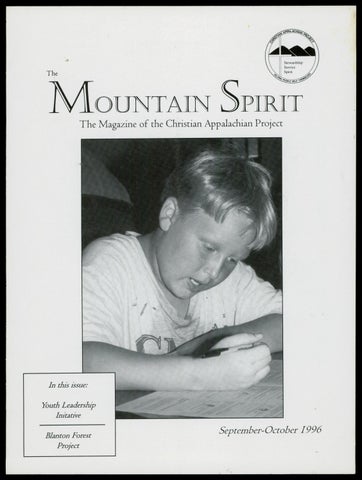
Young People In Appalachia During the summer months, the attention o f the Christian Appalachian Project traditionally turns to young people — kids at Camp Andrew Jackson, Camp Shawnee, day camps in Rockcastle County, and for the first time this year, at Camp Yatesville in Lawrence County. Since their inceptions, CA P’s camps have focused on more than just the great fun of swimming, playing ball, and singing camp songs. Always, CAP has tried to teach lessons that will be carried away long after the camp memories and (as one writer says), the bug bites are faded. Camp Andrew Jackson was the site of CAP’s first Teen Leadership Camp this summer. You’ll enjoy reading Beth Dotson’s story about this great adventure. We heard about a wonderful class in Harlan County, Kentucky, which spent its entire year studying Blanton Forest, an old growth forest, “the best forest we have in Harlan County,” according to one student. See their story on page eighteen. On the cover, a Shawnee camper partici pates in a goal setting exercise (photo by Margaret Gabriel).
Published by the Christian Appalachian Project. Editor: Margaret Gabriel. Advisory Board: Father Ralph W. Belting, Mike McLaughlin, Bill Beqley Carla Durand Teresa McAnlv Circulation: Linda Grider East. ’ The Mountain Spirit Is published six times a year. The annual subscription price is $6.00. Subscriptions and other correspondence should be sent to The Mountain Spirit Christian Appalachian Project, 322 Crab Orchard Road, Lancaster, KY 40446. Copyright, 1996, The Christian Appalachian Project, Inc. All rights reserved. Member, Catholic Press Association. The Christian Appalachian Project Is a non-profit Christian service organization operating throughout Appalachia. The project operates on the philosophy that helpinq people heb themselves is the best approach to Appalachian poverty. A summary of the registration and financial documents filed by this organization can be obtained by contacting: in New York, Secretary of State, Office of Charities Registration, 162 Washington Ave., Albany, NY 12231; in Maryland, for the cost of copies and postage, the Secretary of State, State House, Annapolis, MD 21401; In NEW JERSEY THE ATTORNEY GENERAL, 202-626-4380; In NORTH CAROLINA, A COPY OF THE LICENSE TO SOLICIT CHARITABLE CONTRIBUTIONS AS A CHARITABLE ORGANIZATION OR SPONSOR AND FINANCIAL INFORMATION MAY BE OBTAINED FROM THE DEPARTMENT OF HUMAN RESOURCES, SOLICITATION LICENSING BRANCH BY CALLING (919) 733-451 O' in Pennsylvania, residents may call the Pennsylvania Department of State at 1-800-732-0999; for West Virginia residents, the Secretary of State, State Capitol, Charleston, WV 25305' In Virginia, the State Division of Consumer Affairs, PO Box 1163, Richmond, VA 23209; Washington State residents may obtain a copy of the last report filed with the Washington Secretary of State by calling toll free within Washington, 1-800-332-4483; IN FLORIDA, RESIDENTS MAY CALL THE DIVISION OF CONSUMER SERVICES AT 1-800-HELP FLA or by writing to Christian Appalachian Project, 322 Crab Orchard Road, Lancaster, KY 40446. Our license number in Michigan is MICS 9933. Registration with any of the above government aqencies does not imply endorsement by the state.
The Mountain Spirit
Random Thoughts Glenna Robinson
“She has showed that when I have a problem it’s better to work it out than keep it inside. I think of her as my second mom and I would like to learn her parenting skill. Also, I think that she treats everyone equal in everything she does. The few months I have been coming to the Teen Center, I have learned from her that I can do anything if I wanted. I think someday I want to be like Glenna.”
that she could take charge of her own problems and make her own choices, instead of relying on someone else. I told her how beautiful she was and how easy she was to get along with, and invited her to help us at day camp this summer, which she did.
GABRIEL
One of my greatest blessings has been the time that I’ve been able to spend with young people. Other people’s kids are a lot like my six. Sometimes I’ll swear that nothing I’ve said, nothing I’ve done has even been heard, much less heeded, then I come across a note like this:
The girl who wrote this note, I’ll call her Lola, had only one friend, and it was a controlling type of friendship. Whenever Lola had a problem, I could see that she would let her friend tell her what to do and how to handle it, instead of taking her own initiative. When this girl moved away from the area, it hit Lola really hard. Her self-esteem was so low that she didn’t think anyone else would want to be her friend, and to make matters even worse, she was afraid that if she expressed her feelings, she would cry and people would laugh at her. Whoever said teenagers are in the best years of their lives?
Something I said to Lola clicked, and Some of the kids at the Rockcastle Teen Center ask to call Glenna “mom ” until she reminds she began to bloom. them that they already have moms. She tells them She was great with that she adopts them while they ’re at the center. the younger kids, and she loved working with and our strengths and pull CAP’Svolunteers. For the first together as a team, as a family. time in her life, Lola had friends who accepted her for who she is. When I think about it, I have to She helped all four weeks, and say that even though every child every week her confidence grew a is unique in his or her own way, little more. She graduated from in many ways they’re all the high school this year, and I’m not same. They all want family sure what direction she will values. They all want direction. choose, but I know that which They all want — and need — to ever way she goes, she’s got a be loved. great shot at success. I always remember something Over the years, I found that my my grandma told me, a long time job is often getting kids to accept ago, when I first started working their weaknesses and build on with children. I told her I had a their strengths. I’m not working child I couldn’t decide whether I in the Teen Center to be some liked. She said, “Glenna, are you kind of a big shot. I let them looking at the outside or the know that I make mistakes, and inside?” sometimes the best thing to do is laugh at yourself, and keep on Ever since then, I’ve always trying. I tell them I can’t spell, worked hard to look inside every but I sure know how to get some child’s heart, and when I look help from the dictionary, and deep, I always find something figure out how to do it right! precious.
Finally, I got Lola to talk about her feelings, and sure enough, she cried and cried. I told her, though,
I tell the kids that working as a team works better than working alone. We use our weaknesses
I cry easily, and this one really set me off!
Glenna Robinson is the education coordinator at the Rockcastle Teen Center.
September-October 1996
3
Tony Stone, Jamie Northup, and Melissa Webb attended the Teen Leadership at Camp Andrew Jackson.
Growing P o ten tia l C A P begins its teen leadership initiative at Cam p Andrew Jackson
♦ Story and photos by Beth Dotson ♦
F o r 16-year-old Tony Stone, getting over the 12-foot wall was more than a physical challenge. He and his group members attending the Teen Leadership Camp (TLC) at Camp Andrew Jackson had to puzzle out how they were going to get the entire group up and over the wall. Completing the task required more than pure muscle strength from the teens of various shapes and sizes. So they talked about it. They listened to ideas about how to accomplish this seemingly impossible feat. Tony, who describes himself as someone who doesn’t get good grades in school or speak up too often, shared what he thought. “Whenever I had something to say, they didn’t shoot my idea down. They listened to it,” he said. The ideas worked and everyone got over the wall except Tony. There wasn’t anyone left on his side of the wall to give Tony a boost up. But they were on the other side shouting encouragement. The only way they could imagine him getting over the wall was to make a running start. The Mountain Spirit
4
“When I was trying to do the run and jump, they were all saying, ‘We know you can make it this time’ . . . they were all rooting for me and I really liked it,” Tony said. Seventeen-year-old Melissa Webb, who was in Tony’s group, remembered the support also. “Group support makes you feel better about doing something,” she said. It must have helped Tony because he made it over the 12-foot wall. For Tony, Melissa and the others in their group, tackling the wall was just one of the team building activities they enjoyed during the three-day teen leadership orientation. The experience was funded by a grant to CAP from the Appalachian Regional Commission that aims to give teens the tools they need to become active leaders in their communi ties. The leadership activities also include a week working with younger campers at CAP’s Camp Andrew Jackson and time spent on a community service project. “I think kids are capable of so much more than we give them credit for,” said Andy Beichler, a member of the TLC planning team. Andy works for the
educational non-profit organization Forward in the Fifth that, among other activities, is interested in providing opportunities for youth leaders. “Of course, teens are not kids anymore but they’re not allowed to take responsibility and to take initiative that makes them a part of society as a whole. They’re sort of in their own group, so they’re left out there hanging without the tools. The kinds of things they are getting here are the tools to be able to create positive things of their own initiative.” Amy Burkhardt, another team member who is a Berea College student and also worked as a camp counselor with the teens, added, “It’s almost like when you give them responsibility they show you what they have.”
B u ild in g Y o u th R esources CAP believes that the Appalachian region strongly needs the gifts teens have. Often, young people who graduate from high school and attend college choose not to return to the region, thus draining the area of some of its most valuable human resources. The leader ship camp is a way of helping teens,
The teens frequently divided into small groups, discussed issues, and came together to tell the others the conclusions of their groups. September-October 1996
5
“/ think [leadership training] may be especially important here because the poverty and lack of leadership is a cycle that goes
... ”
some of whom are planning to attend college and others who are not, see their gifts and learn how to put them to use in their own communities. In March, CAP formed a core team of young leaders to plan the camp experi ence. CAP volunteer Bert Uschold, 29, leads the team which also includes Andy Beichler, Amy Burkhardt and Amy Stevens, another CAP volunteer. Heidi Gardiner later joined the group. During the planning phase, Bert frequently remembered his own leader ship camp experience when he was a teenager. “It was my first exposure to good communication, effective listening, the importance of building consensus, the importance of teamwork,” Bert said. The Christian leadership camp he attended served 60 youths. He remembers it as a time of hard work and fun. “There’s hardly a day that goes by when something I learned there doesn’t filter through my head,” Bert said.
standing of how someone from outside that group can contribute. “People often feel alienated from the political process,” Andy said. “It starts young. It’s not just the older people that see this is what goes on.” Andy hopes the leadership program can start changing attitudes of the teens toward a system that they don’t think works for them. He believes many young people leave Appalachia because they don’t think they can contribute to their home and make it better; they feel helpless to change things. “They’re gonna want to stay if they could make a change in their community,” Andy said.
The other team members also brought their leadership experiences to the planning table. They created a three-day orientation with the theme “The Road to Leadership.” The orientation aimed to help teens understand more about themselves, work in groups and develop positive ways to communicate and motivate. As the team members planned, they shared their different perspectives about why student leadership is impor tant. Andy believes that Appalachia’s reputation for political corruption, in which a small group of people controls things, leads to the need for an under The Mountain Spirit
6
i
Seeing their power to make changes, Andy said, can also help reverse some of the youth problems that the entire country faces. “I think that teenagers in general feel alienated from society, maybe it’s a condition of being a teenager.” Counter that alienation with positive community service and it could change the community and the problems that afflict teens.
time for career paths, college, peer pressure,” Heidi said. It can also be a time of teaching students that they can give back to the community. And of helping them realize that even through their difficult times, God is there with them, Heidi said.
Alienation is also a problem for some teens who live in remote areas of the Appalachian region where there are not as many opportunities for community service and leadership as there are in some cities. Bert said that although he believes leadership training for teens is important everywhere, “I think it may be especially important here because of the poverty and lack of leadership is a cycle that goes on. The opportunity for developing leadership is less.” TLC provides that opportunity.
The difficulties the teens want to deal with are close to home — issues like cliques in schools and campus smoking policies. Some campers at the orientation days saw how cliques can break down when people are open to getting to know each other.
Teens T a lk
Heidi sees a need for spiritual leadership among high school students. “High school is an important decision-making 1 ; ST ^ J W p g n , ■\
1' ^
■■* 1 t a i #
.*»
C* wfs*! V *^
1: 1»*
-.pf J
- **'A *
t7 ^
i
The largest number of students attending was from Madison Central High School in Richmond, Kentucky. Fourteenyear-old Jamie Northup was one of them. When she arrived at camp, she saw others from her school with whom she didn’t particularly want to spend three days. After two days of games, talks about personality types and communications and free time to socialize, Jamie had a different attitude. “I’ve just gotten along with everybody, even the people I didn’t get along with before. I think everyone has learned a lot this week. I can see a big difference already.” Melissa Webb, who attends Berea Community High School, agreed. “We’re learning how to deal with other people’s personality traits and faults.” Melissa, Jamie and Tony Stone all praised their session on the Meyers-Briggs test, which categorizes personality types and discusses how those types prefer to communicate and express themselves.
i
*
■
.
P| #
1 The teens often spentfree time canoeing on the lake at Camp Andrew Jackson. A two-person canoe, they noted, is an excellent example of * teamwork.
September-October 1996
7
“You learned a lot about yourself and other people,” Jamie said. “It helps you get along with other people,” Melissa said. Getting along in teams is one thing these young people see that they need to do to lead the students at their schools. The three teens agree that to make changes in things that matter to them about school life, they must take the first step. “You can’t really depend on the teacher or the principal or whatever because that’s not their main thing. That might be really important to us, but to them it might be like whatever, it doesn’t really matter,” Jamie said. “You need student leaders, people that others look up to, to work on it.” During the orientation camp, teens had an opportunity to explore their definitions of student leadership and to hone their own skills so they could better fit that role. They also had the chance to share their frustrations about the adult leaders they see around them. In school, they say, the adults only listen to the students who get good grades. Even when a teen who has made mistakes in the past tries to change, “They don’t recognize that they’re trying to straighten themselves up,” Melissa said.
Making newfriends was an important part of the Teen Leadership Camp.
8
Thus, Melissa, Jamie and Tony believe that to be effective changemakers in their schools, they need to first work on student leadership, then bring adults into the process once they have a plan for improvement. “I think the more people we can get involved, starting with the students, then the teachers,” Jamie said. “The adults, most of the time, they’re not going to pay attention to what a child says. They’re going to pay attention to another adult.” One of the problems Tony would like to address in his school is racism. “At first I wasn’t exactly sure what to do or how to help anything, but now I think we can work on it,” he said. Students worked in school teams at the camp to discuss a community service project that would help them address what they see as important in their communities. They will work with adult mentors, for whom CAP will also provide training, to implement their ideas. Later in the year, they will gather again to discuss their projects.
S e rv ic e B u ild s L ead e rs Nancy Thames has seen how working on service projects can nurture leadership skills in young people from all socioeco nomic backgrounds. Thames directs the Student Service Consortium at Eastern Kentucky University, a program that puts AmeriCorps members in touch with schools in 20 Kentucky school systems to develop service learning activities for students. Thames has seen students learn many lessons and develop valuable skills in carrying out their service projects. “I think that they [Appalachian teens] learn they can make a difference in their community. That they don’t have to be acted upon. They can act. If there’s a situation that needs to be dealt with, that needs to be corrected, they don’t have to The Mountain Spirit
wait for some government organization or some agency, but they can do it. I think it makes them responsive to their commu nity,” Thames said. Many students, Thames said, are not even aware of the needs of people in their own community. Doing service projects puts them in touch with those needs and helps them, and the community, see what they can do. “Sometimes I think we don’t give them enough credit that they can do something or that they will do some thing,” Thames said. Thames has seen students develop a number of talents through service learning, such as flexibility, decision making and critical thinking skills. Perhaps one of the strongest things she has seen is the ability of students who weren’t previously considered leaders. She recalls one class that dismantled a donated log cabin then made a plan to rebuild it. “In this project there were students who had never been leaders. Academics had never been their strong suit and yet in the construction of this log cabin, they became leaders because they had talents and abilities that some of the more academically strong students didn’t have,” Thames said. “They were being looked to as the authorities, as the brains of the project by these students who ordinarily take the leadership. It was a good experience for both types of students.” Once students succeed in that type of leadership role, Thames said, they are likely to seek the opportunity again. Teen Leadership Camp gave them many opportunities to succeed during orientation week and when they returned to work with younger campers. “They have been amazing and they have really responded well to the activi ties,” Heidi said during the orientation. The counselors talked about quiet teens who blossomed during the orientation and September-October 1996
CAP volunteer Bert Uschold acted as the team leaderfor the group that planned the Teen Leadership Camp. that the youths themselves recognized the changes they were going through. The counselors were thrilled to hear Tony say, “I’ve never really been much of a leader before. They really dragged it out of me.” They did that by providing a safe, supportive environment in which they valued and respected the opinions of the teens. Just as the teens learned, so did the adults who planned the camp. “I know exactly what I’ve learned — not to underestimate,” Heidi said. “They’ve been so independent and so filled with ideas and enthusiasm and great thoughts. They’re so creative.” The communities where these young leaders live will be able to witness that creativity during the upcoming year as these teens put to work the skills they are learning. They might discover that what they learned while getting over a 12-foot wall is one important part of what they need to become true leaders. Beth Dotson, a former CAP volunteer, writes from Lancaster.
9
Around the Project Parents Are Teachers Hosts Support Group Parents Are Teachers, the early intervention program of the Christian Appalachian Project, has started a parents’ support group in Lincoln County, according to program manager Leigh Weaver. “The group decided to call the group ‘Parents’ Coffee,’ and it’s really informal,” Leigh said. “The parents themselves decide what to talk about every month. One month we talked about stress, and ways that we can handle stress.” There are three folks who come every month, another two or three who attend sporadically, and several others who are planning to begin to attend. They bring their children, too, giving them a chance
to play together. “Last month we met at a park, so the kids got to play on the swing sets and slides. I let our physical therapist know we were there, so she got to work with them on the playground,” Leigh said. One of the most popular topics, Leigh said, dealt with doctors’ appointments. “We talked about doctors’ appointments that have gone wrong, where folks didn’t get questions answered, or they felt doctors were rude. It made people feel good to get some things out, but we also talked about doctors’ appointments that went well, and how to make those kinds of appointments common.” Leigh
Fossils Wash Up From Creek Bed After Hard Rain
GABRIEL
One Friday night in July saw three to eight inches of rain come down on the Christian Appala chian Project service area. Although most folks spent the weekend bailing water from basements and low-lying living rooms, the campers at the Family Life Day Camp were thrilled with the results of the rain, reports camp coordinator Glenna Robinson. “The rain pushed a lot of fossils up on the bank of the creek, so we spent a lot of time this week fossil
said that people reminded each other to write down the questions they wanted to ask. In fact, the group had its start as the result of a doctors’ appoint ment. “Three families had appoint ments at the same place at the same time. We arranged for transportation through Head Start, and I went with them, too,” Leigh said. “They had a great time together. Two of the women discovered that they went to school together, and they knew the Head Start driver, too. “We discovered that they enjoyed spending time together, and decided that we needed something besides doctors’ appointments to bring us together.” Leigh would like to see a few more people joining the group, and hopes to have a speaker with a formal topic every three months.
Day campers read the instructions for a scavenger hunt. Respecting the wishes of deceased loved ones, or in honor of them, families often request that memorials be sent to us. Memorial gifts live on to benefit others. Many also specify memorial gifts in their wills. Any size gift is welcome. Contact us for more information.
10
hunting,” Glenna said. Glenna explained that the creek is the “forbidden zone,” so when the children are given permission to splash in the creek, it makes for a special day. Day camp was conducted at the Family Life Recreation Center and
other points in Rockcastle County for a period of six weeks during the summer. Forty to sixty children a week enjoyed swimming, games, arts and crafts and Bible stories. CAP also conducted a day camp this summer at its newest camp location, Camp Yatesville. The Mountain Spirit
____around the project. . . continued —
Congressman Baesler, ARC And Dutch Television Visit CAP
September-October 1996
GABRIEL
The Lancaster office of the Christian Appalachian Project was pleased to receive a visit from Rep. Scotty Baesler, who repre sents Kentucky’s sixth Congres sional District in the United States House of Representatives. “Mr. Baesler’s aide told us that he’d heard an awful lot about us, and wanted to see for himself,” said Ike Adams, CAP’S director of marketing. As he was planning for the visit from Congressman Baesler and his aide, Ike learned that the Dutch public broadcasting network was interested in including CAP in a program about life in rural America, specifically Appalachia. “Apparently everyone in the Netherlands thinks that life in America mirrors what they see on television, and this film crew was interested in showing what there is to see between Los Angeles and New York,” Ike said. Another element of excitement was added when Ike learned that two Appalachian Regional Commission representatives from Washington, and one from Frankfort, would be touring Kentucky that day. Could they stop by and meet some of the folks in Lancaster? When Ike found out that July 9 was Congressman Baesler’s birthday, a cake and banner, both reading “Happy Birthday Con gressman Baesler,” were ordered and the day took on a festive air. After stopping at Operation Sharing, Congressman Baesler toured the building on Crab Orchard Road, met Father Beiting, and stopped to shake hands with folks in Information Systems and the lettershop.
CAPfounder Father Ralph Belting and Representative Scotty Baesler (D-Ky.) meet at the CAP office in Lancaster. “The Congressman was really impressed to see how extensive our work is,” Ike said. “And he was happy to meet the folks from
the ARC. When I heard that all those people were going to be coming on the same day I knew it would be busy, and I was right!”
What Can I Do To Help CAP? Christian Appalachian Project supporters often ask what more they can do to help eliminate suffering in Appalachia. First, we tell them, you can tell others of the problems in Appalachia which you learn about in The Mountain Spirit and other CAP publications. You might want to share this magazine with a friend, for example. If you’d like, drop us a line and we’ll send you a replacement copy. Ask us about any of the prob lems in Appalachia and we’ll be happy to share any knowledge we have or to refer you to another organization that can help you. Secondly, you can give us a most valuable commodity — time. Since 1950, thousands of people have worked millions of hours, donating time to helping the people of Appalachia help themselves and their families out of poverty. If you would like to
volunteer a year or a summer to working in Appalachia, please contact The Mountain Spirit, 322 Crab Orchard Road, Lancaster, Ky., 40446. We will see that you receive information about CAP’S volunteer program. Finally, our most powerful form of assistance is prayer. We believe that if our supporters spend at least one minute a day praying for poor people everywhere, mountains can be moved, the course of rivers can be changed. The CAP family forms a powerful prayer network reaching into Appalachia and across the nation. Christian Appalachian Project is a participating agency in the Combined Federal Campaign. Federal and military employees can contribute to CAP by designating #0898 on the CFC pledge card.
around the project. . . continued
Rockcastle Teens Rewarded for Service Jeff Burchett reports that the teens who participate in the program at the Rockcastle Teen Center have performed over 750 hours of volunteer service since September of 1995. Activities include litter and trash pick-up at Lake Linville and elderly visita tion. “They’ve laid carpet and moved furniture and planted flowers,” Jeff said. “They’ve done mostly small jobs, but they’ve really worked hard.” The teens have also helped out with CAP programs, Jeff said, pitching in to help pack food boxes at Christmas time, and decorate and serve refreshments at the dances hosted by the Rainbow Respite Care Center. “We’ve got one kid who’s worked over a hundred hours this year. The center’s only open four days a week, three or four hours a day, so he’s done some community
Double Your Dollars!
Ky„ 40446.
work helps out,” Jeff said. “They’re more aware of the problems of litter and pollution since they’ve helped to keep the lake clean. I like to see the satisfaction they get. The thirty minutes they spend with an old person really makes a bright spot in both their days.”
CAPRICE Participates in Special Olympics The 1996 Special Olympics in Laurel County included four participants from CAPRICE (Christian Appalachian Project Resources for Independence and Community Employment). Three of the athletes participated in track and field events and one entered swimming according to staff member Stephanie SpiveyEloskins, who coached the team with co-worker Jimmie Lewis. Stephanie, who was new to CAP in February of 1996, has been involved with Special Olympics in other places where she has worked, and has also worked as a
Special Olympics volunteer. “It’s a lot of fun,” Stephanie said. “It’s fun when people win or even win second or third. They get to meet so many new people.” Stephanie said that the athletes participate in CAPRICE’S in-home independent living skills program. “Special Olympics gave them a chance to mix and mingle. They had a really good experience.” In 1997, Stephanie said, more CAPRICE participants hope to compete in the Laurel County events and in the state competi tion, as well. COURTESY OF CAPRICE
If you are a CAP donor, or are considering becoming one, you may be eligible to double your gift through your employer’s matching gift program. Many companies today match monetary support to non-profit community service organizations that are supported by their employees. Many of these companies match the gifts that are made by their retirees as well. Please write for your brochure “Double Your Dollars,” which lists participat ing companies and instruc tions. Send correspondence to Teresa McAnly, CAP, 322 Crab Orchard Rd., Lancaster,
service work almost every day.” Another young woman has over 80 hours, and quite a few have more than fifty. Everyone who logged thirty or more hours was treated to a trip to Kentucky Kingdom, an amusement park in Louisville, before school started. “They can really see how their
Left to right, Meryl Ridener and her daughter, Phyllis, Irene House and CAPRICE staff member Jimmie Lewis, who coached the Special Olympics team.
The Mountain Spirit
around the project. . . continued Leadership Camper Confronts What You Don't Fears After Climbing Ropes One day sixteen-year-old Mandy Hancock went into the kitchen in her home and was confronted with a spider, the daddy-long-legs variety, according to her mother, Peggy, manager of Camp Andrew Jackson. Peggy reports that despite a great fear of spiders Mandy composed herself, and found a way to escort the spider out of the kitchen, thanks to some valuable lessons that she has been learning recently. Mandy, who participated in the Christian Appalachian Project leadership camp earlier in the summer, learned a few things about herself, which came in handy when she was facing her eight-legged enemy, Peggy said.
During leadership training, Mandy’s group conquered an obstacle course that included “high ropes,” Peggy said. “She knew they were part of the training. When she was getting to ready to go, she said because of her fear of heights, she didn’t know if she’d be able to go over, but decided to at least go on the trip.” Mandy conquered the high ropes, calling it the hardest thing she’s ever done in her life, and if she could do that, she could do anything. In the face of such determination, that spider didn’t have a chance, Peggy said, who proudly reports that Mandy has learned that she can accomplish anything she wants. “It’s a big lesson to learn at 16.”
Family Life Center Programs Hold Summer Reunion The Valley View apartment complex was the site of a grand summer reunion in Rockcastle County. Family Fun Day brought together former residents of the Family Life Abuse Center and Family Life Services, students from the Christian Appalachian Project Adult Learning Center and Parents Are Teachers, and participants in the outreach programs. “We wanted to bring them together to let them know that CAP cares about them, and to give them a little entertainment during the long summer months,” said Liz Phelps, manager of Family Life Services. “One of our volunteers had the idea for the reunion and everybody — the staff as well as the families — really loved it.”
September-October 1996
Nearly 70 people attended the event organized by Family Life Services staff and volunteers. A group of temporary volunteers traveled from Alabama to perform as clowns and to run carnival games and a cake walk, with prizes made by staff and residents. There was a small charge for tickets, Liz said, and the children were allowed to play until they won a prize. “The funeral home let us use one of their tents, so we set up a bingo game for the adults and gave away prizes from Operation Sharing and God’s Pantry Food Bank,” Liz said. “It was a great summer celebra tion and we raised about $50 that we’re going to give to the Valley View Apartment manager to purchase recreation equipment.”
Know About Wills Can Hurt Your H eirs.. . Find Out Why. Request Your Free Copy.
Much of what you know about wills may be misinformation that has been floating around for years. If you think, for example, that wills are primarily for rich people, or the elderly, you may be the victim of a common mis conception. The helpful booklet offered here will explain how your will can save your heirs from costly delays and confusion. Send for your copy today. Clip and Mail
Christian Appalachian Project 322 Crab Orchard Road Lancaster, Kentucky 40446 Please send without obligation your booklet, “37 Things People ‘Know’ About Wills That Aren't Really So.” Name_____________________ Address City. State,ZIP.
around the project. . . continued
Volunteers Picnic, M eet Father Beiting The Christian Appalachian Project’s long-term, short-term and summer camp volunteers, along with volunteer alumni, gathered on a summer Saturday afternoon to eat chicken, play tournament volleyball, and meet with Father Ralph Beiting, CAP’S founder. Father Beiting told the volun teers a little of the history of his founding of the project, and of the work that he sees as vital today, including economic development and programs that serve and strengthen families. “More than anything else, that’s what we need,” he said. “More than jobs, or more than education, we need strong families.” Father Beiting thanked the
volunteers for their efforts, commending the faith that goes with coming into an area and often having to leave before seeing a task completed. The volunteers asked several insightful questions concerning CAP’S future direction, and efforts involving housing and economic development. Before suggesting that the volunteers could get in several more good rounds of volleyball before dark, Father Beiting dismissed the group with this prayer: “Dear Lord, I ask your blessing on these good people. “Dear Lord, would you go before them so that you might lead
them and guide them on their way through life; “Dear Lord, could you also come behind them that you might guard them and protect them from every danger; “Dear Lord, could you also come and hover above them that you might rain down on them your many blessings and your richest gifts; “But more than anything, Dear Lord, could you come and live within their hearts that you might fill them with your joy and with your peace. “Until we meet again, wherever you go, whatever you do, my prayer is the same. May you go with God.” GABRIEL
Moving? Please notify us of any change of address to make sure you receive every issue of The Mountain Spirit. Please print
O ld A ddress name
Volunteer alumni coordinator Betsy Olson, left, shares a laugh with former volunteer Laurie Eiselt, who serves as coordinatorfor Camp Andrew Jackson.
address city state
ZIP code
N ew A ddress name address city state
ZIP code
Mail to: The Mountain Spirit 322 Crab Orchard Road Lancaster, Kentucky 40446
Day of Prayer Planned for September 11 As a way of uniting all of its workers, the Christian Appala chian Project is planning a day of prayer for September 11. Begin ning in the morning, prayer services will be held in at least one CAP office or program each hour of the day. Employees intend to keep the services going after business hours at CAP’s nine volunteer houses, and at the residential programs.
The idea was presented by Brenda Riddle, assistant director of human development, immedi ately approved, and various people volunteered to lead prayer services in their particular locations. CAP’S employees and volun teers are inviting donors and supporters from all over the country to join them, extending the prayers of the CAP family across the country on September 11. The Mountain Spirit
----------------
around the project. . . continued
-----------
Adult Learning Center Holds Graduation Fifty-two people received high school equivalency diplomas at the Adult Learning Center’s spring graduation ceremony in Rockcastle County. Paula Woodman, manager of the center, spoke of one of the graduation speakers who was planning to continue her education in nursing or pharmacy. “She was very enthusiastic, and thanked CAP and the New Opportunity School for women,” Paula said. The oldest graduate was a 72year-old woman who travels over a hundred miles a day to work in a department store. “Getting her GED was a personal goal for Jolly,” Paula said. “She felt like she wanted to do something new in
her life and this was an achieve ment she wanted to make.” Because of its focus on person alized attention, the Adult Learn ing Center always stays busy, not just during the academic year. Recently the center has begun to concentrate on a life skills program, which increases people’s everyday skills. “We’ve had people give talks on the impor tance of self-esteem, and how it can be raised. We had people teach our students how to write resumes and how to conduct themselves during a job interview, and how to dress. Usually, we’ll do a little role playing with that.” Paula and the ALC teachers consider computer training a life
skill these days, and the classes that they conduct which encourage familiarity with computer skills are always very popular, she said. Glenna Robinson, education coordinator at the Rockcastle Teen Center, gave a talk that focused on “Parenting for Teens,” that opened eyes to the needs of their teenage children. “We ask the students for suggestions, and pull everyone together for these kinds of talks,” Paula said. “It doesn’t matter if they’re GED-level or literacylevel.” The Adult Learning Center is also the home base for CAP’s School on Wheels.
Have an Adventure in Beautiful Appalachia! Volunteer for a year or a summer with the Christian Appalachian Project. We are in need of energetic, open-minded people to staff our many human service program here in eastern Kentucky. Volun teers live together, sharing meals, prayer and the challenge of fighting poverty as they support each other through their strong Christian motiva tion to serve people. Oneyear volunteers receive room and board, a
monthly stipend, health insurance and loan defer ment information. We need one-year volunteers (age 21 or older) to serve in child development, adult education, home repair, elderly programs, respite care, outreach, spouse shelters, youth and teen cen ters and more. Join others from around the country by putting your faith into
action to fulfill a dream for Appalachia. For more information, call 1-800755-5322.
September-October 1996
15
The CAP Closeup “It's remarkable to me that there are that many caring people all over the country. ” Brenda Watts has lived in Preachersville, Kentucky, almost all her life. She and Barry, her husband of 25 years, raised a son; then for nine years, after Troy was a little older, Brenda did clerical work for an automobile dealership. But in 1990, when she began working for the outreach services department of the Christian Appalachian Project, Brenda knew she was where the Lord wanted her to be. “I felt like I was where I should have been all along.” For about ten years, Brenda belonged to a saddle club that gave her the opportunity to ride on
Brenda Watts.
horseback through the mountains of eastern Kentucky, where she saw barefoot children and families living in substandard conditions. “You saw it all right there, and you saw the poverty and how people were living. That really impacted me. I’ve always known there was need here. There weren’t that many jobs, and people that were not educated, and probably wouldn’t ever be educated, if there weren’t some programs offered to help them.” Brenda began her work for CAP in the human resources depart ment, then moving to her current position as the administrative
secretary for outreach services, which includes emergency assistance, CAP’s gardening program, and Christmas baskets. Christmas baskets demand all or part of Brenda’s attention for ten months out of the year. “We start preparing for our mailing in May; it goes out the end of July, so from then on through December we’re hearing from sponsors and registering families. In January we start receiving the thank you letters from our fami lies, then it’s March before we can get all of the thank you letters together for the thank you newslet ter to send to our sponsors.”
♦ Story and photos by Margaret Gabriel ♦ The Mountain Spirit
Brenda Watts Brenda likes the services CAP provides to people in need, and the family atmosphere of people she works with, but glows when she talks about the favorite part of her job, the Christmas basket program. “It’s about the best outpouring of love between strangers that I have witnessed. It’s remarkable to me that there are that many caring people all over the country.” Brenda proudly points out that there are people in every state in the union and Puerto Rico involved in CAP’S Christmas basket program in one way or another. “Some people sponsor families and send gifts, we even have a couple sponsors who send gifts from Alaska! One man last year asked for twenty families. He sent me a long letter, and told me that he felt the Lord had put this on his heart and he wanted to share. And he did — twenty families!” Brenda told of elderly ladies on fixed incomes who are not able to share in monetary ways, but knit caps and booties. “They work all year and send them at Christmas time. Everybody can do their part in some way,” Brenda said.
didn’t know what kids would like. Well, she enjoyed that so much that after she finished with one family, she asked for another. “She told me that her neighbor had commented on the change in her in the last few months. The neighbor had told her that she seemed to be beaming, she was so loving what she was doing.” Just once, the lady told Brenda, she wanted the family’s Christmas to be overwhelming. “That was the word she used, ‘overwhelming.’ So, we’d go back and forth, and she’d call me to ask ‘Do you think this is all right to give?’ Some times we’d be on the phone forty minutes. “In January when I got the thank- yous back from the families who had received baskets, I got one from one of her families that said, ‘I was overwhelmed.’ The mom in that family used the same word that the sponsor had wished for. She sent a wonderful thank you, and pictures of her children.”
For families that are referred too late to secure sponsors, Brenda, the Christmas basket program manager and the case workers, descend on a local department store several weeks before Christmas and load up on toys and gifts. “It’s wild,” she said. “We pair up and some of us will look for gifts for little children, others for elderly people or fathers, and fill about ten carts each. Last year it took us almost two hours to check out!” Brenda took that opportunity to tell other shoppers about CAP and the Christmas basket program, much as she explains it to spon sors throughout the year. “A lot of people had heard of CAP, or one of our programs, but it’s really surprising how many people are just hearing about us.” Brenda thought long and hard to the question “What other job in CAP would you like to have?” Then she smiled and said “I’d like to have a job promoting CAP. But, I guess I already do a lot of that.”
Several people have sponsored Christmas baskets for many years; in 1995 over 700 of the nearly 1000 sponsors were “repeaters,” Brenda said. Many of them receive as well as give blessings. Brenda’s favorite story involves a lady who cautiously asked for a small family. “She was an older, single lady who had never bought presents for children, and so I had to pretty much guide her through. We talked a lot because she really September-October 1996
Brenda meets and greets Christmas basket partcipants at a distribution in Lincoln County with caseworker Marie Bonner.
. . . we hugged a tree and listened to it. You could hear the sap flowing Inside the tree. We also sang tree songs and played a game where we acted like we were a tree! My favorite thing about trees are the leaves.
We hugged a tree . . . ♦ by Jennie B. W ilder ♦ The Mountain Spirit
'* Now I know that kids, even nine year olds, can make a difference,” wrote Kimberly Humphrey, fourth grade student at Wallins Elementary in Harlan County, Kentucky. Her fellow classmates and their teacher Judy Hensley Bryson had just completed a year-long study of Blanton Forest which is almost in their view from the classroom window. Faced with the challenge in the early fall the students chose to become involved in local preservation efforts and designed activities which would satisfy compo nents of the school curriculum require ments at the same time. Upon my first visit to their classroom in October I was overwhelmed by their enthusiasm and the collections that were already underway. The students lined up a dozen deep to share zip bags of seeds and nuts, samples of decaying wood and different types of wood (walnut, hemlock, ash, maple) and scrapbooks of leaf collections. Two large scrapbooks contained their written work, illustrated stories and poetry, complete with photos of their field trips to Blanton Forest and Pine Mountain. Students showed me collections of rocks; a map of the forest complete with tree stands, streams, location of rock formations; and student-
designed jigsaw puzzles of forest scenes. Understandably, when I delivered a large plastic container to house their collec tions, one student lamented, “That’s not big enough.” He was right! In 1992 Marc Evans, a state botanist examining aerial maps of the southwest ern area of Harlan County, Kentucky, observed an unusually dense canopy of forest. Upon investigation, the State Nature Preserves discovered 2,350 acres of old growth forest along the ridges of Pine Mountain. A trust fund was estab lished to purchase tracts for preservation and scientific research. Blanton Forest is a gold mine for the study of biodiversity, rich with unique wildflowers, inverte brates, microorganisms, trees and bogs which have remained undisturbed for hundreds, perhaps thousands, of years. Grover Blanton, a dry goods storeowner in nearby Wallins Creek, bought the land early in this century and refused to sell its timber; thus, the name Blanton Forest. Blanton Forest had become a focus of interest for Forward in the Fifth, a private, nonprofit community-based organization, as we share office space with the Blanton Forest Trust in the MACED (Mountain Association for
Thefourth grade class of Wallins Elementary School in Harlan County spent the 199596 school year studying Blanton Forest. September-October 1996
jell I.. ;
il
I had an idea about buying Blanton Forest, I Community and Eco nomic Development) thought the kids in our class could give their building in Berea. Forward in the Fifth change to help buy the land. It is the best Director Ginny Eager immediately saw an forest we have in Harlan County, Kentucky, opportunity to bring communities and schools and even if we didn’t have a lot of money, we together by developing a curriculum on growth forest to be shared could always know that we did something regionally and nationally. I agreed to coordinate the ourselves to help save the forest. study and contacted Judy Bryson, a fellow teacher Using flip charts, the students member of the Eastern Kentucky Foxfire brainstormed every possible activity Teachers Network, confident that she related to the forest and classified them would enable her students to design the under the proper subject area. In their elementary components of the study. science classes they explored ideas of Armed with an Environmental Education weather, streams, plants, animals; in Council grant, Judy wrote some lesson reading they used resource materials and plans only to discover that engaging the books to gather information they needed; students fully in development of the in mathematics, counting and measuring studies brought about more effective trees, estimating and comparing age and results. “My own plans are a little too size; through spelling lessons they learned complex compared to the students’ plan. to identify and spell the names of trees, My plans in some places are more plants, and birds; they wrote stories, intermediate and the kids are more on poetry, and new articles about their target for the primary level. Go, kids!” adventures and oral histories for social Judy said. studies. Pulling all of these ideas together, they designed art and music projects to use for presentations of their work. It became obvious that they not only could : build their entire curriculum around the forest but also all of the studies integrated and fused together nicely.
4 It will be a lot more fun to study about theforest IN theforest.
“I think it will be a lot more fun to study about the forest IN the forest instead of studying ABOUT the forest just from a book,” commented Jennifer Cole. Charlie England told why: ‘‘ . . . because a book doesn’t let you explore the real stuff.” So that’s what the students did. They “experienced the forest,” by planning field trips to Blanton Forest and Pine Mountain Settlement School to do hands-on research. Serena Long narrated, “We got in small groups and did some cool stuff. One group got some paper and went to different trees and made rubbings The Mountain Spirit
20
with crayons of the bark. Another group tried to find flowers. Another group collected leaves. One group collected small animals like lizards, frogs, crawdads, spiders and a thousand-legged worm. We put the animals back because we were only guests in the forest.” “The children were awed by the beauty and undisturbed condition of the forest,” commented Judy. They wrote that they “found trees that took ten kids to hold hands to reach around” “. . . saw a humongous rock that was split right in two . . .” “.. . hugged a tree and listened to it.” Tara Strunk wrote, “Blanton Forest is an old growth forest that has never been bothered. The trees have never been cut down. There is no trash in the forest because people don’t go there to pollute it. The law protects it.” Steven Hensley said, “I was in charge of making the video. The trees were so big, I had to start taping at the bottom of the tree and work my way up to the top. By the time I had the camera pointed to the top of the trees, my neck was hurting and I was looking straight up. Ms. Bryson lay down on the ground and pointed her 35mm camera straight up into the air to try to get a picture.” Other students photographed various objects and scenes which the class enlarged to poster-sized and created a photo gallery for Principal Jim Roark’s outer office. Despite the apparent joy and enthusi asm in such a powerful learning experi ence for students, there are difficult lessons to be learned in the process. How to work together as team members. How to share opinions and value others’ ideas. How to face responsibility, success or failure. It wasn’t easy for a group of twenty-plus fourth graders to embrace the concept of democracy. The school year did not begin well. “I never heard such
forest. . . ” squabbling and bickering from a group of students . . . I found my nerves frayed at the end of every day . . . They abused their time and spent it terrorizing, picking, insulting and bullying each other,” lamented Judy. Then came the initial field trip to Blanton Forest and they began to look at the forest with purpose. “There were so many things to see, feel, touch, smell, hear, and experience there.” The seed was planted, took root in writing about their experiences and flourished because their articles were published in Forward in the Fifth’s newsletter “Fast Forward.” They had an authentic audience for their work and in their words, “they wanted to get it right.” In personal interviews with the children, they told me their writing had improved and increased over the school year from “half a paragraph to writing on both sides of the paper.” The students’ writing portfolios, an integral part of the curriculum in Kentucky public schools, yielded “proficient” and “ap prentice” scores and only a few “nov ices.” How many wrote entries about Blanton Forest? All of them! In late May they emerged as selfconfident, self-educated environmental ists eager to share what they had learned. Turning down a field trip as a reward for
September-October 1996
21
their work they We have a message for other kids chose to set up displays of their and people everywhere. You may projects in the school library for not get to come to Blanton Forest fellow students and parents to enjoy. yourself, but you can help keep the Visitors found their maturity and forests and the land around you knowledge remark able. This observa free of pollution and safe for the tion of learning which cannot be plants and animals that grow there, tested or measured is labelled “the It is important to take care of the hidden curricu lum.” It’s what we educators try to land around us because if we don’t teach through providing opportu care about it, who will? nities of ownership and responsibility. “I believe that the students take along a exchange, made possible by a grant from stronger sense of who they are and who the Kellogg Foundation, will provide an they want to become as they leave my opportunity for the Wallins students to class,” said Judy. host a group of Native American students next spring. Another group of students The story goes on. Six of these children will make a presentation at the Library will have the opportunity in the fall to Power Summer Institute at the Marriott travel to the College of the Menominee Hotel in Lexington in July. Also, a Nation in Wisconsin to share ideas and network of teachers is developing an research with other students. This student integrated science curriculum to involve students in authentic research with Blanton Forest to be shared through Forward in the Fifth. Remington Hensley expressed the sentiments of the entire class as he said, “I like to think that we could help other schools see what they can do. People are used to seeing bad things in the paper about Harlan County. They’ll finally see something good about it.” ft
“I believe that the students take along a stronger sense of who they are and who they want to become as they leave my class. ”
Jenny B. Wilder is a member o f the staff o f Forward in the Fifth, working prima rily with the Library Power program and the Blanton Forest curriculum. Her interest in oral and local history projects stems from involvement with the Eastern Kentucky Foxfire Teachers Network.
The Mountain Spirit
Letters to the Editor Congratulations to the editor and staff of The Mountain Spirit. Every line is an inspiration, you are doing a superb job. God bless your work. Do not give up. AnaM. Cintro Ponce, PR.
I know my donation is small but, with a lot of small donations, great things can be done. I think you are doing a good thing for the poor people here in Kentucky. May God bless you and all the people that help in your work. Irene Dunn Campion, Ky.
I enjoy The Mountain Spirit. It reminds me of the tough life I’ve had. I know how you feel. My prayers are with you. God bless. Vista B. Smith Forest, Va.
After I am finished reading The Mountain Spirit I always leave it in the employees’ lounge at work. Often a co-worker will come to me about something they read. I volunteered as camp nurse one summer at Camp Shawnee. I made many new friends that summer. That experience will always be special to me. I hope I can do it again sometime in the future. Mary Jo Beemon Florence, Ky.
I thank God for the many good things you and your staff are doing. It must be wonderful to know you are helping so many to start a worthwhile life through your teaching of many phases of their lives and making them know God is watching over them. It’s a blessing for all the young children to learn how to make a better life for themselves and others as well. Certainly wish our government would do more for all our under privileged people. Cecil M. Jones Lancaster, Ohio
Your magazine is a great source of informing the public of the conditions in Appalachia. I, for one, never knew how poor the region was and in our own “back yard.” Thank you for all you and your wonderful people are doing. God richly bless you.
I think you are doing a wonder ful work in the Appalachia area. I visited in Wheelwright last week for a few hours and I asked a lady in a little grocery store about you. She said you were doing a lot of good in that area. I wish I could help more, but my husband is deceased and my income is limited.
Joyce Sedlak Spring Creek, Pa.
Mrs May H. Tweed Asheville, N. C.
September-October 1996
It is comforting to know someone is trying to help those who are so needy. I commend and pray for you and all your volunteers, and wish you much success in all your endeavours. God bless you all. The least I and many, many more people can do is send a little donation as often as possible. As they say “every little bit adds up and helps a lot.” One day if I can afford more, it will be forthcoming. Mrs. Loretta Gernon Metairie, La.
I enjoy reading The Mountain Spirit. I think you are doing wonderful work with the people of Appalachia. Wish I was able to help more. Ray Dreier Carthage, Mo.
I wish I knew the words to use to tell all of you and Fr. Beiting what a great job you are doing. I wish I could do give more but I’m only on Social Security. I’m by myself, but you and all of the Appalachian families are always in my prayers. God bless all of you. Elizabeth Crawford, Yeadon, Pa.
Letters to the editor are welcome. They should not exceed 150 words in length, and we reserve the right to edit themfor space. Address letters to: The Mountain Spirit, Christian Appalachian Project, 322 Crab Orchard Road, Lancaster, Ky 40446.
“intensive care in a hurting world.” The group focuses on gathering groups from local churches and organizations to go out into the world, ministering together. Since its founding in 1986, World Servants has facilitated short-term mission experiences for over 17,000 participants. Nearly 2200 churches have participated in projects throughout 23 countries. The group that worked in Wheel wright was made up of 133 young people and sponsors from and senior high school youth groups.
The Way It Should Be A traveler on Highway 122 in Floyd County could tell there was a big celebration going on in Wheelwright one summer night. Wherever you looked on the grounds of the community center, families shared hamburgers, hot dogs, soda pop and potato salad. Young people tossed a tether ball, children clad in T-shirts imprinted with “World Servants,” enjoyed the swing set and sliding board.
the home repair program of the Christian Appalachian Project. While Ruston and Donna spit watermelon seeds, Mayor Sammons poured soft drinks for thirsty picnickers, and Larry and Geoff talked to families about the work still to finish on their homes. Everyone seemed to be talking about continuing the partnership between the community, CAP and the World Servants.
Nobody was having more fun than the World Servants area directors for Kentucky and West Virginia, Ruston and Donna Seaman; David Sammons, mayor of Wheelwright, or Larry Cranfill and Geoff Barrett, who work with
World Servants, with its American offices in West Palm Beach, Florida, works to mobilize a global network of people to impact the world for Jesus Christ through responding to physical and spiritual needs, providing
♦ Story and photos by Margaret Gabriel ♦
Through the collaboration of CAP (which provided materials and supervision for the project), the World Servants and the city of Wheelwright, construction and repairs were made on ten homes, three churches and one community center. Isn’t that cause for a celebration? Ruston and Larry began talking about the possibility of a Wheel wright project shortly after they met recently. Geoff, who also serves as the pastor of Jack’s Creek Baptist Church near Wheelwright, stirred up the interest of other members of the local ministerial association. Congregations representing five different denomi nations became involved in the project, selecting families that needed repairs on their homes. Brenda and William Ander son were among the grateful recipients of the The Mountain Spirit
24
work of the World Servants. Rather than repairs, though, the Andersons received a new house. “We had tom our old house down, and knew that it would take four or five years to build it back, a little a time,” Brenda said. From family and friends, Billy and Brenda heard about the Christian Appalachian Project home repair program, and sent a letter to Geoff Barrett, telling him that they had had no choice but to destroy their old house and start over. Was there any help CAP could give them? “We were living in a little camper and the kids were living with Billy’s parents,” Brenda said. “We really needed some help — it had gotten to where the kids were ashamed. They didn’t want to have their friends come over. I knew that God would show us the way, but I had no idea they would build a house for us.”
&■■
The weekend before construc tion began, Billy said, he worked at his job as a painter, so that he would be able to take two days off
HWtiSSi
“ . . . you’ve got 133 people right here who have come in and touched this town. ” to help with the construction on his new home, which measures 24’ by 33’ and has three bedrooms. Tim, one of the World Servant volunteers, was sharing his meal with the Andersons and their children, Brandon and Courtney. The pastor of the Light of Life World Outreach, Tim had also taken a vacation from his job in a glass factory to participate in the project, after meeting Ruston. “He stopped at my church to talk one day, and told me about the World Servants. I was sold in about 15 seconds and formed a group in our community, Flemington, West Virginia, a small town with a big vision,” he said. “We’re bringing the Body of Christ together to accomplish some things.” Mayor Sammons shook hands with his friends and supporters, including David Lloyd, a former CAP employee who now serves as a Wheelwright city commissioner. “Reverend [Charles] Wilson told me about the World Servants, and told me that churches wanted to get involved. The whole commu nity has worked on the project. The fire department had a road block to raise money to pay for this cookout, and the senior citizens’ center brought the food for tonight, and for lunches every day, too,” Mayor Sammons said.
Hjfilfi ftflj
“I really hate to see the World Servants leave. They’ve come in and helped people who really
needed help. Have you seen ‘Touched By An Angel’ on television? Well, you’ve got 133 people right here who have come in and touched this town.” Donna called the Wheelwright project one of the top projects of the summer, and said that they are looking forward to bringing a group back next year. “We were having breakfast our last morning, and I heard the sirens. I looked outside and saw all our kids riding down the street in a fire truck — they were having a great time!” There is plenty of credit to spread around for the project according to Larry Cranfill. “Nothing would have happened without the World Servants, but there was a lot of preparation for them, too,” he said. The city of Wheelwright made the community center available as a dormitory, but first had to paint and repair the building, with materials provided by CAP. “The mayor did a whole lot of the painting himself. CAP wouldn’t have been able to do this project, except for the World Servants saying ‘Let’s cooperate,’ and that’s the way it should be,” Larry said. “I think this project has been real good for this little community. It’s brought people together in a loving, supporting way and it’s going to have lasting impact.” ft
Senior high school youth groups gathered in Wheelwrightfor a home repair project sponsored by CAP, the World Servants, and the city of Wheelwright. September-October 1996
25
Planting
¡|§§ 1I ■
the Seeds of Wisdom As they say in commercials, what would you pay for a week of practical leadership instruction for your childP
Don’t answer before we tell you that your child will not only enjoy physical activity in the beauty of the eastern Kentucky hills, but their crucial needs for information and spiritual guidance will be fulfilled as well.
Does five dollars sound about right? Oh, well, if that’s too much, it’s just a suggested donation. Camp Shawnee, next-door neighbor to Jenny Wiley State Park in Floyd
♦ By Jim Trammel ♦ Photos by Margaret Gabriel The Mountain Spirit
26
Wayne Whitney, with the Kentucky Higher Education Assistance Authority, leads campers through an exercise that helps them determine career choices.
Paintsville downstream. Water then rises to cover the only road into camp; there have been winter and spring days (eight during this past wet spring, says camp manager Owen Wright) when camp personnel had to stay on whichever side the rising water caught them. Once the summer comes, though, the roads are generally clear for the camp’s six-week summer session. The camp alternates boys and girls in three age groups. The youngest have just completed first grade; the oldest are 14.
County, Kentucky, is the Christian Appalachian Project’s way of making sure its guests have a positive outdoor experience enjoying Kentucky’s beauty with an emphasis on spirituality and leadership training. The $5 suggested donation, of course, hardly buys the gasoline for the camp buses to get the children back and forth for their week-long camp experience. The camp operates on CAP funds and is staffed by CAP employees and volun teers. The caring and Christian emphasis they provide make possible the camp’s most lasting effects; the character lessons stay long after the week’s fun and mosquito bites fade from memory. The camp’s two dormitories, kitchen, athletic field, swimming pool, chapel and administrative and support buildings nestle into a picturesque country hillside on the shores of Dewey Lake. Those shores draw closer when the flood gates are closed to keep high water out of September-October 1996
The six-week summer program is the only one CAP sponsors entirely at Camp Shawnee, but the camp co-sponsors other special camps, including one for healthchallenged youngsters co-sponsored by Our Lady of the Way Hospital in Martin, Kentucky, and one for inner-city youth co-sponsored by Highland Christian Church in Frankfort. At these camps, Owen furnishes the facilities and counse lors while the co-sponsoring groups run the administration. The number of campers each week routinely exceeds Camp Shawnee’s comfortable capacity, but dormitory space is found somehow, and camp goes on. The record so far is 116 campers. A typical week in early July of this year saw 82 boys age 9 to 11. Those 82 campers of that typical week were divided into four groups, who took scheduled turns with the camp sport activities of swimming, paddle boating, hiking, and canoeing. The camp also provides arts and crafts programs and activities with a spiritual dimension. Not only do the campers have Bible study, but each group also prepares and performs skits and activities with a morally instructional purpose. “The counselors
0
il
that at such early stages the message merely attempts to prepare children to eventually consider their options. Wayne tries to convey that aid is available for higher education, but you have to be prepared. To hold the interest of children of elementary school age, the message is delivered by means of gifts, coloring books and puppet shows. At his program to the 9- to 11-year-old boys, he helps his audience work through an exercise called “Finding Your Dream Career,” that helps relate career choices to personality types. When Wayne’s audience gets involved in choosing a dream career, he makes the point that education beyond high school can lead to finding the career that matches their talents and personalities.
Owen Wright, manager of Camp Shawnee. here are all Christians,” Owen explains. “They don’t pressure the kids to believe any particular way, but they show them by example.” Indirect instruction can sometimes be overlooked, though, and during this week in early July trouble surfaces early — just proving that plans involving young people can probably never run smoothly. This week, two boys who were assigned to the same group o f 9- to 11-year-olds joined each other in making trouble during group activities. Less than two hours after they arrived, they were sent by their counselors to Owen s office for fighting and being disruptive.
Before Monday s program has gotten to the afternoon session, our two boys who aren’t with the program have been hauled in singly for impassioned lectures by Owen. Camp rule: An appearance before Owen means you ’re at the point o f
1 V
Self-esteem is the theme behind subjects such as personal hygiene instruc tion. Some longer-range material is also covered. The camp experimented this year for the first time with a program on higher education from the Kentucky Higher Education Assistance Authority.
.......
■I ‘
'
.
"
4 How do you discuss higher education with campers who may have just recently finished first grade? KHEAA coordinator Wayne Whitney, who also presented the program to the 9- to 11-year-olds, said
A'
,
' ' x)'"'
I
__________ The Mountain Spirit
28
no return. Any further infraction means a call to your parents to take you back home. The two are sent to separate groups, and the program continues. Owen is a logical choice to direct a program that correlates the outdoors with God’s plan. Owen came out of college certified as a high school history teacher, but once in the world of education he found he liked children better than he liked the hurdles and hassles of education administration and the lack of discipline he encountered. Owen loves the outdoors, so the components of his dream career became clear. He joined CAP in February 1990 to manage the Floyd County Teen Center (later the combined Youth and Teen Center). He became camp manager in the spring of 1994. This is his third summer at the eye of this child-driven hurricane. “I like kids and the out-of-doors, and I like for kids to learn about God,” Owen said. He says nature teaches children that
God loves us enough to give us “all this beauty for all of us to share.” In the woods it’s not hard to find practical lessons in God’s love for all creatures. One camper strays from an organized ball game into a nearby wooded area and comes back excited with a discovery: a young field mouse. The other campers ooh and ahh over it for a while, until the counselor gently but firmly insists that the mouse be returned and released, because it s one o f God s creatures just as much as the campers. The program seeks out children from several counties in eastern Kentucky and a few counties across the border in West Virginia. No one who can attend the scheduled dates is ever turned away, Owen said. And despite the minimal fees, camp attendance cuts across class lines — saving the camp’s low fees from becom ing a possible negative factor. Certainly you’d never guess the camp’s low cost from the quality of the facilities and services offered. Camp Shawnee is landscaped by Kentucky’s own mountain ous beauty and graced by abundant tall pines and wildflowers, which add charm to the rugged beauty of the hills and waters. Fr. Ralph Beiting, CAP’S founder, has a love for camping and water sports that has led to CAP establishing Camp Andrew Jackson in Jackson County before CAP set up Camp Shawnee. (CAP is also in the beginning stages of setting up a camp outside Louisa, Kentucky.)
assistant cook; Laura Webb, camp environmentalist; Clabe Sloan and Mike Gobel, lifeguards who administer the swimming test to campers so they’ll be certified safe in the water; volunteer nurse Mary Dwilet; and the 18 to 26 counselors that supervise the four groups of campers and provide staff services to Owen. Further assistance comes from CAP offices in Lancaster, as Kathy Floyd helps keep the camp eligible for nutrition reimbursements from the government. “It’s absolutely unheard of in today’s society, but this is one federal program that has become more efficient over the years,” Owen said. “Most parents thank us for having a place like this,” Owen said. “They say they’d ever be able to give their children such an experience otherwise.”
One group of boys found afield mouse, which they planned to adopt as a mascot until their counselor convinced them to set itfree.
Owen and Fr. Beiting agree the children of Appalachia should be exposed to the beneficial influence of nature early, for they may otherwise never get the chance to let the beauty of their native area speak to their hearts. Several counselors and employees help Owen administer the camp program. A key couple are Eunice and Jerry Oaks, a married couple soon to celebrate their seventh year as camp cook and caretaker, respectively. Eunice manages the camp kitchen, cooking and serving the meals. Jerry’s varied duties as caretaker include maintaining the camp’s water quality from its own system. He’s been specially certified to keep the camp’s water quality high as it is pumped and treated from one of the nearby creeks. Also playing key roles in camp operation are Stephanie Cantrill, the
Sometimes, sadly, a child’s mind is closed to the camp’s positive influences. One o f the two resisters committed more infractions later in the week, and his mother had to be called to take him home. But the other at least completed the week without further discipline — a small victory for Owen to savor briefly before he and the staff moved on to the next week s challenges. The social interaction has helped children learn to relate to fellow campers and new situations in general, sometimes with a new dimension. For example, for some children, Camp Shawnee gives the first opportunity to meet people from outside the county where they live. The benefits are many, with exercise, recre ation, and fresh air only the most obvious. After the week’s program, games and activities have inspired leadership, the spiritual exercises and observance of God in nature has planted its seed of wisdom in the camper’s minds. U* Jim Trammel is a free-lance writer who lives in Lexington and travels extensively in eastern Kentucky. The Mountain Spirit
30
FLS Assists with Independent Living Skills Just as the Christian Appalachian Project’s Family Life Services finished expanding and remodeling some bedrooms, they received a referral from the Department for Social Services, asking if they could admit two blind women, Sue and Jean, who had been living together. “We stood the beds up real quick, and told them to come on,” said manager Liz Phelps. The women had been living with an abusive brother and sister, who had also been stealing their money and running up their credit. “The room looked great by the time they arrived, and when they walked in the room we had turned the lamp on. Sue said, ‘It feels so warm here,’ and that was the beginning,” Liz said. The beginning of learning the skills they needed to live independently. Mary, a volunteer, worked with Sue and Jean, who were in their late 20s, on their finances and personal budgeting. “At first, we didn’t let them cook the kitchen,” Liz said, “but eventually, they learned how to cook for them selves and get around in the kitchen, with some things marked in Braille.” Family Life Services is a one-story house, and within hours of their arrival, Sue, partially blind from birth and totally blind from glacoma by the age of 20, and Jean, blind from the result of abuse, were navigating the house with no problem. One of the greatest lessons, Liz said, was learned by the other FLS resi dents. “At first, the other residents wanted to go out of their way to help Sue and Jean, but soon they realized that learning to take care of themselves was the biggest reason Sue and Jean were with us. They began to teach and encourage them, the way the staff did.” After several months in the shelter, Jean and Sue were able to move to their own apartment, armed with the knowledge and skills they needed to live on their own. “The months they lived here, they budgeted down to their last few cents,” Liz said, “but at the end of their second month on their own, they had $50. We were so proud.” The hard work of the residents and staff, of Mary and Liz and especially of Jean and Sue themselves resulted in the finest of outcomes: self-sufficiency. The assistance of CAP donors — spiritual assistance as well as financial assistance — used where it is needed most, will allow more people to achieve the goal of self-sufficiency.
•
Rates of poverty among
young people under the age of 18 in Appalachian Kentucky range from 17% in some counties, to as high as 52% in others. •
Young people who come
from poor families are more likely to drop out of school. •
In one area CAP serves, the high school drop out
rate is 50%. •
Over half of the non-working adults in Kentucky are
high school dropouts. Data references available upon request. Shaded area indicates the boundaries of the Appalachian region
CHRISTIAN APPALACHIAN PROJECT 322 CRAB ORCHARD ROAD LANCASTER, KY 40446 THE MOUNTAIN SPIRiT
NON-PROFIT ORGANIZATION U.S. POSTAGE PAID Christian Appalachian Project
Address Correction Requested
CAROLYN SUE MARKS 4 4 3 0 KY. HWY 6 4 3 WAYNESBURG KY 4 0 4 8 9