T he Magazine o f the Christian Appalachian Project
May-June 1996 Appalachian E nvironm ental P roducts, Inc .
The
May-June 1996 Vol. XV, No. 3
JV to u n tain The Magazine of the Christian Appalachian Project
A “Seminar” in Appalachia by Jim Trammel
A E PI Built to Last —
by June Widman
Book Review by Jim Trammel Work Fest, page four.
26 James Njoroge: Accepting a Challenge by Beth Dotson
Departments 3 Random Thoughts 15 Letters to the Editor 16 The CAP Closeup 18 Around the Project Appalachian Environmental Products, page ten.
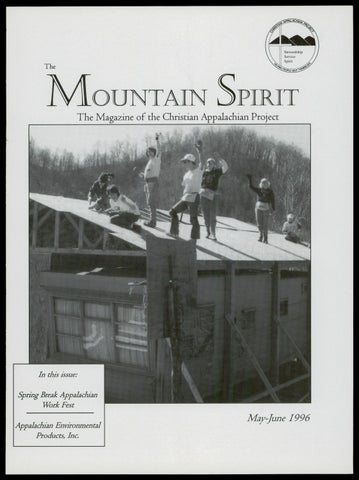
The Variety of Volunteers When we talk about volunteers, often the image that we communicate is that of long-term CAP volunteers — folks who come from all over the United States for nine months or more. In this issue we will introduce you to volunteers who don’t fit the usual mold. James Njoroge is one of about 75 people currently serving as a long term volunteers. He has opened doors at the Louisa Youth Center by introducing young people to his African culture (see page twenty-six). In March CAP hosted the fifth Spring Break Appalachian Work Fest and over 200 college students who chose an “alternative spring break.” Every year a Work Fest volunteer has returned as a long-term volunteer, and we hope 1996 will be no different! Finally, on page ten, we tell you about Appalachian Environmental Products, a small but growing business in Owsley County that began as a volunteer project. The business plan for AEPI was devised by a group of men who came to Owsley County to assist Sister Marge Eilerman, pastoral associate of Holy Family Catholic Church in Booneville. On cover, Spring Break Appalachian Work Fest, 1996 (photo by Gabriel).__________
Published by the Christian Appalachian Project. Editor: Margaret Gabriel. Advisory Board: Father Ralph W. Beiting, Mike McLaughlin, Bill Begley, Carla Durand, Teresa McAnly, Katie Newsome, Beverly Potter. Graphic Designer: Elizabeth Reed Roberts. Circulation: Linda Grider East. The Mountain Spirit is published six times a year. The annual subscription price is $6.00. Subscriptions and other correspondence should be sent to The Mountain Spirit, Christian Appalachian Project, 322 Crab Orchard Road, Lancaster, KY 40446. Copyright, 1996, The Christian Appalachian Project, Inc. All rights reserved. Member, Catholic Press Association. The Christian Appalachian Project is a non-profit Christian service organization operating throughout Appalachia. The project operates on the philosophy that helping people help themselves is the best approach to Appalachian poverty. A summary of the registration and financial documents filed by this organization can be obtained by contacting: in New York, Secretary of State, Office of Charities Registration, 162 Washington Ave., Albany, NY 12231; in Maryland, for the cost of copies and postage, the Secretary of State, State House, Annapolis, MD 21401; in NEW JERSEY THE ATTORNEY GENERAL, 202-626-4380; in NORTH CAROLINA, A COPY OF THE LICENSE TO SOLICIT CHARITABLE CONTRIBUTIONS AS A CHARITABLE ORGANIZATION OR SPONSOR AND FINANCIAL INFORMATION MAY BE OBTAINED FROM THE DEPARTMENT OF HUMAN RESOURCES, SOLICITATION LICENSING BRANCH, BY CALLING (919) 733-4510; in Pennsylvania, residents may call the Pennsylvania Department of State at 1-800-732-0999; for West Virginia residents, the Secretary of State, State Capitol, Charleston, WV 25305; in Virginia, the State Division of Consumer Affairs, PO Box 1163, Richmond, VA 23209; Washington State residents may obtain a copy of the last report filed with the Washington Secretary of State by calling toll free within Washington, 1-800-332-4483; IN FLORIDA, RESIDENTS MAY CALL THE DIVISION OF CONSUMER SERVICES AT 1-800-HELP FLA or by writing to Christian Appalachia Project, 322 Crab Orchard Road, Lancaster, KY 40446. Our license number in Michigan is MICS 9933. Registration with any of the above government agencies does not imply endorsement by the state.
The Mountain S pirit
Random Thoughts Betsy Olson
The hard work involves designing and distributing bro chures, posters and press releases. It involves traveling to volunteer fairs, keeping in touch with prospective volunteers and alumni, and making sure that people who are interested in volunteer service know enough about CAP to determine whether their expecta tions and CAP’S are compatible. Recruiting is a lot more fun, though, when divine intervention takes over. One day a woman called to ask about volunteering. She told me that she’d ridden over something in the road when she was riding her bike. When it was still there on her return trip, she stopped to pick it up, and found it was one of Father Beiting’s books. She read it, loved it and needed to find out more about CAP. Another man called after finding a copy of a book on the subway in New York. I love to hear stories like these. One of the greatest tools that I have for recruiting volunteers, besides being a former volunteer myself, is to tell folks about the impact that current and former volunteers have had on our programs and in the lives of many of the people in this region. When people are thinking about giving a year or more to a volunteer program they want to make a real contribution and know that the work that they do will really help people. It’s great to tell prospec May-June 1996
GABRIEL
If I’ve learned anything in my two years as CAP’S coordinator of volunteer recruitment and alumni, it’s been that recruiting volunteers involves a delicate mix of hard work and divine intervention.
tive volunteers about CAP programs such as our child develop ment centers, early intervention program and teen centers that were started and are still staffed by volunteers. It’s wonderful to have volunteer alumni continue their connections with CAP at home as they give talks about CAP and the volunteer Betsy helped coordinate the logistics o f hosting 231 program to their college students for Work Fest. churches, spread volunteer information around their around people and in a job. By alma maters, and sometimes talk telling Gina’s story, and those of their good friends into volunteer other women in the shelter, Tobi ing as well. Two unique situations was able to make arrangements come to mind. with a dentist to “fix Gina’s smile.” Tobi Anderson and Barbara Griffin live in different towns in Although the greatest part of my Massachusetts. They come to job is trying to fill our constant Kentucky for relatively brief need for one-year and summer periods, but do an extraordinary camp volunteers, I can also tell amount of work for us from their people there are other ways of homes. Barbara has a ceramics volunteering. You can help CAP studio, and makes things that have like Tobi and Barbara do, by CAP’S logo included in the design, serving as regional representatives then sends them to us to sell. The in places where I rarely have time proceeds from the sales support to travel, or send a donation to our work. keep our programs up and running. In northern Massachusetts, Tobi gives talks in churches about CAP and its volunteer program, and has generated several special projects. Recently she entitled her talk “Gina’s Smile,” and told of a woman she met in a CAP spouse abuse shelter. The woman was trying to make a better life for herself despite an abusive mar riage, but she needed a new set of dentures to feel really comfortable
And finally, I tell people that we always need prayer. For people of faith, prayer can be the easiest, yet most significant gift they can give. •
B etsy Olson is C A P ’s coordinator o f volunteer recruitment and alumni. As a volunteer, Betsy sta rted CAP s adult education program in O wsley County.
A "Seminar” in Appalachia T
I he college students who participate in
the Christian Appalachian Project Spring Break Appalachian Work Fest feel good about themselves as they give vacation time to enrich the lives of people in Appalachia. Only later do they discover they often have performed some repairs on their own world view as well.
♦ By Jim Trammel ♦ Photos by Margaret Gabriel 4
The M ountain S pirit
O n college campuses across the country, there’s a new phrase popping up: “alternate spring break.” Instead of spending a week with the traditional sun and sand, in ever-growing numbers, college students are spending spring break helping organizations like the Christian Appalachian Project conduct service projects that make a difference in people’s lives. In the process, the students enrich their own lives in sometimes surprising ways. Work Fest ’96, the fifth such project for CAP, spanned the first three weeks in March, with 27 colleges furnishing a total of 231 students who repaired homes in Martin and Owsley counties. Students added or repaired bathrooms, porches, floors or roofs to homes in critical need of such work. In a couple of instances, volunteers built entire homes. The students’ major fields of study are typically a mixed group. Brad Harmon, a graduate student in theology and Appala chian coordinator for the team from the University of Notre Dame, mentioned one enthusiastic volunteer with a chemical engineering major, about as far as academically possible from the social service arena. But whatever their class room orientation, for a few days students became majors in sharing through action.
Work in the real world Sister Margaret Harig, associate campus minister at the Newman Catholic Student Center at the University of North Carolina-Chapel Hill, says Work Fest speaks to the students’ appreciation of the simple life, the beauty of rural Kentucky, and the appeal of doing something realworld practical as opposed to studying in the classroom. “Once you get a group there and they come back and start telling their stories, they preserve the interest. Students pass
May-June 1996
Work Fest speaks to the students’ appreciation of the simple life . . . the word on,” said Sister Margaret. Their word-of-mouth recruitment, aided by grateful letters from people they’ve helped in past years, are all the program needs to maintain a high interest level at UNC-Chapel Hill. Three members of UNC-Chapel Hill’s delegation this year plan to return next year, she reported. This past trip was Sister Margaret’s third at UNC-Chapel Hill and her sixth if you count back to her own college days at the College of Wooster (Ohio). She always knows interest in Work Fest will be high on the UNC-Chapel Hill campus, but one year the Chapel Hill delegation underestimated total interest and didn’t get their names in soon enough to participate. “We’ve since learned it’s important to sign up early,” she said. Interest in a program may begin with a key person, perhaps in a position to direct a college’s service program. Tami Schmitz of St. Norbert College in DePere, Wisconsin (near Green Bay), is such a person. In her job as pastoral associate she does a little bit of every thing for the 2000-student college and the associated parish that serves 220 families. Her responsibilities include religious education at pre-school through high school levels and student counseling as well as the college’s social justice programming.
Key motivational actions Tami is certainly in a good position to motivate participation in any program she chooses. She learned of CAP’S service work during her own high school days, and since then she has heard of positive
5
their first trip this year. Her assessment of the trip and its impact on her students: “Amazing, excellent, above and beyond anything we ever expected.” Enthusiasm among Tami’s students ran so high that they personally helped finance their trip with contributions of $100 per student. The campus parish picked up the rest of the expenses. CAP helped Work Fest participants keep their on-site expenses low by using Camp Andrew Jackson to house the students working in Owsley County, and a CAP volunteer residence for those working in Martin County. Tami and her participants, including the four who want to return next year, will follow up with their financial supporters to show what the delegation did and the insights the participants gained. The group journal they kept during their time in Kentucky will record the step-by-step unfolding of the spiritual dimension of their journey. By the middle o f the week, even students who had never swung a hammer were showing proficiency in roof repair.
Work Fest experiences from other college representatives at a statewide conference for campus ministries, she said. When her students began discussing possible service projects she knew what to suggest. Interest at St. Norbert was so high that Tami was able to conduct interviews among the 30 student applicants to select the 10 who were most comfortable with the particulars of CAP’S labor-intensive rural work. Some, Tami knew, wouldn’t be able to put in the labor; some would rather work in more urban settings. The inter views directed the 20 other applicants to more appropriate projects. Students’ interest in service projects seems to run high, at least at these participating colleges. Most could easily field teams of more than nine students; CAP limited the number participating from each college to nine this year so that more schools could take part. Tami and ten students represented St. Norbert for
6
“We went to serve, but also received love, hospitality and warmth,” Tami said. She knew the project would build partici pants’ faith as well as living quarters, “but I didn’t realize how wonderfully (the faith dimension) would be integrated into the program,” she said. “It was like a retreat.” St. Norbert students are off to a great start, after their first year partici pating with Work Fest. The delegation from Loyola University in Chicago also survived a round of qualifying interviews made necessary by an abundance of campus
The Mountain Spirit
interest in service projects, said Cari Burr. Cari is a residence hall chaplain on the staff of Sister Brenda Gonzalez, campus minister who oversees mission trips. Sister Brenda makes sure campus-wide advertising goes up to alert students to the college’s program of mission trips, but word-of-mouth recommendations from former workers remains the best recruit ment tool, Cari said. “The city of Chicago offers many chances to serve, so a spirit of volunteerism runs high here,” according to Cari. Their interviews favored seniors and people who hadn’t been on service trips before, she said. There was no effort to qualify attend ees on a skills basis. One or two had workable skills already; the rest were taught basic hammering and painting by the more highly skilled students and the workplace leaders. As their colleagues at St. Norbert do, students at Loyola add $100 each to help
finance their trips. Some students are sponsored by their major departments or by other students in their classes. “It was great,” Cari said of her group’s experience at Work Fest. “I wish I were there right now!”
Giving credit where due At Notre Dame, annual participation in Work Fest and similar projects has long been a way of campus life. Students at the campus in South Bend, Indiana, have been involved with CAP programs, including home repair, Christmas baskets and summer camps for more than 15 years. Other service programs, too, benefit from the participation of Notre Dame students; in fact, it’s possible to get an hour of academic credit for service work. Brad Harmon, Notre Dame Appala chian coordinator, runs participation in Work Fest and similar projects as a onecredit class called the “Appalachian Seminar.” The eight students working for
Albert Bloomfield, right, a CAP outreach manager, gives some instruction to volunteers working in Martin County.
May-June 1996
On several o f the sites, the homeowners pitched in to help the volunteers. This couple has been raising their family of eight in a small trailer, which is adjacent to their new home.
CAP attended classes before and after the trip to get the historical and sociological overview of their mission. A movie entitled “Strangers and Kin,” produced by Appalshop, an Appalachian arts organization in Whitesburg, Kentucky, also prepared them for participation in Appalachian culture, allowing them a sensitivity not always available on first exposure. Brad has students enough to staff ten such projects as Work Fest, and each year has to turn down almost 40 more students who make up a waiting list. He and six associates teach the classes and monitor the worksites to make sure the level of community participation extends beyond the basics of the repair project. Brad says he wants the projects to make a cultural impact on participants. “My concern is that the sites not fall into a pattern of self-service, that they stay more well-rounded, more involved with the community.”
Home repairs to the spirit Encounters with Appalachian culture rattle the popular-culture assumptions students sometimes bring to the experi
8
ence, often re-structuring a participant’s values and priorities. “When (students) meet people who have different values from what the popular culture sells, it tends to change their life goals,” Brad said. Mary Moody of Loras College, a private Catholic co-ed college near Dubuque, Iowa, says this evolution of faith comes because students, perhaps for the first time, “are making a connection between their gifts and their obligations to the needs in the world.” Loras, participating in Work Fest for the second year, institutionally encour ages a spirit of volunteerism and social service in curriculum and in student organizations. All student organizations must have a social dimension — it’s a requirement for college funding. The faith dimension of the mission helps guard against burnout, Mary said. “The possibility for burnout is really great if (participation) isn’t based on faith,” she said, drawing on her two years as a missionary in Bolivia. “Without the strength we can get from prayer and renewal the great needs around us can be draining,” Mary said. The Mountain Spirit
Mary encourages student social service in her position as coordinator of the college’s Peace and Justice Center. “I educate students to the connection between personal faith, community faith and the needs in the world as they relate to our Christian mandate in trying to alleviate some of those needs. I guess it works!” she said, nothing that at Loras social service is a popular alternative, not just a requirement. “It’s not some sort of brainwash. At first it might be an altruistic experience, and they enjoy giving up their gifts and meeting people — but when it becomes clear their commitment should flow out of their faith it takes on greater signifi cance,” Mary said. Mary puts interested students in touch with ways they can make a difference. At weekly Peace and Justice Center meet ings, Mary keeps the flow of fresh topics, new materials, and details about particular needs in the forefront of her students’ attention. She coordinates local March of Dimes events, homeless relief efforts, and spring Clean-up for Hunger. At a recent Global Awareness Week she coordinated presentations from missionaries. Her efforts seem to be taking root: “We’ve seen an increase in students who go on to do a year or two of service work after graduation, especially this year.”
ret sends participating students as ambassadors to share pictures and stories at an evening event held especially for sponsors. The Christian Appalachian Project Spring Break Appalachian Work Fest benefits all of the parties involved, each in a different way. Those whose homes are repaired benefit immediately. CAP benefits because every year volunteers first hear of CAP, experience its mission and commit to long term service. The students, however, reap even longer-term benefits. Those benefits are harder to measure, but include the communication and lasting relationships formed in the work process. “We tell students we know they think they’re going to save the world, but we want more to create relationships for greater understanding between our students and residents of Appalachia,” Brad Harmon said. “Sometimes people get caught up worshipping progress and we lose sight of the real values.” ft
Making the visit possible Fund raising to support such an active slate of projects is a priority. A popular annual event at Loras College, their St. Patrick’s Day auction, netted $5,000 last year for travel expenses and donations. Students who plan to participate in the trip solicit area businesses for auction items. Groups often raise funds through their current participants or alumni. Parish appeals are also possible in situations such as Sister Margaret’s at UNC-Chapel Hill. To augment response, Sister Marga-
May-June 1996
Students “are making a connection between their gifts and their obligations to the needs in the world. ”
9
Buili to Last ♦ ByJuneW idm an ♦ Photos by Margaret Gabriel 10
I hey came to pray, to work on homes, and although they might not be willing to admit it, they came to “bond.” In 1992 twenty businessmen from New York found their way to Owsley County, Kentucky, to volunteer their time and talent by helping to repair several homes in need of repair. They were following in the path of volunteers who had been coming annually to assist Sister Marge Eilerman [see The Mountain Spirit, Mary-June 1995] in whatever projects she could arrange. The group consisted of members of the Men’s Fellow ship from the Church of the Transfiguration, located outside of Rochester, New York. But this year, the results of this annual work retreat would be different. One evening, after spending the day working on a house with no running water, the group was talking about what might be done to get water to that household. Each one of them believed that running water is essential to a family’s ability to properly care for itself. It was at this point that Sister The Mountain Spirit
Marge had to gently remind the enthusiastic group that what was needed most for the area was jobs. “I told them that it was very difficult to restore dignity without being able to provide for your family’s needs. Putting water in a home is a nice gesture, but lasting change could come about only with the creation of employment opportunities.” Whether or not a home had water was only a symptom of the serious problem of unemployment in Owsley County. Chroni cally high unemployment rates have given Owsley County the dubious distinction of being one of the most distressed areas in the nation. All of the social problems that accompany high rates of joblessness can be found in the county. Many of the county’s residents have given up the hope of finding a job and being able to support a family. Sister Marge’s comment served to move the conversation in a different direction. The group decided to step back into the “busi ness” mode and explore the possibilities for setting up some kind of enterprise that would bring jobs to Owsley County. “These fellows were serious,” says Sister Marge. “After returning to New York, several of them met every two weeks for a year. They drew up a business plan and set up criteria to find a product that could be the basis for a small business.”
Two styles o f Adirondack chairs are part o f the product line o f AEPI. This chair is made from durable recycled plastic milk containers.
May-June 1996
Their goal was clear: provide good jobs in an economically depressed region of Kentucky. Having spent some time in the area, these men knew what they were dealing with. As with any good business plan, every idea to be considered had to take into account the level of available technology, resources, skills, and transporta tion. (Shipping anything in or out of Owsley County means dealing with two-lane, curving mountain roads.) Fifty-one different products were considered before the group finally decided on what might work as a business in that rural Appalachian commu nity. Many of the men from the original group that came to work repairing homes now found themselves as individual stockholders in what has become Appala chian Environmental Products, Inc. At the company’s initial stock offering, $70,000 was raised. AEPI makes outdoor furniture from plastic lumber which has been created from recycled plastic milk containers. The Adirondack style chair uses approximately
“I k n e w this was an of AEPI’s products. Employing four additional people, Bart was able to bring the opportunity to help the first year’s sales total to over $100,000. AEPI’s product line is made of plastic community I grew up in. ” lumber which is manufactured in Chicago 350 discarded milk jugs, keeping them out of our nation’s landfills and landscape. What began as an idea in September of 1992, turned into the draft of a business plan by July of 1993. The following November a board of directors was formed that consisted almost entirely of Owsley County folks and in August of 1994 a young man from Owsley County was hired as the president and chief executive officer of AEPI. When Bart Patton arrived on the scene, Appalachian Environmental Products consisted of a couple of pre-fab buildings, several saws, and a few materials. But it also consisted of a $10,000 product order in sales generated through a product show in Atlanta. Gary Thor, who worked, at that time, for CAP’S for-profit subsidiary, Appalachian Development Corporation, had done the initial marketing for the first line
and shipped to Kentucky by freight. The boards are ripped, cut, drilled, sanded, and assembled just as if they were wood. But employee Willis Combs says, “It’s much easier to work with. You can run your hand down a piece of it and you won’t get a splinter. It’s cleaner, too. There’s not a lot of dust created like when you’re sawing wood.” Stainless steel screws are used in the construction of the furniture, so rust is not a problem. What you end up with is outdoor furniture that can be left outdoors no matter what the weather does. The chairs won’t chip, peel, crack, fade, or blow over in the wind. Neither rainwater, sunlight, or salt air will have an adverse affect on this furniture made from recycled milk jugs. Bart and his employees are so sure of the durability of their product that they offer a 20-year guarantee against defects in workmanship and materials. Bart notes, “This is not furniture that you have to replace every year. These pieces are built to last.” Currently, Appalachian Environmental Products builds two types of Adirondack chairs, a footrest and side table, two sizes of trellis, and several sizes of planter boxes. “We’ve experimented with a couple of other things, but those are our main products right now,” says Willis. Bart hasn’t seen anything that comes close to the product his company is manu facturing. “It has the look of wood and the feel of leather,” he says. “It’s comparable to a high quality seasoned oak, but it’s going to last longer outdoors than any quality of wood possibly can.”
AEPI. Pictured is CEO Bart Patton, assembling an Anirondack chair by hand.
12
So how does a new company, conceived in the brains of some fellows from New
The Mountain Spirit
York and carried in the hearts of a few dedicated board members from Owsley County go about hiring a qualified chief executive officer? When Bart accepted the position of CEO for the fledgling company, he left behind a successful career that utilized his degree in construction manage ment and technology.
and the board have definite plans. “The first step is to get stability in production,” notes Bart. “Right now it’s difficult for us to get through the fall and winter seasons because orders drop off significantly. What we’re looking for is that one deal that will assure continuity.”
“They ran an ad in the paper, I saw it and sent in a resume,” remembers Bart. “After the interview, I knew that this was an opportunity to help the community I grew up in. This was my chance to give some thing to a community that needed it desper ately.”
But once that happens, plans are in place to bring the company from a five-person operation to one that employs up to 30 people. That will involve re-locating to a larger space. “We’ve already committed to building in the county’s industrial park,” says Bart. “That commitment helped the county to get the park.”
That attitude of giving to your commu nity is not one that Bart just stumbled on. His father had a dream of building a camp for children whose families would not be able to afford the kind of experiences summer camp normally brings into a child’s life. Seeing that dream become a reality was partly due to Bart’s role in overseeing the construction of the camp facility. Not too far up the road from Appalachian Environ mental Products is Camp Brent Laneer, privately funded and serving children in need from the eastern Kentucky area. The camp is owned and operated by Bart’s father.
When AEPI builds up its volume to about a half million dollars in annual sales, they will have the capacity to take on the step of manufacturing its own plastic lumber. A local extrusion operation would mean a savings of about 30 percent in the cost of materials. It would also stimulate further economic development in the region as a separation market for recycled plastic would be needed in eastern Kentucky. The company in Chicago that sells the plastic lumber to AEPI has gone from running one extrusion line in June of 1994
“Helping build that camp led to a desire to work in construction,” says Bart. But it’s obvious that it also led to a desire to do more. “When the board of AEPI offered me the job of CEO, I told them what I thought I needed to live on. That’s what they offered me, and I’ve been trying to get by ever since.” When asked about the future direction for Appalachian Environ mental Products, Bart
May-June 1996
Willis Combs cuts the plastic lumber according to the pattern lengths fo r AEPI’s product line.
13
Miami, and the furniture did well at a recent merchandise show in Denver. “We’ve just got to keep working at getting the word out,” says Bart. “I’m anxious to see our capacity grow so we can hire more people into full time jobs. It’s all about people helping people.” Sister Marge, who currently serves as the president of the board of directors, adds, “It’s awesome to believe that we can do this. It is exhilarating to see the enthusiasm of the employees and others joining with us in this walk of faith.”
As he assembled an Adirondack chair, Bart explained that it is quite time consuming to make the chairs one at a time, which he was doing to fill a single order. Under normal production circumstances, he said, the production line is much more efficient.
to operating twelve extrusion lines in December of 1995. Since the lumber is made exclusively from the type of plastic found in milk jugs, separation of recycled plastics has to occur before manufacturing the boards. Bart sees all kinds of possibilities for job creation based on the further development of items made from recycled plastic. The other benefit to producing their own lumber is that all of the “waste” material (board ends, scrap pieces) is completely recyclable. They would be able to turn their scraps right back into lumber and use it. Currently, those pieces are stored until there is enough on hand to truck down to Win chester, Kentucky, to sell to a company that uses any type of plastic in the manufacture of a particular type of septic system. Bart hopes to bring Appalachian Environ mental Products to that point within the next five years. He is exploring marketing opportunities in the hotel, motel and resort area industries. Trade shows dealing with commercial lines will be targeted. AEPI has sold products to customers from Maine to
14
On the day I visited Appalachian Environ mental Products, the sun was shining and the air was clear. I could hear the sounds of hammering coming from nearby. A young woman (college age) came into the building to use the restroom and take advantage of the running water in the facility. Curious, I asked what the hammering was all about. It turns out that a group of college students was spending spring break working with CAP to build or repair several homes in Owsley County. Right next door a small home was being constructed for an elderly woman on a very limited income. I wondered if they had heard the story about a group of men from New York who came to a rural, rather isolated area of Kentucky to help repair some deteriorating homes . . . The original group of men from New York whose volunteer trek to Owsley County spawned a business are still involved through their on-going financial support, prayer, and interest. One of them serves on the board of directors and recently helped with sales. “They have a real commitment to us and to this area,” claims Bart. “The bottom line for them is sustaining real employment for people here.” That’s not an easy task in an area where many people long ago gave up the hope of finding opportunities for work. But if the people responsible for Appalachian Environ mental Products have their way, they’ll be building hope one chair at a time. ‘u* The Mountain Spirit
Letters to the Editor We have been receiving The Mountain Spirit for many years. We feel much satisfaction in knowing we are helping in our own small way to help the people of Appalachia to help themselves. We are amazed at the many ways you use your monies to bring better lives to so many less fortunate. We are so proud of your accomplishments and proud to be a part of it. We pray for Appala chia and your continuing success.
I am renewing my subscription to The Mountain Spirit because I don’t want to miss a single issue; it is a fine magazine and I can leam about the Appalachian people and a very fine priest.
From the time I was a young woman in high school, I always felt that we had many unfortunate people in our own country who needed help both financially and spiritually. I only wished I had had a college education so that I might be able to go to Kentucky as a teacher. God has taught me many things over the years and I’m sure that someday in the future I’ll be able to do some actual hands-on helping either through a CAP summer project or some other way that God will make known to me. In the meantime I can help with a few dollars here and there. This is a very difficult time for me financially and emotionally, so please keep me in your prayers, and I will do the same.
Beverly Reinsch South Gate, Calif.
Patricia Seibel Bridgewater, N.J.
The Mountain Spirit brings us the Gospel in modem times! It personifies the Spirit working among the people of God. Thank you for your inspiration.
I like it, the magazine. I think it is wonderful, makes you feel like you are there and a part of it. Some of the places I lived in when a child was very much like them. So it feels like your old home. Thanks so much for it.
Mr. & Mrs. D.J. Weisel Creamridge, N.J.
Mr. & Mrs. Paul Didier Aloha, Ore.
Mrs. Ethel E. Hayman Chester, Pa. I pray for you and CAP daily. I believe you really are making a significant difference in the lives of others. I’m retired and funds are temporarily low but I look forward to helping you a lot in the future with God’s help. I also want to come and work someday with your remodeling program. May God bless you.
I have always been inspired by the courage of the Appalachian people and I admire you for all the help and comfort you give to those in need. I try to do what I can for the homeless and needy in my community. The Mountain Spirit is very uplifting.
Delbert David San Marcos, Texas
Mrs. Allan W. Potepan Seal Beach, Calif.
May-June 1996
It is always a joy to receive your magazine and see the faces of the people in Appalachia. In each person’s face I see the challenges of a difficult life and hope and determination for a better future. God bless your Christian Appala chian Project workers for their inspiration and encouragement to the Appalachian people. It is most gratifying that you take my small offerings and magnify them with Christian love. With prayers for your every success. Pamela Murphy Collegeville, Pa.
I have found The Mountain Spirit to be very helpful to me because of its stories of individu als who have overcome against great obstacles. It is truly inspiring to read about their lives. Betty Oberle Peoria, III. It is so heartwarming to read in The Mountain Spirit of all the wonderful projects CAP is doing for the poor mountain people. God bless you for all the love, happi ness, education and dignity you have given them. You are a true apostle of Christ continuing his work of love to all people. Eugenia M. Breske Royal Oak, Mich. Letters to the editor are welcome. They should not exceed 150 words in length, and we reserve the right to edit them for space. Address letters to: The Mountain Spirit, Christian Appalachian Project, 322 Crab Orchard Road, Lancaster, Kentucky 40446.
The CAP Closeup
“I ’m continuing to grow in the knowledge that I have to accept people . . . ” Lois West.
Lois West has always been one to answer the call. After graduat ing from high school, Lois continued her education, and worked, briefly, in St. Louis, Missouri, but answered the call to return home to Lincoln County, Kentucky. Today, calls come frequently from Lois’ husband, and six children and in January of 1996, from Christian Appalachian Project human development programs which call on Lois as a “floater.” Despite education and experi ence as a commercial and graphic artist, when she moved back from St. Louis, Lois was unable to find a job in her field any closer than a two-hour drive from home. “I
♦
looked for almost a year before I found a decent job, one with benefits. I’ve even been the AFDC route (Aid to Families with Dependent Children),” Lois said.
was barely making it. I was thinking about that and heard a voice, heard it as plain as day, ‘Lois, you can’t stay here until you’re fifty or sixty years old.’”
Lois considers herself fortunate to have grown up in the country, where she learned skills that made a subsistence living possible as she was looking for permanent employment. “I could drive a tractor, work on a farm, clean house. There were always odds and ends jobs you could do.”
She heeded the voice, and the next week investigated enrolling at the Kentucky Business College to pursue a degree in business management and data processing, as she continued working eight to ten hours a day. “And I had five kids at home, at the time. They were all in middle school or grade school.”
For sixteen years Lois worked for various manufacturers, but was motivated by a co-worker to make a change. “Tiny had been there, I know, twenty-five years, and she
Lois’ training paid off when she was hired as a secretary/staff aide at CAP’S group home for boys, which operated at Camp Nelson
Story and photos by Margaret Gabriel ♦ The M ountain S pirit
Lois West until 1988. A resident of the area, Lois was well aware of CAP’S contributions to Garrard County. All but one of her children attended the Sunshine Center, one of the organization’s child devel opment centers. Her family dressed from the “Attic,” and Lois has fond memories of its Thursday night social scene. Years ago, the used clothing store was open late that night for families who worked during the day. When CAP management decided to close the group home, Lois answered the call to become a job coach with the Christian Appalachian Project Resources for Independence and Community Employment, an education program for adults with disabili ties. Later, Lois was named coordinator of the CAPRICE supported employment program. As a job coach, Lois learned many jobs, taught them to CA PRICE participants, and visited job sites periodically. “The concept is changing some,” Lois said. “Job coaches and job developers are becoming employ ment specialists and are serving as a liaison between the participant and the employer.”
leave. In the short time that she has been floating, Lois has worked at the Family Life Counseling Service, the Rainbow Respite Care Center, the Children’s Discovery Center and human development administration. Lois brings the gift of versatility to her job, a gift that was also required at the group home and at CAPRICE. “I feel comfortable and confident that I can learn new techniques and do a variety of things. But instead of training someone else to do the job, like I did as a job coach, I’m doing it myself. Patience, Lois says, is the greatest lesson that she has learned through her work with CAP. “I’m continuing to grow in the knowl edge that I have to accept people, with their strengths and weak nesses, and to give them the services that they need. I can remember the old Lois, a long time ago, would not have been able to understand or have any sympathy.
But all of these things add up to more understanding, and to be able to meet people where they’re at.” In February, during the celebra tion of Black History Month, Lois was asked to give a presentation about black history at the Rockcastle Teen Center. “I’ve made presentations at churches, and talked to kids at the house, but that was the first presentation I’d made for CAP.” Lois believes that much of the racial tension in the area is due to a lack of understanding, “And sometimes young people have a fear of asking questions. So to have understanding, you have to get rid of the fear. I want the kids at the teen center to feel free to ask questions. And I will be as honest and open with them as I can be.” Helping to smooth the paths of understanding between people of different races is just one more way that Lois has found to answer the call. 'u*
Lois became adept at teaching a number of different jobs as she placed participants in positions in restaurants, maintenance positions and nursing homes. This flexibility has served her well in her current position as a human development “floater.” Lois is available to work in any or all human development pro grams and has been called on to fill in for folks during staff meetings, illness and maternity May-June 1996
Lois "floats " to the Sunshine Center, and conducts a tea party with the children.
Around the Project South African Delegation Visits CAP Program involved with the child develop ment center for several years. She told the group about the influence that the CAP center has had on her children, as well as her entire family, and spoke glow ingly of the assistance that she has received from CAP in obtaining her high school equivalency diploma. “The people at CAP Child Development aren’t just my children’s teachers,” Amanda said. “They’re part of our family.”
Brenda and Kim told the delegation that they have learned just as much from Amanda as she says she has learned from them. Head teacher Mary Mundy gave a tour of the center, telling the South African legislators of their daily routine and explaining how activities fit into the overall procedure for child development. The listened attentively and asked many questions concerning the children’s curriculum and the involvement of the families.
GABRIEL
The National Conference of State Legislatures recently hosted a delegation working to improve the economic condition in several provinces of South Africa. The ten-day trip to the United States included a couple of days in Kentucky. After meeting with the staff at the Brushy Fork Institute and the Mountain Association for Community Economic Develop ment, the delegation had lunch at Boone Tavern in Berea then met with workers at the Christian Appalachian Project Child Development Center. The South African legislators were inter ested in learning how CAP works with families in poverty and strengthens families through its involvement. The delegation watched a video which gave an overview of CAP history and programming, and heard a presentation by human development assistant director Brenda Riddle and CAP Child Development manager Kim DelRe. “We’ve been finding ways to meet the needs of individuals through working with families,” Kim said. The highlight of the CAP presentation, though, was the comments from Amanda, a young mother whose children have been
The aides fo r Rep. Scotty Baesler (R-Ky.) asked CAP workers to speak to a delegation o f legislators from South Africa. The group is investigating ways to improve economic conditions in South Africa.
CAP Volunteers to Receive Americorps Education Grants Forty-one current Christian Appalachian Project volunteers are enrolled in the educational awards-only program of Americorps, the volunteer assistance program which was established by President Bill Clinton. According to Kathy Kluesener, manager of CAP volunteer administration, the volunteers who
are receiving the grants are repaying existing college loans, or are planning to pursue bachelor’s or master’s degrees. “If it wasn’t for these awards, some of these volunteers would never have these opportunities,” Kathy said. The CAP volunteer positions were among nearly 380 place ments that were selected by
Americorps for education awards, Kathy said. “So that they don’t re-invent the wheel, Americorps is supporting existing programs that are doing good work. We had to demonstrate that our programs are unique and respond to need.” CAP volunteers are among those in several organizations that are receiving educational assistance from the federal program.
The Mountain Spirit
around the project. . . continued
What Can I Do To Help CAP? contact The Mountain Spirit, 322 Crab Orchard Road, Lancaster, Ky., 40446. We will see that you receive information about CAP’s volunteer program. Finally, our most powerful form of assistance is prayer. We believe that if our supporters
Outreach manager Albert Bloomfield (right), confers with gardener John Stevens o f Martin County. Over 1500families are growing gardens this summer after receiving seeds and supplies from CAP.
CDC Moms Hope to the Heavens During a recent meeting, the moms enrolled in the Christian Appalachian Project Child Development Center family literacy program talked about their hopes, dreams and goals, wrote them on slips of paper, inserted them into balloons and released them into a clear Kentucky sky. “I know it’s an environmental no-no, and I really struggled with it, but it was such a great way for moms to symbolize launching their dreams, we went ahead,” said Kim DelRe, manager of the center in Berea. Families enrolled in the program partici pate in activities that are designed for family involvement. Not a week later, Kim reports,
May-June 1996
spend at least one minute a day praying for poor people every where, mountains can be moved, the course of rivers can be changed. The CAP family forms a powerful prayer network reaching into Appalachia and across the nation. CAP ARCHIVES
Christian Appalachian Project supporters often ask what more they can do to help eliminate suffering in Appalachia. First, you can tell others of the problems in Appalachia which you learn about in The Mountain Spirit and other CAP publications. You might want to share this magazine with a friend, for example. If you’d like, drop us a line and we’ll send you a replacement copy. Ask us about any of the problems in Appalachia and we’ll be happy to share any knowledge we have or to refer you to another organization that can help you. Secondly, you can give us a most valuable commodity— time. Since 1950, people have worked millions of hours, donating time to helping the people of Appalachia help themselves and their families out of poverty. If you would like to volunteer a year or a summer to working in Appalachia, please
she received an excited phone call from one of the moms in the program. “She had, in jest, included with her goals a wish that someone would send her some money. She got an envelope in the mail that day, with $30 folded into a piece of paper. I sure didn’t know that she had included her address, but the envelope was decorated with balloons, so there was no mistaking what happened. There was no return address and the postmark was Chattanooga. How it ended up that far away is beyond me.” CAP Child Development in Berea is one of six child develop ment centers operated by CAP.
Double Your Dollars! If you are a CAP donor, or are considering becoming one, you may be eligible to double your gift through your employer’s matching gift program. Many companies today match monetary support to non-profit community service organizations that are supported by their employees. Many of these companies match the gifts that are made by their retirees as well. Please write for your brochure “Double Your Dollars,” which lists participat ing companies and instruc tions. Send correspondence to Teresa McAnly, CAP, 322 Crab Orchard Rd., Lancaster, Ky., 40446.
around the project. . . continued
Moving?
CAP Contributes to Workshop Marie Bonner, the Christian Appalachian Project’s outreach worker in Garrard County, was moved to tears one Sunday when Dr. William Hawkins, pastor of the Lancaster Christian Church, read a letter that he had received the previous week. The letter was from a single mother of four who had been able to work herself off welfare, but was in deep financial trouble. When she became employed the woman’s rent increased from $50 to $240 a month, and she only had a medical card on the baby, Marie said. Because she was $500 behind in rent, and had gotten an eviction notice, she felt threatened that her children would be given to her abusive ex-husband to raise. “Her letter didn’t ask for financial support, but she wanted us to pray for her, and her children. Her situation sounded so much like one I deal with every day, I started crying,” Marie said. Marie’s congregation, in conjunction with CAP, helped with that situation, and decided to take a step to help prevent such situations for other single mothers. On four successive Sunday nights, single mothers were invited to workshops which explored legal, emotional and spiritual questions. Kathleen Leavell, manager of Parents-Are-Teachers, CAP’S early intervention program, gave parents Respecting the wishes of deceased loved ones, or in honor o f them, families often request that memorials be sent to us. Memorial gifts live on to benefit others. Many also specify memorial gifts in their wills. Any size gift is welcome. Contact us for more information.______________________________________
hints about raising children’s self esteem. “She gave them ideas of things that’s she done with her own boys,” Marie said. “She said to be sure to celebrate birthdays and accomplishments. She’s big on framing things, as a constant reminder of excellence,” Marie said. Marie’s husband, Mel, a mental health professional, recommended women maintain their own self esteem through a good support system made up of family and friends. “He told them to do things for themselves, things they take pleasure in,” Marie said. Lancaster Christian Church, CAP and the Garrard County Mental Health Department plan to sponsor and expand the workshop to include men as well as women, Marie said. “Our pastor’s wife said that even if we only help one person, it’s worth it.”
Please notify us of any change of address to make sure you receive every issue of The Mountain Spirit. Please print
O ld A d d r ess name address city state
ZIP code
N ew A ddress name address city state
ZIP code
Mail to: The Mountain Spirit 322 Crab Orchard Road Lancaster, Kentucky 40446
CAP Volunteer Gathers Coal from Roadsides, Gives it to Elderly Sandi Knight, manager of a CAP elderly services program, reports that volunteer Eric Smith from Anchorage, Alaska, has used a little ingenuity to provide folks in his program with heat at no charge. During the time that he has been in Kentucky, Eric has observed that coal trucks frequently lose part of their load, or all of it, in the case of accidents. Being careful not to put himself or his car in any danger, “Eric stops on the shoul der of the road and goes down a bank to gather the coal that the trucks have lost,” Sandi said. “Nobody can see him, so it’s almost like he’s got his own private stockpile of coal.”
Eric keeps old drywall buckets in the back of his car, so he’s always prepared to make a “fuel stop.” About 20 percent of the elderly people Eric visits bum coal for their heat source. A supply of coal costs about $60 to deliver, and will last for about a month, depending on the quality of the coal, Sandi said. “Good coal bums more com pletely and produces more heat,” Sandi said. “With bad coal, there’s a lot more waste, so it bums faster, and you have to use more.” Sandi said she’s proud of Eric’s ingenuity, and she’s sure that the elderly folks he visits are proud and grateful. The Mountain Spirit
around the project. . . continued Eagle Parents Raise Funds for Year-End Trips Jean Bames, manager of the Eagle Child Development Center, called a recent fund raising event “fantastic.” Parents involved in the Christian Appalachian Project’s pre-school and Families Growing Together programs in McCreary County hosted a family event which raised nearly $ 1500. “They’re going to use the money to take end-of-the-year trips,” Jean said. “The pre-school families are going to the Thomas Museum in Oak Ridge, Tennessee. The families in the literacy program (Families Growing Together) haven’t decided where to go.” Funds will also be used to replace some of the creative play equipment in the center. Money was raised by auctioning items which were donated by local merchants, Jean said. “We had lamps and a pocket knife, a used refrigerator and stove and gift certificates from gas stations and the hardware store.” She praised the parents’ work in gathering donations and in publicizing the
event with signs and calls to the local radio station. Nearly 200 people enjoyed donated hot dogs, chili and soft drinks, and cupcakes that the moms made. Large cakes were included as auction items. “It was really good for the parents to be so involved,” Jean said. “They did all the work to raise money for the school. It gives them some input, and it’s good for them to see success. They worked hard and it paid off.” Jean said that it was good, too, for the two different groups to work together. “We split the money, 50-50 between the pre school and literacy groups, and sometimes they had to learn to work through differences.” The Eagle parents plan and host such events every other year, rather than every year, Jean said. “Eagle Elementary has a fund raiser every other year, and we take the off year. There’s just not that much money around here, so we all do much better every two years.”
What You Don't Know About Wills Can Hurt Your H eirs.. . Find Out Why. Request Your Free Copy.
Much of what you know about wills may be misinformation that has been floating around for years. If you think, for example, that wills are primarily for rich people, or the elderly, you may be the victim of a common mis conception. The helpful booklet offered here will explain how your will can save your heirs from costly delays and confusion. Send for your copy today. Clip and Mail
Christian Appalachian Project 322 Crab Orchard Road Lancaster, Kentucky 40446 Please send without obligation your booklet, “37 Things People ‘Know’ About Wills That Aren't Really So.” Name____________________ Address___________________ City______________________ CAP’s Eagle Child Development Center is a ‘‘family affair. ” Parents are involved in both the pre-school program and “Families Growing Together, ” the family literacy program which has fifteen families enrolled.
May-June 1996
State.ZIP__________________
around the project. . . continued
Camp AJ to Include Leadership Initiative writing and compiling a hand book that will serve as a guide to groups in other Appalachian counties that would like to conduct similar leadership workshops. “The needs will vary from county to county, so everything in the handbook will be able to adapt based on the needs and the facilities avail able.” CAP volunteers Burt Uschold and Amy Stevens, who work in CAP teen centers, are part of Peggy’s team, which also includes a representative from Forward in the Fifth, an organiza tion which is dedicated to improving education in the Fifth
CAP Programs Honor People with Disabilities Recognizing Developmental Disabilities Awareness Month, the Christian Appalachian Project programs that work with people with disabilities honored partici pants who had made particularly significant accomplishments. CAPRICE recognized a 24year-old man who is making new friends, despite his disabilities.
A participant of the Rainbow Respite Care Center held an art exhibition in a local book store. A boy who was referred to Parents Are Teachers with a speech delay was recently evaluated as being on the same level as a typically developing three-year-old. Congratulations to all! CORSALE
Peggy Hancock is a busy lady these days. As the Camp Andrew Jackson manager prepares for the coming summer camping season, she is also preparing to host a leadership camp, which has been made possible by CAP’S receipt of a grant from the Appalachian Regional Commission. One hundred high school students (50 boys and 50 girls) will attend camp for three days in June. They will participate in team building exercises and counselors will help them identity leadership traits and skills. “Then, we’ll bring these same teens back later in the camping season, and let them use some of the skills they’ve learned by working with the younger campers,” Peggy said. “They’ll do more team building, and will do more work on their commu nity projects.” Community projects, Peggy said, will be determined by the workshop participants, and will address community issues that the teens identify and then work to resolve. Participants in the leadership camp will be drawn from six high schools in Jackson, Owsley, Madison and Rockcastle coun ties. The young people will be selected with the assistance of the youth services programs of the family resource centers in each county. “Right now we’re working on a guide to give to those folks that will give them an idea of the kinds of kids we’re looking for,” Peggy said. In addition to planning the curriculum for the camp, Peggy and her core team are working on
Congressional District of Ken tucky [see The Mountain Spirit, January-February 1995]. “They’re interested and work in leader ship,” Peggy said. “It’s great to work with them.” Amy Burkhart, a Berea College student, is also a member of the team. “She called me, interested in working at camp this summer. She came to camp as a little girl and wanted to come back as a counselor. She’s been involved in other leadership experiences, and really believes that they changed her life. She’s really excited about the camp.” Peggy said that the team has a good balance of people from within CAP and outside. “It has good diversity, and that’s what this grant is all about — people working together.”
Parents Are Teachers is an early intervention program. Teachers in six counties work with parents of infants and children with disabilities, helping the parents to maximize their children’s potential.
The Mountain Spirit
around the project. . . continued
Volunteers Needed for Summer Camp Adventure! The CAP volunteer program needs summer camp counselors to staff gen eral, special needs and specialty camps. The work is in a demanding outdoor setting. We are seeking high-energy men and women, age 18 or older for the months of June, July and August. We would like a commitment of at least two months, but a 3-7 week stay can be arranged. Room and board is provided. For more information about volunteer ing for summer, or for a year or more, contact the Christian Appalachian Project Volunteer Office, 235 Lexington St., Lancaster, KY 40444, 1-800-755-5322.
Volunteers must be at least 18 years old.
Adult Learning Center Graduate Wants to Set Good Example Christian Appalachian Project Adult Learning Center manager Lisa Bosley reports that the spring holds several success stories of students who have been working hard to achieve high school equivalency. She tells of the dreams of one of her students, Heather. After obtaining her GED, Heather wanted to continue her education, and applied to a CAP program which helps to finance higher education for GED recipients. The application included a question asking her to explain why the scholarship was important to her. She answered: “This scholarship means a great deal to me and my educa tion. I have been currently working toward receiving my GED. I plan to use this to further my education by going on to May-June 1996
attend Berea College as a parttime student. “I have always been interested in social work. I know that without the proper education I cannot succeed in this line of work. “I am twenty-one years old and have only had the experience working in fast foods. With only the education that I have fast foods are the only places that will let you work. I do not wish to continue to work in this business. I also believe it’s going to become harder in time to even get hired from these places in the future without education. “My children are also a big reason for my wanting to fulfill this in my life. Their role models and influences are very important to me. I do not want them to stop
at nothing, to just settle for second best, when there is a lot more out there for them. I want them to know what great effects an education can do to their lives, with me as an example.” Lisa is pleased to know that Heather will be using her education to improve her own life and to set an example for her children, as well. When children know that their parents value education, they learn a powerful lesson. Christian Appalachian Project is a participating agency in the Combined Federal Campaign. Federal and military employees can contribute to CAP by desig nating #0898 on the CFC pledge card.
Experience
Foreword by Jim Wayne Miller
Notes From a Native Son: Essays on the Appalachian Experience. By Garry Barker. The University of Tennessee Press, Knoxville, Tenn. 197 pages. •
On almost any scale, Garry Barker is an “in-betweener.” Suspended between eastern Kentucky and New York City, Barker is part crafts administrator and part country boy who can’t say “dead” in one syllable. He has lived the Appalachian culture of his grandfather, has seen the War on Poverty advance and retreat, and knows that practically no one has ever wanted to hear the homespun truth about growing up in Appalachia, his area of expertise. Barker is too intelligent to accept easy answers, too downhome cynical to accept things at face value, and too honest to deny
24
A review by Jim Trammel
readers a clear window into his insecurities and frailties. Since all he’s ever wanted is to be a writer, we now have Notes from a Native Son, a paper trail of newspaper columns documenting Barker’s struggle to find his writer voice. Barker’s journey takes on added significance because Appalachia and its crafts are going through the same struggle Barker did. As a student at Berea College, Barker learned well how to “slip casually in and out of the different layers of the English language,” to cover up his roots or display them to advantage as the situation required. Barker writes about how Appalachia’s crafts were manipu lated as they were marketed, primarily by and for Berea. These essays seem rather a tangent at first, until the unspoken point emerges: The crafts, the region
and Barker were all being pro cessed precisely the same way. Berea showed Barker how to modify his speech and mountain manner to get ahead in life. For many years, the college performed similar modifications on Appala chian crafts, improving market ability but perhaps also irrepara bly damaging authenticity. In real life the threads converge: Today Barker heads Berea’s vigorous crafts marketing effort. Barker invites us to consider whether either he or Appalachian crafts are better for having undergone a “civilizing” influ ence. Can any force impose standards on Appalachia without irreparably altering the region’s identity? I don’t mean to suggest Barker had these themes in mind while assembling this collection. But his The Mountain Spirit
writing is so heartfelt and direct that the columns and essays naturally organize themselves with little apparent effort. His topical political pieces for the (Louisville) Courier Journal and the Lexington Herald-Leader newspapers will probably have less staying power than his column “Head of the Holler.” And yes, Barker courageously includes his infamous 1990 essay in which he turned on his own in Elliott County (at least that’s how they read it). It well illustrates a problem he discusses elsewhere: Writing about Appalachia often catches the author between a rock and a hard place, weather ing angry crossfire. “Home Again” describes his trip back to his native Elliott County, which he left when he was five. He has returned for the funerals of three young relatives killed trying to blast open a well to get water to a mobile home. Barker holds back from describing his outrage directly. Instead he evenly records details he observes at the funerals, only letting us see his anger as he travels on to an engagement in New York. The essay closes: “The whole time I’m in New York, I have this distracting thought: For what it cost the Wash ington-based agency to bring me here, for a tenminute presentation, a new water line could have been run to that remote Elliott County hilltop.” May-June 1996
details of the fictional lives of many of his characters.
The essay was published to acclaim from “Appalachian Heritage” literary quarterly subscribers, but when photo copies made it back to Elliott County, the reaction was quite different.
Barker and The Mountain Spirit go back a long way; in Notes Barker acknowledges that publication of his short story “The Liberation of Elsie Watts” helped jump-start sales of his short story collection Fire on the Mountain.
Some took the essay as a putdown from an expatriate native son bragging about his own education and trips to New York.
We notice that some of the “Holler” columns move beyond the hills for their subject matter. They are a fitting conclusion to the collection, suggesting that Barker is ready to move past selfexamination in future efforts. When that happens, this book will be a valuable chronicle of how Barker found and refined his voice after a long struggle.
Ruefully, Barker concurred with a criticism that he had been “gone from the mountains too long,” published his apologies (but never said he was wrong), and the entire painful episode resolved, as best it could, as another step in Barker’s develop ment as an author.
•
Those entertained by the insights into Barker gleaned from his commentaries can see similar psychological brush strokes in his fiction. Autobiography and Appalachian sociology drive the
Garry Barker finds similarities in the forces driving his personal development and the cultural and political forces shaping Appala chia in this selection from the first essay in Notes from a Native Son. •
Berea was the school for Appalachians, the poor, the mountain kids with the ability but not the money for college. I went to Berea believing that I’d finally found a place where I could just be me. It almost was . . . . But Berea also gave me a very mixed message regarding my
A copy o/Notes From A Native Son can be obtained by asking your local bookstore to order it from the publisher, the University o f Tennessee Press in Knoxville. It retails for $16.95
heritage; in 1961 there were no classes in Appalachian literature or history, no Appala chian center and museum, no special effort to recognize and appreciate the mountain culture. Adapt, I was told. Adjust. Learn to speak English. Cast off your hillbilly beliefs, prac tices, religion, and personality. But look the other way, while we use your history, your poverty, and your heritage to raise the money we need to finance making you over into a proper middle-class midwesterner. 25
J*ames, he threw a cookie at me,” the girl complained. “Can I make the snack?” two eager teens asked simultaneously. “Look at this, James. He poured pop on me!” the boy said looking at his wet jeans. For James Njoroge, it was a typical day at the Christian Appalachian Project Youth Center in Louisa. Next to the railroad track in the house that once served as the local Catholic church, James mediated disagreements, joked with the teens and played pool, all while exercising the patience he has learned during his two years of volunteering in the program. James has provided a role model to the youth as he has built friendships with them. It’s not just his positive work that sets James apart. It’s also his skin and his accent. James is from Kenya. He laughs when he says, “There are about six black
Sames iljoroge: Accepting a Challenge ♦ Story and Photos by Beth Dotson The Mountain Spirit
people in Louisa, that’s what Father Beiting says. But I think I made the sixth!” He suggests that even six might not be accurate because he only recalls meeting two other blacks in the town of 2, 000. Through his work at the youth center and the Bargain Outlet (a discount store stocked with used goods and donations from companies) James has learned about life in Louisa, grown spiritually and reflected on how Appalachia differs from Kenya. James came to the United State in 1992 to study for his master’s degree in International Administration at the School for International Training in Vermont. He had worked for the non-profit organiza tion World Vision in Kenya and com pleted an internship with Food for the Hungry International in Somalia. When his class work was finished, James searched for something useful to do while studying his data and writing his thesis. He interviewed for several jobs with international organizations, but none of them felt right. Then James remembered Father Ralph Beiting. In a class about social change, James had seen him in a video about Appalachia and heard him appeal for volunteers. James decided to investi gate the opportunities.
CAP’Svolunteer administration, sug gested that James visit the growing CAP programs in Louisa, on Kentucky’s West Virginia border. With Father Beiting’s assignment to the Catholic parishes in Lawrence and Martin counties in 1991 came CAP involvement in those areas. “I came here for a day and a night and I was so excited about what they were doing here that I felt like this was where I wanted to be,” James said. When James reached Louisa, the youth center was in crisis. The manager had quit and if a volunteer didn’t step in, the center would close. And so James accepted the challenge of working with the 60 youths who visit the center. Older and younger youths visit on alternate afternoons after school. The center offers a variety of activities within its walls — video games, billiards, puzzles and other entertainment. Some students do home work at the center where they know the staff can help them with their questions. The staff also organizes outings, such as trips to state parks and to visit industries in nearby Ashland and West Virginia. “I didn’t know how I was going to handle it because although I had worked with kids in my church . . . this is a
While visiting CAP headquarters in Lancaster, James visited local families with an outreach volunteer and decided that was the kind of work he wanted to do. But then Kathy Kluesener, manager of
James reviews the books at the Bargain Outlet in Louisa, which sells used clothing and distributes in-kind donations.
May-June 1996
27
different culture and youth so I didn’t know how they were going to receive me and how I was going to do,” James said. For five months, he ran the program alone. He’s now working with his second manager. “This is my second year and I have enjoyed it. They (the youth) have challenged me. They have pestered me. I think we are good friends. I praise God that I have been able to be patient and understand what they are going through. And I have been amazed about the acceptance by these kids.” James recalled that the teens initially had varied reactions to him. Some looked at him warily and wondered why he was there. Others welcomed him because they thought being different was cool. James scored points with some kids when he told them that he went to high school with an National Basketball Association player from Kenya who was featured in the movie “The Air Up There.” Now, the youths joke with James and look to him to settle disputes. “He’s funny,” said 14-year-old Ben Shapaka.
common feeling among many who work with teens. “But when I started seeing those results, something of an impact, that I can be able to open an alternative to a lifestyle instead of out there in the street, I wanted to stay.” James has also drawn encouragement from the Bible. He said the Bible says if one soul comes to the Lord, we should rejoice. Some youth at the center have discovered God since James came to town. “I have been able to witness to some of them,” he said, recalling that last fall he took ten young people to church to be baptized. “Their lives have been totally changed.” James is an ordained elder for the youth at his Presbyterian Church of East Africa, and with the permission of the pastor of the Church of God in Louisa, holds weekly youth services in a church building that is no longer in use. One teen whom James clearly admires is high school student Chris Moore. Although the high school is farther from the youth center than the middle school or elementary school where many kids come from, Chris walks to the program. Chris is
“He’s cool,” said 14-year-old Christina Spears. “He’s a good person,” said 13-year-old Chris Sammons. Brandon Griffith remembered that when he began going to the youth center two years ago, he had a bad attitude and temper. More than once he was kicked out. Things are better now. “I learned to be patient from James,” Brandon said. “And I think I’m doing better in school now.” “Any child that walks in this door, I want to make an impact,” James said. “It has not been easy and it’s not as quick as you would want,” he said about the changes in the kids. In fact, there were times when he wanted to give up — a
28
The Mountain Spirit
active in his church and his faith shapes his actions. “He’s been a role model for the other kids here,” James said. James sees that the kids who attend the center need role models and other support. He describes Louisa as a deprived area where there are few sources of entertainment for youth. For example, to go to a movie, they must drive 26 miles to either Ashland or Paintsville. Many families would never consider doing that. They don’t even have enough money for gasoline to drive four miles to pick their kids up at the youth center after school. Worries also plague young people. “The kids enter that door and in their faces you can see fear,” James said. He believes some of it is related to what they see at home. Some is fear that they won’t be able to stand the bad weather because their home is in such poor condition. Many parents have lost much of their dignity, James said, because they can’t provide more for their children. James recalled talking with one boy whose mother had been ill. The boy said she was dying and he didn’t understand why no one visited her or seemed to care. The family’s car didn’t work so if she needed to be rushed to the hospital, they would have to hope that an ambulance would get to them in time. “It was heartbreaking,” James said.
. . . James can show these
youth that they have options. hesitate to even allow him to know exactly where they live when he drives them home. “I have kids that I take in the bus. They don’t want me to go all the way to their house. They want me to kind of drop them close enough,” James said. That way, neither James nor the other kids will see the poor condition of their home. James has also observed that of the few young people who go away to college, “Some of them don’t want to come back because, ‘I am ashamed of where I was bom. I am ashamed of my environment. I don’t even want to show people where I lived,’ “ he explained. As a CAP volunteer, James can show these youth that they have options. For example, he has tried to help the young people understand the value of education. He set an example for them while working on his thesis at the youth center. He answered their questions about why he would want to pursue a master’s degree — an issue that puzzles young people who aren’t sure they need to finish high school.
Other experiences have saddened James. Although he has been to some youths’ homes, others
To address these problems, James believes it is important to work with the entire family. He has met some of the teens’ families during home visits and through the Bargain Outlet. Seeing James at work in the Bargain Outlet gives the impression that he is the village merchant who knows what’s going on with many families. He calls people by name and they return his greeting with friendly smiles.
James says that the young people at the Louisa Youth Center have learned from him, and he has learned from them as well
Although James has seen that eastern Kentucky is an impoverished area and the people are in great need of assistance, he also recognizes that the standards are
May-June 1996
29
manage the Kenyan schools, the teachers can devote their energies to instruction. James has also seen some positive differences. For example, he thinks some good can come out of the decision-making responsibility teens here have at an earlier age. James has observed these differences through his work with CAP and in the community. At the Church of God that he attends, James is active in the activities of the congregation and has responded to invitations to preach at various churches in the area. On one such occasion, the wife of the pastor asked James how he could get up in front of all of those white people and preach. The Louisa Youth Center encourages kids to improve their reading skills by keep a well-stocked library.
different from those in Kenya. “One major difference is that even when you consider this area to be hard hit with poverty and with the few resources that are here, from our stand, they are rich people,” he said. They can afford to drive, go to the grocery and receive welfare checks. James tells a story similar to that of many Appalachian grandparents when he recalls that when he was a student, he walked 13 miles to attend school. There are also differences in attitudes. “The whole question of respect for older people is one thing that is instilled in the minds of the kids at a very, very young age,” James said about his homeland. When he was growing up, and in Kenya’s rural areas today, James said the philosophy was that, “A child belongs to everybody. I was disciplined by people because they found me doing something wrong and my parents approved of that, because they care and they would care like my own parents.” His parents also had a stronger influ ence on the schools than he sees here. “The parents have a very strong say in the morals and the discipline in the schools.” While the parents and government
30
“I just looked at her and said I feel encouraged because I don’t speak what is on my mind, but what is on my heart. If all of us could speak from the heart, the color of skin would cease to mean anything. So the courage I get is that I speak from what Christ gives me. I am only a carrier of the good news of Jesus Christ, who is God of all of us.” James said living with volunteers of different denominations has also helped strengthen his faith. He has begun to study Scripture more closely to discern what Jesus would do in certain situations that he encounters. When people confront James with questions about the injustice in the world, James has gone to Scripture looking for answers. “Where else would I go except to the Scriptures to find out what I would say?” James has come to a realization about his time as a volunteer that he didn’t have when he was deciding what to do while working on his thesis. “I realized I am not here by mistake or by luck, but by God’s plan. I didn’t know that when I was coming. I didn’t know there was some thing God wanted me to do.” Now he knows, as do many others who now call James “friend.” ft The Mountain Spirit
Owsley County Student Published in Local Newspaper Barbara, a student in the CAP School on Wheels program in Owsley County, recently wrote an article for “The Booneville Sentinel,” the weekly paper in Owsley County: “I interviewed the college students at the Christian Appalachian Project Work Fest in Owsley County. The students were from different parts of the country such as New York, Ohio, Minnesota, Illinois, Indiana, North Dakota and California. “They took time out of their vacation to help people. The students could have taken trips and gone to the beach, but instead they came to Owsley County to work on houses and trailers. The students came from all around to help them learn more about themselves. “The students did not give up, but continued to work very hard throughout their week’s vacation. Besides working, the students helped me to understand life and its ups and downs. They were out there working and other people should do the same. “The students encouraged me to go on and make something of myself. If everyone would give this a thought, the world would be a better place.” When students come to participate in Work Fest, they know they will be helping to improve housing in Appalachia. Few students realize that they can have the kind of impact that they had on Barbara. CAP donors help to make those connections between volunteers and the families they come to help, not only through home repair, but in dozens of other programs, as well. Your gift of $25, $30, $50 to use where it is needed most will ensure that those connections remain strong.
Work Fest Volunteers Help Repair Substandard Housing •
A house is described as “substandard”
when it has more people than rooms and there is no indoor plumbing. In areas that CAP serves with daily programs, as many as 16.8% of the homes are classified as substandard. •
In some of the poorest counties in Ken
tucky, over 40% of the homes use wood or coal as the main heat source. This is a major cause of house fires. •
In the ten poorest counties in Kentucky (five of which are served
by CAP) nearly 26% of the housing is mobile homes, which depreciate rapidly and are susceptible to fire. Shaded area indicates the boundaries of the Appalachian region
CHRISTIAN APPALACHIAN PROJECT 322 CRAB ORCHARD ROAD LANCASTER, KY 40446 THE MOUNTAIN SPIRT
NON-PROFIT ORGANIZATION U.S. POSTAGE PAID Christian Appalachian Project
Address Correction Requested
KATHY JO FLOYD 2 2 0 CONN LANE LANCASTER KY 4 0 4 4 4