The
JMountain Spirit The Magazine of the Christian Appalachian Project
In this issue: CAP’S Newest Child Development Center Infant/Toddler: Parent Connections Family Resource Centers
July - August 1995
The
July - August 1995 Vol. XIV, No. 4
Mountain The Magazine of the Christian Appalachian Project
4
I n f a n t / T od Parent Connections by Shannon Bristow
18
Good Neighbors for the 90s ’
by Beth Dotson Infnnt/Toddler: Parent Connections, page four
24
Danny Greene
26
Spirituality and Discipline
by Shay Jaquays
by Connie Hounshell
D e p a rtm e n ts 3 10 16 Magoffin CDC, page twenty-six.
23
Random Thoughts Around the Project The CAP Closeup Letters
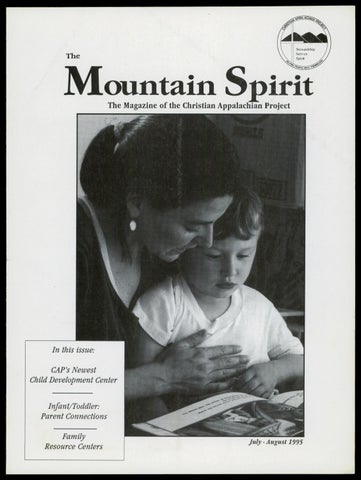
Begin with the Children We might be telling our age, but we remember a slogan from several years back, “Progress is our most important product.” We think you’ll enjoy meeting some folks who might say that their slogan is “Children are our most important product.” We all know children aren’t a product, but there are many programs in Appalachia that know how important it is that children learn that education is fun, and that they are loved by their families, their teachers and by God. When it comes to these lessons education is our most important product! On page four, volunteer Shannon Bristow tells of the importance of beginning to work with children in infancy. On page twenty-six, Connie Hounshell, an administrative assistant in CAP’S Hagerhill office, will introduce you to our newest child development center. If you’ve read the last couple of issues of The Mountain Spirit you’ve noticed quite a few references to Family Resource Centers, which were established in public schools as part of the Kentucky Education Reform Act of 1990- On page eighteen, Beth Dotson tells of the work they do to ensure that low-income children are successful in school. On the cover, Shannon Bristow and Michael, one of her students, read “Where the Wild Things Are,” one of his favorites (photo by Gabriel).
Published by the Christian Appalachian Project. Editor: Margaret Gabriel. A dvisory Board: Father Ralph W. Beiting, Mike McLaughlin, Bill Begley, Carla Durand, Teresa McAnly, Katie Newsome, Beverly Potter. G raphic D esigner: Elizabeth Reed Roberts. Circulation: Linda Grider East. The M o u n ta in Spirit is published six times a year. The annual subscription price is $6.00. Subscriptions and other correspondence should be sent to The M o u n ta in Spirit, Christian Appalachian Project, 322 Crab Orchard Road, Lancaster, Kentucky 40446. Copyright 1995, The Christian Appalachian Project, Inc. All rights reserved. Member, Catholic Press Association. The Christian Appalachian Project is a non-profit Christian service organization operating throughout Appalachia. The project operates on the philosophy that “helping people help themselves” is the best approach to Appalachian poverty. A summary of the registration and financial documents filed by this organization can be obtained by contacting: in New York, Secretary o f State, Office of Charities Registration, 162 W ashington Ave., Albany, NY 12231; in Maryland, for the cost of copies and postage, the Secretary of State, State House, Annapolis, MD 21401; in NEW JERSEY, THE ATTORNEY GENERAL, 202-626-4380; in N O RTH CAROLINA, A CO PY O F T H E L ICEN SE TO SO LIC IT C H A R ITA BLE C O NTR IB UTIO NS AS A CH AR ITA BLE OR G A N IZA TIO N O R SPO NSO R AND FINA NCIA L IN FO R M A TIO N M AY BE OBTAINED FR O M TH E D EPA R TM EN T O F HUM AN RESOU RCES, SO LIC IT A TIO N LICEN SING BRANCH, BY CA LLIN G (919)733-4510; in Pennsylvania, residents may call the Pennsylvania Department of State at 1-800-732-0999; for West Virginia residents, the Secretary of State, State Capitol, Charleston, WV 25305; in Virginia, the State Division of Consumer Affairs, P.O. Box 1163, Richmond, VA 23209; Washington State residents may obtain a copy of the last report filed with the Washington Secretary of State by calling toll free within Washington, 1-800-332-4483; IN FLORIDA, RESIDENTS MAY CALL THE DIVISION OF CONSUMER SERVICES AT 1-800-HELP FLA or by writing to Christian Appalachian Project, 322 Crab Orchard Road, Lancaster, KY 40446. Our license number in M ichigan is MICS 9933. Registration with any of the above government agencies does not imply endorsement by the state.
The M ountain Spirit
Random Thoughts Jean Barnes The m ost im portant elem ent of m y w o rk w ith children at the Eagle Child D evelopm ent C enter in M cCreary C ounty is th e w o rk I do w ith th eir parents. Very simply, I try to teach parents to be advocates for th eir children. In th e past, parents w ere entirely too reticent to speak up to teachers and doctors in m atters that concerned th eir children. Brenda, for exam ple, has a little boy w ith som e delays. W hen I first m et her, she w o u ld n ’t take him to th e do cto r because she w as afraid he w as going to ask h er a question she co u ld n ’t answ er. W e encour aged h er to m ake an appointm ent by telling h e r about th e help she could get for Brandon. She finally m ade th at first appointm ent, th en skipped it. So, w e w e n t back to square one and this tim e w e w en t w ith h er and helped h e r fill out th e forms and answ er th e questions. W e pointed out to Brenda h o w m uch she knew about h er son, and how m uch of that inform ation she could share. Brenda’s learning - and many o th er parents are learning, too that they are th e best advocates for th eir children. W e’ve taught them that if a do cto r o r a teacher tells them som ething they d o n ’t understand, d o n ’t just sit there, ask questions! O ne o f our families has been hearing this m essage for nearly eight years, and I’ve seen a lot o f grow th in them . T heir ow n children attended w h en w e first opened, and n o w th ey ’ve had to adopt som e o f th eir grandchil dren. They b oth served on the advisory council at o u r school, and now th e father is on the sitebased council in th e public school. He learned to speak out and lead group m eetings here at
July-A ugust 1995
Eagle, and because of that, he developed th e confi dence he needs to take an active part in his children’s education. W e know that children’s perform ance Jean Barnes (center). “We know ij we don’t serve the whole family, we’ve missed the boat. ” in school is after they go to school has been significantly better w hen their an informal part of our w ork, but parents are involved. We try to get w h en w e can, w e do w hat w e can them involved from the very beginning, and it seems to be to encourage the children as well as th e parents. working. The children that started at Eagle w hen w e first opened are W e know if w e d o n ’t serve the in middle school now , and from w hole family, w e ’ve missed the all th e reports I hear, they’re all boat, and th a t’s w here w e can do still in school. That may not sound like th e biggest hurdle in the som e things the public schools can ’t. I can tell parents that if they w orld, but those transitions from w ant their kids to com e to school elem entary school to middle here they have to w ork tw o days a school to high school can really be a killer; I have several parents w ho m onth. It can be the mom or the dad, and w e ’ve even had some never w en t beyond elem entary school. W hen they have to leave grandparents w ork, if the parents have an opportunity for a day’s that small school and go to a work. T hat’s just a p art of w ho w e bigger school w ith kids they d o n ’t are and w h at w e do, and everyone know and w ho look dow n on pitches in. We have lots of parents them because they com e from w ho do even more. Parker’s Lake, naturally they d o n ’t w ant to go. They cry and tell their At Eagle Child D evelopm ent parents they d o n ’t like it, and no C enter w e can teach a child that truant law in the w orld is going to sh e’s always got som eone to turn m ake a difference. to, and that som eone is Jesus Christ. O ur kids know that w e W e’re going to do everything love them and Jesus loves them . w e can to make that child success This m ost pow erful know ledge of ful in school, starting w ith pre all makes all the difference for school and following up w hen w e many, parents and children alike. can. If his m om calls and says he can ’t go to school because he Jean B arnes is the m an ager o f d oesn’t have any shoes, w e ’re the Eagle Child D evelopm ent going to make sure he gets some Center. shoes. Keeping up w ith our kids
3
Infcmt/Toddler: Parent Connections: A Volunteer’s Story
So, it is we connect with one another, move in and out of one another's lives, teach and heal and affirm one another, across space and time — all of us wanderers, explorers, adventures, stragglers and ramblers, sometimes tramps or vagabonds, even fugitives, but now and then pilgrims: as children, as parents, as old ones about to take that final step, to enter that territory whose character none of us here ever know. Yet how young we are when we start wondering about it all, the nature of the journey and of the final destination. — Robert Coles, Children of Crisis ♦ by Shannon Bristow ♦ Photos by Margaret Gabriel
A . s I began m y final sem ester in graduate school, I becam e m ore and m ore aw are o f m y w eariness and exhaustion. For tw o years, I had been doing research, reading dry psychology journals and w riting page after page o f theoretical nonsense. I w on d ered h o w m y develop m ental psychology training w ould apply outside th e confines o f Cambridge, Massachusetts. I w as tired o f reducing hum an beings and th eir stories to “m easur able outco m es.” I felt very alone in an environm ent th at equated hum an reason to God himself. I w on d ered w h at had h appened to my soul in six years o f academia. It occurred to m e that I had spen t a good deal of my tim e in school trying to becom e w hat I thought others w anted m e to be rather than seeking to understand w h o I really w as and w h at God w anted for me. During this tim e o f consternation, I read about D orothy Day and th e philosophy of th e Catholic W orker M ovem ent —person ally serving th e p o o r in th e spirit o f the Gospels, especially th e spirit o f C hapter 25 of St. M atthew, “W hat you do to th e least of these you do to m e.” D orothy Day recom m ended a deep life of prayer and voluntary p overty in th e context of an intentional Christian com m unity w hen serving th e poor. In considering this service ethic, it is im portant to recognize that voluntary poverty is a privilege for
Volunteer Beth Myers explores paint activities with Patrick during one of the “in-center”days.
m any o f us and can becom e a tem ptation to pride. Day’s philosophy stands in sharp contrast to the philosophy o f my clinical training at Harvard, w here I w as constantly rem inded to m aintain a so-called healthy distance from children and families. At that time, I could not em brace my Harvard clinical training n o r proceed w ith a doctoral program in clinical psychology. I w as w eary of continuing to involve myself in a social science that w ould require me to maintain a distance from o th er hum an beings. I believe that th e deep connections w e make w ith o ther people are the sustaining features of our lives. W hen w e are in a helping or service relationship, the helper has just as m uch to learn as
olunteer Shannon Bristow isits the home of Michael, >ho assembled a necklace Aom pop beads for Shannon >wear. Ju ly - August 1995
5
th e one being helped. As W alker Percy rem inds us in The M oviegoer, “Listen to people, see h o w they stick them selves in th e w orld, hand them along a w ay in their dark journey and be handed along . . . ” Clearly, it w as tim e for m e to leave academia and go out into th e w orld.
*
Shannon also visits with Michael’s younger sister, Brittany (almost two). She brings toys to suit both children’s ages.
I w anted to find a place to live and w ork w here I w ould n ot only use my child developm ent training but also take p art in a life of prayer, com m unity and service. I w anted to p u t my faith into action by w orking w ith young children in this country in the context of Christian com m u nity. Q uite unexpectedly I learned of the Christian Appalachian Project. Robert Coles, a favorite professor of m ine, often talked about his w ork w ith children in Appalachia and one day m ade reference to Father Beiting, CAP’S founder. That very same day a colleague m entioned that her m other is a CAP donor and avid reader of Father Beiting’s books. Before long, I w as on my w ay to Kentucky for a visit and an interview. Surely, our Lord w orks in miraculous ways. So I w as off to eastern Kentucky. I m ade a one year com m itm ent as a perm anent volunteer. CAP provided me w ith room, board, health insurance and a m onthly stipend in return for my volunteer work. I w as placed at th e CAP Child D evelopm ent Center in Berea, Kentucky, to be the infant/toddler teacher. The Christian Appalachian Project operates six child developm ent centers for pre-school children. Four of these six centers offer a home-based program called “InfantToddler: Parent C onnections.” The philosophy of the program was defined for me as: “Families are the prim ary caregivers of infants and toddlers. We believe that the developm ent of parenting skills is a key factor in the developm ent of the infants and toddlers. Therefore, w e seek to assist in em pow er ing families in their roles as prim ary caregivers by enhancing family strengths and by developing new skills. W e w ork w ith each family to generate a focus that m eets the individual needs of that family.”
“We see ourselves as teachers Jor the young children, and friends and advocates for the families. ”
In practice, the program consists of w eekly hom e visits w ith enrolled infants
The M ountain Spirit
and toddlers and th e ir paren ts (informal play sessions w h ich involve developm ental w ork to fit th e needs o f th e child); educa tional sem inars on an array o f topics; and recreational activities for th e families. We see ourselves as teachers for th e young children, and friends and advocates for the families. Since th e ir creation about six years ago, CAP’S four infant/toddler program s have evolved out o f th e original philosophy. Each program is similar yet varies accord ing to th e needs and dem ographics o f the com m unity. At th e CAP Child Develop m ent C enter in Berea, fellow volunteer Beth Myers and I w o rk to g eth er closely to carry o ut th e goals o f o u r program . W e construe a broad definition of the infant/ toddler program . W e offer p aren t w ork shops on several topics, such as nutrition, effective discipline and budgeting. We w ork closely w ith CAP’S GED teachers and outreach w orkers. Many o f th e w om en in our program have received o r are w orking hard to receive th eir GED. In addition, w e organize recreational activities and take field trips. O ne o f o u r m ost p opular and involving events is th e annual Christmas Bazaar. The fall o f 1994 m arked o u r Third Annual Infant-Toddler: Parent C onnections Christmas Bazaar. W e scheduled m ultiple craft sessions at th e child developm ent
Patrick. When they are old enough, they will enroll in the in-center program. Kristen’s mother, Jackie, looks on. center, and m others took leadership roles in show ing us ho w to m ake various items. The Bazaar, a sm ashing success, w as held at the Berea College Alumni Building Activities Room. T ogether the families in our program and CAP volunteers contrib uted to a terrific day. W e m ade $1400, after expenses, w hich will help support our program in 1995. More im portant, how ever, is the fact that the w om en in the program took real interest and ow nership in som ething they
ilder children in the center enjoy playing the younger children on their “in-center”
Ju ly-A u gust 1995
7
sense of com m unity. W ith a united front, w e can encourage th e grow th of our young children. I believe that to m ake a difference for the young children w e serve w e m ust affect the parents and the w ay that the family system operates as a w hole. I have found that a lot of love and su p p o rt can carry these families a long way. Many of the m others that w e w ork w ith are very young, betw een th e ages of 16 and 21. Many of them have never had som eone to love them or believe in them . W hen the support system begins to take root, w e see som e of these young m others blossom. As you can see, our w ork is intense and very dem anding, but it is equally rewarding. One particular m om ent sticks in my mind: Whilethe infants and toddlers play with Shannon and the other children, Kim conducts a parenting class. Today they are discussing non-violent discipline. w orked hard for and believed in. It w as a real team effort, and w e are looking forw ard to nex t year! To celebrate our success and the Christmas season, w e w e n t out to dinner w h ich rem inded us of th e im portance of “breaking b read” together. For m any o f th e moms, eating in a restaurant w as a special treat.
This afternoon is my very first w ith Daniel. The willful two-year-old pokes his head from behind a beat-up door. He stares at me; his big black eyes p en etrate me. I have never seen a child so beautiful and so full of life. He is a small boy w ith a round and protruding stom ach. He lives up the holler w ith his m o th er and five sisters and brothers. The family carries a certain dignity, a look that is unique but almost
The w om en continue to make im portant strides together. T hree young m others have received th eir GEDs. A nother m other is hoping to take h e r ACT (college en trance exam ) and attend Kentucky College o f Business n ex t fall. The o ther tw o w ould like to find w ork. A long-time, extrem ely com m itted m o th er becam e a “special stu d e n t” at Berea College this fall and will continue throughout th e year. She hopes to be adm itted as a full-time student for the 1995-96 school year. In the m eantim e, o th er m others are following th e lead o f th eir strong-willed, determ ined peers and are w orking steadily tow ard receiving th eir GEDs. Additional accom plishm ents include w orking tow ard and receiving driver’s licenses, looking for jobs, visiting th e public library and w ork ing on personal solutions to child care and transportation. The families in the program have built strong relationships w ith one an o th er and w ith us. These relationships form th e basis of a su p p o rt netw ork and
8
Shannon is happy to report that reading is one Michael’s favorite activities during their visits.
The M ountain Spirit
lost to a p eo p le w h o have been run over and left behind. This afternoon Daniel is w earing diapers and a dirty Lion King Tshirt. He is barefoot and covered w ith m ud. He stares and I stare back. He is so young, yet th ere is so m uch life w ithin him —so m uch beyond th e old bam he lives in. A lthough I have just m et him, he has given m e a great gift: h o p e in the face of frustration and, in his ow n way, th e p ure and innocent love o f childhood. I will not soon forget him. And I thank God for th e tim e th at w e have to play together. O ur tim e is a joy apart from the exhaustion of m y all-too-busy w eek. My only w ish is that som ehow Daniel could understand ho w m uch he has m eant to m e in this brief time. In his hopeful face, I am rem inded of m y passions and o f all th e children in the w orld w h o need o u r care and love. The im portant family m om ents like D aniel’s and th e personalism th at undeqfin CAP’S service ethic m ake th e difference for m any families. W e go th at extra mile w ith th e families th at w e com e to know and love. W e h o p e th at o u r love for Christ and th e spirit o f the Gospels are th e corner stones of o u r service. If w e do not rem em b er Christ in His distressing disguise, then w e have m issed the point. W e are not m eant to be a social service o r governm ent agency. W e are lay m inisters delivering h o p e to all w h o com e o u r way. T here are m any m ore things I could say about th e Christian A ppalachian Project and its infant/toddler program , but I will confine m yself to saying that th e families that I have com e to know and love through m y w ork in eastern K entucky have given m e infinitely m ore than I could have ever given them . Their lives are a great exam ple for m e. T heir w arm th and hospitality are a continuing joy. Harvard never could have given m e such richness o f hum an relation ships that cross race, class and cultural lines. So to th e families in th e Infant/ Toddler: Parent C onnections program in Berea, I am forever grateful for your gentle kindness, sim ple joy, richness of character and m oral vigor. And to th e supporters of th e Christian Appalachian Project, thank you for your su p p o rt of o u r efforts. R em em ber us in your prayers and com e visit us in th e hills of Kentucky. ft
July - August 1995
Something on the other side of the room is far more interesting to Kristen than Shannon’s toy.
Blowing bubbles seems to be a favorite activity of most toddlers —and Patrick is no exception!
--------- Around the Project-----Leadership Workshop Explores Survival Skills The fourth annual W om en’s Leadership C onference featured a day that concentrated on survival skills, said Brenda W ireman, m anager o f th e Christian Appala chian P roject’s Com m unity Health Advocates. “Trish Joseph, one of o u r w orkers, w e n t last year and th o u g h t it w ould be beneficial to our ladies, so w e w orked it into our conference this year,” Brenda said. Nearly 150 w om en attended th e survival skills w orkshop, w h ich received a grant and m aterials from CAP. O ne hundred w om en spen t all o r part o f th e w eek at CAP’S conference at Camp Shaw nee in Floyd County. Jean Rosenburg, d irector o f the Single Parent program at Prestons burg C om m unity College, arranged th e day, w h ich included w orkshops on plum bing and electrical w ork, as w ell as career and survival skills. Chris Gayheart, o f Floyd County, is a regular at the w o m en ’s group m eetings, and has attended th e conference in the past, but this year w as special. “It’s th e first tim e I’ve spen t th e night aw ay from m y kids!” Chris said. She has four teenagers. Marcella Mullins w as a first tim e attendee, for a good reason. She had retired just tw o w eeks earlier from h e r position as a teach er at Allen Central High School in Floyd County. W hen she first began, Marcella taught typing on a m anual typew riter. She m oved on to an electric, and w h en she retired, w as teaching keyboarding and w ord processing on com put ers. She enjoyed mingling w ith the w om en, several o f w h o m had been h e r students. A nother first year conference attendee, Angie Lawrence, w en t
10
speakers and discussion, and afternoons were spent on crafts, makeovers and bingo.
hom e every night to care for her six-year-old daughter. As she enjoyed her first m anicure ( “I usually do 'em myself!”) she said w as enjoying m eeting young m others from o th er counties. In addition to the survival skills w orkshop, the w om en heard speakers address topics on non violent discipline and developing a positive attitude. Cy W ebber, an actor from Louisville, perform ed a one-man show exploring AIDS, and ho w the disease affects relationships. Carol Heavisides traveled the farthest to the conference, and spoke on breast cancer awareness. A CAP volunteer, Carol lives in W hite River Junction, Vermont, and w orks as a visiting nurse, specializing in diabetes. During a previous visit to CAP, Carol spoke to several w o m en ’s groups about health issues, describing sym ptom s and discuss ing treatm ent and o ther practices w hich ensure good health.
“You w ou ld n ’t believe the num ber of w om en w h o had classic sym ptom s of diabetes, but they had felt badly for so long that it w as just a p art of th em .” One lady, in particular, took Carol’s advice, saw h er doctor and began to adapt h er behavior to care for herself. Katie New som e, a CHAP w o rk er w h o leads several groups, said the lady never m isses a m eeting, says she never felt b etter in h er life, and gives Carol the credit. “As a CAP volunteer, you know that you’ve been a success if you’ve touched one life,” Carol said. “I’m glad I got to com e back to find out about that life.” The w eek after the conference ended, planning began for the 1996 conference, Brenda said, w ith review of the evaluations of ’95, letters to possible speakers and brainstorm ing sessions w ith the w o m en ’s groups. “W e’ll find out w hat they liked and w hat th ey ’d like to see in th e future.”
The M ountain Spirit
around the project. . . continued CA P V o lu n te e r s P la n t S e e d s CAP’S nine volunteer com m u nities are given a small am ount of m oney each year to use as “seed m oney” for a com m unity project. The seeds th at th e Louisa volun tee r com m unity planted this year could grow into a totally different w ay o f life for a Louisa resident, reports volunteer Betty Darlin. Shelbie Suzza has lived in a Louisa nursing hom e for nearly ten years. Because o f h e r cerebral palsy, Shelbie has a lim ited degree of independence. “More than anything else in th e w orld, Shelbie w ants to leave th e nursing hom e, and to do th at she had to have h e r o w n battery-pow ered w heelch air,” Betty said.
Starting w ith their seed money, th e Louisa volunteer com m unity sponsored a spaghetti supper, raising th e initial funds for the chair. They com bined it w ith donations from several groups, and th e proceeds from other suppers, and before long they had the m oney in hand. The volun teers found the kind of chair Shelbie needed for half the cost they w ere anticipating, Betty said, “so no w Shelbie has a nest egg.” Shelbie longs for independence, and despite having the needed chair, they have been unable to find a group hom e w here Shelbie can live. “She doesn’t need the level o f care that they have in the
nursing hom e, but th e re ’s just no o th er place for h er to live. She’s willing to m ove to a group hom e anyw here in th e U nited States.” Betty said that the volunteers, w hom Shelbie calls h er adopted family, take h er on outings often but sh e’s not allow ed to leave the nursing hom e alone. “If they had an autom atic door, sh e ’d be gone!” Betty and the o th er volunteers have looked locally for solutions to Shelbie’s need, and hope that by getting the w ord out, a group hom e arrangem ent will be found. “We found out that getting the chair w as the easy part. N ow m ore than anything else, w e w ant to find Shelbie a h om e.”
Wanna bring a smile to an Appalachian family? Wanna know how? A CAP Christmas Basket! During this time of year workers in the CAP outreach program begin the work necessary to pro vide baskets of toys, gifts and food to the folks we serve at Christmas. If you would like to take part: • Let us know the size family you would like to sponsor. (Gifts for each person in the NAME family should cost between $1 5 and $25.) We'll send you ADDRESS information about your family, including ages and sizes, and a few gift suggestions; CITY STATE ZIP • After you finish your shop ping, wrap and label gifts with PHONE (please include area code) the name of each person; • Then mail your boxes of I would like to sponsor a : ___________small family (1-2 children), gifts to CAP by or before No ___________medium family (3-4 ch ild re n ),____________ large family (5-6 vember 20, 1995, to ensure ch ild re n ),___________extra large family (8 or more children) and that we receive them during the parents. first week of December. T O TA L N U M BER O F FAMILIES S P O N S O R E D _________________________ That's all there is to it! Your ___________I am not able to shop for a needy Appalachian family, but I Appalachian family will have a have included a contribution that will enable you to provide gifts Christmas they'll never forget and food for a family. $___________ and you'll know that you've contributed to the real meaning $75 will provide gifts for a family of five. $20.00 will provide a Christmas food box for one family. Any amount you choose will help of the birth of Christ. We look us share the joy of Christ's birth with an Appalachian family. forward to hearing from you!
around the project. . . continued Maybe You Can Double Your Gift!
In recognition of National Child Abuse Prevention Month, Mabel and Randy Randolph, owners o f Foodland in Brodhead, Kentucky, donated a tree, which was planted on the grounds o f CAP’S Family Life Center. FLS workers said that the tree will remind them that their programs grow in the prevention of child abuse.
Peace Committee Studies Principles of Non-Violence The Christian A ppalachian Project is sponsoring a program to educate its em ployees and the com m unities it serves about the six principles o f non-violence as prom oted by th e King C enter for Non-Violence in Atlanta. Beginning w ith th e June issue of The Voice, CAP’S em ployee new sletter, th e principles will be explored, one at a tim e, by m em bers o f th e CAP’S Peace Com m ittee. The April issue included an overview o f the principles by com m ittee m em ber Peggy Patrick, m anager of CAP’S Emmaus Christian Life Center. Asking about the response to violence in society, Peggy said that courageous choices are needed to m ake changes in the situation. “Dr. Martin Luther King recognized terrible violence in our society and chose to live, and ultim ately to die for, th e Gospel m essage o f Jesus Christ, that love o f neighbor is th e w ay of God. His six principles o f non-violence challenge us to choose a different p a th .”
12
At a recent m eeting, the com m ittee discussed the six principles, w hich they will include in presentations concern ing the Christian Appalachian Project Peace Award. The com m it tee will speak to CAP employees, as w ell as com m unity groups w ho will be invited to make nom ina tions for the award. W anda Penman, casew orker for CAP outreach in Lincoln County and a m em ber of CAP’S Peace Committee, grew up in Lincoln County. “I d o n ’t rem em ber having problem s w ith race, but my children do. The first time som ebody called me ‘nigger’ I d idn’t know that it was a bad name, th a t’s how unaw are I w as,” W anda said. “W ith my children, though, it’s a w hole different story. One day my little boy w ent hom e w ith a friend, and w as told that he was not supposed to be there because h e ’s black. The kids d o n ’t know w hy they’re saying that, and th a t’s the sad part. I tell my kids that they’re going to run up on problem s, but I d o n ’t harp on it. I hope that by educating
If you are a CAP donor, or are considering becoming one, you may be eligible to double your gift through your past employer's matching gift program. Many companies today match monetary support to non-profit community service organizations that are sup ported by their employees. Many of these companies also match the gifts that are made by their retirees, as well. Please write for your bro chure "Double Your Dollars," which lists participating companies and instructions. Send correspondence to Teresa McAnly, CAP, 322 Crab Orchard Road, Lancaster, KY 40446. people about non-violence w e ’ll start to transcend som e of these attitudes.” The CAP Peace Award will be presented on Friday, January 12, 1996, at the Baird Lounge on the Berea College Campus. It is given annually in honor of the mission of Dr. Martin Luther King, Jr. to a person w ho actively p rom otes the w ork of Dr. King through his or h er ow n w ork and exam ple. Past aw ard w inners include the Tow n M ountain Baptist C hurch in Perry County, George Duerson of Richm ond and Kelva Nelson of Ashland.
Christian Appalachian Project is a participating agency in the Combined Federal Campaign. Federal and military employees can contribute to CAP by designating #0898 on the CFC pledge card.
The M ountain Spirit
around the project. . . continued CAP R e c e iv e s P u b lic H ea lth A w a r d The Christian Appalachian Project was honored with the Kentucky Public Health Associa tion 1995 Group Award for valuable services in community health. At the award presentation during the public health association’s annual convention, Sharon Reed, a support service clerk with the Magoffin County Health Department, read the letter of nomination written by Kathy Hembree, a public health nurse with the department. “Working hand in hand with volunteers, staff members and local people, CAP serves right where the action is —in the heart of rural eastern Kentucky.”
family resources centers through out eastern Kentucky sent letters supporting CAP’S nom ination. “W e have had several children w h o have had tears dried by a small donation of a toothbrush to them and many o f the parents have given thanks because of the item s that th eir children have received,” one letter said. Garrard County Judge Executive Ray Hammonds, a m em ber o f the board o f the Garrard County Health D epartm ent, said in his letter o f support, “We in the public health field know that good self-esteem is one of the m ost im portant tools a person can have to assure a happy and healthy quality o f life. The materials that CAP makes available to thousands and thousands of people boost self-esteem, giving people a sense o f h ope and w orth, w hich are sadly lacking for m any.”
K athy’s nom ination gave particular tribute to CAP’S Com m unity H ealth Advocates, w hich prom otes health education and w ellness in Magoffin and surrounding counties, and to O peration Sharing w h ich distrib utes in-kind donations in all o f the Appalachian counties of Ken tucky, as w ell as th e o th er tw elve Appalachian states.
CAP Operation Sharing manager Charlie Deaton accepted the award, saying, “On behalf of our founder, Father Beiting, our president, Mike McLaughlin, our 320 employees and 87 volunteers,
Social workers, nurses and administrators from more than a dozen health departments and
I thank you. Through our 70 program s w e try to show G od’s grace, G od’s love and G od’s forgiveness.”
What You Don't Know About Wills Can Hurt Your H eirs.. . Find Out Why. Request Your Free Copy.
Much ofwhatyou know about wills may be misinformation that has been floatingaroundforyears. If you think, for example, that wills are primarily for rich people, or the elderly, you may be the victim of a common misconcep tion. The helpful booklet offered here will explain how your will can save your heirs from costly delays and confusion. Send for your copy today. Clip and Mail
Christian Appalachian Project 322 Crab Orchard Road Lancaster, Kentucky 40446 Please send without obligation, your booklet, "37 Things People 'Know' About Wills That Aren't Really So." N am e__________________________ Address _______________________ C ity ____________________________ State______________ Z IP __________
J u ly - A u g u s t 1995
13
__________ around the project. . . continued ----------
R u th H o lt T eaches CAP V olu n teers to Q u ilt The young man sat hunched on the couch, needle in hand, stitching, slowly and meticulously, the top of a colorful double wedding ring quilt. In a chair next to him sat 67year-old Ruth Holt, quilter extraordinare, with a handmade version of a double wedding ring quilt spread across her lap. The veteran quilter, with a thimble on one finger of her left hand and threaded needle poised between two fingers of the right, paused while she watched her student. “H e’s caught on right quick,” she said, a look o f satisfaction on h er face, “I am am azed at ho w m uch h e ’s got d o n e.”
Ruth started quilting about tw enty years ago w h en she made a bedspread for h er three grand daughters. The art of quilting was handed dow n from h er late m other, Darcus Lafferty, w ho not only inspired Ruth to quilt, but began th e family tradition of teaching CAP volunteers the craft. “My m om w as one of these type people that had to have 18 to 20 volunteers from CAP at the house sew ing.” After h er m other died last year, Ruth continued quilting and passing h er skill on to others. She estim ates that she has taught 10 to 15 volunteers to quilt.
Sandi Knight, m anager o f the CAP elderly program in the Floyd and K nott County area, said Eric loves quilting. “He really gets excited visiting people w ho are quilting, seeing the different w ork they do. A lot of em ployees are fascinated that he chose one of the m ost difficult patterns for his first quilt.” “They should know I love them and like to w ork w ith th em ,” Ruth said about h er youth proteges. “Each generation should teach the other. ” R eprinted w ith perm ission fro m the Floyd County Times.
For several years Ruth has been teaching a y ounger generation the art of quilting. H er m ost recent protege is Eric Smith, a volunteer w ith the Christian A ppalachian Project’s elderly program . W hen th e native of N ew York m ade his first visit to R uth’s hom e he d idn’t know he w as falling into the hands of a m aster quilter. And he never imagined he w ould join the ranks of o th er volunteers w ho have learned th e traditional m ountain art. “The first tim e I ever saw her, she w as quilting,” Eric recalled. During subsequent visits, Ruth talked to h e r young visitor about the art o f quilting. W ithin w eeks, he w as hooked. “She suggested I m ake a pillow ,” Eric said. But being a gung-ho type o f guy, Eric decided to plunge into the art in a big w ay —by making a quilt. “In tw o w eeks, I’ll be d o n e,” Eric said as he fastened his w o oden quilt hoop, a gift from another quilter, to a section to be stitched. “I find it relaxing,” he said about his hobby. “I enjoy it.”
14
Ruth Holt and Eric Smith, a CAP volunteer, share a laugh during the time that they spend together quilting.
Father Beiting Recieves Honorary Degree Father Ralph Beiting, founder of the Christian Appalachian Project is a 1995 recipient of the degree D octor of Flumane Letters from Spalding University.
Addressing the audience for the com m encem ent of the liberal arts university operated by the Sisters of Charity of Nazareth, Father Beiting spoke of th e need to make a com m itm ent to service.
“He joked that now that h e ’s got three honorary doctorates, he should have some intelligence,” said CAP volunteer Jim Flaragan, one of several volunteers w ho attended the com m encem ent exercises.
“He had lunch w ith Dr. Oaks, the president of the university,” Jim said, “And at the reception he w as prom oting CAP and our w ork to [Louisville] Mayor Jerry A bram son.”
The M ountain Spirit
around the project. . . continued C am pers to E xp lore N ature at AJ A ndrew Jackson cam pers are em phasizing th e environm ental w onders o f rural Jackson County this sum m er, according to cam p m anager Peggy Hancock. Peggy is planning activities th at will include “sun p rin ts,” th at is, fixing a leaf o r o th e r vegetation to a specially treated p a p e r w h ich will darken in th e sun. “And w e ’re going to do som e w eaving w ith plants and w eeds that w e find right here at AJ. The kids will be able to take a little piece o f AJ hom e w ith th e m ,” Peggy said. From th e earliest days o f Father Ralph Beiting’s involvem ent in Appalachia, kids have been com ing to cam ps in the m oun
tains. The 1995 season will see 85 cam pers p e r w eek at Camp A ndrew Jackson, and 85 p e r w eek at Camp Shawnee in Floyd County. The cam ps alternate w eeks for boys and girls w ho range in age from 6 to 14. Most of th e children are from Kentucky counties, although som etim es a cousin from out of state attends for a w eek, Peggy said. “It’s good for th e kids to m eet people from o th er places. Some of them have never been out of Jackson County, o r certainly never out of Ken tucky. ” Peggy is excited and a little nervous about h er first cam ping season. Before com ing to CAP she lived in Germany for seven years, w h ere she w orked as a program
m anager for a youth services program . “T h ere’s a lot o f differ ence in the wildlife betw een here and G erm any,” Peggy said, “But there are things about Jackson C ounty that rem ind m e of Ger m any.” The cam pers will have the opportunity to learn quite a bit about foreign cultures and countries from Peggy, and from one o f th e cam p volunteers w ho has a dual citizenship w ith the U nited States and Belgium. Peggy is grateful to have several experienced staffers to ease h er first year. “O ur coordinator is com ing back, and Ron, one of the counselors, has been here seven years. The lady I hired as our assistant cook, and our m ainte nance w o rk er w ere both cam pers w h en they w ere younger. ”
Looking for an Adventure? V o lu n teer w ith th e C h ristian A p p alach ian P roject CAP volunteers assist the people of Appalachia through such programs as child development, elderly outreach, adult education, home repair, and emergency assistance, while focusing on a life of prayer, community and service. Volunteer Opportunities: 21 years of age or older; one year (renewable); room and board; health insurance; monthly stipend. College loan deferment information available. Short term volunteers: 18 years of age or older. Three weeks to three months. Room and board. Applications accepted year-round. Contact CAP Volunteer Program, 235 Lexington Street, Lancaster, KY 40444, (606) 792-2219, (800) 755-5322, Fax (606) 792-6625. 15
The CAP Closeup
7 don't have just one or two kids — I have hundreds!”
“T here once w as a lady w h o lived in a shoe. She had so m any children she d idn’t know w hat to d o .” It’s easy to think of this nursery rhym e at th e Martin Y outh and Teen Center. T here are kids all over th e place, but th ere is plenty of ord er in th e chaos thanks to Peggy N elson, m anager of the Christian A ppalachian Project center. A p erso n w ith m any talents, Peggy began h e r career w ith CAP in 1986 w h en she o pened the youth cen ter in a form er funeral hom e. The kids w ere excited about a place th ey could go after school to be w ith friends and do things.
Being a “second m om ”, and som etim es the only m other influence for m any of the chil dren, is Peggy’s natural-bom instinct. Although Peggy has no biological children, “I d o n ’t have just tw o or three kids, I have hundreds. They’re all different and th ey’re all special,” Peggy said. “Anyone w orking w ith children know s the great pride and unbounded joy w hen one of the kids excels or accom plishes a goal. I feel good that I can be a part of their lives, share their dreams, their struggles and com fort them through troubling tim es.” Peggy know s about troubling times. She becam e a w idow in
1986 after eighteen years of marriage. “W e had the perfect relationship. O ur w edding was tw o w eeks after w e graduated from high school, and I w as devastated w h en he died. If it h adn’t been for my family, friends and my w ork w ith CAP, I d o n ’t know h o w I w ould have survived. It w as, and still is, a great com fort to m e to be w ith th e kids at the youth center, to w atch them laugh and enjoy them selves —they helped m e get through the grieving process and look forw ard to th e fu tu re,” Peggy said. Peggy’s life changed a lot after h er fortieth birthday w h en she becam e involved in activities and projects th at sh e’d never imag ined. Tw o years ago she built her
♦ b y K atie N ew som e ♦ P h o to s b y M argaret G abriel 16
The M ountain Spirit
Peggy Nelson “dream h o u se” and loves to w ork in th e yard, landscaping w ith flow ers and ornam ental shrubs. She designed a craft room w ith lots o f lighting and space in h er n e w house w h ere she loves to quilt, sew and craft. In th e fall o f 1994 Peggy enrolled in th e local college and took tw o co m p u ter classes. “I d id n ’t kn o w th e first thing about com puters, even h o w to turn one on, but I kn o w now! I w as scared at first, b u t th at feeling left w h en m y friends at CAP offered to help w h en ev er I got stuck. I liked w orking on th e co m p u ter so m uch I w anted to buy one, so my dad and I pooled o u r resources and bought a com puter. “My craft room is no w my co m p u ter room and I w ork on it at least an h o u r every day —just playing around on it to see w h at I can do. I’ve enrolled in a sum m er w orkshop and and in August I’ll take an advanced co m p u ter class.
I’ll attend as m any seminars and classes as I can fit into my sched ule.”
stretch dollars w ith com m unity involvem ent she is at h er best.
The enthusiasm Peggy has about h e r new-found com puter skills w anes in com parison to h er 25 year passion for bowling. “My friend Tooties got m e interested. Every Tuesday m orning, you can set your clock by me; I’ll be at the bow ling alley. Right no w there are th ree ladies, “Marla’s Girls,” in my league and w e do p retty well! My average is 172,” Peggy beamed.
After Thanksgiving the youth cen ter w orks on a Christmas party for a nursing hom e in nearby K nott County. Last year, th e group w orked w ith a local church to prep are gift bags for each resi dent. The day of th e party, they served soft drinks and snacks and sang Christmas carols. Residents w h o couldn’t walk to th e recre ation hall had visits in th eir rooms, w ith chatting and Christmas gifts.
Peggy has an extra burst of energy around th e holidays. In N ovem ber each year she contacts grocery stores to encourage local participation in a Thanksgiving dinner for the youth cen ter kids and their families. In 1994 over 115 p eople shared dinner, and through Peggy’s efforts and food donations from local m erchants, th e entire cost w as only $21.17! Peggy takes pride in stew arding d onor m oney and w h en she can
Peggy’s labor is rew arded w hen “my kids do well. W hen they graduate, get their diplom a, their GED, get m arried or find a job, I’m like a doting mama, just as proud as I can be. Some of th e older kids have m oved to o th er states, m arried and started families of th eir ow n, b ut they always call me around Christmas tim e, or visit w h en they com e hom e. It makes me feel special to hear from th em ,” she said. ft
Peggy calls them “my kids, ” and there’s a feeling offamily at the Martin Youth and Teen Center.
Ju ly-A u gust 1995
17
Family Resource Centers: Good Neighbors
o f the ’90s
J J a n Curls grew up in a coal mining cam p in McCreary County. There, she rem em bers, people had tim e for one another. W hen she played grow n up, donning a dress that dragged the ground, and w alked to th e general store, the m anager had tim e for her. He w ould take a few m inutes out of his busy day to play h er game and treat h e r like a grow n-up lady. “My father w as a m iner. It w as not a bad childhood. It w as a w onderful childhood. But w e did not have the advantages that, say, the children w ho lived in the Steams area or W hitley City area had. T here w ere no advantages like taking m usic lessons. But as far as cam araderie and neighbors helping each o th er and taking care of each o th e r’s children, there w as plenty of th a t.” That w as in the 1940s and 1950s. Since then, life has changed in many Appala chian com m unities. “A lot of people I w en t to high school w ith, or even elem entary school, did not go on and further their education. T hey’re hurting and their children are hurting because of th e limbo their lives w ere left in w hen all of a sudden the econom y that w as here w as g o n e,” Jan said. W hether it w as th e closing of the coal mining cam ps o r o th er causes, com m uni ties throughout Appalachia have suffered the same consequences. People w ho didn’t think education w as im portant because a job w ould be w aiting for them , even w ithout a high school diplom a, now struggle to find w ork that will pull them above the poverty line.
Family Resource Centers address the whole family in order to improve education. ♦ Story and p h o to s b y B eth D o tso n ♦ 18
The M ountain Spirit
health needs. They are the good neighbors of the 90s. “Kids need to feel that som ebody cares about w hat happens to th em ,” Jan said. She helped establish the family resource centers in McCreary County and continues to w ork w ith parents and young people. “Hopefully it’s m om and dad. Hopefully its the grandparents. Hopefully it’s aunts and uncles or brothers and sisters. But if th a t’s not true, then som ebody else has got to Dreama Gentry and her sister-in-law, Debbie, began working with the com e in and be that person. family resource center as volunteers, both moving to paid positions. 7he centers give parents the opportunity to share their talents with the Many tim es if one person community. can hold out a hand and say ‘I care about you. I realize w hat you’re going through. You are w orth Changes in th e econom y have also very m uch to m e and your life is w orth triggered changes in neighborhoods and very m uch to this w o rld ,’ and make them society. T here are n ’t as m any relatives and believe that, w e ’re going to make an neighbors w h o are willing o r able to take amazing difference.” care o f th e kids. Even if you can find a general store, it’s not likely th at the Parents have told Denise McKinney m anager will take tim e out for a child’s about the difference she has made during game. T here are gaps that, w h en left the four years she has directed the family unplugged, leave children absent from resource center at Sand Gap Elementary school, chronically ill o r even neglected. School in Jackson County. She recalls one m other w ho was skeptical about h er son Often it is educators w h o are m ost participating in the c en ter’s “Pals” pro aw are o f the voids into w h ich children fall. gram. Denise describes the program as During the school year they see children in giving an adult friend to students w ho the classroom on a daily basis. They notice the child w h o is too tired to stay awake during class; th e child w ho d o esn ’t have a w in ter coat; th e child w ho is absent every w eek. Problem s at hom e can be a great detrim ent to a child’s ability to learn. K entucky legislators recognized this w ith the passage o f the K entucky Education Reform Act in 1990. O ne part of this com prehensive education restructuring legislation provided for th e establishm ent of Family R esource and Y outh Service Centers in o r near schools w h ere 20 p ercen t o r m ore o f the students qualify for free lunch. These centers, w h ich are set up at th e elem entary and high school levels respectively, help families m eet som e of their social, educational, econom ic and
Thefamily resource center in Sand Gap has a room where children can play when their parents are volunteering.
19
to m eet those n eeds,” said Clifford Keith, director of th e Sm ithtow n and Steam s Family R esource Centers in McCreary County. “O ur goal is to keep the child healthy and keep the child in school,” Clifford summarized. “W hat w e try to do is help those families m eet their needs before it becom es an intervention p ro b lem .” At the Sm ithtow n and Steam s center, that m eans w orking w ith a netw ork of care providers in the county to dispense m edical services, clothing, em ergency assistance and educational materials. If som eone at a school discovers a student has a problem , Clifford is called to see w hat he can do to help.
Denise McKinney addresses thefamily resource center volunteers during an appreciation luncheon. “m ight be lacking in som e area that is holding them back as a p erso n ,” w h eth er academ ic or social. The students and adults gather at the family resource center tw ice a m onth for special activities. The skeptical m other allowed her son to participate. W hen he w asn ’t asked to be in th e program th e following year, she called Denise to ask w hy, telling h er that it had m ade a m ade a w orld of difference in his life. Denise told the boy’s m other that because he w as no longer one of the most needy, they needed to make room in the program for others. State regulations require family resource centers to provide preschool and after school child care; family education for new and expectant parents; child care support and training; parent-and-child education; and health services. “It’s just a w onderful, w onderful pro gram because even though all family resources centers across the state have the same six core com ponents they have to m eet, and a lot of optional com ponents, w e can take input from com m unity and see h o w best to m eet those needs,” Denise explained. “Each school has different needs . . . So w e have th e liberty to establish program s
20
“A lot of tim es children d o n ’t w ant to com e to school because of clothing. A lot tim es w e can provide that and keep them from being em barrassed because of their clothing,” Clifford said. Shortly before his interview w ith The M ountain Spirit, Clifford had provided clothes to a boy w ho had outgrow n his ow n. His family couldn’t afford to buy him new clothes. Clifford also intervenes w ith o ther sorts of problem s. In one w eek, he found a pediatrician to see a child w ith a chronic nosebleed. The child’s parents had no insurance or m oney to pay for a doctor. He visited a m other w h o is mentally ill and w ould not send h er children to school, and explained that she could go to jail for keeping h er kids at hom e. He provided m edicated sham poo to five families w hose children had lice. Clifford also gave gas m oney to a family w ho needed to take their daughter to Lexington for a follow-up visit after surgery on h er ears. “Most of the jobs avail able are either m inim um wage jobs or factory jobs
Family resource centers encour age parents to be involved in their children's education.
The M ountain Spirit
th at p ay a little bit above m inim um wage. Some o f those have a few benefits, but m ost o f th e families w ith tw o o r th ree children in th e hom e are still at the poverty level,” Clifford explained. D enise sees th e sam e situation in Jackson County. She has recently w ritten a grant to fund a health clinic in th e family resource center. She believes it will be a great help to th e w orking p o o r —people w h o have low-wage jobs th at d o n ’t provide sufficient incom e to m eet the family’s needs and also d o n ’t qualify for governm ent benefits. At th e clinic, these families w ould be charged for services on a sliding scale th at takes into consideration th eir incom e and expenses. Children w ho otherw ise w ould n o t see a d o cto r could be treated. “I think this program (family resource centers) is w h a t’s been missing in the realm o f social services,” Denise said. Family resource centers collaborate w ith existing agencies and program s so they can refer families in need to th e appropri ate places, and fill in th e gaps w ith new program s. The Sand Gap Family Resource C enter also provides a friendly atm o sphere. Visitors d o n ’t have to go through a receptionist o r w orry about dirtying the carpet. Denise o r one o f h e r three staff m em bers will rem em ber th e person once they have met.
I (MS
The flexibility o f th e centers also allows them to be m ore accom m odating than som e social service agencies. “We try to be sensitive to the fact that, for exam ple, this kid might benefit from an activity but h er family d o esn ’t have a car or gas m oney,” Denise said. In that case, Denise and h er staff will try to find som eone to give that person a ride.
Ju ly-A u gust 1995
Mostfamily resource centers begin the education process with parents beginning with the birth of their children..
Denise takes special pride in h er Girl Scouts program . Parent volunteers go into the classrooms to do scouting activities w ith th e classes (girls and boys). In February, the Scouts also started m eeting after school. The Brownies have earned six badges in four m onths; the Juniors have earned four or five. Denise is also excited about the Ladies Young-At-Heart program for senior citizens. Approxim ately 20 w om en betw een the ages of 50 and 92 go to the center for activities. Initial activities focused on helping the group m em bers feel com fortable at the cen ter and w ith one another. Some of the m em bers have moved on to becom ing Pals and helping students w ith school projects. “It’s my personal belief that senior citizens are to be valued. Our society does a lot to devalue them , unfortunately,” Denise said. “I grew up w ith my grandparents, and I know how really w onderful that w as.” These ladies and o th er com m unity m em bers contribute to the annual Heritage Day the center sponsors in May. It helps students learn about the w ay things w ere done years ago and makes them proud of
Denise also w ants h er volunteers to know how m uch they contribute. Some are w om en w ho previously, perhaps because of their ow n bad childhood experiences at school, w ould not go to their child’s school. The family resource cen ter has given them a com fortable place to share their talents w ith one another and w ith the students. During National V olunteer A ppreciation w eek in April, the family resource cen ter staff planned a luncheon and surprises for them .
butterflies that read “Volunteers are beauty in motion.
their culture. It also invites com m unity m em bers to be a part of the education process. “Folks that may not be com fortable coming u p to a w orkshop o r participating in a classroom activity are com fortable showing th e kids these old tim ey ways, and if they sat back and thought ‘I’m doing a learning activity w ith these kids’ then they m ight be so intim idated that they w ouldn’t do it,” Denise explained. W hen she tells them how m uch the students learned from them , they are often surprised. Heritage Day is one exam ple of a w ay the cen ter helps everyone feel good about them selves and value education. Denise keeps h e r childhood in m ind w hen planning som e initiatives, like th e sum m er readiness program for four- and five-year-olds. “I know that w h en I w ent to school, I was scared of my teachers until I got into the sixth grade. I was absolutely terrified of them . And it w asn ’t anything they had done, it w as just that I w as kind of a backw ard kid. I w as th e oldest one, the first one to go to school. My m om w as a hom em aker and w e didn’t get out a lo t.” The readiness program can help students ease school fears.
22
In McCreary County, Clifford has also opened new doors for students and parents through a variety of program s. He w orks w ith the Christian Appalachian Project to provide tutoring to adults w h o w ant to earn general equivalency diplomas. He has w orked w ith Save the Children to get individual sponsorships for every student at Sm ithtown Elementary School. He has sponsored a class for expectant parents and is w orking on certification for an education program for parents of children from birth through three. Jan Curls is also being a good neighbor of the 90s by trying to m eet any need she sees in the com m unity that isn’t taken care of by others. A form er counselor for the Christian Appalachian Project, Jan offered h er services at the high school early this year w h en a student shot herself. “I w as so burdened after m eeting w ith them (the girl’s friends) because there was such hopelessness there. The things that they felt w ere offering them h ope w ere drugs, sex, hanging out w ith their friends —nothing that w ould lead them to any kind of a future for them or their children,” Jan said.
Jan can relate to some of their fears and hurts. “Up until 1959 when I went to college and took those courses, I really didn’t know I was smart,”Jan recalled. “They made me realize I’ve got a brain. I can think. I am not the stupid child that my husband is leading me to believe I am.” As a teenager, Jan married. Her husband abused her. It took 10 years, but Jan gradu ated from college and left h er husband, taking their five children w ith her. “If children and parents will realize education is the answ er out. It is the answ er,” Jan said. The good neighbors of the nineties are trying to spread that message. ft
The M ountain Spirit
Letters to the Editor I enjoy reading y o u r magazine so m uch. The stories and articles are so real. I feel I know th e peo p le and w an t to help them even m ore than I’m able. After reading thro u g h The M ountain Spirit I really feel for these people but, at th e sam e tim e, I adm ire th eir courage and faith. It makes m e m ore able to face m y ow n life and be thankful for w h at I have — w hich is certainly a step above w hat th ey have. I pray fo r them all and, o f course, for CAP w h ich is doing so m uch for them . God bless! Mrs. Edith From entin Ellicott City, Md.
I w o u ld n ’t be hap p y w ith o u t The M ountain Spirit. I enjoy reading about all th e things that are being done. I have had it for a long tim e, and ren ew it every year. I enjoy Father Beiting’s letters, and books. May God continue to bless you. Mrs. E leanor W ait Concord, N.H.
It takes a lot o f effort to keep all th e “m achinery” running smoothly. May God always bless you and the w o rk y o u ’re doing for those less fortunate. I truly enjoy reading your magazine. Josephine L. Groth West Bend, Wise. K eep up th e good work! You are calling m any to live m ore simply so that o u r Appalachian brothers and sisters can simply live. God bless you all. Sr. Joan M cD erm ott M arlborough, N.H.
Ju ly-A u gust 1995
You are doing a fine job. I enjoy reading The M ountain Spirit and h o w you are helping others have a b e tte r life and a better place to live. Pow er to those w ho con tinue their education. Mrs. Isaac N. D alrym ple Enid, Ok la.
My m o ther introduced your magazine to me many years ago. I sincerely enjoy it. My husband and I have brought donations to Lancaster m any tim es for the Attics. W e have toured your headquarters and Attics in other tow ns and thank God for the dedication of those w ho strive each day to make a better life for th e people of Appalachia. Mrs. Gayle C haljant Danville, Ind.
W e read your magazine from beginning to end and enjoy it very m uch. By reading your magazine w e find out m ore of w hat is happening in the Appalachian area that w e do not read about in The (Louisville) Courier Journal. May Almighty God grant Fr. Ralph Beiting good health to continue his good works. Bill & A nne Burns Louisville, Ky.
W e enjoy reading about the real happenings of real people in Kentucky. I w as raised near M orehead, Kentucky, so I know w hat life is in the m ountains and it is a great joy to be able to help others. May God bless all of you. Clifford E. Lewm an Muncie, Ind.
I really enjoy The M ountain Spirit. It does my heart good to know that so m uch is being done to help a proud but p o o r com m u nity to reach upw ard and outw ard to a b etter life. God bless Father Beiting for his long and p roduc tive life and all he has done, w ith the help of all th e blessed people w h o give o f their tim e and resources. Arlene D unham S. R oy a Iston, Mass.
I have been a subscriber for several years and it has been a pleasure to w atch your magazine grow in professionalism w ithout losing its sense of w arm th, vitality, and caring spirit. K eep up the good w ork, but d o n ’t let it grow too big or too slick. Some mission m agazines try to cover so m uch that they becom e overwhelm ing. Yours is just right in size and scope. Congratulations and God continue to bless you. Mrs. N.J. Merli Spring Lake Heights, N.J.
Thank you for a w onderful magazine w hich show s how m uch good caring people can do. It is sad that in this country so m uch poverty has existed for so long. Hopefully you will be able to continue to help for as long as it is needed. A nita Turdo Rivervale, N.J. Letters to the editor are welcome. They should n ot exceed 150 w ords in length, a n d w e reserve the right to ed it them f o r space. Address letters to The M ountain Spirit, Christian Appalachian Project, 3 2 2 Crab Orchard Road, Lancaster, K Y 40446.
23
*
Danny Green looks in on a tutoring session oj Franciscan sister Mary Myron siore. sisier Mary Myron is a long-time teacher at the David School.
In 1968, Daniel G reene arrived as a lay volun
Danny Greene: Boundless Energy and Enthusiasm Recipient of the 1994 Mountain Spirit Award for Outstanding Work in Education ♦ by Shayjaquays ♦ Photos by Margaret Gabriel 24
teer w ith the Catholic church. D anny’s goal w as to break th e cycle of poverty and dependence on welfare; he addressed the problem by starting w ith education. In 1972, Danny opened th e David School, an alternative school for students w ho m ight n ot have had a chance in th e public schools due to apathy, parental indifference and a general lack of interest. Tw enty-three years later, th e David School operates under the philosophy of providing a com prehensive education program for all its students, and, according to Danny, w ith the belief that “It is our responsibility to prom ote an atm o sphere that offers the students the opportunity to experience success.” W hen Danny opened the David School in 1972, he set up in the abandoned com pany store of the defunct Princess Elkhom Coal Company. Danny and tw o helpers started w ith a group of 10 students, a building w ith no heat or plum bing and very limited resources. W ith boundless energy and enthusiasm , Danny and his helpers set out to establish a m odel school that could be used to reach drop-outs, enrich the com m unity and im prove attitudes and achieve m ents among the students. Less than 15 years after it w as established, the David School w as recognized as a m odel drop-out prevention program in the region by the Appalachian Regional Commission, in the state by the K entucky State Drop-Out Preven tion Commission and locally by m any school boards w ho are also searching for ways to address the high num ber of students dropping out of school.
The M ountain Spirit
W hen th e David School w as first established, th e students w e re tu to red in th e m ornings and in the afternoons, they w orked to p u t th e form erly abandoned building back into shape. At first, this w ork w as done out o f necessity. Today, this w ork is still a part o f th e curriculum , and it takes place in th e form o f w oodw orking, and com m unity service classes, as w ell as operation o f a full service gas station. This w o rk allows th e students to not only im prove th e ir m ath, reading and social skills, but also enables them to gain valuable w o rk experi ence. Through th e David School, o th e r program s have been established as well. The M ountain Top PreSchool/K indergarten Program w as founded in 1984. One o f th e m ain pu rp oses o f th e program is to establish d ro p o u t prevention at its basic level. The school also p repares young children to en ter the public school system w ith a positive orientation and to be success-oriented. The Floyd C ounty Literacy Council is also a part of the David School. This program offers classes at seven locations around th e county and also offers som e hom e tutoring. The students involved in the adult education program are also at various levels. People w h o earn th eir GED are invited to w alk in the graduation cerem onies every year, com pleted w ith a cap and gow n. Danny G reene has been recognized by several groups and organizations around th e country. R eader’s D igest m agazine recognized Danny as an “American Hero in E ducation” in 1989. The same year, ABC featured him as an “unsung A m erican,” and featured him in a 60second public service --------------------------announcem ent highlighting the im portance o f public service. Danny w as also recognized as th e 57th Point of Light through form er President Bush’s “1000 Points o f Light” program , designed to recognize A m ericans w ho w ere w orking to b e tte r the nation. In 1994, Danny received th e Jefferson Award, w h ich w as founded in 1972 by Jacqueline K ennedy Onassis, Senator Robert Taft, Jr. and Sam Beard. This aw ard w as created as a N obel Peace Prize for th e United States to ho n o r th e highest achievem ents in public
Ju ly-A u gust 1995
service. Danny has also been featured on the “Today” show , and has been approached by people w ho w ant to make a m ovie o f th e story of th e David School. Because of the grow th o f the David School and its increasing involvem ent in education, a n ew school building is currently u n d er construction. The com m unity o f David has been highly supportive of the school over th e years, and in 1991 sold about 200 acres of land to the school for about $200,000. One of the biggest obstacles, how ever, is money. The school receives little funding directly from the state. Instead, various churches, colleges and individuals have donated m oney, supplies and labor over the years. Several small foundations have contributed to th e success of th e David School. The federal governm ent, through th e D epartm ent of Education com petitive grants, has also contributed to the school. VISTA assists through a grant p ro gram w hich provides funding for volunteers involved w ith th e school. The staff of th e David School is m ade up of teachers w h o live in the area and several volunteers w h o have dedicated them selves to one or m ore years of service. Many of them are attracted to the school because of its com m itm ent to education and em phasis on th e individual student. Because of the determ ination and dedication of Danny G reene, the students of at th e David School have been able to beat the odds against them . Shay Jaqu ays is a teacher a t the D a vid School an d a fo rm e r CAP volunteer.
25
Spirituality and Discipline: Hand in Hand CAP’s newest child development center makes learning fun for kids in Magoffin County O n O ctober 15, 1995, Father Ralph Beiting, founder of the Christian Appala chian Project, attended the opening of the Magoffin Child D evelopm ent Center. W hile th e cen ter is th e sixth operated by CAP, it is th e first to o pen in the Big Sandy area, CAP’S m ore recen t area of operation. “It w as a dream com e true for Fr. Beiting and o u r entire staff, to see th e center finally o p e n ,” said Sylvia Robinette, m anager of th e center. Since that day, lots o f excitem ent has been going on at the center close to Salyersville, Magoffin’s county seat. Thirtyth ree children are enrolled, w ith ten on a w aiting list. “W e’re here to prepare these children for Head Start or kindergarten,” Sylvia said. The enthusiasm hits you in the face w h en you w alk into th e center. It’s flooded w ith sunshine that reflects off the brightly
26
♦ by Connie HounsheU ♦ Photos by Margaret Gabriel
The M ountain Spirit
colored rugs, furniture, and play equip m ent. The smiles on th e faces o f th e staff and children lets you know at once y o u ’re in a h appy and loving environm ent. “W e try and give these kids a bright and hap p y place to play and learn. W e w an t to teach social aw areness along w ith school readiness and a good dose o f spirituality,” said Sylvia. “It’s really heartbreaking to w itness som e o f th e problem s th e kids bring w ith th em to th e center. Poor nutrition, neglect and abuse are not uncom m on. It really takes tim e for som e of th e children to learn to trust us. After all, they have been p u t into a n ew setting w ith structure and rules w h ich are n ew to them . Because o f th e poverty in th e area, trans portation is a problem for som e of our families, and that affects th e ch ildren’s social skills. Learning to play and get along w ith others is som ething w e really w ork o n .” To address various and com m on p ro b lems, Sylvia encourages all parents to attend a m onthly parenting program w ith presentations by guest speakers. As w ith the children, the cen ter m ust provide transportation to th e m eetings o r many parents w ould n o t be able to attend. The parenting program has been very successful, w ith even an occasional father in attendance. The parents find it a very rew arding tim e for discussion and a tim e to learn som ething new . “This w as the first tim e in my life I m ade a craft,” said one m other, after Trish Joseph, a w o rk er in CAP’S Commu nity Health Advocates program , taught the w om en ho w to make baskets from em pty d etergent boxes.
During “table time” the children fi nger paint. Some of the kids put theirfingers in the paint, others dump it directly on the paper and smear it around.
Ju ly-A u gust 1995
Sylvia Robinette, manager o] the Magoffin Child Development Center. “It takes time for some of the children to learn to trust us. ” “Some of the activities have included crafts, first aid, CPR, fire prevention, nutrition, hygiene and discipline. We look at the w hole family in our parenting program , and always incorporate things w hich can benefit the total family,” said Sylvia. “We always appreciate it w hen people in o th er CAP program s lend us a hand. W hen Garry Vickers gave a presenta tion on discipline, the parents really opened up and shared w ith the group. The parents are excited to learn that there are solutions to som e of the problem s they face. “So m uch has changed since I w as in child care,” said Ann Sizemore, the head teacher at the Magoffin center. “W hen I began w orking here, I realized at once that I had to treat every child as an individual, so I had learned every child’s nam e by the end of my first day at th e center. Every child certainly has an individual personal ity, and in the three m onths I’ve been here, I have seen som e positive changes in a lot of them. “I feel the greatest need of the children is in social skills. T here’s a real need for these kids to learn to interact w ith others. We have children in the center from a
27
Allegiance. “It’s so neat to actually hear them repeat th e w ords w hile they stand w ith their hands over th eir h earts,” she said. The staff of th e cen ter agrees that spirituality and discipline go hand in hand. Ann says the staff is so loving and shows so m uch patience w ith th e children that the children know they are disciplined w ith love. “Many of th e children com e from hom es w ithout consistency and structure. W hen they start in our school, it isn’t always easy for them to understand w here w e ’re com ing from ,” she said. “But children like routine and they soon adjust.”
cognitive development. w ide range o f backgrounds, but m ost of th e kids d o n ’t get out of the ‘holler’ very often, ex cep t m aybe for d o ctor’s appoint m ents. W e teach social aw areness to help expose th e kids to different careers like grocer, doctor, p o st office w orker or teach er,” Ann said.
The children and staff are looking forw ard to the sum m er session w hich will be treated like sum m er cam p. Along w ith the regular teaching program , vacation Bible school will be added. The children will have their meals outside, picnic style, and for extra enjoym ent they will get to splash in w ading pools. Ann, Sylvia and the rest of the staff plan to recruit som e parent volunteers for extra helping hands.
Ann said she is already reaping the rew ards o f w orking w ith the children. “In a special case, w e had a little boy w ho had com e to us from an abusive hom e. He w ould com e into the center, find a nook or cranny, and curl up in th e fetal position, and w ould not participate w ith others. But just th e o th er day he looked up at me and said, ‘Ms. Ann, I love you because you’re so good to m e.’ That makes it all w orthw hile,” Ann said.
Each day w h en th e children arrive at school, they have free play, tim e w hen they can choose w hichever activity they enjoy most. Then, they w ash their hands, have breakfast and brush their teeth. Then the kids sit in a circle (lienee, the term “circle tim e”) and take part in the activities that Ann has planned. Sometimes they move to music and m arch, w hich teaches large m otor skills. O ther days they m ight discuss the w eather, review the ce n te r’s rules or perhaps listen to a Christian tape. Then they m ove to “table tim e,” w here Ann plans a different them e each w eek. For exam ple, during “Earth W eek,” recycling was discussed. Sometimes inform ation on the them e is sent hom e to parents. After another free play session, preparation for lunch begins. W hen the m orning class leaves for hom e, the agenda starts over again for th e afternoon session.
O ne of the activities that Ann is most p roud o f is teaching the kids the Pledge of
Preparing the foods for breakfast, lunch and snacks
“The very saddest thing is, how ever, that som e o f o u r kids have never been exposed to Jesus, so I incorporate a Bible story and Christian m usic in my daily lessons. We always use Jesus as a them e on the bulletin board, and th e kids take turn saying prayers. T hey’re like sponges, absorbing th e stories of Christ. One little boy came from a hom e w h ere they never said a prayer before meals, but the m other said one evening before dinner he asked that they pray before they ate, “Because w e pray at school.”
The M ountain Spirit
keeps cook Melissa Daniels on h e r toes. “As th e kids are eating breakfast they ask ‘w h a t’s for lunch?’ I often see a need for b ette r nutrition in o u r children. Most of the kids get a high-fat diet at hom e, w ith little o r no fresh fruit o r vegetables. I am really pro u d o f th e nutrition program at th e c e n te r,” said Melissa. “My goal is to incorporate as m any fresh foods as I can in th eir meals here. And th ey ’re so receptive to n ew foods! Some o f th e favorite things w e have served are raw veggies w ith dip, and they love kiwi fruit. I try n o t to fry any foods, they are always baked o r broiled, and w e try to use little canned food.” Melissa believes teaching good nutrition and healthy eating habits at th e cen ter will have a positive im pact on th e children’s life choices as they grow up. The children love to help p rep are foods. “One day I brought out bow ls o f peanut b u tter and jelly and let th e kids m ake their ow n sandw iches w hile th e ‘Peanut Butter and Jelly’ tap e played. W e also have the children take turns at clean-up time. Meal tim e is fun tim e at th e c e n te r,” Melissa said. “I try to send nutritional inform ation out in o u r new sletter. I serve ‘family style,’ letting th e children help them selves. The kids love it, they eat b e tte r and are m ore willing to try n ew foods.” A n ew face at th e Magoffin Child D evelopm ent C enter belongs to volunteer Sheila Huntley. Sheila has a degree in early childhood education and hum an services. She has estab-
Head teacher Ann Sizemore conducts circle time with the children moving and ■jumping in time to music.
Ju ly-A u gust 1995
and match shapes.
fished a home-based infant/toddler p ro gram for children two-years-old and under, and for children w ith special needs. “I see about nine children right now . Some of the families I see are very isolated, w ith little or no transportation. I try to bridge the gap betw een having no child care to preparing the child for a day care setting or Head Start. One family has three boys, and I am working w ith them in making the appro priate decision in w hich school settings are right for them . I let them know th e options that are available to them . “I find that m ost of the families I see are doing the best they can w ith w hat th ey ’ve got. They tend to w ant better circum stances for their children. I’ve seen m others carry w ater and heat it so the kids can take a bath. Some hom es d o n ’t have the basics, heat or w ater. I love the kids, though, and I spend as m uch tim e as allowed w ith them , usually one or tw o hours once a w eek. “Their nicknam es are so cute: Nookie, Bubba, Shorty, and Pokie! And they all w ant lovin’ [hugs] from m e every tim e I visit. Carol is a 23-year-old m other w ith
repair shop, and I’m driving the Martin Teen C enter’s van. Sometimes w e have to borrow th e Camp Shawnee van and although w e appreciate it so m uch, w e realize that puts a hardship on o th er program s. The kids are always aw are w h en I pull up in a different vehicle, and they always ask w here th eir bus is,” said Lorraine. “But no m atter w h at w e ’re driving, w e always sing and have a good tim e. So far I’ve only had one child that got m otion sick; Sylvia had to sit w ith him and hold a bucket all the way hom e. Of course, all the children u nder 40 inches tall have to sit in a car seat, and “I’m proud of the work that has already been accomplished at the center, and with God’s help, the o th er are buckled up. Their we can achieve much more. ” safety is our m ain concern. One day w e w ere singing ‘If you’re th ree girls, six, three-and-a-half and tw o happy and you know it stom p your feet,’ and-a-half years old. I w ork w ith the tw o and one little fellow said w ith a lisp, ‘You younger children because the m iddle child all quit stom ping my bus, or y o u ’ll stom p a has serious asthm a problem s w hich hole in the floor and I w o n ’t have any w ay prevents h er from com ing to th e center. to get to school!’ The kids love their bus!” W e w ork on colors, num bers and vocabu lary. T heir language and com m unication W hen the Magoffin County Child skills need th e m ost w o rk ,” Sheila said. “It D evelopm ent C enter first opened its doors, takes time, but th e w ork and effort is so parents w ere cautious in sending their children, but through hom e visitation, rew arding.” referrals and tim e, m utual respect and trust “W e w ould love to be able to transport have formed. A special case involved a little girl w h o w as show ing sym ptom s that m ore children,” said Lorraine Howard, the could have been related to lead poisoning. c e n te r’s bus driver. “O ur bus is old and The staff and the child’s m other w orked breaks dow n often. If w e had another m ode of transportation, w e could reach together to resolve the problem , by identifying the possible source and having m ore children. W e have parents that have the little girl diagnosed. The staff contacted to walk th e child out of their hollow about a doctor, transported the child and m other a half-mile to reach the bus because the and stayed w ith them during the child’s roads are so narrow and rutted, the bus exams. Fortunately, the results proved can ’t be driven on them . If w e had one or negative, but a special bond w as form ed tw o vans w e could travel farther and betw een that family and the caring staff. handle m ore kids. Right no w the law allows a child to ride on the bus no m ore than one hour, and th at limits the areas w e “O ur aim is to help th e w hole family help them selves,” said Sylvia. “W e w ant can reach w ith only the bus. It’s really hard our m om s and dads to develop parenting to m aneuver th e bus in those rem ote skills as well as prep are the children for areas,” said Lorraine. their future. I’m proud of the w ork that has already been accom plished at the center, “O ur prayer is for a new bus or van that and w ith G od’s help w e can achieve m uch will provide th e children w ith safety and m ore.” ft com fort. Right now , our bus is in the
30
The M ountain Spirit
"What do you think your mother should do when he hits her, Monty?" "I think I should call the police." Quite a reaction from a six-year-old, thought Paula, as she talked to Monty after he and his mom escaped to a CAP spouse abuse shelter. Monty's mom told Paula that since she had been involved in an abusive relationship he had become withdrawn and quiet. He seemed afraid all the time and had no interest in playing with other children. "She told me that she didn't think that was the real Monty," Paula said. "After I found out that he felt responsible for his mother's abuse, I understood why he was so quiet." Within three days of his arrival at the shelter, Monty was enrolled in a new school and he and his mom began working on realistic goals for the future. "We worked on school work, math in particular," Paula said. "His mom was concerned about the fact that he didn't have brothers and sisters, so we encouraged him to play with the others kids in the shelter and learn to share." Monty and his mom stayed in the shelter for nearly a month, then she found a apartment and applied for several jobs in the area. "While she was here she worked on her self-esteem and confidence, and she had really improved by the time she left. She knows how important it is for her and her child to stay on track. I think she'll make his future wonderful," Paula said. "Every day will be a new adventure for him." Paula said that Monty and his mom have CAP donors to thank for the wonderful changes they've been able to make in their lives. Your gift of $10 . . . $25 . . . $50 - more if you're able — for use in the child services program of CAP's abuse shelters, or where it's needed most, will assure that other families are able to make needed changes in their lives.
Children in Appalachia •
Rates of poverty among children
under the age of 18 in Appalachian Kentucky range from 1 7% in some counties, to as high as 52% in others. •
Among families headed by
women, nine out of ten children live below the poverty level in Appalachian Kentucky. •
Children who come from poor
families are more likely to drop out of school. #
As young people seek employment outside of Appalachia, poverty
among children increases, as it does with the elderly and women. Source: Appalachian Center, University of Kentucky
CHRISTIAN APPALACHIAN PROJECT 322 CRAB ORCHARD ROAD LANCASTER, KY 40446 The Mountain Spirit
NON-PROFIT ORGANIZATION U.S. POSTAGE PAID Christian Appalachian Project
Address Correction Requested
CAROLYN SUE MARKS 4 4 3 0 KY. HWY 6 4 3 WAYNESBURG KY 4 0 4 8 9