Cr V <<
sa
March - April 1992
The Mountain Spirit The Magazine of the Christian Appalachian Project
The Mountain Spirit The Magazine of the Christian Appalachian Project March - April 1992
Vol. XI, No. 2
Contents Features --------------- Health Care in Appalachia---------------
4 Some Most Special People by Katie Newsome
16 The White House Clinic by Beth Dotson
20 Building Bridges by Ike Adams
22
We Com fort... We Empower by Margaret Gabriel
Departments 3 Random Thoughts 9 Letters 10 Around the Project 14
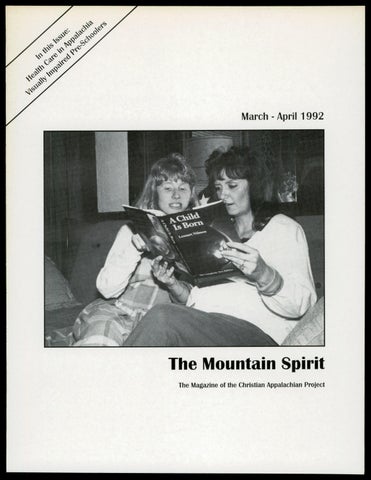
The issue of health care is receiving attention throughout much of the country and promises to receive a great deal more during the upcoming presidential election. Health care—and a lack of health care—has been a crisis in Appalachia for many years. This issue of The Mountain Spirit examines ways that CAP helps people to achieve and maintain good physical and mental health, and introduces you to The White House Clinic, a facility in Eastern Kentucky which provides good health care to mountain folks, regardless of their ability to pay for services. On the COVER, Kathy DiSalvo, manager of CAP’s Community Health Advo cates helps expectant mom Pamla Sue Porter explore the development of her baby, who is due in April. As part of her work with CHAP, Kathy provides prenatal information to women in Floyd County. She plans to coach Pam during her labor (photo by Margaret Gabriel). On the BACK COVER, things are still a little bleak, but we expect spring to break through any day now! (Photo by Randy Jordan)
The CAP Closeup
Community Health Advocates, page 4
Family Life Counseling, page 22
Visually impaired pre-schoolers, page 20
Published by the Christian Appalachian Project. Editor: Margaret Gabriel. Advisory Board: Father Ralph W. Beiting, Mike McLaughlin, Rose Price, Bill Begley, Ike Adams, Kathleen Ford Leavell, Barbara Delmonico. Graphic Designer: Elizabeth Reed Miller. Circulation: Linda Grider East. The Mountain Spirit is published six times a year. The annual subscription price is $6.00. Subscriptions and other correspondence should be sent to The Mountain Spirit, Christian Appalachian Project, 322 Crab Orchard Road, Lancaster, KY 40446. Copyright 1992, The Christian Appalachian Project, Inc. All rights reserved. Member, Catholic Press Association. The Christian Appalachian Project is a non-profit Christian service organization operating throughout Appalachia. The project operates on the philosophy that “helping people help themselves” is the best approach to Appalachian poverty.
The Mountain Spirit
Random Thoughts
Health is not simply a matter of “catch ing” something. Nor is it only the dysfunctional feelings, thoughts and behaviors we counselors deal with. It is an intricate weaving of our mental attitudes and beliefs, how we take care of our bodies and our spiritual ity. Spirituality doesn’t refer to any specific religious cures, but our rela tionship with God and how it affects our lives and health. We can take advantage of this connection whether our problem is physical illness, emo tional dysfunction, or spiritual abyss. Often we create un-health by men tally beating ourselves with poor self esteem or self-image. When we fi nally decide to stop and change our physical, mental, and spiritual health, the first question is: “Where do we start?” Start with the “as i f ’ method. This step involves acting as if we believe ourselves to function in a state of good health. This fosters our thinking about the possibilities for healing our minds, bodies, and spir its, rather than focusing on what may seem out of our control. This may feel phony at first, but can become a habit; soon we won’t have to act “as i f ’ because we really are. Another path to health is the on-going practice of forgiveness. To live healthfully, we cannot continually dredge up the past, using it against others to explain our own life condi tions. Yet, many of us have a ten March - April 1992
dency to do just that. We see this in phrases such as, “I told you so ,” or “You should have listened.” We need to leam to give up control and manipu lation, for ultimately we can only change ourselves. Our will ingness to forgive errors leads us to personal growth and away from pain and conflict. Today let go of a grudge and see how stress-reducing it can be. Stress, of course, long has Ron Lawrence. been identified as a source of both physical and mental un-health. Maintaining health involves main taining goals. W ithout goals or dreams we give up on life. Staying healthy means developing or main taining plans for the adventures, suc cesses, or simple pleasures we look forward to next. We need to see our selves with dreams, challenges, and possibilities for success, even if our un-health is debilitating or even ter minal. If we give up our dreams we have little reason to be healthy, and have chosen a path toward illness. Play can be a powerful healer. As we grow in age we may neglect much of the child who remains in us, believ ing that adults must be serious, ma ture, industrious. These are impor tant charactistics, but what about time for enjoying ourselves and those around us? Play needs to be an inte gral part of our lives, for it is as sacred as our work. Prayer, meditation and other com munication with our Higher Power and Inner Self is a major healing
Corsale
Often we tend to think of health in physical terms: how our bodies feel, or how w e’re affected by ailment or disease. Such a view prevents us from seeing or feeling a broader perspec tive, one not widely considered. This concept considers the connection be tween the mind, body, and spirit, and its major role in our health. It doesn’t matter if the problem is the flu, access to medical care and preventive health, depression or addiction, or any of the many issues CAP addresses.
component of life. Certainly we shouldn’t wait for un-health before we pray or meditate; we need bal ance and serenity in our souls. Turn ing pain, fear, and despair over to God provides comfort, hope, and positive beliefs n ecessary for wellness. We who work for CAP quickly leam how much we improve our health as we seek to improve the health of others. One way of looking at this is em pow erm ent—empowering the people of Appalachia thus empower ing ourselves. It is a process of strengthening ourselves and com munities, as well. Empowerment plays a critical role in health, whether that empowerment helps someone to access appropriate health services or guides someone out of emotional distress. Or we might empower our selves as we leam from those we seek to help and serve. *** Ron A. Lawrence, a counselor with Family Life Counseling Service, holds a master’s degree in social work from the University o f Louis ville Kent School o f Social Work. 3
Some Most Special People by Katie Newsome and Connie Branham Photos by Margaret Gabriel
T h e scene is a local meeting room where four pregnant ladies are gathered with an instructor. They’re all lying on the floor, comfortably situated on exercise mats. Some have a husband beside them, others have a close friend or family member. The instructor’s voice rings out, “Breathe in deeply— exhale with four short puffs; blow, blow, blow, blow. Relax. Breathe in. Exhale.” The women are learning natural childbirth techniques, preparing for better birthing experiences when their new babies signal their intentions to be bom. One member of the group is Christian Appalachian Project worker Kathy DiSalvo, manager of the Com munity Health Advocates Program (CHAP). She has accompanied her friend Pam Porter. When the time comes for Pam to deliver her baby, Kathy will be there as a coach: timing each contraction, going through the breathing exercises, doing whatever Pam needs to help her labor go as smoothly as possible. Kathy is very much involved in the WomanCare Pro gram at Our Lady of the Way Hospital and has coordi nated efforts with several other health care facilities to make CHAP a viable extension of community health services. Along with the administrative duties she accomplishes for CHAP, Kathy finds time in her personal life to be an active member of the Big Sandy Childbirth Association, where she is training to be a
childbirth educator. She hopes to receive her certifica tion later this year.
The beginning of the Community Health Advocates Program six years ago was a continuation of Father Ralph Beiting’s dream to build relationships. When the Christian Appalachian Project sponsored a symposium on the future of Appalachia in June of 1985, at Berea College, an attendee of that conference was greatly moved. Dr. Oris Blackwell, of Eastern Kentucky University, invited CAP to work jointly on a preventive and environmental health program. Out of discussions with Dr. Blackwell came numerous ideas of ways to explore and address health related issues concerning Eastern Kentucky and the Appala chian region. Susie Smith, a nurse from San Francisco, was recruited and joined two other nurses working as CAP volunteers, Jean Kowalski and Sue Duffie. Work ing with other volunteers and people in the Floyd County area, Susie, Jean and Sue established a pilot preventive health program at CAP’s Floyd County base of operations. Over the years, CHAP (as the pilot program was reThe Mountain Spirit
named in 1989) has evolved and improved, meeting needs of the community as they are reported by families, and also according to the individual gifts and talents of the employees and volunteers who have served in the program. Each person has given time and energy to develop new and interesting teaching material to be used in the program. Today, CHAP’s nine en ergetic staff members concentrate on providing school presentations, leading women’s groups, visiting families in their homes to provide health education, and helping with community service and leader ship training—a diverse, living entity of caring, concern and ad vocacy.
Expanding the program into Magoffin County was made pos sible in 1989 when CAP applied for and received a major grant from the W.K. Kellogg Founda tion of Battle Creek, Michigan, which will fund the program for three years in Magoffin County.
have been through since the last visit, as they compare notes on feeding schedules, sleep patterns, medication and the wondrous growth of their “little bundles of joy Melissa helps answer any questions new mothers may have, or if a mom needs more information or a resource, Melissa consults with Kathy Embree, a registered nurse employed at the health department. Kathy is very comfortable working with CAP and says, “I know we can trust Melissa’s professionalism and her caring nature when we make a referral for home visitation. She makes it possible to do the follow-up work involved in the pre-natal program. Our people are too spread out— many live in isolated areas of the county. Just one person doesn’t have enough time for the attention this program needs and deserves.” Kathy went on to tell of a donation that CAP made to the health department through Operation Sharing, its inkind donation program. “We received a donation of vitamin drops for babies—a hot item while they lasted. Our patients rarely have enough money to go out and buy over-the-counter medications of any sort. We try to work with local doctors to get samples of non-prescrip tions drugs like Tempra or liquid Tylenol to give the mothers when their babies get required immunizations. Usually the children run a fever or get a little cranky after their shot, and we tell the parents to give them over-the-counter medications which they can’t afford. They know and we know that the baby will have to suffer through the few days it takes for the infant’s body to adjust to the immunization,” Kathy continues.
Well into the second year of the time spelled out by the grant proposal, things are happening—lives have been changed, steps taken in an almost overwhelming en deavor. Home visitation involves many aspects of health care. A dynamic ingredient to CHAP in Magoffin County is licensed practical nurse, Melissa Vance, who has been with CAP for over two years. A brand new mother herself, Melissa visits homes of expectant and new mothers. “This is the best part of my work. I do initial visits with pregnant women and follow through after the baby is bom,” she says. Warming to her subject, Melissa says, “CAP has devel oped a good relationship with the Magoffin County Health Department and a lot of our referrals come from them. Our work with the people we see in cooperation with the health department is highly confidential and we must respect the agreements made with them when we got involved in their pre-natal program back in August of 1990.” Melissa says it’s easy to become friends with the new mothers she sees. They talk of all the phases their babies March - April 1992
Above left, Connie Branham helps women at the Grigsby Heights Women’s Group paint squares for their friendship quilt. Above, Kathy DiSalvo and Pam Porter review the breathing exercises Pam will use during her labor.
The relationship of CAP with the Magoffin County Health Department did not just happen. It has taken two years to build the harmony that now seems to be firmly in place. Both organizations are pleased with the extended services and ongoing work that is getting done. Not enough time and too few employees are problems at the health facilities in Magoffin County according to Kathy. She spoke of a car seat program soon to be implemented, and the need to admin ister the program effectively. She and CAP outreach workers are collaborating on providing the education parents need when they use the car seats. The two agencies share a videotape explaining the importance of car seats and their most effective use. This collaboration is just another link in the chain that connects health-related services in Eastern Ken tucky. Kathy hopes and plans for the health Women are invited to bring their children to group meetings. CAP workers provide department, the Magoffin Clinic (a pri toys and activities for the children while their mothers chat. mary care service provider) and CAP’S In a second grade classroom at Middle Fork Elemen Community Health Advocates to have monthly meet tary, a boy named Dusty participated, reluctantly, in an ings to coordinate their services and share information “I Am Special” presentation. “Ah, I ain’t special. I ’m on any resources available to the people they serve. “It’s dumb. I’m nine years old and still in the second grade,” difficult to get a convenient time for a representative of Dusty said, with downcast eyes and his hands jammed all the agencies at the same meeting, but we’ll have to deep into his jean pockets. work on that,” she said, her eyes twinkling with an idea. With seventeen years at the health department, Kathy is very happy with the services offered by CAP and enjoys her rapport with its community health workers. “Health care providers are definitely needed in this area, and we do appreciate CAP’s presence here in the county. Great ideas are wonderful, and the harsh reality is that it takes time to implement these programs, but we're on our way!” she comments. kick
When Tommi and Trish returned the next week for the second part of their program, Dusty was more involved and volunteered to answer questions and offered to help carry materials and supplies for the group. By the third week, Dusty was anxiously waiting at the door to show his spelling paper and the “B” grade he had earned. In the final presentation, when the class was asked, “Who is the most special person in the world?” Dusty was the first to stand up, head held high, both thumbs up and proclaim: “ME!”
Reaching out to youth has always been a CAP priority. Every person in Community Health Advocates is in volved with the extensive outreach in this area. Tommi Smith and Trish Joseph are staff assistants in Magoffin County and they do school presentations for more than 400 students each month.
Not all sessions are so dramatic, but for Dusty, the seed of faith and belief in himself had been planted.
Members of the CHAP staff agree that the most gratify ing and rewarding experience of their work in education is the glow that lights a child’s eyes glow when the knowledge that “I am special!” really hits home.
Roger, a fifth grade boy, liked to pick on his classmates, Connie said. The teacher had listed the names of children who were disruptive or unruly in class on the chalkboard for discipline, such as staying in at recess or detention after school. Roger’s name was at the top of
6
Staff assistant Connie Branham tells of a similar expe rience that she shared with volunteer Mark Coumoyer at Duff Elementary School near Garrett, Kentucky.
The Mountain Spirit
the list and his classmate were quick to point out that he picked on people a lot and his name was first on the board every morning. When Connie and Mark began their “I Am Special” presentation, Roger had difficulty expressing anything he liked about himself. After prompting by Connie, he decided that he liked the fact that he helped his mother care for his infant sister after school. The next week, another visit was made to the same class to present a session on “Bullies,” and Roger’s name was on the chalkboard once more. The material in the presentation was difficult for Roger. He had a hard time understanding that when we say things to hurt the feelings of others that we also hurt our own self-esteem. The third week there was a breakthrough, though; Roger’s name was not listed on the board! During the talk on “Emotions” he participated more and began to understand the importance of caring for the feelings of others and how to express his own feelings in a con structive manner. By the final week, Roger’s teacher told Connie that his name had not appeared on the chalkboard for over two weeks. Roger approached Connie and Mark to ask if they would like to see a short play that he and some of his friends had written. Their play was about a bully who needed a friend to talkto and spend time with. Roger had begun to leam a valuable lesson—to treat others in a way that he would like to be treated; believing in one’s self-worth is the foundation for change in any life. Education is a vital part of CHAP’s diversity. Touching young lives each month has a ripple effect when chil
dren go home and tell their families what they have learned. The fun these children have during presenta tion is exceeded only by the enjoyment and fulfillment of the CHAP staff—knowing they have made a posi tive impact on a young life and possibly a future leader. •k "k *
The Women’s Group was initiated about four years ago after many home visits with ladies who said they had no time for themselves. Brainstorming by the CHAP staff led to the idea of an informal group meeting that would last two hours. Each meeting would focus on a particular topic, and would include a “social time.” Input from the women revealed they would like to know more about childbirth, parenting and how to cope with day-to-day crises. They also indicated a special attraction for small handcrafts. The ladies were encouraged to bring their kids and while the moms had some time just for themselves, the children were entertained by a babysitter in another part of the building. “I really look forward to the Women’s Group each week. It’s the only time I get to visit with my friends and we always do something new,” one of the mothers related. The Women’s Group proved to be a huge success, showing a definite need within the community. There are now four active groups. Two are in Martin, another is at the extreme southern tip of the county, in Wheel wright, Kentucky, and at the WARCO Housing pro gram in Langley, Kentucky is the newest organized group. Patti Cobb, a resi dent in the complex, is the initiator of the group. She’s a motivated young mother who cares about her com munity and wants to work to make it better. At the Grigsby Heights Group (a government hous ing complex in Martin), Connie is working with the
CHAP makes school presentalions in Floyd and Magoffin counties. During this presentation, each student surrenders a shoe, then reclaims it by telling something special about herself or himself.
March - April 1992
7
course, she had to model the dresses for the other ladies—applause, ap plause, as Louise walked and turned in her new clothes. Everyone looked through the magazines to get ideas on coordinating acces sories and Louise was one well turned out lady. A trip to the library for a book on kitchen utensils proved to be a fun ad venture. When they re turned to the meeting, each person made a table setting using each uten sil beside their plate. The m enu was crackers, cheese and cranberry Kathy DiSalvo is working on certification to become a childbirth instructor. As Pam s coach, she attends childbirth classes with her at Our Lady of the Way Hospital. juice and the good natured laughter and banter across the table made for a women on household budgets and finding ways to relaxed, supportive atmosphere. stretch those dollars. They are learning how to save money on non-food items such as cleaning supplies, toilet tissue and sham poo by clipping coupons and submitting refund offers. Their craft this month is a “Friendship Quilt.” Each member is painting a stencil on a block of fabric, then adding her name. When all the blocks are finished, they will be sewn together for the finished work of art. When the Women’s Group was taking its first tentative steps four years ago, another lady, Louise, was very active, working at the school her children attended. One day she told the group that she had been selected to represent the volunteer parents at a two-day conference in Jacksonville, Florida, all expenses paid by the school. While everyone congratulated her, and she began shar ing details about the upcoming event, it was evident that she was excited at such recognition among her peer group. Despite her excitement, Louise had a sense of hesitation. When one of the group asked what she was going to wear, she said, “That’s just it! I don’t have anything suitable to wear to something like this. And the banquet that’s scheduled—I don’t know what to use all those spoons and forks for!” Well, this group of women was not going to let a “little oT thing like that” put a kink in the honor that had been bestowed on one of their own! At the next meeting all the ladies brought in jewelry, accessories and women’s magazines. Louise had bor rowed two outfits she really liked from a friend. Of 8
Louise, full of self-confidence, enjoyed the trip to Florida, and with the encouragment of her friends, knew that she would represent the Appalachian region well. A local newspaper published an article about her volunteer work and accomplishments, which later led to a job offer. Since she now has the responsibilities of a full time job and family, she doesn’t attend the Women’s Group regularly, but she still finds time every so often to stop in to visit, see friends, and chat a while. Soon there will be a Community (not just Women’s) Group at Gapville, in Magoffin County. Brenda Wireman, who manages the Community Health Advo cates program in Magoffin County, is coordinating the use of CAP’s adult education “little red schoolbus” as a meeting place. Everyone in the Magoffin County program is looking forward to this new addition to their already extensive programming and hopes that the group will be as useful and popular in Magoffin County as it has proven to be in Floyd County. -k k -k
Faith, creative work, and commitment are the key factors in the Community Health Advocates philoso phy. Promoting good physical health of the individual, nur turing the emotional and social awareness of each person—CHAP is relationships. CHAP is advocacy. CHAP is friendship. The Mountain Spirit
Letters I enjoy my Mountain Spirit maga zine very much; each time I receive mine I pass it down to some one else as soon as I read it. I hope I get to visit with you all some time. I am so grateful for Rev. Beiting and everyone that has a part in the work you all are doing.
We enjoy the varied articles about the activities in Appalachia, and of ten wonder just what would have become of all these people if Father Beiting had not been in the picture. Keep up all of the good work. Mr. & Mrs. Howard L. Rentner Dolton, IL
Kathryn Peters Clarksville, AR
Eddie MacMurray Dubach, LA
I enjoy reading the articles of the work and accomplishments you are doing in the Appalachian area of this nation. Your encouragement and work is helping others to help them selves. This is what is needed to help those less fortunate than others to find hope and courage to make a better life for themselves and their families. Carl Hollar Newark, OH
Everytime I receive The Mountain Spirit, I read it from cover to cover. I consider it “my food for the soul and spirit,” like my Mama used to say. God bless CAP and all the wonderful people you are trying to help. Our prayers are with you always. Shirley Govenettio Hamburg, NY
It is a pleasure to help you in the plight of the Appalachian people. I enjoy The Mountain Spirit magazine and cannot lay it down. May God help you in your work. Wilma Foster Muncie, IN
Y our fine magazine is so aptly named: The Mountain Spirit, for it issues a challenge to each and to all of us, to live in the Spirit of Him who called God His Father, called us His broth ers and sisters and friends, and who calls us again in the hearts and in the hollows, and so hallows us all in the likeness of Him! So work on, little flock! Feed, care and comfort Him/them! Your words, works, and photojournalism move hearts, hands, and mountains! Mr. & Mrs. David R Crawford Southfield, MI
I appreciate the articles that explain so much about the daily life of those you serve in Appalachia as well as the people who carry out the service. Jesus said, “The poor ye always have with you,” but praise the Lord, you have managed to find people and ways to help them ! God bless you all.
I enjoy reading The Mountain Spirit. It is full of interesting things — I’ve been a subscriber to The Mountain Spirit for many years. God bless you in the new year and to meet your goals.
Ruth Carrera Deerfield Beach, FL
Antonia Aguilar Los Angeles, CA
March - April 1992
I enjoy each and every issue of The Mountain Spirit and look forward to the next issue. I play Father Beiting’s tape often and read his books, just to remind me of the very real need of the people he loves so much. If the world had more Father Beitings it would be a much better place for all of us.
I find The Mountain Spirit very help ful in trying to visualize the people who I am reading about. I was bom in England of Irish parents. The people of Appalachia are descendants of those who settled there after coming from the British Isles, so I feel I have something in common with them. I must say that the work you are doing there is wonderful. Keep it up. God bless! Gerard Hamilton Detroit, MI
I feel it is a privilege to help in the much needed work of Father Beiting and the CAP family. Charity begins at home. We should take care of our own family and friends before send ing money overseas. God bless ev eryone. Maude K. Bishop Trenton, OH
Letters to the editor are welcome. They should not exceed 150 words in length, and we reserve the right to edit them for space. Address letters to The Mountain Spirit, Christian Appalachian Project, 322 Crab Orchard Road, Lancas ter, Kentucky 40446.
9
Around the Project FL School Displays Historic Photos The Christian Appalachian Project Family Life Center School was re cently able to take advantage of a program operated by the Kentucky Historical Society. The society has thirty exhibits called “Museums To Go,” which are loaned to schools, communities and other organizations. The most recent ex hibit at the Family Life Center School depicted Appalachian women at the turn of the century. “We can call the historical society and order whichever exhibit we want and keep it for thirty days,” said Lisa Bosley, manager of the Family Life Center School. She said that they have had several different displays and that the staff as well as the stu dents enjoy the variety.
A large group of students were honored In May of 1991 for achieving high school certification. The Family Life Center School in Rockcastle County recognized their achievements with a ceremony that centered around the theme “Wind Beneath My Wings.”
CAP Worker Pilots School Bus “Who drives the bus?”
“Cathie Bailey (now manager of the School on W heels in M agoffin County) started ordering them through a program made available by the humanities council,” Lisa said. “Most of our students have never been to a museum before, so these displays are very broadening for them. Some of them have told us that they have old family pictures from around the same time, and they’ve gotten a lot more interested in that time in history.”
“I do,” said Cathie Bailey, manager of the C hristian A ppalachian P roject’s School on W heels in Magoffin County. In late 1991, Cathie obtained the commercial driver’s li cense she needs to pilot a red school bus that CAP uses to serve 24 Gen eral Equivalency Diploma students in the county. The bus is equipped with classroom space and the materi als needed, including a computer, to help students study to pass the high school equivalency test.
Lisa said that in addition to the pho tographs, the display includes facts about women’s lives in the early 1900s, including the birthing pro cess, reform, education and recre ation.
“Driving it isn’t too hard, but parallel parking this thing on country roads is really something,” Cathie said. “We set up sawhorses in a parking lot, so I can practice.”
“Our students can see how things are different now, and how things have changed,” Lisa said. “They can see how many more choices they have now than women did then—some times they might not think that they do, but they do.” 10
When the adult education program operated out of a community center in the Salt Lick area of the county, Cathie worked with 16 students. Af ter the program “hit the road” she added eight more, because of her increased mobility. Several students received high school certification and
attended a graduation ceremony on January 24, 1992. Several students are welfare recipi ents referred by Kentucky Depart ment for Social Services, working to improve their job skills. “I can go where the students are,” Cathie says of the bus. “Right now w e’re parked on the side of the road, and we’ll be able to go even farther south.” Cathie said that before the bus, she did not realize the severity of the transportation problem in the county. “A lot of women don’t even have drivers’ licenses. But now we’re able to get a lot closer to the people who need us.” Even students that have received their GED are excited about the bus, and stop by periodically, Cathie said. “They want more. They want experi ence on our computer, or to increase their math skills. Some have gotten better jobs, and some want to go to vocational school.” CAP also operates a School on Wheels in Rockcastle County. The Mountain Spirit
around the project. . . continued
CAP Shares Hardwood Flooring Through the Christian Appalachian Project’s Operation Sharing, Seneca Hardwood in Cranberry, Connecti cut, was able to share hardwood floor ing with Appalachian people in need of decent housing. “W e’ll probably be able to do floors in three or four houses,” said Darrell Combs, manager of CAP’s home re pair program in Floyd County. Be cause the pieces of wood floor are small, more installation time will be required, so Darrell may give the materials to families who are able to do their own installation. “Some people are pretty ingenious about fixing their homes, because they’ve had so little to work with,” he said. “They can use just about anything.”
manager of the Family Life Counsel ing Service. “One of the ways to do that is to use volunteers, who can function in the para-professional ca pacity with some training, so that we can continue to expand in our pre vention and intervention areas.” Leah Frederick, a first year volun teer, is working in Partners With CAP, a new program that explores different and more unconventional ways for people to work with and for CAP. One of the projects that Leah is working on with assistant director of human development Brenda Riddle is contacting “volunteer alumni,” the thousands of volunteers, temporary and permanent, that have worked with CAP since 1950. Over the years, the volunteer depart ment has maintained contact with a great many former volunteers who encourage their families and com munities to become involved in
CAP’s work. There are many others, however, that CAP has lost touch with; Brenda and Leah believe that these former volunteers can be a great resource. If any reader is a former CAP volun teer, or knows the address of a former CAP volunteer, please contact Brenda or Leah at Partners W ith CAP, 235 Lexington Road, Lancaster, KY 40444, or call 1-800-755-5322. Workers in the volunteer and human development departments credit in tensive recruiting efforts by Ken Kinley and Carla Durand with the great increase. Despite the fact that CAP now has a record number of volunteers in eight volunteer com munities from Lancaster to Louisa, volunteers are still needed in human development programs, especially in home repair and spouse abuse pro grams, and to help Father Beiting with his efforts in Louisa, Kentucky.
Darrell said that some of the flooring will be used in buildings that house CAP programs, as well.
Volunteer Program Hits New Heights The Christian Appalachian Project had a record number of permanent volunteers in late winter and early spring, when 53 workers were in volved in a variety of CAP programs, including child development centers, elderly visitation programs, the School on Wheels and outreach pro grams. Because of the usually high number of volunteers, workers have been placed in used clothing stores for the first time in a number of years, and a volunteer is working with the Family Life Counseling Service for the first time since the service started in 1985. “In an effort to make the biggest impact that we can make, we’re tak ing advantage of anything that’s available to us,” said Michael Shaner, March - April 1992
The increase in the number of volunteers has been a factor in enabling child develop ment centers to begin infant stimulation programs in Madison and McCreary counties, (photo by Lorraine Corsale)
11
around the project. . . continued
CDC Mom Learns About Lead Poisoning Lucy, one of the moms involved with the Christian Appalachian Project Eagle Child Development Center, noticed some strange behavior from her four-year-old little boy, Blaine. Some days he was fine, other days he “bounced off the walls.” She had Blaine tested and learned that his lead count was 34. “I’m not sure exactly what 34 means,” said Jean Bames, manager of the child developm ent cen ter in McCreary County. “But I do know that they start to get concerned about damage with a count of 20, and the closer you get to zero, the better.” Jean met Lucy after his lead poisining had been identified, when she in-
Moving? Please notify us of any change of address to make sure you receive every issue of The Mountain Spirit. O L D ADDRESS name
please print
address
state
ZIP code
N E W ADDRESS
address
ZIP code
Mail to: The Mountain Spirit, 322 Crab Orchard Road Lancaster, KY 40446. 12
Eagle Child Development Center in McCreary County enrolls 3 0 children In two sessions each day. The children work on the cognitive and socialization skills they will need when they start public school. (Photo by Lorraine Corsale)
quired about enrolling Blaine and his younger sister in the child develop ment center. Although his problem has been diagnosed, his behavior is still “sporadic,” Jean said. “Blaine does well with a lot of struc ture. He works better if he knows what’s going on and what’s coming next. He’s doing so much better, though. It’s really something to see him be able to sit for five minutes and finish a task. When he first started with us, our goal was to get him to sit for two seconds.” Jean said that when they first learned of Blaine’s problem, neither she nor Lucy nor the McCreary County Health Department knew anything about lead poisoning. “We finally got some information, but Lucy doesn’t read, so we have to read the brochures to her.” They’re all learn ing about potential sources of lead that could affect Blaine, and the steps they can take to prevent recurrences of his problem. Lucy is also working to improve her literacy skills. “I feel like we’re really impacting this family,” Jean said. “The two older children are in child develop ment, the baby is enrolled in our infant stimulation program and Lucy is working to leam to read and get her GED.”
How Can I Help In Appalachia? Christian Appalachian Project sup porters often ask what more they can do to eliminate suffering in Appala chia. First, you can tell others of the problems which you leam about in The Mountain Spirit and other CAP publications. Please share this maga zine with a friend and we’ll send a replacement. Ask us about any of the problems in Appalachia and we’ll be happy to share any knowledge we have or to refer you to another orga nization that can help you. Secondly, you can give us a most valuable commodity—time. Since 1950, millions of hours have been donated to helping the people of Ap palachia help themselves and their families out of poverty. If you would like to volunteer three weeks or more, please contact The Mountain Spirit, so that information can be given to the volunteer department. Finally, our most powerful form of assistance is prayer. We believe that if our supporters spend at least one minute a day praying for poor people everyw here, m ountains can be moved, the course of rivers changed. The CAP family forms a powerful prayer network reaching into Appa lachia and across the nation. The Mountain Spirit
around the project. . . continued
Parents Ride To School With Children A staff conference room is one of the many blessings of the new building that was constructed for the Chris tian Appalachian Project Child De velopment Center in Berea. Three times a week the room is used as a classroom for parents that are study ing to pass the test for the General Equivalency Diploma. On Tuesday mornings and Thursday afternoons, the parent-students ac company their children on the bus which takes them to meet with School on Wheels teacher Keith Gilbertson. Teri Mehler, manager of CAP Child Development, said that including space for parents to study at the cen ter was in the plans for the new building from the start. “We even have some students that don’t have children in our school,” Teri said. Teri said that the study opportunity
has had a ripple effect in the county. “When our parents come and they like it, they tell a sister-in-law or a neighbor or a brother, and then they ’11 start coming.”
G ift A nnu ities
The group support has also made the opportunity attractive, Teri said. “W e’ve found that personal contact makes the most difference. We see the parents continuously and we can ask how they’re doing and encour age their progress. And when they get together here, they can encour age each other.” Teri said that although parents can study and take the test by themselves, working with others helps them to achieve their goals.
Christian Appalachian Project is a participating agency in the Combined Federal Campaign. Federal and military employees can contribute to CAP by desig nating #0898 on their CFC pledge card.
A gift annuity to the Chris tian A ppalachian Project will help us continue to provide em ploym ent opportunities to A ppalachian people. This ac tivity is an essential p art o f o u r m ission to help people help themselves.' But, w hat is a gift annuity? It’s a legal agreem ent by which you m ake a gift to CAP and receive a guaranteed life in com e in return. For a m ore com plete expla nation, write today for your free copy o f “Giving T h ro u g h Gift A nnuities” by filling o u t the coupon below and enclos ing it in the envelope provided. Clip and send N am e______ A d d re ss____ C ity ________ State, ZIP __ Date o f B irth
T h e Christian Appalachian Project distributed 2 2 4 8 Christmas baskets in eleven Eastern Kentucky counties in 1991. Each basket included gifts for each member of the family, food for three meals on Christmas day, and a Bible that was supplied by Operation Sharing.
March - April 1992
T elephone _
13
The CAP Closeup
You’ll Find None Better Jim Keeney by the CAP News Service Photos by Margaret Gabriel Jim Keeney.
J i m Keeney, supervisor of the Christian Ap palachian Project print shop, thoughtfully considered what turn his life might take he if were not a printer. “I wouldn’t say that I ’d want to be a minister, but that’s the only other profession that I ever considered,” Jim said. When he came to work for CAP in 1984 Jim decided to become involved in its mission by continuing his print ing career rather than entering the ministry. At that time, Jim was working for the Central Record, a weekly paper in Lancaster. “I felt it was time to move on, and about the time I was thinking about looking someplace else, this job came open.” As Jim was composing a page in the “Help Wanted” section of the Central Record, he saw CAP’s ad for a pressman. “I kept a tie and shoes at the paper, so I changed, came out for an interview and they never missed me [at the paper]. “ Jim had married his wife, Sandra, and moved to Garrard County fromPulaski County in the early ’70s, so during those years he learned of CAP’s work. After nearly eight years in CAP’s print shop, first as pressman, then nine months later as supervisor, Jim says that “the print shop and mail room operations are very important. People find out about CAP largely through what we print. When you look at the number of programs we have and the number of people we serve, telling about it is very important, so you can see how printing fits in, and how we really need to take care to do it right,” Jim said. 14
Jim became interested in printing as a high school student and despite the fact that not many years have passed between those days and now, the changes in print technology have been enormous. Despite those changes, when he needs a standard of high quality printing, Jim thinks back to the days when he operated a letter press. “I was mainly a letter press printer when I came to work here,” Jim said. “That style of printing was a heavier type of work. It was printed on a raised surface, and you had to make up forms from metal slugs. People don’t even work that way anymore, at least not on a big scale. “Knowing the letter press method helps because you leam to print and you leam what a good print job looks like. I still think there’s an advantage to knowing the letter press because you’ve done it the hard way. Compared to the letter press, offset [CAP’s method of printing] is easy!” Jim takes a tremendous amount of pride in his work, and is methodical about both the quantity and quality of his printing. “I see all the effort and time that’s put into different jobs that we print. There’s so much emphasis on the smallest detail, from the color of inks to the sizes of the paper, so I try to give the same consideration to each job. If they’re giving that much consideration to it, it must be important, so we give it the same amount of attention.” The Mountain Spirit
Although Tim likes for his work and his workplace to be planned and organized, he prefers a certain amount of spontaneity in other aspects of his life. That need has lead him to become active with the Tumersville Chris tian Church, a small country church that his father served as minister before retiring. “I ’m sure there are people in other places just as good, but you’ll find none better,” Jim said of the congregation which he serves as a deacon. “I’m attracted to them because they’re good country people. During my father’s ministry he was associated with the rural churches more than the city churches. I’m more comfortable in the informal atmosphere. The town churches have a more set way of doing things. We go in, we sing two hymns, we go to Sunday School class, we have communion, we take up offering. I don’t think that’s wrong, and I like an organized setting in my job, but I like the relaxed atmosphere that I find in a lot of rural congregations.” As a deacon, Jim serves the congregation wherever he perceives a need. “Occasionally, I teach, I serve at the communion table, and I pray in public, although that can be an obligation for anyone, not necessarily a deacon.” When Jim was growing up, he observed his father ministering to people physically, as well as spiritually. “I was raised in an atmosphere where there were people in need, and I’m not talking about just a few scattered here and there. I remember going through some places on the way to the church where my father preached that had houses you couldn’t believe people lived in. And he preached in several counties that CAP is serving now. “There are parts of Eastern Kentucky that I’ve never
March - April 1992
seen, but I’ve seen situations that are similar and I’m aware of how people live.” Jim feels that through CAP he is vitally involved in helping solve the problems of Eastern Kentucky and is grateful for the opportunities that CAP has given him, both personally and professionally. “CAP is a close-knit group, from morning prayers to giving people an opportunity to get involved handing out Christmas baskets. It’s obvious that CAP’S work rubs off on the people who work here. CAP affords people the opportunity to help others and to help yourself. You can do just about anything you want to do. “One thing, though, that stands out in my mind is my indebtedness to CAP for giving me the opportunity to come here and work. I’ll always be indebted for that opportunity. I’ve never felt I was the greatest printer in the world, but I ’ve always felt that if I go in and give 110%, it’s something I can do to give back what’s been given to me. CAP hired me as the print shop supervisor after I’d only been here about nine months. Now, they could have hired somebody with a lot more experience, but they hired me and trusted me to do a good job. And for that I’ll be eternally grateful. “People [who hire for CAP] might see something other than just experience, and give people a chance to prove that they can be productive with more responsibility. Every one of the applicants for my job had more experience than I did, and it made me feel good to know that they trusted me. I think that’s the nature of CAP— to give people an opportunity. CAP pays more attention to smaller details, things like character.”
15
The White House Clinic Story and photos by Beth Dotson I n 1972, Jackson County topped Kentucky’s list of places with the most acute health care needs. There was only one doctor in McKee, the county seat. If someone needed to see a specialist, it meant a drive to Lexington, 75 miles from McKee. It’s even further from some of the hollers in the county that can only be reached by narrow, winding roads that can keep a person who has no money or transportation isolated for years.
years, anyone who dares to answer the telephone “Health Help” risks confusing the caller and hearing a receiver click on the other end. Attaching a formal name to the “White House Clinic” is just one of the wrenches the organization has thrown into the local community during the past 15 years. It has also challenged traditional ideas of medical practice and involved people in the community in making decisions about their health care needs. Philip involved the community immediately with his efforts in the 1970s. When he was working to open the original White House Clinic, the local people demon strated support by donating time, supplies and money. Philip needed that assistance during the first five years of service when he was the only doctor to stay consis tently with the project. Philip’s original intention was to never turn anyone in need away from the clinic, regardless of time or money. There were days when that meant treating 60 patients and not spending as much time with each as he pre ferred. He gave shots and diagnoses to care for the immediate problems while formulating a dream to provide more comprehensive and preventive care. In 1977, Philip found Ted Kay to help him with that dream. Philip advertised for an administrator in a news-
In 1972, Dr. Philip Curd, a native of Louisville, was looking for a place to set up a medical practice. He had served in the Peace Corps, practiced medicine in Ha waii, and he wanted to return to his home state to make a positive contribution. McKee offered Philip that opportunity. He could provide a needed service in a town where the only other doctor welcomed him warmly, rather than fearing competition. With a three-member board behind him, Philip started Health Help, Inc. and opened a clinic in a white house on McKee’s main street. Today, the policy-making board has 13 members and that white house is only one of three buildings in McKee through which Health Help, Inc. offers medical services. It has also expanded into Madison County where a clinic in Berea serves its patients as well as any Health Help, Inc. clients who are admitted to the Berea Hospital. Although the official name of the endeavor is Health Help, Inc., not many patients use that title. To them, it has always been the White House Clinic. Even after 15 16
Dr. Philip Curd, a returned Peace Corps volunteer, began practic ing medicine in Jackson County In 1972.
The Mountain Spirit
letter for returned Peace Corps volunteers. Ted, with a masters’ degree in health adm inistration, had served with the Peace Corps for two and a half years in Brazil. When he read the ad, he was work ing in Chicago, his home town, but liked the idea of exploring another cul ture within his own coun try. Ted and his Brazilian wife, Ida, decided to drive to Kentucky and find out more about Philip’s en deavor. As they adjusted from the long interstate drive to Appalachia’s ru ral roads, the Jackson Services, and the Emmaus Christian Life Center in Berea. places doctors, but doesn’t pay their salaries because of County scenery captivated Ted and Ida because it lack of funding.) reminded them of Brazil. Ted took the job. “A lot of what we experienced in Brazil in terms of the way people treat you on a neighborly-type basis is very different than what you experience in any cities. Even though the stereotype of people here is to be somewhat cold and distant, that really is a stereotype. That’s not what our experience was,” Ted explained. “Everybody welcomed us to their houses, everybody wanted to know where we were from and what our families were up to and what our backgrounds were.” Philip welcomed Ted as someone who could recruit doctors and search for funds, tasks he didn’t have time to perform. One resource Ted used in those early days was the National Health Service Corps. In the 1970s, it served as a clearinghouse for doctors who needed to pay off loans and wanted to do so by working in underserved areas. The White House Clinic got help from these doctors, who were paid by the government. Although the program was a big help, Ted said one of its drawbacks was the high turnover rate of the doc tors—a common problem in Appalachia. Medical care can be more effective when one doctor follows a person’s health for a long period of time. The White House Clinic is glad to have some stability with Dr. David Greene who was introduced to Health Help through the National Health Service Corps about ten years ago. He left the clinic to do a residency, then returned in 1987. Ted said this continuity has been a positive influence on the care the White House Clinic provides. (The National Health Service Corps still March - April 1992
In 1979, it was time for Health Help to expand. When McKee’s only dentist left, Health Help filled the gap with assistance from the National Health Service Corps which provided two dentists, along with dental chairs and hand pieces. For some people in Jackson County, preventive dental visits were a new concept. Preventive dental care, Philip explained, is a middle class phenomenon that wasn’t common among the poorer segment of the Appalachian population. “People from rural areas are not used to having dentists and they’re also not used to spending a lot of money on dental care. What they’re used to is when you get a toothache, you go out and get it pulled and you pay the dentist five dollars,” Philip said. “What modem den tistry offers is maintaining your teeth and not having dentures when you’re 35 years old.” Modem medicine also offers a comprehensive and preventive approach to health care that Philip and his associates (two other doctors, two nurse practitioners and two dentists) have been implementing. It involves moving away from treating isolated, immediate prob lems to looking at the whole person and their possible health risks. At times, this approach has angered pa tients. “I do think that over a period of time w e’ve been able to move along that process of being able to meet people’s needs and to kind of change what they demand of the health care system,” said Ted Kay. “A lot of 17
people used to come in and want a shot__ If they didn’t get a shot they didn’t feel like they had gotten taken care of.” There were times when the doctors heard some unhappy muttering and angry growls because of that, but they persevered in their efforts to educate the patients about appropri ate care. “It’s primarily Phil who has pushed it along in setting standards of care and protocol for the staff that kind of demands that the providers here give good and appropriate care; that they don’t just do what the patients want,” Ted said. According to Philip, the approach has impacted the patients: “The more we’ve done preventive medicine, In the more they expect it. They change doctors, two nurse practitioners and two dentists provide health care in two counties. their preconceptions about what This approach is pushing Health Help’s staff to start happens when they come to see the doctor.” studying the entire community. Health Help’s efforts to expand in this area were aided by a grant for Commu What’s happening is increasingly different. Ted ex nity Oriented Primary Care from the National Rural plained: “Over a 10 year period we’ve worked more Health Association and the Kellogg Foundation. and more and more on getting people to comply with what we call health maintenance__ W e’ve developed “Community-oriented primary care, as I see it, contin our own forms that go on a patient’s chart that indicate ues that evolutionary path and takes that next step some standards and protocol that our medical staff has which is that not only should practitioners be looking at adopted. and taking care of patients who come to their door, they need to be looking beyond the door,” Ted explained. “W e’ve got a health maintenance plan that shows, given a particular patient’s age, what screening things When they look beyond the doors of the White House ought to be addressed by the clinician at the time of a Clinic, they find that 43 % of Jackson County’s popula physical or within this particular age period.” tion lives below the poverty line, but only 17% is eligible for Medicaid. Ted points out that those statis Items to be addressed might be teaching a 13-year-old tics don’t include the working poor—the percentage of girl to do a breast self-examination or suggesting to the population employed in jobs that don’t pay enough people of a certain age that they need to have more to allow for emergency expenses, such as illness and frequent physical exams. disease, and usually don’t have insurance. The approach also studies the patient’s family for clues Regardless of economic constraints, the White House about possible health problems. “Let me ask this person Clinic can serve the poor. Through the federal Commu about what his father died of; what his mother died of; nity Health Center Program, the White House Clinic whether there’s been any heart disease in his family,” has been able to offer discounted medical services to Ted said. “It’s starting to look at the hereditarial aspect the people of Jackson County since 1979. of medicine and whether there should be concerns about this individual.” The services the White House Clinic offers are needed throughout Kentucky’s Appalachian region where, in This is part of the “family practice” with which Health 1990, there were 86 physicians for every 100,000 Help staff members approach patients. It’s another people, according to the University of Kentucky Center stage in an evolutionary cycle that leads to comprehen for Rural Health. The national average is 223 physisive health care. 18
The Mountain Spirit
cians for every 100,000 people. This lack of medical care, as well as lack of education, could account for the fact that in 1989, one in four pregnant women in Kentucky did not receive prenatal care during the first trimester of pregnancy. In one rural county, the num ber of infant deaths was nearly three times the national average. Despite these indicators, Philip believes the health needs in the Appalachian region are similar to health needs throughout the country. “There is a tremendous amount of sickness that is due to lifestyles,” he said. These problems include alcohol abuse, smoking, obe sity, not wearing seat belts and high salt diets. Philip acknowledges that smoking seems to be a larger problem among the poor. Ted sees other problems that also surface when you begin to take a more complete look at the entire lifestyle and family. “A lot of those things—stress, depression, stuff like that—they are not medical problems but social, behav ioral problems. They come from different things,” Ted said. “Poor people might have more stress because they don’t have money for basic needs and that’s going to be more stressful on them.” The White House Clinic has been referring people to the Christian Appalachian Project’s Family Life Coun seling Service since the program’s inception in 1985. The counselors can sometimes help patients deal with these non-medical problems that can lead to health problems such as stress.
and parents. She has spent her first year becoming acquainted with the people and systems. “I’ve come a long way in letting people know there is someone in this school system who they can go to for health care information and problems,” she said. There’s so much more that Susan wants to do. She has spent part of her first year identifying more issues that should be addressed in the community. She would like to work on nutrition education and special students needs, and she will get to these goals as time allows. The other result of the Community Oriented Primary Care Project is the provision of a hospice service. Hospice of the Kentucky River went into Jackson County to meet this special need. Their primary pur pose is to help relieve the pain of the dying through drugs and other therapies. They also offer bereavement counseling to the families. The hospice office in McKee is staffed by a nurse and a part-time social worker. Health Help, Inc. is looking forward to more commu nity-based projects, and to expanding its facilities. They have purchased land on which to build a facility large enough to house the entire McKee operation so they will no longer need to work from three separate buildings. Even if the new facility isn’t white, it will surely still be “White House Clinic” to the people who have come to rely on it for their health care needs.
As Health Help workers began to look beyond their own doors, they gathered community members to discuss problems and prioritized needs. They listed health care issues that needed to be addressed, then chose two that they felt could be adequately addressed: adding a school nurse and opening a hospice service. It had been so long since a school nurse was employed in the five-school system in Jackson County that there were no properly kept immunization records on file when Susan Sweitzer arrived on the job. Health Help hired her as the school nurse in 1991 and she began to compile the records required by the state. She discov ered that although many of the younger children had received their immunization shots, not many parents realized they needed to take the students back to get booster shots. Since she began her work, Susan said the immunization level has increased from about 55% to about 80%. Susan spends a lot of her time helping individual kids with problems and even stepping in to deal with communication problems among students, teachers
March - April 1992
Ted Kay, piclured here with Sharon Judd, provides the necessaiy administration for White House Clinic.
19
They lose sight of their culture as they learn a new one. For many families this separation is a heartache that lasts a lifetime.
Building Bridges
CAP works with others to help visually impaired pre-schoolers
by Ike Adams Photos by Cara Beth Bruner T h e parents of blind children in Eastern Kentucky have historically had two options available to them in providing their children with a formal education. The children could stay at home and receive no formal education at all, or their parents could send them to a boarding school in Louisville. For some children the school was as many as 200 miles away. The children whose parents choose to keep them at home are nearly always sentenced to a life of depen dency and their opportunities to become productive citizens are extremely limited. They will require a primary care provider all their lives, despite the fact that they will generally be surrounded by loving family members who do, in fact, make sure they receive that love and care. On the other hand, the children who go away to school have to break traditional family ties at a very early age. It is a horribly traumatic experience for families to essentially give up a child who has required the extraor dinary attention that blindness demands. Think for a moment how scary it must also be for a small child to leave the safe, secure environs of family, those people who have provided love and care, and enter a world far from home, with only strangers to provide that love and care. Think what must be going through a six-yearold’s mind when he realizes that he won’t be seeing Mommy again for who knows how long.
After beginning to lose his eyesight as a result of diabetes, Father Ralph Beiting, CAP’S founder, began to empathize and not just sympathize with blind people in Eastern Kentucky. He asked CAP workers to be come more involved in services to blind people, and provide them with equipment—dogs, canes, Braille materials—needed to make life more managable. Ike Adams, manager of CAP’s foundation and corporate grant program, researched the need for services to the blind, and found that access to education for visually impaired pre-schoolers was a far greater need. As he investigated the possibilities for this education, Ike learned of a program called Visually Impaired Preschool Services (VIPS) that was successfully work ing with families of very young children in Louisville and Lexington. By providing early intervention, the program enables visually impaired children to enter conventional or “mainstream” classrooms. As he learned more about the program, Ike contacted with the Ameri can Foundation for the Blind in New York to begin discussions about a collaborative effort to make life better for blind children in Appalachia. By early spring of 1990, the foundation had brought the Boston-based Perkins School for the Blind into the discussion because they, too, were interested in CAP’s
objectives and school officials were willing to help fund a three-year demonstration program that CAP would staff and manage. The effort was named Appa lachian Training and Outreach Project (ATOP). The more that CAP learned about VIPS, the more obvious it became that there was no need to reinvent the wheel, so to speak. CAP was able to convince the American Foundation for the Blind, as well as the Perkins School, that bringing VIPS to Eastern Ken tucky made more sense than starting a new program. CAP also convinced the staff of the pre-school services program that the same strategies they were using in urban areas would work in Appalachia and that CAP could help them find a teacher who understood moun tain culture. By November of 1990 CAP had negotiated a contract with VIPS to provide the educational ser vices and run the Appalachian training program from CAP’S administrative office in Martin, Kentucky. Ike wrote grant proposals which established and funded the program, then negotiated and coordinated the orga nizational relationships that made it possible. Ike cur rently manages the fiscal operation of the program and sits on its advisory board, along with representatives from the American Foundation for the Blind, the Perkins School and the East Kentucky Educational Coopera tive. Rose Price, CAP’s director of human develop ment in Martin provides on-site guidance and coordi nation for Joyce Wiliams, the teacher hired to work in the program. Rose also sits on the advisory board. In short order, CAP helped Joyce establish the program. CAP pro gram managers and staff in Mar tin spent the first few weeks get ting Joyce acquainted with the geography and asked her to work with blind children that were liv ing in the area. As of this writing, Joyce visits fifteen families scattered through out the mounta in counti es of Ken tucky. Each of these families has a pre-schooler who is either to tally blind or has very severe vi sual impairment. In several cases, the children also have other de bilitations. Because her students are so spread out, it isn’t practical to serve many more than that, but Joyce has learned of other famiJoyce Williams commutes from her home in Richmond to visit 15 pre-schoolers in Eastern Kentucky.
March - April 1992
Joyce works with visually impaired children work to improve their senses of hearing and touch.
lies who need the service and already there is talk of finding the funds to hire another teacher. The University of Louisville College of Education, as the only program in the state which trains teachers to work with visually impaired children, has provided support to the program. Staff from the college traveled to an Appalachian high school during the summer of 1991 to provide graduate level summer training to more than 20 teachers who will have visually impaired stu dents in their classrooms. The students are those that have benefitted and essentially will have “graduated” from the Appalachian training program. U of L plans to offer the same courses during the summer of 1992. In the process of all this, CAP is building hope and easing worry. The families with whom Joyce works have the hope that their blind children can grow up in the mountains and attend the same school and receive the same education as their brothers, sisters and next door neighbors. They won’t have to worry about the awful separation and family break-up that have tradi tionally been the alternative. Father Beiting speaks often of how necessary it is for CAP to build bridges that link and integrate folks who can make life better in Appalachia. ATOP is an excel lent example of how those bridges can be built in Eastern Kentucky. Through the Appalachian Training and Outreach Project, CAP has linked itself to three very specialized organizations from outside the region and combined the talents and resources to change the way Appalachian people educate their special children. 21
We Empower . . . We Comfort Family Life Counseling Services by Margaret Gabriel
C
hange” works well as the catch-word for the Christian Appalachian Project Family Life Coun seling Service. Almost without exception, people seek ing help from the counseling service seek change of some type, as individuals, as family, as community. “Most of our training is in psychology, with a lot of theology,” says counselor William R. House, referring to himself and four other counselors that work in the service. “Both of those fields, in general, believe that all human activity does two things: it seeks pleasure and seeks to avoid pain, it seeks fulfillment,” Bill says. “Families seek counseling, in a general sense, because they are in pain. People in abusive situations, for example—those doing it and those receiving it, neither are happy people. They don’t just come in for counsel ing, all of a sudden, but they’ve been through that process of wanting something. Perhaps slowly and painfully, but they’re reaching some conclusions.” The Family Life Counseling Service has been helping people with these conclusions—and therefore, change— since 1985. While a large percentage of individuals and families who seek counseling also participate in other CAP programs, an even greater percentage are referred from other service providers in the area or are “selfreferred.”
22
J. Michael Shaner manages the counseling service, and says that they are fortunate to be part of CAP. “That helps us to avoid the ‘headshrinker syndrome.’ W e’re not looked at as a bunch of shrinks. Other mental health agencies in the area are. W e’re different because we’re Christian.” Doris Fincher, the service’s administrative assistant says that often clients ask when they call for the first time, “‘What denomination are your counselors? Are they religious? Are they pastoral?’ I give the back ground of the counselors, because a lot of them have been involved with different types of ministry.” Bill added that recent statistics indicate that more than 80% of the members of the American Psychological Association are Jewish by culture, “But just over 90% are religiously agnostic. Even the most isolated person is usually aware that ‘them shrinks’ is atheist.” Michael says that people who come to the counseling service for help with problems in their relationships with families and others “know intuitively that what’s amok with them is their own spirituality. One of the issues that we deal with in counseling is spirituality. Not in a pastoral or sectarian sense, but the whole focus is how to make folks better in a multitude of ways, with spirituality being a component.” The Mountain Spirit
This attention to spirituality is one element that sets the counseling ser vice apart from other mental health p ro fe s s io n a ls , M ichael says “People are afraid that they’re going to be led away from their spirituality. Not all of them, but a sizeable number are concerned about finding their spirituality, and not being led away from it.” To a client’s ques tion, “Are you a C hristian co u n selor?” Michael an swers, “No, I ’m a counselor w ho’s Christian. There’s a big difference. Our focus is in heal ing with the Bible as a spiritual tool. We emphasize leading people toward spiritual understanding.”
The counselors are in touch with many CAP programs, providing services to those one might expect—people involved with child development centers, elderly and handicapped programs—and even those which one might not think of as needing counseling services. “One of the Attic workers called once,” Michael re calls “A lady had been in every day for two weeks, crying because her husband had died, and she had no other place to go. This Attic worker didn’t know what else to do, so she called, told me that she knew the lady would be in the next day, so I went to the Attic. Sure enough, there she was I sat behind the counter, talking to the worker, so the lady knew I was part of the Attic and when she came in I started talking with her and developed that type of relationship. We were able to direct her back to her church and she made a good contact in the church. It worked out very well for her.” Referrals from CAP and other community child devel opment centers focus sometimes on children with behavior problems, and sometimes deal with a need for improved parenting skills. Some referrals from child development centers deal with needs of parents rather —
¡llllll;.JIlK'l*
Bill was working at one time with a seventeen-year-old girl who was intent on marrying a young man she had met. “She was college-bound, and her mom talked her into coming in. She wanted to marry someone who had been in the penitentiary and was quite a bit older. She said, ‘I’ve never felt this way before in my life. I know I couldn’t be happy without him.’ “I didn’t tell her to stay away from that person, that he was no good,” Bill says. “I asked her what she liked about him, where he worked and so on. At some point, she stopped and thought, ‘This turkey’s been in the penitentiary, he’s been married before and won’t pay child support; he’s not working.’” Bill was able to allow the girl to see that her young man was going to make it difficult, if not impossible, for her to achieve the things in life that she wanted to achieve, thus empowering her to make her own decision.
March - April 1992
Tom Connor works in C AP’S counseling office in Jackson County, and works with three groups that deal with different aspects of sexual abuse.
Gabriel
The word “empowerment” comes up often in discus sion with Family Life counselors. Their counseling techniques and goals are not to tell people what to do, but to encourage people to find out for themselves what they want out of life, and how to attain it.
“Much of what CAP does with people is comfort them,” says Tom D Connor, who works in CAP’s counseling office in Jackson County “Comfort is very important, but it’s not good enough. We're not just comforting people, we’re trying to get people to change so they won’t need comforting, or will learn to comfort themselves, and that’s empowerment.”
Michael says that when Tom first began to work with sexual abuse cases, he was being called at the very end, when the perpetrator was being incarcerated, “And it was ripping the family’s guts out. Now, he’s getting in at the front end, the refer rals are coming earlier. When the call first goes in to social services, the first thing they’re now doing is picking up the phone and calling Family Life Services.” A recent study by the Lexington HeraldLeader revealed that the incidence of child sexual abuse was higher in Louis ville and Northern Kentucky than in the Appalachian counties. “There are some glitches in that,” Tom says. “I suspect that historically it was more prevalent in Appalachia because of isolation, but as isolation begins to break down, child sexual abuse begins to break down. But the community is dealing with it better. “And we get to work with the milder case, because it’s caught earlier,” Tom says. “W e’re not working with any rapists right J. Michael Shaner, Pli.D., manages the Family Life Counseling Seivice. He also serves as C AP’S senior director of human resources. now. Not because they’re not out there, but because most of them are in jail. than children. “Probably depression and marital dis W e’re working with families that have an abusive or cord are our primary presenting symptoms,” Michael incestuous family structure and helping them to over says. “Sometimes problems have to be escalated a come those problems.” little bit, and children really help that when they come into child development centers. Parents will be out on Tom says that many families come for help because their own independently and things will be cool until they fear social, legal and moral repercussions, and they bring their child into a child development center. “they really want to get better,” he says. “And so they Then, interactions will cause problems to escalate to do get better. It’s amazing. I have a case where there’s where they can be recognized as problems, and they a single stepfather—the children’s mother had died. can be handled. The first time the social worker went out for follow-up before we went back to court, he came back and just “When the kids start to get better, it causes change in couldn’t believe it. He says they’d cleaned the house up the family dynamics,” Michael says. “Parents, then, and got all the junk out of the yard—and they didn’t can’t stay the same. When we impact the kids, we even know the worker was coming! You could see this impact that unit and it brings about positive change. father clean up physically and five or six months later And that’s the exciting part.” you see really big change.” Tom works extensively with families and individuals In helping families to make changes, Tom and the other that have been affected by sexual abuse. “We have counselors work at helping families to assess where become the only people in the area who are willing and they are as a unit, where they would like to go and how capable to serve that population, so we get lots of they can be helped. Michael says, “If you see a family referrals. State social workers work as hard as they and realize that a perpetrator is also a victim, either by can, but they don’t have the confidence or supervision previous relationships or by their inability to balance that’s needed,” Tom says. their own lives, and hold them accountable for actions, you can go from there.” “Nine times out of ten, they’ll want to go in and kick down doors, rather than heal families, which is what we try to do,” Michael explains. “We want to go in and reconcile what needs to be reconciled in the best interest of all the people in this family.” 24
“The greatest work that we do is not in child sexual abuse, even when that’s the reporting problem,” Tom says. “That’s a symptom of dysfunctionality, and other The Mountain Spirit
Corsale
people might manifest that dysfunction in another way.” The dysfunction could be alcoholism as well as sexual abuse or depression or any of a number of other presenting causes, but their great service, Michael says, is to re store balance to the family. “It doesn’t matter what the presenting problem is. The important thing is to look at the underlying dysfunction that’s occurred.” Tom says that at the very outset, he tells families “Hang on, because if there’s any problem, it’s going to come out. About 80 to 90% of our cases deal with issues other than the presenting cause or problem of child sexual abuse. It’s very rewarding to see these families heal. I don’t know why everybody doesn’t do it.”
Since its beginning in 1985, the Family Life Counseling Service has grown to in Roil A. Lawrence moved to rural Kentucky after living In Louisville and attending the clude five counselors who conduct five University of Louisville. He has a master’s degree from the Kent School of Social Work. counseling sessions per day. In 1991, over 650 new cases, with presenting problems that included the Family Life Center in Renfro Valley, clients repre abuse, depression, marital dysfunction, substance abuse sented 38 Kentucky counties in 1991. and suicide attempts made contact with the service. Although the service is based in Rockcastle County, at For the first time in 1992, the Family Life Counseling Service has a CAP volunteer involved in work with clients. MarkMcGovem is originally from New Jersey, and came to work as a CAP volunteer from an engineer ing career in Washington, D.C. “I spent a year working at a school in Alabama, and decided that before I got into anything else I wanted to do some work like this.” Mark, working as a para-professional, makes court appearances in the place of a counselor, and enables the counseling service to become more involved on a community level. “And yesterday, for example, I went by a client’s home to visit and tell them, ‘Tom hasn’t seen you for a while and he’s concerned about you. Here’s a time you can come in.’ I gave an invitation to come back if they choose to come,” Mark says. Tom estimates that three quarters of their clients do not have telephones, so if they drop out of counseling, the only way to make contact is in person. “And there’s always someone to take their place—we just don’t have time to visit that person and invite them back.”
Sharm ane Allara is from Jackson County. She has a master’s degree In clinical psychology from Eastern Kentucky University.
March - April 1992
Michael hopes to, eventually, have a volunteer or paid para-professional placed with each counselor. Their main task will be to follow-up with families after
25
o CD
William R. House, a native of Lau rel County, Kentucky, ha s a master’s degree In counseling. Bill worked with Comprehensive Care before starting with CAP.
intensive counseling is complete. “One thing that we have not been able to do is to follow up as thoroughly as w e’d like to. W e’ll have a family in some pretty intensive therapy, then we’d like to have some ongoing contact with them. With para-professionals, we can help families follow up on the things that they know about. When families come out of therapy, we’ve helped solve problems at hand, but we really want to teach them how to heal themselves. And that’s where the para-professional can come in. They can do some of the one-to-one teaching of how to function in daily life.” Despite the fact that all five counselors have five sessions per day, Michael says that they can always fit in “just one more. We work at about 120%, and frankly, I ’m afraid to drop a feather on them. I don’t know how they get done what they get done. If I ask for any more, quality will suffer.” The counselors agreed that by working with families and individuals, communities ultimately benefit, and eventually there will no longer be a need for counseling services. They agree, too, that there seems to be a greater proportion of dysfunction in Appalachian Ken tucky. “All of the statistics indicate that we have more dys functional families in the fifth congressional district of Kentucky,” Tom says. “We have an intensity of crime and a lack of education, and I don’t know what came 26
first, the poverty or the dysfunctional families. They’ve all grown pretty steadily and they’re still growing.” As a state, Kentucky is concentrating on improving education and economic development in an effort to improve the lives of its citizens. As a native Kentuck ian, over 50 years of age, Bill says that neither will have immediate effect. “If you’re talking 50 or 100 years, improving education and economic development will have a tremendous impact. Throughout history, igno rance, poverty and disease are associated with a high level of social dysfunction. That’s no different here than in Newark, New Jersey. We work with an eye to all these big changes, but my focus is on the clients that I work with. What can I do for this person, or this family? “Yes, I support all the idealistic directions that the state’s going in, but they haven’t had an impact yet. I grew up on welfare in Kentucky, and I haven’t seen a change in over 52 years. But I see bigger changes in families that Michael and Sharmane and Tom work with over three or four months. W e’re behind it, but we can’t wait for it.” Michael summed it up, saying, “W e’re the group that rolls up our sleeves and wades out in the middle of it. We need that stuff that’s out here—the educational and economic improvements—and it’s going to get here, but in the short term there has to be something done, and that’s what we essentially end up doing while advocat ing prevention as well as intervention.”
The Mountain Spirit
In 1989 a resident of Bethany House, one of CAP’s spouse abuse shelters, wrote . . .
“The following day I m et with Tom , my counselor. I told him w hat I was feeling and how m uch I hated Frank and wished he w ould die. Tom said that my feelings were okay, that it’s n o t uncom m on to hate this m uch . . . . . . he asked me if I really w anted to go to vocational school, or w ould I rath er go to college. I laughed, I told him, T m 38 years old. How can I go to college?’ H e said, T il show you . . .’ I truly believe h e ’s an angel the L ord sent from H eaven . . . . “O u r lives are full and rich. W hen I’m in counseling with Tom , we talk about how far I’ve com e from a life going now here. I study, take in an occasional movie, and watch my children grow. They ask me about Daddy now and then, and they pray for him . . . .” This former resident of Bethany House is only one of hundreds of people who have benefitted from the insight of the counselors that work in CAP’s Family Life Counseling Services. Counselors enable people to determine their dreams fo r the future, then help them reach the goals they set to achieve those dreams. A nd i t ’s all possible because of the generosity of CAP’s donors. Please con tinue helping CAP’s Family Life Counseling Service in its mission to enable Appalachian families to reach their goals, won’t you? A contribution of $15, $20, $25 to the Family Life Counseling Service, or where i t ’s needed most, will enable CAP workers to enable the Appalachian people to do-or be-anything!
<j
mm
NON-PROFIT ORGANIZATION U.S. POSTAGE PAID Christian Appalachian Project
CHRISTIAN APPALACHIAN PROJECT 322 CRAB ORCHARD ROAD LANCASTER, KY 40446 The Mountain Spirit
Address Correction Requested