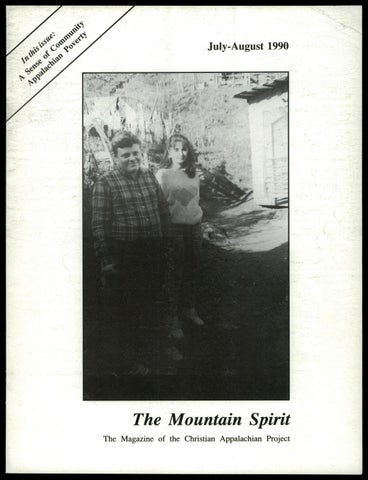
July-August 1990
The Mountain Spirit The Magazine of the Christian Appalachian Project
The Mountain Spirit: July-August 1990
The Magazine of the Christian Appalachian Project Vol.IX, No. 4
Contents Features 4
Where is My Place? by Jan Allen McKenzie Family Life Services is a resi dence for people whose lives are in a state of transition. Men women and children live in community as they rebuild their lives.
16
A Working Community by G len T aul The Sandy Hook Lions Club works to improve the quality of life in Elliott County, one of the smallest in Kentucky.
20
Appalachian Poverty: A Victim’s Story by Joyce Griggs A Berea College student gives a first hand account of the helpless ness of poverty.
23
Soaring by Bette Y. Marshall Clinton and Martina Boyd are cousins who grew up together in Floyd County. Because of their perserverence, and the encour agement of their families, both will attend Pikeville College.
Departments 3
A Thought From the Editor
9
Letters
10
Around the Project
14
The CAP Closeup
Anna Himes, p. 14
Sandy Hook Lions Club, p. 16
The July-August Theme One of the strongest traditions in CAP is that of com munity. From the earliest days, CAP workers have been a group of people working together to serve the Appala chian area in the name of Jesus. In this issue, we exam ine some of the other miracles that are performed by a sense of community. On the COVER, Clinton and Martina Boyd, seniors at Betsy Layne High School in Floyd County. The cousins are scholarship students who will attend Pikeville College next year (photo by Marshall). On the BACK COVER, a pastoral look at Elliott County (photo by Taul).
Published by the Christian Appalachian Project. Editor: Margaret Gabriel. Advisory Board: Father Ralph W. Beiting, Mike McLaughlin, Rose Price, Bill Begley, June Widman, Kathleen Ford Leavell, Patricia Miracle Padgett. Graphics Coordinator: Elizabeth Reed Miller. Circulation: Linda Curtis Grider. The Mountain Spirit is published six times a year. The annual subscription price is $5.00. Subscriptions and other correspondence should be sent to The Mountain Spirit, Christian Appalachian Project, 322 Crab Orchard Road, Lancaster, KY 40446. Copyright, 1990, The Christian Appalachian Project, Inc. All rights reserved. Member, Catholic Press Association. The Christian Appalachian Project is a non-profit Christian service organization operating throughout Eastern Kentucky. The project operates on the philosophy that "helping people help themselves is the best approach to Appalachian poverty."
A Tbought From the E d ito r When former CAP volunteers and other work ers come back to visit old friends in the area, they are usually amazed at how much CAP has changed—no matter when it was that they left. A vibrant organiza tion, CAP constantly changes to meet needs, and as it does, changes in other ways. At a recent workshop for CAP workers in supervisory positions, several manag ers said that they couldn’t conceive of CAP as a static organization, but that sometimes it’s difficult to keep up with the changes. From changing procedures in order to buy diapers in the most efficient way possible to the change of people who have staffed CAP’S pro grams over the years, change is something that all CAP workers have come to expect and accept. CAP must have strong roots to sustain such change, roots that are firmly grounded in the mission statement, which says “Our goal of a better Appalachia moves us to continually seek new and better ways to serve.” CAP has found that the element that enables this type of service, and enables workers to embrace never-ending change is community. An elusive concept, one of the definitions of community is “common character; likeness.” This definition comes to mind when discussing CAP’S sense of community. The common character of a desire to spread the love of God through service lends that sense of community to every CAP program. It is one element that has not changed in the years of CAP’S evolution, and one might even go out on a limb and say that it’s the only element that has remained constant. For many years Appalachian people were isolated by rough terrain that made travel difficult. Because of this isolation, a sense of community grew among Appalachian families and neighbors. Even though travel is no longer a problem because of the tremendous improvement in the roads of the region, Appalachian people remain closely tied to family. And when you talk about family in the mountains you’re talking about a lot more than just parents, sisters and brothers, of course. This sense of community extends to the CAP family, too-workers, people who partici pate in our programs, and people who make our work possible through prayers and contributions. CAP’s tradition, as well as that of the Appa lachian region, has great importance in community. Even before he founded CAP, Father Ralph Beiting began his outreach to the Appalachian people. As others joined him in his work, they began CAP’S tradition of community: a group of people working
The Mountain Spirit
Margaret Gabriel. together because of a common character—the desire to spread the love of God through service to His people. This issue of The Mountain Spirit examines this tradition, but not just among the people who serve. In order to give readers an idea of the goals that can be accomplished with a strong sense of community, we are exploring some ways in which community contributes to the well being of people and places in Appalachia. In Floyd County, two teenagers are demon strating how far people can go with the support of the primary community—the family. You’ll read about one of the smallest counties in Kentucky, Elliott County. The Lions Club of Sandy Hook has established itself as a civic club that unites people of all economic levels to improve life in the county by meeting physical needs. Finally, you’ll meet a man who lived for several months at Family Life Services, a residence for people whose lives are in a state of transition. Jan gives an excellent look at the dynamics of a community that involves people who are working on problems together. As you’ll see, Jan is still working on his problems, but by sharing his experiences he has taught a lesson in the importance of helping others in the community to help themselves. Even when problems seem insurmount able, dependence on God through one’s community is one way of facing and working through them. One other thing we’ve learned about commu nity as we’ve worked on this issue of The Mountain Spirit is that describing a sense of community is almost as difficult as capturing one. Tough to describe, no doubt, but any CAP worker will tell you that you’ll know it when you've got it.
3
' - 'n September 20, 1989 I entered CAP’S Fam ily Life Services. I came to get help for my depression. I came on my birthday, the 34th. What you are about to read is an inner account of my stay.
Where Is My Place?
Since the early ’70s, I’ve kept a written journal, a record of my thoughts, feelings, and memo ries. It is a running account of one life, of life seen from wherever I found myself in it. The journal is a way for me to create some order in my mind; it is a way to explore what I know and what I don’t. It is not always the truth, nor is it always honest or pleasant or even coherent; it is simply the way things looked to me at the time. I kept this journal at Family Life. I’m going to share some of it with you now. For several reasons I’ve had to edit some of the entries. Not all of the material would be appropri ate; not all of the entries make sense to the general reader. There are references to family and friends, people you would not know. To protect the privacy of other residents, I’ve also excluded certain events and changed some names. This is not about others; it is about me and what I thought while I was there.
by Jan Allen McKenzie Photos by Elizabeth Miller
I have also selected those entries that in cluded details about the program, something to show you what it’s all about. But it must always be remem bered that what follows is a personal account and the account of a person who was sick. I have never discov ered a way to be objective. I can only see from where I stand. I can only see through my own eyes, and that, only on rare occasions. You will notice that the first few entries are dated before I actually went to Family Life. I’ve included these to give you some idea of why I needed to go.
Residents share chores at Family Life Services.
4
I should say something here about the work of Family Life Services. It is a residential program. Most the residents are women; most of the women have children. Some, in fact, most, have been abused in some manner, either emotionally or physically. The residents are poor, some have become homeless. While living at FLS, they are given help learning how to go back into the “main stream” of life. They receive counseling, in private sessions and in a group setting. There are chores to do—cooking, cleaning, etc. Some work on getting their high school diplomas. There are classes in parenting (FLS is currently using the STEP workbook-Systematic Training for Effective Parent ing). There is a nutrition class. Before they leave they write a personal financial budget. Those who need it receive clothing, some furniture, transportation, even a small amount of money as a loan.
The Mountain Spirit
Residents and their children enjoy the facilities at the Family Life Center in Renfro Valley. The length one is allowed to stay depends on individual need, though few stay more than 90 days (I stayed 139). Those who plan to enter college often stay until the beginning of the next school term. The journal begins with the date I recorded it, and usually, the time. The time of day an entry is made can be a clue as to my frame of mind. For example, if something is written in the middle of the night, I was probably unable to sleep; I would have been very tired.
Saturday, September 2, 1989. Around noon. The landlord came by and wanted the rent money. I don’t have it. I haven’t worked for 2 months. The depression and my problems with Mary (my es tranged wife) got the best of me.
September 3, 1989. 2:30 a.m. People who know think my problem is “chronic depression.” Whether it’s the cause or the effect, we don’t know. Bill (my counselor for three years) says I should consider medication, so I consider it. Maybe tomorrow I’ll go to the clinic and make an appoint ment. They have to “evaluate” me before they can decide if drugs will help my condition. I don’t know how long that will take . . . On the 20th of this month I ’ll roll over into my 34th year. For all the eye can see, I haven’t achieved anything in my life, except having learned the art of
July-August 1990
continual failure. I don’t have the character I did when I was 20 years old. The flame is there, I hope, but it’s bottled in a ceramic jar, the lid clamped tight: all heat, no light. I ’ve thought I’d like to write a book, but low spirits bind my backside to the couch. I have time, but no juice in the meat. Like a slab of salt cured pork. I hate pork.
September 4, 1989. Early morning. Close to daybreak, maybe two hours. Watch ing television all night again. I hate waking in the morning, so I put it off by not sleeping. What logic! I’m out of money, and only have two cigarettes left. Hoping for money in the mail. It comes around noon. The land lord will most likely come around to evict me tomor row. Not looking forward to th a t. . . I dread packing to move . . . I’m short even a dollar's worth of change. Every time I think about that, I worry over my next cigarette. One lies on the table beside me. I will more likely run to the pawnshop with my old typewriter and the small red icechest I’ve never used, all for a smoke and some gas money. Smoking more, enjoying it less. Living still, but half a life.
Friday, September 8, 1989. 5:15 p.m. Bill House is trying to get me in the CAP program, for a place to stay and therapy for my depres sion . . . still having chest pains and my heart speeds up randomly during the day. No money for doctor . . . waiting for Bill to come and tell me about CAP.
5
FLS manager Liz Phelps (right) conducts a group discussion on STEP (Systematic Training for Ef fective Parenting). Parents at the residence participate in the discussion sessions during their stay. September 25, 1989. 11:00 a.m.
September 30, 1989. 3:00 p.m.
I’m writing from Family Life Services; I live here now. Yesterday there was a softball game with the volunteers. Betty, the only other resident here for the time being, and myself, went to the field by the recrea tion center. The last inning, our last at bat, I hit a line drive to Betty (who was pitching) and struck her smack on the nose. It is broken in two places, small fractures, but not punched out of line, so she didn’t need it packed or splinted. It has swollen overnight and is hurting her now.
Sitting on the screen porch writing so I can smoke out here. This is the only place residents are allowed to do that. Louise (a staff member) and Betty have gone to the mini-mall in Richmond. They left at noon. Kit and Sue have been calling to see if thenchecks are here. Both were residents until they got their third write-ups for coming in late on the weekends. [They stayed out till Monday evening. Sunday night at twelve was the curfew.]
I got up to get a drink of Coke (we’re not allowed to drink in our rooms or smoke or have food in them) and I saw Betty lying cross-ways in the chair. She had a towel over her face, and on top of the towel, a blue bag full of ice. I asked her if I could get her anything and she said “No, thank you.” There was no malice in her voice; she is being very kind and forgiving, under the circumstances. I haven’t started my counseling sessions yet; a fellow named Ron Lawrence will be mine. We don’t have enough residents to conduct group sessions. The Abuse Center is sending some young ladies, I’m told, at the end of the week. It isn’t bad with only two of us here; neither Betty nor I are looking forward to getting a couple of crazy women in here. It happens. Group dynamics demands it.
6
Betty and Louise are back with groceries . . . Tina bought two chests-of-drawers today. She says they are scratched, but will do until she can do better. She also bought me a pack of smokes. Betty is trying to quit and didn’t buy herself any, but has been smoking mine instead. Nancy (a staff member) is here to take the next shift, after Louise leaves at 4:00 p.m. Nancy is a volunteer from Pennsylvania. She used to be an MP in the Army. Volunteers receive $75 a month, plus room and board. Nancy plans to stay a year with CAP. [I would like to say a word about Nancy Moses at this point. Her intelligent conversation, good humor, and caring attitude helped make my stay at FLS more rewarding. While we had some disagreements early on, I came to learn more about myself through our conver-
The Mountain Spirit
sations. Thank you, Nancy.]
October 3, 1989. 5:50 p.m.
October 2, 1989. 2:40 p.m.
I’ve been given my work schedule and chore duties and I have a second counseling session with Ron on Thurs days. I ’ll be working up a schedule of my other activi ties, too—writing, devotions, morning walks. There is required recreation tonight, roller skating.
We had group at ten this morning—Ron (the counselor), Betty, Liz Phelps (the program manager), and I. It was all I’ve come to expect from such adven tures. Ron led out by asking what our highs and lows were this week. The theory in group is beyond me. Freddy, Betty’s son, is home from school and watching cartoons. I ask him if he wants to play some basketball at four, but he isn’t sure he wants to miss his cartoons. I have to clean the recreation center this evening anyway. Liz has made out a schedule for me to work off my expenses here. I have the recreation center, the bathrooms there, and the picnic shelters on the hill to keep clean and in good order. The center has to be done on Mondays and before or after events held there. It is rented to the public for wedding receptions and the like. This work is part of the self-help therapy, giving me structure and responsibilities. The help offered here is what you make it. The program is loosely structured to give rest and slowly increase our ability to function.
October 12, 1989. It looks like we may get another girl with two children; she’s been staying at the Big Sandy shelter, but her husband found out where she is. That would give us ten children and five adults. I’m already spend ing more time in my room to get some peace and quiet. We can only smoke on the porch or outside and the porch is getting crowded; it is too cold in the evening to sit out there. I ’ve enclosed the porch in plastic which makes it too hot during the day. I have to cook lunch today and clean up for lunch and supper. I didn’t get the two staff cars cleaned out yesterday so I have that, too. There are forty-five volunteers having a get-together at the rec center, so I have that to clean tomorrow, too. I hope they haven’t left the bathrooms a mess.
Although a FLS staffer takes the re sponsibility for menu planning for resi dents, each person has a turn in the kitchen, helping with cooking and cleaning up.
July-August 1990
7
October 24, 1989. 8:15 p.m. I’m still here at the Family Life Services, having my “life” centered, my head examined, and al together being pried into. The experience is proving exhausting. I came hoping to rest and recuperate, but have instead been endlessly structured into some sem blance of productivity. “A healthy person is an active person.”
November 10, 1989. I ’m reading a biography of Thomas Merton. The reading awakens my own struggles to be recon ciled within the many parts of myself. Whether or not there are, in fact, many parts is beyond my knowledge; there feels to be many. I live with a constant awareness of myself; it is something often unpleasant, most often, because the self I see is so full of himself. I do not like it, this self-centeredness. My right hand is always watching my left and making obscene commentary on the other’s actions. I feel guilty before God and then I’m self-conscious about knowing I feel guilty over the self-consciousness. Perhaps they (those feelings) are common to all introverts, but the word “introvert” is too simplistic, too general, to plunk my life down on that label. Perhaps it is only pride, not wanting my life summed up in a single work, a word so “unspecial.” What are these feelings of discontent I’m having and where do they come from and how can I live with them? A part of me wants to be heard, to be noticed—is it just a desire to be loved? Another part is tired of writing to please or to be understood by some one else, especially in this journal. Who do I think I’m writing for here? Who will ever care what I put down and if someone should, how could they know my heart when I don’t know it myself? So why do I write? Is it an attempt to exorcise a personal demon, to come to terms with the evil I see in myself? That sounds too grand a scheme for me. I am only myself, a small part of a much greater whole. Where is my place in life? When I started this article I thought I would be able to include more journal entries than I have. But looking through them, I’ve found I have more than sixty pages, and close to twenty-thousand words. / ’ve stopped with the one above because I haven’t gotten past those questions, even now. I still struggle with depression and about the only work I can do is writing. I did start college at Berea this February, but quit after spring break. I didn’t “get it”; I don’t under stand the point of college. I live now in a housing project in Richmond, Kentucky, with a woman / met at Family Life. 8
Residents’ children add another dimension to the program, because at the same time that adults are working at moving their lives through a time of transition, children's needs, too, must be addressed. The Mountain Spirit
Letters By the grace of God, His blessings, and near-crippling arthritis in my feet and knees, I received one copy of Father Beiting’s book, God Can Move Mountains, at my bedside, the first week of November, 1989. I read the book, and tears began to flow, because I am a native Pike County, Kentucky son. I recall my tearful prayers sitting on my bed. My prayers, in es sence, were, “Lord, I’m near-crippled and don’t know if I can play your guitar for nursing homes, anymore.” The spirit said to me at about 2 a.m., “Joe, you can write.” I cried, and prayed awhile longer, and then I began to write let ters to newspapers about the Christian Appalachian Project. During the holiday season, I mailed about 200 letters to newspa pers, mayors, and even our Kentucky governor asking for help. God blessed me to witness four donations to CAP. I trust there are some other donations. God says, “Cast your bread upon the waters,” and I know He’ll do the rest. Glory to God, and praise the Lord’s precious name; my arthritis has let up, considerably. I ’m for real, folks. Joe Damron, Jr. Washington, DC
The counties that CAP en folds will always be special to Frank and me. The folks we met, the home folk (Kentuckians) and the CAP family are dear to our hearts . . . Our Mount Vernon [volunteer] community 1985 . . . the countless more that I can’t mention for lack of space, who all came from across the US to CAP as singles to reach out to those in need in the hills of Appalachia. They gave us so much. We love you all and will be thinking about you while we’re in Tijuana, Mexico, for Habitat For Hu manity building 100 houses in one week with those folks. It will be a challenge but that’s what life’s all about. We are brushing up on our Spanish.
Mrs. Harold Burke Edison, NJ
Frank & Barbara Dempsey Boulder City, NV
We enjoy reading The Moun tain Spirit. It’s heart warming to see the work CAP is doing in Appalachia. My daughter, not being exposed to these conditions, is starting to realize the needs of this country as well as others. We feel it’s important this message be carried to as many people as possible. We leave our copy of The Mountain Spirit at work and it leaves the magazine rack and doesn’t return. I hope it does some good. God bless you all. Doug Andrews Valrico, FL
I love The Mountain Spirit. I feel like I’m right there with all of you when I read it. Even though we’re not together physically, I’m with you in spirit, and you’re in my prayers. Thanks so much for a wonderful magazine.
I do enjoy reading the ar ticles in The Mountain Spirit. In doing so we get a new insight into the tremendous work you are doing. My one regret is that I'm 82 years old; I would love to come and help you.
Barbara Keegan Edison, NJ
Helen Shereda Lake Nebagamon, WI
July-August 1990
Glad to see the results of the many small contributions of read ers, combined with the hard work of your dedicated volunteers, working with the poor of Appalachia. The Mountain Spirit serves as a reflec tion, mirroring the pride of the mountain people in helping each other. One picture is worth a thou sand words. Charity begins at home in the good old USA! Keep up the good work, with your pioneering spirit; to help the elderly and handi capped, educate the young, and supply your various workshops, letting the poor have a chance to show they want to earn their way in this world.
You are doing fabulous work. You are meeting the needs of these people. But equally important is that you leave them with a feeling of self-confidence and self-worth. God bless you. Pauline Mostiller Tyler, TX
Thank you for allowing me to share in so many ways with your loving care of God's people of Appalachia, and keeping me so well informed of their progress. Bettie Allen New Kensington, PA
Letters to the editor are welcome. They should not exceed 150 words in length, and we reserve the right to edit them for space. Address let ters to The Mountain Spirit, Chris tian Appalachian Project, 322 Crab Orchard Road, Lancaster, Kentucky 40446.
9
A round the Project
by the CAP News Service
CAP Observes Older Americans Month Ask workers in many CAP pro grams, and they will tell you that they receive far more from the people in their programs than they give. This attitude was evident when, in recognition of Older Americans Month, Susan Scott and Peggy Patrick conducted a Country Fair at the Emmaus Christian Life Center in Berea. Susan is the manger of CAP’s Elderly Visitation program and Peggy manages Emmaus, a residence for elderly people who choose not to live alone, but do not need the care provided in a nursing home. Elderly people who participate in both programs were invited to spend the day, with CAP providing transportation for folks in Susan’s program. The elderly people who partici pated reminisced about older days, slower days, and at the same time, the younger CAP workers were treated to stories about country fairs conducted during the 1930s and ’40s. During the morning hours, around fifty people watched a slide show pro duced by BiFolkal Productions which explored county and country fairs of times gone by. After the slide show, the Em maus residents and their guests reminisced about the fairs of their youth, and shared some of their favorite memories with the CAP volunteers and first graders from Berea Community School, who came to sing patriotic songs for their elders. A picnic lunch provided by Lee’s Famous Recipe Fried Chicken was fol lowed by the country fair that included a bean bag toss, fish pond, rides on a golf cart and wet sponge tossing. Manager of CAP Alternate Fund Raising Betty Marshall and her assistant, Sheila Oberson, displayed butter churn ing, and the fair-goers were invited to enjoy homemade ice cream, fudge and candy.
10
Human Development director Ellen 1Burke tossing booth at the Country Fair. Peggy and Susan said that theyr were pleased to be able to honor the senior citizens in their programs during Older Americans Month, and to thank them for the contributions they have made to Ameri can society.
Pre-Schoolers Revere And Celebrate the Earth On a beautiful, hot and sunshiny■ morning in April, the children from thei CAP Child Development Center and the Berea Children’s Center made a trip from their respective schools to Berea City Hall in Berea. The purpose of their trip was to present Mayor Clifford Kirby with a ban ner they had made when they studied Earth Day and learned some of the contri butions that they can make to be friends of the earth. The banner showed how the earth should look and and told what people can do to keep it that way. The children sang songs of praise to the earth and hymns honoring God.
provided the target for a sponge
After leaving City Hall the chil dren went to Emmaus, sang for the resi dents, and gave them flags which they had constructed during an arts and crafts class. The flags bore the message, “We do not inherit the earth from our parents . . . We borrow it from our children.” At City Hall and at Emmaus, the children recited the Earth Day Pledge: “No job is too big, no action too small. For the care of the earth is the task of us all.” The crusaders’ next stop was the Log House, a retail sales outlet for Berea College crafts, located a couple of blocks from Emmaus. There they repeated their pledge and made shoppers aware of their responsibilities to the earth. The curriculum of CAP Child Development, as well as CAP’s five other child development centers is designed to make children aware of their responsibili ties not only to themselves and their fami lies, but to society in general.
The Mountain Spirit
around the pro ject. . . continued
Students Graduate From FLC School A story in the May 18,1990 issue of the Lexington Herald-Leader reports that while more Kentuckians are taking high school equivalency, or GED, tests, there has been an increase in the number of people who fail the test. Brenda Rollins, state director of adult education suggested that the failure rate indicates a need for better preparation on the part of the students taking the test. The success rate of the students at CAP's Family Life Center School and its companion program the School on Wheels, indicates that Ms. Rollins sugges tion should be taken seriously. “I know we’re better than 59%,” said George Isaacs, who works with the School on Wheels. “I ’d say we’re proba bly up around 65 to 70%.” Despite the fact that there is now a more difficult GED test than that which was administered until 1988, CAP and its students have met the challenge of prepar ing for essay-writing, critical thinking skills, and more difficult mathematics.
At a graduation ceremony on May 11, fifty-five names were added to the list of over 400 people who have earned their high school equivalency diploma with the help of CAP’s adult education programs.
G ift A nnuities
Graduates were recognized and congratulated by Bige Towery, Superin tendent of the Rockcastle County Schools. He said that was proud of each of them, and thanked them for the contributions they were making to the county by recog nizing the importance of eduation. He also thanked CAP for helping the gradu ates to reach their goals. One of the greatest needs in Ken tucky is for an increase in economic de velopment—for the jobs that people need to care for themselves and for their fami lies. Before an increase in economic de velopment can be achieved, people in government and in the private sector rec ognize the fact that Kentucky’s education level must be improved. The goals of the state department of education, as well as CAP’s Family Life Center School and the School on Wheels is to increase that edu cation level, increasing also the standard of living in Kentucky.
A gift annuity to the Christian Appalachian Project will help us continue to provide em ploym ent opportunities to Appalachian people. This activity is an essential part of our mission to help people help themselves. But, what is a gift annu ity? It's a legal agreement by which you make a gift to CAP and re ceive a guaranteed life income in return. For a more complete ex planation, write today for your free copy of "Giving Through Gift Annuities" by filling out the coupon below and enclosing it in the envelope provided. Clip and send
Students at CAP Child Development paraded to the Emmaus Christian Life Center and presented the mayor of Berea with a banner in honor of Earth Day.
July-August 1990
N a m e _______ A d d re s s -------City, State, Zip Date of Birth _ T elephone ___
11
around the p ro ject. . .continued
Father Beiting Preaches in the Mountains A quizzical look came over Fa ther Beiting’s face. “Well, Jesus told us to. ‘Go forward into every land and preach the Gospel,”’ Father Beiting said, explaining the reason for street preaching. The last two weekends in June Father Beiting, and Father William Poole, pastor of St. Peter Claver Church in Lex ington, heeded Jesus’ instruction, and went forth to preach in Johnson, Lawrence and Martin counties.
Nearly 35 volunteers were honored for volunteer month, with a ceremony at the Family Life Recreation Center in Renfro Valley. Current and former volunteers, and program managers who work with volunteers shared their thoughts, and each volunteer received a mug embossed with the volunteer logo. Everyone later shared a pizza lunch.
CAP Holds Memorial Service In the spring CAP celebrated the new life of workers who have passed away since its work began in Eastern Kentucky. Both Father Beiting, CAP’S founder, and Mike McLaughlin, its president, fondly remembered the honorees, citing the ex ample that they left to follow, and encour aged other CAP workers to continue work ing in their memory.
The light. Today we light a candle in remembrance of you. The candle, bearing a light reflects the sparkle you brought to us; the glowing of it is the smiles you shared; the warmth of it is the love you gave; the brightness of the candle can’t be overshadowed by the darkness as long as we keep the candle burning in our hearts.
Father Beiting remembered his first experience street preaching, when he was a seminarian in 1946. “After the first week, Father McGraw (a Passionist priest) asked me if I’d like to preach. I said I would, and he told me to write a talk and let him read it. I did, and I think that was the first and only talk for street preaching that was ever written down. “I think one reason we’ve been successful with street preaching is that we’ve persevered. I’ve been shot at, had tomatoes thrown at me, been run out of town. If you keep doing it anyway, people figure what you’ve got to say must be pretty good.”
At the Lancaster Christian Church, workers and the families of the honorees remembered Mike Seward and Peggy Hope, both volunteers; Alton Bradley, CAP’S first printer; John Mason, one of the per sons responsible for what has become Christ mas Ridge Crafts, CAP’S marketing divi sion; Bertha Miracle, a child care worker at Little World in Stanford; Jean Brown, CAP’s purchasing manager, and an early staff member of the Kentucky River Sound ings, a predecessor to The Mountain Spirit; and Dottie Stull, secretary to the volunteer program. As candles were lit for each per son, workers listened to a memorial poem written by Brenda Thornton:
12
This picture was taken when Father Beiting preached with Father Poole, right, in 1980. That year, too, the preaching team traveled to Martin and Lawrence counties, in the far eastern part of Kentucky.
The Mountain Spirit
around the pro ject. . . continued
Senior Citizens Center Opens in Wayland In late 1989 the senior citizens of Wayland, in Floyd County, received the news that the Big Sandy Area Devel opment District would receive funding for a senior citizens’ center in their re gion. Later, they learned that the grant would cover only a building, and a salary for Mildred Halbert, the center director, who had worked before at the center in Martin, Kentucky. CAP was able to provide other things needed to operate the center, things like a refrigerator and a freezer, dishes, a desk and office supplies. “We were able to give them some wallpaper, things like that,” said Donna Turner, a worker in CAP’s outreach program in Floyd County. “They’ve got a real nice center, and a great crafts program!” The seniors make baskets (“With absolutely anything,” Donna says. “Cloth, bottles, milk jugs!”), quilts, afghans, and fans. Donna takes a lot of pride in the crafts, and takes any opportunity she can to display the work. In addition to their work on crafts, the people who attend the center play bingo every day and have lunch three days a week. In the interest of staying busy and social, the Wayland senior citizens also operate a little catering interest. “Some times they’ll fix chicken and dumplings for people in an office, and you never tasted such,” Donna said. “It’s just an other way that they’ve found to stay in volved.” Donna said that the main benefit of the senior citizens center is to give the folks an opportunity to get out, to social ize and meet other people. As one might guess, the people are often socializing with folks they’ve known for years and years. As they’ve grown older, though, it’s not so easy for them to get out and mingle as they did when they were young.
July-August 1990
As in "olden days" the ladies at the Wayland Senior Citizens' Center conduct quilting bees to accomplish a great deal of work and have a good time. If not for CAP’s involvement with the center, Donna said, “They would have opened eventually, but it would have been a long time before they had any furnish ings. They would have had a harder time and it would have taken longer.”
M oving? Please notify us of change of address to make sure you receive every issue of The Mountain Spirit.
Summer Camps Start in CAP Counties Summer camps started with a bang again this year, as what will finally tally nearly 600 children started to attend pro grams at Camp Andrew Jackson, in Jackson County, and Camp Shawnee, in Floyd County.
OLD ADDRESS name
please print
address
state
zip code
NEW ADDRESS Boys and girls ages 6 through 14 attend one week of camp, where they have an opportunity to participate in water sports, arts and crafts and Bible study. Veteran campers say that more than anything else, they appreciate the opportunity to meet people from other places at camp. The camps host children from nearly 30 counties in Eastern Ken tucky, and many of the counselors are volunteers that hail from many parts of the United States.
address
state
zip code
Mail to: The Mountain Spirit, 322 Crab Orchard Road Lancaster, KY 40446.
13
The C A P Closeup
Anna Himes The Good Cooker!
story and photos by June Widman Anna Himes.
When Anna Himes was a young girl, her favorite thing to do was play “house” under the trees behind her home. Anna and her best friend, Faerie Mae, would make dishes out of rocks and fix make-believe meals for the younger neighborhood children who they could coax into playing. Anna had been the youngest in her family until she was eight years old. At that time her baby sister was bom and Anna had to learn how to make biscuits for her daddy.
That early learning and love for cooking helped earn Anna her present title of “Good Cooker.” Anna has been the cook at the CAP Child Development Center in Berea for over eleven years. During those years she has
14
seen many children grow up and has had the opportu nity to get to know many of the families associated with the center. From her experience working with CAP, Anna says she has not only learned to work with people, but to recognize the needs of the people and the children’s situations at home. Some of the children are growing up in much the same way that Anna did. Bom at home in the Bernal Ridge area of Rockcastle County, Anna re members her family’s struggles. With her hard-work ing mother as a role model, Anna learned the value of work. Whether it was helping to carry water to the house, or learning to cook at a young age, everyone had a job to do.
The Mountain Spirit
Although she didn’t always have proper shoes to wear or the nicest of clothes, Anna never felt out of place. Many of the children who attended the small country school at Greenhill were in the same situation. Even so, Anna fondly remembers her father entertain ing all types of people with his humor and the stories he told. Oftentimes there were visitors at her home that were rich and poor alike. It seems Anna’s parents gave her a spirit of tolerance and a nature to work hard.
She has learned about different types of people. “People in the hills need to learn more about different people.”
Those gifts have come in handy in helping Anna to enjoy the thirty years of her successful mar riage, despite the fact that she was a bride at the age of 15. In and around the raising of her three children, Anna worked as a cook at a couple of different truck stops, as a maid, a nurse’s aide, a house cleaner, and in a factory.
With all of this, her greatest satisfaction comes from the children. Each year, the children grow to know and love both Anna and her cooking. Very often when childrem start the center at age three, they have been exposed to a very limited number of food types. Something that a little one absolutely does not like at the beginning of the year becomes a favorite food long before the school year is over. A child who attends the CAP Child Development Center learns to eat broccoli!
Since coming to CAP, Anna has learned more than just how to use whole wheat flour and make her own nutritious and delicious snacks and cereals. She has learned about many different religions. “I really enjoy that because we’re all seeking the same place!” Anna says.
And she has learned to feel competent and confident with what she does. “I’ve learned not to be afraid when someone comes around to do an inspection-the State men, the Health Department-none of you guys!”
“Not like the President!” Anna says, “Maybe I should cook for him. In a year, I ’d have him eating broccoli with my cheese sauce!” If anyone can do it Anna Himes “The Good Cooker” can!
On pretty days, students at CAP Child Development like to eat al fresco.
July-August 1990
15
A Working Community
story and photos by Glen Taul Jimmy Whitt, President of the Sandy Hooks Lions Club in Elliott County, Kentucky. A family of four has been living in a two-story log house with no windows or insulation. They depend on water from an open well, and use outdoor toilet facilities. The house is over 150 years old. The land on which the house stands has been in the family for generations, but the family does not own it. It will be part of their inheritance. The challenge was given to a local civic club by an Ohio resident to improve the family’s living situation. “We were fearful at first,” said Jimmy Whitt, president of Sandy Hook Lions Club. “It was the club’s first home repair project, and the financial aspect scared us. But a man from Louisville, Ohio, sort of called our hand.” The man donated $1,000 to the Sandy Hook Lions Club and suggested that it be used to improve the living conditions of this family up a hollow in Elliott County. Although he specifically suggested the house project, he said the club could use the money any way it thought necessary, Jimmy said. Believing that the proposition morally obli gated them to proceed with the repair project, the club
16
built a two-room addition to the house, which provided a small kitchen area and bedroom for the parents. The boys still sleep in the upper story of the log house, but the addition is insulated, has electricity, and is weather tight. Once the club began the project, “we enjoyed it,” Jimmy said. It took the club most of the summer, working on weekends and evenings, to finish the proj ect. It is unusual for a civic club to be dedicated to community service projects like home repair, but for the Sandy Hook Lions Club, such involvement is the rule rather than the exception. The members have commit ted themselves, under the leadership of Jimmy Whitt, to servicing the community in traditional and innovative ways since its establishment in 1984. The club has seven major projects annually, including two blood drives, a Fourth of July celebration, a tobacco festival on Labor Day weekend, a Halloween haunted house, a junior high school basketball tourna ment, and a distribution of food, clothing, and toys to low income families at Christmas. Last year, in addition
The Mountain Spirit
to these projects, the club provided eyeglasses to four teen school kids and elderly people, assisted families who had extreme medical needs, gave emergency as sistance to victims of burned homes, contributed to the local volunteer fire department, cut and supplied wood to elderly or victims of disasters during the cold season, awarded a $100 scholarship to an Elliott County High School senior, helped pay for the Co-Ed-Y to attend the National Beta Club convention, and paid transportation costs for those needing medical treatments outside the county.
When country music star Keith Whitley was alive, it was easy to raise the money to pay expenses and make money. A native of Elliott County, who believed in “giving back to his own,” this rising star was a natural draw, Jimmy said. But last year it was a struggle, despite the performance of three groups.
The club spent a total of $10,000 last year in service to the community, an amazing amount for a county that has a population of 6,000 and a 27 percent unemployment rate, one of the highest rates in Ken tucky.
“When we started the club, we had no idea of what a Lions Club was all about,” Jimmy said.
The desire to serve individual and community needs was part of the club since its founding, and it developed incrementally.
“We never have a budget,” Jimmy said. “W e’re always breaking it. We are constantly raising money, and if we need more, we go out and raise more.”
There was a standing rule at the organizational meeting that the first officers would agree to serve at least one year, or they would be forever trying to organize. Jimmy Whitt was elected president, and continues to serve in that role.
Last year the club sold concessions at the tobacco festival, held a raffle on a four-wheeler, washed cars, collected entry fees for teams that played in its basketball tournament, received donations for each pint donated in the blood drives, conducted Rook tournaments, and sponsored county music shows.
In 1985 Jimmy read a newspaper story about Christmas drives, and encouraged the club to start one. The first year was limited to distributing toys to some of the county’s poorest families. After visiting homes, the members saw a need. The next year, in 1986, food was added, and then clothing.
The club performs home repair as community service projects.
July-August 1990
17
This project encouraged members to bring up needs they knew about personally. A family was devas tated financially by cancer. “Let’s help.” A school club needed help for trips. “Let’s help.” The Little League needed help getting started. “Let’s help.” This kind of response was made for one thing after another, and the club, because of its committed members, responded in a positive way. For example, a club member was having fi nancial difficulties because of cancer. The club gave him $1,000. But then an epidemic of cancer seemed to sweep the county. “We couldn’t afford to give everybody $1,000,” Jimmy said. “So we limited help to $200 for six months; then reevaluated their situation.” The club has experienced considerable growth in its short history, growing from its charter member ship of forty-four in 1984 to ninety-three in 1990. It appears that no talent goes unused. The membership is a cross section of the county’s popula tion. Local businesspeople, public officials, school of ficials, pipefitters and construction workers, men on disability, and the unemployed from all over the county belong to the club. The club was organized to allow anyone to join. “We were encouraged to be a meal club at the start,” Jimmy said. “We were supposed to have two
meetings a month and assess each member $10.00. That wouldn’t have worked. It was all they could do to pay dues.” The club charges dues in other ways for some members. They pay for their dues by working on projects during the day when others have to work. For example, Bob Mullins, who draws disability, worked at the blood drive from 1:00 p.m. to 7:00 p.m. The club has meals during its meetings, but the members are not assessed a fee. Percy Pennington, owner of the Frosty Freeze restaurant and a member, cuts the price of meals when the club meets and he never charges for using the place. “It’s a struggle for these small counties,” Jimmy says of civic organizations. “Our resources are limited, but we try the best we can.” Elliott County is a rural area whose largest employer is the school system. Most people work outside the county as pipefitters and construction work ers, for Addington Coal Company or for the state peni tentiary in West Liberty. There is no commercial farm ing; all agricultural activity is subsistence farming. Local businesses struggle because people shop and bank in the towns where they work. The club always appreciates help from outside the county. United Methodist Churches in Sycamore, Ohio
Above, the White family performed to benefit the Lions Club in 1989. The performance is a big fund raiser for the club. Right, like many Kentucky counties Elliott was named for a favorite son. A marker on the county line tells of Elliott County's namesake.
The Mountain Spirit
The club meets at Percy Pennington's Frosty Freeze Restaurant in Sandy Hook.
*
and Louisville, Ohio bring clothes every Christmas and help distribute them the week before. Ashland Oil contributed to the country music show last year. Ad dington donates the wood from strip mines for the fire wood project, and has donated to the country music show. The Christian Appalachian Project has given the club money for Christmas baskets, home repair and extreme medical emergencies.
v, * !
*
,
■
-
.
\S * -
s
y
: Flltcrft*
bom
*
T % |>
S*t \ * ,
Lx '*
jly '
<
The club struggles to improve the quality of life, and the struggle will not be eased until education is improved, Jimmy believes. Education is the key to bringing the area a healthier economy, or opening other doors of opportunity. It may mean that kids will leave the area, but “at least they would have somewhere to go rather than stay here and struggle.” Jimmy’s dad has a fourth grade education, but pushed Jimmy to get a degree. Although he has elected not to leave the area, to stay at home, and improve the quality of life, Jimmy and the rest of the Lions Club work hard to provide the luxury of choices to young people in Elliott County.
July-August 1990
Appalachian Poverty A Victim's Story
by Joyce Griggs
Joyce Griggs
T he old man poked his head through the door, asking, “Is this the Kentucky River Foothills office?” As my quick glance met his intense, pleading gaze, I captured the time-worn structure of a man, drooped from years of struggling for survival. His wrinkled, stress-drawn face was covered by a prickly beard, and his clothing was ragged and dirty. “Yes,” I replied, “this is Betty Miller’s office. May I help you?” How many times each day did I speak the same words? As a volunteer for Kentucky River Foot hills, a community action organization, I met many of Appalachia’s needy citizens. I remember sadly the mothers with wide-eyed, frightened children, seeking refuge from abuse at home, and the shame-faced fathers trying to push aside their humiliation as they received food for their hungry families. I can recall the soup kitchen we set up to feed the hungry flood victims who came wet, cold, and homeless. Then there was the man who was far away from home, working on a construc tion job. A fellow worker picked a fight with him, causing him to lose his job. He had no money and no way home. Many families, living in homes barely fit for human inhabitance, came for weatherization assis tance. As stated by Ann and Cecil Tickamyer in “Poverty in Appalachia,” “Even though poverty rates all over the nation, including Appalachia, have been declining since 1960, the poverty rate in Central Ap
20
palachia is still nearly twice the national average. Almost one person out of four in Central Appalachia is classified as poor, nearly one in three as either poor or near poor. Both poverty and near-poverty are so preva lent in this region that the cycle of poverty is unlikely to be broken without continued external assistance. The sources of poverty in the region are extremely complex, but are influenced by the interplay of three major factors: lack of employment opportunity in weak, single industry labor markets; an underskilled, educationally disadvantaged work force; and historical and cultural factors related to economic, political, and social devel opment.” I have a lot in common with these people who come to Kentucky River Foothills. I, too, am poor.
I still recall my painful childhood and how I felt when I realized I was different from the welldressed, outgoing, popular children at school. They would not include me in their social groups; some even refused to sit next to me. My clothes were clean but ragged hand-me-downs. My mother and daddy both worked, but on their small salaries our large family barely got by. I never had a soft, fluffy toy animal or a shiny new purse filled with goodies. I remember that on hot spring days the school bus stopped at the store, and I’d watch the other children drink their soft drinks and eat their ice creams. Once, I begged the girl beside me for a bite of her peanuts; then I watched in dismay as she poured every one into her soft drink.
The Mountain Spirit
By the eighth grade, bitter and low in self esteem, I began skipping classes. But somehow I made it to high school. Attending a new school with a different environment renewed my interest. The stu dents were mostly too busy to size me up; I began to work hard and make high grades. I was in the Beta Club and received a Student of High Distinction Award. But then, in my sophomore year, two teachers treated me with such disrespect and inferiority that my old familiar feelings of inadequacy returned. My dignity was shat tered. I also had no money to buy lunch (this was before free lunch), or clothes and supplies that I needed. So I dropped out the day after my sixteenth birthday. My life illustrates the fact that for those trapped in poverty, it is hard to open the door to success. Low self-esteem, hopelessness, discrimination, financial dif ficulties, and the skeptical attitudes of others are all stumbling blocks on the path toward freedom from poverty. Because of these barriers, many are not able to break away. Although there are many fund raisers and government aid for the needy, contributions are so widely dispersed that they frequently have little im pact. The programs may help a starving child for a day, but they cannot boost him out of poverty. From personal experience I have witnessed that trying to escape the bondage of poverty is a rigorous endeavor. After my husband, Fred, injured his back on his job as an electrician about four years ago, our sudden thrust into financial need caused me to realize the desperation of poverty. In almost every direction that we turned for help, we found a closed door. We were met with rejection, skeptical treatment, and humiliation. When Fred sought medical treatment, doctors rejected him because they did not detect his ruptured disk, and simply assumed he was a drug addict seeking medication. Later, we found a hospital that would accept him. They found the ruptured disk which had shattered; the sharp pieces were pressing against the nerves in the spine. Surgery brought him some re lief, but he still suffered disabling pain. Social Security would not help us, and work man’s compensation finally stopped paying, pending a settlement. Because I wanted to be a full time wife and mother, I was considered lazy and dependent on char ity. Financial hardship became a way of life. I remem ber that Fred and I used to sleep with a bucket in the bed to catch the water from the leaking roof. We could not afford to repair it.
July-August 1990
While caring for a disabled husband and our four children, with its responsibilities and financial worries, my body, too, wore down. I ruptured a disk in my lower back, which was further complicated by scoliosis of the spine. Later I was diagnosed with degenerative spine disease and arthritis. I knew the future looked bleak and help was scarce. During these trying times, my religious faith helped me keep my sanity. Lots of prayer and bed rest kept me from greater disability. We finally managed to get AFDC (Aid to Families with Dependent Children) under the terms that my husband would seek rehabilitation. At first, the Carl D. Perkins Vocational Rehabilitation Center in Thelma, Kentucky, would not accept Fred. After an eight day evaluation, they determined Fred too inca pacitated for their rehabilitation program. After consul tation with his doctor, however, we were able to get him admitted. Fred is presently studying to become a certi fied small motor repairman. After my back improved somewhat, I decided that I had to do something to help others in trouble. Since I still suffered periodic disablement and had no job experience, I decided to volunteer for Kentucky River Foothills Development Council (KRFDC), a community action program. While I was working with Betty Miller, the Program Coordinator for KRFDC, she encouraged me to get my GED (General Equivalency Degree). I studied borrowed books for a couple weeks, and KRFDC helped me with the fee. I passed the test with an above average score. Excited about my test results, Betty and I began to discuss college. I found myself interested and determined. With my self-esteem boosted, I began to make plans and do some research for college entrance.
Because I had found no means of transporta tion for educational purposes, I knew I would have to attend a nearby college. Berea College was the perfect answer! When I first signed in at admissions, I was very happy and enthusiastic. Suddenly the huge college buildings and beautifully mowed lawns became more meaningful to me. I had passed them many times before, but they had never taken such a personal place in my life. I had never felt connected to the people of the college except as a stranger passing other faces in the crowd. Now I felt like one of them. But my blue skies of life shortly turned cloudy.
21
On a warm April morning, I received a letter from Berea College. Expecting it to be my letter of ac ceptance, I anxiously ripped it open. My heart sank when I found instead a letter denying me admission for the summer and fall semesters. Due to maximum en rollment policies, I could not be considered for en trance until the following spring. I just couldn’t stand it. At the age of thirty five, I wanted to get a quick start. I made some phone calls to the college. I talked with workers and expressed my desire and my disappointment. I soon found that there was a place for me after all. As a “special student,” I could enter during the summer. Six of my credits earned during the special student status can go toward a degree when I am accepted as a regular student. The sun was shining again! As a special student, however, I still encoun tered obstacles. Under these circumstances, there is no financial help. How could I buy books, pay my fees, and hire a baby-sitter? As I searched for help, I was really shocked to find that once we tried to break our family out of poverty, the resistance was even greater than I had imagined. Richard A. Couto upheld this idea with his statement, “Poverty is an on-going process . . . because the poor are impeded from eliminating their own poverty by economic and social conditions beyond their control.” Thus, I turned to prayer. “Lord,” I prayed, “please help open doors for me, and guide my decisions.” I began calling the organizations I knew that helped the needy. Again I met with skepticism, humili ation, and disappointment. After many phone calls, some progress was made. Someone at the college found out that AFDC did indeed help with child care (they had told me that all I qualified for was twenty dollars a month for travel). Kentucky River Foothills paid some fees. I received a seventy-five dollar grant from a private source, and the Christian Appalachian Project approved my application to buy my books, supplies, and remaining fees. Berea College did not charge me tuition. I have since encountered other problems, but I am continuing with a 4.0 GPA, and have been ac cepted as a regular student. I really enjoy college, and it has benefited me in many ways. I think often about the less fortunate people who are locked into poverty with no hope of getting out. And I realize that my
22
future, too, will be a struggle. If my health worsens, or if some unseen obstacle hinders the achievement of my goals, I could be thrust back into the hopelessness of poverty. But while I have hope, I want to reach out to those still in great need. Someday, perhaps a stronger impact will be made in providing the actual resources required to pull people out of poverty, instead of simply providing basic survival needs. “The destruction of only one factor—poor education, poor housing, unem ployment, etc.-w ill not eliminate poverty” (Williams and Surla, Jr., “Incidence of Poverty”). With my degree in social services, I hope to help make that impact. As a nation, some of our citizens are lazy and ignorant, but the poor are labeled lazy and ignorant more that any class. This simply is not true. We must continually battle humiliation, skepticism, and dis crimination. Some of the poor still have enough dignity to balk at minimum wage, which shows no reflection of the increasing costs of living, and begrudge offering their services for such demeaning, meager wages. Many of the poor are disabled. The elderly, the illiterate, and those who were raised in poverty cannot find a vantage point from which to pull themselves out. For these people, improvement is needed in many areas, includ ing government provision of child care, advanced educational expenses, and self-help programs. For those who are able to work, the government could assist them by implementing policies which encourage expansion of industries to provide better job opportunities, and by increasing the minimum wage rate. An increase in in come in the homes of the poor children would also help equate them with other children, boosting their self esteem. Our nation must be willing to give the poor a chance at success. In his essay "War on Poverty," Hubert Humphrey said “Helping some will increase the prosperity of all. “This investment will return its cost manyfold to our entire economy. If we can raise the annual earnings of ten million among the poor by only one thousand dollars, we will have added fourteen billion dollars a year to our national output. In addition, we can make important reductions in public assistance pay ment . . . and in the large costs of fighting crime and delinquency, disease, and hunger.” For the benefit of the rich and the poor alike in America, the poverty-stricken people of our country much be given a chance.
The Mountain Spirit
S oaring
Story and photos by Bette Y. Marshall When spring comes, high school seniors get ready for graduation. It’s a thing that happens as a natural expectation for most American teenagers. For some, however, it’s an event of a different nature—one that’s far removed from natural expectation.
no indoor plumbing until recently. In fact, they live in a house that has been converted from a smokehouse into a two-family dwelling that houses twelve people. The entire space divided into two units of less then 1,000 square feet.
This spring, two young people named Lucas and Martina Boyd marched down the aisle to get thenhigh school diplomas at Betsy Layne High School in Floyd County. Lucas and Martina are first cousins. Their fathers are brothers. They live in one of the winding, mountainous hollers, deep in the Appalachian area of Eastern Kentucky. The holler is called Boyd Branch.
How does it happen that twelve people come to live in a converted smokehouse, and how do the people cope with the living conditions? It happened for Clinton and Glen, fathers to Lucas and Martina, the same way it has happened for numerous other Appala chian men.
In many ways, Lucas and Martina are typical of the other young people in the holler. Their fathers are unemployed. They live in substandard housing that had
July-August 1990
They grew up in Eastern Kentucky, where coal is king. When they were growing up, they saw thenfathers, uncles, and neighbors earning their living by the sweat of their brows without benefit of schooling. They earned their living in the coal mines when coal
23
What do you do when you find yourself out of work and you have a wife and four children to feed? At first the two men were not upset. They signed up for unemploy ment insurance and began to look for other jobs. But there were no other jobs for men who could not read and write. They continued to look, but the months passed and the two men had no success. Their unem ploym ent insurance benefits ran out.
Lucas and his mother, Eva Boyd.
was still mined in the traditional way-with manual labor rather than technology. At the time they grew up, there were many small mining operations in Eastern Kentucky that re lied on traditional mining methods. Times changed. Technology made rapid advances into the coal-mining industry, and small operations that relied on traditional methods faded from the scene. Clinton and Glen had not attended school even long enough to leam to read and write. They married young mountain women, Eva and Virginia, who had dropped out of high school to take on the responsibili ties of adulthood at a young age. At the time the two couples were married, both young men were employed in local mines and their futures looked bright. They were not prepared for the future. They looked forward to having children, working hard, and having the same kind of lives their parents and grand parents had—lives that included fathers working in the coal mines and raising gardens while their wives cooked, cleaned, had children and looked after their needs. Each couple had four children. Lucas and Martina are the eldest in each family. At the time Clinton and Glen lost their jobs in the mines, in 1982, Lucas and Martina were ten years old. The men lost their jobs, because the small mining operation they worked for could not compete against the larger mining operations that had begun to use technology rather than manual labor.
24
By now, the two families were in dire eco nomic straits. They were not eligible for Aid for Families with Depend ent Children, because the families were intact, and there were able-bodied men as heads of the households. The only help they could get was in the form of food stamps. Food stamps do not provide clothing or shelter. Without an income, they could not pay rent.
The families were faced with becoming part of the homeless population. Clifton’s and Glen’s mother came to the rescue. She owned her home, a few acres of land, and an old smokehouse that was no longer in use. She offered the smokehouse to her two sons as a place to live until their circumstances took a turn for the bet ter. That was eight years ago. The two families still live in the smokehouse. The two men are still unemployed. The families did the best they could to deal with the unpleasant circumstances. They partitioned the smokehouse off into separate spaces with two rooms for each family. The women learned to deal with the hard task of carrying water from a well to take care of all their household and personal needs. The children learned to help. The families settled in to what they thought was a temporary situation. Somehow they managed to maintain an attitude of cheerfulness and optimism. The mothers who had both attended school to mid-high school level helped the children with their homework. The children worked hard and became good students. They went to school every day, scrubbed clean from the baths they took in the kitchen in an old tin tub, and they always completed their homework.
The Mountain Spirit
After a couple of years in the smokehouse and no indication that the men would find employment, the families began to accept their situation as possibly per manent. They began to recognize a need to improve on what they had. Virginia had heard that the Christian Ap palachian Project sometimes helped people who were in need. She heard CAP sometimes helped people with home improvement projects. She talked to Eva and the two women decided to go to a CAP office to see if they could get some help improving their living quarters. The thing that bothered both families most was the lack of space and privacy in their make-shift homes. At the CAP office, they met with friendliness and understanding. A CAP worker agreed to go out to their house and look over the situation. Within a few weeks, CAP assembled building materials and a crew was on the site to erect an addition to the smokehouse. The two families pitched in and helped with the work. Each family ended up with an addition that was larger than the original space they had been living in. During the course of the home improvement project, the two families learned a lot about other serv ices that are available from CAP. They learned of the garden seed program that would provide them with seed, fertilizer, and training that could improve their garden ing skills. They learned of the Christmas basket program that provides needy families with food and gifts at Christmas time. Of most importance to Virginia and Eva was that CAP had a program that would help them get their high school equiva lency diplomas. This could open up new vistas for them. Both women enrolled in the CAP’S GED tutoring program. Their participation in this program made them more capable of helping their children with their home work. In addition, it gave them a new respect for the value of education. This respect was trans ferred to their children. They completed the pro gram and took their GED test. They both passed. Following the example of their moth
July-August 1990
ers, both Lucas and Martina became outstanding stu dents. As they advanced through high school, they grew beyond the need for help with their homework from Eva and Virginia. There were few school activities they could participate in, though. They lived a long distance from the consolidated high school they attended. They had no transportation to and from school for activities that took place in the evening hours. There was no money for special clothing for special occasions. There were times when they felt left out and discriminated against, but they refused to give into these negative feelings. Martina turned her energies toward helping her mother and aunt with housework, cooking, and laundry. Laundry was always a demanding chore for so many people when it had to be washed on an old fashioned wringer washing machine that had to be filled and emptied by hand. Hanging clothes on the clothes line to dry was time consuming and laborious, but it was much better than having to hang the clothes inside at the back of the coal burning stove which is what they had to do in the winter months. In the winter months, the small quarters were always steamy with the smell of drying clothes. Lucas turned his energies toward helping with chores like chopping wood, carrying wood and coal into the houses, and helping with the garden and yard work. Despite their demanding lives, Martina and Lucas found free time. They both became avid readers. Martina discovered during her high school years that she excelled in mathematics. Lucas discovered excep-
— BP- _ -------Martina and her mother, Virginia Boyd. L tiS M t
£
25
tional abilities in both art and literature. Although they grew up in almost identical circumstances, Lucas and Martina developed entirely different kinds of personalities. Martina became outgo ing and gregarious. She communicates easily and openly. On the other hand, Lucas is a true introvert. He talks little and seems uncomfortable in social situations. Last fall when Lucas and Martina entered their senior year of high school, they were faced with a question that was both frightening and exciting ques tion—what next? During the course of their senior year, they each discovered that the answer to “What next?” is, “College.” But it wouldn’t be easy for students with backgrounds like Lucas’ and Martina’s. Their next question was “How can we pay for college?” They found the answer by talking with the teachers and school administrators at Betsy Layne High School. Asked about his two students, Adrian Bently, principal of the Betsy Layne High School, remarked that the most outstanding thing he could recall about Lucas was that he had never heard him utter a word. Lucas is so quiet and so shy he was recognized by his class last fall by being given the formal title of “The Shyest Boy in the Senior Class.” Lucas’ English teacher, Reba Blackburn, has a different interpretation of Lucas’ nature. She said, “Lucas doesn’t say much, but when he speaks, all the other students listen. They know he has something im portant to say. “Although Lucas is reserved in normal social communications, he never fails to respond in class. I don’t know exactly how it can be that Lucas is a leader when he does so little talking, but it’s true. He is a
26
leader. During the course of his high school years, he has become a positive role model for the other kids,” she explained. “Lucas doesn’t drink, doesn’t do drugs, and he never misses a day of school. He comes through with his commitments, and he always treats the other kids and the teachers with respect. That’s why he’s won the United States National Leadership Merit Award,” she added. Not only has Lucas been recognized for his leadership ability, he has also been recognized for outstanding scholastic achievement. He is the recipient of two academic awards-The United States National Arts Award and the National English Merit Award. Ms. Blackburn gives both Lucas and Martina credit for being outstanding students and exceptional role models for other American teenagers. “If we had more young people like Lucas and Martina, I ’d feel a lot better about our nation’s future,” she commented. Lucas and Martina have excelled academi cally. They are honor students and have been accepted by a small private college in Pikeville, Kentucky. They have been awarded Pell Grants that will take care of their tuition, books, and room and board. They have applied for workshops to cover their personal spending needs. Lucas plans to major in art; Martina, in account ing. Eva and Virginia credit some outstanding teachers, the help they’ve received from the Christian Appalachian Project, and God, who has always pro vided for them, for their children’s success. Credit must also be given to two young people who have been willing to take advantage of their opportunities.
The Mountain Spirit
Me . . .
a Christmas basket sponsor?
As a family, we especially en joy being a part o f your Christ mas basket program. We enjoy the shopping and wrapping o f our gifts and try to imagine the joy and the expressions on the faces o f the people when they open them. We have had some very nice appreciative thank you letters from some o f thefamilies. It is the true meaning o f Christ mas and the true spirit o f Chris tianity to give and not always “get” in return. Dianne L. Hummel In 1990 we hope to distribute Christ mas baskets to 2300 families in the mountains of Eastern Kentucky, and we're extending a special invitation to all Mountain Spirit readers to help us reach our goal.
As soon as you contact us, we will send detailed instructions, information about your family and some gift sugges tions. This information will arrive no later than October 12-plenty of shop ping time! Please return the coupon in the re turn envelope, or if you prefer not to cut your magazine, include the infor mation on another sheet.
If you would like to take part: —let us know the size family you would like to sponsor. Gifts for each child should cost between $10 and $20. We ask this price range to keep the bas kets as equal as possible for all chil dren;
^Christmas Baskets program 1322 Crab Orchard Road ILancaster, KY 40446 I I would like to sponsor a ____ small (1-2 children), | ___ medium (3-4 children), ____ large (5-7 children), I ___ extra large (8 or more) family. Please send information.
—we ask sponsors to wrap and label gifts with the name of each person; —please mail your boxes of gifts to CAP by November 19, 1990, or ear lier, to insure that we will receive them during the first week in Decem ber.
I am not able to shop for a needy Appalachian family but I have included $ --------- that will enable Iyou to purchase gifts for a family ($75.00 will provide Ifor a family of five). | N a m e ___________________________________________ | A ddress--------------------------------------------------------------I ICity, State, ZIP----------------------------------------------------