M a y -J u n e 1990
The Mountain Spirit T h e M ag azin e of the C h ristian A ppalachian Project
X h e M o u n t a in S p ir it:
The Magazine of the Christian Appalachian Project
M ay-June 1990
V ol. I X, N o. 3
Contents Features 4
An In vestm ent and a Prayer by K ath leen F ord L eavell O n e o f the C A P ’s m ost loved an d longest-lasting p ro g ra m s is child develo p m en t. K ath leen has been in volved— directly o r th ro u g h p ra y e r— w ith child d evelopm ent for m a n y years. H e re , she shares som e o f the goals o f the staff, an d som e o f the reasons they stay connected w ith the p ro g ra m .
16
A Story T eller by J u n e W id m an Som e read ers m ay rem e m b er Bevery C a rte r S exton, an d som e of the stories th a t she has w ritte n for The Mountain Spirit in the past. Beverly has fam ily roots in the tra d itio n o f A p p alach ian story telling.
20
T he N ew O p p ortunity School for W om en by L in d a Piw ow arski J a n e S tephens has devised a m eans for w om en to explore th e ir p o te n tia l, an d discover w ays to help them selves an d th e ir fam ilies.
22
M ou n tain T u torin g by L au rie M c C u tc h eo n A renew ed co m m itm en t to education in the state o f K entu ck y , a n d the M a rtin v o lu n te e rs’ recognition o f a need , gave b irth to a o n e-on-one tu to rin g p ro g ra m for the children o f Floyd C o u n ty .
Departments 3 9 10 14
From Our President Letters A round the Project T h e CAP C loseup
p.16, Cleo Abney Bowman
p.4, CAP Child Development
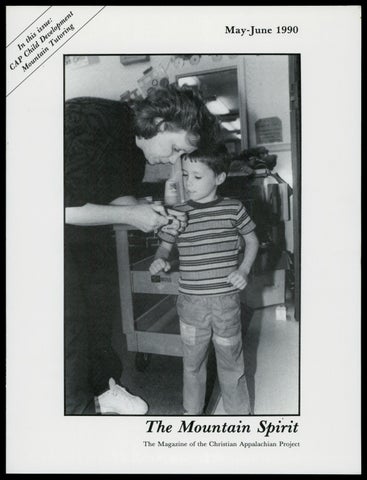
The May-June Theme From the early days of the C h ristian A ppalachian Project, w orkers have been vitally interested in and involved w ith children of all ages. From early childhood education to teen centers, C A P believes th at helping to shape ch ild ren ’s attitudes d u rin g form ative years will help to shape those sam e attitudes later in life. In this issue w e’ll introduce you to some of those pro g ram s, and some ways th at those attitudes are form ed. O n the C O V E R , the S unshine C en ter, the child developm ent center in L ancaster (photo by L o rrain e C orsale). O n the B A C K C O V E R M ary M u n d y , head teacher at C A P C hild D evelopm ent in Berea, conducts 4‘Circle T im e ” (photo by D avid Fisher).
P ublished by the C h ristian A ppalachian P roject. Editor: M a rg aret G abriel. A d visory Board: F ather R alph W . Beiting, M ike M cL au g h lin , Rose Price, Bill Begley, G ary G . E ldridge, J u n e W id m an , K athleen Ford Leavell; P atricia M iracle P adgett. G raphics C oordinator: E lizabeth R eed M iller. C irculation: L in d a C u rtis G rider. The Mountain Spirit is published six tim es a year. T he an n u al subscription price is $5.00. S ubscriptions and other correspondence should be sent to The Mountain Spirit, C h ristian A ppalachian Project, 322 C rab O rch ard R o ad , L ancaster, K entucky 40446. C o p y rig h t, 1990, the C hristian A ppalachian P roject, Inc. All rights reserved. M em b er, C atholic Press Association. T h e C h ristian A ppalachian Project is a non-profit C h ristian service organization operating th roughout E astern K entucky. T he project operates on the philosophy th at “ helping people help them selves” is the best approach to A ppalachian poverty.
Jordan
From Our President T h i s issue of The Mountain Spirit, centered around children, brings to mind a ques tion. How and why did the project first become in volved in day care and child development centers? In the formative years of CAP’S first bona fide program organization, early in the decade of the seventies, why so much emphasis on children, and why has it continued? The first thoughts are obvious, and not unique to CAP: everybody loves children. Let’s make the world better for our children than it was for ourselves . . . to make a difference in the lives of people, you must get to them early in their lives . . . let’s first help those who cannot help themselves, the innocent victims of poverty, those who bear no responsibility in their plight, to wit: the children; and so on in a similar thread of thinking. All this is good and generally true . . . but not unique to CAP. What CAP’S people added to this equation was twofold. One, if we wish to help all members of society, how do we get them interested in us and our programs? Answer: through their children, the one surefire method for reaching out to an entire family. Get the family involved in what you are do ing for their children, and you are seen as a helper, a part of the solution. You become a little bit less of an outsider, and the process of trust is begun. In time, you may be able to reach out and help mom and dad or big brother or uncle as well. It’s not so easy to reach out and be accepted, as many of us found over and over again. Helping children is a good way to begin, and of course, families are very much what we are about at CAP. A second reason CAP went into child develop ment was fortunate coincidence: in the early seventies, we had a number of extremely capable and qualified volunteers who were trained in early childhood education. So, it was a natural. If we did what we were good at, then children it would be. And from our first center, we grew another, and another, and another. We owe a lot of thanks to these early volunteers: for their skill, their commit ment, their overall level of excellence. More than any other single factor, these qualities began to give CAP a reputation as folks who knew what they were doing. That tradition of excellence has continued at CAP, led by child development, but then extend ing to our other endeavors as well, where now we are proud of all of our people, our programs, and general level of our competence. If we had it to do over again, we’d probably do it the same way —to start with the children. M a y -Ju n e 1990
M ik e M cL a u g h lin .
Our current focus, for now and the near future for program expansion, will probably center on economic development, real job creation, adult literacy, and GED training for school drop-outs. All of us in Kentucky are worried about our education, our skill levels, and our lack of job op portunity. But child development, I am convinc ed, will remain a vital part of our total range of ac tivities. And there’s something special we adults can learn from our children, too. How many of us, through the hard-knock experiencing of our lives, have forgotten how to be spontaneous, totally natural, and fully exuberant about life? How many of us have forgotten our dreams, or even how to dream? When it rains, do we still look out side in wonder, searching for the rainbow? How many of us have given up hope? Hope is not just for children. There is a child in each of us, whether we be forty, or sixty, or eighty waiting to be awakened. Each day is new, and can bring a sense of the joy of God’s creation, if we will only let it. If we let the children lead us, we can rediscover the best that is within us, what we need to be fully alive, at the very center of our being, and when we find that inner core, we also feel God’s presence, the nearness of His love, and find that trust and faith —and hope —are not such dif ficult things to have after all, even for us adults. 3
4
The Mountain Spirit
An Investment and A Prayer
Gabriel
by Kathleen Ford Leavell
T h e walk from the CAP parking lot to my office in the Human Development building is a long one. By the time I cut across the front lawn of the CAP Teen Center and through the back playground of the Sunshine Center, the CAP child development center in Garrard County, I’ve covered about fourteen years. You see, I worked at Sunshine Center from the time I was a volunteer in 1975 until my son, Sean Paul, was born, in 1985. Last Thursday afternoon was an interesting trip. The journey began as I stepped out of my car and into a hurling volleyball. When the stars cleared and my senses focused, I was standing face to face with a tall, husky young man, flanked by a half dozen wide-eyed gaping teammates. His long sandy hair dripped with sweat, and his large round face expressed a distantly familiar expression that said, “now I’ve really done it, haven’t I, Kathleen?” It was Jo Jo, my own little Jo Jo. His body was too big, his hair was too long, his voice was too deep and good grief, there was an earring in his ear. But, it was my Jo Jo. I could tell. It was when I closed my eyes that I could see him clearly. There he was, with all the other five-year-olds, sitting on his mat at Circle Time. In the center of the circle were four empty boxes, each with a large uppercase letter taped to its side. Each child held an object in hand. It was happening all at once. M a y -Ju n e 1990
K a th lee n Ford L e a v ell.
5
“Ricky!” I call out with mock excitement, “what do you have?” “A t-t-truck!” comes the joyful reply. “Correct!” My excitement mounts, “and where does it belong?” “In the T* Box!” he shouts with booming pride and deposits his truck there-in. The Sunshine Center resounds with applause. “Amanda!” I solomnly summon, “what do you have?” “A b-b-banana!” she proclaims. “Yes! And where does it belong?” I cry. “In the ‘B’ box!” In goes the banana. “Sandy!” I shout, “What do you have?” “A s-s-sock!” She waves it wildly. “Oh YES!!” I am overjoyed, “and where does it belong?” “In the ‘S’ box!” Swish —right in the ‘S’ box. “Jo-Jo!!” I am estatic now. “What do you have?!” “A milk carton!” he exclaims. In the early 1980s C h u ck T h o m p so n w ork ed as a v o lu n tee r at th e cen ter in S om erset.
“Yes!” I scream. “And where does it belong?” Jo Jo rises triumphantly to his feet and re sounds to the ceiling: “In the refrigerator!” I stare at him blankly, in shock, and I hear him calling my name: “Kathleen! Kathleen, are you O.K.? I’m sorry! I’m really sorry!” “Oh . . . sure, yea . . . I’m fine . . . really, just a little shook up. You took me by surprise, there.” I checked my lip for blood and then wondered what was the bigger shock—the volleyball or the earring?
D eb b ie w ork s as a p a ren t-v o lu n te er at E agle C h ild D ev e lo p m e n t in M cC reary C o u n ty .
6
When the game resumed and I continued across the lawn, I was struck with a sense of fulfillment in my work with CAP. Jo Jo began his association with us as a preschooler, and here he is, a “regular” at the teen center, who is still with us, still wanting to be a part of what we are about. I began to recall the quiet moments of prayer as I sat beside Jo Jo, asleep on his cot along with his three dozen schoolmates some fourteen years ago: “. . . and grant that he might be excited by You; be excited by all that he is and might become; be ex cited by his world, and most of all, that he be a reflection of Your Son to those around him. Amen.” It is safe to say that I have recited that prayer 40,000 times over 40,000 sleeping heads in my years at CAP. The goals expressed in those prayers have been echoed and supported by The Mountain Spirit
thousands of CAP workers and over a million donors. What a humbling and awesome ex perience to look at Jo Jo, at what he is and what he is becoming and be reminded that the answer to these prayers is unfolding before my eyes.
§ * Mm
•*»
And as it unfolds, new prayers are being said, more goals are formed, more dreams begin throughout our six child development centers serv ing more than 300 children and their families. So I asked them, the teachers and program managers, to share with us their hopes, dreams and goals for their children, in whom all of us, and all of you have invested. Their answers were as immediate and absolute as if I had asked them their own names. Elizabeth Goggins, a teacher at the Children’s Discovery Center in Somerset shared: “I want the children to believe that they are lovable and valuable and to always trust and believe in themselves.” Her co-teacher Francis Miller added: “I would instill in them a love for learning and a desire to learn more today than they learned yesterday.” Karoline Stringer echoed: “To build the children’s self-esteem and self-confidence so they will see how special they are.” Sarah Dixon summed it up by adding: “A strong sense of self-identity that will provide a base of security and stability from which children will draw strength in times beyond their stay here.” When asked what was the most important thing they’d want to instill in the children at Hisel Com munity Child Care Center, Cheryl Martin replied: “. . . pride in achievements and pride in their mountain heritage and traditions.” Reva Hisel offered: “. . . that they are special and that God loves them; to be the best they can be and be proud of their accomplishments and where they are from.” The staff of the Family Life Child Development Center in Mount Vernon, along with the sen timents mentioned, expressed this in the words of teacher Diana Bond: . . to believe in themselves and God and to believe that with His help all their dreams are possible.” CAP child development centers are concerned with maximizing every learning opportunity, in cluding traveling back and forth to the centers (which for some children is a good deal of time). Look what happens on the bus Glenna Robinson drives for the center near Mount Vernon: “No matter how old we get or what hardship is placed before us, God gave us the gift to dream. On my bus run, we play that the bus is a dreamship and they (the children) close their eyes to turn on the M a y -Ju n e 1990
T h e H is e l C o m m u n ity C h ild C are C en ter in clu d ed fo ssils in its d in o sa u r u n it.
Jo rd a n
dream vision. I hope they always remember to dream because that is a special gift.” What a wonderful gift—to encourage a child to dream! Robin Allen of the Sunshine Center was asked: “You could work somewhere else and make a lot more money. What keeps you here?” “Oh, I can answer that,” she smiled. “First of all it’s the staff. We get along well and can discuss things openly. I get a great deal of support from my fellow teachers. And I really enjoy the honesty of the children. I think that’s what I love most about them. They are so honest.” Mary Heffernan added: “The greatest gifts I receive from the children are their love and hugs, and I want them to know that they are very much loved and cared about.” “I think their greatest asset,” says head teacher Becky Kana, “is their ability to love; their uncon ditional acceptance of other children.” Patty Joseph agrees: “What fills me with the greatest satisfaction about my work is to share my love and receive the love of the children. When asked “When you pray for the children what do you say?” Joanne Moore replied: “I ask that God keep them safe, secure, happy and healthy. Sometimes if their family is trying to cope with a particular problem, I pray a lot about that. I bring a lot of these prayers home.” Mary Mundy, of the CAP Child Development Center in Berea focuses much of her prayer on the children’s families. “Most of the time I pray that God strengthen the parents; that God might touch the children through their parents and give them the nurturing and love they need. And I pray for their safety and well being.” Anna Himes, who has probably put more years into the Berea child development center than any other staff member, offered this response when I asked her what she wanted most for the children at their center: “If I had to choose one thing I’d say I want them to love God. Really, I’d just want the best for them and I think we’re giving it to them. When you’ve spent eleven years cooking and washing dishes in a school like this you can’t help but see the wonderful things that are given to the children here. I think they are privileged to be able to learn from these teachers, and I am especially grateful that the children are encouraged to pray.” Anna is well known for her warm and nurturing meals as well as her warm and nurturing love. It would seem that the children are privileged indeed to sit at her table. Sue Keith and Pam Stephens are newcomers to the Eagle Child Development Center in McCreary County. I asked them about the greatest joy in their work. “It’s great to feel so free to get involved with the children” responded 8
T eri M eh ler, m anager o f C A P C h ild D e v e lo p m en t in B erea, en jo y s som e p la y g ro u n d tim e w ith h er stu d en ts.
Sue, “Here I am able to really get down and into their play, rather than just supervise them.” Pam expressed every teacher’s ultimate joy when she added: “. . . When I am trying to teach the children something and all of a sudden they ‘get it’. That look in their eye when I know that they understand makes all my efforts worthwhile.” So what is happening in these centers? Children are learning to believe in themselves, in the world around them, and in God. I’d call that faith. And they learn to dream —and to know that their dreams are good and can someday come true to make a better world. That sounds like hope. And they learn to cherish themselves; that they are deeply cherished by God and those about them, and that they, too, are called to cherish one another. And this is love. We would do well to pray that every teacher continues to strive to bring faith, hope and love to our children, for in doing so, we will surely enter with them into the Kingdom of God on earth. If anyone has an extra moment of prayer, it might not hurt to ask that Jo Jo might lose that earring! The Mountain Spirit
Letters I simply want to write [and com ment on Father Beiting’s] beautiful piece in the current issue of The Mountain Spirit. I read it through in its entirety and thoroughly enjoyed reading of the accomplishments and the hard work and loving assistance given to these poor folk in Ap palachia. I remember reading about Eleanor Roosevelt’s interest in that poverty-stricken area as far back as the early 1930s. It’s time the loving Hand of God worked some major miracles there. Father Beiting is one of those miracles and as are all of those wonderful volunteers. I have made Xerox copies of your lovely and encouraging article and am passing it on to friends, who are also “getting along”, including myself. Anna Marie Shinn Atlanta, GA
On one of our recent trips, we visited your headquarters in Lan caster, and to our pleasure, met Father Beiting, who was there for a meeting. We were given a tour of the building, and met many nice people. We became more aware of your varied works, and are impress ed.
The accounts of people and their lives there in Appalachia, and what the project is doing to help them, are very im p o rta n t to us “Outlanders”. They keep us inform ed and in closer contact with our Eastern kin. And I do feel a kinship, having lived in Ohio and New York State before coming to the Islands over forty years ago. Aloha!
I believe this is my third or fourth annual subscription check and I am happy to send it. The Mountain Spirit is an interesting publication: it is informative, educational and entertaining and gives an insight, not only to the desperate needs of the community, but shows the real everyday life of the people of Ap palachia.
Bernice Cahill Volcano, H I
I especially enjoyed “Grandpa’s Funeral” by Keith Morgan in the January-February issue. In a quiet way, Mr. Morgan made me feel that I was with those folks, seeing their courage, their loving concern for Grandpa, and getting acquainted with “Uncle Rutherford.”
We, my wife and I, have lived in the western areas of New York state our entire lives, thus far. Without The Mountain Spirit, I’m certain we’d know little about the very in teresting folks mentioned and pic tured in the magazine. We also note your non-denom inational ap proach. All peoples have pain, hunger, fear, happiness, joy and you name it. I should also men tion—we all need to recognize our spiritual needs as well. God bless “you all”. James and Mildred Mitchener Jamestown, N Y
Once I read, “Never in History have a nation and people had the opportunity that we now have to show greatness and be helpful to others.” Each time I read The Mountain Spirit I realize how true that is and I thank God for Father Beiting and the Christian project he carries out in doing for men, women and children in the Christian Ap palachian Project.
I have to tell you how I first came to know about the Christian Ap palachian Project. Five years ago upon the death of my brother, I moved into the home he occupied here in Downey, and among his papers, I came upon letters and literature from CAP. I knew nothing of the work you all do for the poor of Appalachia, but it was then that I became a believer in what you do and will now continue to help. I enjoy reading The Mountain Spirit and feel I know the people better through it. May God richly bless you all, and especially Father Beiting, as you serve our Lord Jesus Christ.
Catherine Reader Louisville, K Y
Mrs. Jessie Ward Downey, CA
John and Marian Wehrman Cincinnati, OH
M a y -Ju n e 1990
I believe stories like that evoke empathy with the reader in a per sonal way and makes him more aware of those wonderful folk. Stella Neuer Menlo Park, CA
The Mountain Spirit is just the greatest little human interest magazine around. I eagerly await it’s arrival and wish it could come monthly. Having sponsored Appalachian children plus a “CAP” family, I can truly appreciate what CAP is doing to help. The Mountain Spirit contains ar ticles and stories to let everyone know what love and caring can ac complish. Best wishes for continued successes! Mrs. William Mueller Two Rivers, WI Letters to the editor are welcome.
They should not exceed 150 words in length, and we reserve the right to edit them fo r space. Address letters to The Mountain Spirit, Christian Appalachian Project, 322 Crab Orchard Road, Lancaster, Kentucky 40446. 9
Around the Project
by the CAP News Service
Su n sh in e C enter V isits D in osau rs Early in the school year, Sunshine Center head teacher Becky Kana had a pleasant surprise. As she had lunch at a fast food restaurant, she saw advertising for “Dinosaurs Alive,” a display sponsored by the Living Arts and Science Center in Lexington, made possible through Dinamation, International, in San Juan Capistrano, California. “I had planned a unit on dinosaurs for later in the year, then when I learned that ‘Dinosaurs Alive’ would be on display through February 13, I decided to have the unit earlier.” Questioned about the children’s enjoyment of the display, Becky said, “Are you kidding? You saw their faces —they were so excited! The whole day was just a whole lot of fun for them.” The outing included lunch at McDonald’s and time to play on playground, in additional to the trip to the museum. The display was made up of seven pretty-close-to-life-sized prehistoric creatures —five adults and two babies and a “hands-on” room, in which the children were able to han dle fossils and play in a sand box. The room was also filled with pic tures, diagrams and narrative more suited to adults and older children. Becky said that by the questions that many of the children asked her, she could tell that they linked their classroom study of dinosaurs to those that they visited in the museum. “Several asked me ques tions like, ‘did this one eat meat?’ or said, T bet this is the one that ate vegetables.’ Then they recognized the plates on the backs of some, and remembered that they were one way that dinosaurs were protected from their enemies. They definitely related to many things we studied.” 10
F ou r-y ea r-o ld Sean P au l L e a v ell takes a good lo o k at the “ bald d in o sa u r ’’ and d ecid es h e ’s not too crazy ab out w hat he sees.
Becky reported that while the four-year-olds were by and large en chanted with the display, many of the three-year-olds were scared at first. “After a few minutes (I think it was when they realized that the dinosaurs weren’t real) they relaxed and enjoyed everything.” The trip back to school was filled with lively discussion, with everyone casting a vote for his or her favorite dinosaur. The pachycephalosaurus was far and away the winner, Becky said, “but the kids didn’t know what it was called. They just called it the ‘bald dinosaur.’” Becky said she was very grateful, too, for the involvement and cooperation of the parents on the trip. The teachers took 21 children from the morning session and 20 from the afternoon session —nearly the entire enrollment of the Sun shine Center. With so many children, a great deal of adult super vision is imperative, and “we never could have made it without the parents,” Becky said. “They really made a special effort; some of them even drove their own cars to Lex ington.”
G eneral A ssem by H on ors Father B eitin g The Kentucky General Assembly honored CAP’s founder, Father Ralph Beiting, during its meeting in 1990 for “selfless devotion to the people and the spirit of Appalachian Kentucky,” as stated by the resolu tion adopted on February 2. Gregory D. Stumbo, represen tative from the 95th District to the Kentucky House of Representatives, sponsored the resolution. The house cited Father Beiting’s work among the people of Ap palachia, his dreams for the area, and his willingness to come “to the isolated Kentucky highlands in 1950 to find ‘Catholics about as welcome as porcupines at a balloon party.’” The legislators also noted that Father Beiting was recently injured in an automobile accident and wish ed him the continuation of “a speedy and full recovery from his in juries and godspeed in his return to the work of the Lord in Ap palachian Kentucky.” The Mountain Spirit
around the project . . . continued
counties, bringing to 29 the total number of counties participating in the program. Scholarships will be offered to graduating seniors in Bell, Harlan, Lawrence, and Perry counties. They will be awarded in amounts of $375.00, $500.00, or $1,000.00. Long range plans provide for in cluding all 49 Appalachian counties in Kentucky by 1995. Community Service Scholarships recognize high school seniors for us ing their time and talents in service projects to improve their com munities, and help them start their educations in colleges, universities, or vocational schools.
T h e gard en seed p rogram had a su ccessfu l season , d istrib u tin g about th ir te en d ifferen t v a rieties o f seed , as w ell as fer tilize r and seed p o ta to es to n early 3 0 0 0 fa m ilies in tw en ty -fo u r co u n tie s.
‘4D a ily P o in t o f L ig h t” H as R oots in CA P In January of 1990 CAP learned that Katie Donihi had been selected as a Daily Point of Light, a program initiated by President George Bush to honor the thousands of volunteer workers in the United States. Katie, of Orlando, Florida was also asked to greet the President, as he arrived for a visit in Central Florida, according to the Orlando Sentinal. Katie’s honor was of in terest to CAP because she is the granddaughter of CAP’S first volunteer, Rita Brockman. The Sentinel reported that Katie was recommended for recognition by the director of a volunteer pro gram in Orlanda of which she is chairman of the board. “In addition to her work with children and horses, Katie also has done volunteer work for homeless M a y -Ju n e 1990
shelters through her church,” said the Sentinel. “Volunteerism runs in the family. Her parents, Tim and Bonnie, volunteer their time and en couraged her to do the same.” Those involved with the CAP volunteer program would say that Katie is a “third generation volunteer.” “I feel certain that Rita is looking down and smiling, knowing that her work with CAP not only benefitted the people of Appalachia, but has gone on to influence children and grandchildren,” said Father Ralph Beiting, CAP’S founder, speaking of CAP’S first volunteer, who died in 1970.
Recipients are selected by local committees, and although financial need and academic achievement of students are considered, the com mittees base their decisions primari ly on the students’ community ser vice.
Moving? Please notify us of change of ad dress to make sure you receive every issue of The Mountain Spirit. O LD A D D R E SS name
pleaseprint
address city state
zip code
N EW A D D R E SS name
please print
address city state
Four C ou n ties A dded to Scholarship Program The Christian Appalachian Pro ject is expanding its Community Service Scholarship program in four
zipcode
Mail to: The Mountain Spirit, 322 Crab Orchard Road Lancaster, KY 40446.
11
around the project . . . continued the Sunshine Center working in the Parent Resource Center,” Sue said. I wanted to learn as much as I could about Brittany’s condition, so I could do everything I could for her.” The Parent Resource Center helps families with handicapped children to know the laws concerning educa tion of their children, will help them work with their children at home, and make the transition to public school. Because of the good work by Brenda and Carolyn, and especially Sue, the Garrard County Board has received a grant for the center, enabling the program to hire a full time director for the center.
P a ren ts-A re-T each ers, C A P ’s h om eb ou n d program for h a n d ica p p ed ch ild ren w ill also use m aterials a v a ila b le at the P arent R esource C en ter.
P arent R esource C enter A ssists w ith H an d icap s When Sue Majors learned that her daughter, Brittany, had been born with spina bifida, many good meaning people tried to help. “About sixty people swarmed into my room. But I didn’t want to see them. I didn’t want to think there was anything wrong with my baby.” When it was time to involve Brit tany in an education program, Sue had lost contact with all the groups. “But, Parents-Are-Teachers found me,” Sue recalls. Parents-AreTeachers is CAP’s home-bound pro gram for handicapped children. After working with a PAT teacher for several months, Brittany pro gressed to enroll at the Sunshine Center, at about the time that the Garrard County Parent Resource Center started. CAP workers have always known that one of the best ways to achieve goals is by working together —and particularly by working with people who are helping themselves. Many CAP programs work in this way and 12
most recently that philosophy was instrumental in shaping the center, located in a room at the CAP human development office. Conceived by Brenda Mullins, manager of the Sunshine Center, and Carolyn Wells, special educa tion coordinator for Garrard Coun ty, the Parent Resource Center stores books, magazines and videotapes concerning parenting skills and special needs of handicap ped children, and makes them available to families to check out and study and help themselves learn about their children’s handicaps and how they can help them realize their full potential. “For a long time, both Carolyn and I had been gathering materials that we thought might be helpful to parents, but it wasn’t until the Parent Resource Center started that they were organized. “And none of it would have ever been done without Sue. She was responsible for organizing, setting up and cataloging everything.” “I spent my volunteer hours for
“They were primarily interested in hiring Sue,” Brenda said, “but I had been so impressed with her hard work and inititive, I had already hired her as a part time van driver for the Sunshine Center. Even though the center is her first love, working full time wasn’t really possible because of Brittany, so she decided to continue to work as a van driver for us.”
Spring Breakers V olu n teer for C A P It’s not just the robins that herald the coming of spring. The season is ushered in by students who come to participate in CAP’s work during their school breaks. Groups from Notre Dame, the University of South Dakota and Aquinas College have earned the name “Old Faithful,” because of the years they have returned to work during vacation. CAP had several new groups this year, including one from Mount St. Mary’s in Emmitsburg, Maryland. “We heard from Father Tom Mullelly, who read our material and said, ‘I want some kids to come,” said volunteer admissions coor dinator, Kathy Kluesener. “They were a great group, an excellent way to start our season.” The Mountain Spirit
around the project . . . continued
4‘M a y God Bless T om and C A P ”
O p eration Sharing D istrib u tes W in d ow s
Recently, CAP received this letter from Mrs. Charlene Reynolds o f Mount Vernon. Some readers may remember Mrs. Reynold's benfactor, Tom Schaper, from “Tom, the Walls are Kindly Closin’ in on Us,” from the March-April issue oJThe Mountain Spirit.
Charlie Deaton, manager of Operation Sharing, CAP’S distribu tion program for in-kind donations, recently received a letter from Father Carl Johnson, pastor of Saint Sylvester Church in Ottenheim, Kentucky, a small farming community in Lincoln County.
In January of 1990 the wind was high and I went outside to see about my granddaughter. Once outside, I noticed roofing on the ground, looked up and saw that it had come from my house. “Lord,” I said, “the roof has blown off the house! “What will we do?” I didn’t have no money, but I did find enough to get some nails. I call ed Tom [CAP’S outreach worker in Mount Vernon], to see if he could help me, but no answer. I went to the store to get nails, praying “what will I do” as I came out of the store. Just then, Tom drove by, saw me and stopped. When I told him what had happen ed, he said, “I’ll go see what we can do.” I know in my heart that God sent him to me. He tried to put the piece of roof ing back on, but it was in sad shape. Try though he did, he couldn’t get the roofing to stay good. Finally, he stopped, said, “I’ll be back,” came back with a roll of roofing and went up on the house again. He asked me for a putty knife, and when I said we hadn’t got one, he told me a regular knife would do. Tom climb ed down off the roof, and to my sur prise, found a putty knife that we didn’t know we even had. He done what he could and left. Thank God for Tom. My house was leaking all over my bedroom, kitchen and porch. I want to thank God. I hope some day I can do something for Tom. May God bless him for what he has done, and for CAP. M a y -Ju n e 1990
W h at Y ou D o n ’t K n o w A b ou t W ills C an H u rt Y ou r H e irs . . . F in d O ut W h y . R eq u est Y our F ree C o p y Of:
Father Johnson’s letter thanked Charlie for the donation of win dows, doors, and room dividers that the congregation at St. Sylvester’s received from CAP and was able to use for church renovation. The small parish of only 36 families was faced with repairs and renovations to make the church safe, well-lit and well-ventilated. The church received bids on the needed work that ranged from $60,000 to $128,000. CAP’S donation has brought the cost of the remainder of the renovation within reach for the small congregation. Father Johnson’s letter to Charlie concludes, “In all these things we see your helping hand making our dream come true. Please accept our gratitude. Thank you for sharing the blessings which you have receiv ed with us. And please accept our gratitude for your personal concern for us. It is not just the material gifts that we have come to receive, but the deep heartfelt gifts from you and your co-workers. “May the blessing you received and shared with us bring ever new and deeper blessings upon you and the ministry of the Christian Ap palachian Project.” CAP received the donation of 399 windows and doors from Adams Wholesale in Cincinnati. “They’ve been friends of CAP and Father Beiting for years,” Charlie said. The majority of the materials have been used in CAP’S home repair pro grams, and the rest were donated to community action agencies in Knott, Perry, Leslie, Letcher and Greenup counties.
M u ch of w hat you know about wills m ay be m isinfor m a tio n th a t h a s b e e n floating aro u n d for years. If you th ink, for exam ple, that wills are prim arily for rich people, or the elderly, you m ay be the victim of a com m on m isconception. T h e helpful booklet offered here will explain how your will can save your heirs from costly delays and confusion. Send for yo u r copy today. C lip and M ail
C h ristia n A p p alach ian P roject 322 C ra b O rc h a rd R o ad L an c aster, K en tu ck y 40446 Please send w ith o u t ob lig atio n , y o u r booklet, “ 37 T h in g s People ‘K n o w ’ A b o u t W ills T h a t A re n ’t R eally S o .” N am e
______________________
A d d re ss.________________________ C ity ____________________________ S ta te ___________ Z ip ------------------
13
The C A P Closeup
Serious Fun Becky Kana S tory an d p h o to s b y Ik e A dam s
B eck y K a n a .
I t ’s a beehive of activity. Three, four and five year-olds are everywhere. They run small wheel toys on the floor. Four of them are in a rocker-boat on high seas, hanging on for dear life. Half a dozen others are drawing stuff that doesn’t look very much like what they say it is. Other little clusters are huddled around adults at the sandbox and a table. In a back corner, one of the adults is crouched down to eye level with a big-eyed little girl whose mouth is dropped open as though the adult is telling her something simply too incredible to be true. The little girl mouths a question and the adult waves one hand in the air like a helicopter rotor, brings it down, spreads her palms and looks up ward, then points and makes little motions on the floor. The little girl nods her head up and down and looks serious, then claps her hands, hugs the adult and bounds back into the melee, like a basketball player going back into the game after getting a bit of revelation from the coach. The adult smiles broadly and her eyes follow the little girl for several seconds. Welcome to the Sunshine Center, one of CAP’S six child development centers and please allow me to introduce you to Becky Kana, who spends much of her time in corners with little girls and 14
boys, helping them put all the pieces together so that they understand new and different marvels. Becky is the head teacher/coordinator in this wonderfully happy place. She is one of the reasons that CAP’s early childhood development pro grams are regarded as second to none. Becky grew up ten miles down the road from the Sunshine Center in Lancaster, and now lives just three miles from the center with her husband, Mike, and teenagers, Tracie and Patrick. She began working in the program more than eight years ago as a “child care worker” and has worked her way to second in charge of an eight member staff. Over the last three years she has studied for and received Child Development Associates (CDA) credentials from the National Child Development Credentiating Association, which sets rigid professional standards for early childhood development personnel. “We used to be thought of as babysitters or simply child care providers,” Becky tells me as we sit in an office over the main activity area. “But over the last few years, the families we serve and the community, too, have begun to realize that this is an educational institution. Children and parents come to this center to learn. It’s serious business. The Mountain Spirit
“They realize that it’s nice to have fun, to love and be loved, to feel safe, because those things are very, very important to learning. We create that atmosphere and then we teach within it.” “What sorts of things do you teach?” I ask, ex pecting to get a run down on numbers and letters or round pegs in square holes. “Responsibility,” Becky replies. “Self con fidence and motivation. Reassurance and en couragement. When these children enter kindergarten and first grade they are not going to be terrified. When they don’t understand something, they are going to ask questions. We teach them how to learn and that learning is en joyable. The attitudes that they are developing may be the key to keeping them from dropping out of school ten or twelve years from now.” Becky’s enthusiasm for her work is infectious. That she loves what she is doing and that she is very good in the process are obvious. But I want to know more. “Why are you work ing for the Sunshine Center?” I ask. “Why do you like this job so much?” “I spent my first four years of school in a building that had two teachers for all eight grades,” she tells me. “There were four kids in my fourth grade class when the school was closed. I went from that situation to a classroom that had 25 students and one teacher all for fourth grade. It was big. It was terrifying. I was scared to death. I remember just how awful it was. It is very impor tant to me that children not have to go through that experience, and here I’m in a position that lets me make sure that they won’t have to.
I love this jo b because I know we are m aking a big difference in the lives o f these children.
“I love this job because I know that we are mak ing a big difference in the lives of these children,” she explains. “The Sunshine Center gives all of us who work here an opportunity to practice our pro fession and still be assured that it is okay to feel compassion and love and concern for the children at the same time. That’s why I’m here,” she em phatically remarks. In the final analysis, that seems to be more than reason enough.
As h ead teach er, B eck y con d ucts m uch o f the c o g n itiv e lea rn in g tim e at the S u n sh in e C en ter. M a y -Ju n e 1990
15
A Story Teller Beverly Carter Sexton B y J u n e W idm an
I t was almost Christmas, 1985. Each teacher at the Family Life Child Development Center had spent the previous weeks looking for special little things they could use as a “Secret San ta” for one of the other teachers. Now it was time to exchange gifts and reveal identities. Terry open ed her gift and found a dozen eggshells beautifully decorated as Christmas ornaments. In with the egg ornaments were several pieces of paper folded together. As Terry unfolded the pages and began to read aloud what was on them, the gift-giver quietly left the room. As lovely and meaningful as the hand-made ornaments were, the most beautiful part of the gift was the wonderful Christmas story that had been written especially for Terry. As the story ended, there were tears in the eyes of each staff member present. The words on the page had come to life with a spirit of their own. ***
B ev erly C arter S exton
16
Four years later, sixty boys ranging in age from seven to twelve years, sat silently staring at the Storyteller. The normally active, exhuberant campers were gathered around the campfire, listening intently, watching every move made by the woman with the long dress, apron, bonnet, and funny little gloves. As the Storyteller moved about the circle, she easily held the attention of every child present. Did each boy realize the story he was hearing could have been told to his grand father by his great-grandmother? Or to some dis tant ancestor long ago and far away in the hills of Scotland, Ireland, or England? The words from the Storyteller came to life with a spirit of their own. The Mountain Spirit
B e v e r ly ’s gran d m oth er, C leo A b n ey B o w m a n , lo v ed to p la y w ith and “ m ake o v e r ” B e v e r ly ’s ch ild ren and n iec es, h er great-gran d ch ild ren .
Thirty years ago, a four year-old girl sat with her arms clasped about her knees, unsure why, but daring to listen to the frightfully scary story her grandfather was telling. Grandpa often told scary stories. And Grandma, she told ghost stories, too (not as scary, but just as interesting). Story telling was a big part of the little girl’s life. Stories were told as facts; actual occurrences involving Great Aunt Bessie or Uncle Sherm. So the little girl told stories to her dolls and to her cousins. Once when she was in the first grade, she carefully printed out a story she made up herself. Her teacher refused to believe the child had written it on her own, and sent her to the principal, extolling on the little girl the virtue of telling the truth. She stuck to her facts, though; the story was hers alone. The prin cipal’s disbelief reduced the child to tears that day, but it didn’t dampen her spirit, and it didn’t stop the stories. ***
The little girl, the preschool teacher, the Storyteller —Beverly Carter Sexton —has come to understand the intrinsic value in being raised within the Appalachian culture of Rockcastle County. Currently a student at Berea College, Beverly says, “Fve found the courage to be who I am and the confidence to say it’s okay to be here. I know I have a choice about where I can live —I’m choosing to stay here.” M ay-June 1990
Beverly is in her senior year of college as a History Education major with an English minor, and hopes to obtain a fifth through eighth grade teaching endorsement, no small accomplishment for a wife and mother of a teenaged daughter and an eight year old son. She wants to be a high school teacher in her own Rockcastle County. Beverly believes that a problem with the educa tional system she grew up in is that young people “don’t see any connection between education and their future. It’s not taught to them that way. Whatever information is fed to them, it’s coming from ‘out there,’ it has no connection to them or their immediate environment. And until that con nection is made, who wants it? I didn’t want it.” Because of her fascination with the stories her mother and grandparents told, Beverly has always loved hearing about the past. When she discovered that this is what history is all about, she had found her major at college. “Do you know what history is? It’s just what my mother has always been telling me. It’s what Grandma has always been telling me. That’s history —it’s just another story! And that’s why I love it!” That love will be evident when Beverly starts teaching. “I want to show the students that it (history) is relevant to them. That it has a connec17
tion.” Beverly would love to see more Ap palachian students get a college education and stay in the area. Her own delayed entrance into college is a story of its own. One day in her senior year of high school, the guidance counselor stopped Beverly in the hall and asked if she was going to college. Beverly told the counselor that she didn’t have the money for college. The conversation ended there.
B e v er ly d ons h er story te llin g costu m e.
Beverly soon married, and went to work in a sewing factory. Several years later, while working at a restaurant for less than minimum wage, a friend told Beverly about the CETA program and vocational training. Beverly asked a social worker about getting in the program. The social worker informed Beverly that she would have to take a test and that the test was very difficult. Un daunted, Beverly persevered through the system and received training in business-related skills. At the completion of her vocational training, Beverly received the highest score on the state merit test. She applied for and received a job as a senior secretary at Eastern Kentucky University. For the first time in her life, Beverly had a good paying job that included medical insurance benefits. Beverly left the work force to give birth to her second child. Even though her husband had managed to find fairly steady work in the con struction business, money was tight and Beverly began to look for work when her son was around two-and-a-half years old. Seeing God as guiding her every step of the way, Beverly set out to find a job that would allow her to stay near her young son. At this point Beverly began part-time work with the Christian Appalachian Project, and enrolled her son in the Family Life Child Develop ment Center. At each of CAP’S child development centers, parents are required to do some work at the center when their child is enrolled. Beverly’s helping out here and there became a temporary full-time job when the staff was short one teacher. Gaining in self-confidence, Beverly caught on quickly to the techniques involved in working with three and four year-old children. She enjoyed the positive atmosphere and learning environment at the center. But most of all, Beverly noticed how well the children responded when treated with love and respect. An idea began to formulate in Beverly’s mind —an idea that had been put to rest many years ago. Beverly’s desire to become a teacher in the school system she grew up in resurrected.
C leo A b n ey B ow m an .
18
No longer the timid seventeen-year-old, Beverly found her way through all the details of applying and being accepted to Berea College —a liberal arts college in a neighboring county devoted to the higher education of Appalachian youth. It didn’t The Mountain Spirit
take long for Beverly to discover something she really always knew deep down inside—that she was smart. The college courses were not easy, and Beverly had to work hard, but she had always been used to hard work. She applied herself to her studies and received “As” in most of her classes. Each year during the month of January, Berea College offers a “short-term” intensive course of study on one subject. Beverly was intrigued by the c o u rse-o fferin g en titled “ S to ry te llin g ,” so she enrolled during her sophomore year. It was at this time that Berea College “discovered” the natural talent in Beverly Carter Sexton. Her professor was amazed at her story-telling ability. Beverly wasn’t sure what all the fuss was about. She grew up listening to and telling stories, and so naturally assumed it was something anyone could do. Encouraged by her success in the short term class, Beverly began to tell stories to groups of people of all ages. She was also able to utilize her talent in other classes by giving oral reports —another form of storytelling for Beverly. Beverly readily admits to the help she has every time she tells a story. “When I tell a story, I become a little bit of Grandma, a little bit of Grandpa, and a little bit of Mommy. They’re all there when I tell a story.” While pursuing her storytelling talent and her History Education degree at the same time, Bever
ly discovered a problem with integrating the two. Education majors are required to use Standard American English. Beverly has had to make a con science effort to change her normal speaking pat terns, pronunciations, and idiomatic expressions. But when it comes to telling stories, proper language is equally important. As Beverly puts it, “the richness of storytelling is the language, the dialect. Can you imagine telling an Appalachian story in Standard American English?”
That’s history i t ’s ju st another story! And that’s why I love it! —
Somehow, Beverly will figure out a way to make it all work. In her favor is her love of the Ap palachian culture to which she was born, her love of the past and its connection to the future, and her desire to play a role in spreading that love to children of all ages. Beverly’s faith in God and His guidance will keep alive the spirit that’s evident both in her stories and in her teaching.
MWtRtjj
B e v er ly en cou raged h er ch ild ren to learn from the w isd o m o f th e ir g reat-gran d m oth er, w ho d ied in 19 8 7 . T h ese p ictu res w ere tak en to illu stra te a story that B e v erly w rote ab out h er gran d m oth er for The M ountain S p irit. M a y -Ju n e 1990
19
N ew s of O ur Neighb ors
The New Opportunity School For Women Story and photos b y L in d a P iw o w a rsk i
I j i n d a Gadd was thirteen years old when she married. Before her twentieth birthday, Linda had five children. She had not been to school for twenty-three years when she enrolled in Berea Col lege’s three-week New Opportunity School for Women. Today Linda studies full time at Eastern Ken tucky University, working for a degree in social work and makes As and Bs. She dropped by Jane Stephenson’s home on a Sunday afternoon in February to share her story with some of the students who had just completed the first week of the three-week program that helps women evaluate their skills, prepares them for interviews, places them temporarily in interesting work and bolsters their self-esteem. Jane Stephenson is project director of the New Opportunity School for Women and she is happy for Linda Gadd —and for the success of her other graduates. Since the program’s first session in 1987, 46 women have participated. Fifteen of
them are now in school, eight as full-time students. Eleven others have up-graded their jobs. Jane founded the school to serve women bet ween the ages of 35 and 50 who are hungry for op portunity. The program serves nine states in the Appalachian region. “I saw women who were alone, in divorce situa tions or with disabled husbands, who needed money,” said Jane, “without anyone to turn to and no one to help set goals or explore their skills. Many had to get jobs to support their kids.” Jane said that many of these women are motivated and very good at taking care of their families, but job counseling is not available in the rural and economically depressed areas where they live. Many lose confidence in their abilities after they’ve struggled to raise families. Dr. Gurney Norman, an author and a professor at the University of Kentucky, called Jane one day and said he had a friend who was going through a
K a th lee n F a th erg ill, G en eva B la n k en sh ip , J o y c e G ardner, Sharon W in n in g h a n .
20
The Mountain Spirit
ceed—are active in their communities. They do volunteer work, they’ve worked in the past, they want to be productive. They have shown enough motivation; they just have no direction, goals or help in their community.” On week-ends the women take field trips —on the first Saturday of the February session they went to an art museum in Cincinnati —and on Sundays they are offered a craft class in the after noon. The February program had space for twelve women, a summer session will send invitations to fourteen applicants. Some of the women from the winter program gathered at Jane’s house to talk about their first week in the program.
J a n e S tep h en so n .
divorce. She had many abilities but didn’t believe in them and had no money. What could be done? “I could hear things clicking,” said Jane. “I talk ed to my husband [John Stephenson, the president of Berea College] and he said I should write some grant proposals. I called Gurney back and some people around campus. Sometimes things are meant to be.” A grant from the National Education Founda tion of America and a personal gift from Mr. and Mrs. Barry Bingham, Jr. funded the school’s first two years. The Ford Foundation has granted re cent funding. “I wanted no expense for the women to par ticipate —including at-home child care,” said Jane. “Women must attend the full three weeks without going home. Many need transportation money. They have to buy gas for someone to bring them.” The program builds job-search skills, teaches interviewing techniques and computer know-how, offers academic and cultural experiences and nur tures self-esteem. In the mornings the women have classes —an Appalachian Literature class starts the day—that reveal their personal strengths and skills. In the afternoons they have labor assignments: jobs on campus or in the communi ty. Jane feels a kinship with these students. “They are working women,” she said. “They got their GED so they could get into this program. “The women who are chosen —we laugh and call them ‘The Chosen,’ the most likely to suc M a y -Ju n e 1990
Joyce Gardner was no longer able to continue working at her old job and she’s at the New Op portunity School to get a bearing and learn what she can do next. “We’re finding out that we are unique people and that we can do different things. We’re not locked into one job,” Joyce said. “We CAN do, we feel that now, when before we felt we couldn’t do anything. We had feelings of worth lessness. We’re CAN-DO women!” Linda nodded as Joyce spoke. She added, “I had no idea of what I was getting into. I needed something to guide me back into self-esteem. The highlight here is that there are people who care; that’s really meant a lot to me. I begged my family for help and in our first self-esteem class here they saw it.” Linda, soft-voiced, blond and attractive, looks directly at you. “We are human. Most definitely I’ll go home a new person. I’ve learned new ways to show my affection for my husband and children. This (program) brings us face to face with reality.” Geneva Blankenship wore a stock-car racing T-shirt to celebrate the Daytona 500 that was rac ing that day. She likes to watch stock-car racing. She also likes the school. “It’s an opportunity that gives older women a chance to go to college to find out what they’re suited for —so many are dislocated in middle-age and they need someone to give them a helping hand. It’s often not available at home.” That is the reason for the New Opportunity School For Women—to give Appalachian women that helping hand their communities cannot. They take the resumes, the interviewing skill, the new confidence they’ve found and they go home. Many of them return to school, others find new jobs. All of them learn something about themselves —that their lives as wives, mothers, volunteers and workers gifted them with discipline, courage, skills and graces. With a recognition of their abilities, the women become confident and more inclined to take the risk of returning to school or searching for work they enjoy. 21
M ou n tain T u torin g by Laurie McCutcheon
J u d y J o h n so n and M arjorie Z o lk o sk i.
A ls the sun descends behind the mountains of southern Floyd County, creating streaks of col ored light across the lingering clouds, several lamps brighten the windows in the Tuttle’s small blue house in Hi Hat. The home glows with the love and caring shared by Marjorie Zolkoski, a CAP volunteer, and Judy Johnson, a spunky, outgoing 5th grader in McDowell Elementary School. Marjorie is spending another Thursday evening in the Tuttle’s home tutoring Judy in reading, writing and mathematics.
Marjorie and Judy are just one pairing in the Martin Volunteer Tutoring Program run by CAP volunteers in Floyd County. The program was conceived in October of 1989, shortly after our community of volunteers had settled into a new home in Martin. While working in New York city, I was involved in a tutoring program for under privileged children who were not receiving necessary attention from the city school system. This experience proved useful when I arrived in Martin to work as a CAP volunteer.
The two sit side-by-side on the couch in the Tut tle’s living room with their heads bent over Judy’s notebook. The bare lightbulb hangs from the ceil ing and casts a dull light over the school books on the coffee table in front of their knees. Marjorie reaches for the multiplication flash cards she made to help Judy memorize her times tables.
I often heard from local parents that their children do not receive the extra help or individual attention that many need. Remembering the positive experience I had with my student in New York, I approached my volunteer community with the idea of a volunteer-run tutoring program for Appalachian children. With their usual en thusiasm and vigor, my community rallied behind the idea and the Martin Volunteer Tutoring Pro gram was born.
“Seven times one is seven, seven times two is fourteen, seven times three is twenty-one,” chants Judy breathlessly, with her eyes squinted and her hands squeezed together. “Seven times four is twenty-eight. . .” Tonight is the first time that Judy gets all her times tables right, and she knows what that means! Marjorie has promised to take Judy to dinner in Prestonsburg, the Floyd County seat, when she has completely memorized her multiplication tables. Her weeks of effort have finally paid off, and she has trouble containing her excitement at the prospect of an evening out with Marjorie. 22
Currently, six CAP volunteers and one CAP employee act as tutors, each paired with an in dividual student so that the children will receive the one-on-one attention. While three of the tutors have used CAP facilities as tutoring locations, the remaining four are home-based. Though we were originally concerned about transportation of the children, we have been successful in either arrang ing parent transportation or ending our workdays in the area where the students live. Generally, we set aside about an hour each week The Mountain Spirit
in which to tutor. Since the needs of the students differ, however, the tutors decide individually when, what kind and how much attention their students need. Indeed, because of differences in personalities, the tutors have found themselves emphasizing different concerns. For example, some tutors concentrate on basic skills, such as reading, writing, vocabulary and mathematics. Others spend the time giving the children atten tion, encouraging them in their studies and trying to build confidence through a wide variety of exer cises, such as learning measurements by baking cookies, or understanding scientific concepts by heating water and using thermometers. “It’s more than what we’re teaching them,” says Margie Stelzer, a CAP volunteer and tutor. “It’s just kind of giving them attention once a week and that builds their confidence. They learn that somebody believes in them and that helps them do better in school. When somebody tells them ‘Hey, that was great,’ they get such a beam on their face. I don’t think they hear that too much. When you tell the kids that what they’ve done is really great, they sometimes get embarrassed but next time they try even harder to do well. This program is really affirming for the kids.” Kathy DiSalvo agrees. “In my situation, it isn’t the actual tutoring that matters the most. It’s telling the kid that he’s im portant. Important enough that I’ll take time out every week to do this with him. That’s the biggest thing they’re getting out of it. It may not be tomorrow, but maybe in five years they’ll remember that someone really cared about them and they were important. It’s a good investment, a
T h e M artin V o lu n teers. M a y -Ju n e 1990
concrete way that we can give to someone else to show that they matter.” Sometimes, the tutoring program helps not only the student but also the student’s teacher at school. As Dale Baggett points out, “I called Bud dy Boy’s teacher at Wayland Elementary School to let him know that Buddy Boy was being tutored and it seems like it’s had some effect on his classroom experience. Buddy Boy tells me that his teacher expects more from him now and even reacts more positively towards him.” Dale tutors Buddy Boy Thornsbury, a fourth grader, mostly in spelling but feels his primary contribution is to act as a role model and give Buddy Boy the extra attention that he needs. For many of the tutors, this extra time means a big commitment. After a day on the job, whether it’s home repair, garden seed visiting, community health projects or elderly visitation, tutors sometimes long for a hot shower before dinner, or perhaps some quiet time to themselves. But their commitment to their students and their personal motivation to make a difference to a child carries them through even their rougher days. “I wondered how I was going to fit in the time every week,” says Ed Jahnke, one of our tutors. “But I found that I really enjoy it and it’s been a neat experience. The Thornsburys are a special family and the kids are great to be around. Elisha just needed a boost. Even though his parents care, it’s been good for him to meet someone from the outside cares, too.” Ed tutors Elisha Thornsbury, an eight-year-old first grader at Wayland Elementary School. A rewarding aspect of his tutoring sessions has been
L au rie M cC u tch eon and the T u ttle fa m ily — H o b ert, B o n n ie, J u d y and N a n n ie R ose.
the involvement of the rest of the Thornsbury family and the sense of acceptance Ed has received from all family members.
Since I’ve been tutoring, I’ve become more aware of the limitations of the Floyd County school system, the expectations of a young Ap palachian girl, the way my particular family in teracts and the wonderful hospitality of the people of the area.
“Afterwards we always do things together, like we sing together or the other kids will read to me what they’re doing in school. It’s getting the whole family together. Elisha’s brothers and sisters get Marjorie’s experience with Judy has been his books and pencils together for him and clear especially rewarding because of Judy’s motivation off the table at tutoring time. It’s really affirming and the interest shown by Judy’s mom, dad and for me. They look forward to me coming every sister. I originally met Bonnie Tuttle, Judy’s mom, time. I’ve developed a friendship with the whole through the CAP Christmas Basket program and family and now they always invite me to stay for immediately took a liking to the family. Judy was dinner.” especially responsive to the attention I gave, and I This aspect of the tutoring program is probably the greatest reward for the tutors. In fact, many of the tutors were motivated to join not only because they would be able to contribute on an educational level, but because the pro gram provides a unique opportunity to become involved with an Appalachian family and specifically a young child. While many of us see one side of Ap palachian life through our jobs, such as the elderly population or a limited number of mountain families at specific home repair sites, the tutoring program provides insight into another aspect of life here in Eastern Kentucky. Each tutor has the opportunity to become more deeply involved in the life and family of his or her individual student. J u d y , R om an and D en ise T h o rn sb u ry . 24
The Mountain Spirit
knew she was a special child when one day she told me, “When I grow up, I want to be a CAP volunteer and help other people.” When we initiated the tutoring program, I was eager to include her among our students. Marjorie seemed the perfect match for Judy since they share a certain gentleness of spirit and the habit of thinking of others. Marjorie has had a variety of positions since she came to CAP, which have helped her focus on the concerns that are most important to her. “In the year and a half that I’ve been here and in all the programs that I’ve seen, the lack of educa tion stands out to me as the biggest problem. And I see the children as the victims. Since I’ve been able to work with the adults in the adult literacy/GED program, I can see the victims when they’re grown, and how it’s so much harder for them to try to go back and try to make something of themselves, when for years and years they assumed everything was going to be okay, even though they hadn’t finished high school. So when I thought about working with a kid, with Judy, I thought it would be a good opportunity to show a young person her options and work with her to emphasize the value of a good education and to be a good influence. “What has stood out most to me is seeing some
one my own age with four kids whose biggest worry is that her youngest will be in school next year and she’ll be home alone, while my biggest worry is what my next job will be. It really struck me to see the lack of options in her life. And so working with younger kids, we can point out op tions and how important education is to those op tions.” Since their tutoring began last fall, Marjorie has become friendly with Judy as well as her family, and believes this is true because she tutors in the home. “I felt like I would be able to have more of an influence on Judy’s life than in just the academic realm if I were able to work in the home. I think that my coming onto her territory gave her an ex tra sense of security and I was able to see what her life was like and what the influence of her parents was like. In this way, I was able to talk to her bet ter about life in general. Pulling her out of that en vironment would have made it more like a school tutoring, focusing purely on academics. Our academics are mixed in with good interaction time and I am continually amazed at the wisdom of an eleven year old in rural Appalachia!” Judy has responded to Marjorie very en thusiastically and together they dream of the day when Judy will finish high school and go on to Alice Lloyd College in Hindman, Kentucky. Mar-
M arjorie and B u d d y B oy T h orn sb u ry share a lau gh after a treat at a lo ca l soda sh op. M a y -Ju n e 1990
25
jorie encourages her dreams and they concentrate on future plans whenever Judy tires of the academic focus. “One of Judy’s favorite things to do is the ‘language experience’ where the tutor writes down exactly what the student says when the student is telling a story. This way Judy has a story all her own, in her own words, and it helps her recognize words and expressions of her own culture. Judy loves to talk about how she wants to be a nurse, and then a teacher, and then a lawyer. And when they fire her from being a lawyer, she wants to be a waitress! She has promised me that she will go all the way through high school and then she wants to go to college and she won’t be married until she’s done!” Being in the home during tutoring sessions has allowed the whole family to get involved with Judy’s progress. Bonnie has been very open to sug gestions from Marjorie and has begun to en courage Judy to finish all her homework every night before dinner. In fact, Marjorie’s emphasis on education has affected other members of the family very personally.
D a le B aggett and B u d d y B o y .
“I think the family is learning to respect educa tion a little bit more. The family is supportive, but the support is limited since they never received much education. However, one great result of my being in the home is that Bonnie is now working on her GED. And Nannie Rose, Judy’s sister, who does pretty well in school, has begun tutoring her boyfriend in his schoolwork. I try to give Nannie some guidance on what they should be covering. “I thing CAP’S involvement is really good for the Tuttle family right now. Bonnie has a great chance to get her GED; she’s a smart lady. She’s never taken time for herself or been encouraged that she should take time for herself. Bonnie’s stu dying just for personal satisfaction, since she’s disabled and won’t be able to get a job. That sort of interest and motivation is really inspiring to me.” As the sun dips below the horizon, Marjorie and Judy close their books and decide to take a quick walk up and down the holler before Marjorie leaves for home. Although the whole family is eager to go, Marjorie is firm that this time is special for Judy. During their walk down the dirt road they’ll talk about where Judy wants to go to school and what she thinks it will be like. Judy may resolve once again to finish high school and wait to get married until after college. Who knows how long these resolutions will endure, but for now, Judy becomes excited when she thinks about her future and she undoubtedly will not forget the wisdom shared in her early evening talks and walks with Marjorie in the Tuttle Holler. 26
L a u rie and T in a H a ll.
K o r y M ille r and B o n n ie T u ttle .
The Mountain Spirit
Please help the children! In som e A p p alach ian K en tu ck y counties, 50 p ercen t o f the adults can n o t rea d a n d w rite at a functional level. Y oung people d ro p out o f school at an am a zin g rate . K en tu ck y m o u n ta in schools have som e o f the highest d ro p o u t rates o f any in the n a tio n . T h e region suffers from a v eritable dropout sy n drom e. W h en does this syndrom e begin? It begins before a child enters school. It begins w ith a p overty th a t breeds poverty. It begins in hom es w here th ere are no books, no p a p e r, no crayons, no pencils, no gam es. C A P provides pre-school p ro g ram s th a t can help elim inate this dropout syn d rom e. T h e p ro g ram s w ork at giving th ree, four an d five-year-olds o p p o rtu n ities they m ig h t not otherw ise h a v e — o p p o rtu n ities th a t help them develop the preschool skills essential to public school success. W e n eed y o u r h elp, th o u g h . F o r only $20.00 p e r m o n th , you can becom e a sponsor o f one of C A P ’s child d evelopm ent centers. Y o u ’ll receive a n ew sletter ab o u t the ch ild ren , th e ir activities, an d even som e o f th e ir w itticism s. Y o u ’ll have the satisfaction o f know ing th a t y o u ’re help in g to b reak the cy cle o f poverty an d the fru stratio n th a t culm inates in the dropout syndrom e. P aren ts are teachers: C A P en co u rag es p are n ts to take an active role in ed u c atin g th e ir children. H e re , a p a re n t is show n in a classroom w here she w orks as a v o lu n te er to en h an ce h er ow n abilities to co n tin u e the ed u catio n process at h om e.
E nclosed is $20.00 for m y first m o n th ’s sp o n sorship o f the child d ev elo p m en t cen ters. Please send m e a p ictu re o f the stu d en ts a n d a d escription o f the w ork th a t is going on in the cen ter.
N am e . A d d ress. C ity . Z IP
State
M /J 90-M S
C H R IS T IA N A P P A L A C H IA N P R O JE C T 322 CRAB O R C H A R D R O A D LA NCA STER K3 4044b 7 ’ht- M ountain Spirit
A ddress C orrectio n R equested