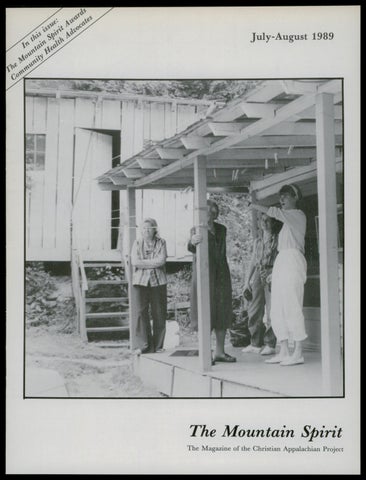
July-August 1989
The Mountain Spirit T h e M agazine of the C h ristian A ppalachian Project
T h e M o u n ta in S p irit:
The Magazine o f the Christian Appalachian Project
Ju ly-A ugust 1989
V ol. V III, N o. 4
Contents Features 4
T he M ou n tain Spirit Awards by G ary Eldridge, Glen Edw ard T au l, M aurice M anning, Jo e Foley and Ike Adam s
Camp Andrew Jackson, p.16
For the second tim e, C A P gave M ountain Spirit awards for special achievem ent in education, economic advancem ent, spiritual enrichm ent, health and prom oting the understanding of Appalachia. H ere we introduce you to the people CA P has honored.
16
T he B eauty o f N ature by J u n e W idm an C hildren attending C am p A ndrew Jackson this year will be paying special m ind to the wonders of the wilderness in Jackson C ounty.
19
C om m un ity H ealth by H eidi A nne Porter T here have been some exciting changes in the preventive and environm ental health program in Floyd C ou n ty — including the nam e.
22
E m phasis on Scholarship by M argaret G abriel Rockcastle Forw ard in the Fifth sponsors a w ork/study program that is designed to n u rtu re and im prove the self-esteem of its participants.
Departments 3 10 11 14
From Our P resident Letters A round the Project T he C AP C loseup
Community Health Advocates, p.19
The July-August Theme A lthough the C h ristian A ppalachian Project has been involved in the lives of people in the m o u n tain s for 25 years, it is only one group th a t provides services and works to im prove life in E astern K entucky. T his issue of The Mountain Spirit will introduce you to o ther people and groups doing o u tstan d in g w ork. T h e M o u n tain Spirit aw ards h onored six people who have been w orking long and h a rd to achieve im provem ent an d R ockcastle F orw ard in the Fifth is taking the bull by the horns and providing incentive for students to finish th eir education. O n the C O V E R A n ita C hase an d J e n n y Z etah hom e visit a p articip an t in the C o m m u n ity H ealth A dvocates P ro g ram (photo by M eg an C orcoran). O n the B A C K C O V E R sum m er lushness su rro u n d s us in the m o u n tain s. ____________________________________
Published by the C h ristian A ppalachian P roject. Editor: M a rg aret G abriel. A d visory Board: F ath er R alp h W . Beiting, M ike M cL au g h lin , Leslie B. L arsen , Bill Begley, R andolph Jo rd a n , J u n e W id m an , K athleen F ord Leavell; P atricia M iracle P adgett. G raphics Coordinator: E lizabeth R eed M iller. C irculation: L in d a C u rtis G rider. The Mountain Spirit is published six tim es a year. T h e an n u al subscription price is $5.00. S ubscriptions an d o th er correspondence should be sent to The Mountain Spirit, C h ristian A ppalachian P roject, 322 C rab O rch ard R o a d , L ancaster, K entucky 40446. C o p y rig h t, 1989, the C h ristian A ppalachian P roject, Inc. All rights reserved. M em b er, C atholic Press A ssociation. T h e C h ristian A p palachian Project is a non-profit C h ristian service organization o perating th ro u g h o u t E astern K entucky. T h e project operates on the philosophy th at “ helping people help them selves” is the best approach to A ppalachian poverty.
From Our President
M y personal schedule has been as stressful and as busy lately as at any time in the fourteen years I have worked here. There seems to be one problem after another: meetings, conflicts, negotiations, all sandwiched between the normal schedule needed to keep CAP’S wheels in motion. So far I’ve survived, but not without a toll on my personal health, both physical and emotional. Is there no end to it all? I remain positive and op timistic, I feel my attitude is good, but I see no change in my schedule in the months ahead: more of the same. Is it anyone’s fault but perhaps my own? Am I not delegating well, or managing my time properly, or it there simply so much that needs doing? I suspect the latter. How can I keep my perspective, I keep asking myself. To stay on top and view CAP as a whole — where it’s going, what will it be like five years from now —and at the same time, place myself in the melee, where the nuts and bolts of daily activity are assembled in order to be aware of the true nature of what is happening around CAP. This is my personal challenge; to combine all these vary ing perspectives into one unified, integrated whole. Why do I write about this, my personal dilem ma, in this particular issue of The Mountain Spirit? I do it primarily because I see these deserv ing recipients of the Mountain Spirit Awards fac ing similar issues and problems in their twenty years of service to their different causes. To have too much to do and not enough time to do it, to have to choose from among priorities, to sacrifice personal time and enjoyment, to have to struggle to find the energy and enthusiasm from deep within in order to keep persevering . . . these are problems they have faced, year after year, and it is to their great credit that they chose their priorities well. For they, in truth, have accomplished great things. Faced with problems that all of us face in our lives and our jobs, they steer a broad course and keep sailing forward, with an eye to the horizon, on the work that needs doing. I reflect upon this, on what makes some of us humans more able to bring about change or ac complish goals than others. What do they do more completely perhaps, than most of us do in part on ly? Among the factors, perhaps . . . They give more time, more hours to their work. They are more selfless than most of us, working for the good of society rather than for personal goals July-A ugust 1989
M ik e M c L a u g h lin .
alone. They do not work alone, but bring people together, accomplishing their objectives with and through others, allowing their initial vision to be changed and enhanced by the input and aspira tions of many others, working together, for com mon cause and common good. Each has that spark of leadership, that willingness to stand up alone if necessary, to get the ball rolling, to get an activity started, to show the way. Leadership comes in many forms and guises, but all these award winners possess it and use it to make our society a richer place, more sensitive to the needs of others, and a greater understanding of what it means to work together for a noble cause. I salute these winners, and wish them well for what has been accomplished. I pray they continue in their untiring efforts, and thereby serve as sources of inspiration for others who may join at their side. What they have accomplished in their own lives and work needs to be emulated by each of us in our own causes and places. There is so much that needs doing that it will take us all to achieve significant impact. Let’s all assess ourselves, our capabilities, our resources, and begin anew with each day’s dawn to be and do the best within us, to look beyond our limited frames of reference, and find what truly matters to ourselves and our world. 3
T he M o u n ta in Spirit A w ards by Gary Eldridge, Glen Edward Paul, Maurice Manning, Joe Foley and Ike Adams Photos by Randolph Jordan 4
The Mountain Spirit
“W TT hen the spirit moves,” as CAP president Mike McLaughlin said, CAP presents “The Mountain Spirit” Awards to recognize the achievements of people who live, work —and make contributions—in the mountains. The five recipients were honored at a reception and ceremony on April 27, 1989 at Boone Tavern in Berea, Kentucky. The Mountain Spirit Awards were presented to Herb E. Smith and Elizabeth Barrett for Promoting the Understanding of Appalachia, Harold D. Rogers for Economic Advancement, Wayne Stewart for Education, Orville John Stein for Health, and Bennett D. Poage for Spiritual Enrichment. The M ountain Spirit con gratulates the recipients, and thanks each for the contributions that they have made and for the example that they have given for each of us to follow. 4<I rejoice in the notion that there is diversity in this country, that people in this region as a whole have things which you can perceive as being out of the mainstream,” says Herb E. Smith. Herb and Elizabeth Barrett, his wife and fellow film maker, together won this year’s Mountain Spirit Award for Promotion of Understanding of Appalachia and its People. The two have devoted their lives to showing the rest of the world the culture and heritage of Central Ap palachia. Herb has been at it for 20 years; Elizabeth, 16. Their common base is Appalshop, a nationallyacclaimed filmmaking company based in the small Kentucky town of Whitesburg, deep in the coal fields. Both grew up in the area and became filmmakers pretty much by accident. Herb and Elizabeth were both still in school in 1969 when what would become Appalshop first came to town. The fledgling film concern was part of a national organization’s push to create small communityJ u ly- A ugust 1989
T h e ston ew are p lates are the w ork o f B erea artist T eresa D ea v er.
based film companies around the country. Whitesburg was one of the areas chosen. Herb is from W hitesburg, Elizabeth from nearby Hazard; filmmaking fell upon them as if from the sky, or like an incoming spaceship, Herb says. Herb began working with the new company almost as soon as it arriv ed. Elizabeth began while in her last years at the University of Kentucky. Both have stayed, have helped forge Appalshop into the diverse multi-media, multi-arts organiza tion it is today, and have produced award winning films such as “Long Journey Home” and “Strangers & Kin.” All of their work has revolved around a culture, and social issues of Appalachia. But both Elizabeth and Herb are involved in more than just the actual filmmaking. To retain total artistic control of content without having to succomb to commercial considera tions, both have become involved with film projects from the earliest stages. “It’s not as easy being a film maker to determine your work,” Herb says. “Because filmmaking is such an expensive medium, it’s usually that most film makers spend a good part of their lives making
films other people want made. “If we aren’t involved in planning, proposal writing, fund raising, meeting with potential donors, then we don’t produce the things that we want to make,” Herb says. The standard genre of Appalshop films has been the documentary. The form allows audiences to see mountain people for what they are, not as stereotypes would portray them. The Appalshop cameras allow people to speak for themselves. Both Herb and Elizabeth credit a good mix of independence and col laboration for the success of Ap palshop films. While one person is ultimately responsible for a film project from start to finish, all are asked to contribute and offer pro fessional support. “Everybody has always been scrambling to make things happen and to make things grow,” Elizabeth says. “We’ve learned that we all need each other.” Elizabeth and Herb have two children; Evan, 7 and Ada, 2. —WJF. B ennett D. Poage is a selfproclaimed “adopted child” of Ap palachia, but considering Ben’s rich Appalachian tenure of achievements 5
KAM founded the Garrard Coun ty Cooperative Parish in 1986, which is composed of the four Disciples of Christ churches in Gar rard County. The mission of the parish is to: “(1) reduce unemploy ment and improve basic educational needs, (2) improve religious educa tion for young people in the area, (3) provide a mutual support system for seniors, and (4) directly assist those in need.” At present, Ben is helping organize a similar group, the “Raccoon” John Smith Cooperation in Bath, Montgomery, Nicholas and Clark counties.
B en n ett D . P oage w as h on ored for sp iritu a l en rich m en t.
and activities, it is hard to imagine he grew up in Missouri. His initial exposure to Appalachia came when he was a rural pastor, a requirement he gladly fulfilled as a student at the Lexington Theological Seminary. His pastoral service to a congrega tion soon expanded to include entire communities, and now includes ministry to a vast region. This career of service has earned Ben Poage the Mountain Spirit Award for Spiritual Enrichment. As a seminary student, Ben joined the Appalachian Volunteers, a War on Poverty program. “Everyone thought it would be temporary,” says Ben, “but it became clear after a few years, that to really serve the region, we needed to put down roots, so I decided to do that.” In 1968, Ben became the founding director of the Grass Roots Economic Development Corpora tion in Jackson, Kentucky. The cor poration began a cooperative sawmill among other projects, and provided essential job training skills to a region that needed holistic im provement.
The Grass Roots experience was important to Ben’s theological development and his vision for Ap palachia. Ben believes it was truly an act of faith in “each other, God, and their own abilities” that yielded the success of Grass Roots. Per sonally, Ben recalls, “I learned enough skills and experienced enough victories, that I was no longer afraid to reach out and do new things —to do things nobody had done before. And we did it! All these poor people did this with darn little outside help.”
It is this type of community ministry that is a manifestation of Ben Poage’s theology. Ben is a “pro cess theologian” and believes that creation is not finished. “God is still working at creating this world and the people that live in it,” Ben says. “God wants us to become co creators with Him, and as co creators we become active in our communities, in helping God fulfill creation.” The openness and honest accep tance Ben has enjoyed from the peo ple of Appalachia has kept him here. He believes his service is con tinually returned to him. Ben con cludes, “Once you have faith in
After his Grass Roots experience, Ben pastored several rural Disciples of Christ churches before becoming the director of Human/Economic Development for the Commission on Religion in Appalachia (CORA), in Knoxville, Tennessee. Currently Ben is an associate minister with the Kentucky Appalachian Ministry (KAM), a position that has allowed Ben to organize a community ministry. Community ministry pro jects include job training programs, leadership training and educational programs. The Mountain Spirit
other people, God, and your a b ilitie s , th e h o rizo n s are unlimited.” —MWM. 4* I believe our greatest resource is our people”, says Wayne Stewart, administrator of the Rockcastle County Hospital in Mount Vernon, Kentucky, recipient of CAP’S Mountain Spirit Award for his contributions to education. “I believe that education is teaching people to adjust to their en vironment —and enjoy it.” A Rockcastle County native, Wayne has a life-long commitment to education in general, and voca tional education in particular. A lot of folks have different ideas about Wayne’s most significant contribu tion to education and the people of Rockcastle County. Wayne serves on numerous boards for a variety of health and educational groups, and “I’d like to do more in direct economic develop ment. I want to see the area develop economically and become a better place to live.” Wayne has received numerous awards for his service, but it’s not his offices, service to the communi ty, involvement in local agencies, or
A w ard re cip ie n t U .S . R ep re sen ta tiv e H a ro ld D . R ogers chats w ith M argaret G ab riel, ed ito r o f The M ou ntain S pirit.
awards that say so much about him —it’s the folks in his community and those he works with and lives around. Wayne doesn’t talk much ab o u t h im self or his a c complishments; he talks about others and how proud he is of them. If there has been a purpose or philosophy that has guided Wayne through his life and his many achievements, it is simply one of helping others, in being able to serve. “No one has enjoyed living more than I have,” Wayne says. “Life has been good to me. One of the things that makes me feel good is being able to help someone else.”
W ayn e Stew art receiv es h is aw ard for ed u ca tio n from F ath er R alph W . B e itin g .
July-A ugust 1989
Wayne is constantly doing just that. He encourages other people to continue their education on a per sonal level. He has established a training program at his hospital that gives incentives to employees to complete or further their education. He is involved with and committed to regional and local vocational education and works to improve educational opportunities at the
high school and adult education level. All these things, however, barely begin to tell the story of this remarkable man who has been described as a “total community person.” Although Wayne is not common ly thought of as an educator, he has encouraged people, through groups and personal contact to continue to pursue education in an area where education is often skipped over or ig n o red e n tire ly . W ayne understands that in order to im prove life in general in Rockcastle County, the specifics can start with education. “Economic growth requires workers who are better trained and students who are better educated. Better health care is another pre requisite to better educated students,” Wayne says thoughfully. Perhaps Wayne’s family best typifies his belief in education. His four children have 13 college and humanity degrees among them. Ann Abney has taught special education for 16 years. Lori Gonzalez received
traditional parochialism. This at titude has been controlled by leaders in the counties across the district, many of whom are fiercely protec tive of their “turf.” Through Mr. Rogers’ efforts, local leaders are beginning to realize that whin one county is successful in recruiting an industry, surrounding counties benefit indirectly as well. “Through a series of meetings held in Frankfort, Kentucky, with state officials and in the district,” Mr. Rogers says, “political and civic leaders pledged mutual cooperation in recruiting industry.”
M a n y m em bers o f D r. S te in ’s p arish atten d ed th e cerem o n y in B erea.
her doctorate in communication disorders and teaches at Southern Il linois University at Carbondale. Serena Stratton is a social worker at the county hospital. William F. Stewart is in family practice in Rockcastle County. “They kinda’ tell the story,” Wayne’s wife, Ruby, says. And wherever you go in Rockcastle County, you’ll find folks who are grateful to him for bringing the community closer to the beauty of the promise it holds for all. Perhaps that’s why Wayne com mented upon receiving the award, “Of any recognition I’ve ever receiv ed, I think this Mountain Spirit Award means the most to me. I’ve known Father Beiting for many years. And of all the things I’ve seen happen in this area, and in Eastern Kentucky, none compare to what he and members of his organization have done and are doing. They have worked tirelessly and unselfishly, and with a dedication and commit ment that has been a strong motivating force for our people.” Wayne’s face becomes a mirror 8
reflecting at the same time, the ex perience of past struggles and the optimistic concern and hope for the future and says, “That’s a real mountain spirit.” —GGE. Since being elected to the U.S. House of Representatives from Ken tucky’s Fifth District in 1980, Harold D. Rogers has used his of fice and his leadership skills to unite interest groups in a cooperative ef fort to recruit industry, promote tourism, and diversify agriculture. “And things are clicking,” Mr. Rogers says. For these efforts and this leadership Hal Rogers is honored with the Mountain Spirit Award for Economic Advancement. Two groups to attract industry and tourists have been formed as a result of his leadership. “I was mov ed to action when Toyota announc ed its plans to locate in Kentucky,” Mr. Rogers says. “I was then told that satellite companies connected with Toyota would only locate in the region if the leaders acted in concert to recruit them.” The first major obstacle to over come, however, was the region’s
He says that by the first meeting’s end in Frankfort, a “love feast” had ensued. The result of this cooperative ef fort was the formation of the Southern Kentucky Economic Development Council. Since its in ception in 1986, 1900 new jobs have been created and 2400 companies have expanded existing facilities. For example, Asahi Motor Wheel Company and Firestone have located new plants; Fruit of the Loom has expanded its plant; the federal government is locating a prison in the region; and the state commerce department is referring three times the number of prospects than in previous years. A similar group, the Southern Kentucky Tourist Development Association, is implementing a district-wide marketing plan to pro mote tourism. The centerpiece of the plan is the revamping of Renfro Valley, Kentucky, by private enter prise. It will act as a visitor’s center and clearing house to direct travelers along Interstate 75 to other regional attractions, such as Cumberland Gap, Cumberland Falls, Lake Cumberland, and Big South Fork Recreation Area, a rebuilt coal mining camp on the KentuckyTennessee border. Other projects in clude the construction of a highway under Cumberland Gap, the restora tion of the Wilderness Road through the gap and the development of a resort area on Lake Cumberland built by the Webb Brothers. Mr. Rogers is encouraging the forThe Mountain Spirit
mation of a group that will promote the diversification of agriculture. With its rough terrain, the region’s farms are small and overly dependent on tobacco production. The group will work to develop supplemental products like fish and wood products, and to pro mote use of the region’s natural resources. Mr. Roger’s work toward pro moting a healthier economy for his native Southeast Kentucky is motivated by his desire to enable peo ple to find jobs near home. “People from Monticello left home to get jobs,” he says. “There was no choice.” After graduating from high school, Mr. Rogers went to Cincinnati to look for a job. There was none. So he con tinued his education, eventually earn ing a law degree from the University of Kentucky in 1964. He returned to Southeast Kentucky to practice in Somerset, and began working through the Jaycees to promote economic op portunities in his county through an in dustrial foundation. So for Hal Rogers, there is much self-satisfaction in being part of suc cesses that provide opportunities for people to stay home. Now fewer of them will have to leave home like he first did to look for jobs. —GET.
D r . Orville J. Stein is not a man preoccupied with recognition or praise for the work he does. In fact, if you want to find out much about what he has done, Dr. Stein is not the person to talk to. He will tell you simply that God called him to practice medicine in Somerset, Ken tucky, and that he has been heeding that call since the early sixties. Then he will turn the interview around so that it focuses on things that need to be done instead of dwelling on that which is already accomplished. This sketch, though, has to do with the reasons why CAP decided to present him The Mountain Spirit Award for Health Service. Suffice it to say that we didn’t get a lot of the information from Dr. Stein. There is, however, no shortage of other folks who hold Dr. Stein in the peak of their admiration and there is no shortage of reasons why they do. After joining Dr. Stephen Kelly to start a family practice in Somerset in 1964, Dr. Stein found himself in the middle of a population in critical need of more and better health care. In the first place there simply were not enough physicians to adequately serve the population, but even more critical was the fact that a great
many people in dire need of medical attention simply could not afford to pay for it. Dr. Stein began seeing patients and attending to their health care needs knowing full well that he might not ever receive a penny in financial compensation for his ser vices. He became concerned for those folks who “have slipped through the cracks of America’s health care delivery system,—those who had no insurance, no state assistance, and no money. “God heals people through me,” he says, “and he also heals me though them. That’s the marvelous thing. One can never out-give God. The more I give the more I receive.” In 1975 Dr. Stein was ordained a deacon in the Episcopal Church and began forming the idea of a free clinic as well as a break from his group practice. As an independent practitioner he has instituted a more flexible fee structure that allows his patients to pay for service based on their ability to do so. Since founding St. Luke’s Free Clinic more than eleven years ago he has treated hundreds of patients from five Southeastern Kentucky counties and he is work ing with the Episcopal Diocese of Lexington to find other physicians that can offer free health care to indigent people all over Eastern Ken tucky. We know of no physi cian who takes the New Testament admoniton to be a servant more to heart and practices it more faithfully than Dr. Orville J. Stein. —IA.
L eft to right: M ik e M cL a u g h lin , H a l R ogers, B en P o a g e, H erb S m ith , W ayn e S tew art, O rv ille S te in , F ath er B e itin g .
July-A ugust 1989
9
Letters Since my visit and stay at the Lan caster volunteer house during the summer of 1987 my life hasn’t been the same. I think about the people of Appalachia and wonder how they’re all getting along. I thank God for your magazine. I get to celebrate and mourn every change that occurs with you and them. One of the best parts of the whole sum mer was the strangers who have become friends. Friends from all over the country that are now in my life. As I said, my trip to the moun tains lives on in my memory. Thank you for helping the special proud people of Appalachia. And thank you for sharing your programs with me. Jane Schweers Creston, IA My mother-in-law was raised in Crab Orchard and we visited Crab Orchard several times while she was alive. It’s nice to read of the areas my mother-in-law talked about and viewed with us. Not many people, for example, know Crab Orchard was once a health spa, known for its springs and that people traveled by rail to Crab Orchard to visit the spa. Seems to me the old hotel still has traces of paint on one wall —and I believe spa visitors stayed at the hotel. I remember well fording a creek in my car in the late ’40s to visit the old homestead, and walking the last hundred yards or so—to reach the house with mud and newspaper and hair “plaster” on the walls. Edward E. Burkett Cincinnati, OH
The Mountain Spirit brings Ap palachia closer to far northern Wisconsin! I read each issue with in terest and appreciation of the fine work CAP is doing. What ex pressive photographs by Lorraine Corsale in the March-April 1989 “Arts and Culture” section! (I liked the riverboat trip too, on the “beautiful Ohio.”) Alberta Anderson Mercer, Wisconsin
I thoroughly enjoy The Mountain Spirit and I would like to compli ment you on the improvement in the paper quality and the format over the years. I read it from cover to cover, then pass it along to friends. Several issues ago you had a story written by Garry Barker which was excellent. I wrote to Garry and ordered his book which came as an autographed copy. Both my family and myself loved the book and would certainly recommend it to anyone interested in Appalachia. Should any more of his work be available we would love to know about it. Keep up the good work. Ann Bonney Kinnear Morrisville, PA The stories and pictures are beautiful but we appreciate more than that the wonderful work among the mountain people. I envy the volunteers. Mrs. Allan W. Potepan Seal Beach, CA
I greatly enjoy reading the fascinating stories about the Ap palachian people and all the devoted work being done by the CAP in dividuals.
I enjoy the magazine very much and I am especially pleased with the work you do —helping people make use of their abilities. It makes a per son proud to be able to do things and the products CAP puts out are beautiful and original. I treasure the items I have purchased.
June Anthony Roseland, N J
Palma McPhee Portland, OR
10
I enjoy every copy of The Moun tain Spirit and look foward to each copy. It reminds me of “the good old days” of my childhood when life was so much pleasanter and people loved their neighbors and worked together and prayed together to make each one’s life pleasanter. Thank you for the pleasant memories and I pray that outside people will continue to help their fellow man bring all people back to the worship of God. Adelaide Tindle Groveton, N H I look forward to my Mountain Spirit. It is a wonderful work you all are doing down there. I was born and raised in the mountains of Ken tucky. As I read it takes me back in memory of my younger days. I love the mountains and the people. If I were younger I would love to work with your staff, but all I can do is send my contributions as the Lord blesses me. You are all in prayers. Alma L. Howard Mansfield, OH I enjoy so much The Mountain Spirit. I never put it down until I have read every article. The joy you must have in doing so much for those less fortunate. I wish I could give much, but am of very limited means. God bless you all. Jim Stong Opelika, AL
Letters to the editor are welcome.
They should not exceed 150 words in length, and we reserve the right to edit them fo r space. Address letters to The Mountain Spirit, Christian Appalachian Project, 322 Crab Orchard Road, Lancaster, Kentucky 40446. The Mountain Spirit
Around the Project
by the CAP News Service
Som erset C h ild D ev elo p m en t C enter P art o f C o m m u n ity SOMERSET —Local and na tional media often bring to the at tention of the American public the fact that a great percentage of children in this country, particularly children from low-income families, are being reared by single parents, usually mothers. This fact is transformed from a statistic to reali ty when Pam Eads, manager of the Childrens’ Discovery Center, one of CA P’s six child development centers, reports that of the sixty children enrolled in their center, thirty have single moms. Of these thirty, Pam says, only two have full-time jobs. Two others work part-time jobs which they do not report to the social insurance of fice, because to do so would make them ineligible for welfare. Even if the part time jobs provided the same amount of money as a welfare check, the mothers would still have the expense of child care and they would lose the medical benefits that are included with welfare. The single mothers who do not work outside the home exist on food stamps and checks which average $200 per month. The lucky ones live in public housing, but Pam says that although the apartments have heat and running water, many mothers do not consider them good homes for their children because of the “potential for bad influence. The moms say ‘I don’t want my kids to learn about drugs and knives.’ They’re afraid that they will learn about those things from other kids in the housing project.” As a program with aspects for the entire family, not just pre-schoolers, the staff of the Children’s Discovery Center conducts classes to teach parenting skills to families of its students. The curriculum includes behavior management, how to pro vide for children’s physical needs, July-A ugust 1989
T h e C h ild r e n ’s D isc o v e r y C en ter p ro v id es d ev elo p m en t in stru ctio n for th ree, four and fiv e y ear old ch ild ren in P u la sk i C o u n ty .
housekeeping skills, “We even teach parents how to play with their children,” Pam said. “Mostly we try to teach them how to be parents because many of them had children when they were still children themselves. “One of the things we deal with is teaching adults how to like children. Often we assume that just because som eone has a child they automatically like that child, but that’s not always true. We show that children can be fun.” Another unit of the parenting class teaches mothers how to care for themselves. Pam and her staff have found that a few grooming tips work wonders for mothers’ selfimages, so they take some time to teach about make-up and hair care and discuss how to dress well on a small budget. A lth o u g h th e C h ild re n ’s Discovery Center’s primary goal is to provide outstanding child developm ent to low income children, Pam considers the center to be very much in the mainstream of service providers in Pulaski County. “We provide child care on Tuesday nights for the Creative Parenting group here [formerly known as Parents Anonymous].
Some weeks they have meetings and other weeks they have structured classes. They do have different cur riculum every month, though, and when they begin to deal specifically with children’s issues, we’ll handle that unit for them. “They usually average eight peo ple a week at their meetings, but they’re often different people each week. I suppose we reach 100 people a year through Creative Parenting classes, and we’re happy that by providing child care we can make it possible for some people to attend those meetings and classes.” Pam has also been involved with homelessness in Pulaski County, and she points out that rural homelessness often involves critical ly substandard housing; families liv ing in houses without running water, insulation and electricity. With a mother of one of her students, Pam brought much light to the problem when she testified before the Kentucky Coalition of the Homeless. The center’s involvement in com munity activities has made the staff an integral part of the total picture of services that are available in Pulaski County. 11
around the project . . . continued
G arrard T een s T our W ash ington WA S H I N G T O N , DC-Six young people who frequent the Gar rard Teen Center in Lancaster spent their spring vacation seeing, “everything there was to see,” according to teen program manager Barb Lehn. The teens participated in fund raising projects, such as car washes and bake sales, during the winter months to earn money for the trip. They spent their first day working at a soup kitchen operated by SOME —So Others Might Eat. “They really enjoyed it,” Barb said. “I was surprised at how much they enjoyed working there. The super visor was used to having groups of kids come in to work from all over, so she was great at getting them in volved. They set tables, served dessert and bread and poured cof fee.” Barb said that she was happy to see how eager the kids were to pitch in and help the homeless peo ple they met. After their work at the soup kit chen, Barb and Debbie Beierle, another center staff member, led the teens on a whirlwind, three day tour of the nation’s capitol that included exhibits at the Smithsonian, the White House, the Washington Monument, the Lincoln, Jefferson and Vietnam memorials and the group’s favorite, the FBI. Another big hit was the Metro —the subway system, a phenomonon totally foreign to young people from Gar rard County. “The last day we had a terrible case of ‘monument overload,’ so we crossed Chesapeake Bay and went to the beach,” Barb said. “Being in the city really opened the kids’ eyes to the bigger world,” Barb said. “It made them appreciate what they have here. We wanted to make Washington seem accessible to them, and make them realize that they could live here if they wanted 12
T e e n C en ter sta ff m em ber D eb b ie B eierle and A ngela P a y to n serve b read at a soup k itch en in W a sh in g to n called S O M E — So O thers M ig h t E at.
to. It was interesting, because one of the boys told me that he could live there, but he likes Kentucky because he doesn’t have to worry about other people and the possibility of violence. “It’s good to know that if these kids decide to live in Lancaster when they grow up, it will be because they choose to live here, and not because they’re afraid they can’t live in a big city.”
M o vin g ? Please notify us of change of address to make sure you receive every issue of The Mountain Spirit. OLD ADDRESS nam e
p le a s e p rin t
address
city
D o Y ou H a v e M issin g Pages? We’ve heard from a couple of readers who tell us that their MayJune copy of The Mountain Spirit was missing nearly half its pages, due to a production error. If you missed seeing “This Is My Choice,” a first person narrative by a resident of one of CAP’S abuse shelters, and “River City Run,” a short story by Garry Barker, we hope that you’ll please contact us. We’re particularly proud of these stories, so we’ll be happy to send you a replacement copy!
s ta te
z ip c o d e
NEW ADDRESS nam e
p le a s e p r in t
address
city
s ta te
z ip c o d e
Mail to: The Mountain Spirit, 322 Crab Orchard Road Lancaster, KY 40446.
The Mountain Spirit
around the project . . . continued
F a m ily L ife C enter H o ld s O pen H ou se
people who were living with them at that time felt that they were a part of the open house as they cleaned the residence, prepared refresh ments, and readied their rooms for tour groups.
RENF RO V A L L E Y - S t a f f workers at the programs located at the Family Life Center estimate that 180 people attended the Open House which they hosted on April 25, 1989. Workers from other agen cies in the immediate area and from as far away as Lexington, Barbourville and Manchester, Kentucky, as well as people in the community commented that they were surprised at the number of services and said that they didn’t realize they are available. Programs at the Family Life Center include a respite care home for handicapped people, a spouse abuse shelter and a school devoted to adult education.
Each of the programs at the Family Life Center prepared a booth in the recreation center, where staff and residents answered questions, distributed literature and made their guests feel welcome.
Sherry Allen, program coor dinator at Family Life Services, said that the event served to pull everyone together, that all of the
“It was a lot of work,” Sherry said, “but judging from the com ments that we heard from many people, we think it really paid off.”
G ift A n n u ities
“We told our residents that there would be many people here, that they might want to wear something besides their old work clothes. Well, we had some of our ladies wear dresses and high heels. They really enjoyed serving refreshments and meeting a lot of people.”
A gift annuity to the C hristian Appalachian Project will help us continue to provide em ploym ent opportunities to Appalachian peo ple. This activity is an essential part of our mission to help people help themselves. But, what is a gift annuity? I t ’s a legal agreem ent by which you make a gift to CA P and receive a guaranteed life income in return. For a m ore complete explana tion, write today for your free copy of “ G iving T hrough Gift A nnuities’’ by Filling out the coupon below and enclosing it in the envelope provided. Clip and send
Please send, w ithout obligation, my free copy of “ G iving T hrough Gift A nnuities.”
Nam e ________________________ Address________________________ P a rticip a n ts in p rogram s for th e eld e rly , in c lu d in g h o m e v isitin g and the E m m aus C h ristian L ife C en ter, p resen ted M ik e M cL a u g h lin and C A P ’s m a n agem en t team w ith a q u ilt in ap p recia tio n for services to eld erly p eo p le. T w e n ty squares w ere com p leted b y la d ies in th e program , th en it w as tak en to the d ifferen t co m m u n ities for q u iltin g b ees o n S atu rd ays.
July-A ugust 1989
City, State, Zip_______________ Date of Birth_________________ Telephone ___________________
13
The C A P Closeup
Gabriel
“ God’s Been Good To M e” Sara Hall
b y G ary E ldrid ge
S ara looks at the framed GED certificate hanging on the wall amongst other framed memories. “It’s something I’ve always wanted,” she says. “It has made me feel so good about myself. A million dollars couldn’t take that away from me.” Her eyes glance toward the picture of Kentucky first lady Martha Wilkinson presenting her with a certificate of merit at an appreciation luncheon at the Governor’s Mansion where she was recognized as one of thirteen outstanding adult learners in Kentucky. “Something I feel every human being should have is an education. I just didn’t have the chance to go to school. Getting my GED was a real op portunity. It’s meant everything. I could read before, but I didn’t understand that much. Now I can look at these books and learn something every time I turn a page.” She smiles and looks out the window at the 14
white and pink dogwood trees that are in full flower amidst the greening hillside. Sara Charlene Hall, age 55, resides in Rockcas tle County. She completed the 9th grade at Whites Special School in Hamermack, Michigan. Sara worked at Dresser Industries, in Berea, as a machine operator for sixteen years. In 1980 she had to resign because of several disabilities. Sara had heart disease which required several opera tions, had developed rheumatoid arthritis, which also required surgery, and suffered from em physema. Sara requires a home health nurse to bathe and dress her. There is minimum work around the house that she performs due to the limited use she has of her hands and feet. Sara has always valued education, and in Oc tober, 1987, started working on her GED through the Family Life Center School on Wheels program The Mountain Spirit
in Renfro Valley. She required a home bound tutor due to lack of transportation and limited mobility with a wheelchair or walker. A tutor traveled to Sara’s home once a week to work with her in two-hour sessions, doing most of the writing exercises and turning of pages because of Sara’s disabilities. When Sara was nearing completion of the course, her tutor contacted the Kentucky Depart ment of Education in Frankfort to ask about the possibility of someone making a home visit to ad minister the GED test. After hearing about Sara’s determination despite her inability to hold a pencil and take the test at a regular site, the Department of Education sent a representative to work with her and administer an oral examination. Sara doesn’t see any of her health factors as disabilities or limitations to what she chooses to do. She turns back from the window and looks at the certificate of merit awarded her by the American Association for Adult and Continuing Education that reads: “In recognition of extraor dinary initiative and dedication in the pursuit of learning that gives inspiration to others.”
somebody else. Like my neighbors. There’s this kid next door to me that’s almost 25 years old and he can’t even read and write enough to get his driver’s license. But, he’s going to have it by next year. I’m going to see to it that he learns enough to get it. And his mother, she’s only had a fifth grade education, but you watch. Both of them are going to be over here and I’m going to teach them. We’re going to do it together. “So many people have helped me.” Sara’s eyes roam over the wall of framed certificates, letters and pictures. There’s a picture of her in a cap and gown at the graduation ceremony next to an autographed picture of her and Governor Wilkin son taken when she attended the award luncheon in Frankfort. “Those pictures remind me of two days in my life I’ll never forget as long as I live.”
“I’ve said all my life I may not get everything I want, but I always had what I needed. And I want to help my people get what they need. It just means so much knowing I can do something for
The smile on her lips widens as her face glows with pride. “God’s been good to me. He hand picked all my special friends. I guess my wall tells it all. I’m the happiest lady in Rockcastle County.” SLunpY
“It just means that I have to go about things in a different way from what someone else might do. I love life and want to do and learn all I can,” she says.
Her eyes brimmed with tears. “Please tell everybody how much they mean to me. My tutor, Kaye Cameron. And Cathie Bailey that helped me so much. And Bige Towery, the superintendent of the Rockcastle Board of Education. I’ve know him for nearly 30 years and appreciate all he has done through the years to promote education in our community. And Jerry Emmons from the state Department of Education that came down and gave me the test. And Father Beiting and all the folks with Christian Appalachian Project that made it possible. It’s been a dream come true.”
F ath er R alph W . B e itin g , C A P ’s fou n d er, gave the co m m en cem en t address at S ara’s gra d u a tio n .
July-A ugust 1989
15
T he B eau ty o f N ature by June Widman Photos by Judi Jackson
Sometimes, when we’re right in the middle of something, that’s when it’s most difficult to see the value of it. The children who attend summer camp at Camp Andrew Jackson come from rural and small-town environments, but that doesn’t automatically ensure a built-in love of and respect for nature. This summer in particular, the campers are experiencing how a simple hike in the woods can become a lesson in cultural history, geology, biology, and botany. Through the many enriching experiences that have been prepared for them, the children come away with a better understanding of what the concept of stewardship is all about. Thanks to the training offered by camp pro gram manager Bill Lynch, the camp counselors are able to turn ordinary events on a hike into wonderful learning opportunities for the children. The counselors (many of whom are volunteers coming from different parts of the country) learn16
The Mountain Spirit
ed about the various rock formations, slope ex posures, and habitats of the area surrounding Camp AJ. By knowing what kinds of things to look for, they can capitalize on events that naturally occur during a hike. Now, as the counselors guide their group of children along a trail, they are able to point out how the group can enjoy the woods with the least amount of disturbance to the plants and animals whose homes they are passing through. As a child stops to pick up an interesting rock, the counselor will gather the group around to investigate what was under the rock. After counting how many dif ferent insects lived there, the counselor will show the children how to put the rock carefully back in place, exactly how it was before they came along. Later in the hike, a child pulls a plant out of the ground. At this time, the children are asked to consider how that plant is connected to other life in the immediate area. What animals or insects might be affected by that one little plant being pulled out of the ground? What if every child who came to Camp AJ pulled up a plant or broke off a branch of leaves? That would be 500 “little distur bances” this summer! Conversations like this help the children begin to realize the impact that people have on their environment and the important responsibility of caring for the gift God has given us. Many of the children who came to camp last summer saw a near-by area that had recently burn ed. This summer, they will be able to see the changes that occurred in one year’s time. By discussing the effect the fire had on plants and trees, and comparing the burned area to an un burned one, the children can better understand the consequences of a forest fire. The cultural history of this part of Jackson County is explored by the children as they hike around an old homestead. By examining the re mains of root cellars, a homesite, and even an old school house, the campers learn what can be discovered about the people who lived here long ago. How did those people make their living? What was their daily routine like? As these con nections to the past are made, a sense of pride can be felt among the children. The older group of children will have a special opportunity to incorporate practical woodcraft and survival skills into their camp experience. For the first three days at camp, the 13 and 14 year olds will practice the techniques necessary to com plete a successful overnight camping experience in the woods, totally without facilities or support vehicles. The group will learn about camp fires and safety, will plan for food and water, and learn how to make a suitable shelter. They will practice some basic rappelling techniques, where safety July-A ugust 1989
A trep id a tio u s cam p er sets out o n a leg o f the o b stacle course at C am p A nd rew J a ck so n .
and cooperation are emphasized. On Thursday of the chosen week, they will set out. Without expen sive backpacking equipment, these campers will hike into the woods, set up their campsite, try out the rock climbing and rappelling techniques they learned, prepare their evening meal, and fall asleep under the stars. On Friday morning, the group will make sure they take with them everything they brought into the woods, leaving the area as close as possible to the way they found it. When this group of children arrived at Camp AJ on Monday, they didn’t know each other very well, if at all. When they wearily hike back into camp Friday morning, ready to dive into the lake, they will not have realized yet the very special way they got to know each other this week. Somewhere down the road they will begin to understand that the success of their overnight outdoor camping ex perience was dependent upon the cooperation and teamwork of the group, as well as the responsibili ty and concern of each individual. Most of the children who come to Camp An drew Jackson could be labeled as “poor”, “needy”, and “having to do without”. For one special week this summer, these children have been shown what a special blessing it is to grow up in an area with such beautiful natural surroundings. By seeing nature as a gift from God, a sense of pride and respect have begun to develop, along with the sense of responsiblity to care for this gift. Material goods may be few, but these children have seen and appreciated the richness that is theirs in their Appalachian mountains. 17
“ . . . and som e seed fell on fertile ground . . . ” byHeidi Anne Porter Photos by Megan Corcoran 18
The Mountain Spirit
Originally known as the preventive and en vironmental health program, the community health advocates program (CHAP), grew out of a CAP-sponsored Appalachian symposium held at Berea College in June, 1985. Following the sym posium, Dr. Oris Blackwell of Eastern Kentucky University contacted CAP to work jointly on a preventive and environmental health program in Eastern Kentucky. Susie Smith, R.N., of Califor nia, was recruited as a volunteer in 1985 and the pilot project was launched in Floyd County. Sue McDuffy, R.N., and Jean Kowalski, R.N., both of Wisconsin, soon joined Susie. Together, these women researched living condi tions, including conditions of drinking water, methods of waste disposal, household heating and the occurrence of recent chronic illness within a targeted area, known as Arkansas Creek. Susie, Jean and Sue took their results and began designing specific programs to educate the residents of the mountain hollow and of the local area. Since those days, when the volunteers worked with families from a targeted hollow, to the pre sent, when the staff works in schools, youth centers, and senior citizens centers, the mission of the program has been to help people help themselves by teaching them about healthy choices and healthy lifestyles. “We changed the name of the program to more accurately reflect the focus of our program today,” explains Anita Chase, program manager of CHAP. “The former name expressed rather lof ty goals, goals that no one was quite sure how to accomplish. The new name is more specific and emphasizes the community aspect of the program.” Anita explains that an important part of the program has always been the networking of the many agencies in the area that are also com mitted to a healthier Appalachia. Some of the agencies involved in the projects with CHAP are the Kentucky Nutrition Council, Mountain Com prehensive Care Center, Champions Against Drugs, and Kentuckians For The Commonwealth.
1988 with her husband, Dan Becker, who works with CAP’S home repair program. Jenny’s background is in education. Combining their resources, as nurse and educator, Jenny and Anita are a prolific team. Their work takes them into many settings. The classroom is one setting where Jenny and Anita work. They have been active in eight elementary schools this year. Together, they have created a unit to raise the self-esteem levels of students. A typical unit is comprised of four separate but related topics designed to make the youngsters feel good about themselves. “This is one of my favorite parts of the job,” says Anita. “The kids’ reactions are immediate. We know in stantly what kind of impact we’ve had when we leave the room.” Initially, someone had to contact the schools and the teachers to set up presenta tions. “Now we have them contacting us,” said Jenny. “We even had a principal send us out on a home visit to check on a situation he was concerned about.” Jenny and Anita will see some of the same children again on their home visits. They conduct 25 to 30 home visits per month, getting most of their referrals from the emergency assistance, elderly, and home repair programs within CAP. After an initial visit, the family or individual must indicate that they have a problem and that they would like help searching for solutions. When Jenny or Anita continue to visit a family, a relationship with that family begins to form.
With these and other organizations, CHAP “empowers the people to make changes themselves,” explains Anita. “We work with the people, helping them realize their own strengths, so that they can solve their own self-identified prob lems.” Anita is a former volunteer who worked in CAP’S elderly program, and also at Camp Shawnee, a CAP summer camp. She comes from Middletown, Ohio, and brings to the program her expertise as an registered nurse. Jenny Zetah, a volunteer from New Ulm, Minnesota, works beside Anita. Jenny came to Martin in the fall of July-A ugust 1989
J e n n y Z eta h uses h er k n o w led g e as an ed u cator in the co m m u n ity h ea lth a d vocates program .
19
women, this two-hour period had become an an ticipated weekly event by many local women. Discussion, presentations, films, art projects, and trips make up the format of the group. The women learn how to fill their own needs and how to fill each others’. For some women, this may be the only time they have for themselves during the week. For Maria Jones, a member since the beginning, the group has introduced her to some of her closest friends. “I never had friends such as Anita and the others. I never knew anything like this before,” says Maria. “You learn together and find out that the other mothers feel the same as you.” Women’s Group emphasizes the sharing of ex periences and knowledge. The women become teachers for each other. Although Anita usually leads the group, at times other members have led specific activities.
J e n n y and A n ita are a fa m ilia r sigh t as th ey travel the roads in F loyd C o u n ty .
“You build relationships through time and com mitment,” says Jenny. “Our presence in the home shows the person that they are worthwhile and that we’re interested in being friends.” Anita adds, “It’s only when we’ve established a relationship that we can begin teaching —and learning.” There can be a high level of frustration with home visits. Sometimes one family member will resent them or will see no reason for change. Sometimes a parent will feel threatened. “We have tojkeep planting seeds,” says Anita. “The frustra tion is a part of the work. Faith keeps us going.” Jenny has recently seen some positive changes within one of the families she regularly visits. The Mullins family was referred from the emergency assistance program several years ago when Linda Mullins, a mother of three, was experiencing poor health. Because of home visits and the personal relationship that has been fostered, Linda now speaks of getting a job when her youngest child enters school this fall, and of continuing to work toward her high school diploma. She is an active member of CHAP’s weekly Women’s Group, where she can meet other women in the area who support and share her goals, frustrations and dreams. Women’s Group has been a support system for other local women like Linda. Co-founded almost two years ago by Anne Meiman and Heidi Anne Porter to create community support among 20
An underlying goal of the group is to build up the self-esteem levels of its members. “I feel much more sure of myself,” says Maria. “All those discussions we’ve had must’ve worked!” She ad mits that she’s been trying to get a neighbor to understand the importance of taking time for herself. “I know how hard it is for mothers. I have four kids myself, but now I know I have my own private time to keep me going.” Maria will soon be moving. She wistfully says that she’ll miss Women’s Group most of all. She wonders if she could start one of her own in her home . . . Besides women and school children, CHAP focuses on senior citizens. Jenny is responsible for
H o m e v is itin g is an im p o rta n t part o f m any CAP p rogram s, esp ecia lly those that d eal w ith eld e rly p eo p le w ho m ay b e h o m eb o u n d .
The Mountain Spirit
six area centers, which she visits monthly. At a center, Jenny will address a pertinent issue such as nutrition, tobacco use, cancer prevention, stress management, and other health related matters. One of the more popular programs called is “Body Recall.” “This is an exercise program designed for older adults,” explains Jenny. The exercise is lowimpact; some are performed in a chair. The idea behind the program is that older people can and should continue to exercise. Jenny usually spends one and a half hours at each center. After each presentation, she takes blood pressures, and then eats lunch with the seniors, taking time to answer questions and to visit. Along with home visits, school visits, and special groups, CHAP also reaches its people through its radio show. The “Floyd County Health Line” begun in 1986, is a talk show that is aired each weekday in five-minute segments. Mike Sanders, CAP’S director of Martin operations, says that one of the original goals of the show was to draw upon area experts and make their resources available to the public. Listeners are en couraged to write in questions and responses con cerning the show. The multi-faceted approach to health education practiced by CHAP has influenced many lives, while creating a successful, dependable program. Anita shares goals she has for the future of the program. “We’d like to increase the staff,” laughs Anita, “then we can establish more women’s groups, in
C areful m o n ito rin g o f b lo o d p ressure p la y s an im p o rta n t role in the program .
crease our home visits, and continue our direct contact with the people.” Another goal of the program is to expand into Magoffin County, which is one of the most depressed counties in the region. In a proposed pilot project, CHAP would focus on the youth of the county by teaching responsibility for health, by helping them to realize life choices, by establishing a local network of activities and sup port, and by developing leadership among the targeted group. The three year project would be modeled on the community health advocates pro gram in Floyd County. As the program stretches, changes, and grows, it reflects the influences of many volunteers who have worked in it. Nurses, teachers, artists, and other professionals have contributed their rich talents to make the program what it is today. Each volunteer brought the vision of a stronger, healthier Appalachia a little closer. And as they changed the program, they too were changed. “I appreciate the people more and more,” says Anita. “They do have the strength to change. We just help them realize it.” Jenny adds, “You typically think of mission work as going to teach and help. Here, we’re learning and becoming enriched ourselves. I think that when we leave, the real mission will begin—that of teaching others what we’ve learned here.”
July-A ugust 1989
21
E m phasis On Scholarship Rockcastle Forward in the Fifth
I ÿ
H ,V
■
i* | ■ : »
wards
V* r y
b y M argaret G abriel Photos by Tom Schaper 22
m
The Mountain Spirit
“ Y o u mean when I go to college,” was Franky Denny’s response to the question posed by The Mountain Spirit, “How do you think that the experiences you’ve had in this program are going to work for you after you graduate?” This attitude can easily be touted as the most important benefit of the Work/Study Scholarship program of Rockcastle Forward in the Fifth. Forward in the Fifth is a non-profit organiza tion that works for the support of academic ex cellence in the schools of the Fifth District of Ken tucky, the Congressional district of nine of the counties of CAP’S service area. Rockcastle For ward in the Fifth is based on the same principles. Since it was established in August of 1987, “the group has given awards, recognition and praise to several groups and individuals in the county schools, in an effort to encourage them and to show them that their efforts are appreciated by the community,” according to the grant application that the group submitted to the Christian Ap palachian Project in 1988. “We have also awarded several mini-grants to teachers to help them enrich their educational curriculum.” The 1987-88 school year marked the first year of the Work/Study Scholarship program. At that time three students participated, using their free periods to do clerical work, tutor other students or assist teachers in the classroom and were paid $3.35 per hour. The program was conceptualized and begun by Shirley Cox, a concerned citizen of Rockcastle County, with the cooperation of Ronnie Cash, principal of Rockcastle County High School and Jamie Worley, the guidance counselor.
S h irley C ox
“My desire to help needy students initially began to develop from hearing my mother’s stories about skipping the first grade in a Berea school, only to become a drop-out statistic in the seventh grade because she was embarrassed about her poor clothing,” Shirley wrote in an essay for the Mount Vernon Signal. “Memories of my own education create images of borrowed pencils and paper and pretended disinterest in school functions because I simply could not afford them. “These motivational factors culminated last year when a course in our local church called Masterlife caused me to reevaluate my gifts and my use of them. Although my own life had become financially secure, I realized that I had nearly forgotten other young people who were still struggling to obtain an education. As I began to pray to the Lord to show me a way to help young students, a plan for a work/study scholarship pro gram began to unfold.”
D ia n a h K in g w orks on a b a n n er for “ P roject G r a d u a tio n .” A b o v e, le ft, F ran k y D e n n y hangs d ecoratio n s for a R ock castle C o u n ty H ig h S ch ool aw ard cerem on y.
July-A ugust 1989
Shirley’s first plan called for her to adopt one student —to help and nurture and encourage one student from a low-income family, perhaps em powering that student to persevere, finish high school, and maybe even go to college. “I came down and got a list of names from Jamie, the counselor.” Shirley said. “When I saw that list, I started crying because the problems were so big. I just couldn’t understand how these 23
children were maintaining a “C” average and stay ing in school. That’s when I realized that I had to do more than just help one child, that there should be some way that we could organize and help more students.” With encouragement from Jamie and from Ronnie Cash, Shirley solicited donations from businesses in the county, and raised the $1,000 that she needed to help three students. “That first year, the only money she had was from business donations,” Jamie said. “She went with the money she had to help the three neediest students, or the three that fit the criteria the best.” Students are invited by teachers to apply for the program based on three factors, all equally impor tant. Students are required to have a “C” academic average in order to apply for the program, in dicating a willingness to work hard and apply themselves. Teachers make a recommendation, at testing to the moral character of the student and his or her sense of cooperation. The final factor is financial need. Shirley said, “Most of the children who apply —and almost all that we have chosen —have an annual family income of $5,000 or less.
D ia n a h K in g .
“Some are living with friends, have moved com pletely out of the home and are living with friends so they can finish school.” Based on these factors, three students were chosen last year, the program blossomed and because of its success the group was able to raise more money (including a substantial grant from CAP) and admit eight students for the ’88-’89 school year. Shirley added that if funds were available, they could place one student with each teacher at Rockcastle County High School. “The teachers are beginning know the types of students we’re looking for, and they’re starting to seek out and really look at them,” Jamie said. “Shirley and I both want to get that student that is willing to help himself or herself with a little en couragement.” Franky Denny is just such a student. He is par ticipating in the work/study scholarship program for the second year, as an assistant to Lawrence Bullock, the art teacher. “He’s going to go on to school now,” said Jamie. He’s made his application to college and last year I don’t think he even would have thought about it.”
S h irley and w o rk /stu d y stu d en t, S taci D e n n y .
24
Shirley went on, “On the application for our program we ask the question, ‘what plans do you have for your future education?’ The tiniest you’ve ever seen in your life, Franky wrote, ‘I think I The Mountain Spirit
want to go to college.’” Franky grades papers, keeps the supply room tidy, “I do the little things that need doing,” he said. During his first year in the program, Franky kept up with his own art assignments after school hours and helped other students with their assignments during the day. His work period this year is scheduled during Mr. Bullock’s planning period, limiting the amount of time that Franky spends working with other students. Franky says that when (not if, Shirley points out) he goes to college, he plans to major in art. The first one in his family to go to college, “Franky’s going to make it,” Shirley said. While Franky is the first to go to college in his family, his co-worker, Dianah King, is the first from her family to graduate from high school. “My papaw is really thrilled,” Dianah said. “Fm the only one with the King name to graduate. My cousin dropped out last year, and I have another one who dropped out just a few weeks ago. He’s thrilled —most of my family just got themselves jobs making $3.35 an hour.” Mr. Bullock referred Dianah to the program, stating that she is aggressive, cooperative, opi nionated and that she expresses herself well. The W o rk /stu d y stu d en t F ran k y D en n y is a p lans poem, reprinted on this page, that Dianah wrote to m ajor in art at B erea C o lleg e. for her senior English class well demonstrates her really doing something instead of coming to flair for expression. Shirley tells Dianah that she school every day just to be coming.” would make a good English major, although Dianah says that she plans to major in business Lawrence Bullock, a native of Rockcastle and minor in art at Berea College. County, said that he “knows where these kids are Mr. Bullock asked Dianah if coming from. Most of these kids are the same way she would be interested in the I was —when they finish high school they’re going work/study program, “And I said, ‘sure.’ I didn’t know there was any money involved; I K en tu ck y wanted to do it because I figured I could learn a lot. I love my art | What pride she carries, class, and I’ve gotten to do a lot § With the wind that flows through the mane of the prized steed. § of extra projects.” & With all the beauty abreast her flaming red cardinal. § 4 Dianah added that the extra & Mountains high with spectacular colors of green. § work has meant more to her than & Pastures of fresh hay that give her a heavenly splendor. § just a little extra money each x The best harvest corn nourished with her earth grown spice, § week. “I’ve gotten to work with & And tobacco housed high in the old barn out back. § Franky and some of the other ^ Neighbors with a lending hand and children at rowdy play, folks, and get closer to them. I § Talking with that slow accent that could only be Kentucky made. § § get the chance to do more for my ^ Shaded, silent country roads and streets of concrete and steel, § school than I would just working x, Blend together to give her that home-place appeal. £ Many leave her but all return, § an hour a day in art. x For she is the place that even the Father would agree, & “Mr. Bullock has helped x With all her glory, spirit and grace, & me —he’s really encouraged me. | She is KENTUCKY. | Everyday he says, ‘what are you § going to do when you go to col § Dianah King § lege?’ And I’ve been thinking § Grade 12 § about it. It really helps. I feel like § Rockcastle County High School § I’ve gotten support and that I’m § July-A ugust 1989
25
lege graduates, it would be easy for them to accept the idea of going to college, but if you’re the first to graduate from high school, the idea of going to college is way out there. There’s an awful lot of in security. One day Dianah said, ‘I don’t want to do that,’ and I asked her why. She said, ‘what if I go out there and don’t make it?’ “I said, ‘so what?’ “‘There are people wanting to spend money!’ “I said, ‘let them spend it. Apparently they have a certain amount of intelligence, and if they didn’t figure that you’re worth investing in, they wouldn’t do it.” Shirley has met with and spoken to groups similar to Rockcastle Forward in the Fifth, en couraging them to adopt a work/study scholar ship program, telling how they went about establishing the program and about the advan tages and opportunities that are made available to the students.
S h irley C ox has a sp ecial re la tio n sh ip w ith D ia n a h K in g . S h ir le y ’s b u sin ess acted as sp onsor w h en D ia n a h en tered a local b ea u ty con test.
to have to leave to find jobs.” He said that development of an industrial base would help. “We lose some of the best minds. We lose those people who are aggressive, people who have ambi tion. They leave because they have to. They go to Louisville, they go to Cincinnati, they go to Lex ington, they go to all these places. They develop relationships there, they get married, they have children, they live there and we lose them. Getting people to finish high school and go on to college is going to help to develop that industrial base.” Mr. Bullock said that one of the obstacles that teachers must overcome with students is a certain amount of apprehension. “I don’t think that anybody is going to take any student from here, say, ‘you can do this,’ and not have the child be somewhat apprehensive. It’s new, it’s something they haven’t done before, it’s something that hasn’t been experienced too much in their family, but I believe that most of the students in this school can be competitive in college.” His work with Franky and Dianah has taught Mr. Bullock that, more than anything else, students need encouragement, they need to know that someone is in their corner. “They have a lot of insecurities, some because of their backgrounds. It might be easier for children whose parents are col 26
As is the case with many programs of its nature, the real advantages to the students can’t be measured in any tangible sense. The hour that they work every day nets each student $15 to $16 each week. This money might represent a few extras for the students, things that they might otherwise not be able to afford, but in a world so often oriented toward material things, it is not a vast sum of money. Shirely and Jamie are quick to point out, though, that this is a work/study scholarship pro gram, with the emphasis on scholarship, and that that emphasis works wonders to improve the students’ self-images. “What I’ve notice more than anything is the changes in the students’ personalities,” Jamie said. “They’ve become more open; in most cases it seems that they’re uplifted, they can talk to you more easily, they’re smiling more, their heads are up, they can look you in the eye. I just see a dif ference in their self-esteem. It seems that those who were somewhat shy and withdrawn have come out.” Shirley added, “If we just give them a feeling that they can do, that’ll be enough. There is a way out of this chain, and it’s education. Mr. Bullock is one of those giving students those “can-do” feelings. “I have a tendency to make my students become a little b i t . . . arrogant, I guess you might say. My idea is that these people are unique and every one of them is talented, and has a right to be a little bit snobbish. I want each person that I have in class to feel special and I think most of the time, they do.” The Mountain Spirit
Me
a Christmas basket sponsor?
A s a fam ily, we especially enjoy being a part o f your Christmas basket program. We enjoy the shopping and wrapping o f our gifts and try to imagine the joy and the expressions on the faces o f the people when they open them. We have had some very nice appreciative thank you letters from some o f the families. It is the true meaning o f Christmas and the true spirit o f Christianity to give and not always “get” in return. Dianne L . H um m el Delavan W I
,
In 1989 we hope to d istrib u te C h ristm a s baskets to 2300 fam ilies in th e m o u n ta in s o f E astern K en tu ck y , a n d w e ’re e x ten d in g a special in v itatio n to all Mountain Spirit read ers to help us reach o u r goal. If you w ould like to take p a rt: — let us know the size fam ily you w ould like to sponsor. G ifts for each child should cost betw een $10 a n d $20. W e ask for this price ran g e to keep the baskets as equal as possible for all children; — we ask sponsors to w rap an d label gifts w ith the n am e o f each perso n ; — please m ail y o u r boxes o f gifts to C A P by N ovem b er 2 0 , 1 9 8 9 , or e arlier, to insure th a t we will receive th em d u rin g the first week in D ecem ber.
As soon as you contact us, we will send detailed in stru ctio n s, in fo rm atio n ab o u t y o u r fam ily an d som e gift suggestions. T h is in fo rm atio n will arrive no later th a n O c to b er 10— p lenty of shopping tim e! Please re tu rn the coupon in the re tu rn envelope, or if you prefer no t to cut y o u r m ag azin e, include the in fo rm atio n on a n o th e r sheet. K eith Gilbertson 322 C rab O rchard R oad Lancaster, KY 40446 D ear K eith, I would like to sponsor a ____ small (1-2 c h i l d r e n ) ------ __ m e d iu m (3 -4 ) ____la r g e (5-7) ____ extra large (8 or more) family. Please send inform ation. I am not able to shop for a needy Appalachian family but I have included $-------- that will enable you to purchase gifts for a family ($75.00 will provide for a family of five). N am e________________________ ________________— A ddress_________________________ ______________ C ity, State, Z IP---------------------------------------------- -