Ut: % %
r
ountain the C hristian Appaiaci
X h e M o u n ta in Spirit:
The Magazine o f the Christian Appalachian Project
January-February 1989
V ol. V III, N o. 1
Contents Features 4
H om e Repair— And More by M argaret G abriel C A P ’s hom e rep air program is one of the few that allows its w orkers to see its results each day. But, th ere are m any aspects of hom e repair that are not quite so tangible.
9
Appalachian Patterns: A R eview by G ary Eldridge Appalachian Patterns weaves stories about A ppalachia as skilfully as a quilter m ight weave different fabrics into an intricate pattern .
16
F in d in g and F eeding the H u n gry
Home Repair, p. 4
Happy Birthday, Father Beiting p. 21
by the C A P News Service In G arra rd C ounty, a com m unity effort works at m aking sure th at all citizens have enough to eat.
21
Happy Birthday, Father Beiting by the C A P News Service Several C A P workers shared with The Mountain Spirit stories about F ath er Beiting to com m em orate his 65th birthday.
Departments 3 10 14 20
From Our President Around the Project The CAP Closeup Letters
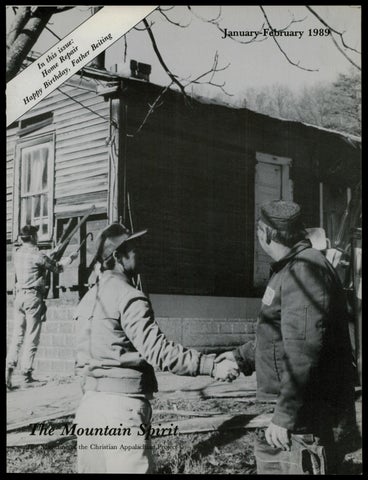
The January-February Theme T h e new year is a big one for C A P. D u rin g 1989, we will celebrate some great events, not the least of which is o u r 25th anniversary. For J a n u a ry , though, we will focus on the 65th b irth d ay of o u r founder, F ath er R alp h Beiting. W hen we started talking to folks, gathering stories about Father Beiting to share w ith readers of The Mountain Spirit, n atu rally, we heard m ore th an we could possibly use. O n page 21, you can read some of our favorities. O n page 4, y o u ’ll learn m ore about the pro g ram th at we w rote about as a b irth d ay gift to F ather B eiting, C A P ’s hom e rep air p ro g ram . O n the C O V E R , the crew in Floyd C o u n ty works on a fam ily hom e (photo by Foley). O n the B A C K C O V E R , an ab an d o n ed A ppalachian sawmill (photo from the C A P A rchives).
P ublished by the C h ristian A ppalachian P roject. E ditor, M a rg aret G abriel. A d visory B oard, F ath er R alph W . Beiting; M ike M cL au g h lin ; Leslie B. L arsen; Bill Begley; R an d o lp h J o rd a n ; J u n e W idm an; K athleen Ford Leavell; P atricia M iracle P adgett. G raphics C oordinator, D ebbie Fraley T u d o r. C ircu lation, E lizabeth M iller. The Mountain Spirit is published six tim es a year. T h e an n u al subscription price is $5.00. Subscriptions and o th er correspondence should be sent to The Mountain Spirit, C h ristian A ppalachian P roject, 322 C rab O rch ard R o ad , L ancaster, K entucky 40446. C o p y rig h t, 1988, the C hristian A ppalachian P roject, Inc. All rights reserved. M em b er, C atholic Press Association. T h e C h ristian A ppalachian P roject is a non-profit C h ristian service organization o p eratin g th roughout E astern K entucky. T h e project o perates on the philosophy th at “ helping people help them selves’’ is the best ap proach to A ppalachian poverty.
From Our President When I was in the first grade, I remember how “big” and “grown up” I thought the fifth and sixth graders were. When I got to be that age myself, I really thought the junior high students had all the best, and when I got there, I realized only seniors in high school had really reached the optimum level of life. This looking wistfully at and into the future continued through the majority of those “passages” I went through in my life as most of us do, and included college, marriage, marriage-with-children, my first “paying” job, and the mid-life years. I was always looking ahead, unable to wait till I achieved the next plateau, and the wisdom and benefits and maturity that the next step up the ladder would bring. Then I would be fulfilled, truly hap py, and a “man-of-the-world.” Somewhere recently, however, looking ahead at the next milestone has lost its appeal. I just turned 49, and now getting older doesn’t seem so great after all; I wish I were going in the other direction instead! And that milestone of all milestones, reaching 65 and then retirement . . . I’m not so much looking forward to it as afraid that it’s going to happen whether I like it or not! Ah so, if we only knew as children what we know today . . . then wouldn’t life have been so fine, so free and gay, so ex uberant and so alive! I guess we always have something to learn, no matter what our age, no matter whether we look forward or backward, or with joy or regret or with excitement and enthusiasm or anxiety and trepidation. But . . . let’s get back to me . . . I don’t want to grow older! What can I do (assuming my own early death is not an option I would eagerly con sider!) to arrest this process, or to see it in a new light, to make the best of the inevitable, to welcome what I know must happen anyway? Enter Father Beiting: a man now turned 65 . . . at normal retirement January-February 1989
F ath er B e itin g p resen ted M ik e w ith the gifts o f roots and w in gs w h en he w as in v ested as C A P ’s p resid en t in 1986.
age, an age of leisure, and what do we see? We see a man of 65 going strong on to 80. We see no retire ment, but a new crusade, a new vi sion, a new hope, a new challenge. He’s not looking back with nostalgia and regret; he did what he could when he lived those years . . . and today his focus is on the NOW and the FUTURE, and how much there is to do, the difficulties as great as ever, and isn’t it exciting that God has put him and us in a position to do something about his future? This is no time to worry about age . . . there’s too much waiting to be done! To be sure, the arthritic knees hurt more, the diabetes continues its course, the need for rest {some rest, anyway!) is a little more paramount, but what are these but minor ag gravations when God’s challenge re mains so clear, and God’s children need his (and our) help! No time to feel sorry for oneself, and no need—if God is present in daily life and actions. I do not mean to make a myth of the man, but I tell you truly, Father Beiting is more inspiring to me, more mature and wise and noble in his age, than I would ever have thought could be the case. He is more of an example for me to follow now than he was 14 years ago, when I began working for him. If I can grow older just half as well
as he, then I will achieve something pretty special. How nice for me, and how lucky, to have such an exam ple, as he has his own example in Jesus Christ, our Lord. I cannot tell you how profoundly this man has affected my life (I’m going to save that for a book I hope to write someday in the not-toodistant future), but I can tell you that I no longer fear growing old. Human growth never stops. There is always a new level of maturity to achieve, of faith to be felt, of challenges to conquer. I have seen this new nobility of the Spirit in him, and I am impressed —and in spired—to seek it for myself. There are exciting things ahead for me, no matter how many —or how few — years I have remaining. Words of several poets come to mind: Browning wrote to his Elizabeth, “Grow old along with me, the best is yet to be,” and another poet, “Whether we look or whether we listen, we hear life mur mur and see it glisten.” How ex citing it is to be alive! How en thusiastically I anticipate it! And how solid and substantial is this ex ample for me —this Father Beiting in his maturity —that I hope in some way to be able to communicate it to you. I may not be Boswell to his Johnson, but I have surely felt his love and my respect for Father Beiting grow daily in my life. 3
Home Repair—And More by Margaret Gabriel
I n honor of Father Ralph Belting’s 65th birthday, The Mountain Spirit asked him to select a CAP program to feature in this issue of the magazine. Making the selection seemed to be as impossible for him as it would be for a parent to pick a favorite child. After a couple of days of consideration, though, Father Beiting made his decision. “Pd like to see a story about home repair,” Father Beiting said. “It’s important to me for a couple of reasons. First, because of the carpentry in my family background and because it’s impor tant to build someplace for families to live. “Then, secondly, there’s the religious motiva tion. We’ve always been concerned about building houses for God and it naturally follows that we would want to build houses for God’s children, to give them a physical home as well as a spiritual home. “I’ve found that construction projects, especial ly homes, is a good way to give credence to what we do theoretically. The last conversation that I had with my father, he was talking about the con struction he’d done for CAP. He cried as he told me that it was the one thing he’d done with his life of which he was the proudest.
T h ere are four h om e repair crew s w o rk in g out o f the o ffice in Garrard C o u n ty serv in g G arrard, R ock castle, L in c o ln and C asey co u n tie s. A n oth er w orks in F lo y d C o u n ty . The Mountain Spirit
“Carpentry and home repair is a wonderful way to unify CAP workers, the poor and donors, because these projects require so much in the way of time, prayers, money and supplies. It strings us together the way few other things do.” In 1988 the home repair program was one of the most visible of CAP’Sprograms. According to Les Larsen, director of maintenance, properties and facilities, the home repair program that works out of the Lancaster office was present in seven coun ties, and touched three others. Darrell Combs, program manager in Floyd County and his crew of four worked in Floyd, Magoffin and Knott coun ties. The four two-person crews that worked in Gar rard, Rockcastle, Lincoln and Casey counties in 1988 repaired 149 homes; the crews working in the Floyd County area repaired 128. “And those are just the homes that we actually went out to,” Les said. “There were many familes that did their own work, that just needed help buying the materials. They could do their own work, but they couldn’t afford the materials. You’d go out to a lot of those houses to talk to the people, and I swear, you could see daylight com ing through the walls. The only thing you can do in a situation like that is the best you can do. We had the demand for home repair far outstrip our resources. We even had to stop taking applications for a while, because we got so far behind. We decided it wasn’t fair to let people file an applica tion to have their home repaired, and then let them wait weeks or even months before we got around to them. But, we’re back on track now, taking applications and prioritizing according to discussions between our crews and the outreach workers who do our home visiting for us. “Our first priority is a family that has a hand icapped member, or a handicapped person living alone. Next we take elderly people and then families that have small children.” There are several organizations in Eastern Ken tucky that work on housing problems, and each approaches the problem a little differently. All seem to fall into two major categories, though, those who build new homes for families at a low, fixed interest rate, and those, like CAP, that primarily repair homes that families own. “Given our resources, we can rebuild more houses than we can start new ones, but with some, it would be foolish to try and repair —it’s much more efficient to rebuild,” Les said. “Then, occasionally, we get an application from a family whose home is past repair; the much more sensible thing to do would be to start from scratch. But this is the family homestead, a house that’s been in the family for several generations, so it’s much more important January-February 1989
C A P tries to h ire h om e repair w orkers w ho liv e in the co u n ty th e y serve.
to them to preserve what they have. What can you say to something like that?” While much of the work of the home repair crews is performed on houses that are owned by a family, Les said that sometimes they work on ren tal property, provided that the landlord will sign an affidavit promising not to raise the rent after the work is completed. “In the past, we tried not to work on rental pro perty at all but we didn’t always know; people would be evasive sometimes when we asked if they owned the home. “With rental property, eight out of ten are not evicted, but then you’ve got that 20% that are, so what do we do? Our outreach department tries to keep up with the rentals that are available in the area, but we always tell the families that it’s a lot easier in the long run to answer questions com pletely on the application and in the interview.” Home repair workers say that one thing that
CAP met through its home repair program. Through the home repair workers, the family learned about the Mountain Christian Academy and the possibility of the children being awarded scholarships to attend the private school. The parents took the initiative to investigate the pro cedure involved in enrolling the children at the MCA, starting in September of 1988. Their mother says their school work is improving because they enjoy going so much more. It is possible that this change could have happened without the involvement of CAP’S home repair team, but Father Beiting, Darrell and Frank all pointed out that you could see a change coming over the family as the physical changes were made in their home. As the children began to like themselves more, they also began to see that other people liked them, too.
h om e repair crew for ten years.
Frank believes that this type of change in at titude can be the result of any program, not ex clusively the home repair progam. “Any progam can enable a person to develop new expectations. When change has been made and expectations
they like about the program is that it is one of the few CAP programs in which it is possible to ac tually point to one’s accomplishments at the end of a day. Indeed, it is very easy to spout numbers about the home repair program: CAP repaired 277 homes last year, affecting 1108 people (average 4 people per family) in eleven counties at a cost of $422,000. But, the more one talks with people who have been involved with home repair —both workers and families — the more one realizes that, overall, the program has very little to do with the number of homes or the number of people or the number of dollars. It has to do with a change in attitude, with the way that people perceive themselves and their lives, and how, eventually, those changes in attitudes will effect a permanent change in Ap palachia. Frank Clark, CAP’Ssenior director of economic development, worked with Darrell Combs on the home repair crew in Floyd County during the year that he served as a CAP volunteer. During the time that he spent with the program, Frank was impressed by the demonstrable changes that he saw in several of the families with whom they worked. “There were several families that we af fected because of the change that we made in their self-image. One of the major factors that I’ve observed since I’ve been here is a substantial resistance to change among lower income people. I think that resistance is present because people don’t perceive that change is imminent or even possible.” Darrell tells of a family in Floyd County that The Mountain Spirit
have been raised, then resistance to changes diminishes —in fact, willingness to change is enhanced because of the raised expectations. And as long as you instill in a person that they can make change possible, then it will be possible to meet those expectations. The expectations become a self-fulfilling prophecy.” Home repair workers are quick to point to the other groups that are responsible for work that is done in the area. “I try to hold really big jobs for times when we have big groups of temporary volunteers,” Darrell said. “When we had a group from Notre Dame last year, six or seven people helped us with a house that, by all rights, should have been pushed over the hill. They helped us shore it up, re-side it so the wind wouldn’t go through the cracks, put in storm windows and redo the roof. If it hadn’t been for those college kids giving up their spring break to come down and help us out, we couldn’t have gotten all that work done. “They left with a sense of accomplishment,
H o m e repair jo b s often in clu d e rep la cin g sid in g and in su la tio n rep la cem en t.
knowing that the work they had done had made a real difference in the life of a family.” Darrell tells of the collaboration of several groups from the area in order to assist two elderly ladies. Through CAP’S elderly program the home repair crew met two ladies who made their home together. One was legally blind, the other helped to care for her in the absence of any immediate family. As is not uncommon in Eastern Kentucky, the ladies did not have indoor plumbing in the house they shared. Reaching their outhouse in volved crossing a 50-foot bridge, which proved to be treacherous last winter when one of the ladies fell on her way to the outhouse. When the home repair crew investigated the situation on the request of the people in the elderly program, they learned that in order to install run ning water for the ladies, a well would have to be dug. “My good friend,” as Darrell refers to her, Congregation of the Divine Providence Sister Ida Deville, who works at the St. Vincent Mission in
M a n y o f the h ou ses serviced b y the h om e repair crew s are u n safe as w ell as u n com fortab le.
leaks, it pained him to report that Mrs. Robinson still had no electricty. “She’s more comfortable, of couse,” Father Beiting said. “And we found a man who would have been happy to pay for her elec trical hook-up, but then she said she’d just have to worry about paying the bill every month if she had electricity.
David, Kentucky, was able to provide half of the money needed. When he heard of the plight of the ladies, the man with whom Darrell contracted to dig the well provided the other half. Then Darrell learned a septic system was need ed, so Anita Chase, a former volunteer now work ing in the preventive and environmental health program, raised the funds needed by contacting people in her hometown of Middletown, Ohio. After the home repair crew finished installing indoor plumbing for the two ladies, they said that the bathroom meant more to them than anything. Although they didn’t have to cross the creek anymore to get to the outhouse, Darrell reports that what was even more important to them was that all of those people working together seemed like a miracle. Father Beiting positively glows when he tells of the work that the home repair crews do for the elderly of CAP’S service area. He’ll grant that the improved self image of families, leading to a “there’s nothing we can’t do” attitude is very im portant, but says that the impact of the program on elderly people is equally rewarding. He spoke of Mrs. Robinson, a lady who had been living in a chicken coop. “I visited with her the other day in the trailer that we were able to set up for her.” Working together, CAP and the Community Action Program were able to purchase a trailer for Mrs. Robinson, who had no running water or elec tricity before moving into the trailer. She had such a terrible problem with water leaking in during rainstorms that she had to cover her few posses sions with plastic garbage bags. While Father Beiting was very happy to report that Mrs. Robinson was delighted now that she had running water and a home without snakes or 8
“People like that keep CAP workers aware of C A P’S m ission,” Father Beiting added. “Sometimes we can get too tied up in our offices, so these kinds of people become a real blessing.” One of the greatest blessings that has grown out of the home repair program, according to Father Beiting, came on the day of the birthday party that the volunteers held for Dennis Morgan [see “Love is What Does It,” The Mountain Spirit, November-December 1988]. CAP, working in conjunction with several other groups, con structed a small house for Dennis, who has lived in a variety of places, including a cave. The birthday party was to be held on the Daniel Boone, CAP’S houseboat that is moored on Dewey Lake in Floyd County- All of the volunteers had been invited, as well as many CAP employees and senior citizens from the area. All anticipated a relaxing, enjoyable outing on the houseboat. The day of the party, the volunteers arrived at Dennis’ new house, but he was nowhere to be found. Father Beiting was unsure as to exactly how the volunteers found him, but reported that Dennis had gone down the railroad tracks near his house and hidden in the trees, in order to avoid going to the party where he was to be the guest of honor. “Dennis just didn’t know how to relate to people who wanted to show him love and respect,” Father Beiting said. “Finally, the volunteers convinced him to come to the party and he had a wonderful time. I suspect that that might have been the first time anyone celebrated his birthday. “You see, what we gave Dennis was not just a house to live in. We introduced him to a whole new world. Although we gave him a house, he learned to get out of that house to meet other peo ple and make new friends. If it hadn’t been for our involvement with him through home repair, we never could have given him that opportunity.” The Mountain Spirit
Appalachian A rts and Culture
T h e Wedding Ring Quilt pattern on the cover of Bo Ball’s collection of short stories, A p palachian Patterns, symbolizes the family custom of a mother presenting each betrothed daughter with a wedding quilt to warm the wedding bed. The jacket design colorfully and symbolically states the premise of the mountain people of rural Appalachia during the 1930-40s who bring to mind echoes of Keats words, “ . . . how necessary a World of Pains and troubles is to school an in telligence and make it a Soul . . . ” The locale is Copperhead, Buchanan County, in the western tip of Virginia, which had no electrici ty until 1950. The area also had the nation’s highest illiteracy rate and the highest volunteer rate in the U.S. Army. Bonaparte Washington Ball is a native Virgi nian who was born and reared in the Appalachian mining county of Buchanan, the richest for minerals in the state; the poorest for its people. Out of a family of ten brothers and sisters, six made it to college. Ball graduated Phi Beta Kappa from the University of Virginia, attended Duke University as a Woodrow Wilson Fellow, and went on to earn his doctorate from the University of Kentucky. Sweet, sad, sometimes humorous, sometimes ironic, and always full of truth, this masterly work of fiction rocks us in love, anger, pain and beauty. As a scrap of saying reminds us in the Afterward, “What the Earth Gave Free in Appalachia;” “You had to choose your companions wisely for blackberry picking.” Carefully. Patiently. Piece by piece. Story by story. Fabric by fabric. Ball has successfully created an Appalachian saga of distracted humans making a lonely voyage through time and the river to the wellspring of their mountain imaginations.
hands that lye had scaled. Then she stared straight into the humps of buffalo and cried for picnics in the sky.” We don’t know how Appalachia will look in a century, or even a decade. But we are grateful to Ball for quilting literature that is warm and caring, capturing emotions In words reminiscent of tradi tion and community, creating a woven-telling as throughout “The Quilt” by the women who pass from house to house sewing their scraps of fabric into the technicolored pattern of a friendship quilt. Ball adds beauty and meaning to the great pattern of life. His writing is texture. Making a beautiful quilt takes patience, im agination and hard work. In the same way, through his thought-provoking and imaginative writing, Bo Ball is saying life is what we make it. Some of these stories have appeared previously in such publications as The Prairie Schooner, The Chicago Review, and Western Humanities Review. Two of the stories, “Wish Book” and “Heart Leaves,” were chosen for Pushcart Prize Awards. Appalachian Patterns deserves to be read, not for glib stereotyped and labeled answers for who we are, but for the questions raised that lead to heightened human consciousness. The book is available from Independence Publications, P.O. Box 29905, Atlanta, Georgia 30359.
ELEVEN SMKF STORIES
A Review v
.
.
r
l
r
b y G ary E ldrid ge
In “Wish Book,” a child’s initiation into the pain of hunger and death, prose becomes poetry and Ball is at his best in using Appalachian language for poignant images; “Mama petted the ISBN 0 945740-00-X
Ja n u a ry -F e b ru a ry 1989
Independence Publishers Inc. Atlanta, Georgia
Stories by Bo Ball
^
Around the Project
by the CAP News Service
N o H ib ern a tio n for C am p AJ JACK SO N C O U N T Y -T h e sounds of laughter, shouting, sing ing and splashing made by the near ly 500 children who enjoy Camp Andrew Jackson in the summer have long since subsided. But “AJs” has not gone into hibernation! Throughout the fall, many different groups of people have enjoyed what Camp AJ and program manager Bill Lynch have had to offer. With Bill’s background in biology and ex perience in teaching, he was able to create outdoor educational ex periences for children of all ages. For the very young, children from a Head Start center and from CAP’S child development center in Hisel have enjoyed field trips to Camp AJ. Both groups went on scavenger hikes and collected items found in nature. They were able to look at and touch the various items and then talk about their possible use. Several classes from different elementary schools in the area have come to Camp AJ for an outdoor education field trip. Bill has made sure there have been plenty of learn ing opportunities for the children —always making use of what nature had provided. The local cooperative extension agent for 4-H worked with Bill on a format in which the children used math skills to make measurements that would be impor tant to a forester. The children were able to make many practical ap plications of the skills they had been learning in school. The local Boy Scouts and Girl Scouts have also made good use of CAP’S facility as they worked on many of the skills required to earn badges. On one outing, the Girl Scouts collected materials from nature to make dyes for fabric. They followed this activity by trying the camp’s adventure trail. The girls had to come together as a team to determine how to work through each challenge on the trail. 10
C h ild ren o f all ages— from p re-sch o o l to tw elfth grad e— p a rticip a te in field trip s and a c tiv itie s at C am p A nd rew J a ck so n in J a ck so n C o u n ty .
With all of these programs, the goal for Camp Andrew Jackson is to be recognized as a place where an appreciation for God’s gifts can lead to the personal enhancement and positive self-image that children need in order to become healthy, productive adults.
Several CAP volunteers who worked at Camp AJ during the sum mer of ’88 organized a trip for some some Lincoln and Garrard county girls who had been to summer camp. Seventeen girls, ages 9 to 12, spent a day and a half at camp in O ctober. Besides getting re acquainted with each other and the counselors, they went canoeing, had a cook-out, sang songs, played group games, took a nature hike (using hand-held magnifying glasses to study micro-habitats) and planted tulips to help make AJ even more beautiful. The success of the “re union” led the counselors to plan similar overnight experiences for girls from several other counties.
BEREA —The Berea College In d u s tria l A rts D ep artm en t presented an electronic emergency call system to Peggy Patrick, manager of the Emmaus Christian Life Center, CAP’S residence for elderly men and women.
For six Jackson County children, Camp AJ is the place they go every Monday and Friday after school for tutoring. Besides getting help in math and reading skills, the children are able to learn in other areas by participating in group games and outdoor activities. Bill set up the tutoring program with the help of Appalachian Communities for Children staff members.
One of the concerns of the elderly residence is absence of a way for the residents to call for help if needed. “We have been blessed never to have had a serious emergency, but now we can sleep more securely knowing our residents can call if they are in trouble,” Peggy said. Commercially built alarm systems cost thousands of dollars, but the college-made project will cost about $300.
B erea C ollege G ives Alarm System to Em m aus
The Mountain Spirit
around the project . . . continued
T h em D ry B ones HISEL —How could you tell if a dinosaur was a meat eater or a plant eater? What animal that is living to day is larger than the dinosaurs were? (A blue whale, just in case you didn’t know.) The children at the Hisel Child Care Center can answer these questions. During a dinosaur “unit,” their teachers read them stories about dinosaurs, and they had pictures of different dinosaurs hanging in the classroom, made dinosaurs out of play dough, talked about dinosaur skeletons and fossils of different kinds of animals that had been found near their homes. Such thorough teaching of a sub ject is an usual occurrence at Hisel.
According to Mary Margaret Wagner, the program manager at the center, “the emphasis is on a kindergarten experience that active ly teaches children through ex periences and stimulation of all five senses. We don’t have just a paper and pencil approach to teaching.” A few of the questions that the students couldn’t answer (“How big were dinosaur eggs?” “What kind of noises did dinosaurs make?) were answered by John Agnew, a naturalist, artist and dinosaur buff from Rockcastle County, who visited the center to talk with the children about dinosaurs and to draw pictures for them.
W hat Y ou D o n ’t K n o w A b ou t W ills C an H u rt Y our H e irs . . . F in d O ut W h y. R eq u est Y our F ree C o p y Of:
They had lots of questions for him. But, they also had a lot of answers.
M uch of w hat you know about wills m ay be m isinfor m a tio n th a t h a s b e e n floating aro u n d for years. If you think, for exam ple, that wills are prim arily for rich people, or the elderly, you m ay be the victim of a com m on m isconception. T he helpful booklet offered here will explain how your will can save your heirs from costly delays and confusion. Send for your copy today. Clip and M ail
C h ristian A p p alach ian Project 322 C ra b O rc h a rd R o ad L an caster, K en tu ck y 40446 Please send w ith o u t o bligation, y o u r booklet, “ 37 T h in g s People ‘K n o w ’ A b o u t W ills T h a t A re n ’t R eally S o .” N am e _________________________ A ddress_________________________ C ity ___________________________ S ta te ___________ Z ip ____________ co u rtesy o f th e Jackson County S un .) January-February 1989
11
around the project . . . continued
C ounseling Available in Jackson County Nearly a year ago Jerry Cooper, manager of Family Life Counseling in Rockcastle County was asked by people who worked with Ap p ala c h ia n C om m unities for Children, in Hisel, to provide counseling services in Jackson County. He agreed to provide counseling service in the county one day a week for a month. At the end of that month the length of Michael Shaner’s (the counselor Jerry assign ed to the county) waiting list il lustrated the fact that there was a desire and a need for the service in Jackson County. Explaining why the move into Jackson County occurred, Michael explained, “we had an opportunity to work with a grass roots organiza tion in ACC, and we are already present in the county through Parents-Are-Teachers and the outreach program.” Close to 90% of his clients are families, Michael said. “I have several teenagers, and several children in the five to ten year range. Then, I also talk to some bat tered spouses that are trying to decide how to deal with their situa tion.” Michael called his work “in credibly exciting. When we start with some intervention and see a kid who’s really regressive, bed-wetting, making bad grades, then see a definite, positive change start in on ly five sessions, it’s very rewarding. “Another very exciting aspect is the amount of themselves that peo ple put into counseling. We do charge what people can afford (sometimes it’s only a dollar per ses sion), but they also add a real deter mination. People come to us know ing that they have to do something, and they want to learn what to do and how to do it. “I don’t do anything magical, 12
M artha W ilk in so n , w ife o f K e n tu c k y g overn or W allace W ilk in so n , spoke and d istrib u ted d ip lo m a s at the g ra d u ation cerem o n y o f the F a m ily L ife C en ter S ch ool on O ctob er 2 6 , 1988.
really, I just help people find the right questions and then help them figure out how to answer them. For example, parents might be asking themselves, ‘why can’t my child read?’ and maybe what they should be asking is ‘why should he read?”’ The counseling office in Jackson County is located in McKee, the county seat, and accepts referrals from other CAP programs, as well as government and private agencies.
“ O peration T u rn in g P o in t” B egin s W ork LANCASTER —As a growing, and therefore changing organiza tion, CAP made a decision in recent months to change the direction of its Group Home for Boys at Camp Nelson. The change involved eliminating the home as a residence for boys. There were several reasons for the decision, not the least of which was the fact that CAP has come to believe that a concentration
on preventive measures will, in the long run, be more effective in the ef fort to help young people make needed changes in their lives. Program manager Robin Barnard explained that although she is cur rently working with nine young peo ple, “Operation Turning Point,” as it has been named, is still in the development stages. “There are two components to the program,” Robin said, “counseling and life skills, but our main concen tration is on life skills.” She went on to say that while she believes that counseling is very important, it is equally important to train young people in the social and life skills that, they need in order to become productive adults. Counseling ses sions are often used to identify these life skill needs. “Our counseling sessions address several different kinds of things continued on page 13 The Mountain Spirit
around the project . . . continued continued from pg. 12
In M em orial
from talking about appropriate ways to deal with stress and depres sion to nuts and bolts skills like how to apply for a job, study skills and social skills.” Working primarily with young people in Garrard County now, Robin plans to expand the program to include people from other coun ties, “when I really get going. Now, I’m also working with the Garrard Teen Center, coordinating staff training, teaching group life management skills. I think this is good because Julie [LeBrun, center manager] and her staff were already working with these kids and now we believe we’re serving them better. While she is still in the planning stages, Robin plans to investigate the needs for programming for elementary school children, and drug and alcohol programs.
On Monday, October 3, 1988, the CAP family learned that the volunteer program secretary, Dottie Stull, had an aneurism on the Friday before and was recuperating from brain surgery. All through the week Dottie was in the foregound of thoughts and prayers, but on Fri day, October 7, she died. Dottie was a 26-year-old wife and mother of two who lived in the Kings Mountain area of Lincoln County. She started work with CAP in May of 1986 as a part-time secretary for Keith Gilbertson in the Christmas basket program. When CAP was looking for a full-time secretary in the volunteer depart ment, Dottie’s hard work and nononsense attitude led him to recom mend her highly. Please keep Dottie’s family, especially her husband, Larry, and their children Larry, Jr., and Sue Ann in your prayers.
D o ttie S tu ll.
Moving? Please notify us of change of ad dress to make sure you receive every issue of The Mountain Spirit. OLD ADDRESS please print
name address city
zip code
state
NEW ADDRESS name
please print
address city zip code
state
T h e E m m aus C h ristian L ife C en ter, C A P ’s resid en ce for eld erly p eo p le in B erea, recen tly h eld a craft fair and sale. Item s for sale in clu d ed q u ilts, b o o tie s, w ea v in g , w o o d w o rk in g , and p o tter y — all h an d crafted . Ja n u a ry -F e b ru a ry 1989
Mail to: The Mountain Spirit, 322 Crab Orchard Road Lancaster, KY 40446. 13
The C A P Closeup
A ction and
H om e Repa Darrell Combs
by Gary Eldridge photos by Joe Foley
D a r r e ll Combs lives in Knott County, on the same property where he was born and where his grandparents settled in the early 1900s. He hasn’t lived there all his life; he spent some time in the Air Force and at other jobs around the coun try. But he has always been there. “That’s where my heart has always been,” he says. “After I was discharged and traveled around a bit, I decided to come back home.” Darrell married Carmen, attended Alice Lloyd College, worked with the Kentucky and Western Union Gas Company for five years and for several construction and contracting companies, started his own business, and eventually, decided to build a home for his family. “I did it with the help of my two sons,” he says proudly. “It really was a family project. Carmen did all the drywall taping and the 14
girls painted.” This family-community involvement carries over into Darrell’s work with CAP. “We’re all in this together,” he says. “I have a lot of pride and respect in my community. They’re my people. I’m one of them.” Darrell joined CAP three years ago after talking with Father Beiting and hearing of the home repair program that he wanted to start, similar to the program in Lancaster. “After a while, I became serious about getting out of contracting and accepting the position with CAP. I was deeply impressed with Father Beiting. I still am. As an in dividual, he has a rare quality about him that you don’t see in many people in his position. He always takes the time to listen to folks in the com munity. It’s because of him that we’re doing what we are, that we’re able to do what we’re doing. The Mountain Spirit
Darrell Combs is truly a craftsperson of Ap palachia, skilled in the tools and techniques of his trade, and possessing a deep knowledge of his materials and methods that evidently parallels his developing relationships with people. “That’s where my philosophy comes in. If we can keep people from giving up, eventually, we will get to where we’re going. If we can build a bet ter house here and there and improve living condi tions in such a way that it’s contagious, then all the work becomes fun and life becomes interesting again. “I guess what it all comes down to is helping folks see that the real meaning in life comes in direct proportion to the extent we serve others. Hope doesn’t just come automatically; it grows on us as we learn how to use it. And as we build hope we become part of the solution and not part of the problem.”
D arrell in stru cts a w ork er in the p articu lars about a porch repair jo b in F lo y d C ou n ty .
Sitting back and reflecting on the time Darrell took from his busy schedule to share these thoughts, I realize I’ve been infected. I can feel the warmness of that smile and hear the enthusiasm in his voice, “ . . . then all the work becomes fun and life becomes interesting again.” And that’s the way it should be.
“We’re always busy,” Darrell says of his four person home repair crew, “but [during the fall] of the year, things always seem a little more pressing, because we’re trying to help people get ready for winter, to do as many roofs and insulate as many houses and put in as many storm windows as we can before the really bad weather hits.” Talking with Darrell is like listening to an oral history of the people of Appalachia speaking for themselves, as he recollects stories of isolation, in dependence and neighborliness. He is reminiscent of the fellow who said: “You can’t just look at the problems of this world and wring your hands. You can talk yourself into a state of utter pessimism in which you believe all is lost and there’s no way out. You have to act instead of talking.” Action is what the home repair program is all about. “Those of us living with the dream of a more humane world know that work —whatever it is —can have meaning if that work has to do with laying the groundwork for a society that’s worth living in.” Darrell has many good things to say about the people whose homes he repairs. “You’ve got to take the time to sit and talk with folks. Let them know you’re interested in them and that you really care. You got to take the time to listen and share. That’s so important.” Ja n u a ry -F e b ru a ry 1989
D arrell lik es the con tact that h e has w ith h om e ow ners in F lo y d , K n o tt and M a g o ffin co u n ties.
15
Tudor
C '*
A Garrard C o u n ty B o y Scout troop gathered n o n -p erish a b le food for the local food p a n try and spent a S atu rd ay aftern oon stock in g the sh elves.
Finding and Feeding the Hungry by the CAP News Service
¿^respite the presence o f government food programs such as food stamps, WIC (a program that allows mothers to purchase high nutrition foods with vouchers), and the commodities pro gram, hunger is still a problem in the United States, a problem that is an ever-present challenge to Terry Harmon, manager o f CAP’S outreach ministries. The Mountain Spirit spoke with Terry about how the food pantry in Garrard County at tempts to alleviate the problem in that county. In the shaded area, Terry describes exactly how the food pantry operates. The Mountain Spirit: Do you think that CAP and the food pantry are successful at meeting the nutritional needs of Garrard County? Terry: Someone once asked Mother Teresa when they were visiting Calcutta, “ How do you know if you’re successful?” She said that Christ never said anything about being successful, he calls us to be faithful. I think that ought to be on CAP’S masthead someplace, and that’s very much the case with the food pantry, too.
MS: If you were going to try to measure success, how would you do it? 16
The Mountain Spirit
Terry: Well, we can do that in a couple of ways.
First, I can tell you about the kind of numbers we’re doing. In a busy month, the pantry in Gar rard County serves about 25 families. We could measure by the dollars and cents that it costs to operate, or we could ask people if the food box they got from the pantry really helped get them through. I’d rather measure success, though, by a letter that I got from Danny, a guy who came in for help a few weeks ago. It said, “ Thank you so much for your help in the $30 loan last month —you were so good and kind to me. God bless you! “ I wanted to let you know I got a job at a sheltered workshop as a supervisor, November 3, my first job in many years! I love working with the kids there (I say ‘kids,’ even though we have members over 60). I’ve been through so much myself after Mom’s death, that I can give uncon ditional love and support to those afflicted in any way. It’s great! “Thanks again, and God bless you.” Danny has some mental health problems and sometimes has a hard time, in general, getting along by himself. He had an uncommon bill come up and came in to us for help. He didn’t ask for the moon, he asked for enough money to do his laundry and get a haircut, because he had a job in terview. Now he’s got a job and he’s started to repay his loan. Danny’s need didn’t have specifically to do with food, but to be able to help somebody in a situa tion like his is another way to measure the success of organizations like CAP and the food pantry. MS: Do the people of Garrard County know that the food pantry is an available resource? Can we
assume that if people know it’s here, they’ll use it, and we won’t have kids going to bed hungry? Terry: You also have to consider what the schools
are doing with the school lunch programs, and then you have places like the Sunshine Center; kids are getting good nutrition there. My observa tion of this food bank in Garrard County is that it does a very good job. It’s well run, the board has timely meetings, and it’s stabilized since 1986. It’s open every day, and there’s a group of volunteers who come in every day to operate it. When you have this kind of good organization, it follows that they’re also getting the word out to the people who need to take advantage of the service. Just judging from the people I see who come into the outreach office, I think the pantry is well publiciz ed. The on-going problems, though, are the limits of the food bank. In some counties you can only get help from them one time a year. Others go up to four times a year, and here it’s three. But that doesn’t do much for what we call the working poor, the people who just don’t have enough resources to make it. They don’t make enough money to pay the bills and live on, even though they’re working. MS: So, the 24th of every month they need food, and they can’t always get it from a food bank? Terry: It’s a problem. It’s a reality. Or they need their electric bill paid, or whatever. They need a whole lot of things come the 24th of the month. It’s a reality that the whole welfare system has to deal with.-
MS: What do these people do? Terry: I don’t know. I ask that question myself,
and most of the time they say “ I don’t know.” We don’t see little puffed out bellies here, so we could
Foley
T erry H arm on has b een ou treach m anager for C A P in L an caster sin ce 1987. H ere, he v isits a fa m ily w ith the ou treach m anager in F loyd C ou n ty . Ja n u a ry -F e b ru a ry 1989
17
say we’re doing OK. But malnutrition shows in other ways. It can show up in behavior disorders, all kinds of things. MS: What kinds of problems do you see?
M an y o rgan ization s in Garrard C o u n ty , in clu d in g the M in iste ria l A sso cia tio n , are in v o lv e d in the food p an try.
Terry: We see bad nutrition and poor nutrition that stems from a lack of education. Often, people haven’t learned enough about how to balance their diet, so their kids don’t eat right and don’t learn how to eat right. That’s frustrating, because there are resources to help people with that kind of thing. You have to consider, too, the kinds of things that are available. Every now and again, we’ll have food donated that people either don’t know how to use or can’t use without a microwave. On the other hand, a lot of parents feel put upon, because their kids say, “ Mommy, can I have that candy bar, can I have that Coke?” and they’ll say, “ I don’t want my kids doing without,” so they’ll buy the Coke and the candy bar which is going to cost X and they might have been able to buy something that would feed three people for the cost of that one thing. That might be a little extreme, but I think you get the idea. MS: Why do you think that happens?
Terry: I think it could be an effort to not feel guil-
T he Garrard C ounty Food Pantry: A C o m m u n ity W o rk in g T o g eth er Television and newspaper reports make much of the plight of the poor throughout the world. Third World countries battle war, famine, pestilence and death on a daily basis with no end of their battle in sight. Those of us in the more prosperous nations are regularly called upon by churches and o ther helping organizations to give a portion of our income to help with this battle and it seems that we respond generously as a nation.
18
quate enough food supply to meet their nutritional needs. The federal ly funded food stamp program helps to some extent, but even with food stamps, there is a gap that needs to be filled when it comes to feeding the poor in America. Nowhere in this country is this gap greater than here in Appalachia.
It sometimes seems that these ac counts of poverty, hunger and lack of adequate shelter in other coun tries overshadow the problems this country faces with those same issues.
As manager of CAP’S outreach ministries program, I daily en counter people whose income is not sufficient to provide for their nutri tional needs. Even the “working poor,” those who have jobs, but do not make enough to live above a subsistance level, have problems with getting enough food to eat.
There seems to be some disagree ment as to how many people there are in this country who go hungry each day or who do not have an ade
Many people in the area served by the outreach ministries program are now able to turn to community food banks which have been set up to
provide some relief to those who need help with their food supply. Generally, food banks supply food to people who are experiencing a short term or crisis related pro blem with their food source or in come. Usually a three to five day supply is given, with the understand ing that a family or individual can only receive assistance from the food bank two or three times a year. The food is high quality, intended to provide the recipients with balanced meals. Nothing in the way of “junk food” is included in a food bank food box. Since December, 1986, the people of Garrard County have been served by the Garrard County Food Pan try. The Mountain Spirit
ty and to give their kids something that they think they really want. That kind of bad food selection happens with vouchers a lot. You give somebody a voucher for the grocery over there and we specify, “ no junk food,” that kind of thing, but I don’t know if the clerk adheres to that. They’re busy and I’m not sure they have time to check. I im agine a lot of families end up pooling their resources at the end of the month, three or four families might get together and throw in what little they have. There are two very important points to this issue. First, helping people with food and nutri tion is one of the most important things that we do in our outreach programs. We feel strongly that somebody can live without electricity. We might argue about paying that for a while, but food’s a different issue. While CAP might not be able to solve every last problem that people have concern ing food, we’re sure going to do everything we can to work with other organizations and agencies in the county. Secondly, we want to make sure that people learn about, or have the opportunity to learn about, good nutrition and budgeting so we can help make the federal food programs as effective as they can possibly be.
T h e y b e lie v e th a t it is p a rticu la r ly im p ortan t to teach th ese v a lu es to the b o y s and girls o f the co m m u n ity .
by Terry Harmon Credit is given to Laurie Pollard, former CAP outreach ministries program manager and Lynn Sebas tian of the Community Action Agency, for spearheading the effort to start a food pantry in Garrard County.
The food pantry is managed by a board of directors made up of local church pastors and members of other civic and social service organizations. As manager of the CAP outreach program, I am an exofficio member of the board.
Seed money for the pantry was provided as a result of cooperation of local agencies, including CAP, churches and civic organizations. A donation was also received from the nationally known “Hands-AcrossAmerica” organization.
Before the food bank was established, vouchers to local grocery stores were issued to needy families by CAP and other organizations. The voucher is not a very efficient way of managing food crisis problems, as the recipient is limited to choosing top-priced grocery store items. Issuing agencies have little control over what the recipient will actually buy with the voucher, despite effo rts to discourage purchases of soft drinks and candy. We believe that the food pantry is a better way to handle food crises, because we are able to
The Garrard County Food Pantry is staffed by volunteers and is open five days a week from 4 to 4:30 p.m. Prospective recipients must be screened by local social service workers prior to being allowed into the pantry to receive their food allotment. Ja n u a ry -F e b ru a ry 1989
provide higher quality food —and more of it —at lower prices and some control can be maintained over quality. The pantry receives food from several sources, including God’s Pantry, a regional supply house in Lexington which allows the food pantry to buy food items for as little as twelve cents per pound. Dona tions made by local churches (a special offering is made by churches to the food bank on the fifth Sun day of each month) and others allow the purchase of some items from local sources and the ability to take advantage of bargains whenever and wherever available. The Garrard County Food Pantry is located in the basement of the Garrard County Historical Society, with the space donated by the Gar rard Fiscal Court. 19
Letters Many years ago we met you, Father Beiting, in Louisville, Ken tucky. We’ve lived several other places since then —now in Wiscon sin. We have followed your efforts in Appalachia with interest and ad miration. You’ve given many people there hope, inspiration and the op portunity to regain self-respect. We salute you! May God keep you in the palm of His hand and continue to guide you in your ministry. John and Gloria Palkovic Lodi, WI
I really enjoy your magazine. The fiction you have is top notch, wish there was more. Also wish you would put more information in about clothing, books and other things you could use, and how best to get them to you, also information about volunteer help. Ms. Paulette Bell Erlonger, K Y
I want to say I appreciate what you and all the organization is doing for the people there in Lancaster, Kentucky. Keep up the good work. Why can’t you people get Meals on Wheels there in your area, and also a center for people over sixty to eat? We are a small town of just over 2000 and we have it here. The cost here is SI.25 per meal, unless you cannot pay, if not, it is free. It is a government subsidy, not welfare. Please look into it. I think it would help your town. Mrs. Earl Warsop Spring Hill, KS There are senior citizens’ centers in each o f the counties o f CAP’s ser vice area, and they do, indeed, pro vide a fine service. Our elderly pro gram concentrates on those elderly people who are unable to attend ac tivities at the cen ters. —Ed.
I guess we all have our preconceived notions about a lot of things. I find that mine are generally not very accurate.
For inform ation concerning donating clothing and other items, please contact Rene Mullins, Berea Attic Warehouse, Highway 25 South, Berea, K Y 40403. The March-April issue o f the magazine will be devoted to CAP’s volunteer program. -E d .
The first communication I receiv ed from CAP was in the form of an appeal letter signed by “Rev. Beiting.” I knew very little about Kentucky and most certainly had never heard of “Rev. Beiting.”
Evidence of the good works of CAP are in the faces of the people we spoke to on our recent trip to Berea —and the Attic! We had taken our car —filled with “shared clothing” and it was received with gratitude and love. The staff at the Attic is exceptional . . . especially “our friend” at the loading dock —I know not her name . . . Lorraine and Jack Respondek Grafton, WI
My preconceived notions about Kentucky were: 1) the state was divided into two parts: a) one part was flat, had lots of lush bluegrass with a large number of beautiful horses grazing. This part of Kentucky was overpopulated with Kentucky Colonels, all living in pre-Civil war mansions; b) the other part of Kentucky was mountainous, populated by people who operated stills and evaded the revenuers. These people didn’t care if school kept or not and would take a pot shot at any stranger in sight.
20
2) “Rev. Beiting.” Was this another Jimmy Bakker? Was CAP another PTL? One thing I did know was that the stated purposes of CAP were laudable. I sent a small check. Later I received an invitation to subscribe to The Mountain Spirit. I accepted the invitation. At the same time, I asked some questions regarding the credentials of “Rev. Beiting.” The first issue of The Mountain Spirit that I received featured a brief history of CAP and its founder, Rev. Beiting, who, it turns out, is Father Ralph Beiting, a Catholic priest. Later, I received a very nice letter from Johnetta Broaddus, answering my questions. Later issues of The Mountain Spirit gave me a great education about the people who populate the CAP area of Kentucky. They are a proud people who need an oppor tunity and a helping hand but most certainly are not the “Snuffy Smith” variety. As for Father Beiting, I ad mire his dedication and the dedica tion of the whole CAP family. The Mountain Spirit has taught me that CA£ is people helping people, regardless of religious belief. From a Catholic viewpoint, the CAP spirit was Vatican II before there was a Vatican II. Keep up the good work and Dominus Vobiscum! So much for preconceived no tions. Fred T. Burke Fairfield, CA Letters to the editor are welcome.
They should not exceed 150 words in length, and we reserve the right to edit them fo r space. Address letters to The Mountain Spirit, Christian Appalachian Project, 322 Crab Orchard Road, Lancaster, Kentucky 40446. The Mountain Spirit
Happy Birthday, Father Beiting b y the C A P N ew s Service
F ath er B e itin g recen tly v isite d the ch ild ren at the In fan t U n iv e r sity in F lo y d C o u n ty .
D e s p ite the fear and trepidation that goes along with growing older for many people, Father Ralph Beiting seems to be absolutely delighted at the idea of growing older and appears to be approaching his sixty-fifth birthday with what can honestly be describ ed as “glee.” We want to recognize his birthday and honor his “senior citizenship” because of what he has already done and now will con tinue to do for his generation. If I had to describe Father Beiting in only one word, I think that word would be “collector,” a word which can be a polite term for “pack rat,” also an accurate description of Father Beiting. Never mind that we don’t have January-February 1989
space to store one more box or bag, or that if for some reason we found a use for the box of widgets Father wants to save, we’d never be able to find them for the rest of the junk. No, if it’s not immoral or illegal, we can use it. Or, so Father says. Despite this collection of useful and not-so-useful junk, Father Beiting’s prize collection is the people he has gathered and united in working to achieve his goal to spread peace and God’s love throughout Eastern Kentucky. In honor of his sixty-fifth birth day, The Mountain Spirit con tacted people who have joined Father Beiting in his dream and asked them for their recollections
of him. The stories presented here are but a few of those which we would have used if many more pages were available. They contain only a few of the memories that people have of Father Beiting and the work he has done in the moun tains of Eastern Kentucky. Margaret Gabriel Editor Two o f the stories are taken from a collection o f essays that Father Beiting has written about his experiences. We include them here because, although they are Father Beiting’s own memories, they tell a story o f how others reacted to him. A year after my ordination to 21
the priesthood, the bishop of our diocese visited the parish where I had been working happily as an assistant pastor and asked to speak to me. Puzzled about the unusual circumstances of a lowly assistant pastor being asked to meet with the bishop, I was trying to make myself comfortable in his presence when he said, “Father Beiting, I have been going over your record.” How much of the record did he know, I asked myself? If he was all-knowing, I could be in real trouble! He went on, “I have been giving considerable thought to opening a new mission territory in our Appalachian area. I need to select a priest to act as a pastor for four counties in the area, and I think you would be a good selection.” I couldn’t believe what I was hearing. I had barely one year of ordination behind me! Surely, this was some ecclesiastical test to determine the degree of a person’s humility. Or maybe what they taught us in the seminary was true, that the inspiration of the Holy Spirit was the motivating force behind this decision. Fortified by this thought, I asked the bishop where the church was located. He said, “there is no church at the present time.” “Oh well,” I told myself, “you can’t have everything in Appalachia.” Then I went on to serious matters. “Where is the rectory?” “There isn’t a rectory, either,” the bishop replied. Right then and there, I had serious reservations about the Holy Spirit being involved in this affair at all. Nevertheless, on October 7, 22
CAP Archives
R ig h t, F ath er B e itin g v isits ch ild ren from the M o u n ta in C h ristian A cad em y in M artin . B e lo w , F ath er B e itin g w ill preach a n y w h ere, but lik es to h ave tw e lv e h ou ses w ith in earsh ot.
1950, I found myself in Appalachia, pastor of a nonexistant church and rectory in a parish the size of the state of Rhode Island, with a total Catholic population of eight people (if you counted the three children). I thought to myself, “this has got to be some mistake.” If it was, it was the happiest mistake of my life. Vicki Gail Eden works in the lettershop at the CAP office in Lancaster. She grew up in Garrard County, where Father Beiting founded St. William Church in 1951. When I was growing up —I guess I was about six or seven years old —our house burned down one night and we lost everything. I remember that Father Beiting came over to see us and took us over to the Attic —it was in the basement of St. William’s then —and told us to pick out clothes or anything else we needed.
came over to me and asked, “Would you like to have that teddy bear?” I just nodded, then watched as he went across the room and brought it back to me. I’m sure Father Beiting doesn’t remember that, but I never forgot it. Les Larsen is CAP’S director o f maintenance, property and facilities. Although he had lived in Kentucky fo r four years when he started working fo r CAP, when he applied fo r the job he was unaware o f Father Beiting and the work he and CAP were doing in Eastern Kentucky. I started work in November of 1983, but I didn’t meet Father Beiting until January or February of 1984, when we had a staff
As I started to go through the clothes, I spotted a big pink teddy bear across the room. I was look ing through the sweaters and things, but I couldn’t help looking over at that bear and wishing . . . I knew that I needed clothes, though. We’d lost everything, and Mama wouldn’t want me ag gravating her about that bear. Well, Father Beiting must have seen me looking at it, because he The Mountain Spirit
learn from Frank Lloyd Wright’s life and experiences. And if it is our goal to enter the Kingdom of God, would it not be equally im portant to learn about those who achieved that goal? I look back to those early morning homilies in that freezing cold church with much appreciation and love. In 1974, Marilyn Stefanski came to CAP from Connecticut and served as Father Betting’s secretary. After serving as the director o f the Sunshine Center and founding “Parents-AreTeachers” and the pre-school pro gram at the Mountain Christian Academy, Marilyn once again became Father Betting’s secretary.
F ath er B e itin g and S ister K a th leen w h en she w ork ed as co o rd in a to r o f v o lu n teers.
After that, I found myself on the road to Martin (a good fourhour trip from home) a lot, and I had to live down a lot of teasing from my equally enthused, but more experienced colleagues. Kathleen Ford Leavell came to CAP as a volunteer in 1975 from Boston. She worked at the Sun shine Center as a teacher, then as manager, until the birth o f her first son, Sean Paul, in 1985. To day, Kathleen works with “Paren ts-A re- Teachers ” in Rockcastle County and she and her husband, Paul, have added Dan to their family. The image of Father Beiting that first comes to mind when I think of my volunteer days is daily Mass. Most of the homilies we heard at those times were about the lives of the saints. Many of the details of their lives have faded, but the message from those stories is one that I expect to carry with me throughout my life. He challenged us to consider our “heroes” in life. He reminded us that we study the lives of those who succeeded in achieving goals similar to ours so that we can pat tern our efforts after theirs and hope for the same success. Major league rookies know all about Hank Aaron. Future architects January-February 1989
CAP
meeting in Martin. He was really starting to get involved in some construction projects over there —he’d bought the old Hall’s Funeral Home that we used as a youth center and a workshop for a couple of years, and they were starting to draw up plans for the office building. I was new, so I wasn’t aware of how captivating he can be when he starts talking. I’ve heard people use the word “coer cion” in this context, but I’ll stop short there. Anyway, the more Father Beiting talked, the more spellbound I was. He literally had me sitting on the edge of my chair, when he asked if I could make one or two trips to Martin to take a look at the construction. The first words out of my mouth were “Cer tainly! My time is your time!”
F ath er B e itin g street p rea ch in g in the su m m er o f 1983.
I wanted to go home last Thanksgiving, because my father had cancer, and we knew it would probably be his last. Even though I had decided to go, I was foolish and didn’t try making travel ar rangements until the last minute. When I, needless to say, couldn’t find anything available, Father Beiting offered to drive me up. My parents were delighted (I suspected they were happier to see him than me), and I was touched, because I knew how much it meant to my father. We spent a very nice Thanksgiving, but then had to hurry back.
We were making pretty good time and pulled into West Virginia about 7:00 in the morning. Father was driving the van, and I was in the back trying to sleep, when he pulled into a rest area to freshen up a little. I told him I’d wait in the van, then after he went in, I decided that since I’d be in the van for several more hours, that I’d better get out to stretch my legs. I went into the ladies room to comb my hair and splash some water on my face. When I came out a few minutes later and looked around, I got a little annoyed with Father, because I thought he was playing a joke on me by moving the van. I looked around for him and started to get really annoyed, thinking about rushing this far from Con necticut, then wasting time by playing silly games. Finally, it started to dawn on me that he was gone, and I was stranded at a rest area in West Virginia. Later, I learned that Father had stopped for gas a little while later and was going to ask me if I would drive but decided that I needed to sleep, so continued driv ing. Another hour went by and he stopped for some breakfast. This time, figuring that I’d be hungry, 23
Taul
F ath er B e itin g gave the b e n e d ic tio n at th e A m erican E agle A w ard cerem o n y in W a sh in g to n , D C , in 1987.
to move to Kentucky?” “Yes,” I said, “if you’ll come with me.” “I have to,” Judy told me. “I just sold the house.”
he went back to wake me and was aghast to find an empty pile of covers that he thought was me. What was even worse, he didn’t know where he’d lost me. He raced back to the gas station, thinking that maybe I’d gotten out there, then finally came back to the rest area where I had spent over two hours pacing, too embarrassed to tell anybody that Father Beiting had forgotten I was with him.
Bill Begley is vice-president o f development fo r CAP. Like many CAP workers, he has grown into the proficiency that his job demands because o f the challenge that Father Beiting issued. I believe that things move in strange ways. The first time that I 24
She asked again, “Do you want
Actually, I was surprised when he offered me a job. I told him that I didn’t have anything to offer him but enthusiastic ignorance. His response was to tell me not to lose the enthusiasm and we’d take care of the ignorance.
CAP Archives
When we got home, and I told some people about my adventure, they were appalled. I must admit that I was, too, while I was waiting, and it took me a little while to get over it. Looking back now, though, I realize that on the surface the episode seems like the epitome of thoughtlessness, but really, he was being very con siderate, thinking that I could get a little more sleep. I’ll tell you though, I sure wasn’t thinking that way when I was all by myself in West Virginia.
was aware that God was moving in my life was three months after I met Father Beiting. Judy, my wife, and I were living in Florida and I met him through some mutual friends that he was visiting. I spent a day with him listening to him describe CAP and his dreams for the area. The last thing I said to him before we parted was “If there’s anything I can do to help you, let me know.” That was in January of 1971. Before Easter, Father Beiting called and asked if I’d meant what I’d said. I said, “I think so,” and he asked me to fly to Kentucky so they could show me around. Judy and I had been talking for a year or so about doing something with our lives besides just working and putting money in the bank, so this seemed like a natural. We put an ad in the paper to sell our house, and I flew to Kentucky on a Monday. I spent Monday, Tuesday and Wednesday being shown around a very small, very new organization. When I called home to tell Judy what I’d seen, she asked me if I wanted to move to Kentucky. “I don’t know,” I told her. “There’s not much here and I’m not sure what will be here a year from now.”
Faith was a new experience for me in 1971. I had faith in myself and faith in my marriage, but I’d never put as much faith in another person as I did in Father Beiting. I can’t think of any other reason to quit a good job in South Florida, sell our house, say goodbye to good friends and move to Ap palachia after less than four days. But there was something about Father Beiting that told me that whatever he was trying to do, we could do it.
F ath er B e itin g v isits A p p a la ch ia n fa m ily .
w ith
an
The Mountain Spirit
Many o f the stories that we heard about Father Beiting centered on his yearly “street preaching” expeditions. His in troduction to the mountains came when he was in the seminary and traveled with several other seminarians and priests to preach in the “hollers. ” This year, in addi tion to several seminarians and volunteers, he was accompanied by Sister Kathleen Weigand, who first came to CAP in 1979, from Pitts burgh. She worked as a teacher in the Sunshine Center, then as manager o f Little World in Lin coln County fo r several years. After serving as CAP’S coordinator o f volunteers, she joined the Benedictine Sisters at Mount Tabor in Floyd County, where Sister Kathleen serves as a pastoral minister fo r St. Martha Church in Water Gap, Kentucky. Last summer, I had an oppor tunity to accompany Father Beiting, along with several others, on the summer street preaching. I have been in the mountains for nine years and have never had the opportunity before. I looked for ward to it. The days were long and the heat was almost unbearable, but I wouldn’t have missed out on this chance to see him in action. He spoke with such conviction and belief and basically shared the Good News that we are all children of God and loved by God. Wherever we stopped, numerous people remembered him from years past as the Preacher Man, the man with the white hair, the man who believes in the common folks, the man dedicated to God and his peo ple.
Doris and her family are members o f St. Clare Church in Berea, one o f the churches that Father Beiting founded during his early days in Eastern Kentucky. Doris started her work as a volunteer and con tinued as an employee, managing CAP’S “Attic”stores. Years ago, Father Beiting was street preaching in Jackson Coun ty, in a small community near Sand Gap. There were a lot of us there, a big group of volunteers and the seminarians who were serv ing as the “Mountain Troubadors” that year. There was a pretty rough crowd in Sand Gap that day, people heckling and calling out while Father was trying to preach. He had started out talking about love, then the seminarians sang several songs and Father started to preach again. I remember that he was talking about loving people who don’t like us, when a couple of cars pulled up and some pretty big men got out. All of a sudden, we heard gunshots and saw bottles flying through the air! In all the confu sion, one of the men ran over to Father and started yelling and curs ing at him. Another guy ran over, grabbed the microphone and started yelling at the crowd —I can’t remember what he said, but the whole scene was very confus ing. Finally, Father got the microphone back and tried to calm everyone down a little bit. Just when things seemed to be simmering down, we heard a shot,
F ath er B e itin g clow n s arou n d at a v o lu n tee r o rien ta tio n .
but he continued preaching. Only when Father Beiting finished did he tell us that something had hit him in the back of the leg. We were relieved to find, on investiga tion, that what he felt was the juice of a tomato running down his leg. Father Beiting always says that he has a soft spot in his heart for Sand Gap, because he’s had so many adventures there, and I’m sure the time that he was “shot” with a tomato must be on the top of his list. Some o f the best street preaching stories are those that Father Beiting tells himself. We were preaching in Breathitt County one August. It was getting late in the afternoon, and we need ed to get back to our trailer to eat
I am thankful I was able to join with him this year and hope to do it again next year. I am grateful to him for calling me forth and challenging me to always strive to become what God has created me to be. Doris Anglin has been working with Father Beiting since the days before CAP was incorporated. January-February 1989
F ath er B e itin g b eg in s or en d s ev ery d ay b y sa y in g M ass. 25
T h e early C A P projects in J a ck so n C o u n ty in clu d ed a g reen h ou se that p rod u ced a v a riety o f h o u se p la n ts.
or seen him on television or in the newspapers. Recently, I met Owen McGovern, executive director of the Catholic Press Association, who traveled to Ireland with Father Beiting last spring. “Do you know a priest from Ap palachia, a big man with white hair?” Owen asked me, when he learned where I was from. “That would have to be Father Beiting,” I replied. and get ready to go out for our evening program, but for some reason, I decided to stop at a place where there were only about a half-dozen houses, not our normal standard of a dozen. We were there about 15 or 20 minutes, and while I spoke and the fellows sang, I noticed a man in an old beat-up Chevy going back and forth. I guess he must have passed us a half-dozen times in the 20 minutes we were there. When we finished, he came up and spoke to me. “You know, I need to thank you for coming here and preaching today. I was going out here and shoot myself to get rid of all my problems. “My wife left me,” he went on. “We got four children, and she took them all up to Dayton. Last weekend, I went to see if I could find them. I found the kids playing at an old place up there, and when I went into the house, my wife was in bed with another man. I thought maybe I’d kill that guy, but instead I ran all the way back. I’ve been stewing, trying to figure out what to do, and today I decid ed that I’d go out and commit 26
suicide. That’s where I was going when I heard you all preaching, and decided to stop and listen to what you had to say.” I asked him what he was going to do now, and he said, “I reckon I just forgot about how much Jesus suffered for me, and I reckon I can take a little bit more if I think of him.” I never did see him again, but I pray that he was able to make some kind of life for himself. It’s very humbling to realize that for one moment we stood between him and his own death, and that God won the battle and the man stayed alive. I ’ve given myself the editorial privilege o f having the last word about Father Belting, and also the opportunity to express the love and best wishes o f all o f us, Father, as you celebrate this special milestone in your life. —Margaret Gabriel. As Father Beiting travels about the country, speaking to various civic and church groups about the work of CAP and the church in Appalachia, more and more of us are meeting people in our own travels who have heard him speak
“That’s his name! Just what is it that he does in Kentucky?” As I spoke about Father Beiting’s work and that of the Christian Appalachian Project, my companion was astonished when he heard that CAP covers an seventeen county region of Eastern Kentucky with nearly 70 programs that employ over 250 people to assist 50,000 men, women and children. Apparently Father Beiting had taken some pictures out of his wallet, but had said nothing about the length of time that he’s lived in the region or any of the programs he’s started. As I tried to tell Owen what a phenomenal man Father Beiting is and how much he’s influenced my life and the lives of many, many others, I had to laugh at myself. At first I was surprised at how little Father Beiting had told Owen about CAP and his work in the mountains. I suppose we always thought Father Beiting would talk the ears off of anyone who would sit still long enough to listen. Then I booted myself for forgetting that talking is not Father Beiting’s style. Action is. The Mountain Spirit
Through our Family Sponsorship program, you can make a significant difference in the life of a family like this one! R e ad e rs of The Mountain Spirit often ask “ how can I m ake a difference in the face of the p roblem s you have in A p p a lac h ia ? ” W e are rem in d ed of an old song th a t goes: “ One m an’s voice can’t make a mountain ring; but if two and two and fifty make a million, w e’ll see that day come ’round. . . ” O u r F am ily Sponsorship p ro g ra m is like th a t. A sm all group of sponsors unites b eh in d each fam ily an d by c o n trib u tin g $20.00 a m o n th apiece, helps the fam ily stan d on its ow n. By w orking w ith in d iv id u al fam ilies, eventually we will see a change in A ppalachia. B ut we need y o u r help. W o n ’t you help sponsor a fam ily until they can help them selves? Send the coupon on this page in the envelope in the fold of the m ag azin e, a n d w e’ll send you in fo rm atio n , including a p ictu re, ab o u t a fam ily h ere in the m o u n ta in s w ho needs y o u r help.
□ Enclosed is a check for $20 for m y first m o n th ’s sponsorship of an A ppalachian family. Please send m e a family photo g rap h , a profile, and com plete inform ation. □ I am interested in becom ing a Fam ily Sponsor. Please send m e inform ation about □ the fam ily I w ould be helping, □ other ways I could help.
N a m e _____________________________ __________________________________________________ A d d re s s _____________________________________________________________________________ C ity ______________________ State ______________________ Zip ______________________ January-F ebruary 1989