e Mountain Spirii agazine of the C h ristian A ppalachian Projei
T h e M o u n ta in Spirit:
The Magazine o f the Christian Appalachian Project
July-A ugust 1988
V ol. V II, N o. 4
Contents Features 4
R eaching G oals— R eaching P oten tial by M a rg a re t G abriel C A P rice In d u stries, w ork tra in in g pro g ram s for h an d ica p p ed people in S om erset an d S tan fo rd , create o p p o rtu n ities for m a n y people in the co m m u n ity .
10
T im e for Camp! by J o e Foley By w orking w ith children d u rin g the su m m er tim e, F ath e r B eiting d rea m ed o f m ak in g an im pact on A ppalachia. T o d a y th a t im pact is still being felt.
16
An A ppalachian C elebration by M a ri W ojahn Each y ear M o reh e ad State U n iv ersity , in R ow an C o u n ty , celebrates the u n iq u e q uality of A ppalachian culture.
23
C e le b ra tio n , p. 16
R e ach in g , p. 4
Successful “ G raduates” by the C A P N ew s Service T h e tra in in g p ro g ra m for h an d icap p ed adults in Pulaski C o u n ty has placed five w orkers in jo b s in the co m m u n ity in the last few m onths.
Departments 3 9 14 18 19
From Our President Letters T he CAP Closeup R andom T houghts Around the Project
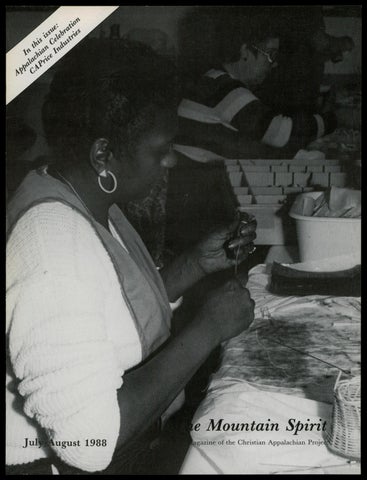
The July-August Theme Since the late 1970s, a m ajo r th ru st of C A P ’s activity has been program s th at w ork w ith and for han d icap p ed people, both children an d adults. As you will learn from the story about C A Price Industries, C A P ’s w ork w ith adults has had trem endous grow th in a relatively b rief period of tim e. O n the C O V E R , a trainee at C A Price in Stanford fashions a cornhusk flower (photo by C orsale). O n the B A C K C O V E R , sum m er vegetation in A ppalachia.
P ublished by the C hristian A ppalachian Project. E ditor, M a rg aret G abriel. A d visory B oard, F ather R alph W . Beiting; M ike M cL au g h lin ; Leslie B. L arsen; Bill Begley; R a ndolph Jo rd a n . G raphics C oordinator, D ebbie Fraley T u d o r; C irculation M anager, T h eresa R ichey. The Mountain Spirit is published six tim es a year. T he an n u al subscription price is $5.00. S ubscriptions and o th er correspondence should be sent to The Mountain Spirit, C h ristian A ppalachian P roject, 322 C rab O rch ard R o ad , L ancaster, K entucky 40446. C opy rig h t, 1988, the C hristian A ppalachian P roject, Inc. All rights reserved. M em b er, C atholic Press A ssociation. T h e C h ristian A ppalachian Project is a non-profit C hristian service organization o perating th ro u g h o u t E astern K entucky. T h e project operates on the philosophy th at “ helping people help them selves” is the best approach to A ppalachian poverty.
From Our President I have met many exceptionally fine people working for CAP, and were I to write about each of them, it would undoubtedly fill more pages than you would care to read. With this issue centering around the handicapped, I thought it would be appropriate to recall one of these fine people, to recall our beginnings in programs for the handicapped, and to reflect upon what has transpired these past ten years from such small beginnings. Jack Heyne is one of those exceptional people. I first met Jack in the winter of ’79, and was im mediately impressed. CAP had grown a lot from 1974 to 1978; we had started many fine programs, and we wanted to do something with and for the handicapped. But we lacked the expertise and wisdom ourselves to know just where to begin, and frankly, were wallowing a bit, unable to press forward with anything substantial or positive. In to this kind of atmosphere, Jack Morris—then our director of human development —walked into my office and said he had someone he thought I should meet, and could I spare ten minutes or so? And I met Jack Heyne. Jack was an optimistic young man, with enthusiasm, obvious sincerity, and a desire to serve. His pragmatism and realism struck me most of all: he had no great and grand designs to bring to our organization, but seemed as though he wanted to help us get started. No ini tial moves were too small, so long as they headed us in the right direction. In short, he seemed made to order for us. He was young as CAP was young, probably in his late twenties, with a good college background in rehabilitation studies. He had appropriate ex perience in work activity and sheltered workshop programs. And, as an afterthought, I should men tion that Jack was handicapped, having lost the use of his legs in a automobile accident as a teenager. That was one of the most remarkable things about Jack. His own handicap was seem ingly unimportant and it never appeared to matter in my subsequent dealings with him. Some people have that knack: as though they have always been a part of the CAP family. They forget about their own problems and focus on the work at hand. We had no budget but had some unused space in several of our “Attics.” We knew of many in dividuals, who could use work activity ex periences, from our relationships with Kentucky’s Comprehensive Care/Partial Hospitalization pro grams who were renting space from us. From these basic elements, Jack and we began to Ju ly -A u g u st 1988
fashion a program that would help these people relate to the world of work, and begin to give CAP an entry into the world of the handicapped. For the first year we remained small, serving only four people in each of two Attic locations. They cut materials for quilting out of used clothing, remov ed buttons for household use, made foot stools out of wood and rope twine, made macrame lat tice for hanging plants and most any other activity that came their way. We grew slowly and we learn ed. Our first budget for this program was about $16,000. And while we were learning, we were ex ploring other handicapped programs as well: a group home for deaf boys, summer camps for the deaf, a residence for retarded adults, a homebound program which taught parents how to help their handicapped children, and residences for multiply handicapped children. When I look back on these programs, I am amazed by their growth. What we began in ’79 with no budget, has now matured into seven ma jor programs (with segments in many other of our programs as well), representing a total budget of over $600,000, employing 25 full-time persons, and easily serving over 200 handicapped people on a regular basis. I am proud of our growth, and what we have been able to accomplish. I have not seen Jack Heyne in six years. He left to assume a position in the Dakotas, his original home. I think he would be surprised at how far we have come in these intervening years. I think he would be proud to have been a major participant in what has come to pass. And I, for my part, am enriched by the experience —and pleasure —of working alongside a fellow such as Jack. 3
R eaching G oals— R eaching P oten tial
by Margaret Gabriel
Y o u have often heard the work of the Christian Appalachian Project described as “helping people to help themselves.” CAP dedicates itself to helping people make the most of the potential that God has given them —to allow them the opportunity to make choices about their lives, to learn to take advantage o f those opportunities in order to make the most of His gifts, and to give something back.
C orn hu sk flow ers are p rod uced at C A P rice In d u stries as part o f the jo b train in g program for h a n d icap p ed ad ults.
The Mountain Spirit
T h e p u rp ose o f the w ork sh op is to teach h an d ica p p ed in d iv id u a ls jo b sk ills.
In order to make opportunities available to people who are handicapped, CAP operates CAPrice Industries, training workshops in Stanford and Somerset. The Stanford workshop produces cornhusk flowers; the Somerset workshop is in the food preparation business. By providing the opportunity for work activity and job training, CAP works in partnership with disabled people. Ric Armstrong, program manager, explained, “We deal with a lot of things, not only the work skills, but changing behavior patterns. With some people, it’s just that they talk too much. I guess if you’d walked through there [the workshop] six months ago, you would have been stopped and asked, ‘what’s your name? who are you?’ and told who they are. You just can’t do that in a work setting, and here we teach that.” Tony DeLeon, production supervisor for CAPrice Industries in Stanford, explained, “The purpose of the workshop is to teach handicapped individuals job skills. If a person has a verifiable handicap —an emotional, physical or mental hand icap-then they’re considered handicapped for the job. This is a training workshop, so an individual comes, not necessarily to learn how to make flowers, but to adjust to the work environment. The person learns how to come to work, how to punch a time clock —responsibilities are our major area of focus.” Regardless of the nature of a person’s handicap, all are referred to the workshops by a health pro fessional, usually a psychiatrist or a psychologist. In order to establish a production level, and to assure that the necessary level is met, several non handicapped people are employed by CAPrice in Stanford and are credited with helping to establish and maintain the high rates and outstanding quali ty of the flower production in the workshop. According to Ric, trainees in the Somerset workshop are more severely handicapped, which is one reason for the different work training pro Ju ly -A u g u st 1988
grams in the two locations. Several of the workers in the Stanford workshop are residents of the CAP Group Home. Although the boys are not physically or mentally handicapped, Tony and Group Home manager Robin Barnard agree that CAPrice is a good work setting for the boys. “The primary focus for the boys is work adjustment,” Robin said. “Most of these guys have never worked before, and so they’re learning to stay on task, how to follow in structions, and to respect authority. One thing that I find the most valuable about the work is that the boys don’t really enjoy it. Making flowers teaches them the value and the discipline of work ing for the sake of work, as a means to an end. Also, since they’re paid by the piece, they soon realize that the more they produce, the more they’re paid. “We like the setting, too, of the boys working with handicapped people. It gives them a sensitiv ity and compassion that they might not have otherwise,” Robin said. The boys’ level of production is one of the reasons why the production of cornhusk flowers has been so successful. CAP has produced cornhusk flowers for nearly eight years, but in the last three, Christmas Ridge Handcrafts, the product marketing division of CAP, has propelled CAPrice Industries into the largest supplier of wholesale cornhusk flowers in 5
Left, h o u se k e ep in g is ane course o f study at C A P rice in d u stries in S om erset. Below rig h t, an oth er train in g course is in food p rep a ra tio n .
the country. As sole supplier of Christmas Ridge’s cornhusk flowers, CAPrice has changed its role slightly. Or not its role; it might be more accurate to say that it’s changed its attitude. In 1984, CAPrice was a work activity program for hand icapped people. Production of cornhusk flowers was strictly secondary, a by-product. Today, CAPrice’s primary focus remains service to hand icapped people as they acquire skills and attitudes needed to function in community jobs, but the “by-product” is enjoying impressive success, because a demand has been placed for a high quality product produced in great volume. The workshop has risen to the challenge.
hand/eye coordination. Our goal is to employ more severely handicapped people [in Stanford], but before we can get to that stage, we have to in vent new machines, we have to do all kinds of things for people to be able to meet the demand.”
Since September of 1987, Christmas Ridge has shipped 7210 dozen cornhusk flowers —86,520 pieces produced by workers at CAPrice In dustries. “It’s very logical to say we’ll ship over a hundred thousand flowers this year,” said Bernie Hale, CAP marketing manager. Bernie went on to say that Christmas Ridge will be able to sell as many flowers as CAPrice can produce. “(When we started to go into a higher selling profile) we didn’t know whether they could keep up with the de mand, but they geared up, and now they can ac tually produce more than we’re selling at the mo ment.”
The quality of the product has made the flower a big seller, Bernie said. “When we market flowers, we market them on their own merit. In our wholesale market, the reason we use a more commercial name is that we feel that the products will stand on their own in the commercial market.
The increase in demand will require an increase in production for CAPrice, of course, so Tony has plans in progress that will enable the workshop to meet the increase. “Flower production is very dif ficult, it’s very tedious and requires great 6
Tony already has the invention of one machine to his credit —a press which cuts flower petals. “We’ve got a pattern, but some of the people can’t hold the pattern in their hand and cut around it with scissors.” He calls the machines “production multipliers,” that are designed to assure both the rate and the quality of production.
“When people are interested, we like to tell the CAP story, but we use it as purely a secondary selling message. The flowers really do stand on their own in the marketplace for their quality and price.” Pat Padgett, administrative assistant for the marketing department, works at many of the shows where Christmas Ridge’s wares are displayed to wholesale buyers. While Bernie points out that the flowers primarily sell because of their unique beauty, Pat adds, “You don’t The Mountain Spirit
always tell people that the flowers are made in a sheltered workshop, but you can sense the people who would be interested. Some people will buy because of that. They’ll have handicapped children, and are very interested in CAPrice.” While the CAPrice workshop in Stanford con centrates almost exclusively on cornhusk flower production, the Somerset trainees work in food preparation and housekeeping. “The program in Somerset is designed to give a marketable, transferable job skill,” Ric said. “One thing flower production doesn’t give, is that I can’t go to a business and say ‘they build cornhusk flowers, they’re going to do a great job in your business.’ In the employers’ mind it doesn’t relate. However, if I come to them and say, ‘they’ve been trained in food preparation, fast food, full service, they know how to bus tables, wash dishes.’ I can go to that section of the employment market and transfer our training to their needs.” During the first part of 1988, the Somerset workshop underwent extensive remodeling so they would be able to use their space effectively for food preparation. During this “down time,” trainees worked in the kitchen of the Children’s
July-A ugust 1988
Discovery Center, CAP’s child development center in Somerset. In so doing, CAPrice found a role for itself in the food preparation market. Now, instead of pre-preparing salads and produce for restaurants as they had planned, “we found our own market niche by preparing lunch meals for the Department of Education’s school lunch program. We also provide meals for Child Care Plus in Whitley City, a small community in Mc Creary County, and of course, for CAP’s new child development center in Eagle.” Ric proudly points to the high nutritional quali ty of the meals they serve. “We serve whole wheat bread and less starch, that kind of thing. That has proved to be a very lucrative area for bidding.” Despite the different types of work at the Stan ford and Somerset workshops and the difference in clientele, the goals of both CAPrice locations are the same. Although Tony and Ric realize that some of their more severely handicapped workers will probably work at CAPrice as long as they want to, the goal for the majority of the workers is to obtain employment in the community. The most important aspect of the workshops, to attain that goal, goes far beyond the actual skills that trainees gain in flower production, food prepara-
tion or housekeeping. “Each worker sets his or her own goal, with the assistance of the CAPrice staff people,” Tony ex plained, “including Ric, the work services counselor, myself, and whoever else is involved with that person.” For example, Comprehensive Care staff is involved with helping to set goals for their people, and the Group Home staff helps set the goals for the boys. “The goals are individualized, and depend on the person,” Tony explained. “If a person is lower functioning, then their goal might be to punch in, to stay on task; they might have personal hygiene goals. A higher functioning person might have job placement goals; working independently, filling out applications, learning to interview. We focus on the work adjustment skills that they need.” Tony said that they try to get as much input as possible from the workers, concerning goal set ting, but that’s not always a realistic expectation. “One of their biggest problems is that they don’t know how to set goals for themselves, they don’t even know what their goals are. We take them by the hand, and make them aware of what they need to work on.” Through talking and counseling, the CAPrice staff works to motivate people, “to make them aware of what they’re supposed to be aware of. It goes back to the basics —it always goes back to the basics,” Tony said. “You’ve got to teach respon sibility, but you’ve got to go one step back, and teach the purpose of work, the purpose of going to school. A lot of these people have become ac customed to getting a Social Security check, living on welfare, having people give them everything. It’s really hard for them sometimes to become ac countable and to take charge of their own lives.” There is an air of success about CAPrice In dustries, both in the workshop in Stanford, the largest producer of cornhusk flowers in the United States, and at the food preparation service in Somerset, which has placed five workers in jobs in the community since last summer. Many non handicapped people have united to help bring about this success, but the credit belongs with the trainees in the program, who are working hard to achieve their potential. c a p.
A b o v e, w orkers at C A P rice In d u stries w ill m ake n early 1 0 0 ,0 0 0 cornh u sk flow ers b efore the en d o f th e su m m er. T o n y D eL eo n , p ro d u ctio n co o rd in a to r, calls flow er p ro d u ctio n “ ex a ctin g w ork that req u ires great h a n d /e y e c o o r d in a tio n .” B elo w , the fin ish e d p rod u ct, read y to sh ip .
The Mountain Spirit
Letters In your last issue, there were a couple of letters commenting on Fr. Berrigan. I felt stung and angry by the attitude they display. Again, as so tragically often, people who smugly —or proudly, or even in their own versions of good inten tions—consider themselves “good Christians,” utterly misread the Gospel. The message of the Prince of Peace was so insistently one of helping, of mercy, of forgiveness, of inclusiveness, of acceptance, of non-judgmentalism. But there was far more than just that! If we believe that Jesus the Christ was the Son of God, of Almighty God (no less!), we better pay close attention to what he said. And what he did. And to what he let be done. For the Passion is the story of a young man who allowed himself to be “handed over” (the correct translation of the Greek of the Gospels) when he could have run away, or he could have fought, or he could have mounted a strong defense. He did none of these things. We must look at our world and its many weapons and makings of war (I write as our troops are in Hon duras), and look at the same time at the Revelation of the Passion of our Lord Jesus. The Lord showed us, in his own broken body, the violence that we commit. We crucify our God. We always continue to crucify him, because we do not want to hear the Word. The Word reveals to us our own viciousness, and we’d rather not know. That, I think, is what Jesus meant by the “they know not what they do” phrase! But he was willing to be racked and torn in order to show us, so that we could finally turn away from our violence. So, the kind of letters that totally misunderstand that the Berrigans, and others like them, have really read the Gospel, and are really out there against the world and its violence, are ready always to be Ju ly -A u g u st 1988
“handed over” in order to remind the rest of us of the Revealed Word, those letters I feel are part of the very violence of the world that Jesus died to reveal. To want to believe that devastating nuclear weapons are making us safe and peaceful is part of the message of evil. To work among the poor of Appalachia or the urban ghettos and to stand against any and all machines of war are two sides of the same Gospel. To avoid seeing that is to avoid hearing the man on the Cross. But we always do that. The Divine Word is Peace, and that takes more love than we have. Louise Masri Menlo Park, CA
I surely do enjoy The Mountain Spirit. I about wear it out —reading and rereading it. What a remarkable place it is —and what great workers you have there. If I were 50 or 60 years younger, I’d love to spend a while there, just seeing what I’ve been reading about for several years. Blanche Utley Croswell, Mi
The March-April issue was very impressive to me. It was interesting, informative and professionally presented. As a retired teacher of child care and development in secondary schools, I realize the im portance of education for parent ing . . . The programs of CAP which in volve small children appear to be of good quality, and your philosophy of helping people help themselves is commendable. The program covers such a large area of Appalachia, that it would be difficult to visit the various facilities to see the needs be ing met; however, your magazine
did a splendid job of helping the reader to feel that they were actually there . . . May God richly bless you and all the other dedicated people at CAP. Dorothy Ginn Lakeland, FL
We are inundated with requests from those in need. It is impossible to help everyone, but something about the Christian Appalachian Project appeals to us. Perhaps it is the sweet spirit that I feel when I read The Mountain Spirit magazine. I hope it is the spirit of Jesus. Some day I hope we can visit you —perhaps to lend a hand. My husband is a pediatrician and I am a teacher. In the meantime, we feel close to your people by reading The Mountain Spirit and by contributing financially from time to time. Diane Dugan Bedford, NH
Having been born in Garrard County and living there for more than twenty years, I can relate to the people you write about in The Mountain Spirit. You are truly do ing God’s work, and I am sure it is appreciated by the many your pro gram has touched. I wish you continued success in your endeavor. Floyd L. Crank Houston, TX
Letters to the editor are welcome.
They should not exceed 150 words in length, and we reserve the right to edit them fo r space. Address letters to The Mountain Spirit, Christian Appalachian Project, 322 Crab Orchard Road, Lancaster, Kentucky 40446. 9
T im e for
by Joe Foley photos from the CAP archives
C 'o m e summer, things begin to look dif ferent around the Christian Appalachian Project. The office is quieter and the volunteer quarters less full. Faces, familiar throughout the previous year, now show up only on weekends and then just to do laundry. Faces, unfamiliar, show up, too —and just to do laundry. What’s happening?
Camp Shawnee With the mountain peepers (frogs) and the locust blooms, come plans for six weeks of camp for hundreds of area children. Budgets are rehash ed and weed-eaters put into shape. Empty milk jugs, knee-deep in the volunteer kitchen after several months of careful accumulation, disappear in a glance, hauled up the mountain in lumbering vans to Camp Shawnee. All of the milk jugs make it. Some of the caps do.
“I was convinced that it was through children that we could really do something good for Ap palachia,” Father Beiting says. “We were helping people out with clothing. We were helping them out with food. But these weren’t permanent solu tions—they were respites. “Children, it seemed to me, is where we ought to begin. They naturally are attracted to heroes, to people who are different, to people who are trying to do good things. So they’ll pay attention to you. If you keep after them in doing the good thing and are loving towards them, they’re likely to take it seriously.”
Beginnings
Four counties west, in Jackson County, much the same is going on as Camp Andrew Jackson also gears up for its summer retinue of campers.
Father Beiting first began his work with Ap palachian children in summer Bible schools, an ac tivity still sponsored by CAP. But as the populari ty of the Bible schools grew, Father Beiting foresaw the need for an expanded role with area children. He thought about starting a summer camp.
Both camps, Shawnee and Andrew Jackson, are operated by the Christian Appalachian Project. Both are the result of the work of Father Ralph Beiting, CAP’S founder and chairman of the board.
In 1957, a large farm on Herrington Lake, in Garrard County, was being divided into house lots. With the help of family and friends, Father Beiting was able to buy a number of the lots right on the cliffs of the lake, providing enough land for
10
The Mountain Spirit
the erection of several buildings and the creation of a lakeside recreational area. He named the camp Cliffview. The look of Cliffview its first year, was indeed different than what CAP’s children’s camps would evolve into in the future. For one thing, there were no girls. “That year, my associate and I were the only counselors we had,” Father Beiting says. “We were scared of girls, I guess. How do you take care of them? But we learned very quickly that it wasn’t fair to just take the boys in. We wanted to expand to include girls, and to do that, we had to get volunteers.” Heeding Father Beiting’s call for help in this particular area of expertise were many of his relatives —female relatives, aunts and cousins. Also coming down to volunteer were his parents, and other friends interested in joining the work that was starting. As the success of the camp increased, and Father Beiting’s reputation grew throughout his four county parish, children began coming to Cliff view from as far away as Jackson County, over 60 miles away. In response, Father Beiting began thinking of another camp, this one to be located at the other end of his parish territory, in moun tainous Jackson County.
Camp Andrew Jackson With the help of some Lexington families, Father Beiting was able to buy 100 acres and begin construction on what would be called Camp An drew Jackson. The camp’s beginnings were stormy. In the midst of other difficulties involved with the start up of the camp, arsonists on Halloween night, 1965, torched two of the camp’s three buildings. “We eventually found out who the arsonists were,” Father Beiting says, but it would have been hard to prove. “It was pointless to spend all our time in litiga tion. We just simply took our losses and went back and built bigger.” The camp, when built back, included a dam, a lake, two large A-frame buildings, and playing fields. This summer, Camp Andrew Jackson will offer six one-week camps, with up to 85 children from a nine-county area attending each week. In addition, a seventh week of camp will be offered for children suffering from Prader-Willi Syn drome, an eating disorder. For this seventh week, the children will be accompanied by their parents and will be introduced to a specialized diet. Although many of the children attending the
C liffv ie w L od ge in Garrard C o u n ty , a su m m er cam p for b o y s, w as the first C A P program that F ath er B e itin g started.
The Mountain Spirit
11
was held at Camp Rebecca Boone, a remote, lake side area a couple of miles from the main dock on Dewey Lake. The only way in was by boat —and twenty-five children attended. The following year, Father Beiting was able to finalize an arrangement with the Boys Scouts of America and the U.S. Ar my Corps of Engineers. For years, the Boy Scouts had leased a 300-acre tract of land from the Corps to use as a camp. However, in recent years, the camp (known now as Camp Shawnee), had fallen into disrepair. CAP agreed to take over the lease.
camp come from rural areas, for many it is the first time they have actually been in a wilderness setting. Gary Johnson, who oversees the camp, tries to foster the awe that most of the children feel when first arriving. For instance, Gary will have each of the children adopt a tree. The kids find a tree that they feel has character, something to say to them, Gary explains. Then each child sketches the tree and is asked to write a short nar rative about it.
Since that deal was struck four years ago, the camp has been greatly improved. New buildings have been put up, ball fields and paths cleared, pools installed, and a dock emplaced. Seventy-five to 85 children are expected at each of the six oneweek camps, with 60% to 70% returning from previous years. One of the week-long sessions will be a specialized computer camp operated in con junction with Berea College. Each of the camps also includes a 38-mile boat trip on the lake and a night outing to dramatic productions at Jenny Wiley State Park.
“God’s nature was put here for our benefit and pleasure,” Gary says. “We’re to respect it and not abuse it. Within nature, God gives us so many learning tools. He wants us to be aware of what is here and the depth of it. We can grow closer to Him through the experience of what he has made.”
“It’s always a treat to take a kid to the theater for the first time because they’re used to watching TV and they’re used to going to the movies,” says the camp’s program manager, Gordy Johnson. “But when they go into the live theater and all of the sudden the musicians come in and the band starts warming up and the stage lights come on —you can see it in their faces, ‘what is this? I’ve never seen this before.’ ”
Camp Shawnee
Beginning last summer, Gordy began structur ing the camp around day-long activities of camp ing, canoeing, hiking, and a boat trip. He finds the children enjoy spending a lot of time on a single activity more than they do spending only a little time on many activities.
When Father Beiting moved into the coalfields area of Kentucky in 1981, to assume the leadership of a parish in Floyd County, he brought with him a knowledge of not only how to start and maintain a camp, but also of what a camp could do. “Camp gave us an entrance into the family,” Father Beiting says. “Before, we were comparative strangers. But once the kids came to camp and went back home and related all the stuff they did and how much fun they had had, some of the parents began to say, ‘well, what can you do for us?’ Again, camp served as an avenue to the parents.” Thus, when Father Beiting arrived in Floyd County, he immediately set about looking for a site for a children’s camp. He wanted to put a camp on a water site, both for recreational pur poses and because of the tradition established by Cliffview and Camp Andrew Jackson. Because the county is home to Dewey Lake, he began look ing there.
M
:
*
^
.. a * v ’ ' V
Within a short time, he had two camps, instead of the intended one. The first year’s summer camp 12
"'• *
M P Ii
“We sell it to them at orientation,” Gordy says. “I tell them these things are going to be hard and that it’s a challenge to complete these things. They seem to respond well to that. They like to know that they’ve really put forth effort.
,
psw*
“It is a challenge for kids to canoe all day. It is a physical challenge to go on a hard seven-mile hike. It is something a lot of the kids have never done. They’ve never set up tents. They’ve never cooked out. They’ve never slept in tents.”
V olun teers Since Father Beiting’s second year at Cliffview, volunteers have played an integral role in the operation of the children’s camps. Often times they make up over half a camp’s staff. “The volunteers not only enable us, from an economic standpoint, to operate the camps, but they also bring many talents and many points of view as they come from different parts of the country,” Father Beiting says. “It’s a wonderful way in which to create a little bit of Americana where all aspects of America are coming together. And it’s Appalachia where it is happening. “The volunteers are also important in that they convey a notion of caring. Camp isn’t just simply a business, it isn’t simply an efficient operation, it isn’t simply a good camp —but it is a loving camp, where these volunteers bring in a great deal of love. The kids know that. They can sense it.” Gordy agrees. “The counselors have to survive with each other for a long period of time. They form a bond bet ween one another that’s very strong, because they have to depend so much on each other. The kids also feel that they’re part of this bond. That’s why we have kids come back every year. That’s why we have counselors come back every year. They
■
■. ■V“'C . '■f-** ,>. x
develop friendships.”
Future Since the inception of CAP’S children’s camps over 30 years ago, most of the children attending have been poor. Many of the children come from foster homes or are referred by the Department of Social Services. Because of that, CAP has been very hesitant to charge any kind of fee. For in stance, at Camp Shawnee, parents or guardians are asked only to contribute $5 for each child they are sending. If, however, the $5 charge seems too much, it will be waived. Although Father Beiting is pleased at how far his camps have come, he still sees new challenges to be met. One of the biggest of these, is to in crease the mutual concern between the poor and the well off, the comfortable and the disadvantag ed. He thinks that camp, through the play of rich, poor and middle class children, can be a good tool to that end. Hence, he wants to broaden the economic background of children attending. “We can encourage these children to be much more open to new ideas, to be much more confi dent. We can help bring hope into their lives and a sense of partnership with the outside world through the volunteers. There is no question we can influence them deeply,” he says. “But, what we need to do is not simply take care of the poor. We need to get the whole community involved. If the rest of the people don’t associate with the poor, they’re certainly not going to have an idea of the difficulties presented to a family. We’ll never solve Appalachia’s problems, unless we get all the people conscious of them.” c a p.
I A b o v e, le ft, ca n o ein g is a p op u lar cam p a ctiv ity ; o p p o site p a ge, the ob stacle course in the w oods w as a ch allen ge to a group o f teen age girls at C am p AJ; le ft, k erS P L A S H !; a b o v e, rig h t, the o n ly access to C am p R eb ecca B oon e w as b y b o a t.
13
The C A P Closeup
H eid i Anne Porter Times o f Discovery
story and photos by Megan Corcoran
H e id i A nn e P orter
!People often wonder how Heidi Anne Porter wound up in Eastern Kentucky from her home in Anchorage, Alaska. A graduate of the College of New Rochelle, in New York, Heidi came to Kentucky equipped with her Bachelor of Arts degree in psychology, and a teaching cer tificate for elementary and special education. Heidi wanted to do more than teach in a classroom after her graduation. Instead of entering into a full time job, she looked into volunteering. CAP was the first and only application she sent out, although she did think of working in the Peace Corps or VISTA. Whatever clinched her decision to come to the mountains, likely was rooted when she was a young girl. Heidi constantly had her nose buried in the Laura Ingall’s Wilder book series, “Little House.” The pioneer spirit instilled in her as a child, has held steadfast to this day. In January of 1987, Heidi became involved in emergency assistance, and home visiting. “When I went on my first home visit, my immediate reac tion was ‘I want to go home.’ I was frightened by what I saw. I can remember one visit like it was yesterday. A young boy was so excited. He ran back to get this beat up old tape player, and out of 14
a tiny little speaker came the song, ‘The Impossi ble Dream.’ It struck a very disturbing cord within.” Heidi explains she was filled with many confus ing emotions that stemmed from what she found in her home visits: the dark and crowded houses, the blasts of thick coal heat from rickety stoves, the heat of the summer cradled between the hills, the dust, the despair. On the other hand, the same sights quickly became accepted as ordinary. “This place is filled with paradoxes. The good and the bad, the ugly and the beautiful, the hopeless and the hopeful.” Only after working in emergency assistance did Heidi come to realize the complex ities of the culture. “I had pre-conceived notions of good, bad, ugly and pretty. After coming here, I felt like a baby learning everything all over again. I had to re-learn all of it —ideas, attitudes, perspectives. I had to be open to letting go of what I had known before coming to the hills, and to be open to what God was showing me in this new place—Appalachia. “I’ve never felt so far from God than I have here at times. I had never known any real pain com pared to some of these people here. I felt so in significant in comparison to the pain I was witnessing.” The Mountain Spirit
However, Heidi went on to say that after the questioning periods, the times of re-discovery in God were that much more beautiful. Throughout the year, Heidi formed many lasting friendships. Her first reactions to the peo ple and the entire place, were normal ones —ones based on shock and disbelief. As friendships grew, she became aware of the inner beauty of the peo ple of the hills. “As I got to know them, the people take you in as their own —as a part of their family. Whenever I felt homesick, all I had to do was go and visit or pick up the phone, and the homesickness was quickly cured.” Heidi was in the midst of deciding whether to work as an employee in emergency assistance, when a tragic accident rocked Martin. A young brother was shot to death by a member of the family. Heidi knew the boy very well through volunteer work at the Youth Center in town, where she volunteered her spare time. With the ac cident, she realized that a job at the Martin Youth Center was the job she must take. It seemed to be the perfect place to meet the urgent needs of children, a place to instill a spirit of love and positive perspectives. “I knew I’d miss emergency assistance, but I couldn’t ignore this vast oppor tunity. I had to take action.” Heidi began working full time at the Martin Youth Center as program coordinator in January of 1988. As coordinator, Heidi has started several pro grams at the center, including ballet and drawing classes, arts and crafts, tutoring and rap groups in which the immediate concerns of children such as feelings, uniqueness, parents, sex roles and drugs
H e id i b egan a b a llet program at the center.
are discussed. To be introduced are more familyoriented activities and a Bible study group. Heidi’s desire to free children from society’s mores has stayed with her through the rough times in the new job. Yet, the rough times are hurdles for her to overcome. The vision Heidi holds for the kids at the center feeds her on-going deter mination to make it all work. “I used to be around the Youth Center a lot, before I took the job, just playing and hanging out. Now that I am here full time, I find that many of the children resent me at different times.” Heidi said that this kind of resentment stems from her position as a disciplinarian and teacher. “At some point, all children will resent both of these. I ex pect a lot out of these kids and this, too, can cause resentment.” Heidi’s job at the Youth Center is not the kind you can leave behind at the end of the day. “Some kids call me in the evening just to talk or to cry. A lot of the kids stay on your mind, and I do worry about them all. I’m not sure what they go home to at night, and that worries me too.”
H e id i w orks at the M artin Y ou th C en ter. Ju ly -A u g u st 1988
Heidi’s overall goal for the Youth Center is “to instill these children with healthy ways of coping. All they see around them are unhealthy ways of coping with life. In this complex culture, it is near impossible for a child to deal successfully with all the strains and depression. My job is to show them the way, that there are other ways of dealing with stuff, and there are ways of finding solutions, positive ways. When visions are put into words, they often sound ‘corny,’ but my vision is to equip these kids with the tools they need to work for a freer Appalachia . . . ” 15
Appalachian A rts and Culture
alachian Celebration
b y M ari W ojahn s courtesy o f M SU
I t ’s the down-home warmth echoed in songs of mountain musicians; the ageless tradi tions heard as feet dance on a wooden floor; the gentle spirit of the region woven into stories, poems and books; and the friendly smiles of a people proud of their Appalachian heritage. All of these ingredients are a part of the Ap palachian Celebration, a summer festival held each year during the last week of June, on the campus of Morehead State University in Morehead, Kentucky. The twelve-year-old celebration presents traditional music and dance, storytelling and poetry, and arts and crafts that focus on the rich cultural heritage of the region. The Appalachian Celebration is, for many who participate, a unique learning experience. Visitors come for the fun and part with a deeper understanding of the skills and traditions of the mountains and the values that shape Appalachian culture. The rich folk art and craft heritage of Ap palachia that has been an important part of every day life for many generations has also been a vital part of the celebration from its start. Workshop 16
classes in basket making and spinning and weav ing, coordinated by MSU’s Department of Art, are taught by celebration guest artists. MSU’s own folk artist in residence, Lyndall “Granny” Toothman, a native of West Virginia, has par ticipated in the celebration for several years by demonstrating her skills and often “spinning some yarns.” Granny has been weaving and spinning natural fibers since 1935, and specializes in using exotic fibers like dog llama hair. Her knowledge and experience in a variety of folk ways are a special part of the celebration. Granny Toothman’s weavings and garments are just one element of MSU’s Folk Art Collection, an exciting exhibit for celebration-goers and the public to enjoy. The only one of its kind in Eastern Kentucky, the collection features works by established and emerging Appalachian artists and provides a unique opportunity to examine and learn about the folk art of our region. Included in the display are quilts, wood-carvings, decorated gourds, hand-made musical instruments, paint ings, baskets, sculptures, models and hand-crafted tools that reflect the experiences, beliefs, and social The Mountain Spirit
identity of the region. A perfect complement to the celebration, the collection serves to promote Ap palachian heritage in its dedication to the education of future generations and to the preservation of a culture which must not be lost. One high point of the celebration was the Arts and Crafts Market where regional folk artists and craftspersons gathered to sell their handmade and homespun works. The Arts and Crafts Market is one of the most successful and popular components of the celebration and has grown to include over 100 exhibitors and to attract several thousand potential customers. In addition to the Market, festivities that closed out celebration week includ ed: the Open Outdoor Stage, featuring bluegrass music, storytelling and more; a farmer’s market; a knife and tool swap; and Appalachian food booths. Music and dance are central to Appalachian life, and both played an important role in the celebra tion line-up. Some of the region’s finest traditional musicians and dancers took part as entertainers. Noon and evening concerts were scheduled each weekday and have featured such notable talents as the McClain Family Band, Trapezoid, Louise Mandrell, John McCutcheon, and 1988 welcomed coun try music’s popular Billy Edd Wheeler. Music and dance were also the focus of workshops at the celebration. MSU’s own Scotty McKee, a national clogging champion, performed and passed on some of the secrets of his fancy foot work in clogging and square dancing classes. Debuting this summer was a songwriting workshop taught by Billy Edd Wheeler, of “Ode to the Little Brown Shack Out Back” and “Coward of the County” fame. Billy Edd passed on tips to songwriters on the way up and gave workshop par ticipants an opportunity to interact with a profes sional who has “made it” in the music industry.
through and learn about these distinguished men and the Appalachia they wrote about and loved. Also in the library, are a collection of paintings of one-room schoolhouses, a photo collection of vin tage fiddlers, and books about the region in the Appalachian/Kentucky Collection. For a decade, the celebration has included the Jesse Stuart Symposium, which focuses on the life and works of one of Kentucky’s favorite authors and is coordinated by MSU’s Department of English, Foreign Languages and Philosophy. The Appalachian experience as reflected in Stuart’s writing, is presented in lectures, readings, discus sions and displays. Guest speakers in 1988 includ ed poet Albert Stewart and Loyal Jones, director of the Appalachian Center in Berea. Mr. Stewart and Mr. Jones also participated as 1988 celebration Scholars-in-Residence, with Stewart presenting poetry readings from his book “The Untoward Hills,” and Jones conducting storytelling sessions. Both gentlemen shared their insight and knowledge about Appalachia. The hills truly come alive each summer on the campus of Morehead State University, with the sounds of mountain music and much more. The annual Appalachian Celebration is an experience to remember, where visitors come to listen and learn, to sing and sashay, and when the week is over, take with them discoveries and friendships that illustrate the heart of Appalachia.
An integral part of each of MSU’s Appalachian festivals is the comprehensive combination of ex hibits and demonstrations. Exhibits of Ap palachian memorabilia, collections and antiques, and demonstrations of traditional mountain skills, like corn grinding and candle-making, are presented as a tribute to the past. Other popular exhibits are the special collec tions located in the Camden-Carroll Library. These permanent displays include the Jesse Stuart, James Still and Roger Barbour Rooms, which are available for celebration visitors to browse
D em o n stra tio n s o f th e fin e art o f m ak in g K en tu c k y h and crafts is an im p ortan t part o f the celeb ra tio n at M oreh ead S tate U n iv e r sity . Ju ly -A u g u st 1988
17
Random Thoughts Our third child, born August 13, 1967, was a very beautiful child, and we didn’t realize until he was about a year old, that he had an 80 % hearing loss. Of course, none of us were used to com municating with a deaf child, and we quickly learned that all you need is patience, patience and more patience. I’d like to say that I always had the patience to take the time to explain everything to Denny, but I didn’t. There were times when I ask ed “Why me? Why do I have to do this?” For tunately, those times were few, and usually I did have the patience to teach, constantly teach, Den ny the things that he would need in the hearing world. Denny helped, too, because he never hesitated to ask people to repeat themselves or clarify something until he understood. From the very beginning, all the family assured Denny that he could do or be anything he wanted, that he would be only as handicapped as he allow ed himself to be. That attitude has encouraged him to work hard and enabled him to achieve much. Denny appreciates the simple things in life, and he has taught every member of the family to be more observant of just what is important. I’m sure that teaching us this blessing was one of the many reasons that Denny was sent to our family. We have each shared a part of our lives teaching Den ny, but I’m sure he has taught us more, much more. When Denny was very young, we realized the importance of the education of a deaf child. It was crucial that all of our work and dreams for Denny be reinforced in an academic setting. The philosophy at the Lexington Deaf-Oral School ap pealed to us, so Denny started school at age four. After pre-school, we had to decide the best step for Denny to take next. Because of his work in an oral school, his language skills were good, so we made the difficult decision to send him to an oral elementary school. Difficult? Yes, it was. The school we decided on was the St. Joseph Institute for the Deaf in St. Louis, Missouri, which meant that he had to leave us and live in a dorm when he was only seven years old. A few people asked me “How can you do this? Send this child away when he’s so young?” The tide of public opinion didn’t make the decision any easier, and several times we almost lost sight of our goals for the future in favor of having our baby home with us. It wasn’t easy, but we had to make a decision based on what Denny needed at the time, and what he would need for the future. 18
Many times during the seven years that Denny lived in St. Louis I asked myself “have we done the right thing?” What we chose for Denny isn’t the answer for every deaf child, but I believe that it was a good decision for Denny. His independence has led to a “there’s-nothing-I-can’t-do” attitude. Although Denny had great academic success, we found this independence to be an excellent foun dation during his formative years. He entered St. Joseph with tears because he had to leave his fami ly, and he graduated with tears again, because, as he put it so well, “I am leaving my second family, whom I have grown to love and appreciate.” During his high school years, I, once again, had a teenager in the house, when we decided the Ken tucky School for the Deaf would be the best high school for Denny. Luckily, it’s close to home, so our family was together once again. Denny’s high school days were fun and challenging. He had always worked very hard, and several times he was rewarded for this hard work with awards and permission to take classes at Dan ville High School. As he finished his work at KSD, we had another decision to make —where should he go to college? The search was different this time. Although Donald and I searched for what we thought was best, Denny was old enough to share in the deci sion, and not only did he share it, he made it. We decided on what we thought would be best, but Denny had other ideas. This time, we honored Denny’s decision. He has just finished his first year of college at the National Technical Institute for the Deaf in Rochester, New York. His major is computer science, his grades were good —a 2.7 GPA —and he’s started to spread his wings in the adult world. When he left home for the second time, I realized the difference between sending a little boy away to school and sending a young adult away to school. It was different, but it sure wasn’t any easier. Everything has not always been wonderful. There have been some bad times, but the good times outweigh the bad many times over. Deafness, like any other handicap, is only a hand icap if we let it be. When I first started to teach this attitude to my son, it was a shot in the dark, really. That could have been all wrong. But now, I can see how Denny has lived that attitude, and looking at his success and achievements, it seems that we were right after all. —JSB. Jean Brown is CAP’S purchasing manager. A t one time she was the assistant editor o f The Ken tucky River Soundings. Ju ly -A u g u st 1988
A round the Project
by the CAP News Service
M C A H ig h School T akes a H iatu s MARTIN—The board of direc tors of the Mountain Christian Academy came to a painful decision recently, when they decided that it would be in the best interest of the academy to suspend operation of the high school for two years. “As much as we’re convinced that a high school is needed and has so much to offer, faced with our finan cial problems, we decided to con centrate on the grade school for a two year period, to try and instill a spirit in the school that will create a greater demand for the high school,” said Father Ralph Beiting, founder of the MCA. “All of the board members are quite sad about the decision that we had to make, but it was a unanimous vote. We still believe in the necessity of a high school, but we recognize our limitations. At this point, we believe that it’s important to finish building the classrooms that we’ve never been able to afford to finish. If we take it from that point, we’ll be in a better position to achieve what we want to achieve. MCA faculty member, David Bourne, is setting up outreach pro grams that are designed to keep the MCA high schoolers in touch with each other, to maintain the sense of community that has been establish ed in the school. “We’re hoping to concentrate more resources on the pre-school and the grade school,” Father Beiting said. “For example, in many of our families, both parents have to work and have to be at their jobs by 7:30, so parents with children in grade school had to make other ar rangements for their children before 8 or 8:30. Next year, we plan to have a teacher at school at 7:00 so that parents can bring their children in early and know that there will be an adult there to work on activities Ju ly -A u g u st 1988
E igh t y o u n g p eo p le grad u ated from the M o u n ta in C h ristia n A cad em y in M ay o f 1988. S ix w ill go on to co lleg e.
with their children, or to help them with some extra schoolwork. We’ll have the same arrangement until 5:30 in the afternoon, so that parents won’t have to hire a babysit ter for after school.” Father Beiting said that by in providing this ser vice, the MCA board and staff believe that they are more directly serving the needs of the area. They also hope to strengthen and improve several aspects of the cur riculum. “We hope to have some senior citizens come in and help with some teaching,” Father Beiting said. Senior citizens are a great resource, he went on to say, and the Mountain Christian Academy is very excited about tapping into the storehouse of knowledge and experience that older people have to offer students. Father Beiting said that during the high school’s two year hiatus, they will concentrate on some addi tional fund raising projects. “The local people have started brain storm ing to come up with some ideas about how to raise money locally. We lost some strong financial sup porters when the economy here went
bananas, so we’ve got to get more people involved locally.” The MCA family —students, teachers, parents, supporters —will be working hard during the next two years to reopen the high school, and to assure that when it does open, the high standard of academic ex cellence will be maintained in grades pre-school through twelve.
E d ito r ’s N otes Through a proofreading over sight, the group on page four of the May-June Mountain Spirit was identified as students. The group is the tutors who work in the adult literacy program in Floyd County. The Mountain Spirit was honored in May by the Catholic Press Association, winning first place among mission magazines in the category of General Excellence. The judges said, “The magazine gives a genuine sense of the Church of the People. Thematically arranged, each issue encourages a penetrating, rather than superficial, study of some real concern.” 19
around the project . . . continued
P A T F am ilies P articip ate in W orkshop LOUISVILLE —A sense of isola tion is often one of the most dif ficult aspects of life for families with handicapped children. In small communities, there may not be other handicapped children, or a parent is so involved with the care of his or her own child, socialization with other families may not be possible. Enabling parents of handicapped children to meet and share was one objective of a weekend conference sponsored by the Department of Education Office of Education for Exceptional Children in late April. Kathleen Leavell and Judy Brooks, teachers in Parents-AreTeachers, CAP’S homebound pro gram for handicapped p re schoolers, accompanied three families to the statewide conference for parents of handicapped children. Peggy Cook, manager of Parents-Are-Teachers, was involved in planning for the weekend. She said that there were accomodations for 500 parents to attend and they had applications from 1000 people. “We had 200 free spots,” Peggy said, “and they were gone in three days.” The keynote speaker, Norb Ryan, has cerebral palsy, and is affiliated with the Child Development Center of the Bluegrass, Peggy said. “He talked about what it was like grow ing up with cerebral palsy. He told the group that it wasn’t until he got away from his parents, and lived in an institution for three years, that he learned of his capabilities.” Kathleen described Norb’s talk as “wonderful and hilarious. It was ter rific to see parents learn just what their children might be able to do.” Kathleen said that the parents of handicapped children in the pro gram learned what they can look forward to concerning the skills that 20
their children might acquire. The importance of support groups was emphasized, and parents learned how to access resources that are available. “The parents said they were ab solutely thrilled that they went,” Kathleen said. “Most said that they don’t feel that they are alone with their problems and they no longer feel intimidated by their child’s hand icap. Being around other parents who have handicapped children made them feel very supported and charged up.” Peggy and Kathleen both said that they believe that the best aspect of the weekend for parents is that they learned that their children not only have disabilities, but many abilities as well. “We heard many, many success stories,” Kathleen said, “so people got an idea of what their children can do.”
T een C enter Goes on Spring Break L A N C A S T E R —F o u r t e e n teenagers from the Garrard Teen Center, along with staff members, went to Tampa, Florida, during their spring break. Teen center manager, Julie Williams LeBrun, and her assistant, volunteer Geoff Kledzik, are both from Tampa, and, through connections, were able to find affordable accomodations for the group —a retreat center that they could use by just giving a donation of what they could afford. The teens worked hard to earn money for their trip. “We set down some rules for the kids early on,” Julie said. “Those that would like to go would have to earn it. They would earn it by participating in the teen center at least once a week in a structured activity; not be kicked out of the center for bad behavior; and they would have to participate in all fund raisers.” The center held several events to earn money for the trip, including a
G eoff K le d z ik clo w n s arou n d on the b each w ith the teen s.
chili supper, a garage sale, car wash, and a spaghetti supper. They also held a rock-a-thon, where the teens rocked in rocking chairs for a twenty-four hour period and had money pledged by donors. The big gest money-maker, according to Julie, was a Christmas tree sale. “Every day of the trip had a struc tured activity,” Julie said. “The first day, we toured Tampa and went swimming at Geoff’s parents’ home. Tuesday, we went to Busch Gardens and then had dinner with a church youth group. On Wednesday, we went to the beach for the first time and had supper at my parents’ home. We went to another beach on Thursday, and then shopping at the malls, which is what a lot of the kids wanted to do. We had supper at our home church on Thursday night. On Friday, we went to Adventure Island, a water theme park, and ate at a steakhouse. “It really was a successful trip,” Julie concluded. Teens in this area don’t often have an opportunity to travel, and Julie believes that they combined a good time with their new adventures. The Mountain Spirit
around the project . . . continued
H ea lth Fest ’88 BEREA —The Emmaus Christian Life Center in Berea, celebrated Older Americans’ Month with a health fair at the center, on May 2nd and 3rd. Peggy Patrick, program manager of the Emmaus Center, and Susan Scott, manager of CAP’S elderly program, combined forces to pro vide an educational, two-day “Health Fest.” “It started out as a mini-health fair,” Peggy said. “And then, so many heal t h pr of es s i onal s volunteered their services, we turned it into a major health fair. We had to turn down a few of those who volunteered, because we just didn’t have enough room.” Among the health care profes sionals attending were several registered nurses, a midwife, a physical therapist, a nutritionalist and a nursing student. During the fair, these professionals gave talks on health problems that seniors might experience. They also gave health tips, helped plan well balanc
ed, nutritional diets, handed out recipes for low sodium and low cholesteral diets, and demonstrated exercises that were designed to im prove mobility and general health. Participants were tested for their blood pressure, pulse rate and blood sugar, and given a demonstration on breast self-exams.
H elp Father B eltin g G ive A ppalachian C h ild ren A C hance
Peggy and Susan showed educa tional films on arthritis; how to use medicine wisely; eating for your health; and accidents that can hap pen in the home, such as falls and fires. The seventy-four participants came from Madison, Garrard, Lin coln, Rockcastle, Pulaski and Jackson counties, mainly through the efforts of CAP volunteers. The volunteers invited the seniors, who are involved in the elderly program, to the health fair, and provided them with transportation. “It was an excellent and fun ex perience,” said Peggy. “As well as being an educational and infor mative day, it was also a social day for the seniors.”
W e believe th a t ed u catio n will b reak th e cycle o f p o v erty in A p p alach ia, an d we believe th at ed u catio n m u st start early. T h a t’s why C A P is involved w ith pre-school p ro g ram s. T h ro u g h th em , we w ork at giving th ree, four and five-year-old children o p p o rtu n ities th at they m ig h t not have otherw ise. W e n eed y o u r h elp, th o u g h . F or only $21.00 p er m o n th , you can be a sponsor o f the S un sh in e C e n te r, one o f C A P ’s six child dev elo p m en t centers. E very m o n th , y o u ’ll receive a copy o f the n ew sletter ab o u t the ch ild ren , th e ir activities, even som e o f th e ir w itticism s. M o st im p o rta n t, for only $21.00 p er m o n th , y o u ’ll have th e satisfaction o f k now ing th at you are h elp in g to b reak A p p a la c h ia ’s cycle o f p o verty and fru stratio n . ______ E nclosed is $21.00 for m y first m o n th ’s sponsorship o f the S u n sh in e C e n te r. Please send m e a p ictu re o f the “ S u n sh in e rs” an d a descrip tio n o f the w ork th a t is going on in th e cen ter. N am e _________________________ A ddress________________________ C i t y ___________________________ S tate, Z IP ______________________ J /A 88-M S
Ju ly -A u g u st 1988
21
around the project . . . continued
on a farm. They grew or raised everything they ate and worked by the sun: when the sun went up at 5:00 a.m., they went to work, when it went down at 8:00 p.m., they quit. Their home was heated by the same wood stove that she cooked on. “She told me about the soap she used to make out of cracklings and lye. She told me that some people she knew used to wash their hair with lye soap, but when I wrote the story, I left out the word ‘soap.’ We had a good laugh over that.” Jane said that she read the ac count of the simple life to many of her other elderly friends who said, “That sounds like my life.” “I really feel like I’ve been living a different culture, a culture that’s almost gone,” Jane said.
M ichelle M cClure and Em m a Jean M ink were two of 46 people w ho graduated from the F a m ily L ife C en ter Sch ool in M ay o f 1988. It w as a sp ecial m om ent for M ich elle and E m m a J e a n , w h o are m oth er and d augh ter.
E ld erly Program R ev iv ed in P u la sk i C ou n ty SOMERSET-CAP was able to renew elderly home visitation in an additional county recently because of the presence of a volunteer will ing and able to take responsibility for operating the program. Jane Rothberg, a respiratory therapist from New Jersey, moved to the county and reestablished the pro gram, which was discontinued several years ago because of a lack of staff. Susan Scott, manager of CAP’S elderly program, said that Jane has been doing an excellent job. “She has 50 people enrolled in the program that she goes out to home visit on a regular basis. There are other aspects of the program that she hasn’t had time to get into yet, like medical transportation, but she helps people with shopping, chores and light home repairs. 22
“She started out visiting agencies and getting referrals. Now, she has the referrals going two ways. She takes referrals from other people, and she can send the elderly people she visits to someone who might be able to help with something she can’t.” Jane said that the great majority of the people she visits have few or no other visitors. “Some of the peo ple see Home Health people three times a week, but that’s not really social. The majority of folks’ families live out of the country, or out of state, so they don’t even see their families that often. I’ve prioritized my visits according to the needs that people have for visitors.” Jane told of an interview she did with one of her elderly friends for an article she wrote for a newsletter. “This lady was born and raised on a farm and raised all of her children
That she can read the Bible and pray with her friends is an impor tant aspect of her visits, Jane said. “We’re the Christian Appalachian Project. We’re not trying to take over the work of the ministerial association, but if they want to read and talk about the Bible, I’m not go ing to tell them ‘no.’ “A lot of the people I visit look forward to reading the Bible, because they don’t attend church anymore for various reasons. I’ve called peoples’ ministers to arrange transportation, or if somebody is homebound, to ask if a church member could go out and visit occa sionally. “I always offer to pray with peo ple before I leave their home, and most people accept the prayer, not always for themselves, but sometimes for someone else.” As is true for the elderly program in other CAP counties, Jane has used the guidelines that have been established and then tailored her program to the needs in the county. “We’ve been very well accepted in Pulaski County,” Susan said. “It’s been a good county for us.” The Mountain Spirit
Successful Graduates by the CAP News Service photos by Margaret Gabriel
I n discussing CAPrice Industries, it is easy to point to the production of 100,000 cornhusk flowers or the number of meals prepared and speak of success. The workers and the staff, though, will tell you that real success is measured when you consider the handicapped people who have been placed in jobs in the community. From the time that CAPrice opened in 1980, un til the fall of 1987, the workshop in Somerset pro duced cornhusk flowers and was more oriented to work activity than actual job training. When Ric Armstrong, current manager of CAPrice In dustries, investigated the potential job market in Somerset, he discovered that the blossoming tourist industry had created 1200 jobs in food ser vices and hotel housekeeping. With this discovery, Ric designed CAPrice’s program to train people for the jobs that were available in that industry. The success stories of CAPrice trainees —like all really important success stories —involve in dividuals doing the most that they can to make the most of their lives. In the last year, CAPrice In dustries in Somerset has had five such stories.
D a n n y and B ern ice T rim b le.
July-A u g u st 1988
23
In a P rice, the w ork services co u n selo r/in terp reter for C A P rice, in terp reted B e r n ic e ’s in te r v ie w w ith The M ountain Spirit.
These five trainees are using the skills that they learned in the workshop in community jobs in which CAPrice has placed them. The Mountain Spirit would like to introduce to you three hand icapped people who have “graduated” from CAPrice Industries and are working in jobs in the Somerset community.
Bernice Trimble Bernice is a familiar face at CAPrice. She began training at the workshop long before its current program was established. When she first started working at CAPrice, Bernice was part of “New Neighbors,” a program initiated by the Oakwood Training Center that placed patients in foster homes in the community. When Bernice’s first foster home didn’t work out, the staff at Oakwood asked Linda Hoose to give her a home. Linda, manager of CAPrice at that time, welcomed Ber nice into her family as her foster daughter, enabl ing Bernice to continue working at CAPrice. When the workshop began its food services and housekeeping training, Bernice elected to learn housekeeping. At the end of her training period, she was placed in a position at the Holiday Inn, working with laundry. Bernice’s deafness and mental retardation could be very limiting if she allowed it, because they in volve one of the most fundamental elements in overcoming handi caps —communi cat i on. Although it takes a minute to get into the swing of communicating with Bernice, she is outgoing, pleasant and eager to understand and be understood.
ed her job. “When she first started at Holiday Inn, Brenda Logan, who worked in our cleaning training program, went into the job at Holiday Inn, learned it, did it herself, then when she was finished with the two weeks of training, we brought Bernice in. Brenda showed Bernice what to do, and I interpreted.” During the winter months, the tourist trade in Somerset slacks off, so Bernice’s work hours were cut. “Her job is to gather in the laundry,” Ina said. “Then, when they didn’t have as much to do, they wanted to add more jobs to her list. They called me to come down and show her what they were adding so she could keep her job through the winter. They cut her days, but she still has her job.” As Bernice was working, one day six years ago, a young man greeted her as she made cornhusk flowers. Danny Trimble recalls, “I said ‘hello,’ and she didn’t say anything. I said ‘hello’ a little
louder, and then Linda, her foster mother, came out and told me that she’s deaf. You could have knocked me over with a feather. I asked her to help me with sign language, which she did. She gave me a book, and I learned from the book, from Bernice and from other people.” At that time Danny, too, was working at CAPrice. He was recently laid off from his job as a security guard, so he’s doing some volunteer work at the hospital as he looks for another job. “I’d like to work as a stockboy, or in a job with children,” Danny said. The two became co-workers, then friends, and then “Linda was going away for the day, and ask ed my grandmother if Bernice could spend the day with us. That’s when we started going out, then after about a year, we got married.” Asked how she felt about a fellow who went to the trouble to learn sign language so he could talk to her, Bernice glowed and signed “fine.” Danny and Bernice live in an apartment in Somerset, and Danny says that Bernice keeps their home as well as she keeps Holiday Inn. “When I try to help, she kicks me out,” Danny said. “No,” Bernice laughed. “He’s lazy.” When they’re not working, Danny and Bernice like to talk with friends, watch TV and visit Dan ny’s father’s farm. Both enjoy the freedom of hav-
ing their own home and handling the accompany ing responsibility. Danny and Bernice are involved in their work and their other activities, but it is easy to see that the most important thing in their lives is each other.
Pam Stone As Bernice trained to work in hotel housekeep ing, Pam studied food services and prepared herself to work in a field that can be expected to provide stable employment. When Pam moved to Somerset from New York five years ago, she met a friend through the church that she joined who worked at the Children’s Discovery Center. She asked Pam if she would be interested in helping out, so Pam began some volunteer work at the child development center. For about a year, she worked in the center, playing with the children and helping the teachers, then enrolled in CAPrice’s training program. At that time, cornhusk flower production and groundskeeping kept the trainees busy, before the program switched in to its current training. Like Bernice, when Pam completed her studies, CAPrice helped her to find a job —working forty hours a week in a fast food restuarant. Praised as a hard worker by her manager, Pam makes french fries, fills soft drink cups and keeps the dining room neat and clean. The CAPrice staff not only helped Pam find her job, they also helped her to fill out the job applica tion, prepare for the interview, and helped her as she trained for the specific work she would do there. The interview was a little scary, Pam said, because “I was nervous —it was all new.” She agrees that the interview was successful because she got the job. Pam lives with her family, where she helps with the household expenses by paying room and board. After Pam completed her training, CAPrice began an Independent Living Skills pro gram which is designed to teach handicapped peo ple how to maintain their own household. Pam said she would be interested in becoming involved with the program in order to learn the skills she needs to live on her own.
. when P am com pleted her studies, CAPrice helped her to f in d a jo b — working fo r ty hours a week in a f a s t fo o d restaurant. P raised as a hard worker by her manager, P am makes french fries, f ills soft drin k cups an d keeps the din in g room neat a n d clean. Ju ly -A u g u st 1988
25
“She’s well on her way to getting there,” Ina said, and Pam agreed, although she admitted that living independently is another experience that might make her apprehensive at first. During her leisure time, Pam likes to water ski in nearby Lake Cumberland and roller skate (“I can’t ice skate —I’ve got twro left feet!”) at a rink near her home. There she meets her friend and has made new friends. She also enjoys crocheting a blanket for her sister’s boyfriend. Pam said that her job involves meeting many people in the course of the day, both co-workers and customers. It’s that aspect of her job that she enjoys the most.
Janet Mink The proximity of the Children’s Discovery Center to CAPrice has opened several new vistas for the program. While the CAPrice workshop was being remodeled, trainees worked in the kit chen of the child development center, preparing lunches and snacks for the children. Working closely with children has presented another oppor tunity to CAPrice workers, and one of them, Janet Mink, has taken advantage of that oppor tunity by taking a job at Children’s Ark Day Care. Janet works with four other people, caring for 20 children that range in age from infancy to six years. She plays with the children and does a little housekeeping while her charges nap. Like Bernice and Pam, Janet worked at CAPrice before the current training program started, making cornhusk flowers and the dogwood blossoms that are used to decorate CAP’S Memorial Day crosses. In fact, Janet was part of the group that came together before CAPrice even had a permanent home. That group helped to clean and renovate an auto mechanic’s garage, making it suitable for use as a sheltered workshop. When CAPrice placed Janet in the position at Children’s Ark, the staff worked with her to make the application process, as well as the transfer into a community work setting, as smooth as possible. A CAPrice work services counselor learned the job at Children’s Ark, and in turn, taught it to Janet, despite her handicaps —cerebral palsy and mild retardation. Janet’s sense of fun and great enjoyment of games seems to suit her very well for her job work ing with children. She enjoys playing ball and singing with the children. Singing is just one of several of Janet’s talents. She has been asked on a number of occasions to solo at Nelson Valley Baptist Church, where she 26
J a n et h elp s care for 20 ch ild ren at a d a y care cen ter. She p la y s w ith th e ch ild ren and d oes a little h o u se k e ep in g w h ile th e ch ild ren n ap .
has been a member for five years. She attends church every week, and helps with the craft pro gram for Vacation Bible School. In addition to her singing talents, Janet’s artistic talents include hooking rugs. Sometimes she makes the rugs and keeps them for herself, she said, but she has sold others to her aunt and uncle. With participation in the Special Olympics add ed to balance her outside-of-work activities, Janet believes that she will soon be ready to once again begin working in CAPrice’s Independent Living Skills program. She participated in the program for about a month at one time, but decided to move back home because her mother is in poor health. “The month she lived in the apartment,” Ina said, “showed her that she will certainly be able to live on her own some time in the future.” Bernice, Pam and Janet by no means have the only success stories to tell after their involvement with CAPrice Industries. Other trainees have also been placed in jobs in the Somerset community. Others expect to do so within the next several months. Still others may never work outside the sheltered workshop, but they have the satisfaction of being productive and successful at a day’s work. The Mountain Spirit
Popular Cornhusk Flower Assortment A great deal of the success o f C A P rice In d u stries can be credited to the su p erio r q uality o f the co rnhusk flowers th a t are p ro d u ced in the tra in in g w orkshop. M a rk ete d by C h ristm as R idge H a n d cra fts, C A P ’s p ro d u ct m ark e tin g division, the flowers are available in fine retail stores th ro u g h o u t the co u n try . As a rea d e r o f The Mountain Spirit, we w ould like to give you an o p p o rtu n ity to p u rch ase these high q uality flowers directly from C A P . Enclose the coupon from this page, an d y o u r p ay m en t in the postage p aid envelope, in the fold o f the m ag azin e, an d C h ristm as R idge will ru sh y o u r o rd e r to you.
Thank You! C hristian A ppalachian Project C hristm as R id ge D iv ., D ep t. M SF 322 Crab O rchard R oad L an caster, K Y 4 0 4 4 6 #10 C o rn h u sk F low er A sso rtm en t
$ 10.00
P L E A S E P R IN T
M y N am e is______________________________ M y Phone. M y A ddress is _____ ________________________________ G ive Street A ddress a n d P ost O ffice B o x N um ber.
C ity
S tate
Zip
Please p rin t below the n am e an d address o f each person you wish to send a gift to.
G ift to: N am e__________________________ ____________________ A ddress__________________________________ .P h o n e___________ G ive Street A ddress a n d Post Office B o x N um ber.
C ity - --------------------------------- S tate
__________________Zip
A G ift F ro m :_________________________________
N O N -P R O F IT O R G A N IZ A T IO N U .S . P O S T A G E P A ID Christian Appalachian Project
C H R IS T IA N A P P A L A C H IA N P R O J E C T 322 CRAB ORCHARD RD., LANCASTER, KY 40446 The Mountain Spirit