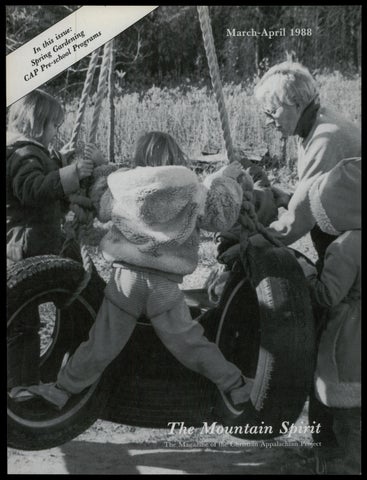
X h e M o u n t a in S p ir it:
The M agazine o f the Christian A ppalachian Project
M arch-April 1988
V ol. V II, No. 2
Contents Features 4
Infant U niversity by M argaret G abriel In Floyd C ounty, Pat G allagher runs an excellent pre-school program for infants and toddlers
8
Dear Father by C arm en Scott R ecently Father Beiting received a letter from a child he influenced m any years ago.
9
Planting Seeds by J o e Foley O ver 2000 families in the CA P service area received seeds, seed potatoes and fertilizer through C A P ’s small farm program .
22
Caring for Children In Crisis
Planting Seeds, p. 9
by M oira Am brose A Peace Place, in W illiam sburg, K entucky, provides shelter— and love—for children in crisis. H ere y o u ’ll meet Sisters Syra and Carol.
Departments 3
From Our President
8
News of Our Neighbors
14
The CAP Closeup
16
Around the Project
The M arch-April Theme This month we explore CAP programs that involve small children. In doing so, we look not only at the actual, day-today process of caring for and educating children, but we ask “ why” CAP has become so involved in day care and early childhood education. O n the C O V ER children who live at A Peace Place, in Williamsburg, Kentucky (photo by Fisher). On the BACK C O V ER, a coal train carries its cargo out of the mountains (photo from the CAP Archives).
Published by the C h ristian A ppalachian Project. E ditor, M a rg aret G abriel. A d visory B oard, F ather R alph W . Beiting; M ike M cL au g h lin ; Leslie B. L arsen; Ja c k M o rris; Bill Begley; R an d o lp h Jo rd a n . G raphics C oordinator, D ebbie Fraley T u d o r; C irculation M anager, T h eresa Richey. The Mountain Spirit is published six tim es a year. T he an n u al subscription price is $5.00. S ubscriptions an d o th er correspondence should be sent to The Mountain Spirit, C h ristian A ppalachian P roject, 322 C rab O rch ard R oad, L ancaster, K entucky 40446. C o p y rig h t, 1988. T h e C h ristian A ppalachian P roject, Inc. All rights reserved. M em b er, C atholic Press A ssociation. T h e C h ristian A ppalachian Project is a non-profit C h ristian service organization operating th roughout E astern K entucky. T h e project operates on the philosophy th at “ helping people help them selves” is the best ap proach to A ppalachian poverty.
From Our President
W h e n I was asked to ex amine my thoughts concerning CAP’S involvement with child development, I found myself reflec ting back to CAP’Searly days. Child development is one of those pro grams with which we have been in volved for a long time, for several reasons, I think. First, we all know that children are tommorrow’s leaders, and so it’s important to work with and provide for them. Secondly, we recognized back then that many times, if a family was to improve its situation, it was necessary for both parents —or one, in a single parent family—to work during the day. In order for parents to do a good job, they need to know that their children have quality care. Finally, in those very early days, many of the volunteers we attracted were young women with a background in education, both early childhood and elementary. We could see that there were needs everywhere —for Attic stores, for jobs, for many things. In tackling a job you want to start in a place where you believe your input will have the most impact, and since we had talent in education, that’s one place where we started. But while all of those things are important, I think the most impor tant reason we have child develop ment centers is that many children in Appalachia do not get the en vironmental enrichment that they need to adaquately prepare them for the first grade. Given the problems in education in Kentucky, it makes a lot of sense to do as much as we can in that area. Our thinking is in line with the Headstart program—you can try to make a change by introducing disadvantaged children to an en thusiasm in learning, to the outside world, to the capacity to dream. I’m proud of the outstanding quality of our child development M arch-A pril 1988
M ik e M c L a u g h lin .
centers, and I think that CAP can point to them and say, “This is something that we do very, very well.” It’s good to have a program that’s been polished the way we’ve polished our child development pro grams with a plan that’s been thought through and worked through. You might even say we’ve gotten a little cocky about it. Oh, we know that there are good child development programs in many places, but we think that our pro grams stand up pretty darn tall with just about anybody’s. We like to think that the seeds we are planting with little children when they are three, four and five years old will take root and grow as they get older. You get lucky, too, when you run into people who were involved in child development and hear about some of the things they’re doing. One of our workers who was involved in child develop ment for quite a few years, told me a story just recently about a run-in that she had with one of her former students. Kathleen was shopping in Lan caster with one of the other past teachers from the Sunshine Center in Garrard County. As they passed a group of teenagers on the sidewalk, they recognized a young man who they realized had been one of their “Sunshine Kids” many years before (well, several years, anyway). At 15, Richard appeared to be tough and nonconforming, not a model
graduate of the Sunshine Center at all. As he came face to face with his former teachers, Richard stopped and Kathleen watched his toughness melt away. Now oblivious to his friends, he gave her a big hug and said, “They tore our school down!” Only a few months earlier, the building that housed the original Sunshine Center had been razed. Richard quickly became selfconscious about his display of emo tion, regained his tough facade, and said, “Well, I didn’t care about that old school, anyway.” Kathleen said that she wanted to tell him, “You can’t fool me, Richard. You’ve just shown me that you’re not as tough as you want your friends to think you are.” As the former Sunshine Center teachers continued on their way, they agreed that somewhere, they had planted a seed in that young man, and as like ly as not it had started to grow and would continue. I have found it very difficult to give definitive answers to the ques tion “Why is CAP so involved with child development?” and I guess that story about Kathleen and Richard is as good a reason as all the philosophical reasons. If we made an impact on Richard, then we have to believe that we’ve made an impact on many other children as well, and together, they will change the face of the earth. 3
In fant U n iv er sity Not Just Diapers and Diplomas
Story and ph otos b y M argaret G abriel 4
T h e name “Infant University” produces some strange images in the minds of some people. I said to a couple of people, “Quick, what do you think of when I say ‘Infant University?’ ” “Diapers and diplomas,” one friend replied. “Little babies walking around in gowns' and mortarboards,” said another. A third replied, “Infant University—IU? Bobby Knight throwing temper tantrums.” Although it sounds very school-like, Infant University, CAP’S infant/toddler day care pro gram in Floyd County, is concerned with things that are much more important than just academic endeavors. For example, on the day that The Mountain Spirit visited Infant U, the children made their own taco pie for lunch before rehears ing their Christmas play. The Mountain Spirit
T h e In fa n t U n iv e r s ity , lo cated in F loyd C o u n ty , p ro v id es d ay care and ch ild d ev elo p m en t for ch ild ren w h o are b etw e en the ages o f six w eek s an d three years.
“This is going to be a homey center. You can tell just by the kids’ attitudes that they’re fun-loving and happy. You don’t hear much crying here —we’re too busy for that!” says Pat Gallagher, a former CAP volunteer who has managed the center since it opened in 1984. One could certainly expect the “terrible twos” in spades in a room full of two-year-olds, but you’ll not find that behavior at Infant U. You’ll see children playing in groups or by themselves, babies sitting in swings and car seats watching in tently. Pat’s enthusiasm and love for her students and their potential, permeates Infant Univer sity—both the staff and the students. “Their minds are opening up to wonderful things! They’re saying words that I sure didn’t know as a three-year-old. Astronaut? We have an astronaut doll over there. They can tell you about Christa McAuliffe because we watched the rocket go up and saw it go POOF! and they know that now Christa is with God. Anything that’s happening is part of what we’re doing.”
of Allegiance and then go to “class.” The “big kids” (they’re two-and-a-half, for heaven’s sake! work from a program called “Just for Twos” which includes stories, arts and crafts and pup petry that centers on a particular theme, while Pat and some of the other staff work with the babies. They exercise the babies, one at a time, talking to them constantly. Pat believes that just the stimula tion of the center has a good effect on babies. “We’ll have them sitting in the room with the older kids, or we pack them around constantly.” Pat is always quick to emphasize that, while In fant U does work on cognitive skills with children, “the biggest thing that’s stressed here is that we’re going to be kind to one another. We’re going to be good human beings before we’re going to be anything else. If I don’t teach them colors and numbers and all that by the time they leave here, it’s no big deal—they’ve still got twelve years to learn it! But, if they can learn that they have to care for that person that they’ve just knocked down, that’s the biggest thing to me. I know it’s working, too. The director at the Mountain Chris tian Academy says, *you can tell the kids that come from Miss Pat’s school because they’re kind. If they hurt someone, they go over and give them a hug and a kiss.’ “We can’t verbalize a lot here—these kids are not going to be able to say ‘I’m sorry that I knock ed you down, and therefore I won’t do it again.’ It’s going to have to be just a hug and kiss that’s going to say, ‘Gosh, I shouldn’t have done that.’ ”
In this area of struggling economy, two income households are commonplace, as are the presence of single parent households. Infant University helps to reduce the anxiety that parents experience when they must leave small children in order to earn a living. “I suspect that a lot of people had to quit their jobs [after they had children],” Pat said. “And none of my parents are working for luxuries, for extra money. They’re just trying to make ends meet.” Pat says that “her parents” don’t look at In fant University as just a place where their children will be watched during the day, and they’ve come to expect more than just babysitting. “Most of the parents are kind of amazed at what their children do. Sometimes they think we do it, that we’ve made all these things. ‘I didn’t do that,’ I tell them. ‘Your kid did that.’ A lot of the children are doing things that five-year-olds do.” Although Pat thinks of Infant U as more than a school, there is a definite curriculum for the little guys —no matter how little. After the children come in, have breakfast and get settled, they start with “Good Morning” circle exercises, the Pledge M arch-A pril 1988
“
W e’ll have them sitting in the room with the older kids. ”
5
One of Infant U’s two special needs children, Stephanie, has multiple handicaps. “She doesn’t walk or talk, and before she came here, she just basically lay on the floor and played with her fingers. She doesn’t do that anymore —she doesn’t have time to play with her fingers! This child is missing part of her ear, and she wears a hearing aid and thick glasses.” Because Stephanie is learning sign language, Pat is teaching the other toddlers some signs, too.
New regulations in Kentucky demand that the special education needs of handicapped children be met at age three rather than age five. Providers realize that in order to meet these needs, groups must work together, so in Floyd County, Infant U will enroll the children in their program and Com prehensive Care of the Mountains (a mental health agency) will provide the additional staff that will be needed. Like many CAP programs, Infant U’s enroll ment of special needs children came about by chance rather than by design. Pat contacted Com prehensive Care to tell them of the services she of fered and happened to mention to the director, Rita Connelly, that she would love to have special needs children referred to the program. Rita recognized how well the programs could work together, and “What really thrilled her was that I would take them over age three,” Pat said. “Even though I usually take them until they’re two-and a-half or three, handicapped children at age three could be functioning at a six months level. To bring that type of child into a three-to-five-year-old pro gram could be very difficult. She was excited because I’m not a government program with a lot of restrictions.”
“They can say ‘eat,’ which is up here,” Pat demonstrated, “and they can say ‘drink,’ and they can say ‘play,’ so they’ll do those things with her. “These kids are just fantastic with Steph,” Pat went on to say. “Bart just loves her. One day she was sitting in a table chair, and Bart went over with a ball and put it in her hand. Of course, Stephanie doesn’t hold anything, and she just let it drop. So he picked it up—very patiently for a twoyear-old—and put it in her hand. He squashed her hand around it and said, ‘Hold it, Steph!’ And she let it drop, and he’d squashed her fingers around it and said ‘Hold it, Steph!’ and he did that over and over. Well, at some point, she must have held it longer, and he clapped and cheered for her, then she mimicked him, and clapped the very same way. For this child, this was a big milestone. We were really excited!” “Family” is a word that Pat uses often, referring to her Infant U family as well as her children’s
natural families. “If parents give me an idea that they don’t like something, I’m just as free to say, ‘You’re the mom and dad. We’ll stop. I try to be very open to what parents want. Everything we do here is like a family,” Pat said. “That’s what I real ly want. I won’t separate them [into age groups]. I talked to this lady in Washington the other day, and immediately they have this concept that babies ought to be in this area, and little toddlers ought to be there, and the big kids have to be there. But that’s not how it is in a family. You don’t put your baby in one room and your threeyear-old in another room and your ten-year-old in another room. They all interact, and that’s exactly what’s happening here—they’re all going to learn from each other.” And in this family atmosphere, Pat’s children are learning to be kind and considerate of each other as they become aware of the world around them. “There is so much learning that’s going on that’s just natural,” Pat continued. “They can be noisy; they can be messy —all those things that moms, after a long day at work, don’t even want to see. It’s such a natural thing that’s happening, that I think it’s going to keep going. Their little minds are opening up to wonderful things. The at titude —ours and theirs —is that you’re missing the fun if you’re not helping to make the taco pie for lunch. We hope to get them so excited about learn ing that it will stick with them for all the years that they’re in school.” CAP. M arch-A pril 1988
N ew s of O ur Neighb ors
D e a r Father Beiting, I very highly doubt that you remember me, for many years have passed since I saw you last, and I was only one of the many children who came to St. Paul’s in McKee, Kentucky. I couldn’t have been more than six or seven at the time, but I never forgot you. You looked down at me with your kindness and caring when I was a small girl. Somehow in my young mind I knew that though I was one of many poor children in that area, I was not just another child to you. My name was Carmen, Abner then, Scott now. There were five of us children and my mother. My father was almost never around. We tried to scratch a living out of that hillside five miles out of Sandgap, but I know that there were times we wouldn’t have made it if not for the caring and help of the people at St. Paul’s. I assume that was all a part of the Christian Appalachian Project then, but as a child I wasn’t aware of it. I remember a lot. I remember a Sister Mary Jo and a car full of food when we had none. I remember a brown crib bed with a teddy bear on the headboard and my mother telling me Sister had brought it for me. She was surprised when I mentioned it years later. She had that bed still, but had thought me too young to have remembered where it came from (or “from where it came,” depending on your grammatical hangups). Never theless, I did remember. I remember the giving and the people who gave. You people made an im pression on me and I believe myself to be a better person for having known you and having ex perienced the kindness of your works. If you ever get discouraged and wonder if what you are doing really helps the people you’re trying to reach, I stand as an example that such caring and help touches more than the bellies and hands of children. My heart was touched through you and my faith was strengthened. Yes, children have faith and I still believe they are more capable of understanding what Jesus Christ lived and died for than are many adults. Sometimes it is difficult for them to maintain that faith into adulthood when people turn their eyes and hearts away from the face of a child’s poverty. Children do not listen to words so much as they listen to faces, to hands and hearts. To a child a voice that says, “I care,” no matter what the words, and a heart, hands and eyes that show that caring are more the gospel of the Jesus Christ they know than any words of doc trine. 8
C arm en A bn er Scott.
Perhaps I presume too much. I only know that as a child, I knew Christ. I knew and understood who He was even before I knew you. I believed then and continue to believe that He sent you and the people working with you to show me that through Him I made a difference, that He loved me and would care for me through those who believed in Him. Perhaps He sends me to you now with this letter to show you that through Him you truly do make a difference in the hearts, minds and souls of the people you touch. For this one, at the very least, your caring was not in vain. When I saw the CAP broadcast last night, a lot of memories came rushing back, memories that might not have been so good were it not for the work you have been doing. It’s been close to twen ty years now, but I will never forget the man who looked down with caring and love in the face of a child’s poverty, any more than I can forget the man who lived for us and died for us, whose love moved you to touch a child’s life, to clothe me and give me food to eat. Your path is a good one and as you know, our paths are no more sacred than the manner of our walking. May you always walk in a sacred manner. Peace be with you, Father. Carmen (one of the least of His little ones) The Mountain Spirit
Planting Seeds b y J o e F oley P h otos courtesy o f Steve L eB ru n
T h e scene is Martin, Kentucky. The sky is grey and the air somewhat cold. Drizzle comes and goes. It’s a Thursday in March. It’s seed distribution day. Highway 80 begins to clog around the turn lane to the steep road leading up to the Mountain Christian Academy and CAP’S eastern division administration building. Cars and pickup trucks, most dating from the ’70s, fill the gravel lots in front of the school and begin parking as they can, straddling the banks of the road on the hill and in some cases, parking in the road itself. All of a sudden there are lots of people about. Winding queues come together at a few chairs and a table with cardboard boxes of files set upon it. Men mill around their pickups and children move about in clusters. Twenty-year-olds in worn jeans and sweatshirts saying “DePaul” or “Xavier” “Xavier” or “I survived the Boston Marathon” hoist 50-pound bags of potatoes on their shoulders and follow people from the little table to the waiting cars. The following day, the event repeats itself at the trailer that serves as St. Luke’s Church in Magoffin County. M arch-A pril 1988
At the western division of CAP, distribution is also going on, though on a larger scale. Seed, seed potatoes, fertilizer and powdered insecticide are handed out to residents in Garrard, Lincoln, Rockcastle, Madison, Jackson, Pulaski, and Casey counties by CAP employees and volunteers, and to residents in over 20 other Appalachian coun ties by various outreach groups with which CAP works closely. In all, approximately 2,000 households thoughout Appalachian Kentucky receive garden seed through the program. My Role
Last spring I had the opportunity to help with the garden program in Magoffin County. I helped with some of the initial visits, with distribution, and with follow-up visits. It was an adventure — there were new people to meet, new areas of the county to explore. There was a certain satisfac tion, bravado even, in finally finding mountain communities such as Falcon and Gunlock and Burning Fork. There was a seat-of-the-pants sense of accomplishment in traversing in all-tooquestionable vehicles the creek beds that double as roads or in hiking the remote footpaths to peo ple’s homes I had only heard of in passing. It was fun, and my mind left it at that. 9
G ladys C asey show s o ff her p o le b ea n s an d som e o f her flow ers that she has p la n ted in h er gard en . She takes p rid e in co o k in g h er garden v eg eta b les and uses th em to h elp su pp ort h er fa m ily .
But there is more. Snapshot experiences such as I have had don’t do justice to the scope and full meaning of the garden program. “It goes a lot further than just those seeds,” said Keith Gilbertson, manager of the garden program in the western division. “Just being that Christian witness and friend in that home has a lot of in fluence on people’s lives,” Keith said. “And there are intangible benefits. People maintain pride. They feel like they’re doing something. “It’s hard to explain how much a garden can mean to some people until you’ve actually raised one. People that do understand. People that haven’t say, ‘well, it’s just a way to save some money.’ Once you’ve gardened, it becomes a part of you. A lot of people that we serve —it keeps them going, it’s something to hope for, to look forward to.”
The variety as well as the volume of seeds is in creasing. Plants or seeds are given out for beans, corn, beets, cucumbers, tomatoes, onions, mustard greens and pumpkins. Seed potatoes are distributed as are seeds for peas, carrots, lettuce, squash, spinach, turnips and radishes. A limited number of flower seeds are also given out. Okra and cabbage and still others are available upon request. To preserve the vegetables once they are grown for year-round consumption —an integral part of the program —CAP distributes canning jars, freezer bags, and pressure canners. CAP will oc casionally make available gardening tools, such as potato forks. “The garden is not only for now, it’s for later, too,” Keith said. “It’s good for nutrition, and it’s good for the food budget.”
The Seeds
Hands-On Support
Seeds and supplies are either donated from cor porate benefactors or bought by CAP from local companies and distributors. Small distributors, usually rural grocery or hardware stores, are not adversely affected by CAP’S distribution because most of the residents involved in the program would not have the money to buy that volume of seeds in the first place. In addition, a much greater number of people are becoming involved in gardening through CAP’S program, thus needing additional supplies periodically, which these distributors supply.
Between the time seeds are donated or bought and the time they sit in piles of brown paper bags at distribution sites, they first must be measured and divided. Help comes from all parts. In dividuals or families that have received no interest loans through CAP’S emergency assistance program will often work off their loans by taking home a sack full of seeds to count and package. Other local residents also help.
“So you’re the guy that’s cut all my business this year,” a rural grocer once said to Keith only half in jest. “I talked with him a while and we figured out that we probably helped as much as hurt,” Keith said. 10
“There’s no shortage of people wanting something to do just to stay busy and feel like they’re doing some good,” Keith said. “We bring the stuff around town and say, ‘Here’s a bag of turnips and here’s a thousand envelopes, could you fill these up?’ ” And they gladly do it. Despite the goodwill, though, local volunteers The Mountain Spirit
and those residents working off CAP loans can handle only a small portion of the total volume of work involved. For the great bulk of the seed work, CAP turns to a group of individuals who, for the last six years, have put together tens of thousands of seed packets each growing season. When CAP first began the garden program, it im mediately saw the Herculean task that was to be involved in packaging the seed. It turned to a work crew at CAPrice Industries, its sheltered workshop for handicapped adults. Though the in dividuals now bag the seed at the Garrard County Mental Health Center, the work crew remains the same as it was. In all, 30,000 to 35,000 seed packets, each with one type of seed, are prepared and marked each year. Another group of individuals without whom the program could not function are the volunteers, both long-term and temporary. With the excep tion of a local resident who serves as secretary to the program, all garden program workers for both eastern and western divisions are either volunteers or form er volunteers turned employees. In addition, 50 to 70 temporary volunteers, usually the twenty-year-olds in the sweatshirts, also help during the year with distribution and then follow-up visits to check on how the gardens are going. “The temporary volunteers, we couldn’t get along without them,” Keith said.
we can. “What we try to do is tie in with them and say, ‘OK, we’ll provide seeds, canning jars, freezer bags and pressure canners, and you supply the knowledge because you’ll be visiting more often.’ ” The Growers
“The thing that we ask is that they put in a good honest effort to raise a garden,” Keith said. “After that, they have to depend on God to send the rain. As long as the effort is there, we’ll build on that. “A lot of people, though, they’ve been doing this for years. They know more than we do,” Keith said. One such gardener is the Reverend B. Samuel Miller. Reverend Miller probably knows as much
One volunteer who has by no means been tem porary is Steve LeBrun. Steve, a former high school counselor from South Dakota, has been with the garden program for almost two years. “It does something for you to work the ground itself, get it plowed, plant the seeds, till the soil,” Steve said. “You feel closer to God and nature,I think. I do anyhow. “From my point of view as a counselor, a lot of what we try to do is to build esteem while we’re visiting. It might just be providing friendship.” Outreach
Much of CAP’s garden work is done through other outreach groups. Of the 2,000 households served by the garden program, 800 to 1,000 are visited by church and other outreach organiza tions that have received the CAP seeds and sup plies and then distributed them as they saw best. Most of these organizations are outside of CAP’s immediate service area and are thus much more familiar with the people CAP itself wants to serve. “If there is a program going there, we certainly don’t want to take over,” Keith said. “What we want to do is cooperate. If it’s a local or grassroots organization, we want to encourage it as much as M arch-A pril 1988
J a m es J o h n so n tills h is en tire gard en b y h a n d .
11
: «4.— - -v ; r
iJl k3 * •*•5- -« It ’
J i
a
|
\
V
\ljg
fllil ^
L e ft, a m em b er o f the B erry fa m ily feeds on e o f th e fa m ily ’s m an y p ets. R ig h t, G lend a H ill and h er fa m ily raise d u ck s, ch ick en s and sh eep to su p p lem en t th e fa m ily in co m e.
r%jr
J*
. m |
' ¡1 * ' i! , yB p
p
m
. X A
^ --iffi
A b o v e , D elm er L u ttrell k eep s b ees and sells the h o n e y to su p p lem en t h is retirem en t in co m e. L e ft, N a m o n Strun k and h is g ra n d ch ild ren set tobacco on the fa m ily farm w h ich p ro v id es m ost o f the fa m ily ’s in co m e. The Mountain Spirit
actly three months later, on May 10, will be the last frost of the season. Another bit of folklore related by Reverend Miller involves the moon. Though he says he himself doesn’t follow the rule, he knows many people that do. The rule goes like this. In the dark of the moon, plant things that need to go down, root crops such as potatoes or carrots. In the light of the moon, plant things that need to go up, such as corn. The Payoff
“Gardening is a lot of times a stepping stone to other CAP programs,” Keith said, programs such as camp, emergency assistance, or the literacy program. “We’re really the program that is able to get into thousands of homes and spread the word of the Christian Appalachian Project.”
about vegetable production as most professional agronomists. He has seed stocks that go back 50 years and more. He can tell you the history of a certain variety of seed, of a bean for instance, and tell you where it originated or who used it the most or why it lost favor. One such bean, the “white red-speckled cut short,” Reverend Miller hadn’t seen since he was a boy in 1923. The last one he ever heard of being planted was in 1925. But through his years of gardening, he always kept alert for anyone who might have kept a stock of the beans, which can produce more than one crop during the garden ing season. Finally, in 1986, he found some stock of the “white red-speckled cut short” from an Ohio distributor. Now he has jars of them soon to be in the field. “You may have heard of my Presbyterian beans,” Reverend Miller said. “They were given to me by a Presbyterian preacher from when he was on Foreign Mission Field in the Middle East when he was only 21 years old. And he gave me that seed. And this will be 44 years with Presbyterian beans.” About one of his corn varieties he said, “It’s so sweet that it’s like running your hand through honey when you shuck it.” Reverend Miller is also a bit of an expert on Ap palachian folklore as it pertains to gardening, though he says he doesn’t give some of it much count. One of the rules he does follow, though, is that involving thunder and the last frost. The first strong thunder in February, if it’s moving north, will exactly foretell the last frost of the season by three months. For instance, if there is a strong thunder moving north on February 10, then exM arch-A pril 1988
The payoff of the garden program itself can be seen in the rows upon rows of canned, homegrown vegetables proudly shown to the CAP visitor, or in the glass jars of seed stock saved from the last harvest, or in the sacks of corn or green peppers people insist you take home with you after a visit. It’s the pride, the enthusiasm. Ann Barker is one Garrard County resident in the garden program. She has three young children. “If I’m nervous or upset about something, I just get out and work in the garden, and it relaxes me,” Ann said. “It’s a way to get close to the Lord.”
The C A P Closeup
!Peggy Cook is a bundle of energy, quick wit, and determination, with an honest, say-itlike-it-is approach to life. She is mother to children Chris and Jessica, wife to husband Jerry, a runner, a tri-athlete, soon-to-be licensed bike racer, and manager of CAP’s “Parents Are Teachers” program. “Parents Are Teachers” is designed to teach parents how to teach, play and cope with their handicapped pre-schooler. (See “A Freshness in the Program,” The Mountain Spirit JanuaryFebruary 1987.) Service may range from teaching parents the correct way to feed their child, to games to play with their child in order to halt fur ther mental and/or physical delay, to appropriate use of a variety of therapeutic equipment. Needs are addressed for children with borderline mental or physical problems as well as those who are severely handicapped. P eg g y C ook
Peggy’s work as program manager began in March, 1984. “When I first came into the pro gram, I was the only person and did all of it,” she remembers. “All of it” included targetting families in need, assessing those needs, teaching, conduct ing follow-up, referrals and implementing ad ministrative tasks.
Peggy Cook:
“If the kids needed anything else, like speech, physical therapy, or medical appointments, I did all that, too.” Peggy laughs, “I was a one person program.”
C A P ’s O w n E nergizer
The past four years have seen much expansion in the program, which recently expanded into Estill County, the sixth county in the program’s service area. Today, Peggy works very closely with a staff of four. Just because Peggy is no longer a one person program doesn’t mean that she is less busy. “I spend 75 % of my time now supervising staff, find ing out what’s going on with the program and keeping up with the kids, and 25 % on paperwork,” says Peggy. And it is the paperwork that she likes least about her job. “That 25% feels like 100% depending on the time of year. I don’t really hate it; it’s just not my favorite part of my job.”
by the C A P N ews Service photos by Giovanna Burks Godby 14
Her favorite part of her job is working with her staff: teachers Kathleen Leavell and Judy Brooks, occupational therapist Denise Salinas, and physical therapist Kathy Murphy. “It’s a real cohesive staff. Our personalities seem to be real The Mountain Spirit
compatible, and the staff are just very dedicated to what they’re doing. The entire staff have a good idea of what they want to do, how they want to do it, and what the program goals are.” Peggy laughs when she says, “The joke used to be that I was the shortest in the program, but I was still the boss. I can’t say that anymore because I am not the shortest.” A typical day for Peggy Cook begins very early, and at least three days a week are spent on the road visiting staff, screening new children, making home visits. Much of her time is spent on the telephone taking and making referrals and talking with other agencies. An occupational hazard for Peggy is becoming extremely involved with particular families and not being able to release that involvement at the end of the workday. “There are kids that, no mat ter how much we intervene, are just not going to be better. All we can do is help train the parents to take the best possible care of them. We’re suc cessful, though, even when all we can do is give the parents the support they need,” explains Peggy. “It is difficult because sometimes these kids don’t make it. We’ve had children die, and that is very hard.” Oftentimes, the families have a multitude of problems of which caring, coping and teaching a handicapped child is only one. “My staff had a lot training last year on how to get through a lot of this stuff as individuals,” Peggy continues, “because it can really get you down if you don’t know how to handle it.”
Som e w h o started in the h o m eb o u n d program h a v e grad u ated to ch ild d ev elo p m en t centers.
Peggy’s life outside of CAP is her way of handl ing an emotionally demanding job. “It’s sometimes easy to leave my work at work because the rest of my life is so hectic.” Peggy says, “Most days I come home, and we immediately start dinner so that we can go to some kind of practice.” Both Chris and Jessica are members of swim teams. “This year, since both my children are swimming, we have practice five days a week.” Last year, Chris became an avid bike racer, and Jessica placed first in her con ference in the breast sroke. Peggy and Jerry are also extremely active in their church, Trinity Episcopal Church in Danville. “Around our house,” says Peggy, “it’s sports and church.” In between swim practice and church activities, Peggy still finds time to run and enters many road runs across the state each year. Last spring, she finished her first triathlon by swimming 1000 meters, running four miles, and biking twelve miles in one hour and forty-two minutes. Another triathlon in 1988? “I’ll probably do one, but one of my goals for this year is to get my license so I can bike race,” smiles Peggy. I have the honor of knowing Peggy as a peer and a co-worker, and the pleasure of knowing her as a neighbor and friend. Recently, during one of our frequent visits, which are always filled with a great deal of banter and laughter, Peggy said to me, “You don’t have the energy to live my life.”
P eg g y crosses the fin ish lin e at th e “ W om en on th e R u n ” race in A tlan ta.
M arch-A pril 1988
She’s right.
cap.
15
A round the Project
by the C A P N ew s Service The process of getting the stories from mind to paper was a learning experience, too. “I explained to them what a secretary is and that I would be their secretary,” explains Cheryl. The students dictate their stories to her or to a parent who is helping on any given day at the center. The story is written wordfor-word as it is dictated, and on those rare occasions when editing proves necessary, nothing is chang ed without the author’s approval.
C A P vo lu n teers w ork on a repair jo b in M cC reary C o u n ty .
H o m e R epair M oves In to N ew C ou n ty McC r e a r y c o u n t y - c a p has become involved in McCreary County through the home repair work that the volunteers do each month in the county. Former volunteer, Casey Sterr, worked in home repair in 1986 and 1987 and through the local ministerial association, met the pastor of the Catholic Church in McCreary C o u n ty . T h ro u g h co n ta c ts established by Sisters Joe and Denise, volunteers who work at the church, CAP’s volunteers visit one home each month, building porches and outhouses and weatherizing homes. Les L arsen , d ire c to r of maintenance, property and facilities, said that he hopes to start a full scale home repair program in Mc Creary County in the future. “If things work right, we’d like to start a satellite home repair office in Somerset and hire two crews to work in southern Pulaski, Casey, and McCreary counties.” Each time CAP moves into an area, needs are discovered in neighboring counties as folks cross county lines, trying to find help with their problems. In Lincoln, Magof fin, Casey, Owsley, and Knott coun ties enough needs surfaced to start 16
full-time programs. Now, McCreary is following that pattern as ground work begins in the county to start a home repair program along with the Eagle Child Development Center.
H ise l C h ild ren P u b lish Stories JA C K SO N C O U N T Y -T e n published authors attend CAP’s Hisel Community Child Care Center. They are kindergarteners at the center, and the local newspaper, The Jackson Sun, periodically publishes the stories that they write. The idea of five-year-olds “writing” was implemented by Cheryl Martin, head teacher at Hisel Community Child Care. “It is great for children to have this kind of language experience,” she says. “They have plenty of stories in their minds.”
The children write, and draw pic tures to illustrate their stories, every week. Thusfar, the children’s works have appeared twice in the newspaper, and their drawings have appeared once. This w ritin g experience transcends appearances in the newspaper, though. The children are, even b efo re they can manipulate a pencil, becoming com fortable with writing. Their com munication and creative develop ment is also enhanced. Cheryl tells of a little girl who is overcoming shyness though this project. “At first, her stories consisted of only a sentence or two, and periodically, she would refuse to write at all. Now, she writes regularly, and her stories are becoming longer and longer. When asked how the children res pond to bring “published authors,” Cheryl says proudly, “They take be ing published in stride. They’re used to it.”
A Christmas Story by Rhonda N eal
Santa Claus buried some toys and it was in the snow and it made a rainbow when the sun came out. And the horse and doll went in the house and cooked some supper and it came a snow again.
The Mountain Spirit
around the project . . . continued
O p eration Sh arin g Through Operation Sharing, CAP makes use o f many in-kind gifts that are made available from various companies and businesses throughout the United States. Recently CAP received a number o f voice activated crib mobiles from Johnson and Johnson. Kathleen Leavell, a teacher in CAP’S homebound program fo r handicapped pre-schoolers shared an experience with Charlie Deaton, manager o f Operation Sharing. Dear Charlie, Cody is a 16 month-old boy enrolled in “Parents-Are-Teachers.” Cody faces several medical pro blems, among them an incomplete esophagus. Consequently, he breathes through a tracheotomy tube and is fed through a gastrointestinal tube. We hope that soon Cody can undergo surgery to allow him to eat and breathe on his own. Part of my job is to prepare Cody to use his mouth and throat for eating, drinking, and com municating. Last Thursday I brought Cody a Johnson and Johnson Voice Ac tivated Crib Mobile to encourage his efforts. Within minutes, Cody realized that the music from the mobile was responding to the tiny sounds he could make through his trach tube. His mother couldn’t hold back her tears as she watched him take a giant stop in interacting with and mastering his environ ment. A great deal more took place than I could write in a letter. The best I can summarize is to say that I believe God is very much present in that home and that He used us to re mind them that He is working in Cody. I’d like to take this opportunity to thank you and the people at Johnson and Johnson for your M arch-A pril 1988
G ary J o h n so n (far left) g u id ed C A P v o lu n teers J a ck P a ra d is, M ark G elak, and form er v o lu n tee r J u d i J a ck so n through the ex te n siv e cave n etw o rk in J a ck so n C o u n ty n ear C am p A n d rew J a ck so n .
work and generosity. It was an honor to extend it to this fine fami ly. Kathleen Leavell Parents-Are-T eachers
O ne G ood T u rn GARRARD COUNTY-When Joe Fekute, a volunteer assigned to work in CAP’s outreach programs was visiting Bill and Dixie Leavell one day, he became concerned because of the unsafe condition of the elderly couple’s wood burning stove. The stove had holes that cause downdrafts —and burnouts. Joe belongs to a church in New Jersey which had just sponsored a collection of items to help Joe with his work. It happened that the col lection included a wood stove that well-suited Mr. and Mrs. Leavell’s need.
During Joe’s visits to the Leavells, he also learned that the creek that runs in front of their house often floods, making it impossible for them to get in or out. In conjunction with Les Larsen, CAP’s director of m a in te n a n c e , p ro p e rty and facilities, Joe hopes to provide Mr. and Mrs. Leavell with a bridge that will make it easier to get around during the spring rains.
Moving? Please notify us of change of ad dress to make sure you receive every issue of The Mountain Spirit. O LD A D D R E SS name
please print
address
dt) state
When Joe and some of the other volunteers took Mr. Leavell the stove, he was determined to repay the kindness, and asked the volunteers what he could do. They had recently received a request from one of Mr. Leavell’s neighbors for a load of wood. Just before the begin ning of a harsh, Kentucky cold snap, Mr. Leavell cut and delivered a load of wood to his elderly neighbor.
zip code
N EW A D D R E SS name
please print
address city state
zip code
Mail to: The Mountain Spirit, 322 Crab Orchard Road, Lancaster, KY 40446.
17
around the project . . . continued
G roup H om e B oys Say “ G o od b ye” to D u k e CAMP NELSON-During the holiday season, the staff and residents of the CAP Group Home had to say goodbye to a family member who has been on the Camp Nelson farm for twelve years. “Duke,” the dog, passed away and was given a proper funeral and burial near the barn. Duke came to the Group Home in 1975, when Steph and Moe Mercier directed the program and lived in the house. Duke has served as a pro tector and friend to all Group Home residents, and legend has it that, in his prime, he captured a ground hog a day to show his appreciation. Program manager Robin Barnard said, “All who shared some time with Duke wished more than once that he could talk. They believe that he saw and heard it all, and began to wonder if he didn’t understand it all better than the human types. Old Duke had a full and happy life, and certainly touched the lives of a lot of teenage boys who were in need of the kind of friendship that develops between a boy and a dog.” In its thirteenth year, the CAP Group Home will try to struggle along without Duke in its service to teenage boys in a “troubled” time. At 16 and 17 years of age, the boys come to the program through refer ral from the Cabinet for Human Resources as a result of delinquent behavior, drug and alcohol abuse, or unworkable family problems. Each share a common need for re direction of behavior or attitudes which are leading to serious pro blems. The usual difficulties of be ing a teenager are compounded by some negative experiences, some hurtful experiences, a lack of op 18
D u k e , alon g w ith som e o f h is b o y s, in on e o f h is “ lea n er and m ea n er” d ays. H e w as p et to h u n d red s o f G roup H o m e b o y s, as w ell and M o e and Steph M ercier (far le ft), and th eir ch ild re n , T o d d , J a co b , an d C h risto p h er.
tions, and a lack of direction. Several CAP programs work to g eth er with G roup Home residents. The Family Life Center School provides boys with the op portunity to complete their educa tion; CAPrice Industries provides job skills training and employment; Family Life Counseling Services provides individual and group counseling. This CAP network joins a staff of six full-time people who share the everyday process of living and learning with the boys. Together they work toward the goal of “h abilitating,” or making capable” a group of boys who are rapidly approaching an age of adult choices and adult consequences. That work is provided by opening doors that have never been opened, setting firm limits that are generally long overdue, and giving the 24-hour-a-day, seven-day-a-week message that “we are here because you are worth it.”
According to Robin, the day-today work of a Group Home brings with it a good deal of stress, a de m and for high energy and understanding, a surplus of action and reaction and occasional dismay. It also brings the pure joy of making a difference or even planting a seed during a time of critical need. CAP’s commitment to providing service to boys is evident in various ways: a 25-year-oldman dropping in to show his wife and son where he lived and got his first real chance; medical problems diagnosed and treated; GED certificates mailed home to mother; even old Duke be ing a good friend to each boy from 1975 to 1987. At a meeting this month, the staff of the Group Home were asked why they wanted to work in the pro gram. After a bit of comic relief, the answer was unanimous: “This is our faith, and hope in action.” The Mountain Spirit
around the project . . . continued
What You D on’t Know About Wills Can Hurt Your Heirs . . . Find Out Why. Re quest Your Free Copy Of:
C A P rice In d u stries in Som erset has started a food services tra in in g program . T h e program has p laced four h a n d ica p p ed w orkers th is year.
C A P rice H old s O pen H ou se SOM ERSET —C A P rice I n dustries, CAP’S workshop for han dicapped adults, recently hosted a grand opening and an open house at their facility in Somerset. Two hun dred people attended the celebration of the ren o v atio n of th eir workshop. With these renovations, the workshop now provides a center for food preparation services train ing for handicapped adults in the Pulaski County area. In addition to the kitchen equipment, a laundry facility was added which Ric Arm strong, CAPrice program manager, hopes to expand to a commercial laundry facility in order to train workers for jobs in the local motel industry, nursing homes and hospitals. Although CAPrice has been ac tive since 1980, the grand opening signifies the change from a sheltered workshop to a work training center in which people experience a work environment as well as an environ M arch-A pril 1988
ment where they can learn indepen dent living skills. The food service training pro gram has placed four workers in local restaurants and has a goal of placing a total of 12 by the end of the year. In conjunction with the Office of V o catio n al R e h a b ilita tio n , CAPrice’s Independant Living Pro gram is another important compo nent of the services that are provid ed to handicapped adults. The skills being taught include money m an ag em en t, k itch en and housekeeping skills, communication and transportation. CAPrice staff members also provide their clients with the counseling necessary during the period of transition from depen dent to independent living. For many of the adults who par ticipate in the CAPrice program, the food services training and the in dependent living skills programs make possible the dream of working and living on their own and making a contribution to society.
Much of what you know about wills may be misinformation that has been floating around for years. If you think, for example, that wills are primarily for rich people, or the elderly, you may be the victim of a common misconception. The helpful booklet offered here will explain how your will can save your heirs from costly delays and con fusion. Send for your copy today. Clip and Mail
Christian Appalachian Project 322 Crab Orchard Road Lancaster, Kentucky 40446 Please send without obliga tion, your booklet, “37 Things People ‘Know’ About Wills That Aren’t Really So.” N am e____________________ Address __________________ C ity______________________ State_________ Zip_________ 19
Letters I have enjoyed The Mountain Spirit for quite a while now, but the Jan u a ry -F e b ru a ry issue was especially good.
Recently I read the letters to you in the September-October issue of your magazine and I’d like to make a comment.
About the Mountain Spirit awards —I do hope they will become an annual event. Your choices were very good and I’m sure not an easy task.
The article by Ike Adams, “A Slap in the Face of Welfare” was entertaining and described certain areas of the old mountain country to a T. We all know about the still and “revenue man” from days past, and no on can deny that part of American history . . . .
I’m sorry that Ms. Higgins was upset with the Daniel Berrigan arti cle. He’s not a favorite of mine, either, but it was not a mistake to write about him —for many reasons. I’m really writing about the “Christian Imperative” article. It was so informative. I really get the picture of how your funds are allocated. You do a mighty com mendable job. I certainly don’t ex pect to see a “vacation spot” crop up in Letcher County. Keep up the good work. Best wishes for 1988. Marguerite Reynolds Trenton, N J
As someone who contributes to automotive magazines and puts out a company newspaper, I appreciate how much effort goes into your CAP paper. I’m a fan of the Jesuits, but not of Dan and Phil Berrigan, whom my brother Leo knew when he was in the Maryland Province. While well meaning, I think they are naive about the relationship of the U.S. chemical and nuclear weapons arsenal and the foreign policy of the Soviet Union and its military im plications. On the other hand, hav ing served as a U.S. military officer I would quickly agree that there is a hell of a lot of wasteful military spending that could be more wisely spent on the poor of the U.S. (in cluding Eastern Kentucky) and have told Congressman Jim Wright so. Paul T. Stimmler Philadelphia, PA 20
I truly admire Father Beiting and his staff for their interest and love in Appalachia. I’m sure they got a smile from the article and although it did not show the usual Christian implication of your publication, I recognized a spirit of people in need, struggling against hopeless odds and they found a solution for a short spell. The article was reminis cent of the past but certainly had to be fiction. Stills aren’t necessary any more because our Christian voters allow alcohol sold in every place where any soft drink is stocked. It was plainly fiction, but entertaining to people like me, who love our peo ple, our background and the true picture of even the negative parts of our heritage. Don’t feel badly about publishing the story —I know others enjoyed it. It’s easy to be nit-picky and ap parently a few of these folks subscribe to your magazine, too. Mrs. Paul N. Mallette Mobile, AL
way of newspapers, etc., somewhat familiar with the activities of the Brothers Berrigan, I am convinced that their mission in life is to destroy any means of defense available to this county. When that is ac complished, and we are left helpless before anyone who cares to attack us, I assure you that what is left to us won’t matter much. The image in my mind of Father Beiting has little in common with the Berrigans. However, since you know the father better than I do perhaps I’m wrong again. Ruby S. Schaefer Eustis, FL
Now that I have found out your edification for Father Berrigan, I don’t feel comfortable supporting your goals. He is a radical and I would place him in the same category as the “gangs” who march on Washington. I believe in helping those in need, but I cannot support someone who finds fault with our government. I have watched him for years and he is a disgrace to the rest of the clergy. Now do you under stand why the number of priests is dwindling —with such a role model as Father B. Please cancel my subscription and don’t send me any more literature. Mrs. Margaret Ireland Escondido, CA
Letters to the editor are welcome.
Until I read the NovemberDecember issue of The Mountain Spirit I had thought that CAP and I were on the same side. The article by Randolph Jordan —which I can see as only a glorification of Daniel Ber rigan—showed me I was wrong.
They should not exceed 150 words in length, and we reserve the right to edit them fo r space. Address letters to The Mountain Spirit, Christian Appalachian Project, 322 Crab Orchard Road, Lancaster, Kentucky 40446.
Having been for a long time, by The Mountain Spirit
Random Thoughts X hate to admit it, but when I was in college working towards a degree in crop science, I thought that the young women who were pursuing a degree in child development were really there just to find a suitable husband (In fact, we said they were going for their M.R.S. degree!). Now, ten years after finishing college, I supervise six child development programs. I’ve learned a lot in ten years . . . . A child’s most formative and influential years of learning occur before the age of five. Fifty percent of potential intelligence is formed by the age of four. The greatest portion of language is mastered by the age of three. The development of language skills and in telligence, combined with a healthy curiosity, good social skills, and a positive self-image all help to establish the groundwork for further learn ing. When these areas are not adequately developed in the early years, it becomes increas ingly difficult to instill a love of learning in the school-age child. Why don’t all three, four, and five year olds naturally develop in these areas? For a child born into poverty, there is increased risk of lower birth weight, malnutrition, and lack of stimulation. When people have a low self-esteem and have been intimidated by a school system from which they
fail to graduate, it’s difficult for them as parents to build up their child’s self image and excitement for education. Unfortunately, early school failures often lead to potentially serious dif ficulties later on. The Perry Pre-School Project out of Ypsilanti, Michigan, has shown the difference that a quality pre-school with parental involvement can make in breaking the cycle of poverty and its’ related pro blems. The study showed that by age 19, young people who attended a pre-school that significant ly involved their parents out-perform ed youngsters who had not. Specifically, there was reduced need for special education, welfare, or in volvement in the criminal justice system. By working with parents and pre-school children together in a loving, positive environ ment, parents can be empowered to provide op portunities for their children to succeed. The self esteem of each family member is improved, resulting in a more stable, productive family. Today, he is a three year old. But with an ade quate amount of love, nurturing, opportunity for expression, the chance to try out, test, and experi ment, he will be a part of tomorrow’s “best and brightest.” -JE W . June Widman, assistant director o f human development, is responsible fo r CAP’s six child development centers.
M arch-A pril 1988
21
Caring for Children in Crisis by Moira Ambrose Photos by David Fisher
merry-go-round, goats, and happy faces are trademarks of A Peace Place. Overseen by two Franciscan sisters, A Peace Place is a farm and home away from home for children in crisis. “Our biggest goal,” says Sister Syra Whitman, “is to do something special with children who real ly need us.” Located in Whitley County, Kentucky, A Peace Place offers foster care and emergency housing for children in Southern and Eastern Kentucky. Guided by Sister Syra and Sister Carol Stiefvater, A Peace Place has housed over 40 foster children since it began in 1982. The farm has been a home to those and other crisis care children between the ages of four months and 18 years. A Peace Place can handle a maximum of six foster children at a time. This does not include ad ditional crisis care children referred by parents, churches and social service agencies. Sister Syra notes that “both the foster care children and the crisis care children go to local schools.” Foster children are referred by the state, which also pays some of the expenses for their care. The complete cost of housing crisis care children, however, is left to Sister Syra and Sister Carol. As a result, obtaining grants and donations is a burden added to the job of running A Peace Place. Sister Syra summarizes, “We depend on God to send us a lot of our money. He has to in spire our neighbors and friends.” 22
Focus on Children
Through the difficulties of the children they care for, Sister Syra and Sister Carol see myriad family and social problems that affect children. “We see a lot of physical and sexual abuse,” says Sister Carol. “One little girl came recently with a black eye and it is just starting to get better.” “Most of our children have suffered from neglect. The kids find it hard to trust. Most have behavioral problems not only because of the separation (from family) but because of stress in the home. Most of the parents have been abused,” she explains. A Peace Place also houses runaways and pro vides respite care. According to Sister Carol, these children are part of the crisis care program which includes any children that are not covered under the state foster care program. Sister Carol continues, “The jail will call and ask us to house runaways. They will stay until the court of social services settles their case. In respite care, we take care of children of parents who are in treatment for alcohol abuse or whatever.”
O n e o f th e m a n y ad v a n ta g es for ch ild ren is th e rural se ttin g o f the h o m e near W illia m sb u rg . T h ere, th e ch ild ren can get close to G od b y g ettin g close to n atu re. The Mountain Spirit
M arch-A pril 1988
23
A Peace Place focuses specifically on care for children. Sister Carol emphasizes that the goal of their program “is to help families through working with children.” Although Sister Carol has a masters’ degree in counseling, and Sister Syra has a background in special education, A Peace Place lacks the staff time, money, and equipment necessary for in-depth family and parental counseling. “We try to cooperate with the parents all we can,” says Sister Carol. “For example, respite care allows parents to concentrate on their own problems without worrying about their children. With these families, a parent itself sees a need to have the children placed —that it couldn’t do it alone. It’s really important that we try and help cases like that.”
A child’s family circumstances and individual difficulties will influence how long he or she stays at the farm. These same factors can determine how a child adjusts to the more serene, supervised environment of A Peace Place. One child has been at the farm for four years. She is a healthy, happy girl who has developed an obviously maternal relationship with both Sister Syra and Sister Carol. Here To Stay
Sister Syra and Sister Carol are relative newcomers to Appalachia. Former Chicago school teachers, they felt a call to the mountains and to children. Both sisters moved south in 1981 to serve as pastoral counselers at Our Lady of Perpetual Help Catholic Church in Williamsburg, Kentucky. The Mountain Spirit
O p p o site p a g e, S ister C arol S tiefvater; b elo w , S ister C arol W h itm an ; le ft, the ch ild ren en jo y sw in g in g on a stu rd y , h o m em a d e sw in gset.
Pets and More Pets
Aside from food, shelter, and TLC, children at A Peace Place benefit from a pet therapy project. Besides the farmhouse and trailer where children are housed, a fenced field contains a multitude of animals; 12 goats, one named Doc who is only six weeks old; five ducks; geese; chickens; a rooster; a sheep and his pal, a pony named Sparky. As part of the therapy project, children learn responsibility by feeding and caring for the animals. Only animals docile enough to touch remain on the farm. In addition, relationships developed with the animals help children work through their own problems. “When a child has a big problem,” explains Sister Carol, “he or she may not want to talk to
Sister Carol and Sister Syra left Our Lady of Perpetual Help in 1982 to experience the moun tains firsthand (and to examine options for establishing a foster care program). The sisters moved into a 200-year-old log cabin with no elec trical system and no running water. Sister Carol recalls, “We sure had fun getting the snakes out of that building and cleaning it up. Of course, we fix ed it up before we got foster children.” After additional problems trying to buy the pro perty, Sister Carol and Sister Syra moved to the farm they have now. With a white shingled house bounded by two barns, a shed and volunteer quarters, A Peace Place is a four-acre farm pro viding a calm, nature-filled environment for its young guests. The house is currently being renovated to accomodate children and staff more efficiently. M arch-A pril 1988
25
O n e o f th e w ays that ch ild ren learn at A P eace P lace is through the care o f the m a n y an im als that S ister C arol and S ister Syra k eep .
you about it, but will go out and talk to.a goat. The children also have the responsibility of being kind to the animals.” Each summer, A Peace Place hosts a summer school program that shares the farm’s animals, facilities and the staff with children in the area. Begun five years ago, the program includes arts and crafts, singing, learning games, tutoring in math and reading and activities geared to personal and spiritual development. Last summer, the pro gram helped 65 children between the ages of six and twelve. Sister Carol believes that the summer program’s most important components are self-esteem classes. Through a workshop called “Live, Love, and Learn,” children are encouraged “to expect more of themselves than has been expected before.” While the summer school program is overseen by Sister Carol and Sister Syra, it is staff ed by volunteers who come for the summer and by local teenagers who have graduated from the pro gram and return as junior counselors. The sum mer program families have a reunion at Christmas and a picnic during the summer to keep parents in volved.
A Peace Place depends on volunteer help for many of the construction, repair, and renovation projects around the farm. Volunteers come from across the country, says Sister Syra, especially during college spring breaks. Volunteers supply their own food, and a Peace Place provides hous ing. The farm receives grants and donations from several sources. Last year A Peace Place received money from CAP and the Diocese of Covington. Recently, the farm received a second-hand stove and refrigerator from a friend in Northern Ken tucky. Aside from donations of labor from college volunteers, several local neighbors contribute time and energy. One neighbor made the playground equipment that delights the farm’s young guests. In the future, Sister Carol and Sister Syra hope to provide more field trips for local children. Cur rently, A Peace Place is searching for funding for its respite care program. Although funding is always hard to find, one of the remarkable characteristics of Sister Carol and Sister Syra is their belief that they will always receive just what they need. In many ways, A Peace Place thrives on a diet of faith.
T h e ch ild ren at A P eace P lace sp en d lots o f tim e ou td o o rs, g ettin g lo ts o f fresh air and p la y in g on th eir p la y g ro u n d eq u ip m en t. The Mountain Spirit
Start your spring cleaning w ith CAP broom s!
O u r b ro o m s— a tra d itio n a l A p p alach ian cra ft— can help you ease the d ru d g e ry o f sp rin g cleaning. O u r craftspeople p ro u d ly p o in t out th at o u r b room s are not only attrac tiv e , they do a m u ch b e tte r jo b th a n the “ store b o u g h t” variety . W e ’re n o t going to prom ise th a t spring clean in g will becom e y o u r favorite activity, b u t at least we can help it along! W e invite you to o rd e r one (or m ore!) by filling in the coupon here, a n d re tu rn in g it to us in the envelope in the fold o f the m agazine.
Christian A ppalachian Project
n 0.
C h ristm as R id ge D iv . M S 88 322 C rab O rchard R oad L a n caster, K Y 4 0 4 4 6
N o . 06 $ 7 .0 0 -----------------N o . 0 7 $ 7 .0 0 -----------------T o ta l O rdered ------------------
05 $6.00 ___________
P lease P rin t
M y nam e is_________________________________________________________ Phone________ M y address is ________________________________ Give Street Address and Post Office Box Number.
C ity________________________________ _State______________________Zip_________________
P.S. W e’ll pay the shipping cost!
Offer good through Ju ly 1st.
m f/M
N O N -P R O F IT O R G A N IZ A T IO N U .S . P O S T A G E P A ID Christian Appalachian Project
C H R IS T IA N A P P A L A C H IA N P R O J E C T 322 CRAB O R C H A R D R D ., LANCASTER, KY 40446 The Mountain Spirit