T h e JMountain S p irit:
The Magazine of the Christian Appalachian Project
January-F ebruary 1988
V ol. V II, N o. 1
Contents Features 4
T he M ou n tain Spirit Awards by M oira A m brose, Jo e Foley, and G iovanna Burks Godby In the fall of 1987, C A P aw arded five A ppalachians with The M ountain Spirit A w ard for outstanding work in their fields. H ere you will meet the five recipients and learn a little of the contributions they have m ade to the m ountains.
17
FLC School, p. 23
T he A rtists by M argaret G abriel C om m em orating their honor, the M ountain Spirit aw ard recipients received works of ceram ic by Berea College graduates.
20
A C hristian Im perative by M argaret G abriel C A P makes sizeable grants to organizations in the m ountains that have sim ilar goals and philosophies.
23
M ak in g C hanges U p on C hanges by Ike Adam s T he Family Life C enter School and the School on Wheels are opening opportunities for residents of Rockcastle and Lincoln counties.
Departments 3 10 14 16
From Our Founder A round the Project T he CAP C loseup Letters
M ountain Spirit Awards, p. 4
T he Artists, p. 17
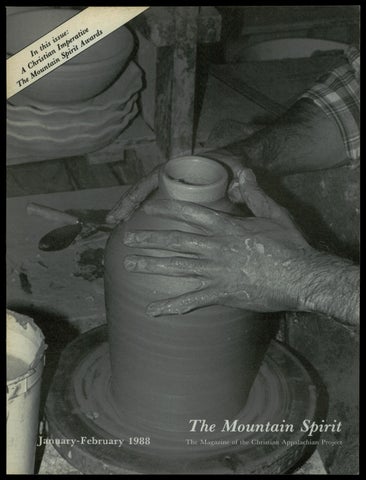
The January-February Theme T h e C h ristian A ppalachian Project is p ro u d to be associated w ith a great n u m b e r of fine people and organizations th at are m aking im p o rtan t contributions to the A ppalachians. In this issue y o u ’ll m eet the recipients of the M o u n tain Spirit A w ards, the artists who fashioned the aw ards an d some recipients of C A P h u m a n developm ent grants. O n the C O V E R , an artist at his wheel (photo by J o rd a n ). O n the B A C K C O V E R , w inter strikes the m o u n tain s (photo by G abriel).
P ublished by the C h ristian A ppalachian P roject. E ditor, M a rg aret G abriel. A d visory B oard, F ather R alph W . Beiting; M ike M cL au g h lin ; Leslie B. L arsen; J a c k M orris; Bill Begley; R an d o lp h Jo rd a n ; Lloyd F eltner. G raphics C oordinator, D ebbie Fraley T u d o r; C ircu lation M anager, T h eresa R ichey. The Mountain Spirit is published six tim es a year. T h e annual subscription price is $5.00. S ubscriptions and o th er correspondence should be sent to The Mountain Spirit, C hristian A ppalachian Project, 322 C rab O rch ard R o ad , L ancaster, K entucky 40446. C o p y rig h t, 1988. T h e C h ristian A ppalachian P roject, Inc. All rights reserved. M em ber, C atholic Press A ssociation. T h e C h ristian A ppalachian P roject is a non-profit C h ristian service organization operating th ro u g h o u t eastern K entucky. T h e project operates on the philosophy th at “ helping people help them selves” is the best approach to A ppalachian poverty.
From Our Founder A few years ago, some friends of mine were going through a divorce proceeding. As they appeared in court, the judge asked the wife why she was suing for divorce. Did she no longer love her husband? “Yes, your honor,” she replied. “I do love him, but he no longer loves me and it is so very hard to live with one who no longer loves you.” When she said that her husband no longer loved her, he jumped to his feet and began to shout, “Now look here. That’s not true. I do love her.” Then, looking at his wife, he said, “Why do you think I work so hard? Why am I on the go so much? I want to make sure that you and the children are well taken care of once I am gone. I do love you.” She looked at him, tears stream ing down her face and sobbed, “But you never tell me. You never tell me.” The divorce never came through because at last someone had said, “I love you.” The wife didn’t want a new car, a new coat, or anything like that. The reward she needed was his love, but she needed to have him tell her. I remember another story that in volved myself. I met an old moun tain couple who lived at Big Hill, Kentucky. The husband had been sent to jail for possession of moon shine whiskey (that’s a story in its own right). When he got out of jail, he wanted God to be more present in his life. He asked one day at the general store if anyone knew a preacher he could talk to. A salesman from the local wholesale grocery said, “I think the priest from our church would be glad to talk to you, but he’s Catholic. I hope that doesn’t bother you.” The old man said it didn’t, and so I came to visit. I spent every Tuesday evening at Jan u ary -F eb ru ary 1988
F ath er R alph B e itin g .
his home for nearly four months. He and his wife and I talked about God and how He loves us and wants us with Him always. At the end of this time they both had a deep religious experience and joined the Church. It was a beautiful day, and at the end of it he called me aside and said, “I have a gift for you.” He took an old towel off a finely carved cane. The wood was beautiful and the many hours of labor spoke of a great talent. I told him, “Jesse, I can’t take this from you. It is too expensive. You could get a good price for this at a Berea craft shop.” He looked so hurt as I spoke. “If I can’t share with you, how can I be your friend? he asked. I realized that he needed to give me an award. He needed to say, “I love you. You are important. You are worthwhile.” When you live as many years as I have in Appalachia, you realize that, while food and shelter, medicine and jobs are so very much needed, there is something even more essential needed. That precious commodity is pride. If we are to ever be a more pro sperous and healthy people, pride must once again fill our hearts and minds. Only a proud people can dream great dreams; only a proud
people can take up arms against a sea of troubles and by opposing, end them. In the many years since I founded the Christian Appalachian Project, I think our finest contribution has been the love we share with the peo ple and their land and the pride we experience as we get to know them better. With the old, we recall the past and the many contributions they made to this land. With the young, we dream the dreams of adventure and what a difference their lives can make. With the families who smart and sting under the blows of today’s oppression, we say, “Don’t give up. Don’t turn back. Your struggle can bring about a better tommorrow.” I hope that CAP is saying to the people of Appalachia, “We love you. You are important. You deserve a sense of pride.” The victory will not go to the strong, to the swift. It shall go to those wonderful people who, con scious of the great love God has for them, believe with all their hearts that with Him they can do all things. For God so loved the world, that He gave us the finest award we shall ever have —His son. Can’t we give someone an award today? Can’t we let them know we love them? 3
L -R (front row) David Lollis, Carol Stumbo, Arnold Turner, Jr. (Back row) Mike McLaughlin, Grady Stumbo, Father Ralph Belting. Not pictured, Loyal Jones.
The M ountain Spirit Awards by Moira Ambrose, Joe Foley, and Giovanna Burks Godby photos by Randolph Jordan
I n October, the Christian A ppalachian P roject proudly recognized the achievements of some people who live, work —and contribute —in the mountains with The Mountain Spirit Award. The Mountain Spirit Advisory Board selected the winners from entries in five categories. Although many fine people were nominated, the board believed that those they selected best exemplify the spirit of the mountain people. The winners were Loyal Jones for promoting the Understanding of Appalachia, David Lollis for Economic Advancement, Carol Stumbo for Education, Grady Stumbo for Health Care, and Arnold Turner, Jr. for Spiritual Enrichment. The Mountain Spirit
I jo y a l Jones is a man of absolutes. Direc tor of Berea College’s Appalachian Center and winner of CAP’S Mountain Spirit Award for spreading the Understanding of Appalachia, Loyal has been in his business long enough to know what he thinks and not be afraid to say it. Yet, despite an apparent black and white opinion on most issues, Loyal has a human focus which undoubtedly mixes a natural sensitivity with a chosen emphasis on people. Some examples: “Shaming people into conforming is inhibiting people in a way that is sinful.” “I like meeting people who are different.” “An honest person without much money could not be elected governor of Kentucky.” “I’m interested in what moves people, what is meaningful to them.” Loyal is in the business of preserving Ap palachian culture. A writer, teacher, scholar, and past activist, he strongly believes that people in Appalachia should be proud of their heritage and themselves. “People who grow up here [in the mountains] need to realize the importance [of their homes] and a sense of place,” he says. Sitting in his Berea College office on the second floor of the 85-year-old Edwards Building, Loyal’s speech is dotted with no-gray-area words such as “sickening,” “outrageous,” “horrible,” “awful,” and “sinful.” His strong opinions stem from years of experience in community development pro grams, academic endeavors, and writing. Before his current position, Loyal directed the Council of the Southern Mountains, a community development and cultural preservation organiza
tion. He came to Berea College in 1970 and now directs the college’s Appalachian Center and organizes courses and activities that focus on the Appalachian region. Loyal has written two books on Appalachian musicians and one on Appalachain humor with performer Billy Edd Wheeler. In explaining Appalachia to others through his writing and speaking, Loyal urges “middle class people” to see and experience Appalachia from an Appalachian viewpoint. “I see myself as trying to get people to set aside their own cultural blinders, to understand life from someone else’s values. Scholarly people will often criticize poor people for being rigid, but middle class people are just as rigid in what they can tolerate and in getting to know people for what they are.” Loyal explains that seemingly out-moded behavior is often based on lack of access to ser vices and conveniences that more affluent com munities enjoy. He relates, “People change when things are realistically available to them. We need more money in the mountains. When there are hospitals, etc., people make the right choices. Often people don’t really have choices when mid dle class people think they don’t make the right choices.” Of great importance to Loyal Jones is the preservation of Appalachian culture. Two areas of special interest are Appalachian religion and music. He believes that, in the past, mountain culture was entwined with its various denomina tions. In writing and researching local religion, Loyal continues his quest for the personal by try ing to find “what people see religion is doing for
F ath er R alp h B e itin g , and C A P p resid e n t, M ik e M cL a u g h lin m ade the p resen ta tio n s to the M o u n ta in S pirit A w ard recip ien ts.
Jan u ary -F eb ru ary 1988
5
them.” Loyal carries his emphasis on the individual into his musical research as well. “The archive at the Appalachian Center of recorded sound is valuable not only for the material itself,” he says, “but for the accents and extraordinary personalities of the people.” The annual Berea College Traditional Music Festival is one way Loyal has established to pro mote, preserve, and present mountain music. It is through festivals like these that “people who ought to be encouraged” are encouraged. In this category Loyal includes banjo-pickers, story tellers, humorists, and fiddlers. He stresses that not only is the beautiful, rich, mountain culture worth keeping, but American society benefits from variety: “We need to help young Appalachians know about themselves and not feel ashamed of themselves. Not to be shamed into conforming . . . it is important to encourage diversity in this country.” Asked how long a unique Appalachian culture can remain intact, Loyal responds, “A distinct Ap palachian culture will last several decades, but the pressure is on to conform, especially because of television. Styles and trends are changing things every year. It’s based on the dollar . . . everything is promoting a kind of cultism.” It is obvious that Loyal will continue to oppose this cult of sameness at the same time that he con tinues to promote the preservation of Appalachian heritage. -M A
U 'T ' X he reason anyone does what they do,” says Dave Lollis, “starts when they’re still a youth and relates to the family. As early as I can remember, my parents were always challenging me with causes.” Recipient of CAP’S Mountain Spirit Award for Economic Advancement, Dave Lollis was born in Asheville, North Carolina, and has lived in Ap palachia much of his life. Throughout his life, Dave’s family influenced his decision to contribute time and energy to the mountains. A veteran of decades of involvement in community develop ment programs and social change, Dave is current ly Executive Director of the Federation of Ap palachian Housing Enterprises in Berea, Ken tucky. For three decades, Dave has thought and acted on social issues. “Christians,” he says, “particular ly are called to understand the interdependence of the justice issues—racial issues, war and peace, and economic justice.” He continues, “If you’re working in Appalachia in social justice and trying to foster change, you’re going to be involved in controversy.” One con troversy arose when Dave worked for a communi ty action program in Southeastern Kentucky. “What the problem came down to was: who was going to call the shots? Just the power structures in the county or were we going to let the low in come people that the program served help design priorities and policies? Some of us (pushing for in put from low income families) were let go. That’s always a scary thing to happen when you’ve got two small children and a family. It teaches you that you can take a stand and survive.” Soon after, 2,500 people gathered at a rally in Barbourville, Kentucky, to support the position of Dave and the other workers who were fired. To promote economic justice, Dave believes churches must work together with government and other community programs. The joint effort is necessary because, “there is no way you can ex pect the private sector to meet those needs —it is not in their economic interest. And there is no way the church would ever have enough money to do all that.
D avid Lollis and Bill Begley, CAP V ice President o f D ev e lo p m e n t.
6
“The question of leadership between govern ment, non-profits and churches must surface at the local level. We’ve got to learn how to use the resources that are available from the private sec tor, public sector and churches in coordinated, ef fective ways. The job is bigger than all of us together.” Joint efforts were integral to many of the suc cess stories that Dave shares with pride. The Mountain Spirit
Dave was also involved in a successful effort to save a community in Harlan County, Kentucky. “The area of the black community in Harlan had been undermined by coal mining and the ground started to collapse. Part of the hill fell off on the city below,” he explains. “To be able to help those families move to the other side of Cumberland Mountain, to Pride Ter race, without destroying the fabric of the communi ty was fantastic. The com munity depended on each other for their very sur vival.” Pride Terrace, the community’s new home, is a group of single and multi-family houses built through a unique combina tion of community grit and state and federal funding. Looking to the future, Dave is realistic in his assessment of Appalachian development. “We’ve got to create employment by creating jobs that get peo ple doing something in their community that needs to be done. For example, we need to reorganize the medical delivery system, home visitation, and train more physicians’ assistants. “We need a slower development process, more patient, more long-range. With the War on Pover ty, we gave up too quickly . . . we stopped when we were just learning how to do things.” After so much commentary, analyzing past ex periences, Dave chuckles and grins, “I could’ve made more money someplace else, but looking over thirty years of work in the mountains, I sure ly don’t feel cheated.” —MA
I do not deserve this award, and for two weeks, I’ve been trying to figure out why you are giving it to me. I don’t deserve it for three reasons. I love what I do, and I do it in my home county. I have had wonderful help, too, and really, this award belongs to the students.” Carol Stumbo modestly accepted The Mountain Spirit Award for Jan u ary -F eb ru ary 1988
A b o v e, M ik e M cL a u g h lin con gratu lates L o y a l J o n es. B elo w , C arol Stu m b o accep ted her aw ard o n b e h a lf o f her stu d en ts and fello w teachers.
her contribution to Appalachia in the field of education. Carol teaches English at Wheelwright High School in Floyd County, Kentucky. She creates an atmosphere of calm respect in her classroom, where students are challenged and realize (some for the first time) academic success through a special writing project —an oral history magazine, Mantrip. Modeled after the Foxfire series, Mantrip is written, edited, and published by students at Wheelwright High School [See “Hall Hallow,’’The Mountain Spirit, March-April 1987], and most of the writing is based on oral histories gathered by students from members of the Wheelwright com munity. Students watch their work evolve from in terview to story to published page. However, the benefit of this project transcends academic suc cess. Carol explains, “With the oral history project we have at our school, a sense of community is 7
grant from the Kentucky Arts Council, and receiv ed a grant from the Kentucky Educational Foun dation to publish Man trip. And still, Carol says, “There is so much left to be done. As long as there is one student who strug gles, our work is not finished . . . I appreciate this award; however, I accept it in the name of others who are working hard in education.” —GBG.
G rady S tu m b o and F ath er R alph B e itin g .
developing between older people and the students. The older people are beginning to feel that they are part of the school and that they have something worthwhile to offer. The students are being put into contact with people they often ig nored before. They are learning to know what it is that these people value and to respect them for those values.” She continues, “A sense of pride is developing among the students as well. They are no longer ashamed that they have a grandparent who knows how to make lye soap or has had no more educa tion than the third grade. They are beginning to understand and that is making a big difference in their lives.” Carol is a native of Floyd County, Kentucky, and earned degrees from Berea College and Morehead State University. In addition to her eight year tenure at Wheelwright High School, she has taught freshman composition, speech and drama at Alice Lloyd College, taught English at McDowell High School, and worked with the Ap palachian Theatre Project and Compensatory Education Program. Carol is a board member of the Floyd County Educational Forum, a representative of the Floyd County Educational Association, a member of the Wheelwright High School Academic Boosters Association, sponsor of the school newspaper and advisor to the school chess team and the school academic team. She received a National Endowment for the Humanities one year fellowship, attended the first Commonwealth Institute for Teachers, served on the School/Community Partnership Committee, attended the first Kentucky Writing Institute, at tended the Mellon Seminar Foxfire Experience at Berea College, served on the board for a county literary magazine, received a teacher incentive 8
I am a country doctor, and that is the badge I want to wear,” began Dr. Grady Stumbo as he accepted the Mountain Spirit Award for his con tribution to Appalachia in the field of health. Although he has realized a successful career in state politics, it is Grady’s committment to his native Appalachia that endears him to the people of the region. Upon his graduation from medical school in 1971, when so many others before him left the area to pursue their careers in urban set tings —some even in other states —Grady returned to the mountains, deep in coal country. He founded the East Kentucky Health Services Center at Troublesome Creek in Hindman, Ken tucky. The clinic provides medical services to thousands of people each year, and he extends his practice to those at home, in the hospital, and in the nursing home. The clinic is located five miles away from Alice Lloyd College, where he was once a student. Grady built his health care program without government assistance, and it is now a national model of rural health care. Both the Robert Wood Johnson Foundation’s Rural Practice Project and the Federal Department of Health and Human Service’s Rural Health Initiative are modeled after Grady’s work. Grady Stumbo was born and grew up in Frogtown, in Floyd County, Kentucky. He was an honor student in high school, attended Alice Lloyd College and received the college’s scholar ship to the University of Kentucky. During medical school, he organized the Stu dent American Medical Association’s Ap palachian Program, which involved young health science, medical, dental, and pharmacy students in ten-week summer preceptorships in Ap palachia. The objective was to convince students to return and work, for all or part of their careers, in areas in Appalachia that are under served. Grady was awarded the Sullivan Award upon graduation for being the medical student most in volved with improving his community. Since graduation day, he has continued that involveThe Mountain Spirit
ment in his community, his region, his state. “I like it here. I’ve had a very good life here, and I want my children to grow up here. I had no choice where I was born, but I choose to live in East Kentucky. I don’t have to, but I choose to.” [See “Grady Stumbo: Mountain Doctor,” The Mountain Spirit, September-October, 1983.] And so, Grady Stumbo continues to devote himself to a region —a people—to create an im proved Appalachia. With sincere appreciation, the Christian Appalachian Project honors him with The Mountain Spirit Award. —GBG.
W h e n Arnold Turner, Jr. first heard the story of the Prodigal Son, he cried. He was 33. The story hit home. At age 29, Arnold Turner had been elected County Attorney in Floyd County. He already had a successful private practice in Prestonsburg. He already had made, by his own admission, “lots of money.” He had a family. Though from humble beginnings, he had taken what society provided and accomplished much, but there was still something missing. “There was just something lacking, something deep within me nobody could reach —no person, no relationship, no material thing,” Arnold said. “I had people tell me to be a Mason. I had people tell me I needed to be in the Kiwanis. But I never had anybody tell me that I needed to be a Christian.” Then, five years ago, things began to change. Arnold began to go to church; he began to explore the Christian faith. With the help of a long-time friend and Christian layman, he made a public profession of faith. Since that profession, Arnold has become pro bably the most notable Christian layman in Eastern Kentucky. It was for his strong faith and his works that Arnold received The Mountain Spirit Award for Spiritual Enrichment.
to and including delivery. It has paid tuition costs so a young woman could give up her job, have her baby, and still remain in college. It has purchased a vehicle so the husband of a pregnant woman could get a job. Without a steady income, the cou ple was considering abortion. Alternatives will also, at the request of young pregnant women, break the news to the parents. It will offer counseling to families as a whole. It will also help with adoption proceedings. “Most of the girls we work with feel they have no choice. They don’t choose to abort, they ask, ‘what else can I do?’ ” Arnold said. “We try to give them a choice.” Another benefit of Alternatives’ work with young women has been its’ ability to draw area churches together in a region not known for strong inter faith interaction. Approximately six churches are represented on the Alternatives ad visory board, and several ministers serve as trustees. The churches supply volunteers, financial and material support, and services such as transportation and housing. The Reverend Timothy Jessen, a Presbyterian minister in Prestonsburg and an Alternatives trustee, nominated Arnold for The Mountain Spirit Award, both for the success of Alternatives and for his ability to draw people together. “Arnold is a person who has an ability to bring together people from different ends of the theological or the denominational spectrum, which is very rare in Appalachia. He himself is a Baptist, but is equally at home in a Charismatic church, a Presbyterian church, a Methodist church,” Jessen said. “He thinks of himself first as a Christian.” Arnold plans to be ordained as a Southern Bap tist minister before the end of the year. —WJF
Prominent among Arnold’s works has been the founding of Do Right Ministries, better known as Alternatives. Alternatives, based in Prestonsburg, serves mostly unmarried pregnant women in the Big Sandy area. Since the program’s inception four years ago, 75 women have been assisted, both financially and spiritually, in their decision not to abort but to follow through with their pregnan cies. Alternatives does just what its name implies. Its services are based on situation and need. While Alternatives provides free pregnancy testing, it will also, in some cases, help with medical costs up Jan u ary -F eb ru ary 1988
A rn old T u rn er, J r.
9
Around the Project
by the CAP News Service
‘‘A ttics” R ecover From the A ugust Fire BEREA —Doris Anglin, manager of CAP’S used clothing stores, is grateful for—to say nothing of overwhelmed by —the generosity with which supporters have reacted to the fire which destroyed the “At tic” warehouse in August.
R ock castle T e en s en jo y th eir cen ter as a spot for stu d y , recrea tio n and fello w sh ip . A bou t 35 k id s drop b y ev e ry d a y .
T een s are D eterm in ed ! W H E E L W R I G H T - When teenagers set their collective minds on a project, you can never tell what will happen. The teenagers who fre quent the Wheelwright Youth Center in Floyd County will cor roborate that statement. One of the Wheelwright kids heard that every pull tab from a soft drink can could be redeemed for a minute of dialysis for a kidney pa tient, and the hunt was on! Fifty of the teens who come to the youth center collected the tabs from family and friends for three months. With the singlemindedness of purpose and dedication of youth, the young people of Floyd County saved 100 pounds of pull tabs. Katie Newsome, manager of the center, placed a call to the Kidney Foundation and learned that there was no truth to the story that pull tabs could be exchanged for dialysis. 10
The kids weren’t about to let all their hard work go down the drain, though. They took their haul to a local recycling center and with the proceeds from the sale of the pull tabs, made a $175.00 donation to the Kidney Foundation. With the same dedication, the young people in Rockcastle County com pleted $5,000 worth of maintenance and repair work to their teen center in Mt. Vernon. “The list is a mile long,” said Ike Adams, manager of the center, “but it includes completion of a new study room, new carpet, new paint, new furniture, a new music room, and lots of cleaning and sprucing up.” Twelve kids worked for two weeks after school, with Ike and Matt Getsi, a volunteer who works at the teen center, as supervisors. “The only payment these kids got was that Matt and I treated them all to pizza to thank them for their hard work,” Ike said.
“We have a file of names of peo ple who have sent clothes in the past. Luckily, that file happened to be here in the store and not in the office in the warehouse. If it had been burned up, I don’t know what we would have done. Renee [Mullins, Doris’ daughter] sent let ters to all of those people, told them what had happened and asked if they could help,” Doris said. The letter explained that the CAP “At tics” were facing the oncoming winter season without the supply of winter clothes which had been sorted, tagged and stored until they were needed. “And it wasn’t just out-of-state people [who helped], either,” Doris said. “A lot of people heard about the fire on television or read about it in the newspaper, so we’ve had donations from people in Louisville and Lexington as well as the local area. It’s good things, too, not 2000 pairs of baby socks, size zero.” Doris said that the response has been so good, that they have been giving clothes away to anyone who asks, and not just those in an emergency situation, like a burn out, as has always been the case. This is helping with the storage pro blem which the stores face, although a semi-tractor trailer truck has been set up where the warehouse used to stand. CAP hopes to be able to rebuild the warehouse in the spring of 1988, but in the meantime, Doris says, “We’re making it.” The Mountain Spirit
around the project . . . continued
FLC School T eachers W in Scholarships STANFORD & MT. VER NON—The Family Life Center School and the School on Wheels have been growing steadily since their beginnings. They have had such success in Mt. Vernon that they have expanded to Stanford. “The people in Stanford didn’t have a program that would teach them GED preparedness,” explained Gary Eldridge, manager of the Family Life Center School and the School on Wheels. “So they asked us if we would start a program there. We’re using the old Little World Day Care Center building and staffing it with one teacher, Carol Cannon. Ms. Cannon already has about ten students in the even ing, and she teaches CAP’S Group Home boys two days a week. That will save the boys from making the trip to Mt. Vernon from Nicholasville.” The trip to Stanford is about 20 miles; Mt. Vernon is about 45 miles. The teachers from both programs have done such good work that three were awarded scholarships to the second annual Education In Ap palachia conference at the Universi ty of Kentucky on October 23-24. Program coordinator, Anita Isaacs, and Linda Argentati and Mark Boyd, both volunteers, received full scholarships to the conference. The conference was sponsored by the A ppalachian Center and featured Eliot Wigginton, editor and writer of the Foxfire series; authors and teachers Johnathan Sher, Linda Martin and Dixie Goswami; and held sessions which dealt with the specifics of teaching in Appalachia. The scholarships provided full registration fees, transportation, food and rooms. According to Gary, six staff members attended the conference in all, including Carol Cannon and Clare Chapman, January -F eb ru ary 1988
D r. O rv ille J . S tein p resid es at the celeb ra tio n o f A ll S a in t’s D a y .
to learn more about the cooperative efforts of native Appalachians working together to improve the educational opportunities for Ken tucky’s adults.
St. L u k e ’s C elebrates A ll S a in t’s D ay SOMERSET —St. Luke Free Clinic in Somerset, Kentucky, celebrated All Saint’s Day on Sun day, October 17. It was such a warm day that the service was held out side under the trees. Dr. Orville J. Stein led the ceremony, speaking of St. Luke and explaining to the nonEpiscopalians in the congregation about All Saint’s Day. Time was set aside during the service to welcome each person that attended with a hug and a handshake. When com munion was held, all baptized Christians were invited to partake. Dr. Stein closed the service with this story. “At 2:00 this evening, I was called to place a man, who was ill, someplace that he could rest and recuperate. As I took him place to place, and still could not find anywhere for him to stay, my agita tion grew and grew, especially when it drew near 4:00 and time for this St. Luke’s ceremony to begin. Final
ly, at 3:45, I found a place for this man to rest until he is well. I had to beg his forgiveness before he left me because he may well have been Jesus Christ, come to test me, for all I knew. “Gives us something to think about, doesn’t it?”
Moving? Please notify us of change of ad dress to make sure you receive every issue of The Mountain Spirit. OLD A D D R E SS please print
name address city
zip code
state
N EW A D D R E SS name
please print
address city state
zip code
Mail to: The Mountain Spirit, 322 Crab Orchard Road, Lancaster, KY 40446.
11
around the project . . . continued
T h e Arts M ake an Im pact on CA P LEXINGTON-On a sunny fall day, teachers at the CAP Child Development Center in Berea ac companied nine children to a classical music concert at the Center for the Arts at the University of Kentucky. Holly Bowers, one of the teachers at the school, taught a unit on classical music before the concert, showing the children pictures of musical instruments and emphasiz ing the kind of behavior that would be expected. “They played several pieces that the kids recognized,” Holly said, “like the ‘Star Spangled Banner’ and the ‘Entertainer Rag.’ Then they played a really neat piece called, ‘The Carnival of the Animals.’ They would describe an animal, then play a piece that sounded like the animals. The kids really enjoyed that.” Teri Mehler, manager of the center, said that the children were very excited about the trip and eagerly anticipated going to the “big city” to do something special. “It was the first experience with classical music for most of them, and it was great to see their eyes get wide, and to see them rock along to the music.”
Prestonsburg, has teenage children who participate in the activities at the center. “She works as a Girl Scout leader and has had story hours for the younger children,” Katie said. “She’s an excellent volunteer.” Heidi Anne Porter, a volunteer from Anchorage, Alaska, teaches classes at the teen center in Martin. She has about 25 students registered in two classes, one geared for 3 to 5 year olds and one for 6 to 12 year olds. “I’d like to start a sports warm-up class to involve the boys,” Heidi Anne said. “To show them how im portant agility is to sports. I’ll let them choose their own music, and as they come to enjoy it —and they will —we can move more into ballet.” Heidi Anne said that she would like to work toward a recital of some kind in the future. “Recitals are important, I think, because peo ple like to have their work recognized, and they’re an important part of building confidence.”
C h ild D ev elo p m en t Program to Start in M cC reary C ou n ty The Christian Appalachian Pro ject plans to open Eagle Child Development Center, its sixth pro gram for three, four and five year old children. “We were approached by people in the community who asked us to come in with a program,” said Ellen Burke, director of human develop ment. “They know about us through our grant program, and from the volunteers who go to McCreary County to work on home repair pro jects.” The center will be located on public school property, so children will be able to take advantage of public school services, like food preparation and transportation. CAP child development workers are very pleased to be working in such close contact with public schools, and they believe that it will make the transition from child development to “Big School” smoother for their students.
The center in Berea is not the only program that has been involved with the classical arts, though. The youth centers in Wheelwright and Martin, both in Floyd County, offer ballet classes to teenagers and children in the county. Katie Newsome, manager of the center in Wheelwright, said that an average of ten girls attend classes that are taught by Linda Holbrook. “We haven’t had any recitals or anything like that. Mostly they work on exercises and routines,” Katie said. Linda, who works at CAP’S spouse abuse shelter in 12
T h e C hristm as w reath factory in T y n er had on e o f its best years ev er this season. D ry w eath er co n d itio n s m ade w orkers u nsu re for several w eeks ab out w h eth er en o u g h fir w o u ld be a v a ila b le to m eet the d em a n d , but then the rains cam e, and n in e ty w orkers p rod u ced 4 5 ,0 0 0 w reath s. The Mountain Spirit
around the project . . . continued
C hristm as Baskets E m p h asize the Spirit O f the Season Twenty-three hundred families in C A P ’S service area received Christmas baskets through the generosity of many sponsors from throughout the country. Courtesy of “Bibles for the World” each family received a New Testament in their Christmas basket, referring them to the story of the birth of Christ in the second chapter of Luke. Distribution is so extensive that baskets are given out for a week in the western part of the CAP service area, and three days in the east. “We started on Monday, the 13th,” said Keith Gilbertson, program manager, “and went through the next Tuesday. We took one day off to regroup and pack baskets for Rockcastle County. It’s a very exciting time, but I’m glad we only distribute baskets once a year!” Keith said that his favorite “Christmas experience” happened
about two weeks before distribu tion, “just when I needed a little lift.” Keith was leaving the Attic one day when he met Lena Napier, an elderly Christmas basket recipient who was shopping with the Attic gift certificate that she had received at the Christmas basket service the day before.
George Washington and Thomas Jefferson can help you write your WILL!
Keith noticed that Lena’s coat was way too small for her, so he helped her find one among the used coats in the store. When Lena found her new coat, the price marked was higher than the amount she had been allot ted on the gift certificate, so Keith increased the amount of the gift cer tificate to cover the cost of the coat. “If I hadn’t been there at that par ticular time, Lena wouldn’t have been able to get that coat. Of course, Colleen [the store manager] would have given it to her if she’d asked, but Lena wouldn’t have ask ed. I’m glad I was in the right place at the right time.” Keith and his crew of workers not only provided 2300 families with a merry Christmas day, they il lustrated the true spirit of Christmas for all who knew of their work.
Send today for your com plimentary copy of “How George Washington Can Help You Write Your W ill. . . And Ideas From 11 Other Presidents.” Just clip the coupon below and send it in the envelope provided in this issue of The Mountain Spirit.
Clip and mail today
Please send, without obliga tion, my free copy of “How George Washington Can Help You Write Your Will . . . And Ideas From 11 Other Presidents.” N am e____________________ Address __________________ C ity______________________ State_________ Zip_________ W hat w o u ld C hristm as b e w ith o u t ch ild ren ?
Jan u ary -F eb ru ary 1988
The C A P Closeup
Accepting the Challange Gerald H. Cooper by the CAP News Service photos by Debbie Fraley Tudor
«m m » ?
£ iff ^
FI i m m i > m * m t G erald H. C ooper in h is o ffice in M t. V ern on .
G ererald H. Cooper had pastored Presbyterian churches for over twenty years but had become in creasingly interested in the field of pastoral counseling. He had talked often with his wife, Joyce, about becoming a full-time counselor.
“While living in Louisville,” Jerry explains, “Joyce saw CAP’S advertisement in the newspaper for director of the retreat center. She tossed the paper to me and said ‘if you really want to do something, here’s your chance.’ ” Jerry took Joyce up on her challenge and became director of the Family Life Retreat Center in Mt. Vernon, Kentucky, in April of 1984. His secondary responsibility was marriage and family counseling, but it didn’t take Jerry long to realize that other CAP programs could benefit from a counseling service, too. “Instead of having counselors in each residential program,” Jerry said, “I proposed to the human development department that we have a counsel ing service that would cover all of those programs and any of the others that would have a use for our services.” The Family Life Counseling Services, with a staff of four counselors, provides services to two spouse abuse centers, a group home for boys, and a home for unwed teenage mothers. They offer counseling services in Garrard, Jackson, Madison and Rockcastle counties as well. Jerry, whose title 14
. ::
The Mountain Spirit
is now program manager of the Family Life Counseling Service, said, “This way we can serve many people and give each other support. And we can learn from each other.” Being director of the retreat center did have its drawbacks, though. “When I first came here,” Jerry explained, “I put on ten pounds. Myrtle Smith and Frances Anderson, who cooked at the retreat center, felt an obligation to fatten me up. I finally had to insult their cooking, which, of course, was very good, so they would stop bring ing me a taste of everything they made.” Jerry is originally from Niagara Falls, New York, but he and Joyce prefer living in the South. “When we had the chance to come to work for CAP and move to Berea, we jumped on it,” Jerry said. “We had become members of the Kentucky Guild of Artists and Craftsmen in 1967, [Jerry is a woodworker, and Joyce makes quilts and candles.] and had participated in several craft fairs in Berea. It was like moving home. One night, we even stayed in the old Moore’s Motel in room number two,” Jerry continued. “The old Moore’s Motel is now Emmaus House, and room number two is now my office.”
J erry h an d carves sm all a n im a ls, and som e o f h is litu rg ica l w ork is d isp la y ed b eh in d h im .
Jerry and Joyce own a craft shop in Berea, where they have a beautiful display of their own works of art and those of other Appalachian crafts people. Joyce works in the shop full-time, and Jerry helps out evenings and weekends. Jerry seems satisfied working at the two jobs he loves, but he is still accepting the challenge. “I feel as though the counseling service can continue to grow,” Jerry said. “CAP provides emergency ser vices, and we help families through transitional periods, but we also need the therapeutic ap proach that helps to turn their lives around—to correct malfunctions that have held them back a lifetime and to help them begin their life anew. “My favorite saying is on a plaque that I have hanging in my office,” Jerry said. “ ‘Give a man a fish, he eats for a day; teach him how to fish, and he eats for a lifetime.’” cap.
J erry ob serves h is w ife, J o y c e , as she rolls b eesw a x ca n d les. T h ese can d les are d isp la y ed in th eir craft shop alon g w ith th eir oth er h and m ade item s, in clu d in g J e r r y ’s w o o d w o rk and J o y c e ’s q u ilts.
Jan u ary -F eb ru ary 1988
15
Letters
I can no longer contribute in any way to your “project.” The article by Mr. Jordan, extolling Daniel Berrigan and the photos of small children proudly displaying “the broken-cross” (or sign of the antiChrist) that Berrigan and his “sicksixties” that have for years, passed off as a “peace sign”, leave me sick at heart and feeling terribly wrong ed. I would feel less cheated had I given my small contributions to Tammy Bakker for her mascara fund —in the the name of Christiani ty and peace.
It has really been a pleasure to meet the people of Appalachia through your magazine. So many of us have no idea of the area or its people, but your magazine has changed all that and given us an idea of where our donations go. Thank you for such an excellent magazine. Marion Webb Springfield, MA
It is indeed sad that you allowed Berrigan and his “broken-cross” rat tling to shadow your fine works, frighten your children and make this lady feel low of spirit and have real fear for our wonderful nation.
We find your magazine most in formative and enjoyable. The help you give to the poor and to those able to eventually help themselves is wonderful. God bless each and every one of you.
Mary Lee Higgins Burbank, CA
Mr. and Mrs. Raymond C. Vlack Chicago, IL
I am sorry that you drew that con clusion from our story in the November-December issue o f The Mountain Spirit about Father Daniel Berrigan. Father Berrigan is in no way connected with the Chris tian Appalachian Project, but did live in the area fo r several months while serving on the faculty o f Berea College. Fm sorry that you believed that the story was “extolling” him. I believe that the story simply paints a picture o f Father Berrigan, leaving the reader to draw his or her own conclusions. —Ed.
Please continue to send the The Mountain Spirit. I enjoy knowing how things are going in the moun tain area. I know there are times when things haven’t been so good. Then, I, too, feel sad and want to help. I don’t have much for I’m a widow on Social Security, but I’ll share what I have. When things are going well, I rejoice with you. My prayers are that God surrounds everyone out there with His loving blessings.
I like The Mountain Spirit very much; the homey stories remind me of my home life as a boy on the farm. It was a humble life, but good. We worked hard and found our own entertainment. I lived on the same farm all my life, where I was born until I was 65. Then I retired and moved to a nice home near by, having sold the farm. I am 77 now and enjoying life. I realize many of your people are poor and needy and I am willing to help what I can. John Meeuwenbert Freemont, M I
My wife and I both look forward to each and every issue of The Mountain Spirit. We are both Californians but enjoy reading about your area and the many fine things CAP is doing for the poor in Appalachian area. I have retired; we are looking for ward to traveling USA. The area that we want to see and visit after reading your fine magazine are the Appalachians and CAP. God bless you one and all. John and Lois Becknell Stockton, CA
Mrs. Lillian Bednarz Stickney, IL The Mountain Spirit is infor mative and imbued with the feeling of Christian charity and love in the deepest sense. Through the magazine, I share vicariously in all the things you do at CAP. Virginia J. Grubaugh Mt. Pleasant, M I
16
Your magazine depicts the spirit and lives of the mountain people. The articles are informing, enter taining and just plain good reading. I also find the stories very down to earth and real life-like. Mrs. Barbara Baker Springfield, 77V
Letters to the editor are welcome. They should not exceed 150 words in length, and we reserve the right to edit them fo r space. Address letters to The Mountain Spirit, Christian Appalachian Project, 322 Crab Orchard Road, Lancaster, Kentucky 40446.
The Mountain Spirit
The Artists b y M argaret G abriel and R an dolph Jord an
I^ecipients of the Mountain Spirit Award received works of ceramic by Appalachian artists commemorating their honor. The artists, Ben Culbertson, James Majcher, and Jim Parsons, all recently graduated from Berea College. They were commissioned by CAP to design as well as execute the awards and each produced a work that the recipients say they will be proud to display. Ben Culbertson was born in Lexington, Ken tucky, and spent his adolescence in Wolfe County. He graduated from Berea College in 1987, with a BA in art with an emphasis in ceramics and is working now as a graduate apprentice in the pot tery department at the college. Ben plans to attend graduate school and is looking for a program that emphasizes function in ceramics. James Majcher, born in Harlan, Kentucky, and raised in Ohio, graduated from Berea College in 1987, with a degree in studio art. Although he has not ruled out graduate school as a possibility, James is considering in which direction he would like to take his art. While his wife is finishing her degree, James is tending their household and their Jan u ary -F eb ru ary 1988
two children, Maggie, 5 and Colin, 2. The Moun tain Spirit Award gave James an opportunity to resume working in clay after concentrating for over two years in other media. Jim Parsons was born and raised in Louisville, Kentucky, and graduated from Berea College in December of 1987. Jim’s degree is in philosophy, and he worked in the pottery department as his work assignment during college. He is considering working as a potter during the semester he will have free before attending graduate school. Jim would like to pursue a career teaching philosophy to children. Berea College pottery can be purchased at the Log House Sales Room, on the Berea College campus, or at the Galt House in Louisville. If you’re not planning a trip in the near future, a catalogue is available by sending $2 to Berea Col lege Crafts, CPO 2347, Berea, Kentucky 40404. “Every piece is different, so ordering by mail means not knowing exactly what you’ll get,” says Garry Barker, the marketing director. 17
I remember, my mother had a class once, and she took my brother and me over there one day, and threw a lump o f clay on the wheel and let us play. I remember that experience so vividly, and I always wanted to learn more, but never really took the chance. I ’ve always had an appreciation fo r ceramic ware, so finally, I threw all my inhibitions aside and jumped in a pile o f clay. -Culbertson
;J
j ;
i t: t - 1
A t the wheel, you can think. Once I ’ve started throwing and pretty much gotten into the flow, my mind can wander, so a lot o f times I can think about things. When you’re trying to study philosophy, you try to put it into your own life. Pottery has allowed me to do that—I can think about things that I run into in terms o f working with pottery. —Parsons
This piece and another piece I ’m doing allow me to do some work and have a purpose fo r the work, so I ’m not just floating. —Majcher
à
:;p ! }I /
m
n
r
*
a— *;
I
f
§ ■
g|||g ■
^
^ *.j
f I
^
V .*•’ /-*
SSh I
r‘t ;
■
mmWmc/ iff m*m i ¿V . 5 ® t? 1 J m g
L
* ;
-fa
fP/ie« / was looking at work assignments, I didn’t want to do anything that was mundane. I wanted to do something that was distinctively Berea, so I came to pottery. I thought I would just do it fo r fun, but I ’ve gotten much more serious about it. —Parsons « 1
V'
H i I
_
■
• -*
i
u •
*
i ^ i
Clay is what got me into art, but I ’ve been away from it fo r a long time. I ’ve been working in wood. I like being very direct with my materials. I can do that with wood. —Majcher
'""x, '‘til
SB■./■/**
I- —Ik
*
11
-
m &
v*m§ f v ■ ■m
It’s every bit as intellectual as a science discipline, but it’s not just a mechanical thing —there are so many aesthetic considerations when it comes to decoration and form. It’s really exciting. —Culbertson
■
I
****&'-
\
.
T h e Christian Appalachian Project sees itself as part of a large network in Eastern Kentucky, a network that opens opportunities of education, economic development and human development in the region. Although the greatest portion of its budget is directed toward programs that CAP operates directly, money is set aside every year to make grants to smaller organizations working in the mountains. Jack Morris, CAP’S coordinator of church rela tions and grants, says that the grant program is both theologically and practically based. Theologically, CAP has a responsibility to share its gifts, and practically, the grant program en sures against duplication of services —many peo ple doing the same thing. There are many organizations working in places where CAP has no daily programming, Jack says. These groups have the expertise and the relation ships with the people in their areas to make signifi cant additions or changes in these counties. An ex tra financial boost from CAP can make a real dif ference in the quantity or quality of their work. Jack says, “We want our donors to have an oppor tunity to be involved with these folks. Becky Simpson works on Christmas baskets at the Crank’s Creek Survival Center, a community organization in Harlan County.
A Christian Imperative
b y M argaret G abriel 20
“We have a couple of underlying priorities. We want to give money in geographical areas that we’re not serving and we want to give to programs that do work that we’re not in right now.” Health is a good example, Jack explains. With the preventive and environmental health educa tion program in Floyd County and the free clinic in Pulaski County, CAP is getting more involved in health services, but “basically, we have not been big in health. Housing is another example. Although we do have housing rehab, we don’t build new homes, so we give to people who do.” Contributions to established programs enables CAP to involve itself in a wider variety of pro grams, and helps to form a strong community of people and organizations working in the moun tains. Although a few of the groups are larger organizations, most of the 130 organizations that have been CAP grant recipients over the years have been much smaller organizations that do not The Mountain Spirit
With the decrease of federal dollars that are be ing spent in social service programs, people turn more and more to local churches and community organizations for assistance that they once got from federal programs. There are two sides to this story, Jack says. “On the positive side, you’re see ing more people band together to do things on a grass roots level because they have to. Okay, that’s the positive side. On the negative side, even when they band together, there aren’t sufficient resources to cover the need. You add one and one and get two, fine; but if you need five, what have you got? You can give the current administration credit for getting us together, but at the same time, even together, there isn’t the capacity to meet the needs.” About the time that federal money was drying up, the coal industry began the slide from which experts doubt that it will ever recover because of the automation of the mines. As the coal produc ing counties struggle to reestablish their economy, the people in those counties turn to whatever resources are available. “I’ve had ministers on the phone to me in the last week, saying ‘we are just absolutely swamped. There is no way we can meet the need.’ “I just got a letter from the Kentucky Council of Churches, pointing out that AFDC [Aid to Families With Dependent Children] payments in Kentucky have not increased since 1969.” There is a 5% increase planned for AFDC families, to which Kentucky is entitled because its economic condition has worsened in relation to other states. The increase will bring payments to $207 a month for a mother with two children. The federal pover ty level is $775 for a family of three. Jan u ary -F eb ru ary 1988
Tudor
have the resources to submit applications to the Ford Foundations of the world. These “grass roots” organizations are run largely by people who are native to the counties in which they operate, although there are projects that involve people who came in through the outreach programs of various churches. “There are both, really [local and non-local workers],” Jack says. “It’s people who came in as volunteers and saw a need (sort of CAP-fashion), or they’ve come in through some agency like ours. But, it’s also local people that have seen a need and are responding to it.”
C A P m ade a grant last y ear to the G alilean H o m e M in istr ies in C asey C o u n ty .
But, there are private funds in those counties, Jack says, and organizations are getting better at finding those funds and using them well. CAP uses the idea of matching grants more every year. “Essentially, we’re telling folks that for every dollar that they raise locally, we’ll give them two. This encourages local participation, and if they don’t get the one dollar locally, they don’t get our two dollars.” CAP believes that by matching these dollars, a local funding base is established, and eventually the CAP funds will not be needed. That money could then be used in another county for a different program. Repeatedly, Jack points out that the CAP grant program involves much more than just a large organization that gives away money to smaller organizations. “We consider these organizations partners in ministry,” Jack says. “They’re not just people that apply to us for money that we give them once or twice, then they’re automatically cut off. We maintain the relationship in a lot of dif ferent ways.” In addition to (and sometimes instead of) money, CAP provides groups with technical ad vice concerning programs that they are starting or operating. “For example, when St. Timothy’s in Estill County [see “If You See a Need, Try to Meet It,” The Mountain Spirit, November-December 21
1985] was putting in their child development center, Ellen Burke, [CAP’S director of human development] spent hours consulting with them on licensing regulations. She went with me to Irvine to meet with them. In that case, there was no money involved, but a lot of expertise. “The money for the programs is terribly, ter ribly important —don’t get me wrong. Without the money it would be like a pastor saying ‘we’re just going to be good Christians and we’re not ever go ing to talk about money, we’re not ever going to give.’ That’s silly —without the money, they can’t do the work. But it’s more than money; it’s a lot more.” In other cases, the advice is not really technical, but involves putting folks in touch with other peo ple who can help them, or groups that can help each other. “Sometimes, when I’m talking to peo ple who’ve made application to us, I’ll find myself saying, ‘do you know so-and-so down in Monroe County?’ And those people will get together.” Often, people will be unaware of other people do ing similar work only a hundred miles away. In troducing these people, and letting them draw ideas and resources from each other is an impor tant part of the ministry of the grant program. Establishing a community of service in Ken tucky is a large —but often elusive —goal of the grant program. Folks working in their own coun ties, in their own fields of expertise, don’t often have the time to gather with their colleagues, but Jack has discovered that joining people together, at least in one instance, worked to the advantage of several groups. Jack and Keith Gilbertson, CAP’S manager of small farming projects, assembled farming groups from several counties, and together they submitted a grant application to the people who distributed the money raised by “Hands Across America.”
CAP w orkers jo in e d m illio n s o f oth er p eo p le as w e stretched our “ H a n d s A cross A m e r ic a .”
“Although some of the projects that we give money to already come together, like the hospice programs, others don’t. In bringing the garden programs together for ‘Hands Across America,’ it was more than just money.” Keith and the others were awarded the “Hands Across America” grant, and in the process, met and learned about other people in the area who do the same kind of work and have the same kind of goals. Human development grants are just one of several types of grants that CAP awards to various people and organizations in Eastern Kentucky. For many years, CAP has awarded $1000 college scholarships to high school seniors. The scholar ships recognize the service that the student pro vides to his or her community. In 1987, CAP pro vided scholarships to 33 seniors in 26 counties. A program that will make grants to small business persons in Eastern Kentucky is in the planning stages. According to Frank Clark, CAP’s senior director of economic development, a lack of “start up” money is a major roadblock to development of small business. A business grant program will help to stimulate enterprise in the counties, pro viding jobs and economic advancement. Through the small farm program, garden seed, seed potatoes and fertilizer are distributed to local gardeners. Operations Sharing distributes in-kind donations made to CAP, such as books and food, to other groups in Kentucky and surrounding Ap palachian states. Through the grant program, CAP joins other groups in a spirit of sharing and community in Eastern Kentucky. “Father Beiting made the state ment to me that he felt that an organization that is as blessed by God as we are has a responsibility to share its resources with other organizations,” Jack says. “It’s a matter of Christian stewardship; we have the same responsibility that an individual has.” CAP.
Making Changes Upon Changes
S tory an d P h o to s b y Ik e A dam s
( j a r y Eldridge has been back in Kentucky for almost a year now. Pretty soon he’s going to have to take the Texas license plate off his car and replace it with a blue and white one that reads “Kentucky” across the top and “Rockcastle County” across the bottom. State law requires him to do so if he intends to stay in the state. In fact, he may already be past the deadline, in which case he has a valid excuse for not getting to the courthouse. Gary, you see, is program manager for CAP’S Family Life Center School (FCLS), a position that leaves very little time to do anything else. Gary doesn’t have time to worry about whether or not his car is properly licensed. He has the school to attend to and that program requires full time attention these days just to keep tabs on everything that it’s doing. The FLCS has virtually become an educational institution in and of itself over the last year —peo ple have received General Equivalency Diplomas as a result of instruction by the school’s staff of seven teachers. Although it is completely unaf filiated with the public school system, it gets high praise from the Rockcastle County School Superintendent. The Mountain Spirit
“In less than three years, you have turned out as many graduates as we do annually at the high school,” Superintendant Bige Towery said to Gary, who sat just behind him when he addressed the FLCS’s most recent graduating class. “I am very impressed. “What you have accomplished,” he turned and told the graduates, “is just as important and worth while as it might have been had you stayed in school. You have proven that you value education and you have gone about getting it. I’m as proud of you as you are of yourselves,” he continued. “And you deserve to feel awfully proud tonight.” Just before the ceremony, thirty-five people had donned caps and gowns at the school and then dashed down the hill to the FLC Recreation Building where the graduation was taking place. A developing thunderstorm was randomly spitting down huge drops of rain along with an occas sional, marble-sized ball of hail. Thunder boomed and flashes of lightening profiled the landscape every few seconds. The distance between the FLCS and the recreation center is about 100 yards. Under the circumstances, a pre-planned, dignified and orderly procession was out of the question. In 23
fact, several of the graduates might possibly have set new records for the 100 yard dash if they had been properly clocked. In the recreation center’s kitchen, they gathered like sardines, hastily adjusting caps and gowns and rehearsing which side of the mortarboard the tassel should be on now and when to switch it later. They smoothed out ruffled hair. The women hastily re-did make-up and the men got in their way. They all laughed and jovially carried on as though everything so far had gone just about right. It had been an adventure. So had their education. Fifteen minutes later, they solemnly marched out of the kitchen to the processional’s refrains and seated themselves in programmed order. Their place of honor consisted of four rows of seats just in front of their husbands, wives, children and friends, who numbered over 200. Thirty minutes later, they were officially and formally recognized as high school graduates. More than a few tears of happiness were shed as each student received his or her diploma from Mr. Towery. The graduation ceremony was especially moving, perhaps because most of the graduates had given up on completing high school years ago. Some had dropped out to get married. For others, school was a luxury they simply couldn’t afford. For some, there seemed to be no practical purpose for getting an education in the first place. Just a few years ago, there were very few jobs in Rockcastle County that required any formal education. Times have changed, though, and so have many peoples’ attitudes toward education. Thanks to the Family Life Center School, they’re getting a se cond chance to finish school after all. According to the 1980 Census, Kentucky’s Fifth Congressional District has the highest percentage of adults without high school diplomas of any district in the nation. Of the counties in the district, Rockcastle heads the top of the list in the lack of formal education among its population. In recent years, the county has built an in dustrial park. It has excellent rail service, and it is split down the middle by Interstate 75. It has a relatively large work force when business develops. First glance at the data that makes it seem ideal for industrial development. But even labor-intensive, low-technology manufacturers re quire a high school education of their workers. Until the education “problem” is solved, the coun ty is not going to experience major economic growth. The Family Life Center School may not be able to solve that problem all at once, but it is making it possible for a potential work force to get the 24
C in d y T a y lo r, a su m m er v o lu n tee r, p ro u d ly d isp la y s the b o o k s d o n a ted b y Sr. M arie G ranger, o f C o lu m b u s, O h io.
education that industry demands. At this writing, 200 students are studying for their GED through the school’s facilities or its outreach program called the School on Wheels. The school itself is a modern facility complete with classrooms and equipment that one would ex pect to find in most schools. There are shelves and shelves of reference materials and other books in the library which seems to be growing faster than the books can be catalogued. Someone recently sent a brand new Encyclopedia Britannica which joined one that was beginning to get ragged around the covers. Projectors, screens and instuction boards are in constant use. Since the school was founded in 1981, it has had to move to a larger building just to meet space needs. “The way things are going now,” Gary says, “We may outgrow our new building before we get settled in.” The Mountain Spirit
In fact, the school could not accomodate all its students if classrooms were absolutely necessary. In many casses, a front porch or a kitchen twenty miles or more from the school serves as adequate learning facilities. Two teachers take education on the road to residents’ homes every day and make use of whatever furniture is most convenient. In many cases, women have children at home or they have no transportation to and from the school. In these cases, it’s more convenient for both the teachers and the students to teach or learn at home, simply because of the travel time that would otherwise be necessary. Teachers even conduct classes for inmates at the county jail. “The fellows at the jail are the very best example of a ‘captive audience,’ ” Gary jokes. He was leery of the idea about teaching inmates when first approached by a local social worker, but decided to run it by the jailer anyway. His skepticism proved to be unfounded; both local of ficials and inmates responded with enthusiasm. “It may sound a bit unusual to say that a man got his high school education in the county jail,” says Gary, “but these guys are ready to take their GED test, and one who was just released has decided to continue classes at the school.”
We are not talking about hardened criminals here. Bootlegging beer in a dry county, for in stance, can get you six months in jail if you don’t have money to pay the fine. Rockcastle County does not allow the sale of alcoholic beverages. More than a few folks drive 25 miles up the in terstate and purchase it legally with intentions to resell it locally at a profit. That’s bootlegging. More than a few folks get caught. That’s life. Dit to for bad checks, growing marijuana, and not paying child support, most of which are more acts of desperation than they are attempts to harm another person. But all get jail terms for numerous people who, perhaps, wouldn’t have broken the law in the first place if they’d had a high school education.
A b o v e, D e lilia B rew er, W ilfred B an ks (a stu d en t from the C A P G roup H o m e) and A n ita Isaacs w ork on tea ch ers’ a id s. L eft, A n ita Isaacs rev iew s m aterial w ith School on W heels stu d en t, M elissa A rn old .
Jan u ary -F eb ru ary 1988
Certainly, the FLC School’s major thrust is not crime prevention or criminal rehabilitation, but one helps out where one can (if one’s heart is in the right place), and the school seems to be helping out all over the place. The School on Wheels has just taken on Lincoln County where adult educa tion is as deficient as it is in Rockcastle County, and where economic development opportunities might be much greater than they are now —if the lack of education was not such a hardship. “It’s not a problem that can be solved overnight. It’s going to take years and years for us to catch up with the rest of the country in terms of education proficiency,” says Gary when he talks about the problem.“It’s going to take time, but we can do it, and I have to think we will. I can’t think of anything more important.” In the meantime, Gary Eldridge, program manager of the Family Life Center School, still has Texas plates on his automobile. He’s going to have to take time to change them . . . soon, instead of worrying about how to double his budget next year. Time is running out on his license tags, but so far as adult education is concerned, he feels that it’s just beginning in Rockcastle County. Gary is much more concerned about the latter. He seldom has a chance to drive anyway.
G rad u ation N ig h t, M a y , 1987.
FLC School Teaches Young Folks In addition to its normal adult instruc tion, the Family Life Center School tutors young folks in numerous classes to assist and encourage them to stay in school or to make better grades. Tutorial assistance is almost im measurable in forms of students served, because most of it occurs on a short term basis. However, 25 youngsters (both elemen tary and high school) spent most of the summer of ’87 studying at the FLCS to improve their reading, writing and math skills so that they would be better students in the public system. The students were awarded special cer tificates of recognition and featured in a local newspaper story. G ary E ld rid ge and B ige T o w ery .
26
The Mountain Spirit
Through our Family Sponsorship program, you can make a significant difference in the life of a family like this one! R e ad e rs o f The Mountain Spirit often ask “ how can I m ake a difference in the face o f the pro b lem s you have in A p p a la c h ia ? ” W e are re m in d ed of an old song th a t goes: “ One m an’s voice can’t make a mountain ring; but i f two and two and fifty make a million, w e’ll see that day come ’round. . . ” O u r F am ily S ponsorship p ro g ra m is like th a t. A sm all group o f sponsors u nites b e h in d each fam ily a n d by c o n trib u tin g $20.00 a m o n th apiece, helps the fam ily stan d on its ow n. By w orking w ith in d iv id u al fam ilies, eventually we will see a change in A ppalachia. B ut we need y o u r help. W o n ’t you help sponsor a fam ily u n til they can help them selves? Send the coupon on this page in the envelope in the fold o f the m ag azin e, an d w e ’ll send you in fo rm atio n , including a p ictu re, ab o u t a fam ily h ere in the m o u n ta in s who needs y o u r help.
□ Enclosed is a check for $20 for m y first m o n th ’s sponsorship of an A ppalachian family. Please send m e a fam ily p h o to g rap h , a profile, and com plete inform ation. □ I am interested in becom ing a Fam ily Sponsor. Please send m e inform ation about □ the fam ily I w ould be helping, □ o ther ways I could help.
N a m e _______________________________________________________ A d d re s s _____________________________________________________ C ity ______________________ State ______________________ Zip
mm Hi
N O N -P R O F IT O R G A N IZ A T IO N U .S . P O S T A G E P A ID Christian Appalachian Project
C H R IS T IA N A PPA LA C H IA N P R O JE C T 322 CRAB O RCHARD R D ., LANCASTER, KY 40446 The Mountain Spirit