%
T h e M o u n ta in Spirit:
The Magazine of the Christian Appalachian Project Vol. V I, No. 4
July-August 1987
Contents Features 4
A M inistry of Hope by G io v a n n a Burks G o d b y O n e of the most energetic, e n d u r in g a n d needed of C A P ’s p ro g ra m s is hom e repair. F our crews of two m en each repair hom es in six counties. H ere y o u ’ll meet them and see some of their work.
8
“ The Abode of a Fam ily” by M a rg a re t G abriel
A family hom e , p. 8
F A H E , p. 11
T h e ho m e repa ir crew has helped R oy an d M e rr y completely rebuild their hom e.
11
FAHE by M o ir a A m brose T h e Federation of A ppalachian H o u sin g Enterprises helps low income people acquire new h o m e s— at m ortgage rates they can afford.
21
A Slap in the Face of Welfare by Ike A dam s J i m Bob and A rn o ld — the Swisher cousins— become involved in a n o th er nefarious, m o n e y -m ak in g scheme.
Departments 3
From Our President
14
The CAP Closeup
16
Around the Project
20
Letters
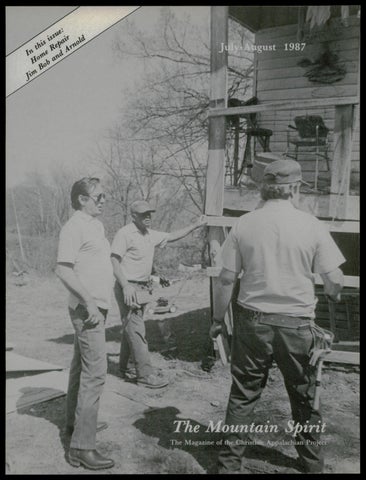
The July-August Theme T h e lack of safe, ad eq u ate housing is one of the most dram atic of A pp alach ia’s problem s. U nless people have a hom e of which they can be p ro u d — for w hatever reaso n — th eir self-worth m ay be in great jeo p ard y . In this issue we exam ine C A P ’s contributions to alleviating the housing problem , and those of FA FE, an organization in Berea. O n the C O V E R , C A P ’s hom e rep air crew discusses a jo b before beginning w ork (photo by G odby). O n the B A C K C O V E R , it m ay be an old school bus, but it’s also hom e (photo by Jo rd a n ).
Published by the C hristian A ppalachian Project. E ditor, M a rg aret G abriel; A ssociate E ditor, G iovanna Burks G odby. A d visory Board, F ath er R alph W . Beiting; M ike M cL aughlin; Leslie B. L arsen; Ja c k M orris; Bill Begley; R andolph J o rd a n . G raphics C oordinator, D ebbie Fraley W ilson; C irculation M anager, T h eresa Richey. The Mountain Spirit is published six tim es a year. T h e an n u al subscription price is $5.00. S ubscriptions and o th er correspondence should be sent to The Mountain Spirit, C h ristian A ppalachian Project, 322 C rab O rch ard R oad, L ancaster, K entucky 40446. C o p y rig h t, 1987. T h e C h ristian A ppalachian Project, Inc. All rights reserved. M em ber, C atholic Press Association. T h e C h ristian A ppalachian Project is a non-profit C hristian service organization operating throughout eastern K entucky. T h e project operates on the philosophy th at “ helping people help them selves” is the best approach to A ppalachian poverty.
From Our President
Gabriel
Housing problems —of which Appalachia has an abundance —have no quick fix. Even a modest home of 800 square feet, built with some donated materials and some volunteer labor, averages over $20,000 to construct. And this for one family! Where is such money available? At what interest rate? How do the unemployed, underemployed, aging, sick or homeless ever qualify for a loan? Where is land available? And where is a job that will make all this possible? No wonder we shake our heads and shudder at this problem and its immense scope. Clearly, there is no quick solution, no easy way, no single source of hope. Government —federal, state and local —must do its part. Financial institutions must cope with the problems and devise methods to alleviate them. So, too, must private enterprise, non-profits, volunteer agencies, and charities such as CAP. The people must do their share in a selfhelp philosophy. We all must work together. Building new homes is only a part of the solu tion. The repair, weatherization and moderniza tion of less than adequate housing is probably an even greater key. For the same amount of money, more homes can be improved than built from scratch. But here comes the old issue of whether the house is worth fixing, whether you are throw ing money down a bottomless sinkhole —some houses are so old and so worn that a repairman may not know where to begin. But even so, it’s better than nothing. And, there may be a fierce pride attached to the house —whatever its condi tion—by the family, if it has been handed down through the generations, or if it has been home for a great number of years. To uproot and move a family, or an older couple, from such a house, may be the one thing you should not do. So you do what you can, maybe not bringing the structure up to the standard of the various building codes, but preserving its life a little longer, to allow a lit tle more cheer between its walls until it finally col lapses upon itself.
M ike M cLaughlin
We have been active in trying to solve housing problems for over 20 years, really since our incep tion. This year’s budget in these areas amounts to more than $350,000, possibly closer to $500,000 if you consider the value of donated materials and labor.
We could not do it without God and without you. Thanks for giving us encouragement and be ing there in spirit and in prayer. We have the desire and hope, as do the homeless of Appalachia who dream of a better time and a better life. We and they will get there, somehow, some way. Some challenges are there for a lifetime, several lifetimes, but we bear down on it a step at a time, a nail and a hammer at a time, one family’s home at a time.
We have helped build new homes and have repaired old ones, worn out by time and use. We have put in fresh, clean water systems, bringing J u ly - A u g u st 1987
plumbing into homes for the first time, made ser viceable kitchens, built bedrooms, roofs, porches, windows —you name it. We have helped a family of seven move out of their home of many years, which was nothing but the shell of an old school bus. We have helped a family of eleven into something more than a two-room shed. We have helped the wandering homeless. We have helped so many —over a hundred families a year in the last four or five years. And we need to help more; the need is just that great. We give grants to other agencies that also have volunteer labor and materials, and building skills, to maximize our dollars and not duplicate efforts. There are many fine groups, like ours, do ing this work, but alas, most are quite small and underfunded. Some major sources of funding have disappeared, including many federal pro grams. Major church denominations have cut fund ing because of their own budgetary problems.
3
H om e Repair: A Ministry o f Hope
Story and Photos by Giovanna Burks Godby The Mountain Spirit
A .n Appalachian woman and her son live in a house where each takes turns staying awake at night to ward off rats. In fact, they’ve named the rats. An eighty-five year old woman lives in a house with rotten floors. Probably all that saves her from serious injury is the fact that she weighs only ninety pounds. Another elderly woman lives in a house with no windows or doors. Through its home repair program, the Christian Appalachian Project helps people living in desperate situations. With each new home that is improved, someone is offered hope for a better lifestyle. Even though many Appalachian families live in homes that are more than adequate, housing still remains one of the region’s most staggering pro blems. According to the 1980 Census o f Popula tion and Housing, many of the homes in eastern Kentucky have no bathroom or only a half bath and/or have no complete kitchen facilities. It is this issue of housing that CAP’S home repair pro gram addresses. “The goal of home repair is to improve health, comfort and safety,” explains Alonzo Castle, home repair program manager. The crew rebuilds roofs, underpins houses, builds porches, refur bishes interiors, installs insulation and siding, replaces rotten windows and floors, builds ramps
for families who have handicapped members, and the list goes on. According to Alonzo, “Some of the houses that we work on are in absolutely terrible shape.” He tells of a home repair crew’s experience working on a house this past year. “It was actually so bad that there wasn’t anything to nail to on the walls —termite damage. We repaired the walls as well as we could, then went outside and put on siding and then drywalled on the inside.” Alonzo remembers a trailer on which a crew recently worked. “It was beyond help, really. The floors were so bad that you couldn’t walk across them because you’d fall through.” The crew tore out the old floor and built a new one. “This year, we plan to concentrate on around ninety homes, at an average cost of $3,(XX) per home, and try to do everything to them that needs to be, or can be, done at one time.” In some cases, the families are able to contribute toward the cost of home improvement, and while it is not a re quirement of the program, some households proud ly insist on making that contribution. Oftentimes, they make monthly installments of five or ten dollars, as their means allow, to help cover the cost of materials. In fact, family members have been known to actually help, on occasion, with the physical labor. However, the home repair pro-
T h rou gh th e h om e repair program , th e C h ristian A p p alach ian P roject is ab le to h elp fa m ilies im p ro v e th eir h om es. J u ly - A u g u s t 1987
5
.
■ <
' - M i t v
' Mr«.'
-
m k
W ith each n ew h om e that is im p r o v ed , so m eo n e is offered h o p e for a b etter life sty le .
gram would not exist if it were not for the generosity of CAP donors. CAP’S home repair program is made up of seven full time employees and one volunteer. All of the men are from Appalachia, except for CAP volunteer, Casey Sterr, who hails from Chicago, Illinois. Casey is also the only member of the pro gram who is not a carpenter. How does a CPA from Chicago wind up repairing homes in Jackson County, Kentucky? “I wanted to help people out —people who can’t help themselves,” explains Casey. “In home repair, you can see something tangible when you leave at the end of the day. And the people . . . with every nail you drive, there’s a big smile on their face.” Casey’s partner, Doug Poynter, smiles in agreement.
with a floor, or glass windows, or walls . . . or whose safety is endangered every time they walk across a room on a rotten floor. In many, if not most cases, the relationships developed do not end when the crews pick up their equipment, load the truck, and drive away. “There’s a depth of a relation that we make with people,” says Doug. “When you go into their home and you’re there for two weeks, you really get acquainted with them. When you leave, they act like they’ve known you all their life.” Many times, the crews visit the families long after their repair work is finished. They stop by homes when they’re in the area, and sometimes, even visit on their own time.
The eight men, who work in home repair, are paired into teams that work in different counties, many working in the counties where they live or grew up. They are an interesting mix of backgrounds—carpenters, a CPA, a Baptist minister —interests, and age —early twenties to late fifties.
“We worked on a house where there were a bunch of high school kids,” smiles Casey. “They loved to play basketball, and they knew we liked to play too. So, they asked us to come up some Saturday or Sunday and play basketball and spend some time with them. You see, we were there with them for about three weeks working on the house. You get to know them, and you build a relation ship.”
Alonzo and the home repair crew feel a great deal of satisfaction when they complete projects for families who may never have lived in a house
Home repair now works in six counties in Ken tucky. Families fill out applications secured through CAP’S Emergency Assistance program,
6
The Mountain Spirit
community action agencies, social services, free clinics, and by word of mouth. Alonzo and CAP outreach workers review the applications and make home visits to assess the needs of the ap plicants. Some applicants are young, but many are elderly, who often live alone and have no extended families. For the vast majority of applicants, their present housing is all they have ever known. Their families’ living conditions have remained the same for generations. A home repair crew recently worked on the home of a young couple named Ron and Sue. Before the crew began work, Sue said, “I’ll be so glad to finally have a room of my own.” And rightly so. Sue and her husband, Ron, lived with their children, two year old Ronald, and three month old Russell, in a trailer that measured eight feet by thirty-two feet and had no furniture, no running water, and no electricity. Sue is twenty-one years old and full of hope, now that CAP’S work is completed. The home repair crew built an addition that provides an ad ditional 500 square feet of living space. Ron and Sue now live in their new addition, and Sue enjoys “a room of her own.” Alonzo explains, with a certain amount of pride and a great deal of sincerity, “It’s good that I have a job, and it’s good that the rest of the crew do, too . . . but, it makes us feel good that we go out there and really help someone. Those sentiments are affirmed by the home repair crew as a whole. Perhaps Doug Poynter says it best, “I’ve learned that I have a compassion for people that I didn’t know I had.”
Yes, Appalachia’s housing problem is moun tainous, but the Christian Appalachian Project relentlessly chips away at the mountain with every swing of the hammer and every turn of the screw. And slowly, one by one, people are being offered hope. c ap.
M r. B rim en jo y ed sp en d in g tim e o u tsid e w ith R ay G reen and L arry C reech w h ile th ey w ork ed on h is h o m e. J u ly - A u g u st 1987
7
R oy
M erry
The Abode of a Family by Margaret Gabriel Photos by Debbie Doll
Roy’s and Merry’s last name and the county where they live have been omitted from this story because they participate in C AP’S family sponsorship program. For more information about the program please contact C AP’S family/sponsor coordinator. 8
W eb ster defines “house” as a “structure for human habitation,” and “home” as “one’s dwelling place; the abode of one’s family.” The importance of family in the definition is evident in CAP’S Home Repair —not house repair—program. Webster’s definition can easily be applied to the circumstances of Roy and Merry. While some of the houses where they’ve lived were merely struc tures for human habitation, they never lacked the quality of “home” because they were abodes of a family. When they first married, Roy and Merry lived in a pop-up trailer. That may not be what many people would consider a suitable house, but it was home for Roy and Merry, especially when they were expecting the birth of their first child. After two months, Roy and Merry found a house a little more comfortable for an expectant mother than a pop-up trailer. Alonzo Castle, manager of CAP’S home repair program described it as a “shell of a house, really, with no windows, no doors to speak of, no ceilings and no floors. There was no drywall or anything like that —there was no way you could insulate it. There had been a fireplace in the house at one time, probably a long time ago. When the house The Mountain Spirit
was first built it was a ‘boxed house,’ which means there’s no studding in the house; it’s just planks standing against a frame. There were probably strips over the cracks to the outside; they probably used fiber board or cardboard boxes to cover the inside, then papered over that.” If this was to be the abode of their family, Roy and Merry decided to fix the house and make it suitable to raise a family. Roy talked with Lynn Sebastian, the director of the Bluegrass Communi ty Action Agency which provides doors, windows and insulation to families in order to keep high winter heating bills in check. Lynn saw that the needed repairs were more extensive than they could provide, so referred the family to Alonzo. After inspecting the house, Alonzo recommended a different plan of action than Roy and Merry originally had in mind. “He said that it would be simpler and cheaper just to build a whole house,” Roy said. “So we just went from there. I got the best lumber I had out of the other house,” then, together, CAP’S workers and Roy built his family a home. With Roy’s help, the home repair crew built the structure for the house and added the dry wall; then Roy completed the rest of the interior and did the finish work. Roy proudly told The Mountain Spirit that he completed the floors, the foundation and the electrical work. “’Course, you can see how I’ve got it wired right now,” Roy said, as he indicated the box on the wall. The wiring was finished, but the circuit box still needed to be in stalled. Roy explained, “Now that I’ve started working, I’ve got some bills to catch up first before I can finish the house.”
After being out of work for nearly a year, Roy found a job with a Cowden manufacturing plant, a cut and sew operation. Roy worked as a brake specialist for Sears in Columbus, Ohio, where he moved because of a better job market. He lived in Columbus for ten years, then met and married his wife and moved back to Kentucky, home to both of them. “Neither one of us had a job,” Merry said, “At least around here, his family was here if we needed help. If we didn’t have anywhere to go, we could go to them.” Roy has seen a good bit of this coun try—Georgia, Tennessee, New York, Chicago. Asked which place he prefers, Roy answered, “Right here! I spent two weeks in Chicago when I worked for Sears. While I was there it snowed every day—the snow was that deep,” he said, in dicating a better-than-knee-deep drift. “I said, ‘If I ever get outta here, I’ll never come back!” When Roy and Merry met Alonzo, and the work on their new house began, they hadn’t counted on making a new friend, as well as a new house. “He was down here last week when Roy was working,” Merry said. “When he was getting ready to leave, he said, *You all are more than a job to me —you’re like family.’ ” Alonzo explained, “When we help a family, more times than not —and particularly when they’re likeable folks —you find yourself kinda drawn to them. They’re very down-to-earth, just basic people. I came from a background of very
M erry shares a sp ecia l m om en t w ith her tw o -y ea r old son , L ee. J u ly - A u g u st 1987
9
N ot quite finished yet, but R oy and M erry have a clean, comfortable hom e to raise Lee and Tasha.
poor people, so I know how people feel. Besides that, I just like people.” Roy and Merry believe that Garrard County is a good and healthy place to raise their two children, Lee, who is two years old, and Tasha, who was celebrating her first birthday the day that The Mountain Spirit visited. Tasha seemed to be en joying the celebration, as she shared a chocolate cookie with the white pinafore she was wearing.
“ When I can, I ’m gonna pay you back, so you can help somebody else. ” Like most parents, Roy and Merry are working hard to provide a good life for their children. “If I could point something out, I’d like to have enough so that my kids won’t have to go through what I went through and have as rough a time as I had,” Roy said. “I want them to finish high school.” “And, go to college,” Merry added. Although Merry says that her dreams now are for her children, Roy has dreams for himself as well as his family. “I’d like to start a business of my own, mechanical or electrical business.” 10
“I just picked it up,” Roy said, when asked how he learned about electrical and mechanical work. “He can do anything he sets his mind to. I haven’t seen anything that man can’t do,” Merry said proudly. “Washing machines, dryers, lawn mowers, you name it, he can fix it.” “I’ve started in it; I’ve wired a couple of houses,” Roy explained. “You’ve got to do a good job to get other houses to work on, and you’ve got to do a cheaper job than anybody else.” Roy says that he enjoys working on his house and that he hopes to have it finished by next winter. He plans to finish the floors and install running water so that they can have indoor plumb ing. There are summertime chores to be done, too, including starting a vegetable garden. “Now that spring’s here, I hope to get a little bit ahead. I want to put water in the house, and get the outside of the house done.” “We need to paint outside,” Merry said, “And paint the inside over again, and put up guttering.” But, even after the house is painted, the gutter ing is up, and the bathroom in installed, Roy and Merry won’t consider the job done. “CAP sure did help me a lot. When I can, I’m gonna pay you back, so you can help somebody else.” The Mountain Spirit
T he F ed eration o f A ppalachian H o u sin g by Moira Ambrose Photos Courtesy of the FAHE
In a postcard picture of Appalachia, run down houses lean against a mountain. We envi sion wooden, shingled structures, with tilted chimneys that puff swirls of smoke. There are holes in the walls, junk in the yard, and a well or pump not far from the house. When we come to eastern Kentucky, however, we get a chance to compare stereotypes with the houses we see around us. Some houses look like what we expect. Some are worse. More are trailers than houses, and many are well-kept homes that would fit into any suburb. But our eyes settle on the run-down houses, the shacks. We feel for the families who live with leaky ceilings, little heat, and no privacy from other family members. We realize, that like people everywhere, the people who live in these houses are hard-working, caring people who would repair and upgrade their homes if they could.
trailer can be $150 or $200. Trailers are poorly built and insulated, so people would knock a hole in the wall and put in a stove. “That’s why there are so many trailer fires. Peo ple burn them down trying to keep them warm,” he explains. But FAHE has researched and developed ways to give families an option to trailers. Dave grins at the reaction he gets when he tells stories of people who make only $6,000 a year, but own their homes. “It’s just hard for people to believe,” he smiles. He tells the story of one woman with three children who made only $2,900 a year. “Where the Farmers Home Administration [a government housing program] or no one else would consider taking the risk, we got to know her as someone in the community who pays her bills on time and takes commitments seriously.
U t i l i t y a n d m a i n t e n a n c e costs a r e m i n i m i z e d b y th e d e s ig n o f th e h o u se .
The Federation of Appalachian Housing Enter prises realizes the same thing. The organization’s executive director, Dave Lollis, believes pure lack of money should not keep deserving families from owning and repairing their homes. The mission of the Federation of Appalachian Housing Enter prises (FAHE) is to provide warm, dry houses for low-income families who have proven that they are conscientious and committed to caring for a home. In 1986, FAHE helped complete 43 new homes, began construction on another 25 and rehabilitated 212 houses in Kentucky, Maryland, Ohio, Tennessee and Virginia. The Federation of Appalachian Housing Enterprises is a coalition of 10 housing organizations in Central Appalachia. Dave Lollis, based in the FAHE office in Berea, coordinates fund raising and program develop ment for the 10 housing groups. FAHE stresses home ownership and repair. Since its founding six years ago, FAHE has been debunking the myth that trailers are a good hous ing option for low-income families. According to Dave, trailers are not sturdy and are uneconomical. “People live in trailers because they think they have no other choice. When we started, we learned that in the first winter month, the heating bill for a 12
“We found a way to pay for and build a house she could afford, and she’s had only one late pay ment,” he relates with pride. In order for families to have an option besides trailers, houses need to be affordable. One of FAHE’s challenges is to find inexpenisve - but solid —construction methods. “The key,” notes Dave, “is the total cost of the house per month. This includes heat, financing, upkeep and pay ment.” Most families can afford $100 a month for
FAHE Helps Mrs. Perkins by F A H E s ta ff
In 1972, Ethel Perkins and her husband bought land along Clover Fork in Harlan County, Kentucky. They lived in a trailer on the property. Mr. Perkins died in 1977 of black lung disease and diabetic complications. Ethel stayed on in the trailer, receiving Social Securi ty and miners’ benefits. Soon, faulty wiring caused a fire that destroyed the trailer, including everything Ethel and her family owned. When the first trailer burned, the family moved a travel trailer onto their property. But, the travel trailer was too small for the family. They moved to another trailer where the rent was $150 a month, and the conditions terrible. Ethel paid $200 one month for the electric bill to heat the place with baseboard heaters. The stench in the trailer was oppressive, and the poor conditions attracted rats. In addition, the
The Mountain Spirit
their “total shelter cost.” “One of the costs of housing is land,” says Dave, “so we try to work with families who maybe have a bit of land. Also, the Appalachian Regional Commission [of the federal government] has money for site redevelopment and water and sewers. These are direct grants of up to $2,500 per home.” Another cost is labor. FAHE and its housing groups keep expenses down by relying on volunteer church groups to do much of the building. They are supervised by a local foreman. Other building crews are local people involved in job-training programs. Aside from this low-cost labor, all the housing groups make an effort to hire local people who need jobs. Materials to build the homes are yet another ex pense. However, keeping homes smaller, keeps costs low. Dave explains, “We try to construct a home that is well-built, but we might build a smaller home that is perfectly adequate —not a Better Homes and Gardens size house.” Dave Lollis feels that counseling for families about to own a home for the first time is an in tegral part of any housing program. “So many people in the low-income housing business don’t see counseling as a need or cost. But we have to prepare a family for what the respon sibility of home-owning means. We are working with families who don’t have any reserves, so it in
drain field for the septic tank was so blocked that sewage water backed up into the commode and bathtub. “I’d empty out the commode and the tub and rinse ’em with fresh water. By the end of the day, that oP dirty water’d be back,” said Ethel.
volves some hand-holding,” he stresses. Through FAHE’s Home Loan Fund, families are able to finance their houses at low interest rates. As the federal government decreases its sup port for rural low-income housing, by reducing the funds and priority given to the Farmers Home Administration, these funds have become crucial. FAHE’s Home Loan Fund is supported by such organizations as the Kentucky Housing Corpora tion, church groups, and the Appalachian Regional Commission. In 1985, FAHE was able to finance 18 mortgages and another seven in 1986. Lollis and the FAHE staff have a real faith in the families they help —faith that has been proven over time. Loans are given based more on per sonal character than on financial strength.
Ethel was determined to improve her situa tion and went to Farmers Home for a loan to build a new house on her property. When she was refused, she heard that Christian Outreach with Appalachian People (COAP), a FAHE group, might build her a house.
“There are lots of people who are working hard to keep their debt under control, and we’ll have to go with people who have that kind of track record. We also look at how well people take care of what they have got.
Through COAP and FAHE’s Home Loan Fund, Ethel was able to have a new house built on her property. And, Ethel’s smile tells how she feels about her new home.
“It’s not how much money a family has but the support and reputation they have in the communi ty. These are the people who are good for their word,” Dave says from experience.
“It’s healthier, cleaner, happier,” she said. “And a lot better lookin’ too!”
And so far, families have been as good as their word. Although FAHE has had a few delinquen cies, they have not made a foreclosure yet.
J u ly -A u g u st 1987
13
The C A P Closeup
R ay Green:
Ray remembers, “There was no building there—just a trailer. Father, his brothers, his sisters, his mother and daddy would come in on weekends, and we’d work [on the building].”
Difference
Father Beiting remembers those days, too. “Ray helped out so much at Cliffview, and during that time, got to know my father very well. My father worked in construction, and thought so highly of Ray that he asked Ray to move away from Lan caster and come and work with him.” According to Father Beiting, his father has always been a perfectionist and never says anthing unless he means it. “This offer was a real tribute to Ray —to his conscientiousness, his skill and his reliability.” Ray’s mother was alive at the time, and so he felt that he should not leave Garrard County and ac cept Mr. Beiting’s offer. However, the compli ment, itself, is special to Ray even today, and he smiles when he talks about Mr. Beiting.
by the CAP News Service Photos by Giovanna Burks Godby
Mr. Beiting is now quite ill and lives in a nursing home. Father Beiting says, “Ray always asks about my father when we see each other at the CAP office in Lancaster, and he asks me to remember him to my father and tell him that he is praying for him.” Father Beiting continues, “Always, when I visit my father, I ask him if he remembers Ray Green who worked with us at Cliff view, and his face lights up. I tell him what Ray says, and my father is so grateful that Ray would remember him and pray for him, that tears come to his eyes, and he just cries.” Ray remembers, with definite fondness, the “early days.” “Everybody knew everybody then,”
Making the
T hirty -three years ago, Ray Green helped a priest, named Ralph Beiting, unload and carry a piano into St. William Church. That favor mark ed the beginning of Ray’s long-lasting relationship with Father Beiting and what would come to be known as the Christian Appalachian Project. Since that day, Ray Green has worked off and on for CAP, and for the past eight years, he has been a vital fulltime member of CAP’Shome repair pro gram.
+;
Ray is one of CAP’S lucky employees who literally worked beside Father Beiting during those hectic, simple, crazy, blessed first years in the late 1950s. One of his first jobs was at Cliffview . . . or what there was of Cliffview. R ay has w ork ed on C A P ’s con stru ctio n crew sin ce 1979.
14
h om e
repair
The Mountain Spirit
he talks about his job in home repair. “It’s more than a job. We’re helping people, and believe me, the people we see really need help.” Ray has seen some very unfortunate situations, and some situations still amaze him. “We’ve work ed on a house where you could shut the door, and the dog could still walk in and walk out,” says Ray. “It was really some house. There wasn’t a chimney. These people had lived there thirty-two years like that.” He remembers a family, of seven, who lived in a tobacco stripping barn, and there were no floors. “[The family] had started a house, a six room house, but they went broke,” says Ray. “We went and finished up the house for them —put the floors in, insulated it, drywall, windows, electrici ty.” But, before the family moved into their new home, the barn . . . and everything they owned . . . burned. It was Ray’s home repair crew that discovered the fire and got help. And, it was the home repair crew that returned later with clothes, food, beds, and some other furniture.
í he recalls. After thirty-three years, he can still recite the names of and describe former volunteers and the work they did during their time with CAP. Garrard County is home to Ray. He was born, spent his childhood, and now lives near the CAP offices in Lancaster. Most of his free time is spent involved in activities at St. Paul Predestinarían Church where he is a deacon. However, he does make time to fish, a hobby he enjoys greatly. Ray Green is a soft spoken man of few words, but his face brightens and words flow easily when
Ray’s work with this particular family was ex tended because of the terrible burnout, but this caring relationship is not unique for the home repair crew. And, it is evident that Ray enjoys the special bond that evolves between the home repair crew and the people they help. “Most all the peo ple we work for are nice people,” says Ray. “Why, some even fix us sandwiches, coffee, and sometimes even cook our dinner for us.” Recently, Ray and co-worker Larry Creech, worked on the home of Jesse Brim, an elderly man who lives in Garrard County. Not only did they nail siding to a portion of Mr. Brim’s home and rebuild an extremely dangerous side porch, they provided pleasurable company for Mr. Brim. In fact, he spent much of the time outside with Ray and Larry while they worked. “Now, when we are out in the area, we’ll stop and talk to him,” Ray says. “There’s a lot of people, especially old peo ple, we go back and see.” Home repair is more than just a job for Ray. Helping people, getting to know people, and mak ing people more comfortable make the difference. Ray smiles, “That means a lot. You see, that’s what it’s about. Helping each other.” “I love my job,” smiles Ray, and a visit with him will prove that he speaks the truth. Ray Green is a special person. Father Beiting recognized that about him thirty-three years ago. “When we could finally have a separate program called home repair,” says Father Beiting, “I was so happy that Ray Green could be a part of it. I’ve always thought so highly of him —he’s a good man.’’ c a p .
J u ly - A u g u s t 1987
15
Around the Project
by the CAP News Service
Love Will Lift Us Up MT. VERNON —Bright stars shin in g th ro u g h the tre e s, moonbeams twinkling like rain bows, fluffy little clouds floating by hot air ballons, music playing, as we lift up, up, up to where we belong. This sight greeted the teenagers and young adults that attended the May Dance at the Family Life Recreation Center. Many clapped their hands in delight and went straight to the dance floor. Each wore his or her Sunday best. Each sported a corsage donated by local florists. For many, this was their very first formal dance. Each was mentally or physically han dicapped. “It all began at a regular staff meeting,” explained Pat Mont gomery, program manager of the Special Needs Home in Mt. Vernon. “We were discussing a 15 year-old Downs Syndrome child who doesn’t get included in dances, and it evolv ed into a community-wide affair. Part of our goal this year was to get out in the community and do special p ro je c ts . This is a n o th e r outreach —going into the communiity for these kids.” As there were no funds in the budget for anything of this nature, the staff decided to contact local merchants for help with the decora tions. The merchants donated helium, balloons, corsages, wood for supports, and crepe paper — everything they needed. Pat, Gloria Jordan, Sherri Hensley, and Beverly Potter, all members of the staff at the Special Needs Home, together with Sherri’s husband, Ray, worked long hours together to create the wonderland that greeted the young people that night. The evening was filled with hap piness. Everyone danced and clap ped. “They had the freedom to en joy themselves,” said Pat. “They knew they were accepted, and the 16
A h a p p y co u p le d anced the n ig h t aw ay at the F a m ily L ife R etreat C en ter.
party was for them. If they didn’t have the beat, it didn’t matter.” A May King and Queen were crowned that night. “It wasn’t a popularity contest,” explained Pat. “They were chosen for their im provem ent and achievem ents throughout the past year —either social or academic.” Fifteen year-old Kathy Coppola was crowned Queen. Kathy has made a lot of academic progress this past year and has been mainstream ed into several classes. At the Special Olympics this year, Kathy won first place on exercises, and two blue ribbons in other competitions. Crowned King was Alfred Taylor, who has worked at CAPrice In dustries, CAP’S workshop for han dicapped adults, for six months. During this time, Albert has made a lot of social progress and is now able to work with other people well. The King and Queen runners-up were Brad Cooper and Janet Mink. “We feel that with love and accep tance, these people can reach their full potential,” Pat said.
ried dozens of sky blue ballons out side to release them into the night, while in the background their theme song played, Love Will Lift Us Up Where We Belong.
Moving? Please notify us of change of ad dress to make sure you receive every issue of The Mountain Spirit. O L D A D D R E SS name
please print
address dty
zip code
NEW A D D R E SS name
please prim
address dty state
zip code
Mail to: The Mountain Spirit, 322 Crab Orchard Road, Lancaster, KY 40446.
Tired, but happy, everyone carThe Mountain Spirit
around the project . . . continued
A New Tradition? MT. VERNON —Traditionally, fathers do not often volunteer their time at the child development centers. But when a child’s grand father offered Laverne Lindquist, manager of Family Life Center Child Development, help in design ing a playground for the center, she decided to go straight to the fathers for their help in constructing the playground. “I seem to get a better response when I go through the fathers instead of sending home notes with the children or mothers,” explained Laverne. “It’s also a way to make the fathers more positive about their family’s involvement with the center, a way of getting into the homes.” Laverne asked some of the fathers, who were unemployed or had flexible hours, to donate their time. Now there are five fathers who
are busy building the playground, running for supplies and prices, even doing some plumbing and washing vehicles. “This has opened the door for the fathers to get involved in the pro gram with their children, too” Laverne said. “Now, some of the fathers are coming to the center dur ing the day and working directly with the children. That’s a wonder ful assest to the boys and girls, because they can give them that father image. We stereotype fathers and think they don’t want to get in volved, but I’m finding that opening that door and including them makes all the difference.”
What You Don’t Know About Wills Can Hurt Your Heirs . . . Find Out Why. Re quest Your Free Copy Of:
Fathers are getting more involved with their children —attending the birth, changing diapers, giving night feedings and so on throughout the child’s life. A new tradition? Let’s hope so!
Much of what you know about wills may be misinformation that has been floating around for years. If you think, for example, that wills are primarily for rich people, or the elderly, you may be the victim of a common misconception. The helpful booklet offered here will explain how your will can save your heirs from costly delays and con fusion. Send for your copy today. Clip and Mail
Christian Appalachian Project 322 Crab Orchard Road Lancaster, Kentucky 40446
T h is sp rin g, at the E m m aus C h ristian L ife C en ter, M ary G u in n celebrated her 90th b irth d a y . M ary is the old est re sid en t, and has liv e d at C A P ’s resid en ce for eld erly p eo p le sin ce it o p en ed n early fiv e years ago. M ary is a n a tiv e o f Garrard C o u n ty and has sp en t m an y o f her n in e ty years sew in g b ea u tifu l q u ilts and p illo w s for h er fa m ily and frien d s. J u ly -A u g u st 1987
Please send without obliga tion, your booklet, “37 Things People ‘Know’ About Wills That Aren’t Really So.” N am e____________________ Address __________________ C ity______________________ State_________ Zip_________ 17
around the project . . . continued
tivities for the whole family throughout the day. After the grand opening on Saturday, the celebra tion continued through the week with special sales and daily door prizes. Although CAP has operated pro grams for teenagers in the past, the teen center in the new building marks the first time that teenagers of Garrard County have had a place designed for their needs. The pro gram will be patterned on the very successful center in Rockcastle County, but the program in Lan caster will be tailored to the preferences of Garrard County’s kids.
Planting Pride LANCASTER-CAP distributed more seed than ever this year, thanks to the generosity of CAP donors and a special donation of 10,000 pounds of seed by Asgrow Seed Company. The small farm pro gram distributed seed, fertilizer and canning jars to more than 2500 peo ple this year. “Some folks have always garden ed,” says Keith Gilbertson, program manager, “but our seed program helps them out a little financially. But, most people tell us that they wouldn’t have a garden at all if it weren’t for CAP’S seed program.” When we recently visited Bessie Napier, an elderly woman who lives at Harmon’s Lick, in Garrard Coun ty, she proudly displayed her canned tomatoes and bread and butter pickles. Most of Bessie’s garden was planted with seed and plants provid ed by CAP. Keith and others who work in the seed program feel a great deal of 18
satisfaction when they distribute seed and then make home visits and see the pride and care people take in their gardens. A CAP volunteer sums up the seed program philosophy best, “We give people a chance to feel good about themselves.”
Services Expand in Garrard County LANCASTER —The Lancaster Attic moved its wares to a building, close to the center of town, which allows CAP to expand its services and administration in Garrard County. In addition to the Attic, the building houses outreach programs, a teen center and the Garrard Coun ty Senior Citizens Center, which is sponsored by Community Action of the Bluegrass. A huge grand opening celebration was held the last Saturday in May. In a carnival-like atmosphere, which included clowns, balloons, popcorn and live music, CAP offered ac-
Because things don’t start to hop at a teen center until school lets out in mid-afternoon, Garrard County Senior Citizens are using the center during the morning hours. The Senior Citizens’ Center is not a CAP program, but Ellen Burke, director of human development, said that with the new building, she and her staff saw an opportunity to help the Senior Citizens Center, which had been looking for a new home for over a year. Since the teen center won’t be open until after school, the space is available for Senior Citizens to use during the day. Several of the divisions of outreach are operating from the b u ild in g , to o . Em ergency assistance, Christmas basket and seed distribution registration, and elderly visitation administration are using the facility as their head quarters, as are the warehousing, shipping and receiving for “Opera tion Sharing.” “Operation Sharing” handles donations of goods and materials to CAP. The grand opening celebration in May was CAP’S way of saying “thank you” to Garrard County citizens who are primarily responsi ble for the success the Attic has en joyed for 30 years. The Mountain Spirit
around the project . . . continued
Special Kids at a Special Camp JA CK SO N AND FLOYD COUNTIES —It’s summertime, so it’s time for the kids to go to camp, right? That’s right, and this year a special group of kids will have an opportunity to enjoy Camp Andrew Jackson. Eight children with Prader-Willi Syndrome will attend camp the first week of August. Although much is still unknown about the syndrome, one of its characteristics is an in satiable appetite. The condition re quires a very strict schedule of ac tivities and a secure lock on the kit chen. June Widman, assistant director of human development, reports that “physically, all the kids we’ll be get ting have their diets under control. Last year Sue [Ricalton] had several of the children in the respite care program for three days. You have to take all of these kids at the same time because of the precautions you have to take, and so you can totally regulate what goes on.”
Regular camp activities —hiking, swimming, sports —will be part of the daily schedule for the PraderWilli camp. Another of the effects of the syndrome is an inability to metabolize calories, so strenuous ac tivities are planned and encouraged. “They enjoy fine motor ac tiv itie s —a rts and c ra fts , needlework, whatever —so we will do that, but we’ll also encourage swimming and other activities. They like crafts because it’s not strenuous and because they can be successful. “Mary Register, who runs the support group for Prader-Willi, will do some training with us. She’s com ing down with several of the parents to see the camp, and to give us sug gestions about what we need to do. There’s also a possibility that they may come as families in the fall.” The campers, who range in age from early to late teens will have a staff of six, including Katy Kerris, camp director at AJ, Kathy Faddick, the program manager, and four volunteers. Gordie Johnson is planning several special camping sessions at
H ard stares in tim id a te the p itch er.
Camp Shawnee in Floyd County this summer. In the early summer, a group of students from Morehead State University will attend Camp Shawnee as they learn to teach out door recreation and group camping. After the arrangement had been made with Morehead, Comprehen sive Care asked if they could use the camp for weekend outings for emo tionally disturbed children. Gordie was able to get the two groups together, and so the Morehead students will help staff the camp. Gordie plans to offer a computer camp through Berea College, a cheerleading camp through the Na tional Cheerleading Association and a sports camp that will introduce kids to wrestling, track and martial arts, in addition to football, basket ball and baseball.
C a n o ein g is a m u ch -lo v ed cam p a c tiv ity . J u ly - A u g u st 1987
With everyone else, Gordie hopes for a summer that is refreshing, entertaining and informative for many mountain young people. “We’ve got to continually come up with new ideas to help the kids and the people.” 19
Letters Please renew my subscription to The Mountain Spirit and accept the rest of my gift in memory of Kimberly Rood, who died of cancer today, at the tender age of two. She isn’t a member of my immediate family, but her father is in the Ar my, and I’m in the Air Force, and we’re both part of the military fami ly. Kimberly, her parents and her doctors, fought for two years, but in the end the cancer claimed her. Kimberly loved everyone she knew and always had a smile, even when the pain was terrible. Her mother told us that in the end, Kimberly looked away from her parents, stared up, opened her eyes wide and said “Oh, boy!” She then reached up her arms, closed her eyes and stopped breathing. It should be obvious to anyone that Kimberly saw heaven and that God reached down for her. This little angel, who never walked on earth, is walking today in heaven. Let my gift touch the people of eastern Kentucky, as Kimberly has touched the lives of all who knew her. Frank P. Comstock Randolph AFB, Texas
Each issue of The Mountain Spirit gives me much to think about, and I just want to say I enjoy it very much and pass it on to a friend . . . Thank you for the interesting ar ticles and God bless all you do for people. Sister M. Leonore Atchung, NJ
Mrs. Mel May Struthers, OH I enjoy reading The Mountain Spirit. I hope you will be able to help the people some, if not to the fullest. I don’t remember the year (so far back) I drove through the country in my van, a novelty then. Some lovely places, yet some miserable ones and I have a sort of feeling for those that are struggling. Lenore M. Bible Harbor City, CA
I enjoy the stories of the nice peo ple there and of the good work all of you are doing to help the people there. It’s just wonderful, the things you all are doing. God bless you all. B. Markle Hagerstown, MD
I would like to see The Mountain Spirit in every U.S. household; we really know so little about our coun try, and this is a “true story” of Ap palachia.
Yes, I want to renew The Moun tain Spirit—don’t want to miss an issue.
I rejoice and commiserate with the happenings recorded in your magazine, and am so happy that there is a CAP which is concerned about its people.
I look forward to every issue with great anticipation. Every article is so interesting and informative, that I feel I know the people from Ken tucky personally.
I always take my Mountain Spirit to work: they seem to enjoy it also.
You are doing a great Christian service.
Carolyn Rushton Denver, CO
Helen Miller Sugar Creek, OH
20
I think your magazine is the best in these perilous times we live. It shows that we are our brother’s keeper. Many people, who have a lot of money, should read your magazine, and the Holy Spirit would put them under conviction to help the hungry and the poor when we are truly children of God. We want to help and in return, God will bless us. My prayers are that God will richly bless all of your people.
Most of the time it is all too evi dent how truly bad many things are in this life; drugs, needless deaths, etc., etc., but when I receive and read my copies of The Mountain Spirit I know that there is still much good remaining in our world and you fine people are certainly a ma jor part of it. God bless all of you! George W. Tuckey Ft. Lauderdale, FL I’ve enjoyed so very much The Mountain Spirit, I also share them with my friends and neighbors. I lived many years in Campbell County, Kentucky, city of Cold Spring. I have friends who lived in the mountains at Frakes, Kentucky. We helped support Red Bird Mission through Asbury United Methodist Church, Highland Heights, Ken tucky. I’m proud to be a reader of The Mountain Spirit. M. & C. Oferschlake Moore Haven, FL Letters to the editor are welcome. They should not exceed 150 words in length, and we reserve the right to edit them fo r space. Address letters to The Mountain Spirit, Christian Appalachian Pro ject, 322 Crab Orchard Road, Lancaster, Kentucky 40446. The Mountain Spirit
A Slap in the Face o f Welfare
6 6T h is is about as tender and teeny as she ever gets,” said Arnold Swisher, just after shaking the quart jar of gin-clear liquid and staring cross-eyed at the tiny bubbles that suspended themselves before rising, ever so slowly, toward the brass lid.
He passed the container over to Jim Bob, his cousin, who gingerly held and then tilted the jar toward the fire, amazement spreading over his face. “If I’m any judge by looking,” said Jim Bob, as the camp fire’s light danced through the glass and reflected off the tiny bubbles, “this is some J u ly - A u g u st 1987
by Ike Adams illustration by Martin Rollins
awful good ’shine.” “Open her up and take ye a sip,” offered Arnold. “It ain’t pizzen. I made it myself.” “You a-lying like a shot dog!!!” whooped Jim Bob. “You wouldn’t know a still if you seen one.” Arnold just sat back and grinned. Jim Bob opened the quart jar, sniffed around the rim, and sipped in a tiny taste of the fresh whiskey. He swirled it around in his mouth a time or two and then swallowed it down. He looked heavenward for a moment, then sniffed the jar again. He took another swig, much larger than the first, tilted back his head and let 21
“I told you, I made it, and I ’m a-tellin’you the truth as shore as I ’m borne!”
it slide down into his innards. He stood stock still for almost a minute, still looking toward the sky, before he glanced down at Arnold. “Where’d you get this stuff?” Jim Bob asked Arnold, as he whistled almost silently though his breath. “I told you, I made it, and I’m a-tellin’ you the truth as shore as I’m borne,” laughed Arnold. “Now give me a swig!” Jim Bob passed the jar back to his cousin and watched while Arnold took a modest sip. Jim Bob knew one thing for certain —if Arnold said he made the whiskey, he made the whiskey! Call oF Arnold whatever you might want to call him, but you’d be bad wrong if you ever called him a liar. Well, Arnold said he had made the liquor. Shore as the sun comes up and sets, he’d done just that. Some people will lie to you just to be at it. Some will make up tall tales to pull your leg. Some will tell you the truth even if they know it’s going to get them in trouble. Arnold Swisher always fit the latter category, and Jim Bob knew it. Jim Bob and Arnold Swisher had been in business together several times before, and on every single occasion, Jim Bob had been the brains behind the fiscal management and planning end of things. You could tell that Jim Bob’s mind was on business as he studied the whiskey. He took the jar back from Arnold and sipped cautiously because the drink was, in fact, mighty potent. “Arnold, OF Son,” said Jim Bob, “We’ve been on welfare for nearly six months now. I think that you have the recipe we can use to slap a bunch of self-righteous social workers in the face. How did you make this stuff???” Arnold just grinned, took a sip out of the jar, handed it back to Jim Bob and nodded off against the huge old oak tree on which he had been leaning. Jim Bob drew heavily on the jar again, then screwed the lid down tight. A mile around the mountain, the dogs suddenly yelped and then roared as they barked 22
treed. Jim Bob looked at Arnold, then he looked at the jar of moonshine. He never even thought about going to the dogs. He unscrewed the cap, took a long smell and then a double swallow. He coughed a couple of times, yelled at the dogs, “HERE PUDGE!!! HEY CLOROX!!! RAMBO!!! FISTY!!! Get in here, right now!!!” He leaned up against Arnold and went soundly asleep. The dogs finally gave up and came back to them, leaving behind a grateful coon. “It’s a gold mine, OF Son!!!” Jim Bob yelled to Arnold as he grabbed the latter about the ears just after dawn the next morning. “You and me, Cousin, are going to be rich men. And I’ll tell you how we’re gonna do it.” In the ensuing weeks, Jim Bob spent every minute of every day marketing moonshine and planning an expansion of the cousins’ distillery. Arnold was making about five or six gallons a day, which Jim Bob could sell for $80 a gallon without leaving his front porch. Their product acquired immediate acceptance in the market place. One day a Cadillac pulled up to the front of the house, where its occupants had an hour long meeting with Jim Bob. When the car left the house, Jim Bob was holding one hundred thousand dollars in hundred dollar bills after simply agreeing to increase productivity of the moonshine. He had also been assured that his new “partners” would purchase every ounce he could produce. Jim Bob had told Arnold, on a daily basis, that they needed working capital to expand. He noted the license tags on the Caddy as it pulled away. “Heaven must surely be in Michigan,” he muttered gleefully under his breath, “ ’cause this is shore ’nuff an answer to my prayers.” That spring, Jim Bob started way above Pikeville and went all the way to Prestonsburg. Everywhere he could find a piece of bottom land along the Big Sandy River, he hired on the folks to grow sugar cane and guaranteed them $5 a gallon for their molasses. Five dollars a gallon was cheap, but Jim Bob The Mountain Spirit
put out the word that he’d buy them ’lasses, burnt, green tasting, or any other way they came out. Jim Bob hired high school kids to go along the river and fish out Clorox and milk jugs to put the molasses in. By the first of September, he had over twenty thousand gallons of molasses stacked up on pallets. Jim Bob started ordering grain by the railroad car. He’d get rye and oats and corn by the car load, and then he’d take anything the granaries had left and mixed it all together. He had the whole thing delivered to his house on Mud Creek. He set it out in the bottom and covered it with whatever he could find that would turn rain. He told everybody to get lost ’cause he was gonna try a unique experiment with Holsteins and hogs. Said he was working on a patent for livestock feed. In the meantime, Arnold was setting up the new still. Now, it’s against the law to describe exactly how that distillery looked, but let me say this: Arnold had welded steel barrels, welded pipes and twisted copper tubing so that you knew that he knew what he was doing. Arnold set up a still that would put out about a gallon a minute . . . a gallon of 180 proof clear liquor. “Arnold, Ol’ Son, this is it,” Jim Bob yodeled, as he capped off a gallon jug and set it aside. The still was running full blast just inside the drift mouth of a coal mine that Jim Bob and Arnold had operated just a few years earlier. Corn and sugar are easy to come by, but pure water is by far the most important ingredient if you want to have clear corn whiskey. The old mine was full of clear mountain spring water. Arnold had originally rigged up a token still that involved a couple of pressure cookers that he had found in the dump along with a length of copper tubing. It’s against the law to tell you exactly how he made the liquor, but it is legal to tell you that he used horse fee, molasses, and mine water, which, when properly soured together and then distilled, yielded a J u ly - A u g u st 1987
beverage —a sip of which would make you drunk and an ounce of which would reputedly cure cancer. Arnold’s original recipe and intent had been focused on purifying water . . . He had rigged up his still because the folks at the drug store wanted nearly two dollars a gallon for pure water. Arnold had an ulcer and couldn’t afford to pay that much for water, so he rigged up a still. On the spur of the moment, he decided to see if he could make whiskey ’cause he’d always heard tell about it, and by golly, it worked!!! The new still was much like the original one, except that it had fifty times as much capacity. It was fired by natural gas so that it could be operated in broad daylight without putting off the slightest hint of smoke. It was meticulously efficient, down to the finest detail. Arnold was justifiably proud of it. Along with the still, the cousins had also thrown up several makeshift buildings around the foot of the mountain where they kept hogs —hundreds of hogs and even a small pasture where they ran fifty or so sleek Holstein heifers. The feeding operation served a number of purposes. First, it served as a legitimate front for the purchase of so much grain and molasses. Secondly, it did in fact serve as a way to get rid of the mash once it had been brewed. Thirdly, and most importantly, it put off a horrible odor that discouraged visitors. It also justified the purchase of a heavy duty cattle truck. In the bottom of that truckbed, the cousins had constructed a compartment that would hold five hundred gallon jugs of moonshine in such a way that it could not be noticed. The truck also had an extra fifty-gallon gasoline tank that was not used for fuel. Once or twice a week Jim Bob and Arnold would apparently take livestock to the market “down in the Bluegrass,” which was as specific as Jim Bob would ever get. The fact of the matter is that the only thing getting marketed was moonshine. “Loading and unloading these pigs is getting awful old, Ol’ Son,” Jim Bob muttered one day. 23
“ What brings you out to the sticks, Sheriff?” asked Jim Bob, innocently as a baby.
I say we just leave them on the truck.” “Might as well,” said Arnold, “They’ll fatten just as well in there as they will in the pen.” Later on in life, when asked how long it took to fatten a pig, Arnold would casually mention that he always tried to put about twenty thousand miles on them. Now, even though we don’t know the exact math to apply to figuring out how much profit Jim Bob and Arnold were making, it doesn’t take a genius to figure out that the money was rolling in. In short order, both of the cousins had purchased the finest four-wheel drive pick ups on the market. Their wives both had new cars. Arnold had the largest Jim Walker home in the catalogue under construction, and Jim Bob had a triple wide mobile home set up, because he “couldn’t see no sense in going to all the trouble of building when you could buy something just as good and move right into her.” In no time, the kids all had new clothes. They said the school principal fainted dead away when all six of Jim Bob’s kids marched into his office and told him they didn’t qualify for free lunches anymore. When Arnold marched into the welfare office to return the last check he’d gotten, he had been with a load of hogs the whole night before. Of course they took the check and then later sent him a bill for a couch that he had set on in the lobby because they couldn’t get the smell out of it. It was also rumored that three social workers quit their jobs to take up hog farming. To say that the Swisher families went from rags to riches, almost overnight, is by no means an exaggeration. But it was not a phenomenon that went unnoticed in the community. Neighbors, as neighbors are prone to do, began speculating that there was more going on up at the Swishers than hog and cattle farming. The most popular theory was that the cousins were using the livestock manure to fertilize a marijuana crop. 24
“Nosy busy bodies. Can’t mind their own business.” Jim Bob would mutter. “Let a man get a little bit ahead and everybody has to start talkin’ about him,” Arnold would echo. “This is shore ’nuff a pitiful world we live in!” It was no surprise to the cousins when a few days later they were paid an unannounced visit by the county sheriff. “Howdy, Jim Bob. How’s she going, Arnold?” he addressed them as though he were a member of the immediate family. The truth of the matter was, that neither of the cousins had ever spoken to the sheriff in their lives. He had never even asked for their votes and he had held just about every elective office in the county. But they shook hands with him and nodded pleasantries, just as affably as he did. “What brings you out here to the sticks, Sheriff?” asked Jim Bob as innocently as a baby. “Oh, I got a little complaint from some of your neighbors. Nothing real serious, I don’t think,” said the sheriff. But the smell these hogs is putting off has some people aggravated, and I just thought I’d come out and see if anything could be done about it.” He wrinkled his nose in disgust. “We’d shore ’nuff be interested if you have any ideas, wouldn’t we, Ol’ Son?” Jim Bob said as he glanced at Arnold with a sly wink. “Why don’t you come on out here and take a look?” Five minutes later, the sheriffs shoes, which had sported a military shine, were covered with hog manure up to his ankles, as Jim Bob and Arnold enthusiastically gave him a tour of a hog house that contained four hundred or so porkers just about ready for slaughter. As the sheriff climbed back into his cruiser, Arnold came running toward the car with two nice big hams. “Take these with you, Sheriff, and let us know if you come up with any way to keep this smell down. We’re just as anxious to keep on The Mountain Spirit
good terms with people as you are!!!” he exclaimed. As the sheriff drove away, the cousins looked at each other and then burst into great peals of laughter. “I’d bet you even money that he’s got a new pair of shoes and a new patrol car before dark tonight,” yodeled Jim Bob. “I still bet he eats them hams,” gasped Arnold. “He’ll forget all about this smell in a day or two.” ****** A few days passed, and production at the still was at full tilt. The cousins were taking time out only to eat and grab a bit of sleep. One afternoon, Arnold summoned Jim Bob. “Cousin, I’ve had the feeling all day that somebody is watching every move I make. I’m worried, and I don’t know what I’m worried about!” he exclaimed very seriously. “Oh, we just been working too hard,” said Jim Bob. “Tell you what, let’s finish up this batch and knock off for a day or two. We’re way ahead of schedule anyway.” Arnold switched off the gas lines, and the cousins wearily capped and boxed up several gallons of fresh whiskey before they stumbled out into the bright afternoon sun. As soon as they were both in open view, a loud voice commanded, “HOLD IT RIGHT THERE, YOU TWO. WE GOT GUNS ON YOU!” Arnold and Jim Bob froze like statues and stuck their arms straight up. In a matter of seconds, they were surrounded by more than thirty uniformed sheriffs deputies, Kentucky State policemen and several men in suits and ties. In short order they were face down on the ground, frisked and handcuffed. “Whoooeeeeeeeeeeee,” yelled one of the cops. “Come here, and look at this.” He had a sledge hammer and was getting ready to lay into the still, which is what law officers generally do J u ly - A u g u st 1987
when they find one. “Don’t touch it!” the sheriff commanded. He had stalked into the fray without even acknowledging Jim Bob and Arnold; acting very much like the big bad wolf who had finally caught the little pig in the brick house. He stepped into the mine and let out a long whistle of genuine appreciation. He studied the still from one end to the other without saying a word. Then he picked up a gallon of the whiskey and brought it back outside into the light. He shook it a time or two and held it up toward the sun, then opened it and took a sip. He paused for half a minute and took a deep swallow, whistled again, just under his breath, and shook his head. “OK, you fellers come here and get this hooch. All of it. We’ll need that for evidence! Put a guard on this still! I want to take it in, too,” he bellowed, as he hurled commands at first one deputy and then another. By the time that he had finished barking orders, Jim Bob and Arnold were sitting back to back, red-faced and heads down. The sheriff finally strode up and squatted beside them. “This is quite a nice little hog feed operation you boys got here,” he said. “But you asked me to do something about that smell, and I want you to know that I believe this’ll take care of it.” “See, when you fellers took me through your hog house the other day, you made one mistake too many. I could smell the mash you were feeding them almost as loud as I could the pig pens, but you’ens made me ruin my shoes and mess up my car, too. That’s why I snuck in here on you like this. We could’ve worked things out so that everybody would have been better off, but you boys tried to make a fool out of me,” the sheriff lectured. “Now you’ens is gonna pay for it. And, by the way, I do thank you and compliment you fer the whiskey.” With that, the sheriff strode away. Two deputies escorted Jim Bob and Arnold off the hillside. Every neighbor for miles around 25
“ You know too much , ” said the lawyer . “J u st act dum b!”
watched while they were loaded up and hauled away to the county jail. ****** Jim Bob and Arnold were lodged in the county jail, which was located on the second story of the courthouse. A couple of days later, their still was brought into town and reconstructed for the public’s appreciation, just in front of the bronze World War I doughboy on the courthouse lawn. Their pictures were on the front page of newspapers in several states, and national television networks had sent crews in to interview them. Their own trucks and their wive’s cars had been seized as accessories to the crime, along with all their hogs and cattle, tons of grain, and enough molasses to float Noah’s ark. Sixty thousand dollars in cash had been found in a shoe box under Jim Bob’s bed. After thirty days, their families had already reapplied for welfare. Their trial still hadn’t come up, but they didn’t figure the sentence would be light. Up ’til this time, they had relied on free legal help from the public defenders’ office, because they didn’t figure there was a lawyer on earth who could help them anyway. Besides, they didn’t have any ready cash to hire one. The next day, two well-known attorneys called them out of the cell block and offered to take their case for nothing, if they would promise to not divulge who the whiskey was being sold to. That was easy enough to do, because the cousins actually didn’t know who was getting the ’shine. “We just know it was going to Michigan,” said Jim Bob. “You know too much,” said the lawyer. “Just act dumb!” Under a plea bargaining arrangement, Jim Bob and Arnold got off with sixty days and credit for time served. The last day they served in jail, they were fed a breakfast that consisted of huge slices of country ham and a warning from the sheriffs office that they shouldn’t even think about getting back into the moonshine business. 26
As they left the courthouse, a familiar looking Cadillac pulled up to the curb. It had Michigan tags. “Get in,” a voice called. “And hurry.” The Swishers scrambled into the back seat, and thirty minutes later they were home. “We musta done something right!” exclaimed Arnold as he counted a thick stack of currency. “I’ve got twelve thousand dollars here.” ‘T h at’s what they paid us for being dumb,” said Jim Bob. “But look over yonder!!!” He was gazing at the old hog truck that had been parked for the last two months. It had smelled so bad that the court system had apparently decided it wasn’t worth their effort when it seized the Swisher vehicles. “So what good is that thing gonna do us now?” asked Arnold. “O f Son, that truck is loaded down with over five hundred gallons of aged moonshine whiskey!” laughed Jim Bob as he grasped his cousin around the shoulders. Arnold stared at the truck, noticing that the rear wheels were squat and realizing that Jim Bob was right. “But cousin, aging it don’t help it a bit,” he said. “I kept a jar full in the closet for nearly a month one time, and I couldn’t tell any difference.” “O f Son,” said Jim Bob as he hugged his cousin with one arm and pointed toward the truck with the other. “It don’t matter. We’ve still got welfare slapped in the face ’til something better comes along. Now let’s go out there and get us a jug so we can celebrate a little.” They tore away the dried manure from the truck bed and opened the disguised compartment. The whiskey was all there. Arnold gingerly pulled out a jug and shook it vigorously, then held it toward the sun. “That’s about as tender and teeny as she gets!” remarked Jim Bob as the miniscule bubbles rose. “Now open that thing up!” The Mountain Spirit
C hristm as O u r w orkers like to get a ju m p on the celebration of C h rist’s b irth , they find th at th inking about C hristm as is one way to beat the sum m er heat, and th e y ’d like to give you the sam e opportunity! Last C hristm as, Mountain Spirit readers were especially generous in providing towels and blankets for o u r C hristm as basket recipients. T h e givers were so generous (and the receivers so grateful!) that w e’d like to ask you to share in that special C hristm as jo y again. W e ’ve added even m ore families to ou r list this year and w e’d like to provide towels and blankets to as m any of those families as possible. H elp us, w o n ’t you? Please send towels or blankets to: K eith G ilbertson C h ristian A ppalachian Project 322 C rab O rch ard R oad L ancaster, K Y 40446 If y o u ’d like m ore inform ation about sponsoring a family this C hristm as, please w rite to K eith an d h e ’ll be happy to send you the particulars!