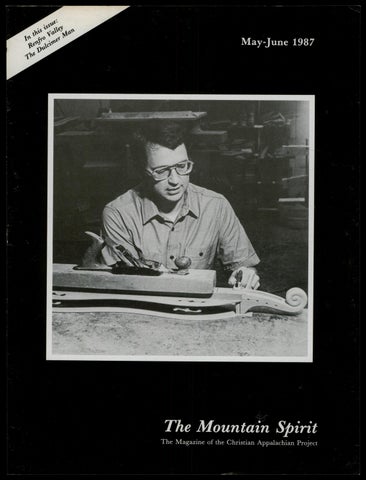
The Mountain Spirit T h e M agazine of the C h ristian A ppalachian Project
X h e M o u n ta in Spirit:
The Magazine o f the Christian Appalachian Project Vol. VI, No. 3
May-June 1987
Contents Features 4
The Dulcimer Man by M oira Am brose W arren M ay, of Berea, crafts some of the finest dulcim ers in the U nited States. H e has been instrum ental in a recent surge in the popularity of m ountain music.
8
“ This Place is Like a Garden”
Teen C enter, p. 8
by Ike Adam s T he teenagers of Rockcastle have taken to hanging o u t— and learning— at the Rockcastle Teen C enter.
16 The Appalachian Center by G iovanna Burks Godby A project of Berea College, the m useum showcases the unique culture of Appalachia.
23 Down in the Valley by Debbie Fraley W ilson N ear the small com m unity of M t. V ernon, y o u ’ll find one of the biggest and longest lasting hoedowns in the country.
Departments 3
A Thought From the Editor
13 Letters 14 The CAP Closeup
G w inette R ay, p. 14
W arren M ay, p. 5
The May-June Theme M usic is an im p o rtan t p art of all o u r lives, especially here in A ppalachia. T h e folk songs of m an y different cultures have blended into a distinct m o u n tain characteristic. O n the C O V E R , W arren M ay, the dulcim er m an , w hom you will m eet on page 4. O n the B A C K C O V E R , some things never outlive th eir usefulness ¡(photo from the C A P Archives)
19 Around the Project
Published by the C h ristian A ppalachian Project. E ditor, M a rg aret G abriel; A ssociate E d itor, G iovanna B urks G odby. A d visory B oard, F ath er R alp h W . Beiting; M ike M cL aughlin; Leslie B. L arsen; J a c k M orris; Bill Begley; R a n d o lp h Jo rd a n . G raphics C oordinator, D ebbie Fraley W ilson; C irculation M anager, T h eresa Richey. The Mountain Spirit is published six tim es a year. T h e an n u al subscription price is $5.00. S ubscriptions an d o th er correspondence should be sent to The Mountain Spirit, C h ristian A ppalachian P roject, 322 C rab O rch ard R o a d , L an caster, K entucky 40446. C o p y rig h t, 1987. T h e C h ristian A ppalachian P roject, Inc. All rights reserved. M em b er, C atholic Press A ssociation. T h e C h ristian A p palachian Project is a non-profit C hristian service organization operating th ro u g h o u t eastern K entucky. T h e project operates on the philosophy th at “ helping people help them selves” is the best ap proach to A ppalachian poverty.
A Thought From the E ditor
On April 11, the Berea College Country Dancers will sponsor the world’s largest square dance. In honor of the dedication of the new Russel D. Acton Folk Recreation Center, and in conjuction with the annual Mountain Folk Festival, the group anticipates that 2,000 people will dance in a circle measuring two miles in cir cumference. Watch for this record in the Guinness Book o f World Records', a Guinness represen tative will be present to verify the event. As many have done before them, the Berea Col lege Country Dancers are using the languages of music and dance to do something truly extraor dinary: gather 2,000 people to simultaneously celebrate the beauty of Appalachian culture. But, why are we surprised? Something extraordinary often seems to come out of something musical. In fact, it happens so often that sometimes we overlook it or come to expect it. Two of the stories in this issue of The Mountain Spirit tell of extraor dinary people and events which involve music. As you’re reading, stop and marvel at how extraor dinary those people and events really are. The old Renfro Valley Barn Dance consistently draws 600 to 1000 people every weekend to the lit tle community near Mt. Vernon, in Rockcastle County. People from many different states —and even several foreign countries—join in the fellowship of good music week in and week out. What else could serve as a rallying point for that kind of dedication and friendship? Warren May, the dulcimer man, has raised the craft of dulcimer making to an art form that is recognized and admired by artists and musicians throughout the United States. Although the dulcimer originated as a European instrument, the changes and refinements that the mountain people have made on the instrument over the years, have made it classically Appalachian. In the last issue of The Mountain Spirit, in “Random Thoughts,” Giovanna made reference to the folk song, “Barbara Allen” or “Barbry Allen” or “Barbr’ellen,” I’ve even seen it spelled. As Giovanna was proofreading, she called, wonder ing how to spell the name of the song. We talked about it, settled on “Barbry Allen,” and decided that since we’ve seen so many different spellings, “Barbry Allen” would have to be accurate with at least one version of the song. M ay-June 1987
This is one of the things that I enjoy the most about Appalachian music; it seems, sometimes, to have a little identity crisis. Any one folk song tell ing a particular story could have dozens of dif ferent lyrics, or it could have the same lyrics, but a completely different melody, or it could have the same melody, but tell a totally different story. The reason for these charming circumstances, of course, is that every person and nationality that settled in the Appalachians brought with them their own musical culture. As those cultures have blended so smoothly over the years, they’re now known as Appalachian folk music rather than English or Irish or Welsh or French. Although the same blending phenomonon can be seen in many other aspects of Appalachian culture, it seems to be music that binds us together in the most ex traordinary sense. I hate to sound trite, but the phrase “universal language” pops into my mind. If we think of music as a universal language, and universally understood, then we are able to understand and explain the parallel of lyrics in songs that come from all different cultures and parts of the world. The explanation could be that no matter who we are, or where we’re from, our lives relate in mat ters of love and hardships and our appreciation of the beauty of nature. From the time that we’re small children, learn ing about the love of God, we are taught that we are all brothers and sisters in Jesus Christ. Maybe the common denominator of music in all of our lives is God’s way of proving his point. —MMG. 3
D ulcim er M an
_________
- ''^ '1
by Moira Ambrose
APPALACH IAN MOU I first met Warren May late one Thursday night last fall. My friend Sue and I walked by Warren’s woodworking shop in Berea after a folk music concert at the nearby college. Warren and co-workers, John Kennedy and David Adams, were putting finishing touches to dulcimers they hoped to sell the next day. The following morning was the first day of the Oc tober exhibition sponsored by the Kentucky Guild of Artists and Craftsmen. The three men looked tired, as it was already 10:30 p.m. when we saw them, and they expected to be whittling tuning pegs and sanding dulcimers until after midnight. Sue and I stopped in the shop and joked with Warren about how many dulcimers he had to complete. After listening to traditional Scottish music a few minutes before, it seemed appropriate that after that concert Sue and I would chat with Warren May, the man responsible for resurrecting traditional dulcimer-making in Kentucky. Warren May opened his Berea woodworking shop in 1977. Though he makes furniture, Warren specializes in crafting dulcimers, small wooden in struments shaped somewhat like a violin, that are played while held in the lap or on a table. Warren 4
characterizes dulcimers —derived from the Latin word “dulce,” meaning “sweet”—as having a “very unique, pleasing sound.” Warren began working with wood on the Carroll County, Kentucky, farm where he grew up. As the youngest of ten children on a 250-acre farm, Warren was often left alone in his father’s workshop while the older children helped with chores. Once, when his parents had guests, Warren hid in the workshop, working on a present he wanted to give the visitors before they left. He surprised everyone by presenting the guests with a smooth, funcitonal, hickory rolling pin at the end of the visit. Warren’s skill and interest in woodworking was passed to him from his father and grandfathers. “My father and grandfather did a lot of rural woodworking,” says Warren. “They did farm maintenance and made rolling pins and bows and arrows.” Warren’s father wove fishing nets and carved shuttles that separate the threads on a loom. The fishing nets were “dip-nets” lowered from boats on The Mountain Spirit
j
the Ohio and Kentucky rivers. Warren’s Carroll County childhood home was on the banks of the Ohio between Louisville and Cincinnati. His maternal grandfather made furniture. “My mother’s father had been known to carve a chair out of a wood stump,” he boasts. But the family’s woodworking was done with unsophisticated tools that were sometimes awkward. Warren broke the family’s butcher knife trying to carve wood. He explains, “The tools were real old. We never had quite the right tool —never an electric drill or anything. “But at college,” he continues, “there was all this new equipment, and I got real excited.” At Eastern Kentucky University, Warren studied Industrial Arts. He earned both a Bachelor of Science and a Master of Arts degree. After graduation, Warren taught woodworking and shop for eight years in junior high and high schools. It was a teaching job that brought Warren to eastern Kentucky where he first came in contact with dulcimers. In 1972, while in his third year of teaching in Lawrence County, Kentucky, Warren M ay-June 1987
started carving dulcimers. “In Lawrence County there was a lot of tradi tional music and some old dulcimers. I had played the guitar since high school, and it just seemed natural to start making and playing the dulcimer,” he says. Appalachia’s musical heritage was one thing that lured Warren to dulcimers. Because of the mountains’ musical tradition, dulcimers were not new to the area. They arrived with European im migrants in the 1700s. Since most immigrants could not transport their instruments, there are differences between Appalachian and European dulcimers. Immigrants remembered how they were made and reconstructed them in North America. Dulcimers originally gained popularity in Cen tral Europe during the Renaissance. The in struments were brought back to Europe from the Middle East as soldiers arrived home from the Crusades. At that time, dulcimers were harp-type instruments, wooden boxes with strings. As dulcimers changed, however, the shape was curv ed to make the instrument stronger.
Appalachian dulcimers—which are different from the more complex, piano-like hammer dulcimers —were eventually simplified to only three strings. People began to put frets —pieces of wood or metal that indicate a specific note—under one of the strings. These simple instruments suited the oral traditions of the mountains. They were the perfect accompaniment to a one-voice song or story. In the mountains, Warren says, dulcimers became “very, very personal, almost sacred in struments. They were never played publicly and lots of times were kept hidden away. They were just played for comfort and personal entertain ment, hardly ever played for people outside the family.” With the influx of fiddles, banjos, and guitars in the 1930s and ’40s, however, dulcimers faced competition. As such simple instruments, they could not play the diverse dance tunes and group songs played by other stringed instruments. With the folk revival of the 1960s, however, dulcimers came into their own. Well-known folk musicians such as Jean Ritchie and John Jacob Niles, both from Kentucky, began using the dulcimer professionally. Because of these musicians, and the dulcimer’s Appalachian heritage, Warren May believes Kentucky has a real claim to the dulcimer. “I’d like to see the dulcimer as our official state instrument,” he says. Soon after 1972, dulcimer-making and wood working became Warren’s livelihood. He uses basic woodworking techniques and only local Kentucky woods—walnut, cherry, maple and poplar —to make his instruments. It takes several months to complete one, and to date, Warren has crafted over 3600 dulcimers. Several are worked on at a time in Warren’s Berea shop, where workers aim to complete one dulcimer a day. In the 15 years he has been working, Warren May has contributed significantly to the art of making dulcimers. He almost single-handedly resurrected the early Kentucky-style dulcimer and designed a new style called the “whale dulcimer” because of its shape. This new design was copyrighted by Warren and is included in one of the prestigous Fine Woodworking Design books. Warren has mastered 20 different styles of dulcimers, including the traditional hour-glass and tear-drop shapes.
W arren and h is w ife, F ra n k y e, in front o f th eir sh o p , U p sta irs G a llery , in B erea. O p p o site, W arren co m p letes w ork on a d u lcim er.
6
The Mountain Spirit
Most important, Warren has improved the musical accuracy of dulcimers. By altering the in struments’ shape and increasing the sturdiness of the tuning pegs, Warren and his co-workers give dulcimers almost unlimited musical range. The musical accuracy has spurred some professional musicians to buy Warren’s dulcimers. “In the last 15 to 20 years, we have updated the dulcimer to where it is seen as a serious instru ment. Our producing dulcimers has also increased their availability,” he adds. And, increasingly, dulcimers and dulcimer
Primarily, Warren May is a craftsman, an artist who takes pride in his creations . . . music is in demand. The music market now boasts more dulcimer recordings and instruction books than ever before. Dulcimers are being produced in greater quantities than they were earlier in the cen
M ay-June 1987
tury, and, according to Warren, there are even a few dulcimer factories in this country. Warren’s dulcimers have appeared in Smithso nian shops and catalogues. Kentucky governors give Warren’s dulcimers as presents to visiting dignitaries, and Warren and his wife, Frankye, also own the Upstairs Gallery in Berea that sells the crafts of many local artists. Primarily, Warren May is a craftsman, an artist who takes pride in his creations and has a deep enough interest in them to know their history. His workshop, strewn with bits of wood, half-finished dulcimers, and light conversation, is a bright place to work and a delightful place to conduct an inter view. It’s an especially nice place to stop and chat after a folk music concert at Berea College. As Sue and I left the shop that night last fall, Warren handed us small, oval pieces of wood that had been whittled too imperfectly to be used as tuning pegs. I saved that small wooden nug get-shiny from being carved smooth and still smelling like the tree it came from. That wooden piece remains special, a very appropriate momento of my first encounter with the dulcimer man.
7
“ This Place is Like A Garden” Story and P hotos b y Ike Adam s
The Mountain Spirit
R ock castle C o u n ty sports a n ew C A P fa c ility created esp e cia lly for teen agers— the R ock castle C o u n ty T e e n C en ter.
Teenagers in rural Kentucky are not unlike their peers in Anywhere, USA. Their hormones race just as fast, and they believe that they are ten years older than they actually are. They like their music loud, if you please, and twenty-four hours a day is just about right. They chronically complain that they are bored and that there is nothing to do, and they fall in and out of love more often than the weather changes in March. Most teens will one day reach the age of 21, or thereabouts, before they give any serious thought to what being a teenager is all about. How many adults do you know, including yourself, whose general summary of their teenage years is, “Oh, if I could just go back and know what I know now?” Last June, Ellen Burke, CAP’s director of human development, hired me to become program manager for a teen center planned for Mt. Ver non, Kentucky. All we had going in was a budget and 3,000 square feet of vacant floor space. Ellen and I agreed that there was no place in Rockcastle County for the teens to function as a peer group independently of the pressures from home and school environments. We further agreed that such a place was important to growing up, especially if we could make the environment free of drugs and alcohol. M ay-June 1987
We talked a lot about special problems that teens have. Pregnancy out of wedlock, an alarm ing suicide rate (higher than any other age group in American society), dropping out of school, the inability to find any sort of part-time work, the lack of recreation facilities, isolation on several fronts beyond just geography, and poverty. We set a goal to have 20 teens actively involved in program activities and to have another 40 using our facility solely for its recreational opportunities by September, 1987. At this writing, in February, we have had more than sixty teens involved in pro grams of one sort or another—tutoring, counsel ing, music lessons, organized sports, facility im provement, value clarification, rap sessions, general interest classes like aerobics and photography. More than 340 teens have used the center for general recreation or as a hang out. We set a goal to keep the center free of drug and alcohol use and abuse. The only evidence we have seen of either is that the marijuana seeds that somebody slipped into one of the houseplants did, in fact, sprout. We set a goal to have the place be viewed as safe by both teens and parents. We haven’t had 9
anything close to a serious accident, and we haven’t had to break up a single fight. By far, the most difficult and frustrating part of opening the Rockcastle Teen Center, as it was finally named in September, was doing the renovation. Bathrooms had to be installed. An of fice, a general study room and a counseling room had to be built and painted. Ping-pong tables, foosball tables, board games, bumper pool tables, furniture, cleaning supplies and office equipment had to be located and then bought, borrowed or scavenged.
R ock castle C ou n ty teen agers, along w ith teen center staff, in v o lv e th em selv es in p in g -p o n g and b u m p er p ool gam es.
In the meantime, I sought advice from the folks who live in Rockcastle County on every front where I could draw a crowd. When we were finally able to open the Teen Center in late September, I knew almost every teen who showed up the first day on a first name basis. There were 40 of them. By the end of the first week, we had entertained 89. By the end of October, the number neared 200. The closest that I ever came to violence in the center happened near the end of our first week of operation. I wanted desperately to burn every Bruce Springsteen tape or album within a hundred mile radius of Mt. Vernon, Kentucky. The teens would play “Born in the USA” over and over and over again. Not the entire album mind you—just that one song. Before opening, we purchased a very nice and very loud stereo system, and to this day, I wish I had that money to spend over. Now Bon Jovi is the rage, and I actually find myself saddened at Springsteen’s sudden drop in popularity. One day recently, one of the teens popped “Born in the USA” into the tape deck, and I actually caught myself singing along at the top of my voice “Bawhn in the U-S-A!”
CAPys Teen Programs at a Glance Several other programs, in addition to the Rockcastle Teen Center, focus on teenagers and their needs and problems. The Wheelwright Youth Center in Floyd Coun ty has a recreational facility with various equipment, an Olympic sized swimming pool and acres of outdoor space. At its peak time, during the summer months, the center has eight people on staff and serves more than 100 young folks per day. The Martin Youth Center, also in Floyd Coun ty, is contained in a single building, like the Rockcastle Teen Center. It serves youth of all ages and offers tutorial services as well as organized group programs. It has a staff of three. Although CAP’S camping programs primarily 10
serve younger children, there are several weeks of the summer set aside for teens, too. The first week of camp at Camp Andrew Jackson has been held for teenage girls for several years. Their time together gives the girls an opportunity to meet folks from other counties and to share thoughts and ideas. Camp Shawnee is investigating several different types of camps for teenagers this year, including basketball camp and computer camp. Last year the camp directors discovered that these types of camps which specialize in a specific skill are popular with teens, as well as beneficial. In the off-season both camps provide en vironmental workshops and facilitate short-term retreats. The Mountain Spirit
I like country music. I know most of the words to everything Willie Nelson, George Jones, Merle Haggard and company have ever recorded. Much to my surprise, I have discovered that a significant number of the teens do, too, but they will rarely stick their necks out and say so. It doesn’t happen as much as I would like, but the country music crowd is getting to the point that it demands equal time with the rock and roll fans for choice of music on the stereo. I mention this not because either form of music has any redeeming social value or is better or worse than the other, but to il lustrate a point that we try to get across in the center. Rock and roll music is a status symbol among teenagers. Kids who prefer country music figure that the best thing they can say about their tastes in music is nothing because they fear ridicule by the larger portion of their peer group. We teach them that it’s OK to be different. It’s OK to make your own choices. It’s OK to like what you want to like without being embarrassed about it; you have a right and a responsibility to be yourself. During the first several months that we were open, I worried and prayed about the lack of a visible, spiritual element to our teen center. At tempts to organize Bible study groups, Christmas caroling and the like went over like a lead balloon. Yet it’s possible to count on my fingers the number of teens that I have heard use God’s name in vain. Finally, when the staff and I began having long, individual talks with the teens, we discovered that almost all of them have a lot of respect for God and that they prefer dealing with Him on their own level.
M ay-June 1987
A b o v e, Ik e A dam s w ith som e o f th e teens w ho v isit the cen ter regu larly. B e lo w , the teen center p ro v id es a p lace for teen s to m eet and so c ia liz e.
11
Part of the problem lies in the fact that dozens of Protestant denominations are represented by the teens in our center. The various churches disagree and have fought over the interpretation of the Bible for centuries. The kids sense that if they get into a discussion about God, they’re apt to get into an argument. I don’t know how long it will take to sink in —maybe it already has—but I keep saying over and over again that it’s OK to love God. And there is some evidence that we are making progress. Most of the staff spends time dealing with the teens on a one-on-one basis or in groups of two or three. It’s easy for one person to keep an eye on the general recreation end of things while the other two or three counsel an individual or lead a group session. Through these small sessions, we’ve gain ed the trust, respect and love of the teenagers to whom we give our time. And if we make an impact on their lives, that’s the way it is going to happen.
“Every time I come in here, I feel like I ’ve been watered and fertilized . ”
We’ve helped several teens decide to stay in school. We’ve helped at least two fourteen yearold girls decide not to get married. We’ve helped one seventeen year-old begin to deal with his alcoholism. We’ve assisted dozens of teenagers in thinking through personal and family problems. We’ve helped fill out college applications and financial aid forms. Many of the teens who use our center are only able to get here once a week because of restrictions at home, or because they live as far as twenty miles from the center. A few come almost every day. One young man who is here almost every Friday knows that I am an avid gardener and that hap pens to be his hobby, too. He pins me down almost everytime he comes in for a little discussion about peas or corn or cauliflower. A week or so ago we were talking and he said, “This place makes me think about a garden.” “Why’s that?” I asked him, thinking that he was referring to the dirty floor and the paper cups that needed to be cleaned up the way weeds need to come out of a garden. “It’s ’cause you all keep planting little seeds in people’s minds, and I keep watching them grow,” he said to me. “Every time I come in here, I feel like I’ve been watered and fertilized.” 12
The Mountain Spirit
Letters I was very saddened to hear, or rather read, in one of your issues, that Reverend Beiting was leaving your fold. He did so much . . . it also must have been quite a treat when Mother Teresa visited. Good wishes to you all . . . Peter W yckoff Alexandria, VA Father Beiting is very much in volved in the Christian Appalachian Project, in addition to the work he does fo r the Mission Office o f the Diocese o f Covington. Although Father Beiting resigned as the presi dent o f CAP in the spring o f 1986, he is still instrumental in decision and policy making as chairman o f the board. Ed. We enjoy the magazine very much. It takes us back home where we grew up in the ’20s and ’30s. We were poor and didn’t know it. We felt rich in so many other ways. We didn’t have much money, but we had what counted, love of family and neighbors and pride in our mountain heritage. We learned to work just as your people are doing.
I really enjoy reading the news of The Mountain Spirit to learn of the wonderful work being accomplished in that area and the love, joy and happiness being brought to so many people who would never know it otherwise. I wish all the folks involved in this great project God’s blessings and continued help from people scat tered over this wonderful land.
After reading about the personal stories and the help they receive from CAP, it makes us so much more thankful for the many bless ings we have received. We would miss getting The Mountain Spirit. Mr. and Mrs. Richard Harris Albrightsville, PA
Mrs. M.L. Lindhorst St. Louis, MO
The Mountain Spirit keeps me alert of what’s going on, and the good work that is being performed. I enjoy reading The Mountain Spirit very much and the beautiful pic tures. I use a lot of the pictures for my Sunday School in my church. The children enjoy the pictures of the mountains. I hope I will be able to visit Reverend Beiting and his staff. May God bless you and keep you in His loving care. Frances M. McLelland New Orleans, LA
Gordon F. Loudin Valley Bend, WV I am grateful for the privilege of seeing how the mountain people live. After reading through this Mountain Spirit I feel truly blessed, having what I do.
I enjoy The Mountain Spirit and I don’t want to miss an issue. I enjoy reading the stories and all the hap penings in the Appalachians, count my blessings, and know I’ve grown up through some rough times, too. I am glad we have people like you to help people there. CAP is doing a wonderful job there and I wish I could do more. If there is ever a time that I can, I sure will. God bless all.
Having been born in Kentucky, this magazine reminds me of “home” each time it arrives in the mail. Thank you!
Bill Markle Hagerstown, MD
Joan C. Carroll Austin, TX
M ay-June 1987
The Mountain Spirit is one magazine we really enjoy reading.
Fern Talbot Rothfuss Brooklyn, M I
The Mountain Spirit is enjoyable and touches the heart. I love the covers, and the stories are very well written. While I’m reading, I feel as though I’m right there sharing every moment with the men, women and children of Appalachia. God bless you and all the people who help to make all your projects possible and workable. Antoinette Reinhold Brooklyn, N Y
I have enjoyed my subscription to The Mountain Spirit. Through it, as well as through telephone conversa tions about our Christmas wreaths, we feel we have come to know you personally and to be better ac quainted with the compassionate work you are doing. Stella F. Neuer Menlo Park, CA
Letters to the editor are welcome.
They should not exceed 150 words in length, and we reserve the right to edit them fo r space. Address letters to The Mountain Spirit, Christian Appalachian Project, 322 Crab Orchard Road, Lancaster, Kentucky 40446.
13
The C A P Closeup
G w in ette Ray: Keeping It Simple by the CAP News Service
In this “computer age,” many people find that the simpler computers (supposedly) become, the more complex they really are. These folks will be happy to hear a reference to KISS.
They brought it in and set it down, and they open ed it up, and Bill said, ‘Here, Gwinette.’
‘“Keep It Simple, Stupid,’ is an industry stan dard,” says Gwinette Ray, CAP’s data processing manager. Gwinette works to assure that CAP’s computer needs and capabilities are evenly match ed and tries to “Keep It Simple, Stupid” for people whose departments require data entry, but don’t understand the intricacies of the IBM System 38.
What Gwinette did was roll up her sleeves and set about making herself “computer literate.” By reading a book, she taught herself how to program CAP’s first computer, a System 32, and the keypunch equipment that came next. Gwinette says that “with a little bit of intelligence, and being able to read the instruction book, anybody could [program the equipment]. If they wanted to.”
Ten years ago, Gwinette was looking for a change from the retail position that she held. Through the Lancaster Women’s Club, “I heard that Bill [Begley, vice president for development] needed a secretary. Well, I thought, ‘being a secretary’s not really up my alley, but I’ll go apply. Why not?’ I came, and I applied, and I got the job.” As Bill’s secretary, Gwinette maintained the cir culation of the “Kentucky River Soundings,” predecessor of The Mountain Spirit, and saw that donors who requested return address labels receiv ed them. Now, CAP’s computer performs those tasks, among others, but at that time, Gwinette didn’t know anything about computers. “Bill told me we were going to get a computer. What did I know about a computer? Nothing. 14
“I knew I was going to work on it, but that’s all I knew. I had no idea what I was going to do.”
Gwinette wanted to, so CAP assisted her in get ting the education and training she needed, as its equipment became increasingly sophisticated. As manager of the data entry department, Gwinette does “a little bit of all of it. A little bit of program ming, a little bit of computer management [which Gwinette explains is like keeping a tidy house]. I usually do all of my scheduling on Monday for re quests that have come in.” Gwinette supervises nine people in her department, and that, too, re quires careful housekeeping and management. The data entry department is located in the center of CAP’s administrative offices in Lan caster, with no windows and little contact with other CAP workers. To guard against isolation and to keep her department mindful of CAP’s The Mountain Spirit
mission, Gwinette has regular meetings with her staff to keep them abreast of any changes or addi tions, especially in human development. “Anytime I hire a new person, I give her a tour, and I do my best to get her out of the building to see some of the things that are happening in other places.” Gwinette was born and raised in Garrard Coun ty and remembers that ten years ago, many of the people in the county didn’t trust CAP because they didn’t know much about it. “But now, they don’t feel the way they did when we were just a small organization over in the yellow house [a residence that served as administrative offices in the mid-70s]. We established credibility as people saw what we did. They knew it was good, and they’ve changed the way they feel about us.” “Probably so,” Gwinette replies thoughtfully when asked if her association, and that of other people from the immediate area, made Garrard countians look at CAP differently. Gwinette says, too, that she thinks about programs that CAP could start in the area. “I would like to see us train students, so that they can do something after they get out of school. I’d like to help them if they were interested in learning about keypunch or program ming, or something else having to do with com puters.” Gwinette is very interested in the “Writing to
Read” computer program developed by IBM to help pre-schoolers develop their reading skills. “They know that it raises reading levels way up above students who haven’t had the program, but they don’t know where it’ll take them in other grades. I’d like to start a program like that for pre schoolers who don’t have as much.” Away from the responsibilities of the office, Gwinette enjoys outdoor activities with her hus band, Donald, and their daughters, Angie and Christina. Kentucky has a beautiful system of parks and campgrounds, which they enjoy on weekends. Donald, Angie and Christina are avid golfers. “I’m not a golfer, but we usually go out as a family late on Sunday afternoon, and I watch while the rest of them play. I just enjoy getting out.” Gwinette observed a CAP human development program in action when Christina was a student at the Sunshine Center. “It had a big impact on Christina,” says Gwinette. “They taught her how to be a sociable person, and she grew up not holding grudges, like lots of kids in Garrard County have, because this person has had more money.” Christina’s involvement in the Sunshine Center impressed upon Gwinette CAP’s commitment to the people of the area. That commitment to the area keeps Gwinette committed to CAP. “I believe in what CAP’s doing. It means a lot to me.” c a p .
(jw in e tte and sen ior com p u ter op erator, M on a R eed , rev iew a co m p u ter read ou t.
M ay-June 1987
15
Appalachian A rts and Culture
B erea C ollege stu d en t, C arolin e R eid , from B an gor C o u n ty D o w n , N orth ern Irela n d , p lays gu itar o u tsid e th e A p p alach ian C en ter.
The A ppalachian Center by Giovanna Burks Godby
T h e room dances with color as the walls become a patchwork of patterns —Jacob’s Ladder, The Tree of Life, Crown of Thorns —sheer artistry. The quilts are masterpieces, all representing a religious theme and are on display at Berea Col lege’s Appalachian Museum. One steps from the sidewalk of Berea, a small town in the Appalachian foothills, through the door, and into the culture of Appalachia. Quilts, dulcimers and other musical instruments, cooking implements, furniture are displayed and serve as a conduit of understanding between visitors and the lifestyle that the items represent. The Appalachian Museum is sponsored by Berea College’s Appalachian Center and is only one of several programs designed, by the center, to promote mountain culture. “The Appalachian Center was a means of pull ing together some programs that would emphasize Appalachian culture on campus,” says Loyal Jones, director of the center. Through these pro grams, students are helped to understand the region’s culture—their own culture. The Mountain Spirit
C ourtesy B erea College
B arbara F reem an and C o n n ie R egan , “ T h e F o lk te lle r s,” at th e 1983 F estiv a l o f A p p alach ian H u m o r.
Nearly all of the students enrolled at Berea Col lege call the Appalachian region their home. Those students from foreign countries are predominately from third world nations where economic conditions are very similar to those in Appalachia. Loyal explains, “Our main purpose at the college is to serve the region by educating young people from low income homes—who have low income, high ability. About eighty percent of our students come from the Appalachian region in Kentucky.” He continues, “In addition to that, we have a commitment that says that we serve the region through other means and services.” A Humor Festival? Loyal Jones’ face beams at the very mention of the festival. “I’ve invited known humorists from this part of the country who, in some way, reflect the humor of the Ap palachian.” During the two day event (this year, July 17 & 18), the guest humorists perform. But, the perfor mances don’t stop there. Prizes are awarded to members of the audience for the best story, song and long tale. “The people who win first prizes will M ay-June 1987
be part of the Saturday night show,” explains Loyal. There is an academic twist to this festival of frivolity. “We’re going to have two scholarly-type presentations,” says Loyal. “One will be presented by an English professor at the University of Ten nessee, about the image of women in frontier humor.” The Appalachian Center sponsors other special events. October will bring the Celebration of Traditional Music. “We try to get the best in old time traditional,” says Loyal. “We’re interested in the ballad singers, the banjo pickers, the fiddlers and the old time string bands.” Berea College and the Appalachian Center serve as a valuable resource for researchers throughout the country. “Berea College has, in its library, the Weatherford-Hammond Mountain Collection,” explains Loyal. “We have probably the best collec tion on the Appalachian region, here at Berea, as you can find anywhere.” Included in the collection are thousands of volumes of cultural history by 17
Appalachian writers or about the Appalachian region and archives holding documents and photographs. The Appalachian Center also offers fellowships and seminars in Appalachian Studies, in which well known scholars participate. College curriculum for many Berea College students includes courses developed by and taught through the Appalachian Center. Courses range from Appalachian history to Appalachian literature to Appalachian problems and institu tions. “We do encourage our students to study the region,” says Loyal, who teaches one course each semester.
Loyal Jones feels it vital that students gain an understanding of the region from which they come, especially if they intend to secure employ ment in Appalachia upon graduation. Loyal, himself, hails from the mountains of North Carolina. After graduating from Berea College, teaching for one year, and working for thirteen years with the Council of Southern Mountains, Loyal Jones returned, in 1970, to Berea to help develop the Ap palachian Center. “I just always wanted to stay here in the region,” he explains. “I’ve always been involved in the region in one way or another.”
Bagnoli
One of the newest and most exciting projects sponsored by the center is Students for Ap palachia (SFA). Traditionally, SFA students tutor children who are experiencing difficulty in school, visit the elderly, and involve themselves in other community related activities. However, some ex citing plans are in the works for the future.
SFA.”
“We’re going to try to focus, in the next couple of years and beyond, on dropouts,” says Loyal. That program within SFA is called the Expressive Arts Program. “The purpose is to build up the self-esteem of these kids —to get them feeling bet ter about themselves and their schools —as well as tutor them.” College students work with these “potential dropouts” and, through specially designed exercises, begin to talk. The program has realized some dramatic results. Loyal says proudly, “One kid went from a D to a B plus in one semester just because, I think, of that change in the perception of himself.” Those students who are tutored are not the only ones benefitting from the program. The work is rewarding, both personally and professionally, to those college students as well. According to Loyal, “Many of our SFA students have gotten jobs, not based on their major, but based on their work in
G en ia M c K e e, a B erea C ollege stu d en t w ho w ork s at th e M u seu m , p lays th e d u lcim er.
18
L o y a l J o n es
It is an involvement, an understanding that he hopes his students will gain from their experiences with the Appalachian Center. He explains, “My purpose is to, subtly and otherwise, try to keep [students] rivetted somewhat to their own culture and have them know something about it. And, there will come a time when they will appreciate this and will be proud of where they come from.” So, students will continue to be enriched by Ap palachian Center courses; scholars will use Berea College and the Appalachian Center as a vital in formation resourse; community members’ lives will continue to be changed by SFA, and many people will laugh and dance through events like the Humor Festival and the Celebration of Tradi tional Music. The projects and programs of the Appalachian Center fit together like the patchwork pattern of a quilt. Each piece is beautiful by itself, but, together, the pieces form a total image that brings pleasure to those who stop just long enough to take a close look. The Mountain Spirit
Around the Project
A K ep t P rom ise Robert Kirn, of Carlstadt, New Jersey, made a promise to the Lord. Robert is 69 years old and an avid runner. As he runs (usually five miles a day), he keeps his eyes glued to his path for “shiny stuff.” “In the course of my running, I pick up quite a number of coins, primarily pennies, nickels, and dimes. I put them in a special con tainer, and every year or so, I total them up,” explained Robert. Here’s where the promise comes into play. “I promised the Lord, whatever the amount, I would match it,” said Robert. He was sur prised at the total amount of his col lection and sent donations to various charitable organizations, in cluding CAP. With his CAP donation of $150, Robert wrote a note describing himself as “a man of limited means,” and added, “I am so happy to be able to contribute in this way.” Robert’s donation represents many pennies, nickels and dimes, and many miles of running. We thank him for his promise to the Lord and his creative donation to CAP.
I t ’s D a y C am p T im e A gain MT. V E R N O N -S tarting in 1957, just a few years after Father Beiting was transferred to the mountains, children have been learn ing about themselves, each other and God at Cliffview Lodge, Camp Andrew Jackson, Camp Rebecca Boone and Camp Shawnee. In the nearly 30 years since Father Beiting held that first summer camp, with six campers, two counselors and a tarpaulin, thousands of youngsters in eastern Kentucky have experiencM ay-June 1987
by the CAP News Service
ed the joy of summer camping. Last year CAP tried a new ap proach to camping —a day camp at the Family Life Center in Rockcas tle County. Liz Phelps, recreation coordinator at the Family Life Center, designed and implemented the program, which served about 30 children a day. Because of the suc cess of last year’s day camp, CAP decided to expand the program to six week-long sessions this summer. The camp will begin in mid-June and run through the end of July. Liz is very excited about the coming camping season. “We learned a lot last year, and we’ve got more direc tion this year. We’re going to serve lunch this year, and we’re looking at taking more field trips, too.” Liz said that the camping pro gram this year will be more educa tional. They plan to tutor and im prove reading skills through the Family Life Center School. The 100 acres of the Family Life Center will offer a great opportunity for the outdoor appreciation that Liz plans for this summer, along with fire building and knot tying. Three short term volunteers and two parent volunteers each week will complete the staff. Liz looks forward to taking her campers to a sheep farm in Rockcas tle County, a saddle club where they might be able to ride horses, and a planetarium in Berea. “We’ll have one overnight per week, usually on Thursday into Friday,” Liz said. “The kids will go swimming on Thursday, then spend the night before the awards ceremony on Fri day.” Day camp is proving to be a very good alternative for kids who are reluctant to go to a residential camp and for the overflow of kids that CAP cannot accomodate at Camp Andrew Jackson or Camp Shawnee.
S oftball is ju st on e o f the sports offered at d a y cam p .
Moving? Please notify us of change of ad dress to make sure you receive every issue of The Mountain Spirit. O L D A D D R E SS name
please print
address city
zip code
NEW A D D R E SS name
please print
address city state
zip code
Mail to: The Mountain Spirit, 322 Crab Orchard Road, Lancaster, KY 40446. 19
around the project . . . continued
An Experience You ’ll Never Forget! A re you retired . . . or m aybe, ju st antsy to do som ething different, now th at y o u ’ve raised y our family? T h e C A P volunteer pro g ram m ight ju st fill the bill! W hile a young person m ight im m ediately come to m ind w hen one thinks of a volunteer, w e’ve h ad quite a few older volunteers, over the years, w ho’ve m ade invaluable contributions to the A ppalachian people. As a read er of The Mountain Spirit, you know already of the w ork th at C A P does and how m uch we need people to help us continue th at work. W ould you consider jo in in g in this m ission? If the answ er is “ y e s,” please contact: V o lu n teer Office, 322 C rab O rchard Road, Lancaster, Kentucky 40446, or telephone (606) 792-3051. T hank you!
Mountain Images NEW YORK —Former volunteer, Lorraine Corsale, is publishing a collection of photographs she took during her time as a volunteer. Lorraine explains, “So many of the photographs of the area only picture poverty and despair. I am much more impressed with the richness of the culture and the strong character of so many of the people. I hope that those qualities are evident in my photographs.” M o u n ta i n Images: A Photographic Essay o f Central A p palachia is available in a hard cover, 120 page volume. To obtain a copy, please send a $20.00 tax deductible contribution, plus $2.50 postage and handling to:
L eonard B rock , 1984 (p h oto b y C orsale).
20
Christian Appalachian Project 322 Crab Orchard Road Lancaster, KY 40446 Attn: Theresa Richey The Mountain Spirit
around the project . . . continued
C A P V olu n teers H elp B u ild H ou se M cC r e a r y c o u n t y - “ ah the work that is done in child development centers, and the like, we know is worthwhile. But, go down and build a house . . . go to a new area and do something physical . . . it gives everyone a boost,” says David Fisher, a CAP volunteer, as he talks about his and twelve other v o lu n te e rs ’ w eekend h o u se building experience. The place is McCreary County, Kentucky. According to David, this area has, along with other typical A p p alac h ian pro b lem s, “ an umemployment rate of 50 % .” Through a priest named Fr. Howlin, four nuns and two independent volunteers, who are working to help fulfill many McCreary County needs, David learned of a family who needed a new home . . . within a week. “We just called up and asked what we could do to help,” explains David. “What they could do” was help a family build a house. Equipped with CAP donated win dows, a door and other building
materials, thirteen volunteers hit the road for McCreary County and a crash course in construction work. A paradox of workers, the volunteers included an accountant, a fellow who stopped by on his way to Washington, D.C., a music teacher and an economics major. But, one Saturday in early spring, they were all home builders. And build they did.
Gift Annuities
After ten hours, the group had in stalled the door and windows and built a roof. The following week, the McCreary County family moved into their new home. Karla Notarianni, a former CAP volunteer, was visiting for the weekend and enthusiastically joined the building crew. Perhaps she best conveys the feelings of the tired, but fulfilled, volunteers. “That’s exactly what every volunteer wants to do . . . to go down and really do something tangible like that.” Volunteers working together. CAP helping others who share CAP’s vision for Appalachia. An Appalachian family touched by the goodwill of a group of people from such varied backgrounds. All made possible because volunteers stopped to ask, “What can we do to help?”
A gift annuity to the Christian Appalachian Project will help us continue to provide employment opportunities to Appalachian people. This activity is an essen tial part of our mission to help people help themselves. But, what is a gift annuity? It’s a legal agreement by which you make a gift to CAP and receive a guaranteed life income in return. For a more complete explana tion, write today for your free copy of “Giving Through Gift Annuities” by filling out the coupon below and enclosing it in the envelope provided. Clip and send
Please send, without obligation, my free copy of “Giving Through Gift Annuities.” N am e____________________ Address __________________ City, State, Zip_____________ Date of Birth_______________ Telephone _________________ C A P v o lu n teers h elp con stru ct a n ew h om e.
M ay-June 1987
21
around the project . . . continued
Shelters B egin P rev en tio n Program MT. VERNON & SOMERSET Maureen Vince and Anita Seals are trying to put CAP’s family abuse shelters out of business. Mo and Anita, staff workers at the shelters in Mt. Vernon and Somerset, speak to community groups in Rockcastle and Pulaski counties about ways to prevent family abuse. A cessation of family violence could be a genera tion away, Mo and Anita admit, but that doesn’t make their efforts any less intense. Mo and Anita receive invitations from and speak to high school home economics and family living classes, church and civic groups about twice a month in each county. They discuss the signals that indicate a potential for violent behavior and exactly what constitutes abuse. Anita explained, “We see a lot of violence in dating relationships. A lot of girls don’t consider screaming and cussing to be abuse, but it is.” Anita says that they’ve seen changes in behavior in these relationships and that eliminating abuse from a dating relationship could —in the future —eliminate abuse from a marital relationship.
Mo and Anita tell their audiences that a person who is jealous, seems to have a duel personality, commits acts of violence against objects or has a rigid idea of sex roles could be prone to family violence.
A L etter to the P resid en t Mike McLaughlin, CAP’s presi dent, recently received this letter from David Sawyer, a Rockcastle County resident and former editor of the New Farm Gazette:
They believe that the most effec tive means of preventing abuse will be in re-educating children. “Abuse is learned behavior,” said Anita, and she believes that by intervening in abusive family situations, the learning pattern can be disrupted. But, Anita also pointed out that child counselors need to be involved to make sure that discussions are therapuetic rather than harmful to children.
Dear Mike, Your editorial in the recent Mountain Spirit, regarding Martin Luther King and your own trials o f maturing in the spirit, was fu ll o f candor, self-understanding and assessment, compassion, insight and humility . . . fine religious qualities. I ’m glad to know such a person is president o f CAP.
Close families are, traditionally, an important part of life in eastern Kentucky, but family violence is a serious threat to those ties. By in tervening in abusive situations, CAP hopes to help restore strong family ties.
We don’t usually run such laudatory pieces in response to a column, but the editorial staff was very taken with Mike’s column, too, and it’s good to know that our feel ings were corroborated by other people.
Mo was accompanied on several talks by an abused woman and her daughter. “They were very en thusiastic,” Mo said, “and anxious to help someone else avoid abuse.” She said that public speaking is a lit tle intimidating to some women, but after they were encouraged to tell about their experiences “in story form, they’d do fine.” The first woman who came to CAP’s shelter in Mt. Vernon has published her story in local papers, has addressed the topic of family violence on the radio, and now works for CAPrice Industries, CAP’s workshop for handicapped adults. 22
A w eek in M arch w as d ed ica ted to seed d istrib u tio n for C A P ’s sm all farm program . T h e sm all farm staff, w ith th e h elp o f lo n g -term and sh ort-term vo lu n teers d istrib u ted seed to o v er 2 0 0 0 fa m ilies in fiv e co u n ties th is year.
The Mountain Spirit
.Backstage, on opening night at the Old Ren fro Valley Barn Dance, is unlike any other backstage you might visit. Instead of the hustle and bustle of last minute preparations, there is a relaxed, informal atmosphere. Old friends are greeted heartily; new performers are introduced all around. Everything is so casual, you might wonder if you had happened into a party by mistake. Indeed, only occasional bursts of music from instuments being tuned give a clue that this really is John Lair’s Barn Dance in Renfro Valley, Kentucky. Virginia Sutton, one of the “old timers,” who began performing at the Barn Dance over 40 years ago, explains it. “We come over here on Saturday night, and we have a good time. The barn dance is just like a party, a get-together. Like one of the old time get-togethers, where all the people work somewhere else during the week and everybody comes in on Saturday night, and we have a hoedown!” And that was the way that John Lair meant for it to be. In the 1930’s, he was a radio announcer for WLS out of Chicago. Responsible for announcing a large variety of old time country performers, John had the idea that such a show would do well with a live audience. He gathered up several musi cians and toured the United States. They once ap peared before President and Mrs. Franklin D. Roosevelt in a command performance for the King and Queen of England.
A b o v e, T erry C lark , the y o u n g er h a lf o f th e O l’ J o e C lark co m ed y ro u tin e, show s h is ex p ertise on the b a n jo . B elo w , P a tty F ly , a regular at the O ld B arn, sw eeten s th e tem p o w ith h er a ccord ian . O p p o site, OP J o e C lark show s w h ere T erry lea rn ed to p ick the “ b a n je r .”
24
The Mountain Spirit
In 1939, John Lair built what is known as the Old Barn in Renfro Valley and invited performers from the mountains to come and play their tradi tional music for the public. John was not sure it would succeed, so he built the barn so it could be used as a tobacco or a work barn, just in case. The Old Bam has never been used for tobacco—it draws from 600 to 1000 people for its weekend performances. People travel from Georgia, Ten nessee, North Carolina, New York, Michigan and even foreign countries to see the shows. Mrs. Anne Henderson, one of John Lair’s four daughters who now manage Renfro Valley, Inc., feels that the friendly, relaxed party atmosphere explains the barn dance’s success. “Everybody has a good time—that’s the secret of why it’s lasted so long—everybody on stage is having a good time. The audience can see that, and they enjoy it and like to be a part of it. “The whole program,” she continues, “was designed to be a way of preserving some of Ken tucky’s country music and to be presented by some of Kentucky’s people. We still try to preserve the flavor of the older kind of music and the way that it’s presented. Nothing too complicated or too many instruments, just as simple as you can.” According to Ql’ Joe Clark, who has been a regular at the bam for over 40 years, “There are only a few of us that’s left that follow [country
M ay-June 1987
music] after the old timers. Country music is a music done by the heart. People could remember the old melodies from their home countries, but they wrote the words to please themselves, and put them with the old tunes. The tunes come from England, Scotland, Wales, Ireland and all the Netherland countries.” From the moment the perfomers gather on stage to do songs like Take Me Back to Renfro Valley and Mama Don’t Allow No Music Playin’Around Here, the audience is strongly aware that this is not just another country music show. There are no electronic instruments, no drums or electric guitars. Along with the old tunes, they use the same type of instruments that were played by their ancestors. “France brought the fiddle,” Ol’ Joe tells us, “the Constantines brought the mandolins, and we got the guitar from the Spanish. We also have the classical guitars from the French, Italians, Bulgarians and the Rumanians. It is all a part of their folk music. Country music is done in the mountains. Some of it is a slow ballad, sweetheart style, or a little ditty from across the waters that was done many years ago.” “The versatility of these performers is amazing,” exclaims Country Charlie, a relatively new performer at the Old Barn. “Each musician can play several different instruments. You’re like-
25
ly to see the same performer sing and play with one group, then a quartet, then another group, and finally as a pair.” Pete Stamper and Ralph Marcum go a step further—they play the fiddle together. Pete holds the fiddle and the correct note, while Ralph plays the tune with the bow. “Everyone is required to be on stage during the en tire show, except some of the specialty acts,” ex plains Charlie (who is known as Mr. Napier by the 5th grade class he teaches in Mt. Vernon). “And, if they like the tune that a particular group is play ing, they are to join right in and jamboree!” The Renfro Valley Barn Dance has started several performers on the road to stardom. Such performers as Homer and Jethro, Red Foley, Merle Travis, and Little Jimmie Dickens began their careers at the Old Barn. John Lair, who auditioned, produced, choreographed and emceed the shows until shortly before his death in 1985, at the age of 91, received numerous awards. Among the awards are four from CBS, and he was nominated for the past three years for the Country Music Hall of Fame. The Sunday Morning Gospel Show, performed at Renfro Valley, is broadcast on 65 radio stations across the country. Renfro Valley was once considered strong competition for the Grand OP Opry before the Opry expanded to its present size. The question is why Renfro Valley didn’t expand, too?
J o h n L a ir started the R enfro V a lle y B arn D an ce in 1 9 39, “ to h a n g out and b e c o u n tr y .”
“Grandpa didn’t want the Valley to become a commercial place,” explains Matthew Teater, John Lair’s grandson who grew up at Renfro Valley. “That’s not what he thought Renfro Valley was all about. He was always trying different things, and if it got too big, it would have gotten out of his control. He wanted to keep it the way that he wanted it; it was a source of satisfaction to him.” Some of those different things included a television network show on CBS, the making of a movie, and live broadcasts of the Saturday night shows on the radio. “He even held the shows in the Salt Peter Cave, near Renfro Valley, once a month for several months,” remembers Matt. “It was great! You could catch a tour and hear country music all through the cave. There weren’t any mikes —the acoustics were just great!” “Grandpa thought that Renfro Valley was a place where time stands still, and he believed in it. Just like your peace and tranquility place. You come down here to have some country music, some good times. In other words, just hang out and be country! Grandpa believed that country music is where you sit down with a flat top guitar or a banjo, and you sing a few songs together —and you have a picnic. He was the most satisfied person I’ve ever known.”
L in d a L ou M artin fid d les a sn ap p y tu n e.
26
Isn’t it nice to know that there is a place where time stands still, where we can stop our headlong rush to wherever we are going —look back —and see and hear some of what we used to be? cap. The Mountain Spirit
Spring Cleaning?
Before you throw out those old paperbacks; cam eras; old electronic gam es; sporting goods like balls, fishing tackle, old volleyball nets; anything of any educational or recreational value th a t you finally realize you can live w ithout, S T O P Y O U R S E L F ! T he Rockcastle T een C en ter can use yo u r rum m age. A n average of 180 teenagers use the center each week, and, w ith sum m er practically here, the ce n te r’s variety of o u td o o r eq u ip m en t (and budget) is severely lim ited. Please help by d o n atin g an y th in g th at m ay be collecting dust in yo u r basem ent or has served its usefulness for you. W h at you discard m ay provide hours of enjoym ent for m any A ppalachian teens. Send yo u r donation th ro u g h U P S or parcel post to: Ike A dam s R t. 4 Box 117 W illiam s & L air Streets M t. V ern o n , K Y 40456
C H R IS T IA N A P P A L A C H IA N P R O J E C T 322 CRAB O RCH A R D R D ., LANCASTER, KY 40446 The Mountain Spirit