T h e M ountain Spirit:
The Magazine of the Christian Appalachian Project V ol. V I, N o. 2
M arch-A pril 1987
Contents Features 4
H all H ollow by Students of W heelwright H igh School N in e students from the oral history class at W heelwright H igh School investigated life in H all H ollow , a predom inately black com m unity in Floyd C ounty.
17
T w o Fam ilies by M oira Ambrose T w o o f the houses at C A P ’s Family Life C enter in Rockcastle C ounty are hom es for foster children with special needs and problems.
20
Secrets by Betty Peterson A little girl experiences som e of the puzzling intricacies o f life.
21
H en ry H u tton by G iovanna Burks G odby “ H u t,” as he is known in Letcher C ounty, is the M ayor Pro-Tern o f F lem ing-N eon.
Departments 3
From Our P resident
10
A round the Project
14
T he CAP C loseup
16
R andom T houghts
22
Letters
H all H ollow , p. 4
T w o Fam ilies, p. 17
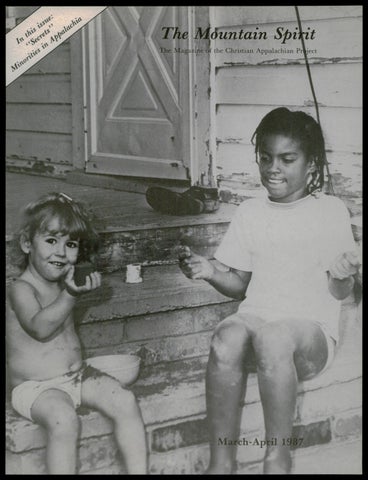
The March-April Theme In F eb ru ary , we celebrated Black H isto ry M o n th nationw ide. D u rin g th at m o n th , we read ab o u t and researched the contributions of blacks an d other m inorities, in A ppalachia, an d w e’d like to share w hat we learned w ith you. O n the C O V E R , two children from H all H ollow , page four (photo by Bob H all). O n the B A C K C O V E R , n atu re is m aking ready for spring (photo by B arker).
P ublished by the C h ristian A ppalachian Project. E d itor, M arg aret G abriel; A ssociate E ditor, G iovanna Burks G odby. A d visory B oard, F ath er R alp h W . Beiting; M ike M cL aughlin; Leslie B. L arsen; Ja c k M orris; Bill Begley; R a ndolph Jo rd a n . G raphics C oordinator, D ebbie Fraley W ilson; C irculation M anager, T h eresa Richey. The Mountain Spirit is published six tim es a year. T he an n u al subscription price is $5.00. S ubscriptions and o ther correspondence should be sent to The Mountain Spirit, C h ristian A ppalachian Project, 322 C rab O rch ard R o ad , L ancaster, K entucky 40446. C opy rig h t, 1987. T h e C h ristian A ppalachian P roject, Inc. All rights reserved. M em b er, C atholic Press Association. T h e C h ristian A ppalachian P roject is a non-profit C h ristian service organization operating th roughout eastern K entucky. T h e project operates on the philosophy th at “ helping people them them selves” is the best ap proach to A ppalachian poverty.
From Our President
As you read this, it is just about six weeks ago that we celebrated Martin Luther King’s birthday. While we have called national atten tion to it, Congress has determined that we should not observe it as a national holiday, with time off from work and the like. I have no quarrel with that. But I was disappointed that so little was made of it. Life here in Lancaster, Kentucky, went on pretty much like every Monday does, and save for the few of us who may have seen President Reagan on TV, or the state Governor, the event slipped by with very little ado. I think we—and I —missed a golden opportunity to be a little inspired, to refresh our spirits, to transcend our everyday life to taste a bit of higher ideals and values. I would not have felt this way 20-25 years ago, in the ’60s, when Dr. King was making his contemporary impact. Sure, I knew who he was, saw him on TV a few times, and knew of his peaceful non-violent resistance move ment. I knew of his demonstrations and marches and sermons, and thought they were OK and probably even needed, but none of this affected my life. The circles I was in were very little impacted by all this hullabaloo. I was for freedom and equality everywhere, and in my naivete and youthful excitem ent for the charismatic JFK, I thought surely right would soon prevail, for blacks, for other minorities, for all the under privileged, down-trodden, and disen franchised. Well, I’ve come a long way since then, and have seen and ex perienced a lot, and it’s sad but true, we’ve still a long way to go. Being a white, Anglo-Saxon Protes tant, raised in a middle class family in the Midwest, I’ve never been a targeted minority group member. The only place I’ve ever felt at times looked down upon, was by some pretty snoo ty high Brahmin up-East classmates of mine at Harvard, and even if this bruised my immature and sometimes fragile ego, heck, life was still pretty M arch-April 1987
good for me. And like the man who can kick his dog, if I felt too put down for my level of tolerance, / could find some other minority candidates —like the American Indian, or the ghetto black —or poor white trash—to be the recipient of my own holier-than-thou haughty behavior. I may not have been necessarily at the top of the hill, but there still were plenty far below me on the pecking order, so my life, my quality of existence, was very little damaged. Thank God for me, I have changed since then. Because Dr. King’s birthday was soon to come, the booksellers began to display some books on him in December and January. I bought one, A Testament o f Hope, which contain ed his essential writings, in his words, as he wrote or delivered them. As I read some of those speeches, and ser mons, and orations, / was impressed. Here was a man, gun downed at only 39, not blessed with my own Harvard education, but who would speak to me through his printed word, who said such things that I would be proud to say, who could express himself so literately, of his anger, pain, frustration, hope, who could reveal his own fine, inner qualities to me, that I began to feel I had found a friend. Here was a man who had such dreams, as I have dreams, for myself and for the Christian Ap palachian Project. Here was a man who put his life on the line, for himself, for his race, for all mankind. I am richer myself, for having come closer, now at age 47, to the man who Martin Luther King was. / am an inheritor of his; he lived, and died, for me. Gosh, I’m glad I bought that book; and by knowing him better, I’m glad that some of his strength has been assimilated into me, in who I am, and what I am, and in what I am about. Pain and anguish are the birth of so many fine qualities and fine peo ple. I personally know no way to grow in emotional maturity, except
M ik e M cL a u g h lin .
through my own pain and suffering. I owe a lot to others who have suf fered, to Martin Luther King, to many other members of so-called minorities. I hope I have grown beyond class distinctions, minority representations, and like methods of various classifications. I want to learn from anybody, minority or not, who can help me in my life, to see the world as it is, and the dream of what it may become. I am a dreamer, I fully admit. I look to the stars without shame and with hope. I can learn something from every man, minority or majority, rich or poor, Appalachian or midwestern, male or female. I thank God for minorities—they may suffer more, but they teach me more. I stand on their side, and want to be counted. Christ came for the poor, and not the rich; and it was they he loved. 3
Hall Hollow by Students of Wheelwright High School
he Oral History Project, sponsored by Carol Stum bo and Delores Woody, at Wheelwright High School, in Wheelwright, Kentucky, consists o f student writers who, through interviews with community residents, are capturing the culture, the history, the tradition o f Appalachia in print. The project is funded by the Educational Innova tions Fund and a $2,000 grant from the Christian Appalachian Project. The students’ quarterly publication, A Ride on the Mantrip, is a collection o f their writing and thus, a testament to life in Appalchia. Copies are available fo r $4.00 through Carol Stumbo, Wheelwright, Kentucky, 41669.
T
The following article is the work o f nine students from the project and their teacher, Carol Stumbo. Students and teacher are “recording the memories” o f the community o f Hall Hollow, in Floyd County, Kentucky, fo r the Kentucky Oral History Commission. We thank them fo r sharing with us this portion o f their work. —Eds. The truth of a time and place is sometimes a hard thing to find. For the last five months, that is what we have been trying to do with a group of people and a place, a quarter mile of land located along the Shop Fork Branch of Otter Creek in Floyd County, Kentucky, known as Hall Hollow. Black people have lived in Hall Hollow since the early 1900s, and, to the best of our knowledge, it is the only place in Floyd County where blacks and whites live alongside each other today. The black communities that used to exist in Branham Hollow, Weeksbury and Shop Fork at Wayland are gone now, but the people of Hall Hollow have stayed. They came because there were jobs to be had in the coalfields; they have remained because it has become home for them.
There is a sense of history in Hall Hollow. We are reminded of that when we stand on the hill in the hollow among the crumbling remains of PalmerDunbar —the first and only high school built for “colored” students in Floyd County. We are reminded of the fact that, despite the tolerance and spirit of the people of Hall Hollow, there were separate schools for the blacks of the community — just as there was a “colored” dance hall and a black clubhouse. Blacks and whites worked alongside each other in the depths of these eastern Kentucky hills, but when a black died, he was buried in the “col ored cemetery” in Wheelwright. A black man’s children did not see movies sitting alongside whites. They sat in the back of the movie house in a section reserved for the “colored.” Nor did the black man play golf on the golf course or swim in the com pany’s swimming pool. That would come later after the law of the land changed. If we could leave Hall Hollow at that, the truth about the black experience in Appalachia would be a simple one. This section of eastern Kentucky would be no different than other areas of the coun try during those days when segregation was the ac cepted manner of doing things. But, that is not all. The very nature of life in the coal camps make this a different experience. Both blacks and whites lived in an environment where the coal company was the dominant force deciding where people lived, what kind of jobs they would have, and what type of com munity would exist in the camps. In those camps, both blacks and whites were experiencing rapid changes in the way they lived; essentially, both groups were from rural backgrounds and in the coal camps, that lifestyle changed dramatically. The people there have learned some things that are not typical of what all people in Appalachia or even in Wheelwright have experienced. Everett Hall, a white store owner, has attended black church services in Hall Hollow. He has lived with black people as his neighbors for most of his seventy years. Reverend Eldridge Terry, a black minister at the Missionary Baptist Church in Hall Hollow believes that the people in the hollow have, over the years, been able to establish the kind of community that could work out its problems. It is not what you will find in the history books—this view of what happened between blacks and whites in Appalachia —if indeed, you can find anything written about it. They are, as scholars have written, an invisible minority within a minori ty. For the most part, very little has been written about the black in Appalachia and what he has ex perienced. That is another reason why their history should be recorded. It is also important to do so for the white Appalachian as well because the history of the black people in this region is also our history. M arch-A pril 1987
Everett Hall can remember the first time he ever saw a black man. He was seven years old, and the year was 1921. His family was living in Hall Hollow, one of the hollows that branch off from the town of Wheelwright. “It was Jake Jennings, a colored fellow, and it liked to have scared me to death,” Everett told us this fall in his day room in Hall Hollow. “He had a peg leg, and he was sitting down there below where the church is. He was sitting right there in a chair. He had his pants’ leg pulled up, and his leg was painted red. Boy, it liked to have scared me to death. Him being black and with that red leg too.” Everett Hall chuckles when he remembers that ex perience. “There were very few families here. I doubt if the population was thirty-five,” he added. Most people in Wheelwright at that time earned their living from farming and raising some stock. Cattle and sheep had to be driven out of Wheelwright and up Big Mud Creek so they could be taken to Catlettsburg where they were sold. Both Everett and his father Lee Hall, Jr., were born in an old smokehouse in Wheelwright. It had no floor in it as Everett Hall remembers. That old building was his birthplace, but most of his memories of his young days are centered around two houses in Hall Hollow. One of those houses was a log house that his grandparents lived in. “I stayed with my grandma most of the time and granddaddy,” he told us. His father had built a four-room house in Hall Hollow a few feet from his grandparents’ house after Everett’s birth, and his childhood was a kind of grand adventure, moving back and forth between those two worlds. That world began to change in 1917, when Elkhorn Coal Corporation moved into the area to develop its mining operations. The coal companies needed a larger work force than they could find in the mountains; they needed men to shoot and load coal and to lay the track for the railroad as it pushed its way farther into the mountains. Representatives from the companies were sent to the south to locate strong men. They were promised jobs and free transportation to the hills if they were interested in working. Blacks and whites responded to the offer. Others were also moving into the mountains during this time. Mexicans, Hungarians, Poles and Italians came. Most of them worked on the railroad or in the mines, but some set up bakeries and restaurants. There are people in Wheelwright today who can remember a section of town known as “Yellow Flats.” That was where the foreign workers lived. “[Things] started to change in 1917. That’s when the coal company came in. They changed [the direc tion of] the creek down here and made room to put 5
in some houses. They had these old wooden buildings,” Everett said. Suddenly, there were more people than houses, and the people coming in to the hills were different from the people that the eastern Kentuckians had been used to. The object was the coal and the getting of it.
school building to conduct them in. Later, that would be converted to a permanent church site. Elkhorn set aside one Sunday for the black denominations to have their services until perma nent arrangements could be made.
“There wasn’t at that time no such thing as segregation. You’d find a colored family living here and a white family living here. That’s the way it has been most of the time. There’d be a white family move out, and they’d put a black family back in there.”
He remembers the black miners who were in jured or killed as they began to work underground. Redbone Faulkner was one of them. He couldn’t have been more than twenty years old, Everett told us, when he was killed in the mines. There were others such as Levi Brown and Gene Lewis. Anna Bell Scott’s husband, John, was paralyzed when rock fell on him. He lived for many years after the accident.
As a temporary measure to deal with the sudden flood of people moving into the mining community, the coal com pany built a boarding house for black miners. John Dean, a black man, ran the house and had meals prepared for the miners for many years. At first, the black miners came without their families. Later they would send for their wives and children. As they did so, the demand for hous ing increased. The company bought land in Hall Hollow from Lee Hall, Sr., (Everett’s grand father), from the mouth of the hollow up to where the Hall fami ly store was located, and began to build houses. Most of these E verett Hall, houses were built quickly (so-called shotgun houses) and had four rooms to them. They had no indoor plumbing or bathrooms. Later, when In land Steel purchased the town from Elkhorn, bathrooms were added to the houses. This ac counts for the particular shape of all the houses in Hall Hollow today —at least, those camp houses that have not been remodeled. As black families began to move into Hall Hollow, Everett Hall began to know black people firsthand. “There was an old lady. Her name was Cora Dean, and so was my mother’s. My mother and her were the best of friends. Me and their boy played together all the time. Joe Dean was his name. I grew up with these colored kids here. I played with them and slept with them.” Over the years in Hall Hollow, many white kids have played with black children the way Everett Hall did. “I’ve heard some awful good preachers [in the black churches].” The church is an important part of life in Hall Hollow today. It is one of the first buildings that you see as you start up the hollow. It was just as important in the early days of the community. For a while, the blacks had no building for their services, and they used the grade 6
The blacks who died in the early days of the mining camp were buried or their bodies sent out on the train. Many of the blacks who came to work in Wheelwright had been working first in Weeksbury. Some were buried in that area. Others were buried in what has come to be known as the “Colored Cemetery Hollow” which is located on a hillside in Wheelwright. Others were ship ped back home to Alabama or some other state in the south. Everett came to know and like people in Hall Hollow. “One of the people that impressed me the most was Frank Edwards. He was- a real nice fellow, and he was a distinguished man. He went well-dressed all the time. Every time you seen him, he was smiling. He always went well-dressed, neat, and he was honest. He paid his debts, and he rais ed a good boy. He was an awful good boy. He married a school teacher here,” Everett said. Palmer-Dunbar, according to Everett, had some very good teachers. Some of the black teachers who taught at Palmer-Dunbar came to the high school at the junction and taught for many years after the schools were integrated. Sarah McQueen is retired now and has moved away from Wheelwright, but she is one of the teachers that many people talk about when they speak of the good teachers that have worked at the school. It is difficult to say whether Everett Hall is typical of the white people that have lived alongside black people in Hall Hollow for the last fifty years. It is clear by talking to him that he is a man who has learned a great deal since that day in 1921, when he saw a black person for the first time. His black neighbors are friends, people he has come to know and respect. The Mountain Spirit
everend Eldridge Holbert Terry is a softspoken man with a trace of a southern ac cent. He lives on one of the hills in Hall Hollow in a small white frame house next door to one of his sons. Reverend Terry was born on January 21, 1898, in Floyd County, Virginia, in a town called Camp Creek. His mother was a black woman who gave birth to ten children and did sewing to help the family out financially. Reverend Terry’s father was an Irishman who taught in the one room schools in Virginia. “I was about thirty-five [when he died], Reverend Terry said. “I thank the Lord for him. He was such a wonderful dad, and he loved all his children, and he loved our momma.” The family would gather at the end of the day, and his mother and father would read from the Bible and sing hymns. That is one of Reverend Terry’s strongest memories of his childhood.
R
sang in all these adjoining counties. We just built a good relationship between the two groups —black and white.” The choir was often paid for the per formances and traveled as far as West Virginia by car.
Reverend Terry has two sons that are preachers. One of his sons, Ronnie, who has a church in Macon, Georgia, recently preached at the funeral of William “Big Track” Smith, a retired black miner in Wheelwright. Eldridge, his youngest son, is the pastor of a church just outside of Louisville. But, both of his sons, he reminds us, were doing some very good preaching before they left Wheelwright. Reverend Terry had a great deal of respect for Big Track. Even though he wasn’t a member of the church until his later years, Big Track, according to Reverend Terry, was a good man. Big Track married Reverend Terry’s sister-in-law after the death of his wife. “He was just a good man. When he was four years old, his He just wasn’t a Christian. We mother died. Despite his age, he have some real good noncan remember some things about Christians. We don’t have to be a his mother. He can recall the long Christian to be a good neighbor. hours that she spent sewing on an We can be honest and fair and old Singer sewing machine mak have concern for other people.” ing clothes for the people in the It is this kind of attitude that community. “They were all must have helped Reverend Terry beautiful,” he said. Reverend R everen d E ldridge H olb ert T erry . during some of the darker Terry believes that his mother’s moments of his life. One of his death was a result of hard work. “It is just a feel sons was killed in a shooting in Wheelwright. His ing I have,” he explained. “But you know when son, James, was living in one of the houses in Hall you bring ten children into the world and take care Hollow and had taken in a boarder. The way of them and help other people too, you’ve done a Reverend Terry remembers it, the boarder had a lot of work.” collection of guns and was out on the porch of the house shooting. James came outside and warned Rev. Terry left Virginia and came to West him that someone could be hurt. Apparently this Virginia looking for work. He was in his early angered the boarder, according to Reverend twenties. Many of the young men —both black Terry, and he shot his son several times. “That lik and white —were looking for jobs in the coalfields. ed to have killed me. James was a good boy,” he It was while he was working in West Virginia that said. he met a black minister who would eventually be responsible for Reverend Terry coming to Another son was killed in a car accident coming Wheelwright. The pastor had just been given a back from Jenkins. And, there is a daughter, church in Wheelwright, and he asked Reverend Mary Elizabeth, who has been in an institution for Terry to come over and organize a church choir. “I several years in Pennsylvania. She left “I moved over here, and I’ve been here ever since.” Wheelwright to look for work in one of the That was in 1937. northern cities and had an accident. “I was kind of fascinated with Wheelwright,” As tragic as some of his losses are, he is not a Reverend Terry added with a smile. “There were bitter man. “I’m eighty-eight years old. To tell you so many people here, and the churches were all the truth, I’ve been with the church all my life. The running over with people attending. I thought that Lord helps me, you know.” was grand, and we just had a good time in church. He sees very few differences between the black We organized a choir and built one of the nicest and white churches in the area. “Some of us may groups. They were well-received everywhere. It have different methods of our services —church looked to be a forty-voice choir at one time. We M arch-A pril 1987
7
A b ove, H a ll H o llo w , o u tsid e o f W h eelw rig h t, in F lo y d C o u n ty , K e n tu c k y . B e lo w , stu d en t w r ite r s, from W h e e lw r ig h t H ig h S ch o o l, in te r v ie w E verett H a ll, a resid en t o f H a ll H o llo w . T h e stu d en ts are m em bers o f the Oral H isto r y class, taugh t b y C arol S tu m b o and D elores W ood y at W h eelw righ t H ig h S ch ool.
services —but we usually are just about alike. I’ve preached in any number of white churches, and then our denomination, the Southern Baptist, they get a little closer. The Kentucky Baptist Conven tion—of course, they are all integrated now. Everybody’s free, and that’s the way I like it, and I know that’s the way God likes it, and that’s the way, I think, that all Christians like it.” The greatest role he thinks adults play is the ex ample that they set for young people. “I think children should be so informed, taught up until that time [when they are old enough to begin to think for themselves about whether they want to attend church], you wouldn’t have to make them go. The program of God is not a ‘push program,’ a ‘make program,’ a ‘compel program.’ The Bible says, ‘Send your child in the way you go, and when you’re gone, it will not depart from them.’ So if you get the right training in the beginning, if you set the example —you see, it is but one way we can teach anyway —it is by precept and example. If we don’t live it, it ain’t no use trying to teach it, especially in the spiritual world,” Reverend Terry said. His voice had lost none of its softness as he spoke. That one statement, and the gentle way in which he made it, is typical of the way Reverend Terry has lived his own life. It is something worth thinking about —the example he sets.
8
The Mountain Spirit
Each o f us, the nine students and the teacher, who have worked on this project, has learned something slightly different. This usually happens when you’re engaged in an educational experience such as this one. I am struck by the difference in an educational experience such as this one. I am struck by the difference in the experience o f the kids at Wheelwright and what I knew growing up in eastern Kentucky. I did not know any black people until I entered Berea College. That seems amazing now since I grew up at McDowell, which is about ten miles from Wheelwright.
I have learned to appreciate what I have and how easily I have obtained it, to speak my opinion, no matter how it may sound, and to respect people and what they have to say.
For Lisa Anderson, a sophomore at Wheelwright, the experience has meant something else. “I have learned,” she says, “to appreciate what I have and how easily I have obtained it. ”As
we have listened to the stories o f young children dying in the mining camp and the struggle it was at times simply to feed a family, we have all been im pressed by that fact. The project has also taught her, she says, “to speak my opinion, no matter how it may sound, and to respect other people and what they have to say. ” That has happened with several o f the students. For Dorothy Hall, the experience in Hall Hollow has been o f a more personal nature. On our last trip to the hollow to see Reverend Terry, Dorothy showed me where her first home had been. “I think the land behind our house was blessed. There were so many things to eat. There were apple trees, paw paw trees, cherry trees . . . My dad could make the best cobbler . . . I used to be ashamed to admit that I was poor, but now I don’t care. I have finally realized that being poor has made me a better person. ” It is that kind o f thing that some o f us are learning. Through others’ experiences, we sometimes can re-evaluate our own. We are still asking questions, still learning from what the Hall Hollow experience has meant to us and what two men, Everett Hall and Reverend E.H. Terry, have seen and experienced during the years that they have lived in this community. We think there is a truth in that. Carol Stumbo
H all H o llo w w riters, from left to right. Back row: G w en H u ff, Sandra D a w so n , L isa A nd erson, K ish a C o tto n , L isa T a y lo r, L isa J o h n so n and D o ro th y H a ll. F ront row: T o n d a J o h n so n , M arsha J o h n so n .
M arch-A pril 1987
9
A round the Project
by the CAP News Service
Father B eitin g T ravels W ith CRS Group E T H IO P IA -W h e n C A P ’s founder, Father Ralph Beiting, went to Africa last November, as part of a Catholic Relief Services (CRS) fact-finding mission, it was with a sense of skepticism. He had heard the stories of how relief sent to Ethiopia and other impoverished nations had been wasted, allowed to rot on the docks. He heard how sup plies had been pilfered by govern ment officials for their own per sonal political ends. He was sur prised with what he found. Father Beiting was the represen tative of the Catholic Diocese of Covington, which was one of only a handful of dioceses chosen by CRS to participate in the Africa tour. The Covington diocese gave $210,000 in relief during the disastrous starvation in Ethiopia two years ago. The amount was one of the highest on a per-Catholic basis in the country. What Father Beiting found in his two weeks of travel through Ethiopia, Senegal and Mauritania was not the wasteful, bungled relief effort that had been rumored. In stead, he found an established net work of 416 CRS workers, some indegenous, some foreign, operating a truck fleet that outperformed even the United Nations in its effec tiveness in reaching the starving. Warehouses had been built, as had distribution centers. CRS was reaching the most remote of villages. In many ways, the methods Father Beiting saw at work modeled his own in Appalachia. Whereas, CRS would refuse aid to no one in need, it would, at the same time, try to discourage a totally dependent relationship. For instance, if a man received a substantial food allot 10
Fr. B e itin g v isits w ith v illa g ers w h ile to u rin g E th io p ia , S en egal and M a u rita n ia on a C a th o lic R e lie f S ervices fa ct-fin d in g m issio n in N o v em b er.
ment, he would be asked to share his labor for several days. He might be asked to help with assistance pro grams or to plant trees on deforested land or to irrigate fields in the fight against drought. In this way, projects can build on resources already present. They work to even tually stand on their own, operate with local residents, and no longer depend on outside intervention. “I was pleased that CRS did this because they were wise enough to be good stewards,” Father Beiting said. “They saw to it that the aid that was given would not disappear in the twinkling of an eye, that it would re main behind in some different form to make a better tomorrow.” Similarities in method between CRS and CAP may not be totally
coincidental. Ken Curtin, CRS organizer of the Africa tour, served as one of Father Beiting’s volunteers 17 years ago. “I find it fascinating to see what an approach like his can do,” Curtin said. Father Beiting said there was no way to brace himself for some of the things he witnessed—tent cities of refugees, desert orphanages of hun dreds of hungry, silent children, crude clinics set up to treat tuber culosis, malaria, leprosy. But Father Beiting also said he had seldom been so moved as by the compassion he saw at work. “I have never been so proud of our Christianity,” he said. “It was in action. It was not talking. It was not rationalizing. It was not philosophizing. It was not getting lost in agencies. It was there with the people.” The Mountain Spirit
around the project . . . continued
In fa n t U n iv e r sity “ H o p s” to A w areness M A R T I N - P a t G allag h er, manager of Infant University, discovered a unique way to teach handicapped awareness to the tod dlers in her charge. For the benefit of Easter Seals, students at the university participated in a “Hoppening” last spring, and Pat plans to participate again this year. Nearly twenty of Pat’s little ones solicited pledges-per-hop from family, friends and businesses in the area and “hopped” in over $600.00 in donations. Pat does not expect the total to be so impressive this year. “Last year, I told people that these little guys could really hop, but I guess they didn’t believe me.” Pat said that in her main motiva tion behind the “Hoppening” was an opportunity to teach handicapped awareness, bringing in crutches, a wheelchair and dicussing visual and hearing impairments. In her ex periences working with little children, Pat has discovered that an event such as the “Hoppening” is an essential means of reinforcing ideas that children might not immediately grasp. Infant University enrolls about 24 children 6 weeks to 3>Vi years old. Pat said that, as the only infanttoddler program in Floyd County, she could easily double her enroll ment if she had the staff. Pat is sensitive to the difficulties of mothers having to leave their children in her care in order to return to work. But difficult as it might be, mothers know that they can feel comfortable with the love and care that their children receive, in addition to the excellent cur riculum that Pat and her staff have devised. “I’m proud of my center, and the M arch-April 1987
kids are used to having people pop in,” Pat said as she issued a standing invitation to anyone passing through Floyd County. Pat explain ed that, when her children see a visitor, they move immediately to a strip of masking tape on the floor and await Pat’s cue to begin their dance routine. “Marilyn [Stefanski, Father Beiting’s administrative assistant] came over one day last week, and she called ahead to say, ‘Pat, I have to come over, but I don’t have time for the kids’ dance. Would you tell them that I’ll come over and see it later on?’ ” Ap parently, Infant University is known far and wide for the greeting it gives its visitors.
good —which is donated to the food bank. The food bank is sponsored by various organizations in the county, including the Garrard County Ministerial Association (GCMA) and CAP. The food bank board committee is made up of represen tatives from the GCMA, Lancaster Women’s Club, CAP, the County Judge-Executive’s office, and the community at large. Laurie Pollard, program m anager of C A P ’S outreach ministries, says, “The food bank board believes that this is the first joint effort by Garrard County agencies and people of the com munity to work together for the bet terment of the community.”
The Mountain Spirit will inform its readers about the success of the “Hoppening” at the Infant University in our next issue!
A J a il P ut T o “ G ood ” U se GARRARD C O U N T Y -T h e local community has opened its heart and jail doors to the needy. That’s right . . . the jail doors. The old jail in Lancaster, no longer in use, is the new home of the county’s food bank.
Moving? Please notify us of change of ad dress to make sure you receive every issue of The Mountain Spirit. O LD A D D R E SS name
please print
address
Food is donated, boxed and distributed to those people in the community in need. Families file ap plications with the Community Ac tion Agency and then, based on their need, they may obtain a food box every four months. Each box contains enough food for a family of four for three to five days. The response to the food bank is exceptional, and donations are tak ing on a somewhat creative twist. Various churches rotate “food Sun days” where members donate food, and then the minister delivers it to the jail. The Senior Citizens group charges monthly dues —a canned
city
zip code
N EW A D D R E SS name
please print
address city state
zip code
Mail to: The Mountain Spirit, 322 Crab Orchard Road, Lancaster, KY 40446.
11
around the project . . . continued
O n the L ookout For Leaders LANCASTER-“You don’t have to be in a management position to be a leader,” says Moira Ambrose. Such was the theme of the workshop she conducted on “Redefining Leadership.” The workshop, open to all CAP employees, was one of several directed by Moira during her time with CAP as a volunteer. “We want to redefine the term ‘leadership’ and show that people can be leaders in whatever position they hold,” explains Moira. That point was well-illustrated through the workshop’s creative exercises and role-playing that proved to be fun as well as informative. Another positive aspect of the workshop was the wide range of CAP employees it drew. Although the group met in Lancaster, people came from as far as Martin, as well as from Mt. Vernon and Somerset. Program managers, secretaries, assistants, teachers and nurses took part in the in-service training while taking advantage of the opportunity to meet and visit with other CAP employees from different programs. This workshop grew out of CAP’s Community Leadership program, based on the same theme as the workshop —you don’t have to hold a “position of leadership” in the com munity in order to be a leader. Lloyd Feltner, Director of Public and Corporate Relations, explains, “This project is designed as a grassroots program to help members of the community cope with bureaucracy.” Thus, CAP’s leadership program will identify leaders within the community, and through workshops and meetings, will train those leaders to, as Lloyd says, “ ap p ro ach com m unity problem-solving dynamically and comprehensively.” CAP’s hope is that, through train 12
1
W in ters in A p p a la ch ia , w h ile b ea u tifu l, often b rin g treach erou s roads
ing people to solve community pro blems and assert leadership at the local level, changes may begin to ap pear in the problems facing Ap palachia as a whole. CAP plans to implement the pro ject in the spring, and, in the mean time, the leadership workshops for CAP employees are good practice and of excellent benefit to those who attend.
H isle M akes G ood U se o f S n ow y D ays HISLE —CAP’s newest child development center, Hisle Com munity Child Care, is located in Jackson County, one of the most isolated counties in the state. One of the problems with the small —many unimproved —roads in the county is the difficulty school buses have picking up students on snowy morn ings. Hisle Community Child Care, like all of CAP’s child development centers, transports many of its students, so snowy days present the same problem as they do for public schools. Program manager, Mary Margaret Gabbard, reports that, “We missed 14 days of school last year, and that was a pretty good year!” Many people in the area remember the winters of 1978 and ’79, when Jackson County students missed over 50 days of school.
In order to continue pre-school education for their students, Mary Margaret and her staff assembled “snowy day boxes” for all of the children in their program. The boxes include supplies needed for activities that the children can per form, while they are snowed in, either alone or with the help of a parent or an older brother or sister. Mary Margaret is particularly happy about the fact that each box is prepared with a particular student in mind. “Each teacher prepares a box for each child in her group. That way, if a child needs work on a par ticular skill, the teacher can be sure to include something oriented to that particular task.” Even though a school bus or a van might not be able to navigate the roads in Jackson County, smaller cars or four wheel drive vehicles can make it to all but the most isolated parts of the county. On these days, Mary Margaret and her staff take advantage of the time they have with no children in the school and use those days to visit families in their homes. The teachers can visit with children, observing them in their homes and even teach parents how to use some of the materials in the snowy day boxes. Mary Margaret believes that these home visits strengthen the bond between home and school for the benefit of the children involved. The Mountain Spirit
around the project . . . continued
Services C on tin u e D esp ite Fire M A RTIN —The Ja n u a ry February issue of The Mountain Spirit reported on a fire which destroyed the Big Sandy Abuse Center in Floyd County. Thankfully, no one was injured, and alternate living arrangements were found for all of the residents. Rose Price, director of human development in Martin, speaks with pride of the action that the staff took to con tinue serving the needs of the area despite the fire. There was only a brief interruption in service of the shelter crisis line, and Rose says that the telephone company was ex tremely cooperative in helping to keep the line operative. “While the fire department was
still spraying water on the fire, Eileen [Recktenwald, program manager] was on the phone with General Telephone, getting them to move the number up here,” Rose said, referring to the administrative offices in Martin. “The phone com pany got the number hooked up that day, or the day after, with the number for the crisis line.” Soon after the fire, CAP located a house available for rent, and within weeks, the Big Sandy Abuse Center reopened its doors. In the meantime, the staff con tinued to work out of the ad ministrative offices, taking referrals and assisting with any problem they could. Eileen and her staff were able to continue phone counseling, refer rals to other agencies, and transpor tation to doctors, attorneys and shelters in Hazard and Ashland.
What You D on’t Know About Wills Can Hurt Your Heirs . . . Find Out Why. Request Your Free Copy Of:
Much of what you know about wills may be misinformation that has been floating around for years. If you think, for example, that wills are primarily for rich people, or the elderly, you may be the victim of a common m iconception. The helpful booklet offered here will ex plain how your will can save your heirs from costly delays and con fusion. Send for your copy today. Clip and Mail
Christian Appalachain Project 322 Crab Orchard Road Lancaster, Kentucky 40446 Please send without obligation, your booklet, “37 Things People ‘Know’ About Wills That Aren’t Really So.” N am e____________________ Address __________________ City______________________ State_________ Zip_________ T h e B ig S an d y A buse C en ter as it b u rn ed last N o v em b er.
M arch-A pril 1987
13
The C A P Closeup
Cleo H ow ell “ Good Morning! May I Help You?”
by the CAP News Service
C leo H o w ell.
T h e term “melting pot” brings to mind most ly urban areas, not the mountains of eastern Ken tucky. And while other cultural groups may not be as visible as they are in New York or Philadelphia, there are surely a sizeable number of people who enhance Appalachian life with cultures from other countries. That aspect of life here is evident if you happen to call CAP’S administrative offices in Floyd County, near Martin. “Good morning, Christian Appachian Project. May I help you?” greets your call, but in a decidedly non-Appalachian accent. The voice belongs to Cleo Howell, now a resident of Floyd County, Kentucky, but originally from Davao City, Philippines. As you might guess, Cleo met Calvin Howell, of Drift, Kentucky, when he was in the Marine Corps, stationed in the Philippines, and she was a cabaret singer on a naval base. “I only got to see him about once every three months. We had to postpone our wedding day three times!” said Cleo of the time when she and Calvin were courting in the midst of the Vietnam War. Cleo and Calvin planned and postponed a big wedding twice. On the third try, “He came in and said, ‘OK, I’ve got three days. Let’s go ahead and get married.’ My friends were everywhere but my house, and I wore my housecoat. I looked like I’d been scrubbing the floor! But I said, ‘Who cares? I love him, so I don’t really care what I’m wearing.’ ” Cleo said that she was warmly received and ac cepted by Calvin’s family and friends when they 14
returned to Floyd County. “They were really nice,” Cleo recalled. “Calvin says that the first time he met me he called his mom and said, ‘I’m gonna marry this girl!’ So, they were not surpris ed. And our holler is like the Philip pines—everybody is so friendly, and they’re warm. And, they let me know that they’re like that, so I didn’t really miss my folks and my friends because they were so friendly. If they were stuck up, maybe I would say, ‘I want to go home.’ They came to my mother-in-law’s house, and everyone introduced themselves, like they were so happy to meet me.” Cleo said that the biggest change for her was ad justing to the difference between living in a place like Davao City and in rural Floyd County. “I was scared because I’d never seen a holler in my life. I didn’t know what a holler was —I was born in the city. Glitter here, glitter there, neon signs everywhere. Then, when I got here, I said, ‘Where in the world am I?’ But, I wasn’t surprised because Calvin had told me what it was like, and everything was just the way he said it would be.” While Cleo feels comfortable and at home now, she is careful that her children, Ulysses and Teresa Lyn (known as Dimples), are mindful of their Philippino heritage. “But, I always tell them how lucky they are here. There, if you don’t have any money, you can’t go to school. Starting in kindergarten, you have to pay. “I used to go to Dimples’ class and talk about the Philippines, so she knows history. It would be The Mountain Spirit
C leo b ecam e a C A P v o lu n tee r soon after m eetin g Fr. B e itin g at St. J u lia n n a C hu rch.
S in ce 1 9 84, C leo has b lessed C A P ’s M artin office w ith h er hard w ork and sp ecial p erso n a lity .
embarrassing if her mother came from there, and she didn’t know anything about it! She was more interested when she was younger, but now, her at tention is to music and reading —she loves to read. But, I do tell her, though, how lucky she is. If you go back to our country, most of the people are uneducated because you have to have money to go to school.”
in Martin on an even keel.
Like many people, Cleo became involved with CAP through personal contact with Father Beiting. Cleo was a parishioner at St. Julianna, Father Beiting’s church at that time, and Calvin, who is now in construction, was working on an old funeral home that CAP was renovating. “Father said he needed volunteers, and I wasn’t doing anything,” Cleo said. Cleo’s volunteer work with CAP started in the stained glass workshop which was operating at the time. “I enjoyed learn ing, and I got pretty good at it, too. Then Mike [Sanders, Director of Operations in Martin] had some paperwork and filing that needed to be done. I said, ‘I’ve never filed anything, but I’ll do my best! The same with typing. I can’t type that fast, but I can get it done.”
Cleo watches the political situation in the Philippines with great interest and says that a few years ago she heard, almost daily, from her mother about the latest developments in her homeland. Cleo remembers trouble when she was growing up but not the fighting in the streets like has been seen recently. “The new president, surely, gives hope,” Cleo said. “We’ll have to wait and see.”
That was in 1984. Today, Cleo is employed as Mike Sanders’ secretary, and anyone will tell you that she can type and file with the best of them! She handles all of the liaison work between the employees in CAP’S eastern area and the account ing and personnel offices in Lancaster, often answers the phone, and keeps things in the offices M arch-A pril 1987
Cleo said that she didn’t really care if she work ed before she started with CAP. Her parents, and then her husband, cared for needs, and although her job as a singer and, before that, as a telephone operator, paid well, she did not place much value in her work. “Not until I went to work as a CAP volunteer, did I put that kind of value in my work,” she mused.
A small group of Philippinos call Floyd County home, along with Cleo. Most of them are doctors who came here from large cities in the U.S. but grew up in rural areas of the Philippines. “Several of them had Christmas dinner with us,” Cleo said, and it’s evident that as much as she treasures her home, she appreciates having friends who share her background. Cleo’s whole life seems to have been filled with adventure. As a singer, a war bride, an immigrant and finally, as an inexperienced, but willing-tolearn secretary. It makes the rest of the CAP fami CAP. ly wonder about her next adventure. 15
Random Thoughts The mountains are quiet in the early March morning. A crispness in the air awakens the day and holds closely to the remnants of winter’s snow. A man emerges from a house, awkwardly placed at the foot of a mountain, and gathers wood to stoke the morning fire. Inside, his wife cooks breakfast, and two small blonde children play and sing on a rug on the kitchen floor. A typical Appalachian scene. But, look closely. The man’s face looks more Italian than the stereotypical Scotch-Irish faces of Appalachia. The smells of breakfast revive the woman’s memories of her grandmother’s kitchen and the stories she told of her childhood in Poland. The children play and sing a folksong entitled “ Barbry Allen” —an Appalachian song with European origins that date possibly to medieval times. The rug is a gift from the woman’s father, who bought it from a Syrian merchant in town. A typical Appalachian scene. M any people possess a stereotypical image of an Ap palachia populated by people of Scotch-Irish descent, with a “smat tering” of blacks and a small population of Indians. There is more to the image than appears at first glance. Many immigrants from eastern Europe came straight from Ellis Island to work in the coalfields of Appalachia in the nineteenth cen tury. Loyal Jones, Director of the Appalachian Center at Berea Col lege, says, “Probably more of those ethnic groups stayed and are iden tifiable in West Virginia.” Many German, Scotch, Irish, Welsh, English, Italian, Polish and Hungarian immigrants worked in the coal mines to earn enough money to move to the larger cities in the North. Those ethnic groups were assimilated, so that today, there are no true eastern European ethnic communities in eastern Kentucky. 16
However, the rich culture that they brought with them, in the nine teenth century, impacted the moun tains in such a way that it gave birth to the music, folklore, dance, ballads, religion —the culture —of Appalachia. “Whatever is Ap palachian culture is a result of the various ethnic groups that came here,” says Mr. Jones. “It’s silly to think that any one group did it.” Some mid-eastern ethnic groups can still be found as autonomous groups in eastern Kentucky. Most of these people seemed to possess an entrepreneurial sense when they came to the mountains and began businesses. Loyal Jones explains, “People tend to think of these mid dle eastern people as being Jewish, but there were lots of Syrians and Lebanese and other such people.” One of central and eastern Ken tucky’s most popular department stores began with a mid-eastern back peddler out of Norton, Virginia, named Dawahare, who travelled the coalfields of eastern Kentucky. According to Mr. Jones,“[The Dawahares] have main tained a great deal of their ethnic heritage, yet speak with an eastern Kentucky accent.” Perhaps the only reason that the mid-eastern groups remained more autonomous is that they had a religious heritage to protect.They also found small towns more con ducive to their entrepreneurial skill and stayed where they settled. Black Americans find themselves in a situation unique to Appalachia. While they are part of the geographical minority known as Appalachia, they are also a racial minority (approximately 7 percent) within that minority. Andrew Baskin, Director of Black Culture and Interracial Studies at Berea Col lege, discusses this issue. “They face a dilemma in trying to determine who they relate to. The majority of black Americans are urban, and
black Appalachians are generally more rural. There is a possibility of an identity crisis.” Ed Cabell, in his book, Blacks in Appalachia, refers to the black population of the mountains as “invisible.” Black Americans have influenced Appalachian culture. African tem pos, rhythm and themes are evident in Appalachian music, especially hymns and spirituals. Their in fluence is evident, too, in dance and in folklore. Berea College will spon sor a black storytelling festival in November, 1987, in which several Appalachian stories will be told, by black storytellers, in an effort to recognize this contribution of black Americans. C herokee Indians are the predominant Indian tribe in Ap palachia but live as a community on a reservation in North Carolina. There are Cherokee in Kentucky; however, through intermarriage, they, too, have assimilated into Ap palachian culture. One can see In dian traits in many of the faces in Appalachia, while many, with notso-Indian characteristics, claim In dian blood. The faces of people who came to this strange place in the 1800s are mirrored on the faces of Ap palachians today. Their cultures are mirrored in mountain living. Loyal Jones says it best, “There’s nothing quite like it anywhere else. Because of so many ethnic groups coming together, Appalachia is bound to be rich.” The mountains are quiet in the early March morning. A crispness in the air awakens the day and holds closely to the remnants of winter’s snow. A man emerges from a house, awkwardly placed at the foot of a mountain, and gathers wood to stoke the morning fire. Inside, his wife cooks breakfast, and two small blonde children play and sing on a rug on the kitchen floor. A typical Appalachian scene? —G B G . The Mountain Spirit
W alking into the home of Patricia Mont gomery and Gloria Jordan is walking into an at mosphere so warm and caring that it’s reminiscent of Father Knows Best. Similarly, Judy Harrison’s home across the street teems with such life and structured craziness that it could be The Brady Bunch. Both homes house special families who deal with stresses —and joys —that most T.V. or typical families never experience.
sure that the family has a support system to help in the care of the child and that care doesn’t fall to one person in the family.”
Both homes are residential programs, funded partly by the Christian Appalachian Project and located at CAP’SFamily Life Center near Mt. Ver non, and serve handicapped children and their parents. Patricia Montgomery and Gloria Jordan run CAP’S Special Needs Home for physically and emotionally handicapped children (toddlers through age 12). Judy Harrison, program manager of CAP’S Home for Special Children, handles children who are “medically fragile.”
Pat and Gloria both live at the Special Needs Home. “The kids need to know that I’ll be here when they come home or are sick at night. That’s what makes it a family,” says Pat.
“That means our children have more than one handicapping condition,” says Judy. “Seventy-five percent of the time they have life-threatening pro blems.” The primary goal of both programs is to reunite children with their families. Most children are referred to the programs through the state Depart ment for Social Services. As soon as a child is placed, staff members begin training parents to take care of their child and possibly rebuild a family. Pat explains, “We provide family training that is individualized for each child. We help parents deal with educational needs, disciplinary needs, and medical problems.” In both programs, parents come to the home and watch staff members care for their child. Then, parents work with the child themselves under staff supervision. Later, parents spend weekends with their child at a house on the Family Life Center grounds and, when possible, the child is finally eased back into the family. Children, not returned to their families, are usually offered for adoption. “Children are only returned home when the parents feel really comfortable,” says Judy. “Han dicapped children are always at a high risk of abuse because they are so demanding, so we make 18
Both residences, each of which has a capacity for eight children, are a home away from home, or the first real family some of the children have ever known. Like children in any family, these children attend Rockcastle County schools, go to movies, have birthday parties and attend church.
Pat and Gloria, a registered nurse, are aided by two other staff members. Begun in May of 1985, the Special Needs Home maintains a ratio of one staff person to every two children. The program is funded 50% by CAP and 50% by the Kentucky Cabinet for Human Resources. Judy, in her sixth year with CAP, is helped by three fulltime staff people and one part-time per son. Her Home for Special Children often cares for infants and “children who come with extra equipment; they need monitoring, oxygen tubes, or braces.” Like the Special Needs Home, this pro gram is unique in the state in its quality care and extensive parent-training program. Living with other handicapped children is a unique experience for each child. In both pro grams, children soon learn to accept each other’s handicaps as nothing out of the ordinary. Judy Harrison stresses that, like brothers and sisters, the children learn from each other. “We have one two year-old who speaks perfect ly well, but she also knows perfect sign language because we use it with three of the other children,” she explains. At the Special Needs Home, all the children know a special concern for Whitney, a small boy confined to a wheelchair. “Few of the kids walk by Whitney without patting his head, kissing him, or straightening his blanket,” says Pat. “Basically,” she continues, “the philosophy of this program is that God has made every child special and unique. Each child has a right to a per manent family, capable of meeting their specializ ed needs.” The Mountain Spirit
C A P ’s S p ecial N eed s H o m e cares for p h y sic a lly and e m o tio n a lly h a n d ica p p ed ch ild ren and w orks w ith fa m ilies in a p a ren t-tra in in g program . P arents are tra in ed to care for th eir ch ild ren and learn to deal w ith th eir “ sp ecia l n e e d s .”
“ A ll m y ch ild ren are p erfect, b u t not b y the w o rld 's stand ard o f p e r fe c tio n ,” says J u d y H arrison .
M arch-A pril 1987
Appalachian A rts and Culture
Secrets b y B e tty P eter so n
I am flat on my belly on the back porch looking through a crack at Spot, my little black and white kitty. She is dead. There is a cobweb in her open mouth, and she is starting to smell, but my mother does not know about it yet, about Spot being dead under the porch, I mean. I know how to keep a secret. I hear my mother’s voice, and I jump up all tingly, only she is talking to someone else, sounding out to the front porch. I hear her quick steps to the kitchen and sag my face against the screen door to see. She is taking glasses down out of the cabinet, then putting them back and taking out different ones, as though she cannot make up her mind about which ones she wants. Who was you talking to, Mommy? She whirls around like she has been caught at something. Lord, you scared me to death, honey! I watch as she hurriedly fills three glasses with cool water from the icebox. The glasses she has decided on have oranges painted on them. She has been saving them until we can have money to buy orange juice to go in them for breakfast. Why are you using them glasses, Mommy? 20
Don’t you think they’re pretty, honey? I just want them to drink from something nice. Who, Mommy? She is all out of breath for some reason as she clinks the three glasses together and picks them up. You stay there, honey. But who are you giving the water to? Shhh! Just some colored people on the front porch. Their car broke down up the road a piece, and they’ve come fo r water fo r the car, and they wanted a sup o f water too. You stay put. What does she mean by “colored” people? I jump off the porch and sneak along the side of the house toward the front and press my nose against a board so I can peep around with one eye at the strangers on the porch. I’m a little scared, and there they are: a tall, thin, kinkyhaired man, another tall, thin, kinky-haired man, only younger, who looks just like him, and a large kinky-haired woman, who looks like the men, holding the cutest kinky-haired baby, who looks like all of them. They look almost black except for the baby, and it is more brown than black. The woman has one big, dark breast out The Mountain Spirit
nursing the baby. Unlike my mother, who covers her breast with a diaper when she nurses my baby sister, this woman just acts like nothing is going on. She just sits in the metal chair on the porch, sipping the water. The men are standing on the steps waiting, fanning with their hats, looking out over the yard to the road and on up toward where their car is. I cannot see my mother, and I know she must be standing just inside the front door. The whole scene excites me and hangs like a painting in front of me as I hurry back to the place where I am supposed to be. The side of the house had smelled like a dusty road, and it is still up my nose. When my mother comes back with the glasses, she is looking them over, like for fingerprints or lip prints. Mommy, how come they don’t look like us? I thought I told you to stay put? She has set the glasses down now and is looking at them —at the darkness that has held them on this hot afternoon. I ’d like to have me a cute little colored baby when I grow up, Mommy. She turns and looks at me then —really looks M arch-A pril 1987
at me. Her eyes are bright and trying to jump out at me. Lord, don’t ever let your daddy hear you say that! Why, Mommy? Cause he don’t like coloreds, and he wouldn’t want you saying stu ff like that. He wouldn’t even like them being on his front porch and drinking out o f his glasses. So we won’t tell him. This will just be our little secret, yours and mine, OK? OK. But why don’t he like them, Mommy? I don’t know, honey. Just cause they’re different, I guess. I will keep this secret, along with many others, until I am a woman and the freedom marches begin. Then I will recall the time my mother and I found the one little black chick in a brood, dead, from where the others had pecked it all over. I cried when I saw it bleeding out of its eyes, and when I asked her why they had pecked it to death, she told me it was just the way of chickens and some animals. They didn’t understand it, and they was afraid o f it because it was different from them. They don’t know love like people do. 21
Letters Just a few lines of praise to the staff, God their leader, all who have a part in the making of this God sent magazine. It is wonderful, clean, and neat, and I enjoy the loving words and thoughts. I read the magazine two or three times.
Though my contributions can be only small in amount, through The Mountain Spirit, I feel the joy of trying to help those less fortunate than I. I enjoy reading of all the ac complishments of CAP and joining in spirit and prayer with all involved.
Georgia Bennett Knob Lick, K Y
May God bless all the many volunteers and donors and may this great work continue. Mrs. Irma Palko Bridgeport, CT
We respect your sincere endeavor to help the mountain people, especially by helping them to help themselves. We would do more to assist your program financially, but we live on a small fixed retirement allowance. We hope your program continues successfully to help these poor people find a leg to stand on. Roy A. Gholson Astascadero, CA
I loved the very human story about Vernon and Elsie and their pet lambs! Please do more of the same. I look forward to each issue. May God bless all of you richly. Mrs. C.M. Gallion Woodbine, MD
I really enjoy every edition of The Mountain Spirit. It’s always interesting and informative. Loved Garry Barker’s story about the “Little Lost Lamb.” God bless all of you at CAP. Mrs. Ruth M. Twohig Lynn, MA
I love to read The Mountain Spirit. What the Appalachians are doing and their struggles—it brings back memories when I was a child living on a farm in Pennsylvania. We had wood stoves and kerosene lamps. It was a good life, growing your own food, canning for the winter months, etc. I felt so close to the Lord. We had to depend on Him for everything. Those days are gone, but not forgotten. They were the learning years, teaching me that God is always there when you need Him. Viola Voeller Naples, FL
It’s like a breath of fresh air —reading about caring, sharing people . . . difficulties and problems seem intensified in the Appalachians, yet the people there are endowed with a deep abiding commitment to them selves and how to cope graciously. I traveled through there for a while and they were always reserved until they trusted you, then they took you to their heart. I love them all!
The Mountain Spirit and all letters from the Christian Appalachian Pro ject are a blessing. Surely God has blessed. I am disabled and so cannot donate as much as I would like, but my small donation helps a bit, I hope.
Doris Haskell Mango, FL
Mrs. H. Peterson Ontonagon, M I
22
My wish is that everybody could read your magazine. I believe it would really stir up some people’s thinking, as we seem to live in a world that doesn’t care anymore. God says we are our brother’s keeper, and it is our responsibility to help them when and where we can. If only more people were aware of this, perhaps your wonderful program would become easier. I don’t have much money to send you, but I do have peace in my heart, and I thank the Lord every day for what I can do, and for people like you, people who give so much. Mr. Jeane W. Owen Danville, VA
I enjoy The Mountain Spirit very much! In your November-December issue you have a spendid story about the Tucker family. About two weeks after I had read that article, while watching an area channel on TV, I was delighted to watch a beautiful story on this same Tucker family on a syndicated program entitled “PM Magazine.” Entertaining guests at the time, I had to “shush” them in order to give my full attention to that wonderful Christian family. Thank you for all you are doing for the people of Appalachia. Ruth Starkey Mt. Pleasant, M I
Letters to the editor are welcome.
They should not exceed 150 words in length, and we reserve the right to edit them for space. Address letters to The Mountain Spirit, Christian Appalachian Project, 322 Crab Orchard Road, Lancaster, Kentucky 40446.
The Mountain Spirit
Henry Hutton N ot Ju st a C om m u n ity L eader by Giovanna Burks Godby Photos by Margaret Gabriel
-Like so many others, Henry Hutton was drawn to eastern Kentucky by the coalfields. He made a life for himself and his wife in Letcher County, raised three children, worked the coal mines, drove a schoolbus, owned a restaurant, was elected constable and is now mayor pro-tem of Fleming-Neon. He is a member and past president of the Lions Club, Grand Chancellor of the Knights of Physies, a Mason, and a deacon of Corinth Baptist Church. His forty-two years as a resident of Letcher County have been satisfying and challenging. You see, in 1950, when Henry Hutton served as a member of the Grand Jury, he could not eat a meal in the local restaurant in Whitesburg. His sandwich was handed to him out a window in the back. Henry Hutton is black. Henry “Hut” Hutton’s family was one of thirtyfive black families out of a total of 150 families residing in Neon in 1958. [Neon merged with the neighboring town of Fleming in 1972, and is today referred to as Fleming-Neon.] “I was the first black elected constable in this county,” he states proudly. “Seven white people ran against me in the primary, and I got more votes than all seven of them put together.” M arch-April 1987
The year 1958 was not the beginning of Mr. Hutton’s career in public service. Between 1950 and 1958, he served as fireman, city councilman, candidate for magistrate, and finally, constable. Was it that this little town of Neon, nestled in the mountains of Letcher County, was tolerant beyond its time in the 1950s? Or, was it that here was a man who, by earning the respect of his com munity, taught his neighbors to look beyond his skin color and see the human being who is Henry Hutton? His parents came to Virginia from Alabama so that his father could work the coal mines during the Depression. Mr. Hutton explains, “At that time, mostly all that was in the coal mines were foreigners and blacks. They ran what they called ‘transportations’ from the South to the coal mines.” Mr. Hutton remembers those early days when his father worked the mines —blacks and im migrants working underground in a strange place. “There was always a good relationship in the mines. It only took a strong back and a weakminded man to work in the coal mines at that 23
time. So, you were friends in the coal mine, and when you got out, there may have been a little pre judice, but not much.” Growing up in the mountains wasn’t an easy way to live, according to Mr. Hutton, for economic reasons. “We had to live on one dollar a day. It was tough.” He continues, “My father worked the mines —would leave every morning at 4:00 and come home at eight, nine, ten o’clock at night. He got a dollar a day and two dollars on Saturday.” In Mr. Hutton’s home today is one of his most treasured remembrances of his father. It is the first item that his father bought, outright, at the company store —an Emerson radio. He smiles proudly, “That was the first time he could go in the mine store and say, ‘I want that’ and buy it without the superintendent signing for it.” When asked about the seemingly minimal amount of racial tension his parents experienced and he, himself, has experienced in his forty-two years in Letcher County, he responds, “It’s just always been that way.” He remembers driving a schoolbus prior to the integration laws of the six ties. “When integration came, my kids and the others had to go to an independent school in Jenkins. The teachers just said, ‘Now the law says that you have to go to school together.’ And, that was it.”
24
He ponders further, “Oh, there are always a few. There are some whites that you wouldn’t dare have to your home, and there are blacks you wouldn’t dare have to your home. And, that’s just about the way it is.” Mr. Hutton and his wife, Elsie, moved to Neon in the summer of 1946, from Derby, Virginia. He says, “My wife and I both liked it and decided to stay. We’ve been quite successful.” Success includes a restaurant that he and his wife ran from 1955 to 1975 specializing in “Hut’s Barbeque.” Mr. Hutton’s culinary work did not end with his retirement in 1974. He combines his cooking talent with his love of politics in fund raising fish fries for local and state-wide can didates. He fed three thousand people at a fish fry in honor of Dr. Grady Stumbo [see “Grady Stumbo: Mountain Doctor” The Mountain Spirit September-October 1983] and his bid for governor of Kentucky nearly four years ago. All together, nearly seven thousand people have enjoyed “Hut’s” fish at fund raisers for a local judge, a state representative, and a state senator. In 1958, Henry Hutton was the first black man to own a coal mine. He, along with seven other men, put up the money to buy the mine. He was already involved in a gravel hauling trucking business, so running a mine seemed to come
The Mountain Spirit
naturally. Although the mining company owned the mineral rights, Mr. Hutton and his partners owned the mine, and Mr. Hutton worked as foreman, the first black foreman.
Wheelwright, and his youngest son lives in Neon. His daughter works for the state of Florida, and Mr. Hutton combines visits with his daughter with frequent fishing trips.
Henry Hutton is a modest man. He seems em barrassed when one speculates that he opened possibilities for blacks in Letcher County. He was the first black mine owner, the first black foreman, the first black constable, one of the first black jurors, the first black mayor pro-tem. Are there any other firsts? He replies shyly, “I haven’t heard of any.” Outside of his political career, Mr. Hutton is an avid fisherman. “That’s my best hobby. I used to golf and fish, but I quit golf to fish,” laughs Mr. Hutton. He fishes in what he calls “two good lakes” in the area and down in Tennessee, but it’s Florida deep-sea fishing that he enjoys the most.
A strong supporter through the years has been Mrs. Hutton. While Mr. Hutton’s mine demanded such a great deal of his time, Elsie continued his school bus route and ran the restaurant. When the restaurant closed in 1975, she was asked to work for a local delicatessen. Twelve years later, she still works six hours a day at the deli.
But, his interest in politics is so strong that he finds excitement in just being near, if not a part of, the political process in his free time. “I sometimes spend my summers as a doorman in Frankfort.” He continues, with a sly sort of grin on his face, “I like to get the door to the legislature, so I can hear what’s going on.” Mr. Hutton is extremely proud of his family —his wife, two sons, one daughter, and eleven grandchildren. His oldest son lives in
M arch-A pril 1987
Forty-two years of work and service have made Fleming-Neon and Letcher County home for Henry and Elsie Hutton. When asked what his fondest hope for the area is, Mr. Hutton responds without hesitation, “Some kind, any kind, of in dustry to come here and help the unemployment.” He is optimistic that his hope will come true. He explains, “The mountains have water [from aban doned mines]. We are fortunate, in Neon, to have a new water system. We have that [installed] and with a new sewage system, we are hoping for some kind of industry.” The community of Neon is presently negotiating with a company to relocate. “There is little coal left; we have to attract in dustry.” Mr. Hutton takes an active role in pursuing a bright future for Fleming-Neon as he serves in the
25
appointed position of mayor pro-tem. He acts as a representive of the community and serves on several boards and organizations. Mr. Hutton ex plains, “The mayor pro-tem helps assist the mayor with the business of the city. If the mayor is out of town and a decision needs to be made quick, I have the authority to do that.” This position is not new to Mr. Hutton. He served as mayor pro-tem for eight years beginning in 1978. Last year, Mr. Hutton entered the mayorial campaign, and although he won the primary, he was defeated in the general election. The mayor then asked him to serve yet another term as mayor pro-tem, a position likened to a vice-mayorship. “The Mayor and I had been friends down through the years. He came and ask ed me, and I accepted the position,” explains Mr. Hutton.
“I f the mayor is out of town and a decision needs to be made quick, I have the authority to do that. ”
When asked what he likes to do best, Mr. Hut ton does not answer fishing, watching soap operas
26
(he’s an avid fan), or even serving in political of fice. He answers, “Helping someone get elected.” He is a handshaking politician, in the true sense of the word. ‘I love to mingle with the people.’” I am not convinced that Henry Hutton could have realized the possibilities in other parts of Ap palachia that he has realized in Fleming-Neon. Unfortunately, the mountains are not immune to the prejudice that taints so many communities all across our nation. And, who knows what might have been possible for this community leader, even in Letcher County, had his skin been white. I traveled to Whitesburg, where I met with Mr. Hutton, to interview this black man holding a political office in Appalachia —a not too frequent occurrence in the mountains. During this inter view with this black government official, I came to respect a man —a man who met challenges headon, who created possibilities and then pursued them, who gained the respect of his neighbors and helped make a difference in his community. Was Letcher County and the community of Neon tolerant before its time? Maybe so. But, possibly, one black man, through his determina tion to be a vital community member, helped a community become more tolerant than it ever in tended to be.
The Mountain Spirit
I R U S T IC C E D A R D O G W O O D CROSS B irdhouses and C obw ebber B room from CAP '
................ 1
No. 001 $10.00
Tasteful M emorial for Spring
No. 035 $12.00
C h ristian A p p alach ian P roject C h ristm as R id ge D iv . D e p t. S 87 3 2 2 C rab O rchard R oad L an caster, K y . 4 0 4 4 6 T hank you for your purchase! D ed u ct $ 2 .0 0 when you order two or more item s. (O ne discount per custom er please.) Total o rd er ed ______________
N o. 001 $10.00 _ N o. 006 $ 7.00 _ N o. 036 $12.00 _ N o. 035 $12.00 _
Yes, I qualify; deduct $2.00 P lea se P rin t M y nam e is____________________________ M y phone num ber is-------------M y address is___________________________ _____________________________ Give Street Address and Post Office Box Number.
C ity___________________________________ State----------------------------------- Zip.
»•' * ■
""% ! ™ *"""V
***^««kSß*
- Ä
N O N -P R O F IT O R G A N IZ A T IO N U .S . P O S T A G E P A ID Christian Appalachian Project
C H R IS T IA N A P P A L A C H IA N P R O J E C T 322 CRAB ORCHARD RD., LANCASTER, KY 40446 The Mountain Spirit