/
If
j
>
'heMountain Spirit >'j T h e M agazine of the C h ristian A ppalachian Project
/
v /( <?
.s
M- m "-'; f ' V ' 1
■ j ■-mm
r-
v O tr i
. -
HP? :■
£‘
. M
m,..
« —B ¡ssi '
IF ^
■"t
&
•«
A
I
1
L"
B
i.
' 'v *
» j
■ P
ll i
11 * ■ —
-:
*
, ***’ '
■ nBwbfct.
~
. < ^»¡PJUj
M a y -J u n e 1985
'***'*£ «f e
% m
m
The Contents From O u r P r e s id e n t.................................................................... 3
M ountain Spirit T h e M ag azin e of the C h ristia n A p p alach ian Project M a y -Ju n e 1985 V olum e IV , N o. 3
Features:
O tey C alhoun and the C alhoun H o u n d s .................................4 Y outh C e n te rs ............................................................................... 16 M y M o th er’s M ira c le ................................................................. 22
Departments:
Appalachian Arts and C u ltu r e .................................................... 8 L e tte r s ............................................................................................ 12 R andom T h o u g h ts ...................................................................... 13 The CA P C lo se u p ........................................................................ 14 A round the P r o je c t...................................................................... 19
E d ito r - in - C h ie f .................................................... R ev. R alp h Beiting E d i t o r ......................................................................................... M a rg aret G abriel Associate E d i t o r .................................................. J . R an d o lp h Jo rd a n A dvisory B o a r d .................... M ike M cL aughlin , Leslie B. L arsen Ja c k M o rris, Bill Begley C irculation M a n a g e r ....................................................................T eresa Richey G raphics C o o rd in a to r............................................. D ebbie J . W ilson T ypesetting ..................................................................... T eresa Richey
The Mountain Spirit is published six tim es a year. T h e an n u al subscription price is $5.00. S ubscriptions an d o th er cor respondence should be sent to The Mountain Spirit, C h ristian A p palachian Project, 322 C rab O rch ard R o ad , L an caster, K en tucky 40446. C opyright 1985, T he C hristian A ppalachian Project, Inc. All rights reserved. M em b er, C atholic Press A ssociation. T he C hristian A ppalachian Project is a non-profit C h ristian ser vice organization operating th roughout E astern K entucky. T h e Project operates on the philosophy th at “ helping people help them selves” is the best approach to A ppalachian poverty.
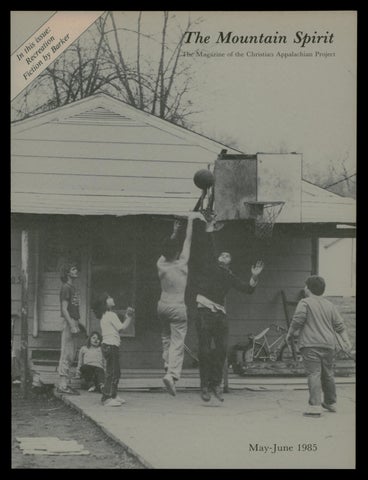
W hen m any people think o f recreation in K entucky the first image that comes to m ind is basketball. It's true that the sport is one of the most popular in the state, but in this m onth’s Mountain Spirit w e'd like to show you some of the other ways that Eastern K entuckians spend their leisure tim e. O n page four you'll meet O tey Calhoun and his fam ous C alhoun hounds. O n page eight you can learn a little about the Berea College C ountry Dancers, and on page sixteen w e’ll tell you about the new youth centers that C A P has started in Floyd C ounty. O n the C O V E R some Berea kids revel in K entucky’s favorite past time (photo by Jo rd a n ). O n the BACK C O V E R , h e’s not a thoroughbred, but a fine-looking horse, just the same! (Photo by Jo rd an ) BELO W , a street dance in downtown Berea.
From Our President The other day I went to visit my father who lives in a nursing home. His greatest complaint was that there was nothing to do. “ You just stare at the walls and watch T.V.,” he said. “ I wish we could play bingo more often.” I almost dropped dead at this remark. For practically all of his 84 years my father has consistantly ex pressed a contempt for bingo. In his declining years it has an importance that baseball, hunting and sports once commanded in his life. F ath er B e itin g talks to M C A stud en ts d u rin g th eir recess b reak .
It made me realize how important and essential good, well managed recreation is to all of us at every in terval of our lives. Like most people I have questioned the value of sports when I see fierce determination and an almost unhealthy devotion to it. But with age I have been able to see the bigger picture. I have often wondered how I can reach the young, especially now as gray hair has replaced the brown. Permit me to share an experience. It was summer time and I was with a group of 20 boys on a houseboat trip down the Kentucky River. One boy in particular was a puzzle. He was not bad or difficult, but he was apparently troubled. Nothing seem ed to be able to penetrate the wall that entrapped him. I had worked with him some. I showed him how to handle the canoe paddles and taught him how to tie up the boat so it would stay secure. We spent some time together one afternoon, just sitting on the front deck of the boat. Silence kept us company for a while, then he turned to me with tears streaming down his face. “ What do you do,” he asked, “ when your mother hates you?” He told a tale of family strife that literally killed his father. He related how his mother attempted to drown him in the toilet bowl. The story took an hour to run its course. M ay-June 1985
If it hadn’t been for the boat trip, a day of canoeing and a quiet mo ment in the late afternoon, he would not have opened up. Recreation had broken down the walls that penned him in. It isn’t the young alone who prof it by recreation. I don’t know when I feel more alive than when I am with the old, our senior citizens. Just yesterday I received a request from a group of elderly people I know. “ Has the ice melted on the lake? Can we come over to see you? Can we go out on the boat?” Somehow they got through the terri ble grip of the winter by looking ahead to a time when recreation could bring a spark back into their lives. Last month our people at CAP started three youth centers, where there had been no organized form of recreation. It goes beyond telling to say that scores of young people come to the centers each day. This, I am sure, was to be expected. Where the miracle lies is in the fact that so many adults have come to the centers as well. They donate their time to serve as chaperones, and instructors for the young people and see that order and fairness prevail. Many of the adults have donated equipment and food and money that the centers may grow. There is more than service and generosity involved here, however.
There is a new spirit abroad. A spirit that is forging a bond of unity bet ween young people and their elders. They are becoming friends. In the future there will be more talking, more sharing and, hopefully, less hostility and separation. Recreation can be a powerful force for good. These stories tell how recreation makes friends of us all and en courages us in difficult times to dream of better things. But there is more. This winter I went on vacation. I spent the majority of my days alone. A camper, a small boat, the water of the Caloosahatchee River and the warmth of Florida in February did wonders for me. The tiredness went away, the tensions were gone. As I sat on the boat at evening time, I began to discover things I should have known. There was the exhileration of a gentle breeze, the peace of water lapping against the boat, the afterglow of a setting sun, the begin ning of a starry night. As I sat, feeling so good, I began to talk to God. I talked to him about water, wind, sun, sand, the stars, the quiet moments, the beauty that was creation. I wanted Him to know that I thought He was pretty special and I thanked Him for love and for the thousands of little things that make up my life. Recreation—it can bring God back into the world. 3
O tey C alhoun A nd the C alhoun H ounds
T h e hot humid August air mingled with the heavy dust of the narrow gravel road and made me wonder if my trip was worth the effort as I drove deeper and deeper into Lincoln County looking for Otey Calhoun and his famous “ Calhoun Hounds.”
Preston
I had heard stories about this man and his love for the breed fox hounds that had been handed down to him through generation after generation of Calhouns. It was hard to believe that such dedication to a cause—any cause—could still be alive today. 4
The M ountain Spirit
I found the Calhoun house on a little side road just south of the town of Waynesburg, Kentucky, in a secluded section of Lincoln County just west of Highway 27. A cool breeze moved across a shady yard filled with flowers and bushes that framed the small country house. A fern planted in a porcelain bucket adorned the rustic porch rail. Otey and Grace Calhoun met me at the front door and I knew from the first moment that just getting to meet this unique couple was well worth the trip. Before long the story of the origin of the hounds and the Calhoun family background began to unfold. “ My people come to America in 1607, and land ed with the early Pilgrims on the east coast down on the James River,’’ said Otey. “ They helped set tle the town of Jamestown, Virginia. Then they kinda’ spread out. But they had brought enough of these hounds to share. These are not English hounds, though. No sir, they are from South Africa. “ A man named J. Thomas Benbow, of Eastbend, North Carolina, did research on the hounds and he knew ancient history better than anyone I ever knew. He said he traced the origin of the dogs all the way to the beginning of their time. “ Story was,’’ he said,“ that God Himself put these hounds here to protect a group of ancient tribes from tearing each other up, over in South Africa. I know that sounds strange and I’m not sure it is the truth but J. Thomas Benbow sure knew a lot about ancient history . . . he probably wasn’t wrong.” Benbow may have been an authority on ancient history, but Otey Calhoun probably knows more about these hounds and the importance of their “ true breeding” than any man alive today. In 1968, Calhoun wrote a book about his family and their dedication to this particular breed of hound. In his dedication of the book it is written —“ Dedicated to my father, James S. Calhoun; my grandfather, Barney B. Calhoun; Colonel Jasper A. Webster and every fine man and woman that has played a good role in this long line of great hounds from England, Ireland and on up to the present time, including the American Indian tribes.” Calhoun spoke of his own ancestors as being mostly English and Irish descent, except for a trace of Indian blood. “ The pedigrees of a man or his family tree is something.” said Calhoun. “ I have just a trace of Indian blood but I’m sure not ashamed of it. You know Indians are the most true freedom-loving race of American people. They fought like demons for their own land and freedom and almost lost it all!” M ay-June 1985
» ryS * ?
- v ■ *- >Av '•T*
-4?*
t
Grace Calhoun shares in the care of King, Blue Feather, and the rest of the Calhoun hounds.
According to Calhoun, if people don’t pay at tention to their own affairs and lineage, there soon won’t be any lineage or anything else. “ You and I may not live to see it but if things go on as is some of the youngsters may live to say, ‘they told us but we wouldn’t listen.’ ” A true breed is important to Calhoun and he has worked to keep his hounds’ bloodline pure just as his ancestors have done for hundreds of years. Now, he is worried about the hounds. Although the Calhouns have four children, 13 grandchildren and 6 great-grandchildren, no one seems interested in carrying on the family tradi tion of breeding, raising and training the Calhoun hounds. A look of sadness creased Otey’s face as he thought about the unsure future that awaited his beloved hounds. “ I never did cross-breed these hounds and I never would!” he said. “ But I’ve been sick and I worry about what is going to hap pen to the breed when I am gone. You can’t trust people not to cross-breed them, especially if they think they can make a little money. But if they do cross-breed them, the hounds won’t ever be the same. “ There is a lot more to a breed than just color and temperament. Quality doesn’t just happen, it was bred into these hounds from the beginning and its been kept there. Gameness! That’s another trait of these hounds . . . they never quit. They will run till they drop. They stick it out till the end, one way or the other. If a fox stays above the ground these hounds will get him,” he said, reflecting for a moment on the good ole’ days when he used to run through the fields with his dogs.
6
A b o v e, K in g , on e o f the sta tely C a lh ou n h o u n d s. B elo w , Grace and O tey share a q u ie t m o m en t in th e ir rural L in c o ln C o u n ty h o m e.
The M ountain Spirit
But hounds are not the only thing Calhoun has spent his life protecting. He is said to be responsi ble for stocking half the game that roams the hills in the Waynesburg area. “ I would buy game and bring ’em in here and then some sorry, no-good, thieving hide hunters would come in and kill ’em just for their hides. They make me so mad! Dogthieving bunch. You know, there is alot of ‘cheap’ hunters in this part of the country. I know it’s the truth. If I didn’t know it for a fact I wouldn’t say it.” Grace Calhoun nodded her head in approval. ‘‘Otey has brought them in here and we would raise them all year and he would build them ‘fox dens’ to hide in,” she said. “ He always was in it for the sport . . . he’d say, if you’re going to be in a sport then be a sport about it.” “ I never killed a fox,” Otey said, “ I’d build dens for them and run my dogs . . . I just loved the chase. I’ve been fox hunting ever since I was big enough to get into the woods with a hound, been at it all my live and I’ll be 79 in March.
f cI told her that there was something wrong
w ith someone that didn ’t like some kin d o f a dog or a pup or something . . . it w o u ld n ’t do fo r her to come around our place because we had plenty o f dogs. “ You can’t make a fox hunter . . . you have to be born one,” he said with a certain matter-offactness in his voice. “ My father had the hounds when he homesteaded government land in Washington and we lived there until 1912, but I came here from Blue Ridge Mountain, North Carolina. That’s where my wife’s from.” “ Yes, we met and married there in 1928, we were married 56 years August 16 of this year.” Grace added. It was apparent from listening that neither had grown bored with the other through the 56 years. “ You know she can’t type but Grace, there, is just about the best bookkeeper a man could ever ask for. She’s been a help to me through the years that I couldn’t ever explain . . . I don’t know what would have happened without her . . . well, I know I just couldn’t make it without her.” said Otey. “ She used to go right along with me on the fox hunts. Sometimes she was a little scared at night but she was always right there after our kids got big enough.” M ay-June 1985
. . . these a in ’t ju s t a bunch o f ole’ dogs!
The two share a deep interest in the hounds, fox hunting and in each other. “ Who couldn’t love those little pups!” said Grace. “ They were so cute and cuddly, like little bear cubs. One time while me and Otey were run ning a grocery store, a lady came in and was telling me how much she hated dogs! Said she would shoot anybody’s dogs that came in her yard and all that. Well, I told her that there was something wrong with someone that didn’t like some kind of a dog or pup or something. And that it wouldn’t do for her to come around our place because we had plenty of dogs. “ We loved our dogs, we’ve lived all over the country and the dogs always go with us. We’ve even been up around Canada but we always took the dogs. Otey never was much on bench shows. He just loved the dogs and the sport.” “ I don’t care a thing about those bench shows and big time braggers. My hounds could put to shame their so-called finest. But I don’t need to prove it . . . I already know it. “ Like my dad, James Calhoun said, these ain’t just a bunch of ole’ dogs . . . them’s Calhoun Hounds!” 7
. by%Beverly *Carter-Sexton P hotos C ourtesy of B erea College
B erea College has long been noted for plac ing a high value on cultural experiences as an in tegral part of human and regional development. One of the programs supported by the college’s Recreational Extension Office is the Berea College Country Dancers, a group of young men and women who are students at the college. Their per formances are based on folk dances and songs from the American Southern Highlands and elsewhere. According to Dr. John Ramsay, director of the troupe, the country dancers were founded in 1937 or 1938 by Frank Smith, an Englishman, who was a recreational specialist for Berea College. He wanted to preserve the folk culture of the southern Appalachian mountains. Dr. Ramsay performed with the troupe while he was a student at Berea College in the early 1950’s and became director of the dancers in 1974. He is a quiet spoken man but his enthusiasm for the group is apparent. When asked about the Berea College Country Dancers, he talked non-stop for 30 minutes, his pride in the dance troupe evident as he happily enlightened The Mountain Spirit on the Country Dancers. “ The way I see my job,” he began, “ is to keep the folk arts alive by using them. We aren’t as in terested in museum elements. We sort of draw on the past but keep it alive, which means it’s always changing. When Frank Smith was here he had to give a lot of attention to the prejudice people had against dance. So he didn’t call it dancing, he call ed it singing games and did mainly the old play party games in which you provided your own music. And that was okay; most churches didn’t object to that, although once in a while somebody would say, ‘this isn’t any different from dancing.’ I’ve tried to analyze this some, and the attitude against dance came over with the dance from England. There was a schism in England between the Puritans and the Royalists; the people who believed in having fun and kicking up their heels and being a bit rowdy and those who were very devout. This is pretty much broken down now but you still find communities, of course, that don’t approve. But we’ve shown that dancing is an honorable and excellent social recreation, and if you look back in history it has been used in all
The Berea College Country Dancers, illustrated in the middle and bottom photos, not only perform their art, but also take it to “ the streets” (top photo). They consider that sharing the dance w ith the communities they visit is as important a cultural expression as the dance they perform.
M ay-June 1985
countries since the beginning of time as an impor tant part of community life. Sometimes it’s ceremonial, and we do ceremonial dancing in our programs, but it’s not Appalachian. It’s farther back, to the English dances, but we like to keep them alive and they add interest to our programs. Most of our dances are traditional. We like to have street dances and community dances and have workshops in which people just get together for the fellowship of dance. Our dancing is sort of a social sacrament which says we believe in being together. We believe in everyone participating; we believe in the sacred circle, the wholeness. These things are in the dance and they do speak, not in words, but perhaps more deeply than in words. I think the dancers feel this. We don’t talk about it a great deal but they sense it intuitively.” Statistically the students in the dance troupe have higher grade point averages. “ It’s hard to say why,” said Dr. Ramsay. “ Why would missing classes make you a better student? Why would evening activities that keep you busy and take you away from your homework make you a better stu dent? I’ve done a lot of thinking about it and I feel, for one thing, this whole attitude toward yourself and toward society, the fact that you are part of a group that has roots, that sort of knows where it’s coming from, does something for you. Being busy helps you because you have to organize your time. Members of the club are a very good
“ Our dancing is sort o f a social sacrament which says we believe in being together. ”
support group for one another and they have set a high standard. When someone needs help they will help each other. Then I think also that performing is a help, it does things for people’s ego. If people applaud what you are doing, you feel different about yourself, and that makes you a better stu dent. And of course, traveling around as we do, that is certainly a broadening experience. These are some of the reasons they are better students.” The Country Dancers have traveled to Latin America, Great Britain, Denmark and Belgium. They were featured by the Cincinnati Symphony in its Mini-Festival series during 1973-74. They performed before President Kennedy in 1963. This summer they are going to Denmark and England. “ That all sounds fine,” said Dr. Ramsay, “ But we also go to Buckhorn and to Crab Orchard, the smallest community, the smallest gym, and that is equally important to us. In fact I think that is the
. . we believe in the sacred circle, the
wholeness. These things are in the dance . . . they sense it intuitively. ”
most important thing to us, to go out and share this with places it has come from. So we are bring ing it back to them also and our program is keep ing these folk arts alive. We have a community adult class open to anybody. It meets on Friday nights. We call it the social alternative to jogging. It has just been going great the last couple of years. We have all ages, from college students to one fellow who is 84.” A brochure published by Berea College pro motes one of the workshops of the Country Dancers as: “ . . . the traditional arts provide a natural medium through which people can meet. Folk dance, especially, fosters a cooperative, democratic spirit; it is participatory and can cut across age stratification. It provides an alternative to the highly commercialized, overly competitive and elite sports which today dominate American free time. Our material is simple, our music infec tious and our dancers committed to sharing their gladness in being together . . . we are skilled at getting people to participate . . . where there is a will to do something about building more democratic forms of recreation, Berea College’s Recreation Extension Office and the Berea Col lege Country Dancers can help you find a way.”
Letters
I want to compliment you for a very fine publication. I have long been interested in the Appalachian region. Your magazine gives me a good understanding and a clear pic ture of the people and conditions of the area. The quality of your magazine is super, too. I enjoy it from cover to cover. Mrs. J. Waifred Johnson Detroit Lakes, M N
The Mountain Spirit gets better and better. After reading it, I feel like I have had a trip to the moun tains of Kentucky and had a visit with its people. The article on Cranks Creek Sur vival Center was most interesting. Last summer there was an article in the Atlanta paper about Mrs. Simp son and the work she had done and was doing. I was so impressed that I wrote her complimenting her and in cluded the article from the paper. Elizabeth Pound Savannah, GA
Your magazine is the best of its kind! The many endeavors you have begun really do show the people your interest in their welfare and gives them hope that the future can be better.
I put everything aside and read The Mountain Spirit when 1 receive it. There seems to be a lot of history in the feature stories and when the volunteers are in the different proj ects, it is amazing how they share their love and talents with the peo ple of the Appalachians. I am happy the children have a fine school to at tend, so they can receive a fine education to make their futures suc cessful. Thanks to Father Beiting and the people who donate their time and money, the people know they are not alone in their problems. I wish The Mountain Spirit was published every month, since it is such a fine magazine. I save my magazines and reread them at dif ferent times. God’s blessings on all your time and work for the Lord. Bobbie Weaver Big Spring, TX
Your magazine is getting better and better! We’ve enjoyed it several years now and have gained much knowledge of the people of Ken tucky. We drove through one time and on up into Virginia and West Virginia, so we can visualize much you write about. We do believe our missionary money goes completely into helping others and we like that, too.
You’re making a difference to day, but better yet, giving the gift of hope!
I’ve introduced our daughter to you and your work and she plans to send money and clothing and she is hoping to interest others in Maryland, where she lives. May God richly bless you all and everything you are able to do to im prove the living conditions and working conditions for the people there.
Marge A . King White Bear Lake, M N
Ralph Peters Shawnee, OK
When they do have that hope, they can listen and believe that Christ does live now in the spirit of the CAP workers.
12
For many years your letters have comforted and interested me. The wonderful work you are doing makes sense and little going on in today’s world does to me. I am 85 years old, and have no income to help you financially as much as I long to, but out of the scores of pleas for money, money, money, in my mailbox this year, only yours would I gladly send all I could to. My church here in Auburn, United Methodist, sends their youth here to do repair work, carpentry or whatever for needy families there, but I myself am able to do little. Be ing a writer myself, my deep and special interest is in your magazine, which is increasing in interest and quality all the time, I am delighted to see. Your January-February issue, with the history of CAP growth, shows your dedication to helping people to help themselves is the greatest dream of all—whether it’s helping them to plant, plough, or to pray . . . that is the world’s need—God has blessed you with the gift of inspiring others with your dream! Mike Sanders, and all your volunteers . . . congratulate Beverly Sexton on her article . . . I loved it! Helen Dick Davis Auburn, AL Your publication, The Mountain Spirit, gives one a deep insight into the great courage and faith and spiritual strength that lies within the heart of the Appalachian people. It truly has become a source of in spiration for our whole family. Mr. and Mrs. W.T. Riley Newport News, VA Letters to the editor are welcome.
They should not exceed 150 words in length, and we reserve the right to edit them for space. Address letters to The Mountain Spirit, Christian Appalachian Project, 322 Crab Orchard Road, Lancaster, Kentucky 40446. The M ountain Spirit
Random Thoughts
A few months ago, I was teaching at a Catholic high school in Norfolk, Virginia. I recall having to walk carefully in the hallways during the break between classes for fear of stepping on a break dancer. I can also remember thinking that these kids were going to throw their shoulders out if they weren’t careful. These recollections returned vividly to me yesterday as I looked through the kitchen window of our house in Berea, Kentucky, and saw some neighborhood kids doing the same type of dance that I had previously witnessed in Norfolk. There in the middle of a seldom busy street was a young boy whirling around on the palm of his hand as his body floated above him. His friends gathered around encouraging him to break as best as he could. “ Holy smokes,’’ I remarked to my wife, “ kids are break dancing in Kentucky!”
“ H o ly sm o k e s, k id s dancing in K en tu cky!”
are
b rea k
In looking over this issue of The Mountain Spirit, I began to realize that the parallels that ex ist in our lives are numerous. As I read over the story on the Calhoun hounds, memories of my youth came to mind, when our family raised beagle pups for hunting. With these images came the feel ings of warmth and security I knew as a child growing up in rural Virginia. The article on youth centers in Floyd County helped me to recall some of the evenings when young people from our parish would gather with my wife and me in our home in northern Michigan. These gatherings became popular because they satisfied the need for companionship and love that was lacking in many of their lives. Garry Barker’s story of a young boy’s accident when collecting colored glass (and the miracle that followed) brought to mind a boy I knew by the name of Sam who lived in an or phanage in Philadelphia, Pennsylvania. As a seminarian, I worked with Sam on a tutorial basis, but our relationship went much deeper. He claim ed me as a friend and would often clue me in to the newest treasures that he had discovered as he ex plored the woods behind the orphanage. There was a sense of joy and wonder that filled the air as he would open that special cigar box that contain ed his finds. M ay-June 1985
My ability to relate to each of the stories that appear in this issue is not unique. Each of us has a wealth of experience that enables us to call to mind certain events in our lives that are similar to those mentioned here. In this issue we’ve provided stories which might relate to you certain situations that can illustrate the similarity between people. Just as Garry Barker relates the tale of a young boy and his mother’s love, so too, does each of us know of times when our own mother’s love seem ed to possess miraculous powers. Similarly, in looking at the story on the youth centers, we know of those recreational places in our town or neighborhood which seek to serve the recreational and emotional needs of the young people in our community. There is a certain unity that exists among people—a unity that simply cannot be destroyed. Nowhere is this more pronounced than in the ways that we choose to recreate. In the spring, children in Appalachia will be playing baseball . . . as will young people in Brooklyn, New York, . . . as will children in Tokyo, Japan. Can it be that we are all somehow the same? Can it be that we are all related in some way? A couple of days ago, there was a gentleman in my office who told me a story of how his family took a train ride through Canada. Traveling with them was their 3 year old son, Peter. When they crossed the border from the United States into Canada, his father told him, “ We’re in another country now, Peter!” “ How can you tell?” replied the youngster. “ The trees are still green,” he continued, “ the sky is still blue and the people look the same.” A man seated across from the family overheard the conversation and attempted to resolve the young boy’s dilemma. “ It’s like a big store,” remarked the man, “ we have different departments, but we’re all made by the same com pany!” Recreation allows us to take a look at ourselves. It gives us the opportunity to step back, catch our breath and re-create that spirit of newness and vitality that may have fallen by the wayside as a result of an all too busy schedule. As the re-birth of spring occurs within our lives and we begin to recreate after the gloom of winter, let’s remember that the ability to re-create is something that we all share. It’s something which unites us and il lustrates a certain oneness that exists among us. It was given to all of us as a free gift from the boss of our “ company” —thanks, God! —JRJ. 13
The C A P Closeup
K athleen Leavell \\: &
“ The Basically Important Values ’ ’
by the C A P N ew s Service
W e should all have the problems that Kathleen Ford Leavell has. She is one of those lucky people who has the great fortune to be torn between two wonderful families. In 1976 Kathleen made the difficult decision to leave Massachusetts and a family she says is “ a wonderful—a very Christ-centered—family. They’re very active, in terms of living out what they believe.” She moved to Kentucky to work as a CAP volunteer. Kathleen has described herself as the prototype of the “ Boston schoolmarm,” and admits that the English language gave her some trouble in her first days in Kentucky. Well, it wasn’t really English that gave her problems. It was the discrepancy bet ween the somewhat mushy version often heard in Eastern Kentucky and the clipped tones she became accustomed to when she was growing up. Her first day as a volunteer was spent working at Camp Nelson, a recreation center which CAP was operating on the Kentucky River. “ I was sup14
posed to follow Donnie Underwood (CAP’S chief of maintenance) around and write down a list of repairs which he told me needed to be done. I couldn’t understand a word the guy was saying, but I didn’t want to appear stupid on my first day. It was so important to do a good job! So, I wrote everything down phonetically. Then I nearly died when Donnie looked at what I had written. Of course, everything was hyphenated and written every which way. He didn’t know what the heck I had written down! But I was able to read it back to him, exactly the way he said it, and he understood it.” Once she overcame her language barrier, Kathleen slowly came to feel at home in Kentucky. In 1977 she began working at the Sunshine Center, CAP’S child development center in Lancaster. Working with pre-schoolers suited Kathleen, who has a degree in elementary education from Salem State College. The M ountain Spirit
In October of 1984 Kathleen firmly and ir revocably put down roots here when she married Paul Leavell, a man born and raised in Garrard County. To her advantage, Kathleen now feels that she has strong family ties in two places. “ My parents have become incredibly important to me since I’ve been here. Their support of what I was doing here and why I had come is remarkable. Sometimes I’d feel, when I went home, that if my mother or father had said to me, ‘Kathleen, I’ll give you a nickel if you’ll stay,’ I would have stayed. But they’re the ones who believe so much in what I’m doing. They say, ‘good-bye darling. Now get on the plane. You’ll be all right.’ That ex perience has helped me to understand children who have a hard time leaving their mothers in the morning. I think that’s a similar frame of reference. We all wonder, ‘what’s going to happen between now and the time I see them again?’ ’’
Kathleen’s second family is not just her hus band, Paul, but all of the friends—many of them other former volunteers—whom she has met dur ing her time in Kentucky. “ Just about every single person who came from Boston for our wedding had a peaceful feeling leaving me here. They didn’t feel they were leaving me stranded in the foot hills. Through their letters they have told me that they have never, ever seen such valuable friends. One of my relatives told me that they had mentioned to one of my friends how, almost, stunned they were at the incredible closeness that was here, and the real love that was between
everybody. They had never seen anything like it. Whoever they talked to said, ‘we’re all pretty far away from our families, and through our volunteer commitment, we’ve learned to adopt each other as family. We know how important we are to each other.’ It’s a sense of living what you believe. I guess it’s real, not just a cliche or a nice thing to say, or an idealistic view. They were truly, truly impressed. And it’s a nice feeling for me to know that my family at home feels good about me being here.” Kathleen and Paul are seeing to it that the next generation goes on, as they expect their first baby in the late summer. Kathleen believes that the years she has spent at the Sunshine Center will be of tremendous value to her as she begins to raise her own children. “ I’m sure my children will go through the same stages that every normal child goes through, but I think I can deal with it a heck of a lot better than I could if I didn’t have all of this experience. I realize—and hope to goodness I will be able to make it real—how important it is that my children believe in themselves and love themselves. If they believe that they are good, capable, worthwhile individuals who are very, very much loved by me and by Paul and by God, then they will make real the Prayer of St. Francis. They will know that they are loved, but that it is also important to love others and to want more to understand how somebody else feels rather than to have everybody always understanding how they feel. “ I know they’ll be normal children, and they’ll go through the stage where they are the most im portant thing in the world when they’re two, like every other two-year-old. But I’m hoping to guide them through that stage, and when they’re past that, they’ll really see value to other peoples’ lives and needs. They’ll be just as full of energy as any other children. I’ll be pulling them off the curtains and wiping the crayon marks off the wall, just the same as any other mother. But, please God, I hope that I will know that this is a normal thing to do, and just deal with the frustration of having it hap pen and not worry, ‘what’s wrong with my children?’ I think I’ve got enough examples around me to be a good mother, besides the train ing that I’ve had. I feel ready and eager.” Kathleen says she is grateful for both her Ken tucky and her Massachusetts roots, “ I see a baby coming in my life and I can see changes coming. But even if I’m not working full time with CAP, I want to be involved in some way. I’m so used to this world and the values. We all share the same values and the same things are basically important to us. This place is about the closest I’ve ever seen to carrying over the things that I learned from my family.” CAP.
M ay-June 1985
15
Recreate is an interesting word. Seen one way it means “ a mode of diversion.” Seen a slightly different way the word means, “ to give fresh life to; reanimate.” Through three new youth centers in Floyd County, the Christian Appalachian Proj ect is achieving both of those activities in a single program. In droves, kids from Martin, Wheelwright and Allen are coming into the centers every day to shoot pool, have a Pepsi, or play Trivial Pur suit—recreational activities, to be sure. But Mike Sanders, CAP’S Director of Operations in Martin and Lavonne Lafferty, Lowell Parker and Sandra Clemons, coordinators of the programs, have a little secret. They know that through these games and interaction the chance for “ re-creation” in Floyd County grows dramatically. “ You’ve got to have some way to get them in here,” Mike said. “ Then we’ll get into education and tutoring. We can see attitudes changing already. Young people have to realize that they are worthwhile and that they can help improve each other.”
cc
Recreation ’
New Life in Floyd C ounty
The Mountain Christian Academy has served as the catalyst for the centers. The incredible success of the school has made the residents of Floyd County fully aware of how much potential they have when they band together in a common cause. Once again, it is many people in Floyd County who are making things work, and not just people directly involved with CAP. Lavonne, who has been coordinating the Chris tian education program at the MCA is in charge of the center in Martin. “ I really believe that this project was in the plan of the Lord, because it’s different. We’ve had several parents involved. One Saturday night, when we were having a dance, we had forty parents come in and sit with us. They said, ‘we had to come and check it out.’ I guess you might call me an old fogey when it comes to rules. Most of the parents know that and they know that I’m kind of tough.” Both Lavonne and Mike believe that setting the perimeters of acceptable behavior has been a key to success so far. Other youth centers have been tried in the county in the past, with varying degrees of success. When the decision was made for CAP to open youth centers, one of the first issues discussed was what was to be considered ac ceptable behavior and what was not. Signs posted in each center discourage rough language, fighting, alcoholic beverages and gambling. “ We determined, before we opened the door, that we would not have any of that going on and it’s been just super,” Lavonne said. “ Some of the kids whom, I understand, they’ve had problems with in school haven’t given us that first problem. 16
*
I
t *
\
The M ountain Spirit
*4*>**
Story and Photos by M argaret Gabriel A F loyd C o u n ty girl stopped in to p lay a gam e of “ U n o ” w ith h e r frien d s a fter school.
“ One day, one of them was kind of arguing and 1 went out and put my arm around him and said, ‘you know, if you break the rules, we’re going to have to restrict you for three days.’ He kind of hung his head. I went home and 1 really prayed about that because I thought, ‘kids with the prob lems are the ones, Lord, that we want to reach.’ So, when I saw him the next day I said, ‘hello, there! Are you mad at me?’ He said, ‘nah.’ I ask ed him how he was and he said he was fine. I said, ‘are you fine enough to give me a big hug?’ He must be about fourteen years old—and big—but he walked over and put his arms around me. I said, ‘hey, I really love you, and so does the Lord.’ You know, that kid has done a complete turn around? He is so good now; he’s the best kid in the place! To me, that’s really what it’s all about. It’s not hard to see the attraction that the centers hold for the kids. Each has pool and ping pong tables, a great array of games, television; but all of these things are more a means to an end, rather than an end in themselves. “ There’s so much we can do with these kids,” Mike said. “ If we can just get them to enjoy a game of pool without gambling, or cut down on the number of teenagers who are drinking, we’ve accomplished a lot. But there are all kinds of things that we want to get them involved with. We’d like to get them to help with the seed pro gram—to help in distribution and home visiting. I’d like to teach them about some businesses out side of the coal industry. We don’t see ourselves as strictly recreational, but we’re learning a lot from it.
“ First, we’re seeing that kids can cooperate with kids from other schools. It’s good to have that strong pride in your school, but the interac tion that they’re having now will help them later on, when they’re working together as adults in the community.’’ Education—something that is not often stressed in Eastern Kentucky—is being given a high priori ty in CAP’s youth centers. They all have a reading room, equipped with tables for studying and com fortable chairs for reading. A lack of books is a current problem. Shelves are well stocked with donated textbooks, but books for pleasure reading are in short supply. “ We’ve had an awful lot of dropouts come in,” Lavonne said. “ I’m hoping that I can get them to go back, or maybe we can set up a program later that will help them study for their GED. We’ve got to figure some way to attract young people to reading, something that will inspire them to read. We’re thinking of asking some of the recreational centers to give us some tickets that we can give to children as prizes. We can give them a trip to a park on Saturday if they read so many books in a given time. It’s bribery, but anything to get them started, if you want to see change.” The centers have been serving to re-create some attitudes in the adults as well as the kids in Floyd County. There are no rules that parents must at tend, but many have been known to drop in with cookies, potato chips or punch and then hang around for a while to play a hand of cards or shoot a little pool. In doing so, the lines of com munication are created—or re-created, perhaps. The kids have living proof that adults care enough about them to join in their activities and talk about things in general. This communication can not help but lead to an increased awareness for both groups. Kids will learn that adults really can help them because of their experience and wisdom; adults will learn that kids need that type of guidance and direction. Of the many good things that have come out of the centers, Mike considers the great mix of dif ferent kinds of people to be one of the best achievements. “ We’ve had some pretty rough characters come in,” Mike said, “ some real street kids, sort of. But they know their limitations. Lavonne is real good with them. I don’t think she’s had any trouble. Then, too, we’ve had a lot of kids from different economic levels. We’ve had kids from poor families and richer families play ing games together—something you don’t often see around here. That kind of situation is going to help this community tremendously in the future.” 18
G il R osen b erg in stu cts a b o y in the fin er p o in ts o f p o o l at the M a rtin y o u th center.
Lavonne told of one of the kids who had never seen anything quite like the center in Martin. “ He said, ‘Lavonne, how much is all this going to cost? I can’t believe this!’ And all we had was that little pool table at that time. He said, ‘this is the greatest thing; I didn’t have anywhere to go and anything to do. Golly, this is neat!’ You’d have thought we had an uptown New York youth center.” There are small goals involved with the Floyd County youth centers. One might be to get a cou ple of kids to talk out a difference rather than to fight it out. Another might be to get a child in terested in excelling in school, maybe even going on to college. You might find some kids thinking about each other in terms of their similarities rather than their differences. But even though these goals may be small, they have the potential to be long-lasting and influential. Mike believes that all of these smaller goals can be summed up with just one attitude. “ We want to teach them that Christ is in everyone they see and in everything they do. The M ountain Spirit
Around the Project
by the C A P News Service
Spirituality in CAP MOUNT VERNON—A Day of Discernment was held, March 1, for the 25 CAP volunteers from the Lancaster, Mt. Vernon and Martin Volunteer Centers. The retreat, held at CAP’s Family Life Retreat Center, addressed the issue of “ A Search for Spirituality in CAP.” After an opening address by Fr. Beiting, the volunteers broke into small groups and discussed various issues concerning their perspectives on spirituality in general and, more specifically, spirituality within the Christian Appalachian Project. The following day, small group discus sions provided an opportunity for further discernment regarding the spirituality question. The observations and recommen dations of the participants were compiled and presented to the management team of CAP at their weekly meeting on March 12. Their observations reflect the concerns, perspectives and hopes of the volunteers that CAP will remain an organization that has a spiritual base and that this spirituality will be nurtured and maintained in the years to come. In reflecting on the value of the day, Kirsten Almo, a permanent volunteer from Minneapolis, Min nesota, begins, ‘‘I think most people ended up talking about spirituality in the lives of volunteers and employees as well as our expecta tions of what things we see happen ing now .” In regard to the spirituality of CAP, she states, “ some places make the spirituality (of CAP) real evident, such as the schools. I think we all discussed this at the Day of Discernment.” And what did you enjoy most about the day, Kirsten? “ The fact that the ideas that were brought up are going to be shared with CAP’s manage ment team . . . that the strong feel ings that we have (about spirituality) are going to be paid attention to.” M ay-June 1985
A C A P tem porary v o lu n tee r w ith her n ew frien d , a C A P rice w orker.
Kirsten concluded her thoughts about the day in saying that she hopes “ that the community will begin to recognize CAP as a spiritual organization . . . that when people become involved in any type of pro gram that is run by CAP, they will know that it’s different from any other school or any other used clothing store . . . that immediately they will know that it’s a Christian place. One more thing,” she adds, “ I’ve found that it isn’t strange to want to live a service-oriented life; it’s what we’re called to do!” Another volunteer who was in at tendance at the Day of Discernment was Kevin Benson. Kevin is one of CAP’s “ temporary volunteers” (one who works with CAP for a period of time ranging from one week to three months). Kevin, who came to CAP from Woodside, New York, has been working with the students at the Mountain Christian Academy in rural Martin, Ken tucky. He will be leaving CAP in a few weeks and we bid him a fond farewell. Remarked Rusty Ellis, CAP’s Coordinator of Volunteer Recruitment, “ I’ve been really im pressed with his ability; he’s an in credible young man!” If you decide to volunteer your talents again,
Kevin, keep CAP in mind. Joining C A P ’s T em porary Volunteer Program is Michael Fouch from Middletown, Ohio. Mike previously worked at “ Our Daily Bread” soup kitchen in Cin cinnati, Ohio, and attended school at Miami (of Ohio) University. Since arriving, Mike has been work ing with the seed program; he hopes to work in one of the Child Develop ment Centers since child care is one thing which he especially enjoys. Also with CAP at this time is a group of temporary volunteers from College Misericordia of Dallas, Penn sylvania. Nine young women from the college will be with CAP for ap proximately 10 days as they serve CAP’s Small Farm Program and assist in the preparation of Camp Shawnee in Martin. This spring CAP hosted representative groups from De Paul University of Chicago, Illinois; Saint Mary’s Col lege of Winona, Minnesota; and Siena Heights College in Adrian, Michigan. They will be serving the people of Appalachia in the areas of Child Development, the “ Attic” stores, the elderly visitation pro gram and through many other CAP programs. 19
around the project . . . continued
Claude David Comes to CAP
some of these and to provide a clearer focus with which to steer the course toward ‘setting the captives free.’ ”
LANCASTER —In O ctober, 1984, Women’s Day magazine, in association with Marden Kane Advertising Agency, sponsored a “ giveaway” of 1000 Cabbage Patch Dolls. The dolls were to be given to a charity chosen by the drawn win ners. The Miner family—Jim, Ber nadette and their three children of Braidwood, Illinois—was one of the selected winners. The Miners had entered the contest, hoping to be able to direct their prize to the Christian Appalachian Project. In November, the doll arrived at CAP. Mrs. Miner recalls that “ After wards, I regretted doing it. I remember seeing all of the terrible things that people were doing to get these things (dolls). There was even a woman pushed through a showcase window while trying to get one.” But this story doesn’t stop here.
The Mountain Spirit will offer more information of the Sym posium as it develops.
Gil Rosenberg, CAP’s Coor dinator of the Small Farm Program, contacted the family and suggested that the doll be raffled, with the proceeds going to help fund the Seed Program (a CAP program which distributes seed to needy families so that they might grow food). The Miners thought that that would be an excellent idea and gave Gil the “ go ahead.” As a result, Ap p ala c h ia n C om m u n ities for Children, a community organiza tion in nearby Jackson County, will be raffling off Claude David (each Cabbage Patch Doll comes with a name) sometime this spring. The Miners, who had “just wanted to make some child happy,” will be feeding many hungry people through their donation of Claude David. “ Oh yes,” adds Mrs. Miner, “ we will be sending another doll next year.” Many thanks, Miners, rest assured that people will need your help again next year. 20
A CAP Family Cookbook?
C lau d e D av id
Appalachian Symposium Sponsored by CAP BEREA—Plans are being finaliz ed for a Symposium scheduled to be held at Berea College to deal with issues that face the Appalachian people. The assembly will address such topics as community and economic development, com munications, spiritual growth and development, and education. A panel of twelve speakers will share thoughts, ideas and concerns about the subject areas to be discussed. The panel will consist of such n o ta b le A p p alac h ian spokespersons as Loyal Jones and Harry Caudill. The Symposium will begin with an opening banquet and a keynote address. The following day, approx imately 300 invited guests from the Appalachian region will attend the day long Symposium in hopes of gaining new insight into the challenges that face the people of this region. Fr. Ralph W. Beiting, founder of the Christian Ap palachian Project, will serve as moderator of the meeting. “ A new time has dawned,” states Fr. Beiting, “ requiring new vision and new direction. Our hope (in regard to the Symposium) is to identify
MARTIN—Marilyn Stefanski, a long standing member of the CAP family, was frustrated. States Marilyn, “ There are a lot of wonderful people who support us through their generosity, love and concern for our work. I really wish there were some way that we could all get together for a meal.” Marilyn realized that it would be impossible for every one of CAP’s supporters to come together for a special sup per,” but she came to Fr. Beiting hoping that he might have some solution to the dilemna. What Fr. Beiting has suggested is that since everyone can’t get together physically—then maybe we can do the next best thing . . . share favorite recipes. It would be a way of people coming together to share the fellowship involved in a meal and still be in their own homes. States Fr. Beiting, “ If we all share those meals which mean so much to us and our families, then how great those meals can be for the CAP family.” The more recipes that Fr. Beiting receives, the better the cookbook guarantees to be. Mail all recipes to: Rev. Ralph Beiting CAP Family Cookbook PO Box 1119 Martin, KY 41649 Fr. Beiting must place a deadline on the entries in order that they can be sent to the printing department. So please mail all entries no later than June 15, 1985. Look for more in fo rm a tio n reg ard in g the cookbook in the July/August issue of The Mountain Spirit. The M ountain Spirit
around the project . . . continued
CAPrice Industries Is On the Move SOM ERSET — C A P rice I n dustries, a sheltered workshop pro gram sponsored by the Christian Appalachian Project, is continuing to develop employment oppor tunities for handicapped adults in the Appalachian region. At the pres ent time, CAPrice is under contract to take cotton t-shirts remnants and make finishing cloths for the Cumberland Wood and Chair Com pany. The workshop program is also employing handicapped clients to develop Ringmaster wooden lamp shades for sale in various local craft shops. In Stanford, Kentucky, CAPrice Industries’ clients are working for the CAP Small Farm Program packing seed to be distributed to local farmers. “ They (the CAPrice employees) are really a vital part of the Small Farm Program. They have been of extreme value to us and are quite effective in helping us prepare for the spring seed distribution.’’ states Keith Gilbertson, assistant coordinator of CAP’S Small Farm Program. In a related story, approximately ten employees of CAPrice In dustries (Somerset) are in training for the Special Olympics to be held this spring. Local games were held April 20 and winners of that com petition have advanced to the state
A C A P rice In d u stries w ork er packs b ea n s for the Sm all Farm program .
M ay-June 1985
final games which will be held in Lexington, Kentucky, on Memorial Day weekend. Look for more infor mation regarding the Special Olym pics in the July-August issue of The Mountain Spirit.
Recreating at the Family Life Center
What You D on’t Know About Wills Can Hurt Your Heirs . . . Find Out Why. Request Your Free Copy Of:
MT. VERNON—CAP’S Family Life Center has broadened its ministry in recent months. In February, the FLC created the posi tion of Recreation Coordinator so that the youth of the area might be given the opportunity to channel their energies into more construc tive, community-building activities. Filling this position is Elizabeth Phelps. Elizabeth has high hopes for the recreational program that is developing in the Mt. Vernon area. “ I eventually want to get all ages in volved . . . all the way up to senior citizens,” Elizabeth remarked. “ Right now, I will probably start off with those people in the group of ages 8 to 18 since there are some programs that are already going for them.” The new coordinator plans to start off slowly, “ with maybe something for an hour or two each day” and as interest grows so will the recreational program. Elizabeth hopes to eventually of fer camping trips, family picnics and other “ large scale” programs. “ My interest in college was En vironmental Education. I think that kids would find it a challange to be out in the woods for a night without their parents.” She continues, “ a lot of people have uninformed ideas about ‘recreation professionals,’ but there’s a lot of education involv ed in ‘playing.’ The person you might want to recreate with could be deaf . . . then you would have to learn how to communicate in order to recreate. That is an extreme case but it does illustrate the growth that can occur with recrea tio n .” Elizabeth hopes to introduce the majority of her new programs this spring.
Much of what you know about wills may be misinformation that has been floating around for years. If you think, for example, that wills are primarily for rich people, or the elderly, you may be the victim of a common misconception. The helpful booklet offered below will ex plain how your will can save your heirs from costly delays and con fusion. Send for your copy to day. CLIP AND MAIL Christian Appalachian Project 322 Crab Orchard Road Lancaster, Kentucky 40446 Please send without obligation, your booklet, “ 37 Things People ‘Know’ About Wills That Aren’t Really So.” N am e____________________ Address __________________ City______________________ State______________________
21
My M o th e r’s M iracle
by Garry Barker A rt by Beverly M c N u tt
T h ree year old Vernon Watts, faded bibbed overalls wet to his knees, scowled as he lunged at the handles of his toy wheelbarrow and worked against the rippling current of Caney Creek. The rushing water threatened to tip over the wheelbar row and spill out the load of sparkling glass, Ver non’s collection of pretty bottlenecks and jar bot toms and jagged shards of broken windowpanes. The stocky, straw-haired boy stiffened, clung stubbornly, and wrestled his bright red wheelbar row around and into calmer waters. Vernon’s miniature wheelbarrow was testimony to the tinkering skill of Harper Watts, scrap metal and wood fashioned into a duplicate of the big wheelbarrow beside the coalpile. “ If you want to work so bad, little feller,’’ Harper had chuckled, “ I’ll fix you right up.” Vernon’s work, this sunny August afternoon, was of his own making; he was gathering shiny pretties from the creekbed, bits of green and red and glittering clear glass, the litter of civilization on remote Caney Creek. Vernon’s wheelbarrow was almost full, and it was time to take his treasure home. Vernon’s home, one he shared with Harper and Elsie, six-year-old Priscilla, five-year-old Roy and the baby Ella June, sat perched on stilts on the hillside above the creek, a weathered four room board and battern farmhouse with a rusting tin roof. A sagging clothesline stretched from the porchpost to the chicken coop, hung with flapping dresses, diapers, shirts, and pillow-cases. Sturdy, cheerful Elsie Watts and her younger sister, Margie, were emptying their bulging apron pockets of wooden clothespins, laughing and chat tering as they worked, boiling the wash in the iron kettle hung over an open fire. 23
Vernon heard their laughter, and shoved his wheelbarrow to the bank to join them and show Aunt Margie his pretties. The creekbank was steep and slippery. Vernon slipped, struggled, and stubbornly pushed for ward again. Halfway up the slope, the boy’s bare feet slipped again and he fell, face first into his cargo of sparkling glass. Elsie whirled when she heard Vernon’s muffled shriek. She ran, apron flying out behind her, a wet sheet still clutched in her hands. Margie followed. When Elsie lifted up Vernon’s head, the blood gushed out. A long sliver of windowpane was im bedded in his mouth. Elsie closed her eyes, pulled it out, and wrapped her wet sheet around the boy’s face. She turned grimly to Margie. “ Get Harper,” she ordered. Margie stared, frozen. “ Go get Harper!” shrieked Elsie. Margie went, brown legs flashing, dust puffing from every step, a wailing whimper bubbling from her lips. Down the hills, across the creek at the slickrock, up the hill and panting, lunging, down the narrow dirt road way to the Bluebank Store. She found Harper bent down into the engine com partment of his dusty old Ford. He looked up, amused, as Margie tugged at his sleeve. “ Whoa there, girl,” he said softly. “ What’s got after you?” “ It’s little Vernon,” Margie finally gasped. “ He’s hurt hisself, Harper.” “ How bad?” Harper slammed the hood shut and looked for a rag to wipe his hands. “ They’s blood everwhere!” screamed Margie. Harper shoved the frantic teenager across the seat, started the Ford, and sent it lunging up the roadway. He skidded as they crossed the creek and was out the door, running, before the car bounced completely to a stop. Elsie, with Vernon in her arms, came running. “ What happened?” growled Harper. “ They ain’t time to talk,” gasped Elsie. “ Let’s go.” She turned to Margie. “ Watch out for the youngens whilst we’re gone.” The trip to Grayson, fifteen miles away, took 30 minutes. Elsie clutched Vernon tight, soaked up the blood with the sheet, prayed softly and urged Harper to drive faster. Harper, fists white on the wheel, hoped the bald tires would not burst. Dr. Watson Gray worked quickly, silently, cleaned away the blood and inspected the wound. “ Tongue’s hopeless,” he muttered. “ Just hanging by a thread.” He turned to meet Elsie’s intense stare. “ I can fix his lip, Mrs. Watts,” he said soft ly, “ but it would be better if I just removed the tongue.” “ Cut Vernon’s tongue off?” Elsie paled. “ It won’t ever grow back,” the old doctor said gently. “ I can’t stitch or bandage it. There’s no way. I’m sorry.” 24
*0
Ohm • /
“ No,” whispered Elsie. “ I won’t let you do that.” “ The doc knows what he’s doin’, Elsie,” said Harper. “ No!” shrieked Elsie. “ Sew up his mouth.” Doc Gray looked to Harper, who shrugged. “ He’ll lose it anyway,” said the doctor. “ No matter,” Elsie said stiffly. “ But he won’t lose it without me even tryin’.” Carefully, the doctor cleaned the wounds and stitched Vernon’s lower lip. “ Probably get in fected,” he muttered. “ You may kill the boy.” Elsie took Vernon, and fitted the torn tip of his tongue back into place. “ I’ll hold it right there,” she said hoarsely. “ I’ll hold it ’til it grows back together.” “ It won’t work.” the doctor said glumly. “ We won’t know ’til I try.” snapped Elsie. Harper drove slowly homeward, watching Elsie from the corner of his eye. She held Vernon’s tongue, her face stoney and determined. Vernon, The M ountain Spirit
still strongly sedated, stared helplessly. In Elsie’s pocket was medicine, and antibiotic and more of the sedative. “ Don’t you say one word, Harper Watts,” she suddenly blurted. “ I wasn’t aimin’ to,” he replied weakly. Priscilla, Roy, and Margie with the baby in her arms met them at the creek crossing. “ He’s alive,” Elsie bluntly reported. “ Margie, you got to help me with this so I can get Vernon and me both cleaned up.” When Elsie explained what she wanted her to do, Margie backed away. “ I can’t,” she whimpered. “ I can’t do that Elsie.” “ You got to .” Elsie’s gray eyes flashed. “ You and me, we got to.” She smiled wearily. “ You brung this youngen into the world, Margie. Now, you got to help me make him well again.” “ I don’t think 1 can stand it,” whispered Margie. “ I can’t, Elsie.” “ You have to,” Elsie said simply. “ And that’s that.” She frowned. “ Put the baby to bed and I’ll show you.” Margie closed her eyes when Elsie brought Ver non to her. “ Look here,” Elsie said gently. “ Just put your hand where mine is, and don’t let him jerk loose. We got to keep this medicine in him, and figger out how to keep him fed.” “ That’s real good,” said Elsie. “ You set right here while I clean up.” Harper sat silently, watching Margie and Ver non. “ Lord help us,” he finally whispered. “ The Lord’s gonna do his part.” Elsie said firmly. She raised her face up from the washpan. “ But we got to help Him.” She hesitated. “ Harper, you’re gonna have to help out with the other youngens now, and with the cookin’ and cleanin’.” “ I got a crop to raise,” protested Harper. “ I got cows to milk and corn to hoe.” “ And you got 30 chickens to feed, and three youngens to tend.” Elsie stood firm. “ Right now I need coal for the cookstove and two buckets of water from the spring.” She waited, as Harper stared numbly at her. “ It won’t hurt you none,” snapped Elsie. “ It just won’t leave you no time for tinkerin’ and playin’ cards.” Harper, grumbling under his breath, carried the coal and water, built up the cooking fire, and sulk ed off to the henhouse with the egg basket. “ How’s Vernon doin’?” asked Elsie. “ He’s startin’ to stir some,” said Margie. “ An’ I’m gettin’ awful stiff and tired.” Elsie moved close and spoke softly to the boy. “ You got to mind us, Vernon, and help us make you well.” The boy’s dull eyes didn’t flicker. “ Praise God Vernon is a peaceful youngen,” sigh ed Elsie. “ You want to hold him or cook the sup per, Margie?” M ay-June 1985
“ I’ll cook,” Margie said quickly. Elsie took Vernon, and gave orders from the rocking chair as Margie mixed cornmeal for bread and sliced the side meat into the skillet. Roy and Priscilla were sent to the garden for tomatoes and cucumbers, and the pot of beans from yesterday was put on the stove for reheating. “ What will Vernon eat?” asked Priscilla. She edged closer and tried to get a better look. “ Warm milk and mush,” said Elsie. “ After I nurse the baby.” “ I can hold Vernon,” offered Priscilla. “ I’m big enough.” “ I ain’t gonna do it,” shuddered Roy. “ Look at where her fingers is.” “ You youngens go play,” ordered Elsie. “ Margie’ll holler when supper’s ready.” She held Vernon while the others ate, then nurs ed the baby while Margie took her turn with the boy. When Ella June was asleep in the crib, Elsie warmed milk and made a thin gruel. She used a black rubber syringe to feed Vernon, mixing the medication with the last drops of milk. The sedative acted quickly, and Vernon slept in Margie’s arms. “ I’ll clean up the dishes now,” groaned Elsie. “ No you won’t neither,” said Harper. He grin ned. “ Me and Roy and Prissy is gonna do that.” Elsie smiled gently. “ They ain’t no need for you to do that, Harper. You’ve done enough woman’s work.” Harper smiled, flashing his perfect teeth. “ You’ve gone and got me about half believin’ you can save the boy’s tongue, Elsie. The least I can do is warsh the dishes.” He laughed. “ Just don’t you let Lem and the boys find out you got me in apron strings.” “ I thank you, Harper,” Elsie said gravely. “ Now, Margie, you let me take a turn with Ver non whilst you get some sleep.” Elsie and Margie traded places at two hour in tervals, fed Vernon with the syringe every four hours, gave him medicine, and rocked. Elsie was in the chair as dawn crept up the foggy hollow. Margie was sound asleep on the pallet beside them, breathing gently. Vernon slept raggedly, his swollen face flushed. Elsie watched the day in, then nudged Margie. “ Wake up,” she said softly. “ It’s time I was fixin’ Harper some breakfast.” “ Lord,” moaned Margie. “ I ain’t never been so wore out.” “ You better get used to it,” Elsie said grimly. “ It’s gonna get lots worser.” For a week, around the clock, the two women maintained the grueling schedule. “ Is he gettin’ any better?” asked Harper. “ Hard to tell,” said Elsie. “ The swellin’ is goin’ down some, finally.” “ You want to take him back to Doc Gray?” 25
“ No.” Elsie’s face tightened. “ Not ’til I can walk in there and show my boy healed up again.” “ That day might not never come, Elsie.” “ Then it won’t be because we never tried,” Elsie said angrily. “ Go give my hens some water, Harper.” Margie and Elsie were alone in the middle of the afternoon. Harper had taken the older children to the tobacco patch to pull suckers, and Ella June was asleep on a full stomach. Margie held Vernon, who was also asleep, and she smiled as Elsie took the chair beside her. “ I was ju st th in k in ’, ” M argie said quietly,“ about the night Vernon was borned.” “ You wasn’t but twelve,” said Elsie. “ That’s a mighty young midwife.” “ We was in the place on Upper Tygart,” recall ed Margie, “ Harper went for Doc Gray, but they couldn’t get back across the creek ’cause of the flood. Lord, I never been so scared, Elsie.” “ You done fine,” smiled Elsie. “ A twelve-yearold girl catchin’ a baby.” “ And I laid him right on your belly,” giggled Margie. “ I didn’t know what else to do with him.” “ He’s always been your favorite youngen,” smiled Elsie. “ ‘Course, when I let you pick his name, I never knowed you was stuck on Vernon Whitt so bad.” Margie blushed prettily. “ And you like to had a hissie fit last summer,” continued Elsie, “ when I whupped Vernon for droppin’ that lump of coal on Roy’s head.” “ Well,” protested Margie, “ Vernon never meant to hurt Roy.” “ That was the worst part,” chuckled Elsie. “ Vernon knowed exactly what he was doin. It took four stitches to sew Roy up.” “ Roy ort to have left Vernon be,” argued Margie. “ He was just takin’ up for hisself, is all.” Her face softened as she stared at the boy’s sleep ing face. “ Is it gonna work, Elsie?” she asked quietly. “ God knows,” whispered Elsie. “ God only knows.” She sighed. “ If you can hold him a while longer, I’ll get supper started.” After two weeks Elsie’s hopes soared. “ It’s growin’ back!” she announced happily. “ They’s a big whelp cornin’ where he was cut.” She was right. Somehow, despite the doctor’s grim opinion, Vernon’s tongue was healing. After
a few more days, Elsie relaxed the vigil, and stop ped feeding Vernon the sedative. “ Can he talk?” asked Roy. “ We won’t know for a while,” said Elsie. “ Not ’til the medicine all wears off and his jaws ain’t so stiff and sore. And that’s a mighty thick scar.” Margie and Vernon both slept most a full day. Elsie, weary and grateful, started catching up with the housework. Vernon, relieved to be freed from the apron, fled to Grayson for a full day of loaf ing. He went back the next morning, to take Elsie and Vernon to the doctor. The bemused physician removed the stitches from Vernon’s lip and thoroughly inspected the thick, gristled scar on the boy’s tongue. “ I don’t know how you did it, Elsie,” he finally chuckled. “ I’d have staked my reputation that this couldn’t happen.” He frown ed. “ Vernon’ll have to wait a long time for that scar on his tongue to go away, but it will go, even tually. You’ll just have to wait and see how it af fects his speech. The good Lord willing, he’ll com pletely recover.” “ The Lord’s willin’,” Elsie said softly. Dr. Gray smiled. “ I’d reckon he is, at that. And He’s got some mighty fine help in you and your little sister.” He let Vernon down from his lap, and ruffled the boy’s brushy hair. “ And you, young feller,” chuckled Dr. Gray, “ you stay out of Caney Creek from now on. I’m not sure that even Elsie Watts could perform another miracle like this one.” As they drove home, Harper pondered at length and finally spoke. “ It was a miracle, Elsie. You and Margie, you done a miracle.” “ No.” said Elsie. “ Me and Margie just done what had to be done, like we always do. The rest was up to God.” She peered out the car window at the hillsides turning to gold and crimson, smiled, hugged Vernon closer, laid back against the seat and started working on plans for supper. The tired-eyed, softspoken narrator slumped in his chair and lit a cigarette. “ Did the boy ever speak again?” asked the woman who sat across from him at the table. “ Did the scars heal?” The lanky, straw-haired man smiled, showing a thin white scar on his lower lip. “ When I’m real tired, I lisp a little, and the scar gets red when I’m mad.” He grinned. “ Other than that, my mother’s first miracle was complete.”
Cot Open A N e w W orld To Our Children
, Hi
O v e r the years, people who live and w ork in A ppalachia have agreed that a m a jo r problem in the area is isolation. I t ’s true. A n d m a n y steps have been taken to help with this problem . Better roads have been built . . .schools have been consolidated . . .m any opportunities have been given. But there is one way of elim inating isolation that h a s n ’t been given too m uch consideration. T h e worlds that can be opened to children when they open a book are boundless. T h e C A P Y outh C e n te rs in Floyd C o u n ty are w orking tow ard in troduc ing the kids in their co m m u n tie s to good reading habits. W e realize that books hold the key to m a ny doors that could easily rem ain locked to kids. T h e kids are interested . . . we have space set aside for some rea d in g rooms . . . all we need now is the books! Do you have old books that have been cluttering up your attic or basem ent? W e ’d sure appreciate receiving them! W e ’re particularly interested in some of the great ch ild ren ’s classics — Tom Sawyer, Little Women, Treasure Island — that kids have loved for
generations. Books m ay be sent to: C A P Y outh C enters P O Box 1119 M a rtin , K Y 41649
C H R IS T IA N A P P A L A C H IA N P R O J E C T 322 CRAB ORCHARD RD., LANCASTER, KY 40446 The Mountain Spirit