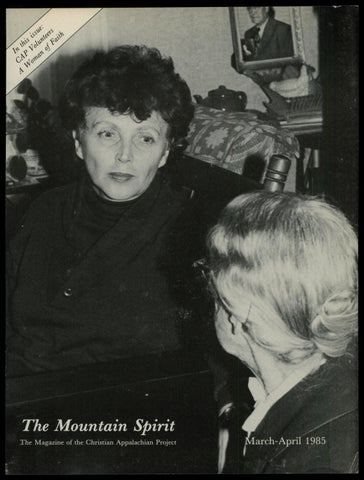
The Mountain Spirit T h e M agazine o f the C h ristian A ppalachian Project
Contents From O u r P r e s id e n t.................................................................... 3
The Mountain Spirit T h e M ag azin e of the C h ristia n A p p alach ian P roject M arch -A p ril 1985 V olum e IV , N o. 2
Features: T he V olunteers and the Elderly: Unconditional L o v e ............. 4 M inerva Gibson: A W om an of F a ith ......................................16 Almost Alone . . . A V olunteer Y e a r ......................................22
Departments: L e tte r s .............................................................................................. 9 News of O u r N e ig h b b o rs .............................................................8 A round the P r o je c t...................................................................... 11 T he C A P C lo se u p ........................................................................ 14 R andom T h o u g h ts ......................................................................20 L e tte r s ............................................................................................21
E d ito r - in - C h ie f ....................................................R ev. R alp h Beiting E d i t o r .................................. M a rg aret G abriel Associate E d i t o r ................................................ .G len E dw ard T au l A dvisory B o a r d .................... M ike M cL aughlin , Leslie B. L arsen Ja c k M o rris, Bill Begley C irculation M a n a g e r..................................................... T eresa R ichey G raphics C o o rd in a to r................................................. R ebecca R eihm T ypesetting ................................................................. T eresa R ichey The Mountain Spirit is published six tim es a year. T h e an n u al subscription price is $5.00. S ubscriptions an d o th er cor respondence should be sent to The Mountain Spirit, C h ristian A p palachian Project, 322 C rab O rch ard R o a d , L an caster, K en tucky 40446. C opyright 1985, T he C h ristian A ppalachian Project, Inc. All rights reserved. M em ber, C atholic Press A ssociation. T h e C hristian A ppalachian Project is a non-profit C h ristian ser vice organization operating th roughout E astern K entucky. T he P roject operates on the philosophy th at “ h elping people help them selves” is the best ap proach to A ppalachian poverty.
■
integral part of our program since the very beginning, and this year we have a fine group, indeed. Y ou’ll meet those involved
B randenburg W imbley escorts a Rockcastle C ounty friend to a doctor’s appointm ent.
From Our President Corsale
I am sure all of you, from time to time, have been asked to volunteer for this task or that. It might be to take something for the church social or help for a few hours at a soup kit chen. Perhaps it may be to keep an eye on the kids for an evening so the parents can get away. The local hospital needs help, the PTA, the Boosters, the scouts—the list goes on and on. Sometimes these requests reach us at an unguarded moment and we say yes. At other times we say yes because we believe in the particular work. Most of the time we say no. We are such busy people. Our time is already scheduled or we just don’t want to get involved. Over the years it has become my contention that volunteering is not voluntary. It is not really left up to us to do this good or perform that service. I believe that when we assumed the dignity of being a child of God we also took on the responsibilities of carrying out God’s work. Our adoption into God’s family means that we have a task to do, a cause to serve. We are not to wait until someone asks us for involvement. We must seek out areas of need that our talents and interest best equip us to answer. We are not to be pursued in the hope we will help. We must be the seeker and offer ourselves as a means of solving a problem. As a wise man once said, we are either part of the problem or part of the solution. We must be solution seekers. If the religious heritage we have from our J u d e o -C h ris tia n background means anything, it means we are all ministers in the ser vice of God. The Spirit compels us. As St. Paul said, “ Woe to me if I don’t announce the Good News.” He knew that volunteering was not voluntary, it followed from his com mitment to Christ. M arch-A pril 1985
F ath er B e itin g m eets w ith v o lu n teers in M a rtin .
Shortly before Christmas a friend who is a jeweler in a distant city sent word that he had some clothing and other items to give to the poor. Could I pick them up when I was in town? I found that there was not on ly clothing but furniture, food, new shoes and jewelry. He had gone out and picked up all the clothing and stored it in his basement. He bought the new shoes with his own money and donated them. He contacted the St. Vincent DePaul Society for more clothing, food and household items. He took jewelry items from his display case to give so that we could sell them and use the proceeds for the poor. In this process he got several other people to help. When I thanked him for being such a wonderful volunteer for the mountains and our people, he look ed puzzled. “ I’m no volunteer,” he said. “ I am just doing what God ex pects of me, what He would do if He were in my place today,” This gentleman has a deep understanding of religious ministry. Yet this story is not new. Did not Isaiah, the great prophet in Jewish times, show the way when God call ed out “ Whom shall I sent, who will be my minister.” Isaiah’s reply was simple, “ Here I am Lord; send me.” Did not Mary of Nazareth continue
the story when the angel told her of God’s great desire to send His Son and save the world. Her immediate response was “ Behold I am the handmaid of the Lord, be it done to me according to Thy word.” John and Andrew, standing by the Jor dan River near Jericho, were told the Stranger who walked past them was the Lamb of God. They im mediately went off and followed Him. The next day they were back recruiting their brothers for service in His cause. What a difference we all could make in this world if we realized that we are called to volunteer. This service does not start from us. It is a call made to us from God. We are our brother’s keeper. We are part of the family of man and our brothers need us because our Father has united us in love. Hopefully this new year will enable each of us to see ourselves in a new light. We are valuable, useful people, who carry in ourselves the answers to so much that is wrong in the world. The voice of a wonderful Father still calls out “ Whom can I send, who shall help me.” It is only when you and I can say “ Here I am Lord; send me” that we shall know what real happiness is and experience lasting peace. 3
T he V olunteers and T he E lderly Unconditional Love
It’s unusual to be able to point to a single ele ment of an organization and say, with great authority, “ that’s the spirit!” “ The Spirit” is so often completely intangible, defying description or definition. It’s fortunate to be able to say that the Christian Appalachian Project doesn’t have that problem. While CAP’s spirit may be difficult to describe or define, the example is definitive—the volunteer program encapsulates the spirit of the entire project. The backgrounds, geographical locations and professional ex periences of the thousands of people who have been CAP volunteers throughout the years differ greatly. But the motivation to give a portion of their lives completely to God and the service of His people is the common denominator which keeps the program strong and vital. There are about 30 people working for CAP as volunteers this year. Five of them are involved in CAP’s elderly program, the only one that is run totally by voluteers. A strong presence in each of the three counties where it operates, the elderly program provides a great service to the people it touches. The volunteers involved will be the first to tell you that they too, are served by the pro gram.
by Margaret Gabriel
“ I have received so much love from them. And it’s unconditional, it really is. They don’t know me very well, really,” observed Jan Yerhot, one of the five women involved with the elderly. CAP has always placed a high priority on pro grams which deal with old folks living in the area.
S o llie A lcorn and v o lu n tee r, B eth K a csits.
4
The Mountain Spirit
Since the mid-seventies there has always been at least one or two volunteers who have spent their time dealing with the needs of the elderly. While many people live on small incomes from social security or pensions, physical poverty is not the greatest problem facing the elderly. Most of them have always lived simply, from the land, making do with what they could make or grow. Loneliness and isolation are the great problems and it is those problems that the CAP volunteers work hard to address. In chatting with them, it is plain to see that the volunteers feel they’ve gained far more through their work with the elderly than they could ever give. Learning about the life ex periences, spirituality and attitudes of the people are great fringe benefits of volunteer work. Most of the volunteers are in their early twenties; their work with old people gives them the opportunity to experience the wisdom which comes with age. Lisa Whitcher, who works in Rockcastle County summed it up nicely when she said, “ I’m twentytwo years old. What do I know?” Marley Close works with the old folks in Gar rard County. “ I have always loved the elderly from my teenage years all the way through to now, to my . . . middle years.” Marley laughed—she turned fifty this year. “ I’ve always had a natural respect and caring. I’d rather be with them than the two-year-olds.” The volunteers know that much of the love they receive from their folks when they first arrive is because of the good work of the volunteers who
have come before them. CAP has been blessed with a long succession of quality men and women who’ve worked and visited with the elderly through the years. The love that was established years ago has been transferred from volunteer to volunteer. Lisa said that many times she’s heard, “ I love Beth [Kacsits, her predecessor] but I love you just as much. They say that the first day you meet them.” CAP volunteers learn early that there is great joy and responsibility in their work. The joy, of course, comes in the unconditional love and ac ceptance that they experience from their people. Often volunteers arrive with the idea that they will have to work hard to be accepted. Under normal circumstances, this might be true. But when the volunteers begin their work they find that their reputations have been established by those who came before them. Therein lies the responsibility. Volunteers are quickly aware that their successors will be accepted—or not accepted—based on the loving, trusting relationships that they continue. Each of the women in the program came to CAP with the desire to work with older folks. Some have worked in hospitals or nursing homes, others with elderly family members. All looked forward to learning from their folks.
Corsale
“ I’m learning that there’s value to every day,” said Jan. “ They get up every morning and thank God for being there. I’m finding things in the out side world that I take for granted, but that they appreciate. Most of my people can still get out and take walks. They’ll say, ‘what a beautiful day,’ and it’s cloudy. “ Old age isn’t scary to me now. I had always feared growing old alone, thought that must be bad. But I have several women who have lived alone for twenty years already and they still have the love for life and the gratefulness for that. I guess that’s what I’m learning.” As is true for many in this country, loneliness threatens to rob folks of their zest for living. Those who have family living nearby feel that loneliness most acutely. “ It’s the ones with family who have more grief than the ones with no family and are alone.” said Marley. “ And when you think about it, it’s very logical. The ones they have raised and they have loved, and who should be loving them in return are ignoring them. It’s easier to live alone and not have that hurt.”
A lm a Salter
M arch-A pril 1985
A n d y C on ley
To involve families with elderly parents and relatives has been and remains a high priority for CAP volunteers. Having a family member provide transportation for shopping and appointments, and spend a little time visiting two or three times a week lends far more stability and continuity for an 5
elderly person than a volunteer who might only be around for a year or two and then replaced by another volunteer. Jan said that she and Lisa work very hard to involve younger family members. “ Oftentimes when someone calls me to do something, and I know that they have a resource person they can call on—it doesn’t have to be family; it could be a friend who I know has a car—I’ll tell them, ‘call this person first.’ Then, if I see their family member in the Attic, or someplace, I’ll say, ‘when is the last time you saw so-and-so? Maybe you should get out there and visit.’ Sometimes when I’m too busy, and I just can’t meet everyone’s needs, I’ll call them and ask them to help out.” The newest volunteer, Linda Sprick works with Marley in Garrard County. She believes that sometimes family members can restrain an elderly person from enjoying life to its fullest by subtly discouraging folks from trying new things because of their age. “ I see all these older people sitting around, and their children tell them, ‘oh, you can’t do things like that. You’re too old.’ They’ve got that in their mind, but they’re not too old. I would like to help them see that they are capable of doing things. If people stay in the routine of do ing something every day, their minds stay sharp.” Marley can attest to the capability of one of her ladies. She recalled a visit to Mrs. Kinnaird Overstreet back in the fall. “ She’s ninety-one years old, and we were outside fixing her storm windows. And I was holding Kinnaird on the stool! I thought to myself, ‘Marley, what in the heck are you doing?’ But she’s got the eye of an eagle and the mind of a steam roller. I thought, ‘Holy smokes, here I am holding this old woman up on this stool.’ But she knows how to do it. I wish everyone in the world could come down here and take a look at these people.” “ But they’re all over the place,” said Linda. “ That’s where I came from. I’ve lived with elderly all my life. I don’t have any first cousins. I have fourteen great-aunts and great-uncles—eight of them are still alive—and there’s only one who’s not functional. They do things for themselves all the time.” We don’t mean to paint every elderly person in Appalachia with the same brush. Occasionally the volunteers run into a person that they’d just as soon not have a whole lot to do with. Often though, these are the people in most need of con tact. Jan has a plan for one particular person whom she finds a little difficult. “ He’s one of those whose family won’t help him. He doesn’t have running water and he doesn’t have a car and lives seven miles out. He needs groceries, that kind of thing. I have to see him, but I’d really rather not. What I do before I go is, I say a prayer, and I
«
I n m s i i i i i f i s i s i n M n s i m mm k
?h m
C y n th ia Cox a n d v o lu n te e r, D av id D a u n h a u e r
walk in with a smile. I try to be in a good mood and I use his humor. He has a lot of humor, he has his little jokes and stuff. But that’s how I deal with him. He burns me up most of the time. He tries to order me around—he thinks I’m his possession, which irritates me. But I just have to step back and try to make things funny; try to find some humor in what he does and joke around with him. So I spend the time, take him to town, then drop him off, say ‘see you later.’ Then I say, ‘oh, gee, I hope we have a slow week!’ He’s about the only one that I have a problem with sometimes. But even if I’m in a really horrible mood I try to put on a smile before I walk in.” Although there are several organizations in the area which help out with the special needs of elder ly people, CAP provides a unique service in that the approach that is taken is always the one-onone. CAP is fortunate to have the means—and the dedicated staff—to allow for the luxury of this service. Garrard County was the second area to have a full time volunteer position established to work with the elderly, but over the years has had a larger turnover of staff than the other counties. Marley finds that even though there have been several different volunteers, the people still feel the continuity of the program. “ I have heard it over and over and over again, ‘where would we be without you?’ And especially among our blacks. They say, ‘you take care of us. You love us.’ It’s a The Mountain Spirit
W illie C oyle
great tribute, I think, to the Christian Ap palachian Project and to Father Beiting, to have seen the need for an elderly program.” The volunteers feel a deepening of their faith as they go about their work, ‘‘They seem to be at peace.” Marley said. ‘‘They’re ready for God, they’re ready to leave. They hope to be able to leave in grace and style. I’m not sure I have the capacity to emulate those qualities. I have not the character for it. I was an Irish princess, and I don’t have that in me. I really don’t. I wasn’t brought up with that sort of thing. But I see it, and I recognize it and I never stop thanking God for having been able to rub up against them. If I could get it through osmosis it would be wonderful. But I don’t know if I’ll ever be able to attain the spirituality and the strength and the character that these people have.” “ My people never seem to dwell on their sickness,” Jan added. “ They’ll say, ‘oh I’m not doing very well,’ but that’s the end of it, basically. They’re not doing really well, but that’s part of their living. God is an important part, because they do look forward to death and being able to be with God. That’s an important thing with most of them. I do have a few who have trouble with that, but most of them are ready.” Lisa experienced a tremendous change of pace when she moved from Chicago to Kentucky. M arch-A pril 1985
K in n a ir d O verstreet
“ When I came down here it really slowed me down. First of all, the lifestyle here is at a slower pace. But then, just being with the elderly, I find myself having to be more patient, and having to slow myself down, to see and to understand. I think that’s something that I can learn from them.” To volunteer is to experience a total change in one’s life. The time that one actually spends in volunteer service is usually one of the most eye opening times of person’s life. But equally transformational is to realize that the rest of one’s life will be shaped and influenced by time spent in volunteer service. The volunteers in CAP’S elderly program are slowly beginning to realize that the strength and prayers of the people they serve will remain with them throughout their lives. cap . 7
N ew s of O ur Neighb ors
Fighting for Justice on Cranks Creek by the CAP News Service Photos by Glen Edward Taul
B eck y S im p so n goes through b oxes c o n ta in in g C h ristm a s gifts for C ra n k s C reek r e sid e n ts . C A P C o m m u n ity R ela tio n s co o rd in a to r, J a ck M orris (sta n d in g ), brought the C ranks C reek S u rv iv a l C en ter a grant that w as u sed for gifts last C hristm as. B e c k y ’s h usb and sits h o ld in g a fo otb all.
8
The Mountain Spirit
Abandoned coal mines dot the surrounding hill sides of Cranks Creek hollow. The scars left by the strippers are starkly noticeable while trees hide the entrances to dormant shaft mines. Coal was once the principle source of income for the 85-90 families who live along this four-mile stretch of the creek. Now there are only a couple of shaft mines operating in the area, employing a few of the residents. “ I hate abuse,” said Becky Simpson, director of the Cranks Creek Survival Center. In her opi nion the coal companies which own the mountains have unduly abused the land. Coal mines are need ed because of the jobs they provide, but there is a way to mine coal without destroying the land and people’s lives. Because of the effects these abuses were having on the inhabitants, Mrs. Simpson became active in trying to correct and prevent more problems. “ We had many old cemeteries being destroyed,” she said. Neglected small family cemeteries disap peared from sight as weeds and undergrowth grew. As bulldozers began to prepare sites for mining, they would run through the cemeteries before realizing it. “ Dad’s folks are buried on a mountain top on the Virginia line,” said Mrs. Simpson, pointing to the location on a wall map composed of a series of aerial photographs. “ This is Day’s branch, my dad’s folks. So way back here was a cemetery that, you know, had all the bodies in it.” It was “ places like that that were so important to me. I had to find somewhere to start working.”
Mrs. Simpson cannot remember floods that bad before 1977. “ We had tides (high water) before then, but when the water went down, the pepper mint was still there and the (creek) banks were un disturbed. By the time we got through the November flood, people that was middle class had gone back to poverty.” She responded to this devastation by starting the Cranks Creek Survival Center, a unique com munity cooperative. In a two-story building next to the Simpsons’ home, local people gathered a common store of food and clothing for those in need. And they have organized creek dredging and strip mine reclamation projects worth several million dollars that have so far prevented more serious flooding. Local families attempted to sue the coal com panies that own the abandoned strip mines. That was almost impossible, according to Mrs. Simp son. Area lawyers were afraid to antagonize the companies. A Harlan lawyer finally took the case, and filed a class action suit on behalf of 16 families in Cranks Creek hollow. She believed that the unreclaimed strip mine sites were the source of trouble, but it was difficult to prove. After the floods in October and November, the group’s case gained more credence. Findings from research conducted by Appalachia—Science in the Public Interest (see
In 1976 she wanted to make the coal companies either relocate or work around the old cemeteries. “ I was at loose ends. I didn’t know what to do,” she said. “ There’s a woman I got to know in Harlan, and I said, ‘If you want to work hard, what would you do?’ She said, ‘Organize. Get yourself a little committee.’ So that’s what I did.” The next step was getting the cemeteries plotted on a map and filed with the Kentucky Department of Natural Resources and Environmental Protec tion. A company applying for a mining permit would then be required to include plans for relocating the cemetery or leaving it intact. As she began her efforts to save the cemeteries, the floods of 1977 diverted her attention. Three floods devastated the area that year. Past mining abuses had prepared the area for devastation. “ This whole place wasn’t nothin’ but cars layin’ on their tops; people’s furniture layin’ in somebody else’s yard,” Mrs. Simpson said. “ You could see the mountains washin’ in. It was fillin’ up the whole valley.” M arch-A pril 1985
B ecky w orks w ith gifts th a t w ere collected for the ch ild re n at C ran k s C reek E lem e n ta ry School.
9
The Mountain Spirit, July-August 1984) and Mrs. Simpson supported much of the group’s conten tions. They eventually received a judgement for $150,000. The families would have been satisfied stopping there, according to Mrs Simpson, but she urged them to remain united and work to get the land reclaimed. She learned how the land could be reclaimed from reading about orphaned land in a magazine. Orphaned land refers to mined areas abandoned before 1977. Revenue from a special tax on mined coal is deposited in a special fund, from which money is used solely for reclaiming abandoned mine lands. Working with federal and state agencies became frustrating at times for Mrs. Simpson. “ We have to return to that point. Gettin’ them to work together was a big chore.’’ She and her group finally succeeded when the federal Office of Sur face Mining granted $1 million in 1978-1979 to dredge Cranks Creek and reclaim the land. Cranks Creek was almost filled in by debris and sediment when the government first dredged it in 1980. “ Before that we was washed out by every lit tle rain we got,” Mrs. Simpson said. Pieces of rock and coal still litter the ground, but grass is replacing the weeds and, with the reduced threat of flooding, a few of the hollow’s more pro sperous residents have built neat brick homes along the road between the creek and the base of Cranks Creek ridge. While Cranks Creek Survival Center’s most im portant project has been working with state of ficials to keep the creek dredged and to reclaim the numerous abandoned strip mines, it provides other services to the hollow’s families and to families in other communities. The center and its many volunteers distribute clothing, provide gifts and food baskets at Christmas for needy families. “ We operate in St. Charles and Elys Creek, Virginia, and in Wallins Creek, Harlan, Smith and Martins Fork, Kentucky,” said Bobby Simpson, who has been married to Becky for 28 years. Nothing is sold. Everything is given freely, ac cording to Bobby. “ If I see a person that needs food, they don’t for long,” said Mrs. Simpson. “ If I see a child that’s barefoot, I can say what size shoes fits them feet. It is just great.” Bobby and his neighbors used money granted from several Appalachian development organiza tions to build the white frame survival center with its bright green porch and hand painted sign. Downstairs, emergency provisions and used clothing are stored. Upstairs is a meeting room for 10
B eck y and B o b b y ex p la in the o p era tio n o f the C ranks C reek S u rv iv a l C en ter to J a ck M orris.
community gatherings and the center’s board of directors. On one side of the building is a green house where plant seedlings are grown. Last year, the se cond year of the program, 1,200 plants—cabbage, pepper, tomato, broccoli, cauliflower, collard greens, cucumber and muskmelon—were given away. Another room was completed late this summer on the other side to store more clothing. In July the still incomplete structure was used as a stage for musicians who played during the center’s first open house. The open house was held to celebrate the center’s successes during the past few years. Several hundred people from Harlan County and two neighboring states came to hear down-home music and eat from pot-luck dishes. Pepsi-Cola donated the drinks and a funeral home loaned two big tents. Under one tent old folks tapped their feet to the singing of country hymns by men playing guitars. Barefoot children romped around picnic tables where their parents sat talking and listening. The accomplishments of the Cranks Creek Sur vival Center are due to the work of Mrs. Simpson and her neighbors—not by outsiders. For them the issue is justice whether it be for the land or people. “ We was raised off the land. I mean we tended the land,” she said. “ So I think that my great love for the land right there” was the starting point. Her work then became a campaign. “ It seems like justice; I’m kind-a-workin’ toward justice for poor people.” CAP The Mountain Spirit
by the CAP News Service
A round the Project CAP Expands Activities In Floyd County CAP’s activities in Floyd County have increased significantly in the past several months with the open ing of youth centers and Attic stores. Youth centers were opened in the communities of Wheelwright, Allen and Martin in February and Attics were opened in Allen and Bypro, a community adjoining Wheelwright. CAP also leased a Boy Scout camp for its summer camp activities. For years there have been no ac tivities available for the kids in the communities. All are shadows of
once-prosperous times. Martin and Wheelwright are former mining towns, two of many in Eastern Ken tucky whose life-blood dried up when the mining industry ceased to maintain them. For Wheelwright, especially, a spark of hope is being revived. “ We feel really optimistic about the youth center,” said Rev. Lowell Parker, a native of Wheelwright and director of the Wheelwright Youth Center. “ We feel like it’s going to be a great asset to the community.” The center is being opened in the Wheelwright Community Building, which is being leased by CAP from the city for one dollar a year. The area surrounding the building in cludes an Olympic-size swimming pool, a playground and basketball and tennis courts. Through planned activities, CAP and parents hope to keep kids busy and off the street. Activities will in clude dance classes, sewing lessons, ping pong, pool and weight lifing. There will be special activities such as movies, dances, parties and various water activities during the summer, according the Mike Sanders, director of CAP’s projects in Floyd County. A variety of classes are planned for the coming months, including welding, equip ment maintenence, and the preven tion of drug and alcohol abuse. Oc casionally, kids and parents from all three centers will participate in ac tivities together. The goal is to teach them to work and learn together and to work toward a Christian attitude, according to Mike.
The new camp facilities will ac comodate more kids and is more ac cessible than CAP’s original Floyd County facility, Boone’s Landing, which can be reached only by water. Camp Shawnee will accomodate 50 children; Boone’s Landing, only 30 to 35. Camp Shawnee is accessible by land and water. The new facilities will allow the camping schedule to be extended beginning in 1986. This year, camp is scheduled for four weeks. Next year, according to Mike, six oneweek sessions will be scheduled. Camping for deaf children will be planned for Boone’s Landing. CAP will work with the Boys Scouts in scheduling their camps, and the Fellowship of Christian Athletes has expressed an interest in holding football and basketball camps, as well as camps for handicapped children.
M o v in g ? P lea se n o tify us o f c h a n g e o f a d d re ss to make sure you receive e v e ry issue o f The Mountain Spirit.
OLD ADDRESS p le a se p rin t
nam e
«•Mu
-
z ip c o d a
c ity
NEW ADDRESS pleas* p r i n t
nam e
“ I hope that through this youth center, kids will pick a better value of themselves. That they’ll stop and look at what they have to offer society instead of looking for what society has to offer them,” Lowell said. M arty B orders, m anager o f C A P ’s A ttic in A llen , sorts u sed cloth in g .
M arch-A pril 1985
The 35-year-old Boy Scout camp which CAP has leased has been christened “ Camp Shawnee.”
ad d ress
z ip c o d e
' d ry
M a i l to: 322
The M ountain S p irit,
(T ab
O rc h a r d
R oad,
L an
caster, KY 40446
11
around the project . . . continued
Arctic Temperatures Grip Eastern Kentucky Central and Eastern Kentucky were not spared in the wave of Arc tic cold temperatures that gripped the nation during mid-January. Sub-zero temperatures and record breaking wind chill factors wreaked havoc for several days with CAP buildings and programs. CAP’s home repair crews, which do not normally work on folks’ homes during the winter months were kept busy in CAP’s residential programs, dealing with frozen and burst water pipes and ineffective heating systems. During the course of only four days in January, Laurie Pollard, CAP’s coordinator of outreach ministries distributed over $800 in emergency assistance funds. The money helped folks purchase coal and wood for their heating stoves,
and prevented utility companies from discontinuing service to families whose bills were past due. “ Discontinued service is not that big a problem during very bad weather,” Laurie said. “ The com panies are usually pretty lenient when the weather is below zero. Even if they were inclined to cut off service, most of the roads were so bad that the trucks couldn’t get through.” Shelter too, was a big problem during the period of severe weather. CAP provided shelter to several elderly people whose homes had poor or no insulation. Because of faulty flues and overworked heating stoves, five families in the area were burned out of their homes. To these families CAP provided shelter when friends or family could not ac comodate them, clothing and other necessary items. No CAP volunteer or employee could remember quite so many burnouts in such a short space of time.
Mrs. Ledford Celebrates Her 100th Birthday Since its first year of publication, the Mountain Spirit has kept its readers abreast of a very special Garrard County couple, C.B. and Addie Ledford. In January Mrs. Ledford celebrated her 100th birth day. Her hazy eyes, long dimmed by cateracts and age, turn toward the light of the window in her room at the Stanford Nursing Home. “ I miss going outside in the wintertime,” she said, “ but I can’t go out anymore, you know. I would probably fall.” Born January 25, 1885 in a log cabin in the hills, Mrs. Ledford has led a long and productive life. Among her most treasured ac complishments are her thirteen children, her education and her eighty year marriage to Burnam Ledford. They were married December 18, 1903 and established a bond that was broken only by his death, February 20, 1983 at the age of 106. “ Burnam always said if he lived till April, he’d be alive another year. He wanted to go in the wintertime, not in warm weather when things were just starting over,” explained Mrs. Ledford. “ He was a good man; he had pretty good thoughts on right or wrong. He came from a big family and he had a lot of responsibility. But he was popular with the girls. They all wanted him for their sweetheart. I was never slighted by the boys either, but I’m glad I got him and he said he was glad he got me.”
S now and ice b la n k et the region in J a n u a ry .
12
Pride in her good looks was still evident by the rouge that colored her cheeks now in the place of the pink glow of youth. And she had her hair piled high on her head in a loveknot, worked with pink rosebuds. That is the way she has The Mountain Spirit
around the project . . . continued worn it for years, as far back as her wedding day over three quarters of a century ago—a sure sign that a woman’s vanity knows no age!
DO YOU KN O W . . . How To Works?
The personal history of the Led ford family has been recorded in the pages of John Egerton’s book, “ Generations.” Egerton wanted a story to represent the history of a typical middle class American fami ly and his research brought him to the Ledford family around 1978.
A
Will T hat
Surprising as it may sound, some Wills d o n ’t “ w ork” very well, that is, they d o n ’t produce the desired results.
When Mrs. Ledford was asked how she felt about thousands of people reading her most personal life experiences, she said, “ I don’t mind. I’ve never been any good at keeping secrets. I was raised to be honest. I never did take advantage of anyone and neither did Burnam. I didn’t have anything to hide, but I was afraid I just wasn’t good enough to write a book about.”
Send today for your free copy of “ How T o W rite A Will T hat W orks.” This booklet, in question and answer form at will give you m uch to think about—and act on.
To: C hristian Appalachian Project 322 C rab O rchard Road Lancaster, Kentucky 40446
It is apparent to all who meet this lady that she is “ good enough. All who talk to her take with them a lit tle of her determination and good will. When she was asked how she felt about living to be a complete cen tury old, she answered, “ I don’t know, I’ve never been 100 before. Ask me again next year.”
W rite
Please send, without obligation, my free copy of “ How To W rite A Will T h at W orks.” N am e ________________________ Street ________________________ C ity __________________________ M rs. A d d ie L edford
S tate__________________________ Zip __________________________
Thanks, Brother Ed!
B roth er E d N ad alsk y
M arch-A pril 1985
This year marks a very special an niversary for a very special CAP volunteer. Brother Ed Nadalsky, a member of the Marianist communi ty in Dayton, Ohio is celebrating his twentieth year of service to Eastern Kentucky. Although Brother Ed lives a couple of hundred miles away, he has been a continual source of clothing and household goods for CAP’S Attic stores, as well as stores in David, Allen and Prestonsburg, Kentucky. Brother Ed solicits contributions from a large number of sources, which he has cultivated over the years. Several times each year he loads up
Telephone (
)_____________
his large van and “ heads for the hills.” The volunteers know how much they can count on Brother Ed. Often you hear, “ need anything? Ask Brother Ed!” If he doesn’t have it, chances are pretty good that he knows where it can be found. We salute Brother Ed for all the love, support and especially prayers that he has provided over the years. Without his friendship we would be poorer folks, indeed. May God’s richest blessings be yours, Brother. 13
The C A P Closeup Over the years people have come and gone from CAP. Some have made lasting impressions, others have passed through almost unnoticed. Some have been such an integral part of the project, that it’s hard to imagine how different CAP’S spirit would be without them. Two such folks are Lew and Georgia Phillips. They call themselves the “ old guard,” but their energy says they’re anything but old.
L ew and G eorgia P h illip s The “ Old Guard?” No Way! by the CAP News Service
Lew began his work with CAP as the general manager at Camp Nelson, after seven years in the retail business. In the early ’70’s Father Beiting dreamed of a family recreation site at the historic Kentucky River landing, which was a Union am munition depot during the Civil War. Lew helped to put hands and feet to Father Beiting’s dream, often working much more than the ten hour days that were somewhat routine. “ I’d get home at eight o’clock at night,” Lew recalled. “ Then some goofy thing would go wrong and I’d be called back.” Lew had one dream at Camp Nelson which he never had a chance to live out. “ I told Father that one day I wanted to get a horse early in the morn ing and ride all over 700 acres down there. I never did get around to it. I rode a horse about three blocks in a parade we had one Fourth of July. But that was the only riding I ever got to do.” Georgia began her work with CAP in the Christmas wreath program after Lew had moved into that department. She is blessed—or cursed, she says, depending on how you look at it—with great organizational skills. For several years Georgia processed orders and shipped wreaths to the proper areas of the country, depending on the weather conditions. Prior to her work with CAP Georgia worked in a variety of capacities, in cluding radio. “ I’ve worn lots of different hats,” she said. But none of Georgia’s work outside the home started until their four sons, Lew, Steve, Dino and Jamie, who all live in Florida now, were in school. “ Whatever jobs I had, I waited until they were in school, or I was home right after school. I’m oldfashioned. I don’t see how the youngsters do it now. I really don’t. We didn’t have any latch-key kids. We have latch-key husbands, right Lew?”
L ew and G eorgia P h illip s
14
Currently Lew heads up CAP’s Home Repair program and Georgia is the assistant supervisor in the Donation/Receipt Division. Georgia enjoys her work because of the women she helps super vise. Each day they open, notate and count all of the donations which fund CAP’s programs. “ You have eight different personalities and it gets The Mountain Spirit
touchy. I love every one of them, because they’re the age of my children.” Georgia constantly en courages her surrogate family to improve their job skills. “ I’d love to see them all get some office skills.” Three have taken classes in the last year in typing and records management. “ I hope I’ve been influential. But it’s like a mother, with the little words you say, and then you hit them back again with little phrases.” Georgia smiled. “ I guess you would call it subtle nagging. You know how moms do. They plant that little seed and then hope that it grows.” The Home Repair program started as a parttime position for Lew when he was recovering from heart surgery. “ I came back part-time and Father said, ‘we want to do some home repair down in Rockcastle County. I want you to kind of expedite it, just check in.’ There was a younger fellow and an older fellow working—some people that Father was trying to help—and when volunteers came in who had some skills, we used them. The first year we did about three houses.” Under Lew’s direction the program has boomed over the last few years. “ It kind of grew like Topsy. To me, this is one of the more concrete pro grams because you can actually see what you’re doing to help. It’s not an intangible.” In 1984, Lew’s two crews worked in Garrard, Rockcastle, Lincoln and the southern part of Madison coun ties on nearly 100 homes. Before his time in retail Lew was a teacher and basketball coach on the high school and college level. CAP benefits from his time in coaching in two ways. First, overly zealous joggers or aerobic dancers with nagging pains can see “ The Coach” for great first aid. Lew claims he can fix any injury but a fracture with hot packs and Scotch tape. The second benefit is in Lew’s continuing service to young people through CAP’S scholarship pro gram. In 1984 nineteen high schools seniors were recipients of $1000 college scholarships, awarded on the basis of outstanding service to their com munities. Lew begins his work in the late winter and early spring. In each county where a scholar ship is to be awarded he organizes a committee of local people which screens applications and selects the award winners. It’s a long time-consuming task that entails a great deal of travel. But Lew feels that through the scholarship program CAP makes solid, long-lasting contributions to Ap palachian young people who have the opportunity to continue their education, and to their com munities, too. In June of this year Lew and Georgia will be the first employees to retire from CAP. Already they’ve started to look ahead to the sadness of leaving and the joy of starting a new time in their M arch-A pril 1985
L ew w orks on repairs for a C A P v o lu n tee r h ou se w ith h om e repair crew m em ber R ay G reen.
life together. “ I’m going to miss the people, real ly,” Georgia said, “ but we’re not going to be gone, just not around in the same way.” Lew says that Georgia has a “ honey-do” list that may never quit. “ I’ve got a whole extension to build on the house, to begin with, and other jobs that I haven’t gotten around to that have been on the list for six or seven years!” “ I want to do some writing,” Georgia said. “ I’d like to go back to school.” “ Now, let me say this about that,” Lew inter jected. “ She has a real flair for words. I couldn’t have gotten through college without her help, because she punctuated and spelled and gave me all those words. The kids will call up long distance from Florida and say, ‘Mom, we’re calling the ex pert.’ ” It’s beautiful to see how much they’re looking forward to spending their retirement years together. Georgia recalled a time when someone casually asked if she had a nice weekend. “ I said, ‘as long as I spend it with Lew, it’s great.’ ” Hats off to Lew and Georgia. May God bless them richly for the years they have given his people with a retirement that’s peaceful, relaxed—and great! 15
“And they were all filled with the Holy Ghost, and began to speak with other tongues, as the spirit gave them utterance. 99 (Acts 2:4)
M in erv a G ibson A Woman of Faith S tory a n d P h o to s by G len E d w a rd T a u l 16
The Mountain Spirit
Along with Baptists, Pentecostals constitute a large denomination in the Appalachians. They are a diversified denomination, composed of many subgroups. But they all share common beliefs. They believe in the verbal inspiration and literal interpretation of the Bible. They believe that some can receive supernatural gifts such as the ability to prophesy, to heal, and to interpret the act of speaking in tongues. Speaking in tongues, after being forgiven of one’s sins and sanctified is the climactic work of grace for Pentecostals. The believer gives way to an emotional outpouring of sounds or words that are incomprehensible to the ordinary listener. But to Pentecostals it is a sign of being “ filled with the Holy Spirit.” Pentecostals believe that this direct involvement by the Holy Spirit is the same ex perienced by early Christians on the Day of Pentecost as described in Acts 2:1-13.
hospitalization for a brief time, and several members of her family were ill. She began praying frequently when she returned home. “ After you pray for a while, you begin to feel the spirit of the Lord,” Minerva said. “ Oh God, you just feel so good.” As Minerva was able to attend church more often, “ I began seeking for the Holy Ghost. I was a long time gettin’ it, too.” The Spirit finally came during a revival in Magoffin County, which borders her home county of Floyd. She began praying enroute, on the Bert T. Combs Parkway. “ I had a lot of faith in the preacher,” Minerva said. As she knelt to pray, she became filled. More than a year later, she was baptized. Minerva believes a person should have the Spirit before being baptized. Illness had prevented her from doing it sooner, and on the Sunday that she was to be baptized, the preacher she wanted to baptize her was not there. Minerva decided not to delay any further. “ The Lord could take me anytime, and I didn’t want to die without being baptized” because the Bible says,“ Be baptized with the spirit and with water.” (John 3:5)
*(I f people will live fo r the Lord He ’ll do many things. But we have to live the life. You’ve got to live fo r Jesus. I tell you, I live fo r Him . . . ” Minerva believes that a person must be baptized before he or she can enter heaven. She disagrees with anyone who thinks otherwise as she did with a woman preacher who was conducting a revival at her church. “ I didn’t like her preaching. I only went to church to pray.”
“ • . - I don’t do one thing that I think wouldn’t be pleasing with the Lord . . . ”
The Spirit filled Minerva Gibson late in life. Now 82, she sought the spirit two years ago and received it. Minerva’s sins were forgiven while she was in her 60s. She cannot remember dates like she once did. Anyway it was before she began praying on her knees in church. She had been attending church, but not praying. In the year that she was filled with the Holy Spirit, she had broken her hip, which required M arch-A pril 1985
On the next to last night that she went, the preacher said,“ ‘If you leave this world without being baptized, you’ll go to heaven anyway.’ So many people just sat there and accepted that. So many people don’t read the Bible and just accept what the preacher said.” Minerva observed one member of the congregation leave, refusing to listen anymore. Minerva was baptized in Middle Creek near Goodloe, Kentucky in western Floyd County. She said that she would not be baptized in an indoor baptistry. “ I don’t believe in it. I believe in being baptized in the creek where you can go plumb down under.” The Bible has nothing in it about being baptized in a baptistry. Jesus was baptized in the Jordan River. “ If he had been baptized in something else, it’d been put in the Bible.” 17
“I think people should go according to what the Bible says. I try to go by the Bible because th a t’s all we got to go by. We can’t go on our own and live the way we want to live. ”
“ I was raised a Baptist,” Minerva said. ‘‘My mother was a Christian,” as are three sisters. “ You know back years and years ago, people didn’t know as much about Jesus as they do to day,” Minerva said. “ They didn’t know as much about Jesus as they do today. Back in them days people never picked the Bible up. I never did. After I got right with the Lord, I began to read it.” Her father read to her mother, because she could not read. Although Minerva went to school, her mother did not, but she could have. Minerva never understood what prevented her. She supposes “ that was way back when people weren’t as in terested in education as they are now.” They could go to grade school, but not to high school because none existed. All the grades were in one building. She believes that “ children learned more in those one-room schools that they do in five years in these schools down here. Teachers made us learn. Teachers don’t do that today.” Minerva’s father was a farmer on Middle Creek near the present town of David, a once-prosperous coal mining town in western Floyd County. Like most families then, most of their food was grown on the land. They picked blackberries, made jelly, grew corn, made apple butter, and grew potatoes. The family depended on themselves rather than 18
stores. They usually had a year’s supply. “ I worked just like a man,” Minerva said. She began young by thinning corn plants on steep hill sides, and then progressed to hoeing it. She never plowed with a mule, but one of her sisters did. Minerva, widowed, now lives alone with a small cat in a mobile home next door to her daughter . A field, where a garden is kept, separates the two homes. Coal trucks run along the road above her home. There are many former mines along the road. A tipple and a large strip mine operation are part of the scenery on this valley road as are a mix ture of homes for middle and low-income families. She is a spry woman, retaining a considerable amount of energy from her younger days. Miner va was walking in three days after having an operation on a broken hip. At first she didn’t think it was broken, because she was standing and moving around alright. Her daughter took her to the doctor in nearby Martin the next day where it was x-rayed. The bone was broken. A bone specialist from Paintsville, Kentucky operated on her. Within three days she was walking, and a week later she went home. The doctors were amazed at the mobility she had for her age. The Mountain Spirit
When she returned to church, with the help of her pastor and another church member, people began talking about how she got out of the hospital too fast. Young people did not leave that fast, they said. “ I said, ‘honey, they don’t know what I’ve got in my life.’ I said, ‘I’ve got Jesus in my life, and him to take care of it.’ And that’s what He done.” For a while she walked with a walker. Shortly after returning home, she began walking with a cane. “ If people will live for the Lord. He’ll do many things. But we have to live the life. You’ve got to live for Jesus. I tell you I live for Him because that’s all I got to do is pray and talk to the Lord.” Minerva laughs, and she gets cabin fever. She en joys going to church. At church they sing and pray and hear preaching. “ We have just a real good time in the Lord,” she said. The crowds are small, “ but you know what the Bible says don’t you? Bi ble says where there’s two or three gathered together he’ll be in the midst.” (Matthew 18:20). “ When I go to church, I take the Lord with me.”
wanted to know why she had failed to call for help. “ Honey,” she said, “ I didn’t need nobody because God took care of me. I said, ‘don’t disturb your neighbors when they’re not needed.’ ” Since then she has had no trouble with her heart. Minerva tries to depend on the Lord totally. “ I couldn’t make it without the Lord.” Without Jesus, she believes, she would not have the strength to walk. Often she does not feel like going to church, but as she begins looking up to Jesus and praying, he puts strength into her body. “ Oh it’s just wonderful what the Lord can do for His people. What He will do if we’ll only live
Minerva tries to depend on the Lord totally. “I couldn’t make it without the Lord. ” Without Jesus, she believes, she would not have the strength to walk. Often she does not feel like going to church, but as she begins looking up to Jesus and pray ing, he puts strength into her body. Pentecostals have a strong belief in the direct healing power of Christ. They trust physicians, but depend on their faith more. One night while her grandson was staying with her, she had a heart attack. Two days before she had been having chest pains. They were a new experience for her. “ That night about 8 o’clock I went to lay down, and my grandson was sittin’ in the living room watching television. And I just got on the bed and laid myself on the pillow when it hit me. Oh God, it struck me! That’s one of the awfullest pains you’ve ever had, if you’ve never had it. “ And I know what to do is raise my hand. As I raised my hand, I began prayin’, and I felt God lay his hand on this side of me.” She laid her right fist on her left and said, “ every pain left me. “ I never told my grandson till the next morning. I just laid still in the bed and slept. Of course, now, next morning I was awful weak.” Miverva was already up when her grandson arose later that morning. When she told him, he M arch-A pril 1985
M in e rv a greets R ick F a irb a n k s, a C A P v o lu n teer
for Him,” she said. “ What few days that I’ve got, I want to put my time serving the Lord, living for Jesus.” The cares of life are many, but for Christians faithfully dependent on God’s love like Minerva, there is no need to worry. “ As long as people hold onto the Lord, they don’t need to let the world worry them. I don’t. It don’t worry me. What worries me is the sinner.” Death can come at anytime. The longer a person waits in accepting Christ, the greater their loss. Minerva Gibson’s testimony is a message that should inspire all Christians in arranging priorities in their lives. c a p. 19
Random Thoughts Consider the idea that Jesus’ first volunteers were a group of twelve people who were called to live, work, pray and play together nearly 2000 years ago. Although most were fishermen they brought with them different backgrounds and ex periences and were asked to form a cohesive group—or com munity—whose goal was to spread the Good News of Jesus. As volunteers 2000 years later we are called to the very same mission that called the twelve apostles. Our common denominator—with the twelve and among ourselves—is that we are all people of God. When we combine our hearts and our souls we give a vitality and unique personali ty to His work. Although we come to Kentucky to serve, in the long run it is we who are served. We learn that volunteer ing is a two way street. We are called to serve and we are served. We teach and we are taught. We love and we are loved. Our call is to serve, not dominate; to mingle, not to stand above; to lead, not drive. And as the apostles did, we learn all this through our volunteer service. As volunteers, we learn that one of our most important missions is our time of prayer together. We have come with different faith ex pressions. Some of us pray very lit tle. Others pray occasionally, still others pray daily. Many of us wish we were as far along on our faith journey as our neighbor may be on his or hers. At these times we learn that God is not finished with any of us. As we continue to search, ques tion and probe ourselves, we learn to accept each other and our dif ferent Christian beliefs. As volunteers we learn to survive. Even though we’re provided with a place to live, food, medical in surance and even opportunities for professional development, the socie ty in which we grew up has taught us that we are entitled to these essen tials and much more. True hap 20
piness, we are told, comes in the guise of expensive cars, high-tech stereo equipment, and unlimited credit on our charge accounts. Our time as volunteers teaches us dif ferently. Jesus was born poor, lived among the poor and died poor. Our time as volunteers teaches us impor tant lessons in values. What is really im portant—security in material possessions or security in God’s love for us as we serve His people? As volunteers we learn to wait. Oh, do we wait! We wait to get into the bathroom, we wait for dinner, we wait at the bus station or airport, we wait for prayers. Our waiting gives a whole new meaning to the phrase, “ the patience of a saint!” As volunteers we learn to risk. Some of us have given up jobs, apartments, the chance to be with family and friends. We are called forth by God to change, grow and share an energy given by Him. We have been empowered by the Spirit. Taking these risks allows God to break into our nice, neat world and give us the freedom to say “ yes” to Him and His people. It’s not easy. Sometimes we want to say, “ God, you set everything up, then call me in.” Usually, though, it doesn’t work that way. We’re a gathering of people and we can, by the grace of God, enpower each other by sharing the gift of the Spirit with each other. As volunteers, we learn to laugh. We have to learn to laugh at ourselves and not take ourselves too seriously. It doesn’t cost much to laugh at yourself, and when you’re trying to live on a volunteer’s sti pend you need cheap ways to enter tain yourself. By and large, volunteers are the most creative peo ple you’ll ever meet when it comes to cost-free entertainment. As volunteers, we are enriched. The people we live with and work with enrich us, if and when we let them. We are challenged in many ways. We are messengers of the word of Christ and as such, we must
tell our stories of how Christ works in our lives. Community is described as an unified body. We are all very different and unique. But our diver sity brings about unity if we but keep in mind our common goal—to serve the people of God. Our volunteer service is not an end, but a means, a way, an avenue of serving the people of God for the rest of our lives. The lessons we learn during this time will be with us always. Throughout our lives we know that we must be open to change; we must be flexible; we must be willing to share our gifts; we must allow the Spirit to work in our lives. We must believe in our commitment to the Lord. In doing so, we are taking responsibility for the call of commitment that was made at the time we received the gift of our baptism. When one is, or has been, a volunteer, it is not uncommon to have family or friends comment upon the things we have given up in order to serve God and His people. But as volunteers, we learn that we never know how much God is going to ask of us. We do know, however, that all we’ve been given is a gift from the Lord to begin with. We are the church of tomorrow, yet we are very much the church of today. We, like the apostles of Jesus nearly 2000 years ago are ordinary people, people of God. As we con tinue on our journey, let us remember that our God is not a god who stays back with the Pharoh and his riches. Our God is not a god who is waiting at the Promised Land, hoping we will make it. Ours is a god who is in the desert, the wilderness—He is with us now and always. Kate Weigand Kate Weigand is CAP’S Coor dinator o f Volunteers. Originally from Pittsburgh, Kate spent three years in CAP’S volunteer ranks and worked as the director o f Little World Child Development Center in Stanford. The Mountain Spirit
Letters Over the years I have watched the progress in Appalachia as well as the many needs that appear over the years and find myself wishing I could be there in person to serve in some small way. Hopefully some day, after we retire to Florida in 1985, we can visit you there and meet face to face. Pat Miller Lake Hopatcong, NJ
The country and the farmers are one of the backbones of this free na tion. Without them and their enter prising energy where would we be? By God’s grace keep them strong and able to carry on our great American tradition of God fearing people ready for all emergencies. Mrs. J. J. Hilbert Leesburg, FL
I enjoy The Mountain Spirit very much and always read everything in it. Although I am almost the full width of our country from you, I feel close to you and the work you are doing. I am an elderly woman (80 years) and cannot do much in an active way. I like to feel that I am helping by sending whatever finan cial help I can give. God bless you all. Mrs. Ilo M. McCord Yamhill, OR
I think you are doing a great ser vice to our Lord in helping these people. My heart is drawn to you all and I only wish I could do more to help you. The magazine is so helpful in learning about the people of Ap palachia; how they live, how they serve, about their problems and needs. God bless your work.
I like the Mountain Spirit very much. You see, each issue makes me somewhat homesick, since I am from Kentucky—from Louisville— and have friends all over the state. I loved to go to John Lear’s turkey shoots on Thanksgiving Day . . . Eugene E. Hettiger Columbus, NM
Mr. H Bakula Forest Lake, M N
I do enjoy the Mountain Spirit. The fiction stories are great. I think my favorite was about the woman finding a job and learning to drive. I wish I could contribute more and oftener. I hope to visit the Ap palachian area some day. May God continue to bless your work and in the name of Jesus I claim that every contribution will grow and multiply many times. Mrs. Barbara Bellamy Sherwood, OR
I really enjoy the Mountain Spirit and look forward to each new issue (I just wish it came more often). I find Father Beiting’s comments, the a rtic le s ab o u t people and volunteers, news about projects (new or on-going) and Garry Barker’s stories most interesting and enjoyable. I think CAP is a wonderful organization. God bless you all. Ruth M Twohig Lynn, MA
We enjoy reading the Mountain Spirit for it shows us the scene where help is needed and where it is administered in Christ’s name. We know God is blessing the work there, for we, as believers, are hap py to share our blessings with you.
Reading the Mountain Spirit has really helped me in knowing my hus band better. You see, he’s from Tennessee. It’s so beautiful to see you all caring, sharing God’s love together. Keep up the good work, troopers. God is with you. I love a big family!
John F. Swatton East Harwich, MA
Barbara Lang Bagdad, FL
M arch-A pril 1985
I enjoy reading your magazine and the life stories of your old time Kentucky families. Even though their lives have been hard, they seem to have a built-in sense of humor and fun, that I am sure has made their lives much easier for them to bear. Keep up the good work and congratulations to your workers and volunteers. Mrs. Roy Smith Washington C.H., OH
I enjoy reading the stories in The Mountain Spirit about all the moun tain folks. If people in other states would try to get along with what they have instead of trying to ac cumulate more and more and more, I believe this country would be bet ter off. Mrs. Gladys Schmeltzer Lawrenceburg, IN
Letters to the editor are welcome.
They should not exceed 150 words in length, and we reserve the right to edit them fo r space. Address letters to The Mountain Spirit, Christian Appalachian Project, 322 Crab Orchard Road, Lancaster, Kentucky 40446.
21
Somehow, limiting what you provide for yourself enables sharing, in that you have needs which others will gladly meet, whether they be material, spiritual, emotional, or intellectual.
Almost Alone . . A Volunteer Year
by Gwen Hall
Ten years ago I was sorting out possiblities for my future. I was due to graduate from the Univer sity of Missouri with a social work degree in May and sensed my choice would impact the rest of my life. It did. I could have chosen to stay in school an addi tional year and would have earned an MSW. The juvenile detention and evaluation center I lived and worked part-time in as a residential counselor offered me a full-time social work position upon graduation. But there was a yearning within me to do something more . . . to volunteer full-time my professional skills. Why did I want to volunteer? I wrote then, “ I think I’m in it for the dare, the risk, the challenge, the freedom. In my experience it’s the nearest thing to the type of lifestyle Christ calls all Chris tians to. There’s something very freeing in deciding that it’s enough to have a place to sleep and something to eat and your energies can be channeled into serving God and others. Freeing too to find such replenishment in singing, in nature, in each other that one wonders whether anything is really missed by not taking part in the expensive entertainments that quickly gobble the best of salaries. Somehow, limiting what you pro vide for yourself enables sharing, in that you have needs which others will gladly meet, whether they be material, spiritual, emotional or intellectual. My folks worry . . . whether I’m risking too much . . . but . . . my mom admits, if nothing else, it keeps her on her knees praying . . . ” I was determined to join the Peace Corps. It was a dream rooted in my childhood and there was something very exciting about filling out an ap plication after years of talking with recruiters.
22
The Mountain Spirit
But Peace Corps had no social work positions open. My dream dead, I turned to a copy of Invest Yourself and began making inquiries and filling out applications for volunteer service with Chris tian communities in the United States. Somehow through that lengthy, many-lettered process, the Jesuit Volunteer Corps emerged as the place for me. It promised “ nitty-gritty” and a chance to embrace a lifestyle which could mesh my faith, talents, skills, profession and interests into a solid commitment to God and His people. I wrote in my application, “ As a Jesuit volunteer, my work communicates not only that I love people, but also that I love God. It is hard to envision all that happening so easily in accepting a normaltype job. * So easily. I wrote those words in naivete. The JVC experience promised spirituality, social justice work, simple lifestyle and Christian com munity. I wanted all four and got all four . . . but not in the ways I expected. Spirituality is very personal and as a word con notes different things to different people. I’m not sure what I expected, but after the high of the religious experiences and celebrations of our fiveday orientation, I was greatly disappointed by day to day reality. At the parish level, we found ourselves living on the boundary of the huge St. Matthew’s Cathedral parish made famous by President Kennedy’s funeral and a small black parish called Im maculate Conception. I claimed Immaculate Con ception as my parish, but because of my erratic work schedule attended St. Matthew’s just as much, especially during the week. Not everyone in our community shared my en thusiasm for daily Mass. Our shared prayer, aside from weekly home Masses said by Jesuit priests, M arch-A pril 1985
was pretty much limited to grace before meals led by the day’s cook. The Corps brought me in contact with many other volunteers, clergy and spiritual people. My Jewish boss and his wife took me to their synagogue and a Hannukah celebration I will never forget. The Lutheran community, called Bonhoeffer House, invited me to their nightly prayer services during Advent and Lent. With them I found some of the shared prayer and Scrip ture study I had so longed for in my own household. The Community for Creative Non violence, a Catholic Worker house frequented by the Berrigans and other peace activists, often in cluded me in their worship services and hospitality work for street people The contacts, conversations and lifestyles of these religious people were stimulating. Yet, in evitably, my infatuation with them and their causes waned as I discovered their imperfections, faults, sins. My disappointment led to disillusion. The Jesuit Volunteer Corps encouraged spiritual nurturance through its orientation ex perience, the provision of three spiritual books of our choice, regular group gatherings of the entire Corps, weekly home Masses celebrated by local Jesuit priests and the personal involvement and visits of the Jesuit Volunteer Corps Director. These provisions were important and necessary spiritual boosts, but they did not prevent my per sonal dark night of the soul. My feelings then were probably best described by this original song, written by a college friend for two other college friends and me who were in volunteer mission service. Its title, “ All Alone” , was just how I felt. A million miles away from home All alone, when I needn’t be Lord, give me the strength to carry on 23
“No cause, principle or social movement was greater than He . To pretend or hope that / or anyone, was perfect was purposeless. To understand, accept, and experience that we are loved, lovable, and capable of loving, despite our weaknesses, was overwhelming. 99
1.
I set out, to challenge the world. An idealist, with talents to share. To prove to the folks what I stood for, and to prove to myself that I care.
2.
This desolate place has become my new home as I search for the good I can do. I question my purpose for the good I can daily. And I constantly think about you.
3.
Everyday brings a setback, a heartbreak. A long way to the top of the hill. I could give it all up in a instant, but if I don’t do it, who will?
4.
So please understand that I love you. This is something I’ve just got to do. With your prayers and your love, I’ll make it. My strength, comes directly from you.
I sang this song often. Numerous other volunteers then, and since, have also identified with it. Perhaps that was its comfort. I was not alone in feeling “ all alone.” I know now that what I wanted was the Lord and what I was expecting and demanding of the people around me only He could give. That awareness came to light during a retreat called ECHO (Encountering Christ in Others), through retreatants whom I initially judged more harshly than the religious folks I blamed for my disillusionment. The lessons were lasting. I learned (or was reminded) that God alone is perfect. No cause, principle or social movement was greater than He. To pretend or hope that I or anyone, was perfect was purposeless. To under 24
stand, accept, and experience that we are loved, lovable, and capable of loving, despite our weaknesses, was overwhelming. The Jesuit Volunteer Corps does not sponsor, fund or create the social justice works for which it recruits volunteers. All the projects are funded by the local community and the JVC simply aids in recruiting and screening qualified persons. Once an assignment is made, the Corps devotes its energy primarily to the spiritual support of the volunteers. It may also assume an advocacy role if problems arise in the volunteer’s employment or living situation. My sponsoring agency was an ecumenical group of Protestants, Jews and Catholics called Pro je c t. It sponsored social service programs for Washington, D. C .’s poor. My specific assign ment was to organize and administer a hotline for the elderly. It was called the ProJeCt Aid and Referral Center. It was to be operated during the hours that existing government agencies of the same nature were closed. Eventually, the steering committee decided to serve all age groups and renamed the program the D. C. Hotline. The office was located in a two-room upstairs apartment in D. C.’s red light district. Prostitutes paced the pavement outside our door 24 hours a day, seven days a week. Sometimes a prostitute would knock and ask for a drink of water. I often wondered if a ministry to them would have been more appropriate for our group to adopt. That wondering was sparked by the fact that our hotline phones seldom rang. We had four phones and all the calls came on the business phone, not the hotline through which we offered help. I seriously questioned the need for our ser vice. Meantime, I busied myself with ad ministrative tasks: recruiting local volunteers to take hotline calls for four-hour shifts, training volunteers, developing a training manual, compilThe Mountain Spirit
ing a resource file, advertising and publicity, organizing the office, making a budget, collecting and analyzing our statistics, exploring fund raising possibilities and whatever else was needed. Frequently I covered shifts missed or forgotten by local volunteers. Many days I worked from 8 a. m. to midnight. One advantage of being administrator and a full-time volunteer, was that I could structure my hours. One day a week I ate my lunch at a nearby senior citizen center and extended the break by leading them in singing their favorite songs and hymns. Another afternoon each week I would take an hour to teach music at Immaculate Con ception’s grade school. Occasionally I also joined the neighboring CCNV community members in their soup kitchen or in distributing sandwiches at their front door. A few times I relieved the staff of a women’s halfway house also in our neighborhood. These added activities enabled me to minister more tangibly to the poor I had hoped to touch as a Jesuit volunteer. I was distraught and impatient with the hotline’s slow growth. Jesuit Father Dave Hinchen, who was then the director of JVC: East, tried to try to calm my frustration with the words from a “ Brother Sun, Sister Moon’’ movie song: If you want your dream to be Build it slow and surely Small beginnings, greater ends, Heartfelt works grow purely. If you want to live life free Take your time go slowly. Do few things but do them well, Simple joys are holy. Day by day, Stone by stone, Build your secret slowly. Day by day, you’ll grow too, You’ll know heaven’s glory. M arch-A pril 1985
I can’t say I took much comfort in these words, even though I loved the song. The hotline never became “ hot” during my JVC year. But last year, the same priest sent me Washington Post articles on the D. C. Hotline and a note that said, “ Gwen—in case you ever wonder whether you made a difference: ‘stone by stone . . . slowly’.” His kind remembrance was a powerful lesson in God’s timing and our inability to measure the merit of our own efforts. In retrospect, I wish I would have been more mindful of my work as God’s work. People fre quently asked me why I could commit so much of my time and life as a volunteer to the fledgling hotline. In reflecting upon their queries with a friend, I realized that I usually answered with the half-truth that people needed to be cared about and listened to and I wanted to be there for them. The whole truth was that I did it because I felt call ed by God to serve Him and His people that way. I missed some marvelous chances to witness for the Lord and give glory to Him to whom alone it belongs. The Jesuit Volunteer Corps required our pro jects to provide room, board, transportation, in surance and a $50 per month stipend in compensa tion for our services. We were encouraged to ex amine how we might live more simply like the folks we served, but no formula or format was dictated. Our community decided to eat no meat or sweets (except ice cream). We ate only natural foods and baked our own bread. We suprised our guests and ourselves at how delicious our nutritious meals were and learned a lot about nutrition, cooking, food co-ops, hunger concerns and food policies. Initially we had to live in a Jesuit rectory in the Northeast section of Washington because our 25
‘“If I never do anything else with my life, I ’d like to think I gave a year of my life to God. 9 What I, and I think, the others discovered in giving that year to God is that God calls us to give Him all our years. As a Wuined one, ’ I could not move on without considering what His will fo r me might be. But I had also learned well, that I would not move on alone. ” house was not habitable when we arrived. Cor nerstone House, the name we gave our eventual home, was located but 8 blocks from the White House in a section of D. C. which high school bus tours of our nation’s capital avoid. I was robbed twice the first two months we lived there. It took 17 of us an entire week to move the rub bish out of the place. A church group, Navy carpentry crew and friends assisted us with the repair and painting that monopolized four months of weekends, evenings and lunchbreaks. When we moved in, there was no heat in the on ly bathroom and the ceiling in my room leaked in eight spots. Two of us suffered severely from flea bites. Eventually the place was fumigated. Traps depleted the mouse population. In time, the roof was repaired. A phone was installed and some blessed person bequeathed us a washing machine. The house repair was an added burden, but it was a community builder too. We also learned that our own experience of poverty was very much limited. Skills, talent, ideas and the generosity of others had accomplished much with little money. The ice cream cone became the symbol of our Washington, D. C. community. It was the only sweet indulgence we allowed ourselves. At least once a week we journeyed, usually on foot, to Georgetown for an 80c scoop of Svenson’s all natural, homemade ice cream. Those moments were sweet indeed! We left our commitments and home for the simple pleasure of sharing the best ice cream in the best neighborhood of Washington, D. C. with our friends. It was a ritual we repeated again and again with each other and the loved ones who visited us. Christian community is an integral part of the Jesuit volunteer experience and maybe is its most challenging aspect. At Cornerstone House we shared cooking, praying, expenses, cleaning and 26
free time. We learned to love each other like families do—through sharing, affirming, arguing, chiding, pouting and forgiving. We learned, sometimes with difficulty, to communicate our needs and hopes and to respect those of the others who shared our home. All of us, I think, became better for it. And perhaps the most difficult part of leaving JVC was leaving each other. At the conclusion of our JVC year, all the com munities of Jesuit volunteers gathered again at a Jesuit retreat house for what we half-kiddingly dubbed “ dis-orientation.” There we reflected on the experiences of our year and in the discussion discerned a spiritual bond we felt would be lasting. We labeled the feeling “ ruined for life.” What was ruined were those dreams of worldly fame, fortune and security we expected to return to after our one year stint. When people used to question me about why I wanted to volunteer, I’d say something like “ If I never do anything else with my life, I’d like to think I gave a year of my life to God.” What I, and I think, the others discovered in giving that year to God is that God calls us to give Him all our years. As a “ ruined” one, I could not move on without considering what His will for me might be. But I had also learned well, that I would not move on alone. Following her Jesuit volunteer experience, Gwen accepted a full-time volunteer social work position in Kentucky. She lived in community at St. Vincent’s Mission, David and worked at Our Lady o f the Way Hopital, Martin where she met her husband, Cainer. They live now with their four children in David. Gwen left social work to give priority time to mothering, but does some freelance writing and photography primarily for the Covington, Kentucky diocesan newspaper, The Messenger. The Mountain Spirit
N ever hurry; N ever worry; N ever volunteer!
N ever volunteer? If people paid any a tte n tion to th at advice the C h ristian A p palachian Project w ould certainly be in a fine fix! O v er the last th irty years or so, thousands of dedicated m en an d w om en have donated th eir tim e— weeks, m onths and even years— to the service of the G od through the A ppalachian people. W h at m ost have discovered is th at, while the p a y ’s not m uch, the benefits are great! H ere is the reflection of one volunteer as she p rep ared to go hom e after a year of ser vice: Time has finally passed. I can hardly believe it. Right now I am excited and all is fitting, but I know the immediate future is likely to have some rough spots until I start something new and settle into it comfortably. It w ill be hard to match the Christian commitment and spiritual people that I have grown accustomed to here, but hopefully I w ill not settle fo r the lack or the loss, but I w ill create it where I am. Christ is everywhere, and in everything there is a ministry.
A re you looking for a little excitem ent in your life? Som ething th at com bines h ard ,
b u t satisfying w ork, a C h ristian lifestyle an d the adv en tu re of a lifetime? W hy not give the volunteer p ro g ram of the C h ristian A ppalachian Project a thought? For m ore inform ation, w ithout obligation, of course, contact: K ate W eigand C o o rd in ato r of V olunteers C h ristian A ppalachian Project 322 C rab O rch ard R d. L ancaster, K Y 40446
::
N O N -P R O F IT O R G A N IZ A T IO U .S . P O S T A G E P A ID Christian Appalachian Project
C H R IS T IA N A P P A L A C H IA N P R O J E C T 322 CRAB ORCHARD R D ., LANCASTER, KY 40446 The Mountain Spirit