Contents From O u r P r e s id e n t.....................................................................3
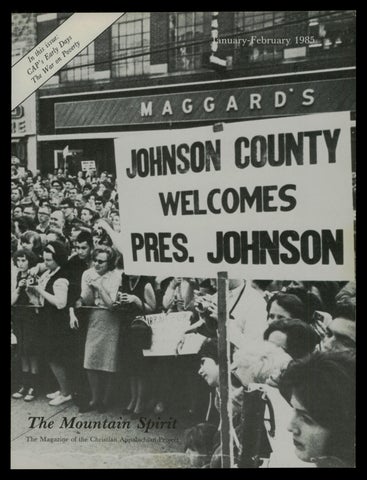
The Mountain Spirit T h e M ag azin e of the C h ristia n A p p alach ian P roject J a n u a ry -F e b ru a ry 1985 V olum e IV , N o. 1
Features: O u r U nconditional W ar O n P o v e rty ........................................4 Those W ere the D a y s ................................................................ 16 C atching U p in Rockcastle C o u n ty ........................................ 24
Departments: L e tte r s .............................................................................................. 9 A round the P r o je c t...................................................................... 10 T he C A P C lo se u p ........................................................................ 14 A round the P r o je c t...................................................................... 10 A T hought From the E d ito r ...................................................... 21 A ppalachian Arts and C u ltu r e ..................................................22
E d ito r - in - C h ie f .................................................... R ev. R alp h Beiting E d i t o r .........................................................................M a rg aret G abriel Associate E d i t o r .................................................... G len E dw ard T au l A dvisory B o a r d .....................M ike M cL aughlin , Leslie B. L arsen Ja c k M o rris, Bill Begley C irculation M a n a g e r ....................................................................T eresa Richey G raphics C o o rd in a to r...............................................................R ebecca R eihm T y p e s e t t i n g ....................................................................................T eresa R ichey The Mountain Spirit is published six tim es a year. T h e an n u al subscription price is $5.00. Subscriptions an d o th er cor respondence should be sent to The Mountain Spirit, C h ristian A ppalachian P roject, 322 C rab O rch ard R o ad , L an caster, K entucky 40446. C opyright 1985, T he C h ristian A ppalachian Project, Inc. All rights reserved. M em ber, C atholic Press A ssociation. T h e C h ristian A ppalachian Project is a non-profit C h ristian service organization operating th roughout E astern K entucky. T h e Project operates on the philosophy th at “ h elping people help them selves” is the best approach to A p p alach ian poverty.
We can always learn from the past, it is said. In this issue of The Mountain Spirit we’re “ looking backward” to see what we’ve learned, and what might be of use to us in the future. On the COVER, an excited group of Johnson Countians greets President Johnson in 1964 (photo reprinted with permission from the Courier-Journal). BELOW, CAP volunteers clear the land at Camp Andrew Jackson in the early ’60’s (CAP Archives). On the BACK COVER, winter has settled in tor a while in CAP’S counties.
From Our President For this issue of The Mountain Spirit I was asked to think back 20 or 25 years and reflect on some of the events of these years. While I have always been inclined to look ahead, looking back can also be a rewarding experience. In 1960 CAP had only one activi ty, a camp for children overlooking Herrington Lake, 10 miles from Lancaster. None of the people cur rently associated with CAP were with me at that time. By the early 1960’s most of our work in Jackson County was in full swing. From then on the progres sion of projects and activities grew and spread over nearly 20 counties in Eastern Kentucky. Farms, factories, shops, camps, schools, and group homes make an impressive array of our 50 separate enterprises, employ ing more than 200 people, investing millions of dollars a year in the well being of Appalachia’s people. While all sorts of awards and recognition have come my way from all these activities, the persistent memory is that of people rather than of projects or activities or awards. Some of these memories are sad because many of my early friends are gone from this life. There was Ben Tincture. When I wanted to start a factory to make Christmas wreaths to give jobs to the local peo ple, he was the only one who believ ed. He offered his old tobacco barn as a place where we could start pro duction. He is dead now but I know he must be very pleased to know that 40,000 wreaths were made this year. Old Mr. Paris is dead. He froze to death in an abandoned car parked along side the road. A snow storm had surprised him on his way home from the store. He sought shelter in the car only to lose his life by morn ing. He reminds me of so many other old lonely people I have known in Appalachia. Everyone was too busy or preoccupied to January -F eb ru ary 1985
worry about them. I think of my own mother who supported our work in Appalachia for 34 years. Time, energy, and finances were given, together with prayers and sacrifices. She died this past April. So many other loyal sup porters are now gone. I miss their love and dedication. There are also happy memories. Volunteers have come to us from all parts of the United States, and have stayed beyond their time of volunteer service. Their services and love of the area and its people have greatly enriched our land. I think of the young kids who went to our camps in years past. Many of them now stop by and thank me for the help they have received. They have a new and bright future where only despair had once been. Often they ask if their kids can go to camp when they are old enough. It is so pleasant to visit a family and see how proud they are of the simple but new house they live in. It is especially gratifying because the Christmas before you visited them when they lived in an old bus. A job, a little help with the housing agency, and smiles now replace the worried, haggard look they once had. It warms my heart to see so many of the well-to-do people of Eastern Kentucky now showing a deeper concern for the poor and neglected. By working together and sharing dreams we have brought about more cooperation than much of the con frontation ever could. Perhaps my greatest joy of the years has been the discovery of the real and genuine American spirit. Over thirty years ago I, a Catholic priest, came to Appalachia and was saddened by the want and need of the people. I took their case at first to my friends, then to my fellow Catholics and finally to all who call this land home. Catholics, Pro testants, Jews, those who had no
denominational ties came forward. They wanted to help, to be involved. Yes they would give their resources, their time and even themselves. Some years back a Governor of Kentucky gave me an award as the Outstanding Kentuckian for that year. In his remarks he said he only wished I was a Baptist rather than a Catholic. With that kind of change he said,“ You could have done even more.” Perhaps he was right. But I don’t think we would have had the story we now have. People have shown me that when genuine love and concern is involved in worthy causes the American peo ple rise above all differences and give their very best. The last twenty-five years have showed me that the most important part of my life is people, not pro jects or achievements. It has shown me that if you are willing to love without reserve, friends come from all quarters. A strength is born of this unity that can and will over come all our problems and cares. I will not have another twentyfive years but each day now has its special glow and promise. How could it be otherwise when you remember what people have done in the days past. 3
O u r U n co n d itio n al W a r on Poverty by Margaret Gabriel Photos reprinted courtesy o f the C o u rier J o u rn a l an d Louisville T im es
Information for this story was gathered by Mike Edgerly and Ann Marshall for the W HAS Radio News program “ Go Tell Sargent Shriver.” The Mountain Spirit thanks W HAS, Louisville, for their permission to use the program as background for this story. 4
The Mountain Spirit
“ Many Americans live on the outskirts of hope; some because of their poverty, and some because of their color. And all too many because of both. Our task is to help replace their despair with op portunity. And this administration today, here and now, declares unconditional war on poverty in America.” President Lyndon B. Johnson State o f the Union Address January 9, 1964 President Johnson’s declaration to the American people in his State of the Union address in 1964 ushered in a new era for the mountain peo ple, and for the urban poor of America. It was a time of excitement and victory. The well-being of all Americans was a social and political priority.
others failed because of their lack of regard for mountain culture.
One of the most significant aspects of the pro grams which came into being in the early ’60’s was the recognition that individual communities were an important element of success. Money that was allocated for the war on poverty was channeled directly into the hands of local government and was to be administered to serve the needs as they were assessed by the local people. Prior to that time “ experts” felt that the solution to the pro blem of poverty in the mountains was to move the population out. The boom years that the coal in dustry enjoyed during the thirties and forties were over, leaving thousands of miners out of work—thousands of families without a means of support. They traveled to urban centers in Cincin nati, Detroit, and Chicago and found work in fac tories, but always the Appalachian people were displaced in these settings. Their values and culture were strange and different from their neighbors.
Of those early days, when the first of the federal money began to flow into Eastern Kentucky, Buck Maggard, an organizer for the Appalachian Com mittee for Full Employment recalls that it wasn’t just the idea of money coming into the area that gave a lift to the people. Finally, they felt that there was a concern on the part of people who mattered, people who could help and this concern
The “ generals” of the war on poverty were established in the Office of Economic Opportuni ty (OEO), headed by Sargent Shriver. The main priority was to break the cycle of poverty which had held people captive for so many generations. “ The war on poverty was never conceived of as a handout, and as a welfare program,” says Shriver. “ There had been welfare, people getting money. Traditionally, ‘the dole’ has been around. We were trying to do something entirely different. We were trying to get services to people to help them solve their problems.” From the early part of the 20th century and even before, well-intentioned people set out to help the Appalachian poor. Often missionaries would come into the area and try to help, sometimes with little regard for what the people felt was needed in their home town or county. Some of the programs and services started by outsiders, such as Frontier Nursing Service, and Alice Lloyd and Berea col leges, have endured and continue to provide ex cellent services to the mountain people. Many Jan u ary -F eb ru ary 1985
The idea of community action, made popular by the OEO, was a different way of approaching the problem. “ Community action was supposed to serve as sort of a matrix that would bring together the resources of the state, of the county, of the churches, of the federal government, and to get them all to doing things a little better, a little differently than they had been,” Shriver explains. “ But being based at the local level, they were sup posed to design their own program to meet the local needs, and to take advantage of the local resources, taking into account local problems. There was no attempt to impose programs on anyone.”
I
3 Uktones ¡J
I A :
»
it
j
w m I I 111
G ra d e
*
mmmm
"V
1%
1« #
■
J o h n so n C o u n ty stu d en ts w elco m e P resid en t J o h n so n w h en he v isite d the m o u n ta in s in 1964.
.
encouraged the local people to take action. “ Peo ple for the first time, after they saw that Washington was going to be some help to them, began to see a little hope. For the first time in about five or six years, people began to get back to doing things. They were interested in life again. They were out working in the community. They were trying to get these programs going on their own, and just felt good in general. At last they had somebody in the White House who was sym pathetic.” One of the most successful of the programs started by the OEO, evidenced by the fact that it has endured to the present day, is the Headstart program, designed to give low-income pre-school children advanced help with the reading and math skills that they need in the first grade. The basic philosophy embraced at that time was that through social engineering and intervention, the cycle of poverty could be broken. For genera tions, substandard education had prevented Ap palachian children from effectively competing in the world outside the mountains. Because there was no place for them outside of Kentucky, the people stayed, most working in the mines or in mine-related jobs with little, if any educational demands. As the mining jobs died out, because of the shrinking demands for coal after World War II and the automation of the industry, thousands of people were left chronically unemployed, with no skills to equip them to make a living. Educa tion was seen as the key—a jumping-off place to begin the structure of the new society that would
break the cycle of poverty. And it had to begin early, with the pre-school development to the children. In order to involve entire communities in the process, local teachers were recruited to work in the Headstart programs. Families were in volved in school activities. In some isolated coun ties it was not unusual for a program that had started as a pre-school to evolve into a community center, with local people operating services to help their neighbors. While much of the responsibility for the war on poverty programs rested on the shoulders of the local people, outsiders were motivated to move to Appalachia at that time, to help implement anti poverty work. Former Kentucky governor Edward T. Breathitt, who held office from 1963 to 1967, explained that local authorities were often suspicious of the Appalachian Volunteers, as they were called. The volunteers were the recipients of one of the first community action block grants which were provided for the area. In 1965 there were about 150 volunteers in Eastern Kentucky working in education, construction, and recrea tion programs. “ A lot of these people were not from Kentucky, or from rural America, really,” says Governor Breathitt. “ A lot of them were highly motivated social activists from places like Oregon or Massachusetts or Connecticut or New York City. They were well-intentioned, fine people—many young. But a lot of them had pre conceived ideas and instead of working with the local citizens and leaders, quite often they came in
At an E astern K e n tu c k y sew in g cen ter, ch ild ren learn ed the fin e art o f p ie c in g q u ilts.
6
The Mountain Spirit
to attack them.” Their work in the area led the volunteers to believe that the somewhat benign tutoring pro grams in which they had been asked to participate were incapable of making lasting changes in the conditions in which people lived. Many began to feel that political intervention and organizing was the element necessary to enable the poor to attain the power they needed to improve life for their children. Edith Esterling, a native of Pike County, became an Appalachian Volunteer in 1966. It was difficult, she said, to observe the plight of the peo ple they had pledged to serve, and to see them con tinue to live in a system in which they were virtual ly powerless. “ Everything is politically run. It’s hard not to be [politically involved] if you’re going to do anything, because everthing is politically motivated.” Although the political involvement of the volunteer corps was not appreciated by the political establishment, little could be done to stem the flow of their activities. The regulations and job descriptions of the program were not clearly delineated, stating that any work con sidered necessary was suitable. The situation came to a climax when several Appalachian Volunteers were accused of ties to the Communist Party and had to answer to the Kentucky Un-American Ac tivities Committee. Shortly thereafter, in September of 1967, Governor Breathitt disbanded the program because of the political disruptions that some of the volunteers had caused in the com munities they served. In 1965 the attention of many Americans began to turn away from the poor, to another war in which the country was engaged. Those involved with the poverty programs of the sixties believe that the escalation of the war in Vietnam was directly responsible for the demise of the war on poverty. The money which had flowed into the poverty striken areas of America was diverted into defense spending. But it wasn’t just money that was diverted. It was a great deal of attention, too. Americans were severely divided on the issue of the whether the United States should continue its presence in Southeast Asia. In the wake of this division, the hopes and dreams for a better life for the people of Appalachia were left behind. By the late ’60’s and early ’70’s the mood of the country shifted. Shriver explains, “ Because we failed in the war in Vietnam, and because the presidency failed the people under Nixon, which was a terrific psychological disaster to America, the people as a whole became skeptical, disillusion ed, almost hostile to themselves, hostile to the idea that they could do things together—through government or even together. So, a sense of in dividualism came back: ‘I’m going to get mine; I Jan u ary -F eb ru ary 1985
A U K e x te n sio n agent h elp s an A p p alach ian m o th er w ith n ew h o m em a k in g sk ills.
don’t care about the other guy; we can’t work together; you can’t trust politicians; you can’t trust government; you can’t trust big labor; you can’t trust big business’—a huge, deep, profound distrust with the structures of our society.” To this day one can still find debates about whether the war on poverty can claim any measure of success. The number of poor people in 1964 and 1984 is substantially the same; about 15% of the population is living below the poverty line. In Eastern Kentucky that number is about 30%, dou ble the national average. The number of people receiving some type of government assistance and unemployment is higher that average. The percen tage of adults who are high school graduates is lower than the national average—all indicators that the war on poverty, at least in Eastern Ken tucky, did not make a substantial difference in the lives of the people it was bound to serve. Harry Caudill, one of Kentucky’s most noted authors and historians (see “ We Need Com munity—But How?” The Mountain Spirit, November-December, 1984), feels that the pro grams failed because the necessary economic basis was never established. “ Now, twenty years later, we have all the problems we had then, and they’ve been compounded. We’re still a dependent region. If Congress cannot or will not continue to fund these welfare programs, people will lapse right back into all the difficulties they had back in 1960. Nothing is changed. No new jobs have been created, outside of coal. And coal will find new technology that will reduce those jobs. 7
“ I have a feeling that, whether we like it or not—and it runs against the grain with American thought—that we’re going to have to make the United States of America the employer of last resort. And we’re going to have to put people to work at meaningful jobs. We’re going to have to organize them, with the idea that this will be per manent. It’s either that, or have a vast multitude of chronically unemployed people doing nothing but staying home and watching television.” Homer Marcum, editor of the Martin Countian, the weekly newspaper of Martin County, Kentucky, feels that the war on poverty encourag ed Eastern Kentuckians to look to sources other than themselves to alleviate their problems. “ It taught our people to sit back and wait on the federal government to take care of their needs. When I talk about the problem of the water system about to go bust in this county, people say, ‘let’s go find some federal money to do that with.’ They’re going to learn, after the lake goes dry, that there won’t be any money to do that with. Our problems have to be solved with local answers.” Others, however, feel that even though many of the programs did not exactly set out to do what they had intended to do, there was a great deal of good that came from the idea of community ac tion and intervention. Because so many of the pro
grams can be seen as failures, people now realize that waiting for the government to enter the pic ture will not help them solve problems. Don Baker served as the general council for the OEO during the ’60’s and believes that both poor people and the agencies that were established to serve them learned some good lessons. “ Community action had an enormous impact in that idea of involving the poor in the development of your program, and its planning, and in its administration, and having them involved in it. That was an enormous change. If you go out into some of these local governments and attend meetings, people automatically, now, understand that they’ve got to have some sort of consideration of what their clients want and need, and to communicate with them in a way that they never did before.” It’s easy to point fingers and say “ this was good; that was bad.” But the effects of the war on poverty continue to influence the life of the moun tains and her people. Some of the programs— Headstart, a few of the job training programs, the foster grandparents program—continue to operate. But while some will say that there are cut and dried answers to the problems and the solu tions, perhaps one of the most valuable lessons learned from the war on poverty is that there is no easy way. Government intervention can certainly be of use to the people, but true changes, lasting changes must come from within. cap
A q u ilitin g b ee at the M illsto n e S ew in g C en ter in F renchb urg, K e n tu c k y .
8
The Mountain Spirit
Letters Living in an area that enjoys economic well-being, thanks to high employment, it’s hard for us to im agine being without basic needs for a good life. You remind us to keep our more unfortunate brothers and sisters in our minds and hearts. What happiness is real if echoes of needs and cares are ringing around us and we heed them not? We love to read the Mountain Spirit. We enjoy the articles on in dividuals past and present. They teach us the lessons of that spirit, for a time may come that we might need the qualities these strong peo ple show every day. Keep those issues coming; have a fantastic day, and God bless you! Bill and Mary Lewis Scotia, N Y
I enjoy your magazine so very much and it is so aptly named, to emphasize the spirit of the people of the area. It was with real pleasure that I read the interview in the November-December ’84 issue with Mr. Caudill. I had read the book, Night Comes to the Cumherlands years ago with a profound feeling of sadness that such conditions could exist in our land. It is a pleasure to know that Mr. Caudill is still in the area and to read of those programs of CAP and the fine work being done. May God continue to bless all you and your efforts.
In these times, when sensa tionalism, materialism, violence, and promiscuity prevail, it is reassuring and comforting to know that there are truly decent and humane people who care about other people. The Mountain Spirit conveys this message of caring and concern for fellow human beings and makes me feel good about the human race once again. The Moun tain Spirit is a beautiful magazine and a beautiful spirit! Thank you for sharing it! Mr. and Mrs. Gerald Field Chicago, IL
I have just read your conversation with Mr. Harry Caudill in the November-December issue of the Mountain Spirit and wish I could adequately describe the impact it had on my thinking. You have such a marvelous way of putting into words the many thoughts and ideas that I have wondered about. The time is indeed here when we church people should really wake up to our responsibilities and put our energies together regardless of our church af filiations. May God bless you in your continuing work. I think and all your staff are really wonderful people. Grace D. Talbott DeKalb, IL
We have laughed and we have cried over the Mountain Spirit and we have felt a great lifting of the spirit and warmth about the heart. Nothing would make me more a believer than the sight of various faiths and backgrounds working together.
On reading the Mountain Spirit, I am well aware that the spirit of con cern, joy, community, and trust in the Lord have grown year by year. Reflections on my own volunteer service at Lancaster and the camp as “ cook” during the summers of 1969, ’70, and ’71 bring back most beautiful memories. At present I am ministering to the poor and minority groups in a section of Arizona as a pastoral minister. May God con tinue to bless your work.
James A . Madison Cherry Hill, N J
Sister Mary Harold Schwerman Eloy, A Z
Lois Weber Detroit, M I
Jan u ary -F eb ru ary 1985
1 look forward to receiving my copy of the Mountain Spirit and thoroughly enjoy reading it from cover to cover. The people are warmly human. Reading about them leaves me feeling good inside. My admiration for Father Beiting is difficult to express. He and his ministry are in my prayers daily. God love you all. Joan Martella Upper Darby, PA
So nice to read the Mountain Spirit, as I’m a native of Jackson County, Ohio. It takes me back to what I call the good old days and beautiful memories which, I hope to cherish the rest of my days. I’m 93 years old, and have crippling osteoarthritis. I pray God will con tinue to bless all concerned at Lan caster, Kentucky. EdnaH. Thomas Jasonville, IN
Thank you for providing my family and myself with an abun dance of knowledgable information about the people of the Ap palachians. Until learning of Father Beiting and his Christian Ap palachian Project, the Appalachians were just a spot on the U. S. map. With the Mountain Spirit we have come to know and greatly admire the people of that region. Linda C. Bortolott Camarillo, CA
Letters to the editor are welcome.
They should not exceed 150 words in length, and we reserve the right to edit them fo r space. Address letters to The Mountain Spirit, Christian Appalachian Project, 322 Crab Or chard Road, Lancaster, Kentucky 40446. 9
Around the Project
by the C A P N ew s Service
CAP Receives Unique Contribution
CAP Volunteers Care For Local Elderly
LANCASTER—A package arriv ed at CAP headquarters the other day. Like the one last year, the package contained a jar, and in that jar was $130.57 in coins and bills from the employees of Engine Parts Service of Cincinnati, Ohio.
Since the time that CAP has been involved in human development programs, the elderly people of Eastern Kentucky have been one of the main priorities. In its service to the elderly, CAP has discovered that nothing is more appreciated by the folks than visits to their homes by the volunteers.
“ If we had sent a check,” said Joe Ernst, organizer of the fund raising effort and assistant manager at Engine Parts, “ it would have looked as though only three of us were contributing. By sending the actual donations in a jar we are say ing that everyone contributed.” Joe said his mother recommended CAP as the best organization to receive what money they had to spare. “ I called my mom. She receives all kinds of literature from organizations asking for financial help and, to her, CAP got the best results.
Jack M orris and the d o n a tio n from the folks at E n g in e P arts S erv ice.
Thanksgiving. We just hope this is enough to help someone or a group of people.” The money Joe and his friends donated this year was used to help an elderly couple who barely escaped their burning house on November 25 in Crab Orchard, Kentucky. A 67-year-old woman had to carry her 87-year-old, bed fast husband from the house amidst smoke and flames. The couple had lived in the house 40 years.
Kate Weigand, CAP’s coor dinator of volunteers, has taken the extra responsibility of coordinating services to the elderly, too. The four volunteers working with the elderly in three of CAP’s counties visit “ an easy 180 people,” Kate says. “ They visit some of the people every week, depending on whether they have neighbors or family looking in on them. But they see all of the people at least once a month.” The volunteers also spend some of their time assisting other local groups which serve older folks. Marley Close, who works with the elderly in Garrard County, helps the Community Action Agency with the federal commodities distribution. In Floyd County, Mary Ann Sorich has assisted with the government heating program. Lisa Whitcher in Mt. Vernon is working on a plan with a member of the Methodist church to enlist the support of local
“ I’ll give money if I know it will get results,” Joe said. He contacted Jack Morris, CAP’s coordinator of community relations, who told Joe about CAP and what it is trying to do. Jack then sent more 'informa tion and letters were exchanged. Last year Joe, Curt Komala, Michael M. Laughlin, and their friends sent $60 which was used toward the purchase of an artificial leg for a gentleman from Rockcastle County.
The people of Crab Orchard gave the couple a shower to help them re establish their lives. The money from our friends in Cincinnati was used to buy a used refrigerator and some used furniture for them.
Jack sent a letter telling Joe and his friends the amount that had been given and for what it was used. Joe said he used the letter to good ad vantage this year. “ I asked them for money, and then showed them the letter,” he said. “ They started to dig into their pockets for any loose change they had.” Joe works with 25 to 30 other people at Engine Parts Service. All have a giving spirit. In the letter ac companying the money, they said, “ Just a little something to get you and the people you help through
F orm er v o lu n tee r, L y n n D a n iels and W illie C o y le o f R ock castle C o u n ty .
10
The Mountain Spirit
around the project . . . continued citizens to help with transportation for shopping and doctor’s visits. CAP’S elderly program is one of its most satisfying volunteer assignments, Kate believes. “ People who come to volunteer are looking to go out and work directly with the people. This program gives them the opportunity to do that; to visit the folks, read the Bible, pray with them. For most, that’s what they came down to do.” The volunteers are keeping more careful records of their work this year, so that at the time of the end of their service, a new volunteer can easily pick up where they left off. In the future, the folks in the elderly program will know that even if the face they see each week or month might change, the love and care ex pressed for them by CAP remains constant.
Handicapped Children Receive Special Attention Families in CAP’S counties face a variety of problems. For some, one of the biggest is obtaining quali ty education for their handicapped son or daughter. There are new laws in Kentucky, as well as many other states, which specify the kind of education to which children are en titled. Because of overburdened staff and lack of funding, states often are not able to provide everything stated by law. In order to help parents prepare their handicapped children for the best education possible for them, CAP has been involved for about five years through its Parents Are Teachers program. The program was started and directed by Marilyn Stefanski in 1979. When Marilyn moved to Floyd County in 1982 to run the pre-school program at the M ountain Christian Academy, Peggy Cook assumed the respon sibility for the program’s thirteen children. “ We work with anyone who’s not getting service anywhere else,” Jan u ary -F eb ru ary 1985
Peggy said. “ Usually it’s the very poor families who need us the most.” Most of Peggy’s referrals come from the Department for Social Services or the Health Department, but sometimes she’ll hear from a family in need of ser vices who have been referred by another family. When a child is referred to her program, Peggy does the inital assessment of the child, and develops a progress plan for herself and the child’s parents. After that, Peggy or one of her staff visits the child once a week. The parental in volvement is the unique aspect of the program. Based on the theory that parents are the first and best teachers of their children, all of the development planning for the children requires that parents work with them on a daily basis. “ Sometimes parents don’t know what’s available, and this is a great way to get them actively involved in education,” said Peggy, who also refers parents to services which she is not able to provide. “ We’ll send kids to physical therapists and speech therapists in Lexington.” Peggy feels that one of the biggest contributions that the program has made recently is the parent support group that has started in Garrard County. The group, which involves nine families, has taken training in CPR and formed a core group of people who can babysit for each other. “ We also want to incorporate the families of kids who are already in school.” School age children pro vide a particular challenge for Peggy. Although she is primarily in volved with pre-school children, Peggy is often called upon to educate public school teachers in how to deal with children who have special needs. Future plans for the Parents Are Teachers program include an infant stimulation program. “ Once a week we’d like to have the baby and the mom come into one of our child development centers and work on
P eg g y C ook and stu d en t, K e lly .
different stimulation exercises, but starting the program depends on the availability of staff.” Thanks to the dedication of Peggy and her staff, along with the cooperation of the school systems and other agencies, handicapped children in CAP’s counties are among the most fortunate in Ken tucky. In the coming years we should see handicapped children reaching levels of education and potential that would not have been possible in the past.
Volunteer Recruitment Makes Strides LANCASTER—The backbone of many of CAP’s human develop ment programs is its volunteer corps. For over thirty years, the presence of volunteers in our coun ties has been a great witness of Christian love and concern to the people in the area. As CAP has grown larger and its programs more ex ten siv e, th e dem and for volunteers has grown along with it. Over the last couple of years, though, word of mouth, on which 11
around the project . . . continued CAP has traditionally depended for volunteer advertising and recruit ment has not produced the number of volunteers necessary to staff pro grams. In order to tackle the problem head on, CAP has hired Edward F. Ellis as a full-time staff person in charge of volunteer recruitment. Rusty, as he is known, has made significant progress in recruiting ef forts just in the few months that he has been on staff. “ A lot of my time recently has been spent lining up a schedule for recruitment visits,” Rusty said. “ I’ll be making trips to Michigan, Wisconsin, Indiana, and Illinois in January and February, then in the spring I’ll be hitting the east coast and northeastern schools.” When Rusty first arrived on the job, one of the responsibilities he assumed was scheduling the groups of temporary volunteers who come to work for CAP during different times of the year. “ Basically, the idea of making personal ap pearances started with the schools that contacted us, wanting to send temporary volunteers for spring break. I began to ask if they would be interested in having a speaker about CAP and got a really good response.” When he asks about speaking at a particular school, Rus ty also inquires abofit other schools or organizations that might be will ing to have him visit. That plan, too has worked well. In most locations, Rusty has several visits planned for one trip. “ The Roman Catholic Diocese of Peoria, Illinois has a great program planned,” Rusty said. “ They’ve decided to have a Lenten study pro gram throughout the entire diocese, and have asked me to help them design a curriculum on Appalachia. The week after Easter they’ll have a food or clothing drive, then finish the program by sending a group of high school seniors to the mountains to do volunteer work in the summer. It’s very exciting. We expect to have 12
80 to 90 parishes involved in the program. About a year ago some adults in the diocese expressed an in terest in becoming involved in volunteer service programs, and this whole project sort of grew up out of that expressed interest.” Another very important aspect of the volunteer recruitment planning is to involve or re-involve former volunteers with the program. “ We’re trying to get former CAP volunteers involved, because they’re really the best recruiters we have,” Rusty explained. “ They’re the ones who’ve worked with the people here, lived in the volunteer com munities, and can best explain how being a CAP volunteer can change your life. Right now we’re trying to contact volunteers in the areas we’re planning to visit, to ask them if they could help us out. We’ll need some housing and transportation, and ideally, we’d like to have former volunteers as speakers at programs. “ By encouraging our former volunteers to keep in touch and stay
active with CAP, even though they’ve gone home, helps us but it also helps the volunteer as they make that transition back to the ‘real world.’ Sometimes it’s rough on a person to go back to the nor mal stream of life when they’ve changed so tremendously because of their volunteer service.” Rusty plans to invite all of the former volunteers to CAP’S next commissioning service for new volunteers. He and Kate Weigand, CAP’s Coordinator of Volunteers, are excited about the possibilities for a big volunteer reunion, and feel that it will be a great show of sup port for CAP’s newest “ class” of volunteers. If you’re a former volunteer, or know someone who is, Rusty Ellis is trying to find you. Help make his job a little easier by contacting him at 322 Crab Orchard Rd., Lancaster, KY 40446.
Spring Is On The Way! Even though we are sloshing through January right now, we know spring is on its way because it’s time for CAP’s Be-A-Seed pro gram to start. This year 1200 families and elderly people will particiapte in the program. Gil Rosenberg, coordinator of small farm projects, is mastermind ing the effort which will involve much of his time from late winter through the summer months.
R u sty E llis and h is w ife, J a n e.
The real beauty of Be-A-Seed is the many different groups who work together to make the program happen. Gil and his assistant, Keith Gilbertson, employ the folks at C A P rice In d u s trie s , C A P ’s workshop for handicapped adults in Stanford, to sort and package seeds. Temporary volunteers who come to work for CAP distribute seed and home visit gardening families in the spring and summer. Attic workers in five counties take applications from families—it’s a real communi ty project! The Mountain Spirit
around the project . . . continued
George Washington and Thomas Jefferson can help you write your WILL!
A L in c o ln C o u n ty resid en t is p rou d o f h is b eet crop.
The goal of the program is to get people involved in raising and preserving their own food. Some of the participants who live in town grow their vegetables in a communi ty garden and help each other with the work and the harvest.
SOAR Commercial to Air In January In various parts of the country, our CAP friends may be seeing a very special television commercial in January.
For some of the younger people who are involved in gardening, especially those who grew up, or now live in town, the program is their first experience with garden ing. The means to raise their own food gives young parents a good feeling of self-reliance, and the knowledge that thanks to their hard work their children might eat a little better during the winter months.
The ad is designed to inform peo ple about the Spirit of the Ap palachian Region (SOAR). SOAR is a new program of CAP, in coopera tion with other charitable organiza tions in Appalachia. Funds raised through the SOAR T.V. ad will pro vide support for projects—many of them staffed by volunteers—that aid the poor, the elderly, children, the h a n d ic a p p e d , and the unemployed.
If a family is able to raise more food than they can use or store, they are encouraged to share it with others, or to sell it through the Lin coln County Farmers’ Market, which will operate for the fifth year this summer.
National spokesperson for SOAR is Beverly Garland, who plays Dotty West on TV’s “ Scarecrow and Mrs. King.”
The gardening project is a real blessing to families, helping them to stretch their food dollar, and enabl ing them to help themselves at the same time. Jan u ary -F eb ru ary 1985
Beverly visited Rockcastle County in July of 1984 to meet some of the local folks and film the commercial. She was impressed by the work be ing accomplished by CAP and SOAR, and developed a fine rap port with her new Appalachian friends.
Send today for your complimen tary copy of “ How George Washington Can Help You Write Your W ill. . . And Ideas From 11 Other Presidents.” Just clip the coupon below and send it in the envelope in the fold of the magazine to receive this infor mative brochure.
clip and mail today
Please send, without obligation, my free copy of “ How George Washington Can Help you Write Your W ill. . . And Ideas From 11 Other Presidents.” To: Mr. William A. Begley Director of Development Christian Appalachian Project 322 Crab Orchard Road Lancaster, Kentucky 40446 N am e____________________ Street ____________________ City______________________ State___________ Zip_______ Telephone (
)_____________ 13
The C A P Closeup
M ike Sanders “Never a Boring M oment ”
by the C A P N ews Service
iVlike Sanders worked as a strip miner most of his life, like his father and grandfather before him. A Pike County native, Mike’s military ser vice took him to Texas, where he married his wife, Jackie, and worked in a variety of factory jobs. When they moved back home to the mountains, they settled down near Prestonsburg, and Mike took a lease on a service station. There’s nothing uncommon about this story. Mike would probably tell you that hundreds of Eastern Kentuckians would chronicle their lives in much the same way. A few years back, though, Mike’s life started to take a different turn. Through Jackie, a parishioner of the Catholic church in Floyd Coun ty, Mike met Father Ralph Beiting. Like many people, Mike’s relationship with Father Beiting started on a business level, and quickly grew. Mike was asked to help out with CAP’s boat trips for the elderly, and before long Father Beiting had given him complete responsibility for the trips and for the care and well being of the boats. From there, “ I got hooked on CAP,” Mike says. “ I was getting ready to go back to work on a strip job, and Father asked me about the possibili ty of a job opening with CAP. He asked me if I was interested, and I said,‘very much so.’ I was just about bored with strip mining. I’d done that all my life, and thought,‘well this is what I want to try.’” 14
His decision to give up a lucrative position in mining to work for CAP for significantly less money marks a real turning point, both for Mike and for CAP. Mike had never considered a career in service work, but answered a call to help change the quality of life in Floyd County. As its first full time employee in the Eastern Division, Mike gave stability to CAP’s fledgling programs in the area. Because he grew up in Eastern Kentucky his in sights are invaluable, and his presence lends credibilty that might otherwise be missing. Mike’s title,‘‘Director of Operations,” is a real reflection of his responsibilities. “ We have an elderly program, an emergency assistance pro gram, the Floyd County Educational Program. I act as the liaison between the Mountain Christian Academy and CAP. We’ve got a couple programs we’re trying to get started in economic development—I’ll be in charge of those. I have nine volunteers that I work with and coordinate programs with; there’s summer camps and other programs on the lake. I’m starting to get involved with a lot of community programs that are just getting started. There’s a spouse abuse shelter and a halfway house I’ve been working with in the evenings. My work covers a wide area.”
M ik e Sanders
The Mountain Spirit
Those who work with him will say that Mike sort of operates and directs at the same time. But Mike says that the constant activity and outpour ing of ideas keeps his work exciting. “ It seems like I haven’t been with CAP three months, but it’s been over a year already. “ This is the only job that I’ve ever had that I’ve been really satisfied with. I get to work with Father Beiting a lot, and being around him, you never have a boring moment! You’re always on the go, and you’re looking for something new to start or you’re trying to help somebody. It’s just completely different from anything else I’ve ever done. It’s really been exciting.” Just in the short time that CAP has been present in Floyd County, Mike can see substantial changes in the people of the area—lasting changes, changes of attitudes and dreams. “ I think there’ve been changes spiritually. We’ve worked with a lot of the kids, and a lot of the elderly, and they’ve gotten involved in helping us help other people. Some of the different groups and organizations in this area have responded to the people who have told them about CAP. I think CAP has helped make a bond between a lot of kids who’ve been in volved in our camp and Bible School. We’ve got the poor children, the richer children, and nobody’s discriminating. It’s the same with the Mountain Christian Academy, one of the projects that CAP helped start. We’ve helped bring poor
M ik e and F ath er B e itin g ob serve a lan d clea rin g o p era tio n at F lo y d C o u n ty ’s n ew su m m er cam p.
Jan u ary -F eb ru ary 1985
kids, rich kids together and they learn a lot about each other. Instead of saying, ‘so-and-so is rich. I don’t want to have anything to do with him,’ or ‘so-and-so is poor, I don’t want to fool with him,’ they’re all just like brothers and sisters.” By working with the children in education and recreation programs, Mike believes that the necessary changes in Floyd County will happen naturally. “ If you can get the kids to learn, it’ll help us economically in the future. Everyone wants to go to work in the mines because the mines pay thirteen, fourteen dollars an hour, and that’s great. It’s good to have jobs like that. But if we could ever get through to the kids that they can get a good job that’ll last years and years, they’ve got something to depend on. If they’ll take a job making six or seven dollars an hour, it’ll help us to get economic development into this area. “ You can’t talk anyone into coming in here with any industry because they can’t compete with the mines. Who can compete with thirteen or four teen dollars an hour, when they don’t have that much profit margain? There’s been two or three different factories in this area. But a lot of people have the attitude, ‘If I have to work for less than twelve dollars an hour, I’ll starve to death.’ That’s one of the biggest things we’ve got to change. And it has to start with the kids. I guess what I’m trying to say is that we have to educate the kids, because education has been one of the biggest downfalls in the Appalachian area. That’s really what’s held us back.” With Father Beiting, Mike believes that foster ing a sense of community among the people is the foundation from which all change must grow. “ I don’t care whether you’re talking about pro grams, or about individual families. Without com munity, you’re not going to accomplish anything. And with it, you can do anything. There’s no limit to what you can do. “ I think that’s why CAP, as a whole, has been successful; because the whole CAP family, to me, is community. I’d say that you’re not going to find a more spiritual group of people. Everybody’s worried about the other person, or wants to get together and go help this program or that pro gram. I believe that, especially in this area, it’s go ing to take a real spirit of community. That’s one of CAP’S strongest points, and something that we have to stress.” Mike acknowledges the fact that it will be dif ficult. But, he knows that no one ever said it was going to be easy. For Mike, the hard work, long hours, and dedication is making a better home for his children and his grandchildren. His work is an example to the people of Floyd County that maybe it won’t be easy. But it will most certainly be better. c a p. 15
✓ ^
f ^
"¥*o body worked harder physically or tried to come up with better 1 ideas than Father Beiting,” said Bob Haragan, who, along with his wife, Alma Lee, helped Father Beiting with summer camp during their vacations in 1962-1964. A dynamic person, Father Beiting was tireless in organizing activities and enlisting other people’s assistance to help others in need. “ He has a lot of charisma,” said George Purcell, who has known and worked with Father Beiting since the early ’50’s when he was assigned to establish Catholic churches in Eastern Ken tucky. “ Can’t be around him long without realiz ing that he is close to God.” Father Beiting had been in Lancaster for four teen years when the Christian Appalachian Pro ject was incorporated in 1964. The incorporation of CAP crystallized what Father Beiting had been striving for during the previous years. George said he wanted to help people all of his life. He wanted to alleviate the everyday concerns of poor people so they could turn their attention to their souls. He also wanted to promote a sense of community among every religion and race. When he came in 1950, his bishop gave him the mission to establish churches for Catholics in Lan caster and Berea, and later for their mission
parishes in Mt. Vernon and McKee. He was the first pastor of the church in Lancaster. The Catholics in Garrard County attended worship services in Danville. “ I tried to spend all my summers with Father,” George said. “ I spent a lot of time there mowing yards and being involved in his operation, ” He and other kids would mow around the churches in Lancaster and Berea, and later in Mt. Vernon and McKee, when Father Beiting established those churches, as well as Cliffview. George was also a camp counselor at Cliffview. “ I was there when he built Cliffview Lodge on Lake Herrington.” It started with a boat. Father Beiting liked boats and recreation, George said. He would take kids for a day of boating as often as possible during the summer. Or if he wanted to see a movie, “ He’d load up a bunch of us kids, and we’d all go up (to Lexington) with him” “ Used to be one of the best shots with a rifle of anybody I’d ever seen,’’George said. He would often take the kids out for target practice on somebody’s farm. To demonstrate Father Beiting’s accuracy one time George held out a cob of corn for him to shoot at. He hit it. “ I wouldn’t do that for anybody else.”
T h e d ays a c tiv itie s at C liffv ie w L od ge alw ays started w ith flag ra isin g and the P led g e o f A lleg ia n ce.
Jan u ary -F eb ru ary 1985
But taking kids here and there for various ac tivities became cumbersome, and Father Beiting got the idea of a permanent place for summer ac tivities. So he and his associate, Father Herman Kamlage, pooled their small diocesean stipends and bought a parcel of land on Lake Herrington. The first camp began in 1957 with a tent and six kids. The camps and Bible schools were for all kids; Catholic and non-Catholic, rich and poor, black and white. Attendance increased and permanent structures were built in the next few years. And volunteers, mostly Catholic seminarians, began to arrive to help with the programs in 1959. Father Beiting always had a way of getting things done. He did much of the physical work himself, George said. It was a common sight to see him burning brush or digging ditches. “ He taught me how to work.” Father Beiting was always teaching by example. When they arrived at Cliffview Lodge for their first camp in June 1962, the Haragans found Father Terence Hoppenjans mowing the grass and Father Beiting gone. When he came in at about 4:30 in the afternoon, Bob said Father Beiting changed clothes and started cutting grass, too. He, George, and Father Hoppenjans continued work ing until well after six that evening. Mrs. Kathleen Gabriel tells about the time when Father Beiting called her husband, Dick, asking if they could bring a refrigerator. (Her husband worked for General Electric in Louisville, Ken-
F ath er H o p p en ja n s su p erv ises p o n y rides d u rin g an early ca m p in g season. G eorge P u rcell is the y o u n g m an secon d from the left.
tucky.) “ You were afraid to say no,” Kathleen said. Her husband answered: “ Yes, Father. We can bring a refrigerator, but we have a station wagon and six children. How are we going to get a refrigerator down there?” The men at G.E. were very sympathetic. They arranged for a refrigerator, measured it, and then measured a friend’s trailor. “ We put that refrigerator in the trailer as tight as socks on a rooster,” Kathleen said. They went to Sears to get a trailor hitch for the station wagon. When they arrived at Cliffview, they wondered how they were to get the refrigerator down a steep embankment, but they got it down and the camp’s cook, Rita Brockman rejoiced at the addition to her kitchen. During this whole time, nothing about payment had been mentioned. Dick Gabriel did not under stand how Cliffview was operated financially, “ and he was not alone,” Kathleen said. “ Dick asked, ‘Who pays for the refrigerator?’ And I said, ‘Gee, Dick, I don’t know. I think you do.’” The Gabriels felt they could not complain much when they saw Fathers Beiting and Hoppenjans unloading a truckload of rock, large rock. “ When the boss was unloading rock at the end of a full day, how could we complain,” Kathleen said.
E v en after in d oor sleep in g fa cilities w ere b u ilt at C liffv ie w , k id s lik e d to sleep in ten ts.
18
Father Beiting could make some of the chores a little difficult. On weekends the sheets and mat tresses were cleaned in preparation for the next group of kids. The mattresses were laid in the sun and sheets were hung on lines over the baseball The Mountain Spirit
field. Father Beiting resented the volunteers using his field for laundry because it left him no place to play baseball with the kids. In another instance, Bob was putting the finishing touches on the “ Squirrel Cage,” a boys’ dorm which got its name after Father Hoppenjans opened it at the beginning of one summer and found it full of squirrels. Father Beiting insisted on putting quarter-top up in the ceiling corners. But Bob thought it unnecessary. “ No one will notice the difference.” But Father Beiting in sisted. He said, “ This is going to be the best place that these kids have ever seen.” Father Beiting was also the entertainer. He would preside over “ camp talk” with kids around an evening fire, telling ghost stories and then, after the kids and gone to bed, he appeared in a plantation owner’s hat, swim trunks, funny shoes, and set off Roman candles to scare the kids. At other times he sent them on snipe hunts in a farmer’s pasture. But the most significant feature of the camp was the integration of black and white kids in the midst of the time that Kentucky was integrating its schools. Garrard County did not integrate its schools until 1964. “ The most remarkable thing was that it was an integrated camp in 1962,” Alma Lee said. “ When I was working on integrating lunch rooms in Stewart’s (department store in Louisville), that was an integrated camp.” And, to her knowledge, there were no racial incidents.
W h en C A P acq u ired the lan d to esta b lish C am p A nd rew J a ck so n , near M c K e e, K e n tu c k y , m ost o f the w ork n eed ed to clear the lan d and co n struct the b u ild in g s w as d on e b y v o lu n teers.
Prior to CAP’S incorporation, Father Beiting’s activities—summer camps, street preaching, Bible schools, establishing Catholic parishes, forming a Catholic grade school in Lancaster—centered around the church. With CAP’s incorporation, the thrust became ecumenical. George remembers the federal government’s at tention to Appalachia, beginning with President Kennedy and continuing with President Johnson, coinciding with the creation of CAP. He happen ed to be living in Jackson County then, living off 20 acres. “ There were only two paved roads in the county,” George said. The main roads, U.S. 421 and Ky. 30, were paved while the rest were gravel or dirt. Today, even most back roads are paved, a tribute to the efforts of the Appalachian Regional Commission. Among CAP’s first projects was a hill farm near Grayhawk in Jackson County. CAP first bought 40 acres in 1964. The next year about 40-60 more acres were purchased. George was hired to manage the farm. He sold his 20 acres, and started working for CAP for a small salary and a place to live. For George the money was unimportant. He Jan u ary -F eb ru ary 1985
19
enjoyed his work, and had the inner satisfaction that he was helping others. A gravel road divided the original farm from later acquisitions. The original acreage on the left was cleared; the land on the right still had timber standing. Diversified farming was practiced. “ We grew tobacco, baled hay, raised beef cattle and mules, and had a green house where two crops of tomatoes were grown each year.” A mule and plow was actually used, George said. The tomatoes were allowed to ripen before sell ing them locally or shipping them to Louisville. Several acres of strawberries were grown for two or three years, and sweet potatoes were tried one summer. The strawberries were harvested by volunteers and people hired locally, because one of CAP’S objectives was to provide employment. Many of the barns were constructed with volunteer help. George now owns 400 acres in Jackson County. CAP sold its portion to him in 1978, and he has continued the extensive dairy operation. The dairy business was started gradually. At first, six to eight dairy cows were donated to the farm by the Trappist monks at Gethsemane monastery near Bardstown, Kentucky. The monks helped with practical ideas on operating a dairy business. Then the operation got bigger. There was no grand plan to expand, but more cows were donated until the herd numbered 15. In 1968 they decided to enter Grade A produc tion, which meant increasing the number of cows and building a milking parlor. “ We had been milking the cows by hand in a barn about the size of a small tobacco barn and putting the milk in cans,” George said. Grade A production meant milking by machine and putting the milk in a sterilized tank.
milking again.” The farm was CAP’s primary project in 1964. Bible school and summer camp at Camp Andrew Jackson, a wood working shop, and organizing farmers to grow cucumbers for Paramount in Louisville were other projects. The wood shop, which made craft items such as cutting boards, was eventually moved to the Jackson County seat of McKee, where it is still operated by owners other than the original. The cucumber pool has been discontinued, but the Bible school and sum mer camp at Camp Andrew Jackson have survived to the present. Because most of CAP’s activities were in Jackson County, its headquarters were near the town Grayhawk. While Father Beiting’s office re mained in Lancaster, CAP operated out of the wood shop building. George was CAP’s treasurer for the first five to six years. CAP had a pitiful income in those early years. Before CAP had a large number of faithful donors, Father Beiting operated on a short-term basis. Despite the dearth of money, he proceeded undeterred to start projects he thought were need ed. With a sense of mission, he went on faith that money would be provided. George said CAP was overdrawn in its bank account many times, but the money always came. And where money was lack ing, Father Beiting found someone to donate whatever he needed. The vitality of CAP then as now rests on the sense of mission and faith the Father Beiting has instilled by example and word. It is by desiring to help people in Christ’s name, by using the imagination to think of ways to use local resources, and by working on the faith that “ I can do all things through Christ who strengthens me” (Philippians 4.13) that the people of Appalachia can improve their lives.
Father Beiting had found out about some dairy cows for sale near Cincinnati and asked George to go negotiate a price for them. He returned and told Father Beiting that the price was too high. So Father Beiting called, got the price reduced by one-third, and had the 30 cows delivered before the new facilities were ready. George remembers that evening clearly. They had just finished milking the cows they had when the truck delivered the new cows, which had not been milked. “ We had to milk them by hand. We finished around one in the morning. We got a few hours of sleep before having to get up and start
G eorge P u r c e ll’s d a iry farm in J a ck so n C o u n ty .
20
The Mountain Spirit
A Thought from the Editor “History is past politics and politics is present history. ” Sir John Robert Seeley
How appropriate is this nineteenth century quote when applied to the history of Eastern Ken tucky over the last twenty years. The politics—and the history—of 1964 set Eastern Kentucky firmly and irrevocably on a course that it will follow for years to come. Back then, the great change in the course of society was a national dream. In some ways the changes were tremendously for the bet ter. Others weren’t quite so good. Still others tug at your heartstrings, as one watches the demise of a unique culture, sacrificed—sometimes necessarily—to the cause of-progress. However, twenty years later we find that society has once again left the Appalachian people to drift on their own. Somehow, Lyndon Johnson—and John Ken nedy before him—convinced the American people that by strengthening the parts of our society that needed assistance to reach their full potential, we would all stand to gain. Because a chain is only as strong as its weakest link, it was up to all of us to pull together to strengthen the whole. Not only were people willing to allow millions of dollars to flow into programs that would lend assistance, educate, and ultimately change lives, thousands of people wanted to help. In great numbers they volunteered time and services. How did the activists of the ‘60’s become the “ Me Generation’’ of the ’70’s, and the “ Yuppies” of the ’80’s? Vietnam and Watergate surely caused a change in the national attitude. No longer did Americans believe that all things were possible. A foundation built on trust was severely shaken. Is that trust in government returning? I believe that Ronald Reagan’s landslide victory in November might be such an indication. Here we have a paradox indeed, an expression of trust in a government in which our national leaders do not have a grasp of the root causes of poverty. The morning after the election I heard James Baker, President Reagan’s chief of staff, on an early mor ning news program. The interviewer pointed out that many people feel that the administration has little concern for disadvantaged Americans, and consider that be a major problem in our country today. Mr. Baker’s reply dealt strictly with the overall health of our economic indicators. January-February 1985
It’s true that lower inflation is beneficial to the poor. But a monthly AFDC check of $188.00 isn’t enough to support a family of three, regardless of the rate of inflation. An AFDC mom needs educa tion which will give job skills, day care for her children while she’s working or attending school, counseling to help her deal with new respon sibilities—the services of the very programs that have suffered severe setbacks in the last few years. In 1964 someone, somewhere along the line, realized that the root causes of poverty were not money. Yes, much money was spent—some of it quite foolishly. From that we have learned that we must have accountability for funding and pro grams must be judged by their success rates in terms of services provided per dollar spent. But, in the short space of twenty years between 1964 and 1984, it seems that a large segment of our popula tion has forgotten all of those altruistic dreams we had for each other. Maybe the general public doesn’t believe that there are poor people in America; malnourished children; elderly people who cannot afford ade quate medical care; young people who have the desire and capability, but not the means for a col lege education. But you and I know. I, because I’ve lived and worked in one of the depressed areas of our country for almost eight years. And you, because of your support of and prayer for the people we serve. Historians will tell you that War on Poverty died in 1967. National priorities shifted at that time and have never shifted back to the level of concern that we saw in 1964. I say that as long as people like you continue to express concern for the impoverished people of our nation that the War on Poverty will not end until it has been won. But it will take a realization on our part that it will probably never be a na tional cause again. The war will have to be fought in the private trenches. We’ve learned a lot in twenty years, though. Just think where that knowledge can take us in the next twenty years. Maybe, by the year 2005, we can look back and claim unconditional victory in our War on Poverty. —MMG. 21
Applachian A rts and Culture “ Folk music is a living organism,” said George Reynolds, folklorist and director of the Foxfire Band in Rabun Gap, Georgia. Folk music is con stantly being created and it is constantly dying. Music will live in a community as long as it relates to the emotional needs of that community. When it fails to do that, it will become extinct and be replaced by music more attuned to the forces reshaping the way people live in the modern world. Appalachian folk music is in a state of change because modern America is changing the tradi tional patterns of life in the mountains. While some forms of expression are dying, new ones are being created and others show signs of surviving. To understand and appreciate folk music, it must be seen within its cultural context, “ because it’s something that people share on a community level that makes them distinctive,” Reynolds said. When lifted out of this context, the songs cease to be folk songs. “ It’s the people behind the folk song that’s important, and it’s what it does that’s important.” Folk music in Appalachia was born from an oral tradition. It was created in frontier com munities in which several generations of a family lived near each other and were relatively isolated by the hills and the lack of good reads from other cultural influences. Most music was passed infor mally from generation to generation, and families in a community eventually became known for their abilities as musicians, according to Tommy Bledsoe, a performer of Appalachian music who lives in southwest Virginia. Because the music was passed orally to each suc ceeding generation, from parents to children and from neighbor to neighbor, the songs and the tunes were distilled to their simplest forms and many variations of the original music were created. Reynolds said that many details that were part of the European versions of their music were forgotten by Appalachian frontiersmen because details failed to relate to the realities of the New World. The folk song must allow people to rid themselves of anxieties, Reynolds felt. It has to convey something emotional to the performer and listener. People have to laugh, to cry, and be frightened. And they have to be entertained. “ In a way, by sharing a particular song we’re all familiar with and by repeating it again and again, we get a sense of who we are,” Reynolds said. The song is part of the folkloric phenomenon which 22
The Folk M usic Phenomenon
by the C A P News Service helps the community to validate its culture and tells how it exists in relation to the rest of the world. Interest by Americans in general in Appalachian folk music did not sprout until 1917 when Cecil Sharp, a British scholar, published a book demonstrating that the songs and tunes of Ap palachia contained remnants of European material. The growth in interest has been steady since then, increasing as areas of Appalachia became more accessible with the building of better roads, said Tom Adler, folklorist at the University of Kentucky. Adler said that interest grew dramatically in the 1950s and 1960s when folk music in general became popular. Now there is a revivalist trend in Appalachian folk music. There are many per formers who are singing the traditional music of Appalachia and re-creating its folk material, but they have not learned the music from the infor mal, folk process. “ What’s happening now, I’m not sure,” Adler said. It appears to be growing in popularity. In terest in folklore has broadened. There is an in creased awareness of folklore in general outside of Appalachia and there are more folklorists and scholars. According to Pat Martin, director of Appalshop’s June Appal recordings, interest in folk music from within the region has increased in the last two years. More local people are attending Appalachian folk festivals; record sales are The Mountain Spirit
by Bluegrass musicians may not necessarily reflect an ongoing folkloric process, because what very often happens is that you get one star musician recording it a certain way.” Everybody copies his recording, and if a person attempts to sing it another way, he or she is often corrected for sing ing it wrong. There must be a willingness to change; Adler continued. “ Folklore doesn’t mean one thing for all time.” “ Folklore must do something to survive,” Reynolds said. It takes whatever form necessary to serve its function. A song or tale must remain relevant to the time in which a society lives or it will die because no one feels the need to sing it or tell it. In contrast to Adler’s criteria, Reynolds does not believe that music has to be passed orally from generation to generation in order to be considered folk. Songs performed by Foxfire Band are not usually what people imagine as folk. They are relatively recent in origin and may not have been passed on in the traditional way. T h e F oxfire B an d , R abu n G ap, G eorgia.
up; radio stations are giving more air time to folk music; and more performances are keeping alive very old folk song traditions. But is the folk process, learning the music from intimate groups, continuing? If a person wanted to collect folkloric traditions in the past, it was understood that he or she had to go to isolated places like Appalachian was Adler’s opinion. Now it is becoming more difficult to identify the folk elements of music, Reynolds added, because of in creasing cross-cultural influences in the world. Folklorists are hesitant to label a song or tune folk unless they know the circumstances in which the music was produced. Yet there is disagreement on the criteria for determining what is folk. For Adler the primary criteria for identifying a song or tune as folk are: (1) is it being passed to the next generation informally and (2) is it found in multi ple versions. If the music is being learned from performers at folk festivals, concerts, and recordings instead of small groups, then folklorists are reluctant to say it is a result of the folkloric tradition. The music may have a known author, yet still be deemed folklore if it is transmitted and has evolved within that tradition. Most popular Bluegrass music is not folk music Adler said, “ Traditional songs that were taken up Jan u ary -F eb ru ary 1985
“ The idea that it has to have a family genera tion tradition begins to break down when you realize that everything these kids are doing in the context of their community is contributing to the folk life of the community,” Reynolds said. The Foxfire Band, composed of students and former students of Rabun County High School, “ Are all celebrating and sharing the same kind of music that their community likes and understands which is specifically Southern Appalachian in its form.” The church, family, and neighbors, the institu tions in Appalachia which ensure survival during troubled times, are the subjects of songs sung to day at square dances, a neighbor’s house, com munity fund raisers, churches, or just with the family, Reynolds said. He continued saying that old songs live a life of their own. If they become useless, as ballads are doing, nothing can be done to keep them alive. What can be done is provide an environment which encourages the use of folk music and the feeling among Appalachians of being proud of their mountain heritage. “ What I’ve been trying to do since being down there (Rabun Gap County High School) is to encourage people to celebrate their own traditions, and try to get kids involved in their own community music. The Foxfire Band performs at festivals, com munity fund raisers, churches, and concerts. It also has recordings of their music which can be ordered by writing The Foxfire Fund, Rabun Gap, Georgia 30568.
C atching U p In Rockcastle C ou n ty B e v ery S exton and h er b est frien d at the M ap le G rove E lem en ta ry School in 1967.
In 1964, after Daddy died, Mom moved the family from Northern Kentucky back to Rockcas tle county in Eastern Kentucky where she was born and raised. I was 10 years old then and have lived on practically the same spot for the past 20 years. The changes that have occurred in this area during that time are dramatic. In a way I am sad dened by the disappearance of our old ways but I know progress demands changes. I guess we are just now catching up with the rest of the world. From 1964 until I started high school, I attend ed a small country school. We were fortunate enough to have a two room school building rather than the usual one room. The “ little room” was filled with 1st through 4th graders and the “ big room” held grades 5 through 8. Our school was actually two separate buildings connected by a covered walkway.
by Beverly C a rte r Sexton
Photos courtesy of B everly C a rte r Sexton 24
In the corner of both rooms was a coal stove. The “ big boys,” that is, one or two of the 7th or 8th grade boys, kept the coal buckets full and a warm fire going during the winter months. The colder the weather got, the closer we scooted our desks toward the stove. Some of the kids didn’t have warm clothing to wear. I remember a girl my age wearing an old moth eaten sweater to school all winter. She had to walk to school and she would be shivering all over but insisted that she wore the sweater because she hated big heavy coats. Of course I knew she didn’t have a coat but it wasn’t a big deal. A lot of the kids lacked proper clothing, so nobody made fun of anybody else. If you put somebody down for not having a coat you were going to get the same for wearing shoes with toes worn out or a pair of britches with three The Mountain Spirit
layers of patches on the knees. After all, one bald man doesn’t make fun of another bald man for not having any hair. It was an unspoken rule among us that we never joked about poverty. The ribbing came when you wore something new or different. I remember the first pair of nylon stock ings I wore. I was in the 6th grade and I never moved from my desk all day. Everybody was laughing and making fun of me and I just wanted to crawl into a hole and die. To add to my distress it just happened to be the day to oil the floors. Oilsoaked sawdust was spread over the wood floor and left for about 30 minutes then swept up. It helped preserve the floor and also cut down the dust. Normally I looked forward to this event because it meant a longer recess, but on this day I refused to leave my seat. I remember two boys scooting me in my desk across the floor as they spread the sawdust and swept it up. Today we have a central, modern high school and the old high school buildings are the grade schools. All the one and two room schools have been closed. In 1971 a vocational school was open ed in our county where high school students and adults can be trained as electricians, welders, radio and TV repair people, auto mechanics, and secretaries. Due to the improvements in our school system, more young people are completing high school than ever before, and people of all ages are taking advantage of the courses offered at the vocational school. Although in our county the small country schools are now a part of the past, I have many memories of my old school days. We pumped water from a well into rusty water buckets and all the kids drank from a common dipper. There were weathered “ out houses” behind the school, one for the boys, the other for the girls (I once painted ours pink—that bright pink outhouse was really something to behold). We had regular visits from the missionaries, two old ladies with a felt covered board on which they stuck Biblical figures. They told us fascinating stories about people from the Bible and we all listened intently. Once a snake took up residence in the schoolhouse and had to be chased away with a broom. One day someone exclaimed that Jesus was coming and we all rushed over to the cemetary behind the school to watch the dead rise from their graves. Some with wild imaginations swore they saw graves open and spirits rise. So many memories, some good, some bad, but all are part of a by-gone era. We have moved forward in of fering better educational opportunities for our children. The little one room schools will be miss ed by those of us who attended them but I think all of us want something better for our own children. There are certain images that come to mind when one thinks of Eastern Kentucky. The notion Jan u ary -F eb ru ary 1985
of the traditional moonshine still hidden up every holler is one of the most exaggerated myths there is concerning this area. Today you are more likely to stumble onto a marijuana patch than a still. That is not to say that moonshine can’t be found, but good whiskey has gotten about as scarce as frogs’ hair these days. The last moonshine I had (which I used for cough medicine) came from Jackson County several years ago. The price then was $35 a gallon which destroys the idea of every country home possessing a jug of moonshine, because poor folks just can’t afford it. When whiskey is run, it is more than likely made by a bunch of young boys who only want some fast money and don’t know a whole lot about whiskey making. They use old 50 gallon drums that once contained Heaven knows what, and they run it through discarded car radiators and sometimes even use battery acid to make it work off faster. Now folks, if you want to pass out permanently, just drink some of that stuff and I guarantee you’ll never wake up. My grandpa used to make good whiskey, but he is 90 years old now and his whiskey making days are long past. The art of making good moonshine has practically disap peared from this area. I don’t think a drink of good whiskey ever killed anybody but this weed they are cultivating and drying up in the hollers is making the kids go crazy. They smoke that stuff and think they are really with the times. It’s been growing wild in these parts for ages and even the cows know it isn’t any good and won’t eat it. In this instance I feel the old ways were better than the new. They should go back to making good whiskey and let the rest of the world smoke weeds. A lot of changes taking place in this area are so gradual that you have to think back about how things were a few years ago in order to realize the difference. For a spell now, our little town of Mt. Vernon has been growing and subtle changes oc-
B e v er ly and h er old er sister and b roth er.
25
A b o v e, M t. V ern on celebrates the M a in Street re n o v a tio n w ith a p arad e. B elow ; to p , B e v e r ly ’s gran d paren ts and b roth er, b o tto m , a R ock castle C o u n ty saw m ill.
curing. Main Street has been spruced up with new sidewalks and a neat row of trees planted in little squares of dirt along the street like the way it’s done on city sidewalks. Fancy street lights have been put up, too, and we celebrated the renova tion of Main Street with a parade and clowns and everybody just had a high old time. There were almost as many people there to see the parade as there are on Saturdays.
tobacco. The all wore faded high bib overalls and were as much a fixture of Main Street as the parking meters. Now the group has dwindled to two or three old men who stand around restlessly, a look of expectation on their age-lined faces. It almost seems as if they are waiting, or yearn ing, for someone to stop and share a story and a chew of tobacco with them. Most of the time people just rush on by, try ing to get their Saturday business finished before the bank closes at noon. But sometimes a group of half-grown boys will surround the old men and drag out their knives. No, it’s not a gang of juvenile delinquents harassing a couple of senior citizens, just boys wanting to swap knives, share a story, and maybe get themselves a chew of tobacco. There’s been a lot of changes in these parts in the past 20 years but the people are still warm, simple, good-hearted folks. I don’t think that aspect of Appalachia needs any improvement at all.
Anybody who knows anything about country folks knows that Saturday is “ going to town” day. Driving along Main Street on a Saturday is as easy as pushing a hen egg down the neck of a pop bottle. You may have tackled the crazy freeways of Los Angeles but you ain’t seen nothin’ till you’ve driven along the one-block stretch of Main Street in Mt. Vernon on a Saturday morning. Parking meters don’t mean a thing; folks just stop their cars wherever they want and get out. There’s not any sense in blowing your horn to get anyone out of the way either, because they’ll just think you are saying “ howdy” and wave and smile. But they won’t move their car until they want to. That’s the way it’s been ever since folks replaced their horses and wagons with automobiles, and it seems the traffic situation on Saturdays hasn’t im proved nor is it going to improve anytime in the near future. A gradual change that has taken place in Mt. Vernon is the disappearance of the old men from the corner of Main Street. They used to stand around and trade knives, tell stories, and chew 26
The Mountain Spirit
W ould you like to be a part of our A ppalachian spring? Now is the tim e to sponsor a vegetable garden for a low income family or elderly person. A donation of $20.00 will provide a large variety of seed, seed potatoes, and fertilizer— and possibly some canning and freezing supplies. At C A P, gardening is a team project. If y o u ’ll provide the seed, w e’ll help the family with their project as m uch or little as they w ant or need. A nd G od will provide the sunshine and rain. W e ’re looking forward to hearing from you. Together we can provide good, wholesome food for our folks this year.