Contents From Our President............................................................3
Features: A Family F arm ....................................................................4 A Furniture Craftsman’s Beginning................................... 9 To Catch A Star................................................................ 21
Departments: Letters..................................................................................8 Appalachian Arts and C ra fts........................................... 13 Around the P ro je c t...........................................................15 The CAP Closeup .............................................................19
The Mountain Spirit The Magazine of the Christian Appalachian Project September-October 1984 Volume III, No. 5 Editor-in-Chief................................................. Rev. Ralph Beiting E d ito r ..................................................................... Margaret Gabriel Associate Editor................................................ Glen Edward Taul Advisory Board .Mike McLaughlin, Bill Begley, Doyle Fortney Circulation M anager................................................Kathy Stathers Graphics C oordinator..............................................Kathy Stathers Typesetting................................................................... Teresa Richey
The Mountain Spirit is published six times a year. The annual subscription price is $5.00. Subscriptions and other cor respondence should be sent to The Mountain Spirit, Christian Appalachian Project, 322 Crab Orchard Road, Lancaster, Kentucky 40446. Copyright 1984, The Christian Appalachian Project, Inc. All rights reserved. Member, Catholic Press Association. The Christian Appalachian Project is a non-profit Christian service organization operating throughout Eastern Kentucky. The Project operates on the philosophy that “ helping people help themselves” is the best approach to Appalachian poverty.
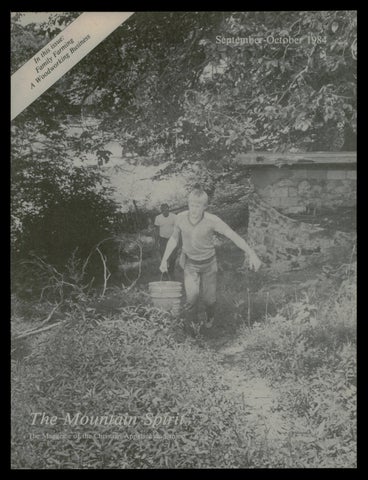
In the September-October 1984 issue we’re exploring some of the economic opportunités, outside of the coal industry, for the area. You’ll meet Kelly Mehler, a craftsman/businessman from Berea and the Raymond and Magdalene Sims who work in tobacco and cattle farming in Lincoln County. On the COVER, the Sims’ grandson helps out with the farm chores (photo by Gabriel); BELOW, Gil Rosenberg tries out the Sims’ butterchurn (photo by Gabriel); on the BACK COVER, an abandoned Appalachian saw mill (photo by Jordan).
From Our President Last Monday when I was getting a haircut, the barber, who is one of our city councilmen, asked if I could find a job for one of the young men of the community. He’s 19, a high school dropout, and has no skills. He did want to work, though. The councilman asked me if I was will ing to give him a chance. Since we’ve started our camp and Bible School in Floyd County we need some extra help, so I hired him. This young man is symbolic of many more in Eastern Kentucky. We have an employment problem. In the county where I live the unemployment rate is still at 16%. A neighboring county has a rate of 27%, the worst in the state. I’m afraid that I don’t know where our future lies, but let’s look at the problem. Most of Eastern Kentucky has a one industry economy. Coal and its satellite industries provide the bulk of the jobs. While this certainly has been a blessing in many ways, it has also had its shortcomings. From the very beginning of its history in the early 1900’s, the coal industry has been like a great roller coaster. It has gone from periods of great prosperity to deep unemploy ment. Today, many of the coal com panies have become energy com panies. No longer are all of their assets in coal; they now own uranium mines and gas and oil wells. For the coal industry this translates into longer and deeper “ bust” periods because the com panies can sit on one form of energy when that particular market is down, and develop another. This makes our coal fields even more susceptible to lay-offs than ever before. We’re being made more conscious of the apparent environmental problems caused by coal, the most glaring of which is acid rain. When a high sulphur coal is burned—and most of our Appalachian coal is high sulphur—waste particles com bine with the atmosphere and form sulphur dioxide. When the particles September-October 1984
combine with rain clouds a mild form of sulphuric acid forms. Clouds that form in the midwest, where a great deal of coal is burned to power electrical utilities, travel east and dump the acid rain in lakes, polluting drinking supplies. As a consequence, we now have a national debate as to whether Con gress should ban high sulphur coal, or require expensive scrubbers to eliminate the sulphur. This debate will come to a head in this decade. Its conclusion will have a serious and, quite likely, harmful effect on the use of our coal. Wherever you go in Eastern Ken tucky these days there is the talk about the coming days of October. The union contracts expire at the end of September. A prolonged and violent strike which is possible, if not likely, will seriously effect our economy for many years. To complicate all of this, we now have foreign competition. Coal is brought into this country as cheaply as we can produce it. Steel is im ported now, in major proportions. All of this cuts back on the demand for domestic coal production. Despite what many people believe coal miners, as a rule, are paid well. Average pay is nearly $100 a day plus many benefits. It is very dif ficult for another manufacturing company to compete with these salaries. A shoe company cannot af ford to pay those salaries and stay in business. The local people can’t understand why they don’t get the same salary as their neighbors and cousins who work in the mines. Labor troubles develop and before long the plant is closed and moved to a non-coal related area. Unwilling to suffer the same fate, new industries choose other areas to begin, and no new jobs are created here. As you can see, the need for a multi-industry economy is becoming acute. But what can be done? In my opinion our best bet is to first turn to education. We have to have bet-
Father Ralph Beiting
ter schools, different kinds of schools, where environmental goals are blended with human and economic goals into one har monious plan. We are seeing some new Christian schools forming in the mountains. We need more. I would like to see a group of peo ple seriously look at our problems, and plan unselfishly for the future. In this group we need coal people, non-coal people, educators, and community developers—spirited leaders with a broad vision. I believe that our great hope is the coal people. If we can get them to look at the full picture, they will see that they already have many of the resources needed to begin a new pattern of economic life. In the long run they will be the winners when the goal of a stable, yet varied economy has been acheived. In the meantime, we have to ex periment with different kinds of work opportunities. CAP has started a stained glass studio and a boat repair shop in recent months. I hope to see some form of high tech industry developed in the area. We must not be discouraged by the enormity of the problems, but we must face them. Working together we have a chance. Ex perimentation must continue and we must never lose sight of the fact that what is at stake is not economic well being, but human survival and dignity. 3
F ro m all sides, society today is bombarded with a fast paced lifestyle and the necessity of high technology. Even in the rural settings of our coun try, the media urge us to move faster, grow bigger. In the Kings Mountain community of Lincoln County, Kentucky, Magdalene and Raymond Sims have tailored the advantages of the modern world to suit their own needs, enjoying a farming life, the values of which have been in the Sims family for several generations.
A Family Farm: An O lder W ay
Raymond, 62, and Magdalene, 60, live on the farm that his great-great grandfather, John Sims, bought and began to work in the 19th century. They enjoy sharing the rich history of their family and telling the stories that their kinfolks have passed down through the generations. John Sims, and his family of five sons and two daughters lived on nearly 1000 acres and worked it all of their lives. Later the land was broken into smaller lots, and passed into the Leach and Doan families in the area. John Doan was Raymond’s grandfather. When John died, Raymond’s mother inherited his land, then married Arthur Sims, who was a descendant of the original landowners. Through Arthur the farm came back into the Sims family. “ They came in a wagon from up around Paris, Kentucky. They drove their geese, brought chickens in a coop, drove a cow behind the wagon,” Raymond recalled. “ Of course, this was like a wilderness here. There was a big chestnut grove here, the hogs ran wild. When they came in, there wasn’t any stock house—the hogs ran wild. “ But we’ve always had hogs. And those geese have been here on this place ever since they came here. We’ve got sixteen now, and I don’t ever remember bein’ out of ’em, so I guess some of ’em go back,” Magdalene added that Raymond’s mother would pick the ducks and geese to make beds and pillows for the family. When Raymond was a boy, his daddy worked on the railroad, which contributed to the well being and bustle of Kings Mountain in those days. Today the town is a memory, marked by a crossroad and a general store, but years ago it was a busy railroad stop. “ Then Kings Mountain was booming. There was a hotel, a good school, and two big stores that handled horse drawn equipment—wagons, plows, and everything you used for horses. The train stopped there. We’d walk to Kings Mountain to get our mail. It was two and a half miles. The mail didn’t run out there then.”
S to ry a n d P h o to s by M a rg a re t G a b rie l September-October 1984
“ He had a neighbor,” Magdalene remembered, “ that used to have oxen, wasn’t it? And he’d ride the oxen to Kings Mountain and back.” 5
W h e n Raymond’s family first came to Lin coln County they lived in a two story log house which is the site of the home where Raymond and Magdalene raised their four sons. His daddy built the house, using some of the materials from the old log house. “ There was yellow poplar in it eigh teen inches wide,” Raymond said. “ I wish we’d restored the old house. It had a board roof, and it got to leakin’, but the rest of it was good.” The term “ farm house” describes their home. It’s neat and comfortable, and the smell of home cooking reached the front porch as we sat in the morning coolness, breaking the beans that Magdalene planned to cook for dinner. CAP’S coordinator of small farming projects, Gil Rosenberg, first met Magdalene about three years ago at the Lincoln County Farmers’ Market, and accompanied The Mountain Spirit to the Sims farm that day. As we chatted, Magdalene told Gil that the good smells from the kitchen had his name on them. She had fixed him some fried dried apple pies, biscuits, and corn bread. “ We raise our own corn, and make our own corn meal. I have a grist mill out there,” Ray mond said. “ We don’t buy corn meal. She’s got some in there, cooked for dinner. See if you can tell the difference,” Raymond said, challenging a dedicated weight watcher to cheat in the line of story research. “ Corn meal won’t put no weight on you,” Raymond vowed. They hand-milk about five gallons a day from a Holstein cow, which keeps the whole family in fresh milk. Magdalene makes her butter, “ and we get plenty of cream off this cow, too.” H i s three years and three months in the service during World War II marked the only time that Raymond ever spent away from the farm. “ I’ve never worked public work at all. Well, two days on the railroad. That was before the war—I was just a kid. Sixteen, I guess, seventeen. “ I like farming, and I took up dairying when I came out of the service. I went four years to the GI farm school over at Lexington, at the university. We had to go of a night. That changed this coun try, that farm program that the government had for the World War II veterans. This land used to be just old clay hillsides, but now you see it’s all green and everything. It really helped. In order to be in the program you had to take up dairying or something like that. I took up tobacco, dairying, and general farming. I knew that this place would suit those things. I didn’t have but just my mother’s place then, but I’ve bought more land since then.” Raymond and Magdalene still work in cattle and tobacco, with the help of the family. 6
The Mountain Spirit
Although their sons all work public jobs, they still pitch in with the farm work. High blood pressure and a heart attack a few years back forced Ray mond to give up the demands of dairy farming. He claims that his activities now are “just exer cise,” but his well-kept place tells the story of a couple who still put in far more than forty hours a week. Raymond says that they don’t really work like they did when he was a boy. “ You worked with the sun back then, from sun-up to sundown. I used to work for fifty cents a day, and it’d be dark when we’d quit. We put in long hours then; everybody did. There was no such thing as fast time, you went by the sun. And when you came in, there was no television to watch. When the chickens went to roost, you went to bed. When they’d start to crowin’ of a morning, that’s when you’d get up, about four o’clock.
Farm ing has changed since John Sims moved his family into Lincoln County to carve a life out of what was then a wilderness. Raymond says that farming has changed since he was a boy. The in dustry is moving away from the family and into the corporate boardroom. The kind of diversifica tion that allowed families to exist almost totally from their own land is becoming a thing of the past.
As is the case with the wives of many farmers, Magdalene worked a public job for many years to help make ends meet. “ I worked eight years at Cowden in Stanford, and twelve years at Mercer Dress in Burgin. I decided twenty years was long enough. When it came time for canning and freez ing, sometimes I’d get in the bed at 1:00 and get up the next morning and go to work.”
“ Then there’s the idea of the family unit work ing together. Sometimes we’ll give out seed to a family as a group and say, ‘look, you divide it up.’
Magdalene grew up about 2 miles from the Sims farm. “ We moved to Casey County when I was in the second grade to be with Mom’s daddy. He was living by himself. I lived in Casey County until I married Raymond in 1942. We like it out here. I don’t want to live in town. I never did, and I know Raymond wouldn’t. And I think the kids all like it. They’re still all on the farm.” The gardening and farming chores keep Magdalene very busy in the summer, and in the winter she makes quilts, pillows, pillow cases, and dolls. When she first met Gil, she introduced him to ornamental popcorn, which she uses to make dried arrangements and other craft items. During the first year of CAP’S Be-A-Seed program, which raises money to assist low-income families raise vegetable gardens, Magdalene contracted with Gil to make all of the gifts that were sent to pro gram sponsors. The next year she provided seed for the growers to raise the popcorn needed to make the gifts. “ Somebody from Ohio sent our neighbor the seed. She showed it to me, and I just wanted some of it, so I wrote to her and asked her to send me some. I’ve been doing that ever since.” Left, some o f the animals on Raymond and Magdalene’s farm. Top, several o f the hogs which they raise fo r meat fo r themselves and their sons; center, geese, which Raymond claims are ancestors o f the geese which John Sims brought from Paris, Kentucky; bottom, a beef bull and a dairy cow. September-October 1984
But Gil believes that farming and gardening are keys to survival in this area. “ Gardening is something that is being done less and less around here, but we think we can reverse that trend by keeping people gardening, and getting the young people into gardening, learning canning skills, and some of the other things that aren’t being passed down.
Instead o f each one having their own little roto-tiller, we'll have three share the roto-tiller. That's really how this area survived in the beginning, the close-knit families tying and pitching in together.
A lot of them will end up gardening together in the same plot, and it’s something we like to en courage, that sharing of resources. Instead of each one having their own little roto-tiller, we’ll have three share the roto-tiller. That’s really how this area survived in the beginning, the close-knit families tying and pitching in together.” Gil speaks of the re-birth of the family garden and of how he, and the people he works with in CAP’s farming projects want to rekindle that spirit in this area. But Raymond and Magdalene Sims don’t know any other way. Their farm has shaped their lives and given them and their family much more than just survival. In them one sees the personification of the values that many people feel have been lost in this country. But that’a a cynical notion. The values of hard work and the impor tance of a family working together are still present in our society, and will continue to flourish through Raymond and Magdalene and hundreds of people like them. cap. 7
Letters When I read the last issue of The Mountain Spirit it made my heart ache to see the damage that the flood did in that part of the country and to what you all have worked so hard for. God surely tested your faith, but praise God you didn’t give up, and are still working. I’m a widow 80 years old and live alone. God has blessed me with strength to carry on by myself, and I thank him. I want to share a part of what I have with your project. I feel I’m rich compared to those that have lost everything they have. May God continue to give you health and strength to carry on. Gladys Cowherd Gordonsville, VA I have enjoyed your magazine so much. In “ The Liberation of Elsie Watts’’ in the May-June edition, the drawing on page 17 brings back a memory when my husband (now deceased) and I were driving through that area . . . on a porch, much like the drawing, was a casket supported by two chairs and a lone ly woman dressed in black was sit ting at the end next to the door. That picture haunted me. At the time I wanted my husband to stop but it was at a curve where you couldn’t. There was nothing but the road and mountains. I wondered who was coming. Sure wish I could draw. I’ve told that story and passed this copy especially. I love Jesse Stuart. My roots and my husband’s began in the South . . . Mrs. Marjorie Lewis Saginaw, M I Congratulations upon your ex cellent edition (May-June 1984). Having known Jesse Stuart and Mrs. Stuart for many years, we felt very close to them. Our first meeting was at a state SCEA con vention in the ’50’s and Dr. Stuart 8
was the speaker. His closing ques tion to the group was, “ Which is more important—C grades and A character or A grades and C character?” In the ’70’s Dr. Stuart was invited to speak to a classroom teacher’s convention in Columbia, SC. Many people were impressed with his qualities and message. Jesse Stuart’s life will always re main as memories in every walk of life. He will be missed by all—especially his family; but his pain and suffering are over and he is in Heaven with his parents and friends. We bow our heads at his passing! Ellen M. Hargrave Bennettsville, SC Jessie M. Blackwell Myrtle Beach, SC
It is always nice to have a reminder of you—and to know that you have volunteers who ac complish the acts of mercy. When one is ninety years old one has wishes of youth in order to be a part of today’s life that has become so com plicated. The mail from Washington, DC is enough to con fuse you were one not set on prin ciples one learned years ago. May the summer months be fruit ful in work done for the glory of God and His children. May I ask to be included in your prayers that Peace, Love, Blessings from Above be yours and on the dear ones of your family. Sylvia Ford Tucson, A Z Although I have enjoyed reading all issues of The Mountain Spirit I especially liked the May-June ’84 issue, possibly due to my interest in h an d w eav in g , all kinds of needlework and crafts. However, my greatest delight is always the page, “ From Our Presi
dent.” From what I have read, I have come to admire Rev. Ralph Beiting very much. I have never met him, of course, but he must be a fine human being—a dedicated Chris tian, a very human person who ad mits to frailties which afflict us all, but a hard-working churchman helping all who are in need of help, regardless of church affiliation. He and all of you working in the Project are doing such fine work. God bless you all. Ella M. Birdsall Elyria, OH Thirty-seven years ago I was given an example I have never forgotten. After mom had fed the six of us she shook out the last handful of flour, and a tortilla, cooked the last grains of rice in our rice jar and warmed the beans that were left. We were happy because mom would get to eat today, too. Just then, there was a short knock at the door. Four words passed between them: “ I’m hungry.” She said, “ Come in,” then motioned him to sit and have a tortilla, some rice, and some beans. My sister said “ Mama, who’s that?” She said, “ Jesus. Because He said, ‘if you receive anyone in My name, you have received Me and your reward is great in heaven.’” So, early we learned to “ share ” and “ make do with what ya got” and make the best you can of it with a smile because God loves a cheerful giver. Today, my “ widow’s mite” isn’t much, but I remember my mom. Amelia E. Edwards Mission Hills, CA
Letters to the editor are welcome.
They should not exceed 150 words in length, and we reserve the right to edit them fo r space. Address letters to The Mountain Spirit, Christian Appalachian Project, 322 Crab Or chard Road, Lancaster, Kentucky 40446. The Mountain Spirit
A F urniture C raftsm an ’s Beginning
Story and Photos by Kelly examines a piece of wood for a chair slat.
Glen Taul
green sign with gold lettering, and a tree with spreading shade hangs in front of the Treefinery Woodshop and Gallery. Upon entering the show room on Chestnut Street in Berea, Ken tucky, a visitor is enveloped by a homey, casual at mosphere. When the part-time sales person is away, the proprietor interrupts his work in the woodshop to visit with browsing customers.
Simultaneously, he took courses at the College of Applied Sciences at the University of Cincin nati. On weekends he got free credit by making furniture. “ I found that I had the patience to work with wood, and it was about then that the idea of starting my own wood shop began,” Kelly says.
In a town where the craft industry is booming, Kelly Mehler is establishing himself as a craftsman of furniture, only five years after starting his business. Kelly, 37, became interested in wood working after graduating from high school. Born in Chicago, Kelly’s family moved to central Florida, where he spent his adolescent years. “ The school system didn’t have a vocational program,” Kelly says. “ It emphasized preparation for college.” “ I’ve always been mechanically inclined,” Kelly says. Although the school system lacked a voca tional program, he was always tinkering with motorcycles, cars, or other machines. After he graduated from high school, Kelly moved to Cincinnati, Ohio, and worked in a rehabilitation center, teaching simple wood work ing to mentally retarded students. “ I tried to give them an activity that was rewarding,” Kelly says. September-October 1984
After two-and-a-half years in Cincinnati, he and his wife, Terri, decided to live in Europe for awhile. Most of their two plus years was spent in Switzerland. “ In each place we stayed, I did odd jobs which included wood working and carpentry,” Kelly says, but not furniture making. O n their return to Cincinnati he resumed his job at the rehabilitation center. Then a friend told him about Berea College and its wood working program. Kelly liked the college and town after making a visit. “ I liked the college’s wood working pro gram, which included furniture making, and I liked Berea’s small town atmosphere,” Kelly says. While he was working and attending school in Cincinnati, he commuted from a small farm in northern Kentucky. For Kelly a small town is more personal; “ It’s like an extended family.” He entered Berea College, intending to earn a teaching degree in industrial arts. Once he got a 9
teaching job, he felt he could build the necessary foundation to start his own business. Starting a small business was difficult then as it is now. In addition to the government regulations with which a businessman must comply, a large capital investment was necessary to purchase materials and tools of the trade. This was Kelly’s main obstacle. But then a friend, who worked at Appalachian Village in Berea, told him about some wood work ing tools being stored in Lancaster, Kentucky at the Christian Appalachian Project. This friend, who had worked for CAP, said to Kelly, “ Boy, there’s a bunch of machines in Lancaster you ought to see.” When he went to look, there were many machines which had been repossessed from failed woodshops which CAP had helped to start. “ They were just sitting there,” Kelly says, “ and I thought, ‘well, let’s see, I could buy a machine here, a machine there, and set them aside until I finished school.’” Eventually he talked with Father Ralph Beiting who was interested in working something out. Kel ly told Father Beiting that he would try to look for space in or near Berea. Father Beiting offered a CAP building near Mt. Vernon that was unused. When he was unable to find anything near home, Kelly looked at the barn Father Beiting had offered. “ It was called the chicken barn,” he says. “ At least it was a place to start.” CAP made some renovations; poured a con crete floor, put in insulation, installed electricity, and moved the machinery from Lancaster. “ CAP allowed me to stay at a reasonable rate,” he says, and loaned him money for capital. Kelly asked a former college mate, who was then working in Stanford, to be his partner. They spent two or three months getting the machines, made in the early 1900s, in working condition. “ We took them apart, cleaned them, and tried to find parts for them,” Kelly says. “ Sometimes we didn’t have much luck with them.” CAP again assisted him, and helped him buy other machines. Their two years at the chicken barn were very difficult. Because they were not located on a main thoroughfare, few people came to look; it took them awhile to figure out what items were marketable. “ We started making furniture, which was unprofitable because people didn’t come by,” Kelly says, “ and we didn’t know where to market them.” So they started attending craft shows and making smaller items. They did everything to maintain a cash flow. For awhile, “ we kind of made it, then we were 10
The Mountain Spirit
down,” he says. Even so, if they made $50 a week, that was considered good. Strains in relationships appeared as a result of poor business. Families couldn’t be supported on it. Kelly often got behind on his bills. At times the electricity was cut off. His friend eventually left, unable to live on the low, erratic income. “ I hated to see him go; he was a good wood worker,” Kelly says. Although their relationship was strained when he left, they parted friends. In spite of these set backs, Kelly says he enjoyed his work. But the set backs affected his self esteem. “ I was real high on self-esteem,” he says. It dropped during this time. “ Even if you’re trying hard, and still not making it, you take it personal. I was associating myself with how the business was doing. “ My family has urged me several times to get out of the business,” Kelly says. But as long as he sees some progress in his business, he is determin ed to do his best. There were some bright spots in this period. Before his partner left, they had hired another per son to handle marketing. And after his partner left, he found his present location. When he drove by and saw the for rent sign, “ my first thought was that the rent would be too much,” and he was unable to tell how much space there was. After some hesitation he called the owner, who offered a reasonable rent. Kelly ac cepted the offer after looking inside. Kelly moved into the building on Chestnut Street in Berea in 1980. He was a little apprehen sive about the move. “ It was a little scarey moving out of the country and onto a main street location,” he says. They were just beginning to show signs of getting established at the Mt. Ver non location. “ Anyway, I thought I’d try it here.” With the help of friends, Kelly worked day and night moving machinery and equipment and set ting up the shop. When he was organized, Kelly started a program of making furniture and ac cessories, taking them to fairs and shows where they would be judged for their quality, and selling some wholesale to other shops and galleries. “ I was trying to build an image of quality and my portfolio,” he says. And he still is.
Above left, Kelly sands a chair slat. Above right, Tom Forman, an apprentice, works on a table behind Kelly. Right, Kelly measures a chair slat.
September-October 1984
11
O v e r the the past few years, Kelly has assembl ed a portfolio of his work. As he made pieces of speculative and customized furniture, he had photographs taken of them. “ I add to it every year, and people are now beginning to see the quality work that I do.” This emphasis on quality and selection is gradually changing the direction of his business. Rather than making mostly small wood items, he is making more customized furniture. That is the direction he wants to go. The other wood craftsmen in Berea specialize in something, like dulcimers or period furniture, but Kelly will make anything a customer wants. “ Basically, I’m a technician,” he says. “ I’m not a designer.” Kelly admires Shaker furniture. He likes the straight lines and simple curves. “ They’re func tional, light, and can be used in a contemporary or traditional setting,” he says. An ornate piece of furniture becomes dated quickly and is less func tional. According to Kelly, to make furniture or nate was against the simple lifestyle of the Shaker religion.
Above, a Berea resident makes a lap desk. Below, space beside Kelly’s shop is readied for use.
In many ways the simple design of Shaker fur niture reflects his lifestyle. His house is simple yet tastefully adorned and close to nature. Terri, and their children—Jason, 10 and Lisarose, 6—are of supreme importance in his life. Kelly and Terri are part of a six-family educa tion cooperative in which parents of the families teach the children in their homes. The parents teach their own children the basic skills at home, and then each parent teaches all the kids a subject. “ I taught science last year,” Kelly says. The child has to be self-motivated, Kelly says. Jason comes to the shop in Berea to study. “ We emphasize a lot of research skills.” They must use the library extensively. The personal touch that is given to his family is what he strives for in his furniture. People want quality, handmade furniture, he says. Unlike fur niture with wood veneer, his furniture is solid oak, maple, walnut, or cherry, and it reflects the care and skills of a master craftsman, who is proud enough of his work to sign and date each piece. “ I am not secure yet,” he says. “ Anything could still happen.” But his growing portfolio and increased orders encourage him. “ I’m not looking to get rich,” he says. Kelly’s objective is to make a livelihood for his family at something he enjoys. When that occurs then he will consider himself a success.
12
The Mountain Spirit
Appalachian
have acquired that ellusive status of the famous. ArtsCulture It’s impossible to be impressed by the fellow you’ve seen while you were growing up, working in his garden and sweating just like everyone else.
Ju st P lain C ountry Folks
Story and Photos by Beverly C a rte r Sexton
John Lair and my dad, Dale Carter, were step brothers. John Lair’s mother, Belle, married my grandpa, Davis Lee Carter, after her first husband died. John was grown up and away from home when the marriage took place, but my dad and daddy’s brother, Ellis Carter, were still young boys when Belle and Grandpa married. When I was fourteen I met John Lair for the first time while going through Salt Peter Cave in Rockcastle County. I told him I was his step brother’s daughter. As we walked through the cave together he told me a story of how my daddy, as a little boy, used to love combing Belle’s long, beautiful hair, but that one day, as he stood behind her chair with the comb in his hand, he pointed out to her that her hair was not nearly so lovely since she had started putting all those gray hairs in it. I laughed with Mr. Lair at this story, and our laughter echoed through the cave. We talked about old times—happy times and sad times. He said he was saddened by the sudden death of my dad in 1963, and that he had come to the funeral. Strolling through the cool darkness of the cave, our way lit only by a coal oil lantern, it was difficult to think of this simple, elderly man
On November 4, 1939, John Lair stepped to the microphone for the first time and said, “ This is the Renfro Valley Barn Dance, coming to you direct from a big barn in Renfro Valley, Ken tucky—the first and only barn dance on the air presented by the actual residents of an actual com munity,” and a long tradition of good, old time country music was launched. Now nearly 45 years later, Renfro Valley is much the same as it was in 1939. The shows are still put on by local people and except for a new red barn and motel, Renfro Valley hasn’t changed much in appearance. Tourists come hoping to get a glimpse of John Lair or an autograph from one of the performers who pick and sing on stage. To the tourist, Renfro Valley is a place where country singing stars are born, where they can experience the laid back life of a time past. To the local people, however, Renfro Valley is a place to earn a living, a source of revenue to the community, and a place where talented local peo ple have an opportunity to launch a career in the entertainment business. We are indebted to John Lair for developing Renfro Valley, and for putting Rockcastle County on the map. But John Lair and the stage performers are just plain country folks—and good neighbors—even though they September-October 1984
Renfro Valley folks perform on a Saturday night.
13
Renfro Valley is nestled in the mountains of Rockcastle County.
as a world famous figure, who once appeared before President and Mrs. Franklin D. Roosevelt during a command performance for the King and Queen of England. John Lair dreamed of preserving the customs, culture, and music of pioneer America, and realiz ed his dream through his development of Renfro Valley. When he first had the big barn built, people predicted that before winter it would be full of tobacco instead of singers. John Lair admits that the floor is heavy enough for a truck, so that he could have turned it into a factory if the music hadn’t worked. But the music did work, and for 45 years a vast array of talented singer, pickers, and clod hoppers have performed at the barn. From the stage of the big barn have come such prominent country performers as Homer and Jethro, the Duke of Paducah, “ Little” Jimmie Dickens and a bashful red-headed boy from Berea, Kentucky, known as Red Foley. The rough walls of the old barn have seen many local per formers pass through on their way to stardom. Many of the old performers return home to Ren fro Valley for John Lair’s birthday, which he celebrates the first Saturday of July with a talent contest. This contest is an excellent opportunity for local talent to “ show their stuff,” and maybe even start their careers as successful entertainers. In 1973, when I was 19, I started working at the Renfro Valley Lodge for 75c an hour. I was a waitress and the work was hard, but I had the op portunity to “ rub elbows” with people like Grandpa Jones, Mac Weissman, Old Joe Clark, 14
and many more. I have to admit that I had never been to see a show at the barn until I started this story. As a matter of fact, very few local people go to the shows. The reason is simple. We know most of the entertainers, and it seems kind of wasteful to pay $6 to see people you can see every day for free. Also, for country folks, listening to old time country music is as easy as inviting folks over for a get together. Somebody will bring a fid dle, another a banjo and so on till you have a regular hoe down going on. But for those folks who live outside of our little community, Renfro Valley certainly does provide good, down to earth entertainment well worth the $6. There is a song John Lair wrote long ago that is still popular at the barn today. It goes: “When it’s springtime in the mountains And the dogwood blossoms blow We’ll be back in Renfro Valley As in days o f long ago” Mr. Lair likes to remember the days when the top entertainers at the barn were Little Clifford, Aunt Ida, and the Coon Creek Girls from Pinchum Tight Hollow, Kentucky. He says, “ Country music is never going to change. It’s simple and everyone can understand it. When you get to where you can’t whistle the tune, the song’s getting too thick.” He decided a long time ago that if his beloved valley was going to be old time then it would just flat be old time. No gimmicks, just a place where people can go back in time, away from the noise and pressures of today’s world, to a little valley in Kentucky where time stands still. The Mountain Spirit
around the project
CAPrice Industries Reap Their Harvest STANFORD— One of the pro jects that the workers at CAPrice Industries in Stanford have taken on for the past three years is a large vegetable garden, about a half mile from their workshop. Even with the terrible drought of last summer, the workers continued, making do the best they could, despite the terrible conditions for growing. This summer, the weather condi tions have been considerably better. After the floods in the spring there was enough dry weather to get things well underway, and then rain came in just the right amounts at the just the right times. Sponsors for the project are Gil Rosenberg, CAP’S coordinator of small farming projects, and his assistant, volunteer Keith Gilbert son. They help the folks in all stages of the gardening project, from motivation and encouragement to picking beans and tomatoes.
by the CAP News Service
“ I’m going to take a couple of them out there with me and have them sell their own stuff.” We also give them some to take home. I imagine that being able to take something home for the family table gives them a lot of pride. “ I think a lot of them worked in the garden when they were younger, but then they lived in different homes or different institutions and haven’t been involved in it in a while. Now they’re back into it and it brings back memories of childhood and happier times.”
Thanks! A note from the Berea Attic: A great big “ Thanks!” to all the parishioners of St. Martin Parish, Warren, Michigan; to Father Hall, Sister Stella, the entire family of Fred Tworek, and everybody in volved with the clothing drive for the Christian Appalachian Project in Kentucky. For all the help during the past years, we are deeply grateful. From the Appalachian
people, God bless all of you. Doris Anglin Coordinator, CA P A ttic Program
The Mountain Spirit Wins Honors From Catholic Press C H IC A G O — The M ountain Spirit was the proud recipient of two awards from the Catholic Press Association for 1983. “ Before the Rivers Ran Black: The Journal of Jeremiah Turlin” was recognized as the best short story of the year. The three part story is the work of R. Kenton Craven, former editor of The Mountain Spirit. A third place in the single color cover category was awarded for the March-April 1983 issue. The cover shows an old mountain man holding his young granddaughter. One judge commented “ the photograph says Mountain Spirit to me.” The photo was taken years ago by Father Ralph Beiting, editor-in-chief of The Mountain Spirit.
“ They love it,” Gil says. “ They like to get out there, to go through that growing process, to put the seed in, to grow something, to produce something. We’re trying to help them be more productive members of society, to improve their opinion of themselves and their value.” Many friends of the CAPrice workers benefit from their work, too. In the summer months it’s not at all uncommon to walk through offices and see bags of fresh pro duce that they have brought into the main office. During their first year many of their vegetables were given away. Last year the harvest was very poor, but this year they’ve discovered that the garden can also help them raise money for special projects. “ Some of the stuff will be sold at Farmers’ Market,” Gil says. September-October 1984
15
around the p ro je c t . . . continued
SOAR Films Commercial in Rockcastle County
Volunteers Start New For the Fall
ROCKCASTLE COUNTY—SOAR (the Spirit of the Appalachian Region), a program of CAP which is promoting and raising money for volunteerism in Appalachia provid ed a great deal of excitement on July 18, as a television commercial was filmed on various locations around the county.
CLIFFVIEW LO D GE—Late August is always an exciting time for CAP. After the busy summer months everyone knows that August brings to CAP a new flock of volunteers who will be with us for the coming year.
Although the intriguing equip ment and bustle of the film crew was exciting, it was Beverly Garland, SOAR’s celebrity spokesperson who created most of the excitement. Beverly was gracious and inviting as dozens of children asked for her autograph, and questioned her about her roles on popular televi sion shows, “ My Three Sons” and “ Scarecrow and Mrs. King.” One nine-year-old girl confided that the filming, and Beverly’s participation was “ the best thing that ever hap pened to this county.” Beverly, who was making her first trip to Appalachia, said that she was surprised at how willing the people were to take her in and accept her. “ The children have been wonderful. They want to ask questions, but they don’t mind talking about themselves either.” At her home in Los Angeles, Beverly is involved with the YMCA and Childhelp, an organization that works with abused children. She makes her services available for whatever needs they might have, and gives talks and makes personal appearances when she can. She found the work of CAP “ tremen dous. This work needs to be done. It’s the people working together that will be able to eliminate that poverty of the spirit—the worst kind of poverty there is. The distance be tween things here makes it hard for people to help each other. But CAP can help, and I’d like to be a part of it.” 16
First on the agenda for the new folks is a week-long orientation ses sion at Cliffview Lodge on Herr ington Lake. They will join the volunteers who are returning for an additional year of service for several days of learning and sharing.
Beverly Garland signs autographs in Rockcastle County.
The commercial, which features Beverly and several of her new found friends in Rockcastle County, will be aired in selected cities in the coming months.
Moving? Please notify us of change of ad dress to make sure you receive every issue of The Mountain Spirit. OLD ADDRESS name
please print
address city
zip code
NEW ADDRESS name
please print
address
Father Ralph Beiting, president of CAP leads most of the discussion which includes talks on spirituality, the origins of CAP, a short history of A ppalachia (including an historical overview of religion in the region), community life, and a driver safety workshop. All of these sessions are designed to give new volunteers a start on the knowledge they will need to work effectively in Eastern Kentucky, and returning volunteers a sort of “ refresher course” in the things that they may have experienced in the past year. In addition to Father Beiting’s talks, the volunteers met with several of CAP’s employees, who told them about some of the aspects of CAP outside of the human development programs. In their free time the volunteers had the opportunity to take advan tage of the beautiful scenery along Herrington Lake, to canoe, swim, fish, or just talk and get to know each other a little better.
city state
zip code
Mail to: The Mountain Spirit, 322 Crab Orchard Road, Lancaster, KY 40446.
The Mountain Spirit welcomes CAP’s newest volunteers, and wishes of them—new and old— success and happiness in the work they have undertaken for the coming year. The Mountain Spirit
around the p ro je c t . . . continued
Judy and Jody Harrison Recognized for Advocacy The Christian Appalachian Proj ect is proud to congratulate Judy and Jody Harrison, who operate our home for handicapped foster children, on their selection by the Kentucky Youth Advocates as the Child Advocates of the Year. At the presentation in Louisville in June, Judy and Jody were honored for the work that they have done with hand icapped foster children for the past thirteen years. Ric Cusick, president of the Board of Directors of Kentucky Youth Advocates made the presen tation, stating, “ you epitomize the many dedicated Kentuckians who unflinchingly serve neglected and abused children giving of your love,
and your respect for others . . . the Harrisons represent our humanity at its best: they serve Kentucky’s neglected and abused children by guaranteeing their safety and pros perity. The people of Kentucky are truly indebted to you.”
‘TIS THE SEASON FOR GIVING . . .
For the last four of the thirteen years that Judy and Jody have worked as foster parents they have been affiliated with the Christian Appalachian Project. Through their loving dedication they have had phenomenal success in placing children back with their natural families or in permanent adoptive homes. The Christian Appalachian Proj ect is proud of its affiliation with the Harrison family, and prays that they will be continually blessed in their work. Send today for your free copy of “ December Giving. . . 10 Ways.” This booklet encourages careful thought of year-end gifts and describes 10 satisfying ways of giving to the Christian Ap palachian Project.
clip and mail today in the enclosed envelope
Christian Appalachian Project 322 Crab Orchard Road Lancaster, Kentucky 40446 ( ) Please send, without obliga tion, a complimentary copy your booklet, “ December Giving. . . 10 Ways.” Name ____________________ Address __________________ City ______________________ State_________________Z ip__ Jody and Judy Harrison and their daughters Holly and Tina.
September-October 1984
17
around the p ro je c t . . . continued
Needed: Christmas Angels LANCASTER—Last December, with the help of many benefactors a r o u n d the c ount r y, CAP distributed 1,154 Christmas baskets to needy families and elderly people in five counties. This year CAP plans to distribute over 1200 baskets, which include food for three meals on Christmas Day, one new toy for each child, a small remembrance for each adult, and a gift certificate for clothing from one of CAP’S Attic Stores. Program coordinator Guy Adams says that “ even though we usually have a sponsor for every family there are always incidental expenses that come up. Sometimes we need to buy extra food, occasionally we have a family who’ll have a crisis late in the year, and have nothing for Christmas. By then, of course it’s too late to get them a sponsor, so we try to provide for them ourselves. And we buy a lot of wrapping paper. The sponsors wrap gifts, but sometimes packages aren’t handled as carefully as they should be and the paper tears. We like to rewrap those gifts, because if a kid is only going to get one small Christmas present, you like for it to be wrapped nicely.” The goal of the program is to help needy families and elderly people experience the joy of Christmas, which is the birth of Jesus Christ. If you can help us in this outreach, just enclose your donation in the envelope in the fold of the magazine and mark it “ Christmas Baskets.” Anything you can send will help us to help our Appalachian friends share in the beautiful joy of the birth of Christ. It will make their Christmas so much happier, and you’ll see what it does for yours, too! 18
Sparky the Clown, aka Peggy Abate, a former CAP volunteer, gives out balloons at the Lincoln County Farmers’ Market. Peggy is a teacher at the Family Life Child Development Center.
f W h a t in the world should we get Grandma fo r Christmas? I t ’s alm ost th at tim e ag ain — tim e to decide ab o u t a C hristm as gift for th at very special older person in y our life. A nother box of d u sting pow der? H ow about some m ore stationery? If y o u ’re like m ost people, n o th in g ever seems to be quite right. H ow about a gift subscription to The Mountain Spirit? Almost every day older readers w rite and tell us th at The Mountain Spirit is like a friend they can count on. T h ey love to read of the m o u n tains and the m o u n tain people, m any of w hom rem ind them of th eir lives w hen they were younger. Some of ou r older readers tell us th at they save every issue an d reread them periodically w hen they w ant a special lift. O nly $5.00 will b rin g The Mountain Spirit to your g ran d m a six tim es in 1985. A nd for g randm as . . . d o n ’t yo u r g randchildren need a little bit of The Mountain Spirit, too? I t ’s not too early to order a gift subscription for C hristm as. W rite today!! The Mountain Spirit
The CAP Closeup
Bill Begley
(<CAP is a Family”
by the CAP News Service
Bui
Begley and his wife Judy were seeking a change in their lives in 1970. “ I had a good job as a technical writer for a digital computer manufac turing company, but I just couldn’t see myself at 65, looking back and saying, ‘Boy! I wrote a lot of good technical manuals,” ’ says Bill, CAP’S Direc tor of Development. While on vacation in southern Florida in 1971, he met Father Ralph Beiting through a mutual friend who worked for CAP. They spent the day with Father Beiting, and invited him to their home for supper that evening. “ I was excited about what he said about what he was trying to do with and for the people of Ap palachia through the vehicle of CAP.” Before Father Beiting left, Bill said, ‘‘if there is anything that you ever thought that I could do to help, I would consider it.” Within two months Father Beiting called and offered Bill the opportunity to work for CAP. “ I was 70 to 75 percent sure that it was what I wanted before I left” for a tour of CAP, Bill says. With that consideration, he placed an ad to sell his house in the newspapers on the same day he flew to Kentucky from his native Florida. September-October 1984
When he called home on Wednesday of that week, Judy asked if he had made a decision. Bill told her yes, but there was no guarantee that CAP would exist next year much less tomorrow. It was new. It did not have a stable income. Fund raising efforts had existed for only three years at the time. She asked, ‘‘Do you want to go?” He answered yes. She said, “ Good, I’ve sold the house.” To Bill that indicated they were doing something right. Bill began work for CAP in May 1971. He first worked as retail division manager, which included overseeing three Attic stores. At the end of two years, two antique stores, a dish barn, and a fourth Attic store had been opened. When Father Beiting bought Camp Nelson along the Kentucky River in Garrard County, Bill asked to be transferred to that area. During his two years as general manager at Camp Nelson, he supervised the building of camp grounds and a swimming pool, the remodeling and expansion of a marina, the remodeling of a restaurant, the development of hiking trails, and the establish ment of several craft shops. 19
Father Beiting then asked Bill to learn how to raise funds for CAP. “ He said that I’d spent enough money in my four years, now it was time to start raising some of it,” Bill says. Like his previous positions with CAP, Bill had no experience or education for fund raising. “ I’ve always been able to take a new job or challenge and become reasonably proficient at it,” he says. No matter what the challenge, Bill has taken hold of new opportunities, accomplished the tasks, grown in competence, and risen within the ranks to positions of responsibility and authority. For nine years Bill has successfully raised the funds necessary to operate the Christian Ap palachian Project. “ I think I’m well suited for what I’m doing. And I’ve arrived at a point where I am very . . . I almost want to say content, but content means laid back and you’re not interested in doing anything else.” Although he never has had a particular position in mind, he is not con tented with remaining at a postion. His aim is to work hard at a current job, be recognized for it, and be advanced because of it.
Judy, a registered nurse, works at the local public health clinic. She is a native of Lexington, Kentucky. Both of their children—Will, 16, and Kate, 14—were born in Florida, but raised in Ken tucky. Bill compares CAP to a family. “ We’re here to do one job: to help as many people as we can,” Bill says. And to accomplish that job everyone must maintain a good attitude toward one another. To illustrate the selfless relationship at CAP, he recounted an interesting experience he had several years ago with Jody Harrison, co-director of CAP’S Home for Handicapped Children in Mt. Vernon. Bill believed that Jody and his wife, Judy, had the most difficult job in CAP. He tried to convey his admiration and sympathy to Jody for his work. “ I was trying to put my arm around his shoulders and offer consolation,” Bill says, “ but Jody beat me to it.” He put his arm around Bill’s shoulders, and said, “ you’ve got the hardest job here in CAP than anybody I know of.” Because of attitudes and efforts like Jody’s, “ we’re reaching and helping a lot of people,” Bill says.
Gabriel
Bill is happy with his job. “ I feel that I am con tributing a large amount to the success of this organization,” he says. He says that if he died tomorrow, he knows that he’s made a contribu
tion toward helping other people.
Bill talks with Guy Adams and Joan Pedersen during the filming of the SOAR commercial. 20
The Mountain Spirit
To Catch A Star
T h e old man sat on a wooden bench, whittling away at a chunk of cherry wood with his Case pocket knife. A warm spring breeze ruffled through the white hairs of his beard and played with the dwindling silver strands that peeked out from around his cap. A flop eared hound lay by the old man’s feet, opening one eye now and then when the sudden cry of a passing bird startled her. She opened one eye, but this time it wasn’t a bird that caught her attention. She opened the other eye and her long floppy ears twitched. She stirred and sat up, giving a little whine. The old man reached over and patted her head. “ What’s the matter, girl? Company coming?” A big, black car loomed around the bend of the road, dust boiling up behind the tires. It pulled in front of the weathered log house where the old man and his dog sat. He squinted and tried to shade his eyes as the sun danced off the car in blin ding brilliance. A young man stepped out of the magnificent machine and slowly advanced toward the old man.
S to ry by B everly C a rte r S exton Illu stra tio n s b y M a rtin R o llin s
The dog rose to all fours and let out a deep throated growl. “ It’s all right, girl,” said the old man as he pulled a plug of Red Man chewing tobacco from the side pocket of his faded overSeptember-October 1984
21
alls. “ This here is that young feller that came callin’ ‘bout this time last year.” He bit off a chew of tobacco and poked it into his cheek. The young man gave the older man a pained look. “ Hello Daddy,” he said as he came to a stop, a cautious distance from the dog. A white dogwood stood in profuse bloom by his side. He plucked one of the fragrant blossoms and twirled it between his well manicured fingers. The old man smiled, amused at the young fellow’s reference to him as Daddy. He knew this polished and proper fellow couldn’t be his James Daniel. He had sent James off to the university ten years ago, along with every cent he had managed to scratch and save through the years. That was the last he had seen or heard of him. When Ellie, James Daniel’s mother died, the old man had a neighbor write to the university in an effort to find him but the university wrote back saying he had graduated and they had no knowledge of his whereabouts. A couple of years ago, this city fellow showed up calling himself J. D. and the old man, “ Dad.” He told the old man that he had gone into business and was now an executive in a very prominent firm. He said that he had a distinguished image to protect and that he couldn’t afford to let people know he was just dirt farmer’s kid from the Appalachian hills of Ken tucky. Hogwash, thought the old man. He didn’t know what had happened to James Daniel, but he sure didn’t believe this J. D. was the same barefoot kid who used to dig crawdaddys out of the mud in Simpsons Creek. If he did believe it, he would have to also believe that his boy had grown into a power and money addict. But more painful, he would have to accept the fact that this boy didn’t love him in the same unselfish, everlasting way in which he loved his boy. Regardless of what kind of person he had sized this J.D. up to be, he had taken a likin’ to him just the same. He didn’t have many visitors, and J.D. was kinda special, being from the city and all. Besides, if the young feller wanted to call him Dad, that was okay. There wasn’t any harm being done. “ Dad,” J. D. wiped his brow with a white silk handkerchief. “ Dad, it’s not a good idea for you to stay here all by yourself anymore. You’re prac tically blind and too old to take care of yourself. I’ve decided to put you in a place where you’ll be cared for. What if you died up here? You could be traced to me and my whole career would be ruin ed. It would seem as if I neglected you. You understand, don’t you Dad?” The old man tried to bring J. D.’s face into focus. There certainly was a physical resemblance to James. He spat a stream of amber juice. The 22
boy was beginning to rub him the wrong way. Need somebody to take care of him indeed! He had managed well enough on his own for quite a few years. He had a roof above his head, a warm bed to sleep in and though he didn’t tend to the farm like he used too, he still put out a small garden each year. He put up his own food and had filled fruit jars lining the walls of his root cellar. There was pork in the smoke house, and if he took a hankering for wild game, he just took his dog and trusty old shotgun and went into the woods and shot a rabbit or squirrel. His eyesight was still good enough to do that, with the help of,his dog and a hunter’s instinct. He got pure, sweet milk The Mountain Spirit
from Nadine, his Jersey. There was also a good number of chickens in the coop that made good Sunday eatin’ and produced a bountiful supply of eggs. Nice big brown eggs too, not those pale, sickly looking things you get from the store. Need somebody to take care of him indeed! The boy was foolish! “ J. D., why don’t we go inside out of the hot sun. I think the heat must be affecting you.” “ Dad, you don’t understand. I came up here to tell you myself. It has already been done. I sold the land to a coal company. They are going to strip mine it. We’ve always thought there was coal here Dad, I finally had it checked out for sure. I sold the house to a business acquaintance. He is going to disassemble it and move the logs to rebuild it somewhere else. I got good prices, too. It will pay for the nursing home you are going to. Look, here are the papers.” He handed over several documents. The old man stared at the black ink markings on the crisp white page. He couldn’t read, but the papers looked neat and im portant. “ They’re coming tomorrow,” said J.D. as he snatched the papers from the old man. “ You do understand, don’t you? It’s better this way. I have my own life to live. I can’t be worried about you. It’s for your own good.” Sweat had begun to bead up on his upper lip. He nervously wiped it away with his handkerchief, then waited for the old man to say something. The silence was heavy in the air. The dog, sensing something wrong, gave a warning growl. The old man patted her head absently. “ I think you should be going now, J.D .” 6 ^G oodbye, Dad.” J.D. said it almost angri ly. As he strode back to his car he saw Simpsons Creek winding its way through the holler. For a brief moment his expression relaxed and his eyes misted over. Just as quickly he shrugged his shoulders and stepped into the car. The old man watched as the car disappeared in a cloud of dust. He listened until he could no longer hear the hum of the engine, then he went inside his house and locked the door. The dog lay outside whining. The old man sat silently in his cane bottom rocking chair as the day dwindled away into darkness. His head was hurting and his arm felt numb. He seemed to be confused about something but he couldn’t get it straightened out in his head. Something J. D. had said. He couldn’t remember what J.D. had said but he felt it was all wrong. He hoped J. D. would never come back again. He sat in the darkness, wondering. The old man had suf fered a stroke. Morning found him still sitting in the chair. An ambulance from the county home was outside and two men were trying to pass the dog. With gleam September-October 1984
ing fangs, she threatened them whenever they ap proached the door. Inside, the man was listening to the commotion in the yard. He was trying to sort it out. The dog was riled at something. Slowly he got up from the chair. His arm seemed useless to him now. He opened the door. The dog, relieved to see him, went over and started licking his hand. “ What do you want?” he asked the two men. His speech was slurred. “ We are here to help you,” said one of them. “ Will you call off your dog?” The old man told the dog it was alright; she lay down relunctantly. The men helped the old man to the ambulance. He got inside trying to push the cobwebs from his mind. “ What about my dog?” he asked. “ I have to go back, I have to take care of my dog.” One of the men stuck a hypodermic in his arm. He drifted off to sleep, still muttering about his dog. He lived in patches of time. One moment he was lying in bed, the next he was being given medicine. He saw people in white uniforms with blank ex pressions bending over him. Sometimes they were telling him to raise up, or to eat. He lost track of time. One night he opened his eyes and it seemed his mind had been cleared of all the cobwebs that had been clinging there. The moonlight streamed into the room through a barred window. He was in a bed with rails on the sides. Struggling, he managed to crawl over the rails and felt the cold floor against his bare feet. He found his clothes and boots in a small closet. He pulled off the white gown and put on his own clothes. His old brown work boots felt warm and comfortable on his feet. He knew he had to get home. He thought of his dog and wondered how long he had been away from her. Silently he opened the door and looked down the hallway. A busy nurse sat behind a desk, engrossed in her paperwork. He sensed that if he was seen, he would be stopped. He had to be careful. Quietly he slipped out of his room toward the exit. It opened noiselessly and warm autumn air surrounded him. He was free! He started walking with one thought in mind . . . home. He found himself on a highway, lights from passing cars blinding him. He wasn’t sure which way to go. There was the screech of brakes as a car swerved to miss him. A great, big truck slowed as it passed and came to a stop. The driver got out and asked the old man if he needed some help. “ I’m tryin’ to get home,” said the old man. “ Can I get a ride?” “ You can go as far my way as you want,” said the trucker. He helped the old man into the rig. 23
He’d never ridden in the cab of a transfer before, and gave the driver a toothless grin as the rig pulled onto the highway. He was beginning to en joy his journey. Once settled in the truck the old man began recognizing the land around him. A full moon lit up the countryside in silvery color. The green of the trees had changed to red, orange, and brown. It’s autumn, thought the old man to himself. I’ve been away a long time. They had only traveled a few miles when he told the truck driver to let him off. He waited until the truck pulled away, leaving him in darkness, before he started off across an open field. He knew where he was going. He was going home. As he neared the other side of the field, he could see a house silhouetted against the sky. He knew who lived there. A hardworking couple with two fine-looking boys who loved to hunt. Their father had tried to buy the old man’s dog several times; said he had a red bone he wanted to breed her with. Thought their pups would make the best hunting dogs in the county. The old man had turned him down though. He loved the dog. She was all he had. A s he neared the house, the dogs began to bark. One he recognized above the other. His dog! He followed her howl to the barn. It was dark in side, but the moonlight through the open doorway settled upon his dog. She hushed when she saw him and as he drew near, he saw nine little flop eared heads stick out from under her. Their little eyes shone with curiosity. “ Hey, looks like you’ve been busy, girl.” The puppies wiggled and whined backing up farther under their mother. She licked the old man’s hand. “ I was a might worried about you, girl, but it looks like you’ve found a place for yourself. A good dog like you needs a good home.” He turned to leave and the dog jumped to her feet, scattering the puppies in the hay. “ No girl, you have to stay here now. This is where you belong. I won’t worry about you here. Besides, you have a family to raise.” He walked out into the night. The dog stood watching after him until the darkness swallowed his bent form. She lay back down, and her puppies swarmed over her. The old man made his way around the house, striking off up a dirt road. He knew he was almost home. He trudged determinedly along the lonesome road. Rounding the final bend, his pace quickened. Abruptly he came to a halt. He rubbed his eyes. The house was gone! Two bulldozers sat where the chicken coop used to be. He felt a pain circle his heart. Out of the corner of his eye he saw something sparkle. He turned toward Simpsons 24
The Mountain Spirit
Creek. It was still there, unchanging, dancing hap pily over the rocks. He walked over to the grassy bank and sat down. As he watched the water flow by, he lapsed into a memory of happier times. James Daniel was playing in the mud, the oozy stuff squishing between his toes. The old man laughed at the recollection. He had a childish urge to pull off his boots, and feel the cool mud on his own feet. The next moment found him at the creek’s edge, his trousers rolled up to his knees, prancing about in glee. He laughed and splashed in the creek. Exhausted, he fell face down on the embankment. He turned his face upward and there the stars twinkled like a thousand diamonds against the vast blackness of the sky. One star shone so brilliantly, and seemed to hang so near, he felt he could almost touch it. All he had to do was reach out and catch it to be swept away into the never-ending heavens. He stretched out his arm, a look of concentrated determination settling over his face. The aged fingers trembled as he strained with all his might to catch the star. 26
The morning sun topped the treetops of distant mountains. A bird cawed in the distance. A gentle breeze ruffled through the grass. Is was the begin ning of a new day. An ambulance crouched near the cumbersome yellow bulldozers. They appeared out of place in this peaceful setting, but there they were, side by side, conspirators in some diabolical plot. The am bulance door shut and it crept slowly onto the dusty road. Two men remained sitting in the grass alongside the heavy equipment. “ Yep, I found him this morning as I came in to work,” said one man to the other. He took off his hard hat and pecked at it with his knuckle. “ It’s the darndest thing,” he continued. “ He was just laying there on his belly with dried mud all over his feet. He had his arm stretched out in front of him like he was reaching for something, but the really weird thing is, he had his fist all clenched up as if holding tight to something, and get this, the old man was smiling! Now what do you make of that?” “ I dunno,” said the other man. “ Maybe he was trying to catch something.” As the two men got to their feet, a star streaked invisibly across the sky. The Mountain Spirit
Live Christmas Greens Freshly Cut From The Mountains of Appalachia Handmade and decorated by experienced, skilled, mountain craftspeople. A. MOUNTAIN KING WREATH Our most appealing and long lasting 20" wreath made of lustrous dark green Scotch Pine. Decorated with clusters of frosted pine cones, holly berries and 2 3/4" velvet ribbon to form a rich red bow. $20.00 ea. B. APPALACHIAN WREATH A simple 20" wreath of great beauty made from Noble Fir or local pine greens. Attractively trimmed with clusters of natural brown pine cones and a wide red velvet ribbon. $15.00 ea.
C. MOUNTAIN SPRAY Popular with our donors for hanging on and beside doors instead of the conventional Christmas wreath. Neatly made of Noble Fir, this 18" spray is decorated with frosted cones and a narrow red velvet ribbon.
\
$10.00 ea.
Christian Appalachian Project 322 Crab Orchard Road Lancaster, 40446
Fill out and return with you donation—PLEASE PRINT
Production starts Nov. 14th ★ First Shipping Date Nov. 25th ★ Last Shipping Date Dec. 14th
★
Please indicate TOTAL NUMBER AND TYPE OF WREATH DESIRED IN SPACE BELOW. Number & Type Greens Desired: A
....
B_________ C__________
Total Number of Greens Wanted _______ Amount Additional Donation Total Amount Enclosed ________________ YOUR
Name
Phone
Address Give Street Address and Post Office Box Number.
C ity.
_State_
-Zip
NON-PROFIT ORGANIZATION U.S. POSTAGE PAID Christian Appalachian Project
CHRISTIAN APPALACHIAN PROJECT 322 CRAB ORCHARD RD., LANCASTER, KY 40446 The Mountain Spirit