1ÜK ■
Warn
it $■
& , yp ^ \° > V"
- i
1984
I
A^> !'*•
91 ■ ■il
ill
#
iE Dl
V .K
HIS : mm
I m
B P ts s ii
¡Äfi ;
m
Ifllllli:
§^icj S /
k
■» mm QPPiiiiBli *>,* V ‘ * " - “ '
sii
■: •***"*s8fc*
j& k
"
irS
~ ■ .\ isJ;,
fSiPI&iSiiSei... ■ * * •= * m . . V . t% *•—
*2 2 ?
«*»
.■■-
ksm ■■?•'
Î1S
¡SllP
7%e Mountain Spirit The Magazine of the Christian Appalachian Project
. ■:
The Mountain Spirit
Contents From Our President
3
Features: Floods................................................................................. 4 Reviving Hope Through H ousing....................................16 A Spirit in Their Hearts.....................................................24
Departments: Letters................................................................................11 News of Our Neighbors..................................................... 12 The CAP Closeup .............................................................14 A Thought from the Editor...............................................20 Around the P ro je c t.......................................................... 21
The Magazine o f the Christian Appalachian Project July-August 1984 Volume III, N o. 4 Editor-in-Chief..................................................Rev. Ralph Beiting E d ito r ..................................................................... Margaret Gabriel Associate Editor.................................................Glen Edward Taul Advisory Board .Mike McLaughlin, Bill Begley, Doyle Fortney Circulation M anager............................................... Kathy Stathers Graphics Coordinator............................................. Kathy Stathers Typesetting.................................................................. TeresaRichey
The Mountain Spirit is published six times a year. The annual subscription price is $5.00. Subscriptions and other cor respondence should be sent to The Mountain Spirit, Christian Appalachian Project, 322 Crab Orchard Road, Lancaster, Kentucky 40446. Copyright 1984, The Christian Appalachian Project, Inc. All rights reserved. Member, Catholic Press Association. The Christian Appalachian Project is a non-profit Christian service organization operating throughout Eastern Kentucky. The Project operates on the philosophy that “ helping people help themselves” is the best approach to Appalachian poverty.
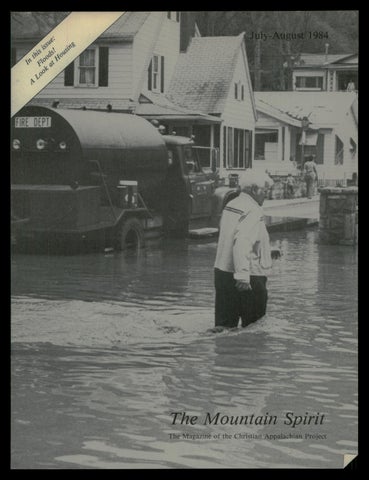
: In recent years many people and organizations in Eastern Kentucky have been looking to alternatives to the traditional housing which has been found in the mountains. This month we would like to introduce you to two groups which have found effective alternatives, Appalachia—Science in the Public Interest of Livingston, Kentucky and the Emmaus Christian Life Center of Berea. We’d also like to tell you about the severe flooding that we experienced in May. On the COVER, Father Beiting wades out to the CAP headquarters in Martin during the flood (photo by the CAP News Service); on the BACK COVER, a local farmer prepares his tractor for the hay cutting season (photo by Jordan); BELOW, two residents of the Emmaus Christian Life Center, Mary Guinn and Nannie Calico.
From Our President
I had solemnly promised our editor that I would have my column finished today. It was to be on hous ing, a subject I enjoy. I was going to write it during my annual retreat, a time of quiet and prayerful reflec tion, and felt I would would surely get it finished, and do it very well. Well, the day is nearly over, and I am finally writing my column. I must confess I did not go on retreat, and the column is not on housing. I’d like to tell you about my little in terruption, if I may. It began as an April shower, developed in to a sp rin g thunderstorm, and by Sunday morn ing, May 6 the creeks were running wild, and we had threats of tor nados and flash floods. By 10:30 Sunday evening, I was sure the town of Martin, Kentucky, where I live and where the Eastern Division of the Christian Appalachian Project is located, was going to be flooded. In the next two days my suspi cions were confirmed. Floyd Coun ty, and much of Eastern Kentucky was hit by one of the most severe floods in recent memory. Every county in which CAP works was ef fected in one way or another, but none more severely than Floyd. Here in Martin our headquarters was covered by more than five feet of muddy water. It’s been a busy week, to say the least. In addition to the work that we’ve put in on our own buildings, CAP workers have been helping our friends and neighbors in Floyd County clean up their homes, as well. I’d like to share with you a few reflections I’ve had on the whole ex perience. In 1977, the last time that this area was hit with major flooding, I lived in Lancaster, where flooding is July-August 1984
Father Beiting takes Gwen Hall to Our Lady of the Way Hospital.
less prone to this kind of severity. We got calls for help, so we gathered up food and clothes, and went to Martin, Pikeville, Harlan, Pineville—anywhere that we felt we could be of assistance. I can’t help remembering that back then we were, in a sense, outsiders. Even though some of our programs had been flooded that year, we were working as dedicated outsiders to the people of this area. This year we’ve worked as in siders. We were hurt just like everyone else. The months and months of work that we’ve done to set up our emergency shelter, our boat repair shop, our stained glass workshop, and all the rest, was under water. The work crew finish ed carpeting just three weeks ago. Now it’s all gone—ripped up and thrown away.
need anything?” I thought of Damian and the lepers on the island of Molokai. For many years he took care of the lepers, and then one Sunday he got up to preach and instead of saying, “ my dear lepers,” he said, “ my fellow lepers.” By contracting their disease he had truly become one of them, as we now have come much closer to the people of Eastern Ken tucky. Instead of saying, “ my dear people who are hurting,” I can say, “ my fellow hurters.”
But I think this has caused the people we work with to see us in a very different light. This time we’re hurting, too. Now we know the heartache and misery that so many of our friends have experienced time and time again.
For so long we’ve been the group that people can turn to in times of trouble, and they know that if it is possible for us to help, we will help all we can. Even now we’ve been able to help. The volunteers have gone about the county working with old people who have no families, to help them dig out of the mud. We’ve set up the Mountain Chris tian Academy as an emergency shelter. We’ve tried to do anything that’s been in our power to do. But it’s different this time. We’ve discovered that people feel as badly for us as we feel for them.
I talked to a lady one night while everyone in town was cleaning up, and she was concerned about me and about CAP. I had spent much of the day in a small boat, ferrying people, water, and supplies through the flooded streets of Martin. There I was, covered with mud and filth, and wearing old clothes, but she said, “ how are you doing? Do you
In times of the worst troubles you can usually find that something good comes out. This time we’ve come to realize that our trouble will lead to a lot of deeper relationships with the people we work with and live with, and these relationships will come to open up even greater opportunities for all of us to help each other. 3
** n :
The deluge graciously held off until after the Kentucky Derby, but in the two days after Ken tucky’s annual celebration of itself, the entire state was hit with tornados and heavy rains. Included here is information and viewpoints from Margaret Gabriel, Glen Edward Taul, Beverly Carter Sex ton, and a first hand account of the severe flooding in Martin, Kentucky by Father Ralph Beiting. Father Beiting’s account is italicized.
“It scares me when it gets up to the step right here, and all in this years, and halfway into that garden out there and all in them woods. 99
In some counties the flooding was the worst in history. Other places were a little luckier, but still badly damaged. By Monday, May 7 as much as five inches of rain had accumulated in some areas. From the surrounding landscape, the water poured into the creeks, the branches, and the up per reaches of the Kentucky, Cumberland, Big Sandy, and Licking river basins. Flood warnings were issued by the National Weather Service. And the floods came. * * *
Left, CAP headquarters in Martin. Above, Main Street, Martin cut off by fioodwater.
Father Beiting sets out to take an expectant mother from Floyd County to Our Lady of the Way Hospital.
July-August 1984
5
On Sunday evening, May 6 the creeks in Martin were running wild and there were threats o f tor nados and flash floods. By 10:30 p.m. I was sure there would be a major flood. A few phone calls to our CAP employees brought them to our head quarters by 11:00. We were joined by a handful o f our volunteers. Everything in the headquarters o f CAP’s East Division, a building which also houses two businesses, an emergency shelter, and volunteer quarters had to be moved to higher ground. While all o f this was going on, lightning illuminated the skies, the roar o f thunder echoed down the valley, and the rain fell. Just when you thought it could come down no harder, a special deluge came. I got to bed after one o ’clock. Some o f the volunteers were up until after three. *** At the Family Life Center in Rockcastle Coun ty, Judy and Jody Harrison, parents of ten children at CAP’s foster home for handicapped children, could see that they could have trouble. On Sunday evening they had an uneasy feeling that additional rain would cause run-off from the hill behind their house to come into the living room. By Monday the carpets were soaked, and they had to confine their children who crawl to the kit chen to keep them safe and out of the dirty water. One of the children has severe asthma, and the dampness in the house caused special problems for the little one.
Director of Maintenence, Les Larsen, loads a truck of supplies to be moved from Camp Nelson.
To the side of the house they had another pro blem come up—literally. The picturesque creek had filled with debris from the high winds and water, and was beginning to spill over the bank. Jody waded waist deep in the water to clear it. If it had been allowed to come up, it would have come into the house through the back porch, where all the children were staying because of the wet, mud dy carpets. *** The floods inundated 60 of Kentucky’s 120 counties. In place after place the scene was repeated: city streets became canals, hollows became islands, fields became lakes, thousands were evacuated, many left homeless, others stranded. ***
Father Beiting travels the waters in Martin. 6
After breakfast on Monday, everyone geared fo r the final assault. The remainder o f the fu r niture was removed. I spent the next several hours trying to get up the road that followed Right and Left Beaver Creeks. Martin now had water in the streets, and the main road was blocked. Four times I drove through water that reached the bot tom o f the car door, only to be stopped at the little town o f Drift. I could go no further. The water was still rising, and the stories o f the tragedies upstream were sickening. I saw cattle huddled The Mountain Spirit
under a lean-to. They escaped the rain, but the water was rising on their legs. People were walking from their homes, holding what valuables they could above their heads. One man placed a table on top o f his car, and then put belongings on the table. Later I saw the table floating up stream. * * *
Walter and Della Mason have lived on Brush Creek in Rockcastle County most of their lives. Walter is 78 and Della is 73. They have lived in their modest home overlooking the creek for near ly 45 of their 57 married years. Here they raised their four boys, and as Walter put it, “ lived good, Christian lives.” Walter was a railroad man until he was disabled many years ago. He took to farming, and they still keep a garden. They live a simple, but full life. From their living room, one could see the creek out the window. The heavy rains had turned it into a muddy torrent. The water had swollen out of its banks, and was swiftly engulfing trees and sweep ing away debris that had littered the banks. Della said that sometimes she was afraid of the rising water. “ It scares me when it gets up to the step right here, and all in this yard, and halfway into that garden out there and all in them woods. It’s a scary lookin’ time to me.” “ It don’t ever bother me that way,” added Walter with a grin. “ I’ve said, ‘now don’t you ever walk away and leave me here alone,” ’ Della replied. “ I don’t like to stay here by myself when the water’s way up that way.
Water service in Martin was stopped for several days. The Red Cross provided water which was distributed to the people by the National Guard.
The Jessamine County road department built an access road to allow several families to escape the rising water of the Kentucky River. Later in the day the trailers were moved to higher ground at Camp Nelson.
July-August 1984
7
“ But it’s never got in the house. It came up to the front step once, but never got in the house.” “ That was the year it took out the old county bridge at Brush Creek. I’ve got the number of that bridge,” he said. “ It’s a big iron piece. They give it to me, and said I could have it. Now they got that big concrete bridge.” Walter said that in years past he would park his car on higher ground when the water started to rise. “ I used to park it just out of sight there, near the railroad,” he said. “ But I can’t do that now, everything would get stole off it.” “ We’ve been robbed three times,” Della said. “ Each time we were robbed we had gone to church, so whoever it was knew we were gone. The last time they tore the house all to pieces. My cur tains were even torn down. The mattresses were rolled up. It just looked like a storm had been here. I’m scared that we might come home and surprise them, and they would kill us out here. Nobody would ever know who did it. Times sure have changed.” Della may be afraid of high water, but this new kind of threat, thieves, is their main concern. For 45 years they have lived near the creek and they know its dangers. They know that when the rains set in that the creek will rise; they expect it. But this new danger comes without warning. They feel helpless against it. Della and Walter will never consider moving away from the threat of high water and away from their isolated home. They, like their neighbors, will passionately hold on to their home and patch of ground. There is an old saying that goes, “ Hail and high water ain’t gonna make me move from this spot!” In Della and Walter’s case, it could be added that thieves won’t budge them either.
Buildings in the valleys at Camp Nelson were under water by late Monday evening.
On Monday morning we set up the Mountain Christian Academy as an emergency shelter. The school is a mile from downtown Martin, and on high ground. We checked with the workers there and found that they needed blankets and food. By 3:30 in the afternoon the water was waist deep on Main Street. With one o f our workers, Calvin, I waded out to CAP headquarters. It was a discouraging sight. We had worked so hard to bring this facility about, and now it was ruined.
***
By Monday afternoon the National Weather Service was warning that the Kentucky River would crest on Wednesday at about ten feet above flood stage. With this report, CAP’S maintenance department knew that evacuating the buildings at Camp Nelson, CAP’S recreation center on the Kentucky River, was inevitable. An “ all hands on deck” signal was sent out, and many of the main office workers traveled about fifteen miles north of Lancaster to salvage the things that had been moved back to Camp Nelson after floods in 1978 covered every building except one. A large truck of clothing, which was stored in one of the buildings, was packed to be sent to Floyd County, where families had started to evacuate their homes. *
8
*
*
We needed a boat and motor desperately. We managed to get into headquarters, where we had a 12 fo o t boat and a small motor. Before long we had a means o f crossing from one section o f Mar tin to the other. As Calvin and I were traveling through the water—the current was running at about 10 miles an hour— we heard a man and woman yelling at us from a roof top, “Can you please come and save us!” They went back to the second floor and we were able to get them into the boat through the window. Then we saw four more people on a balcony—a husband, a wife, and their two grown daughters—also screaming to be rescued. We got the first couple over to the bank, made arrangements fo r them to be taken to the Mountain Christian Academy, and went back for the other family. *
*
*
The Mountain Spirit
adventure! That piece o f advice did very little to calm their fears. There were people watching us from second story windows, and shortly the emergency rescue squad came and got us out o f the water. *
*
*
Eight people died as a result of floodwaters, four of them in Eastern Kentucky. One woman drowned in Pike County, when she was apparently swept out of her home by floodwaters. Two men drowned in Owlsey County when their car ran off the road near Booneville and sank in the flooded South Fork of the Kentucky River. *
*
*
For three days CAP workers were kept busy drying out rummage stores which had taken water and residential programs that are situated next to low lying creeks. The basement of the adult hand icapped workshop in Somerset had taken a foot of water. Compared to other places it seemed minimal, but the workers used the basement to store baskets which they will be selling in the fall to raise money for their program. They’ve been working on the project for over a year.
A Martin resident surveys CAP’S damages.
As the rain began to ease on Monday evening the rivers started to withdraw in some areas, although in others the run-off from the hills kept the water rising. By the end of the week the rivers had receded from most areas, taking tons of soil, and leaving soil, millions of dollars in property damage, disrupted lives, and death. *** The mother and father asked us to take the girls first. We got them both in the boat, but they were scared to death. We told them to be very quiet because once we got out to the Main Street the current was awful, but when the boat started to rock the girls panicked. With that we started to fill with water, and the boat turned over. All four o f us were in the raging stream, floundering and being swept along by the strong current. I grabbed the boat, and Calvin got hold o f the girls. I was surprised to see him let go o f them, and grab a telephone pole. Later I learned that Calvin doesn’t know how to swim. Still holding the boat with one hand, I grabbed the girls and got over to the sidewalk, which is about four feet above street level. We were able to get our feet on the ground, and hold on to a door handle. The water was up to my waist. I tried to calm the girls, telling them that there was nothing to worry about, and to think o f the excitement o f telling everybody about their July-August 1984
By Tuesday morning the western area of CAP had lost touch with Martin. All day, when the news was at its worst, reporting loss of property and life, the main office in Lancaster had no phone contact with the folks in Martin. *** On Tuesday morning, after we’d rescued our boat, two volunteers told us that they’d heard that a man was dying at the Senior Citizens’ Home. We sent word to the hospital that we would take a doctor and nurse over to care fo r the man. Later in the week we learned that he had lived, and was improving. One man’s wife was expecting a baby, and he hadn’t been able to see her fo r a day-and-a-half. We took him to high ground where he was able to travel home to see about her. There was another lady expecting a baby, already in labor. We took her, her husband, and her midwife to the hospital in the boat. Meanwhile, the hospital sta ff couldn ’t get through town, so we carried nurses and doc tors across. The whole day I ran the boat back and forth taking people here and there—the mayor o f Martin, the chief o f police, the National Guard, doctors, nurses, women having babies. *
*
*
Thousands of people were left stranded or homeless by the floods. About 1,500 families were evacuated from their homes in Floyd County, about 1,000 in Pike County, and 1,000 in Breathitt County. Up to 500 families were stranded in the 9
Top to bottom: Volunteers arrived from Cleveland in time to help with the clean-up; everything was taken out of headquarters to dry in the sun; soaked carpet padding had to be taken out and thrown away.
remote mountain hollows of Pike County because of washed out bridges and roads, and landslides. Temporary shelters for the homeless were prepared in churches, schools, dormitories, city halls, and even jails. Public services were crippled. People were without water and electricity, and roads and bridges were destroyed. County officials say that it will take millions of dollars to replace. Pike County Judge-Executive told Gov. Martha Layne Collins, “ We can’t cope with that.” Unless help from other sources is received, counties will not be able to get back on their feet. *** The Hale family of Garrett, in Floyd County, had been staying at the Mountain Christian Academy since Monday. The staff of the school hoped to have all of the people there relocated by Saturday so they could hold classes on the follow ing Monday. As of Thursday afternoon, though, many still had no idea of where they would be able to go. Since entire families live close to each other in small hollows that had been filled with floodwaters, staying with kin folks wasn’t even a possiblity. People whose homes had been damaged, but were still standing needed everything—food, clothes, cleaning supplies. The Red Cross had sent disaster services representatives from many places, but the damages were so severe, the roads so inac cessible, and the counties so large, that they were having a difficult time meeting needs as they arose. *** On Wednesday we began the clean-up. By that time the water had all gone down out o f the street, and I went around to look at our places. God, it was a mess. All these other people around Martin and all over were in such misery. There were old people with no one to help them clean up. The volunteers spent the whole day going around, helping people get things pulled out o f the places, getting the dirt and filth out. This is the price Eastern Kentucky pays fo r ex istence. People ask us, “Why don’t you move away?” But, to where? Once every ten years or so, we know we will be hit like this, but the rest o f the time it’s a good place to live. You pay the price fo r living in the mountains, but the people will come back, and fight back, and they will rebuild again. 10
The Mountain Spirit
Letters The story of Mr. Ledford’s life was so very interesting to me. It gave me the needed push to start working on a history of both my mother’s and my father’s families. The more I write down—only in note fashion, the more I remember my grandparents telling me. They were born in 1850, ’52, ’53, and ’65, so they do cover some ‘‘old times” in Ohio, Indiana, and Kentucky. And I have memories of my own as I am 76 years old with with four great grandchildren.
I just got through reading about Gary. I wish I had known about CAP Group Home when our son was younger. He wouldn’t be where he is today. He is somewhere for something he didn’t do. We are try ing with the help of our Lord and praying he will be out soon. He is twenty-four, and he is a smart boy and is a hard worker when he can get a job. Please pray for him. I sure enjoy your Christian paper. Keep up the good work. May God bless you. Anna M. Edwards Augusta, K Y
This was the first issue of The Mountain Spirit I’ve received—en joyed most of all the “ I Am a Cherokee” article. Hope to get the back issue that covered Harlan story—my birthplace. I was in Harlan in 1982 on Memorial Day, after the Worlds’ Fair and family reunion in Oak Ridge, Tennessee. I have a family portrait of my great paternal grandfather Napier with his half-Cherokee Indian wife, and nine children. My great grand father Snodgrass of Pensington Gap, Virginia was a traveling evangelist, on horse. His shoes were frozen but feet were spared. I went to Kentucky School for the Deaf for 2 years and graduated. I was there in Danville, and wanted to visit CAP.
See “ Gary” March-April ’84.
I particularly enjoyed the last issue of The Mountain Spirit, con taining the article about Jesse Stuart. He is one of my favorite authors. I’ve collected as many of his books as I can find and am searching for others. I always thought of him as one of our greatest contemporary Americans. He wrote of his people with such dignity, sen sitivity and understanding. When reading his books, I was always aware of deep inner strength, a great feeling of compassion and humility; to me a true mark of greatness in any person. His love of the land and his people is a lasting tribute to Jesse Stuart. Dorothy Lackey Brookville, OH
I love every page of your magazine, print some stories of your volunteers; who they are what they did before. Tell us more about your Attic stores and the people you help. Your work is terrific. Wish I were rich to be able to do for your cause.
I grew up in Lexington and Father Beiting conducted my senior class retreat in May of 1958 at Lexington Catholic High. I came to St. William parish that summer for Bible School as an aide to the teachers. I never really forgot Father Beiting or his wonderful love for the people of Appalachia. It’s good to see how far his work has come over the past years. I will try to help CAP as much as I can, and reading The Mountain Spirit helps me see how God works in and through us all.
Naomi L. Bailey Gran Blanc, M I
Rita Jordan Mousiva Naperville, IL
Dorothy Elkins Hawthrone, CA
July-August 1984
Norma Dailey Helena, M T
I enjoy reading of all your ac tivities, also the fact that many of the workers are members of dif ferent churches. It shows that peo ple of different beliefs can work together for the good of all. Alice B. Harris Kansas City, KS
I find The Mountain Spirit helpful in so many ways, i.e., to lift my own spirits when I read of these courageous people and your work. Further, I am a teacher and used “ I Am a Cherokee” with my sixth grade class to show them another person’s search for their ‘‘roots.” It was the basis for a successful lesson. Thanks! Mrs. J.H. Sanders Green burg, PA
Letters to the editor are welcome.
They should not exceed 150 words in length, and we reserve the right to edit them fo r space. Address letters to The Mountain Spirit, Christian Appalachian Project, 322 Crab Or chard Road, Lancaster, Kentucky 40446. 11
News o f Our Neighbors When it was started by the Church of the Brethren and the United Methodists, “ All we knew at the time was that there were a lot of people in Clay and Jackson counties who lived in bad housing, and we felt like the church ought to be con cerned about that,” says Rev. Dwayne Yost, executive director and a founder of Kentucky Moun tain Housing Development Cor poration in Manchester, Kentucky. Then, more than two-thirds of the houses were officially considered to be substandard. Their plumbing was incomplete; some had running water, but many lacked hot water or a bathroom; they were partially in sulated; or the house was too small for the number of persons living in it. Although the percentages are still far above the national average, substantial progress has been made in providing better housing for the residents of the counties.
Dwayne, a Church of the Brethren minister, came to Ap palachia on a special assignment in 1960, but stayed to work with the local people. In 1972 his church per mitted him to remain and work full time toward getting decent housing for the people in Clay and Jackson counties. The area of these counties stretches eighty miles north-south and about forty miles east-west, Dwayne says. About 40,000 people live within these boundaries, and they make their living as small farmers, coal miners, businessmen, and public servants. However, about fifty percent, Dwayne says, are receiving some kind of public assistance, and more than half of
Courtesy of KMHDC
The poor dwellings in which peo ple live has been an enduring, albeit incomplete, image of living condi tions in Appalachia. Whether it be a log cabin, a tar-paper shack, a
delapidated wood-frame house, a mobile home, or a converted school bus, the place is usually too small, unsafe, unsanitary, and unattractive for the person or family living there. From its inception in 1973, KMHDC has sought to improve housing for low-income families in this corner of Appalachia.
Affordable Housing for the Poor
by the CAP News Service
the families have incomes of less than $3,000 a year. Dwayne says that at one time more than eighty percent of the population was below the poverty level. In 1982 the earn ings of sixty-eight percent of the people in Clay County were below the poverty level. “ It is these kind of people we are trying help,” Dwayne says. His intimate knowledge of Ap palachia’s resources, his effective o rg an iz in g sk ills, and his background in construction has helped make the goals of this Ohio native a reality. KMHDC has com pleted 162 new houses and has restored 140 houses since 1973. And since 1979, it has averaged twentytwo new homes and eighteen major restorations a year, Dwayne says. The main thrust of KMHDC is to help a low-income family to plan, to obtain financing, and to construct their house at the lowest possible cost. “ We try to meet the people where they are,” Dwayne says.
Rev. Dwayne Yost visited a family before it moved into a new KMHDC house. 12
All the houses are owned by the person or family. “ We believe in the concept of home ownership. We think it’s better for a family to have a chance to own their house rather than rent it,” he says. The Mountain Spirit
The people are able to buy their homes with low-interest loans from programs administered by Farmers Home Administration (FmHA), or more recently, KMHDC’s Home Loan Fund (HLF). In the past few years, it has become more difficult to get loans from FmHA, Dwayne says. So KMHDC’s board of direc tors voted to begin another financ ing mechanism to help those who are unable to get financing from FmHA. During the previous three years, KMHDC has been able to raise its own financing for twentytwo homes. Last year it financed eight new homes through HLF. The average loan was $15,582, and the average income for each family was $4,896 a year.
period of time, Kentucky Mountain Housing must either hire them or help them find em ploym ent elsewhere. This, in addition to the generosity of volunteer workers, keeps labor costs to a minimum.
Many people would think that making loans to low-income people would be a bad risk, but Dwayne says that people with low incomes are good risks. With one exception, payments on outstanding loans are current, and no one has defaulted on a FmHA loan.
Volunteers have been a vital part of their programs from the start. The groups are a varied mixture, coming from individual churches and from the denominational level, and are composed of twelve to four teen adults or teenagers. They come for a week at a time. The main re quirement for any group coming is that for every five people who come to work, one must be skilled in carpentry.
KMHDC has had a secondary ef fect on the life in these two Ap palachian counties. It has provided employment for unemployed ar tisans and training for others. Of the twenty-eight employees, fifteen were w ithin federal poverty guidelines and all are natives of the counties that KMHDC serves. In addition to the employees, KMHDC is sponsoring seven trainees under a federal program. After a fixed
Taul
A screening committee reviews all applications for assistance. If ten tative approval is given, then the ap plication is referred to the KMHDC board for final approval. This fifteen-member board is comprised of church and community leaders
and five recipients of KMHDC homes, all of whom serve two-year terms. To qualify a family must have an income below poverty guidelines established by the federal government.
Without assistance from churches and church organizations, Kentucky Mountain Housing would be unable to help a broad spectrum of lowincome families. Churches, Red Bird M ission, C hristian A p palachian Project, Church of the Brethren, and the Commission on Religion in Appalachia provide ten percent of KMHDC’s operating budget. “ We look at the church money as the glue that holds us together,” Dwayne says. “ It gives us flexibility. We can use it to help those people who don’t fall into the categories of other agencies.” More than half of his approx imately million dollar budget is generated from co n stru ctio n receipts, and another significant portion comes from federal and state governments.
Dwayne inspects the building of an $18,000 house.
July-August 1984
While some groups may frown on a Christian oriented organization using government money to ac complish its goals, Dwayne believes it is essential. “ It helps us to do far m ore th a n could be done otherwise.” However, as the writer of Civics fo r Americans concluded about KMHDC, the involvement of private citizens is equally important. “ New homes were built because private citizens used government programs to help them reach their own goals. They were built because citizens like Reverend Yost and other community leaders worked together.” 13
The CAP Closeup
Harriet Kidney The Gift o f Understanding
Gabriel
by the CAP News Service
A
lot of talking is done today about the wisdom, knowledge, and experience that older Americans contribute to our society. This point of view comes into sharp focus when one meets Mrs. Harriet Kidney, education coordinator of the CAP Group Home at Camp Nelson. Mrs. Kidney gives the boys at the Group Home many gifts, but she says the greatest is understanding. “ I probably understand them a little bit more than they understand themselves. I worked as a police woman, and that gives me the other side of the picture, the side that they’re coming from. It gives me a realistic view of the situation.” Mrs. Kidney laughed as she said that the greatest gift that the boys give to her, too, is understanding. “ It works both ways. I think they understand my need to be part of the scene.” Mrs. Kidney’s students are boys who have been in trouble for much of their lives, and come to the Group Home to try and change themselves before entering adulthood. “ With boys like these, where so many of them have had an unhappy experience v/ith their parents, it’s the grandparents that have tided them over. So many of them relate to me, not as a person, but as grandmother. It’s odd, but then again, I suppose it isn’t.” August will mark Mrs. Kidney’s seventieth birth day, but thoughts of retirement are far from her mind. “ A lot of people who retire, unless they have a plan, regret it sometimes. My disposition is not marvelous, at best, and sometimes I think that if I were allowed to sit still I would just deteriorate into a mean old woman!”
Over the years, there have been legends that have grown up around CAP regarding certain people, places, and situations. One of those legends has to do with Mrs. Kidney’s first en counter with Moe Mercier, who was the director of the Group Home from 1974 to 1983. Legend has it that Mrs. Kidney was sitting on a crate at the Camp Nelson Recreation Center when Moe came up and introduced himself. Shortly thereafter, he invited her to work at the Group Home. “ It was actually the top of a barrel,” Mrs. Kidney said, putting the legend to rest. As a student at Regis College in Worchester, Massachusetts, Mrs. Kidney, who was a biology major, asked to be allowed to take some education courses. “ I got in the education courses—I don’t even know why I asked to take them—and I even got in some practice teaching, which has saved my life!” Although she is a transplanted Easterner, Ken tucky has held a special fascination for Mrs. Kidney, and for her children, for many years. While working with the Connecticut State Police Department, she met and married Dr. Jim Kidney. “ He decided that he didn’t want to remain in general practice, and got a job in Virginia as a health officer. We were right in the coalfields, and we liked it very, very much.” The family moved around the country for a few more years, and when there was a job opening for Dr. Kidney in Letcher County, Kentucky, they moved back to the coalfields. Mrs. Kidney worked as the school librarian in Cumberland “ and I liked it tremen dously. I liked the people, I enjoy the mountain people. Jim wanted to move on, so we went back
to New York state. About a year later he passed away, and I said to the kids, ‘where do you want to go? Back to Kentucky, Mother,’ they said. So I got a job in Bardstown.” After working in the Bardstown school system for several years, Mrs. Kidney met Moe and moved to Camp Nelson to work at the Group Home. After her eight years as a counselor and teacher at the Group Home, Mrs. Kidney feels that it is her total honesty with the boys that is sometimes hard to take, but ultimately appreciated. “ Once they simmer down to the fact that I care for them, and the honesty is part of caring, then it’s all right.” Mrs. Kidney feels that part of her job, and one area that demands total honesty, is in setting career and education goals with boys who have known only failure in school. “ They’re here to turn their lives around, and this personal work goes along very much with their education pro gress. The boys see it as an extension of their per sonal progress. We try to coordinate the two, and you can see that when they start with one, they will start with the other. It just seems to be a general enthusiasm that they finally get, ‘Well, I’m here, I’m going to make the best of it, I’m going to do a good job.” It’s amazing to talk with Mrs. Kidney about her work and her students. It doesn’t take long to see how much she cares for them. She draws strength from her own life, and her own children, and tells the boys, “ Every experience that you have, if you learn from it, you can turn it to profit later on. I think with a little bit of luck, I’ve been able to do that, and I think, perhaps, I can give them a little bit of understanding.”
On the Wilderness Trail
Reviving Hope Through Housing
W h e n Daniel Boone blazed the Wilderness Trail in 1775, it opened a passage way for people to migrate from the east to central Kentucky. As the number of people increased and stations were founded, branch roads were created that allowed settlers to go further west. The first spur off the trail began about where London, Kentucky is now and continued to Stanford via Mt. Vernon. A sec tion went through a valley paralleling the Rockcastle River. Here among the picturesque rock formations once roamed the Cherokee In dians, using the area to hunt bear and buffalo and the hill tops to bury their dead. Here, too, a group is presently trying to give a small Appalachian community a new hope for self-determination by providing examples of alter native ways of living. “ I think some hope is return ing,” says Father Albert Fritsch, S.J., founder of Appalachia—Science in the Public Interest (ASPI). Father A1 has been headquartered in Liv ingston, a town of about 300 people, since 1980. Of his work he says, “ We feel it’s a challenge here. We don’t have much money, but we can give them a little hope.” The small revival of interest in resuscitating a community by the inhabitants tells him that “ they’re beginning to sense that we’re here to help them, and live, and make it a place of living. Therefore, it’s [ASPI] not just a pass through operation.” ASPI owns land in the valley bordered by the Rockcastle River. From the river the land is relatively level for a hundred yards, more or less, but then it changes to steep undulating slopes. There is not much left to the valley with respect to people. In the early 1970s, after 1-75 was built, no buildings existed in the valley, and the land is considered generally unsuitable for farming, but “ we’ve got some good land for building,” he says. ASPI hopes to repopulate the valley. But Father Al’s organization has a broader vi sion, a vision that is not confined to the narrow scope of a mountain valley. Through the develop ment of experimental housing, he is determined to show how Appalachians can live inexpensively and in harmony with their environment.
Story and Photos by Glen Edward Taul 16
The idea of trying to build the same kind of house from Alaska to Florida is wrong, Father A1 says. He believes that strip mine operators are mistaken in thinking that a shelf or other level space needs to be created in order to build a house. And houses in the mountains should not be built with the idea of using municipal water and sewer systems, because the population is scattered and it would be too costly; furthermore, only the com munities that screamed the loudest would get the The Mountain Spirit
systems. Since 1979 ASPI has completed two houses, and another was started last summer. The structural design of one house is basically Appalachian. It is a modified form of an Appalachian pole-house, a house that is supported by poles wherever it is un supported by earth. There is an eighty-inch seam of coal in the hill, but they did not want to hurt the land or mine the coal as an excuse to build on the land. “ We wanted to prove that you could build a pole-house on a steep slope area, therefore making it unnecessary to have the area strip mined,” Father A1 says. The land was left undisturbed as little as possi ble, too, because the house stands on slip prone land. Without the trees, earth saturated with water could easily slide into the river. So the house was built with the trees remaining. The soil also has a low percolation rate, mean ing that water filters down through the clay soil slothfully. This condition makes it difficult to use regular toilet facilities in houses. “ We put a big emphasis on compost toilet systems.” They use lit tle water and the material can be used as fertilizer. The house’s appearance, both inside and out, is primitive because they lacked all the necessary resources. But “ ours is a different philosophy,” says Father Al. “ We use native material, we build it simply, and we use it in a way that is en-
An intern from Indianapolis, Indiana works on ASPI’s low-cost cord wood house. It is along the valley road once used by pioneers going westward.
vironmentally compatible with the soil.” The house was also cantilevered like a bridge. The weight of one side was counterbalanced against the other side so that even being a pole house, it could hold up a heavy load. The exterior is designed to depend on the sun for energy. Because it is a solar house, deciduous trees are needed. “ We’re south of the Ohio River, and we’re in an area where you begin to think of energy requirements for temperature control in the summer and the winter,” Father A1 says. The house is very cool in the summer because the leafy trees block out the sun. In the winter the leafless trees allow the sun to heat the house. A wood burning stove is used as a back up. A cord-wood house is being built as an example of inexpensive housing for low income families. The house is being built up against a hill side. It is a rectangular structure with rounded ends, and the walls are composed of cord wood cemented into place. The house is being built mostly by volunteer labor.
Fr. Al Fritsch explains the two-man Yurk.
July-August 1984
There are plans to build a house with a geodesic dome type structure at a cost of $4-$5 a square foot. A Yurk, a round house based on a Mongolian tent, has a capacity for two people and was built for $10 a square foot. 17
This house is based on the traditional pole design that is common in Appalachia. Flowers and vegetables are grown in the green house underneath, and solar collectors on the roof and front supply most of the energy.
Many residents laugh at the houses when they come by, Father A1 says, but they become serious about it later. The reason: “ We made a home within reach of the average person. They don’t have to be deeply in debt to buy a house.” There are individuals in the area who plan to build on many of the principles demonstrated in ASPI’s three houses, and several solar projects have been started in the area. They have slightly different methods, but to Father Al, it is en couraging to see them using alternative sources of energy. A native of northeastern Kentucky, Father Al became a Jesuit priest in 1967 and started his ministry in Washington, D.C. with the Center for Science in the Public Interest. He has also worked with a Ralph Nader organization, the Center for the Study of Responsive Law.
of environmental issues. At first he was concerned only about lead in the environment, but it has broadened to encompass humanity’s use of energy. Father Al also believes that concrete solu tions are needed for environmental problems. In the past much of the action taken by environmen tally minded groups merely attacked the people and policies causing the problems. “ That gets you in the whole area of looking for alternatives,” he says. And the alternatives they found have been published in books which describe methods of simple living. Many of the suggestions have been im plemented, Father Al says. “ We’re now trying to put on a practical level, what we’ve said in theory and books.”
“ I have a doctorate in chemistry, and I’ve tried to apply my training to environmental chemical problems, for example, mercury in the environ ment, emissions from leaded gasoline, and toxic materials of all sorts.”
Being headquartered in Livingston, working with local people, and using local resources, ASPI is committed to establishing its experimental, practical, and inexpensive way of living at the grass roots level. It’s slower working from the grass roots, but “ I think in the long run, it will have a greater impact on people,” he says.
Over the years he has grown in his perspective
When change is imposed from the top, it is inef-
18
The Mountain Spirit
fective and ephemeral. He has found that whenever a planner in a federal agency, such as the Appalachian Regional Commission, decides on what is good for the people, the effort will con tinue as long as there is available funding. But when the money disappears, the whole effort col lapses. “ It just comes tumbling down like a house of cards,” says Father Al. There is nobody left who has had the experience in keeping the projects going. This has been Father Al’s major criticism of the liberal Democratic tradition, which tries to solve the problems by change from the top rather than from the grass roots. But he says the Reagan Ad ministration is not any better because it is not a part of Reagan’s policy to provide federal help. Federal assistance has virtually disappeared under Reagan, but ASPI has raised enough money through talks and the sale of publications and ASPI’s “ Simple Lifestyle” calendars to replace the lost federal money. ASPI occasionally gets a few grants for projects, but there is need to develop projects first to see if they will work. That is why science is in ASPI.
“ It’s a struggle, a real struggle,” says Father Al. But they survive by using volunteer labor and having a staff that is paid volunteer wages. Volunteers, both temporaries and interns, find out about ASPI through social action newspapers such as Community Job, through environmental newspapers such as Environmental Opportunities, and through directories like Good Works. Tem porary volunteers, who serve less than six months, come primarily from Ohio, Illinois, Minnesota, and Michigan while interns, serving longer than six months, come from all over the country . They now have interns from California, Indiana, and Minnesota. Like the pioneers, Father Al’s group is blazing new paths to restore the hill man’s sense of selfdetermination. Although their alternative ways of living resemble former modes in Appalachia, they have been modified, with the help of twentieth century technology, to be compatible with the en vironment. Like the pioneers, too, ASPI is using local resources, be it material or human, to ac complish its mission and by Christ-like determina tion and ingenuity, it is prospering.
This cord wood house is being built as an example of a low cost house by ASPI. It is being built by volunteers.
July-August 1984
19
A Thought From The Editor
Charitable organizations routinely speak of housing as one of the basic necessities of human life, as indeed it is. Dozens of groups in Ap palachia are devoted exclusively to housing in the mountains. Many more—CAP included—devote time, money, and materials to building or repair ing homes for low income families and elderly people. It isn’t so much the aspect of a house that makes this element so important. It’s the concept of home. A certain helplessness grips folks when they don’t have a home. Not that they’re unable to care for themselves or help themselves. It’s not that easy to put your finger on it. When talking with a homeless person or family you sense that their identity is in jeopardy. They begin to loose dignity and self-worth. When I visited the Mountain Christian Academy during the time it was being used as an emergency shelter for flood victims, there was a strangely subdued atmosphere all around. Some of the people had been living at the school for four days and still had no idea where they would relocate. The Red Cross, CAP, and other organizations had provided clean clothes, food, and a place to sleep, but the security of not having a home weighed heavily on the whole group. Even the preschoolers seemed to sense that something was very wrong. Pride in one’s home is a very real factor, too. When I was a volunteer I met some children from a very large family in Garrard County. I knew they didn’t have much in the way of material possessions, but it was marvelous to see the kids relate to each other with a great deal of love and respect. I worked with one of the boys in a youth group for several months. As is the case with so many of CAP’S programs, we provided transpor tation for the group, and his part of the county was on my route. This kid—I’ll call him Tom—always met the van at the head of the lane going back to his house, and insisted that I drop him off at the same spot. At first I was thankful 20
for his thoughtfulness. It was a “ picturesque” country road with only a little gravel to indicate its path. One day, though, when he absolutely in sisted that I drop him off at the end of the lane in a pretty good rain I got the idea that consideration was not his major motivation. Several months later I had occasion to take Tom’s sister home, and I got to see where they liv ed. It was a small house—surely too small for their large family—that appeared to have seen better days. But then I noticed a bunch of kids playing in the yard and Tom’s mother working in a flower bed. When Tom saw the van he ran into the house, and suddenly I realized that he was embarrassed by his home. As I chatted with his mom, I got sight of Tom looking at me through the window. I winked at him, and he smiled weakly, but never did come out of the house. As I drove back to the volunteer center I thought of all the things I wished I could have said to Tom. I’d have told him that he was bright and talented, and if he wanted a better looking house when he grew up, then he surely had the resources to work for it. But a better looking house is no better than a shack if it’s a home without the love and respect I’d seen in his family. The next time you hear someone talking about housing as an essential ingredient in human life you might think about it in terms other than just a place to go, or sleep, or hang a hat. Decent hous ing is all of those things, of course, but it has many more implications than just the physical aspects of life. Wrapped up in housing is the idea of home, and all of the psychological, emotional, and spiritual nuances that that wonderful word implies. —MMG. The Mountain Spirit
around the project
by the CAP News Service
Kids Flock to Camp AJ This Summer
A new camp has started this year, too. Camp Rebecca Boone, located in Floyd County, on Dewey Lake, will hold four one week sessions for thirty children each week. Children from Floyd, M agoffin, and Johnson counties will be attending Camp Daniel Boone.
JACKSON COUNTY—Do you remember the time when you went to summer camp and enjoyed canoeing, swimming, hiking, games, singing songs, and listening to ghost stories around a camp fire? Youngsters from southeastern Ken tucky are enjoying these very things at Camp Andrew Jackson. CAP’S camp, near McKee in Jackson County, began its twentieth season on June 11 when about sixtyfive teenage girls came for a week. After a one-week recess, camp ses sions resumed with three weeks of camping for boys, which will be followed by three week-long ses sions for girls. Campers between the ages of 7-14, are coming primarily from CAP’s eight county service area. A few bunks are reserved for children from other Appalachian counties as well. The counselor is the person most directly responsible for ensuring that each child’s experience is broadening as well as fun. “ You are the person most responsible for helping them to have a good time,” says Peggy Abate. In the previous summers, Peggy has worked as a counselor at Camp AJ, but this summer she has new responsibilities as the assistant director of the camp. She is assisting Ellen Howe, a former CAP volunteer, now a teacher in St. Louis. A counselor stays with her kids twenty-four hours a day during their five-day stay at camp. “ You sleep with them, join them in their ac tivities, eat with them, counsel them,” Peggy says. Each day of camp is filled with activities. During the day they swim, canoe, and study the Bible. In the evening the children go roller skating, or sit around the camp fire July-August 1984
Summer camp has always been one of CAP’s most successful pro grams. Through it we’ve come to know children and families a little better, and through the knowledge we’ve been able to better know and serve the people.
Farmers’ Market Enters Fourth Season Some of the campers from Cliffview Lodge have fun with a frisbee.
and sing songs or tell ghost stories. A joy for a camp counselor is when a shy, homesick child becomes more open by the end of the week. “ It’s satisfying just to share part of my life,” says Peggy. At the end of each week, every kid is recognized for some outstand ing personal quality. “ We try to find something to praise about each one,” Peggy says. Awards are given for the best Christian witness (the top award), or the biggest smile, or the best cooperation. No one goes away without being recognized for something. A similar camping program is held in Garrard County at Cliffview Lodge on Herrington Lake. But Camp Cliffview, as it has come to be called, is designed specifically for deaf children and teenagers. Most of these children go to school together at the Kentucky School for the Deaf in Danville, and truly value their camp time. It gives them an opportunity to see their friends from all over the state, and to par ticipate in activities just like hearing children.
STANFORD—As spring fades into summer, the fall is close to follow. These are the seasons of harvest. It is time to enjoy fresh vegetables and fruits. Fresh produce, of course, is more wholesome than canned or frozen, and is usually cheaper when you can buy directly from the grower. To provide this opportunity, Lincoln Countians, with the help of CAP, hold a farmers’ market each year. Beginning in the last week of June, big producers like orchard growers and small, such as family gardeners, gathered in the parking lot of Pizza Hut in Stanford to sell their surplus fruits and vegetables. This is the fourth year the Lincoln County Farmers’ Market has been held, says Gil Rosenberg, who was market master for the first two years of the four that the market has been operating, and co-market master for the past two. The producers set up their own stands and price their own produce. They are open from 4 p.m. to dusk, Tuesdays and Fridays. By July 4th, “ we hope to have sweet corn for sale,” Gil says. Craft items are also on sale. 21
around the p ro je c t . . . continued
CAP gives them a sign, matching funds for advertising, volunteer ser vices, and helps the sellers find loca tions for their market. Gil also helps them with various promotions such as bands, free homemade apple cider, and a watermelon seed spit ting contest during the season. The local Farm Bureau Insurance Com pany pays for the merchants’ license. Gil tries to involve participants of CAP’s Be-A-Seed program with farmers’ market by encouraging some of the better gardeners to sell some of their produce. Future possibilities include developing a larger marketing system that would be centered in Lexington, and becoming involved in Berea’s farmers’ market. This year CAP is providing the sign for the Berea market.
CAP Awards Scholarships to 19 High School Seniors EASTERN KENTUCKY—The Christian Appalachian Project has awarded $1000 college scholarships to nineteen high school graduates in recognition of their community ser vice activities in their home coun ties. The scholarship fund was started by CAP in 1975. In each county where scholarship money is awarded a local committee of educators, business people, and church leaders select the recipient. The young men and woman who have been recognized in 1984 have worked at their churches, in 4-H, and in Scouting programs. “ Most have been involved through their churches with the elderly and the handicapped,” says Lew Phillips, who coordinates the scholarship program for CAP. “ Most of their ambitions as far as school is con cerned have to do with skills which will enable them to come back to the community to help the people still further. 22
This gardener will sell much of his produce this summer at Lincoln County’s Farmers’ Market. It started four years ago in Stanford with CAP’s help.
CAP salutes these outstanding young people, wishes them success in their academic pursuits, and thanks them for all that they have contributed to the well-being of their communities.
CAP Programs Are Clowning Around LANCASTER—The children at the Sunshine Center had a wonder ful treat waiting for them when they came in to nap after their playground activities on May 17. Waiting to talk to them was a real circus clown. Bill Hanna was CAP’s guest for three days the week of May 14. He had a busy schedule, visiting CAP’s five child development centers, two homes for handicapped children, and one of the group homes. One evening he conducted a workshop for the child development staff and taught them various ways to present the parables of the Gospels through clown techniques. Bill traveled as a clown for three
years with Ringling Brothers/Barnum and Baily Circus. His marriage to a woman from Louisville, Ken tucky led him to give up traveling with the circus and settle into “ free lance clowning” and other, more conventional types of theatrical work. Gerry Cooper, CAP’s new direc tor of the Family Life Retreat Center, invited Bill to visit. Gerry came to CAP after serving as pastor at Fourth Presbyterian Church in Louisville. He knew of Bill’s ex perience in Christian clowning, and thought that it would be a good tool for CA P’s child development centers. The associate pastor at Fourth Presbyterian, which is Bill’s con gregation, got him involved in Christian clowning. “ It’s kind of a new approach, it’s a way to involve the youth, to give them something exciting to pursue,” Bill says. “ I think it’s very rewarding. Be ing a clown is a good model for a Christian life. It’s an innocent, child-like approach to a Christian The Mountain Spirit
around the p ro je c t . . . continued way of living. There’s a total belief there, kind of a blind stumbling along. In approaching religion as a child it opens you up. You can see the wrong moves that you make, or the right moves that you make, rather than being confused as in the adult world. There are so many things to think about. In the clown world there are only two or three things to think about.”
Moving? Please notify us of change of ad dress to make sure you receive every issue of The Mountain Spirit. OLD ADDRESS please print
name address
Bill’s performance at the Sun shine Center was wonderful. He’s an excellent juggler, and showed the kids some of the tricks involved in juggling. But while they enjoyed his juggling, pratfalls, and funny faces, it was obvious that what they en joyed most of all was shaking Bill’s hand, giving him hugs, and present ing him with wildflowers. Maybe even more than the adults, the children sensed that his clowning is more than just a performance. It’s a ministry.
zip code
city
NEW ADDRESS name
please print
address city state
Bill Hanna and the Sunshine kids.
zip code
Mail to: The Mountain Spirit, 322 Crab Orchard Road, Lan caster, KY 40446
In Memoriam On April 14, 1984 one of CAP’s oldest and dearest friends passed from this life into a better life with our Lord. Father Beiting’s mother, Mrs. Ralph Beiting died after a struggle with cancer at the age of eighty-two. Mrs. Beiting, born M artha Hiance, grew up in Cold Springs, Kentucky in a family of seven children. In 1923 she married Ralph Beiting with whom she eventually settled in Highland Heights, Ken tucky and raised eleven children.
tucky with her family to help Father Beiting, her oldest son, construct buildings and begin programs. In the sixties, Mr. and Mrs. Beiting lived in Rockcastle County for a year while programs were beginning in Mt. Vernon. Mrs. Beiting was the first manager of the Mt. Vernon At
tic at that time. While we are saddened, selfishly perhaps, at the death of Mrs. Beiting, we at CAP rejoice with her family that she has been called home by the Lord to rest and enjoy the fruits of her good life here on earth.
In his eulogy of his mother, Father Beiting said that first and foremost, his mother was a lover of life. She loved her husband, children, grandchildren, neighbors, and throughout her life she demonstrated her love in the simple, yet important ways. CAP was on the receiving end of Mrs. Beiting’s love throughout its history. During the early years Mrs. Beiting traveled to Eastern Ken July-August 1984
Mrs. Beiting and friends at the Mt. Vernon Attic.
23
have to be people who are willing and able to get along well with other people,” says Peggy Patrick, director of the Emmaus Christian Life Center in Berea. Peggy is referring to a group of 12 to 16 elderly people who have made the Em maus Center their home. “ Living in a community setting like we have, loose knit though it is, if you don’t get along well with people it just doesn’t work out.” Over the years CAP has become acquainted with many elderly people in the area who fall in one of the cracks in society’s system. These are people who are not really able to care for themselves well enough to insure good health, but are in no way candidates for a nursing home or even a personal care home. The Emmaus Chris tian Life Center provides an alternative for these folks, and for many of them it has become a great alternative. “ Our folks need to be pretty independent in the sense of being able to take care of all their per sonal care needs, being able to get to the dining room for meals, take care of their own rooms—either clean them themselves or make ar rangements to have them cleaned—and laundry. We don’t do any of that. In that sense we’re very different from a nursing home, or even a personal care home. So people who live here have to be in dependent.”
The independence that Peggy speaks of extends to the general routine of the household. She says there really isn’t much. The residents are en couraged to set their own activities, see their friends in town; and their families are encouraged to visit as if their parents and grandparents were in their own home. Several of the current residents are members of senior citizens’ and other groups in Berea and the surrounding area. Most retain membership in their churches. “ They pretty much have their own agendas,” Peggy explains, “ and I get the feeling that they really don’t like us to plan a lot of things for them. They pretty much want to do what they want to do.” Residents learn about Emmaus through a varie ty of sources. Referrals come from the local hospital, the Department for Human Resources, and word of mouth. For about half of the current residents there was a family member who learned about Emmaus and made the initial inquiries. “ I have to interview the person,” Peggy says. Often she has someone inquire for a mother or grand mother. “ I won’t accept anybody until I’ve had the person see the place herself or himself, and understand what the facility’s all about.” Mary Guinn has lived at Emmaus going on two years. She is from Garrard County, near Cartersville, and grew up in a farming family of fourteen children “ but only eleven lived to be grown.” Mary was in the middle.
Emmaus residents take all their meals together. At the head of the table is Peggy’s daughter, Gina Marie.
24
The Mountain Spirit
A Spirit in Their Hearts
Mary Guinn is one of Gina Marie’s admirers.
Mary remembers the work they did when they were growing up, and particularly recalls her fondness for the Missionary Baptist Church. “ I loved my church, we enjoyed it. We’d go every Sunday, and during the week when a special one would come up, we go to it. We had picnics and dinners. We took a part in our church. And I still love it. The older I get the more I love it. I’m preparing for the better world now.”
Story and Photos by Margaret Gabriel
Mary was nearly 21 when she married. To the comment that 21 is a little older than most people waited to get married in those days Mary kidded and said, “ I was so ugly, not anybody’d have me!” Mary’s husband lived in the same area where she grew up. “ We were just neighbors and friends,” Mary says. “ We went to church together. We were sweet on one another like anyone else, I guess.” Mary’s first husband died of a heart attack, and when she remarried she had her children—five, three of whom lived to adulthood. Her second husband was a farmer, too, and Mary sup plemented the family income by working at the Berea college laundry. “ I kept my family goin’ with it.” She continued to work in the house and fields, as she did when she was a girl. “ I was a man in the fields and a woman in the house. We’d work in the fields—hay fields, corn fields—and do other things around the house, garden, keep the house. It was all farm work, country work.” July-August 1984
Gladys Hayes Peters, an Emmaus resident, shops at the Attic with volunteer, Sr. Terry Gonyea.
25
Taking walks around Berea with fellow residents, reading the Bible, and quilting are some of the ways that Mary passes her days now. She and her sister, Nannie, who also lives at Emmaus have quilted since they were 8 or 9 years old. Mary guesses that she’s made over 100 quilts in her life. One of her current projects, a patchwork quilt, was laid out on her bed, being pieced together. “ I started this one a long time ago, and I never did finish. I have a wedding ring started, too. I think I’ll keep this one for myself.” “ Mary keeps swearing them off,” Peggy says, “ then she starts all over again. She finds another one she wants to finish up.” Mary finds a few differences between life now, and the days of her childhood. “ People grow up much faster now. Things go faster, too. We didn’t have any planes, didn’t have any cars. I can remember the first car that was ever driven, well in our neighborhood it was. My neighbor went into the Army and when he came back he bought a brand new Ford car. We was all anxious to see that car!” Mary finds that in some ways people are very different now, and in some they are very much the same. They have the same attitude toward one another, but then they stayed closer to home and worked harder at home. “ But I don’t see too much. They dress different now. Used to, if a girl put on a dress like they wear now, she wasn’t nothin’!” Emmaus is a good place to live, Mary says. “ I got so I couldn’t take care of my home, so we sold it out and my daughter found this place for me.” She teased about Sister Terry’s cooking. Sister
Mary works on her patchwork quilt.
26
Resident Waldo Mullins visits with his grandson.
Terry is a fourth year volunteer who does all the cooking for the residents at Emmaus. “ She ain’t no ’count!” Mary said, then admitted that it wasn’t true. “ They’re all sweet. I ain’t got a word against none of ‘em. I guess they get mad enough to stomp me, sometimes, but I just go on.” Peggy assured Mary that wasn’t true, either. “ Mary has a wonderful sense of humor and a bright spirit that keeps us going most of the time. She’s very faithful woman, and it comes through in everything.” “ I’ve always been like that,” she says. “ And I hope I always will. I like to read the Bible a lot. I’ve read the New Testament through twice, and I’ve read some of the old part of the Bible. I like to read the prophets and so forth. I enjoy them all.” The name “ Emmaus” is taken from the twentyfourth chapter of Luke. It is the story of two disciples walking the road to Emmaus after the resurrection of the Lord. Jesus appeared to them, walked with them, and explained the Scriptures to them, but they did not recognize Him as the Lord. When they sat down to eat with Him, He broke the bread and suddenly their eyes were opened to Him and He disappeared. The disciples said, “ Wasn’t it like a fire burning in us when he talked to us on the road and explained the Scriptures to us?” This is the kind of spirit from which Em maus draws its name. Sometimes it is hard to recognize and identify, but always it is the spirit of the Lord—and His spirit-filled people—that makes the Emmaus Christian Life Center more than just a boarding house. It’s a place where peo ple draw strength from each other and offer that strength back to the Lord. The Mountain Spirit
Dear Friends, As you can imagine, the damages which CAP has sus tained in Floyd County because of the flood have been devastating. This is particularly true because we are operating new programs and have been underwriting the cost of construction and overhead. Will you help us build again? If it is in your means to be especially generous over the next few months we would like to ask your help for CAP, and for the people of Floyd County. Our special needs include rebuilding our youth center and emergency shelter, and restoring our offices for the elderly program. As ever, I thank you for your past support, and pray that God will keep you in his gentle mercy. In Christ’s Name,
Reverend Ralph W. Beiting
NON-PROFIT ORGANIZATION U.S. POSTAGE PAID Christian Appalachian Project
CHRISTIAN APPALACHIAN PROJECT 322 CRAB ORCHARD RD., LANCASTER, KY 40446 The Mountain Spirit