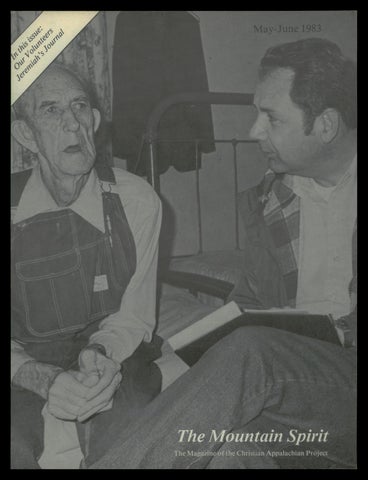
May-June 1983
From O ur President
Father Beiting takes his turn at household tasks in Martin, Ky.
A little while back a journalist asked me what I thought was the greatest achievement of my 33 years in Appalachia. If there is one word that could answer that question I believe that word is “ volunteers.” During my stay in Appalachia I have vigorously sought the help of volunteers to bring our dreams to reality. They have come from every part of our country and all major religions have been represented. The impact of these volunteers continues to be felt year after year. Because of volunteers, certain programs have begun in our area that would not have surfaced without them. Nearly eleven years ago a young woman came to us who had been a nun for ten years. Although she was leaving religious life she still wanted to serve God and His people. She worked as a secretary, a rummage store director, a child development director, and then a few years ago she came to me with the idea of a home based program to assist the families of handicapped children. Since the program began dozens of parents have been helped in their duties to their children, and children have been helped to reach their potential despite their handicaps. It was the first such program in our state. Without her it would not have come about. Another volunteer worked in our “ Attic” store. As she sent thank you notes to people who contributed clothing, she began to enclose a note telling the people of our other programs. She asked if they would like to adopt a family at Christmas or make it possible for a child to go to camp. As a result of her effort in May-June 1983
1982 nearly 1000 families received food, clothing and toys at Christmas and 500 children will go to camp in 1983. A volunteer brings a certain flair or spirit to what they do. We had a Baptist girl from Alabama who was a joy to be near. Everywhere she went the contagion of her smile followed. When she was asked how she could be so happy living and working with so many who had a different religion, she would smile and say, “ we all have the same Lord and see him in all the people we care for.” She made being of a different faith an asset, not a source of contention. Another volunteer would be found in the church early each day. She wanted God’s spirit in her for the challenges of that day. She brought something special to whatever work she did. Being a volunteer often allows a person to fulfill the dreams started with their love of God and country. I remember a young couple who asked to join our ranks. I explained to them how little they would have of the material world. That was all right, they still wanted to come. All their lives they had been taught about the love of God and what a beautiful country we live in. Now they wanted to practice that love and help that country. They had received much. Their desire to give was equally as great. Volunteers have come and gone but over the years many have stayed and enriched Appalachia with their lives and their families. A teacher from a high school in New York brought students down to us for several years. At last he came to
stay, and now teaches in one of our Appalachian universities. Another is a judge in a juvenile court in one of our major cities. Another has gone into the service of the state in the Cabinet for Human Resources. Others have settled in the community, married, had children and are wonderful neighbors who light up the lives of all those that they meet. Volunteers themselves have been changed because of their involvement with us. I remember one volunteer from Ohio. She was here for the summer and engaged to be married that fall. Her fiance was a fine man with a very good job. Her financial and social world would overflow with plenty. After two months she wondered if she could forget the poor and lonely and go back home and lead the good life. I told her to talk things over with her fiance and after a period they decided to call off the engagement. She is now a wife and a mother living in Appalachia. She and her husband are engaged in creating jobs for the poor. Their own financial future is often uncertain, but when I talked to her a few weeks ago she was very happy. She gave me a big hug and said, “ I don’t know how to thank you for letting me be a volunteer. It has enriched my life and given it a purpose beyond my dreams.” The work in Appalachia will go on in one form or another. I pray it shall always have a place in it for volunteers, for from them comes beauty, truth, and long lasting love. Appalachia without these qualities would be a poor place indeed. 3
T here is a spirit that weaves itself in and out and around all of the Christian Appalachian Project; the spirit of love, of dedication and commitment, of energy and enthusiasm. These qualities are exemplified in the presence of CAP’s permanent volunteers. Volunteers who undertake a year or more of full time service to the people of Appalachia have been an integral part of the day-to-day working of CAP since the early 1960’s. Twenty years later volunteers are involved in almost every phase of Human Development programming. On the surface it is difficult to find a common denominator for these folks. Presently our youngest volunteer is 22, the oldest is 65. We have volunteers from Brooklyn and Queens, from San Francisco, and from 25 places in between. Their pre-volunteer careers include landscape architecture, teaching, retail sales, and photography. Look closer, though, and you’ll find the common denominator of desire to serve God while working and living in a Christian community. Most volunteers join CAP with the idea of serving, of giving back to God some of the gifts which have been bestowed upon them. But, 4
throughout the volunteer communities, and among the seventeen former volunteers who are still with CAP as employees, may be found another interesting common denominator. For all that these people have donated to CAP in time, effort and expertise, most will readily agree that what they have gained far outweighs what they have given. For many, their tutelage under the Appalachian people whom they “ serve” has proved as valuable as the time that they have spent in the world of business or earning a college degree. For CAP, the volunteers represent an almost endless source of new and vibrant ideas. Many of the human development programs which have become the most important to CAP and to the people in the areas we serve were initiated by a volunteer thinking, “ say, wouldn’t it be a good idea if we . . . .” Along with ideas, the CAP volunteers bring the perseverance to see ideas through to fruition. The photos in this feature are meant to show our readers only a small part of the services provided to CAP by its volunteers. On these pages we hope you will enjoy seeing an outstanding group of people who are here working hard, playing hard, and praying hard for the greater glory of God. The Mountain Spirit
Left, the CAP volunteers. Below left, Sunny Davis o f Huntington, West Virginia and a “student” at the Children’s Discovery Center in Somerset. Below right, Chuck Klatt from Chippewa Falls, Wisconsin, works with a client at the Somerset Work Activity Center on dogwood flowers fo r cedar crosses.
The Backbone o f CAP: Our Volunteers Photos by Corsale and Gabriel
May-June 1983
Above, Mark Kennell o f Bourne, Texas has clean up duty on C AP’s houseboat, the Simon Kenton. Home berth fo r Mark and the boat is Floyd County. Below, John Burns prepares supper fo r the Lancaster community. When he’s not cooking John works at the Little World Center in Stanford.
6
Top o f the page, a group o f temporary and permanent volunteers gather ’round the piano fo r a song fest at Evening o f Recollection. On the flute is permanent volunteer Kathy Hitner who works at Bethany House. Below, Howard and Betty Winkelspecht o f Hatboro, Pennsylvania review ad copy fo r the Somerset Attic. Bottom o f the page, the volunteers gather fo r prayers at their monthly Evening o f Recollection. Each volunteer community gathers fo r prayer twice every day.
The Mountain Spirit
Below, the Lancaster volunteers gather fo r supper. Right, David Daunhauer o f Louisville, Kentucky learns some weaving skills. Below right, Pat Gallagher also o f Louisville creates puppets fo r the religious education program in Martin.
Left, Rebecca Reihm o f Avon, Illinois talks with sta ff interpreter Vicki Brashear. Rebecca, CAP'S only deaf volunteer, works with the After School Program fo r students at the Kentucky School for the Deaf. Below, Lorraine Corsale fro m Brooklyn, New York on assignment with The Mountain Spirit. Normally, Lorraine works with the elderly o f Garrard County, but took the time to take most o f the photographs fo r this story.
The Mountain Spirit
7
Letters Glad Pastor Mike took over for Preacher Beiting while he was on vacation. I want to thank you for sending this wonderful magazine, The Mountain Spirit. I am getting along in years, but I remember my mother being happy as a child growing up in the mountains of Kentucky . . . . She loved going to the old country school where the hogs slept under the school house. One time she gave the children a good laugh when she jumped out the window right onto the back of a big hog and she rode it (quite a ride). She was all for fun and laughs, but so sweet and kindhearted. Never wanted to think about being poor or sad, so I’d say she was rich in the things of nature . . . . That is why The Mountain Spirit and CAP together with God’s help will overcome all the rough roads ahead . . . .
My sister-in-law was born in the area near the Hatfields and the McCoys. I’m sure she and my brother will enjoy reading The Mountain Spirit as I do! They have birthdays in April so what more can I send as a birthday greeting? We don’t exchange gifts, but by sending them the magazine I hope I’m not only making them feel good, but also helping your expenses. Would you please send them the current issue? My brother will be seventyseven years old. Mrs. Marjorie Simunov Taylor, M I
We continue to try to give our readers a sense o f that richness you describe, both past and present. See Before The Rivers Ran Black in this issue. —Eds.
Anna L. Stone Nevada City, CA 8
I enjoy reading about the simple Appalachian people. I grew up as one in West Virginia. That was during the other Depression of the ’30’s. We lived very simply. People today could get through these difficult days better if they would use some of the simple methods used then. I believe my parents raised us on cornbread, soup-beans and prayer. Those three items were most plentiful. We couldn’t afford a doctor very often. Mother would consult the Great Physician—He was closest and never sent a bill.
Will be looking forward to the May-June issue of The Mountain Spirit. By that time my husband and I will have our garden all in, for we are city farmers. Mrs. Eyle Eifler Marietta, OH
I just think your magazine is wonderful! And I renewed my subscription recently. When I receive a copy, I scarcely put it down until I have read it through. How heart-warming and refreshing it is to read of the neighborly love people have toward one another.
You really have something there. God bless you all.
Vicki Lawrence Engelhard, NC
Father sowed the crops and Mother sewed the clothes for seven children. She also made our soap from pork rinds and fat . . . . I have continued these projects because they are thrifty and I also hate to see some old customs die off . . . .
Mrs. Teda Leach Ottawa, KS
As one of my neighbors said when I told her, “ here people of different faiths are working together for a common cause,” she answered, “ I think that is the background of what Christianity is all about. . . .”
for victims of abuse, Bethany House. Keep up the good work!
Our gardens received a setback with a heavy frost in mid-March, after a month o f very warm weather. Glad to know that many continue the old customs which bind the heart to time and make memories. —Ed. Devil Anse Hatfield Letters to the editor are welcome.
May God bless you all for the wonderful work you are doing! I was especially pleased to read in the last Mountain Spirit of the shelter
They should not exceed 250 words in length, and we reserve the right to edit them fo r space. Address letters to The Mountain Spirit, Christian Appalachian Project, 322 Crab Or chard Road, Lancaster, Kentucky 40446. The Mountain Spirit
News o f Our Neighbors
“ Thought I’d Never Get Out’a This Holler” By M. Elaine Dillhunt
“ I was pulling weeds in my tobacco and I felt like somebody was behind me. I turned around and it was Fr. Beiting. “ I said, ‘Father, you’re the first priest I’ve seen in 20 y ears.’ ” Thomas Henry Paul Conlon, now 84 years old, tells the story with tears in his eyes. “ Twenty years I hadn’t seen no priest,” he repeats. The two men stood amidst the tobacco that day in 1957 getting acquainted. Father asked Tom if he had a rosary and when Tom told him he’d “ worn it out,” Father Beiting gave him another one. “ Do you still have that one?” the interviewer asks. “ Wore that one out too,” he laughs. Tom Colon lives now at St. Pauls’s Church in McKee. His room is an annex to the church so he doesn’t have to go outdoors to get to church. May-June 1983
“ I told Father Beiting that day we met that I’d love to see a church here someday, but I didn’t think I’d ever live to see it. But I did.” Again, the aging man gets tears in his eyes. “ We brought him here to live at the church when he couldn’t live at his own home alone any more,” said Father Wilfred Fraenzle, pastor of St. Paul’s. “ Every winter we’d go up the holler and get him so finally we invited him to just live here all the time.” “ He’s happy here,” adds Sister Marge, assistant pastor. “ He works at the Attic [the Church’s used clothing store] almost every day and people just love him— both the staff and the customers.” Father Fraenzle calls Tom the church’s “ P.R. man.” He enjoys life to the fullest, according to Father, and tries to help other people do that too. When the local softball team was having more losses than wins, he started giving
them some unsolicited advice and their record improved; when the church volunteers need a sitter for their dog “ while they return to New York,” Tom does the job; when the Attic customer needs someone to watch her children while she shops, Tom is happy to do it. He has one favorite little girl who “ comes and stands by me and never opens her mouth. Just likes standing by me.” Tom Conlon has lived in Jackson County since 1937. He was born in Arkansas and received a Catholic education there. Before going to the Kentucky mountains he lived in Ohio. But Martha, the woman he married, was from Jackson County and the way Tom tells it: “ Hoover was president and he wouldn’t make a move and people was losing their farms and Marthy’s mother and father said to me, ‘you stay here’ and I did and me and Marthy got married.” Tom and Martha “ bought a little place” and began farming. Back 9
then, says Tom, “ all they did here was raise your own food and things like that.” He had hogs, chickens, ducks, tobacco, plenty of vegetables, and no tractor. “ Couldn’t use a tractor on my farm; it would turn over. My mule’s name was Pete.”
Fraenzle
Tom says there were days when he “ thought I’d never get out of that holler.” But he did get out and Father Beiting was one of his movers. The day they met, Father Beiting told Tom that there was a church in Berea (two mountains away) and Tom promised the priest he’d be at Mass the following Sunday. According to Tom, it was an Our Father and three Hail Mary’s that enabled him to keep that promise. “ They was a gas station at the foot of the mountain and somebody told me it was open on Sunday and when I got there it was closed. I wanted to keep my promise so I just said an Our Father and three Hail Mary’s and kept goin’.”
Above, Tom works sorting clothes fo r the “A ttic.” Below, Tom and friend on the front steps o f the store.
This combination P.R. man, volunteer, farmer, baby sitter, and humorist is still saying Our Father’s and Hail Mary’s. Sister Marge estimates he says 15 rosaries a day. He himself doesn’t count. “ If it’s raining out I just keep on goin’.” He doesn’t say who or what he’s praying for. Maybe the girls’ softball team that made him honorary coach, or the workers at the Attic who gave him a plaque that says he’s the Attic’s best worker or Father Fraenzle and the staff of St. Paul’s who gave him a home. Maybe he prays for the little mountain girl who brings him milk shakes or the volunteer who went home and got married and never came back for her dog. I think he’s a man who lives in the present and doesn’t dwell much on the past. “ I like it here in the mountains,” he says, “ because you get to help people.” It seems “ helping people” has given Tom Conlon a youthful attitude, smile, and self possession. When Father Fraenzle asked him once how old was old, the 84 year old told him you weren’t old till you were 80 and that “ you don’t know old is cornin’ on you till gets there.” The Mountain Spirit
around
theproject
The grant was made specifically to provide ten full scholarships to needy students once the school is in actual operation. The opening of the school is targeted for the fall of 1983. Within a few years, the Academy hopes to embrace grades K-12, as well as adult education and GED programs.
A Kindred Vision: Ledford Dies At 106 LANCASTER—Shortly after our last issue went to the printer, Mr. C.B. Ledford of Lancaster passed away in the G arrard County Memorial Hospital at the age of 106. He had been in the hospital only a few days suffering from penumonia. Death was attributed to congestive heart failure. Mr. Ledford had been featured in The Mountain Spirit in the MayJune 1982 issue, in “ The Ledfords: A Family For All Seasons,” and our March-April 1983 issue carried a short piece in around the project celebrating the Ledfords 79th wedding anniversary. A book about this extraordinary family authored by John Egerton, Generations: An American Family, will be released by the University of Kentucky Press in July, 1983. The Ledfords have also been featured in a special program produced by Kentucky Educational Television. A native of Coon Branch in Harlan County, Kentucky, Curtis Burnam Ledford came to Lancaster with his father and mother in 1889. He is survived by his wife, Addie King Ledford (98), three sons, six daughters, and over eighty grandchildren and great grand children. Tillie King (58), a daughter who has lived with her mother and father for the last few years and cared for them, chatted with The Mountain Spirit on Mr. Ledford’s last days. “ He said to John Egerton, ‘I’m ready to go, and this time I think the Lord will take me.’” For the next two days he spoke only to the ministers who prayed for him at his bedside to say “ pray,” and “ thank you.” “ If he could have, he would have had ministers and priests from every denomination—he didn’t see different denom inations, only Christians. If poppa could have done what he wanted to do, he May-June 1983
by the C A P N ew s Service
Mr. C.B. Ledford
would have done what Father Beiting did, help the people in the mountains.” True to the kindred spirit between Mr. Ledford and CAP, the “ vision” which he received at the age of 98 and which was printed in The Mountain Spirit has been used by Baptist and Presbyterian ministers and by Catholic nuns in religious instruction classes in several states. “ When he first had that vision, we thought he was losing his mind,” says Tillie, “ but we came to understand that it was real.” At The Mountain Spirit, we believe that C.B. is now with the angels he saw in the vision, talking over old times—and new times forever.
Montrose Foundation Aids the Christian School PALO ALTO, CALIFORNIA— Recently, Robert E. Swank, President of the Caroline and Roxanna Montrose Educational Foundation, announced a grant of $10,000 to the Christian Appalachian Project for the Mountain Christian Academy in Floyd County, Kentucky.
According to Mr. Swank, “ it has been my interest to contribute to the hard pressed people of Appalachia and encourage them toward more and better education so that they can have a greater understanding of the continuously advancing culture and technology in other parts of this great country of ours. The board of Montrose concurs in my feelings.” Currently, the citizens in Floyd County, Kentucky, who support the founding of the Mountain Christian Academy, are raising matching funds to assist CAP donors in the building and staffing of the school.
Sunshine Center Rocks and Rolls
LANCASTER —The G arrard County Home for Senior Citizens was the site of the Rock ’n Roll Jamboree to benefit the Heart Fund. Participants included residents of the home, the children of the CAP Sunshine Center in Lancaster, with special guest appearances by Mr. Robert Hagan, adm inistrator of the G arrard County Memorial Hospital, and Mr. Jack Givens, former University of Kentucky basketball star. Each participant had sponsors who had agreed to donate a fixed amount of money for each minute rocked. Suzanne Rhodus, recreation therapist at the home, reports that $1250.50 was raised for the Heart Fund. “ I told the patients that here they would have the opportunity to 11
around the p roject. . . continued
The Sunshine Center kids show they have Rock ’n Roll Heart by their participation in the Rock ’n Roll Jamboree at the Home fo r Senior Citizens in Garrard County.
help save someone else’s life. ‘You think you’re too old, too sick to help someone, but you’re not. By participating you can help save someone from a heart attack.’ ” The children of the Sunshine Center rocked in miniature rocking chairs, cheered for the senior citizens who were rocking, and sang and danced to “ Rock Around the Clock’’ as their teachers helped to serve punch and cookies to
participants and excited bystanders. Sunshine Center director, Kathleen Ford, explained that she felt it was important for her kids to participate. “ It’s something that they’re capable of doing now. They’re not coordinated enough yet to run or jump rope for the Heart Fund, but we wanted to stress to them that whatever they can do to help someone else they should do it.’’
GIVE THE GIFT OF SPIRIT The Mountain Spirit, that is. We are able to continue offering our magazine to our readers only so long as we are able to make ends meet. Will you help us continue to tell the stories of the hills? Take a moment, please, to fill out the form on the envelope in the fold of this issue, and send a gift subscription to a friend or two—we’ll notify them that you are the giver. Or give a subscription to a nursing home: senior citizens love to read our stories. Or a Sunday School: we get reports that some of our pieces are being used in the classes of churches of different denominations. Let’s spread the Mountain Spirit around the country!
12
Temporary Volunteers Work in CAP Programs LANCASTER— It’s Spring, and at CAP that means it’s time for the annual migration of temporary volunteers. This year our work has been blessed and assisted by students from Divine Word College in Epworth, Iowa; Creighton University in Omaha, Nebraska; the University of Notre Dame in South Bend, Indiana; Oral Roberts University in Tulsa, Oklahoma; Jesuit High School in Tampa, Florida; St. Ignatius High School in Cleveland, Ohio; and Chapel House Interfaith Center in Albany, New York. These folks have helped with a wide variety of program s, including the Be-A-Seed program (CAP’s low income seed program), child development, the Attic stores, and maintenance. In addition to these groups, CAP has been pleased to have several long term temporary volunteers this The Mountain Spirit
around the p ro ject. . . continued
Annual CAP Scholarships Being Considered CAP COUNTIES—As grad uation time approaches, CAP is in the process of awarding 14 scholarships to high school seniors. An award of $1000 is made in 14 counties, which goes directly to the college or technical school of the student’s choice. The scholarships are based on their services to the community, rather than academic merit or family need. The program is coordinated for CAP by Lew Phillips, who works with local selection committees in each of the counties where scholarships are awarded. “ I was able to visit all the schools this y ear,” Lew explained. “ That increases interest when you can talk with counselors and principals personally, and reiterate your criteria.” The newest school to be added to the list is the Kentucky School for the Deaf. While Kentucky School for the Deaf has students from all over Kentucky, CAP’s scholarship will be awarded to a deaf student from Eastern Kentucky. Volunteer Tim Murphy (Notre Dame) sorts seeds for “ Be-A-Seed” program.
year. Keith Gilbertson of Forest Lake, Minnesota has been working with Gil Rosenberg in the seed program; Ellen Rehak of Biloxi, Mississippi has been working at the Children’s Discovery Center in Somerset; Kathy Shulleeta of Richmond, Virginia has assisted at the Little World Child Development Center in Stanford; and Heidi Busse of Eagle Lake, Minnesota has been working at the Lancaster Adult Handicapped Workshop. The Mountain Spirit and CAP would like to thank all these folks for the great dedication and spirit they’ve shown while they’ve been with us. May-June 1983
“ I think this is the best thing we do,” says Lew, who has been coordinating the program for seven of the eight years it has been operating. “ It gives me a good feeling to know that we’re really helping some young people to help themselves by giving them a good start in college.”
An Evening With Gerry Faust
Appalachian Project, on May 23 at Memorial Auditorium in Louisville. Money raised will be used to purchase uniforms, shoes, and team equipment for indigent Kentucky School for the Deaf students, and to finance team participation in special training camps. CAP’s Coordinator of Services for the Deaf and Hearing Impaired, Ric O’Connell, approached Coach Faust about making the appearance, which he has agreed to do at no cost to the Booster Club. Ric explains, “ the athletic field is one place where hearing and deaf kids can meet competitively. In athletics the deaf are judged solely on their ability, and not on their disability.”
WHY BOTHER ABOUT WRITING YOUR WILL? Who needs a will? Mr., Mrs., and Miss do! Send today for your compli mentary copy of “ Why All The Bother About Wills?,” an informative look at why you should have a will.
____ clijyan d mail tod ay____ To: Mr. William A. Begley Director of Development Christian Appalachian Project 322 Crab Orchard Road Lancaster, Kentucky 40446 Name ______________ _____
LO U ISV ILLE—N otre Dame head football coach Gerry Faust will be the keynote speaker at a benefit sponsored by the Kentucky School for the Deaf Booster Club, with the assistance of the Christian
Street __________________ City, State, Z ip ___________ Telephone (
) 13
The C A P Closeup
U u r lives have to be useful. I hope I’ve made the kinds of decisions that will make my life useful, both for myself and those people I serve.” Just trying to schedule an interview with Moe Mercier attests to the fact that he’s made the right decisions. “ Let’s see,” Moe said, paging through his appointment book. “ This week is no good. Can you meet in Mt. Vernon on Tuesday? Okay, then, is Thursday all right?”
Craven
Moe has recently moved into a position as one of CAP’S co-directors of human development after serving as the director of CAP’s Group Home at Camp Nelson. In his travels about CAP’s counties he always seems to be bounding, never just walking. As a former volunteer, who has passed the ten-years-of-service marker, Moe subscribes to CAP’s values and philosophies both personally and professionally. “ I believe in CAP very strongly. I believe in its original values—the Christian values, the self-help value. I believe that CAP can provide to the layman and laywoman a vehicle in which to serve God and to serve the church. That’s the reason I came to CAP.” Moe spent his pre-CAP days in New England. He was born in Central Falls, Rhode Island, and spent much of his life in Massachusetts. “ In 1971 I was working at the Center for Christian Living with the LaSalette Brothers. I was in charge of the Family Retreat Movement. The counselors who made up the staff for those weekends were recruited to come out and have an experience in Kentucky. That was our way of furthering their Christian experience. It was our way of not getting hung up with our own thing at the retreat house, and expanding our spiritual growth.”
Moe Mercier:
A Useful Life
In July of 1973, Moe took a one year leave of absence from the retreat center and moved to St. Clare Church in Berea, where he served as head volunteer. “ After that year,” Moe explained, “ I made my decision not to return to religious life per se. Father Beiting was interested in opening up a home for boys. I talked another volunteer into staying on past his one year commitment and developing this home for boys. “ One of the things that really gave us a boost was Father Beiting’s confidence from day one. I really feel that Father has trust in me. He hasn’t ever once interfered in what we were trying to do with the boys. I see Father as the dreamer of dreams. I see myself more as the person applying the nitty-gritty to the day-to-day operations.”
by the CAP News Service
14
From this workable combination of “ a dreamer of dreams” and the “ nitty-gritty” has come, in those ten years, three Group Homes for boys. The first is one that Moe intiated at Camp Nelson, and in the last four years two others have been established at CAP’s Family Life Center in Renfro The Mountain Spirit
Valley. In Moe’s new position as co-director of human development, his responsibilities include overseeing the operations of all three group homes as well as all other activities at the Family Life Center, outreach ministries in Rockcastle County, while he and his co-director, Ellen Burke, have joint responsibility for CAP’S Adult Handicapped Programs. About his new responsibilities with CAP, Moe says, “ it was coincidental that I was asked to assume these new responsibilities. There was natural growth going in CAP’S life and in my personal life. Being at the Group Home for 10 years, I was getting to a point where I needed more on-going growth for myself. Being the kind of program that it is, it consumes a lot of your emotional energy. I was beginning to find myself drying up. I realized that maybe I needed to take on something else, not only for myself, but for the Group Home. It was just coincidental that at the same time I felt the need for a personal change, Father Beiting and Mike asked me to consider human development. I felt that I could make a real contribution to CAP as a bigger organization, and that it was the right time for me.” After four months in human development Moe thinks that he has begun to take steps in the right direction, seeing to it that all of his programs have a singleness of purpose—CAP’S purpose and God’s purpose. “ I guess right now, establishing a trust relationship on a one-to-one with many people within CAP, establishing a system of loyalty, in the good sense, and an atmosphere of confidence and confidentiality in those places where that is called for, are some of the most important things to me in this early going. I want to provide a support system for people, letting program directors know that they’re not in it alone, that there are ties between them and me, and CAP headquarters. I guess you could say I’m trying to be the liaison that communicates the possibilities of growth for all of us.
Above, Moe makes his point. Below, some hands on experience at the Stanford Work Activity Center. Group Home, both of them as staff members. “ That was rough. I don’t regret it, it wasn’t a bad experience, but it was very difficult. We had so little private life, coping with a lot of tensions, a lot of frustrations. Just having friends over for supper was a problem. We cooked downstairs in the Group Home kitchen, and carried it upstairs. Steph really put up with a lot more than what the average woman would put up with. I think a lot of women would have told me to shove off. I think it’s because she does believe in CAP’s values and in Father’s basic dream. “ We’re like a lot of other people in CAP—we know the original values and those are the ones we stand firm with.” cap.
“ I want to be fair. That means a lot of things, not necessarily that you always agree with people, but at least you’re fair with them. They have an opportunity to voice their opinions and a chance to know that what they say is important, and that it does have an effect on what goes on and what doesn’t go on.” Moe and his wife, Stephanie, have two sons, Todd (6) and Jacob (3) and are expecting their third child in July. “ Both of our families are still in New England, and we feel that pinch of not having aunts and uncles and grandparents. We feel that we have given up a lot in that respect. But Steph believes in CAP’s values, too.” For the first six years of their marriage Moe and Steph lived in a small apartment in the upstairs section of the May-June 1983
15
Grandma by Beverly Carter Sexton
Photos by Sexton
W hen I told Grandma that I was going to write a story about her she wasn’t very excited about it. Grandma can’t read. “ I went to school some but I never got many head marks,” she said. “ Will it have my picture with it?” I told her yes, that I figured it would. That is all it took to get her enthused. She loves having her picture taken. Grandma is a little woman, about 4 feet and 9 inches tall and weighs only 87 pounds. Her long brown hair, which only now, at the age of 93, is beginning to show streaks of grey, is plaited and wound into a neat bun at the back of her head. Modern dress styles haven’t affected her, for she looks as if she just stepped out of a history book in her long dress, black cotton stockings, apron, and bonnet. She lives alone now, since Grandpa had a stroke several years ago which left him totally helpless and he went to live with one of his daughters. Grandma, being set in her ways, could never be satisfied living with any of her children The Mountain Spirit
Beverly Sexton chats with Grandma. and decided to just keep house on her own. Most of her children live nearby and keep a close eye on her. She is as spry as a bantam hen, however, and takes care of herself very well. Once, she decided she was having trouble with her eyesight and had some of her kids take her to the doctor. The doctor, not being able to find anything unusual with her eyesight asked her what she was having trouble seeing. “ Well,” she exclaimed, “ when I’m sewing, I can’t see how to get the thread through the eye of the needle like I used to .” The doctor sent her home without new glasses. C le o Abney Bowman, my grandma, was born in 1890 in a small log cabin in Rockcastle County. She had one older sister and later, thirteen younger brothers and sisters. “ Not a terribly big family in those days,” she says, “ everybody had big families and everyone we knew had it just as hard as we did. I had lots of fun growing up though, and I remember it as being happy. I knew we were poor but we had lots of love and a strong faith in God, so maybe that is why I can’t remember the hard times as being so bad. “ We didn’t have television or record players or even radios back then. I don’t think any of those things existed. Radio might have, but even if it did, we didn’t have electricity. I can remember the first house I lived in with electric lights. I was married and we had moved to Perry County so that Isaac [her husband] could work in the coal mines.”
“ What was it like, being a kid back then?” I asked Grandma. “ Oh, we had lots of fun,” she said as her face lit up. “ We would build playhouses in the mouths of caves and the boys would help. We made rugs out of moss and even had little stoves made out of rocks. I had dishes made out of broken crocks and made mud cakes and little things like that. We used to get the boys to pull us down the hill on handmade wooden sleds. We had so much fun. We didn’t have toys like the young’uns do now. Pa would make us corn husk dolls with corn silk hair. They were pretty too, they sure was. One Christmas, me and my oldest sister each got a real doll. They had wax heads and hers was black headed and mine had yeller hair. We decided to make them kiss, so we hit their faces together and their heads flew off. We cried ’cause our pretty dolls were broke.
When we first went to Perry County, that’s when I saw my first car and I rode in it, too. I liked it. It was different but fun. I think it was called a Ford.
“ Times sure have changed, but you know what? Once, long after I was married, I went back up the holler where I was raised and my little playhouse was still there just like I left it. Now what about that? Even the little rock stove was still there.” “ W h a t about Christmas, Grandma? Did you have a tree?” “ Yep, we sure did. We decorated our tree with paper chains, colored pieces of paper, pine cones, and red berries. It was so pretty. Have you ever saw one fixed up like that?”
“ No,” I replied, “ I don’t reckon I ever have.” “ Well, you ought to fix one like that,” she said matter-of-factly. “ I think they look better than the ones now. On Christmas Eve, Mammie and Pa would wait ’til we young’uns were asleep, then they would put an orange or an apple and a stick of hard candy in our stockings we had hung over the fireplace. When we got presents, they were hung on the tree, not put under it like now. I can think back on those days and it seems just like yesterday. Ain’t it funny how an old woman like me can remember things that happened all that long ago but can’t remember something that happened this morning? I guess that’s just part of getting old. 18
“ I don’t see how I’ve lived to be 93. I sure have been sick in my day. When I was sixteen I got typhoid fever and came in a hair of dying. I was bad off for way over a year. Mammie and Pa didn’t want my long hair cut, but because my fever got so high they had to cut it all off. That was the only time a pair of scissors was ever took to my hair. When they cut it, it was in a big long plait. I saved it and later gave it to one of my beaus. Mammie made me get it back though ’cause she said it was too personal to give to a boy.” “ When did you first meet Grandpa?” “ I was picking blackberries, me and another girl. We sold them for a nickel a gallon and bought gingham material for a nickel a yard to make dresses with. I never owned a bought on dress from the store. We made all our clothes, and wore button up shoes. I never saw anybody wearing slippers back then. Anyhow, me and my friend were blackberry picking when we heard somebody cornin’, so we hid in the bushes. He came walking out of the woods and walked on by without knowing we were there. I asked my friend who he was and she said his name was Isaac Bowman. Well I told her, that is my man if I never get him. He was the prettiest man I ever did see. Later there was a baptism at the mill dam and I went. He was there and after the baptism me and a bunch of girls started toward home and Isaac followed us. We came to a fence and he helped all the girls over, then when it came my turn to cross, he took hold of my hand and kind of pulled me back. He asked if he could accompany me. So we started courtin’. He’d come to the house and we would sit and talk. We would have big gettogethers and play games like ‘spy the timble’ and some of the men played fiddles and banjers. We would square dance and just have the biggest times. Finally we just up and married. The Mountain Spirit
“ I had seven young’uns and we all lived in two rooms. The old wood cook stove was in the smoke house and in the mornings we had to go out to the smoke house to start breakfast. In the winter it was so cold. The snow would blow through the cracks in the walls of our house and the young’uns would dust the snow off their bedcovers. My five girls slept in one bed, three at the head and two at the foot. The two boys slept in their own bed and me and Isaac had a bed. Our bed mattresses were made from corn husks and all our quilts were handmade. “ We lived right around here most of our lives but lived in Perry County for a while. When we first went to Perry County, that’s when I saw my first car and I rode in it, too. I liked it. It was different but fun. I think it was called a Ford. Isaac and his brother, Willie, worked the coal mines. There was a cave-in and a big slab fell on Willie. He lived ’til they started to the hospital with him then died. Isaac walked out of the mines that day and never went back in again. We moved back here and farmed. Isaac didn’t want the young’uns going to church and he didn’t want me going. He put up a moonshine still and my young’uns had to go past there to pack water. I pointed my finger in his face and said, ‘Isaac, do you know what you are doing, our little young’uns have to go past there and you are making that old whiskey.’ He said ‘they don’t know nothing about it,’ and I said ‘how can you keep it hid?’ I said ‘the first time you get drunk I’m going to report your still up.’ I had to get as mean as he was. He started going to church then. He got saved the very first night he went. Gee-o, you don’t know how good I felt. I shouted! I just patted my hands, it tickled me so good! I knew if
Grandma and her great grandchildren.
he was saved he would be changed and wouldn’t be so mean. He used to cuss just about every word he said and he quit that. He quit his tobacco too and done something with his still. I don’t know what he done with his still. He never did tell me. He said nobody would ever know what he done with it but he done away with it. After that, there wasn’t nobody could stall him on the Bible. He could quote any chapter and verse in the Bible. I’ve heard people in the church ask him where to go to find something in the Bible and he could tell them plum blank where to find it. He would teach the Bible to our children at the table. He loved reading the Bible and he could read it so good, I just loved listening to him read. Later he became a preacher.” “ Grandma, do you know who the President of the United States is?”
Baptism in a Rockcastle County Creek.
“ N o , I don’t know his name but I’ve saw his picture on the television. I can remember when women didn’t have the vote. I started voting after we got the vote but I can’t remember ever voting for a president. I always voted like Isaac ’cause I didn’t want to kill his vote out.
“ The women weren’t allowed to work, they weren’t allowed to get jobs. I said back then when women went to working, that that was the worst thing that ever happened. That separated more men and women than anything, getting jobs. The women in those days thought their husbands had to keep them up, now they say, I can do without him, I can get me a job. Did you ever think about that? Well, it’s the truth. When women started just having their way like they do now, doing men’s work, business jobs, that has separated May-June 1983
19
more men and women than anything. I never heard of people separating when I was raised up. They thought they had to live with their men. Nowadays they don’t care if their men do leave ’em. Some of them are that way, not all of them, but some of them are. They get a job and keep their selves up. Nowadays the women won’t put up with nothing. They just say divorce, divorce, divorce! I hate for people to separate their little children. The little children love their daddys and mothers and they want them to stay together. I guess if me and Isaac had ever separated we would have pulled our little young’uns apart; ’cause I wanted them and he did too. I told him back then, if he ever left I’d keep my young’uns if I had to crawl on my hands and knees to take care of them. I would have too. “ I’d rather things be like they used to be. It’s changed so much. I’d rather have hard times than to put up with what’s going on nowadays. You hear so much about awful things going on. I guess they’ve went on ever since the world, there’s just more people now, so they make more meanness. I sure believe the way things are now that it won’t be long before the end of the world; just the way everything is and how things have changed since my raising and now. It’s as different as daylight from dark, things have changed so much. No, it won’t be long. I hate to see little children born into this world, the way times have got. You don’t know how they will be raised or what they have to put up with. It hurts me so bad to think about it. I love little children so good, they look so sweet to me. “ We had hard times but we enjoyed it. We enjoyed one another. We’d go to one another’s houses and visit and if anybody got sick we’d just pile in there and take care of them. We would hoe their corn or just anything that needed doing, for nothing. Nowadays you have to have money just to get somebody to come and see you.”
Grandma keeps busy in her kitchen and loves visits from children, grandchildren and great grandchildren.
G randm a grew quiet and I glanced out the window at the snow covered hills. The same hills where she lived as a child, raised her family as a young woman, and then grew old. They sheltered her and her simple way of life for so long, but finally, even their remoteness couldn’t keep change from crowding in. To Grandma, the change came too quickly and to her the world is now confusing and complicated. As she sat silently beside me I suddenly realized how easy it had been to take her for granted because she has always been here. I realized just how much how I love her and I think it surprised me. Now, as she sat so still, I could feel her sadness as she remembered a time that was gone forever.
“ Grandma,” I said, “ the world changes and people change but God and love is always the same. You have seven children, thirty-three grandchildren, fifty-eight great grandchildren, and two great-great grandchildren and we all love you. So no matter what is happening out here, you know you have something very special right here.” She looked at me and her pale blue eyes twinkled. “ I love my sweet Jesus and I love all my children and grandchildren. Every single one of them.” Then Grandma reached out and hugged me.
20
The Mountain Spirit
Guest Editorial by Gil Rosenberg
“ Why did I volunteer to do this?” When I said I’d do it, it seemed like an interesting challenge. I tried to start writing it four days ago, and the words refused to come out of that stupid pen. It soon became the task I tried to ignore. Today the task I tried to ignore became the burden I put off to the last moment. So here it is, “ The Last Moment.” I should be asleep. June (wife), Jessica (daughter), Phil (friend visiting from California), and Joey (dog) are fast asleep. Even our next door neighbor, Ellen Burke (workaholic) cashed in her chips 15 minutes ago. Sleep will be my reward upon completion of this. You see, I made a commitment. Commitment is important in our family. It’s important in any family. With commitment in mind, my bywords for the last few months have been “ integrity” and “ compassion.” I look at how I dealt with a person or a situation and ask myself how I could have been more honest and shown more love, integrity and compassion. I’ve played around with these words so much lately that they’ve become like old friends to me. Commitment is the new kid on my block. An interesting thing happened when they began to work, live and play with my old attitudes. They formed a relationship. For a “ brains before heart” person like me, a real commitment should be “ an act of integrity done with compassion.” The factual part of the commitment comes much easier for me. For example, I said I would help the Lancaster Adult Handicapped clients grow a garden last summer, May-June 1983
and I did that. My integrity rating for the commitment was 80% (in the school of life, a low B). The compassion part of the contract says, “ you will love doing this and share this love with the people you work with.” I scored a 50% (a solid F) for this test. I started the project with very low marks, thinking, “ how can they expect to do a decent garden with such a late start?” “ When the weather gets hot, they won’t want to work and I’ll be stuck with another job. ” By the end of the summer I was able to put some compassion into my commitment. The people’s love and enthusiasm at working in the garden had broken down some of my barriers. Everytime I saw one of them, the questions would pour forth. “ When are we going to work in the garden?” “ Are the tomatoes ready to pick yet?” “ When are we going to dig them sweet potatoes?” In reflection, I’m disappointed that I did n ’t have more faith and compassion in the beginning. Then, they could have reaped a larger harvest of produce vegetables, and I, a larger harvest of love. For the heart before mind person a commitment should be “ an act of compassion done with integrity.” Their battleground lies in channeling their emotions so the facts are not obscured, and so that the commitment is kept in perspective. My wife is such a person. We are both struggling from opposite ends of the spectrum to achieve an equal balance of integrity and compassion. Individually we do not come close to that balance, but as the married unit of one, we start to reach a proper perspective. 1:50 A.M. Where am I now? I look back at what I’ve written and see that it is also a definition of my 2Vi years as a volunteer. Starting with the question, “ why did I volunteer?” the answer is that I made a vague commitment to my wife. I told her that I would quit my job and follow her lead into some type of charity work. The vague commitment led me to become a CAP volunteer.
Gil Rosenberg is the coordinator o f CAP’s Small Farming Program. He and his wife June, and their daughter Jessica (5) moved here from San Francisco in 1980. In my first volunteer year I went through the task and burden phases. Finally that winter I reached the last moment phase of severe depression. The spring planting season brought me out of my depression by forcing me to focus on my commitment, instead of myself. My integrity forced me to work longer and harder than before. I felt I owed it to myself to make up for the time I had wasted sulking during the winter. The spirit and youthful enthusiasm of other volunteers forced old man compassion to take a small step away from my protective shell. In time, my commitment has become clearer. Despite many setbacks, and other moments of depression, I’ve tried to put more integrity and compassion into it. In carrying out this commitment, a gift has been given back to me—the reaffirm ation of my vow of marriage to June. We are all journeying through this life together. In your journey, where are you now? Look at your commitments. Does integrity or compassion dominate them? Do your marriages (with family, with friends, or your marriage with God) help to balance you out? Tonight I wonder where I am in my journey, what commitments lay ahead of me. I can only hope that my two new friends will be there to guide me. 21
The years 1910-1940 changed Appalachia from a frontier fastness ruled by mountain men into an industrial fiefdom ruled by corporations that came to take the mineral wealth o f the hills. I f one is to understand the reality o f Appalachia today, one must understand the violence and upheaval o f those years, in which what was essentially a seventeenth century culture passed into the modern world, the world o f machines and mines, just at the point in which great ideological and cultural forces were causing planet-wide upheavals, and preparing fo r more upheaval to come. Our time is the result o f those cultural nightmares, but while the rest o f the country changed slowly, the Appalachian coal fields changed overnight. In a three part series, we try to look at those violent years, the years o f Bloody Mingo in West Virginia and Bloody Harlan in Kentucky, when mountain men walked into gigantic collisons beyond their ken. In little, their tale is a tale o f the twentieth century. I have imagined the life and words o f Jeremiah Turlin, but the facts are, I hope, essentially correct. The photos that accompany this article picture life in Eastern Kentucky as it was lived about 1910, when the railroads were built, and the face o f the hills was changed forever. —RKC
A meeting of preachers like Hosea Tnrlin.
April 3, 1939. I been meaning to set all this down for most of my life, ever since I learned to read and write in the Settlement school where Mr. James Fish taught me my letters and confirmed me in the ways of truth. I have been studying all these things now since I was a boy on this same old ridge where my people settled in the long ago, I don’t know the number exactly. But it seems to me now that there has been so much blood spilt all along the roads and on the ridges in my day that I can’t rightly make sense of it. But I want to understand it. Maybe if I can’t some one of these children of mine can read these papers some day and get it all to make sense. My brother Hosea, the preacher, used to say that it was all a punishment from the Lord for all our sins, and that was why the powers of evil in the name of the coal operators of Harlan had been unloosed on us. I don’t know if I can agree with him, preacher of the Lord and divinely appointed though he may be, because I seen too much blood and thunder to stack over against the sins I seen, and hit don’t seem like there is a balance to it. There, I done wrote “ hit” again. It is the way it sounds to me. And Mr. James Fish who was a mighty educated man from up north once told me, “ Jeremiah, do not be ashamed of the way you talk. When you say ‘hit,’ you are saying the word the way it was in olden times, a thousand years ago.” So I reckon that hit will be all right, and my worry is to state May-June 1983
A mountain settlement on Hell-fer-Sartin Creek.
the truth as I seen it happen in my time because God knows the Harlan Daily Enterprise ain’t a gone ter do it, and I don’ think them Communist writer fellers that come down here with Mr. Dreiser air a gone ter it either. So, dear children who read this when I am buried on the ridge with our people, bear with my writing and listen to the tale I want you to know about. Ponder hit in your heart, because it is all I have to leave you. Truth may seem to be a big word for an old hillbilly on the Poor Fork of the Cumberland River to use, but I aim to use it. Our people didn’t come to these mountains for no lie. Today has begun the big strike, and that is what has stirred me up to think back on all that I have seen in my days, and to remember all that has been handed on to me by my father and grandfather and great grandfather. I will speak in the name of Jeremiah, the name fastened on me by my father John Isaac Turlin. He said, “ I hev named you Jeremiah because I was Isaac the child of hope, and my grandfather was Abraham the one who received the promise of faith. But hit has all turned to ashes in our mouths and coaldust in our food and clothes and I cannot see the hope of the future. So I name you for the prophet who was given to scourge the nations.” Well, I don’t know about being any scourge to the nations, right now hit looks like it is all the other way around in Harlan County and has been for the longest time.
But I do want to speak the truth. When you read this and remember, you will remember this day when I started writing down. Because you will remember the day when the coal operators of Harlan has defied the President and everyone else on God’s earth and not signed the contract with the union of United Mine Workers the way every other company in the US has done. And now hit looks like hit is cornin’ again. The guns and the blood and the cryin’ children and the hunger and the hatin’. We’re in for it again, and you my five sons are out of the mines this day along with almost everybody else except your crippled father, who has been out a long time anyway. They say (and when did they ever have it different?) that about four hunnert went to work the mines today, four hunnert out of fourteen thousands in the county that gets their livin’ from sweating coal outen the earth. Scabs. They always is scabs. God help ’em in the days to come. And God help us ’cause that Governor Chandler is talkin’ martial law again. Hit won’t help that some of the union boys has taken some of the scabs down to the river and baptized ’em in the name of the Father, the Son, and John L. Lewis. I can smell the gun powder in the air. But worse than that, my sons, I smell the power of evil on the land, tearin’ it to pieces again, and sometimes I think there will never be no end to it until the Kingdom comes in a flash of glory like Hosea
A Highland family comes to town in 1910.
24
The Mountain Spirit
says. Hit will take an awful lot of glory to clean up these hills and make ’em fitten for livin’ again. And I don’t know if it will ever happen withouten a miracle. But enough of that, I done got away from where I was gonter start with all this. Hit wasn’t all like this always. It was different as night and day. It has come upon me in my time to see the undoing of things that had been set in their places since the foundation of the world when God put everything in hit’s place. He set the trees on the hills and putten the coal in the ground and He looked at hit all and said it was good. But it is evil that comes in the world through Satan and moves everything around the way it oughtent to be. You in your time has not knowed the difference. You came up by the mines and you will go out in the mines, as I have. But I was borned in 1895, and I knowed the stories of the fathers. That is what I am a gettin’ to now. When I was fifteen years old, my great grandfather John Jacob Turlin died at the age of 92. That means he was borned in 1818, when all these hills was a paradise on earth. And when he was a ready to go to the other shore, he called me to his bedside and tol’ me his memories. But my coal lamp is outen oil so I will hold’em til tomorrow night. April 5, 1939 I didn’t get to write yesterday on account that you boys was a grief to me this day. You have got to learn to hold down in a strike and not get all lickered up and hungry for the blood of your neighbors. It would be a great help to me in my days if Jeremiah, Jr. could learn some patience. You’d better, boy. Hit is one thing you can learn in these hills, how to wait. For everything you’re a gonna get in this life, if anything. Them roadhouses and their cheap moonshine and easy ladies try to trick the Lord by speedin’ everything up and makin’ fightin your brothers from the camps the way to end the waitin’. Don’t you never mind it. Them gun thugs jus’ love it when you kill each other off thatway. Hunker down, and wait. You may as well. They got the Governor and the guns and the law, iffen you can call it law that hates families and children. Great grandaddy Turlin knowed how to hunker down and wait on a game track with his flintlock, and sippin’ his shine slow like, hours and hours, waitin’ for elk and bear. That’s what he tol’ me when he lay dyin’ and me a young boy of fifteen. “ Remember, Jeremiah,” he said, “ what it is like now and what it has been in these hills. Because now I see the railroads cornin’ to take away our lives and our hills.” He knowed what was happenin’. He tol’ me about the fancy men from New York and other places up north that had been cornin’ for a long time to sit on the porches and smile and eat our vittles and trick the people into May-June 1983
signin’ the papers for a few dollars. They came for a long time, and by the time they was finished they had bought all the things under the earth from every hill farmer and mountain man. “ Now, Jeremiah, they air a cornin’ to get it. And God help us all. Hyar is the best land on the earth, and we hev sold hit into bondage and hev sold our birthright for a mess of pottage like hit says in the Book. And for what? For some shiny gewgaws,” and when he said this he spat foulness from his mouth, “ and store-boughten clothes and coffee.” It was 1910 when he started tellin’ me these things, the year my two older brothers walked back through McLin Notch which was the way the Turlins come in hyar, and started up the valley to West Virginia to work in the mines there. And down the fork, they was a buildin’ the Louisville and Nashville railroad right up to Harlan from Corbin. Then, we thought good times was a cornin’. It warn’t to later we got letters from my
It has come upon me in my time to see the undoing of things that had been set in their places since the foundation of the world when God put everything in hit’s place. He set the trees on the hills and putten the coal in the ground and He looked at hit all and said it was good.
brothers from a place they call bloody Mingo County (jes’ like they now call this bloody Harlan) and began to know what hit was really all about. Oh, we started to find out all right, when they commenced to buildin’ the coal camps and treatin’ us like the cattle of the field. Then we started to see the face of the great beast of which John spoke in the Book. And it looked like the face of a gun thug and a soldier and the drift mouth of a mine and the front teeth of a steam locomotive all rolled in one. Now, sons, pay attention to me, your father, about what my great grandaddy a tol’ me in 1910, and all that he said. He said that our people come up from Georgia through McLin Notch when he was jes’ a tadpole, and that his grandfather had come from acrost the water before the big war that made the country free. They wasn’t many people here then, about 1823 or so, and every man had his own hollow and ridge and stream, and no man had to bow to any other man. They was free, and they wasn’t no mine guards and gun thugs and coal operators and two dollar guvmint marshalls and egg-suckin’ county sheriffs. The rivers warn’t black then, and trout ran in them, and ever thing you couldn’t find in the fruits of the earth, you could make with your hands or do without ’cause 25
hit probably wasn’t no good for ye anyhow. He said they was still fine huntin’—elk and wild boars and deer and turkey, and even a few buffalo—and that they was still wolves and painters and mountain lions aplenty, yes, and still some Indians around too, though they had been fitten down and made peaceful by then. They was Howards and Cranks and Heltons all spread around, but not too many families all told. The Turlins settled on this ridge here we setten on now, and made a good life raisin’ sheep and floatin’ timber down to Frankfort oncet a year for a little cash. And, he said, we growed everything then, wheat too, and had mills to grind flour and root cellars full of ever good thing. Medicine was in the woods, and the Indians had teached them to use it for healin’. No man came up here then withouten fear in his face. We was lords of our own earth, and worshipped the Lord as we seen fitten, and damned the fellow who tol’ us different. He mought, as great grandaddy said, a find hisself takin’ a trip a little earlier than he had rightly expected.
There’s a heart-hold on truth, and they’s a paper-hold on truth, and I don’ know how to get one to the t’other, but I will keep a tryin’. Great Grandaddy was the ruler of the Turlin clan until he died, when it passed to my grandfather Abraham Turlin, who fit in the Civil War on the Union side, like all us Turlins on Poor Fork—all the rebs was on the Clover Fork, like, but I’ll get to all that part later. But his word—great grandaddy’s—was the law of the family, and what he said held, held, and what he said was let go, was let go. That warn’t no disputing it after he said his piece, and no man would come into Turlin territory withouten payin’ his respects real soft like. He nailed his words on a tree, like, and they was true words, and you knowed it by lookin’ him in the eye, if ye could stand it for very long; for they was fierce proud eyes like blue balls from a musket. But then, he could smile of a suddent, and you knowed there was love in the man too, but love of a kind that went out and fit like hell for what it loved, and then let you know it was there by little things. He was not a man for long speeches. So look here how I have written so much down. I am beginnin’ to like this writin’ business, ’cept that it cramps my hand and my eyes water from the coal lamp. Hit is late in the night, and deathly quiet again, like all the mountains are waitin’ fer the storm to come. My youngest crept down the creek and out on a little ridge today and looked 26
¡¡§s®l N i
K!
fWj
The grandsire o f a mountain clan; a sheepherder drives his flock from the mountains to Richmond, Kentucky; and a mountain family makes sorghum molasses together, as the children taste the sweet lickin ’s. over the U.S. Coal and Coke mine and the Wisconsin Steel Mine. Those big boys are a waitin’ and they got their guards out with guns for the morning. They are a waitin’ to see if the local operators like Smithfield can true enough fight off the unions in Harlan County. Lord, it is a terrible quiet up here. I think tonight I will go down to the old sycamore by the creek, the one with the big limb shaped like a snake, and crawl up in the bend like I used to when a boy, and great grandad was dying so slowly. I would lie there and think in the night, listenin’ to the whippoorwills singin’ their song, and think about what he said to me from his bed. Hit was as sweet as honey, his words, and strong as fire. “ They air a cornin’ to get hit, and God help us all.” My name is Jeremiah, named for the prophet of old, but his words were true, and I hev pondered them in my heart these thirty years or so. There’s a heart-hold on truth, and they’s a paper-hold on truth, and I don’ know how to get one to the t’other, but I will keep a tryin’. To be continued. The Mountain Spirit
*
*
1
LOOKING FOR A BETTER JOB? Become a CAP Volunteer! We can’t promise more money, better hours, a bigger house, or a fancy car—but we can promise the experience of a lifetime! For over 20 years, dedicated men and women who volunteer a year or more of their time have been an integral part of the workings of the Christian Appalachian Project. Volunteers serve in child development centers, elderly programs, Attic stores, handicapped programs, and much more. Volunteers are provided with room and board, medical insurance, and a monthly stipend. If you have the willingness to live, work, and learn as you grow in the spirit of God and His Appalachian people, this may be the place for you. Sound challenging? To learn more write: Coordinator of Volunteer Recruitment Christian Appalachian Project 322 Crab Orchard Road Lancaster, KY 40446
The M ountain Spirit Christian Appalachian Project Lancaster, Kentucky 40446
NON-PROFIT ORGANIZATION ILS. POSTAGE PAID Christian Appalachian Project