Kentucky River
Vol. V, No. 6
The
__________________ __ ____________________________
S u m m e r o f ’79 f o r A p p a l a c h i a ’s
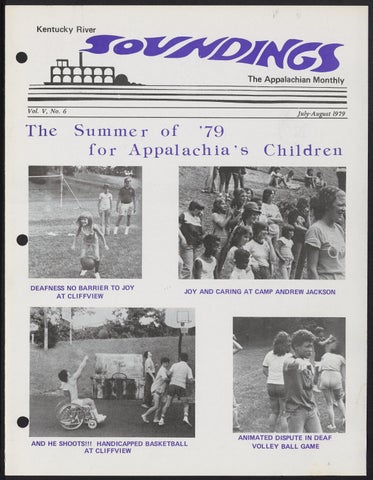
DEAFNESS NO BARRIER TO JOY AT CLIFFV IEW
July-August 1979
C hildren
JOY AND CARING AT CAMP ANDREW JACKSON
AND HE SHOOTS!!! HANDICAPPED BASKETBALL AT CLIFFVIEW
ANIMATED DISPUTE IN DEAF V O L LE Y BALL GAME
From t h e Well, despite the best layed plans of mice and men . . . we are behind schedule again. This issue will be a bi-monthly, and we may do that with the next issue also in order to catch up. The summer is a very busy time for many of CAP’s activities, and it is a busy time for ail of us with family responsibilities, too. Delays and other committ ments combined in such a manner as to get us off schedule and into this fix, but this issue, and the next several issues, will be loaded with information on those summer activ ities. !>r For example, the summer camp | | f Andrew Jackson was again a great success with both children and a fine staff of counselors this year. There will be an article in this issue on that subject, based on several visits and talks with a number of the staff members. Also, Reverend Beiting completed his long journey on the Kentucky and Ohio Rivers with a group of youngsters and I'm sure w ell be receiving an article or two on that subject from him. It must have been a fantastic experience for both the boys and Reverend Beiting. Our camp program for the handicapped also went off extremely well this year, both with scheduled groups and with several spontaneous sessions that were set up in a hurry with the unexpected arrival of small groups. These camps included both the physically handicapped and groups of deaf or hearing-impaired people at Cliffview Lodge on Her rington Lake. A work program for handicapped adults is growing rap idly under the skilled and energetic guidance of Jack Heyne, too, and it will be discussed in this issue. It has been an extremely hot and humid summer here, as it prob ably has been for many of you at your home places, too. When one is sweltering down in the valleys or more open country of the Blue Grass area, one can actually come to envy the people of the hill country with
2.
tack.” Also, we may be obtaining a new typesetting machine which will turn out copy more rapidly and error-free and make the whole p ro^ fc cess more reliable. This will alsc^^ ease the burden for Pam and Barbara at the Kentucky Valley because they won’t have to help Jean haul the present typesetter out to her car for her so often. So, until next month, or sooner if you write, sincerely:
E d i t o r ’s Desk their “natural air conditioning.” The plentiful shade and almost always present breezes of the mountains are quite cooling, even on the hottest days, and it is an escape to drive up into the hills of Appalachia and feel that coolness. It is also a pleasure, and even provides a “cooling” effect, to visit Camp Andrew Jackson or Cliffview Lodge and see youngsters splashing, swimming, or diving into the cool water. Somehow seeing these children of the hills enjoying the water on hot and humid days, even if you do not join them, provides a sort of air conditioning to your own well being. Even more so, I sometimes fegl, than if one were in a plush building with the thermostat set at 70 degrees. Of course, only one week of such cool pleasure for them, or the “natural” air-condi tioning of their mountain homes, makes but a slight dent in the many other difficulties that surround them. But, it is a dent and it is a pleasure to share in making it. Again, I would like to en courage you all to write and express your feelings about the content of Soundings, your monthly magazine, and to submit any poetry or prose you would like to share. In this issue we will have several poems sent in by Mrs. Clyde B. Bell of Gallatin, Tennessee. In submitting them Mrs. Bell was most humble and included a stamped envelope for her poems to be returned if “not suitable,” but actually, as I'm sure you ’ll agree when you read them, they are truly beautiful. They are much appre ciated, Mrs. Bell, and I'm quite con fident your fellow readers of Soundings will also appreciate their beauty and message. And so, I apologize for having failed to stay on schedule this sum mer, but promise that we will get there, one way or another. Once the children are back in school and things become more routinized, we’ll strive hard to keep things “on
Jack Little Soundings Editor Christian Appalachian Project Lancaster, Kentucky 40446
In this Issue: Camp Andrew Jackson Deaf Camp at Cliffview Part IV, Wilderness Road Outing for Handicapped Selection from *Fiddler 1 Poem, “Morning Medita tion ” TV Award for CAP Handicapped Work Pro gram Rick 0 ’Connell‘s “Silent WorldI
p .3 p. 7 p. 11 p. 13 p. 15 p. 15 p. 16
,i « p. 19
THE MONTHLY MAGAZINE OF THE CHRISTIAN APPALACHIAN PROJECT
Chief Editor - Reverend Beiting Editor - Jack Little Production - Alton Bradley Typesetting - Jean Brown
-
Kentucky River Soundings is published monthly b y the Christian Appalachian Project Kentucky River Soundings Lancaster, Kentucky 40446
Manuscripts, photographs and a rt^ ^ work limited to Appalachian themes are invited. Copyright 1978, The Christian Appalachian Project, All Rights Reserved.
Camp
A ndrew
I f any o f you, our readers, should ever happen to be in our part o f Kentucky during the early summer months, you must visit Camp Andrew Jackson. During a week, that is, when camp is in session. On weekends, the staff of counselors is all you'd find, but they, too, are a wealth of initiative, con cern, dedication, and real know-how in “bringing out” the youngsters of Appalachia. Their weekends, how ever, are frequently heavy with meetings to analyze how the past week went and making changes so the next week will be even better. The children arrive on Monday and depart on Friday, and it is during that time that the camp is a beehive of activity and enjoyment and growth. You might, as I did this summer, have occasion to find a ^oup of these mountain youngsters n an activity where one hangs back a little. In my case it was a young ster with his “Diesel Power” capseveral sizes too large - pulled down
Jackson S um m er
almost over his ears, hanging back from “lake swimming.” We said nothing to each other for awhile, just kind of sidewise “eyed one another over.” Then, when there were no counselors present, I kind of sidled over and mentioned that the swimming sure looked like a good way to cool off in the heat. This young fellow allowed as how that might be true, but he just didn’t “take to lake swimming much.” He said he’d heard of too many folks drowning thataway. Taking the cue, I mentioned “crick swimmin' ” and he really came on strong. Said he’d been “ crick swimmin ’ ” most since he could walk, and that was okay, but these lakes could be a mite dangerous. We talked more, and I found that his home was “half in Jackson County and half in Estill County. Built right on the county line it is.” We talked a bit more,.about a number of things, that young man and myself, but he symbolized the summer of Camp Andrew Jackson for me. (<Lake swimmin ’ ” and
1979
“Crick swimmin ’ ” are different, you know, but you have to hear it from one who lives the difference to really understand. ^4nd, I think, when you look at the pinched features of a youngster with that oversize Diesel Power cap pulled down over his head, you can grasp more fully what a week at Camp AJ means to these children of the hills. That’s one side of it, if you ever get the chance, from the way the kids see it. Another side, and one no less beautiful, is to talk leisurely with one or several of the counselors. Which means, absolutely, that you must talk with Ellen Burke first. She’s been the Camp director for several years now, giving a lot of continuity to the scene and con stantly improved operations, too. Ellen's philosophy of leadership at the Camp is a truly enlightened example of participative manage ment. She has to deal with a wide variety of people who have in com mon only that they want to give of themselves to the children of Appa-
(
FRESH AIR AND EXERCISE MAKE FOR GOOD APPETITES 3.
lachia for a summer. They come from all over: by bus from college in Massachusetts; hitch-hiking in from California; flying down - on unpaid vacation - from a nursing job in Minnesota; driving down during the open summer from a high school teaching job in New York; etc., etc. They come from all walks o f life, and make all kinds o f sacrifice so that they may serve, however, these youngsters. And they serve without pay in a most selfless, Christian manner. These volunteers come, how ever, with some very individualistic ideas of what is best for children in a Camp like this, ideas gained from their varying educational back grounds or experience with young people. Each and every one of them is most sincerely motivated, most dedicated, completely com mitted staff under Ellen’s leadership at Camp Andrew Jackson. On only one issue does Ellen readily admit that she tolerates no deviation, and I’m sure it is an issue on which all of you would agree, no doubt, and their enthusiastic, unselfish, tireless efforts to make the Camp a success are ample evidence of that. However, let’s face it, Ellen Burke is confronted with a staff o f 15 to 20 people, very diverse people, whom she must weld into a cohesive,
HOTDOG ROASTING TIME A FT ER PRAYER SER VICE
effective, but cooperative group keeps the well being and positive growth o f the children always fore most. And she does it. She does it with a beautiful mixture of Irish charm, first-sergeant-like authority when necessary, and, most impor tantly, projecting the sincere desire for contribution from each and every counselor. She feels, and makes it very, very apparent that she does
EVENING PRA YER SER V IC E CONDUCTED BY JACK MORRIS, CAP STA FF MEMBER AND MINISTER OF CHRISTIAN CHURCH 4.
truly feel, that each and every one of them has a personal contribution to make. Ellen is receptive to new ideas,to innovation when it improves things, and discourages nothing in^fe terms of staff recom mendationsSF Granted, it may not be implemented. But a staff member knows, full well, that his or her suggestion will be received, weighed, discussed, and sincerely considered. They respond accordingly, and you will find a That is safety !! Regulations are established for the duration of the Camp, and they are adhered to, absolutely, whether for swimming, hiking, boating, or any other poten tially hazardous activity. Ellen Burke, as Camp Director, states this very simply and explicitly, and I know of no one disagreeing. She is that way when it comes to critical issues like the safety of the children. In talking to various of the counselors, I always pressed the question: “What real impact does this Camp have on these children of the mountains? What does it do to them, for them? What do they take away from here?’’ Almost always! the answers follow the same theme^Mi The staff readily admits that th e ^ ^ cannot change a child’s life com pletely with just one week, but they can have considerable impact. “For
'' T"
I "*'* "* ¡¡¡I - I -
THE “COOLING" WATERS AT CAMP AJ
a week, at least, ”says one counselor, “they are loved, they are cared for and about, and they are expected to behave in certain ways. That is a period o f happiness for them. What |more could one hope to give?” Surely, there is a great educational experience along with the “happi ness,” and it is made the more meaningful because it occurs in “happy” surroundings. They learn a degree of self-discipline in eating habits, dental hygiene, picking up and keeping their living area and play area neat and clean. And they learn this not from harsh criticism poured on them in frustrated anger by the adults at Camp, but from patient counselling, guidance; and explanation. Also, carefully handled by the staff, the desires of their peers - the other children at Campmake it apparent that this is how it has to be for everyone to have a good time. It is good learning, we feel, and, to some extent, must be lasting learning. All this learning, especially the self-discipline, must be a direct reflection o f the dedicated and con cerned motives and behavior o f the volunteer staff. Youngsters do not readily submit, for example, to filing by in single file to sign in and then ■sign out when their group has its turn on the swimming dock. But
safety requires it, and they do so, readily. Oh, sure, there is some push ing and shoving and tickling and such in the line, but . . . no one tries to sneak by the sign-in point. They understand, because respon sible and conscientiousadultsrespect this procedure, that it is a proper and necessary procedure. That is the kind o f learning we are talking about. The kind that will result in, to whatever varying degree, a more
responsible, more conscientious, more self disciplined adult because of this experience as a youth. They learn, hopefully, that, as President Dwight D. Eisenhower once said, “Freedom . . . is the right and opportunity to practice self-control for the good o f oneself and others. ” Some might ask why we do not extend the age at the camp to in clude teenagers. Ellen Burke, who has accumulated a vast reservoir of knowledge about these children of the hills she has given her life to, has a ready explanation for that question. It is disconcerting enough for them, she explains, at the preteen age to understand how a woman can give directions and orders to male members of the staff. In their extremely conservative mountain background, this is unheard of in man-woman relationships . . As preteens, they will accept it, however incredulously, but as'they move into their teens it becomes a culturally imponderable and unacceptable practice. Such a little thing for us, but an extremely important facet of life for these youngsters. Hope fully, the fact that it goes on and nothing calamitous results from it will lead to a more enlightened future generation. But, for now, we must deal with this generation.
NO DIRECTIONS NEEDED ON WHAT TO DO WHEN HOTDOGS^AfiE DONE 5.
beginning o f the week and also afraid to go in the water. By the end o f the week, she was swimming by herself and inter-^k acting with the whole group. I was thrilled by her progress and I also felt that all my efforts were well worth it. ”
mm KEVIN WHITELAW AND BONNIE DEVOS, VOLUNTEER COUNSELORS AT CAMP AJ Each weekly group of children at - the Camp is carefully “graded” upon arrival by ages, and many of the following activities are con ducted accordingly. This is a cer tainly understandable practice when dealing with upwards of 60 young sters a week, but it is crucial in some of the activities at Camp Andrew Jackson. For example, in Bible Study, one counselor pointed out that with the older group of girls she would prefer not to have visitors during classr This very astute lady, who teaches high school during the normal year, pointed out that for girls at this age, Bible Study often becomes a way of defining individual and personal moral values for them selves. This being the case, a stranger present would severely limit the open-ness of their discussion. This is the attentiveness the staff at large, and individual counselors in partic ular, give to each and every facet o f learning that takes place at Camp Andrew Jackson. And this open ness, in the way the children respond to every and any question or direc tion from the counselors, is an al most always present atmospheric effect of the whole process. In summary, I would like to present the anonymous statements, written, of several of the counselors this summer, submitted at my re
6.
quest, and Ellen Burke’s order. They are only a part of the whole coun selor experience, but perhaps they will give you an idea of what an idea of what an adult counselor sees as the result of Camp Andrew Jackson: “Camp was one o f the neatest experiences o f my life. One camper represents what camp is all about to me. Donna Sue vjas shy and withdrawn at the
“Camp for me was a unique experience to grow in my understandingfor the Appalachian people I met, and how some o f them live. It used to be some thing I could only imagine, like going back in time, now I have had the chance to actually ex perience their situation. Their lifestyles, some customs, unique family experiences, all this I have shared. This for me has brought out my willingness to strive and attempt to under stand where they are coming from and not fill them with my own ideas. ” “The simple, “I love y o u ,” or bright smile from a child is theftik Christ that shines out to th^m world in honest, pure joy. I have seen and felt Christ more often in these kids than in any other time o f my life. I have experienced Jesus and I am thankful for that!”
VOLUNTEER COUNSELORS A LEX IS KOVACIC AND DETTA PRUIETT COMPARE NOTES AT COOKOUT MEAL
With words, and thoughts, such as that, readers of Soundings, I will leave you and Camp Andrew Jackson for this year. But I will extend again the invitation offered at the beginning o f this article, to visit this Camp i f you have occasion to be in our country in the early summer. Visit it, walk and talk and maybe hold hands with the children o f the hills during their week o f “hap piness,” or walk and talk with the so completely committed adults who give so selflessly, many o f them summer after summer, to make that happiness. It is no paradise, and now the blight of strip -mining threatens the beauty of .the land locked, hill-surrounded Sand Lick site of Camp Andrew Jackson. But it is, nevertheless, a heart-rending example of what joys can be wrought when one chooses to give to one's fellow man for no other purpose than creating something a little better on this earth.
C am p at
IF YOU COME TO VISIT AJ PERHAPS YOU 'LL JOIN IN A COOKOUT AS THESE COUNSELORS DO
Cl i f f vie w f o r and H earing
ONE GROUP OF DEAF CAMPERS WITH REVEREND DITMIER AT LEFT , A HEARING PERSON FLUENT IN SIGN LANGUAGE
Deaf Im p aired As you know, last year saw the tentative launching of a newprogram at Cliffview Lodge for deaf young sters under the enthusiastic and skillful administration of Rick O ’Connel, a CAP permanent volun teer. That first new beginning for Cliffview was highly successful, and this summer it was expanded con siderably. Cliffview hosted three groups o f deaf youngsters this sum mer, one group o f thirteen members and two more groups o f twenty-five members each. The major part of the program spanned four weeks, during which the grounds and boat dock were a bustle of activity and happiness for these young people and the CAP counselors. The activities were not at all confined to the Cliffview facility, however, and included a number of field trips to interesting locations in the area. For example, the group o f deaf youngsters visited the CAP Group Home for boys at Camp
Nelson and the boys really p ut on a full day o f entertaining activities for their guests. They took the deaf children on a tour of the farm, of course, but also held a hay ride for them, all kinds of sporting events, and prepared complete meals with all the trimmings. It is especially gratifying to see two such efforts of CAP mesh together so well, with the boys at the Group Home who come from various troubled backgrounds themselves putting out so much effort to please these deaf young sters and make their day a happy one. Some of the boys even learned a bit of sign language during the day, and communications were occuring between the hearing and non hearing before long at all. Another example of this ex change between CAP programs took place when a group of campers from Camp Andrew Jackson visited Cliffview on one of their field trips. Here we have one group Appalachian youngsters who come from a de prived, sometimes poverty stricken background interacting with ot^er youngsters who have a very differ-
DEAF CAMPERS AT CLIFFVIEW A LL DONE UP FOR "CIRCUS NIGHT"
A 'YOUNG LADY' AND 'OLDER MAN' DURING DEAF CAMP 8.
ent, but no less stifling, form QfWjjj) deprivation. Again, the exchange between the two groups was a joy ous thing to watch. It is always interesting to watch two groups of youngsters who do not know one another come together and kind of "feel each other out" with tentative smiles, introductions, and nervous laughter. The whole scene is even more touching, however, when one of those groups comes from poverty and undoubtedly feels a bit deprived and the other group must bear the . burden of not being able to hear or communicate normally. All went extremely well, though, and the counselors at Camp Andrew Jackson said that their young people came back after the trip demonstrating that they, too, had learned some sign language in meeting the deaf group at Cliffview. The beauty and Christian spirit o f people in general also came out during these tamping sessions fo r^k^ the deaf children, both in the i m ^ mediate neighborhood o f Cliffview and on field trips. At the Cincin nati Zoo, for example, as soon as
the management there learned that the group was made of deaf children th e y \ would not allow anyone to pay. In fact, it looks like the group was given a “special” tour of the Zoo. Also, at the Fort Knox Patton Museum, the same immediate, open, lovinb attention was given to the group when the people there real ized all the children were deaf. They, too, went out of their way to see that the group had a com plete, and unhurried, tour of the museum. Many of the neighbors in the Cliffview area are fairly well-todo people with summer homes or year-round homes on Herrington Lake. Most of them also showed a most Christian attitude toward the groups of deaf youngsters, and were very receptive of the w hole.idea. A nearby farm was toured, and the children showed a great deal of sensitivity toward the farm animals. The owners of the farm also went out of their way to make it as in teresting and pleasant a visit for the children as they possibly could, and begged the group to come back again. The group visited the Dix River Dam, and again the people there were most gracious and helpful to these deaf youngsters. A complete and detailed tour of the whole dam complex was provided, with plenty of time for information to be inter preted into the sign language for their guests. The children were encouraged to ask questions of any thing about the dam and its oper ation, and they did so. The dam operators were very patient in answering these questions about sluiceways, flood gates, various water levels and what danger each level means, and the safety of the dam itself. They even developed on-the-spot signs and gestures to explain various things to the chil dren, to supplement the sign lan guage of the interpreters. Again, Christian concern for one’s fellow humans who have an additional cross to bear through life is very much alive, and one can see it on their faces and in their actions when ac companying a group like this. In addition to the field trips, guest lecturers or speakers volun
tarily came to Cliffview for some highly educational presentations. A lifeguard came and gave a very de tailed and comprehensive talk, with demonstrations, on all aspects of “water safety,” both for swimming and boating. This was very enthu siastically received by the group, with many questions and requests for repeated demonstrations, and will undoubtedly be a very bene ficial bit of knowledge for them with their hearing impairment. Also, one of the Golf Professionals from the Danville Country Club came and gave a talk, demonstration, and practice sessions for the youngsters in golf. This, too, about a sport which is quite popular but not gen erally well understood, was warmly received. For each of the groups the counselors had a “circus night,” where the children were asked to put together various comical or per formance routines as part of a cir cus. These activities stressed pan tomime and gesture, of course, so that all could grasp the meaning and theme of whatever was being done. A highlight o f this was a girl who has cerebral palsy as well as being deaf, and she was able to master baton twirling as part o f her act.
An accomplishment that was loudly applauded by all present, other children as well as counselors, be cause they knew it had taken a lot of concentration and determination on her part. I asked about the one group which put on an act of the popular Rock Band Group, “KISS,” as to how they could respond to music without being able to hear. Rick O ’Connel assured me that, though they cannot “hear” the music as you and I can, they can “feel the vibrations.” Also, the pantomime and gesture emphasis is what really comes through in a presentation like this. All of these circus-night shows were video-taped and then played back for the kids so they could see themselves on TV, a rare but very valuable experience for any youngster. Other activities included a brief, interdenominational Bible School session, where the story was given to the children and they would then “„act it out” in showing that they had indeed understood the story. Their “playback” in pantomime and gesture showed a tremendous sen sitivity and grasp of the story, de spite the fact that it was presented to them only in sign language. There was also a “Family D ay” on one
AND HERE IS “ KISS“ !!! TA LK ABOUT PANTOMIME AND GESTURE
9.
Sunday, where the families o f the children came to Cliffview with the youngsters and had an outing to gether. At this “Family Day” ses sion, emphasis was placed on mothers, fathers, brothers and sisters interacting with their deaf child, showing love and affection and a desire to communicate with him or her. Rick considers this intra-family interaction a crucial factor in how well a deaf child does in adapting to their impairment and in devel oping skills to cope with “hearing world. ” He commented on one little 8-year old girl, who became the “Shirley Temple” of the camp for the counselors, as being far more advanced in her ability to commu nicate than several much older children. One reason for this, he feels, is that there is a tremendous love for her in the family and the mother had her daughter in a pre school program for the deaf when the child was only 3-years old. That is, a loving family like that is deter mined to give their child every break possible in dealing with the problem, rather than trying to ignore it or be embarrassed by it. As evidence of this love by the family for this little girl, she cried at night out of home sickness even though she dearly loved camp and all the counselors loved her. In addition to this, her father called Cliffview every day to ask how his daughter was doing. Rick O’Connel, though very pleased with the way this summer's deaf camp went, is always attentive to improvement. He plans a special introductory course for counselors next year, before the children begin arriving, in the “psychology o f Deafness. ” He points out that there is a significant difference between youngsters who can hear and com municate normally and their broth ers and sisters who are deaf. The counselor, to be completely effec tive, must understand this and deal with the kids accordingly. It is absolutely incorrect to assume that “they’re just like any other little kid, except that they can’t hear,” Rick explains. The fact that they cannot hear or talk has a profound effect on the way they think, also. 10 .
ONE DOES NOT HAVE TO HEAR TO ENJOY HERRINGTON LAKE
In further explaining this, Rick points out that, because o f deafness, they think in much more concrete terms than in abstract ideas. The deaf person grasps “whole concepts” rather than separating something in to many details, perhaps because o f a more restricted vocabulary in sign language. Their attention-span for someone to communicate with them is also quite limited, and if one wants to get a message or idea across, it must be done quickly with only the “essentials.” They just do not think that way. They also have difficulty in cross - symbolicalrelationships, that the average child picks up immediately. As a perhaps too-simple example, one can spell p-e-n-c-i-1 with the alphabet signs, give the sign language gesture for pencil, and then write out the word pencil on paper. But the deaf child will not necessarily link-up these three different ways of saying “pencil.” It seems as if, for some reason, they communicate different ly and think differently with each of „the three different ways of ex pression: alphabet signs, sign lan guage, and the written word. Rick feels that counselors have to under stand these differences to be effec tive in dealing with deaf youngsters. Such young people are also, for some reason, extremely sensitive to any evidence o f unfairness or in justice. Not in terms of favoring hearing people over themselves, but between one deaf child and another.
They are very, very sensitive about anything that could be interpreted as unfair, or imbalanced treatment within the group, not just towards oneself but toward anyone else in the group. If, for any reason, a counselor appears to be favoring one child over another, all others in the group will immediately point it out and be openly critical of the act. There is a parallel intense dislike, which I personally consider healthy, for any form of cheating. Rick says that any cheating in a game or activity o f any kind will be immedi ately picked up by and severely criticized by these deaf children. That, I think, we could use more o f for the society at large. All in all, however, this sum mer’s program for deaf children at Cliffview Lodge went off very, very well. In fact, Rick said that many of them cried when they had to leave the camp, and not just girls. Even teen-age boys, to whom the masculine image of toughness and not showing emotion is very impor tant, cried openly when it was time to say goodbye to the counselors and one another. That is not an enjoyable aspect of the camp, but it does make it obvious that we were doing something right and that we did, in fact, give these deaf young sters a week that they will not soon forget. And, as we can say to most of them, “come back again next year, and it’ll be even better.”
PART
IV,
WI LDERNESS ROAD
Chapter 10 THE CIVIL W ARCONCLUDING DAYS The war between the states was now more than half over. Of the two men that sat in that hotel room in Cincinnati, Ohio, planning how they could keep their states in the Union, only one was still alive. General Samuel Carter was very active and his dreams of saving East Tennessee for the Union were very much in evidence. General William Nelson was dead, shot by a fellow officer at the Gault House in Louisville, Kentucky. The Christmas of 1862 had come and gone. It was now De cember 28. General Carter was stationed at Crab Orchard, Ken tucky. He sought to obtain a troop |of calvary that he could use for a great raid into the Tennessee hills. It was General Carter’s hope that he could free this section for the Union cause. He asked for 3,000 men. The final number was 980, but permission was granted. His road to battle was the Wilderness Road. He left Manchester going through London and Barhourville until at last he came near Cumber land Gap. He bypassed the Gap and fol lowed the old Wilderness Road through a tip of Tennessee and then into Virginia. He was successful in capturing a number of Confederate soldiers whom he had to immedi ately parole because he had no means of taking them back behind Union lines. He destroyed a great amount of enemy supplies and created unbelievable havoc behind the Confederate lines. After his foray into Confeder a te territory he returned to his starting place at Manchester. The exploit was one of great daring. He was gone for five days and seven teen hours. His troops had traveled
over 470 miles during the five days. They had less than thirty-six hours o f rest, but he got back safely with nearly all o f his forces intact. The fatigue was so great on the part of his men and horses that many of the horses dropped dead in their tracks and even one of the soldiers came back frozen in the saddle. It was the recurring dream of General Carter to cutoff East Tennessee and the tip of Virginia from the Con federacy. He intended to disrupt the rail lines until he could make that area a part of the Union once again. Final success in this would have to wait for more than a year. The Wilderness Road had, however, played an important role in keeping this dream alive. After Carter’s raid into East Tennessee that once again utilized the Wilderness Road nothing more occurred along the road until August of 1863. The Union forces had a new commander in the Kentucky area and his name was General Ambrose Burnside. He was an impressive looking gentleman with long whiskers coming down the side of his cheeks. Later generations described any growth of hair a man had on his cheeks as “sideburns” as a tribute to the new fashion introduced by General Burnside. He was instructed by the War Depart ment in Washington to take Cumber land Gap and to do so as soon as possible. One of his junior officers, Colonel John Fitzroy De Courcy, was ordered to leave Crab Orchard where he was bivouaced with his troops, and march on Cumberland Gap. The main force, however, o f Federal troops was to bypass the Gap and head deep into East Ten nessee. De Courcy was to lay siege to Knoxville and capture it. Burn side himself would be in charge o f that operation, and would be accom panied by General Carter. It was on August 25, 1863 that De Courcy moved out of Crab
Orchard and began his march along the Wilderness Road to Cumberland Gap. His report contained a contin ual list of complaints. His troops had no more than thirty rounds of ammunition. Two of his cavalry regiments had no revolvers at all and many of the artillery batteries were poorly equipped. There weren’t even blank cartridges for the shells. Frequently, he was low on supplies and at times had less than four day’s rations for his troops. De Courcy went south from Crab Orchard to Brodhead and Mt. Vernon and came to a little settlement called Pittman some three miles north of London. When no supplies reached him, De Courcy left London and headed on to Barbourville. From there he marched on until, he was at a point some five miles north of the Cum berland Gap. He was now in plain sight o f the Confederate’s defenses at the Gap, but realized that he had little hope o f capturing the Gap by frontal attack because his manpower was small and his ammunition supply was extremely low. Since he had still not been reinforced, strategy was his only recourse. He had his men march past in formation in sight; of the Confederate defenses at Cum berland Gap. As soon as they got out of sight they were instructed to climb the hill and quietly slip through the forest and come back and repeat their march again. Some of the troops marched as many as four times past the Confederates, giving them an impression of a much larger force. In the meantime, General Burn side and Carter had captured Knox ville and they were heading north to take the Gap from the South. The Confederate troops were under the command of General Frazer. They were fairly well equipped and had food supplies for at least a two month period of time. Frazer was confronted by a demand of surrender on the part of Burnside’s army from 11.
the south and he was also under siege by De Courcy on the north. The first request for surrender came on September 7 and he rejected that. On the eighth, De Courcy repeated his request for unconditional sur render and Frazer sent one of his Lieutenants to negotiate with the Union troops. De Courcy had the wisdom to send back with the Con federate Lieutenant four gallons o f whiskey with the hope that it would be a welcome relief for the Com manders o f the defenses at Cumber land Gap. The deadline for surrender had been set for noon on September 9. Perhaps fortified by the whiskey that had been sent to hirh by the Union Commander, Frazer was now convinced that furtherresistance was useless and he offered to surrender to De Courcy. De Courcy entered the fortifications of the Gap fol lowed some hours later by Burnside and his staff. The capture of the Gap, how ever, was not without its sadder moments. More than four hundred of the Confederates had escaped through the woods and taken many of the supplies with them. Burnside was incensed over the slipshod way, which in his opinion, De Courcy had acted. Instead of receiving ac commodations for his capture of the fort with his inferior forces, De Courcy was placed under arrest by General Burnside and ordered to face a court martial. He was later cleared of the charges and resumed his active service. Jefferson Davis, President of the Confederacy, could not for the world of him understand how Frazer could surrender one of the most important forts of the south with out firing a single shot despite the fact that he had superior manpower and an adequate supply of ammuni tion. Once again the Wilderness Road had served as an important means of furthering the cause of the Union in the process of the Civil War. By January o f 1864, General Ulyssess S. Grant had been ap pointed by President Lincoln to command all the Union troops o f the west. This gave him, o f course, direct command o f all the forces in 12 .
Kentucky and their penetration in to Tennessee and areas south. Gen eral Grant shared the vision that General Carter and General Nelson had first developed at their meeting in Cincinnati. He saw the great importance o f the Wilderness Road as a means o f bringing troops into the east Tennessee area and perma nently splintering that segment o f the Confederacy from the Armies o f Virginia. Grant was a direct man and felt that a personal inspection of the road was the only way he could gain adequate knowledge of whether such a campaign was pos sible. He hoped to bring troops out of Camp Nelson and other forts in Kentucky and lead a major army down into East Tennessee and Vir ginia. On the afternoon of January 6, accompanied by half a dozen or so companions he left Knoxville and had his first view of Cumberland Gap from the Powell River Hill. Grant was so impressed by the im pregnability o f the fortress that he commented that with two regiments o f the army o f Cumberland, he would be able to with stand Nap ole on and all the soldiers that he used on the march to Moscow. It was an ambitious statement but it certainly shows the importance that Cumber land Gap held for all the military commanders at the time. After inspecting the Gap and spending the night at the fortifications, the gen eral swung into his saddle and rode north out of the Gap on January 1! He was now following the Wil derness Road to see if it could support a heavy supply of troops and ammunition. Grant’s hope that the road would be a major factor in his campaign to eliminate the Con federate presence in Tennessee and Virginia, however, was badly shaken by what he saw. The ruts in the road were frozen so deep that it was now impossible to draw a wagon along the road. Every few yards they came upon the dead body of a horse or mule. Broken wagons were strewn in all directions. A soldier who accompanied him had counted 258 dead animals on a fourteen mile stretch of the road that went from Cumberland Gap to the fork
of the Cumberland River and Pineville. “There were enough broken and abandoned wagons,” he said, “if they were placed end to end they would take up the entire four teen miles.” Grant spent the night of Jan uary 7 at Barbourville and the next day headed out once again on the northern route. He came to Hazel Patch and turned right on the road that Boone had originally laid out, and proceeded north beyond Mt. Vernon and came to the craigy out croppings of Big Hill. Grant spent the night at Big Hill at the residence of Merritt Jones. This building still stands at the base of Big Hill. The sight o f the road at Big Hill, how ever, was probably the final blow to his plans for using the road. Great gulches had been washed into the road at Big Hill, sometimes thirty feet deep. Once again, he saw the debris o f countless broken wagons. Long lines o f dead horses and mules told the unhappy story o f the dif ficulties the road presented for any concentrated movement o f troops and supplies. From Big Hill, Grant went on to Lexington. By the time he reached his destination he had completely abandoned any idea that the road could be used for a major military campaign. It is ture that he had seen it under the worst possible set of cir cumstances, but his knowledge as a military commander told him that even in better times it was no longer in the condition necessary to sup port large amounts of traffic. Grant was appointed Commander-in-Chief of all the Union armies in the spring of 1864. He turned his attention now full square on Virginia and on Lee. His major offensives would be aimed at Rich mond and the Army of Virginia. The area in Tennessee would have to wait. The story of the Wilderness Road and the part it played in the Civil War was now at an end. The Union Forces were taken out of East Tennessee and only a skeleton of their former presence was seen. The war stretched on for nearly another year, but the Wilderness Road was no longer even considered as a part o f this monumental struggle between brothers in a free country.
0 u titig
£ o'i
f a t i d i c a ftfi e d a
t
A YOUNG LADY ARRIVING FOR A DAY OF FUN
Originally, the Christian Appa lachian Project extended an invita tion to the Cardinal Hill rehabili tation Hospital in Lexington for a week of recreation activity in a Christian atmosphere. Unfortunate ly, due to a lack of medical staff for special needs of the orthopedically disabled patients, a w eek’s stay was impossible, but the resultingtwo-day stay was still a joy fo r all concerned. Cliffview Lodge on Lake Herrington, recently restructured to accomodate all forms of orthopedically and otherwise handicapped persons, was the CAP location for this more-thanjoyous occasion. That is, Cliffview Lodge is now architecturally free to the handicapped, regardless of what their orthopedic disability might be. Wheelchairs, walking-assists, canes, or any other form of physical ambulatory aid will find easy access to any corner of Cliffview, and will find that up-and-down transition of Ithe stairs and ramps there is wellprepared for their movement. It is, in other words, what C.A.P. and its many welcome volunteer laborers wanted to create for these, our less
fortunate but no less motivated or determined brothers and sisters. A recreation area where the limitations placed on people by physical or other handicap is not a deterrent to enjoying life, and others, and God’s
£ £ o d g e creation. The first day twelve children, from the age o f six to thirteen, visited the Camp at Cliffview Lodge, A special bus with a wheel chair lift brought these handicapped, but dynamically enthusiastic, campers to our beautiful site on Herrington Lake. Initially, a brief orientation period was spent in introducing campers, hospital staff, and CAP personnel present for the days activi ties. Following that, a tour of Cliff view Lodge was conducted, to orient all involved on what was available, and unavailable, at the site. Fol lowing the tour, there was a series of activities to provide therapeutic recreation as well as a warm and Christian welcome to all these youngsters. The activities started with a pontoon ride on Herrington Lake and, though the water was quite calm, it was obviously a great thrill to these youngsters and to the CAP personnel involved. Then there was time for fishing from the boat dock at Cliffview and, though the catch was not real impressive, the fun and
JACK HEYNE (SHIRTLESS) , CAP HANDICAPPED PROGRAM DIRECTOR, ENJOYING A LIT T LE BASKETBALL, TOO 13.
experience of it was most definitely enjoyed by all. From the fishing dock the group went back up the ramp to the asphalt parking area where a vigorous game of basket ball was played. To see young people maneuvering wheelchairs at breakneck speed, passing and work ing the ball in close for a shot, and shouting at and cheering one another is a sight to remember. Basketball is generally accepted to be one of the most vigorous and demanding of American sports, and these young sters clearly demonstrated that though handicapped in one way or another, they are very much Amer ican in drive and vigor. A session of archery followed the basketball game, and this ancient form of mankind's efforts at hunting and sport with bow and arrow was also much enjoyed by the young sters. Even for a novice there is somehow a strong feeling of con fidence in propelling an arrow with speed and some accuracy toward a strawfilled target. Then came volley ball, and again the wheelchairs moved swiftly forward, backward, and with quick turns left or right to keep the “volley” going. Finally, to.“settle down” before the evening barbecue, there was a relaxed time of just sitting and talking, with one another and several CAP counselors. There was talk of the days activities, the competition of the sporting events, luck in fishing, and just about life in general. Barbequed over charcoal were hamburgers and hotdogs, and then salad and baked beans and all the trimmings were added and the group had a most festive evening meal. By the time the day had come to an end, the campers were tired from the sun, the exercise, and all the excitement and new experiences of the day of Camp at Cliffview Lodge. It was, though, if you know what I mean, a “good feeling” of being tired, not the kind of feeling of fatigue that can result from a long, boring day of trying to en tertain oneself with TV or table games. The kind of fatigue that comes from a vigorous day of fresh air activity, fierce competition in sports, and interacting with one’s 14.
fellows on a plane of equal ability, and being helped and assisted - but not “babied” - by concerned people. That was CAP's objective for the day, and, judging from the expres sions and appearance of the young sters, we feel it was definitely ac complished. The bus left at dark to take the campers back to the hos pital or their respective homes. The second day nine campers came to Cliffview, with ages ranging from 16 to 55. Their disabilities ranged from spinal cord injury and strokes to physical handicap caused by brain injury. The activities of the second day followed the same pattern as the first day, except that the pace was a bit slower due to the wider age range. This is not to say that the enthusiasm was any less, but only that the frantic drive of youth was not so pronounced, just as it would not be with any older group. We of the CAP Handicapped Service Program were very excited over the enthusiasm shown by the campers, and shared a great deal in the joy and pleasure they had during these two days. To see people with disabilities such as these folks have, both young and old, enjoying them selves so completely is a truly re warding experience. And, in purely professional terms, it has tremendous
THESE GIRLS , LIK E MOST GIRLS, CHOSE TO MOSTLY WATCH
therapeutic value for the handi capped individual to be able to enjoy something like this and meet the challenges o f competitive sports and interaction with one ’sfello ws. Plans are already being developed to broaden the camping experience to more disabled outdoor enthusiasts. Next year we hope to have two weeks of camping activities rather than the two day experience 0 this year at Cliffview. We feel that the camping experience allows the disablec^p person to see the wonders and beauty■o f God's creation and to be come aware o f how God, man, and nature can live in harmony despite personal difficulties .
THE STORY OF TIMOTHY DEXTER Timothy Dexter was born in Maiden, Massachusetts, January 22, 1747. He came from a poor family and was apprenticed to a leatherdresser. When he became of age, he married a well-to-do widow who owned a house and some land in Newburgport. He built a tan yard on her land and used part of the house for an office. By hard work, he became fairly prosperous. He invested money in the Ohio Company, when, “any durn fool should have known he was throwing his money away.” How ever, the Ohio Company’s land sold well and Timothy Dexter became a wealthy man. He seemed to have a knack for making profitable blunders. Having started life very poor, on gaining wealth he was always striving to be recognized as belong ing to the “upper class.” There was much merriment among the “smart set” when he gave himself the title • o f “His Lordship.” Trying to hobnob with the wealthy ship-owners in the town, he let drop the remark. “ I have some extra money. What should I invest in?” Wishing to hoax him, they replied, “Why, warming pans, of course. They sell “like hot cakes“ in the West Indies.” The town fool could have told him that warming pans were used to warm the bed sheets on cold New England nights and would not be worth a “tinker’s dam” in the hot climate of the West Indies. Timothy didn’t ask the town fool. He bought up all the warming pans, he could find and shipped them to the West Indies. There, they sold “like hot cakes” as skim mers in making molasses. The lids made good strainers. With the proceeds of his cargo of warming pans, he employed car penters to build a fine sailing vessel. When his head carpenter told him that “wales” were needed, he asked an acquaintance, “What is a wale?” Seeking to have some fun, the man said, “Why, ‘wales’ are whale
bones. They need them for the ribs of the ship.” Timothy Dexter started buying all the whale bone he could find. When he had bought-up all the whale bone in the principal ports of New England, the carpenters and “men about town” had a good laugh at his expense. They laughed until it be came fashionable for women to wear corsets, laced with strips of whale bone. Who had all the whale bone? Why, Timothy Dexter. Seeking a cargo for his fine, new sailing vessel, he was advised to take a load of coal to New Castle. The town drunk would have told him that a useless task was often described as “carrying coal to New Castle” because that place in England was known the world over as a great coal-mining center. You guessed it. When Timothy’s ship reached New Castle, the miners had been on strike for several weeks. Sounds like the winter of 1978 doesn't it? Timothy’s coal didn’t bring sixty dollars a ton, but he did make a good profit. In another venture, he shipped a load of fur hats and coats to the tropical coast of Africa. When his ship sailed into port, a fleet of whaling ships were there, outfitting for a trip to the icy regions of the Antartic. When none of his profitable blunders had gained him the recog nition he so vainly sought, he de cided to become a writer. His Book. A Pickle for the Knowing Ones: or Plain Truths In A Homespun Dress by Timothy Dexter, came off the press in 1804. Everyone began
laughing about his book. He had written the whole book in one con tinuous sentence with no punctu ation marks. Capital letters sprinkled the pages for no particular reason. Timothy was never a man to give up; he had another edition printed. The last several pages of this edition were filled with: com mas, colons, semi-colons, question marks, periods, exclamation marks, quotation marks, dashes, brackets and capitalized letters with the com ment: “ Salt and Pepper to Taste.” I have faith that Miss Florence Brooks can help me improve my writing. However, my secretary says, “I’m not placing any bets that she can ever improve your use of commas.” Parts of this story are found in “Timothy Dexter’s Profitable Blunders from A Treasure of New England Folklore” pages 284-6, Edited by B. A. Botkin, Bonanza Books, N.Y. The balance from a long forgotten footnote in a college text.
Another selection from When They Hanged the Fiddler By: Jess Wilson Complete Volume, $14.00 Jackson County RECC McKee, Kentucky 40447
MORNING MEDITATION In the stillness o f the sunrise, when the quiet morning light, Breaks upon the earth, rewaking from the silence o f the night, My heart is filled with gladness, for the Heavenly Father’s love, And I pray for daily guidance, with His blessings from above. Mrs. Clyde B. Bell Gallatin, Tennessee 15.
CAP
W orker
MARILYN STEFANSKI Marilyn Stefanski, lon gtim e CAP volunteer and now employed as a Specialist in education for the handicapped pre-school children of regional families, has received a grant of several thousand dollars for her program. The “Parents are Teachers Program" which Marilyn administers, and which has been pre viously mentioned in Soundings, involves home visits and joint learning sessions by both parent and child. It is based on the fact that the best possible teacher for pre school handicapped children is the parent. Marilyn's grant request on be half of this CAP program read as follows: “The money is requested for the immediate purchase of special education materials and equipment for the home-based early-intervention program estab lished in January 1979 for preschool handicapped children in the Eastern Kentucky Counties of Lincoln, Rockcastle, and Garrard. Money from the WHAS TV Crusade would assist with the initial expense of establishing a “lending library" of materials and equipment for parents in the program. In addition to the obvious advantage of facilitating learning, it would free the home teacher from having to make most of the materials, thus allowing her to increase childfind efforts in the three-county area and allowing her to increase her caseload from ten to fifteen children and families." The Crusade, sponsored by WHAS TV of Louisville, Kentucky, 16.
W ins
is conducted annually, and this past raised over a million dollars which was distributed to some 90 different agencies. Monies raised by this Crusade are very carefully distributed according to the following guidelines and rules: “The WHAS CRUSADE FOR CHILDREN is dedicated to improving and enlarging the treatment, trainingandfacilities now available to mentally and physically handicapped chil dren through the age o f 18 now residing in Louisville, Jef ferson County, the Common wealth o f Kentucky and South eastern Indiana. “Crusade grants will not be made to relieve agencies o f responsibil ity for services they are al ready furnishing, nor to relieve them o f their inherent respon sibility to place their programs on a self-supporting basis. “Full responsibility for the allocation o f the Crusade funds rests with the members o f the WHAS “Moral Side o f the News” panel: Lincoln N. Bing ham, Pastor, West End Baptist Church; Donald J. Burke, Pastor, Highland Baptist Church; Msgr. Alfred Horrigan, St. James Catholic Church; Dr. Jo M. Riley, First Christian Church; and Dr. Herbert S. Waller, Rabbi, Temple Adath Israel-B’rith Sholom. “Grants will be made only for programs that can be launched reasonably soon, since money donated to the Crusade for Children must go to work for handicapped children as quickly as possible. *Grants will not be made for projects that are basically o f a research nature or are purely custodial in character. “Grants will be made only to non-profit agencies and organi zations and not to individuals nor for the benefit o f a single child. . “Crusade grants must be spent entirely for children in Ken-
TV
G rant
tucky and Southeastern Indi ana. No part o f a grant may be sent to a national headquarters with which a local agency may be affiliated. Grants to Louis ville, Jefferson County and Kentucky agencies are made only from contributions by the people o f Kentucky. .Indiana contributions are allocated soley to grants serving children in Southeastern Indiana. ” We are most pleased to see something like the WHAS Crusade for Children going on and, of course, that CAP is a recipient of some of the monies so raised. To see funds being raised each year like this, by contributions o f viewers o f WHAS TV in Louisville, reaffirms our faith in the Judeo-Christian ethic o f real concern for one’s less fortunate brothers and sisters. It shows that ethic is still very much alive!! It is also very pleasing to see WHAS TV of Louisville, part of a medium that is often much-maligned and at tim es| rightfully so for misleading our chil-^ dren and youth, doing something so selfless and meaningful to help handicapped children. As in so many things, “guilt by association" does not apply to WHAS TV in this most admirable, charitable, and explicitly directed effort to help, “these, the least of My brothers." We salute WHAS TV o f Louisville, Kentucky for this most worthwhile effort!! For her part, Marilyn Stefanski feels that this is a welcome relief in her administration of the program in that she will not have to spend as much time building, adapting, and fabricating special education mate rials. As she puts it, “I w on’t have to spend so much time ‘scrounging’ and at ‘handicrafts’ and can spend more time visiting parents of handi capped children and finding more who need help.” We have every confidence th at^ this $3000.00 will be used m o st^ effectively in CAP's “Parents are Teachers Program" for handicapped preschoolers under Marilyn’s dynamic and determined leadership.
We feel, also, that the program has a very good chance, therefore, of meeting another of the WHAS Crusade's rightfully stringent rules: M an agency receives a Crusade grant one year, it does not automatically follow that it will be given grants in later years. Each application is studied individually and will be considered along with all other applications. " The staff of the Christian Appa lachian Project feel a great deal of pride in this accomplishment of one of our programs, and hope that you all, without whom we could not continue, share in that pride.
fyPotJc
BABY JESUS Baby Jesus, born so lowly long ago in Bethlehem, Thou hast been for generations, Light, to guide the ways o f men. May thy star, so brightly shining, lead us in the paths o f peace, May each nation claim Thy guidance ‘till all war and strife shall cease. May Thy humble, holy spirit fill our hearts and lives today, That all men may be our brothers and Thy loving way our way. Mrs. Clyde B. Bell Gallatin, Tennessee
ijdci i<vit ieb
fiol ¿ t f a n d i c a ft ft e d
The Christian Appalachian Project is establishing Work Activ ities Centers for the handicapped in Stanford and Mt. Vernon to com pliment the Social Service Agencies presently serving Lincoln and Rock castle Counties. This is consistent with the philosophy of the Christian Appalachian Project o f “helping people help themselves. " If a handi capped person is given the oppor
tunity and appropriate incentive, that person will strive to develop a greater independence and, hence forth, be a more productive member of our society. The CAP Work Activity Center is located at the “Attics" (used clothing stores) in Stanford and Mt. Vernon, and utilizes a sheltered work environment as the best setting for handicapped workers. That is,
MACRAME PRODUCTION BY HANDICAPPED WORKERS AT STANFORD "ATTIC"
throwing such people into open competition with non-handicapped persons might be damaging to their competitive motivations, and they are therefore kept, initially, in com petition only with other handi capped personnel. As carefully defined by Jack Heyne, the CAP Handicapped Serv ice Program Director, a “work ac tivities center" means: a workshop, or a physically separated department o f a workshop having an identifiable program, separate supervision and records, planned and designed ex clusively to provide therapeutic ac tivities for handicapped workers whose physical or mental impair ment is so severe as to make their productive capacity inconsequen tial. " As Jack emphasises (and one should perhaps point out that he himself is confined to a wheelchair), this work activity is primarily for therapeutic purposes, with produc tion providing only secondary rein forcement. That is, the work per formed by these persons should be measured in terms of the added selfconfidence, increased self-esteem, and more socially matured person it develops, rather than the amount of tangibly measurable work they turn out. Please do not misinterpret this
purpose. These people do “turn out work,” and definitely measurable work, at that. But we at CAP, under Jack Heyne’s constant prodding, must always focus on the benefit such work has for the handi capped person involved rather than for CAP in general. This is a slightly different tack for us, but not at all extreme in diversity, since we have always emphasized that provision of jobs for Appalachians was intended to give them, or restore to them, their original sense of pride. This is exactly what provision of jobs for the handicapped is intended to do. The CAP Work Activity Center provides a shelter employment en-i vironment based on a concept of REAL WORK. REAL WORK is an activity essential to the productivity, operation, and existence of a bonafide business. REAL WORK moni tored under a low-anxiety, non threatening, controlled circumstance provides the handicapped worker a meaningful work experience. I'm sure that almost all of you know what that means but, just in case it strikes some as social science “gobbledygook,” let me. elaborate a bit. We emphasize REAL WORK. Okay?? That means simply that the handicapped person must fe£l that he or she is, in fact, providing a good or service by his or her labor that is NEEDED by society. The handicapped worker must not be given a job that is obviously “make work,” out of nothing, such as moving all these boxes from this side of the warehouse to that side, and then next week moving them all back to the original side. Such “make work” projects are immedi ately detected by most people, perhaps especially the handicapped, and they only feel more dejected, more useless, and more of a “charity case. ” That we do not need or want in our program of work for the handicapped. When we speak of “low-anxiety, non-threatening,” or “controlled circumstance,” all we mean is that competition will be equal. That is, handicapped persons will compete with other handicapped persons, thereby eliminating anxiety and threat. This is no more than saying that a heavyweight boxer will 18.
HANDICAPPED WORKERS AT MOUNT VERNON “ATTIC" COLLATING AND FOLDING COPIES OF "SOUNDINGS" not be allowed to fight a lightweight, because the competition would be unfair, unequal, and unjust. (I hope this explanation has been helpful, and not insulting, to you, our readers.) In our CAP Stanford “A ttic” store, such REAL WORK will con sist of: unloading a box of used clothing from trucks or other high way conveyance; removing the clothing from the box; making macramé hangers and other handi crafts for sale ; working in Attic as clothing clerk, shelver, or mainte nance person; polishing shoes, or mending and/or laundering clothing before display. In addition to these on-going REAL WORK activities, CAP's Handicapped Services depart ment is now identifying other work activities that may be included in the Work Activity program such as: repair of small appliances; recondi tioning and refinishing of furniture; and light assembly work related to small industrial contracts. Jack Heyne emphasizes thatthe Work Activity Center will not at tempt to be a Rehabilitation Eval uation facility, but rather a source of information for community agen cies on handicapped workers ability to perform work-related tasks. It will also report on their ability to
interact with co-workers and how they respond to supervision. Again, the PRIMARY PURPOSE o f this activity is therapeutic, not produc tion related. That is, we are most concerned with how this work ac tivity HELPS these people adjust to their disability, and not in how much it contributes to provision o f a good or service. Consistent with this philoso phy, some of the reasons for the work of these handicapped persons is outlined as: self-esteem, feeling of accomplishment and worth, status and dignity, adjustment to society, not being an economic burden, material benefits, independence, and fuller human development. In other words, We want only to help these people achieve that sense o f self dignity that we all aspire to, and that they have a little more diffi culty achieving because o f some accident o f life. They can achieve it, though perhaps in slightly lesser degree than you and I, if only given a little assist. To reinforce these reasons, we push certain traditional and con temporary beliefs and ethics re garding work in our society. For example, we emphasize that work is competitive due to human nature, and the fact that abilities or social
status determine which job one re ceives and what advancement is available. We also point out that “some people work, and some people don’t work,” for whatever reason or reasons. In other words, there are “producer/consumers,”and there are “consumers only.” As an adjunct of this, of course, it is made apparent that any viable, lasting, strong society must have a majority of “consumer/producers.” The handicapped person also learns that work is a normative, or “normal” experience, and that pro duction is a necessary outcome of REAL work. , It is made obvious in our program that the type of work, not a persons individual characteristics,determines a worker’s status, and that “work” in general is a formalized and structured ac tivity for most people. That is, WORK is a routine and predictable pattern of daily behavior for adult Americans who are making their own way in life. The value o f work is also pressed, as being a fundamental right ifor every adult. It should provide opportunities to use and develop one’s ability continuously, that is, to grow as a person and to grow in what one can contribute to society. Work, therefore, is a growth and learning experience, and not just a production function. Also, work should bring dignity, well being, some power, social responsibility, and a feeling of the need for co operation with one’s fellow human beings. Finally, work experience should fit in with other life experi ence such as learning in general, recreation, community living, and sharing of culture with other Americans. In other words, WORK should be part and parcel of one’s whole life experience, and not a separate, segregated, isolated fact of that life. There are, of course, some rather serious problems facing our handicapped people as we draw them into this Work Activity Pro gram. They often have little or no money to begin with, and lack adequate training for any future job placement. Too often, as imposed by our society at large, they see
little challenge in seeking or per forming on a job because o f various “care-taker ” social programs. This, and other things imposed by the dominant social forces, causes them to see little satisfaction in any work, and they have a profound feeling of limited growth potential. That is, they often suspect they are being given a “make work” job, and don’t really feel that they are productive members of society in any sincere sense. To overcome these “problems,” the CAP Work Activity Project places a great deal of emphasis on such REAL WORK things as: a 7 to 10 hour work day, depending on the particular nature of a person’s handicap; pay reflects performance on the job, or, more traditionally, “job work "scale rather than “hourly rated” pay in which an individual is payed for actual production in stead of just “putting in time;” clear separation of work from social ac-
H i cA
0
tivities, where an individual is payed only for actual production and not for being “a-nice guy or gal” to have around; supervision by craftsmen and producers who KNOW what the job is all about, rather than naive counselors; easily pleased by “apparent” hard work; and, finally, constant opportunity for evaluation, counselling as to strengths and weak nesses, and promotion to a better position where warranted by work performance. That is the objective o f our wofk activity program. A REAL WORK atmosphere with REAL INCENTIVES for handi capped persons to make their way once morel back into the ranks o f society at large. To paraphrase, if not plagiarize, another admirable organizations efforts and slogan: “not charity, but a chance!!” This is our hope for the handicapped of Appalachia, and we hope that you will support us in it.
n n e / lj
H k ic lip e
lo
a
BHB 11111kid m Rick, a longtime CAP Volun teer and chief instigator o f the rennaisance at Cliffview Lodge for the deaf and handicapped, is taking a leave o f absence this Fall. Surely, after a two year period of intensive work at Cliffview, much of it good old fashioned manual labor and much more in self-study of the signlanguage used by the deaf, Rick undoubtedly deserves a leave of absence. But, far from taking a taking a vacation, he will be devoting the Autumn and early Winter months in further pursuit o f one of CAP's most recent programs. He will be doing this by sharpening his skills, and psychological knowledge, in dealing with the deaf. The “leave of absence” that Rick is embarking on will be spent enrolled at Gaudalette College in Washington, D.C. This college is perhaps the only 4-year liberal arts college in the U.S. which is entirely for the deaf. Rick will be immersing himself in the non-hearing world, in
classes, in studying, and in social izing with fellow students who are deaf after classwork. He feels that this is the, best way to “really get into it and get it on.” Having taught himself on an almost entirely selfstudy basis enough of the deaf If you know someone who would like to receive the Soundings each month, have them complete this 1 form, enclose $4.00 for a year’s sub1 scription and send it to us. Or, if 1 you’d like to give someone a year's 1 subscription as a gift, complete the 1 form and send it in with $4.00 1 yourself. Name _________^ _________________________ .—_ — — ' Address
■
--------------------------------
( C i t y _________________________________Zip
-------------
Send to:
, Christian Appalachian Project. , Kentucky River Soundings , Lancaster, Kentucky 40446 19.
t
*
^
communication skills to run very successful camps for deaf children at Cliffview Lodge, he still feels unsatisfied. In conducting several camps and workshops in the summer of 1978, Rick felt that his skills and knowledge in this new Cf\.P endeavor were progressing rapidly, and they undoubtedly were. Then, with a more intensive program this sum mer, he began to feel that "there is so much more to know, to under stand, to be able to express,” that he felt a more intensive and ad vanced program of self-study was needed. He feels particularly con cerned, as is mentioned in another article in this issue, about being able to explain the “Psychology o f Deafness” to other hearing people who serve as counselors at the camping sessions. Many might feel that a psy chology course in this subject would fill the bill, but not Rick O’Connel. He will be taking such a course this Fall, to be sure. In his college study
of the Psychology of Deafness, how ever, all lectures will be in the sign language, questions he might ask of professors and answers given will be in “sign,” and discussion of the sub ject with other students will also use this medium of the silent world. Rick feels strongly that only by this complete immersion in the deaf world for a period o f four or five months can he truly understand, well enough to communicate to other hearing persons, what the Psychology o f Deafness is all about. And he is determined to truly under stand. We at CAP know beyond the shadow of a doubt that Rick, with his already obvious determination and dedication, will return to us in January much, much better qualified in dealing with the problems of the deaf. And, with equal certitude, that the deaf children that CAP's programs reach will benefit im mensely from his improved knowl edge and skills. We admire you Rick, and know you 11 do well.
RICK O'CONNELL
N O N - P R O F IT O R G A N IZ A T IO N U. S. P O S T A G E
PAID Christian' Appalachian Project
Christian Appalachian Project Kentucky River Soundings Lancaster, Kentucky 40446 N am e_________________________________________
A ddress_______________________________________
C it y ___________________________________ Zip____
20 .